Tag: Rybinsk World Cup

  • Russia’s Vylegzhanin Uses Teamwork, Fast Skis to Win Rybinsk 30 k

    Russia’s Vylegzhanin Uses Teamwork, Fast Skis to Win Rybinsk 30 k

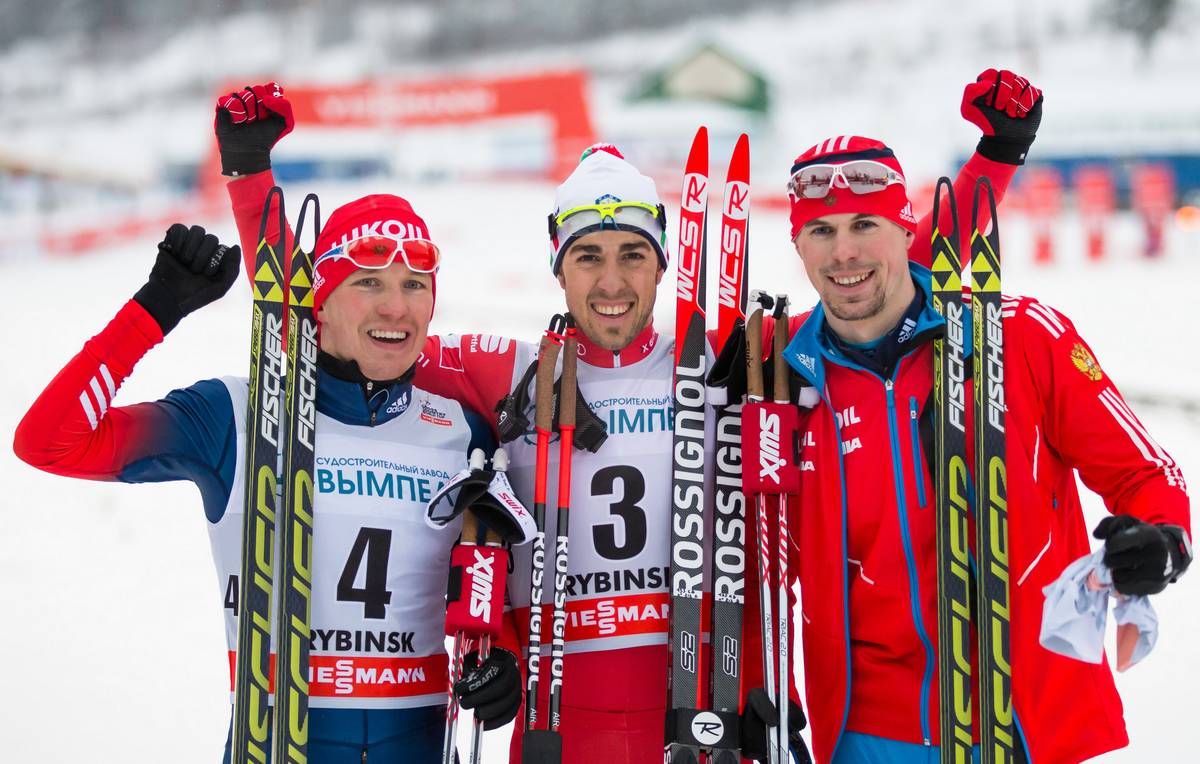
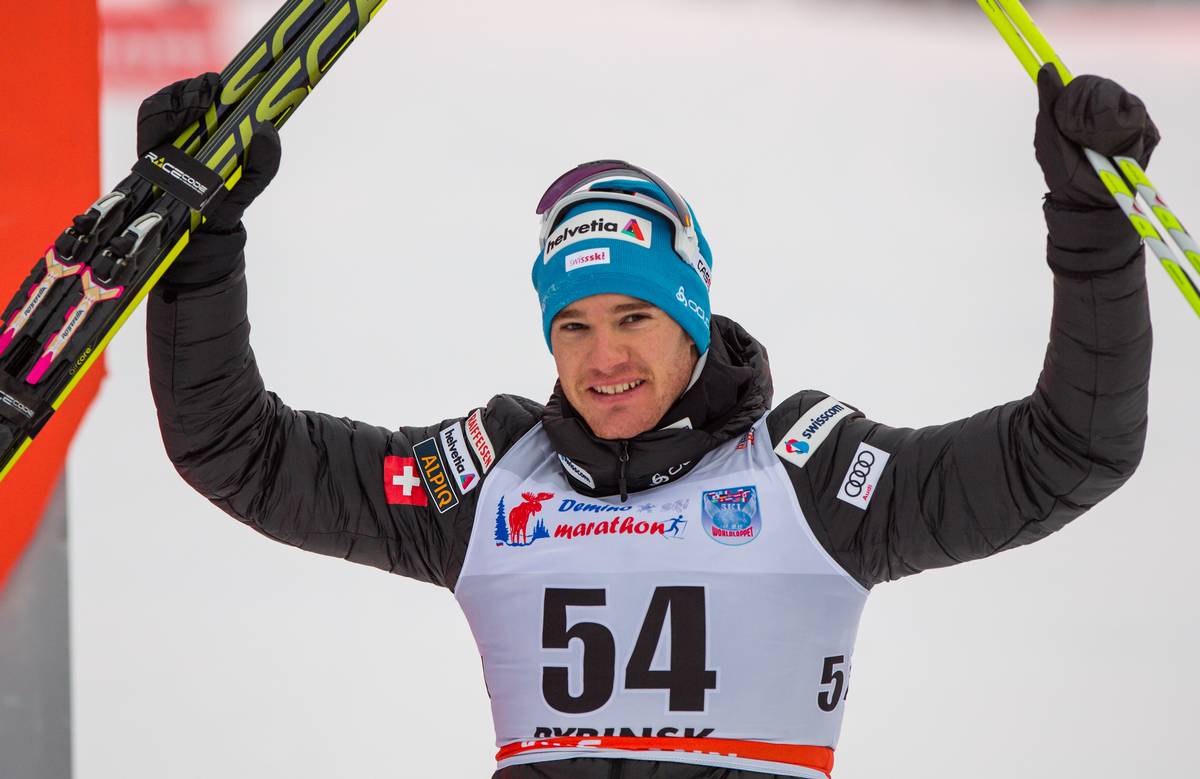
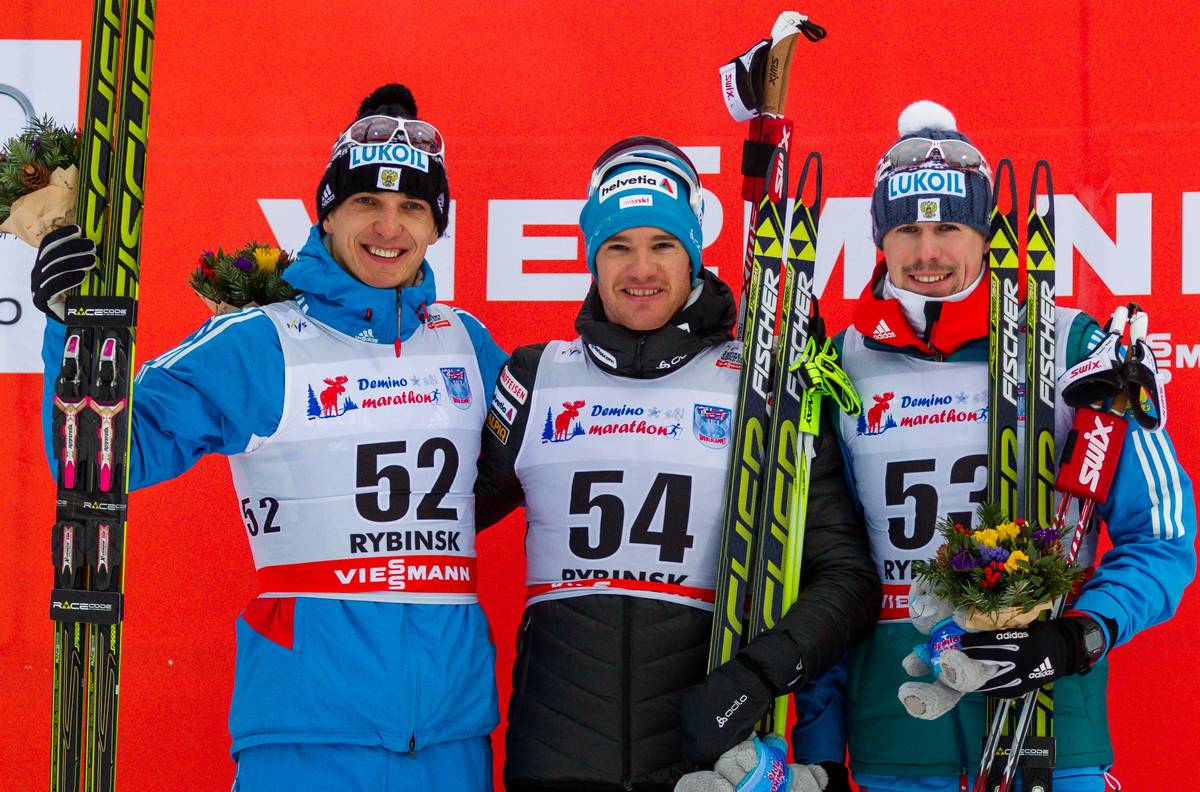
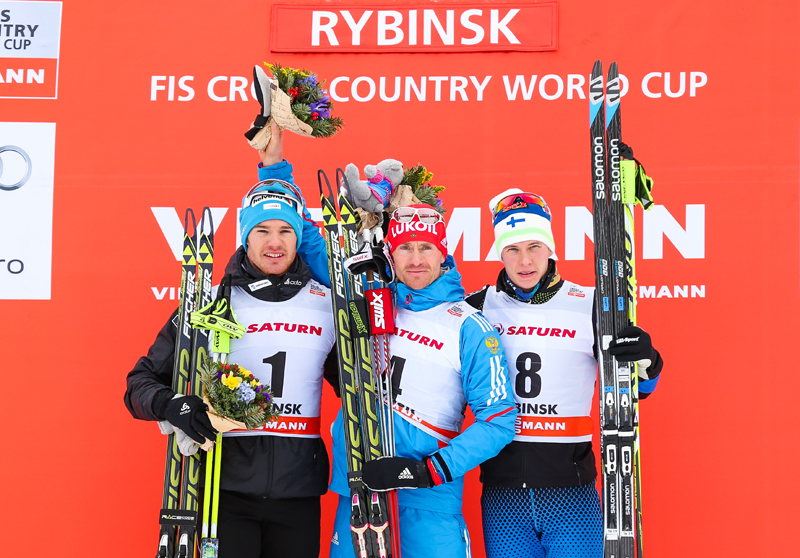
    The men's 30 k skiathlon podium (from l-r):Dario Cologna (SUI) in second, Maxim Vylegzhanin (RUS) in first, and Matti Heikkinen (FIN) in third. (Photo: Fischer/Nordic Focus)
    The men’s 30 k skiathlon podium (from l-r):Dario Cologna (SUI) in second, Maxim Vylegzhanin (RUS) in first, and Matti Heikkinen (FIN) in third. (Photo: Fischer/Nordic Focus)

    Although it isn’t an event that is common on the World Cup race circuit, the skiathlon one race Switzerland’s Dario Cologna has excelled in over the years.

    The last World Cup skiathlon was held at the 2013 pre-World Cup in Sochi, Russia, and used as a leadup to the upcoming Olympics. Before Sunday, Cologna had won the last four international skiathlon events he participated in, including the skiathlon at the 2014 Sochi Games, making him the favorite to win the men’s World Cup 30-kilometer skiathlon in Rybinsk, Russia.

    The 28 year old had also won more races in Russia than he had in any other country: two World Cups (including Saturday’s 15 k skate) and two 2014 Olympic events (the skiathlon and 15 k classic).

    The only problems were that this was a new year and he was up against a strong Russian team (among others) motivated to win on Russian soil. That was about all Russian national-team member Maxim Vylegzhanin needed in terms of headspace to outpace Cologna by 2.7 seconds on Sunday.

    The two athletes would became very familiar with the Rybinsk course by the end of the 12-lap race. After six 2.5-k loops of classic, they went head to head for another six loops of skating on a different 2.5 k course. Both courses included several climbs that could separate the pack or prove to be the perfect place for an attack. It was a relatively warm day with falling snow so nailing the wax for the classic portion was tricky.

    Early on, the race outcome appeared to be more in the hands of the wax techs than the skiers. Many athletes crashed and slipped during the first 15 k classic leg. The pace was extremely fast, which led several missteps. Cologna had an early scare in the first part of the race when he and Canadian Alex Harvey collided and both men fell. Cologna recovered, but Harvey ended up crashing three times in the classic portion. Several other skiers slipped up in the warm conditions as well.

    For the most part, the pack stayed together for the majority of the first half of the race. The lead rotated several times between Cologna, Vylegzhanin and several others, with every attempted attack countered and nobody distancing themselves from the front group. At one point, Vylegzhanin’s teammate Alexander Bessmertnykh and France’s Jean-Marc Gaillard attempted a half-hearted attacked that strung out the field, but their lead was quickly absorbed once the rest of the pack hit the downhill.
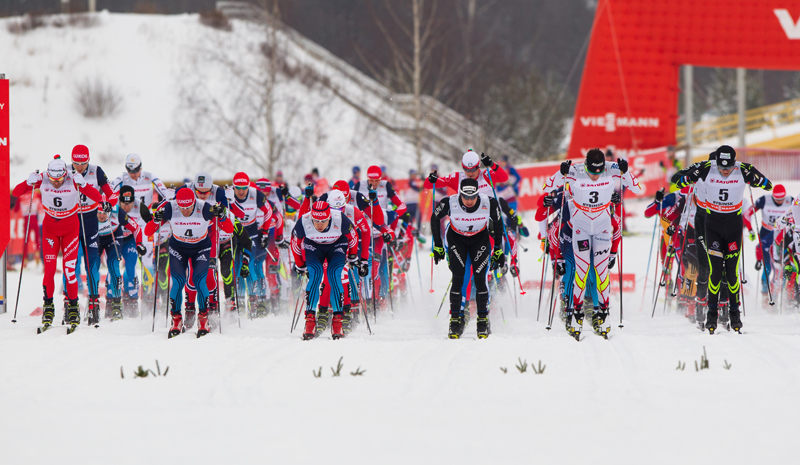
    The start of the men's 30 k skiathlon in Rybinsk, Russia. (Photo: Fischer/Nordic Focus)
    The start of the men’s 30 k skiathlon in Rybinsk, Russia. (Photo: Fischer/Nordic Focus)

    Heading into the transition,  a trio of Russians led the group into the corral. Stanislav Volzhentsev, Dmitriy Japarov and Evgeniy Belov arrived first in 43:14.5, followed closely by the rest of the group. The first one out onto the skate course was Russian Sergey Turyshev, who quickly set the lead pace while Japarov headed out 0.6 seconds behind, just ahead of some 20 others, including Harvey in 13th.

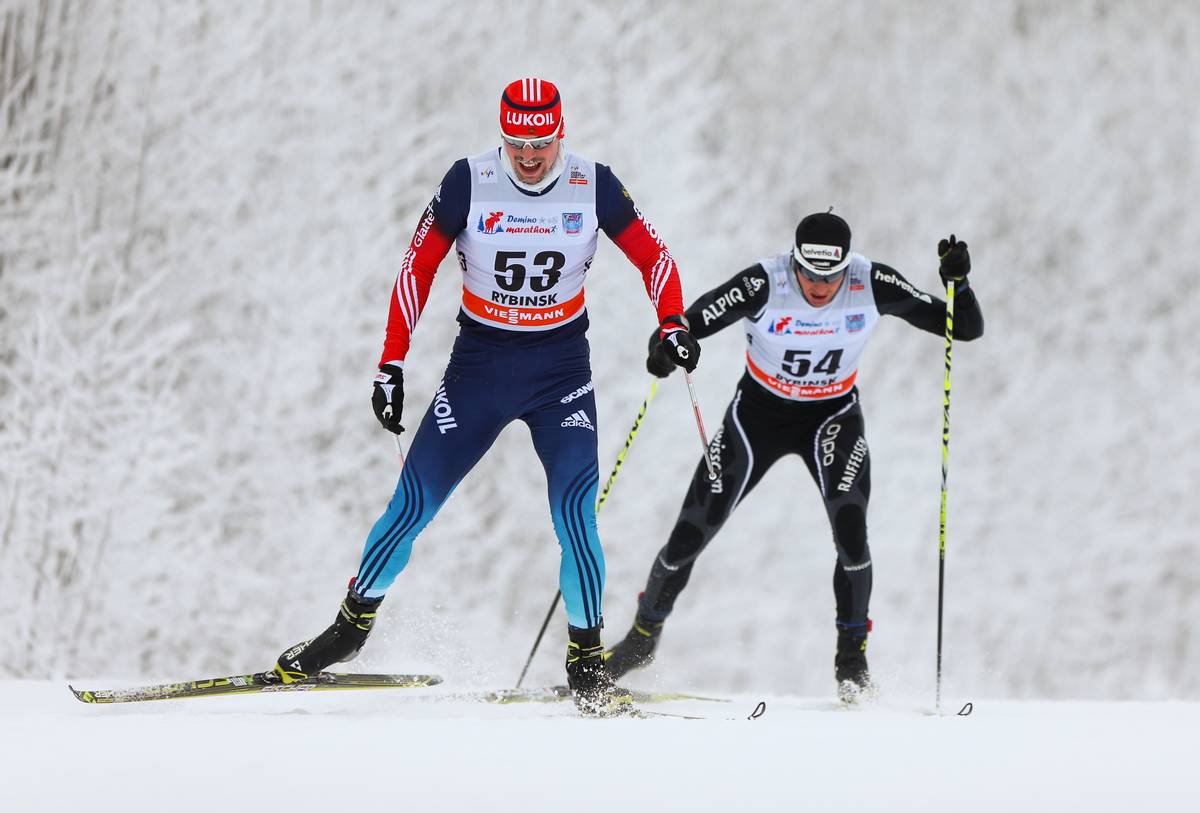
    Once the skate skis were on, the Russian skis appeared to be the fastest of the field. At one point, Russia’s Alexey Vitsenko launched an attack on the downhill and opened a sizable gap, skiing away from the chase pack. Which Russian would ultimately win or podium was unclear, but it was evident their skis were going to help them get there.

    Cologna noticed the difference.

    “The start of the race was very quick but in the skate it was not so fast; I realized that my skis were maybe not as fast as the Russians’,” he told FIS afterward. “So I knew that I needed to attack before the finish to make the group smaller.”

    Cologna’s attack came at the 25.9 k mark when he raced up the hill crossing the timing mat at 1:12:19. Vitsenko marked him closely and joined Cologna as he headed down the hill. Leading the chase group was Finland’s Matti Heikkinen, Gaillard and Vylegzhanin, who were flanked by Russians Alexander Leskov and Eugeniy Dementiev.

    The Russian teamwork ended up keeping Cologna in check and Vylegzhanin close to the front. Heikkinen skied a strong skate leg and found himself in prime position toward the closing segments of the race.

    Realizing his time to shake the pack was slipping away, Cologna gave one last push on the final climb. Vylegzhanin and Heikkinen anticipated his move and quickly latched on. This attack separated the three from the rest of the field and set up the battle for the podium spots.

    “I pushed very hard at the end, but Maxim and Dario were too strong for me,” Heikkinen told FIS.

    The change of pace left Heikkinen hanging behind the two leaders.

    As Vylegzhanin and Cologna approached the finish line, the switchback design of the finish gave Vylegzhanin time to overtake Cologna and cross it first in 1:21:54.8 for his first victory in a year since winning the 15 k classic mass start in Szklarska Poreba, Poland.

    “This is my first podium and win this season and it’s nice that it came in Russia,” Vylegzhanin told FIS. “The spectators are so great here. I had very good skis today and I am happy to the strongest at the finish. Thank you to the spectators, the organizers and of course my team for the great skis today. Russian skis like Russian snow!”

    Cologna finished 2.7 seconds back in second, and Heikkinen rounded out the podium in third, 6.2 seconds after Vylegzhanin.

    Although some the stronger skiers opted out of the Rybinsk World Cup weekend to prepare for the upcoming World Championships in Falun, Sweden, Heikkinen was pleased with his result.

    “Sure, some of the best weren’t here, but a race is a race and I focus on Falun so this is a was a great step,” he said.

    Russia put six in the top eight (sweeping fourth through eighth), with Volzhentsev in fourth, Chernousov in fifth, Konstantin Glavatskikh in sixth, Legkov in seventh, and Turyshev in eighth. Harvey placed ninth.

    As a result of his second-place finish, Cologna moved up into second place in Overall World Cup standings, 333 points behind Norwegian leader Martin Johnsrud Sundby, who did not race in Rybinsk.

    “I was hoping for another win here today … but I am happy with second place,” Cologna said. “It was a good weekend for me and I can see where my shape is.”

    Sunday marked the last World Cup race before a two-week break as athletes prepare for the World Championships, which start on Feb. 18. A World Cup will be held in Östersund, Sweden, the weekend before, Feb. 14-15.

    Results

  • Öberg Takes First World Cup Win, Diggins Claims Fifth in Rybinsk Sprint

    Öberg Takes First World Cup Win, Diggins Claims Fifth in Rybinsk Sprint

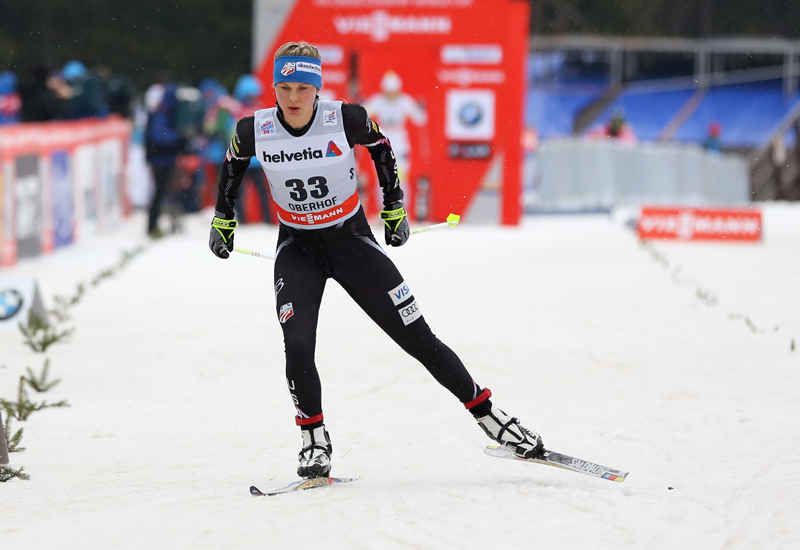
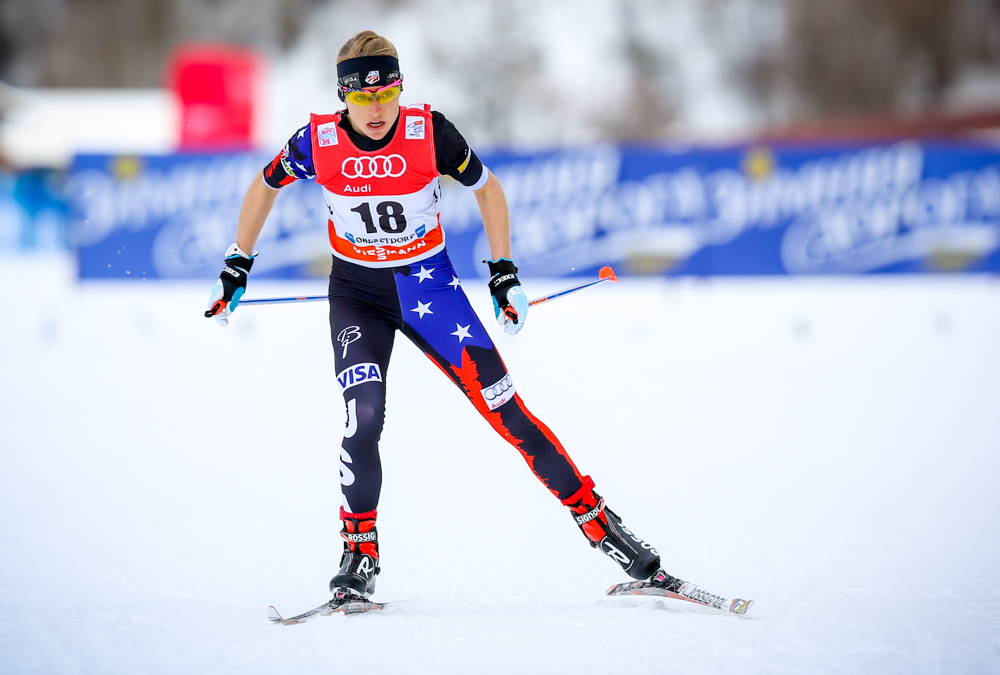
    Jessie Diggins (U.S. Ski Team) on her way to tying a World Cup career best of fifth in Saturday's 3 k freestyle prologue at Stage 1 of the Tour de Ski in Oberhof, Germany. She placed 18th in Sunday's freestyle sprint for 14th overall in the Tour through two stages. (Photo: Marcel Hilger)
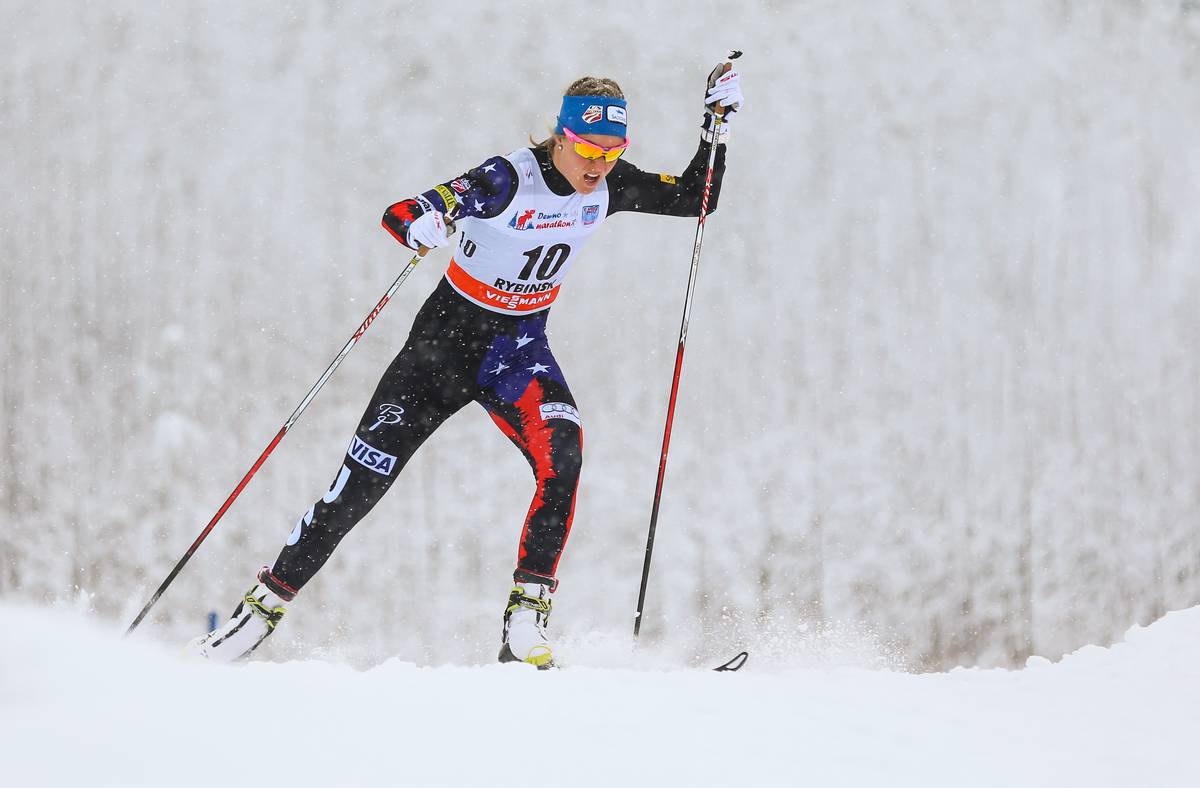
    Jessie Diggins earned a season-best fifth place in the 1.3 k freestyle sprint in Rybinsk, Russia.  She’s pictured here on her way to fifth in the 3 k freestyle prologue of the 2014 Tour de Ski in Oberhof, Germany. (Photo: Marcel Hilger)

    When Jennie Öberg of Sweden finished the 1.3 k freestyle sprint in Rybinsk, Russia she checked a few items off her bucket list – it was her first World Cup sprint final and her first World Cup podium. It didn’t stop there either, as Saturday’s race marked the Swedish skier’s first victory.

    The win came under challenging conditions, where skiers faced a soft, slow course due to heavy snowfall throughout the night and morning. Organizers attempted to harden the track between races to no avail, as the dry snow failed to respond to the groomer’s attempts.

    With the extra challenge, Öberg skied confidently throughout the heats and won the final with a time of 3:02.54. It was a close race for the top spot, with Natalia Matveeva of Russia just 0.48 seconds behind the Swede. Switzerland’s Laurien van der Graaff (+0.76) won a photo finish over Anastasia Dotsenko (+0.78) of Russia to take third. American Jessie Diggins (+5.63) and Norwegian Silje Oeyre Slind (+11.17) rounded out the final in fifth and sixth.

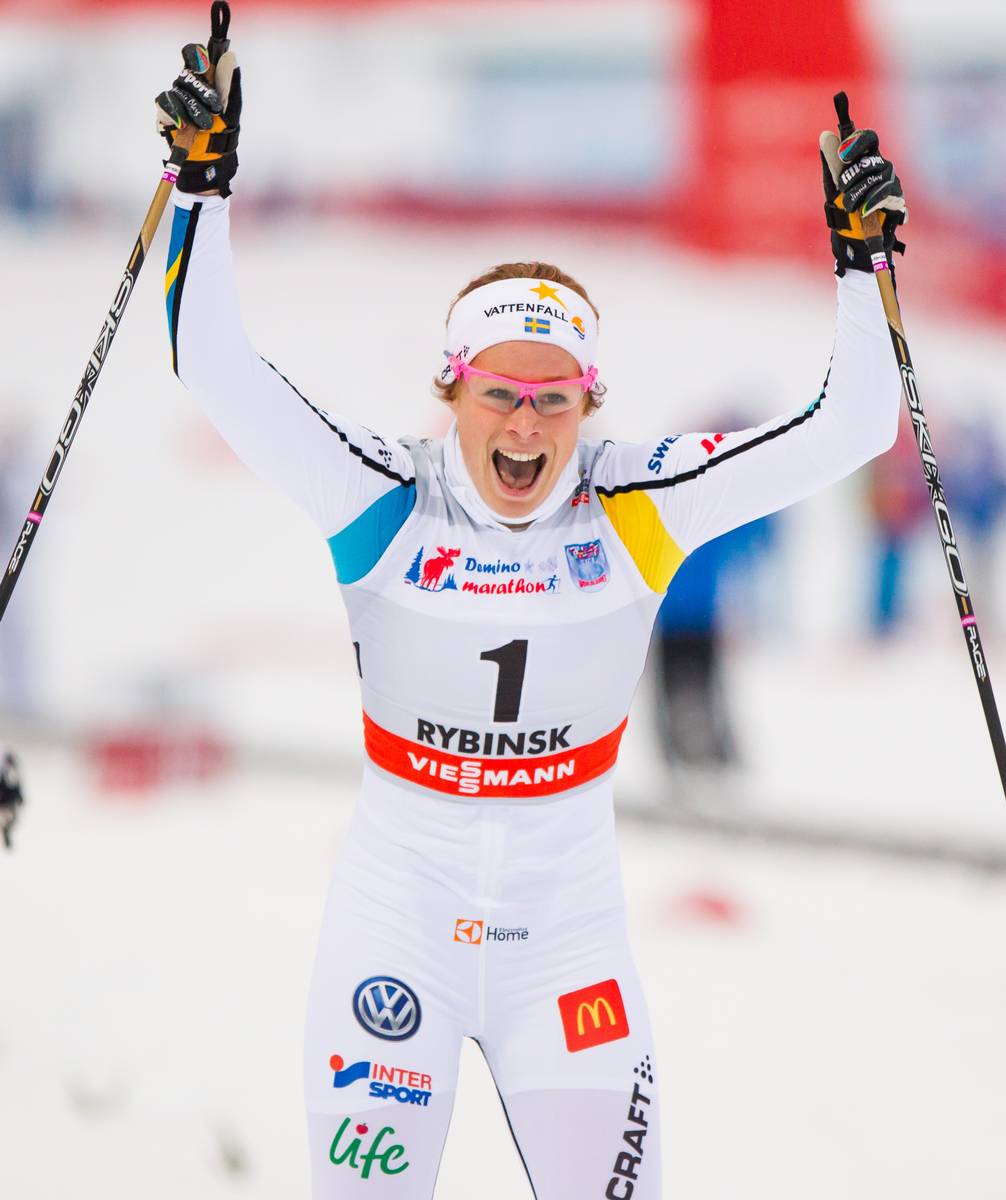
    Jennie Öberg of Sweden celebrates her win in Sunday's 1.3 k freestyle sprint in Rybinsk, Russia. (Photo: Fisher/Nordic Focus)
    Jennie Öberg of Sweden celebrates her win in Sunday’s 1.3 k freestyle sprint in Rybinsk, Russia. (Photo: Fisher/Nordic Focus)

    Prior to Saturday’s race, Öberg’s best World Cup result was a 2014 freestyle sprint in Nove Mesto where she placed seventh. She raced the majority of the 2015 season on the Scandinavian Cup circuit, with her first World Cup of the year taking place in Otepää, Estonia earlier in January.

    Öberg started her day with a strong qualification round in which she placed first, 2.08 seconds ahead of the next competitor. The quarterfinal was wasn’t as easily conquered, however, as the Swede fell after tangling with van der Graaff while exiting the stadium. The crash set her back roughly 40 meters, but Öberg worked to catch the group as they navigated the soft course. By the time the skiers reached the stadium, she was back in the mix, ultimately taking second to van der Graaff.

    With the scare of the fall behind her, Öberg skied a smart and aggressive semifinal and final to take her debut victory. According to the Swede, the win was an important step in qualifying for World Championships, which will be held in her home country in February.

    “This was my first ever sprint final so to win is just amazing.  I am really so happy.  I felt really strong today.  I was ready to win.  When I fell in the quarterfinal I panicked a little but it all worked out.  This gives me confidence for the upcoming Swedish Championships, which will be final selections for Falun 2015,” Öberg said in a post-race interview with FIS.

    In second place, the crowd-favorite Matveeva was happy to be near the top of the results again. Her last World Cup podium was third place in a 2012 classic sprint in Otepää.

    Matveeva entered the heats as the fourth-fastest qualifier and skied to victory in her quarterfinal. In the semifinal, however, she and van der Graaff lunged for a photo finish. Although Matveeva lost by 0.01 seconds, her time was fast enough to nab a lucky loser position and advance to the final.

    “This is a great podium for me.  I have been sixth and fourth here before but never on the podium. The spectators were so loud. It was a great racing atmosphere here today. The conditions were challenging. I am happy with myself for this result,” Matveeva said to FIS after the final.

    Unlike her counterparts, van der Graaff has been in the running for a World Cup podium multiple times this season. Before Saturday the Swiss skier had advanced to a final twice in the 2015 season, in Davos and Val Mustair. In both instances she placed sixth.

    In Rybinsk, van der Graaff was dangerously close to missing the podium as she and Dotsenko were in a photo finish for third. In the end it was van der Graff who came out on top by 0.02 seconds.

    “It feels really great to be on the podium today.  It was a photo finish at the line but I was pretty sure that I was in third place. It was a relief to see that in the end I was third and on the podium,” van der Graaff said to FIS.

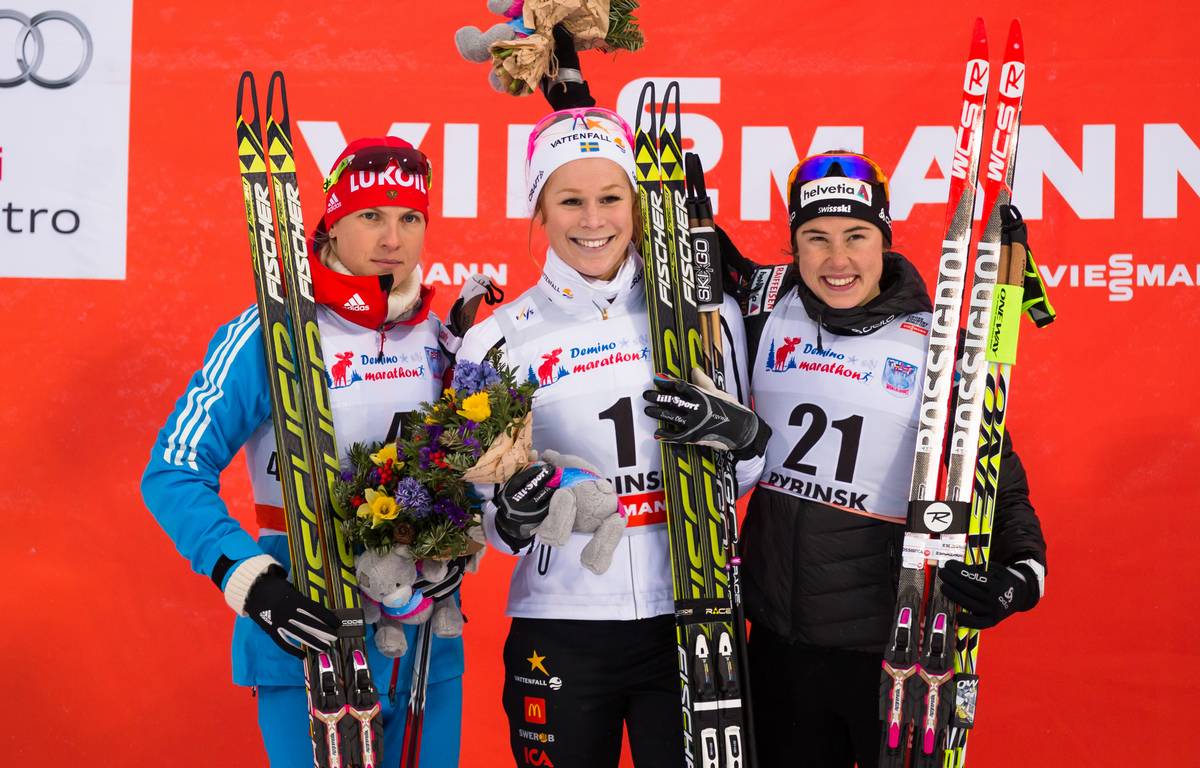
    The women's podium (from l-r): Natalia Matveeva (RUS)  second, Jennie Öberg (SWE) first, and Laurien van der Graaff (SUI) third.
    The women’s podium (from l-r): Natalia Matveeva (RUS) second, Jennie Öberg (SWE) first, and Laurien van der Graaff (SUI) third.

    In fifth place, Diggins earned her best result of the 2015 season. The Rybinsk World Cup marked her first competition since she pulled out of the Tour de Ski due to illness earlier in January. In Friday’s 10 k freestyle Diggins placed 12th.

    The night before Saturday’s competition Diggins said she was plagued by a series of bad dreams, and that she began her warm up feeling exhausted.

    “I had a crazy bad night of sleep… When I got out there to warm up I was like ‘oh man I feel tired,’” Diggins said in a phone interview.

    Despite the fatigue, Diggins explained that she was reminded of teammate Kikkan Randall, who has achieved some of her best results when pre-race feelings indicated a poor day. Diggins said that instead of thinking about her fatigue she decided to focus on how she was going feel in the race. That, in combination with tasty breakfast prepared by teammate Liz Stephen, gave her a boost heading into the race.

    After qualifying 13th, Diggins entered the quarterfinals with more energy. She sat near the back of the pack until the course’s only major climb. There, she moved to second place behind Rikka Sarasoja-Lilja of Finland. The two crested the hill together and attacked the downhill ahead of the four other women. As the two entered the stadium, Diggins free skated past the Finn to take first place.

    A similar strategy was used in the semifinal, but this time Diggins found herself in first at the top of the final hill with Dotsenko and teammate Sophie Caldwell close behind. She was worried that the two skiers would use the draft to slingshot into the stadium, but when they arrived Diggins was still in the front and easily crossed the line in second place.

    Diggins said that the group dynamic of the final made for a fun heat.

    “It was cool because Öberg and Slind had never been in a final before, so we were all high-fiving each other and wishing each other good luck. It was a fun positive energy going into the final,” she said.

    Diggins believed she had a good shot at her first individual World Cup podium, but fatigue got the best of her as she traversed the course for the fourth time. Falling to the back of the heat from the start, the 23-year-old maintained fifth throughout much of the race.

    Diggins explained that the 2015 season has been mentally challenging but that Saturday’s result was a step in the right direction.

    “My confidence this year hasn’t been where it maybe should be because I’m not racing at the level where I was last year, which is hard. It’s definitely one of those things where you have to keep telling yourself that you have what it takes,” she explained.

    According to the Minnesota native, the boost in confidence from the result in addition to USST dynamics will set her up for a strong showing at the 2015 World Championships, which take place in three weeks.

    “I feel really good going into Worlds because the team is functioning like such a well-oiled machine. I feel like we are in a good place,” she said.

    USST Head Coach Chris Grover said that he was pleased with Diggins’ result and that he was impressed with her ability to navigate the soft conditions.

    “Jessie usually likes firm conditions but she was awesome. She really skied in control during her quarter and semifinals. She really executed moves exactly the way she wanted so that was pretty cool,” he said in a phone interview.

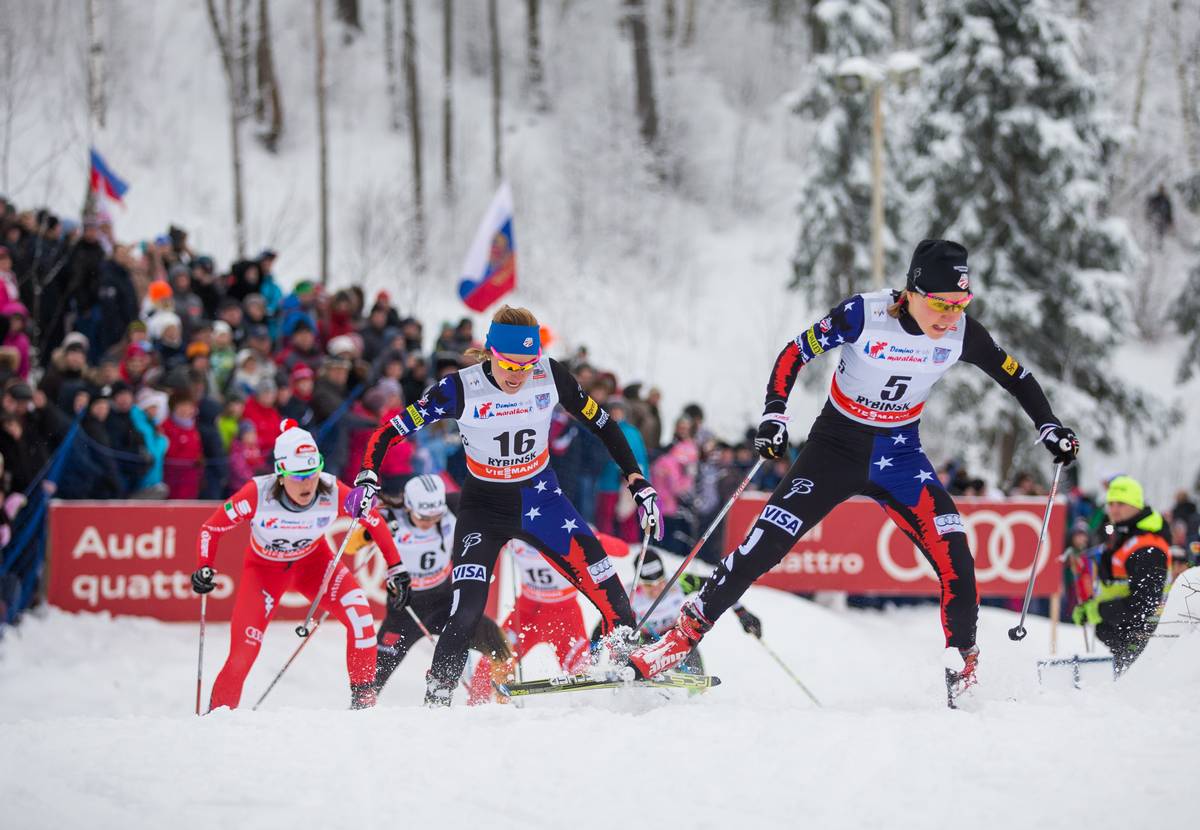
    Ida Sargent (5) leads Sophie Caldwell (16) up the final hill of the 1.3 k freestyle sprint quarterfinal in Rybinsk, Russia. Sargent finished third in the heat while Caldwell placed second. Caldwell and Sargent finished seventh and 13th overall. (Photo: Fischer/Nordic Focus)
    Ida Sargent (5) leads Sophie Caldwell (16) up the final hill of the 1.3 k freestyle sprint quarterfinal in Rybinsk, Russia. Sargent finished third in the heat while Caldwell placed second. Caldwell and Sargent finished seventh and 13th overall. (Photo: Fischer/Nordic Focus)

    American Women Land Four in Finals

    Diggins wasn’t the only American to impress in Saturday’s sprint.

    Caldwell, a regular in freestyle sprint semifinals, skied to seventh in Rybinsk despite lingering fatigue. The 24-year-old qualified 16th and easily advanced from her quarterfinal. Once in the semifinals, Caldwell used similar tactics to land third place. Unfortunately, Caldwell’s semifinal was too slow for her to advance as lucky loser.

    “I was feeling a little fatigued going into the day, but I think I actually felt the best in my semifinal, so I was happy with the direction things were moving… it’s a really tough course that gives your legs a pretty good beating,” she wrote in an email.

    Just behind Caldwell was Sadie Bjornsen in 11th. The placement is her her second-best World Cup sprint result and was her first time in the semifinals since 2012.

    “I’m really happy because it’s been three years since I made it to the semifinals. It was really fun to get there today. It was really challenging conditions with the soft snow and a hard course,” she said.

    Bjornsen was lucky loser in the quarterfinals after finishing third in her heat. While she entered the semifinal hopeful to advance, a poor start prevented her from finding a strategic placement.

    Sadie Bjornsen skied to her second-best World Cup sprint result in Saturday's 1.3 k freestyle sprint in Rybinsk, Russia. (Photo: Fischer/Nordic Focus)
    Sadie Bjornsen skied to her second-best World Cup sprint result in Saturday’s 1.3 k freestyle sprint in Rybinsk, Russia. (Photo: Fischer/Nordic Focus)

    “I didn’t have a great starting position so I was forced into the back. That course is especially hard to ski from the back because it’s a lot of sprint-stop, sprint-stop. I was never able to get into a good position or a good rhythm. I was just hanging on by the horns. I didn’t feel like I could ski what I was capable of but it felt great to be skiing in the semifinals,” she explained.

    Ida Sargent entered the quarterfinals as the fifth-fastest qualifier but ended her day after finishing third in the same quarterfinal as Caldwell.

    “The qualification was really good for me. I was bib #1 which I was a little nervous about but I think it was really good for me because I was able to stay focused in my own race rather than getting distracted by everything going around me like I often do,” she wrote in an email.

    “I was not satisfied with how I skied the quarter and crossed the finish line feeling like I had a lot more to give,” she explained, “Then going into the finish I tried taking the left side which was a shorter line but it was a lot softer so then I went behind Sophie in the lane but the Italian came up on the far right.”

    The final American in Rybinsk, Rosie Brennan, placed 31st, 0.12 seconds from qualification.

    Grover was pleased with the overall team effort, even though he said the team had the potential to preform even better.

    “They did well. Even some of our athletes that traditionally struggle in deeper snow skied really well,” he explained. “We had 4 women in the top 13 so we can’t complain to much… Overall a pretty solid day and nice to have someone in the finals and fight for the podium.”

    Racing continues in Russia Sunday with a 15/30 k skiathlon.

    Results

  • Pellegrino Wins in Rybinsk, Sets Consecutive Sprint Record

    Pellegrino Wins in Rybinsk, Sets Consecutive Sprint Record

    Men's 1.3 k freestyle sprint podium in Rybinsk, Russia (from l-r): Andrey Parfenov (RUS) third, Federico Pellegrino (ITA) first, and Sergey Ustiugov (RUS) second. (Photo: Fischer/Nordic Focus)
    Men’s 1.3 k freestyle sprint podium in Rybinsk, Russia (from l-r): Andrey Parfenov (RUS) third, Federico Pellegrino (ITA) first, and Sergey Ustiugov (RUS) second. (Photo: Fischer/Nordic Focus)

    Italy’s Federico Pellegrino skied himself into the history books after his victory in Saturdays 1.3 k freestyle sprint in Rybinsk, Russia. Pellegrino became the first athlete to win three consecutive freestyle sprint World Cups. His first two victories came this year in a Davos World Cup and in Val Mustair as part of the Tour de Ski.

    “This is just amazing for me. I can’t believe I have won again. Before Davos I had never won a World Cup and now to have won three in a row is just unbelievable,” Pellegrino told FIS reports after the race.

    To win his third straight viceroy, Pellegrino had to beat a strong Russian team full of sprinters. One such skier, Sergey Ustiugov clocked the fastest qualifier heading into the heat races qualifying in a time of 2:41.10. Teammate Alexey Petukhov was second fastest, 3.55 seconds behind and Pellegrino was third, 3.87 seconds back.

    Pellegrino had the fastest quarterfinal with a time of 2:39.39, proving he was the skier to beat in the heats. When it came to the semifinal, however, he changed his tactic. Pellegrino skied a very conservative 2:42.69 to win his heat and to advance to the finals. In comparison, Ustiugov’s semifinal time was 2:37.73.

    If the Russians wanted to stop Pellegrino, it was a perfect setup for them in the finals. Four of the six spots were filled with Russian teammates – Ustiugov, Andrey Parfenov, Nikita Kriukov, and Petukhov. Rounding out the other spots were Pellegrino and Norway’s Emil Iversen.

    At the start it was obvious Russia wasn’t going to let him win easily. The four Russians marked Pellegrino the moment the gates opened. Ustiugov took the early lead followed by Pellegrino, Parfenov, and Kriukov. The pace was fast but didn’t separate the field.

    Spurred by the home crowd at the base of the course’s major climb, Ustiugov put in a strong attack. However, Pellegrino and the other Russians were right there to counter it, with Pellegrino demonstrating that he had the energy to match Ustiugov’s speed.

    As the skiers progressed over the hill, Ustiugov was still leading and Pellegrino tucked in behind him. The group headed into the stadium and Pellegrino stepped out to get onto faster snow. This propelled him right past Ustiugov and into the lead. Parfenov followed Pellegrino, but was quickly dropped when Ustiugov reacted to Pellegrino, who was now in front.

    Into the closing meters Pellegrino’s power and speed took over. He easily out-sprinted Ustiugov and Parfenov to win his third consecutive sprint win. He crossed the line at 2:34.99, besting Ustiugov by 0.69 seconds and Parfenov third by 0.77 seconds.

    Pellegrino was very happy when he talked to FIS reporters, and said he hoped to turn these wins into a financial deal.

    “I feel so strong right now,” he said. “Hopefully with this success I can now find a sponsor for the front of my racing hat! Thank you to Russia for the great hospitality, the friendly people and for cheering for me today. I could hear it.”

    After two podium spots in two races in Rybinsk, Ustiugov showed the home crowd that he still had energy left and was looking forward to Sunday.

    “I am happy to be back on the podium again today. I feel that my shape is quite high right now and I hope to be on the podium again tomorrow in the skiathlon,” he said to FIS.

    Parfenov’s third place finish was his first ever podium, and achieving it at home was an added bonus.

    “This is my first podium ever. It’s great to have my first podium be here in Russia. The fans were great and competing here makes it possible for my family to be here. That is really special,” he said to FIS.

    Rounding out the final spots in the final were Kriukov (+2.61), Petukhov (+3.00) and Iversen (+4.60).

    Results

  • Stephen Earns Historic Podium in Rybinsk; Jacobsen Notches First Win in Seven Years

    Stephen Earns Historic Podium in Rybinsk; Jacobsen Notches First Win in Seven Years

    Liz Stephen (U.S. Ski Team) racing in the Tour de Ski prologue in Oberstdorf, Germany, last weekend. (Photo: Marcel Hilger)
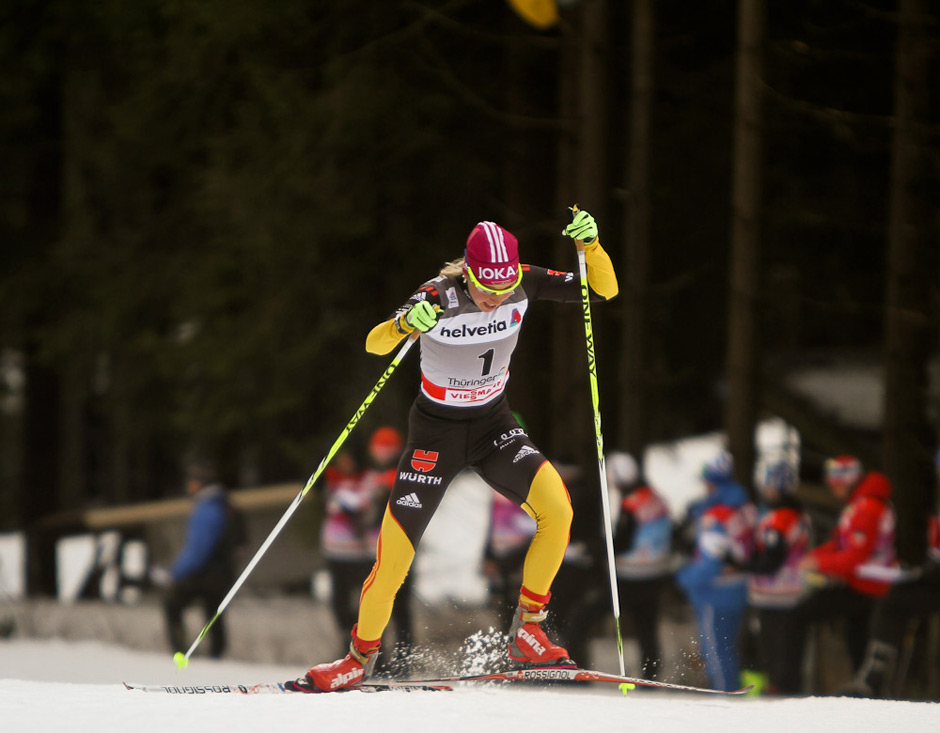
    Liz Stephen earned the best finish of an American woman in a World Cup distance race Friday, with her second place in Rybinsk, Russia. She is pictured here in the 2015 Tour de Ski. (Photo: Marcel Hilger)

    After her second-place finish in Friday’s World Cup 10-kilometer freestyle in Rybinsk, Russia, Liz Stephen had a lot to celebrate – it was her first individual World Cup podium, just two weeks after her historic fifth-place finish in the Tour de Ski.

    But there was something the 27-year-old hadn’t realized.

    As she sat down for the press conference with FIS Marketing Support Jeff Ellis, he informed her of another historic accomplishment – Stephen had posted the best distance result for an American woman on the World Cup, besting Ellis’ wife, Kikkan Randall’s third place in Gällivare, Sweden in 2012.

    With the realization, Stephen said she there was only one word to describe the plethora of feelings surrounding the result.

    “To sum it up in one word, I’m ecstatic. I’m really happy to put it all together on one day. I’m ecstatic for sure and a little emotional,” Stephen said in a phone interview.

    The results in Rybinsk marked a respite from the familiar podium names with major players such as Norwegians Marit Bjørgen, Therese Johaug, and Heidi Weng avoiding the long journey to Russia in order to rest for the remaining races of the season. However, with strong competitors like Poland’s Justyna Kowalczyk and Finland’s Kerttu Niskanen in the mix, no result was guaranteed. 

    Stephen placed second to Norway’s Astrid Jacobsen, who finished the 10 k in 28:12.5. Stephen was off-pace by 14.4 seconds, but placed ahead of Germany’s Stefanie Böhler (+36.4) who claimed the final podium spot. Rounding out the top-five were Yulia Tchekaleva (+37.6) of Russia and Kristin Størmer Steira (+41.4) of Norway. Until Friday, Størmer Sterira had been absent from the World Cup after a double hip fracture in October.

    The Comeback Podium

    Friday’s win was Jacobsen’s first since 2008 when she won the World Cup 15 k pursuit in Falun, Sweden. In the nearly seven years since, Jacobsen has been on the World Cup podium many times but another victory was always been elusive.

    Jacobsen’s path to the top of the podium was a difficult one. Just one day before the start of the 2014 Olympic Games, her brother and training partner passed away unexpectedly, causing emotional hardship for the Norwegian throughout the event and remainder of the year. Later that season she crashed into a lamppost in the Holmenkollen 30 k and was rushed to the hospital. With no serious injuries resulting from the crash, Jacobsen began what looked to be a productive training season that spring. By the fall, however, Jacobsen told NRK that her body was no longer responding to training.

    Astrid Uhrenholdt Jacobsen (NOR) 13th place.
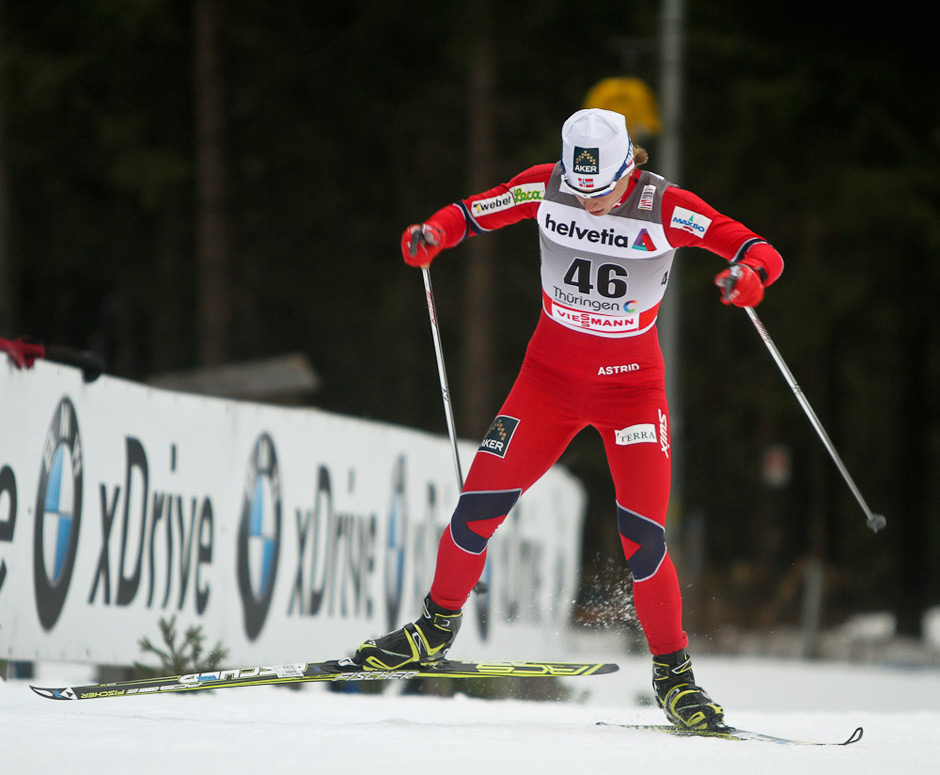
    Astrid Uhrenholdt Jacobsen of Norway returned to the top of a World Cup Podium Rybinsk, Russia after a seven year absence. She is pictured here in the 2012 Tour de Ski.

    According to NRK, the physical hardship lasted through the beginning of the season where Jacobsen raced to uncharacteristic results over the Lillehammer World Cup weekend. With her body feeling out of whack, Jacobsen decided to rest. After seeing improvement since the begging of the year, she participated in Scandinavian Cups while her teammates competed on the World Cup circuit. Her most recent was in Falun, Sweden, the site of the 2015 World Championships, where she won the 15 k skiathlon and placed third in the 10 k freestyle.

    “I have felt since New Year that the shape has been better and better. I had some good races in Falun, but today it was even better,” she told NRK Sport.

    In Friday’s race, Jacobson dominantly skied the hilly course to earn top splits throughout the race. Skiing one bib behind Stephen for the entirety of the 10 k, she crossed the finish line with her arms outreached and a smile on her face.

    “I have had to be very patient this year. My body has not handled training as it should since August. So I am very happy to have such a result today,” she told FIS in a post-race interview. “It is a difficult course with challenging conditions today so I was cautious on the first lap and I think that helped very much.”

    Rybinsk has been friendly to Jacobsen in the past. In 2007 she earned her first World Cup win in the 15 k mass start.

    Third place finisher Böhler also has fond memories of Russia. In 2009 she earned her first and only other individual World Cup podium in a Rybinsk World Cup 10 k mass start.

    Stefanie Boehler (GER) 24th place.
    Stefanie Böhler of Germany earned the third place and her second-ever individual World Cup podium. She is pictured here in the 2012 Tour de Ski.

    “This is a great result. My only other podium on World Cup was here in 2009 so I am really happy to be back on the podium here again,” she told FIS. “I always like coming here. The courses are hard, the people are so friendly and there are many spectators. It’s just really nice to be here in Rybinsk.”

    Böhler has faced her share of challenges as well. In 2012 she was diagnosed with thyroid cancer but fought back to compete in the 2014 Olympics where she and her teammates earned a bronze medal in the 4 x 5 k relay.

    Stephen, who is close with Jacobsen after the two exchanged training time in Alaska and Norway, said she was happy be on the podium with both her friend and Böhler.

    “It was a really fun podium to share. For [Jacobsen] to come back and get a win is pretty special for her,” Stephen said. “After last year’s really challenging year with her it’s really special to be on the podium with a friend and someone who has had her fair share of ups and downs, in skiing and in regular life too. Steffi is the same. She battled cancer a couple years ago and she’s one of the more smiley people on the World Cup and always rooting for everyone else.”

    History in the Making

    With many of the biggest names absent from Rybinsk, Stephen knew there was an opportunity to land a spot on the podium – and she was ready to take it.

    “I really wanted to get on the podium today,” Stephen said of her ambitions. “In order to do that I focused on each section of the course.”

    Known for her climbing abilities, the hilly course in Rybinsk favored the Vermont native. Stephen explained that her main strategy for the competition was to ski the flats smoothly. She also focused on skiing over the top of each hill aggressively – an area in which she’s struggled in the past.

    “I just like to go up hills, but over the top can be an issue for me so I saved enough to really go over the top and carry good speed on the downhills and grab a low tuck,” she said.

    U.S. Alpine Ski Team athletes Paula Moltzan and Resi Stiegler lift Liz Stephen high after her stunning fifth in the 10k classic. The alpine racers were training nearby and came trackside to cheer on Stephen in the Tour de Ski. (Photo: U.S. Ski and Snowboard Association)
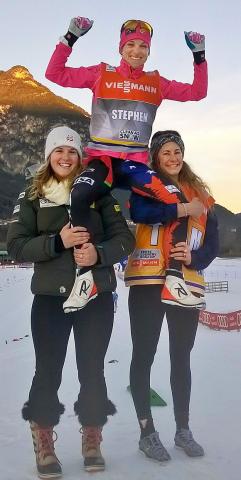
    U.S. Alpine Ski Team athletes Paula Moltzan and Resi Stiegler lift Liz Stephen after a leg of the 2015 Tour de Ski. Stephen’s fifth ranking in the Tour was the best American result ever. (Photo: U.S. Ski and Snowboard Association)

    The strategy worked and as Stephen sped around the course, consistently earning the second-fastest splits. When she crossed the line it was all but certain she had secured her first World Cup podium. Stephen said she hadn’t thought about the historic possibility of earning the top finish in a distance World Cup by an American woman until Ellis told her in the press conference.

    According to USST Head Coach Chris Grover Stephen’s success is due to her superior fitness.

    “Obviously she came out of the Tour de Ski where she was in really good shape and then she was able to stay healthy and recover. She’s in good form right now and that’s the absolute key,” he said of Stephen.

    Stephen also explained that her result was not just a product of her individual abilities, but also the support of her team. Pointing to her fellow American skiers and coaches, Stephen said that everyone, especially women’s team coach Matt Whitcomb who taught Stephen how to ski at Burke Mountain Academy, played a role in Friday’s historic result.

    It means a lot to be with this team, having this result, and knowing that you’re never ever out there by yourself. Good days, bad days, great days, this team forms around you,” she said.

    With World Championships three weeks away, Stephen said she hoped to inspire the team to reach their best results of the season in Falun.

    “Having these results going into World Championships for me personally is, of course, wonderful but I also think and hope that it boosts everyone else’s confidence and belief in themselves,” she explained. “I’ve seen it in the past with Kikkan and other teammates having best-ever results for them, or making history. The whole team gets pulled up by it. I think it will.” 

    U.S. Women Solid in Top-20

    It seems that Stephen has already inspired one of her USST teammates.

    Finishing Friday’s race in 12th place, Jessie Diggins explained the 2015 season hasn’t met her expectations, but that Stephen has helped her work towards a stronger mental attitude.

    “Liz has actually been encouraging and inspiring me to work harder with Sports Psychology and start believing harder that I have what it takes,” Diggins wrote in an email. “This season has been tough on my self confidence so far… and I’ve been working on having more confidence when I step onto the snow. Especially after getting quite sick and having to drop out of the Tour de Ski, there were a lot of thoughts running through my mind  – wondering if I would be in good enough shape to race after being sick and not being able to train as planned, etc.”

    After taking over week of rest between the Tour de Ski and Rybinsk, Diggins said that she was able to “put those thoughts away” in Friday’s 10 k and ski a focused and driven race. However, even though she was able to perform mentally, said her body was not responding.

    “I definitely am not in my greatest race shape right now as I think everything came together quite smoothly in this race and my results weren’t close to what they were a few years ago on this course. I need to be patient as I come out of being sick and let these three races this weekend help me get back in my best race shape!” she wrote.

    Just behind Diggins was Rosie Brennan, who earned her best ever finish in a World Cup. As the period one SuperTour leader, Brennan is participating in her second weekend of racing with the USST.

    Rosie Brennan leading her quarterfinal in Tuesday's 1.5 k classic sprint at U.S. Cross Country Championships in Houghton, Mich. (Photo: Christopher Schmidt)
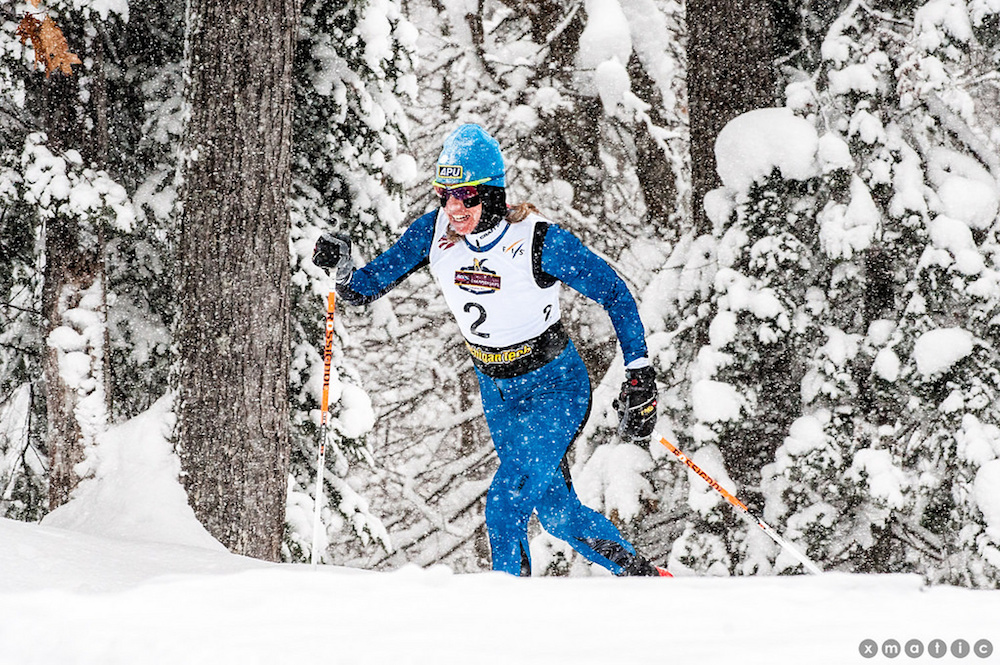
    Rosie Brennan earned her first World Cup points in Rybinsk, Russia. Brennan is pictured here racing in Houghton, Michigan. (Photo: Christopher Schmidt)

    Throughout much of the competition Brennan’s splits were in and out of the top-10, indicating a rapid start. According to Brennan it was all part of the plan, even if it meant her finish speed was reduced.

    “I started pretty hard, maybe a little too hard, but I believe it takes putting yourself out there to really find out what you are capable of. With that in mind, I just tried to keep pushing the whole way. I think I faded a bit at the end, but held it together just enough for a sold result,” she wrote in an email.

    Brennan said she was excited to have “broken that barrier” to earn World Cup points and that she hoped the result would give her confidence through the rest of her time in Europe.

    “Huge race for Rosie, who really skied exceptionally well. That was really exciting to have her in the mix,” Grover said of her race.

    Racing continues in Rybinsk Saturday, with a freestyle sprint.

    Results

  • Cologna Denies Russians a Sweep With Victory in Rybinsk

    Cologna Denies Russians a Sweep With Victory in Rybinsk

    Dario Cologna of Switzerland celebrates his win in Friday's 10 k freestyle in Rybinsk, Russia (Photo: Fischer/Nordic Focus)
    Dario Cologna of Switzerland celebrates his win in Friday’s 10 k freestyle in Rybinsk, Russia (Photo: Fischer/Nordic Focus)

    Dario Cologna likes Russia and it’s probably starting to get on Russian nerves. Prior to Friday, of his nine World Cup and Olympic individual starts in the country he was victorious in three, denying the national team favorites a chance at victory in front of a home crowd. However, all the victories were in Sochi, with two from the Olympic skiathlon and the 15km classic, and other from a 2013 World Cup skiathlon.

    “I like racing in Russia. I have good memories from Sochi last winter. It’s a nice country to come to and compete. The courses are well prepared and the people are great,” Cologna commented to FIS reporters.

    The trend continued Friday with another win for Cologna in the Rybinsk World Cup 15 k freestyle interval start, where he skied to a 16.3 second win over Russian Evgeniv Belov with a time of 36.53.4. In third was fellow Russian Sergey Ustiugov, who finished 28.8 seconds back. Alexander Legkov also of Russia placed fourth, 35.8 seconds behind Cologna.

    While Friday’s race denied them the top spot, the course in Rybinsk has been very kind to its countrymen in the past. Russian athletes have won four of the seven distance races held at home in Rybinsk in the World Cup. Ilia Chernousov, Artem Zhmurko, Maxim Vylegzhanin and Legkov each have one win here.

    Sergey Ustiugov of Russia leads Dario Cologna of Switzerland in Friday's 15 k freestyle in Rybinsk, Russia. Ustiugov finished third while Cologna won. (Photo: Fischer/Nordic Focus)
    Sergey Ustiugov of Russia leads Dario Cologna of Switzerland in Friday’s 15 k freestyle in Rybinsk, Russia. Ustiugov finished third while Cologna won. (Photo: Fischer/Nordic Focus)

    Friday’s three loop, 5km course featured several significant climbs with little opportunity to recover. The highest point on the course was a 22% grade at the 8.9 k timing mark. Couple the hills with the cold weather and freshly fallen snow and the course became that much more difficult.

    Once all the top seeded skiers started, it was apparent the race was going to come down to four athletes – Cologna and Russian teammates Ustiugov, Belov, and Legkov. The latter of the four started near the front of the pack and set a blistering pace that the remaining three barely bested over the first kilometers.

    As a higher seeded athlete, Cologna had the advantage of being the last skier to start. In front of him were Ustiugov and Belov. While Ustiugov was the fastest skier through all the early course time checks, Cologna clocked even better times as he chased the Russian.

    At the 6.9 k split, Ustiugov began to feel the the consequences of his fast start. With the largest climb yet to come, Ustiugov slowed. Cologna eventually caught him, and the two worked to chip away at the distance between them and Belov.

    Men's 15 k podium, from l-r Evgeniy Belov of Russia, second, Dario Cologna of Switzerland, first, and Sergey Ustiugov of Russia, third
    Men’s 15 k podium, from l-r Evgeniy Belov of Russia, second, Dario Cologna of Switzerland, first, and Sergey Ustiugov of Russia, third

    Belov started his race more conservatively but increased his speed through the later parts of the course. His finish time of 37:09.7 was the fastest as he crossed the line, but there were still two skiers left on course. Given the splits, it seemed as if Cologna was all but guaranteed a podium. The only question was which spot would it be.

    “I caught Sergey and I knew that if I just stayed close to him we would have a fast finish. I know he is a great sprinter,” Cologna said in a post-race interview with FIS.

    The question was answered as the Swiss skier crossed the line. Cologna beat Belov’s time by 16.3 seconds, crossing the line in 36.53.4 to take his first 15 km skate World Cup win ever despite being Olympic champion in the event in Vancouver 2010.

    Although Belov was denied the win, he was excited to earn his third individual World Cup podium.

    “I am happy with my result today. It was great to win in Russia. I feel very strong after the Tour de Ski and I like racing in the minus temperatures. I know there courses very well so this is a great result,” he said to FIS.

    With his third place podium – his first World Cup distance podium – Ustiugov said he was happy but still focused on the rest of the weekend’s races.

    “This is a great finish for me. It was very difficult and when Dario caught me I knew that if I could push very hard there was a chance for a podium. This is my first podium in a distance competition on the World Cup. I have only been in the sprint before. I am looking forward to tomorrow’s sprint competition,” he said to FIS.

    Focus now switches to Saturday’s race, a 1.3 k freestyle sprint.

    Results

  • Canada Puts Two in Top Ten; Kershaw Moves into Third in World Cup Overall

    Canada Puts Two in Top Ten; Kershaw Moves into Third in World Cup Overall

    Though it didn’t quite measure up to the standard they set for themselves on Saturday, Canada continued its strong run of World Cup performances by placing two in the top ten in the Rybinsk 30 k skiathlon on Sunday. Devon Kershaw led the way in sixth with a time of 1:20:47.1, only 9.5 seconds behind the winner Maxim Vylegzhanin (RUS). Alex Harvey was only one second behind Kershaw in eighth, and Ivan Babikov finished 19th (+47.1).

    Kershaw celebrating his victory in Saturday's 15 k freestyle. Photo: Fischer/Nordic Focus.

    Canada has been producing consistent world-class results for several years now on the World Cup, and seeing them at the top of results sheets weekend after weekend is almost expected at this point. Because they’ve repeatedly raised the bar this season, anything slightly below that mark seems like an off day. And with raised to the top of the podium with Kershaw’s win in Saturday’s 15 k, matching it was a tall order.

    Kershaw and Harvey worked their way through the middle of the pack through the first 15 k on classic skis, and after the change to skate skis, began to look like they’d be challenging for the podium again. They hovered right near the front of the pack for most of the second half of the race. Kershaw took 27 extra points for winning the sprint at 21.4 k and taking second in the last preem at 26.5 k. Harvey was also right in the mix, taking fourth at 21.4 k.

    When the leading Russians quickened the pace on the final lap, however, the duo couldn’t quite respond.

    “The day went OK,” said Canadian National Ski Team head coach Justin Wadsworth.

    “I mean two in the top 10 isn’t bad, but we were hoping for more.”

    Though they may have fallen shy of their own expectations, their performances moved them up in the overall World Cup standings. Kershaw’s sixth-place finish, when combined with the preems, earned him 67 World Cup points on Sunday, bumping him past Marcus Hellner (SWE) and into third in the overall standings.

    Sergey Turyshev (RUS) and Maxim Vylegzhanin (RUS) leading the 30 k skiathlon. Alex Harvey (CAN) sits just behind. Photo: Fischer/Nordic Focus.

    The day before the skiathlon, Kershaw’s plan for Sunday was to stay near the front and out of trouble.

    “You have to try and conserve energy and ski relaxed in the pack because you need that energy for a sprint finish,” he said.

    On the final lap, the lead pack consisted of five Russian skiers up front—Tobias Angerer (GER) and Kershaw were the first athletes to break the sea of blue. Around ten more skiers were still in contact behind them, but after 80 minutes of racing, the final lap saw the field start to string out.

    Ilias Chernousov (RUS) and Vylegzhanin were the ones to successfully break away on the final uphill, but after the top two, places three through 16 finished within a 10.4-second window.

    According to Wadsworth, those places were pretty much determined before the athletes entered the stadium

    “It was a bit tactical for sure, at least with our guys not wanting to do too much early, and then trying to be there for the finish, but it stretched out quite a bit going into the last climb and there was just no chance to move up,” he said.

    Harvey described the final hill as crucial for positioning, as a fast descent fed into the subsequent uphill.

    “It was more of a ski speed kind of thing since it was a long downhill going into the last climb,” Harvey wrote in an email.

    “The Russians had amazing skis, so did the Germans.”

    The preceding 27 k or so had certainly been a tactical race. After a fast classic portion, the transition to skate skis brought a significant drop in pace.

    “Once we got skating, the pace died and everybody was looking at each other, just like in any other mass start for the men!” said Harvey. “So overall, pretty tactical.”

    Harvey’s eighth-place finish moved him from eight to sixth in the overall World Cup, 198 points behind Kershaw. Despite racing three times in four days, he felt strong on Sunday, particularly in the skate portion, where he moved up from 12th at the exchange.

    “Skiathlons could be my favorite race format,” said Harvey.

    Babikov, who was looking for a little redemption on Sunday after falling in the 15 k the day before, skied the classic portion well, and was eighth at the second preem.

    During the second half, he lost contact with the main pack, and finished 19th.

    “On the skating part I didn’t feel as good as I felt yesterday, maybe acclimatization kicked in,” said Babikov, who arrived in Russia four days ago after two weeks spent at home in Canada.

    Overall, the Canadian mens’ performance in Russia, which began in Moscow on Thursday with Kershaw’s third place finish in the freestyle sprint, can perhaps best be summed up by his tweet on Sunday afternoon: “Pretty decent little Russian trip for Canada. 1st, 3rd, 5th, 6th, 8th, 9th. #decent. Biggest thanks for all the congrats, twittterotti!”

    Men’s results.

  • Vylegzhanin and Chernousov Lead Dominant Russian Performance in Rybinsk Skiathlon

    Vylegzhanin and Chernousov Lead Dominant Russian Performance in Rybinsk Skiathlon

    Vylegzhanin on his way to victory in Rybinsk, Russia on Sunday in the 30 k skiathlon. Photo: Fischer/Nordic Focus.

    Rybinsk is like Russia’s version of Holmenkollen—perhaps not with quite as many spectators, but its fans were no less enthusiastic about the World Cup this weekend, and turned out in admirable numbers despite the cold to cheer on the national team. On Saturday, Russian skiers fell short of topping the podium in front of the home crowd, but that changed in a big way in the 30 k skiathlon on Sunday. Not only did Russia claim the top two spots, they took four of the top five and nine of the top 12.

    Maxim Vylegzhanin (RUS) delivered victory in Rybinsk, besting teammate Ilia Chernousov by six seconds on the twelve-lap course, and in a photo finish for third, Tobias Angerer (GER) broke up the Russian pack by outsprinting Eugeniy Dementiev (RUS). Petr Sendov (RUS) was 0.6 seconds behind in fifth, adding to Russia’s dominating showing.

    “This victory was very important for me because I couldn’t get to the podium in Rybinsk before,” said Vylegzhanin in a press conference following the race.

    “Something was always wrong either with skis or my shape. This time everything worked perfectly.”

    The Rybinsk crowd. Photo: Fischer/Nordic Focus.

    From the moment the gun went off, Russia pushed the pace. On the second lap, the top ten men were all in blue. In an interview with Skisport.ru after the post-race press conference, Vylegzhanin said that his team definitely used their numbers (15-strong out of 56 competitors) to their advantage, consciously using team tactics to try to break open the race in the classic portion.

    Vylegzhanin’s strategy was to wear his competitors down in the classic leg, as he considers it his stronger discipline. There were four intermediate bonuses available on Sunday, at the 6.5, 11.5, 21.4 and 26.5 k marks. At the sprint preem at the 11.6 k mark, Vylegzhanin was in third behind Konstantin Glavatskikh (RUS) and Dmitriy Japarov (RUS), but the pack wasn’t worn out yet, holding at around 30 skiers strong.

    In the exchange zone at the halfway point, Vylegzhanin had the lead and the front group had diminished to 19. As Kris Freeman (USA) described afterwards, the beginning of the skiathlon played out much faster than usual with the sprint bonuses, which were an added feature this year.

    The pace slowed once the skate leg got underway, and Vylegzhanin hovered in the top 10. The relaxed tempo helped his chances in the end, he told Skisport.ru.

    In the first skate preem at 21.4 k, Saturday’s winner Devon Kershaw (CAN) made a break to win 15 extra points, and continued to ski near the front for the rest of the race.

    Japarov and Italy’s Roland Clara attempted to break away shortly thereafter, but the pack reeled them back in, and as the group came through the stadium for the second to last time, Sedov set the pace, with four other Russians in the front.

    Chernousov made a move to take over on the last uphill before the stadium, but Vylegzhanin reacted, and the two put distance on the rest of the field. Chernousov still led as the stadium came into sight, but Vylegzhanin overtook him on the corner before the final straightaway and won by a six-second margin.

    Vylegzhanin said later that he had not particularly expected Chernousov to be the one to make the break at the end, but thought that everyone probably envisioned the last hill to be the spot where someone would try to make their move. With this in mind, he was ready to react to Chernousov’s surge.

    Vylegzhanin also told the Skisport.ru reporter that, though he was pleased with his first World Cup win of the season, it would have been more meaningful if so many Red Group skiers hadn’t been absent.

    Chernousov described his break as an attempt to repeat a nearly-successful identical move in Saturday’s 15 k, where he was just beat at the line by Kershaw.

    “I was really exhausted in the last three laps and tried to relax and use the same tactics as yesterday in the last uphill,” said Chernousov.

    Though he missed the top spot, the Russian was satisfied with his second podium in Rybinsk this weekend.

    Vylegzhanin and Chernousov put a comfortable gap on the rest of the field, but Angerer fought Demetiev for third, the only non-Russian in the top five. Demetiev’s fourth-place finish on Sunday was his first result back on the World Cup since the end of his two-year doping ban.

    “I’m happy to be on the podium again,” said Angerer. “Rybinsk becomes a very special place for me, I do not really know what is exactly special… I always feel well here.”

    “I tried to push hard and worked in front together with Roland Clara in the free technique part but at the end the Russians were too strong today.”

    Men’s results.

    Vylegzhanin (r) in front during the classic portion of the skiathlon next to Sergey Turyshev (RUS). Photo: Fischer/Nordic Focus.
  • Led By Kershaw’s Win, Canadian Men Continue Strong World Cup Run

    Led By Kershaw’s Win, Canadian Men Continue Strong World Cup Run

    Kershaw, Harvey, and Babikov in Rogla early this season. On Saturday in Rybinsk, Russia, they again skied together for much of the race. Photo: Fischer/Nordic Focus.

    Devon Kershaw set the bar as high as it could go for the Canadians on Saturday with his win in the Rybinsk 15 k freestyle, but his teammates skied to impressive finishes as well. Alex Harvey skied with Kershaw for much of the race to finish in fifth (+5.5). Ivan Babikov, in his first race back on the World Cup since the Tour de Ski, finished 17th (+13.6), and would have finished higher had he not fallen and lost significant momentum on the final hill before the stadium.

    With two intermediate sprint preems over the six-lap 15 k course, the mass start was a game of tactics. The men went out conservatively, trading the lead on and off. As the dense group moved around the course, they bunched up at the bottom of each climb and spread out down the other side. It was a tight race, and came down to making a move at the right moment in the final lap.

    “It’s men’s racing, I knew it would be tactical!” said Harvey. “Nobody wants to go hard in front and work for the others…I expected an easy pace!”

    Kershaw expected the same, and after he got off to a good start, let others do the work.

    “I just positioned at the front and focused on conserving energy,” said Kershaw.

    That he did, and even though the Canuck later recalled knowing at the top of the last hill that the race was his for the taking, he was still rather astonished with how well he’s been skiing recently.

    “It’s been such an odd week—the body’s been there every time I call upon it,” said Kershaw. “It’s really weird, but I’ll take it.”

    Kershaw also believes that any of his teammates could have been right there with him the whole way.

    “Today it was me, tomorrow maybe it’s Ivan or Alex,” he said. “Everyone’s so supportive and psyched.”

    Harvey, who only fell off the pace in the final few hundred meters, also sees Kershaw’s victory as encouragement that the next win for Canada could be anyone’s.

    “We train with Kersh at training camps all winter long,” Harvey wrote in an email. “Sometimes he’s in front of me in training and sometimes I am in front of him so I know I’m at the level to win.”

    Kershaw and Harvey both managed to stay out of trouble, but Babikov was not so lucky. As he skied only a few paces behind his teammates, easily in the top 10, he got caught in a tangle on the last uphill to the finish, losing valuable speed.

    “I’m kind of getting used to it, which sounds bad, but on the Tour I had a massive crash, and again today on the last uphill,” said Babikov after his race.

    “There were a lot of crashes at the end there. Some people were just going insane—stepping on each other, doing no good for anybody.”

    Had he not fallen, Canadian National Ski Team head coach Justin Wadsworth thought he might have had three athletes in the top five.

    “That’s a really tough place to get your momentum killed, before that big downhill into the finish, but he skied a really good race besides that one problem,” said Wadsworth.

    On Saturday afternoon, Babikov was already looking ahead to the skiathlon the following day, which he says is his favorite race.

    There’s a bit of pressure for the Canadians heading into the final race in Rybinsk—they haven’t yet failed to place an athlete in the top five on the World Cup.

    What does Wadsworth think his athletes can do on Sunday?

    “The same think, I hope!” he said.

  • Rybinsk World Cup Preview

    Rybinsk World Cup Preview

    Marit Bjoergen and Justyna Kowalczyk at the end of Stage 7 of the Tour de Ski. The two will face off again in Rybinsk on Saturday in the 10 k mass start freestyle.

    For the past few years, the World Cup in Rybinsk, Russia has been the weekend frequently skipped over by national teams and various individuals. With the overall World Cup title a focal point this season and no major championship to save up for, however, the expected fields are nearly double what they’ve recently been, in spite of the handful of athletes who have decided not to race in the extreme cold.

    The forecast initially looked borderline, but on Friday Rybinsk was predicted to get as high as 0F on Saturday. The FIS cutoff for a race to get cancelled or postponed is -4F. If Saturday’s temperature is right on the edge prior to the races, Canadian head coach Justin Wadsworth said he thinks officials will “blow on the thermometer a little bit and make it happen.” With the races set to go off in the afternoon, the temperature will likely have gotten as high as predicted by the time the men start at 2:15 pm local time.

    If the Moscow city sprints on Thursday were part of a push to attract more skiers to the Russian races, it worked. Sixty men and 53 women are on the start lists for the 10/15 k mass start freestyle races on Saturday, which include intermediate sprint bonuses. By comparison, only 30 women and 33 men took to the line in Rybinsk last year.

    Luckily for World Cup fans, that should this weekend a little more interesting. On the men’s side, current World Cup leader Dario Cologna (SUI) has decided not to race in the cold, and neither will the Swedes, Finns, and a few other big names—notably Petter Northug (NOR) and Lukas Bauer (CZE).

    There are still plenty of fast skiers set to battle it out head-to-head on Saturday. Home-field athletes Maxim Vylegzhanin and Alexander Legkov (RUS) currently sit fifth and sixth in the distance rankings, and will have plenty of motivation to perform well in front of Russian fans.

    The two mid-race sprint bonuses could potentially throw the race. Maurice Manificat (FRA) is coming off a bit of a down run following his second-place showing in the Tour de Ski final climb, but could be a contender. Devon Kershaw (CAN) seems on the brink of his first official World Cup win, and teammate Alex Harvey is coming off a fourth-place finish two weeks ago in Otepaa, Estonia. Ivan Babikov has rejoined his team in Europe, and after a strong finish in the Tour final climb, will be raring to go in the mass start.

    The American men’s squad, led by Kris Freeman, will have thinner ranks on Saturday. Noah Hoffman is still in Ramsau, Austria with the stomach flu, and sprinters Andy Newell and Simi Hamilton rejoined him after the Moscow sprint on Thursday.

    Freeman is coming off a comfortable win at Austrian nationals last weekend, and if he skis where he believes his fitness to at, he could mix it up with a top 15. Tad Elliott is back in World Cup action after staying in the US for a few SuperTours after nationals, and with plenty of time in Ramsau to adjust to the time difference, should be ready to go. Sylvan Ellefson is still hitting his stride on the World Cup, but with high energy carrying over from Thursday, could be ready for another good performance.

    On the women’s side, there are fewer big names skipping Rybinsk, and for good reason: Justyna Kowalczyk (POL) pulled 38 points ahead of Marit Bjoergen (NOR) in the overall World Cup on Thursday, and if Bjoergen wants to fight for it, she has to gut it out even at the remote venues.

    The course on Saturday features about 500 feet of climbing per lap, with the women doing four 2.5 k loops and the men six. In addition to Bjoergen, Therese Johaug and all of the big Norwegian names will be lining up. Charlotte Kalla (SWE) is also back for Rybinsk, fresh off of two Swedish national titles.

    The U.S. women have the momentum of a string of top performances on their side. Most recently, they placed three in the top-12 in Moscow, led by Jessie Diggins’s seventh—the 20-year-old undeniably on a roll this year.

    Kikkan Randall is sitting out the 10 k in order to be ready to go for Sunday’s skiathlon. According to USST head coach Chris Grover, Randall is prefectly healthy, but feels she needs to take Saturday off in order to be sharp the next day. Ida Sargent is also skipping the 10 k.

    Liz Stephen is coming off a 21st in Otepaa and a second at Austrian nationals, and the climbing-heavy course could work in her favor in Rybinsk. Holly Brooks, wrist mostly healed, is back on the American roster, and though she may have lost some strength in her arm and core while she recovered from the injury, her coach Erik Flora thinks she’s just as fit as ever.

    Sadie Bjornsen, though missing the heats in Moscow, nonetheless skied a respectable 39th. Bjornsen has said many times that falling just short of the points only gives her more motivation for the next race.

    Barring weather delay or cancellation, the Rybinsk men’s 15 k starts on Saturday at 2:15 pm in Russia (6:15 am EST), with the women starting 1.5 hours later.

    Men’s start list

    Women’s start list