Tag: Rybinsk

  • Back in Anchorage, Randall Reflects on Caldwell’s Win (Updated)

    Back in Anchorage, Randall Reflects on Caldwell’s Win (Updated)

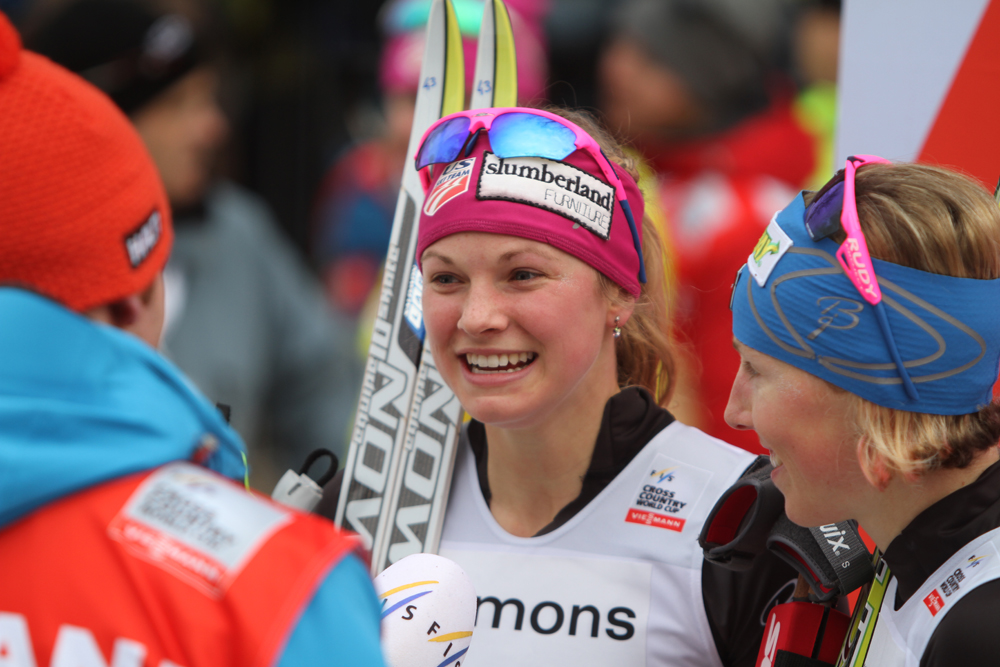
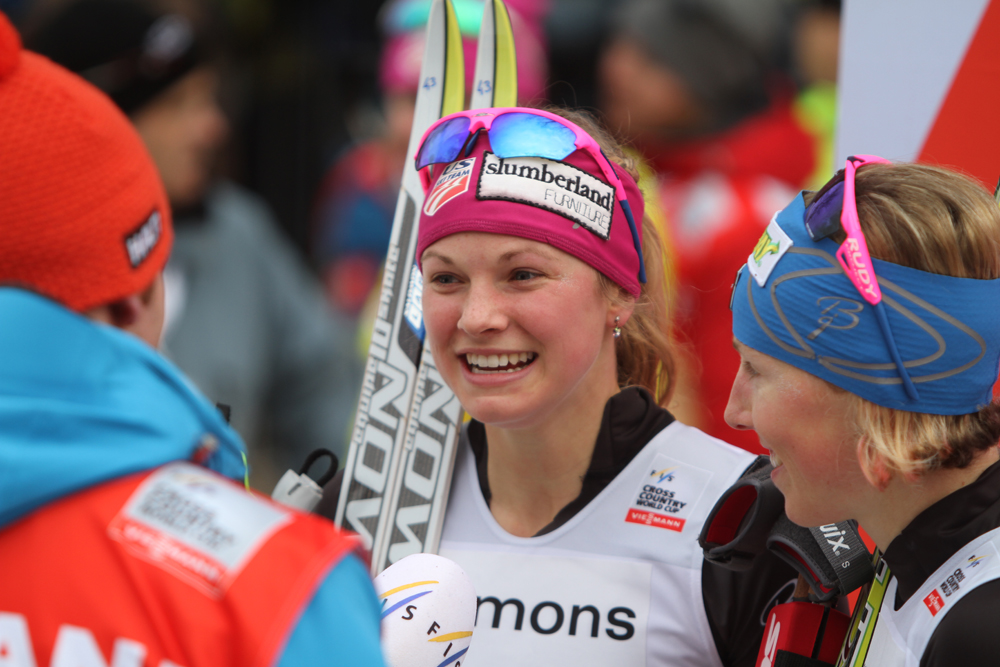
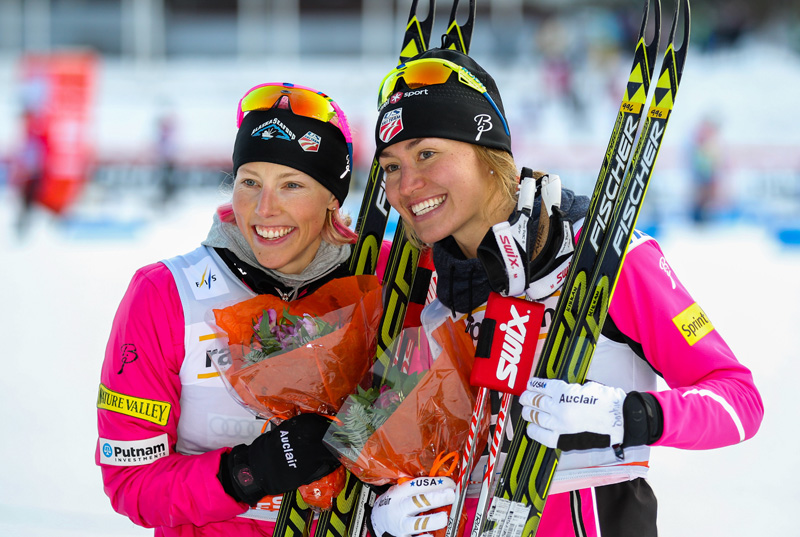
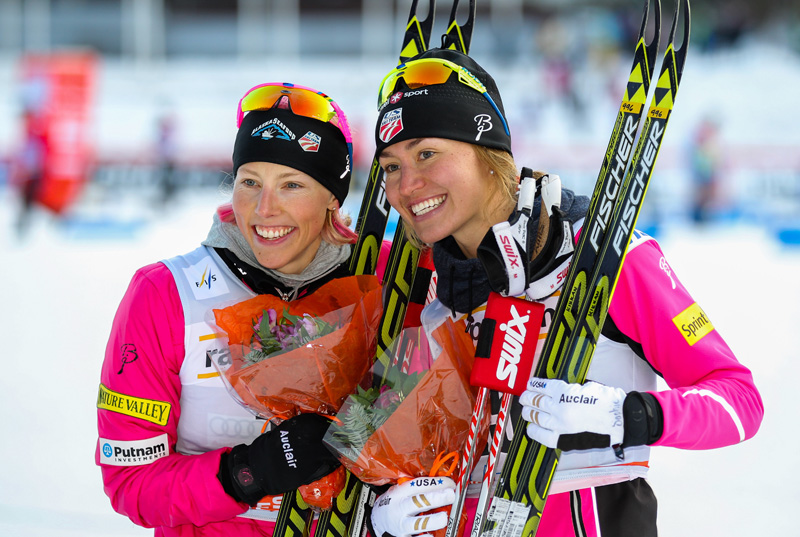
    Fellow U.S. Ski Team members Kikkan Randall (l) and Sophie Caldwell after finishing an unprecedented first and third, respectively, in the Lahti World Cup freestyle sprint on Saturday in Finland. (Photo: Fischer/Nordic Focus)
    Fellow U.S. Ski Team members Kikkan Randall (l) and Sophie Caldwell after finishing an unprecedented first and third, respectively, for the U.S. in the Lahti World Cup freestyle sprint in March 2014 in Finland. (Photo: Fischer/Nordic Focus)

    Note: This article has been updated to include comments from Jeff Ellis, Kikkan Randall’s husband and the FIS media coordinator who interviewed Sophie Caldwell on television after Tuesday’s race.

    ***

    American Sophie Caldwell’s classic sprint victory in Tuesday’s Stage 4 of the Tour de Ski in Oberstdorf, Germany, is as much about empowerment as it is about tactical acumen and gut-it-out speed.

    Someone had to be first.

    Through a long legacy of U.S. women greats, only three have stood atop the podium in a World Cup individual race. Initially it was Alison Kiesel (formerly Owen-Spencer), who won the inaugural women’s World Cup event in December 1978 at Telemark in Cable, Wis. In modern-day World Cups, Caldwell, 25, did so Tuesday, following the path paved by teammate Kikkan Randall, a name synonymous with empowerment.

    “Certainly I think Sophie is actually also the only other women to officially get an individual podium,” Randall said Tuesday on the phone from her home in Anchorage, Alaska. “Jessie [Diggins] has been on the team sprint podium, Sadie [Bjornsen] has been on a team sprint podium, but Sophie is the only one to have snagged an individual podium and so now this makes for the second women in U.S. history to the win the World Cup, so it’s pretty exciting.” 

    (Note: There is some discrepancy over whether Kiesel’s victory technically counts since it was later recognized as a World Cup test event.)
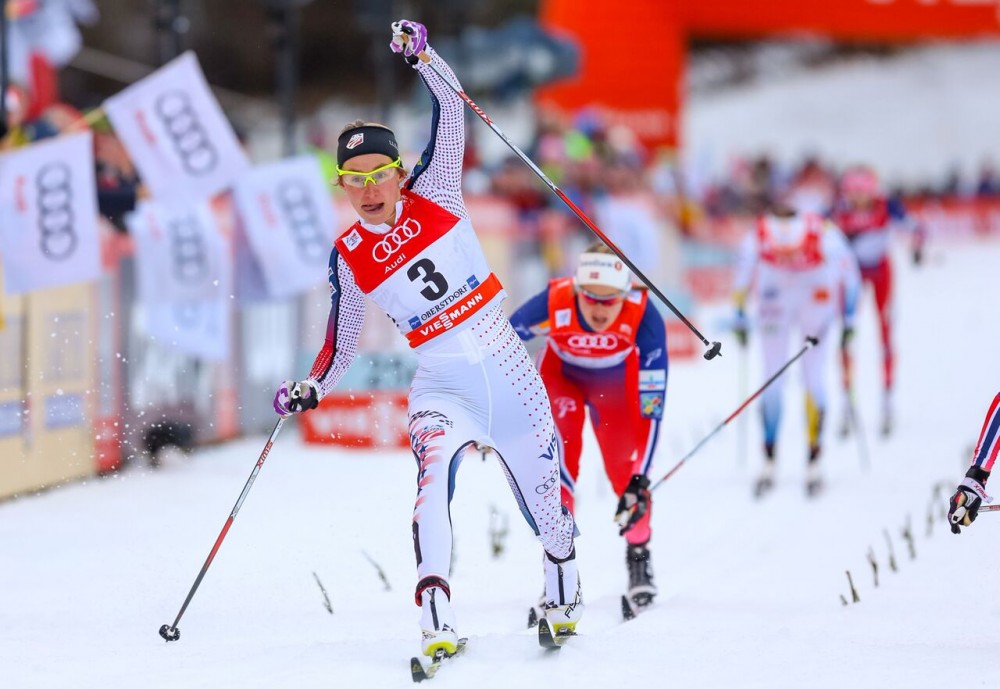
    Sophie Caldwell (U.S. Ski Team)  lunges to edge Norway's Heidi Weng (not shown) for the win in the 1.2 k classic sprint final at Stage 4 of the Tour de Ski in Oberstdorf, Germany. (Photo: Marcel Hilger)
    Sophie Caldwell (U.S. Ski Team) lunges to edge Norway’s Heidi Weng (not shown) for the win in the 1.2 k classic sprint final at Stage 4 of the Tour de Ski in Oberstdorf, Germany. (Photo: Marcel Hilger)

    Randall is currently 10 hours behind Oberstdorf time, which makes watching the Tour de Ski in real-time a habit for Alaskan night owls only. Having been unable to watch the heats live, she caught up with the morning’s news quickly.

    I’ve been having good luck with being able to catch the race on YouTube in the mornings when I wake up, so I didn’t see the race live, but I had some good news to wake up to this morning,” Randall, 33, explained.

    Her husband, Jeff Ellis, was the first to interview Caldwell as the International Ski Federation (FIS) cross-country media coordinator in charge of all post-race interviews with winners. He did so in front of a stadium packed with more than 4,000 spectators and on live TV.

    “It’s always great to interview an athlete that I know, especially when it’s their first World Cup win,” Ellis wrote in an email. “I remember very clearly when Kikkan won her first, and especially when I got to tell her that she had won her first crystal globe.  Those are the highlights of my job with FIS.”

    Sitting out this season while pregnant* with her first child (due in April), Randall is often credited for performance milestones that revealed new possibilities for U.S. cross-country skiers. She showed that winning, and consistently winning, is possible on the World Cup stage.

    Caldwell’s win is her own, but it’s also a part of Randall’s legacy.

    “Since I am sitting at home not racing right now, it just makes me so excited, so proud,” Randall said. “I have so much fun watching these guys and to see the development that they have made and the changes and the increasing confidence. And to know that they are taking the lead now, it’s really exciting for me and I’m happy that could have played a part in it.

    “I have a really strong friendships with everyone on the team,” she added. “So when I see them do well, it feels almost like a personal victory for all of us.”

    For the U.S. Ski Team, victories have become something not unexpected. Simi Hamilton came close in second in Davos. Andy Newell notched fourth in Ruka. The women’s side is full of contenders on any given day. So is Caldwell’s win a surprise for Randall?
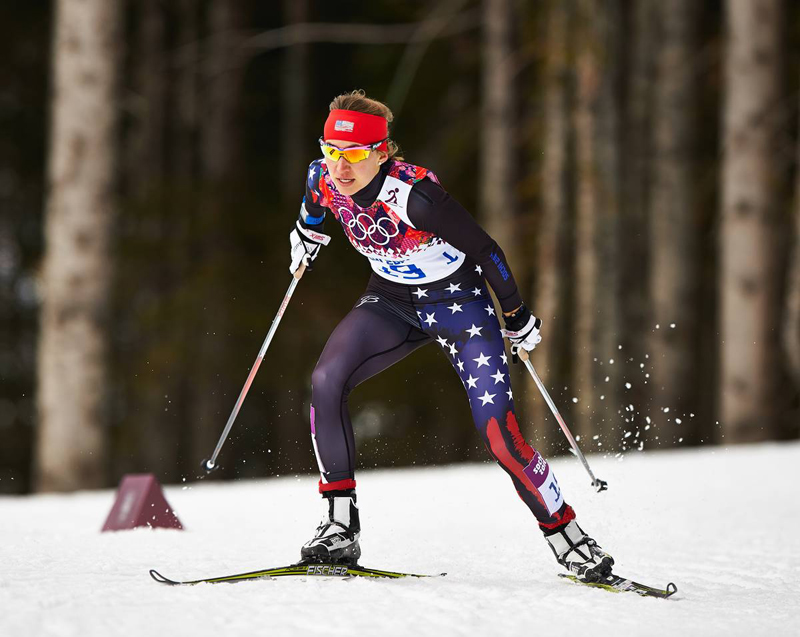
    Sophie Caldwell (U.S. Ski Team) racing to sixth in the individual freestyle sprint at the 2014 Winter Olympics in Sochi, Russia. (Photo: Fischer/NordicFocus)
    Sophie Caldwell (U.S. Ski Team) racing to sixth in the individual freestyle sprint at the 2014 Winter Olympics in Sochi, Russia. (Photo: Fischer/NordicFocus)

    “I have to say I had good expectations for the team coming into today because everybody’s really been racing well and Sophie has been sprinting well, Sadie has been right up there, Jessie’s been right in there. Ida can be really be really strong classic sprinting,” she said. “So I was excited for the girls to all have a good day. I’m not surprised of course to see Sophie in the final and to see her win actually.

    “Certainly sixth place in the Olympics [for Caldwell] was a surprise because that was her first really big performance at a major championship,” she continued. “But she’s been in several finals already this season, so she has proved she is in great shape. It’s just been a matter with getting comfortable with tactics, and being in the right position at the right place. When I saw that she had won today, I was super excited for her, but it wasn’t a huge surprise. You could tell she was ready to make this happen.

    “It’s pretty neat and it’s cool to know that Sadie was close as well. Jessie was in there. All the girls are really can have their moment any day,” she added.

    Asked about her first World Cup victory, Randall recalled, “That memory is still clear to me. It’s definitely a highlight of my career.”
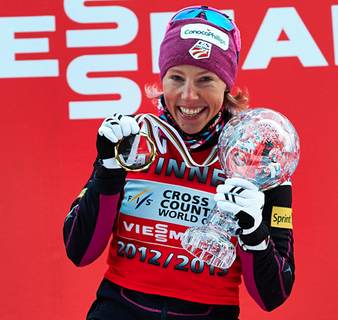
    Kikkan Randall (USA) wins her second straight FIS Sprint Crystal Globe on Randall showing off her 2013 Sprint Cup globe.(Photo: Fischer/Nordic Focus)
    Kikkan Randall after winning her second FIS Sprint World Cup Crystal Globe in 2013. She went on to win three-straight overall sprint titles. (Photo: Fischer/Nordic Focus)

    The first of Randall’s 13 individual World Cup wins (all of which were skate races) came in December 2007 in Rybinsk, Russia.

    “I was 24 years old and I remember actually waking up that morning not feeling great. It was kind of dreary outside, and an arduous Period 1, and I was excited to go home,” she said. “But I thought, OK, one more skate sprint, here we go.

    “When out that day, I ended up finishing second in the qualifier, so I knew things were working well and then just felt strong in each one of my heats. … I remember being in the heat with Astrid Jacobsen and she was skiing really well at that point, so I thought, ‘Today, you know what? I’m going to take a chance. I’m going to try to stick to the front and stick with her, when she makes a move, I’ll kind of be ready to cover it.’

    “We went around the course and as we got into the final climb, I realized that she wasn’t going as fast as I thought I could go, so I pulled out beside and made a spurt up and over the top of the hill. Which was risky because there was a draft effect on the downhill, but I was just in that kind of mode of going for it. I managed to get a little gas and stay in the front and come down that homestretch waiting to be challenged, and then crossing that finish line first and just almost a feeling of disbelief. … Now I can just imagine how excited everybody is and fired up right now to have another win coming through.”

    Years from now it will be Caldwell’s turn to spin a yarn and reflect back on how she helped others believe.
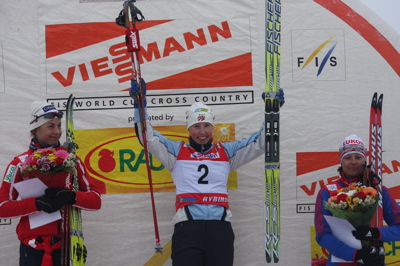
    Kikkan Randall celebrating her first-ever World Cup win at a skate sprint in Rybinsk, Russia, in December 2007. She shared the podium with runner-up Astrid Uhrenholdt Jacobsen (l). (Photo: Kikkan Randall/FasterSkier)
    Kikkan Randall celebrating her first-ever World Cup win at a skate sprint in Rybinsk, Russia, in December 2007. She shared the podium with Norwegian runner-up Astrid Uhrenholdt Jacobsen (l). (Photo: Kikkan Randall/FasterSkier)

    *Side note: Why does FIS consider pregnancy an injury? Kikkan Randall’s FIS profile lists her as “active” yet “injured ” since October 2015. According to Ellis, the data-entry personnel at FIS are on working it.

    “At the moment it is a generic form and isn’t even applicable to cross-country,” he wrote. “If an athlete declares ‘injury’ prior to the season then they are able to keep their FIS points from the previous season.  This is the case for pregnancy as well so they are entered as the same.  It will be fixed for sure for next season.”

  • Russia’s Vylegzhanin Uses Teamwork, Fast Skis to Win Rybinsk 30 k

    Russia’s Vylegzhanin Uses Teamwork, Fast Skis to Win Rybinsk 30 k

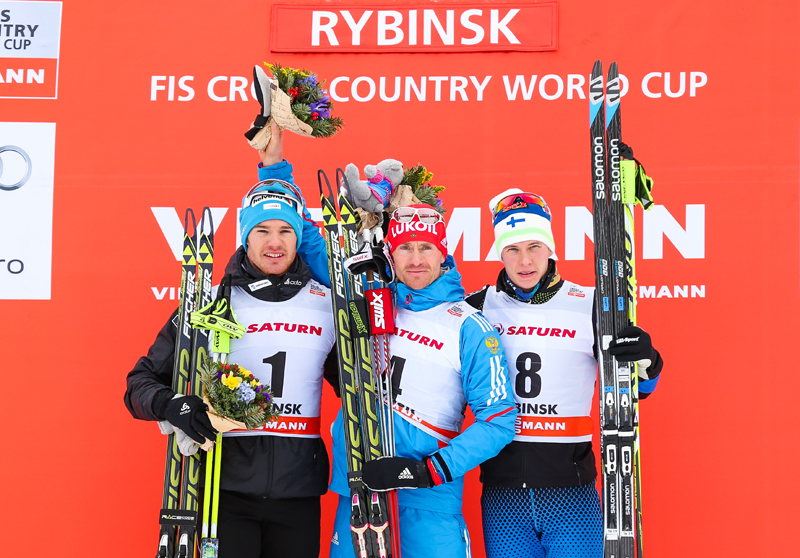
    The men's 30 k skiathlon podium (from l-r):Dario Cologna (SUI) in second, Maxim Vylegzhanin (RUS) in first, and Matti Heikkinen (FIN) in third. (Photo: Fischer/Nordic Focus)
    The men’s 30 k skiathlon podium (from l-r):Dario Cologna (SUI) in second, Maxim Vylegzhanin (RUS) in first, and Matti Heikkinen (FIN) in third. (Photo: Fischer/Nordic Focus)

    Although it isn’t an event that is common on the World Cup race circuit, the skiathlon one race Switzerland’s Dario Cologna has excelled in over the years.

    The last World Cup skiathlon was held at the 2013 pre-World Cup in Sochi, Russia, and used as a leadup to the upcoming Olympics. Before Sunday, Cologna had won the last four international skiathlon events he participated in, including the skiathlon at the 2014 Sochi Games, making him the favorite to win the men’s World Cup 30-kilometer skiathlon in Rybinsk, Russia.

    The 28 year old had also won more races in Russia than he had in any other country: two World Cups (including Saturday’s 15 k skate) and two 2014 Olympic events (the skiathlon and 15 k classic).

    The only problems were that this was a new year and he was up against a strong Russian team (among others) motivated to win on Russian soil. That was about all Russian national-team member Maxim Vylegzhanin needed in terms of headspace to outpace Cologna by 2.7 seconds on Sunday.

    The two athletes would became very familiar with the Rybinsk course by the end of the 12-lap race. After six 2.5-k loops of classic, they went head to head for another six loops of skating on a different 2.5 k course. Both courses included several climbs that could separate the pack or prove to be the perfect place for an attack. It was a relatively warm day with falling snow so nailing the wax for the classic portion was tricky.

    Early on, the race outcome appeared to be more in the hands of the wax techs than the skiers. Many athletes crashed and slipped during the first 15 k classic leg. The pace was extremely fast, which led several missteps. Cologna had an early scare in the first part of the race when he and Canadian Alex Harvey collided and both men fell. Cologna recovered, but Harvey ended up crashing three times in the classic portion. Several other skiers slipped up in the warm conditions as well.

    For the most part, the pack stayed together for the majority of the first half of the race. The lead rotated several times between Cologna, Vylegzhanin and several others, with every attempted attack countered and nobody distancing themselves from the front group. At one point, Vylegzhanin’s teammate Alexander Bessmertnykh and France’s Jean-Marc Gaillard attempted a half-hearted attacked that strung out the field, but their lead was quickly absorbed once the rest of the pack hit the downhill.

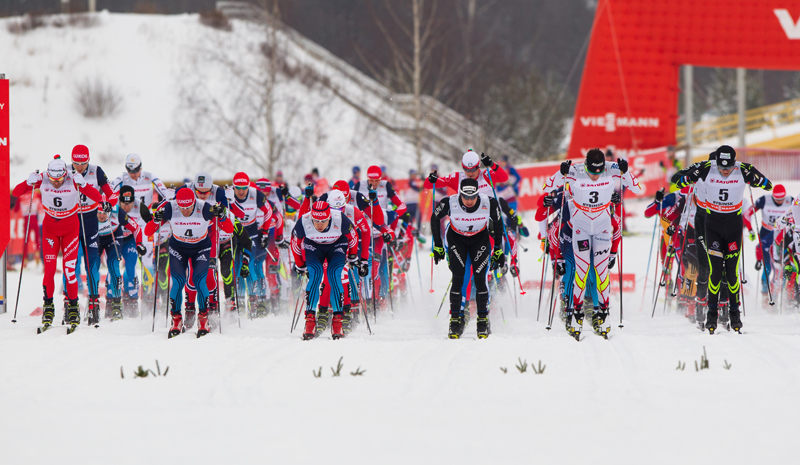
    The start of the men's 30 k skiathlon in Rybinsk, Russia. (Photo: Fischer/Nordic Focus)
    The start of the men’s 30 k skiathlon in Rybinsk, Russia. (Photo: Fischer/Nordic Focus)

    Heading into the transition,  a trio of Russians led the group into the corral. Stanislav Volzhentsev, Dmitriy Japarov and Evgeniy Belov arrived first in 43:14.5, followed closely by the rest of the group. The first one out onto the skate course was Russian Sergey Turyshev, who quickly set the lead pace while Japarov headed out 0.6 seconds behind, just ahead of some 20 others, including Harvey in 13th.

    Once the skate skis were on, the Russian skis appeared to be the fastest of the field. At one point, Russia’s Alexey Vitsenko launched an attack on the downhill and opened a sizable gap, skiing away from the chase pack. Which Russian would ultimately win or podium was unclear, but it was evident their skis were going to help them get there.

    Cologna noticed the difference.

    “The start of the race was very quick but in the skate it was not so fast; I realized that my skis were maybe not as fast as the Russians’,” he told FIS afterward. “So I knew that I needed to attack before the finish to make the group smaller.”

    Cologna’s attack came at the 25.9 k mark when he raced up the hill crossing the timing mat at 1:12:19. Vitsenko marked him closely and joined Cologna as he headed down the hill. Leading the chase group was Finland’s Matti Heikkinen, Gaillard and Vylegzhanin, who were flanked by Russians Alexander Leskov and Eugeniy Dementiev.

    The Russian teamwork ended up keeping Cologna in check and Vylegzhanin close to the front. Heikkinen skied a strong skate leg and found himself in prime position toward the closing segments of the race.

    Realizing his time to shake the pack was slipping away, Cologna gave one last push on the final climb. Vylegzhanin and Heikkinen anticipated his move and quickly latched on. This attack separated the three from the rest of the field and set up the battle for the podium spots.

    “I pushed very hard at the end, but Maxim and Dario were too strong for me,” Heikkinen told FIS.

    The change of pace left Heikkinen hanging behind the two leaders.

    As Vylegzhanin and Cologna approached the finish line, the switchback design of the finish gave Vylegzhanin time to overtake Cologna and cross it first in 1:21:54.8 for his first victory in a year since winning the 15 k classic mass start in Szklarska Poreba, Poland.

    “This is my first podium and win this season and it’s nice that it came in Russia,” Vylegzhanin told FIS. “The spectators are so great here. I had very good skis today and I am happy to the strongest at the finish. Thank you to the spectators, the organizers and of course my team for the great skis today. Russian skis like Russian snow!”

    Cologna finished 2.7 seconds back in second, and Heikkinen rounded out the podium in third, 6.2 seconds after Vylegzhanin.

    Although some the stronger skiers opted out of the Rybinsk World Cup weekend to prepare for the upcoming World Championships in Falun, Sweden, Heikkinen was pleased with his result.

    “Sure, some of the best weren’t here, but a race is a race and I focus on Falun so this is a was a great step,” he said.

    Russia put six in the top eight (sweeping fourth through eighth), with Volzhentsev in fourth, Chernousov in fifth, Konstantin Glavatskikh in sixth, Legkov in seventh, and Turyshev in eighth. Harvey placed ninth.

    As a result of his second-place finish, Cologna moved up into second place in Overall World Cup standings, 333 points behind Norwegian leader Martin Johnsrud Sundby, who did not race in Rybinsk.

    “I was hoping for another win here today … but I am happy with second place,” Cologna said. “It was a good weekend for me and I can see where my shape is.”

    Sunday marked the last World Cup race before a two-week break as athletes prepare for the World Championships, which start on Feb. 18. A World Cup will be held in Östersund, Sweden, the weekend before, Feb. 14-15.

    Results

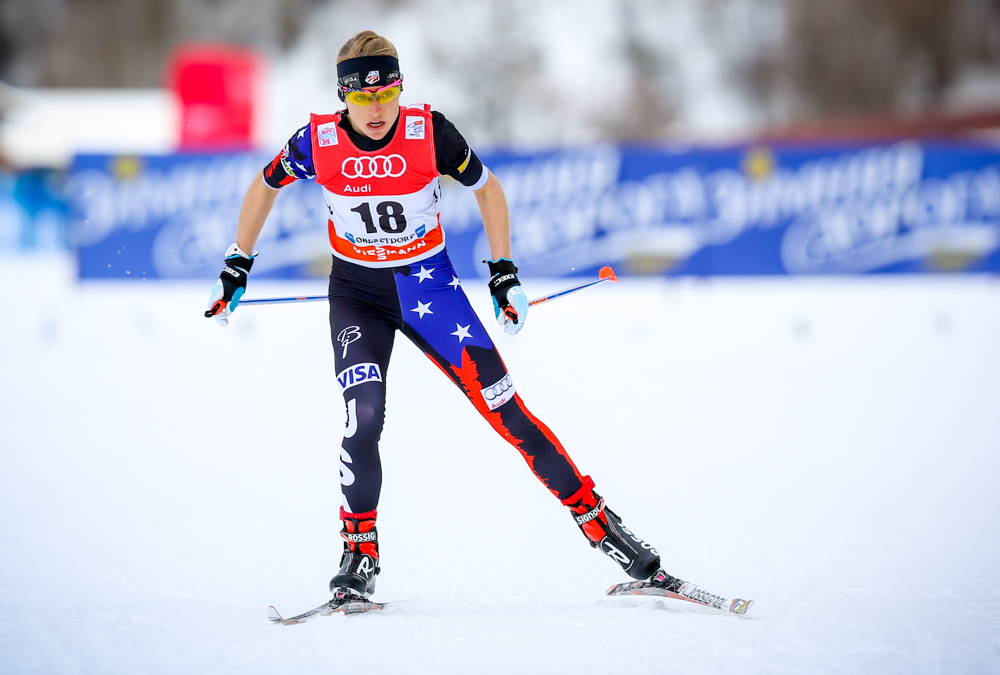
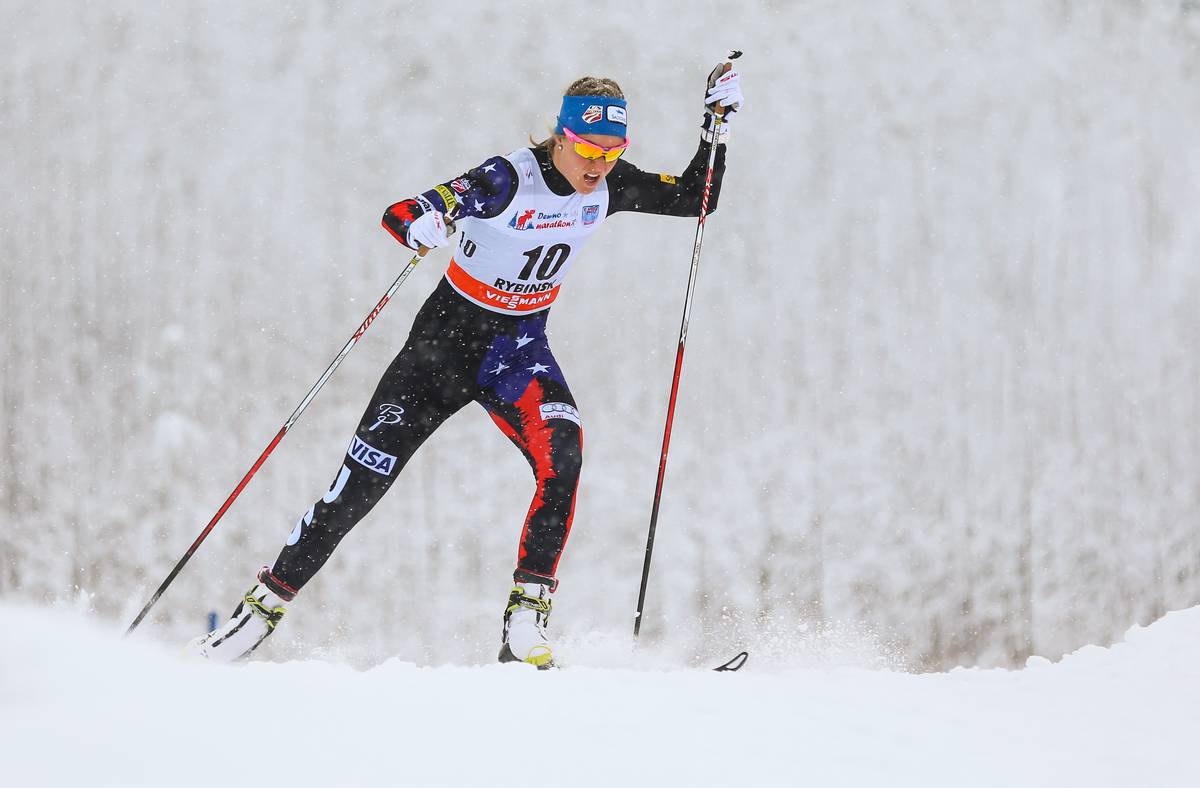
  • ‘The old Jessie is back’ as Diggins Skis to Fifth in Rybinsk Skiathlon

    ‘The old Jessie is back’ as Diggins Skis to Fifth in Rybinsk Skiathlon

    Jessie Diggins (U.S. Ski Team) skiing to first place in the qualification round of Wednesday's freestyle sprint. She finished second overall in the finals, a best-ver finish at a Junior/U23 World Championships. (Photo: FlyingPointRoad.com)
    Jessie Diggins earned her second fifth place finish of the weekend in Sunday’s 15 k skiathlon in Rybinsk, Russia. She is pictured here at the 2014 Junior/U23 World Championships. (Photo: FlyingPointRoad.com)

    Every year has its ups and downs, but for Jessie Diggins the 2015 season just wasn’t cutting it. Whether it was illness or general malaise, Diggins said her racing had yet to match her expectations.

    That all changed for the U.S. Ski Team athlete in Rybinsk, Russia, where she skied to her second fifth-place finish of the weekend in Sunday’s 15 k skiathlon, just 2.9 seconds from the podium. En route to her top placement, Diggins clocked the second-fastest time of the 7.5 k freestyle portion, just 0.2 seconds off the pace of eventual race-winner Yulia Tchekaleva of Russia.

    The placement matches Diggins best individual World Cup finish. She’s skied to fifth in four instances over her career, one of which was in Saturday’s freestyle sprint.

    The 23-year-old is traditionally a stronger freestyle skier and thus planned accordingly. She aimed to ski calm and relaxed in the first 7.5 k classic leg so that she could give it her all in the final 7.5 k freestyle section. Given the course, Diggins knew that as long as she didn’t get too frustrated with the inevitable accordian affect of skiing in a pack, she would be in ideal position to strike in the final kilometers.

    According to Diggins, the classic portion of the skiathon ended up going better than expected, as she fought to stay near the front to avoid the messiness of the pack. Heading into the exchange, Diggins was 13th, 37.0 seconds back from Tchekaleva.  She exited the stadium ready to attack after posting the second fastest pit time. It was here, however, that Diggins found her greatest challenge of the race.

    “I ended up being able to fight more in the classic to be up front and avoid the inchworm effect. It was in the skate half where I thought I was done a number of times. I was yo-yo-ing off the back of this pack. They would drop me on every uphill and I’d make it up on the flats and downhill. Then they drop me again,” she said in a post-race phone interview.

    By 9 k Tchekaleva and eventual second-place finisher Martine Ek Hagen were out of reach, but the fight for third was far from over. A group of roughly six women formed behind the two leaders, jockeying for the final spot on the podium. Oblivious to the fact she was seconds away from her best World Cup result, Diggins skied at the back of the group hoping to hold on.

    Working to counteract the mental challenge of playing catch-up, Diggins attempted to stay positive and ski smart. Aided by fast skis, she was patient as she approached the course’s final hill.

    It left me hungry for more. I’m definitely psyched, but to see the podium right there is a crazy feeling,” – Jessie Diggins on finishing 2.9 seconds away from Sunday’s podium.

    “Eventually I was like ‘you just got to believe that you’re going to keep catching up.’ I was trying to not get dropped on the last hill and I trusted in my skis, which were crazy fast,” she said.

    As the skiers attacked the steep pitch of the final climb Diggins made a move and used the momentum to power her way past several women. Skiing into the finish, she was just 2.9 seconds behind Riitta-Liisa Roponen of Finland and Stefanie Böhler of Germany, who lunged for third place.

    “I wish I had known how close I was to third place because I would have tried to not get dropped quite as early,” Diggins said of the final meters. “I don’t know if much would have changed anyway, but I was getting closer and closer to those girls who were lunching for third, and that was so exciting.”

    At the same time, however, Diggins explained that her lack of knowledge might have been for the best.

    Diggins and Randall get interviewed by a familiar FIS employee, Kikkan's husband Jeff Ellis.
    Jessie Diggins posted the second-fastest time in the skate leg of Sunday’s skiathlon in Rybinsk, Russia. She’s pictured here with Kikkan Randall after a Quebec sprint in 2012.

    “I had no idea and it was probably better that way. If I knew I would have over thought it. For me it’s better when I’m having fun, soaking up the energy of the crowd, and going for it because I’m trying to ski fast,” she explained.

    The Rybinsk World Cup weekend delivered Diggins’ best results of the season. Her 12th in Friday’s 10 k, coupled with to the two fifth places from Saturday’s sprint and Sunday’s skiathlon, mark one of the best weekends in the Minnesota native’s career.

    Diggins acknowledged that the field was thin, with big names such as Norwegians Marit Bjørgen, Therese Johaug, and Heidi Weng skipping the Russian World Cup to prepare for World Championships. At the same time, she didn’t let the smaller field take away from the meaning of her accomplishment.

    “There were some girls who weren’t here racing in Russia, but that’s part of racing – you have to show up and be on the start list if you want the results,” she said.

    The strong weekend of racing comes after a period challenge for Diggins, who dropped out of the Tour de Ski due to illness earlier this month. She explained that prior to Friday, the 2015 season has been difficult due to high expectations that were never matched.

    According to Diggins the weekend of racing in Rybinsk, especially Sunday’s skiathlon, left her feeling excited and sure of her skiing as World Championships approaches.

    “[The skiathlon] left me really excited. I’m feeling like I’m much more confident in my skiing. I’m feeling like I’m back to the old Jessie and skiing like I used to last year when I had that confidence. It’s really cool to have that feeling back,” she explained

    Liz Stephen (U.S. Ski Team) racing in the Tour de Ski prologue in Oberstdorf, Germany, last weekend. (Photo: Marcel Hilger)
    Liz Stephen placed seventh overall in the 15 k skiathlon in Rybinsk, Russia. She is pictured here racing in the 2015 Tour de Ski prologue in Oberstdorf, Germany (Photo: Marcel Hilger)

    USST Women Land Four in the Top-20

    Just behind Diggins in seventh place was teammate Liz Stephen, who earned her first World Cup podium in Friday’s 10 k freestyle. Starting the skiathlon with bib #1, Stephen led the charge out of the stadium.

    “It was quite an experience starting with bib 1 for the first time ever in a World Cup for me, though the front position quickly disappeared as soon as the gun went off and I felt like a wave of water just overtook me, with girls passing on both sides all at once.  It is amazing how fast these girls can get off the line. It is very apparent that I need to continue to work on my quickness off the line,” she wrote in an email.

    Like Diggins, Stephen is a stronger freestyle skier, but clocked the seventh-fastest classic leg of the 15 k. In the skate portion Stephen was fighting in the chase group, but ultimately crossed the line 11.4 seconds out of third.

    Stephen explained that the race was enjoyable due to the high level of competition, and that the largely successful weekend leaves her confident as the team enters two weeks of rest and training.

    Teammate Sadie Bjornsen skied to 13th in the skiathlon, after jumping in and out of the top five during the classic portion of the race. She entered the technique switch in ninth, but ultimately skied the 29th-fastest freestyle leg to take her out of top-10 contention.

    “After a solid classic leg, I struggled for a while when I first switched to skate, but was able to pull it together by the end. Russia has some challenging courses, but I have really enjoyed them this week!” she wrote in an email.

    Rosie Brennan, who finished 20th, wrote that the skiathlon format was challenging but that she was excited to complete a mass start-like race on the World Cup. The SuperTour leader said she skied the race consistently despite some challenges in the classic leg and lack of a final kick.

    “I skied the whole race within a few places of where I started, which I am happy about. I tend to prefer classic, but the classic was a little tricky today and the hills were quite steep so I was actually happy to switch to skate,” she wrote in an email. “I am definitely feeling some fatigue from the last month so I didn’t feel like I have much finishing speed which was a bummer because I was skiing in a pack and would have liked to finish in the front of that pack.”

    Fellow American women Ida Sargent and Sophie Caldwell finished 35th and 43rd respectively.

    With four skiers in the top-20 of the women’s races, U.S. Ski Team Head Coach Chris Grover said he was happy with his team’s effort. 

    Sadie Bjornsen skied to her second-best World Cup sprint result in Saturday's 1.3 k freestyle sprint in Rybinsk, Russia. (Photo: Fischer/Nordic Focus)
    Sadie Bjornsen skied to 13th in the Skiathlon Sunday after earning her second-best World Cup sprint result in Saturday’s 1.3 k freestyle sprint in Rybinsk, Russia. (Photo: Fischer/Nordic Focus)

    “It was another good day, obviously, to have four in the top-20 on the ladies’ side and with Jessie and those guys were fighting for potential podium places,” Grover said in a phone interview. “We for sure wanted to have a podium in the last two days and we didn’t quite get there, but we were going for it.”

    Two USST men started Sunday’s skiathlon but only one finished, with Matt Gelso placing 48th. Gelso said that his race was not what he wanted but that he was able to accomplish several personal goals vote the course of the 30 k.

    Erik Bjornsen was sitting in 51st at the exchange, but exited the race during the freestyle portion due to fatigue. In an email to FasterSkier he wrote that his race was one of the most difficult of the season.

    “It was a really bad day for me. Probably my worst since I got over here to Europe. I knew I was very exhausted going into the race but the goal was to hang in the field for as long as I could,” he wrote in an email. “I think it’s something I can be strong in but not today. I’m ready for some off days, I think this big load from all the hard racing will pay off in a couple weeks, should be perfect timing.”

    The USST now heads to Davos, Switzerland to get some altitude training, rest and sun before traveling to Sweden in preparation for the 2015 World Championships. Most skiers expressed excitement for a break at the USST’s “home away from home.”

    “I am really excited to have some good team time next week in Davos, with great tracks, sunny weather and fun activities all together – maybe even a video!” wrote Stephen.

    Results: Women | Men

  • Harvey Captures Ninth in Messy 30 k Skiathlon in Rybinsk

    Harvey Captures Ninth in Messy 30 k Skiathlon in Rybinsk

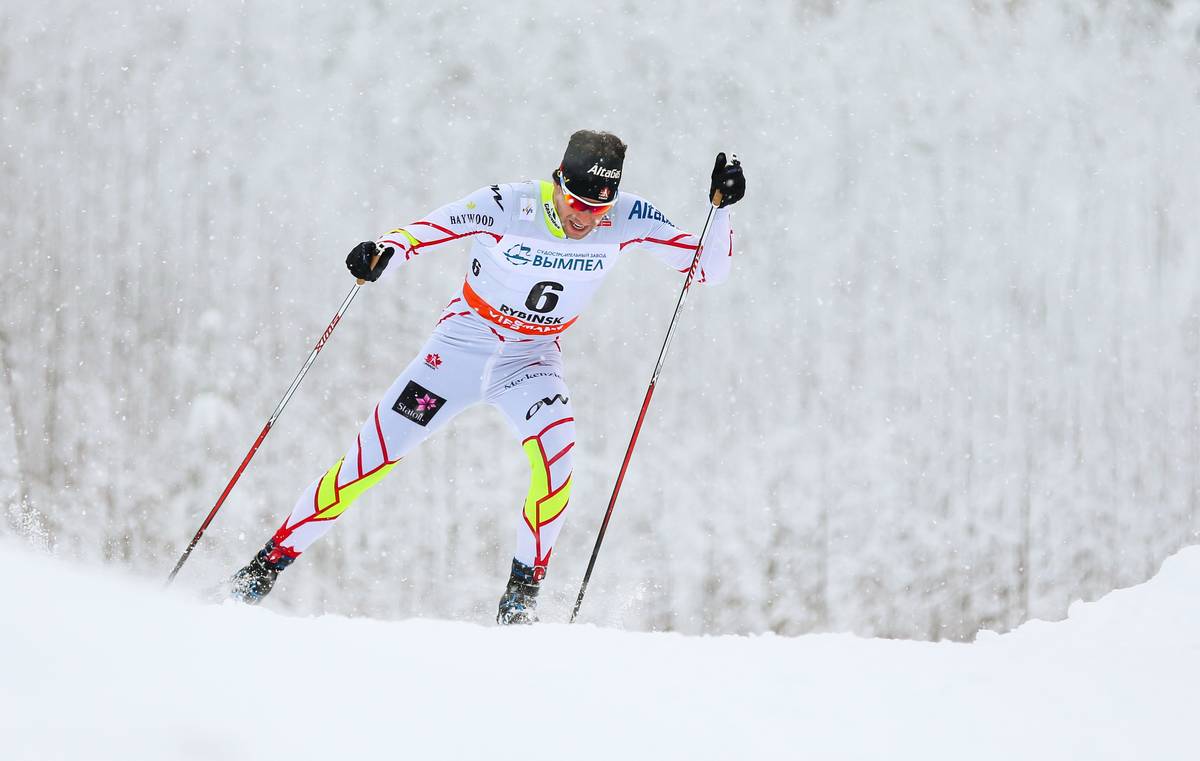
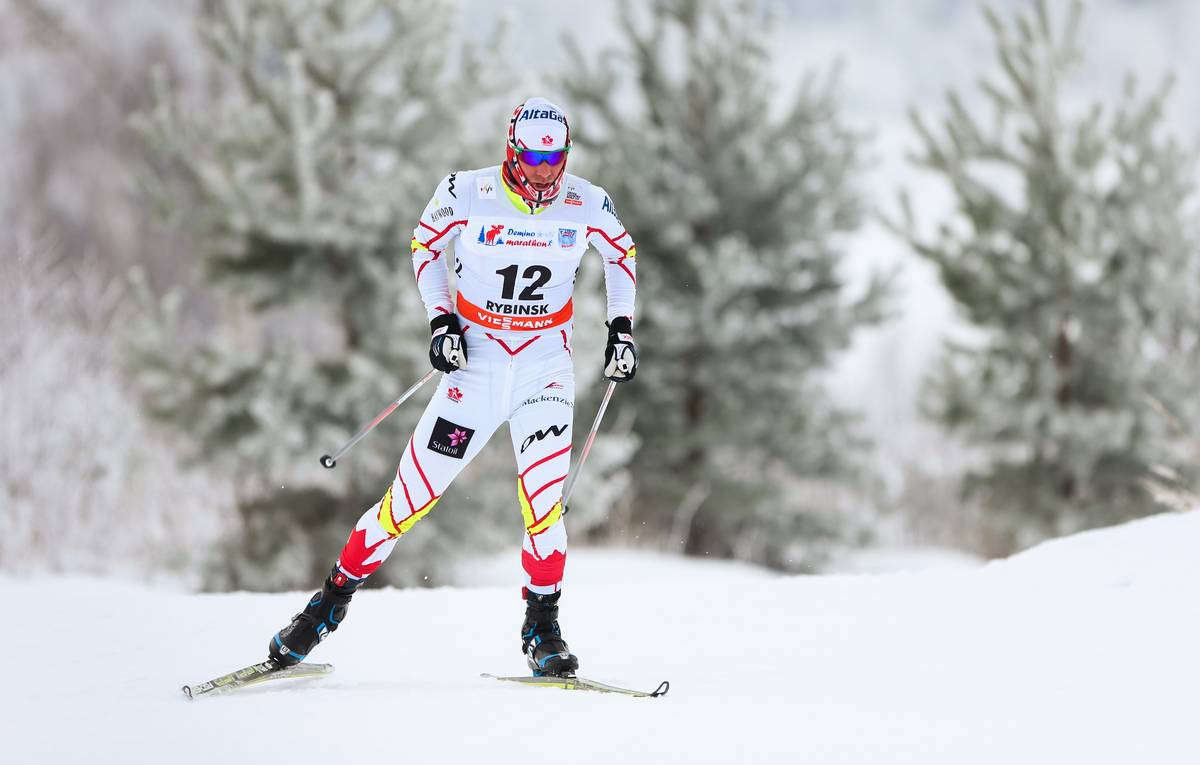
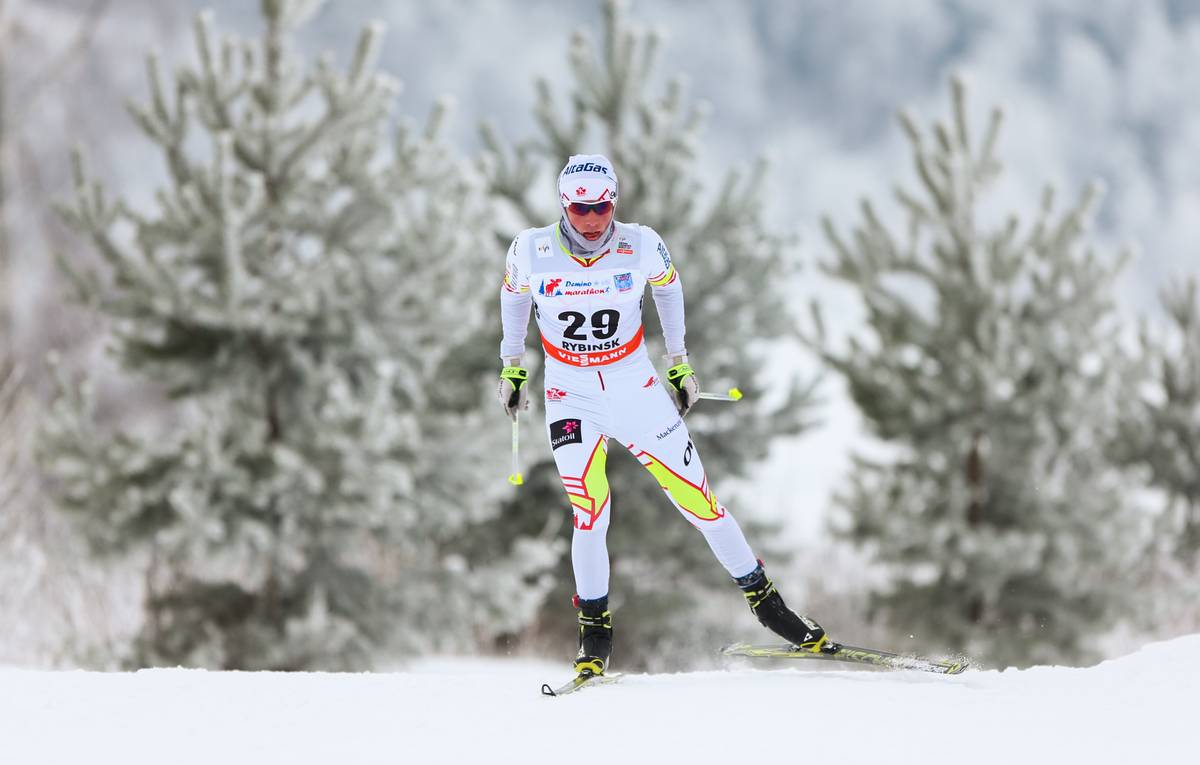
    Canada's Alex Harvey competes in the qualifier of Saturday's 1.3 k freestyle sprint in Rybinsk, Russia. He qualified 25th and ultimately finished 28th. (Photo: Fischer/Nordic Focus)
    Canada’s Alex Harvey, who took ninth in Sunday’s 30 k skiathlon, competes in the qualifier of Saturday’s 1.3 k freestyle sprint in Rybinsk, Russia. (Photo: Fischer/Nordic Focus)

    Canada’s Alex Harvey notched his second top-10 finish in a weekend of World Cup racing in Rybinsk, Russia, leading all North American men by taking ninth in Sunday’s 30-kilometer skiathlon. He finished 16.0 seconds behind winner Maxim Vylegzhanin of Russia (1:21:54).

    Harvey said in a phone interview that the 15 k classic portion was fast and challenging, as a contingent of young Russian skiers fought to position themselves in the font of the pack.

    “There was a lot of stress in the pack,” he said.

    Harvey explained that he crashed five times in the classic portion: three times with Russian Alexey Vitsenko, once with Dario Cologna of Switzerland, and another time with Russian Evgeniy Belov.

    “My goal was to kind of stay relaxed and save energy but that’s not exactly what I did … I had to move to the back of the pack again and again and again,” Harvey explained.

    However, Harvey maintained contact with the leaders and was 13th after the classic portion, just 4.7 seconds behind 15 k leader Stanislav Volzhentsev of Russia (42:54.5).

    The leaders established a slower pace at the start of the 15 k skate portion, which allowed Harvey’s legs to recover.

    Ivan Babikov (Canadian World Cup Team) racing to 22nd on Friday in the 15 k freestyle at the World Cup in Rybinsk, Russia. (Photo: Fischer/NordicFocus)
    Ivan Babikov (Canadian World Cup Team), seen here during Friday’s World Cup 15 k freestyle in Rybinsk, Russia, took ninth in Sunday’s 30 k skiathlon. (Photo: Fischer/NordicFocus)

    “It was super slow the whole time until near the end, on the second-to-last lap. That’s when Cologna and [Finland’s Matti] Heikkinen went … and then they kept pushing the whole way,” Harvey explained.

    He said Cologna and Heikkenen opened up a gap of “five-to-ten seconds” while he was sitting in fifth. The pack was not chasing, so Harvey decided to take on the chase himself, and was in third position going into the last lap.

    “But then I paid for it,” Harvey said. “I slipped from third to ninth. My legs blew up a bit in the end, but still the top 10 is always a good result. That’s what I’m aiming for every time I put a bib on.”

    Harvey said it was an especially good result when considering he was one of the few skiers to do all three races in Rybinsk. He was 10th in Friday’s 15 k freestyle individual start and 28th overall in Saturday’s 1.3 k freestyle sprint.

    “For sure, after three races there was fatigue in the body,” Harvey said.

    Teammate Ivan Babikov used a strong skate portion to finish in 19th (+31.5) after completing the classic portion in 29th, 41.9 seconds behind Volzhentsev.

    “I struggled a bit in classic … I got stuck behind some skiers crashing and after the second time I wasn’t strong enough to breach that gap between our group and main pack,” Babikov wrote in an email.

    Babikov explained that he was able to position himself in the leading group during the skate portion, but expended too much energy doing so, and struggled during the last lap while finishing in the back of the leading group.

    However, he wrote that he was still happy with the 19th-place result.

    Graeme Killick (AWCA/Canadian Development B-Team) racing to 43rd in the 15 k freestyle at the World Cup in Rybinsk, Russia. (Photo: Fischer/NordicFocus)
    Graeme Killick (AWCA/Canadian Development B-Team), who took 40th in Sunday’s 30 k skiathlon, seen racing to 43rd in Friday’s 15 k freestyle at the World Cup in Rybinsk, Russia. (Photo: Fischer/NordicFocus)

    Devon Kershaw was 20th after the classic portion and just 8.3 seconds behind Volzhentsev, but wrote in an email that he had a rough skate on his was to a 34th-place finish (+1:35.2)

    He wrote that most of the skiers stayed close together in the classic portion, which made things messy and unpredictable.

    “There were lots of falls … sketchiness all around, really,” Kershaw wrote.

    He explained that despite the messiness he still felt good and was able to stay out of trouble, and skied as relaxed as he could in order to save energy for the skate.

    “In the skate portion the first 2.5 k was okay, but then it was rough. My calves cramped pretty badly, which was awful, and then I yo-yoed off the back of the big lead group for four laps before finally getting dropped with about 4-5 k to go,” he wrote.

    Kershaw explained that not being able to ski with the big group during the final laps of the skate, along with the wind blowing through the stadium, did not help his position.

    “Today’s result was disappointing. But today there were some positives … so I’ll take those with me moving forward,” he wrote.

    Meanwhile, Canadian Graeme Killick ended up 40th (+2:36.3). He was 31st (+44.2) after the classic portion.

    During a break in World Cup racing until Feb. 14, The Canadian team will head to Livigno, Italy, for 10 days of training, followed by another 10 days in Seiser Alm, Italy.

    “It’s going to be a lot of volume; a lot of three-plus hour skis at altitude to get more efficient at altitude and be in really good shape for World Champs in Falun,” Harvey said.

    Results

    Note: This article was updated to reflect that Matti Heikkinen is of Finland, not Russia.

  • Tchekaleva Skis to Convincing Victory in Rybinsk Skiathlon

    Tchekaleva Skis to Convincing Victory in Rybinsk Skiathlon

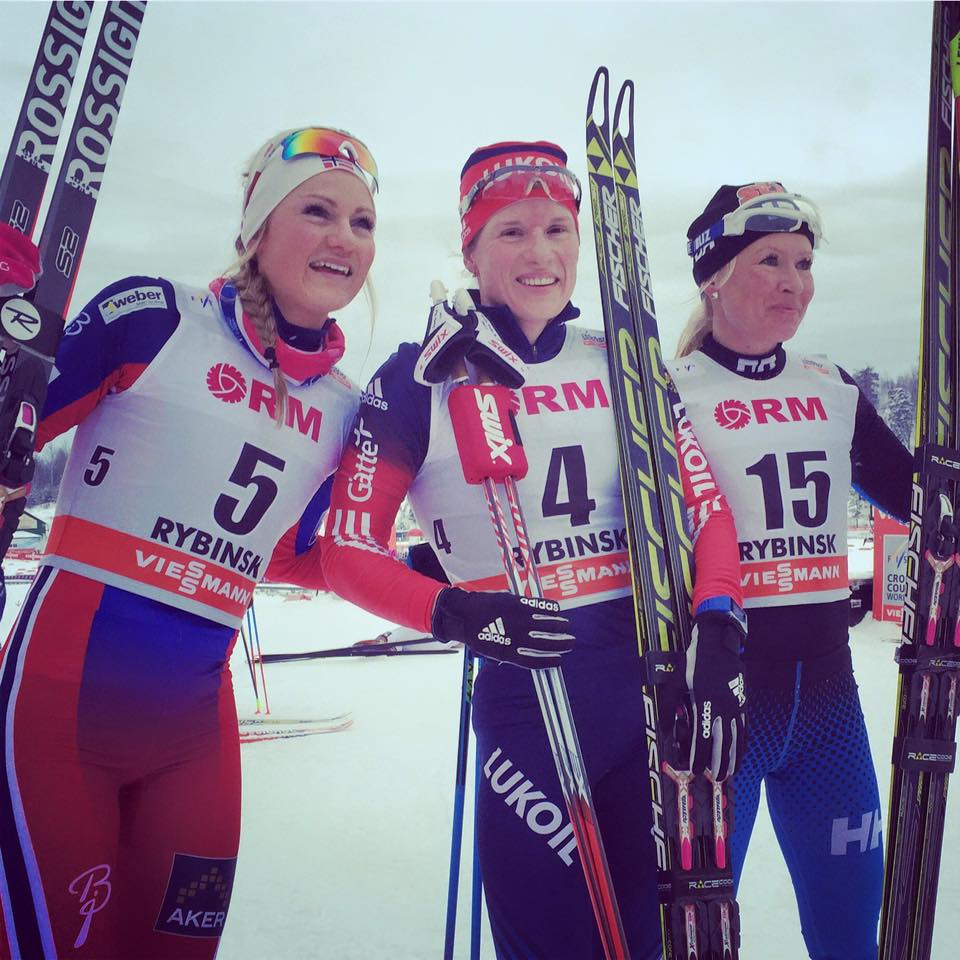
    Women's 15 k skiathlon podium in Rybinsk, Russia (from left to right): Martine Ek Hagen of Norway (second), Yulia Tchekaleva of Russia (first), Ritta-Liisa Roponen of Finland (third) (Photo: FIS/Facebook)
    Women’s 15 k skiathlon podium in Rybinsk, Russia (from left to right): Martine Ek Hagen of Norway (second), Yulia Tchekaleva of Russia (first), Riitta-Liisa Roponen of Finland (third) (Photo: FIS/Facebook)

    Russian Yulia Tchekaleva won the women’s 15-kilometer skiathlon Sunday by 15.6 seconds, earning her first-ever World Cup victory and delivering her best result of the season on home turf in Rybinsk, Russia. Tchekaleva finished the 15 k skiathlon in 44:16.0, with Martine Ek Hagen of Norway in second place, trailing by 15.6 seconds. Riitta-Liisa Roponen of Finland placed third, 22.9 seconds behind Tchekaleva.

    “I tried to save energy in the classic part of the race. I just tried to stay with the front group but not work too hard. When we switched to skating, I felt that I had a lot of power, so I went for the victory,” Tchekaleva said to FIS reporters.

    “It was really nice to win my first World Cup here in Russia,” she added.

    Tchekaleva attacked at the end of the classic portion of the competition and skied alone for the final 7.5 km freestyle portion of the course. However, she could never relax as a Norwegian was hot on her tail. Ek Hagen broke away from the chase group on the first of three laps in the skate portion. As they neared the final kilometers she chipped away at Tchekaleva’s lead, and at one point was just six seconds back.

    In the end Ek Hagen unable to catch Tchekaleva. In the process of the chase, however, she put a gap on the rest of the field and skied alone to the finish.

    “This is my first World Cup podium and I am very happy. It was a hard race today. When Yulia [Tchekaleva] attacked, I tried to go get her and hoped someone else would be able to come with me, but I was alone. Which I guess is good because I was able to get second place,” Ek Hagen said to FIS reporters in a post-race interview.

    Behind her, a fight was brewing for third as a group of roughly six athletes were all within five seconds of each other. With only a lap to go Roponen pulled away from the chase group, followed closely by Stefanie Böhler. The others in the pack were unable to respond, and the fight for third narrowed to two skiers. As the two entered the finishing stretch, Roponen was able to hold off the German to gain her first World Cup podium since 2010.  

    The Finnish skier said she was very happy with her return to the podium.

    “I am feeling very good right now. It has been a long time since I was on the podium for an individual result. It was a hard fight with Steffi (Böhler) to the finish, and I was hoping that I could stay ahead of her, and I did,” Roponen said after the race, adding that she surprised herself with the result. “I was not sure that I thought I would be on the podium today, so I am very happy that I was.”

    U.S. Ski Team’s Jessie Diggins was the fifth finisher across the line, 25.8 seconds behind Tchekaleva and 2.9 seconds from third. She logged the second-fastest skate portion of the skiathlon – only 0.2 seconds slower than Tchekaleva. She also posted the second-fastest pit stop, but given that her 7.5 k classic split was 13th, the gap to Ek Hagen and Tchekaleva was too big to gap.

    In addition to Diggins’ result, the USST also boasted a 7th place from Liz Stephen. The weekend has been largely successful for Stephen, as she placed second in Friday’s 10 k freestyle.

    Sunday’s race in Rybinsk was the first regular World Cup skiathlon in almost two years, aside from the 2014 Olympics in Sochi. The last regular World Cup skiathlon was held in at the pre-Olympic World Cup in Sochi in 2013, when Steira won ahead of Tchekaleva and Nicole Fessel of Germany was third.

    Norway’s selection to the World Championships

    With her second place today and her first-ever World Cup podium, Ek Hagen has made a solid bid for a spot on the Norwegian squad to the 2015 FIS World Championships in Falun, Sweden this February. The races in Rybinsk will be a significant part of the World Championships selection criteria for those who did not race the Tour de Ski. Despite the strong result, Ek Hagen doesn’t take anything for granted until the final selection is made.

    “It will be difficult to make the Norwegian team for the World Championships, but I feel really good right now and I hope I can make the team,” Ek Hagen said.

    Astrid Uhrenholdt Jacobsen, the winner of the women’s 10k skate on Friday, lead most of the first 7.5 k classic but ended up in ninth place after falling back on the skate portion of the race. Jacobsen’s previous win in a regular World Cup event was the skiathlon in Falun, Swden, almost seven years ago in February 2008. Since then Jacobsen has won a stage in the 2014 Tour de Ski.

    For sixth place finisher Størmer Steira, Rybinsk was the first World Cup weekend since her hip fracture in October. With Sunday’s result and fifth in Friday’s 10 k, she has definitely put her name in the hat for a selection position.

    Results

  • Led by Hamilton, Four North Americans Ski to Top-30 in Rybinsk

    Led by Hamilton, Four North Americans Ski to Top-30 in Rybinsk

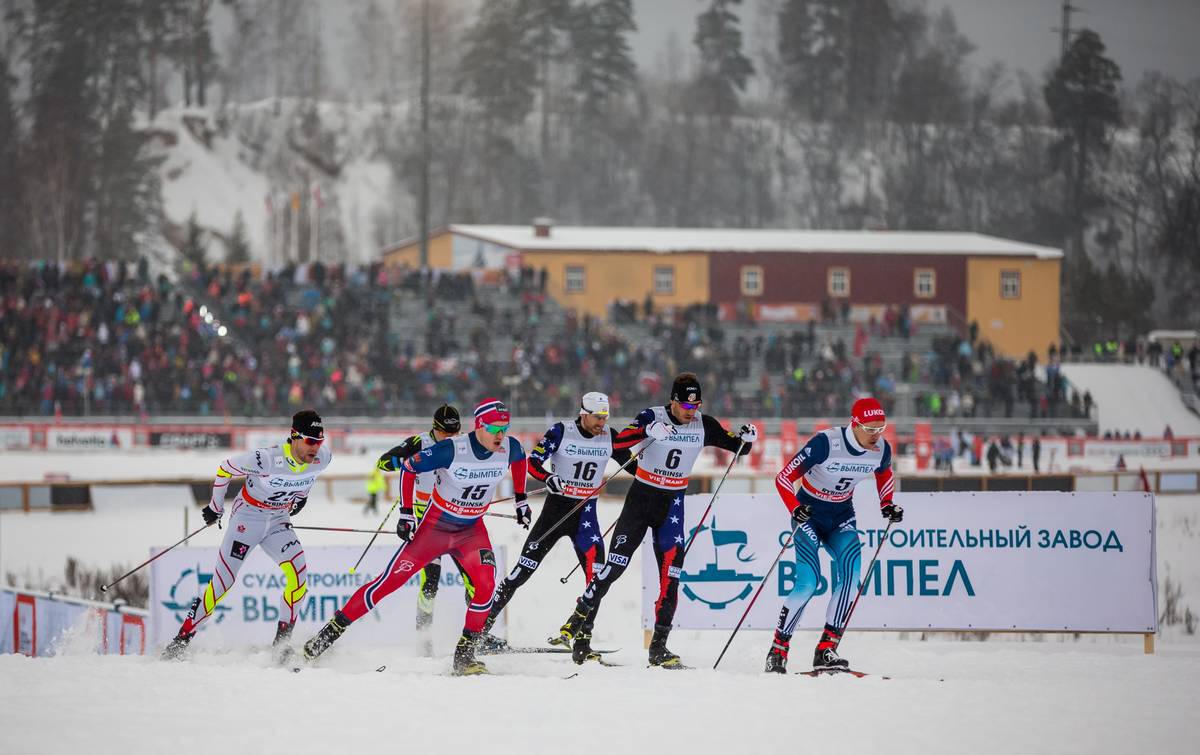
    Simi Hamilton (6), Andy Newell (16), Alex harvey (25) compete in a quarterfinal of the 1.3 k freestyle sprint at the World Cup in Rybinsk, Russia. (Photo: Fischer/Nordic Focus)
    Simi Hamilton (6), Andy Newell (16), Alex harvey (25) compete in a quarterfinal of the 1.3 k freestyle sprint at the World Cup in Rybinsk, Russia. (Photo: Fischer/Nordic Focus)

    As Italy’s Federico Pellegrino and a contingent of Russian skiers shined in the 1.3 k freestyle sprint in Rybinsk, Russia, the North American skiers attempted to keep. While three Americans and Canadian Alex Harvey qualified for the heats, no North American skiers made it into the semifinals.

    American Simi Hamilton had a strong qualifier, qualifying in sixth and finishing 5.29 seconds behind top qualifier Sergey Ustiugov of Russia (2:41.10).

    Hamilton – who placed eighth in the Tour de Ski freestyle sprint in Val Mustair earlier this month – said in a phone interview that he was pleased with how the qualifier went and that the sixth-place result was encouraging.

    “It was one of those days where the snow was super soft, and I think in the past I haven’t been able to ski in conditions like that too well … but I think I’m definitely getting better at skiing in those softer snowy conditions,” Hamilton said.

    U.S. Ski Team Head Coach Chris Grover said in a phone interview that it had snowed “quite a bit” the night before and the morning of the race. Even though the snow tapered off before the competition began, it made for challenging conditions.

    “They re-groomed the course an hour before the competition but it was a really dry snow so and didn’t really bond. It was pretty soft for qualification,” Grover said.

    Simi Hamilton competes in the qualifier of Saturday's 1.3 k freestyle sprint in Rybinsk, Russia. He qualified sixth but ended his day in 17th. (Photo: Fischer/Nordic Focus)
    Simi Hamilton competes in the qualifier of Saturday’s 1.3 k freestyle sprint in Rybinsk, Russia. He qualified sixth but ended his day in 17th. (Photo: Fischer/Nordic Focus)

    American Andy Newell qualified in 16th (+7.59) and said in a phone interview that he felt decent during the qualifier. However, he was hampered by a neck injury that developed during the World Cup races in Otepää, Estonia, where he finished 17th overall in the classic sprint.

    “My neck was all jacked up and I was racing with hot packs taped on there to loosen it up, but it still wasn’t feeling great, and especially across the flats it was hurting a decent amount,” the 32 year old said.

    The highlight for the Americans on Saturday was Erik Bjornsen posting his best sprint result ever on the World Cup, taking 20th (+8.64) and reaching the heats for the first time.

    The 23 year old wrote in an email that he believed his fitness allowed him to push hard from the start and maintain a consistent pace throughout the race.

    “The track was soft so I didn’t feel like I was Superman, but I kept the tempo up and tried to keep it light. It seemed to really work! I was pretty close to some guys I’m usually several seconds behind,” Bjornsen wrote.

    Grover was also excited for Bjornsen, saying he beat several sprinter specialists to get into the quarterfinals.

    “He looked great in qualifications. People were really struggling but he was really powering so that was really cool. He was stoked, and it’s exciting to get another skier in the men’s sprint points besides Simi and Andy,” Grover explained.

    Bjornsen landed in the first quarterfinal heat, and found himself up against eventual finalists Ustiugov, who would take second overall, and Norway’s Emil Iversen.

    Bjornsen was never competitive in the heat, writing that he was “a bit of a spectator from the back of the pack.” Iversen won the heat in 2:40.36, with Bjornsen finishing 2.30 seconds behind in fifth. He was 24th overall.

    “I see that you have to be … aggressive in the World Cup heats. Not a surprise but something that I will learn from experience,” Bjornsen wrote. “Next time I will be a little less shocked to be there and a little more hungry for a semifinal spot!”

    Meanwhile, Harvey — coming off a 10th-place finish in Friday’s 15 k freestyle individual start — qualified in 25th (+9.44).

    Canada's Alex Harvey competes in the qualifier of Saturday's 1.3 k freestyle sprint in Rybinsk, Russia. He qualified 25th and ultimately finished 28th. (Photo: Fischer/Nordic Focus)
    Canada’s Alex Harvey competes in the qualifier of Saturday’s 1.3 k freestyle sprint in Rybinsk, Russia. He qualified 25th and ultimately finished 28th. (Photo: Fischer/Nordic Focus)

    Three other Canadians also raced, but failed to qualify. Lenny Valjas was 42nd (+13.00), 1.89 seconds behind the final qualifier, while Jesse Cockney was 47th (+15.57) and Patrick Stewart-Jones was 52nd (+21.29) out of 53 finishers.

    Newell, Hamilton, and Harvey all raced in the same quarterfinal, in addition to eventual finalist Nikita Kriukov of Russia.

    Hamilton said he felt like he had a great start to the heat, skiing just behind Kriukov. However, he said that he was not aggressive enough on the long flats before the steep climb and let other skiers pass him on both sides.

    “Once that happened, I knew that to stay in contention I had to get back by a couple people before the steep climb,” Hamilton explained, adding that he tried to pass France’s Paul Goalabre on the right but was prevented by the soft, powdery snow.

    At the start of the climb, Hamilton said that Goalabre accidentally knocked his left ski, causing him to fall on his knees. He got up quickly, but was not able to catch up with the leaders, especially on the fast downhill going into the finish.

    Kriukov won the heat in a time of 2:43.77, and Hamilton finished fourth (+1:39), ending up 17th overall.

    “I kept my effort up all the way through the finish … but it’s a tough finish, just super soft all the way through the finish lanes which makes for an interesting last 20 or 30 seconds. You ski as hard as you can but you still feel like you’re skiing a 30 k or 50 k because you’re not moving that fast,” Hamilton said.

    Grover said Hamilton’s slip was unfortunate, as he was forced to play catch-up and “wasn’t able to demonstrate really where he is.”

    Canada's Len Valjas skied to 42nd in the qualifier of the 1.3 k freestyle sprint in Rybinsk, Russia. (Photo: Fischer/Nordic Focus)
    Canada’s Len Valjas skied to 42nd in the qualifier of the 1.3 k freestyle sprint in Rybinsk, Russia. (Photo: Fischer/Nordic Focus)

    Meanwhile, Newell took fifth in the heat (+2.12) to take 22nd overall.

    Newell said that he tried to put himself in a good position while ascending the hill, and was in third at the top. He tried to get in position right behind Kriukov but was unable to secure his position.

    “I just got gassed a little bit over the top … I don’t have much power with the way I’m skiing right now,” Newell explained.

    He also said his injured neck played a factor in the quarterfinal heat.

    “I don’t like to make excuses but I’m not 100 percent when it comes to racing right now … it’s hard to heal and it’s just getting worse some days; sprints and stuff make it worse. So I need to try and heal it up so I can get some hard training in,” Newell said.

    Harvey finished just behind Newell to take sixth in the heat (+2.24) and ended up 28th overall.

    “It was not a good sprint for me today. I wasn’t in the greatest spot before the climb and got stuck behind a fall. I am now focusing on tomorrow’s 30 kilometer,” Harvey told Cross Country Canada.

    As for Sunday’s skiathlon, Bjornsen wrote that it is the race he was most excited for going into this weekend.

    “I’m definitely a little tired from the last two races and intervals in the cold on Thursday, but I have nothing to lose out there! Tomorrow is just another opportunity to ski with the fastest guys in the world,” Bjornsen wrote.

    However, Newell is planning to sit out the race in order to heal his neck, and Hamilton said his status depends on the conditions.

    He said if the recent snowfall sets up before the race and the snow becomes firmer and faster, there is a chance that he will race, but if the snow remains soft and slow he will probably opt out of the race.

    After leaving Rybinsk, the American team will have a training camp in Davos, Switzerland, then head to World Cup races in Oestersund, Sweden, before World Championships begin in Falun on Feb. 18.

    Results

  • Harvey Leads North American Men in Rybinsk 15 k

    Harvey Leads North American Men in Rybinsk 15 k

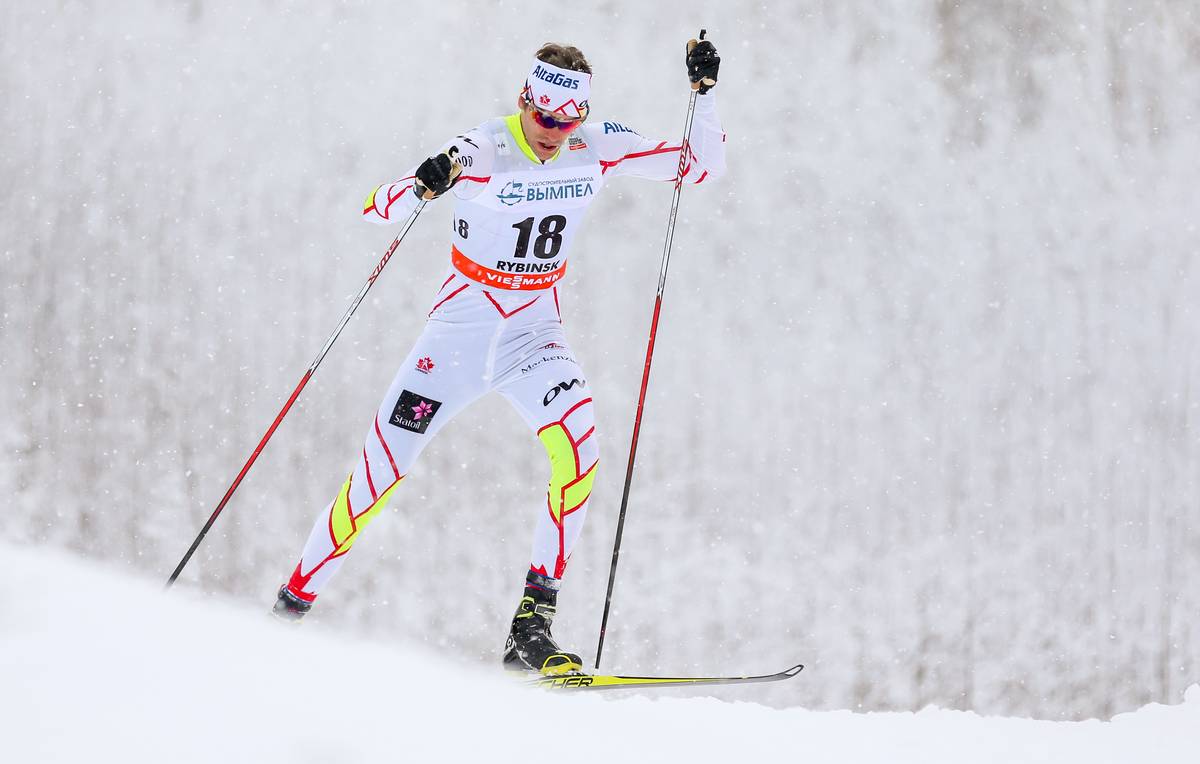
    Alex Harvey (Canadian World Cup Team) racing to 10th in the men's 15 k freestyle on a chilly day in Rybinsk, Russia, on Friday. (Photo: Fischer/NordicFocus)
    Alex Harvey (Canadian World Cup Team) racing to 10th in the men’s 15 k freestyle on a chilly day in Rybinsk, Russia, on Friday. (Photo: Fischer/NordicFocus)

    The North American men had mixed results while facing cold-and-snowy conditions in Rybinsk, Russia, during Friday’s World Cup 15-kilometer freestyle individual start.

    Canada’s Alex Harvey took 10th and was the top North American finisher, ending up 1:15.7 behind Switzerland’s Dario Cologna, who won it in 36:53.4. The result elevated Harvey to 11th in the overall World Cup standings.

    Although the field featured fewer top athletes than a usual World Cup race — with many of the leaders in the World Cup standings, including the top Norwegians, opting out of the races in Rybinsk — Harvey said in a phone interview that he was pleased with his top 10.

    The 26 year old explained his first lap proved especially difficult, as the 5 k course features five significant climbs.

    “I kind of struggled with my legs and everything so I couldn’t push too hard on the first lap, but I was feeling better and better so I was able to pick up some ranks from the 5 k mark on,” he said.

    Harvey had the 20th-fastest time after 3.5 k, but his pace improved throughout the race, and he was 15th after 11.9 k.

    “I think I skied well technically; it was kind of a cold snow so when you were on your edges it was pretty slow, but if you were able to hold onto a flat ski it was good,” Harvey explained.

    He said he tried to glide as much as he could, and “took it down a notch” on the climbs for the sake of his legs.

    “It was probably the best I could have done,” he said.

    Harvey said that before the race he was unsure he would start. He came to Rybinsk thinking more about Saturday’s freestyle sprint and Sunday’s 30 k skiathlon, but decided to race after the temperature was not as cold as predicted.

    “Doing three races in a row is always hard, but it was just -11 [degrees Celsius] so it wasn’t so cold. But had it been -15 or colder I probably would have skipped it,” he explained.

    Ivan Babikov (Canadian World Cup Team) racing to 22nd on Friday in the 15 k freestyle at the World Cup in Rybinsk, Russia. (Photo: Fischer/NordicFocus)
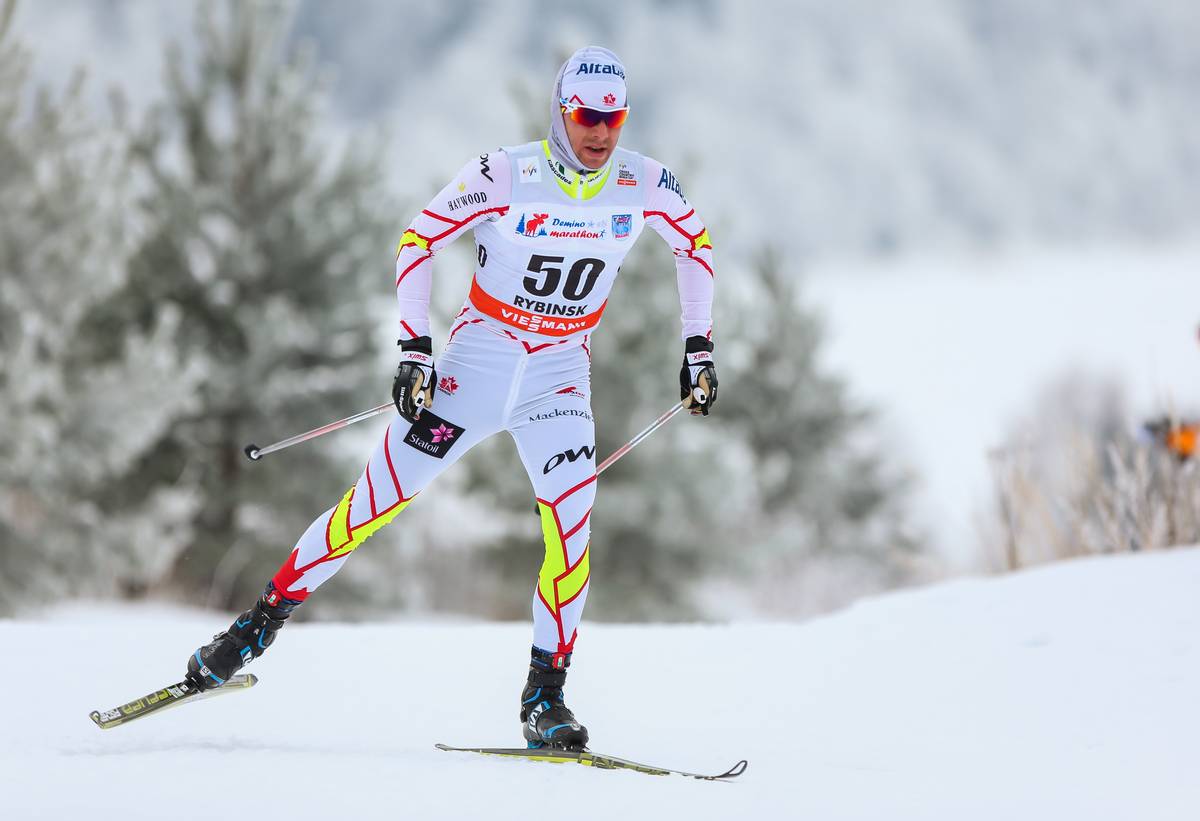
    Ivan Babikov (Canadian World Cup Team) racing to 22nd on Friday in the 15 k freestyle at the World Cup in Rybinsk, Russia. (Photo: Fischer/NordicFocus)

    Also for Canada, Ivan Babikov finished 22nd (+1:53.3), despite not being able to ski as fast as he would have liked.

    “Fresh, cold snow definitely made a big difference in speed compared to yesterday, so it was pretty hard to ski fast out there,” the 35-year-old Russian-born skier wrote in an email.

    Babikov said he skied his second lap alongside France’s Maurice Manificat, who finished sixth (+1:03.8), and was able to stay with Manificat on the flat sections and gradual inclines. However, he lost him on the hills and was dropped 4 k into the second lap.

    “I’m satisfied that I scored some points but I still lost a lot of time to the top ten,” Babikov explained. “My body was feeling good though and I’m looking forward to the [skiathlon] on Sunday.”

    He is now 55th in the World Cup standings.

    Meanwhile, teammate Devon Kershaw was disappointed with his day, in which he placed 36th (+2:42.3).

    “I am sounding like a broken record these days, but it did not play out well out there on the course for me today. I feel devoid of power and on a course like this one — where the climbs aren’t too long or too steep — that’s a bad thing,” Kershaw wrote in an email.

    Graeme Killick (AWCA/Canadian Development B-Team) racing to 43rd in the 15 k freestyle at the World Cup in Rybinsk, Russia. (Photo: Fischer/NordicFocus)
    Graeme Killick (AWCA/Canadian Development B-Team) racing to 43rd in the 15 k freestyle at the World Cup in Rybinsk, Russia. (Photo: Fischer/NordicFocus)

    The 32 year old described the course as a “real workhorse course” and said it is easy to either make up a lot of time or lose time on a difficult day.

    Looking ahead, Kershaw was excited about the 30 k skiathlon.

    “The courses here are some of my favorite on the World Cup, so good body, bad body — I don’t have a hard time getting excited to race on these tracks,” he wrote. “Sunday’s race is longer, has some classic, and is a mass start so the key is to be able to have the body to ski the leaders’ rhythm and try and conserve energy early.”

    Kershaw’s best World Cup result this season was in Ruka, Finland, last November, when he took 14th in a 15 k classic individual start.

    Canadian Graeme Killick, coming off a successful Nor-Am Cup where he won the skiathlon, finished 43rd (+3:18.5).

    Erik Bjornsen competing in the 2015 Tour de Ski prologue on Jan. 3. (Photo: Marcel Hilger.)
    Erik Bjornsen competing in the 2015 Tour de Ski prologue on Jan. 3. (Photo: Marcel Hilger.)

    The two American skiers finished near the back, with Erik Bjornsen taking 40th (+2:50.0) and Matt Gelso placing 50th (+4:10.0) out of 53 racers.

    However, Gelso was ill the week preceding Friday’s race. He wrote in an email that while suffering through a head cold he was not able to ski for multiple days and only managed a short ski on Thursday. Fortunately, he felt healthy on Friday and was able to race.

    The 26 year old explained that he felt solid for the first lap and a quarter of the second lap, but began to struggle when he would have liked to increase his pace and stay competitive.

    “There is a lot of sustained V1 on this course, and I did not have the tempo or pop I needed to ski these sections well. I felt solid on the flat and rolling sections, but unfortunately that made up a very negligible part of the course and so I struggled on the steeps with my slow and flat V1,” Gelso wrote.

    Gelso explained he knew beforehand that this result was a distinct possibility after a week of sickness and little preparation, though he was still “extremely unhappy” with it.

    “But that’s racing,” he wrote.

    U.S. Ski Team Head Coach Chris Grover said in a phone interview that despite Friday’s results, the team is excited.

    “Now that Gelso is feeling better, everybody is healthy,” he wrote.

    He explained that the U.S. team only had five of their ten athletes starting on Friday, as the team is focusing on Saturday’s sprint and Sunday’s skiathlon. However, Gelso will not start on Saturday in order to focus on the skiathlon.

    Results

  • Making a Call: Coach Flora on Sadie Bjornsen’s Tour Departure, Randall’s Return to Alaska

    Making a Call: Coach Flora on Sadie Bjornsen’s Tour Departure, Randall’s Return to Alaska

    Sadie Bjornsen in the Prologue of the 2015 Tour de Ski. (Photo: Marcel Hilger.)
    Sadie Bjornsen skating to seventh place in the 3.3 k Tour de Ski prologue in Oberstdorf, Germany (Photo: Marcel Hilger)

    It’s not easy being the person who has to say when. But that’s Erik Flora’s job, as head coach and director of the Alaska Pacific University Nordic Ski Team, which includes three U.S. Ski Team members and a fleet of top domestic skiers.

    In the middle of the pinnacle event of the season for stateside racers — U.S. Cross Country Championships in Houghton, Mich. — Flora had to take the time to check in with his World Cup athletes, including Kikkan Randall, Sadie Bjornsen and Erik Bjornsen, who competed in the Tour de Ski earlier this week.

    The Bjornsen siblings raced through the fourth stage of the Tour, the 5- and 10-kilometer classic races in Toblach, Italy, and Randall went one stage beyond to end her run with the 15 k freestyle pursuit, also in Toblach.

    When each would stop the Tour and move on to a training camp in Ramsau, Austria, had been predetermined before the seven-stage series began. But when someone like Sadie was having some of the best races of her career, and leaving her first-ever Tour in seventh overall, it made actually withdrawing harder than expected.

    “Man, that was a hard decision, sitting in seventh and her coach to advising her to keep with her plan,” Flora reflected inside APU’s wax trailer at the Michigan Tech Trails in Houghton. He was finishing up his duties for the day at nationals on Thursday, shortly after the end of the last junior mass start.

    However, the decision was calculated, he said.

    “Sadie is in good form — really good form,” Flora began. “She has made a big step this year and we can see that all the way through the summer … training went better than it has ever gone.”

    She and the rest of the U.S. team got through Period 1, the first four weekends of World Cup racing, and that was “a long bat of racing,” he said. Most top World Cup racers plan breaks in advance during the season: “As far as recently, we don’t really see any of the top ladies racing all the way though the season,” he added.

    Kikkan Randall skating to 22nd in the Tour de Ski prologue in Oberstdorf, Germany. (Photo: Marcel Hilger)
    Kikkan Randall skating to 22nd in the Tour de Ski prologue in Oberstdorf, Germany. (Photo: Marcel Hilger)

    For Sadie, Flora said they reasoned it made sense to have her compete throughout Period 1, then train over the holidays before embarking on her first Tour de Ski.

    “That would be a pretty substantial stress and then she could take a break now and then race the next two weekends in the World Cup,” he added. “I think it is important for a lot of the young athletes to get the experience of racing a lot of the different venues and learning about the different venues and that was the goal for Sadie.

    “I think she can be one of the top skiers here over the next few years and to be able to learn each venue while she is young and still up-and-coming is very important,” Flora said. “The Tour is also one of those goals this year, mainly to get a feel for how the Tour works and obviously she got the hang of that pretty quickly, but when she called me and the question was, ‘Should I keep going?’ I thought that it was good.”

    They could have encouraged her to continue, then sit out the next two World Cup stops in Otepää, Estonia (Jan. 17-18) and Rybinsk, Russia (Jan. 23-25), “or pull out of the Tour now and have a chance to race the next two World Cup weekends. You know she had met all of her goals up to this point and she would have done well had she stayed in the Tour, but next year we will make another run at that again,” Flora said.

    “It’s definitely really hard to have to drop out – or not have to, but I’ve chosen to drop out just to save some energy because I’m going to race in Estonia next weekend,” Sadie said on the phone on Wednesday. “But it’s gone better than I expected, and I think it’s so much fun. … I can’t imagine what you would feel like after doing seven, or nine races next year, I feel like you would feel so accomplished just finishing it. Four days is extremely hard, so I definitely respect the whole Tour de Ski so much more after this.”

    While she’s headed to Ramsau, Randall is going home to Anchorage, Alaska, before flying to Sweden at the end of January to prepare for the last World Cup before World Championships (Feb. 14-15 in Östersund, Sweden). Later that week and into early March, she and the team will compete at World Championships in Falun, Sweden.

    According to U.S. Ski Team Head Coach Chris Grover, Randall planned to leave Friday for Alaska, where she’d spend about 16 days trying “to kind of take a break from the World Cup and just get re-centered,” he said. “That is a new plan for her; she was never really planning on finishing the Tour.”

    Flora explained he talked to Randall on Thursday morning about it.

    “It was something that I suggested a few days ago,” he said. “Kikkan has spent a lot of time racing over in Europe over the last few years and she has gotten very good at it. [I’m] always really impressed with the way that she races and trains and travels.

    “Period 1 this year hasn’t gone that well for Kikkan and so we wanted to just take a little bit of time,” he added. “We made a plan to just race through this [fifth] stage in the Tour, that was always the plan, race the first five stages and then again take a training break and prep and get ready for the World Championships.”

    Considering her trends in training and racing, and how much of both she’s done over the last few months, “we decided it would be smart to just take a break and get some rest,” Flora said. “When racing is going well and you’re in a good place in Europe, it is much better to stay there and race. Sometimes it makes sense to take a little break and refocus, and that was my recommendation, to come home take a training break and refocus and go back over for a camp and get ready for World Championships.”

    While Randall could not be reached for comment on Friday, she wrote in an email to members of the press after Thursday’s stage, “With 5 races now under my belt I am leaving the Tour and taking some time to recover and rediscover my top form. The big focus on the season is still the Falun World Championships and I am focusing all my efforts on being in the best shape in February.”

  • Rybinsk Field Strength And The Resurgent US Women

    Two topics today.

    Rybinsk Field Strength

    I’m including the Moscow sprints here, but generally these races are notorious for low attendance. They require some of the most travel for many of the Europeans and they are often scheduled very near the Scandinavian nation’s national championships.

    Did this year’s races attract a stronger or weaker field than in the past?

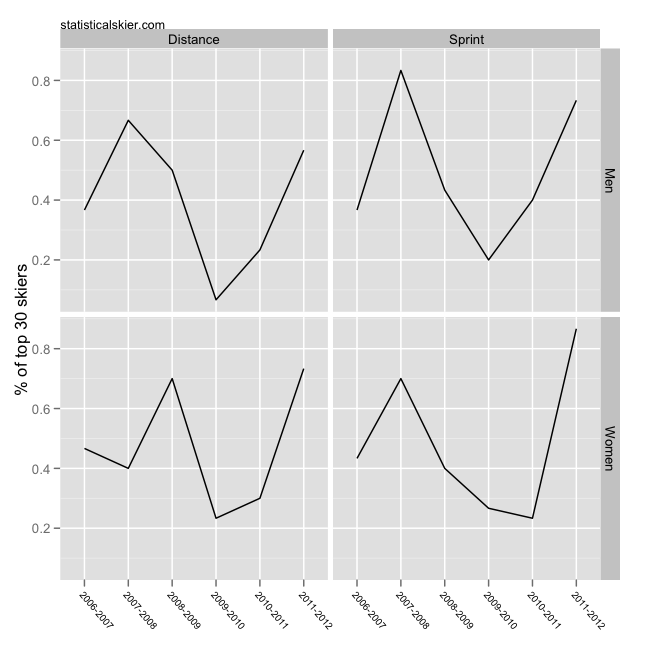
    This is hard to measure objectively, since there are a million different ways you could go with quantifying “field strength”. Here’s one simple take:


    This shows the proportion of the top thirty skiers that season (up to the Russian World Cups) who attended.

    The measures FIS has been taking has definitely improves things since the embarrassing 2009-2010 races. The men’s fields have been getting more competitive at these races for two straight seasons now. The women’s sprint field took a huge jump this season. They weren’t all the most competitive the Russian races have been in the past (at least by this measure) but they’re about as good as we’ve seen.

    Resurgent US Women

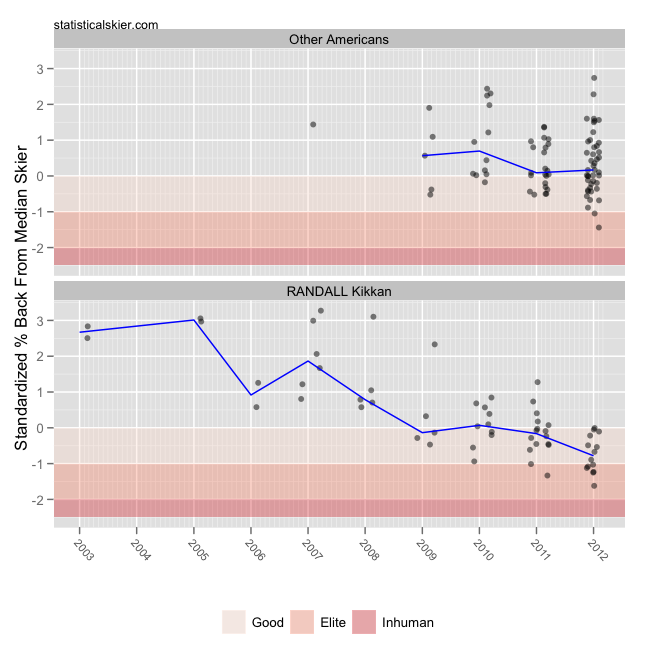
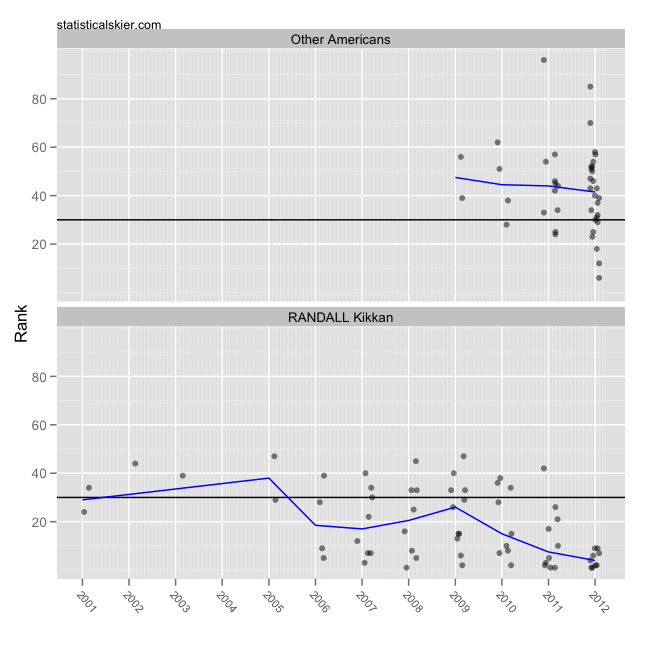
    These are pretty exciting times for the US women’s team, no doubt about it. One way I like to look at US skiing development is to compare our “premiere” WC skier to the rest of our team, since we tend to have lacked depth. So here’s a graph of Kikkan Randall’s distance results compared to those of her teammates:

    Note that Kikkan’s teammates have produced a handful of better results than we’ve seen from someone not named Kikkan. But the overall trend for the group is mostly flat. Compare that to an equivalent graph for sprinting:

    Here I can detect a slight downward trend (i.e. improvement) in the results of non-Kikkan, as well as the notable extremely good results. I’ll be curious to see how Jessie Diggins’ distance races go for the rest of the season, since we generally seem to have seen more of Kikkan’s sprinting success trickling downhill than her (more recent) distance success.

    Related posts:

    1. <Rybinsk: Does Anyone Care?
    2. <Race Snapshot: Rybinsk 10/20km Pursuit
    3. <Rybinsk: Pursuit Recap


  • Johaug Sneaks in Rybinsk Pursuit Victory as Bjørgen and Kowalczyk Battle for Overall Title

    Therese Johaug (NOR) racing in the 2012 Tour de Ski.

    At the start of Sunday 15 k skiathlon in Rybinsk, Russia, all eyes were on two women: Marit Bjørgen, the Norwegian who had dominated the 10 k mass start on Saturday and taken over the lead in the World Cup rankings, and Justyna Kowalczyk, the Pole who had won the Tour de Ski and held the World Cup lead until Bjørgen took it over.

    “It has turned out to be a lot of Marit and Kowalczyk at the top of the podium,” Norwegian racer Therese Johaug told broadcaster NRK after the race.

    And it could have been again: when the gun went off, Bjørgen and Kowalczyk skied into the lead just as expected.

    But Johaug joined them, and turned out to the one to watch. Known as a distance skate specialist as recently as last year, the 23-year-old has strengthened her repertoire this season and had consistently strong performance in classic races and has even skied in sprint heats.

    Savvy spectators would know, too, that skiathlons are a good discipline for the diminutive Johaug, who placed third in the event at the 2011 World Championships and also in a stage of the Tour de Ski, and won the event at Norwegian national championships just a week ago.

    And so Johaug tucked in behind the World Cup titans, and the trio immediately began attacking, opening a sizeable gap on the rest of the field. After five kilometers, they were leading by over 20 seconds, and it was clear that barring a spectacular implosion, no other skier would have even a shot at the podium. While the chase pack shuffled leaders, they were only racing each other for fourth place.

    The biggest surprise was that Johaug helped lead in the final stages of the classic leg, and that Bjørgen, who appeared to be struggling to get her skis to kick, fell off the back.

    “My skis were good today but the girls were stronger in classic part,” Bjørgen said in a press conference after the race. “They made a big gap and I had to work alone in the second part of the race. It was hard.”

    Johaug and Kowalczyk skied into the exchange zone together, ten seconds ahead of Bjørgen. Based on the older Norwegian’s dominance in the past, it seemed possible that she would be able to ski her way back to the lead. But instead, she lost more time during the skate leg.

    With four kilometers to go, Johaug finally attacked, and Kowalczyk could not keep pace with her quick tempo.

    Johaug later explained that the timing had to do with the intermediate checkpoints, which award bonus points towards the World Cup standings.

    “I was told by Egil [Kristiansen, her coach] to go to the front and take the points so that Kowalczyk did not get them,” she told NRK. “I got a little momentum then and I was very strong. It was incredibly fun to do it this way. I just skied away from them.”

    While her initial aim was simply to prevent Kowalczyk from widening her overall lead in the World Cup, Johaug ended up building an almost 30-second lead and picking up the first victory of the year.

    “I am very pleased,” she told NRK. “This is my first World Cup victory of the season. It is very fun that I can fight with the world’s best cross-country skiers.”

    Kowalczyk said in a press conference that she simply couldn’t counter Johaug’s speed: “Therese was faster this time.”

    Both Norwegians were gracious competitors, with Bjørgen telling NRK that she was “fortunate to have someone like that on the team and a strong team around me,” and Johaug saying that “with such rivals as Marit and Justina, you have to work hard.”

    While Johaug was able to bask in the spotlight today, going forward the attention will still be on Bjørgen and Kowalczyk, who are separated by just two points in the overall World Cup standings; Johaug is third, more than 400 points back.

    Bjørgen’s win on Saturday was her 50th official World Cup victory (not counting stage wins), and some have speculated that her dominance has been bad for the sport. Bjørgen herself has said that it is better when more teams and more skiers can be at the top, and told NRK today that the battle for the overall crown would benefit everyone.

    “It’s a very exciting match,” she said. “More than that, it is important for the sport. Now there are once again two points separating me and Kowalczyk. The yellow bib will change from day to day, so it makes it exciting. We will see in the end who is the strongest.”

    Full results

  • Kristin Størmer Steira to Sit Out Rybinsk Races; Benched Due to Weight Concerns

    Steira competing in the seventh stage of the Tour de Ski last month.

    In December, Norwegian broadcaster NRK reported that an unnamed member of the Norwegian national team had been flagged for low body weight and that coaches and staff were hoping to help the female athlete gain weight and return to better health.

    Almost two months later, it seems likely that the woman in question was Kristin Størmer Steira, who was benched for the Rybinsk races this weekend due to low body weight. Norwegian daily newspaper Dagbladet broke the story on Thursday with an interview with Steira.

    “I was frustrated when I heard [the decision],” Steira said in the interview. “I really wanted to go race in Russia. But after thinking about myself, is it actually just fine. I have respect for my health and I know how important it is. So I don’t have a problem following advice from professionals who know what they are talking about.”

    While the decision was made by Norwegian team staff, it was reportedly based on health parameters suggested by the International Olympic Committee, which include multiple measures and are not limited to simply weight and fat.

    Questions regarding eating disorders have surfaced repeatedly about the Norwegian national team, and not only about the perpetually-thin Steira. Teammate Vibeke Skofterud has discussed her history of eating disorders, and this spring Therese Johaug stated publicly that although she had lost weight, she did not have disordered eating.

    Steira in the Tour.

    This appears to be the first time that the team has sat out one of its stars due to weight concerns, and one of the first times in recent years that a major star has addressed these issues in such depth in public. Steira has been a member of winning relay teams at one Olympics and two World Championships, and has famously finished fourth in four Olympic races and one World Championships, failing so far to score an individual medal.

    In Steira’s case, she too asserted that she did not have an eating disorder.

    “I am naturally thin and would look the same if I didn’t train, just look at my mother and father,” she said in the Dagbladet interview.

    Steira gave two reasons that she had moved into an unhealthy weight class. First, she was sick and had lost her appetite. Secondly, she cited turbulence in her personal life, including a breakup with a longtime partner, which had a similar effect.

    “Taken together, it was simply too much for me,” she said. “I was very low both physically and mentally.”

    She said that she told herself she had to eat, but couldn’t actually do it. Nevertheless, she maintained her normal training load, because skiing was a time for her to think. Steira admitted that this had not been wise.

    Steira’s physician, Hans-Petter Stokke, explained to the press that when athletes burn four or five thousand calories a day, a suppressed appetite can pose huge problems.

    “In our opinion, it is not advisable for her to compete at the top level right now,” he said.

    Norwegian sports medicine expert Jorunn Sundgot-Borgen, who studied and taught at Arizona State University and Yale before working for Olympiatoppen, the Norwegian elite sports program whose guidelines were used to assess Steira, praised the national team’s actions.

    “It’s great to see that they take athletes seriously, and that they care about athletes’ health,” she told NRK. “Several other sports have done a poor job on this topic. I hope that more begin to act like cross country.”

    Steira, who is at home in Norway, is expected to return to competition this season. She and her coaches all reported that she was already improving on the weight front.

    After the story broke, Steira tweeted, “Thank you all for the great support! I appreciate it!”

  • Kowalczyk, Chernousov Victorious in Small World Cup Field

    When Justyna Kowalczyk stood at the head of the chevron before the 10 k pursuit Friday morning in Rybinsk, Russia, she must have felt a little bit lonely.

    That’s because no less than 20 of the top 30 women in the current overall World Cup rankings were missing. Kowalczyk’s biggest rival, Marit Bjoergen (NOR) opted to take the weekend off, as did fourth ranked Petra Majdic (SLO), and 6th through 9th, Therese Johaug (NOR), Charlotte Kalla (SWE), Krista Lateenmaki (FIN), and Astrid Jacobsen (NOR).

    With the field reduced, it was Kowalczyk’s day to lose – but she clearly wasn’t going to let that happen, as she crossed the line unchallenged. However, Marianna Longa (ITA) and Aino-Kaisa Saarinen (FIN) made the day interesting, as they stuck to the Polish superstar, never letting her open a huge gap.

    And as soon as the gun went off, it became very clear that the 30 woman pack was not going to be sticking together. Kowalczyk, along with Longa and Saarinen, broke away almost immediately, outclassing the other women on a day with slippery tracks.

    Bonus points were awarded at the 3.9 k mark, and Kowalczyk ate them up, collecting 15, while Saarinen picked up an additional 10, and Longa scooped up the remaining 5.

    Heading into the ski exchange, Kowalczyk and Saarinen stayed tight, with Longa about 8 seconds back, but Saarinen couldn’t handle Kowalczyk’s skate pace, and dropped back quickly. Longa, however, put on a charge, reeling in Saarinen, and then keeping the pace high in an attempt to draw back into the race with Kowalczyk, but the Pole proved too tough.

    Kowalczyk cruised into the finish 9.8 seconds ahead of Longa, while Saarinen finished 20.6 seconds back of the lead.

    The battle for fourth was much tighter, as skate sprinter Arianna Follis (ITA) narrowly beat Riitta-Liisa Roponen (FIN) to the line by less than a second.

    The conditions were difficult – with the temperature hovering around zero degrees Celsius, many of the skiers struggled with grip.

    “I was nervous before the start because the skis did not work well in classic,” said Kowalczyk during a post-race press conference.

    Longa had similar sentiments; “It was slippery today,” she said post-race, “These conditions do not allow for perfect classical skiing.”

    It was perhaps the most encouraging day for Saarinen – after starting her season off with a shoulder injury and missing a large chunk of time, she has been struggling to find her form. Friday was the first World Cup podium of the season for Saarinen, and just before World Championships it has to be taken as a good sign.

    “Now I feel I’m coming back in shape and this is very important in the view of coming World Championship,” she said in a post-race interview.

    Chernousov Takes First World Cup Victory

    At 24 years old, Ilia Chernousov (RUS) still has quite a lot skiing left in his career. But in the 20 k pursuit on Friday, the young Russian put on a show for the fans in Rybinsk, skiing to his first career win.

    Chernousov took the victory in a close sprint over two Frenchmen, Jean-Marc Gaillard and Maurice Magnificat.

    Unlike the women’s race, there was no immediate breakaway, and by the time the men reached the first intermediate sprint for bonus points at 6.4 k, the pack was still tightly bunched. The Russians were in control at the front, and Konstantin Glavatskikh (RUS), Alexander Utkin (RUS) and Alexander Legkov (RUS) earned the first 15, 10, and 5 points respectively.

    Heading into the exchange, a large group of 13 skiers had pulled away, and Italian Giorgio di Centa controlled the first part of the skate leg. As the group headed toward the second intermediate sprint at 13.5 k, several skiers fancied their chances at the extra points, but Gaillard got to the line first to collect 15, while Tobias Angerer (GER) ended up with 10, and Roland Clara (ITA) picked up the remaining 5.

    With the group still tightly bunched, it was headed towards the usual pack sprint finish, until Gaillard put on a move on the second-to-last hill in an attempt to break away. After gaining 20 meters on the field, Gaillard was chased down by Chernousov on the final climb, and as the two came down into the stadium, Chernousov was able to come around Gaillard and finish him off in the sprint to the line.

    Chernousov bested Gaillard by 0.4 seconds, and Magnificat finished third, three seconds back, just ahead of Angerer and di Centa.

    With the win, Chernousov has solidified his spot on the Russian World Championships team.

    “It is my first World Cup victory and the race was very important for me to get qualified for the World Championships,” he said in a post-race press conference. “I had to be in top 6 today for the ticket to Oslo and I made it.”

    While Chernousov’s win is a big one, it does come with an asterisk of sorts – some of the biggest names on the circuit failed to make the trip to Russia. The race was lacking the top three men in the overall World Cup standings, as Dario Cologna (SUI), Petter Northug (NOR), and Lukas Bauer (CZE) were all absent.

    No North American men or women are racing in Rybinsk, as they continue preparations for World Championships.

    FIS World Cup racing continues Saturday in Rybinsk with a freestyle sprint.

    Full Women’s Results – 5 k + k 5 Pursuit

    Full Men’s Results – 10 k + 10 k Pursuit

  • Cross-Country TDs Go Over the Books

    From 22nd to 24th October, FIS organized a seminar for FIS Cross- Country Technical Delegates of OPA countries in Ramsau. More than sixty participants  from eleven nations gathered to update their knowledge of competition rules  and event organization. Participants from traditional OPA alpine countries  were accompanied by representatives of Great Britain, Japan, Mongolia and  Romania. Four candidates for Technical Delegate passed the exam successfully  and many new participants were registered as candidates.

    On Saturday evening, the participants were invited by the mayor of Ramsau  and the Tourist office for a Sunset Dinner on the Dachstein glacier – an excellent experience. During the day, well-known grooming machine company Käsbohrer presented their new machine “Pistenbully 100” and explained the new possibilities and approaches to course preparation as well as sponsoring a lunch.

    “It was a very intensive and fruitful seminar. I was very happy with the group and I want to take the chance to congratulate our new TDs and wish them good luck in their work in Cross-Country Skiing,” said Karl-Heinz Lickert, Chairman of the FIS Sub-Committee Cross-Country Rules and Control. “I wish to also thank Helfried Stiegler and Stefan Scholz for the organization of this seminar in Ramsau.”

    The Scandinavian TDs made their update already in early October in Sweden with great success whilst the East-European TDs came together last weekend in Rybinsk (RUS).

    Source: FIS