Tag: Sadie Bjoernsen

  • U.S. Ski Team Nomination Breakdown with Head Coach Grover

    U.S. Ski Team Nomination Breakdown with Head Coach Grover

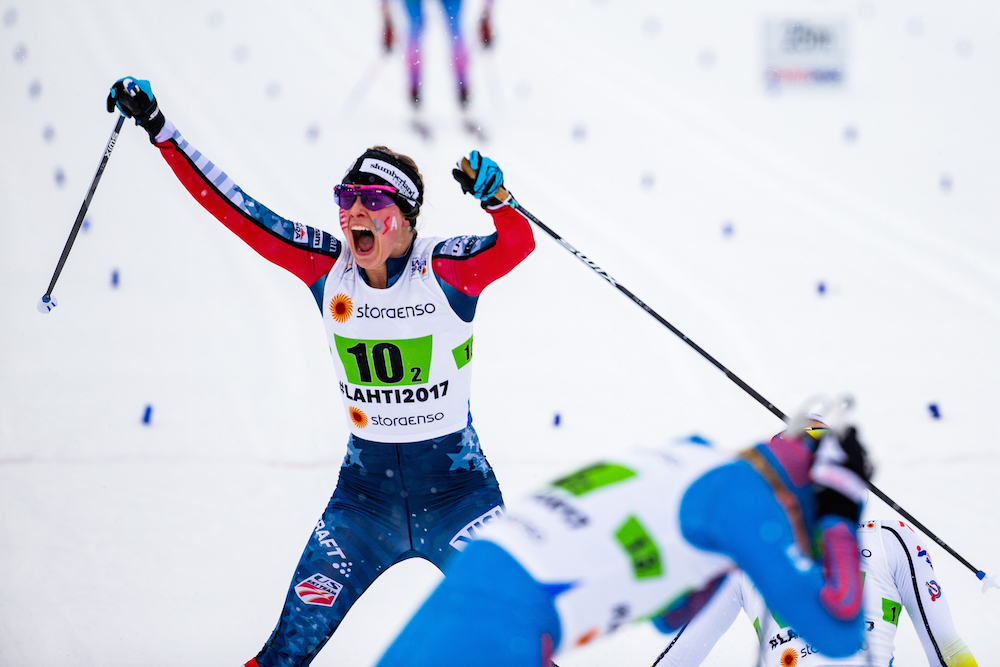
    Jessie Diggins celebrates after anchoring her team to bronze in the women’s classic team sprint on Feb. 26 at 2017 World Championships in Lahti, Finland. (Photo: Dustin Satloff/dustinsatloff.com)

    Shortly after the U.S. Ski Team (USST) formally announced its 2017/2018 cross-country team, FasterSkier reached USST Head Coach Chris Grover on the phone for his comments. Grover is in Bend, Ore., for the team’s traditional on-snow camp.

    We have nine athletes who made the objective criteria to make the 2018 U.S. Ski Team,” Grover said. “Eight that are on the A-team, all of whom finished in the top 30 in the world in either sprint or distance. And then Katharine Ogden, who as a medalist at the World Junior Championships, made the objective criteria that way.”

    Below are the eight A-team athletes and Ogden, who was renominated to the development “D” team, that met the USST’s objective criteria for team selection.

    A Team

    Men

    • Simi Hamilton (Stratton Mountain School Elite Team)
    • Andy Newell (SMS Elite)

    Women

    • Sadie Bjornsen (Alaska Pacific University)
    • Sophie Caldwell (SMS Elite)
    • Jessie Diggins (SMS Elite)
    • Kikkan Randall (APU)
    • Ida Sargent (Craftsbury Green Racing Project)
    • Liz Stephen (Burke Mountain Academy)

    D Team

    • Katharine Ogden (SMS)

    The USST’s 2018 cross-country nomination criteria, as it relates and is applied to athletes meeting the objective criteria, remains straightforward.

    • Attain top-50 ranking in the 2017 final World Cup Overall ranking list.
    • Attain top-30 ranking in the 2017 final World Cup Sprint or Distance ranking list.
    • Attain top-20 ranking in the 2017 FIS final sprint or distance points list.
    • Attain a top-3 individual finish at the 2017 Junior World Championships or U-23 World Championships.

    Six women finished the season ranked in the top 50 in the World Cup Overall ranking list: Diggins (6th), Bjornsen (16th), Stephen (28th), Caldwell (33rd), Randall (36th), and Sargent (44th). Notably, Diggins, Caldwell, Sargent, Randall, and Bjornsen all ranked in the top 30 for the final World Cup Sprint list, too, and Diggins, Bjornsen and Stephen all finished in the top 30 on the final World Cup Distance list.

    Nineteen-year-old Ogden earned an individual bronze in the 10-kilometer skiathlon at the 2017 Junior Worlds.

    Hamilton and Newell were the two men that met the objective criteria, with Hamilton ranking 30th on the final World Cup Overall list and ninth in the World Cup Sprint standings and Newell 28th on the final World Cup Sprint list.

    The remainder of the USST were discretionary selections. The athletes nominated to the team under the discretionary guidelines are as follows:

    B TEAM

    Men

    • Erik Bjornsen (APU)
    • Paddy Caldwell (SMS Elite)
    • Scott Patterson (APU)

    Women

    • Rosie Brennan (APU)

    D TEAM

    • Ian Torchia (Northern Michigan University)
    • Hannah Halvorsen (Sugar Bowl Academy)
    • Julia Kern (SMS Elite)

    As Grover explained, the USST’s use of discretion should not perceived as murky. Built into the criteria are aspects of fulfilling “individual markers” or competition results, “attitude and commitment”, illness or injury, and the heavily weighted medal potential.

    “We are trying to incorporate athletes who we see are on a path to winning a medal at the highest level, at the Olympic level or at the World Championship level,” Grover said. “Can we make a strong case suggesting that an athlete is on the path to winning the medal? It’s really a difficult call. What are the metrics that we’ll be using: FIS points? Should we be using World Cup points? Should we be using placing at World Juniors or U23s, at NCAAs or SuperTours? There are so many different places where athletes are coming from, so many different places where they are competing. Are they all equal? No, of course not.”

    What often makes discretionary selections difficult is that USST coaches must make assessments about future potential using real-time accomplishments between skiers skiing on the World Cup and those skiers competing at the World Cup and Continental Cup (i.e. SuperTour).

    “You can’t really compare someone who has been competing on the World Cup to someone who has been competing at a Continental Cup level,” Grover explained. “So that’s a real challenge for us. Yes, you can look at FIS points – that’s one thing we have always done, for many years. We’ve taken that athlete and tracked FIS points and age in distance or sprint, whatever that athlete’s strongest discipline is, and we try to see where they are compared to the best skiers in the world, the top 10 athletes in sprint or distance of that sex in the world.”

    Grover knows the FIS point system is not necessarily the best indicator of a U.S. skier’s potential on the World Cup.

    “One of the big challenges that we had using that methodology is that our FIS points as a nation in the US are artificially low,” Grover said.

    Grover believes FIS points are “artificially low” because the U.S. collegiate system has numerous European athletes with low FIS points that compete nearly every weekend on the NCAA circuit or FIS-sanctioned races. As a result, those skiers bring some U.S. skiers’ FIS points down.

    “The same thing happens occasionally when the U.S. Ski Team comes back from Europe,” Grover said. “The U.S. women in particular but also some of the men, and they bring good points and then they are not perhaps at their sharpest at SuperTour Finals, and other athletes are able to improve their points by coming close to or beating these athletes. And so that really drives our points down. We’re just not in the European pool enough to have points that are directly compared to European counterparts. The isolation, the way that points come over and they get passed around, and then they stay isolated over here, it prevents us from our points being representative of where people are compared to their European peers.”

    Athlete by Athlete
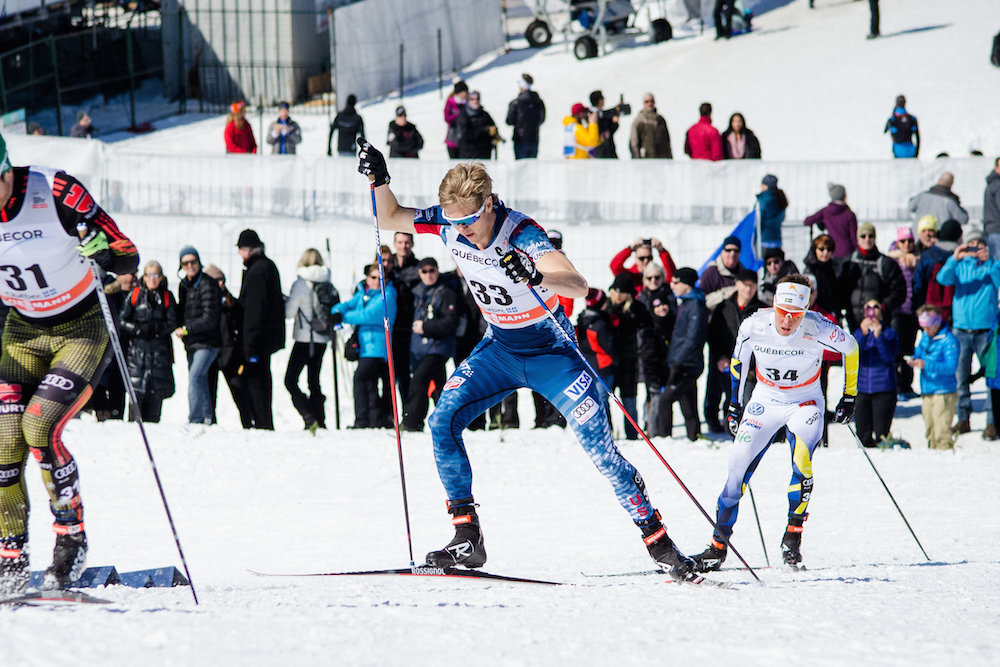
    American Erik Bjornsen (33) racing to the 11th-fastest time of day in the men’s 15 k freestyle pursuit at World Cup Finals in Quebec City for his career-best World Cup result. He finished 25th overall. (Photo: Gretchen Powers)

    For the B-team, let’s go athlete by athlete, those nominated and those not, to get a better picture of the whys and hows of USST discretionary selection. (Note that all of the D-team members from last year were renominated and will accordingly be invited to team camps.)

    “About Erik Bjornsen for example, and why was he nominated to the team,” Grover said. “For a number of reasons, but one thing that we see is that he could contribute to a medal in the team sprint, which is an event where he and Simi were fifth at this World Championships. … [Erik is] a guy who is scoring points in sprints in the World Cup occasionally, some points in distance occasionally. He is a hybrid between aerobic and anaerobic capacities, and that lends itself rather well to team sprint. We feel like he has strong potential there.”

    Bjornsen also skied to an impressive 18th (+1:56.7 behind the winner) in the 15 k classic at the 2017 World Championships.

    Patterson is the lone new face nominated to the USST.  “[Scott] just keeps coming up in conversation and he’s a really really interesting skier,” Grover said. “He got sick before U.S. nationals and then was sick for part of U.S. nationals and did not ski particularly well, at least by his standards for national championships in Soldier Hollow.”

    The Anchorage-based skier did not make 2017 World Championships team. Yet at the start of the season, before his illness, he placed third in the 15 k classic in the West Yellowstone SuperTour and won the 15 k skate in the Sovereign Lake NorAm in mid-December.

    “So this past winter, we knew he’s definitely one of those next guys — can we find some opportunities on the World Cup to start him?” Grover said.
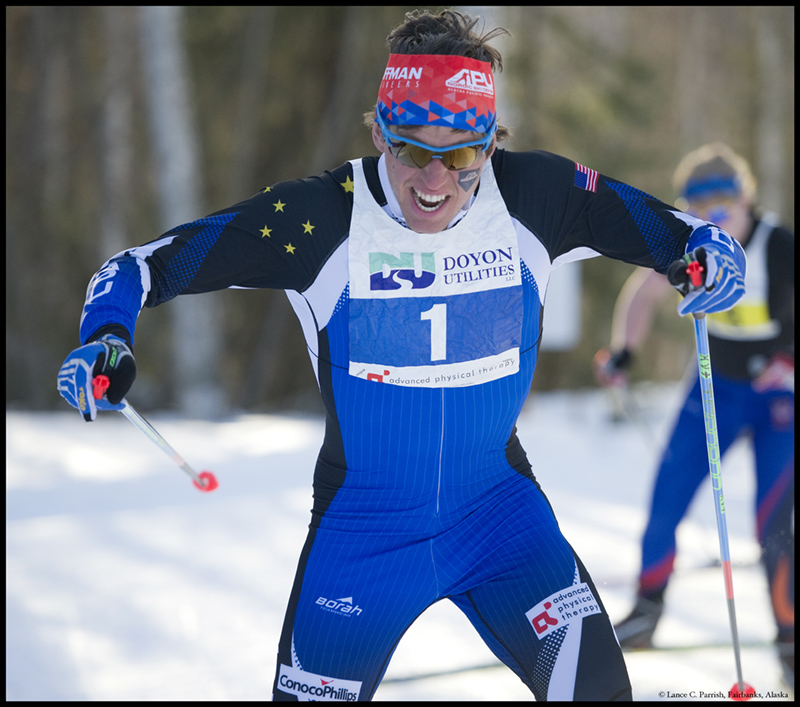
    Scott Patterson (APU) racing the anchor leg of the mixed relay at U.S. Distance Nationals in late March in Fairbanks, Alaska. (Photo: Lance Parrish, Fairbanks)

    Last season, Patterson was offered World Cup starts in PyeongChang, South Korea, and Oslo, Norway. In a thin PyeongChang World Cup field, he placed ninth in both the 30 k skiathlon and team sprint. At Holmenkollen in Oslo, Patterson was the top American man, skiing to a 28th in a loaded field. Patterson also qualified for World Cup Finals in Quebec.

    “And the cool thing was everywhere he went, he scored World Cup points as a 25-year-old athlete,” Grover said of Patterson’s potential. “So he’s a young guy who has got a big history of training. He’s training a lot and training really well and he’s also seizing these opportunities and showing in a very difficult men’s field that he’s a young guy who can grab some World Cup points.”

    Patterson went on to dominate U.S. SuperTour Finals and Distance Nationals at the end of the season, winning both the 20 k skiathlon and 50 k freestyle mass start in Fairbanks, Alaska.

    Addressing the question of why Patterson was given starts in PyeongChang and Oslo despite not leading the SuperTour at the time or qualifying for World Championships, Grover said Patterson had nearly fallen through the cracks. They needed to see he how he might perform on the World Cup.

    “Last year it was a challenging year for us as a national-team staff to look back at what was happening domestically and to make much sense of who was skiing well,” Grover said. “For example, in the first four distance races of the year, Yellowstone, Silver Star, and the two at Soldier Hollow, we had four different men win the four distance races. And of the four first sprint races, in those locations, I believe we had four different men win those four sprint races. And different athletes that were winning qualification in some cases versus those that were actually winning the day result for the sprint. So it was a very unclear picture in terms of who was skiing well … especially on the men’s side.”

    Of the skiers winning some of those races outright, Grover knew Patterson was promising, yet he wasn’t able to demonstrate it internationally on the World Cup or at World Championships.

    “So we wanted to find opportunities for Scott,” Grover said.

    Patrick “Paddy” Caldwell, 23, was bumped from the D-team to B-team status.

    “Paddy, he’s been on the D-team for a few years; he’s obviously been on the radar,” Grover said.

    Caldwell placed ninth in both the 15 k freestyle and 30 k skiathlon at the 2017 U23 World Championships. He also qualified for World Cup Finals in Quebec, where he skied the 25th-best time of day in the 15 k freestyle pursuit.

    “Just given where he is in terms of his ability and his age, we felt like it was the right move for him to move from the D-team to the B-team,” Grover said.

    Longtime USST member Noah Hoffman was not renominated to the team, but he has been offered World Cup Period 1 starts.

    “I think Noah would be the first to admit that last season was pretty disappointing, by his standards,” Grover said. “He and I were able to talk about expectations going into the season and Noah had struggled for a few years on the World Cup previous to this past season. …  And so we just talked that we need to make progress towards an eventual medal in the sport. So this year needs to be a step forward and unfortunately it wasn’t. It wasn’t the results Noah wanted to see and unfortunately it wasn’t the result that we were hoping to see from Noah.”

    Hoffman, 27, finished the season ranked 51st on the World Cup Overall list, a single point from the top 50 needed to meet the team’s objective criteria.

    “We hope that Noah gets back in there and starts skiing closer to his potential and starts making progress towards that medal,” Grover added. “Absolutely, the door for sure is never closed for Noah or any athlete.”

    On the women’s side, Rosie Brennan, 28, was renominated to the B-team. This past season on the World Cup, Brennan earned eight top 30s (the benchmark for scoring World Cup points). Her best finish, beyond her 23rd-best time of day in the Tour de Ski’s final climb, was a 22nd in La Clusaz, France, in the 10 k freestyle mass start.
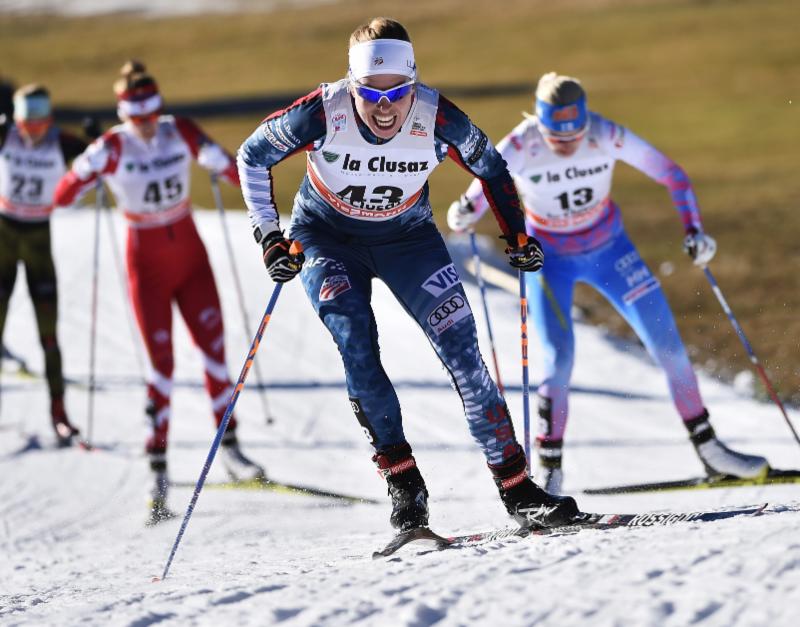
    Rosie Brennan (43) racing to a season-best World Cup result of 22nd in the 10 k freestyle mass start on Dec. 17 in La Clusaz, France. (Photo: Toko/NordicFocus)

    “Rosie is another interesting case,” Grover said. “It’s very hard to differentiate right now between Rosie Brennan, the skiing that she is doing, versus Caitlin Patterson, for example, or Chelsea Holmes. Yes, Rosie has been a little bit stronger in some races, but she has also had some more opportunity. However, we are really looking towards Rosie as a potential leg in a 4 x 5 kilometer women’s relay at a World Championship event. She has contributed a 5 k classic leg to a podium in Lillehammer, and she also skied a terrific leg in Ulricehamn — I want to say 12 seconds from the fastest on that particular leg in that relay this year. So she’s someone we are really looking towards for a potential relay leg. So there are athletes like that where it’s hard to differentiate sometimes between some of the domestic athletes who are really starting to blossom, who we are starting to take a lot of notice of them, but Rosie is somebody who … is in shape and ready to go when we get to Korea this winter.”

    On the non-nomination side of the equation are Holmes and Patterson.

    “Chelsea, she is someone who we have discussed a ton this spring,” Grover said. “And this is a conversation I’ve had with Chelsea as well. Is she a 5 k skier right now? Maybe, maybe not. She has certainly shown her ability in longer events. Her one standout international result from this season is a longer event in skating.”

    The 30-year-old Homes placed 13th in the marquee 30 k freestyle mass start at 2017 World Championships.

    “Does that, at this particular moment, suggest that she might be able to provide a 5 k classic leg in the relay? Not at this particular moment,” he said. “We have a lot of skaters on the women’s side right now. Our skating ability is quite high. So at this moment it doesn’t pencil out, but does that prevent her from being considered in the future for anything? Absolutely not.”

    Scott Patterson’s older sister Caitlin, 27, remains on the USST radar as well.

    “Caitlin is somebody else that we’ve discussed quite a bit,” Grover said. “She’s made a big step forward in the last year she started to score World Cup points and really flirting with that edge of the top thirty on a regular basis. So we absolutely have our eye on her. … Of course Chelsea is Continental Cup leader for Period 1, so she will be skiing World Cup Period 1. And then we’ll assess where she is at that point. Anything can happen at that point. She might be someone that’s skiing really well and we want to keep on the World Cup.”

  • Day 1 in Lillehammer: Halfvarsson is for Real, Harvey Places 10th

    Day 1 in Lillehammer: Halfvarsson is for Real, Harvey Places 10th

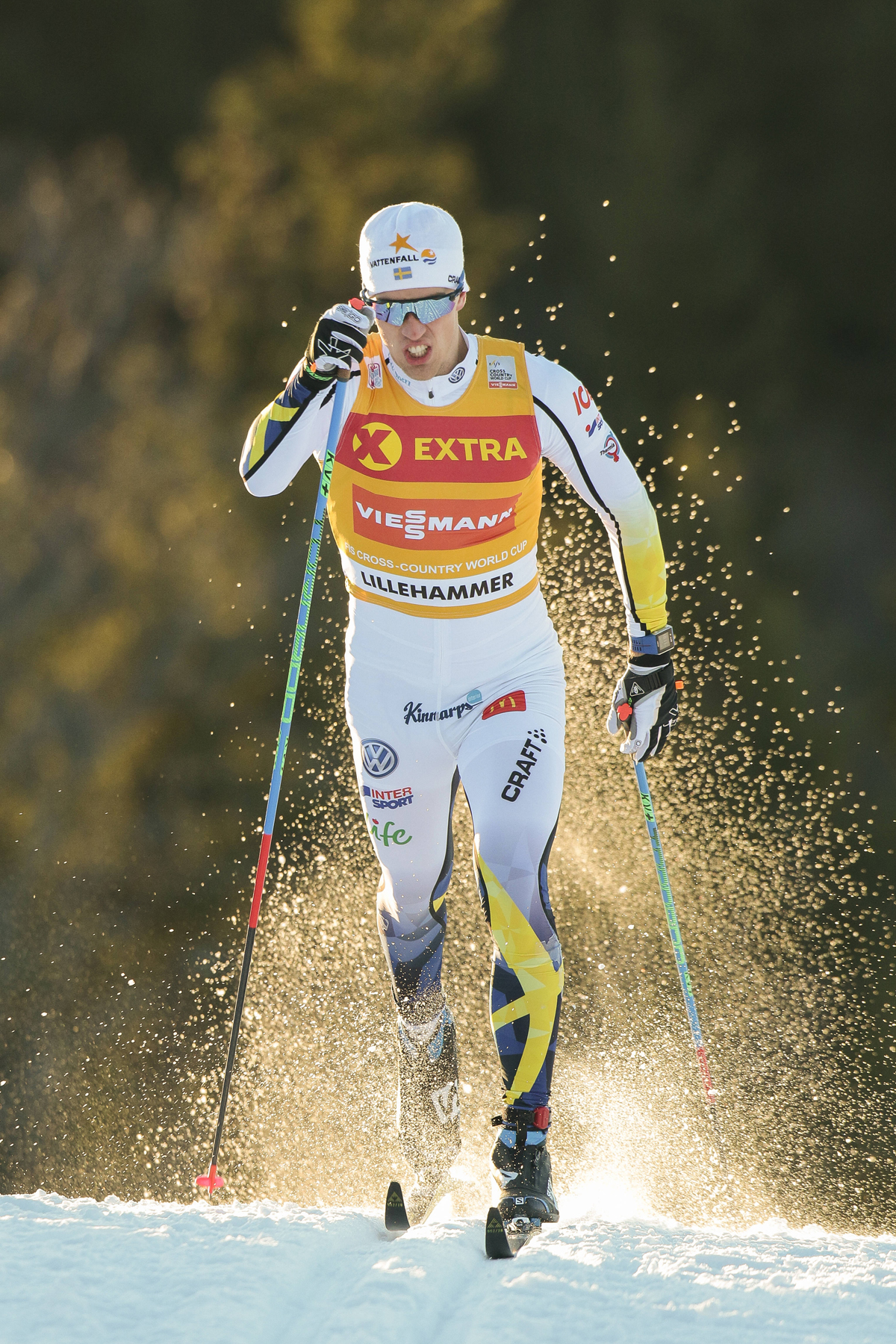
    Calle Halfvarsson of Sweden en route to his first World Cup win in three years, with a victory in Thursday's classic sprint in Lillehammer, Norway. (Photo: Fischer/Nordic Focus)
    Calle Halfvarsson of Sweden en route to his first World Cup win in three years, with a victory in Friday’s classic sprint in Lillehammer, Norway. (Photo: Fischer/Nordic Focus)

    Blue skies. The low, northern-latitude light basking Lillehammer, Norway’s storied tracks in a sublime wintery hue.

    That was only the setting for Friday’s 1.5-kilometer men’s classic sprint, the first stage of a three-day mini tour. The bucolic dreaminess was jolted by snow spraying off the backs of skis as the men charged up and down the three-hilled Lillehammer course.

    Sweden’s Calle Halfvarsson came to Lillehammer wearing the yellow bib as the overall World Cup leader. By race the race’s end, with sprinters coming in and out of sub-Arctic shadow, Halfvarsson took the sprint win in 3:31.83, securing his early season grip on yellow. It was the Swede’s second podium in the season’s early chapters. He placed second in the World Cup’s opening day classic sprint in Kuusamo, Finland, last Saturday.

    “I felt strong in the prologue and in all the heats,” Halfvarsson said during the post-race press conference. “I decided to go out of the track on the last climb because I had a better grip there. I think I am headed in the right direction. We will see tomorrow how things are.”

    Halfvarsson shared the podium with Norway’s Emil Iversen in second (+0.12), and Swedish teammate Teodor Peterson in third (+0.54).

    Ninety-eight men began the mini tour, setting off one by one during Friday’s sprint qualifier. From that initial 98, the field was culled to 30 skiers in the heats, 12 in the semis, six in the finals. And then of course there was one.

    Halfvarsson began the day the same place he finished it: he was the first qualifier in 3:28.44. He moved through the rounds placing second in quarterfinal two, and first in semifinal one where he edged Peterson by 0.10 seconds.

    Peterson qualified fourth, nearly six seconds behind Halfvarsson. Peterson then finished second in both his quarter and semi to advance to the finals, eventually placing third. “I’m satisfied with it, third is better than fourth and I feel like I tried my best in the final 100 meters but it didn’t work, though I’m still satisfied with the performance,” Peterson said during the press conference.

    Iverson’s route to the podium began with a slightly slower turn of pace; he qualified 13th in 3:37.39. Like Peterson, he, too, finished second in his quarter and semifinal. During the final, Iversen appeared to have been dropped by Halfvarsson’s fast skis, strong surge on the final uphill, and his double pole fury. A full 10 meters appeared to separate the skiers coming into the home stretch.

    “I always hope for a win, but second place is a good way to start the mini tour in Lillehammer,” Iversen explained when asked about his result at the press conference. “Being the best Norwegian of the day means I did a good job. The final was really fast. I tried my best on the final uphill, but Calle gained some meters and it was enough for him to win.” 

    Whatever distance there was between the eventual winner and Iversen was quickly diminished. Slotted right behind Halfvarsson, in the same lane, Iversen charged — eventually skiing onto the Swede’s tails a few meters from the finish. Iversen’s lunge for second place was a snazzy move; he swerved out and around Halfvarsson.

    Iversen was unable to better position himself for the finish by moving into the adjoining lane; by doing so he would have obstructed Peterson and risked obstructing him. The takeaway from Iversen’s burly finish should be a big warning shot to potential rivals: the young Norwegian can close seemingly insurmountable gaps with a frenzied finishing move.

    Of note, Norway’s Pål Golberg moved through the rounds with ease. Qualifying third and winning out until the final, Golberg’s sixth-place finish was cemented as soon as the starter’s gun fired. He snapped a pole at the start and did not receive immediate assistance from a coach for a pole replacement.

    Valjas, Harvey, Bjornsen Qualify

    Len Valjas racing in last weekend's classic sprint at the opening World Cup in Kuusamo, Finland. He missed the heats after placing 54th in that qualifier, but raced to 19th in Friday's classic sprint qualifier in Lillehammer, Norway. (Photo: Fischer/NordicFocus)
    Canada’s Len Valjas racing in last weekend’s classic sprint at the opening World Cup in Kuusamo, Finland. He missed the heats after placing 54th in that qualifier, but raced to 19th in Friday’s classic sprint qualifier in Lillehammer, Norway, before finishing 13th on the day. (Photo: Fischer/NordicFocus)

    Twelve North American men began the day’s race. Of those, only Canada’s Len Valjas, Alex Harvey, and U.S. Ski Team member Erik Bjornsen qualified for the sprint rounds.

    Valjas placed 13th overall after qualifying 19th (+10.24).

    Matching strides with eventual quarterfinal five winner Norwegian, Petter Northug, and last week’s 15 k classic winner in Kuusamo, Finland’s Livo Niskanen, Valjas initially looked posed to advance.

    “I felt good warming up for the quarterfinal so yeah, I was hoping for a little bit more today,” Valjas told Cross Country Canada, according to a press release, after the race. “But I had a lot of fun out there. I was skiing in the front for most of [my quarterfinal]. I don’t know, I felt really good and just got kind of boxed in coming into the finishing straight, so I jumped between the tracks, and it was just not enough, I couldn’t, or I needed a little more room to pass one more guy.”

    Valjas skied to third in his heat, only 0.19 seconds from advancing.

    It wasn’t an either-or affair with the Canadians. With Valjas easily qualifying, perhaps some of the pressure was off Harvey. On the phone after the race, Harvey was relaxed. He finished 10th overall for his first top 10 of the season.

    “The first thing I said to my tech after the quarterfinal was that this was mission accomplished today,” Harvey said. “I think there’s always a big break between 13th and 12th place for the bonus seconds.”

    For the mini tour, the overall standings after Day 1 are determined by taking a skier’s qualifying time and subtracting a time bonuses associated with their finishing place in the sprint. Harvey sits in 12th heading into the second day of racing — he received 13 bonus seconds for placing 10th on the day.

    Although satisfied, Harvey’s day could possibly have been even bigger. During his semifinal, just starting up the last of the course’s three hills, sprint winner Halfvarsson nearly skied over the tips of Harvey’s skis as he switched into the Canadian’s lane.

    “I was in good position following [Russia’s Sergey] Ustiugov, and I kind of saw the way he skied in the quarterfinal, I knew he would attack over the last bump,” Harvey said of his strategy moments before the impending Halfvarsson lane switch. “I was able to sneak in right behind [Ustiugov], but then Calle, he kind of changed tracks … His tails were pretty much on my bindings, or just in front.”

    Harvey had to pull up and lost his momentum.

    In an instant a gap opened Harvey was unable to close. After the semi, the jury issued Halfvarsson a yellow card for the move. Audible over the television broadcast feed moments after crossing the line, was Halfvarsson’s apology to Harvey.

    “It’s part of the game, it’s sprinting, it’s always tight, so there’s no hard feelings for me and Calle,” Harvey said of the incident.

    Other Canadians contesting the race were Canadian World Cup Team member Devon Kershaw who placed 42nd, Knute Johnsgaard (U25 Team) 51st, Bob Thompson (NTDC Thunder Bay) 52nd, Graeme Killick (World Cup B-team) 71st, and Andy Shields (NTDC Thunder Bay) 90th.

    On the American side, Bjornsen was the final skier squeaking into the rounds, qualifying 30th (+12.61).

    His quarterfinal was stacked with Halfvarsson and Norway’s new sensation, Johannes Høsflot Klæbo: these two skiers ran away with the heat, crossing the line nearly eight seconds ahead of the next-best placed skier. Bjornsen placed sixth in the heat and finished 24th overall.

    “I’m happy about the race and I’m happy about qualifying from the prologue, which I thought was good,” Bjornsen told FasterSkier in the mixed zone following his elimination. “I felt good through the race and I got some good double poling done”

    (Article continues below)

    https://www.instagram.com/p/BNhCjL3hBKV/?taken-by=sbjornsen&hl=en

    According to International Ski Federation (FIS) records, this is the fourth time Bjornsen has qualified for sprint heats and his first ever in classic technique.

    Adding to the accolades, Bjornson’s teammate and older sister Sadie Bjornsen qualified first in Thursday’s women’s sprint.

    “That was really great, we were talking about the hashtag #bjornsenbookends,” U.S. Ski Team (USST) Women’s Coach Matt Whitcomb said over the phone. “It was the joke around our athlete cabin this afternoon between the rounds and the qualification. They were first and 30th so that was pretty neat.

    “Erik has not qualified for too many sprints, but to qualify specifically in Lillehammer, in the lion’s den is quite impressive,” Whitcomb added.

    Andy Newell (USST) placed 47th in the qualifier. Newell explained in an email that he’s on the mend after fighting an elbow infection and recent cold symptoms.

    “I’m doing ok, but yes I have been fighting a cold for the past few days,” Newell wrote. “I took the last two days off completely from skiing but woke up this morning feeling ok so I made the decision to race. Despite not having any cold symptoms it was obvious that my strength and speed weren’t where they should be. It’s been a rough start to the season so far with the elbow infection before week 1 and then with cold this week. I’m not sure what the rest of the weekend will bring for me, but getting back to 100% will be the priority.”

    For the men, the mini tour features a 10 k freestyle Saturday and concludes with a 15 k classic pursuit on Sunday.

    Newell’s teammate Simi Hamilton (USST) followed him in 48th on the day.  

    “Definitely not the day I wanted out there,” Hamilton wrote in an email. “I’m pretty bummed with how I felt during the qualification, especially since I got my energy back after being sick for all of last week. But I think my body is coming around from illness and I’ve never historically raced super fast or felt great during the very beginning of the season. So I have confidence in knowing that I will feel better and better as the race year goes on.”

    Hamilton did mention his skis were solid. But Hamilton’s response in the email had more to do with his respect for his U.S. skiing peers than dwelling on where he’d like to be.

    “Although I didn’t walk away from the venue today with the race I had wanted to have, I was psyched to see our girls lay down some really fast qualifiers and was proud to watch them fighting with everything they had in the heats,” Hamilton wrote. “But I think the person I’m most proud of today is Erik [Bjornsen]. He’s one of the best classic skiers I know, and works incredibly hard day in and day out, and he deserved to score his first ever classic sprint points today. To be able to do that in Norway is especially noteworthy. It’s incredibly difficult to walk into the lion’s den here, no matter what the race, and I think this is a sign of things to come this season for Erik.”

    Other Americans contesting the sprints were Alaska Pacific University (APU) skier Eric Packer in 76th and Noah Hoffman (USST) in 89th.

    Results: Final Mini-tour standings (after Day 1)

  • Diggins Leads USST to Redemption in Lillehammer Freestyle Distance Races

    Jessie Diggins (U.S. Ski Team) skiing to first place in the qualification round of Wednesday's freestyle sprint. She finished second overall in the finals, a best-ver finish at a Junior/U23 World Championships. (Photo: FlyingPointRoad.com)
    Jessie Diggins (U.S. Ski Team) skiing in the 2014  Junior/U23 World Championships. She raced to 15th position in Saturday’s World Cup 5 k freestyle in Lillehammer, Norway.  (Photo: FlyingPointRoad.com)

    Jessie Diggins has her confidence back and it showed as she cruised to a 15th place finish in the World Cup 5 k freestyle interval start in Lillehammer, Norway.

    Saturday’s 5/10 k race was the second stage of the weekend’s mini tour following Friday’s freestyle sprint.

    Colder conditions and firm tracks made the women’s 5 k a fast race, with winner Therese Johaug of Norway posting a time of 12:33.7.

    With Diggins (+39.0) leading the way, two other American women made it into the top 30. Sadie Bjornsen (+45.0) placed 20th while Liz Stephen (+48.3) placed 22nd.

    After a less-than-ideal sprint where Bjornsen was the lone American to advance past qualification, Saturday’s improved results demonstrated that the US Ski Team has more to work with than races this season have demonstrated.

    Diggins entered Saturday’s 5 k with conservative pacing to avoid blowing up on the final half of the course, which featured what she estimated to be a four-minute climb.

    In addition to a conservative start, Diggins said that one of her main goals was to ski aggressively and efficiently on the downhills – where she said she lost most of her time in Friday’s sprint.

    While it took a little verbal encouragement in the form of Diggins telling herself that “you can do this,” she managed to surpass any uneasiness and rocketed through the course.

    Diggins explained she knew it was good day before crossing the finish line because everything she had raced so far was a blur.

    “Looking back on today’s race there are things I can’t even remember because I was just so in the zone. I think that’s something that defines a good race for me – you’re just so focused that you can’t even remember what you’re thinking about,” she said in a phone interview.

    Diggins said she still had energy at the end of the race and wished she had used it while attacking the fast course.  According to USST Head Coach Chris Grover, the fact that Diggins still had energy was a good sign as it meant that the 23-year-old had even greater potential.

    “She skied fantastic and she was in the mix right from the get-go. She had tight splits and really closed down on a few people that were skiing around her,” he said in a phone interview.

    Back in 20th Bjornsen started the race even more conservatively, clocking in at 34th position at the 2.2 k mark.

    Like Diggins, Bjornsen said that she was pacing to save energy for the big hill. In Bjorsen’s case, however, she explained she might have started too slow.

    Despite her sluggish start, Bjornsen’s top-30 placement was the first time the 25-year-old earned individual points in a freestyle distance race. A strong classic skier, Bjornsen worked hard this summer to improve her skating technique.

    “I have a tendency to take huge strokes that end up being quite slow. This summer I worked a lot on floating more, increasing my tempo, and keeping things moving faster,” she explained in a phone interview.

    It seems that the work paid off.

    “I know I have the ability to skate ski it’s just actually performing it. Today was fun because I feel like it finally came together for me. “

    Stephen, the final American woman in the top-30, crossed the 2.2 k mark in 45th but was able to jump 25 places to 20th by 3.3 k before slipping back to 22nd at 5 k.

    Stephen wrote that she skied the race like it was a 5 k relay leg rather than an individual race for motivational purposes.

    “It makes me perform better than I would if I was just racing the clock. Relay day is when you race for your team and that is how any 5 k skate race feels to me, as if I am on the relay team and skiing for us all,” she wrote in an email.

    The remaining members of the USST were far from the pace set by Diggins, Bjornsen, and Stephen.

    In the women’s race the next finishers were Caitlin Gregg and Kikkan Randall who place 62nd and 63rd.

    Randall, who hasn’t placed in the 60s since 2006, wrote in an email that she felt stuck in a low gear for the majority of the race. However she explained her effort was one step closer to reaching racing shape this season, especially after Friday’s sprint where she placed 43rd.

    The final two U.S. women, Ida Sargent and Sophie Cladwell, finished in 79th and 84th positions.

    USST Women’s Coach Matt Whitcomb, said Friday that Caldwell would treat Saturday’s 5 k as a workout rather than a race, due to her recovery from a broken elbow in October.

    In the men’s 10 k Erik Bjornsen was the top American finisher in 51st, 1:13.2 back from race winner Martin Sundby of Norway.

    Bjornsen finished his first 5 k loop in 35th after a strong start, but was unable to hold his pace for the remainder of the race.

    “I wasn’t able to sustain the pace I had started but I was still able to recover some on the few rest sections… I struggled for a few kilometers but I was able to pull it together for the last couple kilometers,” he wrote in an email.

    Bjornsen was followed by Simi Hamilton in 74th, Andy Newell in 103rd, and Reese Hanneman in 108th positions.

    As the team wrapped up its second race day in Lillehammer, Grover said that all the USST skiers were signed up to compete in Sunday’s 10/15 k classic pursuit. However, at the time of the interview, he said that it was still uncertain if Newell would start, as he was carrying fatigue and possibly needing rest to focus on the upcoming Davos, Switzerland sprint.

    He also explained that while the team saw improved results Saturday, it doesn’t mean his athletes are at full racing potential.

    “I don’t think we’re going to have anything extraordinary as the team is still working into the season,” Grover said.

    The top ranked American headed into Sunday’s race is Sadie Bjornsen who with start in 17th position and attempt to improve her standing throughout the 10 k race. She will start 1:20 behind mini tour leader Marit Bjørgen.

    She explained that she had no concrete goals for the race and that her main focus was to ski with strength and “conquer the hills.”

    Diggins will enter tomorrow’s pursuit ranked 21st followed by Liz Stephen in 35th. Randall is ranked 63rd followed by Gregg in 65th, Ida Sargent in 77th, and Caldwell in 84th.

    In the men’s 15 k classic pursuit, Bjornsen is the USST’s first starter in 53rd followed by Hamilton in 73rd, Newell in 97th and Hanneman in 108th as the last starter.

    Men’s 10 k results | women’s 5 k results

    Men’s tour standings | women’s tour standings

  • Rybinsk World Cup Preview

    Rybinsk World Cup Preview

    Marit Bjoergen and Justyna Kowalczyk at the end of Stage 7 of the Tour de Ski. The two will face off again in Rybinsk on Saturday in the 10 k mass start freestyle.

    For the past few years, the World Cup in Rybinsk, Russia has been the weekend frequently skipped over by national teams and various individuals. With the overall World Cup title a focal point this season and no major championship to save up for, however, the expected fields are nearly double what they’ve recently been, in spite of the handful of athletes who have decided not to race in the extreme cold.

    The forecast initially looked borderline, but on Friday Rybinsk was predicted to get as high as 0F on Saturday. The FIS cutoff for a race to get cancelled or postponed is -4F. If Saturday’s temperature is right on the edge prior to the races, Canadian head coach Justin Wadsworth said he thinks officials will “blow on the thermometer a little bit and make it happen.” With the races set to go off in the afternoon, the temperature will likely have gotten as high as predicted by the time the men start at 2:15 pm local time.

    If the Moscow city sprints on Thursday were part of a push to attract more skiers to the Russian races, it worked. Sixty men and 53 women are on the start lists for the 10/15 k mass start freestyle races on Saturday, which include intermediate sprint bonuses. By comparison, only 30 women and 33 men took to the line in Rybinsk last year.

    Luckily for World Cup fans, that should this weekend a little more interesting. On the men’s side, current World Cup leader Dario Cologna (SUI) has decided not to race in the cold, and neither will the Swedes, Finns, and a few other big names—notably Petter Northug (NOR) and Lukas Bauer (CZE).

    There are still plenty of fast skiers set to battle it out head-to-head on Saturday. Home-field athletes Maxim Vylegzhanin and Alexander Legkov (RUS) currently sit fifth and sixth in the distance rankings, and will have plenty of motivation to perform well in front of Russian fans.

    The two mid-race sprint bonuses could potentially throw the race. Maurice Manificat (FRA) is coming off a bit of a down run following his second-place showing in the Tour de Ski final climb, but could be a contender. Devon Kershaw (CAN) seems on the brink of his first official World Cup win, and teammate Alex Harvey is coming off a fourth-place finish two weeks ago in Otepaa, Estonia. Ivan Babikov has rejoined his team in Europe, and after a strong finish in the Tour final climb, will be raring to go in the mass start.

    The American men’s squad, led by Kris Freeman, will have thinner ranks on Saturday. Noah Hoffman is still in Ramsau, Austria with the stomach flu, and sprinters Andy Newell and Simi Hamilton rejoined him after the Moscow sprint on Thursday.

    Freeman is coming off a comfortable win at Austrian nationals last weekend, and if he skis where he believes his fitness to at, he could mix it up with a top 15. Tad Elliott is back in World Cup action after staying in the US for a few SuperTours after nationals, and with plenty of time in Ramsau to adjust to the time difference, should be ready to go. Sylvan Ellefson is still hitting his stride on the World Cup, but with high energy carrying over from Thursday, could be ready for another good performance.

    On the women’s side, there are fewer big names skipping Rybinsk, and for good reason: Justyna Kowalczyk (POL) pulled 38 points ahead of Marit Bjoergen (NOR) in the overall World Cup on Thursday, and if Bjoergen wants to fight for it, she has to gut it out even at the remote venues.

    The course on Saturday features about 500 feet of climbing per lap, with the women doing four 2.5 k loops and the men six. In addition to Bjoergen, Therese Johaug and all of the big Norwegian names will be lining up. Charlotte Kalla (SWE) is also back for Rybinsk, fresh off of two Swedish national titles.

    The U.S. women have the momentum of a string of top performances on their side. Most recently, they placed three in the top-12 in Moscow, led by Jessie Diggins’s seventh—the 20-year-old undeniably on a roll this year.

    Kikkan Randall is sitting out the 10 k in order to be ready to go for Sunday’s skiathlon. According to USST head coach Chris Grover, Randall is prefectly healthy, but feels she needs to take Saturday off in order to be sharp the next day. Ida Sargent is also skipping the 10 k.

    Liz Stephen is coming off a 21st in Otepaa and a second at Austrian nationals, and the climbing-heavy course could work in her favor in Rybinsk. Holly Brooks, wrist mostly healed, is back on the American roster, and though she may have lost some strength in her arm and core while she recovered from the injury, her coach Erik Flora thinks she’s just as fit as ever.

    Sadie Bjornsen, though missing the heats in Moscow, nonetheless skied a respectable 39th. Bjornsen has said many times that falling just short of the points only gives her more motivation for the next race.

    Barring weather delay or cancellation, the Rybinsk men’s 15 k starts on Saturday at 2:15 pm in Russia (6:15 am EST), with the women starting 1.5 hours later.

    Men’s start list

    Women’s start list