From the FasterSkier archive — posts syndicated from athletes’ and coaches’ own blogs between 2004 and 2012, kept online as published. Current coverage is at fasterskier.com.
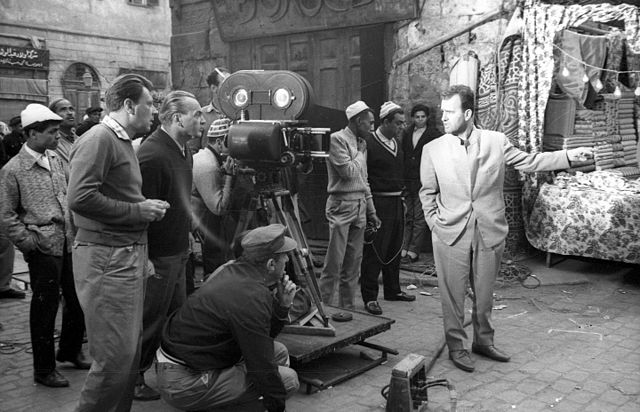
Kikkan Randall shares life’s highs and lows during the short film “Kikkan” (Photo: WikiCommons)
For those of us suffering from the post-ski-season let down—or for those who simply can’t get enough ski-related content—an effective way to help address these issues will be to take 46 minutes to view “Kikkan,” a nicely produced short documentary about the life of Kikkan Randall. Presented (sponsored) by L.L. Bean and Providence Health Alaska, the film includes details of Randall’s childhood, ski career, cancer struggle, and personal life.
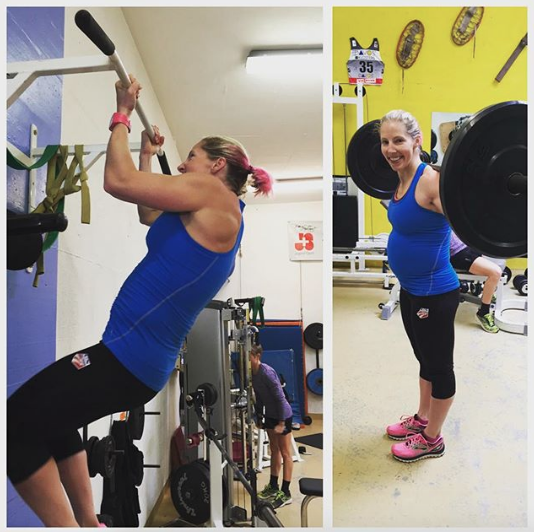
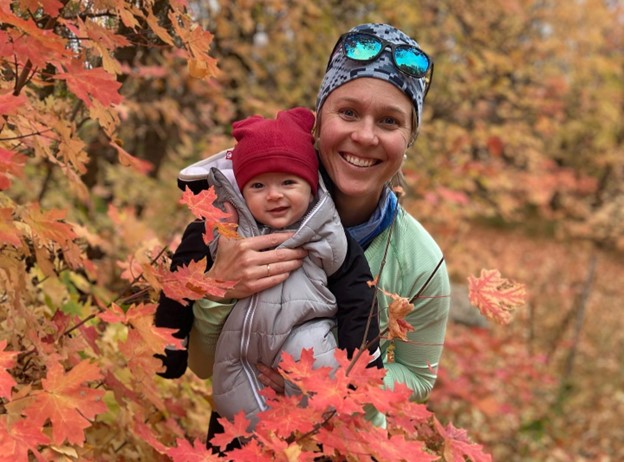
Kikkan Randall had well publicized workouts during her pregnancy. (Photo: Instagram @kikkanimal)
The movie is a candid chronological biopic of an athlete who has faced daunting challenges, and unlike many cinematic athletic biographies it does not quickly regress into a warm sepia toned homage to the subject. Instead, the film is a frank look at a life full of ecstatic highs, searing lows, and Randall’s continuing ability to deal with her life’s challenges.
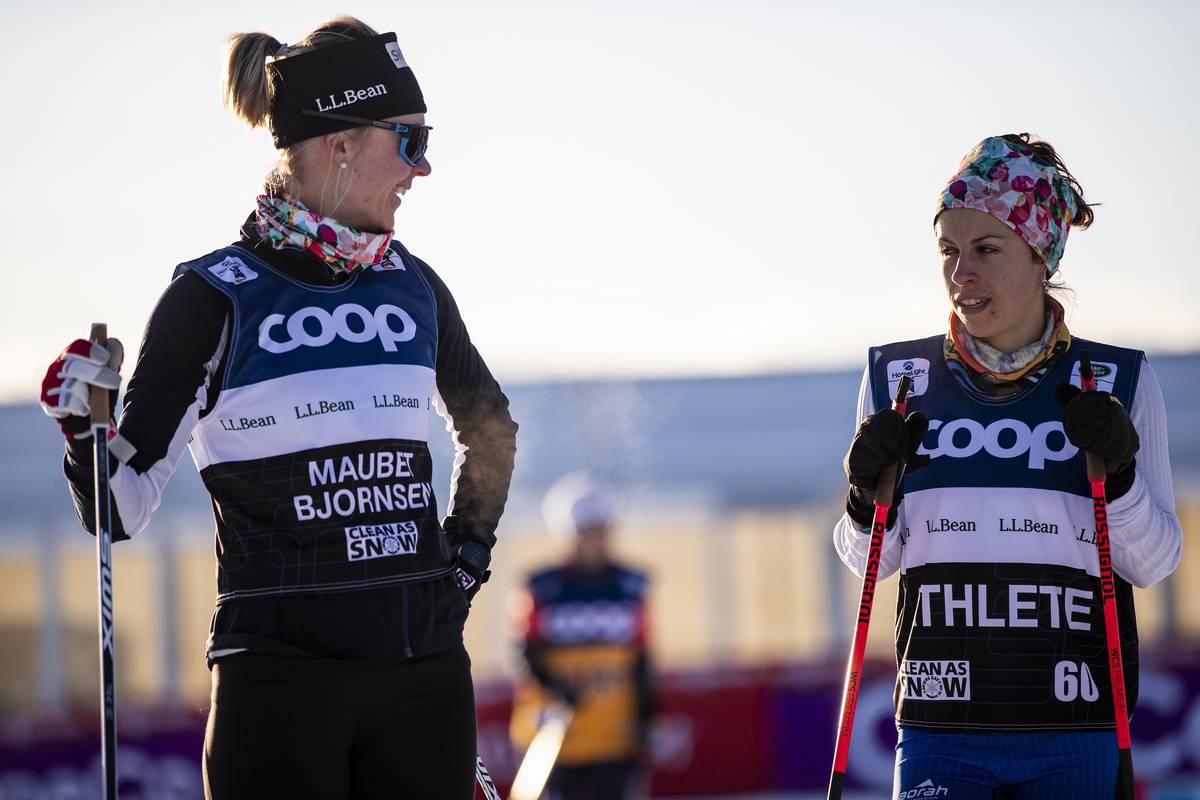
Sadie Maubet Bjornsen joins the film’s guest and talks about losing out to Randall for a spot on the 2018 Team Relay. (Photo: Sadie Maubet Bjornsen)
Randall delves into chapters of her life which most viewers will be familiar with, but there is a lot more detail than the average viewer already knows; the details are quite interesting. Among those more interesting details are interviews with Sadie Bjornsen regarding Randall’s late-hour inclusion in—and Bjornsen’s subsequent exclusion from—the 2018 Pyeongchang Olympic Team Sprint. Bjornsen provides some context to a story that many are familiar with, but probably don’t know the details that she reveals. It’s another very candid portion of the film that helps viewers connect emotionally.
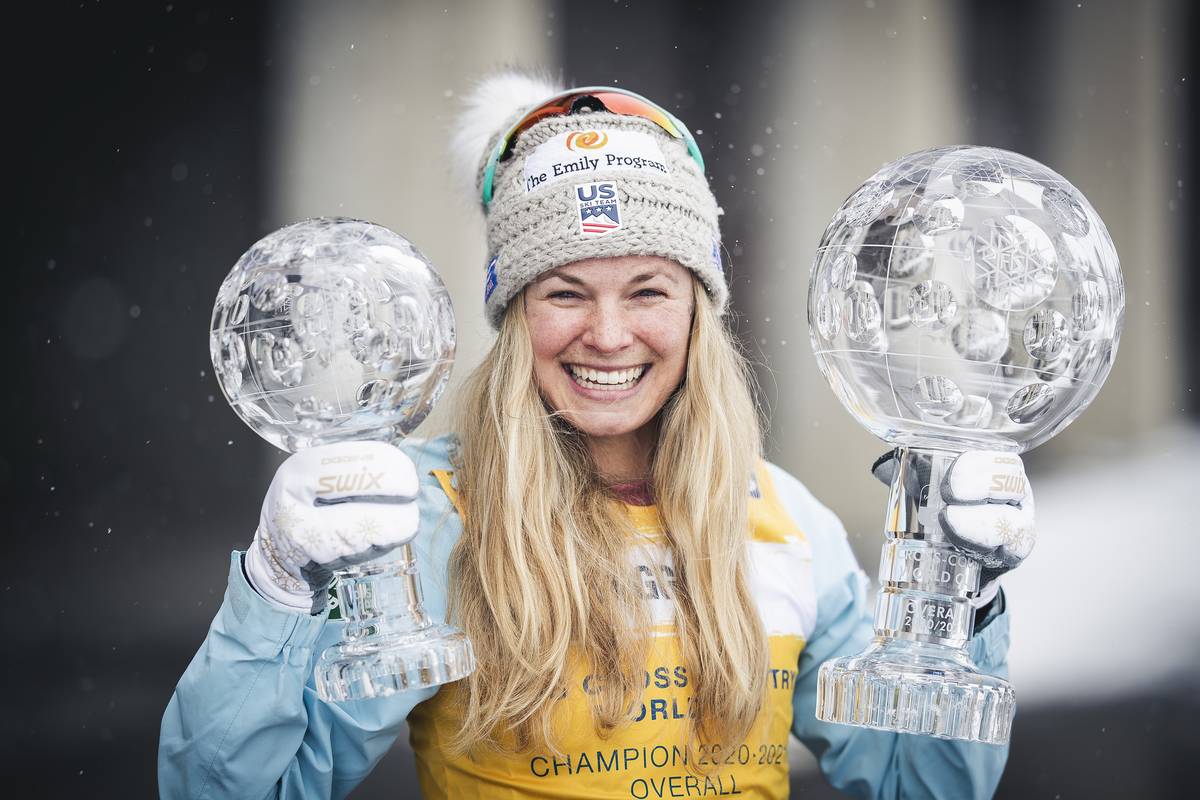
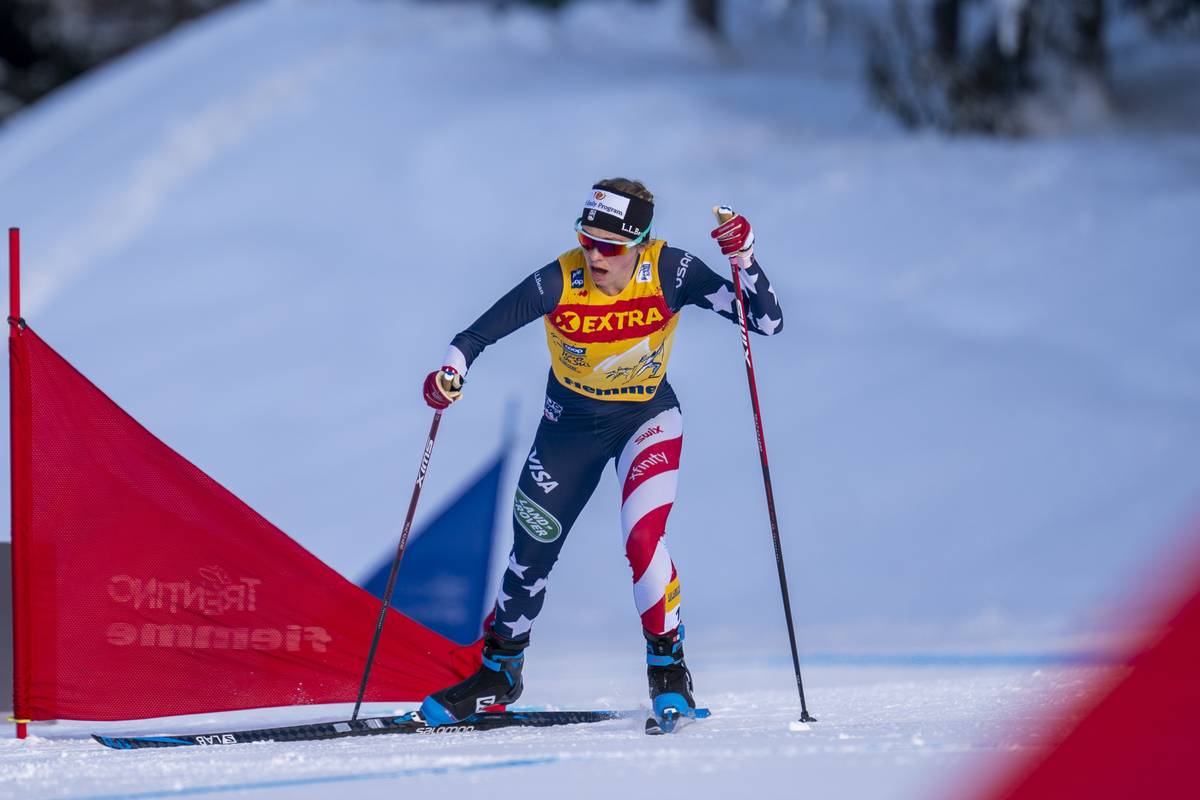
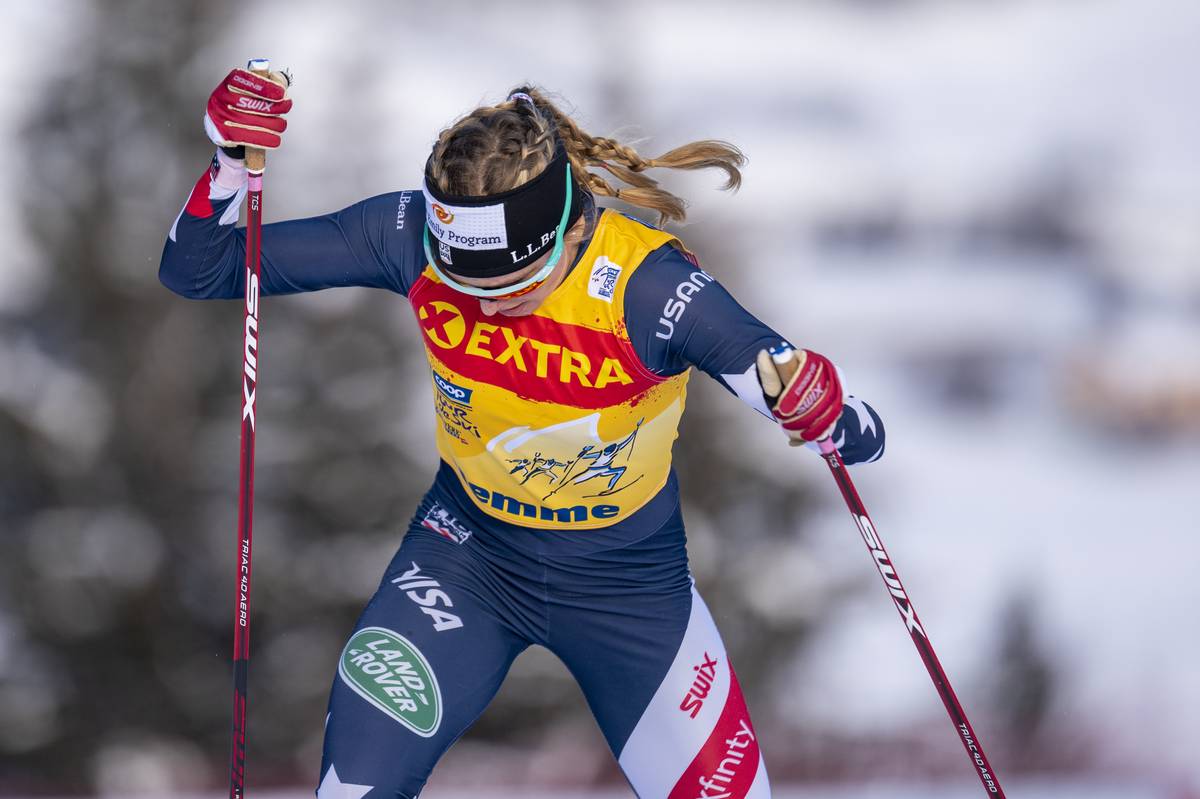
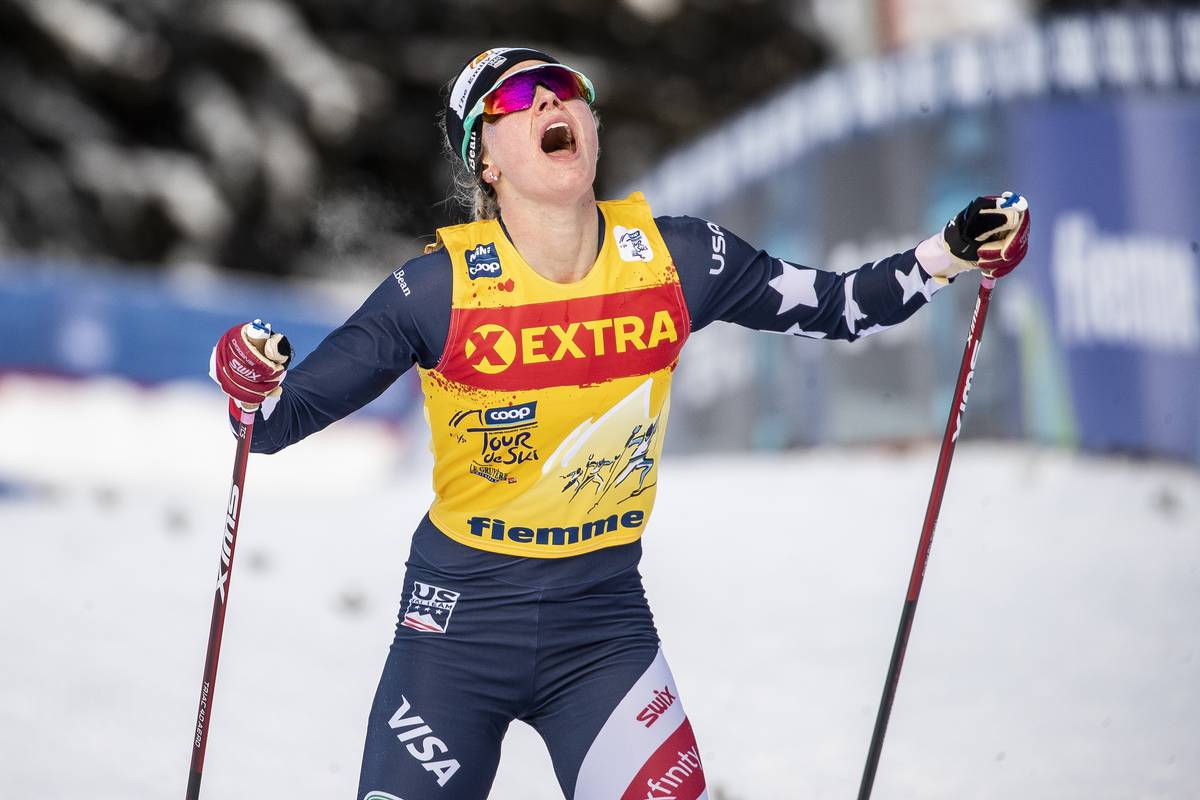
Jessie Diggins and a host of other North American cross-country celebrities make appearances in the film. (Photo: NordicFocus)
The movie is also packed full of familiar names and faces with Erike Flora, Sophie Hamilton, Holly Brooks, Liz Stephen, and Jessie Diggins also making appearances. Randall’s parents are also interviewed.
Randall discusses her early Olympic disappointments and her final Olympic highpoint of winning a gold medal with Jessie Diggins. She also addresses the challenges of having a family while being a professional athlete.
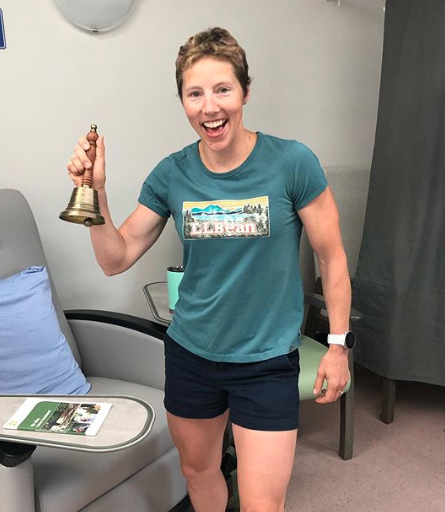
Kikkan Randall rings the bell marking her final Herceptin infusion in July 2019. (Photo: Instagram @kikkanimal)
There is much time spent on Randall’s breast cancer diagnosis and treatment. It’s in this part of the movie where Randall really lets the viewers in, and where the emotional connection happens, mostly because Randall is more open and emotional about raw details of her life than she has ever publicly been. It’s a chapter of her life which for many people might have been the beginning of a slide into a long downward spiral, but like most things in her life, Randall rose up to meet things on her own terms. She also talks briefly about her 2021 divorce from Jeff Ellis, occurring shortly after her cancer treatment had ended and subsequently forcing her to go through the pandemic as a single mother.
There are also enough training and ski scenes to keep viewers entertained.
The short film is generally well produced with nice, but sometimes duplicated, footage of Randall skiing in Alaska. These shots are aided by sweeping overhead drone footage (the inclusion of high-quality aerial footage available through drones has been as much of a game-changer for lower-budget productions as the first fiberglass skis were for cross-country.) There is one distracting audio section that would never make it into a major theatrical film, but it’s over quickly and might add a homespun feel—or not. There are also some mildly annoying border framing effects and added scratching/graininess effects whenever old photos are shown. This kind of easy special effects unfortunately now happens regularly in modest budget films since such effects are so readily available to include and some think add a sense of higher production values. Regardless of these production choices, the movie is enjoyable to watch and informative.
“Kikkan” is well worth the 46 minutes to watch. It will make you feel a connection to one of North America’s cross-country skiing legends that you might not have had previously. It will also help you to transition from the ski trail to whatever else it is you do in the spring and summer. “Kikkan” is now available to view for free on YouTube https://www.youtube.com/watch?v=GiNCCHXzdRU
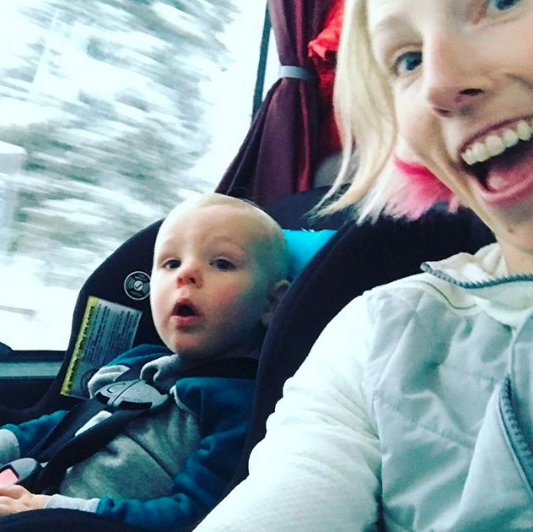
Kikkan Randall travels with her son, Breck, between World Cup race venues. (Photo: Instagram @kikkanimal)
This coverage is made possible through the generous support of Marty and Kathy Hall and A Hall Mark of Excellence Award. Learn more about A Hall Mark of Excellence Award—or about supporting FasterSkier coverage—by contacting info@fasterskier.com.
In part I of FasterSkier’s interview with Sadie Maubet Bjornsen, we caught up with the former U.S. Olympian and heard updates on her personal life. Today, we hear her views on the current crop of Stifel U.S. Ski Team members, and what she sees in her own future.
Sadie Maubet Bjornsen’s years of international experience—and international success—give her an excellent eye for ski-talent. She likes what she sees among up-and-coming young Americans. (Photo: NordicFocus)
As autumn approaches, the impending snowfall still beckons Maubet Bjornsen. “I love the fall, which is weird in Alaska,” she said. “It’s all associated with it’s time to go ski race.” Even though she’s no longer regularly racing, the thrill of impending ski season is still there. “I still have all those happy vibes associated with it [skiing].” Though, she readily admits to missing racing. “The thing I miss most is the confidence associated with it. When you’re at the top of your field … it’s different than leaving sport and being new in a field [like I am now], it was so fun being so good at something, being a newbie in the next part of life is really different.” But she realizes that will also change. “There’s an element of performance in everything.”
One thing she doesn’t miss is being away from home every day. “I love coming home and seeing my husband every day, but the further I am away from being a professional athlete, the more I miss the fitness. While I miss [that], I love the options I have now, you can do just anything. I don’t miss being away, but I do miss traveling and being all over the world.”
Maubet Bjornsen really appreciates the approach being taken by Team USA’s young men and sees a bright future for them. She really appreciates Ben Ogden’s willingness to “go for it.” (Photo: NordicFocus)
Maubet Bjornsen still stays on top of U.S. ski team activity. “I can’t wait for the weekend because I watch the World Cups. When I watched the Olympics, I was more nervous watching than I was when I participated.” She is duly impressed by the young skiers. “The younger athletes are going to be crushing our records. One of the reasons I watch ski racing is because of those young boys, Ben Ogden, this guy is fearless. He does all these wild things in the race … not because it follows the normal trajectory. He does these things like dropping people by 15 seconds off the front in a sprint … I thought of doing that, but I never had the guts to do it. Ben is making his own route. I’m convinced he’s on the path to being the best. It’s really neat to see the boys with their own methods.” She appreciates the approach being taken by the younger team members. “It’s easy to get in the spot where you’re so focused that you forget to have fun, and they have fun on the forefront … I love to see that.”
Maubet Bjornsen developed strong ties with her teammates, especially Rosie Brennan. Her advice to current team members: “Be willing to find your own path to success.” (Photo: Sadie Maubet Bjornsen)
Maubet Bjornsen does have advice for younger racers, which many seem to already be following. “Keep the balance, and fun, and doing it your way,” she advised, a lesson she learned the hard way through the multiple injuries in her career, that there is always a different path to take. “It wasn’t until later in my career that I recognized it might actually be to my advantage to be doing things differently.” She would remind people that “listening to your mind and listening to your own voice is your own path to success.”
She also has advice for being on the road so much. “Finding ways to have something else meaningful is important … if you sit on the track the whole time … only thinking about the next race can get really exhausting.” She credits having other things to think about as helpful with dealing with being on the road. “It’s hard to find your own system when you’re always around other people in the traditional system,” she said. “Really pay attention to what makes you happy.”
Focusing on what works to make you happy is what Maubet Bjornsen says is one of the keys to World Cup success. (Photo: Sadie Maubet Bjornsen)
After she settles into her career and motherhood, Maubet Bjornsen would like to find time to give back more to the sport. “I would really love to go to coach at some point,” she said. “I benefitted so much from Erik Flora’s message of happiness first. I would love to be able to pass on some of things that he taught me.”
Maubet Bjornsen credits her APU coach, Erik Flora, (left) with much of the winning philosophy she built over her career. She wants to pass on that knowledge to the next skiing generation. (Photo: Matt Whitcomb)
Making a difference in other lives is what motivates her. “That’s why I love financial planning,” she said. “It’s so fun to support somebody else, mentally or financially.” She would also like to share her financial knowledge with athletes. “I want to figure out a way to get athletes to have retirement funds. Your accumulating years, when you’re young, are the most meaningful. You shouldn’t be starting your very first retirement fund when you retire from skiing. I would love to figure out how to not have an athlete come out of sport having never started a retirement fund.”
Given all of the obstacles Maubet Bjornsen overcame in her athletic career, it would be a sound investment to bet that she’ll find a way to use her new skills to help young athletes’ financial future.
Maubet Bjornsen will still race, but now she really doesn’t care where she finishes. (Photo: Erik Maurer, Sadie Maubet Bjornsen)
This coverage is made possible through the generous support of Marty and Kathy Hall and A Hall Mark of Excellence Award. Learn more about A Hall Mark of Excellence Award—or about supporting FasterSkier coverage—by contacting info@fasterskier.com.
Transitioning from the life of a professional athlete to the “regular” world can be challenging. Given the heroic number of training hours professional cross-country skiers put in, they may even have a harder time of it than other athletes.
Sadie Maubet Bjornsen recently became a new mother, and has started a career in finance. It’s been a lot of changes in only a little bit of time. (Photo: Sadie Maubet Bjornsen)
Former U.S. team member, Sadie Maubet Bjornsen, has met those challenges head on using the same philosophy she used as a racer: a steady, methodical approach combined with understanding her goals and personal limitations.
As an athlete, Maubet Bjornsen had to conquer difficult challenges. Due to an allergic reaction from an antibiotic she took in her teens, she was prone to tendon injuries and had to find unconventional training methods to keep herself on skis. She has adopted a similar approach to life after skiing, balancing career, parenting, and yes, still getting out on skis.
Maubet Bjornsen has used the lessons she learned ski racing to transition to life as a finance professional and new mother. (Photo: NordicFocus)
FasterSkier caught up with Maubet Bjornsen in her home in Anchorage, Alaska to find out what the two time Olympian and 11 time World Cup medalist was up to — as it turns out, quite a bit.
The biggest recent development in Maubet Bjornsen’s life is that she’s a new mother. Four months ago, she gave birth to a boy, Emil. Her husband, Jo, is French, and they plan to raise their child in a bilingual household that will provide unique challenges for Maubet Bjornsen since she isn’t a French speaker. “I’ve been trying to learn French for 12 years, and I’ve always had something else that I’m studying,” she said. “I’ll be motivated to speak the language, otherwise, they’ll have their own secret language!”
Maubet Bjornsen’s secret weapon has been having constructive diversions from her profession. She ran a bookeeping business and studied for her CPA degree while ski racing. Now she uses skiing as a diversion from work. (Photo: Sadie Maubet Bjornsen)
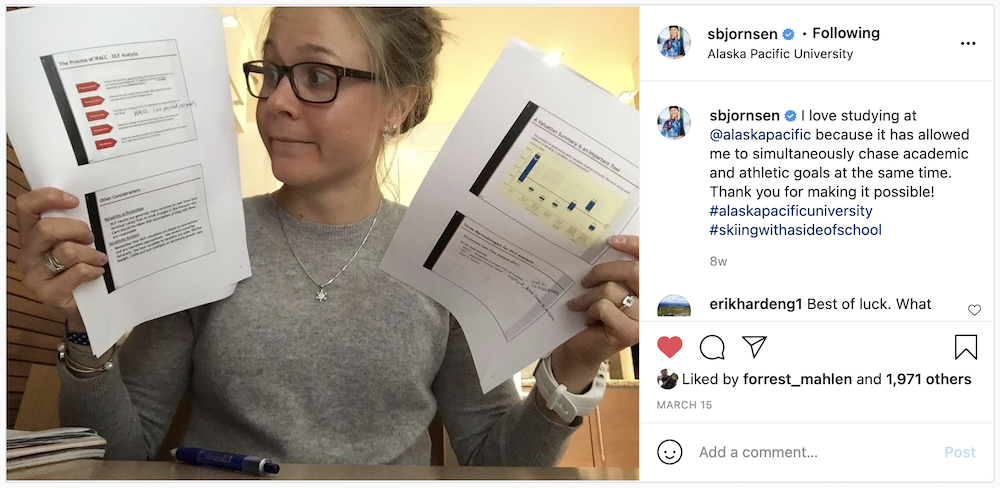
Along with recent motherhood, Maubet Bjornsen has also had significant professional changes in her life. When she was still skiing professionally, she also maintained a bookkeeping business. Recognizing her appreciation of numbers and problem solving, she pursued a double degree at APU (Alaska Pacific University) in accounting and non-profit business management. She studied for her CPA exams while still racing professionally.
She is currently a wealth manager at an Alaskan firm and is contemplating additional certifications in that field. In a few months she will receive her CPA certification; she sees a long term future in the world of finance. “I went from full blown skier to full blown next part of life.”
Having a demanding career makes for a tough life-work balance, but Maubet Bjornsen has taken lessons from skiing to balance her work life. “I’m doing the hard grind now, but it’s just like when I first started at APU and didn’t know at first how I was going to do it all,” she said. “As a skier, I always prioritized other things going on as well as skiing. I wasn’t the best version of myself when I focused on only one thing … I definitely have utilized that approach. I made sure I had something else to think about.”
The tables have turned for Maubet Bjornsen where athletics are now her distraction from work. “I live right on the ski trails and rip a lap from 6-7 a.m. then go to work,” she said. “Now that’s going to be even more challenging with a kid.”
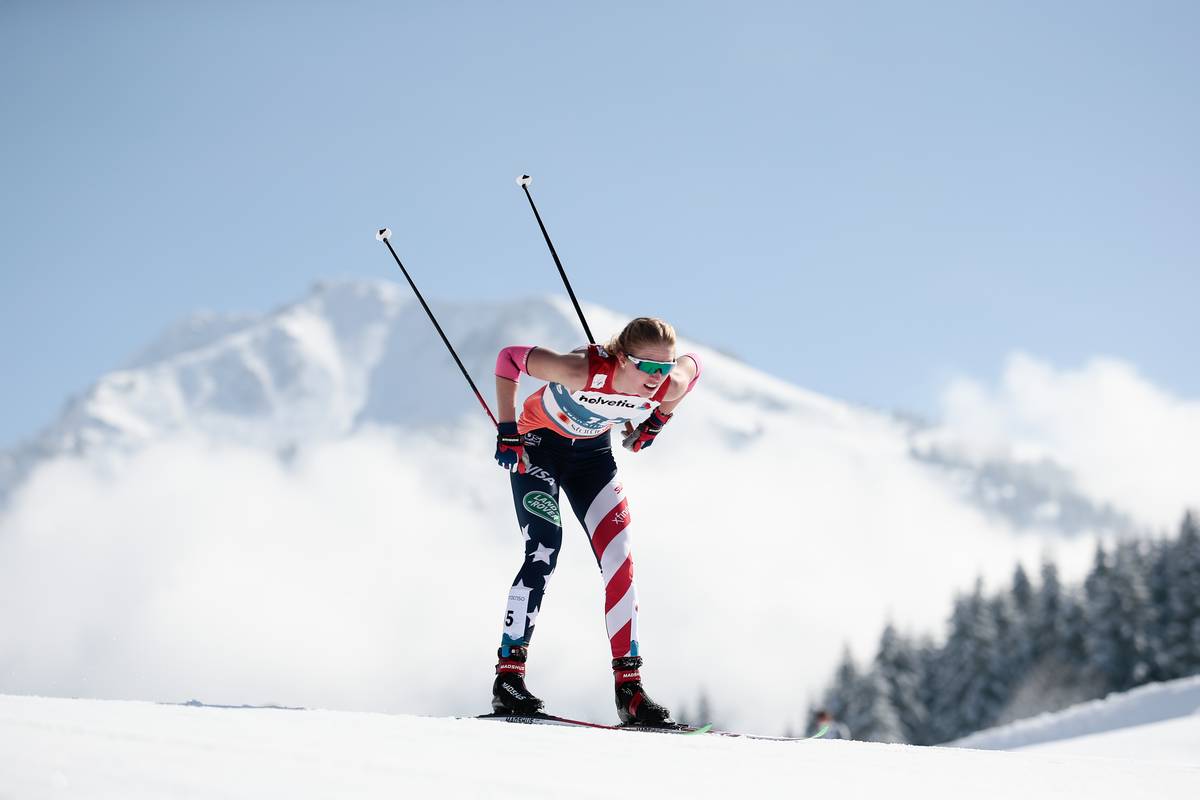
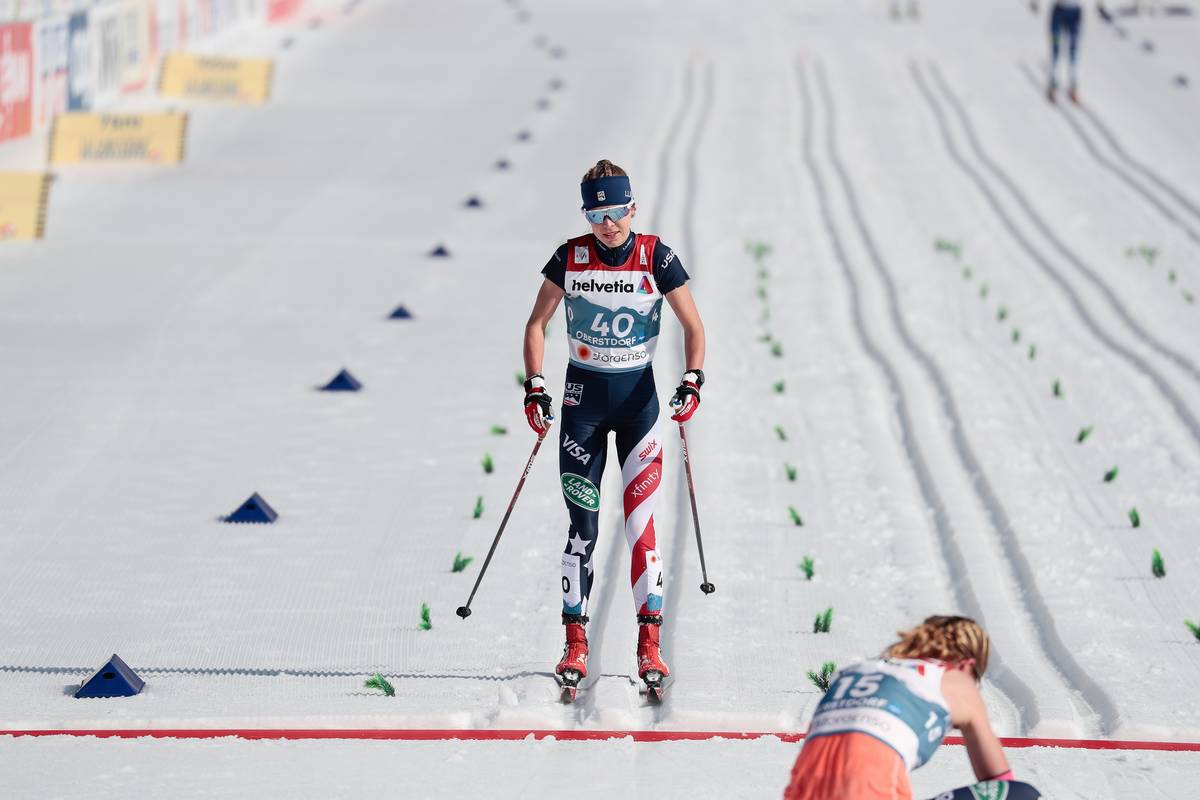
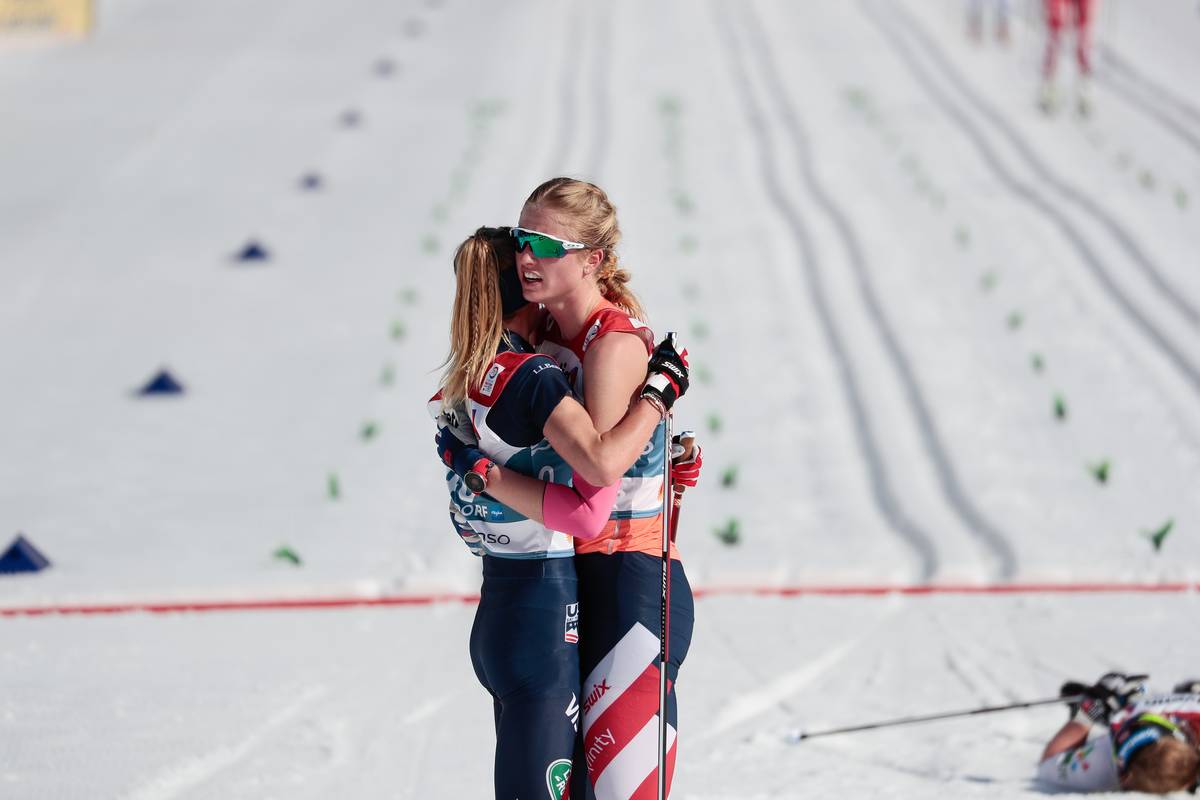
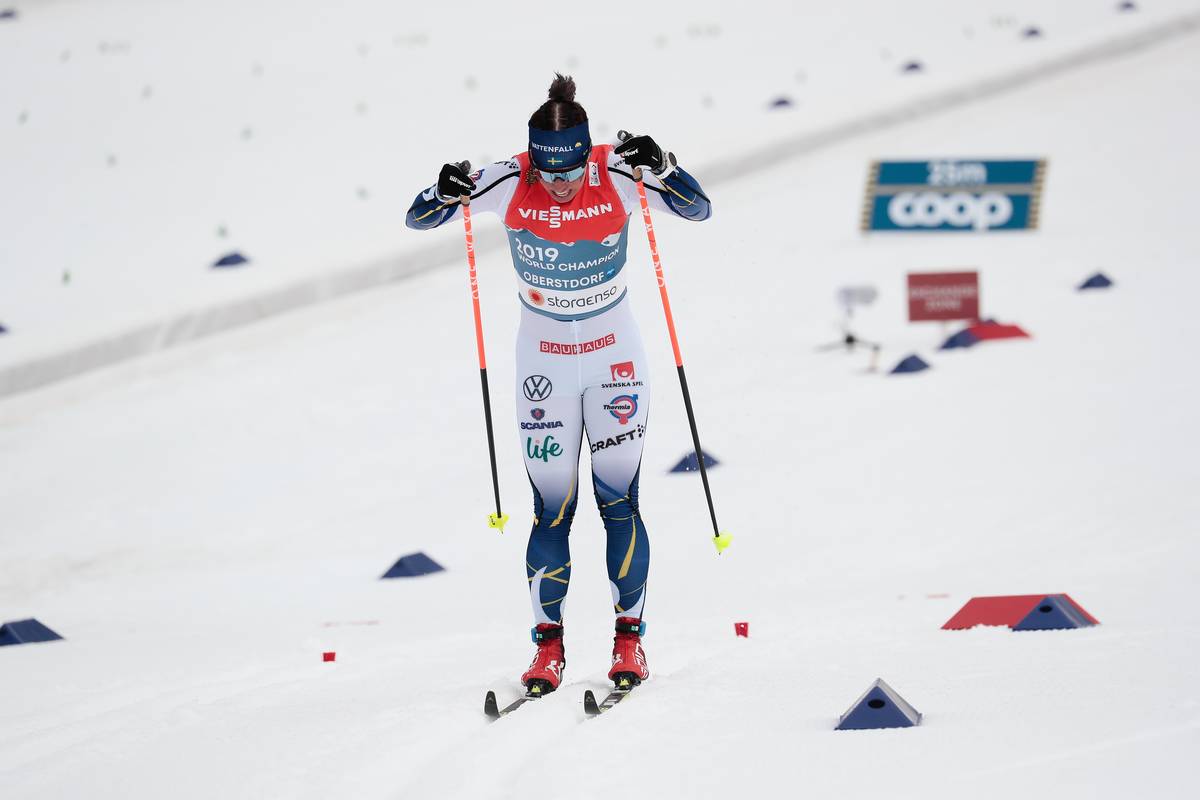
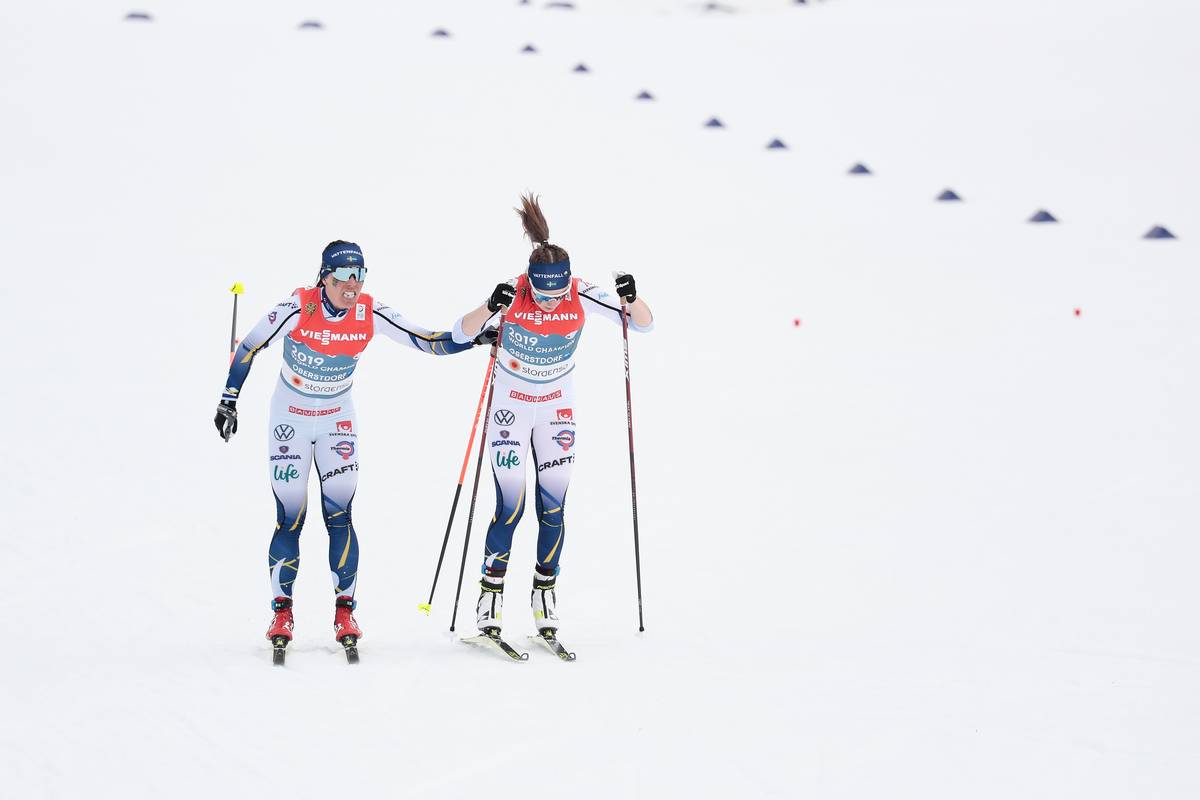
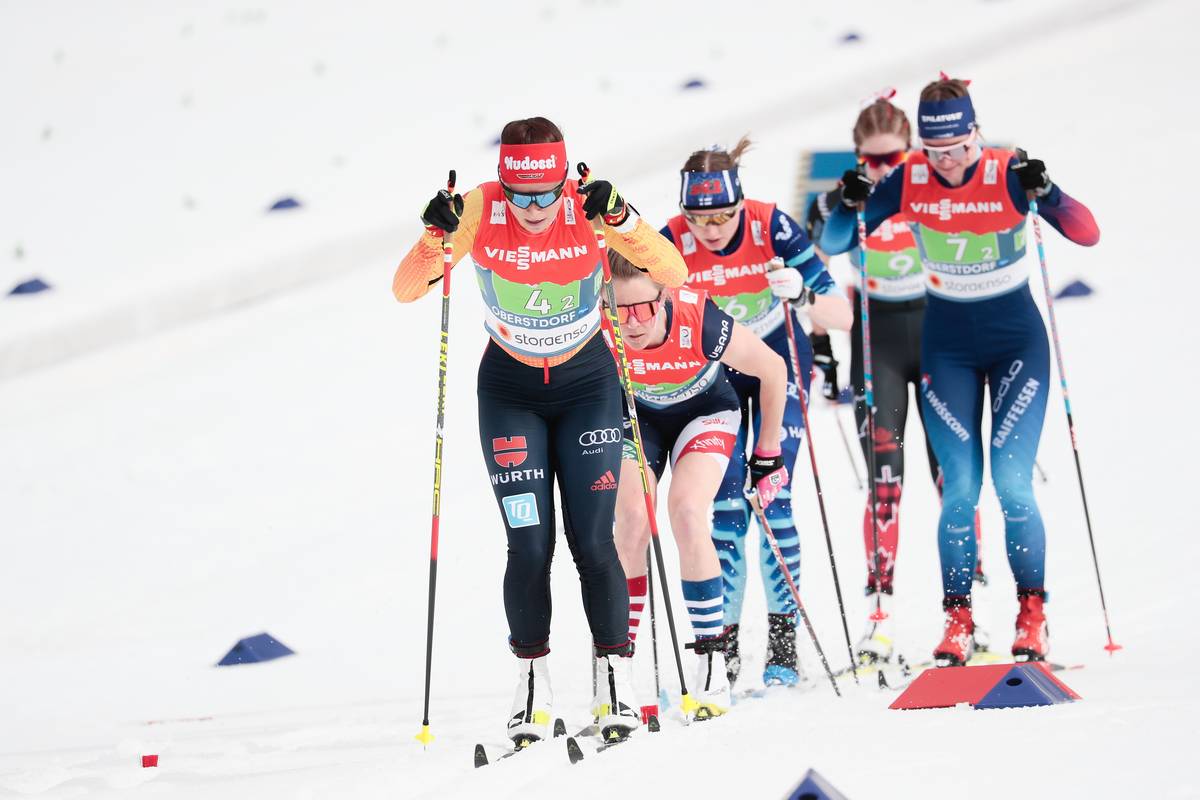
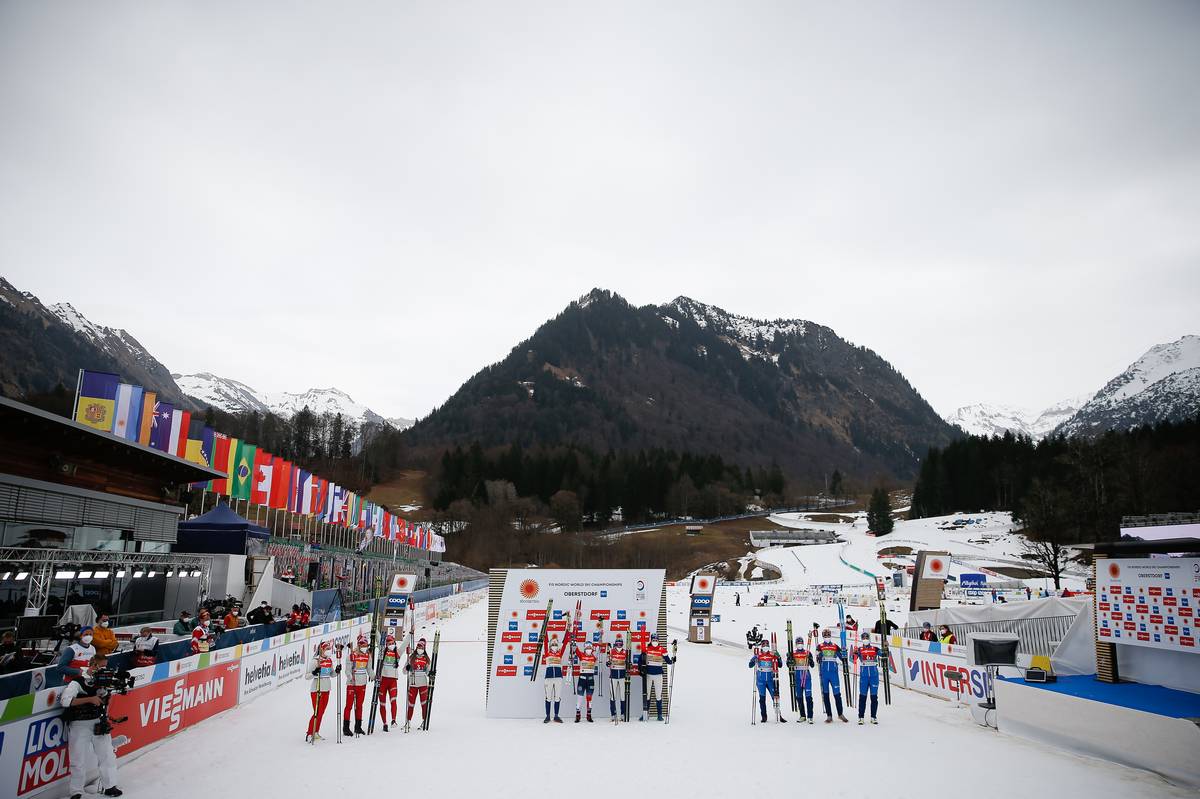
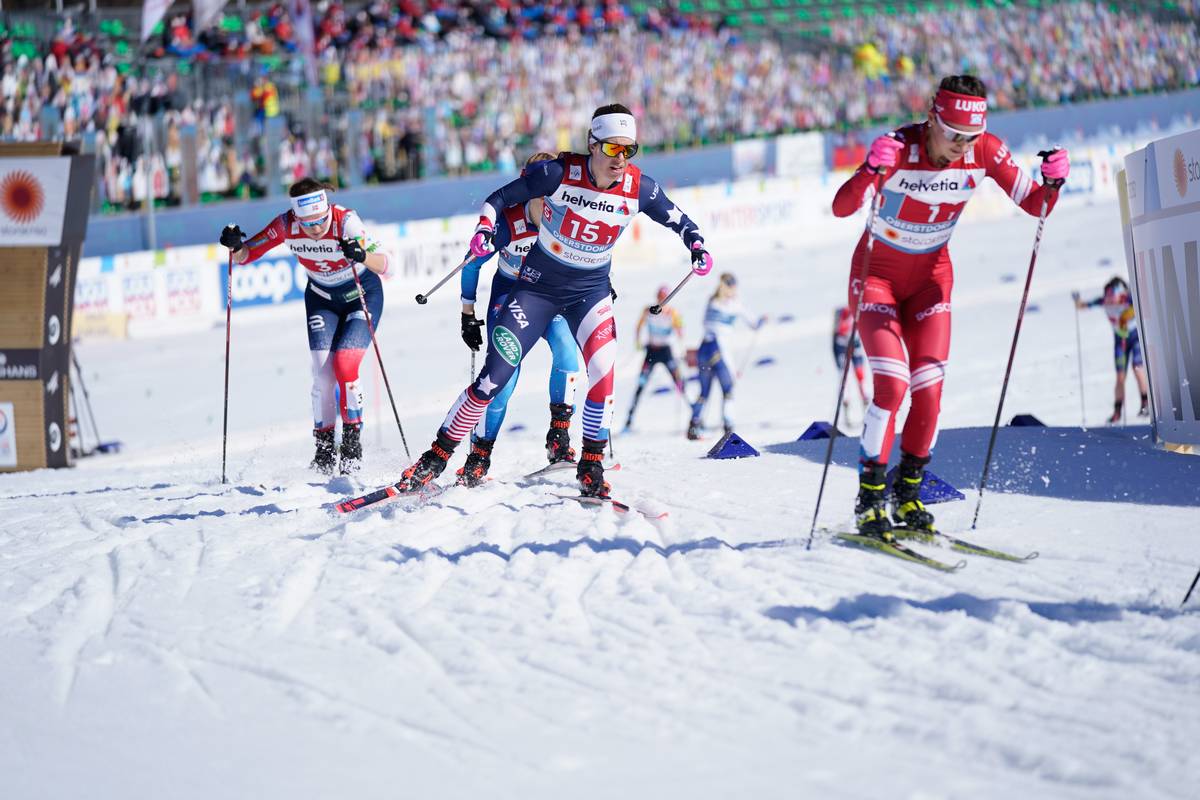
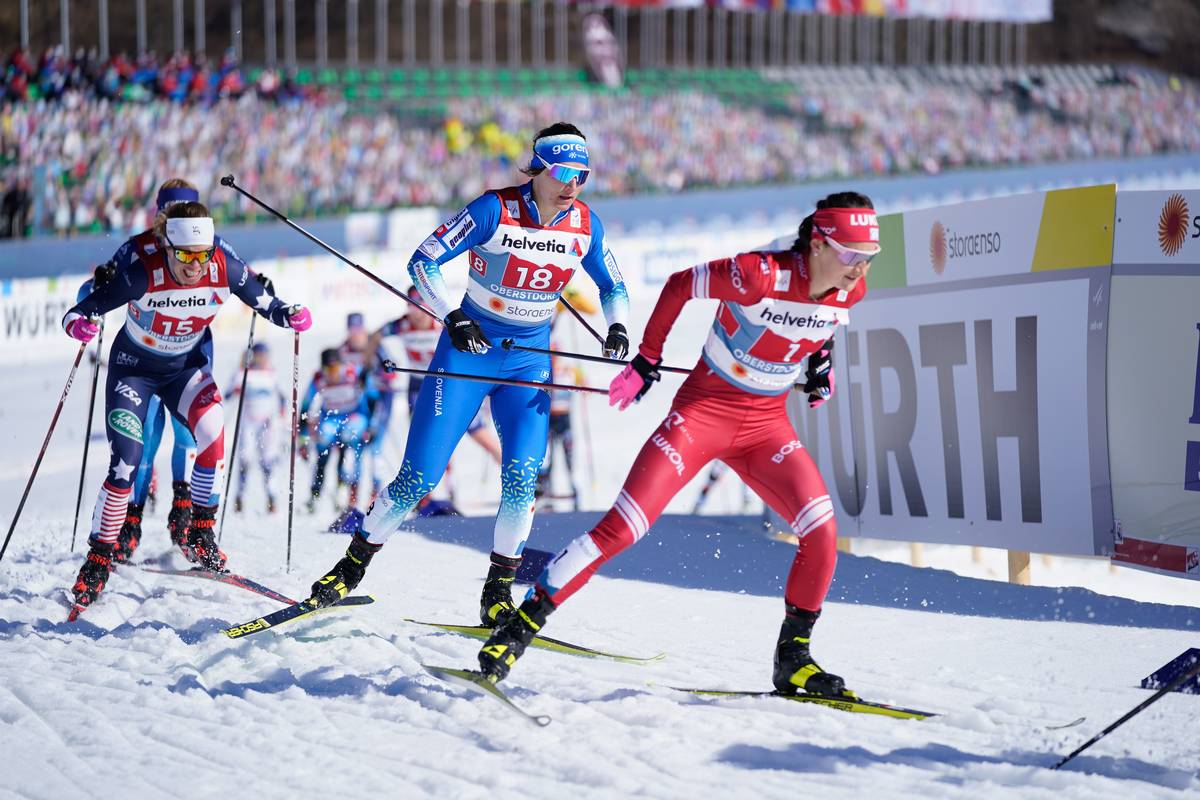
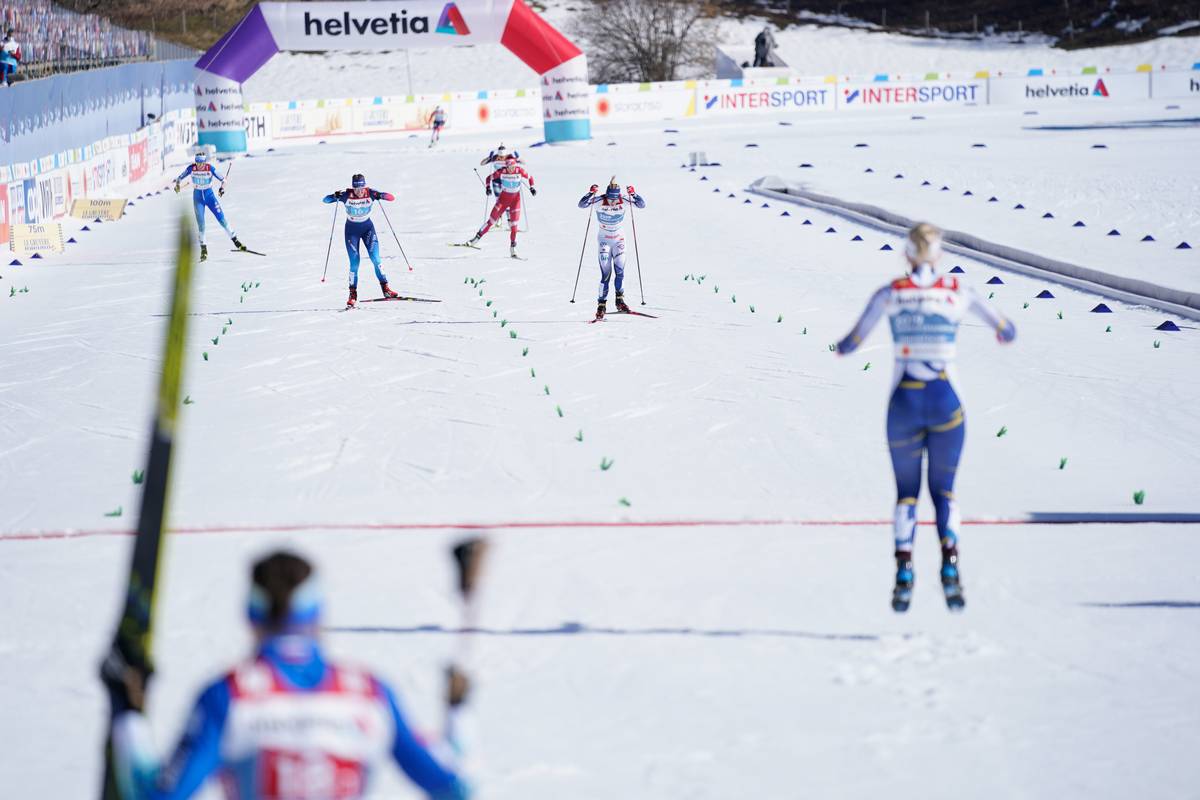
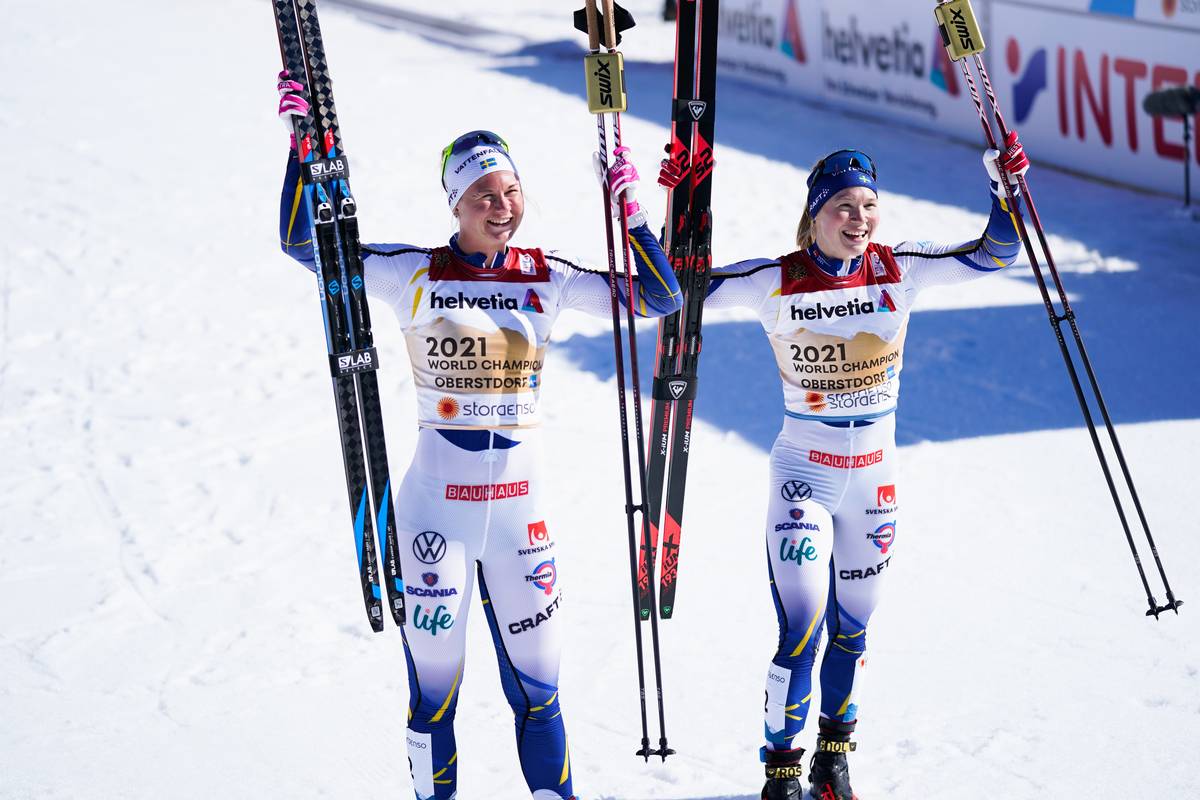
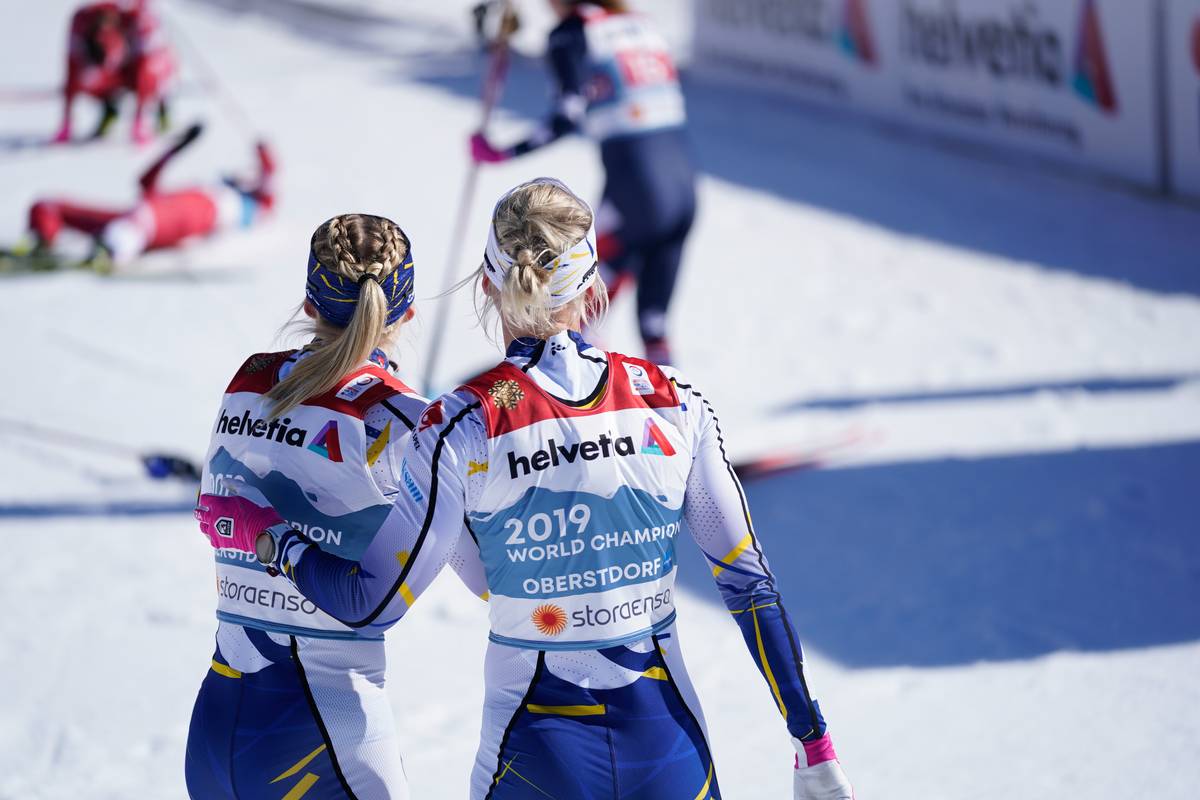
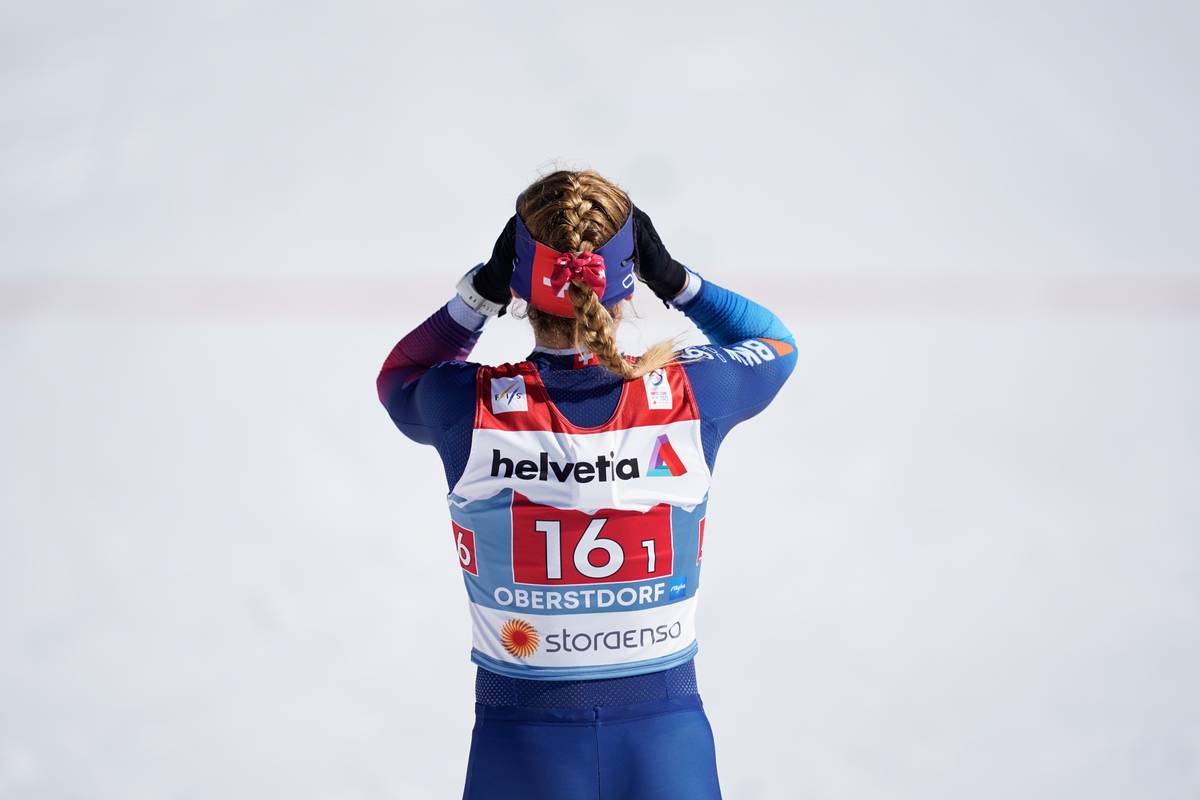
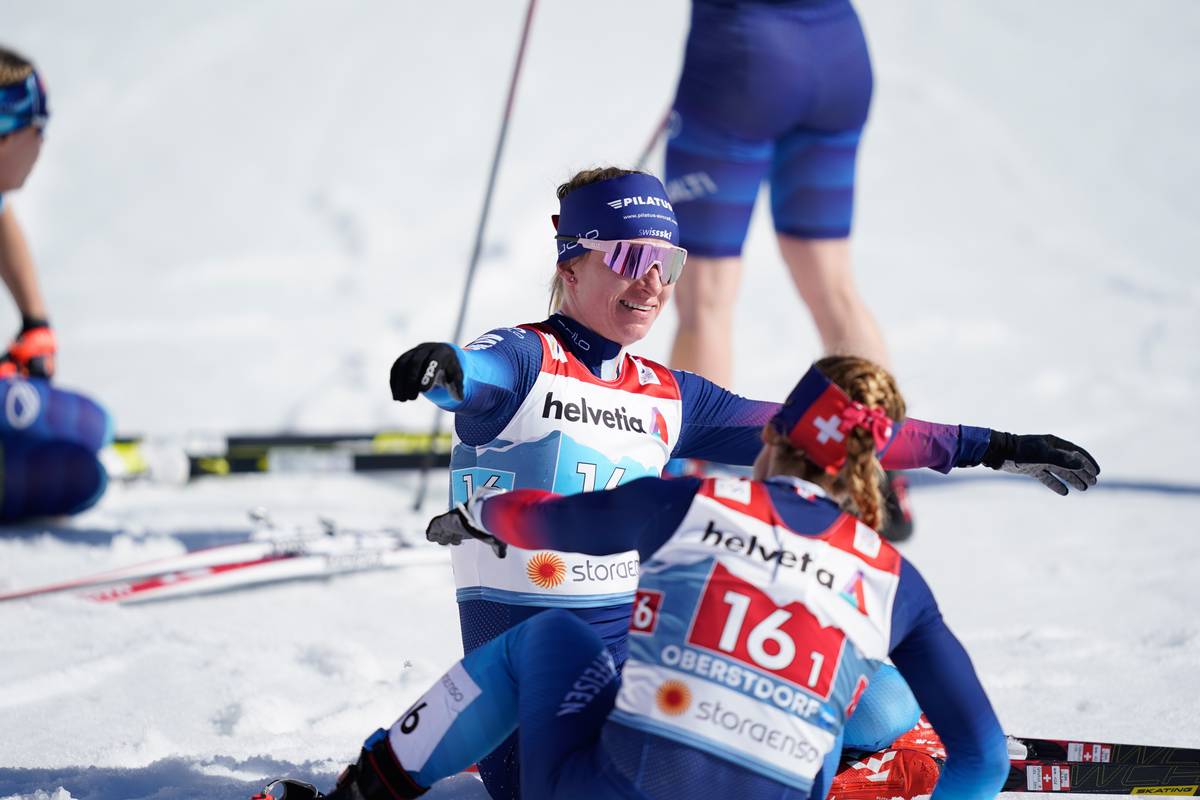
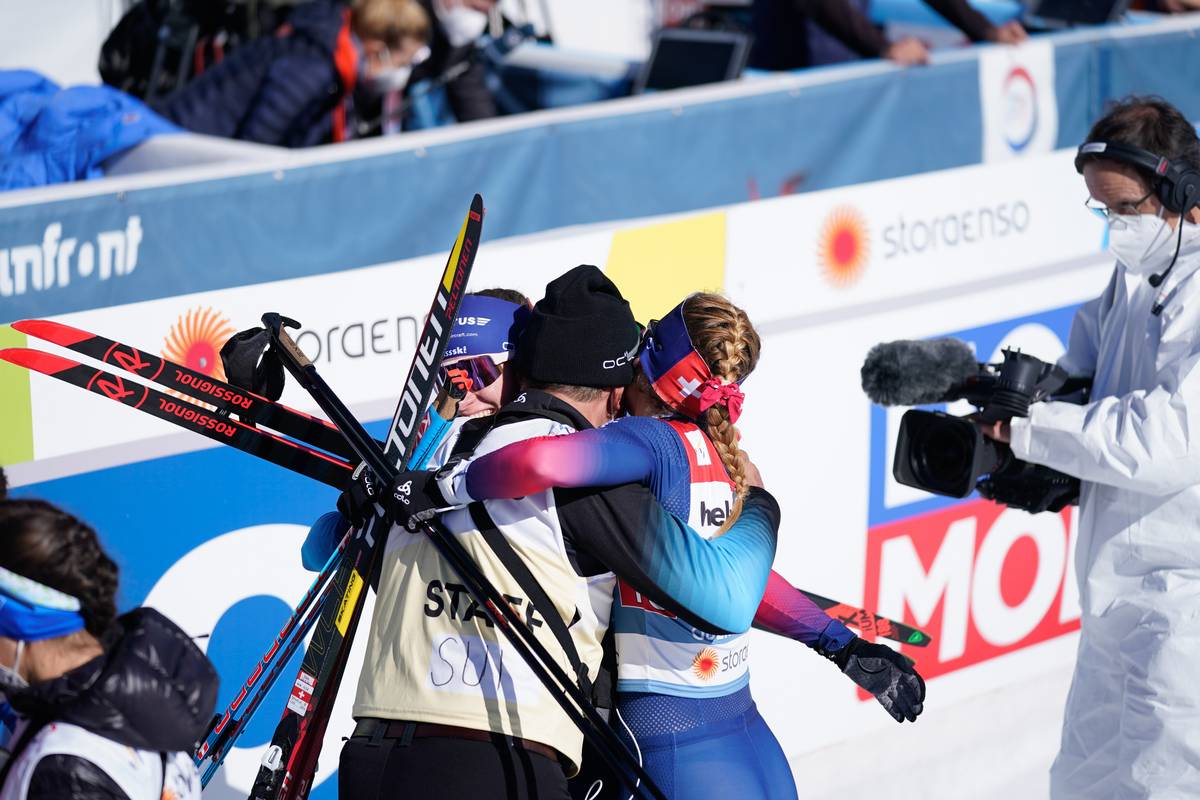
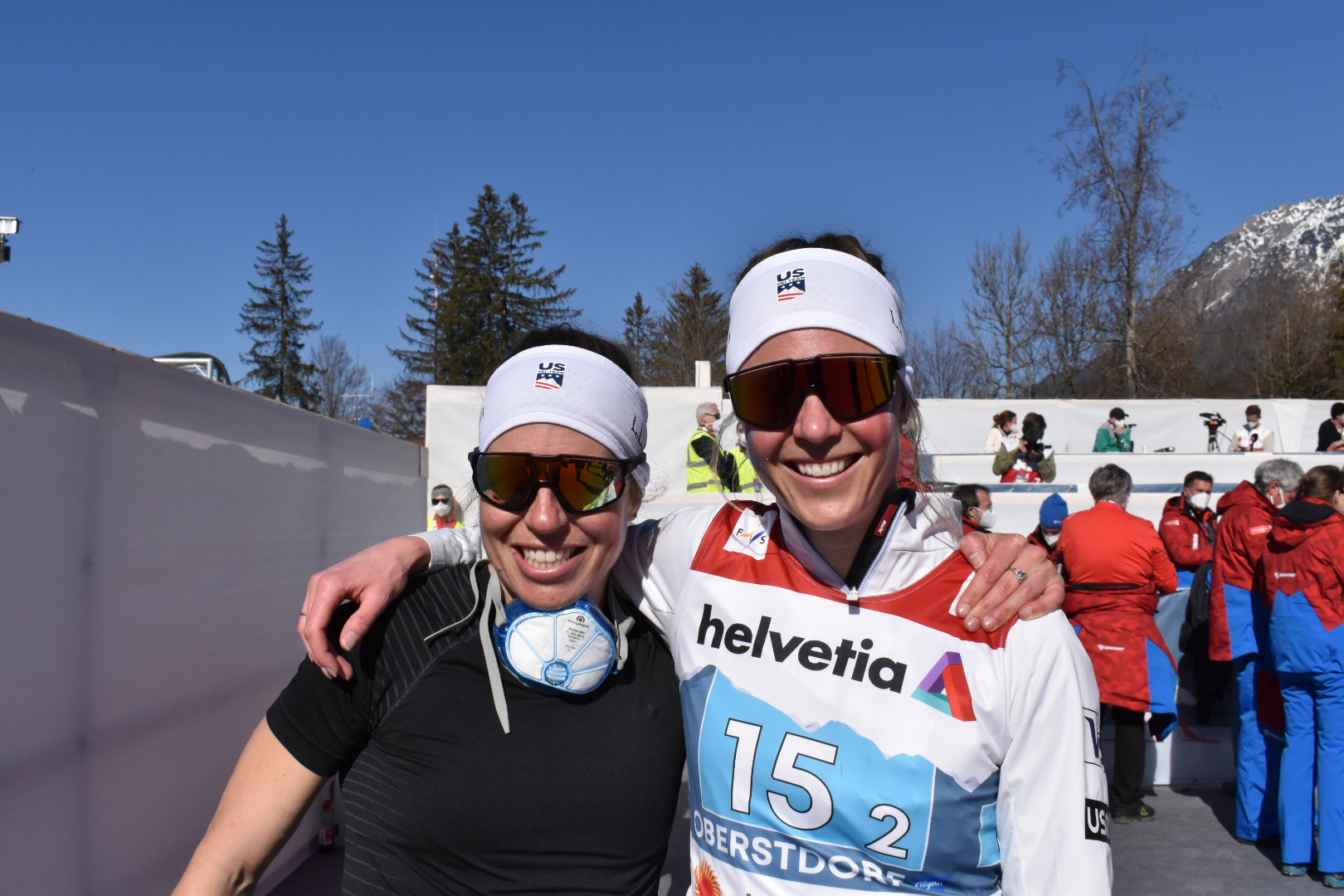
Maubet Bjornsen keeps in close touch with her former teammates. Here they are having just completed the 4×5 relay in Oberstdorf,Germany. (l-r Rosie Brennan, Jessie Diggins, Sadie Maubet Bjornsen, Hailey Swirbul). (Photo: NordicFocus)
She keeps in touch with her former teammates and regularly skis with Kikkan Randall and Holly Brooks. “It’s been one of my saving graces.”
She continued to race “recreationally” her first winter after retiring from World Cup, traveling to Wisconsin for the Birkebeiner, and taking with her a new attitude. “I didn’t really care whether I was winning the race,” she said. “I just loved going to races still, I still just loved being able to ski race, and I have Holly and Kikkan to thank for that.”
Racing in retirement had other challenges. “I wasn’t even sure I could ski 50k,” she commmented. “I didn’t race 50K, I retired before men and women raced the same distances. But it was so fun … I bonked so hard, but it was so so fun.”
Brooks and Randall were both great role models for Maubet Bjornsen of how to handle being a new mother. “Post-partum body recovery is very similar to injury recovery as an athlete,” she said. “You have to be more patient than you want to be … I thought it was going to be a quicker recovery.” She has also learned that with being a new mom comes a new reality. She’s gone from training four hours a day as an athlete, to one hour a day when she started working full time, to now as a new mother, appreciating any time she can get. “I have to accept success with only getting in 20 minutes.”
In addition to her other duties, Maubet Bjornsen has maintained a relationship with Fischer as a brand ambassador. (Photo: NordicFocus)
In addition to all of her other commitments Maubet Bjornsen still maintains a relationship with Fischer skis as a brand ambassador for the company. “Fischer supported me throughout my whole career,” she comments. “And I love to find ways to give back to them. Their whole theme is ‘ski for life,’ I raced Fischer at the Birkie, so I still support them.”
Join FasterSkier in days to come for Part II of Catching Up with Sadie.
Julia Kern prepares for her Olympic debut on the tracks in Zhangjiakou, CNH. (Photo: NordicFocus)
FasterSkier recently shared a press release on behalf of the US Nordic Olympic Women (US NOW) announcing Julia Kern as the 2022 recipient of the fourth annual Gold Rush Award. The release included comments from 2021 winner Jessie Diggins on the qualities that she, along with the other past winners, recognized made Kern deserving of this year’s award, but it became clear that there was a gap in FasterSkier’s coverage on the history of US NOW and the evolution of the award.
To learn more, FasterSkier connected with the spark that launched Gold Rush Award into existence: recent U.S. Ski & Snowboard hall of fame inductee and early groundbreaker for American women’s skiing, Alison Owen-Bradley. It was Owen-Bradley who planted the seeds to bring together the generations of women who have represented United States in cross-country skiing at an Olympic Games, bringing US NOW into fruition.
According to Owen-Bradley, US NOW filled a gaping hole in connection among the women who helped set the foundation for what is now one of the most successful women’s ski programs in the world. Though each of the 53 women Olympians had played a role in propelling the next generation forward, opportunity for connection between the generations had been lacking. With individual efforts, a network amongst these women slowly began to connect sooner, but when the World Cup swung through Quebec City in March 2019, it provided an ideal opportunity to reunite as a collective.
“We ended up having quite a few Olympic women there,” recalled Owen-Bradley in a call. “And it was fun because we wore our vintage clothing to the race, so we had all kinds of different eras of Olympic clothes. It was so congruent because we were really cheering on the latest, greatest women racing but we were also together with our teammates from the past, and it kind of just kind of grew from there.”
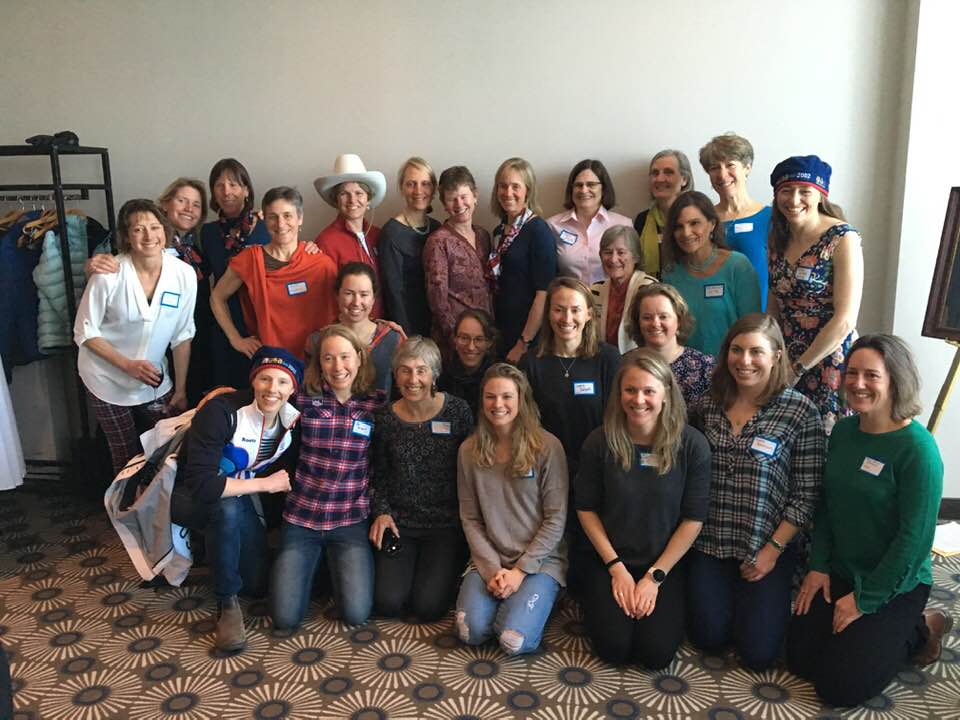
An intergenerational collective of Olympic women reunite at the 2019 World Cup Finals in Quebec City. (Photo: Peggy Shinn)
Having been teammates long before the era of Facebook – in fact, some well before the internet – it had been hard for these women to feel connected and maintain ties after careers ended. Owen-Bradley said that before the reunion, she didn’t have contact information for many of these women, and consequently didn’t feel the relationships had been sufficiently developed among the various generations.
With some word-smithing to nail a catchy acronym, the energy and camaraderie established at this reunion evolved into US NOW. But there’s much more to the name than meets the eye.
“US NOW – being retired from ski racing, who are we now? What have we learned? There’s so much gold in that for mining, in a metaphoric way. All these women, what have they learned? What have they gone on to do? How was it good and bad in their lives to devote their time to this? I don’t think we’ve even come close to exploring that and getting the nuggets [of wisdom] out of what women went through and and got from those experiences. But also, how hard was that? And was it worth it? And what would have made it more worth it? And then to just go forward in a way that uses that wisdom.”
And so, the organization was built by Olympic women and for future generations of Olympic women.
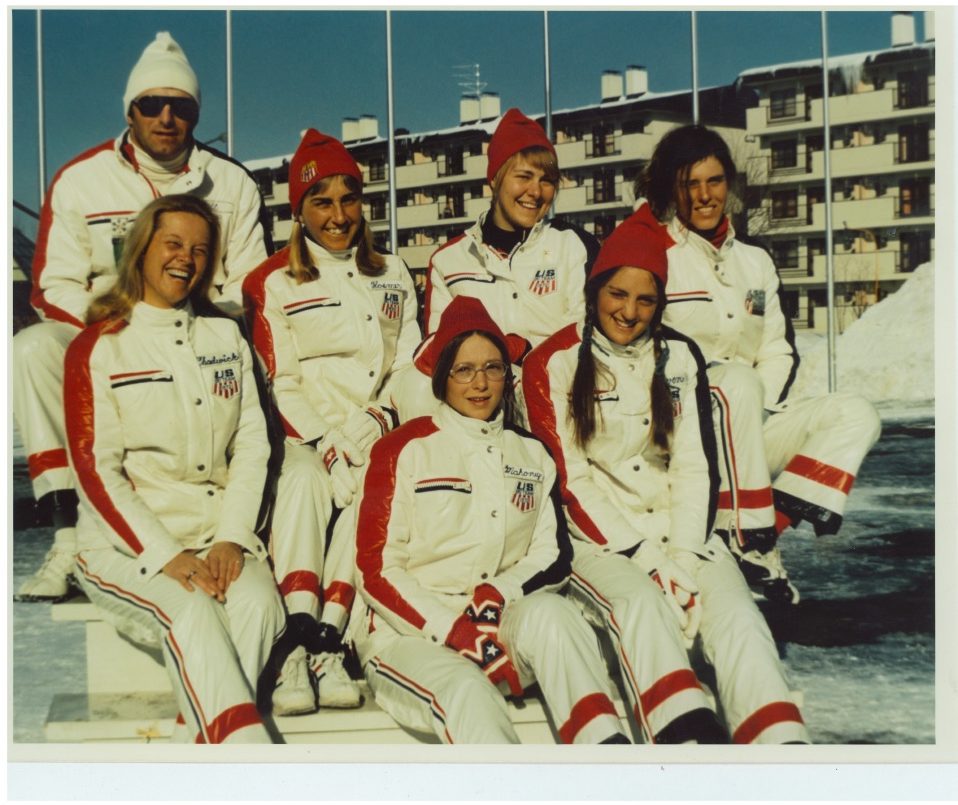
The first Women’s cross-country Olympic Team. The 1972 Games were held in Sapporo, Japan. Bottom row—Gloria Chadwick, pseudo Chaperone, Margie Mahoney, Alison Owen Top Row—Marty Hall, Trina Hosmer, Barbara Britch, Martha Rockwell. (Photo: courtesy Alison Owen-Bradley)
When the coach of the first women’s Olympic team, Marty Hall, was inducted into the U.S. Ski & Snowboard Hall of Fame in the spring of 2018, he invited Owen-Bradley to attend the ceremony, having been one of his original athletes. While traveling through Norway to race at World Masters, a print inspired by the Birkebeiner story caught her eye; instead of the image she was familiar with, which depicted two warriors valiantly carrying Prince Haakon to safety on their trek through the mountains, it was an image of Prince Haakon’s mother, Queen Inga. She too had made the arduous journey on skis to save her son, and yet, Owen-Bradley had never seen her included in the story’s artwork.
Finding it symbolic of the emergence of women’s cross-country skiing in the US over the last 50 years, Owen-Bradley purchased the print, and decided it would be a fitting gift to honor Hall at the ceremony. “He had been the first Olympic coach for women and had kind of gotten us on the map.”
However, the piece of artwork was large. She laughed as she recalled giving it to him, but also telling him it did not need to take up a wall in his home.
“We decided that it would be a traveling picture, and we would pick someone every year to give it to, and so out of that came this idea [for the award].”
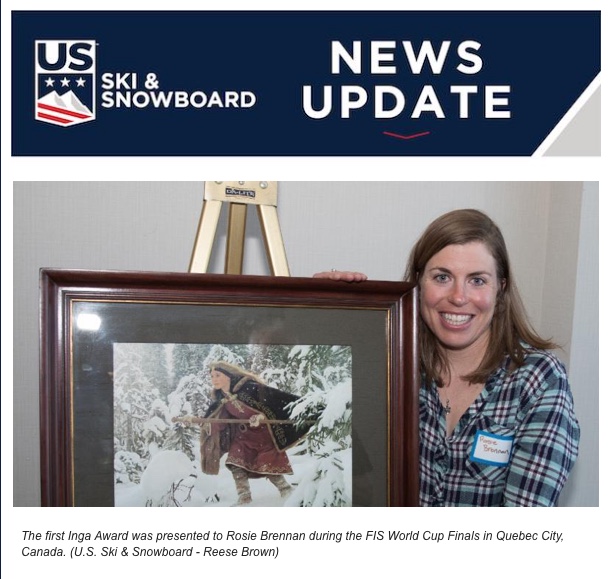
In 2019, following the World Cup, the Inga Award was presented to its first recipient: Rosie Brennan. Having rebounded from a season impaired by the effects of the mononucleosis virus, Brennan was selected based on the “courage, fortitude, grit, determination and raw talent [it took] to achieve an extremely high level of success on the international ski racing circuit [that] season.”
Over the next year, however, Owen-Bradley began to dwell on why the image of a Norwegian woman should be the symbol for the efforts of the women in the American cross-country program. She began looking for inspiration closer to home, eventually finding an equally strong, noteworthy, and under-recognized alternative.
“I changed it to the Gold Rush award because in the High Sierras during the Gold Rush era, women were nordic racing. Not on the same levels that we do it [now], but they had cross country races that that women raced in… So I thought, ‘Oh, what a cool thing — the Gold Rush.’”
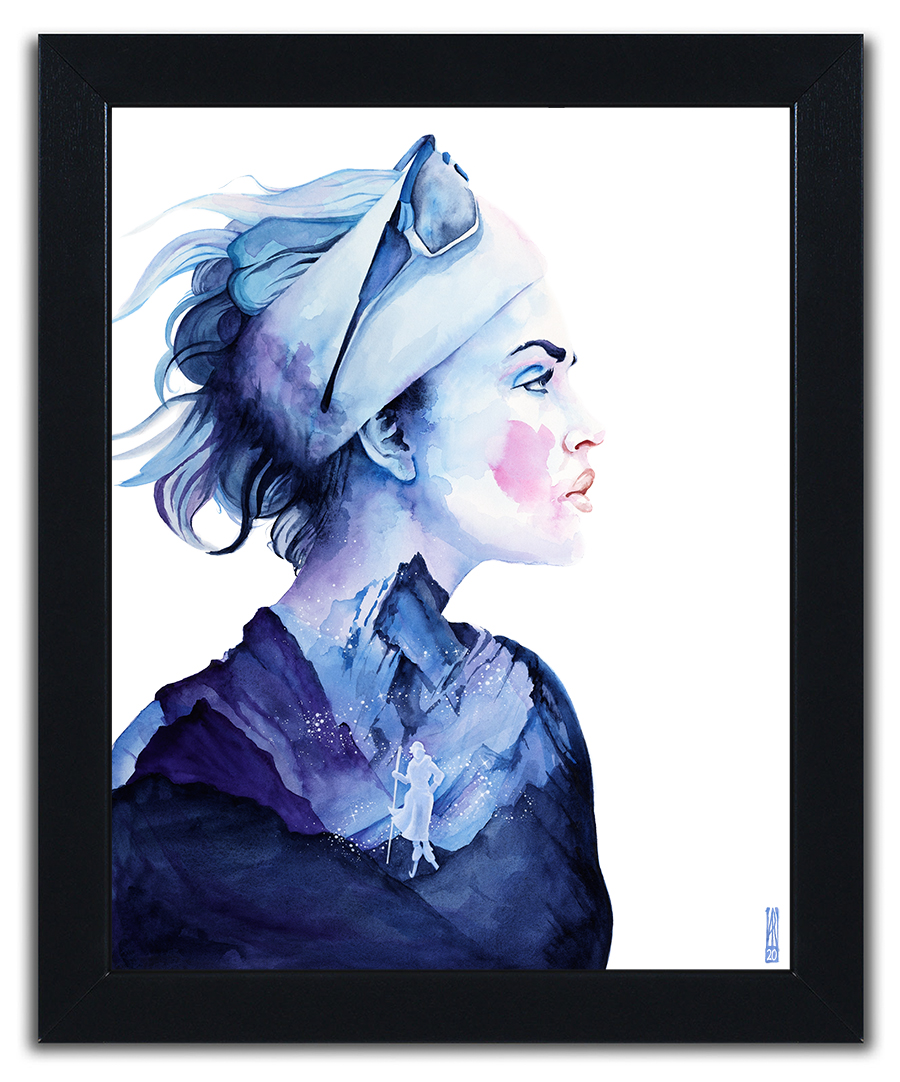
She also noted the ties between racing for gold medals at the Olympics, which Kikkan Randall and Jessie Diggins achieved in 2018. Working with artist Andy Rogers, a new image was created, superimposing the image of a woman on skis in the High Sierra on the bust and profile of a determined and modern-looking woman in a race headband and sport sunglasses. In 2019, this image was presented to co-recipients Sadie Maubet Bjornsen and Sophie Caldwell Hamilton.
Gold Rush Award: (Artist Andy Rogers)
While each of the women mentioned to this point have unquestionably racked up an impressive resume of results, the award is not meant to recognize what happens on the race course directly. Rather, Owen-Bradley explained a recipient is selected for the award by “exemplifying and showing the grit and the grace that it takes to be successful.” It’s what happened behind the scenes to get the result, not the result itself.
“An example would be Sophie whose mother died [in 2019] and she still went on with such grace and was so successful through all of that. And Sadie because of all the injuries she worked through and kept going… So, to me, it’s been about the grit and the grace of what it takes to be a woman nordic ski racer at that level.”
Approaching the 50-year mark of her own Olympic debut and now focusing more of her time and energy on her small farm in Idaho rather than the cross-country ski world, Owen-Bradley explained that this year, she felt less directly connected to the potential recipients for the Gold Rush award. She decided the decision should be made collectively amongst the four previous winners, to which she would add a fifth vote. After some discussion, the group voted unanimously for Julia Kern.
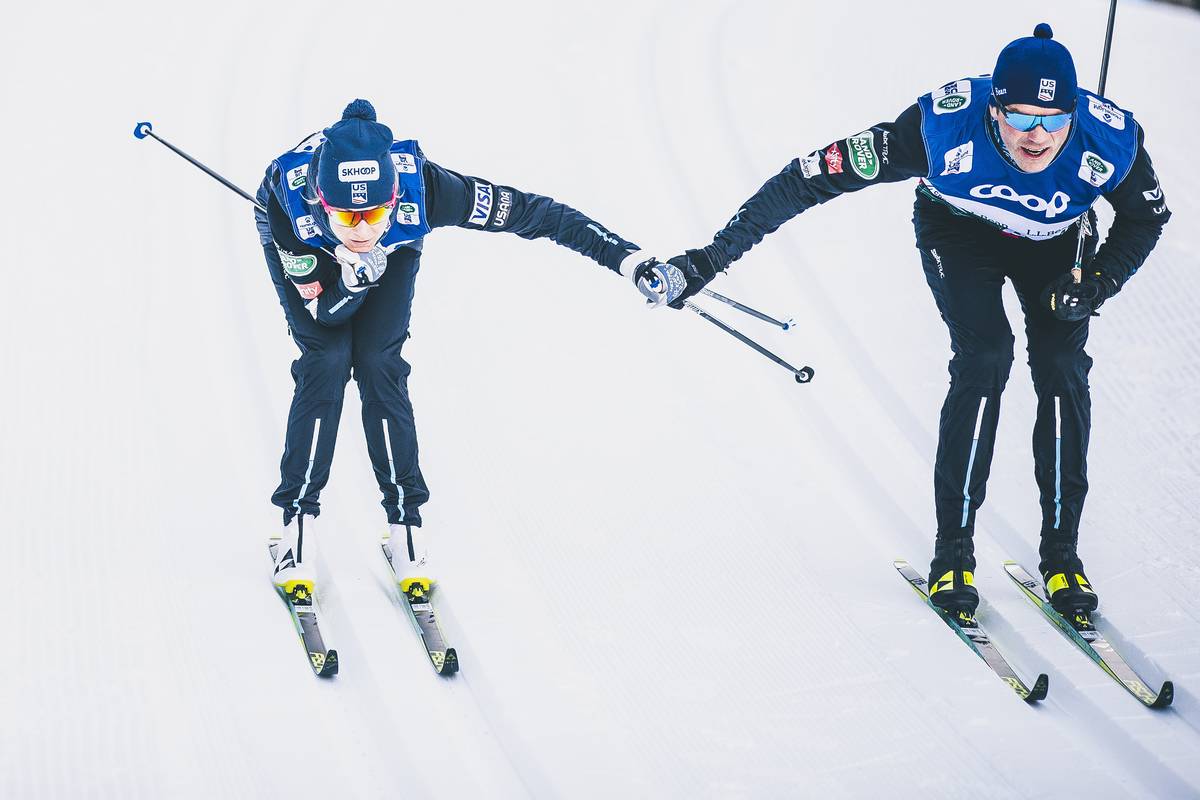
Jessie Diggins and Julia Kern celebrate a second-place team sprint finish in Dresden, GER in December, 2021. (Photo: NordicFocus)
A member of the U.S. Ski Team since 2017, Kern’s progression on the international level has been steady, but non-linear. Alongside leaps forward, she’s faced her fair share of injuries and setbacks. Both the 2020/2021 season and her first Olympic appearances in 2022 left her wanting more, but interjecting these lows during the 2021/22 race season were a slew of career highlights. Her top results include two individual fourth-place sprint finishes on the World Cup, a team sprint podium in Dresden, a handful of other World Cup top tens, and finishing the year winning three out of four events at the joint U.S SuperTour Finals / Canadian National Championships in Whistler, BC.
And in February 2023, she’s heading into a World Championship which will take place at the venue where she earned her first World Cup podium in December 2019: Planica, Slovenia.
Sophie Caldwell Hamilton / Julia Kern
Julia Kern / USST Coaches
Smiles and hugs all-around to celebrate Julia Kern’s first World Cup podium in Planica, Slovenia in December 2019. Kern finished third in the freestyle sprint, with Sophie Caldwell Hamilton just behind in fourth. (Photos: NordicFocus)
According to the past award recipients on the selection committee, it was the juxtaposition of these celebrations and challenges over the last few seasons that highlighted Kern’s candidacy for the award this spring.
“To me, what is special about this award, is first that it was voted on by this very incredible group of women who all share tenacity and drive to get through challenges and be better on the other side and second, that it awards just that and not results,” explained Brennan in an email. “Julia exemplifies this in her ability to be a strong teammate, no matter what the circumstances are. She holds her head high and goes out of her way to never bring people down when things are tough, aren’t going her way, or she’s faced with a challenge. When something doesn’t work out for her, she immediately jumps gears and does literally whatever she can to help her teammates have success.
“On top of that, she doesn’t lose faith in herself, she continues to fight, look for opportunity and carry an optimistic outlook towards her future. She has shown this many times after coming off a slump, injury, or some other challenge to find herself notching career bests. I think these things aren’t mutually exclusive and that we all have a lot to learn from Julia’s ability to be an exceptional teammate and in turn have that give her energy to continue chasing her own goals.”
Smooth and powerful, Julia Kern races through the heats during a classic sprint in Falun, SWE in March 2022. (Photo: NordicFocus)
Commenting on her nomination, Kern attributed her own success to the efforts of the women who came before her, including those who would present her with the award.
“I am incredibly honored to be given the Gold Rush Award by such an incredible group of women. US NOW is a group of women who have paved the way for U.S. skiing, many of whom have been personal role models and mentors to me in skiing and in life. I would not have had the opportunities, experience and knowledge without their hard work and passion for giving back to the younger generations. The past few years have been challenging for a variety of factors, and it was rewarding to come back stronger with my best season yet.”
As the list of award winners grows and US NOW builds momentum, Owen-Bradley hopes the award can be expanded to include a monetary prize in addition to the print and tribute. Acknowledging the increase in representation for women across various aspects of skiing, such as coaching and waxing, she would love to see new awards developed to recognize these important examples also.
When Owen-Bradley began skiing as a child in the 1960’s, her only option was to join the boys program; Title IX did not pass until June 1972, at which point she was 19 and had already raced at a World Championship. As she reflected on the amount of opportunity for women in cross-country skiing now, and what the creation of US NOW and the Gold Rush Award means to Owen-Bradley personally, she expressed feelings of joy and optimism.
“For me to go from not having a place, to having these strong women’s teams – it’s just so fun.”
Alison Owen-Bradley, a pioneer of elite level women’s cross-country skiing in the U.S. (courtesy photo)
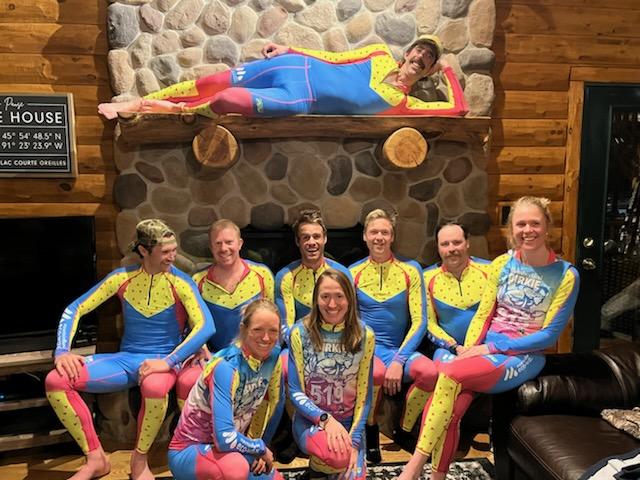
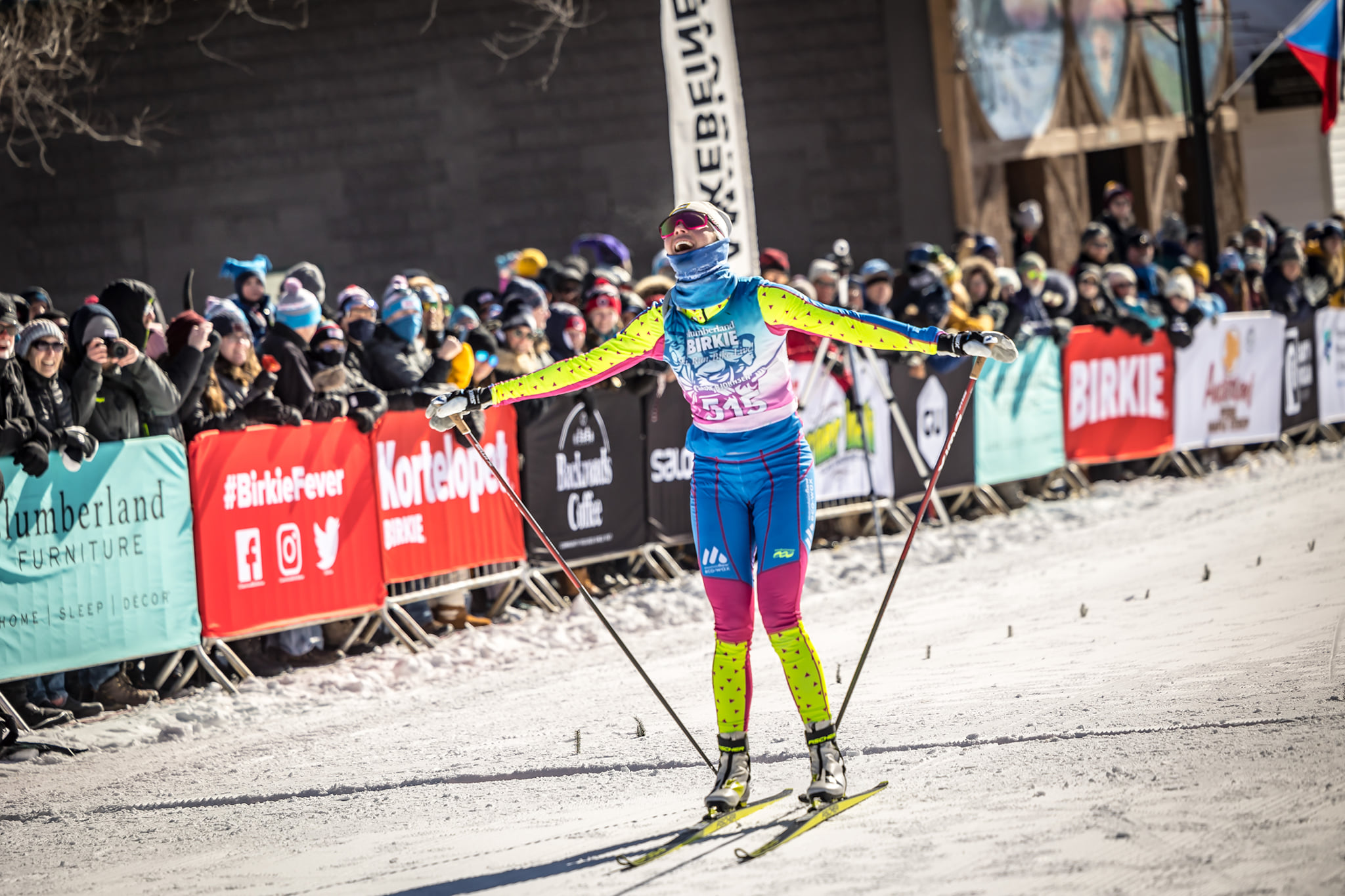
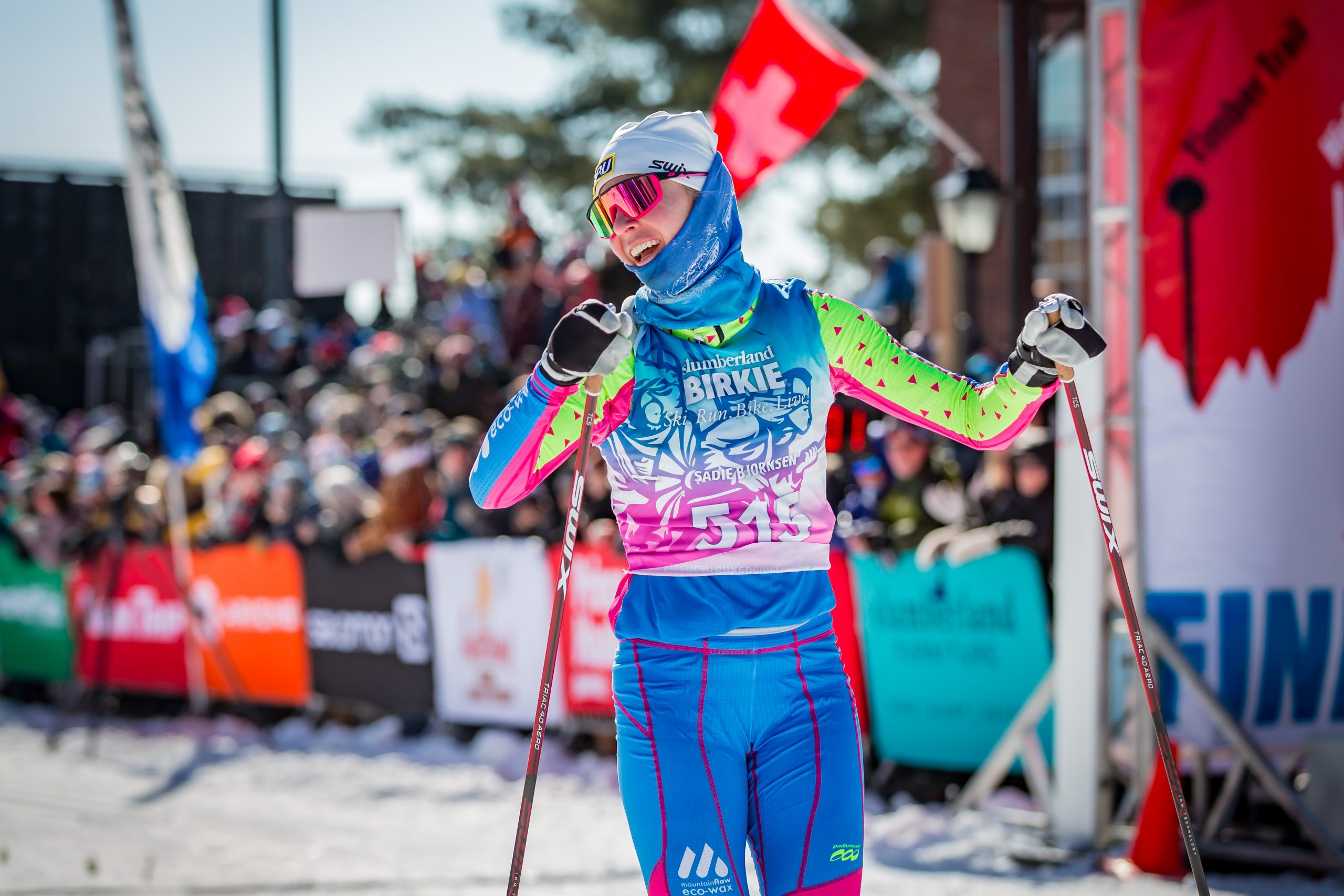
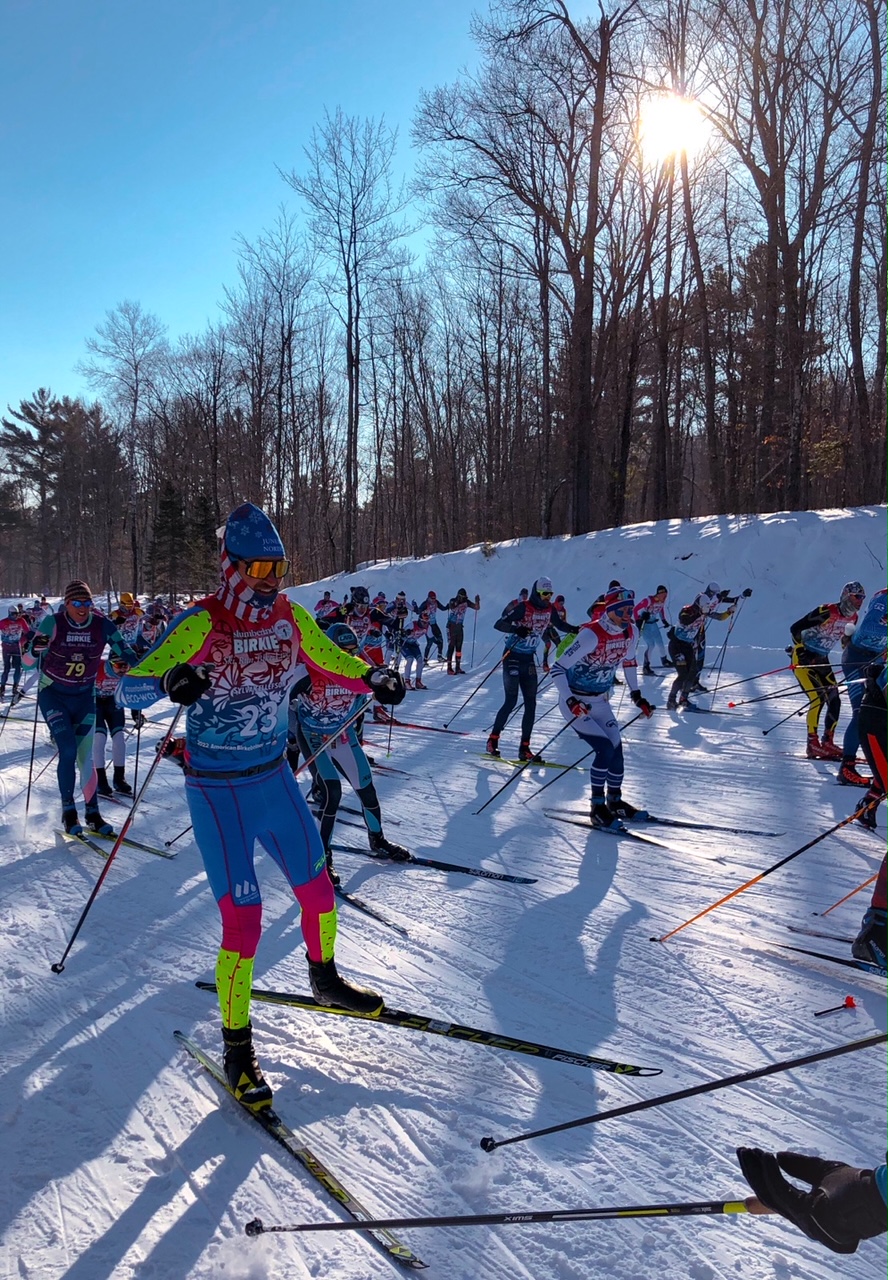
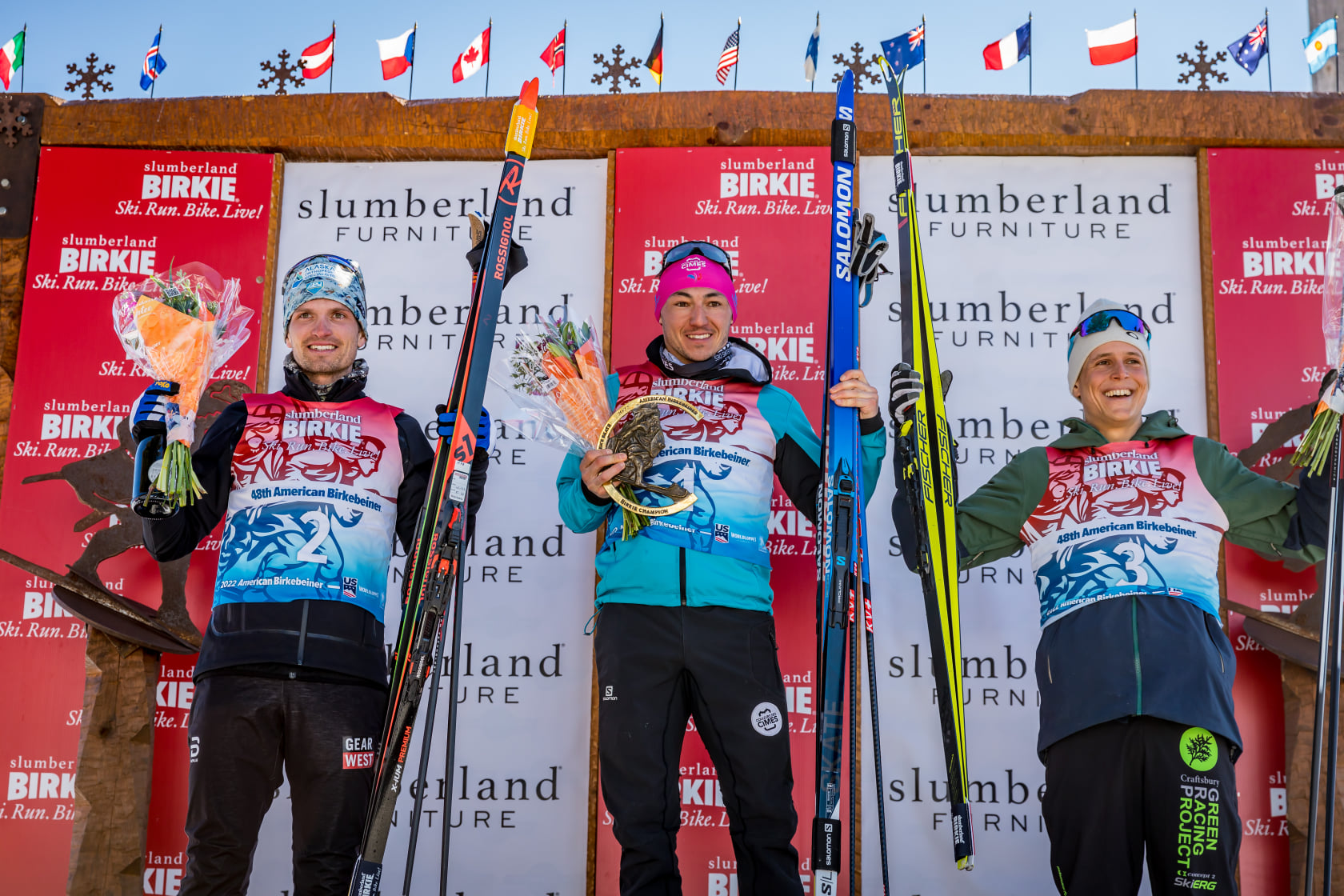
Just over a month ago, the American cross country ski community descended upon the small town of Hayward, Wisconsin. Skies were clear, the snow was cold and firm, and lycra was everywhere. But one set of race suits stood out, both because of the noteworthy athletes wearing them and for their bold neon colors. It was the MountainFLOW Eco Wax race team of Simi and Sophie Hamilton, Sylvan Ellefson, Sadie Maubet Bjornsen, Erik Bjornsen, Matt Gelso, and Liz Stephen.
While most reading FasterSkier will recognize these names without introduction, this is a “band” of retirees who have each, at minimum, raced on the World Cup. Five are Olympians, and one has a collection of top-10 results in World Championship and Olympic sprint results. In short, they’re good skiers who also happen to be good friends.
Racing the Birkie wasn’t about stacking a fast team; leading into the event, mountainFLOW founder Peter Arlein said it would be “super fun, and maybe not super serious.” As the photos suggest, a lot of fun was had, but some fast racing – on skis waxed with mountainFLOW products – happened too.
The mountainFLOW eco wax team was “all business” at the Birkie. (Courtesy photo)
“A trip down memory lane,” wrote Erik Bjornsen after the race. “Super fun to get a crew together and pretend to be athletes again. We are all at different fitness levels, one thing in common though: far from our best. It was fun to try and forget that for a weekend, and go live the athlete lifestyle. It’s been a busy winter in the retail industry, so it was nice to have a little break from work and hang out with friends. No beers were consumed… nothing but business at the mountainFlow house.”
(Side note: they may have been spotted at the Moccasin Bar post race.)
As he alluded, there was a range of fitness levels and race objectives, but the prominent theme seemed to be that becoming some of the best American cross country skiers of their generation correlates strongly with good technique and a high level of residual fitness.
Taking the top result was Sadie Maubet-Bjornsen, who finished fifth in the women’s race, just over two minutes behind winner Alayna Sonnesyn. Erik Bjornsen was the top male racer in 9th (+2:59.05), with Simi Hamilton finishing roughly four minutes behind in 16th. The remaining skiers finished in pairs, with Sylvan Ellefson crossing with Matt Gelso in 121st in the men’s division, and Sophie Hamilton finishing alongside Liz Stephen in 123rd and 124th.
“It was amazing to get the band back together!” wrote Maubet-Bjornsen. “My husband’s family is from Hayward, so after visiting them this summer, we were already committed to doing the Birkie simply to be considered valid members of the Berrard family. When Simi mentioned he was forming a fun team with some of my favorite previous teammates, I was all in. Having jumped full force into this new life, preparing for a 50k couldn’t have been more different than it would have looked in the past. My new way of exercising is waking up at 5:30AM, and hitting the ski trails from my doorstep from 6-7AM.
“Two weeks [before the race], I called in Rosie Brennan to give me some last minute interval workouts to train my brain to accept physical pain again. Four interval sessions later, I showed up and joined the dance. It was pretty fun to ski with the girls, and just witness the gift of fitness that comes out of all those years of hard work. As the top ladies skied away about 35 k in, I no longer could fake the fitness anymore, but still enjoyed every second of skiing it home.”
Adding to the message that more so than lingering fitness, these athletes have maintained a love of the sport and the friendships made through their time immersed in it, Maubet-Bjornsen continued, “I look forward to many more years ahead of joining various classic American races throughout the country that I never had the chance to participate in [while racing on the World Cup]. I feel lucky that my ‘band’ and family that I created in the past ten years is just as excited to jump into a 50 k race, despite the fact we are no longer the pro athletes we were before.”
Sylvan Ellefson in the wild, wearing his neon mountainFLOW race suit. (Courtesy photo)
“For me, cross country ski racing transcends so much more than competition,” wrote Ellefson post-race. “I’ve formed my family and life around the experiences I’ve had and the friends I’ve made along the way. To me the Birkebeiner is an event that encapsulates this cross country ski culture in the US. The people racing at the Birkebeiner are truly the backbone of the ski community and I think for them to see former World Cup and Olympic level skiers helps affirm that in the US, this sport is one giant family.”
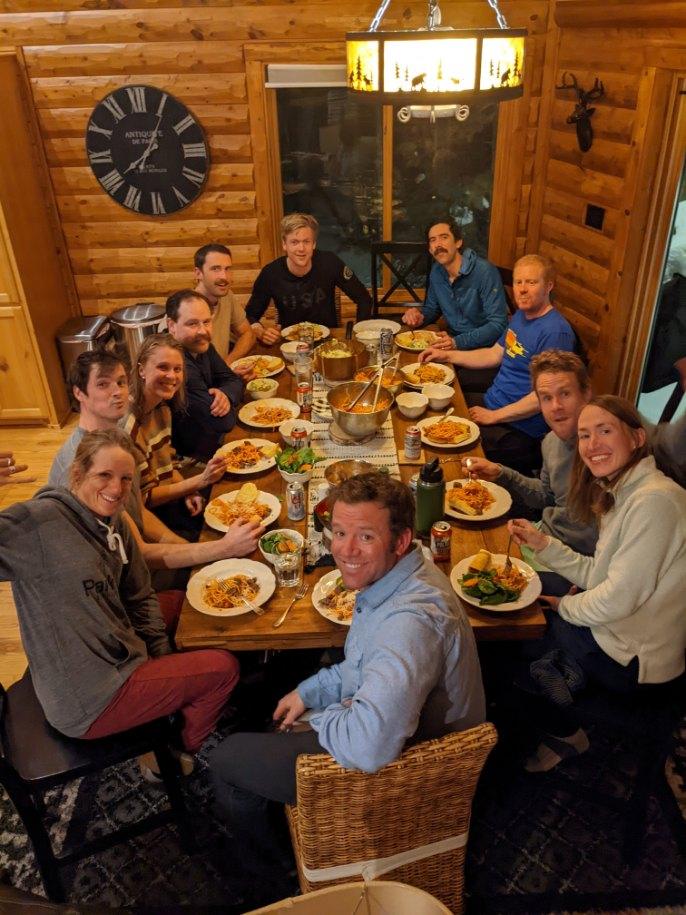
The mountainFLOW Eco Wax team carboloads for the Birkie. (Courtesy photo)
Commenting on the mountainFLOW products and ethos, Ellefson added, “Our waxes were fantastic and I’ve loved using something other than what we’ve been accustomed to using for so long. I’ve tested a couple out now and they truly are not just a great wax, but also a great brand. Getting to spend time with Peter and Brian showed me the culture mountainFlow is trying to create in a space in the industry that is much needed.”
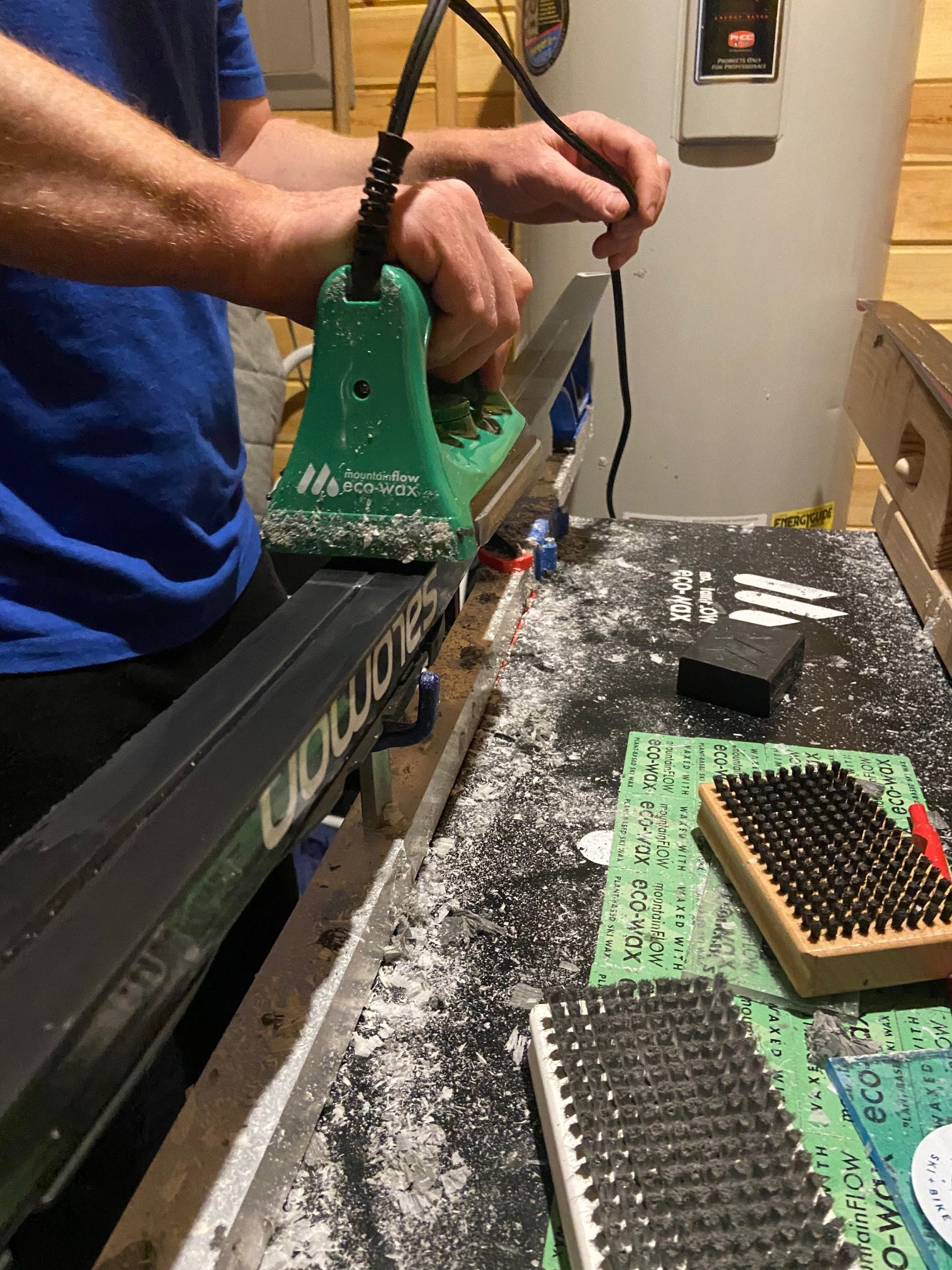
Matt Gelso prepares his skis with mountainFLOW cold wax at the 2022 American Birkie. (Courtesy photo)
More to come, as the coach of non-affiliated French athlete Celine Chopard-Lallier, who took sixth in the women’s race, shares his review of mountainFLOW products, on which Chopard-Lallier also raced at the Birkie. Note that this content is not sponsored by mountainFLOW.
FasterSkier’s American Birkebeiner coverage is made possible through the generous support of New Moon Ski & Bike in Hayward, Wisconsin. While you are at the Birkie be sure to visit New Moon Ski & Bike for all your local expertise.
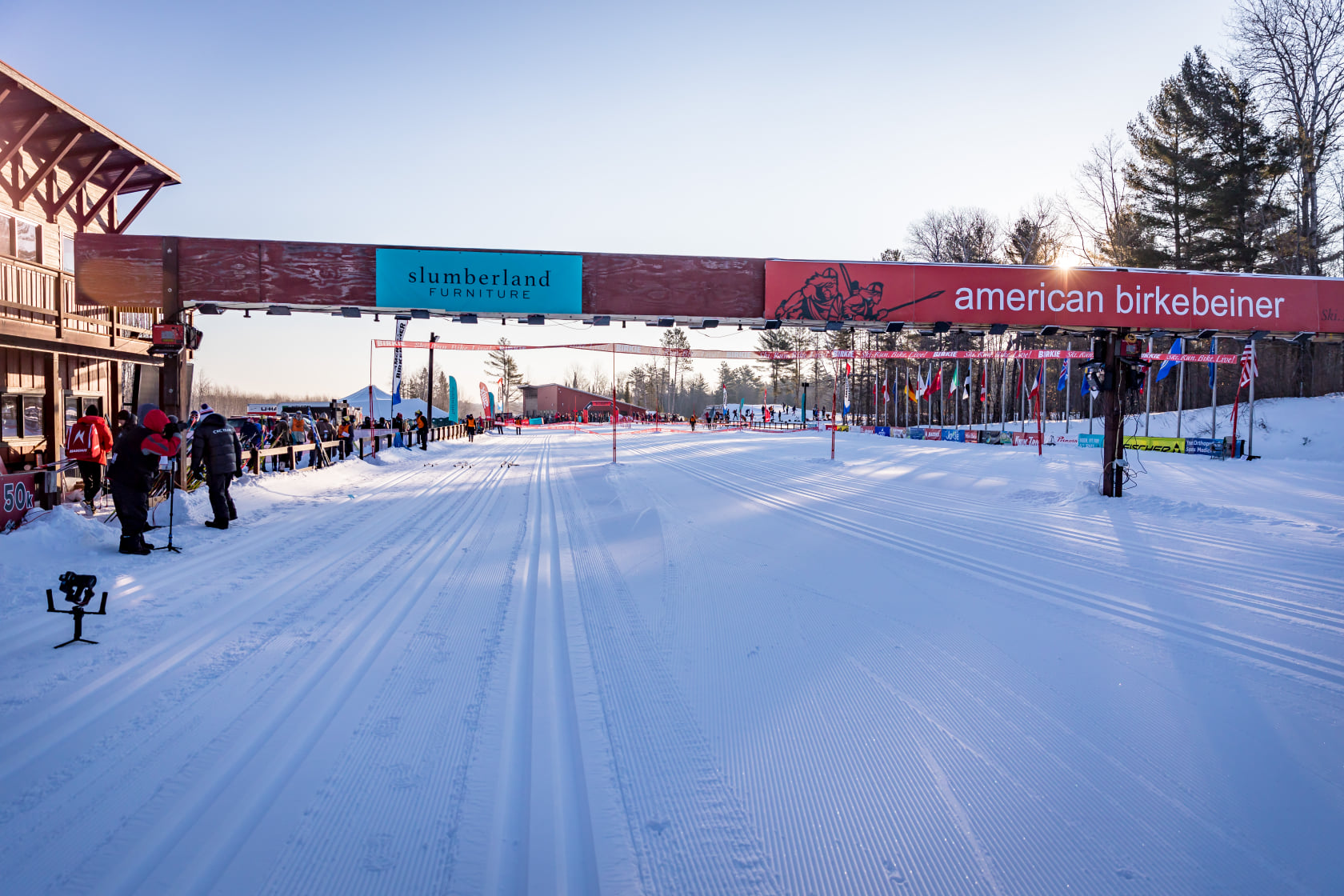
Among the final major races in the ski world in 2020, the Slumberland American Birkebeiner pulled off an event with all the festivities for which the storied event is known. It was pure Birkie fever, with little concern for what other communicable diseases might be circulating at the time. A large snowstorm moved through the Northwoods of WI, followed by a bitter cold snap which let up just in time for a sunny day with mild temperatures on race day, setting up fresh, firm, and fast conditions that saw course records fall.
Flash forward through two years of pandemic and a non-traditional Birkie week format, and the weather gods delivered yet another pristine weekend for racing as the Birkie made its return, with all the Main Street revelry one could ask for.
This year’s Birkie also served as the final SuperTour of the season on American soil, with only Canadian Nationals which will be held in conjunction with SuperTour finals remaining on the calendar in late March. With several athletes who had been just behind the Olympic team cutoff appearing on the start list, along with a handful who declined World Cup starts in Lahti to race the Birkie and a few top international racers in the mix, the front lines of the elite wave were stacked. This set the stage for close racing and exciting final sprints on Main Street that kept the sound of the cheering crowds lining the finish at full volume.
The women’s race was decided in the home stretch as Alayna Sonnesyn (SMS T2) took her third Birkie win in 2:22:52 ahead of Caitlin Patterson (CGRP) in second (+2.0), and Rosie Frankowski (APU) third (+9.0). Also racing for APU, Jessica Yeaton was the fourth woman to the line in Hayward (+27.0), with a retired-but-not-slow Sadie Maubet Bjornsen racing on the mountainFlow Eco Wax team taking fifth (+1:05.0).
Patterson had flown to the Midwest after spending three weeks in China as a member of the Olympic Team, however, she did not earn any starts there, calling it “#chinatrainingcamp” in a heartfelt social media post. Yeaton had also recently flown to the U.S. from Beijing after representing Australia at her second Olympic Games. Yeaton raced in five of the six events (Australia did not have enough women for a relay), with her top finish taking place in the opening 15 k skiathlon, where she finished 31st.
After winning the 2019 Birkie, Sonnesyn returned in 2021 for the unique opportunity to race both a skate and classic event in the same weekend. With pandemic restrictions in place, these races started and ended at the Birkie trailhead in Cable. Sonnesyn won the 45 k skate Birkie on Saturday, just four seconds ahead of Frankowski, then the two traded positions as Frankowski won the 45 k classic on Sunday, with Sonnesyn nearly a minute back in second.
“It feels so good to be here on such a beautiful day,” said in the livestream interview from the finish. “Last year, finishing back at the start was a really great time too, but there’s nothing like finishing on Main Street and hearing that blast of cheering as you come off the bridge.”
A Midwestern native for whom the Birkie has long been a family affair, Sonnesyn said each Birkie win has been special for her. While other women pushed the pace at the front, Sonnesyn had never been the first through the checkpoints. Commenting on her tactics in the post-race interview, she explained that this strategy played to her strengths.
“There are some spectacular distance racers in the field today, and I recognized that going into it and knew that they were going to push the pace and keep it hard through the entire race. I trusted my sprinting, I’ve been training a lot with Jessie Diggins lately and I’ve learned a lot from her, so I knew that I had an extra gear that I could use at the finish as long as I conserved [energy] throughout the race… There were moments where I didn’t think I was going to close those gaps, [and] I crashed with 4 k to go, so that was a little bit dramatic of me, but overall, I just knew that they were going to fight hard and that I would need to fight too.”
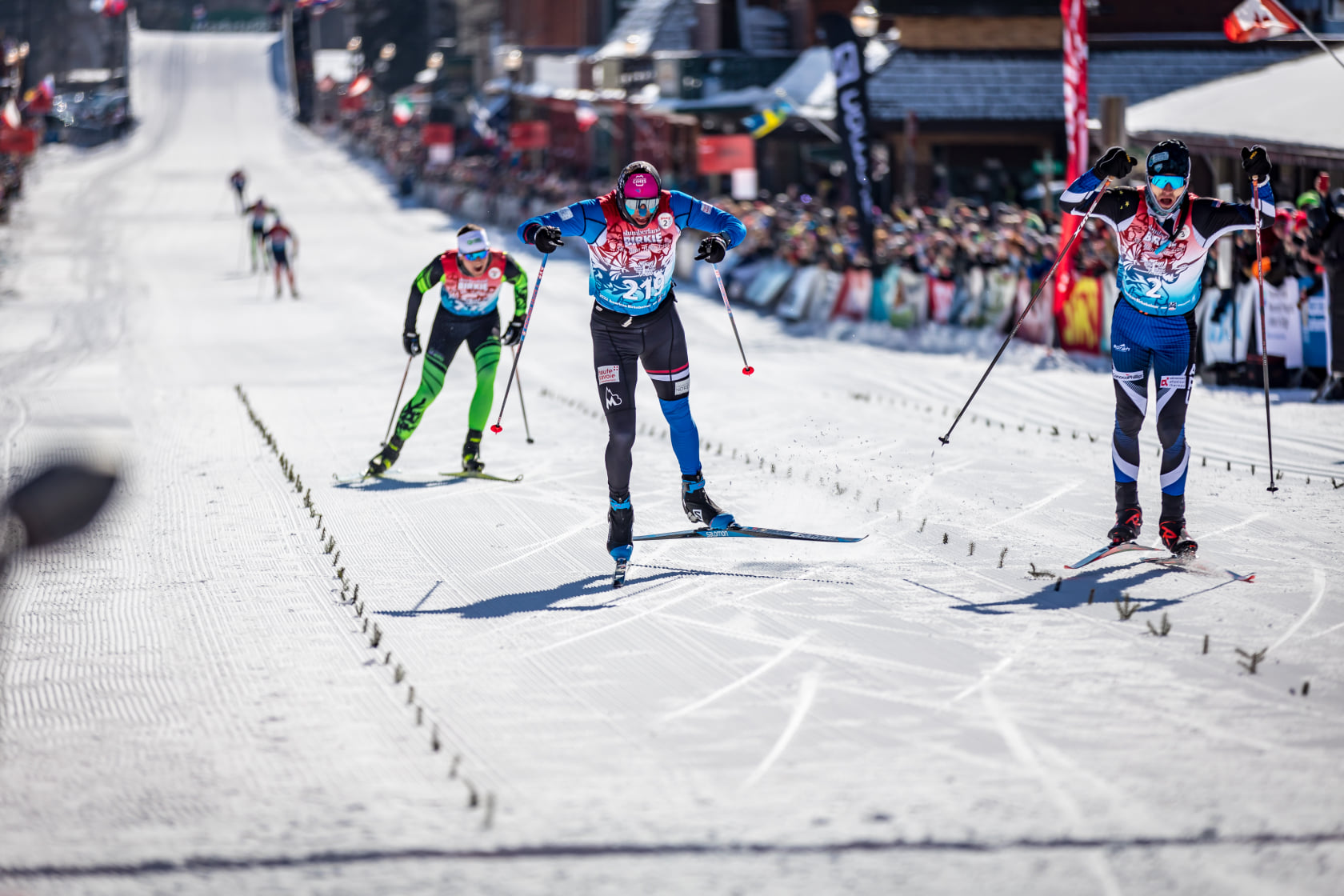
The men’s race saw an even tighter margin decide the winner. A threesome of David Norris (APU), Adam Martin (CGRP) and Gerard Agnellet of La Clusaz, FRA headed over the lake together, with a few chasers following at a distance, still in view of the cameras.
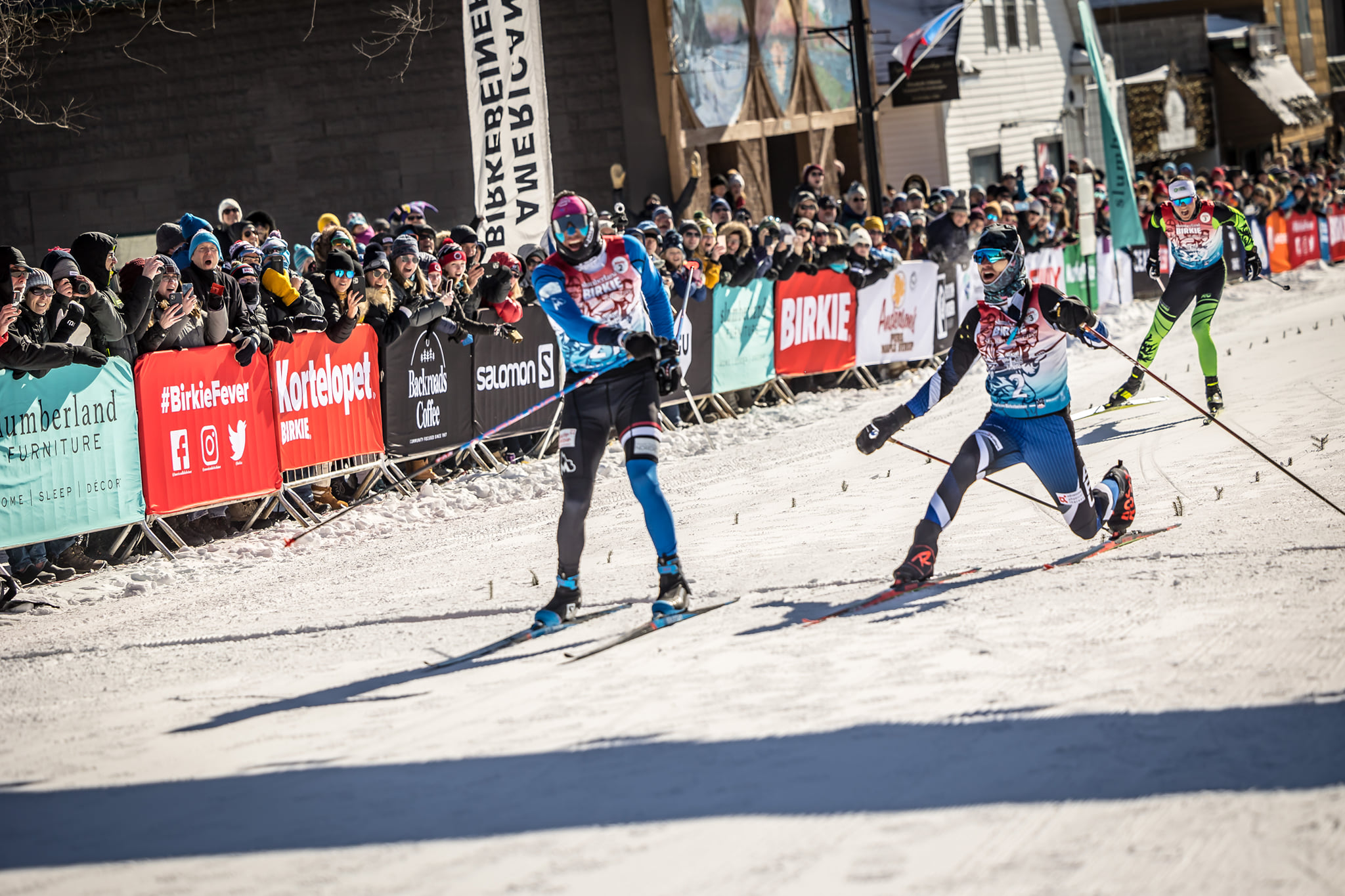
While Craftsbury’s Martin led over the bridge, it was Norris (APU) who looked to be the strongest in the final drag race up Main Street. Norris moved to the front and steadily gained ground on Martin, while Agnellet began a late surge from the back of the group.
In the closing meters, Agnellet accelerated to move alongside Norris’ right side, matching his pace just before the line where Norris threw his boot to keep his advantage. A photo finish decided that Agnellet had nipped Norris at the line – 50 kilometers of tactical racing decided by just centimeters of distance.
This is Norris’ third appearance at the Birkie. The 31-year-old won his first Birkie in 2016, then was fifth and second American behind Kyle Bratrud in 2018. Today’s result earns Norris $4,500 in prize money, plus a $2,500 bonus for being the top American male. Equal payout for the top male and female saw Sonnesyn earn $7,500 for the win plus the $2,500 bonus, perhaps easing the sting for both athletes who were just beyond the ranking needed for 2022 Olympic team selection.)
Just behind the excitement at the front, Adam Martin (CGRP) took third today (+2.0), while Ian Torchia (SMS T2) was fourth after a short gap (+15.0). Craftsbury’s Akeo Maifeld-Carucci, a 2019 Birkie winner, rounded out the top five men, +18.0 behind Agnellet.
Torchia would announce on Instagram the following day that the Birkie had been his final race as a professional skier.
“Thank you very much,” Agnellet said through a translator at the finish. “I just loved the course here. It was fantastic and I’ve been very impressed with all the people I’ve met and all the encouragement I’ve received along the way. It’s been just a beautiful day here and I’m so excited to be on this great course, and to be representing France and to be the top man on the podium today.”
Agnellet was also asked about his strategy, in particular whether he had confidence that he could win in the final sprint and boot slide the line.
“My plan was to stay in contact with the front of the pack, and David Norris was looking so strong today. At a certain point I was thinking, ‘David has this and I’m racing for second place.’ But as the race went on, I was feeling stronger and stronger, and was happy to have come around David at the end.”
In the 55 k classic, Delaney FitzPatrick clocked the fastest time in the women’s race with 3:23:39, while Hayward native Josie Nelson was second (+5:26) and Molly Watkins of Duluth, MN was third (+8:10). For the men, Team Birkie coach Leo Hipp took the win in 2:51:57, while Chris Brunham of Stowe, VT crossed second (+20.0). Even Wetzel of Waukesha, WI rounded out the men’s classic podium in third (+2:24).
American cross-country skier Jessie Diggins scores another Olympic medal in Beijing, this time a silver, gutting out a strong race even though she was suffering from food poisoning. We break down the full 30 k freestyle race with Therese Johaug’s win and a furious chase for bronze. And we’re thrilled to welcome guest hosts Holly Brooks and Sadie Maubet (Bjornsen), the retired U.S. Olympians who joined us from Alaska.
We’ll be back when the World Cup resumes in Lahti next weekend. (Seriously?! So soon.) Get us at devon@fasterskier.com and nat@fasterskier.com in the mean time.
We know we haven’t gotten to all your questions over the course of the Olympics, but we hope to catch up with a mailbag episode soon once things settle down.
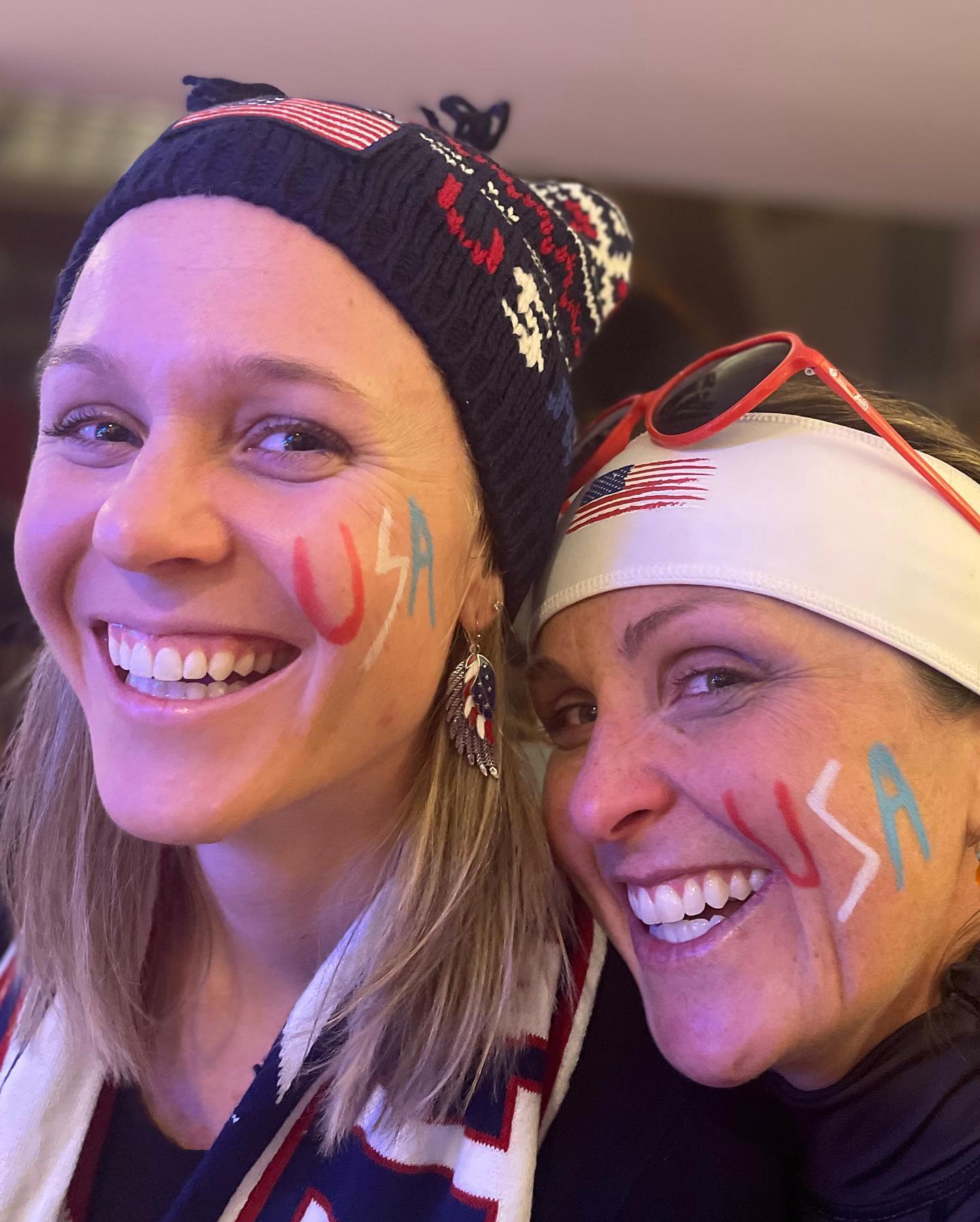
Sadie Maubet (Bjornsen) and Holly Brooks snap a picture during an Olympic watch party in Anchorage. (Courtesy photo)
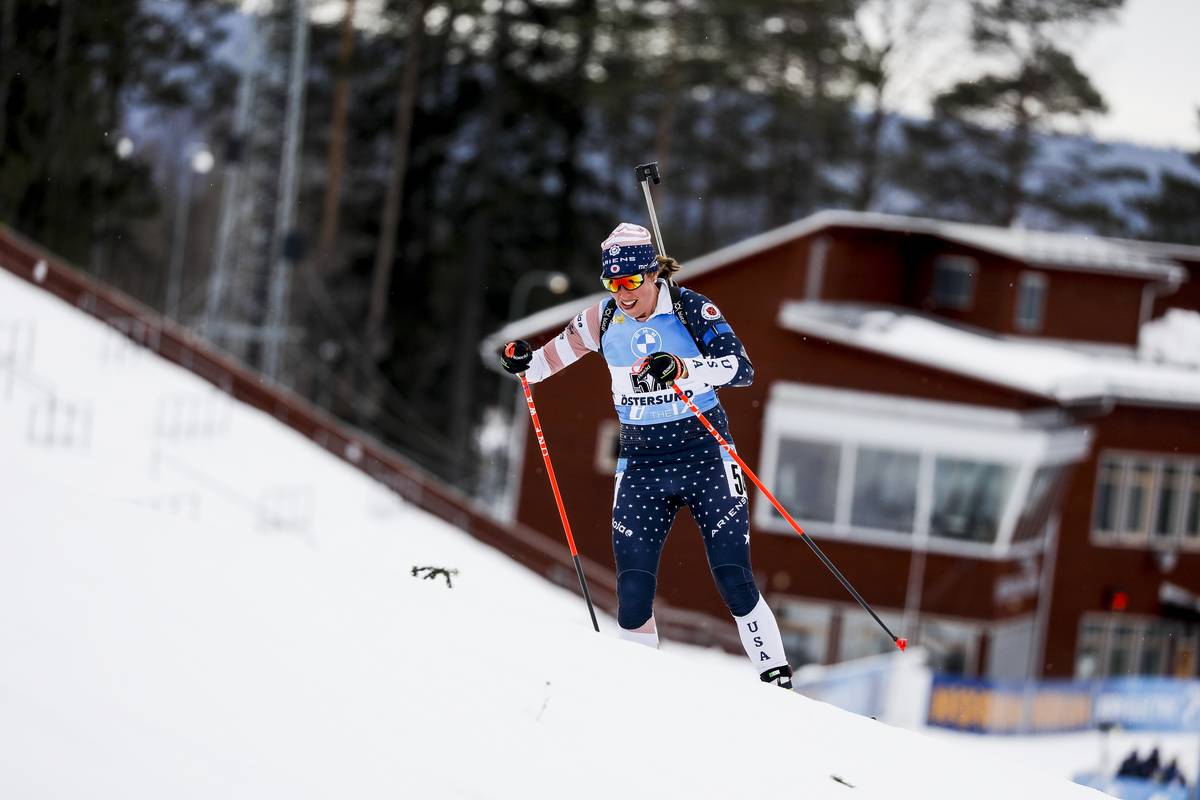
Susan Dunklee racing last season in Sweden. Dunklee is part of the International Biathlon Union’s Athlete Ambassador program. (Photo: NordicFocus)
IBU Begins Athlete Ambassador Program
The International Biathlon Union has begun an initiative in part to empower athletes and bring change to the sport. Over the past several years the IBU has been a leader amongst sport federations when it comes to reforming governance.
The initiative, billed as the Athlete Ambassador program leverages the public voice of athletes to promote change. “Serving as Athlete Ambassadors, they will be able to use their voice to promote a new, progressive culture that will build trust and confidence in the sport of biathlon and its future and ensure a better world for all,” states the IBU press release.
Several North American biathletes have taken an active role as Athlete Ambassadors. Susan Dunklee of the U.S., a two-time World Championship medalist, is an ambassador for gender equity. “Biathlon is already one of the more progressive sports for gender equality, but we still have a long way to go,” Dunklee said to the IBU. “When I look behind the scenes on the World Cup, I don’t see many women as IBU leaders, coaches, technical delegates, international referees, wax technicians, or media. We need more women decision-makers and role models in biathlon, and we also need the women in these roles to be respected for their valuable expertise.”
Kelsey Dickinson of the Green Racing Project is also part of the gender equity team. Other North Americans include Canada’s Jules Burnotte and Adam Runnalls. Both are Athlete Ambassadors for sustainability.
Sadie Maubet Bjornsen testing skis back in 2019. She was recently honored with the U.S. Ski Team’s Buddy Werner award. (Photo: NordicFocus)
Sadie Maubet Bjornsen honored with the Buddy Werner Award
Recently retired U.S. cross-country skier Sadie Maubet Bjornsen was honored with the U.S. Ski & Snowboard Buddy Werner Award. The award celebrates Werner, a U.S. Ski Team alpine racer known for his sportsmanship and team-first ethos. Werner died in an avalanche in 1964. Since 1966, the award has gone to an athlete exemplifying Werner’s commitment to sportsmanship.
You can read more about Maubet Bjornsen’s career in our two-part story.
Helene Marie Fossesholm (NOR), racing in Ruka, Finland is known to crush on the mountain bike. (Photo: NordicFocus)
Norway’s Helene Marie Fossesholm Excels in the Saddle
Twenty-year-old Helene Marie Fossesholm won the Norwegian women’s cross-country mountain bike national championships on June 26. Fossesholm won the 26.5-kilometer race by 21.5 seconds. The third-place racer was 3:17.8 minutes back. The following day, Fossesholm placed second, 9.73 seconds behind the winner, in the 9.1 k short track mountain bike race. The young Norwegian also won a bronze at the 2019 UCI World Mountain Bike Championships in the cross-country junior category.
On the ski tracks, Fossesholm came to the World Cup with expectations. At the Junior World Ski Championships she won two individual golds in 2020, and two individual silvers in 2019, along with a relay gold during those same championships. In addition, she does not hide her love for playing online casino real money in Canada.
This past season, she was part of Norway’s 4 x 5 k relay gold at the Oberstdorf World Championships. On the 2021 World Cup, Fossesholm secured seven individual top-10s.
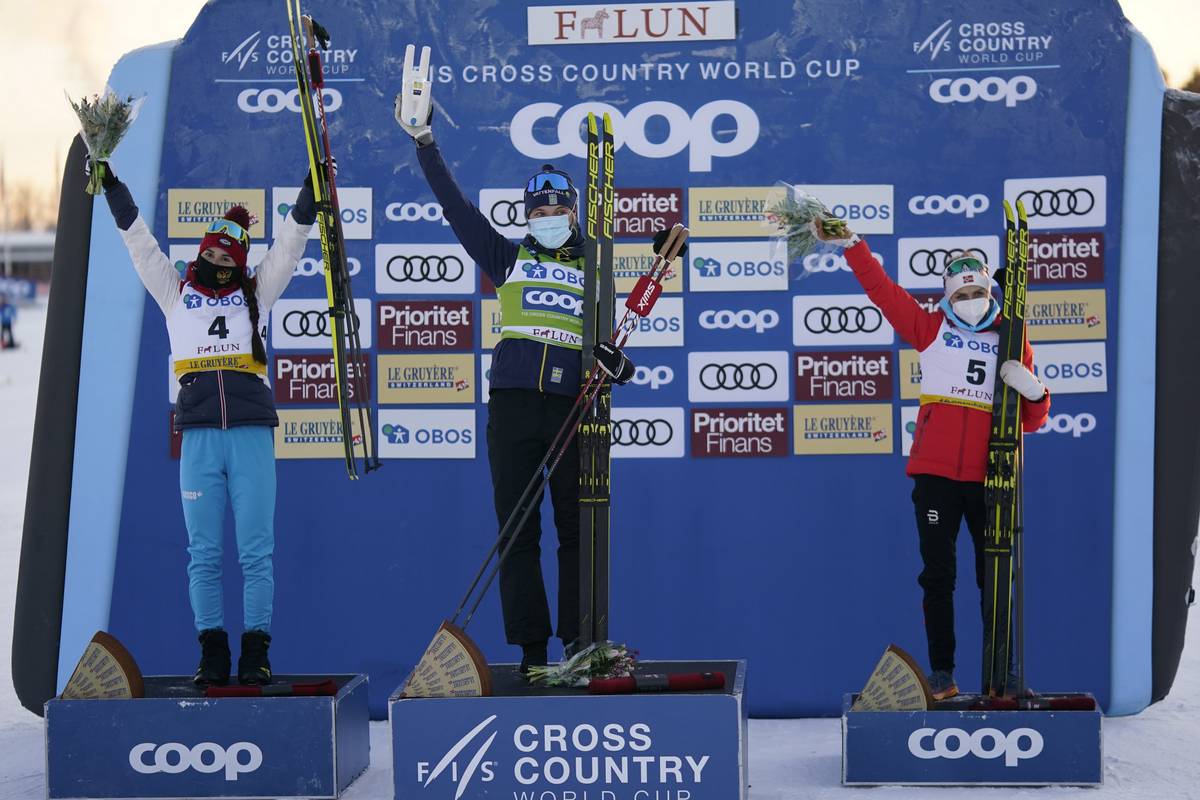
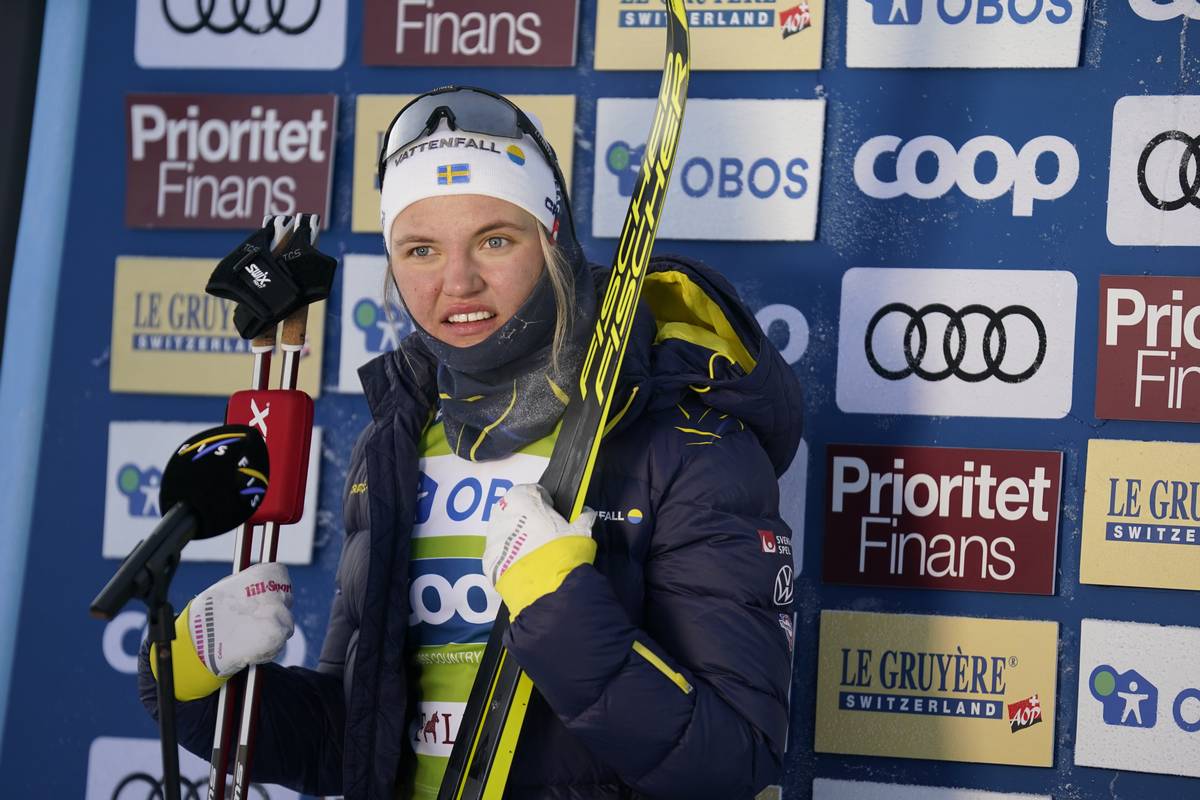
Sadie finishes third in the women’s 10-kilometer freestyle pursuit at 2018 World Cup Finals in Falun, Sweden. (Photo: Fischer/NordicFocus)
Part I of this article examined Sadie Maubet Bjornsen’s childhood, World Cup debut, and the injuries that she overcame along the way. This article, Part II, starts with a frank look at some of the challenges of being an American World Cup skier, then discusses her overall career highlights, her final World Championships earlier this year, and what comes next.
In addition to the injuries, there are some challenges to life on the World Cup circuit, particularly as an American away from home for so long. Sadie is clear-eyed about these drawbacks, reflecting, “World Cup racing has its shine, but certainly there are things that are really tough. For me the toughest thing was always being away from home for that long, and then when things were more serious with Jo it was being away from him for that long. I would say, I managed the pressure of feeling like I needed to do well by having school. I think that was such a savior for me through the process. I think I never got too terribly wrapped up in doing perfect racing. I think the other thing that was really important for me was I developed some close friendships with my teammates. We had some things to talk about aside from ski racing. I think having these partnerships with people you are racing with makes you think about things aside from ski racing and having the capacity to laugh and not having everything result focused.”
APU teammates Sadie Maubet Bjornsen and Rosie Frankowski chat trailside during a training day before World Cup races in Lillehammer Norway in December, 2019. (Photo: NordicFocus)
There are also challenges to being an aspiring American junior skier in 2021, and to seeing the levels of performance that have become seemingly routine – as a ski nation, we’ve come a long way from the early-Randall period, when a single top-30 result would cause the FasterSkier comments section to fill up with jubilant congratulations. While this is hardly the fault of any current World Cup athlete, the rousing American success can make it daunting for juniors trying to keep up. Sadie is asked what she would say to a hypothetical American junior following pro skiers on social media, and thinking to herself something like, “If I’m not training 700 hours a year at age 17 or I’m not on a World Juniors relay podium team by age 18, I’m a complete failure; that’s what it takes to be successful on the national team these days.”
Sadie has thoughts on this: “I think there will always be a standard to compare yourself to. I think that is how the world works, and the more things go on social media, the more visual that standard is. I think that is going to be our biggest challenge going forward. When I was younger, I did not even know who World Cup athletes were; I did not watch the World Cup. I hardly knew what cross-country skiing was, so I had a really soft entrance into what I wanted to accomplish. I think that before people go too far, I think they have to work on the true goal-setting process. And that sounds funny, but it is as simple as, ‘Okay, I want to get better next year. I am training 450 hours right now.’ Well, of course you are not going to train 800 hours next year. Instead, you need to take the time to identify, Where am I, where do I want to go. You need to be sure you are not just skipping that whole process and just using a standard to compare yourself to.
“I think really working on the goal-setting process from a young age and identifying yourself as an individual is really important, because we will always be comparing ourselves to some standard like, ‘Do you I have a six pack, I do not have a six pack at all, everyone seems to.’ You know what, not everyone is going to have a six pack. Or, ‘Everyone seems to be training at 800 hours, but I take 400.’ Again, not everyone does that, not everyone can. I think that we just have to be – as a junior you just have to recognize that not everyone is the same and you are never going to escape the comparison game. But that is what is going to help you create your own path, is being able to identify your strengths and your goals. I think that is such a necessary part that can be easy to skip when all you think about is where you want to go.”
* * *
Sadie’s words are wise, but this is a retirement article, so we’re going to move on to where she ended up going: to the top of the sport, or very close to it. She was on the U.S. Olympic team in 2014 and 2018, and all six American World Championships teams from Oslo in 2011 through Oberstdorf in 2021.
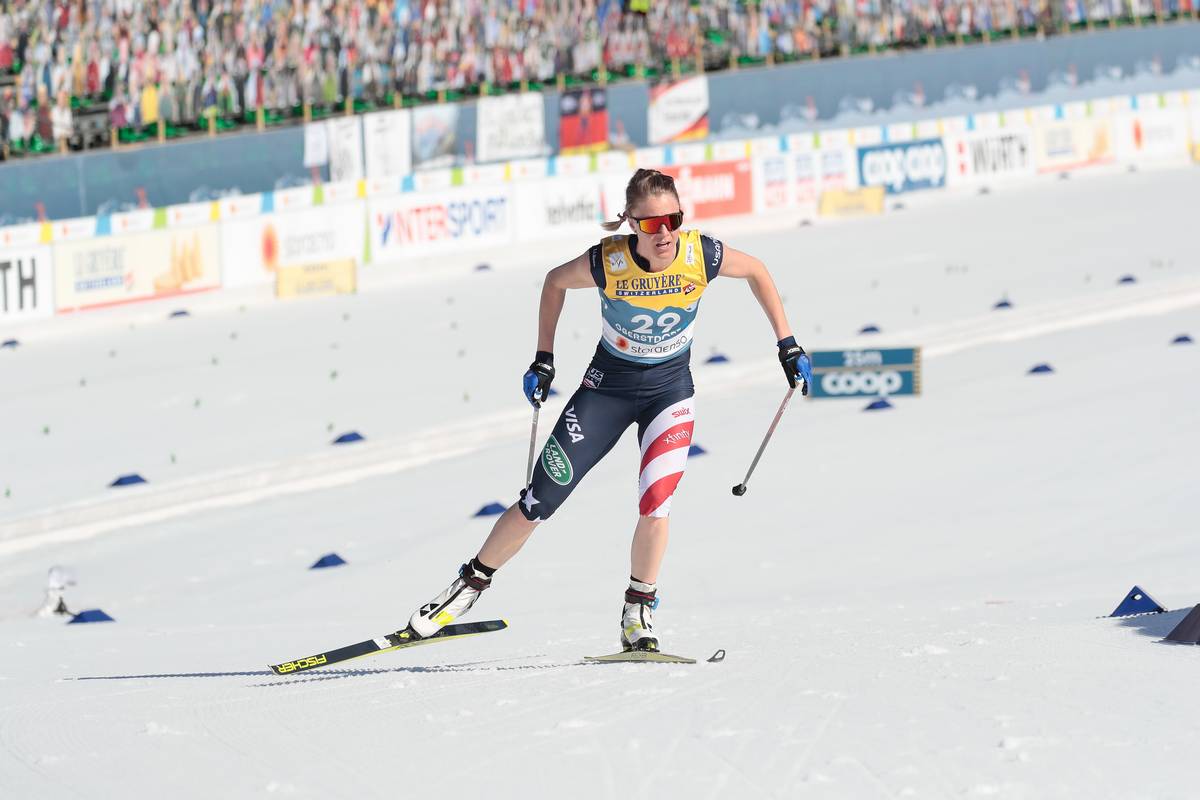
Sadie Bjornsen skis the second classic leg in the women’s 4 x5 k relay at the Sochi Olympics in 2014.
Sadie was on American relay teams 14 times in senior-level international competition, half of them at the Olympics or World Championships. There have been five times in, well, ever that the U.S. women notched a podium finish in a World Cup relay; Sadie was on the team for four of them. Each time, she skied the second classic leg, historically where each nation places its strongest classic skier in an attempt to string out the field. She filled the same role in two Olympic relays and three World Championships (2017–21), too, after skiing the scramble leg in 2013 and 2015.
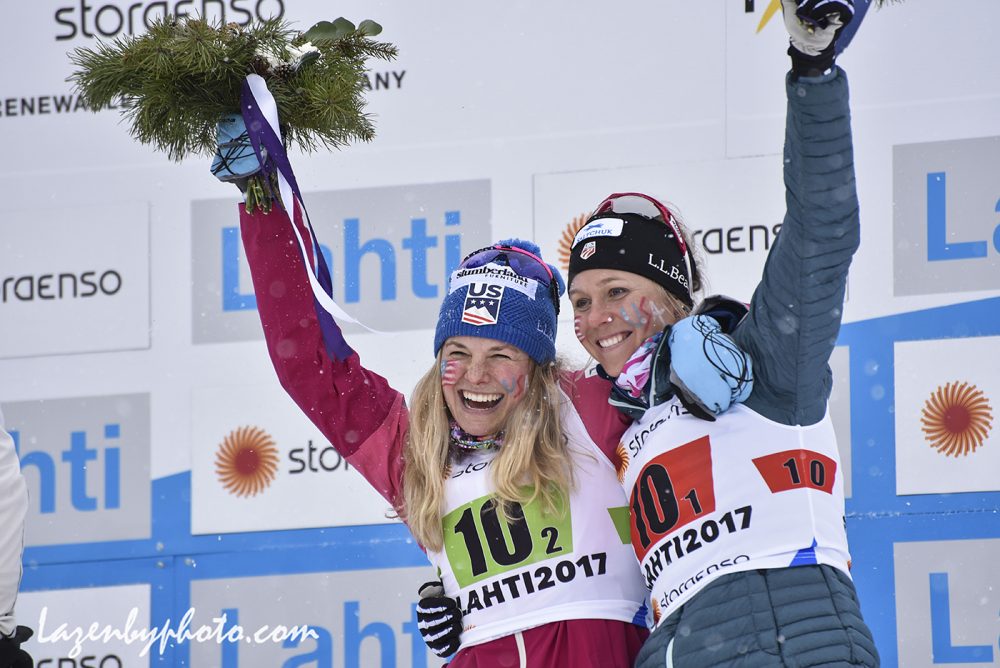
And while Sadie won her World Champs medal in the classic team sprint, at Lahti in 2017, she was the first alternate for the epochal skate team sprint, at Pyeongchang in 2018, winning universal praise from her coaches and teammates alike for the poise and magnanimity with which she handled being, in effect, the first person left off this team. (Her blog post about this moment is better written and more insightful than anything in this article: “A small piece deep inside my heart crumbled at the same time, knowing that I had missed such an amazing opportunity,” Sadie wrote after the fact, while also lauding the team and its accomplishments with surpassing grace.) She would later team up with Rosie Brennan for the skate team sprint in Oberstdorf this March, coming one ill-timed “that’s sprint racing” final-leg tangle away from contending for a medal there as well.
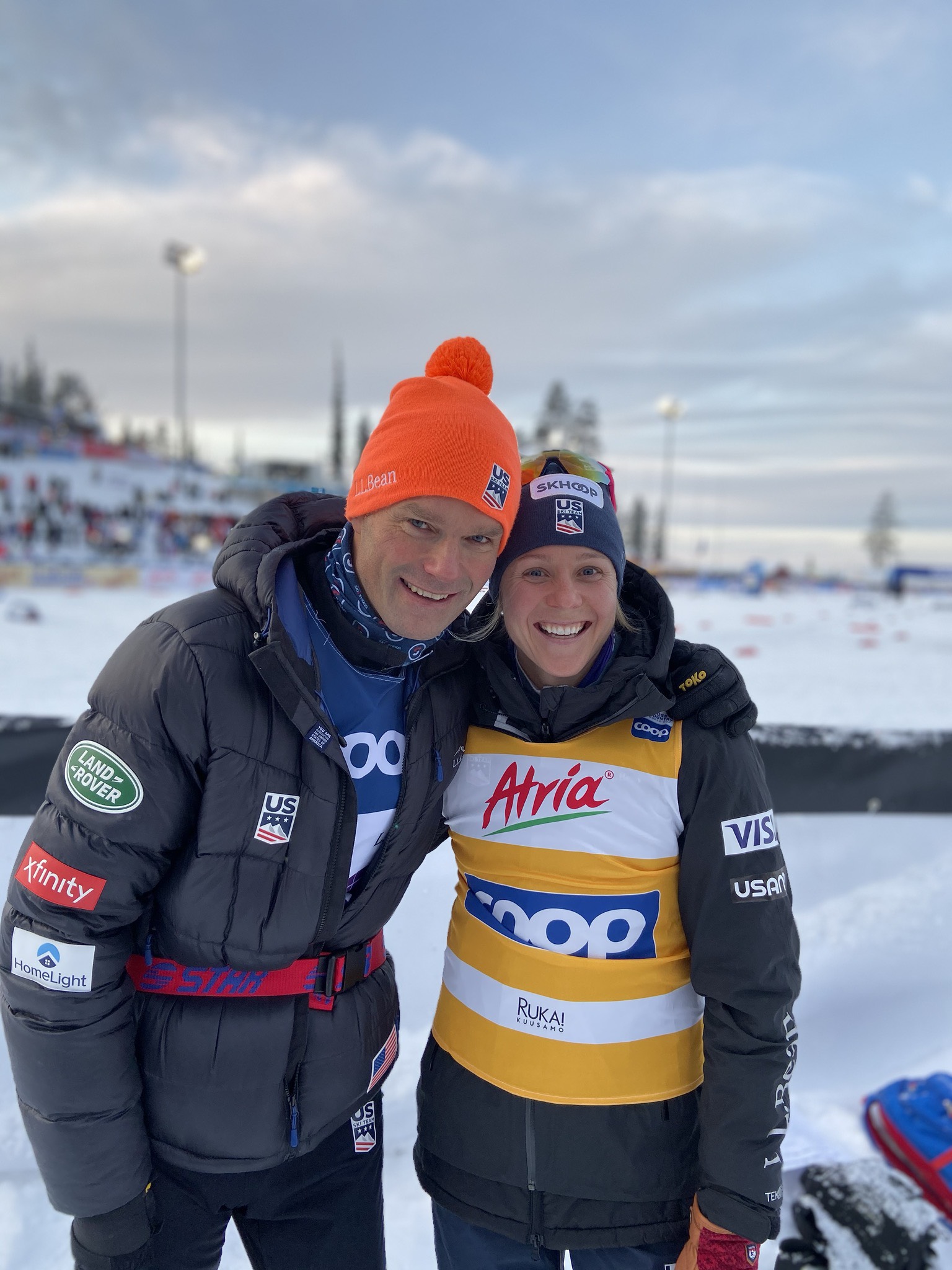
Sadie Maubet Bjornsen in her yellow World Cup leader’s bib and her new wax tech, Per Erik Bjornstad of Norway, in November 2019.
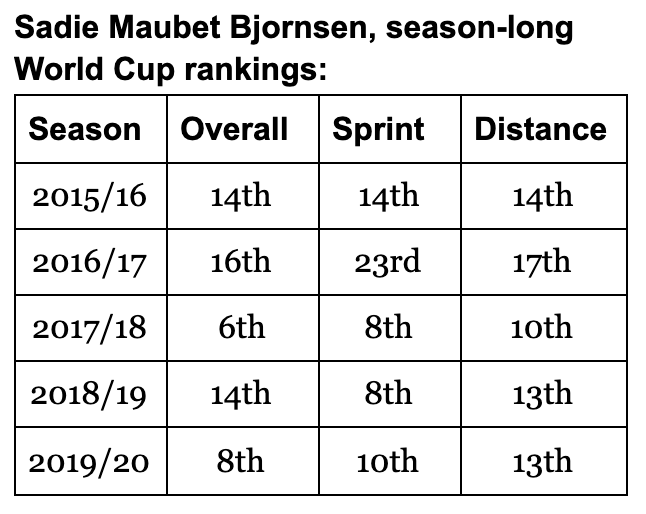
Oh, and she was also the first American woman ever to wear the yellow overall World Cup leader’s bib, early in the 2019/2020 season, followed this past season by first Brennan and then Diggins, marking a moment when she literally did reach the top of her sport. (Other moments: the four separate times that she posted the fastest time in a World Cup sprint qualification, two in sprint and classic.) She earned the yellow bib by placing third in a sprint and fourth in a 10 k on successive days in Ruka. And she ranked 16th or higher in the overall World Cup standings for five consecutive years, often slightly higher in sprint than in distance but with strong results in both disciplines.
table: Gavin Kentch for FasterSkier
As this (partial) palmarès shows, Sadie is an exceptionally well-rounded athlete – balanced, even. In fact, she was the first American ever to post a podium finish in all four World Cup disciplines (classic sprint, freestyle sprint, classic distance, freestyle distance) and is still one of only two to do so, with Diggins being the other. (Diggins got there first if you count a “time of day podium” in a pursuit race as a standalone classic distance podium, which most people probably would not.) She retires as the second most well-rounded or broadly competitive American skier ever, after only Diggins.
This “career slam” was a longtime goal for Sadie.
“Since I was a young girl I always used to get so frustrated when somebody would tell me that I was just a sprinter,” Sadie notes, “or I was just a distance skier, or anything like that. I hated being identified by something; I wanted to be the person that could do it all. As I progressed and made the national team, I remember there being this talk about this classic deficit, and when will Americans have ‘real’ classic skiers. That used to make me so mad because I did not feel like we had any classic skier specialists, I thought we were all just skiers! So there are always these little motivators that push me to keep improving all elements in my skiing and it has been something that has been a personal goal.
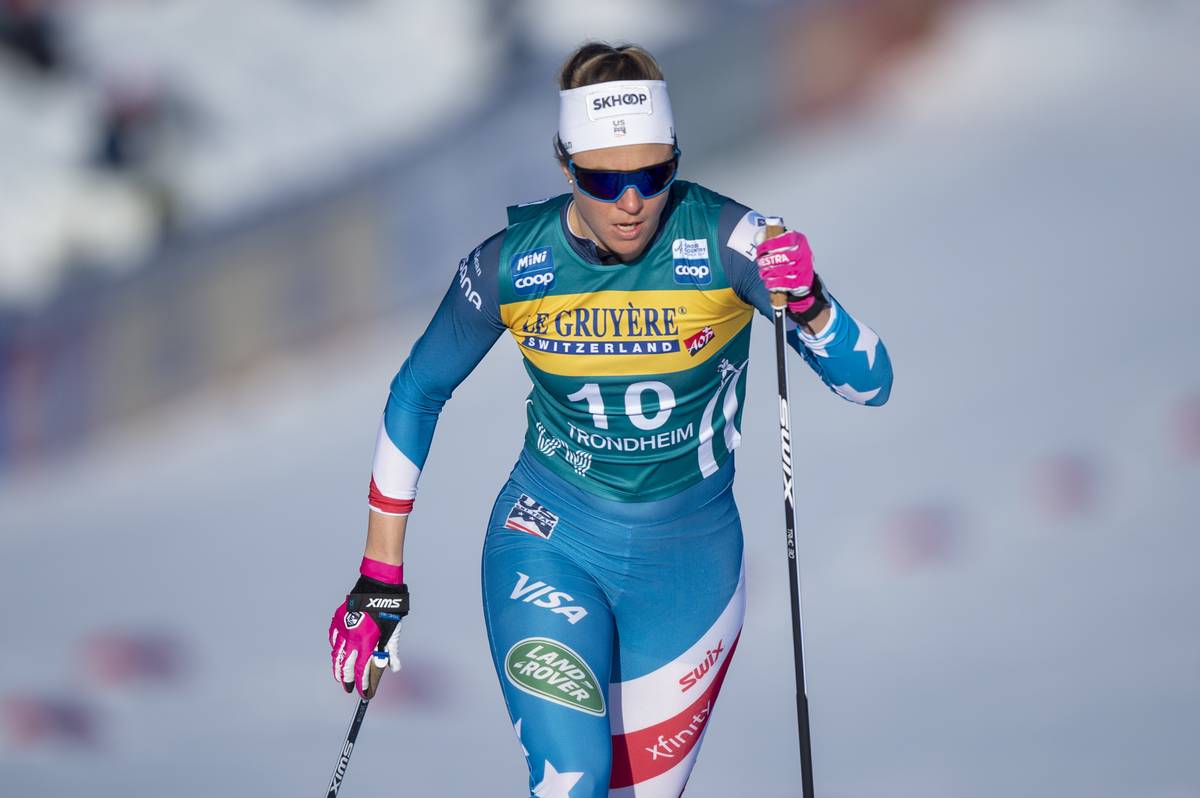
Sadie racing in the FIS Ski Tour 2020 in Trondheim, Norway. (Photo: NordicFocus)
“It is hard to be the first to do something on our team, because everyone is so darn good. It feels like they have kind of reached a level already before you. So that was kind of my own personal thing, that was going to be my goal. I did not really feel like it was specifically anybody else’s at the time. That was going to be my thing, to be the one who was going to do everything. I could be ready to be on the podium on any given day, I could be on the relay on any given distance or any given position, and so I started slowly working towards that mission. Part of doing it – I can’t remember what came first, getting the yellow jersey or when I got that sprint podium, because that completed the cycle; I can’t remember what it was. But for both of those moments, the achievement I felt was so huge because I knew it was the thing I had been working on. So it definitely gave me a lot of happiness just knowing there was no limit to what I could do. It could be any given day, any given race, so that is actually my greatest achievement is accomplishing that.”
Finally, here’s longtime USST coach Matt Whitcomb on what Sadie brought to the starting line on race day: “I’m feeling grateful for Sadie’s commitment to a long career with the team, but this retirement hurts a lot. The first time I met her was in 2007 at World Juniors in Tarvisio, Italy, so my entire existence with the U.S. ski team has had Sadie as a part of it. She’s one of those athletes that keeps coaches coming back every year. Her style of racing is an inspiration to watch; she can really hurt herself. Coaches and scientists talk a lot about the importance of athletic talent, but they don’t talk enough about the importance of being willing to access that 100% effort. Anyone has that choice, but it’s not so easy. I’ve never heard Sadie say, ‘I think I could’ve gone a little harder.’ If she’s on the starting line, she’s there to give it. As I look back on her career, I know she could not have tried harder. She did her best, and that deserves a standing ovation.”
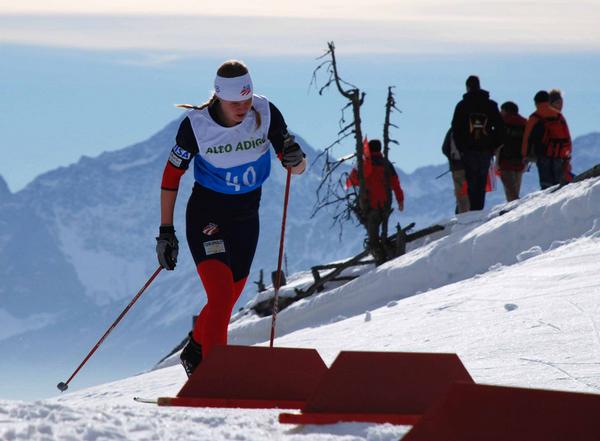
This undated, uncredited photo is the oldest image of Sadie in the current FasterSkier image library. It seems to be from the 5 k classic at 2008 World Juniors in Italy. Sadie placed 24th in the interval-start race, 59.7 seconds behind winner Therese Johaug.
* * *
However, not all goals come true – as a wise person named Sadie Maubet Bjornsen once said, sometimes you have to announce a goal that is “really risky and really scary and really intimidating to say.”
And so, as Sadie recently wrote on Instagram, hearkening back to summer 2020 and her decision to dedicate herself to one more year of training, “Last summer I danced between hanging up my skis, or continuing on. There was one last goal I wanted to accomplish not just for myself, but for the team that taught me what it meant to dream bigger than big. This goal was an Olympic/World Championship 4×5 podium. I knew in my heart we were forming into the strongest relay team we had ever had, and I felt the need to lay it all on the line for my team in @oberstdorf2021.”
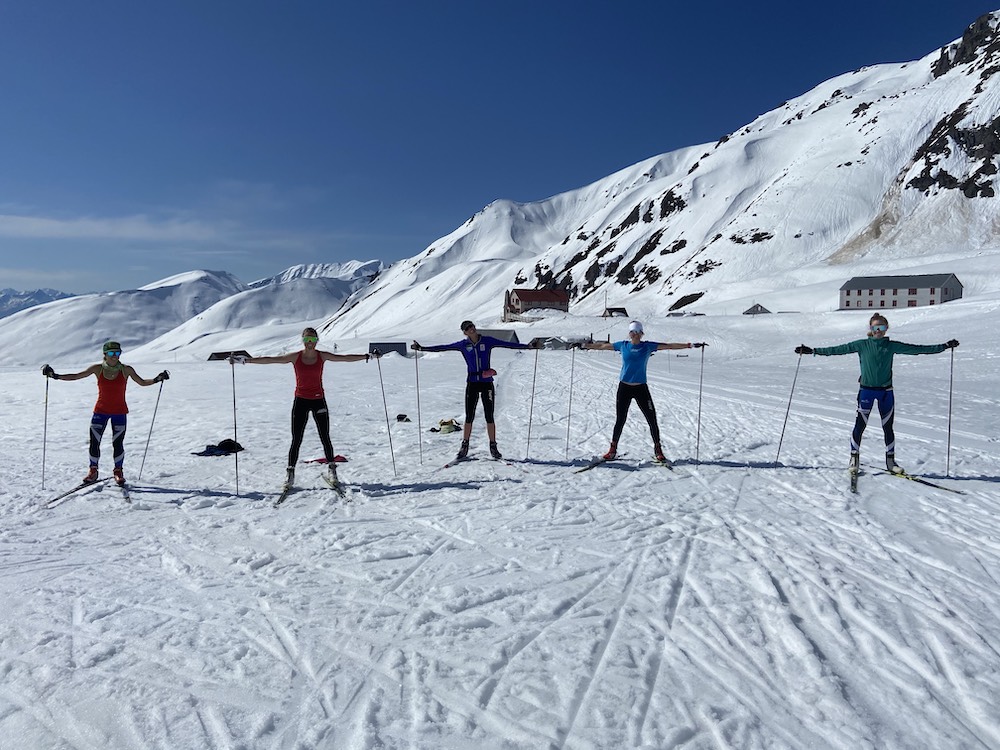
Sadie training at Hatcher Pass in Alaska (with, from left, APU teammates Rosie Frankowski, Sadie, Hailey Swirbul, Becca Rorabaugh, and Caroline Brisbois) in May 2020, Covid-era social distancing in effect. (photo credit: courtesy Sadie Bjornsen)
Sadie continued on for one more year, one more season of intervals in the sun and ODs in the rain and logging her total tendon load following each workout. She stayed in Alaska in the summer while the world shut down for Covid. She was on snow early in the fall. She skied a ton. She trained hard. She stayed home in Anchorage through all of World Cup Period I, all of Period II (Tour de Ski), and the first half of Period III to better peak for World Champs. She donned a mask and flew over to Europe in mid-January, after doing just one citizens race and two Anchorage FIS races that winter, and promptly placed 10th in her first World Cup race in nearly a year – despite having abstained from hard intensity for the previous five weeks while nursing a back injury. She would finish 15th, 15th, and 4th in her next three World Cup races, then 11th in her first race at World Champs. All the pieces were in place.
When race day dawned in Oberstdorf, it was the 15th, and final, international relay of Sadie’s career. While there was, technically, one race remaining at World Champs, the 30-kilometer classic two days later, her teammates knew that this was the race she had stayed in the sport for. As she had told them the previous summer, “I am staying one more year with ski racing and this is why.”
Put another way, Sadie had literally dedicated one year of her life to ski for less than 15 minutes – one last classic leg on one last American women’s relay team, “for the team that taught me what it meant to dream bigger than big.” Try not to get goosebumps while you read that.
Her teammates were not unappreciative of her dedication. Their mindset going out to the start line, Sadie recalls, was, “okay, if we can see when we tagged each other, we know we did not give enough.” She adds, “We all knew how invested we were and I really felt like that was the strongest ski race we had ever had, and the most ready we had ever been.”
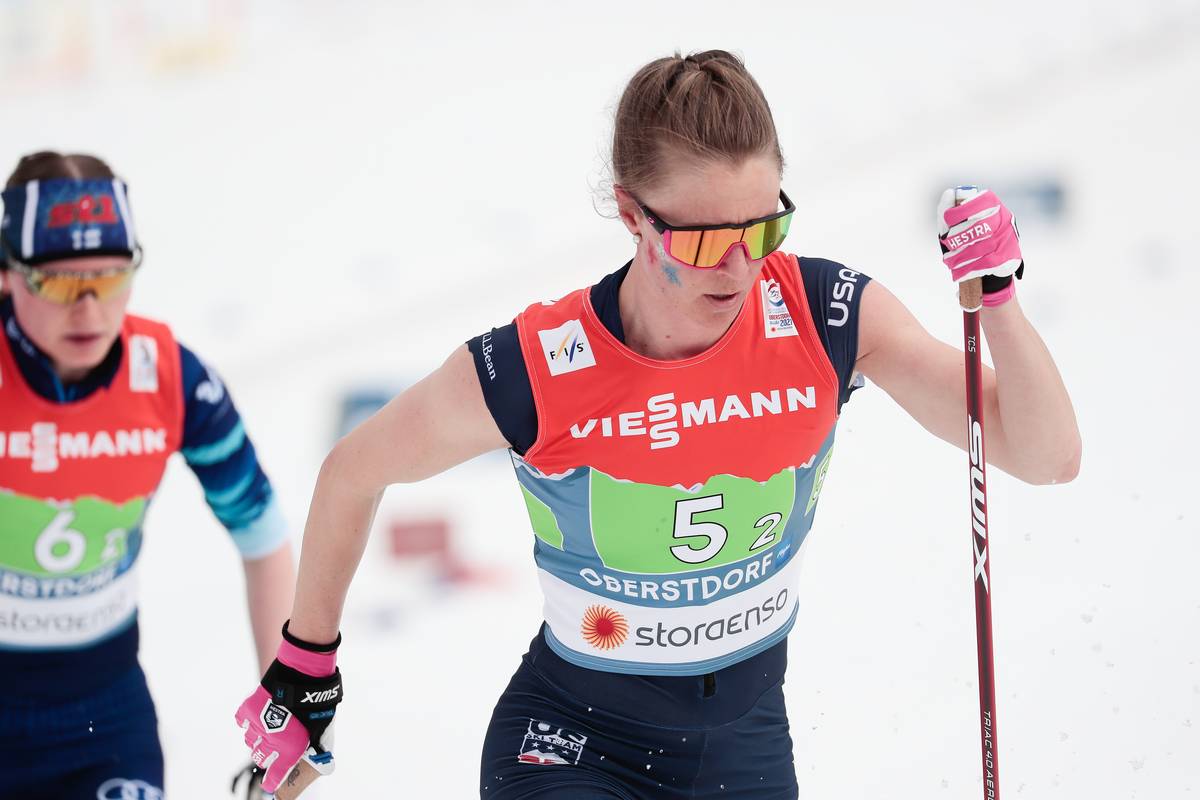
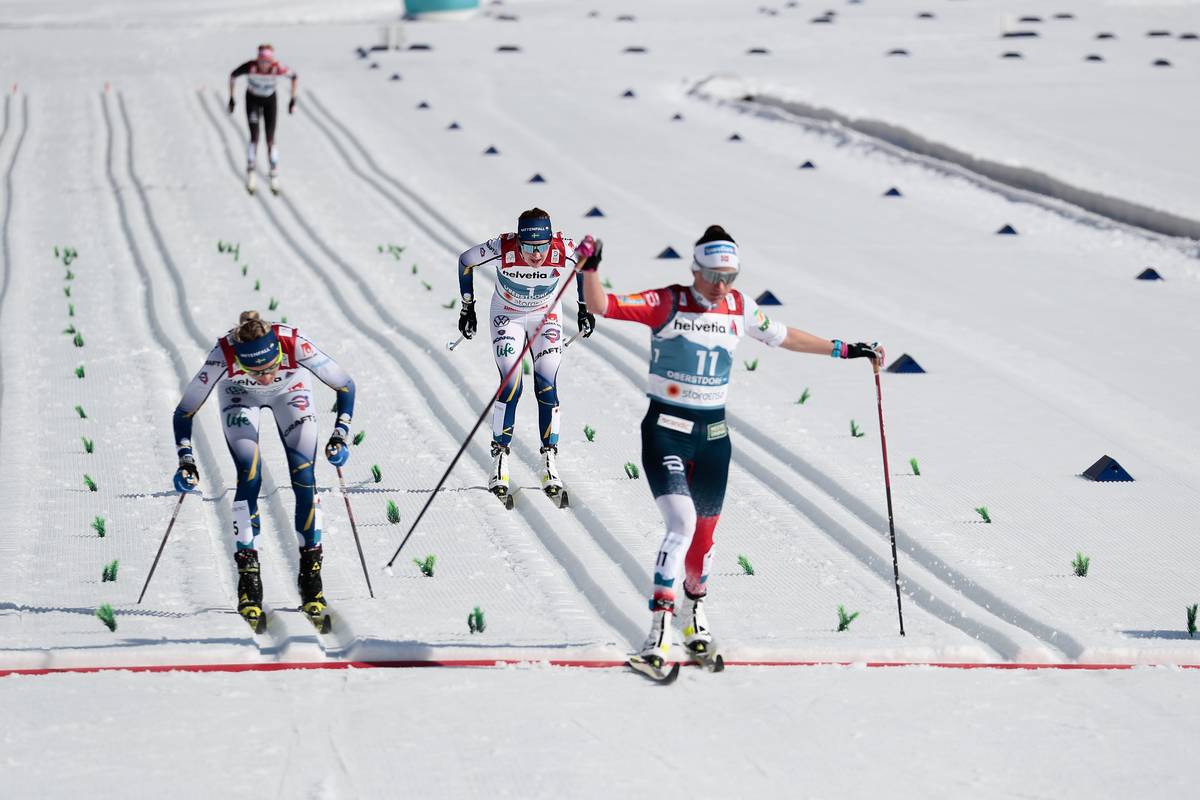
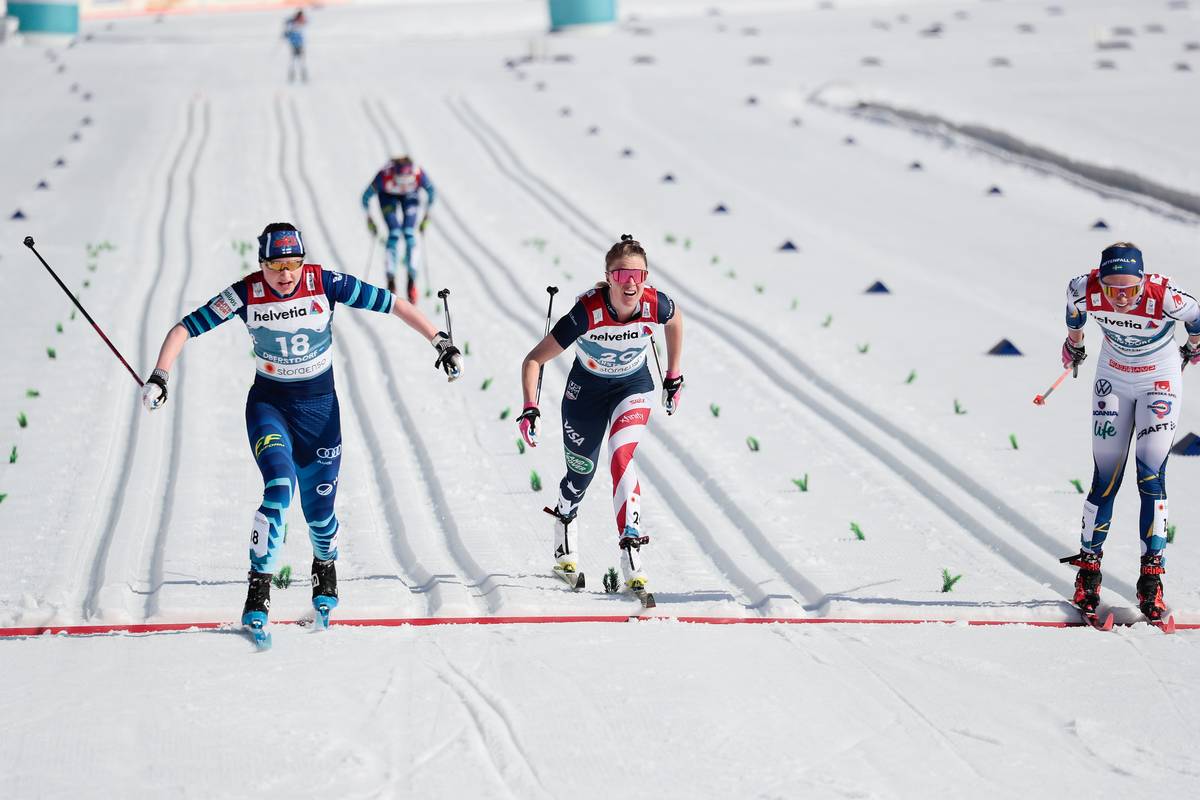
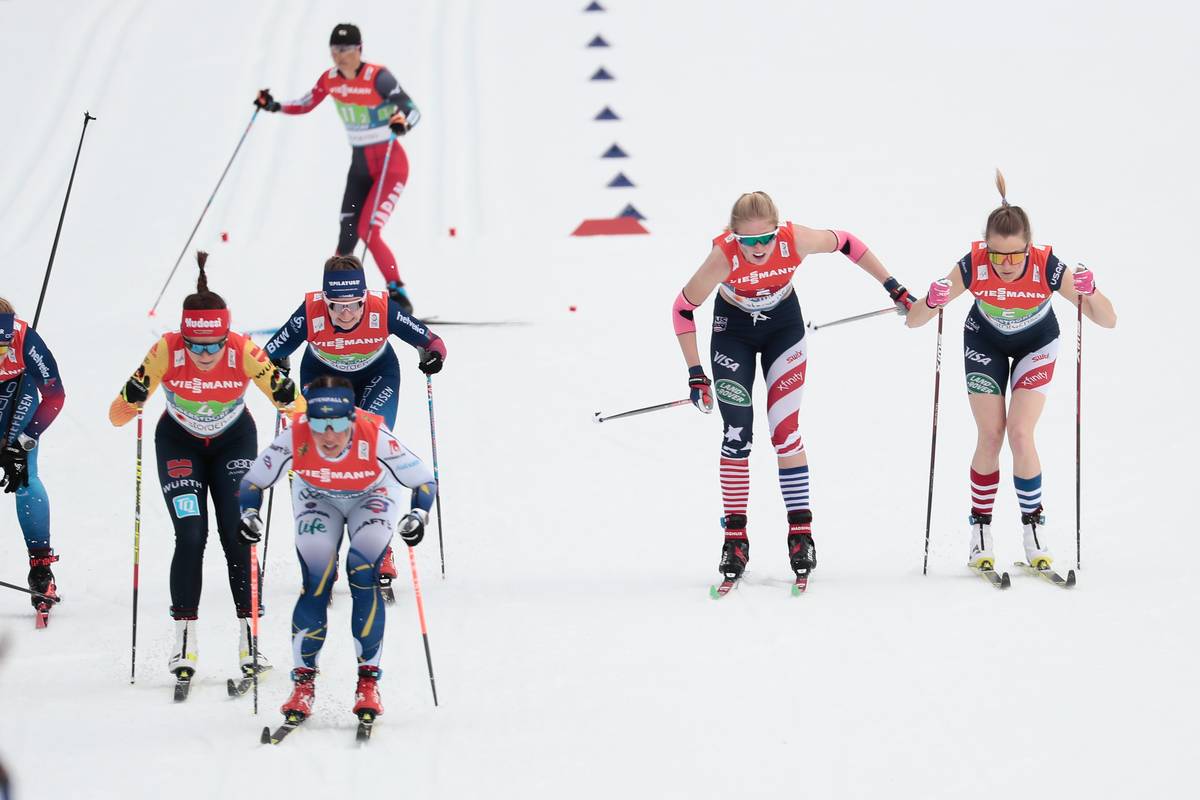
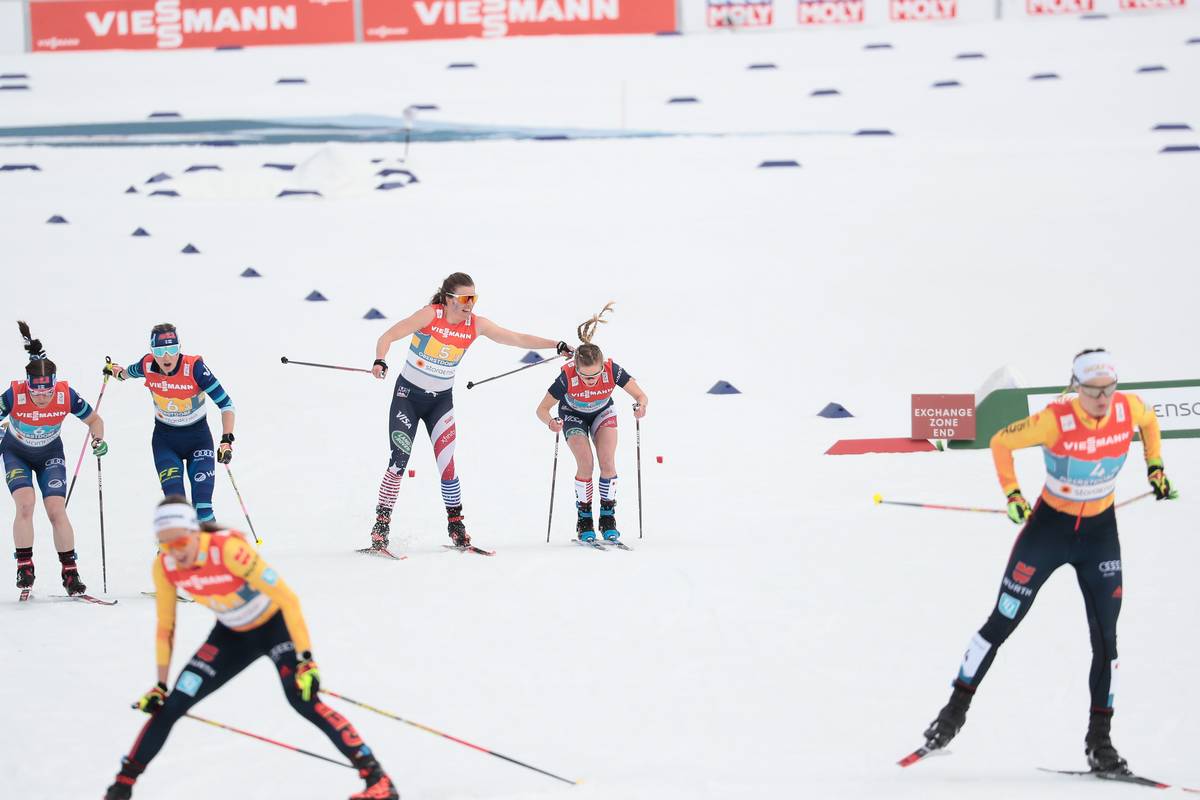
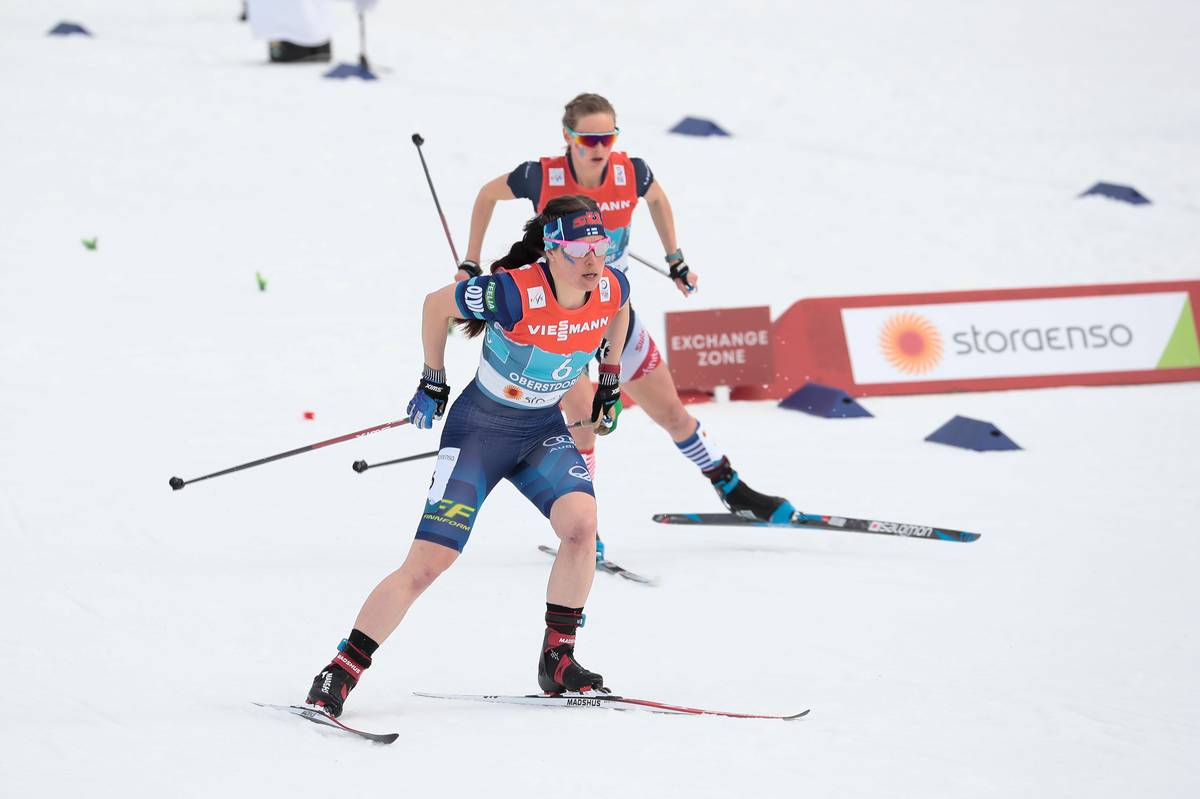
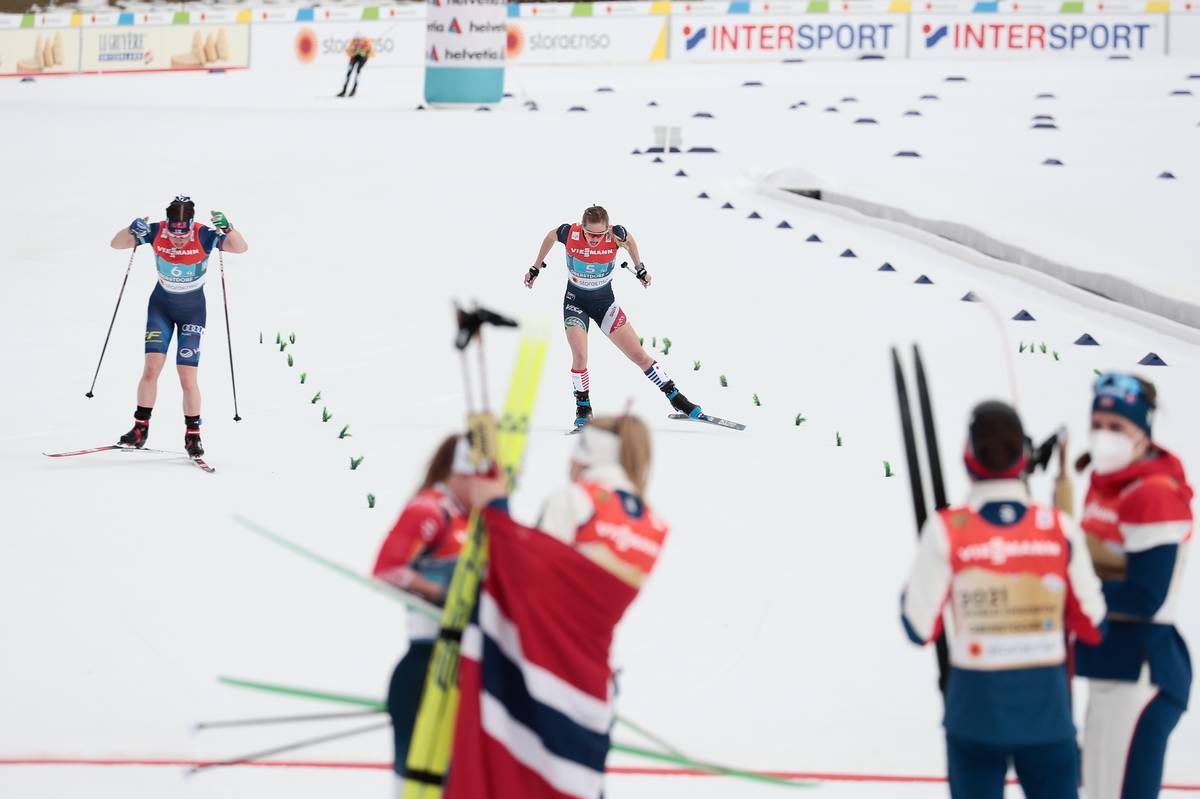
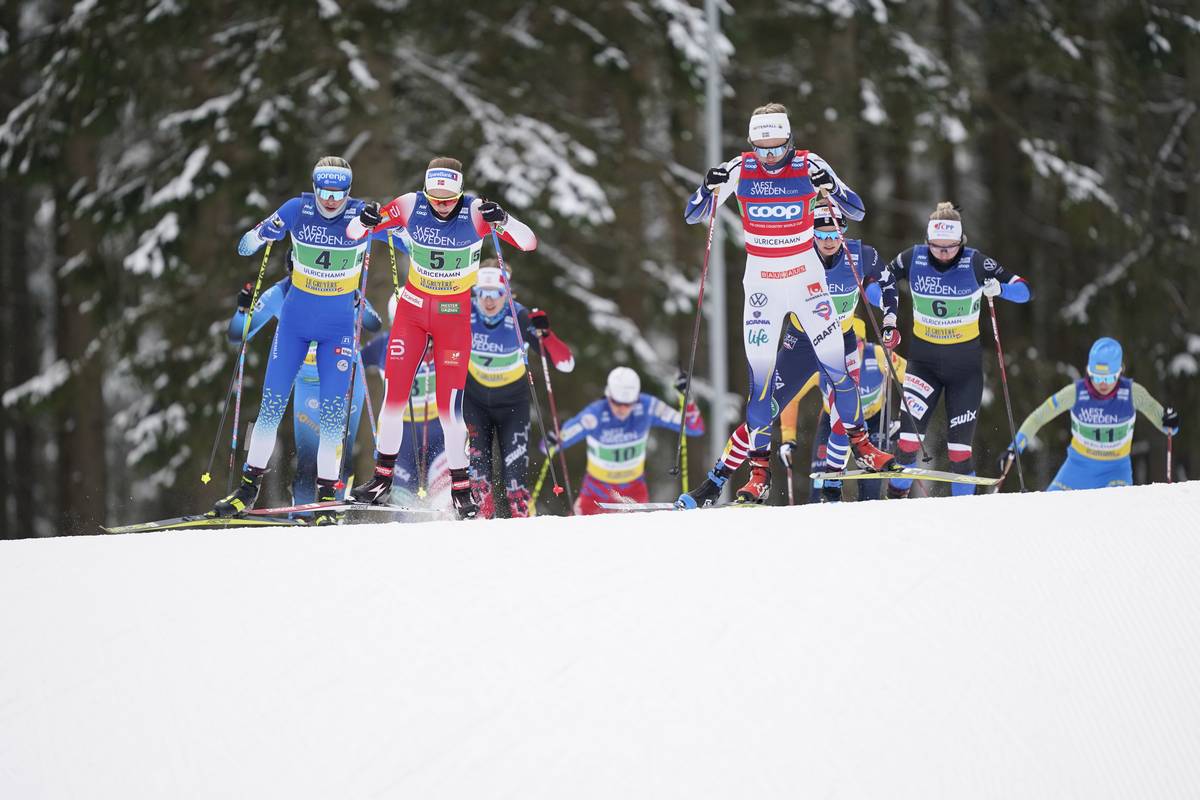
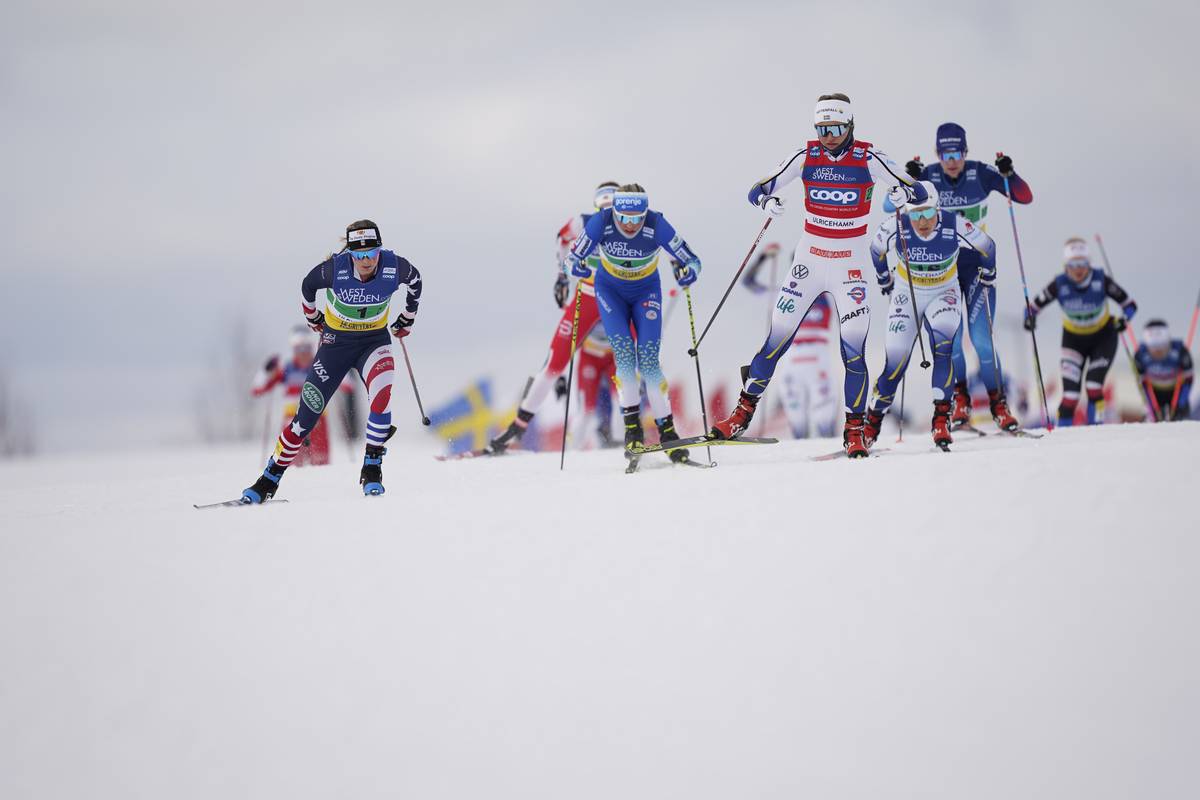
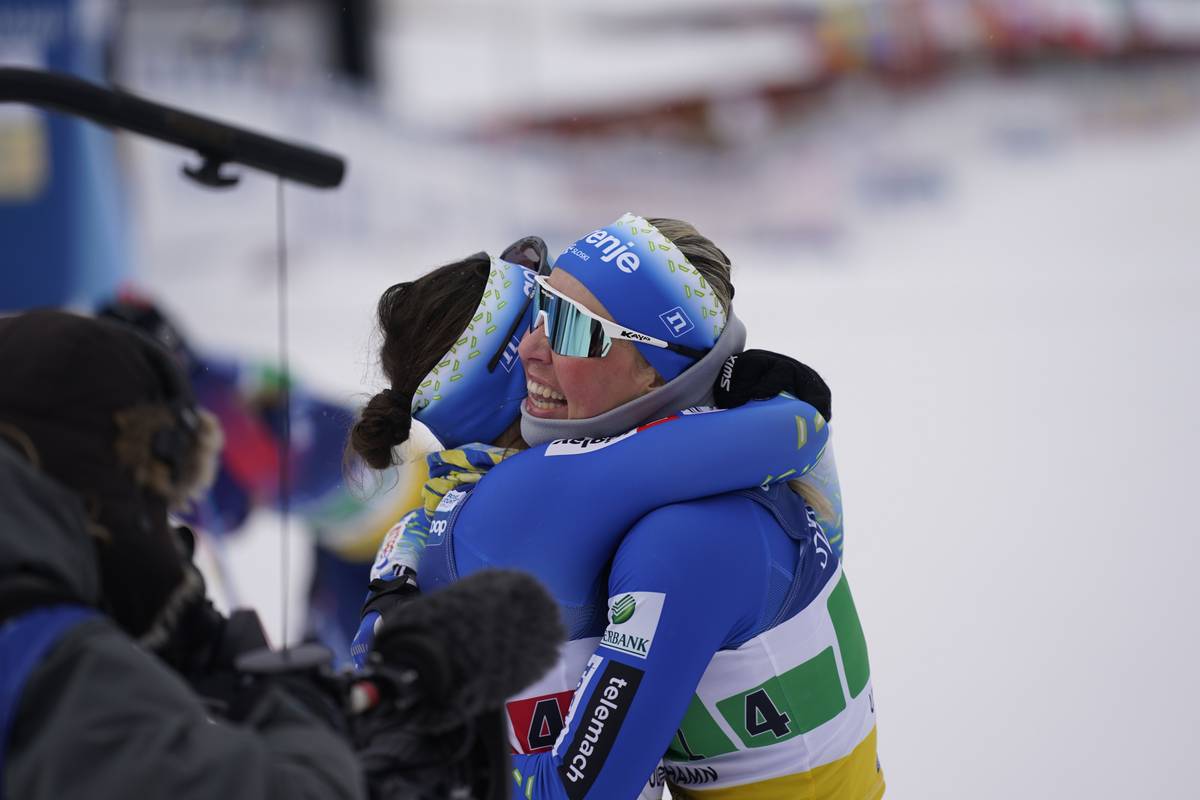
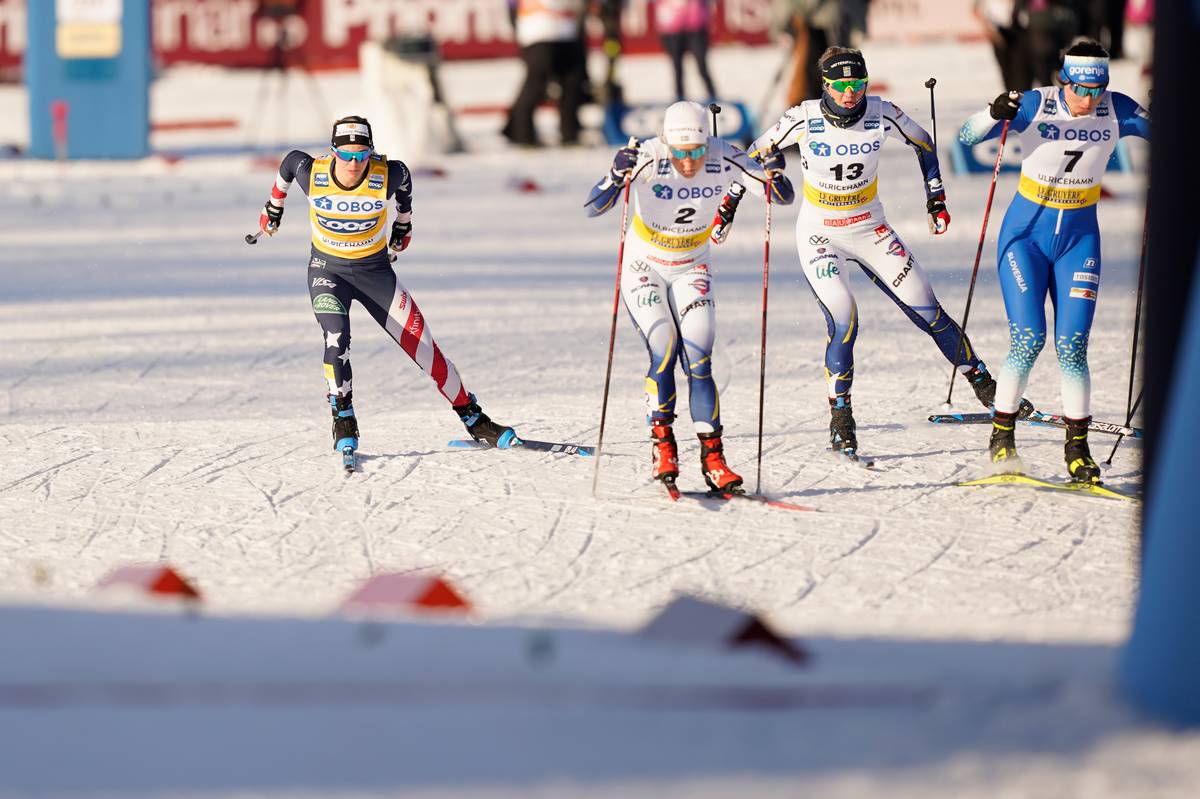
Sadie Maubet Bjornsen (far right, green bib 5) is tagged by Hailey Swirbul in the women’s 4x5km relay in Oberstdorf. (photo: Modica/NordicFocus)
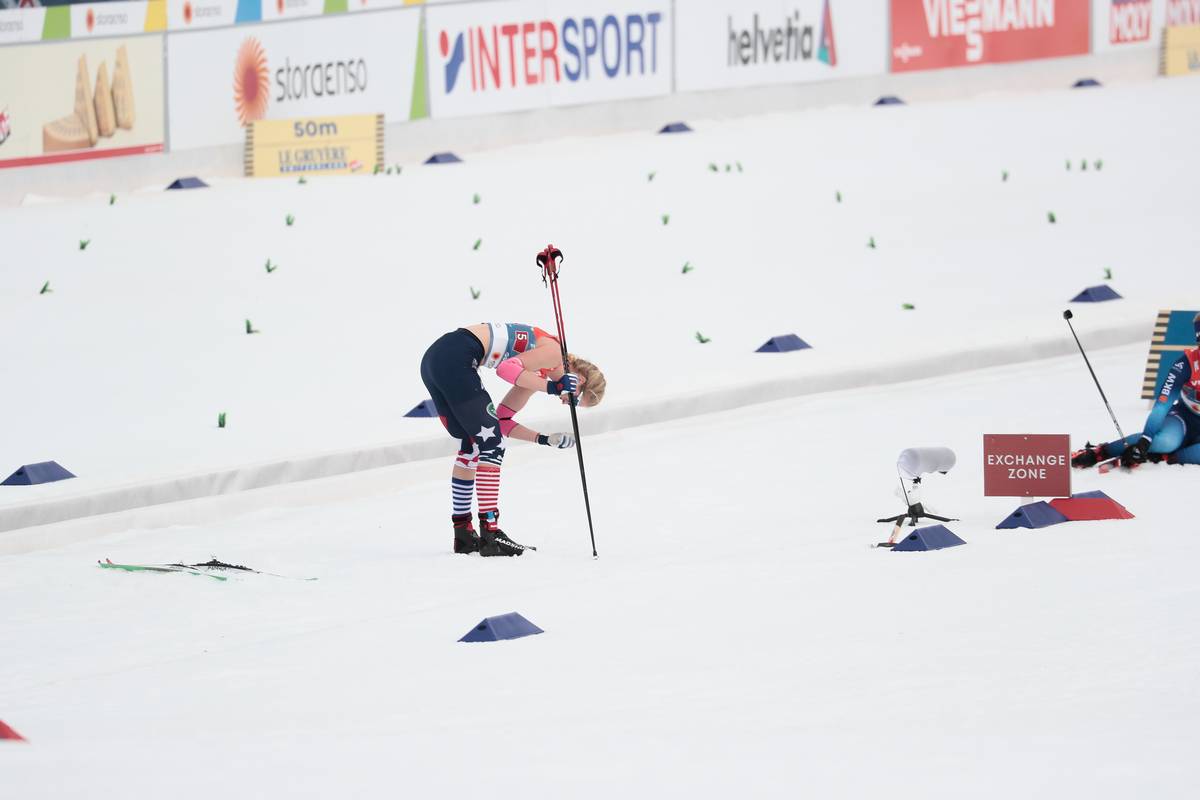
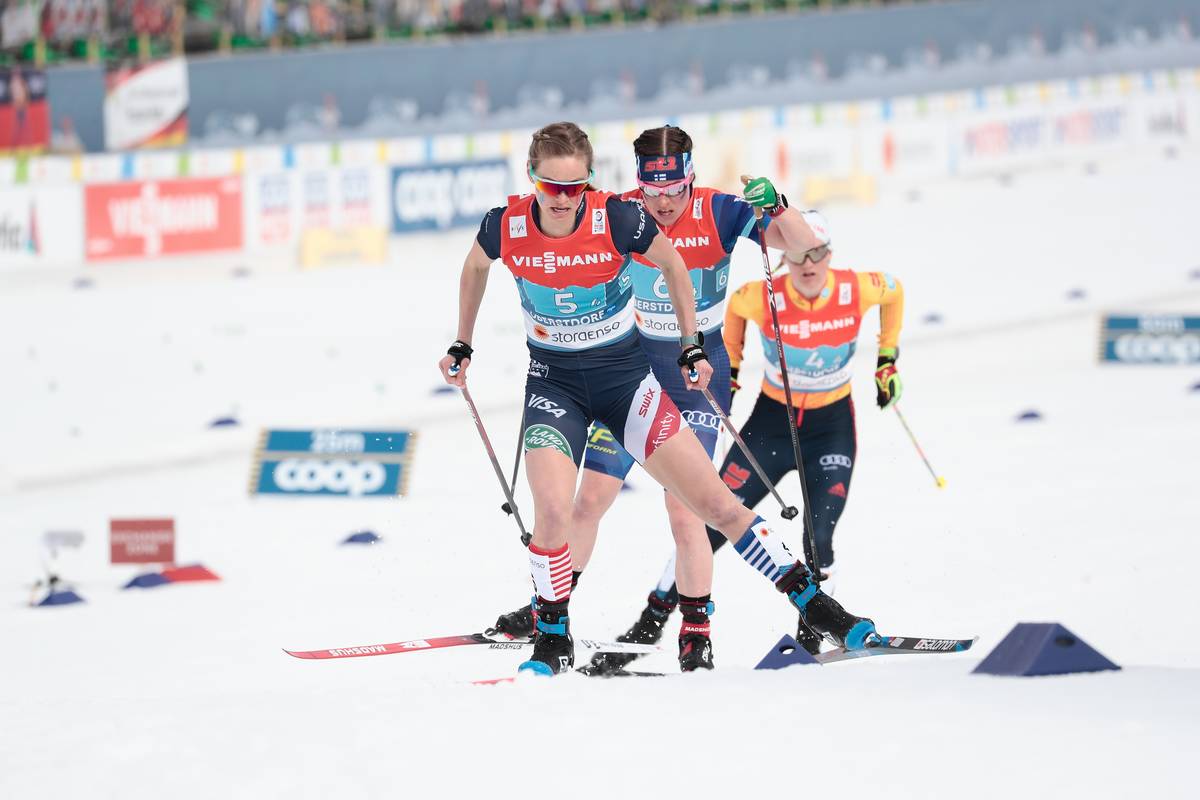
After a year of preparation, Sadie’s relay leg – the second classic leg, one last time – took her 14 minutes and 40.5 seconds. She took the handoff from Hailey Swirbul in eighth after the chaos of the scramble leg, 13 seconds out of third. Halfway through her 5-kilometer leg, she was still 11 seconds off the podium. Less than a kilometer later, she had moved the Americans up into third. She would tag off in fourth, 0.3 seconds out of third, having done precisely what she needed to do to help her team.
If you watch the replay, it is very plausible to conclude that Sadie could not indeed see by the end of her leg.
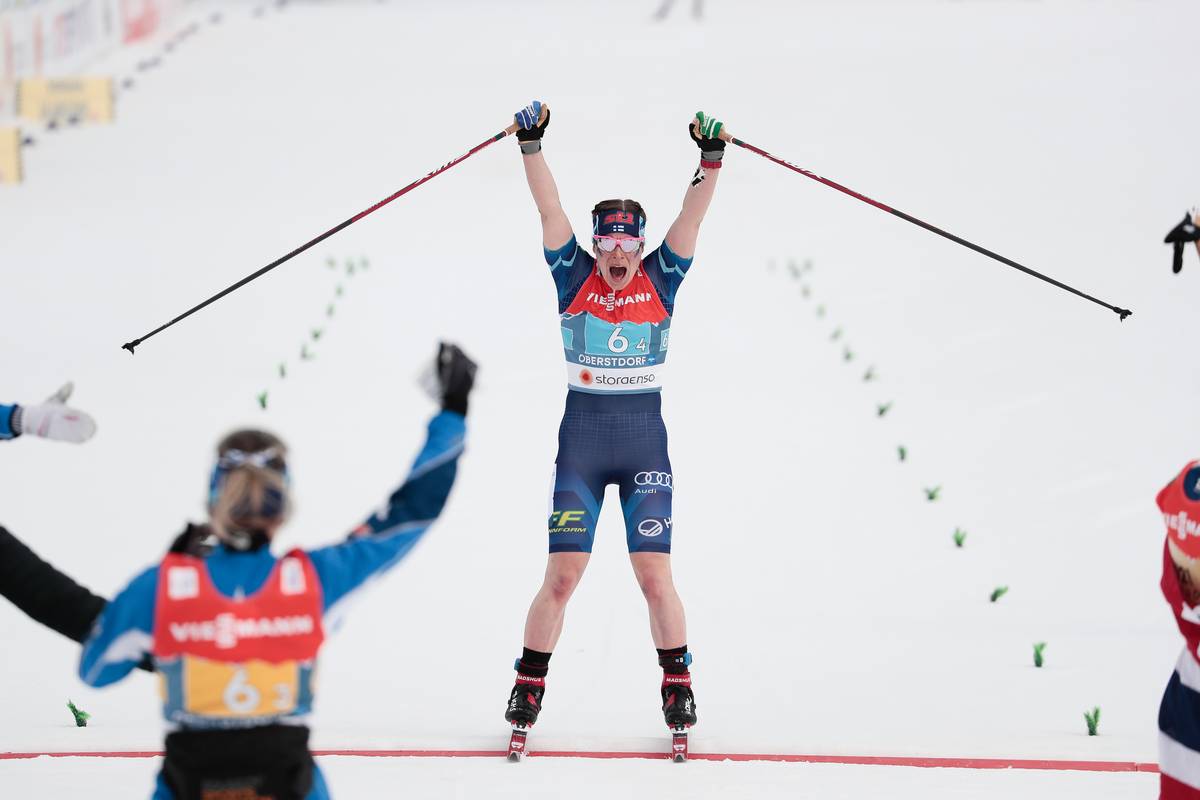
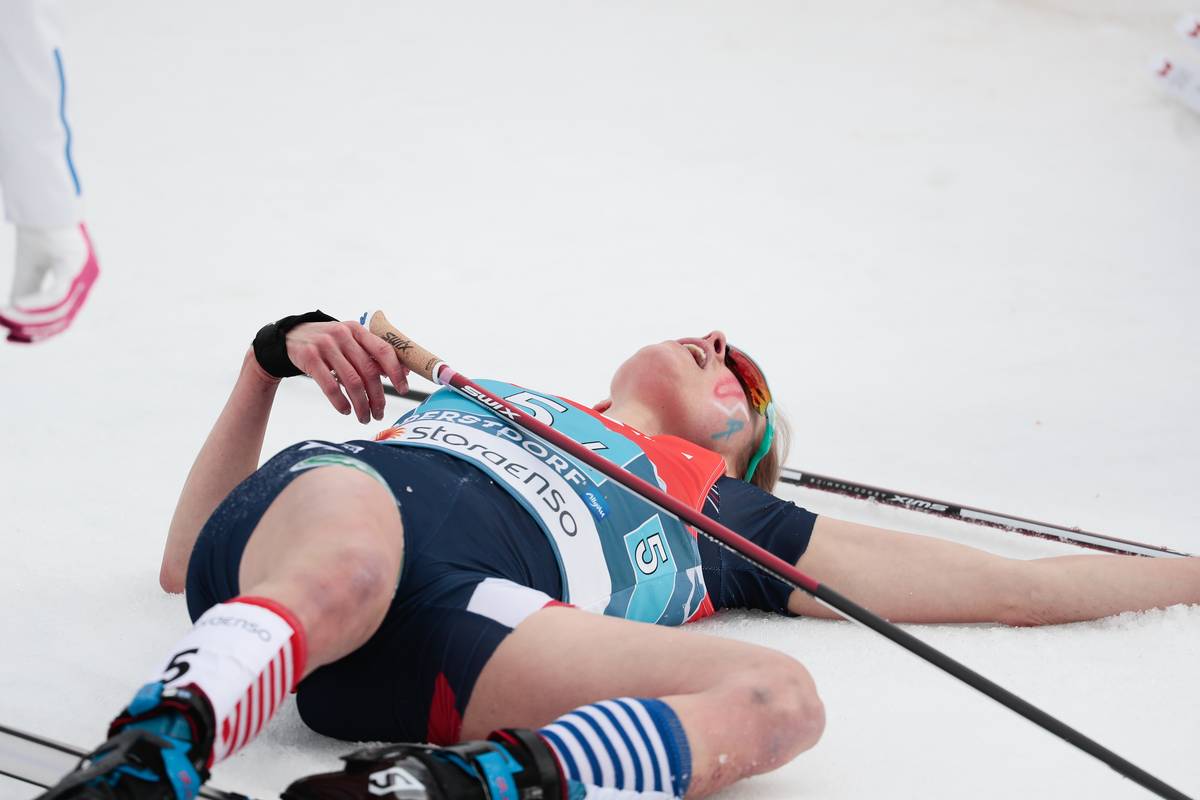
If you’re reading this website, you probably know what happened next: Sadie tagged off to Rosie Brennan for leg three; Brennan pushed hard but was unable to drop anyone around her, tagging off to Diggins in a virtual tie for third; Diggins took off for her anchor leg alongside Finnish anchor Krista Pärmäkoski; Diggins skied her heart out; it wasn’t quite enough; Finland took the bronze, with the U.S. 0.8 seconds back in fourth. It was the American women’s, and Sadie’s, fourth fourth-place finish in the last five World Championship relays. Between the relay and the team sprint, Sadie would leave Oberstdorf a combined 3.17 seconds out of taking home two medals and realizing this whimsical GIF after a year of training.
Sadie digging deep on leg two of the 4 x 5 k relay. (Photo: NordicFocus)
Sadie has no regrets: “We wanted to go to the point where we could not even see where we were going anymore,” she reflected on the relay after the season ended. “I think we literally did that. There were no regrets with that day. … It’s just an achievement in itself to know that there are no regrets. Of course you feel different when you also get the medal but I am so glad I came back for another year. This just felt different than any of the other relays I have been part of so it was certainly worth it.” Sometimes you have to set dream goals that scare you.
* * *
Sadie spent her ski career setting results goals, but she also spent it pursuing a rigorous course of study. She earned two degrees – not a double major, but two separate B.A. degrees – from Alaska Pacific University (the school, not the eponymous domestic ski club), in accounting and nonprofit management. She has embarked on coursework for her M.B.A. She has passed the first of four sections of the fiendishly difficult Uniform CPA Examination to become a certified public accountant, and sat for the second section last weekend.
She studied in the team van by headlamp while driving to and from Hatcher Pass for early-season skiing. She attended class remotely from all around the world, years before “Zoom” became a part of everyone’s lexicon. The former NCAA athlete did, in fact, go pro in sports, but she ably laid the groundwork to go pro in something other than sports now that her ski career is over.
To hear Sadie tell it, these academic demands helped, rather than hindered, her ski career. She explicitly says that doing both at the same time helped her to stay in “a perfect balance”: “When I was trying to do the best that I could in school, when you have the personality that you’re just, like, a bit of a perfectionist, it’s easy to kind of get out of balance. So for me, with ski racing, it was easy to try to perfect every single thing. And when it couldn’t happen, I would really struggle. And so school always provided that balance for skiing, and skiing provided that balance for school. And so I never looked at it that I was like, doing either of them imperfectly. I was just in a perfect balance of challenging myself both physically and mentally. So I think that it just took the pressure down enough to do both of them really well.”
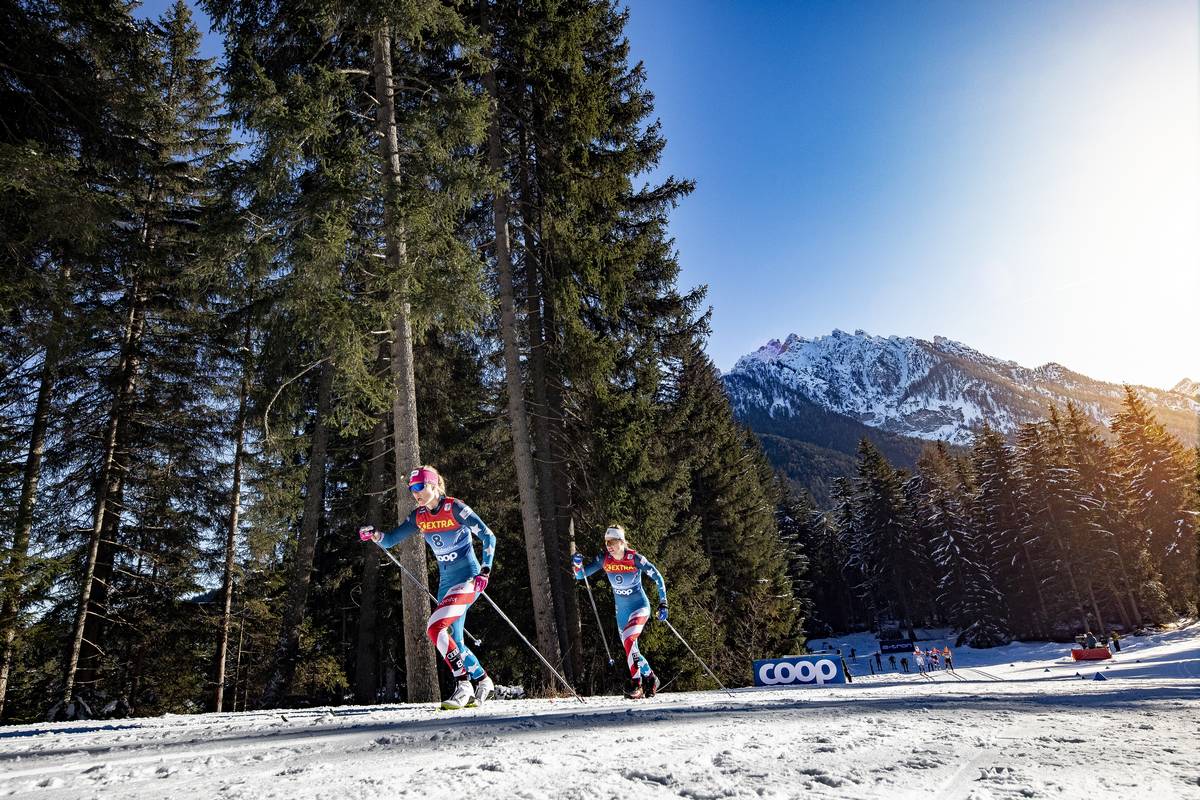
Sadie Maubet Bjornsen (left) and Rosie Brennan (right) stride in sync during the 2020 Tour de Ski in Toblach, Italy. (Photo: NordicFocus)
Balance sometimes comes at a cost. The World Cup end-of-season celebration, notorious as the first time in months when a group of the most highly disciplined athletes on earth can finally let their hair down? She pre-gamed for that by signing on to class. The morning of her first ever Olympic race? Class was at 7:30 to 9:30 p.m. Alaska time the night before, which was 5:30 to 7:30 a.m. Sochi time. Sadie, who woke up early to attend the class, appreciated the timing, as only someone who has negotiated balky European wifi for a decade can: “That was great, because that’s before anybody wakes up and breaks the internet or shuts you down.”
“That is what makes things so rewarding,” Sadie reflects on the school–skiing balancing act, “is working really hard at them and giving up things for them. Again, it was something that worked really well for me to do them together.”
Verrier, the UAA volunteer coach and longtime friend, makes similar observations.
“Sadie said something to me recently that I’ve been thinking about a lot,” Verrier wrote to FasterSkier this spring. “She told me that the most unpleasant and darkest time in her ski career was when she decided to put everything else aside and focus solely on being a professional ski racer. That approach just didn’t work for her at all. She found that she actually needed something else – her academic studies – to keep the skiing from becoming too ‘heavy.’ When she recently started working toward becoming a CPA, while still ski racing, she immediately felt much ‘lighter’ – and more successful. When I think back to when I was first getting to know Sadie at UAA, it all starts to come together and make a lot of sense to me. I don’t think she’s ever been one who thrives best with a singular focus. I think Sadie’s at her best in more complex environments. Whether it’s focusing on academics and athletics at the same time, or having chronic health issues thrown up in front of her skiing goals, I think Sadie’s most at home when there’s more than one thing going on at a time. And I don’t think I realized that about Sadie when she was a freshman at UAA. And maybe she didn’t either.”
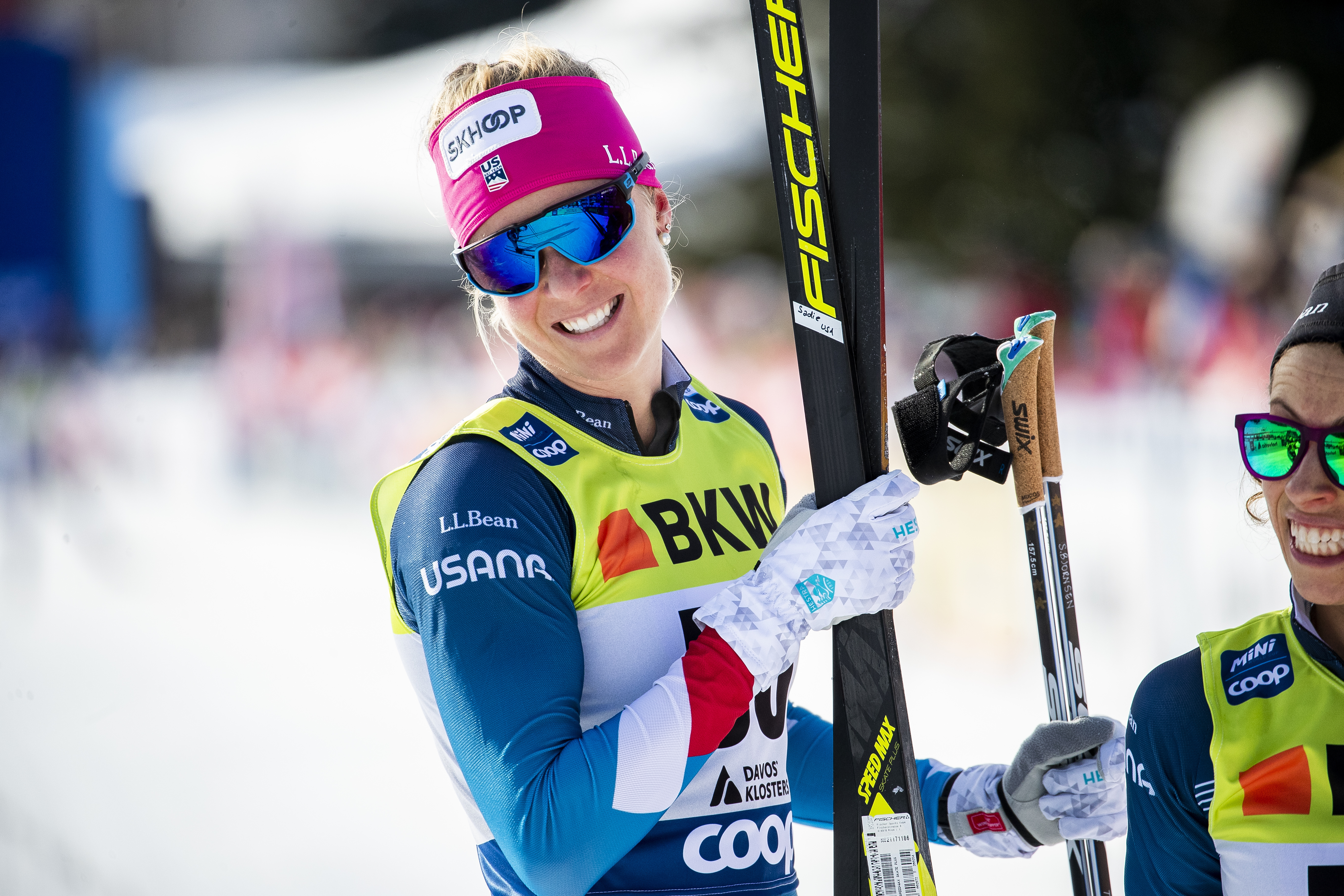
Another consistently strong performance by Sadie Maubet Bjornsen (9th) at the 10-kilometer skate race in Davos, Switzerland, in December 2019. (Photo: NordicFocus)
Everyone needs to figure out the version of balance that works well for their lives. For Sadie, this ultimately involved earning multiple degrees and studying for one of the most difficult professional licensing exams out there. Here’s Verrier again: “Now that she’s shifting her focus to a career in accounting, she recently told me she’s totally loving the challenge of being the ‘minnow’ again, instead of the ‘shark.’ And when she says it, you can see her eyes light up and you know she’s enjoying starting something new that she feels she’s not very good at yet.”
* * *
So, what’s next? For the immediate future, prepping for the CPA exam is pretty much a full-time job. Sadie passed one section, out of four, this spring, and just sat for the second section. Eventually, she will have passed all of Auditing and Attestation, Business Environment and Concepts, Financial Accounting and Reporting, and Regulation, and will be qualified to work in any of a broad range of fields, from assurance and attestation services to forensic accounting to regulatory compliance.
She has already started a business, Bjornsen Bookkeeping, and is providing simple accounting services on the side in addition to studying. She is also transitioning to a life in which she has to specifically carve out time to exercise outdoors, as opposed to automatically doing so twice daily for her job. “Being physically active used to be my job, so it was easy,” she recently wrote on Instagram in a post advocating for physical activity through local group Healthy Futures. “In the past month I have learned how easily a busy day doesn’t include activity… and it makes me feel horrible!”
Sadie plans to stay in Alaska for the time being; it is a good place to be active outside. “I do plan on staying in Anchorage and staying involved in this community despite the fact that I am done racing as a professional athlete,” she says. “I found it really inspiring this winter that Holly Brooks is still racing. She is not the Olympic athlete that she was six years ago, but she is still out there enjoying the process and racing with no shame and I found that so inspiring this winter. I also hope that I can stay involved without having such a high standard as I would have had as a professional athlete.”
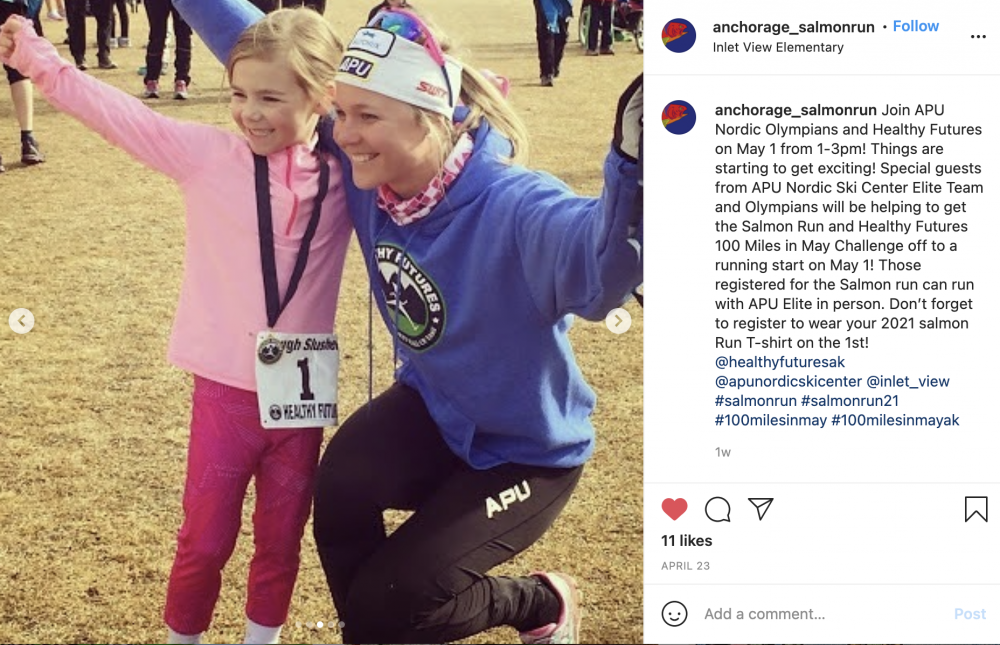
Sadie Maubet Bjornsen at a Healthy Futures community event, ca. 2017 (photo: Instagram/Anchorage Salmon Run)
An Anchorage citizens race can often boast five former Olympians in the field; Sadie may make it six. She may also continue to lend her presence to the various outreach groups and activities – Fast and Female, Healthy Futures, Tuesday Night Races – that have ensured that hundreds of kids in Anchorage already have a signed Sadie poster on their walls, or have had her lead warmups before their race.
And finally, speaking of kids, when Sadie spoke with FasterSkier for a 2016 profile, she answered the “where do you see yourself in five years” question with, “Anywhere in the world, hopefully starting a family.” It’s now five years later. While Sadie and Jo’s personal life is their own and this is emphatically not intended as a birth announcement, it seems safe to say that, should children indeed be in the picture some time soon, Sadie is well qualified to take on the prodigious balancing act that is modern motherhood.
* * *
Disclaimer: Anchorage is a small town, and Sadie and I are both affiliated with the same club program, Alaska Pacific University Nordic Ski Center. Over the years, Sadie has signed multiple posters for my children (okay, also for me as well); I have trained with her a handful of times in APUNSC program-wide bounding sessions; and my wife and I are currently hiring her husband to do light handyman work at our house. If you conclude from all of this that I cannot be completely unbiased toward her, that is, frankly, correct. However, I promise that anyone on the FasterSkier team, let alone anyone involved in American skiing over the past fifteen years, would speak of Sadie in roughly the same glowing terms that I have done here. That does not mean that this article is unbiased; it does suggest that it is representative.
* * *
Further reading (if this wasn’t enough):
Anchorage Daily News: This January, local photojournalist Marc Lester wrote and photographed a superb photo essay on Sadie’s approach to what she knew at the time was her final season of World Cup skiing
Alaska Public Media: Earlier this winter, Sadie spoke with Adam Verrier for local public radio show Outdoor Explorer, pairing with UAA/USST skier JC Schoonmaker in an hour-long episode entitled “Starting and ending World Cup ski careers”
Nordic Nation: Sadie spoke with Jason Albert for the FasterSkier podcast in 2018 about the “Sadie System,” the approach she took to managing tendon load and overall life balance alongside of competing as a professional skier
U.S. Ski & Snowboard: Sadie spoke with Tom Horrocks immediately after this season for an interview that is a far shorter version of this article and that provides a fine complement to some topics discussed here
NBC New York, “Sadie Bjornsen and Jessie Diggins explain cross-country skiing with Legos”: A delightful two-minute video that is precisely what the title promises. Plus, your chance to see Sadie enact a finish-line lunge using Lego characters.
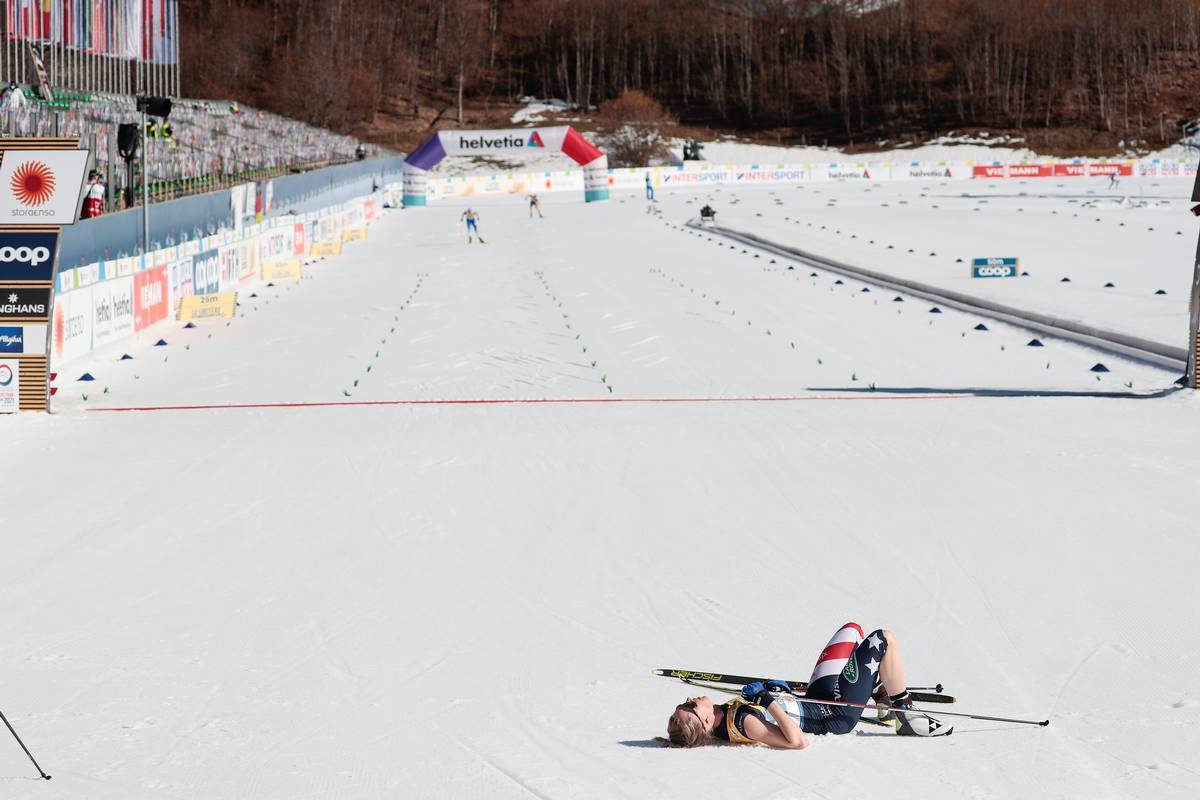
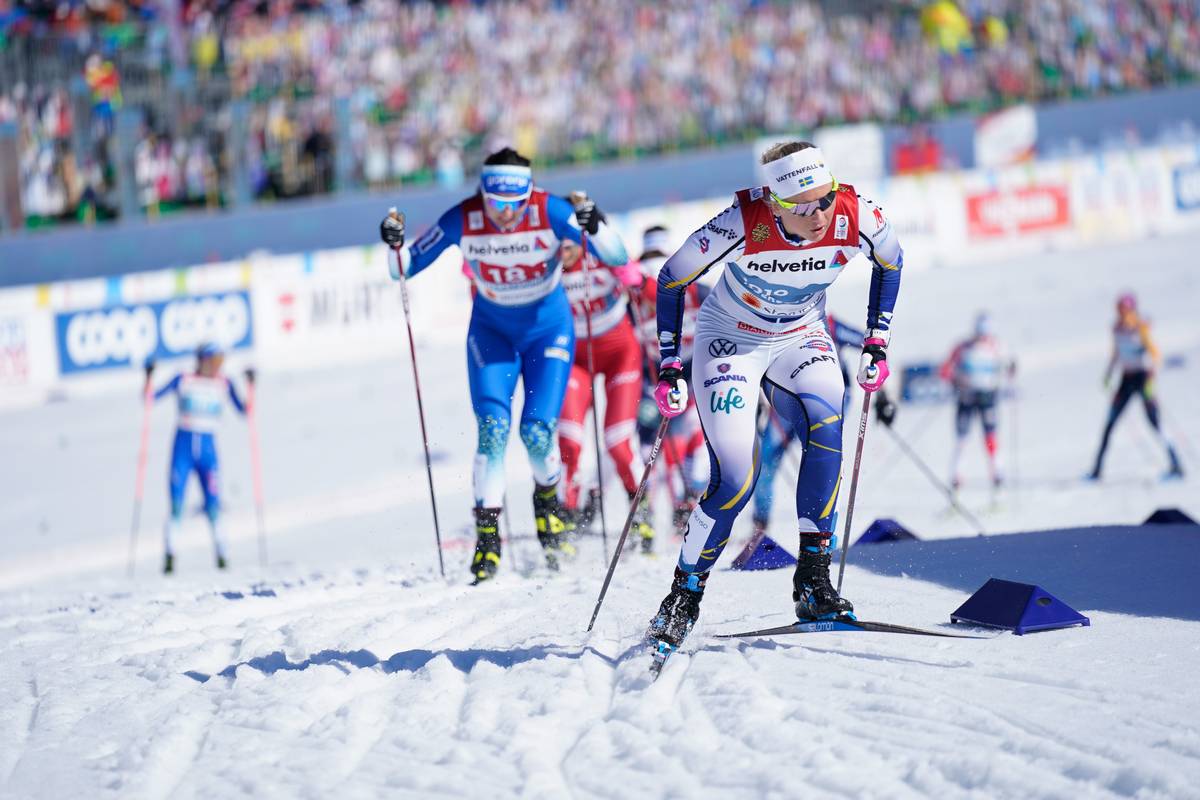
Sadie Maubet Bjornsen (left) skis alongside Yana Kirpichenko (RSF) in the 30 k classic in the 2021 World Championships in Oberstdorf. The race closed out Maubet Bjornsen’s international race career. (Photo: NordicFocus)
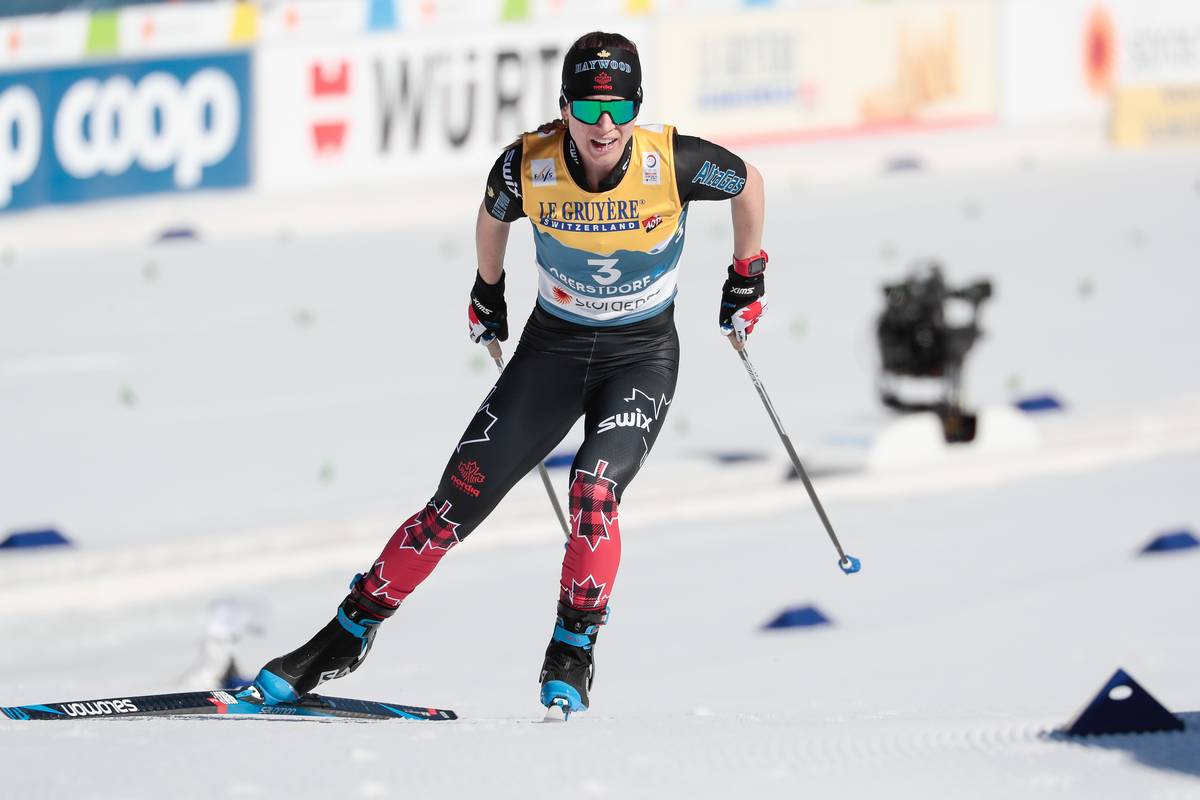
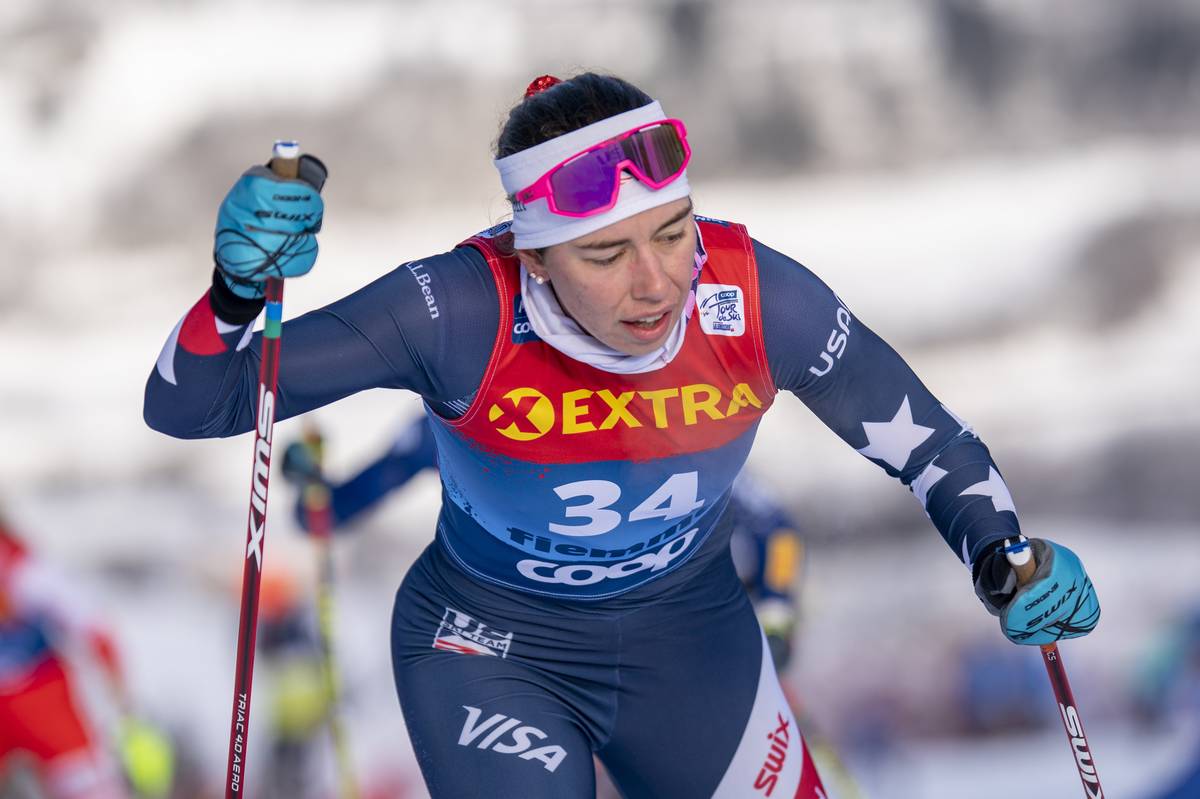
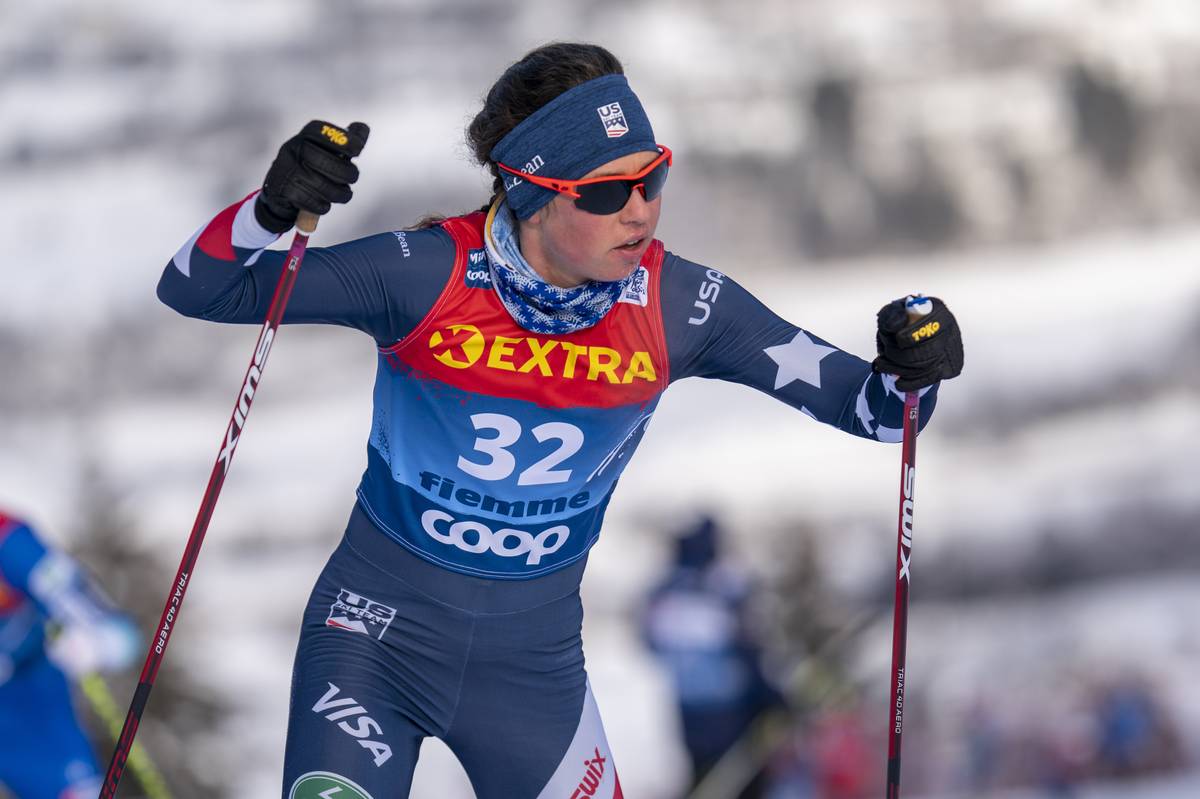
To classic ski, and to do so well, requires an athlete to perform an almost stupidly large number of tasks at the same time. You have to move two arms, two legs, and two ankles in alternation, in almost infinite variations depending upon the snow, the wax, the course, and your remaining energy. You have to mediate between power and finesse, kick and glide, stimulus and weight transfer. In short, you have to balance a whole lot of things.
If you’re this country’s most beautiful classic skier of the past decade, you’re going to have a pretty darn good sense of balance. If you’re going to train at international levels while also earning multiple degrees… and call into class the morning of your first Olympic race… and earn World Cup podiums in all disciplines… your sense of balance is going to be off the charts.
If you can do all these things, your name is Sadie Maubet Bjornsen, who retired from professional skiing after this year’s World Championships in Oberstdorf. If you’re anyone else, read on for a look at her career, and what she brought to American nordic skiing over the past decade-plus.
* * *
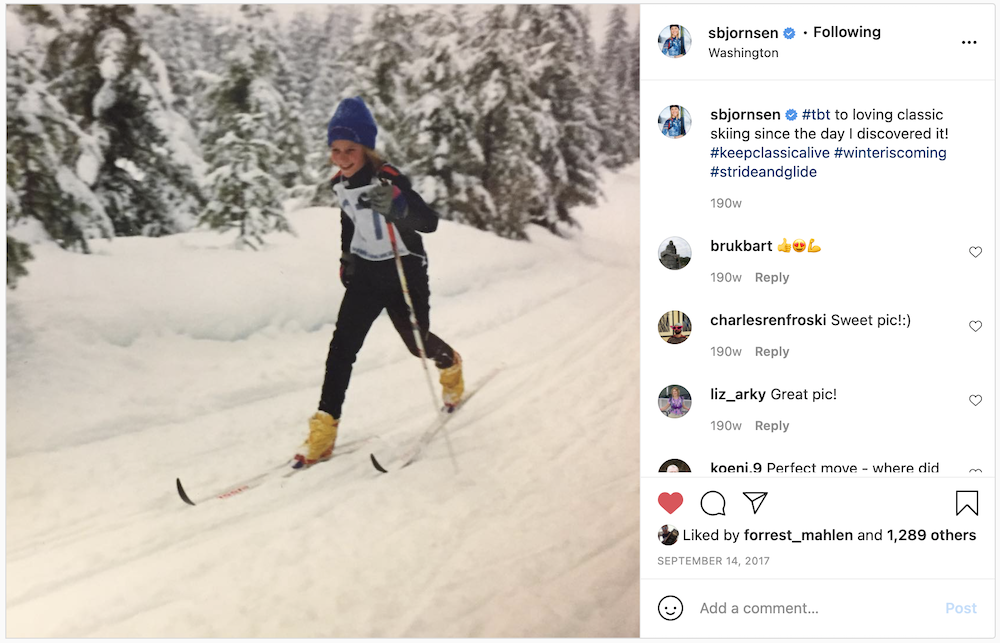
Sadie’s ski career had humble if bucolic beginnings in Washington’s Methow Valley. She skied, of course. The Methow is a pretty good place to do so. She attended an Olympic homecoming parade for neighbor Laura McCabe after Nagano, and realized that the Olympics were something you could do.
But she also ran and biked and played in the woods, and worked on construction sites moving boards around, and in general had an active and, well, balanced childhood. She didn’t rollerski till high school. She trained 250 hours as a high school freshman, up to only 380 as a senior (some high-level American juniors now train twice as much). The humorless application of a rigid and dogmatic training schedule it was not.
“I am not a good ski racer because of what I have done in the past five years, but because of the way I was raised,” Sadie noted in an April phone interview with FasterSkier. (Such a childhood seems pretty well suited to making ski racers; her younger brother, Erik Bjornsen, was also a longtime member of the national ski team.)
Sadie was not unskilled at skiing; she represented the U.S. at World Juniors at Kranj, Slovenia, in 2006, alongside future USST teammates Liz Stephen and Morgan Arritola. But, tellingly, those races in 2006 are the very first FIS races in her profile; she hadn’t been, say, shuttling between U.S. Nationals and RMISA from a young age. Sense of balance, indeed.
Sadie decided to continue skiing in college, heading north to join head coach Trond Flagstad and volunteer assistant coach Adam Verrier on the ski team at the University of Alaska Anchorage in fall 2008. On paper her results were hardly bad – she was third at 2009 NCAA Championships in the 5-kilometer classic race, for example, slightly ahead of Rosie Brennan, Caitlin Patterson, and Sophie Caldwell Hamilton, and her coaches were thrilled for her potential – but things were not going well for her as she began life as a college student. When she moved across the street to Alaska Pacific University, or APU, after the 2008/2009 season, it was as a somewhat broken athlete.
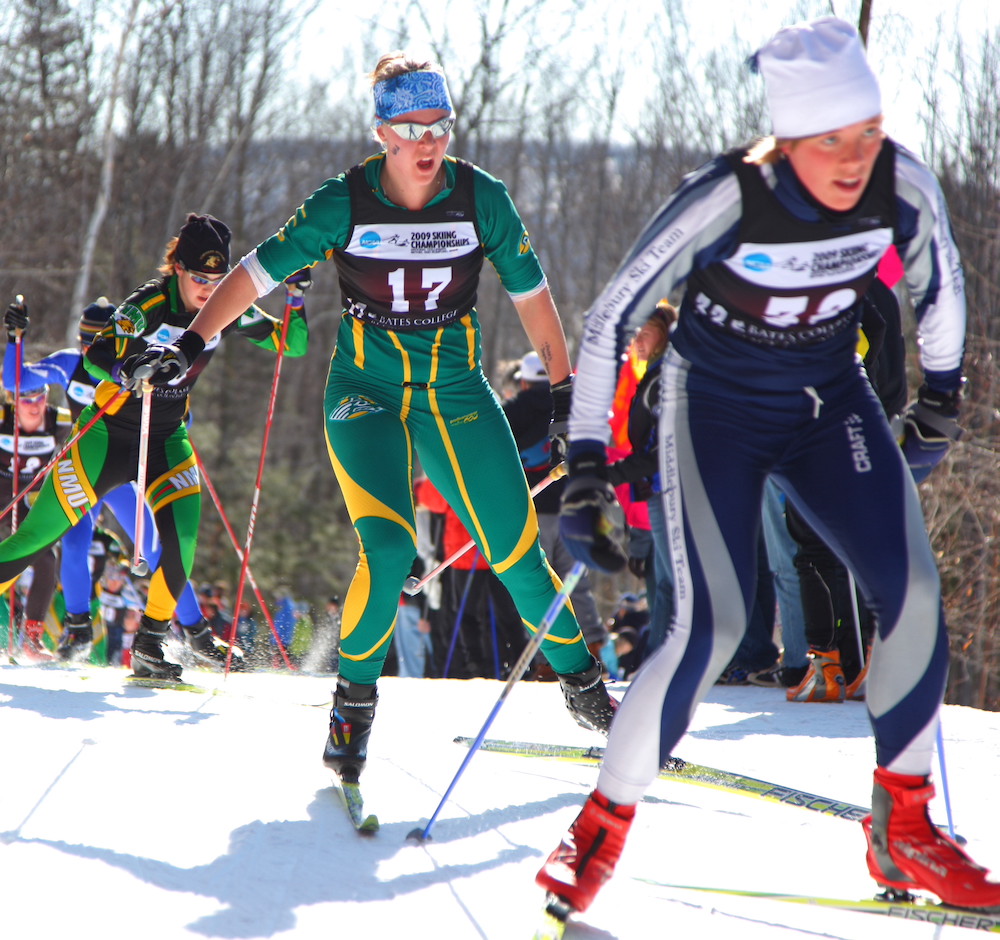
Sadie (bib 17) competes at 2009 NCAA Championships in Rumford, Maine, for UAA. (photo: Trond Flagstad)
“I came in [to APU] kind of as a broken, injured race car,” Sadie recalls. “I could not train for more than 30 minutes and I was not training much, under 500 hours, and somehow [APU head coach Erik] Flora believed in me. I have no idea why; I still wonder that to this day, what gave him the belief because I was not racing well the year that I came here. I had had my worst season ever, I dropped out of college and I had my worst season ever because like I said, I need balance. He took a chance on me, and I remember telling him I wanted to make the World Championships team. And that was certainly a laughable thing to say, but he was totally supportive and he designed a program for this girl who could only train 30 minutes at a time.”
Reader, she made the World Championships team. She made the team for Oslo, in 2011; for Val di Fiemme, in 2013; for Falun, in 2015; for Lahti, in 2017; for Seefeld, in 2019; and for Oberstdorf, in 2021. She also made two Olympic teams in that time, in 2014 and 2018. We’ll have more on her results later, but that’s a heck of a CV for someone who couldn’t train for more than 30 minutes at a stretch two years before her first World Cup podium.
* * *
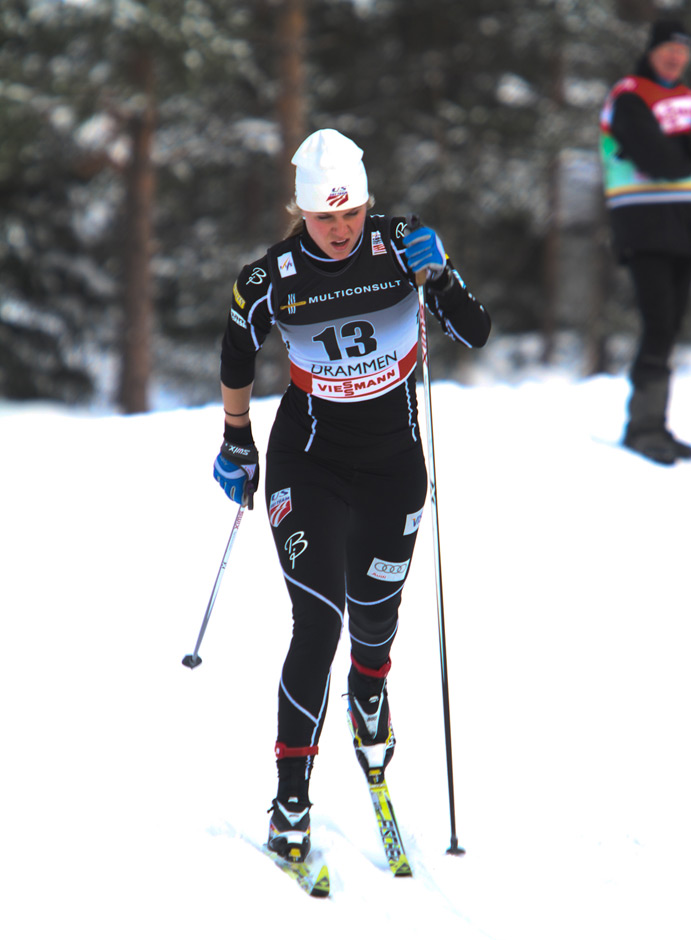
Sadie, of course, did not know that any of this would come to pass when she toed the line in her first-ever World Cup weekend, a skate sprint and 10 k classic in Drammen, Norway, in February 2011. 1.2 kilometers for the qualifier, go as fast as you can, top 30 athletes make the heats and get to keep on racing. Everyone else goes home.
There were 71 athletes in the field that day. Maiken Caspersen Falla of Norway won qualifying. Kikkan Randall won the final. Sadie, then 21 years old, finished 42nd, nearly two seconds out of qualifying – frankly, in sprint racing, at least a 1.2-kilometer sprint covered in roughly 2:16, that’s not particularly close. Sadie’s name appears nowhere in this website’s contemporary race writeup, not even a half sentence at the end giving a cursory listing of other North Americans who also raced.
Sadie in her inaugural World Cup weekend, in February 2011, in the 10 k classic. (There are no photos of her in the sprint qualifier in the FS database.) This photo was originally captioned, “Sadie Bjornsen (USA) with her sharp classic form.”
Was Sadie surprised that she didn’t make the heats? Oh yes.
“I had a really strong memory from that first one,” she now reminisces. “I remember crossing the line after the sprint and going up to [USST head coach Chris] Grover and saying, ‘There is no way I did not qualify. I think the timing is wrong.’
“I cannot believe how sure I was of myself at that age, because now I look at the young kids and think, Wow, how do they think they can win? That is incredible, I think I missed that! I was not thinking that I was winning, I was just sure that I had qualified. I think there is something to be said about being young, just having so much confidence. After asking him, ‘Did they mess up?’ my next question was, ‘What did I do wrong? Where did I lose that time, because I know I did it perfectly!’ He went on to explain, ‘Oh, well, in this finishing stretch there is a lot of time you can lose,’ and so on.
“It was a little bit of a learning experience for me. It turns out World Cup skiing is pretty darn fast, I just had no idea.”
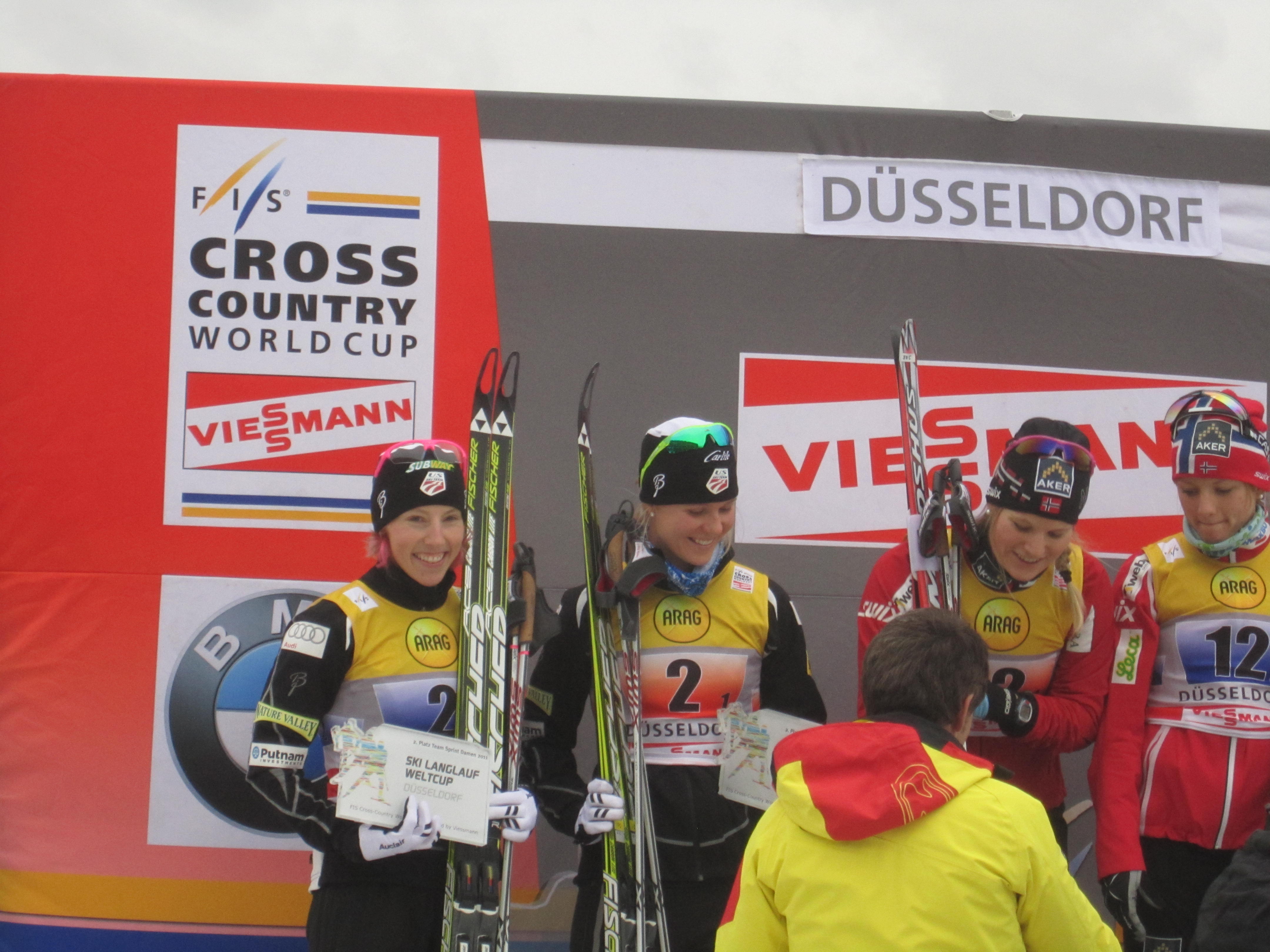
Less than a year later, Sadie was standing on the World Cup podium: Sadie Bjornsen and Kikkan Randall, second, team sprint, Düsseldorf, Germany, December 2011. It was the first World Cup team sprint podium in American history. FasterSkier’s race recap was headlined “Americans pull off surprise second,” and expressed sentiments such as, “the American pair, while talented, was going to have to have a good day to make the final.” No insult was intended, it was just a very, very different era in American skiing.
Randall (L) and Bjornsen (R) on the podium in Düsseldorf, Germany, December 2011. Team Sprint World Cup silver. Photo: Kieran Jones
Both athletes, when asked about this race a decade later, independently sound similar notes as they recall this moment: Randall was the seasoned veteran with multiple podiums to her name who knew what she was doing; Sadie was the 22-year-old rookie who had never made the World Cup sprint heats in her life, with a 34th in qualifying on the same course the day before serving as her previous highwater mark through that point in her career.
Here’s Randall, in a recent email to FasterSkier: “One great memory was in 2011 when Sadie and I teamed up for the World Cup team sprint in Düsseldorf. In between the semis and finals Sadie was so nervous she could hardly sit still. I managed to fall asleep for a few minutes and she couldn’t believe I was able to be so calm. Once we got out on the snow, Sadie found her composure and we went on to win the silver medal together for the first ever World Cup team sprint podium result.”
And, in much the same vein, here’s Sadie, earlier this spring: “I would say Kikkan did the brunt of the work in that race but it was like a race car driving race. All I had to do was stay on my feet. Somehow I did that and she had that killer finishing sprint. But it was a great moment.”
(For historical perspective, here’s Sadie’s quote to this website in December 2011, from the race writeup linked above: “It’s the greatest thing to happen so far! It hasn’t even sunk in yet! It helps to have a sprint champion like Kikkan on your team, that’s for sure.”)
Hindsight is, famously, 20/20, and we all know now that both athletes would earn a World Championships medal in this event within their careers, Randall in 2013 and Sadie in 2017 (in each case teaming up with Jessie Diggins). But what was Sadie thinking at the time?
U.S. Ski Team teammates Jessie Diggins (l) and Sadie Bjornsen celebrate their bronze medal in the women’s 6 x 1.3-kilometer classic team sprint at the 2017 Nordic World Championships in Lahti, Finland. (Photo: John Lazenby/Lazenbyphoto.com)
“I definitely did not expect that,” she says now, “and I would say that was a shiny moment before the next three years of near misses. I think it took me about three years to consistently qualify top-30. … I do remember that podium being like, Oh wait! I might actually be good after all! You know, World Cup racing does not make you feel good about yourself when you are never racing top 30. That Düsseldorf podium was definitely the thing that fueled me for the next three years as I went through the tough process of making the steps to being a World Cup racer.”
* * *
This process is tough for any World Cup skier; any athlete competing at this level is working her butt off to excel in a sport where small margins mean medals. But few athletes did this work against such a consistent backdrop of injury and limitations as Sadie dealt with throughout her entire career.
When Sadie was 16 years old, she took an antibiotic, Levaquin, that had been prescribed for a sinus infection. It had enduring and devastating effects: “it had this side effect of permanent damage to your tendons and your ability for your tendons to recover,” as Sadie puts it.
Sadie Bjornsen, of APU and the U.S. Ski Team, during a SkiErg interval workout at her home in Anchorage, Alaska. She didn’t have to do this workout in sandals or some other form of heel-less shoe, as was sometimes the case. (Courtesy photo)
The result was, in Sadie’s words, “continuous injury” for the next 15 years of her life, variously manifesting as, among other things, foot tendonitis and/or elbow tendonitis and/or knee tendonitis – these are sort of important joints and body parts for a pro athlete. Most World Cup skiers spend, in round numbers, 40 percent or more of their average annual training hours running. Some years, Sadie couldn’t run at all. Some years, it was SkiErg, and aqua jogging, and ski walking, or even skipping, sometimes in 30-minute increments or less when that was all that her body could handle, as many times a day as she could manage and her tendons could bear. Sadie estimates that she was able to consistently run for only around a fifth of her competitive career.
It seems slightly dismissive to call all of this “injuries” – an injury is typically something that you come back from, recover from, and move on, maybe even stronger than before. Sadie’s tendinopathy was far more endemic, insidious, ever-present. You don’t have an independent blank in your training log for “overall tendon load,” in which you carefully estimate the strain placed on each of several large tendon groups in the body, with an eye to curtailing or cancelling the next day’s training session if that cumulative load is too high, a decade after a broken bone. You don’t literally drill a hole in the back of your ski boot a decade after a stress fracture. There are injuries, and then there’s continuous injury.
Sadie recovers after the 10 k interval start skate at this year’s World Championships in Oberstdorf. (photo: Modica/NordicFocus.)
Whatever you call it, it would be blithe to dismiss its deleterious effects on Sadie’s career: In a sport defined by physical performance, any limitation on what you can do, physically, is not going to help you, physically. But mentally, or conceptually, or holistically, or on some other facets that help to make up a complete athlete? The entirety of Sadie’s career makes a profound argument that there are some silver linings to be found here.
Here’s Adam Verrier, the longtime UAA volunteer, reflecting on these issues. He doesn’t quite say “talent needs trauma,” a shorthand for the notion that talented potential is often well-served by some form of challenge, but it’s close:
“As I’ve watched Sadie’s athletic career and her academic path, it’s become clear that she really enjoys the process of trying to accomplish a goal that is so challenging that she doesn’t know whether she’ll be able to succeed or not,” Verrier wrote to FasterSkier. “Sadie’s tendon problems have been a constant throughout her entire career, and they’ve hampered her training to the extent that she can’t train in the ‘typical’ way at all.
She’s relegated to lots of aqua-jogging and Ski-erging, and I don’t mean to talk shit about aqua-jogging, but it’s not the typical path to the World Cup ski podium.
“I’ve sometimes wondered, though, whether Sadie would have done as well as she did if she didn’t have her health problems. I’ve wondered if her chronic tendon issues have put up the roadblock that she’s needed – as a foil – something to fight against. I wonder if her chronic tendon issues are the thing that’s made this whole thing interesting for Sadie and has kept her attention throughout her ski career and has, in fact, enabled her success. I recently asked her about that, and she agreed that perhaps the whole experience would have been less interesting and compelling if she could run a lot and rollerski a lot, like most everybody else.
“Sadie’s a problem solver by nature, and she has the patience and the resolve to take on big goals and try to find a way over, around, or through the roadblocks to reach her ultimate goal. Watching Sadie’s career over the years, the thing that has stood out for me has been her willingness to embrace difficult challenges and go into the fight with one hand tied behind her back.”
Randall, writing separately, observed almost exactly the same thing: “I don’t think I can recall a time when Sadie wasn’t dealing with an injury,” she told FasterSkier. “Yet she never let the injuries be setbacks or excuses. She was always so determined and creative in finding ways to train in alternative ways and she made the adversity into her own magic. Her example helped influence a positive can-do culture on our teams. … Sadie got so good at managing her alternative training and I wonder if it actually gave her an advantage in the long run. Kind of like tying one hand behind your back and then all of the sudden having two hands to work with. It takes incredible mental fortitude and belief, but it has its upsides too. You could say that is Sadie’s super power!”
And, just to complete the trifecta, here’s Sadie herself on this issue: “Things have never been steady, smooth sailing for me. But sometimes that is what created who I was. It actually forced me to make my brain the strongest muscle in my body, and I think we do not always train the brain enough. We think about training our quad muscles or our arm muscles the best, and so something that was a bit of a challenge to me actually created some strength of its own.
Sadie Bjornsen (USST/APU) rollerskiing at Soldier Hollow in Midway, Utah, in 2014, a loop course unlike the one-way uphill climbs on the Anchorage Hillside. (Photo: USSA)
“It definitely was unbelievably frustrating when I am on the tenth injury of the summer, I am having to do my own thing and I cannot come to normal training, and I have to make Flora carry my classic skis in the car because I can only ski for 30 minutes and I will be way out on the Hillside and cannot get back to my car. Often I just felt like a pain in the butt, like why does this keep happening to me? It was something that I always had to work around and I think that it actually made me stronger in the end. Because when I did have the chance to race, it was such a gift, it was never something that I took for granted because I never knew that I was going to actually show up and be able to do it.”
Sadie continues, “A part of being injured all the time is you have to learn to forget it, or not let it hold you back. I would not say I ever truly conquered that, but I made sense of it. I do remember summers where … literally I would not classic ski the whole entire summer. Or, I believe, there was a summer that it was skating. I do remember when you are showing up at Ruka [for the opening World Cup weekend], I had not been able to ski for basically two months before I showed up. I had literally had to hole out the back of my boot. I showed up to the organizers and asked permission to modify my equipment, and my tech just took a knife and made a bolt hole out the back. Then I went out the next day and I won the qual. Nobody believed it, I did not believe it, but I think that fight that keeps you pushing through injuries gives you so much power.”
U.S. Ski Team and Alaska Pacific University teammates Sadie Bjornsen (r) and Kikkan Randall during a ski-walking workout on Gasline in fall 2016. (Photo: courtesy Sadie Bjornsen)
Call it what you will – flexibility, response to adversity, talent needs trauma – but these themes came to a head in summer 2016. Randall had just had a baby, developed diastasis recti during pregnancy, and didn’t get back into running until six or seven months after Breck’s April birth. Sadie was suffering from worse tendinopathy than usual, and couldn’t run. Or classic ski. And so that summer, the two of them ski walked up Gasline, a rolling, five-mile climb at the edge of Anchorage, at least, literally, 100 times. Meet at Glen Alps, stash a car, carpool down to Hillside, ski walk up, drive back down to Hillside. Repeat. Watch out for bears.
“Sadie and I did a bunch of Gasline and alternative training sessions” that summer and fall, Randall recalls. “I remember it being so nice to have those workouts to talk and push each other and feel like we weren’t totally alone and away from the team. It almost didn’t seem like we were missing anything because those workouts were so enjoyable and productive. I appreciated the time to spend one-on-one with Sadie and get to have fantastic conversations, and jokes.”
“We had to come up with something to talk about all 100 days,” reminisces Sadie. “It takes about an hour and 20 minutes to walk up that hill and there are bears along the way so we had to be loud. I remember bonding with her that year like I never had and developing an incredible friendship with her. I think we both went through it that summer because she was coming back from having a kid and you know there are challenges with that. … I think that day after day we believed that it did not matter that it was weird or different or imperfect, we both were bonding together knowing that we could make it happen. … It definitely is a great example of being in an individual sport with a team. I bet we both carried each other a bit that year.”
Sadie Bjornsen (r) tends to her U.S. teammate Jessie Diggins after Diggins outlunged Sweden’s Stina Nilsson (not shown) for the bronze medal in the women’s 6 x 1.3-kilometer classic team sprint on Sunday at the 2017 Nordic World Championships in Lahti, Finland. (Photo: John Lazenby/Lazenbyphoto.com)
After ski walking through summer and fall of 2016, both athletes would medal at World Championships in Lahti in spring 2017 – Randall in the individual skate sprint, Sadie in the classic team sprint, skiing in a technique that she literally had been unable to do all summer.
“When I did have the chance to race,” Sadie says now, “it was such a gift. It was never something that I took for granted because I never knew that I was going to actually show up and be able to do it.”
At the time, a day after the medal in Lahti, Sadie gave an interview to FasterSkier in which, referring to setting the goal of medaling in this event when she couldn’t even classic ski, she said, “If you don’t have those dream goals, then maybe you don’t belong here, because you’re not reaching for the highest level. … Or maybe you’ll never reach this level, because you never put something out there that was really risky and really scary and really intimidating to say, even. And I think that’s really important in making this step, and maybe even a really integral part of our team.”
In part two: some not-so-glamorous parts of the World Cup grind; Sadie’s overall career accomplishments; and why she trained for one more year to race for 15 minutes.
A clear day after Friday’s snowstorm greeted the start of the women’s 30 k classic in Oberstdorf. (Photo: NordicFocus)
This World Championship coverage is made possible through the generous support of Marty and Kathy Hall and their A Hall Mark of Excellence Award. To learn more about A Hall Mark of Excellence Award or to learn how you can support FasterSkier’s coverage please contact info@fasterskier.com.
A blanket of fresh snow lay on the ground while the frozen rocky peaks of the Bavarian Alps peaked through the clouds. Finally, Oberstdorf, Germany looked like a wintery venue.
With temperatures that might feel brisk relative to the tropical heatwave earlier in the week, the women’s field took to the tracks for their final event of the 2021 World Championships: a 30-kilometer mass start classic.
The women’s 30 k closes out racing for the women at the 2021 World Champs. (Photo: NordicFocus)
To set the stage for today’s race, one should first look back to the 2019 World Championships, which featured a 30 k freestyle, and the 30 k classic at last year’s Holmenkollen in Oslo, the last World Cup race to take place before the season was truncated due to the rise of the COVID-19 pandemic.
Let’s glance at the World Champs in Seefeld, Austria, where Norway’s Therese Johaug led the field through the first 5 k, then pulled away. She gapped the field by more than 30 seconds, holding her ground on her own at the front for the remainder of the race. Her teammate Ingvild Flugstad Østberg led the chasers to take second place, followed by, what was at the time a new name, Sweden’s 19-year-old Frida Karlsson, earning a bronze medal in her inaugural World Championships.
Johaug’s performance at the Holmenkollen looked to be an attempt to repeat this style of victory. She was off the front at the 20 k mark, but had not taken the opportunity to switch her skis. Working together on fresh boards were Karlsson and teammate Ebba Andersson, who steadily closed the gap to Johaug. With less than 2 k to go, Karlsson could be seen from the same camera angle, gaining ground with every kick and glide.
Inside the last kilometer, Karlsson overtook Johaug on a long climb. Despite the Norwegian’s best efforts, she could not match the speed of the Swede’s skis on the downhill and Karlsson broke away to win by just under 2 seconds.
So what would it be today?
Therese Johaug on course during the World Championshp 30 k classic in Oberstdorf, Germany. (Photo: NordicFocus)
Johaug’s pace from the start seemed impossible to sustain for the full duration of the event. While other women looked steady and controlled, Johaug was simply charging, her rapid breathing matched by her tempo.
By 10 k, Johaug had a lead of over 53 seconds to the first chase group, led by her teammate Heidi Weng, Andersson of Sweden, and Katharina Hennig of Germany. At the halfway mark, this lead ballooned to over 1:32. Even if impeded by subpar skis, it looked to be an insurmountable margin. Spoiler alert: it was. This left a race for silver and gold in her wake.
Ebba Andersson, Heidi Weng, Frida Karlsson, and Therese Stadlober – the main chasers – play for second and third place as Johaug skis off the front. (Photo: NordicFocus)
A pack of five women seemed to be pulling ahead of the larger chase group that had been together from the start. At 15k it was: Andersson, Karlsson, Weng, Hennig, and Therese Stadlober of Austria.
After a 15 second gap, Krista Pärmäkoski skied alone in an effort to gap up, leaving behind a second chase group that included Sadie Maubet Bjornsen in 8th, in what she announced would be the final race of her professional career.
Sadie Maubet Bjornsen (USA) alongside Yana Kirpichenko (RSF), (l-r) in the 30 k classic. The race closes out Maubet Bjornsen’s international race career. (Photo: NordicFocus)
At 18k Johaug smoothly switched into new boards, while the first chase pack worked their way toward the stadium in the background. Johaug’s gap was approaching two minutes.
A solo affair for the win: Therese Johuag of Norway during the 30 k classic. (Photo: NordicFocus)
Inside the final 10k, a few women led by Pärmäkoski, had gapped up to the first chase group. After a crash took out the three women at the front — Andersson, Karlsson, and Weng — Stadlober snuck around the right side, increasing her tempo to kick and glide away from the women now 16 seconds behind her in pursuit.
Striding and poling in sync, Karlsson, Andersson, and Weng looked determined to regain contact with the Austrian. As they departed the stadium in the sun with 6k to go, the threesome had achieved this goal. They strided away up tracks that looked to be eroding in the sun, heading into the woods where the course looked much different. As more crashes had already happened behind them on sugary sweeping downhills, the task ahead looked to be as much about staying upright as skiing fast.
Heidi Weng (NOR) leads Therese Stadlober (AUT) and Frida Karlsson (SWE) during the mass start 30 k classic. (Photo: NordicFocus)
Talking to a trailside coach on a climb with 2k to go, Johaug seemed to be basking in the confidence of her victory. Attacking through the final kilometer of the course nonetheless, Johaug alternated between a spicy double pole and throwing her arms up in celebration as she made her way down the finishing lanes to stop the clock in 1:24:56.3.
Therese Johaug is a singular distance champ. (Photo: NordicFocus)
Earning her 14th championship medal, ten of which are gold, Johaug has overtaken Norwegian ski legend Marit Bjørgen for the most World Championship medals. The first in her collection was a bronze in the 30k classic in Sapporo, Japan in 2007. Johaug struck out in 2009, but came into the 2011 World Championships on her home turf in Oslo ready to go, taking gold in the 30 k skate and relay, and bronze in the skiathlon.
Johaug is also the second woman to have won 30 k events in both freestyle and classic at the World Championship, following in the footsteps of Elena Välbe of Russia who retired after the Nagano Olympics in 1998. Johaug also joins Välbe and Bjørgen as the only women to have won successive 30 k events at a World Championships.
Therese Johaug takes a fourth gold medal in the 30 k mass start classic. (Photo: NordicFocus)
“It’s amazing, actually,” said of her string of four gold medal performances in Oberstdorf in a post-race interview with FIS. “I work so hard for it, training so much to reach my goals. To come here to Oberstdorf and fight for four gold medals, I have no words. I know so many girls train really hard to reach their goals, and I know that I have a lot of pressure on me when I come here. I was a favorite to win the distance, but you have to do it, and it takes a lot of focus to reach your goals.”
The FIS interviewer called it the “era of Therese Johaug”, to which the Norwegian gave an emotional response, her voice breaking tearfully with her final statement.
“I never have been in such good shape. I am so happy. I’m 33 years and I know I’m getting older and older and I know that this time ends soon, so I am just so happy.”
Sun, glory, and another championship distance win. (Photo: NordicFocus)
In the closing kilometers of the race for silver and bronze, Weng, Andersson, and Karlsson began to drop Stadlober. Finding a new gear as she surged up the last steep climb, Weng rounded the hairpin turn in the lead and dropped into a tuck.
With just a sugary right hand curve out of the downhill to navigate before the final straightaway, Weng was shooting her shot. However, Karlsson’s skis and double pole were superior as they headed down the lanes, gaining her centimeters on Weng with each strike.
In the end, the small gap Weng had created from her move was enough. By a margin of 0.6 seconds, Weng took silver (+2:34.2), leaving Karlsson with her second bronze medal in the event (+2:34.8).
Frida Karlsson, and Heidi Weng (NOR), (l-r) dual for silver and bronze. (Photo: NordicFocus)Heidi Weng (NOR) edges out Frida Karlsson (SWE) for a silver medal in the 30 k classic. (Photo: NordicFocus)
Andersson held on for fourth (+2:36.3), followed by Stadlober in fifth (+2:59.4).
After the finish, Karlsson was seen rolling up the sleeve of her race suit and holding her forearm, which she proceeded to show the Swedish support staff. After icing and splinting the injury, she was reportedly taken away by medical staff and did not participate in the podium ceremony. In an interview with the Swedish news outlet Expressen, a team doctor explained that the injury occured in the crash with Andersson and Weng and that she is being taken to the hospital for x-rays. FasterSkier will share additional information as it becomes available.
Frida Karlsson was carted away for x-rays after a bronze medal performance in the 30 k classic. (Photo: Expressen.se)Only gold and silver represented at the podium ceremony after the 30 k classic. Therese Johaug (NOR) took the win ahead of Heidi Weng (NOR), with Frida Karlsson (SWE) earning bronze before being taken away for x-rays of her arm injury. (Photo: NordicFocus)
Turning our focus to North America, Maubet Bjornsen skied her way to 15th. After falling off the pace with the second chase group as it broke apart, Maubet Bjornsen held her ground well inside the top-20 over the final two laps. Finishing in a tight finish with Johanna Matintalo of Finland and Emma Ribom of Sweden, who took 13th and 14th respectively, Maubet Bjornsen crossed the line 4:42.4 behind Johaug.
In a close finish, Sadie Maubet Bjornsen takes 15th in the 30 k classic. (Photo: NordicFocus)
“I had many kilometers of celebrating and it was just the hardest 30 k I have ever done,” said Maubet Bjornsen after her race. “So you know, nothing like going out on that to remind you how hard this sport is.”
Providing insight into her day, Maubet Bjornsen reflected positively on the first half of her racing, adding that her equipment could not quite match her effort after the ski change.
“I felt totally incredible for the first three laps and then I switched onto some skis that were not quite good enough to stay with the pack I was skiing with. Then it was just like fighting to get to the finish. But I feel really stoked about my first 15 k and that is a good memory, just feeling like one of the strongest girls climbing that monster hill. That is a fun memory to go out with.”
Sadie Maubet Bjornsen ends her professional career at the World Championship 30 k classic in Oberstdorf, Germany. (Photo: NordicFocus)
Closing out her initial thoughts on her final race, Maubet Bjornsen added, “I definitely feel really grateful for my whole career and this last week was definitely really special and the relay was certainly the highlight of the week. It is good to finish on a really hard note too, pushing through 30 kilometers and yeah, I am thankful for my whole career.”
Also inside the top-30 were Hailey Swirbul in 26th (+6:55.6) and Sophia Laukli in 28th (+8:00.7). The final American starter, Katharine Ogden, took 37th (+11:30.7).
“I think it went pretty well for me,” said Swirbul after her race. “I am happy with my day. I had a pretty fast start and I got to ski with my Sadie for a brief moment there in her last race as a professional, so that was really special.”
Hailey Swirbul of the U.S., cresting a hill during the 30 k classic. (Photo: NordicFocus)
“In the 30 k there are so many deaths, and so many revivals that you just have to keep going,” Swirbul continued. “And I went through a couple of those and was very relieved to see the finish line. I am proud out team today and some good fighting.”
For Laukli, today was a first — her debut in the 30 k event. She explained after the race that was not sure how to pace, and felt she had good energy throughout, never on the cusp of a bonk despite skiing alone with no one to draft behind for much of the distance.
“This is the type of race you want to ski with other people,” Laukli said regarding what she learned. “And also, you should switch skis — which I forgot to do. Definitely a learning experience and there’s a lot I can improve on, but I am overall happy with how it went.”
Sophia Laukli crosses the line 28th in the 30 k classic. (Photo: NordicFocus)Sophia Laukli and Hailey Swirbul share a supportive hug after 30 kilometers of classic ski racing. (Photo: NordicFocus)
Canada’s Katherine Stewart-Jones led the way for our neighbors to the North (or East, if you’re Alaskan), finishing 23rd (+6:05.7). Stewart-Jones went out at a fast pace, sitting at the back of Maubet Bjornsen’s chase group in 17th at the 10 k mark, fading into 21st by 20k, holding her ground in this range for the remainder of the day.
Katherine Stewart-Jones (CAN) chases Tatiana Sorina (RUS) during the mass start 30 k classic. (Photo: NordicFocus)
Cendrine Browne was next for Canada, finishing 27th (+7:57.6). Outside the top-30, Dahria Beatty took 34th (+10:01.0).
Canada’s Cendrine Browne racing to 27th in the 30 k classic. (Photo: NordicFocus)
Jessie Diggins and Rosie Brennan did not start today, reportedly conserving energy for the final World Cup stop in Engadin, Switzerland beginning March 13th. The weekend will include a 10 k classic and 30 k skate.
15 teams beginning the 4 x 5 k relay at the 2021 World Championships. (Photo: NordicFocus)
This World Championship coverage is made possible through the generous support of Marty and Kathy Hall and their A Hall Mark of Excellence Award. To learn more about A Hall Mark of Excellence Award or to learn how you can support FasterSkier’s coverage please contact info@fasterskier.com.
Tension built, tension released, as the build-up to the women’s 4 x 5-kilometer relay at the World Championships began under a partly cloudy sky, light breeze, and what we’ve come to expect, warm temperatures at 54 degrees Fahrenheit. Modified race suits aside, the scramble leg ensued with a narrative none predicted.
With 15 teams beginning, and a handful realistically in the medal hunt, the scramble leg, for all practical purposes, did scramble the narrative.
Sweden won a nailbiter 4 x 5k relay at the 2019 World Championships. And with a team loaded with Jonna Sunding, Charlotte Kalla, Ebba Andersson, and Frida Karlsson, they at least, in the Monday-morning-quarterback discourse, seemed a medal contender if not a gold medal lock. Sundling, however, with slick kick, fell off the pace set by Tiril Udnes of Norway and Kirpichenko of Russia. She came through the 5 k mark to tag Kalla 12.5 seconds back of the Czech Republic in first, then Norway, RSF, and Canada’s mega-scramble performance by Katherine Stewart-Jones.
Charlotte Kala of Sweden raced the second leg for Sweden. The team lost ground on the scramble leg and were out of podium contention early on. (Photo: NordicFocus)
Focusing on Sweden here seems on point as they eliminated themselves from contention early on. Kalla, the storied Olympic and World’s champion, fell off the pace something hard on the second leg and landed with a thud. Be it poor ski speed or off-the-mark fitness on the day, the sand through the hourglass flowed freely in terms of Sweden’s time back. Kalla handed Andersson, bronze medalist on Tuesday’s 10 k skate, a whopping 1:39 deficit.
Kalla tagging off to Ebba Andersson: leg two to leg three. (Photo: NordicFocus)
In a relay where first place was a foregone conclusion mid-way into the third leg, we might as well jump to the win. Therese Johaug was tagged with a 2.6 second lead over Russia’s Tatiana Sorina. For their part, Yulia Stupak kept Russia in the hunt as did a coy leg by Heidi Weng, as the Norwegian pulled in front of Russia near the conclusion of her leg with a burst of fast-paced climbing.
Norway’s Therese Johaug dominated the third leg to ensure a Norway win. (Photo: NordicFocus)
Around the 12 k mark, Johaug pulled away with her iconic turnover. The race for gold over barring a catastrophic fall. Johaug tagged U23 skier Helene Marie Fossesholm with a 19.8-second gap to Natalia Nepryaeva for Russia. Nepryaeva held on for silver, stopping the clock 26.6 back.
Norway wins the 4 x 5 k relay with Helene Marie Fossesholm anchoring. (Photo: NordicFocus)
This left the bronze medal up for grabs until the final meters.
Rewinding to the second leg, Swirbul for the U.S. kept it close until roughly 3 k, when she faded from the leaders. She tagged Maubet Bjornsen off, 14.5-second back in ninth place. Maubet Bjornsen kept it calm and held those in front within sight. Skiing with poise and patience, Maubet Bjornsen was 11 second out of third at 7.5 k. Not a kilometer later she had latched onto the Czech Republic’s Petra Novakova in third.
At the 10 k tag, when the skate legs began, Maubet Bjornsen, Germany, and Switzerland were grouped about 27 seconds behind Norway, while Finland came through in sixth, five-seconds after the American.
Maubet Bjornsen pain-caving on leg two of the 4 x 5 k relay. (Photo: NordicFocus)
Swirbul recovers after the grind of a scramble leg. (Photo: NordicFocus)
Brennan charged. She led Germany’s Pia Fink through the 12.5 k checkpoint in third. Finland’s timeless Riitta-Liisa Roponen was fifth, nine seconds behind the American-German pairing. Tagging off for the final leg, Germany, Finland, and the U.S. tagged off third, fourth, and fifth, respectively, with no significant time gaps between them.
Rosie Brennan racing leg three for the U.S. (Photo: NordicFocus)Brennan tagging Diggins and Ropenan tagging Pärmäkoski for the anchor leg drama about to unfold. (Photo: NordicFocus)
Victoria Carl for Germany, Krista Pärmäkoski for Finland, and Jessie Diggins for the U.S. began a 5 k hunt for bronze. Like Brennan before her, Diggins took over the pacing, with Pärmäkoski and Carl close behind. Not until late in the leg did Carl fall off Diggins’ pace.
For readers of FasterSkier, Diggins is well known. Yet if Pärmäkoski was off your radar, we’re here to fill you in. At the 2018 Olympics, she won two individual bronze medals; one in the skiathlon, the other in the 10 k skate. She won silver in Korea too in the 30 k mass start. She has won five World Cups, all, however, in classic technique. Since 2011 she has 27 World Cup podiums.
Diggins driving the pace followed by Pärmäkoski and Carl. (Photo: NordicFocus)
By her standards, the thirty-year-old Pärmäkoski has had an off-year. She has no individual podiums, yet she did finish fifth overall in the Tour de Ski. She’s been consistent, by all measures, but missing her podium gears. She finished 13th overall in this week’s championship 10 k skate when Diggins just missed a medal when she placed fourth. Diggins bested the Finn’s time in that race by 52 seconds.
Again, on paper, Diggins takes this leg and the Americans in for their first championship 4 x 5 k relay hardware.
This is why they race. To see how it all unfolds. With Carl shaken off, it was Diggins and Pärmäkoski bronze medal hunting. Diggins’ tactic was full-steam ahead, leading Pärmäkoski until the closing few hundred meters. Pärmäkoski, sat tight, only showing her presence a few times on the American’s periphery.
Finland’s Krista Pärmäkoski on a late-race move to pull ahead of Diggins. (Photo: NordicFocus)
Up the final leg-quivering climb a final time, Diggins came over a second ahead of Pärmäkoski and at 51:37 into the race Diggins briefly glanced back. Pärmäkoski was still there.
On the plateau above the climb, you could hear U.S. Ski team Head Coach screaming encouragement. Diggins continued to lead, both skiers noticeably fatigued from the effort ascending to the course high point.
Working and tucking down the sinuous and technical downhill, the two skiers mirrored one another. In a furious pace heading into the final short climb before the stadium, Pärmäkoski revealed herself directly to the side of Diggins. Pärmäkoski carried her speed and passed Diggins and led up the final buckling climb. Pärmäkoski descended first and entered the final straight with a four-meter gap. Pärmäkoski V2ed, Diggins pushed with a few free skate pulses and tried to eke out more speed as she too V2ed to the line.
Met by her Finnish squad, Pärmäkoski closed out for bronze (+46.2) with the U.S. in fourth (+47.0).
Down to the wire: Krista Pärmäkoski and Jessie Diggins (l-r). (Photo: NordicFocus)With the advantage down the straight, Pärmäkoski closes in for third, while Diggins takes fourth. (Photo: NordicFocus)
Pärmäkoski and pure emotion crossing the line. (Photo: NordicFocus)No more to give: Jessie Diggins after crossing the finish line in the 4 x 5 k relay. (Photo: NordicFocus)
The racing, if anything, was great. Down to the wire, it went, just falling on the favorable side for Finland in the medal count. If fans want solid racing regardless of the outcome, they got it. With the heavy task of shouldering U.S. hopes in the relay, Swirbul kept them in it, Maubet Bjornsen, Brennan, and Diggins sparked dreams of biting down on the elusive medal.
It was Swirbul’s first opportunity to be a part of a championship relay team at the senior level. “I was really proud I’m so proud to be part of it I don’t, it’s a weird feeling because we’re expected to feel sad with getting fourth place but I feel really proud of this team,” she told the U.S. Ski Team after the race.
For Maubet Bjornsen, in what is likely her final season of World Cup racing, she spoke of an unrivaled legacy in U.S. women’s 4 x 5 k relay’s that has come ever so close to the championship podium.
Maubet Bjornsen, pictured second here, during the women’s 4 x 5 k relay. (Photo: NordicFocus)
“For sure that the relays are the highlights of why I am still ski racing and I think it’s so cool to see everybody just give every bit that they can,” Maubet Bjornsen said to the USST. “Of course we’re shooting for medal and for about six championships in a row we know that it’s possible, if we get all the ducks lined up. “But you know, part of the game is getting those ducks lined up. And that’s how you keep coming back and fighting. For sure we are fit enough and if we get all those ducks running, man we’re coming for the world.”
At one point this season, Brennan wore the yellow bib as the overall leader of the World Cup. She adds another level of depth to a loaded U.S. team. “The relay is the race we have all been looking forward to and had some big goals around that event,” Brennan wrote in an email. “It was another hot day with really soft conditions. This is a team of gritty girls and a team that likes to lay it all out there. We skied that way today and tried our best to play our cards right. It is certainly bittersweet to be so close to that podium and not get there, but when everyone skis with that much grit, there isn’t much else you can do. I am personally a bit disappointed with my leg. I believe I am capable of a bit more than I showed today. It was surprisingly hard to get away from people with a significant draft in effect. My best card was to grind away from the others, so that’s what I did and I am disappointed I couldn’t have been more effective. This is the closest we have been to the goal of a podium and for that I am proud. I know if we keep showing up and trying, we will find our way there.”
All in: Diggins. (Photo: NordicFocus)
Diggins remains the face and spirit of a squad continually knocking on the podium door after four legs of relaying racing. In her post race comments, she explained race strategy is hardwired.
“I played the only part I had and I knew I had to ski like twice as hard as the girls that were with us,” said Diggins to the USST. “I did my absolute damnedest to drop them in the only place that I thought we could. I’m really proud of that…, Yeah it’s heartbreaking to come that close to a medal and know that fitness wise, we are so there. And I think that’s what’s really encouraging about this because that’s the only part that we can really control is coming into World Championships, knowing that our fitness is there, our minds are there, our tactics are there, and most importantly that we’re gritty enough.
“And we definitely are. So I think, for me, when you look at things we can control is how we skied that race. I’m so proud of it. That was an absolute championship performance from every single member of this team and not just from the people who were racing but people who weren’t racing. It’s heartbreaking to come that close and know that we’re there but also that’s, that’s part of the sport.”
The U.S women have placed fourth in World Championship relays in 2013, 2015, 2017, and 2021. If the U.S.’s white whale remains the relay medal, it’s a big ocean out there. Tactics and fitness profiles will be analyzed. But, roughly 12 months from now when the Beijing Olympics go down, the relay socks will be pulled up and 4 x 5 k relay medal dreams will begin anew. Today, Finland gets the well-deserved podium spot.
Therese Johaug (NOR) dominating the 10 k skate competition. (Photo: NordicFocus)
This World Championship coverage is made possible through the generous support of Marty and Kathy Hall and their A Hall Mark of Excellence Award. To learn more about A Hall Mark of Excellence Award or to learn how you can support FasterSkier’s coverage please contact info@fasterskier.com.
The high pressure continued at the 2021 World Championships on Tuesday in more ways than one. Oberstdorf, Germany’s temps hovered around 50 degrees Fahrenheit for the start of the women’s 10-kilometer individual freestyle, and a rarefied number of skiers poised to step on the podium. The pressure cooker that is the individual start, with skiers setting off at 30-second intervals was on display from the first earnest pole plants out of the start.
Coined the “Tempo-Fest” by some who see a Therese Johaug sweep of the distance events as a foregone conclusion – this appeared to be true considering the early splits. The former two-time winner of the 10 k, (2013 in skate, and 2019 classic), the Norwegian’s medal case was already being prepared at the 1.5 k split. She cranked through 3.0 seconds faster than Sweden’s Frida Karlsson and 6.3 seconds ahead of the third-fastest split from the U.S. skier Rosie Brennan. Sweden’s Ebba Andersson notched the fourth-fastest split (+6.8), and American Jessie Diggins, the only skier to best Johaug in this discipline since 2016, was fifth through the split (+7.1).
Sweden’s Karlsson locking in for second overall. (Photo: NordicFocus)
Ebba Andersson of Sweden in her quest for a medal during the 10 k skate. (Photo: NordicFocus)
Jessie Diggins during her fourth-place run in the 10 k skate at the 2021 World Championships. (Photo: NordicFocus)
The justification of noting such early splits with a full 8.5 k of racing to go is this: any time back to Johaug is historically time lost – never to be gained back. That was the case on Tuesday when Johaug had 8.6 seconds over the second-fastest skier, Karlsson, at 5 k – the race midpoint – and 19.8 seconds and 21.3 seconds over Andersson and Diggins, respectively.
Norway’ Johaug on her way to her second win in these 2021 World Championships. (Photo: NordicFocus)
With the open mind thinking that anything can happen but with the caveat that Johaug is a one-of-a-kind skier – this race appeared to be signed, sealed, and delivered to Johaug by 6.8 k, when she led by 18.1 seconds over Karlsson in second.
Johaug won amidst a crowd-less and sunbaked stadium in 23:09.8 to capture her 12th World Championship medal and her second in Oberstdorf after she won the 15 k skiathlon on Saturday. Adding to the accolades, Johaug becomes the first woman to win the 10 k at successive World Champs since Katerina Neumannová of the Czech Republic in 2005 and 2007.
Johaug made it two 10 k crowns in a row: she won the 10 k classic at the 2019 World to add to her win on Tuesday. (Photo: NordicFocus)
“I think I had the day of my season this year,” Johaug told FIS. “I felt incredibly strong and fresh and really have to give thanks to my amazing team of waxers. They are out day and night to test and find the best option for the race. This victory is really dedicated to all of my team and I am really happy to repeat my title”.
For the 21-year-old Karlsson, she captured silver finishing +54.2 seconds back. In 2019, Karlsson also placed second to Johaug in the World Championship 10 k classic. Her teammate Andersson was third (+1:06.9) on Tuesday. Johaug’s win by nearly a minute is peerless when examining the margin of victory in World Championship or Olympics 10 ks back to 2000. (Information listed below compiled by Erik Nilsson.)
2019 Seefeld WC , Johaug +12
2018 PyeongChang Olympics , Haga +20
2017 Lahti WC, Bjørgen +41
2015 Falun WC , Kalla +41 (Norway missed skis)
2014 Sochi Olympics , Kowalczyk +18
2013 Val di Fiemme WC, Johaug +10
2011 Oslo WC, Bjørgen +4
2010 Vancouver Olympics, Kalla +6
2009 Liberec WC, Saarinen +4
2007 Sapporo WC, Neumanova +26
2006 Turin Olympics, Smigun, +21
2005 Oberstdorf WC , Neumanova +1
2003 Val di Fiemme WC , Skari, +21
2002 Salt Lake Olympics, Skari, +4
2001 Lahti WC, Skari, +12
The 10 k skate podium: Frida Karlsson (SWE) second, Therese Johaug (NOR) first, and and Ebba Andersson (SWE) third (l-r). (Photo: NordicFocus)
Diggins, who raced in a scissor-modified race suit to create shorts and short sleeves, placed fourth (+1:04.0) in what was tight racing. She and Andersson remained in close virtual contact when considering splits – with the Swede slightly ahead after the 5 k mark. Of the leaders in the final standings, Diggins was the earliest starter in bib 32. Johaug began in bib 40, Karlsson in bib 46, Andersson in bib 34, and Russia’s Tatiana Sorina (racing under the banner RSF due to a CAS ruling) who finished fifth (+1:13.8), in bib 44. Charlotte Kalla, the storied champion from Sweden was sixth (+1:09.4).
Jessie Diggins (USA) crouched for the descent, followed by Anamarija Lampic (SLO). (Photo: Nordic Focus)
“It’s no secret that I really struggle, these are not my temperatures, I’m more of a Minnesota winter athlete,” Diggins said after the race to the U.S. Ski team when asked about high temperatures. “But for me, I was really proud of our heat mitigation strategies. I’ve been working really hard on trying to acclimate to the heat, I was hydrating like crazy, cut the legs cut the arms off the suit, spritzed my suit with cold water, packed a bunch of snow into my sports bra before the start, and had coaches throwing water on me multiple times and I still got hot. But all that said, that is all I can control. I went out there and, you know, my goal for today was to just be the person who gives, the most. I’ve been visualizing this course for weeks. I practiced in my mind how I wanted to ski it. I went out there and I just skied so hard, and I’m so proud of that because that’s the only thing you can control.”
Diggins crossing the finish for fourth overall. (Photo: NordicFocus)
The U.S., which has never medaled at a championship in the women’s 4 x 5 k relay, should be positioned for a solid day on Thursday when that competition goes down. “Just excited for that relay,” said Diggins when asked if she had anything to add.
Unequivocally the skis and the form were solid across the board for the U.S. Beyond Diggins’ near-podium, all four U.S. skiers finished in the top-25. Sadie Maubet Bjornsen, who remained off the WorldCup until recently, raced to 11th (+1:47.8).
Sadie Maubet Bjornsen racing to 11th on the World Championship 10 k skate. (Photo: NordicFocus)In only her sixth international race this season, Maubet Bjornsen paced to 11th on Tuesday. (Photo: NordicFocus)
“I do feel like I skied with like just no fear out there, and whenever that happens, I’m proud of it,” said Maubet Bjornsen to the USST. “A number is what it is at the end of the day, but I am, I’m really stoked about the fearless energy I went with on those insane hills with. I think you can hear me breathing from literally a kilometer away.
“A number is hardly a measure of today’s effort. I am more of a power skier. So the mountains like that can sometimes break me to pieces and I feel like I just went after them, pretending they were flat and they beat me up no doubt but I feel like I give him a run for their money.”
Rosie Brennan during Tuesday’s 10 k skate. (Photo: NordicFocus)
Rosie Brennan, who barnstormed the World Cup during Period I and charged at the Tour de Ski, finished in 17th (+2:03.3).
“It was tough, I feel pretty crushed, to be honest,” said Brennan to the USST. “I started really well and things were going fine and then I don’t know, slowly just the wheels came off and I didn’t have the body or the brain that I had hoped for. And so it was kind of like a brutal battle to the end.”
Brennan had the fifth-fastest split (+13.2) at 2.5 k, and the seventh fastest at 7k (+33.1). By 7.9 k she lost more time to the leaders, coming through in 12th (+1:38.0).
Asked if perhaps she had started too fast, Brennan said, “I mean it’s hard to say, of course, it looks that way on the splits but I also believe that I’m capable of skiing 10 k at that level. And I think I’ve shown that this season so I think, on a good day I could have held it. And I felt I had to try. So I did plan to go out, you know, relatively hard. And maybe it was just like a little much for the heat or just the body that I have right now but solid five K so hopefully I can turn it around for the 5 k in the relay.”
Sophia Laukli of the U.S. placed 25th in the 10 k skate. (Photo NordicFocus)
Also for the U.S., Sophia Laukli (20), skied to 23rd (+2:23.0).
“I definitely thought it was gonna be slushier than it was,” Laukli said to the USST post-race. “But in the past few days skiing here in the shady areas have been super different than like what’s in the sun. But today was pretty consistent so that was a nice surprise I guess.”
In her first World Championships, Laukli now has two top-30 results – she placed 25th in Saturday’s skiathlon. This is her first season racing World Cups with a top result of 33rd on the Lahti, Finland skiathlon in late January.
Cendrine Browne was the top Canada finisher in 27th. (Photo: NordicFocus)
Canada’s Cendrine Browne, who began in bib 3, notched 27th (+2:32.5) for Canada’s best result.
“I am happy with today’s race. I was aiming for top-20 and was so close – just 12 seconds off,” said Browne to Nordiq Canada. “I just died on the second lap so I know that in a better day top-20 is definitely something I can achieve.”
According to Nordiq Canada, this is Browne’s seventh top-30 at the World Cup level. “I just died on the second lap so I know that in a better day top-20 is definitely something I can achieve. Overall, I couldn’t ask for a better season. Being this consistent in every race is a dream come true, and I’m proud of how I’m performing even though I had a concussion in September and contacted COVID in November.”
Dahria Beatty was 44th (+3:16.2), and Laura LeClair 57th (+4:52.1)
The scene from an exchange during the World Championship team sprint in Oberstdorf, Germany. (Photo: NordicFocus)
This World Championship coverage is made possible through the generous support of Marty and Kathy Hall and their A Hall Mark of Excellence Award. To learn more about A Hall Mark of Excellence Award or to learn how you can support FasterSkier’s coverage please contact info@fasterskier.com.
And now for something completely different. The skate team sprint.
Three roughly 1-kilometer loops each for 7.2 k total, relatively flat with just two brief upticks per lap, winding back and forth along the valley floor in Oberstdorf, Germany. Would the terrain be enough for one team to pull away from others or would it be an empty-the-tank last two laps, fighting for every centimeter?
From semifinal A, advanced the Swedish team of Maja Dahlqvist and Jonna Sundling, who won their heat by nearly two seconds ahead of the Russian Ski Federation (RSF), represented by Yulia Stupak and Natalia Nepryaeva, Norway, and Finland. Three teams finished within a second in Semifinal B, with Slovenia’s Eva Urevc and Anamarija Lampic edging out Rosie Brennan and Sadie Maubet Bjornsen for the U.S., and the Swiss Women, Laurien van der Graaff and Nadine Fähndrich. Germany and the Czech Republic also advanced from the second wave of semis.
Note that four teams advanced from each heat of the semifinals with the next two fastest times, a change from the usual top two teams plus six fastest times. This change was made based on the weather and conditions on the course.
Rosie Brennan marks Russia’s Yulia Stupak during the World Championship team sprint in Oberstdorf. (Photo: NordicFocus)
So far in this World Championship, Brennan had only raced the classic sprint qualifier and Maubet Bjornsen not at all, perhaps leaving them fresh for this competition. American voices could be heard shouting words of encouragement as the women toiled around the course as a large group through the first four exchanges. At the third exchange at 3.6 k, the US was sitting in fifth, 2.3 seconds behind Sweden in the lead and in contact.
Slowly, Sweden began to turn up the dial, building intensity. However, as the final laps took off, any ground Dahlqvist gained on her competitors was closed as they descended off the first roller and headed into the primary climb of the course. It was here that RSF’s Stupak began to challenge, duking it out with Dahlqvist but unable to pull away.
Sweden’s Dahlqvist leads the way in the World Championship team sprint in Oberstdorf, Germany. (Photo: NordicFocus)
After the final change, it was Sweden and RSF at the front, with a small gap to Norway, the U.S., and Switzerland with Slovenia a few meters back.
In the final lap, the tempo accelerated, poles whipped through the air, and any predictions of what might happen were laid wayside.
As Sundling tried to pull away, Fähndrich quickly closed the gap to the front, skiing at the Swede’s hip. Nepryaeva began to fall off the pace, and was being caught by Maubet Bjornsen and Lampic. Though Sundling and Fähndrich held ground at the front, the podium was within reach for each nation.
Rosie Brennan (USA) tails Eva Urevc (SLO) and Yulia Stupak (RSF) during the World Championship team sprint in Oberstdorf, Germany. (Photo: NordicFocus)
At the top of the intermediate climb and on the outside of the left-hand curve, Maubet Bjornsen ski was caught in a tangle, dropping her to her knee and stalling her momentum at an inopportune moment. The American rebounded quickly but was no longer able to fight for the top spots.
Making their way for the last time up the primary climb, Sweden and Switzerland, alone up-front, created a small gap to Nepryaeva. Meanwhile, Lampic of Slovenia was closing in and looking strong.
The final moments of the World Championship team sprint in Oberstdorf, Germany. (Photo: NordicFocus)
Sundling was first into the final lanes, with Fähndrich a ski length behind, matching but not able to overtake the Swede. The women soared to the finish with Sweden holding its ground for the win, Switzerland finishing just under a second behind for the silver medal.
Sweden’s Jonna Sundling and Maja Dahlqvist take home World Championship gold in the team sprint. (Photo: NordicFocus)
“It was so fun to race today,” Dahlqvist told FIS after the race. “But it was hard too, the conditions were a little warm. It was easier in the qualification.”
Sundling was asked whether she knew how close behind Fähndrich was in the final meters.
“I heard there was someone behind me, but I just had my focus on the finish line and to cross it first.”
Fighting for bronze, Lampic out-sprinted Nepyraeva to bring home a medal for Slovenia (+3.46), leaving RSF in fourth (+3.95).
The women’s podium at the World Championship team sprint in Oberstdorf. Sweden took the win ahead of Switzerland and Slovenia. (Photo: NordicFocus)
The women of Sweden have made their sprint prowess well known this season and were favored to win their third World Championship medal in this event, piggybacking on the 2019 World Championships in Seefeld, Austria. Dahlqvist led the team there too, with Stina Nilsson as the anchor. Both members of today’s Swedish team were coming off of strong results in the opening classic sprint, where Sundling collected a gold medal.
The winners, Sweden’s Maja Dahlqvist and Jonna Sundling, take in their team sprint victory in Oberstdorf. (Photo: NordicFocus)
However, a medal for Switzerland and Slovenia, while not unexpected, is perhaps a more novel result. The duo of Van der Graaff and Fähndrich won the team sprint in Dresden, Germany earlier this season, but this is the historic first Swiss medal in the event and the first women’s medal for Switzerland since 1987, a bronze earned by Evi Kratzer in the 5k classic.
Laurien Van Der Graaf (SUI) watches her teammate, Nadine Fähndrich, bring home a silver medal for their team. (Photo: NordicFocus)Laurien van der Graaff and Nadine Fähndrich take silver for Switzerland. (Photo: NordicFocus)
“We always said we want that medal,” Van der Graaff told the Swiss news outlet SRF. And now it’s there! No idea, the emotions are there. It’s incredible.”
Commenting on when they knew they could celebrate, Fähndrich replied, “I was only really sure when I crossed the line. She had tagged off to me in a great position, with only a little bit of a gap to [positions] one and two. Then I felt that those athletes around me tried a little to play tactical games, but I just thought no, I had to risk it because I felt good. I just knew ‘all out now’!”
Laurien van der Graaff and Nadine Fähndrich celebrate with their tech after earning a World Championship silver medal in the team sprint. (Photo: NordicFocus)
Despite the size of their team and country, the Slovenian team of Urevc and Lampic took 3rd in Dresden and won the most recent World Cup team sprint in Ulricehamn, Sweden. Slovenia also took silver in the 2019 Championships in Seefeld. Taking home her second medal of this Championship, 25-year-old Lampic also leads the overall World Cup sprint standings.
Eva Urevc and Anamarija Lampic of Slovenia bring home a World Championship bronze medal in the team sprint in Oberstdorf, Germany. (Photo: NordicFocus)Sadie Maubet Bjornsen helps the Americans to a 5th place finish at the World Championship team sprint. (Photo: NordicFocus)
Finishing alone, Maubet Bjornsen brought the American women home in fifth (+5.83), matching the team’s result in this event at the 2019 World Championships.
When asked if they were left wanting, Brennan gave an optimistic and grateful response:
“I’m actually really happy with it,” she said. “It’s been, quite literally, a career-long dream to do a team sprint with Sadie. She’s been a best friend and training partner for the entirety of my professional career, so I was just so happy and excited to even get this opportunity. I know that we are capable of more on any given day, but that’s ski racing — you go out there and you give it your all. Some days you win, some you don’t. But it was honestly a pretty special day for me.”
Rosie Brennan marks Russia’s Yulia Stupak during the World Championship team sprint in Oberstdorf. (Photo: NordicFocus)
Perhaps envisioning the hang-up in the last lap, Maubet Bjornsen discussed the degradation of the course between the semifinal and final. She explained that the tracks were fast, firm, and tactical in the final, becoming more dangerous as the transformed snow began to break down and accumulate on the surface. In these deeper conditions, Maubet Bjornsen explained that a skier must be aware of their equipment at all times to stay upright and powerful.
However, reflecting on their performance, she too focused on the positive, commenting on the years and hours the two have spent training and racing together throughout their careers, beginning as juniors.
Rosie Brennan and Sadie Maubet Bjornsen prepare for the World Championship team sprint in Oberstdorf, Germany. (Photo: Tom Horrocks/USST)
“I feel like we skied an awesome race,” Maubet Bjornsen said. “Unfortunately, I got stepped on the first uphill which took me out of the draft and I couldn’t quite find the gear to come back to [the group]. Which is a bummer because my skis were incredible and I feel like if I would have been with those girls over the top of the second climb it could have been a medal day, but like Rosie said, you can never count on that, but I think it’s pretty cool that my number one training buddy and me were in a fight for a medal. That’s pretty neat. If you would have asked us that at 14-years-old, beating on each other, we would have laughed at you. So I think if we brought our 14-year-old selves here, we’d be pretty darn proud.”
A trip down memory lane. (Photo: Instagram @sbjornsen)
Finals action with Maja Dahlqvist (SWE) leading Sadie Maubet Bjornsen (USA), (l-r). (Photo: NordicFocus)
This World Cup coverage is made possible through the generous support of Marty and Kathy Hall and their A Hall Mark of Excellence Award. To learn more about A Hall Mark of Excellence Award or to learn how you can support FasterSkier’s coverage please contact info@fasterskier.com.
It was a rather cloudy day as the athletes circled Ulricehamn’s sprint loop again and again for Sunday’s freestyle team sprint, urged forward by the cheering of recorded crowds piped through a trailside loudspeakers. After first contesting a semi-final round earlier in the morning, the ten quickest teams moved onto the final, each athlete racing three laps for a total of 7.2 k (each loop being 1.6 k).
Anamarija Lampic (SLO), Mathilde Myhrvold (NOR), Linn Svahn (SWE), (l-r). Svahn’s team placed second overall, while Lampic was part of the winning Slovenian team. (Photo: NordicFocus)
The pace was steady for the first few laps, as the women’s final progressed. Echoing her tactic from the semi-finals, Jessie Diggins skiing for USA I exited exchange three with a high tempo, pushing the pace to stretch out the pack. Diggins, who leads the overall World Cup and placed third in yesterday’s sprint, tagged her teammate, Sadie Maubet Bjornsen for her final lap with a lead of +0.3.
Sadie Maubet Bjornsen (USA) tucks tight into the stadium (Photo: Nordic Focus)
Maubet Bjornsen led out front, shadowed by two Swedes competing for Sweden I and Sweden II. This was Maubet Bjornsen’s first team sprint of the season. In her young 2020-2021 World Cup campaign, she was right in the mix with Sweden’s powerhouse sprinters. Maja Dahlqvist, representing Sweden I with teammate Linn Svahn, took the lead into the final exchange. With the rolling and working course, one that remained tough for athletes to break away on, the sharp end group of skiers tagged off in a dense pack.
Jessie Diggins (USA), Anamarija Lampic (SLO), Linn Svahn (SWE), (l-r) heading out for a final lap. (Photo: Nordic Focus)
All out for the final lap, a group of eight athletes mostly stayed together. The podium was to be decided in the final few hundred meters. Navigating the corners as they descended into the stadium for the final time, Diggins was boxed out on the outside. With powerful no-pole skating, four athletes entered the finish straight in an all-out battle for the top position. Out lunging the others, Anamarija Lampic took the win for Slovenia. Svahn took second for team Sweden I and Nadine Faehndrich of Switzerland just nicked a boot in ahead of Diggins (USA) to claim third in a photo finish.
“I had a lot of fun being Sadie’s team sprint buddy today! This was a really hard course because it played to none of my strengths; it was windy, no big climbs, and pretty much impossible to drop people or even tire them out because the draft was so big,” Diggins wrote in an email. “So I played the cards I had and tried to push the pace, then tucked in to prepare for a sprint finish but ended up too boxed in. However, I was proud of how we skied a good hard race and left nothing on the table, and it was great practice for team sprints in the future! I was really stoked watching Sadie ski – with grace, power and confidence, and it inspired me to work my very hardest for her! ”
Diggins, along with the U.S. Ski Team will be in Davos, Switzerland preparing for World Championships which begin February 24.
Maubet Bjornsen expressed that World Cup sprints were something she’s reacquainting herself with.
“It was a wild and close team sprint out there today! After feeling a little shy getting back to the full contact world cup sprint racing yesterday, I was feeling extra lucky to have six more chances to ski that course smarter today.
“The semi finals were all about playing it smart, being in the right position, but saving energy for when it mattered most. We tried to learn as much as we could for the finals. That meant leading some laps, attempting some attacks, and sitting behind on some laps. We did a solid job of taking notes for the final. With such a strong head wind, it was a tough position to lead from the front. My mission was to stay in the front and out of trouble, and then attack on leg 3. On such a drafty, tactical course- Jessie and I had to get creative with our strengths. We would have loved to attempt to stretch people from the gun, but the wind was not in our favor.
“After finishing fourth by a photo finish, we both of course left wanting a bit more, but also felt like we did the best we could with our strengths. Even if I am 31 years old, I still feel like every race is a learning lesson, so there are no losses.”
Anamarija Lampic (SLO) celebrates her victory as the remaining athletes lunge for the line. (Photo: Nordic Focus)
Lampic is currently leading the World Cup sprint standings with 377 points, 96 points ahead of Faehndrich who is in second. For Lampic’s teammate, Eva Urec, today’s victory represents her first career WorldCup win. “It was amazing, it’s my first victory so it feels amazing” said Urec in a post-race interview with FIS.
Happy Slovenians, Anamarija Lampic and Eva Urevc hug in the finish pen after placing first in Sunday’s team sprint. (Photo: Nordic Focus)
Also competing for the U.S. was team USA II, Sophie Caldwell Hamilton and Julia Kern, who dropped back in the final lap of semi-final B and finished 6th (+14.8), not quick enough to advance.
Sophie Caldwell Hamilton (USA), Coletta Rydzek (GER), (l-r) racing in the team sprint semifinals. (Photo: NordicFocus)
After being briefly obstructed during semi-final A when Victoria Carl, skiing for Germany I, lost a ski and went down, team Canada I (Cendrine Browne and Maya Macisaac-Jones) faded to finish seventh. In semi-final B, Canada II (Katherine Stewart-Jones and Dahria Beatty) finished 8th, +46.6 back from Sweden I (Linn Svahn and Maja Dahlqvist) who won the heat.
Racing continues on the World Cup in Nové Město, Czech Republic on February 20 with a classic sprint.
Jessie Diggins (USA) looks for position during the start of the women’s final. (Photo: NordcFocus)
The day was cloudless and cold in Ulricehamn, Sweden for the women’s 1.6-kilometer freestyle sprint. As has come to be expected of the Swedish women, they were clutch from the beginning on this course which favored sprint endurance, as the race time times pushed near the 3:30 mark for many. To put this into context, December’s skate sprint in Davos, won by American Rosie Brennan, had the fastest qualifying time, also from Brennan, of 2:40.03.
Sweden’s Johanna Hagström (22) who trains in Ulricehamn was the fastest qualifier completing the 1.6 k course in 3:23.80. Hanna Falk, who is returning from a long recovery from a back injury was second (+1.12). Falk missed the entire 2019-2020 season. Jessie Diggins of the U.S. Ski Team was the top North American qualifier in third (+2.02).
Johanna Hagström of Sweden during the skate sprint qualifier in Ulricehamn Sweden. Hagström was the fastest qualifier. (Photo: Nordic Focus)
Also qualifying for the U.S. were Sadie Bjornsen in 16th (+6.83), and Hannah Halvorsen 22nd (+8.12). Canada’s lone qualifier was Maya MacIsaac-Jones in 24th (+8.36).
Diggins, who leads the World Cup overall, raced the second heat and shot to the front early. Leading wire to wire, she pressed every inch of the course, winning in 3:25.18, in what was the fastest quarter-final by three seconds.
In the first semi, Diggins was matched up against Swedes Maja Dahlqvist, Jonna Sundling, and Falk. Thirty seconds into the race, Diggins was in a familiar spot — working from the front. This time around, this was no wire to wire act for Diggins. She was shadowed early by Swiss skier Nadine Faehndrich, and later on by the Swedes. Roughly 2:25 into the race, Diggins led into a right-hand corner. Sundling skated the double poled for a smidge of sunlight on the inside, then tripped up and fell. Diggins was slowed momentarily by the scrub of speed as she brushed Sundling and nearly fell. Diggins, however, remained on her feet. Sundling righted herself after a moment on the ground, caught the pack of skiers, and by the final straight was steamrolling for a place in the finals. Dahlqvist won the semi in 3:21.39, with Sundling amazingly slotting into second (+0.44), with Falk and Diggins third and fourth, respectively. Both advanced to the finals as Lucky Losers.
Jessie Diggins racing her quarterfinal in Ulricehamn, Sweden. (Photo: NordicFocus)Jessie Diggins strategized to race in the front during her quarterfinal and semi in Ulricehamn, Sweden. (Photo: NordcFocus)
The women’s final was loaded with four Swedes: Dahlqvist, Hagström, Sundling, and Falk, along with Eva Urvec of Slovenia, and Diggins. The narrative was spicy from the start. Sundling appeared to catch an edge moments after the start lanes opened up. She spun around, snapped a pole, as the five other skiers advanced unimpeded. (She soon received a new pole and was able to latch back onto the group later in the race.)
Diggins’ tactics were more reserved. She did not work the course from the front but was positioned near the back as the race advanced. At 2:00 minutes, Dahlqvist led the line of skiers – who were tightly ordered in a line. There were no breakaways – only close-quarter sprinting as the skiers entered the finish straight. Diggins came in with considerable finish speed as did the three Swedes flanking around her.
Dahlqvist won the race to the line in 3:20.59, Hagström was second (+.30), Diggins third (+0.39), Falk fourth ().72). Urevc came in fifth (+1.13), and Sundling, who never truly recovered from two falls in as many sprints, was sixth (+1.74).
Maja Dahlqvist (bib 13) and Johanna Hagström, both of Sweden power down the homestretch. (Photo: NordcFocus)
At 26, this was Dahlqvist’s first career individual World Cup win. She has five team sprints wins on the World Cup. For Hagström, this was her second consecutive weekend as the top qualifier. Last weekend in Falun, a classic sprint, she qualified first. This was Hagström’s second World Cup podium, she placed third in the Cogne, Italy skate sprint in 2019. In Falun, last weekend, she was just off the podium placing fourth overall.
Johanna Hagström (SWE), Maja Dahlqvist (SWE) and Jessie Diggins (USA) celebrate being on the podium in Ulricehamn, Sweden. (Photo: NordcFocus)
Saturday marked the 10th career World Cup sprint podium for Diggins – her seventh in skate technique. The 60 points she earned Saturday, placed her in control in terms of the World Cup overall. She leads Russia’s Yulia Stupak, who has not contested the last two races, by 303 points. Rosie Brennan (also not in attendance in Ulricehamn) is third overall, trailing Diggins by 355 points.
Jessie Diggins wearing the yellow bib in Ulricehamn, Sweden as the leader of the World Cup overall. (Photo: NordicFocus)
With the World Cup overall in her sights, Diggins, in a post-race interview said she is strategizing towards winning, but also maximizing her efforts when it comes to securing valuable points for the overall.
Post-race interview with Jessie Diggins.
“If you were in the front, even if you had a poor finishing lane, you were almost guaranteeing you were going to move on because it is just so hard for people to get around you,” Diggins said about her race day tactics. Advancing in Ulricehamn was as much a calculus of chasing a podium as it was placing her in contention for overall points.
“I am and I think that is something I have learned is that it is OK to state, that you have a really big audacious goal, and it is OK to want to go after it,” said Diggins when asked if she was outright seeking the overall Crystal Globe. “In the last couple of weeks I got together with the coaches, and I was like alright we are going after this, we are going to do this as my season goal.”
Sweden’s Linn Svahn here in Ulricehamn. Svahn fell in her quarterfinal and placed 26th overall. (Photo: NordicFocus)
One name missing from the semis and finals was Linn Svahn of Sweden. She has come to embody Sweden’s dominance in women’s sprinting.
In a quarterfinal to watch featuring Svahn and Hagström, Hagström took control of the pacing with the five others in her draft. While tightly packed near the 2:08 mark, Svahn, who was skiing in third behind Magni Smedaas of Norway, lost her footing and fell. Svahn eventually crossed the line in sixth to place 26th overall.
Sadie Maubet Bjornsen (USA) during her quarterfinal and on her way to 15th place on the day. (Photo: NordcFocus)
Maubet Bjornsen raced in the third quarterfinal where she placed third and did not advance. She was 15th overall in her third World Cup race of the season.
U.S. skier Hannah Halvorsen earned her second career WorldCup points. She raced in the first quarterfinal where she placed fifth after snapping a pole early in the heat.
“I collided with the German Victoria Carl heading out of the start as we both fought to get in a good position as the trail narrowed,” Halvorsen explained. “Her ski hit my pole and it snapped right away. Fortunately, I was able to free skate and hang on to the back of the group until I could get a spare.”
She matched a career-best 23rd overall, she was 23rd earlier this season in Dresden, Germany’s skate sprint.
Hannah Halvorsen (USA) does her best Air Jordan impersonation during qualification where she posted the 22nd fastest time. (Photo: NordcFocus)In her quarterfinal, Hannah Halvorsen snapped a pole early, to finish 23rd overall. (Photo: NordcFocus)
Also in the first quarterfinal was Canada’s MacIsaac-Jones (25) who placed fourth. MacIssac-Jones earned a career-high mark 18th overall place – her third time in the World Cup points.
“I’m very happy with the day,” MacIsaac-Jones emailed. “This was a very tactical course, so I stayed relaxed and worked to establish a good position without wasting too much energy off the start. I messed up in the last few hundred meters which is frustrating, but in general, it felt great to be in the mix and fighting to win.
“The momentum on our women’s team just keeps building – we’ve worked hard to support each other these past few years, and I think the increased level we are consistently showing on the World Cup reflects that. Being in this environment where we are all setting ambitious goals for ourselves and pushing each other to improve helped me turn it around after last weekend.”
Jonna Sundling (SWE), Victoria Carl (GER), Greta Laurent (ITA), Maya Macisaac-Jones (CAN), (l-r) racing in Ulricehamn, Sweden. (Photo: NordicFocus)
Canada’s Dahria Beatty was just outside the points ending her day in 32nd, with teammate Cendrine Browne 37th, Katherine Stewart-Jone 42nd, and Laura Leclair 44th. Fifty-seven skiers began the qualifier.
For the remaining Americans, Julia Kern finished in 38th, Sophie Caldwell-Hamilton 40th, and Alayna Sonnesyn 43rd.
Post-race interview with With Matt Whitcomb discussing the women’s and men’s racing.
Jessie Diggins (yellow bib) strides amidst a pack of contenders during the 10 k mass start classic in Falun, Sweden. (Photo: NordicFocus)
This World Cup coverage is made possible through the generous support of Marty and Kathy Hall and their A Hall Mark of Excellence Award. To learn more about A Hall Mark of Excellence Award or to learn how you can support FasterSkier’s coverage please contact info@fasterskier.com.
In case you missed it, yesterday’s 10-kilometer skate in Falun, Sweden was a standout day for the Americans, highlighted by a gutsy victory by Jessie Diggins. How deep into the well Diggins explored was evident in her writhing and occasionally dry heaving body at the finish as she regained enough oxygen and composure to stagger to the leader chair. She upset the prolific Norwegian distance champion Therese Johaug, whose 66 World Cup distance victories both garner immense respect and some frustrated “She won again…” comments from non-Norwegian followers.
But the story does not end there. Rosie Brennan skied to 8th and Sadie Maubet Bjornsen landed in 10th in her first World Cup race of the season. Three in the top 10 in a full field hungry to to prove their mettle before World Championship selections are solidified. Not a bad day in the office.
On the front lines, Jessie Diggins (left) and Rosie Brennan (right) take to the course during the 10 k mass start classic in Falun, Sweden. (Photo: NordicFocus)
In today’s 10 k mass start classic, the excitement builds a little differently. Versus a drawn out rise in excitement as the splits of the seeded group fly by the various checkpoints, today was head-to-head, with all eyes on what Johaug’s rebuttal would be and how the American’s (and Swedes and Russians and the remaining Norwegians, for that matter) would respond.
Mass start and classic technique, in which Johaug excels. Conversely, Diggins’ has struggled to achieve the same results in classic as skate, though she has displayed marked progress this season.
Jessie Diggins watches her finish time hold up against distance champion Therese Johaug in the 10 k skate in Falun, SWE. (Photo: NordicFocus)
In a pre-race interview, FIS phrased the question to Diggins as this. “What are you in for today?”
“Oh boy! [It’s] a very different race!” she laughed. “I’m very excited to give it my all. All you can give on race day is your own effort. I’m looking forward to crossing that finish line knowing I gave it everything I had. For me, if I can do that, then it was a good day.”
Awaiting the gun to send them off, the athletes quietly slid back and forth in the squeaky frozen tracks, keeping nerves at bay and blood flowing in the single digit Fahrenheit temps. Skiers familiar with an outing in such conditions understand the sounds that go along with these conditions. The cacophonous start sounded like a lightsaber battle.
Germany’s Katharina Hennig (center) chases Therese Johaug (NOR) with Ebba Andersson (SWE) in pursuit. (Photo: NordicFocus)
It was clear early that Johaug and her teammate Heidi Weng wanted to push the pace. They attempted to pull away from the group in the opening kilometers creating a small gap. But in the first downhill back toward the stadium, Diggins gave them something to worry about. Her skis like rockets, she overtook them in the descent, slingshotting around the curve and into the lead as they lapped through the stadium.
In fact, no one could break away. Not even the breakaway specialist Johaug. At the 5 k mark, the top-10 skiers were separated by less than two seconds, with Diggins sitting fifth, smack in the middle.
Left to right, Heidi Weng (NOR), Jessie Diggins, and Frida Karlsson (SWE) stride toward the finish of the 10 k classic in Falun, Sweden. (Photo: NordicFocus)
After a sprint bonus point opportunity at 5.8 k, which was narrowly snagged by Johaug over Sweden’s Ebba Andersson, the pace began to accelerate. At roughly the 6.5-kilometer mark, Johaug began her surge, creating a new gap of a couple seconds by the subsequent top of the climb. But the slinky phenomenon repeated itself, as Andersson, Linn Svahn, Katharina Hennig, and Weng closed the gap on the descent to the stadium. Diggins fought hard to maintain contact, tucked in behind Sweden’s Frida Karlsson just behind the leaders with a train of chasers close on their tails.
With 1 k of downhill and fast terrain to go, this pack was still tight, Svahn and Hennig pushing from the front. An ill-timed crash on a downhill curve took Anderson, who had been in 4th, out of contention, but one could not look away as five remaining women flew toward the finish.
Hammering the uphills, Johaug crested the final sustained climb in the lead, tucking as she pushed into the final sweeping downhill. Svahn stayed tight in the corner, hugging the v-board and capitalizing on her fast skis to sneak by Johaug on the inside. The Swede held herself less than a ski-length ahead of Johaug over the final rollers and into the finish lanes. At that point, it was all over; Johaug was no match for the sprint star’s closing speed.
Linn Svahn (SWE), Katharina Hennig (GER), Therese Johaug (NOR), (l-r) closing down on the finish line on Saturday. (Photo: NordicFocus)Linn Svahn (SWE), Yulia Stupak (RUS), Katharina Hennig (GER), Therese Johaug (NOR), (l-r) poling in for a tight finish. (Photo: NordicFocus)
Poles whipping in double pole fury, Svahn held her ground at the front to stop the clock at 25:57.1. Meanwhile, Russia’s Yulia Stupak sprinted past Johaug in the final meters to take second (+0.4), while Hennig forced the final podium position to be decided by photo. It was determined that Johaug held onto third (+0.9).
The women’s 10 k mass start classic podium: Yulia Stupak (RUS) second, Linn Svahn (SWE) first, and Therese Johaug (NOR) third (l-r). (Photo: NordicFocus)
“I was really looking forward to competing because I’ve been home since the Tour de Ski and I felt pretty strong the last week,” Svahn told FIS after the race. “I just tried to keep my focus on the course and do everything right. When they couldn’t get a gap on the last uphill, the hardest uphill, I thought, ‘Well, now it’s my turn to try to do my best to the finish line.’
“I felt strong and had really amazing skis,” Svahn continued. “It was a victory for the whole team, especially the waxers, because my skis were unbelievable.”
In a gutsy finish, Sweden’s Linn Svahn takes the win in the Falun 10-kilometer mass start classic. (Photo: NordicFocus)
Yana Kirpechenko (RUS) finished at the back of the tight lead group in 5th (1.9), with Norway’s Helene Fosseholm bringing in the chase pack in 6th (+7.7), Diggins 7th (+8.3), and Weng 8th (+8.8).
“Today was awesome,” wrote Diggins in an email. “We had really competitive skis, and I actually have been loving how cold it is because when it’s cold like this I feel like I can just keep pushing and pushing my body! This course had a lot of power striding, and I was just focused so hard on keeping my technique as together as I could with a flooding body. I was sending it as hard as I could the entire race, and I’m very proud of that effort. And fun to be so close to the front in a classic race!”
Jessie Diggins, filling the lungs after placing 7th on Saturday. (Photo: NordicFocus)
Sadie Maubet Bjornsen was next up for the Americans, finishing in a pack of chasers in 15th (+35.7).
“Another exciting day of racing in Falun here,” Maubet Bjornsen emailed. It is the first time in a while that I have started a ways back in a mass start, and boy, it is a different type of racing! Huge respect for all those who put together amazing races from that position! I kind of felt like I was burning matches more than I would have loved just trying to weave my way through.
“I was once again feeling encouraged by these first races. With five weeks away from hard intensity as I have worked through a back injury, my huge achievement was making it to the finish line. Classic has been particularly tough for it, so today was a real wild card. But I had some really encouraging feelings, and I look forward to working towards more exciting feelings in the weeks to come.”
Back on the World Cup, Sadie Maubet Bjornsen puts together solid back to back distance results with a 15th place finish in the 10 k classic mass start in Falun, Sweden. (Photo: NordicFocus)
Maubet Bjornsen took her first long-term absence from international skiing recently. During the pandemic, she has remained mostly in Anchorage, Alaska working and training.
“After spending 11 months away from [World Cup] racing, this weekend has been particularly fun to just kind of re-remember how this works. I haven’t yet raced without spectators, and I will say it is a different feeling. It almost feels like a super serious summer time trial. You hear your coaches cheering more than ever, which is kind of fun in a new way! It kind of takes racing back to the core, which is special.”
Outside the top-30, Rosie Brennan took 33rd (+1:15.6), followed by Katharine Ogden in 42nd (+1:49.1), Sophia Laukli 50th (+2:37.1), Caitlin Patterson in 51st (+2:41.2), and Alayna Sonnesyn in 56th (+3:33.2).
Post-Race Comments from U.S. Head Coach Matt Whitcomb.
Rosie Brennan finishes 33rd in the 10k mass start classic in Falun, Sweden. (Photo: NordicFocus)Face covered at the finish, Katharine Ogden skied to 42nd in the 10 k mass start classic in Falun, Sweden. (Photo: NordicFocus)
Leading the Canadian women with her second individual top-30 in two World Cup stops was Katharine Stewart-Jones in 17th (+36.2), her career best individual result at this level. Despite a string of wins and podiums last season, both domestically and in Opa Cup events, and a top-30 finish in the 2020 Scandinavian World Cup Ski Tour, a seemingly break-through season, Stewart-Jones was not named to the Canadian national team for 2020/2021. Another top-20 result will automatically qualify her to make the team next season.
“It was a super fun race,” Stewart-Jones wrote after the race. “The pace went out hot but I knew it was the type of course where gaps are hard to make but also hard to close so my goal was to get myself into a good position in the first lap and hold on. The techs did an awesome job with my skis which helped me relax both on the downhills and climbs.
“Overall I’m just extremely happy to be back racing and also very excited about how the team has been performing so far. Cendrine [Browne’s] result yesterday was really inspiring and I am confident that this is just the beginning for our team.”
Stride and glide: Canada’s Katharine Stewart-Jones (bib 35) and Sadie Maubet Bjornsen (bib 24) work their way toward the finish of the 10 k mass start classic in Falun, Sweden. (Photo: NordicFocus)
Cendrine Browne rounded out the Canadian finishers in 38th (+1:45.1). The race saw 60 finishers.
The women’s 10 k skate podium from Falun, Sweden: Therese Johaug (NOR) second, Jessie Diggins (USA) first, and Ebba Andersson (SWE) third, (l-r). (Photo: NordicFocus)
Leave no doubt to your imaginations, Jessie Diggins, in-form and yellow-bibbed as the World Cup leader, stamped her authority on the 2021 season with gusto in Falun, Sweden. She won the 10-kilometer individual skate on Friday in 23:35.9.
This was Diggins’s eighth individual win on the World Cup — all have been in skate.
With the sun hanging on the horizon and unable to warm the air above squeaky-snow-cold, this was a key opportunity to shine for Diggins. One would assume, and perhaps not incorrectly, that this would be another Therese Johaug win. The Norwegian star has been a near, if not certain lock, for distance wins in recent years.
At 4.4 k, Diggins and Joahug, who began in bib 57, while Diggins started 31st, were in a virtual tie: Johaug came through the time check pipping Diggins by 0.5 seconds.
Yet 2.3 kilometers later, Diggins flexed, building an 8-second lead over Johaug. That flex was intermittent as Johaug, as she does, roared back and clawed those eight seconds back to lead by 0.1 seconds at the 7.7-kilometer mark.
Jessie Diggins locked in for the win: Falun, Sweden 10 k skate. (Photo: NordicFocus)
Talk about tension builders as Diggins sat in the leader’s chair, knowing that the preeminent women’s skier of this generation was hunting yet again for a win. With 0.9 kilometers to go, Johaug led by 1.1 seconds over Diggins. The high tempo, the palmarès, the legacy, all that remains in place for Johaug. But on this day, she faded by two strokes of the second hand to place second (+2.1) behind Diggins. As U.S. Head Coach Matt Whitcomb noted in a post-race interview, with such a small lead at the top of the course (the apex of the “big Morderbakken”), he felt confident, although not certain, in the win for Diggins.
“Wow, it’s really crazy, I cannot really believe it,” Diggins told FIS after the race. “I think if I had to design the perfect course for me this would be it. It was cold. I had amazing skis, the downhills were so fun they were so crazy, and the uphills are so hard, I was just thinking it was like a video game for me.”
Therese Johaug (NOR) skating down the final straight in Falun. (Photo: NordicFocus)Therese Johaug of Norway toeing the line in the 10 k skate: Falun, Sweden. (Photo: Nordic Focus)
Second place remains an atypical position for Johaug. The stats speak for themselves.
Johaug has won 66 World Cup distance races, a record.
Since the 2018/2019 season, Joahug has won 29 of the 33 distance races she has contested.
Of the last 16 skate distance races she has entered on the World Cup, Johaug had won them all, a streak extending back to March 2016.
Sweden’s home squad was represented by Ebba Andersson on the podium, in third, 14.6 off Diggins’s time.
Ebba Andersson of Sweden racing to third on the day. (Photo: NordicFocus)
The U.S. had two other skiers in the top-10: Rosie Brennan finished eighth (+59.1), and Sadie Maubet Bjornsen 10th (+1:01.5). This was Maubet Bjornsen’s first World Cup race of the season as she had decided to focus on training and school during the early part of the World Cup schedule.
“We skied a very confusing 10k course that had us on three different loops so being aware was very important,” emailed Brennan. “We also saw transformed, man-made, and fast snow for the first time this season. Despite the very cold temperatures, the snow was fast and the course had some tricky downhills to navigate as a result. I love individual start races so I wanted to start hard and see what my body had in it as we move further away from the Tour de Ski. My body felt better than last week so things are coming along and on track for being in top shape for the World Championships. I am pleased with my effort today and for holding a steady pace throughout the race.”
Rosie Brennan for the U.S. remains in top shape as she placed 8th on Friday. (Photo: NordicFocus)In her return to World Cup racing, Sadie Maubet Bjornsen skied to 10th in the Falun, Sweden 10 K skate. (Photo: NordicFocus)
Beyond the three skiers in the top-10 for the U.S., Sophia Laukli placed 41st (+2:18.4), Caitlin Patterson 42nd (+2:19.5), Katharine Ogden 48th (+2:33.1), Julia Kern 55th (+2:50.7), and Alayna Sonnesyn 58th (+2:52.2).
Post-Race Interview with U.S. Head Coach Matt Whitcomb.
Canada entered four skiers in the race, with Cendrine Browne placing in the points for the second consecutive weekend. Browne placed 23rd (+1:44.4). This was Browne’s career-best individual World Cup result.
Cendrine Browne of Canada placed 23rd on Friday, a career-best World Cup result for the Canadian. (Photo: NordicFocus).
“Today I knew my legs weren’t 100%,” Browne emailed. “But as my coach Louis says, sometimes you can have bad legs and still have a good race. I also knew there would be a lot of one skating in the course; my specialty. So I focussed on that, putting a lot of energy into the flats and gradual sections. And it paid off! I’ve always loved this course because of all the one skate sections! My first top 30 was here 3 years ago.
“In today’s race, I pretty much skied alone during the whole race. Stupak, who was starting behind me, caught me on the Murderbaken when there was approximately 1km left to the race. I stuck with her and I’m glad I did because that last hill was very difficult.”
Also for Canada, Katherine Stewart-Jones placed 36th (+2:11.2), Dahria Beatty 59th (+2:52.3), and Laura LeClair 66th (+3:26.2).
Raw emotion as Jessie Diggins becomes the first North American to win the overall Tour de Ski. (Photo: NordicFocus)
This World Cup coverage is made possible through the generous support of Marty and Kathy Hall and their A Hall Mark of Excellence Award. To learn more about A Hall Mark of Excellence Award or to learn how you can support FasterSkier’s coverage please contact info@fasterskier.com.
Though Devon Kershaw might fairly say “It’s not really cross country skiing,” as a viewer, the grueling climb up the Alpe Cermis is the crown jewel of the Tour de Ski. Sure, it is both impressive and visually appealing to watch beautiful technique and tactical racing, but there is nothing quite like watching racers toil through the lactic burn of grinding their way 400 meters up a ski area, at times with over 40% grade. Wheels come off, gaps close quickly, anything can happen.
Here’s how today shook out.
After nearly 50 kilometers of racing over seven stages, skiers take to the tracks one last time in Val di Fiemme, first for a lap of the sprint course, then soaring along the river banks along the narrow winding track of the Marcialonga, Italy’s WorldLoppet series classic. And, as camera angles altered from shots of the Swedes that set pace down the valley, controlling the narrative from the front while still conserving energy for the climb over the final 2k, to breathtaking aerial views of the frosted valley, it is clear why Marcialonga organizers refer to Val di Fiemme as a “Italian cradle of cross-country skiing”.
An aerial view of the storied venue in Val di Fiemme, Italy. (Photo: NordicFocus)
After a thrilling set of four podium finishes, including back-to-back distance wins in Toblach, all eyes were on Jessie Diggins. She entered the final stage wearing the yellow bib with a lead of 55 seconds in the overall standings. Given the beastly nature of the climb, this time margin certainly did not indicate that Diggins had her first Tour de Ski win in the bag.
To add to the energy, two sprint opportunities for bonus points were available at the 2.5 and 6.6 k checkpoints, this alternate leaderboard adding interest and incentive for sprinters to remain in the Tour.
Linn Svahn on the Alpe Cermis- she helped pace Andersson early in the stage and won three stages in this edition of the Tour. (Photo: NordicFocus)
Point leader and winner of both sprint stages, Sweden’s Linn Svahn charged off the front of the pack at the 2.5 k mark, collecting 15 bonus points with her teammate Ebba Andersson hot on her tails. The two quickly allowed the pack to close the nearly 4-second gap, but Andersson remained at the front, pulling away to create a gap of over 10 seconds at the 6.6 k mark, which she kept as the grade inclined.
Perhaps trying to lure Diggins to push too hard too soon, perhaps she had her eye on the TdS podium, or perhaps just looking to be the queen of the hill and win her first World Cup, it was clear that Andersson wanted to dictate the pace from the front in the back half of the mass start event.
Sweden’s Ebba Andersson takes the stage win, and placed third overall in the Tour. (Photo: NirdicFocus)
Andersson was the epitome of steady as she worked her way up the climb. She could V2 when the grade was humane, and smoothly transitioned between her V1 and the “coach’s skate” required to keep skis gliding on the steepest pitches.
While the Swede remained composed, Diggins displayed the grit and perseverance for which she is beloved as a racer. Though Andersson was more than two minutes back in cumulative time heading into the final stage and the remainder of the field behind her, Diggins left nothing to chance, giving her all as she pushed every meter. Holding her ground, the American kept her time back on the leader even and tight, hovering around nine seconds throughout the climb.
Like everyone, even Diggins rides the struggle bus up the Alpe Cermis. Diggins, however, motored to a Tour de Ski overall win on Sunday. (Photo: NordicFocus)Jessie Diggins racing to second on the stage and first overall in the Tour de Ski atop the Alpe Cermis. (Photo: NordicFocus)
With less than a kilometer to go, head coach Matt Whitcomb cheered from a switchback as Diggins passed, his excited shouts leaving him nearly as breathless as the athletes. Pine boughs tucked into the snow to create the final lanes as Andersson and Diggins headed toward the inflated arch that offered relief from the pain in their bodies.
Ebba Andersson (SWE) chugging along in front for the Stage 8 win. (Photo: NordicFocus)
With the end in sight, Andersson with a poker face V2’ed through the finish while a slack-jawed Diggins held together in V1 to cross the final meters and collapse over the finish line.
Finally, the Tour de Ski victory was hers and she could simply lie in the snow, chest rising and falling with her labored gasps for air. More than a win, this achievement makes Diggins the first American — in fact, the first non-European — man or woman winner in the 15-year history of the Tour. She also sits atop the leaderboard for Overall World Cup standings.
Victory and relief, Jessie Diggins completes the climb up the Alpe Cermis to win the overall 2021 Tour de Ski. (Photo: NordicFocus)Exhausted, Jessie Diggins crosses the line second in the stage to hold onto her lead in the overall Tour de Ski. (Photo: NordicFocus)
“This was a lifelong goal,” Diggins told FIS after her race. “We had an amazing team atmosphere this whole time, and amazing support and help, and so many cheers from around the world — it really gave me wings up the hill today.”
The interviewer asked what this result meant in light of a World Championship season, as completing the arduous Tour in such a year could be seen as a risk. If an athlete cannot recover properly in the subsequent six weeks, their potential on the championship stage could be compromised. Diggins’ answer looked through a wide-angle lens.
“It means so much. I think it’s so cool for our country to show that it’s possible. And now I’m looking forward to resting.”
Jessie Diggins wins the overall 2021 Tour de Ski and sits at the top of the overall World Cup standings. (Photo: NordicFocus)On the top step of the podium, Jessie Diggins is the 2021 Tour de Ski winner. (Photo: NordicFocus)Jessie Diggins becomes the first North American skier to win the Tour de Ski in its 15 year history. (Photo: NordicFocus)
Behind the two leaders, France’s Delphine Claudel crossed the line in 3rd (+32.6). Evidencing the “anything can happen on the Alpe Cermis” sentiment, Claudel sat in 19th in the overall standings leading into the final stage and had never before earned a World Cup podium, though she was 7th in the 10 k skate in Stage 4. The 24-year-old overtook Russia’s Yulia Stupak in the final kilometer, closing a 12 second gap and creating a nearly 8 second one of her own.
Stupak held on for 4th place (+40.0), followed after a gap by teammate Tatiana Sorina (+1:04.3) rounding out the top five.
Yulia Stupak of Russia here on the Alpe Cermis, placed second overall in the Tour. She won two stages, and podiumed in four others. (Photo: NordicFocus)
With this result, Stupak held her ground in second place for the overall TdS standings, finishing 1:24.8 behind Diggins in cumulative time. Andersson’s outstanding climb was a springboard, advancing her from 6th to 3rd (+2:00.8). Recall that Andersson did not make the heats in Stage 1 of the Tour and finished 12th and 18th, respectively, in the second and third stages. Landing on the podium four times in the final five stages fueled her steady rise through the ranks.
Today’s queen of the Alpe Cermis, Sweden’s Ebba Anderson set the fastest time in the final stage of the 2021 Tour de Ski. (Photo: NordicFocus)A good day for Sweden, Ebba Andersson wins Stage 8 of the Tour de Ski to finish 3rd overall, while Linn Svahn takes home the victory in the point standings. (Photo: NordicFocus)
Adding reason for Swedish team celebration, Svahn was the winner in the point totals, with Diggins in second and Slovenia’s Anamarija Lampic in third.
Rosie Brennan, here in the Alpe Cermis, animated this Tour and finishes a career best 6th overall. (Photo: NordicFocus)
Closing out a career best finish in the Tour de Ski, Rosie Brennan was the 7th woman up the hill (+1:17.8) to finish 6th in the overall standings. Brennan’s previous best finishes in the TdS overall were 15th last season and 24th the season prior.
“I love the final climb because of its simplicity and the feeling of accomplishment of reaching the top,” wrote Brennan in an email after the race. “I knew there was an opportunity to make up some places today so I set out with intention. Unfortunately, I stuck a tip in the powder on the side of the trail on the Marcialonga portion leading into the climb and took another digger. Luckily, I didn’t lose much time, but was then at the back of the pack and knew that if I was going to make the most of the climb, I needed to be ready for the breaks as soon as we hit the bottom. I worked really hard to make up the places that I could and then really went for it when we reached the climb to try to get into the leading group. It was my only option at the time, but definitely took a little more energy than I had hoped. I had a moment of weakness when I hit the first steep pitch and lost the ride I needed to take. I was able to recollect myself and hold strong, but frustratingly missed top 5 by a mere 4 seconds. 6th place is absolutely a career best and I am proud of my effort of fighting back after the disaster that was stage 6, but I always want more of myself and those 4 seconds certainly sting a bit.”
The end in sight, Rosie Brennan finishes 7th in the hill climb and 6th in the overall Tour de Ski. (Photo: NordicFocus)
“It was inspiring to watch Jessie put so much fight in every day and that certainly inspires me to find more,” Brennan continued. “I couldn’t think of a better person to take the yellow bib off my back. I am also really excited to hold onto the red [World Cup distance leader] bib! The Tour de Ski is always a new experience and always requires a lot of fight. I am thankful to have been able to race the event this year and am really looking forward to some recovery!”
Antonia Fraebel (GER) and Hailey Swirbul (USA) behind, during Stage 8. (Photo: NordicFocus)
Hailey Swirbul skied the 15th fastest time today, bumping her up to 18th in the overall Tour standings. The 22-year-old is in good company with this result, considering the only other American women to finish in the top-20 of the Tour de Ski are Jessie Diggins, Kikkan Randall, Rosie Brennan, Sadie Maubet Bjornsen, and Liz Stephen.
Hailey Swirbul, another American high point, placed 15th on the day and 18th overall. (Photo: NordicFocus)
Katharine Ogden finished 24th (+2:34.5) up the climb for 23rd overall in the Tour, while Caitlin Patterson rounded out the Americans in the top-30 finishing 27th (+2:42.9) in Stage 8. Patterson was 34th in the overall TdS standings.
Katharine Ogden V1-grinding on the Stage 8 final climb. (Photo: NordicFocus)Caitlin Patterson climbs to 27th in the final stage of the 2021 Tour de Ski. (Photo: NordicFocus)
Finally, Julia Kern skied to 37th today (+3:41.3) to end the Tour in 38th.
– Gavin Kentch contributed
This story will be updated with additional comments from athletes when available.
Sadie Maubet Bjornsen races at Kincaid Park earlier this month. (photo: Eric Packer)
This article has been updated with additional information about the history of the Kincaid Hairpin FIS course, and with a link to an article compiling national club time trial results.
ANCHORAGE — Sunday, the second day of FIS races in Anchorage, saw, at some level, more of the same: fresh snow (though much less than the day before), soft and slow conditions, and Sadie Maubet Bjornsen at the top of the results sheet. There were some changes on the men’s side, however, as Hunter Wonders finally reached the top step of the podium this season, after coming in second in last weekend’s citizens race and third in Saturday’s sprint qualifier.
Women’s race
Sadie Maubet Bjornsen did seven 10 k skate races on the World Cup last year. (Okay, eight if you count the Tour de Ski final climb up Val di Fiemme, which is in fact also a 10 k, but that has a 418m max climb, and so has been discarded as an outlier for this point about comparing times across more typical courses.) The fastest took her 23:41, albeit on a 9.4-k course. The slowest took her 29:33, on what was actually a 10.8-k course given the precise combination of laps used.
Two laps of the hardest 5 k FIS course at Kincaid is actually closer to 10.4 k… but nonetheless, Sunday marked Maubet Bjornsen’s slowest 10 k in years, non-Tour de Ski final climb division, as she finished in 30:58.45. And she won by over a minute. It was slow going out there. (If you go back far enough: When Maubet Bjornsen, at the time 20 years old and named Sadie Bjornsen, raced this course at 2010 Senior Nationals, she was even slower, finishing 19th in 31:36.9, nearly 3 minutes back of Kikkan Randall.)
If you’ve done a senior-level distance race at Kincaid in the past decade (exception: distance races at 2018 Senior Nationals), you’ve likely raced on the Hairpin FIS course. As UAF skier Kendall Kramer said in a pre-race Instagram story about the course profile, “I don’t really understand it, but it’s like all up and no down, so that’s good.”
From left, Sadie Maubet Bjornsen, Rosie Frankowski, and Zanden McMullen race at Kincaid Park earlier this month, not actually on the FIS course. (photo: Lex Treinen)
As she wrote to FasterSkier on Sunday, “These last few weeks as I have gotten to train twice a day, mostly in the dark (December in AK), I find myself falling in love again with the sport I get to do. Generally I’m traveling all the time, trying to recover on these super challenging courses, which largely amounts to waddling around on the walls. I forgot what it feels like to ski through the woods, and ski smooth and fast, and just be in the little dream state alone in the dark. I feel like I couldn’t be luckier right now!”
Maubet Bjornsen added, “I’m so thankful for all the years of hard work I put in, and learning the circuit, because it gives me the confidence and belief to design my own plan this year. This weekend was a fun reminder that this plan was designed with a lot of thought and purpose. I’m thankful I have my teams and coaches behind me on it!”
To hear Maubet Bjornsen’s teammate tell it, this psychological comfort is accompanied by a strong physical base: “I will say that the world better watch out when Sadie gets to the World Cup,” Rosie Frankowski wrote to FasterSkier. “Yes, she might be racing small races here in Alaska, but that girl is not in local race shape. She would still be a dominant force in a strong international field so I can’t wait to see her back on the circuit when the time comes.”
Frankowski isn’t skiing that badly herself, picking up her second second-place finish behind Maubet Bjornsen in as many days (third of the season if you count last weekend’s 10 k skate). Sunday, she started second and finished second, 1:14 behind Maubet Bjornsen.
Frankowski noted that it is difficult for her to divine what her current shape is “when you aren’t racing head to head against that many people. I had some good time trials before our World Cup crew left,” she wrote, “and I have had some good races since then I think. I definitely feel that I made gains this summer in my weaknesses like coordination and speed, but, again, it is hard to tell how I would do against a World Cup field.”
Regarding her racing outlook for the rest of the winter, Frankowski observed, with equanimity, “As for myself, I might have lost the opportunity to race in Europe this year by turning down Period 1 [starts after the Lillehammer races were cancelled] so I am just going to keep focusing on what I can control, which is racing locally and enjoying the good winter we have had so far.”
The women’s 20 k skate podium at the 2019 U.S. Cross-Country Nationals at Craftsbury, VT. From left to right, Jessica Yeaton (APU/Australian National Team) in third, Caitlin Patterson (CGRP) first, and Rosie Frankowski (APU) second. (Photo: John Lazenby)
Third place went to Jessica Yeaton, an Australian national who grew up largely in Anchorage and previously trained full-time with APU. Yeaton now attends school in Albuquerque, where she is in the University of New Mexico’s three-year physical therapy doctoral program, and spends far less time on snow than she used to. That said, she took time out from her studies this spring to win the American Birkebeiner in a 48-hour trip crammed in between exams, so her snow fitness remains decent.
The rest of the top ten was: Becca Rorabaugh in fourth, 2:05 back; Anna Darnell in fifth, 2:16 back; Kendall Kramer in sixth, 3:07 back; Garviey Tobin in seventh, 3:23 back; Mariel Pulles in eighth, 4:00 back; Aubrey LeClair in ninth, 5:09 back; and Marit Flora in tenth, 5:18 back. Kramer and Pulles ski for UAF; the rest of the top ten skis for APU.
The top three U18 girls were Marit Flora (APU), Meredith Schwartz (Alaska Winter Stars, or AWS), and Katey Houser (ANR).
The top three U16 girls, who skied a single lap of the 5 k course, were Sammy Legate (AWS), Amae Kam-Magruder (AWS), and Kiley Dennis (Alaska Nordic Racing, or ANR).
Men’s race
While Maubet Bjornsen destroyed the women’s field all weekend, the men saw a new name at the top of the results sheet, as APU skier Hunter Wonders took the win in 27:06.98. Wonders is currently on the USST D-Team by virtue of his top-10 finish in the 15 k classic at this year’s U23 Championships (he was eighth), which is the sort of result that would have made headline news on this site five or ten years ago, before Gus Schumacher and Hailey Swirbul et al. began destroying worlds. Wonders was second in this race at Kincaid last year (behind Schumacher), and took his first national championship in Houghton last January, in the classic sprint. Sunday’s victory appears to have been the first of his career in a senior-level FIS race (he finished behind a Canadian at nationals).
In this file photo, Hunter Wonders races at Kincaid Park earlier this month. (photo: Eric Packer)
“I’m super stoked” about the win, Wonders wrote to FasterSkier. “It’s a really competitive field that we have in Alaska right now, which is fun and keeps things interesting. It’s a good confidence booster going into the rest of the season to really see that training has paid off over the last year. I’m hoping that it puts me in a good position to make the U23 World Junior team, as well as maybe get some discretionary starts on the World Cup.”
Last weekend’s winner in the 10 k skate, Zanden McMullen, was on the podium again on Sunday, this time in second, 8.66 seconds back of Wonders. Forrest Mahlen was third, 56.30 seconds back. All three men on the podium ski for APU.
The weekend marked “the first FIS races for me since the Birkie last year,” Mahlen wrote to FasterSkier. (For details on some of the intervening FIS races that didn’t happen, see this fine piece on Alaska Public Media from mid-March by FasterSkier alumnus Nat Herz, poignant headline, “This Anchorage skier flew 3,000 miles to his first World Cup race. Now he has to quarantine.”)
“It was a strange combination of remembering how to ski race, and learning how to do it safely with all of the new Covid protocols,” Mahlen continued. “The NSAA [Nordic Skiing Association of Anchorage] put together a very impressive event and I have no doubt we will have a lot more racing opportunities in Anchorage this season.”
Forrest Mahlen races at Kincaid Park earlier this month. (photo: Eric Packer)
So speaking of this season, what’s next for Mahlen? “With the uncertainty of racing at all this year my plan has been to take advantage of the amazing skiing Anchorage has had for the past nine weeks,” Mahlen wrote. “Instead of traveling and racing the Supertour I’ve been able to ski right from my front door on the APU campus onto groomed trails. With no national level racing I plan to spend the winter training far more than I usually would, and taking advantage of any local races that happen. With that in mind I was pleased with my result in the 10k today, especially with such an impressively deep men’s field for a local race.”
Mahlen noted, in reference to the national championships that would typically follow two weeks after this race weekend, “The [December] Besh Cups are usually a strong predictor of US Nationals podiums, and I don’t think that has changed this year.”
The rest of the top ten was: Thomas O’Harra (APU) in fourth, 57.30 back and just a second off the podium; Kai Meyers (APU) in fifth, 57.99 back; Sam Hendry (University of Utah) in sixth, 1:21 back; Michael Earnhart (APU) in seventh, 1:22 back; Luke Jager (APU) in eighth, 1:36 back; Magnus Norøy (UAA) in ninth, 2:11 back; and Sigurd Rønning (UAA) in tenth, 2:19 back.
The top three U18 boys were Porter Blei (ANR), Aaron Power (AWS), and Mark Eggener (AWS).
The top three U16 boys, who skied a single lap of the 5 k course, were Cole Flowers, Elias Soule, and Skyler Amy, all of Alaska Winter Stars.
Memes, as humor often does, use comedy to express a difficult truth: This is a large country; head-to-head racing across different regions during a pandemic is ill-advised and logistically problematic (not to mention currently barred in some states); some athletes are potentially uncomfortable with the elevated role given to discretion when it comes time to select athletes for international championships.
In a mid-November email to USSS members, U.S. Ski Team Cross Country Program Director Chris Grover acknowledged the stress that race cancellations create “for athletes, coaches, parents and clubs, as they try to qualify skiers for international trips like the Oberstdorf Nordic World Championships, the World Cup, and the Vuokatti WJC/U23s.” Grover wrote, “We would like the community to know that the U.S. Ski & Snowboard coaching staff, and the various discretionary selection committees involved in selection of athletes to these trips, will now consider any type of race result that is submitted, including smaller non-sanctioned local races, and even a well-run time trial. Of course, the more professionally run the event, the easier it is to interpret the results and to weigh those results; so if official races can be run, that is ideal. But in these challenging circumstances, we want everyone to know that we will evaluate any results that you send to us for consideration. We will also continue to consider top international results from the 2019-20 season, as described in the discretionary selection criteria.”
A survey of informal time trial results this season is outside the scope of this article. (Also, it was done already, and better, on SkinnySki.) As for official races, the two Kincaid races are the first FIS races held on the continent this season, and, given their place on the calendar and the strength of their field, may be unofficially viewed as 2020/2021 U.S. Nationals West. They are the first USSS/NRL (national ranking list) competitions with results up in the MyUSSA results database. (It appears that ski races were also held this weekend for the Quarry Road Maine Cup with a few dozen athletes, though official results are not up yet, just live timing.) Races remain proscribed in Vermont, as in Minnesota. SkinnySki.com has compiled a virtual hot lap competition leaderboard for the best times on three snowmaking loops in the Minnesota area.
Racing is currently scheduled to continue in Anchorage in January with the next two races in a five-race citizens race series.
Covid reporting disclaimer: The weekend’s races occurred under the provisions of the Municipality of Anchorage’s Emergency Order No. 16 and Attachment E, which together set forth the rules governing outdoor sports competition. This includes an exception from the city’s 10-person gathering limit for outdoor sports, but bars spectators if there are more than 10 people at the venue, counting both athletes and volunteers.
This reporter watched portions of Saturday’s sprint qualifiers from home via the Kincaid stadium webcam. When he drove to Kincaid on Sunday, he found more than 10 people in the Kincaid Stadium between athletes, coaches, and volunteers (and, it must be said, a handful of spectators), and so he did not add to the total. He parked elsewhere and went skiing on other trails in a large park, then covered the races via email and Instagram direct message without needing to come close enough to anyone to stick a microphone in their face. He thanks all the athletes interviewed for their time in writing.