From the FasterSkier archive — posts syndicated from athletes’ and coaches’ own blogs between 2004 and 2012, kept online as published. Current coverage is at fasterskier.com.
New amateur cross-country skiing event in March 2018
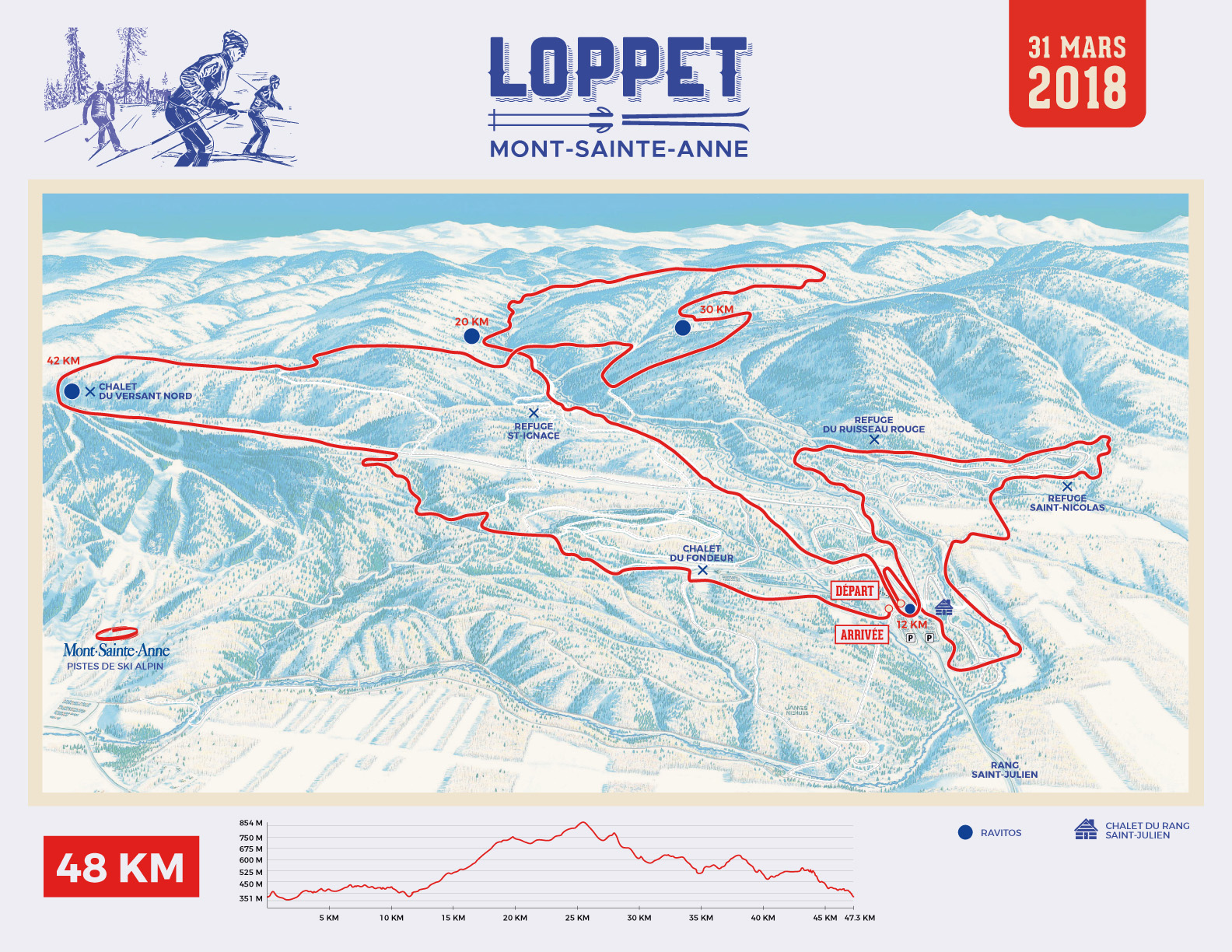
QUEBEC CITY (Wednesday, February 28, 2018) – Cross-country skiing enthusiasts now have a new event to look forward to with the inaugural Mont-Sainte-Anne Loppet coming up on Saturday, March 31. With 48K and 25K freestyle distance races, 10K classic and freestyle distances and a 1.5K loop for young skiers, nearly 500 novices, intermediates and experts cross-country skiers are expected to take to the trails at Mont-Sainte-Anne. This new addition to the Quebec City cross-country calendar will be not only a sporting challenge, but also a fun way for skiers to wrap up the season.
“We want the Mont-Sainte-Anne Loppet to become an annual fixture, and most of all, we want cross-country skiers to have a blast and wrap up the season in style with this celebration of spring,” said Patrice Drouin, president of event producer Gestev on behalf of Quebec Winter Events Corporation. “We were inspired by the Vasaloppet in Sweden, which now attracts more than 15,000 skiers. We see great potential to grow this new event event bigger and better in the future!”
Starting and finishing at the Rang Saint-Julien Lodge in Saint-Férréol-les-Neiges, the 48K and 25K courses are a unique opportunity for skiers to explore the Mont-Sainte-Anne backcountry and discover areas not usually open to the public!
“We’re excited to be hosting a new event like this at Mont-Sainte-Anne and shining the spotlight on Canada’s biggest cross-country skiing centre. We hope the Loppet will not only attract elite skiers, but also inspire and draw newbies to this fantastic sport,” said Maxime Cretin, the new vice-president and general manager at Mont-Sainte-Anne.
The mayor of Saint-Férréol-les-Neiges, Parise Cormier, is also thrilled to be rolling out the red carpet for this new event. “It’s an honour for our town and the entire Côte-de-Beaupré region to celebrate the end of the season with an event that shines the spotlight on the newly renovated cross-country facilities at Mont-Sainte-Anne,” she said. “We’re proud to be involved in such a high-profile happening and are sure it will be a huge benefit for the community.”
Alex Harvey first to register
Saint-Férréeol-les-Neiges native and locals’ favourite at the Olympics in PyeongChang, Alex Harvey was the first to sign up for the 48K distance at the Mont-Sainte-Anne Loppet this March 31, not just to ski on home snow again but also to rub shoulders with participants—and maybe even give them a few pro tips! “Skiing the trails right in my backyard after the Olympics is a dream come true,” said Alex Harvey. “I’ll officially be on vacation after a big season, but I’m stoked to be skiing at home again and baing a part of the inaugural edition of this event, which I hope turns into a regular happening and keeps growing bigger and better. Cross-country development here in Quebec is something that’s very important to me and I’m thrilled to see Gestev and Quebec Winter Events Corporation taking the initiative to get such an awesome amateur event off the ground.”
More information and registration details available at www.loppetmsa.com.
About Quebec Winter Events Corporation
The mission of Quebec Winter Events Corporation (QWEC) is to promote winter sports on home snow through international events including the Sprint Quebec FIS Cross-Country World Cup, Ski Tour Canada and the Cross-Country World Cup Finals, as well as the FIS Freestyle Ski and Snowboard World Cups at the annual Jamboree festival. In addition to attracting the world’s top winter sport athletes, QWEC works hard to support the development of amateur sport through each of its events.
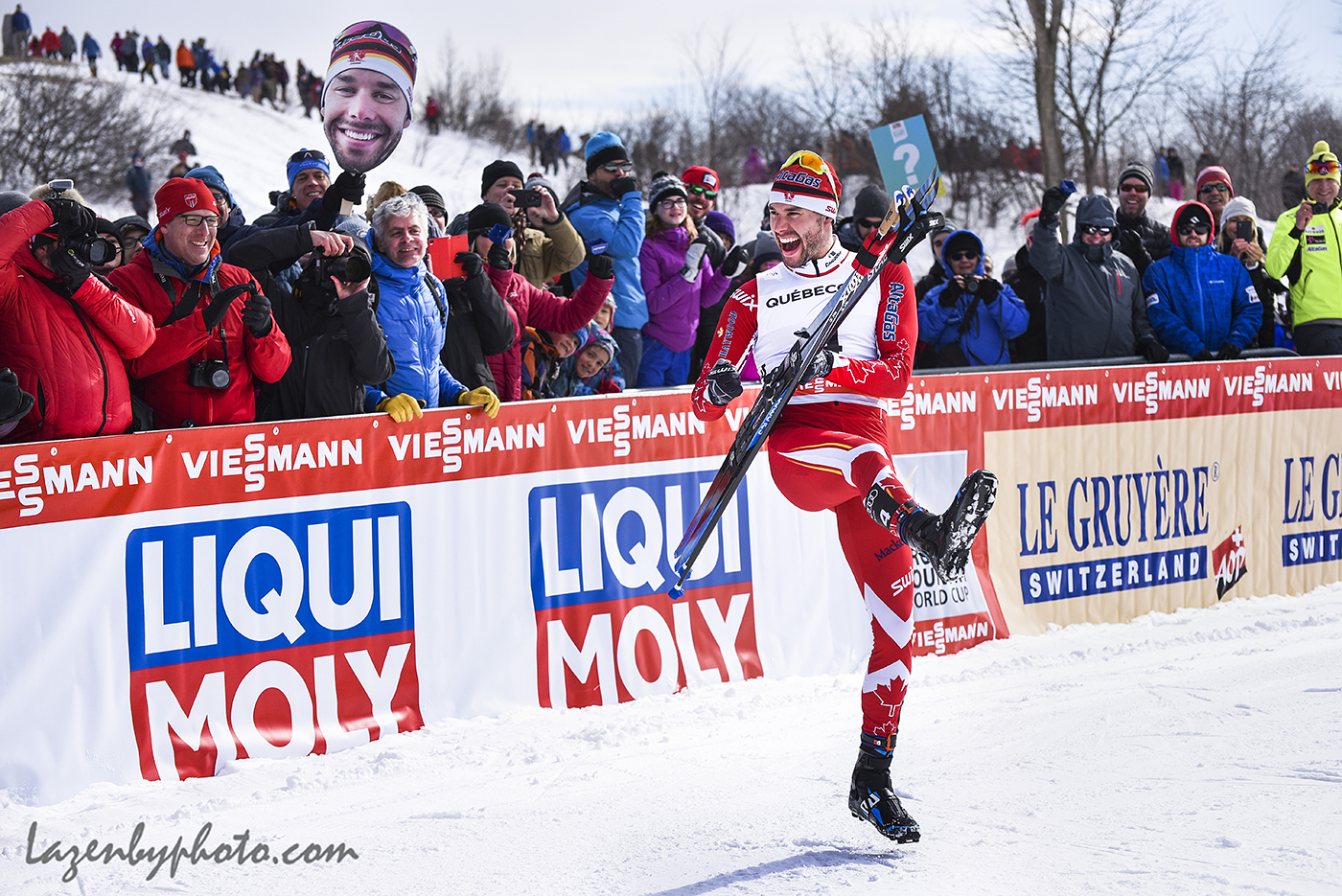
Alex Harvey (Canadian World Cup Team) celebrates his World Cup Finals freestyle sprint win at home on Friday in Quebec City. (Photo: John Lazenby/Lazenbyphoto.com)
QUEBEC CITY — Friday started off about as good as the Canadian men’s team could have hoped for, with five skiers finishing in the top 30 to qualify for the heats in the 1.5-kilometer freestyle sprint on the first day of World Cup Finals. According to Cross Country Canada, that’s the first time five Canadian men have qualified in a World Cup race.
Racing one lap around the Plains of Abraham in the heart of Quebec City, athletes were bolstered by an estimated 25,000 cheering spectators. While they ramped up the intensity for their Canadian skiers, they went wild for Alex Harvey.
And the Saint-Ferréol-les-Neiges native delivered in every sense possible.
Harvey started off as his team’s leading qualifier, clocking in with the fourth-fastest time, 4.14 seconds behind Norway’s qualifying winner, Johannes Høsflot Klæbo, who rounded the course in 2:39.44 minutes. Behind Harvey, four other Canadians also qualified less than seven-tenths of a second apart. Len Valjas qualified 24th (+9:28), Julien Locke of the Alberta World Cup Academy (AWCA) 25th (+9.39), Jess Cockney 28th (+9.90), and Bob Thompson of the National Team Development Centre (NTDC) Thunder Bay in 30th (+9.95) as the final qualifier in the men’s race.
For Locke and Thompson, it was their first World Cup top 30. For Cockney, it was the beginning of one of his career-best days. For Harvey, he was just warming up.
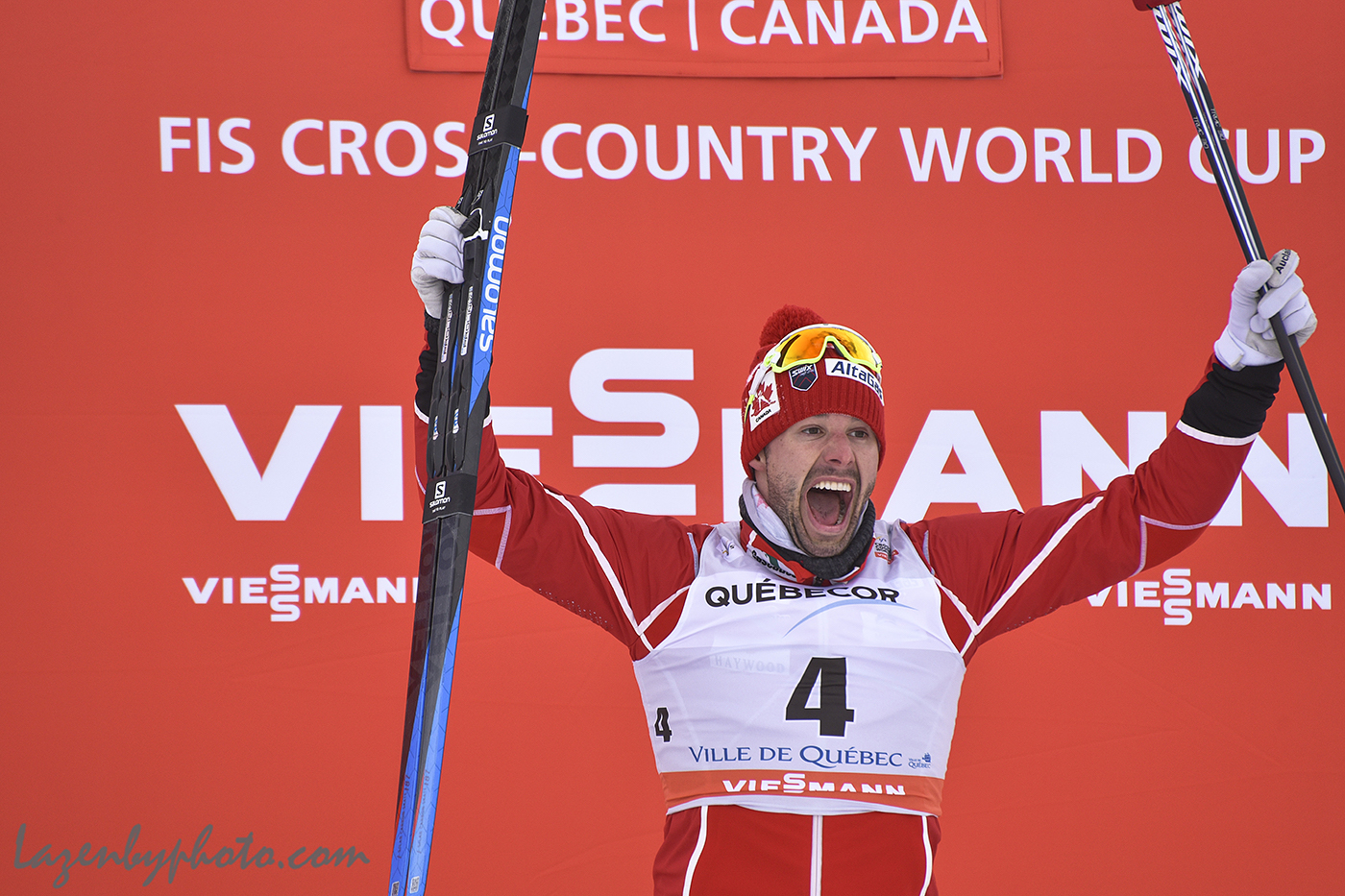
Canada’s Alex Harvey celebrates his sixth-career individual World Cup win (not counting World Championships) on Friday at 2017 World Cup Finals in Quebec City. Harvey won the freestyle sprint by 0.31 seconds over Norway’s Finn Hågen Krogh. (Photo: John Lazenby/Lazenbyphoto.com)
In Harvey’s nine years as a World Cup skier, the 28 year old has racked up six individual World Cup wins — spoiler alert — including Friday’s. He won a skate sprint one other time, three years ago in Szklarska Poreba, Poland. At World Championships, he’s accumulated five medals, with his first coming in the 2011 classic team sprint and the second World Championships gold of his career in the 50-kilometer freestyle mass start less than two weeks ago in Lahti, Finland.
After winning the longest race on the circuit, Harvey seamlessly switched gears and dominated Friday’s freestyle sprint on a wide-open course with short, steep hills organizers had to work hard to integrate.
In his quarterfinal and semifinal, Harvey raced to first in both heats in a way few others attempted to do on Friday. He led from start to finish and didn’t appear to worry too much about the draft, only making sure that he was far enough ahead so that no one else could use it to slingshot past him in the finishing stretch. He won his quarterfinal by 0.34 seconds over Simi Hamilton — the lone American man to qualify for the heats — and semifinal by 0.04 seconds over France’s Richard Jouve. That one was a little closer and didn’t give Harvey enough time to remove his pole straps before the finish, like he did in his quarterfinal while Hamilton lunged for the line to secure second behind him.
It was one of those days where it appeared everyone else was working really hard, while Harvey was simply cruising. But that was confidence and the crowd he was riding, and it was a look that worked for him.
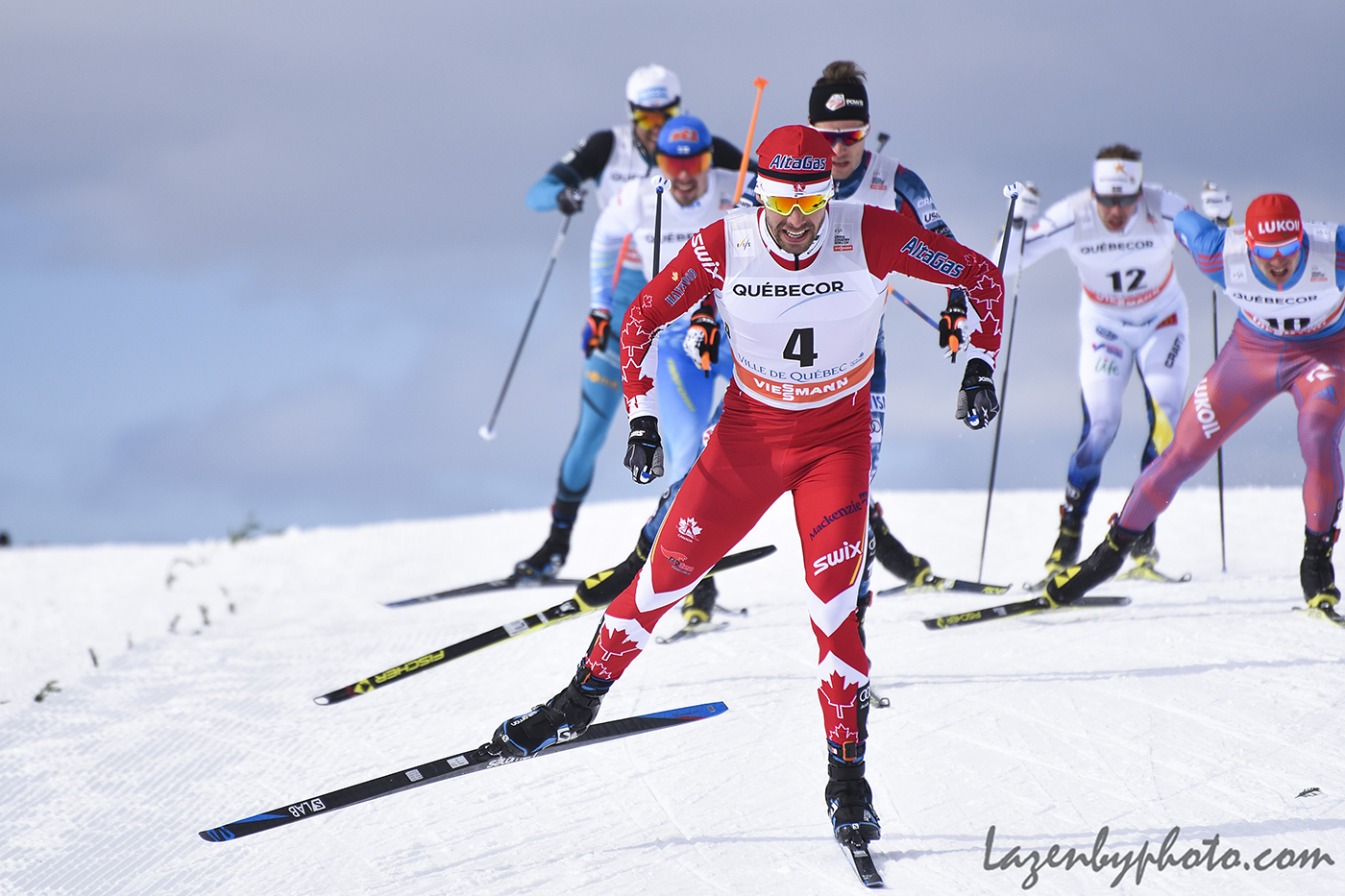
Canada’s Alex Harvey leading his quarterfinal in the men’s 1.5 k freestyle sprint on Friday at World Cup Finals in Quebec City. Harvey went on to win the final for his second individual World Cup win this season (not counting World Championships). (Photo: John Lazenby/Lazenbyphoto.com)
In a post-race interview, Harvey explained he decided to set the pace in the fourth quarterfinal. The heats before had been almost 10 seconds slower than Klæbo’s qualifying time, so Harvey knew his quarterfinal contenders had a chance to advance more than the top-two if they skied fast enough.
He faced a similar situation in the second semifinal. Harvey said he spoke with Jouve and Norway’s Niklas Dyrhaug before their semifinal and discussed how one of them should lead, “to keep pushing, not make it easy, ’cause we want to move to the final,” Harvey said. “The strategy is actually pretty similar most of the time, but it’s a question of being able to actually do it.”
He did it and advanced to the final as the man to beat. All around the course, fans shouted for “Alex”.
Out of the gate in the men’s final, Norway’s Finn Hågen Krogh surged to the front. The six finalists launched immediately into the first and longest climb on the sprint course, just short of 250 meters long, where France’s Lucas Chanavat took the lead and Harvey skied just behind him over the top. Racers dropped back into the stadium then skated back out of it again, where Harvey moved to first in front of the two Frenchmen in the final: Chanavat and Jouve.
Krogh soon after slotted into third and attacked on the steepest climb while Harvey and Hamilton proved to have the most left to answer.
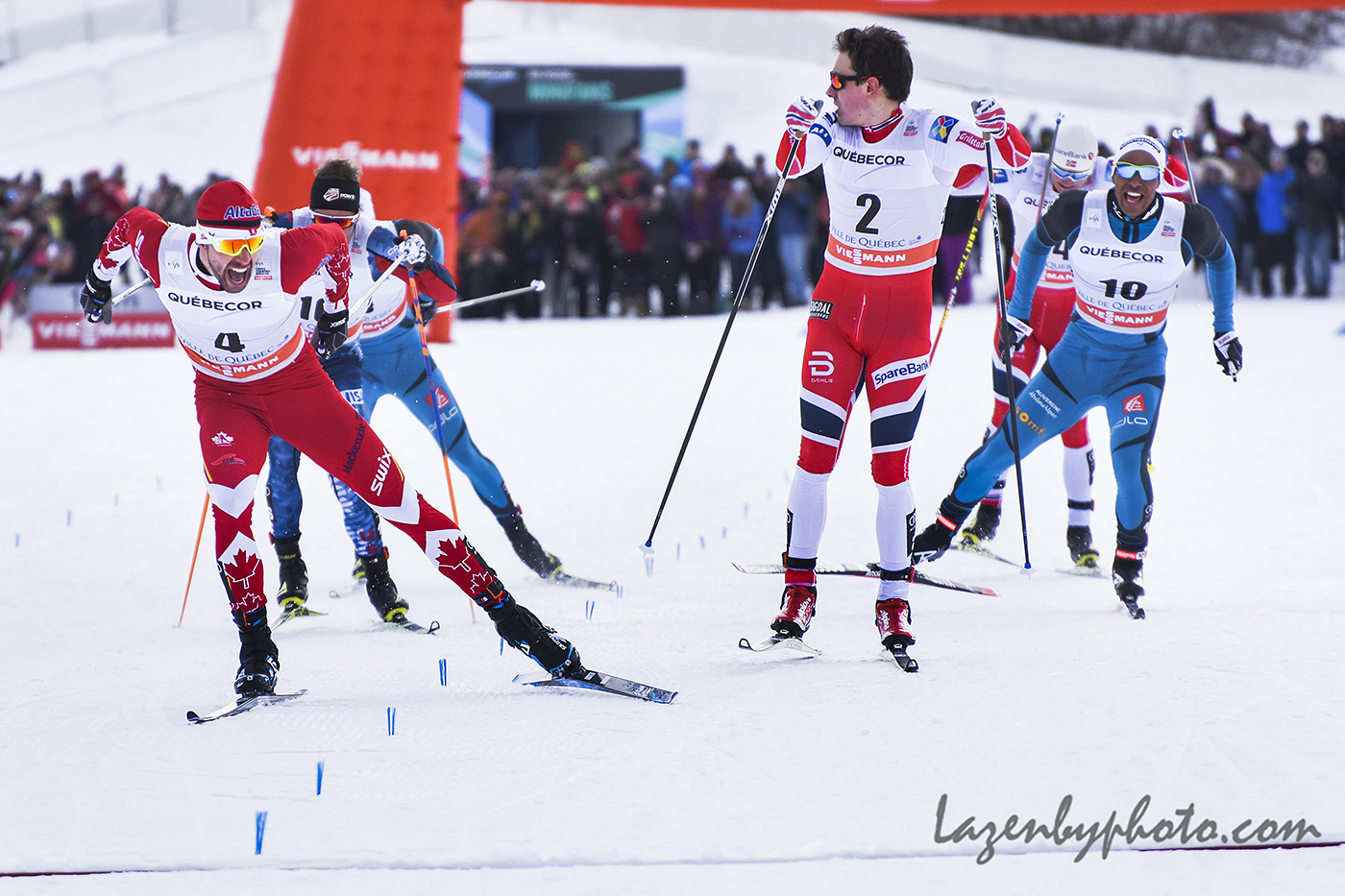
As Krogh led into the last uphill, Harvey followed, then Hamilton, Jouve, Chanavat and Norway’s Sindre Bjørnestad Skar — the last three within striking distance of Hamilton in third place. Harvey tucked behind Krogh and absorbed his draft, breaking out his powerful V2 with 100 meters remaining and leaving Krogh chasing him to the line. There, Harvey threw up his arms to celebrate, while Hamilton lunged for third in a photo finish with Jouve. The Frenchman took it by 0.07 seconds, Hamilton ended up fourth, 1.01 seconds behind Harvey, Skar fifth (+1.51), and Chanavat sixth (+1.72).
Canada’s Alex Harvey (l) coming on strong in the finishing stretch to outlast Norway’s Finn Hågen Krogh (2) by 0.31 seconds for the win in the World Cup Finals freestyle sprint on Friday in Quebec City, while France’s Richard Jouve (10) races to third, just ahead of American Simi Hamilton (behind Harvey) in fourth. (Photo: John Lazenby/Lazenbyphoto.com)
“At the last turn, I was confident,” Harvey said in French. “I looked at him [Krogh] and I knew I had him, but I was focusing on staying second because of a strong headwind in the last downhill.”
“To be beaten by the 50 k World Champion on the home stretch is tough,” Krogh told the International Ski Federation (FIS) on Friday. “I was simply not good enough.”
In the finish area, Harvey appeared about as elated as he was after the 50 k in Lahti, a reaction he said was “pure instinct.”
“But sprinting comes with greater stress, with the risk of falling, of breaking a pole…” Harvey said in French. “To cross the finish line after a sprint is like a deliverance.”
The win comes just over a year after Harvey placed second in a World Cup skate sprint in Quebec during the Ski Tour Canada. After passing Russia’s Sergey Ustiugov in the finishing stretch, he had been in first until France’s Baptiste Gros snuck up on him on the inside lane. Harvey finished half a second back in second place, but it was still a day he’d remember — his girlfriend Sophie came out on course to congratulate him.
On Friday, he made sure to lock up the win. And he was met afterward by Sophie, his sister (also named Sophie) and his dad, Pierre Harvey, alongside the finishing lanes.
“Last year it would have been nice to win,” Harvey said in English on Friday. “When I passed Ustiugov last year, I had so much more speed than him … I didn’t ease up, but I thought I was going to win … and then I saw Baptiste just blow by all of us in the corner of my eye. So I had a bit of that in my mind and just making sure it wasn’t going to slip through my finger two years in a row.”
Asked how this stacked up to his 50 k win, he said it was close.
“Today’s victory really isn’t far behind my 50 k win,” he said in French. “My second place last year here was already incredible, so to top that off with a win at home is a dream come true.”
The win comes after Harvey has competed two 50 k races, including last weekend’s Holmenkollen World Cup in Oslo, Norway, in less than two weeks and traveled across the Atlantic back to his home province.
“What surprises me is how well he recovered after the double 50 k, in which he did very well, both times,” Louis Bouchard, Harvey’s personal coach and Canada’s co-World Cup coach, said in French. “Usually in sprints, he will hang at the back and make his move right at the end in the final stretch. So tactically, he skied differently today. He felt strong to the point of leading every round right until the end. It’s also rare to see Alex qualify so strongly. His form his tremendous at this point.”
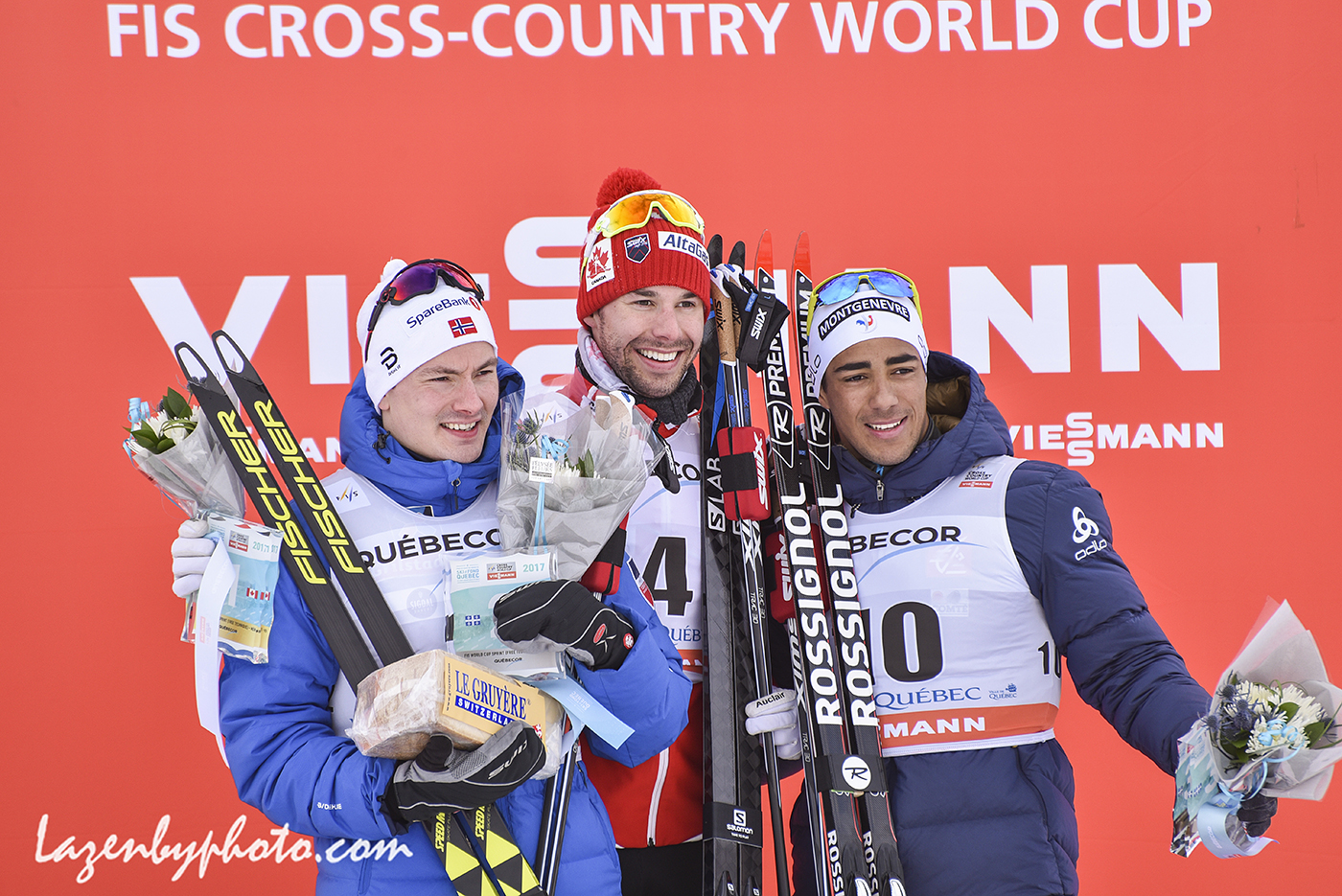
The men’s freestyle sprint podium on Friday at World Cup Finals in Quebec City, with Canada’s Alex Harvey (c) in first, Norway’s Finn Hågen Krogh (l) in second and France’s Richard Jouve (r) in third. (Photo: John Lazenby/Lazenbyphoto.com)
Pierre Harvey, a local hero and the inspiration behind the Pierre-Harvey National Training Centre, spoke with reporters after the race. Five years ago, he had been on site to witness his son’s first-career World Cup win in Falun, Sweden.
“It’s always very emotional,” Pierre said in French. “I was there when he won his first World Cup in Sweden, which I didn’t think he could ever do at the time, but winning became a familiar sight in a way. I thought he would burn himself after the qualification, but he managed to win every round after. It was impressive to see him beat Krogh, a very capable sprinter, in the last stretch.”
Asked what propelled his son on Friday, Pierre said racing at home.
“In front of friends and of a cheering crowd, along with great ski conditions, is an extra motivation,” he said. “He left home on the fifth of November, so coming back after months of racing in Europe, he really wanted to put on a show for his friends. I hope he keeps his energy levels high for tomorrow and Sunday’s races.”
Two more World Cup races remain to close out the season: a 15 k classic mass start on Saturday and 15 k freestyle pursuit on Sunday. Harvey has essentially solidified third place in the overall World Cup rankings with 57 points separating him from Finland’s Matti Heikkinen in fourth place.
“Today’s win comes with 50 points, 30 bonus seconds and 10 seconds I put on him in today’s qualification,” Alex Harvey explained. “I feel secure with this lead on him.”
Ahead of him, Norway’s Martin Johnsrud Sundby and Russia’s Ustiugov are not racing in Quebec. Sundby already locked up the World Cup overall and distance titles, and Ustiugov is still 282 points clear of Harvey in third place.
After Day 1 of 3 in the World Cup Finals mini tour, Harvey leads by 2.3 seconds over Krogh. All 74 racers remaining in the men’s field will start Saturday’s mass start together.
The Sprint World Cup podium was awarded on Friday, with Norway’s 20-year-old Klæbo in first, Italy’s Federico Pellegrino (last year’s Sprint Crystal Globe winner) in second, and Skar in third. Both Klæbo and Pellegrino were eliminated in the semifinals, with Pellegrino placing seventh and Klæbo eighth on the day.
As for third and fourth place on Friday, Jouve was thrilled with his fourth individual World Cup podium and first this season after being injured in December and January.
“It was a really good day for me,” Jouve said in French. “I passed through my quarter and semi as I wanted. I managed to stay in a good position in the finals. I had very good legs and fast skis.”
Asked what he thought of the crowd’s favoritism for Harvey, he said it wasn’t anything he couldn’t handle.
“We were here last year, and the public is pleasant and cheers for everyone,” Jouve said. “It’s normal to see them favor the local star.”
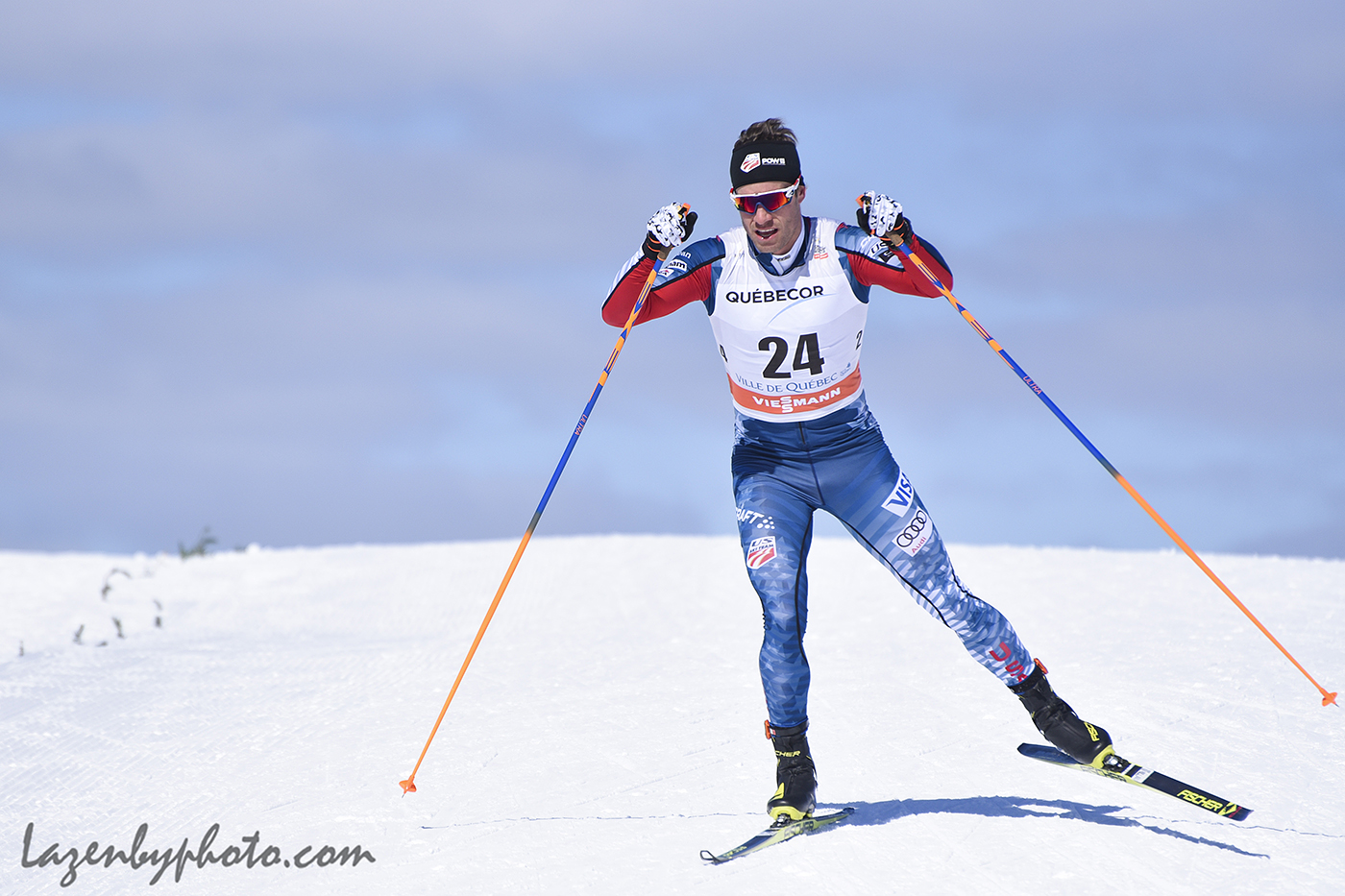
Simi Hamilton (U.S. Ski Team) racing to 16th in the men’s 1.5 k freestyle sprint qualifier on Friday at World Cup Finals in Quebec City. He qualified in 16th and went on to place fourth in the final. (Photo: John Lazenby/Lazenbyphoto.com)
Even Hamilton, frustrated with fourth, was happy for Harvey.
“He’s such a good guy. He’s such a great North American teammate. He’s always so psyched when we ski well, and we’re always so psyched when he skis well, as well as all the other Canadians,” Hamilton said. “We are really just like kind of one bigger team, us against all the Europeans we feel like sometimes, so it’s cool to see him so successful and skiing so strong. And he handles his success with so much humility and grace.
“Someone as talented as he is, and somebody who works as hard as he does, it’s awesome just to feel the energy,” Hamilton added. “He’s such a good ambassador for our sport, and I think that that’s a testament to see all these people cheering him on, because they know that he’s such a great guy, more than just a good ski racer.”
Hamilton faced Harvey in all three of his heats and followed him in every one.
“I knew that Alex and Finn were far enough ahead of us that, unless they tripped or something, that we weren’t going to catch them,” Hamilton said of the final. “So I also knew that I was ahead of Jouve and the other two that were behind us a little bit, so I knew that, especially with the tailwind, if I just skied it well that I would have held onto third. And I just didn’t do that, and it sucks. I want it back. I want to do it again. I felt good going into it, I felt like my energy was really good during the entire final, and for whatever reason, I just didn’t ski it.”
Four Canadians in Top 20
Earlier in the day, Cockney tied his second-best individual World Cup result in 10th and popped his second top 12 of the season to meet the criteria for the Canadian 2018 Olympic team. After qualifying in 28th and hanging around fourth or fifth for most of his quarterfinal, Cockney used the draft and his reserved energy to sprint from fourth to second in the finishing stretch. He finished just 0.09 seconds behind Klæbo, who won that quarterfinal, and edged Great Britain’s Andrew Young by 0.07 seconds. While Young didn’t advance, Cockney did, and he went on to place fifth in the first semifinal, 1.3 seconds behind Krogh, the winner of that heat.
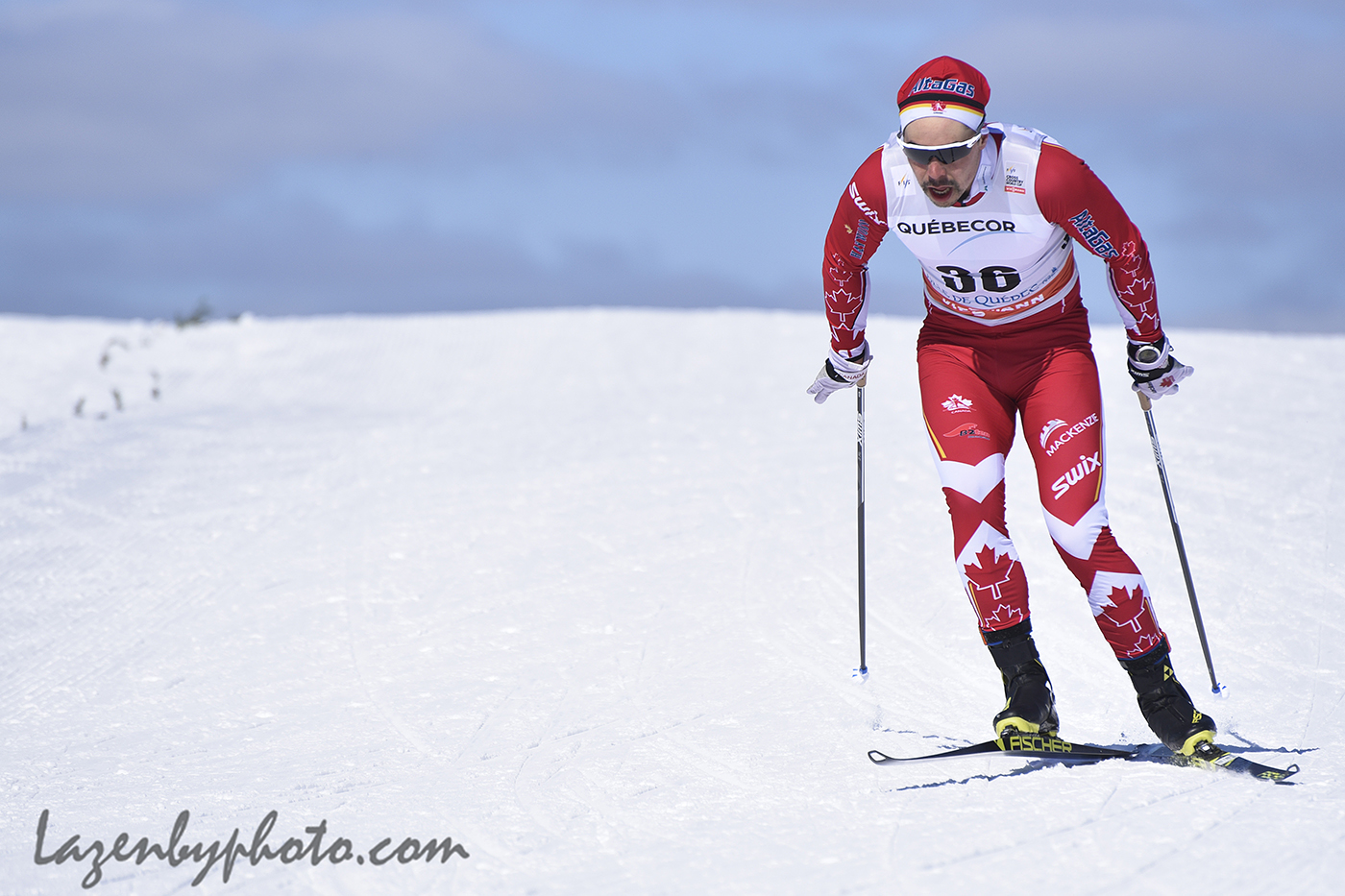
Jess Cockney (Canadian World Cup Team) racing to 28th in the qualifier of the men’s 1.5 k freestyle sprint on Friday at World Cup Finals in Quebec City. He went on to place 10th on the day to tie his second-best World Cup result. (Photo: John Lazenby/Lazenbyphoto.com)
“You can see just how wide open this field is, and it’s so windy that you kind of had to be smart about where you wanted to use energy,” Cockney said of his tactics.
“I knew the start was straight into the headwind. You could come down with the tailwind behind you and make back a couple spots, or at least close the distance behind some people. And that’s just exactly what I wanted to do in the quarterfinal, and I was lucky that it worked out well, and I had some energy saved from doing that for the finishing straight. So that was really big for me.”
As for his finishing gear, Cockney laughed and said he’d like to think he’s had that all along. His trouble has been getting into the heats. In the one other World Cup sprint he qualified in this season — the classic sprint in PyeongChang — he went on to finish 10th.
“It’s funny, I’d like to think I always have some kind of sprint like that, but I never get into the sprints; my qualifying speed is still not there,” Cockney said. “Today, to actually see it on a race course and see it at a World Cup — I’m really happy with that. I can do it on a domestic level, but being consistent at an international level is still taking some time.”
Four Canadians landed in the top 20 with Valjas in 19th and Locke in 20th. Valjas finished fourth in the first quarterfinal, 1.81 seconds behind Chanavat, who won. Locke placed fourth in the third quarterfinal, 1.89 seconds behind Pellegrino as the winner of that heat.
“I’m a bit disappointed,” Valjas said. “I didn’t feel like I was able to show my potential today. I always felt boxed in, and every time I tried to make a move, there was somebody there. The course is so turny that when you’re beside somebody you get boxed in, so it’s frustrating. I think I had more speed than I showed today, but I ended up not skiing it well tactically, starting at the back.”
Asked about the conditions, Valjas elaborated that Quebec had some of the best snow that World Cup skiers have seen all year. Quebec City was hit with a massive snowstorm earlier in the week on Tuesday.
“Europe is sometimes good, but this is all-time conditions here,” Valjas said. “It’s fast, it’s wide. It’s just, with the curves, it’s harder to pass than I thought.”
Julien Locke (Canadian U25 Team/AWCA) racing to 25th in the men’s 1.5 k freestyle sprint qualifier on Friday at World Cup Finals in Quebec City. He went on to place 20th on the day for his first World Cup top 30. (Photo: John Lazenby/Lazenbyphoto.com)
On the other end of the spectrum, Locke, a 23-year-old member of Canada’s U25 Team, was pleased with his performance in his third World Cup start as it marked his first time in the points (top 30). In his first World Cup race last month, he came close in 36th in PyeongChang.
“At the start of the season, my two main goals were to go to the Korea World Cup and the World Championships,” Locke said. “And I went to Korea, and I unfortunately had a crash there, so I was really hoping for another second chance, and to qualify to come here was fantastic. It’s crazy having Alex here, a world champion coming home, and the atmosphere is incredible. So since this race was announced, doing a good sprint here was my big goal for the year.”
Thompson, 26, ended up 30th after finishing sixth in the same quarterfinal as Cockney. After making his World Cup debut at last year’s Ski Tour Canada, Thompson started this season on the World Cup in Europe and raced to 31st in the classic sprint in PyeongChang. On Friday, he scored his first World Cup points as well.
“Getting in the heats has been the goal for every sprint World Cup I’ve gone to do, which is, this is the 17th now, and I think it’s about the seventh sprint or so,” Thompson said. “… Goal number one is, get a top 30. So I got that, I can reassess, and raise the bar a little bit.”
Newell Narrowly Misses Qualifying
For the U.S., Andy Newell missed out on qualifying by eight-hundredths of a second in 31st. Erik Bjornsen was 0.98 seconds back in 33rd, and Cole Morgan (Sun Valley Ski Education Foundation) another second back in 34th.
“For Andy to be in 31st, disappointing for him,” U.S. Ski Team Head Coach Chris Grover said. “He felt good out there; he’s a little bit mystified. … And then also for Erik Bjornsen and Cole Morgan, who skied great, to be so close to going in … If we’d gotten three or four guys into the heats then I think it would have been a great start to the day. So a little disappointing to miss that opportunity.”
“I was feeling pretty good out there skiing, so I don’t know why it was slow,” Newell said. “I couldn’t figure out why.”
Bjornsen said he hasn’t raced much since World Championships and hoped Friday blew the cobwebs out.
“I was hoping for a little bit more today,” he said. “I obviously wanted to qualify … but I’m excited for the next couple days. … Tomorrow’s a 15 k classic, which is my favorite event, so yeah, hopefully I can put together some good races.”
Also for the U.S., Paddy Caldwell placed 50th, Matt Gelso 57th, Scott Patterson 58th, Jack Hegman 61st, Brian Gregg 62nd, Ben Lustgarten 69th, David Norris 70th, and Noah Hoffman 73rd.
Canada’s Andy Shields came close to qualifying in 35th, Russell Kennedy followed in 36th, Devon Kershaw 38th, Knute Johnsgaard 41st, Evan Palmer-Charrette 47th, Joey Foster 53rd, Graeme Killick 64th, Ricardo Izquierdo-Bernier 71st, Brian McKeever 72nd, and Gareth Williams 74th.
Togo’s Mathilde Petitjean racing to 67th in the freestyle-sprint qualifier at the Ski Tour Canada World Cup stage last season in Québec City. (Photo: Benoit Corriveau)
In an effort to showcase the North Americans competing at this week’s International Ski Federation (FIS) 2017 USANA Nordic Junior World Championships and U23 Cross Country World Championships at Soldier Hollow in Midway, Utah, we asked those qualifying athletes several questions about themselves — actually, we had them fill in the blanks. Here we have 22-year-old Mathilde Petitjean, of the Pierre-Harvey National Training Centre, who’s representing Togo at her second U23 Worlds. On Tuesday, she finished 36th in the classic sprint. She was listed to start Saturday’s 20 k skiathlon.
***
“My full name is Mathilde Amivi Petitjean, but you can call me Matti. I was born in Togo (yep everybody, I was in Africa, so cool for a cross country skier) , raised in La Roche-sur-Foron (little city in France), and one thing you should know about my hometown is we can see the Mont-Blanc when we take some altitude.
I started cross-country skiing when I was seven, thanks to Le ski club du pays rochois.
I currently train in Saint-Férreol-les-Neiges, Québec, with CNEPH [Centre National d’Entraînement Pierre-Harvey, a.k.a. Pierre-Harvey National Training Centre].
Togo skier Mathilde Petitjean (who trains with CNEPH) at 2016 U23 World Championships in Rasnov, Romania. (Courtesy photo)
If I’m not skiing, you might find me cooking some sweet meals or working on my Quebec accent with my teammates.
If I had to pick a favorite book, it would be ‘Comment se faire des amis of Dale Carnegie‘.
One of the things I’m most excited about for U23/Junior Worlds at Soldier Hollow is to show my new race suit to everybody, so flashy. One race I’m especially targeting there is the sprint.
The best advice anyone ever gave me about skiing or racing was no pain, no game.
One of the best race memories I have is: ouhh I have lots of but I think it was the finish of the Olympic 10 k classic. The stands of the Olympic stadium were filled to bursting and everybody on the finish area cheered me on. That was awesome.
If I could meet one World Cup skier, it would be the young and talented sprinter Lucas Chanavat …… oh sorry I forgot it’s my friend.
If I don’t end up being a professional skier, I’ll probably be an adventurer like Indiana Jones or maybe a long jump athlete.
I’m missing zero of school to be here, and my professors are probably thinking, ‘Oh please, I hope Mathilde will not come with a Quebec accent went she’s back to school.’
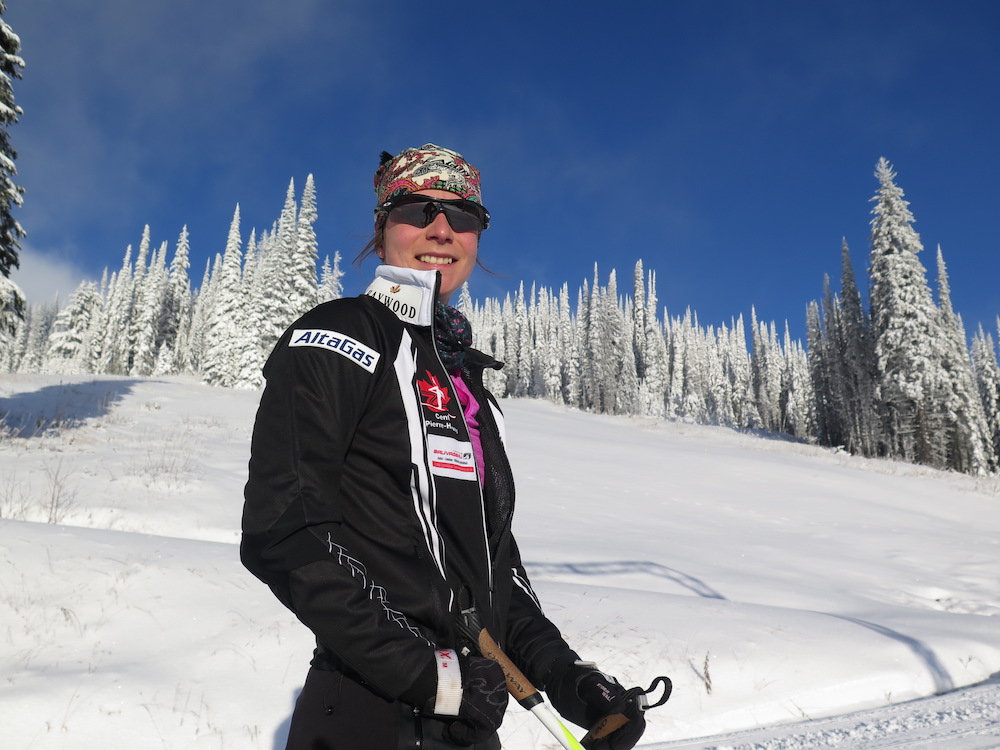
Canada’s Frédérique Vézina (CNEPH) training at Sovereign Lake near Vernon, B.C., last December. (Courtesy photo)
In an effort to showcase the North Americans competing at this week’s International Ski Federation (FIS) 2017 USANA Nordic Junior World Championships and U23 Cross Country World Championships at Soldier Hollow in Midway, Utah, we asked those qualifying athletes several questions about themselves — actually, we had them fill in the blanks. Here we have 22-year-old Frédérique Vézina, of the the Centre National d’Entraînement Pierre-Harvey (CNEPH), a.k.a. Pierre-Harvey National Training Centre, who’s representing Canada at her second U23 Worlds.
“My full name is Frédérique Vézina, but you can call me Fred or mom. I was born in Québec, raised in Saint-Ferréol-Les-Neiges, and one thing you should know about my hometown is yes, we do get a lot of snow in the winter time! As Saint-Ferréol-Les-Neiges might not sound familiar to you, it’s the city in which Mont-Sainte-Anne is.
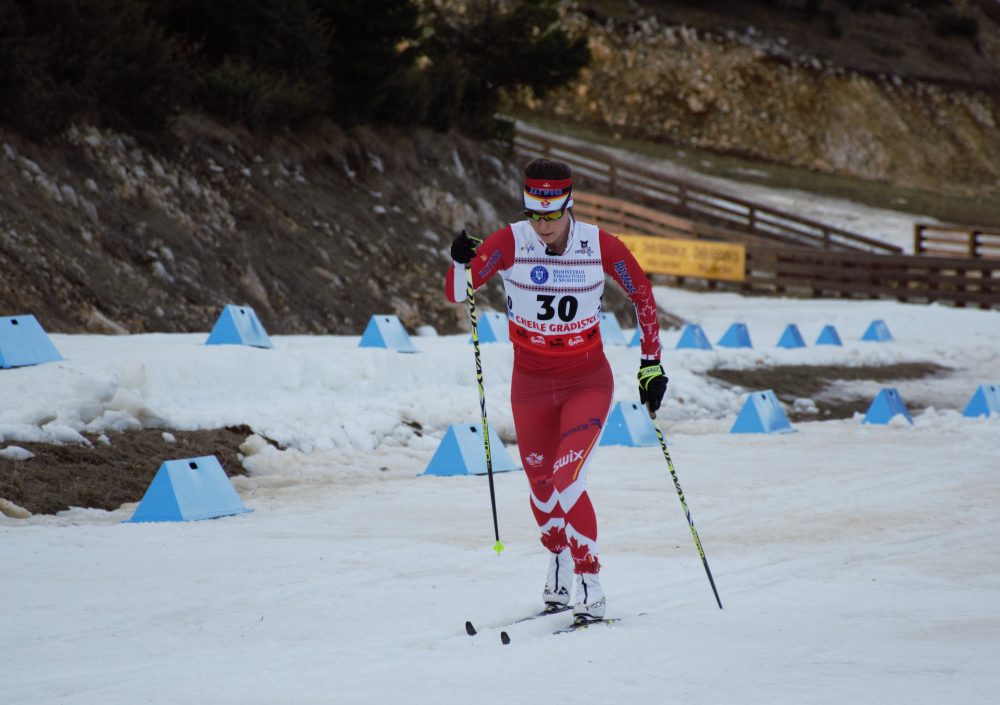
Canada’s Frédérique Vézina racing to 39th in the women’s 10 k classic at 2016 U23 World Championships in Rasnov, Romania. (Courtesy photo)
I started cross-country skiing when I was two, thanks to my parents who decided to spend my energy overflow in the best way possible.
I currently train in Saint-Ferréol-Les-Neiges (or Mont-Sainte-Anne) with CNEPH.
If I’m not skiing, you might find me cooking and dancing in the kitchen, or studying in my robe, or volunteering for Nunavik’s cross country ski clubs!
If I had to pick a favorite book, it would be… I seriously don’t know, but my last reads were: Chris Hadfield’s ‘An Astronaut’s Guide to Life on Earth’, ‘Born to Run’, ‘Les 4 Accords Toltèques’, and ‘Un Avion Sans Elle’.
One of the things I’m most excited about for U23/Junior Worlds at Soldier Hollow is having my brother and my parents fly over to cheer for me. One race I’m especially targeting there is the skiathlon.
The best advice anyone ever gave me about skiing or racing was to race against the course.
One of the best race memories I have is my first win at Midget NorAms. I did not expect anything. The race was 3.5km long (it felt long at that time) and was held on a farm so the spectators could see most of it from the highest point of the course except for that one 400 meters in the woods. After the mass start, we were a group of 15 girls tight together. Then came the time when we went into the woods. I surprised myself by coming out of it first. I remember my parents surprised and cheering so happily seeing me up front. I kept pushing hard, doing my thing and concentrating on skiing well even though I was pretty excited inside. I finally crossed the finish line in first place! The hugs from my brother, family, friends and coaches at the finish made me realize what just happened. At that particular moment I knew I was going to be a skier for the years to come.
If I could meet one World Cup skier, it would be Marit Bjorgen.
If I don’t end up being a professional skier, I’ll probably be a doctor.
I’m missing 21 days of school to be here, and my professors are probably thinking, ‘How is she even able to do both at the same time?’ I even had a colleague in class asking what program I switched to. Well surprise, I’m still in your program, I’m just not going to school very often!
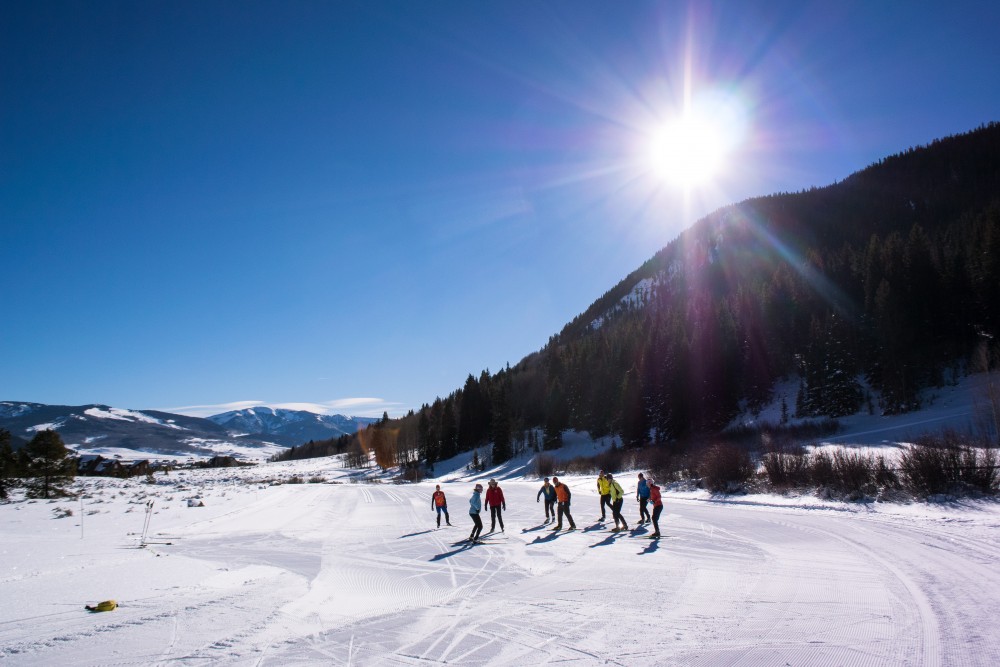
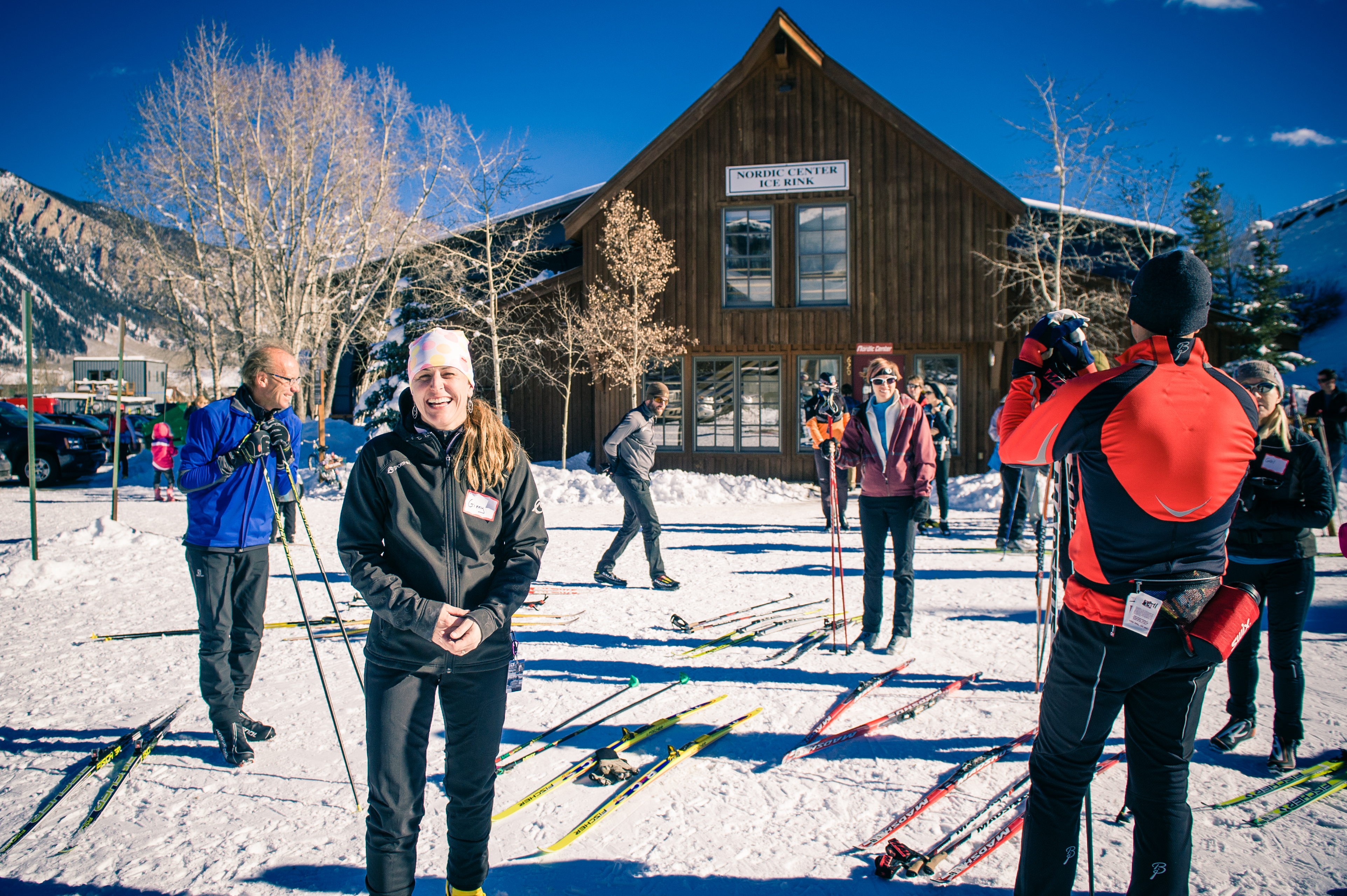
Sun stretches over the hills during a cross-country lesson at Crested Butte in Colorado. The nordic center there is hosting its annual Crested Butte Nordic Thanksgiving Camp from Thursday to Sunday. (Photo: Xavier Fane)
We’ve been hearing about West Yellowstone since, well, the U.S. Ski Team officially started its annual Fall Camp there in 1978. But surely, Montana’s southern tip can’t be the only place to get on snow this time of year…
That’s why we provided a guide to Thanksgiving on-snow camp venues in the U.S. and Canada (we realize this week isn’t Thanksgiving in Canada, but we’re sticking to areas that offer skiing around this week in late November for all intents and purposes). If we’re missing an early season camp, we apologize — it’s a big continent — but let us know so we can feature that camp in next year’s guide.
***
What:Yellowstone Ski Festival
Where: West Yellowstone, Montana
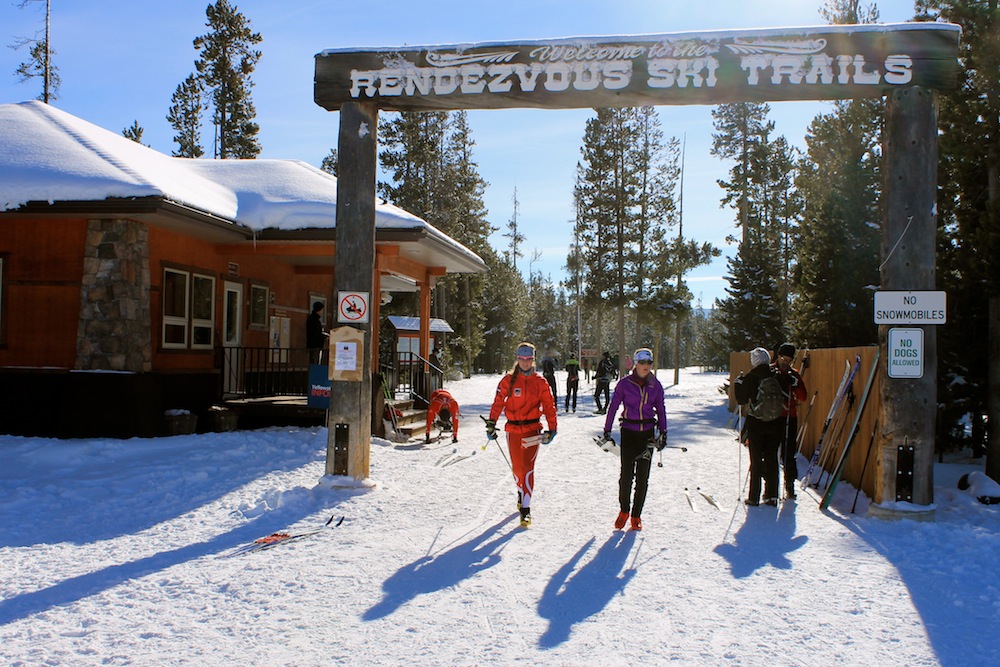
Each year, the Rendezvous Ski Trails see hundreds of skiers each day during the Yellowstone Ski Festival on Thanksgiving week in West Yellowstone, Mont.
When: Tuesday, Nov. 24, to Saturday, Nov. 28, 2015
How many years running? 20+
Target audience: Masters and beginners (clinics available for both), as well as elite racers
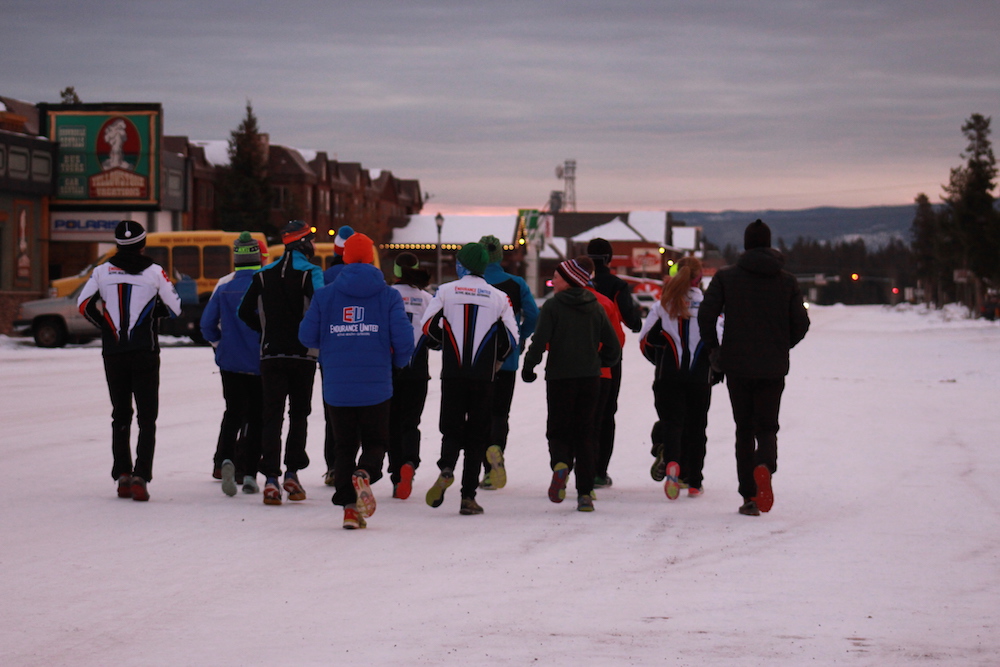
Endurance United team members get ready for a day of skiing during a morning run in West Yellowstone, Mont., at this year’s 2015 Yellowstone Ski Festival. (Photo: Gabby Naranja)
Anticipated participation: An estimated 4,000-5,000 skiers throughout the week. “It varies from year to year depending on the snow conditions and the snow level,” West Yellowstone Ski Education Foundation Program Director Moira Dow explained. “Because we’ve gotten snow early this year and good snow, we have been able to get the word out. Like right now the trails are packed. We will probably have a lot of people coming for longer periods of time.”
Advance reservation required? Racers must preregister. Trails are open to public; trail pass required.
Grooming report: Essentially everything is open. “It’s full-coverage skiing on good skis with full tracks,” Dow said. More details | Webcam
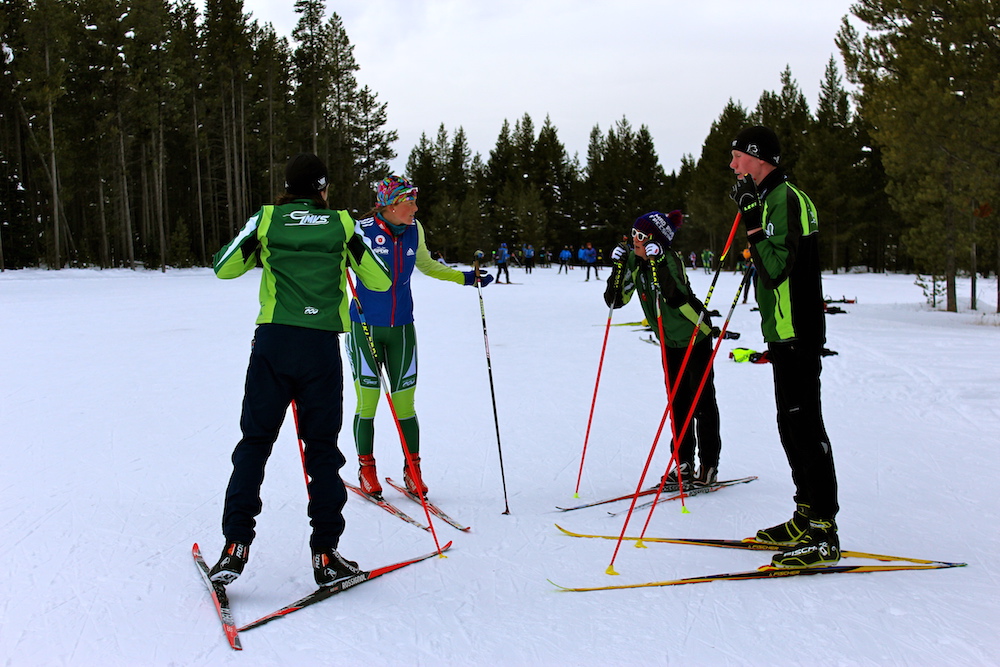
Green Mountain Valley School nordic skiers meet up during a ski on the Rendezvous Ski Trails this week in West Yellowstone, Mont. (Photo: Gabby Naranja)
What makes this camp unique? “The number of trails and the quality of snow that we have. We’re one of the few places in the country that does have consistent, early, good snow. In addition to that, we have a lot of industry participation. And we have great evening programs for people. We have not just skiing, we have the full package for everybody and anyone, from the beginner skier who wants to get out on the snow for the first time, to the SuperTour elite athlete who can train at high altitude, and good snow in the early part of the season.”
Special events:
U.S. Ski Team Development Coach Bryan Fish and the former vice president of Fischer Skis U.S. nordic division, Peter Ashley, will be featured speakers
Freebies: “Everything at the indoor expo at night is free. Anybody who has a trail pass can get into the outdoor demo area for free. In addition, on Wednesday and Friday night we have ‘après-ski’… [with] complimentary adult beverages and junior beverages, sledding, some music, and fun stuff like that. Just a little bit more of a party atmosphere after the sun goes down and before the expo opens.”
***
What:Crested Butte Nordic Thanksgiving Camp
Where: Crested Butte, Colorado
The Crested Butte Nordic Thanksgiving Camp, now in its 14th year, is a fundraiser for Crested Butte Nordic, a nonprofit dedicated to getting people on the local trails. (Photo: Xavier Fane)
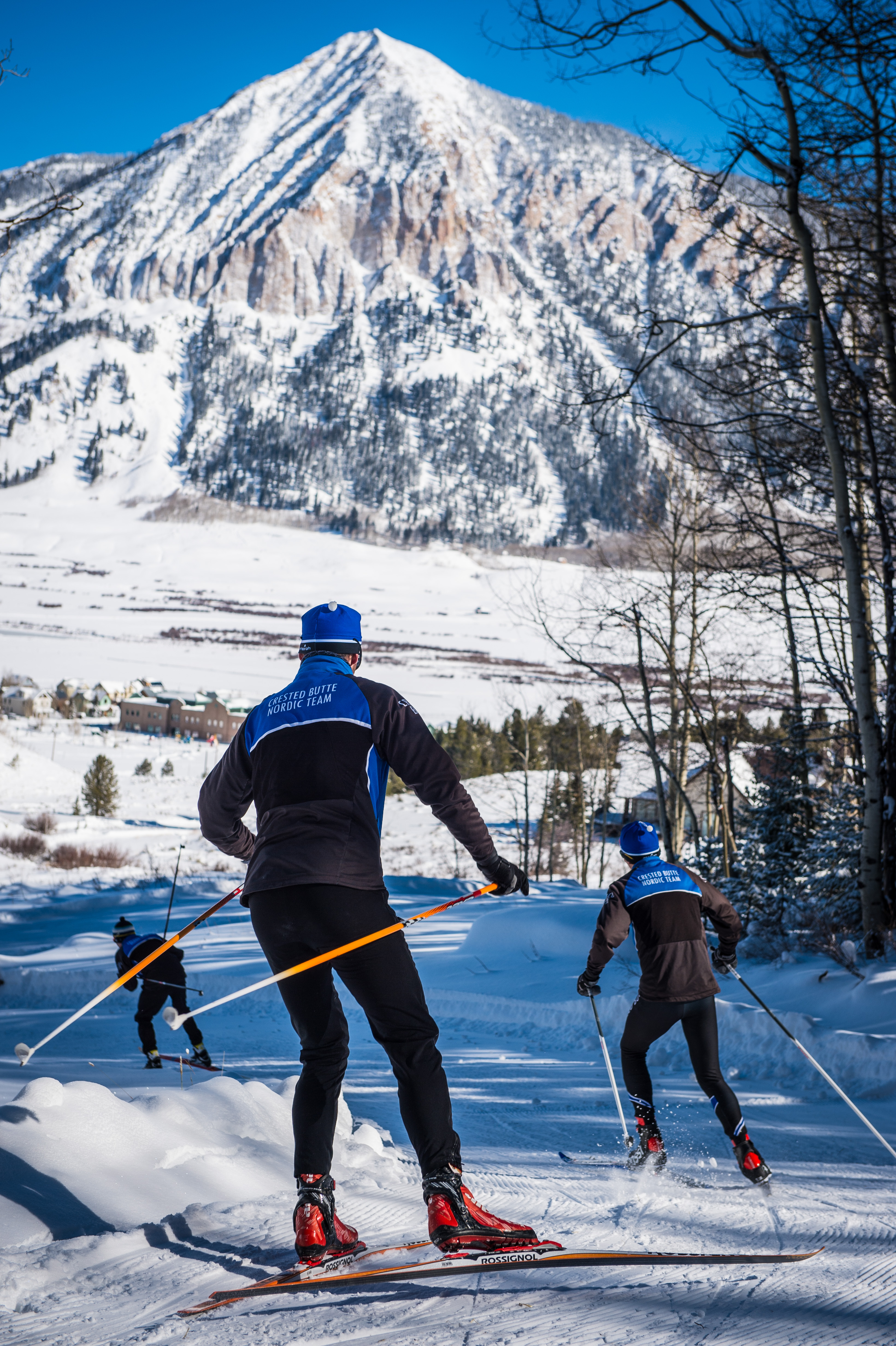
Skiing at Crested Butte Nordic in Colorado. (Photo: Xavier Fane)
How many years running? 14 as an official organized camp: “Crested Butte has really good and reliable early season snow so the Nordic Center decided we should try to get folks to come here and get some instruction from our great instructors,” said Drew Holbrook, marketing director for Crested Butte Nordic and the Grand Traverse ski race. “We also have a wonderful venue for early season nordic skiing and we’ve been fortunate enough to have been on-snow every year.”
Target audience: All ages and abilities, “from never-evers to master blasters looking to improve their technique,” Holbrook said. “If parents are skiing along with children, kids ski free. All kids 17 and younger get free passes and rentals. And, actually, all season long we do that — people 17 and younger ski free. At the Thanksgiving Camp we also do free kids clinics. So if a parent is taking a clinic, then they can have their kids taken care of all day.
Anticipated participation: Several hundred skiers on the trails throughout the long weekend. For clinics, projecting 75-80 participants.
Advance reservation required? Pre-registration recommended for clinics.Nordic Center trail passes available any time. Skiing at Lily Lake, a 10 k early season trail system four miles up Kebler Pass Road, is free.
Trail pass rates: $18/day, skiers 17 & younger ski free. $130 for a 10-punch transferable pass.
Grooming report: With about a foot of snow at the venue in town, “it’s looking like in-town skiing for the camp,” Holbrook said. As of Tuesday, Ruthie’s Run (5-kilometer loop at the nordic center and up on the bench) and Lily Lake (six miles west of town up on the pass) were groomed. “We’ll have over 10 kilometers of high quality skiing available,” Holbrook added. More details
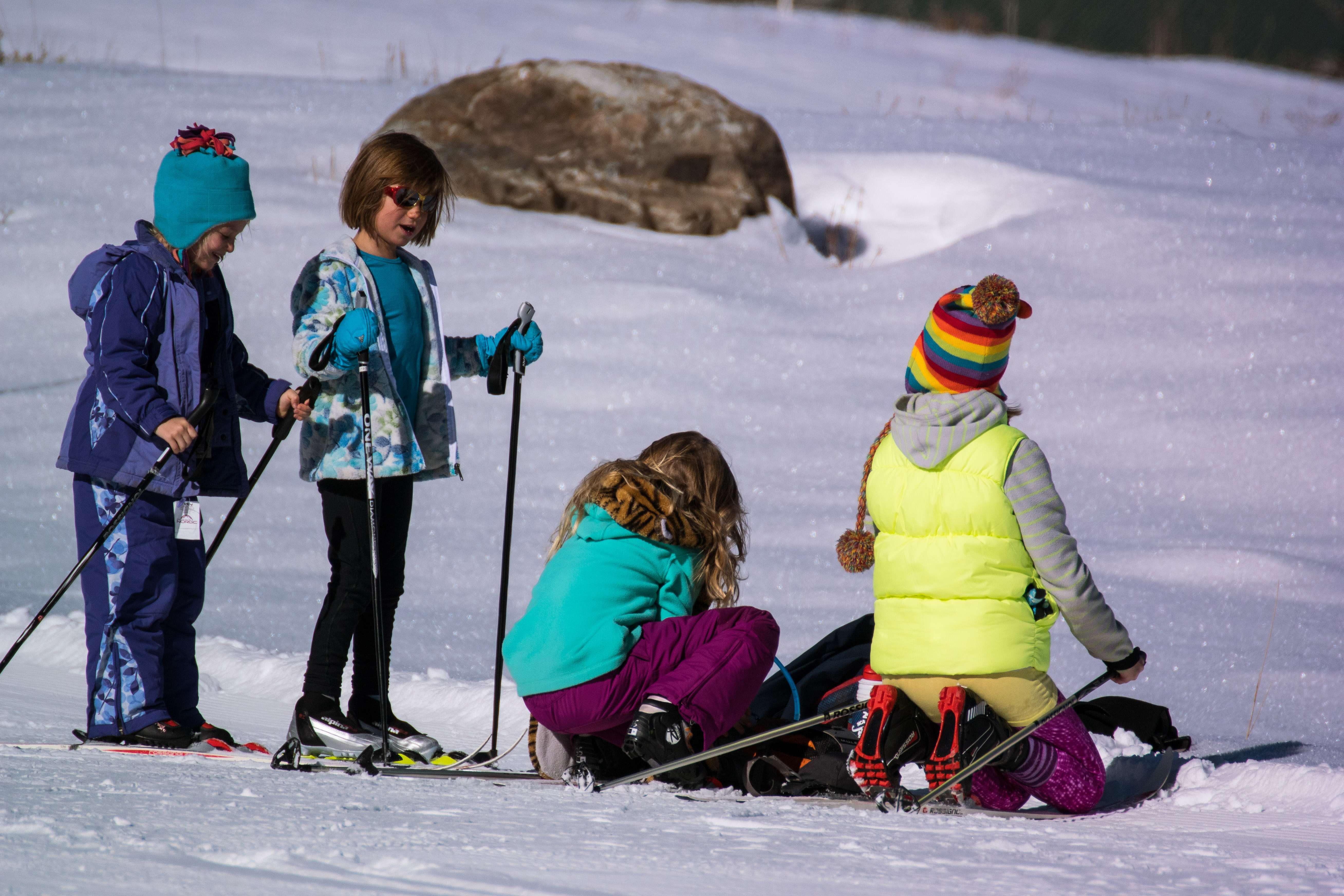
Here’s a deal: Kids 17 and under enjoy free rentals, passes and clinics at the Crested Butte Nordic Thanksgiving Camp. (Photo: Xavier Fane)
What makes this camp unique? “As a non-profit, our mission is to get people out on the trails skiing. We are not making a ton of money off it,” Holbrook said.
“We just want people to come here and use our trails and make it affordable. A lot of people come back year after year and work with the same instructor. They get to know each other and get to know the other people that come into camp. So it’s definitely got this small feel to it, it’s kind of personalized.”
Special events:
For the first time, a race (on Sunday): 5/10 k freestyle + kids’ race with new homologated course on Ruthie’s Run. “It’s engineered, seeded, and mowed,” Holbrook said. “Due to the engineering, we are able to groom the race course with a lot less snow than we used to need. That enables us to count on having this race and count on have a good race venue close to town.”
Winter Kick-Off Party (Saturday night): Fundraiser for Crested Butte Nordic, tickets $30/adult,$10/children.
Wax clinic, nutritional talk and Nov. 25 is opening day at Crested Butte Mountain Resort, with free skiing all day.
***
What: CXC Thanksgiving Nordic Festival
Where: Telemark Trails in Cable, Wisconsin
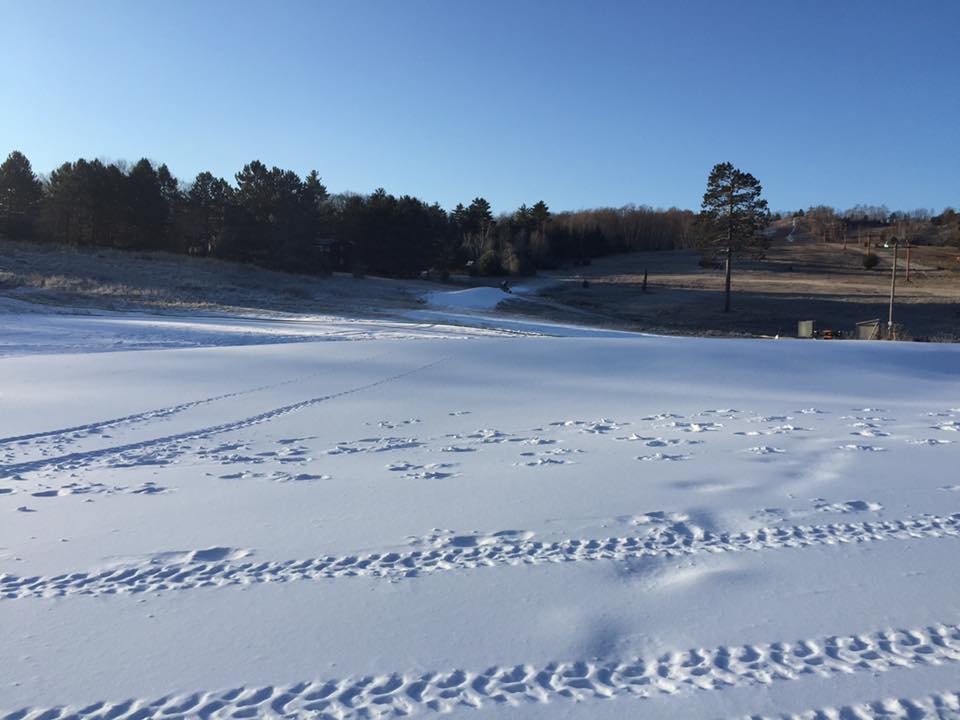
After three nights of blowing snow, CXC Thanksgiving Nordic Festival organizers were ready to groom the Telemark Trails in Cable, Wis., on Nov. 22. (Photo: Facebook)
When: Wednesday, Nov. 25, to Sunday, Nov. 29, 2015
How many years running? First year. “Our goal for the festival is to show the template to other communities, what it takes to make snow … to provide a business and operations template to other places around the Midwest so they can do these festivals in late November and then have a reliable loop for the winter,” CXC Executive and Athletic Director Yuriy Gusev explained.
A 1 k loop was made and groomed for the first-annual CXC Thanksgiving Nordic Festival in Cable, Wis. (Photo: Facebook)
Target audience: All skiers; open to the public
Anticipated participation: Based on the camp’s Facebook page, at least 75 plan on attending, and Gusev estimated that paired with a local turnout would amount to 200-300 skiers. “We don’t want to make it a big deal … just to show the community this is an opportunity to ski,” he said.
Advance reservation required? Yes, for clinics (instructed by Gusev on Friday, Saturday and Sunday).Trails open to public.
Trail pass rates: $50 season passes, good for the festival and the whole winter. Trail passes can be purchased at www.cxcskiing.org/skipass, Telemark condominium office and Cable Area Chamber of Commerce Office.
Grooming report: Skiing on a 1 k loop at Telemark started on Sunday: “Usually there’s no natural snow this time of year, so our plan was to make snow,” Gusev said. “It just didn’t get cold like it normally does.” Once temperatures finally cooled late last week, the snowmaking crew was able to work on blowing and laying out a 1-kilometer manmade loop, some of which will be used for the 2016 Junior Nationals sprint course. More details
What makes this camp unique? “Anytime you have early snow, you stand out. I think it can be a key component to have this … to provide a reliable base for the rest of the winter, especially for youth programs where the snow is critical and also for entry-level participants. We’ve seen already with the couple snowmaking areas in the Twin Cities how much impact these have on the ski industry and local ski shops. They’ve been able to actually do relatively well in snowless winters.”
Special events: Fischer Demo
***
What: Snow Mountain Ranch Nordic Ski Camp
Where: Granby, Colorado
A November day at Snow Mountain Ranch, which opened for skiing earlier this month and remains open with 50 k groomed with a set track. (Courtesy photo)
How many years running? First time in recent years
Target audience: Beginner skiers to seasoned racers
Advance reservation required? Yes.
November skiing at Snow Mountain Ranch in Granby, Colo. For the first time this year, a five-day camp was held for masters. It ended on Tuesday. (Courtesy photo)
Participation: Capped at 24. “Smaller is better from both a coaching and athlete viewpoint,” Snow Mountain Ranch’s Nordic Center Director Bill Pierce explained. In its first year with little marketing, the five-day camp attracted four athletes.
“It was really small, but it was great,” Pierce said. “It’s so early that people don’t expect there to be snow [when] it’s 60 degrees in Boulder. … We just want to put another option out there; a lot of skiers want to be on snow in early November and Denver is really easy to get to.”
Trail pass rates: $350 for the camp, includes all coaching sessions and day passes
Grooming report: 50 kilometers groomed and track-set. Snow Mountain Ranch started grooming Nov. 4 and opened for skiing on the 14th. According to Pierce, they have anywhere from a 4-5 inch base to 10 inches in some places. It was snowing there on Thanksgiving, with four inches of snow expected to fall today. More info | Webcam
What makes this camp unique? “This is the earliest masters camp in North America on-snow as a pre-Thanksgiving camp,” Pierce explained.
The idea was to run a masters camp similar to an elite or junior camp, with two-a-day sessions combining workouts and technique — all at 9,000 feet above sea level. The focus was on transitioning from dryland training to snow skiing, with an emphasis on technique and slow volume at high altitude.
With a small but mighty coaching staff (two of which are USSA certified), Pierce said the ability to work with athletes helps them set, understand and achieve skiing goals.
“We all speak the same language,” he said of the coaches. “You can go to a lot of places, and a lot of places you feel like you’re getting a lesson. There’s a difference between a lesson and coaching.”
“[This camp is] just another opportunity in the country to go skiing all day,” he added.
When: 2 1/2-day weekend and 5-day midweek camps (schedule):
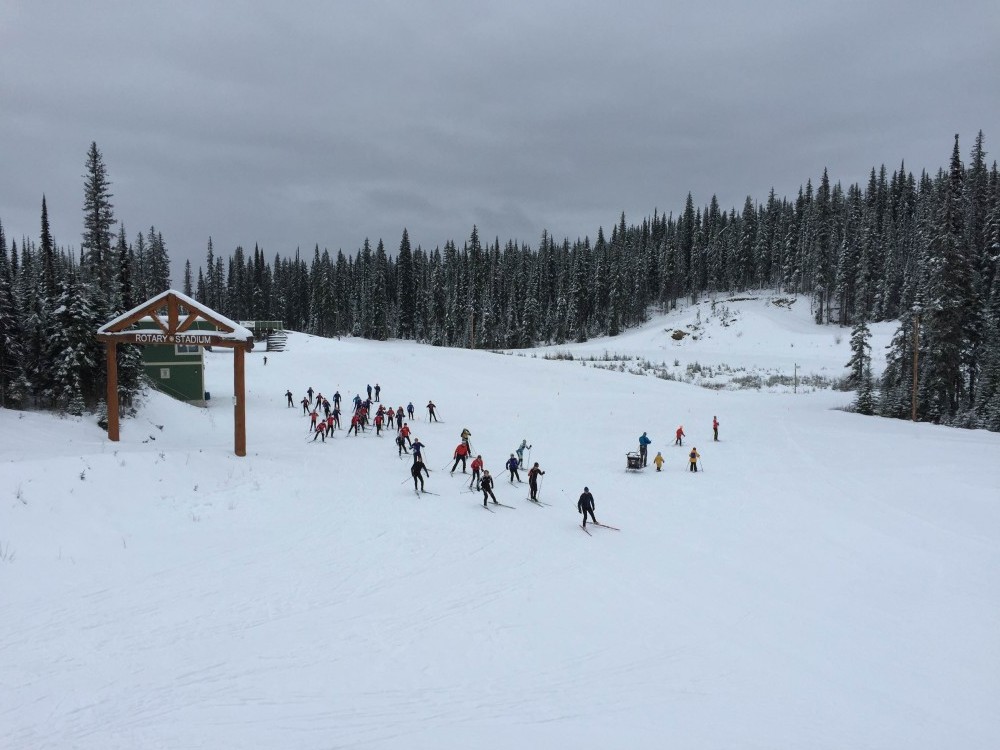
A gaggle of skiers at a junior camp head out on the trails at the Sovereign Lake Nordic Centre on Nov. 14 in Vernon, British Columbia. Roughly 800 skiers took to the trails that day. Each winter, Sovereign Lake hosts a series of weekend and weekday camps, called SuperCamp. (Photo: Gerry Furseth)
Camp #1:Nov. 20-22
Camp #2: Nov. 23-27
Camp #3: Nov. 27-29 (with Pro-camp option)
Camp #4: Nov. 30-Dec. 4
Camp #5: Dec. 4-6
Camp #6: Jan. 15-17
Camp #7: Feb. 19-21
How many years running? 26 (The SuperCamp program started in 1989)
Target audience: All ages and skill levels from beginner to elite racer.
Advance reservation required? Yes.
Anticipated participation: Typically around 225 to 250 participants, hoping for 260 this year.
“In its heyday in the early ’90s [SuperCamp attracted] upwards of 400,” Sovereign Lake Nordic Center General Manager Troy Hudson explained. “We want to get back to those numbers by offering some great new initiatives like focussed Masters Pro camps for racers and more options such as the biathlon camps which are proving to be very popular.”
Trail pass rates: Dual area trail passes included in camp fee, ranges from $339 to $925 Canadian dollars per person (depending on length of camp, and half or full days). Pricing
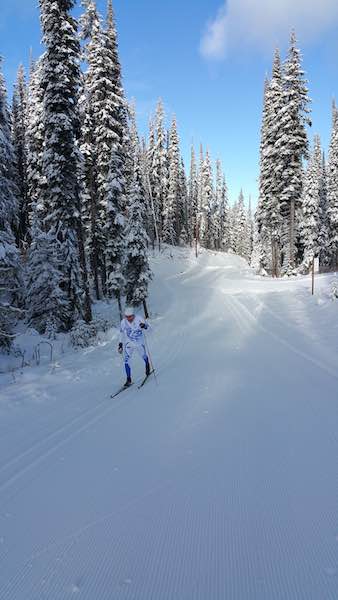
VR40 blue-wax skiing on Nov. 16 at the Sovereign Lake Nordic Centre in Vernon, B.C. (Photo: Ryan Olson)
Grooming report: Sovereign Lake has 40 kilometers groomed and Silver Star has an additional 40 k open. More details (and webcam)
What makes this camp unique? “I’m often asked, what is Supercamp?” SuperCamp coordinator Shane Landreville wrote in an e-newsletter. “That’s a great question and because Supercamp offers so much more than a traditional ski lesson, it’s a difficult concept to explain and it’s difficult for people to wrap their heads around it. Quite simply, Supercamp is a Nordic experience.”
SuperCamp attracts top-level coaches, as many come from across Canada to get early snow before they start their season at home. Each camp includes lectures and lessons on waxing, how to build a training plan, and sports nutrition, as well as access to the national altitude training centre gym, and best of all, 105 kilometers of trails between Sovereign Lake and Silver Star — many of which are used for World Cup, NorAm, and World Master events.
With half- and full-day options, the camp is at an altitude of 1,600 metres (5,250 feet). Many of the accommodation options are on the nordic trails. You can ski or walk to restaurants and bars in the evening.
Biathlon camps are either five days long or a single afternoon, and a new Pro camp is more racing focused.
The Silver Star alpine area opened earlier this week, as did the separate Fat Bike trail system.
Special events:
Keynote speakers, a sports nutrition lecture, and wax clinics
Stretching classes, body pre-activation sessions, and for 5-day campers, two 30-minute massages. “Skiing for a solid 2 days or 5 days is tough, it really is, so taking care of your bodies is important,” Landreville wrote. “For our 5 day camps, you can also take part in the excursion to the spa and pools at Sparkling Hill Resort.”
***
Also: Canada’s Early Season XC Venues
What: Frozen Thunder
Where: Canmore, Alberta
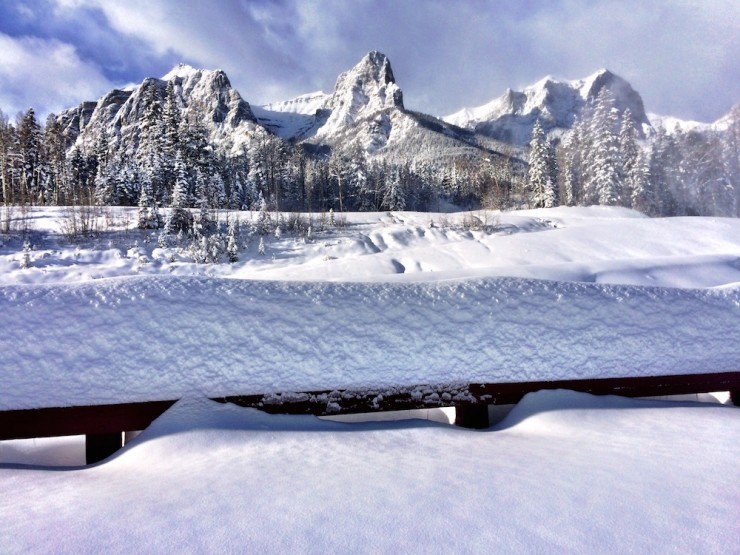
Fresh snow at the Canmore Nordic Centre: A n Olympic Legacy Venue now a regular host of Canadian based World Cups. (Photo: Pavlina Sudrich)
How much snow: Boreal Glide, a 2.5 k manmade loop, is open for both freestyle and classic. Course map | Weather
Good to know:
According to according to Julie Moffet, the regional operations coordinator at Forêt Montmorency, la Forêt is the only place in North America with cross-country skiing as early as Oct. 30 all the way to Easter in April.
No races or special events are scheduled, simply skiing and snowshoeing for all.
To reserve a room on the trails (with two single beds and a shared bathroom), with access to a cafeteria, two lounges with a fireplace, game room, auditorium, and wax room, visit http://www.foretmontmorency.ca/en/lodging/
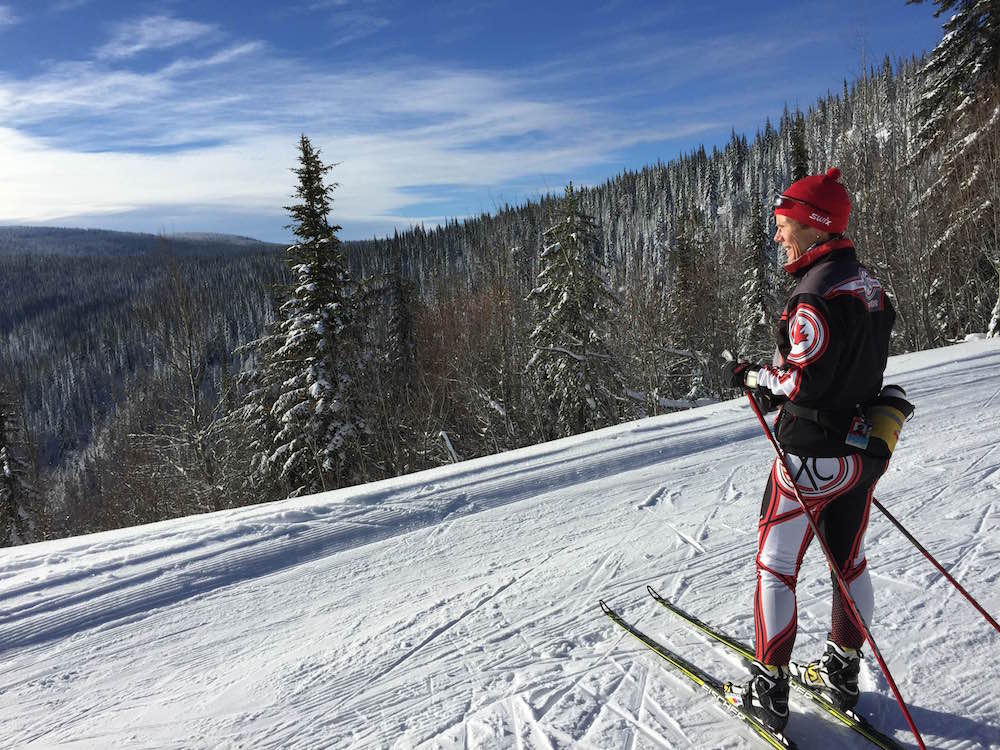
First-year senior Frédérique Vézina, 20, of the Pierre-Harvey National Training Centre, training in Quebec.
This ‘Pros of Tomorrow’ series, brought to you by the generous support of Fischer Sports, aims to highlight some of the most notable up-and-coming athletes around the world, which may or may not be Fischer-sponsored skiers. If you have an idea for a top-notch skier you’d like to read more about, please email info@fasterskier.com with the subject line: ‘Pros of Tomorrow’. We’re also looking for stories about intriguing juniors, collegiate skiers, or lesser-known athletes; please email us with names — subject line: ‘From the Pack’.
***
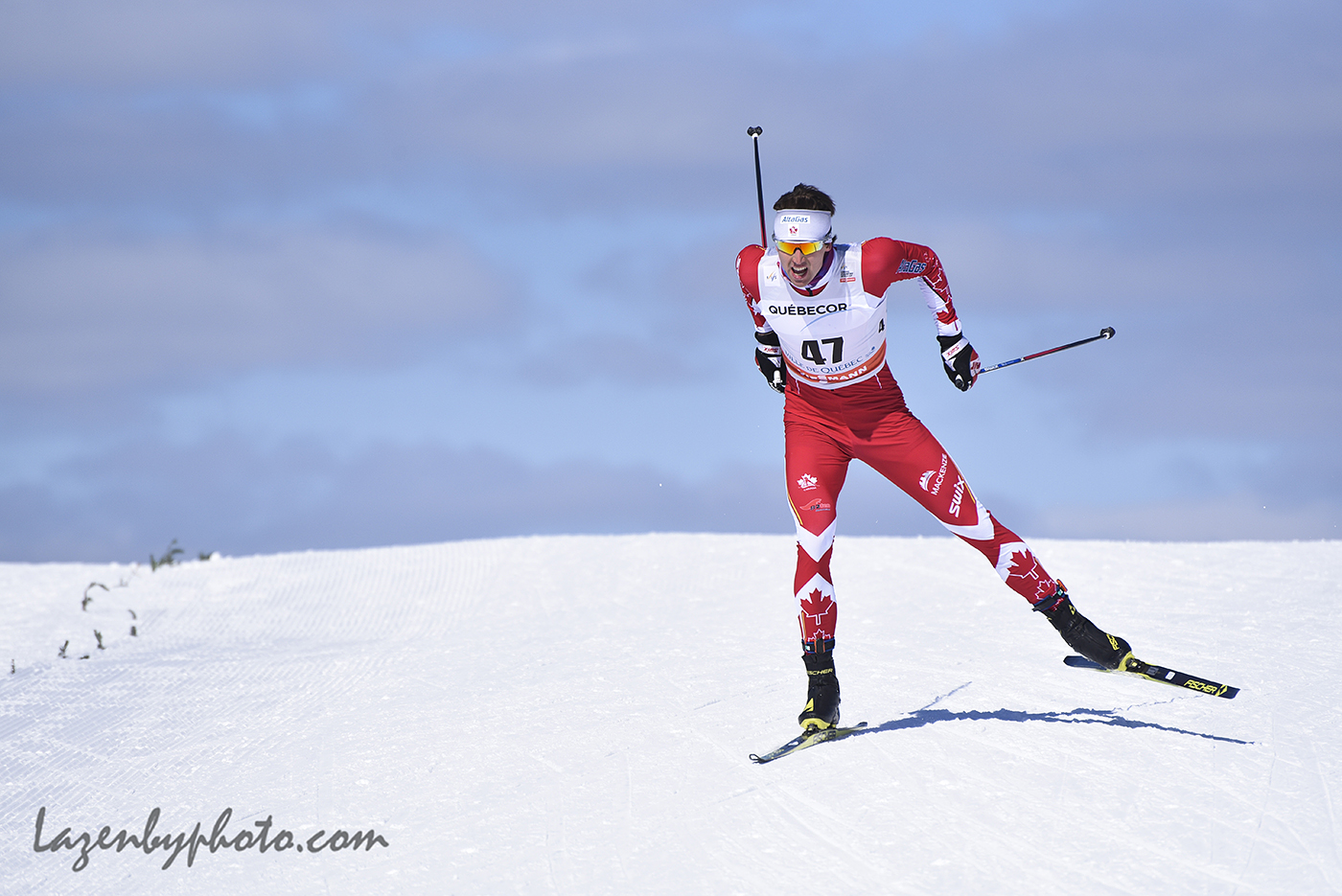
Frédérique Vézina of the Pierre-Harvey Training Centre during a NorAm classic race.
While the famous father-and-son duo Pierre and Alex Harvey is at the very heart of cross-country skiing in the province of Quebec, another family name has become increasingly part of Quebec’s nordic culture: Vézina.
Former Canadian Ski Team member Jocelyn Vézina was one of Canada’s strongest skiers in the ’80s, alongside teammates Pierre Harvey and Yves Bilodeau (now Canada’s head wax technician). His 20-year-old daughter, Frédérique Vézina, a first-year senior, is rising fast on the Canadian nordic ski scene.
Just like Alex Harvey, she grew up at the foot of the Mont-Sainte-Anne ski slopes — 200 meters precisely. Eager to race and expend her energy, she joined MSA Nordic Ski Club. Competing in both cross-country skiing and kayak at the time, she chose to give up the latter in her mid-teens.
“The ski lifestyle was more appealing to me. I liked the fact that it involved so much diversity,” Vézina said last month on the phone from her home in Saint-Ferréol-Les-Neiges. “In the summer, I’ll run, cycle, even do triathlons, which all prepare me well for skiing.”
And while her background in kayak boosted her upper-body strength in skiing, she said that now she struggles to keep up on the water with her former teammates.
Last year’s racing season was “long but rewarding,” the former junior national-team member said. Her consistency at the Canadian Juniors — she placed third, second and won the last race —- enabled her to make the trip to Val di Fiemme, Italy, for the 2014 FIS Junior World Ski Championships.
With wax setbacks, she placed 30th in the skiathlon, but found success a week later in a FIS race in Ramsau, Austria.
“Last season, I spent two months away from home, competing in Europe,” she said. “We had bad skis in Italy, but Austria was a big hit for me! I made it to the podium [in second place] in the 7.5 k skate race, which was really unexpected.”
She loves distance races, especially the skiathlon, said sprinting isn’t her strongest suit.
“I think I have much more slow-twitch muscle fibres. I’m built on my father’s slim frame,” she said.
This summer, she worked on her weaknesses, focusing on speed and devoting more time to anaerobic training. She stayed mainly at home, training with the Pierre-Harvey Training Centre (Centre National d’Entraînement Pierre Harvey, or CNEPH) team, then in October, joined other members of the Canadian national team in Park City, Utah, for an altitude camp.
This season, she hopes to qualify for the U23 World Ski Championships in Almaty, Kazakhstan. So far, she’s posted two top-30 results at the U.S. SuperTour in Bozeman, Mont., where she was 23rd in the 10 k classic and 29th in the classic sprint, and two top 20’s (13th and 18th) in the 7.5 and 10 k classic races at the NorAm opener Dec. 13-14 in Rossland, British Columbia. She did not race at the most recent NorAm Dec. 19-20 at Sovereign Lake, B.C.
“I’m aiming for a top 20 in Kazakhstan,” she said. “I just received a bunch of skis to try out. I hope that the only thing stopping me from good results will be myself, not my skis!”
Asked whether she dreams of representing Canada at the Olympics one day, she hesitates for a moment.
“I’m not one to dream too much. Of course I would like to race at the Olympics, but if I do, I want to do well, not just participate. If anything, I dream of becoming the next Beckie Scott!” she said. “She didn’t benefit from all the programs available to today’s young athletes, yet did really well and became a role model for us. If she could do it, why can’t I?”
Vézina recently completed her CEGEP (Collège d’Enseignement Général et Professionnel) and has considered pursuing a career in sports medicine.
First-year senior Frédérique Vézina, 20, of the Pierre-Harvey National Training Centre, training in Quebec.
Si la dynastie Harvey trône au coeur du ski de fond québécois, et fait résonner sa mémoire depuis les exploits de Pierre jusqu’aux succès récents d’Alex, une autre famille scintille depuis quelques décennies sur les terres du Mont Sainte-Anne: les Vézina.
Jocelyn Vézina fut membre de l’équipe canadienne aux côtés de Pierre Harvey et d’Yves Bilodeau (actuellement technicien en chef de l’équipe canadienne de ski de fond) dans les années 80. Sa fille, Frédérique, âgée de vingt ans, fait déjà honneur à son nom.
Frédérique Vézina of the Pierre-Harvey Training Centre during a NorAm race.
Tout comme Alex Harvey, elle grandit à quelques 200 mètres des sentiers de ski de fond du Mont Sainte-Anne. Habitée d’une énergie débordante, elle décida de joindre promptement la troupe de ski du Club Nordique MSA. Ce choix l’empêcha toutefois de poursuivre les courses et l’entraînement en kayak.
«Le ski offre une grande diversité et un mode de vie qui m’attiraient davantage», confie Vézina lors d’une conversation téléphonique depuis la maison familiale à Saint-Ferréol-Les-Neiges. «Lorsque l’été arrive, je peux pratiquer différents sports, comme la course à pied, le vélo et même le triathlon. Ce sont toutes d’excellentes façons de me préparer pour la saison de ski de fond.»
Malgré son retrait des courses de kayak à seize ans, elle tire encore aujourd’hui les bienfaits de ce sport centré sur le développement de la force musculaire au niveau du haut du corps. «Je suis relativement plus forte en ski grâce à mes années d’entraînement en kayak. Mais je suis incapable de suivre mes anciennes coéquipières sur l’eau aujourd’hui!».
Actuellement membre de l’équipe canadienne junior de ski de fond, Vézina jette un regard ambivalent sur sa saison dernière. Une saison «longue, mais tout de même satisfaisante», admet-elle. Sa régularité – avec une troisième puis une deuxième place, et une victoire en clôture des Championnats canadiens juniors- lui permit de participer aux Championnats du Monde Junior FIS 2014 à Val di Fiemme, en Italie.
En prise avec des problèmes de fartage, elle glissa à la trentième position lors du skiathlon. Ses déboires en sol italien furent vite oubliés une semaine plus tard à Ramsau, en Autriche, lors d’une course continentale FIS.
«La saison dernière, je suis restée deux mois complets en Europe, loin de chez moi. J’ai eu mon lot de difficultés en Italie, avec des skis lents. Je me suis rattrapée en montant sur le podium [sur la deuxième marche] à Ramsau, dans l’épreuve du 7.5 km style libre. J’étais tellement surprise!»
Elle affectionne particulièrement les épreuves de distance, notamment le skiathlon. Sa «bête noire» demeure les sprints. «Je crois bien avoir plus de fibres à contraction lente. Je suis taillée dans le frame de mon père!»
En guise de préparation estivale en vue de la prochaine saison, Vézina a concentré ses efforts sur la vitesse et sur l’entraînement en anaérobie. Elle en est à sa cinquième saison au Centre National d’Entraînement Pierre Harvey (CNEPH). Un camp d’entraînement en altitude a brisé la monotonie en octobre dernier, alors qu’elle a retrouvé l’équipe canadienne à Park City, au Utah.
Cette année, Vézina a les Championnats du Monde U23 à Almaty, au Kazakhstan, en point de mire. Elle vise une position parmi les vingt premières.
Interrogée sur son rêve de représenter le Canada aux Jeux Olympiques dans un avenir rapproché, la principale intéressée hésite un moment.
«Je ne suis pas vraiment du genre à rêver. Bien sûr que j’aimerais participer aux JO, mais pas à n’importe quel prix. Si j’y vais, je ne veux pas tenir le rôle de figurante, je veux performer. En fait, je rêve plutôt d’être la prochaine Beckie Scott. Malgré le manque de programmes d’aide aux athlètes à son époque, elle est devenue une skieuse exceptionnelle et une femme exemplaire. Si elle y est parvenue, pourquoi ne pourrais-je pas en faire autant?»
Vézina a récemment terminé ses études collégiales et aimerais entreprendre des études en médecine sportive.