From the FasterSkier archive — posts syndicated from athletes’ and coaches’ own blogs between 2004 and 2012, kept online as published. Current coverage is at fasterskier.com.
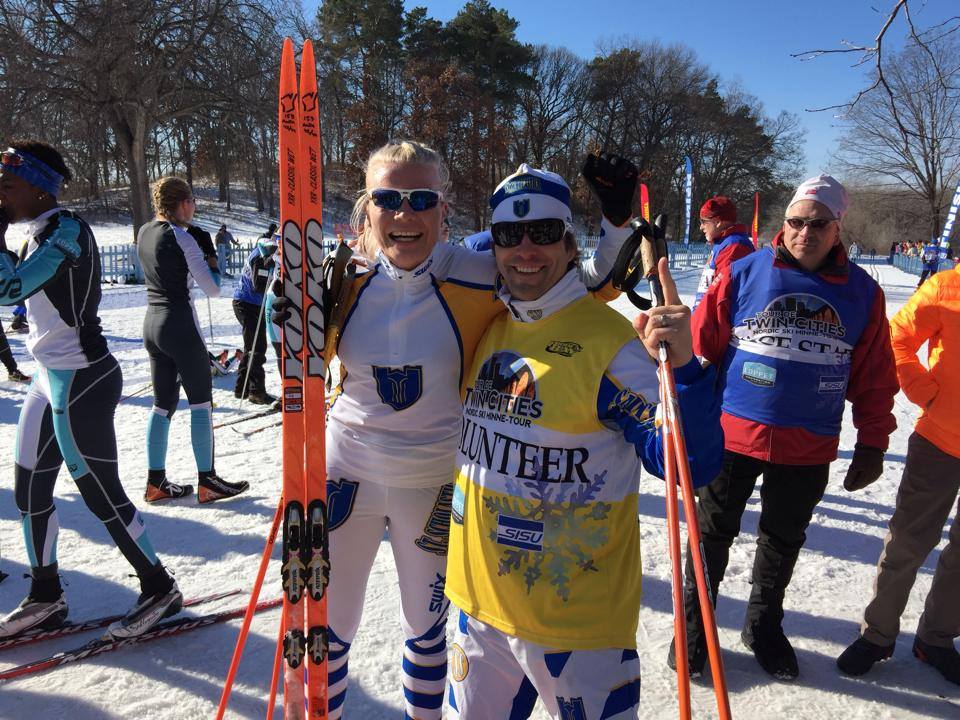
The College of St. Scholastica’s nordic head coach for the last decade, Chad Salmela (r) with Saints skier Anita Kirvesniemi of Finland. (Courtesy photo)
The sound of a Gator utility vehicle heading out to one of the race-course checkpoints. The long lines to the port-a-potties. The tribes of teams stretching in the shade of tree trunks near the white, spray painted start-line boxes.The smell of dirt and sweat. For Chad Salmela, a former high school cross-country runner and coach, nothing compares to the sensory mélange of a cross-country running meet.
With that in mind, when the head running coach for The College of Saint Scholastica (CSS) for the past 26 years, Steve Pfingsten, decided to retire in mid-February, Salmela — in his 10th year as the CSS nordic head coach — saw an opportunity. He approached the CSS Athletic Department with an idea: if given Pfingsten’s position, using his background and knowledge in both skiing and running, Salmela could work to bring the two CSS endurance sport programs closer together.
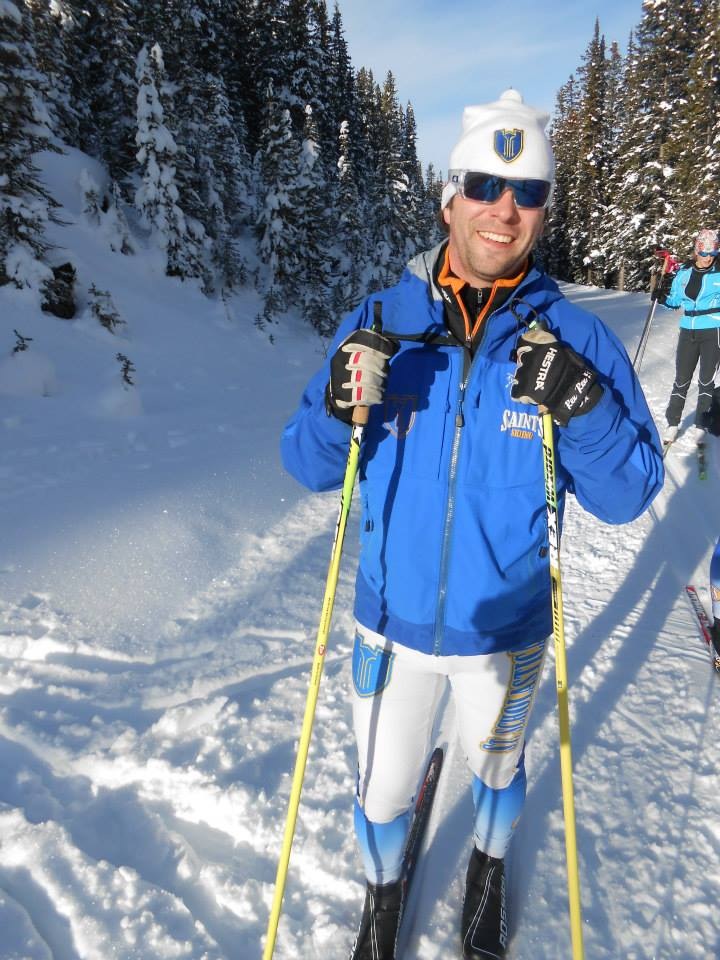
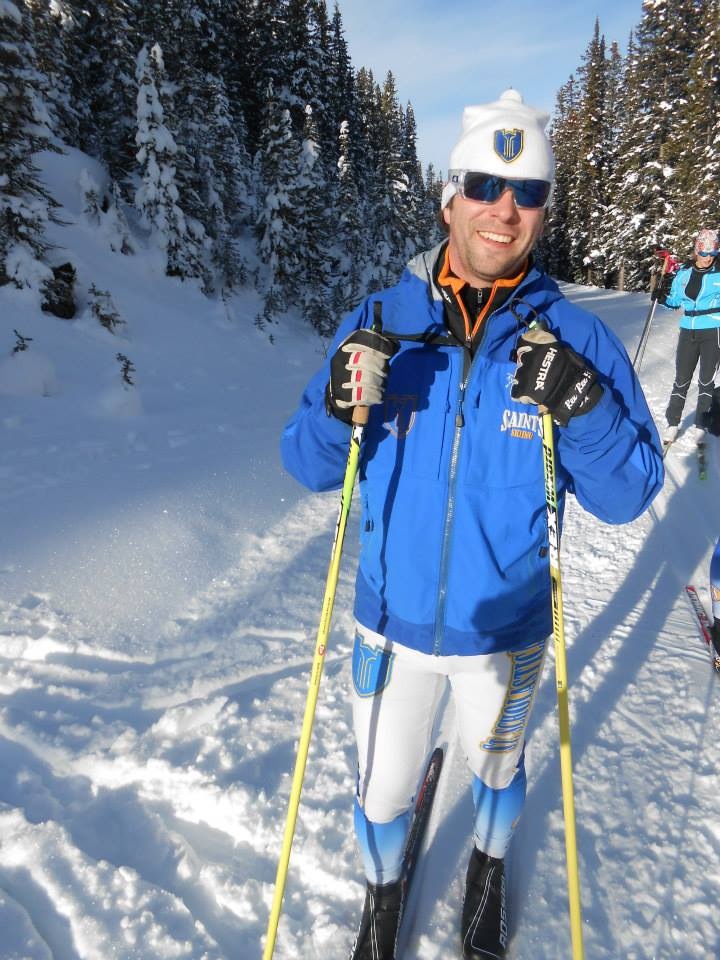
St. Scholastica Head Coach Chad Salmela during a ski at Lake Louise near Canmore, Alberta. (Courtesy photo)
Three-and-half months later, Salmela, a Virginia, Minn., native, is the new head coach of the Saints’ cross-country team and assistant distance coach for track and field. His dream to integrate the two programs will take teamwork and communication between himself and the new nordic coach — still to be determined. While he plans to help interview and mentor the new nordic hire as needed, he is most excited about the chance to once again discover himself amidst the fall running season.
“I can’t wait for that first meet where we get off the bus and the sights and the sounds and the nerves,” Salmela said during a recent phone interview. “There’s something majestic to me about cross-country running … as a coach, there’s just so much more to do the morning of an event in cross-country skiing. You don’t ever get to just revel in the atmosphere quite like you do in cross-country running.”
Eliminating some of the elements involved with being a nordic ski coach on race day — waxing, testing, wax station set up and break down — doesn’t just afford more time for existential reverie. In Salmela’s eyes, it also creates more opportunity for coaches to engage with their athletes.
“In cross-country skiing, waxing and ski preparation is important,” the 45-year-old coach said. “I’ve made it important and [the Saints] program has succeeded on the waxing for sure … but there’s a cost to that. The cost is you don’t get to interact with the athletes and really engage with them as well as you could. That’s the one big upside to people starting to limit the fluoro carbon use. I think it will get coaches back in touch with their athletes and sport again.”
Getting back to basics of athlete-coach interaction is not the only thing Salmela hopes to achieve by making the switch. Though he started the Saints’ ski team in 2006 and has since helped the school develop the competitive Division III program it has today, the key for Salmela as a coach is staying challenged and open to change. Even if that change is a little uncertain.
“It was not easy for me to leave the ski team,” he said. “I created the program. It’s not just that I was there 10 years, it’s that I was there 10 years and it was nothing when I started. It didn’t exist … and as a DIII program in 10 years of existence, [CSS] is pretty good … we were as good as we’ve ever been two years ago. We had more talent and better results. We won the conference championship, we did well against NMU [Northern Michigan University] and NMU is awesome. So to walk away from all that, it almost seems nuts.”
The CSS nordic program’s growing success over the years under the guidance of Salmela is evident, with Bjorn Bakken’s first NCAA qualification in 2008 (the team’s second year in existence), Tyler Kjorstad’s second NCAA qualification in 2009, the men’s first team win in 2012, Paul Schommer and Jeremy Hecker’s 3rd and fourth NCAA qualifications in program history in 2012, followed by the Saints women’s first team win in 2014, Schommer’s All-American finish in 2014, and the first dual-female NCAA qualifiers in 2015.
As Salmela explained, doing so took 10 years’ time and patience, occasionally working with athletes who had been injured or were just beginning their ski careers.
“Chad didn’t really impact my ski career, he started it,” Schommer, a 2015 grad and now an aspiring Olympic biathlete from Appleton, Wis., wrote in an email. “Without him, I wouldn’t of had the career I’ve had and hopefully will have … I think a lot of athletes overlooked the amount of time Chad put into their training plans, time analyzing lab tests, and preparing skis for race weekends. Chad doesn’t take shortcuts … He cares about more than performance. He cares about the whole picture knowing that to be a high level athlete it’s all the little things that add up.”
“Chad doesn’t take shortcuts … He cares about more than performance. He cares about the whole picture..” — Paul Schommer, former St. Scholastica skier and All-American on his college coach Chad Salmela
As Salmela looks to swap skis for running spikes, he explained he is not leaving athletes like Schommer behind. He is discovering ways empower more. After returning from a TED Talk in his hometown presented by the former mayor of Duluth on vulnerability, Salmela realized one reason for the career is change is to ensure that not only is he challenging his athletes, but he is being challenged by his work with them.
“It does feel like I’m stepping down the rabbit hole into a whole new world,” he said. “[But] I like challenges … and maybe that’s the essence of my coaching, is that I am vulnerable and that there’s some genuineness to being vulnerable and opening yourself up to vulnerability. I’ve certainly made mistakes with athletes, and I’ve certainly taken wrong paths in training. So I’m far from perfect, but I think the search for being a little more perfect is always good. You’re never going to get there, but the destination of trying is pretty powerful.”
A Change of Pace and Salmela’s Next Steps
Tempo runs. Hill workouts. Steady states. Strides. When it comes to running, there are quite a few workout sessions that are considered a standard in the sport. Lab testing is not one of them.
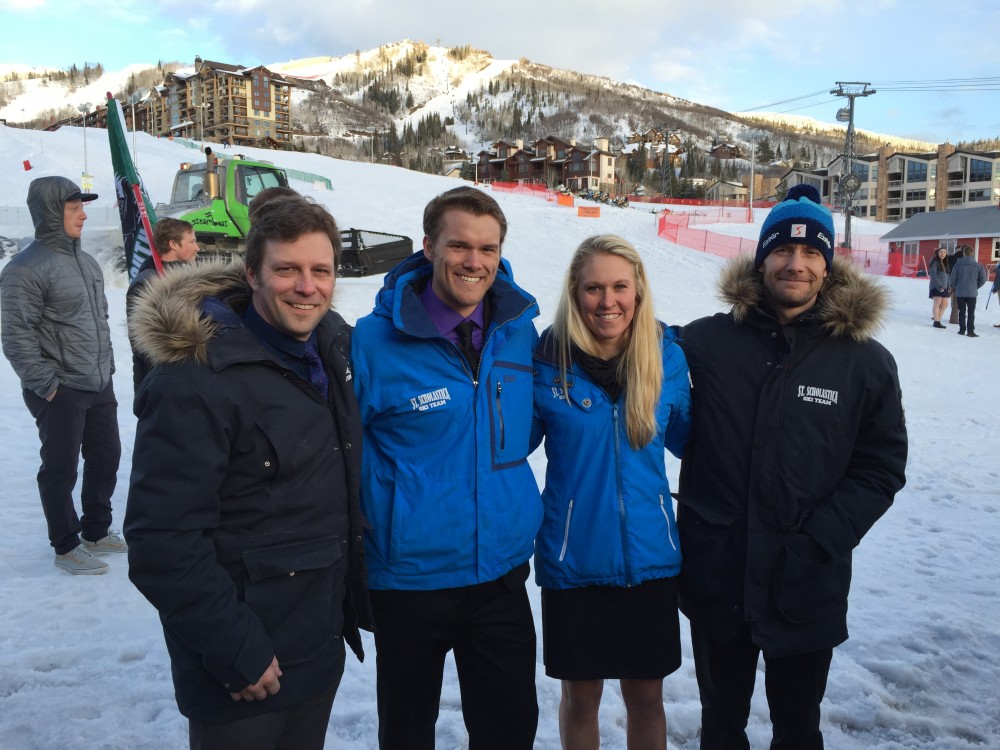
Chad Salmela (far left) with 2016 NCAA qualifiers Reitler Hodgert and Kelsey Dickinson as well as assistant nordic coach, Josh Tesch at 2016 NCAA Championships in Steamboat Springs, Colo. (Courtesy photo)
However, athletes who run for the St. Scholastica cross-country and track teams — Salmela predicts around 50 cross-country and 65 to 90 track and field athletes (20 distance runners) will join the program this upcoming season — can expect these tests to become a staple in their training plans.
A US Biathlon National Team competitor for two years after high school, a US Biathlon assistant coach from 1998-1999 during his undergraduate years at Middlebury College, and the National Junior Development Program Director in 2000 — during which he helped render three future Olympians, Tracy and Lanny Barnes and Annelies Cook — along with seven years of coaching running, Salmela has a wealth of experience with high-end performance training plans. Using his knowledge on physiology primarily from nordic skiing, such as monitoring athletes’ aerobic efficiency in the lab, he hopes to bring a new perspective to the American populist running culture.
“I don’t think there are a ton of Division III running programs who are bringing athletes into the lab,” he said. “My feeling is that there could be more emphasis generally placed [in running] on aerobic efficiency … I think that if you are strong enough and if you implement the right kinds of stress loads on runners, you can vastly increase the aerobic volume training of a runner, beyond what is commonplace today.”
While increased aerobic volume training may be novel to many of Salmela’s future runners, he sees change as an imperative part of being an athlete, skiers and runners alike.
“The one thing 20 years of coaching has taught me is that, for any single person, doing the same thing forever is never the most optimal way to go,” he said. “You have to change. Your body changes and you have to change.”
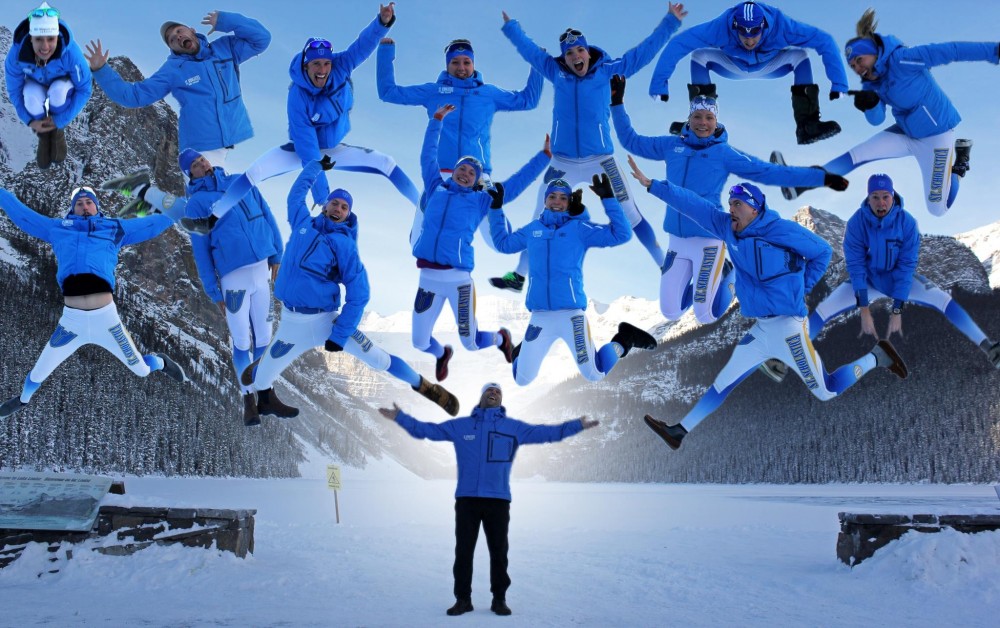
Chad Salmela (below) and his Saints ski team. (Courtesy photo)
A fresh start, fall racing and forfeiting long winter van drives are not the only things Salmela is embracing as he passes the CSS nordic team torch to the next coach. The switch also opens up the the opportunity for him to further establish himself as cross-country skiing’s garrulous nordic guru.
“I don’t have any contracts of anything right now, but it frees up the potential to do more T.V. work or commentary work,” said Salmela, who’s been a color commentator for NBC at the last three Winter Olympics, as well as a biathlon and cross-country World Cup commentator. “It’s nice to be able to have that freedom. I certainly thought of that in this process … That’s definitely a factor, but more than anything, I needed a career change.”
With a career change still steeped in coaching, Salmela does not relinquish the chance to spark and inspire.
“I can’t travel as many people in skiing just because budget-wise and the number of skis I have to pack,” he said. “So I’m really excited that I get to coach a sport where I get to load a bus full of kids and I get to inspire them all to run the best they can.”
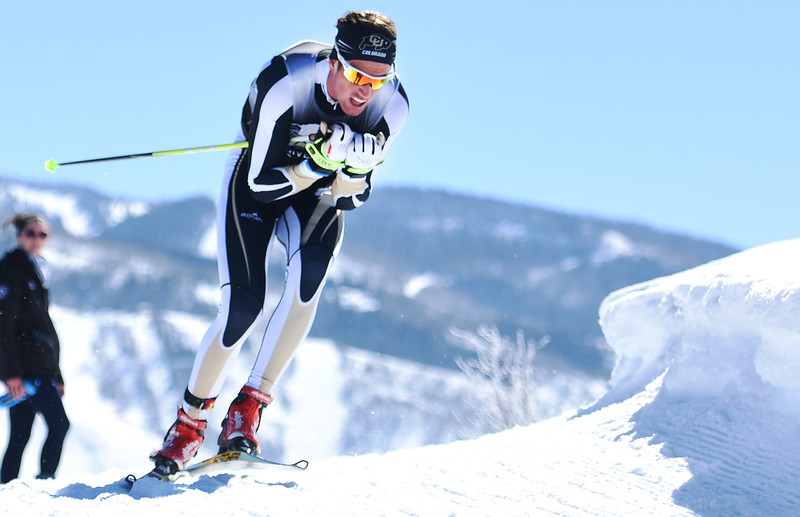
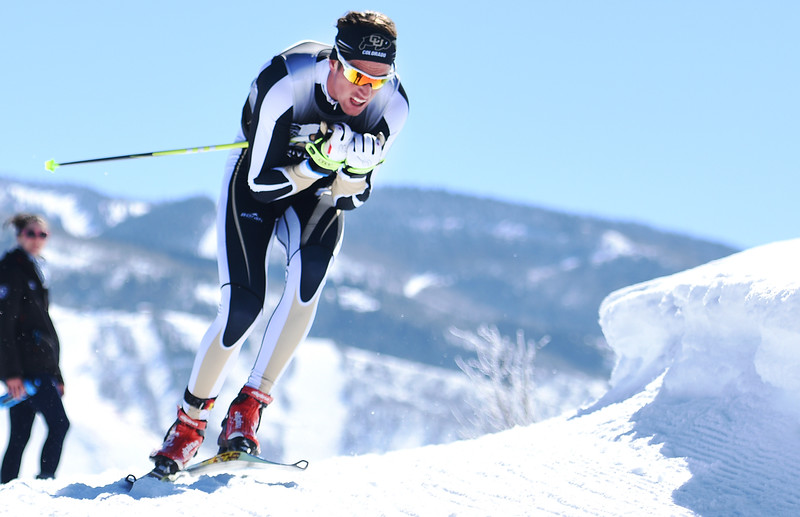
Mads Strøm of the University of Colorado racing to first place in the men’s 10 k freestyle at 2016 NCAA Skiing Championships last week in Steamboat Springs, Colo. (Photo: CUBuffs/Buffzone.com)
Note: This article has been updated to include comments from Ethan Townsend as of Thursday, March 17.
With the conclusion of the collegiate season taking place at the 2016 NCAA Skiing Championships in Steamboat Springs, Colo., last week, FasterSkier provides a look at the some of the latest involving school, sport and the Championship races. Part I examines the tradition behind the NCAA Skiing Championships format, and what it would take to change it.
A Brief History of NCAA Skiing Championships
5 k/10 k. 15 k/20 k. Scrolling through the archives of the National Collegiate Athletic Association (NCAA) championship events for nordic skiing is akin to strolling through a 1950s U.S. ‘Levittown’ neighborhood: Variation zero to none. Another online record for the past 16 years of NCAA Skiing Championships provides a similar finding. Nordic races at this event are traditionally two races for each gender: women race 5 kilometers and 15 k, while the men race 10 k and 20 k. Though the discipline alters between freestyle and classic, the distances for each respective gender remain the same.
A phone conversation earlier this season with Cami Thompson-Graves, Dartmouth College women’s head nordic coach and director of skiing, NCAA Men’s and Women’s Skiing Rules Committee member, Chair of the USSA Cross Country Committee, and most recently, a member of the International Ski Federation (FIS) Ladies’ Cross Country Committee, revealed a similar story.
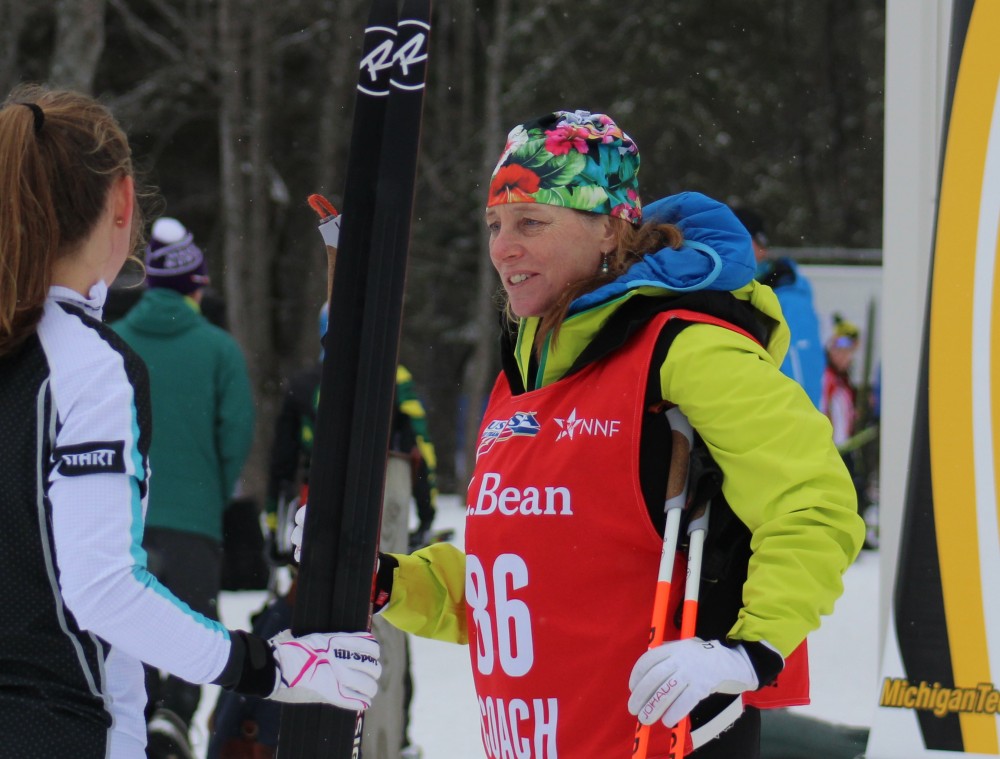
Dartmouth women’s coach Cami Thompson-Graves (r) at 2016 U.S. nationals in Houghton, Mich.
“So as long as I can remember, [the championships] have been two races,” Thompson-Graves explained. “Way back when … it was an individual race and a relay. But then when skating came along, we went with one classic race and one skate race. Pretty much for the last 25 years, we’ve alternated every two years and done a long mass start of one and a shorter of the other.”
So what if the championship races have stayed the same for the past 25 plus years? Why should anyone in or out of the college-race scene care?
“I skied in the East and tradition is a big deal in the East,” Chad Salmela, head nordic coach of The College of St. Scholastica in Duluth, Minn., said on the phone. “People like tradition, but at the same time, tradition can limit your outlook as to what the future could possibly hold.”
Coaches, Committee Members and Athletes on Change
According to Salmela, the championship event controls quite a bit of what events college racers will compete in during the regular season.
“Let’s face it, the championships really drive what happens in the regular season because everybody is trying to qualify,” Salmela said.
That’s certainly the case for the 2016 Rocky Mountain Intercollegiate Ski Association (RMISA) nordic race schedule, with all but one weekend following the 5 k/10 k and 15 k/20 k format.
“It varies from region to region,” Thompson-Graves said of the 5 k/ 10k and 15 k/20 k race distances in the Eastern Intercollegiate Ski Association (EISA) schedule. “If those are the [championship] events, we’ll try to do those races one weekend back to back early in the season and our regional championship is usually similar to the NCAA Championship.”
This year, the EISA schedule included a men’s and women’s 1.5 k classic sprint, as well as a men’s and women’s sprint relay event.
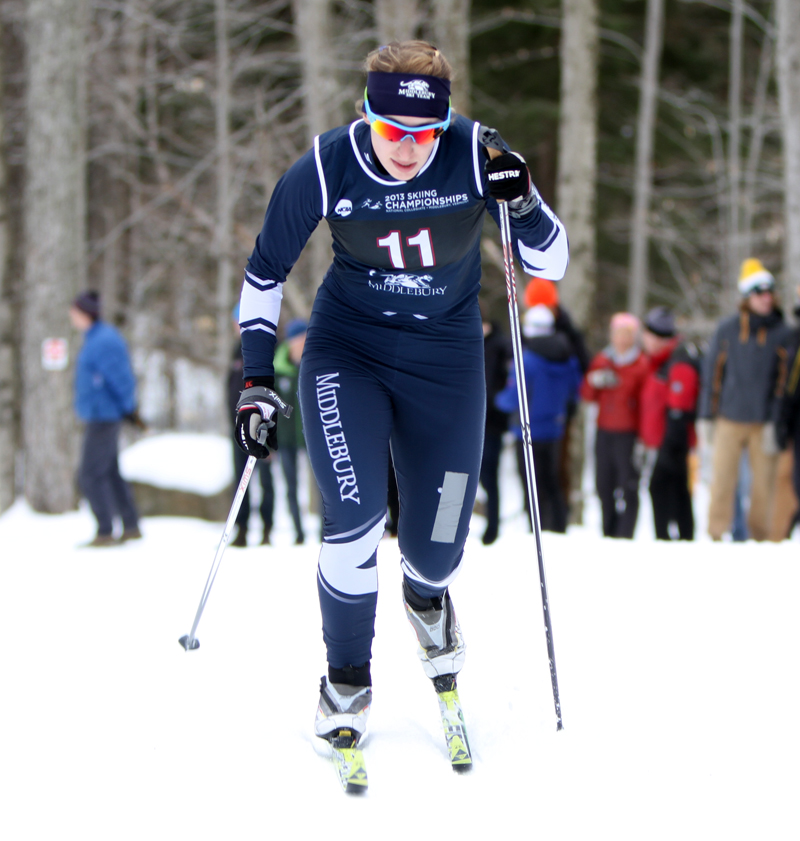
Kelsey Phinney, a Middlebury College senior from Boulder, Colo. competing at 2013 NCAA Skiing Championships at the Rikert Nordic Center near Middlebury, Vt.
Still, a few individuals question if this is enough and whether the current NCAA Championships nordic skiing schedule necessitates change.
“I love sprinting and I would love to see it in the championship events for college races,” Kelsey Phinney, a senior at Middlebury College, said on the phone.
“I think sprinting is a really good development tool in terms of gaining speed and applying tactics during your races. It’s such an exciting part of our sport right now and it has such a presence on the World Cup that in terms of development, it makes a lot of sense to include it,” Phinney added.
Raleigh Goessling, a senior at the University of New Hampshire (UNH), agrees.
“I think that sprinting is already a really big part of nordic skiing at every other level, except the college level,” Goessling said on the phone. “I think that college programs should get on board with that.”
Goessling’s point was bolstered further by Salmela.
“I’m very much in favor personally of adding sprinting to the championship,” Salmela said. “I think it modernizes the sport and it’s inevitable. The question is when and how.”
Attempting to Answer ‘How’
In an effort to resolve the question of ‘how,’ Salmela — whose four year term on the NCAA Men’s and Women’s Skiing Rules Committee expired this past September — and committee members created a proposal for the 2016/2017 race season.
The proposal, submitted last spring to the NCAA for review, included a menu offering championship race organizers the opportunity to select the race lengths and format, based on the courses and course crews available to the championship event host-site.
“What we proposed to the NCAA put the onus on the organizer of the championships to decide on a menu of FIS distances and disciplines,” Salmela said. “The idea was to leave it up to the committee to steer it in a way that sprinting becomes a part of NCAA skiing, but is not necessarily a mandated thing every year.”
Thus, any International Ski Federation (FIS) event, from a sprint to a 30 k, had the potential to show up at a championship race series.
However, the proposal was returned this past fall to the NCAA Men’s and Women’s Skiing Rules Committee for further review.
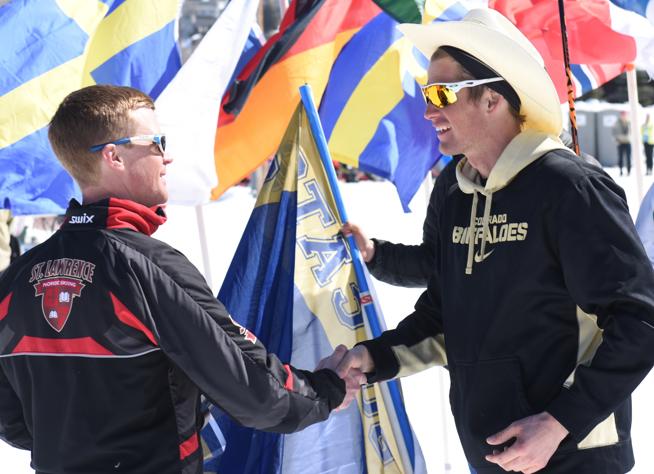
Ethan Townsend (l), chair of the NCAA Men’s and Women’s Skiing Rules Committee and St. Lawrence University head nordic coach, congratulates the 2016 NCAA 10 k freestyle champion, Mads Strøm of the University of Colorado. (Photo: Joel Riechenburger/Daily Camera via CUBuffs/Buffzone.com)
“It’s not been denied,” Ethan Townsend, chair of the NCAA Men’s and Women’s Skiing Rules Committee and St. Lawrence University head nordic coach, explained on the phone prior to the championship. “It’s just kind of a big change and the NCAA wanted us to vet it out a bit more.”
The most recent discussion regarding the proposal took place last week in Steamboat Springs, Colo. at the 2016 NCAA Championships.
“I think we are looking to re-propose what the skiing committee approved this past summer with some changes,” Townsend wrote in an email post-2016 NCAA’s. “I’m not really confident we will get that change through but we are going to try.”
With the next NCAA Men’s and Women’s Rules Committee meeting taking place in early June, Townsend predicts changes to the NCAA Championship event won’t be implemented for another season or two.
“Any changes will take at least until 17/18 I think,” Townsend wrote, “it’s too late to have this in place for next season.”
While select coaches from the east, west, and central locations convened last week to go over a number of NCAA issues–including the proposition of holding NCAA Championships in Alaska, a topic Townsend described in an email as “more concerning in the immediate term for a variety of reasons”–athletes remained topics of conversation, but not contributors to the dialogue.
At some levels, the lack of voice is not a deliberate choice. Currently, there is no athlete representation on the NCAA Men’s and Women’s Rules Committee.
“That’s not our call,” Salmela said. “The committee makeup is entirely driven by the NCAA … I think it would be awesome to have an athlete or a couple athletes on each sport committee, but that’s not a skiing issue, that’s an NCAA sport-wide issue.”
That doesn’t mean that student athletes’ don’t have plenty to say.
“Although I’m personally not a sprinter, I think it is a good move if we want to develop competitive skiers to race on the World Cup,” Dartmouth senior Oscar Friedman said on the phone. “That being said, I would probably support a calendar that more closely mirrors the World Cup. If there’s only two races at NCAA’s, I don’t think it makes sense to have a sprint. I would prefer there be three races; one can be a sprint and two distance races.”
While many might agree with Friedman, financial restrictions decrease the feasibility of adding another race day.
“We are only funded by the NCAA for 5.5 days and we currently have four races days, alternating Nordic and Alpine events,” Fredrik Landstedt, the secretary-rules editor for the NCAA Men’s and Women’s Skiing Rules Committee and head nordic coach for the University of New Mexico, wrote in an email. “It is very unlikely that the NCAA will increase their spending on the Skiing Championships to add extra days.”
Landstedt also extrapolated that the the duality of NCAA skiing — shared scoring between alpine and nordic, as well as combined points between men’s and women’s teams in order to win a championship title — makes bringing a sprint into the championship particularly complicated.
Fans at the 2015 NCAA Skiing Championships in Lake Placid, N.Y.
“A sprinter can be tripped or obstructed and your entire team can lose the Championship because of something that was not related to the strength of the skiers on your team,” Landstedt wrote. “This happens all the time in sprinting. When it is an individual race for individual glory, it is very different compared to when it affects not only the rest of the Nordic team, but the Alpine team as well.”
Instead, Landstedt suggested that an “Individual Sprint Championship” be incorporated into NCAA Championships.
“I believe that we could add an Individual sprint championship race where the winners will be recognized by the Collegiate Ski Coaches Association as the NCAA Sprint Champions,” Landstedt explained. “It might mean that there are 3 Nordic races in a 4 day span but if the sprint race is an individual race, slow sprinters and some skiers from the teams that are competing for the team trophies might chose to skip this race.”
A Way Out of the NCAA’s Quagmire?
A change to NCAA Championships is particularly complex.
“We’re basically only going to be allowed to have two races at the championships and so how are we going to pick those two races and make it fair for everyone?” Thompson-Graves questioned.
“… Program budgets are probably all over the map and we all have to follow different rules,” she pointed out. “[Dartmouth has] to follow Ivy League rules and Division I rules, Middlebury, Colby, Bates, and Williams are following NESCAC [New England Small College Athletic Conference] rules and Division III rules. We’re all trying to compete head to head and yet we face a lot of different kinds of issues.”
School budgetary divides and division differences are just the beginning.
Landstedt also wondered whether adding sprinting will encourage sprint racers to become more specialized in college racing and if schools with larger budgets will be at an advantage to recruit and travel to sprint venues for training.
“Major concerns include how to fit sprinting in to a team format, having highly educated officials and a jury that can handle lots of protests and rule correctly on obstruction and interference issues common in sprint races, limited number of race venues with good sprint courses, expense related issues, recruiting,” he explained. “I also believe that sprint racers will become more and more specialized and that it will be harder and harder for distance skiers to compete in sprints and vice versa.”
“People like tradition. But at the same time, tradition can limit your outlook as to what the future could possibly hold.” — Chad Salmela, College of St. Scholastica head coach and former member of the NCAA Men’s and Women’s Skiing Rules Committee
All of these concerns compressed into two days of competition makes for a challenge. But it’s a challenge that Salmela feels cannot go untouched.
“If you look a the repertoire of what FIS has for nordic skiing right now, it’s a multitude of events,” he said. “To cap for that in two days is probably one of the greatest challenges the committee faces in trying to be a relevant piece of ski racing — not just American ski racing — but ski racing. And I think that’s why sprinting needs to be looked at. The sport has to be relevant.”
An Issue of Relevancy: College Racing and The World Cup
How much focus should college skiing in the U.S. place on preparing athletes for higher levels of nordic competition? How many skiers move on past college to ski professionally? Would this number grow if changes were made to NCAA Championships?
“There’s a very tenuous argument, I feel, that NCAA skiing is the best path for the top talent in the country to develop into World Class skiers,” Salmela said. “I think that it’s a wonderful and lucky mechanism for retaining athletes who maybe don’t progress at the international pace for their age.
“From a U.S. Olympic Committee perspective, the NCAA is a safety net that you don’t have to fund to keep talented skiers developing,” he added.
From 2005 to 2009, Simi Hamilton, 28, raced for Middlebury, where he was a three-time NCAA All-American, before he made the leap to the U.S. Ski Team. Hamilton nabbed two individual podiums this season on the World Cup, first in a freestyle sprint in Toblach, Italy, and again at the freestyle sprint earlier this month in Gatineau, Québec.
“When the question comes up of how college ski racing affects/overlaps with the overall development of a racer that wants to race full time (World Cup or domestic circuit) after school, it’s always tricky to answer,” Hamilton wrote in an email. “I don’t think there’s any way one person can say, ‘Yes, it fits in great’ or ‘no, the two don’t mesh at all.’ If I were answering the question based on what it did for me, I would definitely say that it helped. Skiing throughout college gave me an opportunity to stay in touch with racing, while giving me enough space from the sport to become more mature as an athlete and as an adult.”
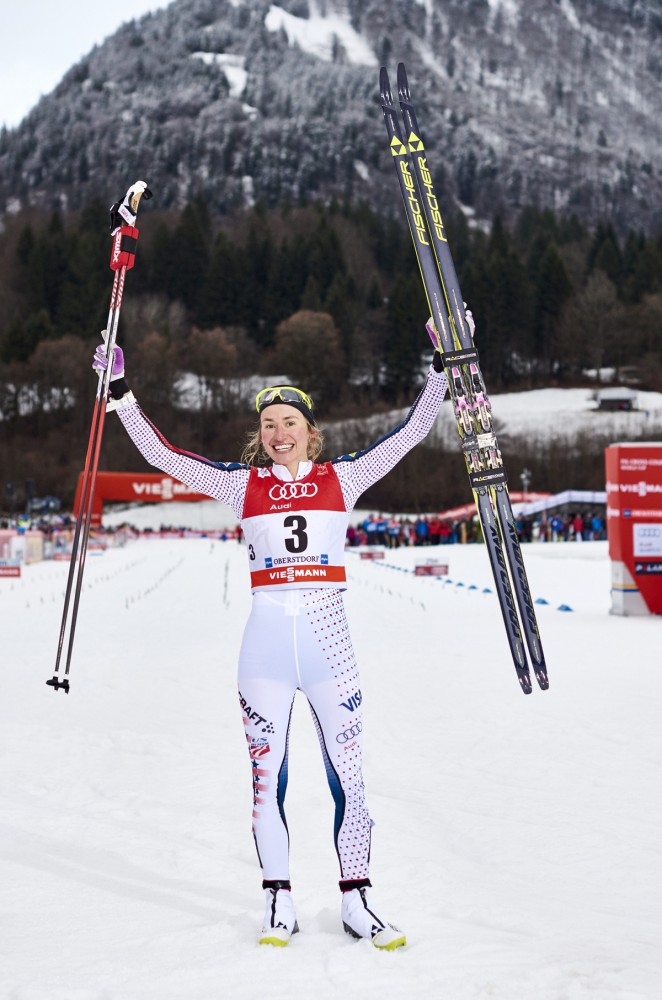
Sophie Caldwell soaks up her first World Cup win at the Tour de Ski Stage 4 classic sprint in Oberstdorf, Germany. (Photo: Fischer/NordicFocus)
Caldwell, a 2012 Dartmouth graduate and five-time NCAA All-American, who won her first individual World Cup in January at the the women’s classic sprint in Obsterdorf, Germany, also explained college ski racing was the right decision for her.
“I don’t think I was mature enough or mentally ready to ski full time right after high school, so I think having the balance of skiing and school in college worked out really well for me” Caldwell wrote in an email. “By the time I graduated from Dartmouth, I was four years older and more experienced, and ready to give professional skiing a stab.”
Though both have seen recent success on the World Cup and both agree that development varies from person to person, they also confer on the point that perhaps it’s time to re-evaluate race distances at NCAA’s.
“Sprinting is becoming more popular and almost half of the World Cup races are now sprints, so it definitely would be worth considering for college racing,” Caldwell wrote.
Hamilton pushed the point even further.
“I think that NCAA needs to do some serious restructuring of their planning and scheduling in college xc ski racing,” he wrote. “It’s crazy to me that athletes still go to the championships and only race one middle distance race and one long distance race.
“It’s hard to be too critical about the current system that is in place now because I am successful at what I do and I think I have quite a few years left of skiing successfully on the World Cup circuit, but that shouldn’t be an excuse for the NCAA to keep things exactly the way they have been for the last 30+ years,” he added.
In conclusion, Hamilton added two primary goals college skiing should strive for within the U.S.
“The first is giving young athletes a chance to be a part of something in college that is great,” he wrote. “The importance of being part of a team, no matter what kind of team, cannot be overstated. Regardless of whether an athlete wants to ski after college or not, college skiing should provide every xc athlete with a really fun chance to work hard at something and focus on achieving goals beyond the classroom.”
While Hamilton’s first objective of college skiing revolved around teamwork and team skiing, his second goal emphasized individual aspirations.
“The other goal that college ski racing should strive for is giving young races a chance to develop into the kind of athlete they want to become after college, if that is something they are serious about pursuing,” he wrote. “Personally speaking, if I had been given more opportunities while I was in school to focus on sprinting, there’s no doubt that I would have entered the World Cup circuit with more confidence and better prepared.”
“Personally speaking, if I had been given more opportunities while I was in school to focus on sprinting, there’s no doubt that I would have entered the World Cup circuit with more confidence and better prepared.” — Simi Hamilton, U.S. Ski Team sprinter and former Middlebury skier
As a place where athletes have the opportunity to compete and train at a relatively low cost, college does seem to provide a great opportunity to further develop nordic skiers and skiing in the U.S.
“Most of these college programs are providing coaching and transportation and waxing and all those things to make it easy for athletes to race, which they maybe don’t appreciate until they’re out of school and trying to do it on their own,” Thompson-Graves said.
Yet, lumping U.S. college racing and the World Cup all in one does not appear to be the answer, either.
“I think the challenge is that we’re trying to accommodate a lot of different kinds of athletes in college racing,” Thompson-Graves added, pointing out that “some programs are just happy to race carnivals,” while other U.S. college programs “challenge [athletes] to think bigger and do more if that’s what they want to do.”
Ultimately, however, most believed that it should be a priority that skiing in the U.S. stays relevant.
“I guess I fall into the camp that would like to see us doing, in college skiing, races that are sort of done in the national and international calendar,” Thompson-Graves said. “To me, it’s important that our athletes are learning to race whatever the current races are throughout the world. That’s important to me.”
Norway's Vegard Ulvang (r) holds up the arm of Joe Dubay, who was originally proclaimed the winner of the 2012 American Birkebeiner men's classic race before being disqualified for not registering and racing in his college teammate's bib. Dave Chamberlain (l) moved from second to first, and Ulvang ultimately placed second.
Note: This story has been updated to include thoughts from David Chamberlain, who was later proclaimed the 2012 American Birkebeiner classic champion.
***
All American Birkebeiner coverage is brought to you through the generous support of Concept2, makers of the SkiErg.
Before and during the American Birkebeiner 54 k classic race on Saturday, the thought of being disqualified never crossed Joe Dubay’s mind.
The 21-year-old said he didn’t think twice when his College of Saint Scholastica teammate Chris Parr gave him his bib, or when he started with Wave 1 and the elites in Cable, Wis., or as he contended for the win with seasoned veterans Vegard Ulvang of Norway and David Chamberlain of Boulder Nordic Sport.
The look on Parr’s face at the finish told him something was wrong, Dubay said in a phone interview on Monday.
As the college freshman sprinted to the line and narrowly beat Chamberlain followed by Ulvang for the victory in his first Birkie, Dubay realized there might be a very big problem. Living only a couple of hours away in Minneapolis, he had been announced as the winner as he came through, but that was only because someone recognized him.
According to the entry list, he was Chris Parr.
Dubay said he contacted some race officials immediately after the race.
“I told them, ‘I’m not Chris Parr. My name’s Joe Dubay. What do you want me to do about this?’ ” he said. “I was pretty sure I would get immediately disqualified.”
Instead, Dubay said the officials told him to sit tight while they sorted things out. The said he should go to the podium ceremony and press conference in the meantime, he said.
“I felt like was in a difficult spot because I made a mistake,” Dubay said. “It should have been somebody else up there not me.”
About an hour after the press conference, the results reflected Dubay’s disqualification. He didn’t hear back from race officials, but discovered the DQ upon checking the results later in the day. While there was no money at stake in the 54 k classic race, the mixup caused a podium shift with Chamberlain moving to first and Ulvang placing second. Murray Carter of Manitoba was third.
According to American Birkebeiner Executive Director Ned Zuelsdorff, Dubay was disqualified for not registering for the 2012 classic race and skiing in another racer’s bib. That violated rules set by the International Federation of Skiing and the American Birkebeiner Ski Foundation, he explained in an email.
Zuelsdorff quoted a statement from the Birkie website:
“Do not allow another skier to use your bib. If this does occur, the skier and finish time will be disqualified from the race, and both you and the person using your bib will each be required to pay a $150 penalty before being allowed to enter a future event. You and the skier may also prohibited from entering a future event for a period of time.”
The statement explained that skiing in someone else’s bib can cause issues with age class and overall standings. For safety purposes, it was important for a racer to be identified in case of a problem out on the course.
Zuelsdorff wrote the problem wasn’t new — they had a similar situation with a Kortelopet 23 k “winner” and age-class discrepancies in the past — but this was the first with a Birkie winner.
Dubay said he was working with his college coach, Chad Salmela, to right his wrong.
“Basically, I’d just like to express to them that I definitely regret that and apologize for causing a bit of a mess for them for the other athletes that had to deal with the confusion,” Dubay said. “Racing under Chris’s bib was not the right thing to do in the first place.”
Nearly a month ago, Parr offered Dubay his bib upon qualifying for Junior Nationals. Parr decided to skip the Birkie in preparation for the races March 3-10, but came to cheer on Dubay.
He picked up his bib — registered for Wave 1 of the classic race — and gave it to Dubay. In the classic race, the elites and Wave 1 start together, so Dubay jumped in and contended with six-time Olympic medalist Ulvang and Chamberlain, the race service director at BNS.
Dubay, who won a 30 k Finnish Junior Championship in 2009, said he felt good throughout Saturday’s race, but regretted how things turned out.
“I didn’t really understand how big the race was, which also probably led to me not putting two and two together there,” he said. “I went to the start and did my thing. I was in shock the whole time; I was like, ‘Holy smokes, I really didn’t know this was going to be this big.’ ”
The American Birkebeiner and its associated races reached an all-time high with more than 9,000 participants and an estimated 20,000 spectators this year.
The man who was retroactively dubbed the classic champion, Chamberlain didn’t have any hard feelings.
“I have to hand it to Joe Dubay, he skied a great race, smart tactics and a good sprint at the end,” Chamberlain wrote in an email. “When it came down to the finish straight none of us could follow him. Nobody can take away his effort on Saturday, and the number he had on his back certainly didn’t affect his performance.”
On his end, Chamberlain was pleased with how the pack racing played out. He felt good and his skis were fast, making the 54 k more enjoyable. However, nothing topped skiing alongside one of Norway’s greatest racers of all time.
“The best part of my day on Saturday was the chance to compete with my childhood hero, Vegard Ulvang,” Chamberlain wrote. “I always have admired him, and getting the chance to exchange a few words with him during the race and have a talk with him at the podium ceremony afterwards was really special for me. I can say after skiing behind him during the race that he still has a lot to teach about classic technique, every kick and pole is in the right place with no wasted effort.”