At Norway’s 2015/2016 season-opening International Ski Federation (FIS) weekend, defending World Champion Martin Johnsrud Sundby was in for a surprise. The final starter to hit the deteriorating tracks in the 15-kilometer classic individual start, the Norwegian initially posted the fastest overall time, only to later be disqualified for a skating infraction.
A similar result greeted American sprint leader, Torin Koos in the closing competition of the 2012 U.S. Cross Country Championships in Rumford, Maine. After crossing the finish line first in the men’s classic sprint A-final, Koos was ultimately disqualified for what the jury deemed “an obstruction of competition“, switching lanes before completely clearing his competitor’s skis.
While being the athlete in either of the above situations is never easy, difficult too is the position of technical delegates (TD) who determine their outcomes. When should a skier be disqualified? How many skating steps counts as an infraction in a classic competition? How much should this vary for level of competition and competitor?
Whether a World Cup race or a junior club competition, TDs are as key an event element as the right race-day wax. But serving as a ski referee is not the only responsibility TDs hold.
When conditions are icy enough to send skiers rocketing into trees lining a race course, or the day’s temperatures forecast frostbite, canceling or delaying a competition is also a judgement call made by TDs.
Race courses are also on the list of TD’s concerns. Although the whereabouts of V-boards may not weigh heavily in the minds of athletes, the layout of a course can determine the outcome of a race for skiers, with the duty of setup falling partly on TDs.
As a resource, TDs serve another role. By advising and working with race organizers, TDs ensure those involved with a cross-country sporting event, from the groomer to the timers, are in compliance with USSA and FIS rules.
In the United States at present, however, few individuals are signing up for the job. The total estimated number of individuals who began training this fall to become a level one TD is 10. While few appear to be entering the TD pipeline, many of the current TDs in the U.S. are also rapidly approaching retirement.
“I don’t know what the average age of a TD [in the U.S.] is, but it’s certainly not a young person’s activity,” Scott Wilson, regional coordinator for the Midwest and chair of the U.S. Ski & Snowboard (USSA) TD assignment committee, said on the phone in early October.
Wilson, 70, who has been a TD and coach for the past 25 years, also indicated that not all those currently listed on the TD record remain active in their membership.
“There are 75 on our roster right now,” Wilson said. “But … because there are insurance issues and background checks … we’ll probably nick it down more to 65 [TDs] that are making some progress or staying current.”
As outlined by Wilson, there are three different levels of TDs, with one newly emerging level he refers to as “in-training”. Following the “in-training” level, each consecutive level is known as Level 1, Level 2 and Level 3 TD. For an individual to be considered a Level 1 in the U.S., they must attend a TD seminar (usually held in the fall with dates determined by regional coordinators).
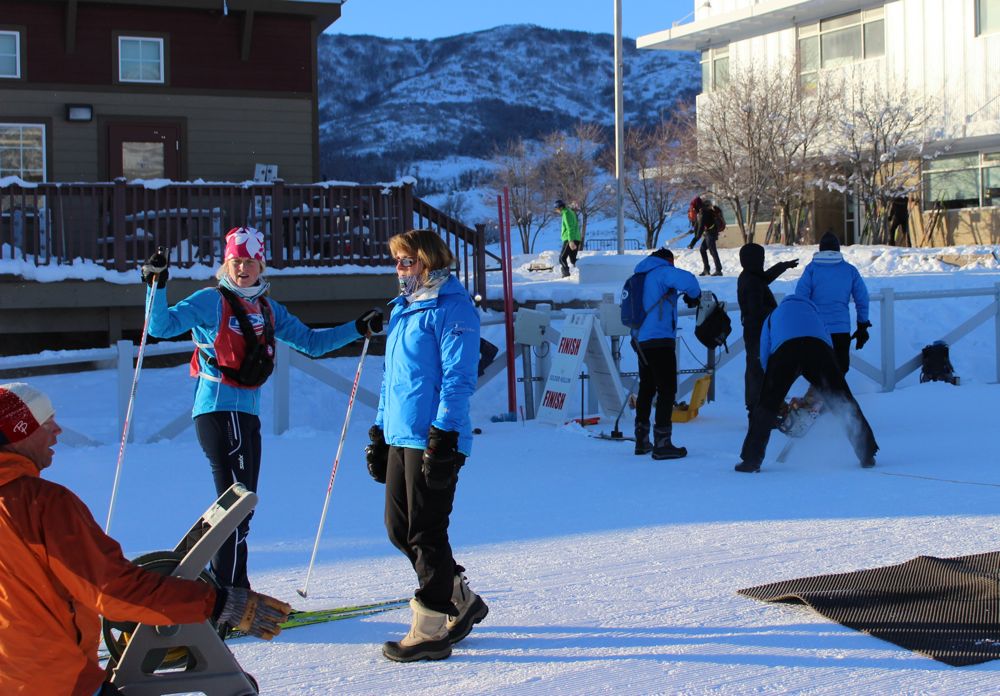
Level 1 TDs are only permitted to run local club competitions, whereas a Level 2 can run a local or national event — such as a Continental Cup (e.g. SuperTour) — and a Level 3 may work anything from a World Cup competition to a small-scale ski race.
For this reason, following their initial seminar, many Level 1 TDs work for two years shadowing an experienced Level 2 or Level 3 TD.
After two years, a Level 1 TD may have accumulated enough experience to become a Level 2. Advancing from Level 1 to Level 2 requires an evaluation which takes place over the course of two competitions.
During the first competition, a Level 1 will serve as an assistant TD, primarily observing the more experienced TD. During the second competition, they are no longer an assistant, but placed in charge and monitored by the more experienced TD.
If the the Level 1 TD successfully becomes a Level 2, another two years of race experience are required before they can consider becoming a Level 3. A recommendation from the regional coordinator must also be put forth for a Level 2 to become a Level 3.
Furthermore, according to the FIS rulebook, an individual must be under the age of 50 in order to start training to become a Level 3 TD. To become a Level 3 TD also requires an examination as well as a presentation at a TD seminar. All said and done, becoming a TD particularly at the World Cup level, is not as simple as counting skate steps in a classic race.
“It’s a fairly big commitment, for most of which you don’t get reimbursed or paid,” Al Pokorny, the TD regional coordinator for Pacific Northwest Ski Association and Intermountain Division, said on the phone in late September. “So the only people who really can do that are people who are older and people who have money.”
At present, a TD’s training expenses, such as travel to and from required instructional seminars, are not covered. For American TDs in training, one seminar must be attended during the fall. A TD must then continue to attend seminars every two years — which rotate location between the U.S. and Canada — at every level in order to maintain their TD status.
With many required trainings, little compensation and a lofty time commitment, pulling TDs into the pipeline is a constant challenge. Pokorny, who has been a TD for almost 10 years, explained that’s a challenge that must be addressed, since having not just young TDs, but TDs who understand the sport from the inside, is beneficial.
“We have great TDs, but the ideal TD would be someone who is relatively young [and has been] involved in the sport at a high level,” Pokorny said. “One of our jobs as a TD is to go out and ski the course and to determine if the course is appropriate for the level of competition and so you kind of have to know what that means. The best way to know what that means is to have done it. So that’s the main reason someone who has been in the sport at a high level makes a good TD.”
Yet, recruiting individuals who have been in the sport at a high level and are fairly young, regardless of compensation is no easy task.
“Those people typically have young children, they’re just getting married. There’s a whole bunch of stuff going in their lives and the last thing they want to do is have to go back and be a TD,” Pokorny said.
Even after throwing in the compensation most TDs receive for events they help run, which amounts to $50-$100 dollars per day, along with travel or accommodation costs (usually but not always), the reimbursement still is not much more than what a high-school referee might earn while working a varsity football game.
Sally Jones, the regional coordinator for the Far West region, pointed out that for the amount of time put in compared to the payout, a TD may as well work for free.
“It’s challenging to find TD’s, whether male or female, because it’s quite a time commitment,” Jones, one of 10 women currently listed as a TD in the U.S., said on the phone in early October.
“It’s not a career, it’s a volunteer position,” she added.
So what drew many of these TDs into the job in the first place? Why spend hours upon hours shivering watching snowflakes and ski racers fly by? One of the most experienced FIS TDs, Al Serrano boiled it down to one word: community.
“You know, we’re a crazy community,” the 48-year-old Serrano said. “We’ve done some things to bring up the compensation a little [for TDs]. There is a requirement for a NRL or FIS race that the TD assistant get paid for their travel expenses and get paid for the day with rates up to what the FIS rate has been … roughly on par for $100 dollars a day. … But bottom line is you do [TD work] because you’re a part of the community and you want to stay involved with it.”
“… Bottom line is you do [TD work] because you’re a part of the community and you want to stay involved with it.”-– Al Serrano, FIS technical delegate on what keeps many TDs involved
Bruce Cranmer, head nordic coach at the University of Colorado-Boulder echoed the sentiment of Serrano and many other TDs FasterSkier spoke with.
“Some are trying to do it at a professional level,” Cranmer said on the phone. “Others are doing it more … to give back and help the sport.”
Perhaps if American TDs can recruit individuals with similar mindsets, the pool of TDs may not shrink so soon after all. Maybe if they can hook the right ones, they will safely replace those soon looking to retire.
“We need to do a better job of targeting people,” Serrano said of potential ways to encourage membership. “You know, going to the clubs and the teams and asking about their retiring athletes and people who might be willing to do it.”
***
The Steps to Become a TD in the U.S.
Outlined below are a few steps individuals can take to become a TD in the U.S. After completing the initial training, a TD has the opportunity to remain a Level 1 TD, or move up to Level 2, which allows them to work as the head TD at national-level events. A Level 2 TD who wishes to move up may continue training and become a Level 3 TD, permitting them to work as the head TD at FIS-sanctioned competitions.
– Step 1: Contact your local coordinator. The first step to becoming a TD is contacting the coordinator for your region. There are currently five regional coordinators: Justin Easter (East), Scott Wilson (Midwest), Al Pokorny (West), Sally Jones (Farwest), and Matt Pauli (Alaska region).
Many TDs also indicated that in order to replace the current cohort of TDs approaching retirement, TD coordinators and TDs need to communicate with local clubs and college programs to obtain contact information for individuals who may be interested in becoming, or are qualified to be, a TD.
“We need good candidates,” Serrano said. “We need to have local people so the travel distance [for TDs to competitions] isn’t so far.”
– Step 2: Attend the trainings. While most of the initial TD seminars take place in the fall, there in not an established date for training among all regions. Contacting regional coordinators for specific training times is crucial.
“The initial TD training is done through the regional coordinators, which varies from region to region,” Serrano said. “That’s one issue we’re trying to work on, is to standardize [TD trainings] a little bit.”
– Step 3: Spend time as an apprentice. Spending time shadowing various TDs at multiple levels of competitions provides a vast scope of the TD styles and ways to work an event.