From the FasterSkier archive — posts syndicated from athletes’ and coaches’ own blogs between 2004 and 2012, kept online as published. Current coverage is at fasterskier.com.
Among the world’s top ultra-marathon runners is Courtney Dauwalter. Her accolades read as a list of the world’s most challenging trail running events, followed by “win” in pretty much every one of them. Known in the running world simply as “Courtney,” she is an incredibly talented athlete, but more importantly, Courtney is an incredibly thoughtful and inspiring person.
In high school, Courtney and I were teammates on the cross-country ski team and both of us stood on top of the podium at the 2002 Minnesota State High School Ski Championships (if anyone has any photos in their archives, please let me know – this was long before digital cameras and smartphones were ubiquitous). After skiing in college for the University of Denver, Courtney spent several years teaching, before a passion for trail running eventually pulled her away from teaching and into a trail running career. We stay in touch and try to meet up when it works out.
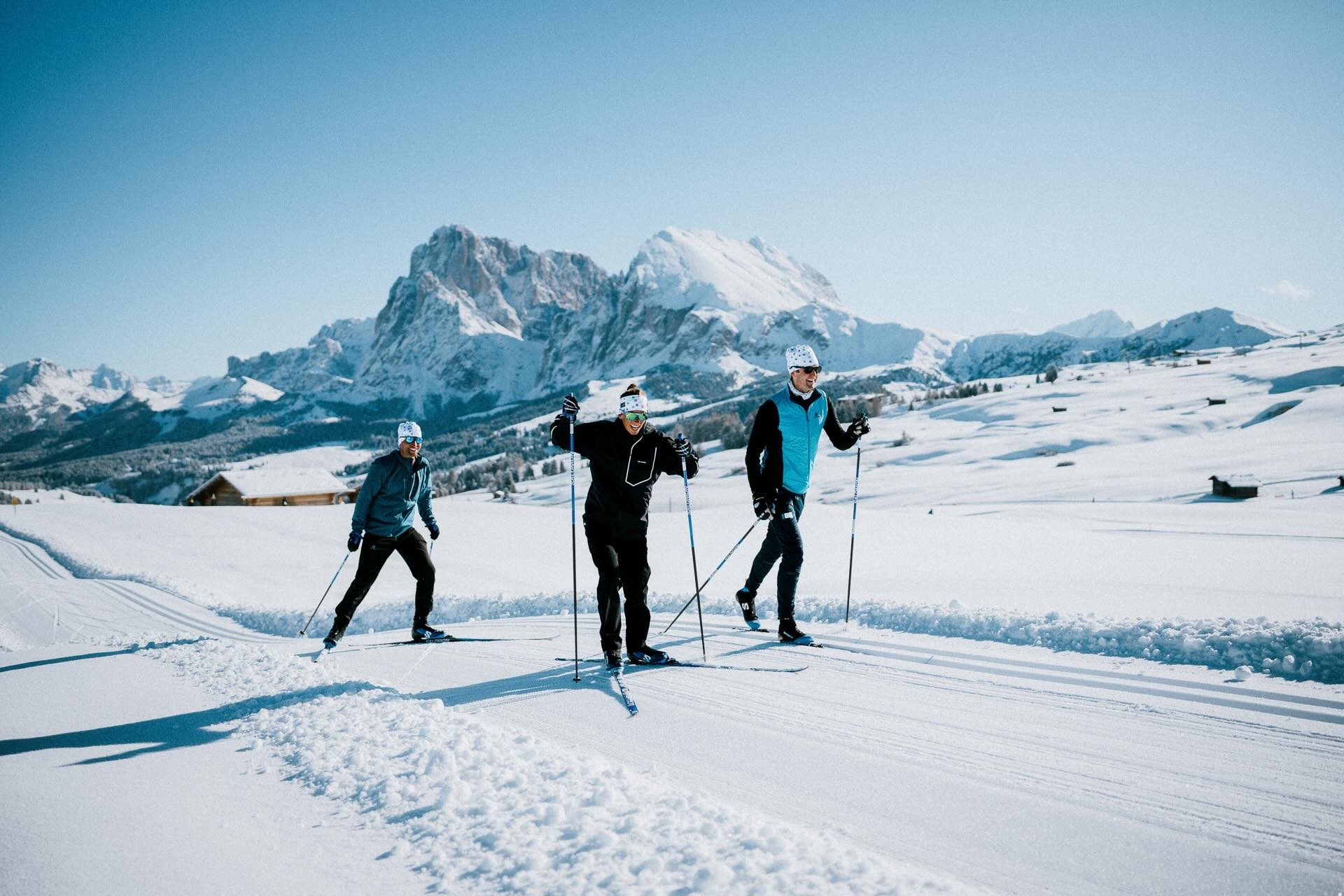
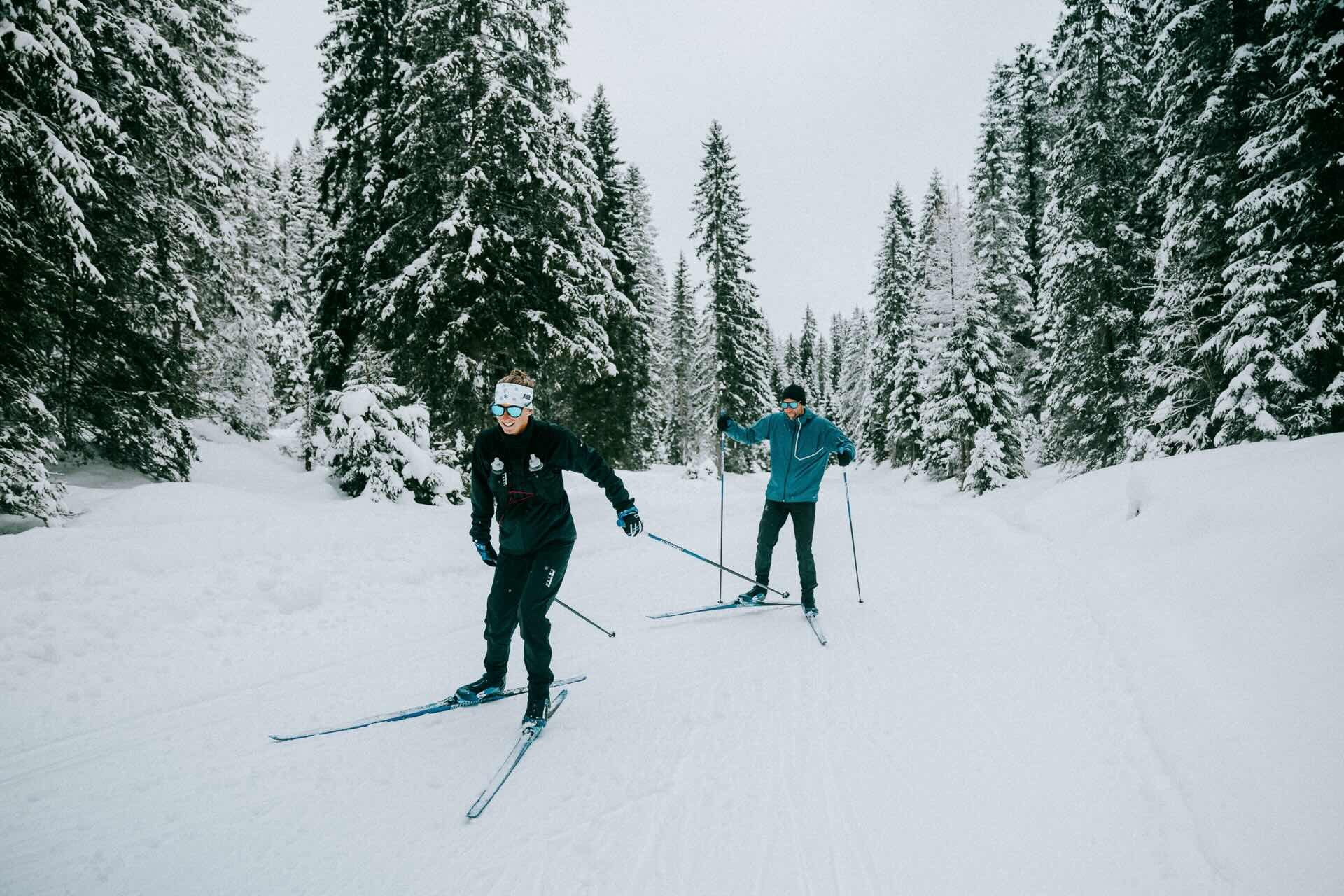
Courtney Dauwalter explores the Seiser Alm trails with Garrott Kuzzy from Lumi Experiences (Photo: Moritz Klee)
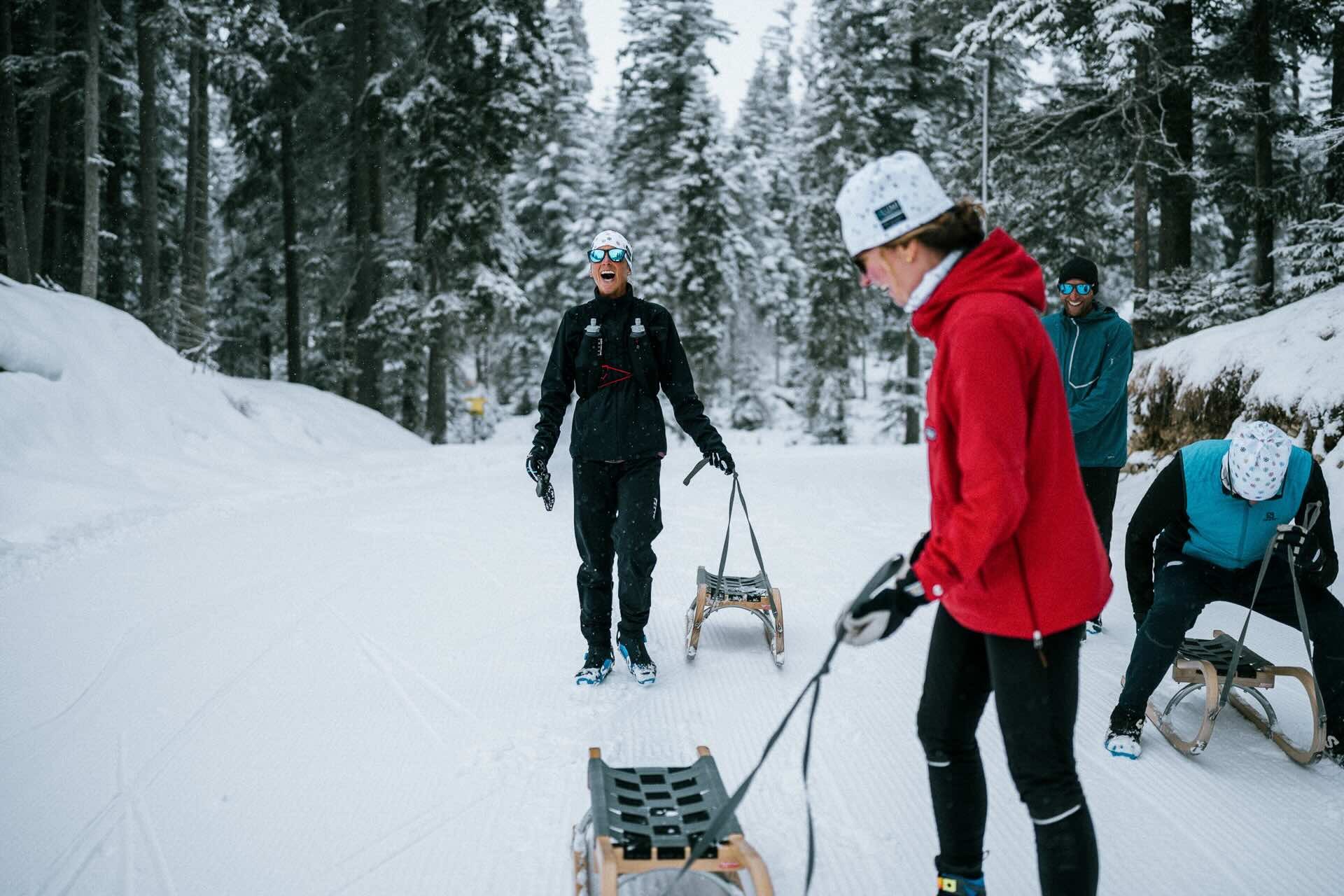
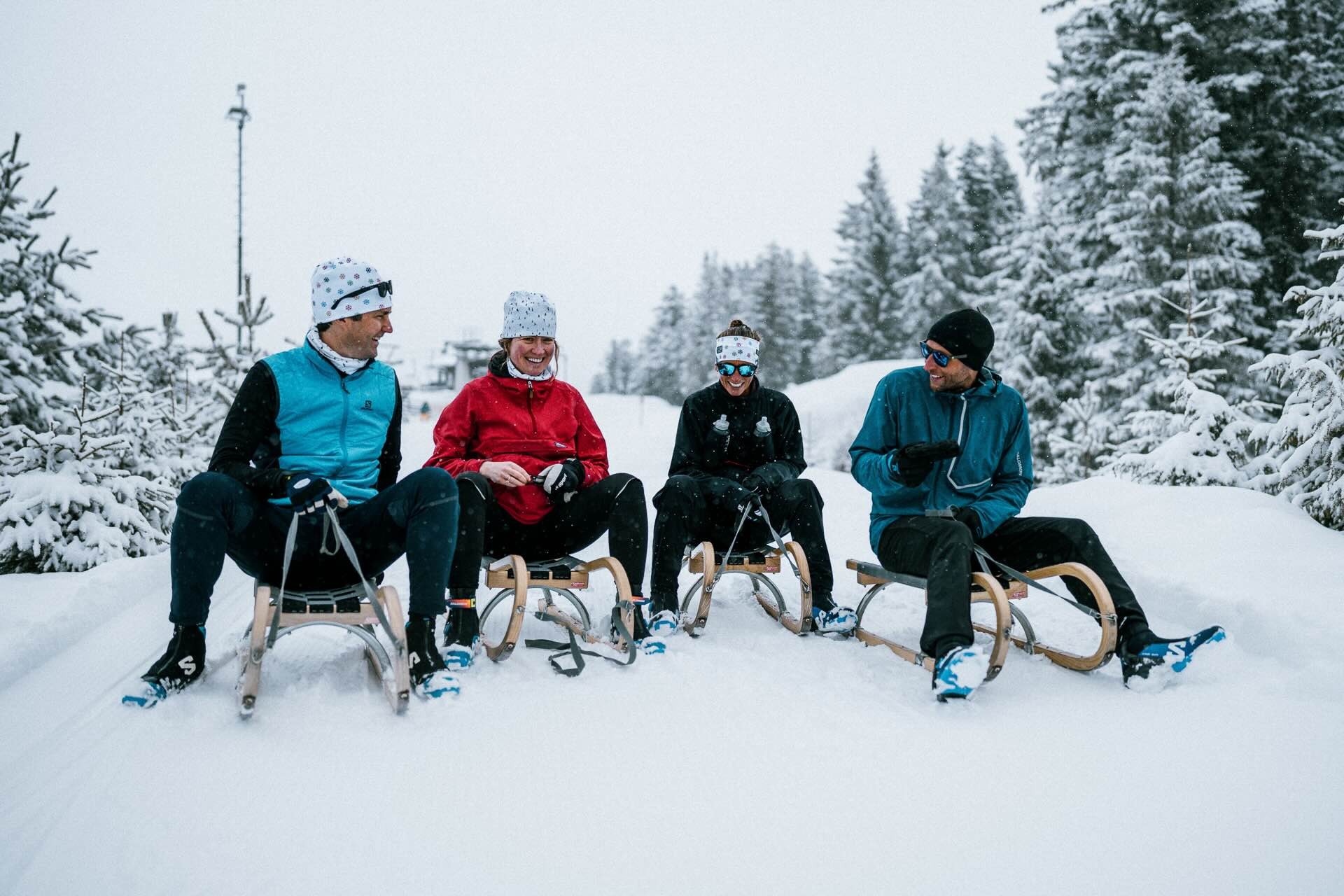
Last fall, Courtney reached out to share that she was invited to run as a torchbearer in Italy in January 2026 and perhaps even do a little skiing afterwards: “Hey Garrott! Kev and I were just looking at the Lumi website and saw the Seefeld & Seiser Alm trip. We’d love to ski it this winter!” Fast forward a few months and we were catching up over a hot chocolate in a hut in Leutasch, Austria, getting ready to go sledding down one of my favorite trails before skiing our way back to their hotel in Seefeld. We had a blast skiing in Seefeld, Austria and Seiser Alm, Italy, where we got fresh corduroy tracks after a big snowfall and sampled cheese at one of my favorite farms in the Dolomites. It wasn’t until we were there that Courtney realized she’d been to the region before on a long trail run and pointed to the mountain she traversed during a summer trail running event a few years ago.
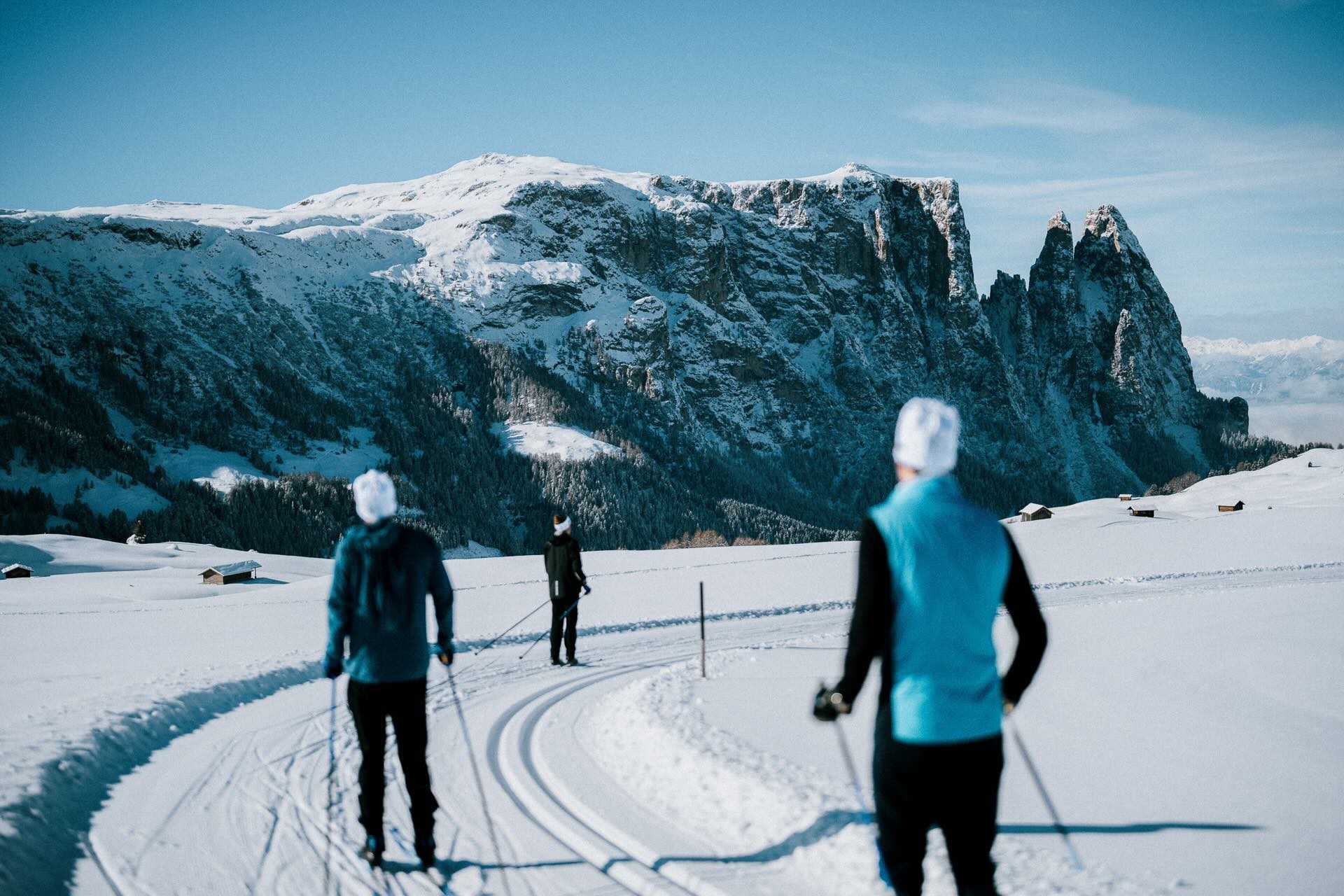
The iconic Schlern formation rises above Seiser Alm’s trails in Italy (Photo: Moritz Klee)
A Legend on Foot
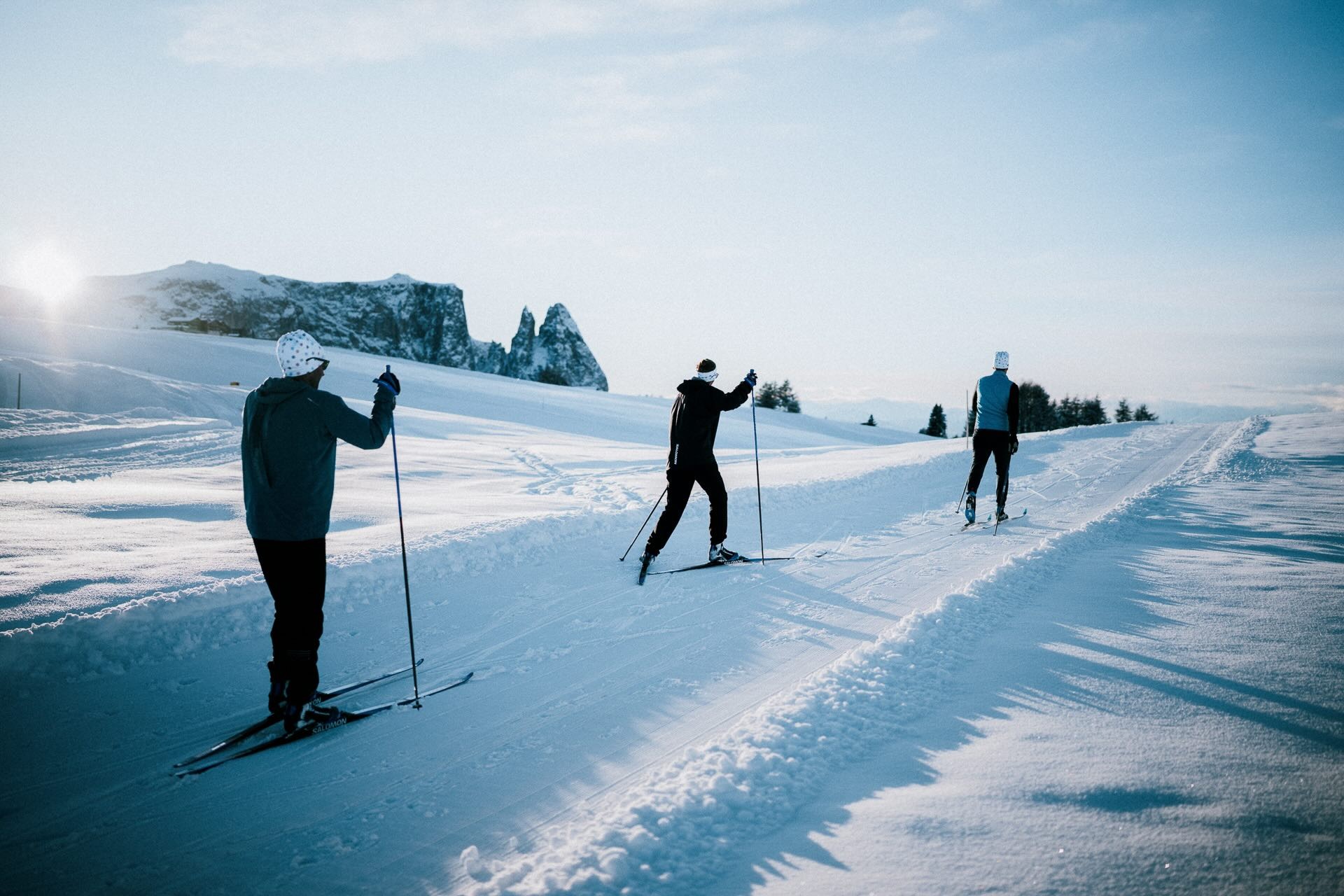
Enjoying an evening ski on Seiser Alm (Photo: Moritz Klee)
Widely recognized as one of the world’s top trail ultrarunners, Courtney’s trademark baggy shorts, easygoing attitude and mental resilience have made her a fan favorite and an inspiration for a generation of athletes of all ages who are bucking the definition of what makes a traditional trail runner. She has shattered records worldwide and amassed repeated victories at ultrarunning’s premier events, highlighted by an unprecedented sweep of the “Triple Crown” in 2023, winning the Western States 100, UTMB (Ultra-Trail du Mont-Blanc) and Hardrock 100 all in a single calendar year.
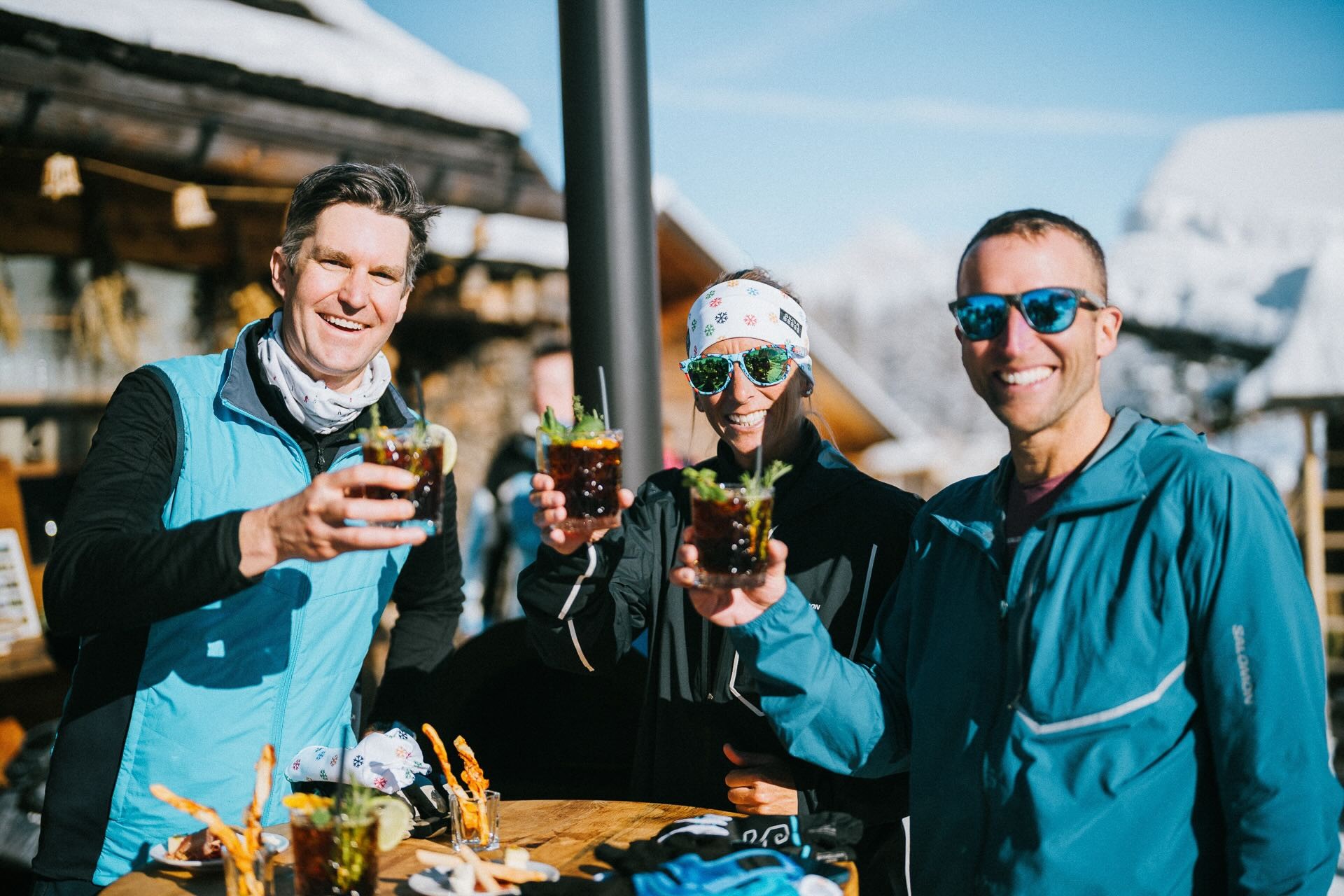
Salut! to a day on Seiser Alm’s trails in Italy with Lumi Experiences (Photo: Moritz Klee)
Courtney continues to set the bar high this season, winning the women’s Ultra Trail Chianti Castles 120K in Tuscany this past March and placing 10th overall. In May, she tackled the grueling Cocodona 250, redeeming her previous year’s DNF by pushing through the Arizona heat to take 2nd among women and 6th overall. She followed that in July by capturing her fourth straight women’s title at the Hardrock 100, crossing the line 5th overall in 26:03:10 to set the fastest female clockwise time in the race’s history. Was it her week of skiing in Seefeld & Seiser Alm this winter that made the difference? Well, probably not, but skiing is definitely great cross-training for trail running.
Still Stellar on Skis
Snow-capped peaks make for an incredible backdrop for skiing at Seefeld, Austria and Seiser Alm, Italy (Photo: Moritz Klee)
Courtney still excels at skiing, a testament to the importance of cross training and staying fit no matter the season – not to mention the years of working on her stride early in her athletic career. Her husband Kevin is relatively new to cross country skiing, but still loved the alternative to running, exploring the trails and perfecting his ski skills.
Alpine sledding with Courtney Dauwalter and Lumi Experiences (Photo: Moritz Klee)
One of the highlights of our week together was rodeling, aka alpine sledding. We had a memorable ride down the hill through forests blanketed with snow before our ski back to Seefeld. There are plenty of ski trails and activity options suitable for everyone in Seefeld & Seiser Alm, from ultra-distance champions to beginners.
Ready for rodeling with new and old friends in Leutasch, Austria (Photo: Moritz Klee)
Ski in Austria and Italy Next Winter
Fresh snowfall made for excellent conditions on Seefeld’s trails (Photo: Moritz Klee)
Would you like to explore Austria and Italy’s best cross-country ski trails next winter? Let Lumi Experiences handle all of the hotel, transportation, and scheduling logistics so you can enjoy the trails to the fullest with your travel companions, with the help of Lumi’s local, expert trip leaders. Relax in comfortable trailside accommodations and discover regional cuisine unique to both countries. Not an ultrarunner like Courtney? Both Seefeld & Seiser Alm feature trails for all levels of skiers, even novices. There is limited space available on Lumi’s Seefeld & Seiser Alm trips next January, with two departure dates available. Reach out to reservations@lumiexperiences.com today for a detailed daily itinerary or to sign up.
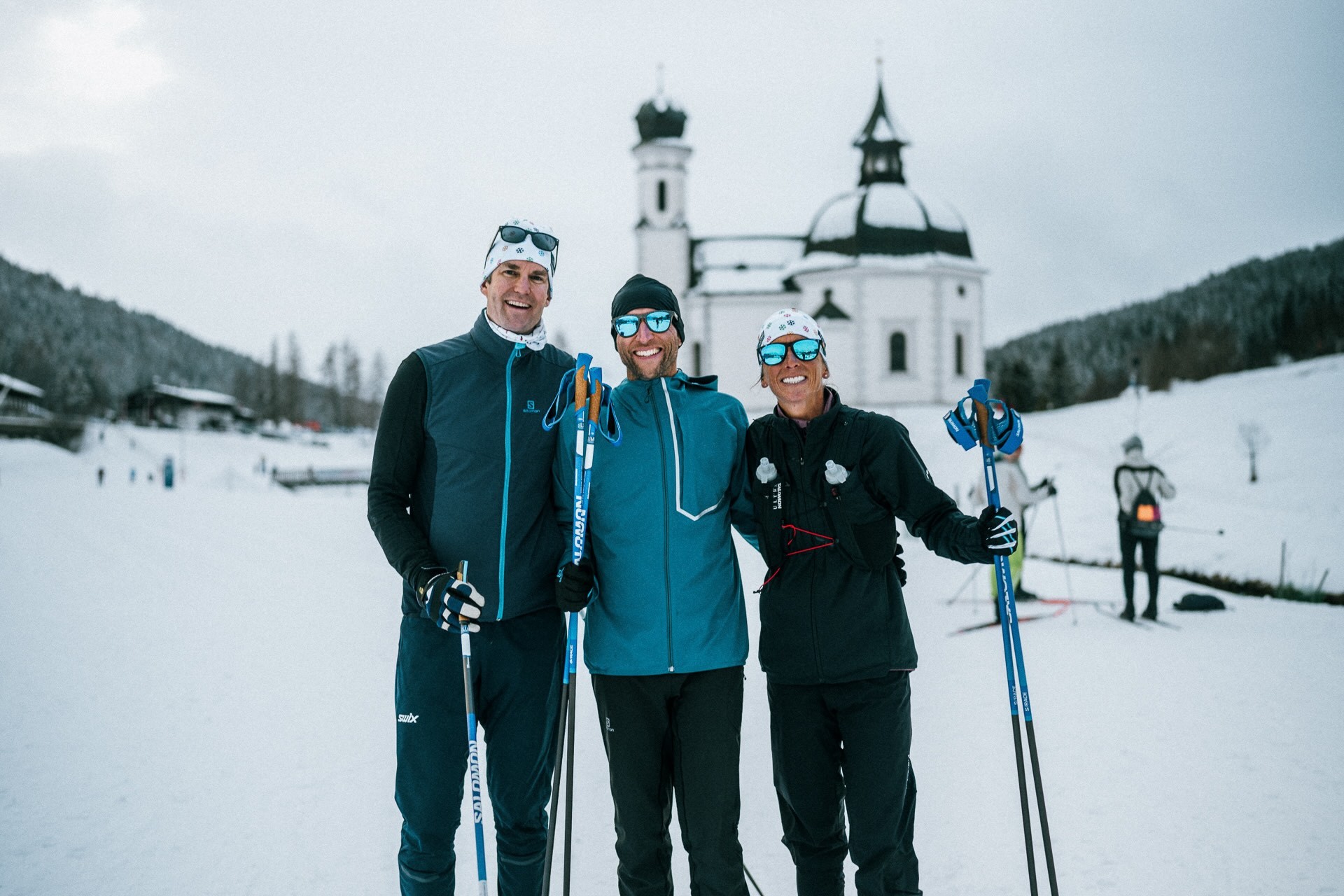
Garrott, Kevin and Courtney in front of Seefeld’s Seekirchl church (Photo: Moritz Klee)
As the world’s premier cross-country ski travel company, Lumi Experiences offers boutique trips that introduce travelers to winter cultures where Nordic skiing is a part of everyday life — from Sweden to Slovenia. It’s a ski vacation like no other.
Media contact: Nathan Miller – Marketing & Guest Communications Manager – nathan@lumiexperiences.com
By the time Sophia Laukli picks up the phone from Lillehammer, it’s raining again.
“There is, like, a small 1k loop up at Sjusjøen,” she says, “but it’s… yeah, it’s, like, raining every day, so it’s not really great conditions.”
On paper, Laukli is one of the most intriguing dual-sport athletes in endurance sport: a U.S. Ski Team member and Olympian who has also become a force in international trail running. In person—or over Zoom—she’s thoughtful, understated, and very clear on one thing: the way she trains now, in Norway, looks a lot more boring than the world might imagine.
You come to Norway expecting secrets, she says. What she found instead was simplicity.
“They’re so simplistic around ski training,” Laukli explains. “It’s not rocket science. You can do the same… You do essentially the same workouts every single week, all year round.”
That realization—combined with a crash-and-burn experiment as a full-time runner and a new coaching relationship with her boyfriend, longtime Norwegian pro skier Gjøran Tefre—has quietly reshaped her career.
As this Olympic season approaches, Laukli’s bet is clear: train like a skier, keep the training simple, stay within herself, and let the results show up in both sports.
Maine Roots, Late Commitment
For all the talk about Norway, Laukli’s story really starts in coastal New England.
“I was actually in the Boston area until I was, like, six or seven,” she says. Then came a year and a half in Norway, and finally Yarmouth, Maine—the place that still feels like home.
“From my memories and my ski memories, it’s all from Maine.”
Her father is Norwegian, so skis were always around. Winters meant skiing, family trips to Norway, and a life that looked, from the outside, like an early pipeline to the World Cup. From the inside, it didn’t feel that way at all.
“It was a very recreational thing,” she says. “I didn’t really enjoy it that much. It was just kind of like, obviously, we’re gonna ski because it’s winter. But I didn’t know anything else.”
In Maine, her parents weren’t just ski parents—they were essentially the ski people in the community.
“They were my coaches,” she says. “And very present in the ski world, which was hard for me… A part of me became pretty hesitant towards skiing.”
She gravitated toward soccer and tennis. Skiing felt obligatory.
“Up until midway through high school, skiing was kind of just something I did because my family did it,” she says.
The idea of becoming a professional athlete wasn’t just unrealistic—it was unimaginable.
“I was gonna just go to school and be a nerd or something,” she says. “Being a professional skier wasn’t even a consideration.”
Then came the pivot: joining the iconic Yarmouth High School ski team, coached by the legendary Bob Morse.
“It opened my eyes a lot,” she says. “It wasn’t super competitive, but it showed me the sport that felt forced on me was actually something I liked—and could be really good at if I tried.”
Looking back, she’s grateful it took so long.
“I’m super happy I went through that zero-pressure, uncommitted relationship to skiing,” she says. “Today I have so much motivation to be 100% committed… and I’m far from burnt out compared to many skiers who commit when they’re 12.”
Discovering Running (By Hating It First)
The other half of her dual-sport identity—trail running—comes from an even stranger origin story.
“Running was something that I actually hated,” she says, laughing. “I really, really, really did not like to run when I was young.”
Running in Maine didn’t help.
“It just wasn’t enjoyable to run there,” she says. “Unless you really liked running on roads and golf courses.”
She ran cross country her senior year only because the coach wanted her on the roster for states. She ran track for one year and found it “horrible.”
“It wasn’t until I started training out West in the summers, finding mountains… that I actually enjoyed running.”
Those Western US trails served as the practice grounds, preparing Laukli for some of the world’s biggest trail races. But first she had to figure out college—and how training would fit around it.
Sophia Laukli takes the collegiate national title in the 15 k skate in 2022. (Photo: Tobias Albrigtsen / @untraceableg)
Middlebury to Utah: Building a Life Around Skiing
Laukli chose Middlebury because, at the time, academics were the top priority.
“I knew I didn’t want to be done skiing,” she says, “but it wasn’t the priority.”
Covid changed everything. Remote classes allowed her to chase early World Cup opportunities without living on campus. Once Middlebury required students to return in person, the timing coincided with the rapid ascent of her ski career.
That led to a transfer to the University of Utah.
“Utah is built for athletes,” she says. Most classes were online and flexible. She chose economics not out of passion but practicality.
“I didn’t necessarily choose the thing I thought was interesting,” she says. “I chose what would best suit my ski career.”
Now, even as a full-time pro based in Norway, she’s studying again—an online Norwegian MBA.
“I’ve never been someone who can come home from training and sit on the couch until my next session,” she says. “I think I was missing having more than just training.”
Balancing skiing and school helps her prevent the sport from consuming everything.
Last year, after the World Championships, Laukli decided to lean all the way into running. It seemed logical—if she’s good at running without specifically training for it, imagine how good she’d be if she did.
“I always thought I’d be a much better runner if I had just run,” she says.
So she tried it. No roller skiing. No ski sessions. Just running—every day.
“I was running 10 to 12 hours a week,” she says. “And I was so tired each day. I was getting worse and worse at running. And obviously not good at skiing.”
The experiment collapsed at a race where she felt utterly depleted. She flew home, frustrated and confused. That’s when she sat down with her boyfriend, Gjøran Tefre.
“He said, ‘It’s fine. I’ll write a plan. Don’t freak out,’” she says. “‘We’ll get you a coach, but ski training is straightforward. We’re gonna baby you into ski training again.’”
Two weeks completely off. Then a return to “textbook” ski training.
Within a week of roller skiing, something wild happened: her running started feeling good again.
The pattern was clear. She ran better when she trained like a skier.
Sophia Laukli (USA) during the World Cup 20km in Engadin (SUI). (Photo: Authamayou/NordicFocus)
Kristen Bourne Saw The Same Thing
“Last season was definitely a struggle for her, both running and skiing,” says U.S. Ski Team assistant coach Kristen Bourne, who monitors Laukli’s training load. “And she’s just trying to figure out why.”
For Bourne, the shift wasn’t just physical—it was psychological.
“I’m a huge believer that what makes a difference from a good athlete to a great athlete is the athlete who is very invested in their own process,” Bourne says. “The ones who are thinking, advocating for what they need—not just deferring to a coach because the coach’s word is gospel.”
That ownership, she says, is new in Laukli.
“She’s definitely leaning into that more this year,” Bourne says. “Which is really cool.”
Sophia Laukli and Gjøran Tefre at the Cross Country Skiing World Championships. (Photo: Courtesy Photo)
The Gjøran Factor: Coach, Partner, Check on Reality
Mixing a relationship with coaching is a delicate thing. Laukli knows the risks—she’s heard them all.
“I’ve been told by many people this is not a good idea,” she says. “And other people are like, ‘Wow, I wish I could do that.’”
She also knows why it works.
For one, they communicate constantly. For another, his intentions are pure.
“One of the hardest parts of finding the right coach was that they either only cared about skiing or only cared about running,” she says. “He’s the only one who actually wants me to do well in both.”
Still, she doesn’t call him her “coach.”
“I want our personal life and work life to be separate,” she says. “We need other people in the room.”
That’s where Bourne plays a key role.
“At this level, athletes have so much experience—they do know what they need,” Bourne says. “So my goal isn’t to dictate everything. It’s to help Sophia articulate what she feels and translate it into training.”
The two systems—Tefre’s daily presence and Bourne’s structured oversight—meet in the middle.
One of the key themes that has emerged from all our recent interviews is the importance of making time for fun. Sophia Laukli and Gjøran Tefre embrace that notion entirely. (Photo: Courtesy Photo)
The Norwegian Experiment: Simple Workouts, Serious Control
When Laukli moved to Norway, she expected cutting-edge workouts—maybe some secrets behind the country’s dominance.
“It’s almost been the opposite,” she says. “They’re so simplistic around ski training.”
Five-by-ten-minute intervals around the Holmenkollen loop. The same long, easy days. Repeated blocks of threshold.
“You’re gonna become better if you do five-by-ten once a week for 12 weeks in a row,” she says. “You’re gonna become better.”
The key difference from the U.S.? Control.
Almost every Norwegian skier has a weekly treadmill “profile test,” which involves six-minute stages at a 10 percent incline, with lactate samples taken at each step andheart rate recorded.
“It’s to see if you’re in the right range,” Laukli says. “Not to get better each week.”
Bourne sees value in that simplicity.
“Sometimes a coach wants to prescribe the flashy intervals,” Bourne says. “But honestly, the athletes who can execute the basics really, really well—that’s where the gains are.”
She sees Laukli finally embracing that mindset.
“Athletes shouldn’t feel like training is something done to them,” Bourne says. “They should feel like they’re building something in collaboration with the coach. Sophia is starting to live that.”
Laukli agrees that American juniors often overtrain because they don’t know any better.
“If I go too hard too many times in a row, it’s a much worse year,” she says.
The hardest part? Slowing down when training with Norwegian women who can drop her on almost every roller-ski interval.
“Every interval I do here, I know I’m not gonna keep up,” she says. “At 17, that would’ve crushed me. Now I have evidence that I can beat them in the winter.”
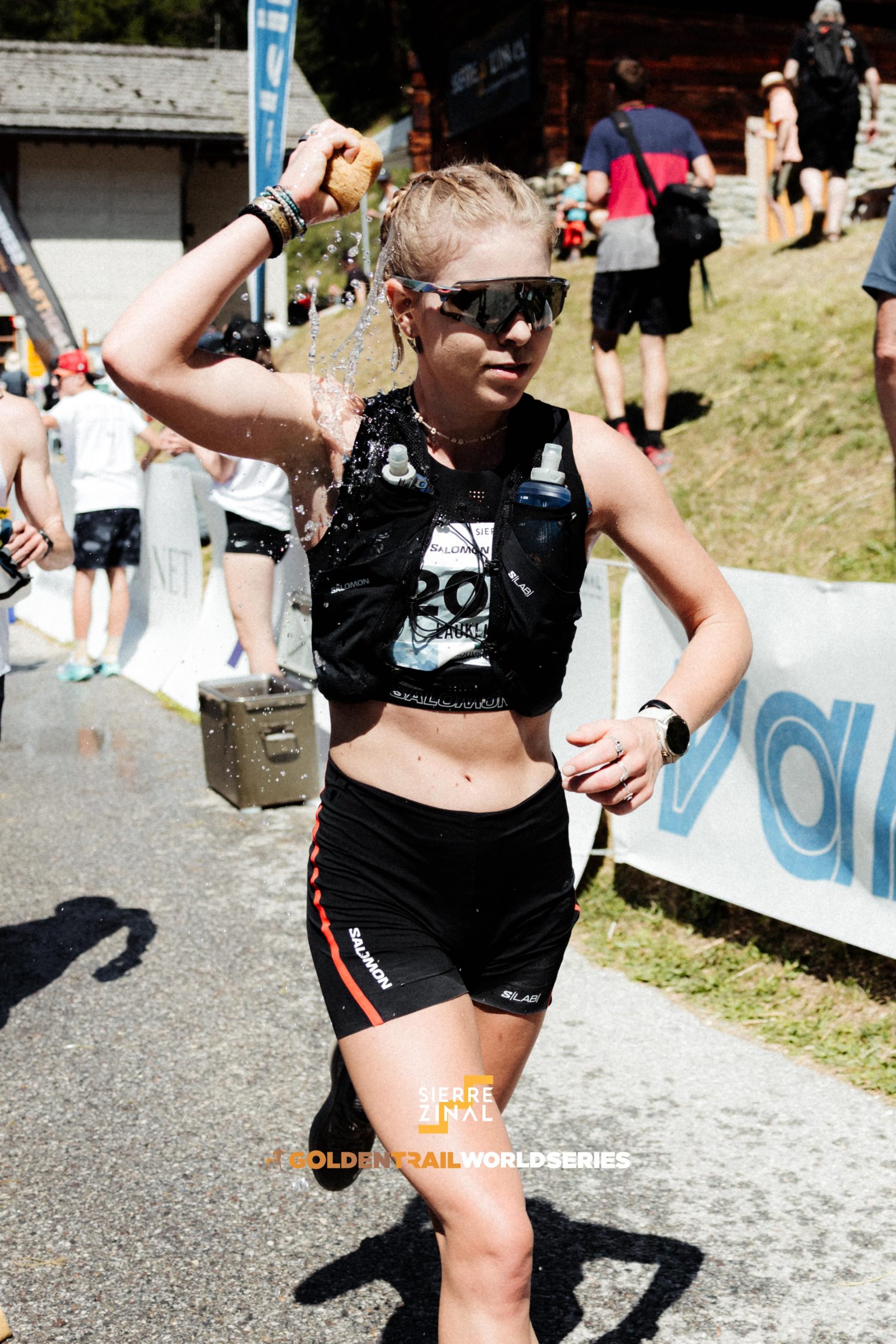
Laukli racing Sierre-Zinal in the Gold Trail World Series in 2024. (Photo: @rising.story_@colinolivero_GTWS_SierreZinal
Two Seasons, One Mindset
Running and skiing back-to-back seasons creates year-round excitement—and pressure.
“I have two competition periods,” she says. “It’s easier to motivate. But it also means I’m 100% consumed by performance all year.”
That obsession became a barrier last year. Now, Laukli is working with Bourne and Tefre to shift her mindset.
She has clear goals for skiing: the Olympic 10k, the Olympic relay, andthe final hill climb at the Tour de Ski.
She has equally specific running goals: above all, returning to Sierre-Zinal, where she once ran 2:53 on the iconic 31 km route.
However, she’s no longer defining success solely by results.
“There’s so much I’m working on—technique, tactics, how I ski courses,” she says. “It’s easy to be on a start line and focus on whether those things show up.”
Bourne sees that evolution clearly.
“Sophia has the instincts of a really high-level athlete,” Bourne says. “But learning to trust those instincts—rather than obsessing about the result column—is where she’s growing most.”
Laukli nears the finish of the final climb of the 2024 Tour de Ski on Alpe Cermis, where she claimed the victory. (Photo: NordicFocus)
Why Salomon Fits: One Athlete, Two Worlds
For an athlete splitting her year between the World Cup and the Golden Trail Series, sponsorship could easily become complicated. Many runners work with running-only brands; many skiers work with ski-only brands. For Laukli, that would have been a logistical mess — and maybe even a dealbreaker.
Instead, she found the perfect home with Salomon.
“I’m super grateful that I get to have my sponsor, my main sponsor, support me in both,” she says. “Because then it’s a lot easier to focus on each season. I know that they’re supporting me in that.”
That unified support matters. It lets her shift from skis to singlets without the politics of competing brand calendars and conflicting performance expectations.
“I don’t really know if it would be possible for me to be a runner for another brand and a skier for a different brand,” she says. “Like, defending to them that I can’t run a normal running season because it’s the Olympics, or I need to drop World Cups so I can run better this year — that just wouldn’t work.”
With Salomon, the opposite is true. Everyone’s aligned.
“Having everyone be on the same team makes it manageable,” she says. “And a lot more motivating, because everyone has the same goal.”
She works directly with Salomon’s France-based team, and Laukli lights up when she talks about the group behind her.
“They’re all French,” she says, laughing — a nod to the company’s deep culture in both ski sport and trail running. It’s also a reminder that Laukli lives firmly in the middle of two endurance worlds that Salomon understands and embraces.
That harmony matters. Her identity isn’t split; it’s blended. And Salomon is built for that.
Sophia Laukli (USA) racing the World Cup Mass Start in Les Rousses (FRA). (Photo: Modica/NordicFocus)
Sunny Weekends and Simple Breakfasts
Some things have gotten simpler, like her pre-race breakfast.
“I used to do peanut butter and banana,” she says. “Now I just have cereal. Apparently, simple is better.”
World Cup life has also taught her the importance of flexibility.
“You learn how to adapt,” she says. “Something will always go wrong on a race weekend.”
When she’s asked for her favorite place on the circuit, she doesn’t hesitate.
“Davos,” she says. “It’s sunny. You can have bad races, and it doesn’t matter because it’s a really nice place to hang out.”
That small detail fits her evolving philosophy. Training is simpler. Goals are more balanced. And the sport—skiing and running—feels more sustainable.
Somewhere between Maine and Norway, between Middlebury and Utah, between World Cup stadiums and alpine trails, Sophia Laukli has built a training model that doesn’t look flashy. It’s repetitive. It’s measured. It’s rooted in trust, communication, and doing the basic things right, over and over again.
And if the Norwegians are right—and if Laukli’s instincts keep sharpening—those basics may be exactly what carry her to the front this season, in both sports.
Love Stories Like This? Help Keep Them Coming.
Feature interviews like this one take time, access, and care to produce. If you value thoughtful storytelling and independent ski journalism, please consider becoming a Voluntary Subscriber. Your support directly fuels the work we do to cover the people, places, and moments that make our sport special.
Sophia Laukli (USA) claimed third place in the Alpe Cermis climb in last year’s Tour de Ski. That extraordinary effort, while daunting, isn’t even the hardest event Laukli enters. (Photo: NordicFocus)
Competing at a professional level in any sport requires great skill, talent, and focus. Thinking of going pro? Unless you’re in the top 1%, don’t bother trying out. Then, once you reach the professional level of competition, the athletic quality is so high that there is simply no margin allowing time to participate in more than your primary sport. Despite all those seeming truisms, occasionally an athlete emerges with the talent and determination to be able to compete in multiple sports. Incredible athletes such as Connie Carpenter-Phinney and Eric Heiden did so with speed skating and cycling, but they went from a career in one sport to a career in the other. It’s far more rare for an athlete to be a professional in two sports simultaneously. The list of such two sport pro athletes is very short: Bo Jackson and Deion Sanders come to mind (football and baseball simultaneously). After that, the list is extremely short.
You can now add to the list of professional multi-sport athletes Sophia Laukli of the Stifel U.S. Cross-Country Ski Team. The 23 year old Laukli has been on the U.S. team since 2021 and represented the U.S. in the 2022 Olympics. Among her professional skiing highlights, Laukli podiumed in the Tour de Ski on the giant hill climb at Alpe Cermis.
Laukli (far right) took a podium in the Alpe Cermis stage of the 2023 Tour de Ski. Skiing might not even be her best sport. (Photo: NordicFocus)
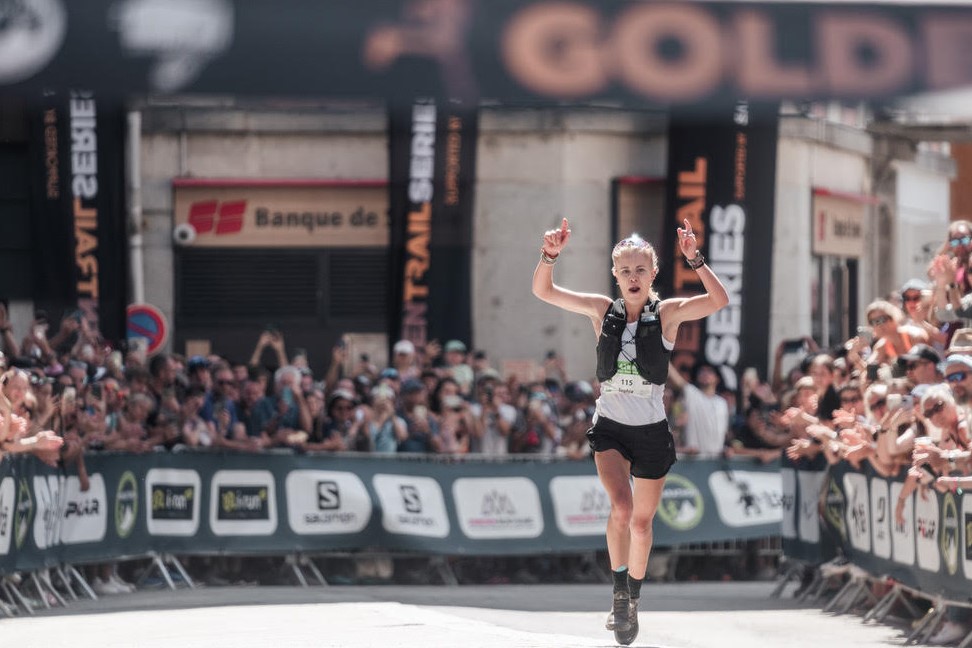
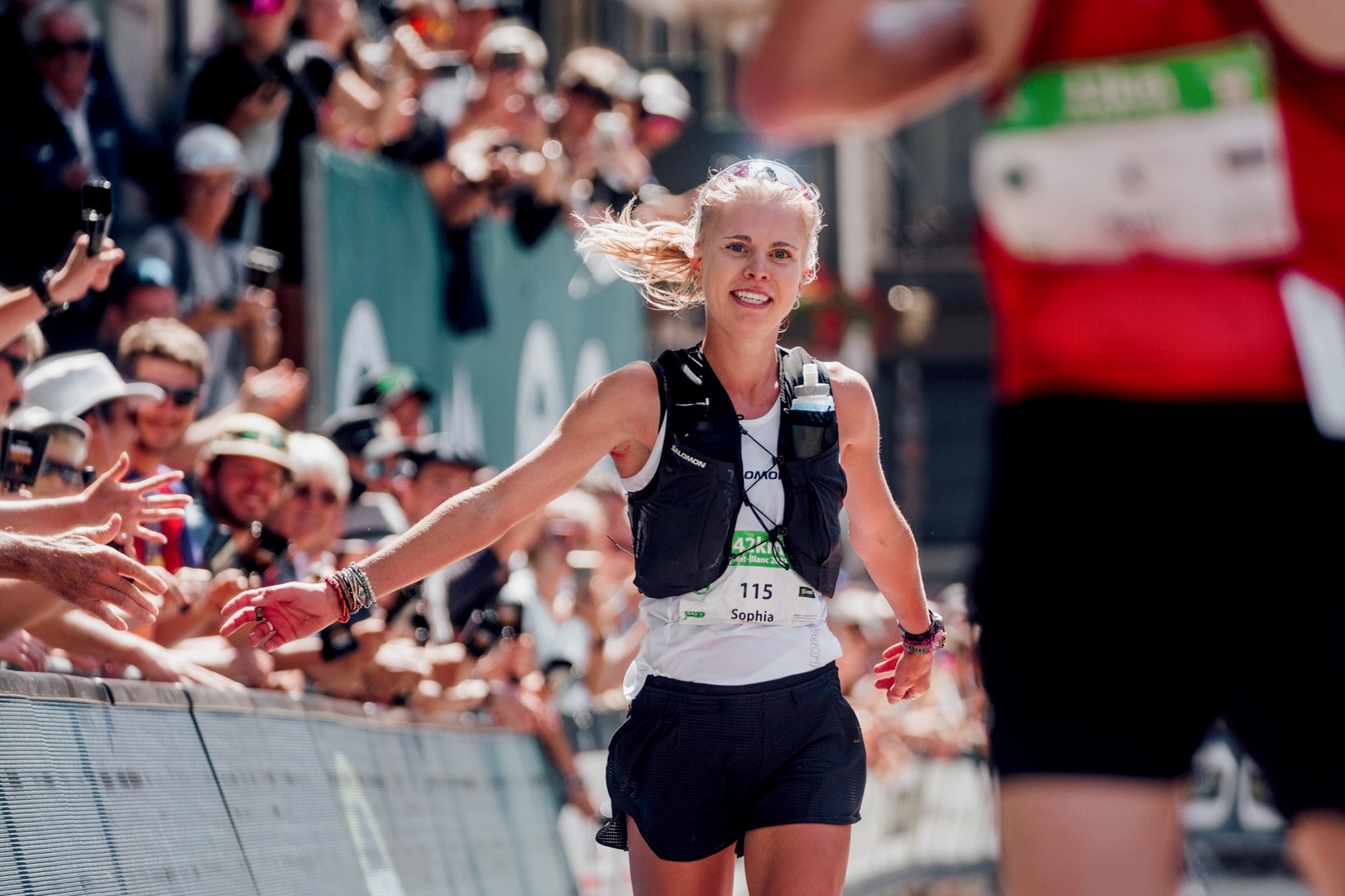
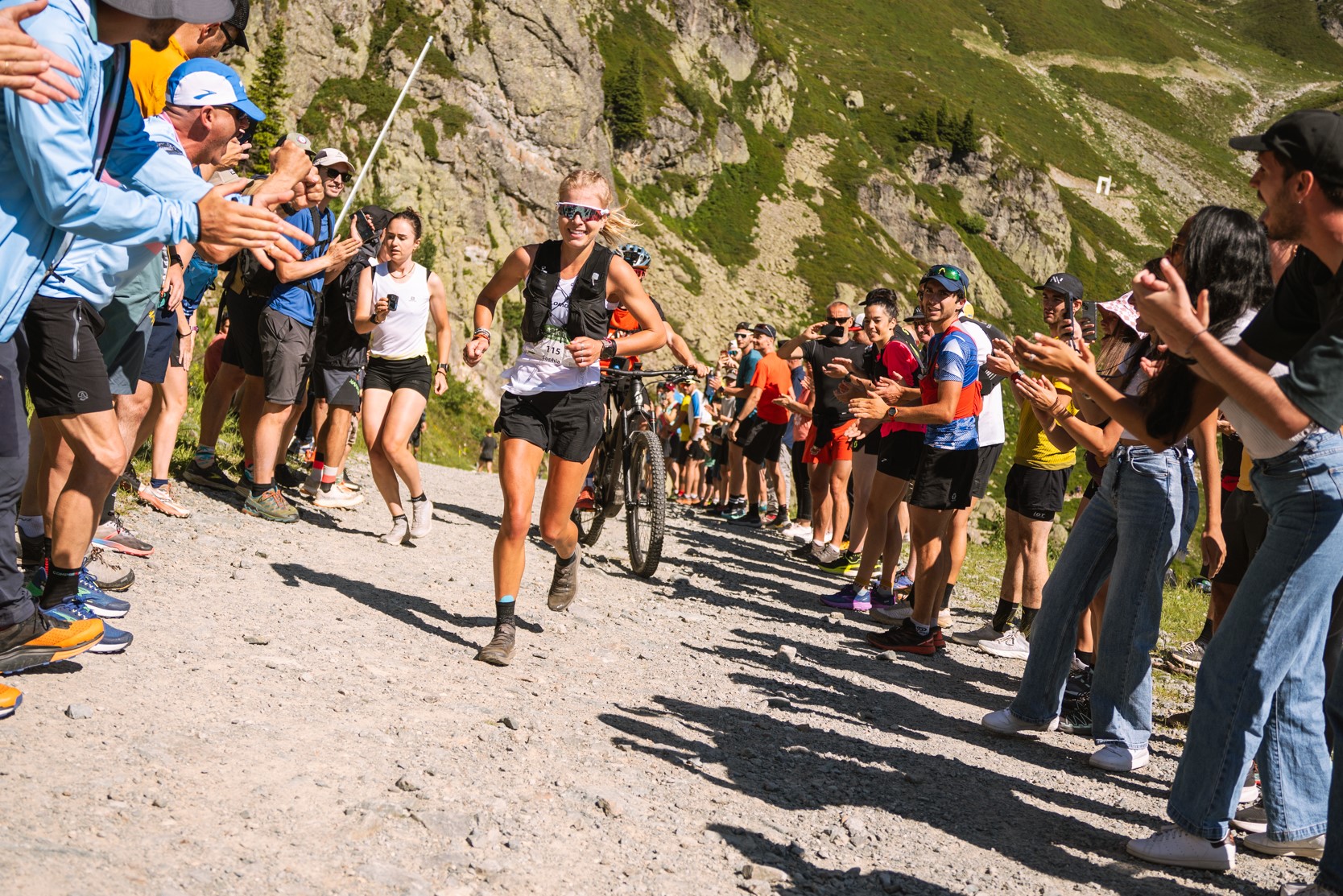
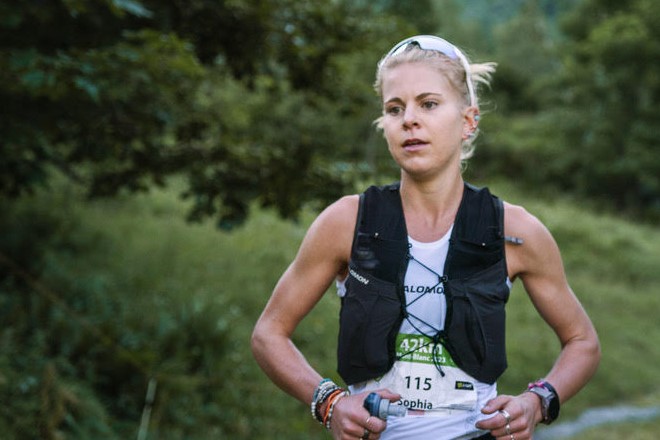
Not one to pass up an opportunity, last year Laukli began professional trail running while maintaining her status as a professional cross-country skier. On June 25th, Laukli won the prestigious Marathon du Mont-Blanc—a marathon-distance trail race—in a time of 4:12. Laukli not only won, but she crushed the existing record by almost 12 minutes even though this year’s race was longer and had more elevation gain than in previous years. The marathon’s distance changes a little each year, and this year’s version was 27.7 miles (44.6 kilometers) with 8,333 feet (2.5 kilometers) of elevation gain. The race is based in the picturesque town of Chamonix, France and consists of several grueling uphill and downhill sections.
Perhaps the most amazing thing about Laukli’s story is that she didn’t begin seriously running until a couple of years ago.
Laukli was gracious enough to take time out from her hectic schedule and speak with FasterSkier about her two-sport career. She very candidly shared her thoughts about her future as a professional multi-sport athlete, and a host of other topics.
This interview has been edited for clarity and brevity.
FasterSkier: You’re now in Oslo, Norway. Do you consider that home?
Laukli: Very recently. When I finished University of Utah this spring, I thought I would give Norway a full time try. I just moved here four weeks ago.
FasterSkier: You’re fluent in Norwegian and also French?
Laukli: Yes, but I’ve lost my French quite a bit from not speaking it for a while.
FasterSkier: You’ve been a professional trail runner for two years. When did you begin to think about competing professionally, and what attracted you to trail running?
Laukli: In high school, I hated running. I got into trail running when I started training out west. When I was going to school in Utah, I started to run the mountains and thought it was pretty cool. At that point, I knew I could run based off our skiing workouts, and now that I enjoyed running, I hopped into some local races. I didn’t set out to become a professional trail runner. There’s actually a Salomon employee who looks over super niche race results in the U.S. who reached out to me. That was two years ago that he kind of found me. It kind of just fell into my lap.
FasterSkier: So you were just running as training and as a hobby and were discovered? You never had a long simmering ability as a runner?
Laukli: No, not at all.
FasterSkier: That’s really unusual!
Laukli: Yes. It’s so shocking to me. Like I said, in high school I didn’t like running at all. I thought it was miserable. So, seeing what I’m doing now—is a little bit of a surprise. I ran a season of track in high school and that was enough. I played soccer most of the time in high school. I competed in cross-country [running] my senior year just because our team was in the running for state champs. I raced, but I wasn’t really part of the team.
FasterSkier: So you’ve completely serendipitously discovered this new love?
Laukli: Exactly.
FasterSkier: During the coverage of the Mont-Blanc race the commentators said that this was the furthest you have ever run. Is that accurate?
Laukli: It’s technically accurate. I’ve run 42k once in training a few years ago. With this race, the altitude, elevation gain, and everything about it was way more daunting than anything I had ever attempted before.
FasterSkier: Given your lack of experience at this distance, were you apprehensive going into the race?
Laukli: I was very very nervous! All of the running races I’ve done before I didn’t need specific training for them. They were about three hours long, but that’s kind of the limit you can get away with if you know how to run. 30k is the turning point for when things can go from zero to 100, so that’s why I was quite nervous. Last year the longest I had raced was about three hours and I ended that so exhausted.
FasterSkier: At some point in the race did the nerves subside?
Laukli: Yes. Just like in skiing, right off the start line you know how you are going to feel, and I shocked myself with how good I felt in the first 10k and I knew there was a lot of potential if I raced smart.
FasterSkier: Were you concerned you went out too fast? You reeled in the lead woman at the start very quickly?
Laukli: No. I watched the race replay, and they were commenting on that a lot.
FasterSkier: That seemed like all they could talk about for a while.
Laukli: Yes, I was pretty shocked when I heard that because it’s true: I’m a novice, but I was so cautious and nervous— I was very confident in the pace I was going. It didn’t really stress me out. I’ve always been a body listener in all of my training and didn’t start wearing a heart monitor until my new coaches told me to. So that’s helped me to know how to pace.
FasterSkier: The race coverage was pretty incredible.
FasterSkier: You were regularly mentioned as a pre-race favorite. Given this is only your second season, did this surprise you and put pressure on you?
Laukli: In the running world, they do not hesitate to say, “You’re expected to win this.” No one wants that pressure or expectation. But I didn’t let it get to me too much. Also, these first couple of races, there are a lot of racers absent, so there wasn’t as much depth.
FasterSkier: Well, maybe some of the top racers weren’t there but you still broke the course record by almost 12 minutes on a course that was longer and had more elevation gain than before. So no matter who wasn’t there, that performance catapults you to the elite level right away, doesn’t it?
Laukli: That was my best running performance ever. I was curious to see if the results would have changed if some of the other top runners had been there. But I felt that I won because it was a really good performance.
FasterSkier: What motivated you to run this distance?
Laukli: It was self-motivated. It’s such an iconic race and that motivates me on which races to run. Some people were second guessing my choice. I watched the race last year and decided I really wanted to do this cool race.
For now, Laukli (here on Alpe Cermis) plans to continue as a two-sport professional athlete. She feels that running helps her to find joy in skiing. (Photo: NordicFocus)
FasterSkier: The course profile is a roller coaster. How does it feel running it?
Laukli: You’re told the race doesn’t start until the second climb which is at about 30k. I really “sensed it” on the first climb and people were telling me to chill, that this isn’t where you go, and I did fade toward the end. The race has two very significant climbs, and I haven’t fully learned how to approach that. I was really struggling on the second hill. I’m still navigating how to drink enough, and I bonked quite a bit. I would like to do it again and see if that’s inevitable or if I can approach it better.
FasterSkier: Regarding fueling. There are only three aid stations. What was your strategy?
Laukli: Coming from skiing, I didn’t realize how strict of a plan you need. If I drink too much I cramp, so I try to compensate by having a ton of gels, but I realize the liquid piece is really important. I had an hourly amount of liquid and carb intake, but with the conditions I needed to drink more. Everyone carries about 500ml, and I wasn’t filling up as much as others at the aid stations. Stomach issues are such a thing in running, and if you haven’t trained for drinking a lot it’s not going to go well. A lot of people stop to drink at the aid stations, but I have a hard time doing that, which is pretty dumb in a race that long. Gels really work for me, but when it’s so hot you need liquid.
FasterSkier: You looked really fluid and relaxed almost the entire race. Did you feel that way?
Laukli: Not really. At the last aid station, with about 8k left, I was so nervous to hear the split. A couple of Salomon people told me I had a 12 minute lead, and I was so relieved. I was thinking, “Right now I can maybe get to the finish line.” I was in a state where if I needed to go fast, I was probably going to face plant, because the body was really really down. I don’t think I executed perfectly.
FasterSkier: The downhills are technical and there are pictures from previous races of very bloodied runners from falls on the downhills. What was your strategy?
Laukli: Going in, the race was a full mystery. I had no idea what was coming. The downhills are actually less technical than in a lot of the other races, but because it’s 40k in, it doesn’t take a lot to make you trip. If I didn’t have such a huge lead, I probably would have fallen, because all I was thinking was to not go fast down the hills.
FasterSkier: The city center finish is a lot like the Birkie, but with even more people. You looked totally pumped up high-fiving everyone as you ran in?
Laukli: That was the coolest race finish I’ve ever had. During those last five minutes I forgot about how bad I felt. This is an unusual finish. I did not account for how much this race meant to people.
FasterSkier: They offer a 90k version of the race. Any thoughts on doing that?
Laukli: NO! When I finished, I thought I don’t know if I ever need to run a marathon again. It’s a one-time event a year for me.
FasterSkier: Your top 10 finish means you get an all expense paid trip to the next race (Dolomyth’s Run, Italy, July 15th). The race moniker is “The Couloir of Hell.” You going?
Laukli: I hadn’t planned on it, but I think I’ll end up doing it. It’s just a two hour race, so it’s a lot easier on the body.
FasterSkier: How did you feel after the race? The downhills have to take a big toll?
Laukli: I felt very bad. My downhill technique made things worse. Even now, (nine days later) my legs don’t feel fully normal. Most of my training is a lot of roller skiing, so these long running races take a lot more out of the body. I’m really not used to it.
FasterSkier: Any other races?
Laukli: Yes, I’ll do Sierre-Zinal (31 K in the Swiss Valais Alps). Then I’ll go back to the U.S and do Pike’s Peak. But I might skip one now that I’m doing the Dolomites.
FasterSkier: How does the climbing in this race compare to Alpe Cermis in the Tour de Ski?
Laukli: I go way deeper in the pain cave in running. Skiing is a little nicer to the body, and it’s way shorter. I have the ability to push a little more in running. In skiing the technique still holds me back a little and in running your not held back by anything.
FasterSkier: Do you consider yourself a skier who runs, or a runner who skis?
Laukli: Definitely a skier who runs. I train completely normally for skiing and haven’t changed my training at all to cater to running. If I would start running more specifically, I think my skiing would take a toll and I really don’t think I’m losing anything in running by doing so much ski training.
FasterSkier: Right now your focus is on ski training, and you don’t have a specific running program?
Laukli: No.
FasterSkier: Wow! So, all of the running ability is just a byproduct of ski training?
Laukli: Yeah. It is a bit unique, and I try to explain that to the other runners and it’s very confusing to them. I don’t totally get it either. I truly don’t run that much during the week. I just seem to have this natural endurance where if I’m in good shape I can run.
FasterSkier: What you’re doing is so unusual for professional ski racers. Have you run into resistance with people telling you that you shouldn’t be doing this?
Laukli: Yeah, but it’s not necessarily people saying you shouldn’t run, it’s more like people suggesting caution. Don’t do too much, or you’re going to start sacrificing skiing ability. It comes from both sides. The running people say you should only run because you’re way more successful running than skiing. The skiing side is saying don’t get injured, don’t overdo it. It’s a bit of a battle from both sides, but I think that’s inevitable. I still feel enough [support] from both sides that it’s not a huge issue, but there’s definitely pushback on both sides.
Laukli on course for team USA at the 2022 Olympics. She hopes to be on the US team again in 2026. (Photo: NordicFocus)
FasterSkier: Do you foresee continuing this way for several years, where you’re a professional two sport athlete?
Laukli: I really hope so, but I don’t know. This past ski season I ended the season and was way more motivated to keep skiing and improve results than I have been before. I want to get a lot better at skiing, and in order to do that I don’t know if the running piece is that beneficial, but at the same time I know that I won’t really want to keep skiing if I don’t have running. I get way more excited about skiing if I also have running. I want to definitely ski through the next Olympics, and until then skiing will definitely take priority. I’ll probably continue running after skiing. I think you can run a lot longer than skiing, but it’s a balance I haven’t quite figured out yet.
FasterSkier: But the pressure isn’t so great to pick one or the other that you still feel comfortable going forward doing both?
Laukli: Now; I don’t feel the pushback is getting in the way, but that could change in the coming years. Running is more financially sustainable than skiing.
FasterSkier: Given your running success and the financial rewards that go with it, is it tempting to say that maybe this is where my better use of time is?
Laukli: I totally have those thoughts. Whichever season I’m in I kind of want to just stay there. I went into the ski season last year thinking running was way more fun, but then I had the ski season, and was thinking ok, skiing is what I want to do.
FasterSkier: Compare a really hard 50 k ski race to a trail running race of equivalent time. Is the running always a little deeper into the pain cave?
Laukli: Yeah. I think so. Skiing is unique because there’s so much tactics. In running, there are tactics, but it’s very different. In skiing there’s more room to conserve energy.
FasterSkier: In the Tour de Ski on the Alpe Cermis climb, did your running really help you out?
Laukli: Yes. That’s the most equivalent ski race to a running race. For me it’s [Alpe Cermis] way less painful than a normal ski race because I just find a pace and keep it, I do it for 30 minutes and get to the top. It’s way more simple than other races.
FasterSkier: Your forte is long distance. In skiing, how short does a race get for you before it’s too short?
Laukli: Probably 5k. It’s good that we’re doing 20ks and 50ks now.
FasterSkier: With the World Cup in Minneapolis, any possibility of you hanging around and doing the Birkie the following week?
Laukli: Yes. That is my plan as of now. I’ve never done it, and there are a handful of us who are considering doing it.
FasterSkier: You’re now sponsored by Salomon for winter and summer. Are you the only one with that arrangement?
Laukli: Jessie [Diggins] is technically Salomon running as well. But as far as someone competing in both, I am.
FasterSkier: Was that a reason for choosing Salomon as your sponsor, so you could have a year ’round relationship?
Laukli: For sure. I signed with Salomon two years ago for running. This last year it came up as a possibility to sign with them for both and it made a lot of sense to me.
FasterSkier: Do you work with the same team at Salomon for summer and winter?
Laukli: It’s a lot of collaboration between both sides. Being a 360 athlete is a unique presence, so that provides a benefit also. Also, earlier, when we were talking about pushback to choose one or the other, with Salomon it’s the opposite because it’s an environment where they’re very much supporting the other sport.
FasterSkier: You also decided recently to move to Norway to join team Aker Daehlie, what was your thinking behind that?
Laukli: There were a lot of different reasons. World Cup is in Europe. Most of the running I do is in Europe. It’s really tempting to have a European base. The running is very good in Norway, and obviously the skiing is too. There were skiing reasons and running reasons.
FasterSkier: Does it cause any conflicts with the U.S. team as far as attending camps?
Laukli: No. Essentially, it’s just like being on Stratton or APU, it’s just that I’m based out of Norway.
FasterSkier: Your father’s Norwegian, was he a big influence on you taking up skiing?
Laukli: Yes, but both my parents ski. I definitely started to ski because both my parents skied.
FasterSkier: If you had to choose between going for a really nice three hour ski or a really nice three hour run, which would you do?
Laukli: This is going to scare ski people, but I would definitely go for a run.
FasterSkier: Have you ever considered doing a road marathon?
Laukli: Yeah, it would be really cool, especially one of the big races. It’s not on the agenda currently. It’s worth looking into. But the timing [calendar] of the marathons is poor. Watching Boston this year, I thought it would be really fun to do.
FasterSkier: Even though you’d rather go for a run than a ski, what is your favorite place to go for a recreational ski anywhere in the world?
Laukli: I would ski in Sjusjoen, right by Lillehammer. If I’m going on a long ski, I want it to be endless trails and that’s the place for that. (Sjusjoen has over 2,500 km of trails.)
FasterSkier: Classic or skate?
Laukli: That would be a skate ski.
FasterSkier: I would think the running would transition nicely to classic?
Laukli: I would think so too, but that’s currently not the reality.
FasterSkier: You travel a lot. What’s one thing you can never be without on the road?
Laukli: A good jar of peanut butter.
FasterSkier: Is good peanut butter hard to come by in Europe?
Laukli: They do make it in Europe, but I’ve always traveled with my own jars because you never know if this niche little place is going to have it and I just really want to have it, so now I just always bring it and it makes my bags really heavy!
FasterSkier: When you do a long training session do you listen to music?
Laukli: I’m actually an audio book person. I only do audio books. I don’t do music.
FasterSkier: Really? So, you go for a hard run and you’re listening to a book?
Laukli: If I’m doing intervals, I probably won’t listen to anything. But if I’m just training easy then yeah, I listen to books. I used to listen to music, but I’d get bored, and books were more interesting.
FasterSkier: So, what are your favorite audio books?
Laukli: The reason I started was because I’d never read Harry Potter, so I did the entire series. I also listen to Steven King. I don’t have one genre.
FasterSkier: That’s really interesting. I think you’re the only person I’ve ever spoken to who listens to books while training.
Laukli: I’m very aware of that. I’ve tried podcasts, but I enjoy books the most.
FasterSkier: Do teammates tease you about that?
Laukli: Honestly, I don’t know if many of them know.
FasterSkier: Well they’re going to know now!
Laukli: That’s ok. I pride myself on it.
FasterSkier: Favorite thing to eat after a really long training day if you can eat anything?
Laukli: I think any sort of pastry, but I really like donuts.
FasterSkier: Are donuts a thing in Norway?
Laukli: I’ve discovered that they’re really bad, so I‘d have to find something new.
FasterSkier: Minneapolis has a couple of great donut places so maybe you can stock up for road food while you’re driving to the Birkie?
Laukli: That would be perfect . . .
FasterSkier would like to thank Sophia Laukli for spending time speaking to our reporter Ken Roth, and thanks also to the GoldenTrailSeries for the use of photographs.
The women Ski Coaches Association is excited to announce our new GearUP program. This program is designed to help reduce barriers for women ski coaches by partnering women coaches with an equipment brand rep to outfit them with gear, provide brand specific knowledge, and create industry connections.
Madshus, Fischer, Rossignol and Salomon will each work directly with two women coaches for the duration of the 2022-23racing season.* The eight coaches selected for this program will be outfitted with at least one pair of classic and one pair of skate skis, two pairs of boots, two pairs of Swix poles and other coach-approved swag!
Why GearUP? We believe this program will help level the playing field for women in ski coaching careers through:
mentoring and networking with another male-dominated profession that is important for coaching success and advancement – the gear industry.
reducing the personal expense required to purchase and update racing equipment that can impact a coaches credibility in the profession.
increasing access to the gear related expertise required to excel on the snow everyday and behind the scenes on race day.
Developing and retaining women coaches at all levels of the sport supports athletes, other coaches, and the organization/ski community as a whole. Check out WSCA’s Why Women Coaches Matter page for more information!
Through the mentorship aspect of this program, coaches will increase their knowledge to accurately fit a ski to an athlete, understand what makes great skis for certain conditions and how to properly prepare them, have a contact list of connections from their partnered brand, understand the brand’s product line, and gain other useful skills. The program will include 3-4 structured sessions with reps and coaches through the season to increase networking and knowledge about gear and waxing.
Women with any levels of experience currently coaching at the middle school level or above are encouraged to apply.
Application period opens October 1 and closes October 14. Decisions will be communicated by the October 21st with program kickoff on the 30th.
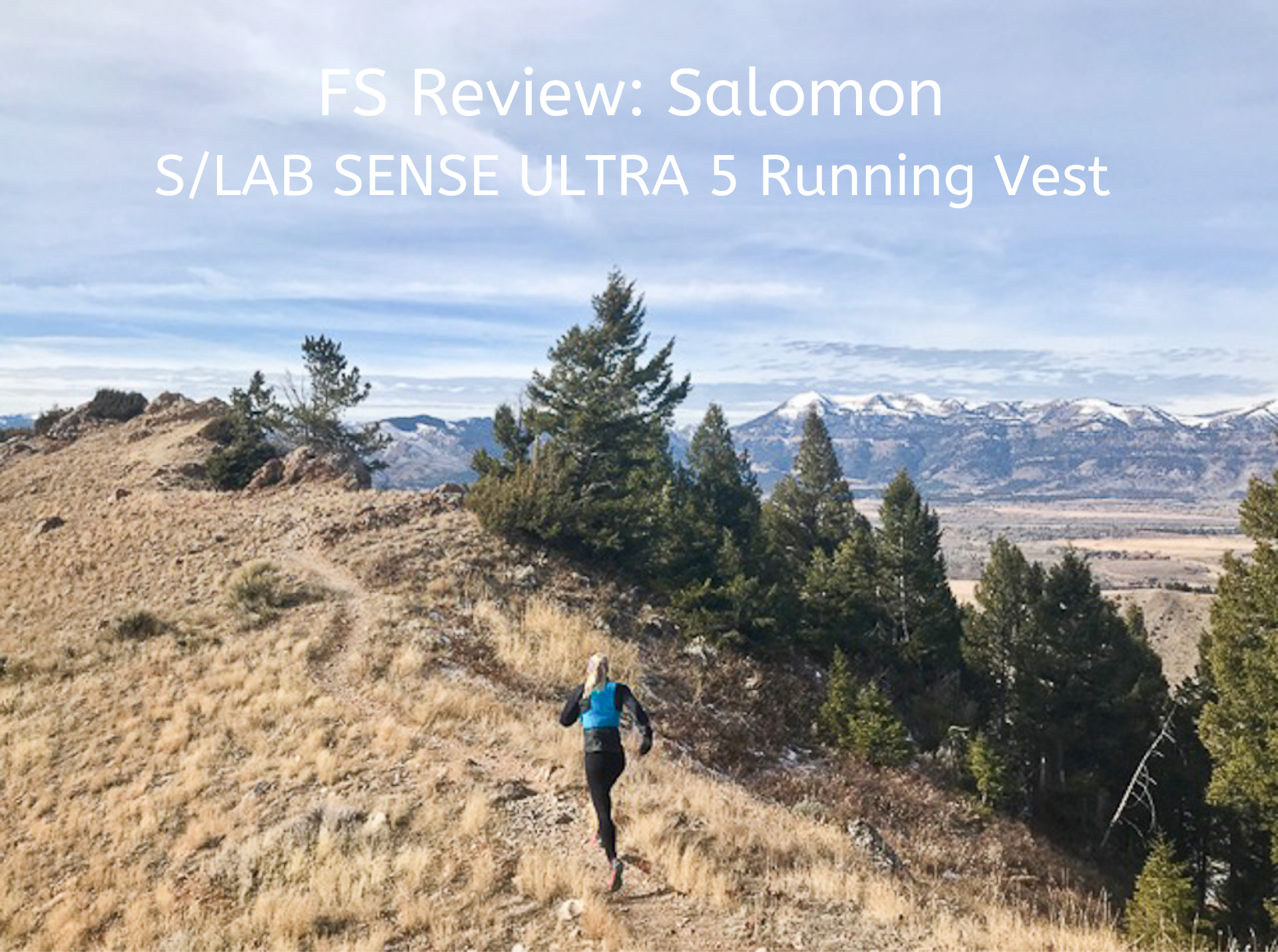
Jesse Knori somewhere near her hometown hills outside Jackson, Wyoming.
If you are still running with a traditional drink belt strapped to your waist — listen here: It’s time to give up the drink belt for running excursions. The fight is over and the running vest is miles ahead of you, already sipping a refreshing recovery drink at the parking lot––heck they might have even swapped their cold, sweaty top layer for a warm, dry one by now. Instead of spending time catering to your bruised hips and a sore back from the bumpy ride of the drink belt; swap it out and enjoy more storage, convenient water access and a “barely there” feel.
From the dawn of the CamelBak, which might date some readers, to the svelt body-hugging running vest of today, it’s a buyers market when it comes to options including fit, color, and the ad-nauseam accessories. One brand that was an early entrant into the more tech featured running vest niche was Salomon. Many of their running vests share the most basic of templates: a wrap-around vest made with breathable and stretchy fabric and plenty of pockets.
For the past several months, I’ve been testing the Salomon S/Lab Sense Ultra 5 Set, which includes two soft flasks. The “5” in the name represents the volume of the vests carrying capacity for extra gear. There’s a back pocket/sleeve Salomon wisely calls a “kangaroo” pocket. That rear pocket is perfect for stashing a windbreaker, or a light extra layer you might want to haul on your run.
The vest comes with 2 zippered side pockets(you can stuff a light windbreaker there too), and several pockets for nutrition, gloves, and a hat. It’s a fast feeling and looking pack. For those with an average ape-index, you can reach all your gear mid-stride, including items in the kangaroo pocket.
Perfect Distance: <4 hours
Temperature: Reasonably Sustained (not a ton of layer swapping)
Storage: 5L
Liquid Capacity: 1L
User Pros:
Lightweight
Comfortable
Plenty of secure storage space
Customizable front adjustments for fit
All pockets reachable while on the move
No chaffing in even the hottest of conditions
User Cons:
Perhaps too many storage pockets for the length of time the vest supports
Takes some finessing to get the water jugs to sit still on fast terrain
No space for extra water (However, if you are looking for water bladder storage upgrade to the Salomon ADV Skin 12)
Bottom Line: This vest performs with ease as you jump from rock to rock, downhill to pavement, and everything in between. A great running race vest for any distance (especially when refueling stations are an option).
Like many Solomon products, you pay a premium for the refined design and premium fabrics. The vest retails for $155.00. (If you do your homework, it’s possible to find the vest on sale.) And for those with fashion sense, it comes in several color options: black, blue, and red — with sizes ranging from XS, S, M, L, and XL. Here’s a link to Salomon’s running vest size chart.
Simi Hamilton on the new skate skis in Oberhof, Germany. (Photo: Matt Whitcomb)
By the time you read this piece, some skiers from the U.S. Ski Team (USST) will be settling in Trondheim, Norway for a two and a half week training camp. In total, five are making the journey from the U.S. The sixth skier, Kevin Bolger, no stranger to training in the region, has been in Trondheim for nearly a month. Bolger’s experience in Trondheim goes deep. He has trained there in the off season for many years.
It’s true, the Oberhof ski tunnel does resemble a commemorative ribbon. (Photo: https://www.oberhof-skisporthalle.de)
“In terms of having a guide upon arrival, we are pretty well plugged in.” U.S. coach Matt Whitcomb said in a call.
Bolger will be the local guide for Sadie and Erik Bjornsen, Simi Hamilton, Sophie Caldwell and Andy Newell (former USST member). The skiers will be joined by U.S. head coach Chris Grove, Whitcomb, and physiotherapist Zuzana Rodgers.
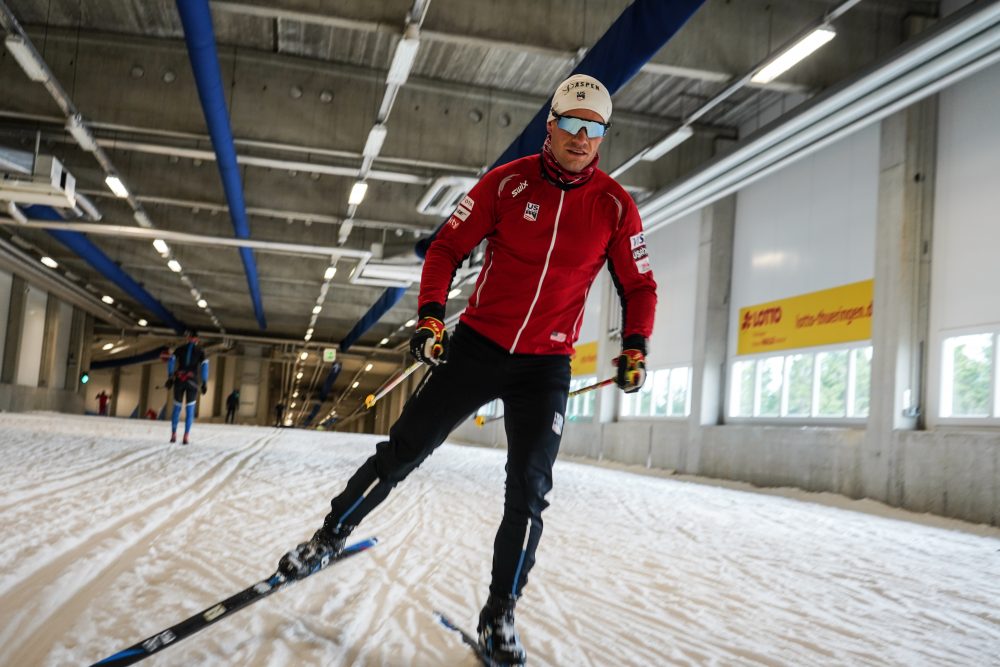
Hamilton and Whitcomb will hop a flight from Germany to Trondheim. The pair spent four days last week in the Oberhof ski tunnel. If you are imagining a simple oval where Hamilton becomes dizzy going round and round, the tunnel is a bit more complex. Whitcomb relayed that Hamilton describes the tunnel as “a loop with two out and backs, like a commemorative ribbon”.
The indoor-skiing provides Hamilton an opportunity for on-snow training and to become accustomed to his new ski fleet. After a career spent on Fischer skis, Hamilton has switched to Salomon skis and boots this season.
Simi Hamilton driving the new fleet of classic skis in the Oberhohf ski tunnel. (Photo: Matt Whitcomb)
“It was a good opportunity with Salomon this year because we have Jessie [Diggins] and Sophie [Caldwell] on them among the various brands in our truck,” Whitcomb said. “And we have an exceptional amount of service because they have few athletes on the World Cup. It was time for a change for Simi and this time around in Oberhof it is more about getting used to the product instead of actually testing the skis. We will do a little bit of testing but the main purpose is simply to get used to skiing on the new brand.”
The Oberhof ski tunnel was reserved by several elite groups twice each day for four days.
“Our goal is to not really push it too hard it is just to get in as much quality skiing as we can under the expected jet lag to go to Norway both well trained but also not buried,” said Whitcomb.
The camp in and around Trondheim will involve joint training sessions between the U.S. contingent and skiers from Italy’s National Team. Federico Pellegrino, Francesco De Fabiani, and Dietmar Nöckler are scheduled to attend. In addition to training with the Italians, the six U.S. skiers will race the Toppidrettsveka rollerski events from August 22-24.
“The number one goal is to get some race experience in the summer against some of our World Cup competitors and just get that summertime competitive vibe going that you cannot get in the U.S. without going to the best,” said Whitcomb. “That is the number one goal. And the secondary goal is to a little bit of training with some of the local Norwegians in Trondheim. Some that are showing up early for the races and also with the Italians who we have been talking with for the last four or five months about wanting to do something together
Hamilton was not alone in Oberhof. The Russians were there to join the ski tunnel fun. (Photo: Matt Whitcomb)
In years past, the U.S. team has flown to New Zealand for a major on-snow camp. This year with no World Championships and the Olympics three winters away, the coaches offered athletes the possibility of a new routine. Jessie Diggins, Julia Kern, and coach Jason Cork will return to New Zealand’s Snow Farm.
“The number one reason is just for some change,” said Whitcomb of the smaller contingent headed to New Zealand. “It wasn’t anything that we believe so firmly in that we were opposed when Julia and Jessie wanted to go, it was no big deal. It was more of a let’s bring this to the athletes and see what they want to do. As you might imagine, it is quite a big time commitment for some of us who don’t get to see a lot of summer, or one of the best parts of the summer, and it’s exchanging that for winter. You are giving up a bit there. It is something will miss as Simi and I were both just talking about because it is a reprieve from the heat of August. It is just for the purpose of changing things up a little bit and it is a non-championship year. Later on, we can perhaps assess whether or not it provides us with what we think it does.”
Martin Benes, who has coached at Sugar Bowl Academy for the last seven years, was recently hired as head coach of U.S. Paralympics Nordic. (Photo: U.S. Paralympics)
(Note: This article has been updated to include the hiring of Miles Havlick as the University of Utah’s head nordic coach, which was announced Monday afternoon.)
There have been several notable career changes in North American nordic skiing this summer. Here’s a quick look at who moved where:
Robert Lazzaroni, the nordic director at U.S. Ski & Snowboard, will soon begin his new role as Salomon’s nordic regional commercial manager for the Americas. (Photo: Salomon)
Robert Lazzaroni:from U.S. Ski & Snowboard to Salomon. Last week, Salomon announced via a press release that Lazzaroni, of Park City, Utah, will join its staff as nordic regional commercial manager for the Americas, starting Aug. 27. For the last three years, Lazzaroni served as nordic director at U.S. Ski & Snowboard in Park City. Before that, he was program manager at Utah Olympic Park, and before that, a nordic division manager for Rossignol and later One Way Sport. Asked about his new job at Salomon, Lazzaroni told FasterSkier he’d be willing to talk more in depth after he starts. Until then, he’s still employed at U.S. Ski & Snowboard.
According to U.S. Ski & Snowboard’s Chief of Sport Luke Bodensteiner, many of Lazzaroni’s duties as nordic manager “have been or will be distributed across existing staff, and we’re taking the opportunity to re-align our staffing positions to make sure that we have an efficient structure that supports our priorities of athlete development, coach education, and strong domestic competition,” he wrote in an email to FasterSkier. “This will likely require hiring an additional position, but the nature of that job is TBD based upon where we determine that we need the human resource to support those priorities.” Bodensteiner expected to know more about the shift in staff responsibilities later this month.
Martin Benes:from Sugar Bowl Academy to U.S. Paralympics Nordic. Also last week, the U.S. Olympic Committee announced the hiring of Martin Benes as its new head coach of U.S. Paralympics Nordic Skiing. He replaces Eileen Carey, who was promoted to program director following the departure of John Farra (to USA Triathlon) this spring. Benes began coaching as an assistant ski coach at Bates College, then spent the last seven years as head nordic coach and director at the Sugar Bowl Academy near Truckee, California, according to his LinkedIn profile. As head coach of the U.S. Paralympics program, he will “lead the development of annual and seasonal training plans for the national team, track athlete performances, workout data, sport science data and annual progress reports, contribute to the U.S. Paralympics athlete identification and development strategy, and assist in planning travel and logistics for the Nordic skiing program to competitions, camps and events,” according to the press release.
“It’s an incredibly exciting time to join the program following such a successful performance in front of the world at the Paralympic Winter Games PyeongChang 2018,” Benes stated in the press release. “I’m eager to get started in my role so we can continue to strengthen the program and win medals on the international stage.” He’s set to begin on Aug. 20.
Fredrik Landstedt:from the University of New Mexico to the University of Utah. Late last month, the University of Utah announced it had found a new director of skiing to replace Kevin Sweeney. Landstedt had been a staple on the University of New Mexico (UNM) Ski Team for the last 21 years, spending the last 11 years as head coach of both the nordic and alpine programs (and 10 years before that as head nordic coach). His decision to take the job at Utah came less than 24 hours after the UNM Board of regents unanimously approved a proposal to eliminate four sports starting in the 2019/2020 season, according to the Albuquerque Journal. Those sports are men’s and women’s skiing, men’s soccer, and women’s beach volleyball. The proposal would also significantly impact funding for cross country and men’s track and eliminate the women’s diving program. In the meantime, UNM announced assistant coach Joe Downing will assume the role of interim head skiing coach.
“I am honored to have the opportunity to lead a program with such a rich history,” Landstedt stated in the Utah press release. “Utah has a strong winning tradition and the support that the University provides its ski team is incredible. I look forward to bringing NCAA titles back to Utah!”
Miles Havlick in November 2015 in West Yellowstone, Montana.
Also at the University of Utah, Miles Havlick: new head nordic coach. In a press release on Monday, the university announced that Havlick, one of its former skiers and a two-time NCAA champion (2012 and 2013), was hired to head up its nordic team for the coming season. Havlick, 28, skied for the the Sun Valley Ski Education Foundation Gold Team after college and won the 42-kilometer Australian Hoppet Worldloppet last August. He delved into coaching last summer in Australia with the Birkebeiner Nordic Ski Club and Victorian Junior cross-country ski team, and last winter, was an assistant coach and wax technician for the Australian junior national team at Junior World Championships. Havlick also waxed for the Australian national team last March in China. He has also assisted the Utes ski team, most recently as an assistant coach at 2018 NCAA Championships.
Eliška Hájek Albrigtsen:from Central Cross Country to the University of Alaska Fairbanks. After spending the last year filling multiple roles with Central Cross Country (CXC) out of Madison, Wisconsin (including CXC Team head coach and junior development coach), Albrigtsen has accepted an assistant-coaching position with the University of Alaska Fairbanks Ski Team, replacing Josh Eide. Albrigtsen was a four-time All-American skier for the University of Colorado Boulder and an NCAA champion in 2011.
Cross Country Canada seeks senior national team coach: Two days ago, the CCC headquarters in Canmore, Alberta, put out an announcement for applications for a full-time senior national team coach. The position indicated it requires both domestic and international travel. “Reporting to the HPD [high-performance director], the Senior National Team Head Coach (NST Head Coach) is responsible for leading the technical delivery and alignment of Senior National Ski Team (Senior NST) programs in order to achieve podium performances at Olympic Games and FIS World Championships,” the job description stated. “The NST Head Coach will have the responsibility to plan, coordinate and monitor the training and competition of NST athletes in line with CCC’s collective goals.” CCC’s senior team includes 10 athletes, five of which are on the World Cup Team. The other five are on the U25 (under-25) Team. View the job posting here.
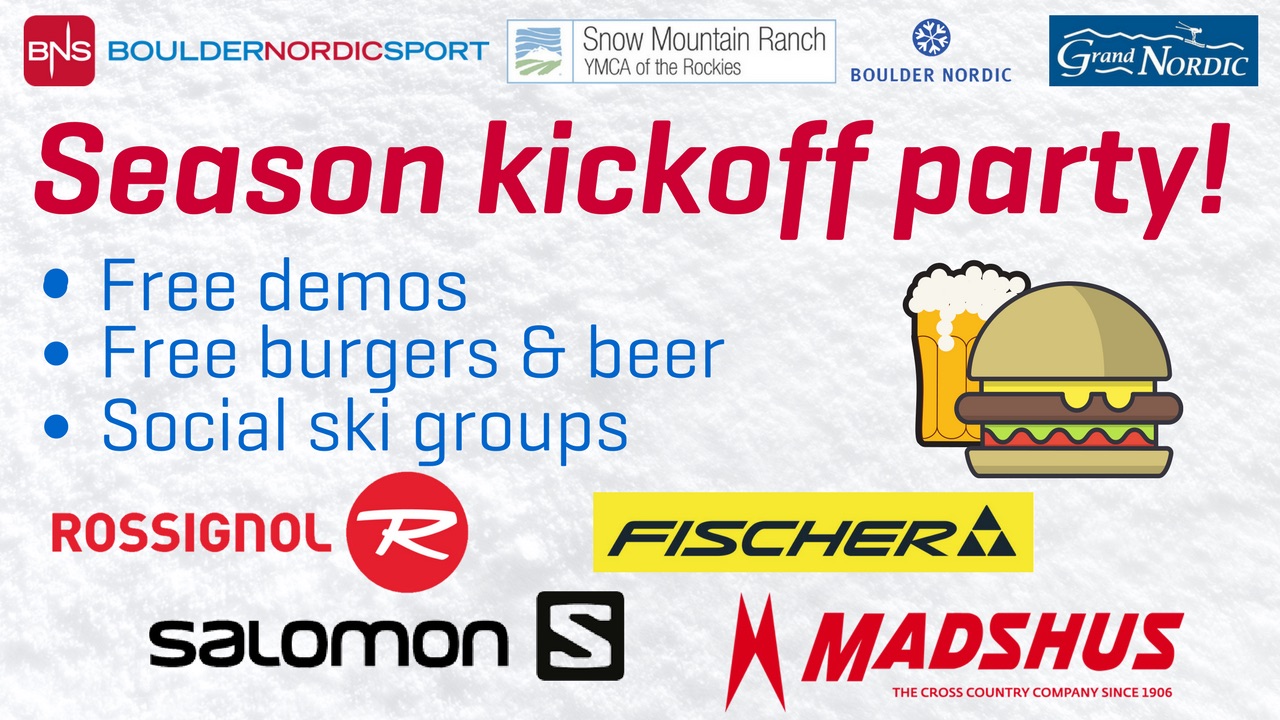
BOULDER, CO—Boulder Nordic Sport, is excited to announce the first-annual Season Kickoff Party at Snow Mountain Ranch on December 2, 2017. In partnership with YMCA of the Rockies, Rossignol, Fischer, Madshus, Salomon, Boulder Nordic Club and Grand Nordic, this is an opportunity to spend the day trying out the latest gear, connecting with skiing friends, and enjoying après ski fun!
Featuring free equipment demos throughout the day, the Season Kickoff party will include a complementary biergarten with burgers, beers, and brats; afternoon social ski groups, and more.
Want to make a weekend out of it? Snow Mountain Ranch offers lodge rooms and cabins, many of which are a comfortable walking distance from the ski trails. Off-season lodging prices are available the weekend of December 2-3 at snowmountainranch.org/lodging.
Tell your friends, bring your family, and join BNS to welcome the 2017-2018 ski season!
***
About BNS: Boulder Nordic Sport brings World Cup Service to everyone with full-service ski shops in Boulder, CO; Bloomington, MN, Portland, ME and online at bouldernordic.com. BNS specializes in professional ski service using Tazzari stone-grinding equipment as well as sales and advanced fit of cross-country skis, equipment, and technical apparel. BNS imports Holmenkol and SkiGo wax lines and carries a full line of wax and professional tuning equipment from over ten wax brands.
Information about Boulder Nordic Sport and the new BNS Magazine are available at www.bouldernordic.com.
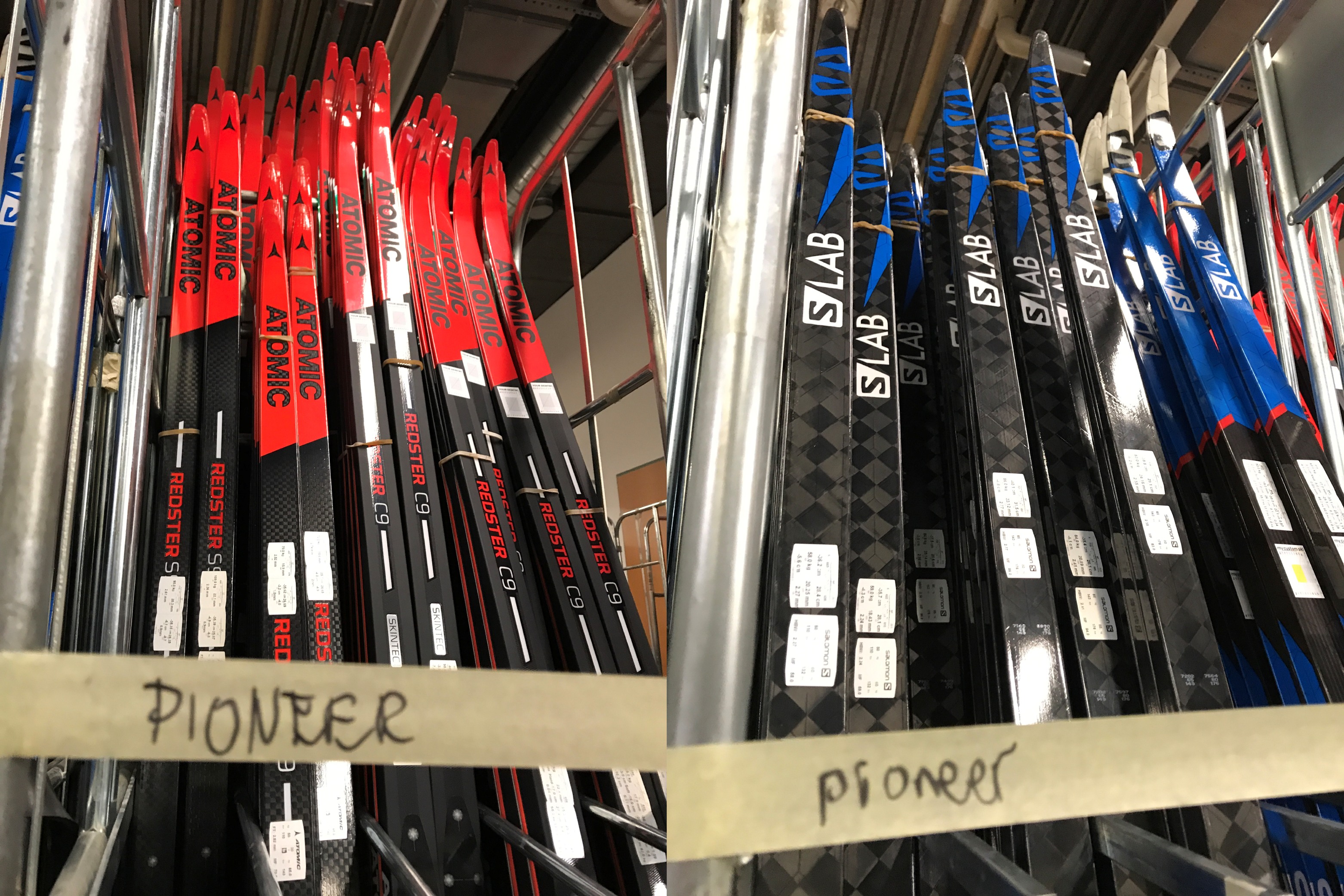
Just a few weeks ago, I was fortunate enough to make a quick trip across the pond to pick skis at the Amer Sports ski factor. Salomon and Atomic both fall under the Amer Sports umbrella and their race skis are manufactured in Altenmarkt, Austria. Since flights into Salzburg were super expensive, we flew into Munich, Germany. When I say we, I am referring to my good friend Josh Doebbert. Josh is one of the engineers on my technical team that helped me build a new ski flex tester and he is very experienced at working quickly and efficiently when picking through thousands of skis. We decided during the design phase of this tester to make the total weight including custom case, less than 50lbs. This would allow us to easily travel with our flex tester on airlines. Picking skis by hands and eyes is great but having a tool to quantify your hands and eyes after hours of ski picking is very useful. Additionally, using pressure instead of pocket length measurements (pretty much everyone uses pocket length to try to quantify skis) is arguably a better measure of ski performance; more on this in a future article.
Josh and I drove from Germany to Austria on the autobahn and I loved it. Josh was a little worried with the no speed limit thing and me driving but we made it no problem.
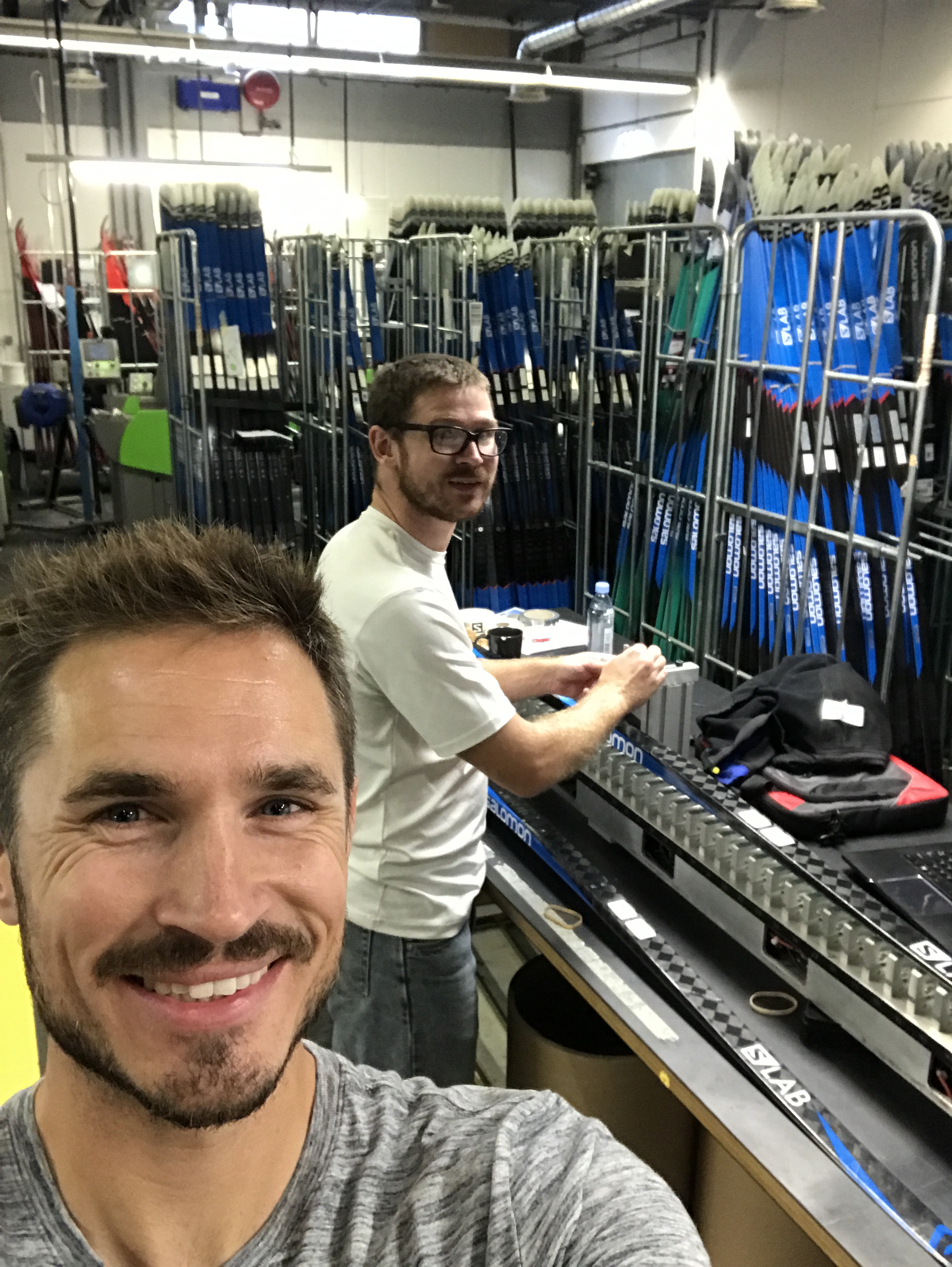
We met Jean-Marc Draeyer and Martin Rohrmoser bright and early on Monday morning (11pm CST) to start our 12hour picking day. Jean-Marc and Martin are in charge of the “kilo” programs for Salomon and Atomic. Skis in the Kilo area are the cream-of-the-production-crop. These skis are the most closely paired and exhibit the quantities that Jean-Marc and Martin deem desirable… a farmer knows where his best crops come from. This does not mean that production skis are not good. In 2010, I went top 30 on the World Cup in Canmore on a pair of “normal” production Salomon skis in arguably one of my best race results of my career.
Everyone reacted with “wow” you must have been on a super day. Well the truth is, I was having a mediocre day with my body (I had a limited acclimation period), but my skis were absolutely incredible in the cold Canmore snow. (Salomon makes some of the best cold snow skis and now wet snow skis in the world… more on that later).
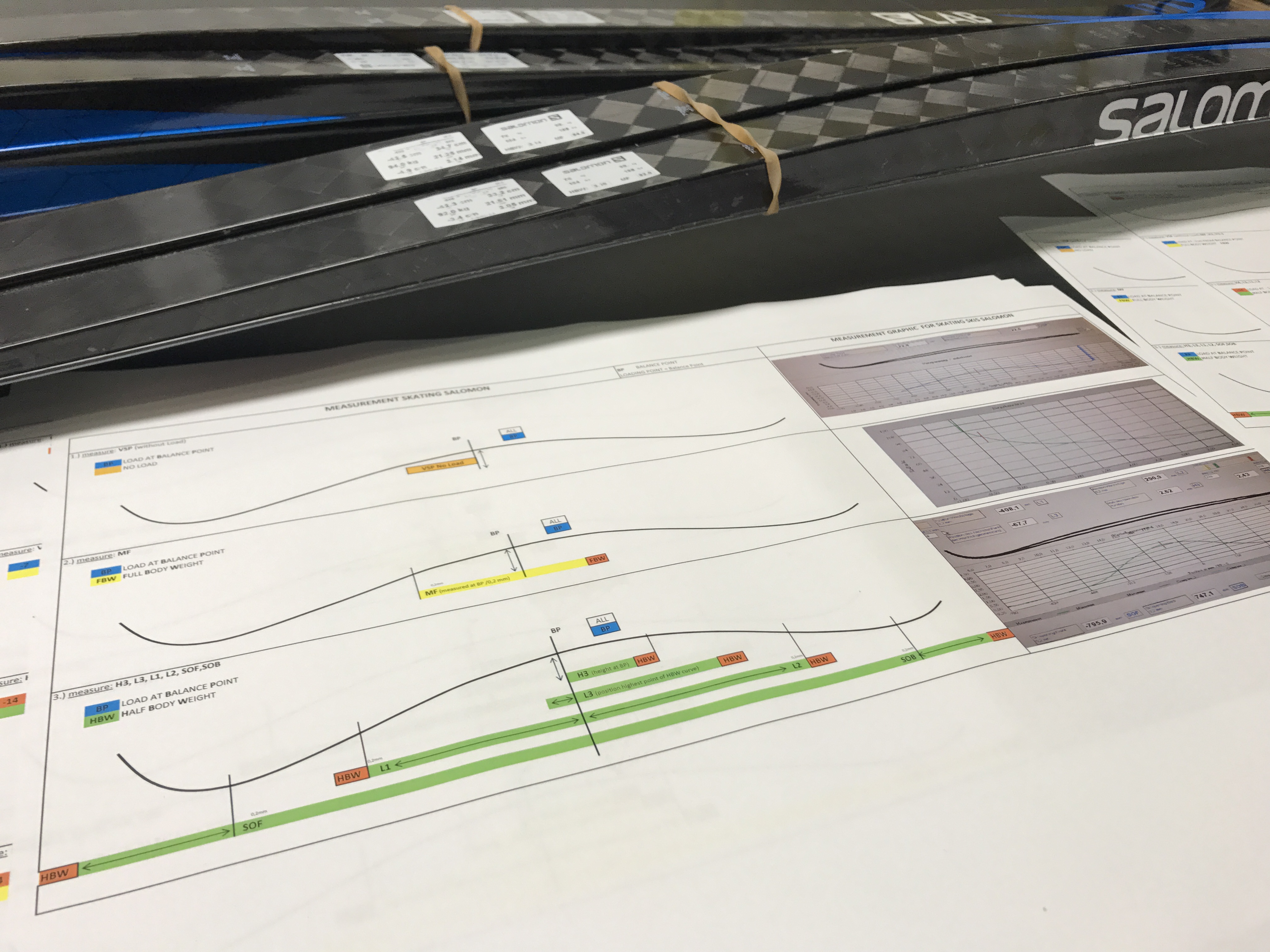
Once we had some espresso with Jean-Marc and Martin, we went about unpacking the flex tester and discussing goals for the day. The Amer guys were pretty intrigued with the tester and we burned some time showing-and-telling with over a dozen Amer sports employees. We showed them our process and then Jean-Marc showed us how the kilo skis are chosen, paired and measured. It is a pretty intensive process and involves a lot of measurements and numbers.
Being an engineer, I like this approach a lot vs. the squeeze and tell method of picking (not to say a highly trained set of hands and eyes cannot pick world class skis, I picked my 2010 WorldCupTop30 ski with my hands and eyes) After we settled in, Josh and I spent hours going through racks and racks and racks of Salomon and then Atomic skis.
We were picking skis for both specific customers and general inventory for the shop. Josh and I would start sorting kilo skis of a certain model and length with our hands and eyes, picking the best we could find… which were pretty darn good. Then we would flex test our hand chosen pairs and take only the top percent of those skis. Essentially, we were taking the cream (kilo skis) of the cream (hands/eyes) of the cream (flex tester)… that’s the best cream. After more than 12 hours of ski picking, we had a very robust and high quality rack of skis to bring home.
Salomon Ski Models:
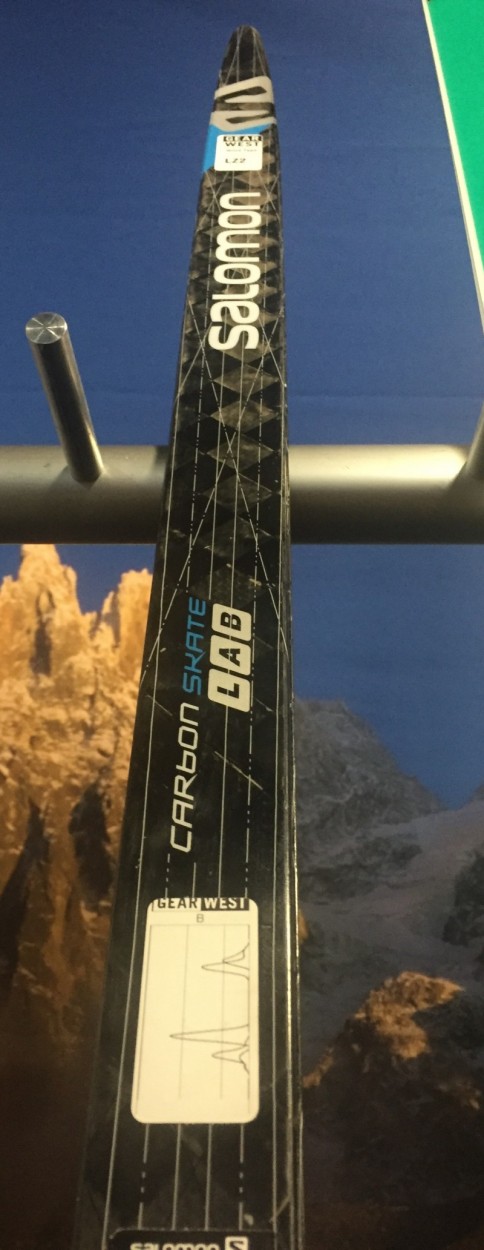
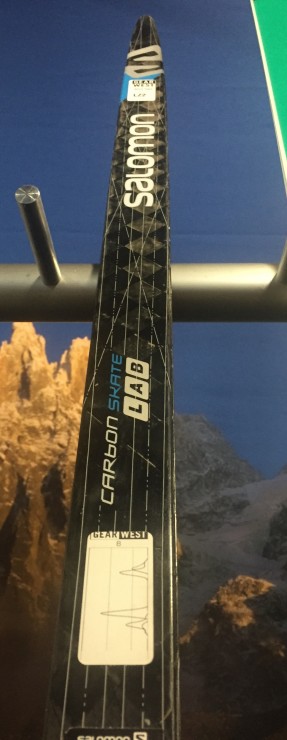
S/Lab Carbon Skate Blue (cold): This is the new ski in the Salomon line-up and the one I had the most inquiries about during our preseason. I first heard about this ski a few summers ago when I was training on the Haig glacier INSERT with Scott Perras. Scott is a 2014 Olympic biathlete and sponsored by Salomon. Sometimes the World Cup biathletes get the new cool stuff before the regular World Cup athletes (Biathlon is a big deal in central Europe). Scott shared a tech and skis with fellow athlete Brendon Green. Both of those guys were having great success with the prototype blue carbon skis in both soft cold and firm cold snow. The camber height is lower on these skis vs the old carbon skis and the glide zones were long and amazingly smooth. We had great success finding a ton of great cold skis in the Carbon Blue. Also, I picked more than a few pairs with enough universal camber properties that they could handle cold snow warming to glaze… think perfect Birkie conditions: below zero/single digits over-night warming to teens/twenties in beautiful sunshine by race finish.
S/Lab Carbon Skate Yellow (universal): This is the Carbon Skate Lab from last year. In Salomon lingo, blue is cold and yellow is universal. A few years ago I didn’t win the argument with a bunch of Salomon people that green is cold, universal is blue/violet/red and wet/warm is yellow but again, I am an engineer and not a marketing person. This year’s Yellow/Uni skis are looking great. They are more refined compared to last year’s production. Last year I saw some camber confusion and skis with the bridge too far forward and aggressive front end pressure along with tail pressure that did not match well within pairs. This year all of that seems much tighter and more controlled. Bridge position was appropriate for a universal ski and I was able to find carbon yellow skis that leaned both to the warmer and to the colder side of things. Also, the base material on these skis can take wax very well to be hard enough for green conditions. Disclaimer: I am a Salomon sponsored and my bag is full of Yellow Carbon Lab skate skis that each work in a vast array of conditions. Two years ago I was 2nd place by 5 seconds to my training partner and best friend, Brian Gregg, on a pair of now Yellow Carbon skis with race temps of 0F at the season opening SuperTour at West Yellowstone. Additional, Salomon is now offering this ski in 177cm length and some of my shorter/lighter customers are super excited about that!
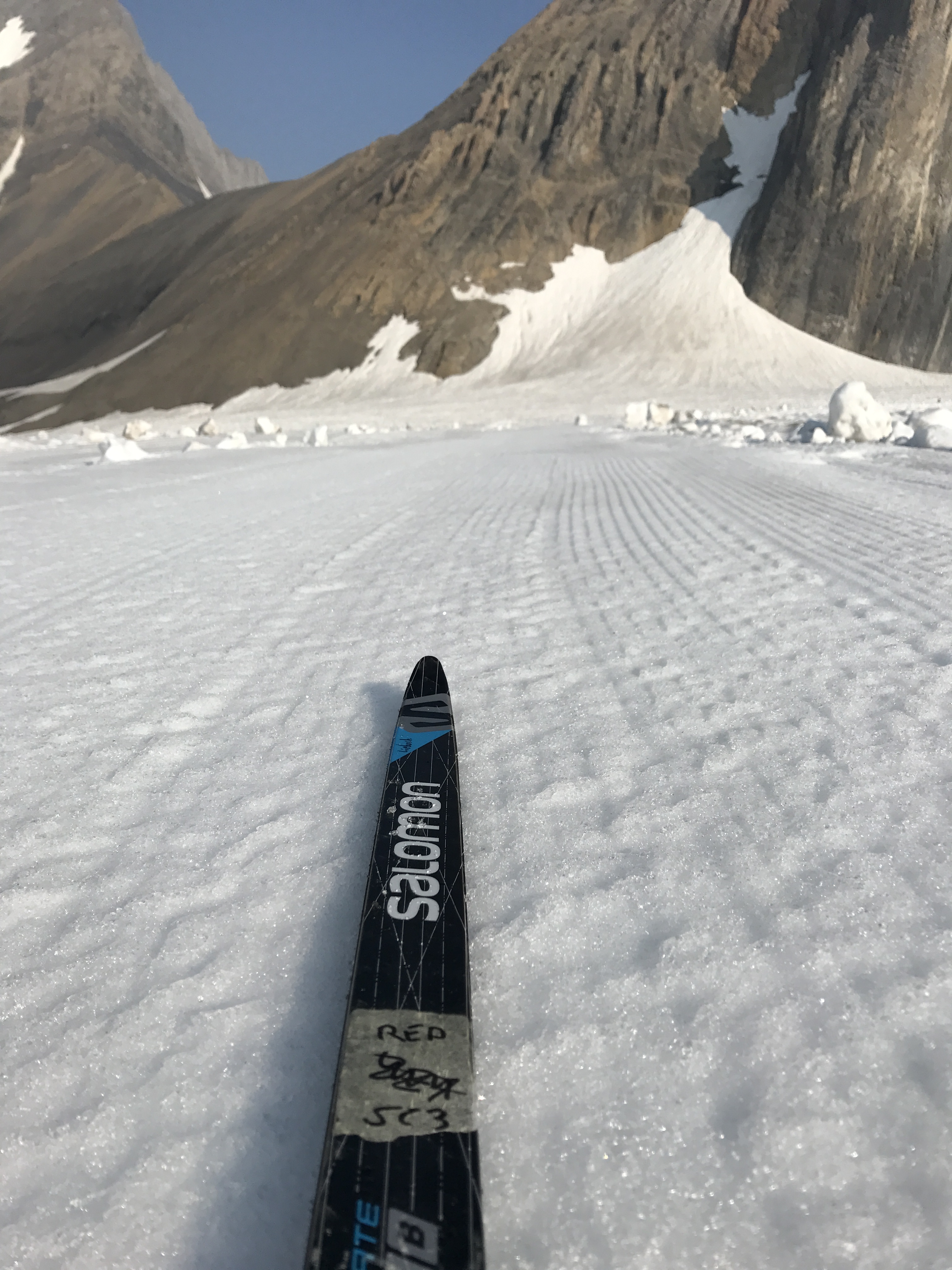
S/Lab Carbon Skate Red (wet/ and artificial): “I’m all bout that bass, bout that base, no trouble…” Oh wait, that’s bass and I mean base. Red base, clear base, grey base… whatever you have heard it referred to as… it all is the same Amer sports wet/warm/humid base material. This is very likely the most universal wet snow base material in the industry. A few years ago on that same Haig glacier trip that I had the great pleasure of crossing paths with Scott Perras, I had in my bag an early production pair of Carbon Skate Red skis. Scott filled me with jealously as he talked about his Carbon Blue prototype skis but I had the Carbon Red skis with me. It was by far the fastest ski in wet snow once things started melting down around 10:30 each morning. I let Scott “demo” that pair for a few laps and I didn’t get it back from him until days later. Salomon has had some unbelievable days on the World Cup with their Red base skis. Jessie Diggins, Matti Heikkinen, Maurice Manificat, Alex Harvey have all had days when they have had a distinct advantage with these skis. I am specifically thinking about the 2016 Tour de Canada during the Canmore stages in the 50F+ weather when Heikkinen won the 15km skate, 2nd in the pursuit time of day and 3rd in the 30km skiathlon. His skis were ridiculously fast compared to Sundby and Ustiugov. Matti is a super fit guy but I know skis made a huge difference those days. The one caution with these Red skis is that they need to have a camber profile that matches the conditions. In last years Red skis and some of this years Red skis the camber profile did not match the wet/warm profile. That is OK sometimes because the Red base can be unbelievably fast in frozen corn or artificial snow all the way down to 0F. But if you want the best universal wet snow ski your money can buy, I would make sure you have someone knowledgeable pick these Red skis for you. At Pioneer, we have had too much experience with man-made snow and wetness over the last few years and we are very familiar with picking and preparing these skis. Wax-wise, I could write many more pages about Red bases and preparation. If you are thinking about racing World Masters this year at Wirth Park, a Salomon Red base ski might not be a bad idea to have in the bag.
S/Lab Classic Blue (cold): I tried this ski for the first time in November of 2015. Isaac Wilson, Nordic Commercial Manager and good friend, took me aside and showed me two pairs of the newly re-designed Salomon classic race skis. He said I could ski on them for a few minutes and then would need them back as the official release was not happening until later that winter. I grabbed the best feeling pair of the two after a quick squeeze and skied off. FINALLY is what I thought to myself. Salomon has finally designed and built a classic ski that could compete with the other brands on the World Cup level. I was previously sponsored by Salomon/CXC from 2005-2011. During that timeframe, it was very difficult to find good or robust classic skis from Salomon. With the new design from Salomon, finding great classic skis is much easier. That pair I tried from Isaac is still in my bag (he never got it back) and I had my best nationals’ classic result on that pair in 2016 in cold snow at Houghton. The Blue classic ski has less splay and a very low riding pocket. I have used it with marginal results when going to warmer kick waxes (think Start Oslo) and very limited success in the klister range but for a green and blue and maybe violet hardwax ski… amazing.
S/Lab Classic Yellow (universal): The yellow classic skis from Salomon looked great this year in the kilo department. The production look very excellent and consistent and I was able to find many skis with camber shapes that would allow the use of hardwax and klister. I was able to grab a pair of yellow classic skis for myself last summer and this was my go-to pair of klister covered and warmer kickwax conditions skis. I won the City of Lakes Loppet classic race on this pair and I had amazing kick even with going extremely thin and even with my wax crew of Andy Brown and Tom Carlson dumping liquid fluoros all over my kick zone. INSERT If you are looking for a do everything classic ski, look no further.
S/Lab Classic Red (warm): See my notes above about the Red base. This is a klister ski and it does it very well. I spent almost all of my Haig glacier classic time on this ski. The camber is high and carries klister very well and the flexibility of Salomon’s core allows for easy kicking. Selection is important as I noticed some production skis had camber confusion… the profile did not match up to the base material. Also, some pairs had a bit too much fight in front of the pocket for my liking. But the good pairs we selected were really really excellent and I am going to make some happy customers with these skis.
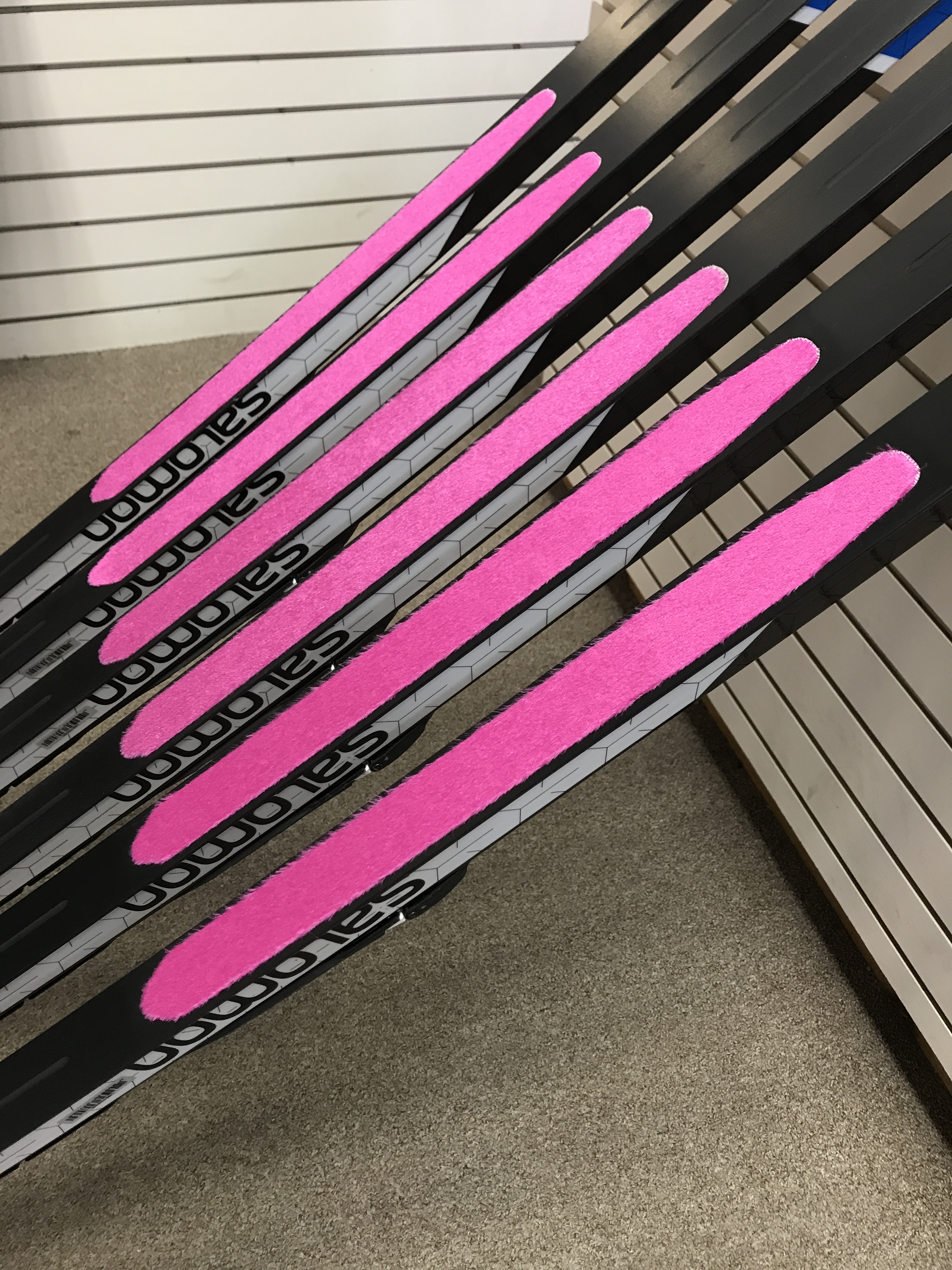
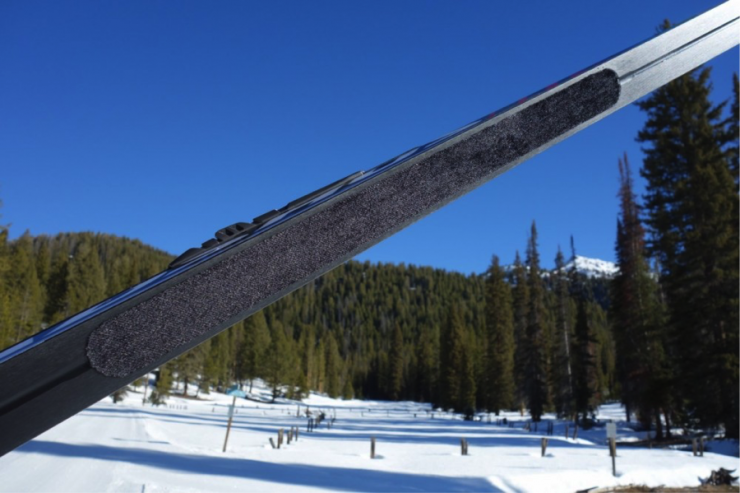
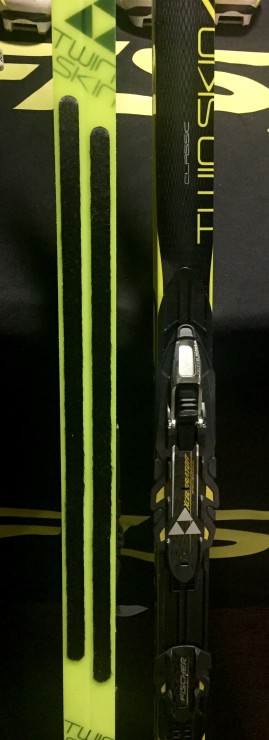
S/Race Skin: This ski has won over Jessie Diggins and if it is good enough for Jessie it’s good enough for us. I was able to test 3 pairs of these on the Haig glacier this summer and while I preferred my S/Lab Classic Red skis with a beautiful klister mix… these were just easy: no prep time at all. I am a firm believe that classic skiing and learning to classic ski will make you a better skate skier. A large percentage of my customers only skate ski and if they classic skied a few times a week; it would help their balance and let those skate muscles recover a bit. Another interesting development in skin skis is that now over ¼ of the Norwegian Birkie skiers are using skins for the race. There is a huge development in skin ski technology and the argument has been made that skin skis are saving the sport especially the traditional classic technique by avoiding the hurdle of kick waxing. We have skin skis at all price points, the S/Race is the version you want if you plan to ever race on a skin ski or potentially race on a skin ski if the waxing becomes a nightmare scenario… or if you just like a great performing ski.
Atomic Ski Models:
Redster S9 Carbon (universal): This is a new ski from Atomic and we had the chance to ski on it last year. It created a lot of excitement for us as the ski was really fast but had a bit more stability than I would have expected. This stability was affirmed when I was picking and flex testing the skis because the bridge was located a bit more underfoot and the camber was more balanced. Josh Doebbert was so excited during our picking process, he is planning on snagging a pair for himself.
Redster C9 Skintec (skin ski): Our most anticipated new skin for this year. Atomic started the skin ski revolution and now they are bringing the skin technology to market in a race level ski. This has been a long time coming and Adam was able to ski on a pair of these last year. So far, this is the only skin we have been on that performs on the same level as the Nanosonic skin from last year. The pocket is slightly recessed and tapered which really helps improve speed without sacrificing any skin-like kick.
If you need us to pick you a great pair of skis, please use our SKI REQUEST form. We have a few more ski picking trips coming up and the Salomon and Atomic kilo skis we hand-picked are arriving soon from Europe so now is a great time to contact us. Thanks ~ Matt and Adam
All Footwear 50% OFF – Salomon, Keen, Vasque, Chaco *In-store only, hurry, footwear is flying off the shelves for this sale HERE is our current inventory list
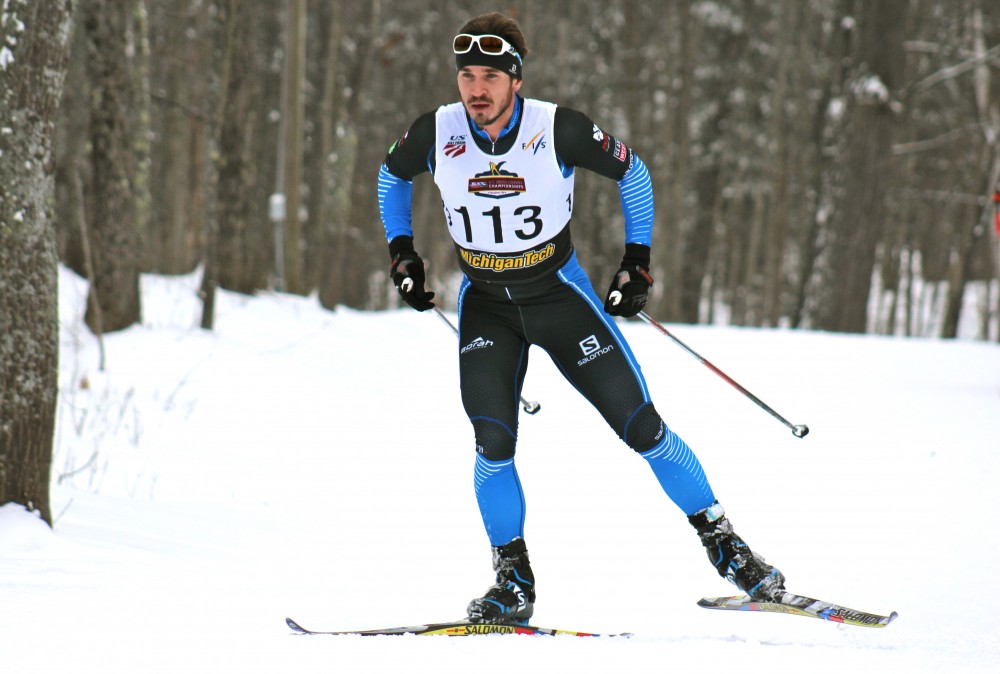
Matt Liebsch (Gear West/Salomon) racing to an eighth-place finish in the men’s 30 k freestyle mass start at 2016 U.S. nationals in Houghton, Mich. (Photo: Toko)
That mark represented the single U.S. men’s quota spot remaining since Adam Martin, a Northern Michigan University skier and the third man on the SuperTour distance list (post-nationals), declined the opportunity to race at the Ski Tour Canada (STC) World Cups so he could focus on NCAA Skiing Championships in March.
According to Matt Liebsch, a Gear West/Salomon skier from Orono, Minn., he received an email from U.S. Ski Team Head Coach Chris Grover on Thursday morning stating he’d been officially selected for that remaining spot.
The Tour begins next Tuesday, March 1 in Gatineau, Ottawa. It may be last minute, but it’s something Liebsch, a longtime racing veteran, welcomes.
“I didn’t know if they were going to take somebody from U23’s,” Liebsch said on the phone about the waiting game, which could have spanned until the end of U23 World Championships on Friday. “They said they would if somebody had a real good result there, but nobody skied quite strong enough so I got the email yesterday [Thursday] at 8 a.m. saying I was in.”
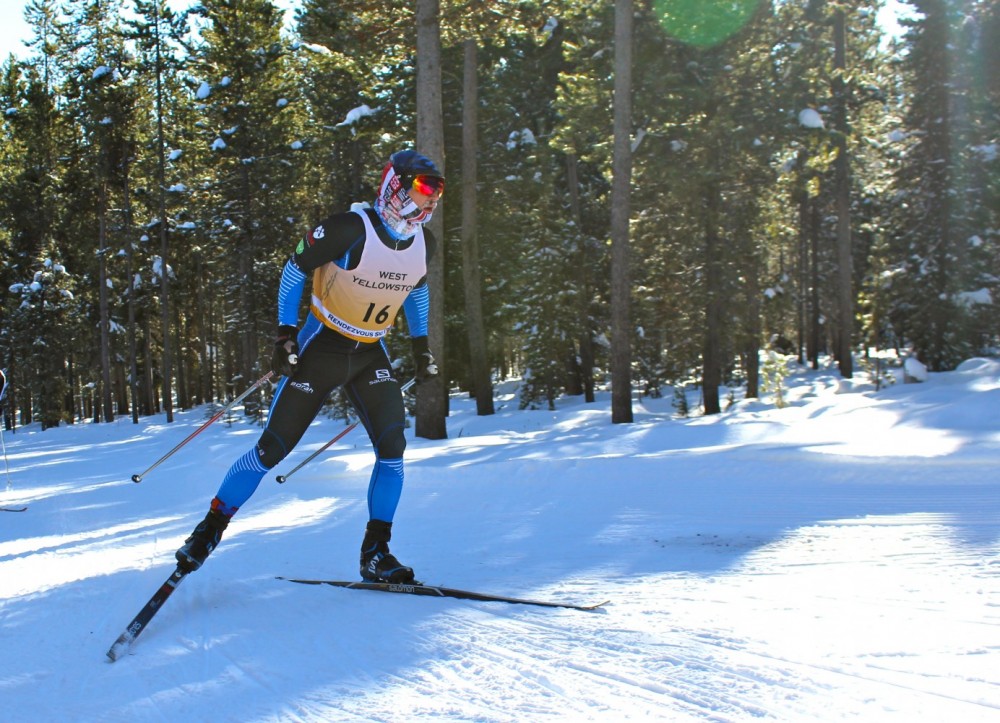
Matt Liebsch (Gear West/Salomon) racing to second during the SuperTour men’s 15 k freestyle in November in West Yellowstone, Mont.
It’s been a long road for 32-year-old Liebsch, who scored his first SuperTour points in 2006 in West Yellowstone, Mont. Nearly a decade later, this past November, Liebsch placed second to his friend Brian Gregg in the West Yellowstone SuperTour distance opener: the 15 k freestyle.
“I was a little bit surprised that I was on the podium for West, honestly,” Liebsch said. “And Brian Gregg, my training partner and I were both like, ‘Wow, geez, how’d that happen?’ We felt pretty good during the race.”
That podium may have been a surprise for Liebsch, but he had set his intentions for the season well in advance.
“My goal since summer training was to make Tour du Canada. That’s why I trained a bunch and why I trained pretty hard with Brian all summer,” he said. “So that was kind of something that I circled on my calendar, yeah, I want to qualify and do those. There are a couple of 15 k skates, and the only 15 k skate I have done at a World Cup level, I was in the points. There is a 15 k at Canmore and then there is a pursuit on the East Coast, so I like my chances in those a lot.”
In his career, Liebsch has competed in four World Cups, all in Canada. The 15 k freestyle in which Liebsch scored World Cup points was in 2010 in Canmore. He finished 29th for the second-best American result
After his West Yellowstone podium, Liebsch set his sights on the distance races at U.S. nationals in January to solidify his goal of earning starts at the season-ending STC.
“I just knew that nationals was double-distance Super Tour points, so I figured I needed to be in the top 10 of both of those [distance races] to be in the mix,” Libesch said.
In the first distance race at nationals in Houghton, Mich., Liebsch placed eighth in the 30 k freestyle mass start, finishing 47.4 seconds behind winner Tad Elliott of Ski & Snowboard Club Vail. Earlier in the week, in the 15 k classic individual start, Liebsch finished ninth.
Liebsch entered nationals with one outcome in mind regarding the 30 k skate race.
“I wanted to be on the podium, honestly I wanted to win that thing,” Liebsch recalled. “I’ve been second and third in the distance races at nationals over the past five or six years. But I’ve never taken a national title, that was my chance. I just skied tactically a little bit too aggressively early in the race and burnt too many matches … But I went out and was skiing aggressively like I was going to try and win that thing.
“I wasn’t really thinking I need to ski conservatively to try to just place well enough to make the Tour du Canada,” he added. “If that had been my goal, I probably would have been maybe top five, somewhere in there for the skate race. And then I would have been on Tour du Canada for sure, and I would have known back in, I don’t know, early January. That of might made things a little bit easier for me logistics-wise. But I was at nationals trying to win that race.”
“I wasn’t really thinking I need to ski conservatively to try to just place well enough to make the Tour du Canada. … I was at nationals trying to win that race.” — Matt Liebsch
Since being notified of his STC invite, Liebsch has had little time for logistics. Soon after, his friend Brian Gregg nudged him to start an online fundraiser.
“I started it last night, maybe around 7 o’clock,” he said on Friday. “I left work early and I told my bosses that I need to figure some stuff out to get up there.”
Nation’s Group skiers, like Liebsch, are responsible for funding the entire cost of their trip. He estimates with flights, housing and food, along with hiring a wax technician, the price tag will be somewhere around $5,000 dollars.
Just prior to his phone conversation with FasterSkier, Liebsch had raised around $3,500 dollars. By the time he had hung up, he’d surpassed his initial goal. Late Saturday morning, that number was up to $6,600 (and he’d set a new mark of $6,800).
“I’ve just been totally taken aback by the support from the ski community. It’s just been super humbling. I’m super blessed to have that support,” he said.
Matt Liebsch’s two daughters, Samatha and Charlotte (Cha-Cha) at the 2016 American Birkebeiner earlier this month. Liebsch placed 17th in the elite men’s 52 k freestyle race in Hayward, Wis. (Courtesy photo)
Liebsch is an anomaly at the elite level of U.S. cross country skiing. He works many hours at Gear West along with the more full-time part of his life: raising three children, ages 7, 6, and 2, with his wife, Marybeth.
Liebsch jokingly referenced Norwegian World Cup leader Martin Johnsrud Sundby’s parenting duties.
“I think Sundby’s got three kids as well, although his full-time job is skiing,” he said. “It’s exhausting sometimes, but honestly, I live about a mile from my work, I’m in the western metro area [of Minneapolis]. The rollerskiing, the trail running, and the training opportunities are literally right out my front door.”
This was Liebsch’s schedule Friday morning: Marybeth, who works at the Loppet Foundation, took the two older kids to the bus first thing. Then, she drove to work while he watched the baby at home.
“I’m a buyer for the store so I was just doing some pre-season reporting and watching the kid,” he said. “Then I took the baby down to Wirth [Park] and swapped and gave her the little one and then met Brian [Gregg] at 10, and we skied for two hours real hard. Now I am going home to have lunch and take a nap and then get a massage and then I think I’m going to lift lightly this afternoon. Friday and Saturday are my normal off days from work.”
Juggling work, the real nuts and bolts of raising children, and keeping dreams alive can be a pressure cooker — especially when those dreams are elusive.
“It seems like I’ve lived most of my athletic life on the bubble,” Liebsch said about his not making the cut for the last two Olympics or a World Championships. “It definitely has been heartbreaking at times to get left home. I just love skiing so much. If I’m here locally it just means I get into some local races. I think for some in the ski community that when they are done racing, they kind of look at it like their job, and when they are done racing they might be done skiing. I just love skiing, so when I get to race or train, that’s just what I like to do.
Liebsch crossing the finish line at the 2009 American Birkebeiner with his son.
“If I’m not in Russia racing the Olympics, I’ll be stateside racing SuperTours, or jumping in some local races, local marathons,” he added. “I just have that perspective. When I get left home from things that I felt like I should be at, it’s kind of easy to get down on yourself. But I like skiing so much usually I get over myself pretty quick and just keep at it.”
This time around Liebsch won’t be left back at home. Although known as a distance skier, when Tuesday’s freestyle sprint initiates the STC, Liebsch says he’s ready.
“The skate sprints, I’m super pumped about that,” Liebsch said of Stage 1 in Gatineau and Stage 3 in Quebec City. “I’m going to approach them like I normally do. I’m excited at the opportunity, and if I have god skis and a good day, I think I can do real well. I am most excited about the distance stuff and there are only three sprints in the Tour, and we’ve got five distance days. I am pretty pumped about that.”
With his plane ticket booked, and some minor details to be worked out, Liebsch will soon head north. It just may be without the kids in tow.
“Hopefully I can convince my wife to come up to Canmore for a couple of days to watch me. We are going to leave the kids with Grandma and Grandpa,” he said. “I’m super pumped to get an opportunity to score some World Cup points again. I think I’ve got a legit chance in some of the distance stuff. Hopefully I stay healthy and sharp and I’m expecting I just get stronger as the Tour goes on … I won’t have any work stuff. I’m going to just be able to put my feet up and hopefully just get sharper as we go.”
Matt Liebsch with his three children on the podium at a local race in the Twin Cities: Ski Renne. (Courtesy photo)
It’s a name worth repeating, and it’s also fun to say. Jessie Diggins won Stage 6 of the Tour de Ski last Friday, Jan. 8, becoming the second U.S. woman to win a stage at the 2016 edition of the Tour. In winning the 5 k freestyle individual start, the 24-year-old Diggins was also the first U.S. woman to win a skate race longer than 3 k.
If you couldn’t get enough of her win, check out more photos from the day below, provided by Salomon.
Jessie Diggins realizing she won the 5 k freestyle at the sixth stage of the Tour de Ski on Jan. 8 in Toblach, Italy. (Photo: Salomon/NordicFocus)
Jessie Diggins realizing she won the 5 k freestyle at the sixth stage of the Tour de Ski on Jan. 8 in Toblach, Italy. (Photo: Salomon/NordicFocus)
Jessie Diggins after winning her first individual World Cup race in the 5 k freestyle at the Tour de Ski in Toblach, Italy. (Photo: Salomon/NordicFocus)
Jessie Diggins talks to FIS media coordinator Jeff Ellis (Kikkan Randall’s husband) after the 5 k freestyle at the sixth stage of the Tour de Ski in Toblach, Italy. (Photo: Salomon/NordicFocus)
Jessie Diggins (r) with Norwegian runner-up Heidi Weng after Diggins won the 5 k freestyle at the sixth stage of the Tour de Ski on Jan. 8 in Toblach, Italy. Weng finished 0.9 seconds back in second. (Photo: Salomon/NordicFocus)
Jessie Diggins (c) of the U.S. Ski Team after capturing the second U.S. women’s win of the week at the Tour de Ski on Jan. 8. Diggins won the 5 k freestyle by 0.9 seconds over Norway’s Heidi Weng (l) and another Norwegian Ingvild Flugstad Østberg (r) placed third. (Photo: Salomon/NordicFocus)
Jessie Diggins (c) of the U.S. Ski Team after capturing the second U.S. women’s win of the week at the Tour de Ski. Diggins won Friday’s 5 k freestyle by 0.9 seconds over Norway’s Heidi Weng (l) and another Norwegian Ingvild Flugstad Østberg (r) placed third. (Photo: JoJo Baldus)
Jessie Diggins (c) of the U.S. Ski Team after capturing the second U.S. women’s win of the week at the Tour de Ski on Jan. 8. Diggins won the 5 k freestyle by 0.9 seconds over Norway’s Heidi Weng (l) and another Norwegian Ingvild Flugstad Østberg (r) placed third. (Photo: Salomon/NordicFocus)
Jessie Diggins (c) of the U.S. Ski Team after capturing the second U.S. women’s win of the week at the Tour de Ski on Jan. 8. Diggins won the 5 k freestyle by 0.9 seconds over Norway’s Heidi Weng (l) and another Norwegian Ingvild Flugstad Østberg (r) placed third. (Photo: Salomon/NordicFocus)
Jessie Diggins (U.S. Ski Team) being presented with her prizes after winning the 5 k freestyle at the sixth stage of the Tour de Ski on Jan. 8 in Toblach, Italy. (Photo: Salomon/NordicFocus)
Jessie Diggins (U.S. Ski Team) after winning her first individual World Cup, the 5 k freestyle on Jan. 8 at the Tour de Ski in Toblach, Italy. (Photo: Salomon/NordicFocus)
Jessie Diggins after winning her first individual World Cup, the 5 k freestyle at the sixth stage of the Tour de Ski in Toblach, Italy. (Photo: Salomon/NordicFocus)
Tomorrow, Jan. 1, 2016, Salomon is expected to announce the release of its new NNN-compatable boot and binding system, called Prolink. (Photo: Salomon Prolink/xc-ski.de)
The dueling alphabet soup of binding systems is about to get a whole lot simpler. For the past decade or so it’s been two camps: Salomon’s SNS system or NNN. On Jan. 1, Salomon plans to reveal a not-so-well-kept secret.
Salomon, which is owned by the Finnish-headquartered sport conglomerate Amer Sports, will begin production of NNN-compatible boots and bindings. The new system, called Prolink, shares DNA with NNN.
According to Amer Nordic Commercial Manager Isaac Wilson, some key differences remain.
The Bindings
“Starting with the easiest and the most obvious, the binding is lighter. It’s also lower and it’s thinner,” Wilson explained on the phone.
SNS devotees often claim more sensitive ski-feel is obtained with as little material between the boot sole and the ski. (Modern NNN bindings slide onto a ski-mounted plate, called the NIS system. The binding slides onto the plate with, no drilling required, and provides some fore and aft adjustment.)
Continuing Salomon’s direct-mount legacy, Prolink bindings will screw mount directly to the ski with no NNN plate in between. To allow for an easier transition from SNS to Prolink bindings, the new system will use an identical SNS screw-hole pattern. Converting skis with SNS bindings to Prolink will be simple.
New in 2015, Salomon’s Carbon Skate Lab featured a ThinPly carbon construction and three different base setups, cold, wet and universal.
Amer Sports, which owns both Salomon and Atomic, has invested millions developing new ski technologies. Both brands helped introduce and innovate classic skis with built in skins. This year Salomon rolled out a top-end price point carbon skate and carbon classic ski.
“All of our skis, from the cheapest kids ski to the most expensive carbon ski, will all come pre-drilled based on camber of where that ski should be mounted,” Wilson said of the new easy to use mounting system. “So it makes the mounting really quick. But it’s still a direct mount to the ski so you get a really direct connection.”
Wilson asserts that differences between current NNN bindings and Prolinks don’t stop at what he claims is better snow-feel, but extend to a mechanically better connection between the boot and binding.
Salomon claims its system, which compresses against the boot’s attachment point, a thin bar near the toe, is better than the NNN closure which uses a small hooks that grip and wrap around the top of the boot bar.
“There is no compression on that system so that the bar of your boot is not actually held or pressed tightly, there is a lot more movement involved,” Wilson said.
With the tighter connection, Salomon suggests its system will last longer and provide a more seamless interface between boot and ski.
The Boots
Salomon’s plan for the immediate future is to produce two runs of identical boots in each model, one with a SNS sole, the other a Prolink sole.
“We will have starting with the S-Lab Pro all the way down to the Escape touring boot, everything in there will be offered in either option,” Wilson said. “We want the conversation to turn away from, ‘What system are you on?’ to ‘What boot fits you the best? What skis do you like the most? What are the most relevant technology for you?’ Not so much, ‘What is the system you are currently using?’ ”
Older model Salomon S-Lab Skate Pro with SNS compatible sole
In the long term, production runs of boots offering an “either or” option may not be cost effective. Salomon is already thinking ahead. It’s skyrocket price Carbon Skate Lab boot pushes beyond 1K for a pair. Yet it remains a way for Salomon designers to prototype modular boot systems.
“When you go to our Carbon boot, and our new Carbon Classic boot, they will actually come with a shell with cleats … They will come with both cleats so you will have the ability to have both in the box. You’ll be able to have an SNS cleat and a Prolink cleat [that is NNN compatible] in the system,” Wilson said. “The goal will be like a cycling shoe where you never worry about what pedal you are using.”
The Binding Wars and the Bottom Line
Binding compatibility is downright unglamorous. But as the interface between ski and boot, binding compatibility is a gateway to greater profitability. For example, with the NNN system buyers have many brands to choose from to optimize fit; there’s Rossignol, Alpina, Madshus, and Fischer — just to name the major players. If your ski race quiver includes NNN bindings, it makes the most sense to purchase boots from these brands. If Salomon or Atomic boots are the most comfortable fit, then up to now, the SNS system was mandatory.
Amer Sport’s business model worked for awhile. The SNS system held strong here in the U.S. Yet gradually, brand influencers, like coaches and their ski clubs, as well as top World Cup skiers, switched to NNN. At one ski club in Bend, Ore., you’re likely to see only a few pair of Salomon boots amidst a group of 30 to 40 skiers on any given day.
Internationally, the SNS system is quite robust.
“In Germany, it’s still 80 percent,” Wilson said. “But in the U.S. and a few other places we have four really strong competitors and we lost partnership with Fischer a few years ago. Our market share shrunk. We went from 65- to 70-percent market share in the U.S. to just about 35 percent.”
In places like Norway, a major nordic-ski product consumer, SNS became an afterthought as well. Wilson said that despite Amer Sport’s investments in high end ski production, they simply were preaching to a smaller and smaller choir.
“At the end of the day, in all the business meetings we were in, we were saying no matter how much we do this we are only speaking to 35 percent of the industry, and that we are spending an awful lot of money to talk to 35 percent of the people.”
Salomon could have moved on this earlier, he added. “My biggest thing is, OK, we could have done it ten years ago, but I’m just really happy we are doing it now. … It’s hard to admit that we need to play across the full range of systems … so that we can be back to where we once were which is a much higher market share especially in boots where we are the most relevant brand still in the industry.”
Salomon’s bottom line is likely to be bolstered by the Prolink system’s introduction. Wilson explained the system is an NNN upgrade, but it’s not revolutionary. Put simply, now Salomon can attract consumers who simply prefer their boots and don’t want to change binding systems from NNN to SNS.
“Hopefully it allows people to open the ability for them to take Salomon or Atomic product and not close the door for us,” he added.
“I am proud that Salomon was not too proud to do this … I think they were really globally not that worried about it and now I think especially if they ever want to play in the Norwegian market, if they ever want to play in the U.S. market in a real way, this was a move that they had to do. I think they came to that realization and they did it.”
Wilson admitted he’s asked the question again and again — does this mean Salomon has lost the binding battle or lost the war? “For me, it’s a funny way to think about it. I feel like hopefully the consumer is the one who wins this in the end. So nobody has lost but the consumer comes out as a winner.”
WEST YELLOWSTONE, Mont. — FasterSkier walked the floor of the 2015 Yellowstone Ski Festival Expo and found some interesting gear hidden behind those piles of stickers and schwag. Mohair-skin skis, carbon-soled boots and athlete-inspired clothing were common themes among the exhibitors. Take a look through our gallery below.
Podiumwear sales rep Kyia Anderson shows off one of the custom ski suits that Jessie Diggins helped design. A portion of the sales goes toward supporting Diggins.
BeFAST Sportgear, based in St. Paul, Minn., showed off their American spirit with this trendy neck gaiter.
Borah Teamwear showed off its new one-piece suits. This suit, made for Alaska Pacific University, uses an innovative seamless design that builds the suit as a whole rather than a sewn-together top and bottom.
New for 2015, Salomon’s Carbon Skate Lab features a ThinPly carbon construction and three different base setups, cold, wet and universal.
Rossignol’s R-Skin is built on the popular Rossignol Delta chassis and is perfect for a quick, worry free and wax-free ski.
Madshus introduced the Terrasonic IntelliGrip. A skin ski featuring a graduated mohair base, it’s great to grab and go. (Photo: Madshus)
Fischer’s Twin Skin joined the plethora of new mohair skin skis. The offset skins free up the ski in the gliding phase, and the 70-percent mohair to 30-percent poly mixed skin is replaceable. The skin length varies depending on ski length.
Alpina Sports is bringing their footwear line to the U.S. The line includes performance light hiking shoes, casual footwear and hiking boots.
Fischer’s new Speedmax skate boot uses a full carbon sole and reduced padding in the liner to cut weight for a maximized performance.
The Alpine Elite 2.0 skate boot features a one-piece carbon sole and a proprietary carbon weave along the edges of the carbon heel counter to eliminate any hot spots.
Yoko’s 9100 Kikkan Randall Edition poles feature a 100-percent CNT (carbon nano-technology) shaft with a design inspired by Kikkan’s style. The YXG Kikkan signature gloves include three models featuring different levels of wind stopper, plus a separate race line inspired by Randall’s international-racing success.
The Nano Carbon Race 100 UHM Poles by Madshus feature a new black-on-black graphic and heat-moldable pole straps.
One day. Eight events. Introducing NEW Ultra 100K Marathon!
Hayward, WI (September 22) — The 14th annual American Birkebeiner Ski Foundation®
(ABSF) Birkie Trail Run & Trek, Presented by Salomon, will be held on the iconic Birkie Trail this
Saturday, September 26th. From the challenge and intensity of a new 100K Ultra Marathon to
the fun of a 5k run/walk, an estimated 1000 runners and trekkers from around the Midwest will
take to the trails.
The Birkie Trail Run & Trek events start and finish at Birkie Ridge Trailhead, 12.5 miles north of
Hayward, Wisconsin, and 5 miles south of Cable, Wisconsin. The eight Birkie Trail Run & Trek
events place runners and trekkers on some of the most scenic stretches of the famous Birkie Trail and single-track sections of the CAMBA (Chequamegon Area Mountain Bike Association) trail system. With eight events on the roster – including a marathon, marathon relay, half marathon, Nordic Trek, 5K run/walk, youth 5K (12 and under) and 1K (free for ages 9
and under), and this year’s new 100K Ultra Marathon – there is a north woods trail experience
available for every ability level. This year’s new Ultra 100K marathon utilizes all of the marathon
course plus two additional loops, with aid stations and support teams along the course route. Full race course information is available at www.Birkie.com.
“The Birkie Trail Run & Trek event is ideal for runners looking to break free from traditional road
running and provides an ideal crossover race experience and introduction to trail running,” said
Ben Popp, ABSF Executive Director. “Our event is continually evolving and we are excited to
offer the new Ultra 100K marathon to the mix of existing running and trekking events.”
The Birkie Trail Run & Trek welcomes new elite athletes to the marathon, including: Jeff
Quednow, Ogema WI; and Marco Sturm, Neuötting-Bavaria, Germany. Additionally, the 2014
Birkie Trail Run & Trek male marathon champion, Craig Cardinal, Northfield, MN, is back to
defend his title, while 2014 women’s half-marathon champ, Tiffany Karl, Duluth, MN, is returning
and running the full marathon.
“The trail is in great shape, volunteers are ready and we are excited to welcome runners,
trekkers and their families to this weekend’s events,” said Allan Serrano, ABSF Event Director.
“The wide, grass covered, level surface and challenging profile of the groomed Birkie Trail,
along with the smooth and fast CAMBA single-track will give runners of all abilities everything
they’re looking for this weekend.”
The weekend kicks off on Friday with bib pick-up at the Cabin Stop, Hayward, WI, with cheese,
craft beer and wine samples, and exciting door prizes. The new Ultra 100K event starts
Saturday, bright and early, with rolling starting times for all other running and trekking events
(see schedule below). Festivities continue with awards ceremonies, food, craft beer and wine,
vendor displays, and live music by Duck for the Oyster under the big tent. Later that evening,
the celebration moves to Rivers Eatery, Cable, Wisconsin, with live music by Molly and the Danger Band. This year, participants have the opportunity to camp near the start/finish area at
Birkie Ridge Trailhead.
With a focus on youth development, Annie Hart – Birkie Ambassador, 5-time All-American and
professional cross-country skier – will lead the kids warm-up games and race activities. There
will also be an obstacle course for kids and treats following the youth events, hosted by the
Central Cross Country Ski Association (CXC).
“We are very pleased to be the presenting sponsor of the Birkie Trail Run & Trek,” said Josh
Korn, Regional Marketing Manager, Salomon Soft Goods. “The Birkie trail is truly a gem of a
course for both running and Nordic trekking alike!”
Over the years, the Birkie has grown its programming into an exciting array of fitness and
recreational opportunities. The 107-kilometer Birkie Trail system attracts skiers, runners, bikers,
trekkers, and hikers, from casual day-trippers to elite superstars.
Follow us on Twitter #BirkieRun15
###
About the American Birkebeiner® Ski Foundation and Birkie® Events Located near Hayward and Cable, Wisconsin, the American Birkebeiner Ski Foundation, a 501(c)(3) organization, is known for its signature American Birkebeiner Ski Marathon held each February. Today, the Birkie brand has grown to encompass a year round lifestyle that provides healthy, active events for thousands of outdoor fitness enthusiasts of all levels. Birkie. Ski. Run. Bike. Live! Visit www.Birkie.com to learn more.
About Salomon – Designed for Freedom –For more information about Salomon, visit www.Salomon.com
Birkie Trail Run & Trek, Presented by Salomon Schedule of Events
Final Birkie Trail Run & Trek registration. There is no relay team registration
after 4pm on Wednesday, 9/23. There is no registration for all other Birkie Trail
Run & Trek events after Friday, 9/25
Sunday July 26, join Winter Olympians Jessie Diggins, Kikkan Randall and Caitlin Gregg for an hour of fun activities and inspiration in the Mall of America! Pick your hour, either 1-2pm or 3-4pm and come meet your heroes and make new friends!
In the Mall of America Rotunda from 5-6pm, after the Fast and Female events, Jessie will be hosting a talk about how to take that next step forward in racing. Salomon will present a talk on equipment and figuring out what’s right for you, so bring your questions! Open to skiers of all ages; boys, girls and their parents! Jessie will also be signing posters after the event.
This article is a paid advertisement by Caldwell Sport, a ski-grinding service and new-ski retail shop operated by Amy and Zach Caldwell in Putney VT. It’s busy season in the ski industry and we’re cranking away at selling and grinding skis, so we’re recycling an article that Amy wrote for our website in late August. How many of you were paying attention in late August? OK – then this will be new material for you!
This summer I was fortunate enough to visit several different ski factories in Europe with Zach. After our first year back in operation as Caldwell Sport, we felt that investing in my understanding of skis from the ground up was important for our business. We’re a small business, and it’s necessary for both of us to have a high level of expertise in all aspects of the operation. There is no better way to learn about skis than to go to the source and handle skis every day for a few weeks with no distractions. I am pretty sure this is Zach’s idea of heaven.
Our first trip of the summer was to Norway. Zach planned the trip so that we could spend a few days skiing on the snow at Sognefjell, about a 3 hour drive north of Lillehammer, with some of the US Ski Team guys that he coaches. Sognefjell is a remote mountainous area located above the Sognefjord. Its elevation is about 4500ft and holds snow well into the summer. There is a hostel-like lodge there that serves five very carbohydrate rich meals a day. They salt and groom a 7km winding loop (with hills and turns) twice a day.
When we were there, all of the major ski companies were testing their products along with some of the Norwegian National Team, German Biathlon, United Bakeries Marathon Team and a host of other teams from Norway, Sweden and Finland. Because all of the major ski companies are based out of Europe, this ends up being a relatively close testing area for them. While we were there, we were able to test some prototype products that are really interesting ideas. If all goes well, these products will be brought to market over the next few years. We were able to get a sense of what concepts ski companies were working with and what direction they are headed.
After 15 hours of skiing in 6 sessions at Sognefjell, we headed back to Lillehammer to spend a week picking skis at the Madshus factory in nearby Biri. I have become a bigger and bigger fan of Madshus skis over the past few years, so I was really looking forward to going to the factory. Although any factory setting is far from glamorous, the Madshus factory was a totally impressive facility. They take extreme care selecting all of the materials that go into their skis and have built some of the most exact machines in the industry. They are so exact that they have to make slight adjustments during a production cycle so that not every pair of skis is identical! Anyway, after a week of drinking the Madshus “Kool Aid”, I left Madshus feeling even more excited to test their skis this season.
After Madshus, the next stop on the ski pilgrimage for me was to the Salomon Headquarters in Annecy, France in August. While Salomon produces their skis in Altenmarkt, Austria; their World Cup service team is based out of Annecy and all their development and prototyping happens there. They actually have a press in Annecy where they can produce a new ski to test without having to halt the whole production line in Austria. It was a great opportunity to spend a little time with Patrice Frisson-Roche, one of the Salomon World Cup service guys, to learn a bit about what skis they have been testing and liking on the World Cup.
Over the next two days, which also happened to be a weekend, we spent 10 hours on road bicycles near Annecy biking several of the roads and Cols that the Tour de France often visits. Thanks much to Alex Haas, the Salomon international marketing director, and his good friend who is the marketing director for German soccer for showing us some incredible riding around Annecy. In spite of very sore bums and legs, it was an amazing three days.
From Annecy we went to the Salomon ski factory in Altenmarkt, Austria. Salomon shares a factory with Atomic which are both owned by Amer Sports. It is interesting to see two totally different ski companies working side by side. They have two separate design teams that work independently of one another. Most of the factory workers are working for Amer and not directly for either ski company. Jean-Marc Draeyer works for Salomon and is very involved with ensuring the quality of every pair of Salomon skis.
Overall, my impressions of the Salomon factory were very positive. Although Salomon hasn’t been making skis for all that long compared to the other ski companies out there, they’ve done a good job bringing in some very hard working and knowledgeable people.
Riding in Annecy, France.
We were also very fortunate to have 2 free days in Altenmarkt due to an Austrian holiday and another weekend day. Zach and I took advantage of the nice weather and the Austrian Alps and did 2 fantastic hikes from Ramsau, one of them taking us up and around the Dachstein glacier. Although the Dachstein is used as a summer ski training venue, August tends to be its low point for good skiing during the year so we were happy to be hiking instead of slogging around on dirty, very slow glacier ice.
Dario Cologna’s skis at Fischer.
Also, during our week in Austria, we were able to squeeze in a day visiting the Fischer factory in Ried. Although Ried is unfortunately not located in the beautiful Austrian Alps, it was a great opportunity to get to take a look inside the factory that has been the leader in making cross country skis over the past few decades. The Fischer factory certainly did not disappoint. It is definitely the largest of the factories and it is clear that they continually reinvest in their machines and technology. It was also great to see into the racing department and see a whole bunch of Dario Cologna’s skis get dropped off for grinding. Thanks to Andy Forstner (another World Cup service guy) for showing us around.
In all, I learned a lot about the different ski brands we carry this summer. One of the biggest lessons that I learned was that to be truly knowledgeable with skis, one must be a continuous and eager student of skis. Ski companies are constantly trying to refine their skis and make them lighter and faster. They come up with new concepts, develop them and then test them over and over again. I know one thing that I will do this winter is use every ski as a ski testing opportunity. Knowledge comes with hard work. Fortunately, like all of our customers, I don’t mind this type of “hard work”.
Salomon USA and SkiRack, New England’s most complete source for Salomon Nordic equipment and clothing, are hosting a custom gear-fitting event Saturday, October 27, and Sunday, October 28 to kick off the 2012-2013 Nordic ski season.
The Salomon SuperFit Event will allow local Nordic skiers the chance to meet one-on-one with professional boot fitters and factory representatives including Salomon’s New England sales rep Patrick Ruane. Additionally, SkiRack owner, Spike Clayton, SkiRack staff members Kyle Darling and Jake Hollenbach and local Mansfield Nordic Club coach, Tim Weston, will attend and bring years of expertise and experience fitting Nordic athletes.
Skiers of all ability levels will learn about the latest Salomon Nordic racing equipment for 2012-2013. They’ll get customized guidance from the factory pros to make sure their skis and boots are ideal for their body, ability, maximum performance and enjoyment.
What: Salomon SuperFit Event
Where: SkiRack, 85 Main St. Burlington, VT
When: Saturday, October 27, 10am—6pm. Sunday, October 28, 2012 11am-5pm.
Every Salomon ski purchased at the event comes with a free pair of Salomon SNS bindings.
“It’s exciting to partner with Salomon again this year to offer this premier Nordic event,” says SkiRack’s Will Skolochenko. “The Nordic season is right around the corner and this event is a great way to get everyone ready.”
The Salomon SuperFit Event is free and open to the public. There will be refreshments, prizes and giveaways. Event contact info: SkiRack, 1-800-882-4530.
Salomon, the mountain sports company. Salomon was founded in 1947 in the heart of the French Alps. Since then, we’ve been creating innovative products to enhance the performance of athletes. Performance led design is our past. Performance led design is our future.
There may not be snow in St. Croix Falls or the Metro area – but there is still plenty of skiing and racing to be had not far away! (Photo taken on 1-14-2012 on the Wolverine Trails in Ironwood, MI)
This brown winter of 2011 – 2012 is starting to bum us out, but we are recharged after a fantastic trip to Ironwood for this past weekend’s Sisu Ski Marathon. We figured this weekend would be a great time share some enthusiasm with our team mates and customers by putting together a fun program of events here at Cyclova XC and in the surrounding area!
We will kick things off with our Brown Winter 30% Off Of MSRP 4 Day Overstock sale – Thursday (1/19/2012) through Sunday (1/22/2012) with our lowest prices of the season on most of our top end xc ski race skis, boots, and poles – as well as in stock Tubbs Snowshoes! See the details on this sale below!
Thursday 6PM: Group interval workout at Trollhaugen (most people will be classic skiing, but you’re welcome to join as a skater)
Friday: (A variety of tasty craft carbonated beverages will be served from 6 to 9 – max of 2 per person) 6PM:
First in adveture stories stories – Frank Lundeen presents “Skiing in Australia” on Cyclova XC Big Screen 7PM: TBA Movie on Cyclova XC Big Screen
Late (9PM – 1AM): Concert by Charlie Parr at Trollhaugen
Saturday: 8AM: Group carpool leaves for a day trip to the Birkie trail. The shop will be open from 7:30 to 8 for any last minute pre-trip skiing needs you might have. 9AM: Group skate ski and lesson at Trollhaugen 6PM: Night Mountain Bike Ride on the Woolly Trails. Rolling at 6PM from Cyclova XC in downtown St. Croix Falls. Call ahead to arrange for a Salsa Mukluk demo bike for the ride! Bring your own lights & bike unless other arrangements have been made.
Sunday: 9AM: Group ski at Trollhaugen 3PM: 3 mile Group Trail Hike on the Indianhead Trail (meeting at Lion’s Park, just north of St. Croix Falls. Be sure to check out the 30% off sale on all in stock snowshoes prior to leaving!
Come this Thursday through Sunday for the best deals of the season on top end XC Skis, Boots, Poles, & Snowshoes!
Brown Winter 30% Off Of MSRP 4 Day Overstock sale on in stock snowshoes, top end race skis, boots, and poles. We are slightly over inventoried on the latest 2012 top end race equipment, and are going to offer the lowest prices of the season for 4 days only – Thursday, January 19 – Sunday, January 22. Products included in this incredible deal are: All in stock Tubbs Snowshoes Fischer Carbonlite Skate Skis (“the HOLE ski”) Madshus Nano Sonic Skate Skis Madshus Hyper Sonic Skate Skis Madshus Hyper Sonic Classic Skis Madshus Nano Sonic Skate Boots Rossignol X-Ium Skate Skis Rossignol X-Ium Classic Skis Rossignol X-Ium Skate Boots Salomon Equipe 10 S-Lab Skate Skis Salomon Equipe 10 S-Lab Classic Skis Salomon S-Lab Classic Boots Salomon S-Lab Skate Pro Boots Salomon S-Lab Poles Swix Star Poles
Caldwell (right) grinding skis in Boulder, fall 2009. Photo courtesy of Zach Caldwell and Erik Nilsson.
Zach Caldwell’s role within the ski industry is hard to define. In trying to come up with a single phrase to describe his job, ‘ski technician’ isn’t nearly sufficient, as it doesn’t quite capture everything he is—structure designer, snow whisperer, wax chemist, engineer, ski evangelist, and occasional coach (he calls it his “hobby,” as if working with Kris Freeman and Noah Hoffman were as ordinary a pastime as fly fishing). Caldwell’s expertise in everything from kinetic friction to classic technique comes from his willingness to be a constant student of the sport. He is always designing and testing new structure patterns, wax combinations, binding placement—even wax bench efficiency.
When it comes the companies producing the skis he spends so much time with, his attitude is no different. Caldwell recently returned his ski selection and grinding business, Caldwell Sport, to Vermont after a few years of partnering with Boulder Nordic Sport in Boulder, CO. In addition to the new locale, he’s introduced Salomon skis to his inventory, and recently returned from Europe for the second time this summer for his inaugural tour of Salomon’s factory. There he met with their design team, observed the production process, and picked skis from their race selection to take back to the shop.
FasterSkier caught up with Caldwell a few weeks ago, while he was still in Altenmarkt, Austria and was scheduled to get his first Salomon factory tour the following day. He talked about what goes into building a relationship with a new company, why he’d made what seemed to be a complete 180 on his opinion of Salomon, and his perspective on the whole ski business after almost a decade in the industry.
FasterSkier:First off, it’s been a few months now since you left Colorado. How is the settling in going back in Vermont?
Zach Caldwell: It’s a little chaotic, as you might expect, especially with the timing. We packed up and started driving at the end of May, got back [to Vermont], unloaded the truck, and then four days later I flew over to Europe. We hadn’t even unpacked.
Amy was back home looking for shop space, checking everything out, sending me real estate listings, and she started saying that we could either pay $1,000 a month for shop rent, or just buy a place where we can set up house and shop and do the whole thing under one roof. We ended up getting a contract on a place in Putney that’s zoned appropriately, and we’re supposed to close on that about three days after I get back.
We’re living out of boxes, but it’s been fun to be back east.
FS:Are you worried that living and working in the same place will mean you never get a break?
ZC: Actually, I think it’ll mean more and better time for myself and the family. It’s not a standard retail operation with set hours. We have flexibility. There are large chunks of time when we’re working really long days. But there’s also a lot of time when we get to have some fun, go skiing, etc. So I’m not too worried. Less time commuting, and less time working retail during the holiday season sounds pretty good to me!
FS:Talk about your decision to start working with Salomon. You haven’t been their greatest fan in the past, and you explained on your website that working on Tad Elliott’s skis this winter brought you around. Was that all it took to change your mind?
ZC: You’re right, I haven’t always been a huge fan of them. Salomon’s been one of my favorite companies to pick on in the ski industry, largely because they put so much energy into marketing their product, telling the story, and getting the word out, so it’s easy to look at them as a marketing-based company. But you have to respect their ski boot business; they’ve dominated the market in the U.S., and internationally I think they’re getting to better parity in terms of the binding systems. They’re a pretty major player, so you can’t really ignore them.
When they first started making skis, it became apparent they weren’t going to do the manufacturing. They contracted Fischer to do it, and those were OK skis, but obviously Fischer had no incentive to develop a really good ski for Salomon.
Then they got bought by Amer [Sports], which is also the parent company of Atomic, and all of a sudden they’re a fully-fledged ski company, because their parent company owns the means of production. Then the question is, who gets to call the shots inside Amer? Who’s deciding what’s what? What became apparent is that Salomon has their own design team and own design concept for skis.
There’s no way to launch something from nothing and have it be successful right off the bat. In my opinion, to put it bluntly, that first generation of Salomon skis were bad; they just weren’t very good skis. This would have been three or four years ago. What I’ve seen is that Salomon’s stuff has gotten better, and it’s gotten better on the fly. They’re making adjustments, and adjusting quickly.
So, when I started working with Tad’s skis…I was prepared to tell him to drop the relationship and sign on with someone else. And over the course of working together a bit, I found that that wasn’t my take at all, in fact I found that the skis were quite good, very competitive.
But a lot of companies make good skis. Its not like deciding to work with Salomon was a decision that their skis are better than, say, Rossignol. Rossi makes great skis as well. But from a business perspective, I’m looking at their whole company. Salomon is a very big, very capable company, with really good sales support, really good distribution support. You’ve got a lot of people working for you with a project with Salomon. I never would have made the decision to do it if I didn’t considered their skis to be good.
That doesn’t mean they can’t improve; every company is looking to improve. I’m looking at: what is the direction for developing the product further, and do they have control of the process? So this, for me, is a bet on the future for them. I feel they’ve reached a level that is undeniably good, I’ve got access to work directly with their racing department over here in Europe, so logistically they support my business model. They’re very willing to hear criticism and take feedback, and they’re not defensive at all about critique.
It’s an investment in a company that I believe is very serious about making good skis, and that’s coming from the point of view of not having [previously] been a fan. I feel like to take on their brand, I needed to take on a really good working partnership; these guys are eager to work with me, so it seems like a pretty good fit.
FS:In working with Salomon, are you involved in any official capacity in the design process?
ZC: No, not at all. My job is to learn the skis from the inside out. When I say “work with them,” I mean “hang around like a leech and try to suck information out of them”. On what they’re trying to do, what their design process is, how they produce the ski and, more importantly, reproduce it.
My willingness to work with a ski company depends on their openness to showing me the design process, letting me ask questions, and becoming a workable expert in what they’re doing. Once I understand what they’re trying to do, it’s really easy to assess how successful they are in meeting their own goals.
Generally, a ski company that meets its own goals is coming up with pretty good skis.
FS:Where do you begin the process of learning their skis?
ZC: It’s backwards on this trip because of everyone’s vacation schedules. Normally my preference would be to start with their R&D department and talk to the people who come up with the concept. You have to have an idea of how the ski will work, what the guiding philosophy is. How does the ski function? How is a classic ski going to kick and then glide? How is a skate ski going to be stable on edge and then supple when running? You’ve got to have an idea about how this will be accomplished.
Then you have to understand the materials and production process. Ideally, I’d have someone explain the concept to me first, then let them explain the choice of materials and how they work with their production capacity to realize that concept, and then I’d actually look at the skis.
This time around, I’m in Altenmarkt now, and on Monday I’ll go into the factory first with Jean-Marc Draeyer, a Swiss guy who speaks six languages, has worked with a bunch of companies in the industry, and just started with Salomon last year. Within the company, he handles the highest number of skis. He’s actually working in the factory directly with the production department to get what the racing department needs from them to put out into the world.
FS:When you’re at the factory, how do you begin the process of sifting through everything, to get to what you want to bring back?
ZC: Part of the reason for coming over to Europe is to get to skis that have already been selected by the racing department and to have their people there to work with, to guide you through the process of what they’re trying to do. There’s always sifting involved; you never take everything. I’ve got a good starting point from working with Tad last year, looking at a lot of skis and testing a bunch of stuff for him at the Tour de Ski, and then again at World Championships. I’ve got good ideas about the starting point. It’s pretty fast work once you start to identify the qualities you’re looking for.
FS:What qualities are you looking for? Do Salomon skis fit a certain type of skier?
Salomon skis are pretty universal. It’s easy when we’re talking about other brands to [generalize]. I feel that Madshus skate skis work really well for a skier who’s active in their motions, sets up in an active position, is on their edge early and always moving in their skiing. This, compared to Fischer or Rossi, which accommodate someone who glides for a long time on a flat ski. I don’t think [Salomon] is a pigeonholed ski at all.
The interesting thing I found in working with Tad is that he has some skis that are really pretty low camber, and with the binding fairly far back in the bridge they’re really pretty slippery and surfboard-like. Then he’s got some other skis that are mounted further forward that are higher camber and more active, they ski really energetic and action-based. I think the company gives us materials to work with a broad range of skis.
In the end, the materials and construction are a means to an end. It’s the control of those aspects and the mastery of the people who design the ski and use the materials and construction methods that really helps, so that’s what I’m betting on with the Salmon guys, is their control of that.
FS:Taking a bit of a step back and looking at your involvement in this business for nearly a decade now, what have you learned? Are you setting things up differently this time around?
ZC: I guess the learning curve is continuous—it never stops. I’ve learned a ton since I’ve started, but I don’t know as much as I will a year from now, or even a day from now. The business model is structured to facilitate the continuation of the learning process. I don’t want this business to become stagnant. The core business is pretty much unchanged from when I first started—I provide services and add value to products. I don’t carry products where I can’t add value. It’s a small business, just Amy and myself, and so we have to use our time to best effect.
This time around I’ll try to organize things a little more professionally, encourage people to make appointments so that I’m setting aside time for customers, but am also setting aside time for work on the skis.