From the FasterSkier archive — posts syndicated from athletes’ and coaches’ own blogs between 2004 and 2012, kept online as published. Current coverage is at fasterskier.com.

Tag: Salt Lake City

  • Balancing Books, Labs, and Laps: Inside Newly Named U.S. Ski Team Member Lucas Wilmot’s Routine

    Balancing Books, Labs, and Laps: Inside Newly Named U.S. Ski Team Member Lucas Wilmot’s Routine

    When Lucas Wilmot sits down after morning intervals, there’s no long nap or lazy lunch ahead. “This fall, it’s kind of all back-to-back—training in the morning, then eating, then class, then trying to eat and train again, and then do homework,” he says. “It’s tight.”

    That understatement is classic Wilmot: composed, analytical, quietly focused. At just 19, the Jackson, Wyoming-raised skier is already juggling NCAA racing for the University of Utah, kinesiology labs that might soon shift toward biology, and a new badge of honor—fresh membership on the U.S. Ski Team.

    Lucas Wilmot was keeping it fun from the very beginning. (Photo: Courtesy Photo)

    From Jackson to Utah: A Small-Town Start

    Wilmot’s story starts, like so many in American skiing, with a local club, a hand-me-down pair of skis, and a family that encouraged movement. “I kind of started with my parents—they just put me in skiing in elementary school,” he recalls. “Back then, it was all about hanging out with friends and not really racing.”

    That changed in middle school, when the sport shifted from pastime to passion. “It took a turn where I started to take training more seriously and be more race-focused,” he says. “I remember looking forward to the trips, doing well in races, and having the older guys on the team as idols. Seeing how big and fast they were—I always thought that was really cool.”

    His sister, two years older, was both chauffeur and role model. “She was skiing too—she’s still skiing now at Bates,” he adds. “I started summer training with the older crew in Jackson when I was one of the youngest guys. My sister could drive. I couldn’t. So I’d just spend my time training with the older guys.”

    The big breakthrough came as a sophomore. “Minneapolis Junior Nationals was another big turning point,” Wilmot says. “I had three top tens there, and I never expected anything like that. That was when I realized, if I actually put in the time and effort, I can see results that impress even myself.”

    Lucas Wilmot (#230 – far right) starting to get serious about his skiing racing at a Junior National Qualifier as a U14. (Photo: Courtesy Photo)

    “Welcome to the U.S. Ski Team”

    If Minneapolis was the first turning point, Soldier Hollow was the second. “I got third in the classic 10K at Senior Nationals,“ Wilmot recalls. “That was kind of a big whoa moment—a big jump up. Will (Wicherski), my coach from Jackson, came up to me and said, ‘Do you know where you are?‘ I said no, and he said, ‘You’re in third.‘ I was just kind of shocked and caught by surprise.”

    That race qualified him for Junior Worlds, where another top result changed everything. “They released the requirements—it was a Junior Worlds Top 10,“ he says. “When I had the ninth place in Schilpario, Italy, in the skate 10K, I kind of knew I’d made the team. Right after the race, Brian Fish walked by and said, ‘Welcome to the U.S. Ski Team.’“

    Wilmot laughs at the memory. “It was at the wax cabin or something. I kind of knew that day. My parents and sister were there, so it was nice to tell them in person,“ he says. “But I didn’t want to be loud about it. I told my parents, like, this isn’t official, but it’s looking like I might be nominated.”

    Now, being able to put on the U.S. suit still feels surreal. “I definitely feel pretty lucky,“ he says. “It’s a lot of people’s dream to do that, and it was one of mine. I feel super lucky, and it’s an honor. When I have the U.S. suit on, maybe I’ll go reach out to someone I’ve never met before—they’re all kind of like teammates to me.”

    Lucas Wilmot (UU), Murphy Kimball (UAA) and Tabor Greenberg (UVM) this past spring at the USST’s annual Bend camp. (Photo: Courtesy Photo)

    Structured but Flexible

    Last season Wilmot logged around 500 hours of training; this year he’s targeting about 600. But he’s adamant that numbers aren’t everything.

    “I’m definitely not the number grinder. I just try to keep it fun—never do too much, always quality. It’s kind of my mindset: always having quality in the time you’re training. Make sure it’s worth your time to be there.”

    He recalls finishing a long over-distance session in Park City camp and realizing more minutes would add nothing.

    “I was thinking I could do another 30 minutes, but I’d just be walking. It’s not really how much is that gonna do for me? If it’s not quality, if I’m not putting all my effort in, then I’m not getting the most out of it.”

    That approach—precision over volume—mirrors his team’s philosophy. “Pierre (the Utah coach) kind of switched it to more professional training,“ he explains. “Every training has a specific outcome goal to it… You’re not just doing it to do it. There’s a reason why, and it’s all part of a broader plan and structured schedule.”

    A Day Measured in Minutes

    In Utah’s mountain light, mornings start early—Wilmot trains, refuels, and hustles to class. “I like to think ahead and plan out as much as I can,“ he says. “School is my priority, and how can I get it done efficiently so I can rest well. I try to go to bed as early as I can and know that training in the morning is kind of also a priority.”

    The key, he’s learned, is organization—a skill honed on long travel days in high-school racing.

    “Being on trips for skiing taught me that if I get it done ahead of time—get all my schoolwork done or just know that when I have spare time, I should try to get ahead or catch up on school—that’s what I think about all the time.”

    Even with 600 training hours, he squeezes recovery in where he can. “It’s a hard balance between having training in the morning as a priority or staying ahead on work,“ he admits. “But I think I learned well… just to plan ahead.”

    Wilmot during the 7.5-kilometer classic interval start last spring at the U.S. Ski and Snowboard Cross-Country Junior National Championships in Soldier Hollow, Utah. With a time of 23:12.4 second, Wilmot won his first Junior National title in his fourth appearance. (Photo: Drew Palmer Leger/Courtesy Photo)

    Fueling the Machine

    This semester, recovery and nutrition have become new focal points.

    “This fall I was kind of struggling with recovery after the morning session and my class schedule,“ he says. “So one of the things I’m trying to do more of is focus on nutrition right after—that’ll allow me to make it through the long school day and then also recover well. That’ll help me get energy for the training and races.”

    Breakfast sets the tone: “Usually a banana, an everything bagel with butter, and maybe a little bit of yogurt… kind of got a little something of everything. It’s pretty yummy.”

    The science-minded athlete is applying classroom theory to real life. His kinesiology background gives him a deeper understanding of performance—how recovery, fueling, and training stress interconnect. “I’m keeping on the science track,“ he says. “Right now I’m doing kinesiology, but maybe switching to biology or another science-related thing. Not sure yet.”

    Keeping It Fun

    For Wilmot, joy isn’t optional—it’s essential. “I just love hanging out with all the buddies, training with friends. Definitely makes it go by a lot faster,“ he says. “It’s pretty fun just to crack jokes a lot and mess around, too… You don’t always have to be serious at training.”

    That balance between intensity and levity keeps burnout at bay. Whether it’s running mountain ridgelines or laughing through rollerski sessions, he believes camaraderie fuels consistency. “Sometimes there are places not to focus,“ he laughs, “and just have a good time.”

    Fun with friends is Lucas Wilmot’s core principle. (Photo: Courtesy Photo)

    The Process of Progress

    Beyond coursework and results sheets, Wilmot’s compass points toward steady growth. “I’d hope to make the NCAA team for the University of Utah this year,“ he says. “That’s going to be pretty challenging… but I hope to have more stabilized results and less fluctuation.”

    He defines progress through small, controllable actions:

    “In skiing, just being as efficient as I can. If I’m in a race and I feel uncomfortable, I try to find where I’m comfortable and not make myself too jittery. Being comfortable in your own way during a race—knowing how to race your races—is important for me.”

    When he talks about the future, Wilmot’s tone shifts slightly—equal parts excitement and realism. “Within the next four-year span, there’s a good chance the progress track may take me to that level,“ he says, thinking ahead to the Milano-Cortina Olympics. “If I stick with it, that would be an insane experience and something very special.”

    Wilmot skiing with Murphy Kimball (UAA/Alaska Winter Stars) on Eagle Glacier this past summer during the US Alaska camp. (Photo: Courtesy Photo)

    A Learner at Heart

    Among the national-team veterans, Wilmot sees himself as a student first. “I kind of see myself as a little follower,“ he admits with a grin. “Everyone’s just a little more experienced than I am. I feel like I don’t have much, so I think of myself as a learner and a listener—someone who tries to take everything I can from them.”

    But even the learner can lift a team. “I love being the guy that gets someone to smile,“ he adds. “And make them laugh. I love doing that.”

    That mix of humility and humor is why teammates have quickly embraced him. He’s not loud, but he’s steady—the kind of athlete who brings calm to chaos, whether it’s a high-stakes interval session or a late-night study grind.

    Looking Ahead

    Wilmot’s path has never been about a single breakthrough; it’s about accumulation—hours, credits, lessons. “I kind of never saw myself being where I would be right now,“ he reflects. “It goes back to the open-doors thing—I was just following what was happening, putting in the work, and seeing what opportunities it led me to.”

    That approach—disciplined but flexible—may be his greatest strength. Between lecture halls and ski trails, he’s learning to find balance. And every dawn run, every late-night homework session, is another quiet step toward the next start line.

    “It’s a good, hard balance,“ he says, smiling. “But that’s kind of what I signed up for.”


    Love Stories Like This? Help Keep Them Coming.

    Feature interviews like this one take time, access, and care to produce. If you value thoughtful storytelling and independent ski journalism, please consider becoming a Voluntary Subscriber. Your support directly fuels the work we do to cover the people, places, and moments that make our sport special.

    Join the FasterSkier community.
  • Luke Bodensteiner Talks New Potential and a Possible New Olympics in Utah

    Luke Bodensteiner Talks New Potential and a Possible New Olympics in Utah

    In the thick of the elite winter sport scene for more than 25 years. That would in part define Luke Bodensteiner. He strung together an Olympic cross-country ski career and ended his over two-decade stint at U.S. Ski & Snowboard as their Chief of Sport. For roughly the past year, Bodensteiner has worn two hats at the Utah Olympic Legacy Foundation (UOLF): Chief of Sport Development and GM of Soldier Hollow (SoHo), the cross-country and biathlon venue from the 2002 Games. The SoHo part of his responsibilities involves managing the complex which includes ski trails, a biathlon range, waxing outbuildings, and an iconic but dated timing building.

    Chief of Sport Development involves broader management responsibilities.

    In Bodensteiner’s words, he “essentially guides all of the winter sports programs across the venues.” Considering this is a former winter Olympic site, the breadth of geography and sport-specific venue types are vast. There’s Utah Olympic Park with its sliding track and six ski jumps, Utah Olympic Oval with facilities for speed skating, and two arenas capable of housing hockey and figure skating, and the assets at Soldier Hollow.

    Salt Lake and the surrounding region, including Park City and the Heber Valley, are again in the Olympic news. The 2002 host city, Salt Lake, is the United States Olympic & Paralympic Committee’s (USOPC) winter Olympic bid city for either the 2030 or 2034 winter Games.

    The bidding and site awarding process was reformed in 2019. Now, the International Olympic Committee (IOC) is tasked with engaging potential hosts in a more transparent dialogue. Further, the IOC also removed its hard timeline of selecting a host city seven years in advance. This came amidst a series of potential host city dropouts. In 2014 Oslo pulled out when Norway’s government declined support for a 2022 Games. Calgary pulled a potential bid when the city’s electorate voted in a referendum that the 2024 Games were an undesirable expenditure. 

    The reforms allow places like Salt Lake greater flexibility as negotiations unfold, stakeholders determine new costs and benefits, and unexpected social-earthquakes manifest like COVID. The real issue is this: The IOC wants bidders who have community buy-in. 

    This past February it became official, the Salt Lake City-Utah Committee for the Games was formed.

    The prospects of an Olympics both excites Bodensteiner but also adds some complexity to the suite of his responsibilities. And although Salt Lake possesses the know-how and legacy venues, this is no slam dunk. 

    “Optimistic. But it is complicated,” Bodensteiner said when asked about Salt Lake’s prospects for a 2030 Game’s winning bid. “There is a lot up in the air right now. Tokyo is postponed and who knows what happens this year. I would say really optimistic because the IOC, on many levels, needs to present a sustainable Olympics and the budget for a Salt Lake 2030 Olympics is actually less money than was spent in 2002 because of the existing infrastructure. There are not currently that many candidates, but obviously Sapporo, [Japan] is in the mix. They have a nice bid and nice venues and they have this interesting Tokyo situation which could play in their favor or not. Barcelona, [Spain] has made some noise about making a bid but it is not probably real or realistic. Of course, Calgary bowed out in the last go-around which was fortunate for Salt Lake. So there are a lot of really positive factors for Salt Lake.”

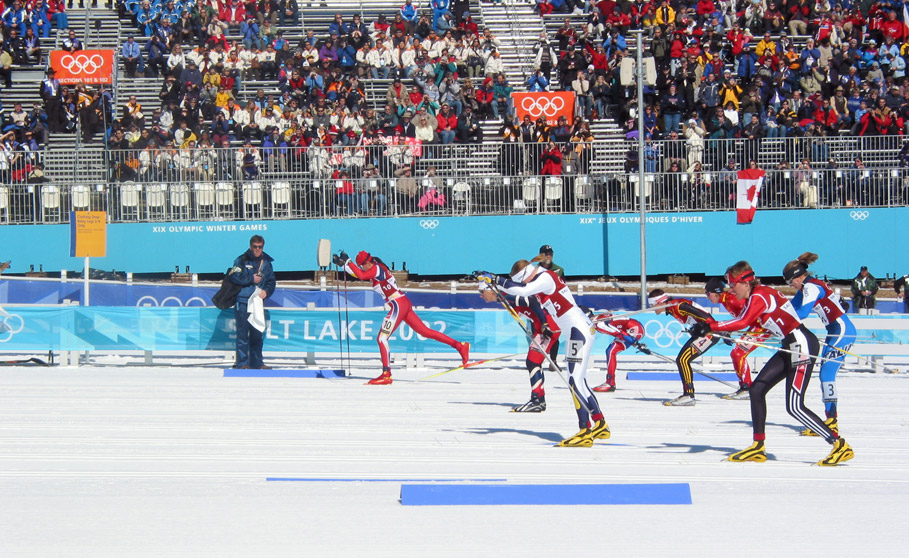
    The start of a women’s race at the 2002 Olympics in Soldier Hollow

    Bodensteiner also acknowledged that LA’s 2028 Summer Games could complicate a 2030 SLC bid. Domestically, there is only so much advertising budget to allocate. Back-to-back Games could be untenable from a marketing standpoint. In that event, Salt Lake could defer it’s bid to 2034.

    Either way, a ten year timeline to a potential Olympics adds a real degree of earnestness to Bodensteiner’s goals as he helps reform sport development at the Utah Olympic Legacy Foundation. From a venue standpoint, the community appears in support of nascent initiatives to fund venue modernization. Something Bodensteiner says is simply rejuvenating venues to a new Olympic standard, not a complete scrape and rebuild.

    I’m going to rewind here to a quote from Bodensteiner’s exit interview with FasterSkier from U.S. Ski & Snowboard back in July 2019. Here’s that exchange: 

    FasterSkier: You are Chief of Sport, but I am hearing you talk like someone who is less focused on medals. Is this something you have learned and absorbed at US Ski & Snowboard over twenty some odd years?

    LB: You are exactly right, you get pigeonholed after you have been known as somebody who is single mindedly chasing medals at the Olympics for twelve years. That becomes your brand or your persona. It is important to, it is better to not let that happen at the end of the day. 

    I think it has been an evolution. And I would say in our work at the U.S. Ski Team, while we have really, I would not say single-mindedly chased performance at the Olympics although that is something that my team thought about and worked on every single day for the twelve years I was there, I think we also built out programs and philosophies and plans on where we were going. 

    We were also recognizing that that is a real short term perspective and there are things that you might do in the short term that will yield those kinds of results that don’t create a sustainable foundation. And so I think we have always had some level of emphasis on club development or coaches education and important things like that.


    Even prior to COVID and the jolt and now sustained tremors to remove structural racism, Bodensteiner had been thinking more holistically about athletes and what success looks like. He understands his mandate involves building equity in sport not simply creating a pipeline that terminates at a single point with medal success.

    “We have asked, should we be hosting the Olympics in 10 years time, what is the story we want to be told about our community through the experience of our kids?, Bodensteiner said. “If the eyes of the world are looking at us what does success look like for us? Our metrics are really focused on broadening the number of kids who are involved in our programs, improving our demographic makeup so that the participation in our programs really reflects our communities from the racial diversity perspective, gender diversity, economic diversity, so that we are not just here for the kids that can afford what we think is affordable.”

    According to Bodensteiner, his first eight months in the job with UOLF were consumed with understanding the foundation’s programs and how they were similarly failing. In his words, “diagnosing where we are creating these kinks that give us effectively the same results that any other youth sports program in America gets and then rolling out the set of initiatives to start to correct those.”

    He cited stats that youth most often leave organized sport at 11 years old for girls and 12 for boys. Bodensteiner says retaining those youth remains a priority while also seeing that they find success off the field.

    Then life was disrupted in mid-March. Good intentions, retooled programming, and any semblance of normalcy evaporated in the short-term.  

    “We had to shift from looking forward to shifting to how do we get through this initial shock here and how do we bring kids back into sports? Bodensteiner said. 

    Harnessing Bodensteiner’s bearish sentiments about a successful Olympic bid, the change he envisions may have a 10-year arc. Yet the change has tangible incremental goals. Better retention. Youth participants reflecting the diverse population in the greater Salt Lake region. Kids who feel valued not simply for a sport result but for engaging in self-improvement.

    Along with a community steering group, Bodensteiner has absorbed and processed what these positive outcomes might resemble in a decade. UOLF, like many in sport, continue to grapple with the duality of participation and performance. The Olympics can be polarizing, especially in an era when the collateral damage of chasing medals is exposed. The human costs have been real. But in Bodensteiner’s eyes, sport can be more humane and foster a culture where participation and performance aren’t fossilized in their pre-2020 form.     

    “We have our eyes set on 2030 and so for us, it is a long term transformation plan,” said Bodensteiner. “We have put our heads together for about three months to think this through and one of the things that really came out was that participation and performance are often viewed as opposing factors. We really want to achieve both. We want to achieve both in a way that those two factors support each other rather than pull each other apart. The ultimate success for us is to provide a high amount of accessibility and have a positive impact on athletes’ lives and have some of those kids go on to have that ultimate sport success of being on an Olympic team in their backyard in ten years time.”

    With the sporting venue assets in place and a dynamic region with the legacy of Olympic hosting know-how, the UOLF might just pull it off. 


  • Gear West Pop-Up Shop Tour – Salt Lake City

    (Flyer)

    The cross-country ski tting experts are bringing North America’s largest inventory to you!

    WHO’S INVITED? All Club Members & Coaches

    WHEN IS IT HAPPENING?

    Saturday, October 7th from 11am – 7 pm

    Sunday, October 8th from 11 am – 5 pm

    WHERE IS IT HAPPENING? Trolley Square Shopping Center – next to Wells Fargo 600 S 700 E, Salt Lake City, UT 84102

    WHY GEAR WEST? Our philosophy – fit matters. Gear West is based in Long Lake, Minnesota. We are the largest retailer of Nordic ski equipment in North America. Our size allows us “first pick” from the warehouses and factories of the manufacturers we work with, resulting not only a large inventory — but a quality selection of
    hand-picked skis. We take pride in the fact that the skis we outfit our customers with are precisely fit for specific conditions as well as the person’s skiing ability and budget.

    WHO IS COMING OUT TO FIT?

    Jenny Beckman

    Director of Nordic Sports

    Michael Stearns

    Ecommerce & Marketing Manager

    Jenny & Michael have 20 + years of combined ski fitting experience. Michael has personally selected all of the skis for Gear West’s current inventory. Prior to Gear West, Jenny was the Salomon Nordic Race Service & Community Marketing Manager where she worked with the S/Lab team to select skis for Salomon athletes.

  • Wednesday Workout: Make Your Own Agony Hill

    Wednesday Workout: Make Your Own Agony Hill

    Peter Wolter, of the Sun Valley Ski Education Foundation, racing to the fastest time up Agony Hill during the 2017 Western Regional Elite Group (REG) time trial in Salt Lake City, Utah. (Photo: Matt Whitcomb)

    When it comes to U.S. Regional Elite Group (REG) training camps, there are a few running themes that remain consistent across the country and from year to year. In the East, West and Alaska, participants in the U.S. Ski Team’s development program are tested with an uphill run, agility course and a roughly half-mile double pole, all of which are timed and done individually.

    Western REG coaches Mike Elliott and Bill Hokanson explained how the run is done at Agony Hill, adjacent to the University of Utah in Salt Lake City. The “hill”, on the 6,348-foot Mount Van Cott, has been an REG staple since 2006, according to Elliott, a three-time Olympian and former U.S. Ski Team (USST) member. It has been used since the 1990s by the USST, the University of Utah Ski Team, Wasatch Ski Academy, The Utah Nordic Alliance, Park City Nordic Ski Club, and Soldier Hollow Nordic Ski Club, Elliott wrote in an email.

    The Agony Hill course records set more than a decade ago still stand, which Hokanson explained was partially due to trail construction since.

    “We’re not 100% convinced the modern course is exactly equivalent to the historical one,” wrote Hokanson, head coach of the Wasatch Nordic Ski Academy in Park City and Salt Lake City.

    For instance, Morgan Arritola set the junior women’s record of 16:55 minutes up the 1.7-kilometer climb in 2004. The rest of the course records were set before that by John Aalberg (12:46), Nancy Fiddler (15:46) and Rob Whitney (reportedly under 14:00) for senior men, senior women and junior men, respectively.

    “Variations in the Agony Hill TT course over the past 3 – 4 decades may in part account for the difficulty contemporary athletes have faced in trying to set new records,” Hokanson wrote.  “However the records are held by 4 of the toughest, fittest, most talented athletes of all time, which may fully account for the tenacity of their record efforts.”

    Here’s how you can replicate the Agony Hill time trial in your own backyard:

    “Agony Hill can be developed anywhere and it does not have to be all uphill,” wrote Elliott, now executive director of Rocky Mountain Nordic in Durango, Colo. “My coach, Dolph Kuss, used a course on the edge of Durango when I was in college a Fort Lewis college in 1965 & 1966.  It was a loop next to the local cemetery.  The area is still called test tracks.”

    Elliott recommends a climb lasting 12 to 15 minutes for athletes 18 and older. He also suggested starting athletes individually (via interval starts).

    “It can be all out for one lap or Level 3 below threshold intervals,” Elliott added. “Try and have around the same time each time.  It can be a 15-minute run to see how far you can go.  Like Agony Hill, it can be all uphill.”

    He explained that these kind of time trials measure fitness, pacing and rate of improvement over time, and recommended doing this workout once every other week or once every three weeks.

    The Workout: Agony Hill uphill time trial

    1. Warmup: Light running and stretching for 30-40 minutes

    2. Uphill Run: Interval-start recommended

    • Option 1: One time, all-out effort: see how far up the hill/mountain you can go
    • Option 2: Level 3 intervals: aim for consistent times

    3. Cool down

    Agony Hill specifics:

    • Where: Mount Van Cott, east of the University of Utah in Salt Lake City
    • Course map
    • Course length: 1.7 kilometers
    • Peak Elevation:  6,348 feet
    • Vertical climb: 367 meters
    • Unofficial course records:
      • Senior men: John Aalberg (12:46)
      • Senior women: Nancy Fiddler (15:46)
      • Junior Men: Rob Whitney (reportedly under 14:00)
        • 2nd fastest junior male: Glen Randall (14:34)
      • Junior Women: Morgan Arritola (16:55)
    • This year’s winners:
      • Peter Wolter (Sun Valley Ski Education Foundation): 15:40
      • Novie McCabe (Methow Valley Nordic Ski Club): 17:29
  • Under 23 Questions with Stephen Schumann

    Under 23 Questions with Stephen Schumann

    U.S. Nordic Combined's Stephen Schumann (28) passing on the outside, en route to 10th in the nordic-combined normal hill/10 k at 2017 Nordic Junior World Championships on Tuesday at Soldier Hollow in Midway, Utah. (Photo: U.S. Ski Team/Steven Earl)
    U.S. Nordic Combined’s Stephen Schumann (28) passing on the outside, en route to 10th in the nordic-combined normal hill/10 k at 2017 Nordic Junior World Championships on Tuesday at Soldier Hollow in Midway, Utah. (Photo: U.S. Ski Team/Steven Earl)

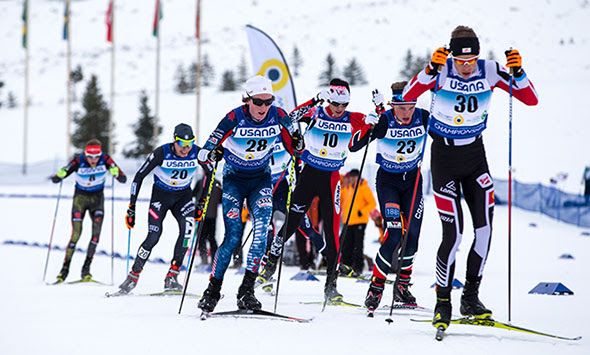
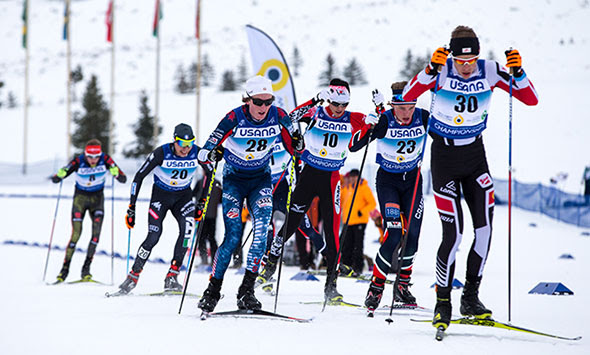
    In an effort to showcase the North Americans competing at this week’s International Ski Federation (FIS) 2017 USANA Nordic Junior World Championships and U23 Cross Country World Championships at Soldier Hollow in Midway, Utah, we asked those qualifying athletes several questions about themselves — actually, we had them fill in the blanks. Here we have 16-year-old Stephen Schumann, of the Park City Nordic Ski Club and U.S. Nordic Combined/USA Nordic, who’s representing the U.S. at his first Junior Worlds.

    On Tuesday, Schumann raced to 10th to lead the U.S. in the individual normal hill/10-kilometer Gundersen. On Thursday, he was slated to start the nordic-combined 4 x 5 k team event, with teammates Elijah Vargas, Ben Loomis and Grant Andrews. 

    ***

    “My full name is Stephen John Schumann, but you can call me Skunk. I was born in Salt Lake City, raised in Salt Lake.

    I started skiing when I was seven and jumping when I was five, thanks to my dad. I currently train in Park City, Utah, with the US Ski Team/ USA Nordic.

    If I had to pick a favorite book, it would be ‘How the Skunk Learned to Jump‘.

    Stephen Schumann leading a group during the Ruka Nordic Combined Continental Cup 10 k competition on Jan. 15 in Kuusamo, Finland. (Courtesy photo)
    Stephen Schumann leading a group during the Ruka Nordic Combined Continental Cup 10 k competition on Jan. 15 in Kuusamo, Finland. (Courtesy photo)

    One of the things I’m most excited about for U23/Junior Worlds at Soldier Hollow is having a home event.

    One race I’m especially targeting there is the 10 kilometer individual race.

    The best advice anyone ever gave me about skiing or racing was ‘don’t lead’. One of the best race memories I have is skiing my first COC.

    If I don’t end up being a professional skier, I’ll probably be a coach.

    I’m missing zero days of school to be here, and my teachers are probably thinking, ‘Thank god I don’t have to see that kid for a couple more months.’

    You can follow me on Instagram @stephen_schumann or on Twitter @stephen_schu.”

  • In Contrast to Lake Placid Venues, Soldier Hollow Blazes its Own Path

    In Contrast to Lake Placid Venues, Soldier Hollow Blazes its Own Path

    A view of the trail system at 2002 Olympic venue Soldier Hollow

    Following the funding scare with the Olympic Regional Development Authority in Lake Placid earlier this year, FasterSkier correspondent Peter Minde is examining the structure and viability of various post-Olympic venues around North America. This piece, his second in the series, looks at the status of Soldier Hollow, in Utah.

    Cross country skiing and biathlon drew more athletes and spectators than any other sports at the 2002 Winter Olympic Games in Salt Lake City. But Soldier Hollow, the venue for those events, had a murky post-Olympic future even as it was being developed.

    While Lake Placid’s Mount Van Hoevenberg is managed by a semi-public entity that depends partially on state financing, Soldier Hollow is a stand-alone organization.  Although it’s on state land, SoHo receives no state funding and must rely on its own initiatives to keep running.

    Originally, Soldier Hollow wasn’t in the picture for the Winter Olympics. In their bid for the 2002 Games, the Salt Lake Organizing Committee (SLOC) had proposed running cross-country events at a golf course just outside of town.

    According to William Spencer, the deputy chief of competition for biathlon at the Games, SLOC wanted to construct the venue at a temporary facility at the Mountain Dell Golf Course. But Mountain Dell was in an area with unreliable snowfall.

    “Could we have done it there [Mountain Dell]? Probably. But there were hurdles we could avoid by going elsewhere,” said Gordon Lange, head coach of the Park City Nordic Ski Club. In addition to unreliable snowfall, there were water runoff concerns, and snowmaking at Mountain Dell would have been very expensive. Development of Olympic-quality trails would also have disturbed protected habitat in East Canyon and Mountain Dell.

    A young Torin Koos racing at Soldier Hollow

    Organizers conducted on-site inspections of seven potential sites before SLOC narrowed it down to two candidates. The venue was then switched to Soldier Hollow, which has “some of the best skiing anywhere in the world,” says U.S. Nordic Combined Head Coach Dave Jarrett. Opened in 2000, Soldier Hollow was the site for all the cross country, biathlon and Nordic combined events at the 2002 Games.

    When the Games generated a profit, SLOC had money to spare to ensure that the Olympic venues could be used by the public for years to come.  The Utah Athletic Foundation (UAF), a private non-profit, was designated by the state to take ownership of Olympic Park, the Park City venue for ski jumping and luge, bobsled and skeleton, and the speed skating oval near Salt Lake City. Endowed with $76 million, UAF took over these sites in May of 2002, expecting to manage them on interest generated by the endowment.

    State legislation originally specified that any profit from the games would endow only Olympic Park and the speed skating oval, and Soldier Hollow was to be on its own starting in early April, 2002.  But because UAF received a larger-than-expected endowment, in early October of that year, the Utah state parks board transferred Soldier Hollow’s concession to UAF. Thus, the cross-country venue benefited from a financial commitment that enabled them to invest in infrastructure and equipment.

    But the affiliation was not necessarily permanent. Indeed, by early 2004, UAF was struggling, and news sources were reporting the layoff of twelve employees. An item in a July, 2004 issue of the Salt Lake City paper Deseret News noted that despite its endowment, UAF was having difficulty breaking even on its operations at Olympic Park and the Olympic Speedskating Oval.

    For UAF, there was an out clause after two years. In an interview, Jarrett noted that despite campaigning to grandfather Soldier Hollow in to UAF, the two organizations severed their relationship in the spring of 2004. UAF didn’t think it could afford to fund Soldier Hollow in addition to its other two venues.

    The Soldier Hollow Legacy Foundation (SHLF), which manages the ski area, was founded in 1999 to perpetuate the ski venue following the Olympic Games. According to General Manager Howard Peterson, as a concessionaire operating on state land, SHLF pays 6 percent of its gross receipts to the state. A main focus of SHLF’s mission is to reach and expose local kids to cross-country skiing.

    With no government aid and a limited commitment from UAF, Peterson was compelled to find creative measures to attract visitors and enhance Soldier Hollow’s bottom line. Consequently, one can do a lot more than simply ski at Soldier Hollow. Mountain bikers ride the cross-country trails from May through October. Parking fees assessed to those attending the Soldier Hollow Classic Sheepdog Championships, now in its ninth year, fund junior ski programs. The Soldier Hollow Charter School rents space in the competition center for its 150 students, in classes ranging from kindergarten through 8th grade.

    “If it wasn’t for Howard, we wouldn’t be skiing there right now,” said Lange, whose juniors spend time training at Soldier Hollow both on snow and on roller skis.

    In the summer of 2002, work began on a 1,200-foot tubing hill, funded by UAF.  The lift-served hill was a hit, accounting for approximately 59 percent of Soldier Hollow’s revenue in 2008, the most recent year for which data is available. (By contrast, skiing made up a mere 18 percent of revenue.)

    Peterson felt that a tubing hill was a great way to attract visitors who might not be interested in skiing. “[The campaign] is about snow,” he said.

    “Tubing provides an alternative for families where some members might not want to ski,” said Bill Hokanson, the head coach for the Utah Nordic Alliance’s

    The start of a women's race at the 2002 Olympics in Soldier Hollow

    competition programs.

    There’s also the charter school, which adds to the pool of skiers at the venue, in addition to paying rent. As part of their curriculum, charter school students get outside on skis about four times a week during the winter.

    But the legacy foundation doesn’t just keep Soldier Hollow open, however—the organization also gives back to the community.

    Monday through Thursday during the winter, three or four school buses roll in each day, introducing what Peterson estimates are 9,000 children to skiing each winter. Soldier Hollow does “a fantastic job of introducing skiing to organizations and schools,” says Hokanson.

    Jarrett started Soldier Hollow’s youth ski program from scratch in fall of 2000, bringing cross-country skiing to an area where the sport had little tradition. The club, now called Team Soldier Hollow, is comprised of various programs for juniors, from beginners through a development team.

    SHLF also provides support for athletes who qualify for the Junior Olympics, with a combination of fundraising assistance and scholarships. And aspiring elite athletes benefit from discounted ski passes, which are available to athletes on formal teams.

    In contrast to the venues in Lake Placid, which have been subject to the whims of the New York state budget process, Soldier Hollow now seems stable in comparison: SHLF’s financial footing appears sound, and Peterson was positive about its future. One thing is certain: the venue is almost certainly better off as an independent entity than as a part of UAF. In March, the Utah legislature was presented with SRJ011, a bill which would allow UAF to sell a portion of the Olympic Park property. The body of the bill notes that the Olympic Park and speed skating oval’s annual costs have consistently exceeded revenues, and that UAF’s endowment might be exhausted by 2025.