Tag: Sam Flora

  • Don’t Overfill Your Cup: APU Coach Erik Flora and the Complete Athlete

    Don’t Overfill Your Cup: APU Coach Erik Flora and the Complete Athlete

    Erik Flora, head coach of Alaska Pacific University, with one of his athletes, Rosie Brennan, also a U.S. Ski Team member, during training at 2017 Nordic World Championships in Lahti, Finland. (Photo: John Lazenby/Lazenbyphoto.com)

    This week’s featured articles are made possible thanks to the generous support of The Loppet Foundation, host of the Masters World Cup 2018. Registration opens in October.

    ***

    RIDING IN A PISTENBULLY ON EAGLE GLACIER, in the Chugach Mountains above Girdwood, Alaska — If you want to find the essence of Erik Flora, the longtime coach of the Alaska Pacific University (APU) ski team, you need to come here.

    You need to fly to Anchorage. You need to drive 45 minutes down Turnagain Arm to the small resort town of Girdwood. You need to bump over dirt back roads to the Girdwood “airport,” a dirt airstrip surrounded by wildflowers on the ground and glaciated peaks above. You need to make your way inside the Alpine Air hangar, past the curious tourists overdressed for summer sunshine, and pay for your ticket. You need to absorb the safety briefing, climb into the A-Star, put on ear protection, and get ready for one of the most scenic helicopter flights of your life.

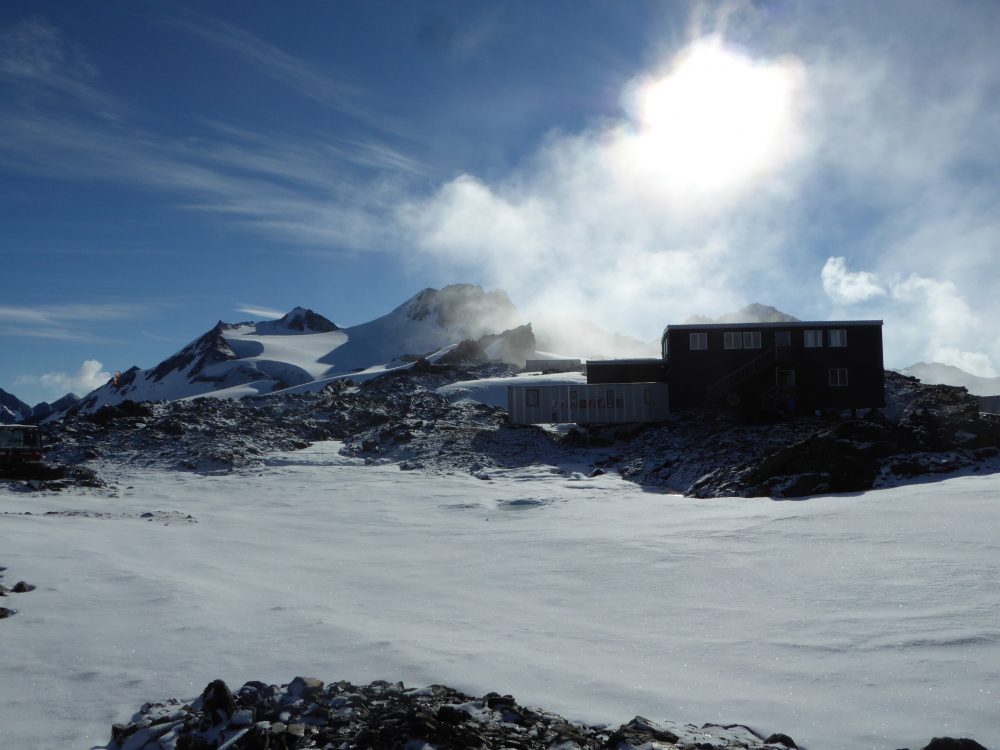
    Within 10 minutes, you will go from sea level to 6,000 feet, from summer to winter, from coastal hemlock rainforest to high alpine zone. You will marvel as the helicopter pilot effortlessly sets the machine down on a landing pad smaller than a spare bedroom, a ridiculously narrow patch of firm ground amidst the sea of friable black rock. You may notice that there is a glacier 100 feet to one side of you, and a cliff edge 100 feet to the other. You may notice that the residential building in the middle is literally bolted to the rock to hold it in place.

    Or you may just be wondering where the heck you are, and who would voluntarily spend several weeks each summer up here. And that is where you will find Erik Flora, a man squarely in his element: in a training environment of largely his own creation, shaped by a single-minded focus on helping American skiers to be the best in the world. Oh, and to become better people, help the community, and learn to coach themselves along the way. That’s all.

    ‘I was born in Nashville, Tennessee, which is kind of unusual for a cross-country skier’

    But before Flora could make it to a glacier in the Chugach Mountains, he had to get out of Nashville first. His family moved when he was young, following his father’s work as a city planner. This took them to the suburbs of Portland, Ore., a pleasant place but also still an unlikely venue for a future cross-country ski coach.

    Erik Flora (l) and his mother, Berit Flora, on Eagle Glacier in the Chugach Mountains, Alaska, in July 2016.

    The Floras were members of the Oregon Nordic Club, and Erik frequently cross-country skied at Mt. Hood, the alpine resort (with a smaller nordic area) about 90 minutes driving and 4,500 vertical feet above Clackamas. Bend, Ore., and Snoqualmie Pass in Washington were other frequent weekend destinations.

    The snow was plentiful but the drives were long, and by the time he was in high school Flora was realizing that Portland was not the optimal place for someone with long-term nordic aspirations. His plans crystallized at a Bend training camp in the summer after his sophomore year, featuring some logistical real talk from his coach.

    “After doing some testing and skiing around” at the training camp, Flora recounted, his coach encouraged him to move to Bend. “Because in Portland you can only ski a couple times a week, and with my goals being what they were, to be a World Cup skier, then it had to be a little more than twice a week. And so I moved to Bend when I was 17, … and moved in with this coach. And my parents were still in Portland.”

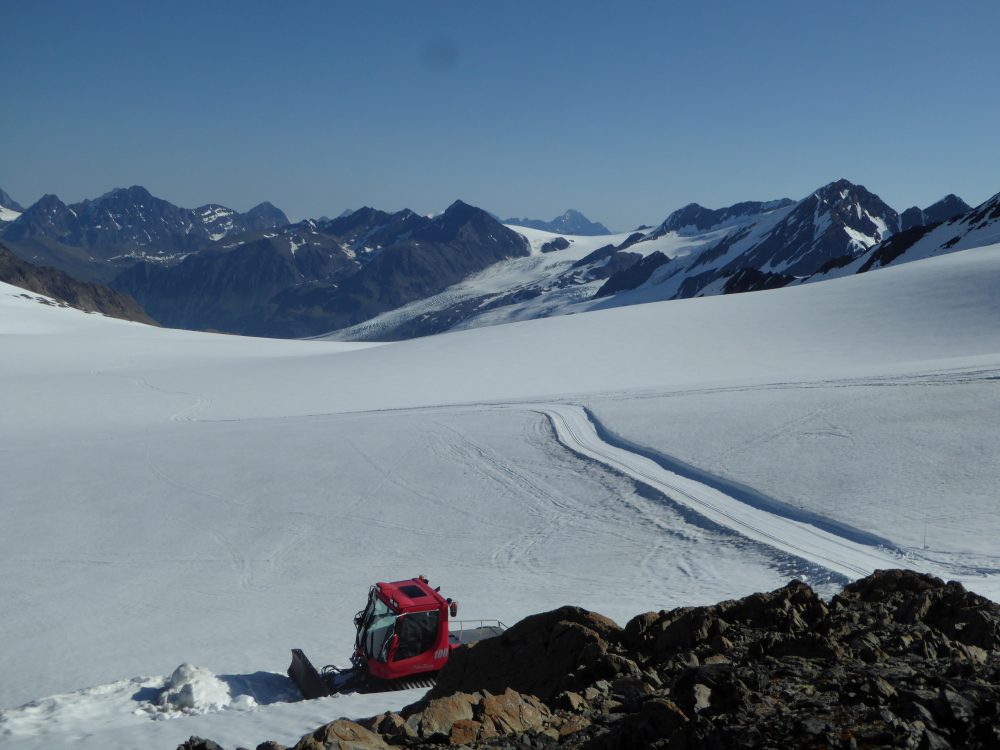
    (All direct quotes in this article come from an in-person interview with Erik Flora. The interview was conducted in the cab of a PistenBully on Eagle Glacier in July 2016 while Flora groomed from 10-11 p.m. for the next day’s skiing. Why so late? In part because of the need to groom in cooler temperatures to give the snow a chance to set up. And in part because, as Noah Hoffman noted following the 2014 Man Camp at Eagle Glacier, “Flora has nailed the grooming. (It helps that he never sleeps.)”)

    Within a year, Erik’s parents, Sam and Berit Flora, had followed him to Bend. A period of athletic wanderlust and nomadism followed, as Flora fils “kind of bounced around to different places around the West.” There was a school year spent in Norway, too.

    Throughout this time, Flora explains, he was “kind of figuring out more of what I wanted. I wanted a place where I could train at sea level, since when I was in Norway, that seemed to be something that most of the top racers in the world at that time came from sea-level locations. Some place that had a long winter and a ski community. And that was Anchorage.”

    View from riding shotgun in the PistenBully: grooming in the fog and summer twilight, on Eagle Glacier in the Chugach Mountains, Alaska, in July 2016.

    Flora contacted Bill Spencer, a former U.S. Ski Team member who was at the time the coach of the nordic team at the University of Alaska Anchorage (UAA). “And shortly after, I was driving my truck up the Alcan,” he recalled.

    Flora’s Alaska origin story is familiar to the point of cliché among Alaska transplants: “My plan was to move to Anchorage, and stay for a year, and see how it was. I lived here a year, and pretty much decided at that point, I was probably going to be in Alaska forever.”

    It didn’t hurt that Flora met his future wife, Gretchen Pfisterer (now Flora), in Anchorage around that time. Or at least started dating her then – they had met at World Junior Trials a few years earlier, when he was 18.

    “And I remember the moment I actually saw Gretchen for the first time,” Flora, now 44, recalls 25 years later. “She was walking up to get her medals – she was a good ski racer, for sure. And I saw this girl walk up, blond hair, and thought, ‘Wow, that – that is something. OK.’”

    The two of them skied on different teams for the next few years, before uniting on the UAA team in Anchorage when Erik Flora was around 20. (Pfisterer had grown up in Anchorage. She was the girls Anchorage Daily News Prep Athlete of the Year in 1989, an honor later awarded to future APU skiers Eric Strabel, Kikkan Randall, and Scott Patterson.) They began dating while both were at UAA, and “kind of figured out that Alaska” was going to be a good match for them, Erik now recalls.

    Career as an athlete

    That coach at the Bend summer camp was onto something. Flora found success at UAA, skiing to All-American status in 1994 and again in 1995. (His then-girlfriend, now-wife was no slouch either; Gretchen earned an All-American finish in 1992.)

    Flora’s collegiate results put him on the national development radar for U.S. skiing, and exposed him to opportunities outside of Alaska.
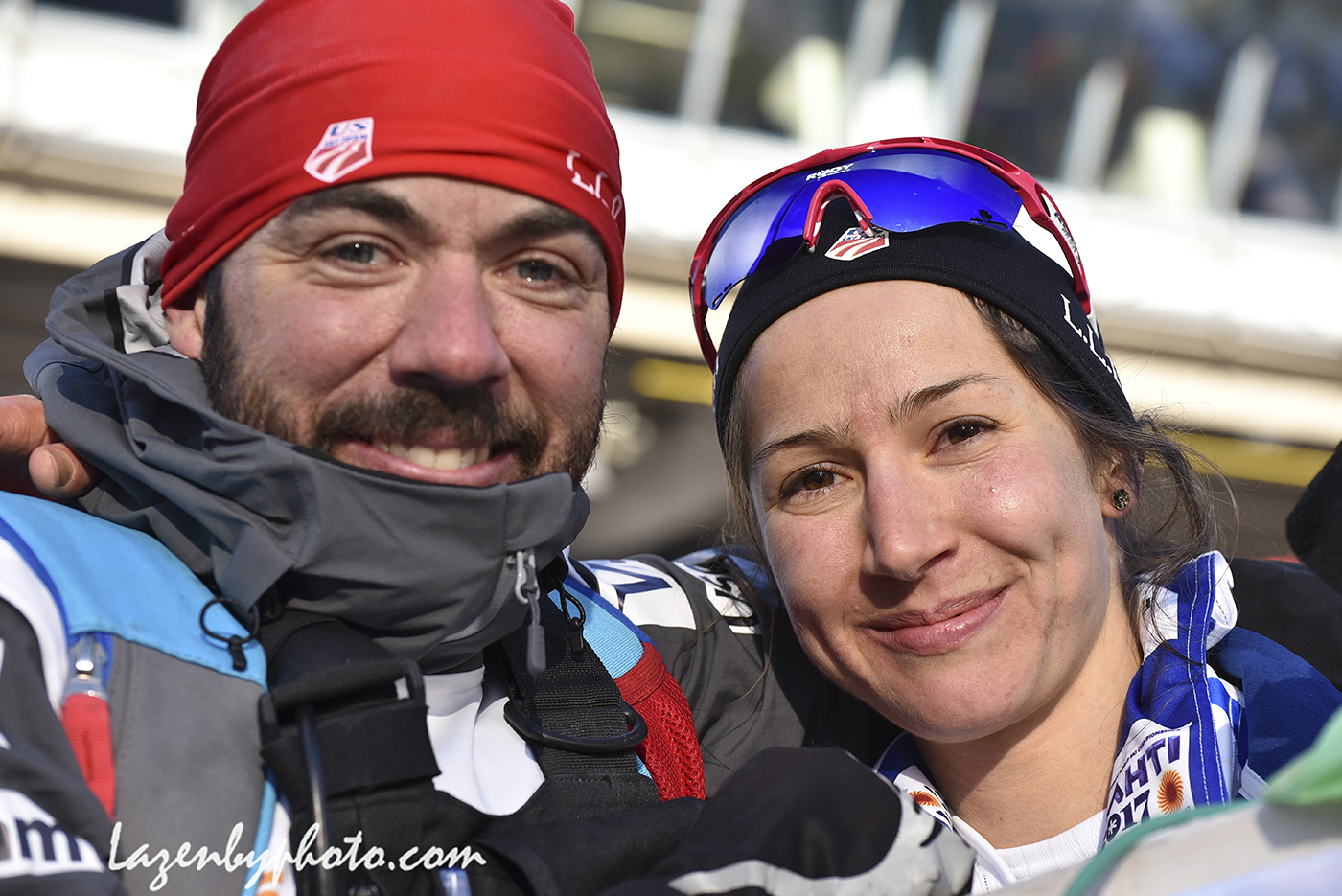
    Happy athlete, happy coach: Erik Flora with APU skier Chelsea Holmes after Holmes placed a career-best 13th in the women’s 30 k freestyle mass start at 2017 World Championships in Lahti, Finland. (Photo: John Lazenby/Lazenbyphoto.com)

    As Flora diplomatically notes, this experience, while another step on the ladder, ultimately showed him that Anchorage felt like the best match for him and his skiing: “After being in Anchorage for a couple years, the USOC had a development program based out of Marquette, Michigan, that I joined. I moved out of Alaska for a year, lived in Marquette, and tried a different program. It was kind of a good next step. And after trying that, I realized that what I had experienced here in Anchorage was really along the lines of kind of how I wanted to develop my ski racing.”

    Flora soon returned to Anchorage, this time for good. Three-time Olympian Jim Galanes had founded a program associated with Alaska Pacific University, Gold 2002, which was not shy about its aspirations. (The program would indeed send at least two Anchorage natives, Nina Kemppel and Kikkan Randall, to the Winter Olympics in Salt Lake City, though neither of them medalled. No American skier has yet won another Olympic medal in cross-country skiing since Bill Koch at Innsbruck in 1976.)

    In the Gold 2002 program, Flora says, “instantly I found what I was looking for.”

    Specifically, the team was the right match of coach, mindset, reliable snow, and a critical mass of athletes with unified goals. “I always knew that I wanted to be a ski racer,” Flora now recalls, “and the key was to find where I could make that happen. And … a lot of the places I lived, whether it was in Portland, where we didn’t have enough skiing, or some of the other places, in the early days, there wasn’t a team to work with – and that’s what I found in Anchorage, was Team Gold 2002 had a handful of athletes, and they were all talking about U.S. development.”

    Flora skied for Galanes for a few years. But in 1999 he was in a car accident while driving up to Hatcher Pass, in the Talkeetna Mountains outside of Palmer. He injured his back, not quite enough to prevent him from continuing with competitive skiing, but just enough to keep him from regaining his pre-accident levels of performance.

    The accident “kind of sidelined my ski racing career,” Flora says. “I was about 24, 25 years old at the time, and spent the better part of a year and a half trying to get back to where I was before the car accident. It never did pan out.”

    Career as a coach

    Flora stayed in Alaska following the car accident, but stepped away from ski racing. He devoted himself to learning to fly small airplanes in Bush Alaska. He pursued his airplane mechanic’s license. He obtained multiple levels of aviation ratings, including commercial instrument ratings and land and seaplane ratings.

    Erik Flora runs away from a departing helicopter at APU Masters Glacier Camp on Eagle Glacier in the Chugach Mountains, Alaska, in July 2016.

    “I thought I was going to be a pilot for a while,” Flora says… but “then realized partway through [the aviation certification process] that that my heart was really in cross-country skiing. So that’s where my coaching began.”

    Flora coached the Masters program for Gold 2002 for three years, starting in 1998 at a modest six hours a week. He took over coaching juniors in 2001. Following the Salt Lake City Olympics, Gold 2002 merged with and rebranded as what is now officially known as the Alaska Pacific University Nordic Ski Center, or APUNSC. Flora has been in charge of the APUNSC program since 2006.

    This narrative makes it look like the car accident was what set Flora on the path to coaching. That’s not inaccurate. But there are two other things that Flora mentions first when asked about life events that pushed him into coaching.

    First, he cited the influences of his childhood: “I grew up in a very active, supportive family that cross-country skied a lot. And that definitely set the lifestyle of wanting to spend my life, you know, ski racing and working with athletes, being in the ski world.”

    And second was his year abroad in Norway after high school: “Probably the next significant experience was going to school in Norway for a year, and being 19 years old or so, and kind of realized that – I went over and kind of saw how the Norwegians trained, and had this feeling like, ‘I can do this.’ So having that belief pretty young, certainly – ‘I’ve been racing with some of the top kids in Norway, this is something I can do.’”
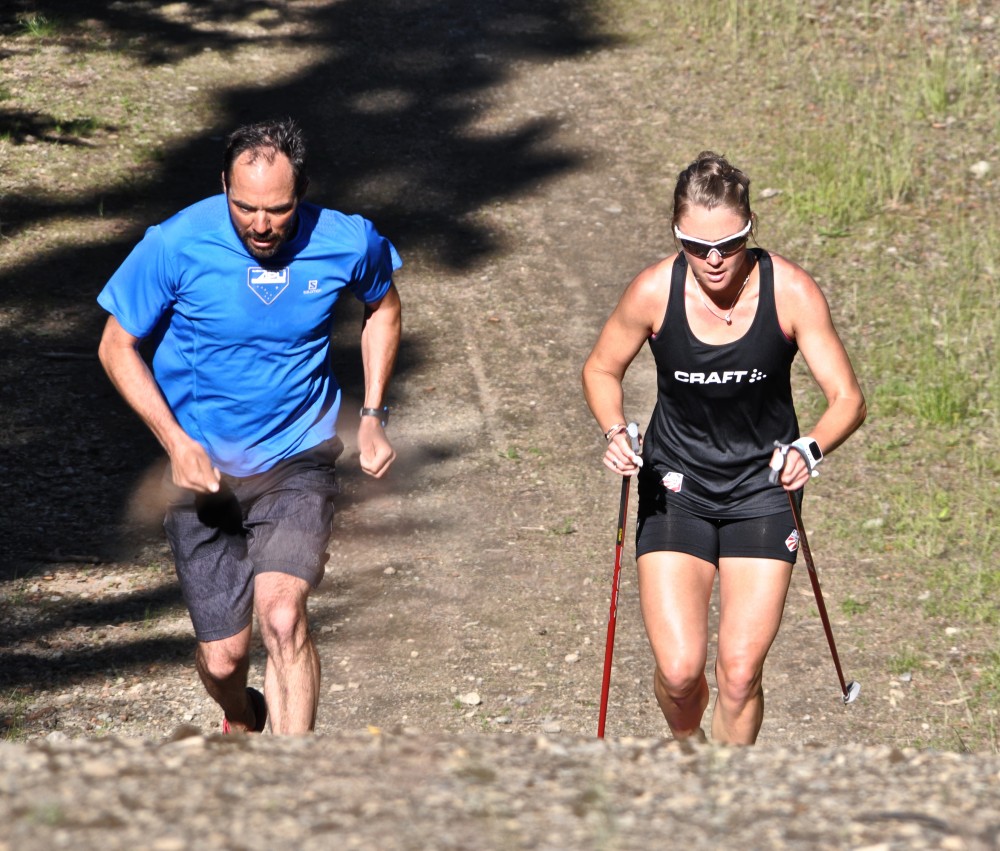
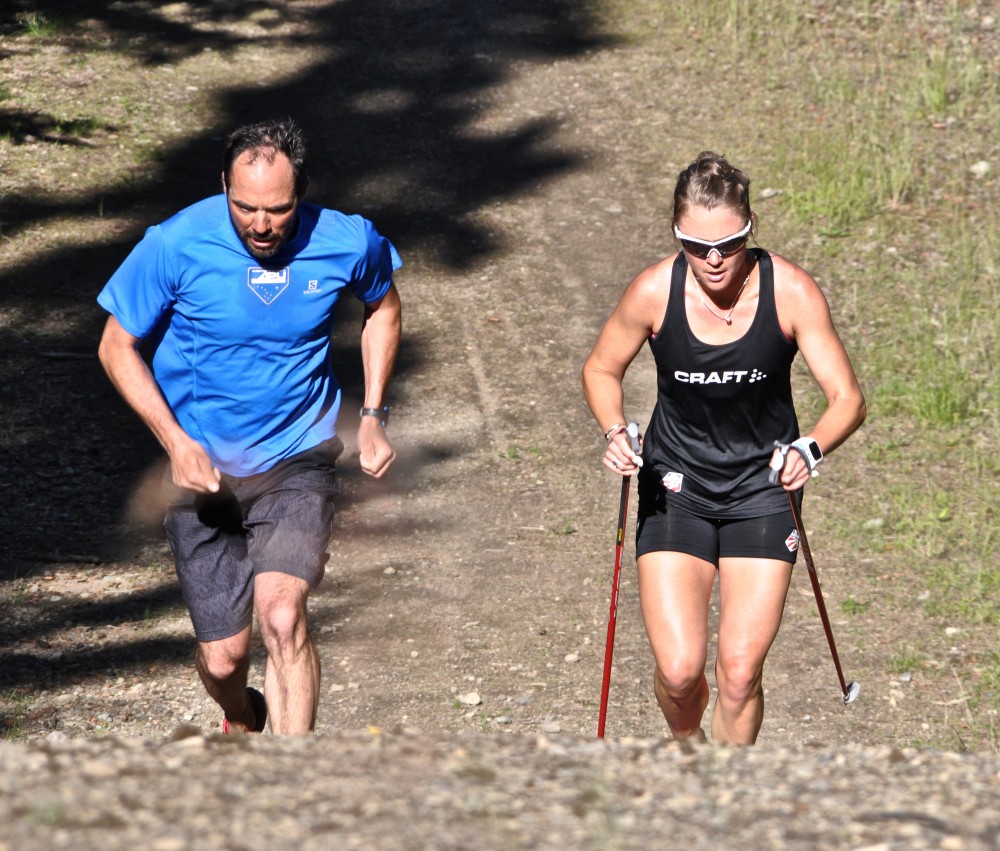
    APU Head Coach Erik Flora runs alongside Sadie Bjornsen (APU/U.S. Ski Team) during a workout last summer. (Photo: Matt Whitcomb)

    Flora kept this experience in mind when he began coaching. But he changed his outlook from “I can do this” to “we can do this.” Part of this was the general shift from athlete to coach. And part of it was specifically watching the success of his former Norwegian training partners a decade down the line.

    As Flora says, “watching a friend of mine get an Olympic gold medal, that I had trained with when I was younger,” had an effect. It made him “take that same … idea when I started coaching, the approach of, ‘Hey, we have a lot of talented skiers, we can certainly do this. The United States can be one of the top nordic countries.’ And then really believing in it.”

    (While the famously circumspect Flora did not mention the friend by name in this interview, it has been elsewhere reported that the friend was Norwegian Tor Arne Hetland, who won the first-ever men’s sprint Olympic gold in Salt Lake City. “You know it’s possible for someone to win a medal,” Flora told Alaska Public Media when discussing Hetland in a 2014 interview. “But you’ve never seen it, you’ve never had breakfast with them. They don’t seem like they’re human. Being friends first with this athlete… and then all of the sudden he wins a gold medal. It’s like, ‘wait a second, I can do that.’”)

    The parallels to The Kikkan Effect are strong: As the theory goes, Randall’s breakthrough World Cup success inspired the current generation of American skiers to greater heights, largely by showing athletes what someone just like them was capable of. Just so, Hetland’s Olympic success inspired Flora to seek these same heights in America, just a few years before he took over the APU program and became Randall’s personal coach. If this theory is correct, then that year abroad in Norway ca. 1993 had some pretty far-reaching influences.

    The Kikkan Effect and APU’s success

    So let’s talk about Randall for a second. (Full disclosure, the author grew up doing Anchorage youth sports in the same generation as Randall, and, like many others of that generation, literally had a poster of her on his bedroom wall. His older daughter now has a signed picture of Randall in her room.)

    As previously profiled many times (for example, in this FasterSkier piece from 2012 called “The Kikkan Effect,” then later in this Outside Online piece from 2017 called “The Kikkan Effect”), Randall broke down barriers and achieved unprecedented success for American skiers, raising her countrywomen up along with her.

    Flora is chary of divulging too much about training plans, but some inklings of his work with Randall can be gleaned from the Outside Online version of The Kikkan Effect. Here are a couple paragraphs from that article:

    “By 2006, with new APU head coach Erik Flora in place, [Randall] increased her training load even more. ‘By 35 percent,’ says Flora. ‘That put her on par with the Scandinavians.’ In 2008, Flora ­dialed things up again. ‘The year of intensity,’ Randall calls it. ‘You hadn’t trained hard enough if you hadn’t started crying.’”

    At the risk of oversimplifying a lot of complicated science about supercompensation (see also Jason Cork’s arm tattoo if you ever get a chance), the changes seem to have worked. The volume increase of 2006 was followed by the first ever World Cup win for an American woman in 2007. The intensity increase of 2008 gave way to the first ever World Championships medal for an American woman in 2009. There was more to it than that, but the decisions made between coach and athlete seem to have paid off.

    Erik Flora officiates at the wedding of Kikkan Randall and Jeff Ellis in Talkeetna, Alaska, in May 2008. (Photo: FasterSkier blog)

    In the middle of this period, Flora officiated at Randall’s wedding to Canadian skier Jeff Ellis in May 2008, standing before an archway formed by superannuated pairs of skis with Denali looming in the background. Flora remains Randall’s personal coach to this day.

    Whatever the reason – be it Randall, Flora, greater trends in American skiing, or some combination of the above – the decade-plus since Flora began working with Randall has seen stunning success for the APU program.

    By the Ski Tour Canada at the end of the 2015/2016 World Cup season, APUNSC had eight athletes skiing on the World Cup, probably more than from any single other club in the world. (And this doesn’t include Randall, who was out for the season on maternity leave.) Going into the 2017/2018 season, APUNSC claims six of the 16 athletes currently on the U.S. Ski Team A, B, and D teams. (Stratton Mountain School counts another seven.) Oh, and there were the two World Championships medals this February, Randall’s third and Sadie Bjornsen’s first (with Jessie Diggins in the team sprint). Whatever Flora is doing at APU, it seems to be working.

    Flora was asked what he is most proud of other than these world-class results. He immediately mentions helping his athletes to develop as people:

    “My proudest accomplishment with this team is, you know, the medals and the ski performances I’m very proud of, but just seeing that the athletes I’m working with are having a good development experience, where they’re coming in at a young age and learning about that transitional place in life – where they’re going, how to chase a goal, and the life experience part. We have these outstanding individuals that, in my Elite program, they’re leaving as these exceptional individuals to the community. That’s one of my proudest parts.”

    He then mentions the overall success of the broader APU program – but, much as with his athletes, ties this to the personal development of the individuals involved:

    “Eagle Glacier, and the Nordic Ski Center, seeing the stability that we have right now, and the reputation as being a world-class elite ski area up on Eagle, and that our training center is one of the top clubs in the world, I’m incredibly proud of what we’ve accomplished. And a lot of that is due to the coaches that have worked for me. And to watch a lot of the coaches that started as either young coaches, or transitioned from athletes into coaches, and to be able to watch them along their journey and find their place where they can also do the same, they can help out and pass along what they’ve learned. Those are my proudest moments.”

    And even when the question is rephrased to hone in on results, Flora still evinces a care for the overall level of American skiing:

    “From the first time we watched Kikkan step onto the silver medal podium in Liberec in 2009 for World Championships, I’ve always believed that U.S. skiing can compete, it’s a matter of getting the right group together and having the right energy, and working hard toward a goal. And so every time I see one of our athletes on a podium, it just confirms that we’re doing the right thing. And we’re doing it in the right way, you know, we’re doing it in a way where the athlete’s having a good experience.”

    Erik Flora gestures at APU Masters Glacier Camp on Eagle Glacier in the Chugach Mountains, Alaska, in July 2016.

    As Flora says, he believes in U.S. skiing. In this vein, it’s a small but telling detail that the flags on display inside the Eagle Glacier training center are American flags. This is a program with “Alaska” in its name, that counts homegrown Alaskans as the majority of its roster. And Alaskans, to engage in a moment of gross understatement, tend to be very proud of Alaska. But the flags are all stars and bars, not eight stars of gold on a field of blue. Flora clearly loves it in Alaska, and has stayed because he believes it is the best place to pursue his goals, but his primary focus remains on international success for the country as a whole.

    Coaching philosophy

    So what’s the coaching philosophy that Flora uses to help American skiers reach these goals? In a word, it’s all about a cup. In two words, it’s all about a cup and the athletes.

    First, the cup. One of Flora’s favorite training images is to suggest that everyone’s life is a cup. [draws diagram on whiteboard with cross-section of a cup] And training fills up this much of your cup, and recovery fills up this much, and preparing and eating food fills up this much, and presumably you’d like to see your friends some, too… and pretty soon, your cup is in danger of overflowing.

    It is a helpful metaphor for visualizing overall training and life stress. It is also a frequent training talk trope. Every training camp at Eagle Glacier, from juniors to masters, signs the wall of the training center, often beneath an image in some way symbolizing the camp or evoking an in-joke from the past week. A picture of the cup was chosen for one recent Elite Team glacier camp, suggesting that the cup was frequently discussed.

    As Flora now notes, “I began as an elite coach about 10 years ago. And when I started, I had this idea or this plan, that if I wrote a training plan, and it was the correct training plan, that I would have good success with my team and my athletes. And you know, sure enough, I was fortunate enough to have a good experience in coaching, and we had some good successes and that seemed to work. But what I’ve kind of learned to appreciate through the years is that to be a top-level skier, it’s very much a lifestyle. So the more I can help athletes find what the right balance is, the better the program goes, the better success we have.”

    Live the lifestyle and find the right balance – you can’t overfill your cup.
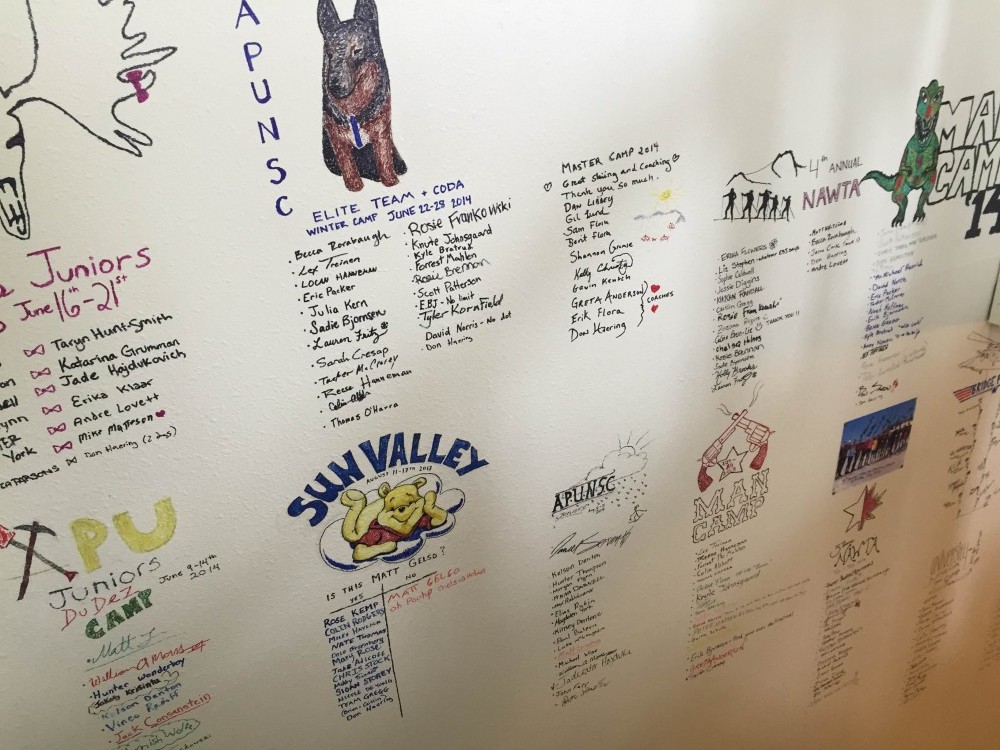
    The wall of fame inside the Thomas Training Center on Eagle Glacier. From left, the APU Juniors (teenage girls), APU Elite Team, 2014 Masters Camp, North American Women’s Training Alliance, and Man Camp (APU and USST men), among many others, have all left their mark. (Photo: Greta Anderson)

    And second, the athletes. Flora clearly believes in empowering his athletes to, if not literally coach themselves, at least to take a very active role in the process. As he notes, “I guess if I were to summarize my coaching style, [it would be] as: I believe very much in trying to educate or teach the athletes about training.”

    He continues, “And so … when they start from a young athlete, they learn all the different types of training, they get experience training in different ways, and they become the expert over time. And that’s been something I’ve been very proud of. It’s like, the team I have now, I feel very confident that – when it’s their turn to coach, that the experience level of the athletes is quite high. Because through the training process, they’ve, you know, learned ‘what happens when I train too much,’ ‘what happens when I train on the right sequence,’ ‘how do I get faster,’ ‘what are the basics.’ And so I would say that’s a way to sum up my basic philosophy of training.”

    Personal life

    So what does Flora do when he’s not coaching skiing? Well, he goes skiing for fun.

    No, really – Flora can often be seen skiing with his entire family in the offseason, either on the ski trails in spring or in the mountains in summer. These are often family affairs, as three generations – Berit and Sam, the septuagenarian (and still skiing) grandparents; Erik and Gretchen, the parents; and Oskar, Marit, and Ingrid, the children – can be seen hiking up steep trails with skis in backpacks.

    And, yes, all three children ski race. They are not bad at it, either; Marit was second among U14 girls, and Oskar first among U10 boys, in last winter’s Besh Cup Series of JO qualifying races.

    Despite, or perhaps because of, his day job as a high-level professional ski coach, Erik and Gretchen at a Besh Cup are less Ski Coach than Good Sports Parent. Leave it to the other parents to engage in a postmortem of tactics or wax efficacy following a zero-stakes U12 contest… Erik and Gretchen are the ones who reliably say only, “Good job! Did you have fun? Let’s go get some hot chocolate.”

    Presumably that cup is full of hot chocolate. But not too full.

    * * *

    Disclosure: The author is an unremarkable Masters skier with the APU Masters program. He receives coaching from Erik Flora on one occasion per year, for a few days in a group setting at APU Masters Eagle Glacier Camp, but has no other direct involvement with Flora as an athlete.
  • Masters Minds: From Texas to Eagle Glacier

    Masters Minds: From Texas to Eagle Glacier

    Gavin Kentch (APU) climbs back up to the training center on Eagle Glacier, in the Chugach Mountains, Alaska, during APU Masters Camp in July 2017. (Photo: Jim Falconer)

    By Jason Somers

    Introduction: Welcome to the jungle

    My quads were burning from too much snowplowing. My coach’s words were echoing in my head: “You are most stable when tucking.” I willed, begged, and pleaded with my legs to assume the position, but being in this aerodynamic position also meant I would go fast, too fast, because at the moment I had one small problem – I couldn’t see where I was going.

    This small problem could likely be overcome but combined with the fact that I was careening down a trail on Alaska’s Eagle Glacier in a July snowstorm, I had to keep the  trail markers to my right or risk going off the trail. Not a big deal except that going off the trail meant I could in theory fall through a previously unknown crevasse, the big one that would lead me all the way to China in a horrific tumble, if I were ever to be seen again.

    My mind began to wander. I pushed out of my mind my imagined eulogy that included the requisite nod to global warming and my major contributions to society at large, such as eating large quantities of breakfast tacos. I imagined a bronze cowboy hat statue with a ski hat on top that would commemorate the first loss of life by stupidity on the glacier. Also, of course, celebrities I never met like Eddie the Eagle would attend and say it was a shame. Kikkan Randall would be there, her hair colored extra bright pink.

    Was this a death-defying 70-percent gradient that I was attempting? No, it wasn’t, but I was most certainly a nerd. A nerd well over his head. I am also a stubborn nerd so this meant I came equipped with nerd glasses, which were now so badly fogged after having gone through rain, sleet, and snow that they were more of a blindfold. I could barely make out the trail markers, I was flying blind, the skis began to pick up more speed, I knew the trail turned but when, and would I have enough time to turn with it?

    Oh, and there was one more thing that made it especially intimidating: They don’t have these conditions or trails, or even snow, where I am from in Southern Texas. Yes, I, am a rollerskier who had not seen snow in four years, and this is my story.

    Day one of camp: Welcome to Alaska

    As my Egyptian Lyft driver courteously bid me farewell, I walked with my bags toward the small group gathered in the parking lot of Alaska Pacific University (APU) in midtown Anchorage, Alaska. The evening before I had flown into Anchorage and traveled from the airport with my mouth agape with awe at the large peaks towering above. My Airbnb host had been a Russian grandmother who insisted on playing me videos of Russian folk songs, as she sang along with tears in her eyes. This was turning out to be a memorable trip already.

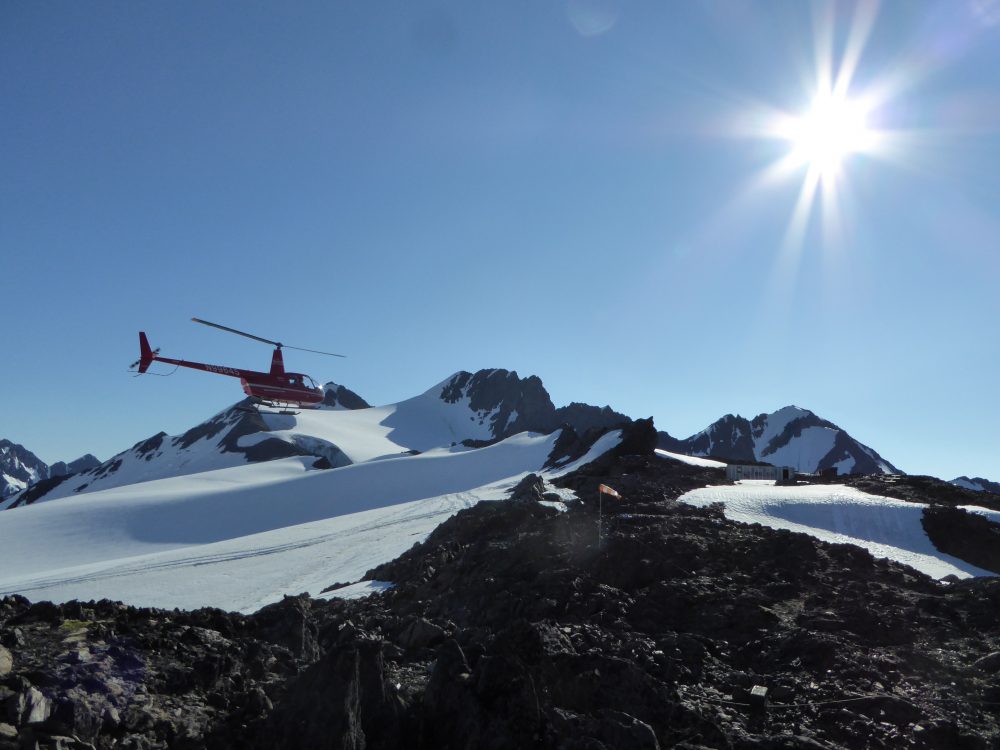
    A helicopter approaches the landing zone at Eagle Glacier, in the Chugach Mountains, Alaska, during the 2017 APU Masters Camp in July. (Photo: Gavin Kentch)

    As introductions were made in the parking lot I considered it a rousing success that no one burst out in uncontrollable laughter when I told everyone that I was from San Antonio, Texas. The acceptance continued as we drove 45 minutes down Turnagain Arm to Girdwood in the APU van. Fragile ego still relatively intact, it was now time for the first of many firsts to come, a helicopter ride to Eagle Glacier.

    As any rollerskier in a southern climate will tell you, there are a few questions you get asked by strangers repeatedly. Unlike bicycling in Texas, in which you may be the recipient of a special howdy in the form of a beer can thrown from a pickup truck, most folks are genuinely curious about your rollerskis.

    When you are a rollerskier from Texas, at a premier skiing camp held at a world-renowned training center at almost 6,000 feet in the Chugach Mountains, you get asked questions, too. Number one goes something like, “How the hell did you hear about this place?” Answer: FasterSkier and athlete blogs (Noah Hoffman’s posts from 2013 and 2014 being a standout), and an APU promo video. An email to the world’s best nordic ski coach, Erik Flora, and the next thing you know you are flying in a red helicopter so small it looks like a good gust of arctic air could smack it into the side of a mountain.

    Thanks to FasterSkier’s own Gavin Kentch, who insisted that I sit up front; I experienced my first ride to the clouds in the front of our Alpine Air helicopter and felt like I was going to fall through the glass bubble around me. I snapped pictures like a Japanese tourist in Washington, D.C., during the cherry blossom bloom. My adventure was just starting, but as I would find out soon enough, getting there was the easy part.

    Secrets revealed

    Secrets: we all have them. But how many of us have real, dark, dirty skiing secrets? Well, I do, and they were going to be revealed in an utterly uncomfortable guilt-wrapped blanket of embarrassment followed by an epic explosion. Assumptions are dangerous also, especially if they help to keep your secret a secret. I had those, too, and I was leaning on them heavily already. Day 1 of skiing would reveal all the cracks in my rollerski kingdom, but the real meltdown would come the next day.

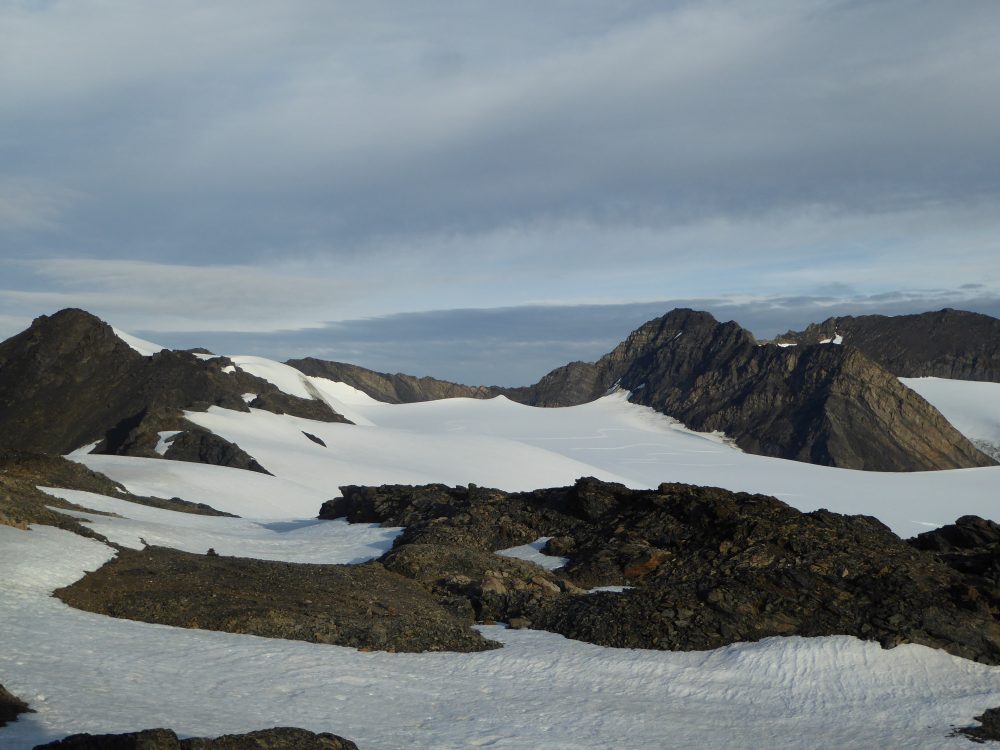
    The ski trails are faintly visible (in the background in the shade) from the second-story window of the Thomas Training Center above Eagle Glacier, in the Chugach Mountains, Alaska, during APU Masters Camp in July 2017. (Photo: Gavin Kentch)

    But first came room assignments. I would have three roommates in a dorm room with two bunkbeds.

    My first roommate would be Jeremy Littell, a USGS brainiac who studied climate change, something I might have wound up doing minus a few missteps and stutter steps in another direction. Jeremy would join myself and several others for a mountain run the day after camp; he struck me as someone who was very fit, and unsurprisingly he turned out to be a speedy skier.

    Next was Tom Corbin, with a skiing and ski coaching pedigree that looked like a Who’s Who of the history of American skiing, including decades of coaching and many years spent chasing an Olympic berth. Tom was such an animal that despite hip replacements and blown knees, he was out there everyday ripping it. He also complimented me at the end of the camp on my progress. I told him that coming from someone of his stature it meant a lot to me, and I really meant it.

    My other roommate was someone FasterSkier readers would recognize immediately, but I did not see the moniker through the bling at first. Whispers that there was another FasterSkier contributor at the camp led me to suspect and then realize that the author of the very article that led me to buy my last pair of rollerskis was bunking next to me… the man, the legend, the myth – Fast Big Dog, or FBD.

    “It’s all about how you look.” — FBD

    “It’s all about how you look,” he shouted to Gavin, part of the lively back and forth between the two. With that it was settled.

    In case anyone wondered, and I had, FBD is not just an irreverent authorial persona. He is exactly the same in real life as in his writing. There are few skiers who have their own monogrammed “Team FBD” tights and can pull it off. FBD really will throw down at any time, and if you thought it was all bravado, you would be mistaken – he was out skiing longer than anyone else for nearly every session on the glacier. The day after camp, he came away victorious in the T-Bar Row showdown in the APU weight room, though he was then crushed by all of the locals in his ill-advised rollerboard challenge.

    FBD was also generous in his encouragement of my progress, and spoke kindly about me at the end-of-camp sharing circle when Erik Flora asked us to share our reactions to camp. But before we could get to the kumbaya and the warm cuddly feeling of all surviving a sufferfest together, I had some dark secrets that were about to be revealed, some assumptions to be utterly disproven, and a near breakdown to weather. Nordic skiing has a way of exposing the rawness that lies beneath, and I was about to be exposed and the curtain was going to be pulled back – way back.

    Onto the snow. For the first time in four years.

    Time to get on skis. The first ski was classic skiing on the first afternoon.

    Some background: I am primarily a rollerskier now, but the memory of snow after four years of asphalt still lingers. I went shuffling around years ago on a whim in Vermont when I used to live there, and after that I borrowed my neighbor’s ancient three-pin skis and used them in a field across the street from my converted farmhouse. Some years later, I took up classic skiing in Ukraine after I decided to stay around six more years after serving in the Peace Corps. Skiing in Ukraine consisted of making a track yourself and skiing back in it if you wanted to get home through the woods a little sooner before you froze to death.

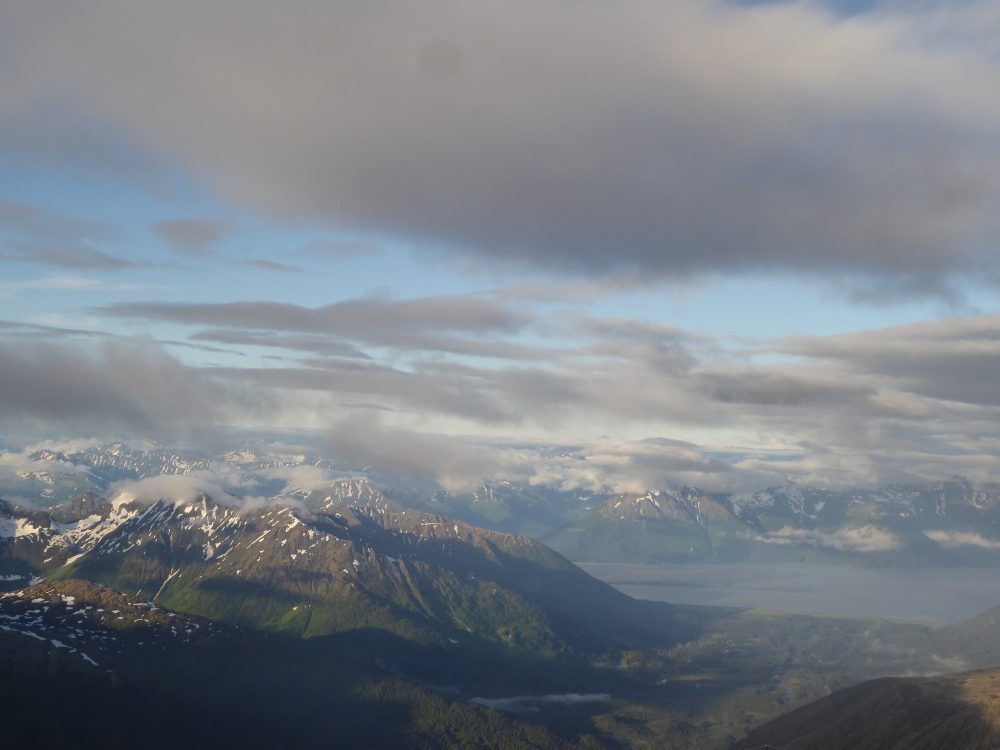
    Looking down toward Girdwood and Turnagain Arm from the Thomas Training Center above Eagle Glacier, in the Chugach Mountains, Alaska, during 2017 APU Masters Camp in July. (Photo: Gavin Kentch)

    I got into rollerskiing in Texas after I moved back when, by some kind of water-into-wine miracle, I came across Roller Ski Texas, a group founded and organized by a Russian expat named Phillipp Dimitriev, who felt he could bring rollerskiing to Texas’s churro-loving masses by buying pneumatic wheeled skate skis and giving away free lessons. After a while when one day everyone looked at me and asked what are we going to do today and I completely made something up, I became the coach.

    The takeaway from this is that although I had some experience with classic skiing on snow, it was always in cold snow conditions and was never in groomed tracks. This was one of my secrets, but I could rollerski in my sleep, I trained everyday… “What could possibly go wrong?” I thought, as I laced up my boots to hit the trail, preparing to plummet 200 vertical feet from the edge of the glacier down to the “stadium” area and start of the main loop.

    Little did I know I was doomed from the start.

    I realized I was in trouble just seconds into the descent. I was not used to the speed. There were no hills in Texas that could simulate this; I managed to get to the bottom but this is where the fun really began.

    My assumption surrounding my secret had been that classic rollerskiing was just like skiing, or at least almost like skiing. Stories of developing a late kick from too much rollerskiing I passed off as unicorn stories spread by misanthropic ski snob haters. Time to go up.

    The minute I started to climb out of the stadium, going up a steady uphill in klister conditions at 65 degrees and sunny, I slipped, and then I slipped again, and then I slipped so hard I nearly faceplanted. Where was the kick? Was my coach just messing around when he applied the klister, did he secretly apply butter or motor oil after I left the wax Conex?

    I now encountered an additional problem – my poles were sinking almost to the handle.  This was made worse when I slipped especially badly. I quickly developed a strategy of trying to excavate my poles by widening the crater so that my basket would be released. About halfway through the first lap my pole came back up out of the snow without a basket on the end; already frustrated beyond belief and in not in one of my prouder moments, I just kept going.

    I was slipping so much in the tracks that I could only sometimes find a kick outside of the track. The pole without a basket made things more challenging because that pole would sink much deeper and consistently than the other. I found myself mostly sliding down most of the downhills on my face. My temper was flaring. I was lashing out at myself and cursing the snow gods.

    APU Coach Galen Johnston was “part David Blaine and part Dr. Phil with a six pack”

    By the end of the first lap I met up with my coach, APU Development and Masters Coach Galen Johnston. Proving himself to be part David Blaine and part Dr. Phil with a six pack, Galen went about assuaging my self-directed assault on myself while simultaneously running off the little devil perched prominently my shoulder whispering a long spew of the negative poison Kool-Aid that I had been drinking.

    “I’m so frustrated with myself,” I remember telling him. Galen promptly proceeded to take a look at my scissor kick flailing that I was trying to pass off as skiing and got to work. He quickly began to work with me on proper positioning, finding and feeling the kick, and making smaller movements while increasing the cadence. Pure Genius.

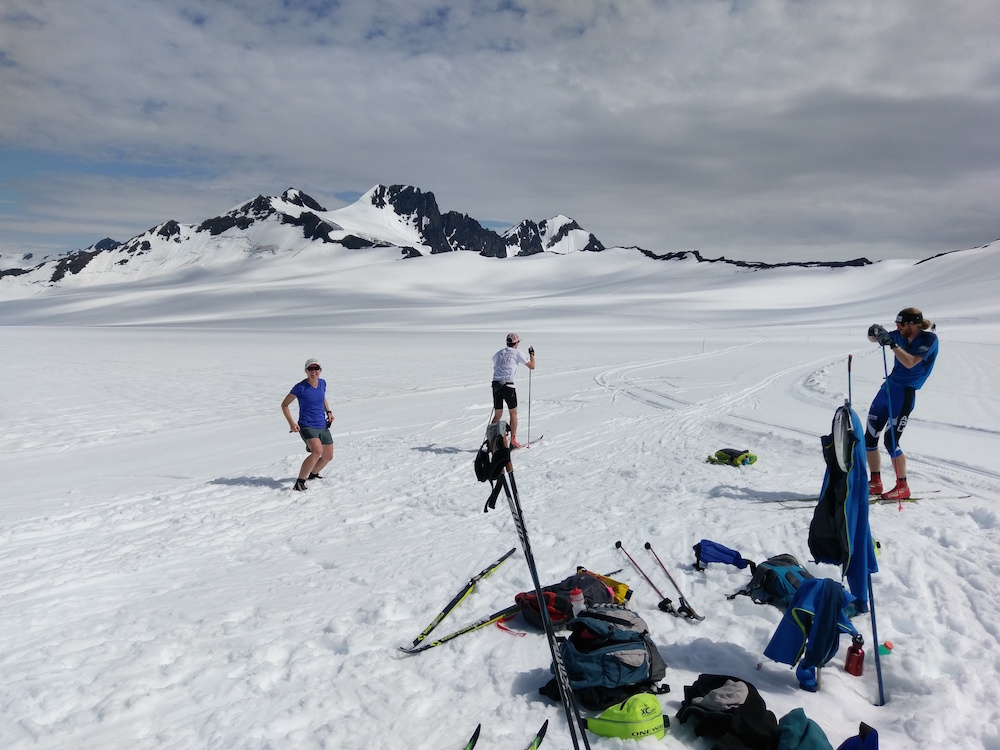
    He also takes photographs: APU coach Galen Johnston (r) gets a shot of Shannon Brockman (far left) in the stadium and gear drop area of Eagle Glacier, in the Chugach Mountains, Alaska, during 2017 APU Masters Camp in July. (Photo: Dan Libbey)

    The next lap I started feeling less slip, and the next after that I had begun to feel like a skier; I was still skiing without a basket, but I felt stronger with each lap. Galen skied with me, encouraged me, and even helped me nail a downhill that seemed to be my nemesis.

    Somehow I survived the first day. Even though I had improved greatly, my confidence was badly shaken. I thought about the hours of intervals, distance, and hills I did on rollerskis; the strength training, swimming, and cycling that had led me to believe I would somehow be competitive with a group of lifelong racers. Call it ignorance, but I still had an inkling of hope that the next day, with our first skate ski session in the morning, would be different… instead, after today’s black eye and ensuing attitude adjustment I would nearly have a breakdown the next day that found me questioning my very reasons for coming to Eagle Glacier.

    Because sometimes the first skate skiing of your entire life happens on glacial slush at 6,000 feet

    The next morning I found myself at the bottom of the first climb, ready to open up the skate skiing. I was ready, or so I thought. Here, now, I would redeem myself.

    My rollerskiing group in Texas was a skate skiing club, I coach skating technique, I’d done it in front of the cameras for local news stations, I was sure that my upper body strength from years of training would help me… but somewhere my biggest deep dark secret was gnawing at me.

    I had never skated on snow of any kind in my entire life.

    You see, even though I had never skied on soft slushy snow in a track on classic skis – I had never skated on snow of any kind in my entire life. Since classic had been a disaster, my assumption that rollerskiing could simulate skiing was hanging by a thread.

    As I started up the first hill [the “first hill” at Eagle Glacier gains roughly 100 meters total over a series of rolling up and downs, though mostly ups – Ed.], the first problem I noticed was that I spend very little time doing V1 rollerskiing. In Texas, the “hilliest” terrain I can still full V2 on my medium-speed Marwes. I practiced V1 based on some video I had seen online, but mostly this was just jump skating the tops of hills.

    At Eagle you are either going up or going down, and going up for me meant skiing V1 for a long time. I began to notice immediately that my glide was virtually nil, so I began poling harder to compensate, which just sunk my poles deeper into the soft snow and decreased whatever glide I was getting even further. As soon as I pointed my skis out in a V-stance, my right abductor began to ache. A war injury from my soccer years, it would get worse as I went on before finally turning into a stabbing pain near the end of the lap that reminded me repeatedly that I was 41 years old and going up a steep hill at nearly 6,000 feet.

    It was about this time that I began to feel the altitude. Despite moving almost slow enough to fall over, I noticed that my heart rate was highly elevated. Even though I was constantly reminding myself to breathe, I found myself stopping repeatedly on every hill. I vowed to get through the first lap, and I did, but I called it quits after that. I was too demoralized to seek out a coach; I felt utterly broken.

    Later that evening, I began to question why I had come to this camp. I had come to get some on-snow time, but also, being highly competitive, I came to measure myself against others. It was not just the four years of training in 100-degree, 80-percent humidity since I had last seen snow that had prepared me for this. I had also spent six years before that skiing by myself in Ukraine.

    Fresh snowfall surrounds the Thomas Training Center above Eagle Glacier, in the Chugach Mountains, Alaska, during 2017 APU Masters Camp in July. (Photo: Gavin Kentch)

    Skiing had always been a place where I could find solace, peace, satisfaction, and happiness when I couldn’t find it elsewhere. Now it suddenly seemed like my greatest demon. Everything I had done before seemed for naught. It felt like I was just learning how to ski, like the tables had been turned and suddenly I was one of the beginner athletes I coached in Texas. About this time I thought of my family, my 18-month-old. I wondered how they were doing. I began to miss them. To complicate my crisis of conscience, others in our group were regularly seen texting and talking on their phones… I checked my phone and found that I had no service. I was at an all-time low.

    Some time before heading out for the classic afternoon session. Berit Flora offered me her phone so that I could call my family. Berit was affectionately referred to as the camp mom for her powers of making sure everyone was doing well and well fed, and her gesture in that moment seemed to give me new lifeblood. A dark cloud seemed to float away from above my head.

    (I had the pleasure and honor of later having dinner with Berit and her husband Sam and others after the camp finished. Both Berit and Sam (who are Erik Flora’s septuagenarian parents) were out there skiing every day, and had plenty of history in the form of great stories to add to mealtime discussion. Sam also drove me to my Airbnb room after camp, to Alaska Mountaineering and Hiking to return my rented skis, and to the airport. Their hospitality and kindness will not soon be forgotten.)

    About this time I began to reevaluate my goals. There were other reasons to come to this camp, such as receiving some of the best coaching from some of the best coaches in the world. Also I could personally gain from coaching because my first ski taught me I had more to learn than I realized. Also, if I could ski these conditions I could come away with some newfound confidence (maybe getting through it was the moral victory) as well as a desire to get on snow more often; more snow time was something that became apparent immediately that I needed.

    The wall of fame inside the Thomas Training Center on Eagle Glacier. From left, the APU Juniors (teenage girls), APU Elite Team, 2014 Masters Camp, North American Women’s Training Alliance (American and Canadian athletes, plus Norwegian skier Celine Brun-Lie), and Man Camp (APU and USST men), among many others, have all left their mark. (Photo: Greta Anderson)

    I also reminded myself of how few people get an opportunity to ski here, the names of elite athletes written on on the walls serving as gentle reminders of the caliber of skiers who typically come to Eagle. I vowed to take in the beautiful scenery more, and to receive as much coaching as possible. Once I put the shattered pieces of my ego aside I began to enjoy myself again.

    The next classic session I felt especially good and was able to catch Brandy Stewart (an elite skier from Montana) and Gavin, two skiers well above my level, on a climb. I was immediately dropped on the first descent, but it was something Galen would bring up on the last night. Credit to Galen, but also to Dylan Watts, the best cook/competitive skier/coach in the world, who jury-rigged a really sweet basket on my left classic pole. Feeling like I was skiing with two poles really made a difference.

    After talking to Erik Flora the night before, he immediately found me the next morning.  I got to ski with him for a while, which made my day, and made it apparent what I need to work on for the future.

    It was not lost on my me how much it would cost me to have the best coach in any other sport work with me one on one; the experience was priceless. A shooting lesson from Gregg Popovich or a tackling lesson from Bill Belichick I could never afford, even if they were willing to take the time. And yet Erik seemed to enjoy coaching me; that dedication and love for coaching is something that I hope I can duplicate with my rollerskiers. I tried to listen to everything he was telling me technique-wise, but when he skied in front of me I couldn’t help but imagine how hard it was for him to ski that slow; he is an amazing skier and within seemingly a second or two after the lesson ended he was out of sight, moving on to find and coach the next athlete.

    Morals and acknowledgments

    There plenty of others who gave me the courage to continue on and improve each day. Both of the FasterSkier crew gave me encouragement throughout, and everyone seemed to lift each other up with a kind word or two on the trail. Special thanks to Jeffrey Lynn, my hilarious dishwashing buddy that made the time spent doing chores enjoyable. Jeffrey was there to become a better skier to be able to ski with his son. I watched him put on Moleskin and heaps of duct tape to cover his blisters every day – you were inspirational to me.

    Special thanks to Galen, who even loaned me his skis, and to him and the APU Masters Group who let me join two of their workouts after camp. I truly felt like a part of the APU Masters skiing community, and I don’t recall ever feeling that much energy and excitement from working out with anyone else.

    I’d come far during the camp, from skiing alone in the woods in Ukraine, to braving the heat in Texas, to V1’ing up a glacier. I had come great distances to see, taste, and feel the ultimate. The ultimate venue, ultimate beauty (yes, Alaska is probably the most beautiful place I have ever seen), ultimate coaching, and ultimate community.

    It was only fitting that after coming from humble obscurity and a truly off-the-radar outpost like San Antonio, and overcoming some pretty personal lows, the helicopter I flew out of was bringing up two of our nation’s greatest skiing stars, Kikkan Randall and Sadie Bjornsen. They got out of the helicopter, with an NBC cameraman dressed more for L.A. weather than for Alaska filming every step they took.

    Total stars in our sport, they both smiled and waved. Sadie offered a quick handshake and Kikkan smiled and said hello, looking exactly like the Fischer ski poster of her on the second floor of the Thomas Training Center had suddenly come to life. If I would have had the time without the helicopter ready to lift off, and it wouldn’t have been so loud, I might have introduced myself: “Hi, I’m Jason, a skier from San Antonio.”

    — Gavin Kentch contributed 

    ***

    Masters Minds series: Are you a masters skier who loves your club? Submit camp or training recaps, announcements, or stories to info@fasterskier.com with the subject line “Masters Minds.” Articles can be first-person accounts or written from an observatory standpoint with comments from others.

    Related: 2014 APU Masters Camp | 2015 APU Masters Camp