From the FasterSkier archive — posts syndicated from athletes’ and coaches’ own blogs between 2004 and 2012, kept online as published. Current coverage is at fasterskier.com.
Long distance in Oslo, city sprints in Drammen. The World Cup takes its late-season swing through Norway and Devon and Nat have a full breakdown, with special guest Sam Hendry, a Canadian athlete who’s had some standout results late this season.
We’re sprinting to the finish of the 2024 podcast season. Send your long-shot requests for off-season content to devon@fasterskier.com and nat@fasterskier.com. We’ll be back in a few days.
The sport of trail running is growing. With more specialization, sponsorships, and media attention, the scale of competition changes. The Golden Trail World Series, which launched in 2018, is helping guide this growth. With a world series circuit, national series, and a championship, the Golden Trail World Series (GTWS) “exists to celebrate and evolve trail running as a sport.” Given that trail races can be roughly anywhere from 5 k to 330 k and with a range of national and private circuits, the idea with the GTWS was to provide a competition for the top trail athletes to compete in year after year.
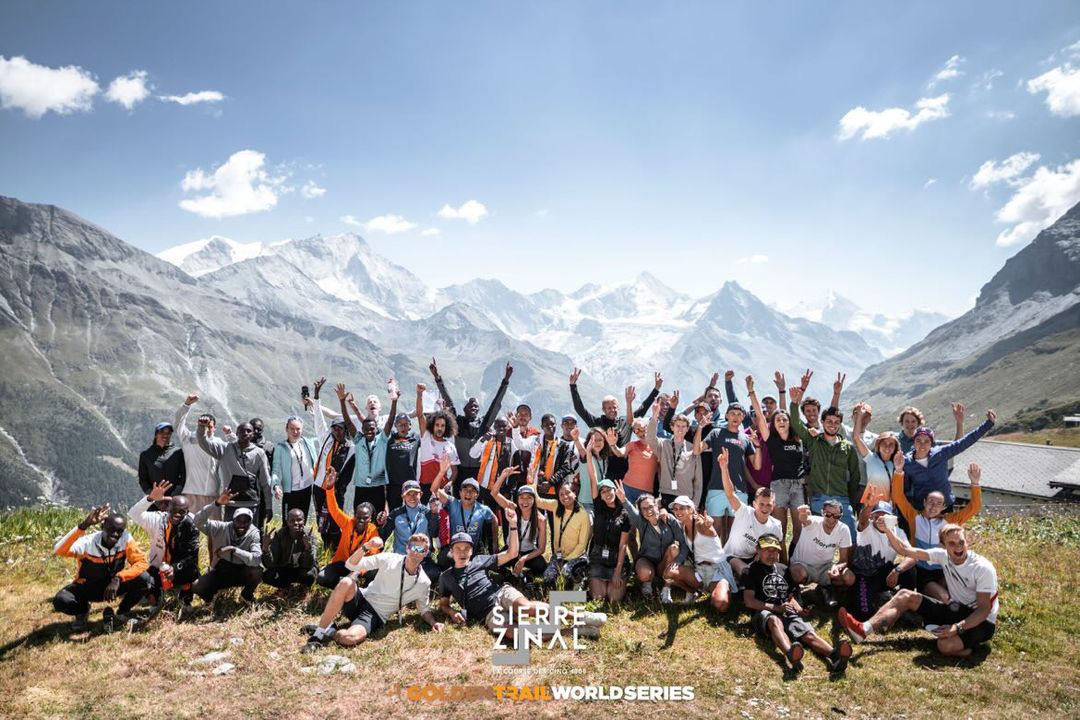
Golden Trail World Series competitors pose together before Sierre Zinal in Switzerland (photo:@goldentrailseries)
The GTWS combines a circuit of the best-known 21 to 42 kilometer races in the world and draws the best athletes to compete. In practical terms, the Golden Trail World Series could be considered a trail world cup. The man behind the vision, Gregory Vollet, sees the GTWS as a way for more professional athletes to be able to make a living from running, as broadcasting helps grow viewership and thus sponsor interest. In an interview earlier this summer, Vollet said, “currently the rate of athletes who have a real financial contract is very low. The Golden is designed to help them: them, the athletes, and the sport. This is its raison d’être and it will remain so.” With four GTWS completed this summer, the next two events will be happening in the U.S. in September before the five-stage series finale in Madeira at the end of October.
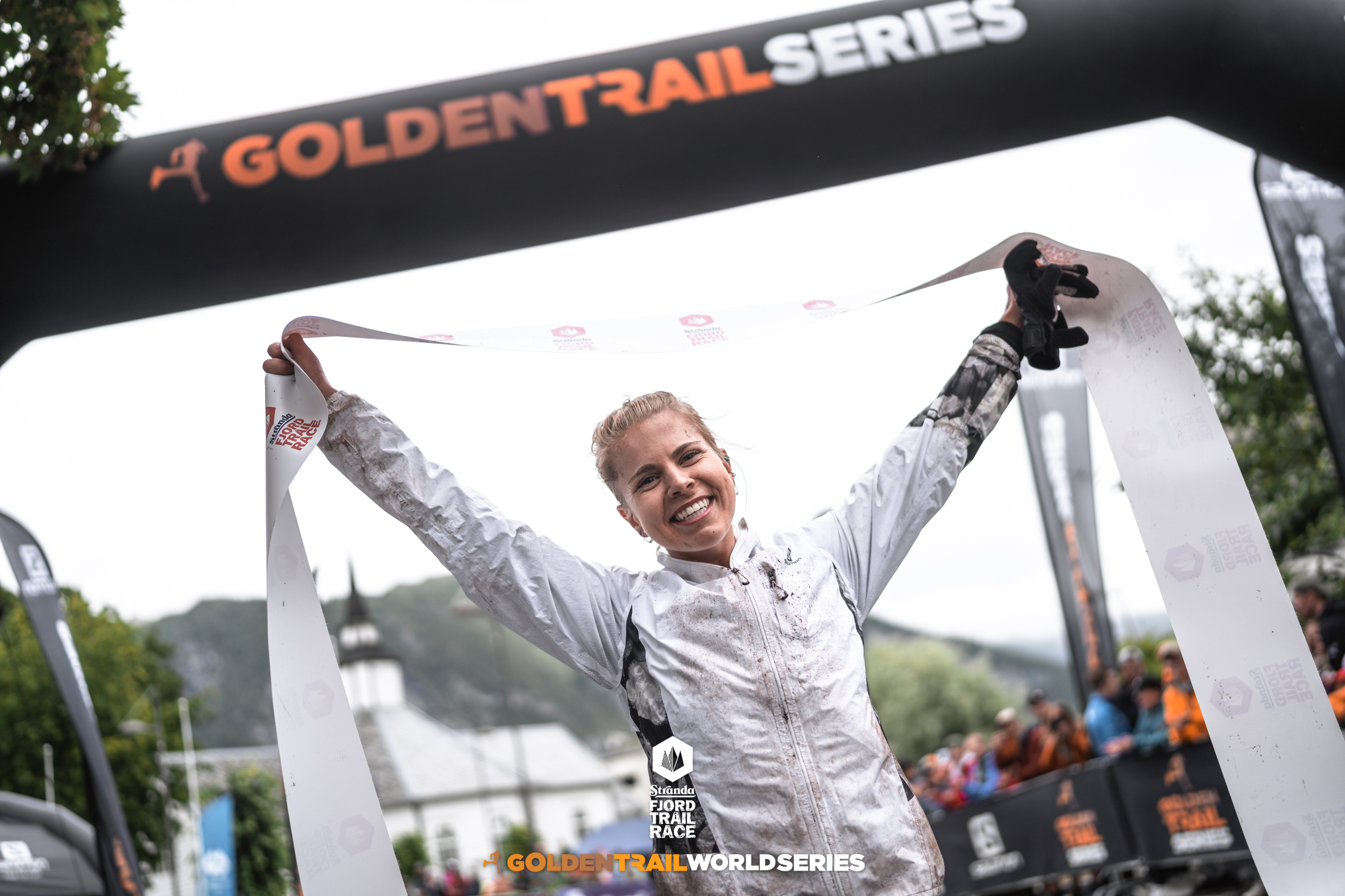
Sophia Laukli is all smiles after winning her first-ever Golden Trail World Series event (photo: @goldentrailseries)
In an email to FasterSkier, Laukli shared her thoughts on the GTWS experience, saying “the environment was very intense, but also fun and exciting all around, similar to ski races I would say.” Having never met or competed against the other women was initially a little daunting but Laukli said, also “made it a bit more exciting.” She remarked that, “All the runners ended up being very nice and stoked for each other which is always great. It stood out to me too that the top ten women were almost all from different countries, which was pretty sweet to see.”
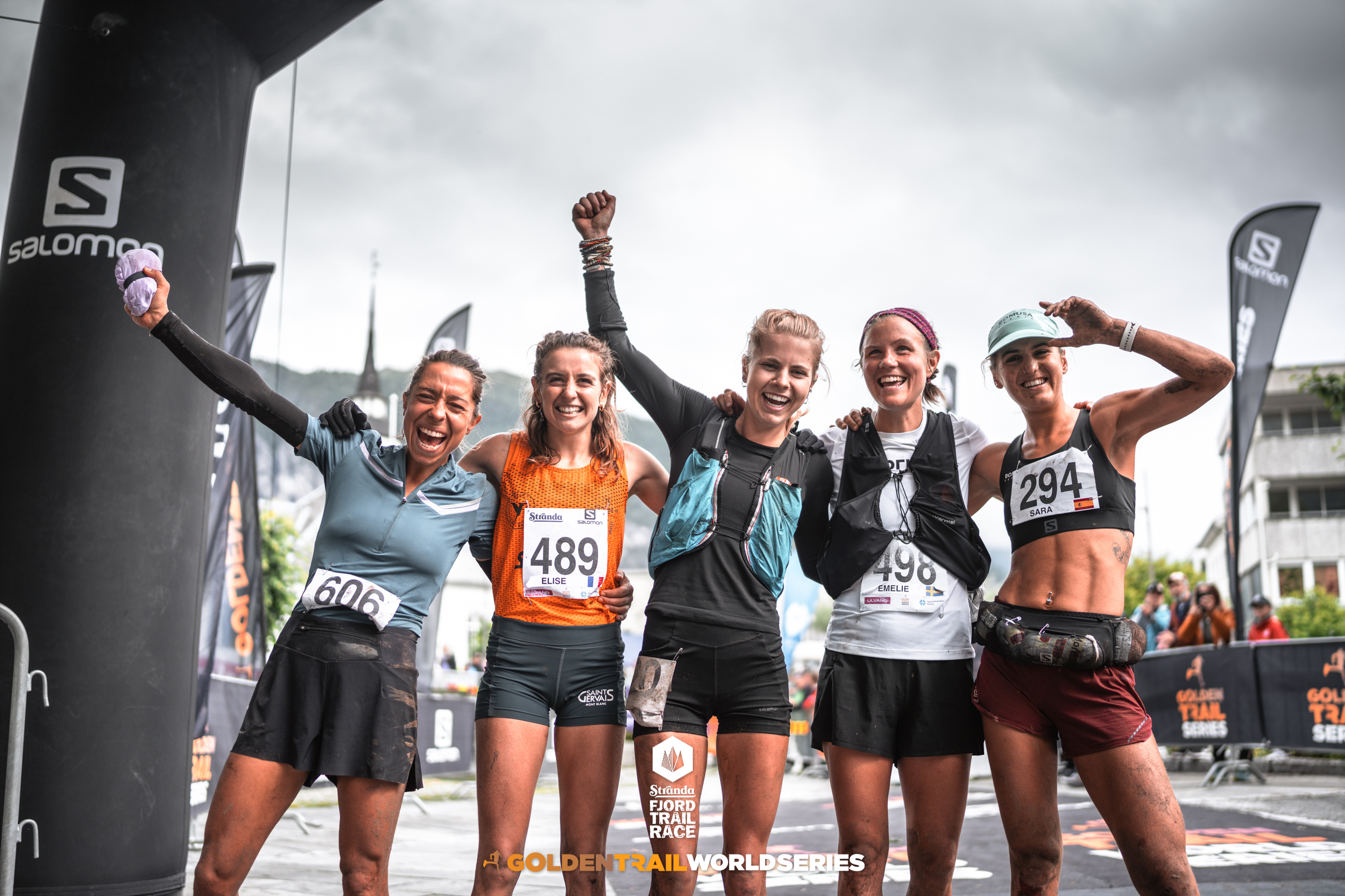
Stranda Fjord women’s top-five finishers: Blandine L’hirondel (FRA), Elise Poncet (FRA), Sophia Laukli (USA), Emelie Forsberg (SWE) and Sara Alonso (ESP) from left to right. (photo: @goldentrailseries)
According to the race description, the Stranda Fjord 25 k “takes you on a wild ride in the Norwegian fjords. This course has everything from fast and flowy trails, steep climbs and technical downhill running.” With 1700m (5,577 ft) of climbing, there was plenty of vertical to be found as well. Laukli described the race as “crazy technical.” She wrote, “I had done part of the course a couple days before so I knew what was coming, and I was pretty terrified on the start line. There was a lot of discussion about the strong technical skills of the other runners before the race, so I knew there would be tough competition since I knew I struggled with technical terrain myself.”
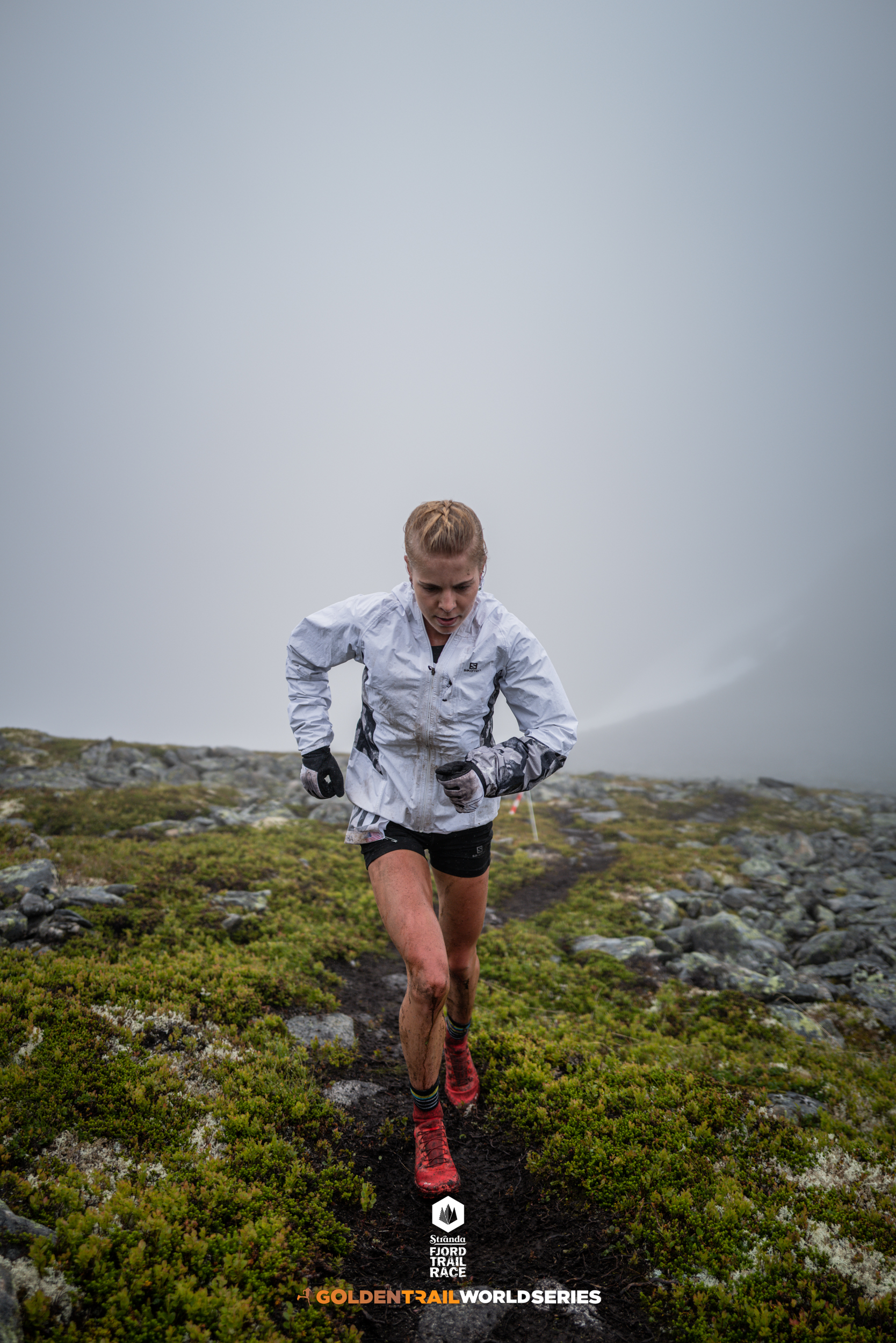
In soggy conditions with minimal visibility, Sophia Laukli leads the women’s race (photo: @goldentrailseries)
Knowing that about herself, Laukli made a plan to go hard out of the start in an effort to make up time on the climbing sections. The plan worked, “I had a pretty large gap at the final peak,” Laukli shared, “so I did everything in my power to stay on my feet and keep moving on the descent. The first boulder section was brutal and slippery but luckily I avoided any crashes. The course then moved along to basically a long mudslide, and then the hardest part for me ended up being the marsh for the last part of the course, which seemed to last forever.”
Nearing the finish, Laukli began to suffer, realizing that she hadn’t been eating or drinking enough throughout the race. She wrote, “I bonked pretty hard the last 45-ish minutes in the marsh, and that’s when I no longer stayed on my feet, but it was just face plants in the mud so no injuries involved. I was really just playing catch up until the finish and hoping none of the other women would come fly by me. I was absolutely exhausted at the finish, but managed to hold off the rest of the field, although many of them did make up some time on me on the whole descent. Once I crossed the line, I was honestly very shocked I had won, but it was a great feeling! It felt so rewarding to be done after probably the hardest race I had ever done.”
When asked about maintaining a balance between ski training and trail racing, Laukli said that the two go well together. She wrote, “I haven’t changed much about my ski training this summer just because I have always incorporated quite a bit of trail running into my plan for skiing. In the week or so leading up to my running races, I do sometimes have a little more running focus at least for the intensity, just for some last prep, but the majority of my training is still a lot of roller skiing. It’s very helpful to have the roller skiing aspect to prevent running injuries and keep building a solid base, so I feel the two are very compatible and cross over well. I wasn’t sure how it was going to work initially, but so far it seems to be working well to combine the two.”
Originally, Laukli’s plan was to travel to Switzerland for the next stage of the GTWS at Sierre Zinal before heading to Sweden to join the U.S. Ski Team for a camp there. Unfortunately, she caught COVID just after the Stranda race, meaning that plan was out. Instead, Laukli will be traveling back to Utah in preparation for the start of the school semester at the end of August and competing in a couple more running races later in September.
Laukli’s University of Utah teammate, Sam Hendry also shared some thoughts with FasterSkier about his recent racing experiences. Before traveling to Europe, Hendry won a stage of the U.S.-based Cirque Series, in Brighton, UT, which he described as a “good training race.”
Sam Hendry closes in on the finish line at the end of the Stranda Fjord 25 k (photo: @goldentrailseries)
Heading across the Atlantic, Hendry touched down in Norway, ready for his GTWS debut. “The Golden Trail World Series is pretty cool,” said Hendry, “it is essentially the World Cup of trail running.” About his performance in the Stranda 25 k Hendry shared, “Stranda was a crazy technical and challenging course, but I was very happy to finish in the top ten.”
The men’s top-ten from Stranda Fjord, won by Jonathan Albon (GBR), with Sam Hendry in 10th (far left) (photo: @goldentrailseries)
From there, Hendry moved with the rest of the GTWS circuit to Switzerland for the 50th edition of the famous Sierre Zinal race. Hendry wrote, “[Sierre Zinal] was much more straightforward but still super hard, being a 31 k with 2100m (6,890 ft) of vertical. I had a terrible climb but got into a rhythm at 11 k and managed to move up into 22nd. I’m pretty happy with the two weekends of racing here in Europe.”
***
In other domestic running news, Scott Patterson held onto his title as victor of the Crow Pass Crossing, earning his 8th win (6th in a row). Patterson finished the 22.5 mile race in a time of 3:04:07, running in challenging weather conditions. His fellow APU teammate, Ari Endestad, finished in third place, +28:35 behind Patterson.
In the Alyeska Cirque Series on July 30th, former U.S. Ski Team D-Team member and current UAF athlete, Kendall Kramer won the female division in a time of 1:24:26. On the men’s side, Patterson won (1:07:02) ahead of Micheal Earnhart (U.S. Ski Team D-team & APU) and David Norris (APU). Norris also competed in the Snowbird Cirque Series on August 6th and finished in sixth place, while continuing his recovery from a bruised heel that hinders his ability to run downhill quickly.
Thomas O’Harra (APU) approaches the turnaround point in the 2022 Mt. Marathon race above Seward, Alaska. (photo: Anna Engel)
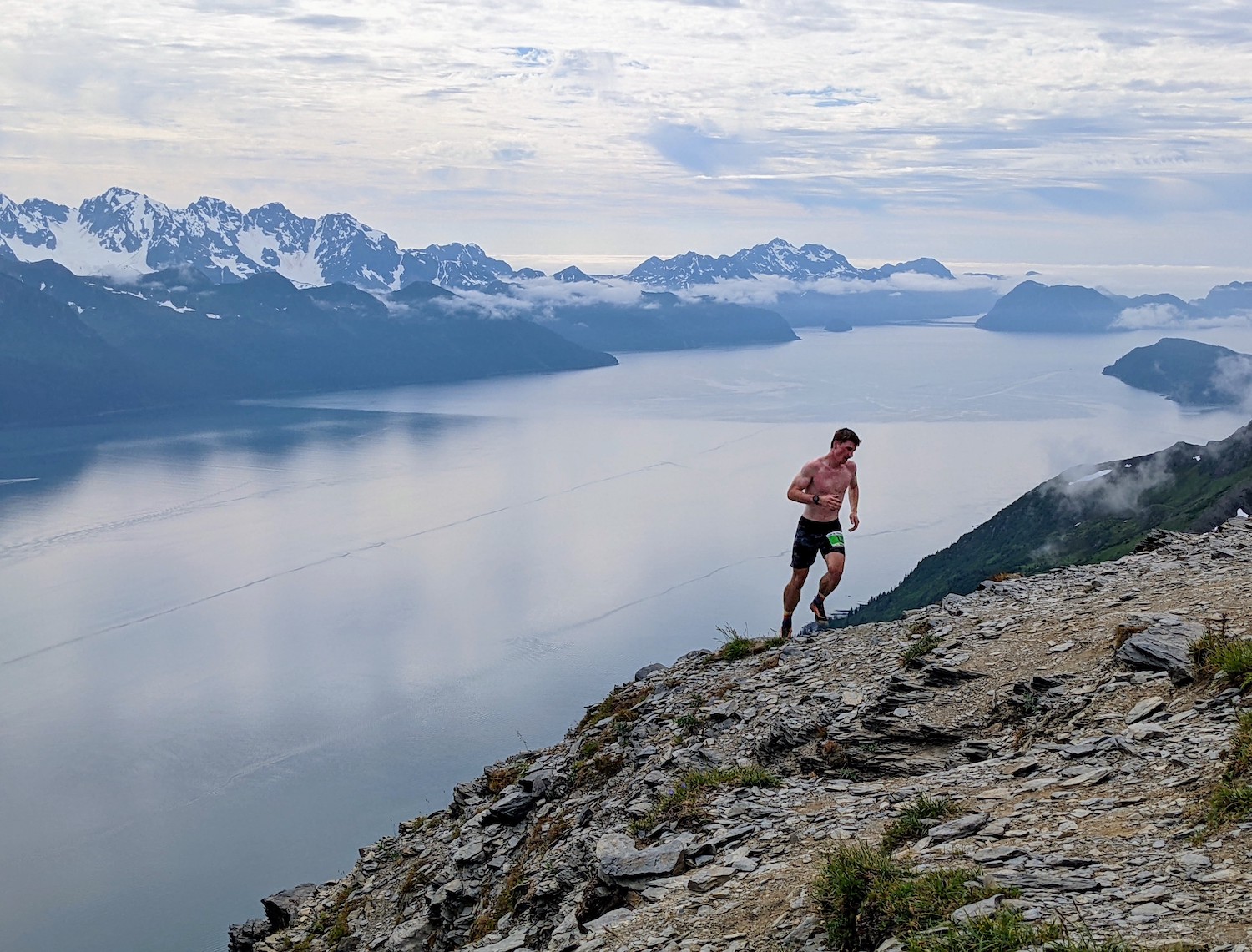
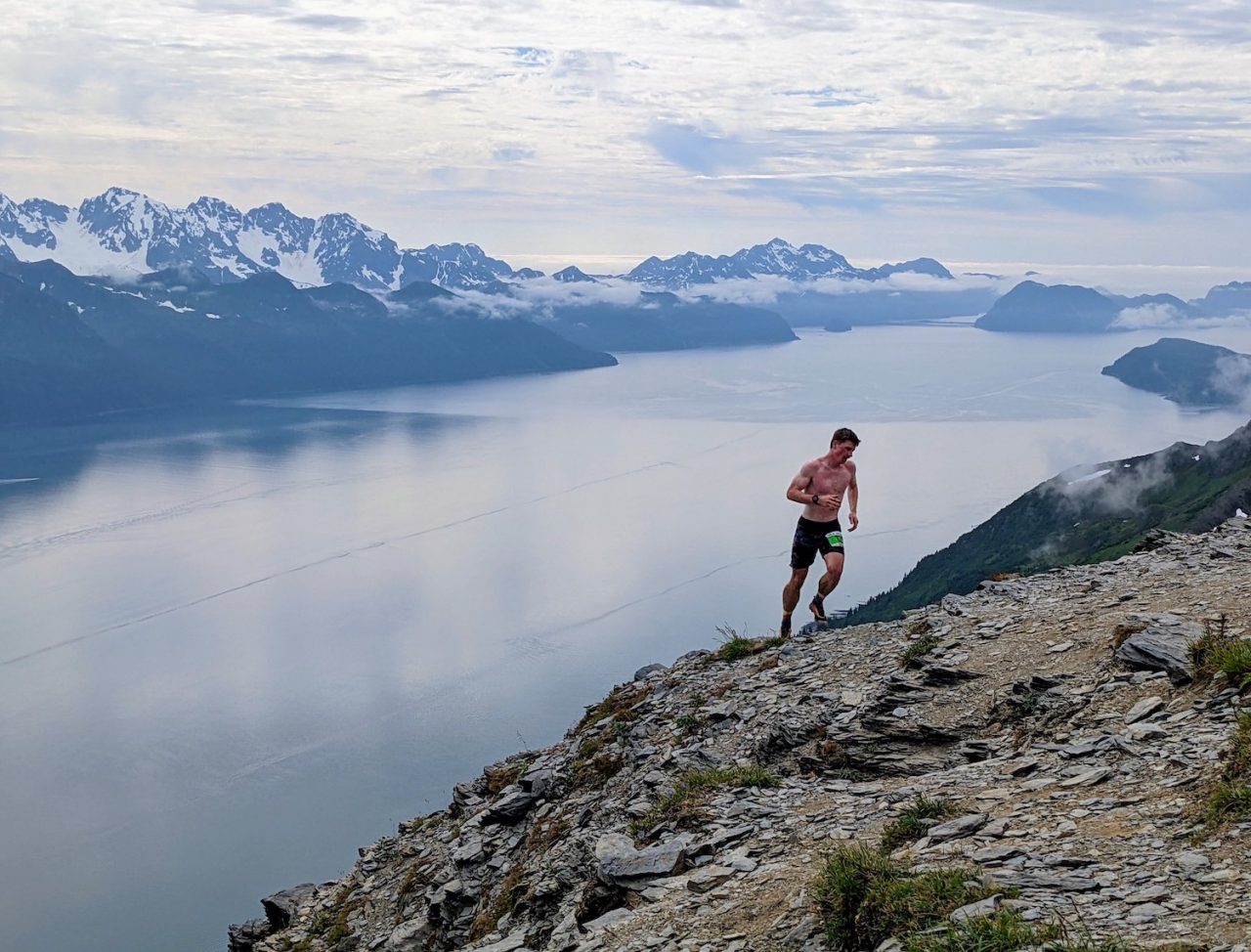
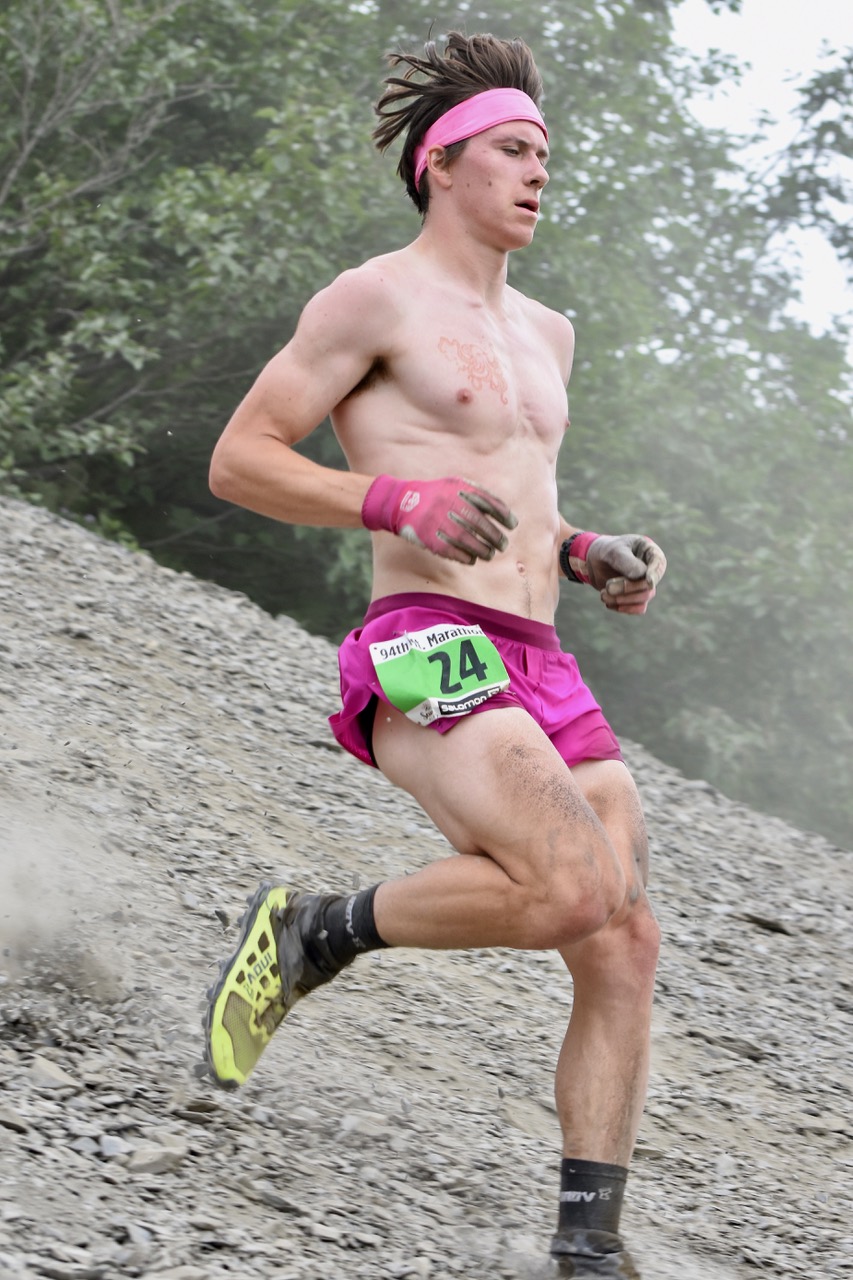
Occurring annually on the 4th of July, and touted as the toughest 5 k on the planet, the 94th edition of the Mount Marathon race took place this past Monday in Seward, AK. Needless to say, the race is a storied tradition, beginning with its first “official” running in 1915. Over the years, participation has increased to such an extent that these days there are a number of complex ways for race entrants to register, including selection through a lottery system, petition for a race spot, or even buying a bib at a last-minute live auction.
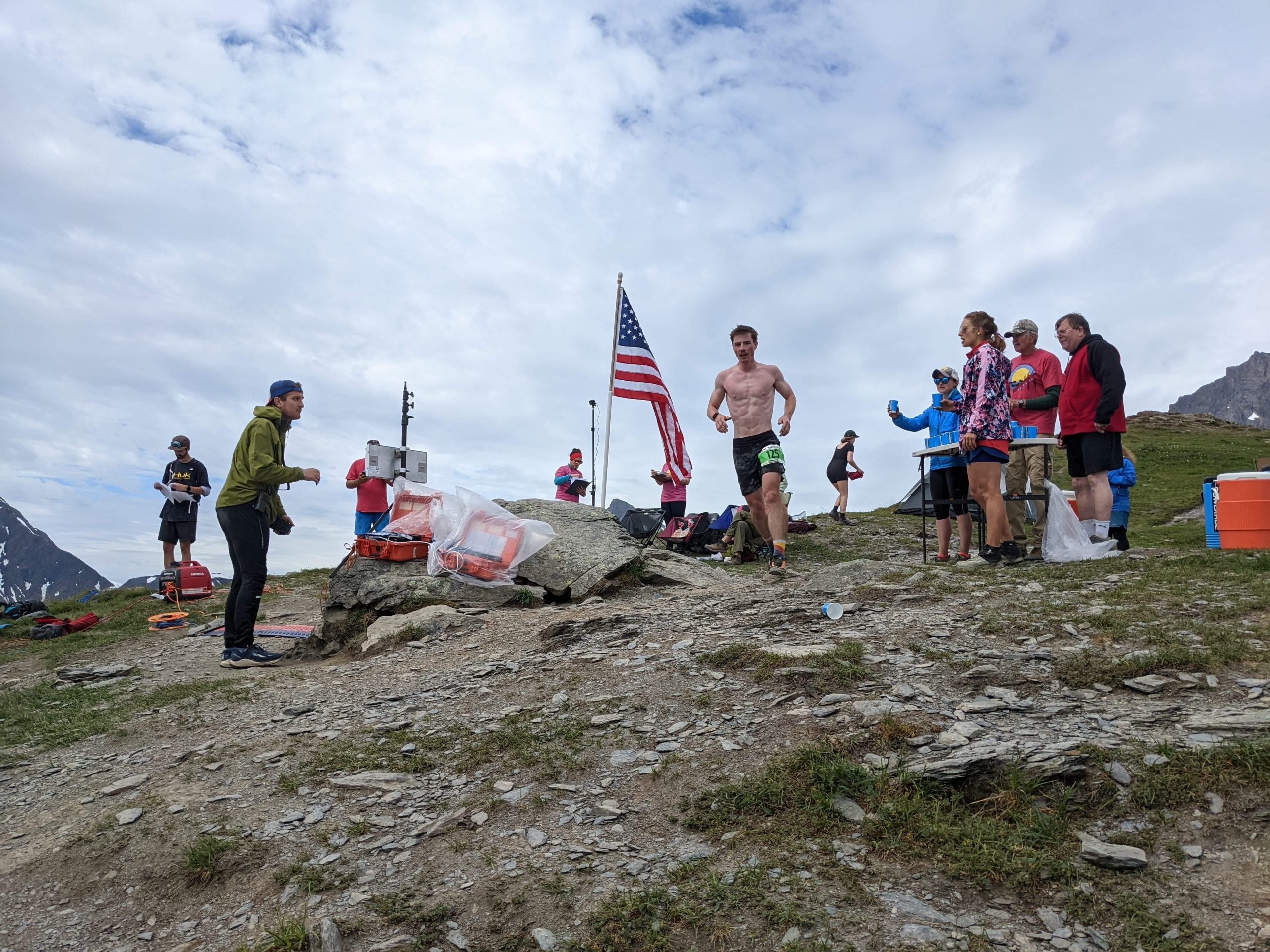
There is no set course up the mountain itself. Racers start on city streets, at sea level, and run through town for half a mile before starting the climb and heading straight up the mountain. During the climb, athletes cover roughly 2,675 vertical feet of climbing in less than a mile (0.9 to be exact). Once they’ve crossed the timing mat around the false summit at Race Point, they turn around and descend that same steep slope via a slightly different route. A junior boys and girls race is also run, in which the participants only ascend partway up the mountain before turning around.
Runners bomb down scree back towards Seward and Resurrection Bay after turning around at Race Point. (Photo: Walker Hall)
This steep and challenging course has seen a number of nordic skiers succeed, including current men’s record holder, David Norris (41:26). Norris has won the race all three times he entered and took the record from mountain master, Kílian Jornet (41:48). Four-time Olympian, Nina Kemppel, holds the record for most race wins at an impressive nine victories. And until this year, three-time Olympian, Todd Boonstra was the oldest victor at age 41. However, at the conclusion of the 2022 edition of Mount Marathon, that crown went to a new champion.
The men set off at 11 a.m. local time and Max King of Bend, Oregon, took this year’s victory in a time of 43:37. At the age of 42, he became the oldest winner in the race’s long history.
Behind King, APU skier Thomas O’Harra placed second in his Mount Marathon debut. “I really didn’t expect to do as well as I did,” shared O’Harra. “It’s such a strong field, even without David [Norris] racing this year.”
Just a few weeks before O’Harra took top spot in the Bird Ridge Hill Climb, so he had confidence heading into the uphill section of Mount Marathon. “I knew that I was in good shape for the climb at least, after Bird Ridge, so I figured that I could be in the top three to the top and then the downhill was a total unknown to me. I practiced it once, a week before the race, but I’ve never raced a downhill like that before so I had no idea what to expect.”
Thomas O’Harra (APU) rounds Race Point in second place in the 2022 edition of Mount Marathon (Photo: Anna Engel)
Plummeting down the scree slope, O’Harra said his main goal was to stay on his feet and not get hurt. “I was shocked that I was still in second coming off the mountain and suffered my way down the road to the finish, where I managed to sneak under 45 minutes, which was a kind of secondary, if-it-goes-well goal,” said O’Harra. “[It was a] super fun time though, the closest running race I’ve ever done to the Birkie, and I’m stoked to come back and race again next year!”
Canadian skier and current Ute (athlete at the University of Utah), Sam Hendry, finished second behind Norris in 2021. This year, Hendry placed 7th with a time of 47:39. Hendry shared that this year’s Mount Marathon “was a bit of a disappointment.” He continued, “I finished second last year and was really hoping for a strong result again. With some busy travel getting up to Alaska, I didn’t have the best preparation and my legs were just a little off.” Hendry raced both the Vertical Kilometer (VK) and 26 k at the Broken Arrow Skyrace mid-June and placed fourth in both, besting King by nearly a minute in the 26 k. Hendry said, “I had some good results there, and plan to add some more running competitions to the calendar for later in the summer. I really enjoy getting some competitions in during the summer and getting to feel stressed and nervous.”
Michael Earnhart descends a dusty slope towards Seward (Photo: Jim Jager)
New U.S. D-Team member and APU skier, Micheal Earnhart, finished his day in 15th (49:45). He wrote to FasterSkier, “I wasn’t stoked with my results by any means but I am happy that I’m at a point in my career where top-15 at Mount Marathon can be a bad day.” Earnhart was quick to praise his teammate’s success saying, “My main takeaway was how impressive it was to see my APU teammate, and race rookie, Thomas O’Harra get second place. Definitely a strong day for APU and skiers in general which is always fun to see.”
Fellow U.S. Ski Team athlete Luke Jager was shortly behind Earnhart in 18th.
With the men’s race concluded, the focus turned to the women, who started at 2 p.m. local time. (The men and women now race in the flagship afternoon slot in alternate years.) Breaking the seven-year-old women’s record, Allie McLaughlin of Colorado earned the victory in a time of 47:09. Previously held by Swedish runner, Emelie Forsberg, with a time of 47:48, McLaughlin created a margin of 39 seconds in her favor.
Rosie Frankowski, who finished 4th in 2021, and is perhaps one of the fastest climbers out there, came in sixth this year (53:19). Racing Mount Marathon for the first time, newly named U.S. Ski Team A-Team member, Novie McCabe placed 8th (56:27). About her race, McCabe shared, “Mount Marathon was crazy! So hard, but a very cool experience for sure. I’m pretty happy with it. I was nervous about the downhill and was honestly pretty happy with myself for just doing something a bit out of my comfort zone.”
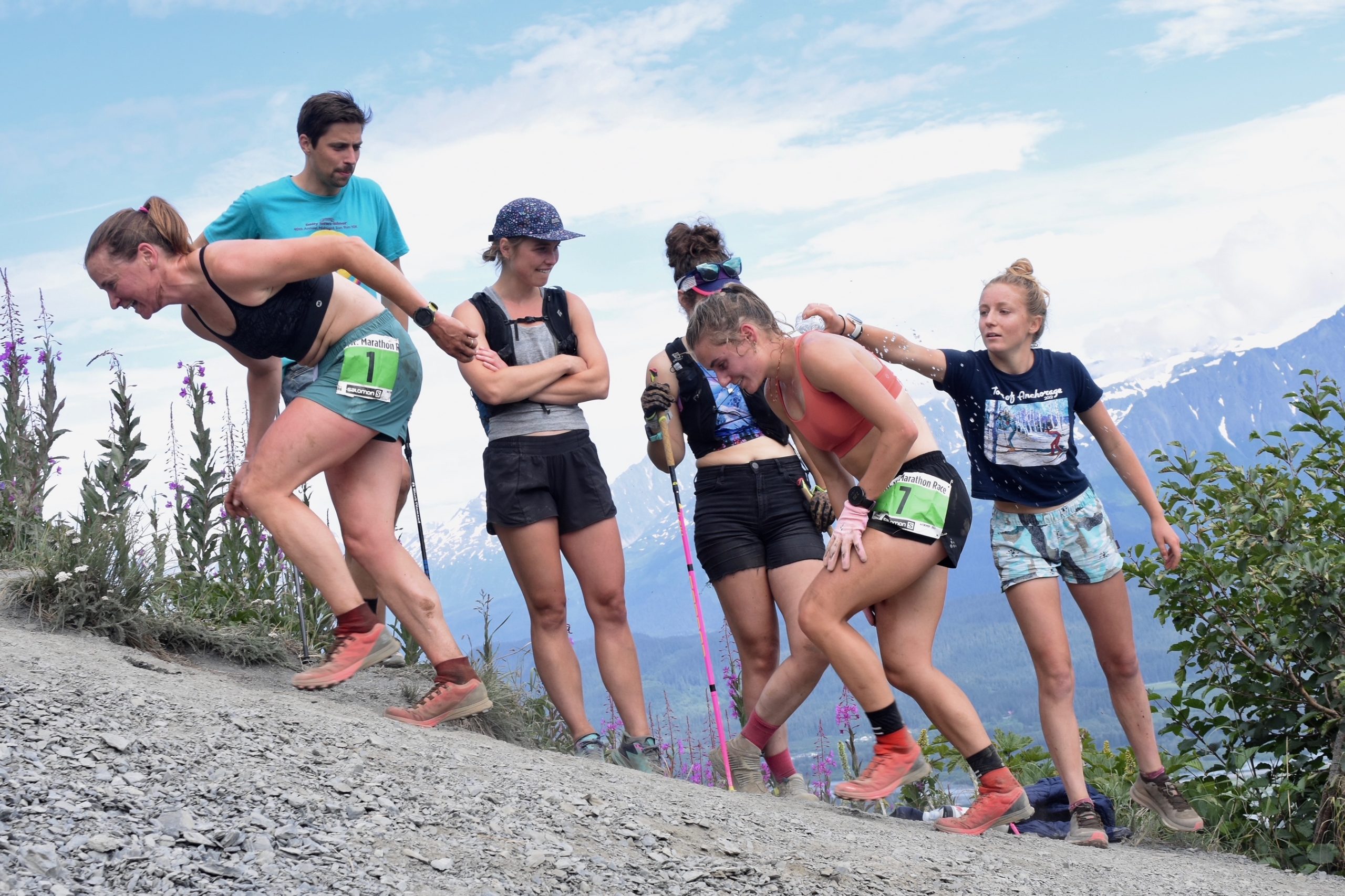
After racing the junior girls event, Dashe McCabe waters her sister, Novie (bib #7), on the climb (Photo: Jim Jager)
Kendall Kramer of UAF finished just outside the top-ten in 11th position (57:12). Kramer finished 9th last year (56:50) and was the junior girl’s race champion in 2018 (34:05).
Full race results of all the Mount Marathon events can be found here.
In other racing news, U.S.A. Track and Field Mountain Running Championships (USATF) in Wilmington, NY at the beginning of June saw two 2022 Beijing Olympians competing. Sophia Laukli finished third in a time of 1:29:03., and Caitlin Patterson came in sixth (1:35:52.3). Results for that event can be found here.
The Loon Mountain Race hosted Vertical U.S. Mountain Championships on July 10th, which a number of nordic and biathlon athletes attended. Alex Lawson representing Craftsbury Green Racing Project finished third, and posted the second fastest time on the “Upper Walking Boss,” a 40% grade ski hill for a half-mile at the end of the race.
Jake Brown (also of CGRP) had the second fastest time on the “Upper Walking Boss” and finished 9th overall. Full results for the event can be found here.
The Cirque Series mountain race circuit kicks off this coming Saturday (July 16th) at Brighton, UT. With a schedule of six U.S. based races taking place over the next few months nordic ski fans should keep an eye out for familiar names near the top of the results sheet.
Carrying the momentum from the first day of racing into a second distance event, athletes lined up once more at the Whistler Olympic Park for a 10 / 15-kilometer interval start classic. Over 130 men and 90 women participated in the open categories, representing clubs across Canada and the United States.
Adding a springtime layer of complexity to remind us that we are officially past the equinox, temperatures in Whistler hovered above freezing while a mix of precipitation fell off and on throughout the day. Webcams of the venue showed the spectacular mountain backdrop hidden amongst dense clouds and conifers still laden with the week’s snow.
It’s a humidity-temperature combo that makes classic waxing tricky. Consequently, many athlete chose to use “hairies”, which are known as “rub skis” in Canada, essentially foregoing kick wax and opting instead for a sandpapered kick zone. For those with strong striding technique, this achieves grip without as significant a risk of icing issues, as klisters can be known create in such conditions.
Top Canadian U20 racer Xavier McKeever (Foothills Nordic), who was 13th overall today, explained how this changes the game for those who haven’t had the experience: “You have to be a bit more careful with your kicks and a bit more gentle, because they can slip out really easily. That was the biggest focus for me [today], just to try and ski technically well.”
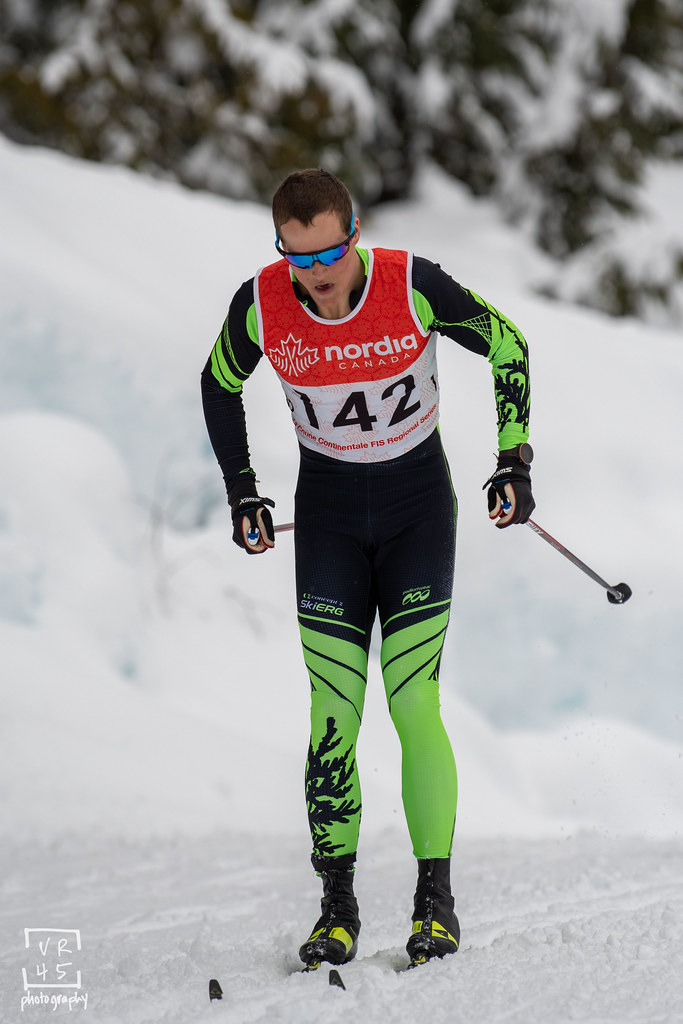
Craftsbury’s Adam Martin takes the 15 k classic win in Whistler. (Photo: Doug Stephen / VR 45 Photography)
Following 10 k sitting and standing events contested by Nordiq Canada’s Para Nordic athletes, the open men’s category headed out for the three 5 k loops. In a close race for the top podium spot, Craftsbury’s Adam Martin took the win with a time of 40:29.3. Martin was chased by today’s Canadian National Champion, Antoine Cyr (Skinouk) who hunted his times from 19 bibs behind.
Though Cyr led through the first 10 k, a strong closing lap from Martin moved the American to the lead in the splits, with Cyr skiing the third fastest final lap to take second (+1.3). Canmore’s Russell Kennedy was third overall (+13.1) for the second spot on the Canadian podium, while fellow Canmore athlete Sam Hendry, who now trains with the University of Utah, was third for Canada in fifth overall (+48.0). Both Cyr and Kennedy had also raced onto the podium in yesterday’s 10 k free.
“I felt really good today,” Martin wrote to FasterSkier after the race. “Particularly in the second half, I started to figure out how to best race this course and these conditions, and I found a good place mentally to push. I’m really happy with the outcome – that was a dream to win.”
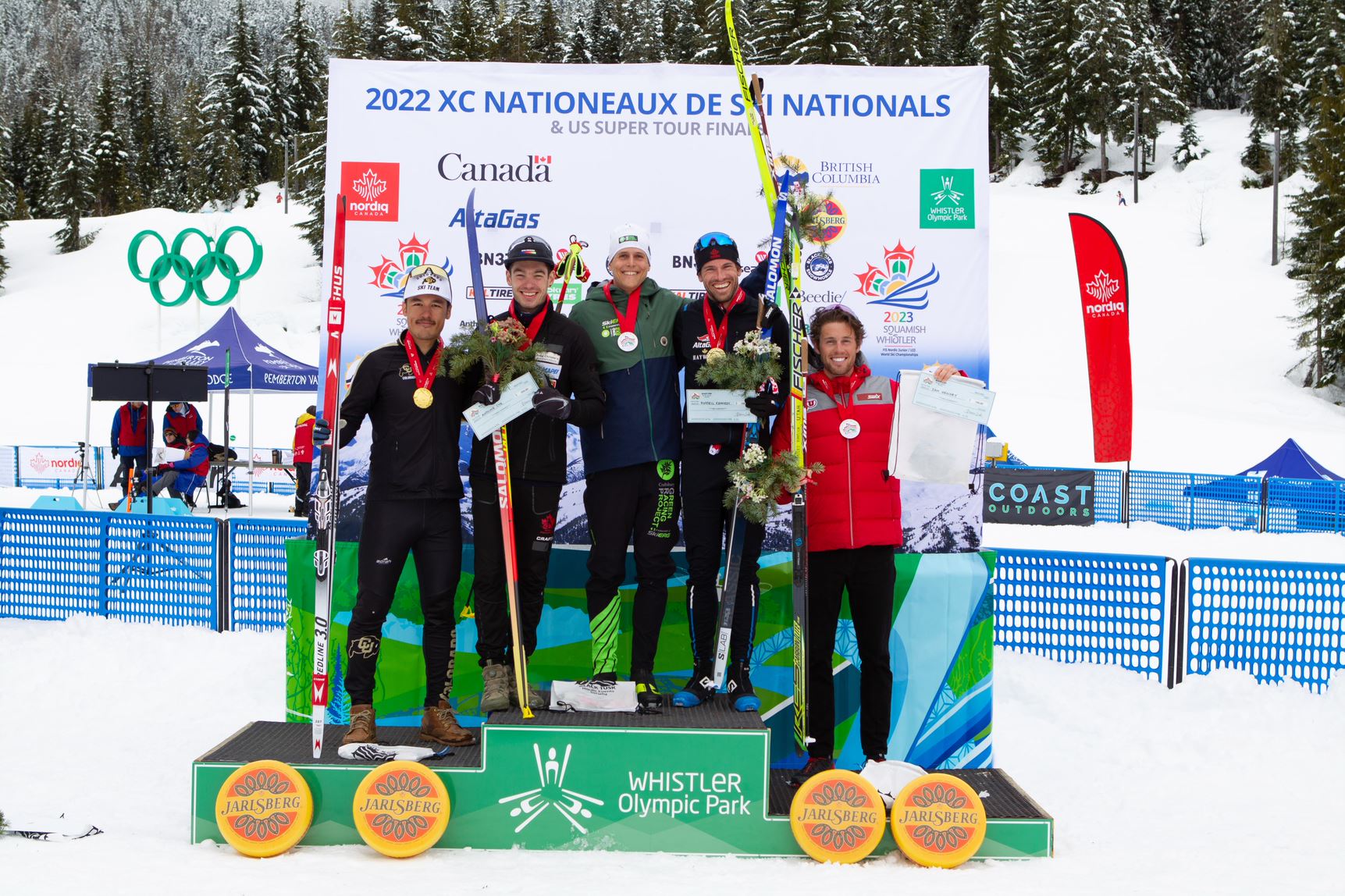
The men’s 15 k classic podium in Whistler: Adam Martin (CGRP) took the win ahead of Antoine Cyr (Skinouk), and Russell Kennedy (Canmore Nordic). (Photo: Joern Rohde / Nordiq Canada)
A successful season of SuperTour racing has Martin ranked at the top of the rankings, and earned him starts in post-Olympic World Cup events. After taking third at the American Birkie, Martin headed to Norway to race the 50 k classic at Holmenkollen, where he finished 26th. The following weekend, he skied to 44th in the 15 k free in Falun, Sweden. A week later, Martin is back with his Craftsbury team and standing atop the US SuperTour podium.
“It’s nice to return from the World Cup and still feel in good shape. After two 50 k’s, and travel, and a season that I’m really happy with, everything is a bonus at this point. I think it’s great that we are able to combine with Canada for these races. There are a lot of guys at a similar level, so it makes for some tight, fun racing.”
A 23-year-old Quebec native, Cyr’s best results have been in classic this season, namely an 11th place finish in the opening World Cup 15 k classic in Ruka, Finland, and racing with Graham Ritchie to put the Canadian team in fifth during the Olympic classic team sprint in Zhangjiakou. After the team sprint, he was praised by both his teammate and coach Erik Bråten, along with armchair quarterback Devon Kershaw, for his classic technique.
“Classic is always good for me and is a race I love,” Cyr said of today’s 15 k in a post-race interview with Nordiq Canada. “It was tough conditions this morning, and a good skier normally comes out on top in hard conditions. I was able to ski well, focus on the race, and came second overall, which is a little bittersweet because it was a really tight battle in the end. But it was really fun, the track is amazing. It’s an Olympic standard track, so it’s just really good.”
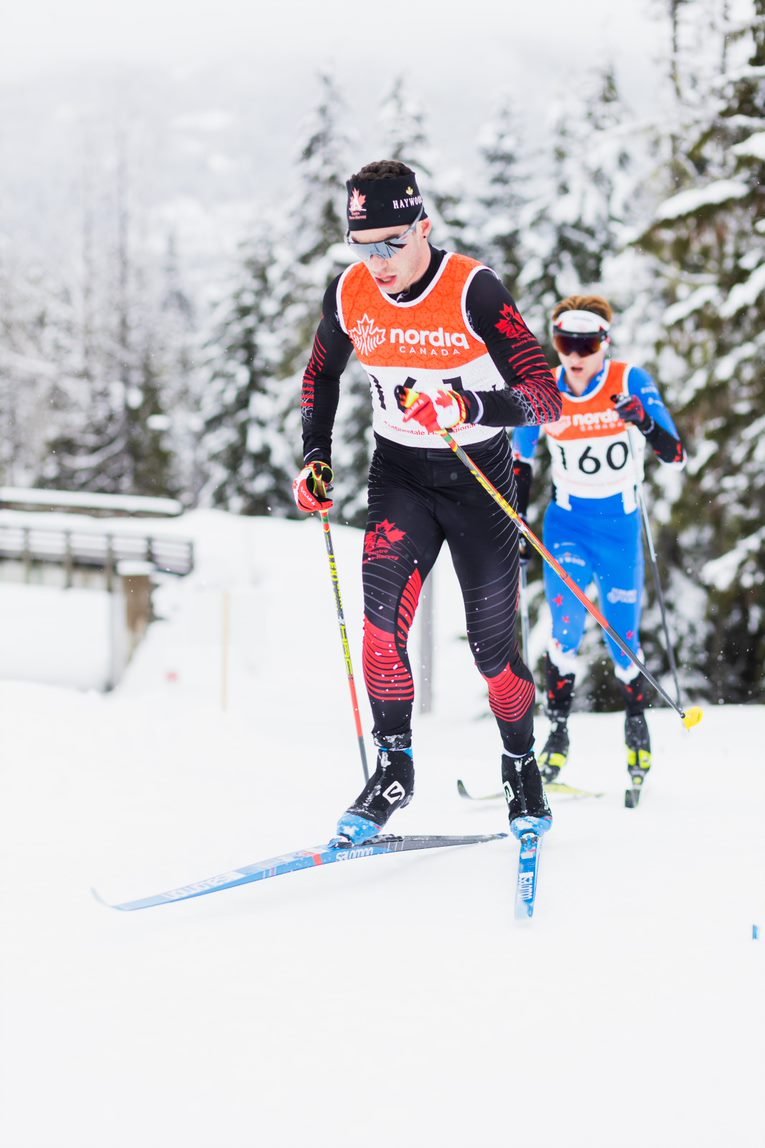
Antoine Cyr races for the Canadian National Title in the 15 k classic in Whistler. (Photo: Nordiq Canada / Nathaniel Mah)
In his second lap, Cyr had caught yesterday’s winner, Rémi Drolet (Team Black Jack), whom Cyr credited in supporting his strong result today.
“When I saw was closing the gap on him on the first lap, I decided to go a little harder than I planned to catch up with him. [I then tried] to relax behind him for a lap or half of a lap.. In the end, I was missing a little bit on the last lap. I think that that helped for sure, skiing with someone strong like Rémi.”
Finally, Cyr spoke to the importance of an international field featuring all age groups coming together this week, particularly on the heels of a two-year hiatus due to pandemic restrictions.
“It is so good for the young kids — us older guys, we’ve been racing on the World Cup, but like the juvenile and junior, they almost have no races in Canada. To have a big event like this is just amazing and we’ve been looking at the younger guys’ results for an hour yesterday, seeing who’s in good form, and who’s coming up, and you are the next guys to be like taking over. So for them, it is awesome, and for us too, racing with the US is always — it should always be like this.”
Joining Martin for the SuperTour podium, BSF Pro Team athlete Finn O’Connell was 7th overall (+1:06.4) and second American, with University of Utah’s Luke Jager half a second behind in 8th overall (+1:06.9).
Julia Kern strides for the win in tricky conditions during the 10 k classic in Whistler. (Photo: Doug Stephen / VR 45 Photography)
In the women’s 10 k, SMS T2’s Julia Kern skied a strong second lap to take the win in her second consecutive day on the podium, stopping the clock at 29:54.3. Her club and national teammate, Jessie Diggins, took the second step finishing +18.3 back, while University of Utah’s Sophia Laukli skied to third (+1:03.2).
Looking at tough conditions, Kern explained she raced by trial and error today, exploring which techniques were most efficient on different sections.
“I kind of had an open mindset going in today,” she told Nordiq Canada after the race. “I knew that the tracks might be a little bit punchy or washed out in sections, and so I was double pulling wide or double polling narrow or just like power striding on the flats if it was getting too punchy out there. So just trying it all.”
She continued that she was looking to “have fun, send it from the start, and see if I could hold that pace the whole time,” which she ultimately proved able to do. It’s the time of year where the hay is in the barn training-wise, and athletes have had a long season, leaving them in varying states heading into the last hurrah. On whether she was looking to just have fun at these races, or whether it was a serious quest for the podium, Kern said “both”.
“I think the end of the season is always really fun. It’s so cool to have this many athletes here. And I’ve been feeling really good the last few weeks and so enjoying racing when it does feel good and when I’m able to push really hard. We’re all really tired at the end of the season, but also, when the body’s in form you might as well take advantage of it and send it on the course.”
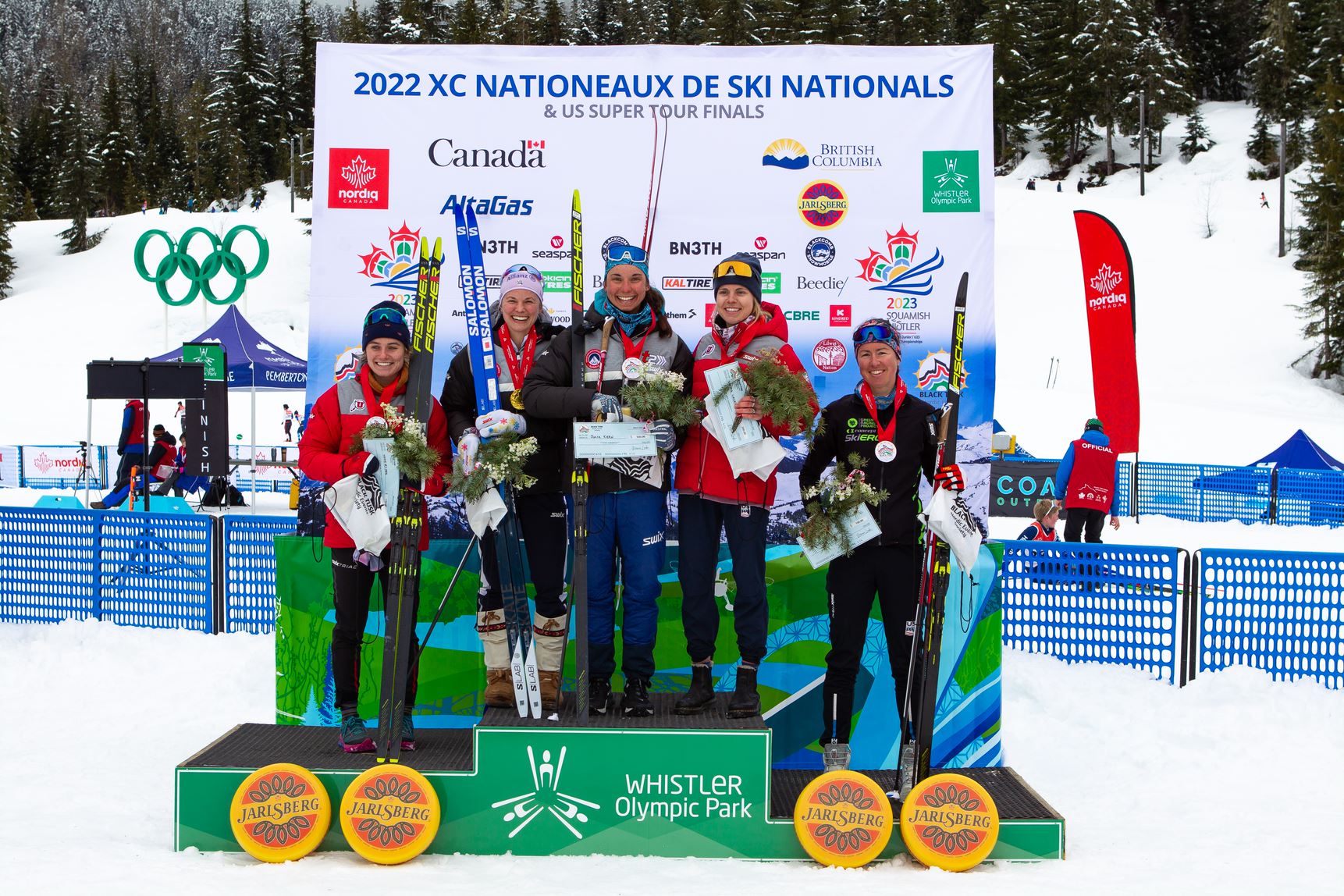
The women’s 10 k classic podium on day 2 in Whistler: Julia Kern (SMS T2) took the win ahead of Jessie Diggins (SMS T2) and Sophia Laukli (Univ. of Utah). (Photo: Joern Rohde / Nordiq Canada)
Winning back-to-back Canadian National titles, Katherine Stewart-Jones (Nakkertok Nordique) was again on top for the Canucks, finishing sixth overall (+1:17.5). Finishing in the same order as yesterday, Dahria Beatty (Whitehorse Ski Club) was second for Canada in eighth overall (+1:55.0), while Cendrine Browne (Fondeurs-Laurentides) rounded out the podium in ninth overall (+2:14.5).
“I went out really hard knowing that that’s what I had to do if I wanted to make the podium,” Stewart-Jones said of her race. “I had a good first lap, and I definitely slowed down a lot on the first part of the second lap. I was just tired and was having a hard time staying in the zone and keeping the rhythm, but I was able to pull it together a bit for the second half of the second lap. So I was really happy with that. And I was happy with how hard I pushed. I just didn’t have it quite in me today, and sometimes that happens.”
On the importance of focusing on her technique on this type of course with sub-optimal conditions, she continued, “It’s really important, especially on the climbs. The grip isn’t always perfect in these conditions, so you really have to make sure to stay on top of your skis. If you get tired and you start leaning forward, then it makes it even harder to kick… And then on the flatter sections, it was a bit awkward, and you had to expect that. Either you’re striding awkwardly or you’re doing a kick double pool, but your poles are sinking. You have to just really focus on committing to whatever you decide to do and not like trying to switch too much between.”
Speaking to already standing atop two podiums, Stewart-Jones responded with pride, while also acknowledging that the overall win would be sweeter.
“Oh, it’s definitely nice to be winning the national championship title… because we’re racing against the Americans, I obviously care about the overall too, so maybe it feels a little less exciting, but for sure, I’m proud of that.”
Katherine Stewart-Jones (Nakkertok Nordique) takes back-to-back national titles in the women’s 10 k classic in Whistler. (Photo: Doug Stephen / VR 45 Photography)
In order to get closer to the overall podium, she said he would focus on resting as much as possible and maintaining the head space to perform her best. “It’s been a long season and I haven’t raced this much in a long time. I think everyone’s pretty tired. But also just being able to also be mentally strong [over the next races]. And yeah, you never know what’s gonna happen.”
Racing continues Wednesday with individual classic sprints, which will be live-streamed by the Black Tusk Nordic Events Society. If you’re looking for additional video updates, follow along on the Nordiq Canada and Black Tusk Instagram pages.
The final weekend of SuperTour racing in Period II, and the final weekend within the Olympic qualification window, kicked off Saturday at the Lake Creek Nordic Center in Ketchum, Idaho. Part of the 2022 Sun Valley Nordic Invitational, the SuperTour races were held in conjunction with a Montana State University RMISA event and an Intermountain XC junior national qualifier.
Highlighting the size of the event, there were 157 female athletes in the field. With 141 senior and U18 men racing in the 10k, and another 46 racing in the men’s U16 5k. Spanning all age groups, an additional 70 U14 athletes and another 18 U12 athletes raced a 3k and 2k course, respectively. In all, nearly 400 cross country skiers, from Olympians to 10-year-olds in their first seasons on skis, made their way around the tracks in Lake Creek.
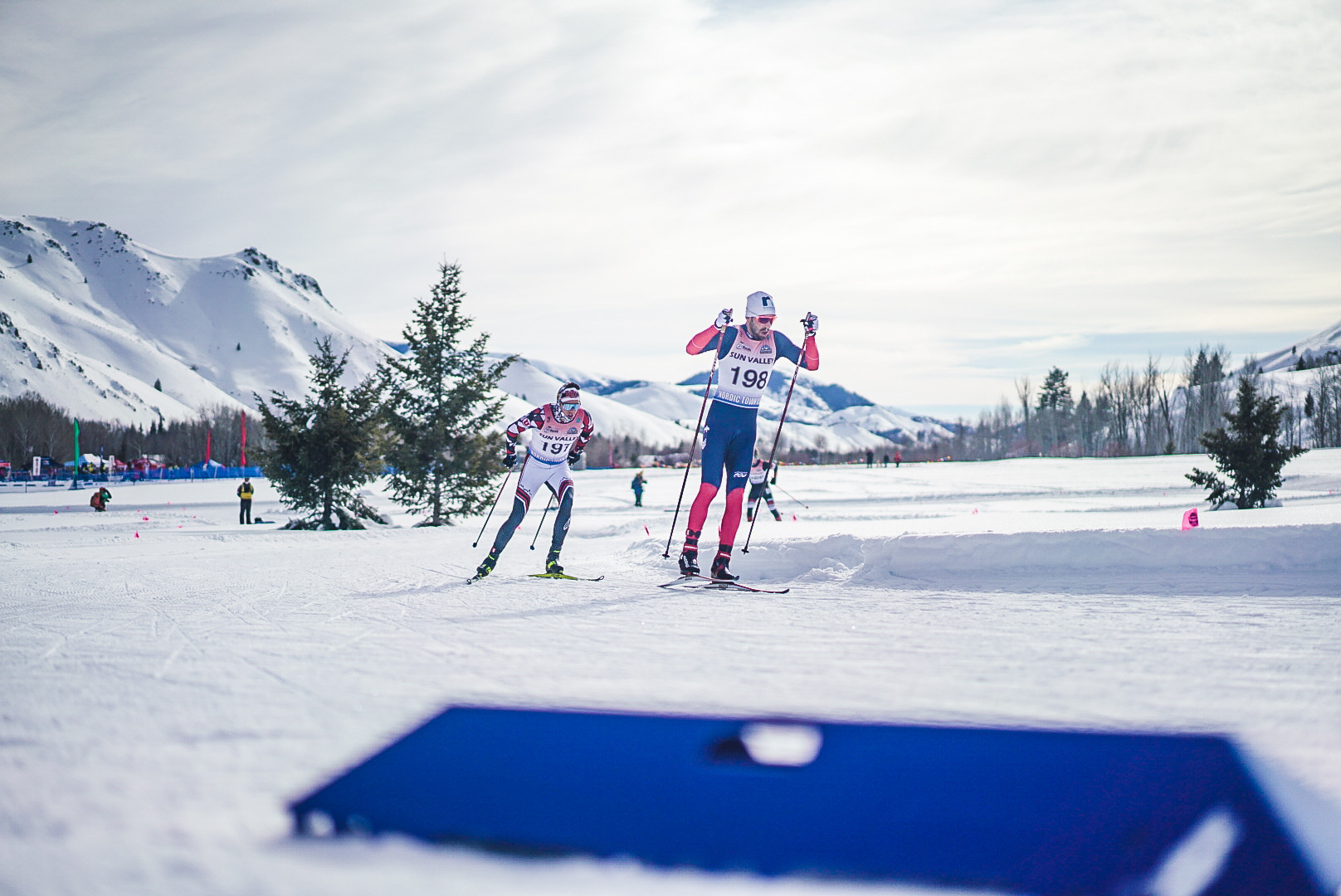
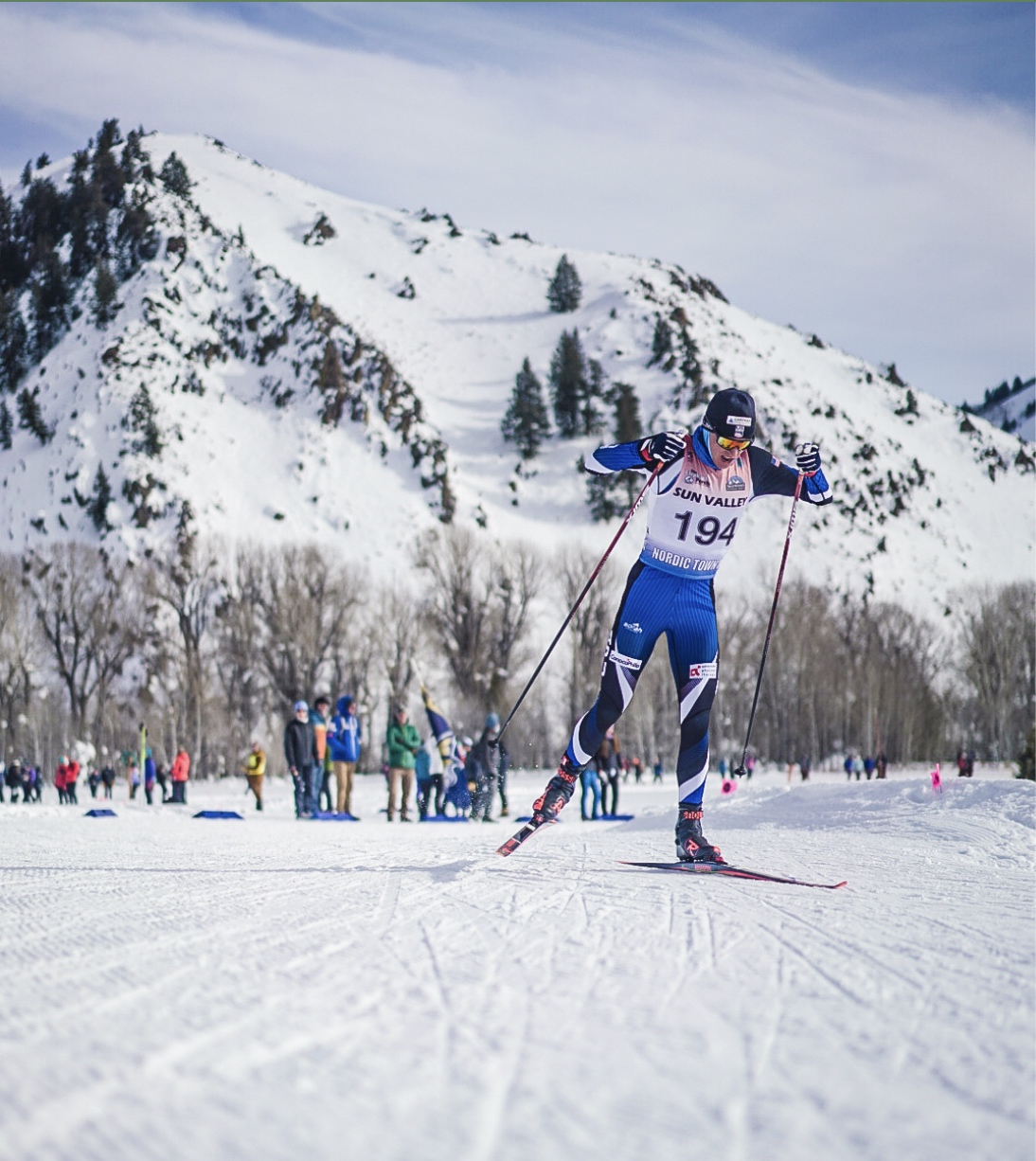
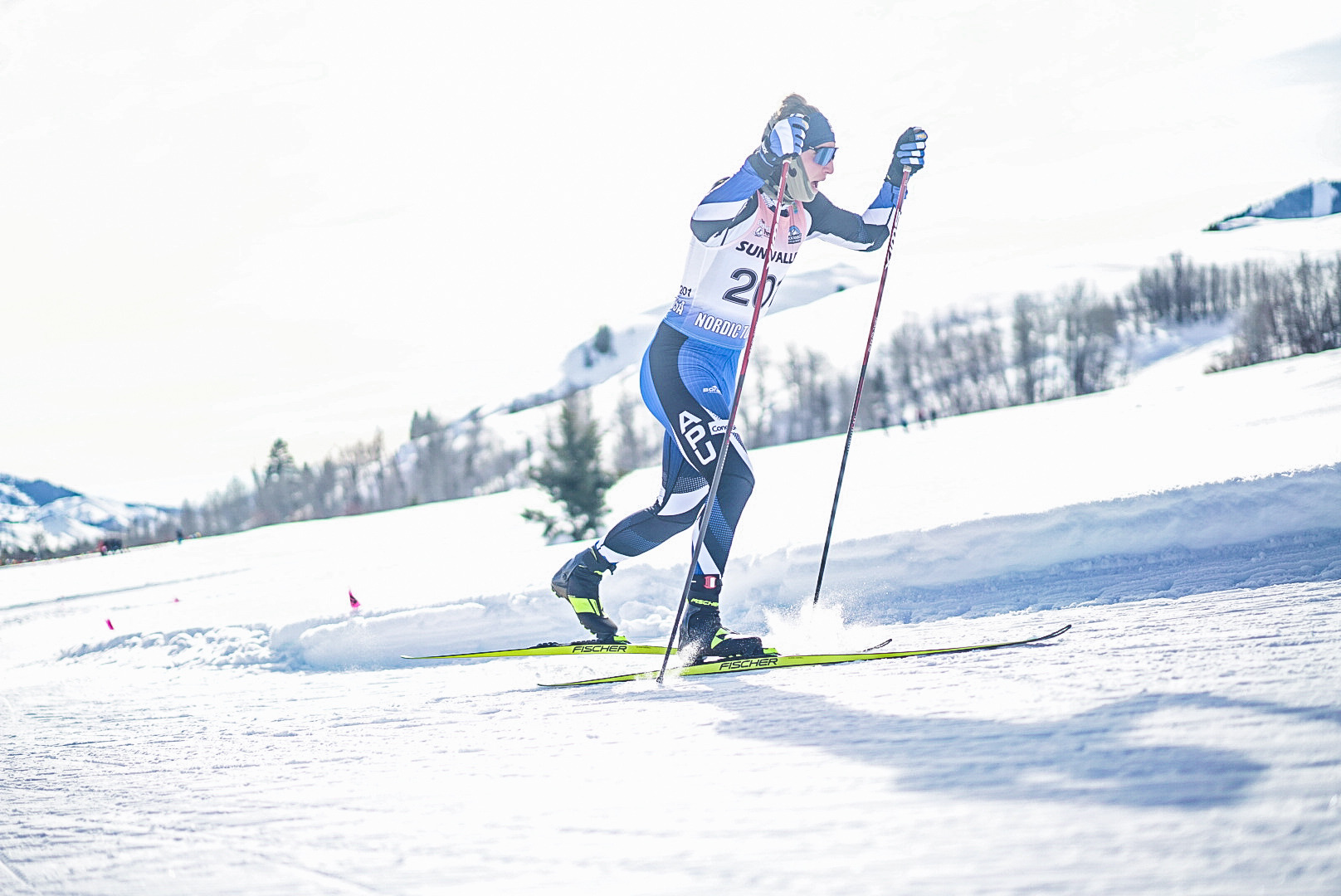
An athlete races the 10k interval start free on the Lake Creek trails in Ketchum, ID. (Photo: Tobias Albrigtsen / @untraceableg)
As the World Cup events in Les Rousse, France and Planica, Slovenia were both cancelled due to rapidly increasing coronavirus caseloads with the omicron variant, several athletes who might have headed back to the World Cup for these events found their way to Sun Valley instead, meaning fields were more in line with the U.S. Cross Country Championships than a typical SuperTour.
On the women’s start list for the 5-kilometer individual start skate, which kicked off the weekend of distance racing, were six women who have spent at least part of their season racing on the World Cup: Rosie Brennan (USST/APU), Caitlin Patterson (CGRP), Katharine Ogden (USST/SMS T2), and three University of Utah athletes who are also members of the U.S. Ski Team, Sophia Laukli, Novie McCabe, and Sydney Palmer-Leger.
Likewise, the men’s 10k field included seven World Cup athletes: David Norris (APU), JC Schoonmaker (USST/UAA), Scott Patterson (USST/APU), Hunter Wonders (USST/APU), Zanden McMullen (USST/APU), Luke Jager (USST/U of Utah), and Zak Ketterson (Team Birkie).
Given Ketchum’s elevation of roughly 5,950’, approximately the same as the courses in Soldier Hollow, Utah and those Olympic team members will face in Ziangjiakou in February, the events provided another opportunity to spend time training at the elevation and to hone their approach to racing at altitude. Overnight lows in the single digits meant cold air and snow temps at the start of the women’s race, another important similarity to forecasted Olympic conditions.
According to co-chief of competition Kelley (Sinnott) Yeates, livestream was not available during the Sun Valley Nordic Invitational due to connectivity issues along the courses. As such, FasterSkier’s reporting this weekend is based on live timing and the feedback of those on-site.
Of the course, Sun Valley native Johnny Hagenbuch provided insight into the 5km loop that was raced today in an email to FasterSkier: “The new courses at Lake Creek are very difficult: they essentially removed all the flat from the old course and replaced it with the biggest climb at Lake Creek.”
Senior Women’s 5k Free:
Without the ability to view the race and no intermediate splits in the live timing, the women’s race results left little room for suspense. Given her dominant performance in the 20k skate during the U.S. Cross Country Championships, it was no surprise to see Rosie Brennan’s name top the list. Brennan smashed the 5k loop, finishing in 14:28.6, a full 48.6 seconds faster than the next woman.
Rosie Brennan enjoys a wintery training day before the weekend of World Cup racing in Davos, SUI. (Photo: NordicFocus)
“I decided to come to Sun Valley after the World Cups in France were canceled,” Brennan wrote to FasterSkier in a post-race email. “My coach, Erik Flora, has been up here all week with the rest of my APU teammates, so it made sense for me to come here to be able to work with my coach and teammates. That has been the total silver lining of the World Cups being canceled. Erik is not allowed to come to the Olympics, but is my personal coach and someone who I trust and value immensely, so getting this extra week to work on things with him has been such a welcome surprise.”
Now several weeks into an extended altitude block, Brennan has been training near her childhood home in Park City, UT. The races in Soldier Hollow put her back on familiar tracks with hometown advantage, and the nostalgia continued today.
“It has been a full circle moment for me this weekend as I spent many years racing JN Qualifiers in Sun Valley growing up, so to be back here doing so now as I prepare for the Olympics has brought back all kinds of memories from my whole ski career. My high school and college coach were also out there today cheering and it’s been really special to have this extra time in the U.S. to share moments with people like that who have helped in getting me to where I am today.”
Brennan had originally planned to rejoin the U.S. Team in Europe, but following the cancellations of the two remaining World Cups before the Olympics, has shifted her plans to limit her risk of covid exposure, as a positive test might jeopardize her ability to travel to China, regardless of the severity of her case.
“With travel being risky on all kinds of levels today, I decided to just stay put after the World Cup cancellations and make the most of the training opportunities I have here in the U.S. before heading to Beijing. This weekend is serving as a replacement for the races I would have done in France and also another opportunity to test my limits at altitude. We just incorporated the races into a little intensity block to get my engine running again after a good volume block.”
Rosie Brennan logs hours on home trails during an extended altitude camp near Park City, UT. (Photo: Instagram @rosiewbrennan)
Speaking to her feelings holistically as she prepares for the Olympics, entering the Games on the heels of a career-best 2020/21 season with a host of early-season indicators that she can be a medal contender, Brennan spoke to the stress athletes face amidst the pandemic, which has added layers of complexity in traveling to Beijing and entering the Olympic bubble.
“It’s definitely a stressful lead up to the Games with COVID raging everywhere, a multitude of requirements and things that need to get done to be allowed into China, and figuring out all the details of being prepared for such a long travel to a very foreign country with lots of restrictions. I am doing my best to just stay on top of all the requirements, stay far away from everyone I can, and chip away at the things I need to be prepared for. The training at home has been great and having a coach to work with is so helpful, so from an actual racing perspective, I am feeling good and optimistic. I feel very lucky to have a home base in Park City and that the venues in the area provide good preparation for the Games.”
Sophia Laukli races to second overall and finishes the top collegiate racer in the women’s 5k interval start free in Ketchum, ID. (Photo: Instagram @utahskiteam)
Recovered from racing the Tour de Ski, where both women notched top-10 finishes on the hill climb, Sophia Laukli (USST/U of Utah) took second place (+48.6) today, with Novie McCabe four seconds behind in third (+52.6). Katharine Ogden (USST/SMS T2) was fourth (+52.0) for the women, with Rosie Frankowski (APU) next (+59.8) to round out the top-five.
With their top-three overall finishes, Laukli and McCabe also took home top results in the collegiate standings on behalf of the University of Utah. With teammate Sydney Palmer-Leger in 7th overall (+1:32.5), the Ute’s swept the RMISA podium.
“Today was definitely quite the race,” wrote Laukli after the race. “I was really looking forward to it since I love 5k skates, and courses with lots of climbing. I was also excited to get back into racing after the tour, especially on the domestic circuit which I was starting to miss. I was very happy with how the race ended up today, and it was actually a bit of a surprise (results-wise) just based on how I felt during it. I know I was not alone by getting rather cold out on course, but it felt like quite the shock to the system and difficult to get in a good groove—sometimes that will happen though! While it was probably one of the hardest 5ks I’ve ever done, it’s an awesome course and I just had fun getting back into racing after a short break.”
Commenting on her recovery post-Tour de Ski and her goals over the next couple of months, Laukli continued, “I took the past couple weeks very easy in my training, with minimal intensity, to recover from the tour. I wanted to take advantage of that racing block to really get into my best racing shape so taking a step back in training right after was important. The rest of the season is still a bit up in the air, but I know these races at altitude will be great preparation if I do end up at the Olympics. Either way, I’m planning to continue doing some college races and hopefully NCAAs, so these races will be good prep for that as well.”
With Sophia Laukli and Novie McCabe also taking second and third on the overall podium, Sydney Palmer-Leger brought the Ute’s home for a collegiate podium sweep. (Photo: Instagram @utahskiteam)
Other noteworthy results include the retired, but nevertheless still a contender, Caitlin Gregg, who hopped into the race while still serving as a co-head coach of the Midwest’s Team Birkie. Gregg finished in 8th (+1:37.5), just ahead of the day’s top Craftsbury skier, Alexandra Lawson.
Also, Caitlin Patterson, who earned a spot on the podium in each of the events at the U.S. Cross Country Championships and SuperTour in Soldier Hollow, finished 17th, nearly two minutes behind Brennan. In a post-race Instagram story, Patterson wrote that she had been very cold during the race with numb legs and toes, which left her feeling like a “floppy fish popsicle.” Despite finishing below where she was perhaps aiming, Patterson remains in second place behind Frankowski in the SuperTour overall standings, and in second behind Brennan in the Olympic qualification rankings for distance racing.
Senior Men’s 10k Free:
The men’s field would race the same lap the women did, but twice. That meant there was a time checkpoint at the halfway mark to indicate how the race was shaping up, yielding interesting insights into just how tight a spread the top of US men’s skiing is right now. With World Cup athletes, elite-level domestic racers, and top collegiate skiers from the West, there were plenty of names to watch.
Ian Torchia (SMS T2) leads Sam Hendry (U of Utah) during the SuperTour 10k individual start in Ketchum, ID. (Photo: Tobias Albrigtsen / @untraceableg)
An Aspen, CO native and no stranger to altitude, Graham Houtsma (BSF Pro) was early off the line as the second starter in bib 172. Houtsma came across the 5km split as the early leader at 13:30.3. His mark would look to be the point around which the top of the field clustered for the first part of the race. Then, Scott Patterson (USST/APU) came through in bib 194 and raised the bar. His split topped Housma by a full 30 seconds (13:00.2), and would be chased as the remainder of top-seeded athletes lapped through.
Before diving into that group, however, a caveat. A couple of the top skiers today weren’t assigned splits at all in the live timing, including overall SuperTour leader Adam Martin (CGRP), Johnny Hagenbuch (USST/SVSEF), and top-collegiate finisher, Bernhard Flaschberger (U of Denver). That gave an incomplete picture of what the race looked like through one lap, setting the stage for a few surprises in the eventual final results.
Scott Patterson skis to fifth in the 10k individual start free in Sun Valley. (Photo: Tobias Albrigtsen / @untraceableg)
So what did we know through 5km? If you were just observing, you would have seen Patterson overtaken by one, and only one, skier. Teammate Hunter Wonders (APU) completed the first lap of the course 3 seconds ahead of Patterson at 12:57.9. The field that had splits looked to be shaping up into a tight affair, with the top 5 skiers all within 15 seconds of each other. That included Wonders in the lead (12:57.9), with Patterson next (+2.3), Ian Torchia third (+8.5) seconds, David Norris (APU) in fourth (+10.0), and Finn O’Connell (BSF Pro) in fifth (+12.1). Based on eventual results, it is safe to assume that Hagenbuch, Flaschberger, and Martin all went through in the 13:00 min pack too.
At the finish, Wonders would cross the line in first place at 26:28.7, and slightly increase his lead over the pack in the second lap. Over Torchia, it had grown to 8.5 seconds, and Patterson 20.9 seconds. But it would be the skiers of the “mystery 5k” splits that really made a difference in defining today’s results. Hagenbuch came in soon after Wonders, and crossed the line in 26:15.4. It would prove to be a mark no one could top on the day. Bernard Flaschberger too, would slotted himself into the top of the pack – finishing less than a second ahead of Ian Torchia to claim 3rd.
The top 5 of the final results then, looked finished like this: Johnny Hagenbuch with the win in 26:15.4, Hunter Wonders in second (+13.3), Bernhard Flaschberger in third (+27.0), Ian Torchia in fourth (+27.5), and Scott Patterson fifth (+34.2).
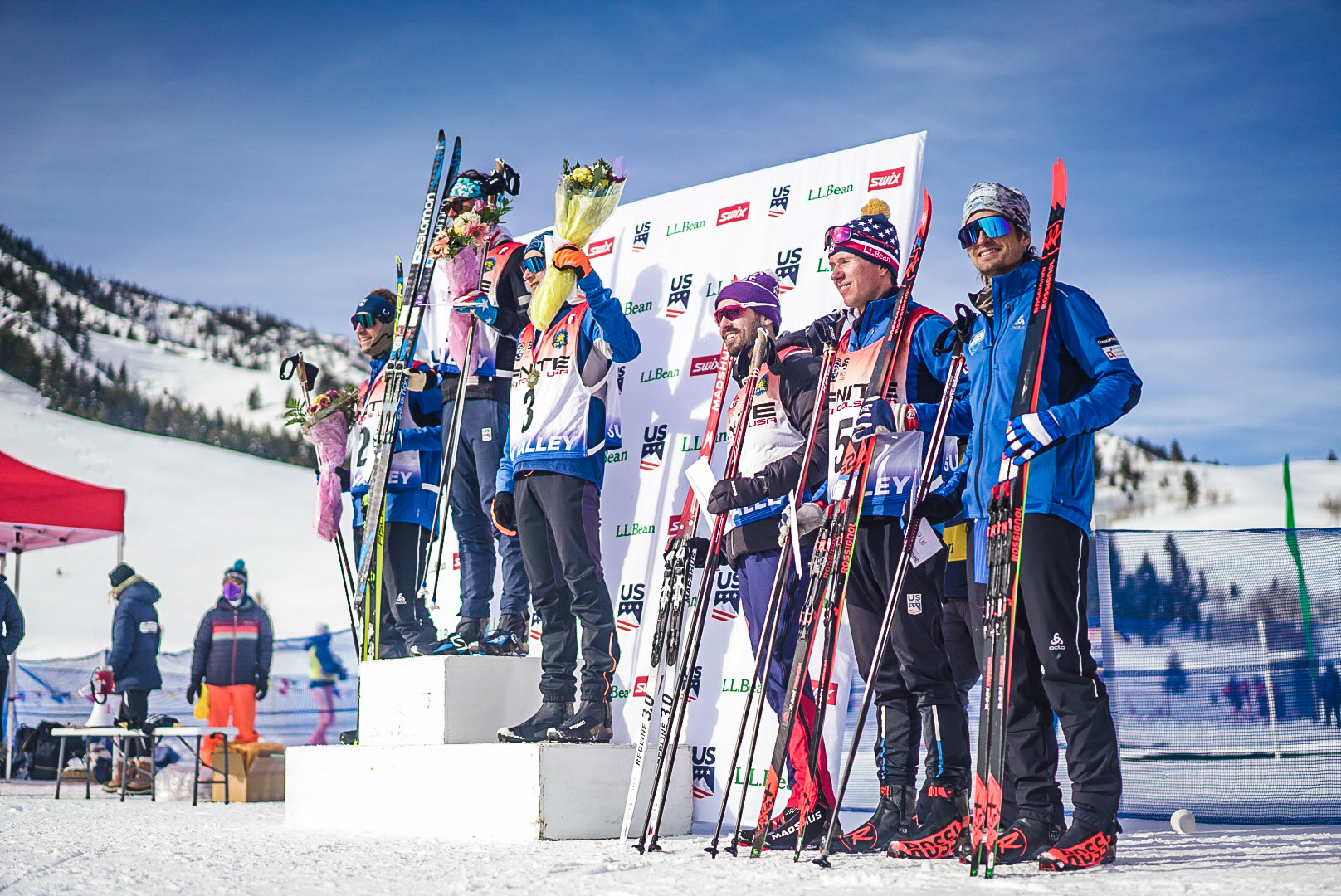
The men’s podium of the SuperTour 10k individual start skate in Sun Valley, including the top-six athletes. (Photo: Tobias Albrigtsen / @untraceableg)
In an email to FasterSkier, Hagenbuch pointed to an intimate knowledge of his home course in Sun Valley as being a key to his impressive margin at the top:
“The conditions were firm and well skied-in, and it was fairly fast. I have skied a whole lot here at Lake Creek in my years, and I knew the race was going to be super hard. I think it’s important to focus on the transitions and more rolling parts of the courses at Lake Creek, as just about everyone will be suffering on the climbs. I tried to ski [with a] really big, powerful V2 on the more gradual north end of the course; the strategy for the uphills was mostly to step on and off the skis quickly.”
With his results, Hagenbuch wins his first SuperTour of the season, on his home course, to boot. Not too shabby for a Saturday morning in Ketchum. He also did so in convincing fashion, rising above a field of seasoned SuperTour athletes to claim a definitive win by a stout margin. It will also improve his 5th place overall in the SuperTour standings, replacing two 6th place finishes from early in the season at Duluth.
On his win, Hagenbuch wrote, “frankly it’s quite a relief to have done well today, as I feel I haven’t really expressed my shape to the fullest for a variety of reasons this season… I’m just taking it day-by-day, [and] it was a real treat to have so many friends and family to cheer me on at home in a field that was deeper than U.S. Nationals.”
Hunter Wonders skis to second place in the men’s 10-kilometer individual start skate race in Ketchum, ID. (Photo: Tobias Albrigtsen / @untraceableg)
Elsewhere in the SuperTour standings, Wonders’ 2nd place finish will improve his distance standing going into today from 12th overall – replacing a 4th place finish in Soldier Hollow in the 15km Classic off his point standings. Overall SuperTour leader Adam Martin finished 7th (26:57.6) on the day, while 2nd place holder JC Schoonmaker was 21st (28:04.3).
“Today was a solid effort,” Wonders wrote to FasterSkier after the race. “It’s been a while since I’ve been home to Alaska and that’s started to weigh on me this week. Leading into the racing I was low energy trying to get my feet back under me after nationals in Utah. It was a good confidence boost and a pleasant surprise when I realized I was having a good day on the course today.”
Shedding light on the course conditions for those unable to watch, Wonders continued, “It was amazing conditions for a race, not too cold with firm grooming which is always welcome. 10k is pretty short, so I knew I had to take it out hot. I was a little concerned about blowing up, but realized that the course had more recovery when you’re at race pace versus easy skiing. The high part of the course is brutal but it sets you up into a ripping decent to the finish. Overall, it was a great day and I’m happy with my racing and thankful for my teammates keeping my spirits up this week and the coaches hooking me up with some great skis.”
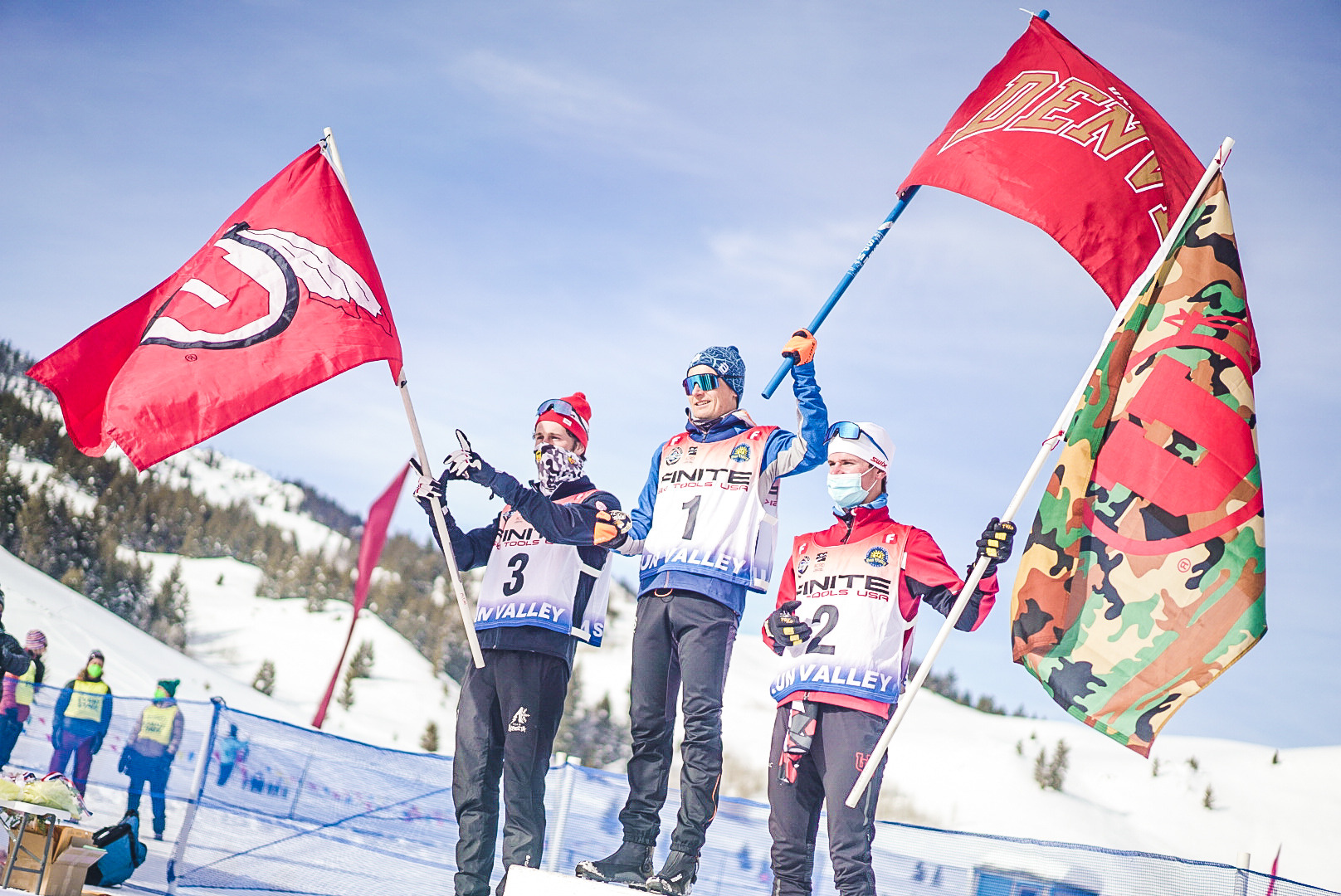
In the RMISA collegiate standings, the Utes again had a strong podium showing. With Flaschberger taking the win for Denver, Walker Hall (U of Utah) Sam Hendry (U of Utah) skied into the next two collegiate spots to solidify the overall lead for Utah this weekend.
The RMISA men’s podium of the 10k interval start classic in Sun Valley: Bernhard Flaschberger took the win for the University of Denver, ahead of Utah’s Walker Hall in second and Sam Hendry in third. (Photo: Tobias Albrigtsen / @untraceableg)
NextGen coach Eric de Nys and NDC TBay’s Timo Puiras review results from an informal 15km time trial on November 28th. This ‘race’ was the first to feature athletes from multiple regions in twenty months, featuring athletes from CNEPH, TBay, AWCA, and more.
Last season, Canada held no races, posted no domestic results, and, in general, vanished into the pandemic fog.
Travel restrictions meant that many Canadian skiers didn’t see any skiers from other regions.
Which skiers made progress and which regressed over the last 20 months? We finally have hints after the first races last weekend. What is new? Lots. What happens next? Keep reading.
Athlete Progress
Following the opening FIS races, part of the Western Canada Cup series, which happened December 4th and 5th at Sovereign Lake in Vernon, BC, Nordiq Canada and its followers finally had results that could be used to assess athlete progress.
Many athletes from Québec, Ontario, Manitoba, Alberta, and BC spent time at Sovereign Lake in November, getting a combination of elevation and snow. Most were confident in their preparation based on summer training with teammates, including the few athletes who race the World Cups last season or were in Europe in November. However, the coaches were still likely to shrug when asked who was fast this year.
FasterSkier’s research suggests that Sam Hendry was the Canadian with the most races last year. A student athlete at University of Utah, he was able to travel and compete on both the SuperTour and NCAA circuits. The small group of athletes who raced World Cups and U23/U20 Championships in February and March had no warmup races before racing at the top level and ended the season with less race days than Hendry.
FasterSkier will be sharing more in-depth athletes profiles in the coming weeks.
Calendar Changes
Canada has dropped the NorAm name, a leftover from the depths of history when the US and Canadian series merged into one North American series. Since the SuperTour split off some years back, the reversion to the Canada Cup name (as in a Continental Cup race held in Canada) is appropriate, even overdue. A name change, however, is simply symbolic. Real change requires action, and action usually results in anger from the people who were demanding change.
As originally planned for last season, the series is now divided into Western and Eastern, which is expected to reduce travel costs and make it easier for skiers to stay in the sport until they are ready to earn a permanent place on the World Cup team. The obvious downside is that the top skiers won’t meet until national team and Olympic trials in Canmore. FasterSkier has been talking to skiers about pros and cons and will follow this shift closely.
Building a season schedule in Canada doesn’t get much easier with the east/west division. The country spans 5.5 time zones and the geographically larger west division has a much smaller population. Every possible calendar and scenario includes lots of travel.
Olympic trials need to be held at elevation as Beijing is at 1,800m, and the west has the only three homologated courses above 1,200m (Canmore, Rossland, Sovereign Lake). Ideally, there would have been early trials on snow for the World Cup period 1 starts, but that would also have to be in the west because the east doesn’t have appropriate courses available in October/November. With 2022 Nationals scheduled for Whistler, the obvious solution would be to have all major events in the west. This would (reasonably) be seen as unfair to eastern athletes. The ‘least bad’ answer was not to have trials in October.
The divided schedule has Sovereign Lake December 4th-5th followed by Rossland, also in BC, on the 11th-12th. In the east, Nakkertok, just north of Ottawa, will host races on the 11th-12th, followed by Mont Sainte Anne, further east in Quebec, on December 18th-19th. Everyone comes together for the first time at the trials in Canmore January 6th-11th. These competitions will be used for athlete selection for the Beijing Olympics, U23/U20 World Championships, and World Cup period 4, which means pressure to perform for everyone.
Nordiq Canada Changes
NC has made a tonne of staff changes since last season. There is now a NextGen coach to bring skiers up to the top level, and a Development Coach to deliver skiers to the NextGen coach. Chris Jeffries, longtime leader of the Alberta World Cup Academy, has been named High Performance Director. Julie Beaulieu is working on the development side. Nathaniel Mah has retired from Nordic Combined competition and is Marketing Engagement Coordinator. Ilona Gyapay has had a role shift, described by one deeply-connected race official as ‘the new Dave Dyer’. (Dyer spent many years with Nordiq Canada, before ending his career as Events Director.)
Erik Bråten was originally hired in the fall of 2018 as a NextGen coach with a secondary focus on developing the base of the pyramid before having his role changed almost immediately to the “Everything Coach”. After two and a half seasons, he left NC in April, 2021. He later rejoined as a World Cup coach for the 21/22 season.
Eric de Nys was selected as NextGen coach in June. He started work in August, joining in at the Penticton national team camp organized by Dave Wood, which had been moved to Vancouver Island to escape wildfire smoke.
De Nys organized the traditional Canadian elevation camp in Mammoth, California. For BC athletes this was out of the smoke and into less smoke, as California was also burning. This camp is important for Canada because it allows a range of elevations that aren’t practical in BC or Alberta and don’t exist in the rest of Canada.
“BC has good elevation, but in an Olympic year, good enough won’t be good enough.” — Wood, July 2021.
Matt Smider was hired as Development Coach in time for Canmore’s Frozen Thunder team camp in October, once again led by de Nys. Smider is known for sparking the growth of small town Revelstoke Nordic into the big leagues; these skills will be useful to fill the development pipeline.
De Nys lead a mix of NextGen and World Cup athletes to Muonio and Gällivare to race continental cups, with promising results against the top skiers from Finland, Russia, Italy, and Sweden. At this point, the casual observer might think that the NextGen coach role was blurring to fill the gap created by the absence of a national team head coach.
Future
With back to back Top-15 finishes, Nordiq Canada’s Antoine Cyr is 12th in the 15k freestyle pursuit in Ruka. (Photo: NordicFocus)
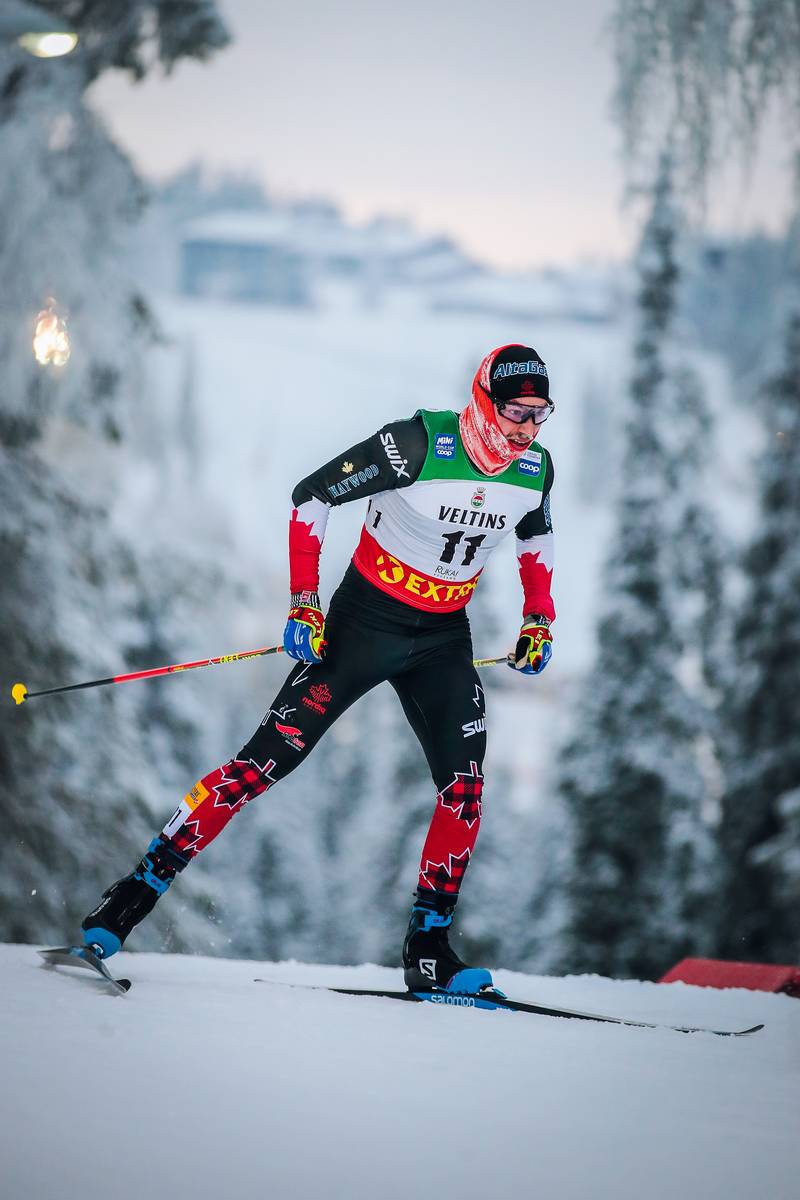
Racing season is here and most eyes will be focussed on the next race. Some Canadians began their seasons in Europe. Rémi Drolet and Russell Kennedy knocked out good results in Finland and Sweden. McKeever easily won all three junior races in Gällivare against a stacked Swedish field. In the first World Cup weekend in Ruka, Antoine (Toni) Cyr led the way with an 11th in the classic 15km and 12th in the free pursuit. First year senior Olivier Léveille moved up to 17th in the pursuit while Russell Kennedy, Katherine Stewart-Jones and Cendrine Browne all earned World Cup points.
Jeffries will join full-time in April, the delay allowing him to make sure his current Alberta World Cup Academy athletes don’t have their Beijing preparations interrupted. He was clear that adding a head coach is a priority for next season.
This writer had two full seasons without seeing any of the athletes race in person, which leaves me feeling blind. The last FIS points race I watched in person was the 2019 WC finals in Québec City. It is hard to go into a new season without a good guess of which athletes to watch, but that challenge is shared by the athletes themselves.
Canadian racers missed two years of nationals and an entire season. For an athlete having a breakthrough year, nationals is where they get to show that improvement. Nationals is also the one chance for domestic racers to test themselves directly against the WC team.
“For an 18 year old to miss a year and really two years when 2020 Nationals were cancelled, is a huge amount of time,” de Nys said. “For a first year U20 aged athlete, they will have missed racing a Nationals and an entire calendar year as a U20 with another Nationals completely. In essence, they will go from a Junior to a Senior with no race experience to help them navigate that landscape.”
With some Canadian skiers doing well in Europe and others waiting to test their progress, it is fair to ask how Nordiq Canada will help them succeed. It is common to hear people in the sport use phrases like ‘those people in Canmore’ or refer to Nordiq Canada as an opaque office that is not connected to the clubs and provinces.
“A lot of our resources and core operations still get based out of Canmore. So an athlete that lives in Quebec on the National Ski Team still probably feels as though they’re not as engaged in the National Ski Team as an athlete skiing in Canmore, [and] we need to change that,” Jeffries told FasterSkier. “But it’s already changing.”
Jeffries went on to point out that CEO Stéphane Barrette, HP Manager Joel Jaques, de Nys, Smider, and Jeffries himself do not live in Canmore.
“One of our number one objectives for the first two years of this next quad is to make inroads on breaking down that perception of those barriers.”
Watch this space for more detail on NC direction as FasterSkier was able to catch up with Barrette, Jeffries, de Nys, and Smider on the snow at Western Canada Cup #1.
A composed David Norris talks with local media moments after winning the 2021 Mount Marathon race in Seward, Alaska. (Photo: Twitter screenshot from Alaska’s News Source)
Men’s race
Most athletes pay their dues as they work their way up the results list for Mount Marathon, the grueling 5-kilometer, 3,000-foot-gain out-and-back race in Seward, Alaska, that dates to 1915. There is no substitute for experience on the technical course, and most people need to get their rookie run out of the way before they can even think of challenging for the overall victory in subsequent times on the mountain.
David Norris is not most athletes.
Racing on an overcast Wednesday afternoon, Norris lodged his third-ever start in what is believed to be the country’s oldest mountain race. Roughly 43 minutes later, he had claimed his third-ever victory, continuing his winning ways as he ran down Fourth Avenue in downtown Seward before a crowd of thousands.
Norris’s time of 43:27, though well off his course record of 41:26, was still just outside the all-time top-10 list for a race that has was first held in World War I. He probably would have cracked the top 10 if he hadn’t slowed to high five children lining the final few blocks.
Norris’s aerobic fitness, even for a world-class cross-country skier, is superb. In June he lowered his own course record on the uphill-only Bird Ridge hill climb (3 miles, 3,400 vertical feet) to a frankly staggering 35:40, well over a minute ahead of anyone not named David Norris on a course that has been covered by virtually every Alaska-based nordic athlete in the past three decades.
On Wednesday, Norris used these skills to hit the halfway point of the climb in 18:25, already well ahead of Canadian skier Sam Hendry (second at this year’s NCAA Championships for University of Utah) in 18:59 and pro trail runner Darren Thomas in 19:21. By the turnaround, at 2,974 feet at a false summit midway up the mountain, the gap had grown to nearly two minutes: Norris in 31:54, Thomas in 33:48, and Hendry in 34:27.
David Norris descends a near-vertical shale field approaching the end of the 2021 Mount Marathon race in Seward, Alaska. (photo: Twitter screenshot from Alaska’s News Source)
Hendry overtook Thomas on the descent to move back into second, as the athletes plummeted nearly 3,000 feet in less than three kilometers, but Norris padded his lead as he ran alone to the finish. The final podium was David Norris, 43:27; Sam Hendry, 46:00; and Darren Thomas, 46:09, according to unofficial live results. Fourth went to Michael Connelly, a bronze medalist at 2019 Youth World Skyrunning Championships, and sixth to Lars Arneson, who holds the unsupported Grand Canyon Rim-to-Rim FKT, reflecting the depth of the Alaska mountain running community. (Another Salomon-sponsored athlete from Outside was seventh.)
“It feels good. I’m stoked to be back” at this race, a composed Norris told local television broadcasters after taking the time to put on a dry shirt and drink some water, looking barely winded and conducting his post-race interview while the rest of the podium was still on the course.
“I felt good,” he continued. “The mud [on the first part of the ascent] was super-slick, so I was just being patient till we got out of the trees. Then I figured, use the fitness where the footing’s good.”
“It’s great to see that we’re able to pull this off” again, Norris said, after the 2020 race was cancelled due to Covid and the 2019 race was marred by poor air quality due to wildfire smoke. “It’s fun to be out here with so many good friends, and the Alaskans who are psyched to run up a mountain.”
So what’s next, Norris was asked. “Now it’s just rollerski time trial time,” he said, as he looks ahead to this winter’s Olympics.
Norris holds the all-time course record for Mt. Marathon, 41:26, as well as the third-fastest time. Second place on the all-time list is held by Kílian Jornet (yes, that Kílian Jornet), from 2015. Other notable skiers in the all-time top-10 include former UAA and APU skier Eric Strabel, and 1988 Winter Olympian Bill Spencer.
Women’s race
Rosie Frankowski’s race began a lot like Norris’s: she was first by nearly a minute at the halfway point of the climb, and first by nearly two minutes at the top. Unfortunately for the APU skier and Olympic hopeful, the finish line is back down at sea level – and no one else in the top five needed to hold back a little on the descent to avoid incurring an injury in the run-up to the Beijing Olympics. Frankowski would ultimately finish fourth this year, after taking a notably non-aggressive line on the descent in 2018 to slip from first to seventh.
In this file photo, Rosie Frankowski races the first stage of the FIS Ski Tour 2020. (Photo: NordicFocus)
The uphill, however, was all Frankowski. She already had a gap of several meters by the base of the cliffs roughly a half-kilometer into the race, which she consistently stretched on the near-vertical climb through densely humid undergrowth. She emerged onto the stark shale slopes of the upper mountain to reach the halfway point of the climb in 20:19, substantially ahead of Ruby Lundquist (21:17), Hannah Lafleur (21:44), and Christy Marvin (21:45). It was more of the same at the turnaround point: Frankowski first in 37:06, then a gap of nearly two minutes to Lindquist (38:57) and three minutes to Marvin and Lafleur (39:38 and 39:40).
Frankowski’s ascent tied her 2018 effort for the third-fastest uphill since at least 2006, according to available records.
“The uphill was great,” Frankowski emailed. “It was definitely a bit slippery in the first half from recent rain and the top half was quite a bit softer than in 2018. I had quite a few slips where I had to catch myself with my hands, but I never did a total belly slide. Fog rolled in right when I was near the top and inexperience on the mountain made me think I had a lot further to go than I did, so I was surprised to see the American flag at the top and kind of bummed out that I didn’t put in a last uphill surge which I was waiting to do to run under 37 minutes.”
The descent, however, is not Frankowski’s forte, and she may have wished to exercise additional caution as a non-U.S. Ski Team athlete going into an Olympic year. Lafleur unleashed the day’s fastest downhill by a substantial margin, 11:44, to overtake all three athletes in front of her and win in 51:24. Lindquist was close behind in 51:38. Marvin, a 40-year-old mother of three, rounded out the podium in 52:21. Frankowski reached the finish, apparently uninjured, in 52:56.
“I have been focusing more on ski training than running this year since it’s an Olympic year and I want to put my best foot forward in trying to make that team,” noted Frankowski. “Nonetheless, I was still hoping to run a good uphill time and then just enjoy the downhill and not get injured. It’s hard not to get wrapped up in the hype of the downhill, but in order to hold off fantastic downhills like my friend Hannah (who won), I’d have to be so ballsy and sendy, and I am not willing to do that yet with skiing on the line (maybe someday or then again, maybe not haha!).”
In 2018, Frankowski notched the day’s 92nd-fastest time on the descent. She improved considerably this year, taking off nearly four minutes on the downhill to rank a healthy 24th among downhillers, out of roughly 230 women total, helping her to a fourth-place finish.
Other nordic skiers in this year’s top 10 included former Dartmouth skier (and current Salomon-sponsored pro trail runner) Taryn Hunt-Smith in eighth and current USST D-Team athlete Kendall Kramer in ninth. Nordic skiers in the all-time top 10 include Morgan Arritola in seventh and Jessica Yeaton in ninth.
“According to folklore, the tradition of the Mount Marathon Race began when two sourdoughs argued about the possibility of climbing and descending the mountain in less than an hour. ‘Impossible’ one said. To settle the argument, and the resulting wager, a race was held, with the loser to furnish drinks for the crowd. At the same time, enterprising merchants put up a suit of clothes and other attractions for the winner and proposed the race take place on a holiday – why not the 4th of July? The optimistic sourdough lost his bet. The winning racer took one hour and two minutes.”
The race was first formally contested in 1915, with a winning time of 1:02:02. There were no races held in the early 1920s, the mid-1930s, and for one year during World War II. The race has been held every year since 1943, always on the fourth of July. 2018 marks the 91st running of the race. [The 2019 juniors race would be cancelled due to poor air quality, and the 2020 race cancelled due to Covid.]
The first official women finishers were in 1963, nine years before women were officially allowed in the Boston Marathon and 21 years before women were allowed to race distances over 1,500 meters at the Summer Olympics.
Notable past Mount Marathon champions who were also skiers include, in reverse chronological order, Holly Brooks, Kikkan Randall, Nina Kemppel, Lynn Galanes, and Betsy Haines (Randall’s aunt). Notable male Mount Marathon champions who were also skiers include Scott Patterson, David Norris, Eric Strabel, Trond Flagstad, Toby Schwörer, Todd Boonstra, Bill Spencer, Jim Renkert, Tom Besh, and Sven Johanson. Kílian Jornet, who won in 2015 and held the course record before David Norris happened, may merit honorable mention as a ski mountaineer.
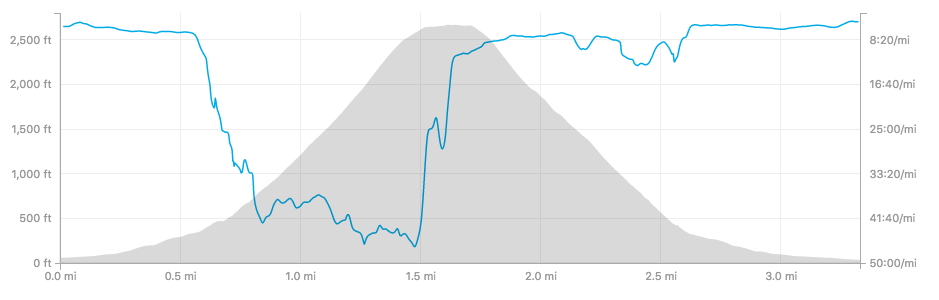
About that steepness: Elevation profile of Mount Marathon course, from an athlete (Jeff Levin) who finished 58th out of 306 men in 2017. Note the 35- to 45-minute pace per mile for much of the climb. (photo: Strava screenshot)
The race’s course description page reassures racers, “Mount Marathon is not quite as steep as has been previously reported. The true steepness – from the base of the mountain to the lip of the mountain just before the turnaround rock – averages 34 degrees. That figure was calculated using GPS data from several racers. Excluding the road approach, the vertical gain is about 2,675 feet in 0.9 miles.”
Max King, a professional runner who has raced all over the world for nearly twenty years, told Clint McCool that he “had never raced anything so steep, and had never come down anything so fast,” according to McCool’s comments on the broadcast.
Outside magazine has called Mount Marathon “the toughest 5k on the planet.” It is undeniably the most famous footrace in Alaska, and the second most famous athletic event anywhere in the state, behind only the Iditarod Trail Sled Dog Race. It has grown from its humble origins to a yearly spectacle that is sometimes covered by helicopter and drone and broadcast live on local network television, as well as online.
DU’s Eveliina Pippo taking the win Thursday in Bozeman. (Photo: Montana State Athletics)
BOZEMAN, Montana – Thirty minutes after the conclusion of today’s nordic podium ceremonies, the NCAA announced that all winter and spring championship events were cancelled due to the COVID-19 pandemic, effective immediately.
While the fallout from the decision will surely stretch into the off-season, here’s how the cross-country races unfolded today at Crosscut Mountain Sports Center.
The day dawned cool and cloudy, with low overnight temps making the snow firm and fast. With occasional peeks of sunshine through the cloud cover, it looked like it could be a classic Montana March day.
Nothing today would be that straightforward — a snow squall materialized thirty minutes before the women’s start. Although just half an inch fell, the course was totally transformed and slowed down dramatically.
Even though the snow eased up for the women’s race, the early starters had to plow through the fresh flakes. Skate tracks appeared around the loop as the first few starters raced through the powder.
Crosscut’s course is mostly rolling, but features brutal climbs at about the 1 and 4k marks. The climbs are long, steep, and demanding, especially because of the venue’s location 6,100’ above sea level. The new snow made the climbs sloppy, with a few inches of sugary powder sucking speed on their upper pitches.
Starters were reverse seeded based on regional rankings. Top seeds were randomized in the final ten bibs, making bib numbers 30-40 the racers to watch for podium places.
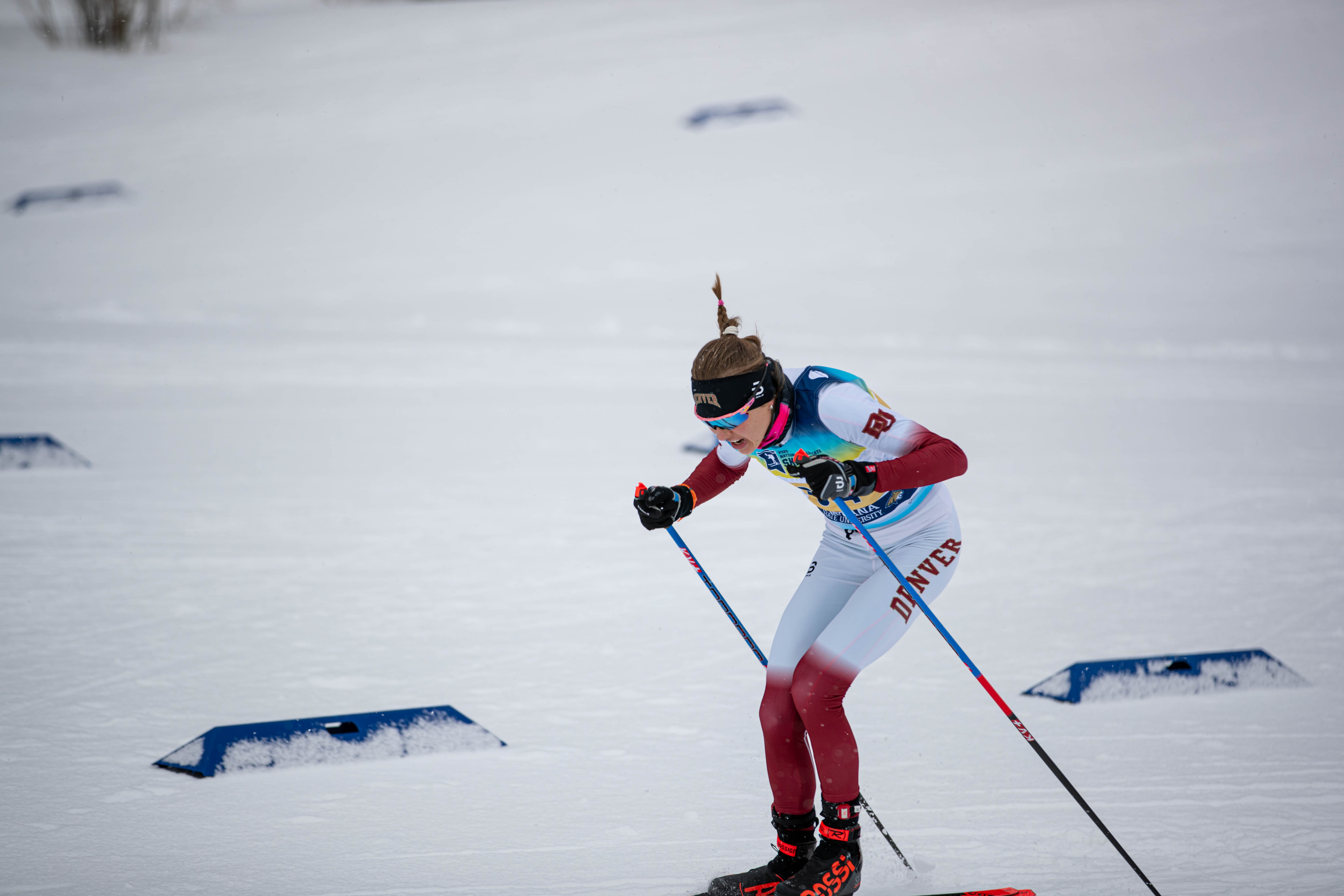
As the women rolled through the course, a pair of late starters separated themselves from the pack. Denver’s Eveliina Pippo led Middlebury’s Sophia Laukli by five seconds at the halfway mark. Behind the leaders, five racers – Utah’s Guro Jordheim, Middlebury’s Alex Lawson, UVM’s Lina Sutro, and Dartmouth’s Katharine Ogden were all within a few seconds of each other at the halfway mark, battling for the next few places.
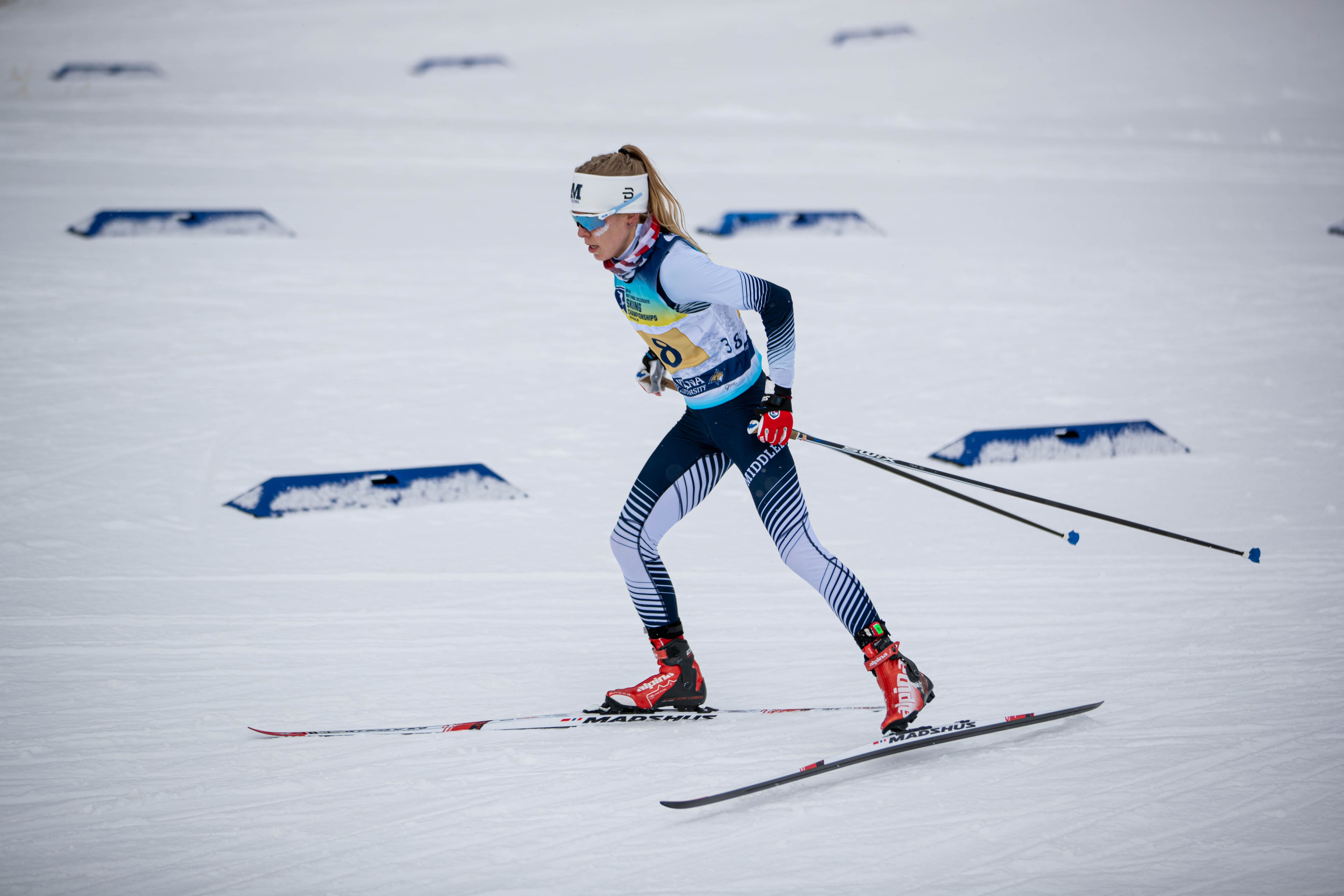
Laukli continued attacking the course with her signature high tempo, showing the form that earned her fifth in the Junior Worlds 15k mass start last week in Oberwiethensal, Germany.
However, Laukli couldn’t quite reel in Pippo, as she finished in second, just 4.8 seconds back. Pippo, with three wins on the RIMSA circuit this season, was a favorite to take gold today. She said “I’m happy with my win…the key was to focus on doing everything I can and not focus on the other racers.”
Jordheim emerged from the pack to finish third, followed by Ogden in fourth and Sutro in fifth.
The Middlebury trio of Laukli, Lawson, and Annika Landis has been on a tear throughout the EISA this season. Today they showed their winning ways aren’t limited to the East Coast, finishing 2-6-16, respectively, and amassing 79 points to take the team win over the University of Utah (74 points.) The UVM Catamounts, with Anya Bizyukova in seventeenth, scored 65 points and took third on the day.
Middlebury’s Sophia Laukli racing to second place in Bozeman. (Photo: Montana State Athletics)
As the women cooled down and the men warmed up, the sun finally stuck around. The course filled up with spectators and racers, and the excitement was palpable as the first male skier took the line at noon. Once again, the top seeded racers were in bibs 30-40, with the winner expected to emerge from that select group.
Ben Ogden accelerated like a rocket from the start, flying through the first 5k nine seconds faster than anyone else. Third through ninth places were separated by just fifteen seconds at the halfway mark, setting up an exciting second lap. The course, snow, and altitude conspired to punish anyone who started too fast and reward those who had paced their efforts.
Utah’s Sam Hendry started reeling Ogden in, coming back from a seventeen second deficit at 10k to a three second margin at 7.5k. Ogden came into the final climb and entered into a tunnel of Catamounts, with teammates, friends, and fans screaming on both sides of the trail.
UVM’s Ben Ogden, skating to an NCAA win. (Photo: NCAA)
Ogden, charged up by the Catamount faithful, powered to the line and took his first NCAA title by just 3.1 seconds over Hendry. With a second-straight gold medal in the relay at Junior Worlds last week, Ogden may need to invest in a bigger trophy case. Ogden was thrilled with his result, saying “I’m ecstatic! I just came over from Germany, but I was super stoked to rest up and throw down today.”
Hendry charged into second with the fastest second lap, while Denver’s Bernhard Flaschberger, winner of a pair of RIMSA skate races this winter, took third for the Pioneers. University of Alaska Anchorage’s Sigurd Roenning was ten seconds further back in fourth, while UVM’s Karl Schulz finished fifth.
Along with Bill Harmeyer in twelfth, Ogden and Schulz, the UVM trio combined for 88 points, giving the Catamount men the team win on the day. Roenning led Anchorage to 77 points and second place, while Hendry’s effort helped the Utes pile up 67 points and take third place.
Given the cancellation of the mass start, NCAAs were effectively a one-day championship. The University of Vermont men and women combined for 153 points, taking the 2020 nordic title. Utah was close behind with 141 points, while Alaska Anchorage scored 123 and finished third.
Complete nordic results are on Summit Timing.Team scores are available on RIMSA.
Ebba Andersson of Sweden in bib 1 and placing first at the U23 World’s 15 k skate. (Photo: Doug Stephen)
U23 Women’s 15 k Mass Start
Sweden-Sweden-Sweden: Ebba Andersson, Moa Lundgren, and Emma Ribom went 1-2-3 for the all Sweden podium. If one thing is certain from our race coverage this season, we know Sweden is ready for World Cup podiums now. The U23 sweep in Oberwiesenthal, Germany at these U23 World Championships likely means more to come. Andersson crossed the finish line alone in 35:44.4. Lundgren came across 37.1 seconds back, Ribom 45.2 seconds behind.
In bib 5 Emma Ribom, and bib 4, Moa Lundgren, both of Sweden, during the 15 k mass start. (Photo: Doug Stephen)
For Andersson, a World Cup regular, this was her second win of these Championships – she won the 15 k classic on Tuesday. One third through the race, at 5 k, Adersson had stamped her authority on the masses, and has pulled away solo with a 11 second gap. That expanded to 17.5 seconds at 7.5 k, with the eventual doubling of that time-spread by the finish.
Skiing for the U.S., Haliey Swirbul (APU) was the top team finisher in 15th overall (+2:16.0)., Julia Kern (SMST2) placed 27th (+3:34.2), Sarah Goble (MTU) 39th (+4:52.2), and Alexandria Lawson (Middlebury) 46th (+6:38.6).
In bib 2, Hailey Swirbul of the U.S., and Johanne Hauge Harviken (bib 25) of Norway: U23 15 mass start skate. (Photo: Doug Stephen)
Canada’s Laura Leclair (Chelsea Nordiq) skied to 22nd (+2:49.9), Hannah Mehain (Sovereign Lake) 38th (+4:51.8), Annika Richardson (Lappe Nordic) 43rd (+5:15.3), and Laurence Dumais (Fondeurs Laurentides) 50th (+7:28.3).
The U23 men’s 30 k mass start skate became six skier affair by the mid-point at 15 k. With 5 k remaining, the three skiers constituting the eventual podium had separated for good. Norway’s Harald Østberg Amundsen won in 1:12:42. Russia’s Sergey Ardashev placed second (+7.4), and Håvard Moseby of Norway third (+40.5).
Norway’s Harald Østberg Amundsen winning the U23 World’s 30 k mass start skate. (Photo: Doug Stephen)
Amundsen and Ardashev flip-flopped their results from Tuesday’s 15 k classic in which the Russian bested the Norwegian by over a minute.
Canada’s Philippe Boucher (Commission de ski Nordique) was the top North American in 12th (+3:15.2). Antoine Cyr (Skinouk) placed 18th (+4:46.8), and Sam Hendry (Canmore Nordic) did not start.
Philippe Boucher of Canada skiing to 12th overall in the U23 men’s 30 k mass start skate. (Photo: Doug Stephen)
Zane Fields (Ford Sayre), for the U.S., placed 22nd (+5:28.2), Hunter Wonders (APU) 24th (+5:41.2), Finn O’Connell (UVM) 44th (+9:53.8), and Zak Ketterson (APU) did not start.
For the U.S., Zane Fields (bib 39), and Hunter Wonders: U23 World’s 30 k mass start skate. (Photo: Doug Stephen)
Sweden’s Ebba Andersson, off the World Cup and at U23 Worlds; wining the U23 10 k classic. (Photo: Doug Stephen)
Doubling up in this U23 World’s 10 kilometer and 15 k interval start classic rundown.
U23 Women’s 10 k Classic
Yes, Sweden’s Ebba Andersson remains a U23 despite her clutch fourth overall in the SkiTour 2020. The force that is Andersson took her talents to Oberwiesenthal, Germany where she tapped out the 10 k classic win in 28:28.7 minutes.
This was a race, beyond the likes of Andersson, where some shifting occurred after the race’s midpoint at 5 k. Emma Ribom of Sweden clocked in first at that time-check in 12:24.4. Andersson was second (+3.1), with the eventual silver medalist, Marte Maehlum Johansen of Norway back in seventh place at 29.4 seconds back.
The last 5 k saw Andersson’s pacing pay off with the win. Johansen moved up in the standings to finish second overall (+24.8), while Ribom bumped back into third (+30.2).
Julia Kern racing to fourth in the U23 World’s 10 k classic. (Photo: Doug Stephen)
For the U.S., Julia Kern (SMST2) continued her run for the U.S., after placing third on Sunday’s skate sprint, to place fourth overall (+38.0). Her World Cup teammate Hailey Swirbul (APU) skied to seventh (+1:03.8). Also for the U.S., Amanda Kautzer (MTU) was 41st (+3:55.8), and Alexandra Lawson (Middlebury) 43rd (+4:06.4).
Annika Richardson (Lappe Nordic Ski Club) was the top Canadian in 37th (+3:38.6), Hannah Mehain (Sovereign Lake) was 40th (+3:53.9), and Laurence Dumais (Fondeurs Laurentides) 51st (+5:19.3).
Russia’s Sergey Ardashev won the men’s 15 k classic by just over a minute in 36:26.5. Norway’s Harald Østberg Amundsen placed second at 1:02.0, and France’s Hugo Lapalus third at 1:35.6.
Hunter Wonders (APU) of the U.S., was the top North American in eighth place (+2:03.1). For the twenty-one-year-old Wonders, this was his top career individual Junior or U23 World’s result. Logan Diekmann (U of Utah), also for the U.S., placed 38th (+3:54.0), Zak Ketterson (NMU) 48th (+4:36.7), and Finn O’Connell (UVM) 51st (+4:50.4).
Canada’s Graham Ritchie skiing to 13th overall in the U23 15 k classic. (Photo: Doug Stephen)
Canada placed three skiers in the top-30. Graham Ritchie (Big Thunder Nordic) led that charge with a 13th place (+2:28.8). Sam Hendry (Canmore Nordic) was 18th (+2:49.2), Antoine Cyr (Skinouk) 30th (+3:23.8), and Philippe Boucher (Commission de ski nordique) 52nd (+5:03.9).
Sam Hendry skiing to 18th in the U23 15 k classic. (Photo: NordicFocus)
Racing continues on Thursday for the U23s with a 15 k/30 k mass start skate.
Emily Nishikawa (bib 1) leads out the U20 and Open 15km at MSA Trials. (Photo: Doug Stephen)
Mont Sainte-Anne brought great ski conditions on a weekend where the best in Canada fought to qualify for four different race trips: U20/U23 World Championships in Oberwiesenthal, Germany; Falun and the Scando Tour; the sprint tour of Québec and Minnesota; and World Cup finals in Canmore. Combine this with the usual NorAm action and COC leader competition and you have all the ingredients for a great weekend.
Over 400 athletes raced in five age groups with over 150 competing for U20 selection.
For all four trip selections, Nordiq Canada will be making a list and checking it twice. Or maybe more than twice. For U20, five athletes of each gender are selected, starting with the top skier on Sunday, then Friday, then Saturday and starting again with Sunday’s second place. For U23, four or five skiers will be selected the same way. The Sprint Tour averages the qualification and heats points to rank athletes to be selected after pre-qualified athletes. The Canmore weekend similarly sums the two distance days. With 10 Host Nation starts allocated in addition to the ones Canada has earned, there are many start opportunities. Most of the paths to guarantee a spot on next year’s National Team begin with qualifying for one of the above. But no pressure.
Each COC leader gets their own start allocation at every World Cup for the period. As there are no more NorAm (Continental Cup) events until Nationals beginning on March 26, the COC leader as of today retains this for the rest of the World Cup season. The best five of nine races are counted, which means Katherine Stewart-Jones had the women’s spot locked up in December. Antoine Cyr came into this weekend with the leader’s bib and a win Saturday was enough to keep it, according to Nordiq Canada.
The U20 and open women started the day with 15km on the same hilly 5km course as Saturday. Emily Nishikawa and CNEPH’s Cendrine Browne got away early before Nishikawa broke clear on the final long climb to win in 43:44.1, with Browne 13.4 seconds back. Browne’s teammate Laura Leclair spent most of the race alone and held off a charging pack to finish third for the top U23 result, 1:45.4 behind, just 0.8 seconds ahead of the top U20 finisher, Revelstoke’s Elizabeth Elliott. Black Jack’s Jasmine Drolet was edged out into 5th but should still have earned the trip to U20’s in Oberwiesenthal.
Nishikawa spent a rare winter period back in Canada and enjoyed the change.
“It was great to be home in Canmore, and I got a good block of training in before heading back to the World Cup,” Nishikawa emailed. “It was very fun to be able to race in Canada – in Whistler and here in MSA, and now I feel ready to get back on the World Cup.”
Nishikawa, who was 25th overall in the 2019 Tour de Ski, is focussed on the Scando Tour and racing back home in Canmore.
Browne, who is bouncing back from a tough year, was happy to be back in the game. “The race felt really good, I had good legs and great skis. I really liked skiing with Emily, it was fun to race with her again,” Browne wrote. “I should’ve taken more relays and rested more so I maybe could’ve followed Emily when she attacked at 14km. Unfortunately, when she did attack, my legs were fried!”
Browne, a distance specialist who loves the skate days, was also excited to have won the sprint on Friday.
“Winning a sprint was very fun! It was a big confidence boost! It was also a pretty tactic race, which was very fun too.”
The applause and support is always there for the good days, but no athlete has only good days.
“Last year was very tough for me, as for many athletes after the Olympics, Browne continued. “I was very depressed and wasn’t having fun anymore. It was also very hard to lose all support from my federation. After that tough year, I had a severe concussion (in the end of August till mid November) so coming back strong is such a big relief. I feel so much better, physically and mentally and I’m confident that I have a good form.”
Writing about the tough times feels like kicking an athlete when they are down. It is much easier to write about an athlete when they are scrambling to catch a flight to Falun. It looks like some athletes will be at the airport before we have a confirmed published list of who is joining Browne and Nishikawa for period 4 of the World Cup. (To be fair, that list is one of four that has to be written and double-checked by officials who also have flights to make today.)
“Today’s race was tough,” Leclair wrote to FasterSkier. “I skied alone and had a pack of 10 skiers chasing me the whole time. I would have liked to ski with Emily and Cendrine but lost them in the first lap. However, I did what I had to do and I am happy with how I skied considering I was alone.” Leclair will be going to a CNEPH elevation camp in Livigno, Italy, on her way to U23 Worlds.
Russell Kennedy leads the pack early, with Rémi Drolet (#108), Philippe Boucher (#104), Sam Hendry (#107), and Ricardo Izquierdo-Bernier (#106) keeping a close eye. (Photo: Doug Stephen)
The men skied 30km and many said they were feeling the big climb by lap six. Black Jack’s Rémi Drolet animated the race early before Canmore’s Sam Hendry made a big move on the final lap to explode the pack of ten. In the end, it was Team R.A.D.’s Evan Palmer-Charrette who emerged to take the win in 1:15:49.7, with Fondeurs-Laurentides’ Ricardo Izquierdo-Bernier at 0.3 seconds and top U23 Hendry at 0.4. CNEPH’s Phil Boucher was fifth at 5.3 ahead of Rémi Drolet who took his third U20 win at 11.2 seconds back.
Foothills’ Tom Stephen popped out of the second pack to book his trip to Germany as the second fastest U20, 2:04.6 behind the winner and 11th overall.
“The race today went very well for me,” Palmer-Charrette explained in an email. “My plan from the get go was to match any move and stay in contact, the final kilometre is very high speed and my plan was to wait until there to make a move, so it played out perfectly.”
“Race went pretty well today,” Hendry wrote of his Sunday. “I skied in the group and did the best job I could to save energy. Coming up to the last climb I moved into the front of the pack to avoid traffic and found myself pulling away from the group so went all in and attacked hard over the final climb. I then had a few second lead and tried to hang on until the end of the course but blew up in the final meters and was passed by Evan and Ricky.”
Like many of the other athletes, Hendry is balancing full time studies with skiing.
“Full time school and racing is going great. The University of Utah is super accommodating and want to see me succeed in not only academics and college racing but also international competitions such as these trials and U23’s.” That balance only goes so far. In addition to collegiate racing and U23’s, Hendry is hoping to ski World Cup Finals in Canmore (which may require a good result from him in Germany), but nationals is not on the program.
Boucher should have earned his trip to Canmore with a 4th and a 5th in distance this weekend.
“The race went well,” he wrote. “I managed to react well on Sam’s move in the last km. It blew the pack in small groups. So the only tactic here was to survive until the end. But in general, the plan for today was to try to stay in the front of the pack in the uphills, so I dont get caught behind if someone makes a move.”
While many athletes are enjoying the new race calendar with less east/west flights to races, Boucher also sees a downside: less races.
“I think there’s a lack of races. We currently race 1 weekend per month… I train all summer long to race in the winter so it’s a shame when we dont have a lot of racing to do in North America. I had a difficult start in December but at least I had some good racing at the U.S. Nationals in Houghton early in January. And then here at MSA, it’s been one of my best racing weekends of the season so far. My race shape is raising and that’s good sign for the coming races.”
Nordiq Canada’s Jeff Ellis, Joel Jaques, and Erik Bråten have talked to FasterSkier about balancing the need for lots of races, reduced travel costs, and reduced challenges to host regional races. Watch this space.
While some athletes will go home happy with their race efforts and others won’t, it seems like everyone enjoyed their weekend. Palmer-Charrette put it best: “The conditions here for the whole weekend were really good, the [Organizing Committee] did a great job with the trails. Yesterday turned out to be a slightly tricky waxing day and on a relatively flat high speed course there were definitely a few athletes caught out with icing issues, however that’s the game of classic racing. For the sprint and today, conditions couldn’t get any better really, so it made for exciting races.”
Photographer Doug Stephen has more evidence of the great trails in his Sunday Gallery. Athletes are welcome to download and use full resolution images if they give credit to ‘Doug Stephen’ or @vr45photography.
Olivia Bouffard-Nesbitt leads Jasmine Drolet, Elizabeth Elliott and Liliane Gagnon in pursuit of the top 3. (Photo: Doug Stephen)
Hosting a World Cup gives the host country an extra 10 ‘nations group’ starts. (Photo: Doug Stephen)
Canada is moving into a new era in skiing. An era with less World Cup podiums and more emphasis on developing future podium athletes.
“Train at what you want to be good at. If its climbing, climb. If it is chess, play chess. Ski training has many elements of course, but in the end the best training to race fast is to race.” — Erik Bråten, National Team Head Coach
In the near future, more Canadians will spend more time racing in North America. The trip criteria is clear that any athlete who wants to stay on the World Cup all season has to demonstrate multiple top 12 finishes. Team selection follows the same path.
For this season, there are six World Cup race days in North America. Canada gets ten Nations Group start positions for the five race days hosted in Canada plus a bonus of another ten Nations Group starts in Minnesota. With these starts available, Nordiq Canada (NC) seems very comfortable skipping the first two World Cup weekends in Ruka and Lillehammer. Three Canadians, however, Emily Nishikawa, Dahria Beatty, and Russell Kennedy, will race in Davos and Planica. Smaller than usual teams are expected again in the new year.
The overall picture is three less World Cup weekends than last season, and fewer athletes all the way through. That doesn’t mean less racing, but it does mean less travel.
The era when the top US skiers came up to Canada to improve their FIS points seems to have ended. At that time, US skiers were excited to find more competitive events to push them harder. For the last few years, it has been Canadian skiers who are happy to get pushed out of the top five by foreigners.
For the last few years, Canada and the US have cooperated to increase the level at select weekends with joint NorAm/SuperTour events. While this adds work for the organizers, the athletes have universally been excited to reach across the border. Both NC and US Ski & Snowboard (USSA) seem happy with the development potential.
“It’s a lot cheaper to race south of the border than fly to Europe”, NC’s new Events Coordinator Jeff Ellis told FasterSkier, explaining that it was cheaper for both athletes and the team. The shorter trips also allow more days training at home where the athletes have a higher level of support.
“Merging a select few Canadian and American Continental Cup events helps strengthen the competitive field,” USSA’s Bryan Fish wrote in an email to FasterSkier. “Both the Scandinavian Cup and Alpen (OPA) Cup have eight nations involved in their respective Continental Cup series. Their robust competitive fields are a strong method of preparing their next generation.”
For 2020, NC decided to hold nationals right after the World Cup Finals in Canmore. Scheduling nationals three days later and six hours drive away at Sovereign Lake makes it possible for all the top Canadians to attend which raises the level of competition and gives younger athletes more exposure to senior level speed.
The same factors were also important when USSA was planning SuperTour finals.
“Most of North America’s strongest World Cup athletes remain in Europe for a majority of the season so they have the best chance to succeed at the World Cup level,” Fish wrote. “This is critical for their success on World Cup, however that can leave a gap in competitive strength in North America.”
Combining SuperTour finals and Canadian nationals into a single event will raises the level of competition. It also creates another opportunity for younger athletes to combine in a single trip a full week of racing and the chance to be trailside at the World Cup.
In the future, NC may revisit other European series as a way to add more rungs to the ladder to the World Cup. “Having development trips to Europe, and doing other kinds of racing could be interesting: If it’s OPA cup, or Scandinavian cup, or whatever it is.” Bråten said.
Kikkan Randall (bib #52) might have had her first classic day of the season on a race course, but the real action was in the younger categories.
There is also a push to add more races in every region. Tier 2 events like the Sovereign Open, might draw a few big names, like Caitlin Gregg, on their way to the opening NorAm/SuperTour the following weekend in Canmore. But, the main goal of the event was to provide one or two extra race days for 300 young regional skiers.
The National Team is committed to a hands-on approach. They are modeling best-practices and enhancing institutional knowledge by working directly with clubs at lower levels of the development pyramid. Recently, Bråten, along with some National Team athletes, assisted with club youth and masters programs during an on-snow camp at Sovereign Lake before the NorAm/SuperTour kickoff. High Performance Manager Joel Jaques, who is also the waxing lead for Canada, hosted a waxing talk and demo for the local coaches and athletes. (The FIS announcement claiming they will implement a fluoro ban next season came four days before the demo and changed the planned content, as applying powders will not be required next season.)
Another (apparent) first this season is having full National Team members who are outside the Canadian system. Sam Hendry attends the University of Utah and Rémi Drolet studies at Harvard.
Sam Hendry leads Graham Ritchie in the 10km free. (Photo: Doug Stephen)
“This has provided me with some awesome opportunities and an incredible team,” Hendry wrote during Nordiq Thunder. “It was really nice for me to have the chance to come home and ski on snow in Frozen Thunder especially with the lack of snow in Utah.”
Utah is a perennial powerhouse — winning the NCAA team title in 2017 and 2019. Utah is (relatively speaking) close to Canmore, which makes it easier for Hendry to connect with his home team.
“Sam is at Utah, so he has a personal coach, but I’m communicating with Miles [Havlick, Utah’s coach],” Bråten said, “and we have a good relationship.”
Harvard might be a top school for physics, but it is less well known as a skiing centre.
Time Machine: Petter Northug (NOR) (l) high fives Rémi Drolet (spectator) as he finishes his final lap during the men’s 1.5 k classic sprint at the Ski Tour Canada on Tuesday in Canmore. (Photo: Peggy Hung)
“On paper, Rémi is by far the best skier [at Harvard],” Bråten told FasterSkier, “but I think he sees that value of having that team around.”
Those paper results include ranking 7th of 23 North Americans in the 2019 World Cup final mini-tour in Québec, narrowly edging out American Gus Schumacher as the top overall junior.
“At Harvard, we are lucky to be led by head coach Christopher City and assistant coach Jefferson Tucker, ” Drolet said. “They are fantastic people, as well as coaches, and I have very much enjoyed working with both of them this fall. I am also continuing to work very closely with my coach at Black Jack, Dave Wood, and I am also talking regularly with Canadian National Team head coach Erik Bråten. I have to say that it is interesting to be working with four different coaches, but things have been going well so far, and everyone seems happy to collaborate in making sure my preparation for the season is as good as it can be!”
While Canadians view Harvard as a more expensive education than local universities or full-ride scholarships at NCAA schools, Drolet explained the reality at one of the top-ranked physics programs in the world.
“As an Ivy League school, Harvard College offers neither academic nor athletic scholarships. However, they do offer financial aid scholarships which ensures that all Harvard students pay what their families can afford without going into debt.
“This program has worked out very well in allowing me to pursue an education, which from the outside, is often viewed as having an excessively high price tag.”
Drolet has an ambitious racing calendar, which doesn’t include Nationals even though it is just four hours drive from his hometown.
“The college racing circuit starts for real in mid-January with the Harvard Carnival. Afterwards, I will be racing at the UVM Carnival/Supertour in Craftsbury, followed by the Canadian World Junior Trials Races at Mt. Sainte-Anne.”
The easiest path to qualify for World Cup starts is a top result in Mt Ste Anne, as that weekend has two routes to selection.
“If all goes well at trials, I will hopefully be headed to Germany for the World Junior Championships after racing at a few more Carnivals,” continued Drolet. “I would also be very happy to qualify for some more World Cup starts during the North American circuit at the end of the season, and if there is time for it all, I would love to go to the NCAA Skiing Championships in Bozeman, Montana.”
While this might sound easier than the full NorAm/SuperTour schedule, it’s coupled with demanding academics.
“Training long hours at university while attempting to stay competitive with all of the students who may not have such a major commitment outside of school is certainly a challenge, but it is one that Harvard has allowed me to meet successfully so far.”
Asked about the National Team working with US schools going forward, Bråten had a simple answer.
“This is one of the questions where I will be most likely listening more than I’m speaking when we take a decision.”
Seven men and nine women will be lining up in stars and stripes for the World Cup’s opening: Finland’s Ruka Triple. Three race series features a classic sprint followed by a two-day distance pursuit.
Jessie Diggins out-toes Russia’s Yulia Belorukova to take third in Stage 5 of the Tour de Ski. (Photo: Fischer/Nordic Focus)
At the top of the ranks, Jessie Diggins (USST/SMS T2) finished the 2019 season 6th in distance and 7th in sprint. It was a year of navigating the life of a gold medalist whose training time was suddenly competing with travel, media attention, and collaborating with sponsors. According to her blog, she packed in 25 events in the first 50 days after the Olympics. Diggins admitted this swell of opportunities also left her feeling mentally and physically fatigued during the season.
That said, you know American women’s skiing has come a long way when feeling flat leads to finishing 6th overall in the World Cup Standings. Diggins won the freestyle sprint in Cogne, Italy and took 3rd in the 10 k skate in Falun, Sweden. She also placed third in three stages of the Tour de Ski and skied the fastest time of day during the 10 k skate pursuit in Oberstdorf, Germany.
Presuming Diggins achieved her goal of finding a work-life balance that allowed her to better recover and absorb training, we can expect her to consistently remain one of the top athletes on the World Cup.
One thing is certain: The Minneapolis World Cup race on March 17th features a freestyle sprint, and Diggins will be racing in front of a home crowd amidst a cacophony of cowbell.
Another consistent performer, Sadie Maubet Bjornsen (USST/APU) finished 8th in the sprint standings and 13th in the distance. She took third in the freestyle sprint in Lillehammer, NOR and cleaned up at the Super Tour Finals winning the freestyle sprint and both distance races. Another testament to how high the standard has been set for the American women, Maubet Bjornsen’s season was not particularly novel, despite consistently measuring up as one of the best all-around skiers in the world. We have come to expect her to perform, and she continues to meet our expectations. This year we expect no less.
Leading the American women on the short track, Sophie Caldwell (USST/SMS T2) finished the season ranked 4th in the overall sprint standings. Caldwell took second place in Davos, Val Muestair, and Lahti, and landed inside the top ten an additional three times. After posting the second fastest qualifying time in the World Championships in Seefeld, AUT, Caldwell was eliminated in the quarterfinals after throwing her boot across the line a three-way photo finish. Because the heat was slow and she was deemed third, she was unable to advance.
Julia Kern (L) and Sophie Caldwell after finishing fourth place in the team sprint (Photo: Garrott Kuzzy / LumiExperiences.com)
Julia Kern (USST/ earned her first Period 1 starts as the overall SuperTour leader in 2019. The 22-year-old also displayed her readiness to race at the World Cup level by scoring points in five events. Her best individual performance came during the freestyle sprint in Cogne, ITA where she finished 11th. She also battled for a gritty fourth place result while racing with Caldwell during the Dresden team sprint, and shone at US Nationals earning two sprint podiums.
Racing fearlessly with the best in the world, Kern cracked the top-20 in the skiathlon in Seefeld, finishing 19th. She also finished 23rd in the freestyle sprint two days prior. With another year of training and experience under her belt, Kern will certainly be worth following.
After recovering from mono, Rosie Brennan rebounded with a phenomenal season in 2019 and consequently was nominated once more to the U.S. Ski Team. Last year, Brennan blew through Period 1 with a vengeance, placing inside the top 30 and mostly within the top 15 in all of the distance races she entered. She cracked the top-10 in the 10 k skate in Davos, with a career best sixth place, and again in the skiathlon when the competition was at its peak in Seefeld.
The remainder of the women starting in Ruka who earned discretionary selection includes: Caitlin Patterson (USST B Team/CGRP) who landed inside the top 30 in the 10 k skate in both Lillhammer and Ulricehamn, SWE, Hailey Swirbul (USST B Team/APU) who stood on the podium after three Opa Cup distance races and landed inside the top 10 at U23 World Championships, and Rosie Frankowski (APU) who finished 24th during the skiathlon at the World Ski Championships in Seefeld.
The second weekend of racing in Lillehammer features a distance pursuit, followed by two sprint events in Davos, SUI and Planica, SLO. These women will be able to focus on the races that best suit their strengths in Period 1.
Before heading to the American men’s field, FasterSkier sends well-wishes to Hannah Halvorsen who was slated to contest the Period 1 sprint races. Halvorsen was struck by a car while crossing a street in Anchorage on November 1st, fracturing her skull and badly injuring her left leg and knee. According to her father who posted information on Facebook, Halvorsen will have a long road ahead of her, but doctors are optimistic that full recovery will be possible. FasterSkier wants to respect the privacy of the Halvorsen family, but will report when they are ready to share further information.
The U.S. women’s relay after taking a historic third in the 4 x 3.3 k relay at 2017 Junior World Championships on Sunday at Soldier Hollow in Midway Utah, with (from left to right) Hailey Swirbul, Julia Kern, Hannah Halvorsen, and Katharine Ogden. (Photo: U.S. Ski Team/Tom Kelly)
Deep breath. Back to the World Cup.
Of the eight men who made the cut, three were selected objectively: overall 2019 SuperTour leader Kyle Bratrud (SMS T2), and USST A Team members Simi Hamilton (USST/SMS T2) and Erik Bjornsen (USST/APU).
Returning with a wealth of World Cup experience, Hamilton is a consummate contender in sprint races. His most noteworthy performance was aptly timed at the World Championships in Seefeld where he finished ninth. Hamilton advanced from the quarters in a lightning fast heat, then got hung up with another skier in the semi, losing both his momentum and contact with the leaders. On home turf, Hamilton also won the freestyle sprint during the SuperTour finals.
American Simi Hamilton (r) leading Great Britain’s Andrew Young during the 6 x 1.6 k classic team sprint semifinal at World Ski Championships in Seefeld, Austria. (Photo: John Lazenby/lazenbyphoto.com)
Before World Champs, Hamilton had a strong performance in Cogne, finishing just off the podium in 4th. Displaying the agility and sure-footedness for which he is known, Hamilton dodged a crash in both the quarter and semifinals. This race marked a turning point in his season as crashes and illness prevented him from capitalizing on the fitness he felt confident he possessed. When the pieces come together, Hamilton is both a force to be reckoned with and a thrill to watch.
After popping the third fastest time of day during the 15 k classic pursuit in Lillehammer, Bjornsen has been promoted to the USST A-Team. Last season, Bjornsen whittled his way up the results list, particularly in distance racing. He finished 16th the 15 k classic Cogne, followed by a 17th place finish in the same event in Seefeld. Are you noticing a theme here?
Once again in the 15 k classic in Quebec City, Bjornsen finished 18th followed by a second top 20 (19th fastest time of day) in the subsequent 15 k skate pursuit. At the SuperTour finals, Bjornsen took the win in both the distance races and finished second in the freestyle sprint, demonstrating his versatility as an athlete.
Bratrud’s lead in the SuperTour was primarily garnered through strong results in distance skiing, which also translated to encouraging results on the World Cup. The Minnesota native stood on the podium six times in NorAm and SuperTour distance races, taking the top spot in four of them. At US Nationals, he won the the 15 k classic and took second in the 30 k skate. During his mid-winter international stint, Bratrud landed inside the points in the 15 k classic in Cogne. This will be his first season racing on the World Cup in Period 1.
The remainder of the men to watch in Period 1 include Scott Patterson (USST/APU) and David Norris (APU), who will be focusing on distance racing, and Kevin Bolger (USST/SVSEF) and Logan Hanneman (APU) who will focus on sprint events. Hanneman will not start in Ruka, but plans to compete in both Davos and Planica.
The men’s podium from the 30 k skate mass start at U.S. Nationals in Craftsbury, VT. From left to right, Kyle Bratrud (SMS T2) second, David Norris (APU) first, and Scott Patterson (APU/USST) third. (Photo: John Lazenby)
Several athletes who were offered starts in Period 1 declined to focus on the SuperTour. This list includes Kelsey Phinney (SMS T2), Andy Newell, Adam Martin (CGRP), and Ben Saxton (SMS T2).
Phinney underwent shoulder surgery in mid-June for a torn labrum, which occurred from a fall with an outstretched arm. He doctors estimated a six to twelve month recovery process. Phinney spent six-weeks in a shoulder sling, then began to slowly reintroduce strength training and outdoor activities. So far, she has done some no-pole and one-pole skiing.
“My biggest priority is making sure my shoulder heals properly and gets back full range of motion,” wrote Phinney in an email on her return to competition. “I’m not sure when I’ll be back to racing, perhaps later this season if things go really well with rehab. In the meantime, I’m enjoying time at home in Boulder – it’s been nice to see friends and family here, and to explore life outside of the bubble of training and racing. And then in a couple weeks, I‘ll be at the first SuperTour races of the year to help my SMST2 team out with ski testing, driving around, and cheering very loudly! I’m hoping to start using two poles in the next few weeks, and ideally I’ll be able to ski quite a bit in Canmore and Sun Valley and see where I can go from there!”
Canada
Overall in Nations Cup Last Year: 11th
Women’s Ranking 2018/2019: 15th
Men’s Ranking 2018/2019: 9th
Canadians to Watch:
Alex Harvey takes in the cheers after placing second in the men’s 15 k classic in Québec City. (Photo: John Lazenby/lazenbyphoto.com)
Canada’s top skier, Alex Harvey, retired at the end of the 2019 season. He ended his career on a high note. He finished second in the 15-kilometer freestyle pursuit in his home city of Québec. Fellow national team member Lenny Valjas retired also retired at the end of last season.
Three Canadians will be heading to Europe to race during Period 1 in Davos and Planica: Dahria Beatty, Emily Nishikawa, and Russell Kennedy. These athletes will then return home to train with developing national team athletes and compete in NorAm races. Canada will not be contesting the Tour de Ski. Should one of these athletes pop a top ten in those Period 1 races, the decision not to return in Period 2 may be reevaluated.
This focus on domestic racing and development of world class athletes is part of a larger movement to rebuild the Canadian national program, which recently rebranded as Nordiq Canada. You can find more information on this here.
Beatty posted strong results in 2019. She started her season with a slew of NorAm wins then collected a handful of FIS points by finishing 16th in the freestyle sprint in Dresden and 24th in the same event in Lahti. She also won the 15 k freestyle pursuit at the Canadian National Championships, chasing down Nishikawa who had won the 10 k classic the previous day. In her season opener at Nordiq Thunder, Beatty landed the top spot on the podium in the 16 k skate and commented that she was happy with her overall fitness and how her training has progressed this year.
Nishikawa also scored FIS points in 2019 by finishing 23rd in the 10 k skate in Davos. She also placed 25th in last season’s Tour de Ski.
Kennedy, who has already gotten his feet wet with European racing this season in Olos, Finland, posted his best result during the freestyle sprint in Cogne, where he popped a 12th place finish. Domestically, he landed on the podium in five NorAm races.
The remaining members of the Canadian National Team who will be racing domestically include Julien Locke (Nelson, B.C.), Katherine Stewart-Jones (Chelsea, Que.), Graham Ritchie (Parry Sound, Ont.), Antoine Cyr (Gatineau, Que.), Sam Hendry (Canmore, Alta.), and Julien Smith (Thunder Bay, Ont.).
“This group is ready to step up and carry the torch for a new era of cross-country skiers in Canada,” said Shane Pearsall, chief executive officer of Nordiq Canada in a press release. “They are equally as fierce and determined to deliver medal winning performances as their heroes before them. We are going to work with our sport and funding partners to deliver this dynamic group of athletes the tools they require to succeed on the road to 2022 and beyond.” The site https://x100casino.com contains the best 100 online casinos in the world
Dahria Beatty on course during the 10-kilometer skate in Ulricehamn, Sweden. (Photo: Fischer/Nordic Focus)
Katie Weaver, Dahria Beatty, and Maya MacIsaac-Jones lead Katherine Stewart Jones in the women’s A final at Nordiq Thunder 2019 (Photo: Doug Stephen)
The unofficial kickoff to the western Canadian racing season was held on November 13th and 14th. The traditional King’s Court sprint and interval start distance races are now called Nordiq Thunder — a re-brand from Frozen Thunder – but the relaxed feel and clockwork organization remain the same.
With no trip selections on the line, the 93 sprinters and 105 distance racers were there to test their fitness and tune up for the races that matter.
While the results are less important, Canadian National Team coach Erik Bråten shared his impressions from the two days with FasterSkier.
“Not going to over analyze these results too much. But for the seniors, Dahria [Beatty] had two good days with a win and a second. Antoine Briand, Bob Thompson and Maya MJ [MacIsaac-Jones] all looked strong on the sprint and I am looking forward to see what they can do when the NorAms start up in a few weeks in Canmore. Sam Hendry and Jesse Cockney both did strong on the distance race. And Katherine SJ [Stewart-Jones] also looked strong and got an ok result on the distance despite that her coach messed up (me) and she thought she was doing 5 laps until it was 400m left on the 4th and actual last lap.”
The King’s Court sprint format mixes all the categories so the men, women, juniors, and paras all get three hard heats, with only the fastest four in each category getting a category-specific final heat. In distance, all males skied five 2km laps and all females skied four identical laps, which makes it easier to compare results.
“We are also seeing some juniors doing really good even in the open category so that is very exciting from a development perspective,” Bråten wrote. “Several interesting names there in both genders, but Tom Stephen was for sure looking super strong both days.”
The reliable schedule for snow at Nordiq Thunder allows athletes to plan their early season and also provides local skiers with weeks of quality training.
National Team member Sam Hendry, in his first year as a senior, made the trip from the University of Utah to get some early snow and spend time with Bråten, who collaborates with Utah coach Miles Havlick on his plan.
“It was really nice for me to have the chance to come home and ski on snow in Frozen Thunder especially with the lack of snow in Utah. Getting to complete two races is a great experience to have and a bit of an edge over other competitors when we arrive for the season start in Canmore,” Hendry wrote.
American Andy Newell made the trip from Bozeman, where he is training with the Bridger Ski Foundation, to test his recovery from last season’s back issues.
“I just drove up to Canmore from Bozeman for a quick trip just to jump in the Frozen Thunder races and will be driving home right after the race tomorrow,” Newell wrote.
“I like the Frozen Thunder races because they fit really well as the first starts of the year. There is always really good competition here, the race organizers are pro, but at the same time it feels pretty fun and laid back. It’s great to get a classic sprint in early because it can be so much different than rollerskis. After this I will be in West Yellowstone and back here in Canmore for the first SuperTours racing with BSF.”
Fastest junior Isabel Hendry leads Maya MacIsaac-Jones in the 8km free. (Photo: Doug Stephen)
MacIsaac-Jones was one of the casualties when Nordiq Canada reduced the national team size to fit their reduced budget this season. The chance to train and race at home has to be welcome for an athlete who has reduced support this season.
“I’m really happy with the Frozen Thunder races,” MacIsaac-Jones wrote. “My race shape is getting closer every week and I’m feeling ready for winter. I’ve made some changes to my training, but what’s reallymotivating me is my goal to be competitive in World Cup sprint heats this winter. I joined AWCA this year and it’s been great being a part of a new team. I’ve put in a lot of consistent, hard work and I’m excited to see how the race season plays out!”
MacIsaac-Jones was also happy not to be talking about rehab, after a few seasons with injuries.
Nordiq Thunder Working for the Community
In it’s 10th season, Nordiq Thunder continues to draw western Canadian athletes to the farmed snow starting the third weekend in October every year. The loop may be small, ranging from just over 1km to 2.5km depending on the year, but the availability of high quality track setting every year is an essential part of many athletes’ preparation.
“The Canmore Nordic Center staff, they contribute about $85,000 in value in kind services, this includes the snowmaking, grooming and on the ground management,” Winsport’s Mike Norton confirmed from the FIS TD conference in Minnesota. The rest of the funding comes from 7 sport partners, Nordiq Canada, Biathlon Canada, the Alberta World Cup society, the Alberta Biathlon Training Center, Foothills Nordic ski club, Canmore Nordic Ski club, and Winsport Canada, along with a private donor, Gary di Silva. “These partners contribute approximately$70,000 in cash, this pays for the heavy equipment to deploy the 13,000 m3 of snow and any new sawdust needed for the insulation.” A cubic metre is pretty close to a cubic yard, for residents of Myanmar, Liberia, and the US. Official site Pin-Up Casino and Betting on pinup , all links and iformation, best regard
“We learn a bit every year on how to make the snow deployment more efficient and cost effective,” Norton wrote, which is a bit of Canadian understatement for the significant progress made over the last decade.
Nordiq Thunder mornings are reserved for registered athletes with bibs, while the the afternoons are open to the general public. This helps with the crowding until more trails open and the regular season begins.
What is often overlooked in the focus on racing and elite athletes is that Nordiq Thunder’s farmed snow allows the Centre to focus their existing snowmaking capabilities on opening more trails, which provides a longer season to all skiers. While the elite skiers get all the attention, the entire community gains.
Photographer (and proud parent) Doug Stephen was there both days and has posted albums on Flickr: sprint and distance. Athletes are welcome to download and use full resolution photos as long as they credit Doug Stephen (@vr45Photography).
Sam Hendry leads Graham Ritchie in the 10km free. (Photo: Doug Stephen)
Julien Locke leads Rémi Drolet and Sam Hendry during the second lap at Westerns 2019. (Photo: Doug Stephen)
KELOWNA, B.C —
One week after Easterns, it was time for Westerns, and the Polar Vortex made the trip for both weekends.
At Easterns, the air was cold enough to keep the organizing committee on edge at the start of the weekend, and freezing rain complicated driving plans. At Westerns, the cold weather held off to Sunday, but falling snow on dry, salted roads created a sheet ice for Friday’s commute. Both championships had less athletes than expected, with driving conditions and weather predictions having an effect.
Photo albums and result links follow the daily summaries.
Friday, Skate Sprint
Tallon Noble leads Sam Hendry in the junior men’s A final. (Photo: Greg Redman)
The action kicked off Friday with skate sprints at the Telemark Nordic trails near Kelowna, B.C., in sunshine and -11C.
Benita Peiffer (Whistler) won the 1.3km A final in 3:02.79, 0.10 seconds ahead of top qualifier Katie Weaver (RMR). Elizabeth Elliot (AWCA) took third, 2.77 back after qualifying second.
“I felt really confident going into the final,” Weaver told FasterSkier. “I led all of the race, right until the finishing stretch and Benita came up, and I think she got me right at the end.”
Despite placing second, Weaver was happy with her tactics: “I wasn’t super confident with my hop offset on those tough hills, so my goal was to get out into the lead and control the race. Kinda position myself well so I could have a good finish.”
Peiffer and Elliot grew up racing together before Elliot moved to Canmore, and were clearly enjoying racing together again, completing each other’s sentences during the post-race interview.
Elliot: “It was really fun, we had all the BC skiers that we grew up skiing with. It was super-fun to all be with each other in the same heats and…”
Peiffer: “…Back to the good old days of racing together.”
Tactics were also a shared vision.
Peiffer: “You stay with the pack going up the big hill, and then it’s really easy to draft because you have a really long downhill.”
Elliot: “If your skis work for you.”
The open men raced the same course and Julien Locke (CNST) was in dominant form, winning the qualifier and each heat by over 3 seconds, taking the A final in 2:28.23.
“I’m just here to race hard,” Locke said after his cool down ski, “so I just raced hard every round.” Locke has been fast in 2019, winning the sprints at US Nationals, Easterns, and Westerns, but he would probably trade any one of those to improve on his second place at the World Championships qualification sprint at Bishop’s University.
Junior national team member Rémi Drolet (Black Jack) outreached Telemark’s own Gareth Williams (CNST) to take second, 3.42 behind Locke and 0.03 ahead of Williams.
“Tactics were tough for me,” Drolet said. “I was slow off the start, so I was behind a little bit. Basically, I had to catch up so I was really focusing on pushing over the tops of hills really hard. In the end, it was a sprint to the finish between Gareth and I. Julien was a bit ahead [laughs at the understatement]. It was fun.”
Williams was bouncing back after getting ill on the trip home from U23’s in Lahti and leaving Easterns without starting a single race.
“I started to feel better round after round, because I hadn’t done any intensity at all, so the feelings were coming back, but I kind of lost it there on the last hill,” he said. “My legs felt really heavy and I pushed really hard but it wasn’t quite enough to out sprint Rémi, and not enough to keep up to Julien Locke either.”
312 athletes raced in good conditions on a day where the driving conditions were anything but good.
Xavier McKeever won the junior boys qualifier and every heat at Westerns 2019. (Photo: Greg Redman)
Saturday, Classic Mass Start
The new 5km loop at Telemark received a homologation certificate less than a week before the event, but it was immediately put to use with the men doing three classic laps and the women doing two in -11C air and intermittent light snow.
The men raced first, with Locke, Drolet, Williams, and Sam Hendry (Team R.A.D.) taking an early lead.
Williams dropped out early in a race he probably shouldn’t have started. It is hard to miss a race for illness, and harder still when the local tv station is there to see their hometown star, and your mum is the race secretary.
Black Jack teammates Locke and Drolet put the hurt on Hendry early, before Drolet broke clear to win alone in 42:18.4, 4.8 seconds ahead of Locke. Hendry hung on for third, losing 42.2 seconds on the final lap.
“I tried my best to hang on to the pace, but Rémi’s in great shape right now, coming off his big results at world juniors, so [it was] hard to stick on,” Hendry said after. “My skis weren’t quite as fast as the others. On all the downhills, they’d open up a little gap and I’d have to try to bring it back on the climbs and the flats.”
“Rémi and Sam were skiing fast, it was fun to battle with them,” Locke said. “I’m a little bit stronger on the flats, [Rémi’s] a bit of a stronger climber. We were pushing each other and just trying to ski fast and work together.”
“It was a really fun race today,” Drolet said after doping control “It was a decent pace off the start, skiing with my teammate Julien, Gareth for a bit until he unfortunately dropped out, and then Sam Hendry. It’s a pretty hilly course, so there’s not a tonne of double poling, but I think the parts of it that are double pole are important to ski well and conserve energy for the uphills.”
Drolet and Locke worked well together, up to a point. “Once Sam started to fade a little bit, we attacked and dropped him off,” Drolet explained. “Then we skied together for the rest of the race until the final climb, where I managed to pull away from him.”
Novie McCabe (61) leads Jasmine Drolet, Katie Weaver, and Molly Miller at the 2019 Westerns 10km. (Photo: Doug Stephen)
The open women’s 10km was all about the next generation. Novie McCabe (Methow) got away early to win in 32:42.6 minutes. Black Jack teammates Jasmine Drolet and Molly Miller were second and third at 53.4 and 1:28.1 back. All three are in the junior girls category and competed at Junior Worlds in Lahti.
“I basically went out from the start hard, and tried to hold it,” McCabe told FasterSkier. “Going up the first hill, I tried to get into the lead and then on the double pole section I tried to make a break and just push hard into a downhill and that’s where I kind of gapped people by a little bit and then I just went from there.”
As an American, McCabe has a Canadian Points List ranking that put her in the third row at the start. Asked about whether this is good practice for racing in Europe, she replied “Yeah, it was definitely good to have some practice with that, navigating my way through people.”
Jasmine Drolet, at sixteen, a year younger than the other two on the open podium, kept things simple in the interview, describing her day as “good race, good skis.”
“In Canada it’s not hard to be the fast one, but when you get there [at World Juniors], it’s quite a shock,” Jasmine Drolet explained. “It’s good to ski with the best in world.”
“I haven’t been feeling super great in a lot of the distance races this year, so I was happy to have a better day today,” Miller said at the end of the day. “It was a bit aggressive in the beginning for sure. I came out of the lanes in a bad place, but it seemed to spread out very quickly.”
Among the 386 racers were some of Canada’s para-nordic team, here to prepare for World Championships starting the following Saturday.
“Races are always better than intensity,” Mark Arendz (CPNST) told FasterSkier post-race. “We’re using this as an intensity, just this single race from Westerns, to prep for World Championships in Prince George [B.C.] next week.”
(In the video below, you can see Arendz in the open men’s start, look for the national team suit, second lane from left.)
Sunday, Relays
The temperature, despite predictions, reached -17C by 9:00, allowing the relays to start on time.
For most, the relays are really about having fun with friends. The results are summarized in Sunday’s rundown.
“Relay events are always fun races, even in -17 conditions,” Rémi Drolet wrote in an email Sunday night. “It also does not matter how far ahead or behind you may be. It is always important to go as fast as possible since it can be hard to predict exactly what will happen after you have tagged your teammate.”
105 teams braved the cold to enjoy another good event at Telemark.
Course and Venue
“It’s a good course, I love racing here. Steep hills, some nice gradual stuff, it’s a good combination of all techniques.” — Locke, talking about the new sprint course
Julien Locke leads early in the first lap of the 15km. (Photo: Peggy Hung)
“My first race [here] was in 2005, my first ever provincial race, BC Midget Championships. I was 13 years old and that was my first race outside of the Kootenays. It was a pretty big day for me.” — Locke
“Seeing the young kids racing this weekend certainly brought back memories. Kelowna was one of the locations where I raced most in my younger years, and it was there that I learned many of the fundamentals of racing. Much of my early understanding of race preparation, tactics, and even technique was developed racing at Telemark.” — Rémi Drolet
“Super nice day, super great course, not too cold. Another great race at Telemark.” — Hendry, on Saturday
“It’s really nice to just be able to come up here and have some great competition and the races are really well organized.” — McCabe, on crossing the border from the Okanogan Valley in Washington state to the Okanagan Valley in B.C.
On zone4 results, click on a skier’s name to pull up pictures of that athlete in the selected event. Greg Redman, featured here, is one of the photographers contributing. There are a lot of photos, with over 60 photos of some athletes in some events.
Note that masters and the youngest athletes are in the Okanagan Cup links under Full Weekend, and some of the para athletes competed in the open category for the classic race.
2019 Lahti, Finland’s World Cup classic team sprint podium. From left to right, Norway I in second, Sweden I in first, and Sweden II in third. (Photo: @fiscrosscountry Instagram screenshot)
FIS World Cup Lahti, Finland Classic Team Sprint
Sunday in Lahti, Finland the women raced a 6 x 1.4-kilometer classic team sprint. U.S. fans saw their hopes for a podium snuffed out in the two semi-finals that determined the 10 teams advancing to the finals.
In the first team sprint semi, the U.S. Ski Team’s (USST) Ida Sargent and Sophie Caldwell placed sixth overall and did not advance. Sargent and Caldwell, constituting team USA I, were 10.78 seconds off the winning time of Sweden II’s Evelina Settlin and Hannah Falk, who won the first semifinal in 18:36.74 minutes.
In the second semi, USA II’s Kelsey Phinney (SMS T2) and Julia Kern (USST D-Team) raced to seventh (+1:06.32). Norway I’s Tiril Udnes Weng and Maiken Caspersen Falla marked the fastest time of 18:31.09 minutes.
In the women’s final, Sweden I’s Ida Ingemarsdotter and Maja Dahlqvist won in 18:24.96 minutes. Weng and Falla took second (+1.84), Sweden II’s Settlin and Falk placed third (+3.55).
2019 Lahti, Finland’s World Cup classic team sprint podium. From left to right, Norway II in second, Norway I in first, and Finland I in third. (Photo: fis-ski.com screenshot)
The men raced a 6 x 1.6 k classic team sprint in Lahti. Both U.S. teams entered raced in the second semi with neither placing well enough to advance. The second semi was won by Russia I’s Artem Maltsev and Gleb Retivykh in 19:31.22 minutes.
In that semi-final, USA II’s Kevin Bolger and Logan Hanneman placed sixth (+6.60), USA I’s Simi Hamilton and Erik Bjornsen were seventh (+16.05).
USA II placed 12th overall, USA I 14th in the final standings.
Johannes Høsflot Klæbo and Emil Iversen of Norway won the first semi in 19:22.32 minutes.
Norway I’s tandem won the final in 18:57.19 followed closely by Norway II’s Sindre Bjørnestad Skar and Eirik Brandsdal in second (+0.65). It was a photo finish for second and third, as Finland I’s Iivo Niskanen and Ristomatti Hakola finished 0.71 seconds back to take the third podium spot.
Western Canadian Championships, Telemark, Kelowna B.C., Relays
Westerns wrapped up with club relays on a day where the thermometer flirted with cancellation before rising to -17C at 9am (that is 2 Fahrenheit, for residents of Liberia, Myanmar, and the USA).
The relay event is intended to help build club spirit in a less competitive environment. In practice, many skiers just find two friends they want to ski with. Despite the cold, 105 teams competed today.
In the open men category, the ‘BC Lost Boys’ team won easily, with Rémi Drolet, Gareth Williams, and Julien Locke finishing the 15km in 38:00.9. Drolet and Locke are teammates at Black Jack while Williams is a Telemark local. All three are national team members.
Julien Locke leads Rémi Drolet and Sam Hendry in Saturday’s mass start classic. The relay used the same 5km loop. (Photo: Doug Stephen)
‘Alberta 1’ placed second, at 1:47.1 back, with Thomas Manktelow (), Michael MacIsaac-Jones (AWCA), and Sam Hendry (Team R.A.D.) ‘BC Power, Speed, and Grace’ was third, with Tallon Noble (Strathcona), Michael Murdoch (Whistler), and Ian Williams (Telemark) at 2:26.8.
The open women used the same 5km loop as the men (and the same as on Saturday). ‘BC Supernovas’ won in 47:25.7, with BC team members Paige Latta (Sovereign Lake), Elizabeth Elliot (AWCA), and Benita Peiffer (Whistler). ‘BC Avalanche’ took second at 1:33.4 with Katie Weaver (RMR), Gina Cinelli (Revelstoke), and Beth Granstrom (AWCA). ‘Just the Ladies – No Nick’ was just 3.5 seconds behind 2nd place with Claire Grall-Johnson (AWCA), Amanda Thompson (AWCA), and Hannah Jirousek (AWCA) representing Yukon/Ontario.
Norway’s Maiken Caspersen Falla taking the World Cup win in the 1.4 k skate sprint in Lahti, Finland. Sophie Caldwell of the U.S. Ski Team placed second. (Photo: fis-ski.com screenshot)
FIS World Cup Lahti, Finland 1.4 k/ 1.6 k Freestyle Sprint
In the women’s skate sprint qualifier in Lahti, Finland Slovenia’s Eva Urevc laid down the fastest time in 2:40.67 minutes. Swiss skier Nadine Faehndrich was the second fastest qualifier, 4.21 seconds back, with the U.S. Ski Team’s (USST) Sophie Caldwell third (+4.36).
Canada’s Dahria Beatty qualified 25th (+10.21). Also making the heats for the U.S. were Ida Sargent (USST) in 26th (+10.36), and Kelsey Phinney (SMS T2) in 27th (+10.54).
Of the top three qualifiers, only Caldwell advanced to the finals. The final was won by Norway’s Maiken Caspersen Falla in 2:43.64. Falla advanced to the finals as a lucky loser from the first semifinal. That semi was won by Caldwell who ended up placing second (+0.11) in the final. Sweden’s Maja Dahlqvist sprinted to third overall (+0.37).
Germany’s Sandra Ringwald placed fourth (+0.46), Norway’s Mari Eide fifth (+0.75), and Tiril Udnes Weng of Norway sixth (+0.94).
Phinney placed 19th overall, Sargent 30th. Canada’s Beatty was 24th in the final standings.
Also for the U.S., Julia Kern (USST D-Team) coming off of illness ended her day 38th overall. Hannah Halvorsen (USST D-Team) placed 41st.
Johannes Høsflot Klæbo won the men’s 1.6 k skate qualifier in 2:47.01 minutes. He was followed by teammate Haavard Solaas Taugboel in second (+4.15). Qualifying in third was Finland’s Joni Maeki who clocked a time of 2:51.36.
Klæbo won the final in 2:52.06 while Italy’s Federico Pellegrino raced to second (+0.30). Norway’s Finn Hågen Krogh was third (+0.61). Also from Norway, Eirik Brandsdal took fourth (+1.31) and Emil Iversen fifth (+1.75). Gleb Retivykh of Russia was sixth (+2.08).
No North American men qualified for the heats.
Logan Hanneman (APU) for the U.S. placed 32nd overall after missing the heats by .22 seconds. Simi Hamilton (USST) finished 36th overall, and Erik Bjornsen (USST) 42nd.
Evan Palmer-Charette was the lone Canadian entered; he placed 67th.
Rémi Drolet leads Julien Locke and Sam Hendry at the start of lap three. (Photo: Peggy Hung)
Canadian Western Championships, Telemark, Classic Mass Start
Day two of Westerns dawned with low clouds and intermittent light snow at -11C for the classic mass starts.
The men raced first, completing three laps of the new (and freshly homologated) 5km loop. Rémi Drolet (Black Jack) won in 42:18.4, getting from Julien Locke (CNST) on the last climb to earn a 4.8 second gap. Sam Hendry (Team R.A.D.) stayed with leaders until late in the second lap, finishing 42.2 seconds back. Rémi Drolet and Hendry are juniors who represented Canada at Junior Worlds in Lahti last month. Crystal Lust
The first small climb of the Westerns 10km classic. Jasmine Drolet (#55) leads Novie McCabe (#61) in the left track. (Photo: Peggy Hung)
The open women skied two laps of the same course, with Novie McCabe (Methow) breaking clear on the first lap to win alone in 32:46.6. Jasmine Drolet (Black Jack) was second at 53.4 seconds followed by teammate Molly Miller at 1:28.1. All three raced at World Juniors in Lahti: Jasmine Drolet is 16 and the other two are 17.
There were 386 finishers on Saturday. Racing continues Sunday with relays.
The U20 World Juniors 4 x 5 k relay first place team from the U.S, (l-r) Johnny Hagenbuch, Ben Ogden, Luke Jager, and Gus Schumacher. (Photo: JWSC2019 / Mikaela Takala)
2019 U23 World Ski Championships in Lahti, Finland 4 x 3 k and 4x 5 k relay
In a historic first for the U.S., the U20 men’s team won the 4 x 5-kilometer relay today in Lahti, Finland at the 2019 World Junior Ski Championships. Luke Jager skied the first classic leg for the U.S., Ben Ogden skied the second classic, Johnny Hagenbuch skied the first initial skate leg and Gus Schumacher raced the anchor leg.
The foursome won in a time of 45:34.7 minutes, and beat second-place Russia by 3.8 seconds.
Russia’s team was comprised of Egor Trefilov, Andrey Kuznetsov, Yaroslav Egoshin, and Alexander Terentev.
Germany’s team of Jakob Milz, Florian Knopf, Anian Sossau, and Friedrich Moch took third finishing 6.3 seconds behind.
For Canada, Remi Drolet , Sam Hendry, Xavier McKeever, and Thomas Stephen skied to 11th (+2:29.7).
In the 4 x 3.3 k U20 women’s race, Norway’s Kristin Austgulen Fosnaes, Astrid Stav, Helene Marie Fossesholm, and Kristine Stavås Skistad won at the line in 35:24.7 minutes.
Russia’s Anastasia Faleeva, Kristina Kuskova, Veronika Stepanova, and Anna Grukhvina were a close second, stopping the clock 1.0 seconds back.
Louise Lindström, Frida Karlsson, Tilde Baangman, and Lin Svahn for Sweden placed third (+33.3).
The U.S. team of Mara McCollor, Kendall Kramer, Sydney Palmer-Leger and Novie McCabe skied to fourth place, 40.5 seconds back.
For Canada, Anne-Marie Petitclerc, Jasmine Drolet, Anna Pryce, and Molly Miller placed 11th, 3:01.4 minutes behind.
FIS Cross Country World Cup Ulricehamn, Sweden 10/15 k freestyle
In what is his skiing canvas, the 15 k freestyle, France’s thirty-two-year-old Maurice Manificat won his first World Cup of the season in Ulricehamn, Sweden today in 34:55.4 minutes. It was a tight race in that Norway’s Simen Hegstad Krüger Simen Hegstad Krüger who placed second finished 1.1 seconds back. Teammate Didrik Tønseth was third (+8.7).
Canada’s Alex Harvey was the best placed North American in ninth (+31.4). Lenny Valjas skied to 57th (+2:32.1), and Bob Thompson 77th (+4:16.6).
For the U.S., Scott Patterson finished 35th (+1:26.5), David Norris 53rd (+2:11.3), Ben Lustgarten 64th (+3:04.7).
Norway’s Therese Johaug kept her distance win streak alive at eight wins in eight starts on the World Cup this season. She won the women’s 10 k skate race in 25:48.2 minutes, with teammate Astrid Uhrenholdt Jacobsen in second, 22.8 seconds back. Third place went to Sweden’s Ebba Andersson, 24.9 seconds behind.
The U.S. Ski Team’s Jessie Diggins skied to fourth place (+38.3), while teammate Sadie Bjornsen was 15th (+1:25.1). Caitlin Paterson (CGRP) had her best World Cup result of the season, skiing to 23rd (+1:49.9). Rosie Brennan (APU) placed 28th (+2:03.2), and Rosie Frankowski 42nd (+2:28.0).
Dahria Beatty was the only Canadian entered. She finished 56th (+3:54.7).
In the women’s 10 k pursuit, Italy’s Dorothea Wierer won in a time of 29:20.1 after skiing two penalties (1+0+0+1). Second place went to Germany’s Laura Dahlmeier, who finished 6.0 seconds after Wierer after one missed shot (0+0+1+0). Saturday’s third place went to another Italian, Lisa Vittozzi, who finished 16.2 seconds behind the winner after tying Wierer’s shooting score.
Clare Egan led the way for the U.S., racing to 11th (+1:31.9) after skiing two penalties (0+0+0+2).
“I’m really happy with my race today,” Egan wrote in an email. “The wind and altitude are always a challenge here, but I took my time on the range and capitalized on the fast glide of my skis to save energy on course. I made a costly and dumb mistake on my last shot but still came away with my second-best career result. I’ll take what I learned from today and go for it again tomorrow in the mass start! Can’t wait!”
Joanna Reid was the next American to finish, placing 29th (+2:55.2) after three missed shots (1+0+0+2).
For Canada, Rosanna Crawford finished 34th (+3:30.8) after skiing five penalties (2+1+1+1) and her teammate Megan Bankes finished 39th (+3:37.1) with five misses (1+0+3+1). Also skiing for Canada, Sarah Beaudry placed 46th (+5:07.5), also with five penalties (4+0+1+0).
In the men’s 12.5 k pursuit, Norway’s Johannes Thingnes Bø
won in a time of 31:33.7 after skiing three penalties (1+1+0+1). France’s Antonin Guigonnat raced to second place, 34.8 seconds behind with one missed shot (0+0+1+0). The third and final podium spot on Saturday went to France’s Quentin Fillon Maillet, who skied two penalties (1+0+0+1) and finished 40.6 seconds back from the winning time.
Sean Doherty for the U.S. placed 47th (+4:39.1, 3+2+1+0). Jake Brown was lapped and was not given an official time.
For Canada, Jules Burnotte skied to 54th (+5:42.8, 1+3+1+1), and Scott Gow 55th (+6:39.7, 4+0+2+3).
Canada’s Antoine Briand (CNEPH) was the fastest qualifier on the day in 3:14.71 minutes and won the men’s final. Dominique Moncion-Groulx (Nakkertok) placed second in the final, with Ben Saxton (SMS T2) in third.
Saxton was the second fastest qualifier, with Oliver Hamel (CNEPH) third fastest.
For the women, Sophie Caldwell (USST/SMS T2) scorched the qualifier in 3:40.44 minutes with Jessica Yeaton (APU/Australian National Team) qualifying in second (3:50.49). Dartmouth’s Katharine Ogden qualified third (3:51.79).
Caldwell went on to win the final in 3:37.06, with Yeaton in second and Kelsey Phinney (SMS T2) in third.
Bob Thompson outsprinted Jack Carlyle in the men’s 30km. (Photo: Doug Stephen)
Canmore hosted the second NorAm of the 2018/2019 season on December 13th, 15th, and 16th. The event also served as U23 and Junior World trials.
By the end of the weekend, starts at the U23/Junior World Championships and the World Cup’s Tour de Ski would be earned.
This event was originally scheduled for Whistler Olympic Park but had to be moved as a result of heavy rain and inclement weather forecasted into the immediate future. The Callaghan Valley Cross Country organization, the original bid-winner for this season’s trials, made the difficult decision to cancel on December 1st. The weather gods added one final insult on December 13th, when a major snowstorm ensued in the Callaghan Valley that would have made racing possible on the 14th.
Canmore’s cross-country community stepped in on December 2nd and was able to organize a successful race weekend with a few weeks notice.
The International Ski Federation (FIS) mandates that Continental Cup leaders for each period earn automatic start rights for the next World Cup period, including financial support from the event hosts. This season, Period 1 leaders get starts for Period 2 (Tour de Ski) and period 3 (Dresden, Otepää, and Ulricehamm) along with race support.
For the first time since Perianne Jones and Dasha Gaizova started in the 2014 edition, Canada will enter a woman in the Tour de Ski (TdS). The last female finisher was Sara Renner, who placed 16th overall in 2010.
This past weekend, Dahria Beatty won all three races in Canmore. Combined with her second place (and top Canadian result) in Sovereign Lake the previous weekend, Beatty is the COC leader and will leave for Europe on the 21st.
In an email to FasterSkier after Thursday’s sprint, Beatty wrote: “I think the first 3 stages of the Tour this year are my dream come true, 2 sprints and a 10km skate.” The day after sending the email, Beatty received the official news that her TdS dream would be a reality.
On the men’s side, Bob Thompson won twice in Canmore to lock down the male COC leader position.
As this event was also the selection trials for U23 and Junior World Championships, up to 12 athletes would automatically qualify for the Lahti, Finland championship races. The High Performance Committee met Sunday afternoon and will announce the final choices soon.
Weekend Results Summary:
Names in green earned automatic selection for Lahti.
Classic Sprint, Thursday:
Open Women: Dahria Beatty, Katherine Stewart-Jones, Maya Macisaac-Jones; Marie Corriveau (6th, U23)
Junior women: Anne-Marie Petitclerc, Molly Miller, Anna Pryce
Open Men: Bob Thompson, Angus Foster, Julien Locke; Graham Ritchie (4th, U23)
Junior Men: Remi Drolet, Tom Stephen, Xavier McKeever
Interval start freestyle, Saturday:
Open Women 10km: Dahria Beatty, Katherine Stewart-Jones, Frédérique Vézina; Sadie White (4th, U23)
Junior Women 5km: Molly Miller, Isobel Hendry, Elizabeth Elliot
Open Men 15km: Russell Kennedy, Evan Palmer-Charrette, Alexis Dumas; Gareth Williams (6th, U23)
Junior Men 10km: Sam Hendry, Remi Drolet, Tom Stephen.
Mass start classis, Sunday:
Men 30km: Bob Thompson, Jack Carlyle, Russell Kennedy; Sam Hendry (4th, top junior), Antoine Cyr (5th, U23)
Dahria Beatty leads Katherine Stewart-Jones. They would finish 1-2 all three races. (Photo: Doug Stephen)
“My tactics for every heat was to ski smooth and relaxed the first half and attack off the final two climbs into the finish. That worked out well for me today. I skied from the front and had control of the heats. The sprints were staged out of the biathlon stadium (hence why you couldn’t find them on the webcam) so it was an uphill finish, making for very fair racing.” — Beatty (1st)
“I was not happy with my qualifier but am really happy with how I skied the heats. Our staff did an awesome job with the skis today! The course was a lot of fun. Tactics essentially involved staying relaxed off the start, positioning well for the final climb and then hammering to the finish.” — Maya MacIsaac-Jones (CNST, 3rd)
“I feel pretty amazing about today’s race. 4th senior at a NorAm sprint is by far my best sprint result ever! My tactic was to have fun and just go like hell; I had a blast and I never went this fast before!” — Frédérique Vézina (CNEPH, 4th)
“I didn’t really have any tactics, I just wanted to go as fast as I could, ski well and try to stay with the leaders. I didn’t ask myself a lot of question, just ski fast!” — Marie Corriveau (MSA, 6th)
Bob Thompson wins the A final with three Thunder Bay teammates in the camera frame. (Photo: Doug Stephen)
“I am very happy with how today went. I found the finishing sprint gear I felt I was missing had the speed when I needed it.
Everyone was fairly relaxed for the first half of the final knowing it was important to have the energy for the gradual climb into the finish. My move was made coming up to the last short downhill and then on the short striding hill before turning into the finish. I had been feeling great in that section in every heat and made sure I was at the front to make the most of it.” — Thompson (1st)
“The group strung out a little bit going into the big downhill, I was back in 5th but had amazing skis and came back up to the group pretty easily. Everyone was really skiing together going into the last climb, and Bob just put down a mean last hill and got away from us. I jumped out from behind Julien Locke as we hit the finishing stretch and got up beside him as we got right down to the line, and just got him in a big lunge.” — Angus Foster (TBay, 2nd)
“The tactics worked out for me as well! I was planning on holding on to the leaders in the final for as long as I could, and then using my fitness to the best of my ability in the finishing stretch.” — Graham Ritchie (TBay, 4th)
Interval start free technique
Sadie White was fourth and top U23 on Saturday. (Photo: Doug Stephen)
“It was a hard race today. I had a good start but then got really stiff going into my second lap after the big climb. It took a lot of mental fight to regroup after I got really stiff on the second lap but I was able to ski out of it and push really hard on the final lap.
I am really happy with my fitness right now, my pacing was a bit off today but I think that fact that I am in good shape allowed me to bring it back.” — Beatty (1st)
“I felt better and better throughout the whole race today! I kind of wish we had more lap to go…” — Vézina (3rd)
Russell Kennedy descending to first place. (Photo: Doug Stephen)
“Pacing was important today: that being said I didn’t pace it that well. Was definitely fastest the first two laps. Skis for me were really good [as] the team did an awesome job on them.” — Russell Kennedy (Team R.A.D., 1st)
“The race today went alright, I tried to start hard and couldn’t quite get myself into a top end race gear. I skied relatively consistent and was able to find a better feeling on the last lap, but overall not the way I want to feel during a race, the result was a pleasant surprise.
I think pacing played a big role, I was pretty far back after the first and second lap but turned out to be less than some guys lost on the last lap and so I was able to move up quite a few places in the final kms.” — Evan Palmer-Charrette (Team R.A.D., 2nd)
“My race today was really good. I feel like I was able to push hard and keep a good technique. I think the key today was to get a good glide after each push because they were not a lot of easy part on this course and the downhills were fast so you needed to get recovery were you can.” — Alexis Dumas (CNEPH, 3rd)
“Today’s race was good, not amazing but I’m happy to come away with the top U23 spot which qualifies me for U23 World Championships.
Today’s weather was static and remained the same for the whole race. The race was decided on the last lap, that’s where I pushed my hardest. My plan for the race was to increase the speed as the race progressed, getting a bit faster each lap. I was getting splits and I realized I was off the pace on the first laps, so I just made sure to push as hard as I could on the final climbs.” — Gareth Williams (Telemark, 6th)
Mass start classic
Russell Kennedy (bib #1) leads out the men’s 30km while Bob Thompson towers over the field in the leader’s bib. (Photo: Doug Stephen)
“Today’s race stands out as the most fun I’ve had in a 30k since the very first one I ever did at the Canmore Nationals in 2010.
The main group got smaller definitely through Russell pushing the climbs on most laps. We had the group of 6 for several laps and then the last 2 were really just the 3 of us with Russell pushing hard on the climb from the bottom of the course. Jack and I had faster skis and on the final downhills went by and then had a great sprint to the line.” — Thompson (1st)
“After a tough sprint day, it was great to bounce back with two super successful distance races. ” – Sam Hendry (Team R.A.D., 1st junior in 4th)
“Today was a fun race. A good battle between Katherine and me once again.
Katherine set the pace early and by the second lap, we were on our own. It was windy on course today, so it was hard to break from each other and after testing each other a few times on the last lap it came down to the finish sprint, which of course is my favourite.” — Beatty (1st)
“The race was really fun. I pushed the pace right off the start so Dahria and I made a break from the rest of the group after the first lap. We skied together the entire race, it was the type of course that made it difficult to break away because the hills were relatively short and there was quite a big drafting effect on the flats. It came down to the finishing stretch and Dahria was stronger on the double pole!” — Katherine Stewart-Jones (CNST, 2nd)
Selection
“At this point, if I am offered a start I will plan to race the first 3 stages and then reassess after that based on how I am skiing. The Dresden WC will also be a focus just after the new year so I want to make sure I am well prepared and have enough energy for those races as well.” — Beatty, on Thursday, before the Tour de Ski offer was made.
“Qualifying for world juniors has been a big goal of mine for many years and I am really excited to have achieved it this weekend.” — Hendry
Personal Highlights
“Most unusual part was getting to come home and lie in bed between the quali and heats.” — MacIsaac-Jones
“I am very very happy with my race today, I really surprised myself! It’s been a long time I didn’t feel good at racing so it was really fun to have good feelings again. Take the first spot for U23 world champ was the best way to start the season!” — Corriveau
“Getting to race the final with three of my NTDC Thunder Bay teammates was a blast, I was really proud of the way we skied out there today and think it reflects a lot of hard work by our team and coaches this year! I’m stoked for Graham and Julian go 1-2 in U23 with World Champs spots on the line, and we all owe a big thank you to our wax techs for some wicked boards all day.” — Foster
“It’s been really nice to race at home and sleep in my own bed, especially knowing I will be away a lot for the rest of the season.
Everyone in Canmore has done a great job organizing the races so last minute. I’ve been especially loving the chocolate medals!” — Beatty
“The highlight from this past weekend was hands down, getting to ski with my teammate and role model Russell Kennedy for almost all of the classic mass start on Sunday.” — Hendry
Remi Drolet has been in Canmore before: Petter Northug (NOR) (l) high fives Remi Drolet (spectator) as he finishes his final lap during the men’s 1.5 k classic sprint at the Ski Tour Canada on Tuesday in Canmore. (Photo: Peggy Hung)
Julia Kern (SMS T2) leading Dahria Beatty (CNST) in the semi. (Photo: Pete Leonard)
For the third consecutive year, the SuperTour and NorAm series met up at Sovereign Lake near Vernon, BC, for a combined race weekend of skate sprints and classic interval starts. Over 450 athletes competed each day in four age groups.
According to many attendees, combining the two Continental Cup series was an unqualified success. While many of the skiers expressed their pleasure in interviews, one quote stood out.
“The SuperNoram is the best idea ever.” — Sam Hendry
The skate sprint course ran fast, with no new snow since Tuesday, ski speed on Saturday was faster still. The NorAm/SuperTour in Sovereign Lake has had classic sprints for the past few years. This iteration of the event was different since the organizers tested a new skate sprint course in advance of the 2020 Canadian Nationals. The jury selected a 1.2km variant over the 1.4km course option for race day. With no new snow for several days, even -9C air and -12C tracks resulted in fast glide. The end result was fast times, ranging from 2:15 minutes for the open men to 2:55 minutes for the junior women.
“Felt good in qualification.” — Andy Newell described his day to FasterSkier in this video interview.
Andy Newell (SMS T2) had a dominant day, winning the qualifier in 2:15.18 minutes, a full 4.05 seconds ahead of second place skier Logan Hanneman (APU), before easily winning each heat. Olivier Hamel (CNEPH) placed third finishing 6.70 seconds back.
Antoine Briand dropping the pack, Andy Newell watching and waiting. (Photo: Pete Leonard)
Newell led from the start in his quarter and semi-finals. In the final, Antoine Briand (CNEPH) pushed from the start after placing second to Newell in the first two rounds. However, the end result was the same. Briand pulled Newell away from the pack and Newell gapped Briand in the final 200m to take the win. Ben Saxton (SMS T2) took the four-up sprint for third, placing ahead of Hanneman, Antoine Cyr (CNST), and Ben Lustgarten (CGRP).
Julia Kern (SMS T2) had a similarly dominant day for the women, winning the qualifier in 2:40.54 minutes, 3.52 seconds ahead of APU’s Hailey Swirlbul and 3.69 seconds ahead of Hannah Halvorsen (APU). Dahria Beatty (CNST) was Canada’s top qualifier, placing sixth, 7.36 seconds back, after she fell on the first corner.
Kern won each of her heats comfortably, but the exciting action was in the pack. In the semifinal, Rosie Frankowski (APU) and Swirlbul hit the deep snow outside the course while attempting a slingshot from the back on the final ‘hole’ corner, a fast turn from the long downhill leading into a steep climb to the finish straight. There were a number of broken poles and minor crashes on that corner, but only those two left the track entirely.
Julia Kern squeezing Dahria Beatty over the bridge in the A final. (Photo: Peggy Hung)
In the A final, Kern earned a gap on the final corner, leading a train of Beatty, Lauren Jortberg (Dartmouth), and Maya MacIsaac-Jones (CNST) to the finish. Halvorsen trailed in alone, followed by Erika Flowers (SMS T2) who broke her pole.
Sunday’s Distance Events
On Sunday, the classic tracks were glazing with -6C air and -10C snow at very high humidity. Many teams picked a hard over soft grip wax combo as no significant snow fell until the end of the race day. While a number of skiers needed to get out of the track in the final ‘technique zone’ climb on the last lap, it appeared that the issue was more often tired legs than lost grip wax.
The classic distance races were much tighter than Saturday’s sprints, with some nail-biting finishes for the coaches.
Canada’s Katherine Stewart-Jones was attacking from the start. (Photo: Gerry Furseth)
Katherine Stewart-Jones (CNST) attacked from the start of the two-lap interval start race and hung on to win in 31:48.4 minutes. Her 15:30.7 minute split for her first lap was the fastest by 17.1 seconds, allowing her to keep the win despite a fifth fastest second lap. Becca Rorabaugh was second fastest on the first lap and third fastest on the second lap to take 2nd overall, 7.1 seconds back.
Kern closed to 0.7 seconds behind Rorabaugh to take third place, while Swirlbul skied the fastest second lap to just miss the podium, 10.9 seconds behind Stewart-Jones and 3.1 behind Kern. Beatty was fourth at 26.7 seconds and first-year senior Hannah Mehain was ninth overall and the third Canadian.
Novie McCabe (Methow Valley Nordic Ski Team) followed up her dominant junior sprint win with a 12th overall placing, 2:00.6 minutes back.
In the men’s 15km classic, Kyle Bratrud (SMS T2) edged out Lustgarten by 3.8 seconds to win in 41:59.3 minutes. Ricardo Izquierdo-Bernier, representing the University of New Mexico and CNEPH, put Canada on the podium in third place at 34.7 seconds back.
Junior skier Samuel Hendry (CJNST) edged Newell by 0.4 seconds to take fourth at 1:13.7 minutes back. Bob Thompson (TBay) was the third Canadian in seventh, 1:20.1 minutes behind, confirming his distance progress after a disappointing sprint day.
Almost everyone in North American skiing came to the party. Jess Cockney and Olivia Bouffard-Nesbitt were seen testing skis for their teams. Bryan Fish was watching on behalf of the US team and shared his thoughts on international cooperation. New Canadian national team coach Erik Bråten offered his first impressions of Canadian racing. Follow the links below for all the video interviews.