From the FasterSkier archive — posts syndicated from athletes’ and coaches’ own blogs between 2004 and 2012, kept online as published. Current coverage is at fasterskier.com.
Has it really been a week since the Olympics already? The World Cup’s furious schedule forges on with more racing this weekend in Lahti, Finland. Special guest host, Finnish Olympic gold medalist Sami Jauhojaervi, joins us to break down those results and other Finnish highlights from this season.
We also cover results from the World Junior Championships in the early part of the podcast, and finish with a brief discussion of how cross-country skiing is handling Russian participation on the World Cup circuit given the country’s invasion of Ukraine.
Finland’s Iivo Niskanen (c) celebrates his World Championship title as Norwegians Martin Johnsrud Sundby (l) and Niklas Dryhaug hoist him above their shoulders after the men’s 15-kilometer classic race at the 2017 Nordic World Ski Championships in Lahti, Finland. (Photo FIS/FIS twitter)
Welcome to World Cup Windup, where we check in with the top-10 teams from last year’s FIS Cross Country World Cup tour before the season starts with the Ruka Triple in Kuusamo, Finland, on Nov. 24.
FINLAND
Overall in Nations Cup Last Year:Third, by just 106 points over Russia
Women’s Ranking 2016/2017:Third
Men’s Ranking 2016/2017:Fourth
Who’s Back:
World Cup overall title runner-up Krista Parmakoski, fifth-place Matti Heikkinen, and eighth-place Kerttu Niskanen; Iivo Niskanen, fourth in the distance standings (behind Heikkinen in third); and Laura Mononen, ninth in the distance standings. Plus, podium finisher Anne Kylloenen, and Aino-Kaisa Saarinen who returned to World Cup action after maternity leave and scored some top-tens.
Who’s Missing:
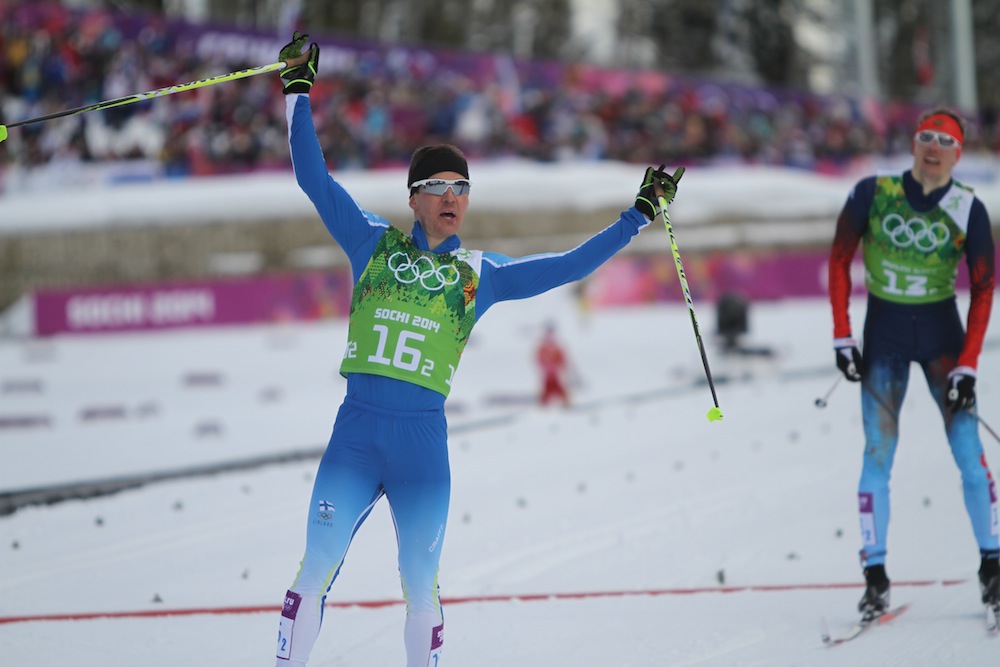
Sami Jauhojärvi. The veteran, who raced on the World Cup for 16 seasons and teamed up with Iivo Niskanen for gold in the 2014 Olympic team sprint, called it quits this spring. “I’m not tired of skiing, but at some point it just happens that competitive instincts begin to fade,” Jauhojärvi told InsideTheGames. “By training I could be pushing my limits for a few more years, but my competition mind is done. … I do not think any more about fighting for gold medals at future Olympics.”
Pre-Season Results:
Finland’s Krista Parmakoski skis to silver, her first World Championships medal, in the women’s 15 k skiathlon at 2017 Nordic World Championships in Lahti, Finland. (Photo: John Lazenby/Lazenbyphoto.com)
Only a few of the team’s distance skiers competed so far. KristaParmakoski won a 5 k classic in Muonio, Finland, while Anne Kylloenen won a 10 k skate where Laura Monenen was third and Aino-Kaisa Saarinen fourth, and Iivo Niskanen finished second to Russia’s Alexey Chervotkin in a 15 k skate the same day. Ristomatti Hakola won the sprint in Muonio.
Recent Drama:
According to the Finnish press, this will be the last Olympics for Matti Heikkinen, who will be 34 years old. He is targeting all the long-distance races and possibly the team sprint. Iivo Niskanen, meanwhile, will not to contest the skate races at the Olympics and focus on classic.
Kerttu Niskanen changed trainers this year, and her new choice is controversial. She is working with Pekka Vähäsöyrinki, one of the coaches involved in the 2001 blood-doping scandal which resulted in suspension of the Finnish ski association. The coach was found to have lied in court; there are allegations that when he was the national team director, he gave EPO and growth hormones to the head coach to use for the athletes.
Finland’s Kerttu Niskanen racing in the women’s classic team sprint at 2017 World Championships in Lahti, Finland, where her team (with Aino-Kaisa Saarinen, not shown) ultimately placed fifth.
“For several seasons I have remained at about the same level,” Niskanen told the news agency YLE. “So I want to try something new. “For me [the allegations] are just that. History… People may think what they want. It does not matter to me.”
Meanwhile, Krista Parmakoski is helping to organizing a youth ski racing series in her home district, called the “Krista Cup”. It will be a series of six races open to 7- to 16-year-olds and she will help organize the prizes. “It is important to encourage and inspire young skiers in every way, especially in the Häme district,” she told the local newspaper. “I still remember how much fun we young people had running around, seeing skiers and enjoying the atmosphere. With the Cup, young people can experience fun cross-country races throughout the winter.”
Best Social Media Presence:
On the women’s team, both Krista Parmakoski (Instagram) and Kerttu Niskanen (Instagram) provide consistent posts of training and daily life, as does Laura Mononen (Instagram).
Sprinter Lari Lehtonen has an active Facebook page, posting almost daily, and often includes training videos. Iivo Niskanen is also a consistent Twitter and Instagram poster, where you can see his hobby of horse racing as well.
Cologna in early action during the 2012 Tour de Ski.
From the qualifier through to the A-final, recently crowned Tour de Ski champion Dario Cologna (SUI) skied a “perfect” sprint day by all accounts in Otepää, Estonia on Saturday.
The current overall World Cup points leader made a statement from the word get-go, posting the fastest qualifying time by an unbelievable 4.2 seconds in a 1.4 k classic. He then went on to decisively win his quarter, semi and final heats. Ola Vigen Hattestad (NOR) and Eirik Brandsdal (NOR), who finished second and third, both said that runner-up was the best they could hope for.
“It was a perfect day for me,” Cologna said in a press conference after the race. “I had a good qualification and I got self-confidence for the heats.”
Self-confidence may have been a factor in his victory, but the sheer force behind every plant of Cologna’s double pole was not to be messed with. If his tempo looked moderate, it was only because each stroke generated so much forward momentum.
“I did not have a chance against Dario,” Hattestad said.
Canada’s Alex Harvey lunged for the finish line in an effort for third, but crossed it just shy of the podium for fourth.
While the women’s race featured a high-profile showdown between the two of the biggest names in cross-country, the men’s became, quite literally, an arms race. The compact, slow snow made for finicky kick conditions, and prompted a large majority of the men’s field to swap their classic skis for slicker skate equipment.
If Cologna’s 4.2-second gap in the qualifier on skate skis didn’t prove that double poling was the way to go on Saturday, the first round of heats certainly did.
Ola Vigen Hattestad (NOR) in action during the Tour de Ski earlier this month. He was second on Saturday.
In the first quarterfinal, Cologna started off trailing Russia’s Anton Gafarov, but quickly closed the gap in the first few hundred meters. Several Russians decided to stride, and the mistake became apparent on the first uphill. Cologna gapped Gafarov with his double pole as the Russian’s kick faltered. Cologna’s strength may have been superior in any case, but throughout the heats, striders repeatedly lost time — on the uphills, no less — to those powering through with their upper bodies.
For those who knew their arm strength was lacking, however, the choice to go with skate skis was more of a gamble. The third quarterfinal, which included Harvey and teammate Lenny Valjas (CAN), exposed those who had the muscle to efficiently push through an entire sprint course more than once and those who had spent everything they had in the qualifier.
Peeter Kummel (EST) led Valjas up the first climb, with Harvey skiing just off their back. Going into the second hill, Harvey made up time on the front, and skied beside Kummel and Valjas. Down the other side, it looked as though fast skis might propel both Canadians onto the next round, but somewhere in the final straight, Valjas’s arms ran out of gas. Harvey double poled away to advance comfortably along with Kalle Lassila (FIN), while Valjas suffered through the finish on fumes in fourth, ending 21st overall.
“I’ve never felt that way in a race before,” Valjas said of the pain he’d just experienced.
The next quarterfinal featured the second-fastest qualifier, Gleb Retivykh (RUS) and Andy Newell (USA), who had the ninth-best qualifying time. Retivykh burst from the gate fast and led with a strong stride up the first hill with Igor Usachev (RUS) and Sami Jauhojaervi (FIN) in the chase. Newell skied off the back, but managed to gain ground steadily coming up the final hill, as striders lost ground to the double-polers. Retivykh developed an unbeatable gap down the other side, and Newell moved into third behind Johan Edin (SWE).
In the final 300-meter straightaway, Newell’s stronger finishing tempo moved him through to the semis, his first shot past the quarters this season.
“I’ve been feeling good all year, so it’s nice to have a clean quarterfinal,” Newell said.
The fifth quarterfinal was the closest yet — Oeystein Pettersen (NOR) led out of the gate, and all six skiers double poled for the whole heat. Nikita Kriukov (RUS) slowly edged up on Petterson, and it came down to a photo finish between the two, with Kriukov barely nosing by. Anders Gloeersen (NOR) failed to make up the gap in time and was 0.1-seconds off the pace in third.
As expected, racing got more furious in the semifinal round. Cologna continued to demonstrate his control, skiing from the front for most of the heat. Gafarov once again took the lead for a brief time, but Cologna led the takeover pack and put impressive distance between himself and the rest of the field on the second big climb. The real race was the one for second; Brandsdal eventually bested his teammate Hattestad.
Harvey during the final climb of the Tour de Ski. He just missed the podium in Otepää, finishing fourth.
Harvey, Pettersen, Kriukov, Newell, Alexander Panzhinskiy (RUS) and Gleb Retivykh (RUS) took to the line for the second semifinal — it was seemingly anyone’s race. Kriukov led the Russian trio out of the stadium, with Harvey just behind Petterson and Newell off the back.
Up the first climb, Harvey clearly wanted to move by, but couldn’t immediately find an opening. Petterson shifted and Harvey moved through the hole, and from then on out steadily gained on the striding Russians — his real advantage came on the final downhill, as his skis were clearly faster. Harvey and Petterson went 1-2 through the final straight, with Kriukov in a close third.
Behind them, Panzhinskiy and Retivykh tangled up and crashed right in front of Newell, who slipped by without falling, but not before getting his ski skewered by an errant pole. Momentum lost and base dragging, Newell crossed the line five seconds off the pace in fourth, but still finished a season-best seventh overall.
The A-final featured a stacked lineup: Cologna, Harvey, Pettersen, Brandsdal, Hattestad and Kriukov. All six men were on skate skis, and double-poled their way up, down and around the course. The group remained virtually as one pack, Cologna always in the front, until the second climb, when the top four put a gap on Kriukov and Petterson.
Cologna, Hattestad, Harvey and Brandsdal remained close down the final hill and into the stadium, drag racing out of the right-hand corner into the straightaway. All four turned on the backburners, and Cologna opened up just enough of a gap to comfortably raise his hands in triumph over the line. Harvey, who had been skiing even with Brandsdal and Hattestad, finished fourth despite a lunge for the finish.
Brandsdal, 3rd in Otepää, shown qualifying in Milan last weekend.
“It was a great day for me,” said Cologna of his execution. “I’ve been in good shape and recovered well from Tour de Ski.”
The runner-up, Hattestad was complimentary of his competitor. “Second place is the maximum what I could achieve today,” he said.
Harvey, though pleased with a top five, was disappointed to have just missed out on the podium.
“That was a close one today,” he said in a press release. “Fourth is awesome, but it is a little heartbreaking too. … Pure sprinters train a lot more for double poling than distance skiers so I was a little nervous today because it is a really hard course.”
Men’s competition resumes Sunday with a 15 k classic.
A view of the men's course for Stage 7 of the Tour de Ski.
TOBLACH, Italy – Stage 7 of the Tour de Ski, which took place Thursday, is the event’s crown jewel: a 35-kilometer point-to-point race that sent competitors up an over a mountain pass, with the craggy Dolomites as a stunning backdrop.
Or, to be more precise, it sent male competitors up and over a mountain pass, with the craggy Dolomites as a stunning backdrop. The women, meanwhile, skied three laps of a standard five-kilometer course on the trails in Toblach, never heading up high to the rugged alpine scenery.
We checked in with a number of coaches and athletes to see what they thought of the discrepancy.
Marit Bjoergen (NOR): “For us it is better, because when [there is] a group, and…one in front, it is hard to go in front. But for us, when the track is round, it is easier to go alone. I think it is better to do it like this.”
Rickard Grip (Swedish women’s coach): “Actually, I think it’s a little boring that they go on this normal 5 k track for three laps. I think it would be interesting to see if the ladies started where the men will start. They wouldn’t [have to] go the first three or four k—the men go all the way down here, then they go the 5 k loop, then in the finish. So, I think maybe the women could go on the track to here, and then not make any laps [on the 5 k loop), or maybe do a really short one, or something.”
“I think it would be interesting to see about that, because it’s a little bit boring that they just go [in Toblach].”
Kikkan Randall (USA): “Last year I was kind of up in arms about, ‘Hey, why do the guys get to do a cool point-to-point race, and we don’t?’ But after skiing here, I felt like it was a really good course, and it still accomplishes, you know—people gapping together, people spreading out. And I think for us to do a point-to-point course, it was going to be mostly downhill, so I think it’s a good venue…there’s still plenty of exciting racing.”
Sami Jauhojaervi (FIN): “The [35 k] track is not the best possible for ladies. A lady who is skiing alone will lose from one to three minutes, compared to a group, which can change the leader all the time. It would change too much. The time differences in ladies are already now big—too big.”
“Of course, us men, it’s nice to have some challenge, but of course on the lady’s side, it’s huge gaps. And those would be even more huge. So the number three [lady] would start in the wave, [if] they would do this 35 k.”
On an alternative: “They could, for example, in this stadium—they could do some uphill, and then come down from another track. For five kilometers, flat-uphill, seven kilometers to 10 down, then some loop in the stadium.”
Astrid Jacobsen (NOR): “Of course we could race 35, but I think the day we should race 35, we should also have the same distance for the shorter races. Like, [in the prologue in Toblach], we had three [k], they had five [k]. And I think also—it’s bigger gaps between the women and the men, so if we had a 30 k, it would be really not interesting any more. Because I think it would just be one skier, [then] two minutes, one skier…[That way], we’d get too big differences between the skiers, and then it’s not so much action any more…I think 30 k tomorrow would be maybe not so fun to watch.”
Magnar Dalen (Finnish head coach): “I feel that it should have been much better that the women had the same type of race [as the men]. Because the race they have tomorrow on this hard track [the 5-kilometer loop] just separates the real good engine skiers more. If the ladies had had the same as the men—maybe five kilometers shorter, but still with a slight downhill—it would have been very interesting for the overall. Now, the Tour will be like [settled] tomorrow. Not who is one and two, but all the others behind will have big problems, and impossibilities for the podium.”
“It’s a hard track [the one the women are skiing]. It’s an extremely hard track at high altitude. (Toblach is at roughly 4,000 feet above sea level.) I don’t see any reason—why are the girls skiing a harder track than the boys?”
On the feelings of the Finnish women: “They want to have it the same as we had at the beginning of the Tour de Ski—then they were starting [the same course as the men].”
Charlotte Kalla (SWE): “I don’t know. I’m very focused that it should be 15 kilometers…it’s enough with 15 kilometers.”
“It would be fun to go from one place to another, but I don’t want to go 15 kilometers downhill.”
Sami Jauhojärvi brings it home in 5th in the 15km classic at World Championships.
While you might not be able to spell or pronounce his name, if you’re a fan of elite cross country skiing, you should be familiar with Sami Jauhojaervi.
Jauhojaervi is one of Finland’s top cross country skiers – the 30 year old has finished as high as 5th in the World Cup Overall, has four World Cup podiums to his credit, and two World Championship bronze medals from Liberec in 2009, where he was a member of the 4×10 k relay team and sprint relay. Last season his best finish was a third place finish in the classic sprint stage of the World Cup mini-tour in Kuusamo, Finland.
FasterSkier caught up with Jauhojaervi to talk about last years’ phenom Juha Lallukka, the 2001 Finnish doping scandal, and the elimination of the individual start 50 k on the World Cup.
FasterSkier: The 2009-2010 World Cup season was an extremely tough one for you – you failed to hit the World Cup podium, and the Vancouver Winter Olympics did not feature any Finnish men coming home with medals. But in 2008-2009 you had a career best year, finishing fifth in the World Cup overall rankings. What happened, what changed?
Sami Jauhojaervi: After a great season 2008-2009 I was having a good summer of training. I was in very good shape already at the end of August, and I was just thinking ‘this is an Olympic season, I need to push more than ever before to get a medal from Vancouver’. I became “blind” with my training, and did not have enough courage to rest. It’s easy to see in hindsight, but I made several wrong decisions from September until January, which led to a tired nervous system. I tried to get as much recovery as possible after the Tour de Ski, and got myself in a better shape, but then got a virus-infection during the Olympics which finally destroyed the last dream to get a medal from 50km.
In general, all the Finnish men became too greedy in our training, so that the results were not as good at the Olympics. I think that all of us increased the amount of high effort training a bit too much. Still, we were just about ten seconds behind the third team in 4x10km relay.
I didn´t have anything new in my trainings. I got too greedy and did not have enough courage to rest enough. The main reason for the tiredness was that I was too self-confident that I was doing the right thing, and forgot to control my recovery.
FS: In the last few years the Finnish mens team has brought along some very talented skiers, such as Matti Heikkinen and Ville Nousiainen, and you finished 4th in the relay at Oslo World Champs. What is the atmosphere around the team? Is the 4×10 a major focus for the team?
SJ: We are all individuals with different kinds of training systems and, we all are trying to do the best result as individuals. Even though this individualism lights 4x10km somehow up the highest fighting spirit in our bodies. When we are in training camps together, we are challenging each other in every training session, competing all the time and also supporting each other if somebody has problems.
Jauhojärvi leading the chase pack on the second leg of the World Championship 4x10km relay. Finland ended up 4th.
FS: For most people looking on, it seemed that Juha Lallukka came out of nowhere last season to be your fourth on the relay team, and also won the 50 k at Finnish National Championships by over 2 minutes. Did you know he was at that level? Where did he come from, and is he going to be a part of your team next season?
SJ: The results Juha had were not a surprise inside the team. He is very talented man with high VO2, but just being a skating distance specialist, he has not many chances to show up during the season – on the World Cup there are usually just 2-3 skate distance races a year. Juha was about to end his career after Vancouver, but fortunately decided to continue outside the national team, which was a good decision for him. He´s been chosen for the team this season but he likes to do his training on his own. I´m quite sure he will be a part of the relay team, and skating team this season. He’s especially needed on relay team as our other skating specialist Teemu Kattilakoski ended his career this spring.
FS: What are your goals for this coming season? Are you focusing on the Tour de Ski, looking for the World Cup overall?
SJ: My focus for this season is going to be the World Cup Overall. I’m trying to become a better skater during the summer and fall so that I can get good results also in skate races.
FS: What is your opinion on the rise of North American skiing? Are both Devon Kershaw and Alex Harvey seen as legit medal contenders week in and week out on the World Cup, and for the World Cup overall?
SJ: Both Devon and Alex have developed into really good skiers, and I was positively surprised about their victory in sprint relay in Oslo! Somehow I don’t rely on that they will finish on podium in overall or even nearly every week. One problem I have considered is that most of the competition are held in Europe, and athletes from North America have to stay away from home for ages, which might make them frustrated and the level of concentration for skiing gets down?!
But it’s also good that North America shows it head in cross country skiing. You have extremely good conditions in several place for training and hopefully the example of boys and Kikkan Randall will lead to more youngsters interested in skiing. One good thing to promote skiing would be to have it shown more on TV!
FS: You’re an athlete rep to the FIS, and have taken part in the recent FIS meetings. What is your opinion on the Tour de Ski, and its increasing importance during the World Cup season?
SJ: The Tour de Ski has been a really good invention to promote cross country skiing. The interest that media shows for it is huge, but the Tour de Ski also has a little too big role in World Cup Overall. If you happen to be sick during Tour de Ski, you´ve already lost the overall competition. Cross country skiing really needs an event such as Tour de Ski, but some solutions should be made so that its role is smaller in terms of the total World Cup!
FS: What have you heard are the biggest issues facing the athletes on the World Cup? What do people want changed the most, or are nervous about in the future?
SJ: One of the biggest challenges for athletes is travelling during the season. Most of the athletes are satisfied with the amount of World Cup races, but feel that there is too much travelling. The other issue is always the price money. Most of the athletes are not satisfied with the distribution of money. I think they´ve done a good review of prize money distribution in ski jumping, where the top 30 receive money, instead of just the top 10.
FS: Your one World Cup victory is a 50 k Classic mass start, how do you feel about the elimination of the individual start 50 k as a World Cup race?
SJ: It´s really sad that one of the most traditional events is no longer a part of the circus. The individual 50km has always been the most respected event in skiing, and I really hope to have it back in the system, and especially in major championships soon. The interest of following the 50km is totally different compared to shorter distance, because anything can happen until the finish line has been crossed.
Finishing the 15km classic World Cup in Drammen.
FS: Finnish cross country skiing was hit hard with doping scandal in 2001, at the home World Championships in Lahti. Where were you, and what were your thoughts on having the best Finnish skiers test positive?
SJ: In my last year as a junior skier I came second at Finnish Champs in the sprint, and qualified for the Finnish cross country team at the World Championships in Lahti 2001 and took part in sprint, finishing 18th.
I was surprised about the use of doping in the team, but I didn’t become sad about it. Even though I was a bit ashamed for the Finnish people to have several skiers caught for doping, I was still happy that those who were cheating were caught, and I considered it merely a chance to show my talent as a young skier. Afterwards, I´ve thought that the case in Lahti was a start for a more clean endurance sport, which continued very well into Salt Lake City also!
FS: What did that do to your perception of cross country skiing? How did it affect your choice of sport, and career?
SJ: Of course I started to question whether it was possible to climb up to the top with natural ways. I believed that it was possible, and decided to continue on the road I had chosen one year before, when I made the decision to be a professional cross country skier. Now, eleven years later, I´m still on that road, and am really happy to have made that decision. I have thousands of great experiences and learned several important skills for living.
FS: How has the scandal of 2001 affected Finnish cross country skiing? Has the public view of cross country skiers in Finland changed and how?
SJ: The first years few after Lahti we were suffering for a lack of money in our federation. It really affected us – we couldn’t afford to have proper training camps and other facilities for doing really high level cross country skiing, and therefore the results were also awful! Fortunately, the finances started to ease a bit around 2004, and we could also have full quotas in World Cup races, which gave us skiers the possibility to learn the world of the World Cup circus.
The public view became really bad after Lahti. The popularity among viewers and people collapsed, and almost nobody believed in “clean” skiing. People were joking with us like; “What pills do you eat, because the results are so bad? You should change the pharmacy!”
For me, such comments just gave more power and strength to train harder. Now, the trend is totally different and most people understand that those who cheated were the generation before us. Cross country skiing has also become a trendy sport in Finland in recent years.
FS: What do you see yourself doing after your career in skiing? Do you hope to stay involved in the sport at some level?
SJ: Together with my coach and my physiotherapist we´re building up a firm which will concentrate on the total well-being of a customer, including sports, recovery, education for different kinds of matters in living, food. After my career we have planned that I will be the CEO of the firm and deliver the experience I have learned from sports to normal people. I´m quite sure I will also work with young people in endurance sport, for example as a coach.
FIS athlete representative Kikkan Randall after her World Cup sprint victory in Drammen this February.
If the decision-making process at the U.S. Ski and Snowboard Association (USSA) Spring Congress is exhausting, the annual International Ski Federation (FIS) meetings are even more challenging.
While American skiers often lament the relative lack of visibility of our beloved sport within the US, the FIS Calendar Conference that convened in early June demonstrated that popularity comes at a price. Namely, the larger the number of significant stakeholders—countries, athletes, coaches, administrators and TDs, of course, but also media and sponsors—the more difficult it becomes for committees to reach a compromise and the more complicated resulting decisions seem to those outside the process.
The conference was held in Portoroz, Slovenia this year from June 1 through June 4, and in those five days there were over fifty meetings of various committees, sub committees, and working groups.
The week ended with the World Cup Organizer’s Seminar, where subgroups presented their stances on issues they had worked on, preparing the FIS Council for their final approval a few days later in Slovenia’s capital, Ljubljana.
The US sent four administrative representatives to the conference: out-going USSA Nordic Director John Farra, USSA official Bob Gross, New England Nordic Ski Association (NENSA) Adaptive Programs Coordinator Eileen Carey and New York State Olympic Regional Development Authority (ORDA) Vice President Jeff Byrne.
Representing her fellow cross-country skiers on the athletes subcommittee, along with Finland’s Sami Jauhojaervi, was Kikkan Randall.
Though they attended the same conference, Farra and Randall took part in separate meetings throughout the week, and had slightly different takes on their experiences.
While Randall came away feeling like the concerns of the athletes had been heard, Farra, who sat on a subcommittee created to address the team sprint at World Championships, felt that progress was limited.
“I’ve been a FIS representative long enough to know how slow progress is at the international level,” said Farra in a phone interview. “It often feels like nothing happens, but it’s important for us to be there anyway and have a voice at the table, because that table is full of people from the European perspective. Their athletes can easily race on the weekends and then go home during the week and sleep in their own beds. It’s not deliberate, but they’re not going to think of what the Canadians, Americans or Japanese go through on the World Cup.”
At least one rule change this year attempts to ensure that the top teams don’t cruise through the season with the bare minimum number of starts. The top five-ranked nations from the 2010-2011 season are now required to send athletes to all World Cups, except for one weekend of their choosing.
For the men, that affects Norway, Russia, Sweden, Switzerland and Italy. For the women, it applies to Norway, Sweden, Italy, Finland and Poland. The rule is intended to ensure that all World Cups have a good starting field.
“It gives any nation a weekend to rest and not go to Canada, for example. But if you skip more than one weekend, you lose the ability to start the next weekend. It penalizes those top teams for not participating,” explained Farra. Though he adds that “they could still throw in their B athletes to protect themselves from the rule. But it’s a good effort to make the World Cup a legitimate, season-long event.”
Creating a calendar that’s fair to all national teams is only one challenge on the international level. FIS, like USSA, must try to set a racing calendar that meets the approval of skiers with disparate strengths—one that doesn’t favor endurance athletes over sprinters, or one technique over the other.
Farra sat on a working group meant to address the fact that the team sprint at World Championships and the Olympics wasn’t actually playing to sprinters’ strengths.
“Though skiers only go for 1 k at a time, it’s such a long event that it’s not really a sprint,” he said. “If you look at the results, it’s being won by the same athletes winning distance races.”
This is a problem for sprinters because, out of the six events at the Championships and Olympics, there are really five that cater to distance racers, and only one that suits sprinters, according to Farra. While the working group, which includes Norway’s Vegard Ulvang and Slovenia’s Uros Ponikvar, is not quite ready for a wholesale change to the team sprint at this point, “adaptations could happen in the future. It’s good to keep the discussion going.”
Randall said that her experience voicing athletes’ concerns at the conference was a positive one.
She is now three years into a four-year term as an athlete representative, and in her opinion, these were the most productive meetings she’s attended, thanks in large part to her work with Jauhojaervi over the past year to set up an effective network of communication between the athletes.
In order to make sure every team had a voice, she has helped put together a sort of athlete’s commission.
“We now have a representative from every country, so we can give and get feedback to every team. During the season we held two meetings with them to figure out the main topics we wanted addressed. We put together a survey for all of the athletes, and out of about 80 of them, we got just over a 50 percent response rate. We then went to the FIS conference with actual data, and I presented that a few times throughout the meetings. They all seemed pretty blown away by the fact that the athletes were so organized,” said Randall.
With solid numbers showing what was important to the athletes, Randall said that she and Jauhojaervi were able to steer the direction of the conversation. At the top of the list was the athletes’ desire to have a representative with them if they got called into the jury room.
“Right away, they said, ‘Okay, if that’s what you want, then it’s done.’ That was our number one concern, and it was passed unanimously,” said Randall.
Another main concern of the athletes entailed giving fair racing opportunities to sprinters on the World Cup.
In the past, whenever there was a sprint race on a given weekend, it was usually on the second day, making it tough for sprinters who want to do the distance race as well.
“We asked for at least a 50-50 split for the sprint to be first. If you look at the calendar that was released, I’d say we got that wish,” said Randall.
The third major issue that Randall brought to the meetings was prize money distribution, particularly on the tours. Right now, “it’s pretty top heavy,” she said, with most of the money going to the top two or three finishers.
The athletes wanted to see a redistribution of that in order to reward a top-10 or top-15 finish, Randall said. And since she had the data to back up the claim that this was what the athletes wanted, the committee paid attention.
“They asked us to come back to them with a proposal of what we want to see,” said Randall. “So that’s one of our tasks for the next year, to put that together and get it back to them, and I think we’ll be able to. Usually we go to FIS and they say ‘Oh, you want more prize money? No, we can’t give you more prize money.’ But now they’re asking us to tell them what we want.”
In addition to making Randall and Jauhojaervi’s representation more effective and credible, the network they’ve set up also improves feedback to the athletes now that the meetings are over: Randall said she was able to send out a summary of what went on at the conference.
“We’re really lucky, in the U.S., that we have such good communication between USSA, the coaches, and the athletes. But other teams sometimes never give this kind of information to their athletes directly. It’s important for them to be able to understand why decisions were made, and who the stakeholders are,” said Randall.
In addition to listening to the concerns of the athletes, the FIS must also consider who is generating viewership and prize money all winter: the sponsors and broadcasting companies.
When trying to make changes to the World Cup calendar, “TV companies that pay to cover the races aren’t flexible on certain days,” Farra explained. “The calendar will always have to revolve around weekends, TV time, holidays and other major events that are going on.”
This came into play in discussions surrounding the addition of a World Uphill Trophy in Poland.
While there won’t be World Cup points at stake at the uphill event this winter, the climb will happen on a Sunday, after the Polish World Cups on Friday and Saturday.
According to FIS Cross Country Director Jürg Capol, the federation is hopeful that the race, which is half climb and half descent, will inject fresh interest into a calendar that lacks an Olympics or major championship. Popularity equals TV time, and TV time equals more prize money.
Other changes made to the schedule in order to generate more excitement for spectators and TV viewers included the addition of an extra day to the Tour de Ski, and a trial run of a new interval start order.
In the Tour, with the addition of a 3 k for women and 5 k for men, the series now has nine events and two rest days.
The new interval start order will be run as a test, at the first World Cup event in Beitostoelen, Norway. The top 30 athletes according to current standings will start in reverse order in the last group, which is the format dictated by the previous rules. But now, those 30 athletes will be separated by at least one skier in between them.
By spreading out the top athletes, FIS is hoping that they will be more visible throughout the race, according to Farra. If it goes well, the system will be implemented over the rest of the season, excluding stage events.
Maintaining and growing a fanbase for skiing is always a concern, said Farra, even in Europe.
“We need skiing to continue to be able to provide prize money. This sport is not just about holding onto tradition. As a sport we are in a fight for TV time, credibility and sustainability,” he said.
For a full list of highlights from the FIS Conference, click here.
The Czech Republic's Lukas Bauer racing at the 2011 World Championships in Oslo. Bauer recently received over $2,500 in prize money owed to him by the International Ski Federation.
Two skiers have received more than $5,000 in overdue prize money owed to them after the disqualification of a Russian skier for doping in 2009.
This spring, both Finland’s Sami Jauhojaervi and the Czech Republic’s Lukas Bauer confirmed to FasterSkier that they had each received some 2,200 Swiss francs apiece from the International Ski Federation (FIS), for their performances in the 2009 edition of the Tour de Ski.
Jauhojaervi and Bauer finished 10th and 11th, respectively, in the overall standings of the race, and had been elevated one position after Russian Evgeni Dementiev’s ninth place was voided due to his use of EPO, a banned blood-boosting drug.
A little-known FIS rule required that Dementiev’s prize money be confiscated and distributed retroactively to Jauhojaervi and Bauer, but the case had stalled until a FasterSkier investigation highlighted it in November.
In an interview last week, FIS Secretary General Sarah Lewis acknowledged that there had been an “oversight” in her organization, which she attributed to the relative rarity of such cases, and their complexity.
“It’s such an ad hoc, unusual thing to happen—it just needs to be better followed-through,” she said. “You’ve got multiple little chains there, where there can be a breakdown. Clearly, it didn’t work as well as it should.”
Dementiev’s case was especially drawn out: because of procedural hurdles, it was more than six months before he was suspended based on the results of a drug test that occurred in January, 2009.
By that point, Bauer said, the Tour results had dropped off his radar, and it hadn’t occurred to him to ask after the prize money. In an interview in Oslo in March, he called on FIS to do a better job of overseeing the redistribution process.
“I think that they have to work on it,” he said. “It was not the first case—and I’m sure it will not be the last case.”
FIS officials had previously noted that neither Bauer nor Jauhojaervi—nor their national ski associations—had approached the federation about the missing prize money in the period following Dementiev’s disqualification. But in the interview, Lewis said that the responsibility for follow-up ultimately lay with her organization, not the skiers themselves.
“It’s not the athletes who have to initiate the process,” she said. “The athletes…should expect that the process will be managed by FIS.”
The 2010/2011 Veissmann Tour de Ski is nothing if not draining. Consisting of eight events in ten days in two countries, the fifth edition begins December 31st and runs until January 9th.
The Tour begins with a freestyle prologue in Oberhof, Germany, on December 31st, followed by a classic pursuit start on January 1st. The Tour then moves to Oberstorf, Germany, for a sprint on January 2nd, and a pursuit on the 3rd.
After a two day break, the Tour resumes in Toblach, Italy, for a sprint on January 5th and a point-to-point pursuit start from Cortina to Toblach on the 6th.
The Tour de Ski wraps up in Val di Fiemme, Italy, as the Italians host a 10/15 k on January 8th, and then the final climb up Alpe Cermis on the 9th.
The Favorites
In the fifth edition of the event, all three top male finishers from last season are expected to contend. Lukas Bauer (CZE), Petter Northug Jr. (NOR) and Dario Cologna (SUI) are all registered, and while two have started the season quickly, the third – Northug – has only four World Cup starts to the season, having fallen ill just before the opener.
The Czech Republic's Lukas Bauer racing at the 2010 Olympic Games.
Bauer has come out swinging – the aging Czech distance specialist sits in seventh in the overall rankings, and has already collected two podium finishes, including a stage win in Kuusamo, Finland. He has finished in the top 30 in every distance race he has started (his one sprint wasn’t great, as he finished 104th, a full ten seconds away from qualifying).
Given his hot start, the fact that he is the defending and two-time Tour de Ski champion (2007/2008 and 2009/2010), Bauer is undeniably the favorite. While his utter lack of sprint skill is disconcerting, he has shown in the past that it is irrelevant, as in the two sprints on the Tour last year, he finished 54th and 60th. But Bauer recognizes that sprinting is still important – he has put extra time into improving his speed over the summer, and should be aiming to limit the damage during the two sprint stages.
After Bauer, Switzerland’s Dario Cologna is a must-watch. In his short four year World Cup career, Cologna has already won the World Cup overall, the Tour de Ski (2008/2009), and currently sits in second in the overall standings, a mere 22 points from the lead.
Cologna is dangerous because he is a true all-around skier, and more importantly, is extremely consistent. The last time Cologna finished outside of the top 30 on the World Cup was over a year ago, on December 12, 2009, in Davos. He has already stood on the World Cup podium three times this season, including a second place finish in the Kuusamo mini-tour, and a third place in the freestyle sprint in his hometown of Davos.
Despite finishing runner-up to Bauer in last years’ Tour, winning the 2009/2010 Crystal Globe, and being the most recognizable cross country ski name on the planet, Petter Northug has to be considered a bit of a dark horse. The dynamic Norwegian is just bouncing back from illness, and his absence from the early World Cup has put him in a large hole in the overall standings, as he sits in 18th.
Dario Cologna celebrating a victory at the Olympics
While Bauer is the distance workhorse, and Cologna is the all-around consistent performer, Northug is the sparkplug. Love him or hate him, the Norwegian is without a doubt one of the most talented and entertaining skiers on the circuit.
The question will be his health, and whether he has returned to his world-beating form. Over the last two World Cup weekends, Northug has done well, but not outstanding. The real concern should be with his famed sprint speed – his failure to win a sprint finish in the 30 k freestyle at the La Clusaz World Cup combined with his 28th place sprint in Davos the weekend before shows that his sprint is not where it has been in the past.
Northug may need a few extra races to get back to where he needs to be, as it is inconceivable that a skier of his talent will be held down for long. Expect him to speed up over the course of the Tour, and a podium finish is completely realistic.
The Chasers
While most of the buzz is about the top three finishers from last year, both the Russians and the Swedes also have strong contingents hitting the start line.
The Russians have nine men starting, headlined by Alexander Legkov and Maxim Vylegzhanin. Legkov currently sits atop the World Cup overall, and much like Bauer he is a sub-par sprinter, but an excellent stage racer.
Winner of the Kuusamo mini-tour and runner-up in 2006/2007 Tour de Ski, Legkov has the potential to gut out a victory, as he has the tools to distance ski as well as almost anyone, and won’t lose much time in the sprints. The only area for concern is his Tour de Ski record in the past three years, as he has finished 20th, 33rd and failed to complete the event since his second place in 2006/2007.
Legkov and Bauer.
Maxim Vylegzhanin is ranked third in the overall behind Cologna and Legkov, and as one would expect, has had great start to the season. He has finished in the top 15 six times, including fifth in the Kuusamo mini-tour, and besting Northug in the 30 k freestyle in La Clusaz, which certainly bodes well. He has a decent record on the Tour (21, 15, DNF), but just can’t seem to make the breakthrough to finish in the top 10.
The only surprise for the Russians is that 20 year old phenom Petr Sedov, who is currently 8th overall, will not be starting.
The Swedes are bringing seven men to the party, and could easily capture at the very least a couple of stage victories.
Emil Joensson is the current world cup sprint leader, and is currently fifth in the overall. He is practically a lock to make the podium in both sprints, and he can ski a mean 10 or 15 k, especially classic. Unfortunately for Joensson, as the Tour goes on, his distance racing will be sorely tested, and he simply lacks the ability to compete in the longer events, so it is unlikely he will be able to contend for a podium spot in the final races.
However, his team mate Marcus Hellner, who is fourth overall in the World Cup ranking has a much better shot. Often billed as Northug’s biggest rival, but not quite at the same level, Hellner started out the season strong with a home town win in Gallivaere, Sweden, but has been inconsistent since then, finishing fourth in Kuusamo, 33rd in the 15 k classic in Davos, seventh in the sprint, and finally 29th in the 30 k freestyle in La Clusaz.
In the 2009/2010 Tour de Ski, Hellner was saddled with the wooden medal despite having a very strong final climb. To stay in contention for the podium, Hellner will have to avoid the inconsistent distance days, and if he is close going into Alpe Cermis, his strong skate climbing means he can pick up a few spots.
Other strong Swedes include Daniel Rickardsson, a very good all around skier who will be in a position to crack the top 10, Johan Olsson, who hasn’t raced a World Cup since finishing 7th overall in Kuusamo, and the tough-as-nails Anders Soedergren.
Sweden’s Scandinavian counterparts, Finland, lack a real shot at the Tour overall. Sami Jauhojaervi is their best hope, as he is ranked 19th overall, and has had success on the Tour previously, but his horrendously inconsistent skiing (think two top 10’s, and three races 50’s or higher) will prevent him from being a true challenger. Matti Heikkinen gets the nod as well, but like Jauhojaervi lacks the staying power required for the lengthy event.
While the event is on home turf for both the Germans and the Italians, neither country has a skier competitive enough at the moment to challenge the top group.
Seven Italians are pegged to start, including Giorgio di Centa, and on-form sprinters Fulvio Scola and Renato Pasini.
Meanwhile, the Germans have only two men currently in the top 40 in the overall World Cup standings, but 13 men will start. Surprisingly Jens Filbrich and Tim Tscharnke are the two highest ranked German skiers, while stalwarts Axel Teichmann and Tobias Angerer are 46th and 58th respectively, and both will have to demonstrate a lot better form than they have thus far on the World Cup.
North American Contenders
This edition of the Tour will see five North American men fighting for position – and all five men bring their own unique set of skills to the event.
American’s Andy Newell and Kris Freeman will both take to the start line, and will hope to continue the good early-season World Cup results with top results, regardless of stage. Freeman has jumped out to the best start of his World Cup career, and sits in 13th place Overall, as a result of collecting points in each of his World Cup starts thus far.
Newell has had a decent start as he sits in 31st in overall on the back of his strong sprinting, in which he has earned points in all three of the sprints thus far on the circuit.
Newell
Both men have been typecast as specialists – Newell in sprinting, and Freeman in distance racing. However, both skiers have been working hard on diversifying their skiing, and have a bet running over who will score World Cup points first – Freeman in a sprint, or Newell in a distance race.
The biggest question mark surrounding Newell is whether he will be able to distance race well enough to stay in contention.
“I’m pretty excited to have a bunch of opportunities to do some distance races,” he said, “because I know I’m in good shape and I can distance race really fast — I just haven’t had the chance to show it.”
Newell knows he has strengths and weakness in distance racing; “I know I’m a good mass start skier for sure,” he said.
“I can ski well in packs but at the same time it’s like any time in a mass start race – you run the risk of blowing up,” he said, “It can be sometimes easier for sprinters like myself [to blow up] as you can build up so much lactic acid.”
Both Freeman and Newell are relatively new to the Tour de Ski. Freeman has never competed in the event before, and Newell he completed three races last year before bowing out, and he felt that he has not gotten “a true Tour experience.”
Regardless, Newell is going in confident; “I feel like I can be good at back to back to back races,” he said, “I think I’ve trained enough over the year that’s something I’ve gotten a lot better at.”
Like many other racers on the Tour, Newell is targeting consistency, and is thinking about having good races each stage, rather than focusing on finishing as his end goal.
While both Americans are working on their weaker race types, the best bet for top performances are their bread and butter events – the skate sprint for Newell, and something 15 k or longer for Freeman. It is difficult to imagine either skier truly contending for a place on the overall podium, but top 30 finish is a completely reasonable expectation.
“Hopefully I’ll be able to hang in there for some distance races and score some distance races,” said Newell, “I’m going to need to score some bonus seconds in sprints [to have a chance in the overall standing].”
The Canadian contingent showcases an all-around skier just coming into his prime, a young gun with loads of potential, and one of the best climbers on the circuit. Devon Kershaw, Alex Harvey and Ivan Babikov are all world class talent who had excellent results on the Tour de Ski last season, and look to build on that success. In charge of the three skiers is Head Coach Justin Wadsworth – a rookie on the Tour de Ski.
“I think I’m pretty well organized,” said Wadsworth in an interview with FasterSkier, “and that’s key for keeping the nerves down.”
While he has never been involved with the Tour before, Wadsworth is confident – he has been to all the World Cup venues before, and the three skiers he is in charge of will be well served. The Canadians have a large staff of five wax technicians as well as a massage therapist, the legendary ‘Wolfman’.
Wadsworth is confident in his athletes ability to make the most of the Tour, and emphasized that Kershaw and Harvey have a shot in every stage, while Babikov will be able to take advantage of the difficulty of the last three stages, as he will be getting fitter every race.
Kershaw
After one of the hottest starts of his career, in which he has consistently skied in the top 30 while hitting a few top 10 finishes, Kershaw is hitting his stride as an all-around skier.
While he appears to be in form, and he is happy with how things went, Kershaw is still cautious about the event.
“The Tour de Ski is completely different [from the rest of the World Cup season],” said Kershaw in a recent interview with FasterSkier, “a whole lot of things have to go right.”
For Kershaw, having one or two really good days would make for a successful Tour, but his real ambition for the Tour de Ski is unrelated to results.
“To be honest, the only big goal is to stay healthy,” he said, “Over the different Tours, we’ve had a lot of illness on the team, and I’ve been lucky to avoid it for the most part.”
If he stays healthy, Kershaw has proven that he can race well in the Tour format. Last year he finished 16th in the event, benefitting from good sprinting, as well as six top 30 finishes.
While he has traditionally had strong results in Tour de Ski sprints, including a podium, this year Kershaw isn’t so focused on the sprint.
“The sprints are long days, and I don’t know how important they are in the overall,” he said. “[Lukas] Bauer won the Tour last year without ever qualifying for a sprint
Unfortunately for Kershaw, his favorite and best event, the 10 k classic, has been eliminated from the Tour this year. As a result, he’s keeping his eye out for the 20 k pursuit in Oberhof, Germany in Stage 4.
“The Tour really starts at the Pursuit in Oberstorf,” said Kershaw, “That’s the first place you’re really going to see some fireworks. Whether or not I’m looking forward to that, I have to be on my toes.”
Kershaw said he may have pushed his training a little bit too hard during the last week, and as a result is feeling a little flatter than he would like, but with some dedicated rest, is hoping to be back in top shape come December 31.
While Kershaw is still hoping to regain a little bit of energy, Alex Harvey is feeling well rested and ready to go, according to a recent interview with FasterSkier.
Harvey is still relatively new to the Tour – this will be his second time tackling the event. And he learned a lot from last year, and highlighted two major things that he is hoping to improve on – staying calm, and proper feeding.
The point-to-point race is something he is much more comfortable with the second time around. Last year Harvey described himself as “really nervous” prior to the start, as there was no opportunity to ski the course beforehand and he had a large gap he desperately wanted to close to the leaders. As a result, Harvey ended up with a severe diaphragm spasm, throwing off his rhythm. This time around, Harvey is a lot more comfortable, as he knows the course, and is aware that he needs to stay relaxed.
Second, he recognized the increased importance of feeding on an event like the Tour de Ski. In the long classic race last year, Harvey was skiing strong at the front of the chase group when he bonked hard with one kilometer to go.
“I didn’t feed enough during the day,” said Harvey, “you need to make sure your energy levels are always high, and it’s really hard to recover when you bonk that hard.”
If there was one area Harvey really targeted for improvement this year, it was his sprinting.
“On the sprinting side I was disappointed last year,” he said, “This year I wanted to make sure I can sprint well.” Last season Harvey managed to qualify just twice for a World Cup sprint. This season he has started just one, but finished ninth.
Harvey has been confident with his shape all fall, and his strong start on the World Cup has increased his confidence. “I knew I would be more consistent this year, and I know I usually improve as the season goes on,” he said.
And consistency is what Harvey is targeting for the Tour. While he has picked a few stages as key – the 20 k Pursuit in Oberstorf, the 36 k point-to-point, and the second last stage – he is confident in his shape regardless of the stage.
“If I have a good day, any of the stages I can do well,” he said.
As for the Final Climb, the 22 year old isn’t intimidated – he’s actually a little bit excited about it.
“It’s not complicated,” he said, “you have to ski well technically, but it’s all about the climbing. It’s just how your body is doing, even the skis only matter for the first part.”
While Harvey may not consider the Final Climb very complicated, that may be in part to being in close proximity with the man who is quite possibly the best at the event – team mate Ivan Babikov.
The first few stages don’t suit Babikov, as he has struggled in prologues and sprinting, but as the days get longer and the Tour gets tougher, Babikov, who is widely regarded as one of the toughest athletes on the circuit, will shine. His specialty is the last stage – in 2009 he won the quad-busting climb outright, and in 2010 he finished fourth. If Babikov can stay close during the opening stages, his climbing skill means he may threaten for a podium spot.
Both Canadians and Americans have spent the Christmas break in Davos, Switzerland, taking advantage of the high quality training location, and getting in large amounts of skiing and some good recovery as well.
The group has gone alpine skiing, and taken advantage of the many excellent coffee shops in the Swiss town, but the teams are now in Oberstorf preparing for the first stage – a 3.75 k prologue.
It’s not often a country finishes fifth on the Nations Cup list and can call their season ‘sub-par,’ however Finland managed to pull it off.
The Finns started out strong – Matti Heikkinen was a pleasant early season surprise earning medals in two of his first four starts on the World Cup, and Aino-Kaisa Saarinen was her consistently strong self all season. However, after that, things went south for Finland.
You may remember Sami Jauhojaervi from the 2008/2009 season. A small in stature but outstanding classic skier who has an incredibly difficult to spell last name, Jauhojaervi was possibly the greatest surprise on the circuit. In one particular sprint race he squeaked into the heats, and qualified 30th, but managed to hack his way into the A-Final. Unfortunately for Finland, the only surprise he sprung on the World Cup this year was being utterly abysmal. Like dropping from 4th in the Overall in ’09 to 58th in 2010 abysmal.
He was joined in his slump by some of Finland’s most consistent top tier talent. Virpi Kuitenen had her worst point total on the World Cup since 2001, when she was 25. Pirjo Muranen scored more World Cup points before Christmas in 2009 than she did in the entire 2010 season.
Things really came to a head for Finland at the Olympics. With no medals to speak of and no top results in the first week (the best was 10th in the sprint, by Kalle Lassila – good for a lot of countries, but just okay for Finland), the Finns came out firing for the pursuit. And it promptly turned into a nightmare. The top three men all DNF’ed, which while it is due to bad skis, is not the way you want things to go. Meanwhile, the women skied strongly – Saarinen finished 5th – but failed to get a medal.
The Fins finally got their act together in the relay, as the women picked up a bronze medal, and the men finished 5th, far better than either teams individual results would have predicted. And Aino Kaisa Saarinen broke the individual medal drought on the last day, finishing 3rd in the 30 k classic.
But things weren’t all bad. Female skiers Riita Lisa-Roponen and Riikka Sarasoja picked up some of the slack, as did Ville Nousainen, Matias Strandvall and Lasse Paakkonen on the men’s side, all upping their skiing to another level. However, having a couple of mid-pack skiers move up the rankings a little in no way replaces having three skiers who finished in the top 10 Overall rankings in ’09 drop like lead balloons.
There is almost no way for Finland to do worse this season. They still have world class skiers on their team, a proven developmental system, and there is too much young talent to count Finland out.
Sure, Virpi Kuitunen has retired and now goes by Virpi Sarusvo, so don’t expect her to have a bounce back season, but the rest of the Finns should at the very least be motivated.
The Finnish public won’t accept another season where their racers are so far back of their Scandinavian rivals Norway and Sweden, to say nothing of their close friends the Russians.
With the country hosting the second World Cup weekend (with the new mini-tour format) in Kuusamo, and as well as hosting an event in Lahti the second last weekend of the circuit, the Finnish fans will get an eyeful, and a place to vent their frustrations, if need be.
Also, Aino-Kaisa Saarinen looks really scary when she races, because of her massive visor.
Saarinen being her usual intimidating self
Who You Should Watch
Lasse Paakkonen, who has somehow earned himself the monikor ‘The Hammer’, had a breakout year on the sprint circuit last season. He qualified in all seven of the starts he was given, including two incredibly competitive fields in Drammen and Oslo. He can both classic and skate sprint, and has a variety of pictures, hilarious and awesome, on his blog.
The Czech Republic's Lukas Bauer racing at the 2010 Olympic Games.
A second athlete has not been paid more than $2,000 U.S. dollars owed to him under International Ski Federation (FIS) rules.
When Russian cross-country skier Evgeni Dementiev was suspended for doping in 2009,FIS rules called for the redistribution of 4,375 Swiss francs in prize money that he won at that year’s edition of the Tour de Ski, after testing positive for performance-enhancing drug use. But in an e-mail to FasterSkier, Czech skier Lukas Bauer, who should have received 2,187 Swiss francs as a result, said that the funds had not reached him.
“I never received additional money after Dementiev was disqualified,” Bauer said. “ I was never contacted by FIS or Tour de Ski organizers about this problem…We will see later, but I don’t expect any miracles.”
The news comes less than a week after FasterSkier reported that Finnish skier Sami Jauhojaervi also had not received prize money owed to him—another 2,187 Swiss francs, or roughly $2,200 U.S.
In a brief phone interview Monday afternoon, FIS Secretary General Sarah Lewis dismissed questions about the prize money, saying that they were unwarranted.
“The process is very straightforward, from the point of view of the funds being available,” she said. “You don’t need to be concerned that the matter isn’t being dealt with.”
But in an e-mail sent later in the afternoon, FIS Anti-Doping Administrator Sarah Fussek acknowledged that there had been a delay in the redistribution of the money after Dementiev’s sanction was handed down. She said that the situation was in the process of being corrected.
“It appears there was an administrative lapse in handling the necessary transfers from the Russian Ski Association account to the Finnish and Czech accounts after the decision was taken by the FIS Doping Panel,” Fussek said, noting that neither Bauer, Jauhojaervi, nor their respective ski associations had taken the issue up with FIS in the interim. “In any case, the prize money is at their disposal through their National Ski Association.”
According to Lewis, her organization interacts solely with these national ski associations—not with individual athletes.
“The member associations are the only people with whom FIS can have any actual dealings, according to our statutes,” she said.
Under FIS rules, each national ski association must have in place legal agreements that provide for the “immediate return” of any prize money earned after an athlete tests positive.
“The national ski associations are really responsible for the conduct of all their athletes—if we were to have somebody that had a doping violation, FIS would essentially just send us a bill for the prize money,” said U.S. Ski and Snowboard Association (USSA) Vice President for Athletics Luke Bodensteiner in an interview. “I can understand their position, because they’re dealing with however many different nations there are, and different legal systems.”
All members of the U.S. Ski Team, for example, must sign a contract with USSA that guarantees any prize money forfeited in the event of a doping violation, Bodensteiner said.
After the money is collected from the national ski association of the offending athlete, FIS passes it on to the national ski associations of the athletes to whom it is due—in Dementiev’s case, from the Russians to the Czechs and Finns.
Dementiev tested positive for the blood-boosting drug EPO in the sixth stage of the Tour de Ski in January, 2009, but because of hurdles in the legal process, he was not officially suspended until the following November.
That left him free to finish the 2008-2009 racing season, and Dementiev’s ninth-place overall finish in the Tour de Ski garnered him 4,375 Swiss francs—the only prize money he would earn before the end of the year.
A former Olympic champion, Dementiev’s ban expires in November of 2011. News recently broke in the Russian media that he is planning a return to the sport next year.
Sami Jauhojaervi racing at the 2010 Tour de Ski. Photo, Iso76, Wikipedia.
Hidden away 50 pages into the International Ski Federation’s (FIS’s) anti-doping rules is a policy that has received little publicity in the charged debate surrounding performance-enhancing drug use. “As a condition of regaining eligibility after being found to have committed an anti-doping rule violation,” it reads, “[an] Athlete must first repay all prize money forfeited.”
After the 2009 Tour de Ski, Finland’s Sami Jauhojaervi stood to benefit from the application of that rule. In that race, Jauhojaervi finished tenth overall—one place behind Russia’s Evgeni Dementiev, who was later announced to have tested positive for a blood-boosting drug before the race’s sixth stage on January 3, in Italy.
Russian media reported earlier this month that Dementiev would be making his return to the sport for the 2011-2012 season, after serving a two-year suspension. But in an e-mail to FasterSkier on Sunday, Jauhojaervi said he has never been awarded the difference between ninth and tenth place—2,187 Swiss francs, or $2,226 U.S.
“I have never received the difference after Tour de Ski 2009, so maybe I should ask after the money!” Jauhojaervi said.
According to FIS rules in place when Dementiev tested positive, each national ski association must make agreements with its athletes that provide a legal basis for reclaiming prize money in the event of a positive drug test. Those agreements, the rules read, should include a provision stipulating that when a skier is convicted of doping, he or she will “immediately” give back all prize money earned after the violation occurred.
In an e-mail to FasterSkier, FIS Anti-Doping Administrator Sarah Fussek said that Dementiev’s money from his finish at Tour de Ski should already have been redistributed, and she did not respond to a question about Dementiev’s eligibility.
“As far as we are aware this has been done. If the funds have not reached the adressate, we will check with the book keeping,” Fussek said.
An e-mail inquiry sent to the Russian Ski Federation regarding its policies was not immediately returned; a representative reached by phone said that the federation’s president and general secretary were traveling until next week.
Prize money for the overall 2009 Tour de Ski was paid 10 athletes deep, so Czech skier Lukas Bauer, who finished 11th, also stood to received 2,187 Swiss francs after Dementiev’s disqualification. Lucie Švarcová, Bauer’s publicist, did not immediately respond to an e-mail inquiry.
Earlier this month, a story published in the Norwegian newspaper Verdens Gang highlighted a similar policy in the International Biathlon Union’s (IBU’s) anti-doping rules that will cost three suspended Russian biathletes a combined total of more than $135,000.
FIS and IBU’s rules diverge slightly—under those in place at the time the biathletes were caught, they were not required to return prize money immediately. But according to Verdens Gang, all three have declared their intentions to make a comeback, and before they can do so, the Russians will have to pay. Ekaterina Iourieva owes the most—over $85,000 U.S.—while Albina Akhatova owes $38,000 and Dmitri Yarochenko $18,500.