From the FasterSkier archive — posts syndicated from athletes’ and coaches’ own blogs between 2004 and 2012, kept online as published. Current coverage is at fasterskier.com.

Tag: Sami Jauhojärvi

  • Olsson, Jauhojärvi, Bauer Retire, Among Others

    Olsson, Jauhojärvi, Bauer Retire, Among Others

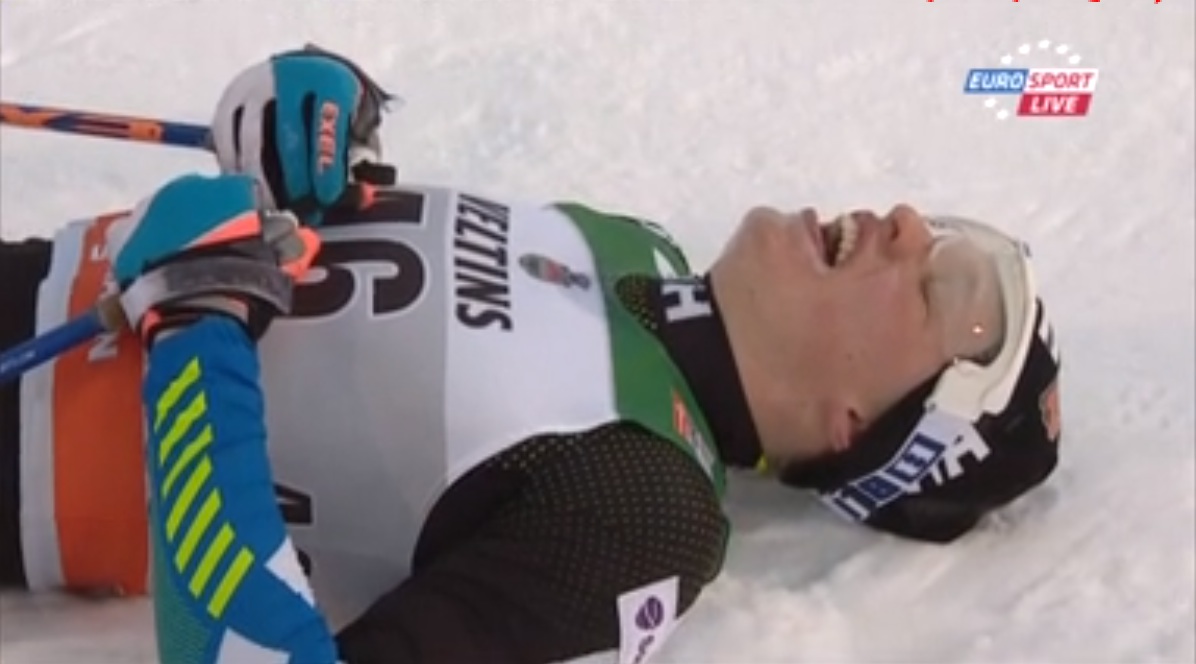
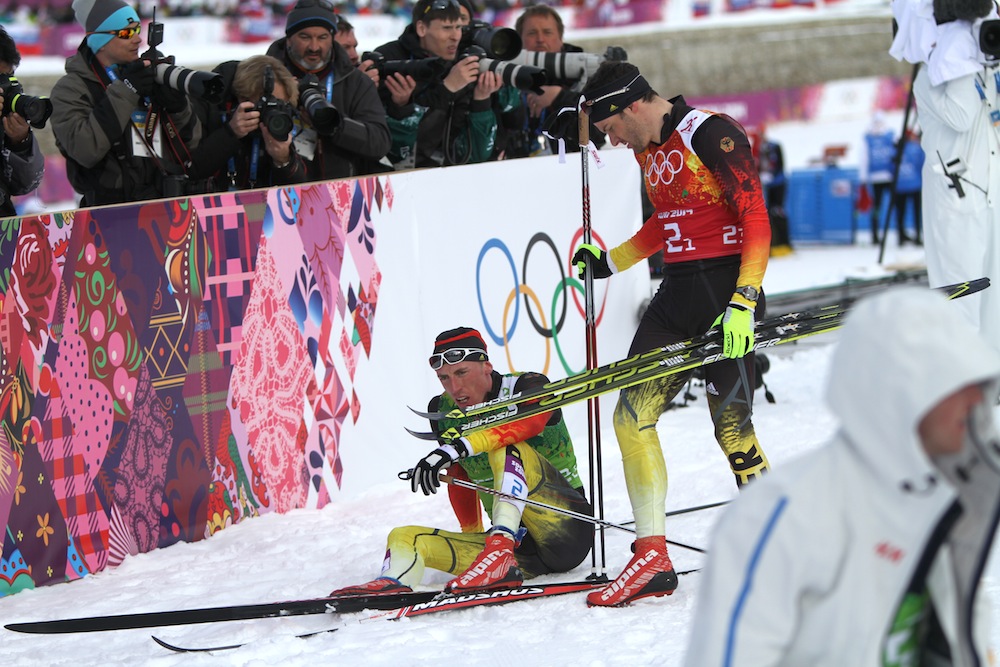
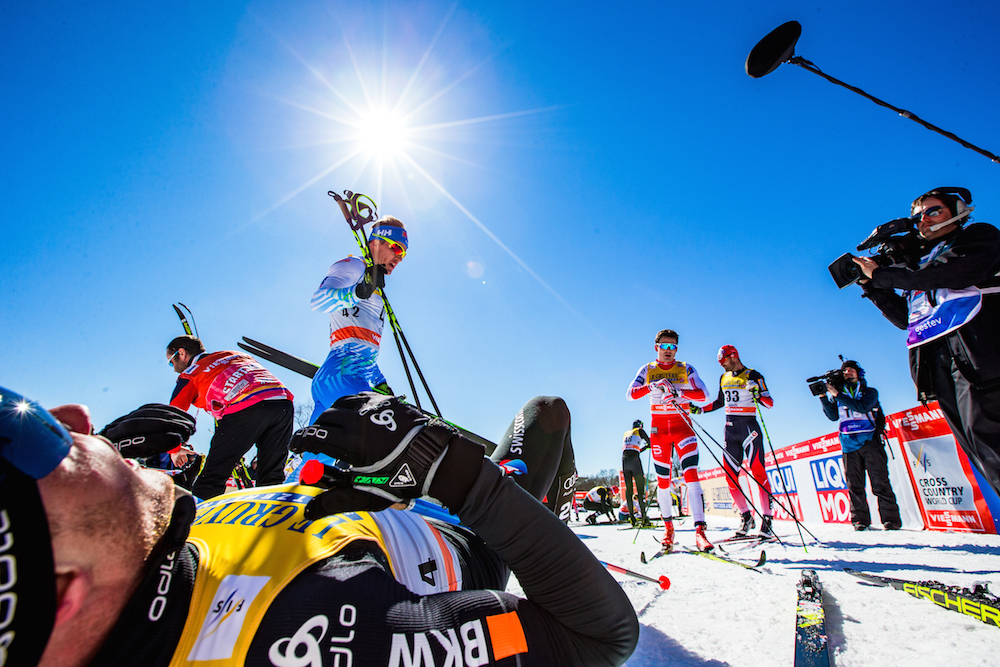
    Finland’s Sami Jauhojärvi (in blue and white) walking out of the finish area after the men’s 15 k classic mass start at World Cup Finals in Quebec City. Also pictured: Switzerland’s Dario Cologna (on the ground), and Norway’s Finn Hågen Krogh and Hans Christer Holund (33). Jauhojärvi finished 11th on the day and ultimately placed 16th overall in the World Cup Finals mini tour to end his World Cup career.

    Coming off the 2016/2017 season and less than a year out from the 2018 Winter Olympics in PyeongChang, South Korea, several international cross-country skiers and biathletes have announced their retirements. Among them are Sweden’s Johan Olsson, Finland’s Sami Jauhojärvi and the Czech Republic’s Lukáš Bauer, all of which earned medals at Olympics and/or World Championships.

    Sami Jauhojärvi
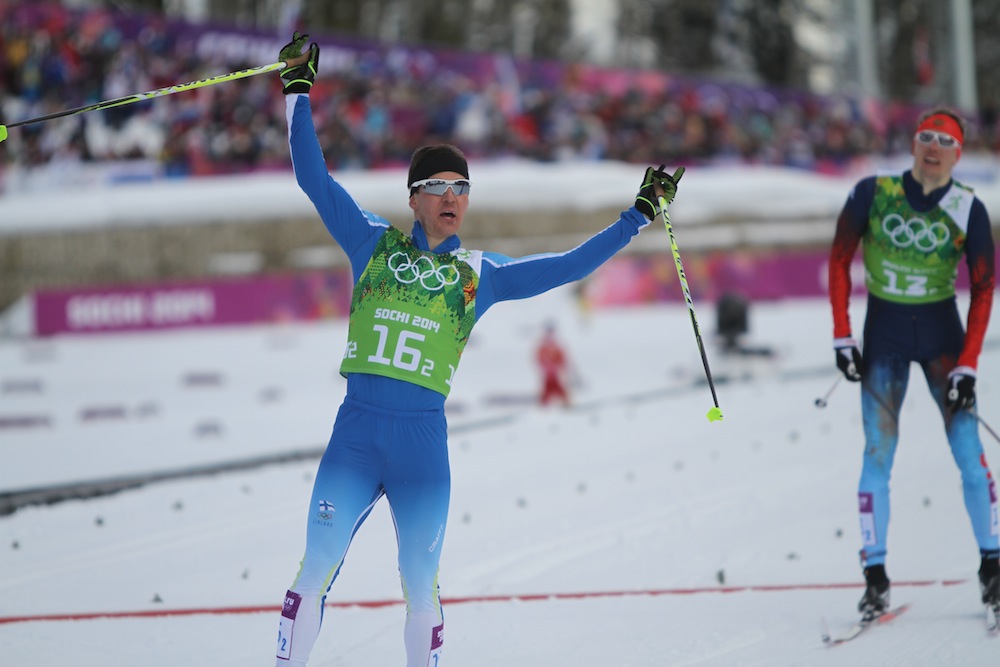
    Finland’s Sami Jauhojärvi anchors his team to gold in the men’s classic team sprint, ahead of Russia’s Nikita Kriukov, at the 2014 Sochi Olympics

    Earlier this month, Jauhojärvi, 35, publicly stated that he would be hanging up his race skis, ending his season with a third-place finish in the 50-kilometer freestyle at Finnish nationals.

    Jauhojärvi, who turns 36 in early May, competed at eight World Championships and three Olympics, winning gold with teammate Iivo Niskanen in the men’s classic team sprint at the 2014 Olympics in Sochi, Russia. He started racing World Cups 16 years ago, served on the athletes’ commission for the International Ski Federation (FIS) from 2009 to 2013 and racked up three bronze medals at World Championships. His latest bronze came in the classic team sprint (again with Niskanen) at this year’s 2017 World Championships at home in Lahti, Finland.

    “I’m not tired of skiing, but at some point it just happens that competitive instincts begin to fade,” Jauhojärvi told InsideTheGames. “By training I could be pushing my limits for a few more years, but my competition mind is done. … I do not think any more about fighting for gold medals at future Olympics.”

    Johan Olsson
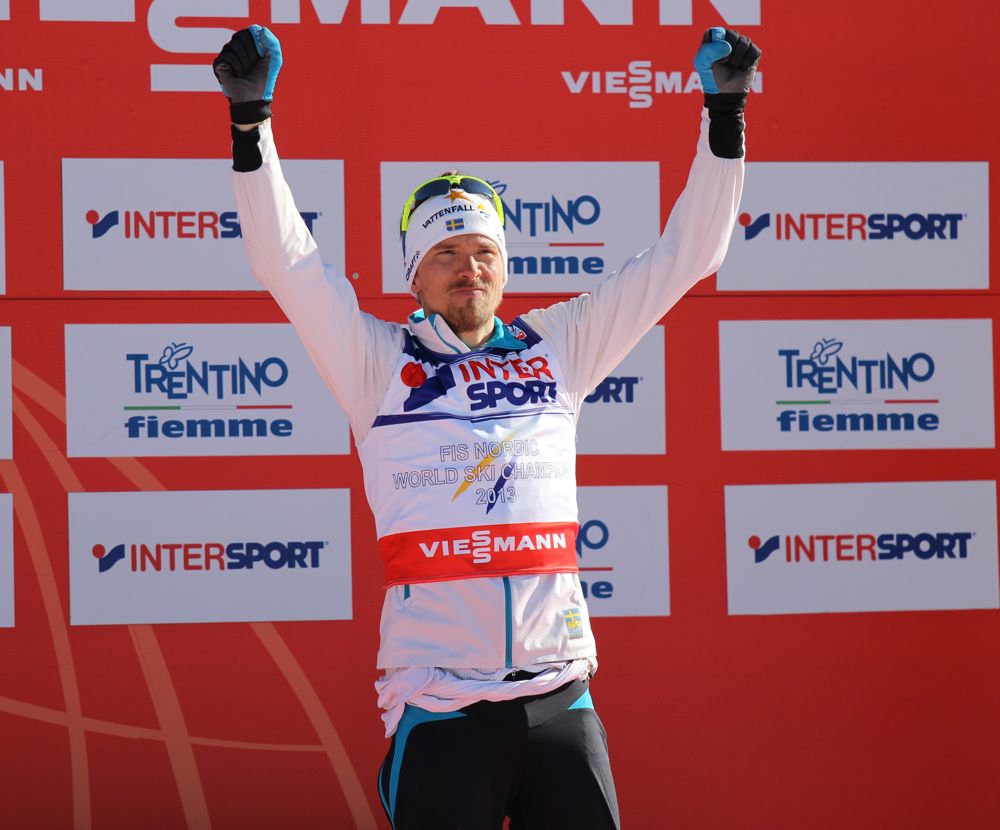
    Sweden’s Johan Olsson celebrating his first individual World Championships gold in the 50 k classic mass start in 2013 in Val di Fiemme, Italy.

    Sweden’s 37-year-old Olsson, who has also spent the last 16 years on the circuit, is also calling it a career, according to FIS. He amassed 14 world championships-caliber medals (eight at World Championships medals and six at the Olympics), making him one of the most successful Swedish skiers of all time, behind Gunde Svan and Sixten Jernberg, who each tallied 17.

    Four of Olsson’s medals were gold: he was part of the Swedish men’s 4 x 10 k relay that won at both the 2010 Olympics in Vancouver, B.C., and 2014 Sochi Games. Individually, he won the 50 k classic mass start at 2013 World Championships and 15 k freestyle individual start at 2015 World Championships on home soil in Falun, Sweden.

    Olsson cited wanting to be more present for his family, which includes his two daughters (ages 5 and 2).

    “I have had an ambition to become the world’s best skier and have had the consequences for it,” he told Expressen, according to a loose translation. “… When that burden grows bigger than the joy to keep on, it’s time to stop.

    “I have spent 15 years trying to realize my sporting dreams,” he explained. “Now I will be able to realize completely different dreams, and I will be able to be a much more present dad.”

    Olsson has been working with Swedish public television, SVT, and has expressed his desire to stay involved with skiing to build interest in the sport.

    “The question is how to make me on television,” he said of his TV career. “My paradise at the end of a race has been to stand in the interview zone and chat most of all, even though I finished 35th. Would there be enough time on television?”

    Lukáš Bauer
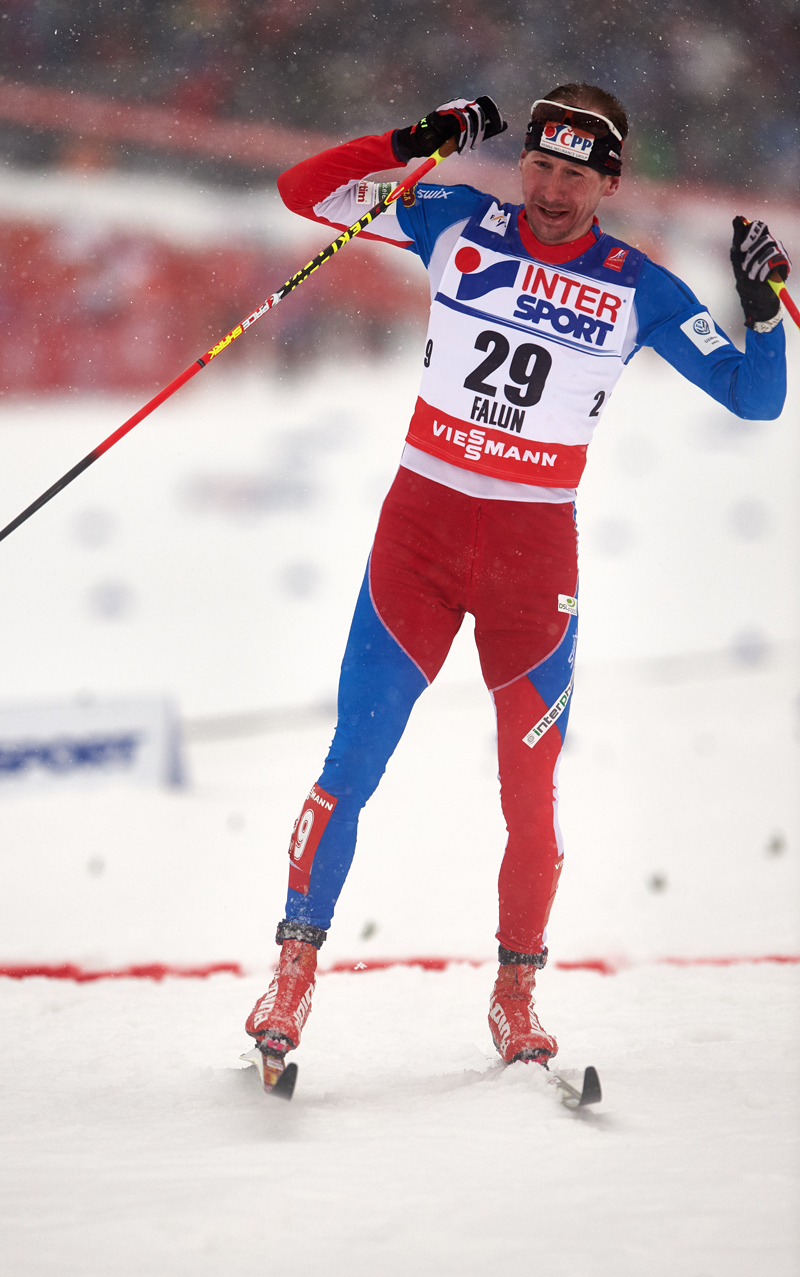
    Lukas Bauer celebrates silver in the 50 k classic at 2015 World Championships in Falun, Sweden. (Photo: Fischer/NordicFocus)

    Before the start of this past season, Bauer, 39, publicly stated it would be his last. But the decision became solidified after he finished 19th in the 15 k classic at 2017 Lahti World Championships.

    “A result that has disappointed me, after which I spent two and a half hours in the rain reminiscing of it,” he said, according to Neveitalia. “On other occasions I would have said, ‘I can redeem myself the next time,’ but not in this case because I just decided to quit.”

    He finished the season and his career out in the Lahti 4 x 10 k relay, in which the Czech men’s team placed 11th.

    The Czech Republic’s most successful cross-country skier, Bauer was the 2007/2008 Overall World Cup champion. He competed at five Olympics and 11 World Championships over 19 World Cup seasons, winning 18 World Cup races and the Tour de Ski twice, in 2008 and 2010. At the Olympics, he has a silver and two bronze medals. At World Championships, he is a two-time individual silver medalist — most recently placing second at 2015 Falun worlds in the 50 k classic mass start.

    Like Olsson, he also has two children.

    “I do not retire for a matter purely tied to my performance,” Bauer said. “If I wanted to prepare myself and I would be honored to participate in the upcoming Olympic Games, but the reality is I do not care. At home I have a wife and two children. It’s time to concentrate more on them than on sports goals. Without their support, I would never have obtained anything I collected in my career, to which I look with pride and satisfaction.”

    But he’s not completely done with skiing and plans to continue racing marathons.

    “Now I will focus on managing my team [Team Pioneer Investments] in long-distance races and I will also try to compete as much as possible, as long as the doctor will allow me,” Bauer said.

    Martin Johansson

    Sweden’s Martin Johansson, 32, is leaving elite skiing as a national A-team member who transitioned to cross-country in 2010. The move came after he won two gold medals at orienteering World Championships in 2009, but was seriously injured when he was impaled by a branch, according to Nordic Magazine. In six seasons thereafter, his career best in cross-country was fifth place in a 10 k freestyle in 2015 in Kuusamo, Finland, and he finished this year with a third-place finish in the 50 k freestyle at Swedish nationals, after which he announced his retirement on social media. Johansson competed at the last two World Championships.

    Fanny Horn Birkeland
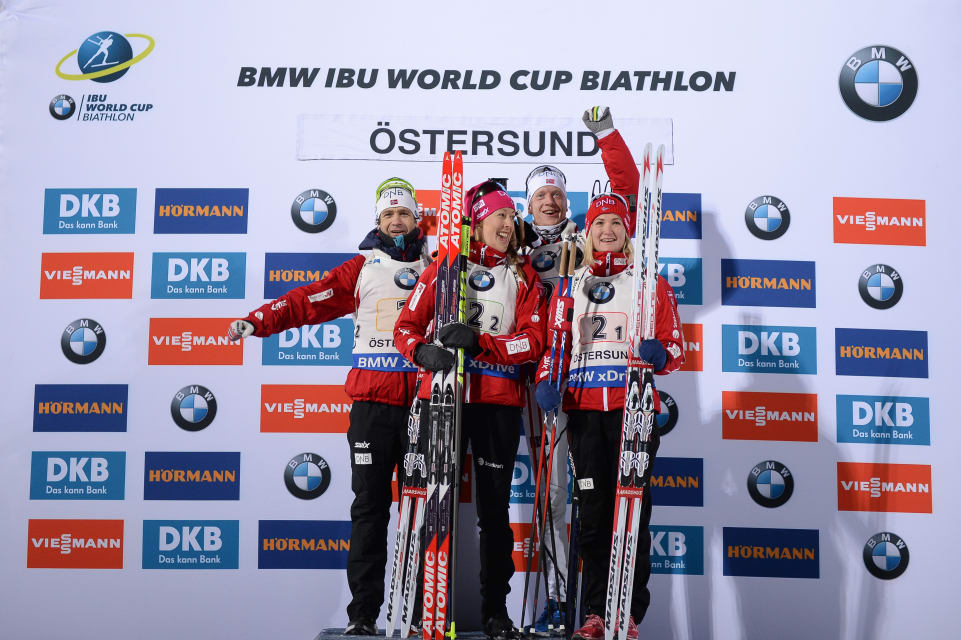
    (l-r) Norway’s Ole Einar Bjørndalen, Fanny Horn Birkeland, Johannes Thingnes Bø, and Marte Olsbu on the podium after winning the first race of the 2016/2017 biathlon World Cup season, a mixed relay in Ostersund, Sweden. (Photo: IBU)

    Norwegian biathlete Fanny Horn Birkeland announced her retirement during the last International Biathlon Union (IBU) World Cup weekend of the season. At 29, she has competed at the sport’s highest level for the last seven years, been on more than half a dozen winning relay teams, and won a 2015 World Cup sprint in Ruhpolding, Germany.

    “My plan was to go until the Olympics next year, but my form has not been so good,” Birkeland told the IBU. “I did everything to reach my goals, but still I had some trouble to make it to the top in my competitions. It is hard to put so much work into it every day and not get any results that I want. Twenty-nine is not so old, but I have been in this game for some time and it feels right now.

    “The highlight of my career was my win in the Ruhpolding sprint in 2015,” she added. “It was unreal … that was my day to get the opportunity to be on top of the podium. I wanted to do it again, but I never managed it.”

    Her husband, Lars Birkeland, also competes for the Norwegian biathlon team. “We helped each other a lot to get where we are now,” she said.

    Éva Tófalvi

    Romania’s Éva Tófalvi, 38, is also moving on from her career as a World Cup biathlete after competing at five Olympics, where her best result was 11th in a 15 k individual race at the 1998 Games in Nagano, Japan. She won an individual World Cup race during the 2008/2009 season after originally placing second (the winner, Russia’s Albina Akhatova, was disqualified for doping), making her the first Romanian biathlete to win a World Cup.
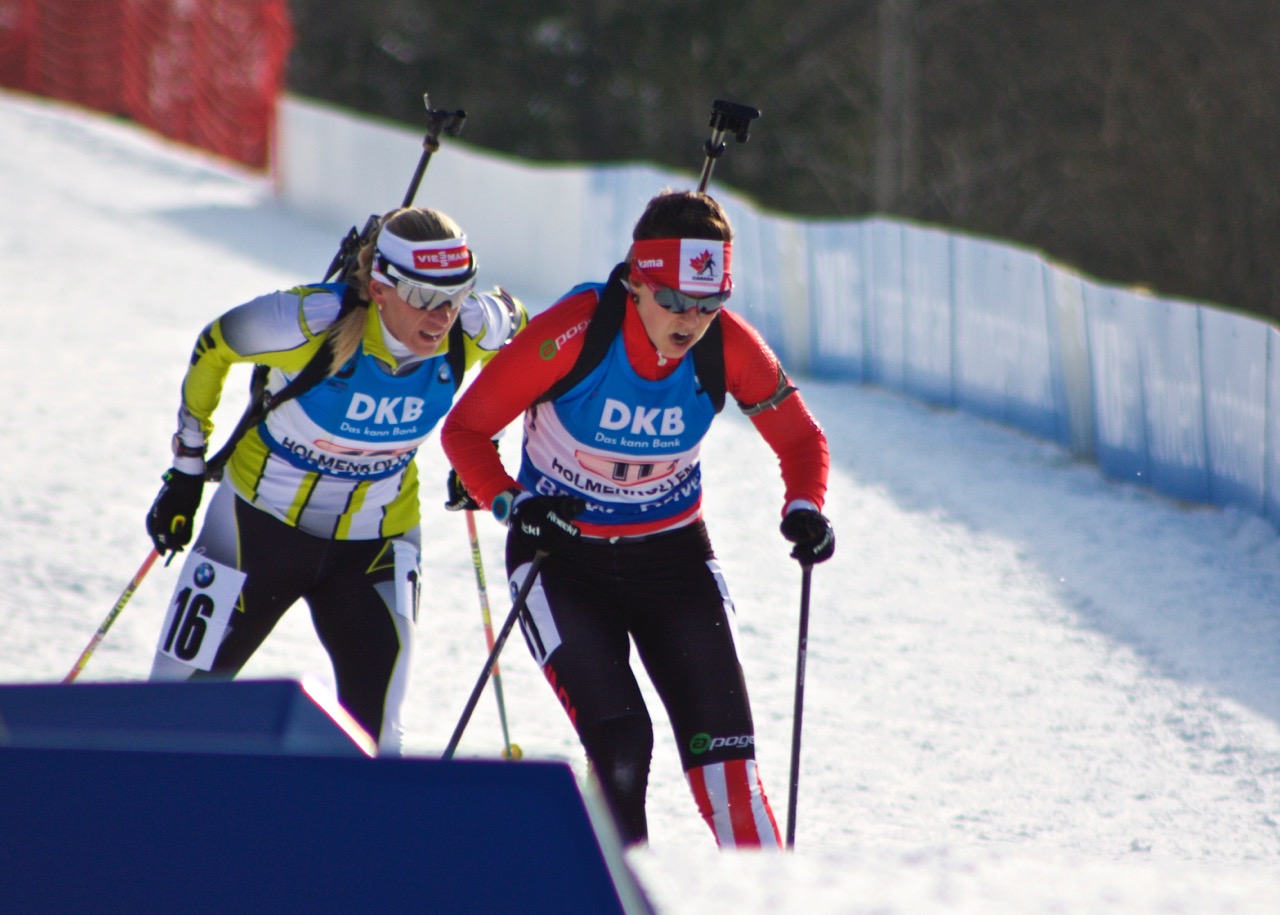
    Canada’s Julia Ransom (r) skiing with Romania’s Eva Tofalvi during the first leg of the 4 x 6 k relay at 2016 IBU World Championships in Oslo, Norway. (Photo: JoJo Baldus)

    In an interview with the IBU, Tófalvi said she wanted to wanted to focus on her personal life.

    “I am not a 100 percent sure, but I feel like it is the moment to settle down and start a family,” she said. “I know the Olympics are behind the corner, but I do not think I can invest the energy which is needed for such an event.

    “Winning World Cup is probably the most incredible memory I will ever carry,” she continued. “It is not just because of the win, but the work I know I had to put to get it. Even back then I did not have a real team behind me. My skis were not as good and I had no doctors, trainers and coaches with me like it was for bigger teams, like Norway. Winning in Hochfilzen was really special because of that, because it felt like a good prize for having had to work double as much as most to make up for what I couldn’t have.”

    Despite being left-handed, she had to learn to shoot using her right hand because Romania only had right-handed rifles.

    “In 20 years so much has changed in biathlon,” she said. “Now everything is much more professional and everyone is more focused on their careers. I think we were taking everything more lightheartedly back then. I now see girls that were born around the years I was making my debut in  he World Cup, and they are so determined that they achieve what before we would do at a much older age.”

  • Down to the Wire: Norwegian Men Win Lahti Relay with Russia Nipping at Their Heels

    Down to the Wire: Norwegian Men Win Lahti Relay with Russia Nipping at Their Heels

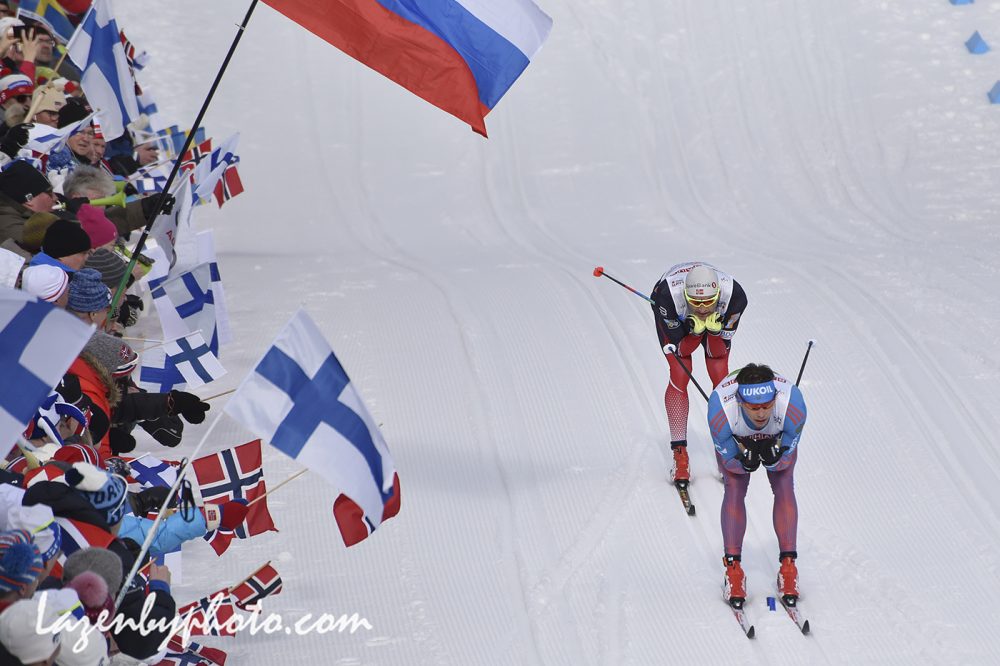
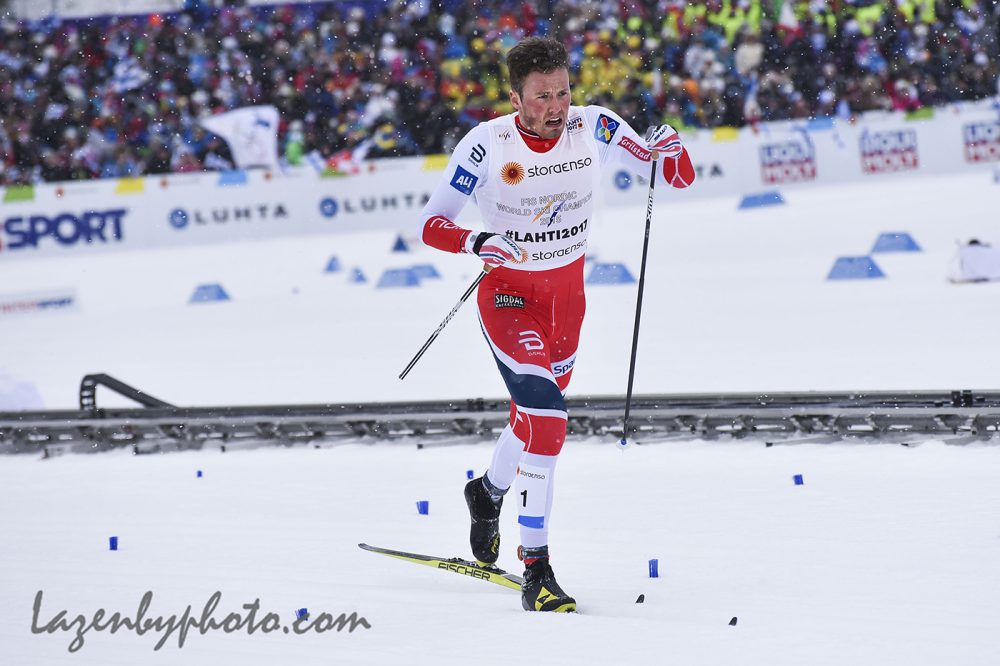
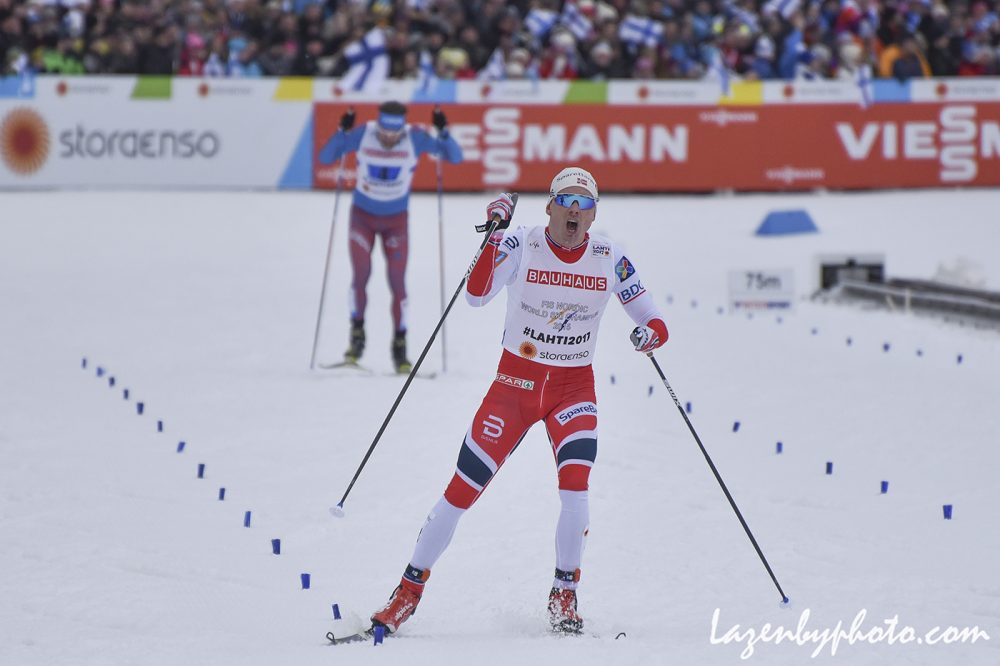
    Norway’s Finn Hågen Krogh with the victory stoke as he wins the 4 x 10 k relay at the 2017 Nordic World Championships in Lahti, Finland, by 4.6 seconds over Russia’s Sergey Ustiugov (behind). (Photo: John Lazenby/Lazenbyphoto.com)

    LAHTI, Finland — There were three medals up for grabs during Friday’s 4 x 10-kilometer relay at 2017 Nordic World Championships on Friday. Yet after the scramble leg, two distinct races: Norway and Russia’s dance for gold, and what eventually became a four-way tango between Finland, Sweden, Switzerland, and Germany for bronze and silver.

    Russia’s Andrey Larkov and Norway’s Didrik Tønseth first strung out and then smoked the field late in their leg. By the tag to their second-leg skiers, Norway and Russia were twenty seconds up.

    Russia’s Alexander Bessmertnykh leads Norway’s Niklas Dyrhaug as they sustain the break during the second leg of the 4 x 10 k relay at the 2017 Nordic World Championships in Lahti, Finland. (Photo: John Lazenby/Lazenbyphoto.com)

    That margin grew to thirty seconds, as Russia’s Alexander Bessmertnykh and Niklas Dyrhaug finished Leg 2 and the transition to skating began.

    Coming in just a half a minute later in third place, was Finland’s Iivo Niskanen, giving the fans a premature taste of the podium.

    Racing the third leg was Norwegian Martin Johnsrud Sundby. Russia tried to match the Norway’s trump card with Alexey Chervotkin. The 21-year-old Chervotkin skied the third leg for Russia in both team relays that took place this season: the first in Nove Mesto, Czech Republic, the other in La Clusaz, France, where the team placed second both times to Norway.

    However, the World Championship leg was the first time Chervotkin matched up against Sundby this year.

    Late in the leg, it was unclear what Sundby’s strategy would be as the young Russian shadowed the 32-year-old Sundby move for move. With Sergey Ustiugov up for the Russians in the anchor leg against Norway’s Finn Hågen Krogh, many armchair-relay strategists would have thought the Norwegian’s line up ploy was a dud.

    Not until 1.2 kilometers left in the leg did Sundby make a sufficient gap. At that point, the time spread from silver to gold was only eleven seconds. Not exactly a huge buffer for Krogh.

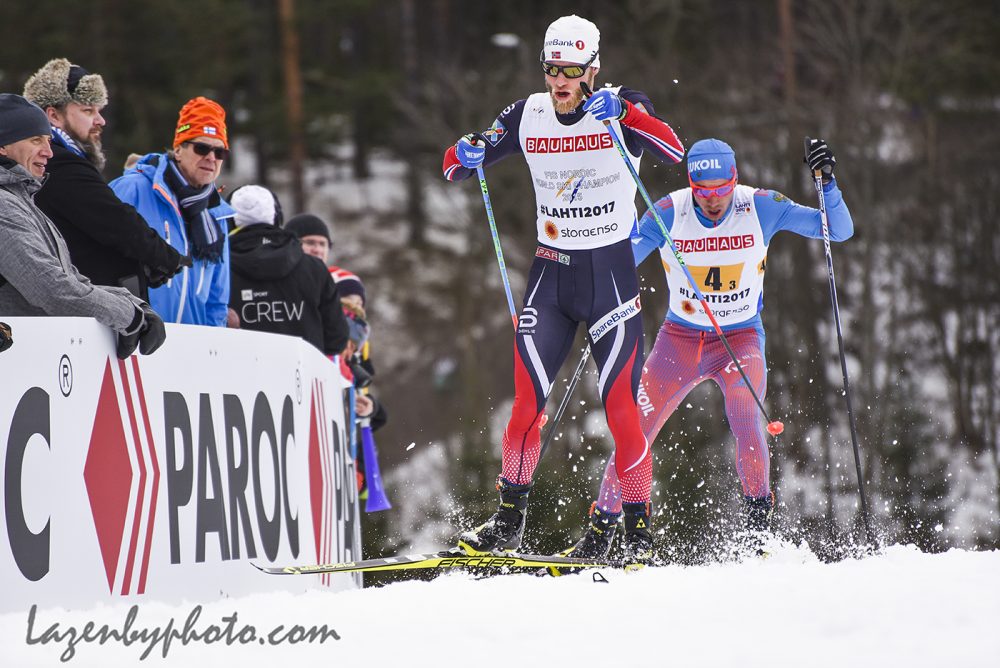
    Norway’s Martin Johnsrud Sundby, marked by Russia’s Alexey Chervotkin (4), during a critical third leg of the 4 x 10 k relay at the 2017 Nordic World Championships in Lahti, Finland. (Photo: John Lazenby/lazenbyphoto.com)

    By Sundby’s tag to the anchor skier, he had gifted Krogh a 17.7-second margin for error. The rhetorical question at the start of the fourth leg: when will Ustiugov catch Krogh?

    “He’s the worst the worst guy you can have in back of you,” Krogh said during a press conference, referring to Ustiugov. “He made the race tough for me.”

    At 1.3 k into that fourth leg, Ustiugov was 8.8 seconds back. In another 1.2 kilometers, it ballooned again to 11.6 seconds, and then it contracted again to 5 seconds with 3.8 k to go. But until the finishing stretch, when Krogh rounded the final turn with a 100-meter lead on the Russian, was Norway a sure win.

    Krogh crossed first in a time of 1:37:20.1 hours for the ninth-consecutive Norwegian championship 4 x 10 k relay gold. Finishing 4.6 seconds later in second place was Russia’s Ustiugov.

    “It’s not just for us, it’s the whole team,” Sundby said during a press conference of their ninth world-champs relay gold. “It’s for the waxers, it’s for the trainers. When you go the relay for the Norwegian team, you feel you’re going for your country. So it’s a massive victory for us.”
    What kept the capacity crowd engaged was not so much the battle for gold and silver, but the fate of the on-again, off-again Finns.

    Let’s back up to when Niskanen tagged off to Finnish skier Lari Lehtonen for the first freestyle leg. At that point, the Finns were in third, a solid 15 seconds ahead of France in fourth place, 32 seconds ahead of Switzerland in fifth, roughly 55 seconds ahead of Germany in sixth, and almost a minute ahead of Sweden in seventh.

    “We are individual athletes, and you have to focus on your own leg,” Sweden’s Johan Olsson said after the race. “Both me and Daniel [Rickardsson] thought the medal chance was over when we had done two legs.”
    The first sign that something was awry for the Finns was a restless home crowd. What may have been perceived as a plush-time cushion for Lehtonen was in fact cardboard thin.

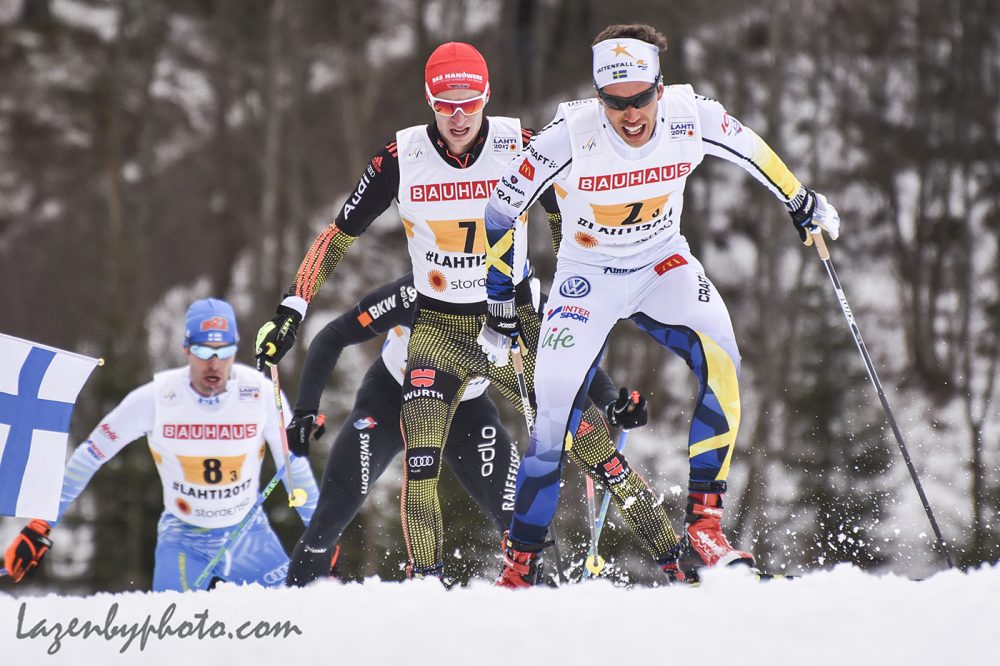
    Sweden’s Marcus Hellner (r) leads Germany’s Florian Notz (7), Switzerland’s Dario Cologna (behind Notz), and Finland’s Lari Lehtonen (8) during the men’s 4 x 10 k relay at the 2017 Nordic World Championships on Friday in Lahti, Finland. (Photo: John Lazenby/Lazenbyphoto.com)

    Sweden’s Marcus Hellner and Switzerland’s Dario Cologna were on the hunt. Seemingly an afterthought, Hellner skied the fastest third leg, animating the race for bronze by pulling Sweden back into contention.

    These four teams — Finland, Germany, Switzerland, and Sweden — stuck together through the exchange into the fourth leg until the last headwall climb, called Indian Hill.

    It was then that Finland’s Matti Heikkinen hop-stepped around Germany and Switzerland, bringing Sweden’s Calle Halfvarsson with him.

    “I know that Matti will go on the last uphill and it was good game for me to go after him,” Halfvarsson said during the press conference.

    The two appeared to have dropped Switzerland’s Curdin Perl, until Perl miraculously slotted behind the Finn-Swede duo. Finland entered the final 100-meter stretch in a sprint for bronze.

    One errant pole plant as Heikkinen ramped up his gear, causing him to fall to the ground was Finland’s loss and Sweden’s gain. Halfvarsson crossed third for Sweden (+2:31.8) and Perl fourth for Switzerland (+2:32), and Finland ultimately crossed fifth (+2:42.4).

    (Story continues below)

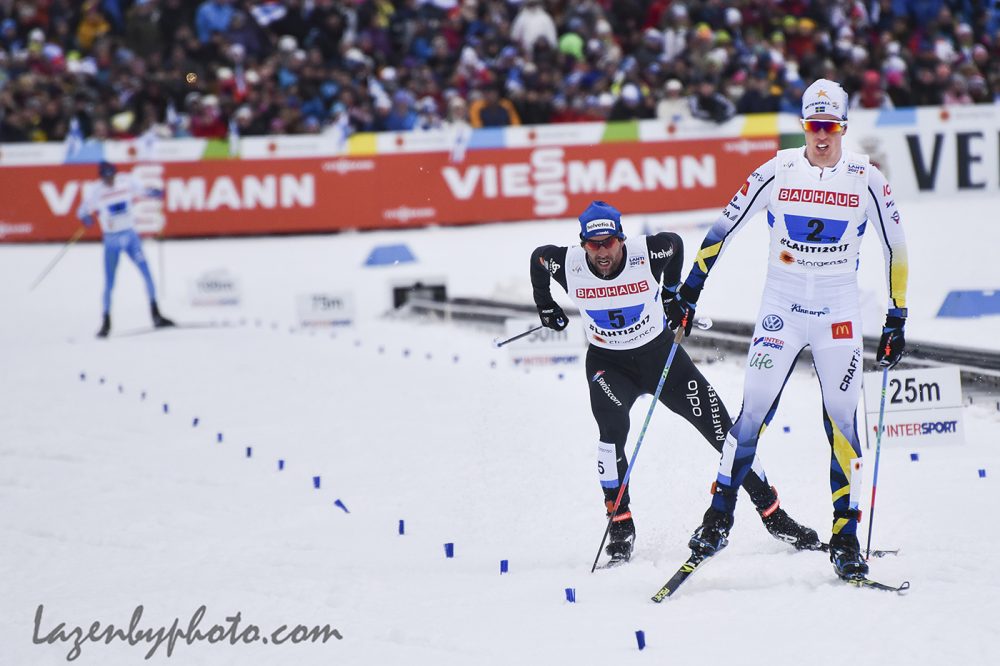
    Sweden’s Calle Halfvarsson (2) crossing the line in third place, ahead of Switzerland’s Curdin Perl (5) in fourth at the finish of the men’s 4 x 10 k relay at the 2017 Nordic World Championships in Lahti, Finland. Finland’s Matti Heikkinen (far left) is seen after righting himself due to a errant pole plant. (Photo: John Lazenby/Lazenbyphoto.com)

    The U.S. fielded a team comprised of Kyle Bratrud, Erik Bjornsen, Tad Elliott, and Simi Hamilton. Bratrud scrambled the first classic leg for the Americans, handing off to Bjornsen in 11th, 1:28.2 minutes behind the leader.

    “I was definitely more nervous for this one because I was starting,” Bratrud said afterward.

    While this is the second World Championships for Bratrud, a 24-year-old member of the Central Cross Country (CXC) Team, Friday was the first time he raced the scramble leg in a relay — he raced the third leg for the U.S. in the 2015 world champs 4 x 10 k relay in Falun, Sweden. Though he eventually lost contact with the front group, Bratrud was happy he was able to hold on for as long as he did, even if it caused him a yellow card for a technique violation.

    “It was nice to at least see the front before they really picked up the pace,” Bratrud said.

    “Props to Kyle on the yellow card,” Elliott wrote in an email. “Scrappy out there.”

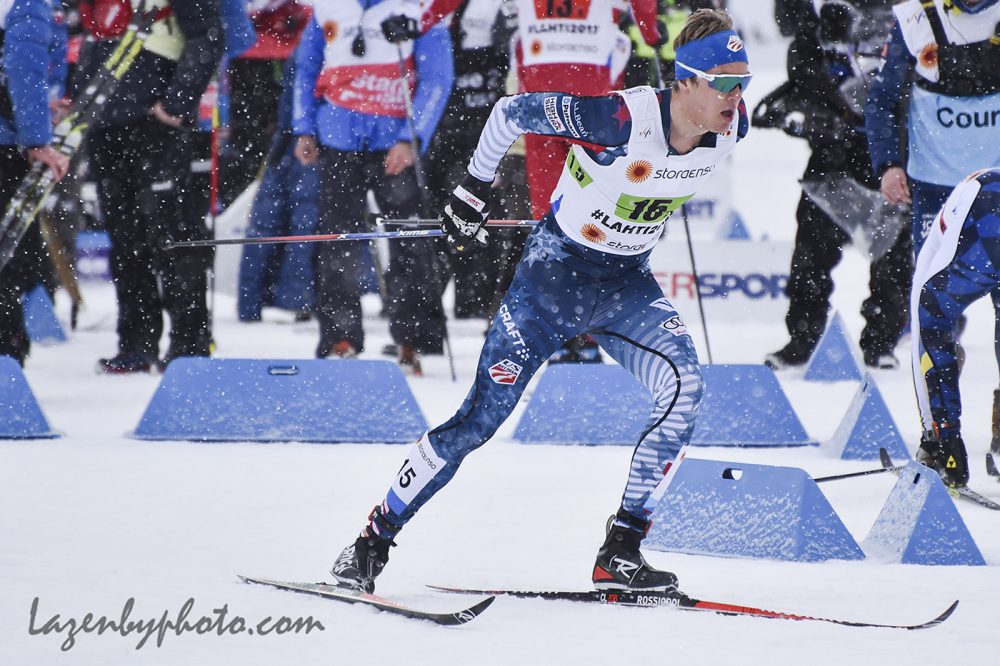
    Tad Elliott racing the third leg of the U.S. men’s 4 x 10 k relay at the 2017 Nordic World Championships on Friday in Lahti, Finland. (Photo: John Lazenby/Lazenbyphoto.com)

    While Bratrud had company for approximately one lap, Bjornsen raced completely alone.

    “It’s not the position you necessarily want to be in, but took it for what it was worth and tried to charge up to the group in front of me, which was [the Czech Republic’s Lukas] Bauer and [Germany’s Jonas Dobler],” Bjornsen said.

    “But I mean…they were moving fast,” the 25-year-old U.S. Ski Team member added. “I tried to mentally just keep pushing, but it’s tough to be out there by yourself. I felt pretty good, it’s just a different type of race.”

    Bjornsen tagged to Elliott, for the Americans’ first freestyle leg. He skied the eighth-fastest third leg, 1:47 behind Hellner.

    “I was also getting great splits from the coaches on making ground on the group in front of me,” Elliott wrote.”I wanted to catch them, I just didn’t really get there for Simi to save it all for his sprint. Simi skied one hell of a leg.”

    Elliott handed off to Hamilton, the anchor leg for the U.S.

    “By the time he tagged off to me, I think I was 10 or 15 seconds from [the Czech Republic, Kazakhstan and Italian teams],” Hamilton recalled. “They fortunately started pretty conservatively, which was nice for me.”

    Those three teams were in fact 16 seconds ahead of Hamilton. He eventually closed that distance, putting the U.S. in contention for a top 10.

    “I wanted to start fast and see if I could make up some time on them,” Hamilton siad. “And I did, I ended up catching them by the top of the climb after the tunnel. So I was psyched about that.”

    However, when Hamilton came through for his fourth and final lap, the hill-laden course had taken a toll on his legs. He finished in 10th (+5:31.3), just half a second ahead of the Czech Republic’s Petr Knop in 11th (+5:31.8).

    Canada’s Alex Harvey racing the third leg of the men’s 4 x 10 k relay at the 2017 Nordic World Championships on Friday in Lahti, Finland. (Photo: John Lazenby/Lazenbyphoto.com)

    “That last lap my legs were definitely feeling it a little bit and those guys are all really good climbers,” Hamilton said. “I couldn’t quite make the moves that I wanted to in the last kilometer because I was a little whupped by then … but I was still able to pick off Czech Republic at the finish. Maybe not the best day for us, but still a day that we were fighting.”

    Canada’s team of Graeme Killick, Devon Kershaw, Alex Harvey and Lenny Valjas finished 12th, after being lapped and thus pulled from the race on Valjas’s final leg.

    In January of this year, Canada raced to a historic third place at the Ulricehamn World Cup relay in Sweden.

    “It just wasn’t our day,” said a dignified Valjas after Friday’s relay. “We’re all in shape, it’s just none of us were on our A-game today and that’s what it takes to be fighting in this.”

    Results

    — Harald Zimmer and Chelsea Little contributed

    Erik Bjornsen (U.S. Ski Team) racing the second leg of the men’s 4 x 10-kilometer relay at the 2017 Nordic World Championships on Friday in Lahti, Finland. (Photo: John Lazenby/Lazenbyphoto.com)
  • Friday Rundown: Bailey 2nd in PyeongChang; Lahti Relay & NoCo Team Sprint (Updated)

    Friday Rundown: Bailey 2nd in PyeongChang; Lahti Relay & NoCo Team Sprint (Updated)

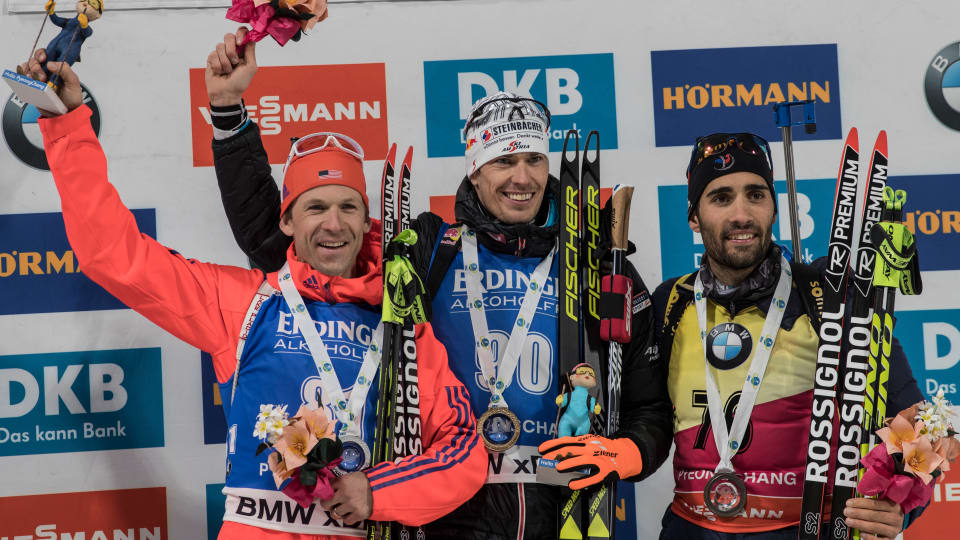
    The men’s 10 k sprint podium at Friday’s IBU World Cup in PyeongChang, South Korea, with Austria’s Julian Eberhard (c) in first, American Lowell Bailey (l) in second, and France’s Martin Fourcade (r) in third. (Photo: IBU)

    IBU World Cup (PyeongChang, South Korea): Men’s 10 k sprint

    US Biathlon’s Lowell Bailey kept his clean-shooting streak alive with another one of his personal best results on Friday, racing to second in the men’s 10-kilometer sprint at the International Biathlon Union (IBU) World Cup in PyeongChang, South Korea.

    Bailey started 81st and hit all 10 targets in the two-stage race to cross the finish line in first, 4.7 seconds ahead of France’s Martin Fourcade, who locked up the 2016/2017 overall World Cup title with an eventual third-place finish on Friday.

    An even later starter in bib 90, Austria’s Julian Eberhard rocketed to his third-career World Cup victory (and second win this season), cleaning both stages and topping Bailey’s time by 40.7 seconds. That bumped Bailey to second place and Fourcade to third, for Bailey’s second World Cup podium this season (including his win in the 20 k individual at IBU World Championships).

    In the last five non-relay races, including four at World Championships, Bailey has not placed outside the top six. And in all of those races, he’s only had one miss.

    Bailey is up to ninth in the World Cup Total Score standings. Fourcade ran away with the season-long title in first, now that he’s 360 points ahead of Russia’s Anton Shipulin in second.

    While Eberhard and Bailey shot clean on Friday, Fourcade missed two — one on each stage (1+1) — but made up for it with the fastest course time. Eberhard had the second-fastest course time and fastest shooting time of the 102-man field.

    Austria nearly had two on the podium with Dominik Landertinger finishing fourth (+48.1), 2.7 seconds out of third, with clean shooting.

    Three Canadians finished in the top 60 to qualify for Saturday’s pursuit, with Scott Gow in 27th (+1:40.3) with two penalties (1+1), Brendan Green following in 28th (+1:42.1) with one miss (0+1) for his first individual top 30 of the season, and Christian Gow in 56th (+2.33.6) with two prone penalties (2+0). Nathan Smith finished 88th (+3:32.5) with two standing misses (0+2) in his first World Cup race since early December, and Macx Davies finished 98th (+4:20.2) with four penalties (3+1).

    For the U.S., Leif Nordgren placed 37th (+2:03.7) with two misses (1+1) to qualify for the pursuit, along with Bailey. Sean Doherty was 80th (+3:13.3) with two penalties (1+1) and Paul Schommer 101st (+4:38.1) with five misses (3+2).

    Results

    ***

    FIS Nordic World Championships (Lahti, Finland): Nordic Combined 2 x 7.5 k team sprint

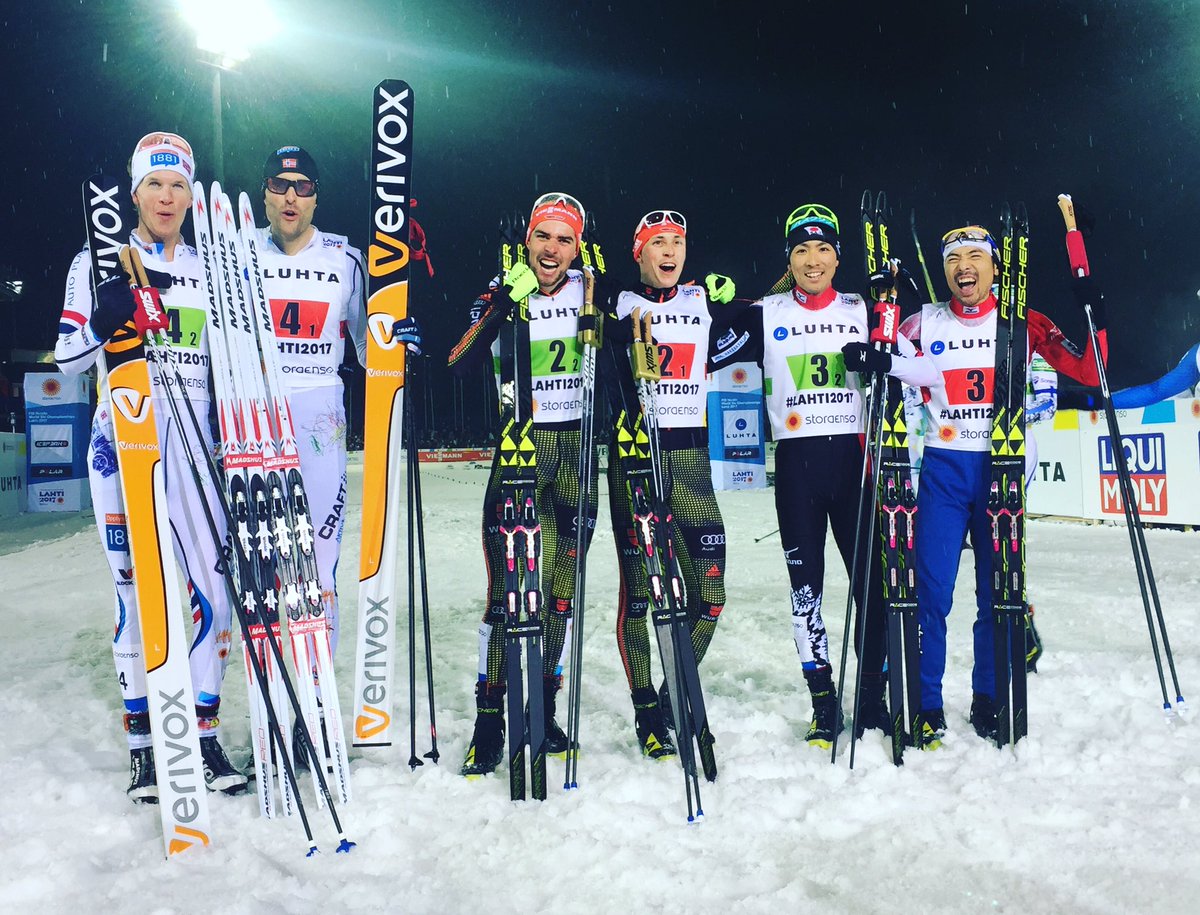
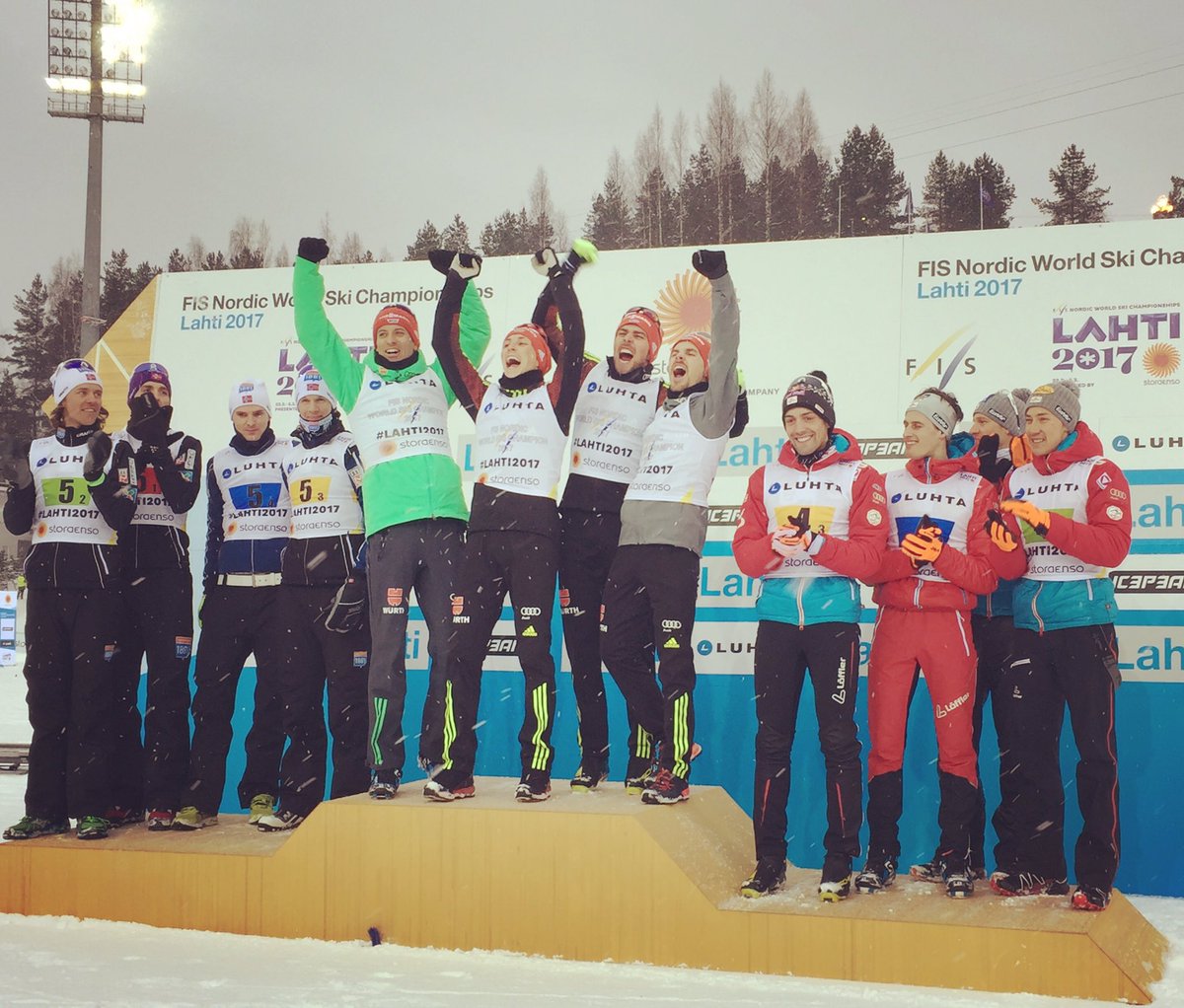
    The nordic combined 2 x 7.5 k team sprint podium on Friday at 2017 Nordic World Championships in Lahti, Finland, with Germany’s Johannes Rydzek and Eric Frenzel in first (c), Norway’s Magnus Moan and Magnus Krog in second (l) and Japan’s Yoshito and Akito Watabe in third (r). (Photo: FIS Nordic Combined/Twitter)

    [UPDATED] Johannes Rydzek and Team Germany completed the World Championships sweep on Friday, with Rydzek teaming up with Eric Frenzel to win the final nordic-combined competition of 2017 Nordic World Championships in Lahti, Finland: the 2 x 7.5-kilometer team sprint.

    Rydzek won all four NoCo competitions over the past week, including two individual events and two team events.

    On Friday, he and Frenzel, the defending World Cup champion, jumped to second and started the 2 x 7.5 k cross-country race 16 seconds behind France’s Maxime Laheurte and François Braud, who jumped to first. The Frenchmen both posted jumps of 125 meters for a total of 264.2 points. Frenzel and Rydzek, meanwhile, scored 256.1 points after jumps of 125.5 and 122 meters.

    The Germans pulled off a 1-second win over Norway, finishing in 28:45.8 minutes, while Norway’s Magnus Moan and Magnus Krog claimed silver after starting the ski race in fourth, 24 seconds behind France. Together, the Norwegians posted the fastest course time, and Moan skied the fastest 7.5 k (13:53).

    “It’s still unbelievable,” Rydzek told German broadcaster ARD. “The race today was so suspenseful again, down to the last curve with the lapped athlete [Russia]. I knew that I am very fast on the homestretch, and had explicitly looked at that section before the race. Eric did a great job today, and despite all circumstances pointing against us we managed to do it again today. Just cool to be back on the top of the podium with Eric.”

    Just a couple hundred meters before the finish, Rydzek used the moment when they approached the lapped Russian athlete to slingshot between him and Krog and gained a decisive edge.

    “I was scared of that situation with the lapped athlete, because that was really close,” Frenzel told ARD. “I thought, ‘What is he doing out there?’ But in the end you can rely on Johannes to solve that like a world champion, that was top.

    “We knew ahead of time that Lahti suits us well, that we can be good here if the conditions work out,” he added. “So we are very happy to be able to go home with so many medals.”

    Japan took the final spot on the podium after brothers Yoshito and Akito Watabe jumped to third, started 18 seconds after France, and held their position to finish for third place, 10.2 seconds after Germany.

    Austria’s Wilhelm Denifl and Bernhard Gruber missed bronze by half a second in fourth (+10.7) after starting in fifth, and France ended up fifth (+11.5).

    Nearly a minute later, Italy placed sixth (+1:10.6) and Finland seventh (+1:10.7). The Czech Republic followed in eighth (+1:26.4), and the U.S. was ninth (+1:48.1) with Bryan and Taylor Fletcher after starting 12th and 2:08 out of first. The Fletcher brothers recorded the second-fastest course time out of 14 teams.

    “Taylor did a good job stepping up in competition and it gave me motivation to step up as well,” Bryan said, according to a U.S. Ski Team press release. “Unfortunately I wanted it a little too much and didn’t have the jump I am capable of.

    “The races went well but we were just too far back,” he continued. “We had the second fastest time as a team overall, which is solid and continually shows our strength on that side of the sport.”

    Final results | Jumping

    ***

    FIS Nordic World Championships (Lahti, Finland): Men’s 4 x 10 k relay

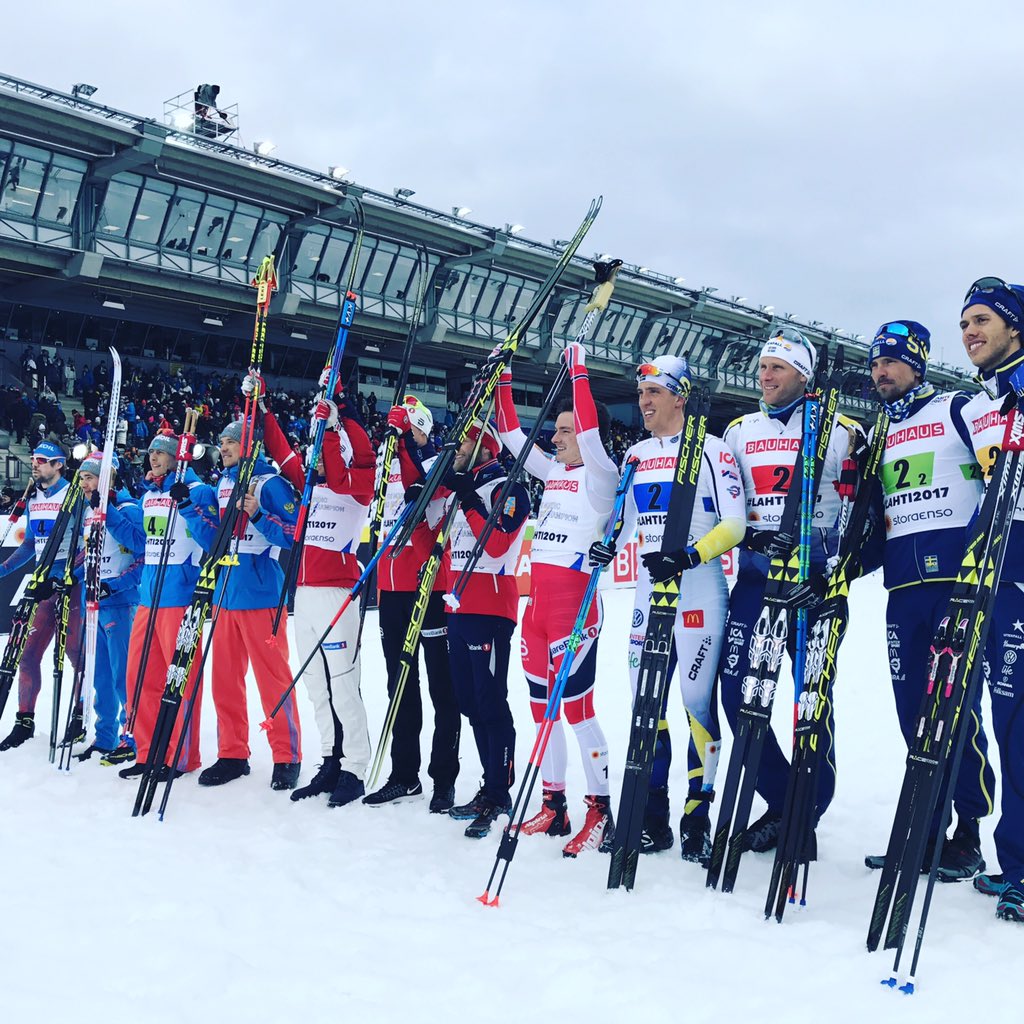
    The men’s 4 x 10 k relay podium at 2017 Nordic World Championships, with Norway (c) in first, Russia (l) in second, and Sweden (r) in third. (Photo: FIS Cross-Country/Twitter)

    The men’s 4 x 10-kilometer relay as the last team event of 2017 Nordic World Championships came down to a two-way battle for gold between none other than Norway and Russia on Friday in Lahti, Finland,

    The two teams skied in either first or second throughout the four-leg race, with Russia’s Andrey Larkov tagging Alexander Bessmertnykh 2.9 seconds ahead of Norway’s first leg Didrik Tønseth, then Bessmertnykh coming through the second exchange just half a second ahead of Norway’s Niklas Dyrhaug.

    Behind them, Finland skied alone in third place at the race’s halfway point, but was ultimately swallowed by the chase pack on the third leg.

    On that third leg, Norway’s Martin Johnsrud Sundby worked hard to drop Russia’s Alexey Chervotkin, and eventually did so, coming through the final exchange 17.7 seconds ahead. That gave Norway’s anchor Finn Hågen Krogh just enough of a gap on Russia’s Sergey Ustiugov, and he was able to hold off Ustiugov by 4.6 seconds at the finish to give Norway the gold in 1:37:20.1 hours.

    Russia claimed silver and Sweden outlasted Switzerland for bronze after Calle Halfvarsson attacked in the final kilometer to drop Finland’s Matti Heikkinen and Germany’s Lucas Bögl. Halfvarsson finished 2:31.8 minutes out of first, and just 0.2 seconds ahead of Switzerland’s Curdin Perl for third place for Sweden (which included teammates Daniel Rickardsson, Johan Olsson and Marcus Hellner).

    Switzerland was fourth (+2:32) with Jason Rueesch, Jonas Baumann, Dario Cologna and Perl, Finland fifth (+2:42.4) with Sami Jauhojärvi, Niskanen, Lari Lehtonen, and Heikkinen, and Germany sixth (+2:42.8) with Thomas Bing, Jonas Dobler, Florian Notz, and Bögl.

    France finished seventh (+3:52), Italy eighth (+5:29.8), Kazakhstan ninth (+5:30.6), and the U.S. 10th (+5:31.3). The U.S. team (Kyle Bratrud, Erik Bjornsen, Tad Elliott, Simi Hamilton) skied in 11th for most of the race before Hamilton moved them up to 10th with the sixth-fastest anchor leg.

    Canada (Graeme Killick, Devon Kershaw, Alex Harvey, Len Valjas) ended up 12th after being lapped on the last leg. In 14th at the first exchange, Kershaw moved them up to 13th, then Harvey put them in 12th with one leg to go.

    Results

  • Amidst Finnatics, Niskanen Strides to 15 k Gold; Bjornsen Notches 18th at World Champs

    Amidst Finnatics, Niskanen Strides to 15 k Gold; Bjornsen Notches 18th at World Champs

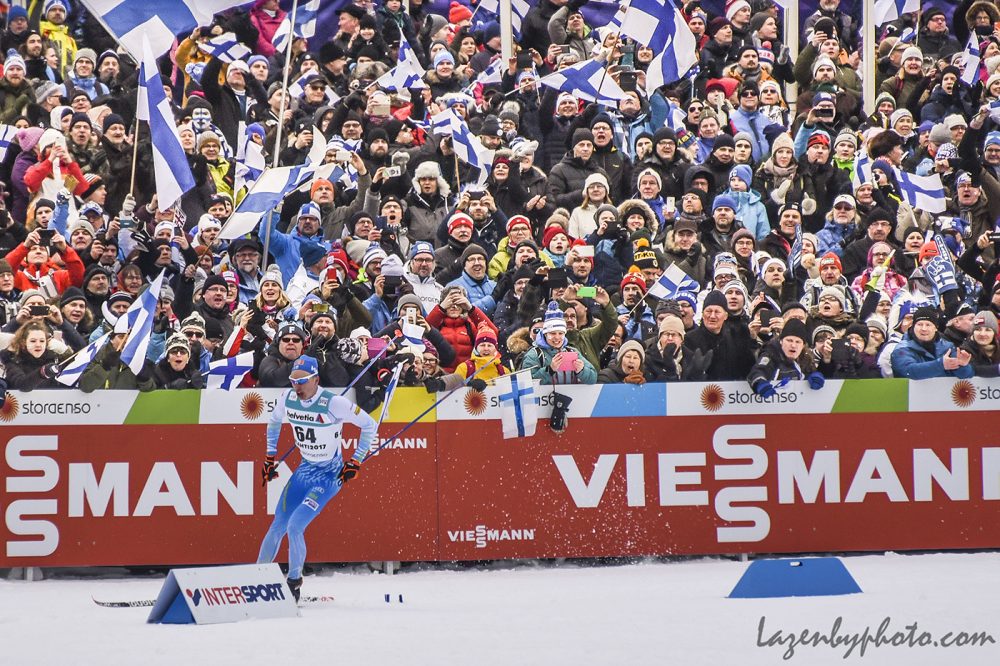
    Amidst a sea of Finnish flags, Finland’s Iivo Niskanen turns the final corner on his way to gold in the men’s 15 k classic individual start on Wednesday at 2017 Nordic World Championships in Lahti, Finland. (Photo: John Lazenby/Lazenbyphoto.com)

    LAHTI, Finland — Through the first seven medal races of 2017 Nordic World Championships, the hometown Finns came close. There was Krista Parmakoski’s skiathlon silver. There was the spectacular Finn non-win when Finland’s Iivo Niskanen and Norway’s Emil Iversen tumbled 200 meters from the line during Sunday’s classic team sprint. At the moment of the tangle, Niskanen was primed to pass Iversen for what appeared to be a golden performance.

    Instead of a cheer concluding the sprint, a collective exhale deflated the crowd: Niskanen and teammate Sami Jauhojärvi ultimately settled for bronze. While it wasn’t the result they had hoped for, it remained the 25-year-old Niskanen’s first World Championships medal.

    Another race on Wednesday brought another Finnish opportunity. On a 34-degree Fahrenheit day with moist tracks and low-hanging clouds, gold was up for grabs.

    During the men’s 15-kilometer classic individual start, Niskanen channeled whatever bitter taste remained from his team sprint near-win into a controlled and sufficient pace. After 1.5 k, Niskanen ranked fourth — from then on, he was the fastest through every remaining timing point, and first when it mattered most. Niskanen won in 36:44 minutes.

    Norway’s Martin Johnsrud Sundby finished 17.9 seconds off his time for silver. Sundby’s teammate Niklas Dyrhaug clocked in 31.3 seconds back for bronze, his first-career individual championships medal.

    The men’s 15 k classic podium at 2017 Nordic World Ski Championships in Lahti, Finland: (from left to right) Norway’s Martin Johnsrud Sundby (l) in second, Finland’s Iivo Niskanen (c) in first, and Norwegian Niklas Dyrhaug (r) in third. (Photo: John Lazenby/Lazenbyphoto.com)

    “It’s for sure a really good team, Norway, and it’s a hard fight in all the places for every distances,” Dyrhaug said at the post-race press conference about making Norway’s 12-man World Championships team. “I have been a reserve for the skiathlon and the team sprint. I have been here since Otepää — ten days now. I have been ready so when I got the chance in the 15 k, yeah, I am happy to show everybody that I am in really good shape and I have something in world champs to do.”

    The 15 k classic appears an odds maker’s nightmare. It remains a fickle distance and technique with a million and one variables. There’s the course profile, the athlete’s classic technique to consider — do they thrive on headwalls or stridable terrain, double poling? The wax. The snow type. The venue’s altitude. Then there’s the pacing — go out hard? Look for negative splits? Ski it like a true distance race, not an elongated sprint?

    A single 15 k classic win at a championship or World Cup level evidently doesn’t mean more will come your way. Of the 133 starters on Wednesday, Finland’s Matti Heikkinen remains the only athlete who had won a 15 k classic at a World Championships or Olympics (at 2011 World Championships in Oslo, Norway, he won the gold in this event). Not since the ’54 and ’58 championships has an athlete won two world titles in this event.

    Finland’s Iivo Niskanen (r) celebrates his 15 k classic win with loved ones at 2017 Nordic World Championships in Lahti, Finland. (Photo: John Lazenby/Lazenbyphoto.com)

    Niskanen and the 15 k classic are sympatico and eventually he may buck the consecutive-winner’s curse. Niskanen has three career World Cup podiums: all in the 15 k classic. There’s two wins — both in Kuusamo, Finland, and a second place at the last pre-championship World Cup race last month in Otepää, Estonia.

    That doesn’t mean the Finn isn’t flawless.

    “Many times, in many races I have started too hard for the first two kilometers,” Niskanen said after the race.

    His too-early, hot-pacing issues were remedied Wednesday as he left nothing to chance. Niskanen suggested he’d had a Lahti champs dress rehearsal to test his pacing strategy.

    “It was good to race here before on the Scandinavian Cup and learn the track, today I’m ready,” Niskanen said.

    Back on Jan. 8, Lahti hosted a Scandinavian Cup 15 k classic. Like today, Niskanen won over another Norwegian, Johannes Høsflot Klæbo (+5.8).

    “Today I planned to do a half kilometer and push hard,” Niskanen said on Wednesday. “After a kilometer and a half, I was quite fresh and got quite easily a gap and pushed as hard as I can. Everyone is cheering you and so then you don’t actually feel the lactate as normal. I had a difficult last kilometers, but it was one and a half to go I just thinking about myself, ‘Now we are not going to lose 20 seconds anymore.’ ”

    That losing 20-seconds remark referred to his Scando Cup race. During that 15 k, he was 17 seconds up on Klæbo with 3 k remaining. He actually lost 12 seconds to Klæbo on that final sector, not 20, but Niskanen recognized the trend — slowing down in the final push.

    Finland’s Iivo Niskanen powers down the finishing stretch en route to gold in the men’s 15 k classic at 2017 Nordic World Championships in Lahti, Finland. (Photo: John Lazenby/lazenbyphoto.com)

    Although young, Niskanen has struggled with repeated sickness and overtraining. Promoted as a potential World Cup overall contender, Niskanen’s three 15 k classic victories remain the sole podiums highlighting his World Cup resume.

    “It has been many hard years and I said when I wake up, ‘I feel healthy today and I have hope’,” Niskanen said. “I have gotten easily sick for many years and over training, maybe I have been training too much and too hard during the last years. But this year I have trained more than ever, but I have not raced in every weekend.”

    The higher-volume, limited-racing recipe worked. This season, the Finn tailored his race schedule — not too much, not too little. To date, he’s raced 11 World Cup races.

    “The goal was to win here in Lahti and be in the best shape here and we see it with my gold,” Niskanen said.

    Norway’s Sundby remains a World Cup benchmark— he’s a mutiple overall Crystal Globe winner and leads this year’s standings. But for the reigning overall World Cup winner, an individual championship gold (at world champs or the Olympics) still eludes him.

    “I think my race was really good, I felt so fast out there,” Sundby said after the race. “And then I was 20 seconds behind, I don’t believe it. It was tough for the mind to motivate myself for fighting today, but I did what I thought was one of my best race ever at this distance.”

    Norway’s Martin Johnsrud Sundby on his way to second place in the 15 k classic at the 2017 Nordic World Championships on Wednesday in Lahti, Finland. (Photo: John Lazenby/lazenbyphoto.com)

    Asked if he felt demoralized knowing he was 20 seconds down grinding away on Lahti’s wooded tracks, Sundby explained how he attempted to remain in the hunt.

    “It is not so difficult in the World Champs … [Niskanen] did the race here in the Scan Cup a few months ago, where he for sure lost a lot of seconds in the last 3.75,” Sundby added. “And I tried to motivate myself. I said, ‘He will meet the wall, he will meet the wall, you just have to push.’ I felt good, I felt good all the way and tried to gain seconds but it was nearly impossible today.

    “It is an amazing performance Iivo showed us today, everybody,” Sundby said of his Finnish protagonist. “You have to appreciate a really good sportsman. Also with some things that happened before here in the world champs, maybe in the team sprint, and it’s called karma. Today he showed everybody.”

    Best World Champs Finishes for Bjornsen in 18th, Bratrud in 33rd

    While Niskanen took the overall victory on Wednesday, American Erik Bjornsen walked away with a win of his own. Two days earlier, the 25-year-old Washington native had raced to a historic fifth place in the classic team sprint with his U.S. Ski Team (USST) teammate Simi Hamilton for the best team-sprint result for the U.S. men’s program. Before that, the team’s best was seventh place in 2015.

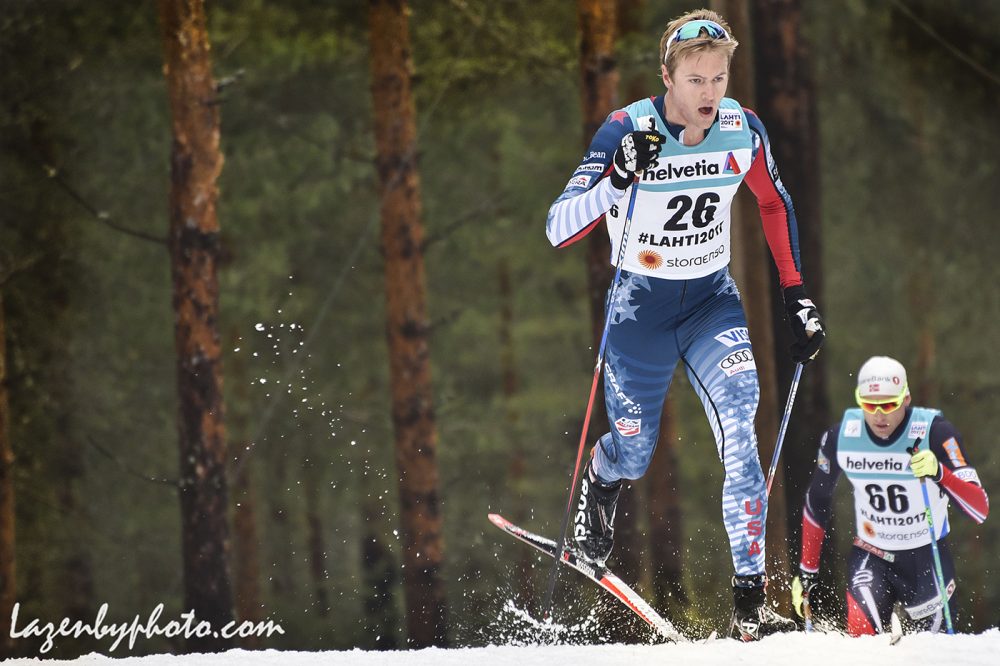
    U.S. Ski Team member Erik Bjornsen (26) skiing ahead of Norway’s Niklas Dyrhaug (66) during the men’s 15-kilometer individual start at the 2017 Nordic World Championships on Wednesday in Lahti, Finland. Bjornsen went on to place 18th, while Dyrhaug captured third place for bronze. (Photo: John Lazenby/lazenbyphotography.com)

    Bjornsen had raced the anchor leg for the U.S., challenged by names like Norway’s Johannes Høsflot Klæbo, Russia’s Sergey Ustiugov and Wednesday’s eventual 15 k winner, Niskanen.

    Despite some of the heavy hitting names that challenged Bjornsen on Sunday, he found himself in the mix (two of his laps were the fifth fastest and one the fourth fastest of all second-leg skiers).

    “In the team sprint the other day, you saw some of the best skiers, I mean, I was skiing with Iivo Niskanen, who has a good shot at winning today, and I felt pretty comfortable skiing with some of those guys,” Bjornsen after Wednesday’s race. An early starter in bib 26, he initially finished third before being bumped 15 places to 18th (+1:56.7).

    “I definitely went into the [15 k] race with quite a bit of excitement from the team sprint,” he said.

    Bjornsen added that the energy he was able to find during the team sprint is something he sees as working it’s way into his longer-distance efforts.

    His performance in the 15 k appears to prove that, as he finished in the top 20 for his best individual World Championships result. The finish also ties his best individual World Cup result — he placed 18th three years ago in a 15 k in Toblach, Italy. The finish was also the best championships result of an American in the men’s 15 k classic since Kris Freeman placed fourth at Liberec world champs eight years ago. 

    Bjornsen explained that a slight bonk toward the end of his first lap caused him to put on the brakes briefly, though he found he was ultimately able to pick his pace back up before finishing.

    “I went for it in the beginning, for sure, and I think I had a pace for the first lap that would have been pretty similar to some guys in the top ten,” Bjornsen said. “Then I kind of hit a little bit of a wall there, a little bit through the first lap, and struggled for a couple of kilometers … then I was able to pick up a little bit of steam before the finish.”

    American Kyle Bratrud (CXC Team) racing to a career-best 33rd in the men’s 15 k classic at 2017 Nordic World Championships in Lahti, Finland. (Photo: John Lazenby/lazenbyphoto.com)

    “I mean hopefully I can just continue to improve and be able to keep that pace up the whole way and then I think it can come together for me,” he added.

    The second American to finish on Wednesday was Kyle Bratrud in 33rd (+3:11.5). Bratrud’s result was 20.7 seconds out of the top 30 and marks his best individual result at his second World Championships and career best at the World Cup level.

    Seeing himself as a stronger skater, Bratrud, 24, of the CXC Team, entered Wednesday wanting to test his ability to push his classic-technique limits.

    “I think I’m a little more confident in skate skiing, so classic I figured I had nothing to lose,” Bratrud said after. “I basically just went as hard as I could from the gun … to see if I could hang on.”

    While the decision resulted in Bratrud having to ease up during some of the climbs, he indicated that managed to recover well enough on the descents to regain control.

    “The course is pretty rolly and I was dying a lot on the uphills,” he said. “On the downhills I was getting some recovery and and all of a sudden I’d feel good again, but I’d get to the next hill and I’d be totally dead.

    “It was kind of a roller coaster of energy, but I just tried to keep my legs moving as fast as I could,” he added.

    With Wednesday also being his mother’s birthday (both his parents made the trek to Lahti to watch him race), Bratrud was thankful for the opportunity to race before throngs of fans, even if the names most were yelling didn’t belong to him.  

    “This is pretty awesome to not even be able to hear yourself breathing because it’s so loud,” Bratrud said “I love when people are cheering, even if it’s not for me.”

    Two other Americans competed on Wednesday, with Andy Newell (U.S. Ski Team) finishing 50th (+4:21.7) and Ben Lustgarten (Craftsbury Green Racing Project) 55th (+4:56.9).

    With his USST teammate Noah Hoffman out due to sickness, Newell explained that he was then slotted to race Wednesday’s classic event.

    “It was fun to get a 15 k in at the championships like this, it’s unfortunate that Hoff wasn’t feeling good so I had to come in and take his spot,” Newell said after.

    Adding that much of his goals are geared towards races scheduled to take place next season –particularly the 2018 Olympics in PyeongChang, South Korea — Newell is not too concerned with numerical results.

    “I felt OK in a few places, but definitely lost too much time out there. I’m just kind of going after a feeling. It wasn’t a great day, but I didn’t feel awful, either,” Newell said. “I’m hoping to build on this year and kind of use this year as a platform to be at my best by the Olympics. I’m not worried too much about results, just trying to feel good when I can.”

    Lustgarten indicated that he had been dealing with a bout of food illness prior to Wednesday. Unable to eat much in the days leading up to the race, the 24 year old had difficulty tapping into his normal race speed.

    “I was just blown. I tried to ski really smooth and then on the the steep stuff, I tried to ski really light and I tried not to throw up,” Lustgarten said. “I’m probably at 70 percent right now and I’m just trying to ski as well as I can here. … It’s a great experience and it was cool to hear the crowd going, I just wish I could ski like I was a month ago.”

    Canada’s Jess Cockney racing to 65th in Wednesday’s 15 k classic at 2017 Nordic World Championships in Lahti, Finland. (Photo: John Lazenby/lazenbyphoto.com)

    Canada was led by Devon Kershaw in 35th (+3:24.8). The next Canadian to finish was Knute Johnsgaard in 56th (+5:00.7), followed by Jess Cockney in 65th (+6:20.7).

    “I don’t think I pushed as hard as I should have. … Mentally, maybe I wasn’t totally zoned in, but I was happy to do a distance race in front of a big fan base like this in Finland for the hometown favorites, so that was good,” Cockney said.

    This being Johnsgaard’s first world champs experience, the 24 year old was happy with how he race his third individual event of the week.

    “I just went out at a pace I thought I could sustain for 15 k and kept that pace pretty steady I think and was able to push hard and kind of sprint up the last hill,” Johnsgaard said. “I felt like I paced it as well as I could, so I’m pretty satisfied with my race.”

    Results

    — Gerry Furseth and Harald Zimmer contributed

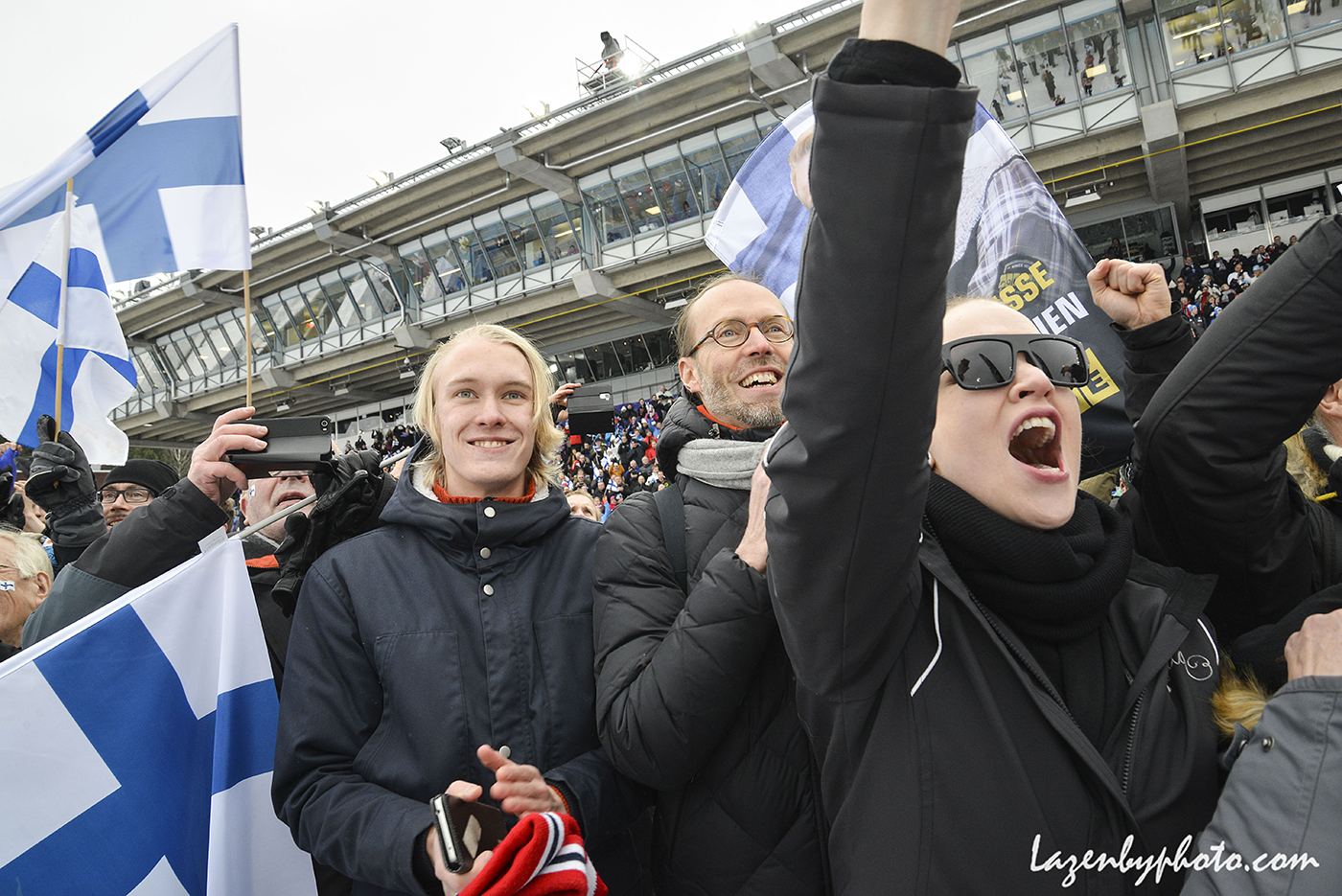
    Finnish fans celebrate Iivo Niskanen’s gold medal in the men’s 15 k classic at 2017 Nordic World Championships in Lahti, Finland. (Photo: John Lazenby/Lazenbyphoto.com)
  • Hopes Dashed for Finland and Norway, Russia Claims Team Sprint Gold

    Hopes Dashed for Finland and Norway, Russia Claims Team Sprint Gold

    Russia’s Sergey Ustiugov out-duels Italy’s Federico Pellegrino for the men’s classic team sprint gold at 2017 Nordic World Championships on Sunday in Lahti, Finland. (Photo: John Lazenby/Lazenbyphoto.com)

    LAHTI, Finland — The breath taken out of a nation.

    Throughout the lifetime of a sporting fan, high-stakes races or games offer the chance for seared-into-the-neurons moments, things you remember for an eternity with the distinct recollection of where you were and what you were doing when the news came down.

    But those are exceptionally rare moments. And depending on what side of the equation you’re on, they can be mile high or a mile deep. It’s rendered down to the win or the loss.

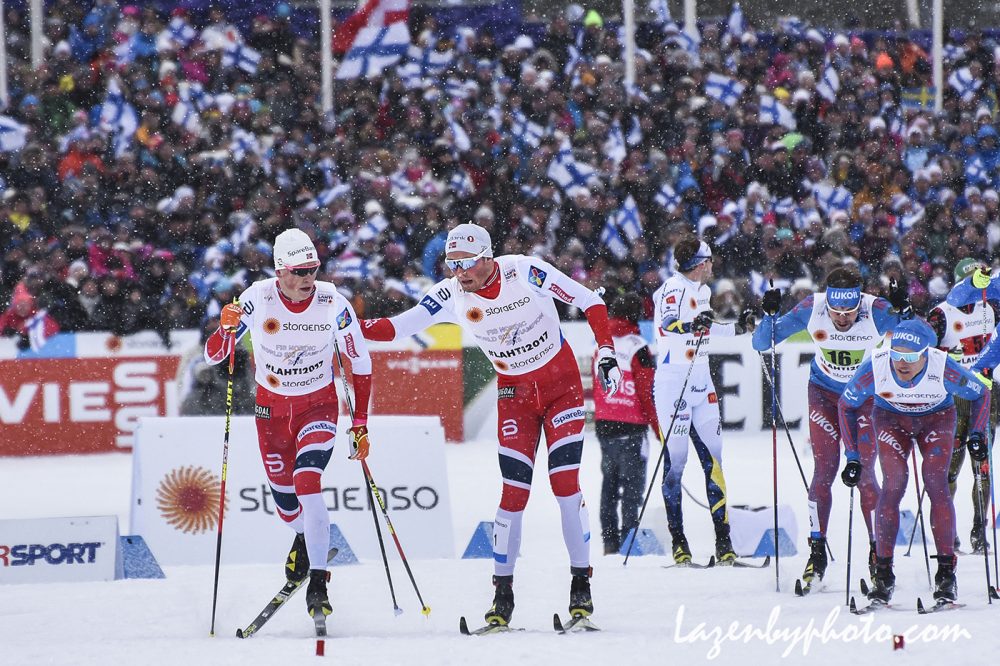
    Norway’s Emil Iversen tags teammate Johannes Høsflot Klæbo during the men’s classic team sprint final at the 2017 Nordic World Championships on Sunday in Lahti, Finland. (Photo: John Lazenby/Lazenbyphoto.com)

    For much of Sunday’s men’s 6 x 1.3-kilometer classic team sprint at the 2017 Nordic World Championships, it appeared to be a cruiser for team Norway, featuring Johannes Høsflot Klæbo and Emil Iversen. The ending to their gold-medal story seemingly written after the third exchange when Klæbo gifted Iversen and all of Norway a 5.38-second lead over the chasing Finns.

    5.38 seconds is a small duration. But when that time gap is illustrated as a distance gap in a sprint, the void looks immense: in this case the distance from Iversen to Finland’s chaser Iivo Niskanen was 45 meters. Even in the best of times, an often too-wide gap to close.

    The sprint course features a long but strideable climb right from the stadium’s steps. It then 180’s to the left and hits a steep headwall most skiers herringboned. Then it was a speedy descent into the hairpin known as “Lahti Corner”, and then stadium time —  a horseshoe-shaped venue of terraced stands filled to capacity with a mostly Finnish crowd.

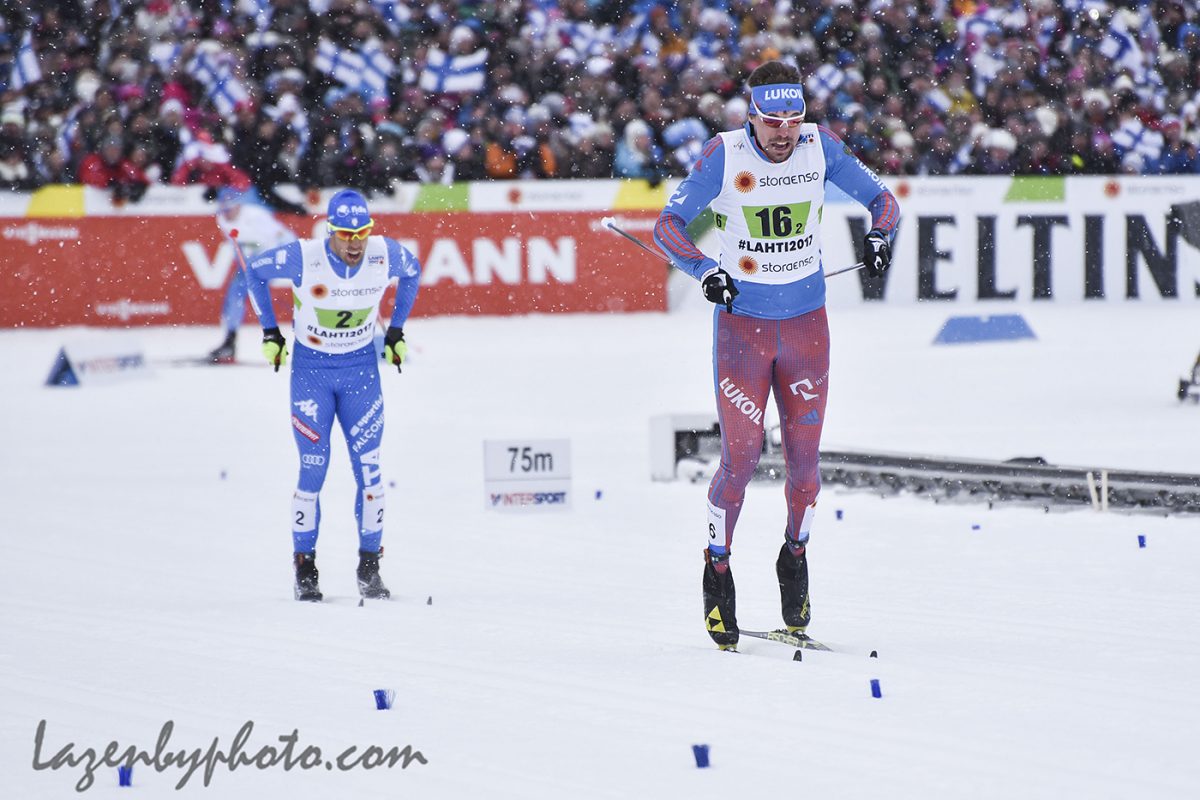
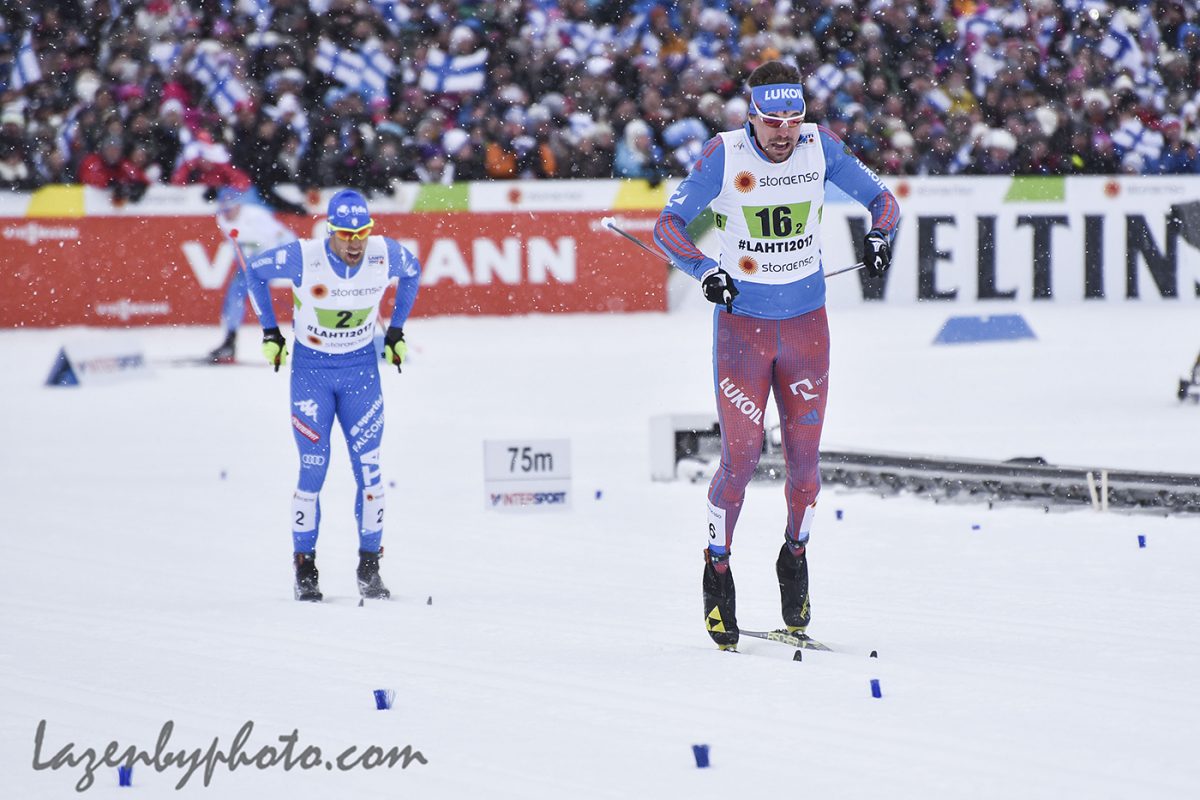
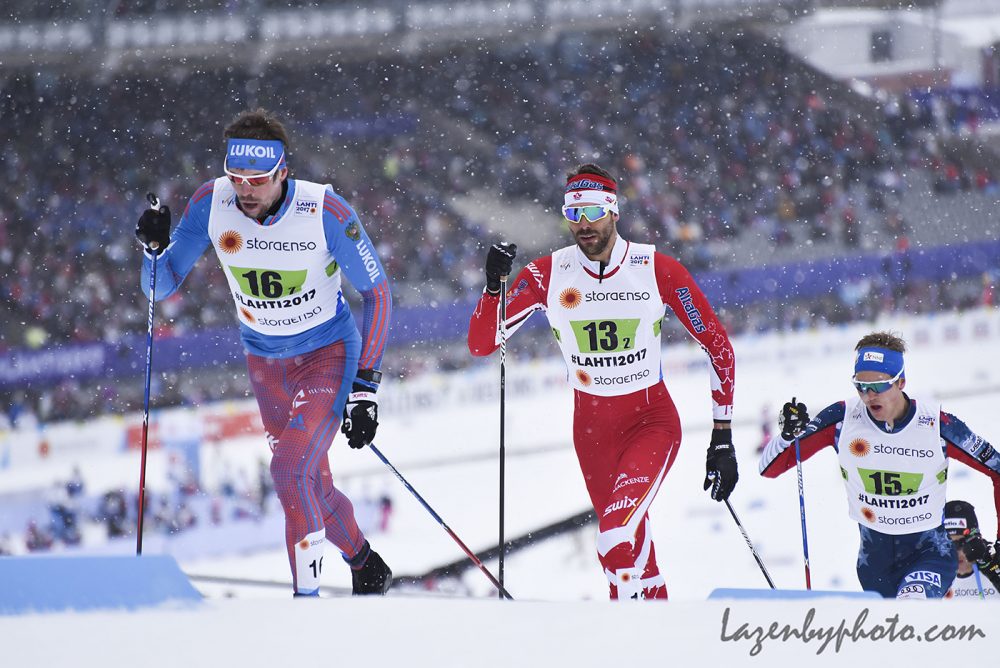
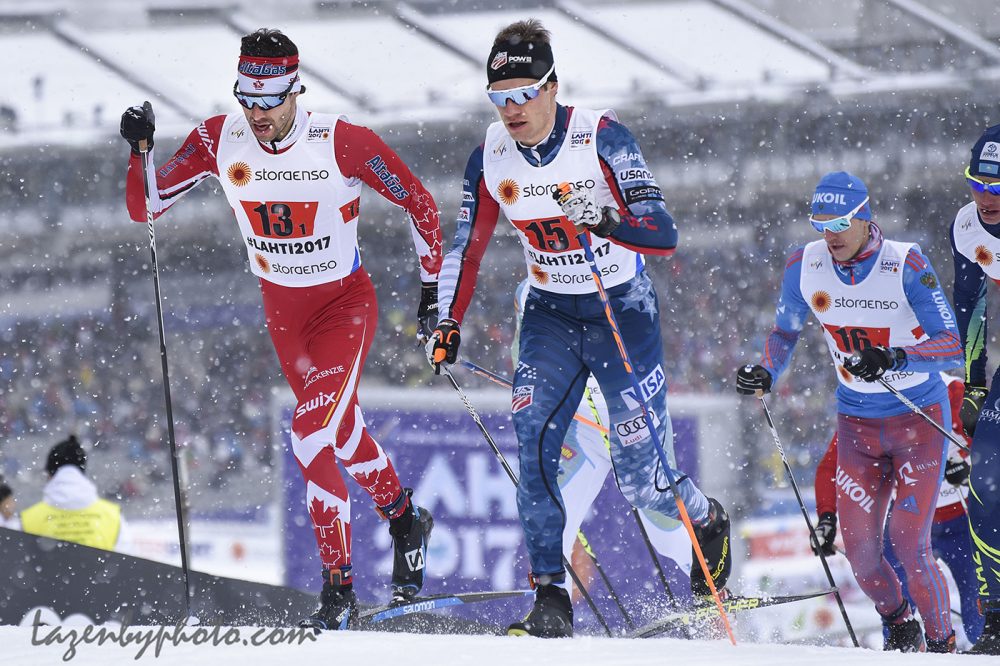
    Russia’s Sergey Ustiugov (16) leads Canada’s Lenny Valjas (13) and American Erik Bjornsen (15) in the men’s classic team sprint final at 2017 Nordic World Championships on Sunday in Lahti, Finland. (Photo: John Lazenby/lazenbyphoto.com)

    Chasing Iversen, frothing at his heels, were three skiers. There was Niskanen, and right behind him, matching stride for stride were Russia’s Sergey Ustiugov and Italy’s Federico Pellegrino.

    As Niskanen worked up the headwall and pushed over the top, he put some meters on Ustiugov and Pellegrino. After a powerful double poling section, Niskanen tipped on the fulcrum into a fast downhill towards Iversen. By “Lahti Corner”, Niskanen had caught the Norwegian.

    The Finnish frenzy that ensued was a roar. The crowd had sensed the Niskanen-Iversen link up.

    On the glide out from Lahti Corner, a 300-meter straight away, Iversen was set in the third of four tracks. One lane of tracks remained to the left — inside of the Norwegian.

    Niskanen, inches away from Iversen’s tails, slotted to his left to pass. There are many perspectives out there, and many depend on which flag you wave, but surely Iversen sensed Norway’s grasp on team gold weaken.

    Norway’s Emil Iversen skiing with a broken pole down the finishing stretch after tangling with Finland’s Iivo Niskanen (not shown) 200 meters from the line, which cost Norway gold in the men’s classic team sprint at the 2017 Nordic World Championships in Lahti, Finland. (Photo: John Lazenby/lazenbyphoto.com)

    Iversen moved to his left to shut down the Finn and immediately jolted backward as he tangled with Niskanen.

    Finland and Norway down. The Finnish cheers snuffed.

    In a blink, Ustiugov and Pellegrino zipped passed in what moments before had been a fight for bronze, into a sprint for gold.

    On this day, Ustiugov was the better closer. With teammate Nikita Kriukov, he anchored Russia to the team-sprint win in 17:40.69 minutes. It was the second race in a row in which Ustiugov earned gold due, in some part, to another skier’s misfortune. Italy’s Pellegrino and Dietmar Nöckler placed second (+2.14).

    Finland’s duo of Sami Jauhojärvi and Niskanen were third (+8.64), Norway fourth (+18.42). The race jury deliberated for a half hour before announcing that neither Norway nor Finland were relegated.

    “What can I do at that situation, when I see that my teammate is going to push for the gold, and then happens this unfortunate crash?” Jauhojärvi said during the press conference. “But it’s just a part of sports, and sports is just a small part of life. We need to be happy that we can pick up the medal in front of [a] home audience this evening.“

    After crossing the line Niskanen fumed and ranted.

    “Yeah, of course straight after the finish line I was very angry, and maybe it wasn’t the most cleverest thing to do with Emil in that last curve,” Niskanen said of his antics. “He lost a medal, and maybe we lost a gold medal. But it’s over now, we are in bronze, and the games are continuing. Just only thing we need to do about this is shaking hands with Emil. We have many years to compete together in the same arenas, and our careers are continuing, and the Lahti ski games are continuing, and we will have good days later.”

    A Norwegian journalist asked a pointed question of Niskanen. “Did you expect a rookie mistake from someone like Iversen?” he asked.

    “Emil has done many sprints, and maybe that move was the only thing to do if he wanted to fight for the gold medal,” Niskanen said in his response. “He really wanted to win, and we did. I came faster behind him and he changed the line, but… it’s a sprint.“

    Answering in English, Kriukov spoke to his lackluster early season results. “This season, yeah, not so good for me and my shape not so best,” he said. “But today I am liking the situation. And lucky for our team and I think there is a reason while our team is first today.”

    For Kriukov’s partner Ustiugov, it was his second gold and third medal overall in as many championship races.

    U.S. Fifth, Canada Sixth

    American Simi Hamilton (16) and Canada’s Alex Harvey (13) racing together ahead of Russia’s Nikita Kriukov (16) in the men’s classic sprint semifinal at the 2017 Nordic World Championships in Lahti, Finland. Both teams reached the final, where the U.S. placed fifth and Canada sixth. (Photo: John Lazenby/lazenbyphoto.com)

    U.S. Ski Team members Simi Hamilton and Erik Bjornsen skied to fifth place, 23.58 seconds behind Russia. For much of the race, Hamilton and Bjornsen remained in contact with the main group consisting of the podium countries: Norway, Canada, Germany, and Sweden.

    On occasion, Klæbo would try to break the race, but the integrity of the group remained for most of three laps. After the race, when asked how he managed Klæbo’s burst, Hamilton said his was a game of calculated risk.

    “I think it goes both ways. It’s one of those courses and one of those races where if you go too hard in the same spot then you’re going to pay for it later” Hamilton said. “But at the same time, you know, we’re at world champs, you have to take chances. I think you’re constantly sort of evaluating that risk versus reward the whole time you’re out there.”

    The risks for losing contact were a gassed slog playing catch up; the reward — opportunity. And lap after lap it was either Bjornsen or Hamilton deep in a tuck after rounding “Lahti Corner”, playing in a congested international game once reserved for the traditional nordic-ski nations.

    For the 25-year-old Bjornsen, it could have been a day of nerves instead of the calm and power with which he skied. Throughout the race, he posted the fourth- or fifth-fastest splits of the second-leg skiers.

    “We haven’t done a lot of team sprints together,” Bjornsen said about his experience teaming up with Hamilton. “The last one was in Sochi. I haven’t done a lot of them recently. So it was great. Going into the finals, it was like, the best teams in the world and the best dudes next to me.”

    Bjornsen skied the Americans from eighth into fifth on his second loop, and after Hamilton dropped two places to seventh by the last exchange, Bjornsen again rallied for fifth.

    At 29 years old, Hamilton remains humble and a student of continued improvement.

    “My classic skiing is still progressing,” Hamilton said. “And for someone like Erik, it comes so naturally for him, he’s such a beautiful classic skier, he’s so efficient. I just focused on putting myself in as much pain as possible to keep contact with that group that I was skiing with. I always have faith in him being able to dig to a place where not many people can dig too in order to come up with that result.”

    Erik Bjornsen (U.S. Ski Team) racing in the men’s classic team sprint final at 2017 Nordic World Championships in Lahti, Finland. With teammate Simi Hamilton (not shown), the Americans finished fifth. (Photo: John Lazenby/lazenbyphoto.com)

    Heading into the last lap, Hamilton tagged Bjornsen in seventh, 10 seconds back from Russia, Italy and Finland. (After a Klæbo flyer, Norway was 16 seconds ahead of the U.S. as Bjornsen began the final lap.)

    “Simi handed off to me in a great spot on the last leg,” Bjornsen reflected. “I was fighting with a few other guys and it was just perfect. Super fun to be with the veteran here.”

    Bjornsen’s older sister Sadie captured her first career world-championship medal before the men’s team sprint final.

    “I actually didn’t know that she was on the podium until after [my] race,” Bjornsen admitted. “I was second leg so I showed up pretty late, kind of just when Simi was starting … So I was trying to stay pretty focused. I wasn’t even thinking about the fact – I actually glanced up at one point and saw a replay of her crashing, and so I was a little worried that they weren’t in it. But it was so exciting to see Sadie come up and get a podium here. This is her first race and I know she’s in good shape. It’s great. Nobody deserves it more than she does. I watched her over the years, just so focused and dedicated. There’s a reason she’s so strong.”

    Canada was represented by national-team members Alex Harvey and Len Valjas. In January, the duo won the World Cup season’s first team sprint. On paper they still remained a medal contender, in addition Harvey has come into the championships primed. However, Valjas has struggled with a health issue the last few weeks.

    “I’m better now, what I think we came to the conclusion with the doctors and everybody, two weeks ago in the gym in Davos I hurt my vertebrae a bit,” Valjas said after the race. “I don’t know how, but it totally affects my breathing, so [at the last World Cup in] Estonia and the sprint here, I felt like I was not able to breathe. The race starts well and I die immediately.”

    Valjas said he’s received treatment to alleviate the symptoms. “A couple days ago, I didn’t know if I’d even start because it was really actually hard to take a deep breath,” he elaborated. “It doesn’t feel like much but when you try to go at 100 percent, you cannot keep up and it’s frustrating. So I was just happy that I was able to ski with these guys, but when it got away on that second leg there, trying to catch Iversen kind of pushed me over the limit a bit.”

    Harvey initially skied the team into third by the first exchange, just 2.8 seconds out of first, and despite slipping to fifth on Valjas’s first loop, Harvey raced up to second by the third exchange, 4.9 seconds behind Norway. On Valjas’s second loop, he dropped to eighth. Harvey held that position on the second-to last leg and tagged Valjas with the same group containing the U.S. Valjas then picked off two places for sixth place.

    “I died a bit in the end, but I still had a lot of confidence in Len’s finish,” Harvey said. “We know in a high-speed finish like that, Len is maybe the best in the world so I was still confident that if I put him in the right situation, we still had a legitimate shot. We still believed in a podium finish and it’s just, you can’t have it every time. But I think it was a big improvement for Lenny, compared to the last two weeks and leading up to the relay.”

    The Canadians finished sixth, 27.02 seconds behind Russia and 3.44 seconds behind the U.S., in the final.

    Championship racing continues Tuesday with the women’s 10 k classic individual start.

    Results

  • Sunday Rundown: Lahti and Osrblie (Updated x2)

    Sunday Rundown: Lahti and Osrblie (Updated x2)

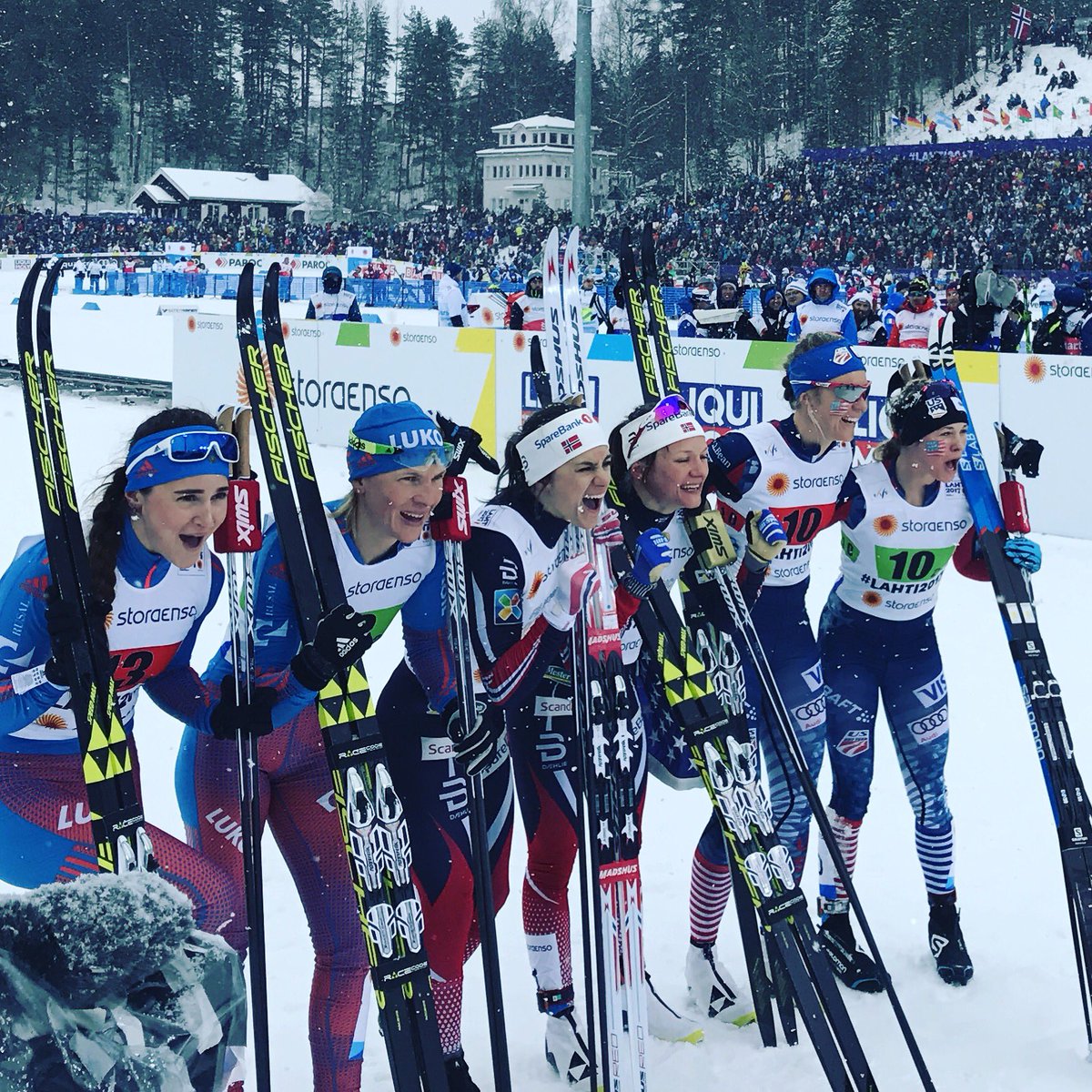
    Heidi Weng and Maiken Caspersen Fall of Norway (center) bested Yulia Belorukova and Natalia Matveeva of Russia (left) for gold in the women’s team sprint at 2017 World Championships, with Sadie Bjornsen and Jessie Diggins of the U.S. (right) outsprinting Sweden for bronze. (Photo: FIS Cross Country/Twitter)

    FIS Nordic World Championships (Lahti, Finland): Classic team sprints

    Defending champions Norway repeated gold in the women’s team sprint, with Heidi Weng and Maiken Caspersen Falla crossing the finish line first in Lahti, Finland. On the second-to-last loop, it looked like Russia could have something to say about that. Yulia Belorukova put in a furious sprint up the course’s biggest climb, and then beat Weng to the exchange. But her teammate Natalia Matveeva could not match the pace when Falla put on her own sprint on the last uphill. Russia finished second for silver, +5.56.

    The competition for bronze was closer, with Germany, Finland, Sweden, and the United States going out of the stadium for the last loop together in chase of the Norwegian and Russian leaders. The last climb was defining in the race for bronze, with Jessie Diggins of the United States staying closest to Sweden’s Stina Nilsson. Diggins caught Nilsson on the downhill and was able to stay just ahead of the Swede to the finish, claiming bronze (+18.38) along with teammate Sadie Bjornsen. It was a return to the team sprint podium for Diggins: after winning the team sprint at 2013 World Championships with Kikkan Randall, she teamed up with Sophie Caldwell in 2015 but the pair finished eighth.

    Nilsson and Ida Ingemarsdotter settled for fourth (+18.57), and the Finnish team of Aino-Kaisa Saarinen and Kerttu Niskanen finished fifth (+23.02).

    The Canadian team of Cendrine Browne and Dahria Beatty was seventh in their semifinal and landed 13th overall.

    In the men’s team sprint, Norway set a high pace from the beginning, with phenom Johannes Høsflot Klæbo attacking on the steep uphill every time he skied. On his second and third loops, he tagged off to Emil Iversen with gaps of just over five seconds to the rest of the field. But Iversen had a hard time holding the lead, in part because of Russia’s Sergey Ustiugov, who had won the 30 k skiathlon the day before and put in a huge effort to catch Iversen on the fourth loop of the team sprint.

    On the final loop, Finland’s Iivo Niskanen bridged the gap up to Iversen, mostly on the steep uphill and then also with ski speed on the downhill. But the time the pair entered the stadium, Niskanen had caught the Norwegian and was moving with higher speed. He decided to switch tracks to overtake Iversen, but Iversen decided to switch tracks just a second later, without checking one last time to make sure the track was clear. He fell, taking out Niskanen with him.

    That allowed Ustiugov and Italy’s Federico Pellegrino to go sailing by to claim gold and silver (+2.14) with their teammates Nikita Kriukov and Dietmar Noeckler. It was the second gold for Russia in the event in three World Championships; Kriukov and Alexey Petukhov won in 2013, and also took silver in 2015.

    Niskanen got up and claimed bronze (+8.64 with Sami Jauhojärvi), swearing as he crossed the finish line; with a broken pole, Iversen limped across the line in fourth (+18.42). He was called to a jury meeting but ultimately no teams were disqualified because of the crash.

    Erik Bjornsen of the United States won a sprint finish for fifth (+23.58) with teammate Simi Hamilton), besting Lenny Valjas (+27.02 with teammate Alex Harvey) of Canada.

    Results: women | men

    ***

    FIS Nordic World Championships (Lahti, Finland): Nordic combined 4 x 5 k team event

    Germany (Björn Kircheisen, Eric Frenzel, Fabian Rießle, and Johannes Rydzek) took gold in the nordic combined 4 x 5 k team event on Sunday at Nordic World Championships in Lahti, Finland, while Norway placed second and Austria third. (Photo: FIS Nordic Combined/Twitter)

    [UPDATED] After sweeping the first individual nordic-combined competition of 2017 Nordic World Championships on Friday, Germany achieved gold as a team, with Björn Kircheisen, Eric Frenzel, Fabian Rießle, and Johannes Rydzek winning the 4 x 5-kilometer team event in 47:57.3.

    The Germans combined for the best jumping score of 11 teams and started the relay in first, 44 seconds ahead of Japan in second. Norway started 1:07 minutes back in fifth but rose to second place (+41.7), with Magnus Moan, Mikko Kokslein, Magnus Krog, and Jørgen Graabak. Moan raced them into third at the first exchange, then Kokslein secured second, which they held onto for the remaining two legs.

    “It was our goal to ski a controlled race,” Germany’s Frenzel told ZDF. “Not really look at how the gap was developing, but just make our own race. And put up a little more pressure towards the end of each leg. That worked well, that was a wickedly cool team performance today. And I am just happy that we could put a little golden crown on the whole event today.”

    “I think today you could see again that we all worked together and enjoyed the competition,” Rydzek added. “We were all happy about each other’s performance, and just rewarded ourselves for hard hard work.”

    Austria started fourth, 1:05 behind Norway, and clinched bronze (+1:03.7) with Bernhard Gruber, Mario Seidl, Philipp Orter, and Paul Gerstgraser. Gruber initially raced them into second at the first exchange, but they relinquished one spot and hung on for third, ahead of Japan in fourth (+1:06).

    Japan (Hideaki Nagai, Takehiro Watanabe, Yoshito Watabe, and Akito Watabe) jumped to second, but found themselves in fourth at every exchange.

    Finland took fifth, Italy sixth, France seventh, and the U.S. eighth (+3:27.2) with Bryan Fletcher, Taylor Fletcher, Ben Berend, and Ben Loomis. The Americans started the race in seventh and were in sixth after the first two exchanges, but slipped to eighth on the third leg.

    Results

    ***

    IBU Youth/Junior World Championships (Osrblie, Slovakia): Youth & junior pursuits

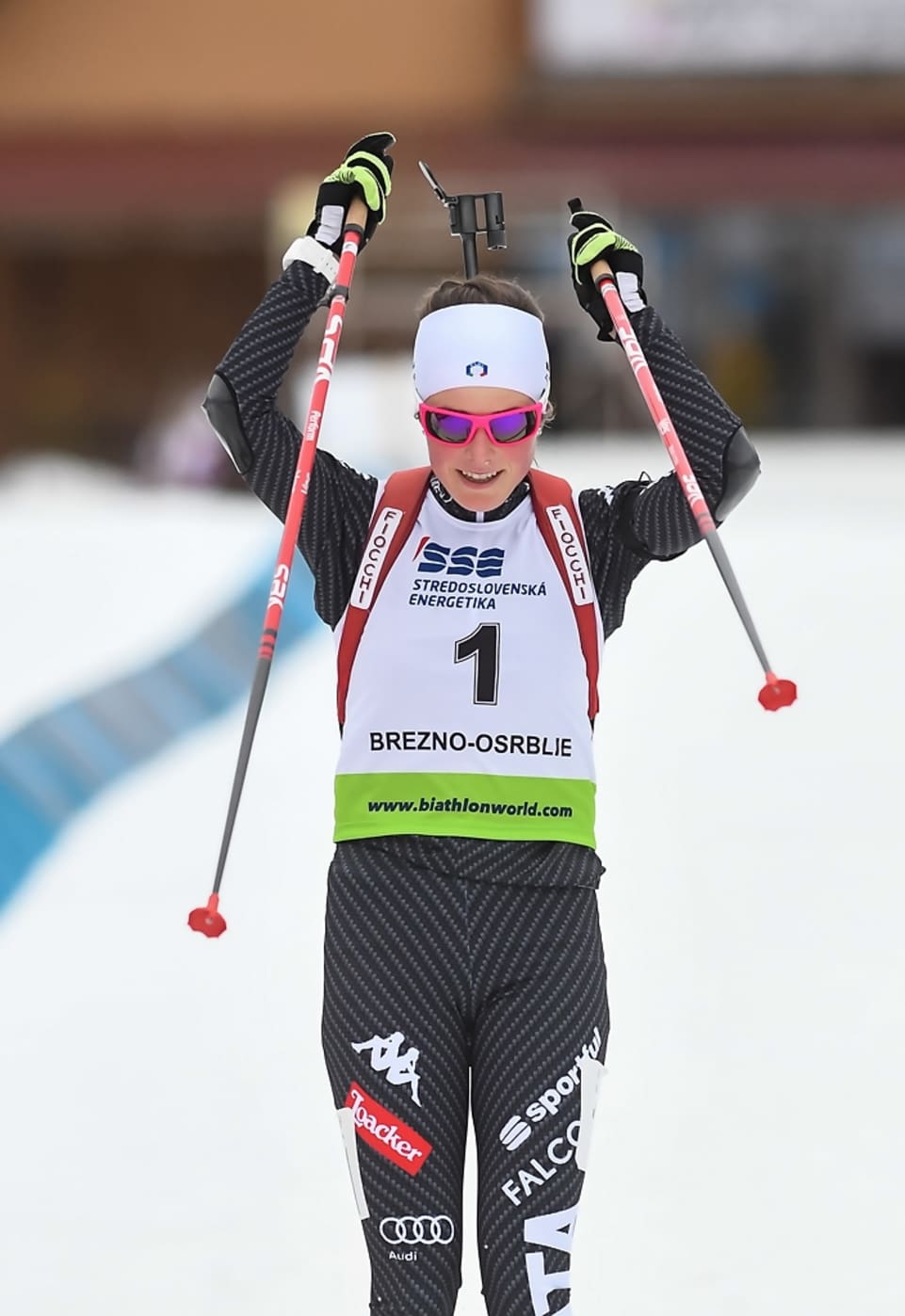
    Four seems to be Chloe Levins’s lucky number. After a career breakthrough of fourth place in the pursuit at last year’s Youth Olympic Games (YOG) in Lillehammer, Norway, the 18-year-old Vermonter raced to fourth in the youth women’s 7.5-kilometer pursuit on Sunday at the International Biathlon Union (IBU) Youth/Junior World Championships in Osrblie, Slovakia.

    Italy’s Irene Lardschneider winning the youth women’s 7.5 k pursuit on Sunday for her second-straight gold at 2017 IBU Youth World Championships in Osrblie, Slovakia. (Photo: IBU)

    Levins started the race in 11th and worked her way up to fourth with clean shooting in three stages. She missed two in the first prone but rebounded and held off Ukraine’s Khrystyna Dmytrenko by seven seconds for fourth place. Levins finished 1:55.5 minutes behind the winner, Italy’s Irene Lardschneider, who started the race first and held on for her second-straight gold medal despite four penalties (0+0+2+2), finishing in 26:57.1. France’s Lou Jeanmonnot-Laurent rose from fourth to second place with 19-for-20 shooting (0+0+1+0), and Italy’s Samuela Comola took bronze (+1:08.5) for the second-straight race with two misses (1+0+1+0).

    Three U.S. women qualified for the pursuit, with Amanda Kautzer finishing 42nd (+6:16.2) after starting 59th and shooting 80 percent (1+0+2+1), and Grace Gilliland finishing 55th (+8:32.1) with six penalties (2+3+1+0).

    Canada’s Shilo Rousseau followed in 54th (+9:02.1) with eight misses (3+1+2+2).

    Results: Youth women

    In the junior women’s 10 k pursuit, Canada’s Megan Bankes raced to 16th for the best finish for a North American in that race. The gold medalist in last week’s 12.5 k individual, Bankes finished 13th in Saturday’s sprint and thus started in that position, 1:25 out of first. She ended up 16th with four penalties (0+1+2+1) and finished 2:15.8 behind the winner, Russia’s Valeriia Vasnetcova, who started 24th and worked her way all the way up to first with clean shooting.

    Vasnetcova was the only one to clean the four-stage pursuit on Sunday, and in doing so, she achieved her first gold of the championships and second of her career at Youth/Junior Worlds after her team won last year’s youth relay in Romania.

    Coming off a sprint win, Italy’s Michela Carrara started first and took second at the finish, 10 seconds behind Vasnetcova with three misses (1+1+1+0). Norway’s Ingrid Tandrevold scored her second-straight medal as well, after starting second and finishing third (+10.8), with two penalties (0+0+1+1).

    Canada’s Nadia Moser had her best result of the championships in 30th (+3:43.5), moving up one place after starting 31st, with three penalties (0+1+0+2). Emily Dickson finished 47th for the second-straight day (+6:29.9) with four penalties (1+0+1+2).

    Siena Ellingson was the lone American to start after placing 18th in Saturday’s sprint. She finished 41st (+5:24.7) with seven misses (1+2+1+3).

    Results: Junior women

    In the junior men’s 12.5 k pursuit, Canada’s Pearce Hanna rocketed to 23rd after starting 47th, shooting 17-for-20 after cleaning the first two stages (0+0+1+2) for his first top 30 of the championships. Hanna finished 3:12 behind the winner, Russia’s Igor Malinovskii who picked up his second-straight gold.

    Malinovskii started first and finished in 32:39.8, 13 seconds ahead of second place, with four penalties (0+1+2+1). Norway’s Sindre Pettersen took the silver medal after starting in eighth and posting the fastest course time to overcome five misses (2+1+1+1). Belarus’s Anton Smolski moved up from fourth at the start to reach the podium in third (+27.4) with five misses as well (0+0+3+2).

    All four Canadian junior men qualified for the pursuit. Trevor Kiers led them in 39th (+5:13.3), after starting 48th, for his best result of the championships. Jules Burnotte placed 43rd (+5:35.3), up from 55th, for his best result as well, and Zachari Bolduc finished 57th (+8:18.3). Kiers missed five targets (2+0+1+2), Burnotte had seven misses (3+1+1+2), and Bolduc missed eight (2+3+2+1).

    For the U.S., Cody Johnson finished 55th (+7:19.5) with nine penalties (2+1+2+4) and Travis Cooper 59th (+8:46.2) with eight misses (5+0+1+2).

    Results: Junior men

    In the youth men’s 10 k pursuit, the first race of the day on Sunday, two Canadians finished in the top 30, with Leo Grandbois in 22nd and Adam Runnalls in 27th.

    For Grandbois, it was his first time outside the top 15 of the championships after he had won the youth men’s 12.5 k individual last Wednesday and finished 14th in Friday’s 7.5 k sprint. He had to ski six penalty loops on Sunday (0+2+2+2), dropping outside the top 20 after the third shooting. Grandbois finished 3:21.8 behind the winner, France’s Emilien Claude, who won the sprint as well to start the pursuit first.

    Claude, who had four penalties (1+1+0+2) and finished in 29:22.4, held off Italy’s hard-charging Cedric Christille by 16 seconds after Christille shot just two penalties (0+0+1+1) to move up from fourth to second for his first medal in his first Youth World Championships. Germany’s Danilo Riethmüller rose from sixth to third place (+30.7) despite four misses (1+0+1+2). For the German, it was his second bronze of these championships after placing third in the 12.5 k individual.

    Canada’s Runnalls moved up from 32nd at the start to 27th at the finish (+3:47.5) for his first top 30 of the championships. He had five penalties (1+3+1+0), but cleaned the last stage to move into the top 30.

    Vasek Cervenka was the lone American to qualify in the youth men’s pursuit, and he moved up from 49th at the start to 30th (+3:52) with five penalties (1+1+1+2).

    Results: Youth men

  • Poltoranin, Nousiainen, Jauhojärvi & Niskanen Take Wins over International Field in Muonio

    Poltoranin, Nousiainen, Jauhojärvi & Niskanen Take Wins over International Field in Muonio

    Racing has kicked off in Muonio, Finland, with classic sprints on Friday and an 8.2/15 k classic race on Saturday. While skiers from the home country took many spots on the podium, Alexei Poltoranin of Kazakhstan prevailed in the men’s sprint, beating Ristomatti Hakola by a ski length.

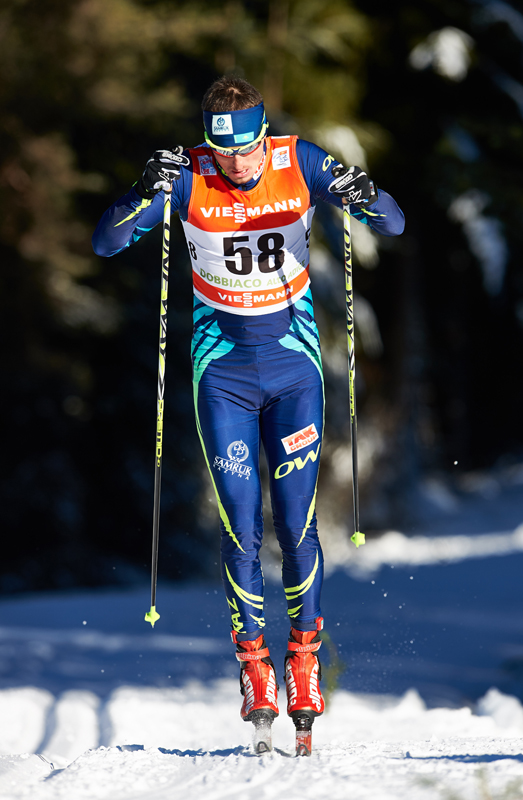
    Alexey Poltoranin (KAZ) racing for the Tour de Ski in Cortina-Toblach (ITA) in 2015. On Friday he won the classic sprint at FIS races in Muonio, Finland. (photo: Fischer/NordicFocus)
    Alexey Poltoranin (KAZ) racing in the Tour de Ski in Cortina-Toblach (ITA) in 2015. On Friday he won the classic sprint at FIS races in Muonio, Finland. (photo: Fischer/NordicFocus)

    With just 16 skiers advancing to heats, and four skiers per heat because of the narrow width of trails, action was fast on Friday afternoon. According to Poltoranin, the races are tests for the Kazakh team.

    “My Estonian coach, Mati Alaver, who I have been working with for two years and my sparring partner, 2002 and 2006 Olympic Champion Andrus Veerpalu, who I have been training with since the summer until the last starts and who also happens to be my serviceman and test pilot, are also in Muonio,” he said in an interview with Astana Times on Friday.

    He also shed some light on the fighter’s mentality that took him to the top later that day.

    “In times of hardships I think if I slow down and lose one to three seconds, then have I worked for nothing since my childhood?” he said. “This is why we are training, to fight for every second, for every place.”

    Finally, he had some requests for Kazakhs at home: watch skiing on television, and do it themselves.

    “I recommend everyone to start skiing, because it is a healthy lifestyle,” he said. “Your body muscles are working, including the heart, and most importantly it is not as traumatic as jogging.”

    Mona-Liisa Nousiainen bested Krista Pärmäkoski in the women’s final after also winning the prologue.

    “In the final, Krista pulled a pretty good pace,” Nousiainen told Kestävyys Urheilu.

    Nousiainen is planning in the first World Cups of the season, to be held in Kuusamo, Finland. After also winning a sprint in Vuokatti earlier this month, she certainly seems to be a compelling choice for sprints. But with few top women from other countries competing in Muonio, she was wary of assigning her wins so far too much importance.

    Finland's Sami Jauhojärvi crosses the line ahead of Russia's Nikita Kriukov to win a gold medal in the Sochi Olympic team sprint in 2014.
    Finland’s Sami Jauhojärvi crosses the line ahead of Russia’s Nikita Kriukov to win a gold medal in the Sochi Olympic team sprint in 2014.

    “Sure, these messages indicate that the training sessions have gone well,” she said, according to a translation. “But the main contests are of course still ahead.”

    Alena Prochazkova of Slovakia was third in the A-Final.

    Come Saturday, Poltoranin slipped to the third spot of the podium as Sami Jauhojärvi was the man of the day. The Finn opened up a 43.5 second gap to teammate Hakola over the course of 15 k of classic skiing, with Poltoranin another 1.8 seconds behind in third.

    “I hope my mother believes the broadcast,” Jauhojärvi said at the end of an interview with Kestävyys Urheilu. “And my son Oiva at home. Dad won!”

    The field was also filled with a few former NCAA skiers. University of Utah alum and sometime Norwegian World Cup skier Snorri Einarsson placed seventh, +1:38.3 behind Jauhojärvi. Former University of Alaska Anchorage skier Vahur Teppan of Estonia placed 38th (+4:38).

    Kerttu Niskanen of Finland skiing to fourth place in the 30 k classic at 2015 World Championships.
    Kerttu Niskanen of Finland skiing to fourth place in the 30 k classic at 2015 World Championships.

    In the women’s 8.2 k, Pärmäkoski again finished a close second, this time behind Kerttu Niskanen. Niskanen clocked a time just 2.3 seconds faster.

    Working through falling snow and powdery trails, Niskanen called the course less than ideal.

    “The snow was falling and the trails were in messy condition,” she said, according to a translation. “It was a mess that somehow came forward.”

    She revealed in an interview with the Iltalehti newspaper that she is focusing on a World Cup overall placing, and intends to race the Ski Tour Canada.

    “It doesn’t make sense to race all the races for the period, but most I can ski,” she said. “The Tour de Ski and the Canadian tour, theirs is a big role. If they do not go well, you will have to forget the overall World Cup competition.”

    Riita-Liisa Roponen, a formidable force on the FIS Marathon Cup in the last few years, placed third +24.5.

    “Time, well well – it seems I can still stride with the young girls,” 37-year-old Roponen quipped to the Kaleva newspaper.

    Aino-Kaisa Saarinen, a Finnish longtime star who recently announced that she was pregnant, finished ninth (+1:22.3). She explained after the race that she plans to continue racing until she begins to be afraid of crashing, at which point she’ll stay away from the start line.

    Utah alum Maria Gräfnings placed tenth, four seconds behind her. College of Saint Scholastica’s Anita Kirvesniemi placed 43rd (+3:58.9).

    Racing continues Sunday with skate distance competitions.

    Results: 

    Friday women’s / men’s sprint

    Saturday women’s 8.2 k / men’s 15 k

  • De Fabiani Breaks Through for Italy with 15 k Classic Win, First-Ever Podium

    De Fabiani Breaks Through for Italy with 15 k Classic Win, First-Ever Podium

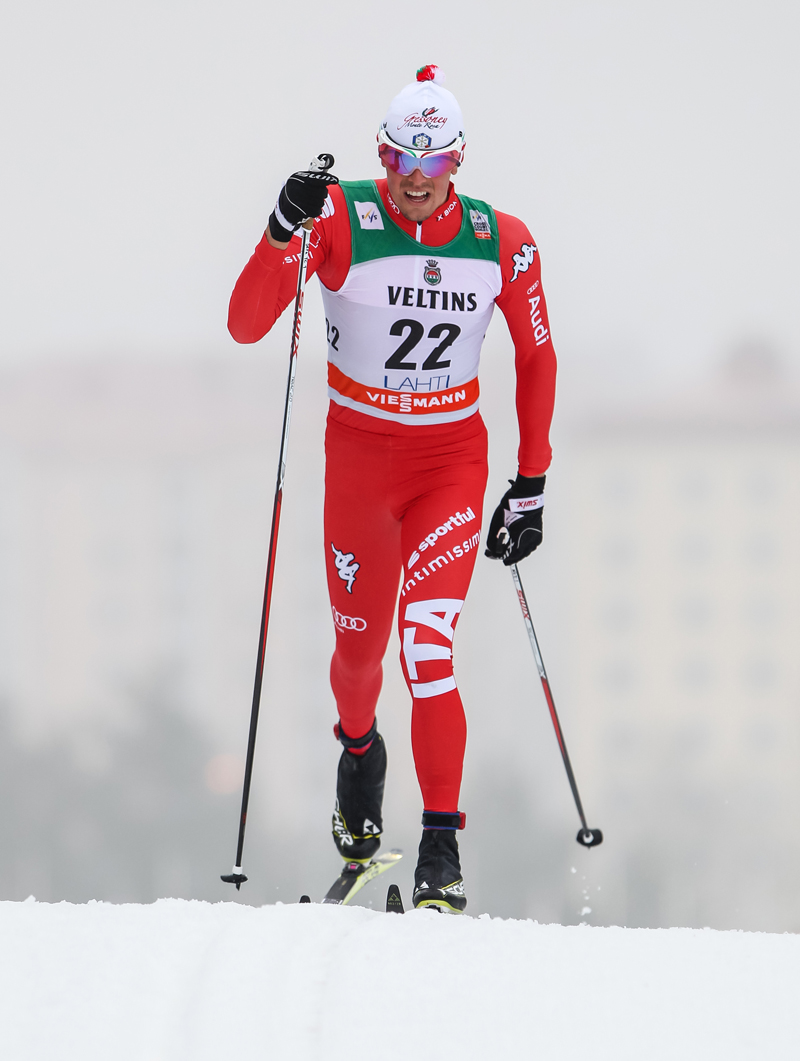
    Francesco de Fabiani racing to his first World Cup win in the Lahti World Cup 15 k classic on March 8, which was Italy's first victory in a classic-distance race since 1997. (Photo: Fischer/NordicFocus)
    Francesco de Fabiani racing to his first World Cup win (and podium) in the Lahti World Cup 15 k classic on March 8, which was Italy’s first victory in a classic-distance race since 1997. (Photo: Fischer/NordicFocus)

    No amount of fog or soggy classic conditions could dampen Francesco de Fabiani’s spirits on Sunday as the 21-year-old broke through an 18-year barrier for Italy with a World Cup classic-distance win in the men’s 15-kilometer individual start in Lahti, Finland.

    After starting second in the seeded group in bib 22, de Fabiani took to the course 30 seconds after Norway’s Eldar Rønning and gradually worked his way into the three-lap race.

    De Fabiani finally took the lead at 11.2 k, and from that point on, the young Italian — who had never been on the World Cup podium before — became untouchable. Kazakhstan’s Alexey Poltoranin came close, clocking through the checkpoint 3 seconds behind De Fabiani, and Finland’s Sami Jauhojärvi was 4.6 seconds out of the lead in third.

    Out of 71 finishers, de Fabiani’s time at 3.4 k ranked 25th. By 6.2 k, he was up to 20th, and by 13.4 k, he remained 7.2 seconds ahead of Jauhojärvi in first.

    “I was very motivated to show my best today after a disappointing performance in the 50 k in Falun last week,” de Fabiani told FIS after the race.

    Exactly a week ago on March 1, the Italian placed 32nd in the 50 k classic mass start at World Championships in Falun, Sweden. Three of his teammates, Dietmar Nöckler, Giorgio Di Centa and Mattia Pellegrin, finished ahead of him in 12th, 22nd and 23rd, respectively.

    But this Sunday was different. De Fabiani set the new time to beat at the finish, besting Norway’s Martin Løwstrøm Nyenget by 6.5 seconds to bump the 22-year-old Norwegian U23 team member out of the leader’s seat.

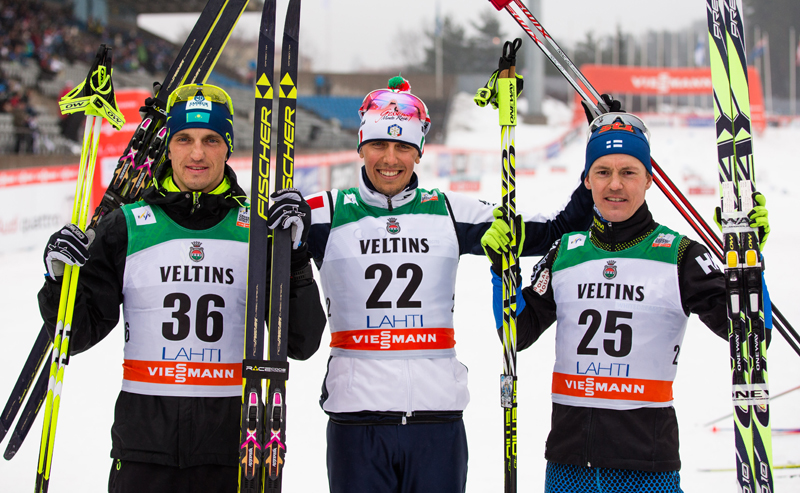
    The men's 15 k classic podium at Sunday's World Cup in Lahti, Finland, with Italian winner Francesco De Fabiani (c), Kazakhstan's Alexey Poltoranin in second (l), and Finland's Sami Jauhojärvi in third. (Photo: FIS Cross Country/Twitter)  The men's 15 k classic podium at Sunday's World Cup in Lahti, Finland, with Italian winner Francesco De Fabiani (c), Kazakhstan's Alexey Poltoranin in second (l), and Finland's Sami Jauhojärvi in third. (Photo: Fischer/NordicFocus)
    The men’s 15 k classic podium at Sunday’s World Cup in Lahti, Finland, with Italian winner Francesco de Fabiani (c), Kazakhstan’s Alexey Poltoranin in second (l), and Finland’s Sami Jauhojärvi in third. (Photo: Fischer/NordicFocus)

    Even with Jauhojärvi in bib 25 hot on his tails, de Fabiani remained on top at the finish as the Finn came through 4.6 seconds back to take second. The 33-year-old Jauhojärvi crossed the line while waving of his hand back and forth, indicating it was a so-so race, then smirked and pointed two fingers at the TV camera to indicate second.

    “I’m quite satisfied with the result, but still little bit disappointed I lost the victory by only 4.6 seconds,” Jauhojärvi told FIS. “Only on the big climb in the the second lap I was in trouble and I lost about six seconds. Then I got a ride with [Switzerland’s] Dario Cologna and I tried to follow him.”

    An early leader in bib 36, Poltoranin came through the 3.4 k checkpoint with the fastest time, and behind him, Sweden’s Calle Halfvarsson came closest to it, 1.4 seconds back. Poltoranin went on to lead through 8.4 k, where Russia’s Alexander Bessmertnykh was fastest, 0.5 seconds ahead of Rønning. Nyenget was 1.3 seconds back in third at that point, and Poltoranin 1.5 second behind in fourth.

    Also at 8.4 k, Nöckler, who started 30 seconds behind his teammate, was ahead of De Fabiani and 2.7 seconds behind the Russian, along with Cologna (+3.9). With 6.6 k to go, De Fabiani was 5.7 seconds out of first, followed by Halfvarsson (+6.8).

    About 2 1/2 kilometers later, de Fabiani found he was within three seconds of Nyenget in first, and Rønning and Cologna worked their way up into contention in second and third, less than a second back. Bessmertnykh remained in the mix with Nöckler and Poltarinin, within 2 seconds of the lead.

    On the final 5 k lap, de Fabiani made his mark. Cologna and Nöckler came within 2.6 seconds of him at 11.2 k, and Nyenget was another 0.1 seconds back in fourth.

    With 1 1/2 k to go, de Fabiani picked up the tempo considerably, and Jauhojärvi came within 7.2 seconds of him at 13.4 k to post the second-fastest split. Poltoranin and Nyenget were 7.7 seconds off the pace tied for third, and Nöckler and Cologna dropped more than 10 seconds behind in fifth and sixth.

    Poltoranin closed hard and came up 3 seconds short of de Fabiani, who ended up clinching the win ahead of him in 34:51.2. Jauhojärvi ended up third at his home World Cup, and Nyenget took fourth, 6.5 seconds back and 1.9 seconds off the podium in his second World Cup race (he previously placed 41st in last year’s 50 k classic at Holmenkollen in Oslo, Norway).

    Cologna in fifth (+9.7) boosted his points in the overall World Cup standings to come within one point of Norway’s Petter Northug, who placed seventh on Sunday, 15.3 seconds after de Fabiani. The two remain in third and fourth overall, respectively, despite putting some points into Norwegian World Cup leader Martin Johnsrud Sundby, who finished 10th on Sunday (+21.5).

    At the end of the day, Sundby clinched his second overall World Cup title, 322 points ahead of Northug and with just 290 points up for grabs in two more races this season.

    In the race for the overall Distance World Cup, Cologna remains 83 points ahead of Sundby with one race to go (the 50 k skate in Holmenkollen next Saturday) and 190 points remaining.

    “It is great to win a first World Cup,” De Fabiani told FIS. “I was lucky today. I skied with Lukas Bauer [of the Czech Republic] for two laps and he helped me a lot to win the race today.”

    Bauer, who started 45th and finished ninth (+20.3), after Rønning in eighth (+16.9),  immediately congratulated the Italian at the finish. De Fabiani stood up out of his seat to greet him in the finishing pen.

    Beyond de Fabiani’s first career win and podium, the victory was a first for Italian cross-country skiing, which had not won a classic distance race since Silvio Fauner topped a 10 k in January 1997, according to Neveitalia.

    Italy had two in the top six, with Nöckler finishing 13 seconds back from his teammate in sixth.

    For Poltoranin, it was his 21st career World Cup podium after a medal-less World Championships.

    “I am happy to be back on the podium,” he told FIS. I was not satisfied with my performance at the World Championships. Today was a difficult race. I was in the lead in the halfway of the race, but then I could not keep the speed.”

    Results

  • Finland’s Next Messi? Iivo Niskanen Breaks Through with Kuusamo World Cup Win

    Finland’s Next Messi? Iivo Niskanen Breaks Through with Kuusamo World Cup Win

    The men's 15 k classic podium in the first World Cup distance race of the season on Sunday in Kuusamo, Finland: with Finland's Iivo Niskanen (c) in first and Sami Jauhojärvi (r) in third, and Norway's Martin Johnsrud Sundby in second. (Photo: FIS Cross Country/Twitter)
    The men’s 15 k classic podium in the first World Cup distance race of the season on Sunday in Kuusamo, Finland: with Finland’s Iivo Niskanen (c) in first and Sami Jauhojärvi (r) in third, and Norway’s Martin Johnsrud Sundby in second. (Photo: FIS Cross Country/Twitter)

    Iivo Niskanen appeared itchy in the leader’s chair on Sunday, after finishing with the fastest time of the day through 46 racers in the men’s 15-kilometer classic sprint — the first distance race of the 2014/2015 season.

    Itchy, anxious, whatever you want to call it, but happy.

    Livo Niskanen (FIN) celebrates his win in the 15 k classic at the 2014 U23 World Championships in Val di Fiemme, Italy. (Photo: Fiemme 2014)
    Iivo Niskanen (FIN) celebrating his win in the 15 k classic at the 2014 U23 World Championships in Val di Fiemme, Italy. (Photo: Fiemme 2014)

    The 22-year-old Finnish A-team member, defending U23 World Championships 15 k classic champion and younger brother of Kerttu Niskanen, had never been on a World Cup podium before.

    He won gold in the 2014 Olympic classic team sprint with teammate Sami Jauhojärvi, but individually, this was a big deal.

    Fourteen men raced for Finland on Sunday in front of Ruka’s packed stadium in Kuusamo, Finland, but the man of the hour was Niskanen. The 33-year-old veteran Jauhojärvi wasn’t far behind him — 12.5 seconds at the finish — and ended up on the podium, too, but Niskanen soaked up the most crowd love and blew the most kisses after the race was over.

    Moments before he officially won it in 35:09.4 — by 10.3 seconds over Norway’s Martin Johnsrud Sundby — Niskanen jumped out of the cushiony chair and got ready to run like crazy down the finishing stretch.

    “It’s amazing that this [victory] came in front of a home audience,”  Niskanen told the Ilta-Sanomat, according to a translation. “I just realized a little boy’s dream. Thanks to the military forces. We have two men on the podium; it is a fine specimen of a job well done.”

    Niskanen started early in the seeded group, 46th of 96 men, and consistently clocked the fastest times through each passing checkpoint about every 1.5 kilometers. That’s impressive enough for a U23 in his first full-time World Cup season, but Niskanen’s times held up as more than 30 other races passed through.

    Maxim Vylegzhanin skating the Russian 4 x 10 men's relay to silver in the 2014 Sochi Olympics.
    Maxim Vylegzhanin skating the Russian 4 x 10 men’s relay to silver in the 2014 Olympics in Sochi, Russia.

    By the time Russia’s Maxim Vylegzhanin in bib 82 hit the 1.4 k marker, Niskanen had his match. The 32-year-old Vylegzhanin came through the checkpoint 2 seconds faster than Niskanen, and by 3.1 k, he remained 1.5 seconds ahead.

    A third of the way through at 5 k, Niskanen had the edge over the Russian by 4.3 seconds, followed by Jauhojärvi, Sweden’s Daniel Richardsson, Sundby, Sweden’s Lars Nelson, and Russia’s Sergey Turyshev, respectively.

    By 6.4 k, Niskanen and Vylegzhanin were dead even, 8.8 seconds ahead of Jauhojärvi. One-and-a-half kilometers later, Niskanen had a 7.1-second cushion as Vylegzhanin began to fade.

    Jauhojärvi was still third fastest through that checkpoint, 9.7 seconds back, and Norway’s Niklas Dyrhaug was up to fourth after a conservative start.

    Dyrhaug, who started 30th, took his position in the leader’s chair after finishing in 35:22, 28.5 seconds faster then previous leader Francesco De Fabiani of Italy. The Norwegian would stay there until Niskanen bested his time by 12.6 seconds.

    At the 10 k mark, both Niskanen and Jauhojärvi were faster then Vylegzhanin, and it seemed first and second was possible for Finland. But there were still more competitive racers to come, including Sundby, the reigning overall World Cup champion.

    Niskanen had nearly 15 seconds on Jauhojärvi at 11.4 k, and Vylegzhanin was 14.8 seconds back in third. The Russian slipped to eighth by 13.1 k, and Sundby slipped momentarily on what looked like slightly slick skis — or maybe he was just getting tired on Kuusamo’s relentless three-lap course.

    With less than two kilometers to go, Sundby was up to second regardless, 14 seconds behind Niskanen. Jauhojärvi was another 1.5 seconds back in third.

    Niskanen sat grinning from ear to ear under the lights in the Ruka stadium. As Sundby hoofed up the final climb, grimacing through a thick beard and big sunglasses, it was fairly evident he wasn’t going to touch the young Finn. Sundby put on a strong finishing kick around a Russian at the finish, and secured second, 2.2 seconds ahead of Jauhojärvi in third.

    Sundby finishing and looking up to confirm he placed second in Sunday's World Cup 15 k classic in Kuusamo, Finland.
    Sundby finishing and looking up to confirm he placed second in Sunday’s World Cup 15 k classic in Kuusamo, Finland.

    “It is lovely to get on the podium, although I wanted to win,” Sundby said to NRK, according to a translation. “I was basically shot against Iivo.”

    While he said he was “not flying on skis yet,” he hoped it would come with time.

    “My ultimate goal is to be in my best shape in Falun,” he told FIS.

    Sundby bumped fellow Norwegian Dyrhaug to fourth, just one-tenth of a second off the podium. But he wasn’t too upset.

    “I am very, very happy to be back in top form,” Dyrhaug told NRK. “I’ve had two tough years, so it’s good to know that the body is working again.”

    Standing on the podium with him for the first time in a World Cup since 2010, Jauhojärvi said he felt like he skied smoothly, but he wasn’t completely satisfied.

    “I heard from Norwegian split times that Niklas [Dyrhaug] was in the lead,” Jauhojärvi told FIS. “He was skiing behind me so I had to speed up in the last kilometers. I did not feel strong and fast today, but I had extremely good skis.”

    Niskanen, who became Finland’s first male to win in Ruka in 19 races there, said both his grip and glide were perfect.

    An exhausted Iivo Niskanen at the finish of Sunday's  15 k classic in Kuusamo, Finland, which he won for his first World Cup podium.
    An exhausted Iivo Niskanen at the finish of Sunday’s 15 k classic in Kuusamo, Finland, which he won for his first World Cup podium.

    Walking through the mixed zone, Finnish coach Magnar Dalen yelled to journalists, “Watch out for that boy there! He is a cross-country Messi!” referring to the Argentine soccer great.

    “I was an amazing day; I had to be smart,” Niskanen told NRK. “I have done many races here and knew I had to turn down the pace two notches on the hills and makes it up [on other parts of the course].

    “It was really noisy along the course,” he said to FIS. “Before the race I thought I could be in top six. I tried to improve the summer training and I seem to have done a good job. It was pretty nice that my family could be here today with me.”

    “It was impressive,” said Petter Northug, who placed 23rd and 1:02.7 back, to NRK. “Niskanen looks like he has risen.”

    Vylegzhanin tied Didrik Tønseth for 11th, 37.5 seconds behind Niskanen. Russia’s top skier, Alexander Bessmertnykh finished fifth, Calle Halfvarsson of Sweden was sixth, Canada’s Alex Harvey seventh, Simen Håkon Østensen eighth, Pål Golberg ninth, and Finland’s Matti Heikkinen 10th.

    Turyshev ended up 25th, four seconds behind Switzerland’s Dario Cologna in 24th (+1:05.2).

    "Iiiiivoooo !! Unbelievable !!!
    “Iiiiivoooo!! Unbelievable!!!” Kerttu Niskanen tweeted after Sunday’s race.

    Note: Two men did not finish Sunday: American Noah Hoffman and Poland’s Maciej Starega, who stopped somewhere after 3.1 k. Hoffman crashed hard on an icy downhill about 1 k before the finish and was taken off the course in a stretcher.

    According to U.S. Ski Team coach Matt Whitcomb, Hoffman “sustained a lower left leg injury today and will be headed home to the US as soon as possible for further evaluation. He will fly home either Monday or Tuesday. The World Cup organizers and medical personnel in Kuusamo / Ruka, as well as our US Ski team medical staff member Peter Dickenson handled the situation very well.”

    Results | with Splits

  • After Germans Crash, Young and Old Combine to Claim Gold for Finland in Team Sprint

    After Germans Crash, Young and Old Combine to Claim Gold for Finland in Team Sprint

    Finland's Sami Jauhojärvi crosses the line ahead of Russia's Nikita Kriukov to win a gold medal in Wednesday's team sprint at the Olympics.
    Finland’s Sami Jauhojärvi crosses the line ahead of Russia’s Nikita Kriukov to win a gold medal in Wednesday’s team sprint at the Olympics.

    FasterSkier’s coverage is made possible through the generous support of Swix.

    KRASNAYA POLYANA, Russia – The cross-country team sprint had been whittled down to men from three countries: Germany, Finland, and Russia.

    As they skied around the final downhill corner, into the stadium, the only question left seemed to be who would get bronze, who would get silver, and who would get gold.

    That is, until Sami Jauhojärvi, the Swedish anchor, drifted to his right, at the same time that Tim Tschanke, the German anchor, drifted to his left.

    Their skis crossed, and Tscharnke spun around and crashed, leaving him down on the snow as Jauhojärvi and Nikita Kriukov, from the Russian team, went on to collect the gold and silver medals.

    By the time Tscharnke got up, it was too late: Teodor Peterson had passed him, snatching the second lucky bronze of Sweden’s cross-country campaign at these Olympics.

    The Germans trailed in in 7th place, nearly 45 seconds behind.

    The result set off a wild celebration by Jauhojärvi and his teammate Iivo Niskanen at the finish, with Jauhojärvi raising his arms and screaming as he crossed the line.

    But it also set off some grumbling by the Russians—Kriukov said he was also held up by the crash, and otherwise could have challenged for gold—and a formal protest from Germany, which the race jury rejected.

    The Germans still had 48 hours to file an appeal, and it was unclear whether they had done so late Wednesday.

    Jauhojärvi looks back at Kriukov at the finish.
    Jauhojärvi looks back at Kriukov at the finish.

    Bjoern Weisheit, the German team manager, said any objection would be only to get “justice,” rather than to elevate Tscharnke and his partner Hannes Dotzler to the medals, since the two finished in seventh place.

    As the drama with the protest unfolded, Jauhojärvi and Niskanen were left to celebrate their gold.

    The two form an interesting pair. Jauhojärvi is a compact 5’9” with dark hair, and at 32 he’s a veteran cross-country skier who is likely racing in the last Olympics of his career.

    Niskanen is 22, blond, a lanky 6’2”, and was skiing in his first-ever games. He had a breakout result in the 15-kilometer individual race last week, in which he placed fourth, less than a second away from a bronze medal.

    “We are, with Iivo, in a different position,” Jauhojärvi said afterwards. “He is just in the beginning of his career.”

    The race stayed together until the fifth of sixth laps. (In the team sprint, each athlete took three trips around a 1.8-kilometer loop.)

    On the fifth lap, Dotzler helped push the pace and broke apart the group, which up to that point had included eight different teams.

    He tagged off to Tscharnke in the lead, with Finland and Russia not far behind, thanks to powerful legs from Niskanen and Maxim Vylegzhanin. Those three teams ended up breaking away from the rest of the pack, and headed up the last hill together.

    The course at the Laura Cross-Country Ski Center was an especially tough one.

    Team sprints are known for their unique demands on athletes’ speed and endurance, but at an interminable four minutes long, with two long climbs, the loop here brought a special kind of pain. The U.S. head coach, Chris Grover, described the course’s effects on Wednesday as “taking the best skiers and reducing their legs to jelly.”

    “This is just about the most difficult track that I have ever been to,” Kriukov said.

    The Finns, the Russians, and the Germans all had selected at least one skier for their teams Wednesday whose athletic background was more suited towards distance races than sprints.

    For the Germans, that was Dotzler, who has never even made it past the preliminary round in a World Cup sprint, while Vylegzhanin and both Finnish men have strong track records in distance races.

    Somewhat surprisingly, the leaders dropped the Norwegian team, which consisted of Petter Northug, a multiple Olympic medalist from 2010, and Ola Vigen Hattestad, who won the individual sprint here last week.

    Hattestad was the one who lost contact, in the second-to-last leg, and told Norway’s national broadcaster, NRK, that “when they made the move, I had nothing to respond with.”

    This time, Norway’s failure appeared to be all physical, following the country’s high-profile struggle with slow skis earlier this week.

    Team manager Vidar Lofshus said that Hattestad reported no problems with his skis Wednesday.

    “We should definitely have been on the podium in this one,” Lofshus said. “I am a little bit disappointed.”

    For the Finns, and for Jauhojärvi especially, the medal drew out some deep emotions.

    His last year-and-a-half had been difficult, with the unexpected death of his father last winter, followed by struggles with illness.

    After an unrestrained, gleeful celebration as he crossed the line, then a flag-waving victory lap with Niskanen, Jauhojärvi lost his composure in the finish pen, breaking into tears as he slumped over a wall.

    The medal was the first from the Olympics in Jauhojärvi’s long career.

    “It means everything for him, I think,” said Reijo Jylhä, Jauhojärvi’s coach. “I’m crying.”

    Niskanen simply said the medal was “unbelievable.”

    “It has always been my dream since I grew up, and my dreams have come true,” he said.

    For the Russians, the medal was the second in cross-country skiing at these Olympics, which should help ease the pressure on their athletes in the two remaining competitions—the 30- and 50-kilometer distance races next weekend.

    Vylegzhanin and Kriukov both sounded pleased with the silver, but also a little irritated to miss out on a duel with Finland for the gold, after being slowed in the mishap with the Germans.

    “Had we not had the crash that we did, we would have had a good fighting chance for a gold medal,” Kriukov said. “I worked my 90 percent. If not for the crash, I probably would have worked out all of my 100 percent.”

    Sweden, meanwhile, ended up with its second gifted medal of the games, after a big pileup in the men’s individual sprint last week allowed Emil Jönsson to collect an improbable bronze.

    Jönsson skied the first leg of Wednesday’s event, and said he and Peterson, his teammate, would have been satisfied with fourth place, knowing that they’d given a full effort.

    Neither Swede expressed an opinion about who was at fault in Germany’s crash, but Jönsson noted that it came in a type of race that’s notoriously chaotic.

    “I feel really sorry for them, but it’s also a sprint, and you have to stand up all the way to the finish line,” he said. “We are a little bit in shock, and a little bit happy to be number three.”

    —Chelsea Little and Alex Matthews contributed reporting.

    Results

  • After Medal Hopes Dashed by Late Crash, Germany Loses Team-Sprint Appeal

    After Medal Hopes Dashed by Late Crash, Germany Loses Team-Sprint Appeal

    Germany's Tim Tscharnke (l) after the finish with teammate Hannes Dotzler. The two finished seventh after Tscharnke fell a few hundred meters before the finish as a result of a tangle with Finnish anchor Sami Jauhojärvi. Finland took gold and Germany placed seventh.
    Germany’s Tim Tscharnke (l) after the finish with teammate Hannes Dotzler. The two finished seventh after Tscharnke fell a few hundred meters before the finish as a result of a tangle with Finnish anchor Sami Jauhojärvi. Finland took gold and Germany placed seventh.

    FasterSkier’s coverage is made possible through the generous support of Swix.

    KRASNAYA POLYANA, Russia — Things are not necessarily popping up daisies in Deutschland, especially for fans of cross-country skiers.

    After the women’s team of Stefanie Böhler and Denise Herrmann finished fourth in the 1.3-kilometer classic team sprint, 1.15 seconds off the podium behind Norway, Finland, and Sweden, respectively, the men’s team lost out on a sure-bet medal in the last few hundred meters before the finish.

    Tim Tscharnke had anchored Germany in impressive form, attacking on the final steep climb before a curving descent down toward the grandstand. The 24-year-old, who teamed up with Axel Teichmann to win silver in the 2010 Olympic freestyle team sprint, was in the hunt for gold — this time with teammate Hannes Dotzler. At the very least, with three men up front after gapping the field, it appeared he’d get bronze.

    Tscharnke led into the downhill and teetered initially in the soft snow in one of the most fatiguing races of the Olympics. Going wide around the bend, he started to cut back in as Finland’s Sami Jauhojärvi took the inside lane and came out in front of him. Jauhojärvi’s skis slid over Tscharnke’s, and the German fell to the ground, nearly taking out Russia’s Nikita Kriukov with him.

    “[He] was in the wrong lines — he was in the lines for lapping,” Tscharnke said of Jauhojärvi. “I wanted to go to the finish and he crossed my way. I thought Finland take the wrong way with lapping, it wasn’t lapping and I wanted to go to the finish lines, and it was crossing my way. Sh*t.”

    Kriukov stepped to another lane and stayed on his feet, skiing behind Jauhojärvi for silver. Finland, with Iivo Niskanen, won its first Olympic gold since 1998 and the two teammates immediately reveled in the glory, dancing backward across the finish, grabbing a Finnish flag and soaking up the moment. Tscharnke took a while to recover and ended up seventh out of nine teams, 42.13 seconds behind Finland.

    In the moments that followed, the Germans launched a protest against Finland, claiming Jauhojärvi obstructed Tscharnke. Before the flower ceremony could commence, the jury decided whether the move warranted a disqualification, and ultimately rejected the Germans’ case.

    German press officer Stefan Schwarzbach said the appeal was rejected, but they had 48 hours to appeal — if they choose to do so.

    “The question is, if it is really, really senseful,” he said. “We don’t understand. We haven’t decided yet [if we’re going to appeal] … The opportunities are really, really small because what would happen? Maybe the Finnish team will be disqualified, but there was no case we can remember that the team which was kicked off got a medal after.”

    If their appeal was accepted, the most likely result would be that Norway — the fourth-place men’s team — would get bumped up to bronze.

    “[Whether that will] help us, that’s the question,” Tscharnke said. “When I’m from Norway or from Finland or from France, they would be disqualified, but we are from Germany and it’s the same when you are from Russia: nothing will happen.”

    “It’s sad,” German team organizer Bjørn Weisheit said. “It was the second chance for us today.”

    As for the mood of the team, he said, “It’s sad and pissed off.”

  • The Inside Track: Immonen In the News, Roster of New Snowproof Racing Team Includes Finns

    The Inside Track: Immonen In the News, Roster of New Snowproof Racing Team Includes Finns

    Our blogs are being a little wonky, but we didn’t want to leave you without some international skiing news. Here’s the roundup for June 13, which usually appears on The Inside Track:


    — Thought you’d heard the last of Janne Immonen, the Finnish skier who blew his team’s reputation at the 2001 World Championships? He’s back on trial. On Thursday, the former World Cup skier was indicted with two others for using erythropoietin (EPO), a banned substance, and for perjury after lying to a court in 2011. He admitted to both, and with the trial ongoing, prosecutors are demanding jail time for Immonen, Harri Kirvesniemi and Jari Isometsä, according to NTB.

    Immonen, 55, used a blood-plasma expander called hydroxyethyl starch (HES) back at the 2001 World Championships, and was caught, disqualifying his gold-medal relay team. Immonen received a two-year suspension before officially retiring in 2003. At the 2011 court case, his former coach Kari-Pekka Kyrö stated that Immonen used EPO as well.


    — Miss the racing scene? On June 22, you can start following the FIS Rollerskiing World Cup when it kicks off in Croatia. The circuit tours Italy, Russia, and France before concluding in Toblach, Italy, in late September.


    — Wondering what Sami Jauhojärvi is up to? According to a press release, the 32-year-old Finnish skier recently signed with the Austrian-based Snowproof Racing. The team currently has eight athletes, many of which are professionals: Jauhojärvi, Antti Lampinen and Riitta Liisa Roponen from Finland, Martin Koukal of the Czech Republic, Slovenia’s Martin Bajcicak, Manuel Hirner of Austria, Ukraine’s Valentina Shevchenko, and Italy’s Stephanie Santer.

    “By signing Jauhojärvi, Lampinen and Hirner we fulfilled most of our wishes,” team director Marc Hager said. “We wanted to have athletes from a Scandinavian country, which are well known in the scene, as well as one athlete from Austria who should represent the team’s nationality.”

    Best known for classic sprinting, Jauhojärvi is apparently going the distance in his first season of marathons.

    “We’ve planned to start in 3 to 4 marathon races with a special attention to the Ski Classics series,” he said. “Together with a strong team we’re for sure aiming for some top results.”


    — We’re all for originality, especially when it comes to making your own theme songs. Check out this intro video for the Swedish Winter Sports Research Centre and scroll around for other interesting training tips (i.e. “The Role of the Pole”, “Strength Training for X-Country Skiing”).

  • Ski Contract With Jauhojärvi A Big Step For OneWay

    Ski Contract With Jauhojärvi A Big Step For OneWay

    Sami Jauhojärvi (FIN) is the first World Cup skier to sign on with OneWay's new skis. Photo: OneWay Sport.

    Earlier this week, OneWay Sport announced that it had signed Finnish skier Sami Jauhojärvi to compete on its brand-new skis for the coming year. OneWay has been around since 2004 when it began making carbon-fiber poles, but only introduced a complete line of cross-country equipment to its product lineup in 2012.

    As with any sporting goods brand, sponsoring a highly visible athlete is a big step in both establishing the company and integrating a new product into the market. We already know they make a good pole, and with OneWay’s neon yellow featured prominently on France’s and Canada’s race suits this past season, visibility was hardly an issue. But signing Jauhojärvi to their new products establishes that the World Cup skier is confident in the quality of their skis.

    “Sami is the first one and of course very important because … he is the number one [skier] in Finland,” said OneWay CEO and President Andreas Bennert. “It’s a big thing for us as a Finnish brand for the domestic market.”

    After doing some on-snow testing up until last Friday in Rovaniemi, Jauhojärvi said he came to the decision to make the switch from Fischer to OneWay’s equipment.

    “[OneWay] is the most active and innovative brand in developing our cross country sports,” he said, adding that he also fully believes in the company’s efforts to develop youth skiing in Finalnd. OneWay is the main sponsor of Hopeasompa, Finland’s junior championships.

    Jauhojärvi is also partnering with OneWay for personal reasons. The 31-year-old views it as the “last chance in my career to get some change in the routines, to get some new motivation with some new equipment.”

    OneWay hopes that Jauhojärvi is the first of several skiers to represent its skis and boots next season. According to Bennert, a few more World Cup athletes are currently in the process of testing the equipment.

    The signing of its first major athlete would be a big step forward under any circumstances, but it is especially good news for OneWay in light of its recent setback from the injunctions from Fischer Sports in Finnish and German courts. Fischer claimed that OneWay’s use of yellow and black in its products was unfair competition and violated trademark rights, but the courts eventually dismissed each case. Now OneWay is seeking compensation for what it sees as a significant loss of pre-season sales during the six weeks of the injunction’s duration, which began in mid-March.

    That was a crucial time for their new skis and boots, said Bennert, because it coincided directly with the European trade shows where retailers decide what to buy for the coming season.

    “Yellow is a brand color for us; about 50% [of our products] are yellow with other color details,” said Bennert. “By taking out all these products our range was looking pretty poor… We were not able to present our full package, and have been limited to sell textiles, poles, and so on.”

    The injunction did not apply in the U.S. and Canada, but Bennert said Fischer notified North American retailers of the injunction. Fischer declined to make any comment on the case, as OneWay is still in the process of seeking compensation.

    Now that OneWay’s name is in the clear, Bennert is looking to keep growing the relatively young company. In his mind, what sets OneWay apart from more established ski companies is a modern approach to marketing and its 100% focus on the nordic sports.

    OneWay’s marketing campaigns are certainly unlike those seen anywhere else in the nordic world. One of its mid-level skis, for example, features a woman in a bathing suit on the top sheet. The vibrant ski imagery throughout the OneWay catalogue would fit right in a Warren Miller film.

    “This is exactly what the consumer would like to have today,” said Bennert. “A lot of nordic brands make good, solid, well-known products, but the brand is very traditional. We have a big change in the generation of cross-country skiing, in all the countries nowadays, and these people are demanding more than just a product.”

    OneWay may now be back on track in Europe, but its footing in the US market is a bit less certain. When the company made the announcement a year ago that it would begin its own ski line in 2012, it began working with a new distributor, Quality Bicycle Products in Minnesota.

    Bennert said that QBP couldn’t keep up with OneWay’s needs this past winter, forcing them to find something new for 2012.

    “We sold 30,000 pairs of poles last winter, and this winter with QBP we went down to 1,000 pairs, which was very bad for us,” said Bennert.

    At the moment, OneWay is in the process of finding a new distributor, and Bennert hopes that over the course of the summer he will have found a good match for the company’s needs.

    “It’s definitely irritating the market, but it’s something that you cannot solve in a day.”

  • Kowalczyk Sweeps in Muonio, Jauhojärvi Nabs Victory

    Kowalczyk Sweeps in Muonio, Jauhojärvi Nabs Victory

    Craftsbury Green Racing Project, Muonio, Finland
    Clare Egan of the Craftsbury Green Racing Project (CGRP) placed 39th in the 5 k classic in Muonio, Finland, on Sunday. She is pictured here in Saturday's 5 k skate, in which she was 55th. Photo courtesy of Ethan Dreissigacker.

    As the air turned slightly cooler in Muonio, Finland, Justyna Kowalczyk (POL) won her third race of the weekend on Sunday in the 5 k classic. In only two short laps, she bested the women’s field by 20 seconds, clocking in at 11:40.7. Aino-Kaisa Saarinen (FIN) notched her second runner-up performance of the weekend.

    Sami Jauhojärvi (FIN) won his first race of the series in front of a home crowd after placing second on Saturday, topping Alexey Poltoranin (KAZ) and Anssi Pentsinen (FIN) in the 10 k. Jauho said to Hevoskuuri.fi that he wasn’t completely satisfied with his performance over the three days, he felt the best in Sunday’s distance classic. The Finn is getting revved up for the Kuusamo, Finland World Cup on Nov. 25–27, which features a sprint followed by a distance race and pursuit.

    Leading the way for the Craftsbury Green Racing Project (CGRP) women was Ida Sargent (CGRP/USST) in 26th, +1:13.3. Though Sunday’s 89-woman field was much smaller that Friday or Saturday’s races of 100+, Clare Egan’s 39th (+1:23.1) was not far behind Sargent. Hannah Dreissigacker finished only 7 seconds behind Egan (+1:30.4) to round off the American showing.

    With the snow temperatures closer to freezing on Sunday than it’s been all week, Egan said the tracks held up much better than for Friday’s classic sprint. The past three days have been her introduction to European racing, the lone professional rookie to make the trip with CGRP. Egan said she was pleased with how her race today went.

    “My wax worked well, and I felt good,” Egan wrote in an email. “Since [before Friday] I had never raced in an international field like this, I did not know what to expect, but I am happy with how my races went.”

    CGRP head coach Pepa Miloucheva said she was satisfied with her team’s performance in sub-par snow condtions, but noted they were far from in top form.

    “Overall, the athletes were a little tired, as we didn’t [ease] our training much before the races,” she said. “But they were able to put good effort and also have some pretty good results.”

    Pat O'Brien getting out of the gate in Saturday's 10 k skate. In the 10 k classic on Sunday, he was 61st. Photo: CGRP.

    On the men’s side CGRP was led by Pat O’Brien in 61st, +1:25.2 back from Jauhojärvi’s winning time.

    “Racing in Europe is always a great experience,” said O’Brien. “The fields are deeper and more competitive than in a comparable race in the US. Have an off day here and you can be way down on the results sheet. Humbling. Have a good race and you can be up with some big names, see where you are fitness-wise, and where you need to improve for the rest of the season.”

    Tim Reynolds was +1:42.6 back in 80th, followed by Dylan McGuffin in 101st (+2:10.3) and Ethan Dreissigacker in 129th (+2:59.0). The men’s field was nearly as deep as Saturday’s skate distance with 152 competitors.

    Though Scandinavia wasn’t able to provide the snow conditions originally hoped for, Miloucheva and her athletes all felt they had a valuable racing experience in Muonio.

    “Despite the luck of snow this year, we were lucky and we ware able to put lots of hours on skis since we got to Finland,” said Miloucheva. “The conditions are actually pretty good if you don’t look at the bottom of the skis!”

    Full results

    Ida Sargent, Pepa Miloucheva
    Ida Sargent (front) and Craftsbury Green Racing Project coach Pepa Miloucheva look on during Saturday's skate races in Munio, Finland.


  • Finns Settle Contract Dispute, and National Team Reassembles

    Finland's Krista Lahteenmaki on her way to winning the 10 k skate at 2011 U23 World Championships. A provision in Lahteenmaki's contract requires her to turn over five percent of her earnings to the ski federation.

    A dispute between the Finnish ski federation and members of the national team was resolved on Monday, the federation reported, meaning that all 18 members of the team have rejoined the coaching staff and are training together in the final period before World Cup competitions begin.

    “Now it’s finally time to focus only and exclusively on elite sport,” a group of athletes who had been training independently while embroiled in the conflict said in a joint press release.

    The problems originated with a clause in the athletes’ contracts stipulating that skiers born after 1987 must pay five percent of their prize money to the federation. The rule was first written into contracts in 2008, when it affected a single young member of the national team. But as team composition changed, it affected more and more athletes and last season, the rule garnered the federation roughly a thousand euros. According to Finnish team leader Reijo Alakoski, all of that money was reinvested in the junior program.

    The cash may have helped young skiers develop into national-team prospects, but nobody is thrilled by the idea that once they “make it”, those same skiers will be handing their money back to the federation. Even senior members of the team are up in arms, with many refusing to sign their contracts.

    Only four skiers had done so – all women – and head coach Magnar Dalen had just a skeleton squad going into a training camp in Val Senales, Italy last week. World champion Matti Heikkinen was left behind, along with World Championship medalists Sami Jauhojaervi, Ville Nousiainen, and Krista Lahteenmaki.

    Lahteenmaki wrote on her blog that she found it particularly harsh that young skiers were required to fork over their cash because prize money makes the biggest difference early in a skier’s career. At just 21 years of age, she has already won two World Championships medals. She’s also one of the athletes affected by the five-percent provision.

    “I just do not understand why they want the money only from the young, why not subject everyone to the same rule?” she wrote. “In fact, I feel that the money which I got is really important… It is the spark, why the athletes want to invest more and more [effort in the sport].”

    Sami Jauhojärvi celebrating a win in the 2010 Tour de Barents.

    Jauhojaervi made similar comments to the press and called for the provision to be dropped from the national team contracts.

    “Mainly, it would be equal in terms of the young athletes being treated as we are treated,” he told the Finnish Broadcasting Company. “The team’s financial situation has improved and it shouldn’t be funded by the success of young athletes.”

    Although Jauhojaervi was not affected by the provision, he is the captain of the Finnish team and took it upon himself to fight what he saw as an ethical battle.

    “It’s about equality under the law,” he told Bergen News. “It’s one of the basics of the Olympic ideology.”

    Alakoski, the team leader, told the same newspaper that the provision could be considered a tax, and that successful athletes should be happy to give something back to their teammates.

    But Lahteenmaki didn’t share his rosy vision.

    “Is this the right way to treat athletes?” she asked on her blog. “Why should I encourage young people to continue in this sport, when I know what is waiting for them?”

    The standoff  dragged on all summer, but with the race season rapidly approaching things came to a head. Without officially being on their national team, the skiers could not represent Finland in international competition. In addition, they were not invited to training camps like the one in Italy, and instead trained on their own. By mid-October, this no longer seemed acceptable.

    Aino Kaisa Saarinen racing in the 10 k at 2011 World Championships.

    Four-time world champion Aino-Kaisa Saarinen said that these considerations were what ultimately caused her to sign the contract even though she didn’t agree with the five-percent provision. She was one of the four athletes who were cleared to travel to Val Senales.

    “I signed the contract and left the politics behind,” she wrote in a blog post. “I decided that the Val Senales camp would be the best. And if I don’t earn money, how can I support my family? As a professional athlete, I had no choice.”

    Lahteenmaki described how the dispute, which played out very publicly in the Finnish media, had affected her training.

    “On Wednesday, we were informed that the majority of the squad have been separated, and on Friday we would have had to leave the camp in Italy,” she wrote on her blog, adding that in the following days she spent her time talking to the media and waiting for communications from the ski federation; Jauhojaervi told a Finnish news website that he had spent ten hours negotiating in just a single day last week.

    “Of course, in this situation, training would have been futile,” Lahteenmaki wrote.

    While Saarinen made her choice somewhat earlier than most of her teammates, in the end they all had to agree with her rather than spend more time talking to the press and the ski federation. After losing what some claimed was the most important week of training leading up to next month’s World Cup openers in Beitostolen, Norway, the skiers said that enough was enough and issued a joint press release.

    “[We] are willing to compromise and willing to sign the contract that the union previously offered,” they said. “The athletes hope that the association’s board still can remove the so-called five percent clause from the contract. If the Board does not agree to it, the athletes are still signing contracts because they have already missed a week of training, both mentally and physically.

    “Despite the compromise, the underlying conflict between athletes and federations have not disappeared.”

    The federation promised to revisit the issue at the end of the season, before the skiers are given new contracts to sign for the 2012-2013 season.

    “I can’t believe this was all over a thousand euros,” Alakoski said. “But despite that we hope to return to this in the spring.”

    In the meantime, the athletes are back training with head coach Magnar Dalen, and the fight has given them a greater sense of unity.

    “I greatly appreciate that the team that was ready to fight for our young people,” Lahteenmaki wrote. “Also, all the support that has come from outside our group has been really important. All of this has … created a belief that our fight is for the right cause.”


  • Majdic, Manificat Victorious in Tour de Barents Stage 1

    The North American elite racing season may be over, but there is still plenty of action to be found in Europe, including the second annual Tour de Barents, a four-stage mini-tour in the Barents region of northern Europe.

    While fields are not large – just 11 women and 35 men are contesting this year’s event – there is plenty of firepower. Petra Majdic (SLO) leads the women as she wraps up her farewell tour. Majdic is joined by young Finnish star Krista Lahteenmaki and her World Cup teammate Kerttu Niskanen.

    World Cup standouts Kristin Stoermer Steira (NOR) and Alena Prochazcova (SVK) are also competing.

    On the men’s side, 2010 Tour de Barents champion, Sami Jauhojärvi (FIN) will attempt to defend his title. He will be challenged by the French duo of Maurice Manificat and Jean Marc Gaillard as well as Lukas Bauer (CZE), John Kristian Dahl (NOR), World Champion Matti Heikkinen (FIN), Tobias Angerer (GER) and Estonian veteran Jaak Mae.

    The mini-tour kicked off this morning with a 6/12km individual start event in Tana, Norway.

    Majdic skied to a 12.8 second victory over Niskanen. Lahteenmaki was just another .8 seconds back in third.

    Prochazkova was fourth, and Italian Virginia De Martin Topranin, 24th in the 2011 Tour de Ski took fifth.

    Stoermer Steira who has not been in top form in classic events this season, struggled to a seventh place finish, over a minute back of Majdic.

    “The race was perfect for me,” Majdic said, noting she hasn’t classic skied in two weeks. “The course was great for me, because the uphills were not steep and the track was fast.”

    Manificat served notice that this year’s Tour de Barents would be no cakewalk for Jauhojärvi, who ran away with the overall title last year.

    The 25-year-old Frenchman skied to an eight second victory over Jauhojärvi. Teammate Gaillard was third +9.9 seconds, with Bauer and Heikkinen rounding out the top five.

    “I heard intermediate times well, and my finish was really good today,” Manificat said referring to on-course splits. He led at every official time check, and surprised many given that he has been known as something of a skate specialist.

    “I have worked a lot on classic during the season, and it shows,” Manificat said.

    Racing continues on Thursday with a 10/15km freestyle mass start in Inari, Finland. Following an off day on Friday, the Tour picks up with a classic sprint in Rovaniemi, Finland, before concluding with a hill climb at the same location.

    Majdic is realistic about her chances in the hill climb, so is looking to build a substantial lead in the next two stages. The sprint, especially, with bonus seconds will be critical.

    “Tomorrow’s mass start and Saturday’s sprint with bonus seconds are important for me, because I think I will not be the best on the Ounasvaara Climb on the final day,” Majdic said.

    The final climb is a new take on the format popularized in the Tour de Ski. Instead of the standard mellow terrain into wall of a hill to the finish, the Tour de Barents version features a repeated 4.4km loop.

    The women will ski the circuit twice and the men three times. The hill is 109 meters of vertical over just a 900-meter stretch. The course then drops precipitously back to the stadium, where the fun starts all over again.

    Skiers may race any of the races individually and compete for prize money, but obviously must complete all stages to be eligible for the overall title.

    There is also a junior competition – both in the individual races and for the overall Tour.

    The Barents region consists of land bordering the Barents sea, and was established following the fall of the Soviet Union with the goal of creating international cooperation for promotion and development of the area.

    Tana is a municipality in Norway consisting of numerous small townships. It is the fifth largest municipality in the country based on area but is home to only 3,000 people. Bordering Finland, official languages include Sami and Bokmål.

    Complete Results

  • With Speed and Swagger, Northug Anchors Norwegians to Gold

    With Speed and Swagger, Northug Anchors Norwegians to Gold

    Norway celebrates relay gold.

    Martin Johnsrud Sundby and Eldar Roenning, the first two skiers for Norway’s 4x10km relay team sat in the Photo Press Center, eyes glued to one of the many television screens, watching the race unfold.

    The tension was high – no laughing or joking, not even a smile. Tord Asle Gjerdalen was on track for Norway, and he, along with Sweden’s Anders Soedergren, had just been reeled in by the chase pack. The race was now wide open with any of six teams in line for three medal spots.

    Twenty-six thousand Norwegian fans in the stadium, and an uncountable mass on the trails shared their nervousness. It may have been too much to hope for a clean break early, but one misstep at this point, and not just the gold, but silver and bronze could slip quickly away.

    The race gets under way – heading up to Midstubakken.

    Forty minutes later, the seats in front of the TV were empty, Johnsrud Sundby and Roenning now waiting in the finish area for anchor Petter Northug. The fears were for naught as the last ten kilometers of the race played out as though specifically choreographed for a Northug-led Norwegian victory.

    In what is considered the most prestigious race at any Championship event, Northug threw down what has become his classic move – waiting until the last climb around the back of the stadium to hit the accelerator.

    He attacked over the top, instantly opening a five meter gap on Sweden’s Marcus Hellner, and pulling away as he entered the homestretch, plenty of time to pull out a vintage 2007 Northug move, imitating Alex Harvey’s shushing of the crowd before stopping suddenly just before the line and waiting for Hellner, stepping over and claiming victory with the Swede just meters away.

    Tobias Angerer brought home the German team in third, the first medal of the Championships for Deutschland, and something of an upset.

    Rickardsson leads Vylegzhanin, and Johnsrud Sundby at 5.5km.

    The early part of the race played out exactly as expected. Big Daniel Rickardsson (SWE) set the pace from the get go, pushing hard. Just eight minutes into the race, hairline fractures began to appear in the pack, small cracks that quickly widened to substantial fissures.

    Halfway through the first leg, the big three of Sweden, Norway and Russia held a six second gap on the chasers, a margin that more than doubled on the climbs up the Midstubakken. The leaders looked strong and controlled, but the rest of the field had broken – faces twisted in pain, they struggled over the top of the climb.

    The gap continued to widen clearing the 30 second mark. The crowd, however, was riveted on the front – Sundby had broken, and Rickardsson and Russian Maxim Vylegzhanin pulled away on the final climbs up above the stadium. First seven seconds, then 12 – by the first exchange Sundby was a full twenty-two seconds back, a mere six seconds ahead of the chasers.

    “It was one Swede and one Russian who tried to kill me out there,” Sundby said of the hearty beating handed to him. “It was a tough race and I really had to try to do some damage control.”

    Sundby said he felt great during the warm-up, but he lost his legs much earlier than expected. “It was awful for me today,” he said, noting that he had excellent skis and that a relay scramble leg hasn’t gone so badly in several years.

    “I felt in control all the time,” Rickardsson said, though he couldn’t say as much for his ability to recall his race. He insisted that it was Roenning skiing for Norway, and claimed he put 20 seconds on the Russians as opposed to the Norwegians.

    Roenning heads out on the hunt.

    When the second-leg skiers took over, the big question was whether Eldar Roenning would be able to ski Norway back into the thick of things. And the answer was yes: while Johan Olsson of Sweden and Stanislav Volzhentsev skied fast, Roenning skied faster, and was able to catch onto them.

    “I saw that he took in a lot of time just in the beginning, and then I held him off for a little while, but then he came and I needed a little bit of rest from my pace,” Olsson said. “So I tried to recover so I had some extra power when he tried to push at the end. It was a little bit tactical, which was a little bit unusual for the second leg.”

    For his part, Roenning said that he knew he shouldn’t try to catch the leaders immediately.

    “It was twenty seconds or something, and I was telling myself that I am in good shape and I would not take a chance to rush out and take in two kilometers,” he said in a press conference. “I wanted to use the first lap… [after I closed the gap] I didn’t know what would happen.”

    Sundby was relieved when his teammate regained the lead, saying that he “could only hope that Eldar would have the best day of his life.”

    Roenning thought that Olsson would make a move as the second lap came to a close. But instead, the two skied to the finish together, dropping Volzhentsev along the way. When asked whether he felt he was lucky that Olsson didn’t increase the speed, Roenning laughed.

    “I don’t think I was lucky, I think I was better than them,” he said.

    The gap is almost closed – Roenning made up the remaining distance over the next 300 meters.

    By the time they reached the tag zone, the Russians, who had looked so strong just one leg earlier, were now only a few seconds ahead of the chase pack, which included Germany, Finland, Italy, and Japan.

    Anders Soedergren of Sweden and Tord Asle Gjerdalen of Norway were the first skiers to embark on the third leg.

    “[Gjerdalen] would not give a millimeter in the lead,” Soedergren said. “I knew I had to do the job by myself from the beginning.”

    He didn’t seem pleased with Gjerdalen’s stinginess, but the Norwegian said he should have seen it coming.

    “When you have [Petter Northug] on the last leg there is no need to keep up the speed,” Gjerdalen said in a press conference. “It is only to follow the other guys. It is quite an easy tactic.”

    Perhaps partly because Gjerdalen refused to push the pace or help Soedergren, the pair was caught by a chase pack that included teams from Finland, Italy, Japan, Germany and, temporarily, Russia.

    Alexander Legkov had quickly caught the leading Scandinavians, to nobody’s surprise. Legkov has had a stellar season so far; he has won the World Cup mini-tour in Kuusamo, Finland, and stood on the podium a few more times, including as part of the Russians’ second-place relay teams in Gallivare, Sweden and La Clusaz, France.

    Roenning leads Olsson and Volzhentsev in to the stadium 7.5km into the the second leg.

    But after chasing hard, he imploded, losing over a minute and a half to the leaders and dealing his team, which had been favored for a medal, a blow from which they could not recover.

    The pack back together on the third leg.

    With two kilometers to go on the third leg, the least familiar face in the pack made a move. It was Juha Lallukka of Finland, who despite being 31 years old has entered just six Olympic and World Championships races in his career. Since his debut in 2002 he has 23 World Cup starts to his name, and attended only two weekends on the circuit this year.

    “He’s a skating specialist who is only doing skating races,” Finnish head coach Magnar Dalen told FasterSkier. “He has had a very good season and his last entry for us was in La Clusaz, where he was in the relay and skied a very very good, very solid leg. I know that he is in shape, and that he can be very good on his best day. So it was not a very big surprise.”

    Lallukka handed off to teammate Matti Heikkinen with a three second lead over Italy – Roland Clara having been the only one able to even stay close to the Finn – while favorites Norway and Sweden were more than ten seconds behind.

    His move shattered the pack.

    “It was really hard the last two kilometers,” said Franz Goering of Germany. “I really just hoped I could give [Tobias Angerer] a chance for the medals.”

    Lallukka’s work turned out to be for naught. Heikkinen and Piller Cottrer went out together, but they weren’t away for long. Led by Hellner, the three chasers were quickly back in contact.

    Heikkinen leads out at the start of the anchor leg.

    None of the nations had any interest in doing any work for the first half of the leg. But with every kilometer the group traveled closer to the finish, the more the scales were tipping in favor of Northug and Hellner, the best sprinters in the field, who were lurking patiently at the back.

    “Nobody wanted to go hard on the first kilometers—it was pretty easy,” Hellner said.

    Finally, as the men headed out on their second of two five-kilometer loops, Piller Cottrer went to the front.

    A 38-year-old veteran, Piller Cottrer is a multiple Olympic medalist, but his speed is no match for Hellner or Northug in the closing kilometers.

    “I tried to push hard the whole 10 k, because I was the only one that wanted to stay alone in front, and not waiting [for] the finish line…I did everything I could,” he said. “Everyone was saving energy behind me, especially Angerer—hitting my skis and poles all the time.”

    Heikkinen, the winner of the 15 k classic on Tuesday, also had an interest in pushing the relay pace in the closing kilometers, but he said afterwards that his legs weren’t as snappy as they were earlier in the week.

    Hellner, Northug and Angerer set about tracking down the medals.

    “My plan was to go, but I was not strong enough today,” he said. “The body was not working perfect, and that’s why I was not strong enough in the last one-and-a-half kilometers.”

    After swinging back and forth around the stadium, the relay course’s closing kilometers sent the men in front of the crowd one last time, before dropping them down to the base of the Gratishaugen—the same hill where Hellner had launched his race-winning attack in the individual sprint earlier in the championships.

    In fact, Hellner’s performance on the climb was so impressive that locals had renamed it the “Hellnerbakken”—Hellner’s hill.

    He and Northug had pushed through the stadium and into the descent, and the two came into the climb side-by-side—a perfect time for Hellner to make another move. This time, though, Hellner said he was waiting.

    “My tactic was not to go so hard in that hill, and instead wait a little bit longer until the last uphill before the finish,” he said. (Afterwards, Northug said that if Hellner really wanted the hill to keep its new name, “he’s going to have to attack harder than that.”)

    Still, he and Northug were going hard—hard enough that only Angerer, the German, could stay with them. The three crested the Gratishaugen together; on the next flat stretch, Angerer put in a token attack, but nothing came of it.

    Afterwards, Hellner said that he’d been “a little surprised” that none of the other men had made a move earlier, since “they know that Petter is the dangerous one—and maybe me also.”

    But Piller Cottrer had already done his best, Heikkinen was having an off day, and Angerer said that he never had an opening—though he said afterward that he still didn’t think Northug is invincible.

    Killer Piller leading the way with 5k to go.

    “It’s difficult. But…Marcus beat him last week in the sprint, so it’s possible, and [Canadian Alex] Harvey did the same in Drammen two weeks ago,” Angerer said. “I wanted to go, but I was behind Petter and Marcus and had not a chance, and not a place to attack.”

    Northug has lost in plenty of sprints, but the number of times he’s been beaten in a drag race at the end of a distance race can be counted on one hand. So long as he’s still in contact with the leaders in the closing kilometers, there’s no one better.

    “When I have my tools and my skis with me, and it’s two kilometers left, I always have a good feeling,” he said.

    With 26,000 fans cheering him on in the stadium, there was only one thing left for Northug to do: shift into the gear that makes him “the best man, the best skier in the world,” as Gjerdalen put it.

    The acceleration, up the last small climb to a knoll running perpendicular to the homestretch, was textbook Northug: fluid and ferocious with crisp technique, each stride inching him away from the chasers.

    Hellner had nothing, Angerer had even less, and by the time Northug took the righthand turn to descend the small hill into the homestretch, he’d opened a lead of 15 meters. It wasn’t enough of a gap to repeat Marit Bjoergen’s flag-waving heroics from Thursday, but it did give him time for a couple of gestures.

    Piller Cottrer and Angerer setting the pace. Angerer is either trying to incite Petter with a monkey imitation, or he is adjusting his bib.

    First, as he entered the home stretch, he raised a finger to his lips to quiet the crowd. And then, just before crossing the line, he snowplowed to a stop, sliding his skis parallel to the finish as Hellner approached, before finally pushing across, into the arms of his teammates.

    Northug’s antics sent a predictable spasm through the journalists assembled at the finish—it seemed like every other finisher was polled on his response to the move. Heikkinen was diplomatic—“every person acts, and takes those results, [their] own way”—Soedergren was unperturbed—“he had a chance to do it in front of the home nation, and why not?”—and while Hellner was initially irritated, calling the move “typical of Petter—a little arrogant,” he said that he had bigger concerns than the gesture.

    More aggravating, Hellner said, is “that I lost the battle, and I didn’t make the gold.”

    “It doesn’t affect me what he is doing [at] the finish line,” he said. “We congratulated him that he was so good today, and we will go home and train and beat him next year.”

    Results

    Northug shushes the crowd.
    Petter slams on the brakes before crossing the line.