Tag: sandnes

  • Torchia on the Ups, Downs and All He’s Learned Since His First USST Nomination

    Torchia on the Ups, Downs and All He’s Learned Since His First USST Nomination

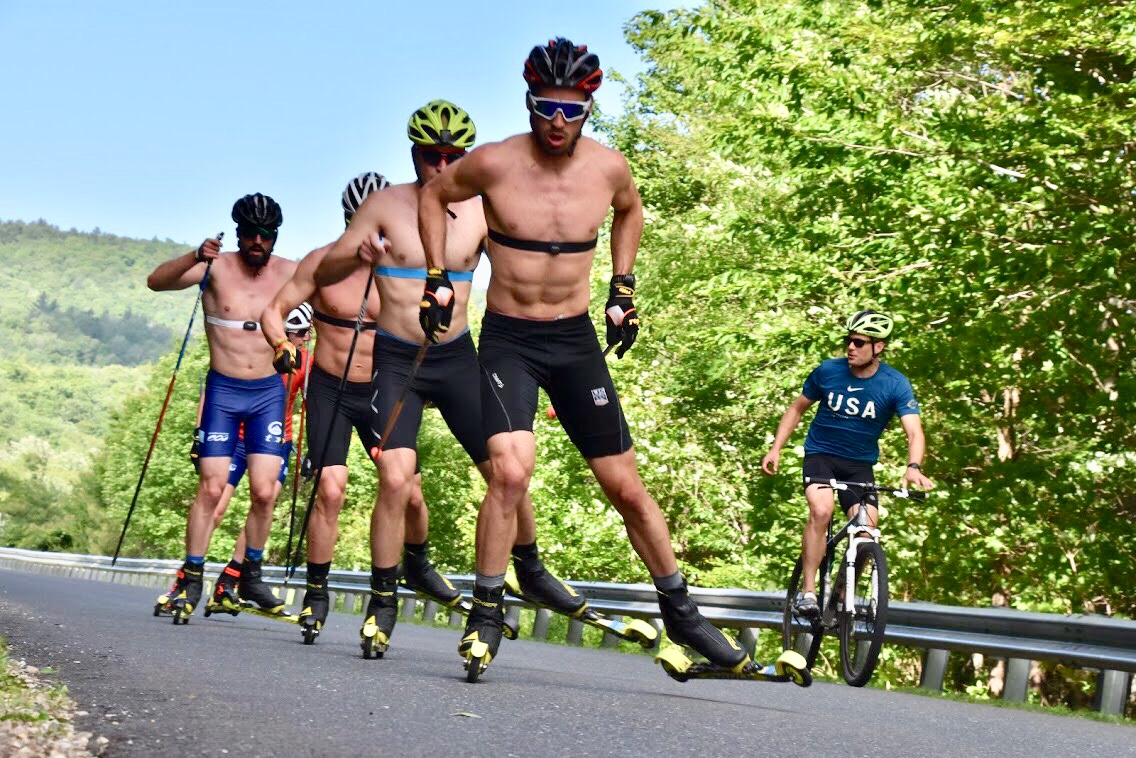
    Ian Torchia (front) leading L3 intervals with the Stratton Mountain School (SMS) team in June. (Photo: Pat O’Brien)

    Two summers ago, with just five miles left of the Marquette Trails Fest 30-mile mountain bike race, all Ian Torchia could hear in his head was the voice of Krystof Kopal, his Northern Michigan University (NMU) teammate, snidely saying, “You drop out again?”

    Fifteen minutes earlier, Torchia had careened into a tree. After dusting himself off, he remounted his bike, but not before noticing his left wrist was badly injured.

    For a moment, Torchia considered pulling out of the race. Thoughts of Kopal, however, kept his feet on the pedals. A few months earlier, Kopal had given Torchia ceaseless verbal flak for dropping out of the 2016 Spring Series 50-kilometer ski race due to cramping. 

    “[Kopal] was playing in my head … so I finished the last five miles with a broken wrist,” Torchia, now 22, recalled on the phone this summer, noting that it wasn’t until after he had finished the race that he found out it was broken.
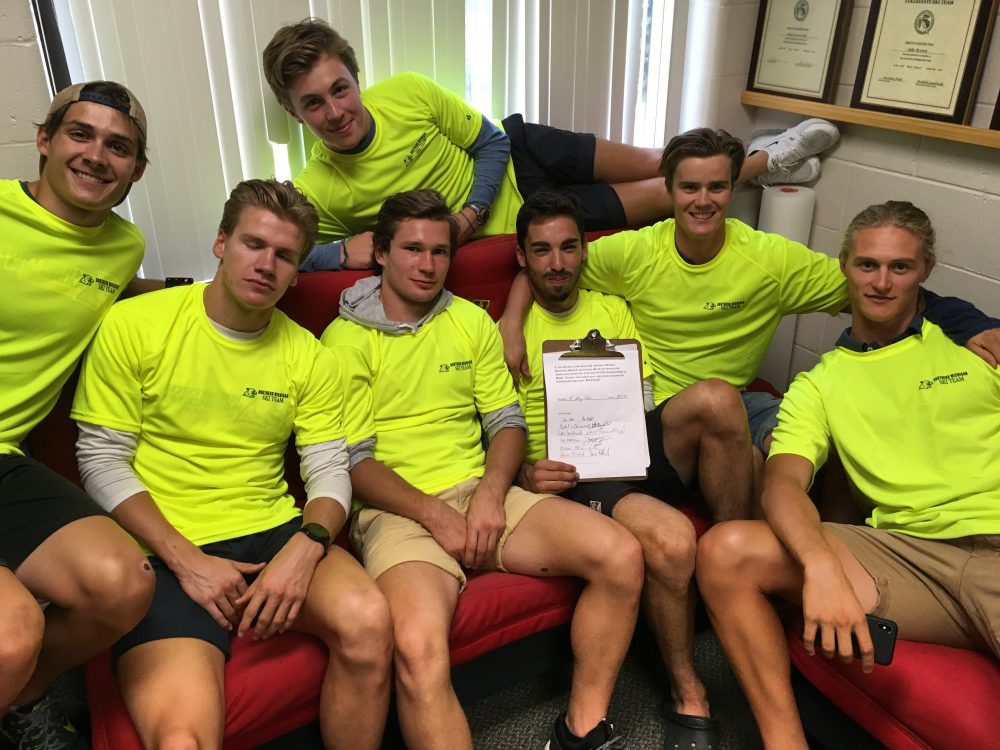
    The NMU men’s ski team with Ian Torchia (third from r) in late August. According to Torchia, the paper he’s holding is a contract. “If we win [the] team NCAA title [this winter], they get to tattoo my gluteus maximus,” Torchia wrote. (Photo: Andy Keller)
    Shortly after, Torchia had his wrist examined by doctor and was told he would need to have surgery. The procedure — scaphoid fixed via percutaneous fixation–left Torchia in a cast. 

    About a month before his crash, Torchia had been nominated to the U.S. Ski Team (USST) D-team and invited to two national-team training camps that summer. Torchia had intended to attend both camps, regardless of whether his wrist was healed or not.

    Fourteen days after his accident, Torchia departed Marquette, Michigan, his “home” since he began attending NMU in 2014, and headed for Eagle Glacier, Alaska, the location of the first USST camp.

    On the glacier, he skied with either one pole or none at all. When he returned to Marquette, the pattern continued for another two months. It wasn’t until the end of August that he had his cast removed. 

    “I kept training super hard with the broken wrist,” Torchia said.

    All that training led Torchia to what he recalled as being “in pretty good shape” leading up to November. Then things started to go south. Fast. Right around Thanksgiving, Torchia was exhausted and experiencing severe night sweats.

    buy inhalers

    “If you type in ‘mono’ on Google and look at the symptoms, I probably had seven out of the eight,” he said. “But I at the time was thinking ‘It’s just a bad virus. It will pass.’ ”

    The symptoms continued. Torchia’s girlfriend suggested he get tested for mononucleosis. He didn’t. 

    “I didn’t want to believe her,” Torchia said. 

    Soon enough he had to. In mid-December, hypothermia forced him to drop out of a race. At 2017 U.S. Cross Country Championships in Midway, Utah, he felt sluggish and “off” during training, so he visited a walk-in clinic in Park City. The doctor tested for mono, and the results came back positive. 

    “The doctor was kind of nonchalant about it,” Torchia said. “He came in and was like, ‘Oh yeah, you’ve got mono, but nordic skiing isn’t a contact sport so you should be good to go and ski at nationals. I was like, ‘Oh, sweet…that’s not how it works.’ ”

    Following the diagnosis, Torchia decided to skip nationals and return to his hometown of Rochester, Minnesota, for the holidays. He stopped exercising for a month before gradually returning to training.

    “A lot of different skiers messaged me saying, ‘On this return, you need to take it really easy,’ ” Torchia said. (One of those skiers included Tad Elliott, who caught the Epstein-Barr virus in 2014 and went on to win a national title in 2016).

    Torchia took their advice, as well as that of his NMU head coach, Sten Fjeldheim, who has helped other athletes diagnosed with mono safely return to training. The two worked out a meticulous day-by-day plan for Torchia’s return. Torchia redshirted the 2017 college season, but by March, he was back on skis.

    “I wasn’t really thinking about what other people thought,” Torchia said when asked if he was worried whether others were questioning his USST nomination during that time.

    “I was thinking more about the next steps,” he continued. “Like the day to day, ‘Oh, my morning heart rates are going down,’ or ‘This next weekend I can start running again.’ … I think before [mono], I was riding really high on skiing, and it was … a big, big part of my life. Getting mono kind of let me take a step back and realize, OK, there are other things [besides skiing].”
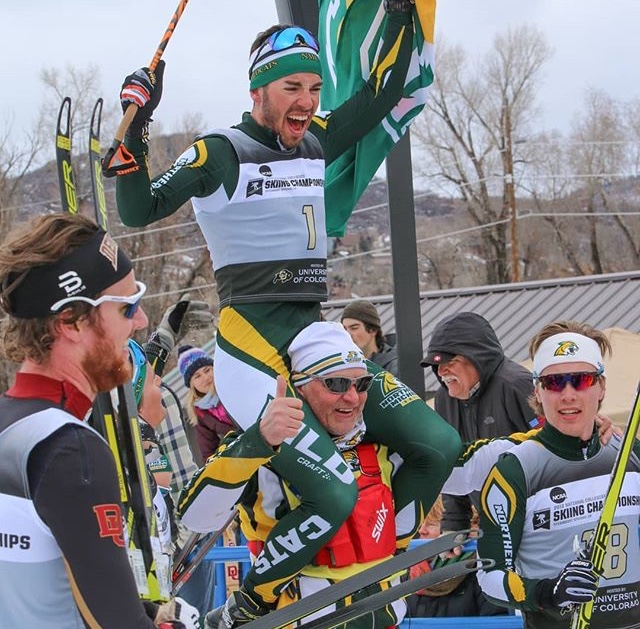
    Ian Torchia (1) on the shoulders of Northern Michigan University Head Coach Sten Fjeldheim after he won the men’s 20-kilometer freestyle race at 2018 NCAA Skiing Championships in Steamboat Springs, Colorado. (Courtesy photo)

    Mono not only gave Torchia a little perspective, but also an extension on his time to compete in college. By redshirting in 2017, Torchia retained eligibility to compete in 2018 (as a junior) and 2019 (as a senior). In his fifth year at NMU, he is currently working toward a master’s degree in exercise science.

    This past March, he won the 20 k freestyle at NCAA Skiing Championships to become NMU’s seventh NCAA champion in program history. In the other race at 2018 NCAA’s, the 10 k classic, he placed fifth for All-American status. Earlier last winter, Torchia qualified for and competed at U23 World Championships in Goms, Switzerland.

    “I try to look at the positives that mono brought,” Torchia said. “That first season of being on the USST brings a lot of pressure and inadvertently getting mono kind of lessened that. Afterward, when I got renominated to the team [last spring], I was like, ‘OK, they’ve given me this second chance, so I need to take it.’ ”

    Torchia was renominated to the D-team for 2017/2018 and again this past spring for the 2018/2019 season. After his third-straight nomination, he approached his summer with revitalized vigor. For the first time since enrolling at NMU, he decided to spend some time training outside of Marquette, largely as a result of a wedding invitation from his USST teammate, Erik Bjornsen. In July, Bjornsen and Marine Dusser were married in Villard-de-Lans, France.
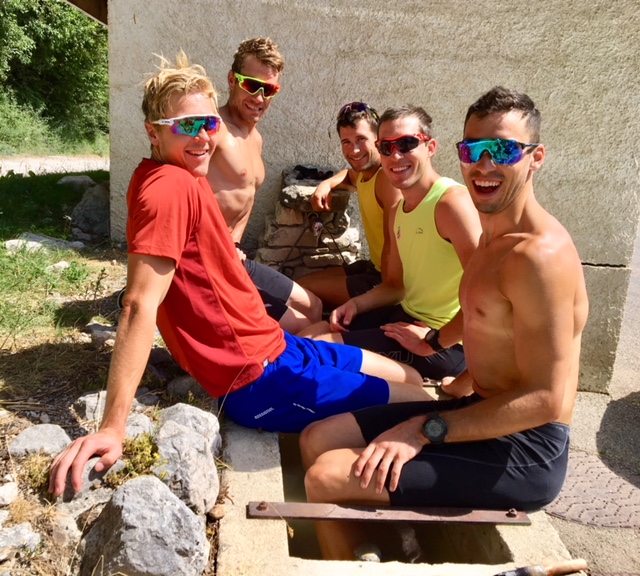
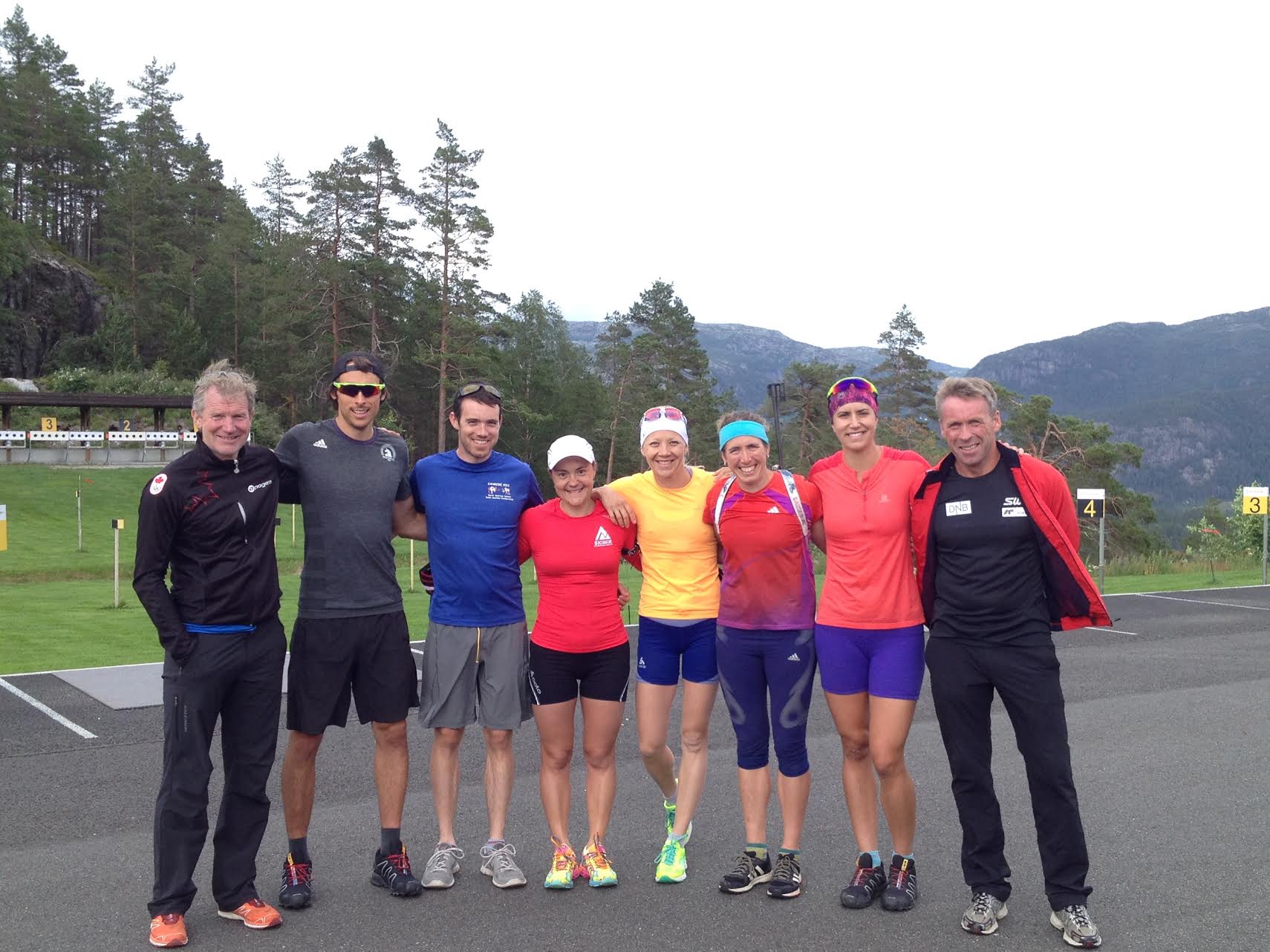
    Right to left: Ian Torchia, Paddy Caldwell, Adrien Backscheider, Simi Hamilton, and Erik Bjornsen during a post-interval cool down in Villard-de-Lans, France. (Courtesy photo)

    “After getting Erik and Marine’s ‘save the date’, I knew there was no way I was missing the wedding,” Torchia explained.

    After the wedding in early July, Torchia remained in France for the USST men’s training camp. The camp lasted 10 days and featured what Torchia described as “hard rollerski intervals and epic mountain runs.”

    He was accompanied by three teammates, Bjornsen, Simi Hamilton and Paddy Caldwell, and their coach Chris Grover. French national-team member Adrien Backscheider joined the group for interval sessions.

    Following the camp, Torchia had made arrangements to stay in Europe for another two and a half weeks, which was partially prompted by his Norwegian teammates at NMU. Over the years, many had encouraged him to travel to Norway and compete in the famed Lysebotn Opp, an uphill rollerski race in Norway’s Blink ski festival.

    Before heading to Sandnes, Norway, for Blink, Torchia made two stops. First, Oslo, where he stayed with his former NMU teammates Fredrik Schwencke, a native of the city, and Kristen Bourne, an American citizen currently training with the Lyn Ski Club in Olso.

    “Pretty lucky to have so many great friends and teammates that put me up throughout the trip,” Torchia wrote in an email.

    Torchia spent a week in Oslo before traveling to Kragerø, where he visited his current NMU teammate Mathias Aas-Rolid. A native of Redalen, Norway, Rolid has a cabin in Kragerø that he opened up to Torchia for “a pre-Blink training camp”.
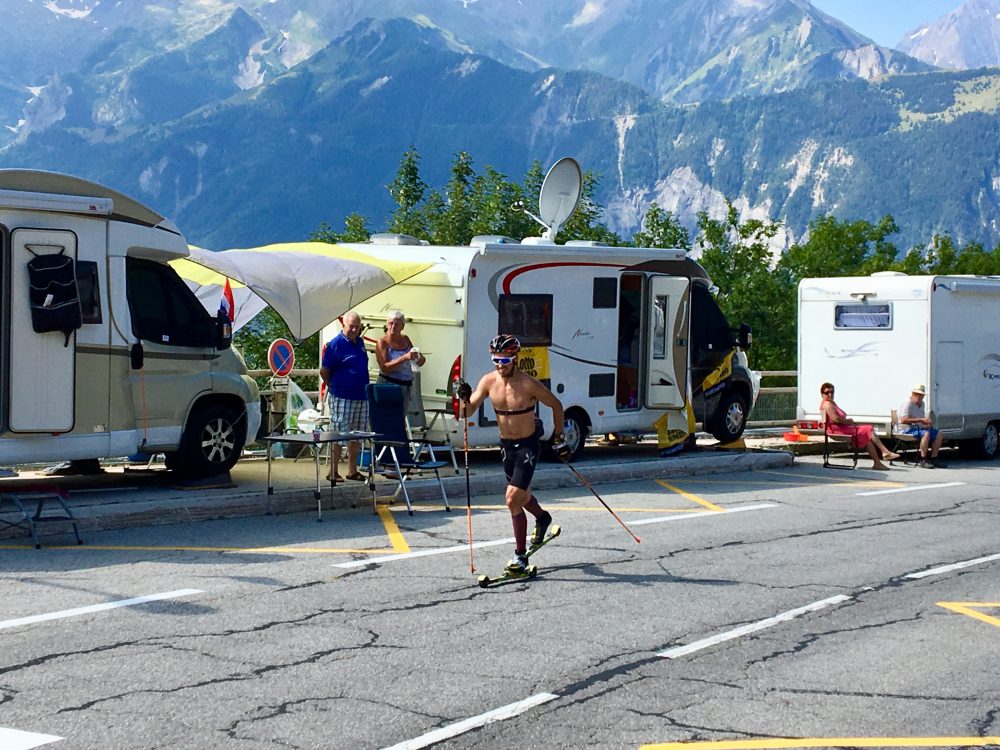
    Ian Torchia rollerskiing up Alpe d’Huez, two days before the Tour de France on July 17, 2018. (Photo: Chris Grover)

    Following Kragerø, Torchia headed to Sandnes for the Blink races. Canadians Evan Palmer-Charrette, Scott Hill and Bob Thomson had rented an Airbnb in Sandnes for the weekend, and keeping with his summer nomadic style, Torchia crashed on their couch during the festival.

    tetracycline buy online, betnovate

    tetracycline buy online, betnovate

    He competed in the 60 k distance race as well as the Lysebotn Opp. The 60 k was what Torchia referred to as “an add-on to the main focus of Lysebotn.

    “For the 60, I made a big blunder by not bringing a water pack and counting on getting feeds along the race course,” he recalled. “Turns out trying to get a feed from a stationary volunteer at 20+ mph is not very effective.” 

    Without feeds, Torchia explained that he “bonked” halfway through the 60 k and ended up finishing 55th. The result left him ready to “turn it around” for the 7.5 k Lysebotn Opp the next day. He managered to position himself well early on in the race’s mass start and within the first kilometer, found himself with the likes of Russia’s Sergey Ustiugov and Finland’s Iivo Niskanen.

    “After the 1 k tunnel, I passed Ustuigov and Niskanen and probably got a little too excited and blew my load about 2 k from the finish,” Torchia wrote of his Lysebotn start. “ ‘Twas a long 2 k in from there and almost managed to catch Harvey but just missed the auto qualifying for the mass start (top-10) by about 15 seconds. I’ve never done a rollerski race, period, so competing in Norway in the strongest field they’ve ever had was a hell of a way to start.”

    Torchia placed 13th, just over 2 minutes behind the winner (and 2018 Olympic skiathlon gold medalist) Simen Hegstad Krüger of Norway and 15 seconds behind Canada’s Alex Harvey, who placed 10th.

    Torchia’s summer adventure ended after Blink, and he flew back to the U.S. on Aug. 6.

    “Getting to do intervals with Adrien Backscheider, [South Korean/Norwegian skier] Magnus Kim, and then race with a World Cup field at Blink served me a big piece of humble pie but was a good indicator that the summer progress[ed] well,” Torchia wrote.

    Torchia is now back in Marquette, focused on school and skiing. Beyond college races, Torchia is targeting 2019 U.S. nationals in Craftsbury, Vermont, 2019 World Championships in Seefeld, Austria, and 2019 World Cup Finals in Québec City.

    “It’s been some ups and downs and definitely a learning experience,” Torchia said of the years since he was first nominated to the USST. “But it’s made me stronger in the process.”
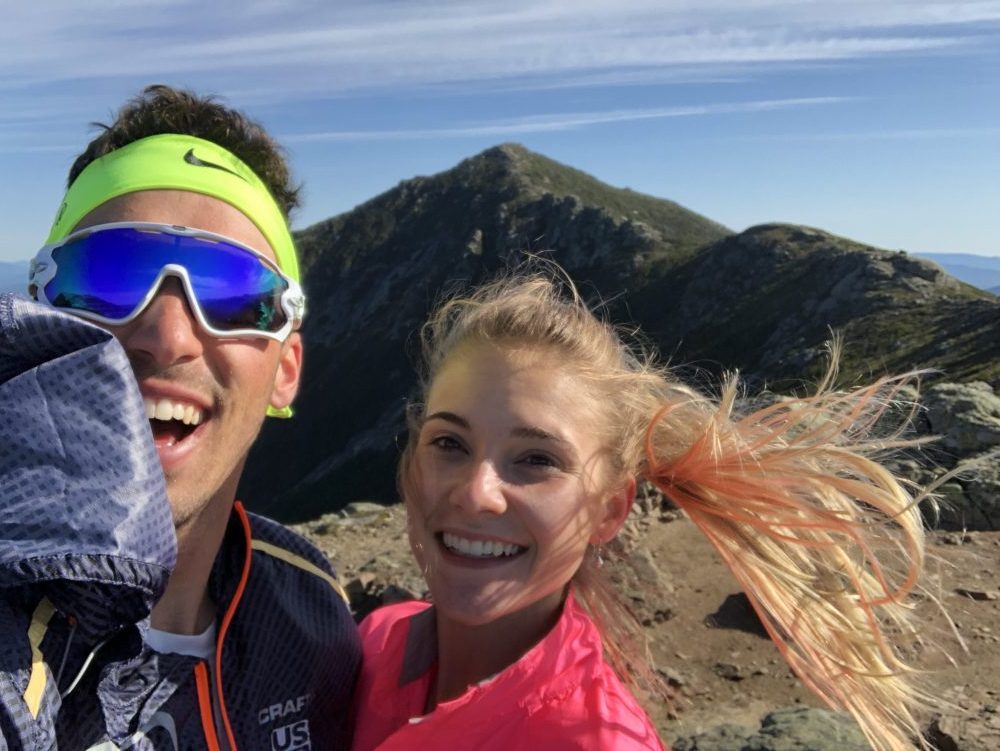
    Ian Torchia (l) with girlfriend, Kameron Burmeister, hiking in Franconia Notch, N.H., during an East Coast road trip they took in June. (Courtesy photo)
  • How Blinkfestivalen Began and Where It’s Headed

    How Blinkfestivalen Began and Where It’s Headed

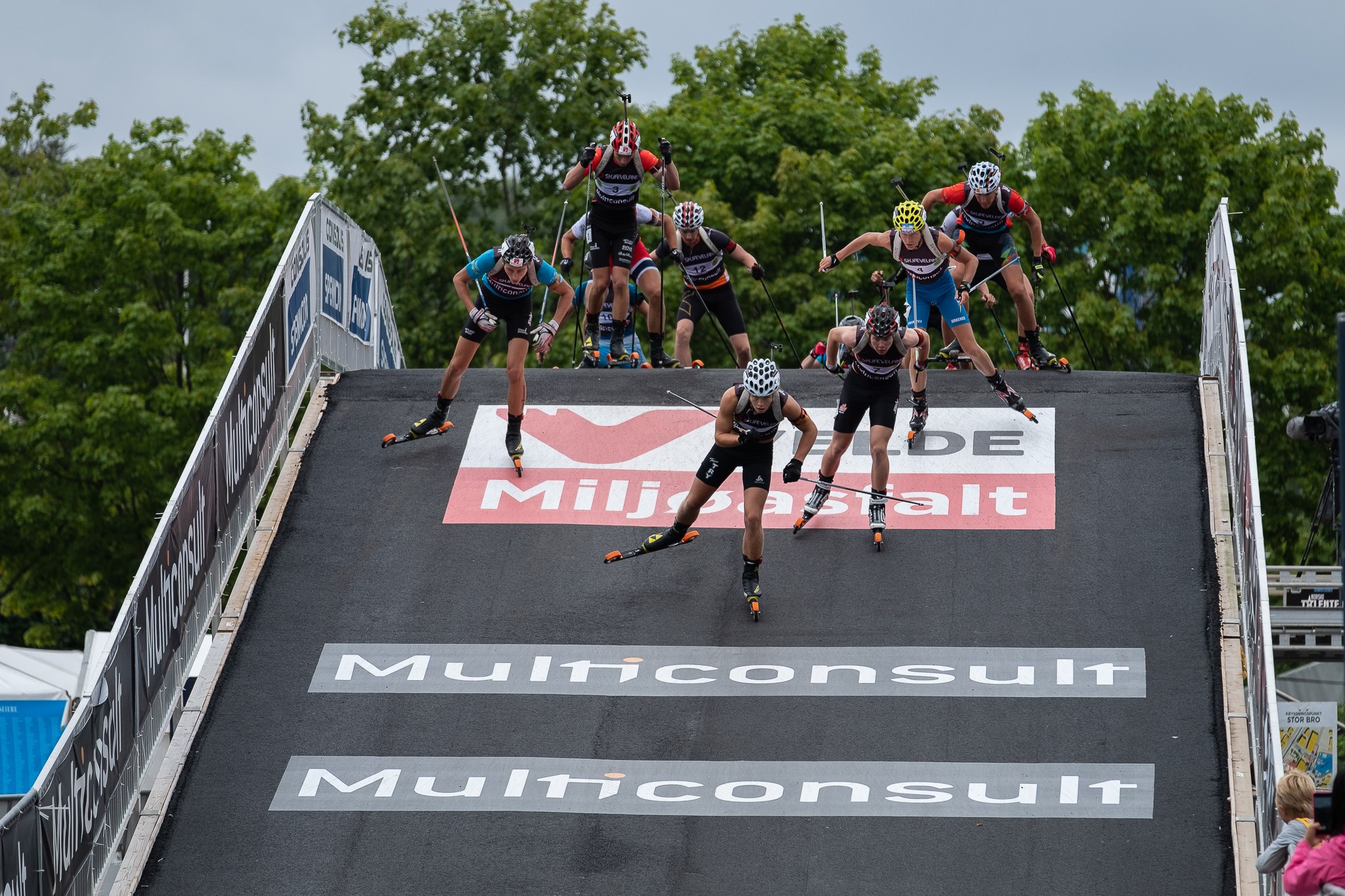
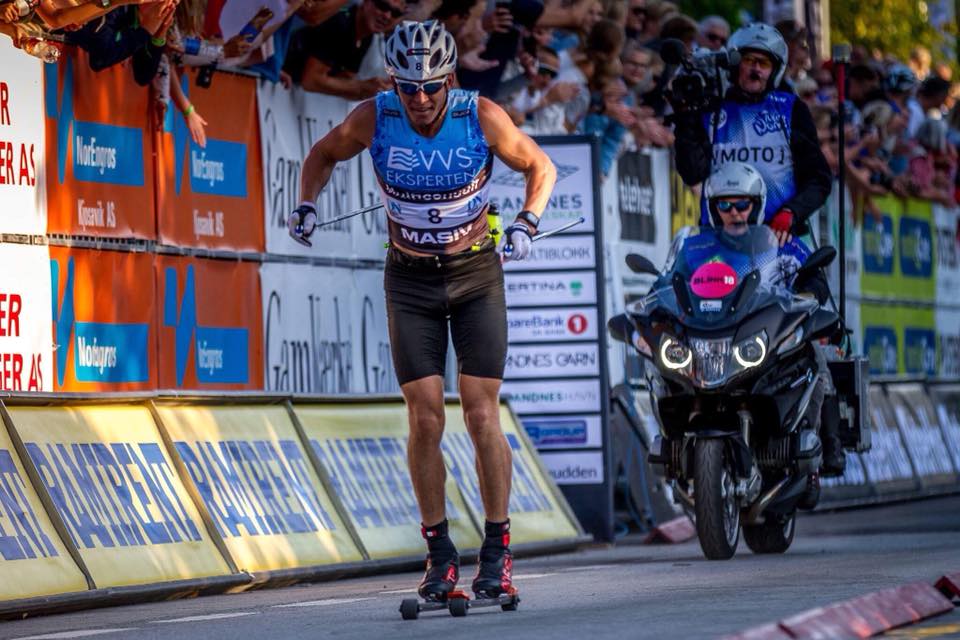
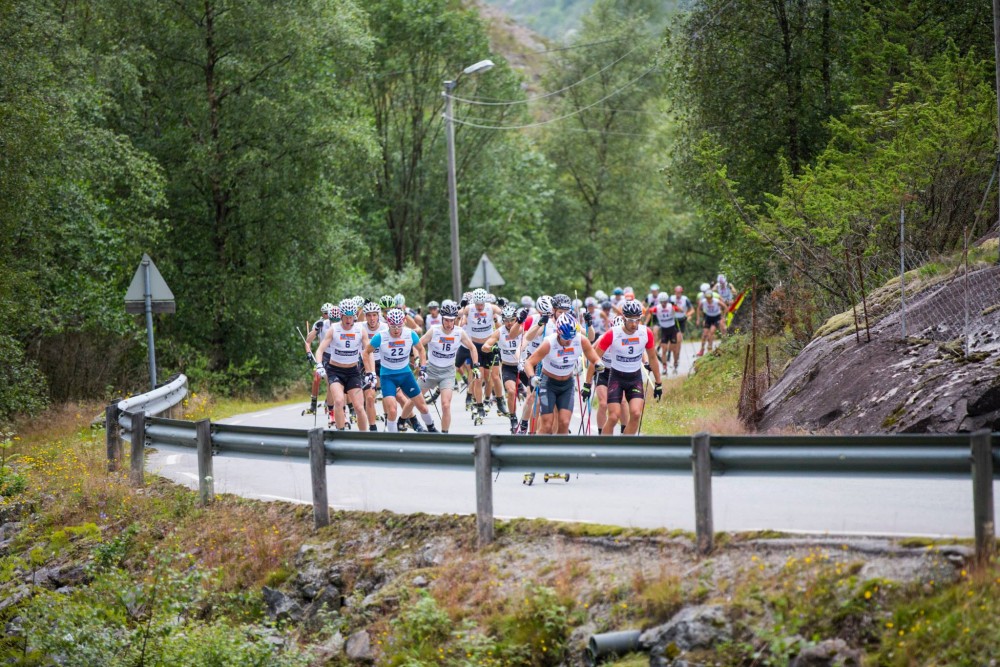
    Racers crest a hill at the 2018 Blink rollerski festival in early August in Sandnes, Norway. (Photo: Axelar / Arild Aarnes / Skifestivalen Blink Facebook)

    In 2005, Norway’s government-owned broadcasting network, NRK, lost production rights for its national football league. In search of a new program to air in place of summer soccer games, NRK, which still held broadcast rights for biathlon and cross-country skiing, approached the Norwegian Ski Federation and the Norwegian Biathlon Federation with a question: Could they find an organizer willing to create a large summer event encapsulating the winter sports of biathlon and nordic skiing?

    NRK’s answer came in Arne Idland.

    Idland was serving as the team manager for the Norwegian Biathlon Federation at the time and had planned to finish his term that same year. The 2006 Winter Olympics had just wrapped up, and Idland was ready for a change.

    Before stepping out of his role with Norwegian Biathlon, Idland become the chief of sport for Norway’s Blink Ski Festival, known as Blinkfestivalen.

    “I spent my last months in the biathlon federation just thinking about Blink,” Idland said in a phone interview.

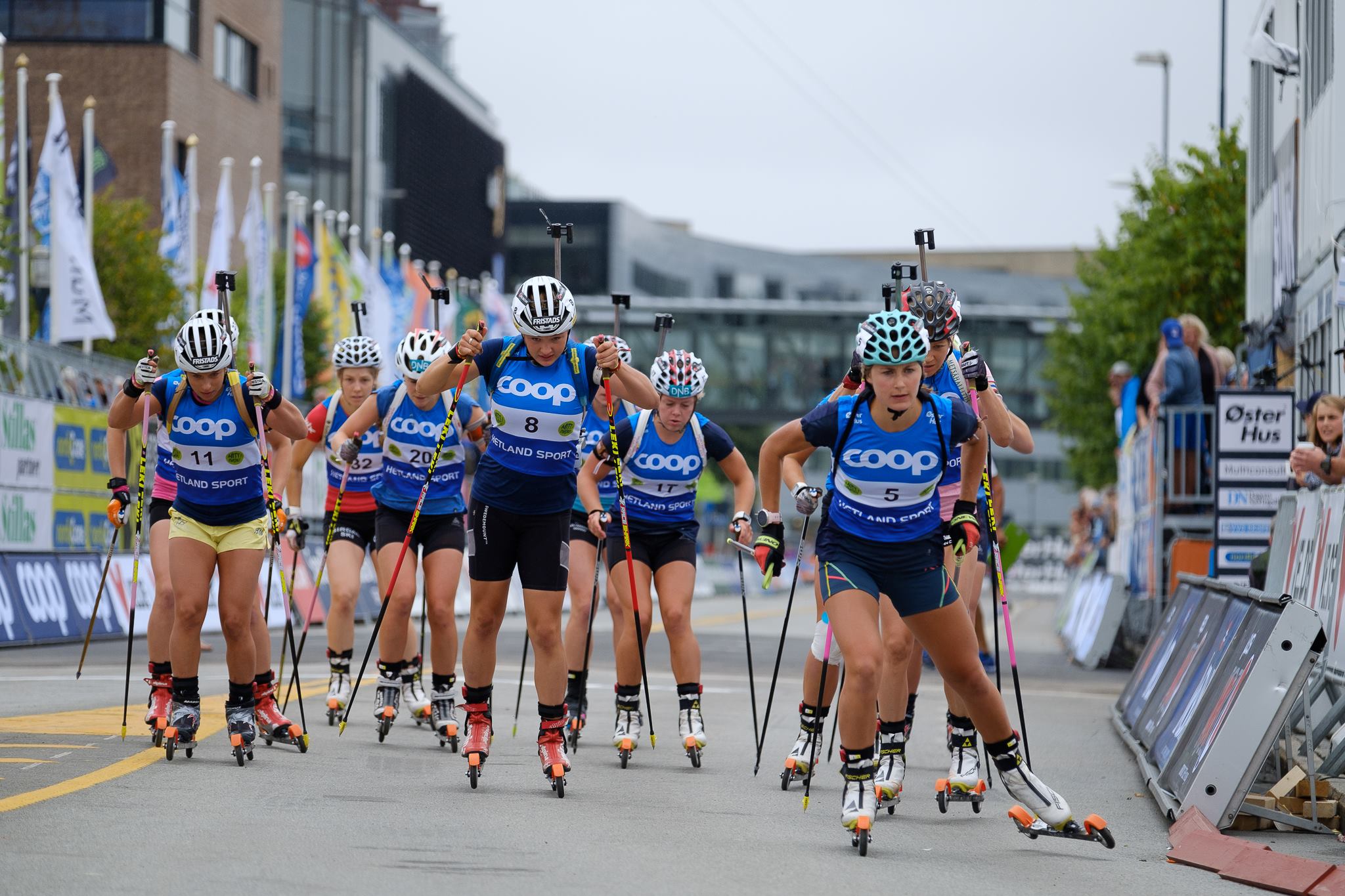
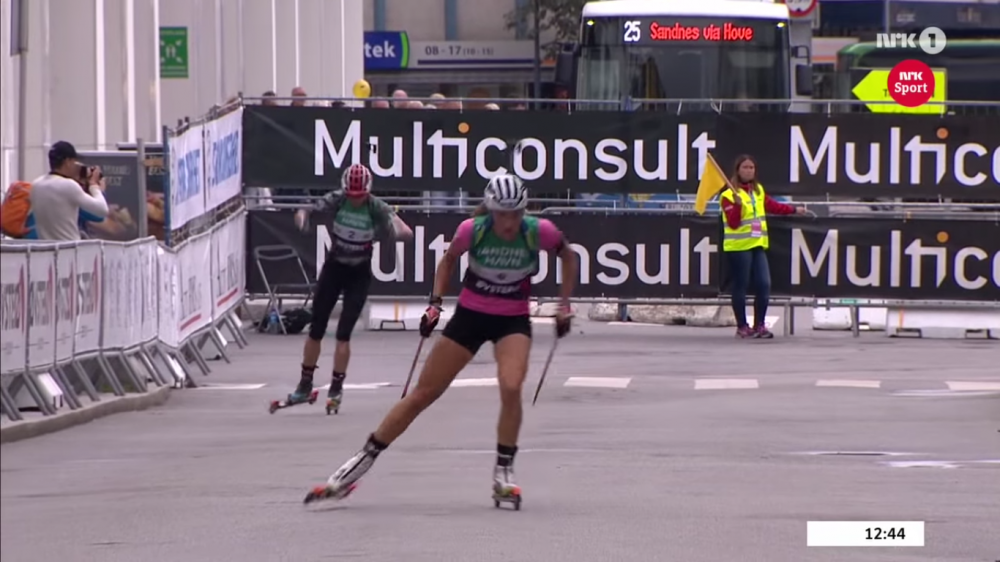
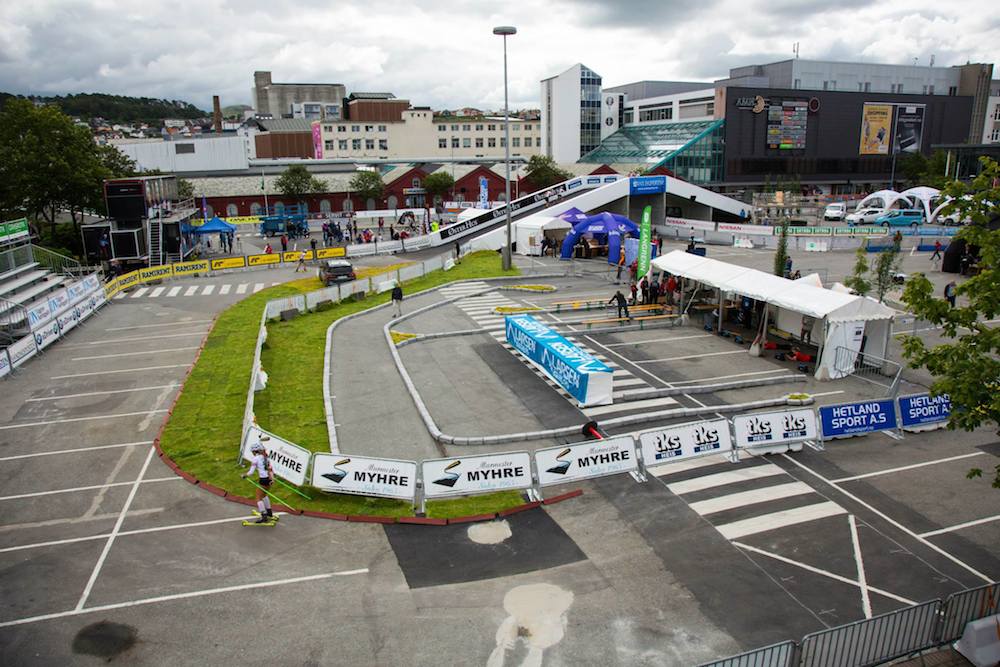
    Biathletes racing in downtown Sandnes, Norway, during the 2018 Blink Ski Festival in early August. (Photo: Axelar / Arild Aarnes / Skifestivalen Blink Facebook)

    Originally from the city of Sandnes himself, Idland said he chose the municipality as a host city for Blink because, at the time, Sandnes “had no big events.”

    Since its inception in 2006, Blink has grown, becoming a premier international rollerski event. Organizers spent a grand total of 23 million Norwegian Kroner (about $2.75 million U.S. dollars) on this year’s Blink rollerski festival. That’s up from approximately 6,000,000 Norwegian Kroner (nearly $720,000 U.S. dollars) in its inaugural year.

    Even with the high price tag, Idland indicated that everything at Blink — entry, exit, and post-event concerts — are free. An estimated 70,000 thousand spectators attended Blink, and not one paid to get in.

    “That has been maybe one of the major key factors to our growth and our success,” Idland said. “Everything is free. We even have free concerts. No tickets to come in and that is the same today as it was at the start. Everybody can come and go just as they want.”

    But how has the city been able to sustain a “free” and accessible race to the public? Sponsors, Idland explained. Through their financial backing, Idland and three others staff members are paid to work full time, year round on Blink.

    When festival time rolls around, local cross-country and biathlon clubs near Sandnes pitch in to organize the multi-day event. And their time is paid. About 600 club members worked at this year’s Blink, and in total, were paid 750,000 Norwegian Kroner (about $90,000 USD).

    “That’s the most important income on an annual basis for the clubs,” Idland said. “It’s also a window to show all the people the sport and to get young kids and youth to start with biathlon and cross-country.”

    Much of Blink revolves around the concept of sport promotion, as opposed to pulling in dollars.

    “One major thing with Blink is that Blink is open for everybody,” he said.

    The festival not only includes an elite race series, but also junior and youth categories in both the biahtlon and cross-country divisions. Idland estimated that 3,000 children participated in Blink camp activities this year and 1,200 juniors entered Blink competitions. Last week, athletes from Russia, Italy, France, Sweden, Great Britain, Finland, Canada, and the U.S. made the trek to Sandnes to participate.

    “We have everything from — maybe you are four years old trying rollerskis for the first time — up to the athletes like [Martin Johnsrud] Sundby and [Therese] Johaug and the other big names,” Idland said. “It’s not only a show for the big stars. It has been important both for the development of the Norwegian Ski Federation and also for the youth and juniors.”

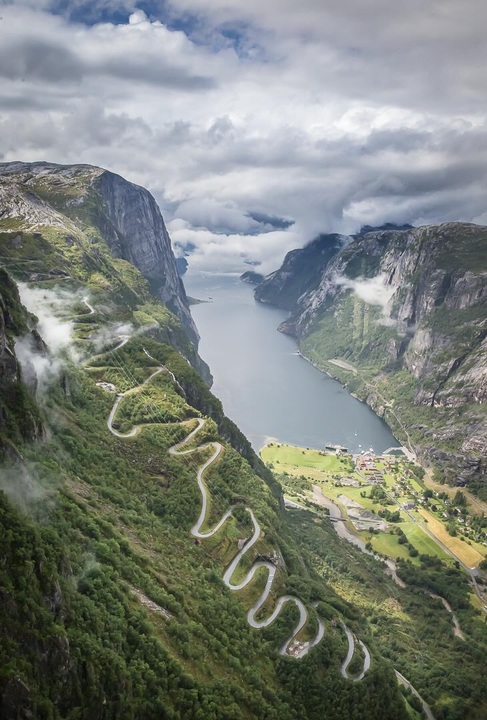
    The 7.5-kilometer race course for the Lysebotn Opp, an annual hill climb at the Blink Ski Festival in Lysebotn, Norway. (Photo: Blink Ski Festival/ Facebook)

    As Blink looks to develop Norwegian skiers, it also continues to develop its race series program. In 2010, organizers added the Lysebotn Opp uphill race, which begins in the fjord town of Lysebotn before climbing 640 meters above sea level.

    Three years ago, they introduced the Blink Classics distance races, which were 50- or 60-kilometers long for elite women and men, starting in the city center of Ålgård and finishing in Sandnes.

    Organizers have also been keen on safety for the high-paced rollerski events on asphalt. Few of its courses feature any steep downhills, all of its courses are fenced off to spectators, and every competitor must use the same speed of rollerskis. This year, Blink provided 1,000 unused rollerskis for racers. Next year they will do the same, with even slower wheel speeds, set to the same speed.

    “So next year we will use IBT 4, which are the slowest skis we have,” Idland said. “That is mainly for the safety, but also we also want the strongest athletes to win. The slower rollerskis you have, the more similar it is to winter time.”

    Winter is not something Blink hopes to compete with, Idland said. Climate change, however, may moot that point.

    “We do not want to become a threat to the traditional skiing on snow,” Idland said. “But … the winters get a little bit shorter and maybe also have to go a little further up in the mountains to find the snow, so I think rollerskiing will become more and more important as a supplement for skiing. Not instead of skiing, but maybe you do more rollerskiing.

    “We do not want to be a threat to the FIS World Cup either,” Idland continued. “We can play along with both FIS and the IBU. If at one time in the future there should be an interest that they would do something together with Blink, we would of course sit down and have a discussion with the FIS and the IBU.”

    Hopefully, that future interest is one made by choice.

    ***

    Related: Blink Ends with Jam-Packed Friday/Saturday | 2018 Lysebotn Opp | 2018 Blink Classics

  • Blink Ends with Jam-Packed Friday/Saturday

    Blink Ends with Jam-Packed Friday/Saturday

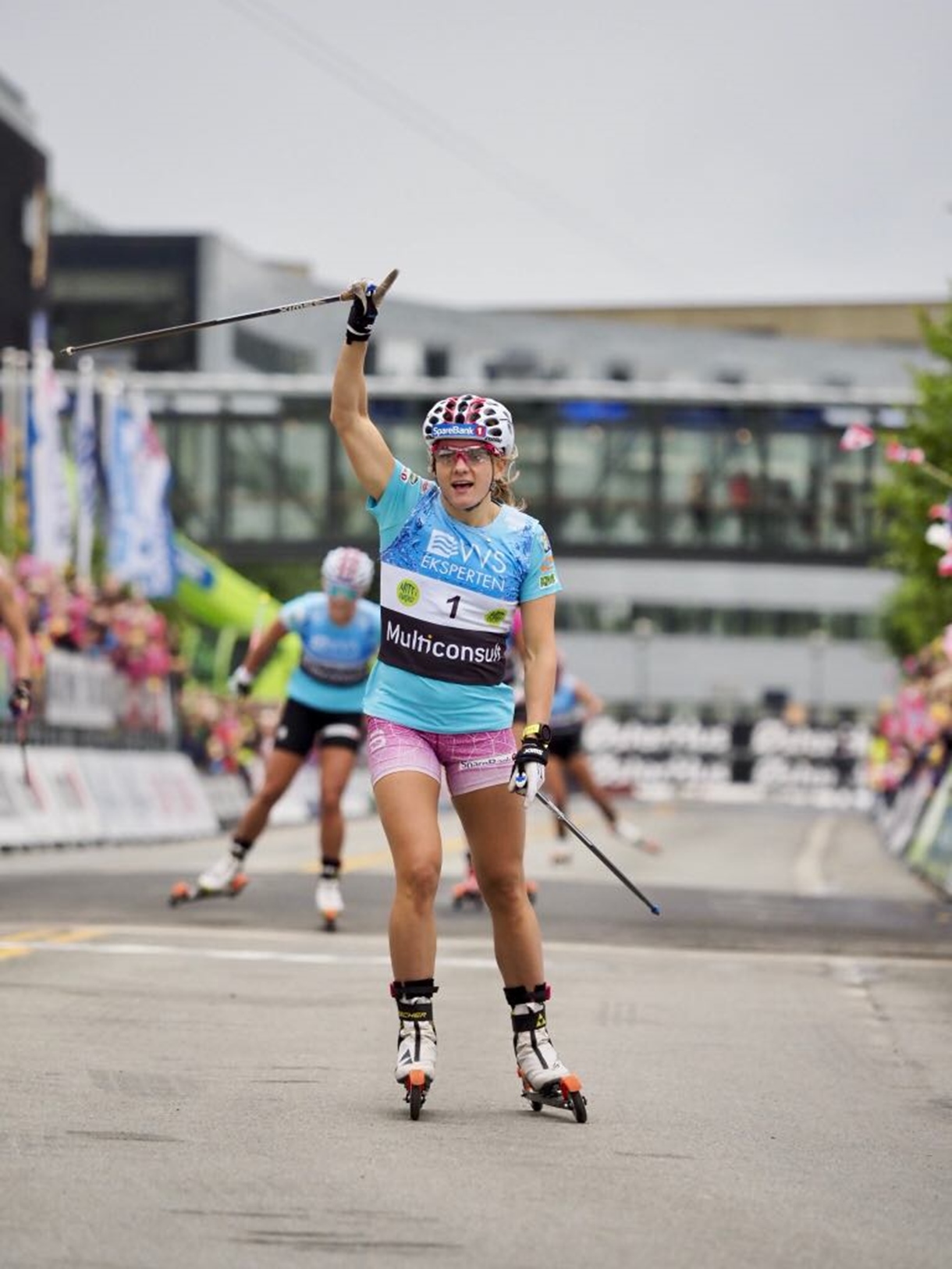
    Norway’s Maiken Caspersen Falla (1) winning Saturday’s women’s cross-country sprint final on the last day of the 2018 Blink Ski Festival in Sandnes, Norway. (Photo: Blink Ski Festival/Axelar/Arild Aarnes)

    The 2018 Blink Ski Festival continued in full force on Friday and Saturday, with cross-country and biathlon prologues, 10- and 15-kilometer cross-country races and biathlon mass starts all taking place on Friday, followed by sprints on Saturday. 

    Elite racing began in the afternoon with the men’s prologue (no prologue was held for the women), Norway’s Gjøran Holstad Tefre posted the fastest time of 3:12.21. Finishing 1.89 seconds back was another Norwegian, Aleksander Dyrberg Ek, and Great Britain’s Andrew Young claimed the prologue’s final podium spot, finishing 2.27 seconds off the winning time.

    Also in the top 10 were Norway’s Morten Eide Pedersen in fourth (+4.7), Britain’s James Clugnet in fifth (+4.76), France’s Lucas Chanavat in sixth (+5.09), Norway’s Stian Grastveit in seventh (+5.70), France’s Renaud Jay in eighth (+5.75), and Norway’s Sindre Folkvord and Harald Østberg Amundsen in ninth (+6.00) and 10th (+6.03), respectively.

    Canada’s Evan Palmer-Charrette finished 34th (+16.68), Scott Hill placed 39th (+19.37) and Bob Thompson was 40th (+19.54) out of 47 finishers.

    Results: Men’s cross-country prologue

    After the elite men’s prologue, athletes geared up for a men’s and women’s biathlon prologues.

    Norway’s Johannes Thingnes Bø took the men’s biathlon prologue win in a time of 10:30.2 after two misses (1+1). One second back, it was a tie for second place between another Norwegian, Lars Aasheim Svaland, who had one penalty (0+1), and France’s Antonin Guigonnat, with one miss as well (1+0).

    Men’s biathlon prologue

    Slovenia’s Anastasiya Kuzmina, who took one gold and two silver medals at the 2018 Olympics, won Friday’s women’s prologue with clean shooting and a time of 11:34.6. Just 0.6 seconds behind was Norway’s Emilie Ågheim Kalkenberg, who placed second with perfect 10-for-10 shooting as well. France’s Justine Braisaz claimed third, 10.7 seconds out of first, after missing two targets (0+2).

    Women’s biathlon prologue

    The next event on Friday’s program was the women’s 10 k cross-country mass start, which Norwegian sprint specialist Maiken Caspersen Falla won in 20:39.4. She bested fellow Norwegian Mari Eide by 1.9 seconds, and Sweden’s Charlotte Kalla and Norway’s Kari Øyre Slind followed in third (+3.9) and fourth (+3.9), respectively, with the same time.

    Working their way into the top 10 were Russia’s Elena Soboleva in fifth (+4.9), Finland’s Krista Pärmäkoski in sixth (+5.0), Norway’s Ingvild Flugstad Østberg and Ragnhild Haga in seventh (+5.1) and eighth (+5.2), respectively, Austria’s Teresa Stadlober in ninth (+6.6), and Russia’s Natalia Matveeva in 10th (+8.7). Out of 31 women, Nichole Bathe, racing for Great Britain, finished in 23rd (+1:09).

    Women’s cross-country 10 k freestyle mass start

    Sweden’s Hanna Öberg (front) racing to first in the women’s biathlon mass start on Friday the 2018 Blink Ski Festival in Sandnes, Norway. (Screenshot: NRK broadcast)

    Friday’s program then moved on to the women’s biathlon mass start. Sweden’s Hanna Öberg won the event in a time of 13:19.4 despite three misses (0+1+2+0). Kuzmina finished second, crossing 2.1 seconds behind the Swede after a penalty in each stage (1+1+1+1). Third place went to another Swede, Mona Brorsson, who crossed 5.9 seconds after Öberg and shot four penalties (2+1+1+0).

    Women’s biathlon mass start

    Norway’s Henrik L’abeé-Lund (r) winning the men’s biathlon mass start on Friday at the 2018 Blink rollerski festival, ahead of his teammate Johannes Thingnes Bø in second in Sandnes, Norway. (Screenshot: NRK broadcast)

    Following the women’s biathlon race, the men’s biathlon mass start got underway. Norway’s Henrik L’abeé-Lund emerged as the winner, crossing the line in 17:21.3 after shooting four penalties (1+1+2+0). Exactly three seconds behind him was J.T. Bø in second place with two misses (1+0+1+0). Sealing the all-Norwegian podium was Vetle Sjåstad Christiansen, who missed six targets (1+1+2+2) and finished 12.1 seconds after L’abeé-Lund for third.

    Men’s biathlon mass start

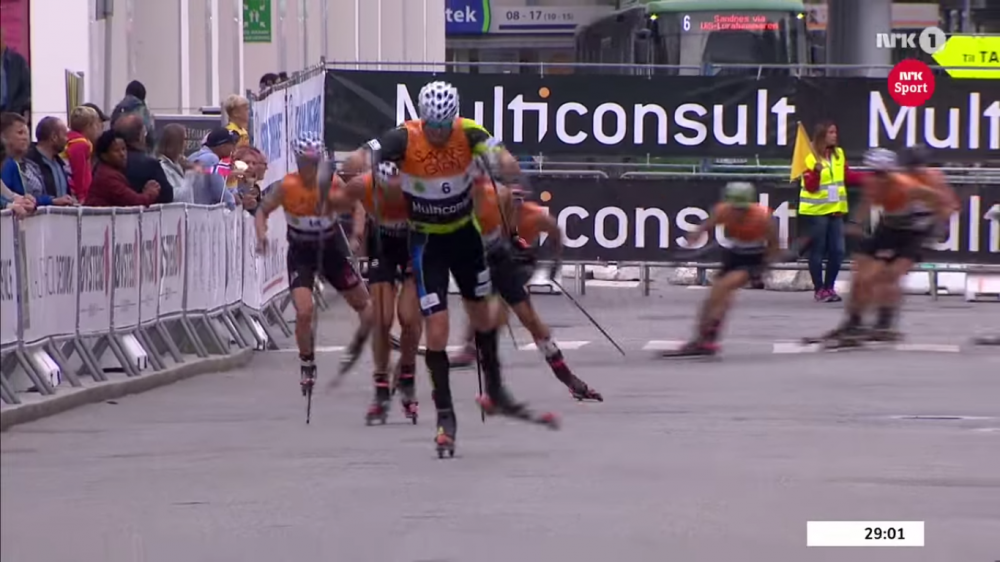
    Russia’s Sergey Ustiugov leading the pack of the elite men’s 15-kilometer freestyle cross-country mass start on Friday at the 2018 Blink Ski Festival in Sandnes, Norway. (Screenshot: NRK broadcast)

    Friday’s final race turned back to cross-country for the elite men’s 15 k freestyle mass start. Russian skier, Sergey Ustiugov, who was banned from competing at the 2018 Winter Olympics, won it in 29:26.0, 2.1 seconds ahead of Norway’s Aleksander Ek, (who had placed second in the prologue to start the day). Italy’s Federico Pellegrino was just another 0.6 seconds back in third (+2.7).

    “I was a little nervous today because I won it last year and I wanted to repeat my success here again today,” Ustiugov told NRK through a translator. “It didn’t go easy, but I did manage to do what I wanted to do, and I would like to thank all my team, Markus [Cramer], and the rest of the team. That was great.”

    The remaining top ten included Norway’s Vebjørn Turtveit in fourth (+2.9), Sindre Bjørnestad Skar in fifth (+3.9), Øystein Pettersen in sixth (+5.4), and Torstein Bu in seventh (+5.8). France’s Adrien Backscheider and Clement Parisse placed eighth (+5.9) and ninth (+6.2) respectively, followed by Norway’s Eirik Brandsdal in tenth (+6.2).

    Racing for Canada, Alex Harvey finished 14th (+7.5).

    Men’s Cross-country 15 k freestyle mass start

    Complete results: Friday

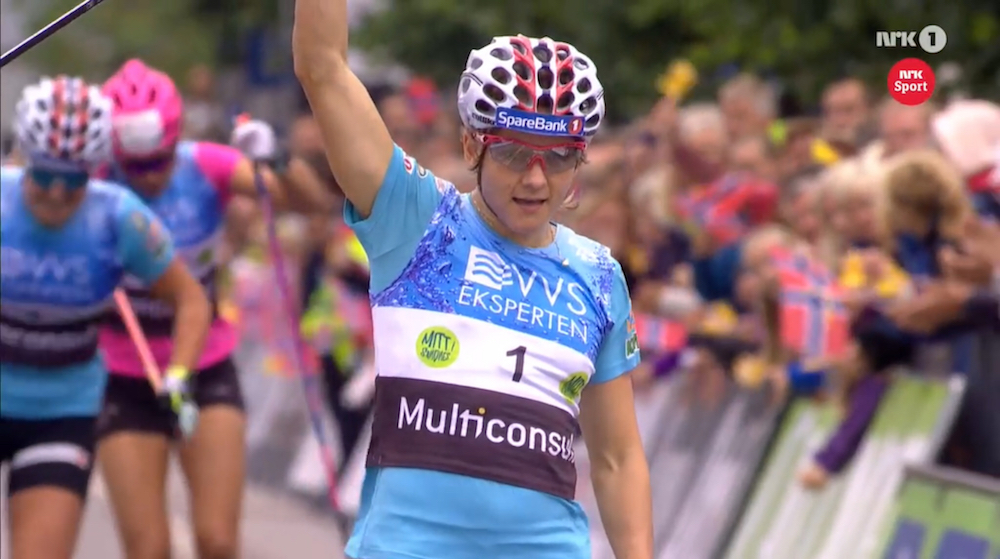
    Norway’s Maiken Caspersen Falla winning the women’s cross-country sprint on Saturday at the Blink Ski Festival in Sandnes, Norway. It was her second-straight victory after topping Friday’s 10 k freestyle mass start as well. (Screenshot: NRK broadcast)

    Saturday marked the final day of the Blink rollerski festival and included cross-country and biathlon sprints. In the women’s cross-country final, Norway’s Falla picked up her second-straight win, ahead of Russia’s Matveeva in second (+1.6) and Sweden’s Ida Ingemarsdotter in third (+2.4). Norway’s Eide was just off the podium in fourth (+2.9), Norway’s Barbro Kvåle Trømborg placed fifth (+3.7), and another Norwegian, Linn Ravndal, finished 8 seconds back in sixth.

    Falla’s won the final in 3:40.8 after topping her quarterfinal and semifinal as well.

    Women’s cross-country sprint

    The men’s cross-country racing began with a prologue, which Norway’s Vetle Christiansen won in 1:31.92, just three-hundredths of a second ahead of his fellow countryman, Ek. France’s Baptiste Noel placed third in the prologue, 1.76 seconds out of first.

    Men’s cross-country prologue

    Russia’s Gleb Retivykh (second from r) winning the men’s cross-country sprint final on Saturday at the Blink Ski Festival in Sandnes, Norway. (Screenshot: NRK broadcast)

    In the heats later in the day, Russia’s Gleb Retivykh came out on top of the final, getting there by placing second in both his quarterfinal and semifinal, then winning the last round by 0.2 seconds over Pellegrino in a time of 3:15.5. Pellegrino had won his quarterfinal but advanced as a lucky loser in fourth out of the second semifinal. The 25-year-old Ek capped off his successful series with another podium, placing third in the final, just 0.3 seconds out of first.

    In a post-race interview with NRK, Retivykh explained this was his first time at Blink.

    “I am very happy,” he said in English. “Today is my first win at Blink, and [it was my] first time here.”

    In a close final, Norway’s Gjøran Tefre and Brandsdal followed in fourth (+0.5) and fifth (+0.7), respectively, Italy’s Francesco De Fabiani was just behind in sixth (+0.8).

    Men’s cross-country sprint

    France’s Justine Braisaz celebrating across the line as she wins the women’s biathlon super sprint on the last day of 2018 Blink Ski Festival on Saturday in Sandnes, Norway. (Screenshot: NRK broadcast)

    Biathletes were able to experience head-to-head sprint racing as well (a deviation from the typical biathlon World Cup sprint format, which is individual), in the women’s and men’s biathlon supersprints, which included one prone and one standing shooting stage per heat.

    France’s Braisaz won the women’s final in 7:45.3. She had previously won her quarterfinal (which was a longer distance), then placed seventh in the first semifinal (same distance as final). Norway’s Marte Olsbu placed second in the final (+0.4), and Sweden’s Brorsson returned to the podium in third (+0.9).

    “It was really close at the end, but I am very happy about the weekend here,” Braisaz told NRK on English after. “Everything is perfect, even though the weather is a little bit — how do you say — moody. But it’s OK. And I am really happy to be in Norway and I will make my stay longer after the festival weekend.”

    Women’s biathlon super sprint

    Norway’s Vetle Sjåstad Christiansen winning the men’s biathlon supersprint on Saturday, the last day of the Blink Ski Festival, in Sandnes, Norway. (Screenshot: NRK broadcast)

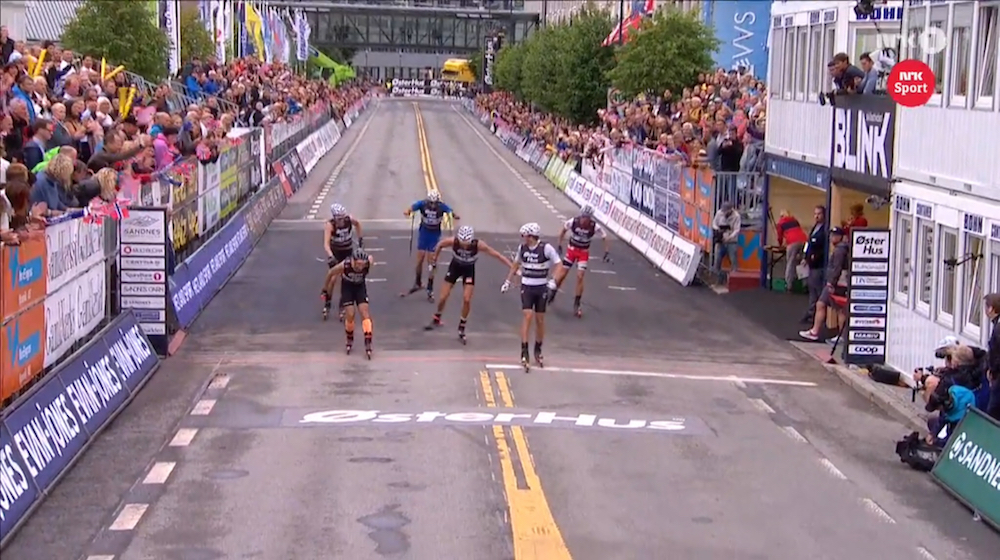
    In the men’s biathlon super sprint, Norway’s Christiansen dominated the day, winning his quarterfinal and semifinal before beating J.T.  by 2.2 seconds in the men’s final with a time of 12:01.8. France’s Guigonnat completed the podium in third, 8.5 seconds behind Christiansen.

    Men’s biathlon super sprint

    Complete results: Saturday

    ***

    Related: Blink Day 1 | Blink Day 2

  • Bolshunov, Gjeitnes Win Blink Classics Distance Races on Opening Day

    Bolshunov, Gjeitnes Win Blink Classics Distance Races on Opening Day

    Russia’s Alexander Bolshunov racing to first in the Blink Classics men’s 60 k on Wednesday in Sandes, Norway. (Photo: Blink Ski Festival/Facebook)

    A predictor for the winter ski season ahead? Could be. Either way, Norway’s Blink Ski Festival, or as it’s called in Norway, Blinkfestivalen, remains the ultimate in rollerski racing and returned for the 12th year in a row on Wednesday.

    The festival opened with elite men’s and women’s distance rollerski races, known as the Blink Classics.  For the third-straight summer, the Blink Classics featured a 60-kilometer mass start for the men and a 50 k for the women.

    Eighty-six men competed in Wednesday’s 60 k, which began in the city center of Ålgård and finished in the municipality of Sandnes. A complete course map, which deviated little from last year’s rendition, may be found by clicking here.

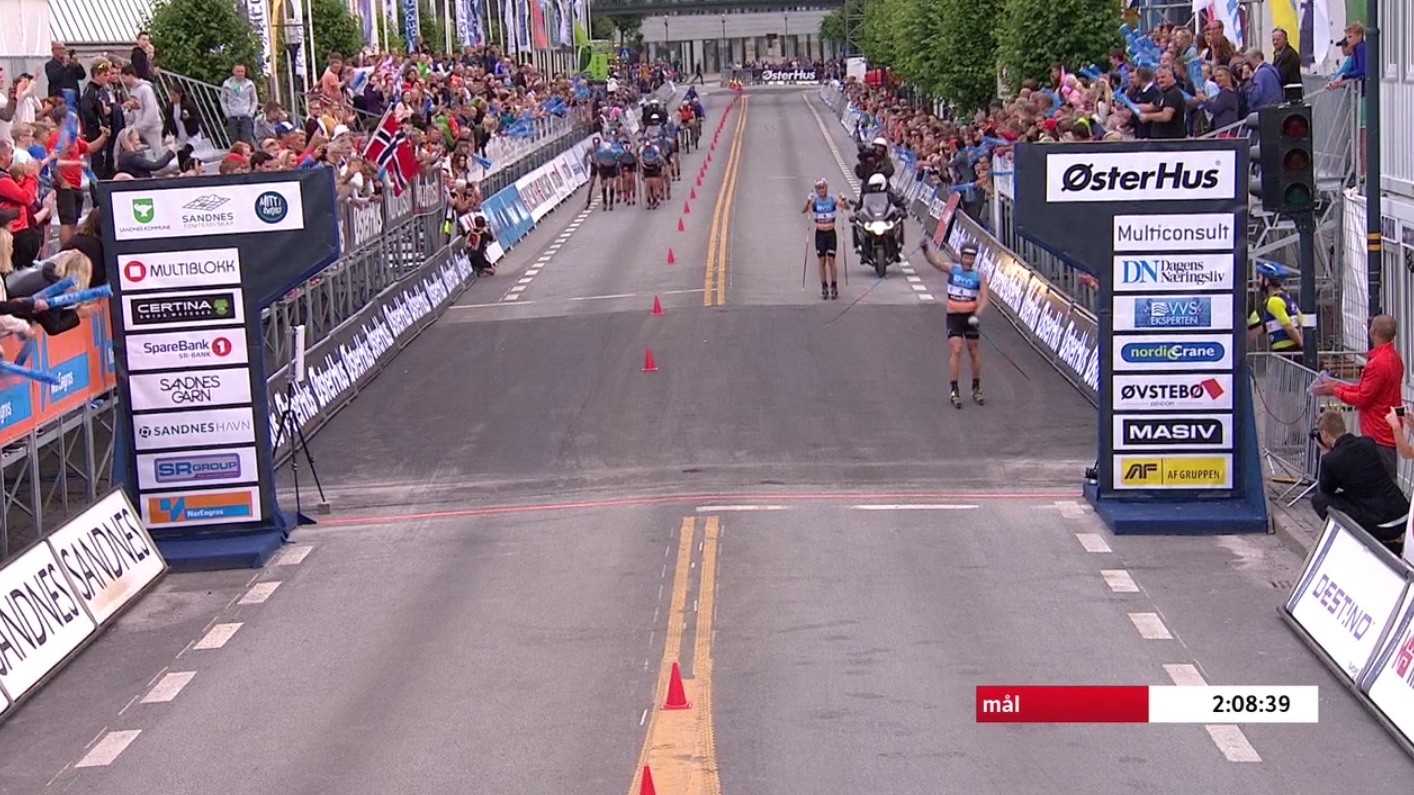
    By the end of the men’s 60 k, it was Russia’s Alexander Bolshunov who finished first in 2:10:51.6 hours. The 22-year-old Bolshunov had a number of World Cup podiums last season and one win in the final 15 k of the year. He also earned three silver medals and one bronze at the 2018 Winter Olympics in South Korea.


    Finishing just 5.9 seconds behind him was another Russian, 19-year-old Sergey Ardashev, in second place. The third elite man across the line was Norway’s Anders Mølmen Høst, 27, of the Lyn Ski club, who finished 1.8 seconds out of second place and 7.7 seconds back from first.

    Norwegians occupied the rest of the top 10, with Tord Asle Gjerdalen in fourth (+8.1), Øystein Petterson in fifth (+8.3), Hans Christer Holund in sixth (+8.3), Sjur Røthe in seventh (+8.7), Simen Hegstad Krüger in eighth (+8.7), Runar Skaug Mathisen in ninth (+10.3) and Martin Johnsrud Sundby — the winner of last year’s Blink Classics 60 k — in 10th (+10.8).

    Nearly half of the men’s field came from nations from outside Norway, with athletes hailing from Russia, France, Canada, the U.S., Great Britain, Finland, Sweden, and Italy. Canadian World Cup skier Alex Harvey was the top North American in 14th (+1:19.0).

    Also for Canada, Scott James Hill placed 53rd (+11:00.0) and Bob Thompson was 56th (+11:53.1). Ian Torchia was the lone American in the event, racing to 55th (+11:52.3). Canada’s Evan Palmer-Charrette did not start.

    Norway’s Kari Vikhagen Gjeitnes finishing first in the Blink Classics women’s 50 k on Wednesday in Sandes, Norway. (Photo: Blink Ski Festival/Facebook)

    In the elite women’s 50 k, which had just nine finishers, Norway’s Kari Vikhagen Gjeitnes finished first in 2:21:19.0. Second place went to Astrid Øyre Slind, who crossed 33.9 seconds after Gjeitnes, and the third and final podium spot went to Poland’s Justyna Kowalczyk (+5:55.4).

    Racing for Great Britain, Nichole Bathe placed sixth (+14:05.1). Originally from Wisconsin, Bathe is a dual citizen of Great Britain and the U.S., and is currently training with the British national team in Norway.

    Following the Blink Classics on Wednesday, the Blink Ski Festival will turn to the Lysebotn Opp uphill rollerski race on Thursday.

    Blink Classics results: Men | Women

    https://www.instagram.com/p/Bl9FffkA2wS/?taken-by=kari_vikhagen_gjeitnes

  • Norwegians Sweep Sprints; Newell Out in Quarterfinal on Last Day of Blink

    Norwegians Sweep Sprints; Newell Out in Quarterfinal on Last Day of Blink

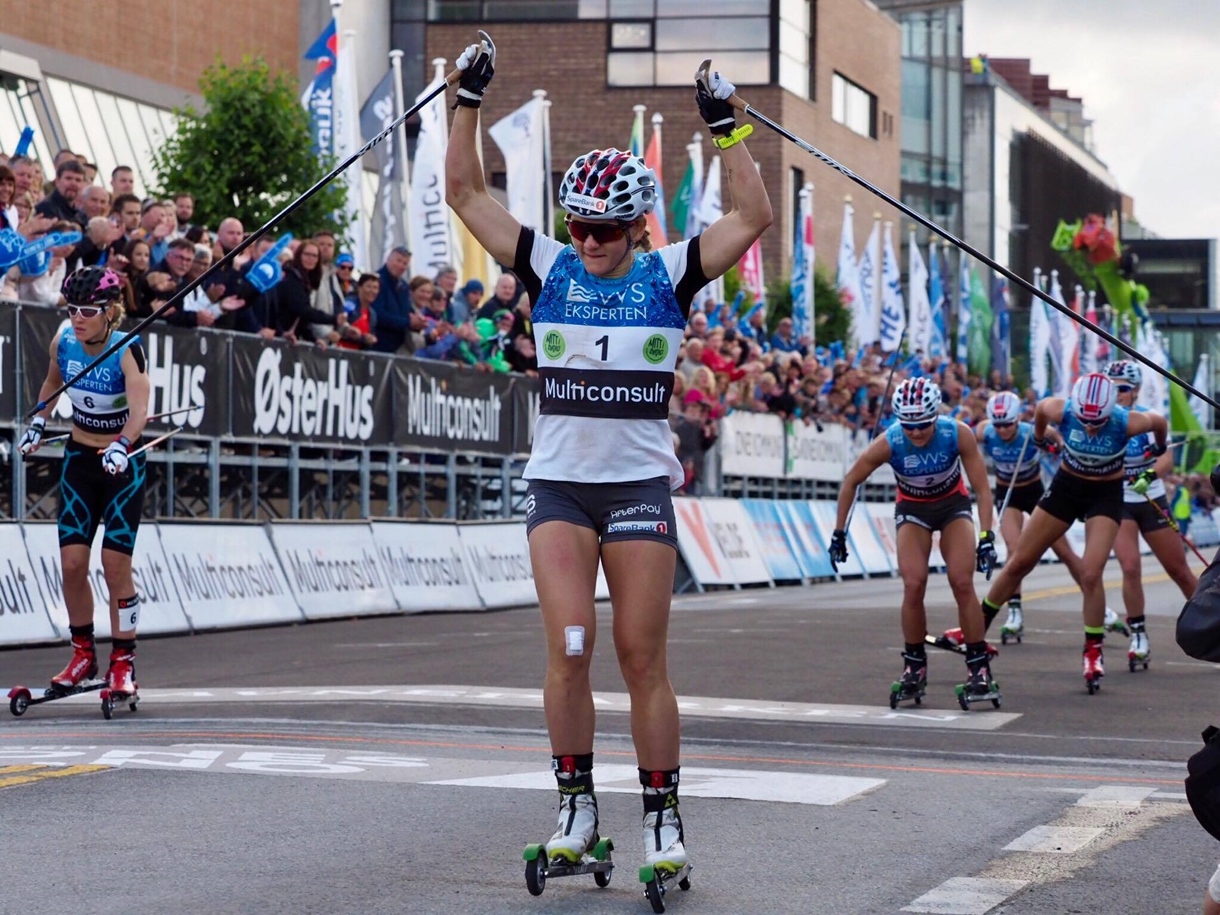
    Norway’s Maiken Caspersen Falla celebrates across the line after edging out Russia’s Natalia Matveeva and her Norwegian teammate Ingvild Flugstad Østberg in the women’s cross-country sprint on Saturday at the 2017 Blink Skifestivalen in Sandnes, Norway. (Photo: Axelar/Ørjan Dalseth)

    The fans in the well-filled stands of the 1-kilometer rollerski city course in Sandnes, Norway, had many reasons to cheer loudly on Saturday, as their local heroes claimed victories in all four sprint events that concluded the 2017 Blink Skifestivalen (Ski Festival).

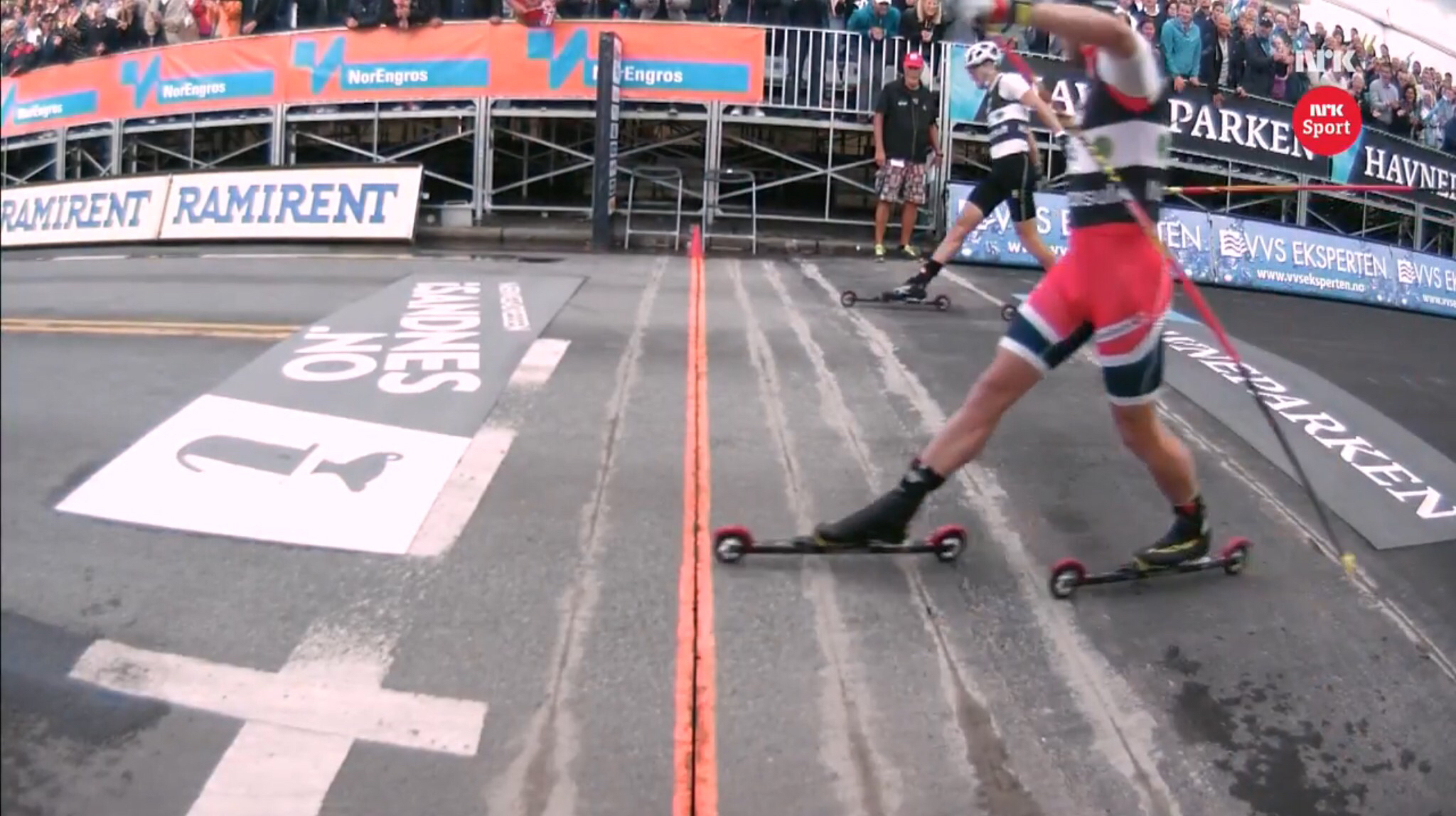
    In the final race of the day, the men’s cross-country sprint was decided by the length of a rollerski, with Norway’s Sindre Bjørnestad Skar crossing first, just 0.1 seconds ahead of Sweden’s Teodor Peterson. Skar took the win with a time of 3:27.6 minutes after two laps around the flat course, which featured two short climbs over a ramp and a bridge. The third place on the podium went to Kasper Stadaas, also of Norway, 1.9 seconds out of first.

    Norway’s Sindre Bjørnestad Skar (front) lunges across the line ahead of Sweden’s Teodor Peterson in the men’s cross-country sprint at the 2017 Blink Skivestivalen on Saturday in Sandnes, Norway. (Photo: NRK screenshot)

    Second in Friday’s mass start, Skar advanced through the rounds on Saturday with narrow victories in his quarterfinal and semifinal as well. Last season, Skar won a World Cup at the freestyle sprint in Toblach, Italy, and achieved two other podiums. He raced to third in the sprint qualification at the World Championships in Lahti, Finland, and went on to finish 13th.

    Andy Newell of the U.S. Ski Team (USST) was the lone North American starter of the day, and his run ended in the quarterfinal heats when he crossed the line in third, 1.1 seconds behind Norwegians Sondre Turvoll Fossli and 0.3 seconds behind Sivert Knotten. In an Instagram post, he mentioned breaking three poles in three races he competed in at this year’s Blink. He finished 16th in the 60 k classic and 18th in the 15 k freestyle mass start.

    (Article continues below)

    https://www.instagram.com/p/BXKYSBPhWK1/?taken-by=andynewellskier

    In the women’s cross-country sprint, a number of the last season’s top sprinters contended for the podium. Reigning Sprint World Cup champion Maiken Caspersen Falla emerged with the victory in the final with a time of 3:49.6 after keeping her challengers at bay in the long finishing straight. Russia’s Natalia Matveeva placed second (+0.8) and another Norwegian Ingvild Flugstad Østberg took third (+1.1).

    Earlier in the day, Falla won her semifinal, after she advancing from her quarterfinal with a wildcard. Originally Falla had finished the heat more than 30 seconds back, following a spill from which she emerged with a slightly bloody right knee.

    “Suddenly the asphalt was there,” Falla told Norwegian broadcaster NRK, according to a translation. “I am very happy that I was able to protect the face and head… I was really scared. I’m terrified.”

    She explained that it had been a long time since her last crash on rollerskis, and that she likely had placed a pole on her own shoe. No other athlete was involved in the incident, and her semifinal heat started with seven athletes.

    On Friday, Falla placed third in the women’s 10 k mass start after outlasting the group of skiers she was with in the finishing straight.

    USST member Liz Stephen opted not to start in the sprint on Saturday (after placing sixth in the hill climb and 25th in the 10 k freestyle mass start), instead continuing her European road trip to Östersund, Sweden, according to an Instagram post.

    Biathlon

    In the women’s biathlon sprint, French veteran Marie Dorin-Habert made a minor rookie mistake while leading when she knelt down on the shooting mat for another prone shooting, before realizing that all her competitors had correctly taken a standing-position stance. Maybe she had assumed that — like the men in Saturday’s sprint format — they also would have to shoot four times.

    France’s Marie Dorin-Habert (l) erroneously kneels down to take the prone position in the second shooting stage of the women’s biathlon sprint at the 2017 Blink Skifestivalen on Saturday in Sandnes, Norway. In the lead until that point, she went on to finish third. (Photo: NRK screenshot)

    She quickly stood back up, but after incurring a penalty she was overtaken by Sweden’s Hanna Öberg and Norway’s Marte Olsbu. On the final lap Olsbu managed to pass the Swede to claim the victory in a time of 7:57.3 minutes with two penalties, while Öberg finished second (+2.8, with two penalties) and Dorin-Habert third (+5.0, with one penalty) ahead of Sweden’s Emma Nilsson (+9.4, with two penalties).

    Vetle Sjåstad Christiansen after winning the men’s biathlon sprint on the last day of the 2017 Blink Skifestivalen on Saturday in Sandnes, Norway. (Photo: Axelar/Ørjan Dalseth)

    In the men’s biathlon sprint, racers skied four loops and shot in four stages. Coming into the final shooting stage, Norway’s Lars Helge Birkeland and Vetle Sjåstad Christiansen, along with France’s Simon Fourcade, had created a small gap to the rest of the field. While Birkeland and Christiansen hit all their targets, Fourcade had to ski one short penalty lap through a traffic roundabout. Turning sharp left into the finishing stretch, Christiansen overtook Birkeland and pushed hard until the line in a time of 12:09.6 with two penalties, while Birkeland finished 4.6 seconds back in seconds place (with one penalty). Fourcade held onto third place (+16.2, with three penalties) ahead of a chase group.

    The excited fans also sang a little birthday tune for Norway’s Tarjei Bø — who turned 29 on Saturday — as he came into the finish in seventh place (+42.2) smiling and waving to the crowd.

    No North American biathletes raced at this year’s Blink.

    Saturday’s results:

    Cross-country sprint finals: Women | Men

    Biathlon sprint: WomenMen

  • Summer Success for Sundby, Wins First Race of Blink Festival

    Summer Success for Sundby, Wins First Race of Blink Festival

    Defending Overall World Cup champion Martin Johnsrud Sundby won the first race of the 2017 Blink Ski Festival on Wednesday, finishing 2.6 seconds ahead of fellow Norwegian Simen Hegstad Krüger in the Blink Classics 60 k distance rollerski. (Photo: NRK screenshot)

    Stands crowded with 50,000 cheering spectators. Bibbed athletes clad in shorts and T-shirts clicking by on rollerskis. Competitors representing various countries dousing themselves with bottled water as they cross the finish line.

    These were among the sights and sounds of the world’s largest summer rollerski-race series, Norway’s Blink Ski Festival.

    Celebrating its ninth year, racers and fans kicked off the 2017 four-day festival in Gjesdal and Sandnes, Norway, with men’s and women’s classic distance rollerski races on Wednesday.

    Toeing the start line for the elite men’s 60-kilometer were well-known Norwegian World Cup racers, such as Martin Johnsrud Sundby, Petter Northug and Sjur Røthe, as well as Russia’s Sergey Ustiugov, Finland’s Iivo Niskanen, Germany’s Lucas Bögl, and American Andy Newell.

    In the beginning, it appeared Ustiugov was gunning for the lead, charging the group of 58 rollerskiers with 46 k to go. But within another 9 k, a pack of six had broke off the front, including Sundby, Røthe, Niskanen, and Norwegians Øystein Pettersen, Simen Hegstad Krüger, Anders Aukland, and Simen Håkon Østensen. Ustiugov was now in the chase group close to 45 seconds away.

    With less than 30 k of road left to race, the front group had dwindled to three Norwegians and a Finn: Sundby, Røthe, Krüger, and Niskanen. Newell had caught up to the chasing group, now almost two minutes back from the leaders.

    Given 20 more kilometers, however, Sundby and Krüger had pulled away, Niskanen working to hold onto third 30 seconds back. The two Norwegians battled together until the final kilometer, when Sundby surged for the final city sprint to secure the victory in a time of 2:08:40.6.

    Though some may see the win as a premature predictor of what’s to come this winter, Sundby was not one of them.

    “We are talking about July. Everyone pretends like they don’t care, but this is important for everyone who is on the starting line,” Sundby told NRK, according to a translation. “There weren’t a lot of world-class athletes who was not on the starting line today.

    “This is incredibly good practice,” he continued. “I greatly appreciate all of these competitions.”

    Just 2.6 seconds behind Sundby, was Krüger crossing in second. Third went to Niskanen, who finished 36.7 seconds back from the winner.

    Just 1.8 seconds outside of the top 15 was Newell in 16th overall (+5:25.1) in the elite men’s race, out of 58 finishers.

    In the elite women’s 60 k, which started at the same time as the men, Norway’s Astrid Øyre Slind latched onto a few male racers from the start and broke away from her competition, which included just 10 women

    Slind took the win in a time of 2:20:04.2, while fellow Norwegian Kari Vikhagen Gjeitnes claimed second, 2:11.1 minutes back. Belarus’s Yulia Tikhonova completed the women’s podium in third (+2:23.4). 

    (Article continues below)

    https://www.instagram.com/p/BW9z6M4hmcd/?taken-by=andynewellskier

    Racing continued Thursday with the men’s and women’s hill climb, the Lysebotn Opp, in  Lysebotn, Norway. Sixty-five women came out for that race, with Sweden’s Charlotte Kalla taking the victory in 33:18.3. Norway’s Heidi Weng finished 40.3 seconds back in second, and Marit Bjørgen wearing bib 1 finished third, 1:50.5 minutes behind Kalla.

    Liz Stephen of the U.S. Ski Team took sixth (+3:35.7) behind Norway’s Ragnhild Haga (+2:43.4) in fourth and Finland’s Krista Pärmäkoski in fifth (+2:47).

    In the men’s race, Norway’s Hans Christer Holund took the win in 27:37.6. Krüger repeated in second place, 1:13.9 minutes back, and Finland’s Matti Heikkinen placed third (+1:25.6), while Sundby was sixth (+2:11.5) behind fellow Norwegians Henrik L’Abée-Lund in fourth and Røthe in fifth.

    Out of 100 male starters, 99 finished. Newell did not compete.

    Check back Friday for a more detailed recap of Thursday’s Lysebotn Opp.

    Day 1 distance results: Men | Women

    Day 2 Lysebotn Opp (hill climb) results: Women | Men

  • An Insider’s Look at the 2015 Blink Festival With UVM’s Jørgen Grav

    An Insider’s Look at the 2015 Blink Festival With UVM’s Jørgen Grav

    Grav racing on the EISA circuit. (Photo: Jørgen Grav)
    Jørgen Grav of the University of Vermont racing in an Eastern Intercollegiate Ski Association (EISA) race. (All photos courtesy of Grav)

    The 2015 Blink Festival brought many of the world’s best cross-country skiers together for three days of rollerski racing in Sandnes, Norway. But the festival is much more than just a race for World Cup level athletes. There are open races for junior athletes ages 11 to 20, as well as opportunities for those with low enough International Ski Federation (FIS) points to race against the best seniors in the world.

    Anyone can try to sign up for the high-caliber race series, but because it has grown to be so popular, the 150 athletes with the lowest FIS points get chosen for the senior races. This year, one of them was 23-year-old Jørgen Grav of the University of Vermont (UVM).

    Grav was born and raised in Oslo and is training at home in Norway for the summer before his senior year at UVM. He lives just five minutes away from the Holmenkollen ski jump and works at a nearby boat-classification company that certifies and insures large ships. He has an agreement worked out with his employers where he gets a week off every three weeks or so in order to more effectively train for his senior year of college racing. His work schedule also gave Grav an opportunity to compete in this year’s Blink Festival.

    He began the festival with a strong showing in the Lysebotn Opp. He finished 45th in the 7-kilometer uphill rollerski race, ahead of household names like Petter Northug and Finn Hågen Krogh. The UVM Catamount described the location of the race in Lysebotn, located at the end of a fjord, as one of the prettiest places in Norway.

    The men begin the climb during the Lysebotn Up. (Photo: Jørgen Grav)
    The men begin the climb during the Lysebotn Opp.

    “[The race] starts at sea level and it literally goes straight up for 640 meters and it has 27 switchback turns. It goes through 1.1k of tunnel, and the first k is completely flat. So it’s basically all that climbing in 6 k,” Grav said in a recent phone interview. “At least we do it on number 1 wheels, because it would be brutal on number 2 wheels.”

    The fastest racers in the Lysebotn Opp, Finland’s Matti Heikkinen, Russia’s Alexander Legkov and France’s Maurice Magnificat, manage to V2 the entire climb, which has an average incline of 10 percent. Grav was able to V2 most of the race, but had to take a few breaks and switch to V1, he said.  His effort was good enough to put him within five minutes of the leaders and shatter his personal record from three years earlier.

    “I finished at least two minutes faster than what I did three years ago so I am super happy about that and anything less than five minutes behind those guys up a tough course like that you should be satisfied with,” Grav said.

    Friday and Saturday brought two more days of rollerski racing and other events in downtown Sandnes. One such event was the shooting duel, a range-focused event for the biathletes where they run about 10 meters to the shooting mat, shoot five targets as quickly as possible, and then run 10 meters back to the finish. The event goes quickly, with the winning times for both the men and the women being under 20 seconds.

    “Its really entertaining; it’s good TV I think,” Grav stated about the shootout format.

    A part of the race course in Sandnes. (Photo: Jørgen Grav)
    A part of the race course in Sandnes.

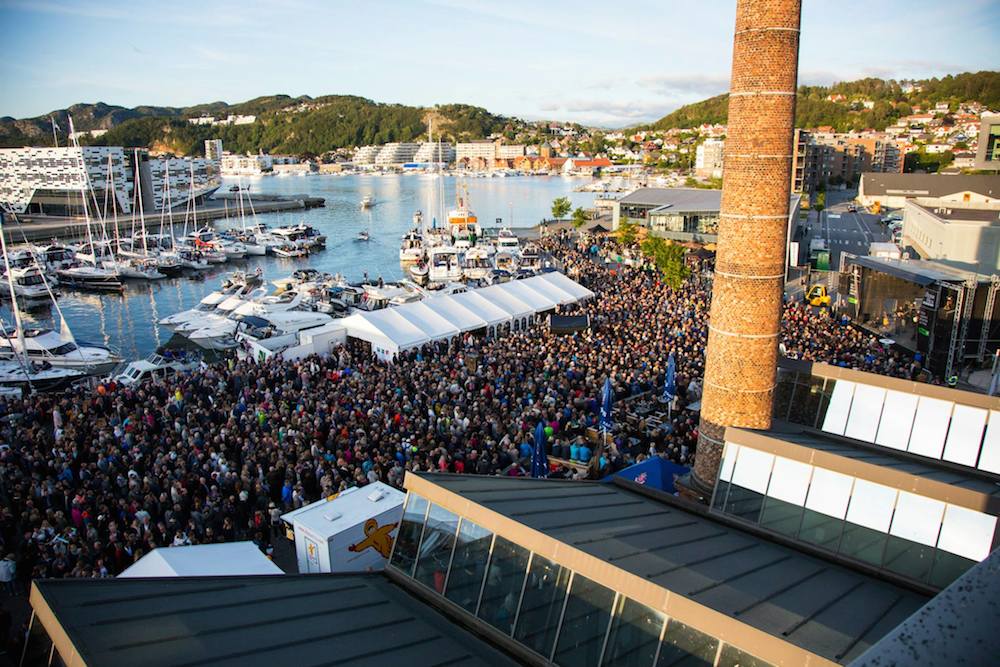
    For those who attend Blink in person, like Grav, there are some added perks. The festival has a VIP tent with live music and bleachers set up all the way around the 900-meter course so spectators can enjoy the action. The organizers even temporarily pave part of a pedestrian-only street so the race goes right by the fans. They also add bridges and turns to keep it exciting for spectators.

    Because of the tight course setup, Friday’s mass start could only accommodate 30 racers. World Cup skiers get a free pass to the final, but the rest of the participants have to qualify with a short, two-lap race to determine the remaining spots. There were only 12 available, and Grav finished 15th, missing the final by seconds.

    “I wish [the World Cup skiers] all had to race the qualifier so we all had the same chance, but I think it’s good in a way because then in creates more exposure [for the sport] on TV,” Grav said.

    He had strong races on Thursday and Friday, but met some trouble in Saturday’s sprint qualifier — and he wasn’t alone. Rain poured down all day, making an already technical course very slippery.

    “I was way off. I couldn’t ski properly and I think a lot of people just didn’t want to race because it was not safe,” Grav said about the sprint. He finished 30th in the preliminary round, but much like the mass start, some spots in the heats were reserved for World Cup athletes who bypassed the qualifier. As a result, Grav’s 30th place was not enough to put him in the heats.

    A look from above at a concert during the festival. (Photo: Jørgen Grav)
    A look from above at a concert during the festival. (Photo: Jørgen Grav)

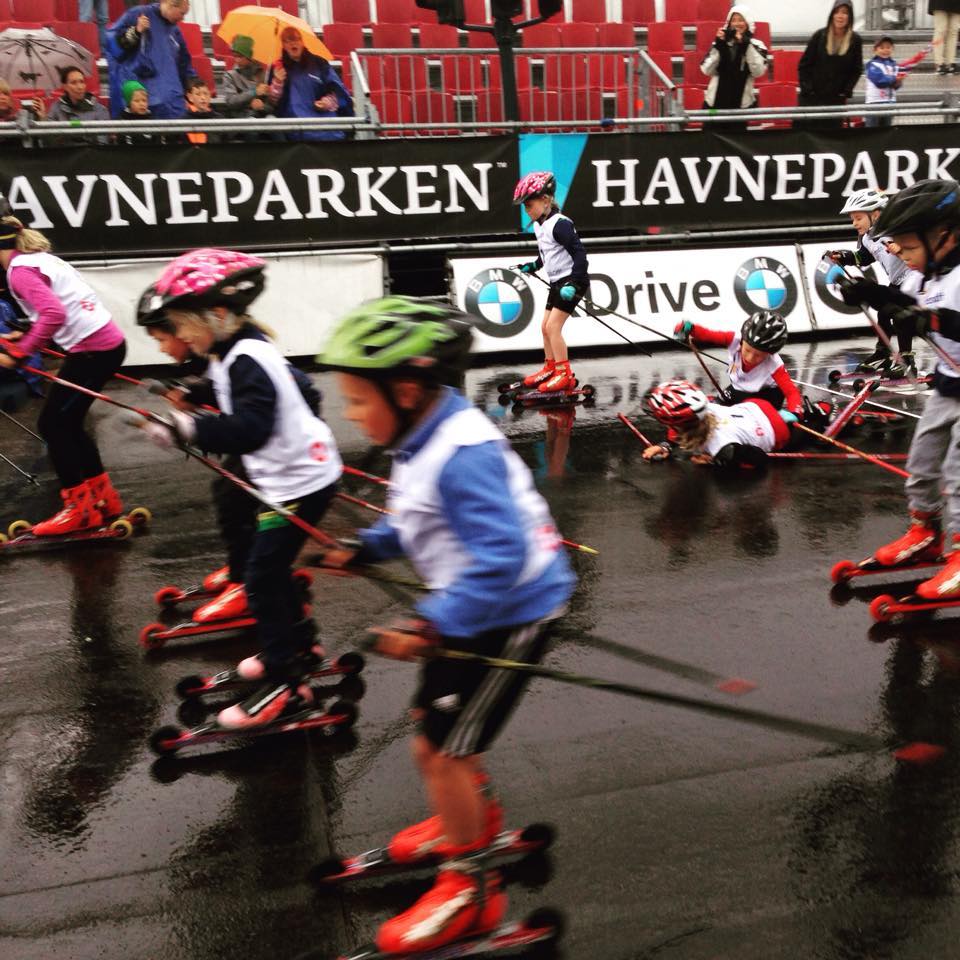
    Though there are many things about Blink that Grav enjoyed, he said the kids in attendance were one of the highlights. They all get a chance to race, and then they stay to cheer on their idols and get autographs.

    “They love standing around outside of the finishing area and are up in your face for getting you to sign their bib number or their autograph book and everything,” Grav said. “You feel like a real celebrity. It’s super cool.”

    The energy from the spectators also impressed the incoming college senior, though at a rollerski festival in Norway, he didn’t expect much less.

    “It feels like a festival with people that love skiing,” he explained.

    Grav also attended last week’s Toppidrettsveka, where he finished 41st overall. He said feels he is in his best shape ever because he has been able to focus on his training and has a fast group of peers keeping him motivated and setting strong examples. Grav also feels he has made some promising technique changes this summer.

    “I’ve been switching more over to increased double poling in my training which is the development of the sport right now, more upper body strength,” he said. “I think that is going to be a big thing this winter.”

    Looking ahead to this winter, his main goal is to place in the top three at the 2016 NCAA Skiing Championships in Steamboat Springs, Colo. Last season, Grav finished ninth in the 20 k classic mass start.

    Some kids racing at the 2015 Blink Festival. (Photo: Jørgen Grav)
    Some kids racing at the 2015 Blink Festival.

    As for after college, Grav plans to continue skiing. He will try and reach one of the recruit teams for the Norwegian National Team and then ultimately hope to get selected to the team. Grav knows it’s a tall order, but as long as he continues to love skiing, he sees no reason to end his career.

    “It’s the toughest country in the world to get on the national team so its definitely a commitment to get all the way there, but as long as I have the motivation in the spring every year to start up a new year then I am probably going to keep going!” Grav said.

  • Casting a Wider Net: ‘International Biathlon Team’ Shares Shooting Tactics in Sirdal

    Casting a Wider Net: ‘International Biathlon Team’ Shares Shooting Tactics in Sirdal

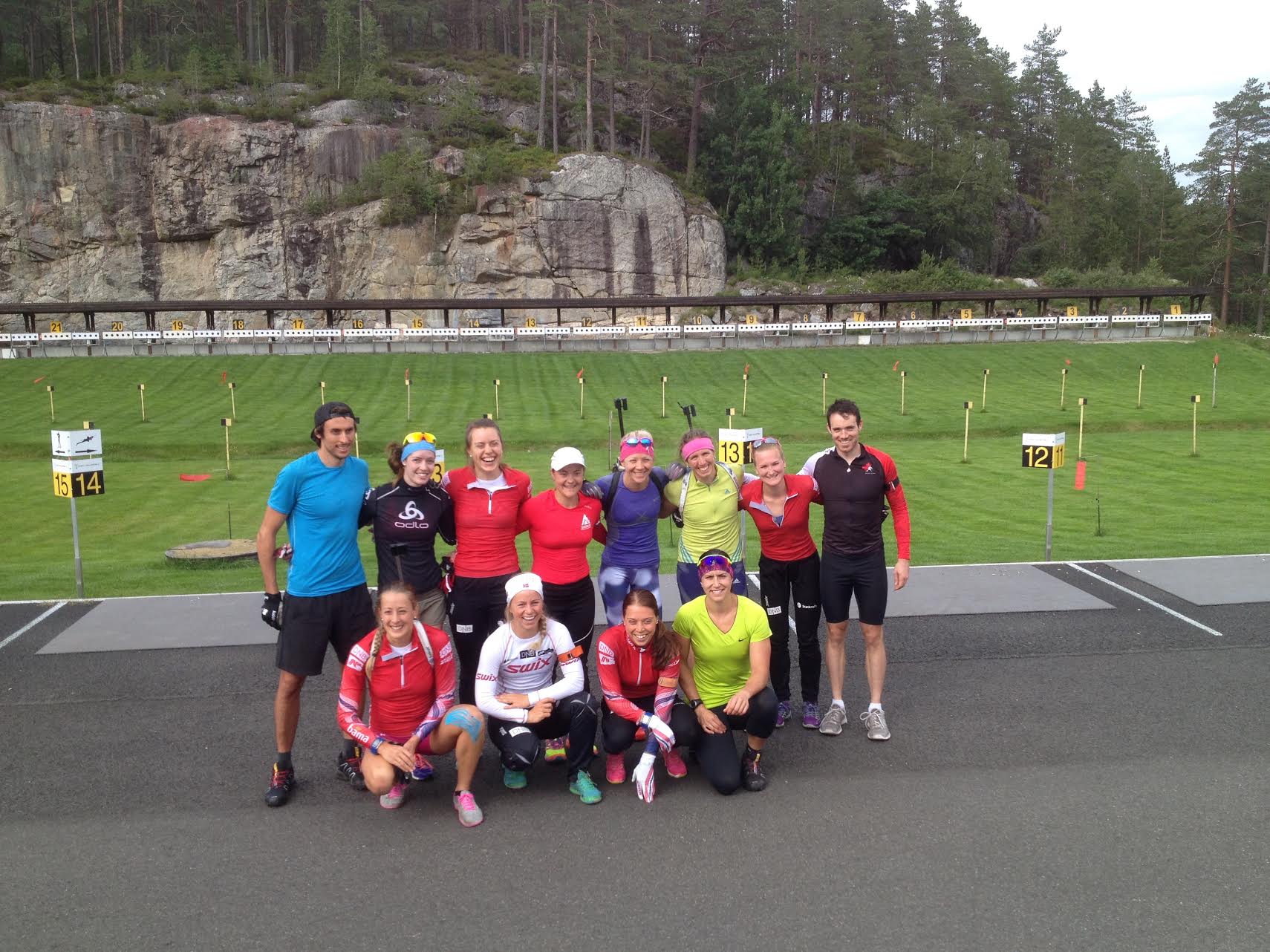
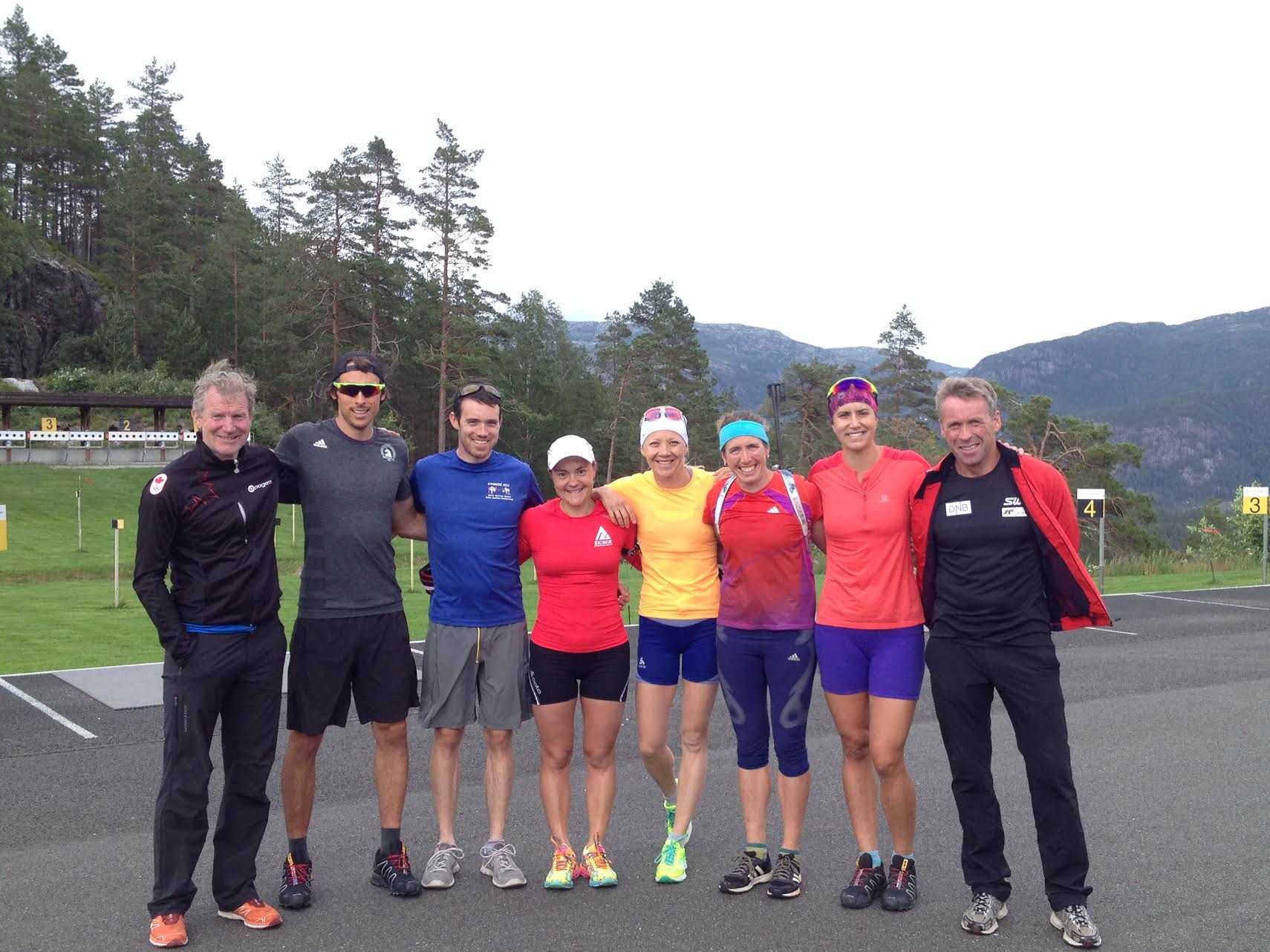
    The "International Biathlon Team" camp in Sirdal, Norway, with (front left to right) Fanny Well Strand Horn, Tiril Eckhoff, Elise Ringen, and Rosanna Crawford, and (back left to right) Brendan Green, Megan Heinicke, Sinnoeve Solemdal, Ekatarina Yurlova, Kaisa Mäkäräinen, Susan Dunklee, Marte Olsbu, and Nathan Smith. (Photo: Matthias Ahrens)
    The “International Biathlon Team” camp in front of the 30-point range at the sports school in Sirdal, Norway, with (front left to right) Norway’s Fanny Welle-Strand Horn, Tiril Eckhoff, and Elise Ringen, and Canada’s Rosanna Crawford, and (back left to right) Canada’s Brendan Green and Megan Heinicke, Norway’s Sinnøve Solemdal, Russia’s Ekatarina Yurlova, Finland’s Kaisa Mäkäräinen, American Susan Dunklee, Norway’s Marte Olsbu, and Canada’s Nathan Smith. (Photo: Matthias Ahrens)

    It all started two years ago when Biathlon Canada’s head coach Matthias Ahrens struck up a conversation with highland-cow farmer Frode Oftedal at the World Cup in Oslo, Norway. There, Oftedal, also a biathlon enthusiast, invited the Canadians to come to Sirdal, Norway, for a training camp with the French team. The French biathletes had been returning to the sports school there to train since 2002 — because of Oftedal.

    For Canada, the possibility became reality this spring when Ahrens asked Norwegian biathlon coach Arne Idland whether his A-team athletes (Rosanna Crawford, Megan Heinicke, Brendan Green, and Nathan Smith) could participate in the Blink rollerski festival in August. They could, and would, but before that, why not arrange a shooting camp with Norwegian personal shooting coach Joar Himle? Last year, the Canadians held a camp with Himle’s expertise at home in Canmore, Alberta. This time, they’d continue learning from him in Norway.

    Three non-Canadians — Russia’s 2015 world champion Ekaterina “Katja” Yurlova, Finland’s Kaisa Mäkäräinen and American Susan Dunklee — caught wind of the camp and asked Himle if they could join, Ahrens explained in an email.

    Of course they could, and the self-proclaimed International Biathlon Team was born. In the last few months before the nine-day camp in late July, Ahrens contacted the participants from various nations — including Norway and France — to coordinate workouts.

    “At the end of the year World Cup party in Khanty-Mansiysk, I met Joar Himle,” Dunklee explained in an email. “He mentioned that he might put together an international women’s shooting training camp this summer around the Blink Festival. I was immediately interested.”

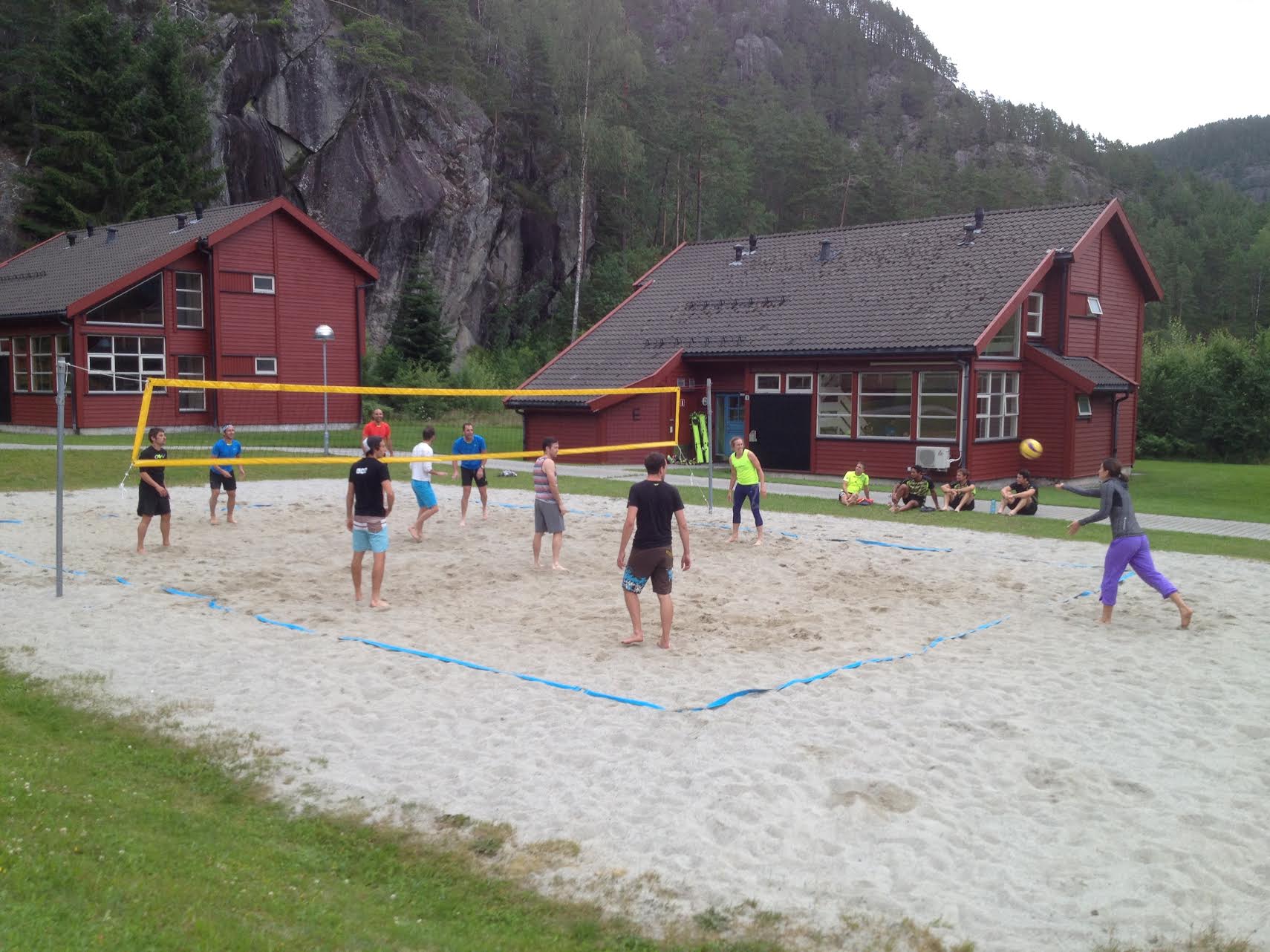
    The International Biathlon Team enjoys some leisure time during a volleyball match at the sports school in Sirdal, Norway. (Photo: Matthias Ahrens)
    The “International Biathlon Team” enjoys some leisure time during a volleyball match at the sports school in Sirdal, Norway. (Photo: Matthias Ahrens)

    Tonstad, the site of the Sirdal sports school where the athletes would stay and train, was just a short drive from Sandnes, where Blink is held annually. For Dunklee and other Blink participants, such as Crawford, Heinicke, Green, and Smith, that made it an easy choice for a training venue before Blink.

    “Shooting has traditionally been my weaker link as a biathlete and my major focus for this training season,” Dunklee explained. “I spent the spring brainstorming how to speed up my shooting times with the US coaches and sports psychologist and we have taken satisfying steps already.  We decided it might also be beneficial for me to cast the net a little wider too. Joar’s camp worked very well with the timing of the Blink Festival, which I was already planning to race, and our team’s Europe camp. I heard that some top World Cup athletes were planning to attend.  It sounded like an opportunity worth trying out.”

    Meanwhile in late July, the rest of the US Biathlon A-team, except Lowell Bailey, who got married July 11, attended a training camp in Östersund, Sweden.

    “This part of the camp we are focusing on specific biathlon training,” U.S. women’s coach Jonne Kähkönen explained in an email. “There’s a really good roller loop at the stadium and a full range that typically has varying winds — no change this time, so good wind practice. We have already had a couple of sessions with some Swedish athletes joining in to mix it up and provide additional challenge on the head to head stuff at the range.”

    They planned to stay there until Aug. 3, when Dunklee, Bailey and Leif Nordgren would rejoin the team after Blink for a week at the ski tunnel in Torsby, Sweden.

    “Next week in Torsby the biggest focus is on the skiing and technique work,” Kähkönen said of the second part of their European camp.

    The Sirdal training camp crew (from left to right): Biathlon Canada Head Coach Matthias Ahrens, Brendan Green, Nathan Smith, Katja Yurlova, Kaisa Makarainen, Susan Dunklee, Rosanna Crawford, and Norwegian personal shooting coach Joar Himle. (Photo: Matthias Ahrens)
    The Sirdal training camp crew (from left to right): Biathlon Canada Head Coach Matthias Ahrens, Brendan Green, Nathan Smith, Katja Yurlova, Kaisa Makarainen, Susan Dunklee, Rosanna Crawford, and Norwegian personal shooting coach Joar Himle. (Photo: Matthias Ahrens)

    In Sirdal, Canada brought its A-team, including Crawford and Heinicke, to work out with Yurlova, Mäkäräinen and Dunklee. Smith and Green coordinated sessions with some of the French men.

    “We’ve been having discussions together as a group about different aspects of the shooting process,” Dunklee wrote. “Joar believes in the value of athletes taking ownership of their own training and in the value of learning from other people’s approaches.  We have also benefited from sharing the range here with the French and Norwegian women’s teams and collaborating on a few workouts.”

    “It’s been great getting to chat with other athletes at meals and see what they’ve been up to during the summer,” Crawford wrote in an email.

    She explained that all of the morning workouts included everyone —“Kaisa, Katja, Susan, Megan and the boys,” while afternoon training was a bit more individualized. They worked on shooting twice a day with Himle, including some shooting drills with the French team one day and the Norwegian women another afternoon.

    “We also got to go for a great classic ski with some of the Norwegian women,” Crawford wrote. “It’s a pretty impressive group of people with 3 of them having WCH medals!”

    On Wednesday, the group parted ways, with several athletes heading to Sandnes for the Blink races from Thursday to Saturday. Afterward, the Canadian A-team will venture to Oslo for three days to train on the 2016 IBU World Championships course. Then Ahrens and Smith will return to Canmore, and Crawford and Green will venture to Östersund for a few more days of training.

    “Our B-team is in Canmore and will go up to the Haig glacier next week before they leave for [the North American Summer Championships in] Jericho [Vermont] and the races there,” Ahrens explained. “Otherwise we are mainly training in Canmore until we go for a 2 week camp in Park City in the last week of September, first week of October.”

  • Kristoffersen Tops Johaug to Win Blink Mass Start; Randall Fifth

    Still feeling a bit like fish out of water on faster-than-normal rollerskis, U.S. Ski Team members Kikkan Randall and Liz Stephen jumped in anyway Friday, the second day of the Blink Festival in Sandnes, Norway.

    After both cautiously approached the start of yesterday’s 7.5 k climb, where Stephen finished third and Randall was sixth, Randall decided to go for it in the 10 k criterium-style mass start. She ended up fifth, about 15 seconds behind winner Marthe Kristoffersen and three of her Norwegian teammates.

    Thursday’s winner, Therese Johaug was second in a sprint to the finish on the relatively flat, 750-meter loop course, and Heidi Weng finished a few seconds later in third. Another Norwegian, Maiken Caspersen Falla, beat out Randall for fourth. Bettina Gruber of Switzerland placed sixth.

    In a Skype interview from Norway, Randall said she lost some energy on the sixth lap when she sprinted for a preem money bonus about halfway through the race.

    “I didn’t quite get it,” she said. “I came around the outside and I think Marthe Kristoffersen was able to hold me off but I made a push for it . After that the pace accelerated a little bit and my legs were a little blown out by that sprint. I kind of lost touch with the leaders on that and it took me a couple laps to get my legs back, and then unfortunately I wasn’t in a position to fight for a win anymore.”

    Regardless, she was happy with the way things went from the start.

    “After yesterday I decided I needed to be more aggressive,” Randall said with a laugh. “I made sure I went off the start as quick as I could and tried to get in a good position. A couple times, girls were trying to work their way into the train and I just tried to hold my spot, and luckily I avoided any problems.”

    Stephen finished 13th, 52 seconds behind the winning Norwegian trio. When contacted by FasterSkier after the race, she wasn’t sure what place she had come in, but knew she started out too conservatively. At one point, she said she was last, but passed several people to climb back into the mix.

    “I’m not going to lie, I was terrified going into this race,” Stephen said. “The whole rollerski, poles, wicked-fast skis, pavement … I was stressed out. I was going to try to be ballsy, but it didn’t work that way so I was just kind of letting people go by and do their thing and played my catch-up game, which I actually really enjoy but it’s not the fastest way to race.”

    Tomorrow, her plan was to go all out.

    “There’s no laps to pass people,” Stephen said. “If you are in the back for the first lap, you’re going to be in the back for the end of the first lap also. I need to just get a little better with my stressed-out-ness so tomorrow will be better, I hope, for me.”

    Randall said the format of the rollerski festival is new to them both, and they’ve been adjusting to racing on faster rollerskis. With a 90-degree turn about 20 meters from the start on Friday, Randall said it’s been exciting.

    “I can already tell that if we come back and do this next year, just having the experience of doing it once will help us out tremendously,” Randall said. “It’s cool for us to interface with the World Cup field at this kind of mid point in the summer so we can kind of see where we are.”

    On Saturday, the Blink Festival wraps up with sprint racing. The women start with quarterfinals then semifinals, both of which entail one 750-meter lap with the top three moving on – and the final will be two laps.

    The reigning World Cup sprint champion, Randall was primed for those races.

    “I wish I would’ve had a little bit more in my legs after that preem sprint to hang with those guys [today], but tomorrow will be fun,” she said.

    *          *          *

    At the front, Kristoffersen was thrilled to win the sprint against Johaug and Weng, who had gone 1-2 in the hill climb the day before.

    “I have to admit it looked a little bleak coming into the last straight,” Kristoffersen told Norwegian newspaper Aftenposten. “I thought that Therese had too much, but I couldn’t give up without a fight.”

    Johaug had the same assessment of the finish.

    “Actually, I thought I’d take it all,” she told the paper. “But Marthe obviously had an extra gear.”

    It was all Norway, all the way in the men’s race as well. After 15 k of racing, the field was still tightly packed; Oystein Pettersen’s 3.1-second victory was one of the larger margins among the top ten. He beat out teammates Martin Johnsrud Sundby and Pal Golberg, with Switzerland’s Joeri Kindshi just missing the podium by 0.2 seconds. The entire top-20 were separated by only 15 seconds.

    It’s not surprising that Pettersen, who contests almost exclusively sprints on the World Cup circuit and teamed up with Petter Northug for Olympic gold in the sprint relay in Vancouver, won the field sprint, but he usually isn’t so close to the front in a distance race.

    But if the rest of the racers were surprised, Pettersen himself wasn’t.

    “I’ve actually always done well in Sandnes,” he told Aftenposten. “I felt I could not betray the audience that cheered for me at every point along the way. It’s amazing what they do here in Sandnes.”

    Official results: men / women

    — Chelsea Little contributed reporting