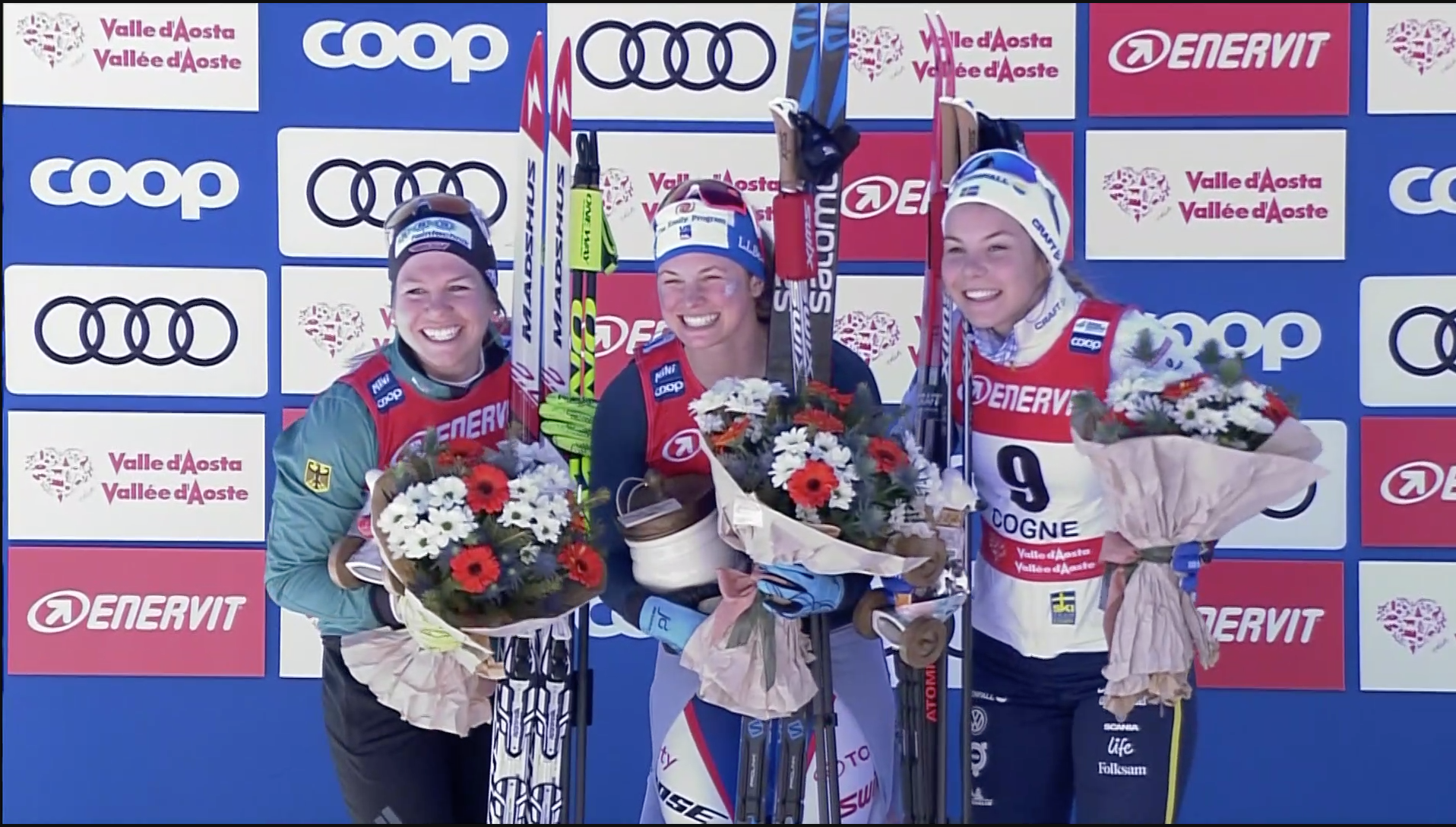
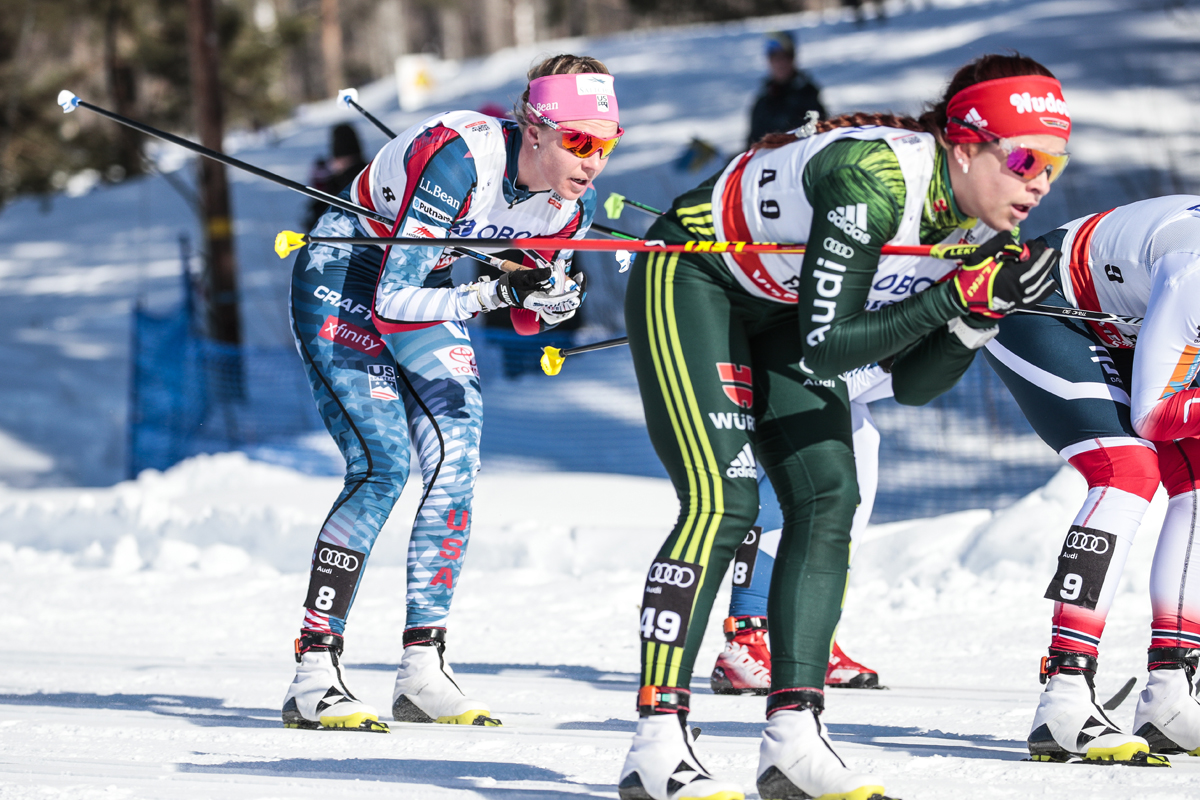
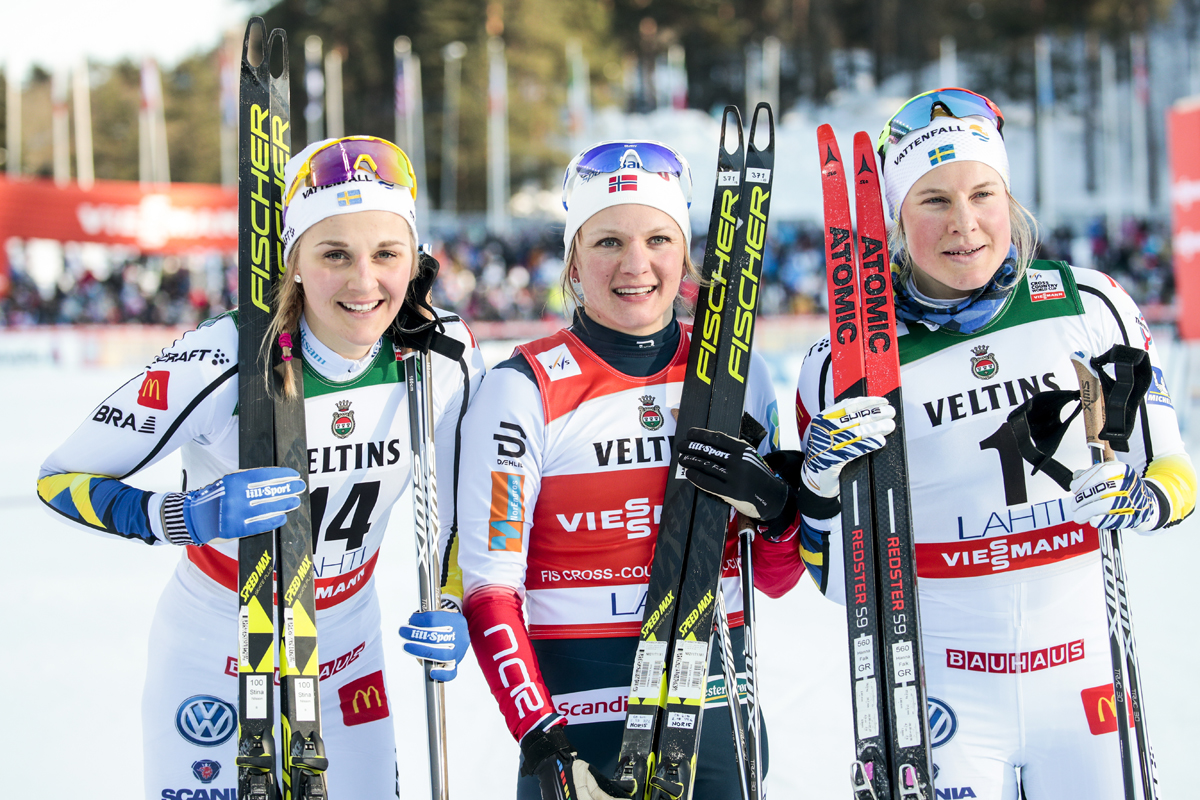
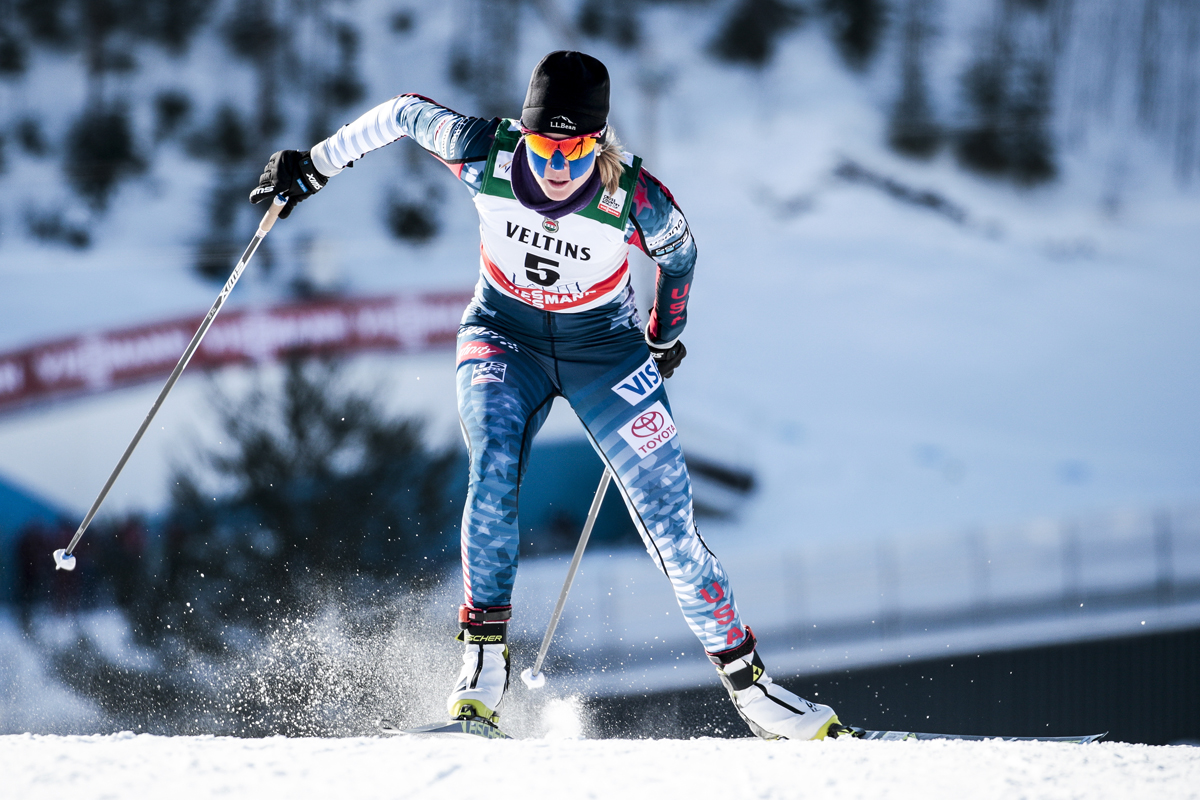
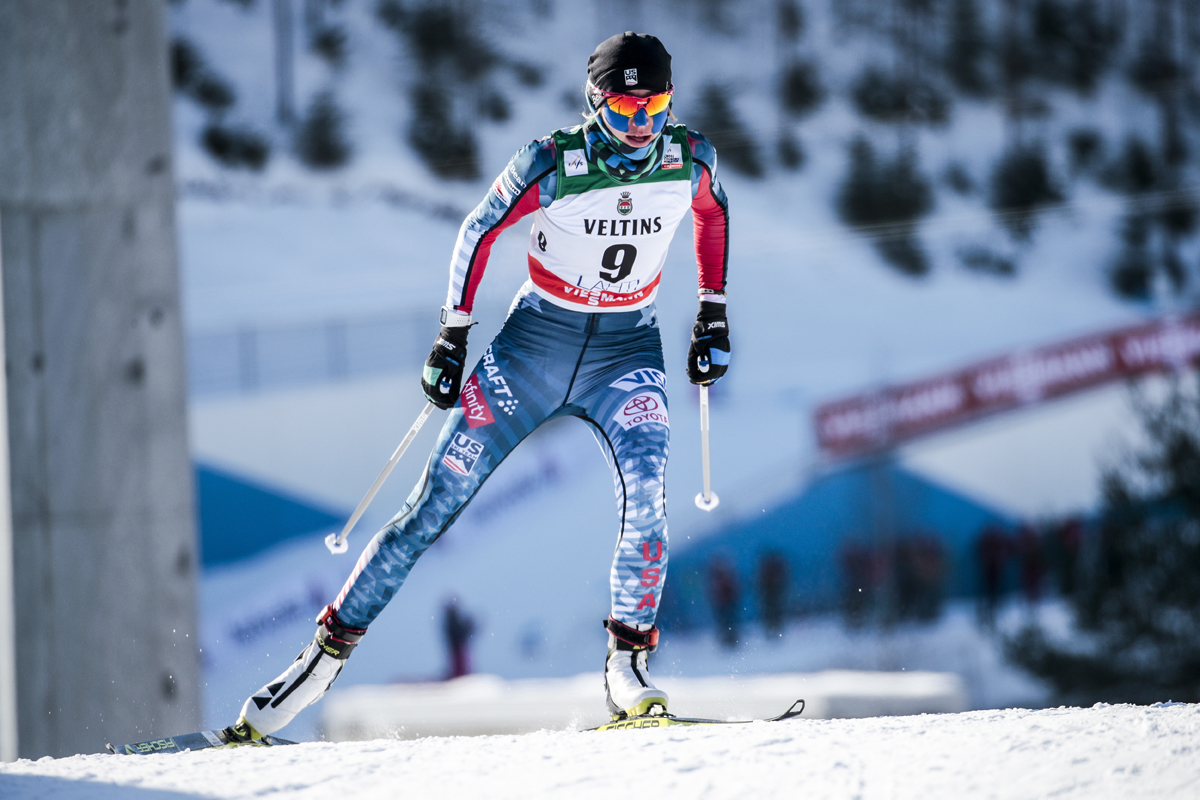
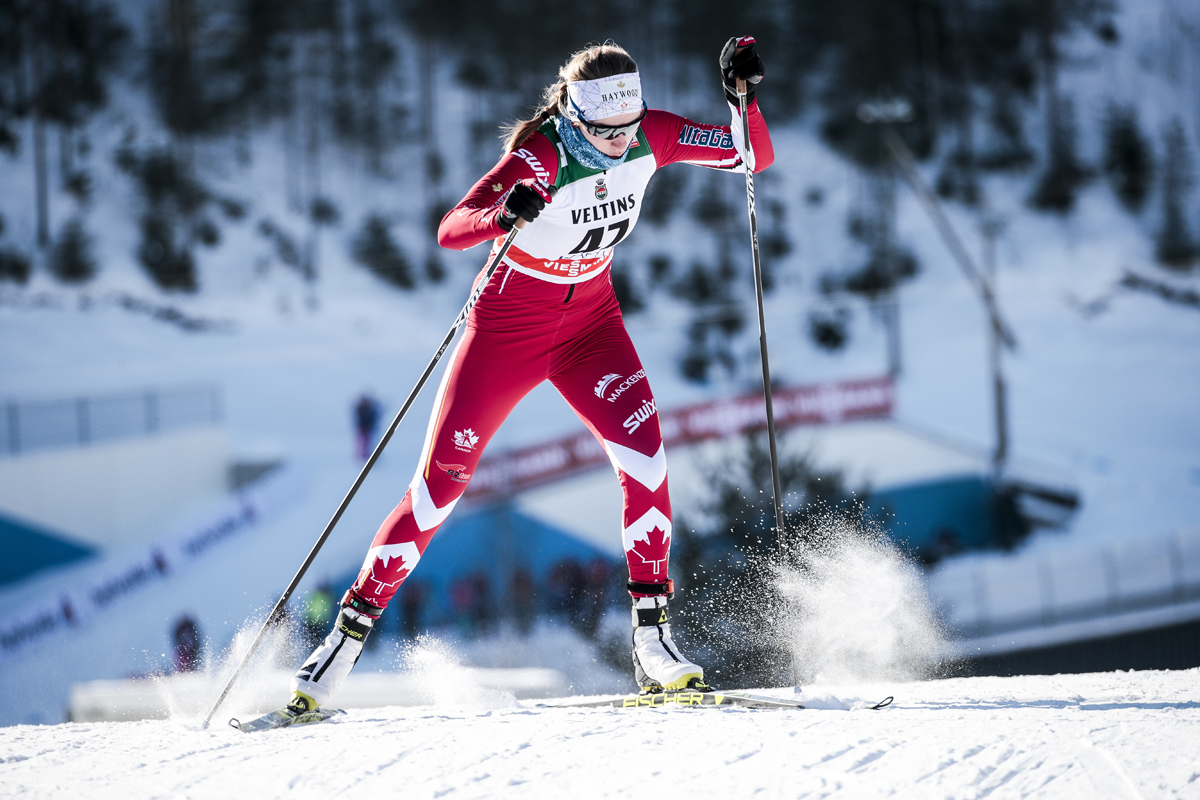
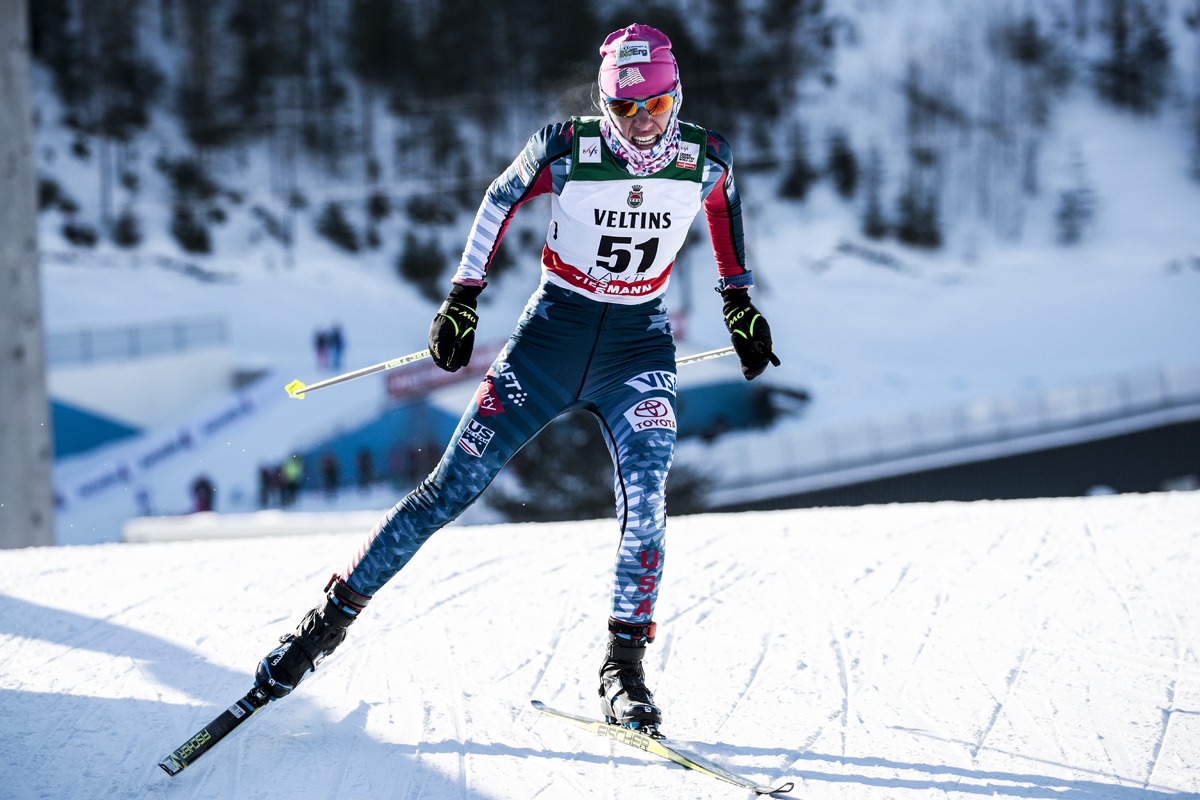
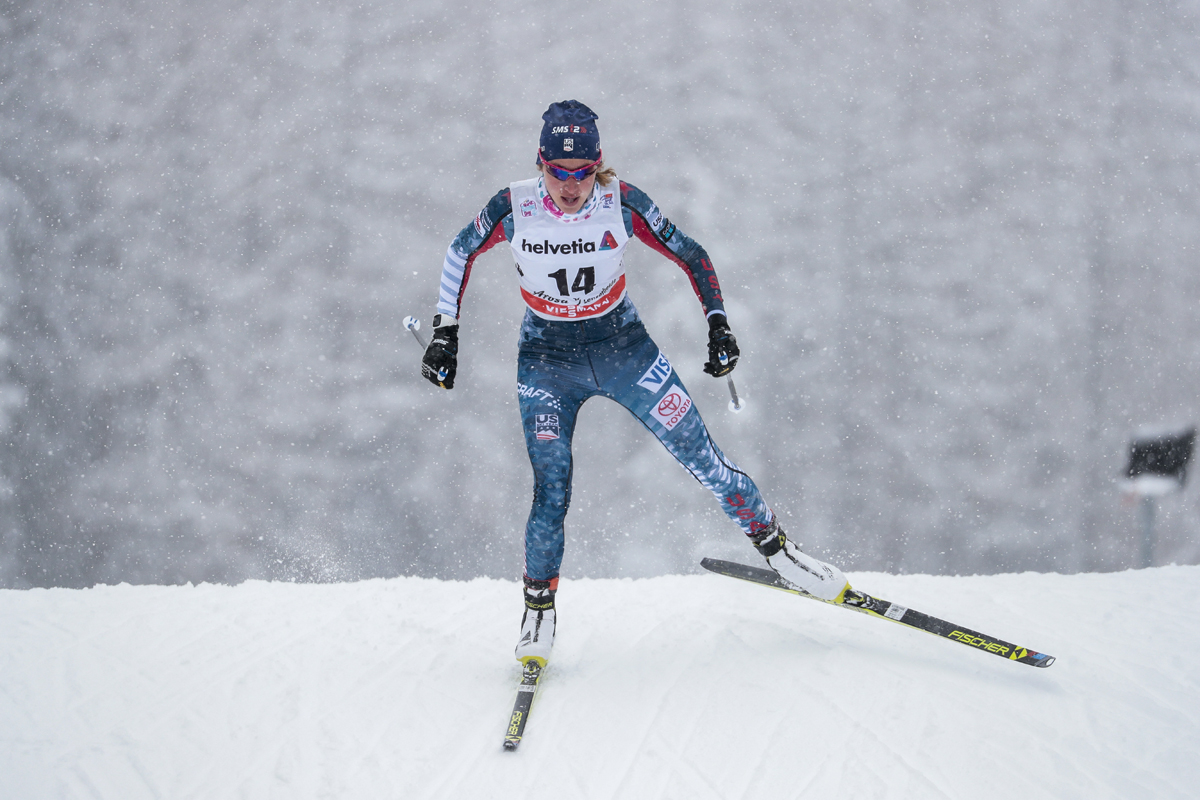
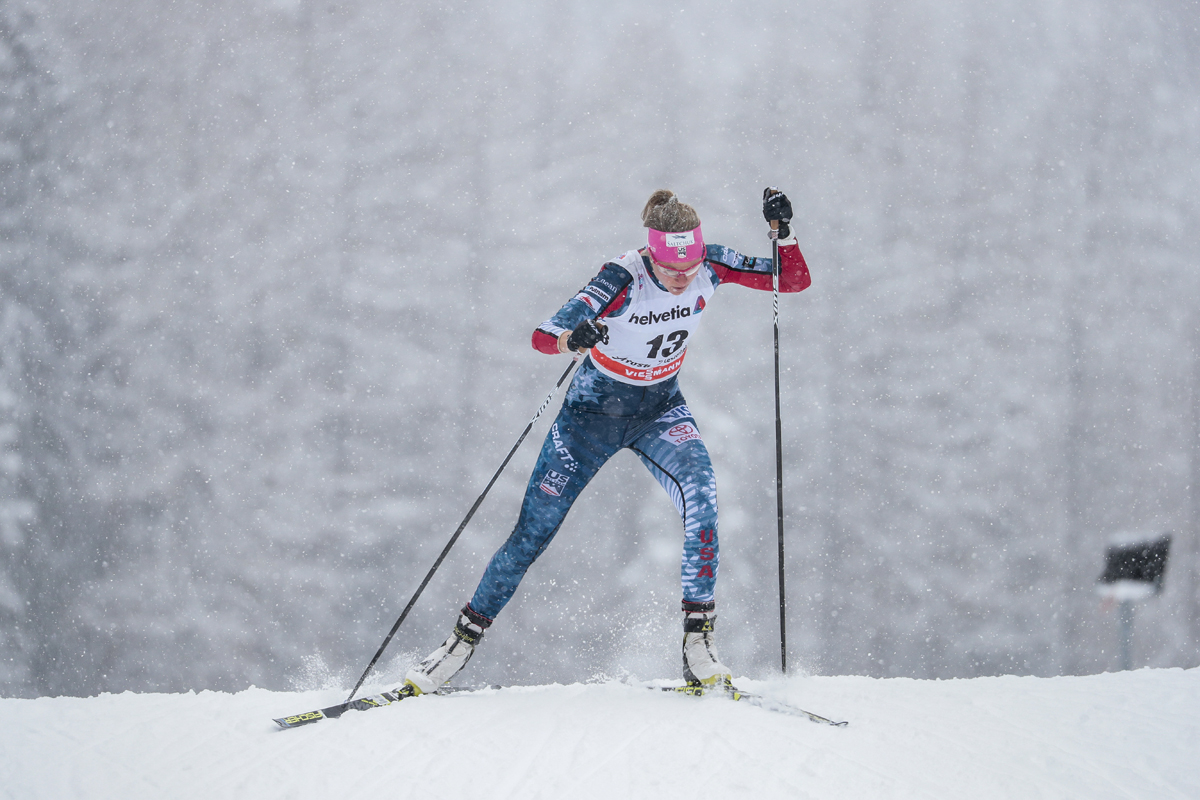
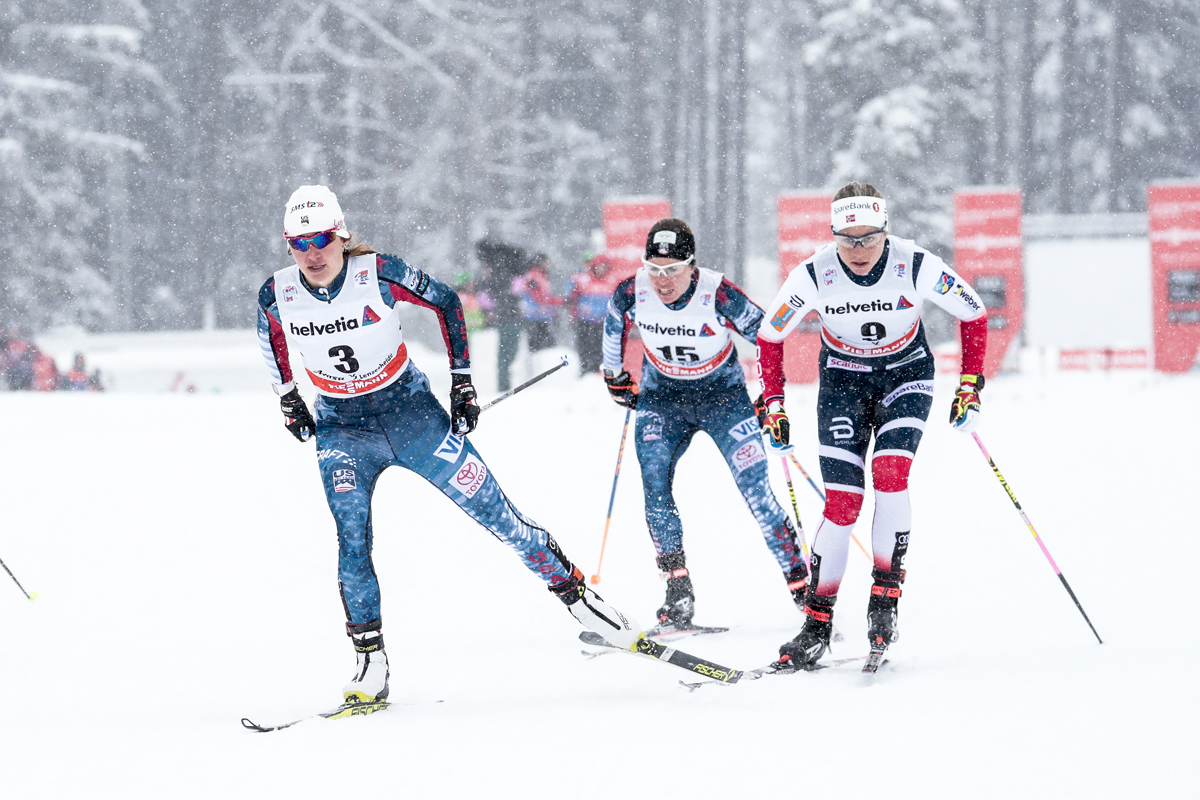
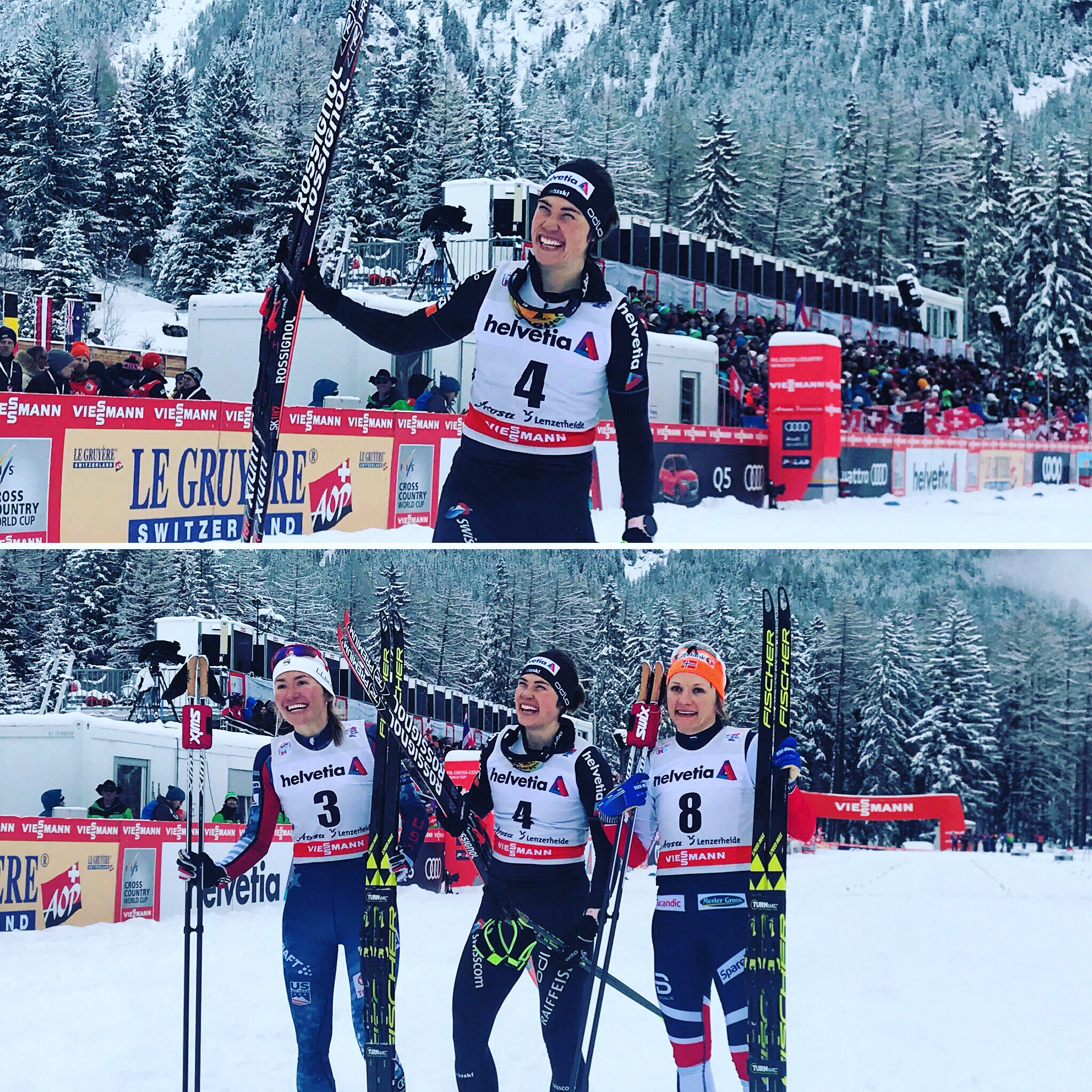
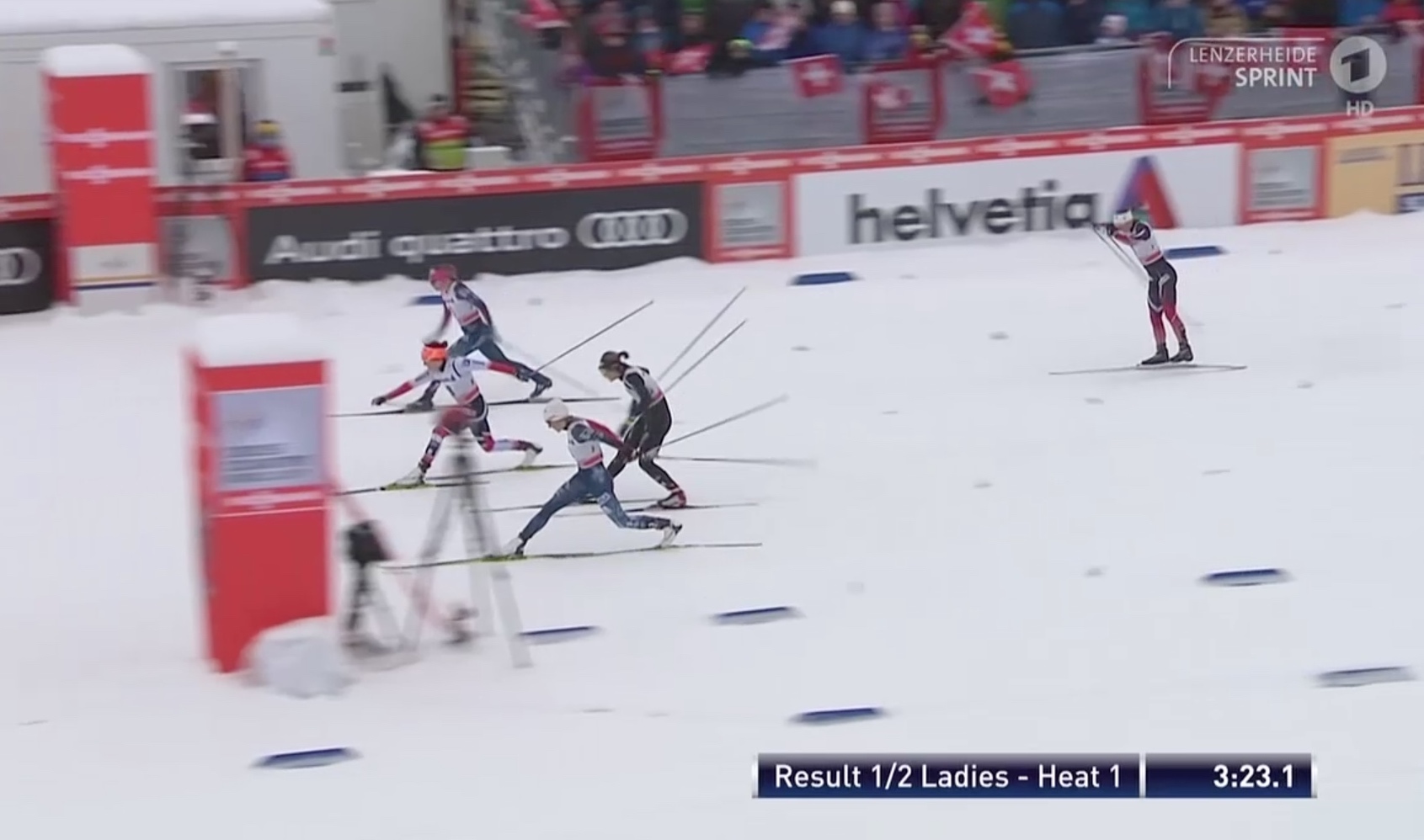
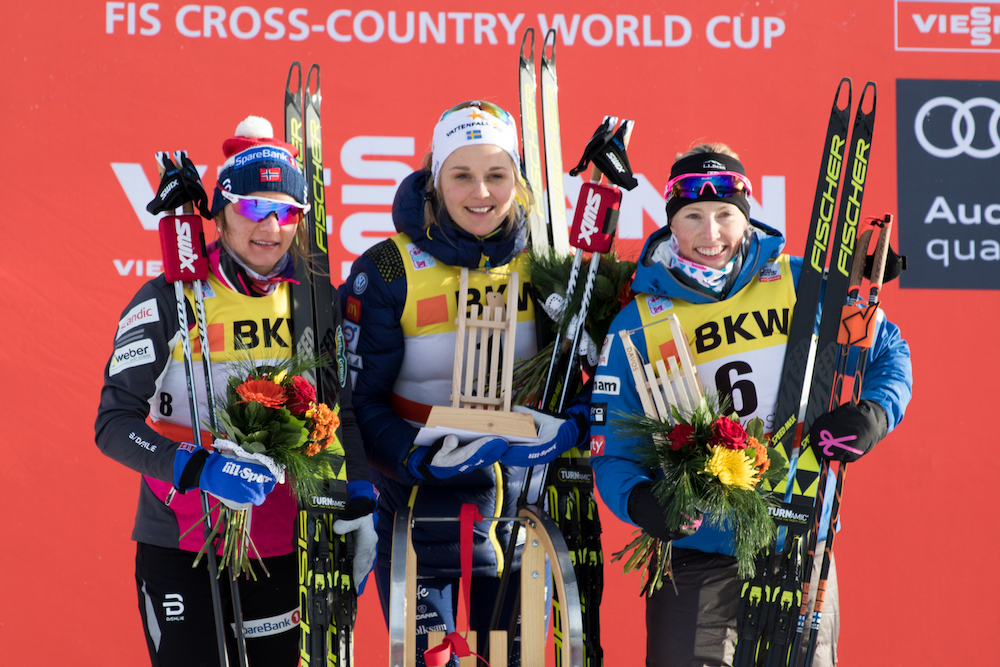
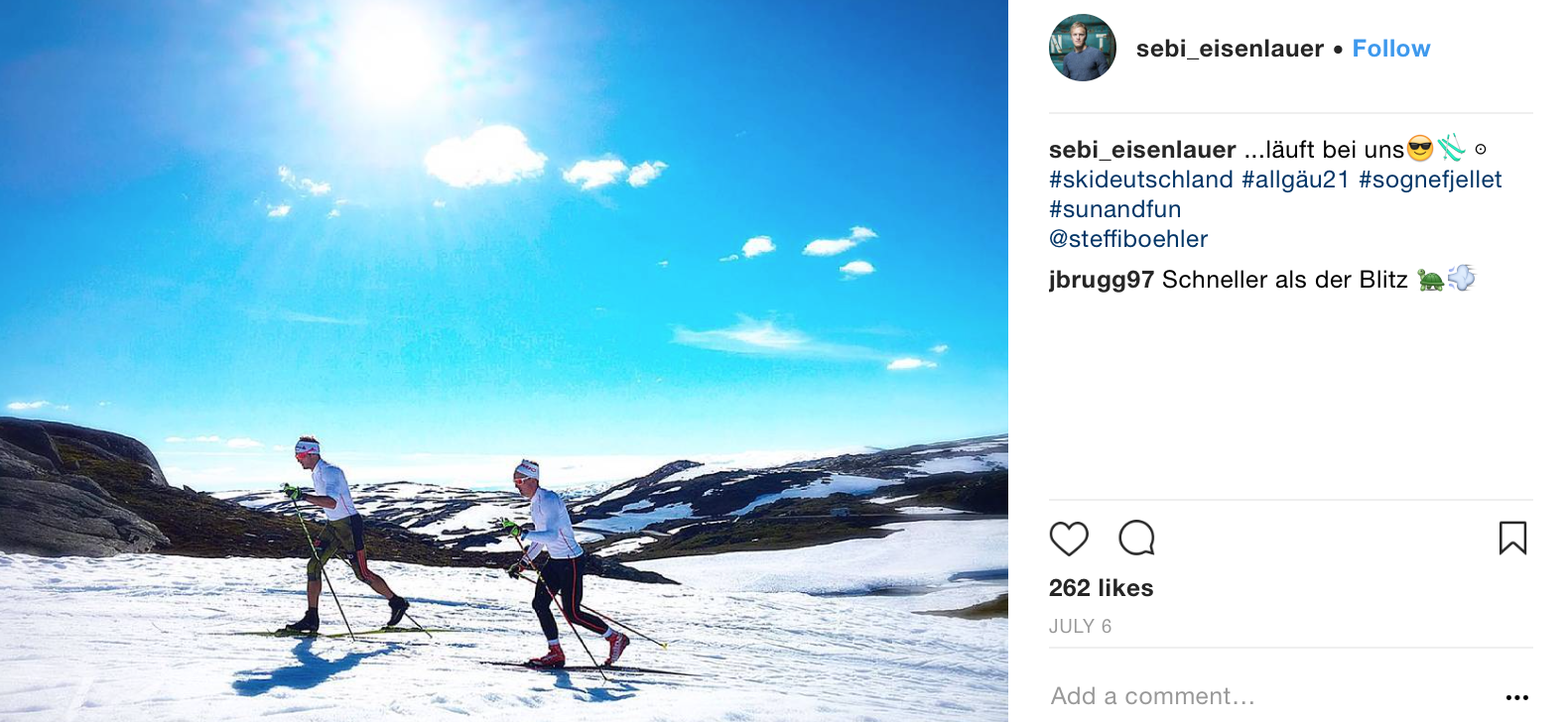
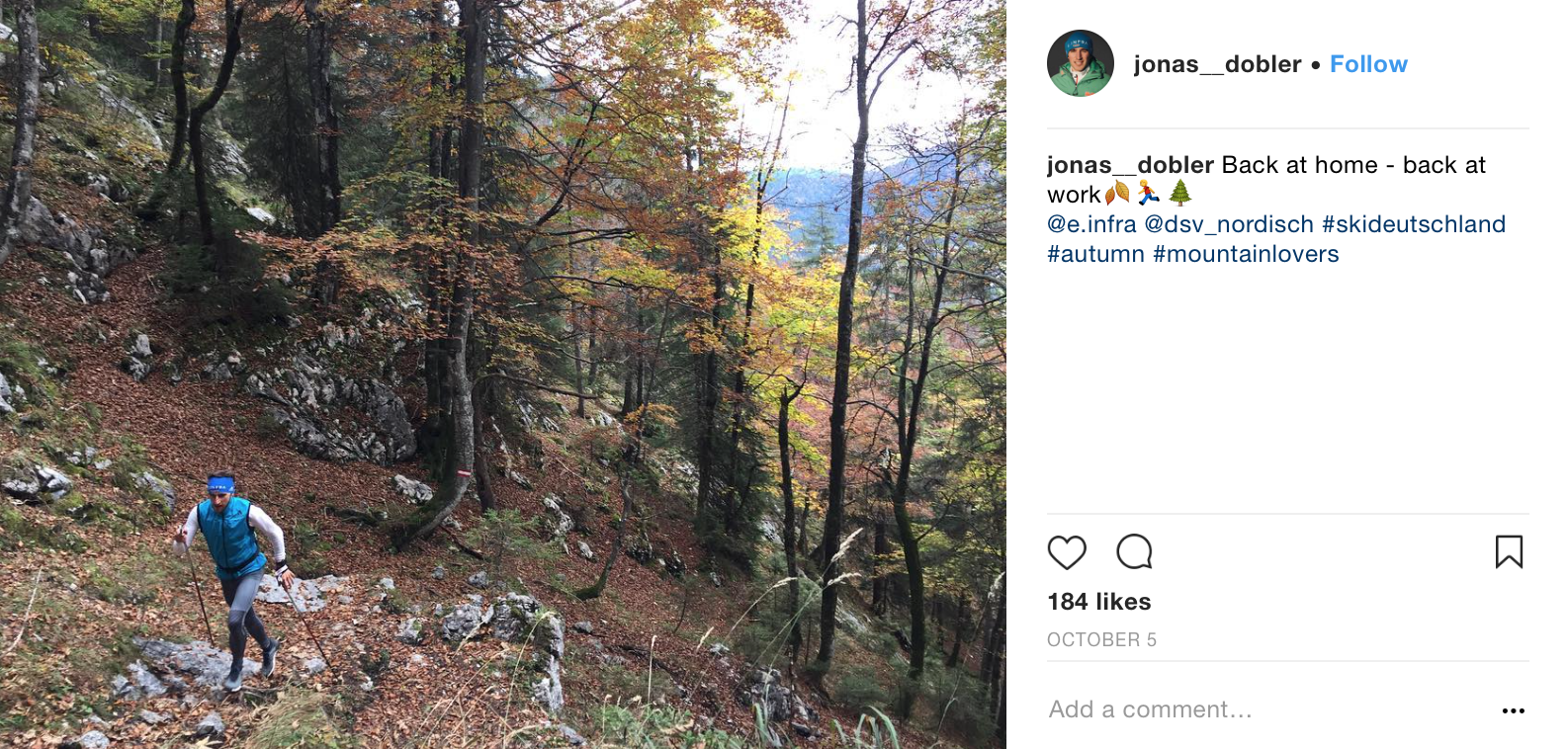
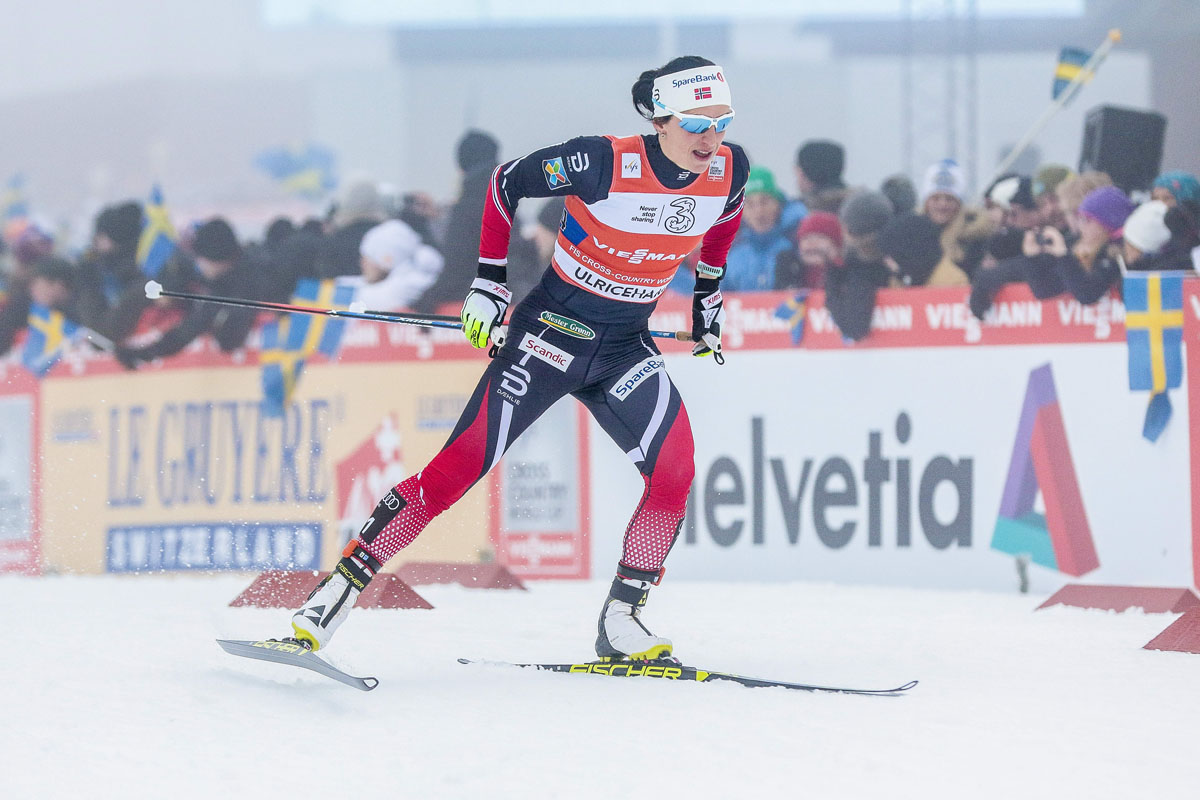
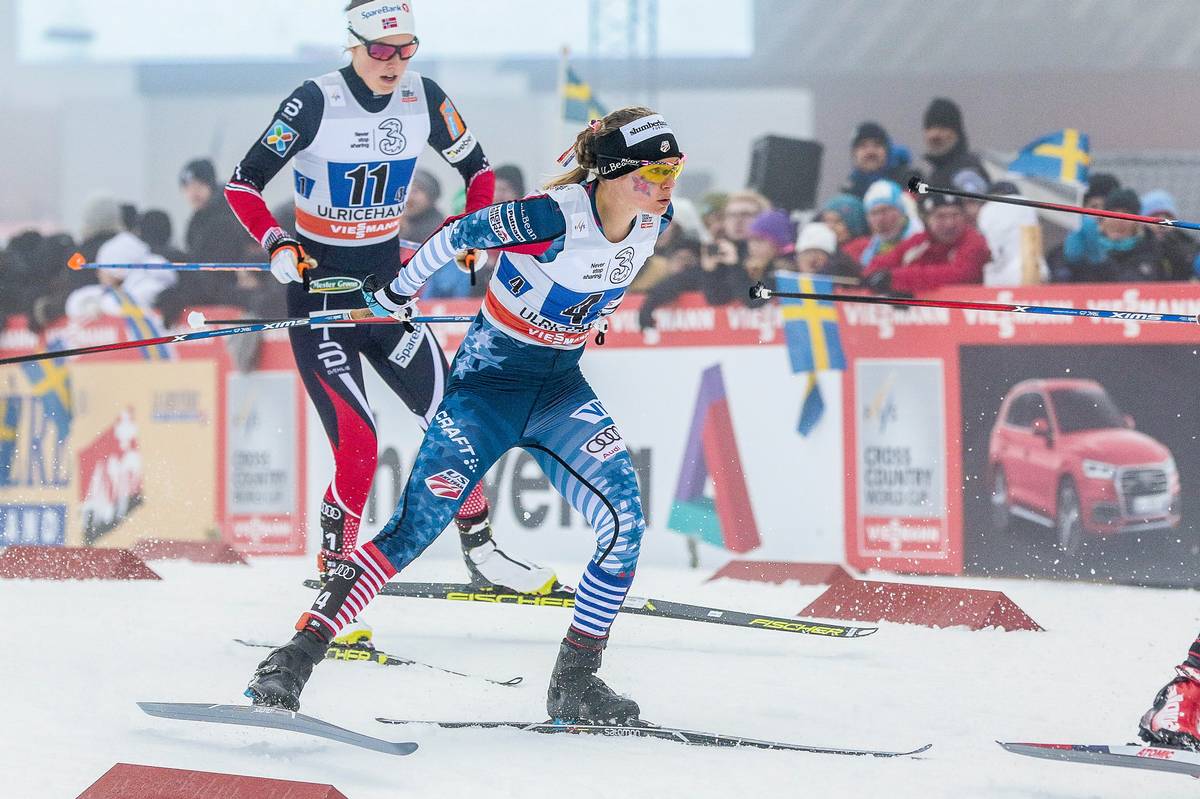
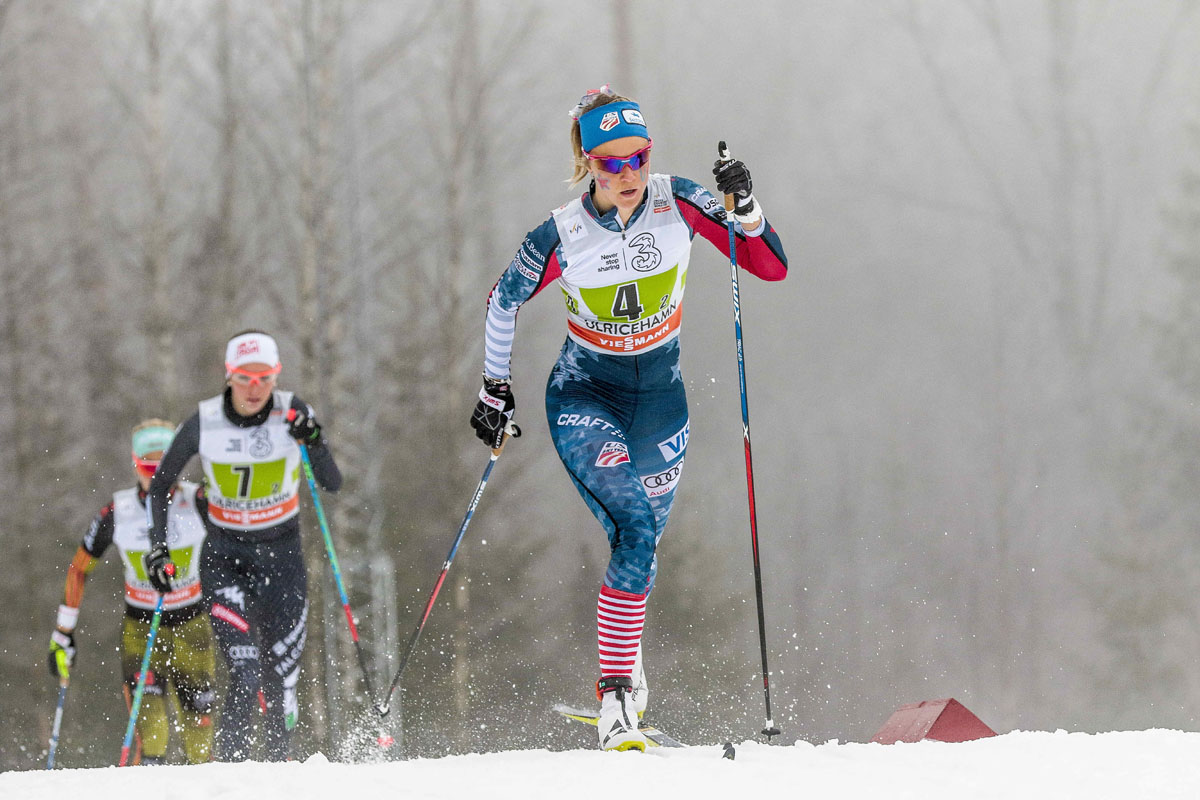
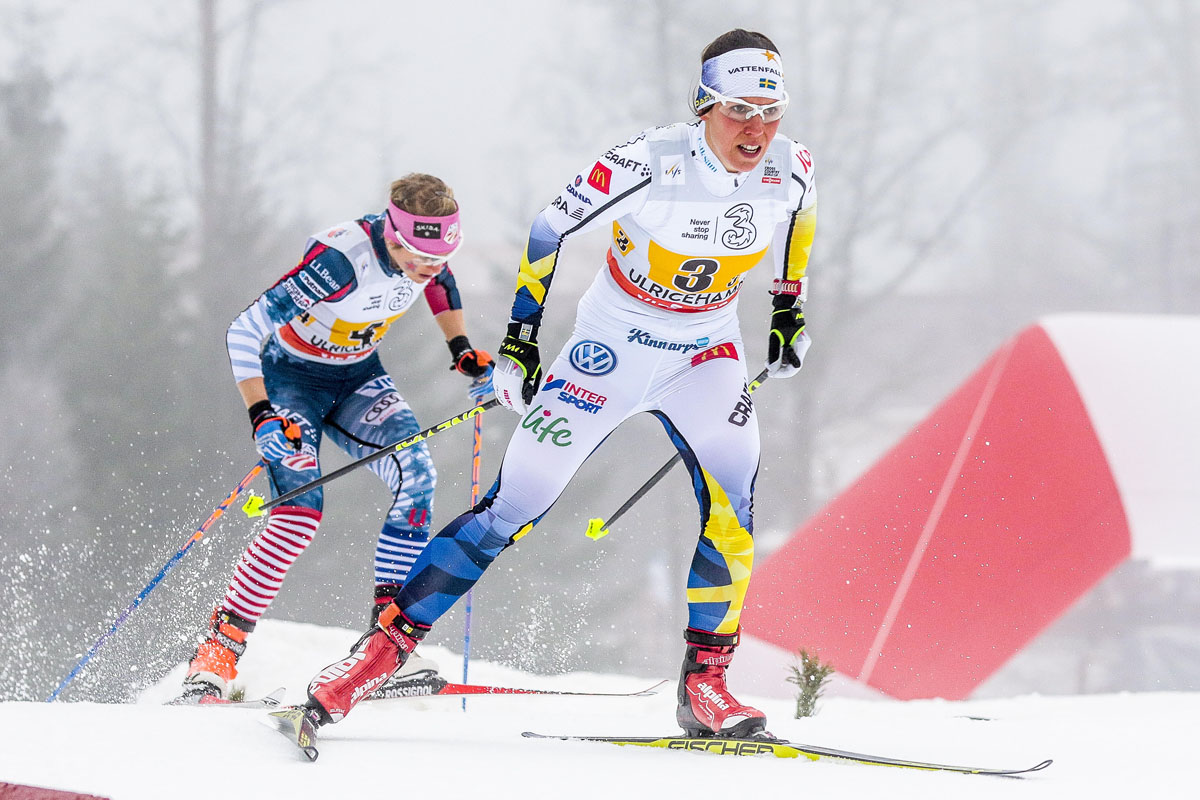
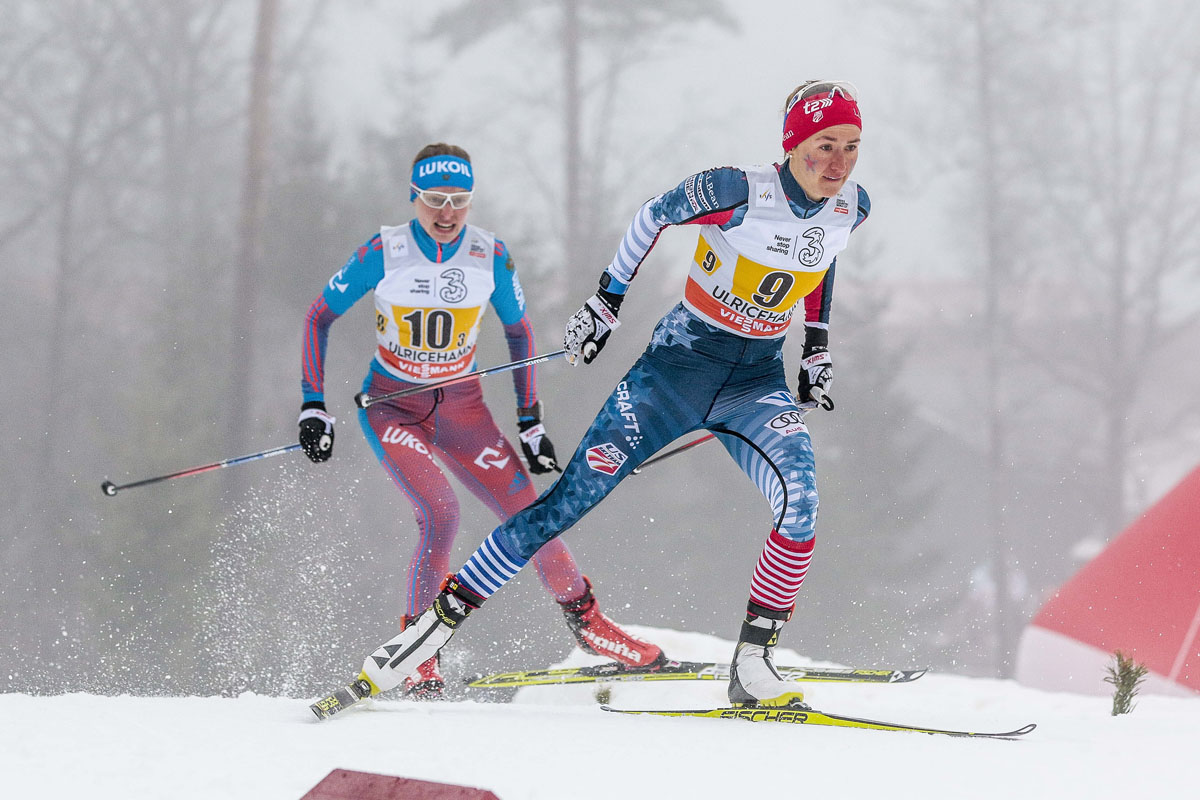
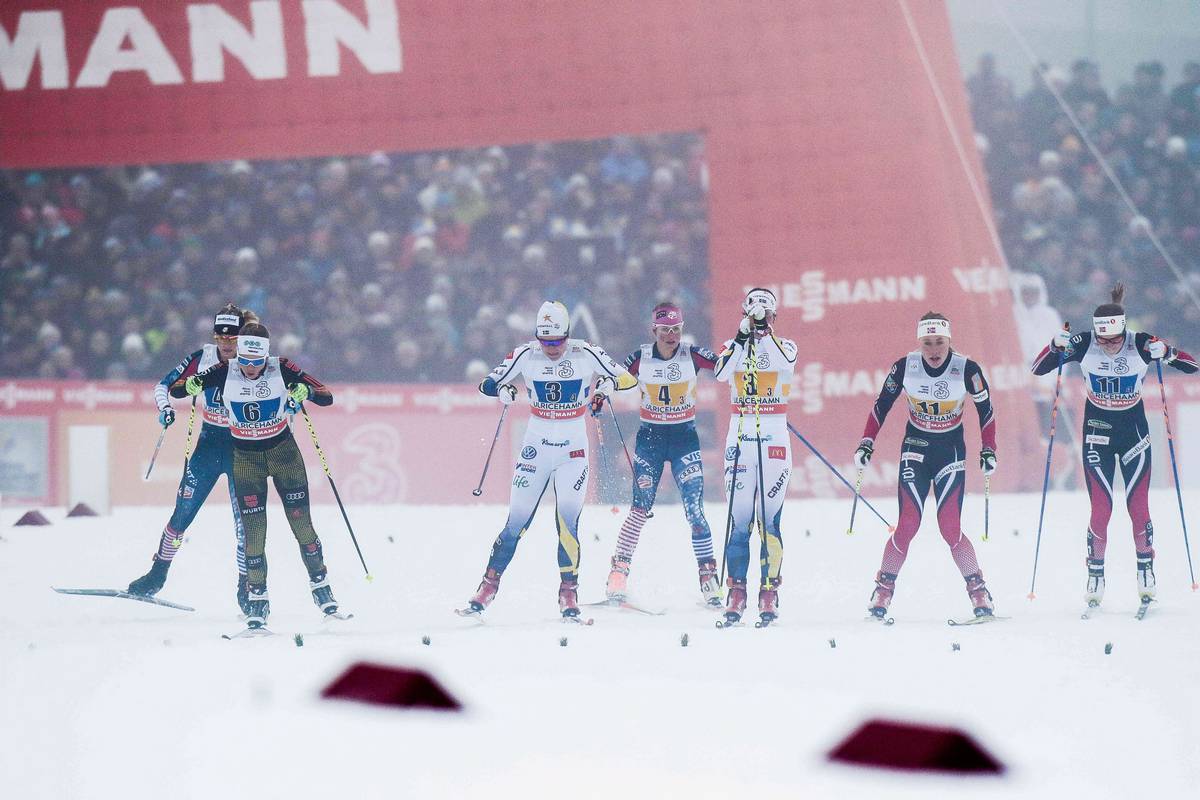
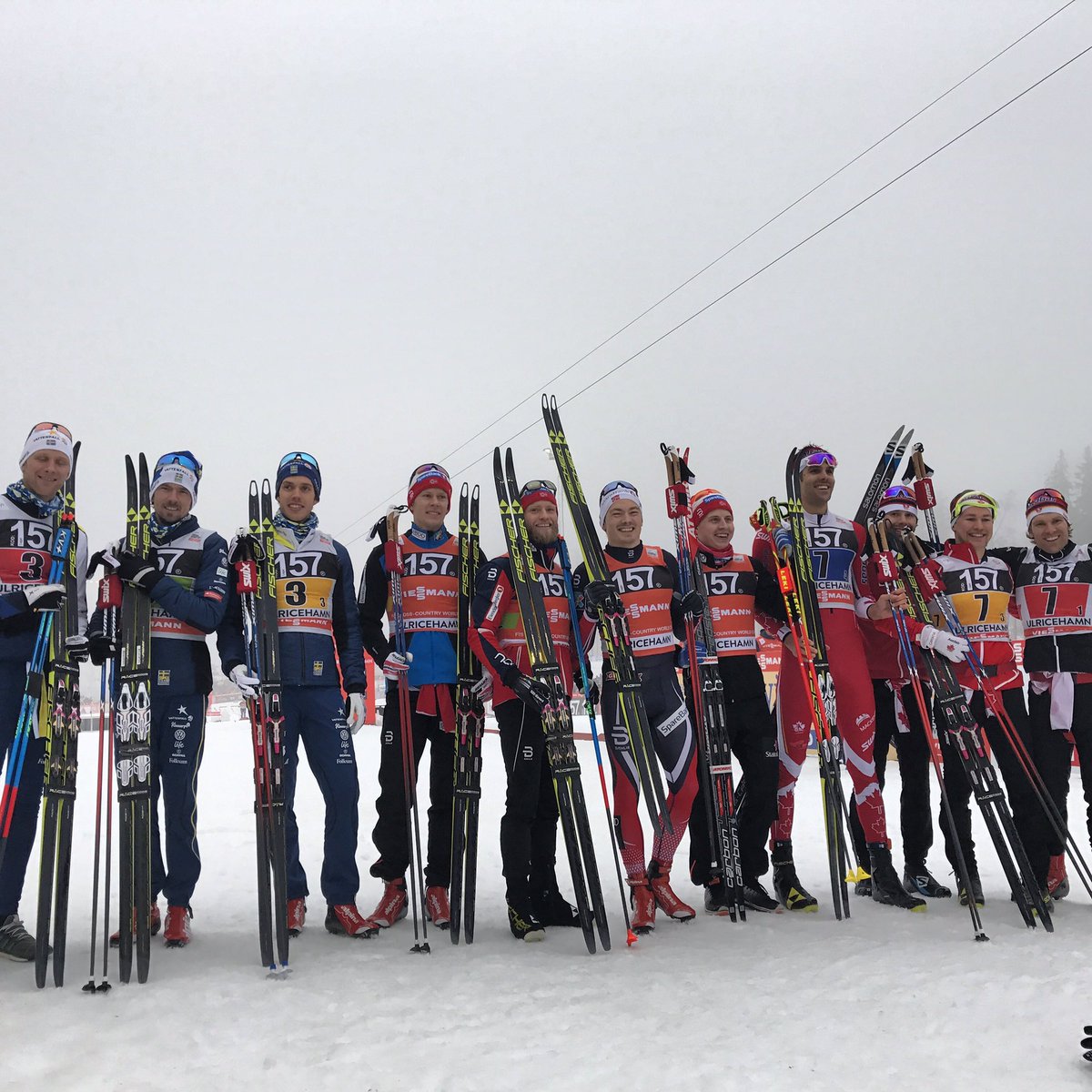
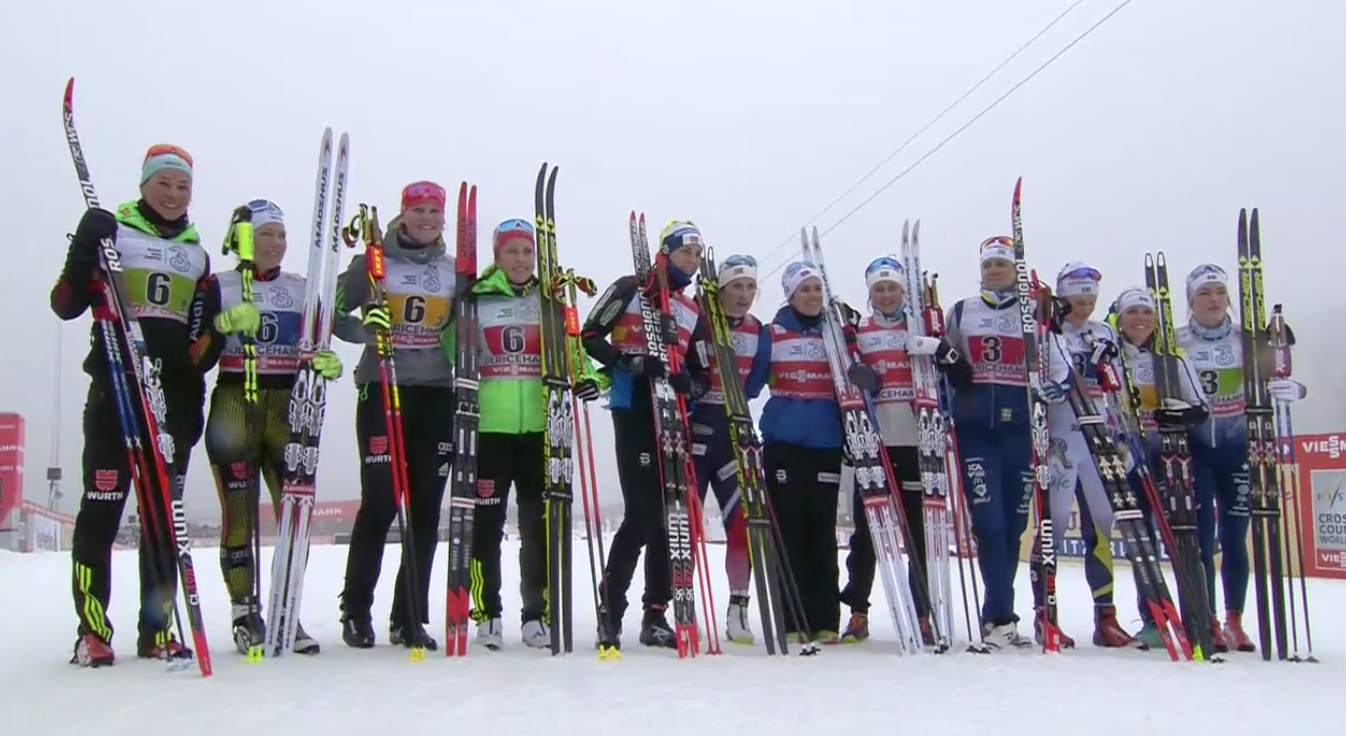
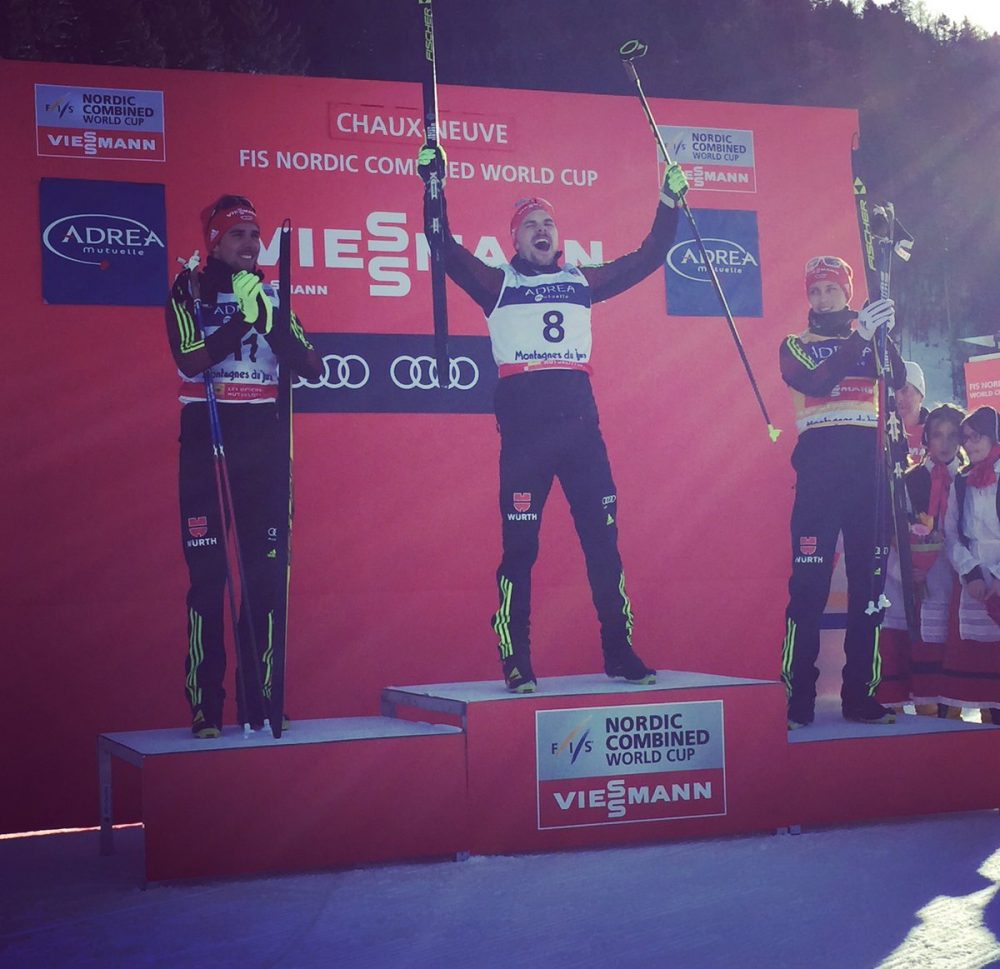
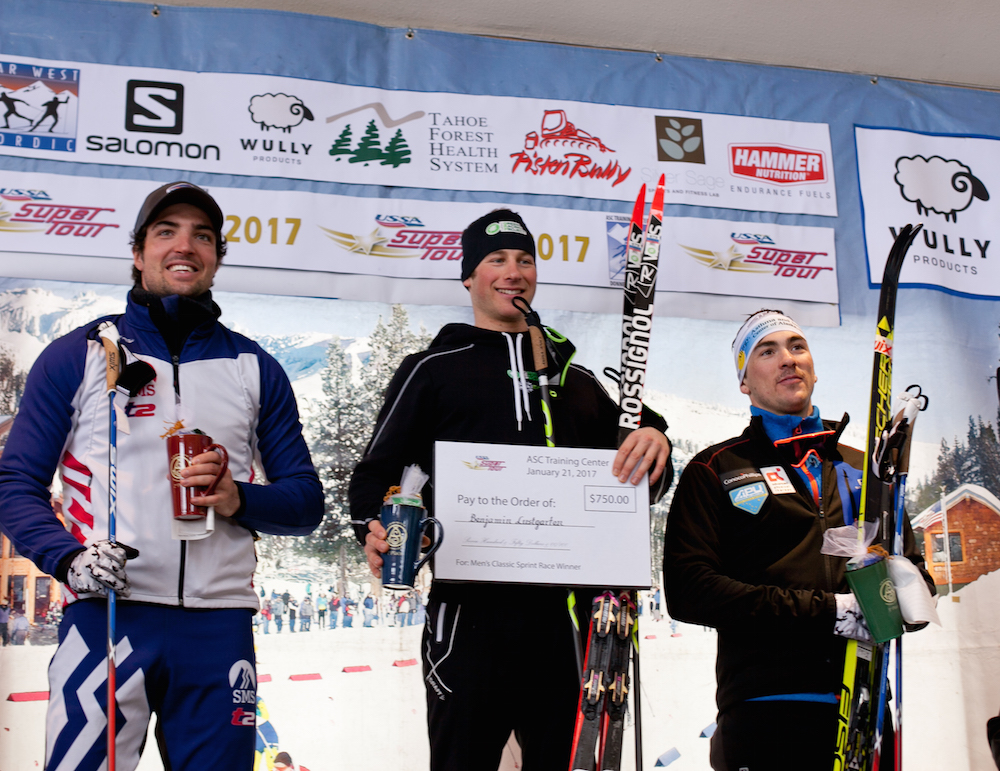
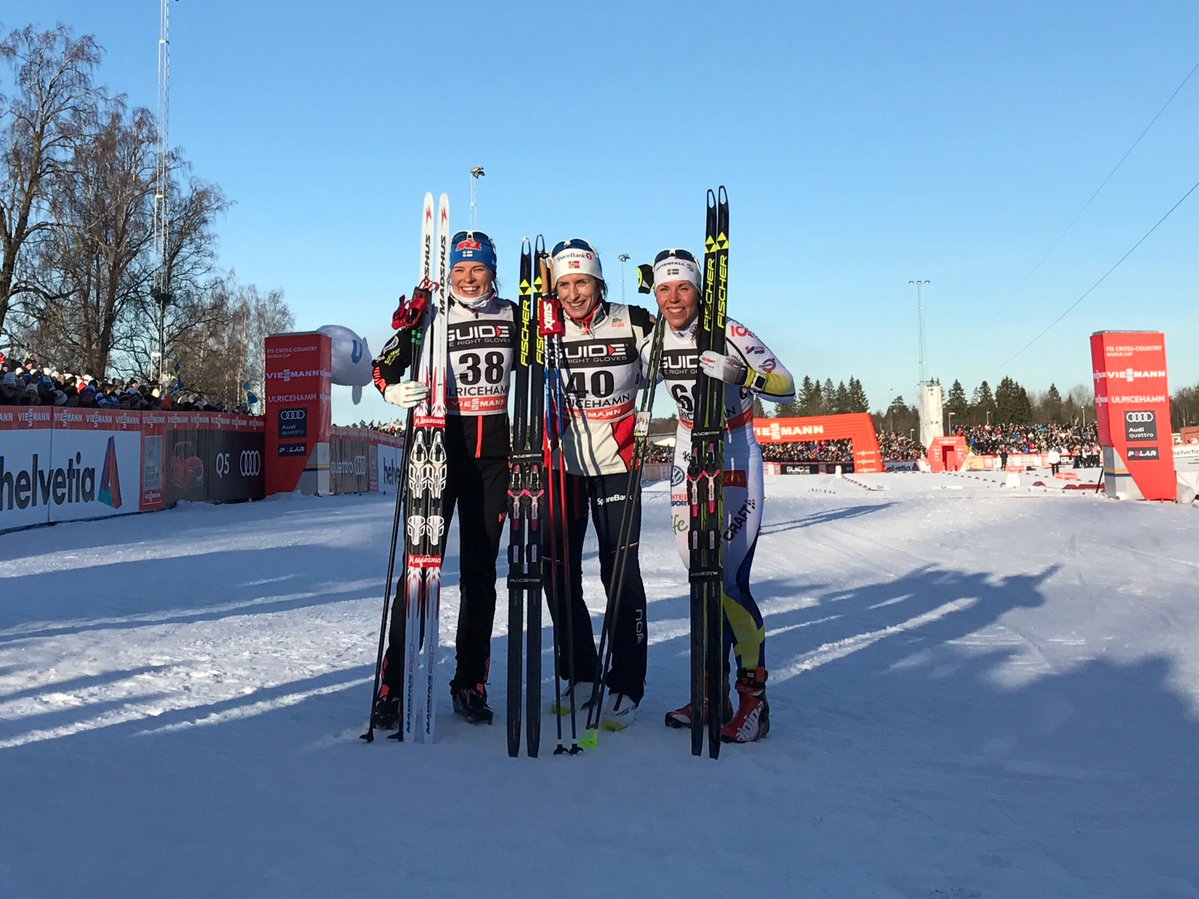
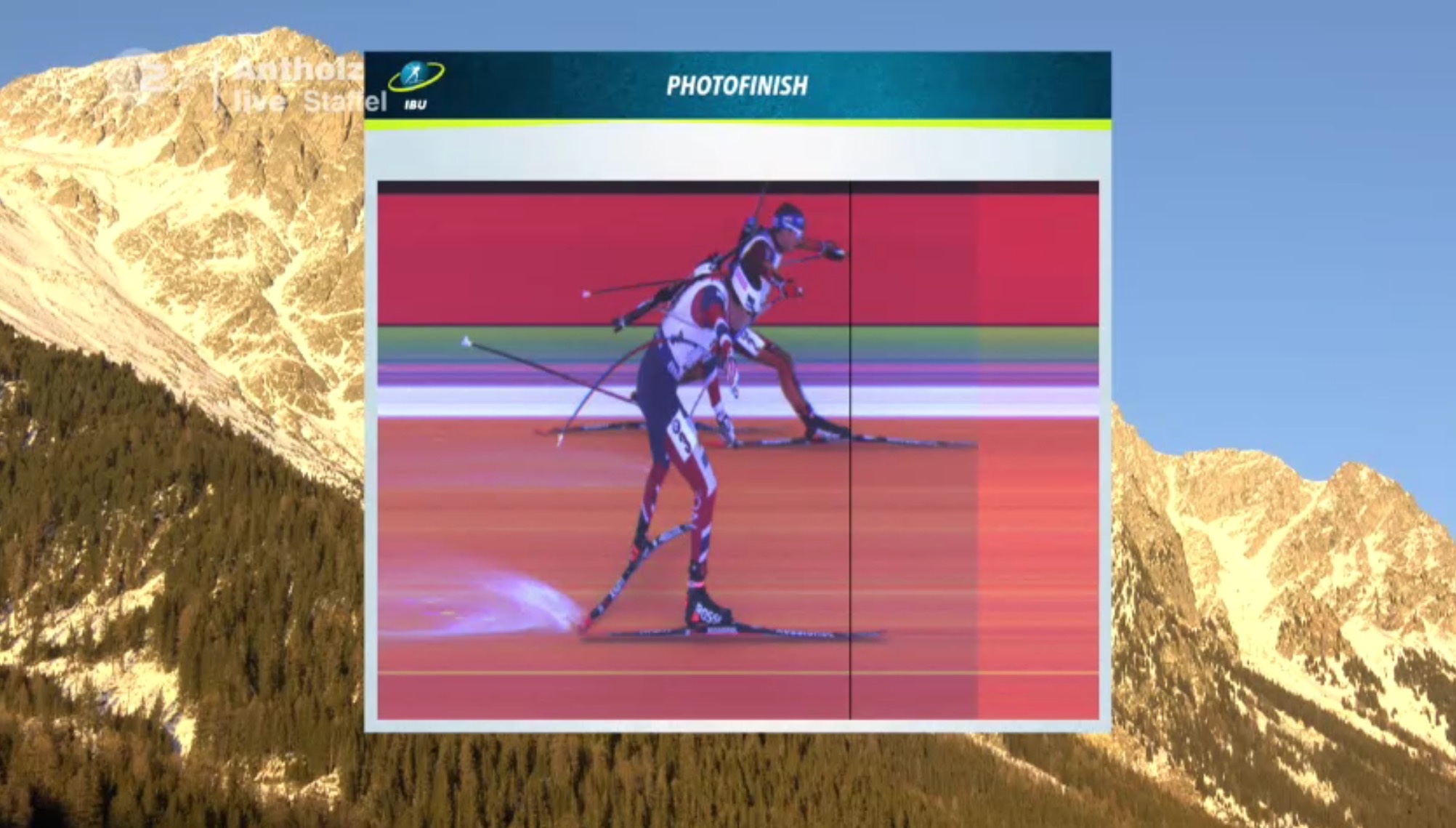
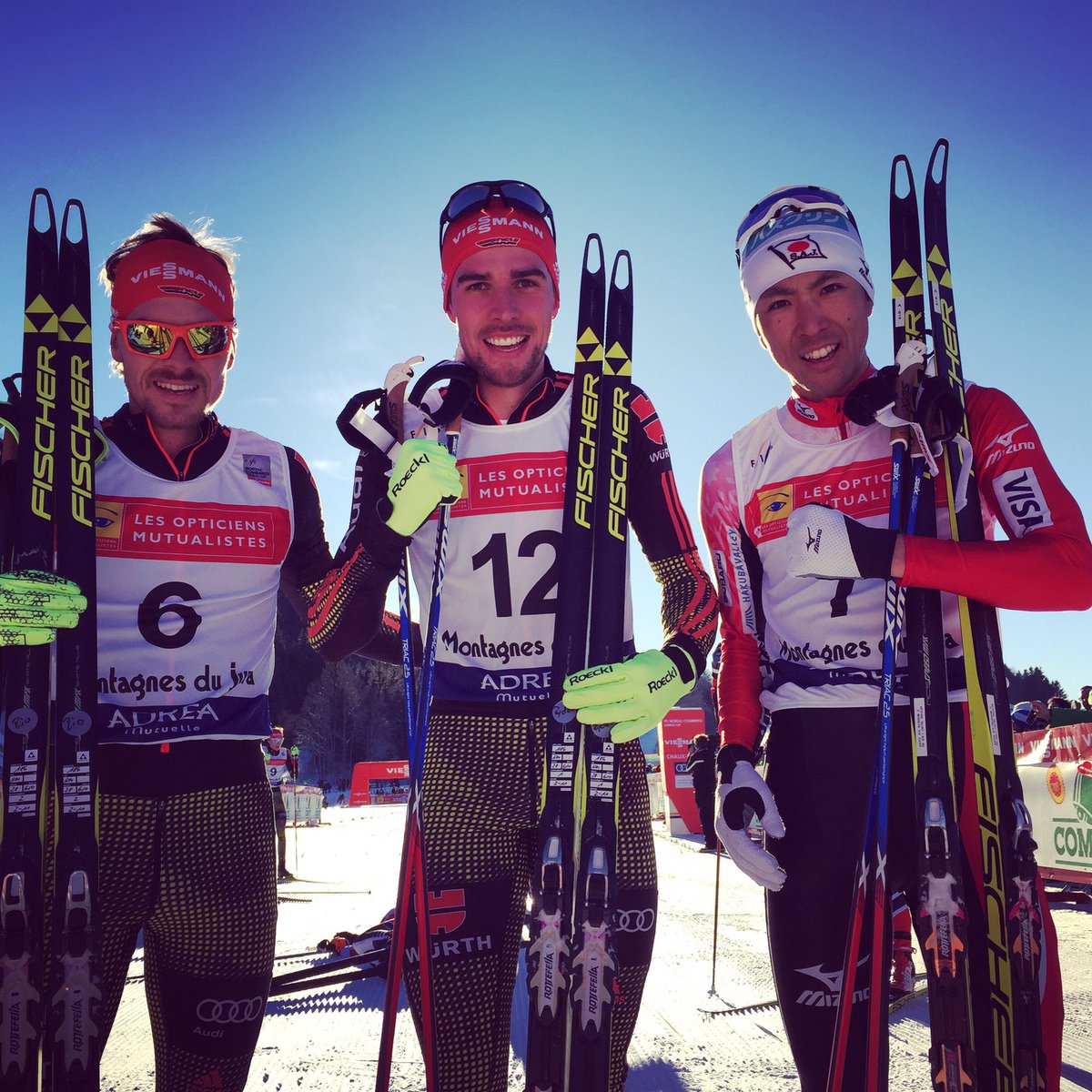
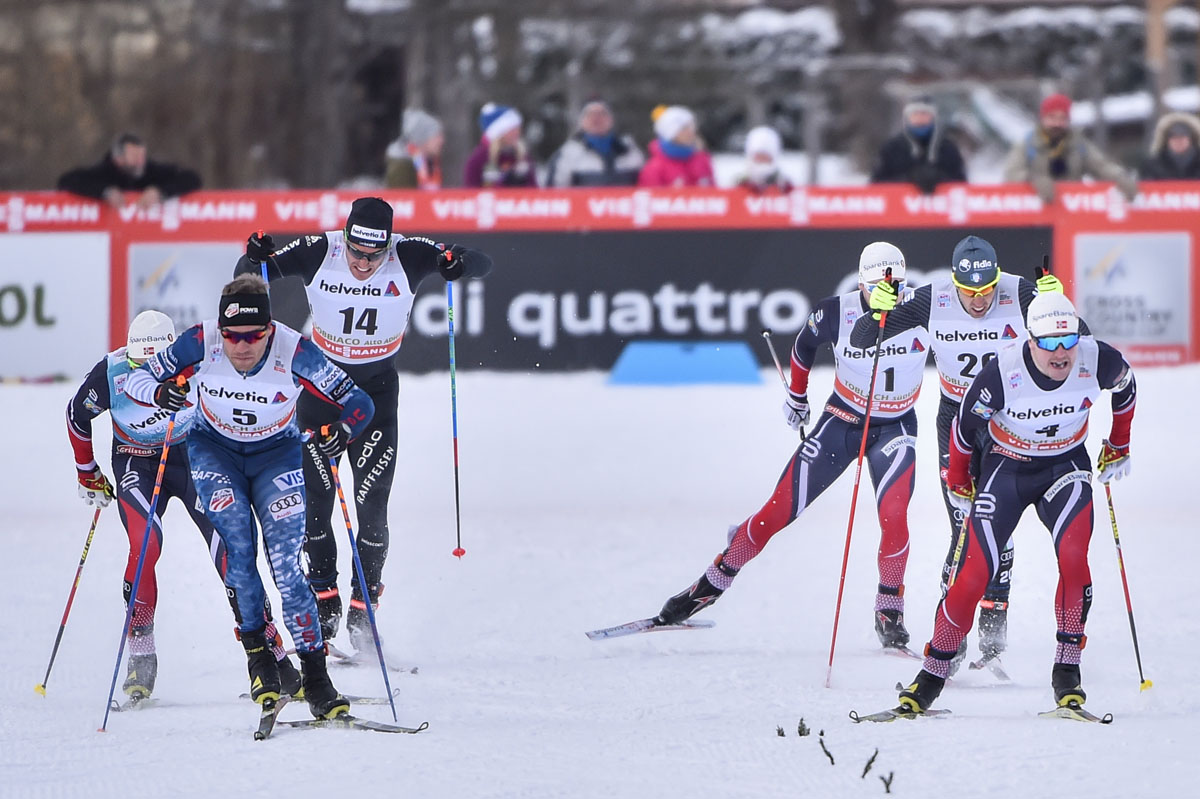
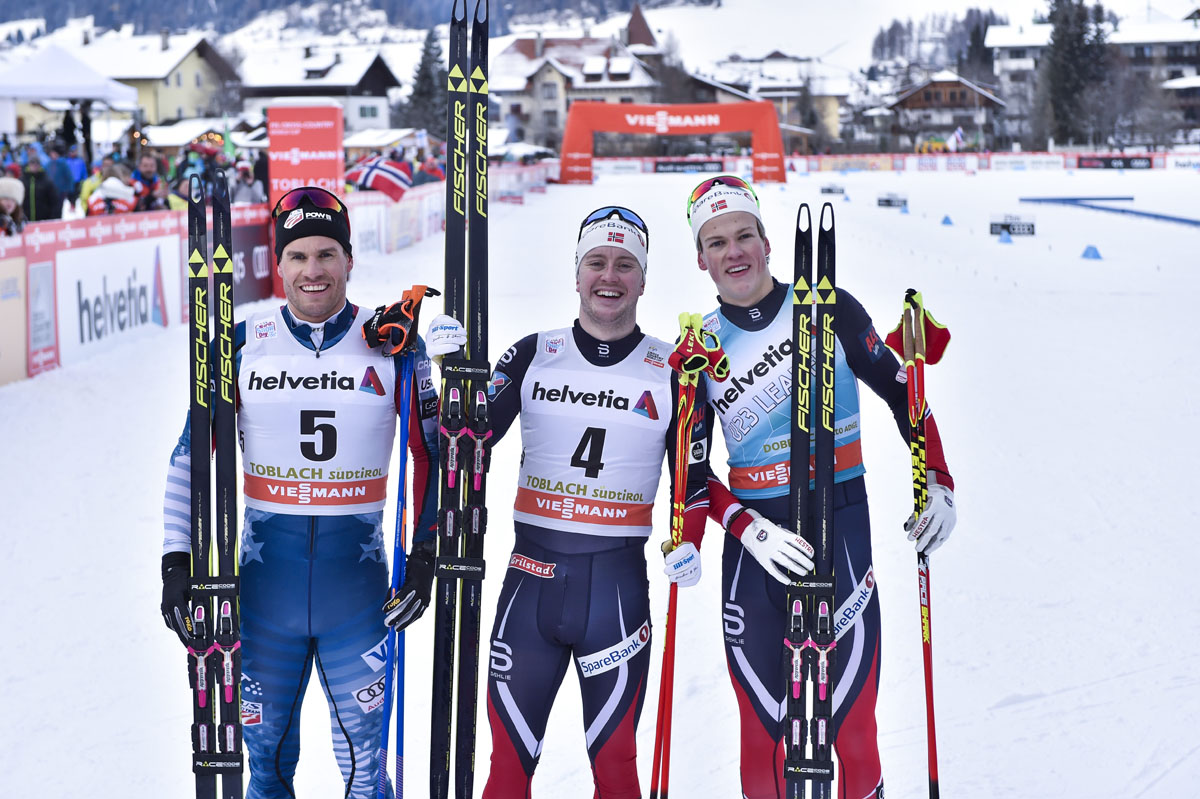
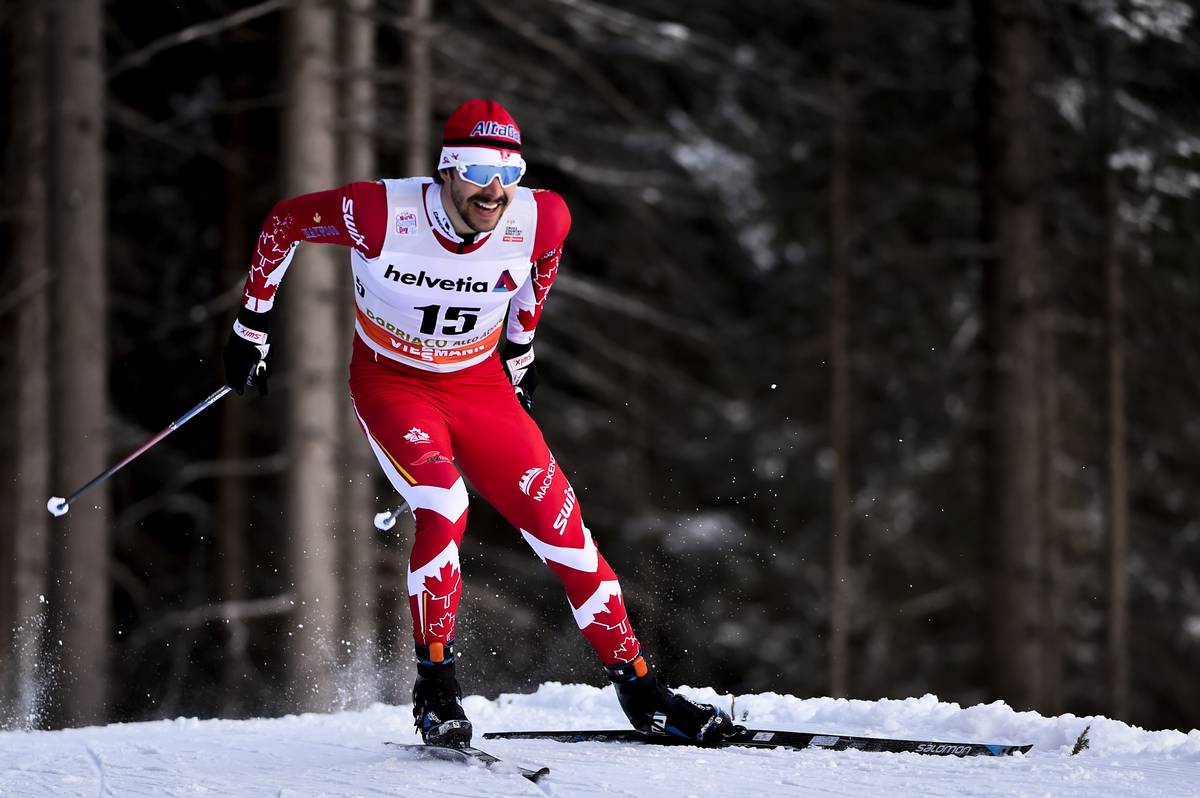
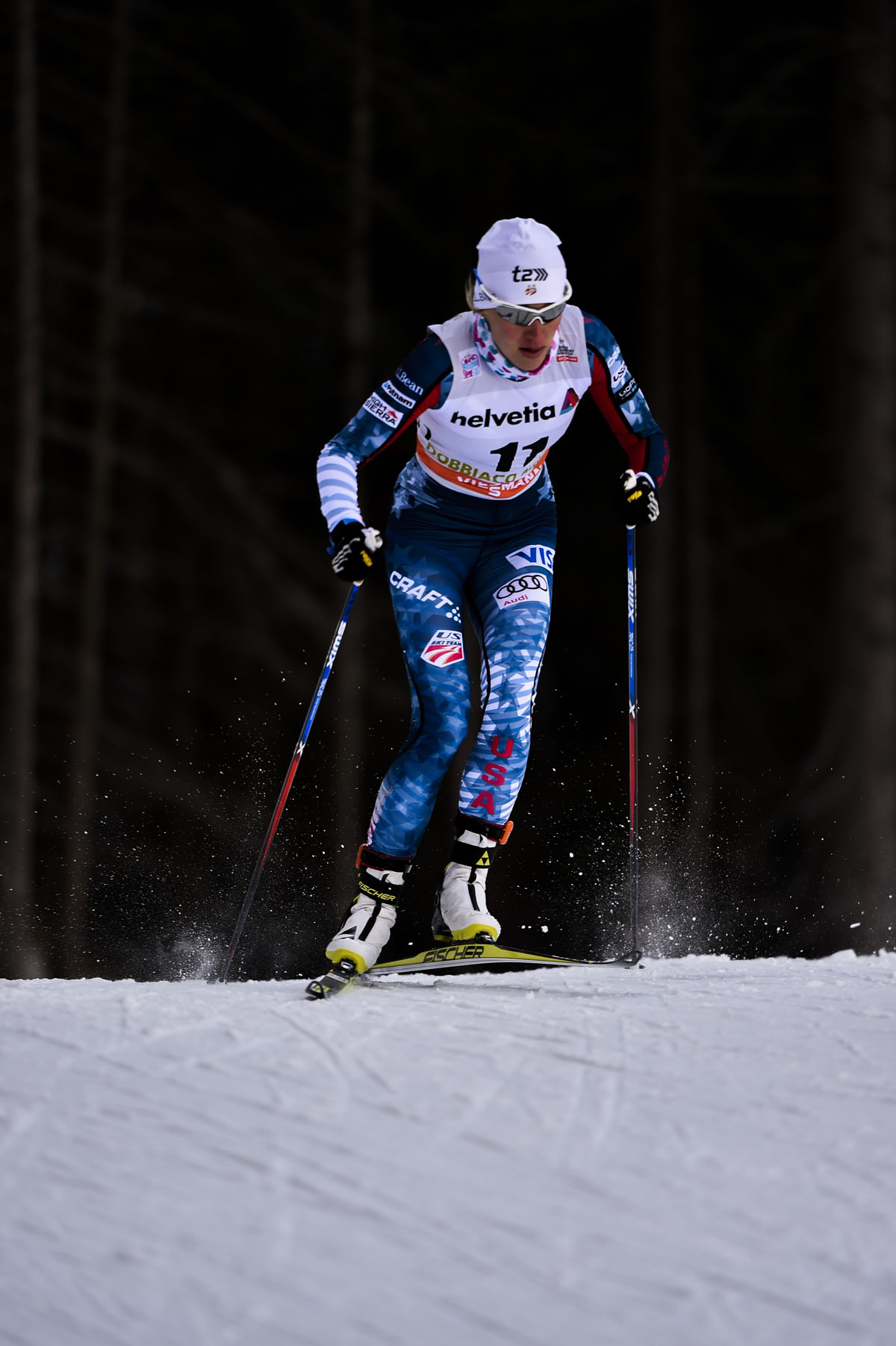
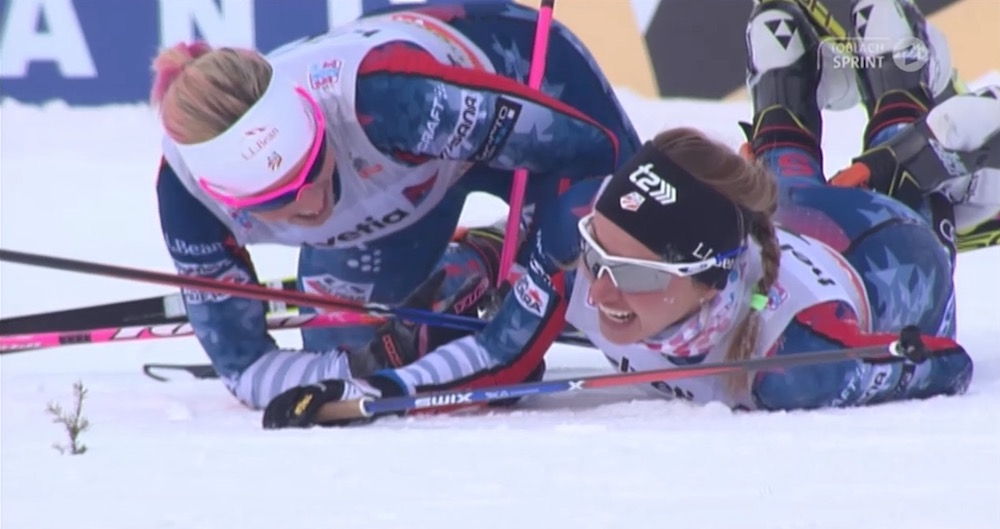
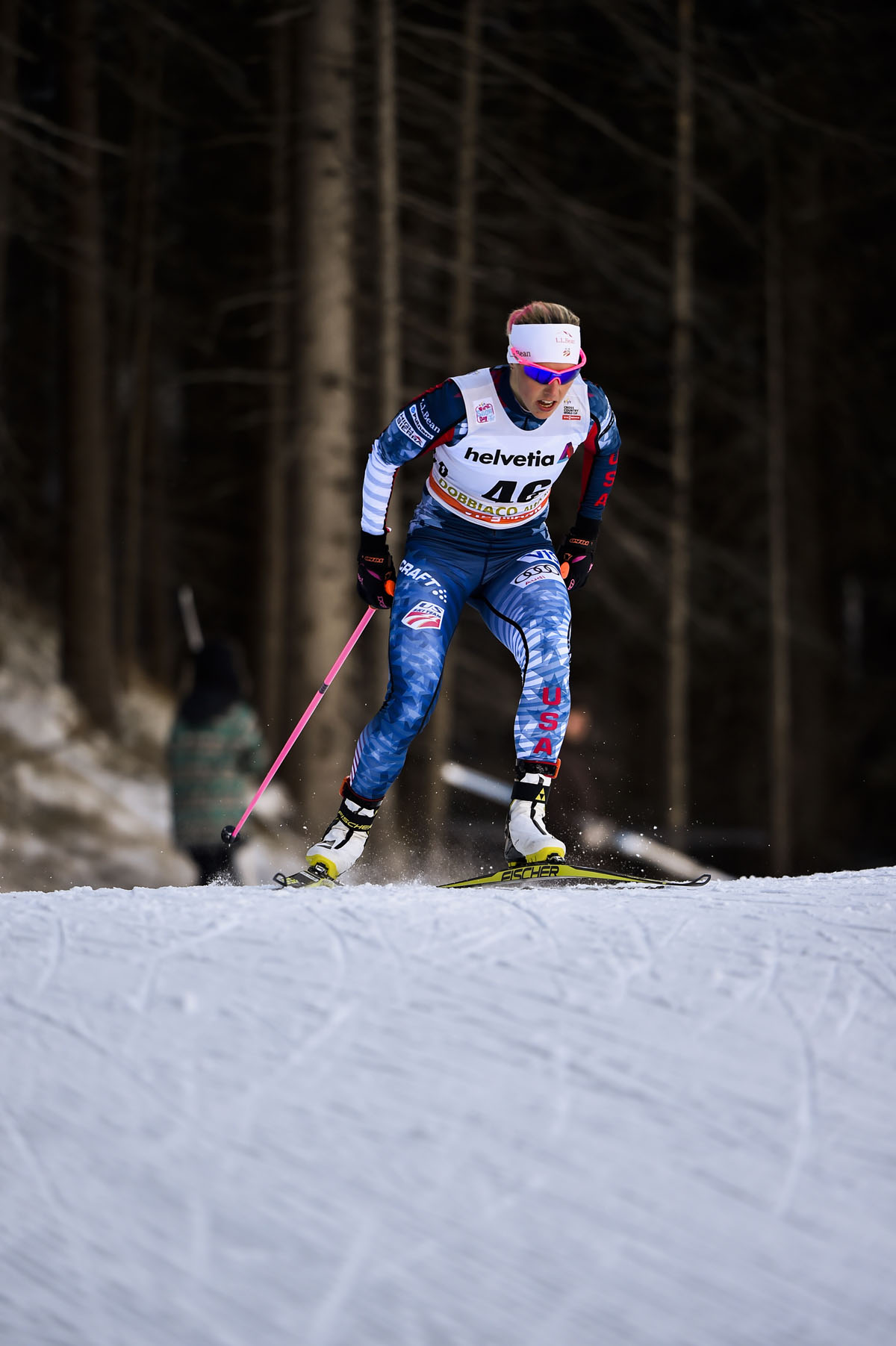
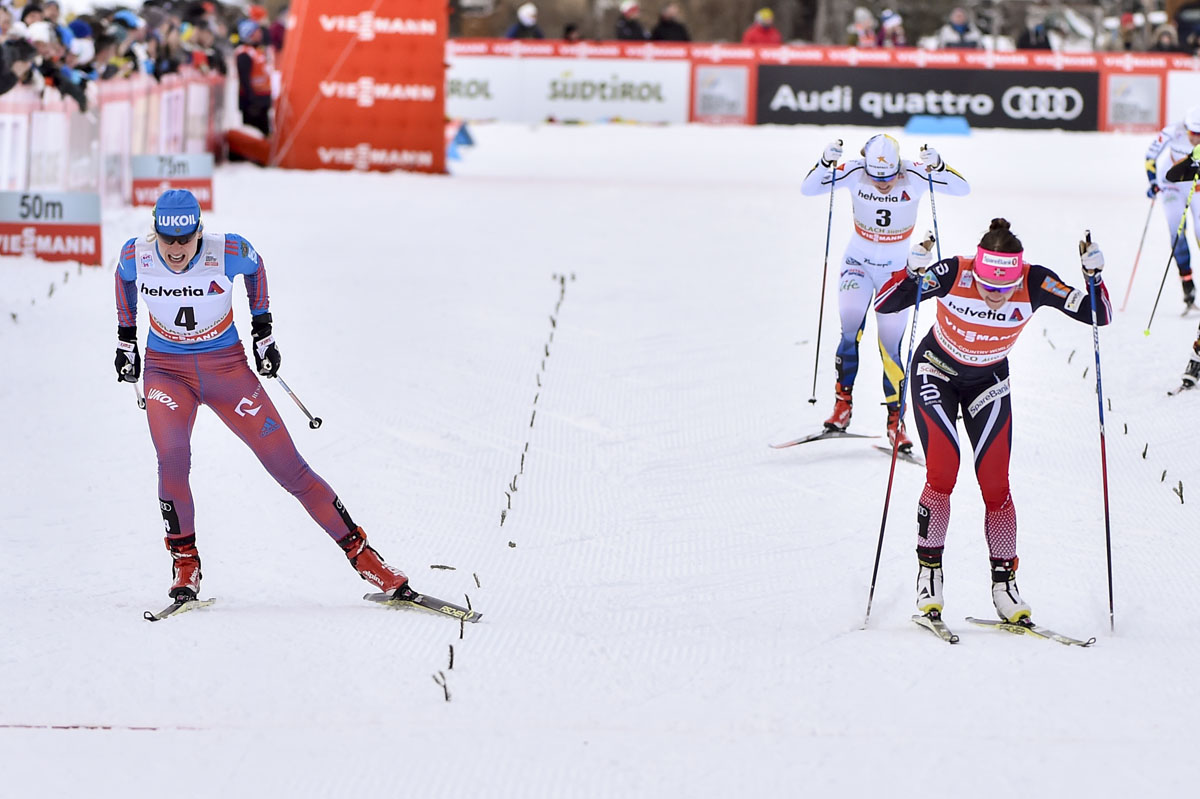
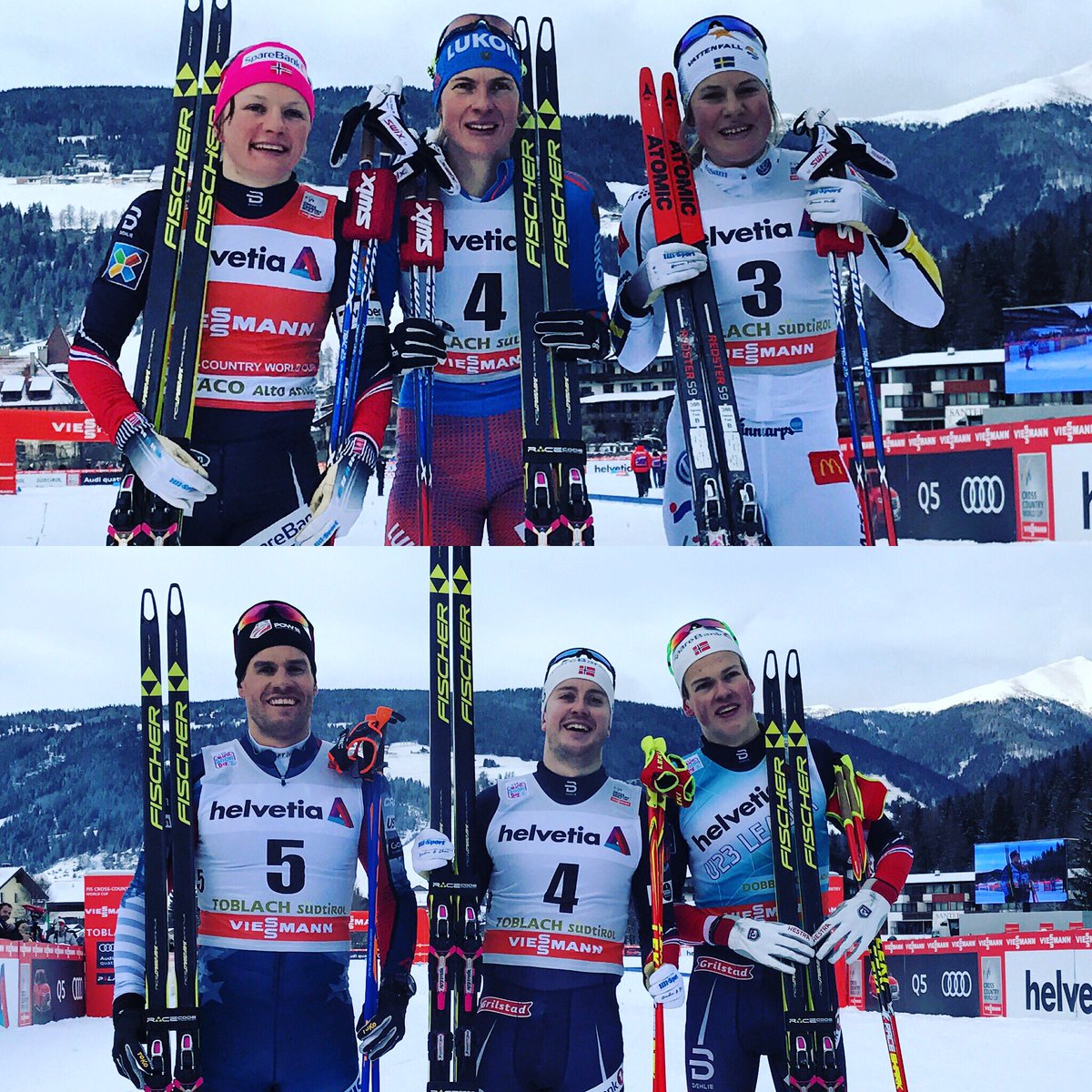
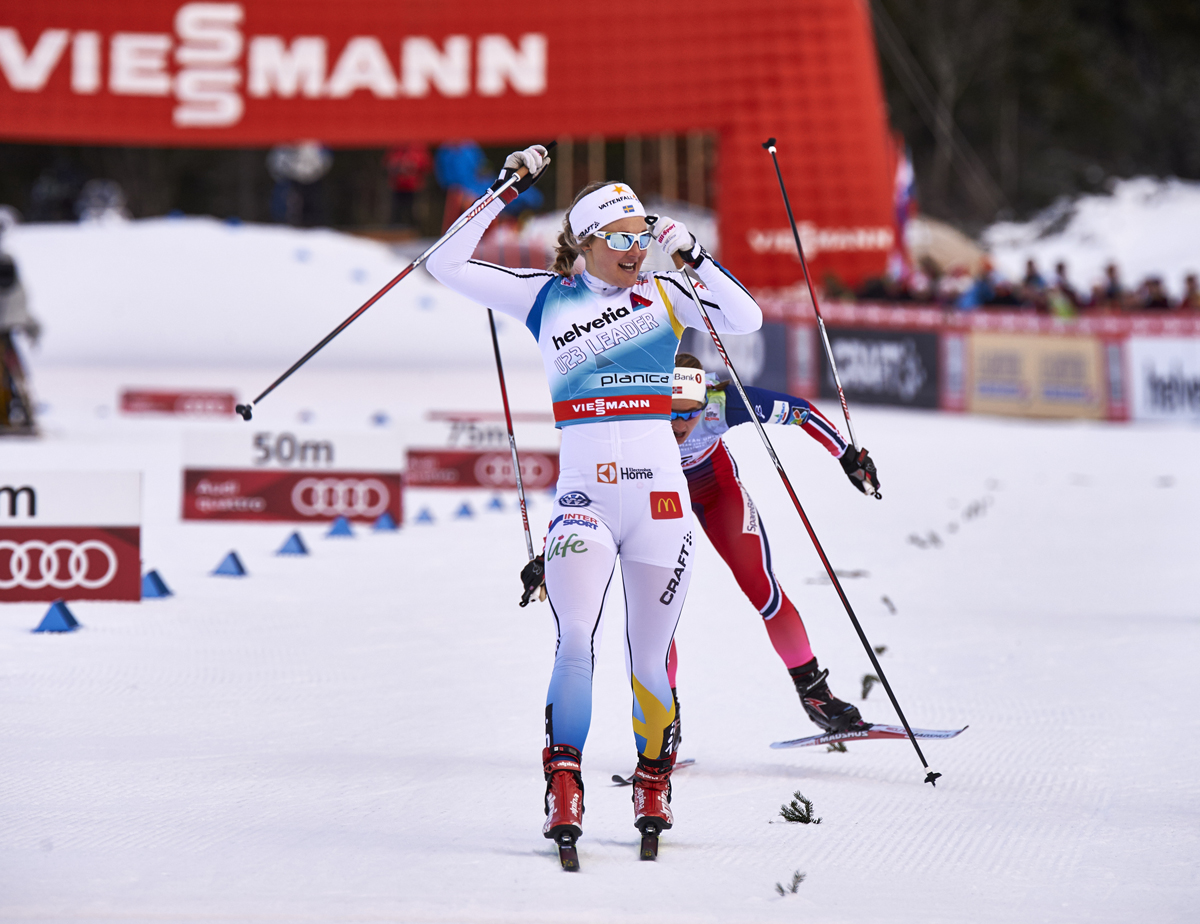
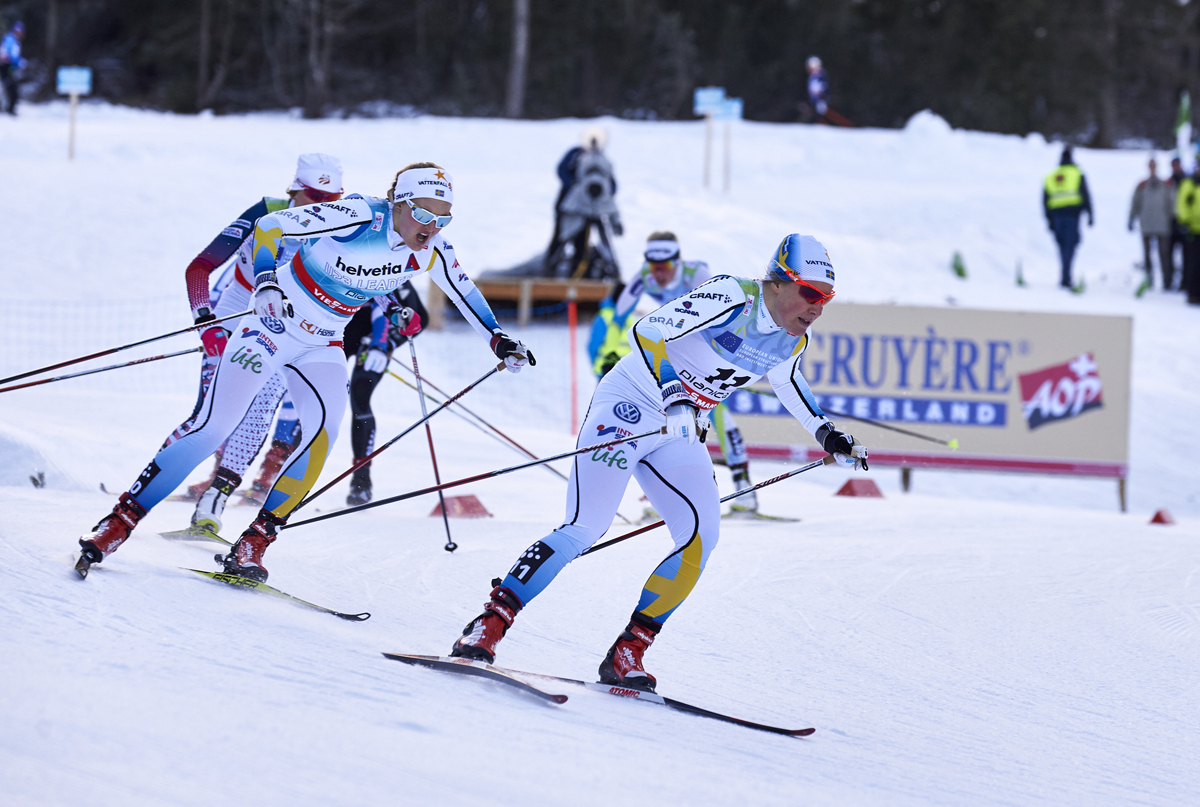
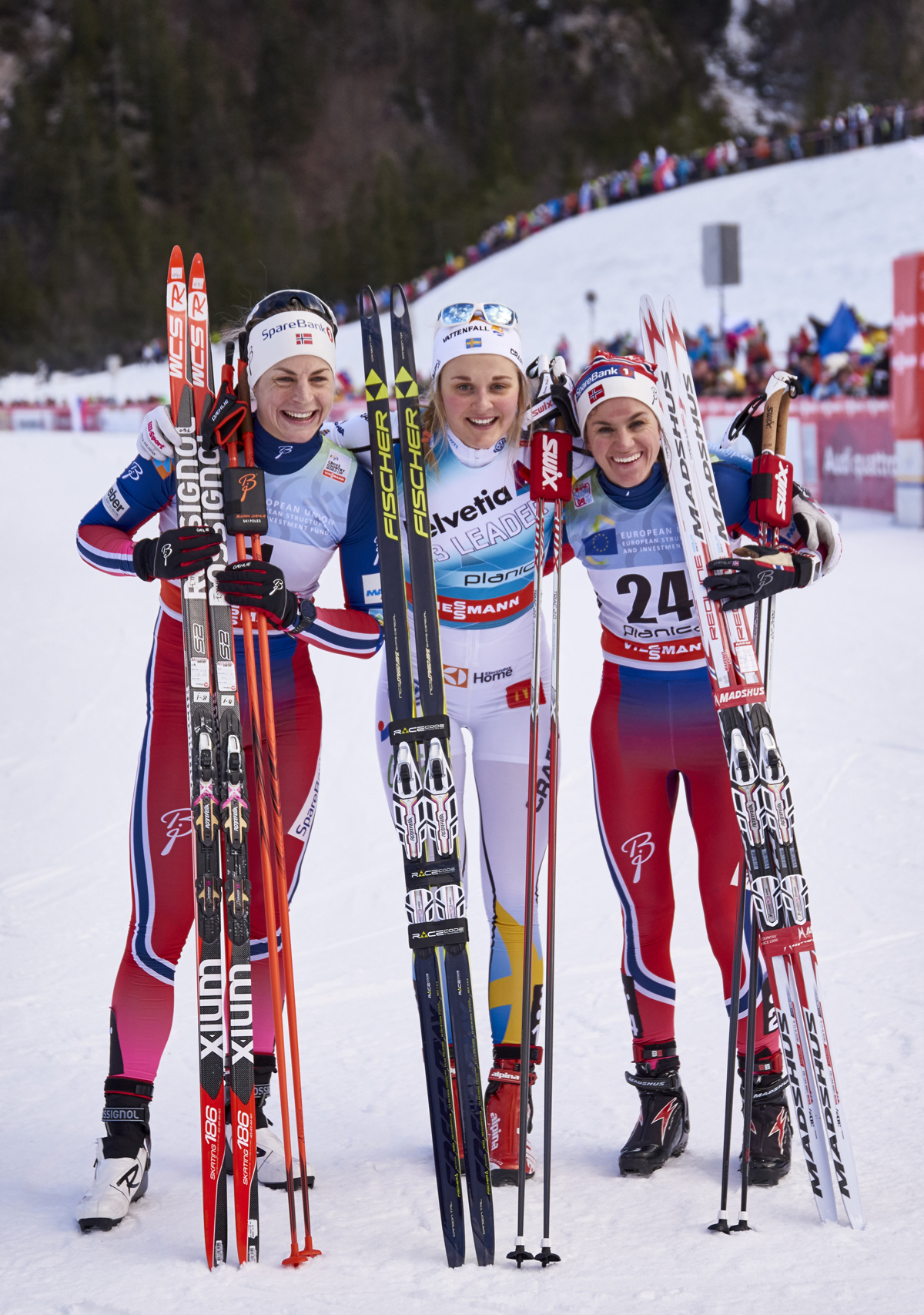
left to right Sandra Ringwald (GER), Jessie Diggins (USA), and Johanna Hagström (SWE). (Photo:Screenshot)
Until the very end of Saturday’s 1.6-kilometer freestyle sprint race in Cogne, Italy, American Jessie Diggins had those watching on the edge of their seats. She advanced as the lucky loser in her quarterfinal and then once again in her semi final, before winning the final in a lunge to the line.
“Man I am glad they do lucky losers here!” Diggins told the International Ski Federation after winning Saturday’s sprint. “It’s so fun to be in Italy, I love it here, your pasta is the best! Thank you guys for cheering so loud, this was a lot of fun!”
Diggins started the day by qualifying in seventh, 5.18 seconds off of the fastest qualifying time of 3:37.06 posted by Switzerland’s Nadine Fähndrich. She was then slotted into the first quarterfinal along with Germany’s Sandra Ringwald, Norwegians Ane Appelkvist Stenseth and Anna Svendsen, Russia’s Natalia Nepryaeva, and Diggin’s U.S. Ski Team teammate, Ida Sargent. Diggins crossed her quarterfinal in fourth, behind Ringwald in first, Nepryaeva in second and Appelkvist Stenseth in third. The fast times in Quarterfinal 1 produced two lucky losers: Appelkvist Stenseth and Diggins. She had secured a spot in the semis.
Matched up against U.S. teammate, Sadie Bjornsen in Semi final 1, Diggins crossed third behind Ringwald in second and Bjornsen first. The fast times, however, once again worked in favor of Diggins and she advanced to the finals as a lucky loser.
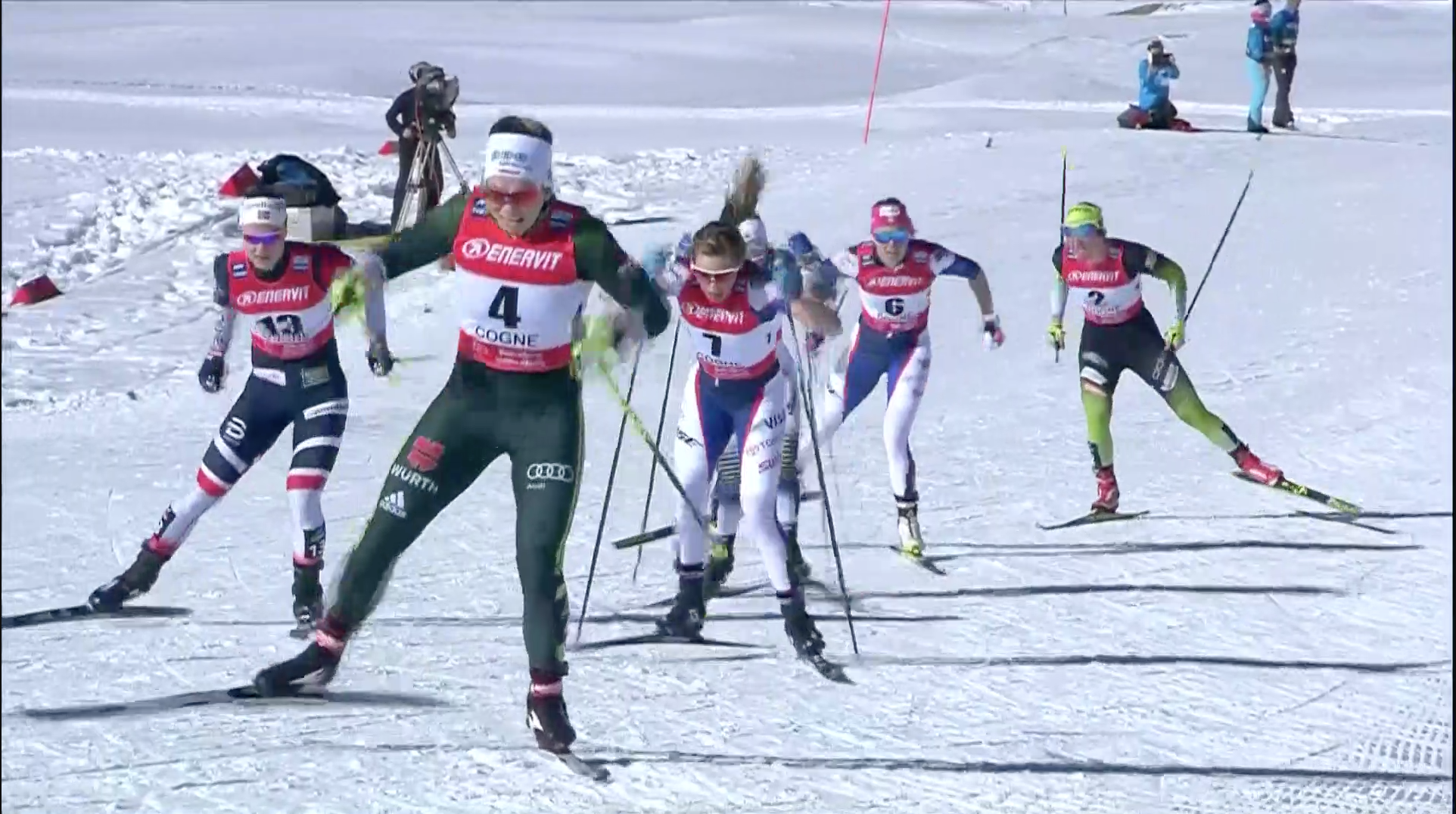
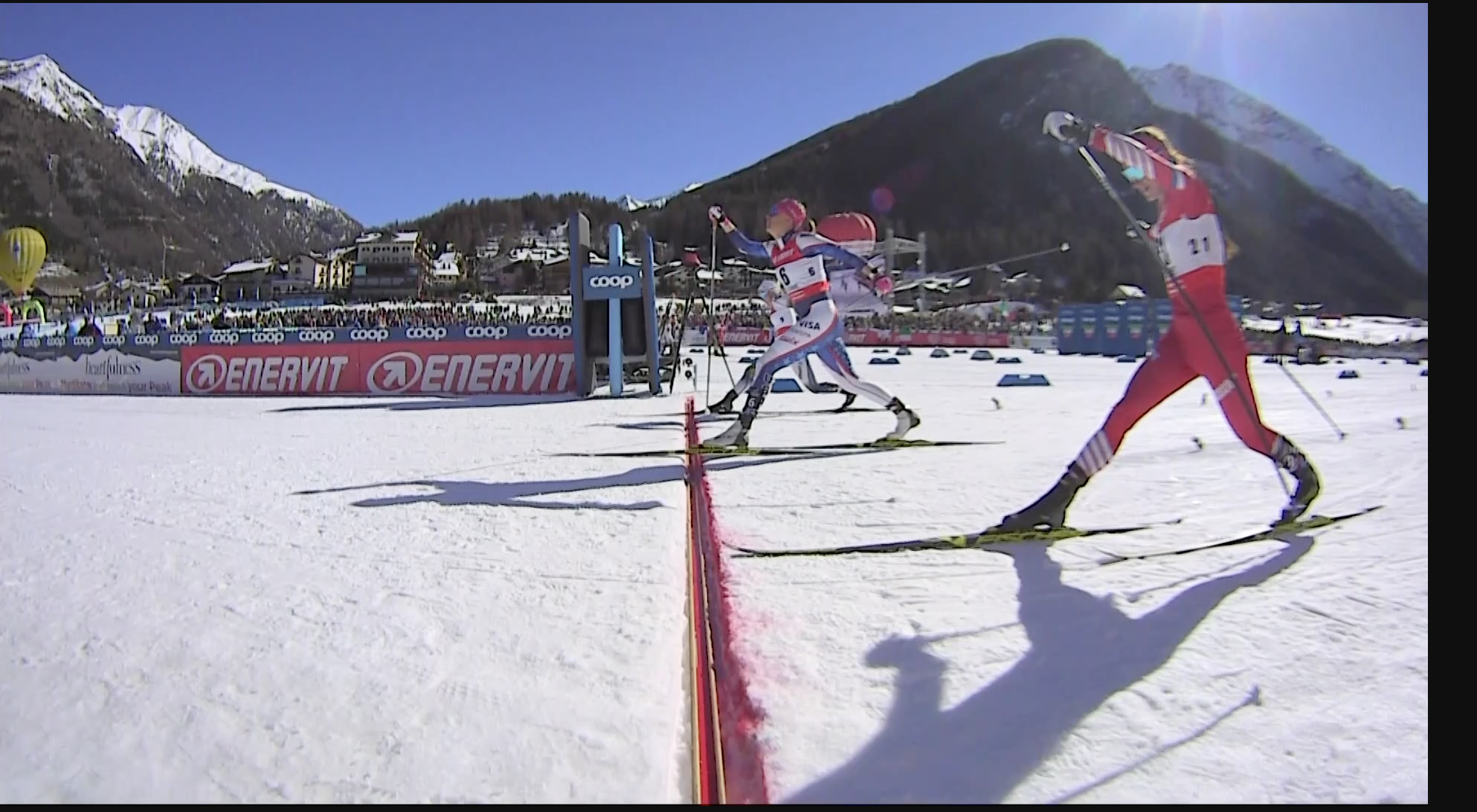
During the final, it appeared Germany’s Sandra Ringwald was on her way to the win. She made her move in the course’s major climb, gapping the field by a little more than a meter. Chasing her down were Diggins, Appelkvist Stenseth and Sweden’s Johanna Hagström. By the last hiccup of a hill before the finishing stretch, however, Diggins was closing in. With 100-meters to go she trailed the German, but by less than half a meter. The two lunged for the line, with Diggins bringing in the win. This is the first individual World Cup sprint victory for Diggins, and her first win of the 2018/2019 ski season.
“Honestly, there have been lots of ups and downs this year,” Diggins told FIS after her win. “I’ve been sick a lot, there has been a lot of doubt, and sometime losing my self-confidence. So it’s good to remember you don’t know what’s going to happen until the last 100-meters of any race, and you just have to believe in yourself and keep pushing the whole way.”
Finishing in second place overall, 0.11 seconds behind Diggins was Ringwald. After qualifying in fourth, the German skied smooth and strong, winning her quarterfinal and crossing second in her semi final. Her second place finish in the final is her first individual World Cup podium–in 2017 she earned a second place with Team Germany in the 4 x 5 k relay in Ulricehamn and in 2016, she and Hanna Kolb, who retired this spring, partnered up to take third in the Planica Team Sprint.
Sandra Ringwald (4) leading the pack, but Diggins (7) is close behind. (Photo: NBC Screenshot)
Following Ringwald, Sweden’s Johanna Hagström, crossed third on Saturday, 0.86 seconds back from Diggins. After qualifying ninth, Hagström crossed her quarterfinal in second. She went on to snag a lucky loser spot from her semi final to advance to the final. This is also her first individual World Cup podium finish.
Racer’s enjoyed blue skies and warm temperatures in Cogne on Saturday. When prompted about the course conditions Diggins told FasterSkier during a phone conversation that “It was incredibly hot, everyone was making fun of me because I was rubbing handfuls of snow over my neck and my arms, I was so hot, it was ridiculous out there, it felt like skiing in April, so sunny and gorgeous.”
These warm temperatures made for changing snow conditions, but according to Diggins, the USST wax technicians had no problem keeping up.
“Halfway through rounds we switched skis and switched structure, and they kept keeping up as the course was breaking down in the sun, and that was really impressive,” Diggins said. “With a long gliding downhill, you needed the speed today. My Salomon boards were smoking today, and I really needed that in the finishing stretch.”
“I’m just really grateful to them for all the hard work that they are always doing, you don’t see it on the TV, but you know there is a huge team of people there, just working so hard, and definitely skiing way more the we are,” Diggins added.
The next American finisher was Bjornsen who ended the day in fifth, 2.32 seconds behind her teammate Diggins. With World Championships taking place in Seefeld, Austria next week, a few U.S. skiers chose to sit out last weekend’s World Cup races in Lahti, Finland and partake instead in a training camp in Davos, Switzerland. Due to that camp, Bjornsen indicated during a phone conversation with FasterSkier that she “didn’t really know what to expect today.”
Sadie Bjornsen (USA) lunging for the win in her quarterfinal, against Johanna Hagestrøm (SWE) and Yulia Belorukova (RUS). (Photo: NBC Screenshot).
“I’m definitely starting to feel a bit better than I have for a while, so I was encouraged by that,” Bjornsen said. “I was pleasantly surprised to find quite good feelings today, so that’s really nice right before World Champs.”
Prior to Saturday, Bjornsen explained that her race strategy was to lead as little as possible during the heats. However, that changed, she said, after she saw her teammates Diggins and Sophie Caldwell ski their quarterfinals. also talked
“It looked so stressful to me to try to make moves, so I ditched my plan and decided I was going to go back to my leading plan and I’m really happy I did,” Bjornsen said.
“In the semifinal, I tried a new tactic to try to stay in the front, but maybe not the front-front because we had a stacked semifinal and that also worked quite well, and I saw that I had some extra power in that final uphill so when I finished my semi I was like ‘oh man, I can win today, I feel amazing!’” she said.
By the final, however, Bjornsen’s energy reserves were burning low.
“Going into the finals, I could feel right away a little bit of a power outage, but when I went over the top of the climb, I was like ‘the race is not over until it’s over so I’m going to keep fighting because I know I can be strong until the last uphill,’” she said.
In the final uphill Norway’s Appelkvist Stenseth maneuvered in front of Bjornsen, breaking her momentum.
“Getting stopped like that and having to go again, I didn’t have that final gear to do that,” Bjornsen said.
Following the two women in the final, the U.S. had four more top 30 results, with Julia Kern placing just outside the top ten in 11th, Sophie Caldwell 17th, Ida Sargent 24th and Rosie Brennan 27th.
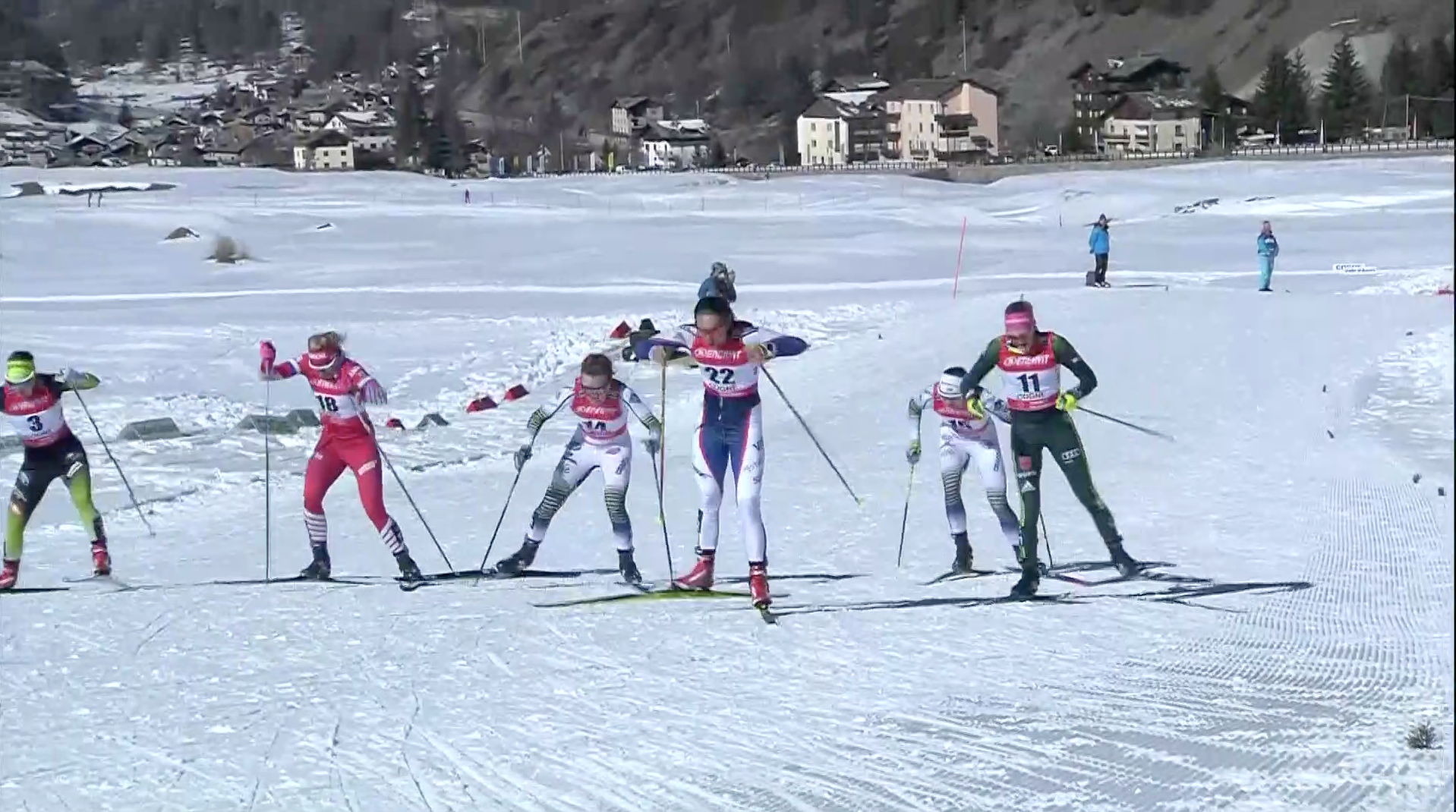
Racing in Quarterfinal 4, Kern was up against Germany’s Laura Gimmler, Sweden’s Linn Sömskar and Moa Lundgren Russia’s Tatiana Aleshina and Slovenia’s Alenka Cebasek. In the first climb, Kern charged to the front and kept the front charging pace through skied into second place during her quarterfinal. In the second semi final, Kern crossed sixth to place 11th overall.
“I was in the fourth quarterfinal so I was able to watch the heats before me on the jumbotron and get advice from my teammates who raced in the earlier heats. We noticed that people were getting boxed in so my tactic was to ski as close to the front as possible. I ended up leading my quarterfinal, similar to what Sadie’s tactic ended up being in her quarterfinal.”
Prior to Saturday’s finish, Kern’s career best World Cup result came in the Dresden city sprint this year where she finished 19th.
Julia Kern (22) taking the lead before the first climb during her quarterfinal. (Photo: NBC Screenshot).
Caldwell crossed fourth in her quarterfinals and did not advance to the semis. Brennan and Sargent also did not advance past the quarterfinals.
“I love racing in Italy!” Brennan wrote in an email to FasterSkier. “It’s beautiful here and the courses are quite different from many other World Cup courses so it’s been a great change of pace.”
Brennan was one U.S. athlete who chose to sit out last weekend’s World Cup races in order to complete the Davos training camp.
“I had a great training camp in Davos and am feeling much better so I was optimistic for today’s race.” Brennan said. “The qualifier went well and I’m always excited to get a shot at the heats. I did a really poor job of skiing to my strengths in my heat and struggled a bit with my skis so I am disappointed in how things went there. I am excited to see where my distance shape is tomorrow!”
Also skiing for the U.S., Kelsey Phinney finished in 33rd, 1.03 seconds outside of qualification.
Four Canadian women raced on Saturday, with Dahria Beatty leading the way in 38th. The next Canadian finisher after Beatty was Cendrine Browne in 48th, followed by Maya Macisaac-Jones 49th and Katherine Stewart-Jones 51st.
Norway’s Maiken Caspersen Falla taking the World Cup win in the 1.4 k skate sprint in Lahti, Finland. Sophie Caldwell of the U.S. Ski Team placed second. (Photo: fis-ski.com screenshot)
FIS World Cup Lahti, Finland 1.4 k/ 1.6 k Freestyle Sprint
In the women’s skate sprint qualifier in Lahti, Finland Slovenia’s Eva Urevc laid down the fastest time in 2:40.67 minutes. Swiss skier Nadine Faehndrich was the second fastest qualifier, 4.21 seconds back, with the U.S. Ski Team’s (USST) Sophie Caldwell third (+4.36).
Canada’s Dahria Beatty qualified 25th (+10.21). Also making the heats for the U.S. were Ida Sargent (USST) in 26th (+10.36), and Kelsey Phinney (SMS T2) in 27th (+10.54).
Of the top three qualifiers, only Caldwell advanced to the finals. The final was won by Norway’s Maiken Caspersen Falla in 2:43.64. Falla advanced to the finals as a lucky loser from the first semifinal. That semi was won by Caldwell who ended up placing second (+0.11) in the final. Sweden’s Maja Dahlqvist sprinted to third overall (+0.37).
Germany’s Sandra Ringwald placed fourth (+0.46), Norway’s Mari Eide fifth (+0.75), and Tiril Udnes Weng of Norway sixth (+0.94).
Phinney placed 19th overall, Sargent 30th. Canada’s Beatty was 24th in the final standings.
Also for the U.S., Julia Kern (USST D-Team) coming off of illness ended her day 38th overall. Hannah Halvorsen (USST D-Team) placed 41st.
Johannes Høsflot Klæbo won the men’s 1.6 k skate qualifier in 2:47.01 minutes. He was followed by teammate Haavard Solaas Taugboel in second (+4.15). Qualifying in third was Finland’s Joni Maeki who clocked a time of 2:51.36.
Klæbo won the final in 2:52.06 while Italy’s Federico Pellegrino raced to second (+0.30). Norway’s Finn Hågen Krogh was third (+0.61). Also from Norway, Eirik Brandsdal took fourth (+1.31) and Emil Iversen fifth (+1.75). Gleb Retivykh of Russia was sixth (+2.08).
No North American men qualified for the heats.
Logan Hanneman (APU) for the U.S. placed 32nd overall after missing the heats by .22 seconds. Simi Hamilton (USST) finished 36th overall, and Erik Bjornsen (USST) 42nd.
Evan Palmer-Charette was the lone Canadian entered; he placed 67th.
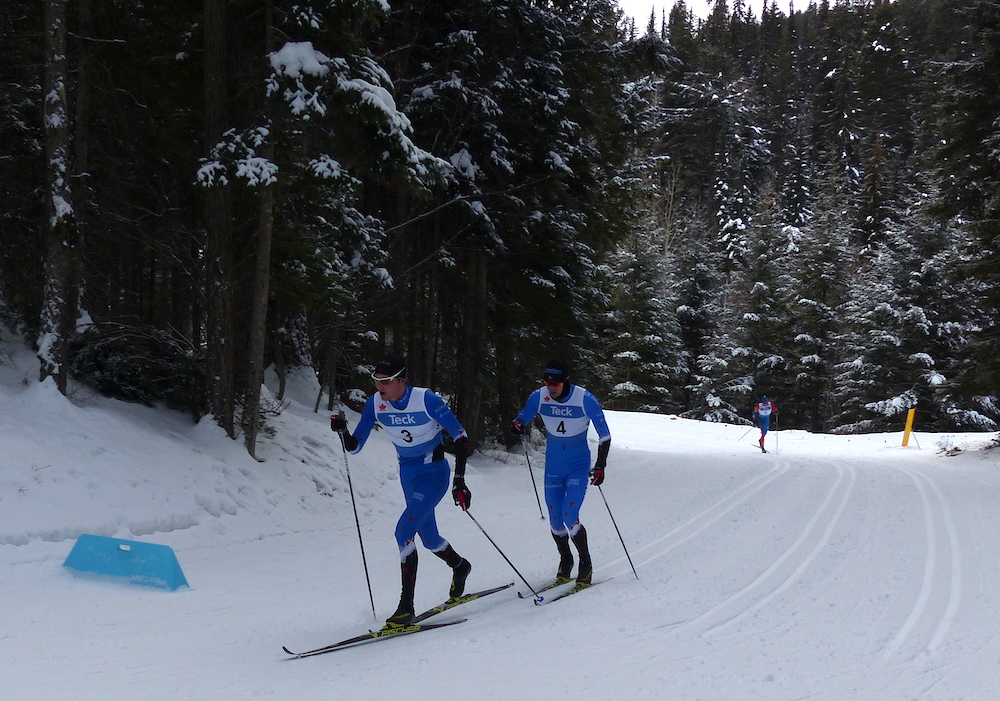
Rémi Drolet leads Julien Locke and Sam Hendry at the start of lap three. (Photo: Peggy Hung)
Canadian Western Championships, Telemark, Classic Mass Start
Day two of Westerns dawned with low clouds and intermittent light snow at -11C for the classic mass starts.
The men raced first, completing three laps of the new (and freshly homologated) 5km loop. Rémi Drolet (Black Jack) won in 42:18.4, getting from Julien Locke (CNST) on the last climb to earn a 4.8 second gap. Sam Hendry (Team R.A.D.) stayed with leaders until late in the second lap, finishing 42.2 seconds back. Rémi Drolet and Hendry are juniors who represented Canada at Junior Worlds in Lahti last month. Crystal Lust
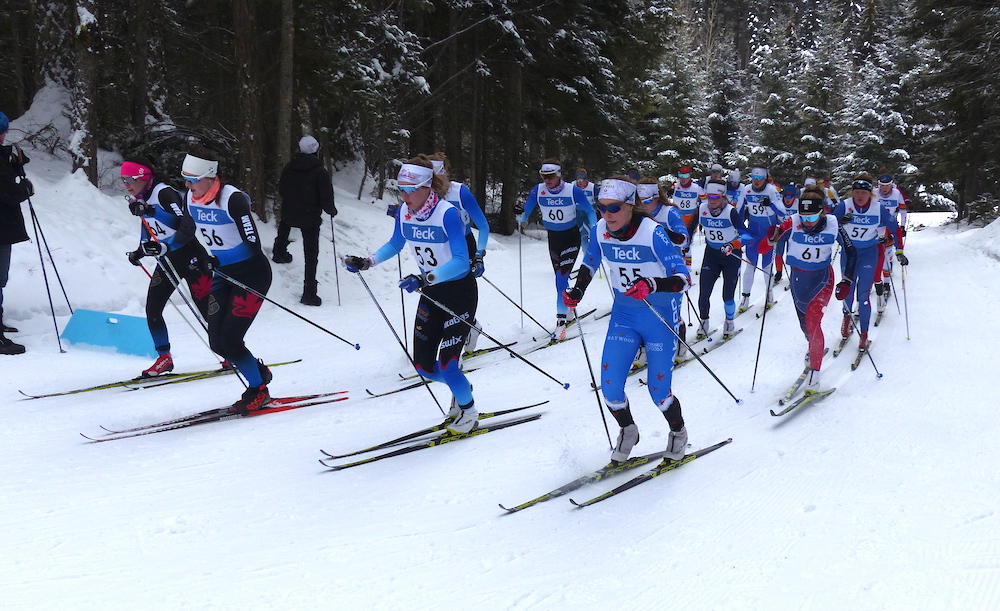
The first small climb of the Westerns 10km classic. Jasmine Drolet (#55) leads Novie McCabe (#61) in the left track. (Photo: Peggy Hung)
The open women skied two laps of the same course, with Novie McCabe (Methow) breaking clear on the first lap to win alone in 32:46.6. Jasmine Drolet (Black Jack) was second at 53.4 seconds followed by teammate Molly Miller at 1:28.1. All three raced at World Juniors in Lahti: Jasmine Drolet is 16 and the other two are 17.
There were 386 finishers on Saturday. Racing continues Sunday with relays.
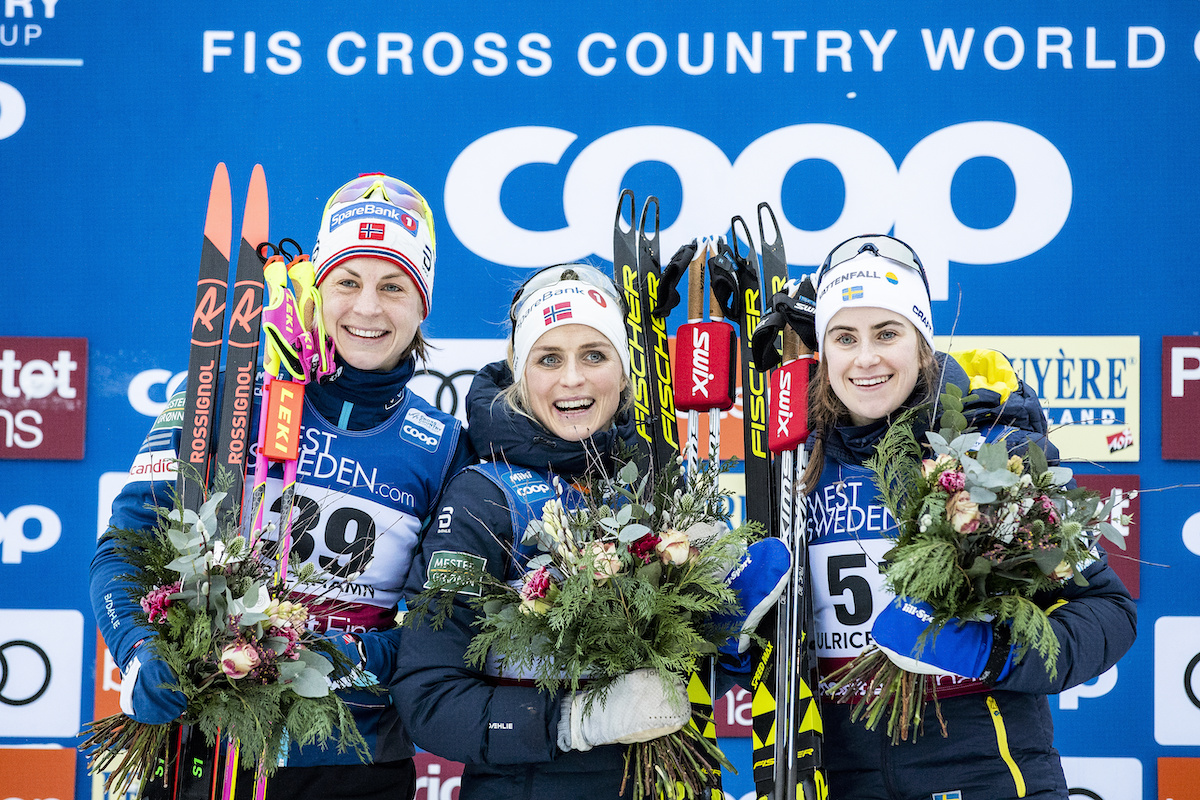
The women’s podium for the 10-kilometer individual start freestyle race in Ulricehamn, Sweden. Norway’s Therese Johaug took the win for her 50th career victory, followed by her teammate Astrid Jacobsen (l), and Sweden’s Ebba Andersson (r). (Photo: Fischer/Nordic Focus)
The World Cup returned to Ulricehamn, Sweden for the second time today for the women’s 10-kilometer individual start freestyle event. Ulricehamn earned rave reviews when it first hosted a World Cup two years ago, with athletes expressing their gratitude for the top notch course preparation and for the support from a huge crowd of fans. This year appeared no different; tens of thousands of people lined every inch of the 5k loop, erupting in cheers for the racers as they passed, raising to a roar for those racing in their home country.
As period 3 comes to a close and only two race weekends remain before the World Championships in Seefeld, Austria, athletes hope to be coming into their peak form, as their results may further implicate how they may stack up at the end of February. Firm tracks with no new snow made it easier for wax techs to create an even playing field for the racers than last week in Estonia, and a slight change to the 2017 Ulricehamn course included one additional hill to further test the athletes.
Leading the way in bib number one, Sandra Ringwald of Germany set a fast tempo, posting splits that held her the lead until the fastest pack of women entered the course wearing bib numbers 30 and higher. As the later group began, Jessie Diggins looked strong as she knocked down the fastest times at each checkpoint. Diggins vied for the podium throughout the race along with Finland’s Krista Pärmäkoski, Sweden’s Ebba Andersson, and Norway’s Astrid Uhrenholdt Jacobsen and Therese Johaug.
It was no surprise that Johaug took charge of the field upon starting, creating a gap over the next skiers that steadily widened throughout the race. Johaug crossed the line in a time of 22:48.2 minutes to remain undefeated in distance races this season. It is Johaug’s 50th World Cup victory.
Her teammate, Jacobsen, moved into second place by the 5 k mark and held on to finish 22.8 seconds back on Johaug, sealing the deal on her first podium of the season.
“Oh my god, it was crazy out there,” Norway’s Therese Johaug commented to the International Ski Federation (FIS). “I feel like it was the World Championships. I am so impressed with the people here in Sweden and Ulricehamn who took a trip up here and cheering for us. It was amazing. It was crazy.
“The tracks have everything, they have a flat area, they have steep hills,” Johaug continued. “I think the course here is really good. We have to have more World Cups here. They are crazy good to cheering us, the people, and all the people that work here are so kind and so nice. So we have to have more World Cups here in Sweden.”
Ebba Andersson of Sweden skis to the finish line in Ulricehamn amidst an erupting crowd of her countrymen. (Photo: Screenshot FIS/Nordic Focus)
Racing in her home country for her first World Cup podium, Andersson skied conservatively through the first half with splits just faster than those of Diggins. The Swede then made a strong push in the final 5 k, closing on Jacobsen and pulling ahead of Diggins. As she crossed the line and clinched her spot in third, she was welcomed with a cacophony of cheers and a wave of blue flags from the sea of her countrymen in the stadium.
“It was crazy out there and it was a lot of people cheering for me and for the other girls who are competing,” Andersson told FIS. “It’s a special feeling”
A strong first lap put Diggins just ahead of Andersson, but her second lap did not quite hold off the Swede’s surge. Diggins crossed the line in fourth place (+38.3), followed by Pärmäkoski in fifth (+53.3). Also with solid results for the US, Sadie Bjornsen took 15th (+1:25.1), Caitlin Patterson (CGRP) 23rd (+1:49.9), Rosie Brennan (APU) 28th (+2:03.2), and Rosie Frankowski 42nd (+2:28.0).
Dahria Beatty was the only Canadian entered. She finished 56th (+3:54.7).
“First off, I have to say, I am so so proud of our junior team and so psyched for them,” Diggins told FasterSkier in a call. “We didn’t start out race until 2:15, so we were all gathered around watching the girls and watching the guys, and they are skiing so well. They are taking US junior skiing to a new level. It got me so fired up – I had happy tears when the boys won their relay, there’s nothing more motivating than that… So that brought a lot of really positive energy and momentum into the day for sure!
“I had been feeling pretty tired last weekend, a little bit rundown like I wasn’t quite recovered from everything that the Tour took out of me,” she continued. “So I did a little more resting this week, a little less training, and it worked. I got some of my snap back and it felt so nice to feel really sparky and to feel like I was able to push really hard in the race today. I think that’s the closest I’ve been to Johaug all year, so things are definitely trending in the right direction as we lead into World Champs.”
“Nice racing by all the ladies,” Chris Grover told Fasterskier. “Really cool to see Rosie Frankowski just get off the plane a few days ago and she was challenging for the top 30 especially on her first lap… Sadie was in the top 10 for her first lap but faded a little bit at the end, but she’s been in a pretty good training phase this week preparing for the World Champs. She felt good about her race that she was skiing as fast as she was given the amount of training she’s been doing.
“It was an interesting race,” he added. “Some of the other ladies that they were competing against probably didn’t go out quite as hard and had a little bit more on the second lap. We seem like today overall we started pretty fast and maybe across the board paid for it a little bit on the second lap. But overall, really solid day for those ladies and nice to see Jessie in particular fighting for the podium.”
Frankowski was offered a start after her second place finish in the 20 k skate at US Nationals. She will also be starting in the 10 k classic in Cogne, Italy.
“It was super fun to race in Ulricehamn,” wrote Frankowski in an email. “There were fans lining the course cheering the entire time, chanting U-S-A, which was really motivating! The course was fast, and although there were 3 big uphills, it felt like a whirlwind of just speedy skiing. As my first World Cup this year, and first individual start race, I was unsure of what to expect and thought I would get passed by a lot of people, but I was pleasantly surprised that the girl behind me didn’t pass me. I think the biggest thing I am taking away from this race is the reminder that at this level, fitness is just one of the factors in your performance, and you really have to remember to ski well with powerful good technique.”
Caitlin Patterson (CGRP) racing to 23rd in Saturday’s 10 k skate in Ulricehamn, Sweden. (Photo: Fischer/Nordic Focus)
“Racing today felt good,” wrote Patterson in an email. “It’s great to feel forward progress. Last week I may have been holding onto a little more travel and jet-lag fatigue than I realized. I felt fine but was not able to dig really deep during the race, so it was nothing special. This week I do feel better, but mostly I was excited to skate, to enjoy racing this course, and to feed off the energy of the crowds.
“I know I can keep improving, because today was quite good but it wasn’t perfect, there’s more to come! After this weekend I’m heading to a training camp in Davos Switzerland and looking forward to continuing to sharpen the fitness towards the later season.
“I tried to make the most of features of the course that I knew were my strengths – fast downhill corners and rolling, gliding flats,” she elaborated. “My execution on those parts I thought was quite good, and the hill climbing was really pretty good too.”
Both Patterson and Brennan earned FIS points for their top 30 finishes.
“I had to conquer some of my weaknesses out there today which was a good challenge,” wrote Brennan in an email. “I didn’t quite do as well in the challenge as I had hoped, but there were some positives to take away. I found some better speed on the second lap which I was happy about and moved up in the end.
“I think it will take some races and some hard efforts to get back to where I want after a long break,” she continued, “but I have the time and have a plan. I am really excited to get in yet another relay tomorrow and am hoping to channel some incredible inspiration from the junior boys who brought us all to tears today.”
All of the Americans expressed their appreciation and gratitude for the race atmosphere in Ulricehamn, where FIS reported an estimate of 27,000 spectators.
“Right now, all my clothes, my hair, everything smells like a bonfire,” Diggins laughed. “It was so cool. I’ve talked about this before because I get annoyed that women and men don’t switch days on the Holmenkol, so if you’re not a man, you never get to race with that amount of people, just because Saturday is the big day… everyone always buys tickets for Saturday, that’s the big party watching day.
“So to have around 30,000 people was just so cool,” she continued. “We have a lot of fans here in Sweden and I really love them because you’re warming up and people are cheering for you and you just feel like such a rockstar. It gives you such a cool boost of energy. There was not a silent section of the course to be found… It was such a cool atmosphere, and that’s what ski racing should be.”
“It’s no secret – I love relays, our whole team loves relays,” Diggins expressed emphatically. “I am super excited, I mean, I am pretty nervous because I think you get nervous when you have good chances. I really believe in all these girls and all the guys and what I think we can do out there. Relays are also really hard because you need everyone having their best day all at one time, so it takes something really special to make a relay go well, but that’s why it’s so cool when it happens. So I’m really excited and as always, we’re going to get out there and do our absolute best.”
American Sadie Bjornsen skiing just behind Germany’s Katharina Hennig during the women’s 10 k classic mass start at 2018 World Cup Finals in Falun, Sweden. (Photo: Fischer/NordicFocus)
Welcome to FasterSkier’s World Cup Preview, where we check in with the top-10 teams from last year’s FIS Cross Country World Cup tour before the season starts with the Ruka weekend in Kuusamo, Finland, on Nov. 24 with a classic sprint.
***
Germany
Overall in Nations Cup Last Year: 8th
Women’s Ranking 2017/2018:
Men’s Ranking 2017/2018:
Germans to look out for: If there’s one woman returning to Germany’s national ski team from last season who is hungry for a sprint podium and on the watch list, it’s 28-year-old, Sandra Ringwald. The Lahti, Finland freestyle sprint left her in fourth, just shy of her first World Cup podium. Prior to Lahti, she raced to a seventh and sixth, respectively, in the Davos and Lenzerheide freestyle sprints.
While freestyle sprinting may appear to be the magnum opus of Ringwald’s cross-country skiing, she also finished last season with top thirty performances in a series of other disciplines, most notably a 12th place finish in the Tour de Ski 10-kilometer freestyle pursuit in Lenzerheide, Switzerland. She led the German women in last year’s Overall Cup Standings, finishing in 23rd behind Finland’s Aino-Kaisa Saarinen and ahead of Sweden’s Anna Jönsson Haag.
Chasing down Ringwald on the Overall Cup Standings is her teammate, Stefanie Böhler who ended last season ranked 25th in the overall. The 37-year-old Böhler raced into the top ten three times during last year’s World Cup season, holding out for eighth in Oslo, Norway’s famed Holmenkollen 30 k.
Along with Böhler and Ringwald, Germans Victoria Carl, Nicole Fessel, and Katharina Hennig scored points in the 2017/2018 season and are back on the team, ready to hit the World Cup circuit in search of more top thirties. Not returning to German’s national cross-country ski team after announcing her retirement this spring is Hanna Kolb.
Leading the charge on the men’s side for Germany will be Thomas Bing. The 28-year-old Bing ended last season with five top fifteen World Cup performances, his strongest being a ninth place in the Tour de Ski 15 k freestyle mass start in Oberstdorf, Germany. Along with Bing, Lucas Bögl is another name to look for from Germany. Bögl bust into the top-25 five times last season, most notably the Final Climb in the Tour de Ski 9 k pursuit in Val di Fiemme, Italy.
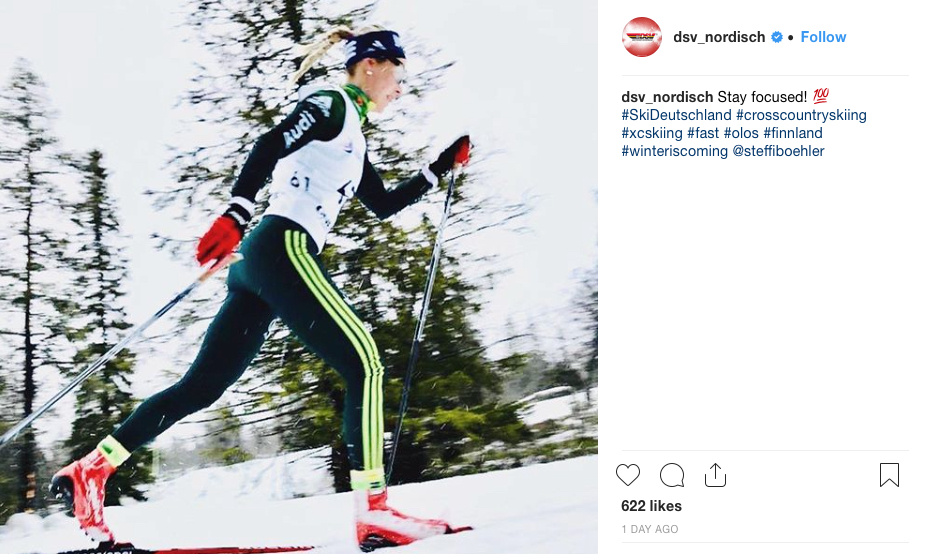
Germany’s Steffi Böhler during the FIS women’s 5-kilometer classic in Olos, Finland on 11/10/18. She placed sixth overall in what was used as a warm-up race for the German team. (Photo: Instagram screenshot)
Pre-Season Racing: Many German National team members are lined up at the FIS races in Olos, Finland scheduled from Nov. 9-11. In Friday’s 1.4 k classic sprint, Ringwald and Laura Gimmler placed first and third respectively. Gimmler had limited World Cup exposure last season, but notched two top-20s.
For the men, Bing was the best placed German in the sprint placing third overall.
In Saturday’s 5 k classic, the German women stacked five athletes in the top-6. Carl placed first, Hennig second, and Poland’s Justyna Kowalczyk was third. Also for Germany, Julia Belger skied to fourth, Pia Fink fifth, and Böhler sixth.
The men raced a 10 k classic. Jonas Dobler raced to 6th as the best placed German.
Sunday featured a 10 k skate for the women. Russia’s Natalia Nepryaeva won, while Carl was second, Ringwald third.
In the men’s 15 k skate, Dobler was the best placed German in fifth place.
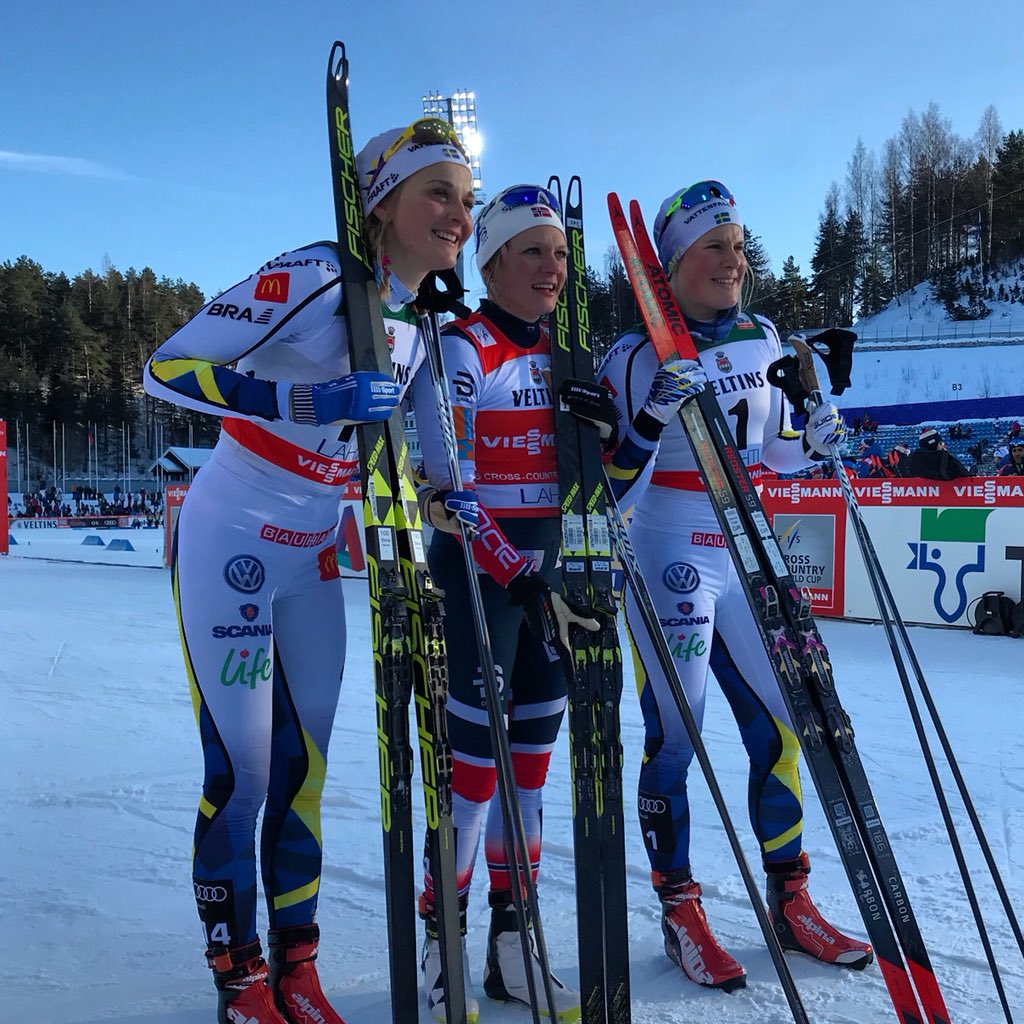
The women’s 1.4 k freestyle sprint podium at Saturday’s World Cup in Lahti, Finland, with Norway’s Maiken Caspersen Falla (c) in first, and Sweden’s Stina Nilsson (l) and Hanna Falk (r) in second and third, respectively. (Photo: Fischer/NordicFocus)
Eight points. That’s the number that separated Norway’s Maiken Caspersen Falla and Sweden’s Stina Nilsson in the Sprint World Cup standings before Saturday’s freestyle sprint in Lahti, Finland.
Three sprints. That’s the number of World Cup sprint races that remained in the 2017/2018 calendar, one of which took place on Saturday.
With one down and a classic sprint and skate sprint to go, Falla’s lead has grown to 28 points. It’s not much, with 150 sprint points remaining in the two remaining races (100 for winning the Drammen classic sprint and 50 for winning the skate sprint at World Cup Finals in Falun), but she’s getting there. Let’s just say neither of these two women can afford to skip a sprint.
Coming off her last race of the Olympics, the team sprint (where Norway took bronze behind the U.S. and Sweden), Falla had 10 days to recover before Lahti. Nilsson had six days after notably racing to third in the 30-kilometer classic mass start on the last day of the 2018 Winter Games in PyeongChang, South Korea.
Six time zones away from Korea in Finland, Falla and Nilsson faced off once again, but instead of racing for gold (which Nilsson had claimed in the Olympic classic sprint), they’re in a race for the Sprint Crystal Globe (of which Falla is the two-time defending champion).
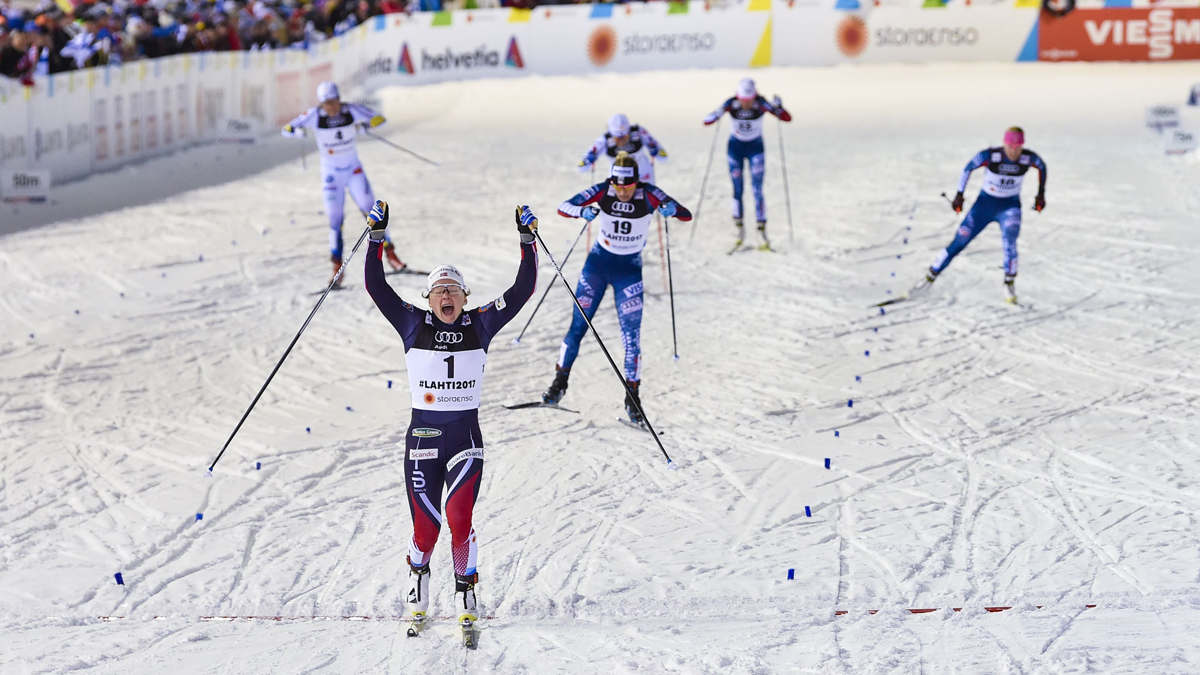
Norway’s Maiken Caspersen Falla celebrates her gold medal in the 2017 World Championships freestyle sprint in Lahti, Finland, ahead of Americans Jessie Diggins (19) and Kikkan Randall (r), who placed second and third, respectively. The third U.S. woman in the final, Sophie Caldwell (second from r) finished sixth. (Photo: Fischer/NordicFocus)
As alluded to, Falla had the edge on Saturday, winning the women’s 1.4 k skate sprint by 0.36 seconds over Nilsson in 2:54.83 minutes. She did it by leading from start to finish — a tactic she hadn’t necessarily planned nor desired —on the same course that she won on at World Championships last year. In that skate sprint, Falla bested Americans Jessie Diggins and Kikkan Randall for gold. Diggins and Randall placed second and third in that race, respectively, but the two did not contest Saturday’s sprint in Lahti. Instead, they were coming off a New York City media tour that involved several appearances with major TV networks.
But back to Falla. The 27-year-old left her competition chasing on Saturday, advancing to the final after placing second in her quarterfinal (0.71 seconds behind Nilsson) and first in the first semifinal (just 0.04 seconds ahead of Nilsson in second place).
She had qualified for the heats in 12th, 7.96 seconds off of the top time of 2:54.72 set by Sweden’s Hanna Falk.
“I was really stressed in the prologue,” Falla said afterward, according to an International Ski Federation (FIS) press release. “In the heats I had a better feeling.”
She had to fend off three Swedish heavy hitters in the final: Nilsson, Falk and Ida Ingemarsdotter.
But Falla never let any of them get ahead of her — an impressive feat on Lahti’s sprint course with two major climbs. The lone Norwegian in the final, Falla jetted out of the gate and into the lead, with Falk quick to challenge her before the first uphill. But Falla stayed ahead.
“I didn’t want the first position, but I just got it in the start,” Falla told FIS in a televised post-race interview. “So I just had to lie in front and do the best I could.”
While Falla continued to drive the pace, Sweden’s Falk took a breather near the back while Ingemarsdotter and Nilsson slotted into second and third. Germany’s Sandra Ringwald, in her first World Cup sprint final since the Tour de Ski in late December, skied in fourth, ahead of Falk and Switzerland’s Laurien van der Graaff.
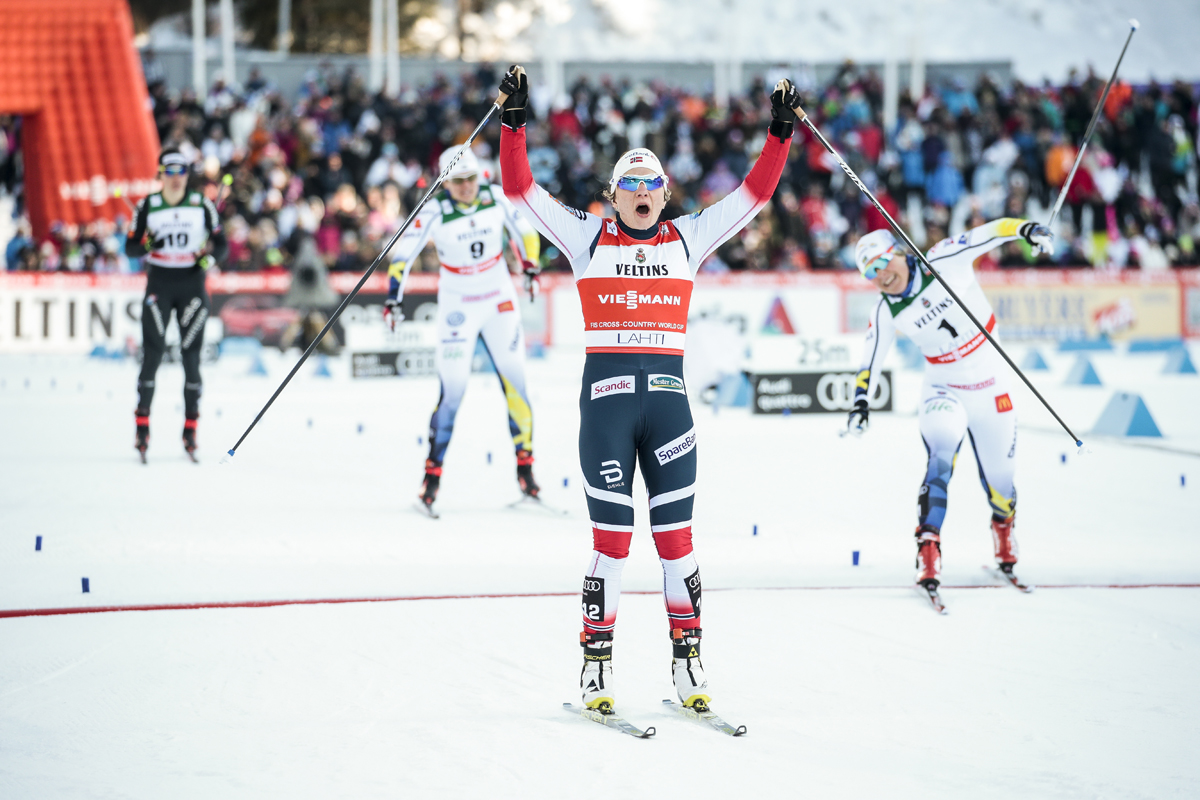
Norway’s Maiken Caspersen Falla celebrates her win in the women’s 1.4 k freestyle sprint on Saturday at the World Cup in Lahti, Finland. (Photo: Fischer/NordicFocus)
Falla led the downhill then into last long, multi-tiered climb, while the three Swedes assembled hungrily behind her. Nilsson began her attack when they hit the steepest section near the top, but Falla was at least a step or two ahead as they rounded the 180-degree turn and began to descend down the other side.
Tucking into the stadium, Falla got low and used her fast skis to gain a few more meters on Nilsson. She then took a couple of strides to keep her momentum and finally launched her final V2 push toward the finish.
No one could match her; not Nilsson skiing closest to her, nor Falk or Ringwald just behind. She didn’t even have to lunge to secure the victory over Nilsson, but Falk and Ringwald did as they placed third (+0.78) and fourth (+0.88), respectively. For Ringwald, fourth place marked her best individual World Cup result in a little over a year (after she placed fourth in a 2017 skate sprint in Toblach, Italy).
For Falla, it was her second individual World Cup win of the season and first victory since Dec. 2 in Lillehammer, Norway, where she won the classic sprint. Falla was the 2014 Olympic champion in the individual skate sprint. And let’s not forget, she won the World Championships sprint in Lahti last year as well as the 2016 Lahti World Cup skate sprint.
“Last year here and also two years ago I was in front down the last downhill, and I succeeded there for the last three years so I knew it is very possible to lie in front as well,” Falla told FIS. “In the final I had Stina and Hanna behind me and I knew both of them are really fast. I have a big respect for them and I am very happy I could win today.”
Nilsson, who bested Falla for the classic-sprint gold medal in PyeongChang, had qualified for Saturday’s heats in 14th, 8.26 seconds out of first.
“I felt pretty good in the prologue, but in the end I was missing some seconds, which I probably lost after the start,” she told FIS. “In the heats I found my pace and I could keep all the way through to the final. In the final, I was not so fast after the start but I am happy to be on the podium again. It is very good for the sport that the battle for the Sprint Crystal Globe is still going.”
Falk also said she was satisfied with her end result, after winning her quarterfinal and advancing as a lucky loser in third in the semifinal with Falla and Nilsson.
“I had a very good qualification,” Falk told FIS. “I tried to fight in every heat. The final was hard but I am happy to be third today. I had a good speed before the last corner but it was always tight there. It was a tough fight between me and Sandra [Ringwald]. I’m happy to be third.”
Sadie Bjornsen (U.S. Ski Team) qualified fifth in the women’s 1.4 k skate sprint at the World Cup in Lahti, Finland, and went on to finish 17th overall. (Photo: Fischer/NordicFocus)
Four Americans in Top 30
Leading the Americans in the qualifying round was Sadie Bjornsen in fifth, 3.88 seconds off Falk’s fastest time. Sophie Caldwell qualified in 17th, Ida Sargent advanced in 21st and Rosie Brennan followed in 29th.
For Brennan, it was her first time back in the heats in about two months after she qualified in 21st in the Tour de Ski classic sprint on Oberstdorf, Germany. While the heats were canceled that day due to a storm, Brennan went on to finish the Tour in 24th overall. Since then, however, the U.S. Ski Team (USST) member has finished outside the top 40 in four World Cup races and one Olympic event (the 15 k skiathlon).
Despite finishing sixth in her quarterfinal on Saturday, 4.91 seconds behind Ingemarsdotter in first, Brennan’s overall result of 29th indicated she was back on track.
“I have been struggling with health and recovery since the tour,” Brennan wrote in an email to FasterSkier. “I’ve just been taking things day by day and trying to work through whatever issue I am facing. The Olympics was a huge disappointment for me. I did what I thought was best to prepare for the games, but have struggled with my health and my body and as a result was far from where I wanted to be at that time.”
In PyeongChang, she raced one event — the skiathlon — and placed 58th. She stayed with the team for the duration of the Games, hoping to have the opportunity to race the 30 k. But that wasn’t in the cards.
“It’s very challenging to be at the games and not be participating in the events that you have trained for over so many years,” Brennan reflected. “I have had some good races this year and have made some improvements so I am doing my best to remember that and try to see each day as a new opportunity. My goals moving forward are more about my feelings, my body, and my health than any results. I am very happy to have made a step forward today and am hoping my distance skiing will see the same results. I wasn’t able to ski my quarterfinal as well as I would have liked, but it’s been awhile since I’ve raced now so to just get another stab at it was a great step forward.”
Sophie Caldwell (U.S. Ski Team) racing to 17th in the Lahti skate sprint qualifier. She went on to reach the semifinals and place eighth overall. (Photo: Fischer/NordicFocus)
Out of the four Americans in the quarterfinals, Caldwell was the lone U.S. woman in the semifinals. She had raced to second in her quarterfinal, finishing 0.25 seconds behind Ringwald, who won that heat. But her road there wasn’t an easy one, as Caldwell skied up from near the back of the pack into second coming out of the final downhill. There, she scooted ahead of Norway’s Heidi Weng, who had been second at the time, while Weng dropped to last in the heat.
“… I had the ambition to do well, and it’s incredibly annoying when something like that happens,” Weng said, according to a loose translation.
She added that she didn’t discuss it with Caldwell after.
“I can’t do anything about it now,” Weng said. “Things like that happen in a sprint…”
Caldwell reflected that it might’ve been worth conserving less energy and using more to get in a better position before that last downhill.
“I found myself in the back there with no room to pass or respond to a move,” Caldwell wrote in an email to FasterSkier. “… There is a big draft on the final downhill and if you’re leading, you need to send it and have a good bullet tuck, and if you’re within contact of the leader, you can try to work the draft and in my quarter I was able to do that. I don’t remember there being contact with Heidi, but we both definitely bobbled a bit on the final corner.”
Caldwell’s first World Cup podium came in Lahti four years ago. Last year at World Championships, she reached the skate-sprint final and placed sixth overall.
On Saturday, she made it to the semifinals and finished fourth in the second semi, 1.46 seconds behind Ringwald in first.
“I have had some success in Lahti before and I’ve also had some disappointing results, and I think today was somewhere in between,” Caldwell wrote. “I enjoy how tactical this course can be with all the corners and transitions. I was feeling quite good today, but I struggled to find that extra punch and didn’t ski with the confidence or control I know I’m capable of, so even though the result is by no means a bad one, I was just disappointed in how I skied mentally in the semi final.”
She was pleased with her recovery after the Olympics, where she placed eighth in the classic sprint and fifth with the women’s 4 x 5 k relay.
“The Olympics can be physically and emotionally exhausting, so I made sure I took some time to take it easy and get my feet under me again,” Caldwell wrote. “I was really looking forward to getting back in the World Cup routine in Europe. We had a very long travel day, so we were feeling a little rugged the first day here, but some good sleep, food, and training had me feeling quite good a couple days later. I did some light intervals on Thursday that felt quite good and was psyched for today.”
Bjornsen described having some trouble transitioning from the Olympics back to the World Cup. She raced four events in PyeongChang, with a top individual result of 14th in the classic sprint.
“It was an interesting step back to the World Cup today,” Bjornsen wrote in an email to several media outlets. “It has been a real ‘homesick’ week here coming back from the Olympics, and sometimes hard to feel how your actual muscles are feeling instead of your head. Fortunately, my muscles felt surprisingly good in the qualifier and I felt really excited to see what I could do today!”
In her quarterfinal, she recalled getting “tangled” and losing her positioning on the first turn, leaving her chasing the rest of the group.
“I finally caught them on the very top of the course, but just narrowly missed getting into their draft down the hill, and missed moving with those top three,” Bjornsen wrote. “Sprinting has been everywhere from amazing to frustrating this year, and what I have learned is that you can never think too hard about it. Often for me, the difference between a fantastic day, and a frustrating day is some super move that I either find, or I miss.”
She ended up fourth in her quarterfinal, 2.84 seconds behind Falk in first, which put Bjornsen 17th overall.
“I am just looking forward to heading into tomorrow with a head that is back excited again, and some muscles feeling good!” Bjornsen wrote of Sunday’s 10 k classic. “I put a lot of focus into my form at the Olympics without much thought about afterwards. Fortunately, the majority of the World Cup field is in the same state, so now we are all just racing with what sort of energy and excitement we have left. I always kind of like that. It is raw and fun.”
Sargent finished the day in 27th overall after placing sixth in her quarterfinal, 1.07 seconds behind Sweden’s Anna Dyvik in first. After skiing in fourth in the middle of the race, Sargent moved up to second on the final downhill toward the finish. But on the tight lefthand corner before the finishing straight, she lost her position and momentum and slipped to sixth.
“Today wasn’t great but it was a huge step forward for me,” Sargent wrote to FasterSkier. “I haven’t raced much recently and was struggling with injury so I’m just super happy to be racing again and very excited to have a bunch more racing in the next few weeks.”
“I’m excited to feel like my fitness is still there after so much travel and not much racing,” Sargent wrote.
Canada’s Dahria Beatty just missed making the rounds in 34th place on Saturday in the Lahti World Cup skate sprint. (Photo: Fischer/NordicFocus)
Beatty 34th for Canada; Phinney 36th in First World Cup
Canada’s Dahria Beatty missed qualifying for the heats in 34th, 0.9 seconds out of 30th place. While she was the lone Canadian woman competing on Saturday, three other American women started, with Kelsey Phinney of the Sun Valley Ski Education Foundation (SVSEF) racing to 36th, 1.25 seconds out of qualifying, in her World Cup debut.
“I was pretty happy with my effort, definitely a little bummed to miss out on the heats, but cool to know that I’m pretty close to that level!” Phinney wrote in an email to FasterSkier. “I’m psyched to be here and getting a World Cup start was one of my main goals of the season. Being a second out of qualifying will for sure help stoke the fire for next year and I learnt a lot today from things that went right and things that didn’t.
“This was my first World Cup start and everyone has been so welcoming,” she continued. “I’ve been having a lot of fun and just trying to take it all in. … It’s hard to put the feeling of being at the start line of a World Cup into words, it’s something I’m hoping to get to experience a lot more of!”
(Her Sun Valley teammate Kevin Bolger, also in his first World Cup, placed 11th overall after reaching the semifinals in the men’s 1.6 k sprint. “I am so proud of Kevin, it was so special to get to watch him holding his own with the best in the world in the heats today! Really cool to see your teammate crush it in his first World Cup.”)
Phinney explained that Saturday was a one-time opportunity since she’ll be joining the OPA Cup trip on Monday before flying back to the U.S. for SuperTour Finals in Craftsbury, Vermont, later this month. She’s spent the better part of the last month racing in Norway, placing sixth in a FIS skate sprint in Åsen and 13th in a Scando Cup skate sprint last weekend in Trondheim.
“She had a really impressive Scando Cup Sprint last weekend, and has shown she can skate sprint with the best of them,” SVSEF Head Coach Chris Mallory wrote in an email to FasterSkier. “I thought she might squeak into the top 30 with a good day. She skied the first half of the sprint today very fast, so the pacing was just a touch off. But still, very solid effort for her first WC. She’s shown the speed is there, so she’ll be back.”
Kaitlynn Miller (Craftsbury Green Racing Project) on her way to 61st in the World Cup skate sprint qualifier in Lahti, Finland. (Photo: Fischer/NordicFocus)
Also for the U.S., two Craftsbury Green Racing Project (CGRP) skiers, Caitlin Patterson and Kaitlynn Miller, placed 56th (+20.12) and 61st (+21.70), respectively.
***
Notes: In the first women’s quarterfinal, Germany’s Victoria Carl skied up on the ski tails of Finland’s Krista Pärmäkoski, which caused both women to crash out of contention on the final downhill. Pärmäkoski had been skiing in second at the time, behind Nilsson in first. She finished fifth in that heat (+12.11) and Carl, who appeared to hit her head, took a long time to stand back up and crossed the line in sixth (+49.5). Carl was relegated to last (30th place) for obstruction.
German coach Janko Neuber told reporters after that, “She crashed, fell on the head and bruised the back of her neck. As a precaution she is being taken to the hospital for evaluations, but we are optimistic that it isn’t anything serious.”
Pärmäkoski, who finished the day in 21st overall, wrote in Instagram: “This was a bit tough but today, with the fall, shorts [sprints] were short. Fortunately tomorrow is another chance.”
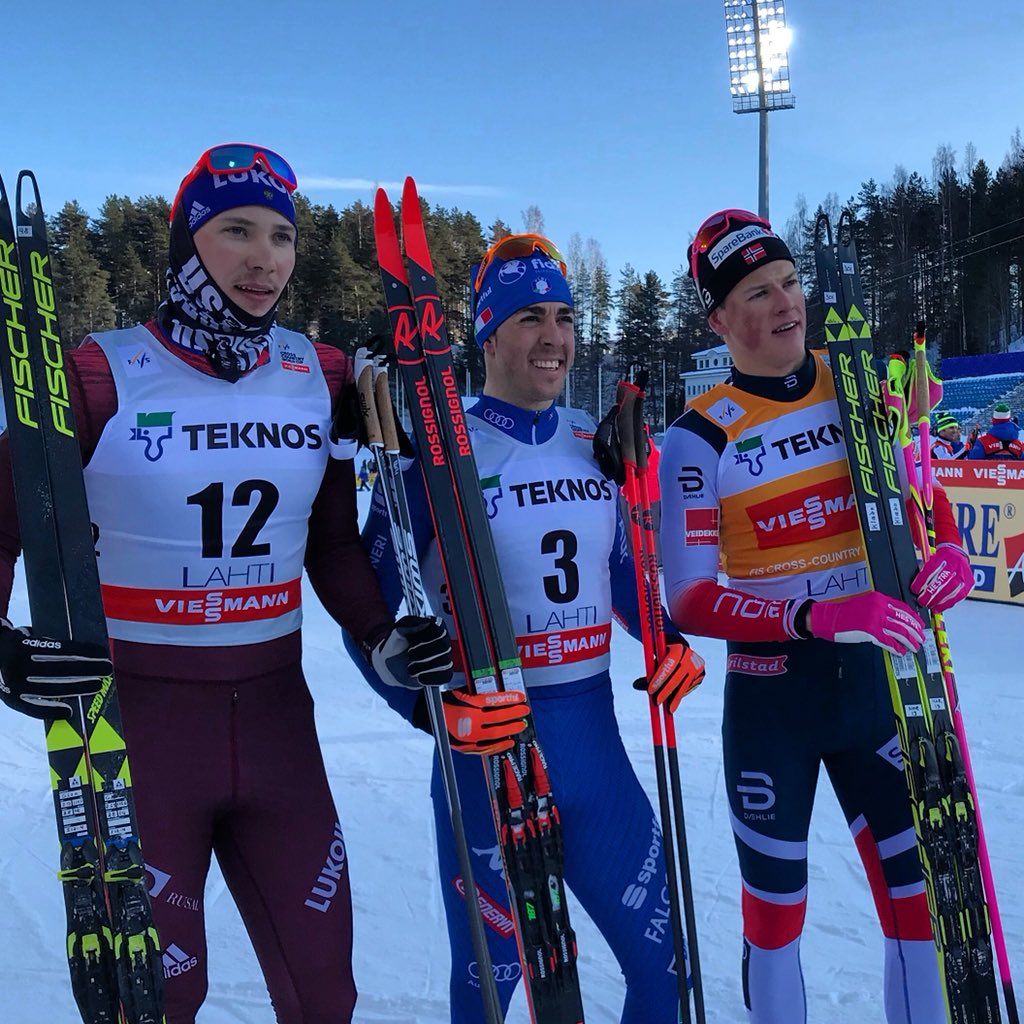
The men’s 1.6 k freestyle sprint podium at Saturday’s World Cup in Lahti, Finland, with Italy’s Federico Pellegrino (c) in first, Russia’s Gleb Retivykh (l) in second and Norway’s Johannes Høsflot Klæbo (r) in third. (Photo: FIS Cross Country/Twitter)
FIS Cross Country World Cup (Lahti, Finland): Men’s & women’s freestyle sprints
The defending world championships from the 2017 freestyle sprint prevailed again in Lahti on Saturday, with Norway’s Maiken Caspersen Falla winning the women’s 1.4-kilometer freestyle sprint final and Italy’s Federico Pellegrino coming out on top in the men’s 1.6 k final at last year’s World Championships venue.
Falla’s rise to the final started with her qualifying in 12th, 7.96 seconds off the fastest qualifying time set by Sweden’s Hanna Falk in 2:54.72. Russia’s Natalia Nepryaeva qualified second (+0.63) and Finland’s Krista Pärmäkoski third (+3.62), just ahead of Germany’s Victoria Carl in fourth (+3.88) and American Sadie Bjornsen in fourth (+3.88). Four American women qualified for the heats, with Sophie Caldwell in 17th, Ida Sargent in 21st and Rosie Brennan in 29th.
The women’s 1.4 k freestyle sprint podium at Saturday’s World Cup in Lahti, Finland, with Norway’s Maiken Caspersen Falla (c) in first, and Sweden’s Stina Nilsson (l) and Hanna Falk (r) in second and third, respectively. (Photo: FIS Cross Country/Twitter)
Falla went on to place second in the first quarterfinal, 0.71 seconds behind Sweden’s Stina Nilsson in first. According to the race jury’s ruling, Carl obstructed Pärmäkoski coming out of the last downhill before they entered the finishing straight and both crashed out of contention, with Pärmäkoski finishing fifth in the heat (+12.11) and Carl sixth (+49.5). Carl was relegated to last (30th place) for the obstruction.
Falla then won the first semifinal by just 0.04 seconds over Nilsson in second. The two other Swedes in that heat, Falk and Ida Ingemarsdotter, advanced to the final as well as lucky losers with fast-enough times.
In the final, Falla found herself at the front of the pack early then held her position to the finish, crossing the line in 2:54.83 and beating Nilsson by 0.36 seconds. Sweden had two on the podium with Falk in third (+0.78), Germany’s Sandra Ringwald placed fourth (+0.88), Ingemarsdotter was fifth (+1.83), and Switzerland’s Laurien van der Graaff placed sixth (+3.02).
Caldwell was the lone American woman to make it past the quarterfinals, as she placed second in her quarterfinal, 0.25 seconds behind Ringwald in first, then fourth in the second semifinal, 1.46 seconds behind Ringwald, who also won that heat. Overall, Caldwell finished the day in eighth.
Bjornsen placed 17th overall after finishing fourth in her quarterfinal, 2.84 seconds behind Falk in first. Sargent had been second in her quarterfinal until the final tight lefthand corner into the finishing straight, where she slipped to sixth and ultimately finished sixth, 1.07 seconds behind Sweden’s Anna Dyvik in first. Overall, Sargent finished the day in 27th, and Brennan placed 29th overall after finishing sixth in her quarterfinal, 4.91 seconds behind Ingemarsdotter in first.
Two American men advanced to the heats as well, with Kevin Bolger of the Sun Valley Ski Education Foundation (SVSEF) qualifying in 16th in his World Cup debut, 6.38 seconds behind Norway’s Johannes Høsflot Klæbo, who topped the qualifier in 2:59.06. Erik Bjornsen of the U.S. Ski Team qualified 29th, 8.29 seconds back.
Meanwhile, Pellegrino qualified for the heats in third (+1.9) behind France’s Baptiste Gros in second (+1.23).
There, Pellegrino won the first quarterfinal by 0.19 seconds over Klæbo, with the Norwegian visibly backing off before the finish — comfortable enough to automatically advance to the semifinals in second place. But Klæbo showed Pellegrino what he’s made of in the first semifinal and beat the Italian by nine-hundredths of a second.
Bolger also raced in that first semifinal after placing fourth in his quarterfinal, 0.73 seconds behind Russia’s Gleb Retivykh in first. Bolger’s time was good enough for one of two lucky loser spots in the semifinals, where he went on to finish sixth, 1.86 seconds after Klæbo. Overall Bolger finished the day in 11th.
Erik Bjornsen placed 20th on the day after finishing fourth in the first quarterfinal (with Pellegrino and Klæbo), 1.56 seconds out of first.
In the final, Klæbo set the tone, slowing the pace to almost a stop at one point, while he and Pellegrino stood side by side at the top of the course. On the way down, they accelerated, but Norway’s Sindre Bjørnestad Skar was the one who truly attacked. It might’ve been a bit too early, as Pellegrino caught him by the top of the final climb and took the lead on the following downhill into the stadium. Pellegrino held off his challengers, including Retivykh who came on strong out of the downhill, to take the win in 3:16.73, 0.77 seconds ahead of Retivykh in second and 0.9 seconds ahead of Klæbo in third. Skar settled for fourth (+1.3), Finland’s Ristomatti Hakola placed fifth (+1.44) and France’s Lucas Chanavat finished sixth (+7.55).
In the qualifier, Canada’s Dahria Beatty finished 34th, +13.39 and just 0.9 seconds from making the quarterfinals. She was the only Canadian woman competing.
American Kelsey Phinney (SVSEF) was also close to making the cut. In her first European World Cup, she placed 36th in the qualifier, +13.74. Caitlin Patterson and Kaitlynn Miller, both of the Craftsbury Green Racing Project, placed 56th (+20.12) and 61st (+21.70).
Mathilde Petitjean of Togo, a primarily Quebec-based skier, finished in 59th (+20.80).
In the men’s qualifier, Logan Hanneman (APU) placed 49th (+11.45). Paddy Caldwell (U.S. Ski Team/SMS T2) finished 59th (+13.55), and APU’s Reese Hanneman and David Norris placed 61st (+14.33) and 67th (+19.27).
Julien Locke led Canada in 42nd place (+9.78), and Andy Shields finished 60th (+14.29).
American Chloe Levins racing to seventh in the junior women’s 7.5 k sprint on Saturday at IBU Junior World Championships in Otepää, Estonia. (Photo: Terri Dickson)
Poland’s Kamila Zuk won her second race in a row, taking gold in the junior women’s 7.5 k sprint after also winning the individual at World Junior Championships. Zuk had one penalty to two by second-place Marketa Davidova of the Czech Republic, who finished 26.0 seconds back. Bronze went to Myrtille Begue of France, who shot clean to finish 52 seconds back.
The sole U.S. starter, Chloe Levins followed up her sixth-place finish in the individual with seventh place in the sprint. Levins had a single penalty and finished +1:31.7.
For Canada, Megan Bankes was close behind Levins in ninth, with two penalties and +1:49.5. Teammate Nadia Moser was 21st, also with two penalties, +2:46.2. Emily Dickson finished 36th, +3:50.5 with two penalties, and Zoe Pekos just missed the pursuit cutoff in 66th (+6:22.4) with four missed shots.
In the junior men’s 10 k sprint, Vasilii Tomshin of Russia took the gold with perfect shooting. France’s Martin Perillat Bottonet was second, less than a penalty-loop’s worth of time back at 20.5 seconds – and he did have one penalty. Norway’s Sverre Dahlen Aspenes took bronze (+29.4) with two missed shots.
Trevor Kiers led Canada in 16th, a breakthrough result; his previous World Juniors best was 39th in the pursuit last season. Kiers missed two shots, both in prone, and finished 1:34.9 behind the time set by Tomshin.
Adam Runnalls placed 26th for Canada (+2:08.3) with three missed shots. Teo Sanchez also qualified for the pursuit by placing 53rd (+3:19.2) with one penalty, and Angus Tweedie was left on the outside looking in with 69th place (+4:41.3) with three missed shots.
Cody Johnson led the Americans in 37th, with clean shooting, 2:31.1 back from Tomshin’s time. Tim Cunningham was the next finisher in 71st (+5:13.5) with seven missed shots, followed by Jacob Pearson in 79th (+6:24.2) with two penalties and Cam Christiansen in 86th (+7:52.5) with three penalties.
Sweden’s Stina Nilsson (center) won gold in the classic sprint at the 2018 Olympics on Tuesday in PyeongChang, South Korea, with Norway’s Maiken Caspersen Falla (left) taking silver and Russia’s Yulia Belorukova bronze. (Photo: FlyingPointRoad)
PYEONGCHANG, South Korea — Tuesday at PyeongChang’s Alpensia cross-country venue, the site of the Olympic Games women’s 1.25-kilometer classic sprint, Sweden’s Stina Nilsson took gold. On an evening when athletes were already challenged by an aerobic capacity testing course, shifting winds and falling snow, another factor made the challenge debilitating.
Nilsson came into the Games well-rested and well-primed to take her first individual Olympic medal. The 24 year old had come close before; at her first Olympics, the Swede placed 10th in the freestyle sprint in Sochi, Russia. There, she went on to claim bronze in the classic team sprint with teammate Ida Ingemarsdotter.
A year later in Falun, Sweden, at World Championships, Nilsson placed second in the individual classic sprint. When you are close, you begin to think more about achieving a singular goal and less about overall season-long outcomes.
Nilsson last raced a World Cup the weekend of Jan. 20-21 in Planica, Slovenia, where she raced to 13th place in the 10 k classic. The day before, on Jan. 20, Nilsson took a small prize: a World Cup classic-sprint win.
In her run up to PyeongChang, Nilsson explained she was able to focus on her training and block out distractions.
“Not so much pressure the last weeks, because I have not been on the Internet so much,” Nilsson said at the post-race press conference. “And not on Instagram. So the most pressure comes from myself, and that’s the pressure that I have to deal with. But today I managed to control those feelings and just ski so fast as I can.”
With temperatures hovering around 25 degrees on Tuesday evening, Nilsson was unstymied by the gusting winds or falling snow in formulating the answer to her success equation. Starting with Tuesday’s qualifier in PyeongChang, Nilsson marked the fastest time, stopping the clock in 3:08.74 minutes. With Nilsson pushing the pace, she also scored a win in the quarters. Again in her semifinal, Nilsson placed first after dualing with the 2014 Sochi skate-sprint champion, Norway’s Maiken Caspersen Falla (who also won the skate sprint at last year’s World Championships), in a photo finish.
“I had a really good day,” said Nilsson, a 2015 World Championships classic-sprint silver medalist. “I felt strong already in the prologue, and I felt also strong in the quarterfinal, and in the semifinal. I felt like I had some energy saved for the final.”
Sweden’s Stina Nilsson and teammate Hannah Falk (4) embrace after Nilsson won the classic sprint gold medal at the 2018 Olympics in PyeongChang, South Korea. (Photo: FlyingPointRoad)
Lining up in the final trying to prevent Nilsson’s clean sweep on the day were Falla, Nilsson’s Swedish teammate Hannah Falk, American Jessie Diggins, and Russians Natalia Nepryaeva and Yulia Belorukova.
The energy Nilsson stated she had saved for the final was more than sufficient. Off the line she set the pace up the course’s first climb — a climb not steep enough to create big gaps and string out the field. The group stayed together with two skiers in the inside lane, three in the adjacent lane, and Diggins skiing outside the tracks and closing on the outside.
Topping out on the hill and taking a sharp 180-degree turn, Nilsson led but no skier pulled away. Down the hill, the six skiers tucked and glided and double poled into the course’s decisive climb with Belorukova then Falla the closet skiers to challenge.
The final hill is where Nilsson seized the day.
“I just wanted to cross the finish line totally tired, so I just went for it in the last uphill,” Nilsson said about her race tactics in the final. She carried considerable speed over the final climb and the gap grew to the two closest chasers, Falla and Belorukova.
“My plan was to save the most of the power until the last part of the [final] climb,” Falla, 27, said at the press conference. “But when the two others got a little gap in the first downhill, I used too much power in the first part of the climb. So in the top where I was planning to use all my power, there wasn’t that much left.”
Nilsson still had power to spare. She soloed off the front to win the final in 3:03.84 minutes. Falla took silver (+3.03), Belorukova, a 23-year-old Olympic rookie, bronze (+3.37).
In the post-race press conference, Belorukova was asked about the tense relationship between the International Olympic Committee (IOC) and the Russian Ski Federation. The IOC banned numerous Russian skiers from PyeongChang for doping violations. Those Russian athletes competing at the 2018 Winter Olympics are not competing under the Russian flag, but as Olympic Athletes from Russia (OAR).
“Good question,” Belorukova said through an interpreter. “There is nothing that will break us, there is nothing that will instill fear into us, we are strong and we will fight until the end.”
Nepryaeva ended up fourth (+9.14), Falk fifth (+11.16), and Diggins sixth (+11.23). FasterSkier will post an additional report on the U.S. women’s results.
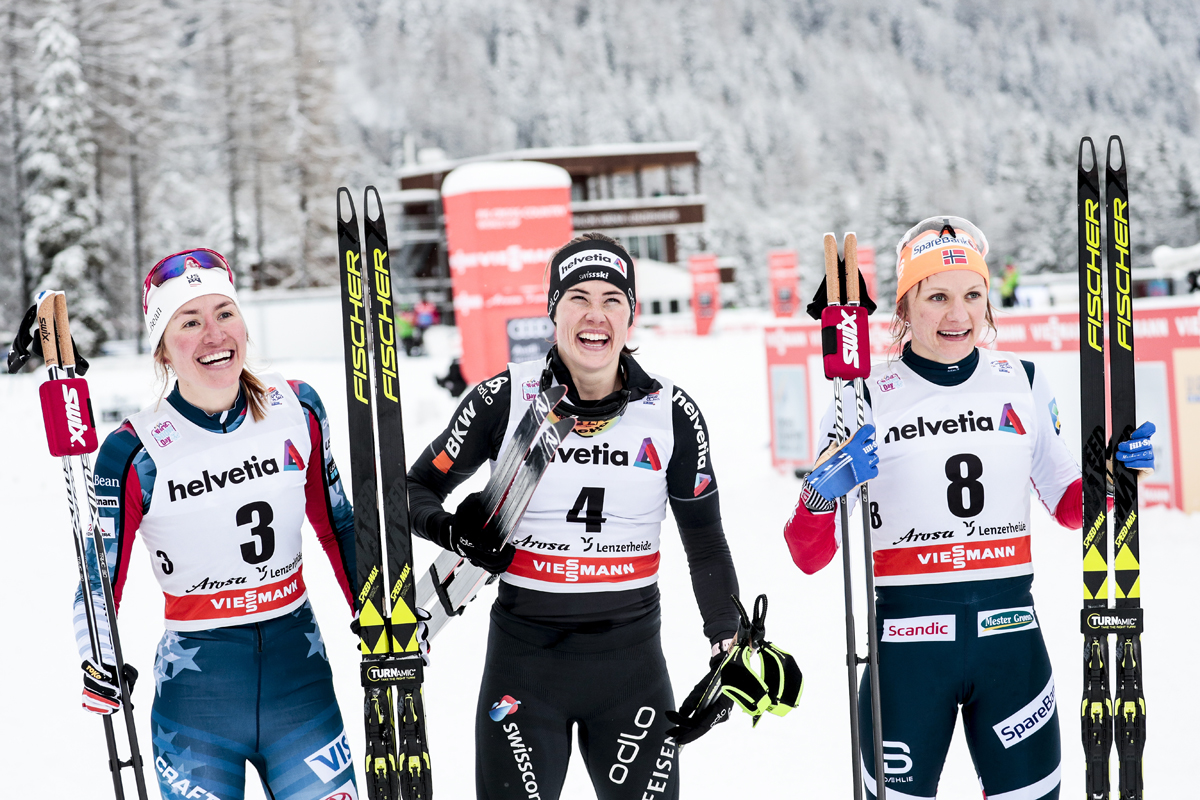
The women’s podium after the Stage 1 freestyle sprint of the 2018 Tour de Ski, with (from left to right) American Sophie Caldwell in second, Switzerland’s Laurien van der Graaff in first, and Norway’s Maiken Caspersen Falla in third. (Photo: Fischer/Nordic Focus)
The 12th edition of the multi-stage Tour de Ski (TdS) opened Saturday with 1.5-kilometer freestyle sprints in Lenzerheide, Switzerland. On a spectator-friendly, 750-meter loop featuring a punchy and sustained climb each lap, the hustle and bustle of a gritty and soft-snowed World Cup sprint were on full display.
We’ll leave the suspense out: it was the first home-snow World Cup victory for a Swiss skier since 2007. It was also the first career World Cup win for 30-year-old Swiss skier Laurien Van der Graaff.
Van der Graaff took those honors after qualifying in fourth behind fastest qualifier, Ingvild Flugstad Østberg, and winning the women’s final in 3:25.80.
“It was a really good day,” Van der Graaff told Swiss broadcaster SRF, according to a translation. “I already felt good at the start, never really tired. I knew if I was still in the mix on the finish stretch I could win it all. Last year I always couldn’t put it together mentally; a little bit was always missing. I am just really happy that I now finally was able to put it all together. … I really worked on this all summer, that I want to win, that I want to be in front, that has always been a little ambiguous for me. That in the end I didn’t really have the will to win, or maybe also the strength to really withstand. And today I thought to myself, ‘Now I’ll take it,’ and it worked.”
Sophie Caldwell (U.S. Ski Team) racing to third in the qualifier of the women’s 1.5 k freestyle sprint on Saturday at Stage 1 of the Tour de Ski in Lenzerheide, Switzerland. She went on to finish second overall for her first individual podium in two years. (Photo: Fischer/NordicFocus)
The bigger news for North American fans was that Sophie Caldwell was back on the podium. Caldwell wore Bib 3 as the third-fastest qualifier. She finished the qualifier 2.33 seconds in back of Østberg, the day’s fastest qualifier in 3:29:91.
Caldwell ultimately raced a savvy, gutsy and full-steam series of races to land second overall, toeing the line in the final 1.42 seconds behind race winner Van der Graaff. Caldwell last scored an individual World Cup podium two years ago when she won a classic sprint stage of the 2016 Tour de Ski.In doing so, she became the third woman in U.S. history to win a World Cup.
In the time since, the U.S. women’s team has racked up several other individual podiums. Jessie Diggins won three individual World Cup races (and earned two medals at 2017 World Championships), Sadie Bjornsen has notched three individual podiums (and 2017 World Championships team-sprint silver with Diggins) in the last year, and Kikkan Randall raced to bronze in the 2017 World Championships skate sprint and third place this season at the Davos World Cup.
Third place in Saturday’s final was locked up by Norway’s Maiken Caspersen Falla (+1.86), who also won the first semifinal. Falla now leads the World Cup overall sprint standings. Sweden’s Stina Nilsson, who is not contesting the TdS, remains in second.
Russian Natalia Nepryaeva took fourth (+3.17), and Jessie Diggins finished fifth (+4.33) after breaking her second pole of the day (she previously broke a pole in the quarterfinal). German skier Sandra Ringwald fell and finished sixth (+31.68).
Caldwell and Diggins
Before getting to the day’s American stories, here are the U.S. team’s results for the day: five out of the seven U.S. women entered in the Tour qualified in the top 30 to advance to the heats, with Bjornsen clocking the 13th fastest time (+5.20), Rosie Brennan 15th (+5.27), and Ida Sargent 30th (+8.69). Randall finished 44th and Liz Stephen 66th out of 71 in the women’s qualifier.
Sadie Bjornsen (U.S. Ski Team) racing to 13th in the women’s skate-sprint qualifier at Stage 1 of the Tour de Ski in Lenzerheide, Switzerland. She went on to finish the day in 14th. (Photo: Fischer/NordicFocus)
Bjornsen finished her day 14th overall after placing third in her quarterfinal. Brennan placed 15th after also finishing third in her quarter. Sargent ended the day in 20th.
On Saturday, Caldwell crushed and skied cool. She won her quarterfinal by 0.22 seconds over Germany’s Victoria Carl.
“I was pretty confident in my finishing kick especially because my heat had a lot of more distance-oriented skiers,” Caldwell said on the phone. “I figured my strength would probably be like something like the finishing stretch or having to put in a surge, so I just tried to be patient and pick a good line and put in a good punch on the finishing strength and that seemed to work well.”
Caldwell’s semi was more stacked. She confidently skied into a three-way photo finish in her semifinal with Falla and Diggins. Falla won, Caldwell placed second (+0.06), while Diggins was third (+0.07).
“I was really proud, watching her ski the way she did,” U.S. Women’s Coach Matt Whitcomb said on the phone. “She’s really making the transition from someone who skis carefully and tactfully and really maximizes her finish speed and strategy to somebody who’s starting to control some heats. And when I saw her in this incredibly aggressively paced semifinal hanging the way she does on the second lap, on the big climb, at altitude, we knew she had a good shot to win this race. So, it’s perhaps, I think, the fastest Sophie’s ever skied in a skate sprint. I think she has never looked this good, particularly at altitude, and I’m really excited to see what’s ahead for her.”
On a good day, all the little thing must align. Not simply the ski speed and sensations, but the ability to adapt and make opportunities.
“My strength is usually gliding and skiing fast and relaxed, and sometimes my weakness is that short-hop V1 because I can glide really easily,” Caldwell said of her willingness to keep in contact with the front. “But my tech and I chose some really good skis for climbing today, even if they weren’t the absolute fastest on that long downhill, they felt really awesome climbing and I think for me today that was what was important, was to make sure my legs felt good on that section and coming across the flat in the start and in the middle. I knew Miken is a really strong V1-er and would probably be making her move there, and so I tried to position myself coming through the second time where I could be either behind her, or have a clear trail in front of me and just match her tempo because she has a really impressive V1 and pushes it over the top of hills. That worked quite well both in the semi and the final and my V1 felt surprisingly good today, of course, my legs still hurt but it wasn’t this instant flood that sometimes I get when I try to get when I V1 up the short steep little things.”
Caldwell’s season so far includes two eighth-place finishes, a ninth and Saturday’s podium. Her up-tempo start to the season has Caldwell embracing both skate and classic techniques.
Sophie Caldwell leading her U.S. teammate Rosie Brennan (c) and Norway’s Astrid Uhrenholdt Jacobsen in the quarterfinal of the women’s freestyle sprint at Stage 1 of the 2018 Tour de Ski in Lenzerheide, Switzerland. (Photo: Fischer/NordicFocus)
“Well it’s funny because I actually always considered myself a skate sprinter until I won in Oberstdorf,” Caldwell reflected on her win two years ago. “But I was like hands down a better skate sprinter and I preferred skate sprinting and classic distance. Then over the last few years, I feel like they have become equal. I honestly don’t know which one I prefer which is a good feeling to have because I think I am more confident in both of them. I would say maybe at this point classic is a little more consistent, but skate is easier for me to either pop a good one or feel really bad on a day. But I am definitely psyched with the consistency of the beginning of the season. It’s funny because it is by far the best I ever started out a season, especially with Ruka and Lillehammer results. But after a few weekends getting eighth or ninth or whatever I was those first few weekends, you are definitely left wanting more. I had to just keep reminding myself that I tend to ski into the season.”
In the fourth World Cup sprint of the season, Saturday was podium-time for Caldwell. As for Diggins, we’d like to coin a verb: to “Diggins”. Definition: hard-charging, never capitulate, no excuses. In Lenzerheide on Saturday, Diggins totally “Digginsed”.
She qualified in second, 1.41 behind Østberg, in a hard effort that may have been Diggins’s easiest part of the day.
“It’s a classic Jessie story where she overcomes a major obstacle and still advances as if nothing happens,” Whitcomb said of Diggins’s broken-pole recovery in her quarterfinal and the final.
“So when something like that happens, unfortunately, nobody really remembers what she had to overcome,” he continued. “She broke her pole at the top of a big climb on the first lap [in her quarterfinal], and one of our techs, Eli Brown, saw it and just was not quite positioned perfectly for that incident. He was where he was supposed to be, but the skiers were moving so fast. But it’s a pretty good spot to break a pole because she just had to hop in the draft and ski down the downhill, and we were able to get her a pole about 100 yards after the downhill.”
Diggins kept in control. She was able to keep her losses in check while maintaining contact with the leaders. Broken pole or not, Diggins was in it to win it.
“In the quarterfinal, I was coming around the corner and someone kicked the tip of my pole just as I’d planted all my weight on my poles to turn the corner, so it shattered,” she wrote in an email. “Eli came running with a really amazing javelin throw of a spare pole, (I mean, you should go watch, it was epic) but I was already too far down the track and I knew I needed to stay closer to the pack if I was going to have a chance. I stayed calm, knowing that I felt amazing and I still had a chance to make it out of the heat if I could get another pole quickly. After rounding the corner and skiing another 50 meters one-poled Matt came running with a tall spare pole and I was able to just put the hammer down and get back into it.”
Diggins finished second (+0.54) in that quarterfinal, 0.54 seconds behind Van der Graaff, who won that heat. Behind her, Falla finished third (+0.87).
Diggins went on to reach the final as a lucky loser after placing third in her semifinal’s three-way photo finish for first with Falla and Caldwell. And then once again in the final, Diggins snapped a pole.
“In the final, the pole break came at a really bad place to try and come back from, unfortunately,” Diggins wrote. “I was cornering with good speed but Van der Graaff moved over slightly right and kicked my pole just as I’d put all my weight on it — same way that the first pole broke. … Unfortunately, to get another pole I had to ski way out of the way and by the time I got the spare that was inches taller than my other pole, I had lost contact with the group and only had about 700 meters to catch up. … It was a tough battle but I’m starting to get really good at one-pole skiing ;)”
Heading into Stage 2, Caldwell is ranked second and Diggins fourth overall in the tour based on adjustments for qualification time and time bonuses.
“I was really proud of how I skied today,” Diggins noted. “I raced with guts and never, never, never gave up, and my fitness is definitely there and ready for a good tour. It feels good to feel strong, and not tired! Wow!”
The TdS continues Sunday with a 10 k classic individual start for the women (15 k classic for the men).
The women’s top-three finishers (below) after Stage 1 of the 2018 Tour de Ski, with (from left to right) American Sophie Caldwell in second, Switzerland’s Laurien van der Graaff in first, and Norway’s Maiken Caspersen Falla in third. Above, van der Graaff acknowledges her home crowd after winning her first World Cup in Lenzerheide, Switzerland. (Photo: FIS Cross-Country/Twitter)
FIS Cross-Country Tour de Ski (Lenzerheide, Switzerland): Stage 1 freestyle sprint
Sophie Caldwell is back on the podium. It’s been two years since the 27-year-old U.S. Ski Team sprinter won an individual World Cup race and became only the third woman in U.S. history to to do so. That was also in the Tour de Ski — but in a classic sprint.
In the time since, the U.S. women’s team has racked up several more podium accolades. Jessie Diggins has recorded three individual World Cup wins (and two World Championships medals), Sadie Bjornsen has notched three individual podiums (and a World Championships team sprint silver with Diggins) in the last year, and Kikkan Randall raced to bronze in the 2017 World Championships skate sprint.
But Saturday, the first day of the 2018 Tour de Ski, was Caldwell’s moment to stand on the second step of the podium. She started the morning by qualifying third in the women’s 1.5-kilometer freestyle sprint in Lenzerheide, Switzerland, 2.33 seconds behind Norway’s Ingvild Flugstad Østberg, who won the qualifier in 3:29.19 minutes. Diggins qualified second, 1.41 seconds off Østberg’s time.
Five out of the seven U.S. women entered in the Tour qualified in the top 30 to advance to the heats, with Bjornsen clocking the 13th fastest time (+5.20), Rosie Brennan 15th (+5.27), and Ida Sargent 30th (+8.69). Randall finished 44th and Liz Stephen 66th out of 71 in the women’s qualifier.
A three-way photo finish for first in the first women’s semifinal, with Americans Jessie Diggins (far side) and Sophie Caldwell (near) lunging at the line with Norway’s Maiken Caspersen Falla (pink headband). Falla won that heat, Caldwell was second and Diggins third, while all three plus Switzerland’s Laurien van der Graaff in fourth (in black) advanced to the final. (Screenshot: ARD broadcast)
Caldwell went on to win the first quarterfinal and place second in the semifinal by just six-hundredths of a second (behind Norway’s Maiken Caspersen Falla, who won the first semifinal).
Diggins advanced in second in her quarterfinal, 0.54 seconds behind Østberg who won that heat, then raced to third in the first semifinal, just another hundredth of a second behind Diggins. The final featured the two Americans as well as local favorite, Laurien van der Graaff of Switzerland, Falla, Russia’s Natalia Nepryaeva, and Germany’s Sandra Ringwald.
In front of friends and family, Van der Graaff went on to take the win — her first and Switzerland’s first on home soil since Toni Livers won in Davos in 2007.
She won the final in 3:25.8, 1.42 seconds ahead of Caldwell in second. Falla placed third (+1.86), Nepryaeva took fourth (+3.17), and Diggins finished fifth after breaking her second pole of the day (she previously broke a pole and skied a while without one in the quarterfinal). Ringwald fell and finished sixth (+31.68).
Van der Graaff had previously qualified fourth then won her quarterfinal and advanced as a lucky loser from the first semifinal, where she placed fourth behind Falla, Caldwell and Diggins.
“It’s incredible. I mean, to win on this course, home, is just crazy,” van Der Graaff said in a post-race interview with the International Ski Federation (FIS).
Bjornsen and Brennan finished the day in 14th and 15th, respectively, after placing third in their quarterfinals. The U.S. had five in the top 20 with Sargent in 20th, after she placed fourth in her quarterfinal.
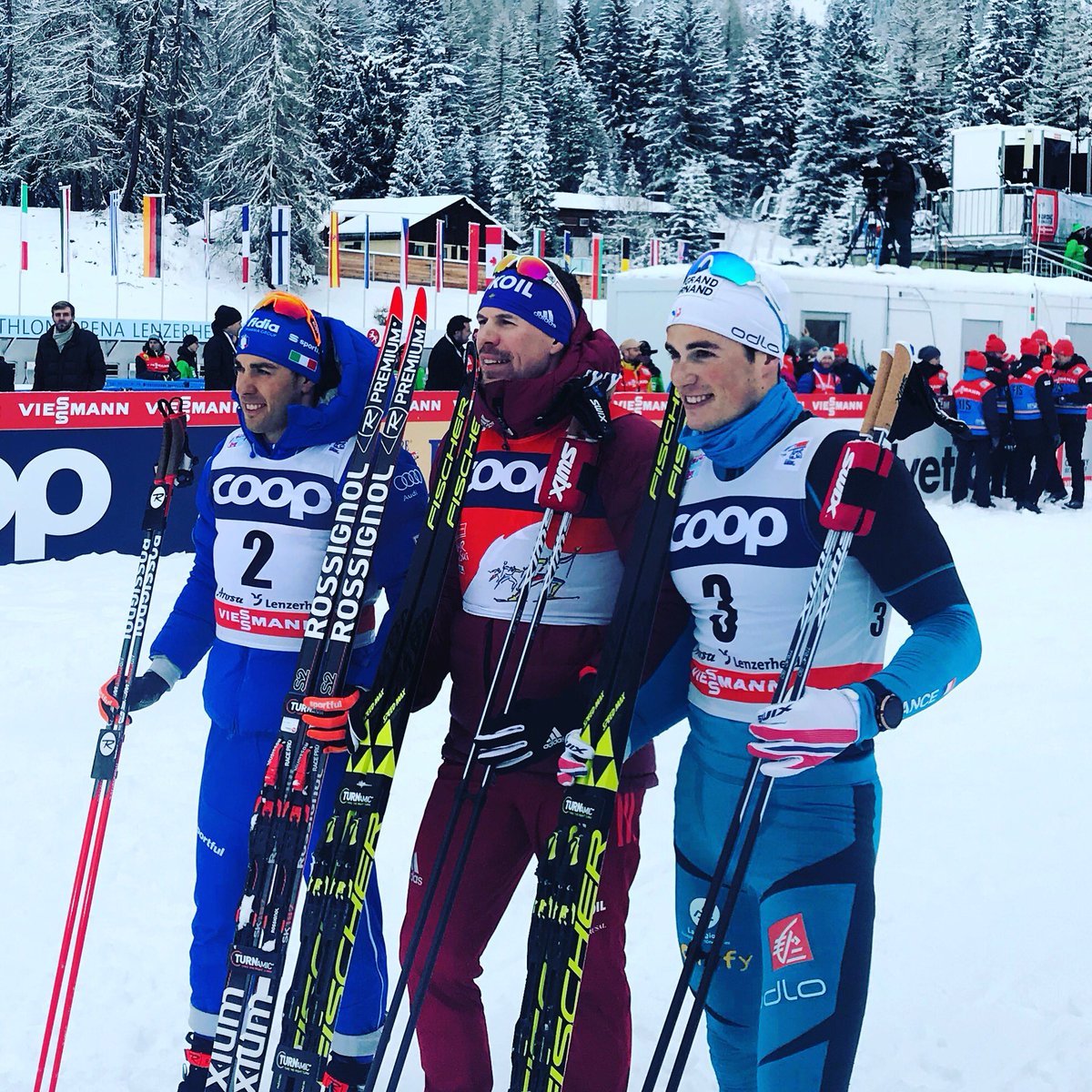
The men’s podium after the Stage 1 freestyle sprint of the 2018 Tour de Ski, with Russia’s Sergey Ustiugov (c) in first, Italy’s Federico Pellegrino (l) in second, and France’s Lucas Chanavat (r) in third. (Photo: FIS Cross Country/Twitter)
In the men’s 1.5 k freestyle sprint, the defending Tour de Ski champion, Sergey Ustiugov of Russia, won his first World Cup race of the season by 1 second over Italy’s Federico Pellegrino.
Ustiugov started off by winning the qualifier in 2:58.46, and Pellegrino qualified second, 1.08 seconds off the Russian’s time. Ustiugov then raced to second in the first quarterfinal, just 0.07 seconds behind Norway’s Finn Hågen Krogh in first. In the second quarterfinal that followed, Pellegrino took the win over Finland’s Ristomatti Hakola in second (+0.35).
The first semifinal featured a three-way photo finish for first, with Ustiugov edging Pellegrino by 0.04 seconds and Krogh by 0.06 seconds. Hakola finished fourth (+1.11) in that heat to advance to the final as well.
There, the 25-year-old Ustiugov was first across the finish line in 2:57.28. Pellegrino claimed second (+1.0), and France’s Lucas Chanavat — whom had qualified third and won both his quarterfinal and semifinal — reached the podium in third (+2.76). Hakola was fourth (+5.91), Krogh fifth (+14.39), and the second French skier in the final, Richard Jouve sixth (+21.01).
Canada’s Alex Harvey missed reaching the final by one-hundredth of a second, placing third in Chanavat’s semifinal after a photo finish for second place. While Chanavat won that heat by 0.34 seconds over his French teammate Jouve, Harvey was another 0.01 seconds back in third. Ultimately, Harvey placed seventh overall (he started the day by qualifying in 18th).
Three out of four American men qualified for the heats, with Simi Hamilton in 15th, Andy Newell in 20th and Erik Bjornsen in 27th. Hamilton finished the day in 15th as well after placing third in his quarterfinal, Newell ended up 19th after finishing fourth in his quarterfinal, and Bjornsen was 25th after taking fifth in his quarter.
Paddy Caldwell finished 74th in the qualifier for the U.S. Canada’s second man in the Tour, Devon Kershaw finished 86th out of 94.
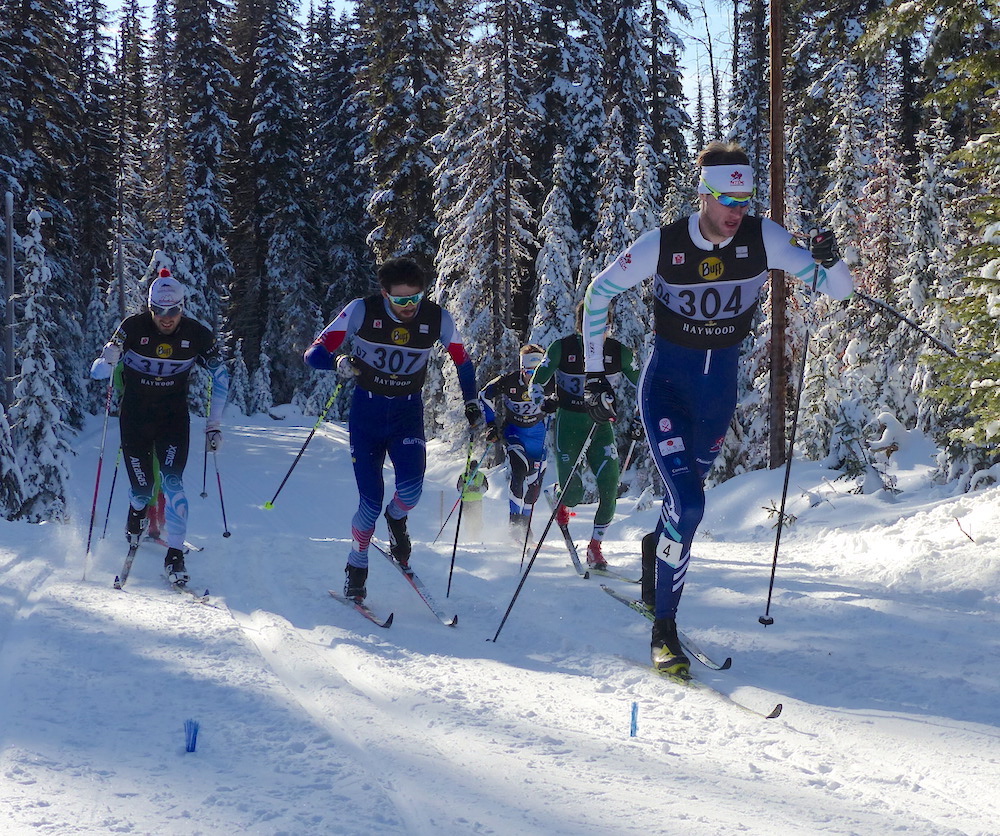
Bob Thompson (304) of NTDC Thunder Bay leading Sun Valley’s Jack Hegman (307) and Patrick Stewart-Jones (317) of the AWCA during their quarterfinal of the NorAm men’s 1.3 k classic sprint on Saturday at Sovereign Lake near Vernon, B.C. (Photo: Peggy Hung)
NorAm/SuperTour (Sovereign Lake near Vernon, British Columbia): Classic sprints
On the opening day of the NorAm Continental Cup series in Canada (which doubled as a U.S. SuperTour), American Kaitlynn Miller of the Craftsbury Green Racing Project (CGRP) started Saturday with a nearly three-second win in the classic-sprint qualifier at the Sovereign Lake Nordic Centre, then went on to win her quarterfinal and semifinal before topping the final as well.
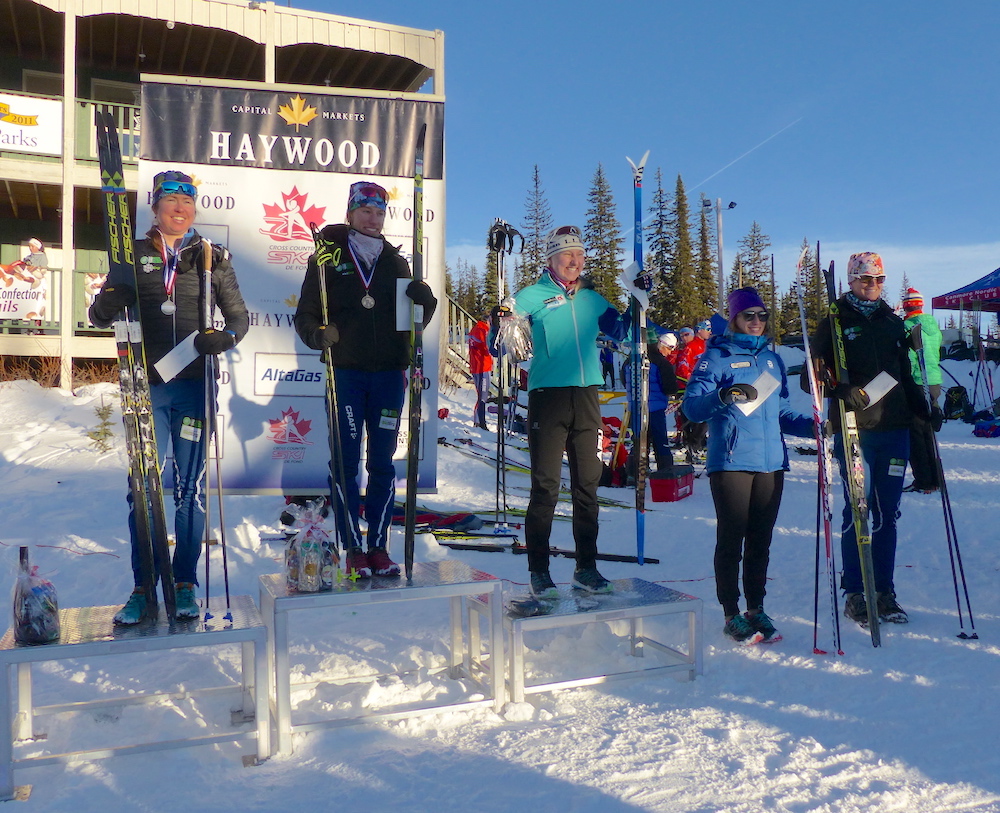
The women’s 1.3 k classic sprint podium and top five at the first NorAm of the season on Saturday at Sovereign Lake near Vernon, B.C., with (from left to right) Caitlin Patterson (CGRP) in second, Kaitlynn Miller (CGRP) in first, Hannah Halvorsen (APU/USST) in third, Kelsey Phinney (SVSEF) in fourth, and Liz Guiney (CGRP) in fifth. (Photo: Peggy Hung)
Miller was the fastest women’s qualifier by 2.87 seconds on the 1.3-kilometer course with a time of 2:59.39. Ultimately, she won the final in 2:57.53, 0.93 seconds ahead of her teammate Caitlin Patterson in second and 2.59 seconds clear of the third American on the podium, Hannah Halvorsen of Alaska Pacific University (APU) and the U.S. Ski Team (USST) D-team, in third place.
Halvorsen previously qualified third behind Kelsey Phinney, of the Sun Valley Ski Education Foundation (SVSEF) in second. Phinney finished fourth in the final (+2.85), while a third Craftsbury skier, Liz Guiney placed fifth (+3.53). The lone Canadian in the six-woman final, Sophie Carrier-Laforte of the Pierre-Harvey National Training Centre (CNEPH) placed sixth (+4.38).
Thompson Fends Off Five Americans
Of the six racers in the men’s 1.3 k freestyle sprint final, five of them were American. Bob Thompson, of the Thunder Bay National Team Development Centre (NTDC), bested them all for the win in 2:29.31, just 0.03 seconds ahead of Ben Saxton, of the Stratton Mountain School (SMS) Elite Team, in second place. Cole Morgan (SVSEF), the qualifying winner who had so far dominated all of his heats, ended up third overall, 0.48 seconds behind Thompson.
Sun Valley and APU each had two athletes reach the men’s final with Jack Hegman (SVSEF) taking fourth (+0.51), and APU’s Reese Hanneman and Tyler Kornfield placing fifth (+7.75) and sixth (+7.9), respectively.
To start the day, Morgan posted the fastest men’s qualifying time in 2:31.00, while last weekend’s SuperTour skate sprint winner Nick Michaud, of the Bridger Ski Foundation (BSF), qualified in second, 0.78 seconds back. Americans took the top-three qualifying spots with Logan Hanneman (APU) in third (+1.59), whileThompsonwas the top Canadian qualifier in fourth (+2.34).
Morgan won both his quarterfinal and the first semifinal to advance to the final, along with Thompson who placed second in that semifinal (and placed second to Hegman in the quarterfinals).Saxtonwon the second semifinal (after finishing second to Logan Hanneman in the quarterfinals) andKornfield was second behind Saxton in that semifinal to automatically advance to the final. Reese Hanneman and Hegman made it to the final as lucky losers after placing third and fourth, respectively, in the first semifinal.
Norway’s Johannes Thingnes Bø notched his second-straight win in Hochfilzen after Martin Fourcade of France missed three on the final shooting stage of the men’s 12.5 k pursuit on Saturday. Bø, who started the race 12 seconds ahead of Fourcade in second, cleaned the final standing stage to leave the range nearly a minute ahead of Slovenia’s Jakov Fak in second. Meanwhile, Fourcade, who had been skiing in first just ahead of Bø before the last stage, dropped 1:19 minutes back to fifth.
Norway’s Johannes Thingnes Bø (1) heading out of the start, 12 seconds ahead of the second starter, France’s Martin Fourcade (yellow bib), on Saturday in the IBU World Cup men’s 12.5 k pursuit in Hochfilzen, Austria. (Photo: IBU/biathlonworld)
While Bø skied the win in 36:41.1 minutes and Fak, the third starter, finished 58.8 seconds later in second place, Fourcade made up two places on the final loop to place third (+1:10.0) after passing Germany’s Simon Schempp and Russia’s Maxim Tsvetkov.
Schempp settled for fourth (+1:10.5), and Bø’s older brother, Tarjei Bø, passed Tsvetkov as well to claim fifth (+1:11.9), while Tsvetkov finished sixth (+11:12.3).
On another snowy afternoon in Hochfilzen, Johannes Bø had three penalties, two of which came in the first stage (2+0+1+0). Fak was one of four men in the race with just one miss (0+0+1+0) — no one cleaned — while Fourcade missed five (1+0+1+3). Schempp had four penalties (3+1+0+0) but held onto his starting position in fourth, Tarjei Bø improved from 14th at the start to fifth with just two misses (1+0+1+0) and Tsvetkov raced up from 20th to sixth with a single miss (1+0+0+0).
American Sean Doherty tied his second-best World Cup result in 17th (+2:12.8) after starting 23rd and 1:39 out of first. He had two penalties (1+0+1+0).
Canada’s top finisher, Nathan Smith placed 31st (+3:02.2) after starting 19th and missing three shots (1+1+0+1). His teammate Brendan Green rose to 33rd (+3:15.7), up from 52nd at the start, with three penalties as well (1+0+1+1).
Four Canadians qualified for the pursuit, with Scott Gow placing 48th (+5:08.4) with seven penalties (1+1+3+2). His younger brother Christian Gow crossed next in 49th (+5:13.7) after missing five (+5:13.7).
The other American man in the race, Lowell Bailey placed 36th (+3:20.6), up from 53rd, with three misses (0+2+1+0).
Kuzmina Gets First Win in Three Years
Slovakia’s Anastasia Kuzmina cleaning one of two standing stages in the women’s 10 k pursuit at the IBU World Cup in Hochfilzen, Austria, en route to a 10-second win. (Photo: IBU/biathlonworld)
In the women’s 10 k pursuit that followed, Slovakia’s Anastasia Kuzmina overcame a 22-second starting deficit to win her first race in three and a half years, shooting 19-for-20 (1+0+0+0) and finishing in 34:31.2. Kuzmina (the sister of Russia’s Anton Shipulin) started second behind Friday’s sprint winner Darya Domracheva of Belarus. Domracheva had a single miss as well in Saturday’s pursuit (0+0+1+0) but slipped to second after her penalty in the first standing stage, while Kuzmina cleaned the last three stages to take the win.
Domracheva settled for third (+11.8) and Finland’s Kaisa Mäkäräinen rose to second (+10.2) after shooting 18-for-20 (1+0+0+1) and skiing the fastest course time to rise from her starting position in sixth.
Italy’s Dorothea Wierer slipped one place to fourth (+51.6) after starting third and missing two (1+0+0+1), while Norway’s Marte Olsbu raced up from 13th to fifth (+58.2) with a single penalty (1+0+0+0). Ukraine’s Yuliia Dzhima improved from 20th to sixth (+1:08) with one miss as well (0+0+0+1).
Canada’s Emma Lunder achieved her second-best career World Cup result in 27th (+2:31.6) after starting 42nd and cleaning three stages after missing one in the first prone (1+0+0+0). Her teammate Rosanna Crawford improved from 49th at the start to 39th at the finish (+3:44.3) with four penalties, one in each stage (1+1+1+1).
The U.S. had one woman qualify for the race, Clare Egan, who finished 53rd (+5:21.6) with seven penalties (2+2+2+1).
For the third and final day of World Cup racing in Hochfilzen, the men’s and women’s relays will be held Sunday.
The women’s skate sprint podium at Saturday’s World Cup in Davos, Switzerland, with Kikkan Randall (r) of the U.S. Ski Team in third place, Sweden’s Stina Nilsson (c) in first, and Norway’s Maiken Caspersen Falla (l) in second. (Photo: Reese Brown/US Ski & Snowboard)
Kikkan Randall returned to the podium on Saturday in the first freestyle sprint of the 2017/2018 World Cup season, placing third in the women’s 1.5-kilometer skate sprint behind Sweden’s Stina Nilsson and Norway’s Maiken Caspersen Falla, respectively, in Davos, Switzerland.
Americans made up half of the women’s final, with Jessie Diggins racing to fourth and Ida Sargent sixth, with Norway’s Ingvild Flugstad Østberg between them in fifth.
Nilsson started the day by winning the qualifier in 2:51.71 minutes, while Østberg had the second-fastest qualifing time, 2.57 seconds back. Switzerland’s Nadine Fähndrich posted the third fastest qualifying time (+2.73), and for the U.S., Diggins qualified fourth (+3.37), Sargent fifth (+3.78), Randall sixth (+4.11), Sophie Caldwell ninth (+4.87), and Sadie Bjornsen in 11th (+5.38).
Nilsson then won her quarterfinal and the first semifinal before outlunging Falla by eight-hundredths of a second for the final win in 2:47.99. Randall (who won her quarterfinal and advanced to the final as a lucky loser in third in the first semifinal) finished 2.53 seconds after Nilsson for third overall, and Diggins (who won both her quarterfinal and the second semifinal) was 4.41 seconds back in fourth. Østberg finished 5.62 seconds back in fifth, and Sargent crossed the line 14.49 seconds back in sixth.
Caldwell placed eighth overall after winning her quarterfinal then placing fourth in the second semifinal, behind Diggins, Sargent and Germany’s Sandra Ringwald, respectively. Ringwald did not advance to the final, either, for seventh overall. Bjornsen placed 13th on the day after finishing third in her quarterfinal.
Also for the U.S., Julia Kern (U.S. Ski Team D-team) finished in 57th in the qualifying round, 16.55 seconds out of first.
Dahria Beatty was the top Canadian in 53rd (+15.53), followed by Katherine Stewart-Jonesin 55th (+16.18) and Cendrine Browne in 64th (+18.27).
In the men’s 1.5 k skate sprint, Norway’s Johannes Høsflot Klæbo rocketed to his sixth-straight win in as many World Cup races this season, topping the qualifier in 2:23.10 (by 1.27 seconds over France’s Lucas Chanavat and 1.73 seconds over Italy’s Federico Pellegrino in third) then winning his quarterfinal and semifinal comfortably before capping the day with a victory in the final in 2:28.07. Pellegrino placed second in the final, 1.8 seconds back, and Russia’s Alexander Bolshunov tallied his third podium of the season in third place (+4.64). Finland’s Ristomatti Hakola placed fourth (+5.39), France’s Richard Jouve was fifth (+8.65) and Russia’s Gleb Retivykh was sixth in the final (+18.34).
Americans Andy Newell and Simi Hamilton both qualified for the heats in 10th and 12th, respectively. Hamilton went on to place ninth overall after finishing second in his quarterfinal (behind France’s Renaud Jay) and fifth in the second semifinal (which Hakola won). Newell’s day ended in the quarterfinals, where he placed fifth, 2.44 seconds behind Klæbo, who won that heat. Overall, Newell was 21st.
Canada’s Alex Harvey qualified for the heats in 21st and went on to place 23rd overall after finishing fifth in his quarterfinal, 1.14 seconds behind Retivykh in first.
Also for Canada, Julien Locke missed qualifying in the top 30 by 1.07 seconds in 36th (+7.84). Russell Kennedy placed 48th (+9.39), Knute Johnsgaard was 52nd (+10.35), Jess Cockney 54th (+10.83), Devon Kershaw 63rd (+11.78).
For the U.S., Erik Bjornsen finished 58th (+11.12) and Paddy Caldwell 108th (+24.04) in the qualifier.
Germany’s Thomas Bing (7) leads Sweden’s Daniel Rickardsson (2) and Switzerland’s Jason Rüesch during the first leg of the men’s 4 x 10 k relay at 2017 World Championships in Lahti, Finland. (Photo: John Lazenby/Lazenbyphoto.com)
Welcome to World Cup Windup, where we check in with the top-10 teams from last year’s FIS Cross Country World Cup tour before the season starts with the Ruka Triple in Kuusamo, Finland, on Nov. 24.
GERMANY
Overall in Nations Cup Last Year:Seventh
Women’s Ranking 2016/2017:Sixth
Men’s Ranking 2016/2017: Ninth
Who’s Back:
Nicole Fessel and Steffi Boehler, top-20 in the World Cup distance standings; sprint finalist Sandra Ringwald; Victoria Carl and Katharina Hennig, who joined Ringwald and Boehler to finish second in the World Cup relay in Ulricehamn; Florian Notz, Elizabeth Schicho, Laura Gimmler, and Thomas Bing, each of whom had a single World Cup top-10 last season, and Hanna Kolb, who had two.
Who’s Missing:
Veteran sprinter Tim Tscharnke retired partway through the summer. The 2010 Olympic team sprint medalist has struggled with back problems and finally called it quits. “The last three years of my career were riddled with many mediocre months, punctuated by health problems and athletic setbacks,” he said.
Pre-Season Results:
The World Cup women’s 4 x 5 k podium on Jan. 22 in Ulricehamn, Sweden, with (from left to right) Germany (Stefanie Boehler, Sandra Ringwald, Victoria Carl, Katharina Hennig) in second, Norway (Ingvild Flugstad Østberg, Heidi Weng, Astrid Uhrenholdt Jacobsen, Marit Bjørgen) in first, and Sweden in third (Ida Ingemarsdotter, Sofia Henriksson, Charlotte Kalla, Hanna Falk). (Photo: Fischer/Nordic Focus)
Earlier this month in Davos, Switzerland, Thomas Bing won a sprint race and Laura Gimmler was the runner-up in the women’s race. Katharina Hennig and Steffi Boehler went 2-3 in a distance race.
Recent Drama:
After being sick in both August and September, Florian Notz is aiming for a World Cup debut in Davos in December, not earlier. “I did not have any real training for two to three months,” he told Südwest Press. “That’s why Kuusamo is too early for me… I have set myself as a goal, that I want to attack fully [in Davos]. I am still optimistic that I can be in shape by then. But of course, everything has to go right.” If not, Olympic qualifying will be tricky.
Lucas Bögl is among the athletes joining the new “Athleten für Deutschland” athlete union, which was recently founded as an independent alternative to the athletes’ council run by the German Olympic Committee. The head of the German Olympic Committee is not a fan, saying basically that athletes trying to make demands will only bring problems upon themselves. Bögl disagreed. “The club should help the athletes commission and support the athletes,” he told OBV-online. “That should be in the interest of everyone involved.” He also said: “Cross-country skiing is not something you do for the money, it’s more of a way of life. I have turned my sport into a profession. I feel privileged that I don’t have to sit in an office. I can do that for a long time after my career is over.”
Sandra Ringwald, who just missed making the 2014 Olympic team for Germany, and is particularly focused on 2018 Games this winter. “I want to fulfill my Olympic dream and be in PyeongChang,” she told the Südkurier newspaper in an interview. “However, I’m going easy on the whole thing. In the past few years I have often set my goals too high… I’m not working just for Olympic qualification. My aim is to play a good role in the World Cup as well. I want to show what I can do at the very first races.”
Best Social Media Presence:
Steffi Boehler is a consistent Instagram poster, and also includes some of her artwork along with training and daily-life pictures.
Sprinter Sebastian Eisenlauer also posts gorgeous training shots:
Marit Bjørgen taking Norway home for a win in the 4 x 5 k relay in Ulricehamn, Sweden. (Photo: Fischer/Nordic Focus)
Another women’s 4 x 5 k World Cup relay, another Norwegian win.
Yawn? Not so fast. While the team of Ingvild Flugstad Østberg, Heidi Weng, Astrid Jacobsen, and Marit Bjørgen may have picked up the victory, the women’s race in Ulricehamn, Sweden, was anything but dull.
For one thing, it was the closest race in 23 months, going all the way back to the 2014 Olympics where Sweden took gold. The top four teams all finished within 10 seconds of one another – a far cry from the more recent Norwegian victories by 30 or 40 seconds or even well over a minute.
And for another thing, the race for second place was a nailbiter. After trailing the leaders by 11 seconds at the first exchange, the German and American teams had clawed their way back into the fight for the podium. So by the time 19 kilometers had gone by, it was Hanna Falk of Sweden, Sandra Ringwald of Germany, and Jessie Diggins of the United States flying into the stadium to the finish together.
All were highly motivated. It is Falk’s home course, and the very first time her club has hosted a World Cup.
“It was again a great experience,” Falk told FIS. “I was motivated by the audience.”
For Germany, being in that group of three meant the potential for the team’s best finish in three or even seven years.
And for the United States? Well, the U.S. women are always game for a relay, and Diggins is always game for a fight.
Jessie Diggins skiing the anchor leg for the United States. (Photo: Salomon/Nordic Focus)
In the end, though, Diggins was boxed at the back of the group coming into the finishing straight. She had to choose an outside lane and couldn’t quite catch Ringwald and Falk.
The German edged the hometown favorite for second place, earning Germany their best relay finish since 2010.
“It was in my head that I absolutely did not want to become fourth today,” Ringwald told German broadcaster ZDF. “And then I just thought: killer instinct for the end, just keep at it! When Hanna [Falk] started her first attack I tried to somehow fight, and then on the last meters I knew that finish stretch suits me pretty well. And I just gave it all I had, and then it worked out for a second place.”
She crossed the line 8.8 seconds behind Bjørgen and Norway. Falk took Sweden to third, +9.0, and Diggins and the United States were left in fourth, +9.2.
“Of course we were hoping to be on the podium,” U.S. Ski Team Head Coach Chris Grover said in an interview. “So it’s hard when you’re that close to the podium, within a few hundredths of a second, and then not able to be on the podium. But all the women skied really well.”
U.S. Women Strong, But Can’t Crush the Course
The consensus from the U.S. team was that all four members of the first squad – the U.S. also fielded a second team, which finished 12th – skied well, but that the course wasn’t especially suited to them.
The classic portion of the relay (the first and second skiers) did ascend a major climb that had featured in the individual 10 and 15 k freestyle races on Saturday. But the skate course skipped that hill, and instead was rolling and flatter.
Sadie Bjornsen bringing the U.S. back up toward the leaders on leg two. (Photo: Fischer/Nordic Focus)
Rosie Brennan kicked things off for the U.S. She lost contact with the lead group (both Norwegian teams, Ida Ingemarsdotter of Sweden, and Anamarija Lampic of Slovenia), but tagged in fifth place, just 11 seconds back.
“I didn’t have the best start, but found my groove about half way through and was able to pull back some time in the second half,” Brennan said in a USSA press release. “I will always want more when it’s a relay because I want to be the best for my teammates, but I am satisfied with today and now know exactly where I need to put in some work to be better next time.”
From there, Sadie Bjornsen took over.
“I knew I needed to be somewhat patient closing that gap,” Bjornsen said. “Thinking back to Lillehammer when a similar thing happened, I tried to close the gap in one kilometer and I exploded. I was trying to be a bit more conservative for the first part today, and it all worked out well.”
By partway around the loop, Bjornsen and Germany’s Steffi Boehler had bridged up to the chase group. Heidi Weng of Norway had taken off, putting 15 seconds on the rest of the field – Norway never faltered after that – but the American and German teams were now skiing with Sweden, Slovenia, and the second Norwegian team.
“Once we finally did catch the group it was a bit challenging because there really wasn’t anywhere you could pass,” Bjornsen said. “There were just two lanes.”
Coming into the stadium she took the lead, but it still wasn’t what she had hoped for – and she wasn’t able to drop the other skiers.
“I was double poling as hard as I could coming down that hill, while others were tucking,” Bjornsen said. “It was the only way to get around. It was impossible to pass, which I knew the classic legs were the only places to make a break, so for that reason I was wondering how it could be possible to go around those girls, but yeah. It was what it was.”
“The goal is always to be as close as possible after the classic leg, and to put our skaters in contention for the podium,” Grover said. “Rosie and Sadie did exactly that. They brought it in right in contact with the second-place team.”
The inability to create gaps was something that would come back to haunt the Americans on the next two legs, as the race transitioned to skating. Charlotte Kalla of Sweden tried to move and break up the chase group, but the U.S. racer Liz Stephen stayed right on her – and then the rest of the group caught up too.
Charlotte Kalla of Sweden and Liz Stephen of the United States trying to make a break for it. (Photo: Fischer/Nordic Focus)
“Kalla took it out hot — I tried to stay with her, and then Ragnhild [Haga, of Norway] and [Germany’s] Victoria Carl caught up,” Stephen said. “It was a really hard course to pass on because the draft was pretty amazing. There’s just no real long hill to showcase fitness, or to make any moves on, and I think you saw that in both the men’s and women’s races today. But it was a really fun race to do, and I feel like I skied really well, especially tactically well, which is not always my strong suit.”
Later, Stephen tried to up the pace herself, but similarly failed to get a gap. On the particularly fast course, the draft effect was just too strong.
“Today I had to think about the best way for me to ski the course,” she explained. “I skied the uphills really well, and as fast as I could. But we weren’t able to fully break the group, Charlotte and I. I led some of the downhill, flat stuff, and I felt like I was really moving,and speeding people out — but then there were three people right up on me again. Once you realize what’s going on, you have to play to your strengths, so I knew that I needed to just hang with the girls.”
By the time Stephen tagged off, Slovenia had dropped out of the group and it was a four-way race for second place, about 16 seconds behind the leading Norwegian team.
Diggins took the tag and the lead of the group. But she, too, was unable to ski away from her competitors, although Kari Øyre Slind of the second Norwegian team did drop back.
“For my leg, it felt like a chess match,” Diggins wrote in an email. “After watching Charlotte and Liz racing so well but seeing the drafters in their pack still clinging on, I knew my usual strategy of going all out was unlikely to work. I did the best I could with how it played out, but I feel like my fitness wasn’t reflected well in this particular race. It was a huge drafting course and it was exceedingly hard to drop people in the skate leg.”
Coming down the final downhill to the finish, Diggins was in back of Falk and Ringwald and trying to get past. She couldn’t, and dropping down to the finishing straight didn’t have an immediately obvious choice of finishing lanes. She eventually had to swing wide to the left. Despite a hard sprint to the finish, Ringwald and Falk got there first.
“In the sprint finish, we fell short by a quarter of a second,” U.S. Ski Team women’s coach Matt Whitcomb said in a USSA press release. “Jessie felt like she made a tactical mistake with her positioning, but she also did a lot right out there. She skied great. We’ll take a look at the footage to learn from the race for each athlete. I know she’d like to do it again, and the good news is that she will.”
While the U.S. didn’t make the podium – a goal which had been made easier by a disastrous start by Finland, almost always a podium contender – the women seemed philosophical about the day.
“We all had these little things that we wish we could have improved, but the thing about the U.S. relay team is that the harder the course is, the better for us,” Bjornsen said. “Today was a challenging course; it was really hard to make breaks on the skate legs. On the classic legs, I think if it would have been an even more challenging course it would have been better. Every course is different, and you want to be the best on every single course, but I think all four of us, all eight of us, really, finished the race today feeling… we wanted to be on the podium, of course, but feeling no crush of confidence out there. We all feel confident going into the next relay.”
A Second U.S. Team Toes the Line
It’s not often that the U.S. has two relay teams in a race, but that happened in Ulricehamn. Kikkan Randall, Ida Sargent, Sophie Caldwell, and SuperTour leader Liz Guiney finished 12th, +3:03.0, after losing a finishing-stretch battle with the Russia I team.
Sophie Caldwell skiing leg three for the second U.S. team. (Photo: Fischer/Nordic Focus)
“It was really cool,” Grover said. “We had eight women so we were really hoping to field two teams, but you’re always worried that somebody’s going to get sick or something. But we were lucky that everyone was healthy and ready to go. That was cool. I wish we could do that more often.”
Randall had been 10th at the first tag, just 29 seconds behind the leaders and 18 seconds behind fifth-place teammate Brennan.
Sargent then took over and skied the eighth-fastest time among second-leg skiers, losing only 24.6 more seconds on Weng.
“I was really happy with how I felt today and had a lot of fun racing,” Sargent wrote in an email. “I skied solo for the whole race except for when [Finland’s Anne] Kylloenen caught me around the 4km mark, so we skied the last kilometer together. It was a very tough course to ski by yourself because there was a lot of flat and some long gradual downhill sections that would have been a lot easier to be in the draft or working with someone else during those sections… Considering that I was skiing solo I was really happy with how close I stayed to the leaders. I haven’t done many distance races this year so I wasn’t sure what to expect.”
After that, Sophie Caldwell brought the team to 11th, and Guiney, in her first World Cup relay, to 12th.
“I think the travel and excitement of the weekend caught up to me a bit,” Guiney wrote in an email. “I was mostly excited to be able to start on a World Cup relay, so I didn’t have any expectations beyond getting to the finish as fast as I possibly could. Skiing alone in a relay is always tough, so I just tried to focus on skiing each section as well as I could. Of course, I was really hoping to stay in front of the Russian team, but their last leg caught me with around 1 k to go. While I was able to stick with her until the finish, I didn’t quite have the sprint to get around her in the lanes.”
“Being on a team with Liz Guiney in her first World Cup weekend was also a blast!” Sargent, a Craftsbury Green Racing Project teammate of Guiney’s, wrote.
The men’s 4 x 7.5 k relay podium at the World Cup in Ulricehamn, Sweden, with Norway (c) in first, Sweden (l) in second, and Canada (r) with with its best-ever men’s relay in third. (Photo: FIS Cross Country/Twitter)
FIS Cross-Country World Cup (Ulricehamn, Sweden): 4 x 5 k and 4 x 7.5 k Relays
Norway notched back-to-back team victories in the women’s and men’s relays on Sunday at the World Cup in Ulricehamn, Sweden, with Finn Hågen Krogh securing a win in themen’s 4 x 7.5 k relay by 0.5 seconds over Sweden’s Calle Halfvarsson and Canada’s Lenny Valjas. With two kilometers remaining, nine teams were within 3.8 seconds of first. Krogh outlasted both Halfvarsson and Valjas in the finishing stretch, as Sweden placed second and Canada third for its best-ever relay result, according to a Cross Country Canada press release, besting its fifth-place finish from 2012 (with then-anchor Ivan Babikov, now a Canadian World Cup coach).
Krogh teamed up with Simen Hegstad Krüger, Martin Johnsrud Sundby and Anders Gløersen and finished in 1:06:47.5, while Sweden placed second with Daniel Rickardsson, Johan Olsson, Marcus Hellner, and Halfvarsson.
For Canada, with Devon Kershaw, Alex Harvey, Knute Johnsgaard, and Valjas, it was Harvey’s third-straight World Cup podium, Valjas’s second-straight team-event podium, and national U25 Team member Johnsgaard’s first podium.
“I have been waiting my whole career for this,” Kershaw said, according to a FIS press release. “All the guys did a great job today.”
The U.S. placed 10th (+1:16.5) with Andy Newell, Erik Bjornsen, Noah Hoffman, and Simi Hamilton.
The Norwegian women’s team (center) won the 4 x 5 k World Cup cross-country relay in Ulricehamn, Sweden, by 8.8 seconds over Germany (left), with home team Sweden (right) edging the United States for third.
Earlier on Sunday, the women’s 4 x 5 k relay didn’t break apart until the second leg, but Norway still proved its dominance over the ski world with a win to start the day.
After the group of Ingvild Flugstad Østberg and Lotta Udnes Weng (Norway), Ida Ingemarsdotter (Sweden), and Anamarija Lampic (Slovenia) more or less stayed together on the first relay leg, Heidi Weng made a break for it, giving Norway a 16.8-second lead at the second tag. The Norwegian team never looked back and after the race Weng and teammates Østberg, Astrid Jacobsen, and Marit Bjørgen were able to climb to the top step of the podium.
The race for second place, though, wasn’t resolved until the finish line. Sweden, Slovenia, Norway’s second team, the United States, and Germany were all in contention at various points in the race.
On the last leg, Jessie Diggins of the U.S., Sandra Ringwald of Germany, and Hanna Falk of Sweden battled it out, dropping Kari Øyre Slind of Norway. The three shot to the finish line together, with Diggins stuck behind the other two. Ringwald eventually won the sprint finish by 0.2 seconds over Falk, with Diggins another 0.2 seconds back in fourth.
That gave Ringwald, Katharina Hennig, Stefanie Boehler, and Victoria Carl a second-place result, one of Germany’s best since taking silver at the 2010 Olympics. (The team won bronze at the 2014 Olympics.)
Ingemarsdotter, Falk, Charlotte Kalla, and Sofia Henriksson took the third step of the podium. Rosie Brennan, Sadie Bjornsen, Liz Stephen, and Diggins were left to settle for fourth.
The second U.S. team, of Kikkan Randall, Ida Sargent, Sophie Caldwell, and SuperTour leader Liz Guiney finished 12th after skiing in 8th and 9th earlier in the race.
NorAm Western Canadian Championships (Whistler, B.C.): Relays
[UPDATED] This season brought a changeup to the Western Canadian Championships with a three-person relay event in response to athletes’ request to add “fun” events to the NorAm series.
While 146 teams finished in 17 categories, it was Ontario winning the open men’s 3 x 7.5 k in 50:32.9 (Bob Thompson, Jack Carlyle and Andy Shields) and B.C. dominating the open women’s 3 x 5 k in 41:09.47 with three juniors (Katie Weaver, Anna Goodwin and Hannah Mehain).
The masters men and juvenile girls categories included the most teams, with 15 and 14, respectively.
FIS Nordic Combined World Cup (Chaux-Neuve, France): Individual large hill/10 k
Sunday’s Nordic Combined World Cup podium in Chaux-Neuve, France, with German winner Fabian Rießle (c), German runner-up Johannes Rydzek (l), and Germany’s Eric Frenzel (r) in third. (Photo: FIS Nordic Combined/Twitter)
On Sunday, after the large hill jump and 10 k ski, Germany swept the podium in the second event of the NoCo World Cup in Chaux-Neuve, France. Fabian Rießle placed first in 22:44, and his German teammates Johannes Rydzek skied to second only 2.2 seconds back, and Saturday’s winner Eric Frenzel was third (+7.9).
(Frenzel leads the NoCo World Cup, Rydzek is second overall, Rießle is third.)
Norway’s Jarl Magnus Riiber flew the farthest with 139.8 points. Franz-Josef Rehrl from Austria jumped to second with 135.7 points while his teammate Bernhard Gruber jumped to third with 131.7 points.
Magnus faded to 23rd (+47.5) in the 10 k ski. Rehrl started 15 seconds back from Magnus and placed 17th overall (+31.5). Gruber maintained a top-ten, placing 9th (+13.5), after starting 32 seconds behind first place jumper Magnus.
While the top three jumpers all dropped back in the ski, it was a day of catch up for the German’s after the jumping portion.
Rießle ranked eigth after the jump and earned 128.7 points, he began the ski 0:44 back. Rydzek placed 11th in the jump with 126.9 points, while Frenzel jumped to fourth with 131.4 points.
The only U.S. skier entered in Sunday’s event was Ben Berend. The U.S. Nordic Combined skier jumped to 13th with 126.8 points — starting the ski 0:52 behind Magnus. Yet Berend couldn’t capitalize on his strong jump, he dropped to 37th (+2:06) after the ski.
The Nordic Combined World Cup continues next Friday in Seefeld, Austria.
Ben Lustgarten (Craftsbury Green Racing Project) with his $750-dollar check for winning the men’s SuperTour classic sprint on Saturday near Truckee, Calif. Stratton’s Ben Saxton (l) placed second and APU’s Reese Hanneman (r) was third.
Lustgarten, of the Craftsbury Green Racing Project, raced to a 1.58-second victory in the men’s A-final at the Auburn Ski Club in Soda Springs, Calif., finishing in 3:03.4. Ben Saxton, of the Stratton Mountain School (SMS) Elite Team, placed second, and Reese Hanneman, of Alaska Pacific University (APU), was third (+2.77).
Hannenman’s younger brother Logan also reached the final and placed fourth (+4.5), Dakota Blackhorse-von Jess (Bend Endurance Academy) was fifth (+5.86), and the third APU skier in the final, Tyler Kornfield sixth (+18.69).
Blackhorse-von Jess started the day off as the fastest qualifier in 2:58.8. Saxton qualified second, 4.1 seconds back, Logan Hanneman qualified third (+4.2), and Lustgarten fourth (+6.5). Blackhorse-von Jess went on to win his quarterfinal and place second in his semifinal, while Lustgarten and Saxton both won their quarterfinals and semifinals.
Jennie Bender (3) of the Bridger Ski Foundation leading Stratton’s Julia Kern (2) and Sun Valley’s Deedra Irwin (5) during the second women’s classic sprint semifinal at Saturday’s SuperTour near Truckee, Calif. Bender went on to win the semifinal, as well as the final.
In the women’s A-final, Jennie Bender of the Bridger Ski Foundation, coming off a classic sprint win at nationals, scored another victory in 3:29.07. She edged Craftsbury’s Kaitlynn Miller by just seven-hundredths of a second, and Stratton’s Julia Kern placed third (+3.42). Racing at home, Hannah Halvorsen (Sugar Bowl Academy) finished fourth (+3.88). Craftsbury had three in the women’s final with Caitlin Patterson in fifth (+3.93) and Heather Mooney in sixth (+27.35).
Miller proved to be the woman to beat throughout the day, winning the qualifier in 3:30.9, along with her quarterfinal and semifinal. Kern qualified second (+3.2) and Bender third (+4.6). Bender went on to win her quarterfinal and semifinal as well before facing off with Miller in the final.
NorAm Western Canadian Championships (Whistler, B.C.): 10/15 k classic
It was interval-starts day at Western Canadian Championships at Whistler Olympic Park and national-team veteran Emily Nishikawa completed the four laps of the women’s 10 k classic in 30:35.5 to win ahead of teammate Dahria Beatty, 16.5 seconds behind. Maya MacIsaac-Jones completed the national team and Alberta World Cup Academy (AWCA) sweep in third (+1:36.5).
Sovereign Lake’s Hannah Mehain, of the national junior team, was the top junior for the second-straight day in eighth overall (+3:22.1).
In the men’s 15 k, Lappe Nordic’s Andy Shields won the six-lap race in 40:34.2, showing some of the form that won him the NorAm overall last season. National-team member Jess Cockney collected his second-straight podium, finishing second, 4.3 seconds behind Shields. Evan Palmer-Charrette (NTDC Thunder Bay) completed the podium in third (+55.1).
FIS Cross-Country World Cup (Ulricehamn, Sweden): 10/15 k freestyle
The men’s 15 k freestyle podium at Saturday’s World Cup in Ulricehamn, Sweden, with Canadian winner Alex Harvey (c), Norwegian runner-up Martin Johnsrud Sundby (l), and Sweden’s Marcus Hellner (r) in third. (Photo: FIS Cross Country/Twitter)
First individual win of the season (second straight, after winning last weekend’s team sprint), fifth individual victory of his career. That’s the latest news on Canada’s Alex Harvey, who won the World Cup men’s 15-kilometer freestyle individual start on Sunday in Ulricehamn, Sweden, for his first victory in a 15 k skate race and fourth individual podium of 2016/2017.
To say Harvey is on a roll is an understatement. On Saturday, he beat Norway’s Martin Johnsrud Sundby by 6 seconds after starting a minute behind the Norwegian defending World Cup champion. Harvey’s fastest time across the line in 32:46.2 held up through 76 finishers, with Sweden’s Marcus Hellner coming somewhat within range after starting a minute behind him. Hellner ended up 14.3 seconds back from Harvey at the finish for third place, behind Sundby.
Switzerland’s Dario Cologna missed the podium by 0.5 seconds in fourth (+14.7), and Norway’s 24-year-old Daniel Stock broke through in fifth (+16.2) for his first World Cup top 20.
Great Britain’s Andrew Musgrave placed sixth (+18.7), Sweden’s Daniel Rickardsson was seventh (+25.0), Norway’s Finn Hågen Krogh eighth (+32.2), Russia’s Petr Sedov ninth (+33.9), and Japan’s Keishin Yoshida 10th (+34.2).
American Erik Bjornsen landed in the points as he tied Norway’s Simen Andreas Sveen for 28th (+1:09.2), leading fellow U.S. Ski Team members Noah Hoffman, who placed 41st (+1:28.8), and Simi Hamilton in 53rd (+1:56.2). Also for the U.S., Matt Gelso, the Period 1 SuperTour leader from the Sun Valley Ski Education Foundation (SVSEF) Gold Team, finished 68th (+3:00.3).
Harvey’s Canadian World Cup teammates Len Valjas finished 35th (+1:17.7) and Devon Kershaw 38th (+1:22.2). Knute Johnsgaard (Canadian U25 Team) did not start.
The women’s 10 k freestyle podium on Saturday in Ulricehamn, Sweden, with Norwegian winner Marit Bjørgen (c), Finland’s Krista Parmakoski (l) in second and Sweden’s Charlotte Kalla (r) in third. (Photo: FIS Cross Country/Twitter)
In her first World Cup race in over a month and at a brand-new World Cup venue, Norway’s 36-year-old Marit Bjørgen returned to her winning ways, topping the women’s 10 k freestyle on Saturday in Ulricehamn.
Bjørgen started 40th out of 61 finishers and took the lead from Finland’s Krista Parmakoski at the finish with a time of 23:46.3 minutes. Parmakoski, who started a minute ahead of her in bib 38, ended up second, 10.7 seconds back. Sweden’s Charlotte Kalla reached the podium for the second time this season in third (+24.9).
“It is always great to win,” Bjørgen said, according to an International Ski Federation (FIS) press release. “I stayed at home for five weeks and was training. It is great to come back with a victory. I know that the training I had done was good. It was an amazing atmosphere today by the course. There were people cheering everywhere.”
Norway swept fourth through sixth with Astrid Uhrenholdt Jacobsen in fourth (+25.7), Ragnhild Haga in fifth (+32.3) and Heidi Weng in sixth (+34.0).
American Jessie Diggins raced to seventh (+34.9), ahead of Sweden’s Hanna Falk, who recorded her best distance result in eighth (+36.4). Norway’s Ingvild Flugstad Østberg finished ninth (+44.8), and Germany’s Sandra Ringwald was 10th (+56.6).
“I didn’t have the snappy good feelings I was hoping to have in my body today, but it was a solid race,” Diggins wrote in a post-race email to FasterSkier. “It’s always hard when you know that on your best days you are capable of more, but at the same time we had great skis, and it was really fun for me to be able to ski with my teammates today!”
The U.S. had three in the top 20 and four in the top 30 with Sadie Bjornsen in 12th (+1:00.5), Liz Stephen in 16th (+1:07.3) and Rosie Brennan in 24th (+1:30.7).
Cendrine Browne as Canada’s lone woman in the race achieved 35th (+1:52.0) for her career best in an individual race. Also for the U.S., Kikkan Randall placed 40th (+1:59.6) and Liz Guiney of the Craftsbury Green Racing Project 52nd (+2:33.2).
The photo finish of the men’s 4 x 7.5 k relay on Saturday at the IBU World Cup in Antholz, Italy, with Germany’s Simon Schempp outlunging Norway’s Emil Hegle Svendsen. (Photo: ZDF broadcast screenshot)
For the U.S. men, top six was a target for the 4 x 7.5 k relay on Sunday in Antholz, Italy, according to US Biathlon Men’s Coach Jonas Johansson.
Mission accomplished. In the final team event before 2017 World Championships, Lowell Bailey, Leif Nordgren, Tim Burke, and Sean Doherty combined for sixth, finishing 1:04.9 minutes behind the German winners. The Americans used a total of 10 spares but avoided the penalty loop, as did the Germans who used seven spares to clean the eight-stage race and won it in 1:13.57.2.
Germany’s Simon Schempp narrowly outlasted Norway’s Emil Hegle Svendsen in the finishing stretch to secure the victory for Germany (with teammates Erik Lesser, Benedikt Doll and Arnd Peiffer) by one-tenth of a second. Norway finished second with nine spares and no penalties (with Lars Helge Birkeland, Henrik L’Abee-Lund, Johannes Thingnes Bø, and Svendsen), and Russia secured third (+33.6) with nine spares and zero penalties as well (with Maxim Tsvetkov, Evgeniy Garanichev, Dmitry Malyshko, and Anton Babikov).
Ukraine used a total of just five spares and had zero penalties for fourth (+46.7), and Austria took fifth (+49.2) with eight spares and no penalties, after Austria’s Dominik Landertinger skied away from Doherty on the final loop and finished 6.9 seconds ahead of him for fifth place.
For the U.S. men, sixth was close to their team-best fifth with the same lineup in last year’s World Cup relay in Presque Isle, Maine. The same group also took sixth in Ruhpolding, Germany, last year as well.
With all four making US Biathlon’s World Championships team, announced Saturday, they will likely be aiming for a best championships result early next month in Hochfilzen, Austria.
Canada (Christian Gow, Scott Gow, Macx Davies, and Brendan Green) finished 16th (+4:13.8) on Saturday with two penalties and 11 spares. Scott Gow skied them up to 15th by the second exchange but they dropped to 18th after Davies had two penalties on the third leg. With Green anchoring and using just one spare, they recouped two places before the finish.
In the women’s race, Germany’s Nadine Horchler achieved a lifetime dream with her first World Cup win, after starting in bib 30 and earning her start as a reserve athlete. Germany took first and second with Laura Dahlmeier in second, and the Czech Republic’s Gabriela Koukalova placed third. Susan Dunklee of the U.S. was the lone North American starter and finished 24th after leading at the start of the second loop.
FIS Nordic Combined World Cup (Chaux-Neuve, France): Individual large hill/10 k
Saturday’s Nordic Combined World Cup podium in Chaux-Neuve, France, with German winner Johannes Rydzek (c), German runner-up Fabian Rießle (l) and Japan’s Akito Watabe (r) in third. (Photo: FIS Nordic Combined/Twitter)
The first part of Saturday’s Nordic Combined World Cup individual large hill/10 k competition was a shining moment for U.S. Nordic Combined skier Ben Berend, who jumped to second for a total of 127.5 points, trailing only Norway’s Jarl Magnus Riiber with 139 points in Chaux-Neuve, France.
Berend flew farther than Germany’s Eric Frenzel, who jumped to third on the Chaux-Neuve large hill.
Later in the day, they started the 10 k Gundersen in that order, with Riiber heading out first, followed by Berend 46 seconds later, then Frenzel 53 seconds back in third.
Germany’s Johannes Rydzek started 1:15 minutes back in 12th and skied the fastest 10 k to take the victory at the finish (in 23:01.7). He held off his German teammate Fabian Rießle by 2.8 seconds for the win, after Rießle started sixth and 1:01 back. Japan’s Akito Watabe reached the podium in third (+5.7) after jumping to seventh and starting the race 1 second behind Rießle.
Frenzel ended up fourth (+8.3), and the fourth German in the top five, Björn Kircheisen improved to fifth (+22.6) after starting 11th.
Riiber dropped to 15th (+54.0), and Berend fell outside the top 30 to end up 32nd (+2:26.0) with the 39th-ranked course time.
Berend finished 12.2 seconds ahead of his U.S. teammate Taylor Fletcher, who placed 34th (+2:38.2) after the jump put him in 48th.
Bryan Fletcher was 49th after the jump but did not start the 10 k.
The Nordic Combined World Cup continues Sunday in Chaux-Neuve with another large hill/10 k.
Ski Classics #5: La Diagonela (Zuoz, Switzerland): 50 k classic
[UPDATED] Under “blue skies, no wind and perfect track conditions” in the Swiss Engadin Valley on Saturday, according to a Ski Classics press release, Russia’s Ilya Chernousov and the Czech Republic’s Kateřina Smutná won the men’s and women’s La Diagonela, respectively, in Zuoz, Switzerland.
Chernousov, of Team Pioneer Investments, and Tord Asle Gjerdalen (Team Santander) led a large pack of men into the final major climb on the 50 k course. There, Gjerdalen attacked and Chernousov matched him, accelerating away from his competitors up the last steep pitch to the finish, according to the press release. He finished in 2:03:39.6 hours, holding off Gjerdalen by 1.5 seconds, while Øystein Pettersen (Team BN Bank) finished third (+3.0).
In the women’s race, Smutná (Team Santander) pushed to break up the field around the halfway point, where the men caught the women. Britta Johansson Norgren (Lager 157 Ski Team) hung with Smutná, but lost contact over the last 5 k. After finishing second in the last two Ski Classics races, Smutná took the win by 1:03.2 minutes in 2:20:49.2. Nordgren finished second, ahead of Sara Lindborg (Team Serneke) in third, who finished more than three minutes later (+4:17.4).
American Simi Hamilton (5) racing for the win with Norway’s Sindre Bjørnestad Skar (r) as they lead the men’s final down the finishing stretch of Saturday’s 1.3 k freestyle sprint at the World Cup in Toblach, Italy. Skar won the photo finish with Hamilton by 0.03 seconds. (Photo: Fischer/NordicFocus)
The feeling was beyond déjà vu. Simi Hamilton remembered the exact moment so clearly: almost exactly 13 months ago, he had led the World Cup men’s freestyle-sprint final in Toblach, Italy, into the last climb and ensuing descent into the stadium. There he was, leading the six-man final and racing for first place. Italy’s Federico Pellegrino took it from him after taking advantage of the downhill draft, slingshotting from second to first, while Hamilton secured second. It was the second podium of Hamilton’s career and first in a non-stage World Cup.
Great moment, but on Saturday, the U.S. Ski Team member was out to make it even better on the same 1.3-kilometer sprint course in Toblach.
In an instant, Hamilton recalled his positioning on that last hill and how those final seconds played out last season as he approached the last hill of Saturday’s final. Hamilton charged from behind to put himself in second by the top, right behind Pellegrino.
“I remember thinking coming down that long downhill, ‘This is awesome because this is exactly what Federico did to me last year,’ ” Hamilton said on the phone after Saturday’s race. “He got a really good draft off of me coming down that downhill and he was able to slingshot through the corner and into the finish stretch so I was really psyched. I was like, ‘This could be a really good thing right now.’ ”
His observations were spot on as the U.S. sprinter — who has worked to improve his distance racing as well — slingshot around Pellegrino to lead into the final curve before the finishing straight. There, he skied over a pocket of softer snow, which caught him off guard and put him back on his heels, he said.
“It kind of it messed with my head a little bit,” Hamilton said. “So I think it took me a second to recover from that, and I was just focusing so hard on not doing anything really stupid in the last 100 meters with the snow conditions kind of being a little funky there.”
At the same time, he knew he had as good a shot at ever at winning.
“I knew that I was fighting for first right there and fairly confident I was going to be on the podium at that point, but I really wanted that first spot, especially with having gotten second last year,” the 29-year-old Colorado native said.
Behind him, Norway’s Sindre Bjørnestad Skar had also taken advantage of the draft, as well as Hamilton’s slight bobble under the archway banner 100 meters before the finish, and came up on Hamilton’s left side to challenge him for first place.
The two went stride-for-stride to the line, which ended in a photo finish for first. Skar celebrated across the line, holding one arm high, while Hamilton teetered out of exhaustion and face planted alongside him. It took several moments to determine the actual winner. Finally, the results revealed that the 24-year-old Skar had taken it by three-hundredths of a second (winning the final in 2:47.91 minutes) for his first individual World Cup victory. For Hamilton, second place marked his first podium this season and the fourth of his career.
The men’s freestyle sprint podium at Saturday’s World Cup in Toblach, Italy, with American Simi Hamilton (l) in second, Norway’s Sindre Bjørnestad Skar (c) in first and Norway’s Johannes Høsflot Klæbo (r) in third. (Photo: Fischer/NordicFocus)
“He had a really really solid last 100 meters,” Hamilton said of Skar. “We both threw for the line and he was just coming up a little faster than I was. … It was a little frustrating, for sure, to be second again for the second year in a row, but at the same time he skied really well, and all of those other guys in the final. It is great to share the podium with a bunch of other really talented, strong skiers, who are the best sprinters in the world.”
Norway had two on the podium with 20-year-old Johannes Høsflot Klæbo in third (+0.66).
Pellegrino missed out on the podium by 0.61 seconds in fourth (+1.27), Switzerland’s Jovian Hediger placed fifth (+1.84) and another Norwegian Håvard Solås Taugbøl was sixth (+3.77).
For Skar, who turns 25 on Jan. 22, the victory (which was his third podium this season and his career) was another check mark on his list of season goals.
“Getting my first World Cup victory and then qualifying for the World Championships was one of my goals this year and it seems like that’s going well,” he told NRK after.
After qualifying in fourth (0.78 seconds behind Taugbøl, who won the qualifier in 2:47.38), Skar went on to win the first men’s quarterfinal in a photo finish with Hediger, then placed second in the first semifinal. Taugbøl won that semifinal by just six-hundredths of a second over Skar, while Hamilton was just another 0.05 seconds back in third and Hediger 0.03 seconds behind Hamilton in fourth. All four advanced to the final, where Skar positioned himself in the middle of the pack for much of the two-lap race, skiing in third up the second-to-last climb.
“It was almost like a lottery,” Skar said of the frequent change of leaders in the final during a post-race, televised interview with the International Ski Federation (FIS). “I just tried to stay calm and to have a good sprint.”
He had a feeling that he had the edge on Hamilton, but “it was very, very tight,” Skar said.
For Hamilton, who qualified fifth (+0.83), the podium confirmed what he had been searching for. So far this season, he has only competed in six World Cup races. Three of them were sprints, and his best result before Saturday had been 18th in the skate sprint at the Tour de Ski’s first stage in Val Müstair, Switzerland. After leaving the Tour after Stage 2, Hamilton competed in two OPA Cup races last weekend in Planica, Slovenia. There, he won the skate sprint and finished fifth in the 10 k skate.
“That definitely increased my confidence and I felt much better about where I was fitness-wise and speed-wise with those races last weekend,” Hamilton said. “And I knew that I have skied this course well before and I really enjoy racing here. It is a great place and I love it, and I was just psyched to see what I could do today, and fortunately it ended pretty well.”
U.S. Ski Team Head Coach Chris Grover said it was “incredible” that Hamilton has placed second in Toblach’s sprint two years in a row.
“It’s been fun watching him train on this course this week,” Grover said on the phone Saturday. “He did a big intensity session on the sprint course on Thursday, and when you watch him do it, he just looks like somebody who could be on the podium in this race, and of course he looked like that last week when he won the OPA Cup, too. He was able to go out there and make moves at will and see an opening and take it.
“He’s shown a mastery of this course, and his fitness is quite high,” Grover added. “It’s also worth mentioning that we had incredible skis today. Athletes kept coming back saying, ‘My skis are incredibly fast!’ That’s a key part of the equation.”
As for Hamilton’s form leading up to World Championships late next month?
“I’m hoping that I am not peaking right now because obviously we have quite a bit more time to go before Lahti, but I am definitely feeling like things are still going in the right direction,” Hamilton said.
All 7 Americans Advance
Men and women combined, five Americans and two Canadians started Saturday’s sprint — held less than a week after the nine-day Tour de Ski (TDS) ended last Sunday. Three of those Americans were women; the two Canadians were both men. Just one of them completed the Tour. Most of the competitors in Toblach this weekend did not compete in this year’s TDS.
Of those seven North Americans, all of them finished in the top 30 of their respective qualifiers on Saturday to advance to the heats.
Hamilton led the group in fifth, and just another 0.27 seconds back, his U.S. teammate Andy Newell qualified in sixth, 1.1 seconds behind Taugbøl.
Canada’s Alex Harvey racing to eighth in the men’s 1.3 k freestyle sprint qualifier on Saturday at the Toblach World Cup in Italy. (Photo: Salomon/Nordic Focus)
Canada’s Alex Harvey qualified eighth (+1.73) and Len Valjas 23rd (+4.16) out of 70 starters. (Of note: Russia’s TDS winner Sergey Ustiugov finished last in the qualifier in 70th, nearly 42 seconds off Taugbøl’s time.)
In the first men’s quarterfinal, Newell took third at the finish, 0.38 seconds behind Skar in first. Their quarterfinal time wasn’t fast enough to put Newell through as a lucky loser, and he ended up 13th on the day for his best result this season. In his fourth World Cup sprint this season, Saturday marked Newell’s first time qualifying in the top 30.
“Skate skiing and I haven’t been on great terms the last year or so haha,” Newell wrote in an email. “But in all seriousness I knew this year was meant to be a rebuilding process for me so I’m happy to be back on track.
“I finished last season not ever wanting to race a sprint race again, so I knew mentally and physically it was going to take some work to build back up to being a medal contender again,” he added. “I have to keep reminding myself that it’s still just January and to be patient and continue to try to make small gains and build throughout the season. Points and standings aren’t important to me at this time, just staying healthy and strong and building toward the World Championships and especially the Olympic year.”
Harvey raced to fourth in the second quarterfinal, 0.42 seconds behind Hamilton, who won that heat. The Canadian ended up in a photo finish with Norway’s Sondre Turvoll Fossli for third in that quarterfinal and missed it by 0.08 seconds. Neither Fossli nor Harvey advanced to the semifinals, and Harvey placed 17th overall (moving him up to fourth in the overall World Cup standings).
“I think that was my best qualifier in two years so I was a bit surprised,” said Harvey, who was coming off a career-best seventh in the TDS and had originally planned to skip the individual sprint to rest up for Sunday’s freestyle team sprint, according to a Cross Country Canada (CCC) press release. “It was such an easy trip to come down to Toblach. I just felt if I’m doing race prep I might as well put a bib on and see what happens. I felt a lot of speed today and was quite happy.”
Harvey noted the precise tactics of the Toblach sprint with a “good course here that has you always turning left,” he told CCC. “You need to keep on the inside lane because it is a little quicker, especially with the fresh snow, so if you took the lead it was hard for someone to go by you. I was just not quick enough from the start.”
Valjas also finished fourth in his quarterfinal, 1.58 seconds behind Pellegrino who won that heat, to place 20th overall. While Valjas remained in contact with the leaders throughout, he found himself at the back of the group early and moved up slightly to secure fourth at the finish.
Three U.S. Women in Semis
Meanwhile in the women’s race, the three U.S. entrants — Sophie Caldwell, Ida Sargent and Kikkan Randall — qualified for the heats in 15th, 16th and 27th, respectively.
Caldwell’s 15th-ranked qualifying time was 4.82 seconds behind the qualifying winner, Norway’s Maiken Caspersen Falla, who completed the 1.3 k course in 3:10.89.
American Sophie Caldwell racing to 15th in the women’s 1.3 k freestyle sprint qualifier at the World Cup in Toblach, Italy.(Photo: Fischer/NordicFocus)
Sargent was another 0.27 seconds back in 16th (+5:09), and Randall was 7.52 seconds off Falla’s qualifying mark.
All three U.S. women reached the semifinals, with Caldwell and Sargent automatically advancing after taking second in their quarterfinals. In the first quarterfinal, Caldwell finished 0.18 seconds behind Sweden’s Hanna Falk, and Sargent was 0.23 seconds behind the winner of the fifth quarterfinal, Slovenia’s Vesna Fabjan. Randall reached the semis as a lucky loser, after placing fourth in the fourth quarterfinal, 1.42 seconds behind Germany’s Sandra Ringwald in first.
For Randall, it marked her first semifinal appearance in two years (she took last season off to have a baby).
“I am feeling a little closer to my normal sprint gears every race,” Randall wrote in an email on Saturday. “Today’s qualifier was a good start. In the quarterfinals I was in a really fast heat and just tried to stay relaxed in the pack. We had really fast skis today and I was able to be strong in the finish so it was really exciting to advance to the semis.”
In the first semifinal, Randall and Caldwell squared off against a stacked heat with Norway’s Falla, Sweden’s Falk and her teammate Ida Ingemarsdotter, and Russia’s Natalia Matveeva. During the first lap, Caldwell positioned herself in third and trailed Matveeva and Falla on the descent before the start of Lap 2. There, on the downhill, Randall rode up into Caldwell and both tumbled to the ground and out of contention before the second lap.
“Our skis were incredibly fast today and that was actually a little bit of the problem,” Randall explained. “When our pack came down the hill that first time in the semi, everyone came together into the corner. The other girls went right so I could really only take the inside. I came up on Sophie faster than expected and tried to sneak by on the inside. But there wasn’t much space and I think I may have knocked her boot with my ski.
“When she lost balance there was nowhere to go and my skis went underneath her as we fell,” she continued. “I feel really bad because I think I caused the crash. It was a real bummer because I think both of us were feeling good and ready to mix it up. But luckily we are both OK and there was no broken bodies or equipment.”
U.S. teammates Kikkan Randall (l) and Sophie Caldwell (r) after colliding in the first women’s semifinal on Saturday at the World Cup skate sprint in Toblach, Italy. (Photo: ARD broadcast screenshot)
In what appeared to be a slow-motion tangle, both Randall and Caldwell appeared to smile at each other as they realized their misfortune. Caldwell particularly had trouble freeing her ski. The two finished fifth and sixth in that heat (Randall 22 seconds back in fifth, and Caldwell a minute back from Falla as the winner of that semifinal in sixth).
“[Kikkan] asked if I was okay and apologized,” Caldwell recalled. “It’s a bummer, but it’s unfortunately part of ski racing and there are no hard feelings.”
“We’ve had problems with that same thing before,” Grover noted. “Everyone from behind runs up on everyone who’s in front, and then, depending on if you’re pinched on the inside, or if you can make some space on the outside, you can end up making it through or you can end up in some trouble. It’s a pinch point, a tough point on the course, for sure.”
He added that Randall “took full accountability” for the crash, and there were no hard feelings.
“She felt quite bad about it, and Sophie bears no grudge about it because she knows that’s the kind of thing that happens in sprint racing all the time,” he said. “Those guys are good and they are going to be sprint teammates tomorrow, so we’ll start looking forward to the next day.”
Grover said his staff had to make the tough call of picking two women out of three for Sunday’s team sprint.
Sargent raced to sixth in the second semifinal on Saturday, just 0.86 seconds out of first. She had moved up to third on the final climb, trailing Norway’s Astrid Uhrenholdt Jacobsen and Germany’s Ringwald, respectively, and held her position on the final curve into the finishing straight. There, both Jacobsen and Sargent were overtaken by Slovenia’s Fabjan (who came on strong for second place) and Switzerland’s Laurien van der Graaff (third), following Ringwald in first.
Kikkan Randall (U.S. Ski Team) racing to a season-best 10th on Saturday in the World Cup freestyle sprint in Toblach, Italy. (Photo: Fischer/NordicFocus)
At the end of the day, U.S. women occupied 10th through 12th place, with Randall in 10th, Caldwell in 11th and Sargent in 12th.
“I tried to stay relaxed in the heats, but I felt really good so I just tried to ski near the front of the pack,” Sargent wrote in an email. “The course is really frustrating though with a long downhill with a draft that brings everyone back together but I just tried to stay out of trouble. I thought that I was in a great position in the semifinal going into the finish but then I hit something and I’m not really sure what it was, but it stopped my ski dead and I almost fell. After that bobble it was hard to get going again and so I was really bummed to lose all the places and not advance.”
For Sargent, 12th was her best result in over a year.
“I felt really strong today so I’m happy with my fitness at this point in the season,” she wrote. “We had a small staff this weekend but they did an amazing job and I’m very thankful for such awesome skis!”
In terms of how the U.S. coaches made the call for between those three for Sunday’s team sprint, Grover said it wasn’t easy.
“… As luck would have it, we had three athletes finish 10, 11, 12 on the day today, which did not make it any easier,” he said. “You actually had three athletes who are fairly evenly matched in a lot of respects right now, in terms of how they’re skiing. In the end, we decided that we really wanted to have Kikkan’s experience, in team sprint in particular and in closing out a team sprint, and in the second leg, we wanted Sophie to be able to rely on her aerobic conditioning at the moment … It was a very hard decision for us … I really wish we had a fourth woman here, so we could start two teams.”
Matveeva Gets First Win in Nearly a Decade
While the three U.S. women missed Saturday’s final, Russia’s Matveeva — who hadn’t won a World Cup race since 2007 — went on to outlast Falla for her 12th-career individual podium. Eight years ago, Matveeva tested positive for EPO was was suspended from competing from December 2009 to March 2011. After that, she reportedly had two ACL tears. Now 30, Matveeva captured her second-career sprint win on Saturday by eight-hundredths of a second over Falla.
Russia’s Natalia Matveeva (l) winning Saturday’s freestyle sprint final, by 0.08 seconds over Norway’s Maiken Caspersen Falla (r), for her first World Cup win since October (!) 2007. Sweden’s Hanna Falk (3) placed third. (Photo: Fischer/NordicFocus)
“I’ve waited a lot of time to be [here],” Matveeva told FIS in a post-race interview. “I’m very happy and the Russian team is very happy. Thank you very much my service team. Good job today.”
Matveeva charged to an early lead in the final, while Falla challenged her on the first of two climbs on the second lap. Matveeva followed her closely leading into the last climb, where Falla beat her to the top with a quicker-tempo V1. As the two descended into the stadium with a slight gap to Falk in third place, Matveeva drafted Falla then rode up alongside her, taking the outside line around the turn. The two sprinted toward the line, with Matveeva getting one extra push in for first place in 3:04.13.
“I don’t feel particularly well so second place is all right, but of course it’s frustrating to be beaten in the final stretch,” Falla told NRK. “I knew she would be fast in the final stretch. I’m a little lighter than everyone else, and that’s not an advantage.”
At the same time, Falla wasn’t bitter.
“It’s good that more people are fighting for the top spots before the World Championships; it’s more exciting then,” she said. “We have to see the positive in it all.”
Falk took the final spot on the podium in third (+2.41), and Ringwald was one second shy of it in fourth (+3.46). Ingemarsdotter finished fifth (+5.88) and Fabjan was sixth (+19.39).
In Sunday’s 6 x 1.3 k freestyle team sprint, Caldwell and Randall are teaming up in the first women’s semifinal, while their men’s team of Newell and Hamilton will be in the second men’s semifinal. Also in that second men’s semifinal are Canada’s Valjas and Harvey.
The women’s (top) and men’s (bottom) podiums at the World Cup 1.3 k freestyle sprints on Saturday in Toblach, Italy. Russia’s Natalia Matveeva (top center) won the women’s final, ahead of Norway’s Maiken Caspersen Falla (top left) and Hanna Falk (top right). American Simi Hamilton (bottom left) took second in the men’s final, behind Norway’s Sindre Bjørnestad Skar (bottom center) and ahead of Norway’s Johannes Høsflot Klæbo (bottom right) in third. (Photo: FIS Cross Country)
FIS Cross-Country World Cup (Toblach, Italy): Freestyle sprints
Simi Hamilton is back on the World Cup podium and was three-hundredths of a second away from the win on Saturday in the men’s 1.3-kilometer freestyle sprint in Toblach, Italy. The American qualified fifth and went on to win his quarterfinal then advance as a lucky loser in third out of him semifinal. In the men’s final, Hamilton waited until the last hill to strike and used his conserved energy in the two-lap race to outlast the likes of Italy’s Federico Pellegrino and Norway’s Johannes Høsflot Klæbo at the finish. Hamilton put it all on the line in a photo finish with Norway’s Sindre Bjørnestad Skar, with Skar taking his first individual World Cup victory in 2:47.91. Hamilton placed second for his first podium of the season and fourth of his career. It was also Hamilton’s first time in the final this season.
Klæbo was the second Norwegian on the podium in third, 0.66 seconds behind Skar, Pellegrino placed fourth (+1.27), Hediger was fifth (+1.84), and Norway’s Håvard Solås Taugbøl (who won the qualifier to start the day in 2:47.38) took sixth (+3.77).
“I just had a good feeling that I was a little bit before [Hamilton],” Skar said in a post-race interview with FIS of his immediate finish-line celebration before confirming that he won. “It was very, very tight.”
Skar, who turns 25 on Jan. 22, qualified fourth and won his quarterfinal and finished second in his semifinal, 0.05 seconds ahead of Hamilton.
Also for the U.S., Andy Newell qualified for the heats in sixth and took third in his quarterfinal for 13th overall. Canada’s Alex Harvey qualified eighth and finished fourth in his quarterfinal for 17th overall, and the second Canadian racing this weekend, Len Valjas, qualified 23rd and took fourth in his quarterfinal for 20th.
In the women’s race, Russia’s 30-year-old Natalia Matveeva notched the 12th individual podium of her career (all in sprints) and first victory since 2007. She challenged Norway’s Maiken Caspersen Falla on the last climb and overtook her in the finishing stretch of Saturday’s 1.3 k skate sprint final for the win in 3:04.13. Matveeva qualified fourth to start the day, then placed second in both her quarterfinal and semifinal en route to the victory. Falla won the qualifier in 3:10.89, and continued to dominate her quarterfinal and semifinal before ending up second on the day, just 0.08 seconds out of first.
“I’ve waited a lot of time to be [here],” Matveeva told FIS afterward. “I’m very happy and the Russian team is very happy. Thank you very much my service team. Good job today.”
Sweden’s Hanna Falk reached the podium in third (+2:41), Germany’s Sandra Ringwald placed fourth (+3.46), Sweden’s Ida Ingemarsdotter was fifth (+5.88), and Slovenia’s Vesna Fabjan sixth (+19.39).
Americans Kikkan Randall and Sophie Caldwell tangled in the first semifinal and ended up 10th and 11th, respectively, at the end of the day. Also for the U.S. Ski Team, Ida Sargent qualified for the heats in 16th (behind Caldwell in 15th while Randall qualified 27th), and reached the semifinals as well, placing sixth in the second semifinal after skiing in third into the finishing stretch. Sargent ended up 12th for her best result in over a year.
Finland’s Kaisa Mäkäräinen posts a 22-second win for her first victory of the season and first time shooting without a miss in an individual race since the Ruhpolding sprint almost exactly a year ago. Dunklee leads North Americans in 33rd and qualifies for the pursuit, along with Canada’s Rosanna Crawford (55th), Megan Tandy (56th) and Julia Ransom (60th).
Ski Classics Kaiser Maximilian Lauf (Seefeld, Austria): 60 k classic
[UPDATED] Imagine knee-deep snow drifts over the course of 60 k. That’s what faced racers in Saturday’s Kaiser Maximilian Lauf, the fourth stop in the 2016/2017 Ski Classics series, in Seefeld, Austria.
Team Santander’s Kateřina Smutná and Andreas Nygaard fared best in the conditions, racing to the women’s and men’s victories in 3:43:48.7 and 3:21:44.5, respectively.
Smutna won the women’s race by 10.8 seconds over Astrid Øyre Slind (Team United Bakeries), and Britta Johansson Norgren (Lager 157 Ski Team) finished more than three minutes later in third place (+3:35).
“It was the right decision to go with kick today,” Smutná said after, according to a Ski Classics press release. “It was hard for us to be in the lead and open the tracks for men. We waited for them to catch up and do the work on our behalf. I noticed it was tough for Britta because she was double poling. So, Astrid and I decided to work together in the final section of the course, and it worked perfectly.”
The men’s race was much closer with Nygaard holding off his Team Santander teammate Tord Asle Gjerdalen by 0.6 seconds. Stian Hoelgaard (Team Leaseplan) placed third, another 0.6 seconds back.
“It was a tough race because there was so much snow on the course,” Nygaard said, according to the press release. “At some point, we were knee-deep in soft snow. The pace was slow, but you get tired after a while because you have to work hard when it’s snowing like this. I just kept telling myself that I need to keep up with the guys and win the race in the end. This is something that I didn’t expect to happen when the season started. Let’s see how long I can keep the yellow [leaders] bib.”
The overall Ski Classics series leader, Nygaard is also the sprint leader as well. On the women’s side, Johansson Norgren possesses both the overall and sprint bibs as well.
FasterSkier Editor-at-Large Chelsea Little placed 17th.
Stina Nilsson smiles as she secures the win for Sweden with teammate Ida Ingemarsdotter (not shown) in the women’s freestyle team sprint final at the World Cup in Planica, Slovenia. She beat Norway’s Astrid Jacobsen (behind) for the victory. (Photo: Fischer/NordicFocus)
Groundhog Day. That was the feel of Sunday’s 6 x 1.2-kilometer freestyle team sprints at the World Cup in Planica, Slovenia, a day after Sweden’s Stina Nilsson and Italy’s Federico Pellegrino won the individual freestyle sprints on the same one-lap 1.2 k course.
The women’s team sprint came down to the final climb on the last leg — just like in the last round of the individual women’s sprint on Saturday. Trailing a Norwegian on the last descent and into the base of the climb back up to the stadium (yesterday it was Ingvild Flugstad Østberg; today it was Astrid Uhrenholdt Jacobsen), Nilsson carried her speed to pull up alongside and blow past the Norwegian, leading by the top.
Look familiar? That’s because it is. Sweden’s Stina Nilsson notched her second-straight victory of the World Cup weekend in Planica, Slovenia, on Sunday, anchoring Sweden I to the freestyle team sprint win. (Photo: Fischer/NordicFocus)
The 22-year-old Nilsson, both U23 and Sprint World Cup leader, continued to accelerate in the last 200 hundred meters to the finish, winning in 3.51 seconds for her second victory of the weekend. Nilsson shared it with Ida Ingemarsdotter, 30, teammates on Sweden’s first team (noted as Sweden I).
“We had a great day as a team. You could say we are a good couple,” Nilsson told FIS after the race. “Ida did a great work. In the final lap I was in a good position and I could ski as I wanted. I am very satisfied with the weekend in Planica.”
After sharing the podium with Nilsson on Saturday, Heidi Weng and Jacobsen teamed up for Norway I and finished second after leading at every exchange, just ahead of the Swedes. Nilsson and Ingemarsdotter had won their semifinal (ahead of Americans Ida Sargent and Sophie Caldwell in second) to automatically advance to the final, and Weng and Jacobsen won the other semifinal.
“This is better than third, but not good enough tactically to win,” Jacobsen told VG after the final, according to a translation. “Towards the end Stina had a gear that I had not.”
After nine of 10 teams skied within four seconds of the lead through the first two exchanges, Weng picked up the tempo on her second leg (third overall), and Ingemarsdotter and Germany’s I’s Sandra Ringwald stuck closest to her. Meanwhile, Sweden II slipped about 1.5 seconds off the pace in fourth, while the U.S., with Ida Sargent and Sophie Caldwell, skied in fifth (+4.46) at the third exchange — the halfway point.
One lap later, Jacobsen and Nilsson remained close, about half a second ahead of Sweden II’s Hanna Falk in third. Germany’s I’s Hanna Kolb came through the exchange a second later in fourth. By the final exchange, Weng and Ingemarsdotter had gapped Germany’s Ringwald, skiing in third, by 2 1/2 seconds.
“I knew Weng would run hard, especially in the second and third lap and am happy that I could latch on to and give Stina a good position,” Ingemarsdotter told Dagens Nyheter, according to a translation.
“Ida made it perfect. I just got the position I wanted,” Nilsson said.
Germany’s first team hung onto third and secured third, 8.84 seconds behind Sweden and 5.33 seconds behind Norway, for their first podium in almost two years.
“My attack came maybe a little too early, but it was the plan, and maybe that didn’t totally work out because I folded a little in the end,” Ringwald told German TV broadcaster ZDF. “But the three of us were able to create a gap, and so we are satisfied with the third place.”
“I am really relieved, because we knew we had a gigantic chance today and that we had to grasp it,” Kolb said. “Just a great feeling.”
Last season, Nilsson and Ingemarsdotter won the only team sprint on the schedule — also freestyle technique — in Otepää, Estonia. There, they beat Norway’s Maiken Caspersen Falla and Østberg by 0.85 seconds, and Poland’s Justyna Kowalczyk and Sylwia Jaskowiec finished 0.95 seconds back in third.
Falla and Østberg rested on Sunday, while Mari Eide and Kathrine Rolsted Harsem represented Norway II. Fourth through seventh were separated by 2.77 seconds, with Falk (Sweden II) leading the chase group in for fourth (+18.24), followed by Caldwell in fifth (+20.57).
Germany II’s Lucia Anger edged Harsem in a photo finish for sixth by 0.01 seconds, 21 seconds behind the winners. Two Slovenian teams reached the final, placing eighth (+47.24) and 10th (+2:42.12), while Italy finished ninth (+55.98).
(Story continues below)
The men’s freestyle team sprint podium at the World Cup in Planica, Slovenia: with Italian winners Federico Pellegrino and Dietmar Nöckler (c), France I’s Renaud Jay and Baptiste Gros (l) in second, and France II’s Richard Jouve, age 21, and Valentin Chauvin, age 20, (r) in third. Yes, Gros is holding a chainsaw — a chain-free noisemaker borrowed from spectators. (Photo: Fischer/NordicFocus)
Italy, France, France
Minutes after the women’s final, the men’s final played out to produce the identical winner to Saturday’s sprint — Italy’s Federico Pellegrino — who essentially pulled off the same move as Nilsson, not long after she anchored the Swedish women to the win in 16:14.08. Pellegrino anchored Italy’s first team (with teammate Dietmar Nöckler) to the win in 14:44.82.
In yet another repeat, France occupied the remaining spots on the podium in the men’s race. Renaud Jay of France’s first team led five frontrunners into the exchange zone for the last time, with France I, Germany I, Italy I, Russia I, and Norway I all within a second of one another.
On the next lap, Jay’s teammate Baptiste Gros set a blistering pace and Pellegrino chased him up the longest climb on the course. There, they began to break away from Germany and France’s second team, and Gros continued to lead up the final ascent.
On that climb, Pellegrino pulled a “Nilsson,” so to speak, as he carried his momentum from the downhill draft to pass Gros before the top. The 25-year-old Pellegrino, who became Italy’s winningest Italian male skier of all time on Saturday with his seventh individual World Cup win, added another victory to his resume as he skated away toward the finish, looking back a few strides before and winning in 1.79 seconds.
(From right to left) Italy’s Dietmar Nöckler leads Norway II’s Ola Vigen Hattestad, American Andy Newell, and Norway I’s Anders Gløersen and a Russian in the men’s freestyle team sprint final at the World Cup in Planica, Slovenia. (Photo: Fischer/NordicFocus)
France I’s Jay and Gros place second, and France II, with 20-year-old Valentin Chauvin and Richard Jouve, 21, held off Germany for third (+2.41).
Germany I, with Thomas Bing and Sebastian Eisenlauer, notched fourth (+2.93). Norway missed the podium for the second-straight men’s race with Norway I’s Anders Gløersen and Eirik Brandsdal in fifth (+4.51) and Norway II’s Ola Vigen Hattestad and Pål Golberg in seventh (+7.66), behind Russia’s Gleb Retivykh and Alexey Petukhov in sixth (+6.46).
Americans Andy Newell and Simi Hamilton crossed the finish line in eighth, but were disqualified for missing the tag in the zone on the second exchange.
Early in the race, Gløersen led though the first exchange to give Norway I an early lead, but they slipped to sixth with Brandsdal on the next leg, 1.3 seconds behind Norway II in first. Hattestad had brought Norway II into the lead, and by the fourth exchange, his teammate Golberg remained third, within half a second of Pellegrino and Gros. One lap later, Norway I and II came through the last exchange in fifth and sixth, 1 and 2 seconds out, respectively.
Norwegian commentators were quick to call Sunday’s final another instance of the Norwegians being “outclassed,” pointing out that six Norwegians occupy the top seven in the men’s overall World Cup standings. In the sprint standings, Pellegrino leads Norway’s Sondre Turvoll Fossli by nearly 200 points. Finn Hågen Krogh ranks fourth and Petter Northug is the third Norwegian in the top six.
Italian teammates Federico Pellegrino (l) and Dietmar Nöckler after winning Sunday’s World Cup freestyle team sprint in Planica, Slovenia.
“I realized a dream I had at a very young age,” Pellegrino told Italy’s La Gazzetta after Sunday’s win, according to translation. It was apparently Italy’s first team-sprint win since the women won in 2010 in Düsseldorf, Germany.
“In my early years of the World Cup, one of my first trips to the World Cup was in Düsseldorf, where they scheduled just a sprint and team sprint,” he added. “Seeing champions such [Italy’s Arianna] Follis and [Norway’s] Hattestad that could make a perfect weekend lit my imagination. I wondered if I could ever do it.”
For Nöckler, 27, it was his first World Cup win.
“I did not feel that good in the semifinal,” he told FIS after he and Pellegrino qualified second behind France’s Jay and Gros. France II won the other semifinal.
“I knew Federico is the best finisher in the world,” Nöckler added. “I tried to work hard to prepare a good position for him. We have won five Italian national championships together. It is great to win the World Cup.”
At 2015 Word Championships, Nöckler and Pellegrino earned bronze in the freestyle team sprint (behind Norway and Russia, respectively).
France’s Jay was thrilled to be on the podium after placing fourth on Saturday.
“I knew Baptiste was very strong today,” Jay told FIS. “I wanted to gain some meters before the last exchange so that Baptiste has advantage on Pellegrino, but Federico was too strong.”
For Chauvin, the weekend marked his first on the World Cup.
“It is just amazing,” he said of Sunday’s podium. “It is fantastic I could be on the podium with my friends. The whole team did great here during the whole weekend.”
France’s Lucas Chanavat (front) and Richard Jouve (second from r) lead Italy’s Federico Pellegrino during their 1.2 k freestyle sprint quarterfinal at the World Cup in Planica, Slovenia. Pellegrino won the heat, Jouve placed second and Chanavat faded to sixth. (Photo: Fischer/NordicFocus)
Six days ago on Sunday, Jan. 10, the famed hill-climb finale up Alpe Cermis in Val de Fiemme, Italy, wrapped up the 10th annual Tour de Ski. This weekend, standard World Cup racing has resumed in Planica, Slovenia, marking the first time a World Cup event has been held in Planica — better known as a biathlon center. The last World Cup races in Slovenia took place in 2011 in Rogla, about 200 kilometers east.
On Saturday, two familiar faces in the sprint scene topped the men’s and women’s 1.2-kilometer freestyle sprint.
Italian record-breaker Federico Pellegrino raced to his fourth-consecutive freestyle sprint victory this season. He is the first racer in history to do so, and according to the International Ski Federation (FIS), is the only male to reach the podium more than once in these four races. The list of firsts goes on when it comes to 25-year-old Pellegrino.
Last season, Pellegrino became the first athlete to win three consecutive skate sprints between December 2014 and January 2015. With Saturday marking his seventh World Cup win, he is now the winningest Italian male cross-country skier of all time, according to FIS. He was previously tied with Pietro Piller Cottrer with six wins.
“Statistics are made to be changed,” Pellegrino told La Gazzetta della Sport, according to a translation. He said he had “great feelings” during the qualifier, which he won by 1.59 seconds over France’s Lucas Chanavat.
He went on to win his quarterfinal (by 0.26 seconds ahead of another Frenchman Richard Jouve), and advanced out of his semifinal after placing second, 0.6 seconds behind yet another French skier Baptiste Gros.
In the final, a trio of Frenchman (Gros, Jouve and Renaud Jay) trailed Pellegrino into the last few hundred meters before the finish, with Gros leading the charge behind him. Pellegrino skied away to the victory in 2:15.12, holding off Gross by 0.88 seconds. Jouve placed third (+1.71) and Jay completed France’s sweep of second through fourth in fourth place (+2.23).
Gros had also placed second to Pellegrino in the Davos World Cup skate sprint in December — Pellegrino’s first win of four in a row.
Russia’s Gleb Retivykh and Germany’s Sebastian Eisenlauer finished behind the French contingent in fifth (+4.18) and sixth (+4.19), respectively.
Easily the favorite going into the race, some pressure inevitably rode on Pellegrino. He reflected feeling like he “could only lose the race.”
“It felt very good in the qualification,” he told FIS after the final, “But I was worried it could get worse.”
He proceeded to comfortably advance through the heats with strategic execution. He won the third quarterfinal, which turned out to be the fastest and produced two lucky losers: Finland’s Martti Jylhä in third and Sweden’s Calle Halfvarsson in fourth.
Pellegrino then carefully navigated a loaded semifinal, with all six competitors qualifying in the top eight. Gros took the lead at about halfway through, with Pellegrino stuck a few spots back. After being boxed out of the inside lane turning into the final climb, Pellegrino fought his way into second on the final climb to ensure he’d automatically advance in the top two. Gros cruised to a fairly commanding semifinal win, which did not go unnoticed by Pellegrino.
“I learned in my semifinal how to ski in the final,” Pellegrino told FIS. “I expected Baptiste to be fast on this course, so my plan was to go in the front and get a gap on the others.”
Confident in his chances in the semi, Gros had his doubts entering the final: “In the semifinal I thought I could win, but in the final it was clear that Federico [would] win,” he later told FIS.
Gros led the final for most of the first half, while Pellegrino sat back around fourth place. This time, however, he didn’t let Gros get out of reach. About halfway through the race, Pellegrino made his move: passing on the inside, accelerating to the front of the pack ahead of Gros and significantly cranking up the pace.
With that, the race proved to be as good as done. Pellegrino created a gap leading into the final downhill, breezed up the final climb with an unmatched tempo, enjoying a sizable gap on the field before throwing his arms up to celebrate across the line.
Notably, there were no Norwegians in the men’s final. This starkly contrasts from most races throughout the World Cup season and the team’s Tour de Ski results, with the Norwegian men claiming seven of the overall top 10.
That said, a number of top contenders did not race on Saturday — largely to rest and recover after completing the Tour de Ski — including Norway’s Martin Johnsrud Sundby, Finn Hågen Krogh, Petter Northug, and Didrik Tønseth. The strong Russian sprinter, Sergey Ustiugov, also was missing from the scene.
“Today was another great day,” Pellegrino told La Gazzetta. “But it was a very difficult victory because I had to emotionally handle it right against the French, which always start as horses, head down, and it is difficult to rule them all. Fortunately with my skiing, I always managed to extricate myself from their traps, in the semifinals I figured out how to run the final and I did it. I can count on energy that I know I have.”
“I am very confident of the work I’ve done,” he added. “At home, I can store hours of work that allow me to maintain this state of form. The success allows me to put more hay in the barn…”
Pellegrino currently leads the Sprint World Cup by 196 points over Norway’s Sondre Turvoll Fossli, who placed eighth on Saturday after being eliminated in the semifinal (behind Gros, Pellegrino and fellow Norwegian Eirik Brandsdal, respectively). Gros ranks third overall, 224 points out of first.
Stina Nilsson Earns Second Sprint Victory
Sweden’s Stina Nilsson celebrates her second-career World Cup victory on Saturday at the 1.2 k freestyle sprint in Planica, Slovenia. She beat three Norwegians — Astrid Uhrenholdt Jacobsen, Heidi Weng and Ingvild Flugstad Østberg, respectively — to do so. (Photo: Fischer/NordicFocus)
In the women’s 1.2 k sprint, Sweden’s 22-year-old Stina Nilsson claimed her second World Cup victory in two months. She previously won the December freestyle sprint in Davos, Switzerland.
With this win, Nilsson, the U23 leader, took the Sprint World Cup lead as well, ahead of Norway’s Maiken Caspersen Falla. While Falla’s doctor apparently warned her against starting Saturday, (“she was not in top form,” according to NRK), she raced the qualifier anyway and placed an uncharacteristic 45th, more than 14 seconds behind qualifying winner Astrid Uhrenholdt Jacobsen, her teammate.
Nilsson started her day with the 10th-fastest qualifying time, 5.82 seconds behind Jacobsen. She proceeded to win her quarterfinal — the first one of the day — by 0.1 seconds over teammate Hanna Falk and 0.92 seconds ahead of American Sophie Caldwell in third.
From there, Nilsson met one of Norway’s biggest threats in any race: Ingvild Flugstad Østberg. Both Nilsson and Østberg had raced the entire Tour de Ski (eight races in 10 days from Jan. 1-10), with Nilsson placing 24th and Østberg second overall. Yet less than a week later, here they were. Nilsson later told NRK she skied for a total of 35 minutes this week before Saturday’s race.
Slovenian Vesna Fabjan led their semifinal of the gate, while local spectators cheered her on. Nilsson shadowed her until taking the lead about halfway through and creating a fairly big gap before into the finish. Nilsson won the semifinal by half a second over Østberg, who held off Fabjan by 0.33 seconds to advance to the final.
Sweden’s Hanna Falk leads teammate Stina Nilsson (l) and Sophie Caldwell (behind Nilsson) during their 1.2 k freestyle sprint quarterfinal at the World Cup in Planica, Slovenia. While Falk was eliminated in the semifinal (after placing fourth), Nilsson ultimately won the final. (Photo: Fischer/NordicFocus)
For Nilsson, the final was her 11th straight in as many World Cup sprint starts — both skate and classic — since December 2014.
On Saturday, she squared off in the final round against Germany’s Sandra Ringwald, Italy’s Gaia Vuerich, and three Norwegians: Østberg, Jacobsen and Heidi Weng. Third in the Tour de Ski, Weng was back in action less than a week later asa well.
In Vuerich’s third final of her career, the Italian initially led out of the start, while Ringwald and Nilsson skied in second. Into the next downhill, Nilsson took the lead, with Vuerich hanging onto second.
At about halfway through, Østberg accelerated on a climb to get in front of Nilsson. By the top of this hill, Østberg maintained her position with a fairly brisk pace, Nilsson held onto second, Jacobsen had moved into third, and Weng skied in fourth.
But could Østberg, who had been in contention for the Tour de Ski overall title until the final grueling mountain climb, hold that high tempo six days later? The last uphill on the sprint course had proved crucial throughout the day. It led up into the stadium and into the finishing straight.
As that climb approached, Nilsson rode the draft and her slick skis up alongside Østberg to challenge her to the top. She used the momentum to overtake Østberg, who began to fade at the crest of the hill, and Nilsson led over the top and toward the finish.
Behind her, the three Norwegians fanned out in a wave, one in each lane to try to chase her down. Jacobsen moved into second ahead and Weng charged late for third, just ahead of Østberg.
The women’s World Cup freestyle sprint podium in Planica, Slovenia: with Swedish winner Stina Nilsson (c), Norwegian runner-up Astrid Uhrenholdt Jacobsen (l), and Heidi Weng, also of Norway, in third. (Photo: Fischer/NordicFocus)
Nilsson captured the win in 2:33.03, 0.34 seconds ahead of Jacobsen in second and 0.55 seconds ahead of Weng in third. Østberg missed the podium by five-hundredths of a second in fourth (+0.60), Ringwald finished fifth (+2.78), and Vuerich waved to crowd as she cruised in for sixth (+26.26), happy to make the final.
“I am really happy for the second win this season. I had a great day,” Nilsson told FIS. “My plan was to ski as much as possible in the front. I am excited to be in the lead of the Sprint World Cup.”
Falla did not qualify for heats after she had been “battling illness,” according to FIS.
A sprint specialist, Falla left the Tour de Ski after winning the first stage: a freestyle sprint in Lenzerheide, Switzerland. On Saturday, she dropped to third in the Sprint World Cup standings 94 points behind Nilsson in first. Østberg ranks second, 58 points behind the leader.
According to NRK, Falla planned to travel back to Norway and skip Sunday’s freestyle team sprint.