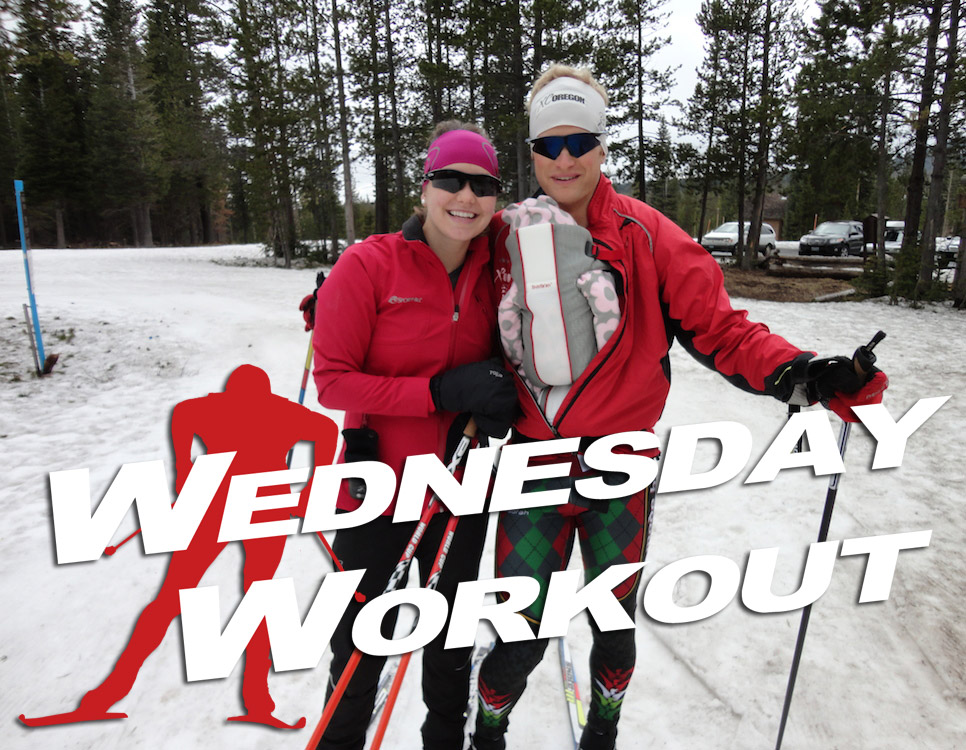
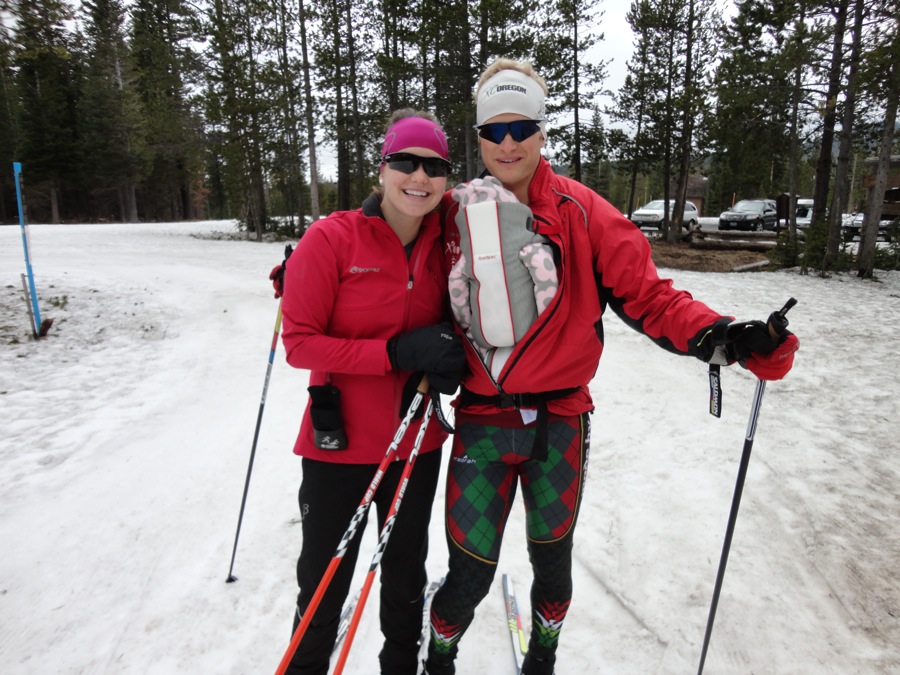
Santi and Carolyn Ocariz on their first family ski with their then-newborn daughter Sonia, three weeks after she was born last winter. Santi is currently in an accelerated nursing program, training and jumping in races when he can. (Courtesy photo)
Let’s face it, if you don’t ski professionally for a living, aren’t on some kind of elite team aspiring to reach that level, or don’t quite have the luxury retired folks have — chances are it’s not always easy to find time to train (or even exercise).
Former Central Cross Country (CXC) skier Santi Ocariz, 27, has the same problem. Currently in an accelerated nursing program in Minnesota, he’s also the father of a 10 month old — so yeah, getting out for long skis is tough.
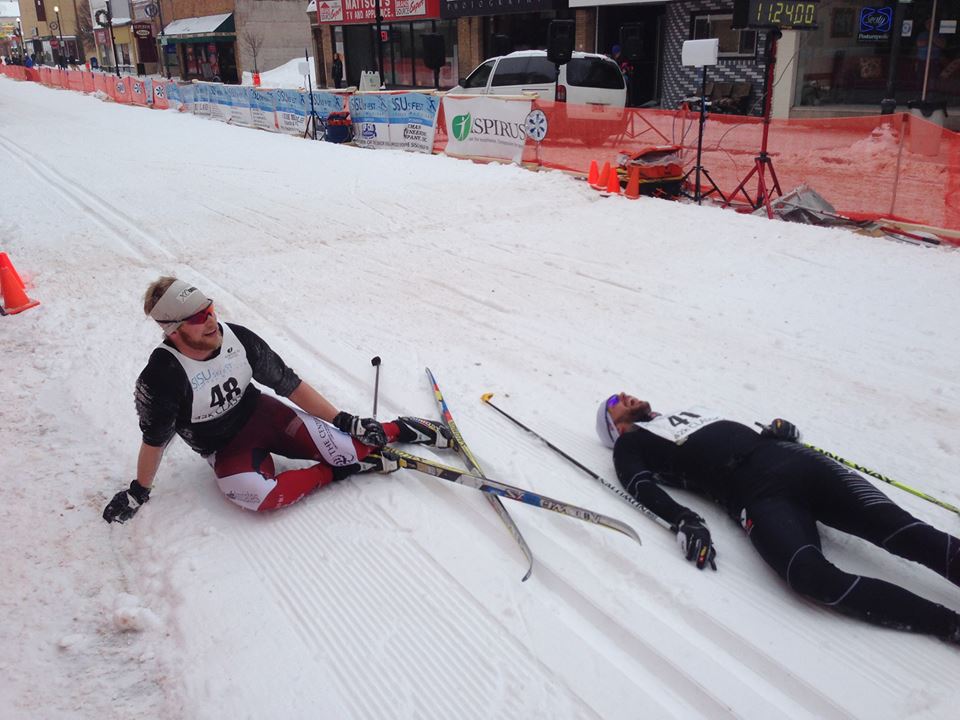
Doug DeBold (r) and Santi Ocariz after going all-out to place first and second, respectively, in the 42 k classic SISU Marathon on Jan. 11 in Ironwood, Minn. (Courtesy photo)
“I had a great time, but am abnormally sore now!” Ocariz wrote in an email on Monday.
“I haven’t gotten much of any training in this year,” he continued. “On average I have only been able to get out skiing once a week, and this race was my longest ski of the year by about an hour and a half.”
So is muscle memory our only hope? Not necessarily.
For Ocariz, family, school and work take priority over ski training, and training in general, so he’s relied on what he calls “opportunistic training.”
“If everything else is done, then I treat myself to some exercise,” he explained. “In the summer and fall (weather permitting) I was able to get out a bit for short runs pushing Sonia in a stroller.”
Option 1: Short runs pushing the kid in a baby jogger.
Option 2: Get a bicycle trailer and ride or stride with the kid in tow.
Ocariz wrote that their friends at New Moon Ski Shop pooled together and bought he and his wife, Carolyn, a Burley.
“This has allowed me to get out about once a week rollersking or skiing,” he explained.
Disclaimer: Don’t take your child out in dangerously low sub-zero temps. The recent cold snap in the Midwest put a damper on Ocariz’s training.
“Basically, when I do find 20 minutes or half an hour to work out, I just go as hard as I can from start to finish,” he wrote. “We jumped into a few 5k races on the weekends this fall and I pushed Sonia in the stroller. Sonia even won a couple races 😉
“Again, I would describe my exercising as opportunistic. Sometimes this means 2 or 3 hard sessions in a row, followed by a complete dry spell of 2 or 3 days. Obviously not the most beneficial way to train, but it burns off energy and helps me sleep better at night.”
In the end, isn’t that why we do all these crazy activities? So keep it in perspective, schedule at least 20 to 30 minutes of exercise a day when possible, and know that greater flexibility and more training time will (eventually) come.
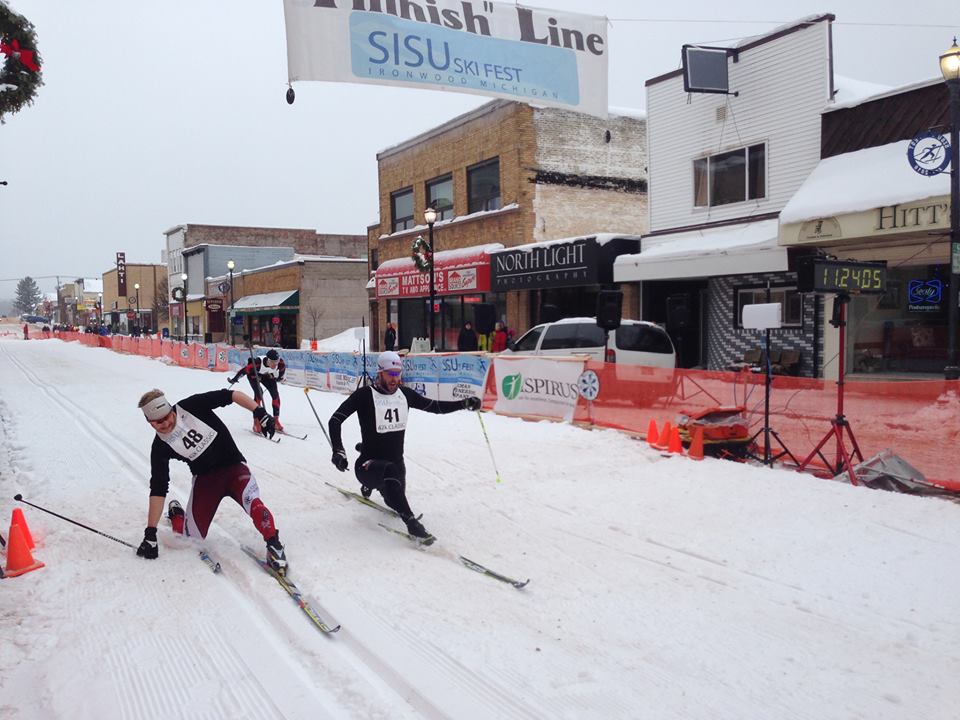
Former CXC teammates Santi Ocariz (l) and Doug DeBold racing to a photo finish at the 42 k classic SISU Marathon on Jan. 11 in Ironwood, Mich. DeBold took the win, using a pole Ocariz lent him a minute before the start. (Courtesy photo)
Santi Ocariz’s mind could’ve been preoccupied with a million things a minute and a half before the start of the 42-kilometer SISU Marathon on Jan. 11 in Ironwood, Mich. But the 27-year-old Wisconsin native could only think about his former teammate Doug DeBold, who’d likely give him the best run in the classic race.
Just before the start, DeBold, of Wayzata, Minn., realized his pole strap was broken. Ocariz ran to his car and found him a replacement. Anyone who knows Ocariz or remembers his gesture from the 2012 American Birkebeiner wouldn’t have been surprised. Skiing with the leaders with less than 10 kilometers to go, Ocariz gave his pole to Matt Liebsch, another one of his former teammates at Central Cross Country (CXC), after Liebsch initially refused the offer when he broke his. Liebsch ultimately accepted at 44 k and went on to place second.
“I mean, what’s the difference if I’m eighth or fourteenth?” Ocariz said after finishing 11th. “He had the chance to win. He’s a good friend of mine.”
Two years later and just over month before the 2014 Birkie on Feb. 22, Ocariz told The Daily Globe the SISU Marathon was “all friendly competition.” He and DeBold had grown up racing one another as juniors and in college before spending a summer as teammates on CXC.
“I had no idea how the race would play out,” wrote Ocariz, who’s living in Moorhead, Minn, pursuing an accelerated nursing degree and is the father of a 10 month old, in an email to FasterSkier.
DeBold led from the start and took off around 14 or 15 k, he explained.
“I took it out nice and slow and waited for a while to start reeling him in,” Ocariz wrote. “I didn’t want to bonk or lock up in cramps, as I haven’t gotten much of any training in this year. On average I have only been able to get out skiing once a week, and this race was my longest ski of the year by about an hour and a half.”
Doug DeBold (r) and Santi Ocariz after placing first and second, respectively, in the 42 k classic SISU Marathon on Jan. 11 in Ironwood, Minn. (Courtesy photo)
With about 11 k remaining, Ocariz and Chris Pappathopoulos caught DeBold, and Ocariz passed him. The three raced together toward the finish, where Ocariz led into the final straightaway.
“Doug pulled up alongside of me as all three of us sprinted for the finish,” Ocariz explained. “Doug and I lunged for the line, and he got me by one or two hundredths of a second.”
On the results, the two were listed with the same time of 2:24.06, but DeBold took the victory in the photo finish. Pappathopoulos was third, one-hundredth of a second behind.
“I had no idea who won,” DeBold told the local Globe.
“I kept thinking I’ve gotta go harder, but I couldn’t,” Ocariz told the Globe. “My legs and even my arms were cramping up … It was a pretty good suffer-fest.”
As for whether this was a tune-up for the Birkie, Ocariz explained it depends on whether he can swing it with school.
“I have very little free time, even on the weekends,” Ocariz wrote. “If I can get away, I’ll be suffering through the Seeley Hills Classic and the Classic Birkie.”
Skillicorn Breaks Away for First SISU Win
In the women’s 42 k classic, Kelly Skillicorn of Winona, Minn., broke away on the final lap around 15 k to win in 2:43.55. Another former CXC skier, Audrey Weber placed second, 16 minutes later.
“The pace went out easy and everyone settled into a long line fairly quickly,” Weber wrote in an email. “I got in the track and I think Skillicorn was marking me, so she tucked in behind me. My main goal was to maintain a pace within myself and not get taken out by any flailing master blasters, which is always a risk for women at the front of the pack in mixed gender mass start races.”
After her first SISU victory, Skillicorn told the Globe that she didn’t feel good at the start after waking up at 5 a.m. and driving north from her cabin in Hayward, Wis., nearly 90 miles away. But she started to feel better with 15 k to go.
With two men in front of her, she said she kept her distance while keeping them in her sights.
“I wasn’t sure how close anyone was behind me because I never look back,” Skillicorn said. “I stayed with the guys. The last 5k I really pushed it. I never want to slow down when I’m racing.”
“My main goal was to maintain a pace within myself and not get taken out by any flailing master blasters.” — Audrey Weber, second woman in 2014 SISU Marathon
And when Skillicorn decided to go, Weber couldn’t respond.
“I guess that’s what not training does for you,” wrote Weber, 27, who was born four days before Ocariz on Sept. 23 . “My training this fall consisted of mostly CrossFit and maybe 3, 45-minute runs. I’ve been on skis a total of 6 times this winter. It’s all I have time for being in my first year of dental school. So I pretty much had one pace I could ski and I did all I could to hang on. I probably kept her in sight for another 5k, but by the time the second lap started I was in no man’s land.”
Skiing for second, Weber focused on “not stopping and mostly just hoping I didn’t get passed,” she wrote. “I pretty much had no expectations for this race other than finishing. I didn’t have any idea what my body would be up for having not tested my ski fitness in quite a long time. When you have fitness, you can rely on your strengths in a race, but when you’re out of shape you don’t really have any strengths to fall back on, so you just really hurt for a long time.”
In the end, she was grateful for fast skis and “decent technique” to fall back on. Next month, she plans to race the Birkie classic marathon.
In her second time at the SISU Marathon, Weber described the people of Ironwood as “amazing and incredibly hospitable! … I have found both times that the town really rolls out the red carpet for racers.”
While waiting for her boyfriend to finish his first ski race, the 42 k skate, she sat in a “plush recliner” by the front window of a furniture story on Main Street. “I made friends with the store manager, he offered me hot coffee and told me stories about people from Ironwood,” she wrote. “I know I didn’t really deserve it, but I felt like a World Cup race leader for a little while. It was very special.”
In the race’s fifth year, registration was at a high around 600. Race director Jonathon Rulseh told the Globe that they caught a break with temperatures in the 20s after they neared 45 degrees below zero just days before. He also pointed to the nearly 250 volunteers behind SISU’s events — with the 42 k marathons, 21 k Heikki Lunta half marathon, Taste N Tour, 3 k & 5 k Junior SISU and the 2K Lapset Loppett; and three snowshoe races.
“They’re the glue that holds the SISU together and makes it run,” he said. “They’re critical to its success.”
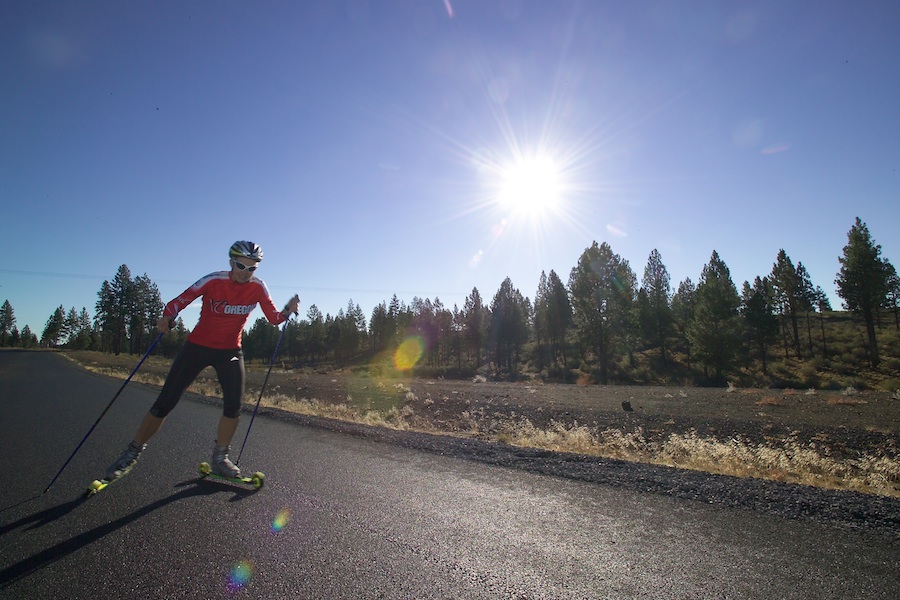
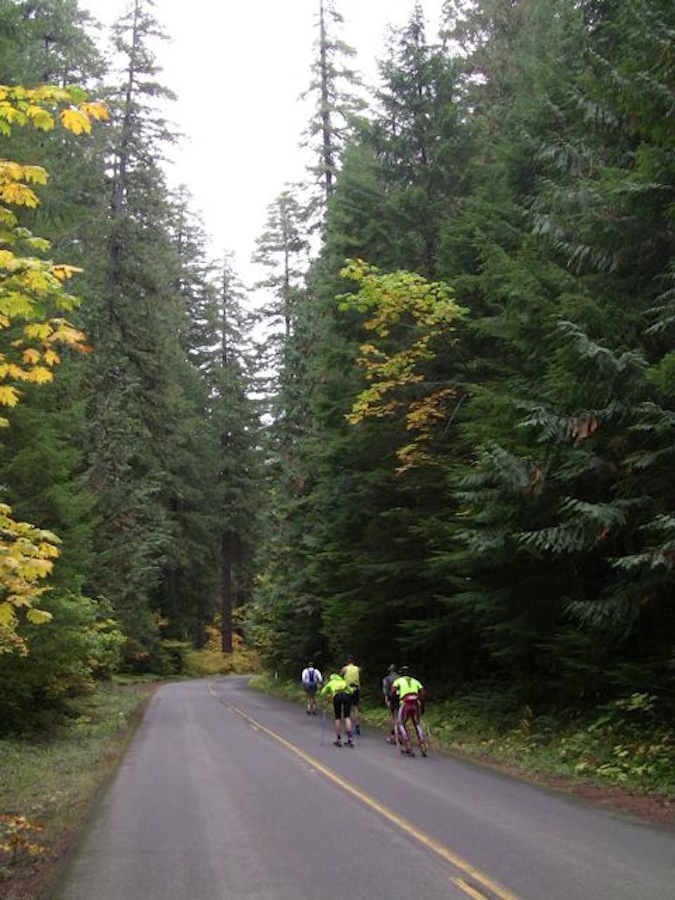
XC Oregon’s Sarah Max during a rollerski session near Bend, Ore. (Photo: XC Oregon)
Note: This is the 10th preview in our U.S. elite-team series, called the “The 12.” We asked coaches to tell us what’s new and whom to look out for this season, and we’ll publish additional previews in the coming weeks in no particular order.
The XC Oregon squad during a rollerski last fall near Bend, Ore. (Courtesy photo)
National/International Elite Roster: Santiago Ocariz, Matt Briggs; Carolyn Ocariz, Sarah Max.
Associate roster: 12-15 additional associate skiers will join the roster come November, according to Downing, who is “still finalizing plans with a bunch of folks.”
Who’s new: Downingexpects several top regional associate skiers to come onboard, but not at the national/international elite level.
Who’s missing: Oliver Burruss, who’s “entering the ‘real world’ ” in Burlington, Vt., Downing writes.
Top results last season: A couple months before his first child was born, Santi Ocariz made the most out of the Noquemanon Ski Marathon in Marquette, Mich., winning the 50 k classic in January. He went on to win Bend’s pinnacle spring event, the Pole Pedal Paddle, in May just two months after his wife and teammate, Carolyn, gave birth to Sonia. As you can imagine, Santi didn’t get to train as much as he would’ve liked.
“I don’t think I have trained this little in a year since I was a junior in high school,” Ocariz wrote in an email after the race. “However, what I lacked for in time, I made up in effort.”
Max won the women’s race to complete the XC Oregon sweep, and in February, the 38-year-old topped the podium at the 58 k Mora Vasaloppet in Minnesota.
Coach’s comment:
“For 2013/14 we’ll have a bit of a ‘factory team’ feel with fewer full-time skiers than some years, but a whole lot of talented people involved,” Downing wrote in an email.
“Santiago and Carolyn Ocariz will be out of the state much of the year with school [in the Midwest], but it’ll be fun seeing what those two can pull off,” Downing explained.
The rest of the team will race “a mixed bag of events” for the duration of the season, mostly within the Pacific Northwest and at select marathons, and not so much at big domestic races like nationals and SuperTour series.
“Our big focus once this winter winds down will be attracting 4-6 new high performance athletes to target the national/international scene beginning Spring/Summer 2014,” Downing wrote. “Bend is an amazing spot so basing here for a few years (or longer) is rarely a tough sell. But we are also happy to incorporate athletes living anywhere in Oregon. The flexibility and quality of the XC Oregon system has stood the test of time so we know any skier than joins us is going to have what they need to reach their goals — whatever they may be.
“We have already banked resources to guarantee an exceptional level of financial and logistical support for new athletes for several seasons. The consistency of our support is amazing and a direct reflection of the quality of XC Oregon delivery over 16 years. Our incredible sponsors and patrons have believed in XC Oregon because we don’t try and be something we aren’t. We help skiers achieve their goals. We attract quality people. We constantly support our community. We do all this the right way. Simple as that.
Whether someone is interested in chasing the Olympic pipeline or marathons or a little bit of everything — interested skiers should visit xcoregon.org and feel free to get in touch at any time over the coming 8-10 months.”
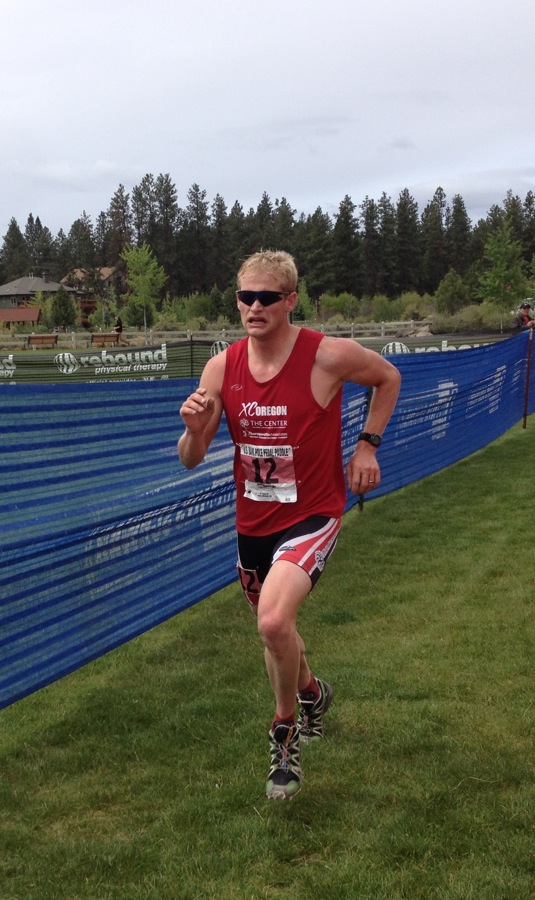
Santi Ocariz bringing it home for a 49-second win at Saturday’s Pole Pedal Paddle in Bend, Ore. (Courtesy photo)
Seven years after discovering the annual Pole Pedal Paddle in Bend, Ore., Santi Ocariz couldn’t shake the urge to try it.
A 26-year-old Wisconsin native, Ocariz visited Bend during his college summers, fell in love with the area, and resolved to come back and one day compete in the alpine, cross-country, bike, run, kayak and sprint race.
Two months before last year’s big event, Ocariz and his wife Carolyn set out for their new home in Bend on rollerskis, raising close to $20,000 to feed impoverished children. They anticipated the 3,000-mile trip would take close to three months, but the couple sped up the pace to get Ocariz to Oregon for the PPP.
They arrived four days before. Ocariz ultimately reasoned he was underprepared in terms of training and equipment, and did not race.
This year, he was ready — maybe not in training hours, but definitely mentally. Last summer, Ocariz launched toward fatherhood when Carolyn became pregnant with their first child. He shifted his priorities to train less and work more in preparation for the hospital bills and additional expenses, and in March, welcomed baby Sonia to the family.
Suddenly, two-a-day workouts were no longer a thing, and he was lucky to ski once a week.
“I don’t think I have trained this little in a year since I was a junior in high school,” Ocariz recalled in an email. “However, what I lacked for in time, I made up in effort.”
Intervals and time trials become his bread and butter, and Ocariz worked with expert paddler Torsten Heycke on kayak-specific training.
He started biking in February to work on his weaker link, practiced transitions and graciously accepted a gift from his friends: a plane ticket to Bend for the event on May 18.
A week and a half before the PPP, the Ocarizes had moved to Moorhead, Minn., where Santi started an accelerated nursing program at Concordia College.
Suddenly, his initial urge to participate had culminated into a driving motivation to beat everyone else — including several defending champions. Ocariz knew his family could use the $1,000 grand prize for winning the elite individual race, and he remembered that as first place started to slip away last Saturday.
“Everyone crushed me in the beginning of the race,” Ocariz wrote of the alpine leg, which involves sprinting to the top of Mt. Bachelor to click into skis before navigating gates on the descent.
With little experience downhill skiing, Ocariz fell behind race leaders Andrew Boone, the 2011 winner, and 2010 champ Marshall Greene. By the start of the 8-kilometer nordic leg, he estimated they had 40 seconds on him.
Ocariz cut the deficit to 10 seconds by the end of the cross-country ski, and early in the 22-mile bike leg, passed Greene up front. A few minutes later, Greene regained the lead.
“Marshall destroyed me on the bike,” Ocariz wrote. “By the time I was out of the running transition, Marshall was 2 minutes ahead of me. From here I put my nose to the grindstone and began working on reeling him in.”
Three miles into the 5-mile run, Ocariz started to lose hope, but only for a moment.
“As soon as I reminded myself how much the prize money would mean for our family, I leaned forward, shortened my stride, and pushed harder,” he wrote.
Forty seconds behind at the kayak transition, Ocariz could see Greene. His friend and supporter, Heycke heaved Ocariz’s boat forward in the water, helping him gain 20 seconds. From there, Ocariz focused on staying smooth and paddling smart, gauging his distance from Greene and how hard he was working behind him.
“By the second turn-around buoy I had almost caught Marshall,” Ocariz wrote. “With about 200 meters to go I put in a surge and passed Marshall. I was able to put 5-10 seconds on him in that last sprint. When I hit the beach I burst out of the Kayak, flung my paddle and life jacket, and began sprinting for the finish. 800 meters later, at the finish, I was 49 seconds ahead of him.”
As a rookie, Ocariz had done it — winning the elite race in 1:44:35 over a slew of local favorites. Marshall was second and Boone finished more than six minutes behind in third.
“With my PPP inexperience and lack of ability to train as I have in the past, I was unsure of my ability to match up,” Ocariz wrote. “I was definitely the dark horse. … Winning the PPP in Bend is viewed similarly to how winning the Birkie is viewed in the Hayward area.”
Enough said.
***
For women’s runner up Zoe Roy, achieving a personal best in her hometown’s celebrated race was also significant. A 25-year-old skier currently training in Canada, Roy remembered first racing the PPP on a team when she was 9 or 10. She did it solo at age 12.
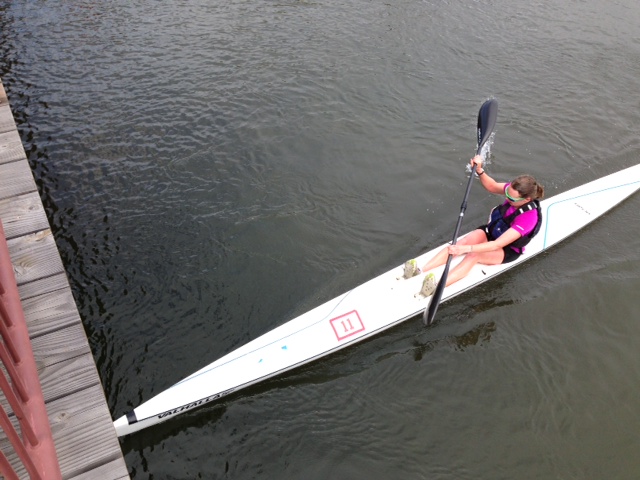
Zoe Roy near the end of Saturday’s Pole Pedal Paddle in Bend, Ore. She placed second for a personal best after friend and three-time winner Sarah Max. (Courtesy photo)
In 2009, Roy shared the individual podium with her mom, Muffy, a multiple PPP champion.
“She was second and I was third,” Roy wrote in an email. “Pretty sweet to be on the podium with your mom, though!”
She hadn’t raced it since. Back in Bend for an on-snow camp at Mt. Bachelor, Roy decided to enter the 2013 race a week before.
“I banked mostly on leftover fitness from the winter and tried to do a little a bit of everything just to get comfortable with all the different legs,” she explained.
Early in on Saturday, Roy led through the alpine and cross-country ski legs into the bike transition. Her friend Sarah Max caught her on the ride, but Roy got back in front during the run.
“I had about a 20-second lead going in to the paddle and she caught me!” Roy wrote of the kayak leg. “I think my body was so tired from everything else that I could barely hold my arms up, I didn’t know if I was going to make it!”
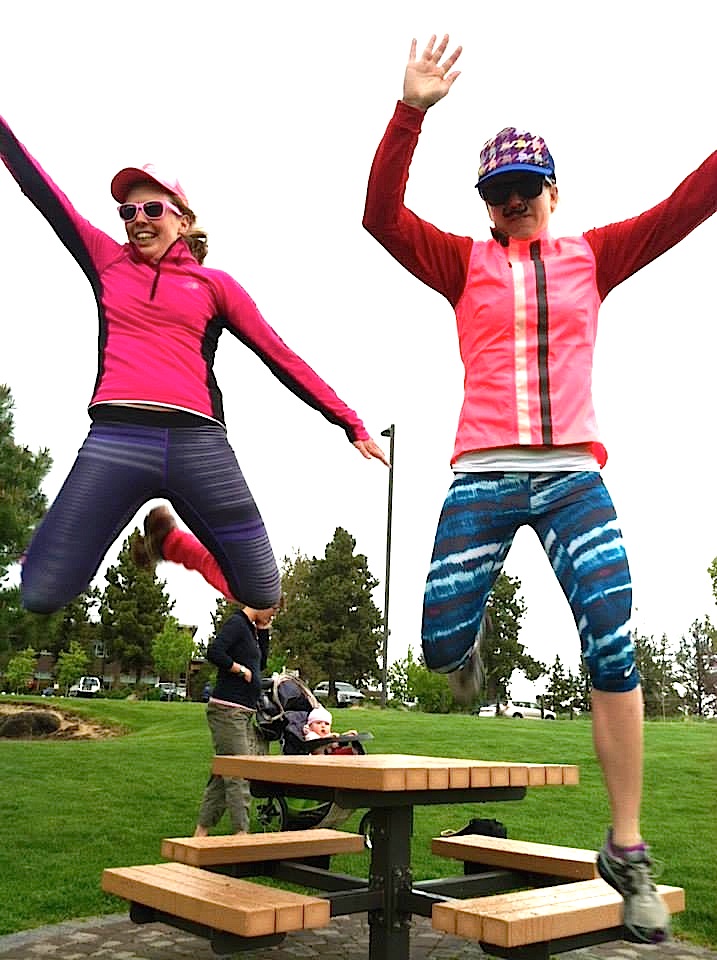
Zoe Roy (l) and Sarah Max the day before the Pole Pedal Paddle on May 18 in Bend, Ore. A Canadian skier originally from Bend, Roy placed second behind Max, now a three-time champion. (Courtesy photo)
A back-to-back champion in 2008 and 2009, Max claimed her third PPP title in 2:04:24, a minute and two seconds ahead of Roy in second. Another Bend resident, Mary Wellington finished third, nearly 5 1/2 minutes behind Max.
In a race packed with more than a thousand competitors between tandems and teams, Roy stressed the draw of racing individually.
“The individual is definitely the most team event out there when you factor in the number of people that helped me out, from my awesome support crew (my brother Tosch and my good friend from Bend, Matea) to all the people that I borrowed equipment from,” she wrote. “It takes a village!”
Now, it’s back to skiing, she explained. Roy is hosting fellow independent Canadian skiers Chandra Crawford, Amanda Ammar and Alana Thomas at her house in Bend for 10 days of training.
As for Ocariz, he’s already back in classes. After a season off, Carolyn has resumed full-time training and will race remotely for XC Oregon. Santi explained that he and Sonia, now 10 weeks old, will be her support crew.
“I won’t be training for or focusing on elite racing,” he wrote. “I hope to get to the opportunity to jump into a citizen race or two, but it is not going to be a priority. We have been thrilled with J.D. [Downing] and his organization of the XC Oregon team … The community and team are a perfect fit for us.”
The major focal points for the SuperTour field this year are qualifying for the Canadian World Cups in December and World Championships in February. Photo: Flying Point Road.
Ready or not, the 2013 SuperTour season is fast approaching. Here’s what you need to know about the domestic race scene this year.
At this point, we’ve pretty much said everything we can about the twelve senior ski programs in the U.S. We ran a series throughout the summer highlighting each team’s past accomplishments and goals for the future. Read back through ‘em for comprehensive rosters and standalone previews (scroll down for links). Now that it’s November, it’s time to discuss who stands a shot at beating whom.
First, there are a few unusual things about the race schedule to understand, as domestic results have an important role to play in qualifying athletes for bigger things this season. The U.S. can enter more athletes than usual in each World Cup race in Canada and can have eight athletes of each gender on its World Champs team, meaning that U.S. Ski Team (USST) members have a shot at top-end international competition this winter (those on the USST are not guaranteed World Championship slots, either).
Not surprisingly, the big focus is a combination of Canadian World Cup starts and World Championships. The overall, sprint and distance SuperTour leader(s) at the end of each competition period get World Cup start rights no matter what year it is, but being consistently fast enough to be in one of those positions is hard.
The five extra Nation’s Group spots afforded to the U.S. for each of the Quebec and Canmore World Cup races will be partially filled based on the SuperTour standings after the Bozeman races. With selection criteria theoretically reaching further into the field and requiring just two weekends of top results, the international stage suddenly seems much closer and more attainable. Who cares if SuperDario Cologna won’t be there, it’s still the World Cup!
World Championship criteria are a slightly different story, but early SuperTour races could still help decide who gets to go. The U.S. will bring up to eight men and eight women, with the first spots going to athletes who reach a certain World Cup ranking by January 14. After that, USSA goes down the National Ranking List, which is created off of competitors’ best four USSA-scored races from the twelve months prior to the selection date.
The road to Val di Fiemme, then, has already begun. The beginning of the current SuperTour and the week’s worth of racing at U.S. Nationals are further opportunities for athletes to turn in one of their four-best results and move up the ranking list.
Consequently, there’s a lot potentially riding on the SuperTour this year, despite the continued absence of leader bonuses at the end of the season. It’s not that everyone wasn’t trying hard before, but with a handful of top-level start rights on the line that only come around every so often, things could get feisty. Dreams will come true and hearts will be broken.
Now, the players: last year’s overall SuperTour leaders, Sylvan Ellefson (SSCV Team HomeGrown) and Jessie Diggins (SMS T2/USST), are already in Europe and out of the domestic picture for the next two weekends. Even so, the potential lineups for West Yellowstone and Bozeman are impressive.
The Rookies
Eric Packer (DAR). Photo: Flying Point Road.
For the purposes of this preview, athletes can pretty much be divided into two groups: knowns and unknowns. Every spring a handful of top-tier college skiers graduate and the domestic circuit gets an injection of new blood. Most graduates have competed in SuperTours before, but not when it’s actually been their job to ski fast.
So while the rookies aren’t joining the circuit as complete unknowns, their changed training circumstances can make the first results of the year a bit of a surprise. The 2012-2013 freshman class has generally never trained without academic demands competing for their time, and given the results they’ve been able to churn out even during school, count on them disrupting the status quo on the SuperTour this year.
Take Eric Packer, who joins the SMS T2 team from Dartmouth College and already has a handful of SuperTour and national podiums to his name. Packer was probably the most consistent college performer, sprinting and distance-wise, on the circuit last year, and could be ready for a significant step forward in his transition to full-time racing.
Reid Pletcher (CU) winning the skate sprint qualifier at West Yellowstone, 2011.
There’s also Reid Pletcher, who has been described as a “sprint fiend” and returns to skiing for Sun Valley this winter after graduating from CU. Remember how he won the skate sprint in West Yellowstone last year, just six months after a climbing accident landed him in the ICU? Yeah, that was ridiculous. Imagine what he might do this winter with a strong summer of training behind him.
Ryan Scott will be another sprinter to watch for. Regardless of the whole obstruction controversy, he was still in the classic finals at U.S. Nationals. At U23s he was the top American performer in the freestyle sprint. He didn’t race a whole lot after that, but his coaches at Ski & Snowboard Club Vail think he’s looking mighty fast in the run-up to the first race of the year.
In the women’s field, newcomer Sophie Caldwell (SMS T2) presents the greatest threat to the usual SuperTour standbys. Amy Glen (Craftsbury Green Racing Project) did beat her by a toe-length at the biggest college race of 2012, but the name Caldwell regularly shows up at or near the top of the results sheet week after week — whether it’s Sophie or one of her equally fast relatives.
The Upperclassmen
Though they represent relatively known quantities, the more seasoned SuperTour athletes are no less intimidating for it. They’ve been around the block and they know what it takes to be at the top of the domestic field.
Jennie Bender (CXC) was the second-ranked woman on the SuperTour last year, and stands a good chance at leading it in winter with Jessie Diggins now in Europe. Photo: Flying Point Road.
Central Cross Country (CXC) was indisputably the best all-around team last year, and won the National Nordic Foundation’s team trophy in a landslide to prove it. The Midwest squad has lost a few athletes and coaches to other programs since last spring, but still claims four athletes ranked in the top five on the SuperTour in 2012: Jennie Bender, Karl Nygren and Caitlin and Brian Gregg. Look out for their fire engine-red spandex when the gun goes off.
The next team to mention is undoubtedly Alaska Pacific University (APU). Sadie and Erik Bjornsen (APU/USST) are both racing stateside this November, and present a formidable threat when united with the rest of their teammates. Kate Fitzgerald, Becca Rorabough, Rosie Brennan, Reese Hanneman, Peter Kling — the Alaskans have a lot of returning talent. Thanks to Eagle Glacier, they’ll also be stepping onto their skis with more on-snow hours under their belts than anyone else.
From the Bridger Ski Foundation, Torin Koos and Leif Zimmerman present solid all-around threats. Zimmerman has traditionally pulled off a distance win at West Yellowstone every year, and Koos will no doubt be looking for redemption for getting erased from the results the last time he raced in the U.S. When we spoke with him in June, Koos said that every day he thinks about the Canadian World Cups more than anything else.
He’s probably not the only one. Mikey Sinnott (SVSEF), after finally earning his first World Cup starts in March, will be raring to get back. With two real, actual, sprints on the schedule in the first two weeks, Sinnott should be in contention to go to Canada. His teammate Matt Gelso is another name to watch in both sprint and distance. Representing Sun Valley’s women, Chelsea Holmes is coming off a strong finish to her 2012 season, where she was fifth in the 30 k at distance nationals.
Matt Liebsch (Team Strong Heart/Team Birkie) skiing to the finish. Photo: Flying Point Road.
Racing for Team StrongHeart/Team Birkie, Matt Liebsch is a perennial distance challenger. He took second in the 15 k freestyle at nationals and usually puts up solid distance results at the opening races. This year he’s been training in West Yellowstone longer than anyone getting ready to hit the ground running on November 23.
In the east, the CGRP has another impressive lineup. Tim Reynolds and Pat O’Brien both finished the season strong at distance nationals and will want to continue the trajectory in 2013. To the north, Maine Winter Sports Center’s Welly Ramsey has been logging the hours with Kris Freeman and apparently been able to keep up at times, which can only be good for his skiing. Skyler Davis will be on the domestic circuit for the first period, at least, and could be a sprint contender for SMS T2 if he’s in full form.
From Oregon, Dakota Blackhorse-von Jess (Bend Endurance Academy) proved last year he is not to be overlooked on a sprint day. And with more of those legitimately on the SuperTour schedule this year he’ll have plenty of opportunity to contend in the heats. XC Oregon added Santi and Carolyn Ocariz to its roster this year, and returning skiers Matt Briggs and Ollie Burruss will be looking to top their career-best SuperTour finishes from last season.
That’s a lot of skiers entering the starting gate this week, and this list doesn’t even include everyone. At some level, each athlete is trying to do the same thing: ski better than they ever have before and hope that it’s enough to break through to the next level. The trouble is, they’ll have to get around each other first.
* * *
For more in-depth discussion of each team and its athletes, read FasterSkier’s features from this summer:
Matt Briggs leads XC Oregon teammates Jason Adams (c) and Ollie Burruss (l) during team relays during a training session in late May in Bend, Ore.
Note: This is the first of a quick-and-dirty preview series on elite teams in the U.S. We asked coaches to send their 2012/2013 rosters and tell us what’s new for the coming season. We will be publishing additional reports over the next few weeks. Teams are presented in no particular order.
National /International Elite Roster: Santiago Ocariz, Oliver Burruss, Matt Briggs;
Carolyn Ocariz, Stephanie Howe, Sarah Max, Jamie Woelk
Who’s new: Santi and Carolyn Ocariz (as the two confirmed additions, 1-2 more possible. Carolyn arrived just over a week ago on June 9).
“We are super excited to have them both here,” Downing wrote in an email. “Their addition obviously allows us to significantly boost our national/international elite presence, but just as important to us is the quality of the individuals. Just look at what these two did this spring [rollerskied across the country] — and more importantly why they did it [to feed impoverished children]. There’s also a big comfort level in that Santi has spent several summers in Bend and has a brother living here so the transition should be very smooth. It’s really a perfect fit all the way around.”
What else: With a PhD and all, Howe will likely compete in more marathons this winter after studying at Oregon State University in Corvallis last year on the western side of the Cascades.
While it’s unclear how much Marshall Greene will race, Downing was excited to welcome him back to Bend this summer with his wife and new baby. Greene spent the last couple of years in Wisconsin earning his Master’s degree.
XC Oregon (XCO) is also expecting to add 12 to 15 members to its associate roster.
Who’s missing: Zoe Roy will likely make the full switch to Rocky Mountain Racers (RMR) in Canmore, Alberta, in an attempt to make Canada’s international teams. She was affiliated with XCO last season while completing her undergraduate degree in Utah and also raced in Canada with the support of RMR. Given that Roy is from Bend, Downing will try to incorporate her whenever possible.
Top results last season: Burruss was eighth in the Boulder Mountain Tour and 20th in the American Birkebeiner 50 k skate, and both Burruss and Briggs had career-best SuperTour results last season. Max was the 19th woman the in the Birkie this year, and Roy notched four top-10 performances on the Canadian NorAm circuit, two of which were on the podium.
In all, a dozen XCO skiers tallied best-ever results last year, which “radically improved on anything they had done before,” Downing wrote. “We really take our role seriously as positive ambassadors for the sport in Pacific Northwest and there is no question last year was one of our best ever in that regard.”
Coach’s comment: XC Oregon is proud to celebrate its 15th season this year. According to Downing, it’s either the longest or second-longest continuously running elite-development program in the U.S. Aside from the high number of athletes that represented XC Oregon over the years, at least two dozen went on to coach nordic skiing.
“That more than anything probably reflects the 100% athlete-based approach of XC Oregon,” Downing wrote.
As for spring training, XCO skiers can enjoy at least another week on snow up at Mt. Bachelor, less than a 30-minute drive away.
“That’s a huge upside as athletes can maintain normal routines and yet still get the same quality of on-snow workouts as if we were shelling out thousands of dollars sending them to some remote spot,” Downing wrote. “I feel really good that the vast majority of the crew is in a comfort zone of how they’ll structure their training around everything else in life. We’ve also got some good training partner options this year that should be a big help. Bend itself is often a huge asset since there is a deep and incredibly talented pool of endurance athletes here.
“For the season I think we’ll find 2012/13 looking very much like the average year over the past decade,” he added. “We’ll have a nice mix of some notable SuperTour/Nationals results, some domestic and international marathons, and then the steady drumbeat of regional activity.”
Down the road in 2013, the team may restart a summer internship program for collegiate skiers, especially for graduating seniors interested in racing after college.
“We’ll be fundraising for that this summer and hope to roll out specifics this fall,” Downing wrote. “It’s also likely we’ll want to add 2-3 funded-level athletes in Spring 2013 so that’s always exciting to look forward to.”
Carolyn and Santi Ocariz complete their two-month rollerski across the U.S., called Ski Across America, by rolling into the Pacific Ocean on Friday, May 11. (Courtesy photo/SkiAcrossAmerica.com)
When Carolyn and Santi Ocariz clicked into their rollerskis slightly more than two months ago, neither really knew what they were in for.
The Wisconsin couple heard plenty of stories about the places they’d travel through. They took to heart the warnings about crazy drivers, snakes and treacherous temperatures while crossing America’s heartland. It might not be hot when they left, but it could get brutal, and the elements could change 180 degrees by the time they reached Utah.
Husband and wife, Santi and Carolyn Ocariz celebrate the end of their Ski Across America journey, in which they spent two months and five days rollerskiing from Charleston, S.C., to San Francisco to raise money for Food for the Poor. (Courtesy photo/SkiAcrossAmerica.com)
Carolyn, 23, and Santi, 25, prepared as best they could. As they ticked off the states and thousands of miles, the two couldn’t have been more surprised.
Drivers frequently slowed down beside them and asked what they were doing. Rather than threaten to run them off the road, they were genuinely interested.
“It was unbelievable,” Santi said on the phone from San Francisco, where they finished their journey last Friday. “I think we were better accepted on the roads in the south than we were back in Wisconsin.”
The hospitality they encountered throughout their trip, Ski Across America, had been overwhelming, he said. Once people heard they were rollerskiing more than 3,000 miles across the U.S. to raise money for a charity called Food for the Poor, many strangers opened their homes to them.
In all, the Ocarizes raised an estimated $17,000 to $18,000 dollars to help feed children in impoverished nations. They visited at least 400 churches along the way to deliver packets with their message, which they asked pastors to read to their congregation for donations. With their trip’s website still up and running, Santi hoped more money would continue to roll in.
The newlyweds from the Midwest had come a long way since early March when they first started their journey at the Atlantic coast in Charleston, S.C. In two months and five days, they raised some $12,000, crossed more than a dozen states and visited friends and relatives along the way.
Spending about seven hours a day on the road – sometimes longer – the two often chewed off more than a 100 miles at a time. While traveling through Yosemite National Park on the last leg of their trip, a park ranger informed them 10 miles in that they couldn’t rollerski through it.
They popped out of their rollerskis and ran. After logging a total of six hours on foot, most of which was downhill and would have been much more pleasant on wheels, the Ocarizes arrived on the other side of the park the next day.
“The legs took a beating,” Santi said. “When we’re in shape for running, it wouldn’t be any big deal, but when you’ve been rollerskiing for the past two months, not really running, it was kind of a shock to the system.”
He said they were lucky to have even been able to use the road; it opened the day before. Avoiding the 750,000-acre park altogether would have added an estimated three days of rollerskiing.
They camped overnight in Yosemite and woke up the next morning to find chocolate missing out of Santi’s backpack along with his cellphone. Apparently, a raccoon dug both out and dragged the latter to an obscure place at the campsite. Someone later found his phone and planned to mail it to him.
“It actually ran off with my phone,” Santi said with a laugh. “It couldn’t have been anything else.”
Before Yosemite, the Ocarizes encountered a similar “blessing” at Lake Powell in southern Utah. When they arrived at the second largest manmade reservoir in the U.S. nearly 200 miles long, they learned the ferry across opened for the season that day.
“Otherwise we would have had to go who knows how far around,” Santi said.
After climbing to around 10,500 feet on rollerskis, Carolyn and Santi Ocariz realized a mountain pass to Cedar City in southern Utah was closed. They had to backtrack to Duckville, Utah, then farther back the next day. (Courtesy photo/SkiAcrossAmerica.com)
They would always remember the good fortune they encountered on routes like those, he said. At the same time, they’d probably never forget when they skied more than 30 miles out of the way to the top of a closed mountain pass.
To get to southern Utah’s Cedar City, Carolyn and Santi picked a road that looked pretty doable: 60-65 miles of not-so-tough terrain. On the way, they realized they misinterpreted the map.
“It turned into like a ten-hour skiing day,” Santi said. “The whole afternoon we were climbing, and as we climbed, it got colder and rain turned to sleet and snow and the wind was blowing in our face.”
Alternating between rollerskiing and driving their Subaru, the two arrived at the top of the pass nearly 10,500 feet above sea level. There, they saw a gate across the road indicating the pass was closed.
“That was a demoralizing moment,” Santi said, jovially.
It was already getting dark and they had to backtrack to the next town. There, a landslide had closed an alternate route. They called it a night and drove farther back to an open road the next day.
Looking back, Santi recalled some of the most beautiful places they rolled through: Yosemite, Taos in New Mexico, the redwood trees and mountains near the California coast, and even the south despite its 88-degree days with 90 percent humidity.
“Sometimes the outlook of the south is, oh, it’s dangerous and weird people, but it was completely the opposite,” he said. “You won’t find any nicer places or communities, I don’t think, than down there.”
He and Carolyn bathed in mountain streams, at truck stops and campgrounds, but at the end of their trip — about 3,500 miles total — they soaked up the Pacific. With Santi’s cousin Alec biking alongside them for the last 30 miles while their friend Judy Krueger drove the car, Santi and Carolyn arrived at the West Coast and rollerskied right into the ocean.
Santi and Carolyn Ocariz complete their two-month Ski Across America by rollerskiing into the Pacific Ocean near San Francisco on Friday, May 11. (Courtesy photo/SkiAcrossAmerica.com)
“It was pretty awesome,” Santi said. “We had both been looking forward to completing the trip but at the same time it was like, what now? The last two months had been just all rollerskiing and suddenly it came to an end.”
They had memories to hold onto, friends like Rebecca Dussault and her husband Sharbel to thank for joining them for a day and a night.
They met a man running across the country for the American Heart Association (willpoweredrun.org) and even watched Tad Elliott mountain bike race. The spoke at churches on weekends and had plenty of people to inform that they finished.
Finishing up some computer stuff at his relative’s home in San Francisco, Santi said they were preparing for the next step. A member of the Central Cross Country (CXC) Elite Team for the last two years, he decided months ago to join XC Oregon in Bend.
Also a former CXC member, Carolyn would move there to train with the team as well. She was flying home to Wisconsin on Wednesday to spend time with family and gather their belongings before driving west once more. In June, the two will celebrate their one year anniversary.
Santi said Bend was a destination that had been on their minds for years. He spent several summers training there while in college at the University of Wisconsin-Green Bay. Both born in the Midwest, he and Carolyn viewed their cross-country trip as the best way to get there.
“Bend is amazing. It’s a training mecca,” Santi said. “I think they still have ten feet of base snow so they’re gonna have snow until who knows when in July. So we’re going to be ditching our rollerskis and getting back on snow for a while.”
More appealing was the amount of people they could train with, which included elite runners as well as skiers.
“There’s just a very good crowd of fit and enthusiastic people,” Santi said. “Even though the team is smaller we have many more people to train with than Hayward.”
Part of the reason they finished their anticipated three-month trip earlier than expected was so that Santi could get to Bend sooner and Carolyn could spend more time at home. She would be meet him in Bend in a few weeks, he said.
On Saturday, Santi planned on racing the Pole Pedal Paddle in Bend with his brother Javier. After that, he’ll jump into training with old friends at the U.S./Canadian ski team camp there.
“I feel great, honestly; I have a ton of energy,” he said. “The body adapts. It gets stronger and I definitely feel very strong right now.”
For some, two months of nonstop rollerskiing might be draining. In his case, so many easy-distance days in a row gave him the rest he needed.
“In a way this trip was training, but I guess we didn’t consider it training,” Santi said. “We were just kind of doing it for the fundraising aspect of it.”