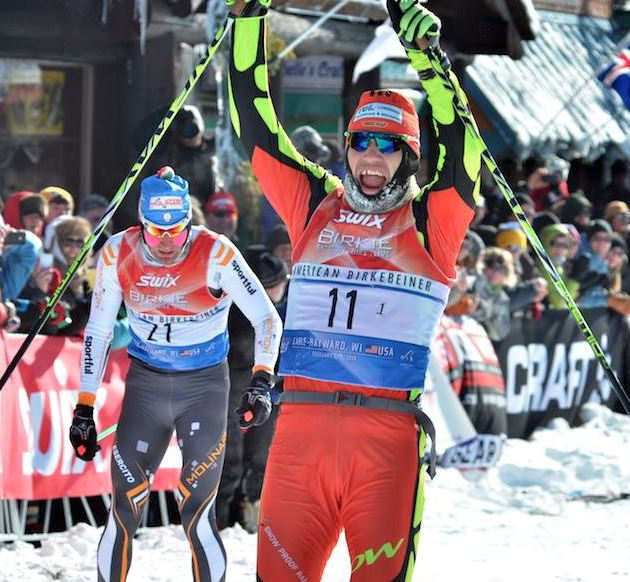
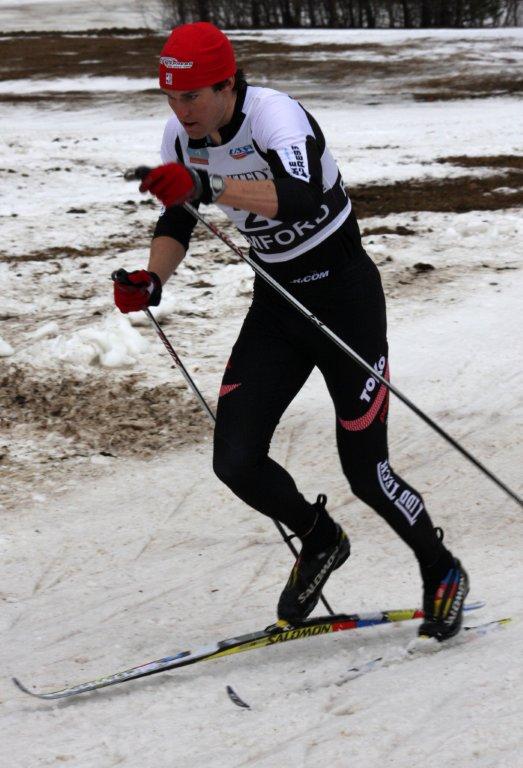
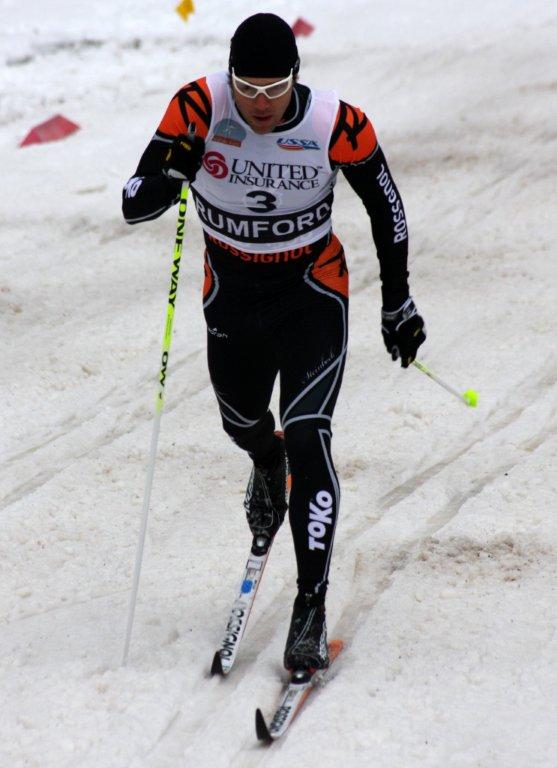
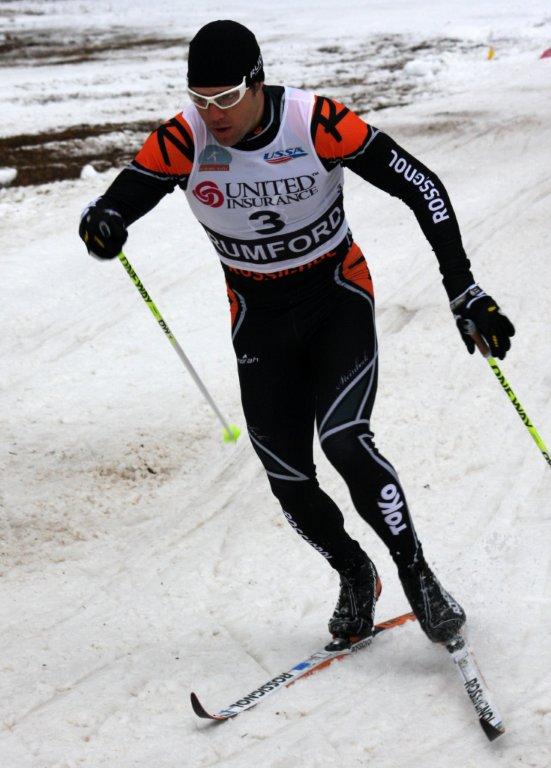
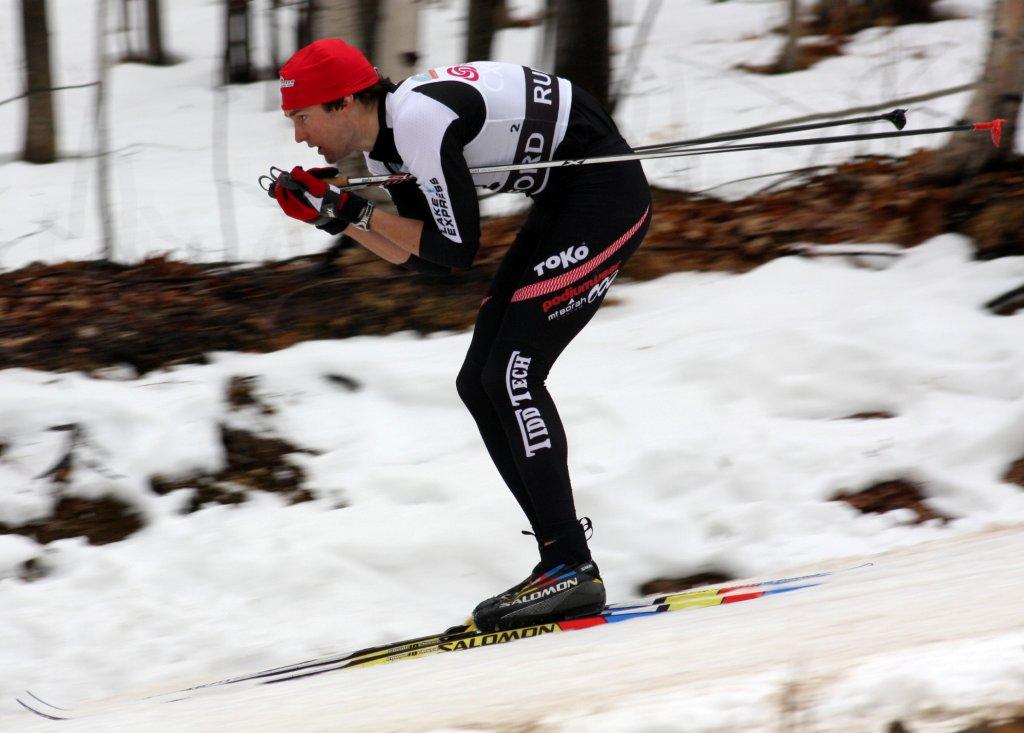
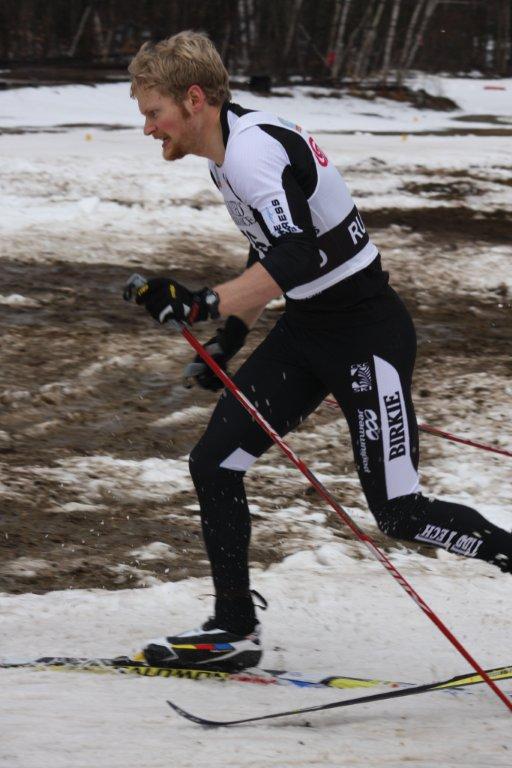
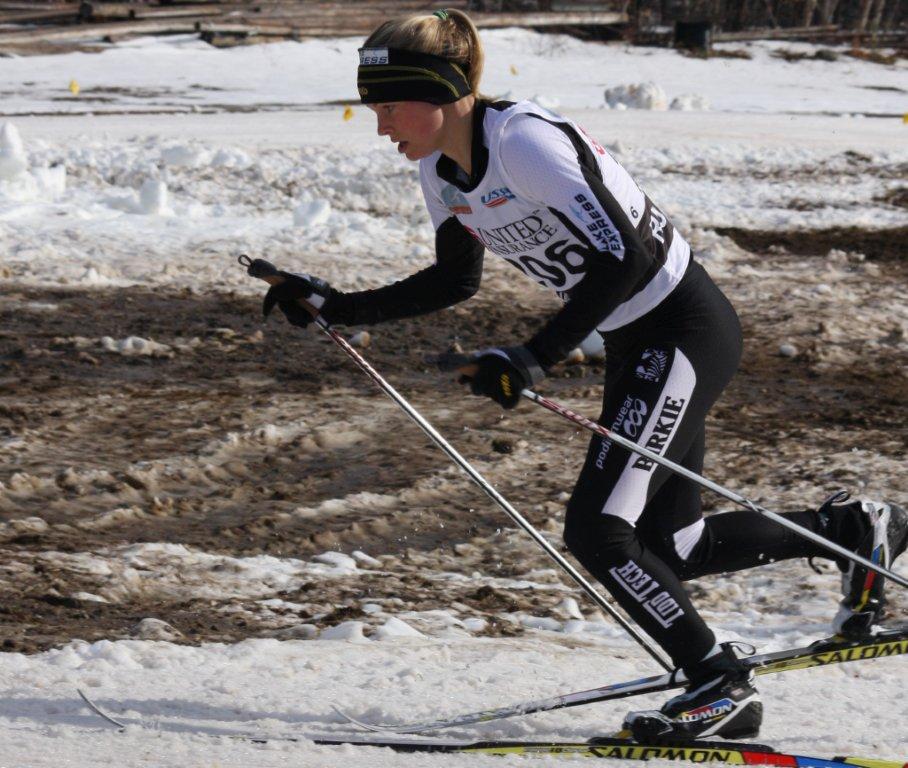
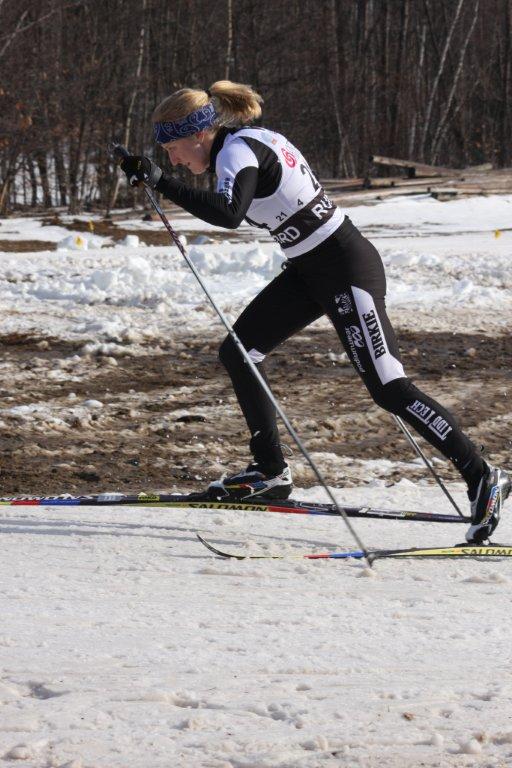
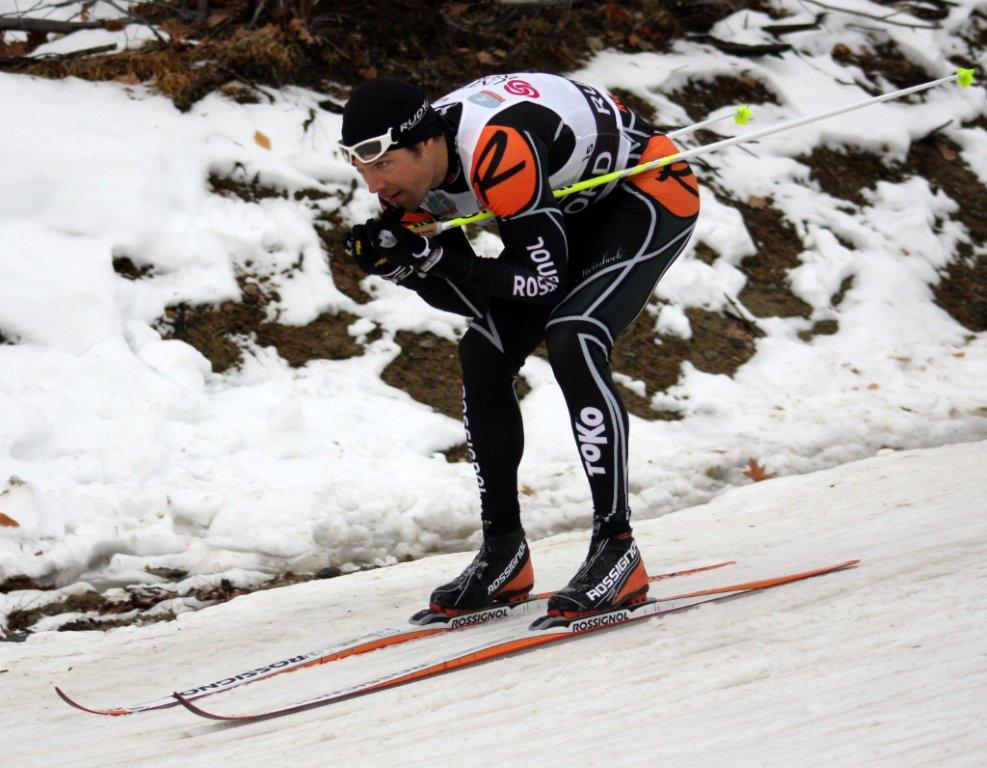
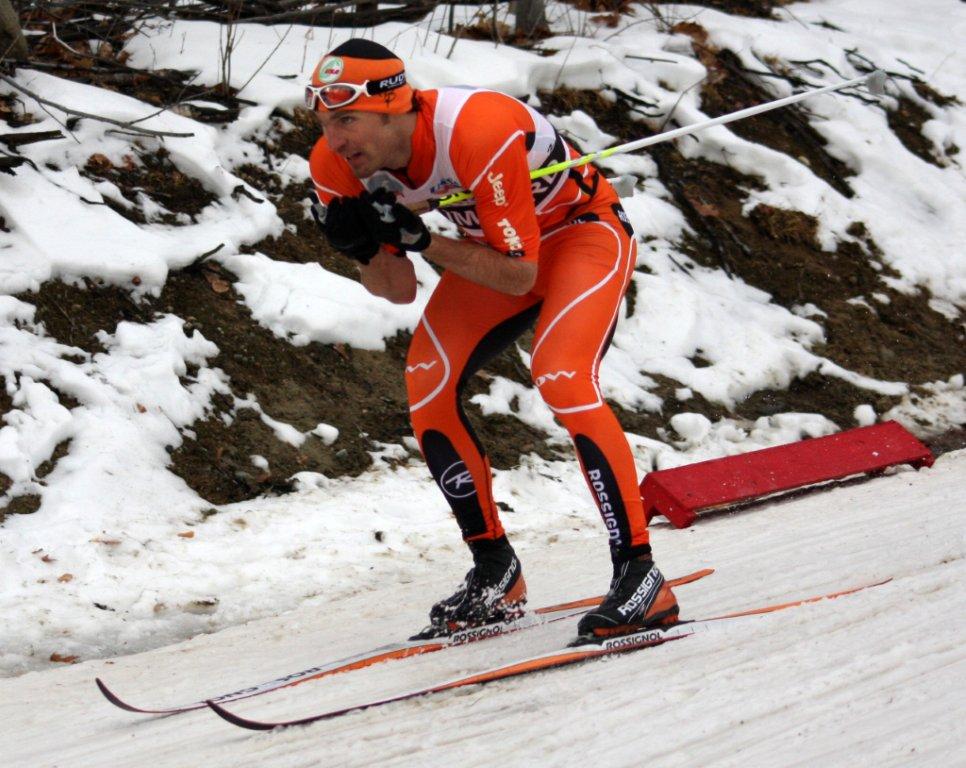
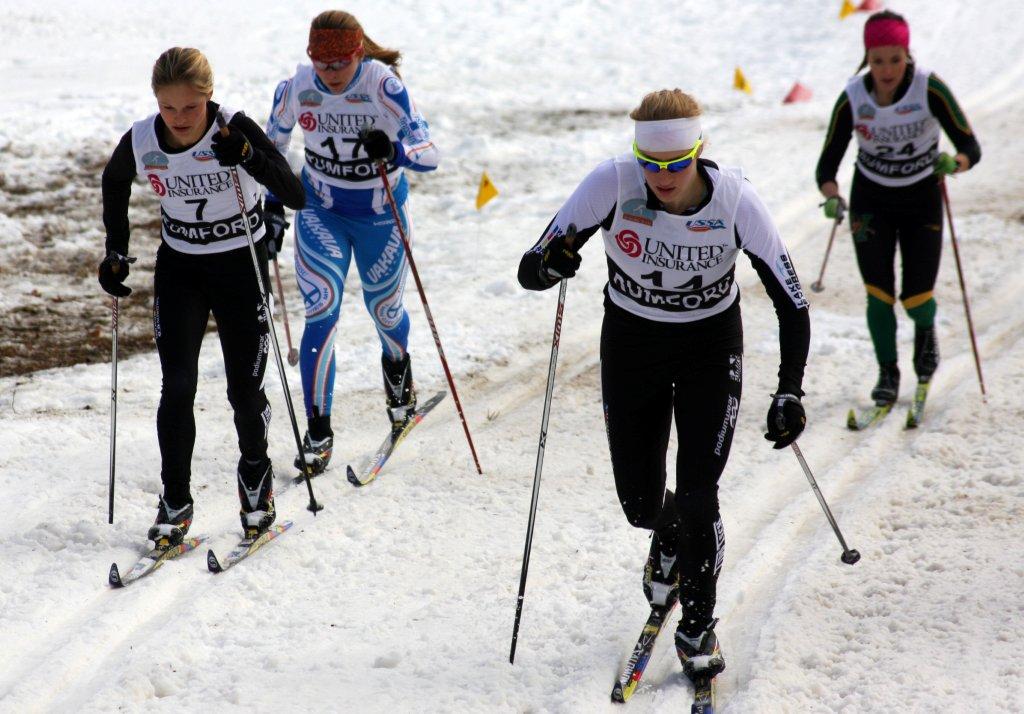
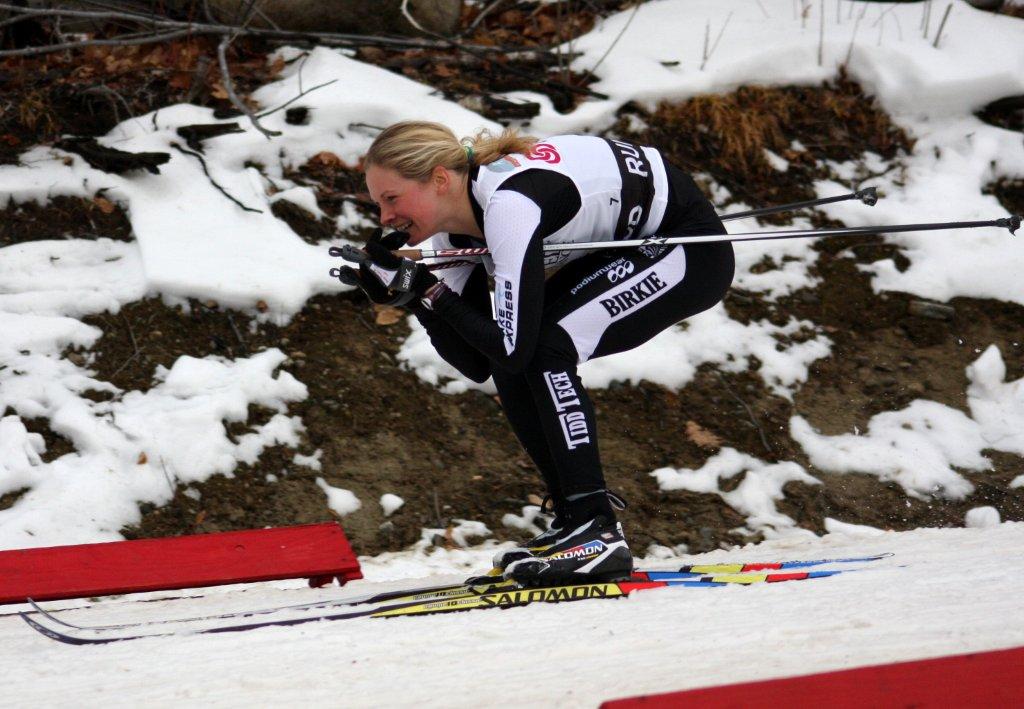
Tom Reichert, winner of the 2014 Birkie crosses the finish line. (Photo: American Birkebeiner Ski Foundation)
Hayward, WI—After Friday night’s snowfall and wind played havoc with the Birkie organizers’ plans, with tents collapsing and fallen trees that had to be removed from the course, Saturday morning broke clear and sunny, if a little cold and windy at 2 degrees Fahrenheit.
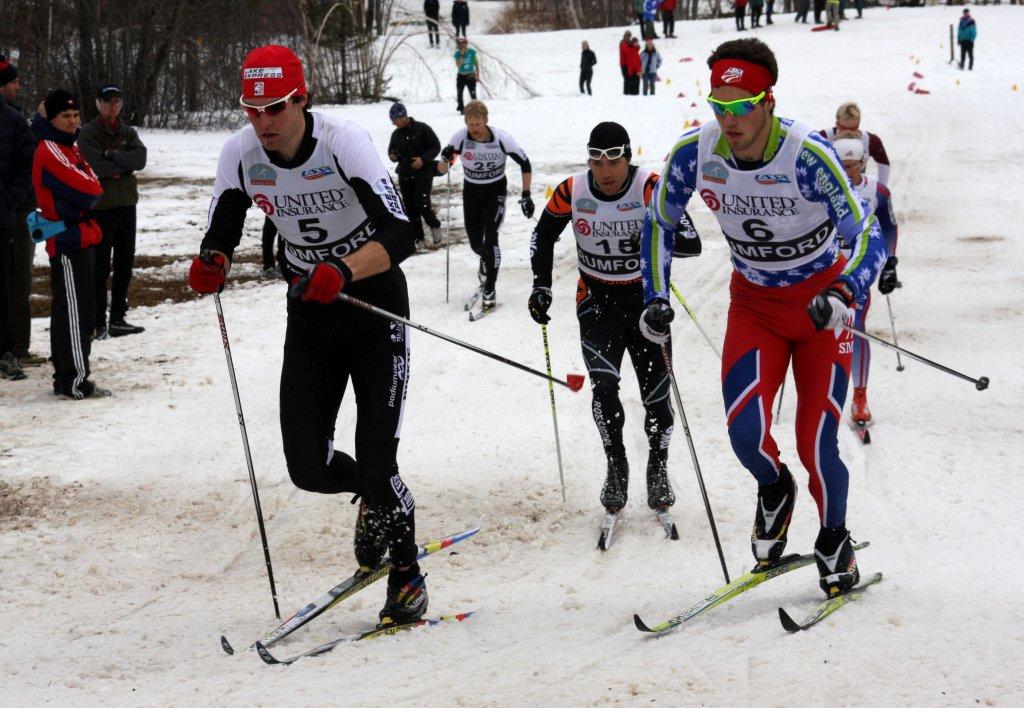
The elite men’s skate race went out hard, taking everyone by surprise in the slow and soft conditions. Lex Treinen of Anchorage, AK pushed the pace early and put the field under pressure. Simone Paredi and Sergio Bonaldi, both of Italy and skiing for Team Molinari, said through Antonella Confortola Wyatt, their compatriot and current leader of the FIS Marathon Cup, that an American had started fast but that at some point he fell off the pace, and with the 20 k to go he was no longer among the men at the front of the race.
Tom Reichelt of Oberweisenthal, Germany also baulked at the ferocity of the early pace, but managed to stay with the leaders. Christophe Perrillat of France led the race at 25 k and held second at 38 k, with Czech legend Martin Koukal leading the race at the final split, 12 k from the finish line. Behind Koukal and Perrillat were Reichelt, Bonaldi, Paredi, and five others.
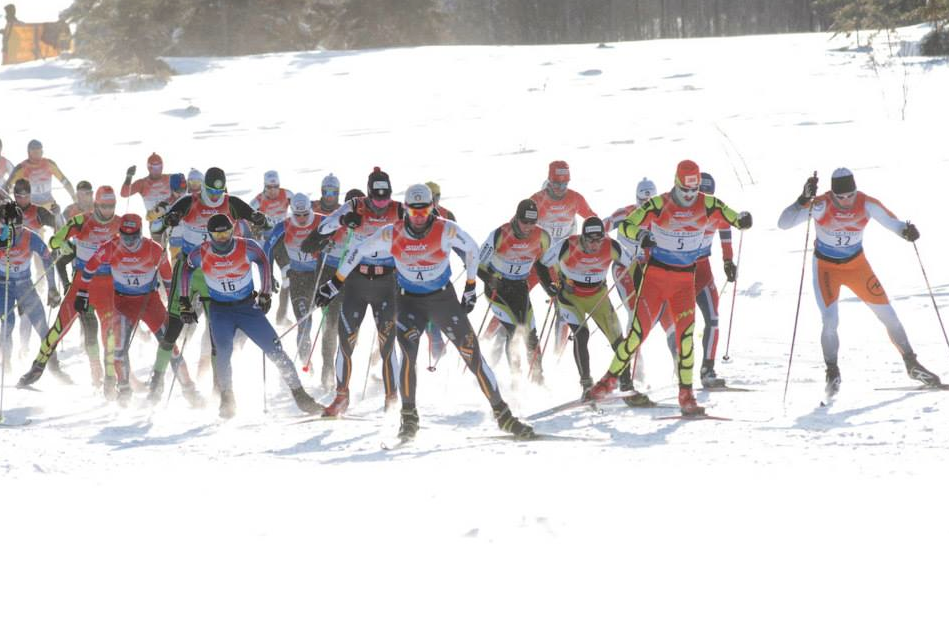
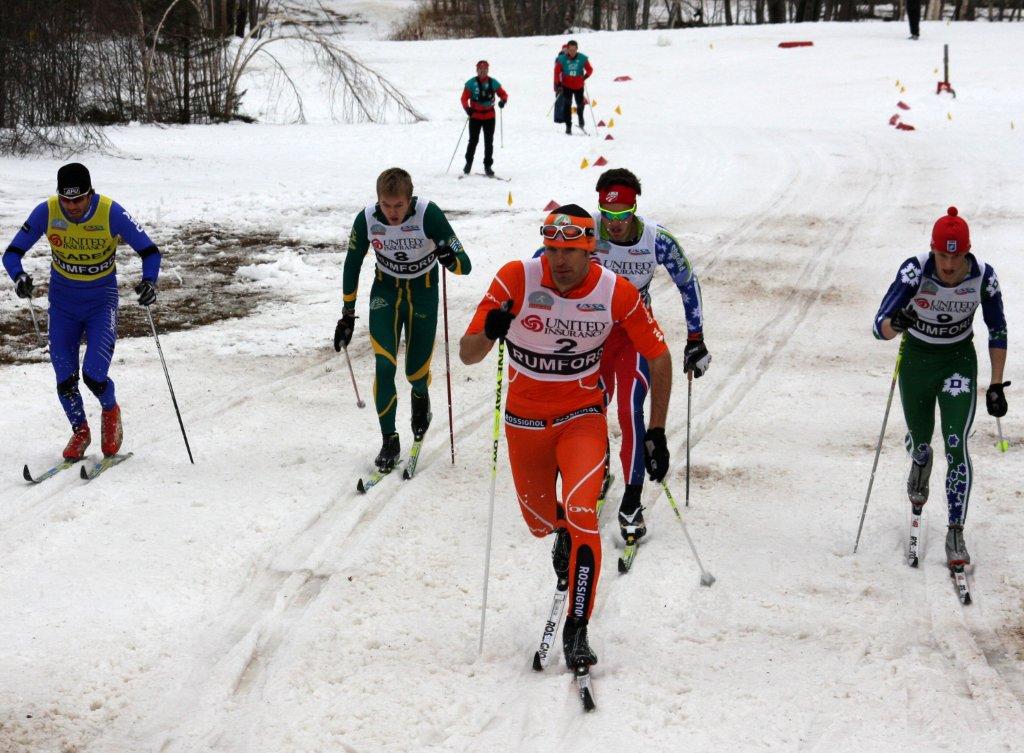
Men’s start, 2014 Birkie. (Photo: American Birkebeiner Ski Foundation)
Late in the race as the pace accelerated, Reichelt took the lead as the course began to open up in the wide fields approaching Lake Hayward. Behind him were Bonaldi and Paredi, hanging on and looking for an opportunity to make a move in the final two agonizing kilometers across the lake.
A strong westerly wind blew across the track, gusting up to 30 miles an hour. Bonaldi found that only one skate lane was fast, the other wind blown. Bonaldi, last year’s winner of the Birkie and wearing bib number one, said he knew that there was no possibility of skiing past Reichelt, even in the final 500 meters as the course leaves Lake Hayward and cuts down Main Street. Instead he thought about beating his teammate, Paredi, in the final sprint for second.
Reichelt for his part could sense the Italians behind him and awaited their attack. “I was waiting for the others to catch me,” he said, “but nobody did. I thought in the sprint I had no chance.”
Reichelt held off a hard-charging Paredi, winning by half a second, in a time of 2:14:29 with Bonaldi third, four tenths of second behind Paredi. Reichelt said that his Birkie victory was his second biggest success after a third place World Cup result at Oslo’s famed Holmenkollen 50 k in 2006. “Now I can drink a beer,” he said, “because this win is great for me.”
The American results were led by Matt Gelso of Ketchum, ID in 7th place, 33 seconds behind Reichelt and ahead Koukal. Treinen was the second American in 10th overall, followed by former Birkie winner Matt Liebsch of Orono, MN, in 12th, 6:21 back. Christopher Hamilton of Canmore, AB was the top Canadian in 15th.
Despite overlapping with the Olympic 50 k to be held on Sunday, the men’s field was stacked with European skiers. Of the top 20 skiers, 12 were from Europe. Once again there was a strong five man Italian contingent, headlined by former winners Bonaldi and Fabio Santus. There was also a strong three man French team led by Perrillat, who finished in fourth.
Reichelt’s Birkie victory put him into the red leaders bib in the FIS Marathon Cup, 11 points clear of Koukal, and 21 points ahead of Benoit Chauvet of France, who finished 6th in the Birkie. The FIS Marathon Cup continues on Sunday, March 9th with its final race, the Engadin Ski Marathon in Switzerland.
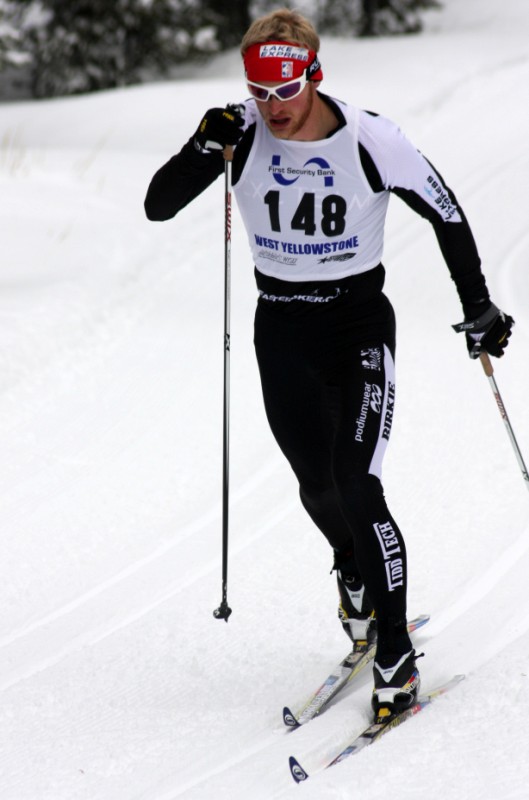
Santi Ocariz, West Yellowstone 2010. (Photo: Toko)
The men’s classic race, 54 kilometers of doggedly rolling terrain, was led for much of the distance by Nils Koons of New Zealand and Eivind Opsahl of Norway. When they reached Lake Hayward, Santiago Ocariz took the lead with four skiers in tow. “I had been waiting, and waiting, and waiting,” said Ocariz, “my legs were cramping on the hills where I would have liked to have gone, so that wasn’t going to happen. I just waited for the lake.”
Ocariz skied a cautious race for much of its length, knowing his limits on a light training schedule. Last winter Ocariz skied for XC Oregon, but a move to Moorhead, MN to attend an accelerated nursing program and a one-year old daughter left little time to train.
On the lake Ocariz found that the tracks had been completely windblown, so he skied in the firmer skate lane and tucked in behind some skaters, using them as a windbreak. “Towards the end of the lake I saw there was a little gap starting to be made, so I decided it was time to go.”
Ocariz’s timing was key: With 500 meters to the finish line, the course narrows considerably as it rises off the lake and into downtown Hayward, creating a brief stretch of choppy snow that both classic and skate skiers must share. Ocariz said he, “knew that was the spot to do it, because if the other skiers got stuck behind the skaters it would give me a little extra advantage.”
His final effort down Main Street won him the day, if not a monetary prize. His time, 3:01:00 was 5.5 seconds faster than Koons and 5.9 seconds ahead of third place Opsahl.
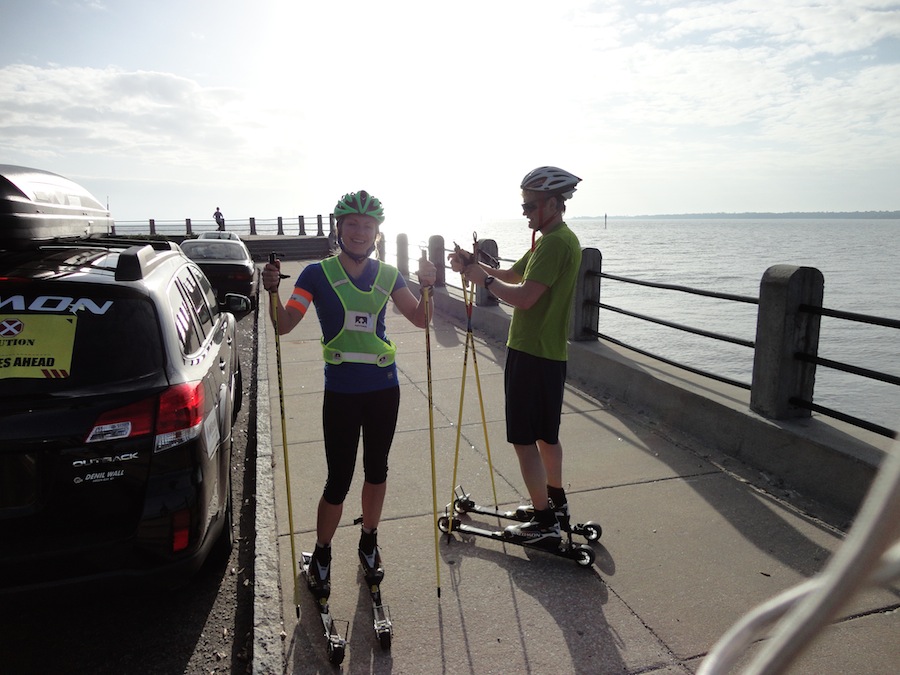
Carolyn and Santi Ocariz about to embark on a three-month rollerski across the United States to raise money for Food for the Poor. The Midwest couple, formerly of CXC, left Charleston, S.C., on March 8. (Courtesy photo/www.skiacrossamerica.com)
With the Atlantic Ocean to their left and the Pacific Ocean more than 3,000 miles to their right, Carolyn and Santiago Ocariz started striding toward the latter, one at a time across the United States.
The newlyweds from Wisconsin weren’t entirely sure where they were going, or the reaction they’d receive while rollerskiing across states like Alabama and Mississippi, but they had a tentative route and plenty of inspiration to keep them going.
Every mile they rollerskied meant more money for those starving in South America, Central America and the Caribbean. If they rounded up $36 dollars a mile, the cross-country ski racing couple could raise $108,000 for Food for the Poor and feed about 3,000 children for a year.
That notion kept Carolyn, 23, and Santi, 25, brimming with excitement before starting their anticipated three-month journey in Charleston, S.C., on March 8. After nearly two weeks “off” since their last race of the season at the American Birkebeiner in Hayward, Wis., where Carolyn won the 54-kilometer classic race in her debut and Santi was 11th in the 50 k skate race, both were ready to get moving again.
Formerly of Central Cross Country (CXC), the two decided to forgo the last month of the racing season for the sake of charity and favorable weather. They chose a southern route to avoid snow and hoped to make it to their destination in San Francisco before temperatures became unbearable, passing through places like Georgia, Arkansas, Texas and New Mexico along the way.
After racing in their former hometown of Hayward, they packed up, enjoyed one massive snowstorm and left for good. By alternating between rollerskiing and driving their Subaru Outback, they planned to make it to San Francisco by June. Soon after, they would retrieve their belongings from their parents’ homes in the Midwest and move to Bend, Ore., where they planned to start training with XC Oregon.
Dreamt up in December and named “Ski Across America,” the trip turned out to be multifaceted. An unusual feat at first glance, rollerskiing across the country required both outside support and inner drive. The couple hoped to garner the attention of churches and the charitable, and speak about their cause whenever possible – even if after 50 to 70 miles of rollerskiing a day.
With between $4,000 and $5,000 dollars raised at the start of the trip, Carolyn said they hoped to round up the majority of funds on the road. While the journey was uncertain, along with night-to-night accommodations and road conditions (they had to navigate a dirt path on the first day), both looked forward to the high points ahead: meeting new people, eventually moving to a new place and helping others in the process.
***
FasterSkier caught up with Carolyn and Santi by phone the night before they left Charleston to discuss some of the details of the trip.
FasterSkier: How did you pick your route?
Carolyn Ocariz: Santi picked a starting point and then an ending point, and then he picked the route from there. I think it all actually happened because he was able to make this contact [with a friend of a friend of a friend in Charleston]. Charleston’s a really historic city and we’ve come to find that it’s an amazing, beautiful, wonderful city. Even the people that we’ve met so far are just like, ‘We’re so excited that you’re starting in Charleston.’ It’s great and it’s really cool because everyone here is so friendly and it’s definitely a great place to start.
FS: Had you been to Charleston before and what’s the weather like there?
CO: It’s our first time in South Carolina actually. It’s in the lower 60s, upper 50s; pretty warm with cool breezes.
FS: I heard Hayward got dumped on (1 ½ feet of snow) before you left. What was that final ski of the season like?
CO: It was weird but at the same time not because I’ve had this thought in my head so long that I knew that we were going to be leaving the snow soon, but it was exciting. I think the Birkie was a really good way to end the season, and then I think I was ready. I mentally had prepared for the warmer weather. … We’re both like, ‘This is great!’ Warm weather.
Santi Ocariz: It was a bit difficult [to cut the season short], but I don’t know when else we would be able to do it, to have that chunk of time. It was a bit of a sacrifice but we definitely think this is a much cooler way to spend our time and our efforts, actually being able to help the people that have nothing. It was a little difficult but now that we’ve actually pulled the trigger and gone with it, it’s amazing.
FS: How did you come up with the idea for this trip?
CO: Ever since I met Santi in college, I knew that he was really into doing adventurous things and I really liked that about him. I always like doing pretty exciting, adventurous things, but never had the courage to actually plan them and do them, but I knew that he always goes through with them.
We talked about this actually before we were married. We had thrown around some ideas and made a goal/dream book and it was pretty cool because this was actually in it. I had no idea if it would ever come about and the idea came back again and we talked about it.
SO: We always thought we wanted to do something like this. I was thinking it would be a good idea to do it earlier this spring just because we’re going to be moving but I would definitely say it was both of our ideas.
CO: Our friend Abe Clark ran across the United States a few years ago, and Santi and I just thought that was amazing and what a great thing he was doing for a wonderful cause [Living Water International, which brings safe drinking water to communities in need]. We had kind of thought in the back of our minds that someday it would be really fun to do the same thing, but for our sport and rollerski across the United States.
SO: We just thought, ‘We’re not tough enough to run it, but it would be pretty cool to maybe rollerski sometime and do it for a charity.’
CO: [In] early December, we had talked about it and we decided, ‘Yes, we are gonna do this,’ and we started telling our families and then we started telling our friends, and we started spreading the word. We got our website up and the word started spreading more after that.
FS: What’s a dream book?
CO: I actually started it in college [University of Wisconsin-Green Bay]with a professor as an extra-credit project [and changed with it Santi to make our goal and dream book]. We have a bunch of things in there and this was actually one of them. I had forgotten about it until I looked at it and I showed him, like ‘What do you know? We had this in the plans years ago!’ So that was really cool to look back on that.
FS: How did you choose Food for the Poor as your cause?
CO: Santi’s brother Javier told us about this because they’re the most efficient nonprofit that helps people with 96 cents of every dollar going straight to the cause. We have our own expenses and we want to have as much money going to the cause as we can, and we researched them and thought they were a great organization that we wanted to support.
FS: How will you go about raising money?
CO: While starting in Charleston, we’ve dropped off information at close to 10 or 12 churches with hopes that they’ll read our story and hopefully inspire some donating to the cause. We hope to do that in every city that we go to in hopes that they’ll be inspired to give to the cause. We’ve definitely had a really great start so far. We had people giving before we even began, which is really awesome to see.
FS: What motivated you to do this now?
CO: Since we’reboth done with college now and we’re pursuing professional skiing, we decided that this is a really good time in our lives. We don’t have anything tying us down. We don’t have set jobs. We don’t have a house or anything like that so we figured, if we want to do this, this is probably the best time to do it and also, we had been wanting to do something to help a lot of people. We thought this would be a great thing to combine something that we love to something that will help a lot of people.
FS: How exactly will this work, rollerskiing across the country on your own?
CO: One of us will ski and one of us will drive close behind and the plan is to hit between 50 and 70 miles a day. Hopefully each day we’ll at least ski five hours between the both of us, and some days it may be more, some days it may be less. We’ll just switch off. I might ski for an hour and a half and switch off with Santi and he’ll ski however long he’d like to until we reach what we think is a good amount for the day. Then we’ll go into the nearest town and try to talk to people after that and set up a place to camp and sleep for the night.
FS: How will you make contacts or spread the word?
CO: There are usually people in the [church] offices and we’ve been going in and dropping off [printed information]. [We’ll see] if there are any rotary clubs or schools that wouldn’t mind us speaking, like maybe giving some presentations, dropping off some information to spread the word.
FS: How many days a week do you plan to rollerski?
CO: Probably six days. We definitely will plan on taking one day off a week, but it depends week to week if we’re really feeling tired. It also depends too how the roads are. If some sections are a little bit rougher, we might do more toward 50 miles a day, but then we’re thinking once we get closer to the West Coast, there will be more deserts. We’ll probably crank out a little bit more with a lot more open roads.
FS: What kind of reaction or support have you received?
CO: Everyone has been really supportive and really excited for us and they’ve been praying for us and telling us that they’re going to watch us the whole way as we blog. It’s been awesome, even just speaking in our hometown churches back in Hayward and Spooner, people were so excited and really appreciative. This one gentlemen got really emotional telling us how great he thought what we were doing was. Things like that make us really excited and pumped to get out there to do this.
There’s a lot of people that we’re just really appreciative of the generosity they’ve had for us and the organization.
[Note: The Ocarizes have several sponsors, including V2 Roller Skis, New Moon Ski & Bike Shop in Hayward, and Wilson Electronics. They said their Outback was decked out in stickers.]
FS: What else do you need?
CO: Right now the only thing would be like gas cards because gas prices have gone up … but otherwise I think we’re good. [Visit skiacrossamerica.com to donate.]
FS: What’s the sleeping situation like?
CO: We’re hoping to sleep in churches along the way. … We know that our friends know people willing to open their doors and let us in, if that happens, that’s awesome but mostly churches and camping because it’s going to be a lot of really beautiful camping places along the way. If need be, we’ll sleep in our car.
FS: And food?
CO: We have a box of food. We’ll just buy stuff at the grocery store and we have this little camping stove and camping equipment and we have a car-food heater so we have stuff we’ll make. We’ll eat rice and beans and fruit and normal stuff we’ll just cook along the way.
FS: How did you make money to support yourselves on this trip?
CO: I worked [at Rivers Eatery in Cable, Wis.] since last summer, and [Santi and I] also worked at New Moon. Santi painted five paintings of Vegard Ulvang, [which Ulvang signed], and he sold them during the Birkie, which ended up raising a lot of money for our expenses for the trip.
FS: What are your thoughts on moving to Oregon?
CO: It’s a pretty big transition, but it’s exciting. Santi’s from Spooner, [Wis.,] but he spent a lot of summers out in Bend training in college, and I’ve been there to visit him. We really love Bend and we always said we wanted to live there for at least a year and we figured this would be a good time to do that.
[Note: Santi spent the last two seasons training with CXC and Carolyn leaves the team after one year.]
FS: Do you plan to mostly skate or classic ski on the road, and what kind of looks are you expecting from southerners?
SO: Mostly classic because the roads might be busier. We don’t want to take up that much room on the roads just to be safe. … Most people out here don’t even know what it is or never heard of it [rollerskiing]!
FS: I know you do this for a living, but how hard do you think this will be physically?
SO: Your body gets in shape. There are people that bike across the country in eight days and ran [across]. It sounds crazy but then when you look at other things, it’s not that crazy.
FS: What are you most excited for?
SO: Everything I guess. It already has begun to be a pretty awesome adventure.Just seeing things getting to meet new people, see new roads, national parks; neither of us has been in the majority of them, so it’s going to be an awesome experience.
Conditions were as forecasted – warm, wet, (although during race times there was no precipitation) dirty, and soft. The wax recommendation held up all day and as we recommended, more structure was needed as the day went on. Attention to detail proved to be very important today as well. Small things made a difference especially in a short race with extreme conditions (wet and dirty) and with a finishing section consisting of a downhill with a long run out!
The wax needed to be brushed and polished off the ski very well today to prevent dirt build up. That applies to fluorocarbons as well. Even a slight greasy sheen on the base will attract dirt in such dirty and wet conditions.
The kick zones used today were pretty short as glide was so important. It was important to clean up the exposed sanded area so it wouldn’t attract dirt.
The Yellow Structurite bit proved to be really good over a 1mm linear structure as we recommended. After a few runs (including qualifying), it needed to be reapplied as it only got wetter out there.
Many had success with JetStream Red today (as well as the more obvious Yellow). JetStream Red is surprisingly good in wet snow and is generally the call when conditions are wet and dirty. If wet and clean, JetStream Yellow is best. Today was a short race and of course people rewaxed for the heats, so Yellow was good despite the dirt.
Tuesday’s race will be a 10/15k Classic. Wax tip will be posted tomorrow on Twitter (@TokoUS) and Facebook (Toko US). Please follow or visit us to see it.
Garrott Kuzzy (CXC)
Chris Cook (Steinbock Racing)
Chris Cook (Steinbock Racing)
Garrott Kuzzy (CXC)
Santiago Ocariz (CXC)
Jessie Diggins (CXC)
Jennie Bender (CXC) in action this winter.
Kuzzy, Cook, and Santi were all in the same heat.
Chris Cook (Steinbock Racing)
Torin Koos (MOD)
Jennie Bender (CXC)
Jessie Diggins (CXC) having fun and going fast. The two things are related.
Big changes to the team roster and the coaching staff are this spring’s news for the Central Cross-Country Ski Association (CXC). 18 athletes and three coaches will comprise the 2011 team for one of North America’s largest and fastest-growing clubs.
Vacating the post of head coach that he held since the formation of CXC in 2006, Bryan Fish has accepted a position with the US Ski Team (USST) as Continental Cup coach. Jason Cork will be stepping in to fill this void, bringing his experience with Durango Nordic Ski Club, Michigan Tech University, and recent J1 and World Junior Championships coaching staffs to the job. Gus Kaeding, a former CXC athlete, will be stepping up as the team’s elite development coach this season.
Under Bryan Fish, CXC sent its first athlete to the Olympics in Garrott Kuzzy
Olympian and CXC athlete Garrott Kuzzy is optimistic about the changes in coaching staff, saying “I see the changes as positive, all the way around; we’ve now got three great coaches, four if you include Igor Badamshin, instead of just one.”
Turnover among athletes is similarly high. A notable loss to the team comes with the departure of Rebecca Dussault, who along with her husband has taken an internship position at an organic farm in Colorado for the year and is pregnant with her third child, due January 19. Also leaving the team are decorated skiers Kristina Owen, Kelly Chaudoin and Audrey Weber.
The men’s team will be headed by Kuzzy, who will continue to work with CXC after a parallel stint with the USST. Notable newcomers include Santiago Octariz, who represented University of Wisconsin-Green Bay last year as the lone NCAA All-American from the central region, and Tad Elliott, a National Champion and U23 World Championships team member. (Elliott raced for CXC’s marathon squad last year; this year he will be a full member.)
Filling out the remaining spots on the men’s team are Brian Gregg, Karl Nygren, Eric Wolcott, Matt Liebsch, Bryan Cook, Andre Watt, Ben Lannin, and Doug DeBold.
Caitlin Compton and Bryan Cook do a strength workout Photo: CXC
There is an Olympian among the CXC women as well, as Minneapolis resident Caitlin Compton joins the roster. Other new additions are former University of Vermont standout Jennie Bender and Canadian Brooke Gosling. Maria Stuber, who had six top-5 SuperTour results in 2010, returns for another year with the squad, as will JoJo Winters and Melissa Schwartz. Jessie Diggins will be joining the squad full-time this year following her high school graduation.
The roster is an impressive hybridization of veteran and newcomer. “It’s going to be an ideal mix of skiers. I can’t wait to start working with our ‘new additions’—some of the strongest skiers on the circuit,” says Kuzzy, “The vets will have more to learn from them than they will from us!”
The CXC association has enjoyed rapid growth and huge success since it was founded only four short years ago. The program now encompasses not only the elite Vertical Limit team but juniors, masters, and educational opportunities.
The team’s schedule is structured such that athletes participate in a ten- to fourteen-day camp every few weeks and train at home over the weeks between camps. CXC is currently in the midst of their first summer training camp of the season, located in the Saint Croix Valley of Minnesota.