From the FasterSkier archive — posts syndicated from athletes’ and coaches’ own blogs between 2004 and 2012, kept online as published. Current coverage is at fasterskier.com.
Ski orienteering — it’s a real-deal, fast-paced sport. Don’t believe it, check out these photos.
Earlier this month from March 5-10, the Craftsbury Outdoor Center in Craftsbury, Vermont, hosted the 2018 Ski Orienteering World Cup and World Masters Championship. Photographer John Lazenby captured some high-action moments at the races. Check out his complete gallery here and a sampling of his shots below (click each to enlarge):
Finland’s Tuomas Kotro before the start of the distance race at the 2018 International Orienteering Federation World Cup at the Craftsbury Outdoor Center in Craftsbury, Vt. (Photo: John Lazenby/Lazenbyphoto.com)
Russia’s Stepan Malinovskii racing in the middle distance race at the 2018 International Orienteereing Federation World Cup at the Craftsbury Outdoor Center. (Photo: John Lazenby/Lazenbyphoto.com)
Estonia’s Rimmo Room racing in the sprint at the 2018 International Orienteering Federation World Cup sprint in Craftsbury, Vt. (Photo: John Lazenby/Lazenbyphoto.com)
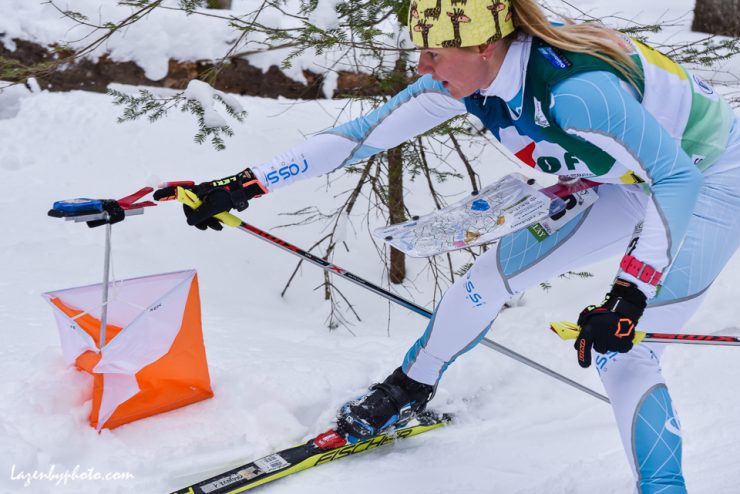
A Czech competitor hits a checkpoint and the snow in the middle distance race at the 2018 International Orienteering Federation World Cup at the Craftsbury Outdoor Center. (Photo: John Lazenby/Lazenbyphoto.com)
Eventual winner Tove Alexandersson of Sweden in the middle distance race at the 2018 International Orienteering Federation World Cup at the Craftsbury Outdoor Center. (Photo: John Lazenby/Lazenbyphoto.com)
Norway’s Lars Moholdt in the middle distance race at the 2018 International Orienteereing Federaation World Cup at the Craftsbury Outdoor Center. (Photo: John Lazenby/Lazenbyphoto.com)
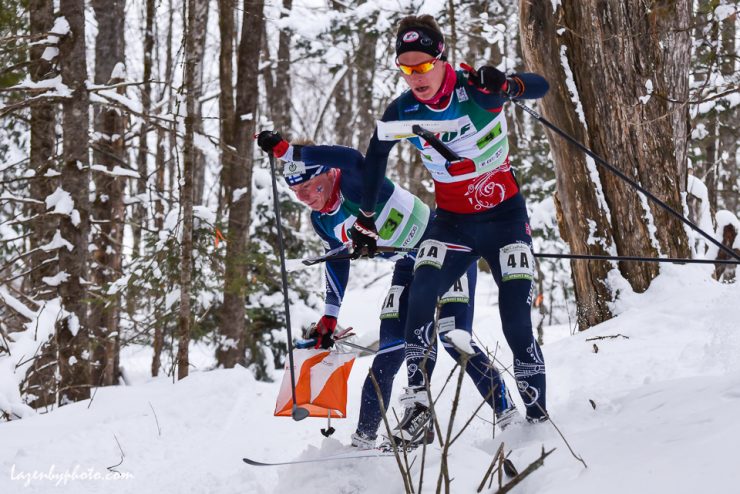
Romania’s Simon Suciu, leads Estonian Kevin Hallop in the middle distance race at the 2018 International Orienteering Federation World Cup in Craftsbury, Vt. (Photo: John Lazenby/Lazenbyphoto.com)
Bulgaria’s Stanimir Belomazhev leads Sweden’s Oyvind Wiggen in the mixed relay at the at the 2018 International Orienteering Federation World Cup at the Craftsbury Outdoor Center. (Photo: John Lazenby/Lazenbyphoto.com)
American Jimmy Burnham in the exchange zone of the mixed relay at the International Orienteering Federation World Cup at the Craftsbury Outdoor Center in Craftsbury, Vt. (Photo: John Lazenby/Lazenbyphoto.com)
Eventual silver medalist Eduard Khrennikov of Russia hits a checkpoint in the mixed relay at the at the 2018 International Orienteering Federation World Cup at the Craftsbury Outdoor Center. He teamed with Tatyana Oborina for second place. (Photo: John Lazenby/Lazenbyphoto.com)
Eventual silver medalist Russian Tatyana Oborina hits a checkpoint in the mixed relay at the at the International Orienteering Federation World Cup at Craftsbury Outdoor Center, Craftsbury, VT. She teamed with Eduard Khrennikov . (Photo: John Lazenby/Lazenbyphoto.com)
A near miss as competitors Tero Linnainmaa of Finland and Jorgen Madslien of Norway arrive at a check point at the same time in the mixed relay at the International Orienteering Federation World Cup at Craftsbury Outdoor Center, Craftsbury, Vermont. (Photo: John Lazenby/Lazenbyphoto.com)
Canada’s Robert Graham after the final exchange in the mixed relay at the 2018 International Orienteering Federation World Cup at the Craftsbury Outdoor Center. (Photo: John Lazenby/Lazenbyphoto.com)
A Swedish ski-orienteering World Cup competitor carries his nation’s flag Craftsbury, Vt. (Photo: John Lazenby/Lazenbyphoto.com)
Canada’s Milla Tarnopolsky and Robert Graham after placing 18th in the mixed relay at the 2018 International Orienteering Federation World Cup at the Craftsbury Outdoor Center. (Photo: John Lazenby/Lazenbyphoto.com)
Americans Anna Voegele and Ari Ofsevit after placing 19th in the mixed relay at the 2018 International Orienteering Federation World Cup at the Craftsbury Outdoor Center. (Photo: John Lazenby/Lazenbyphoto.com)
One of the maps at the 2018 Ski Orienteering World Cup / World Masters Ski Orienteering Championships in Craftsbury, Vt. (Photo: John Lazenby/Lazenbyphoto.com)
The women’s team sprint medal ceremony at the 2018 Winter Olympics in PyeongChang, South Korea, with (from left to right) Sweden’s silver medalists Charlotte Kalla and Stina Nilsson, American gold medalists Kikkan Randall and Jessie Diggins, and Norway’s bronze medalists Marit Bjørgen and Maiken Caspersen Falla. (Photo: FlyingPointRoad)
(Note: This article has been updated to include clarification from Sara Mae Berman on her results in the 1971 national 50-kilometer ski race in Putney, Vermont)
***
What did John Caldwell have to say after the U.S. women’s gold-medal performance on Wednesday at the 2018 Olympics? We asked Caldwell, a 1952 Olympian and one of the founders of the U.S. women’s cross-country program who coached the U.S. Ski Team through five Winter Olympics (1960, 1964, 1968, 1972, and 1984), and he wanted to take the opportunity to explain how the team came to be in order to give some perspective on how far it’s come. The following was written by Caldwell, 89, of Putney:
“It hasn’t been easy to get to where we are after today. Lots of the reports mention how many years it’s been, or that it’s been 564, 321 days (or something like that) etc., and they are all true. Better they knew a bit about the development and could write about that. So that’s what I intend to do here.
In the Oslo Olympic Games in 1952, the Finnish women ran the same course as the guys one day and their times beat our times. Of course we didn’t have a women’s team then.
I coached the FIS Team to Oslo in 1966 (Gallagher, Elliott, Gray, Damon and C Matis) and the manager, Bob Tucker, and I wanted to get females started skiing more in the US. So we met with a Swedish official named Inga Lowdin and she told us we should work to make sure people don’t think you need Amazons (females) to be good at xc. “I will send you some “girls” that will help your development of xc.”
Tucker and I had to lock the big boss in a closet — well, almost — in order to get funding for airfares, something on the order of $3500. Three Swedes came over in 1967, including Toini Gustafsson and Barbro Martinsson, who both won gold medals at the Autrans OWG in 1968. They made their first stop in Putney and encouraged Martha Rockwell to race the next day, thus starting her international career.
A few years earlier Martha had led off for a team at the Putney Relays. Girls didn’t race then and so she was teamed up with two boys. She beat a couple of boys from a near-by prep school to the finish and one was seen shredding his skis afterwards on a handy fence.
Sometime in the late ’60s we ran a National 50k at Putney. Sara Mae Berman wanted to race, but no long races were run for the female sex. I entered her with the guys on a 5 x 10 k loop. She was quite far behind when she came by on her 4th lap and I stopped her for a moment or two, showed her our timing clock on a little stand, along with a pencil and paper, and told her to just time herself because I had to go inside and award prizes. She finished and I will wager her time is registered somewhere. We ran a tight ship in those days.
[Note: Berman wrote FasterSkier and sent a copy of results from that race, which was held in 1971, to clarify that at least one man finished behind her. Her husband Larry Berman explained in another email that her time was not originally listed, “but the timers recorded her and I wrote down her splits. At the end of 4 laps, there were 3 men behind her.”]
So our first ladies international team didn’t materialize until 1970 when we sent them to the FIS World Championships in Vsyoke Tatry in Czechoslovakia.
All along the way in these years there was precious little club skiing. Almost all of it happened in secondary schools and colleges. Divisional committees dictated races to fit the school and college schedules. Year-round XC training was a rarity, mainly due to the fact there were few year-round coaches available. So as a nation, we floundered. The transition to club skiing was slow and I hesitate to try and explain it or point to significant events, but thank goodness, it happened. Now we are fairly well set up with a pretty good club system. The secondary schools are feeding some clubs and a lot of colleges, the colleges are doing a good job of developing skiers with their four-year programs and they help feed the clubs with good seniors. The clubs also help feed the colleges with good skiers from their junior ranks.”
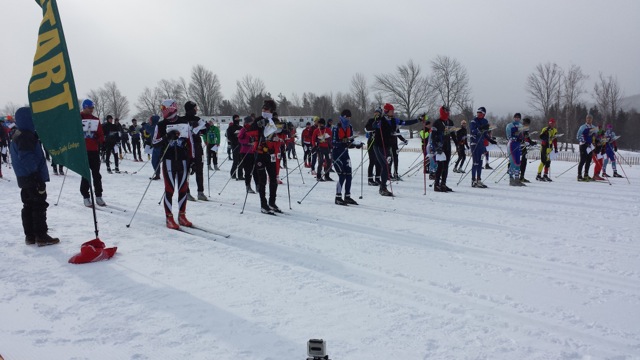
Long-distance mass start at 2014 U.S. Ski Orienteering National Championships March 14-16 at Trapp Family Lodge in Stowe, Vt. (Photo: Barbara Beall)
“This is the world of Ski Orienteering, one of the more obscure and mentally challenging Nordic ski racing disciplines.”
STOWE, Vt. — Imagine a Nordic ski race where you cannot preview the course, don’t know where you will be going, how long you will be skiing or how many hills you will have to climb. A race where you can go anywhere you want on skis, including down snowshoe trails or through uncharted glades. Where you can even take off your skies and run with them. This is the world of Ski Orienteering, one of the more obscure and mentally challenging Nordic ski racing disciplines.
The U.S. Ski Orienteering National Championships, a biennial event, were held this past weekend at the Trapp Family Lodge Ski Center in Stowe, Vt. Approximately 100 skiers, ranging in age from 10 to nearly 80 attended the three-day competition, featuring a Sprint and Middle Distance race (with individual starts) and a Long Distance race with a mass start. Different age classes are on different courses, with varying technical and physical difficulty.
Skiers received the map 15 seconds before the start, and were required to find the correct controls (those orange-and-white fabric markers you might see in the woods) in the right order, registering electronically at each one with a timing chip carried on their finger. At the end of the race, skiers download that information and are given their split times to each control.
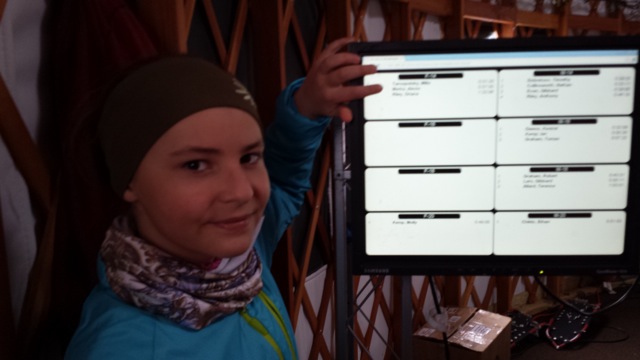
Alexis Merka, 10, the youngest competitor at 2014 U.S. Ski Orienteering National Championships in Stowe, Vt. (Photo: Barbara Beall)
In the mass start, the courses were “forked,” meaning skiers ultimately skied the same distances and climbs, but not necessarily in the same order as their competitors, in order to prevent following. Race designers set up the courses to specifically challenge skiers on route choices, forcing them to decide, for example, whether it is faster to stay on a large trail or to follow a narrow trail only groomed by a snowmobile. The courses also challenge skiers to maintain contact with their maps, and to not become upset by climbing up and skiing down a hillside a couple of times.
Alexis Merka, age 10, was the youngest competitor at the event. She is from Maryland, and her mother and father are both orienteers. She competes in both ski-O and foot-O (which involves running rather than skiing). When asked what happens when she gets lost, she said “I say to myself, don’t panic, stay calm, look at the map.”
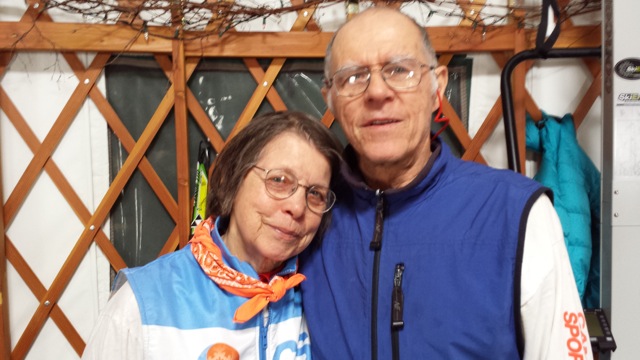
Larry Berman, who with his wife Sara Mae Berman started the Cambridge Sports Union and has been involved with ski orienteering since the early 1970s, said that he loves the challenge of finding that control right where it is suppose to be based on the map … and if the control is not there, clearly the map is wrong.
“I say to myself, don’t panic, stay calm, look at the map.” — Alexis Merka, 10, youngest racer at 2014 U.S. Ski Orienteering National Championships
For male and female skiers in the elite classes, the U.S. National Championships also identify those skiers who may be named to the USA National Ski Orienteering Team, qualifying them to go to World Events. The top U.S. female skiers were Alison Crocker (1st), Alexandra Jospe (2nd) and Anna Voegele (3rd). Top U.S. male skiers were Adrian Owens (1st), Greg Walker (2nd) and William Frielinghaus (3rd for Middle and Long Distance) and Ari Ofsevit (3rd Sprint). For full results go to: http://www.neskio.com/results/
Larry and Sara Mae Berman, founders of the Cambridge Sports Union, at the 2014 U.S. Ski Orienteering National Championships in Stowe, Vt. (Photo: Barbara Beall)