Tag: Sara Renner

  • Beckie Scott: The Olympic Champion Rebuilding Nordiq Canada

    Beckie Scott: The Olympic Champion Rebuilding Nordiq Canada

    This article was made possible through the generous support of our voluntary subscribers. If you value coverage like this, please support FasterSkier with a voluntary subscription.

    The five minutes Beckie Scott spent at the finish line in Soldier Hollow on February 15, 2002, lasted longer than most things in her career. She had crossed the line in what felt like third place. She thought she had a medal. She did not yet know.

    “It was actually a photo finish,” Scott said. “There were about five full minutes where we didn’t know. And then it was announced.”

    Her teammates, her coaches, and the wax technicians were already gathered in the pit, standing in the cold. The result came over the loudspeaker. Bronze. Canada. Beckie Scott.

    “We went ballistic,” she said. “It was magic. By that point, a lot of the coaches and wax technicians had made their way down to the pit. We were sort of standing there all waiting, and then when it was announced, it was just chaos. But in the best possible way.”

    The Canadian flag went up the pole in third position. The bronze, in the moment, was a win.

    “There was no disappointment. We celebrated that medal like it was platinum. This was the first medal for Canada. It was a long shot. It was absolutely incredible and powerful to stand on. In that moment, I got to celebrate that and have that day, and that feeling, and all the joy that comes with it.”

    What happened next is now part of cross-country skiing’s history. The two Russian skiers who finished ahead of her were caught for doping. The bronze turned to silver, then to gold. The flag that had risen for her in third place was wrong, but only because the truth had not yet caught up to the racing.

    It would catch up eventually, though, and so would Scott, now an Olympic champion.

    Beckie Scott with the gold medal she was awarded at a ceremony in Vancouver in June 2004. A former Canadian cross-country skier, Scott finished third in the 5 k pursuit at the 2002 Olympics but was later awarded gold when the two women ahead of her were disqualified for using performance-enhancing drugs. (Photo: Cross-Country Canada)

    Scott grew up in Vermilion, Alberta, a rural community in the province’s northeastern region. Her parents were avid cross-country skiers and members of the local club. The trails started at the back of their property and ran into the provincial park. She could ski out the back door.

    When the Jackrabbit program — the Canadian equivalent of the Bill Koch Youth Ski League in the United States — rolled out across Canada in the early 1980s, her mother adopted it in Vermilion and Scott came up through it.

    “I developed just a real affinity and love for the sport, right from the start,” she said. “I was very inspired by the community. I really loved the community. I loved competing, and I just loved the idea that the harder you worked at something, the better you could do. So as a kid, it was all very exciting, and a lot of fun.”

    The Vermilion club is now more than 50 years old. The trails are well used. It remains a rare facility for a rural Alberta town.

    What was not rare, in the late 1990s, was the experience of a North American woman struggling on the World Cup. Scott was at the front of a group that did not yet exist. She was the best of her cohort, which was a difficult thing to be.

    “Even when we started on the World Cup, when I was there, the results were abysmal. It was very, very poor performances. The results were nowhere near successful, that’s for sure.”

    She remembers it now with a kind of dry humor. “I think it’s good that we had a good sense of humor, because there were a lot of days, if we weren’t laughing, we would have been crying. I do remember being completely devastated, often. Not just by being so far down the list, but by how far behind I was. That, to me, just seemed almost impossible. To see the gaps that I was seeing when I first started, in the era, I think we all know why the Russian women were skiing as fast as many of the men.”

    She did not know that at the time. She thought she was just a weak competitor.

    The way through, she said, started with a single word.

    “The first step was approaching it as a professional. Leveling up the approach to my career as a cross-country skier, as a professional. I don’t think I was doing that in the early days, and I didn’t even understand what that meant, necessarily. So that was a big shift. And then it was increasing training hours, getting serious about strength training, and technique. Taking every single piece of what a performance needs and addressing it separately, and eventually collectively. But the biggest shift for me was the mental, socio-emotional approach. Shifting the paradigm to being a professional.”

    She offers this as the lesson she most wants to pass on. The hardest part, she said, was maintaining belief.

    “In the early days, I just didn’t know at first if this was even possible, or what it was going to take, or how to get there. I had this incredibly aspirational ideal of what I wanted to be, and I was so far from that when I first started.”

    The first glimmer of light came at a World Cup in Val di Fiemme, Italy. She does not remember the exact year when we spoke, but it was in December of 1997. After seasons of trying to crack the top 30, she finished eighth.

    “That was it. That was the moment. It’s like, okay, 100 percent this can be done. And this isn’t going to be a one-off. It was totally exciting and inspiring, and I just wanted more.”
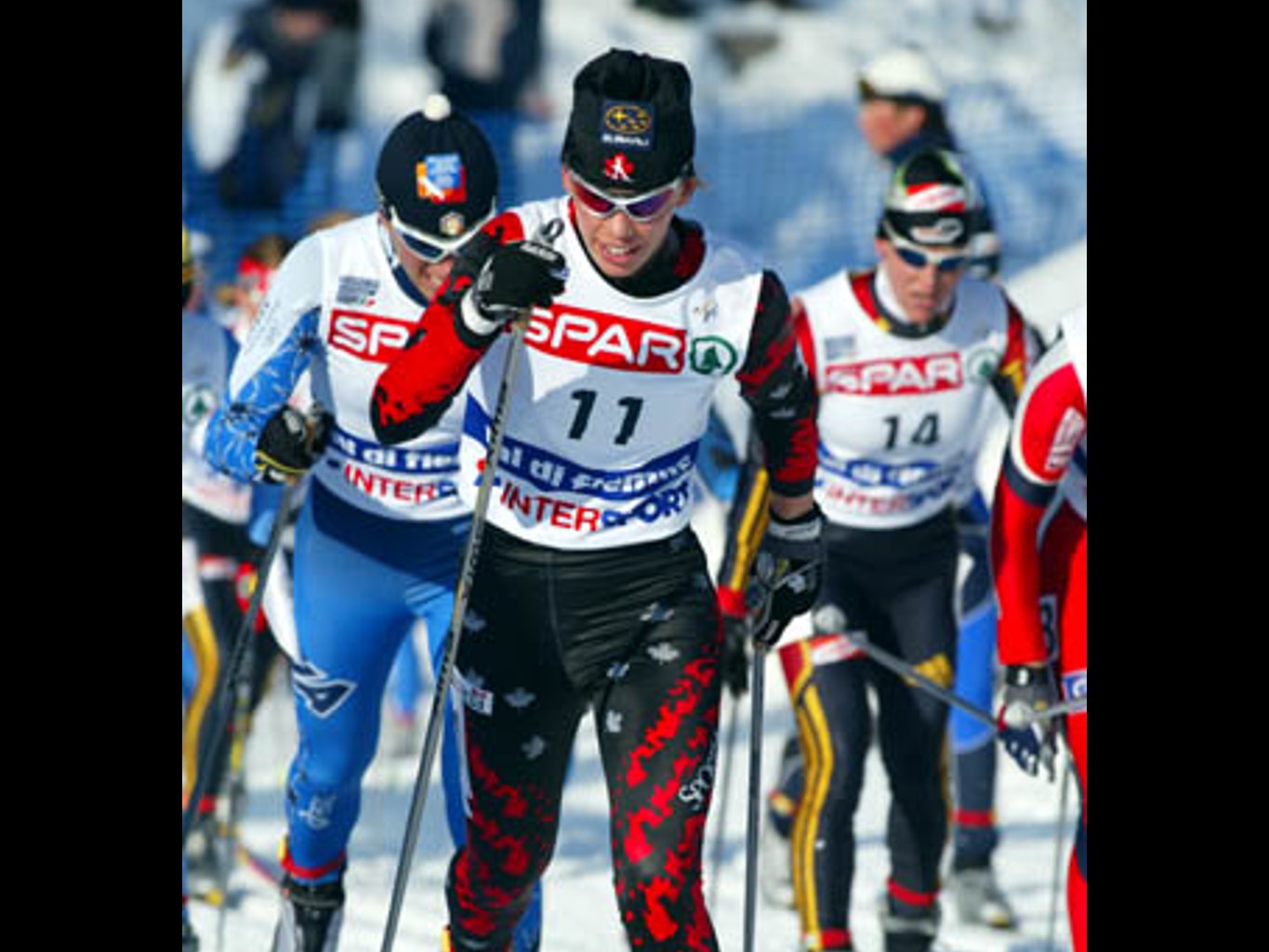
    Beckie Scott racing in Val di Fiemme (courtesy photo)

    By Salt Lake City, she was a contender. Not a sure thing, but a contender.

    “We had the belief, even years leading into Salt Lake City, that this was a golden opportunity that we shouldn’t and couldn’t pass up. We had spent our years living and training in Europe, constantly dealing with jet lag, living in hotels, foreign language, foreign food. And this was a magical opportunity on our doorstep to effectively race at home.”

    The 2002 women’s pursuit was a five-kilometer classic followed an hour and a half later by a five-kilometer skate. The format played to her strengths.

    “I could do both techniques well. There’s this powerful energy that’s created when you have a home crowd behind you. It really does change things for athletes in a way that’s hard to describe. There’s an uplift that’s just incredibly powerful. I felt it. I remember it to this day, twenty years later.”

    Then came the five minutes of waiting, and the chaos in the pit, and the medal that was, eventually, the right color.

    The irony of becoming the public face of clean sport in cross-country skiing was not lost on her. She had been vocal before Salt Lake, after most of the Finnish team was caught for doping at the 2001 World Championships in Lahti.

    “It was deeply frustrating to know that we were doing everything we could do to compete at the highest level in this sport, and we were constantly being thwarted by athletes who were using performance-enhancing drugs. That was incredibly aggravating. And it was shared. Not just by me, but my coaches, technicians, fellow teammates. This was not just unique to me.”

    When the Russians were caught in Salt Lake, her first reaction was surprise.

    “It was an open secret how much performance-enhancing drug use was going on in our sport, in particular by the Russian team. I was surprised because I did not have much belief, faith, or confidence in the anti-doping systems at that time. When I learned later about what actually happened at Salt Lake City to have those tests revealed as positive during those games, it was a remarkable series of events.”

    That path eventually led her to the World Anti-Doping Agency and a long career in sport integrity work.
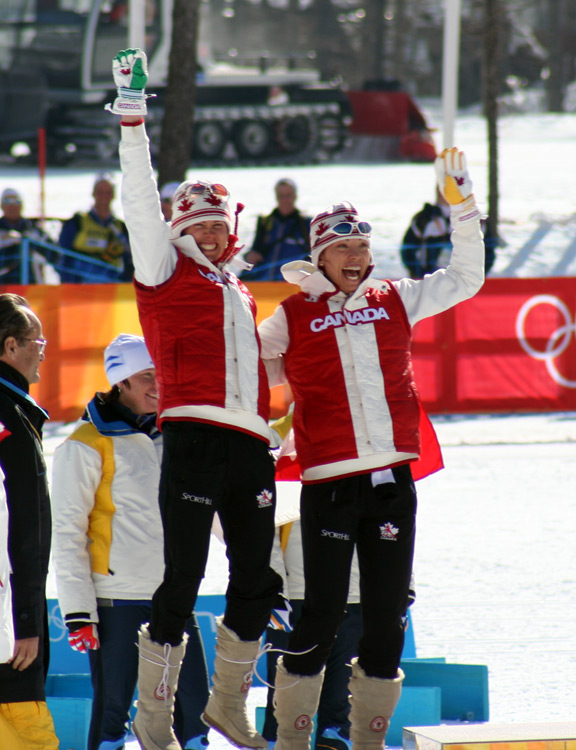
    Canada’s Beckie Scott (right) and Sara Rennner receiving their silver medal in the team sprint at the 2006 Olympics in Torino, Italy. That was two years after Scott belatedly received the gold medal she won at the 2002 Olympics, after fighting long and hard to earn it when the first two finishers were found to be doping. (Photo: courtesy photo)

    In 2006, in Turin, she won another medal. This one is remembered less for who lost it and more for who gave it.

    In the women’s team sprint, her teammate Sara Renner broke a pole. A Norwegian coach, Bjørnar Håkensmoen, standing on the side of the course handed Renner one. Renner finished the leg. Canada finished second. Norway dropped to fourth.

    “It really lived long in the hearts of people, I think, because of the sportsmanship element,” Scott said. “The Norwegian coach giving her the pole, which moved the Norwegians back to fourth and gave us the opportunity to have a silver that day. That piece was so encouraging and heartening, and really in the spirit of what we like to think the Olympics should be about.”

    The other piece, for her, was personal. The team sprint silver was the last medal of her career, won with Renner, with whom she had been racing for eleven years.

    “That was the culmination of 11 years of traveling and racing World Cups, World Championships, and Olympic Games together. And then we could stand on the podium together, in what would be the last year of my career. As teammates, but also very good friends, lifelong friends. We’re friends today. There was a dual component to that experience. It was, I think, lovely and inspiring in a lot of different ways.”
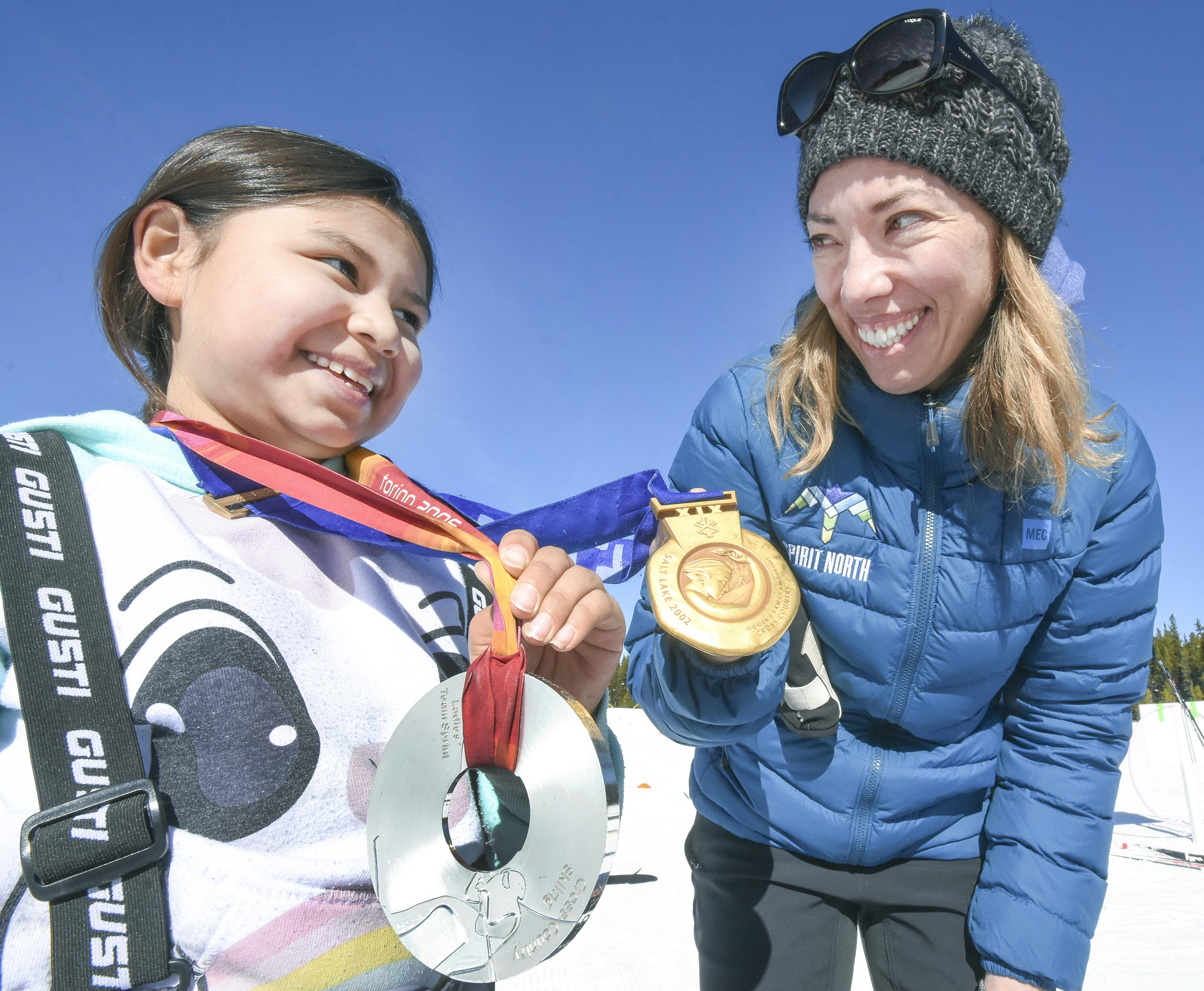
    Beckie Scott shares her silver and gold Olympic medals with a Spirit North participant. (Photo: Spirit North)

    When she retired from racing, she was invited to be an ambassador for a Learn to Ski program sponsored by an oil and gas company in northern Alberta. The program ran in indigenous communities. She would visit a community five or ten times a year, ski with the kids, show the medals, give a talk, then go home.

    She kept going home, and she kept thinking about what she had seen.

    “I began to notice many things. First, the disparity in the socioeconomic conditions of how indigenous people in this country live versus non-indigenous people. The lack of opportunity that kids were really able to access for sport and play. And then just the paradox of my own life and the opportunities that I had through sport, and my own kids were having through sport.”

    It struck her, she said, as deeply unfair.

    “An entire population of people was effectively kept out of that arena, and for no valid reason that I could see or think of.”

    The Truth and Reconciliation Commission published its final report in 2015. Among its 94 calls to action were several related to sport. Scott read the report. She had, she said, a hard time just letting things be.

    “I have a hard time just turning away and saying, not my problem. So I started a nonprofit.”

    She started with four communities in northern Alberta. The organization, Spirit North, is now national. It operates in 160 communities across Canada. It serves roughly 20,000 kids a year. It is among the largest sport for development organizations in the country.

    “The lesson there is that you can make a difference. I didn’t know anything about starting a nonprofit. I didn’t even really know much about indigenous culture and ways of being and knowing. But being open to learning, being super curious, and being driven by a vision of what change could look like, and meaningful action. That resulted in that organization.”

    Beckie Scott gives a speech while she served as the Chair of the World Anti-Doping Agency (WADA) Athlete Committee. She also served on the Compliance Review Committee. (Photo: courtesy photo)

    In March of 2025, Scott started a new job as CEO of Nordiq Canada. The skills, she said, transfer. Spirit North was a nonprofit. So is Nordiq Canada. There is a board, staff management, fundraising, finance, HR, and strategy.

    “A big part of our job at Spirit North was setting the strategy. A big part of our work here at Nordiq Canada is setting the strategy. Putting the activities together. How are we going to get to where we want to go. Many, many parallels.”

    The job she walked into was harder than the parallels suggest. The federal government had frozen its core contributions to National Sport Organizations for 20 years. The core funding that Nordiq Canada received from Sport Canada when she started last year was the same dollar figure as when she was racing two decades earlier.

    “Think about that in terms of the cost of living, inflation, and the rising demands on an NSO. It really crippled the organization in terms of capacity and what it was able to deliver.”

    She brought her CFO, Sian Bolton, from Spirit North with her. They streamlined operations. She went out and raised money.

    “I just started knocking on doors and pounding the pavement, trying to raise money for the organization. The response in the community has been encouraging. We signed on a number of new donors and had some major gift contributions. People recognize that we have a lot of talent right now in our programs in this moment. And if we don’t get behind them, we’re going to lose them. People heard that message loud and clear.”

    Then, after Milano, the federal government announced a $755 million investment in sport over the next five years.

    “It’s transformational. We are going to benefit from that. I am very optimistic about our future financial state because of the government’s recent announcement and because of our fundraising success.”

    The total budget at Nordiq Canada now sits just under $5 million, covering both the Olympic and Paralympic programs. About $2 million of that is core federal funding. Scott would like to add another $1.5 to $2 million.

    She conducted a ‘listening tour’ after taking the role. The thing she heard most often from athletes was a lack of trust in the high-performance system.

    “As an athlete, you want to believe more than anything that your NSO has got their act together and knows what they’re doing when it comes to high performance. That was one of the biggest areas that needed to be addressed.”

    She restructured the leadership team quickly. “It was time to make a fresh start. The organization needed to be right-sized for the budget and the financial situation we were in. But we also needed the right skill sets and the right roles.”

    She has, she said, four near-term goals. Podium results. Financial stability. Restoring trust and credibility. Unifying the community.

    “It’s a bit fractured,” she said of Canadian skiing now. “I think we can do a much better job of pulling together, remembering why we’re all here. Unifying as a nation behind our athletes and our programs and our development and our organization.”

    The fifth goal, on a longer arc, is coaching development.

    “I see a huge opportunity for closing the gap in coaching in this country. I look to the U.S. and what the U.S. has done to generate so many really highly qualified coaches, and not bringing them over from Europe all the time. For me, for the next four to five years, coaching development is going to be a big focus.”

    Beckie Scott and Justin Wadsworth pose with their family. (Photo: courtesy photo)

    Scott is married to Justin Wadsworth, who spent six years as head coach and high-performance director for Biathlon Canada and is now consulting for U.S. Biathlon. They try not to talk about work over dinner.

    “It’s hard. We’re living it every day, and our kids are both in it. But dinners are generally pretty lighthearted. We don’t avoid talking about work, but we certainly don’t do it all the time.”

    She is writing her report for the upcoming Nordiq Canada AGM. When she looks back on her first year, she said, it has been a remarkable one.

    “It was a lot of transformational change. New leadership in finance, high performance, events, athlete support. But at the same time, we managed to do that without destabilizing our teams. Our athlete performances continued to rise at the Olympic Games, at the Paralympic Games, at the World Juniors. We have so much to celebrate and be proud of when we think about this last year in terms of performance. The organization is on solid ground, and it’s really full steam ahead.”

    It could seem strange that the woman who became the first North American to win an Olympic gold medal in cross-country skiing now spends her days raising money, restructuring boards, and writing AGM reports. Alternatively, maybe the trail Scott got on out of her backyard in Vermilion had been leading her all along to this moment, and she has proven she is ready for it.


    Help Support Our Coverage!

    If you value the thoughtful work and access FasterSkier provides, please consider becoming a Voluntary Subscriber. Your support directly fuels our work to cover the people, places, and moments that make our sport special.

    Join the FasterSkier community!


  • The Escape: Talus Lodge

    The Escape: Talus Lodge

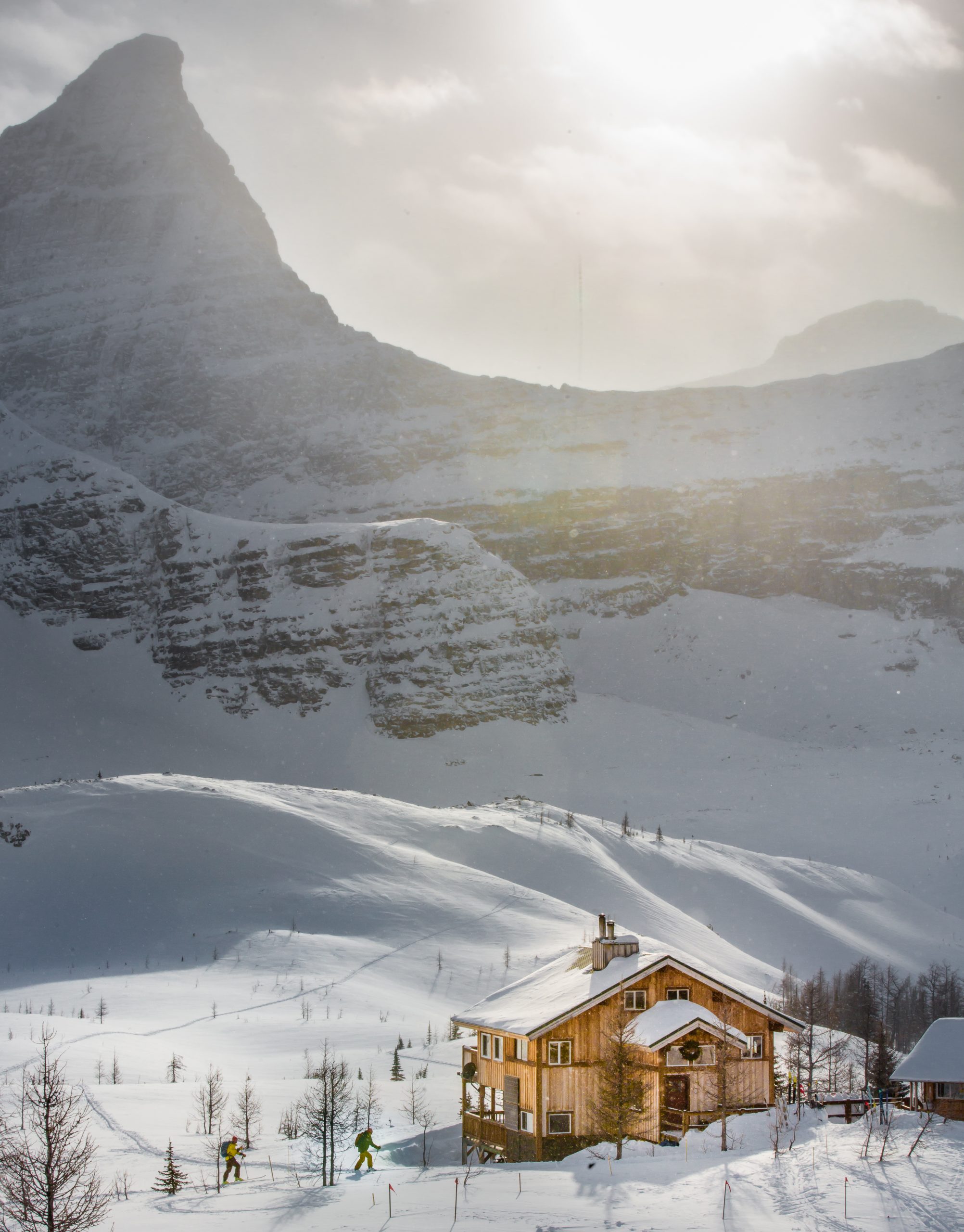
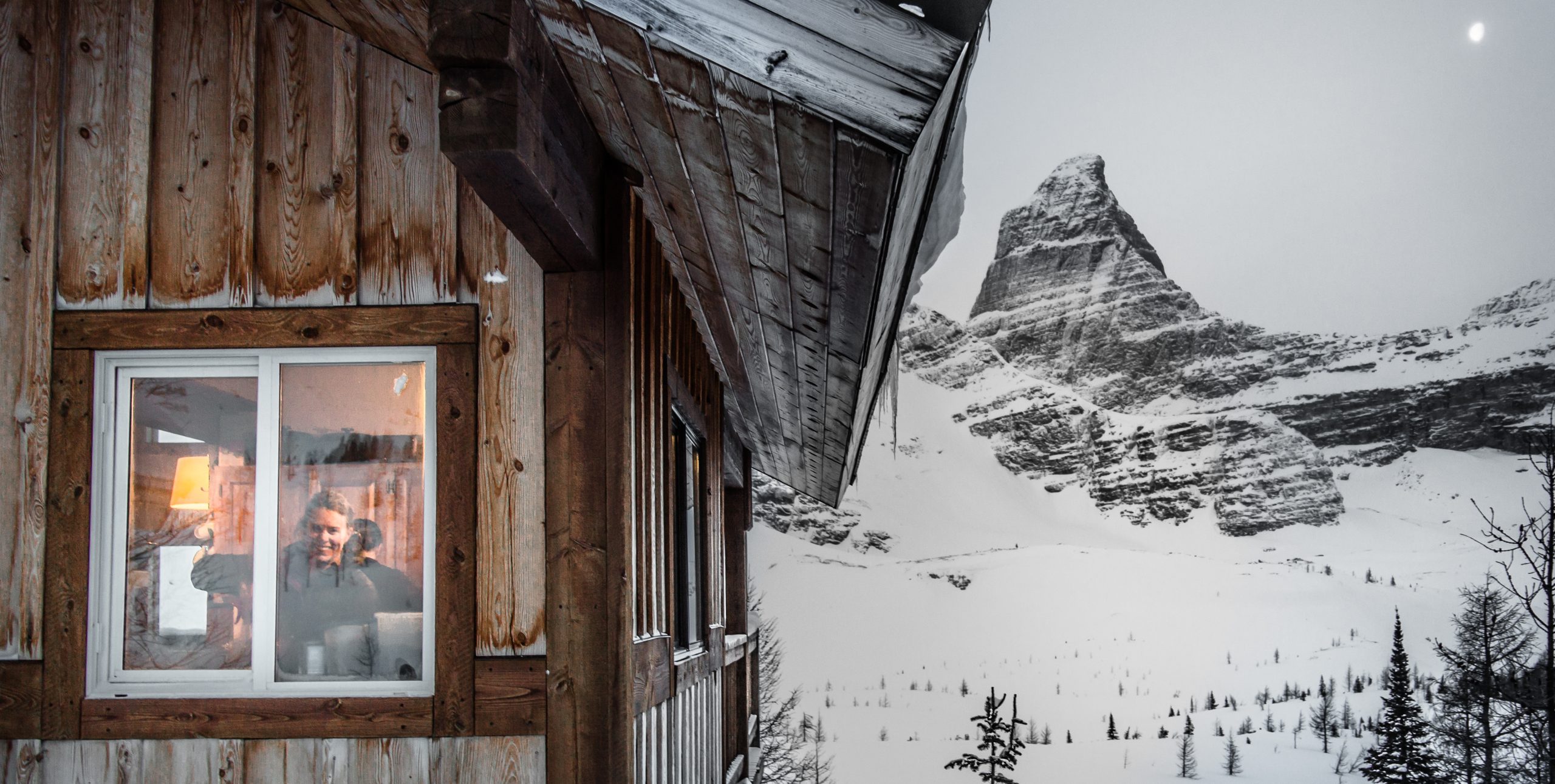
    Photo: Noel Rogers.

    When we began this series, The Escape, we imagined it would be a slippery slope. It turns out the slope is blue-ice slick. Cabin-lust is real.  

    This past spring, just as Covid-19 began making headlines in the U.S., one of the best treat makers on the planet, Zoë Roy, was chef at Talus Lodge. Roy, along with a friend who is rumored to ride bicycles in all forms, settled at the lodge for approximately two-months as the U.S. and Canada worked out their Covid-19 related border issues. Roy holds a Canadian passport, the bike rider does not. From Roy’s mom, I’d hear occasionally about Zoë’s charmed existence self-isolating in a dreamscape and relationship test tube.

    Tucked way back, the lodge is perched in British Columbia’s East Kootenays and situated on Ktunaxa ʔamakʔis, the homeland of the Ktunaxa people.

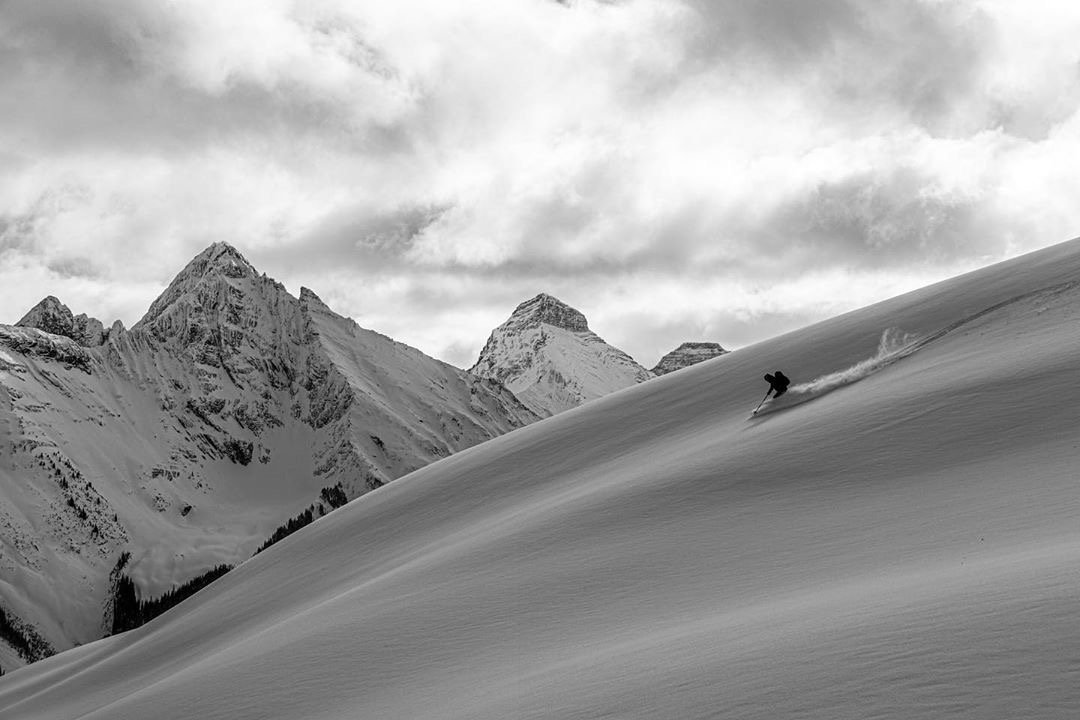
    Envision a snow globe fantasyland ripe with serrated summits, glades, and bowl skiing. 

    Let’s shoot straight. This is not the place for 40 mm underfoot nordic skis. The geography enveloping Talus Lodge spoons nicely with its 100 mm or greater width partners. This is powder country.

    Photo: Leo Imbimbo

    Before the eye roll that this has nothing to do with a cross-country ski site, hear us out. The lodge is owned and operated by Sara Renner and her husband Thomas Grandi – both accomplished skiers at the World Cup level. Renner won Olympic silver in the 2006 team sprint and a bronze at the 2005 Oberstdorf World Championships. The couple, who parent three children, are high-mountain lovers. Grandi is a certified ski guide.

    But the cabin features in The Escape are more about Zen than results and resumes. Inhale. Exhale. Transport yourself to Talus Lodge.  

    Photo: Marcus Baranow

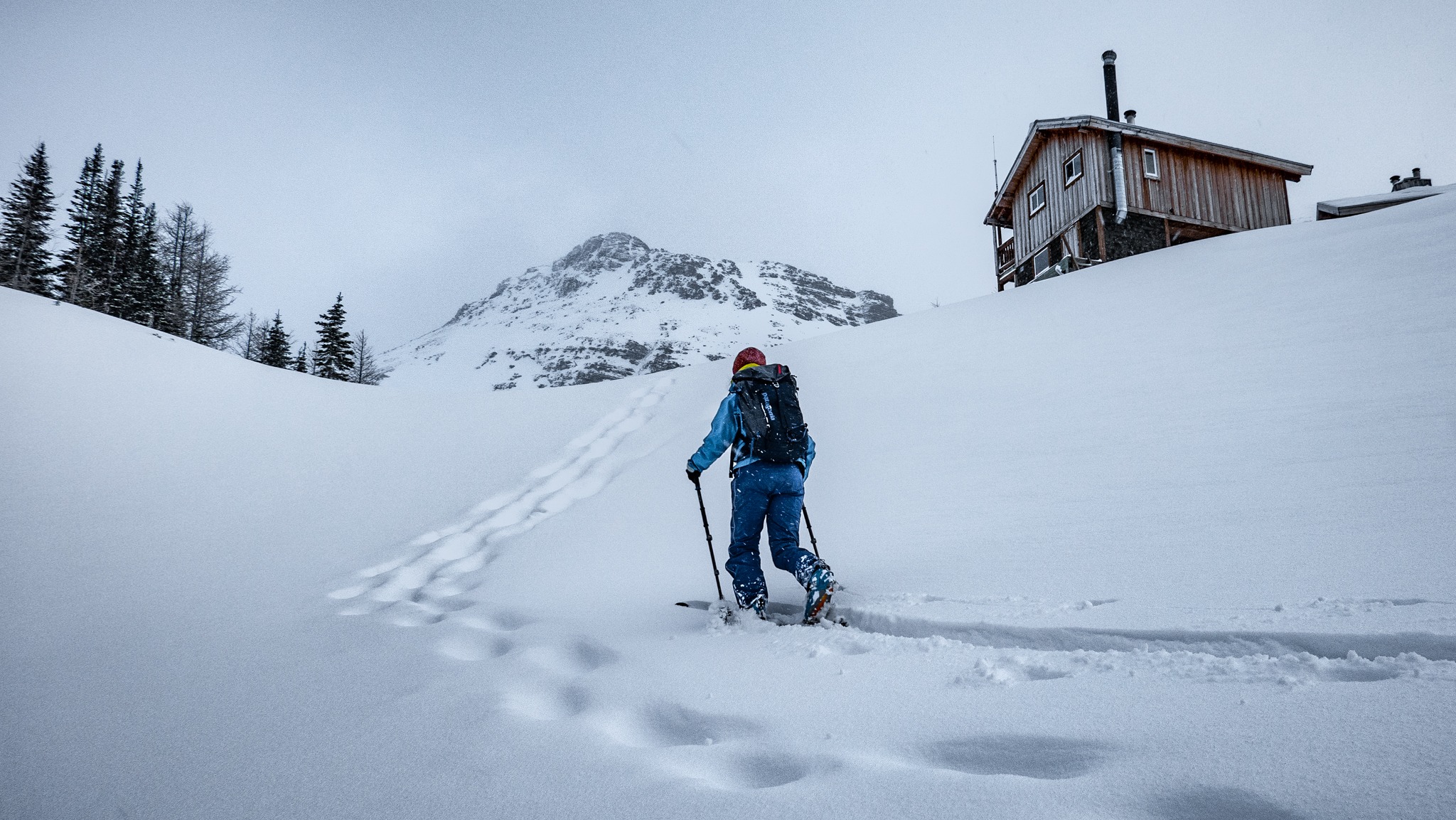
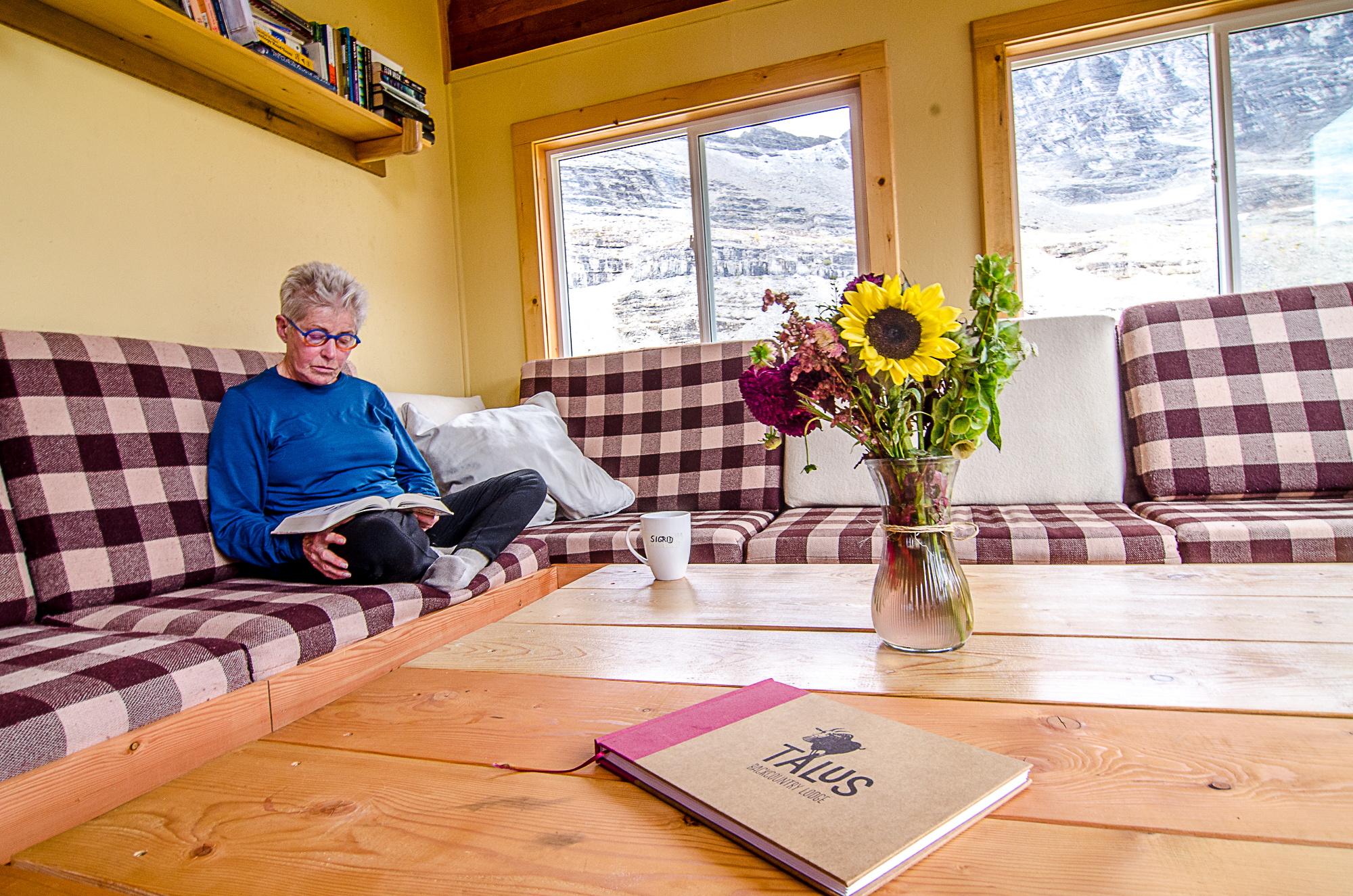
    This is the full off-the-grid plush experience, beyond skiers self-powering uphill. Mountain-style gourmet meals are catered. The lodge features a full kitchen and normally sleeps 10-12 guests. Six bedrooms populate the lodge, all double occupancy. Solar panels and a backup generator supply power. A wood stove stokes heat in winter. The wood-fired sauna rounds out your post-ski life. And since this is real-deal avalanche country, your cost for staying includes mandatory ski guides.

    Photo: Noel Rogers
    Photo: Karsten Heuer
    Photo: Noel Rogers

    Stays at Talus are an opportunity to unplug. There’s no WiFi. However, guests have access to a satellite phone when necessary. Originally built in 2001, the lodge was recently renovated.

    buy voltaren online

    As for getting there, most take the heli in, some tour in with a guide. Otherwise, it’s simple. This is your job if heading to Talus for a winter adventure: show up with skis, gear, clothes, and plenty of endurance. They provide the rest. If the images of winter wonderland don’t suit you, the lodge is available for summer hiking too. For now, during the pandemic, only Canadians can book Talus.      

    Photo: Noel Rogers


  • Canmore NorAm/SuperTour/Nationals Classic Distance

    Canmore NorAm/SuperTour/Nationals Classic Distance

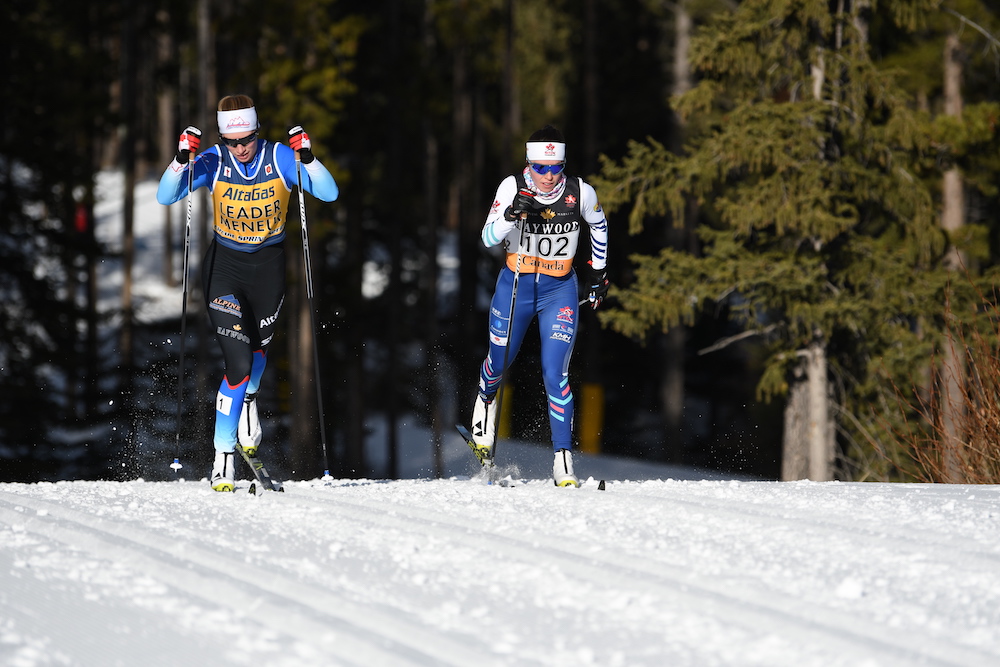
    Katherine Stewart-Jones got second again in the 5km classic. (Photo: Doug Stephen)
    Katherine Stewart-Jones powering to another second place in the 5km classic. (Photo: Doug Stephen)

    Day two of the first NorAm and SuperTour weekend was interval start classic, with 10km for the men and 5km for the women.

    The US SuperTour athletes took the chance to show their depth today, packing the top ten of the open categories.

    The 154 men raced first, with the U.S. Ski Team’s Zak Ketterson winning comfortably in 27:33.1. National team member Antoine Cyr was second at 15.0 back, followed by CGRP’s Ben Lustgarten at 20.4 seconds.

    Dartmouth’s Katharine Ogden won the 5km in 14:58.1, 19.7 seconds ahead of national team member Katherine Stewart-Jones and 36.5 seconds ahead of Sun Valley’s junior Sydney Palmer-Leger. 119 women finished today.

    While the open categories got the headlines, they aren’t the only people racing. In a throwback to 2009, Tasha Betcherman beat out Olympic medallist Sara Renner in the masters women’s 10km. In total, 33 masters and 268 younger athletes raced today, for a total of 578 finishers.

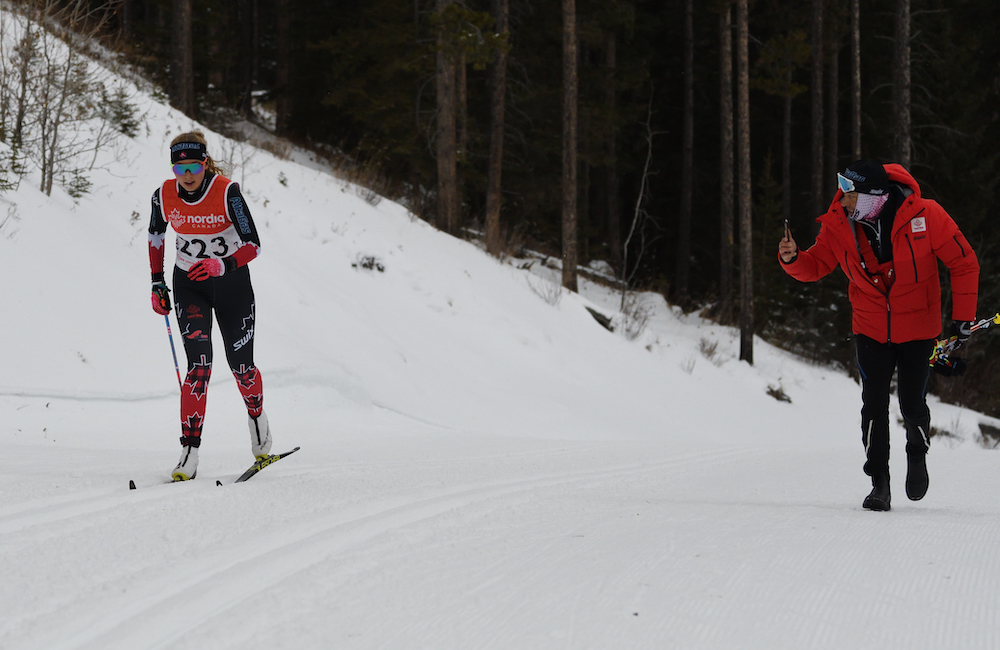
    National team's Natalie Wilkie attacking a climb while coach Robin McKeever shoots video. (Photo: Doug Stephen)
    National team’s Natalie Wilkie attacks a climb while coach Robin McKeever shoots video. (Photo: Doug Stephen)

    Mexico crowned the second ever national champion, with Jonathon Moreno taking the title in 41:25.7, 1:47.5 ahead of yesterday’s winner, Rodrigo Rangel Fernandez.

    Rangel Fernandez was excited by the progress Mexico is making, throwing down a challenge to Johannes Høsflot Klæbo.

    https://www.instagram.com/p/B5xsbrJJpwD/?igshid=kh344b10iifr

    Full results for the weekend are on zone4, including live timing again for Sunday. The timers included separate climb results for Saturday; Canmore is the head office of the Zone4 timing company, and once again they added some detail that isn’t usually included at this level of racing.

    Doug Stephen’s gallery has 162 full-res photos today.

  • Canmore NorAm: Notes, Quotes, and Selections

    Canmore NorAm: Notes, Quotes, and Selections

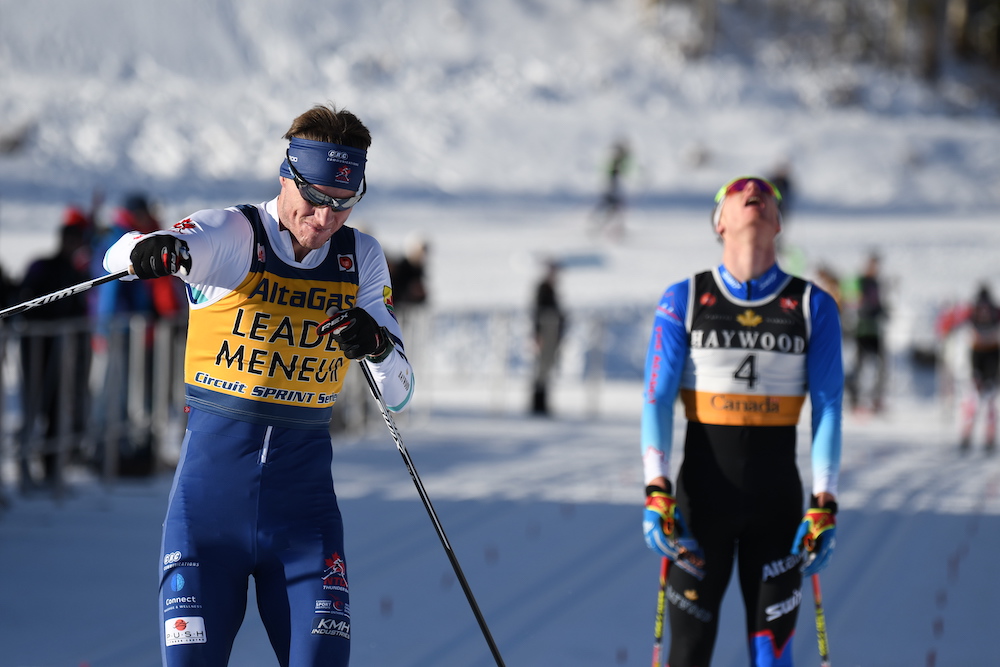
    Bob Thompson outsprinted Jack Carlyle in the men's 30km. (Photo: Doug Stephen)
    Bob Thompson outsprinted Jack Carlyle in the men’s 30km. (Photo: Doug Stephen)

    Canmore hosted the second NorAm of the 2018/2019 season on December 13th, 15th, and 16th. The event also served as U23 and Junior World trials.

    By the end of the weekend, starts at the U23/Junior World Championships and the World Cup’s Tour de Ski would be earned.

    This event was originally scheduled for Whistler Olympic Park but had to be moved as a result of heavy rain and inclement weather forecasted into the immediate future. The Callaghan Valley Cross Country organization, the original bid-winner for this season’s trials, made the difficult decision to cancel on December 1st. The weather gods added one final insult on December 13th, when a major snowstorm ensued in the Callaghan Valley that would have made racing possible on the 14th.

    Canmore’s cross-country community stepped in on December 2nd and was able to organize a successful race weekend with a few weeks notice.

    The International Ski Federation (FIS) mandates that Continental Cup leaders for each period earn automatic start rights for the next World Cup period, including financial support from the event hosts. This season, Period 1 leaders get starts for Period 2 (Tour de Ski) and period 3 (Dresden, Otepää, and Ulricehamm) along with race support.

    For the first time since Perianne Jones and Dasha Gaizova started in the 2014 edition, Canada will enter a woman in the Tour de Ski (TdS). The last female finisher was Sara Renner, who placed 16th overall in 2010.

    This past weekend, Dahria Beatty won all three races in Canmore. Combined with her second place (and top Canadian result) in Sovereign Lake the previous weekend, Beatty is the COC leader and will leave for Europe on the 21st.

    In an email to FasterSkier after Thursday’s sprint, Beatty wrote: “I think the first 3 stages of the Tour this year are my dream come true, 2 sprints and a 10km skate.” The day after sending the email, Beatty received the official news that her TdS dream would be a reality.

    On the men’s side, Bob Thompson won twice in Canmore to lock down the male COC leader position.

    inhalers

    As this event was also the selection trials for U23 and Junior World Championships, up to 12 athletes would automatically qualify for the Lahti, Finland championship races. The High Performance Committee met Sunday afternoon and will announce the final choices soon.

    Weekend Results Summary:

    Names in green earned automatic selection for Lahti.

    Classic Sprint, Thursday:

    • Open Women: Dahria Beatty, Katherine Stewart-Jones, Maya Macisaac-Jones; Marie Corriveau (6th, U23)
    • Junior women: Anne-Marie Petitclerc, Molly Miller, Anna Pryce
    • Open Men: Bob Thompson, Angus Foster, Julien Locke; Graham Ritchie (4th, U23)
    • Junior Men: Remi Drolet, Tom Stephen, Xavier McKeever

    Interval start freestyle, Saturday:

    • Open Women 10km: Dahria Beatty, Katherine Stewart-Jones, Frédérique Vézina; Sadie White (4th, U23)
    • Junior Women 5km: Molly Miller, Isobel Hendry, Elizabeth Elliot
    • Open Men 15km: Russell Kennedy, Evan Palmer-Charrette, Alexis Dumas; Gareth Williams (6th, U23)
    • Junior Men 10km: Sam Hendry, Remi Drolet, Tom Stephen.

    Mass start classis, Sunday:

    • Men 30km: Bob Thompson, Jack Carlyle, Russell Kennedy; Sam Hendry (4th, top junior), Antoine Cyr (5th, U23)
    • Women 15km: Dahria Beatty, Katherine Stewart-Jones, Hannah Mehain (U23); Jasmine Drolet (6th, junior)

    Doug Stephen photographed all three days; see his albums on Flickr for many more images in full resolution.

    Results: Full Weekend, Sprints, Sprint BracketsInterval Starts, Mass Starts


    Quotes from Canmore:

    Sprint

    Dahria Beatty leads Katherine Stewart-Jones. They would finish 1-2 all three races. (Photo: Doug Stephen)
    Dahria Beatty leads Katherine Stewart-Jones. They would finish 1-2 all three races. (Photo: Doug Stephen)


    My tactics for every heat was to ski smooth and relaxed the first half and attack off the final two climbs into the finish. That worked out well for me today. I skied from the front and had control of the heats. The sprints were staged out of the biathlon stadium (hence why you couldn’t find them on the webcam) so it was an uphill finish, making for very fair racing.” — Beatty (1st)

    I was not happy with my qualifier but am really happy with how I skied the heats. Our staff did an awesome job with the skis today! The course was a lot of fun. Tactics essentially involved staying relaxed off the start, positioning well for the final climb and then hammering to the finish.” — Maya MacIsaac-Jones (CNST, 3rd)
    I feel pretty amazing about today’s race. 4th senior at a NorAm sprint is by far my best sprint result ever! My tactic was to have fun and just go like hell; I had a blast and I never went this fast before!” — Frédérique Vézina (CNEPH, 4th)
    I didn’t really have any tactics, I just wanted to go as fast as I could, ski well and try to stay with the leaders. I didn’t ask myself a lot of question, just ski fast!” — Marie Corriveau (MSA, 6th)


    Bob Thompson wins the A final with three Thunder Bay teammates in frame. (Photo: Doug Stephen)
    Bob Thompson wins the A final with three Thunder Bay teammates in the camera frame. (Photo: Doug Stephen)

    I am very happy with how today went. I found the finishing sprint gear I felt I was missing had the speed when I needed it.

    Everyone was fairly relaxed for the first half of the final knowing it was important to have the energy for the gradual climb into the finish. My move was made coming up to the last short downhill and then on the short striding hill before turning into the finish. I had been feeling great in that section in every heat and made sure I was at the front to make the most of it.” — Thompson (1st)

    The group strung out a little bit going into the big downhill, I was back in 5th but had amazing skis and came back up to the group pretty easily. Everyone was really skiing together going into the last climb, and Bob just put down a mean last hill and got away from us. I jumped out from behind Julien Locke as we hit the finishing stretch and got up beside him as we got right down to the line, and just got him in a big lunge.” — Angus Foster (TBay, 2nd)

    The tactics worked out for me as well! I was planning on holding on to the leaders in the final for as long as I could, and then using my fitness to the best of my ability in the finishing stretch.” — Graham Ritchie (TBay, 4th)

    Interval start free technique

    Sadie White was fourth and top U23 on Saturday. (Photo: Doug Stephen)
    Sadie White was fourth and top U23 on Saturday. (Photo: Doug Stephen)

    It was a hard race today. I had a good start but then got really stiff going into my second lap after the big climb. It took a lot of mental fight to regroup after I got really stiff on the second lap but I was able to ski out of it and push really hard on the final lap.

    I am really happy with my fitness right now, my pacing was a bit off today but I think that fact that I am in good shape allowed me to bring it back.” — Beatty (1st)

    I felt better and better throughout the whole race today! I kind of wish we had more lap to go…” — Vézina (3rd)


    Russell Kennedy descending to first place. (Photo: Doug Stephen)
    Russell Kennedy descending to first place. (Photo: Doug Stephen)

    “Pacing was important today: that being said I didn’t pace it that well. Was definitely fastest the first two laps. Skis for me were really good [as] the team did an awesome job on them.” — Russell Kennedy (Team R.A.D., 1st)

    “The race today went alright, I tried to start hard and couldn’t quite get myself into a top end race gear. I skied relatively consistent and was able to find a better feeling on the last lap, but overall not the way I want to feel during a race, the result was a pleasant surprise.

    I think pacing played a big role, I was pretty far back after the first and second lap but turned out to be less than some guys lost on the last lap and so I was able to move up quite a few places in the final kms.” — Evan Palmer-Charrette (Team R.A.D., 2nd)

    My race today was really good. I feel like I was able to push hard and keep a good technique. I think the key today was to get a good glide after each push because they were not a lot of easy part on this course and the downhills were fast so you needed to get recovery were you can.” — Alexis Dumas (CNEPH, 3rd)

    Today’s race was good, not amazing but I’m happy to come away with the top U23 spot which qualifies me for U23 World Championships.

    Today’s weather was static and remained the same for the whole race. The race was decided on the last lap, that’s where I pushed my hardest. My plan for the race was to increase the speed as the race progressed, getting a bit faster each lap. I was getting splits and I realized I was off the pace on the first laps, so I just made sure to push as hard as I could on the final climbs.” — Gareth Williams (Telemark, 6th)

    Mass start classic

    Russell Kennedy (bib #1) leads out the men's 30km while Bob Thompson towers over the field in the leader's bib. (Photo: Doug Stephen)
    Russell Kennedy (bib #1) leads out the men’s 30km while Bob Thompson towers over the field in the leader’s bib. (Photo: Doug Stephen)


    Today’s race stands out as the most fun I’ve had in a 30k since the very first one I ever did at the Canmore Nationals in 2010.

    The main group got smaller definitely through Russell pushing the climbs on most laps. We had the group of 6 for several laps and then the last 2 were really just the 3 of us with Russell pushing hard on the climb from the bottom of the course. Jack and I had faster skis and on the final downhills went by and then had a great sprint to the line.” — Thompson (1st)

    After a tough sprint day, it was great to bounce back with two super successful distance races.  ” – Sam Hendry (Team R.A.D., 1st junior in 4th)

    Today was a fun race. A good battle between Katherine and me once again.

    Katherine set the pace early and by the second lap, we were on our own. It was windy on course today, so it was hard to break from each other and after testing each other a few times on the last lap it came down to the finish sprint, which of course is my favourite.” — Beatty (1st)

    The race was really fun. I pushed the pace right off the start so Dahria and I made a break from the rest of the group after the first lap. We skied together the entire race, it was the type of course that made it difficult to break away because the hills were relatively short and there was quite a big drafting effect on the flats. It came down to the finishing stretch and Dahria was stronger on the double pole!” — Katherine Stewart-Jones (CNST, 2nd)

    Selection

    At this point, if I am offered a start I will plan to race the first 3 stages and then reassess after that based on how I am skiing. The Dresden WC will also be a focus just after the new year so I want to make sure I am well prepared and have enough energy for those races as well.” — Beatty, on Thursday, before the Tour de Ski offer was made.

    Qualifying for world juniors has been a big goal of mine for many years and I am really excited to have achieved it this weekend.” — Hendry

    Personal Highlights

    Most unusual part was getting to come home and lie in bed between the quali and heats.” — MacIsaac-Jones

    I am very very happy with my race today, I really surprised myself! It’s been a long time I didn’t feel good at racing so it was really fun to have good feelings again. Take the first spot for U23 world champ was the best way to start the season!” — Corriveau

    Getting to race the final with three of my NTDC Thunder Bay teammates was a blast, I was really proud of the way we skied out there today and think it reflects a lot of hard work by our team and coaches this year! I’m stoked for Graham and Julian go 1-2 in U23 with World Champs spots on the line, and we all owe a big thank you to our wax techs for some wicked boards all day.” — Foster

    It’s been really nice to race at home and sleep in my own bed, especially knowing I will be away a lot for the rest of the season.

    Everyone in Canmore has done a great job organizing the races so last minute. I’ve been especially loving the chocolate medals!” — Beatty

    The highlight from this past weekend was hands down, getting to ski with my teammate and role model Russell Kennedy for almost all of the classic mass start on Sunday.” — Hendry

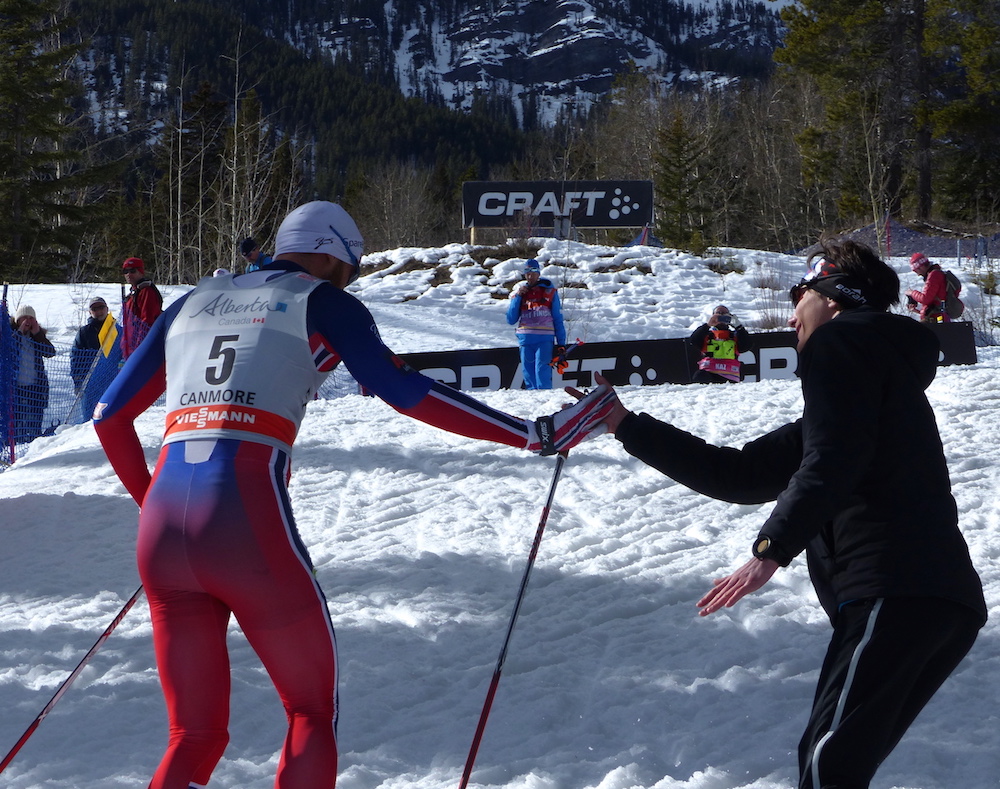
    Remi Drolet has been in Canmore before: Petter Northug (NOR) (l) high fives Remi Drolet (spectator) as he finishes his final lap during the men’s 1.5 k classic sprint at the Ski Tour Canada on Tuesday in Canmore. (Photo: Peggy Hung)
  • Thursday Rundown: Hochfilzen, Canmore and U23/JW Trials

    Thursday Rundown: Hochfilzen, Canmore and U23/JW Trials

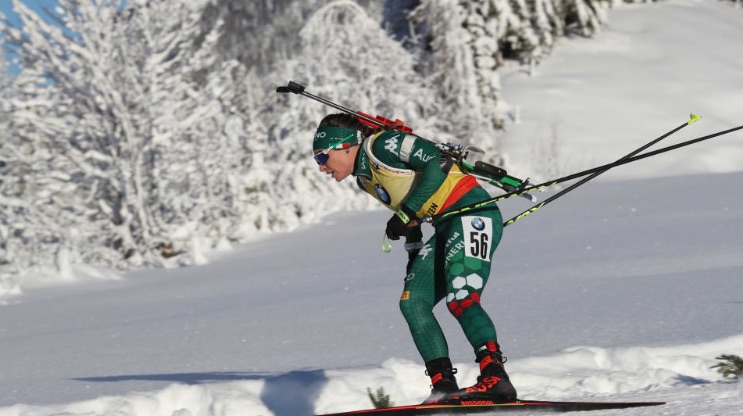
    Dorothea Wierer of Italy won Thursday’s sprint in Hochfilzen, Austria in a time of 21:04.9 minutes. (photo: biathlonworld.com)

    Today in Hochfilzen, Austria, Dorothea Wierer of Italy won the sprint in a time of 21:04.9 minutes. Wierer missed one shot standing for a single penalty during the race. Kaisa Mäkäräinen of Finland was close behind in second, 0.6 seconds back. Mäkäräinen also had one missed target standing. Third place went to Russia’s Ekaterina Yurlova-Percht, finishing 24.4 seconds behind. Yurlova-Percht short clean in the race.

    Susan Dunklee was the best placed American in 34th (+1:33.0, 0+2). Joanne Reid was 44th (+1:48.3, 0+1), and Clare Egan 65th (+2:22.1, 2+2).

    Canada’s Rosanna Crawford laced 49th (+1:56.4, 2+0), Megan Bankes 73rd (+2:47.8, 1+2), Megan Tandy 87th (+3:26.9, 2+3), and Nadia Moser 88th (+3:34.8, 2+2).

    Results

    On the non-racing front, the IBU released a statement about “Austrian state authorities” investigating five Russian biathlon officials and five biathletes due to their connections to doping. The IBU stated that the possible infractions occurred during the 2017 Hochfilzen IBU World Championships.

    Russian sports journalist Dmitry Guberniev has posted the names of the individuals under investigation. According to tass.com, a Russian news site, Guberniev the following people: “Among athletes accused of violating anti-doping rules are 2014 Olympic champion Anton Shipulin, Evgeny Garanichev and Alexander Loginov. The list also includes biathletes Alexey Volkov, Irina Starykh, former coach of the Russian national team Alexander Kasperovich, doctors and massage therapists Artyom Kryntsilov, Alexander Selyavkin, Evgeny Shutov and Dmitry Topychkanov,” tass.com reported.

    List of people under investigation according to Russian journalist Dimitri Guberniev (Screenshot from @guberniev_dmitry)

    FasterSkier will post updates about this developing story as more information is discovered

    – Harald Zimmer contributed

    ***

    NorAm and U23/JW World Championships Qualification, Canmore, Alberta

    The Canadian NorAm series continued Thursday in Canmore, Alberta, with a combined NorAm and trials for U23 and Junior World Championships.

    The three race weekend kicked off with classic sprints, run from the biathlon stadium which offers an uphill finish in place of the traditional long descent into the finish straight.

    The selection criteria are involved, but it appears that each day four athletes will earn a spot in U23/JW World Championships in Lahti, Finland. The top athlete of each gender in U23 and junior each day should be automatically selected.

    There are also World Cup period 2 (Tour de Ski) and period 3 starts on the line, with the possibility of Canadian women in the Tour de Ski for the first time since Sara Renner finished 16th in 2010.

    Dahria Beatty (CNST) won the open women’s category in style, winning the qualifier in 3:51.06 by 4.96 seconds before winning all three heats by large margins.

    vancomycin online

    Katherine Stewart-Jones (CNST) finished second in the A final in 3:49.60, 2.20 seconds behind Beatty after finishing second in the qualifier and winning her earlier heats. Maya MacIsaac-Jones (CNST) completed the podium, finishing 5.37 back.

    Marie Corriveau was the top U23, finishing 6th in the A final after qualifying in 6th. Corriveau has struggled with results for two seasons, but her first race of the season is a very positive sign.

    Anne-Marie Petitclerc (Mont Sainte Anne) won the qualifier and quarterfinal on her way to the junior win in 4:01.71. Molly Miller (Black Jack) was second at 0.68 seconds back and Anna Pryce (Foothills) took third at 7.25 seconds.

    Bob Thompson (TBay) won the men’s A final in 3:19.43 by 2.31 seconds. Angus Foster (TBay) outstretched top qualifier Julien Locke (CNST) by 0.01 seconds for second. Graham Ritchie (Big Thunder) was the top U23 in 4th, 2.36 back after qualifying 6th.

    Remi Drolet (Black Jack) won the junior A final in 3:31.94, after winning the qualifier and all his heats. Foothills teammates Tom Stephen and Xavier McKeever were second and third, 2.08 and 2.51 seconds back respectively. Stephen has two future seasons as a junior while McKeever has three.

    All results, including live timing for the rest of the weekend.

    Sprint results Sprint brackets 


  • Cross Country Canada: The Reboot Part Two

    Cross Country Canada: The Reboot Part Two

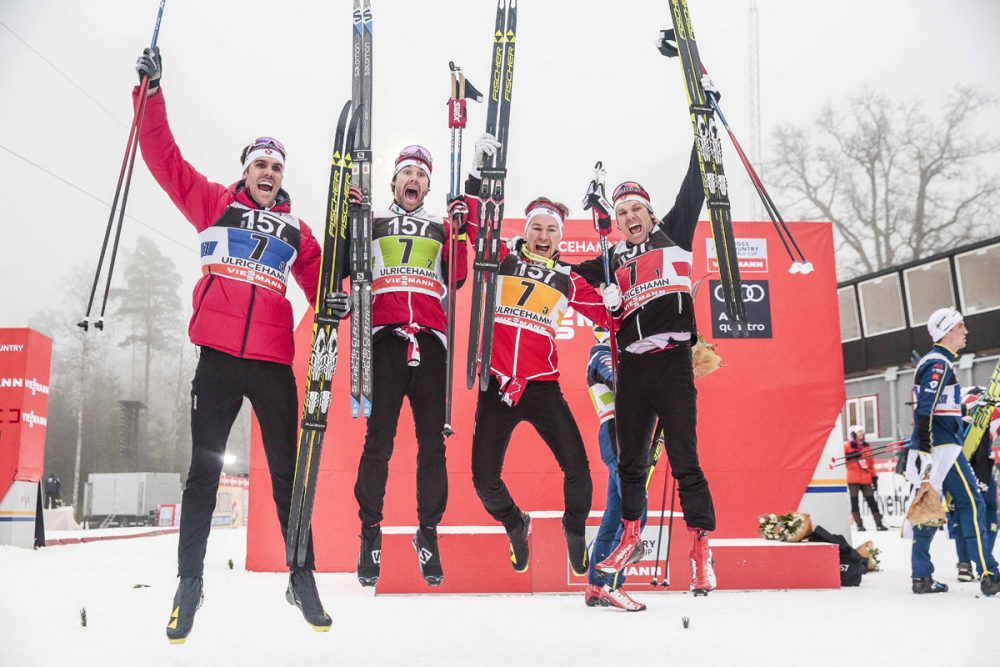
    Left to right: Canada’s Len Valjas, Alex Harvey, Knute Johnsgaard, and Devon Kershaw after their historic third place finish in the 2017 men’s 4 x 7.5-kilometer team relay in Ulricehamn, Sweden. (Photo: Fischer/Nordic Focus)

    This is the second part of FasterSkier’s report on the state of high performance cross-country skiing and athlete development in Canada. You can read part one here.

    Cross Country Canada (CCC), as the national governing body for cross-country skiing in Canada has the difficult task of steering a rather large ship. The idea in steering the ship is to maintain a path requiring little quick and nimble maneuvering. Survey the landscape, mine the data, set a course, and sail. Along the way, there’s the ability to make slight adjustments for efficiencies, accommodate unforeseen changes.

    To help make those macro and micro changes, Cross Country Canada hired Nic Lemyre as a high performance consultant in June, 2018. Lemyre, a Canadian living in Oslo, Norway has concrete ideas of what sustainable improvement and success resemble.

    Where do we want to be?

    Nic Lemyre (Photo: Norges Idrettshøgskole/Norwegian Sports Academy/)

    “We’re thinking our starting point is to build a really strong relay team, on both the women’s and the men’s side,” Lemyre told FasterSkier. “We want to have five athletes, so that we can rotate with the fifth athlete and we’re never in a situation where we can’t field a strong team because one athlete’s injured or sick.”

    According to Lemyre, the composite team must be derived of skiers who can hit specific individual benchmarks “[When] we have athletes that can start scoring points in every race they enter on the world cup, that’s a medium term goal,” Lemyre said. “From there, we start aiming for the top-15 for all athletes that are identified in that group.“

    Part of the reasoning behind the relay vision is that for a skier to get a permanent spot on the World Cup, the athlete not only has to reach a high level, but also help raise four other Canadians up to that level. Lemyre believes this should foster cooperation and team spirit.

    It helps us meet goals of performance,” Lemyre added. “But also it helps us meet goals that are related to how to build a strong performance culture, where the athletes need to support each other, to learn from each other. They need to push each other. They need to push each other beyond limits they may have experienced before.”

    How do we get there?

    After PyeongChang, CCC appeared to have both the political will to start the painful process of another re-invention. However, that will came with a reduced budget with which CCC could support its future options.

    The simplified model of corporate restructuring begins with terminating certain roles and concludes with creating new roles filled by new individuals near the top of the organizational pyramid. Often, in a medium or large corporation, most people will be shuffled around and only a few near the top will lose their jobs. The final step is to find a quick win to help the newly reshaped organization gain morale and unify.

    buy amoxicillin online

    In a small organization like CCC, everyone is near the top. While the process works well for the survival of the organization, it can be hard on individuals. 

    The change at CCC began with long-time High Performance (HP) director Tom Holland’s planned retirement. Lemyre was hired as a consultant to oversee the restructuring of the HP group. Shortly before Lemyre’s hiring, CCC eliminated some positions.

    As Joel Quenneville’s recent firing demonstrates, proven ability and past success is not enough to provide job security during a reboot. (Quenneville was the NHL’s Chicago, Blackhawk’s head coach since 2008. During his tenure Quenneville lead the team to three Stanley Cups.)

    On November 1st, CCC hired Erik Bråten as a new national team coach and modified Louis Bouchard’s title. Bouchard remains head of the National Training Centre in Mont Ste-Anne, Québec, with the added title and responsibilities of World Cup Head Coach.

    Bråten, a recent Norwegian School of Sports Science graduate with a specialization in cross-country skiing, won the 2018 coach of the year award from the Norwegian ski federation. This hiring didn’t happen as quickly as some had hoped, but is considered the first win for CCC’s new structure.

    Erik has a strong sports science background applied to cross-country skiing,” Lemyre said on the phone. “His profile is unique in our environment. The fact that he’s young is really positive for us, because he’s open to this new experience. He comes with a solid base, and his excitement and his motivation, I think, will be great assets in applying that knowledge in the right culture in Canada. At an individual level, Erik is unique in working one on one with athletes. I think our athletes are going to really appreciate that.”

    Along with bringing in new personel, Lemyre aims to improve sharing of training information in Canada. In Norway’s organizational structure, athletes and coaches are able to log hours and training plans on an interface organized by the Norwegian National Ski Federation. It’s a model and template Lemyre is intimate with.

    “The fact is that we have a large country, and we can’t be with athletes every day of the year following them on site,” Lemyre said. “Now the technology is there to pool [training data] in a way that our coaching staff and the local coaches can communicate really well, But also as we’re building up our science team, we also have interaction with our different people involved in helping the athletes develop.”

    Dahria Beatty racing the 2018 Holmenkollen 30 k freestyle mass start in Oslo, Norway. (Photo: Fischer/NordicFocus)

    Another planned shift is to interchange athletes between Europe and Canada more often. For example, Dahria Beatty will start the season in Canada — a change encouraged by her coach Chris Jeffries and supported by Lemyre.

    This summer my coach Chris and I came up with a plan that allowed me to stay in Canada to start the season to build into the race season and then head over the Europe and race on the World Cup circuit leading up to World Championships in Seefeld,” Beatty said. “With this being the first year of the new quadrennial, it is the perfect time to fine tune some of those race details domestically before leaving for Europe mid-December. I am looking forward to racing part of the Tour de Ski then period 3 and hopefully finding my peak for World Championships and World Cup finals in Quebec.”

    Lemyre’s concept is to allow athletes like Beatty to build into the early part of the season domestically and arrive in Europe at a higher level of race fitness.

    The way we scheduled the trips this year, giving some athletes the chance to prepare very well before they race on the World Cup,” Lemyre added. “I think some of them will be stronger when they show up on the World Cup, and also they’ll be able to sustain that level of performance over the time period they are on the World Cup. We will try to be a little more selective and well prepared when we show up, and then post really good results when the athletes are racing the World Cup.”

    Jeffries stated that the stress of living abroad, a dynamic known all to well by North American World Cup skiers, can be counterproductive to a developing athlete.

    The last few years, our top athletes spent the majority of their time in Europe,” Jeffries said. “I think it stalled our development a little bit, because we’re always living out of a suitcase, and we’re always having to ski races where we’re trying to perform.”

    Dave Wood spent 18 years as a national team coach. His time leading the team included the post-Nagano rebuild and managing athletes at the Olympics in Vancouver. His vision includes giving skiers more time to develop and less emphasis on being fast all season.  

    Sara [Renner] had far less World Cup starts before she was top-15 at the Olympics than the people of today,” Wood said. “I think that this big argument about experience is valuable when you are looking for seconds. When you are looking for minutes, [World Cup experience] makes no difference.”

    Will it Work?

    The U.S. has been able to develop a strong women’s team built off Kikkan Randall’s determination to drag U.S. skiing to the top. Randall took inspiration and knowledge from Canada’s post-1998 rebuild where Scott, Renner, Milaine Thériault, Jamie Fortier and Amanda Fortier decided it was time to lead the charge.

    American Kikkan Randall tucking during the women’s 10 k classic mass start at 2018 World Cup Finals in Falun, Sweden. (Photo: Fischer/NordicFocus)

    In both cases, the athletes didn’t succeed alone. The “fantastic five” got the support of Holland, Wood, and many others. Randall also collected a large supporting cast, well documented by Peggy Shinn’s book ‘World Class’. 

    Laura McCabe, now a Methow Valley coach and two-time Olympian, spent most of her free time in Nagano with the Canadian women’s team because it felt like a group that had a vision and a willingness to support one another to collective success.

    “It just shoots you up the ladder when you come back and you feel like you have a very safe place, you’re working on this goal together, you’re all in it together, and you’re there for each other all the time,” McCabe told FasterSkier. “I felt like the Canadian women were doing that. And now I feel like Matt Whitcomb has led that charge for the American women.”

    While crediting Randall for starting the process, McCabe feels that the team’s work to be a team is the critical factor.

    “They have goals, team goals and they have personal goals,” McCabe said. “They are always there for each other. One of their biggest goals is to basically keep their relationships positive and keep everybody moving forward. I think that is one of the number one reasons that team is doing well.”

    In a conversation last May with FasterSkier, Yukon coaching icon Alain Masson spoke of the complexities of achieving success on the international stage. Simply possessing physical gifts, the aerobic capacity, the predisposition to tolerate and absorb high training loads, is no guarantee of success.

    There’s the behind the scenes unglamourous work of nurturing athletes, remaining true to organizational core values, and feeding the system with money, intellect, and vision.

    “Definitely, there’s a minimum set of physical characteristics that you need to perform at that level,” Masson explained to FasterSkier. “But you also need many characteristics, personality characteristics, that are vital. What Alex showed, and Sara Renner, and Chandra [Crawford] and Beckie [Scott]. I think athletes that combine both the physical and the mental characteristic at a time when the program works together, and everything lines up with the funding, good leadership, and everybody working together. That’s the difficulty, this is the issue, trying to get all of that together. As the women in the U.S. have demonstrated, when you have all of that lining up, it’s amazing what you can do.” 


  • Cross Country Canada: The Reboot Part 1

    Cross Country Canada: The Reboot Part 1

    Canada’s Alex Harvey celebrating on the podium after placing second in the men’s 15 k freestyle mass start in Seefeld, Austria, for his best result of the 2018 World Cup season. (Photo: Salomon/NordicFocus)

    Cross Country Canada (CCC) has begun a reboot process as the new Olympic cycle starts. Corporations call this a reset, a rebranding, a new direction, restructuring, and various other names that try to disguise the challenges and issues that come with enacting real change.

    The reboot process traditionally starts with an acknowledgement that the current level of success, and that of the foreseeable future, doesn’t align with the goals or the potential of the organization.

    Canada left PyeongChang with no medals at three consecutive Olympics, only one skier in the World Cup red group, and a perception that there was no obvious successor to Alex Harvey.

    There are many people who, with the benefit of hindsight, believe that CCC allowed itself to be trapped by a combination of success and the Own The Podium (OTP) funding model. 

    The process of assigning blame for the past, called “blamestorming”in the corporate world, is one of the most effective ways to waste time and destroy morale without doing anything to improve the future. The “best practices” approach to a reboot starts with four apparently simple questions: How did we get here? Where are we now? Where do we want to be in five years? How can we get there?

    While CCC does many things as a national sport body, this article will focus on high performance and the development system.

    How did we get here?

    After a disastrous 1998 Olympics in Nagano, CCC shrank to a full-time staff of five and endured a forced re-invention. Four years later, in 2002 at Salt Lake, Beckie Scott won all three medals in the skiathlon after the initial silver and gold medalists were caught doping. Sara Renner missed the B final in the sprint for 9th place.

    Canadian Chandra Crawford in the 2011 team sprint in Dusseldorf, Germany. (Photo: Fischer/NordicFocus)

    In 2006 in Torino, Chandra Crawford earned a surprise gold in the sprint while Scott finished fourth. Scott had earlier teamed up with Renner for a team sprint silver medal.

    buy vancomycin

    In 2010, there were no Canadian cross-country medals. However, there were signs of promise. Renner skied to her fourth Olympic top-10 finish. All four Canadians competing in the men’s skiathlon finished in the top-15. Devon Kershaw lost out in final kilometer of the 50 k to finish fifth, 1.6 seconds away from gold.

    That post-Vancouver glow was possibly the point where CCC temporarily slid off the rails.

    A number of Canadian sports fell victim to OTP incentives. A sport qualifies for OTP funding by having good prospects for a medal in the next Olympics. The money comes with strings attached, to ensure that resources are spent on improving the probability that specific individuals will podium. For smaller sports where the OTP money is a significant proportion of the sport’s annual budget, it is hard to make choices that put that money at risk. Choices like balancing the emerging athletes in the pipeline, while simultaneously supporting those athletes already at the top-end of the sport. 

    As a result, many sports have lost their OTP eligibility by losing the focus on development and the vision that qualified the sport for OTP in the first place. Some people put cross-country skiing in the list of sports that fell into this trap.

    After 2010, the future looked bright. Harvey and Kershaw were World Champions in the 2011 team sprint. Kershaw was second overall in the 2011/2012 World cup. (A feat only equaled in North America by Scott and Jessie Diggins).

    Harvey arrived at Sochi in 2014 as a medal favorite. He was fresh off a World Cup podium in Toblach the weekend before the 2014 Games began. Sochi ended poorly when Canada, along with Norway, couldn’t solve the difficult waxing conditions.

    In 2017, the men’s World Cup relay podium in Ulricehamn, Sweden sustained the hope — that result earned another year of OTP funding for five men. (Harvey remained a the top, as he won the men’s 50 k skate at the Lahti, Finland World Championships.

    The results in PyeongChang were similar to 2002 numerically: Harvey was close to a medal in multiple races and Lenny Valjas collected 7th in the classic sprint. A medal would have changed the mood, but not overall situation. 

    Where are we now?

    Post-PyeongChang, CCC believes Canada is not achieving the international results a country with plentiful snow and 37 million people is capable of.

    The development system in Canada consists of the National Team, the official training centers (Centre National d’Entrainment Pierre Harvey (CNEPH), Thunder Bay National Team Development Centre (TBay), and the Alberta World Cup Academy (AWCA)), and the clubs. The ten provinces and three territories have teams, but don’t have a formal place in the development system as each of the thirteen regions approaches development support differently. In the last few years, the number of clubs actively recruiting and developing athletes while supporting a high performance team has increased. For our purposes, as no official name has been affixed to these clubs, the term ‘elite club’ will be used here.

    In the past, all national team members were required to belong to a training center while developing athletes were encouraged to join.

    “I can speak for many of the athletes, they thought that if they didn’t go to a training centre, then they might as well quit skiing,” Telemark’s coach Adam Elliot said. “It was that broad of a choice, they felt they had to choose between skiing and school immediately.”

    The landscape is more diverse now, with more options. The examples that follow skew to Western Canada, largely because the coaches quoted brought teams to Sovereign Lake snow camps in May and November and were available for in-person interviews. Eastern Canada remains equally diverse in terms of its club offerings.

    A common theme among the coaches and athletes is that each athlete’s needs are different, and he or she needs to find an environment that fills those needs. FasterSkier asked AWCA’s head coach Chris Jeffries how an athlete should choose his or her path to success.

    “It’s such an individual, case by case thing,” he said. “I don’t have an answer.”

    In 2017, a shift to allow more development paths resulted in new senior National Team member Gareth Williams staying at his home club, Telemark, in Kelowna, BC. Elliot described how it came about.

    “Tom Holland approached us, for Gareth, and said we like what you’re doing in the Okanagan, and we want to keep Gareth there. We’re going to support you and your program to be able to support Gareth.”

    Also in 2017, Julien Locke returned to his home club Black Jack while Russell Kennedy shifted to the new Team R.A.D., part of the Canmore Nordic Club.

    To further illustrate the spectrum of options and pathways, FasterSkier contacted three Canadian athletes, each with a history of NorAm podiums and some international success, to discuss their ski-training choices. Dahria Beatty started at AWCA and has remained there, Evan Palmer-Charette started at TBay then recently moved to Team R.A.D., and Andy Shields has gone rogue.

    Dahria Beatty en route to 20th overall in the Seefeld World Cup freestyle sprint for her season-best result in 2017/2018. (Photo: Fischer/NordicFocus)

    “For me, I’ve been working with Chris [Jeffries] for six years,” Beatty told FasterSkier in November. “It works really well for me, and I have a good group of training partners where I am, that can push me everyday in training.”

    AWCA is also the home training group for National Team skier Emily Nishikawa and two junior national team skiers. AWCA also benefits from its close proximity to a number of other training groups.

    “For me, Canmore’s a location where I want to be training, where I want to be based out of,” Beatty said. “All the pieces fit well together for [me], it’s somewhere I think I can keep improving.”

    Palmer-Charrette made a summer-time decision to change things up by finding a fresh environment in Team R.A.D.

    I think the best part of being on a training centre is the entire program is based around a small group of athletes of similar age which makes for a great training and racing environment,” Palmer-Charrette wrote. “I feel training centres, as they are, are best-suited for junior/u23 athletes and especially great for athletes who are a bit late to the game like I was at the end of high school and will really benefit from learning from other athletes on the day to day training life.”

    Shields is no longer affiliated with an official team. He funds his skiing by painting houses in the summer and representing ski wax companies in the winter. Although he refers to ski racing as a hobby, he did end the last season as COC leader and will race period 1 of the World Cup.

    I don’t think I could have done this straight out of junior,” Shields wrote. “My time on Tbay is still having a huge positive effect on my ski career. Being on a team through my early years as a senior made it much easier to get a decent training base and set a couple good habits in place which are paying dividends.”

    Shields did reflect and offer an alternative to how he might have changed his path to elite level skiing.

    “If I could go back in time I would have gone the NCAA route straight out of junior,” Shields added. “College skiing in the States is a much better deal than a training center for people in their early twenties. You can go down to the States, get a degree, not pay a dime, and come out the other side with plenty of time to have a full-time ski racing career. I would have joined a training centre upon finishing with NCAA.”

    The Canadian university system differs from the U.S. model, offering little money for sports. Heading south to the U.S. as a student-athlete remains an option for some Canadian skiers. Most athletes remain in the Canadian system to develop. With that in mind, FasterSkier asked why some athletes had chosen some of the Western based training centres.

    Jeffries, who leads the AWCA, also noted how his program has evolved. There appears to be room at the AWCA for those with concurrent goals. The AWCA has partnered with the University of Calgary to allow AWCA athletes to work towards degrees.

    “We’re always evolving our programming, and what it entails, and how we package it,” Jeffries said. “That’s why we have this new university program this year, because you just look at the popular decision making of graduated high school athletes.” 

    Elliott, based in the Okanagan, said his program offers athletes a well rounded experience too. 

    “You’ve got the trifecta,” Elliot said. “You’ve got access to education opportunities for post-secondary. We’ve got the university, UBC Okanagan, and the college. Most of the people who’ve moved here have gone to school. Secondly, it’s the Okanagan. Which is probably the best place to ski in North America, with skiing up and down the valley –with Nickel Plate, Telemark, [Kelowna] Nordic, Sovereign, and Larch Hills. The third is that you’re moving into a community of skiers: family, volunteers, everybody trying to make a go of keeping people in sport.”

    Clearly the times have changed from a programming perspective and the past’s financial windfall for Canadian cross-country skiing.

    “Probably the quad between 2010 and 2014, CCC had more money almost than it knew what to do with, ” Dave Wood, former National Team head coach, told FasterSkier in May as he finished up a long ski day. “Now, I think the budget’s still three and a half million. While it’s maybe low compared to what it has been, it’s a hell of a lot higher than it was in ‘99, by about four times.” 

    Former CCC High Performance Director Tom Holland spoke of those larger commitment from clubs during the Frozen Thunder races in October. 

    “There’s a lot more resources,” Holland said, referencing the increased numbers of coaches attending Frozen Thunder with their athletes. “One of the reasons clubs are more important now is that there are paid coaches at the clubs. That’s why training centres started in the 90’s, because you’ve got to have a coach, full-time.”

    Thee deep question remains: what next for Cross Country Canada as it ponders a post-Alex Harvey scene? Better and more diverse options for Canadian skiers, like those modernizing their offerings to connect with the student-athlete, is a step forward. But fans of the sport, and of course Cross Country Canada, have short-term and long-term goals. No one wants to see another Olympic quadrennial transpire without the glimmer of medal potential at the international championship level. 

    “I think when Alex Harvey retires, mostly likely after next year with Lenny Valjas, it will be the end of an era having athletes being able to finish on the podium at World Cups, World Championships, said Alain Masson, Whitehorse head coach. “So definitely, the program is going to go into a real rebuilding phase with lots of young athletes, but no guarantee of success in the near future.” 

    This is part one of a two-part story. 


  • Hanging Up the Boots: Kershaw Retires from Skiing, Embraces Next Challenge

    Hanging Up the Boots: Kershaw Retires from Skiing, Embraces Next Challenge

    Canada’s Devon Kershaw racing at 2017 World Cup Finals in Quebec City, where he finished 26th in the 15 k freestyle pursuit and 19th for time of day in the last race of the 2016/2017 season. (Photo: John Lazenby/Lazenbyphoto.com)

    On April 26, Devon Kershaw posted a photo on social media of Alpina boots hanging on a line. The next day, he spoke on the phone with FasterSkier from his new home in Lillehammer, Norway, after a day of running around outside with his 15-month-old daughter, Asta Isabel.

    Kershaw was tired, but in a good way. For the first time in 17 years, he was ready for a new challenge, a new focus and much more time with his daughter and wife, Kristin Størmer Steira, a former standout Norwegian skier.

    Three years after Steira left professional cross-country skiing and pursued a career in business, starting with her master’s degree in business management, Kershaw is following suit and headed back to school. The 35-year-old Canadian hung up his boots to quietly announce his retirement after about a month of deliberation.

    “I was really keen to keep ski racing, to be honest,” Kershaw said. “I had the motivation to go one more year, and in my head, I wanted to race one more season, but as things progressed in the spring, there were a lot of different factors that just made it seem like, oh man, it doesn’t look like it’s gonna be super realistic at this point.

    “I struggled with that, when you feel like you still have more in the tank,” he continued. “But at the same time, it’s a bit of a double-edged sword in the sense that it’s been a fantastic career.”

    Kershaw was quick to reflect on his roots as a kid growing up in Sudbury, Ontario, “a mining town with a small but passionate skiing community,” as he put it. He also reiterated how proud he was to represent Canada for 17 consecutive seasons, first as a junior national team skier for two seasons starting in 2001, then as an under-23 national team member in 2003, and finally as a full-fledged World Cup Team member starting in 2004.

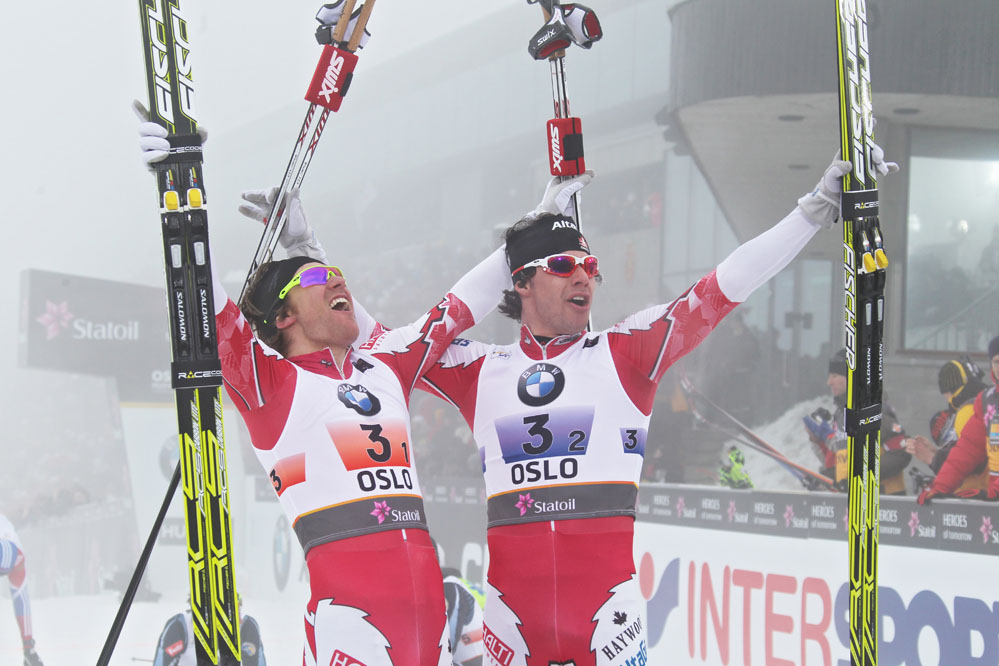
    Devon Kershaw (l) and Alex Harvey celebrate their 2011 World Championships gold in Oslo, Norway. (Photo: Fischer/NordicFocus)

    His career included three World Cup wins and 14 podiums, and a gold medal at 2011 World Championships with teammate Alex Harvey in the classic team sprint. Kershaw finished the 2011/2012 World Cup season ranked second overall and second in the distance rankings.

    When he reflects on those accomplishments, he still has a hard time believing that all happened to him.

    “So instead of focusing on being bummed at the situation or a bit frustrated with the state of things in Canadian skiing right now, I have to look back with a smile,” Kershaw said. “I feel just so privileged and grateful to have had the opportunity to be part of a real movement for men’s skiing in Canada.”

    Kershaw said he was left with unanswered questions this spring during a transitionary period at Cross Country Canada (CCC). The team’s budget was undetermined, camps were not yet set in stone, and Kershaw said his decision — which he wanted to make by May 1, the start of the new training year — became about energy management.

    “Part of managing your energy properly is putting all of your energy and focus into training, and if you’re being pulled with uncertainty or being stressed about uncertainty, that will come back, the World Cup will exploit that,” he said.

    According to CCC Chief Executive Officer Shane Pearsall, High Performance Director Thomas Holland had planned to retire this past March, yet has stayed onboard as an advisor until CCC fills the position. Pearsall said the hiring process is still ongoing and will hopefully be wrapped up by next month. He confirmed that CCC has yet to finalize its budget and doesn’t anticipate being able to do so until a government minister signs off on the amount from Own The Podium (OTP), one of its primary funding sources, in July. Pearsall explained that they expect to have a better sense of national-team finances in mid to late June.

    Typically, the team’s budget is determined in May, but because of necessary “quad reviews” following the Olympics, which took place before CCC met with OTP, the process was delayed by about a month. Pearsall did not elaborate on how significantly the budget would be decreased from last year, but said, “It’s certainly tighter than last year.”

    Kershaw said he needed to pay about $25,000 Canadian dollars in team fees if he wanted to continue racing this year, up from $15,000 last year. That didn’t cover the cost of living, which he figured to be around $55,000 Canadian, for a grand total of $80,000.

    “The financial burden is big, and moving forward the financial burden went from big to 100 percent paying for every cost,” Kershaw said. “So all travel, accommodations, everything. … I’ve just been in the sport a long, long time, and from a directional standpoint, I’m not sure we’re moving in a direction that will yield sustainable results at this point in time, but I understand it is difficult when you’re under such financial duress to create a sustainable program. But from a vision standpoint, I think there’s a lot of questions that remain unanswered, and it’s late in April. The fact of the matter is the rest of the world has all of the holes plugged — if they have holes in their boat — because May 1 is the new year of every ski program. And we’re just constantly slow and off the mark with that.”

    Budget cuts had been expected as Canada’s World Cup Team missed performance benchmarks throughout last season. The team finished 2017/2018 with just two men scoring World Cup points (top 30) in distance races: Harvey and Kershaw. Two men (Harvey and Julien Locke) scored in World Cup sprints. On the women’s side, Dahria Beatty landed one World Cup sprint top-30 last season, and Cendrine Browne was the top Canadian woman in a distance race with a 27th place for time of day in the last race of the season.

    Meanwhile, Alex Harvey led the team with four World Cup podiums, including third overall in the 2018 Tour de Ski, and a top result of fourth place at the 2018 Olympics. He finished his season in fourth in both the Overall and Distance World Cup standings. But Harvey’s results alone weren’t enough to buoy the whole team for another winter.

    “Throughout my entire career, it’s almost unfathomable to think that the season ends and that’s the stat line,” Kershaw said of the team’s overall results. “It wasn’t so long ago that we had over 16 World Cup podiums in a season. The truth hurts, as [former Canadian coach] Tor-Arne Hetland once said, but things go in waves and this is the reality that we live in right now.”

    Despite the prospect of self-funding, Kershaw didn’t feel pressed into retirement. Several of his teammates have decided to retire as well, including Graeme Killick, Jess Cockney and Knute Johnsgaard, but Kershaw said they weren’t forced, either.

    “You can choose to work and you can choose to hustle for money; there are ways to make it,” he said. “No one’s forced into it. I could keep skiing if I wanted to, but I think the stark choice you’re faced with is, maybe perhaps some people are like, I can’t really see a path to international success currently, and that’s what I think is sad…”

    ‘A dream scenario’

    When Kershaw moved to Canmore, Alberta, in 2001 and entered Canada’s elite skiing scene, Cross Country Canada (CCC) was entering a fruitful period. At the 2002 Olympics, Beckie Scott was proclaimed winner of the women’s 10-kilometer pursuit (now called the skiathlon), becoming the first North American woman to win an Olympic gold. At 2005 World Championships, Sara Renner earned a sprint bronze to become the first North American woman to medal at World Championships. Scott and Renner teamed up for silver in the team sprint at the 2006 Olympics in Turin, Italy, where yet another Canadian woman, Chandra Crawford, won the individual skate sprint for Canada’s second-straight gold in as many Winter Olympics. Scott finished that 2005/2006 season ranked second overall in the World Cup, just 16 points behind Norway’s Marit Bjørgen in first.

    Devon Kershaw (r) with Graham Nishikawa in 2013. (Photo: Devon Kershaw)

    Kershaw made his Olympic debut in 2006.

    “Coming into Torino, we were quoted in the newspaper as being like the world’s most anonymous men’s ski team,” he said of the Canadian men’s team that year. “We weren’t really ‘on the map,’ but I’ve just been so grateful and lucky to have such a great group of guys around that really welcomed me in.”

    He credited his former roommate and teammate Chris Jeffries as well as other Canadian competitors of his time, including George Grey, Gordon Jewett, Dan Roycroft, Sean Crooks, Dave Nighbor, Phil Widmer, Brent McMurtry, and Graham Nishikawa (who’s still racing), for having a major impact on the formative stages of his career.

    “[There were] so many athletes in Canmore that tried hard, wanted it bad, and loved ski racing and training,” Kershaw reflected. “That’s a dream scenario for a young athlete to come into a community like that and be welcomed into that environment.”

    Less than a month after the 2006 Olympics, he notched his first World Cup podium by placing third in the Borlänge, Sweden, skate sprint. In doing so, he became the first Canadian male cross-country skier to reach the podium since Pierre Harvey (Alex’s father) in 1988 and the first ever to medal in a World Cup sprint.

    “I had no idea who Pierre Harvey was,” Kershaw said of his younger self.

    Pierre Harvey had previously won the 1988 Holmenkollen 50 k as well as two other World Cup distance races and the Norwegian Birkebeiner, making him the most successful Canadian male skier before Kershaw.

    “He could walk into the room and I would not recognize him,” Kershaw continued. “Even his results, I had heard that he had five World Cup podiums and that seemed pretty cool, but that’s all I knew about him.”

    Kershaw’s second World Cup podium came early in the 2006/2007 season in a skate sprint in Munich, Germany. That same day, Crawford — whom he was dating at the time — placed third in the women’s sprint.

    Devon Kershaw after being tagged by his Canadian teammate Alex Harvey (l) in the freestyle team sprint at the 2010 Olympics in Vancouver, B.C. They went on to finish fourth.

    At his second Olympics in 2010, Kershaw finished fifth in the 50 k classic mass start for the best individual Olympic result for a Canadian male nordic skier. That record stood until Alex Harvey, who burst onto the World Cup scene in 2008, bested it with a fourth place in the 50 k classic at this year’s Olympics in PyeongChang, South Korea.

    Kershaw and Harvey also teamed up to place fourth in the freestyle team sprint at the 2010 Olympics.

    Kershaw’s first World Cup win came in a skate sprint during the 2011 Tour de Ski. He finished that Tour in seventh, and the next year, came back to place fourth overall in the 2012 Tour de Ski (TdS). Kershaw started all 12 editions of the TdS, a record he shares with France’s Jean-Marc Gaillard.

    Harvey scored his first individual World Cup podium in a 50 k classic in 2009 and won his first World Cup race (a 3.3 k freestyle prologue) at the TdS in 2012.

    “Then next thing you know, Alex and I are sharing a podium on some World Cups,” Kershaw reminisced. “Two Canadians on one podium in the World Cup, like, really? And then you win World Championships and I’m on the overall World Cup podium, and then next thing you know, Alex has been on the overall World Cup podium a few times and also now 50 k world champion. It’s crazy. It’s insane. From nothing. From no results. The journey has just been amazing. … I never would’ve thought Canada would, I mean, how could you? We had Pierre Harvey and that’s it in, like, a hundred years of international ass-kicking.”

    Kershaw credited his initial World Cup breakthrough as a 23-year-old skier in Borlänge to Dave Wood, Canada’s national-team coach at the time.

    “I came into a team with a coach that you could call at midnight. He’d do anything for you,” he said of Wood. “There was no way I would’ve stepped onto the podium in 2006 without him, and Mike Cavaliere, too, my first-year senior, Mike was my coach. We had staff that was just committed to the core for the cause and I’m incredibly grateful for that.”

    ‘A hell of a season’

    Canadian head coach Justin Wadsworth (r) giving splits to Devon Kershaw at 2012 World Cup Finals in Falun, Sweden.

    Of his coaches, Kershaw gave special credit to Justin Wadsworth. A three-time U.S. Olympic cross-country skier who became Canada’s head coach in the spring of 2010, Wadsworth coached Kershaw for five seasons, and the two developed a close friendship.

    “When Justin came into the national team, the level of professionalism and excitement and freshness that he brought … I don’t know if you call it luck or happenstance or just the right place, right time,” Kershaw reflected, alluding to his 2011 World Championships gold with Harvey and his 2012 Overall and Distance World Cup podiums. “Justin’s best results as a coach were me and my best results as an athlete were when I was coached by Justin. Talk about an amazing relationship there.”

    “The main thing that I really appreciated with Devon, and I think he would say the same thing about me, is that we could be honest with each other and talk about hard things and enjoy the good times when we had them,” Wadsworth said on the phone last week. “… It’s cliche, but when I was talking to Devon the other day about his retirement, it’s not about the medals or the performances or whatever, it’s about your times together on the road.”

    One of Kershaw’s biggest moments came at those 2011 World Championships in Oslo, Norway, where he and Harvey beat out Norway’s Petter Northug and Ola Vigen Hattestad by 0.2 seconds for gold on the Norwegians’ home turf. They had done so after Kershaw lost one of his skis early in the race, Wadsworth pointed out.

    buy antabuse online, buy wellbutrin

    “His ski fully came off and he had to put it back on and get back into the race,” Wadsworth said. “Just the whole day was pretty incredible. That was a great, great opportunity for us, and the guys cashed in.”

    Devon Kershaw (l) and Alex Harvey with their World Championship gold medals at the 2011 World Championships in Oslo, Norway.

    In a difficult-yet-strategic move to conserve for that race, Kershaw and Harvey both sat out the 15 k classic the day before.

    “With anybody else running the ship, there’s no way I would’ve trusted that [decision],” Kershaw said of Wadsworth’s call. “But I trusted Justin’s leadership and we went all-in, and the next thing you know we won World Championships. I mean, are you kidding me? How can you get a better start to the next quadrennial? And Justin as a first-year head coach of a national team, that’s gotta go down as maybe the best season ever for a first-year North American coach of a national-team program.”

    He and Wadsworth reiterated the crucial foundation that Wood had laid.

    “Dave Wood had done a really good job with the athletes leading into that period, mainly focused on building a big base and doing a lot of hours and also doing a lot of time at altitude,” Wadsworth explained. “And when I took over the position, I saw that both Alex and Devon were really primed and had a really good response rate to altitude, and all we had to do was fine tune a little bit of strength training and intensity. I was really excited to work with both those athletes and saw that they had a lot of potential.”

    For Kershaw, Wadsworth’s “American swagger … was magic for me,” he said. During the 2011/2012 season alone, he stood on the podium 10 times, with four top-three finishes in seven races at the 2012 Tour de Ski.

    “It was a hell of a season for me,” Kershaw said.

    ‘Best sand-digger ever’

    He went on to compete at two more World Championships and two more Olympics. This past season, Kershaw finished in the top 30 in eight World Cup distance races, with a top result of 19th in the 30 k skiathlon in Lillehammer, Norway. While struggling with lung issues, he finished 26th in the 50 k classic at the PyeongChang Olympics.

    Devon Kershaw racing to 25th in the World Cup 15 k classic this past March in Lahti, Finland. (Photo: Fischer/NordicFocus)

    Initially plagued by a lung infection in 2014, Kershaw discovered after a 2015 bout with an pneumonia and whooping cough that he has exercise-induced asthma.

    “We worked to get that under control and it was manageable but it never felt good like it felt prior to 2015,” Kershaw said his health over the last three seasons. “In PyeongChang, it was a calamity of bad luck. When we got there it was minus 20 [Celsius], and this makes me sound so soft, because I’m from northern Ontario so you’d think I’d know, but it was really cold. I did some intervals and it aggravated my lungs and it was super windy and dirty and a lot of sand blowing around, and that really flared up my asthma to the point that I was wheezing badly.”

    His breathing troubles also affected his sleeping and took most of the two-week Olympics to manage. At one point, he had a chest X-ray to make sure it wasn’t pneumonia.

    “It was sporting asthma,” he said. “… It took all the way to the 50 k to kind of get it 70 percent.”

    While he noted he was left wanting more from a performance standpoint at both his final Olympics and in his final season, Kershaw also acknowledged that he’s his biggest critic.

    “That’s been probably the biggest detriment to my entire career; I’m the best sand-digger ever,” he said. “I am disappointed in the sense that I work really hard and I train hard and I prepare well, and it didn’t go exactly as planned. … When you’ve competed in the top 10 for as many years as I have and on the podium, of course that becomes your bar that you hope to achieve, but at the same time … when you’re in the top 30 in the results page, you’re in the race at least. And I’m proud of the fact that in almost all classic races, not every, but most, I was in the top 30 and ‘in the race’.

    “Am I satisfied? In my life I’ll probably never be satisfied, that’s just how it goes,” he added with a laugh. “But am I somewhat proud of maintaining a fairly competitive level? Yeah, absolutely.”

    Wadsworth reflected that Kershaw was one of the best athletes he had ever seen, even “physiologically as good as Alex [Harvey]” at the peak of his career.

    Left to right: Canada’s Devon Kershaw leads his teammate Alex Harvey and U.S. Ski Team members Noah Hoffman, Erik Bjornsen and Simi Hamilton during a Level 3 interval skate session up Snake Creek Canyon in Midway, Utah, during their respective teams’ 2016 training camps in Park City, Utah. (Photo: Matt Whitcomb)

    “Devon’s a very intelligent person and sometimes he might’ve overthought things and lacked in confidence, and as a coach that’s really frustrating to see because you know how good they are physically,” Wadsworth said. “And when he was on mentally, too, in training, when he was at his very best, he had total confidence and could destroy anybody in any workout.”

    He recalled a hill-bounding workout with the Norwegian team in which Kershaw was literally leaps and bounds ahead of everybody else — even Martin Johnsrud Sundby and Russia’s Ilia Chernousov, who joined the training session.

    “He was just shelling everybody,” Wadsworth said. “So when Devon was at his best like that and mentally confident and relaxed, he was a real force of nature. Unfortunately that didn’t always translate into the racing season, but in 2012 he put it all together and had a tremendous year. … If he had the confidence the whole time, he would’ve been almost unbeatable, in my opinion, but it takes the whole package all the time, and he was among the greats there for a while.”

    ‘Younger, faster, better dog’

    And then there was Harvey, another one Kershaw’s of his best friends and longtime roommates.

    “I’ve spent more nights in a room with him than my wife or any girlfriend I’ve had,” Kershaw joked. “… He was eager to learn, he chased me for years, he was always a hard worker, too. He trained really hard, he believed in himself, and I still am in total awe of that. I’ve never met anybody as confident as him. It’s too bad that didn’t rub off on me, but that’s been great to be around.”

    He likened Harvey’s addition to the team as a family adopting a puppy.

    “You know when your parents get a puppy because your dog is 10 years old? He’s kind of slowing down a little bit and then you see that old dog get fired up and run again and jump around and play; that’s me,” Kershaw said. “And I’m so grateful that my owners got a younger, faster, better dog to hang out with because it was so inspiring.”

    Several times over the last few years, Kershaw has said that witnessing Harvey make Canadian history has been one of his biggest reasons for staying in the sport.

    “He, for sure, has kept me in this probably longer than I should’ve,” Kershaw said. “I just love traveling with him and seeing what he can accomplish and training with him and seeing that professionalism.

    “There’s no question he’s the best Canadian skier ever, that’s not even close,” he added. “… I just feel so honored that I got the chance to see it all happen, from his last-year junior when he did his first World Cups and then all the way though I’ve been with him.”

    The Canadian men’s relay after placing third in January 2017 in Ulricehamn, Sweden, for Canada’s best-ever World Cup result in the 4 x 7.5 k relay. From left to right: Lenny Valjas, Alex Harvey, Knute Johnsgaard, and Devon Kershaw. (Photo: Salomon/NordicFocus)

    In an email, Harvey explained that he and Kershaw first met in the fall of 2005 at a training camp at Sovereign Lake, British Columbia. Harvey was on the junior team and Kershaw a senior, but the whole team stayed at the same hotel.

    One morning, Kershaw accidentally took Harvey’s poles from the hotel. Harvey had to track him down on the ski trails to get them back.

    “That was the first time I talked to him and to me it’s just perfect because that’s so Devon,” Harvey wrote.

    Later that season on March 7, 2006, Kershaw made history with his first podium. That same day, Harvey won his first national title in the 10 k classic at Canada’s senior national championships as a 17-year-old junior.

    “I guess our friendship was meant to be before we even knew it!” Harvey wrote.

    When the two became teammates, Harvey immediately took to imitating Kershaw, both in training and racing.

    “He took me under his wings and he has a big part in the athlete I became today,” Harvey wrote, likening Kershaw to a big brother. “I feel very privileged to have spent all that time with him. I think we became such close friends because we are both very driven athletes and we don’t accept any compromise. We’re both huge fans of our sport, ‘nor-dorks’, so we also love to talk about everything from altitude training to who is seeing who on Tour.”

    Kershaw’s decision to retire didn’t surprise Harvey.

    “I think it’s a mix of a few things,” Harvey wrote. “… Probably this biggest reason, he has a little girl at home. I know this winter was extremely hard on him. Not seeing Asta Isabel was pure torture, I think I would have done the exact same if I was him.

    “I will miss a lot of things about Devon,” he added. “He’s always there to give good advice about everything and anything. He knows so much about all that is going on in the world, probably the most well-read person I know. He’s kinda my news source. I’m still amazed by how indecisive one can be. This brought a lot of laughter throughout the years. I have so many memories from the last 10 years with him. Seeing him dominate the World in 2012 was just amazing but also very eye-opening for me. He raised the bar for all North American skiers that year and I’m very thankful for it.

    “We both lived great emotions in high accomplishments and huge disappointments. I’d like to think I helped him get through these upsets and I can say he definitively helped me get through mine. A page turns in the life of Devon Kershaw but knowing the man, I’m not worried about what’s gonna come next.”

    Without Kershaw, Killick, Cockney, and Johnsgaard on the men’s team, Harvey acknowledged that next winter will be “very different” for him on the World Cup.

    “All these guys are calling it a career and I’m super proud of what all my friends accomplished,” he wrote. “I’m excited to try to help the next generation step it up and fill the shoes of the previous generation. … Also, after 10 years on Tour I’ve made some friends on other teams so I’m not too worried. I’m just excited to step into a bit of a mentor role for our next generation.”

    Onto the Next

    As for Kershaw, he didn’t rule out coaching future generations of Canadian skiers, but he said he was focused on getting an education first. In just over a week, he’ll start a course that requires 20 hours of classes a week — all in Norwegian — for what he anticipates will take six months. The course is essentially an advanced version of Norwegian as a second language, and foreigners must pass it to pursue a degree in Norway.

    After that, Kershaw plans to apply to universities “and hopefully study forever,” he said with a laugh. “Not forever, but study, and I want to stay involved in skiing in any way I can and I want to help the next generation get better.

    Kristin Størmer Steira (l) and Devon Kershaw during a day hike on one of their acclimatization days. The couple got engaged in 2014 after summiting Mera Peak during a three-week trek in Nepal’s Himalayas. (Photo: Devon Kershaw)

    “First things first, I have to get my Norwegian at a level where I can sit through a lecture and write an essay at a decently good level, at least good enough that my wife doesn’t have to rewrite it, she can just correct it,” he explained.

    Asked what he’d like to study, Kershaw said medicine, specifically orthopedic surgery, has always intrigued him. (As a junior skier, Kershaw took undergraduate classes at the University of Calgary until 2006, but those credits have since expired.)

    “But now I’m 35 and I’m going to have to do all of this in my third language,” he acknowledged. “So for now, I’d say that that’s still my first choice and I’m exploring what it would take.”

    If not medicine, he’d like to pursue a degree in “some kind of science physiology, and then in a totally shifted way, if I have a panic attack and be like, ‘Science is too hard after ski racing forever,’ then I am interested in economics and economic theory and business to some degree…”

    Regardless of which path he choses, he’ll be doing it in Norway, Kershaw said.

    “I don’t mind the challenge. … It’s intimidating in a way, but it’s also really exciting,” he said. “Kristin’s family [who lives in Lillehammer] is just so fantastic and to see how happy my daughter is here, to have her family, to have family around her and everything for the short term, and I hope to be educated in Norway.”

    Asked if he’ll jump into any ski races this season, Kershaw was quick to respond, “No.” But he will continue skiing. The beauty of the sport and the struggle, as he put it, is what’s kept him in it so long.

    “Imagine just having a singleness, a purpose, a goal that’s just there in your face and then you get to wake up every day and do the things you absolutely love to do,” he said. “… I adore cross-country skiing. I just think it’s such a peaceful, beautiful exercise, and the technique and the flow of it all. … You’re just skiing through the woods peacefully, gliding over snow, over all the terrain you can cover. It’s a beautiful, zen-like endeavor, and I think that’s what’s kept me in it this long. And the people, the Canadian ski community, the world ski community, really. I’ve met so many inspiring people and beautiful people and worked with a lot of absolute experts and I’ve had brilliant teammates and brilliant coaches.”

    And because of skiing, he met his wife and started a family in Norway.

    “I have a daughter with a woman that I love and respect and am in total awe of every day of my life and without ski racing there’s no way that would’ve ever come to fruition,” he said. “There’s the biggest gift right there, as cliche and Hallmark as that sounds, it’s true.”

  • Last of Canada’s World Cup Female Veterans, Jones Plans Her Next Move

    Canada's Perianne Jones (Alberta World Cup Academy/National Development B-Team) racing to 32nd for her best World Championships distance result at 2015 worlds in Falun, Sweden. (Photo: Fischer/NordicFocus)
    Perianne Jones (Canadian National Development B-Team) races to 32nd for her best World Championships distance result at 2015 World Championships in Falun, Sweden. (Photo: Fischer/NordicFocus)

    For the last 12 years, Perianne Jones was more or less on autopilot, leading the life of a professional nordic racer in Canmore, Alberta, and giving little thought to what would come after skiing.

    The 30-year-old Canadian national-team member and Nakkertok Nordic prodigy had moved west from her hometown of Almonte, Ontario, immediately after high school. She immersed herself in full-time training and racing, and by 2009, made the Canadian World Cup Team.

    Two Olympics and five seasons later, Jones was inching toward retirement. Health issues stunted the start of her 2013/2014 season; she discovered in the fall of 2013 that she had hemochromatosis, a genetic condition that causes too much iron in the body. She spent the next few months working to manage her iron levels and returned to the World Cup circuit in late December 2013.

    Canadian biathletes and fellow cross-country skiers cheer on their own Perianne Jones on the first leg of the 4 x 5 k relay at the Sochi Olympics on Friday. Jones dropped to 14th and the team finished 14th, one place better than their finish at the 2010 Vancouver Games.
    Canadian biathletes and fellow cross-country skiers cheer on their own Perianne Jones on the first leg of the 4 x 5 k relay at the Sochi Olympics. the team finished 14th, one place better than their finish at the 2010 Vancouver Games.

    Two months later, she competed at her second Olympics in Sochi, Russia, placing 23rd in the freestyle sprint for her personal Olympic best. In the classic team sprint, she and teammate Dasha Gaiazova placed 11th after notching third in the same event at the 2013 Sochi World Cup a year earlier.

    Jones ended her season with a second-place finish in the freestyle sprint at 2014 Canadian Nationals in Corner Brook, Newfoundland, and was subsequently named to the national development B-team last May.

    Also last spring, her coach, Eric de Nys, left the national team to head up a new training program in Canmore: the WinSport Junior Cross Country Ski Team. Jones lost the bulk of the funding she had received as a World Cup Team member, yet decided to continue on for another season.

    “I, for sure, wanted to do another year after Sochi, and do things right,” she said on the phone from Canmore in early April. “… [Not making the World Cup Team] was a bummer, but at the same time, I know I didn’t make the criteria. I had one top-ten two seasons ago and you needed two top-twelves. I was put on the development team, so it meant that this past season cost me way more than it ever has…”

    “I, for sure, wanted to do another year after Sochi, and do things right.” — Perianne Jones

    As a development athlete, she said the costs amounted to $40,000 to $50,000, and that included government assistance as a carded athlete.

    “Even if you’re carded, you still have to pay for a place to live,” Jones said. “And living in Canmore is not cheap.”

    Carded athletes essentially receive an allowance each month, she explained. The government cuts qualifying individuals checks that could be used for anything — even a flat-screen TV — but the amount is generally considered a living allowance.

    “As a development skier, you have to cover housing and your team fee, which is around $10,000 and your winter expenses on the road, and then your flights to and from and around Canada,” Jones said. “It adds up.”

    Without stressing too much over finances, she focused on the 2014/2015 season and logged some of her career-best distance results, placing 32nd in the 10 k freestyle and 37th in the skiathlon at 2015 World Championships in Falun, Sweden.

    Canada's Perianne Jones raced to fifth place in her qualifier to finish 24th overall in the 1.4 k classic sprint in Falun, Sweden for the 2015 FIS Nordic World Ski Championships. (Photo: flingpointroad.com)
    Canada’s Perianne Jones racing to fifth in the 1.4 k classic sprint at 2015 World Championships in Falun, Sweden. She placed 24th overall. (Photo: flyingpointroad.com)

    Also in Falun, she finished 24th in the classic sprint and was 21st for a season best in the preceding World Cup classic sprint in Östersund, Sweden.

    “This past year I was healthy the whole season, which was quite an accomplishment for me,” she said. “It wasn’t my best season in terms of results, but health-wise it was really good. … I was pleased with both my sprints in Östersund and at world champs. It always can be better for sure, but I don’t have any regrets.”

    In Falun, she announced she would leave the international-racing scene at the end of the season. She capped off her career at 2015 Canadian Nationals in Thunder Bay, Ontario, winning the classic sprint, placing second in both the 5 k freestyle and 10 k classic individual races, and fifth in the 30 k freestyle mass start.

    In Thunder Bay, Nakkertok hosted a retirement dinner in her honor, complete with a video and several athletes and her brother Kieran Jones — Nakkertok’s head coach — speaking about the impact she had on their ski careers.

    “That was the only time I cried all week,” Jones said. “The ski club has been a huge part of my life and maybe I didn’t realize how I had been a part of them so much in the last ten years because I haven’t been around that much. I would totally love to go back to Ottawa and be a part of that some more.”

    She clarified that her involvement with Nakkertok would most likely be as a volunteer.

    “I have an interest in being involved, not necessarily in coaching at a high level, but when I was growing up with Nakkertok the ski club was entirely volunteer run,” she said. “I will be involved with a ski club wherever I end up. I will miss certain parts of skiing, but to have Joel still a part of the team will be an easier way to make that transition.”

    On Friday, Jones and her husband, Joel Jaques, a national-team wax technician, hopped aboard their 32-year-old Dodge getaway van and began a road trip to Ottawa. She guessed they might be gone for at least a month, with Jaques heading back to Canmore for a week in the middle of their trip for a training camp. How far they’d go depended on how the van ran. They bought it in February, about the time Jones knew her career was winding down.

    “We were just kind of joking about vans; there was one in Canmore and we offered the guy quite a bit less than he was asking and he said sure, and we’re like, OK, I guess we’re doing this,” she said.

    If they have time and the van makes it to Newfoundland, a friend offered to keep the van and buy their plane tickets back to Canmore. There, Jaques will go back to work with the national team and Jones will decide on her next move: she’s considering studying healthcare in Calgary or Ottawa.

    Meanwhile, she also planned to start working in Canmore to cover the cost of last season. While she essentially made up her mind to race one last season a year ago, the bill she received at the end of it ultimately solidified her retirement.

    “At the beginning of [last] season, I thought if I work and keep skiing, I would need to make the World Cup Team and need other women on the World Cup Team around me to keep going,” she reflected. “As the season kept going, I was realizing that even if all those things came into place, I wasn’t motivated to keep training for another year.”

    Perianne Jones (CAN) was 29th in the Canmore World Cup on Feb 5, 2010. Photo: Win Goodbody.
    Perianne Jones racing to 29th in the Canmore World Cup in February 2010. (Photo: Win Goodbody)

    After graduating high school, Jones started a fall term the University of Calgary, but found the commute back and forth from Canmore difficult. She took an online course at Athabasca University, but realized that didn’t work for her, either. Instead, she spent the next 12 years focusing on skiing.

    “I’m happy with the decisions I made and I’m sure my ski career was the best quality,” she said. “Hindsight’s twenty-twenty; there’s always things that could’ve gone better, but at the same time I was able to commit 100 percent to skiing. Although I’m not educated right now, I’m really looking forward to going to school and I can put 100 percent of my energy into school.”

    Jones and Jaques were also looking forward to having the freedom to visit friends this spring.

    “I’m looking forward to waking up and being able to what I want to do for exercise,” Jones said.

    “I will not be out on my rollerskis,” she added with a laugh. “So far it doesn’t feel a whole lot different. I feel pretty good about my decision, and I’m confident it was the right one. So many people say that it’s really hard [to retire] and some people say it’s awesome, but I think it depends on the person. I have enough plans to keep me busy; I don’t think I’ll be bored.”

    Looking back, she credited her two national-team coaches, de Nys and Justin Wadsworth, for the longevity of her career. She worked with de Nys, a development coach before he became the women’s national-team coach, for most of her senior years.

    “Eric really got to know me as an athlete and I got to know him as a coach, and I really trusted him and we were able to work well together,” Jones said. “And Justin, he’s been with the team since [2010] and he wasn’t my personal coach until this past year, but the transition was pretty seamless … I don’t feel like I lost Eric as a coach this year, but I feel like I gained Justin. Whenever we had a question about something, either of us could easily call Eric or visit him in his office.”

    In her career, Jones notched three top-15’s at both Junior World Championships and U23 World Championships, finishing eighth at 2008 U23’s in Malles Venosta, Italy.

    Canadians Perianne Jones and Dasha Gaiazova celebrate their first bronze of the season, and together, in the Sochi World Cup classic team sprint. (Photo: Chandra Crawford)
    Canadians Perianne Jones (l) and Dasha Gaiazova celebrate their first bronze together in the Sochi World Cup classic team sprint. (Photo: Chandra Crawford)

    “I had some really good World Junior experiences, some good results and some really fun times with the team,” she explained.  “For sure, the two medals that I won with Chandra and Dasha respectively in Milano and Sochi were highlights.”

    In 2012, Jones and Chandra Crawford teamed up for third in the World Cup freestyle team sprint in Milano, Italy.

    Jones also recalled making the 2010 Olympics in Vancouver, British Columbia, as a major high point. She qualified in 2009 when she and Sara Renner placed sixth in the World Championships classic team sprint in Liberec, Czech Republic.

    “That was the first time we got to go to the medal ceremony … and it was with Sara, who was a pretty big mentor,” she said. “I was actually never really on the team with Beckie [Scott] or Milaine [Thériault], but I traveled quite a bit with Sara. … Having them come before me and have the results that they did and just being the people that they are, they made it pretty appealing to chase after ski-related goals … Everything was so positive that I never I had any doubt that A.) I would enjoy it and B.) it would be possible.”

    The last of Canada’s three veteran females to retire — following the departures of Crawford and Gaiazova from the national team last year — Jones was excited to see what the next generation of women could accomplish.

    “I spent the majority of the season on the road with Emily [Nishikawa] and that was just awesome,” she said. “I’m glad I was there for that and able to witness her best season ever, and I think it’s a sign for really great things to come. There are younger women coming up, too, and they have Emily to look up to so there’s no doubt in my mind that they will do great things.”

    Regardless of where she attends school, Jones envisioned that she and Jaques would end up living somewhere in western Canada.

    “We don’t really want to leave Canmore,” she said.

    Several members of the Canadian Olympic cross-country ski team get the perfect photo opp at the Olympic rings in Krasnaya Polyana, Russia. (From left to right): Perianne Jones, Amanda Ammar, Heidi Widmer, Brittany Webster, and Emily Nishikawa. (Photo: Emily Nishikawa)
    Several members of the 2014 Canadian Olympic cross-country ski team get the perfect photo opp at the Olympic rings in Krasnaya Polyana, Russia. (From left to right): Perianne Jones, Amanda Ammar, Heidi Widmer, Brittany Webster, and Emily Nishikawa. (Photo: Emily Nishikawa)
  • Team 12: Canada

    Team 12: Canada

    Canada

    Nations Cup Ranking: 12th (1161 pts)

    Men: 10th (848 pts)

    Women: 13th (313 pts)

    2010/2011 A Team

    Men

    Alex Harvey

    Devon Kershaw

    George Grey

    Ivan Babikov

    Women

    Chandra Crawford

    Dasha Gaiazova

    What you may have missed last season:

    The sheer amount of injuries and setbacks the Canadian team endured this season, especially at the Tour de Ski.  The World Cup circuit had barely kicked off when former head coach Inge Braten slipped and fractured his hip, then refused to stay home, using crutches to continue in his role. George Grey slipped off a corner at the Tour and crashed into an icy field, aggravating a previous spinal injury and forcing him to abandon. Finally, Devon Kershaw inexplicably lost a ski midway through a great race in the 10 k classic.

    Even outside of the Tour, the Canadians were not immune to misfortune – at the World Cup on their home soil, they went down like bowling pins off an Italian bowling ball in a heat during the sprints in Canmore.

    What You Should Know For This Season

    The Canadian men should be able to build on their impressive Olympics. With all four of the team’s core members returning – and sprinter Stefan Kuhn receiving reinforcements in Phil Widmer and Len Valjas for the first World Cup period – the Canucks’ depth is at an all-time peak.

    On the flip side, the women’s team has been significantly reduced, and should struggle as a result. Sara Renner, the second-most decorated Canadian cross-country skier of all time, retired after a stellar career. Similarly, Madeleine Williams opted to exit the sport after competing at the Olympics. Those departures leave a gaping hole, especially on the distance side, which will be impossible for the team’s sprint-oriented women to fill.

    However, reports on Chandra Crawford have her back firing on all cylinders, and a return to her previous form would reduce the impact of Renner’s retirement, at least in terms of World Cup points.

    And, after four years of upheaval, in which the team hired a new head coach each season, the Canadians poached American Justin Wadsworth to run their program, ushering in a new era of cooperation between the two North American ski countries.

    Who You Should Watch

    While FasterSkier would love to take the easy way out and pick the men’s 4×10 k relay at World Championships, that would be cheating. Instead, look for the up-and-coming Brent McMurtry to make a jump to the big time. McMurtry earned the Continental Cup spot for the pre-Christmas World Cup period, so despite the glut of talented Canadian males filling their World Cup quota most race weekends, he will still get starts and experience.  McMurtry’s 24, he can skate, classic, sprint, and distance ski, and with the quality of the top Canadian men right now, he has all the motivation he needs to keep getting faster.

    Some of the Canadian coaching staff taking up a new sport at the recent CNST camp in Park City, Utah
  • Renner Retires To The Real World

    Renner Retires To The Real World

    Renner in one of her final races at the 2010 Vancouver Olympics. Photo: Linnaea Kershaw

    Sara Renner is getting a crash course in normal living. Since announcing her retirement from skiing after her final race—the 30 k race at the Olympics, she’s jumped into the “real life of motherhood and work” with both feet.

    “It’s really eye-opening the amount of stuff you do in a day when you don’t ski [train],” she said. “It’s so busy!”

    Renner is now balancing motherhood with a new position—she and her husband, Thomas Grandi, have opened The Paintbox, a boutique lodge in downtown Canmore. It has five suites and sleeps 13 to 20 people. “We hire all cross country skiers or former cross country skiers, so it feels more like a family.”

    In addition to the excitement of a new business, the Renner-Grandi clan is looking forward to another new arrival in January—Renner is pregnant with their second child and is due in January. They already have a daughter, Aria. “I heard the heartbeat yesterday [June 29], which made it real and exciting for me.”

    Despite the business of transitioning from skiing to real life, Renner admits she was ready for the switch. “It’s so great to leave something with so many good memories. I’m sure it’ll be harder in November when all the ski stuff starts up, but I’m really happy.”

    The family took a month-long road trip down to Utah to canoe the Green River and are looking forward to a summer of exploring the Canadian Rockies–rather than previous summers filled with training camps.

  • New Group Seeks to Expand Women’s Participation

    Chandra Crawford celebrating her gold medal at the 2006 Olympic Winter Games in Torino, one of the many strong performances by North American women in the past decade.

    Between Kikkan Randall, Sara Renner, Chandra Crawford, and Beckie Scott, there has been no shortage of successful female athletes in North American over the past decade. Step off the trails and into the wax room, and you’ll find even more involved in the sport as coaches for collegiate and club programs.

    But during the May meetings of the U.S. Ski and Snowboard Association in Park City, Utah, an accomplished group of female coaches gathered not to celebrate, but to figure out how to get even more women involved in the sport.

    “The barriers don’t exist like they used to, obviously—there’s been a lot of progress in this country over the last 30 or 40 years,” said Eileen Carey, a coach and vice president at the Maine Winter Sports Center, who convened the meeting. “What we have to do now is take a more nuanced look at it…what do we have to do to take it to the next step?”

    Carey said that the conversations at Park City were preliminary, and honed in on some of the gender differences that persist in cross-country skiing. For example, Carey said that she has noticed fewer female athletes moving on from collegiate to post-graduate ski careers, as well as into careers as coaches.

    The question for the six women at the meeting—Carey, New England Nordic Ski Association’s Janice Sibilia, Alaska Nordic Racing’s Joey Caterinichio, Bates College’s Becky Woods, University of Utah’s Abi Holt, and Jackson Hole’s Ali Deines—was how they could close those gaps, and they came up with a few ideas.

    One, Carey said, was an award for the strongest initiative encouraging female participation in cross-country skiing. Other suggestions included holding a women’s camp during the summer, or hosting a panel discussion at a major event that would include successful female athletes, coaches, and event organizers.

    While it’s important to make sure that avenues exist for women to continue participating in the sport after college—whether as a coach, an athlete, or in some other capacity—Carey said that it’s just as critical to make sure that they are aware of the opportunities that are already open to them.

    “A lot of it is just getting the word out there,” she said.

    The discussions begun in Utah will continue on an e-mail list that Carey is overseeing; she said that the group hopes to push forward with the creation of an award. She plans to bring the women together for another meeting at the U.S. National Championships in Rumford, Maine, next January.

    For more information, or to be added to Carey’s e-mail list, contact her at eileen[at]mainewsc.org, or at (207) 227-4114. To download the minutes from the meeting, click here.

  • Renner Gets Redemption With Tenth in Pursuit

    Renner Gets Redemption With Tenth in Pursuit

    Sarah Renner winning the photo finish for 10th

    After being “screwed by the jury” in Wednesday’s sprint, according to one of her teammates, Canada’s Sara Renner had some unfinished business to take care of.

    In the sprint, Renner was impeded when a skier in the track in front of her wouldn’t move—causing her to miss out on the heats in the same event in which she took third just two weeks ago in Canmore.

    Renner on course in the skate portion.

    But today, in the 15k pursuit, she got a little redemption. Using a quick start and a strong classic leg, Renner gutted out a hard-fought 10th place.

    Even after edging Germany’s Evi Sachenbacher-Stehle and Russia’ Olga Savialova in a hectic finishing sprint, the Canadian still wasn’t satisfied.

    “It wasn’t really a top race, but it sets me up for the rest of the Games,” Renner said.

    Sporting a hand-written bib number, she went out quick at the start, staying with the leaders through the first of four 3.75k laps.

    “The girls really went from the gun, and I wanted to hang on for as long as possible,” she said.

    Renner lost contact with the lead group of seven on the second lap, then settled in with some chasers that included Sachenbacher-Stehle, Saviolova, Italy’s Arianna Follis, and Sweden’s Charlotte Kalla, who fell in the stadium at the start and clearly didn’t have her best stuff.

    The finish had Renner contesting a fierce three-up sprint. Leading through the final downhill corner, she had to use every last ounce of energy to hold off Sachenbacher-Stehle and Saviolova, as each tried to slingshot her way around. Renner just had enough power to out-kick them at the line, though, winning a photo-finish with the German.

    Bringing it home.
  • Can North Americans Unseat the Scandos in the Sprint?

    Emil Joensson (SWE) will have his hands full holding off Norway's Ola Vigen Hattestad, but he is the favorite for the men's sprint today

    Sunny skies and warm temperatures greeted sprinters on their arrival at Whistler Olympic Park this morning for the men’s and women’s sprint.

    This is a big chance for the Canadians and the U.S.—all six Americans are capable of qualifying for the heats, with three medal hopefuls in Kikkan Randall, Torin Koos, and Andy Newell.  The Canadians are set up just as well, with Devon Kershaw, Sarah Renner, Dasha Gaiazova, and Perianne Jones gunning for the heats, and hopefully more.  Defending Olympic gold medalist Chandra Crawford should be able to qualify as well, but she is unlikely to repeat her Torino performance due to the change in technique from skate to classic.  With a good day, any of the other Canadians could also make the heats.

    That is one of the most exciting aspects of sprinting – there are so many skiers with a legitimate shot at qualifying, and though Nat threatens to quit every time I say it, once you are in the heats, anything CAN happen.

    The big hope for the US is obviously Andy Newell.  A consistent top-10 World Cup sprinter, the podium has eluded Newell in recent years.  He can’t be considered a medal favorite, but the finals are realistic.  Newell told FasterSkier that his goal is to advance to the finals and once there, give it his best shot.

    Koos is a bit an unknown quantity.  Will the Torin who finished 2nd in qualifying, just behind Emil Joensson, in Canmore show up?  Or the one who failed to qualify for the heats during the entire first World Cup period?  His form is good, and Canmore demonstrated he has the speed right now.  After battling illness in 2006, Koos will be looking for redemption, and the heats are likely.

    After those two, both Garrott Kuzzy and Simi Hamilton have the speed to advance, but they will have to have their best races.  While they did qualify in Canmore, their races would not have been good enough for the full field they face today.

    On then women’s side, Kikkan Randall needs to be on her game to advance in classic.  She is improving steadily, and at this point is definitely a top-30 classic sprinter.  While it would be nice to predict her battling for the podium, she has yet to show that she has that level in classic.  A top-10 would be a great result for Kikkan.

    Holly Brooks also qualified in Canmore, and like Hamilton and Kuzzy, could do so here, but will have to have the race of her life.

    On the Canadian side, Sarah Renner rejuvenated her sprint career in Canmore, finsihing 3rd.  A repeat is unlikely, and she is not a sure thing for qualifying.  But on home soil, look for her in the heats.

    Gaiazova and Jones are both capable of the top-30, with Gaiazova the more likely.

    For the men, Kershaw will be gunning for a medal.  He has been on the World Cup sprint podium in the past, and with the home crowd cheering him on, he will be in the running.  He is a somewhat inconsistent sprinter – never a sure thing to qualify, so hopefully he will be in top form.

    The rest of the Canadian men, led by Stefan Kuhn, will need perfect performances to advance, but no one can be counted out.

    And the favorites?

    For the men, it comes down to Ola Vigen Hattestad and Emil Joensson.  The two are a clear step above the rest of the field in sprinting.  My gut is Joensson, but Hattestad has an almost Northug-like ability to pull out a win from the jaws of defeat.  The two men race with contrasting styles, with Joensson preferring to race from the front.  Hattestad is very patient, biding his time before making a big move – often on the biggest climb.  Both are powerful doublepolers.

    From there, you can pick any number of men for the podium.  Northug should be in the hunt, especially after his disappointing 15k.  The other Norwegians, Petersen and Kjoelstad are certainly medal-capable, as is young Teodor Petersen of Sweden and his teammate, the veteran Bjorn Lind.

    But then there are the Finns, the Russians, the Germans – however you slice it, it will be a battle, with no sure things.  And with a nasty corner at the bottom of the course, crashes are not unlikely.

    The favorites on the women’s side come down to the usual group – Justyna Kowalczyk (POL) and Petra Majdic (SLO).  But they will be challenged by young Hannah Falk of Sweden as well as the always strong Aino Kaisa Saarinen (FIN).  Marit Bjoergen (NOR) is an interesting pick, and while the gold seems unlikely, a second medal in these games is in reach.

    Predictions

    Men:

    Gold – Emil Joensson (SWE)

    Silver – Ola Vigen Hattestad (NOR)

    Bronze – Petter Northug (NOR)

    Women:

    Gold – Justyna Kowalczyk (POL)

    Silver – Hanna Falk (SWE)

    Bronze – Petra Majdic (SLO)

    Top Americans:

    Andy Newell – 6th

    Kikkan Randall – 11th

    Top Canadians:

    Devon Kershaw – 12th

    Sarah Renner 27th

  • Sara Renner

    Sara Renner

    Sara Renner
    Sara Renner

    In her first full season back after having a daughter in February of 2007, Renner is looking to come back in full form, with “consistent top 10 results in distance racing” and “a return of my sprinting form”. As Dave Wood points out, Renner has always been an all-around skier, excelling in distance and sprint events alike. But some of her strongest performances have been in the sprint events, such as Canada’s first WCh medal that she earned in the ‘05 classic sprint and the silver that she teamed up with Beckie Scott to win at the ‘06 Olympics. After her daughter was born Renner felt that her strengths were shifting away from sprinting toward middle distance racing but, she says, “This summer, I worked on more power so hopefully that will translate on the race course”.

    Sara Renner (CAN) - 15th.
    Sara Renner (CAN) – during the sprint qualifying round of the Canmore World Cup. Renner qualified in 15th, but ended the day 3rd overall.

    Renner will be missing this first weekend in Beitostollen but racing soon after disembarking the plane in Kuusumo. She will remain in Europe until after the Tour de Ski. Her family will join her in Rogla, Slovenia for the WC races and Christmas holiday.

  • Kowalczyk Crushes Canmore Classic Sprint; Canada’s Renner Takes Third

    Kowalczyk Crushes Canmore Classic Sprint; Canada’s Renner Takes Third

    In the men’s classic sprint in Canmore on Saturday, there were all kinds of tactics in play. In the women’s version, there was just one: go like hell, and leave everyone else in the dust.

    That was Justyna Kowalczyk’s M.O. today. Using the massive engine she’s developed by racing every event in her path, the Polish dynamo crushed her competition in every single heat she skied on Saturday. In the final, she had more than seven seconds on her nearest challenger even after an easy cruise over the last hundred meters—enough time, in the words of the announcers here, to eat a sandwich before crossing the finish line.

    “There is only one tactic, and that is Kowalczyk going,” said Jochen Behle, the head coach of the German team.

    Ida Ingemarsdotter of Sweden was second, edging hometown hero Sara Renner (CAN), who took the final podium position. But the big story today was Kowalczyk—or, more specifically, the degree of domination she demonstrated.

    Her first two heats unfolded identically: get off the start first to stay out of trouble, build a big lead over the first two hills, and then continue to open the gap before cruising easily into the finish. The closest anyone came in either of those heats was three and a half seconds.

    Canada’s Dasha Gaiazova had the misfortune of drawing Kowalczyk in her semi.

    “She’s been crazy fast this year, and just shows no sign of fatigue,” Gaiazova said. “Just superhuman powers.”

    The Canadian ended up thirteen seconds down in that heat for a twelfth-place finish—and that was on a good day.

    In the final, Kowalczyk had just one small hitch—she was slow off the start. After trailing going up out of the stadium, she quickly passed the leaders on the outside going over the top of the first hill, then put it into overdrive on the course’s main climb. She came into the finish with a gap of what looked to be thirty meters—made all the more impressive by the fact that it only took her half a lap to build it.

    Canadian Sara Renner captures the final step on the podium.  Photo: Philip Bowen
    Canadian Sara Renner captures the final step on the podium. Photo: Philip Bowen

    Renner, who lives in Canmore, took advantage of a little home course knowledge to help garner her first World Cup podium in four years. There was a tricky righthand corner on the final descent into the stadium—which claimed favorite Petra Majdic (SLO)—and each time through it, Renner found the perfect line around the ice patch in the middle.

    In the final, she moved into third on the last big climb and stayed there until the finish. On the home stretch, it looked like she might be able to claw her way back to Ingemarsdotter, but she couldn’t quite do it, even buoyed by the boisterous crowd here.

    Those fans got to cheer on a grand total of four Canadian women in the heats—Perianne Jones and Chandra Crawford qualified in addition to Renner and Gaiazova, though neither advanced out of the quarters.

    Out in droves on another crystal-clear Canmore day, the Canadian spectators packed the stadium and lined the switchbacking sprint course, clearly giving their women a boost. Renner acknowledged them by skiing back out into the middle of the stadium for a bow after the finals.

    While the Canadians were able to mix it up with the Euros here, the gap to the Americans was a little wider. After a sub-par qualifying heat left her in 22nd, Kikkan Randall struggled through two heats, advancing to the semifinals as a lucky loser. Though she ended up with a respectable tenth place, she still seemed to be missing the top gear she had at U.S. Nationals in early January.

    Alaskans Kikkan Randall (10th place) and Holly Brooks (28th place) enjoy the sun in Canmore.  Photo Philip Bowen.
    Alaskans Kikkan Randall (10th place) and Holly Brooks (28th place) enjoy the sun in Canmore. Photo Philip Bowen.

    While it’s a tough place to be psychologically—Randall looked very disappointed after her qualifier—her club coach, Erik Flora, said that the Alaskan is still not quite at her peak. According to Flora, these races are still just preparation for the Games for Randall, after a block of altitude training here in Canmore.

    “A little bit of the training camp is still in her,” Flora said.

    The rest of the U.S. women were further back. Holly Brooks was the only other to make the heats, and she finished fifteen seconds behind Kowalczyk in her quarterfinal—a stern reminder of the distance between even the strongest American women and the rest of the world, and one that Flora said he’d be taking home with him.

    “Every time we come here, we leave with a lot of good ideas,” he said. “To be here and to look and watch and feel it—it’s great.”

    As the circuit moves from Canmore to the Olympics, the question that must be on the minds of the top international women is whether Kowalczyk can be stopped.

    She was untouchable Saturday, but there were a few women missing who could challenge Kowalczyk in Whistler. The Finns and the Norwegians took a pass on the Canmore races, and though Majdic was M.I.A. in the finals today, she will be a force to be reckoned with in the Olympic sprint. And Kowalczyk said that the Canmore course is one of her favorites.

    But after today, the Pole looks like she will be tough to beat. Ultimately, it comes down to the fact that she’s racing more and training harder than everyone else, according to Behle, the German coach.

    “She’s doing more than the rest,” he said.

    —With reporting by Topher Sabot

  • Canmore’s “Strong-Man’s Course” Should Favor Distance Skiers

    Canmore’s “Strong-Man’s Course” Should Favor Distance Skiers

    Emil Joensson (SWE) is the clear favorite for this afternoon's sprint heats in Canmore
    Emil Joensson (SWE) is the clear favorite for this afternoon's sprint heats in Canmore

    With a thin international field here contesting the classic sprint in Canmore, for the world’s best, Saturday morning’s qualifier was just a formality.

    From here, the stage is set for a knock-down, drag out series of heats on what the U.S.’s Torin Koos called a “strong-man’s course.” 1.7k long and striding-heavy, the difficulty and length of the new sprint loop in Canmore will make for a tough, tactical afternoon.

    “Nobody’s going to want to put the hammer down, I think, from the get-go,” said Chris Grover, the head U.S. sprinters, after the qualifying round. “Maybe a little bit in the quarterfinal when the best guys are just trying to separate themselves from the guys who qualified quite far behind them, but everyone’s going to be trying to conserve energy out there.”

    According to Canadian veteran Sara Renner, the length of the loop—the qualifier took roughly three and a half minutes for both men and women—should allow for some distance-oriented skiers to rise to the top.

    In the past, Renner said, World Cup sprint courses have been shorter, but the one here in Canmore is part of an effort by the International Ski Federation (FIS) in the last year to give distance skiers more of an edge in these events.

    “That’s what the FIS’s plan is—to make sprinting for distance skiers,” Renner said. “They’re making everything longer.”

    Of the skiers that qualified for the heats, there are a few that have stronger distance backgrounds. On the men’s side, Norway’s John Kristian Dahl is an all-rounder, as is Russia’s Maxim Vylegzhanin. Axel Teichmann (GER), who qualified 21st, should also be better over a longer distance. And Sweden’s Emil Joensson, the clear favorite in a sprint here regardless of length, also had some good results in the distance races in the Tour de Ski.

    “The fitness that he’s in—[and] he won the skate sprint here two years ago—he’s the favorite for this course for sure,” Grover said of the Swede.

    As for the women, Justyna Kowalczyk (POL), who crushed the qualifier by over four seconds, can contend for the podium over any distance, and her distance background should help her today. Marianna Longa and Arianna Follis, a couple of Italians, also have good engines, as does Russia’s Olga Rotcheva. And Renner herself could also be set up for a strong day, after qualifying in 15th.

    Check in with FasterSkier later this afternoon for coverage of the heats.

  • Grey and Renner check in after Day 2: the “mass start”pursuit, Tour format, and team spirits

    George Grey (photo: Morten Byskov)
    George Grey (photo: Morten Byskov)

    George Gray led the Canadians with a 17th place in yesterday’s prologue.  Sara Renner took 27th in the prologue and moved up in today’s pursuit for a final finish of 21st place.

    Sara Renner
    Sara Renner

    Renner:

    Today, I was slow off the start but stronger at the end. It was basically a mass start. I had six girls in my second. I feel like my shape is turning around and hopefully I can qualify tomorrow. I don’t mind the back to back racing and the traveling. The Tour de Ski is like Spring Series but without the party. The racing format keeps hotel time to the minimum and racing time to the maximum and I like that. Team spirits are good. Devon is loudly learning the guitar and Ivan is eating a lot of chocolate. George is baking bread every day in the team bread maker and Alex is has been driving us down lots of one way streets which adds some excitement.

    Grey:

    Yesterday was good for me and I was happy with another top twenty to add to the list.  A few more seconds could have made a big difference but that is how it is every day on the World Cup…you can count on several skiers being in the same second as you are.  Today I went for it from the gun but it was not meant to be.  I struggled in the mass panic of a 15km ‘basically mass start’.  There is much more racing to come and it is important not to dwell on the tough days but rather prepare for another good day.  The rest of the team was strong and that is what is important.

  • Sara Renner: Words on the Weekend

    Sara Renner
    Sara Renner

     
    Sara Renner is still trying to find her true racing form since taking time off to have her baby daughter in the winter of 2007.  After a rough week of travel led to blasé results in Kuusamo, Renner was able to stay positive and by placing 25th in the 10km skate she showed a spark of the racing form she is capable of. 

    With your 25th place finish on Saturday it looks as though you are on the right track as far as getting ready for the bigger distance races –  do you feel like your race form is coming back?

     I’m happy with my distance race. It has been a difficult start but I felt like a World Cup racer again on Saturday. It’s important to stay cool in this business and trust that my best form will come at the most important time- the Olympics.

    I don’t know if you are disappointed about your sprint qualifier, or if you feel your speed is coming back but just not quite there yet – Are you going to keep working to sharpen your sprint speed in the upcoming weeks, and if so, what will it take to do that?

    The elusive sprinting form has become even more elusive. I think some neurons might be blocked in that department. Sprinting appears to be so 2005 for me.

    What have you been working on in the last couple weeks since Kuusamo?

    What is your game plan leading into next weekend’s races at Rogla?  Your husband and daughter are coming to see those races, is that right?

    Prior to Davos, we have been working on increasing my tempo and turnover in my classic and skate. This week, I will be doing some volume training in Davos with some intervals on Wednesday. Also, I plan to enjoy the local coffee shop and the happy Swiss people. I will see the family in Rogla which is very exciting.

  • Renner and Grandi Lead 350 People on One-Day Journey

    CANMORE, Alta.—Olympic and World Cup medallists, Sara Renner and Thomas Grandi, are encouraging Canadians young and old to join them in a one-day journey to stem the climate crisis, October 24, 2009 in Canmore, Alta., as part of International Day of Climate Action.

    With people around the world taking action in their respective communities, the Olympic couple are hoping to rally a group of 350 people concerned about the climate to participate in a symbolic expedition from the Civic Centre in Canmore, Alta. to the Quarry Lake. The “Canmore Climate Crusaders” are being encouraged to plan their departures from the Civic Centre according to their own walking, hiking, running, roller skiing or biking ability in order to arrive at the Quarry by 12 noon where they will all join together to make the numbers 350 for a group photo.

    All photos of the day can be uploaded to 350.org, and will be displayed in New York City on the big screen in Times Square.

    Participants are being encouraged to make and bring their own banners, paint their faces, wear Halloween costumes, decorate bikes or dogs, or just come as is. The person with the best decorated 350 banner will win a day of cross-country skiing or alpine skiing with Thomas and Sara.

    Renner and Grandi began leading Canmore’s 350 movement in support of climate change last year with a 20-kilometre recreational bike ride with the community in an effort to get global action on what some have deemed to be the worst crisis humans have ever faced.

    The number 350 is the most important number in the survival of the planet – 350 parts per million (ppm) of carbon dioxide (CO2) is the safe line for the global climate. With the world mark currently at approximately 387 ppm, Renner and Grandi are encouraging Canadians to join them in inspiring political leaders to act and remember this critically important number.

    Being Olympic winter athletes, Renner and Grandi have a strong connection with the environment, their impact and the effects of climate change. The Alberta-based couple are also encouraging Canadians who are not available to participate in the Canmore experience to start their own 350 action events in their community.

    For more information on 350, please visit www.350.org on the Internet. For updates and information on the Canmore event go to http://350canmoreclimatecrusaders.blogspot.com.

    WHO:

    – Sara Renner, Canadian Cross-Country Ski Team
    – Canadians of all ages

    WHEN:

    – Saturday, October 24, 2009
    – 9 a.m.   Sara Renner Interviews – Canmore Civic Centre
    – 10:15    Sara Renner Public Speech
    – 10:30    Group journey from Civic Centre begins
    – 12 noon Group Photo forming numbers 350 at The Quarry

    WHERE:

    – Canmore Civic Centre
    – Quarry Lake – 12 noon Arrival and Group Photo

    SPONSORS:

    – Town of Canmore
    – Canmore Community Cruisers
    – The Paintbox Lodge
    – Devonian Properties
    – Gord Jewett Enterprise