From the FasterSkier archive — posts syndicated from athletes’ and coaches’ own blogs between 2004 and 2012, kept online as published. Current coverage is at fasterskier.com.
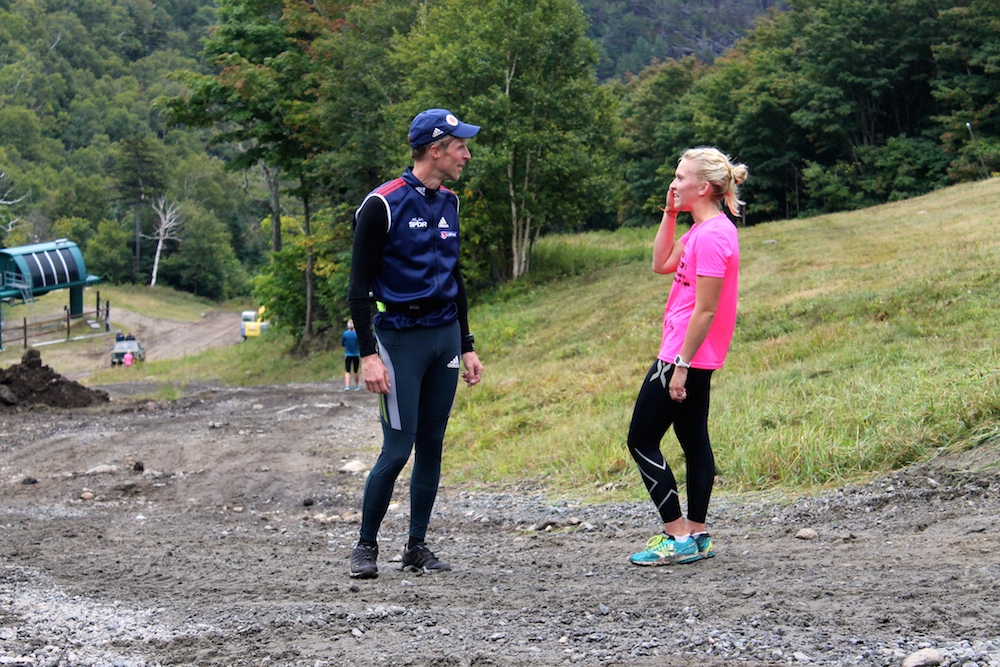
U.S. Biathlon Association women’s coach Jonne Kähkönen checks in with Kelsey Dickinson after an uphill running time trial in 2014.
When Jonne Kähkönen was hired to be the women’s national team coach by the US Biathlon Association (USBA) in 2010, there wasn’t much of a playbook to follow.
The Finn couldn’t mimic the footsteps of his predecessor, because there wasn’t one.
For the first time, the women’s team was going to have a coach of their own.
“The men’s program was on a really high level going into Vancouver [2010 Olympics],” USBA Chief of Sport Bernd Eisenbichler – then the high-performance director – said on the phone this weekend. “It was a deep program and the men’s relay was having pretty good potential. And we saw the women coming up having the same potential to go up to the top as well.
“We knew that if we wanted to build up a strong women’s program, we needed to have a dedicated coach for them,” he explained. “Really just focused on their development, and putting the group together to make it a really good environment.”
Enter Kähkönen, who had spent the previous four years as the head coach of the Finnish biathlon team.
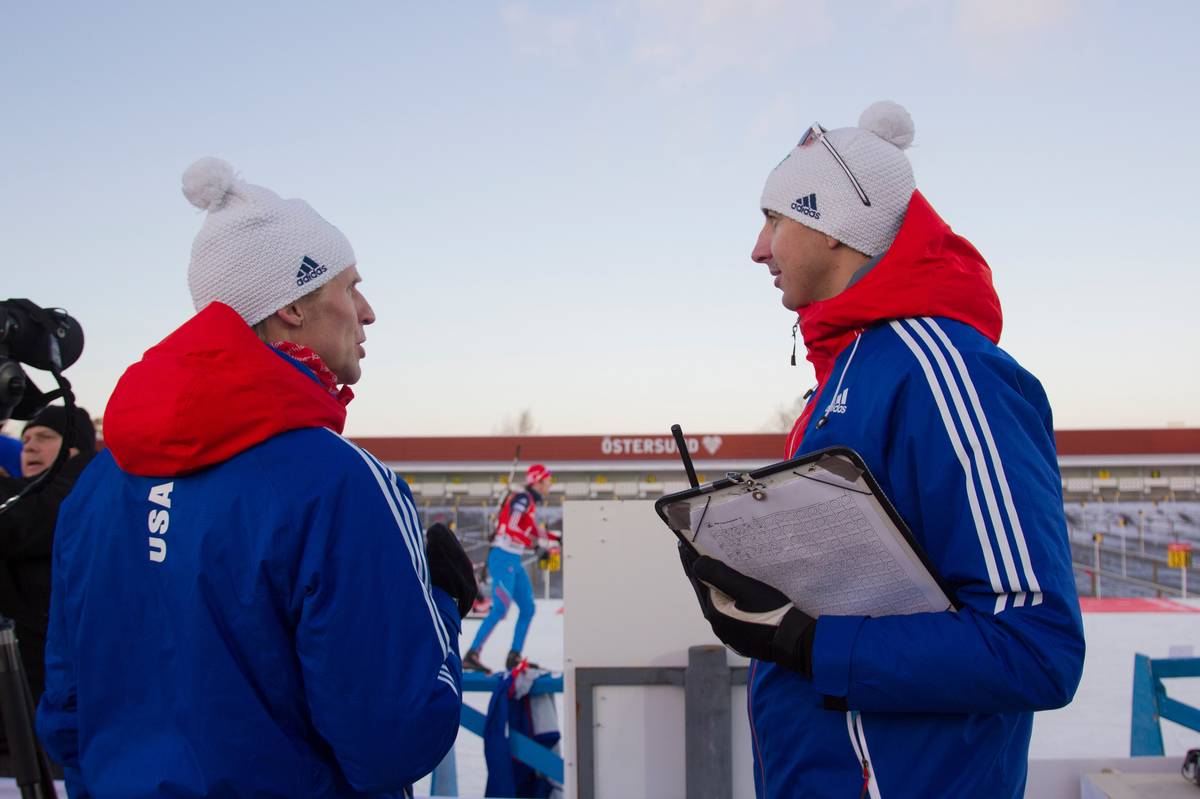
US women’s coach Jonne Kähkönen, left, and men’s coach Jonas Johansson on the range in Sweden in 2014. (Photo: USBA/NordicFocus.com)
“Obviously the first quad [four-year Olympic cycle] felt like it went by really quick, because everything was new,” Kähkönen said in a phone interview last week. “I think looking back, we made really good decisions overall with the philosophy of the team for both the men and the women. Especially for the women, in the early years, to get them up to speed, to be competitive. And it was successful already after the first couple years.”
In 2009, the U.S. women were ranked 20th in the World Cup’s Nations Cup standings. Eight years later, they have had numerous top-20 performances from multiple athletes, World Youth and Junior Championships flower ceremonies, and World Cup podiums and a World Championships silver medal by Susan Dunklee.
“When we started, we didn’t think we were capable of that,” Eisenbichler said. “We saw the potential, but to win a silver medal with Susan, to have these multiple top 20’s by six or seven different athletes, I think we can be really happy with what the women’s program has looked like the last eight years and where we are right now.”
And after leading that charge for eight years, Kähkönen is leaving the team to take back his role as the head coach for Finland – a program that has also risen in that period, with Kaisa Mäkäräinen winning three overall World Cup titles, Mari Laukkanen scoring two World Cup victories, and the mixed relay team finishing sixth at the 2018 Olympics.
“It has been a process,” Kähkönen said of the transition. “I definitely have been thinking of each quad [cycle] as a project. At the end of the project it is always good to evaluate and think about the next steps and what’s good for me professionally, but then I want what’s best for the team and the athletes also. And I feel like now with the few retirements, it’s probably good in a way to make the changes now.”
“I think that the women need a new stimulus,” Eisenbichler said. “Not that the old stimulus wasn’t good or wasn’t working anymore, but after eight years it’s normal. And Jonne and I see that the same way. I could not be more thankful and grateful to Jonne. And now it’s time for him to have a new era with the Finnish biathlon association.”
The Fun-Loving Finn
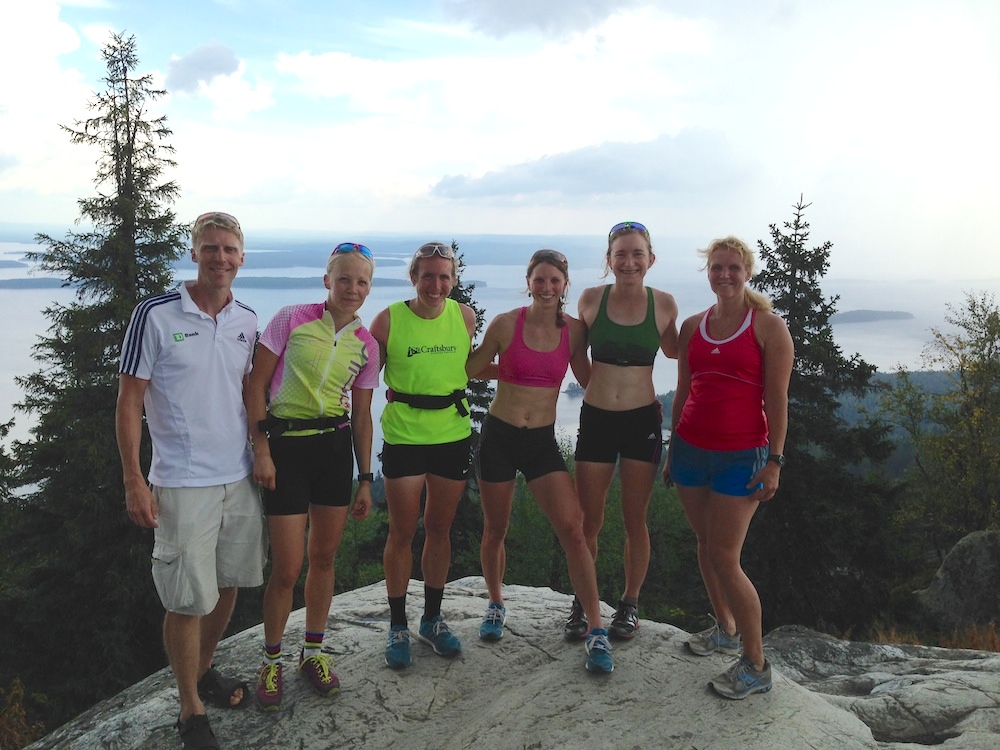
The US Biathlon women’s team after an uphill interval session up Koli, the highest point in southern Finland, with coach Jonne Kähkönen (l) and his wife (r), who also rollerskied up, and Finnish World Cup champion Kaisa Mäkäräinen (second from l). (Photo: Jonne Kähkönen)
“I think that having a women’s coach changed something in the heart of the women’s team, because it felt like a validation that we were improving and deserved someone that was there specifically for us,” 2014 Olympian and five-time World Championships competitor Annelies Cook, who retired in 2016, wrote in an email last week.
“Personally, I am really grateful that I had Jonne as a coach,” she continued. “Jonne was there in my life through many big changes and I could always talk to him and I always felt supported by him. He was always positive for us, and that is something you really need in a sport that can really get you down sometimes. Biathlon is different from cross-country skiing in where the differences in performances from day to day don’t change that drastically. Biathlon can change instantly from good to bad, and that can be really emotional sometimes.”
Kähkönen said that he learned a lot in his years of coaching in the U.S., not least from the athletes and the team’s international staff, who hail from Sweden, Italy, the Czech Republic, and Germany.
“It makes me think what works and what doesn’t work, and also to take that into account working with the athletes,” he said.
But what he learned the most was to have fun.
“I know that having fun seems dangerous to say [in a serious environment],” he said. “It’s not only about having fun, but enjoying your work and enjoying what you’re doing — I think that’s more descriptive. But, at times, having fun as well!”
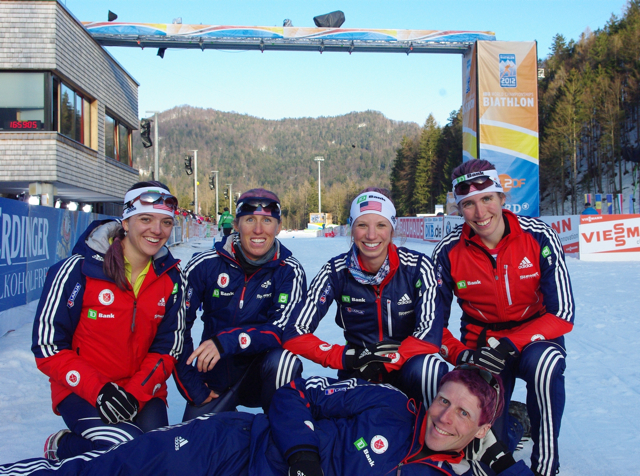
Sara Studebaker, Lanny Barnes, Annelies Cook, and Susan Dunklee, with coach Jonne Kahkonen, model their new hairstyles at 2012 World Championships.
Case in point: in 2012 at World Championships, Kähkönen dyed his hair purple. He had told the team that if any of the women finished in the top 10, he’d do it. Susan Dunklee placed fifth in the 15 k individual. So purple it was.
“I think those types of things are important, whatever it is, just to try to lighten it up a little,” he said. “Me being Finnish, people say that I’m not a typical Finn. I’m more open or more lively or whatever.”
Quite apart from the hair, Dunklee’s fifth-place finish in Ruhpolding was one of Kähkönen’s favorite moments from his tenure with the team. At the time, he was midway through his second winter leading the women’s squad, and Dunklee had competed in just two weekends of World Cup racing.
“Probably one of the most exciting moments was Susan’s first breakthrough at Ruhpolding World Champs in that individual,” Kähkönen reminisced. “She had the lead for a good while, and her being really surprised by it. That was definitely, maybe not the start of it all, but one of the very good results that we had early on.”
The previous year, Sara Studebaker and Laura Spector had broken into the top 20 on the World Cup, and Haley Johnson had been close in 21st. One year later, Cook made her own jump into the land of top-20’s. And later still, Hannah Dreissigacker and then Clare Egan would hit the top 20, along with Dunklee’s four World Cup podiums and her World Championships silver medal.
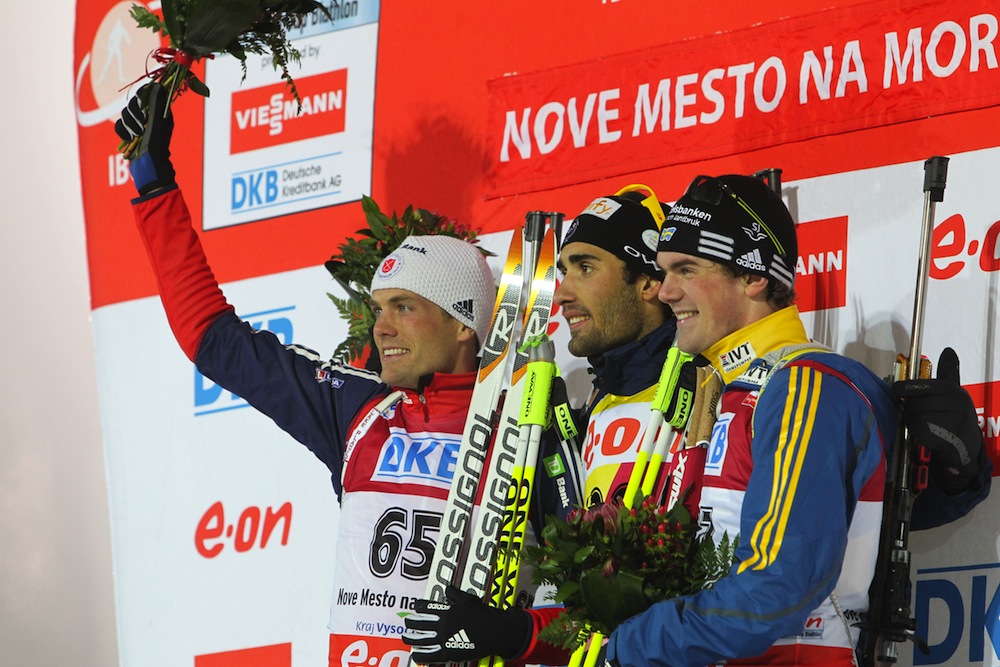
“Obviously after all the hard work, all the medals, Tim [Burke] in Nove Mesto and then Susan and Lowell [Bailey] in Hochfilzen last year, those are on top of the list,” Kähkönen said.
Back to Finland
Kähkönen hesitated to say that he was headed for home.
“It may be a cliché to say that home is where your heart is, but Lake Placid has been my home,” he said. “I’ve said this to a couple of people, but it hasn’t hit me yet because I’m still here. It has been great. The community is so supportive. There are great people there and we made good friends. So it will be tough to leave when that day comes.”
The family will move this summer, after his oldest son graduates from high school in June.
U.S. women’s coach Jonne Kahkonen talks to his team between intervals at a training camp in Bend, Oregon, in 2012.
But it is an interesting assignment for Kähkönen to retake the reins of a program that has changed a lot since he last worked there.
“With Kaisa [Mäkäräinen] being the star, it is exciting to go back and work with her, if she decides to continue [racing], which remains to be seen,” he said of an athlete who had five podiums the last time he worked with the team, but now owns 23 international wins and 54 more podiums. “We worked together in the past, so it will be fun to be reunited.”
But the other pieces of Finland’s biathlon puzzle are no less compelling.
“At the same time, I think as big a part of it is seeing the rise of the next generation,” Kähkönen said. “They won a couple medals at the junior level. It’s not just the juniors and youth who won the medals, but even behind them, there are just more people doing biathlon now, which is good to see. And just seeing the good results that the men’s team is starting to post on the World Cup now. That’s inspiring to me.”
And in the end, the fun is one thing that he hopes to bring back to Finland.
“I just read in one of the Finnish papers today, Aino-Kaisa Saarinen, who is part of the cross-country team — she has trained a bunch with Kikkan Randall and the U.S. women — she made a comment that what she was missing a little bit in the last couple of years was having this sort of North American type of relaxed and having fun atmosphere while doing the work that everyone is committed to.”
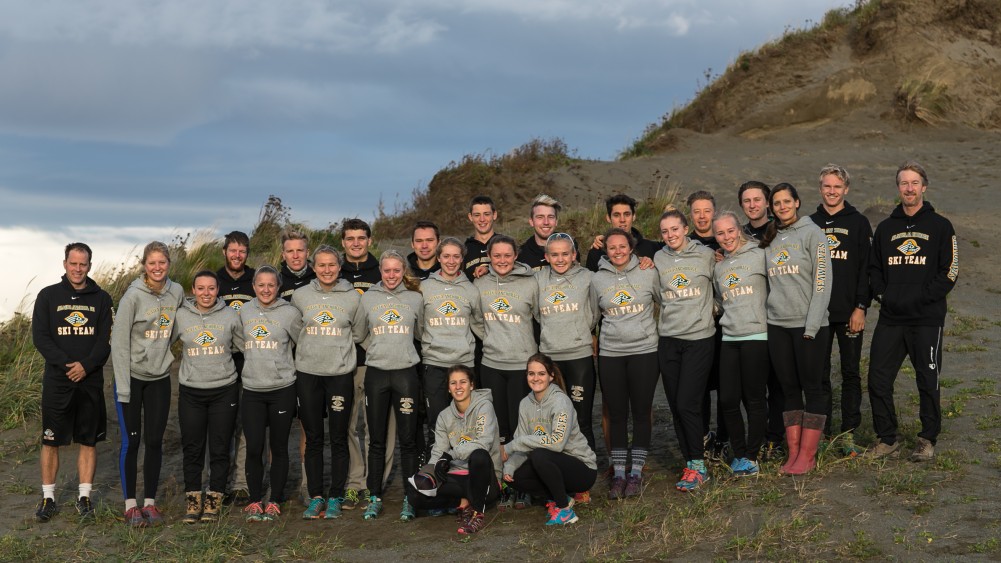
The present faces of the 2016/2017 University of Alaska Anchorage Ski Team (both nordic and alpine) at Kincaid Park in Anchorage. (Photo: Adam Phillips/UAA Athletics)
College skiing in Alaska is on its deathbed. (Or perhaps on its deathbed in Anchorage, and at least in the sick bay in Fairbanks.) FasterSkier previously posted thoughts and reactions from some of the more prominent University of Alaska Anchorage (UAA) skiing alumni, including Olympians Brian Gregg and Sadie Bjornsen. But there are other people who stand to be even more immediately affected if the University of Alaska Board of Regents cuts college skiing after this season: the athletes who ski for UAA, and the people who coach them. Here we share some thoughts from those groups, in an attempt to understand the human cost of the proposed elimination of UAA skiing following the 2016/2017 season.
Two Athletes: Hailey Swirbul and Casey Wright
Hailey Swirbul, 18, is a true freshman at UAA. Born and raised in Colorado, she visited Anchorage for the first time on her official recruiting visit to UAA last fall. To her surprise, Anchorage was love at first sight (“I stepped off the plane and I saw those mountains glowing pink, and I was like, Whoa, this is magical. This is nothing like Fairbanks!”), and she happily committed to ski for UAA soon after. Swirbul competed and trained internationally prior to coming to UAA, including anchoring the U.S. women’s relay team at Junior World Championships in Almaty, Kazakhstan, in February 2015, and attending International Junior Camp in Norway that summer.
Casey Wright, 21, took a slightly more circuitous path to skiing for the UAA Seawolves (fondly referred to by the team as the “Skiwolves”). Wright, an Australian, was born in Melbourne, and is a member of the Australian National Ski Team. She has raced for her country at several international competitions, including world juniors in 2013 and 2014 and World Championships in Falun, Sweden, in 2015. Wright previously skied in the U.S. for the Sun Valley Ski Education Foundation (SVSEF) Gold Team in Sun Valley, Idaho. (She is one of at least three Australian national team skiers who currently live and train in Anchorage, including Alaska Pacific University athletes Jessica Yeaton and Paul (PK) Kovacs.)
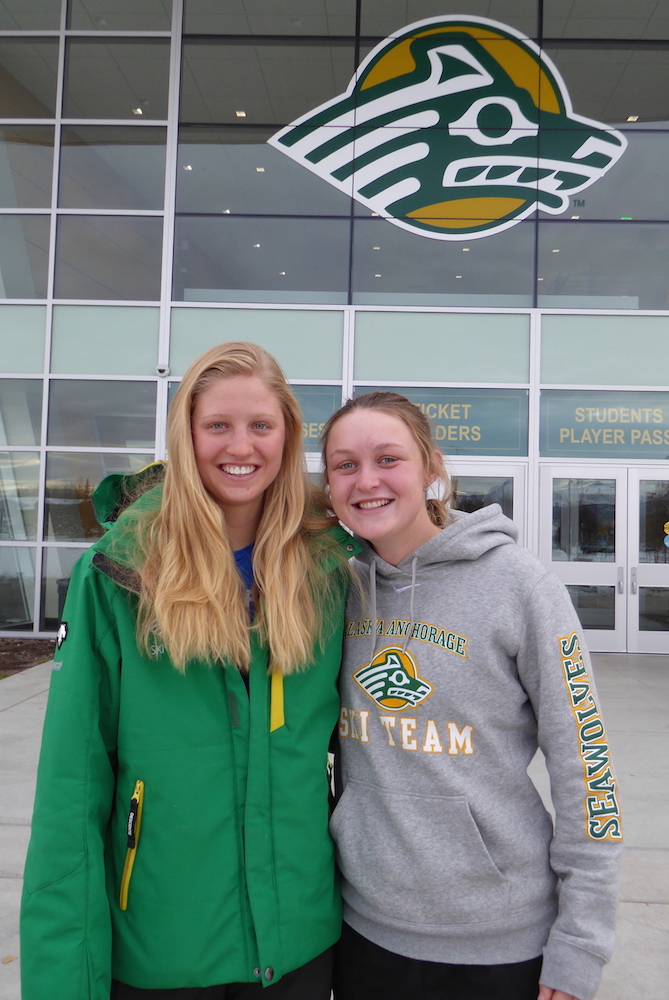
UAA present: ‘Skiwolves’ Hailey Swirbul (l) and Casey Wright (r), on the UAA campus in Anchorage, Alaska, in October 2016. (Photo: Gavin Kentch)
Both athletes spoke with FasterSkier in an in-person interview on the UAA campus on Oct. 28, slightly more than 24 hours after news came out that their program was slated to be discontinued at the end of this season. Both Wright and Swirbul were surprised and disappointed, but nonetheless impressively buoyant given the circumstances.
And speaking of buoyant, it is not just an orthographic coincidence that you can’t spell “Seawolves” without “love.” Both athletes’ sincere love – for their sport, for each other, for their suddenly endangered ski program – was apparent throughout the interview, in which Wright and Swirbul at times literally finished each others’ sentences.
This particularly came through in each athlete’s overriding concern at this moment: for others and for their team.
“I’ve gone from initial, like, absolute being distraught to kind of angry, and now I’m trying to understand why, and trying to look in the future,” Wright said when asked how she was feeling. “For us at the moment, or for me anyway, it’s just, like, looking for out my team, looking out for my coaches, just trying to make sure everyone’s okay. I think that’s really my main concern at the moment – that everyone is coping as well as they could be.”
Swirbul expressed similar sentiments: “One of the hardest things … that each of us are going to face is breaking up this team, ’cause we have such a young team, and we have so much potential, and it is horrible to see that go right now.”
“We are really close,” Wright added. “I’ve never been on a team where I’ve had this connection with teammates, where it’s like – we’re just like a family, an extended family.”
Indeed, Wright called the Skiwolves “my second family.” “It takes me, like, over 30 hours to get home,” she observed, reflecting the distance between Alaska and the antipodes. “This team is my family,” Wright stated, her voice and syntax breaking, “and – the thought of not being able to see all these people every day – like, after this year – or not even a year, after, what is it, going to be five months, pretty much, six months, is just like – it’s devastating. I can’t even fathom… that’s just heartbreaking.”
Swirbul, discussing the Oct. 27 meeting at which they were told that their program was slated to be cut, continued with the familial theme. “One of our teammates actually paralleled it to a funeral, and it feels like our team is dying,” Swirbul said.
“It feels like a death in the family,” Wright concurred.
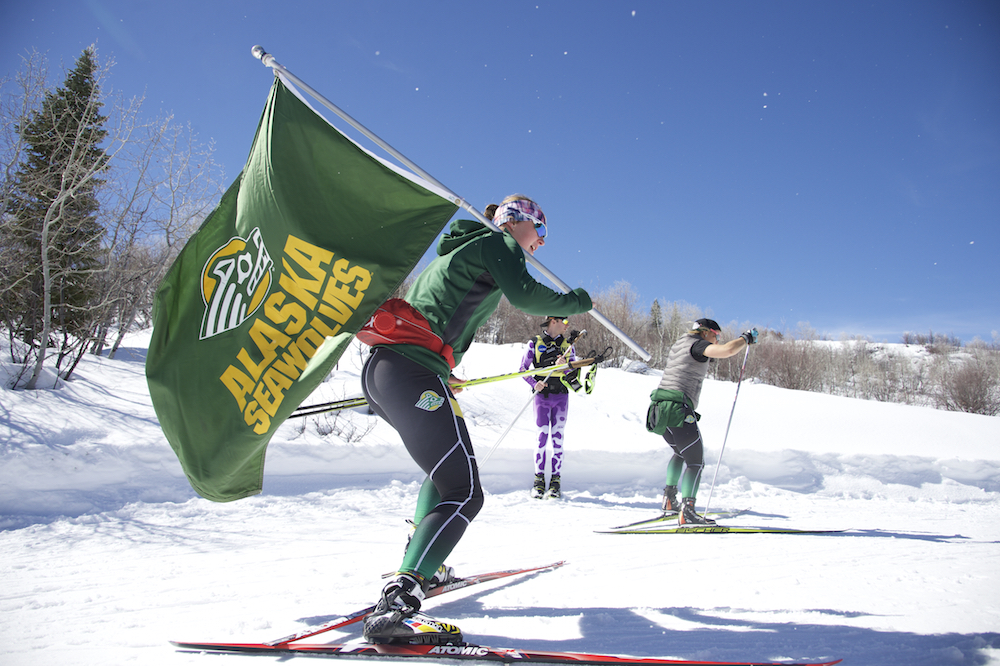
UAA present: Casey Wright carries the Seawolves’ team flag at the 2016 NCAA Skiing Championships last March at Howelsen Hill in Steamboat Springs, Colo. (Photo: Jamie Schwaberow/NCAA Photos)
While both athletes underscored that the team was quickly becoming tighter than it ever had been, they admitted that they had begun thinking about what might come next if their program – and college scholarships – come to an end.
(UAA Athletic Director Keith Hackett wrote in his public statement that “UAA will honor our commitment to those Student-Athletes who have been impacted by this decision by keeping them on scholarship through the spring of 2018.” But head nordic coach Andrew Kastning said that he was “a little surprised” to hear that his athletes only had two more years on scholarship (counting the 2016/2017 season), “because at one point when we thought that we were going to be – when the cuts were being talked about, [assistant nordic coach] Sara Studebaker had asked Keith what would happen to our athletes that are here. And he said, ‘Their scholarships will be honored until they graduate.’ But it didn’t sound like that was arranged, at least at this point.”)
“It’s impossible not to think about [next year],” Swirbul, 18, said. “I’ve been thinking about it for the past couple months, unfortunately, especially when [my] parents have been encouraging me to look into that in case that happened, and it did. First off, I need to clear up what this whole situation with the scholarship in the coming years is. And that’s a huge factor in my decision. If that’s the case, then my first option would be to attend school here still, and potentially ski for APU [Alaska Pacific University]. Otherwise, I need to start applying to colleges all over again.” (While athletes who transfer schools are typically required to sit out a year before playing again at their new school, the one-year waiting period is waived when the athlete’s sport was cut at the previous school.)
Swirbul reiterated that she yearned to stay in Anchorage: “I love it here. I don’t want to leave. Taking that away from me, taking that away from all of us, is just heartbreaking.”
Wright, who turns 22 next month, had similar goals, but was still working with the NCAA to gain some clear answers to something as simple as how many years of NCAA eligibility she had remaining before she began the process of seeking out other schools. “I’m in a bit more of a difficult situation, being an international student-athlete,” Wright said.
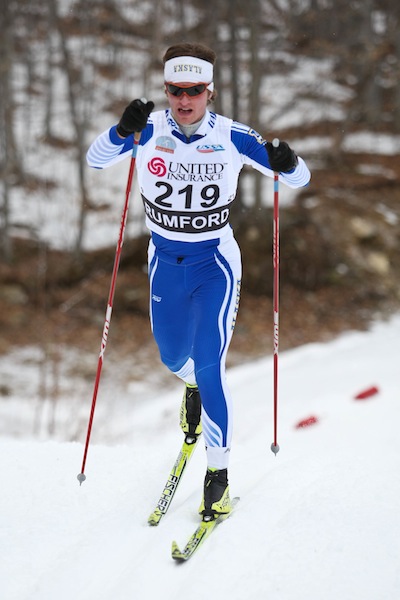
UAA past: Erik Bjornsen (then UAA, now APU and USST) races in the men’s 15 k classic race at 2011 U.S. Nationals in Rumford, Maine. (Photo: FlyingPointRoad.com)
“In order for me to achieve my goals,” she continued, “the best place for me to be, I believe, is in the U.S. It’s just, the calibre of skiing here is fantastic in order for me to develop and reach my goals. Although I don’t have as many years of eligibility left, so that would be a difficult one to try and convince another team to take me on.” Wright also hoped to stay in Anchorage if at all possible.
Wright recounted her self-initiated “recruitment” into the UAA program (she had been skiing with the SVSEF before she began reaching out to American NCAA ski teams), and how it led to the current team at UAA. “Andrew was the only one that responded to an Australian girl contacting him saying that I was a skier,” Wright said. “I don’t think anyone else believed me.”
UAA originally didn’t have scholarship space for her, but a space then opened up on short notice. “So I pretty much just jumped on a plane and came here. … It was the best decision I could have made. It’s just been incredible,” she said.
Wright recounted the process by which this year’s team – which, she pointed out, skews young and blonde – was assembled soon after she came on board. “Andrew was talking about all these freshman girls we’ve got coming in. He was like, ‘We’ve got a lot of 18-year-olds.’ It was like, ‘Oh boy, we’re going to have a lot of Justin Bieber [Swirbul cracks up], and teeny-bopping around’ – but it’s been nothing like that.”
Swirbul: “Wow, thank God.”
Wright: “He just kept signing girls.”
Swirbul: “And they’re all blonde and they’re all freshman.” (This is almost literally true.)
Wright: “Andrew has dubbed us The Blondetourage. That pretty much sums us up.”
On a more serious note, and discussing the process that led to the ski team being cut, both athletes were quick to reject a reporter’s suggestion that they might feel betrayed.
“I absolutely would not say betrayed,” Swirbul said. “And I think that’s how the coaches feel. They feel like they betrayed us – I think some of them are blaming themselves for this. And that’s the hardest thing for me to see, is thinking about my teammates and my coaches that might not have a clear path of where to go in the next few years. I think that I’ll figure something out, and a new door will open. I just worry – I feel so much for the people that don’t have that clear path.”
Swirbul also disagreed with the premise that skiing had been singled out in some manner. “I I don’t think we were necessarily singled out,” she said. “But I can’t understand why they would cut skiing in Alaska. I don’t understand that. And I don’t think they understand why they cut us. I don’t know. … Were we singled out? No. Are we some of the best academic and hard-working people at UAA? Yes. And I don’t think they would purposefully single out those types of people to remove.”
“Were we singled out? No. Are we some of the best academic and hard-working people at UAA? Yes. And I don’t think they would purposefully single out those types of people to remove.” — Hailey Swirbul, UAA freshman nordic skier
Finally, Swirbul graciously declined an invitation to compare the ski team’s record of success to the consistent mediocrity and decades-long trend of losing seasons that plague the UAA hockey team.
“I would never wish this upon anyone else, and I can’t say that I would rather have the gymnastics be cut, or the hockey be cut – because this sucks. And I don’t want anyone to go through this,” Swirbul said.
At the same time, Swirbul expressed some confusion as to whether it was really money or something else that was driving the decision to submit skiing for proposed elimination.
UAA past: Sadie Bjornsen (then UAA, now APU and USST) skis to a third place finish in the women’s 5 k classic race at the 2009 NCAA Championships in Rumford, Maine. (Photo: FlyingPointRoad.com)
“Actually, what the director [Hackett] ended up saying,” Swirbul recalled of the Oct. 27 meeting, “was that it doesn’t even come down to money at this point, it’s more NCAA rules. They’re cutting our teams from 13 to nine. And so they need a 10th team, potentially. And they said, ‘If we do need a 10th team, if that waiver goes through and we need to find a tenth team, they will find the money to do that somehow.’ However, they can’t let us find the money to fund ourselves. I don’t even know what they’re talking about. They said there’s money there if they need to have a 10th team.”
Wright expressed similar sentiments: “We want the opportunity to, if it is down to money, we want the opportunity to fundraise. We were told that Alaska wasn’t a giving state, that people here don’t want to give money, that’s what he told us, which, we don’t believe that’s true, considering that APU is able to fundraise six figures annually.”
The Alaska Dispatch News, or ADN, has reported that the annual budget of the APU program is “about the same amount” as that of the UAA ski team. “With APU always in financial straits,” the ADN wrote, “the team raises most of its own funds.”
While it is hard to quantify the generosity of a state, some indication of Alaskans’ attitudes toward charitable contributions may be gleaned from the success of Pick.Click.Give, a program that allows Alaskans to voluntarily choose to donate a portion of the Permanent Fund Dividend (PFD), the share of oil revenue that is annually given to most Alaskans. Last year 5.5 percent of Alaskans who filed for a PFD online made a donation through the program, donating an average of $108 per person from a revenue check that this year came out to $1,022 per person.
“If we were given the opportunity to raise funds,” Wright continued, “or to meet a target, or who knows what … we would have done it. We would have been knocking on doors, asking for people to donate, selling cookies like Girl Scouts. We would have had a bake sale. I think that’s what hurts the most, is that we couldn’t do anything, we weren’t given the opportunity to save ourselves; it was basically said, ‘This is out of your hands.’ … That kind of stings as well, when we’re told, ‘You just have to sit back and wait,’ which skiers aren’t good at doing. If there’s something that we can do, we want to do it.”
The Coach: Andrew Kastning
Head coach Kastning, 34, now in his sixth season at UAA, also yearns to take action and find a solution. He and his wife, former Whitman ski coach Calisa Kastning, have a new house in Anchorage and two young girls. “We got another kid on the way, coming in March,” Kastning noted. “So the stakes to figure something out are kinda high.”
Kastning spoke with FasterSkier by phone on Oct. 29, shortly before the lifelong Cubs fan watched Chicago lose Game 4 of the World Series 7-2 to the Cleveland Indians.
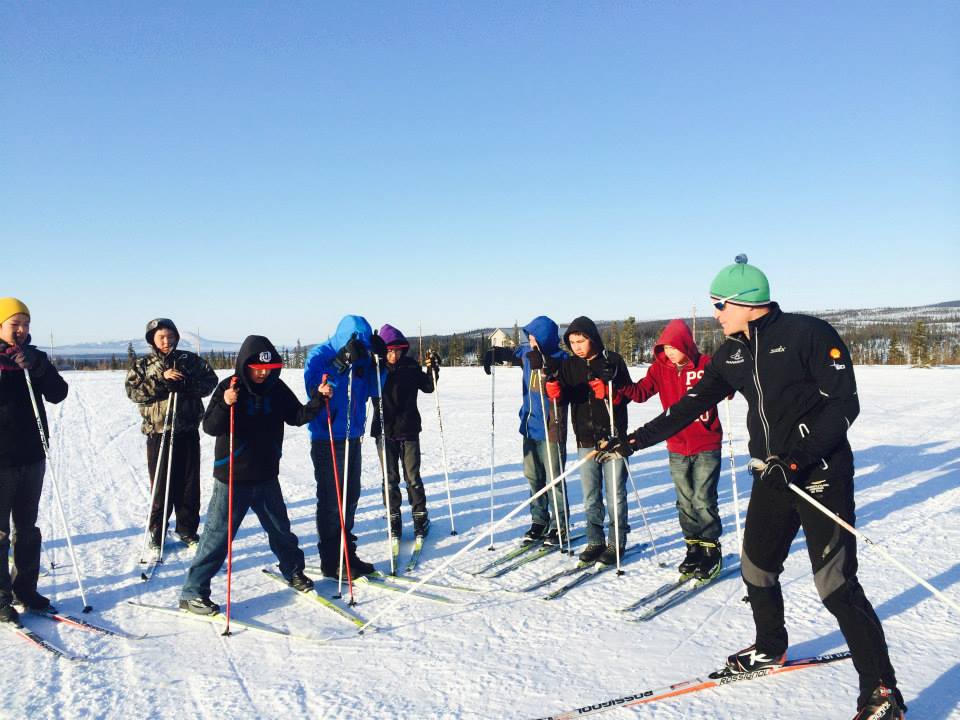
Coach Andrew Kastning teaching seventh-grade boys to V2 in Kiana, Alaska, on a Skiku ski outreach trip to rural Alaska. (Photo: Celia Kastning)
Beyond the obvious, there are several aspects of Kastning’s situation that are particularly poignant. The first is that, as he said, “I’ve got the team now that I’ve always wanted. And nothing against the teams I’ve coached before, but since I got to Alaska I’ve been trying to get kids – young, promising Americans combined with experienced international racers. And for the most part, it’s been experienced international racers that I had.”
Until, Kastning continued, “I turned the corner when Hailey signed a year ago. She signed early, and that opened the door, opened the eyes of other American recruits coming out of high school to look at Alaska. And this is the team that I’ve always wanted to coach. Because we have so much talent and they’re so young, and so moldable, and they’re getting along so well … it’s been awesome to do that. It makes the sting of it a little bit extra, because there are eight freshmen on my team and four sophomores. And so we’re set up well to be stronger and stronger.”
But this is cross-country skiing, a sport where your speed this season is largely determined by how much you were training the year before (and the year before that, etc.). And it appears that Kastning will only have one season in which to help his athletes achieve their best. “We’re just trying to get the best peak performance that they have within them,” Kastning said, “and I know they’ll ski their hearts out.”
Kastning remains clear-eyed about the artificial limitations of taking what should be a four-year progression and compressing it down into one season. “It would be a Disney story to win the NCAAs this year,” Kastning said. “However, looking ahead in the next two to four years, given this group of kids, I don’t think that’s out of the question. The way they’re working together, and the talent level that they have.”
“It would be a Disney story to win the NCAAs this year. However, looking ahead in the next two to four years, given this group of kids, I don’t think that’s out of the question.” — Andrew Kastning, UAA head nordic coach
The other reason this is especially poignant for the Kastning family is that together they’ve been through this drill before. Twice. Kastning was assistant nordic coach at the University of Nevada, Reno, in the late 2000s, until he saw the writing on the wall and left for a more secure coaching job elsewhere. A year later, the Nevada athletic director – a man named Keith Hackett – announced that skiing was going to be cut at Nevada.
UAF past: David Norris (now APU) racing at U.S. nationals in Rumford, Maine. (Photo: Kris Dobie)
(Hackett would take the same job at UAA in 2012. His official UAA bio notes, “UAA’s skiing, men’s basketball, women’s basketball and men’s cross country [running] teams have all produced top-four national finishes since 2008.”)
Kastning’s then-girlfriend, now-wife, Calisa (Schouweiler) Kastning, was coaching at Whitman at the time. Until, Andrew says, “Calisa called me at the conclusion of the 2009 NCAA mass start races – I was still in my ski boots – and she was in tears, telling me that her program had just ended. … And it was a shocking announcement. And they had no chance to fight it, and no ability to fundraise to keep it going, and even a few donors there came through with a big chunk of money that wanted to keep the team, but the athletic department stood their ground and said ‘no.’ ”
Andrew happened to visit Calisa in time to attend the final team gathering for the Whitman College Blues ski team (most famous skiing alumnae: Holly Brooks ’04 and Laura Valaas ’06).
“And it was heartbreaking.”
“I wasn’t even involved with that program at all,” Andrew said. “But then through my girlfriend at the time, to see those kids trying to cope with the last team gathering – which we’ll have to go through too if this decision stands – it was really hard. And I was just kind of a bystander in that situation. So I’ve already been through one final gathering for that team. And it was a little bit by happenstance, but I know what it’s like and I know what the emotional rollercoaster is that we’re going to have to go through until the end of the spring semester.”
Andrew continued, looking ahead to a year full of lasts: “We’ll have Athlete of the Year banquets, with the whole athletic department, and it’s going to weigh on everybody’s mind there. And we’ll have our final team barbecue gathering where we name our most valuable players and our most improved, and all that. And normally we give framed pictures to our seniors, and talk about each senior athlete and what they’ve contributed to the program and say goodbye to them. And now we’ll probably have to make framed pictures of everybody, and try and talk about everybody. Which will take all night, because they’re all such awesome kids.”
UAA breakfast present: Local skiers show their support for #savealaskaskiing. (Photo: Holly Brooks)
Despite Andrew’s shared history with Hackett and shuttered ski teams, he hesitates to blame Hackett for the current decision at UAA: “I wish the president [UA President Jim Johnsen] had been there [at the meeting to make the announcement], because he’s the one that’s really pulling all these micromanagement strings above, and unfortunately Keith is having to, for lack of a better word, be his puppet, and take orders from the top. Because even though Keith cut skiing once [before], I don’t – at least I don’t want to believe that that was his first choice. It seemed like it was just a fait accompli, like it was agreed upon on both campuses that the ski team was an easy target. And that was going to be the first tree to fall.”
(Many symbolic trees are falling on the UAA campus these days. A survey of faculty and staff released earlier this week showed that “more than half” of current staff members “feel that morale [at UAA] is the lowest they have ever seen.”)
As a small silver lining, Kastning appreciates that at least someone else had to give his athletes the bad news: “In a sense I was glad that Keith had to be the one to look them in the eye and tell them that their hopes and dreams were going to be crushed in Alaska.”
A final season to remember
It is clear from coach and athletes alike that, while news like this could potentially cleave some teams apart before the season even began, it is instead leading the 2016/2017 Skiwolves to cleave together even stronger than before. Here’s the final word from the athletes:
Swirbul: “It’s quite bizarre that they’re cutting out this part of Alaskan culture in Anchorage. … And we’re hosting nordic U.S. Nationals in two years – Anchorage is hosting that – and there won’t be a college team here. That’s ridiculous. That’s outrageous.”
Wright: “It’s almost comical to think that we won’t be there in green and gold on the start line. It’s really heartbreaking. It’s just sad.
“But we’re going to rally together, and we’re going to have a memorable season. And people are going to remember the Seawolves. It’s not that we’re just gonna hang our heads low, and walk out from our last race. We’re going to go out there, and people are going to know that we’re there. We’re going to be there loud and proud. And I think that’s going to be – that’s the thing I’m looking forward to most this season, is that we’re going to make it one that people are… next season they’re going to miss us, because we’re not on the start line with them.”
Swirbul: “Nice. That makes me hyped.”
Wright: “I think that makes everyone hyped right now. We’re going to make this season count.”
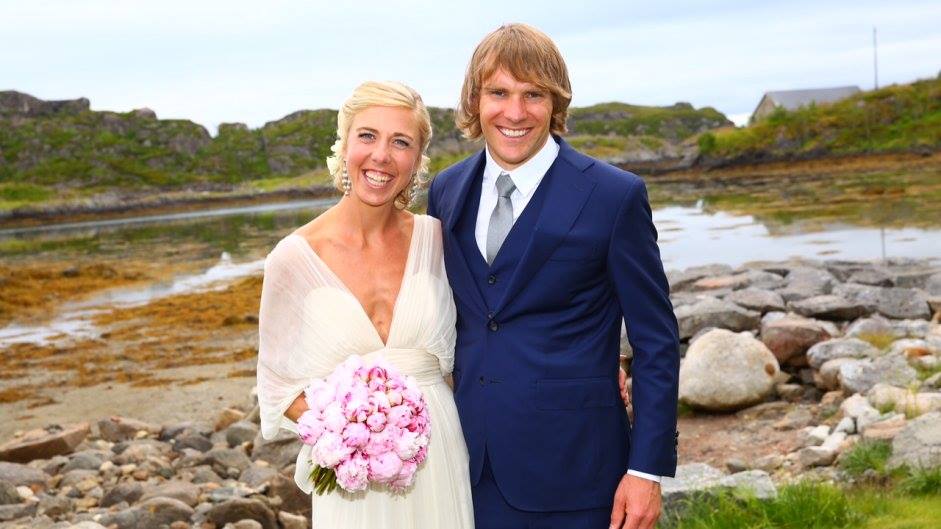
Skiers have been wearing a lot of white lately — or variations thereof. This past weekend, Canadian World Cup Team member Devon Kershaw and his Norwegian girlfriend, three-time Olympian Kristin Størmer Steira, tied the knot in Lofoten, Norway, where Steira has family ties.
Kristin Størmer Steira, of Norway, and Devon Kershaw, of Canada, were married last weekend in Lofoten, Norway. (Photo: CCC/Facebook)
Steira’s teammates, including Marit Bjørgen, Therese Johaug and Ingrid Flugstad Østberg, made the trip to the northern islands for the wedding, along with Canadian skiers Alex Harvey, Jess Cockney, Graham Nishikawa, Drew Goldsack, and Phil Widmer.
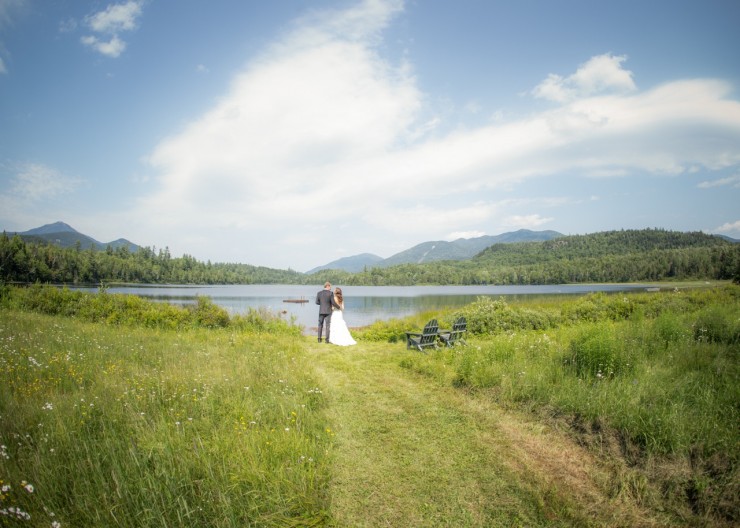
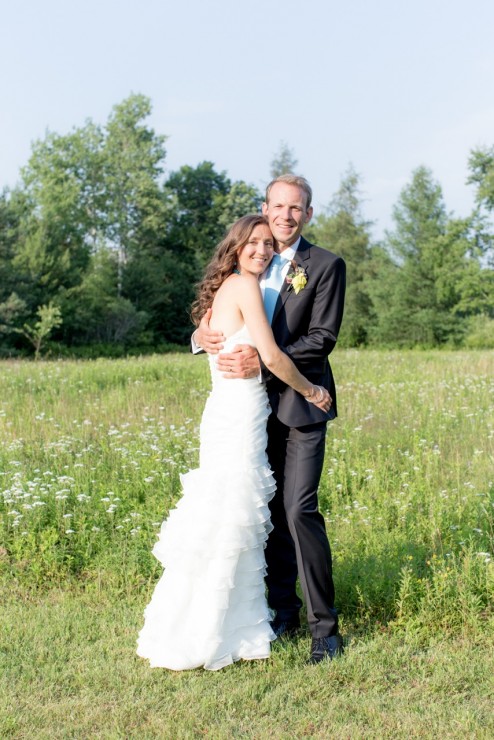
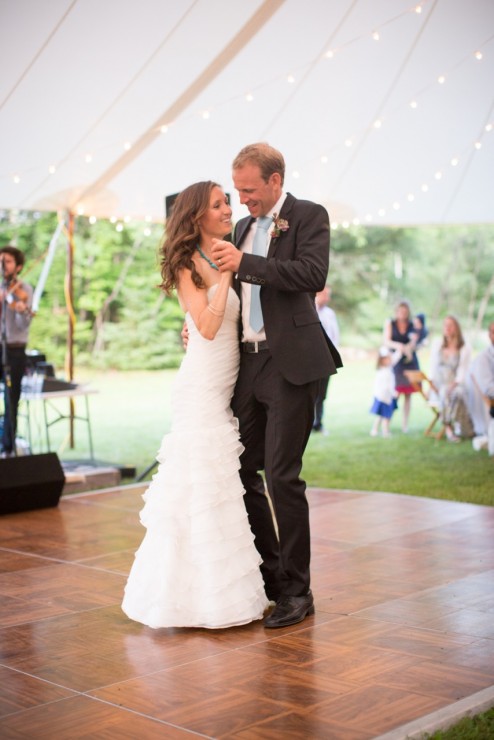
On July 11, US Biathlon’s Lowell Bailey wed Erika Edgley at Connery Pond (photos above) in North Elba, N.Y., then held a reception in front of the house where Bailey grew up in Lake Placid. Edgley is also from Lake Placid. They celebrated with about 120 guests from “all over the world,” Bailey explained in an email. “Americans, Brits, Germans!”
Bailey recently arrived in Stavanger, Norway, for the Blink Summer Ski Festival — a three-day series of rollerski races, starting this Thursday and ending Saturday. His teammates Leif Nordgren and Susan Dunklee also plan to participate.
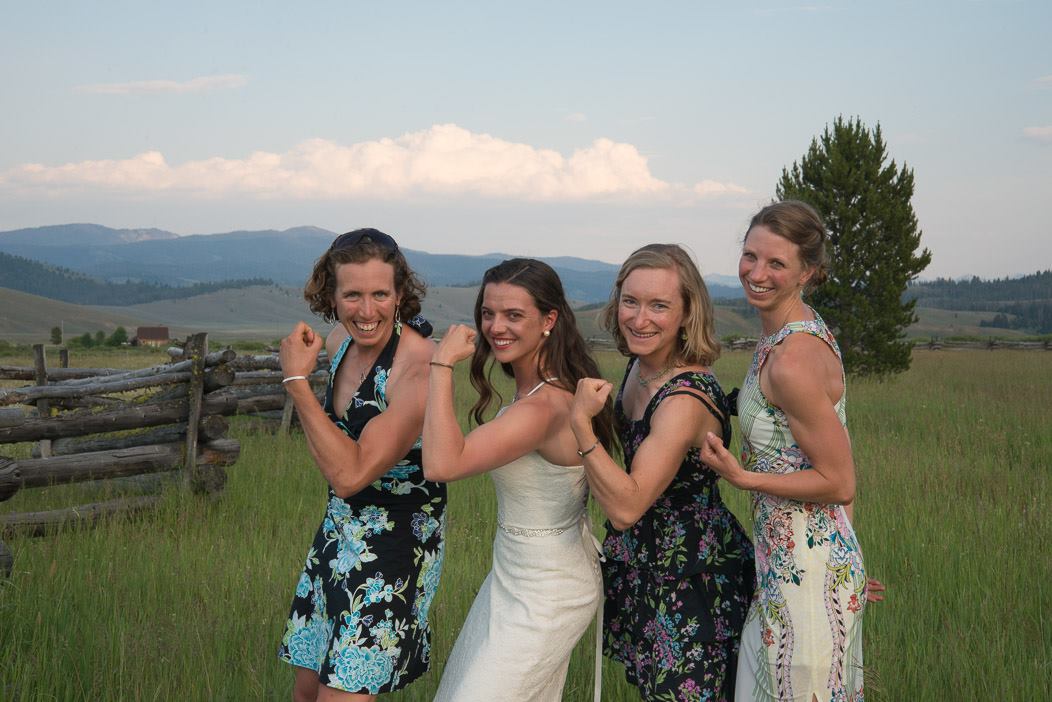
Sara Studebaker (second from l) married Zach Hall in mid July and celebrated with friends and former US Biathlon teammates Susan Dunklee (l), Hannah Dreissigacker (second from r), and Annelies Cook (r) in Stanley, Idaho. (Photo: Sara Studebaker/Facebook)
Also this month, former U.S. biathlete Sara Studebaker married another retired biathlete and current ski coach, Zach Hall, with her 2014 Olympic relay teammates Dunklee, Hannah Dreissigacker and Annelies Cook by her side in Stanley, Idaho.
And on July 18 near Canmore, Alberta, Canadian biathlete and Olympian Scott Perras married Jodi Etcheverry, a former biathlete, at a lakeside ceremony.
Longtime sweethearts, former U.S. skiers and now development coaches, Maria Stuber and Bryan Cook recently wed in their native Wisconsin.
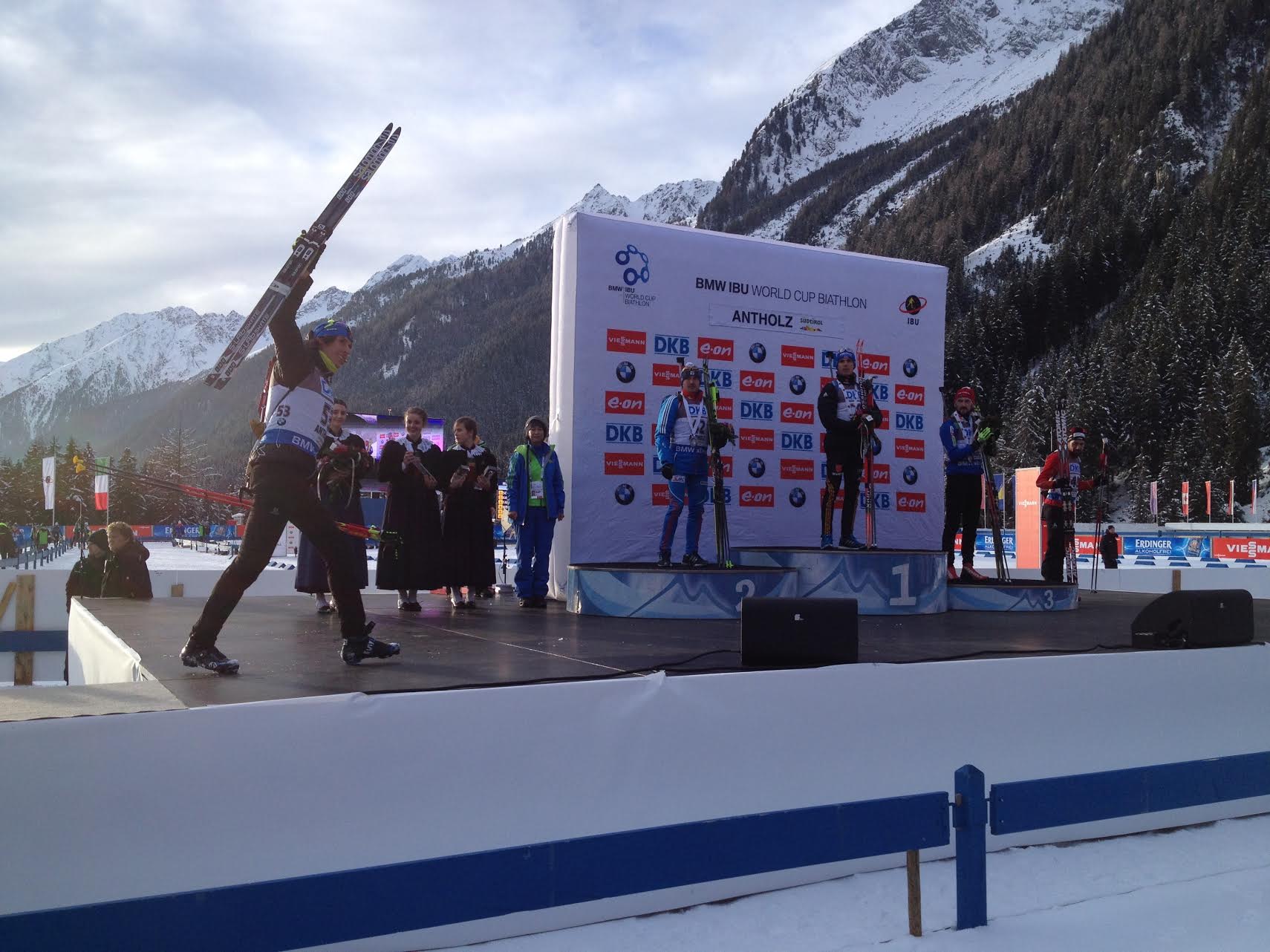
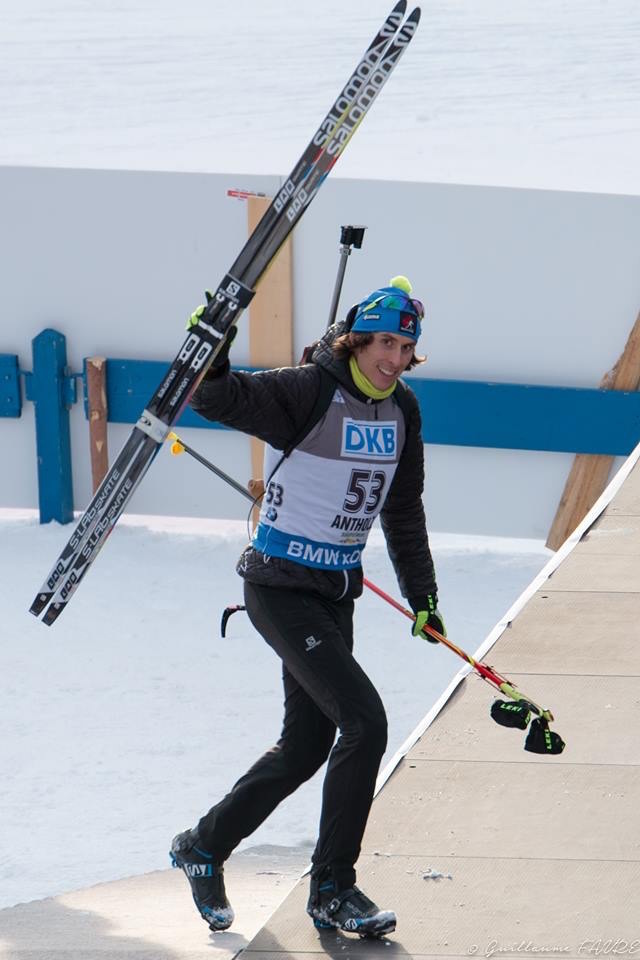
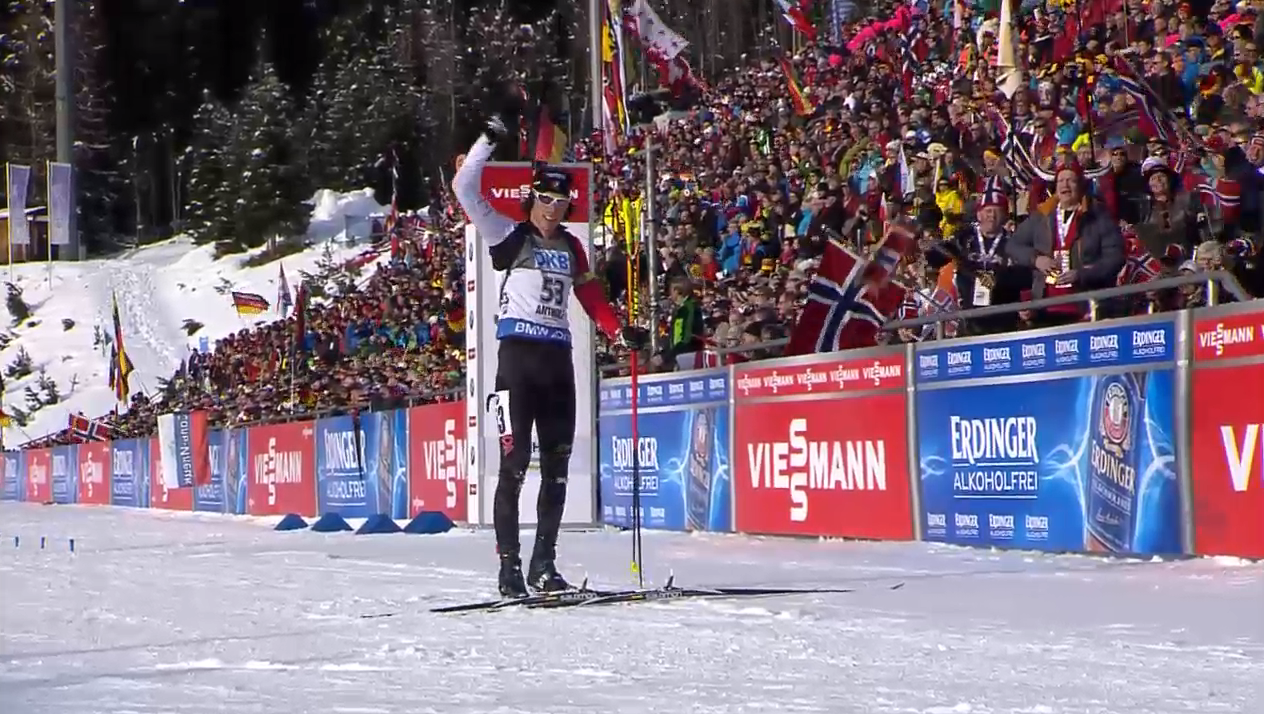
Biathlon Canada’s Brendan Green (l) acknowledges the crowd, including his parents, during his first appearance in an IBU World Cup awards ceremony on Thursday in Antholz, Italy. He placed fifth in the men’s 10 k sprint for a career best. (Photo: Matthias Ahrens)
Brendan Green couldn’t put his finger on it after the men’s 10-kilometer sprint in Antholz, Italy, but whatever it was, he was hoping it kept up.
The 28-year-old Canadian rolled to his fourth-straight flawless IBU World Cup race on Thursday — flawless in the sense that he didn’t miss a single shot, and perhaps the most perfect of all four given that he achieved a career-best fifth place in doing so.
“I’ve always loved racing here in Antholz and it is definitely my favourite stop on tour,” Green wrote in an email. “It’s hard to say exactly why I’ve been able to find success here. It’s a fun venue to race, the atmosphere and fans are awesome, the weather is almost always perfect, and the course is one that maybe plays a little more into my strengths.”
Just over a year ago, Green recorded his previous career-best World Cup result of eighth in the Antholz sprint. On Thursday, he broke an IBU record for the longest clean-shooting streak of any man on the circuit in the last two years, according to RealBiathlon.
Brendan Green (Biathlon Canada) celebrating fifth place in the men’s 10 k sprint on Thursday at the IBU World Cup in Antholz, Italy. It topped his previous career best of eighth, which he previously achieved in the Antholz sprint last year. (Courtesy photo)
As of last Sunday, Green was the first biathlete to clean a three-race weekend in 2014/2015, closing out the races in Ruhpolding, Germany, in 18th in the mass start.
And on Thursday, he became the first male in the last two seasons to notch 50-for-50 shooting, matching Belarusian female biathlete Nadezhda Skardino, who did so in Ruhpolding last season.
“It’s been awesome to have had such success with my shooting since Christmas,” wrote Green, who hasn’t missed a target in a race so far this second World Cup trimester. He returned to the circuit in Ruhpolding, starting with a relay on Jan. 15.
“After the first trimester of racing I came home with some specific changes in mind that I needed to address before I continued back on the World Cup circuit,” he explained. “No major changes or revelations, but I did make a few small positional adjustments and then from there fine tuned a few areas in my approach to shooting. So far it seems to be working and I really hope that I can continue on in the season with strong shooting.”
But no pressure.
“At the moment I’m trying not to overthink it too much and focus more on each race day to day,” he added.
With his fifth-place result, Green will start Saturday’s 12.5 k pursuit in fifth, 24 seconds behind sprint winner Simon Schempp of Germany. On Thursday, the Canadian finished 24.4 seconds behind Schempp and 3.5 seconds off the podium.
Schempp, who tied Italy’s Lukas Hofer for first in last season’s Antholz sprint, won it outright on Thursday in 23:18.8, 14 seconds ahead of Russia’s Evgeniy Garanichev. It was the German’s second-straight victory and fourth ever since he won the Ruhpolding mass start four days earlier.
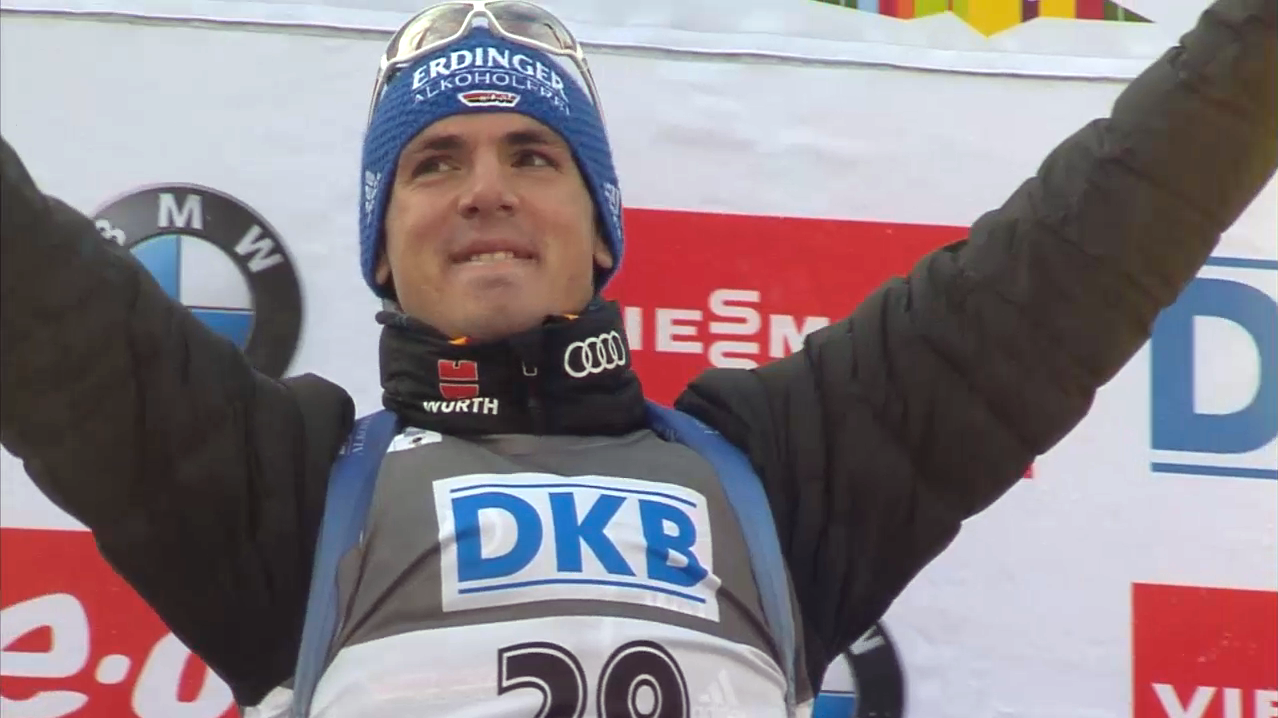
Germany’s Simon Schempp on the podium after his second-straight IBU World Cup win (and fourth overall) in the men’s 10 k sprint on Thursday in Antholz, Italy.
Schempp cleaned his third-straight race with the second-fastest course time. Switzerland’s Benjamin Weger was fastest on course in the three-lap race, but missed one prone target to place fourth, 30.9 seconds behind Schempp and 0.8 seconds off the podium (behind Slovenia’s Jakov Fak in third).
“This is crazy. The last three races were really good for me,” Schempp told the IBU. “I think I made good progress in my training over Christmas. I am really happy about January.”
Green’s overall course time ranked ninth and his range time was 31st-fastest among 102 finishers. The 42nd starter, Garanichev cleaned with the third-fastest range time and skied to second with the sixth-fastest course time — coming closer than anyone but still 14 whole seconds away from Schempp, who started in bib 29 ahead of him.
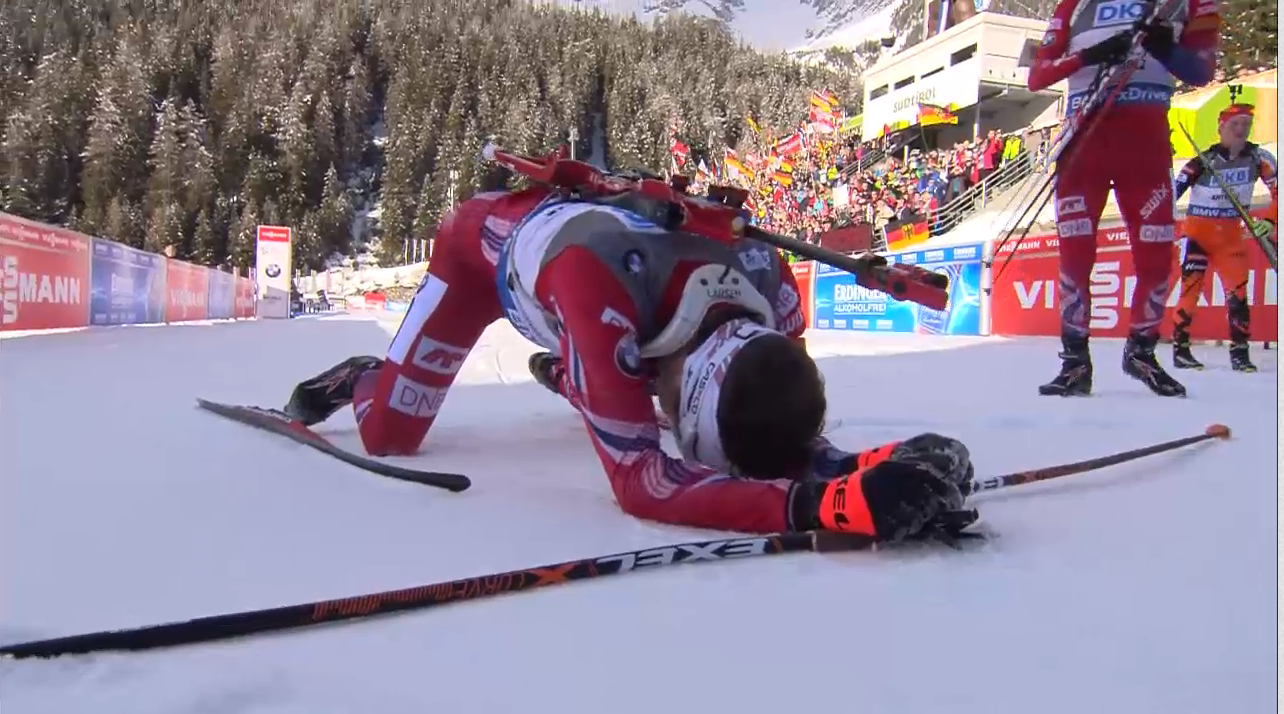
An early leader, Norway’s Ole Einar Bjørndalen exhausted at the finish of the IBU World Cup men’s 10 k sprint on Thursday in Antholz, Italy. He ended up ninth.
Fak started 48th, and with the fourth-fastest ski time and sixth-ranked range time, the Slovenian was headed for first with one shooting stage and one lap to go, but missed his final shot (his lone penalty of the day) to finish 20.1 seconds behind Schempp.
“The pressure on the trigger was not quite right and I missed by a small amount,” Fak told the IBU. “I was shooting really well in zeroing — no misses. That probably gave me too much confidence. It is better to miss a few and then you work harder to make sure you hit in the race.”
However, for Green, who started 53rd and jumped from 15th after prone to fifth after standing, it was about keeping his momentum going.
“Brendan always seems to get into race shape in skiing and shooting after Christmas, it takes him a while to gain the right pacing and shooting confidence in race intensity,” Biathlon Canada Head Coach Matthias Ahrens wrote in an email.
“We worked a little bit on his zeroing pending on what type of race related to how the pace is being pushed, i.e. individual compared to sprint, mass start, relay, etc.,” Ahrens explained. “Historically he also has quite good races in Antholz with fast ski times, maybe it is the combination of the altitude with the course profile which suits him.”
Green compared it to his training base in Canmore, Alberta, in terms of “weather, snow, and terrain,” he wrote. “I’m sure training and living at 1400 meters [4,600 feet] in Canmore would also be another factor. The fact that I have had some of my better results here, like my sprint race last year is definitely a motivator as well.”
Brendan Green after finishing a career-best fifth in the men’s 10 k sprint at the IBU World Cup in Antholz, Italy.
He also had his parents to race for and in front of, after they traveled three days from the Northwest Territories to watch him race for the weekend. They arrived in Antholz on Wednesday night.
“I think the most special part of today was having my parents in the crowd,” Green wrote. “They’ve dedicated so much time and energy towards my career and for them to see in person what I spend my winters doing and experience the World Cup atmosphere was awesome for them. It was really special to be able to share my result today with them and I think that’s what I’ll remember most from today — seeing my parents smiling and waving a flag from the grande stand during the prize ceremony.”
From the start, Green knew his skiing already felt stronger than last week. And after his first shooting stage, he realized he was on track for a top result if he stayed on the same unblemished path.
“I tried not to take any risks shooting and focus more on a steady and consistent race,” he wrote. “I think if I can race in control with a process that I know I can trust, that will be the key factor to good results for me.”
Leaving standing with 10-for-10 shooting behind him, he looked up at the big screen to see his split time: fifth. From there, the Canadian staff gave him splits on the final lap.
“I did all I could on my last lap, I knew it was tight and that the podium was close, there really wasn’t too much else going through my mind,” Green wrote.
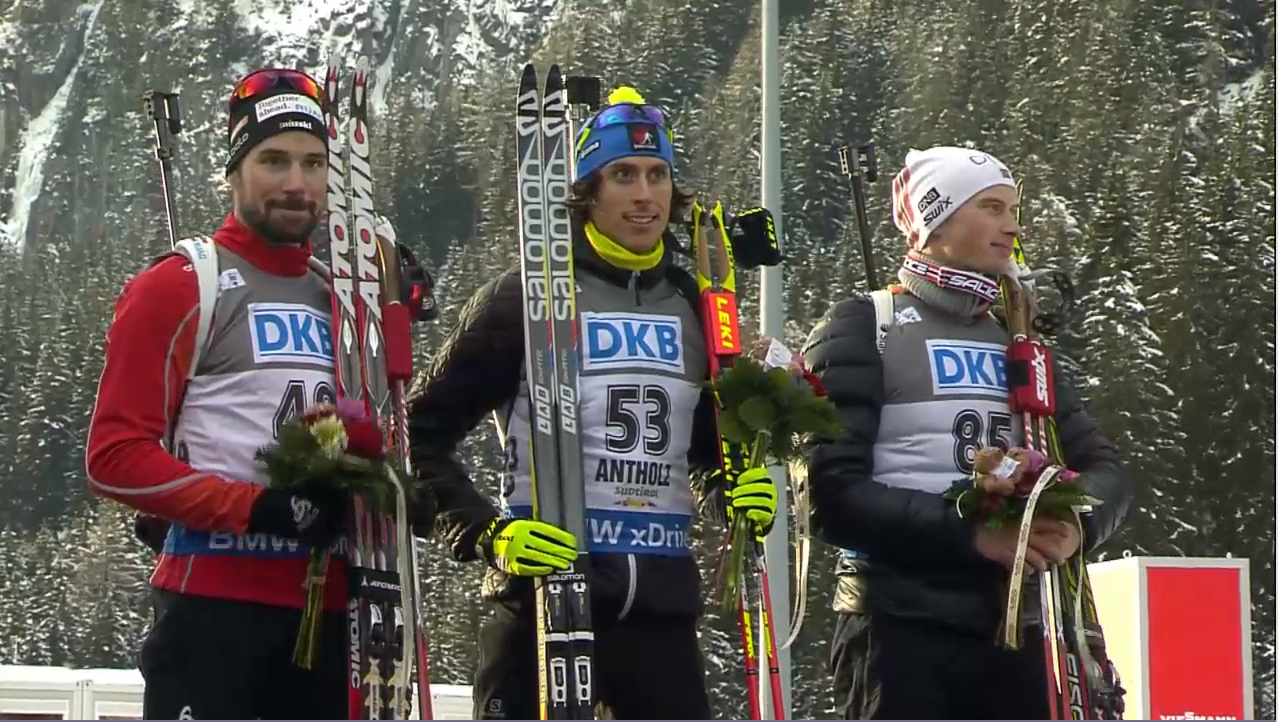
Brendan Green (c) in fifth stands between Swiss fourth-place finisher Benjamin Weger (l) and Norway’s Henrik L’Abee-Lund, who was sixth, at the 10 k sprint awards ceremony in Antholz, Italy.
When he finished, he looked up again, confirmed he had held onto fifth and turned his attention to the stands. Still standing at a time when most other racers collapse to catch their breath, he raised one arm to celebrate.
“Today was a great result for me,” he wrote. “I’m sure I’ll think about those 4 seconds to the podium eventually, but for now I’m especially happy with the race I executed and the end result.”
According to a tweet from Biathlon Canada, Green will receive “clean shooting pins” for his last several performances.
Former US Biathlon racer Sara Studebaker explained in an email that the national-team coaches used to reward her teammates for clean-shooting races with “Fika” — coffee and pastries.
“It really is pretty cool that Brendan cleaned the whole weekend! If that had been me, I probably would have celebrated with a couple glasses of wine with my team,” Studebaker wrote after his Ruhpolding performance. “But at the same time, it’s your job to shoot well … so you can’t go too crazy. It’s awesome, but also kind of like, ‘yeah, that’s what I’m SUPPOSED to do.’ ”
“ I probably would have celebrated with a couple glasses of wine. … It’s awesome, but also kind of like, ‘yeah, that’s what I’m SUPPOSED to do.’ ” — former US Biathlon member Sara Studebaker on clean shooting
Biathlon Canada High Performance Director Chris Lindsay noted that Green’s progression and shooting success has been in line with the team’s expectations.
“Brendan has consistently been a very strong shooter for a number of seasons,” Lindsay wrote in an email. “The change in the past two years following his [back] injury has been that the ski speed has improved. I think that the work that our physiologists, physiotherapists, and strength coaches did to rebuild his fundamental movement skills has been paying off and serves as a lesson for young athletes. You have to get the basic fitness correct before working on the things that will shave the final seconds off your time. It’s a similar philosophy to shooting — hit the targets first, then worry about speeding up.”
Lindsay also pointed out that Green is following a similar pattern to last season, “where December laid the foundation for the success around the Olympics,” he wrote.
But Green explained that he had hoped to start this season stronger than he did.
“It was never really the plan to follow a similar trajectory as seasons past,” he wrote. “I would say almost the opposite, this year I was really hoping to start off the season and first trimester with a bang. I’m not sure why I historically get better as the season progresses but it’s starting to seem more and more like a very difficult trend for me to change.”
Lowell Bailey (US Biathlon) racing to 32nd in the IBU World Cup 10 k sprint in Antholz, Italy. (Photo: USBA/NordicFocus)
With his first-ever appearance in the flower ceremony (top six), Green led three teammates, including Christian Gow, who qualified for Saturday’s pursuit in 52nd (+2:03.9). Scott Gow finished 74th (+2:38.5) with three penalties (2+1), and Nathan Smith ended up 78th (+2:43.3) with four misses (2+2).
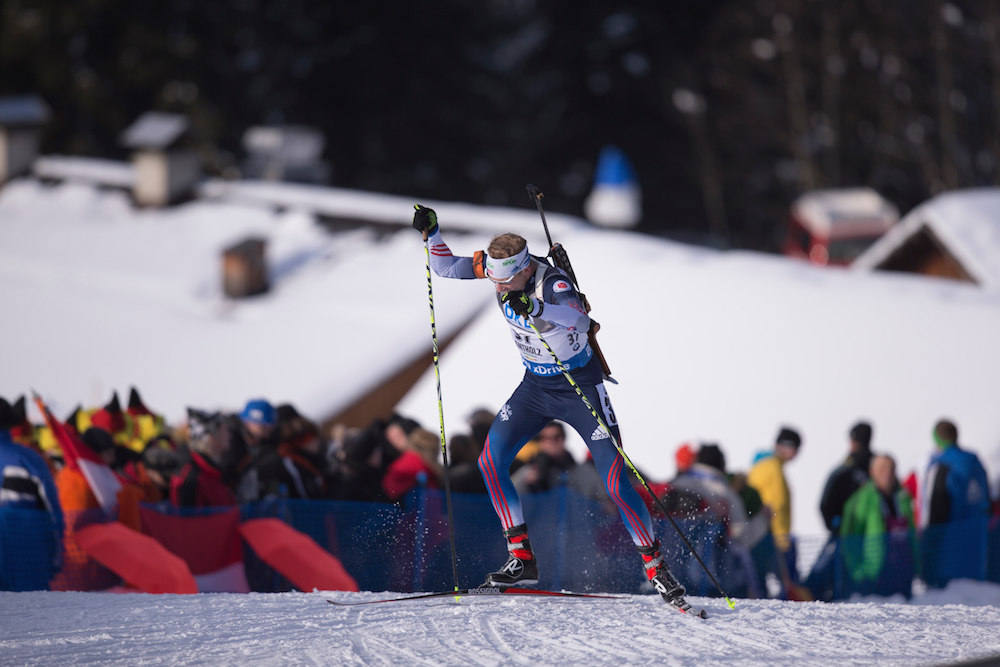
Two Americans made the top-60 cutoff for the pursuit as well, with Lowell Bailey placing 32nd (+1:31.2) with a single standing miss, and Tim Burke finishing 48th (+2:02.1) with three penalties (1+2).
Also for the U.S., Sean Doherty placed 63rd (+2:19) with three misses (1+2), and Leif Nordgren missed four for 80th (+2:49.5).
Team player: Studebaker tags off to Hannah Dreissigacker during a World Cup relay in 2013. Studebaker is channeling her energy for a new team starting this fall, when she takes over as assistant coach for the University of Alaska Anchorage. Photo: USBA/Nordic Focus.
When Sara Studebaker retired from biathlon after a successful 2013-14 season and the Sochi Olympics, she envisioned coaching in her future.
But a college team wasn’t the first job that came to mind.
“I’d always thought about college coaching and how that would be something I was interested in,” she told FasterSkier in a phone interview on Monday. “I guess that initially I assumed I’d work in biathlon. But that didn’t work out for a variety of reasons.”
Studebaker had enjoyed her time racing at Dartmouth College before she began her biathlon career, but admitted that in recent years she had been more focused on her own sport than the college scene.
“We always look up the NCAA results, but mostly it’s to see people that you knew, or how Dartmouth did,” she laughed. “College skiing is probably similar from my standpoint as biathlon is for a lot of other people, in that it’s that thing you look up once a year.”
But when she found herself taking a call from Andrew Kastning, the head coach at the University of Alaska Anchorage, things just seemed to fit. Studebaker had moved to Anchorage to be with her fiancé Zach Hall, another former national team member who coaches AK Biathlon. Suddenly, she had the opportunity to work with a group of talented young skiers – and a lot of resources to channel in doing so.
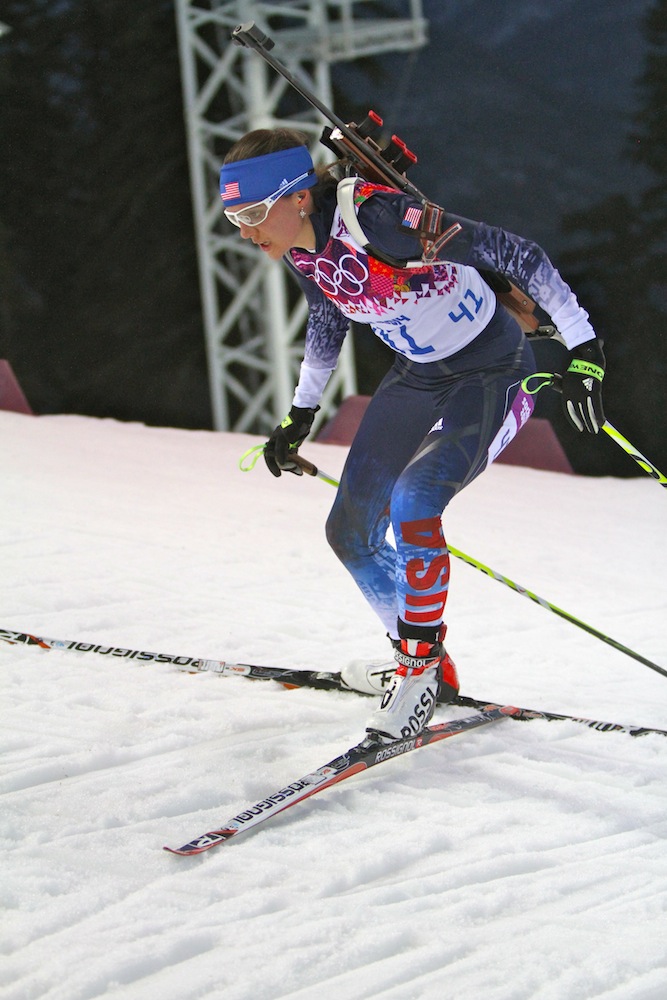
Studebaker competing at the 2014 Olympics in Sochi, Russia.
“I’m really looking forward to meeting all the athletes and getting back involved in the collegiate environment,” she said. “I had a great time skiing in college, so I’m really excited to be part of that world again.”
For Kastning, Studebaker was a natural choice for a position that was vacated by former UAA and Sun Valley standout Nicole De Yong. With four World Cup and one World Championships top-20 to her name, Studebaker knows what it takes to be successful at the elite level – but also is familiar with the college scene.
“With news that Nicole was stepping down from her role as Assistant Coach, I knew I had big shoes to fill,” Kastning wrote in an email. “I liked the idea of having a female on the staff that can address situations from different perspectives but unfortunately, female coaches are hard to come by so I began looking in all directions to fill the position. Sara was fresh in my mind from working with her in the arctic for NANA Nordic, so I knew she was retiring and moving to Alaska.”
Studebaker said that work is just officially starting so she’s still doing mostly planning and paperwork, but looks forward to her first full-time coaching gig.
“I’ve had the opportunity to work with a large number of really great coaches, from college and even before college, through my professional career,” she explained. “So I definitely hope I can bring that to the table. I think that any time you have exposure to more coaching styles, it helps you gain insight into how to reach people. Not everyone responds in the same ways to each kind of coaching. Hopefully having worked with European coaches and American coaches, collegiate and high school, will help me relate to these athletes a lot better.”
She will be able to draw on a lot of memories of her own college experience – a government major at Dartmouth, she captained her team to a win at 2007 NCAA Championships – such as how to balance being a student as well as an elite athlete.
But she marveled at the resources that UAA has to deploy for its ski team, including the brand-new Alaskan Airlines center, an athletic department building for all sports, including skiing.
Studebaker racing to 11th place in the 15 k classic at 2007 Championships, which her Dartmouth College team won.
“Just walking around there, you know, their weight room is giant and brand new, we have a new ski room, and new locker rooms just for the ski team,” she said. “This sounds silly but, you know, they have the sea wolf in the carpet in the locker room, and I was like, wow, this is big! It’s really cool. It’s a big advantage for these athletes to have this support, and to be taken so seriously… These athletes have the ability to really do some more focused training.”
As Studebaker settles in, Kastning hopes that she can impart some world-class wisdom on his athletes.
“Sara should be able to provide valuable insight into race day preparations both mentally and physically, thanks to her experiences on the World Cup and at the Olympics,” he wrote. “She seems very organized and prepared to face fluid situations with a clear head from her years as an elite biathlete, characteristics that I believe will carry over well to Seawolf Skiing. We are excited to have her and I’m confident she will strengthen our program immensely.”
Studebaker certainly hopes so.
“For me it was a very conscious decision to retire,” she said. “If I had wanted to keep going, I could have, and I would have been pre-qualified for the World Cup. I had good results last year, I had a good season. I was just ready to be done. So I think from that angle, I’m really excited to be here. Hopefully that will rub off. And hopefully my credentials will be helpful.”
Susan Dunklee climbs the hill out of the Holmenkollen stadium en route to sixth place in the 10 k pursuit today. Photo: USBA/NordicFocus.
OSLO, Norway– Both Susan Dunklee and Lowell Bailey came into today’s 10 and 12.5 k World Cup pursuits with podium finishes fresh in their minds. The two Americans each earned their first top-three finish ever in the last week.
For Bailey, a third-place finish in Kontiolahti, Finland, last weekend was followed up by a sprint race here on Thursday where he was frustrated by two penalties which negated the high level of his skiing. As he has been saying ever since the podium, he is just trying to stay focused and do what he has been doing for years.
For Dunklee, things were even fresher in her mind: her own third-place finish came in Thursday’s sprint, and she started the pursuit today in third place.
She also started off with a crash on the first loop, which knocked her back a few places and many seconds.
“I got off to a little rough start,” Dunklee said. “I was thinking about how I wanted to take that downhill, and I wanted to swing myself out wide because the snow is a little better on the outside coming out of it. I took a funky line and I was going to go off the edge, and then I got scared, and then I just fell.”
She had been holding her time gap to sprint winner Darya Domracheva of Belarus, but dropped back to sixth or seventh place after losing her momentum. She also lost several clips worth of ammunition for her rifle.
“They were laying in the snow and I thought, ‘shoot, maybe I should grab them’,” Dunklee explained. “So I picked them up, which cost me a couple seconds, which was stupid, but then I was like, well now what do I do with them? So I put them in my pants, thinking I could bring them to the range. But then they slid all the way down to my boot. It was pretty stupid.”
Lowell Bailey (right) shooting during today’s 12.5 k World Cup pursuit.
Nevertheless, the crash did accomplish one positive thing – it broke the tension of wondering if she would be able to stay in podium position.
“That whole next kilometer and the shooting, I was just laughing at myself,” Dunklee said. “The second loop I felt really relaxed. I had already messed it up a little bit, it’s not a perfect race so it takes the pressure off. I was just able to focus on doing what I needed to do after that.”
On the fourth loop, she found herself back where she started: in third place. With just a single penalty up to that point, she had been able to climb her way back. But then Dunklee missed the very last shot of the race.
“I was extremely surprised in that last shooting to be on that third mat,” she said. “And then I left the range, even after I’d had a penalty loop, and I was still in fourth with third just ahead of me. That really surprised me. I guess the people ahead of me didn’t shoot perfect.”
Even after getting passed by Domracheva and Kaisa Makarainen of Finland, Dunklee’s efforts were good enough for sixth place and the flower ceremony.
“I could certainly get used to this,” she said after the race.
Racing a few hours later, Bailey moved from 19th up to 14th place with three penalties.
“It was a solid race,” he said. “It wasn’t amazing, but I’m happy with where I’m at and looking forward to tomorrow.”
As was the entire field, both men and women, Bailey was plagued by wind on the shooting range. Just two men, pursuit winner Simon Eder of Austria and sixth-place Alexey Volkov of Russia, shot clean. Bailey had a penalty in each of the first three stages before cleaning the final standing stage.
“Both my prone stages had quite a bit of wind,” he said. “So it kind of sucked to have one each time, but I just tried to keep my head in it. And especially in standing today, I really wanted to be focused. It has been really windy the last couple of days, so I expected quite a bit of wind. It wasn’t so bad today, but I was really happy with standing because I was able to take ten quality shots. I missed one, but that’s the way it goes.”
The final stage was a good one to clean, though, as it sent him out on course with a group of other fast skiers.
“It was a really exciting race,” Bailey said. “It was really close between everyone. The last lap was a pretty fun fight between me, [Norway’s Johannes Thingnes] Bø, [Russia’s Anton] Shipulin, and Fredrik [Lindström of Sweden]. It’s fun to mix it up with those guys.”
Bailey ended up 14th and is now looking forward to the final race of the season tomorrow, a 15 k mass start. And then, home.
“For sure it’s the last World Cup,” he said. “My focus is really just trying to stay focused for three races, which gets increasingly hard as you get closer to the end. But I’m really just – I have my sights set on tomorrow, and that’s really what I’m trying to do, to stay in it.”
The third U.S. starter, Sara Studebaker, slipped from 41st to 44th with four penalties.
U.S. Biathlon staff cheer Sara Studebaker around the penalty loop at Holmenkollen. In the last World Cup sprint of her career, Studebaker placed 41st.
OSLO, Norway– While there were plenty of strong results from North American biathletes in the 7.5 and 10 k World Cup sprints here yesterday, the next biggest story was something more mundane: the horrible, atrocious ski conditions.
Weather has been warm in Oslo during the day, but cold enough at night that there is some ice. That meant that the course conditions were split between ice, slush, and crust that athletes sometimes broke through.
Women’s World Cup leader Kaisa Makarainen of Finland called it “the worst tracks all season” and Norway’s Tora Berger, who is chasing her in the total score, told NRK that it was “quite hopeless to ski in some places.” In Norway it is almost something of a scandal how the trails can be in such bad shape. It’s unclear whether or how much salt was applied to try to freeze up the snow, or whether it was done correctly.
North American athletes agreed with the international leaders, universally panning the course while admitting that it was at least a fair race.
Susan Dunklee navigating a treacherous course. She fell on one of the uphills when, in a search for firmer snow, she snagged a ski on a v-board. Photo: Fischer/NordicFocus.
“The course was shitty,” American Hannah Dreissigacker said. “But I think it was equally shitty for everyone.”
“It is not good,” Canada’s Scott Gow agreed. “Some spots are very icy and some spots are very soft, and it’s kind of rutted and bumpy… Some of the corners normally aren’t bad in good conditions, but when you’re taking the corner and you hit a sudden ice patch, it’s kind of hairy.”
“Some of the downhills are pretty scary right now, like the one down there,” teammate Nathan Smith agreed. “You almost fall every time you go around it.”
“My goal going out there today was just, like, stay on your feet and just ski,” said U.S. biathlete Sara Studebaker. “It was really hard to feel like you were racing because the conditions were just so bad.”
“It was really difficult and deep. I just tried to find the icy spots on the course and stay on the hardpacked stuff,” said American Lowell Bailey. “I really focused on trying to work the right technique for the right conditions. They were so varied. So trying to ski pretty big on the uphills when it got deep, and then trying to use the skis to glide on the harder packed V2 sections.”
American Susan Dunklee noted that it could have been worse: “It was pretty abysmal when we showed up today,” she said. “There was really thick fog so you could barely see the targets and then the course must have been six or eight inches deep of slush, all around everywhere. Over the next hour the volunteers really worked on shoveling a lot of stuff off and it got a lot better. But it still was really tough.”
In order of results, here are more comments from the rest of the American and Canadian competitors.
Women’s 7.5 k Sprint
Dunklee led the way in third place, 33 seconds behind race winner Darya Domracheva of Belarus. It was the first World Cup podium for a U.S. woman since 1994; our full story is here.
“I feel like I have been on the edge so many times in the last couple years, that I’m ready to be here,” Dunklee said. “I’m ready to try to do it again in the future. We have a couple more races this weekend and who knows what will happen, and we also have a long summer of training. Going into that with this fresh in my mind will be a very good thing, I think.”
Rosanna Crawford (left) nearly shot her way to her first top-ten finish.
Next came Rosanna Crawford of Canada, who tied for 11th in a career-best result. She wasn’t expecting to do so well, for a variety of reasons.
“I was really in a bad mindset this morning,” Crawford admitted of waking up to find the venue blanketed in thick fog. “My legs were feeling awful and I know I’m not good in these conditions. But I decided to switch and that it was going to be a battle of whoever could overcome the tough conditions and try to have a positive outlook.”
She missed a shot in prone, which immediately bumped her back. But after hearing that Dunklee had cleaned all ten targets and was sitting in third place, Crawford found even more motivation.
“I was like, pfff, if she can hit all her standing targets I can hit all my standing targets,” Crawford laughed. “This is the first season in a while where I’ve been stronger at the end of the season, that hasn’t happened in a while, so that is also motivating.”
Despite the strong results – she was also in the top 20 four times in the past two weeks – Crawford isn’t perfectly pleased with her recent performance and her racing has sparked ideas for change during the off-season.
“I’m bummed that I’m going to end my season without having hit ten for ten once,” she said. “I think that’s the first time ever in my biathlon career… This has been my worst shooting year ever, I think I’m under 80%, which is too bad. So I think the focus over the summer will be of course to get stronger, but to really figure out a good position for my new stock and make sure I’m happy with it.”
Nevertheless, Crawford has collected eight of the best ten results of her career this season, imperfect shooting or no.
“A couple years ago I would have been happy making the top 60 with nine out of ten,” she said. “Now I’m hungry for that top ten, I want to be there, and I want to be there often.”
Teammate Zina Kocher followed in 16th place with two penalties, also continuing a string of good post-Olympic results.
Studebaker of the placed 41st with a single penalty. The Idaho native is retiring at the end of the weekend, and was happy to have a good result and make the pursuit competition in her last weekend of racing.
“I would have said beforehand that I would do great now because I’m not focused on it and not worried about it,” Studebaker said. “But honestly I think I have been more nervous. I am trying not to think about it, but it’s like, ‘this could be my last race, make it good!’ To do everything the same way because it’s working, so just make it happen. But that’s been tough for sure… This trimester has been going pretty well for me, and I wanted to go out in the last race with a bang.”
She finished in a particularly packed part of the field, and was happy with how she was able to ski on her final loop.
“When I was out there I was getting good splits that I was in the high 30’s, but that ten seconds would have been 50th,” she said. “You gotta push and it’s crazy when it’s that close. I wasn’t totally able to hold onto the points… I was happy with how things went.”
Canada’s Megan Heinicke, racing with a rib injury, placed 59th with three penalties and actually fainted at the finish line.
Dreissigacker collected five penalties, two in prone and three in standing, and placed 75th to miss the cutoff for Saturday’s pursuit competition. Her race started off well, thanks to Dunklee.
“I was about to start as she was coming into the finish, and I was so distracted, like, I just want to watch!” Dreissigacker said. “Right as I was leaving I heard her going into third place, and I was psyched. During my race I heard them interview her on the loudspeaker, which was pretty cool.”
But things on the range were difficult
“I was really hoping that I could have a good one too,” she lamented. “I don’t know, I just hate shooting sometimes – there’s just no reason I should shoot that badly. Practice yesterday was so good. I missed like one shot the whole day. It was feeling so good, and I just don’t get it.”
Men’s 10 k Sprint
Bailey led the way for the North American men, finishing 18th. After hitting the podium for the first time in his career last week, he knew what would have been possible if he had shot better than his two penalties.
U.S. biathlete Lowell Bailey on the shooting range.
“My skiing was good today,” he said. “I was skiing top of the field. So I just let two go. But I think it will be hopefully a decent result. I think I was about a minute off with two penalties, so it could have been another good day if I had put it together on the range.”
Bailey said that despite his own podium last week and having watched Dunklee’s performance before his own race, he tried not to let expectations creep into his head.
“I just tried to keep my head in the game and really focus on what I could control today,” he explained. “I worked on being aggressive on the range this week leading into this. I’m not disappointed, I hoped for better, but that’s biathlon, some days are better than others.”
All three Canadian men qualified for the 60-man pursuit to be held on Saturday. They were led by Gow, who placed 35th with clean shooting.
“That felt awesome!” a radiant Gow said at the finish. “I think it’s actually my first clean sprint race of the year, so it could not have come at a better time I don’t think.”
Next came Brendan Green, who placed 47th with two penalties. He was followed by Nathan Smith in 50th place, also with two penalties.
“I didn’t feel that great skiing really,” Smith said. “I wasn’t able to keep up to most guys. I just felt a bit tired… Shooting eight, you need to get more than that to get your best result.”
United States teammates Tim Burke, Leif Nordgren, and Sean Doherty all struggled with shooting, missing four shots apiece. Burke narrowly missed making the pursuit, finishing 64th. Nordgren placed 78th and Doherty, who is coming off a World Junior Championships where he won two gold and one silver medal, finished 83rd.
“Ouch! Fitting ending for a less than spectacular season…” Nordgren tweeted after the competition.
Susan Dunklee (US Biathlon) racing to the second-best sprint result of her career, and this season, in the women’s 7.5 k sprint on Saturday in Kontiolahti, Finland. (Photo: USBA/Nordic Focus)
The women’s 7.5-kilometer biathlon World Cup sprint on Saturday in Kontiolahti, Finland, proved once again that the North American biathletes are able to blend themselves in with the better-known Europeans.
Unlike Thursday’s sprint race, today’s mattered more in that the results determined who would participate in Sunday’s pursuit — something that has been difficult in recent years for North Americans. In the words of U.S.’s Hannah Dreissigacker, “Mostly I’m just really happy to have finally broken my ‘pursuit curse’ and qualified for my first World Cup pursuit!!”
Her teammate, Susan Dunklee, who had a single standing miss to finish eighth, 35.7 seconds behind winner Kaisa Mäkäräinen of Finland, led the North American women on Saturday. In an email, Dunklee explained that before she headed out to warm up, she stopped by the stadium for some inspiration at the men’s flower ceremony.
“It was awesome to see Lowell on the podium,” she said of her teammate, who achieved his first World Cup podium in third in the preceding men’s sprint. “He has worked so hard for so long and it finally paid off.”
Dunklee went on to notch her second-best sprint result of the season, and her career.
Mäkäräinen went on to win her second-straight sprint in Kontiolahti in 20:53.6. Despite one prone penalty, the Finn beat Norwegian runner-up Tora Berger by 6.2 seconds. Gabriela Soukalova of the Czech Republic finished 6.7 seconds after Berger in third. Both Berger and Soukalova cleaned.
According to an IBU press release, Mäkäräinen, who hails from nearby Joensuu, is Kontiolahti’s hometown hero. Both she and the men’s sprint winner, Johannes Thingnes Bø of Norway, won both sprints there in the last three days.
With one penalty, Mäkäräinen was 17.3 seconds slower than she was in Thursday’s race on the same course.
Saturday’s conditions were not the easiest. According to Dunklee, the course’s soft-and-sugary snow required extra energy to “fully accelerate over the tops of hills and around the corners,” which she explained she did not have.
However, shooting went much better for Dunklee. In standing, she focused on “painting” (holding on the target) for a little longer before pulling the trigger. “With three U.S. women qualified for tomorrow’s pursuit, it will certainly be an exciting race, and we all believe we can move up,” she said, referring to Dreissigacker, who placed 41st (0+2) 1:51.4 back from Mäkäräinen, and Sara Studebaker in 58th (1+1), 2:30.3 behind.
“I’m really psyched for tomorrow’s race,” Dreissigacker wrote. “My goal is to go out there and relax and have fun and move up into the points.”
In bib 63 of nearly 90 finishers, Dreissigacker found it helpful that she was able to ski with people for most of Saturday’s sprint. Although she missed her first two standing shots, and panicked for a moment about needing to hit the rest of them — which she admits is not the right thing to think — she did manage to pull herself together and hit them, despite her legs “starting to shake.”
As for the Canadians, Rosanna Crawford led the team in 16th. She missed one standing and clocked in 54 seconds back from Mäkäräinen.
“It was another tough race today!” Crawford wrote.
She found the course “pretty tough” and made even harder because the organizers trucked in a bunch of snow from a “saved” pile.
She had a positive experience on the shooting range, which she described as “calm,” and was able to hit all of her prone targets, which she explained hadn’t happened in a while.
“I’m still searching for that top 10! Tomorrow will be a tight pursuit and good shooting will be key.”
Despite three misses (2+1), Canada’s Zina Kocher made the pursuit in 54th (+2:16), as did her teammate Megan Heinicke in 60th, who missed one shot on both stages to finish 2:32.7 behind the winner.
American Annelies Cook missed the top 60 in 76th (1+3).
Canada’s Zina Kocher in the Olympic 7.5 k sprint. In today’s 10 k World Cup pursuit, she placed 13th.
Two days ago, when three Canadian women including newcomer Emma Lunder placed in the top 30 in a World Cup sprint, the team talked about how positive their atmosphere was and how much they could accomplish.
Fast forward to today, and teammates Rosanna Crawford and Zina Kocher were sprinting down the finishing lanes of the 10 k World Cup pursuit competition in a fight for 13th place. Just how huge was it? Neither has had a better finish so far this season, and Crawford has only done better once in her entire career.
“As I left the range there wasn’t anyone to close to me, but then Zina passed me on one of the up hills and I was like okay, time to giver!” Crawford wrote in an e-mail.
She had started the day in bib 17 and immediately missed three shots in the first prone stage, which dropped her back to 33rd place. But Crawford only missed one more shot over the last three stages and gradually climbed into the top 15.
“Things started out really bad with three misses in my first prone,” Crawford wrote. “I over-corrected for the wind, so all me! I got a correction out on my second loop to come back what I had corrected in my first shooting. The first miss of the second bout was also me being a bit trigger happy! I find when I have bad first shooting or two the pressure is off a bit and it’s easier to hit the next 10-15 targets.”
She skied an aggressive last loop, notching the 10th-fastest closing time. But when Kocher, consistently one of the fastest skiers on the circuit, passed her, Crawford knew she would have to take it to a whole new level to hang on.
Kocher had started in bib 23 and collected four penalties of her own over the course of the race. That was thanks in part to the Pokljuka wind, which has tripped up competitor after competitor over the course of two days of racing.
“Tricky day out there for sure,” Kocher wrote in an e-mail. “My first prone the wind was quite strong, I made a correction but it wasn’t quite enough as I missed my first two shots. I stopped and reevaluate and made another correction, hitting the next three. The next prone I had to change the correction again and just focused 1 shot at a time. Standing, I just made sure to come in controlled, and take it one shot at a time.”
By the time she left the range the last time, she was in 18th place and on the warpath.
“This is a hard 2km course, especially in the heat that we had today, and I didn’t want to burn out before the final lap,” Kocher explained. “I think when it comes down to a final lap I’m pretty mentally strong. I can motivate myself to find every last bit and honestly, I love that challenge. It’s exciting to look ahead and try to see if you can catch the next place.”
Eventually, that next place was Crawford.
Sara Studebaker (USA) in today’s 10 k pursuit competition in Pokljuka, Slovenia. Photo: USBA/NordicFocus.
“I tried my best to stick with her on the up hills and then when we were almost at the finish I saw the Ukraine girl [Natalya Burdyga, who ended up 15th],” Crawford wrote. “To be honest I wasn’t thinking about catching Zina, only catching the Ukrainian girl! Zina is so strong on the last loop, I knew if I could keep her in sight then maybe the French girl behind me wouldn’t catch me.”
Kocher outsprinted her in the end, claiming 13th while Crawford settled for 14th, just over two minutes and 45 seconds behind Kaisa Makarainen of Finland, who claimed the win. It was a meaningful way to end a good race.
“It was really fun with Rosanna there, it was truly motivating for both of us, she knows me well and when I passed her she challenged herself to not give up,” Kocher wrote.
In the second World Cup race of her career, Emma Lunder racked up two penalties in each prone stage but then cleaned both standing stages, and skied into 41st place, just outside the World Cup points. Teammate Megan Heinicke dropped from 43rd to 45th with seven penalties.
Dunklee, Studebaker Represent for U.S.
After being stymied by a rifle problem in the sprint, Susan Dunklee skied aggressively and moved from 38th up to 20th to become the top U.S. woman in the pursuit. Despite five penalties, she had the fourth-fastest ski time and rocketed through the field.
“Every loop I had good pack of people just ahead that I could chase down,” Dunklee wrote in an e-mail. “I was surprised to move up so many places. My shooting was far from great today, I couldn’t find my normal flow in standing, but it was nice to have all my equipment working correctly. I never did find the missing part to my rifle so we scavenged some other similar pieces instead and had to adjust the sight position a little to make it work.”
The other U.S. qualifier, Sara Studebaker, had three penalties and finished 36th, scoring World Cup points for the second straight competition.
“I am definitely happy to have some solid results here after feeling like I missed a couple opportunities at the Olympics,” Studebaker wrote in an e-mail. “I’m definitely happy with my results the last couple days. It’s nice to grab a couple World Cup points here!”
Both Dunklee and Studebaker noted the snow conditions, which became slower and sloppier over the course of the women’s race and added to the difficulties presented by the wind.
“The snow transformed about three loops into the race, making for some slow skiing but it seems like all the athletes were struggling,” Dunklee wrote.
“Conditions today were tough, though,” Studebaker agreed. “The skis slowed way down in the third loop and just got worse as conditions kept warming up. Luckily, it was pretty much the same for all the teams, but it made for a tough last couple laps.”
Dunklee is looking to carry on her momentum from the Olympics, where she had a collection of the best results ever by a U.S. woman. And Studebaker is, too – she wants to finish the season strong and this weekend has been a good step in the right direction.
“I haven’t felt quite as good on skis these last couple days as I did in Sochi,” Studbaker wrote. “It’s a little frustrating not to be able to find that speed, but also indicative that I probably hit my peak perfectly! I think there’s still some gas left in the tank for another couple weekends, though, so I’m looking forward to that.”
There were of course highlights: Sara Studebaker shot a strong competition, missing only a single shot to lead the team in 35th. It was the best World Cup result of the season so far for the team’s most veteran athlete.
“Today was definitely a tough day on the range,” Studebaker said in a U.S. Biathlon Association press release. “Some people got lucky with the wind, and some people had super windy conditions while they were shooting. I definitely was lucky, but I’ve also been really working on my shooting since Sochi did not go as I had hoped on the range. I was really happy to have a solid race today and score some World Cup points! It was a good race for me to have right now and I’m looking forward to improving in the Pursuit.”
But Annelies Cook missed five shots total for 79th place, and Hannah Dreissigacker collected eight penalties for 83rd. Neither will compete in Saturday’s pursuit race.
Susan Dunklee, meanwhile, had a good thing going after she cleaned all five prone targets and was skiing easily within the top ten. But when she came onto the range for standing, she realized that the back end of her rifle’s sight had somehow fallen off while she was skiing – “one of the more frustrating situations I have encountered as an athlete,” Dunklee wrote in an e-mail to FasterSkier.
Waving her arms to range officials in an attempt to receive a spare part (she didn’t), Dunklee attracted the attention of commentators and was featured both in the broadcast and even in online news in biathlon-hungry countries.
As Dunklee explained it, Studebaker noticed the piece on top of one of the hills, so it must have come off of her rifle there.
“It occasionally comes loose on my rifle and the piece starts to unscrew a little, but to have it come off entirely… I never expected that,” Dunklee wrote. “I had just checked it yesterday too.”
She was left trying to shoot more or less without a sight.
“Rather than peering through a pin sized peep hole, I was looking through more of a centimeter sized hole,” Dunklee wrote. “I could still see through to the front sight but without the eyepiece I had very little chance of lining it up correctly to hit anything.”
She missed four of her five targets – and actually that one hit was impressive. Despite the penalty loops, Dunklee had the fifth-fastest course time of the day and finished 38th, living to fight another day in the pursuit.
In cases of rifle malfunctions, she explained, athletes have a few options. One is to receive help from a range official. For instance if a magazine falls out of the rifle in a crash, athletes can raise an arm and ask for ammunition to be brought to them.
If the rifle breaks, all teams actually have one spare rifle that they keep on the range. Atheltes can ask to use it by, again, raising an arm and making the request to a range official.
“It is difficult to make snap decisions weighing how much time you might lose trying communicate and waiting for the necessary aid against the probability of hitting targets and the time you might spend in the penalty loop,” Dunklee explained. “Unfortunately I totally forgot about the spare rifle as option until I was done shooting. associated the spare only with broken stocks and snow-jammed sights and I didn’t make the obvious logical conclusion that it might be a good option in a case like this too.”
The women’s pursuit will start at 1:25 pm. local time on Saturday, or 7:25 a.m. EST.
Annelies Cook anchoring the U.S. to an unprecedented seventh in the women’s biathlon 4 x 6 k relay at the Olympics on Friday in Krasnaya Polyana, Russia.
FasterSkier’s coverage is made possible through the generous support of Swix.
KRASNAYA POLYANA, Russia — If you were looking for the women’s US Biathlon Olympic team between training and racing over the last two weeks, your best bet was to follow the music.
Led by Annelies Cook and Hannah Dreissigacker, the women’s team took the Pharrell Williams song “Happy” with them throughout their adventures at the 2014 Winter Games — playing it in unique picturesque scenarios around the Endurance Village, Laura Cross-Country Ski & Biathlon Center, and even at some of the security checkpoints.
The idea was to dance to the upbeat music, get others to join in, film it, and make friends in the process. While the teammates collaborated in the past, they planned to publish it before the end of the Olympics.
“I think the coolest thing was going up to people, random people like volunteers and asking them to dance for us,” Cook said after Friday’s relay. “[And] how excited people were. Once you did that then people would talk to you, so I got to meet a lot of volunteers and hear their stories. Just asking different athletes to dance for us and breaking down those barriers was really special.”
Aiming to publish the dance video before the women’s 4 x 6-kilometer relay on Friday night, the U.S. team successfully went into the race with that mission accomplished (although it was temporarily made private to comply with Olympic rules). Now they could focus on their last race of the Olympics.
Annelies Cook anchoring the U.S. to an unprecedented seventh in the women’s biathlon 4 x 6 k relay at the Olympics on Friday.
The ultimate goal, however, remained consistent with their running theme: have fun.
“I felt so relaxed and I just came out and was like, I don’t even care how we do, I’m just so happy to race,” Cook said. “I mean, you do care, but there’s days when you’re out there and you’re just so nervous.”
Fortunately for Cook, the team’s anchor, Sara Studebaker cleaned both her prone and standing stages to rocket to fifth, 1:12.9 behind the leader and 43.7 seconds out of third. She continued the momentum after teammate Susan Dunklee posted the fastest first-leg time to put them in fourth, with three spare rounds. Second-leg Hannah Dreissigacker used six spare rounds and tagged Studebaker in sixth.
“I felt really confident in how the girls were gonna do, and when they tagged off to me in sixth I was like, Yeah this is where we should be. We’ll let’s just see what happens,” Cook recalled.
The U.S. women’s previous best was eighth in two World Cup relays this season, with the first one coming in early December in Hochfilzen, Austria
Heading out of the tag zone just a second ahead of the Czech Republic’s Jutka Landova, Cook clocked the fourth-fastest course time on her first of three laps.
“It was nice because … I could just sit with her and I felt really relaxed,” Cook said.
Feeling good on her first and second laps, Cook used two spare rounds on both her prone and standing stages, which kept her out of the penalty loop, but cost her some time on the range. She headed out on her second of three 2 k loops in sixth place, then seventh by the next time around.
Trailing Italy’s Karin Oberhofer on the final loop, Cook tried to catch her. There, she recalled: “My body filled with lactic acid like crazy. It was all I could do to stand up.”
Cook held her position to finish seventh for the best U.S. women’s Olympic relay result, surpassing the eighth-place mark set by Beth Coats, Joan Smith, Laura Tavares, and Joan Guetschow at the 1994 Olympics.
With a team total of 13 spare rounds (one fewer than the Czech Republic) and zero penalties, the Americans came in 2:11.7 behind the Ukrainian winners (who won in 1:10.02.5) and 30.7 seconds after Italy in sixth.
“I felt like sixth was so close,” Cook said. “It was right there, but I had two many extra rounds, but you could take those extra rounds in any other leg.”
“I think it was a very big opportunity to do something very, very special and we missed out on the shooting part to do so,” US Biathlon (USBA) High Performance Director Bernd Eisenbichler said. “They gave everything they had so that’s great to see, but the shooting held us back from an absolutely sensational result today.”
Closest to the podium after the first leg, in which Dunklee handed off six seconds out of third, Dreissigacker lost two places using three spare rounds on both of her stages. Studebaker bumped them up to fifth, passing Switzerland’s Aita Gasparin and Landova on her last loop.
“I’ve had some really good results in relays; I really like relays so it was great,” Studebaker said.
In her first race a week after she placed 55th in the 15 k individual last Friday, the 29 year old had her best race of the season and said she felt especially rested and relaxed coming into the relay. Studebaker’s third-loop course time was the second fastest of her leg.
“That was hard, but it was awesome,” Studebaker said of her last loop, in which she attacked up the first long climb out of the stadium. “It’s just a 2 k, your chances of blowing up are pretty small and I can usually pull out a really great last lap, that’s kind of my specialty. I just went for it.
“I was a little worried on the downhill that I might have some lactic-acid legs and fall or something but it worked out great,” she added with a laugh. “It was a good feeling, too, for sure to see that in myself.”
Dreissigacker wished she could take back a couple of the spare rounds, but so did some of her other teammates.
“Once you get to that third spare round, you don’t even care that you had to shoot it — you just care that you hit it,” Dreissigacker said. “I was just really happy I didn’t have a penalty loop today.”
None of the Americans did, and with a fewer spares, Eisenbichler was confident the could’ve placed even higher than their previous World Cup best of eighth.
“If you look at the time back, we are with absolutely awesome shooting we are 1:30 back from the medal, with, you know, nine extra rounds,” he said. “So it was a possibility for sure, that’s a very, very high goal. But I think top five for us was absolutely possible and that’s still for us a sensational result.”
“Everything is in our hands, everything was there,” U.S. women’s coach Jonne Kähkönen said. “The material was really good today, and it was just those extra rounds that we kept having. … This is just another good confirmation of what I’ve been staying throughout the season. When they started bringing results as a team, this is what you have to believe in. You have to be open for a good result and not just hope that you will get one. It’s reality, for sure.”
Dunklee, for one, wanted to win her scramble leg. Derailed slightly by two spare rounds in prone and another in standing, she relied on fast skiing to stay within 13 seconds of Italy’s Dorothea Wierer in the lead.
At the end of the day, she said the team was upbeat and in what could be the final Olympic race for at least one of its members. Studebaker said this will most definitely be her last Games, and she’s unsure whether she’ll continue to race next season. Cook said she’ll have to reevaluate in a couple years.
Dreissigacker, who had a career best by more than 30 places in the 15 k Olympic individual, emphasized the importance of keeping it light.
“I think for all of us it was like, this is the last one so just have fun,” she said, showing off the American flag painted on the side of her face. “For us, it was leave it all out there, have fun doing it, enjoy being here.”
“There’s definitely some stress here at the Olympics, especially early in the week I felt it, but it’s been [nice] to unwind a little bit as we get into the rhythm of things and be able to enjoy it as we go,” Dunklee said.
As for their video: that’s been keeping Dreissigacker, the editor, occupied since they arrived the first week of February.
“It was … really fun getting athletes from other countries involved, and making some new friends that way,” she explained. “So far we’ve gotten lots of good feedback. I’ve gotten both ABC and NBC asking for permission to post it. So thats awesome!”
— Nat Herz and Chelsea Little contributed reporting
Sara Studebaker, a 2010 Olympian, placed 44th in the Olympic sprint, her best result of the season: “it couldn’t happen at a better time.”
FasterSkier’s coverage is made possible through the generous support of Rudy Project.
SOCHI, Russia – At the end of Sunday’s 7.5 k biathlon sprint, three Americans could say they became Olympians for the very first time.
“In some ways, every race is the same and the goals are the same,” said Annelies Cook, who finished 53rd. “But I was definitely out there like, okay, if I finish this…. getting kind of teary-eyed. This is something that I’ve wanted for a really long time. I’m 29 and I’ve tried a few times before, and I haven’t been able to do it. So actually getting there, it’s a huge feeling for me.”
Susan Dunklee led the team with a 14th-place finish, the best ever in a sprint by a U.S. woman. It helped the close-knit U.S. women’s team start the Games off on a good note.
“It’s great and I think our team is great, we had such a great atmosphere going into these games,” 2010 Olympian Sara Studebaker said. “Susan had great results in Antholz. For me to be able to start, she was in fourth place when I started, and it was just like, this is great! Yeah! Go Team USA!”
It was a more-than-solid rookie performance that highlighted how well the team handled their first Olympic appearances. U.S. Biathlon President Max Cobb said he was “actually thrilled” with how Dunklee, Cook, and fellow newbie Hannah Dreissigacker handled themselves on Sunday.
Annelies Cook on the move.
“Obviously, it’s something you can’t replicate in training, to be at the Olympics and in your first competition,” Cobb said. “So I think it was great. I mean, I couldn’t be prouder of Susan’s performance. It is the best sprint performance ever in the Olympics for our women. So that’s fantastic.”
On The Range
Studebaker was the next U.S. finisher in 44th place with a single penalty. Cook had two penalties and Hannah Dreissigacker, who finished 65th, racked up four. But neither of the rookies felt that their shooting errors were due to the added pressure of the Games.
“It’s too bad I missed two, it’s such a tight field, you can’t make any mistakes,” Cook said. “But I’m happy that it wasn’t worse than that.”
For Dreissigacker’s part, she had been feeling good on the range all week and just wasn’t quite sure what happened. She missed a single shot in prone, after which she was ranked 53rd, but then three in standing which dropped her out of contention for the pursuit.
“My first shot was a little out of it, I wasn’t quite settled enough,” Dreissigacker said. “Sometimes I think when that happens it’s hard to get back in the rhythm. For me shooting is all about rhythm. “It probably didn’t help that I came in right with Dorothea Wierer, who is one of the fastest shooters on the World Cup. And I can usually shoot pretty fast too, but I think that I kind of let that rush me a little bit.
“I really thought I’d hit the last one actually,” she lamented. “And then it was like, are you kidding me?”
Studebaker was happy with her race – it was her best result all season – but had a similar reaction to her single missed shot in prone.
“It’s so funny – I always hit my prone shots!” she laughed. “And I’ve been missing them in the last few races. I missed one and it was, like, come on! It would be interesting to talk with the coaches and see what happened. But I’ll take it.”
Olympic Debuts
Rather than the external pressure, Dreissigacker said that the one way the Olympic atmosphere might have affected her performance was just her internal emotional state. With so many people cheering back home, she wanted badly to be able to turn in a good race.
Hannah Dreissigacker.
“Honestly, I was way more nervous for trials,” Dreissigacker said. “I’ve had so many trials this year, to get here, and I was way more nervous for those races. Today it was a more positive excitement. I was definitely nervous, but it wasn’t like, oh my God I have to do well. It was that I want to do well. Sometimes if it’s too personal, it’s a problem.”
Studebaker remembers how she felt at the Vancouver Olympics: a little doe-eyed, soaking everything in. This time around, she said, she was going for high performance since she already had her Games experience.
But she understood exactly what her teammates were going through.
“I don’t think anyone has been super nervous, but it’s different,” Studebaker said. “You’re at the Olympics! Your body knows that and in the back of your mind somewhere, you’re like, oh my gosh, it’s the Olympics! And even if you know that and you tell yourself that it’s just the same, it’s a big deal. For Hannah, she hasn’t been doing biathlon for that long, to be that close to making the pursuit, it’s great.”
For Dunklee, the key to leaving the hype behind was to make the race routine, just like any other competition she does all season.
“Once I got out here and started warming up, it was just normal race routine,” Dunklee said. “Everything felt normal that way, which was what I wanted. Just because it’s the Olympics you don’t want it to be super different.”
Cook said she had given it everything she had – the Olympic courses are notoriously hard, draped on the side of a mountain along with the cross country trails – and was left with absolutely nothing in the tank.
“It was hard!” Cook exclaimed. “It was good, I was nervous and I’m just so relieved that I finished. There’s this thing like okay, I just at least want to be an Olympian because I actually raced an Olympic race. So I’m really glad that I did that. It’s a hard course. It takes everything out of you and you have to put everything into it.”
Like Cook, Dunklee just missed out on qualifying for the Vancouver Games, which hit her hard. Here in Sochi, she’s making the most of the fact that she was an automatic qualifier this time around, and that she’s come very far in the sport in the last four years.
“It’s a long-term journey, and it hasn’t really hit me in some ways yet,” Dunklee said of finally being able to call herself an Olympian. “It’s something I’ve dreamed about since I was a kid. I always believed I was capable of it because of my role model, my dad [two-time Olympian Stan Dunklee]. They’re here, and they’re watching. I know they were out there.”
One Big Team
All the support from home is just one part of the picture for the U.S. biathletes. They have also been living next door to the U.S. cross country ski team in Sochi, a rare treat for a squad that spends the entire winter on the road, isolated from their North American friends.
That carries special weight for these four women, who were all ski racers in college: Dunklee, Dreissigcaker, and Studebaker and Dartmouth, and Cook at Utah. They spent years racing against many of the skiers who are now representing the U.S. in Sochi as well.
“It’s been awesome to be in the same place as the cross country skiers,” Dreissigacker said. “Yesterday during practice, I got to ski – the course is parallel for a while, so I got to cheer for them on their hill while I was doing my training. That was awesome.”
Being right here, facing the same hills on the course, made the U.S. skiers’ impressive first day of racing all the more meaningful for the biathletes, who didn’t get their start until the next day.
“I think that both Liz [Stephen] and Jessie [Diggins]’s finish yesterday was absolutely fantastic,” Dunklee said. “They were quite a ways back in the pack and they just fought like heck all the way up that hill, and it was very inspiring to see that.”
The two teams have also been watching the Olympic races together from their chalets in the Endurance Village.
“The cross country group came over and we watched the men’s biathlon race, and we have to explain, oh, this is this person, and this is what that means,” Cook said. “And I think the other girls watched the 30 k with them today and they were really psyched. It’s just nice to be around them because they are great people.”
Irina Starykh (RUS) on her way to a World Cup podium earlier this season in Hochfilzen, Austria.
Yesterday afternoon, the International Biathlon Union (IBU) issued provisional sanctions to three athletes who had “A” samples which tested positive for a prohibited substance. The federation did not release much more information, stating that the athletes were from Russia and Lithuania but declining to name them or specify which banned substance had been detected.
The news came on the heels of other positive tests: last week, 12 Russian athletes in seven different summer sports failed doping tests. And just this week, Alexandra Gulyaev, a junior national champion in the 1,500 meter run on the track, also failed a test.
Today, more details came to light as the Russian news site R-Sport alleged that two of the three athletes were Russian, and that they were Ekaterina Iourieva and Irina Starykh. The IBU has not confirmed the athletes’ identities and stated that it will not do so until after the “B” samples have been tested, which should be in roughly a week.
Iourieva, a World Champion in 2008 has already served a doping ban after testing positive for recombinant erythropoietin (EPO) in 2009. While not naming names, IBU Vice President Ivor Lehotan did confirm to R-Sport that it was the second offense for one of the athletes involved.
Starykh has never had a positive test. She is currently Russia’s top female athlete in the World Cup total score, sitting in sixth position. Starykh won the Continental Championships sprint last season, and received a single World Cup weekend of starts after that. This season, she has shot into the spotlight, starting every World Cup race and earning two podiums. Only once did she finish outside the top 30.
While Starykh was named to Russia’s Olympic squad, Iourieva was left off of it.
Both women are trained by Vladimir Korolkevich. Russia has an unusual setup for its women’s team: it is split into two groups, the second of which is trained by Wolfgang Pichler, a German who made his name as the head coach of the Swedish team. If the names leaked by Championat are correct, then none of Pichler’s athletes are implicated. When he took the position in Russia, he issued strong statements against doping and swore not to tolerate it on his squad.
Just one week ago, Korolkevich, who previously coached the USSR, Slovenian, and Ukrainian teams before returning to Russia and initially working with Iourieva as she returned from her ban, was promoted to head coach. That meant that he would supervise Pichler, limiting the German’s influence over his own squad.
Although the Russian Biathlon Union (RBU) held an emergency meeting of their anti-doping committee today, there is no news of whether Korolkevich will retain his position.
Instead, the RBU responded to outrage over the positive tests by condemning the invasion of athletes’ privacy.
“The Russian Biathlon Union urges the media and fans to respect the rights of athletes and to respect international regulations of anti-doping organizations,” the committee said in a statement posted to their website. “… neither the national federation, nor any other organization… has the right to disclose information or comment on the details, give the names of athletes, or especially to adjudicate. Moreover, until the publication of official information no one has the right to call an athlete guilty of doping.”
The executive director of the Russian anti-doping agency, Nikita Kamaev, took no responsibility for the situation in comments to the Russian website Championat.
“At the end of the training cycle for the biathlon team, all of the athletes were clean,” he said.
Meanwhile, some Russians are alleging a conspiracy to smear the host nation of the upcoming Olympic Games. Among them are Sergei Tchepikov, who competed in an astounding six Olympic Games ranging from 1988 to 2006, and won two individual and four relay medals in biathlon.
“It’s strange that the results of samples that were taken in December were just announced now, just before the Olympics,” he told “Soviet Sport”. “Apparently, this was done in order to destabilize our team.”
While he could not spill any details, IBU President Anders Besseberg was quite forthcoming in an interview with Norwegian newspaper VG.
“It is no coincidence that they were tested,” he said. “In this case, we had been aware of these athletes for a long time. This is what it takes… it would be unfortunate if cheaters compete in Sochi. I am very pleased to weed them out of the system before the Olympics.”
Athlete Reactions
Other World Cup and Olympic-bound biathletes were quick to condemn the positive tests, taking to twitter and facebook, and in some cases the media.
Emil Hegle Svendsen of Norway told VG that he had been tested seven times in two weeks.
“It’s perhaps a bit much,” he said. “But I would rather that WADA test too much rather than too little.”
Canada’s Rosanna Crawford echoed his observation.
“I know how much our team is tested and I can only hope that every other nation is tested just as much,” she told FasterSkier.
Others simply vented their frustration.
“Iourieva again!” Canadian coach Roddy Ward tweeted. “… Nice clean up job Russia (not!)”
“I’m disappointed to hear about more positive doping tests in biathlon. But at least the cheaters are getting caught! #cleanitup” tweeted U.S. star Tim Burke.
The North American women’s teams, who had spent the winter competing against Iourieva and Starykh, also offered up their thoughts. In some ways, they said that a positive test wasn’t a complete shock.
“The epic revelations of doping in the cycling world during the past couple years have been eye opening for all endurance sports,” U.S. biathlete Susan Dunklee wrote in an e-mail to FasterSkier. “It has made me wonder, just how clean are biathlon and xc skiing? I fully support the efforts of WADA, USADA and other such agencies. It is very disappointing to know that they do not have a fool-proof system yet, but I feel confident that their continuing efforts are creating a much fairer playing field. As an athlete, I can’t control what others do; my job is to simply focus on training hard myself and competing with integrity.”
Others, like Dunklee’s teammate Sara Studebaker, were discouraged about what the tests meant for the sport’s image leading up to Sochi, their biggest chance to reach viewers and fans in North America and elsewhere.
“While it’s great that the system is catching people and seems to be working, this is terrible for the image of biathlon, especially right before the Olympics,” Studebaker wrote in an e-mail. “I still believe that the majority of the people we’re racing against are clean, so a few bad apples that make us all look bad is really unfortunate.”
Crawford agreed, especially in the case of Iourieva.
“With the names that are being circulated it’s disappointing that one of them has already served a two year ban for doping,” she said. “This just proves that there needs to be a lifetime ban for testing positive.”
While the announcements could be a distraction for competitors honing their final preparations for Sochi, Crawford says the news will make her go even faster.
“It’s a sad truth that there will be athletes who get to compete at the Olympics who have either used performance enhancing drugs in the past or leading into the Games,” she said. “If you want you can use this as your excuse, or you can use it to fuel you to want to beat them even more. There’s no sense wasting energy worrying about it… Right now I will just focus on putting all my energy into my final training phase and leave it up to WADA to catch the cheaters.”
The Canadian women jumping for joy after notching Biathlon Canada’s best-ever finish in a relay. (Photo: Biathlon Canada/Matthias Ahrens)
Note: The following has been updated to include quotes from Megan Heinicke.
About halfway through the IBU World Cup women’s 4 x 6-kilometre relay on Thursday in Annency, France, it was pretty evident Germany had the race in the bag.
Anything can certainly happen, but Andrea Henkel had opened a 10.5-second lead for the Germans by the end of the second leg, and after teammate Franziska Hildebrand’s third leg, they were up by 35 seconds on Norway. Laura Dahlmeier essentially had to go through the paces, shoot as clean as possible and ski strong to hold off Norway and Ukraine, both contending for the podium with somewhat of a surprise charging from behind – the Canadians.
It wasn’t a surprise for Canada. Chris Lindsay, high-performance director for Biathlon Canada, has known for some time what his quartet of Rosanna Crawford, Megan Imrie, Megan Heinicke, and Zina Kocher were capable of. And on Thursday it was Canada’s best-ever relay result – in a female, male or mixed event. The nation’s previous best was sixth in a mixed relay in 2011 in Hochfilzen, Austria.
The top teams in the 4 x 6 k women’s relay gather around the podium Thursday at the IBU World Cup in Annency, France. Germany won, Ukraine was second, Norway placed third, and Canada notched a historic fourth. France placed fifth, Russia was sixth, Italy finished seventh, and the U.S. tied last week’s eighth place. (Photo: Biathlon Canada/Matthias Ahrens)
The Canadian women placed fourth on Thursday behind Germany, Ukraine and Norway, respectively, with Germans Franziska Preuss, Henkel, Hildebrand, and Dahlmeier winning in 1:06:27.8, and using just three spare rounds in the process.
Ukraine’s Juliya Dzhyma, Vita Semerenko, Valj Semerenko, and Olena Pidhrushna, placed second 23.3 seconds back with four spare rounds, edging Norway in third by 0.5 seconds with Tinril Eckhoff, Fanny Welle-Strand Horn, Synnøve Solemdal, and Tora Berger, who used a total of 10 spare rounds.
The Canadians were 1:35.8 back in fourth after using nine spares.
“Certainly holding the shooting together with the great skiing was the difference,” Lindsay wrote in an email. “Having a big result that is completely owned by the women helps to build an even stronger foundation upon which podiums will follow.”
Heading out first with 22 other teams, Crawford cleaned her prone and used one spare on her standing to bring the team to fourth by the exchange.
“I’ve learned from the past couple relays that being aggressive off the start and getting with the lead group will save you a lot of energy and make sure you don’t get tripped up most of the time!” Crawford wrote in an email. “I’ve got a strong double pole so I can usually be right behind the person in front of me and then it’s just a matter of [maneuvering] my way to the front group.”
A fan of the range at Le Grand Bornand, Crawford explained she took advantage of the calm conditions and focused on one shot at a time. She left her first stage in second behind Switzerland’s Selina Gasparin, who cleaned both stages to tag off in first – but Gasparin wasn’t always in front (and her sisters Elisa and Aita, and teammate Patricia Josh ultimately dropped the lead on the second, fourth and third legs, respectively, so that Switzerland finished 13th).
Italy’s scramble skier, Dorothea Wierer cleaned her prone and used one spare on her standing to put the team in third behind Germany’s Preuss, who used one spare on each stage to tag off in second.
“Selina Gaspirin really didn’t want to lead, so we were able to catch up to her and then I passed her right before the range,” Crawford explained. “Standing was good, my hands were pretty cold so I had some trouble with my spares, dropping two, before I got one in and hit the target.”
For the last loop, Crawford stuck with Preuss and Norway’s Eckhoff just behind the leaders, tagging off in fourth, 11.6 seconds after Gasparin in first and 3.2 behind Preuss in second. Italy tagged in third, Belarus was fifth, and Eckhoff came through in sixth for Norway, 15 seconds behind Gasparin and 3.4 behind Canada.
With Susan Dunklee scrambling for the second-straight relay, the Americans started the second leg in eighth, 33.3 seconds behind Germany.
From there, Imrie brought the Canadians to third with a clean prone and one spare in standing. Henkel took the lead for Germany with 10-for-10 shooting, and Imrie tagged just Heinicke 17.3 seconds behind Germany and 6.8 seconds behind Norway.
Heinicke used three spare rounds – one in prone and two in standing – for the eighth-fastest third leg, but she managed to hold tight in fourth, a minute behind Germany, but just 10 seconds behind Ukraine.
“I was disappointed about the prone miss because it really shouldn’t have happened, but in the moment I was just focused on doing my job which was loading that spare bullet calmly and efficiently,” Heinicke explained.
In the second bout, she didn’t realize that her first spare didn’t hit and was partly out of position. “That was too bad, but I didn’t let it get in my head, didn’t hesitate and my second spare hit,” she wrote.
As for her last lap: “I was feeling exhausted skiing and was just thinking to fight as hard as possible and not to give anything away,” Heinicke wrote. “I was already thinking about Zina and thinking that I just needed to keep that Ukranian within striking distance for her.”
When Kocher received the final handoff, she tried to relax, focusing on her key words for shooting and most importantly, breathing.
“I knew it was up to me to complete the task of the day and I felt that pressure,” Kocher wrote in an email. “I’ve been struggling with that a lot before today but I’ve been working all week on my shooting and staying with the process, not on the result and not on anyone else around me.”
After using three spares in prone, Kocher found her team’s chance at a historic best slipping. France’s Marie-Laure Brunet cleaned both rounds, shooting especially fast on the standing and putting Kocher under pressure.
“I was over cautious,” Kocher wrote of her first time in the range.
Fighting for every shot the second time around, Kocher ended up using one spare round in standing and raced away on her final lap to catch Brunet from 20 seconds behind. Kocher passed her and finished 8 seconds ahead in fourth.
Dahlmeier shot clean to hold off both Ukraine’s Pidhrushna, who also cleaned, and Berger, who used two spares on her standing but closed hard on the last lap to finish third, just a half second behind Pidhrushna.
Knowing she’s a strong closer, Kocher explained she gave everything she had, but wasn’t sure it would be enough.
“I did not know if I had enough to hold off the Russian or catch the French,” she wrote. “I just put my head down and focused on gliding.”
While “a podium would have been incredible,” Kocher explained the team was thrilled to break through in fourth.
“We are absolutely ecstatic and proud of each other that we all pulled it together what we knew was always possible,” she wrote. “I don’t think this is the last of us. Now we have this confidence and belief in ourselves and each other for the future.”
Two years ago in Hochfilzen, Imrie, Kocher, Le Guellec, and Green combined for Canada’s previous best of sixth in a mixed relay, according to Lindsay.
“We’ve known for a long time that we are capable of a top 6 in a relay,” Crawford wrote.
“The numbers have shown that we can be up playing with the best – but staying in the game is a skill in itself,” Lindsay explained. “Developing comfort at being in the ‘game’ takes some time.
“Last weekend the women were mix for most of the race,” he added. “This week they were in it the entire race. There might be weaker races in the future but I have no doubt that we will continue to rack up time in the game and this will lead to medals.”
U.S. Repeats Feat
The U.S. women placed eighth in the Hochfilzen relay with Lanny Barnes subbing for one of their core national-team members, Annelies Cook. For all four skiers, it was a career best.
On Thursday, they repeated the result with Dunklee, Sara Studebaker, Hannah Dreissigacker, and Cook, respectively. They placed eighth with six spare rounds, finishing 2:44.1 behind Germany.
“Last week when we finished 8th, we were jumping up and down at the finish,” wrote Dunklee, who used just one spare on the second stage. “This week was also very exciting but more contained. We know we can dream bigger now. It was inspiring to see the Canadians do so well – if they can do that, we can do it.”
In her first year on US Biathlon’s A-team, Dreissigacker was the highlight, cleaning both her stages in the third leg to bring the team from 12th to 10th.
Dunklee got them off to a strong start, jetting out toward the front early to avoid getting stuck behind the pack on the course with several corners and short, steep hills.
“In the past being so high up may have scared me, but today I felt relaxed and could still transition to the range with a calm focus,” she explained. “My last loop wasn’t great, no gas left in the tank, but I will be smarter pacing for the sprint.”
Tagged in eighth, Studebaker started alone, nearly 10 seconds ahead of Ukraine in ninth but 22 seconds behind France in seventh. She used one spare in prone, then three in standing.
“It was tough to ski that first loop mostly alone, and it definitely helped in the second loop to have people to ski with,” Studebaker wrote. “I had a little trouble in standing, missing one from the clip and then taking all three extras to get it. It was certainly nerve-wracking!”
Dreissigacker could see Sweden’s Asa Lif about 10 seconds ahead of her when she was tagged in 12th . She caught her and picked off one more place, bringing the team to 10th with fast-and-flawless shooting.
“Fast shooting is a strength of mine, and when you don’t have to load spare bullets that also makes it a lot easier to pass people there!” Dreissigacker wrote. “I’m hoping that I can continue to shoot well in non-relay races too … and that it’s just that my last two races have gone well and they’ve happened to be relays. … I think that I do well when I’m relaxed and having fun, and relays are good for that. And I like to shoot well for my teammates!”
Just two seconds behind Finland in ninth, Cook wasn’t sure where her team stood when Dreissigacker tagged her. After a close-call in the exchange, Cook was relieved to make it out unscathed, and didn’t see their place until she entered the range for the first time.
She cleaned the prone and used one spare standing, putting her in prime position for the final lap.
“I thought that maybe I could catch [Italy’s Karin Oberhofer] and bring us into 7th, but she skied well in her last lap and I couldn’t get her,” Cook wrote. “I didn’t do anything special, I just tried to ski well and be relaxed when I got into the range – and luckily I hit my targets and the girls around me struggled.”
Sensing Slovakia’s Anastasiya Kuzmina coming up from behind on that last lap, Cook focused on holding onto eighth.
“Once I got to the last uphill, I knew I would be fine,” she wrote.
“Sunday was our best relay in a while and we always try to beat our bib number,” Cook added, referring to their eighth seed. “It was fun to see Susan leading everyone and it’s really cool that Hannah cleaned. Sara also kept us right in the game and fought super hard. Everyone gave it. I was really glad that I could be part of a good result – because I only got to cheer last week!”
“My lower legs have been feeling better,” she wrote of her bothersome shins, which kept her from last weekend’s competition. “But they usually don’t bother me until I go hard so I was definitely a bit nervous about how they would feel and they were the best they have been so far.”
“We’re really in a good place right now and I think after two top-8s we’re getting hungry for more!” Studebaker explained. “It’s definitely an exciting place to be in this Olympic season.”
Hannah Dreissigacker (center) in the thick of it, leaving standing in eighth place behind Megan Heinicke of Canada.
HOCHFILZEN, Austria – Lanny Barnes has done a lot of relays before. But the 31-year-old had never quite found herself in the position she had today: going into the anchor leg of the 4 x 6 k World Cup relay, the United States was in seventh place, less than a minute and a half behind the leading team from Ukraine and only 40 seconds from the podium.
“The other three girls they did an awesome job of putting me right up in there,” she said. Barnes proceeded to hit all of her targets and the U.S. finished eighth, by far the best result of any of the racers’ careers. The previous best was tenth place in Antholz, Italy, last season.
Coming in with bib 17, a 16th-place ranking in the Nations Cup, and tough results the day before when none of the women made the top 60 in the sprint, the United States definitely wasn’t expected to make the top eight. It seemed like it would be especially tough with Annelies Cook, the team’s number two athlete, sitting out. Luckily the Americans are traveling with five women, so both Barnes and Hannah Dreissigacker, who had been expecting to fight each other for a chance in the relay, got to start.
To have the depth to finish eighth without one of the relay team’s traditional members? That’s certainly something new.
“It says a lot about the women’s program,” Barnes said. “We’re on our way up and even though we had a really disappointing day yesterday, it was good to come back and have a decent result today.”
For various reasons, the team really needed a strong result to get their mojo back. The most obvious was the sprint yesterday, which was mainly hampered by poor shooting: except for Barnes, the other three starters (Susan Dunklee, Cook, and Dreissigacker) all had four penalties.
Not so today, when the team used just three spare rounds between all of them over the course of eight shooting stages.
“It’s a really great statement what they are doing today,” shooting coach Armin Auchentaller said midway through the third leg. “They are awesome today – they have no penalties in prone and they’re in a good spot. They are fighting hard on the track out there and it’s really nice to see them perform in this way. It’s for sure for all of them a great confidence-booster and this will bring them forward.”
Susan Dunklee playing catch-up on her last lap. The Americans’ opening racer, she tagged off in 11th.
But there were other things, too. Dreissigacker, Barnes, and Sara Studebaker are competing for two starting positions in individual races (Cook and Dunklee have the first two of the Americans’ four-woman quota). Studebaker had to sit out the sprint, which was something of a blow. Dreissigacker has been on the bubble for basically her whole international career and is constantly trying to get results good enough to hang onto her starting spot. And Barnes is attempting a comeback after compartment syndrome surgery.
So for these women in particular, it was mission accomplished. The team member who has been on the circuit the longest, Barnes was helped out by a bit of history when she found herself setting out on course in seventh place. She showed why she was a staple of U.S. teams for so long as she was calm, collected, and perfect on the range – as well as the fastest shooter in both of her bouts – despite intense pressure.
“It was especially great to have the opportunity to do the relay here – I think I’ve cleaned every relay I have ever done here, so it gave me a little confidence in the shooting,” Barnes said. “Especially when it’s head to head and there’s a lot of pressure, because when I was coming into the range on the last loop, I could still hear the top girls just leaving. So I was really excited to have that pressure, to know that I have to hit them or else we’re dropping back, way back.”
Skiing the third leg, Dreissigacker bounced back hard from her disappointment the day before. She cleaned prone, used a single spare in standing, and skied the eighth-fastest time of all the third-leg racers.
“It’s such a relief that I can actually hit my prone targets,” she said. “This is what I have been wanting to do – to mix it up with other fast girls. And this was such a good opportunity to do that. It was just fun. That’s what biathlon is about, when it’s really a race and you’re moving back and forth. I hadn’t really gotten that chance yet [this season], so it was awesome.”
And Studebaker came out of the gate with a vengeance after missing out on Friday’s action. She didn’t need any spare rounds to clean her targets.
“Personally, it was a little bit of both,” she said when asked whether the extra rest day was a benefit or a detriment. “I was bummed not to race yesterday and I need races to get into feeling better, but at the same time it made me more hungry today to go out there and really get it… It was definitely the race that I was hoping to have after sitting out yesterday. Clean shooting, and I got to ski around some fast people.”
By the time Studebaker was finished and Dreissigacker took over, the team was in 13th. That sounds about like their usual relay results – unspectacular. But in fact, it was the perfect setup for a run towards the top.
“It was a really good place,” Dreissigacker said. “13th doesn’t sound that great but we were right with a lot of people. They really weren’t far ahead. It was the perfect opportunity to think that there’s not a lot of pressure, but they are right there and I can ski with them and shoot better than them.”
For someone like Dreissigacker, who has relatively little World Cup experience and has to treat each race like a trial to keep her spot, the relay was something of a comfort, rather than being an added stress.
“Honestly, I think I race a lot better when I’m not super, super nervous and really putting a lot of pressure on myself,” she said. “I definitely really want to do my best for the team, but having other people being a part of it too takes some pressure off and it really allowed me to just relax and say, okay, this is my focus. And then do that, just ski with that girl who is right there.”
Dreissigacker said that last night in their prep work the women “didn’t dwell on” their disappointing results in the sprint. Instead, they treated the relay like a new opportunity.
“First of all we always want to finish higher than our bib,” Studebaker said. “But it was the first relay and we’re trying some different stuff. Susan was scrambling [for the first time], and Annelies isn’t feeling great so she’s sitting out, so we were just hoping to get that relay feel and come together as a team and have a good result. We haven’t had the best team results usually, so we thought we’d try to turn it around here.”
Seems like it worked
“It was really awesome to start out the first relay like that,” Barnes concluded. “It was fun.”
Susan Dunklee on her way to 16th place in the women’s 7.5km sprint in Ostersund. (Photo Credit: US Biathlon/Nordic Focus)
Conditions were excellent for racing this evening in Ostersund with mild temperatures and light winds. But perfect conditions demand perfection from those that wish to make the podium, and Noway’s Ann Kristin Flatland delivered, skiing and shooting her way to her second career victory in 21:41.2. In second place, Russian Olga Zaitseva also delivered perfect shooting to earn her a spot on the podium, finishing 15.9 seconds behind Flatland. Rounding out a good day for Norway, Tora Berger was able to chase down a podium spot after one missed shot in the prone stage, finishing 22 seconds behind the top spot. Yesterday’s winner in the 15km individual race, Czech Gabriela Soukalova delivered a solid performance to earn her sixth place with one penalty in the prone stage.
This victory is notable to Flatland as it is her first victory her pregnancy, giving birth midway through last season.
“It is of course very good for your self-esteem,” she said in an interview with the Norwegian newspaper NRK, “it shows that I have done a good job [of training] this summer.”
Flatland’s daughter and husband are with her Östersund, which makes it easier. She was so down at the end of last season that she considered retiring. A win boosts her confidence that continuing towards the Sochi Olympics was the right decision despite the huge changes in her family life.
“It’s been up and down in the fall, and there have been times when I’ve wondered if it was worth coming back,” she said. “… I showed that I can compete at the top with a perfect race. It has proven both to myself and those who may not have had faith in me, that I can do it.”
As for second-place Zaitseva, today’s result was an indication of more to come: “I am satisfied with my performance,” she said in an interview with Biathlon Russia. “I can say, ‘we are warming up.’ I always want to win, but I understand that the work is not done yet. Everything will be fine in pursuit.”
Ann Kristin Flatland (right) chases Olga Zaitseva in the 2013 World Championships pursuit, where both finished just off the podium. (Photo: Chelsea Little, FasterSkier)
Berger, last year’s runaway World Cup total score winner, said that she often has difficulty in the beginning of the season.
The top North American woman, Susan Dunklee, finished 16th with one penalty in the standing stage and a total time of 21:41.9, one minute behind first place.
“My shooting and skiing came together on the same day and that is a big confidence booster for me” Dunklee said of the day’s efforts, “popping a top 20 this early in the season is something I feel really good about.” Dunklee is optimistic about the coming days of racing, “later this weekend we have a pursuit based off of today’s results and there will be lots of great people to ski around – I’m excited!”
“Biathlon is very unpredictable sport,” Dunklee added in an email. “Every athlete on the World Cup is capable of ‘cleaning’ a race; we have all done it many times during practice. Even when we approach our races the same way every time, the shooting doesn’t always pan out due to any number of factors: wind, physical exertion, nerves, etc. It feels extra special when the pieces do come together on a race day.”
The top Canadian, and second North American woman, Megan Imrie, finished 22nd in 22:08.4, 1:27.2 behind Norway’s Flatland. This is Imrie’s third-best World Cup finish after two top-20 finishes in the 2011-2012 season, and a dramatic improvement over yesterday’s 85th place finish, where she had a disappointing nine penalties. Most importantly for Imrie, today’s result qualifies her for the 2014 Sochi Olympics.
“Biathlon Canada is not surprised that Megan was able to complete her Olympic qualification today,” Canada’s High Performance director, Christopher Lindsay, wrote in an email to FasterSkier regarding Imrie’s performance. “She has been training hard and her very strong performance in the WC1 Mixed Relay made it clear that she is ready to race at the top level. We are confident she will have more top 30 results this season.”
Rounding out today’s North American finishers were Canada’s Rosanna Crawford in 51st with three penalties, American Annelies Cook in 55th with two penalties, and Canadians Megan Heinicke in 56thalso with three penalties, and Zina Kocher in 64th with four penalties.
Crawford started strong, cleaning the prone stage, but had “a bit of a disaster” in the standing stage and missed three. Her total course time of 19:29 was 33rd in the field.
“I am glad that I still get to go to battle this Sunday in the pursuit!” she said of the day’s racing.
The final two North Americans were Sara Studebaker and Hannah Dreissigacker, both of the United States, in 71st and 93rd places, respectively. Both Studebaker and Dreissigacker were frustrated with their performances. Studebaker said that it usually takes her a few races get into race shape each season, adding that she was “pretty close to making the pursuit, so I hope to build on that and improve for next week.”
As for her race, Dreissigacker said that she was “sort of embarrassed, really. But at least everything was bad on the same day.”
Studebaker summed it up, “Overall, I think our team is in a good place and we’ll continue to improve as the season goes on. This is just the first week and the most important races are still a couple of months away.”
Hannah Dreissigacker leaves the start in Tuesday’s sprint at Soldier Hollow while Lanny Barnes and Sara Studebaker wait on deck. Photo: Gordon Vermeer.
After four rollerski races’ worth of battling, eleven biathletes have been selected to attend U.S. Biathlon’s fall training camp in Östersund, Sweden, to prepare for the World Cup season. The camp is also an important step in the Olympic qualification pipeline, as early-season World Cup results are one way to snag a trip to Sochi.
Six athletes – 2013 World Championships silver medalist Tim Burke, plus teammates Lowell Bailey, Leif Nordgen, Susan Dunklee, Annelies Cook, and Sara Studebaker – were prequalified for the Sweden camp. Hannah Dreissigacker and Jeremy Teela, both also members of the national team, were the trials winners after competing in Jericho, Vermont, this summer and then Soldier Hollow, Utah, last week.
Lanny Barnes, an Olympian who underwent compartment syndrome surgery at the end of the 2013 season, was added as a discretionary pick. The Durango-based athlete who trains with her sister under the team name Twin Biathletes was the next-ranked woman in the trials standings.
On the men’s side, national team veteran Jay Hakkinen earned a discretionary nod, with USBA High Performance Director Bernd Eisenbichler noting that the Alaskan was highly ranked in the trials and “actually beat Jeremy in three races.”
Sean Doherty, the 18-year-old who won three medals including one gold at World Youth Championships last season, also got the nod as a discretionary pick. The New Hampshire native trains with Algis Shalna in Jericho, Vermont.
How to Qualify: It’s Complicated
These eleven athletes aren’t necessarily the ones headed to Sochi, but booking a ticket to Europe certainly gives them an advantage in a multi-step process which provides several ways to qualify.
Importantly, the team’s top three racers – Burke, Bailey, and Dunklee – are already pre-qualified based on results from the last season of World Cup racing. They met criteria such as a top 30 ranking in the Total Score or two top-15 finishes in World Cup and World Championships racing.
The U.S. has spots for five men and five women, although the team can only start four athletes in each competition. It’s unclear whether they will bring the full roster of five or not.
The next way the U.S. will try to fill its team is based on the first period of World Cup racing. After the openers in Östersund kick off on November 24, the IBU World Cup will move to Hochfilzen, Austria, and then to Annency, France. Rosters for those races will be determined by performance at the pre-race training camp, while athletes not picked for the World Cup will be sent to the second-tier IBU Cup circuit, with the opportunity to move back and forth based on current performance.
In these early World Cups, a top-30 finish is good enough to be added to the Olympic team. Up to three men and three women can be selected to the team by the end of December, counting Burke, Bailey, and Dunklee – so one more man and two women can qualify this way. If more athletes have top-30’s, the ones with the best results will be picked. Conversely, if no athletes in a given gender reach the top-30, the athlete with the single best result will be added anyway.
Of the athletes who will go to Sweden and haven’t pre-qaulified for Sochi, Nordgren, Cook, and Studebaker all had top-30 finishes last season.
For the remaining spot or spots on the Sochi roster, athletes will have one last chance to fight their way onto the team in January. Importantly, it’s also possible for athletes who did not make it to the Sweden camp to step in on this part of the process: trials races held in December will select a few more racers to join the IBU Cup circuit, where they will join any non-qualified athletes from the fall World Cup and IBU Cup squads.
In this final step, Americans will compete in Ridnaun, Italy, or Altenburg, Germany, and also potentially in time trials. The best athletes will be selected using a percent-back ranking from three of four races and time trials. USBA also allows one discretionary pick per gender for the Olympic team.
Performance Notes: Women’s Team Looking Strong
Eisenbichler said that he was very happy with the level of performance by his women’s team, and also that it was relatively easy to identify Dreissigacker and Barnes as the two women who should be added to the roster for Sweden. Dreissigacker won the sprint in Jericho this summer as well as the final sprint in Soldier Hollow; Barnes was second in the last Soldier Hollow sprint. Her sister Tracy had better performances in Jericho, but did not compete in Soldier Hollow.
More importantly, Dreissigacker and Barnes turned their performances up a notch in the last competition, going 1-2 while both shooting clean. Barnes is a veteran and traditionally one of the best shooters on the circuit; Dreissigacker is a relative newcomer to the sport after coming in as a skier.
“That was really important to see, that even with a fair amount of pressure in that last race they shot clean,” Eisenbichler said in an interview on Saturday. “This is the first time for Hannah.”
Eisenbichler was also pleased with his pre-qualified athletes. Dunklee cleaned in a sprint win on Tuesday, where Cook was second and Studebaker third. Cook didn’t compete in the final race; she tweaked a nerve in her neck, and since she didn’t have to qualify through the races, Eisenbichler said it was “safer not to take any chances.” The problem has since been fixed and she is back to training.
He called Studebaker’s two third-place finishes in Soldier Hollow “solid” and was gratified to see that the women’s team had improved considerably since Jericho.
“Opposite of Jericho, the women really were shooting very well,” he told FasterSkier. “I don’t want to seem overoptimistic, but I’m really happy with where the team is right now.”
Men Knocking at the Door
Eisenbichler was also enthusiastic about the performances from Bailey, who has swept all four of the trials races, and from Burke and Nordgren, who were often close behind.
“I think that once these three guys get to the World Cup, they will be able to be having some really good results right away,” he explained.
After that, though, the committee’s job was considerably harder in making discretionary selections for the Sweden trip. Teela was the trials winner based almost entirely on a single exceptional performance where he cleaned his targets to place third in the first Soldier Hollow sprint.
Hakkinen and Doherty were fourth and fifth in the final sprint, behind the three pre-qualified men. Hakkinen was consistent throughout the four trials races, but these strong performances late in the game and under pressure certainly helped the pair earn their discretionary nods.
National team member Russell Currier and National Guard biathlete Wynn Roberts also had top-six finishes in Soldier Hollow; both also raced well in Jericho, where Currier was second in the sprint and Roberts seventh, but the fifth American. They found themselves just on the outside when the final rankings were tallied.
“There were a lot of guys in the mix for that fourth spot on the trip, like five or six of them,” Eisenbichler said. “Even the ones that didn’t make it, I think will have good performances if they go to the IBU Cup in January. It’s going to be very competitive.”
Doherty’s selection was probably the most surprising. He did not compete in Jericho due to illness, but had a stellar final sprint in Soldier Hollow.
“Sean’s preparation this year has been great,” Eisenbichler said. “Compared to his progression in October last year, he has made huge improvements. We really thought that sending him to Sweden will be the best thing for his development as a biathlete.”
U.S. national team biathlete Hannah Dreissigacker demos her sport for kids in a village in the Alaskan Arctic. Photo: Brendan Smith/ANTHC.
Note: a quick read of Alex Matthews’ piece on NANANordic, published yesterday, will be helpful but not essential background.
Anyone familiar with the NANANordic project – whether from a friend who has participated, reading about it online, or glimpsing tantalizing Facebook photos of skiing in the Arctic – will find Zach Hall’s account of how he got involved pretty familiar.
“Lars (Flora) posted on Facebook that he was looking for volunteers to coach in the Arctic… and I jumped on the chance,” Hall, an Anchorage-based former U.S. national team biathlete, told FasterSkier.
That’s the usual way the story starts: excitement at the chance to give something back while also getting something in return: a glimpse of a part of America that most people might go their whole lives never thinking about. The largest of the northwestern Alaskan region’s eleven villages has a population of roughly 3,000, a number that sounds tiny to city-dwellers and suburbanites alike; one that’s 1,800 miles from the northern border of the contiguous 48? It’s not a trip that many get to make.
Noorvik students learning to ski under the blue sky of the Arctic. Photo: Chris Arend, NANANordic.
Then, the adventure begins, and those feelings only get stronger as athletes work with students who have zero background in skiing, a different view of the world, and seemingly boundless enthusiasm.
“There’s something about being involved in a program that is launched and sustained by passionate people,” Hall said of his experience last year. “All the volunteer coaches were psyched to be there and the excitement was palpable from the students. I’ve been blessed throughout my ski career with so many people that invested time and energy into my development, and it’s fun and rewarding to be in a position to begin passing that on.”
As it happened, Hall’s biathlon skills gave him an extra opportunity to pass it on, something that Flora quickly picked up on. He asked Hall and his girlfriend, current national-teamer Sara Studebaker, to bring their rifles along and introduce the kids in the village of Kiana to biathlon last year.
It was such a success that Hall, who coaches a few juniors in the Anchorage area, took on the challenge of organizing a broader biathlon program for this year. From recruiting to logistics, he was in charge of getting biathletes to six different communities in the region.
A Different Biathlon Introduction
There’s a lot of reasons that Flora thought biathlon would be a good fit for the program.
“The patience and focus needed to participate in biathlon is amazing,” Flora, an Olympic cross-country skier, told FasterSkier. “In addition, the time needed to learn about gun safety, and practicing marksmanship are extremely valuable for students and skiers.”
But as Hall, Studebaker, and Flora learned when the biathletes demoed their sport in a single village last year, there are many more reasons that it was an excellent choice for the program. Unlike most people who are introduced to the sport through nordic skiing, the villagers could see real practical use in the combination of skiing and shooting. Furthermore, biathlon, which in modern times is a military sport, actually has its roots in their type of lifestyle.
An aerial view of the town of Noorvik, where Susan Dunklee helped out as a coach. Photo: Chris Arend, NANANordic.
“I would tell a story about the history of biathlon, tie in how peoples of the north have hunted on some form of ski for thousands of years and then describe the development of this most practical hunting method into one of the most popular winter Olympic sports,” Hall said.
And the kids got the message; coach Susan Dunklee said that after a demonstration, there was always a group that wanted to hang around and talk with her about hunting.
“The hunting link isn’t too hard to make for the kids since it’s such a way of life for them,” said Hall. “It’s convenient for villagers when the caribou pass near the village, but that’s not always the case. At over $10 a gallon, the price of fuel can make hunting on a snow machine cost prohibitive, so I also tried to get kids to think about skiing as a means of transportation that is economical and sustainable.”
So the participants definitely “got” the first part of Hall’s message. But the part about how this activity, old and necessary, transformed into a sport where each race broadcast on television is watched by over 15 million people?
They got that, too.
“We had several kids that told us they want to go to the Olympics as skiers,” Hall said.
Nuts and Bolts
Sam Dougherty and a student checking out the ice in Kotzebue. Photo: Carol Richards, NANANordic.
Besides looking at the big, inspirational and aspirational picture, Hall had to get down to the gritty details, too: how do you teach hundreds of kids a sport that involves an unfamiliar endurance component, as well as a firearm component with all of its associated safety headaches?
The biggest lesson from his first year with NANANordic is that there’s no single by-the-book way to teach biathlon to the kids.
“It’s important to be really flexible with the programming, so for this year the we wanted to get biathletes into a few more of the villages and then provide a framework for how to present biathlon but to ultimately leave it up to them to respond to the interest levels of the students as well as the climate of each village,” he said.
As such, he and Flora, along with school administrators in the villages, decided that no bullets would be fired. That’s right: biathlon without bullets. They would get the participants familiar with the sport and the guns, and in future years incorporate actual shooting instruction (the kids were certainly clamoring for it). Flora reported that he and Hall are working on getting more rifles to use next year.
Meanwhile, athletes in the six villages came up with a range of different ideas of how, and how much, to teach the sport. Many incorporated what they called “biathlon basketball,” combining skiing with the kids’ favorite other sport. Shots were taken into trash cans, and the penalty loop headed out around a ski pole stuck in the snow. Many of the instructors showed the kids the routine of skiing into a stage and shooting; Hannah Dreissigacker reportedly used a caribou fur as a shooting mat.
In other places, biathlon was less actively included. One was Kotzebue, where several-time World Junior Championship team member Sam Dougherty had taken time off from school at Montana State University to travel as an instructor. His problem? The kids had a little too much enthusiasm.
“Just because of the sheer number of hysterically infatuated and enthusiastic kids we had to have our eyes on, along with dozens of sled dog teams cruising around our usual ski spots in preparation for the big Kobuk 440 race, I decided it wasn’t a smart or safe idea to be wielding a rifle,” he explained. “My biathlon exposure was unfortunately limited to discussion with the older kids.”
But despite that, he still thought it was a valuable addition to the program.
“I related biathlon to hunting caribou. If you shoot and miss the caribou, it’ll run off and you have to chase it down to take another shot (penalty loop), but if you’re smart and steady you can take the caribou sooner and don’t have to travel as far,” Dougherty said. “It worked.”
The goal of NANANordic is to create sustainable ski programs in the village; further developing a biathlon program could be a big draw to that, in that it creates another attraction and helps keep more different kids interested in skiing.
“Overall I think what we did with biathlon was a success because it exposed kids to another facet of the Nordic skiing lifestyle, and they were really excited to learn more about the sport,” Hall said. “Rifles [are] another way to connect with kids and capture their imaginations. Some kids love the freedom of being able to go exploring, others just want to jump, and biathlon leverages their existing ties to firearms in a unique way that lets us pull them into the awesome world of Nordic.”
A New Area, and New Champions?
Both Hall and Dougherty have been Alaskan their whole lives, yet the experience of living in a village was completely new for them.
“Like most Alaskans, I had never been farther north than Fairbanks and never off the road system before,” Dougherty said. “I really didn’t know what to expect… in the beginning I was a stranger in my own state.”
“Bush Alaska” refers to the roadless area where all transport is by boat, plane, or snowmobile. Athletes were flown into the villages to coach; the absence of easy transportation means that life is much, much different than in the lower part of the state.
But for Hall, it was also unbelievably rich.
Future racers? Noorvik students go for a ski. Photo: Chris Arend, NANANordic.
“I had conceived of the Arctic as being a desolate place with villages that were all pretty similar to each other,” he said. “It’s not that simple. The area can certainly be desolate, but at closer examination you realize that the region teams with fish and wildlife and the people who live there have fascinating cultures that are intricately linked to the landscapes and resources that surround them.”
Dunklee was amazed at how the athletes were welcomed into the villages and befriended by family after family. Many were offered a full-access look at what it would be like to live in a village.
“Skiing around the village we saw fresh dead caribou in the back of snow mobile sleds, as well as bear and wolf skins hanging from porches,” she said of her time in Noorvik. “One couple in the village, Dave and Audrey, invited us over to dinner several times. They hunt and gather a lot of their own food, such as caribou, swan, and blueberries… Fresh caribou meat was plentiful but I would crave fruits and veggies if I stayed there long term. The people were super friendly and welcoming- that part would not be hard to get used to.”
Most of the kids in the NANA region will likely stay there. Dunklee said that some might move to Anchorage or other southern parts of the state – a few had already been through the city to visit relatives – but that life outside Alaska itself seemed very foreign to them. Her description of her home state of Vermont was met with mostly blank looks.
But the introduction to skiing may be changing that. For one thing, the vast number of volunteer coaches, many of whom have international racing experience, provided another glimpse of the world to their students. Racing, too, might appear on their radar screen. The kids certainly have the talent.
“I was so amazed at how fast these guys picked it up,” Dougherty said. “In one week, with every day being sub-zero temperatures, I was having to chase down kids that could give the middle school racing scene a run for its money in Anchorage… We had a great coaching staff, and with such an organized program, I wouldn’t be surprised if Alaska starts to see champion skiers coming out of the NANA region in years to come.”
After the recent passing of Canadian champion Shirley Firth and the renewed focus on that country’s now-defunct Territorial Experimental Ski Project, we asked Dougherty if he thought something similar could be put in place in the NANA region. After all, the prospect of moving kids from village to village for ski races is fairly daunting.
But there is a “no road” ski conference a few hundred miles south in a different group of villages, and Dougherty said that Alaska provides other opportunities, too, for kids to start to get involved in racing if they want to.
“The Arctic Winter Games is a sports competition for countries that touch the Arctic Circle,” he explained. “I went for snowshoe biathlon in 2006, and it’s a great way to get international race experience at a young age. The Russians and Norwegians are always very good. Qualifying for Team Alaska is split up by regions of the state, so the bush areas are always represented at these events as well as urban Alaska… I do know that many village kids look at Arctic Winter Games as the highest level of competition. I certainly did when I went as a youngster.”
For Grownups, too
Finally, while NANANordic is undoubtedly focused on the kids, Hall couldn’t deny that it was fun to give another group of athletes the chance to join the NANANordic experience.
“It didn’t take too much arm twisting to get other biathletes involved,” he said. “I’ve always felt that travel is one of the best ways to challenge the assumptions we all carry of places we’re not familiar with and NANANordic is doing a great job of creating what amounts to a cross cultural exchange that benefits everybody involved… I anticipated that the program would have a big impact on each of them and based on the feedback I’ve received so far, it did.”
The athletes weren’t just being nice when they talked to Hall; the experience had made a deep impression on them.
“We spent our time playing games on skis, just delighting in being outside, in being active, and sharing that with other people,” said Susan Dunklee, the top-ranked American woman on last year’s World Cup circuit. “Sometimes in the middle of the race season you can lose sight of what you love about skiing, and this was a great reminder for me.”
The trip wasn’t quite all fun and games; athletes also had the chance to challenge themselves in a way that was every bit as tough as racing, but also completely different. They were offered the opportunity to ski from one village to the next.
“Dylan Watts, Odin Brudie and myself skied 35 miles to Selawik,” Dunklee said. “We carried heavy packs with food, dry clothes and water, plus a rifle for safety. It was cold enough that I wasn’t able to stop moving for more than a couple minutes at a time or my fingers went numb. Going into it, I was very confident in my ability, but it turned out to be surprisingly tough. We skied for 6 hours and I bonked hard the last few miles. I recovered at the end by eating a piece of muktuk [whale blubber].”
Last year, when Hall and Studebaker skid 48 miles from Deering to Buckland, 30 of that over pack ice, they surprised themselves and everyone else.
“Kids in both villages couldn’t believe that it was possible because nobody had ever done it before,” Hall explained. “Trips like that are typically reserved only for airplanes, snow machines and the occasional dogsled. With one long ski we opened their imaginations to how incredible and capable the human body is!”
For Dunklee, who had never been to Alaska even to race, the trip opened up the wonders of the state, too.
“The terrain was mostly flat and treeless with some big hills off to one side,” she said. “Sometimes when the fog lifted we could see the trail stretching out for miles ahead of us. We passed wolf tracks and a herd of caribou.”
It will be a memory to hang onto as athletes hit the roads and trails this month, writing another season of hard training into the books.
This is a scene the U.S. hopes will play out at the Olympics: Tim Burke on the podium after earning silver in the 20 k individual at 2013 World Championships in Nove Mesto, Czech Republic. Photo: Nordic Focus/USBA.
The last five years have seen the size, resources, and focus of the U.S. biathlon team rise and fall, then rise and fall again. There have been shifting standards on what constitutes an “A” team performance, how much discretion is used, the size of the “B” team, and even how late into the season athletes are added to the team.
But the 2014 season is different for one huge, glaring reason: Sochi, Russia, which will host the Olympic Games.
And so, in an effort to be the absolute best it can be at the Games, the U.S. Biathlon Association is sinking all of its resources into a skeleton crew of elite seniors as the big event draws near.
“That’s definitely what we’re doing, and what the [U.S.] Olympic Committee is willing to support,” USBA President Max Cobb told FasterSkier last week. “We will have a very different strategy for the 2014-15 season than we have now, that’s very clear… [but] that’s the approach we’re taking this year.”
Four men and four women were recently nominated to the “A” team for the 2013-2014 season, and just three athletes in total to the “B” team. It’s the smallest squad that the U.S. has nominated in years.
He is joined on the “A” team by Lowell Bailey, Russell Currier, and Leif Nordgren. The four men qualified automatically for “A” status by finishing fifth in the World Cup 4 x 7.5 k relay in Oberhof, Germany, in January. A top-seven relay result is specified as one of several possible qualification criteria in the national team criteria.
On the women’s side, Cobb said that Susan Dunklee, Annelies Cook, and Sara Studebaker all met individual qualification criteria for the “A” team, while Hannah Dreissigacker, who started her first World Cups partway through the season, was a discretionary pick.
Susan Dunklee had the best U.S. women’s result of the season, placing seventh in the 15 k individual at the Sochi World Cup – where the team previewed the Olympic venue. Photo: USBA/NordicFocus.
“We looked at her results and she had two top-20 finishes on the IBU Cup, and we thought she had a strong performance in the relay at World Cup 6 and at World Championships, so for the future, she has the ability to contribute,” Cobb said of Dreissigacker, who along with Dunklee is also affiliated with the Craftsbury Green Racing Project. “She had a top-60 at the World Championships and had competitive international ski times, so that was really good.”
Dreissigacker’s inclusion is also notable as it is the first time in recent memory that four women have been named to the “A” team. Cobb hoped that having a larger training group, more comparable to the atmosphere on the men’s team, would propel the women to greater success.
“We’re really excited about the progress of the women’s team,” he said. “I think that having those four women training together throughout the season is really going to drive things to an even higher level, and be a big step forward for the coming season.”
All eight “A” team athletes competed at World Championships, where they collected four top-20 results and an additional eight top-40 finishes – all of which bodes well for next year’s Olympic Games. The only two athletes not to score points at World Championships were Dreissigacker, for whom it was the first trip to the sport’s second-biggest stage, and Currier, who proved his abilities last season when he collected two individual top-ten performances on the World Cup.
B-Team Veterans
Unusually for a national team, the “B” level is filled only with veterans – all of whom have had Olympic success in the past. While none of the three achieved particularly strong international results last season, USBA is hoping that they can be in the mix come trials and make the teams more competitive.
For the women, Lanny Barnes is the sole “B” team nominee. After a mediocre year where she started on the World Cup and then saw some IBU Cup action, she and twin sister Tracy Colliander, herself a 2006 Olympian, underwent surgery for compartment syndrome. On their website they wrote that the injuries had been bothering them for a long time; they are already back on skis.
“It seems like their surgery was successful and that they were pretty quickly back able to get around again, unlike Tim’s surgery, where he was off his feet for a long time,” Cobb said. “So that’s really positive, and we’re hopeful that it will be good and that their results will come back up. But the truth is that the results really weren’t strong for either one of them this season, so there was no rationale for bringing them on to the A team.”
Can he do it again? Now a dad, Jeremy Teela (left) has his work cut out for him if he’s going to repeat his ninth-place finish from the sprint at the 2010 Vancouver Olympics.
Also on the “B” team are Jay Hakkinen and Jeremy Teela, two long-time national team veterans. Along with Lanny Barnes, Teela had the best U.S. results at the 2010 Olympics. The men hope to make one last Games this winter.
“Having spoken to both of them, they are both very concentrated and focused,” Cobb said. “You know, Jeremy welcomed his first son into the world just before the season began, and I think that he took a necessary break from the rigors of training and preparing for international competition, and he still went on and had fairly close selection races with Jay. So he was already able to compete successfully with Jay, and for both of them the big challenge is what they can make happen for this year going into the Olympics. And I think both of them will really put everything they have into it.”
This year, the “B” team designation has little benefit in the way of training or off-season support; while in the past it has been a group of athletes who live and train in Lake Placid, many of the veterans prefer to train out of their own home bases. In addition, more of the camps than usual will be limited to the “A” team.
“It’s less ‘B’ team participation than we had last year,” Cobb said. “But there has always been a difference, there have always been camps where only the ‘A’ team was invited. We have the camps where we are using rollerski competitions to qualify athletes for the on-snow training camp in Sweden, and there we will have support for the ‘B’ team athletes, but other than that, this year most of the camps will be only the ‘A’ team.”
Further Cuts to Development
What the “B” team lacks this year is the usual crop of younger athletes who are rising through the ranks. Given the team’s funding situation, Cobb said, there just wasn’t the possibility to include development in this year’s national team. The team is so small, has no new members, and only one under the age of 25.
“We are very cognizant of the fact that it is very hard right now to be a developing biathlete in the United States,” Cobb said. “It’s very difficult to stay in the sport. That said, we think that the strategy that we’re taking to give the leading group of athletes everything they need to be successful will be one that results in longer-term prosperity for all of us.”
The team nominations came with an announcement that the junior national team will be named at a later date, and Cobb mentioned that USBA is particularly excited about the development trajectories of younger athletes like Casey Smith, Anna Kubek, Tara Geraghty-Moats, and newly-minted Youth World Champion Sean Doherty.
The national team money going towards development this year will be some token amount for a junior team, the details of which are yet to be announced; it will help athletes like Sean Doherty, 2013 Youth World Champion in the pursuit and twice a silver medalist. Photo: UBSA/NordicFocus.
But the athletes left in the lurch are those that are old enough to be out of the junior ranks, but who weren’t seen to have much of a shot in this Olympic cycle. Katrina Howe of the Maine Winter Sports Center, Wynn Roberts of the National Guard, Bill Bowler (who has headed north of the border to train with the Biathlon Alberta Training Center), and Mark Johnson of Mount Itasca spring to mind, as all made international tours this season or last season. In addition, Corrine Malcolm was not re-named to the national team.
Several younger athletes, too, are just negotiating the transition out of the junior ranks. Without development funding from USBA, it’s tough to know how many might make it through the end of the next Olympic cycle, after a raft of current national team members will have presumably retired.
Cobb, however, stressed that biathlon is not alone in this challenge.
“We’re not the only sport in the country that’s really challenging from a financial standpoint to continue to progress in,” he explained. “Unfortunately it’s not that uncommon. I actually just spent a day and a half with [USOC Chief of Sport Performance] Alan Ashley and had some great conversations about long term strategies from the Olympic Committee that could try to change that, to bring more resources to bear on developing sports so that it’s not so challenging for good athletes working their way up through the system.”
Future Goals
If all goes well in Sochi, Cobb hopes that success will bring more money to the program and allow them to re-establish a better development program. And that includes, among other things, once again reaching out to the ski community in search of new biathletes – a strategy that worked well for Dartmouth College graduates Studebaker, Dunklee, and Dreissigacker.
“Seeing the success from Susan, Sara, and Hannah, we envision being able to reach out again to collegiate athletes and be able to offer them the opportunity to be able to jump into biathlon,” Cobb said. “We recognize that we have really limited resources, and we need to focus them this year as concentrated as possible on success in Sochi, and if they are successful there, that will only help us to have a broader development program in the year after.”
In the meantime, he hopes that the few club teams that exist in the U.S. can continue to shoulder the burden of funding developing athletes.
“On the positive side, we still have some good clubs,” he said. “I know that Raleigh Goessling and Casey Smith will spend some more time at Maine Winter Sports Center, and Katrina Howe is there. The Craftsbury program is really offering athletes another opportunity in biathlon now, and that seems to be growing – Algis Shalna is putting a fair amount of time into that project as well now.”
There are a few other reasons to be optimistic, too. For instance, Burke’s silver medal is an additional carrot in continuing negotiations to attract new corporate sponsors.
“There’s no question that it’s made– we had started some of the discussion with companies before Tim’s medal, and that really helped continue those discussions,” he said. “I think that the results we have this season are good and are compelling and will help that process, and there are active proposals on the table now that are into third-round discussions.”
Finally, skiing on the whole is seeing exponentially more success in the United States, and, Cobb hopes, that added visibility can help each of the sports that fall under the nordic umbrella.
“It’s also coming at a time when the cross country team and nordic combined are also very successful, more successful than we’ve been,” Cobb said. “But in general, it brings the attention back to nordic sports, and that is really, really helpful, especially going into Sochi. I know NBC is going to be very focused on Kikkan [Randall] in Sochi, and I think that will be of great benefit to nordic sports generally, and to biathlon as well.”
2013-2014 U.S. National Team:
Men “A”:
Lowell Bailey, Lake Placid, NY
Tim Burke, Paul Smiths, NY
Russell Currier, Stockholm, ME (Maine Winter Sports Center)
Leif Nordgren, Marine, MN
Men “B”:
Jay Hakkinen, Kasilof, AK
Jeremy Teela, Park City, UT
Women “A”:
Annelies Cook, Saranac Lake, NY (Maine Winter Sports Center)
Hannah Dreissigacker, Morrisville, VT (Craftsbury Green Racing Project)
Susan Dunklee, Barton,VT (Craftsbury Green Racing Project)
Gabriela Soukalova of the Czech Republic soaking up her moment atop the podium of the IBU World Cup 7.5 k sprint on Thursday in Khanty-Mansiysk, Russia. The 23-year-old notched her second World Cup title of the season and her career.
Forgive Gabriela Soukalova for not being completely psyched about racing on Thursday in Khanty-Mansiysk, Russia. She was still on Czech-Republic time, five hours earlier than where she was in Siberia, and temperatures weren’t expected to rise above -15 degrees Celsius (5 Fahrenheit) for the IBU World Cup women’s 7.5-kilometer sprint that night.
She didn’t sleep well, and on a short walk to breakfast that morning, the 23-year-old started rethinking this whole racing-at-night-in-the-winter thing.
“I told one of my teammates that it was so cold that I did not want to race,” Soukalova told reporters. “She said, ‘You are going to win,’ and I told her she was crazy!”
Thursday’s IBU World Cup 7.5 k sprint winner, Gabriela Soukalova of the Czech Republic enjoys a reindeer-drawn sleigh ride with Germany’s second- and third-place finishers, Andrea Henkel and Miriam Gössner (not shown), in Khanty-Mansiysk, Russia.
Fast-forward to that evening, when Soukalova braved the frigid temperatures with more than 80 others. Starting 25th, the Czech cleaned both the prone and standing stages and rolled to a 17.2-second victory over Germany’s Andrea Henkel.
It was her second World Cup win of the season – and her career – and couldn’t have been awarded a more suitable ending. Soukalova, Henkel and Germany’s Miriam Gössner in third (+23.6) hopped into separate sleighs while reindeer carted them around the stadium for a victory lap.
“I did not expect it; this is wonderful,” Soukalova said.
Her previous win came in December at a sprint in Pokljuka, Slovenia. A week ago, she was a solid eighth in the individual 15-kilometer World Cup in Sochi, Russia, and said her shooting’s been coming along ever since.
“My shooting was not so good after Christmas,” she said. “I felt much stronger after relay in Sochi and had good training this week, so I had a feeling that would be more successful here.”
Just how successful? She really had no idea until she finished. Clean shooting is always a good thing in biathlon, but when someone like Henkel (who started 22nd) does it first, it makes for one tight race.
Gabriela Soukalova of the Czech Republic excited to finish first in Thursday’s IBU World Cup 7.5 k sprint in Khanty-Mansiysk, Russia.
Soukalova relied on skiing fast, with the fourth-fastest course time just ahead of Henkel in fifth, to bump Henkel to second and Gössner to third. Gössner started 20th and briefly had the lead after missing one standing and skiing the third fastest ski time.
Sixth-place finisher Kaisa Mäkäräinenof Finland was the fastest of the lot, but suffered two penalties on the second stage to finish 34.6 seconds out of first. Slovakia’s Anastasiya Kuzmina placed fifth (1+1) with the second-fastest course time, and Russian Olga Vilukhina, who started fourth and initially led despite one prone miss, ended up fourth (+30.4).
With one miss apiece, Vita Semerenko of Ukraine was seventh (+42.5), and the first starter, Norway’s Tora Berger took eighth (+43.5).
Two races remain for the women in Khanty-Mansiysk, the last World Cup stop of the season: Saturday’s 10 k pursuit and Sunday’s 12.5 k mass start. The top 60 in Thursday’s race qualified for the pursuit, which included two out of three Americans.
U.S. Biathlon’s Susan Dunklee placed 29th on Thursday with two prone penalties. She was 1:52.3 behind Soukalova, but time back didn’t make so much of a difference. Dunklee was pleased with her top 30.
“Missing two prone shots in my first stage was disappointing, but I knew it was important to refocus,” she wrote in an email, as she kept the pursuit in mind. “Then I got lucky – I left the penalty loop right behind Tora Berger, and was able to catch a ride with her for most of my second loop.”
Racing in the cold was tough, Dunklee added.
“Siberia is living up to its reputation with some cold weather, the likes of which we haven’t seen at all this season,” she wrote. “The snow was very slow.”
Annelies Cook, who placed 36th for the U.S. with two standing penalties, described the conditions as “squeaky styrofoam.” Last week in Sochi, where she notched career bests, Cook wrote that it was considerably different, with “rock-hard skiing” on a much harder course.
“Sochi was one of those courses that made itself hard and you had to be tough,” Cook explained in an email. “This course is relatively much easier, so you have to be able to push yourself to get to that level. Even though I felt good, the race kind of snuck up on me and I think I had more gas in the tank than I realized while I was in the moment. But it was a decent day and I am happy to make some points.”
The third U.S. skier, Sara Studebaker placed 66th (1+1) in her last World Cup race of the season. Compared to Sochi, where temperatures soared around 10 Celsius (50 Fahrenheit), adjusting the cold wasn’t easy, she wrote.
“I had pretty cold hands in prone, which was a little tough since you then have to be really careful with your shots,” Studebaker explained. “And it was especially hard since I haven’t had to deal with cold hands and cold races much this year at all!”
The skis were great, she added, “definitely one of the best out there.” At the same time, she couldn’t help but be a little disappointed.
“I feel like I did all I could with what I have right now, and am just in a bit of a slump, as happens to many athletes,” Studebaker wrote. “It’s hard to end on an off-note, but I hope it will serve as motivation for me to figure out what went wrong this season, and fix it so I can come back stronger next year for the Olympics. I know the potential is there for me to be a lot higher up on the results, we just need to find the right formula to get there!”