Tag: Sarah Hirshland

  • USOPC Pivots on Athlete Protests, IOC Stands Firm (Updated 6/11/20)

    USOPC Pivots on Athlete Protests, IOC Stands Firm (Updated 6/11/20)


    This story has been updated to include the Thomas Bach’s statement made on 6-10-20 regarding athete protests. Bach is the President of the IOC.

    Since the video of George Floyd’s killing was released, pent up frustration has emerged on the streets, social media, and amongst the influential athlete rank and file. Many have called for change.

    The United States Olympic and Paralympic Committee (USOPC) sent a letter to athletes Monday announcing the organization was forming a committee to support athletes making political protests.      

    Sarah Hirshland Chief Executive Officer of the USOPC. (Photo: USOPC)

    “Today, I am creating an athlete-led group to challenge the rules and systems in our own organization that creates barriers to progress, including your right to protest. We will also advocate for change globally,” wrote Sarah Hirshland, CEO of the U.S. Olympic & Paralympic Committee. 

    Hirshland’s reference to “change globally” brings to light the International Olympic Committee’s (IOC) Rule 50. Rendered down to its basics, Rule 50 aims to depoliticize the Olympic movement. The rule effectively bans athletes from using their Olympic moment to advance a political agenda. The most iconic example of athlete protests remains Tommie Smith and John Carlos of the U.S. who won the gold and bronze, respectively, at the 1968 Mexico City Summer Games in the 200 meter sprint. Each athlete raised an arm with a gloved clenched fist in a black power salute as the flags were raised. Smith and Carlos were sent home for their anti-racism protest. (NPR’s Code Switch produced a story on the fiftieth anniversary of the protest.)

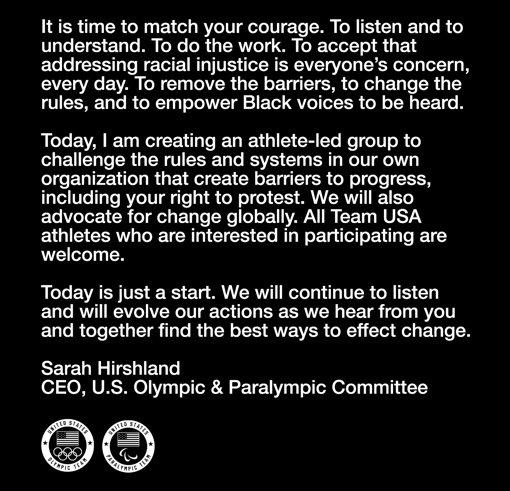
    June 8 Twitter screenshot from @USOPC_CEO


    June 8 Twitter screenshot from @USOPC_CEO

    Hirshland’s pivot amidst the current protests comes in opposition to a decision made by the USPOC 10 months ago. Then, hammer thrower Gwen Berry and fencer Race Imboden were disciplined for political protests at the 2019 Pan American Games. There, Berry raised a fist on the podium, while Imboden took a single knee during his award ceremony. Both protested pervasive inequalities in the U.S. The USPOC placed both athletes on 12 months of probation. 

    However, it was reported by the The Telegraph on Tuesday that the IOC intends to enforce Rule 50 at the 2021 Tokyo Games. According to Rule 50, violations will be considered “on a case-by-case basis as necessary.”

    The IOC’s Rule 50 guidelines were updated this winter by the IOC’s Athletes’ Commission prior to the original start of the Tokyo Olympics. According to the guidelines they “have been developed with the aim that each and every one of you can enjoy the experience of the Olympic Games without any divisive disruption.”

    In a document titled Rule 50 of the Olympic Charter: What you need to know as an athlete, the IOC lists the following four “main goals”

    • First, to protect athletes 

    • Second, to prevent the over-commercialisation of the Games and to keep the Olympic venues – (i.e. the field of play) free from advertising. This is known as the “clean venue” policy. 

    • Third, to prevent the Games from being used as a platform for protests, demonstrations or the promotion of political, religious or racial propaganda. 

    • Fourth, to define the rules for manufacturers’ identifications and other identifying features on sports uniforms and equipment, to prevent unauthorised commercial, political, religious or racial propaganda. 

    On Wednesday June 10, Thomas Bach, President of the IOC, indictaed the IOC might be open to modifying how Rule 50 is interpreted.

    “The IOC Executive Board supports the initiative of the IOC Athletes’ Commission to explore different ways of how Olympic athletes can express their support for the principles enshrined in the Olympic charter, including at the time of the Olympic Games, and respecting the Olympic spirit, ” Bach said. “The framework has been set and now let the Athletes’ Commission and the athletes discuss amongst themselves and come up with the relevant proposals.”

  • News Roundup for 7/19/19

    News Roundup for 7/19/19

    Bodensteiner Hired on with the Utah Olympic Legacy Foundation

    Luke Bodensteiner left U.S. Ski & Snowboard as Chief of Sport on July 15, he was named the Soldier Hollow General Manager and Chief of Sport Development on July 17. Bodensteiner’s new positions are under the Utah Olympic Legacy Foundation umbrella. 

    As part of his duties, Bodensteiner will oversee daily operations at the Soldier Hollow (SoHo) venue. According to the July 17 press release announcing the hire, SoHo came under Utah Olympic Legacy Foundation direction back in 2016. 

    “I’m thrilled to be joining an organization that’s accomplishing so much in Olympic and Paralympic sport, and which has established such a unique and powerful legacy,” said Bodensteiner in the press release. “I feel very fortunate to be joining the effort at a time when the UOLF is moving aggressively to establish a leading edge winter sport culture in Utah, for the benefit of our communities, our youth, and our state’s long-term ambitions in winter sport.” 

    Bodensteiner’s position of Chief of Sport Development extends across all aspects of the Utah Olympic Legacy Foundation, not only cross-country skiing and biathlon. These include ice skating disciplines at the Olympic Oval, and summer facilities for freestyle skiing at the Utah Olympic Park. During the winter, the Utah Olympic Park houses a bobsled/luge track and ski jumps. The jumps can accommodate summertime jumping. 


    Canmore out of the Running to Host IBU World Cups for Three to Four Years

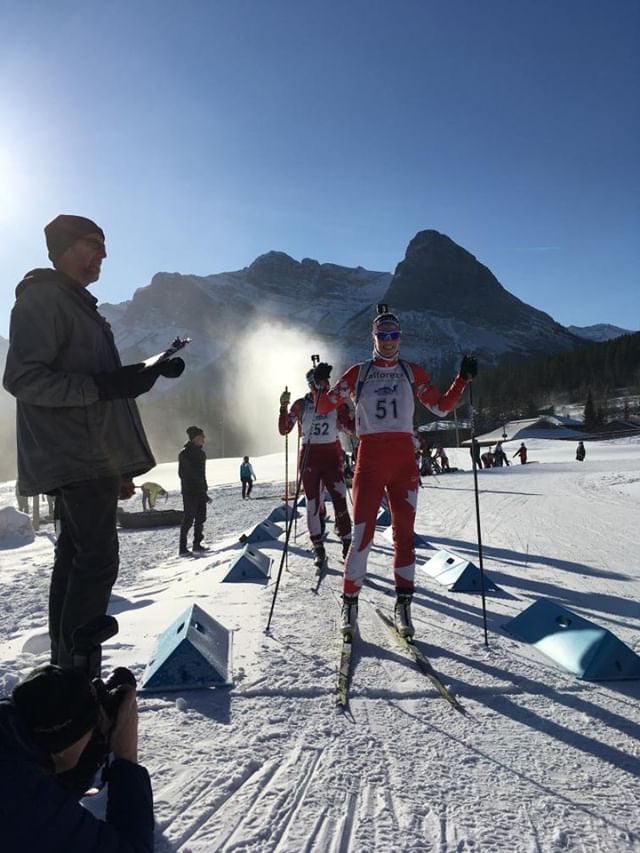
    Megan Tandy (bib 51) racing in Canmore. (Photo: Matthias Ahrens)

    After hosting IBU World Cup biathlon events in Canmore, Canada this past February, the Canmore Nordic Centre has been informed it will not be considered for future biathlon World Cups for the next three to four years. 

    Originally built to host the 1988 Winter Olympics, the Nordic Centre is need of updating to meet the IBU’s host site standards. According to a CBC News article, the venue has asked the provincial government for $13 million to modernize the facility and update the firing range.  

    In the article, Ken Davies, the chair of the Alberta Event Hosting Society, said the province missed the deadline for allocating the money to update the venue. 

    Currently, it appears the provincial government has set the nordic centre’s upgrades as low priority.

    “While we recognize that Canmore Nordic Centre has a long-standing tradition of hosting World Cup biathlon ski events, $13 million in upgrades is a significant cost that must be measured against other pressing government priorities,” Jess Sinclair, press secretary to Minister of Environment and Parks, said according to the CBC article.


    Borders Commission: An Independent Panel Chartered by the USOPC

    This week, the Borders Commission released its 113 page report on reforming the United States Olympic and Paralympic Committee (USOPC). The USOPC was formally known as the USOC. The Borders Commission was organized to examine how the USOPC should reform.

    If you follow Olympic sport in the U.S., the cultural norms and values as practiced at the grassroots, club, elite, and the highest bureaucratic levels have been questioned in recent years. The brave athletes who revealed sexual abuse in elite gymnastics are among the voices who have championed the reform movement. They remain a catalyst for the Borders Commision’s work.

    At the top of the U.S. Olympic sport organizational pyramid is the USOPC. As the sex abuse allegations were investigated and confirmed, the former head of the USOC, Scott Blackmun and the former Chief of Sport, Alan Ashley, were found to be negligent.

    The USOPC remains under the reform-minded microscope. Enter the Borders Commission. The recommendations in the newly released report are widespread.

    The report states that an athlete first approach is paramount. “The USOPC and the NGBs and their Paralympic equivalents alike, must course correct, placing athletes and their well-being, at the center of all considerations and business operations,” states the report on page 31.

    Other recommendations include modifying the USOPC Board to include better athlete representation, providing broader access to health care and mental health services for athletes, and more athlete-centric funding models. It is by all measures a comprehensive report aimed at creating cultural norms at all levels of sport that protect and support athletes.

    On July 17, the USOPC released a response to the report’s findings.

    “The USOPC has already made significant progress to strengthen protections and empower athletes, and we are grateful for the Borders Commission’s diligent and extensive work to ensure that progress continues,” said USOPC Chair Susanne Lyons according to the press release. “We look forward to reviewing the full report and taking appropriate actions to implement and reinforce meaningful reforms to create a culture and environment where athletes can achieve both personal well-being and competitive success.”

    USOPC CEO Sarah Hirshland is quoted as recognizing that a cultural shift is due.

    “As we remain laser-focused on prioritizing and supporting the needs of athletes and NGBs, we must set clear standards of organizational excellence and hold ourselves and all member organizations accountable,” said USOPC CEO Hirshland. “With changes to governance and personnel, policies and procedures – and most importantly, culture – we are a very different organization than we were one year ago, but we have more work to do. We remain committed to that reform process and will share information about additional actions we are taking as a result of these recommendations. We are grateful to the entire Commission for their dedication and hard work over these past months.”