From the FasterSkier archive — posts syndicated from athletes’ and coaches’ own blogs between 2004 and 2012, kept online as published. Current coverage is at fasterskier.com.

Tag: Scando Cup

  • Closing the Gap: Racing in the Dark

    Closing the Gap: Racing in the Dark

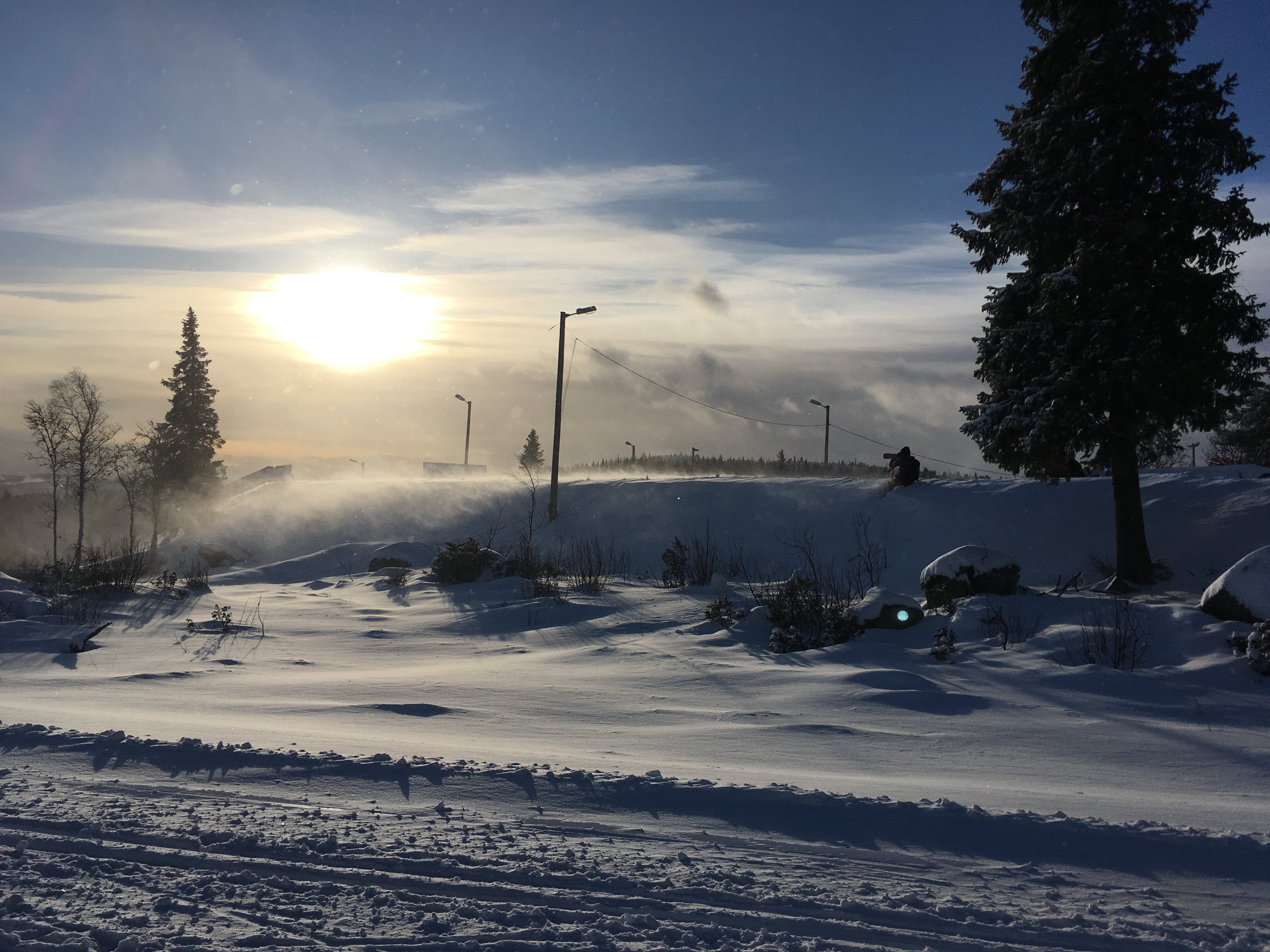
    Soft Scandinavian Cup track as seen last weekend at the Dec. 15-17 Scando Cup in Vuokatti, Finland, “the same conditions for Sundby all the way down to me,” author Maks Zechel writes.

    Editor’s Note: The following is part of a series proposed by Maks Zechel, a 20-year-old Canadian cross-country skier embarking on his first season training abroad. In August, he made the big move to Norway, where he’ll be training and racing with Team Asker for the entire winter. Through these updates, Maks hopes to share his personal “observations, stories and lessons learned” to help close the gap between North American and Scandinavian nordic skiing. Previous posts: #1, #2, #3, #4, #5, #6, and #7.

    ***

    Part 1: Vuokatti

    It’s Thursday morning and I’m in the Oslo airport, waiting to catch a flight to my second Scandinavian Cup race weekend of the winter. I haven’t seen the sun yet and, from what I’ve heard, my destination of Vuokatti, Finland, doesn’t look much like a Caribbean postcard either.

    Two flights and an hour on a bus later, we arrive in Vuokatti. There is something about 3 p.m. total darkness that I suspect I will never grow accustomed to; it’s the impending sense of urgency that I need to go to bed soon. Or maybe that’s just coming from the fact that I still have to check into the hotel, ski the race loop, test skis, eat dinner, and then write my final exam for my online university course. By the time I start my exam, and reboot my laptop after it crashes, it’s 8 p.m. … classic.

    We wake up before the first race in the dark. The sun allegedly rises into the cloudy, snowy sky at 9:59 a.m. and sets at 2:07 p.m. Despite our noon start time, the trails remain cast in dusky shadows, and the entire race loop, and ski jumps overlooking the stadium, remain lit 24/7. For the record, I spent approximately 72 hours in Finland, and I can’t confirm that the sun actually touches that part of the world; for all I witnessed they might just brighten the streetlights every morning.

    We jog a few hundred meters from the hotel to the race site, located by the Vuokatti Olympic training center. All the racers are staying in two large hotels within walking distance of the race site, which creates an exciting “athlete village” atmosphere. Vuokatti is an epic training and racing location with 7.5 k+ of lit world class ski trails, early season snow making, a ski tunnel, and ski jumping and biathlon venues. Nordic countries don’t seem to like hosting races anywhere with a big chalet, or with any chalet at all, so we set up base in the snow. Luckily for us, the infamous Finnish cold weather decided to leave for the weekend. The stadium is tiny, hardly wide enough for a finishing straight, miniscule individual start corral, and a lap lane. It’s easy to feel lost amongst the tall, uniform pines of a snowy Finnish forest, but the Vuokatti course has something for everyone. Each day, 200-250 participants are on the senior men’s start line, with Norway, Sweden and Finland well represented; the top 100 doesn’t get more competitive than this anywhere in the world.

    As I’m warming up for my 15 k skate race, I have never recognized so many people that I’ve never seen before in real life: “Oh hey random Norwegian skier, congrats on beating your 3000-meter track PB this summer! By the way, say hi to your dog for me.” The potential for a seriously awkward conversation with one of my idols is too high, so I try my best to avoid in-awe-eye-contact…
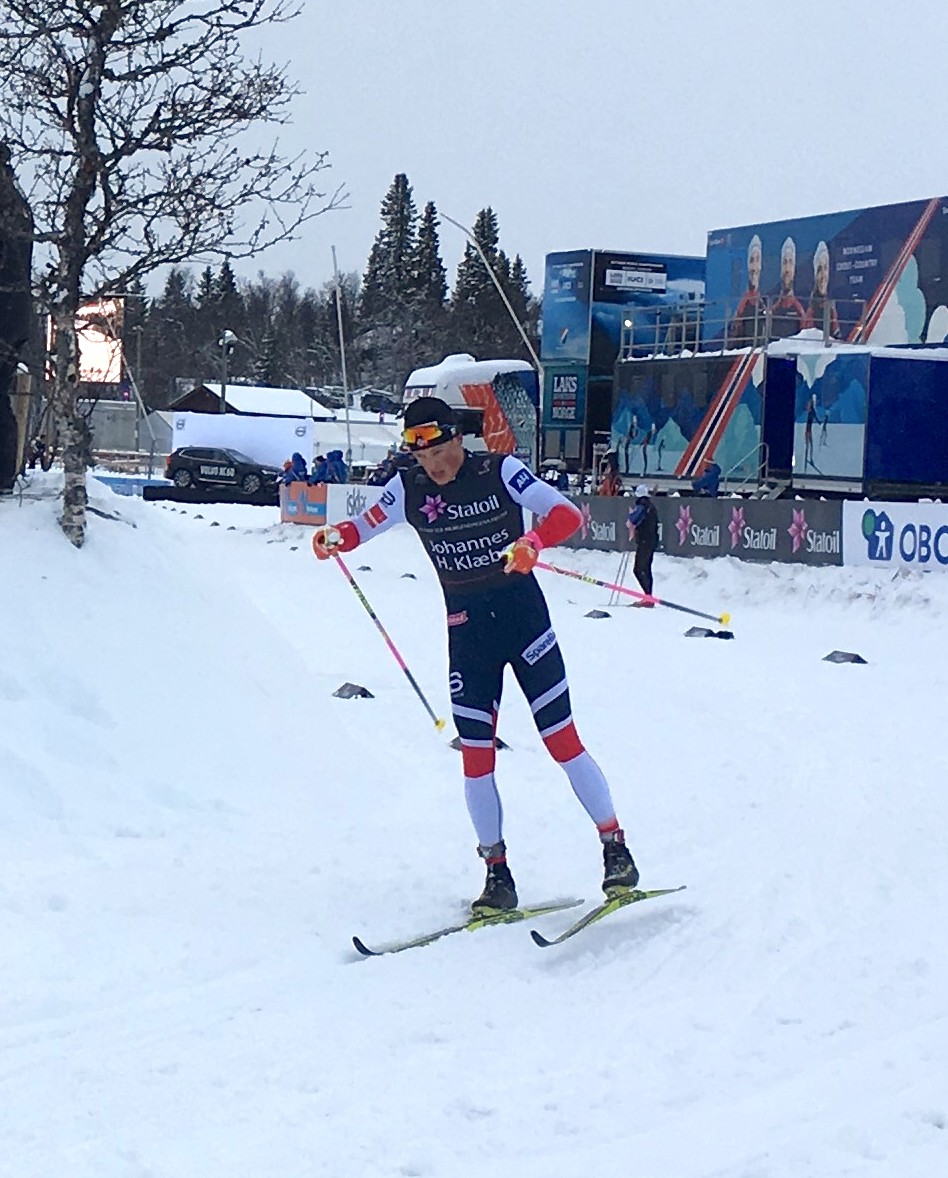
    Norway’s Johannes Høsflot Klæbo in his debut race of his record-setting 2017/2018 season. In eight World Cup starts so far, he’s won seven of them. Here he’s shown racing at Norway’s FIS season opener in Beitostølen last month. (Photo: Maks Zechel)

    At the end of the first day our teammate, Erland, placed 19th, with Ryan and I at 107th and 132nd. After racing in the Beitostølen Scandinavian Cup and Gålå Norwegian Cup race weekends in November, it remains hard to swallow our pride as we race better than we ever have, but still fall far short of our lofty goals.

    However, the lessons that we learn in every international race that we compete in are crucial to our development. During the 15 k classic race in Vuokatti, my teammate, Eirik, was caught by the eventual top-two skiers of the day, Ristomatti Hakola (Finland) and Martin Nyenget (Norway). Eirik is a strong double poler, so he was impressively able to stay with them until the set of steep hills in the last 2 k of the course, where they put around 50 seconds into Eirik per lap. What he was unable to match, was the insane power that Hakola and Nyenget were kicking their skis with, giving them big glides on even the steepest pitches where I had to run out of the tracks

    Racing with athletes who are able to ski at this level creates an unforgiving racing environment if you are unable to push yourself to new heights. After a poor race, the performance is reflected by a drop of dozens of spots down the results sheet. Scandinavians respect the high level of these races and they know that there are hundreds of skiers working just as hard as them, ready to take their place if they don’t race fast. Poor races by even the best cause them to disappear down the results (Petter Northug finished 17th in a Norwegian Cup race this winter). Although Erland is an incredible skier who is capable of top-20 Scandinavian Cup results, he had placings of 89th and 47th in Beitostølen. This is nothing to be ashamed of, but the results clearly represented that he was not in top form at the time. Good performances are rewarded in the opposite manner. That is the nature of these races, where 1 minute gained or lost can mean 30-50 spots. In the Vuokatti sprint, the top-30 men in qualifying were all within 5.87 seconds, with the top 58 within 10.55 seconds, and top 84 within 15.15 seconds. The reality is harsh, but it feels productive to know exactly where I stand against the best.

    World Cup racing is ridiculously hard, and that is a lesson that should be experienced as early as possible. When I was 132nd in the 15 k skate race in Vuokatti, a good race for me, it felt like a smaller reward than I was used to for my efforts. It’s easy to feel overwhelmed by the sheer number of competitors, but it helps to look at the time gap when looking for achievable next steps. In this race I was 4:38 minutes behind race winner, Daniel Stock (Norwegian skier with a World Cup podium from last year). It’s a lot over a 38-minute race, but if I can shave off 1 minute by the end of the season, then I’m in the top 100. Wherever I place, at the end of the day I know how far away I am from top World Cup contenders. Doing these races doesn’t make getting fast easier, but it does put into perspective exactly how much my efforts and improvements mean on an elite level.

    Every weekend these races feel a little more familiar, a bit more like home. The competition is intimidating, but every race still has the same enthusiastic community of athletes, volunteers, coaches, wax techs, friends, and families that we are used to in Canada. In Beitostølen, a stressed Ryan was enthusiastically interviewed four minutes before his race start and the NRK commentators talked about our goals in Norway and this FasterSkier blog for over a minute on national television. In Vuokatti, the race announcer introduced us as the two Canadians living in Asker, Norway, with their goal of becoming two of Canada’s best World Cup skiers. It’s flattering to be known like this, despite struggling to come even close to the top 100, and it makes us feel like we belong. Soon enough we will make sure we are known for more than just booking a couple of plane tickets to Norway.

    Part 2: Getting to the Top
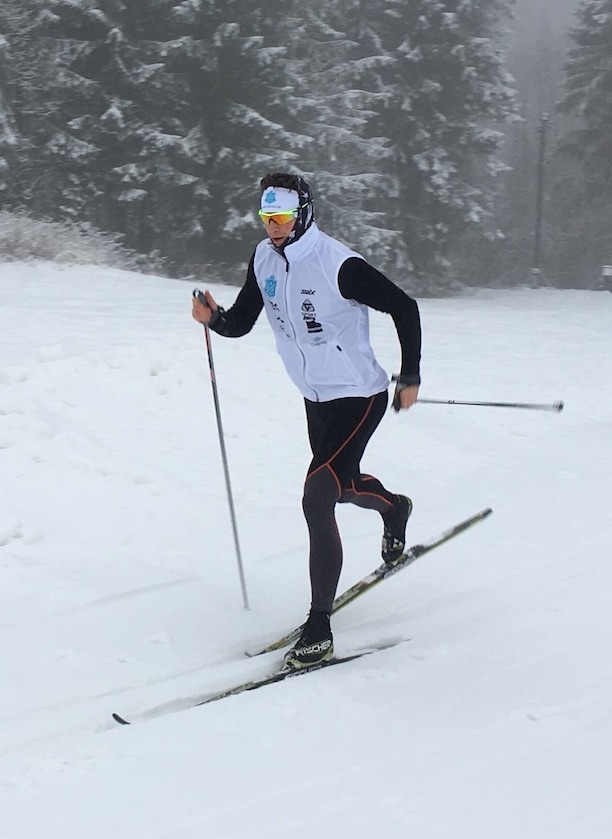
    Author Maks Zechel repping the Asker Skiklubb white and blue.

    Racing in Scandinavia is like getting on the freeway out of the city at 5 p.m. on the Friday of Thanksgiving weekend; everyone is heading in the same direction, and no matter who you are, you have to be patient and observant in order to seize the opportunities that will bring you to the front of the never-ending queue. In Canadian racing, we often lack this traffic, and this causes skiers to race at their own level, because there aren’t enough skiers of similar abilities to push each other to the top. I believe that it is still possible to become a great skier from racing in North America, but we have to be prepared to take even bigger risks than our Scandinavian counterparts, as we can be sure that they are encountering far more opportunities than us.

    From my experiences watching NorAm, SuperTour, Scandinavian Cup, and World Cup results, the best skier of the day will often win a three-lap 15 k with a certain order of lap times: the first lap is the fastest to take advantage of fresh legs, the second lap is the slowest, and the the third lap is the second fastest. These margins are small, but they indicate a skier who has skied a smart and controlled race, riding the edge of blowing up in order to expend energy perfectly and close fast where weaker skiers tire. This is how a winner skis a race. The skiers who don’t win the race ski differently because they are not at the same level. If they ski in the same controlled manner, they fall short of the win because they cannot maintain the same pace/execute the same pace changes. A dark horse who is trying to win, or merely trying to break through the ranks, gives everything in an effort to ski at a level that is higher than they can actually maintain. They may try to go out as hard as possible, risking blowing up early with the hope that they will be able to maintain a “suicide pace”. The skiers who don’t control the race usually ski with positive splits, becoming slower each lap on a good day, because if their splits are negative it means they will lose too much time at the start of the race.

    In North America, we get comfortable skiing like winners. The shock comes when we try to make the jump to World Cups, and we suddenly have to relearn how to ski like developing skiers, to ski like we are trying to break through to the top.

    Here’s a fact: nobody comes to World Cups from North America and starts winning right away. The jump is too big to make all at once. Scandinavians can sometimes go straight to the top, because they had to grow up skiing like losers, or at least skiing like winners who had to fight against 30 other winners every race. The issue is that North Americans begin to relearn the lessons of devastating time gaps at an important point in their careers, when ideally they would be fighting competitively for coveted World Cup top 30s. We’re not developing as much as we could at home, because we’re not desperately fighting just to come top 50 or top 100 as juniors and U23s. Not to say that you can’t develop hugely between the ages of 25 and 35 (many do), but we rarely see this happen in North America because the attrition rate of skiers in that age range is so high. Many skiers never see their full potential realized.

    In North America, we get comfortable skiing like winners. The shock comes when we try to make the jump to World Cups, and we suddenly have to relearn how to ski like developing skiers, to ski like we are trying to break through to the top.

    In Vuokatti, numerous small skiing nations were well represented, countries that we North Americans would see as “lesser” skiing nations, when in fact they’re doing things better than us. The Vuokatti Scandinavian Cup saw a large contingent of Chinese national-team skiers compete, and at Beitostølen, Japan was well represented. I even saw a couple of Mongolian skiers in Finland. These national-team skiers are consistently starting Scandinavian Cups in their pursuit of becoming competitive on the World Cup (zero Chinese skiers started the Toblach World Cup, while 10 Chinese men and women started in Vuokatti the same weekend). These small skiing nations recognize that they cannot develop all of their athletes through World Cup starts, so they send their remaining skiers to the next best thing. This mentality has led Japan to produce podium-capable World Cup skiers such as Masako Ishida and top 15 contenders such as Keishin Yoshida.

    We need to fill up our quota spots on the World Cup, but for the rest of us, Scandinavian Cups are an equally good opportunity to develop. A month of World Cup racing can cost a Canadian National Team member upwards of $5,000 Canadian dollars (not including flights). Last winter Team Hardwood Elite ran a one-month trip from Canada to Norway for $2,700 CAD (flights included) per athlete, where they raced nine Scandinavian- and Norwegian Cup-level races. We shouldn’t scoff at local-level Norwegian races either, which can be found all over the country every weekend of the winter. Sondre Turvoll Fossli, a World Cup medalist, won a local race, with a senior men’s field of 12, in Lier, the same weekend as Toblach and Vuokatti. At a local race in Konnerud the weekend before, I was bib number 1051 as the last starter of the day. Only 17 senior men raced, but the winner has placed top five in Norwegian Cups.

    Many North American skiers want to break through on the World Cup, but there are limited World Cup starts that offer a small and difficult opportunity for us to impress on a stage that we have never experienced before. The chances of breaking through this way have proven nearly impossible for numerous talented North Americans. For the countless incredible skiers who didn’t even receive those World Cup opportunities, the chance of World Cup success is a long-dissolved dream. This builds the impression that only a select few North American skiers can ever be great. This is untrue. The truth is that only a select few will ever break through when offered a handful of World Cup-level racing opportunities. The truth is also that us remaining North Americans have the ability to achieve that same level, but we must do so more patiently and down a less traditional path. If you truly want a chance at becoming competitive on the World Cup, you don’t have to fight for years to qualify for a World Cup development experience that most of us cannot afford. Instead you can race as many Scandinavian/Norwegian Cups as you like, every year, at a far cheaper cost, which will allow you to race against skiers who are already at the World Cup level that many of us dream to achieve. These skiers are no more talented than our skiers, they just have had the time and the countless opportunities to race at a level that most of us never have the chance to see.

    This leaves an important question: who is left to race in North America? It is hard to develop our best senior athletes to become World Cup podium contenders, it is harder still to do this in such a way that will allow all of our younger skiers to develop, too. My experience in Norway has been a positive one so far, and I will continue to promote what I am doing. But I should not have to come to Norway to develop. The simplest way for an individual to learn to race like the Scandinavians is to come to a country like Norway, but by individually developing overseas, we put a stop to the widespread development that we could be doing back home.

    Norwegians are successful at skiing because they love it; skiing is everywhere in Norway, and for that reason Norwegians never have to go far from home to ski fast. Top Norwegian skiers race in local races because they know that good racing is great development, no matter who you’re racing against. If we want races to be competitive, then it’s up to us to race fast.
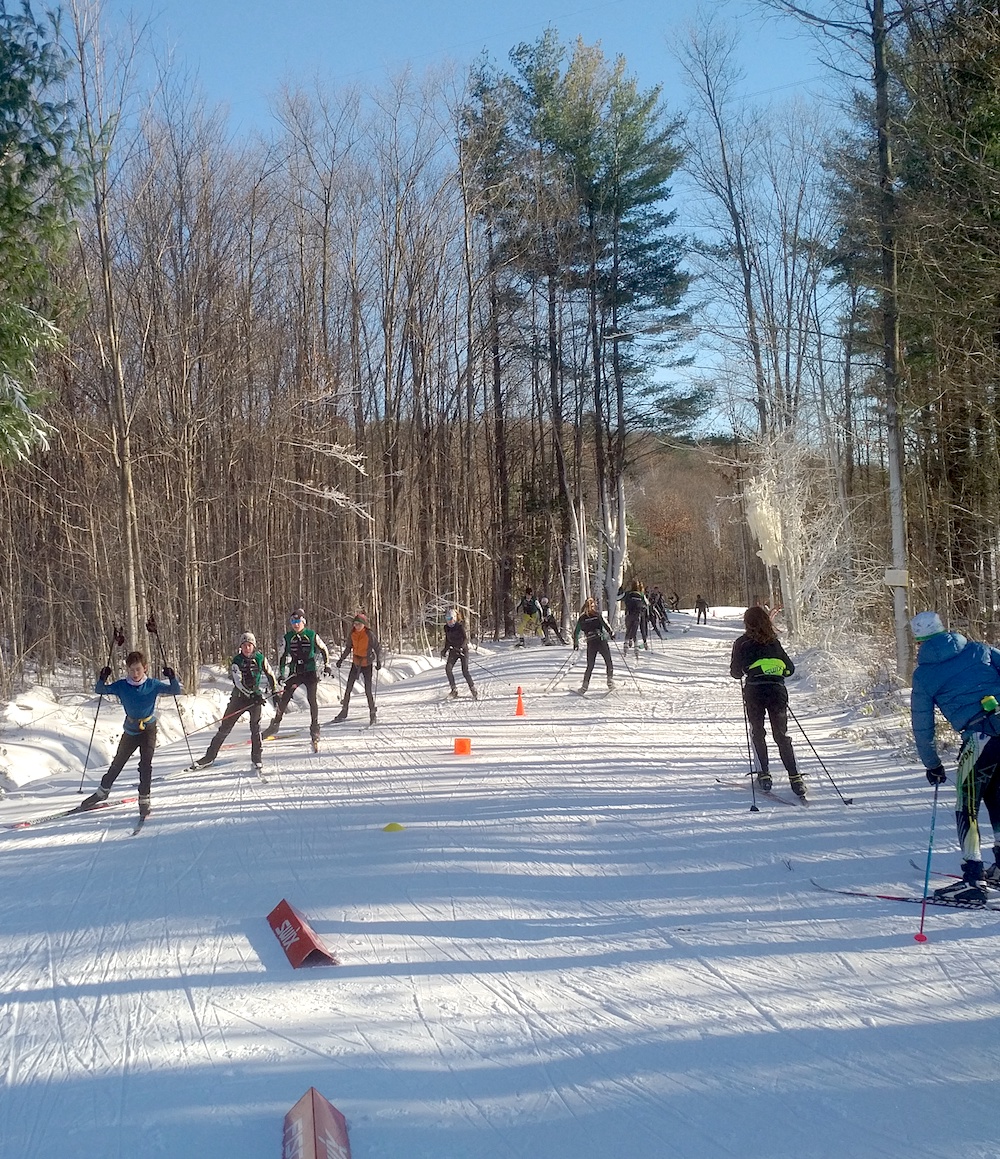
    Youth and masters alike getting some early season ‘ k’s in on Nakkertok Nordic’s “Nakkertrak” on opening day Nov. 11, 2017. (Photo: Nakkertok Ski Club)

    My home club, Nakkertok Nordic, was able to purchase snowmaking equipment last year. Due to the enthusiasm and incredible dedication of the parents and volunteers who are the backbone of Nakkertok, they were able to host two early season race weekends this year, just outside of Ottawa (a city of 900,000 people). Ottawa is in an excellent central location for Eastern Canadians and Americans. The same weekend as the Dec. 15-17  NorAm race weekend in Rossland, over 200 people raced the Candy Cane Cup on the “Nakkertrak” early season snow loop. In the future, I see this becoming a main event in an early season racing series, where athletes race in Craftsbury, Vermont, at their annual early season races, then drive the mere four hours to Ottawa for two back-to-back high level FIS races. Eastern Canada and the U.S.A. are full of the skiing culture that makes Norway so great, our issue is that we fail to coordinate to create the fantastic race opportunities that we could have. Many top Canadian skiers already travel to Craftsbury at the beginning of the winter to be in a race where Patrick Caldwell takes the win and the field is deep with professional, university, high-school, and part-time racers of all levels. There is a fear in Canada of burning young athletes out by letting them race up. I agree, we shouldn’t just allow our “prodigies” to race up; I think that everyone from age 16 and up should race together. Development as a skier is only loosely correlated to age, and I am grateful at every training session with Team Asker for the young junior skiers that kick my butt in workouts. Our egos have to be thrown aside, because the more we segregate our racing categories, the less we can help each other get faster in the way that the Norwegians do.

    The simplest way for an individual to learn to race like the Scandinavians is to come to a country like Norway, but by individually developing overseas, we put a stop to the widespread development that we could be doing back home.

    Many Norwegian skiers race almost every weekend, all winter long. We have to create these same local racing opportunities, and if we make them accessible, they will soon turn into world-class events. Nakkertok took a race, which has simply been a club time trial in past years, and turned it into a CPL (Canadian Points List) level race with a field of 68 open men and 45 open women in one year (that is a bigger field than the Rossland NorAm). The depth of such events, with their diverse assortment of competitors, creates an environment where both our top racers and our developing racers can grow. An athlete is much less likely to quit skiing if they are regularly racing in a field with dozens of skiers at their level and with similar ambitions of going to university or working full time, all while skiing as fast as they can. Because you know what, racing is really fun, but only if it is a commodity made accessible to every North American skier, not just our Olympic hopefuls.
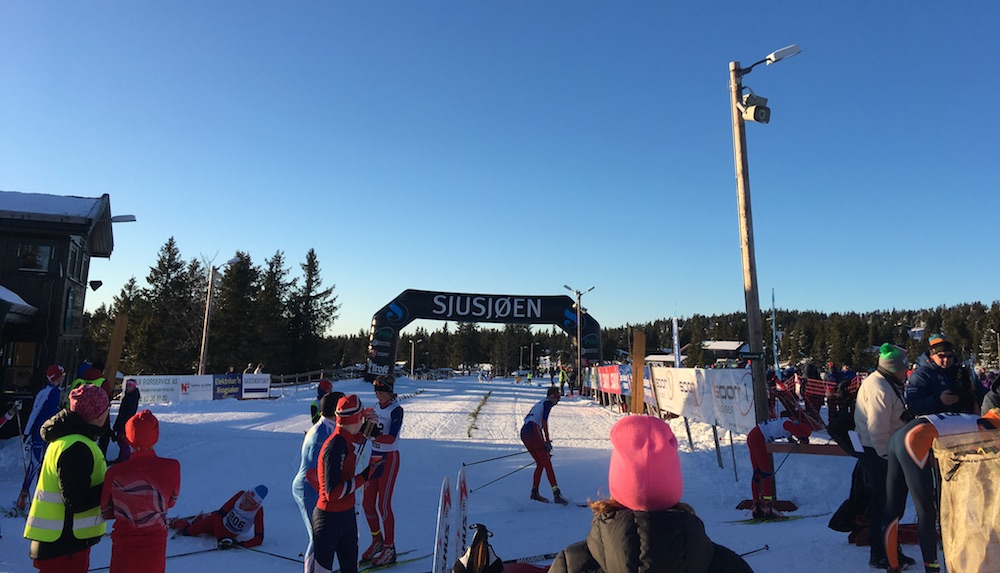
    A local race in Sjusjøen, Norway, with hundreds of racers of all ages. (Photo: Maks Zechel)

    About Maks: Maks Zechel is a competitive cross-country skier who secretly wants to become a professional mile runner. He loves hiking and going on canoe trips with his family, as well as peanut butter cups in ice cream. Johan Olsson is his favourite skier and he hopes to race the Cortina-Toblach stage of the Tour de Ski one day. He enjoys writing about his experiences. Follow him on Instagram @makszechel.
  • Weekly Roundup: Quite a Scene at Biathlon World Champs, Aspen SuperTour and Scando Cup

    Weekly Roundup: Quite a Scene at Biathlon World Champs, Aspen SuperTour and Scando Cup

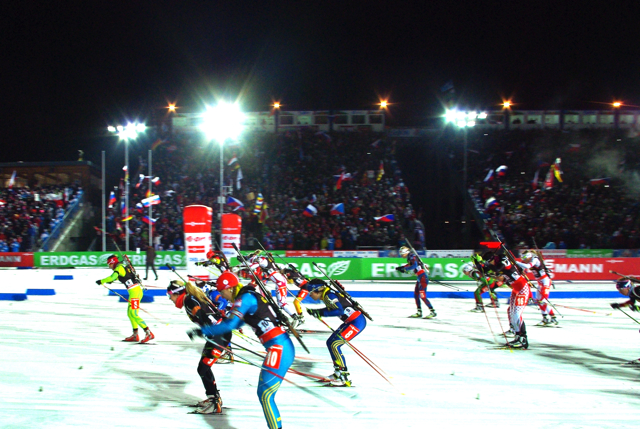
    As Czech flags wave in the background, the mixed relay field sets off in pursuit of the first 2013 Biathlon World Championship title on Thursday in Nove Mesto, Czech Republic.
    As Czech flags wave in the background, the mixed relay field sets off in pursuit of the first 2013 Biathlon World Championship title on Thursday in Nove Mesto, Czech Republic.

    Think you can picture the scene at the International Biathlon Union (IBU) World Championships in Nové Město na Moravě, Czech Republic? Think again.

    Veteran and newbies alike found themselves in awe of the stadium and 20,000-strong crowd. After the first few days of racing, many were still struggling to cope with the noise factor, but hey, they weren’t complaining.

    Norway opened with its third-straight mixed relay victory, no surprise there, and the hometown fans celebrated its own team making the podium in third right behind France.

    The U.S. notched its best mixed-relay result in eighth with Annelies Cook, Susan Dunklee, Lowell Bailey and Leif Nordgren. With Tim Burke out trying to get healthy, Nordgren filled in. Meanwhile, the Canadians were simply happy to get their feet wet at World Champs as Rosanna Crawford, Megan Heinicke, Jean Philippe Le Guellec and Scott Perras combined for 15th.

    On Saturday, Norway’s former biathlon king, Emil Hegle Svendsen, made a point to get back on top and captured his second-straight gold medal of the week, beating French rival Martin Fourcade in the 10 k sprint. In the women’s 7.5 k sprint, Ukraine’s Olena Pidhrushna surprised with her first career win and teammate Vita Semerenko tallied her third World Championships bronze.

    All four American men in the sprint raced well enough to qualify for Sunday’s 60-man pursuit. Burke was back in action in 28th, Bailey placed 32nd and Russell Currier and Nordgren also made the cut. Two Canadian men and two women qualified, led by Le Guellec in 36th and Scott Gow in his debut World Championship in 45th. In the women’s sprint, Cook also placed 45th and Heinicke narrowly qualified for the pursuit in 54th.

    That brings us to Sunday when Svendsen continued his World Championships domination, outsprinting Fourcade by 2.4 centimeters for the pursuit victory. It didn’t come easy: he nearly stopped after getting tangled with Russia’s Anton Shipulin on the last climb.

    Norway’s Tora Berger won her first individual gold of the week in the pursuit, rising to the occasion when two skiers in front of her, Russian Olga Zaitseva and Krystyna Palka of Poland, missed one apiece on the last shooting stage. Berger shot clean on the final stage and hammered home for the victory.

    Meanwhile, Bailey and Le Guellec led the North Americans in 13th and 15th, respectively. Le Guellec made up 21 places – the second most of any man in the pursuit – and Bailey climbed 19 spots to get back in the mix.

    IBU World Championships

    Athlete reaction to renovated venue: story

    Thursday’s mixed relays: international report | American report | Canadian report | results

    Saturday’s sprints: men’s international report | women’s international report | American report | Canadian report | men’s results | women’s results | photos

    Sunday’s pursuit: men’s international report | women’s international report | North American report | men’s results | women’s results

    Sunday’s pursuit photos: North Americans | men | women

    ***

    While biathlon expert and FasterSkier editor-at-large extraordinaire Chelsea Little was on site in Nové Město, Audrey Mangan traveled to Aspen, Colo., for the SuperTour – making her first stop at the Vail Mountain Games.

    There, the Central Cross Country (CXC) husband-and-wife duo, Brian and Caitlin Gregg topped the men’s and women’s field, respectively, in the 10 k freestyle mass start – a sort of warmup for the SuperTour weekend ahead.

    On Saturday, big, wet snowflakes at 8,000 feet above sea level didn’t slow down skiers like Rosie Brennan of Alaska Pacific University (APU), who won both the 1 k classic prologue in the morning and the 5 k classic individual start in the afternoon. On the men’s side, Mike Sinnott of the Sun Valley Ski Education Foundation (SVSEF) won the prologue and teammate Patrick Johnson tallied his first career SuperTour victory in the 10 k.

    Sunday’s coveted Owl Creek Chase involved a sprint showdown at the end of the 21 k point-to-point race. Brian Gregg edged Sylvan Ellefson (Ski & Snowboard Club Vail/Team HomeGrown) by eight seconds at the finish, showing all his speed work this summer paid off.

    Part-time racer Nicole DeYong (SVSEF) skied away from the pack for a two-minute victory after winning the same race in 2010.

    Vail Mountain Games

    Friday’s 10 k freestyle: overview with interview video | results

    Aspen SuperTour

    Saturday’s classic prologue and 5/10 k individual start: report | sprint prologue results | 5 k classic results | 10 k classic results

    Sunday’s Owl Creek Chase 21 k freestyle mass start: report | men’s results| women’s results

    ***

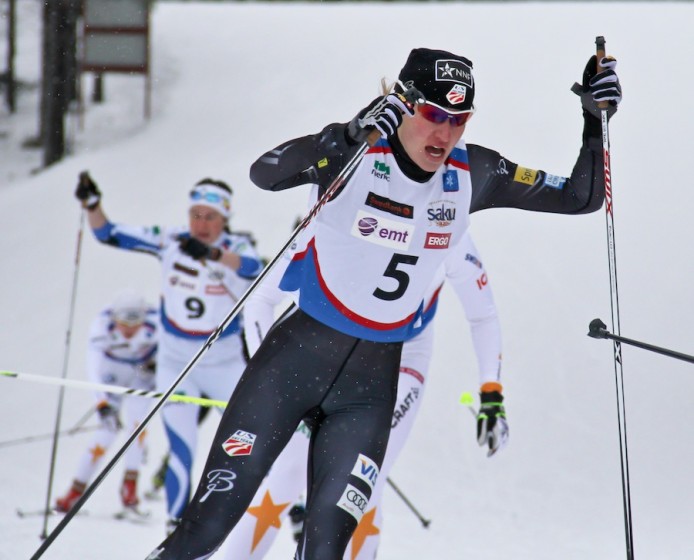
    Sophie Caldwell (SMST2) racing to a second-place finish in Sunday's Scando Cup 1.1 k freestyle sprint in Pärnu, Estonia. She was just 0.14 seconds out of first for a career best. (Photo: Eric Packer)
    Sophie Caldwell (SMST2) racing to a second-place finish in Sunday’s Scando Cup 1.1 k freestyle sprint final in Pärnu, Estonia. She was just 0.14 seconds out of first for a career best. (Photo: Eric Packer)

    Meanwhile, several other American domestic skiers put their skills to the test at the Scandinavian “Scando” Cup in Latvia and Estonia. Caitlin Patterson of the Craftsbury Green Racing Project led the group in Madona, Latvia, where she was ninth in Thursday’s 10 k freestyle mass start and 10th in the 5 k classic on Wednesday. Eric Packer of the Stratton Mountain School T2 Team (SMST2) broke through in 16th in the 20 k freestyle mass start.

    A few days later, Sophie Caldwell (SMST2) made the podium in second in Sunday’s freestyle sprint in Pärnu, Estonia, one day after finishing 17th in the classic sprint. Jennie Bender (CXC) qualified as high as fourth in the classic sprint and went on to place 16th. The next day, she was 11th in the skate sprint.

    Scando Cup

    Wednesday-Thursday in Madona, Latvia: recap

    Saturday-Sunday in Pärnu, Estonia: recap

  • Caldwell Builds Confidence at Scando Cup, Second at Skate Sprint in Estonia (Updated)

    Caldwell Builds Confidence at Scando Cup, Second at Skate Sprint in Estonia (Updated)

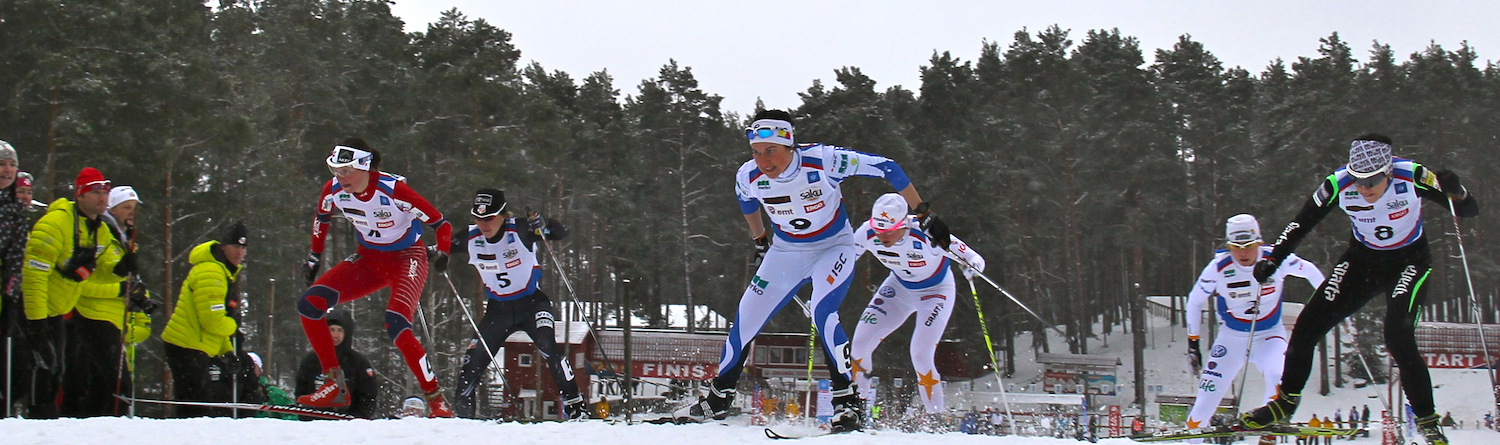
    American Sophie Caldwell of the Stratton Mountain School T2 Team (second from l) holding her own in the Scando Cup 1.1 k freestyle sprint on Sunday in Pärnu, Estonia. Caldwell finished second to Norway's Kari Vikhagen Gjeitnes (l). (Photo: Reese Hanneman/Engine Room Media.net)
    American Sophie Caldwell of the Stratton Mountain School T2 Team (second from l) holding her own in the Scando Cup 1.1 k freestyle sprint on Sunday in Pärnu, Estonia. Caldwell finished second to Norway’s Kari Vikhagen Gjeitnes (l). (Photo: Reese Hanneman/Engine Room Media.net)

    (Note: This recap has been updated to include comments from Eric Packer, Caitlin Patterson and Jennie Bender.)

    Nothing beats racing with the Euros, except when you beat most of them. Sophie Caldwell of the Stratton Mountain School T2 Team (SMST2) rose to a career best at the Scandinavian “Scando” Cup on Sunday, placing second in the 1.1-kilometer freestyle sprint at the Jõulumäe Recreation Centre in Pärnu, Estonia.

    The day before on a slightly longer course, Caldwell finished 17th in the 1.3 k classic sprint after qualifying in ninth. That wasn’t quite what she’d hoped for, so the 22-year-old rallied to the fifth-fastest qualifying time Sunday and employed some smart tactics in the heats that followed. Beyond brains, she used some brawn, too.

    “Today definitely helped my confidence because I was not super psyched with how yesterday unfolded,” Caldwell wrote in an email on Sunday. “I’m happy to be feeling healthy again and excited to hopefully see some sun and be in Switzerland! It was fun to be able to mix it up with those girls today and I’m looking forward to getting the chance a couple more times in the next few weeks.”

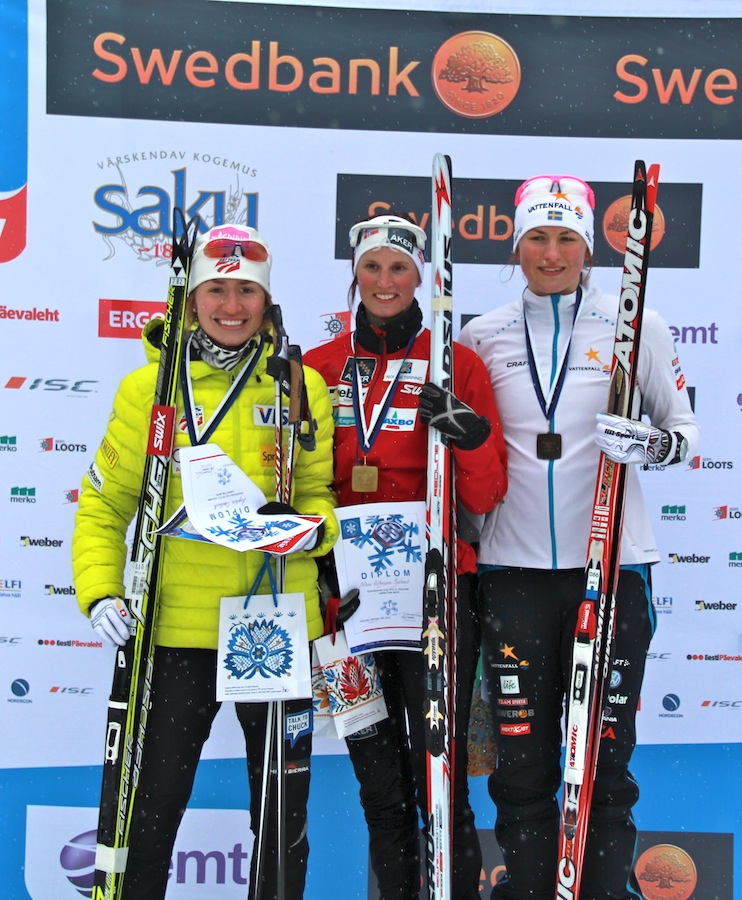
    Sophie Caldwell (l) on the Scando Cup podium after placing second in Sunday's 1.1 k skate sprint in Pärnu, Estonia. Norway's Kari Vikhagen Gjeitnes (c) won by 0.14 seconds, and Sweden's Linn Soemskar was third. (Photo: Reese Hanneman/EngineRoomMedia.net)
    Sophie Caldwell (l) on the Scando Cup podium after placing second in Sunday’s 1.1 k skate sprint in Pärnu, Estonia. Norway’s Kari Vikhagen Gjeitnes (c) won by 0.14 seconds, and Sweden’s Linn Soemskar was third. (Photo: Reese Hanneman/EngineRoomMedia.net)

    The SuperTour leader, Caldwell will get some more World Cup experience next weekend in Davos, Switzerland. After that, she’ll travel with the U.S. Ski Team to Val di Fiemme, Italy, where she’ll compete at World Championships.

    But this past weekend, and the last week of Scando Cup racing between Latvia and Estonia, was great practice. Caldwell led the Americans in second on Sunday, just 0.14 seconds out of first.

    “Sophie made some great tactical moves throughout the rounds and almost got the win,” US Ski Team development coach Bryan Fish explained. “She was inched out at the line – an excellent performance.”

    Norwegian Kari Vikhagen Gjeitnes captured her second-straight win of the weekend, and Sweden’s Linn Soemskar was third after posting the fastest qualifying time. Soemskar was seventh in the classic sprint.

    On a snowy day with temperatures hovering around freezing, Caldwell said she learned her lesson in the quarterfinal after leading from start to finish.

    “I knew position was important and it paid off, but it was not easy,” she wrote.

    Caldwell didn’t get off to the greatest start in her semifinal, but that ended up helping as she put herself in a good drafting position and slingshot around the leaders to win the heat.

    The final played out similarly as Caldwell struggled a bit from the start but focused on staying inside on the corners “and not letting people cut in or push me around,” she wrote.

    “I took the inside track on the last hill and got into second place and had a sprint off down the final stretch for 1-3,” she wrote. “It was really exciting and I felt better and better as the day went on!

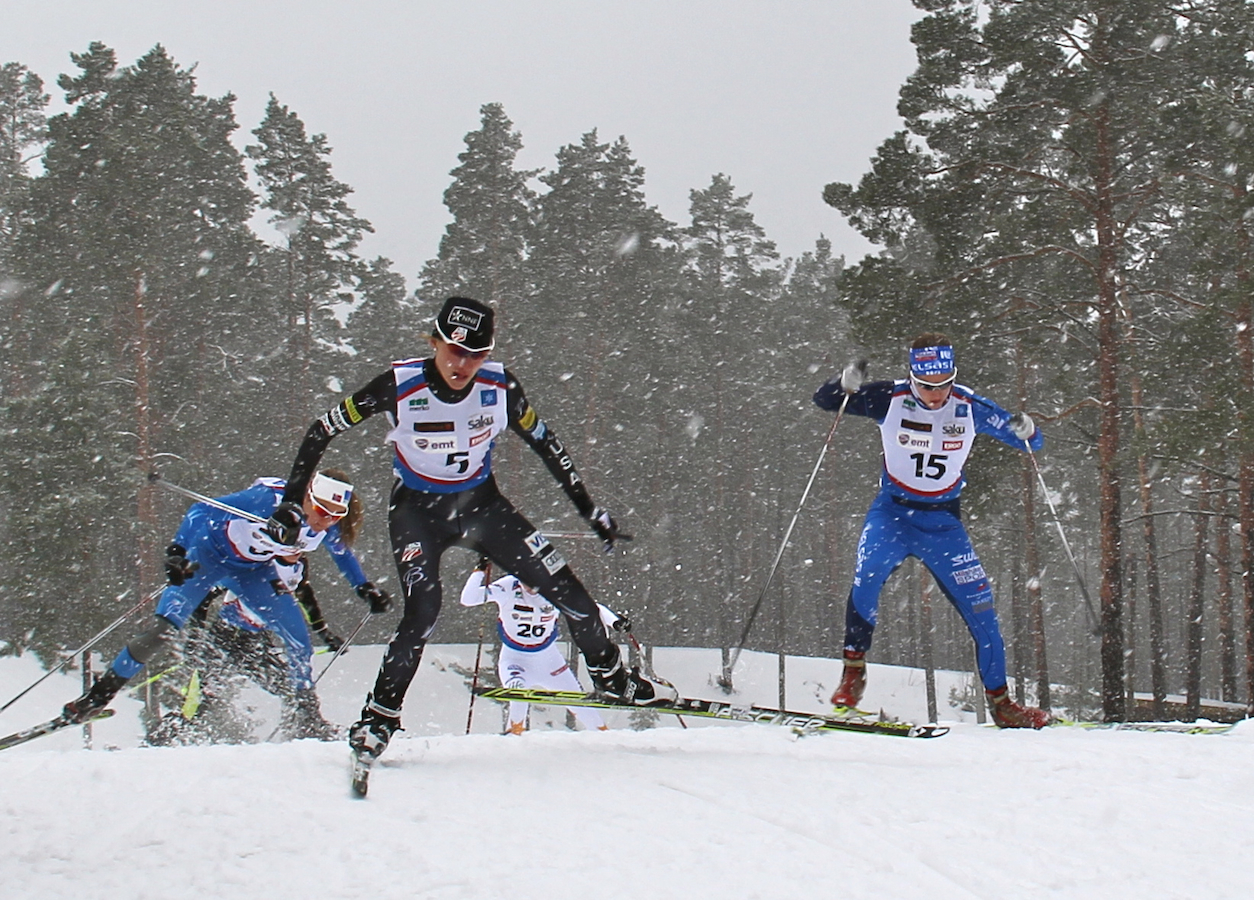
    Sophie Caldwell (SMST2) leading one of her heats with Norway's Astrid Bruland in the Scando Cup 1.1 k skate sprint at 2013 Jõulumäe Recreation Centre in Estonia on Sunday. Caldwell ended up second in the final. (Photo: Reese Hanneman/EngineRoomMedia.net)
    Sophie Caldwell (SMST2) leading one of her heats with Norway’s Astrid Bruland in the Scando Cup 1.1 k skate sprint at 2013 Jõulumäe Recreation Centre in Estonia on Sunday. Caldwell ended up second in the final. (Photo: Reese Hanneman/EngineRoomMedia.net)

    “I still feel like I’m learning a lot each time I race over here, but I like to think each time I’m get a little tougher,” Caldwell added. “I even gave a girl a little smack when she cut me off yesterday and then tried to ski big and hold my own today! So one step at a time but it was definitely fun to end the weekend on a high note.”

    Just outside of the top 10, Jennie Bender of Central Cross Country (CXC) qualified in 11th and finished in the same position – advancing to the semifinals. The day before, she qualified fourth in the classic sprint and went on to place 16th, which Fish wrote was a “very strong result, however, I knew she felt bittersweet.”

    “I wasn’t ecstatic with 11th, but I figured it could have been worse,” Bender wrote in an email, referring to the classic sprint. “It was even shorter than the classic sprint course, and you had to keep mentally in the moment 100 [percent], or time was being lost.

    “I was in the semifinals with Sophie, who totally rocked it,” she added. “It was sweet having American representation on the podium. … The field was very tough, with many World Cup skiers mixed in.  I cant wait to get back to Europe to race more. I think it’s quite valuable for the progress of an elite skier. ”

    Caitlin Patterson (Craftsbury Green Racing Project) was certainly the most consistent of the weekend, placing 22nd in both qualifiers as well as overall in the two sprints.

    “It was funny that I managed to have two sets of qualifying and finishing places that were identical, at 22nd,” Patterson wrote in an email. “I’m happy with how I’ve been racing in Europe, but mostly happy with the overall experience. The racing has made me more excited for future races and motivated to improve a few particularly weak areas in my racing, like the sprint starts. We had a fun group of skiers and coaches from the US, people who are serious about racing but also enjoyable to spend time with (and make videos with) in the down-time between races.”

    Becca Rorabaugh of Alaska Pacific University (APU) qualified in 28th on Sunday and ended up 25th. She was 24th in the classic sprint after qualifying in 27th.

    Anika Miller (Payette Lake Sports) also made it into the top 30, qualifying in 16th in the skate sprint and finishing 26th overall. On Saturday, she was 21st after qualifying in 20th.

    Saxton Leads American Men in Sprints

    On the men’s side, Norway’s Tomas Northug dominated both the 1.6 k classic and freestyle sprints. The younger brother of World Champion Petter Northug, he beat teammates Eirik Lorentsen and Emil Nyeng, who were second and third respectively, on Saturday, and topped another, Sindre Bjørnsetad Skar, on Sunday along with Sweden’s Johan Edin.

    Ben Saxton of F.A.S.T. Performance Training was the top finisher for the U.S., placing 33rd in the classic sprint. He was 0.78 seconds from qualifying in 30th on the challenging course – which took more than four-minutes to complete – and ranked 60th at the start. On Sunday, Saxton was 71st in the skate sprint.

    Reese Hanneman (APU) led the way on Sunday, placing 42nd in the skate sprint. The day before, he was 45th. Eric Packer (SMST2) notched a personal-best Scando Cup sprint performance in 43rd Sunday after placing 58th in the skate sprint.

    “I was disappointed to miss out on the heats, but it was positive to be right in the mix in such a tight field,” Packer wrote in an email. “I was just over four seconds out of the top ten, so I know I need just a few more seconds to be right in the mix with the best.”

    Montana State University junior David Norris was 43rd in the classic sprint and 72nd in the skate. APU’s Forrest Mahlen was 76th on Saturday and 77th on Sunday, and teammate Jack Novak placed 83rd in the skate and 84th in the classic sprint.

    “Weather played a role particularly with the men,” Fish wrote Saturday. “It was clearly klister skiing in the morning but the heavy snows started at 9AM (as predicted) prior to the start and throughout the heats.”

    The weather kept the U.S. wax techs and coaches on their toes, and their athletes went with both klister and zeros.

    “The venue in Estonia was awesome,” Packer wrote. “The sprint courses were some of the best and most fun I’ve ever skied. They used lots of bridges and tunnels to give almost a roller coaster feel to the courses.”

  • Nishikawa Breaks Away to Finish Fifth in Scando Cup 30 k

    Nishikawa Breaks Away to Finish Fifth in Scando Cup 30 k

    Graham Nishikawa of the Alberta World Cup Academy races to the fastest time in the 15 k freestyle pursuit at the NorAm Western Canadian Championships in Canmore, Alberta, on Jan. 22. Photo courtesy of Angus Cockney.

    There’s something to be said about consistency. Canadians Graham Nishikawa and Michael Somppi might say it’s a little annoying.

    With repeat results, the two can’t be too upset with their performances in recent Alpen and Scandinavian Cup races. Both Senior Development Team skiers, Nishikawa and Somppi finished the same as they did in their previous races.

    At the Alpen Cup in Switzerland on Sunday, Nishikawa of the Alberta World Cup Academy was fifth in the 15 k freestyle pursuit. Somppi (National Development Centre-Thunder Bay) skipped the race because of illness, but finished 20th in the preceding Alpen Cup classic sprint.

    On Thursday, Nishikawa was fifth again in the 30 k freestyle mass start at the Scandinavian Cup in Madona, Latvia. Somppi was 20th for the second straight day after Wednesday’s freestyle sprints.

    “Well, another 20th place for me today. It seems to be my number,” Somppi wrote in an email after Thursday’s race. “I felt good on my skis today and am happy with the result. … I gave my best effort today and that’s all I can ask of myself.”

    Somppi noted he avoided several crashes and broken poles throughout the 30 k race by skiing relaxed and aware in a pack of more than 50 skiers. Before the race, he talked to Canadian Paralympian and Foothills skier Brian McKeever, who advised him “to chill out and not waste energy doing little bursts for position,” Somppi wrote.

    The course itself required a hefty amount of energy with 198-meters (650 feet) of climbing per 5 k lap.

    “Doing that 6 times really burned everyone’s legs,” Somppi wrote, commending Nishikawa for his fifth-place finish with an aggressive group of leaders.

    Somppi finished 2:26.67 behind Sweden’s Fredrik Karlsson, who won in 1:15.33.05.

    Nishikawa wrote in an email that the pace out of the mass start was actually pretty slow. That changed about 15 k later.

    “I tried to stay in the top 10 for most of the race – in order to stay out of trouble,” Nishikawa wrote. “[Five] of us got away on the last lap and it came down to a sprint. I could not get very good position on the final hill and came around the final corner in 5th and could not get around anyone – as there was no room.”

    Nishikawa finished fifth, 0.45 seconds behind Karlsson. Another Swede, Lars Nelson was second (+0.20), and Norway’s Kristian Tettli Rennemo and Anders Tettli Rennemo were third and fourth, respectively. Nishikawa was 0.05 seconds out of fourth.

    “It was a great race,” Nishikawa wrote. “I am in very good shape and could match any of the attacks. Losing the sprint is a bit tough to take as it would have been amazing to capitalize on this opportunity.”

    Mike Sinnott of the Sun Valley Ski Education Foundation Gold Team was 15th (+1:12.14) after skiing in fourth shortly after the start. On one of the first downhills, he wrote that he came too close to some other racers, causing him to crash hard when his skis slipped out.

    “I broke a pole and waited for everyone to pile into my rib cage, but somehow they all avoided me,” Sinnott wrote. “That pretty well changed my game plan from there. I found myself dead last and was forced to ski half a climb with one pole, before I grabbed one that was much too large. I traded it out later but wasted a lot of energy fighting through the stragglers – not reaching the lead pack for another 6km but still fighting in the yo yo until about 15km.”

    With about 10 k remaining, he was back in fourth. The eventual top five broke away around 22 k and Sinnott said he pushed a little too hard trying to stay with them.

    “Ten other guys had some patience and moved by me and regained the lead,” he wrote. “At that point it was damage control for me, and I feel I skied well to keep it fairly close. The leaders had some impressive finishing speed considering they were only 20 seconds up with 4km to go.”

    McKeever was 22nd, Peter Kling (Alaska Pacific University) placed 34th, Welly Ramsey (Maine Winter Sports Center) was 44th and Max Christman (Bend Endurance Academy) was 46th out of about 55 competitors.

    ***

    In the women’s 15 k mass start, Becca Rorabaugh of APU was 17th, 3:37.66 behind winner Martine Ek Hagen of Norway. Hagen beat Norwegian runner-up Marte Monrad-Hansen by nearly a minute and three seconds in 41:19.62. Three other Norwegians placed third through fifth.

    Alana Thomas of Nakkertok was the top Canadian in 20th (+3:50.14). In her second week of racing abroad in Europe, she wrote in an email that she expected the start to be faster. She felt comfortable with the pace, which could have been a result of the crowded mass start, and wrote that it picked up one kilometer later.

    “I was tremendously surprised to see how many fast euro girls were doing big ugly snowplows on the downhills,” Thomas wrote. “That’s one skill advantage we North Americans seem to have!”

    She followed her plan and went hard from the start, skiing with Rorabaugh and two Swedes for a lap before falling in the stadium.

    “My fault, quite embarrassing,” Thomas wrote.

    She attempted to catch back up and later tucked in with the group behind them. Feeling strong on the hills, Thomas tried to drop them on a large hill midway through the last lap.

    “Unfortunately the group came back to eat me up in the last k which was mostly downhill and flat,” she wrote. “I guess I needed an uphill finish today!”

    Zoe Roy, who races for Rocky Mountain Racers, StellaRacing and XC Oregon, was 25th. Emily Hannah (Steamboat Springs Winter Sports Club) was 26th of 30 women in her first career 15 k.

    ***

    The Scandinavian Cup continues this weekend in Albu, Estonia, with classic sprints on Saturday and 10- and 15-k classic races on Sunday.

    Men’s 30 k results

    Women’s 15 k results


  • J1 Scando Cup Team: Hitting Scandinavia to Soak up Experience

    J1 Scando Cup Team: Hitting Scandinavia to Soak up Experience

    The annual pilgrimage to Scandinavia has become an important part of the US development pipeline over the last decade. Twelve US athletes and three coaches make up the 2011 J1 Scando team.

    “This is a trip we’ve been running for at least a dozen years now, in conjunction with the National Cross Country Ski Education Foundation,” US Ski Team Development Head Coach Matt Whitcomb said to FasterSkier.

    Whitcomb points out that the J1 “Scando Cup” trip is significant for a couple of reasons. Obviously, it is an exciting and eye-opening for the individual athlete. Furthermore, the J1 Scando trip is also the first step of the elite development pipeline that includes international racing, he said.

    “They get to travel with members of our national team, CXC, Green Team, APU. That is a huge step for a lot of them,” Whitcomb said.

    Finally, the American presence at the Scandinavian Cup races also increases the international experience of the local racers. Just like for the American skiers, these races are a step on the Scandinavian teams’ elite development ladder and their initiation into international racing.

    “It’s a neat deal if you think about it. We’ve done this trip for so many years because it is so successful. The Scandinavians have always been very welcoming to us and I think us being there adds to the depth of the competition,” said Whitcomb, noting that most of the racers come from Norway, Sweden, Finland, Latvia and Estonia.

    “We’re always chasing podiums on the J1 trip, but the main thing is the international racing experience,” Whitcomb said.

    Adversity is a learning opportunity

    Stella Holt at work in the 10K classic at US Senior Nationals in Rumford, Maine. (Photo: Doug Durfey)

    For Stella Holt, 17, of Glacier, Montana, being named to the team was a huge accomplishment. Her inclusion on the team is almost like a fairytale: hard work and persistence is rewarded.

    After several seasons of injuries and illness just racing at the US Senior Nationals in early January was more than Holt had accomplished for a long time. Her first two attempts at going to nationals got derailed.

    “My second year as a J2, I strained a ligament in a sledding accident,” Holt recalled. Then in the summer of 2009 she broke her ankle and spent the entire fall recovering from that. And just when she was literally getting back on her feet again, she came down with mononucleosis, right about the time she would have gone to nationals. But while irritating and disappointing, Holt considers those roadblocks a learning experience.

    “The last couple of years have been challenging with all the obstacles, but the age I am now is the perfect time to go through all of that. And I pretty much feel that OK, I’ve already gotten that out of my way,” Holt said to FasterSkier.

    Aimed for the J1 team

    Holt has attended the western regional camps with the US Ski Team in Park City, Utah, for the past two summers, she has done well at the junior national level, even last season when she was held back by mono. The Scando Cup was the next logical step. Holt set out for the US Senior Nationals again. And she had the J1 trip in the back of her mind.

    “It was my goal to make this team and I had an inkling it might happen. I had taken the steps in order to get there,” Holt explained, adding that racing at the international level has been her goal for a couple of years.

    She came to Rumford and went to work.

    “I knew as soon as I had finished the skate race on Thursday and the announcer read off the top ten juniors that I had done enough to secure my spot,” Holt said.

    Curious and realistic

    Stella Holt (Glacier Nordic Ski Club, bib 9), 40th place in the women's 10K skate at the West Yellowstone SuperTour this fall.

    “I’m not sure what to expect. I’ve never been to Europe before. But I know the level of competition over there will be really challenging. Here I am used to a certain level of success, but I know that overseas that will be different. I would like to do well, but I don’t know what to expect. I think having that knowledge going into to the races will help,” Holt said.

    However, Holt looks at the experience as more than just a week of racing overseas.

    “I met a couple of the other juniors while I was in Maine and we had a quick introduction to the coaches. But I’ll meet 11 new people and get to know them really well,” she said with a grin.

    A role model for her team

    Robin Brooks, head coach for the Glacier Nordic Team, says Stella Holt has earned every mile of the trip.

    “She is a strong individual. She is very tough,” said Brooks, her voice filled with respect and admiration for her athlete’s accomplishments.

    “People here kept saying that if Stella could only stay healthy, she would have such a great season, so that has been her focus this season, just to stay healthy,” Brooks said, noting that there was never any question about Holt’s talent or potential.

    But most noticeably, Holt has an attitude and a work ethic that spreads throughout the Glacier Nordic Team, Brooks said.

    Holly Brooks with the Glacier Nordic Ski Team at the 2010 West Yellowstone Ski Festival. Stella Holt third from the left.

    “Stella is just a great motivator to her teammates. And she is involved in everything: She is the class president and she was the captain of her cross country running team when they went to state this fall. It’s been fun to have her on the team,” Brooks said to FasterSkier.

    And the feeling is mutual.

    “I love our team! They’re all very supportive and we work together really well,” Holt said.

    J1S trip roster

    The J1 Scando team consists of 12 athletes, six girls and six boys. The girls are: Annie Liotta (Alaska Winter Stars), Marion Woods (Alaska Winter Stars), Cambria McDermott (Stratton Mountain School), Stella Holt (Glacier Nordic Team), Sharmila Ahmed (GO Training), and Hannah Boyer (FXC). The boys are: Logan Hannemann (FAST), Patrick Caldwell (Stratton Mountain School), Forrest Mahlen (APUNSC), Dylan McGarthwaite (Minneapolis Ski Club), Peter Mamrol (Alaska Winter Stars) and John Hegman (Mansfield Union High School). Heather Mooney (Stratton Mountain School) was originally also named to the team, but she will instead be racing in the World Juniors in Estonia, which are going on at the same time as the races in Sweden.

    Additionally, there will be three coaches for the trip: Head coach Matthew Johnson of the Burke Mountain Academy, coach and service tech Peter Leonard of FXC and Kate Barton of the Jackson Hole High School Ski Team.

    The $11,000 grant from NCCSEF and contributions from all the 10 USSA Junior Olympic divisions fund the coaches’ trip expenses and other running costs, while the athletes have to pay $1,450 each to cover the rest of their expenses. The US J1 team leaves for Sweden on January 26, for a pre event training period at Camp Södergren in Österssund, Sweden, before heading to Örnsköldsvik on February 1.