From the FasterSkier archive — posts syndicated from athletes’ and coaches’ own blogs between 2004 and 2012, kept online as published. Current coverage is at fasterskier.com.
This coverage is made possible through the generous support of Marty and Kathy Hall and A Hall Mark of Excellence Award. To learn more about A Hall Mark of Excellence Award, or to learn how you can support FasterSkier’s coverage, please contact info@fasterskier.com.
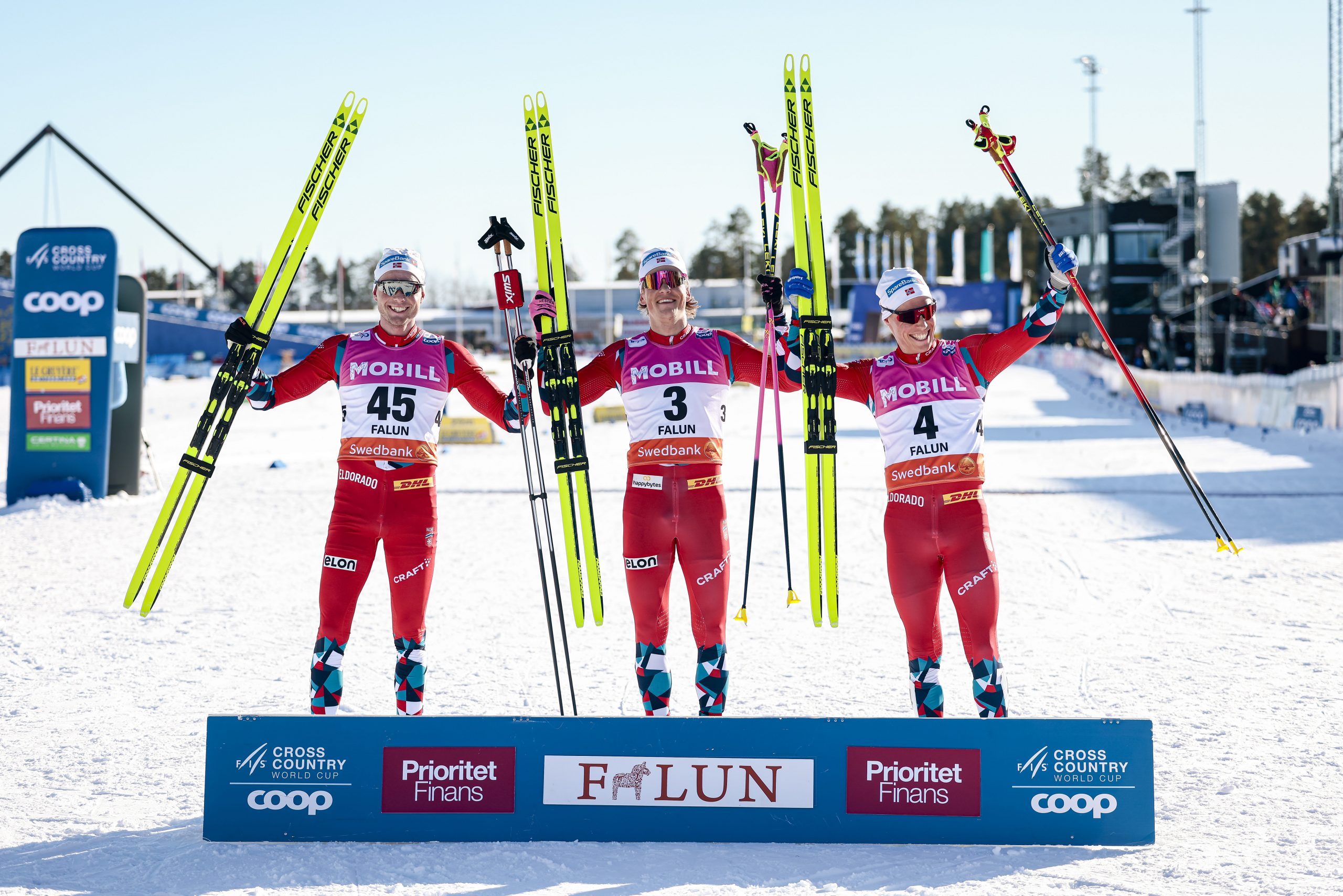
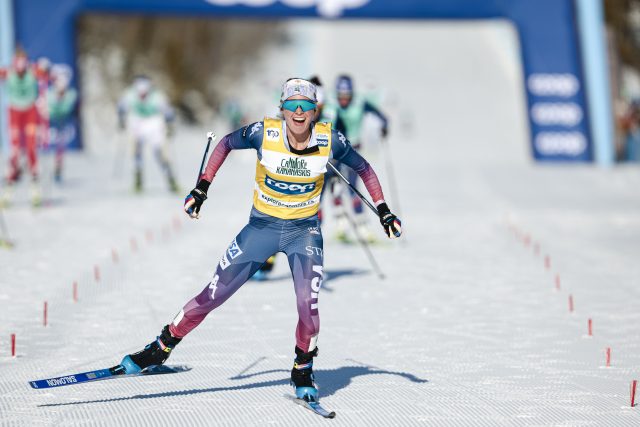
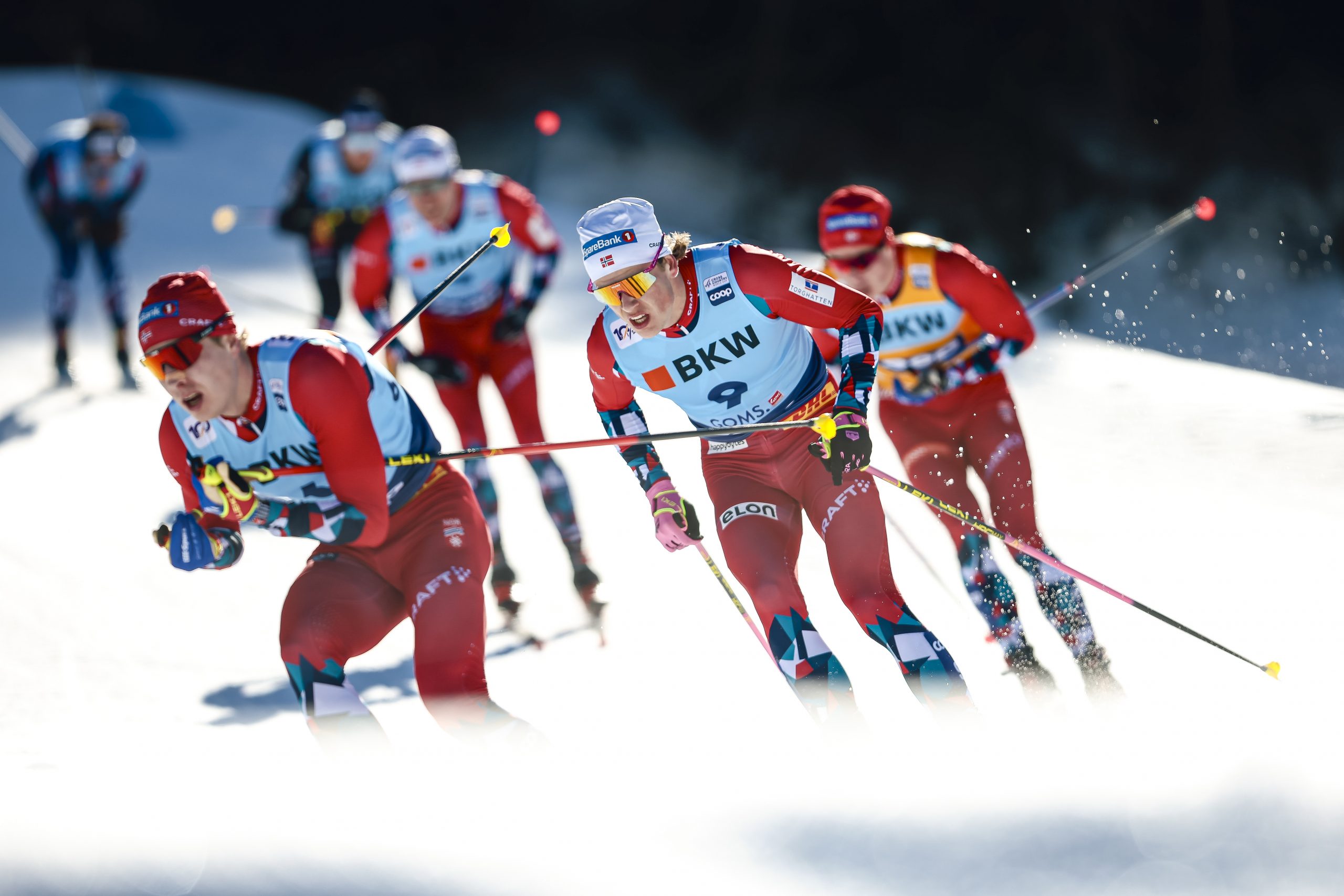
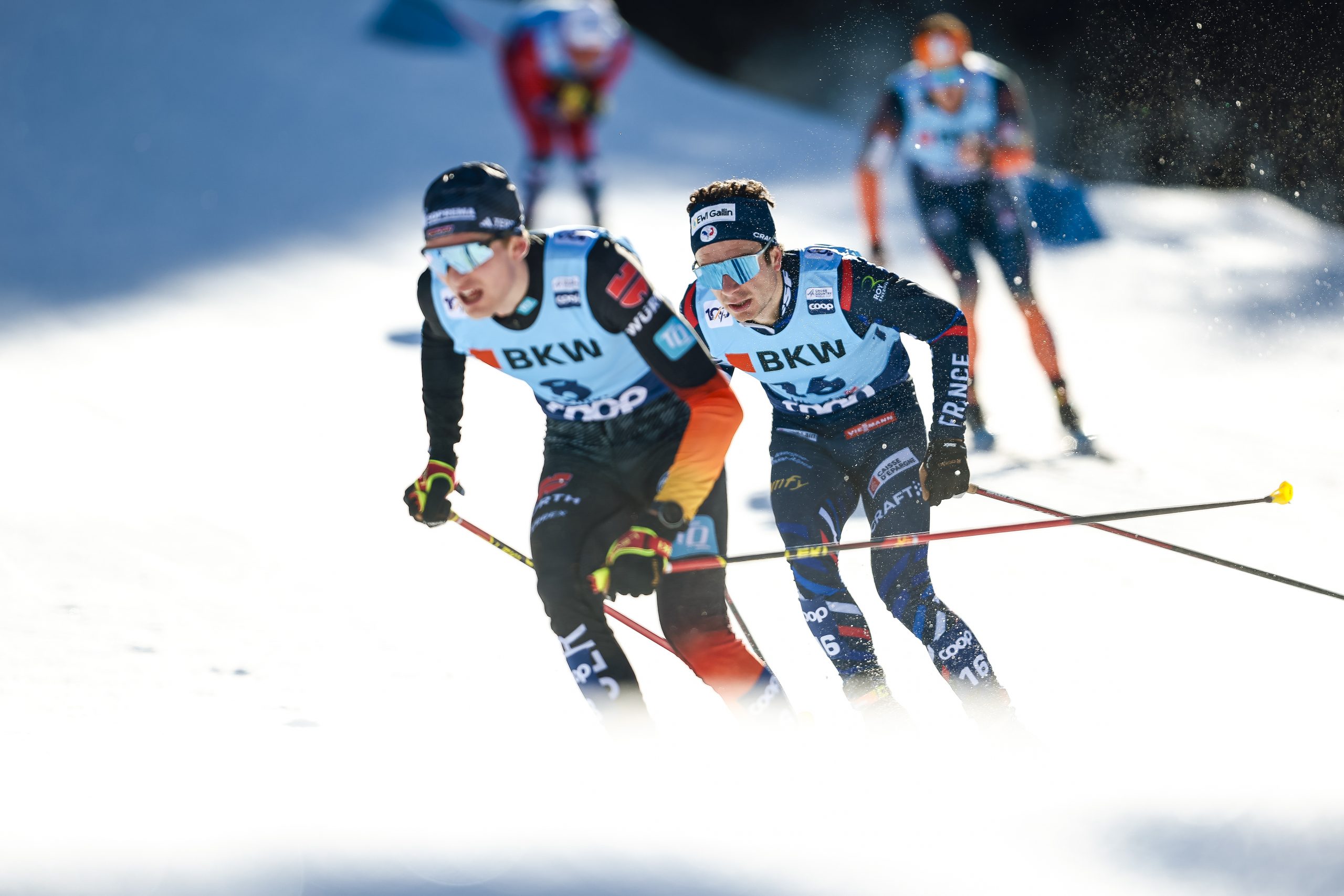
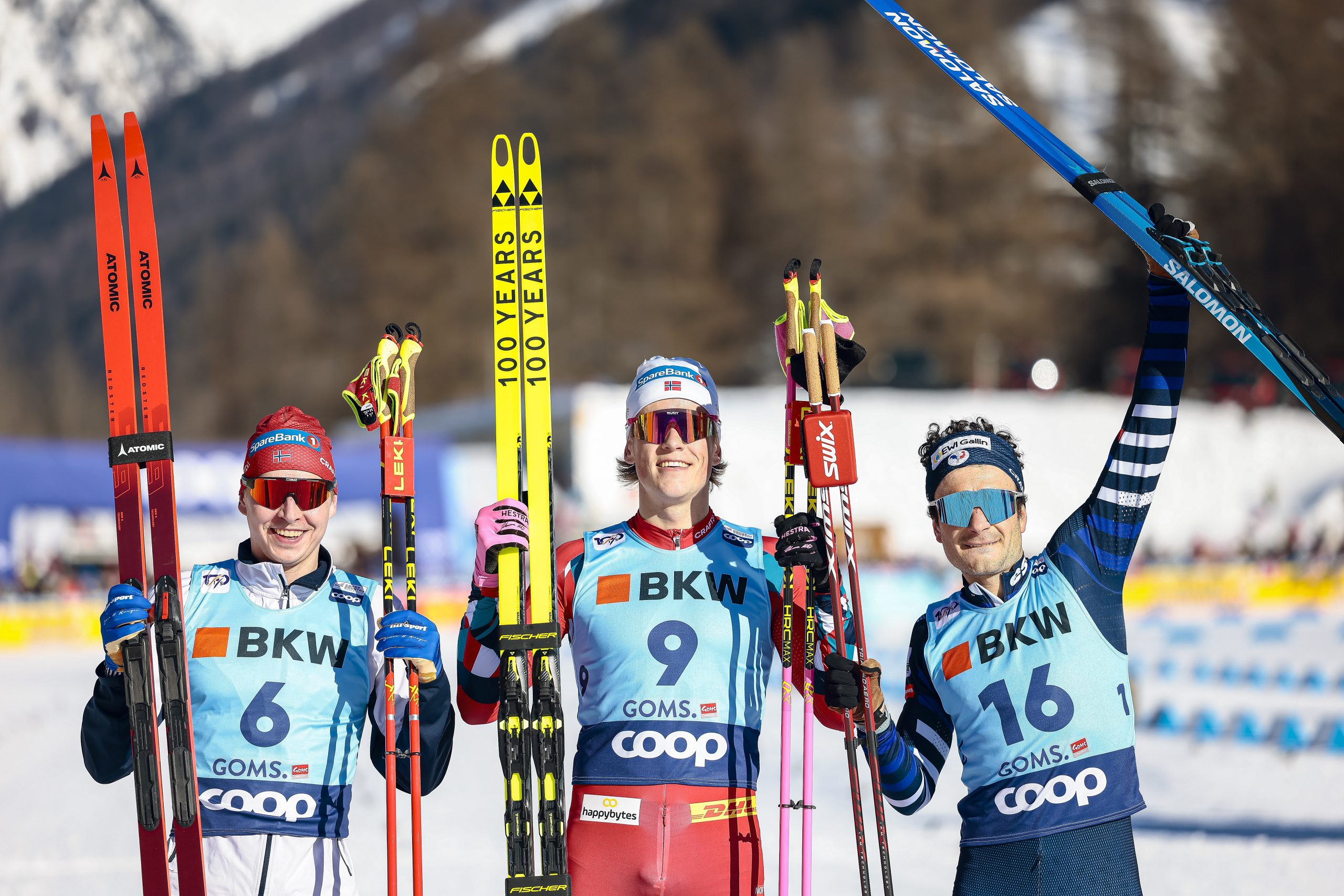
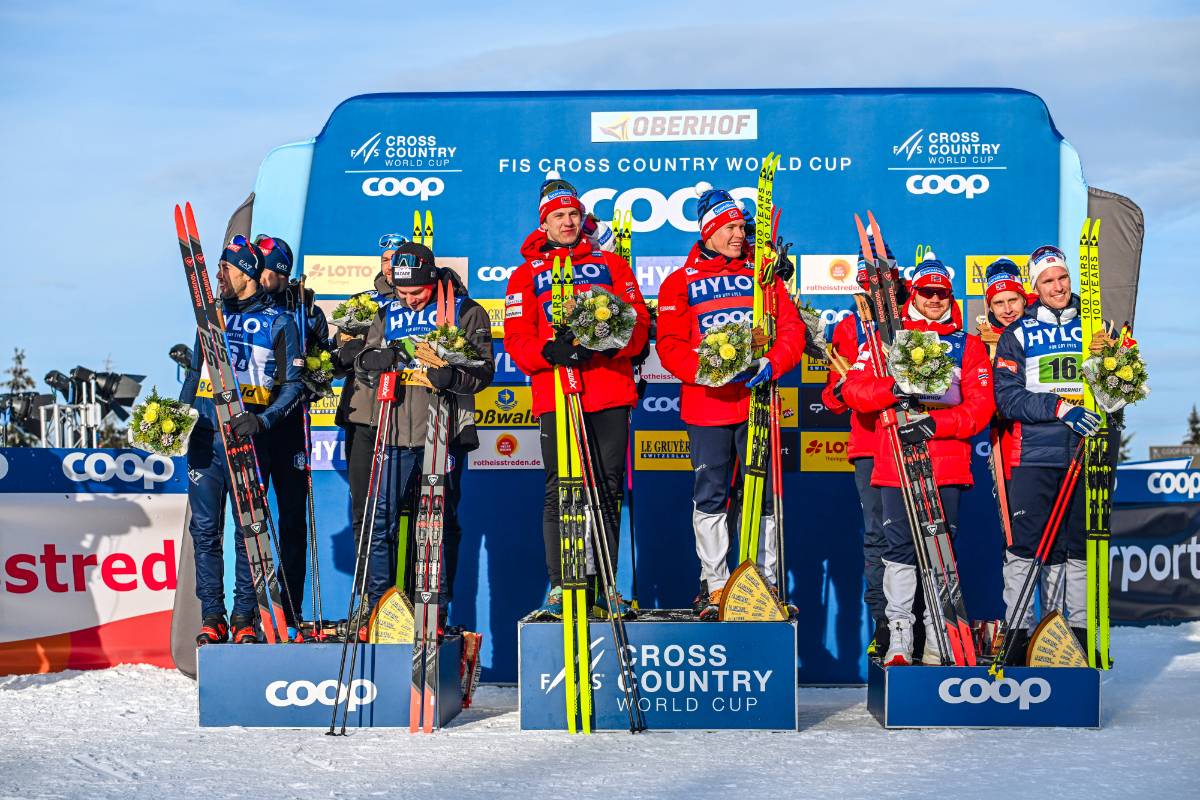
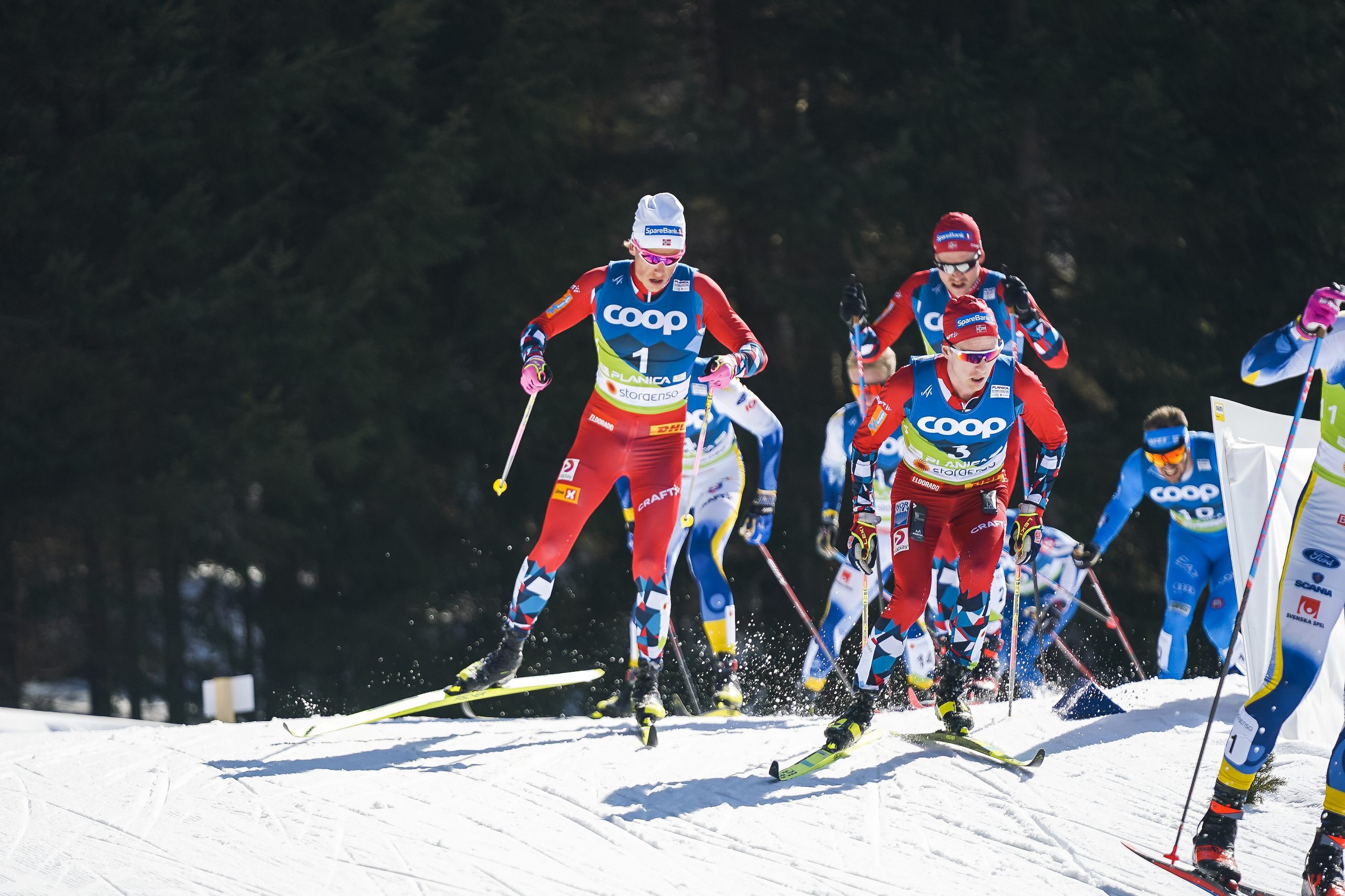
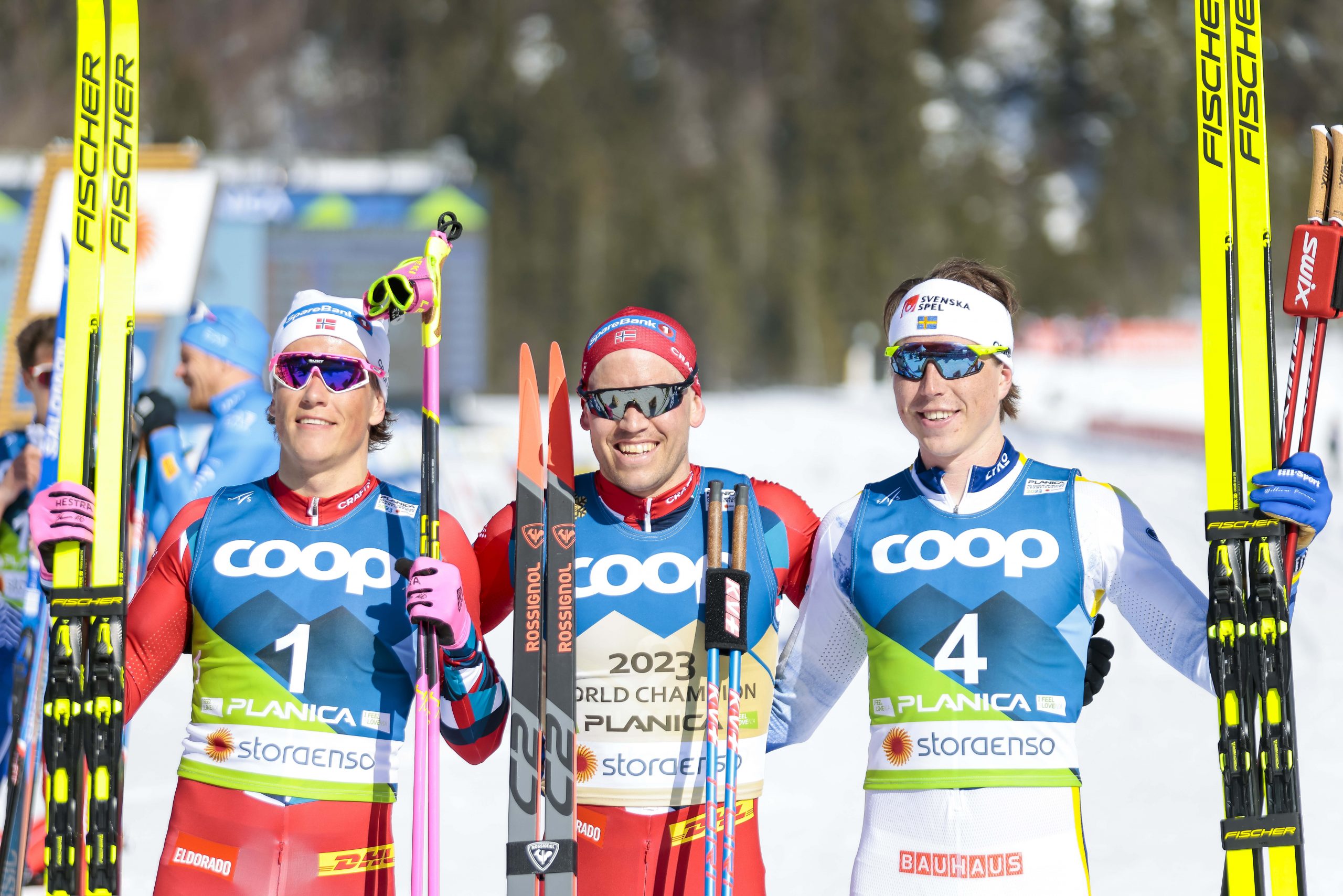
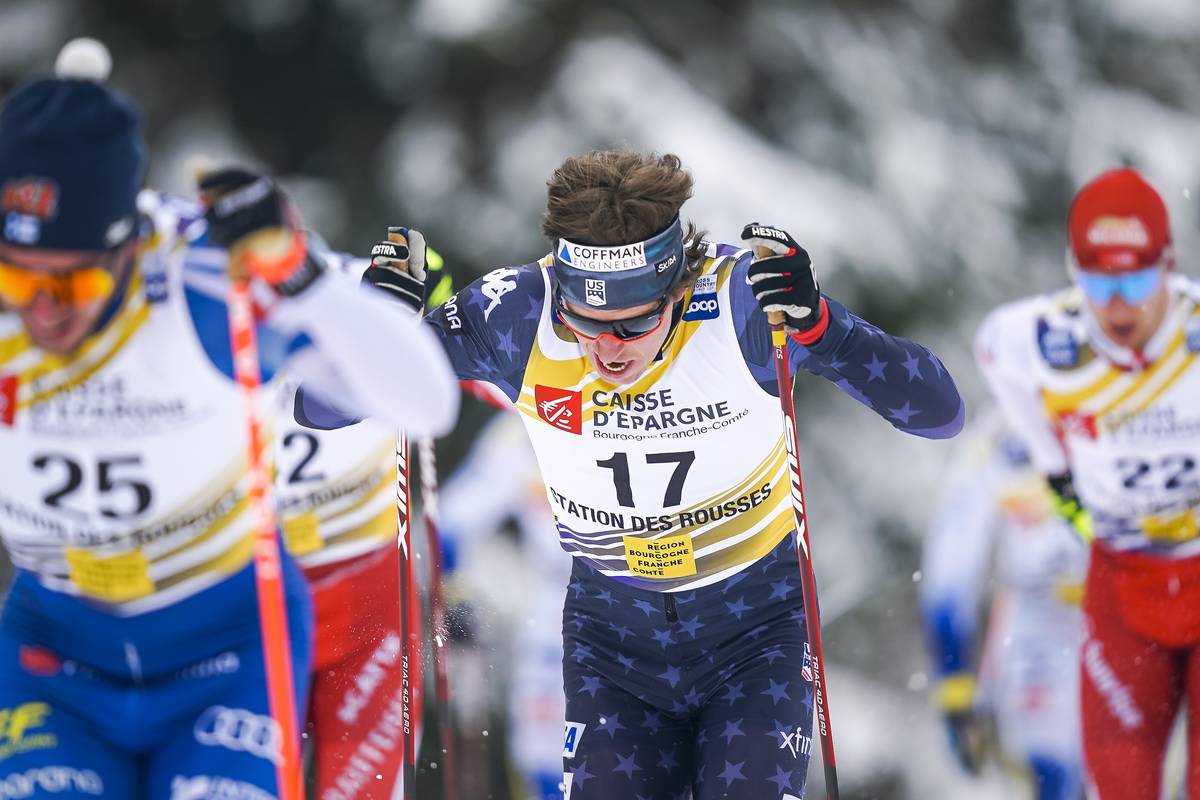
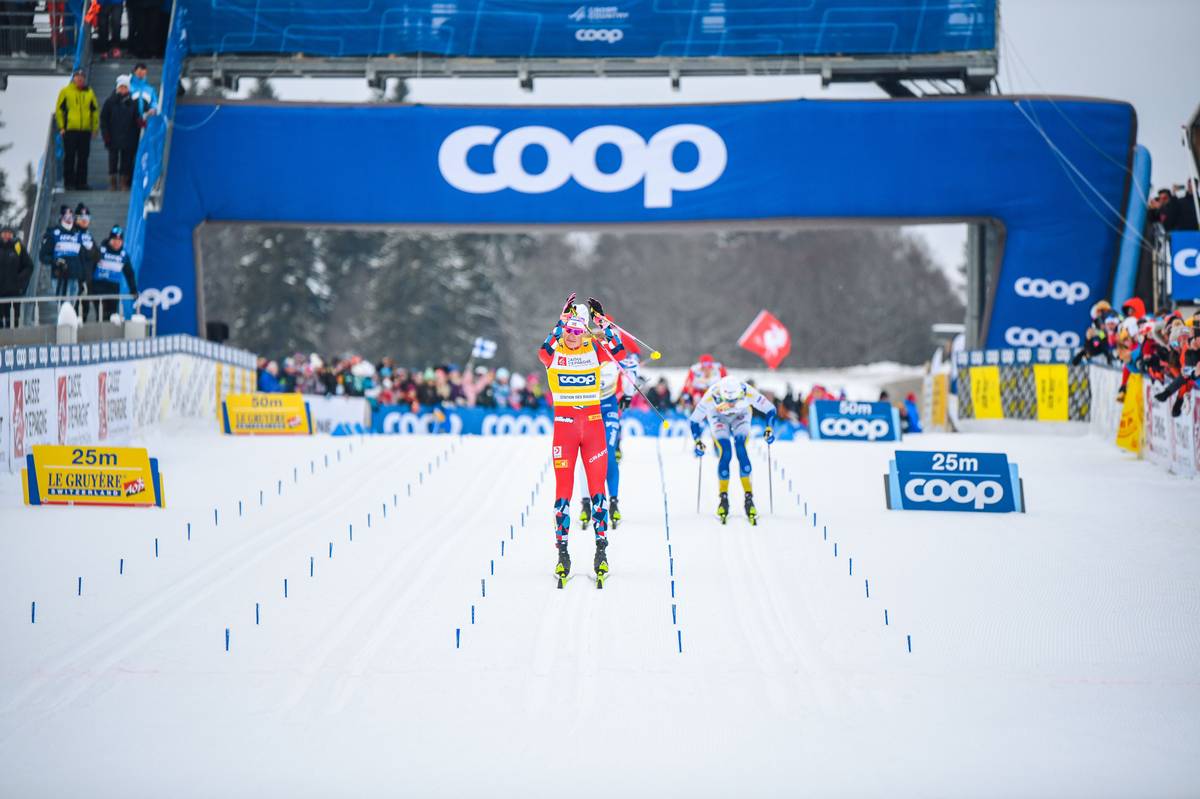
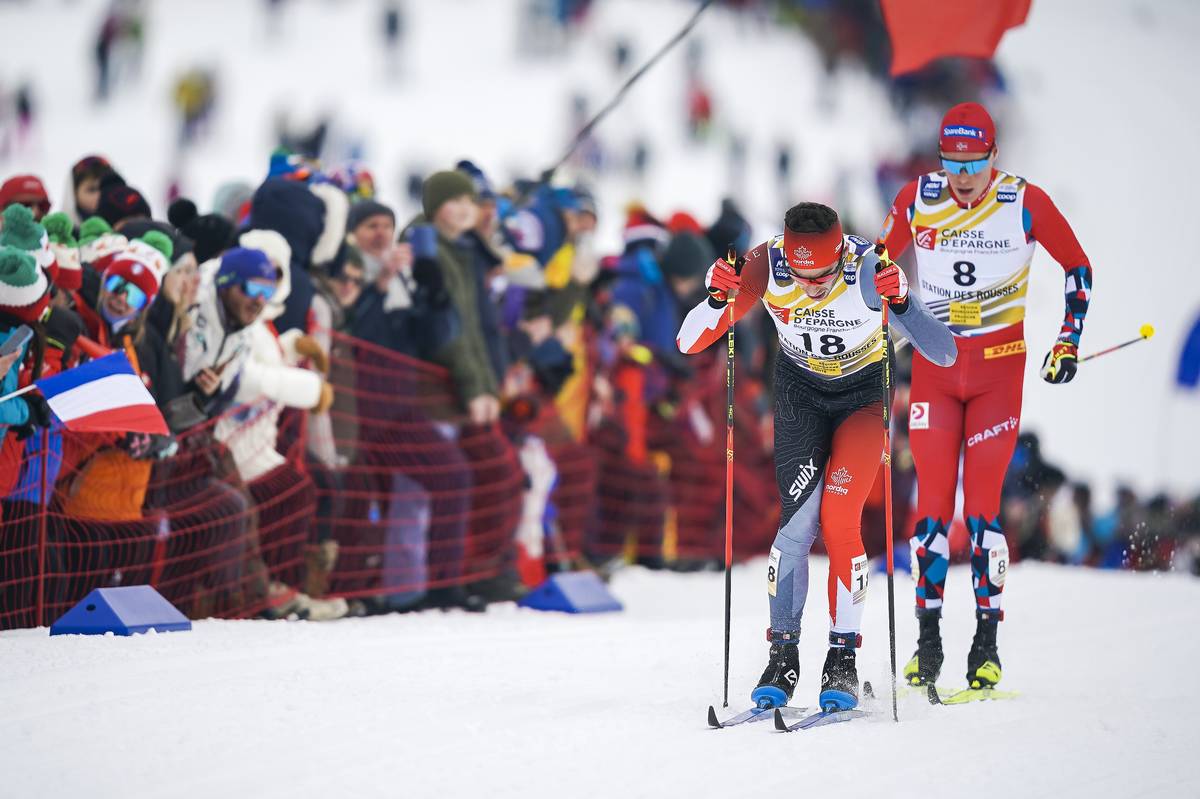
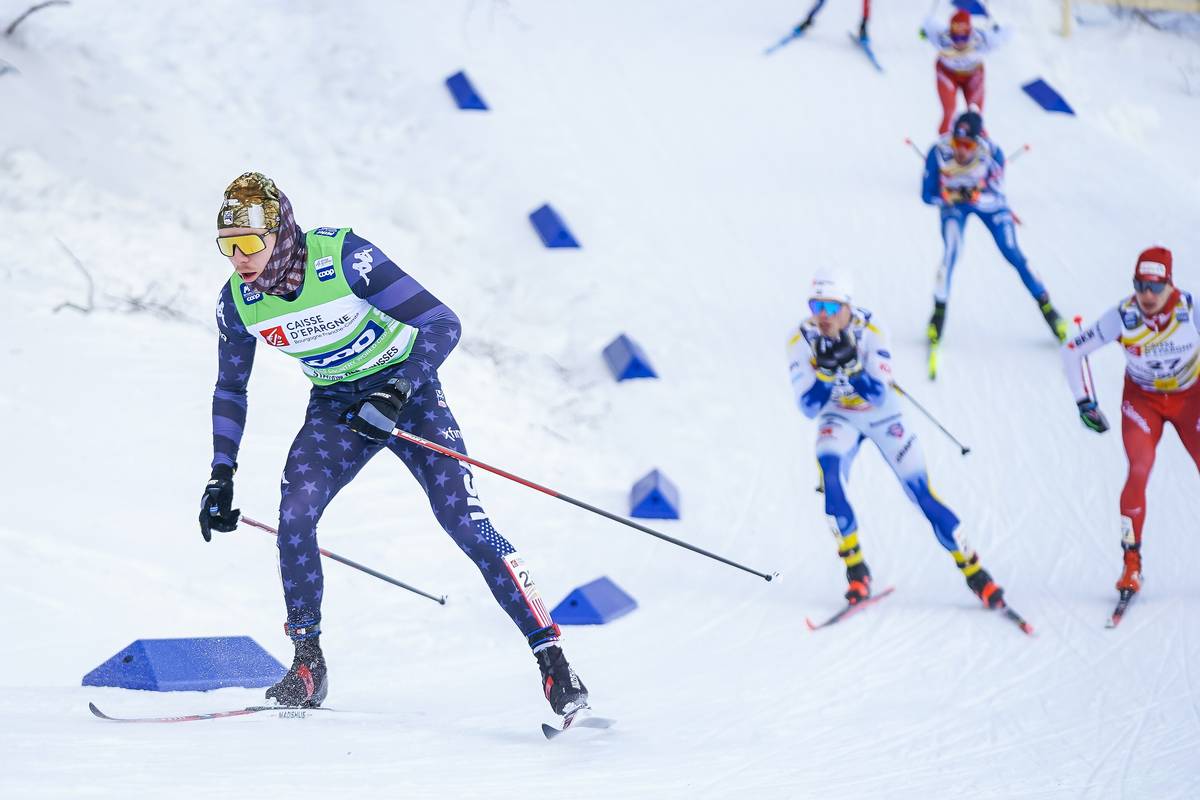
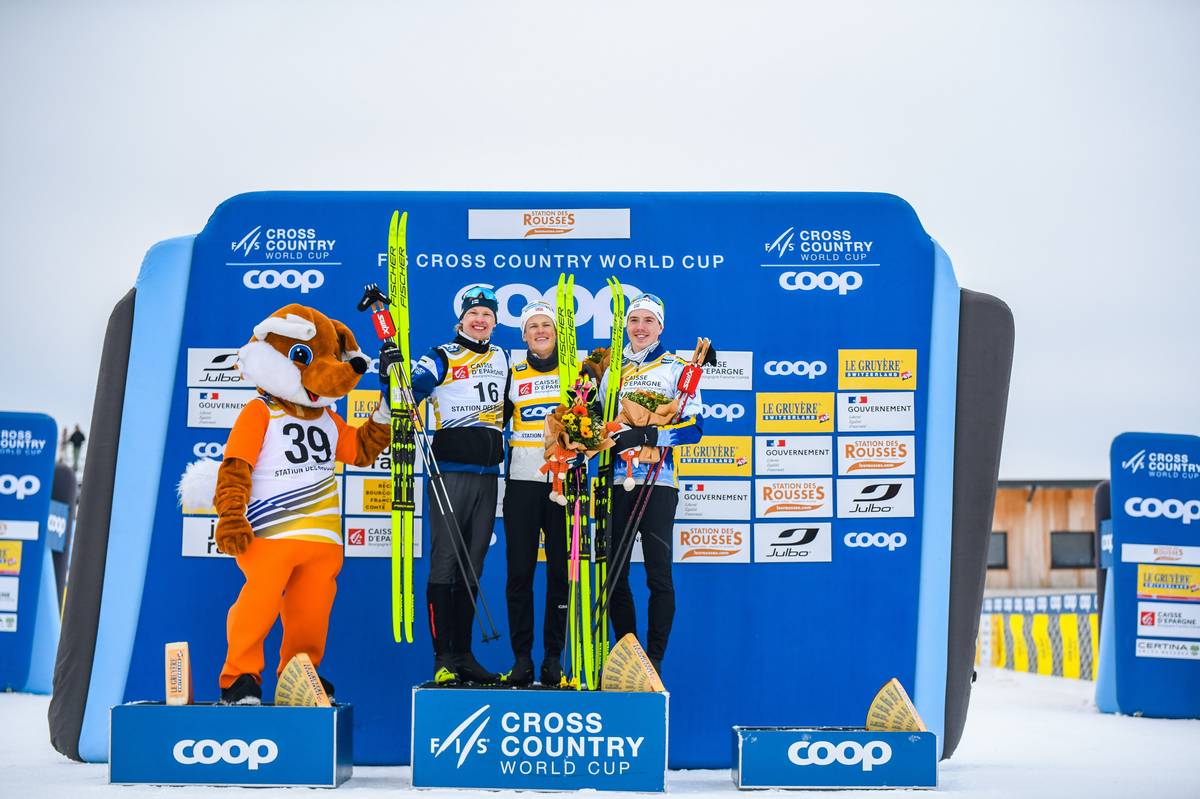
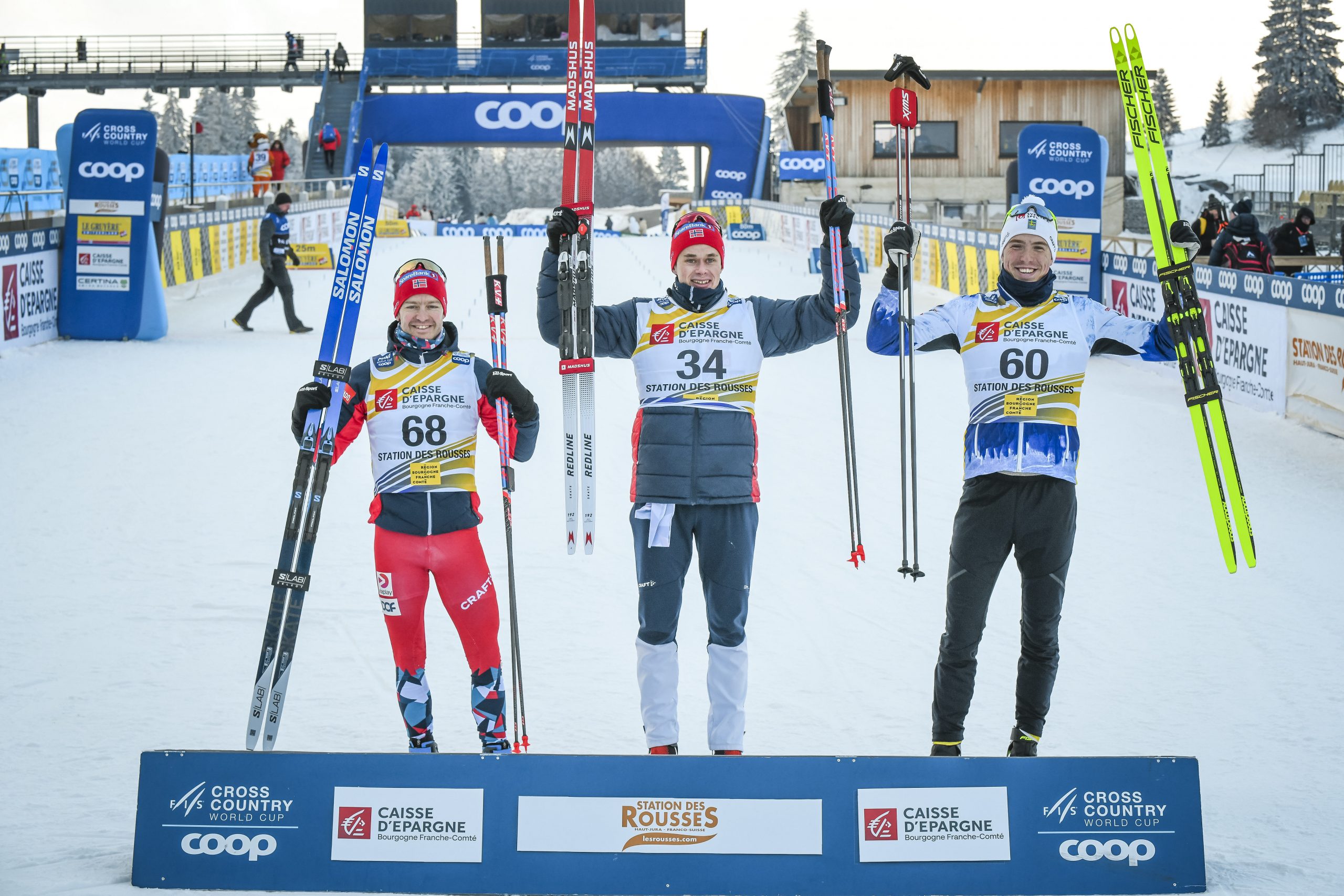
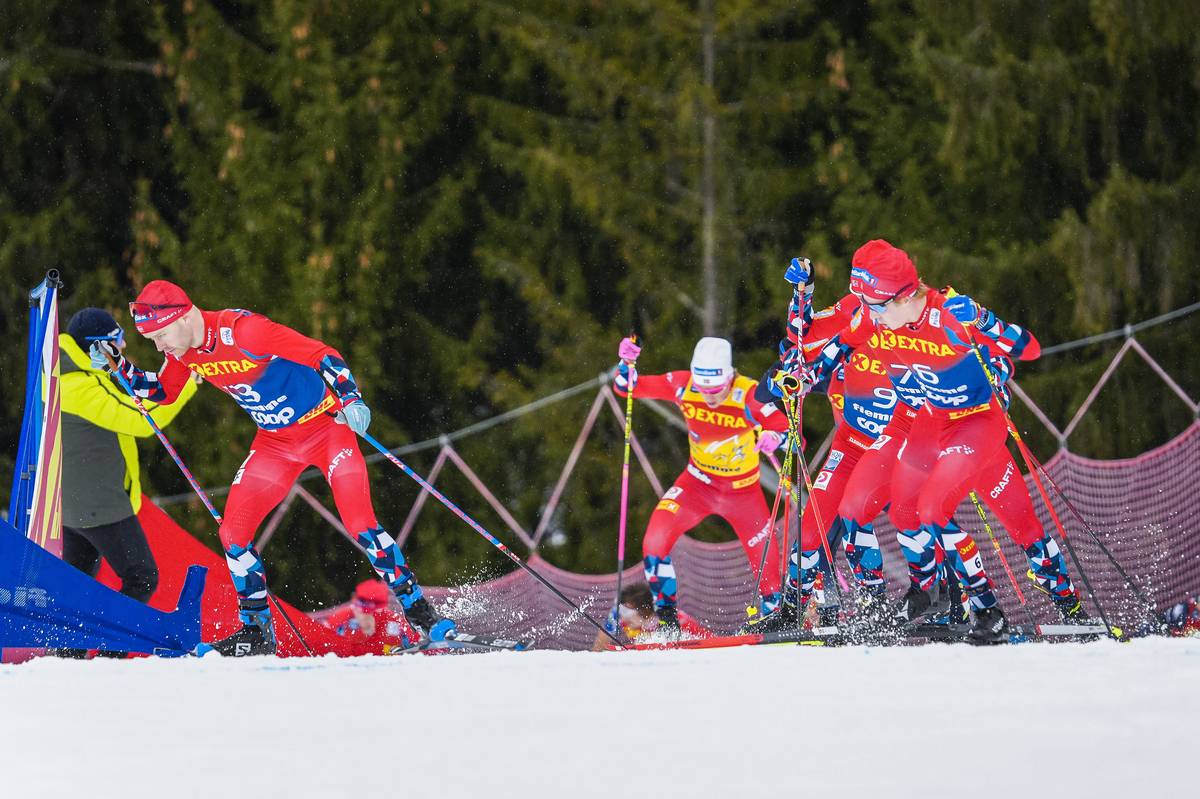
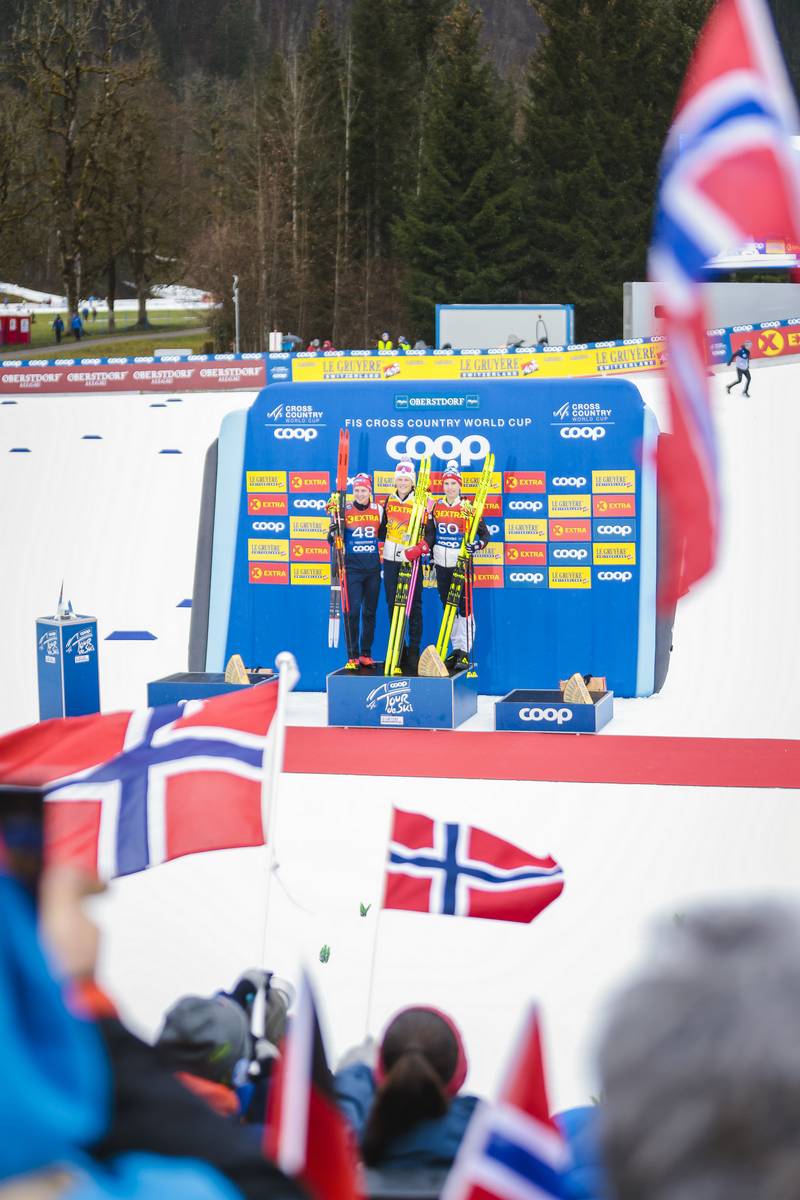
Gjoeran Tefre (NOR), Johannes Hoesflot Klaebo (NOR), and Martin Loewstroem Nyenget (NOR): another all-red Norwegian podium in the 2024 World Cup finale in Falun, Sweden. (Photo: Modica/NordicFocus
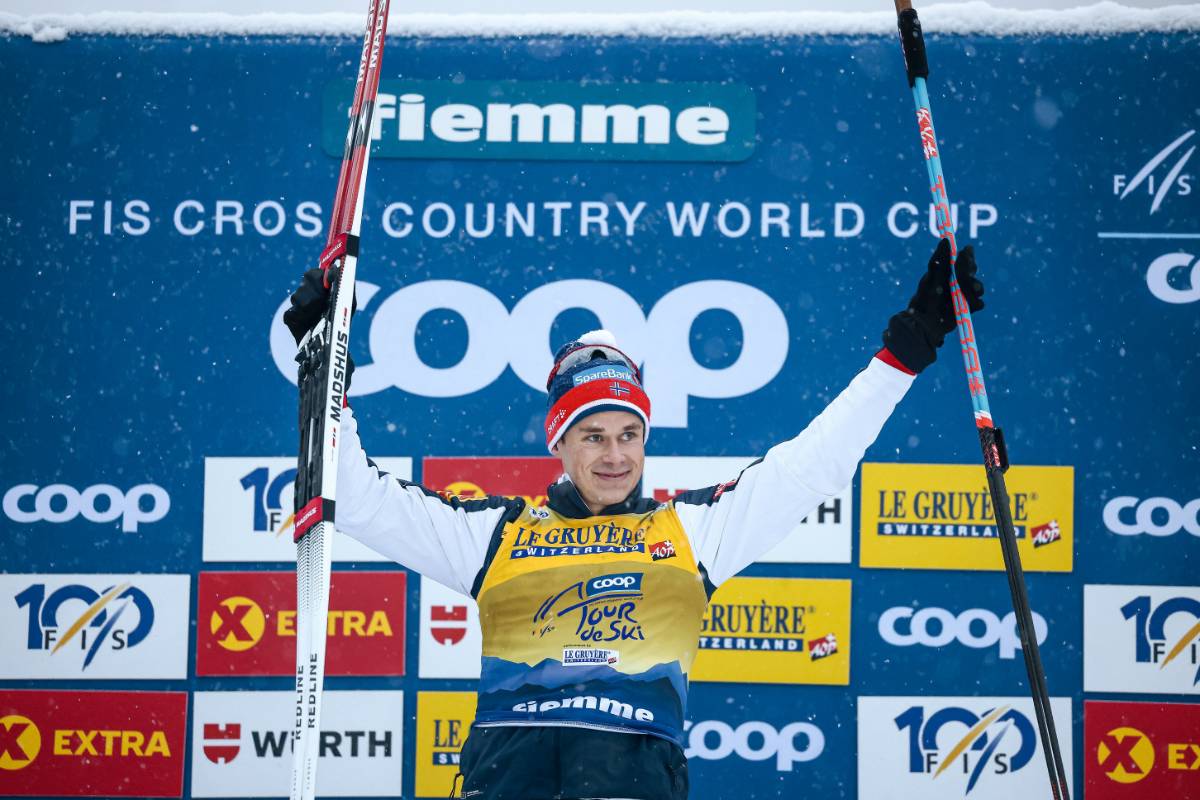
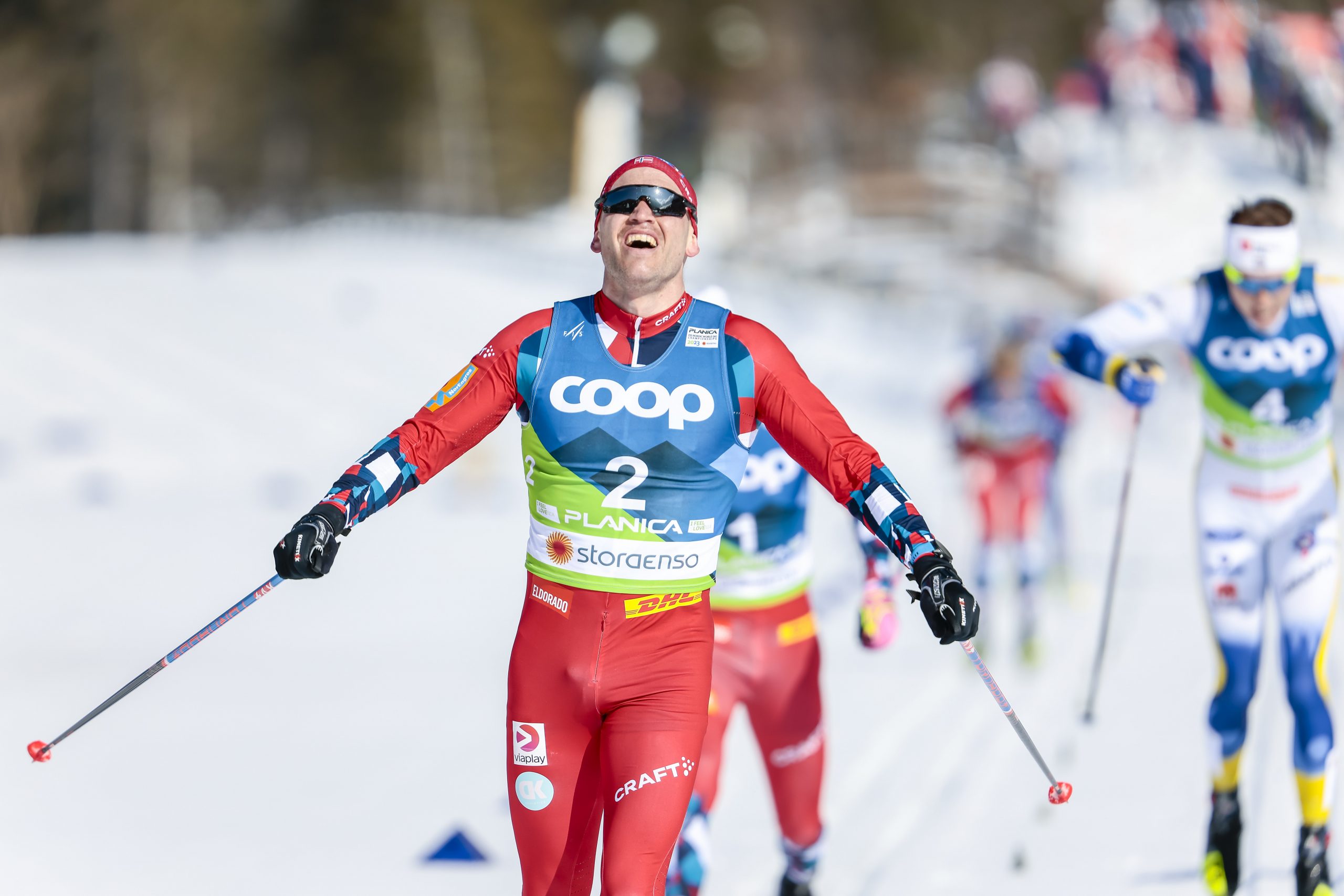
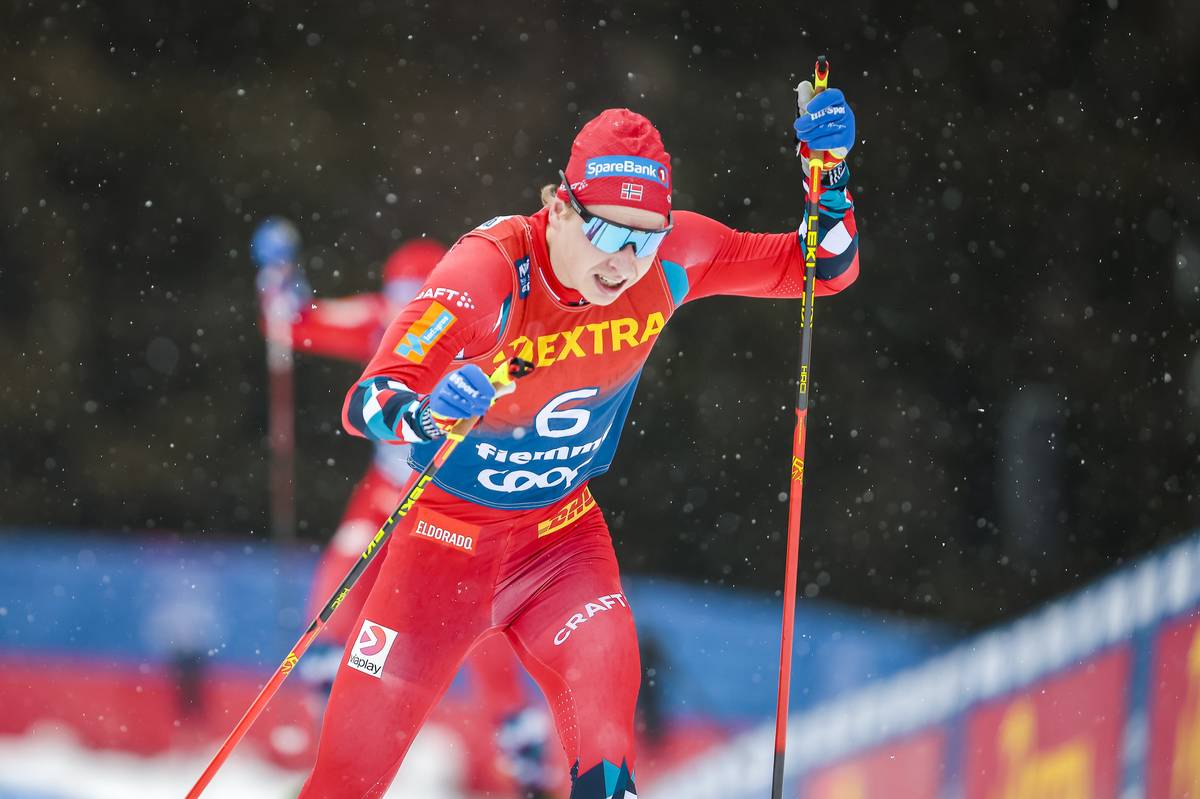
The 2023-2024 FIS World Cup season ends as it began—an all-Norwegian podium. After 20 kilometers of Mass Start Freestyle racing, the race was decided among a crowd of red race suits as Johannes Hoesflot Klaebo sprinted to first, followed by Gjoeran Tefre second, and Martin Loewstroem Nyenget third.
It’s been a season defined by the accomplishments of Klaebo (with 16 individual race wins and the Sprint Globe), but concluding with the awarding of the World Cup Overall Crystal Globe to Klaebo’s teammate, Harald Oestberg Amundsen (who also won the Distance Globe). And few teams in the world of sport dominate their discipline quite like the Norwegian men’s team does in cross-country skiing.
Klaebo missed nine race starts this season (due to illness), including the entirety of the points-rich Tour de Ski. Still, of the 24 races he entered, he won 15—an extraordinary level of consistency, excellence, and dominance. Regardless, the lead built in the World Cup Overall standings by Harald Oestberg Amundsen (NOR) was such that Klaebo would have needed to win Falun’s 20 k Freestyle—and win all the bonus points—while Amundsen finishing far down in the standings. Coming into today’s race, Klaebo trailed Amundsen by `112 points. With maximum of only 130 points available in todays race (100 for the win, 30 bonus points), Klaebo would have needed to run the table AND have Amundsen basically fall off the edge of the map. While the likelihood of a Klaebo win was fairly high, the odds of Amundsen performing so poorly were quite low.
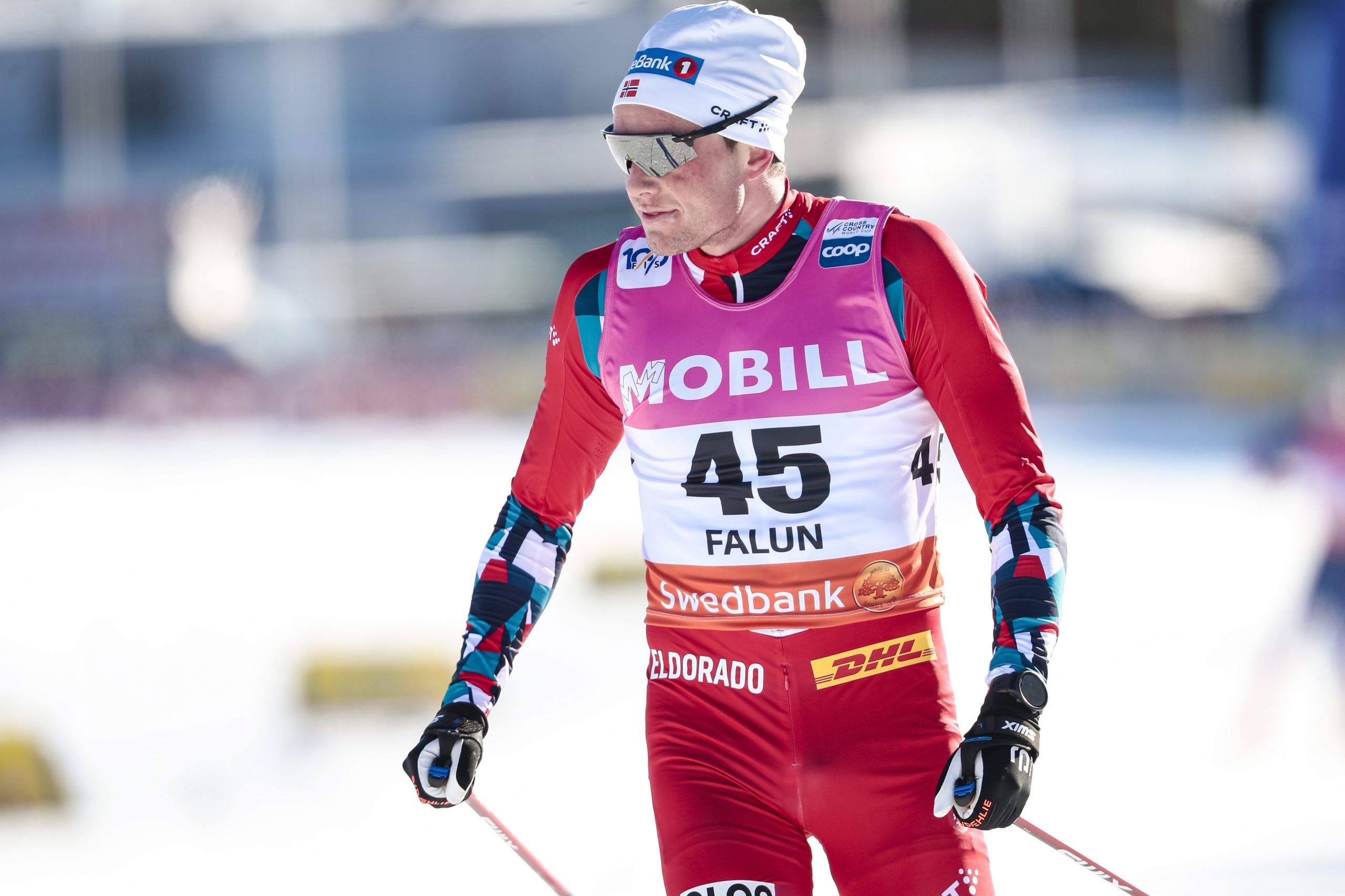
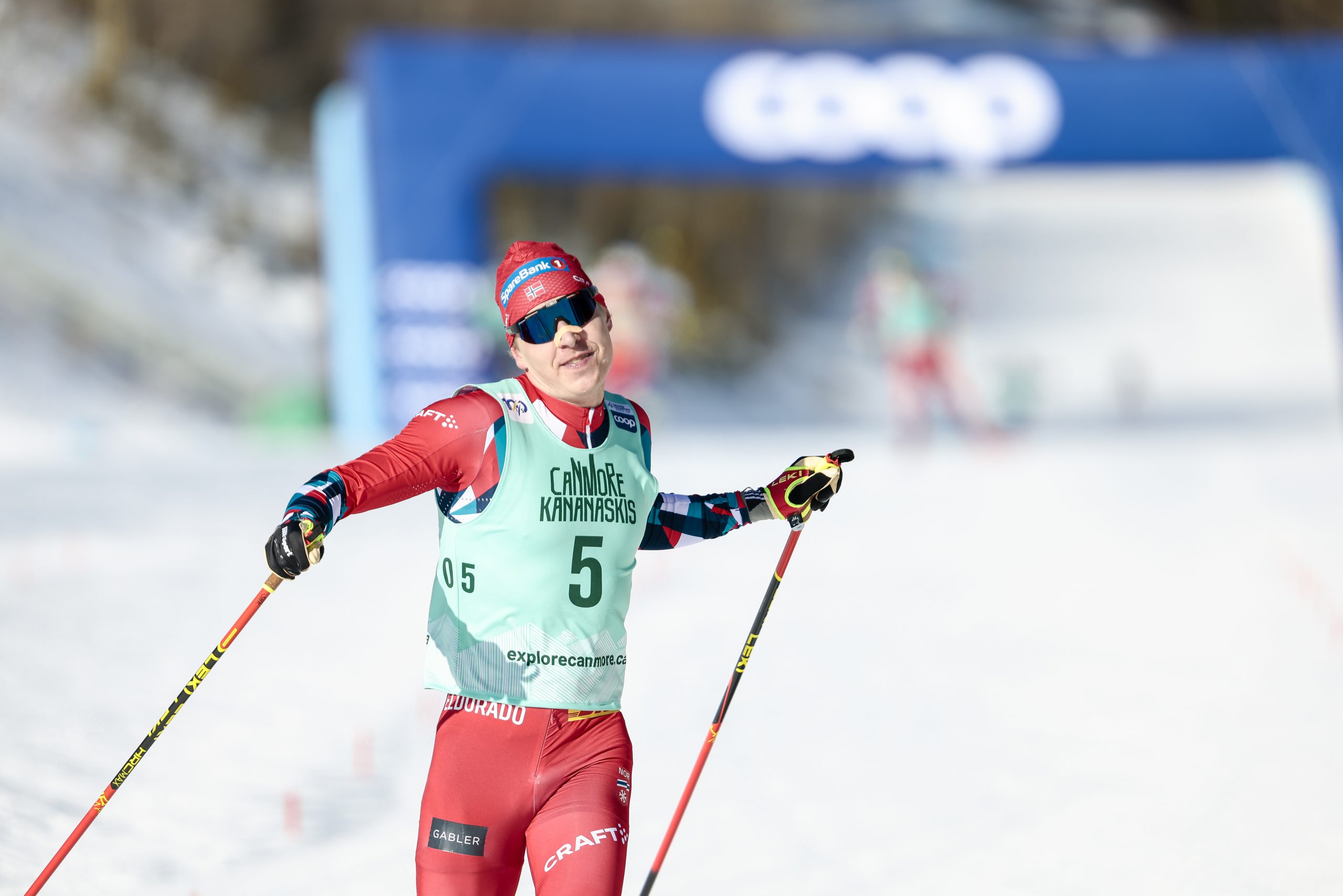
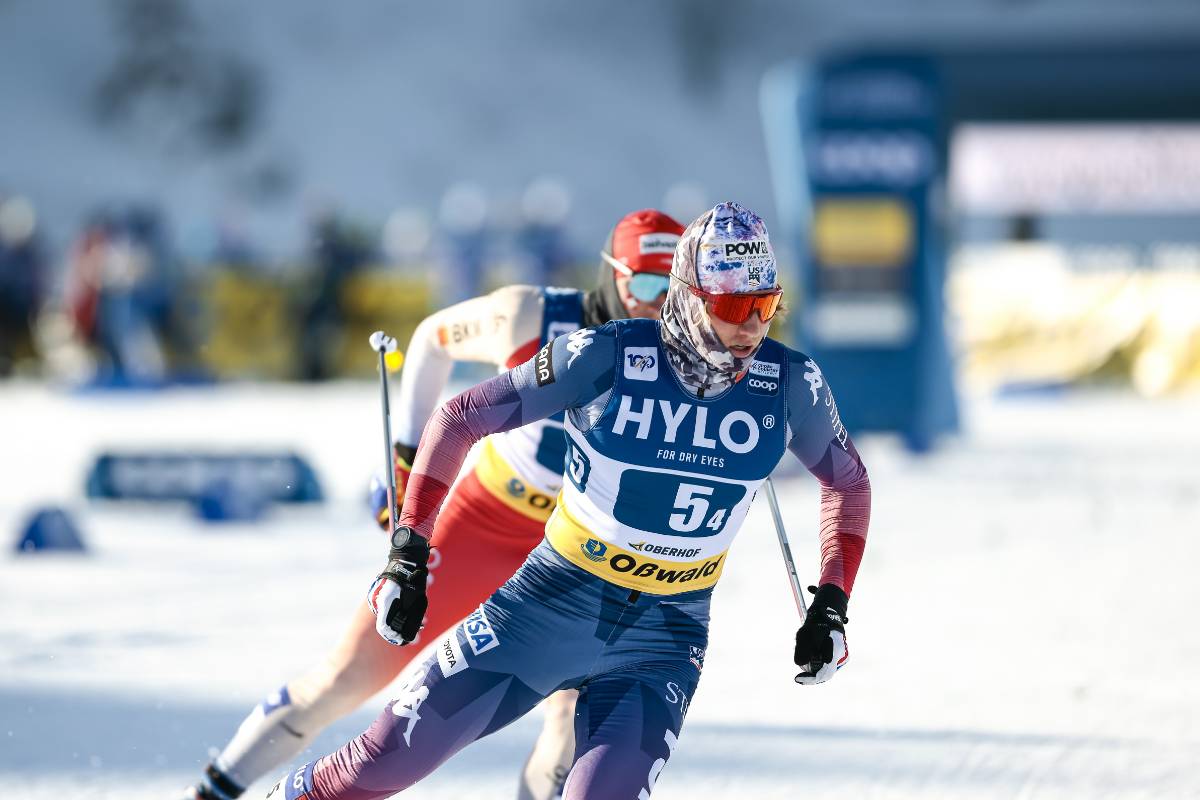
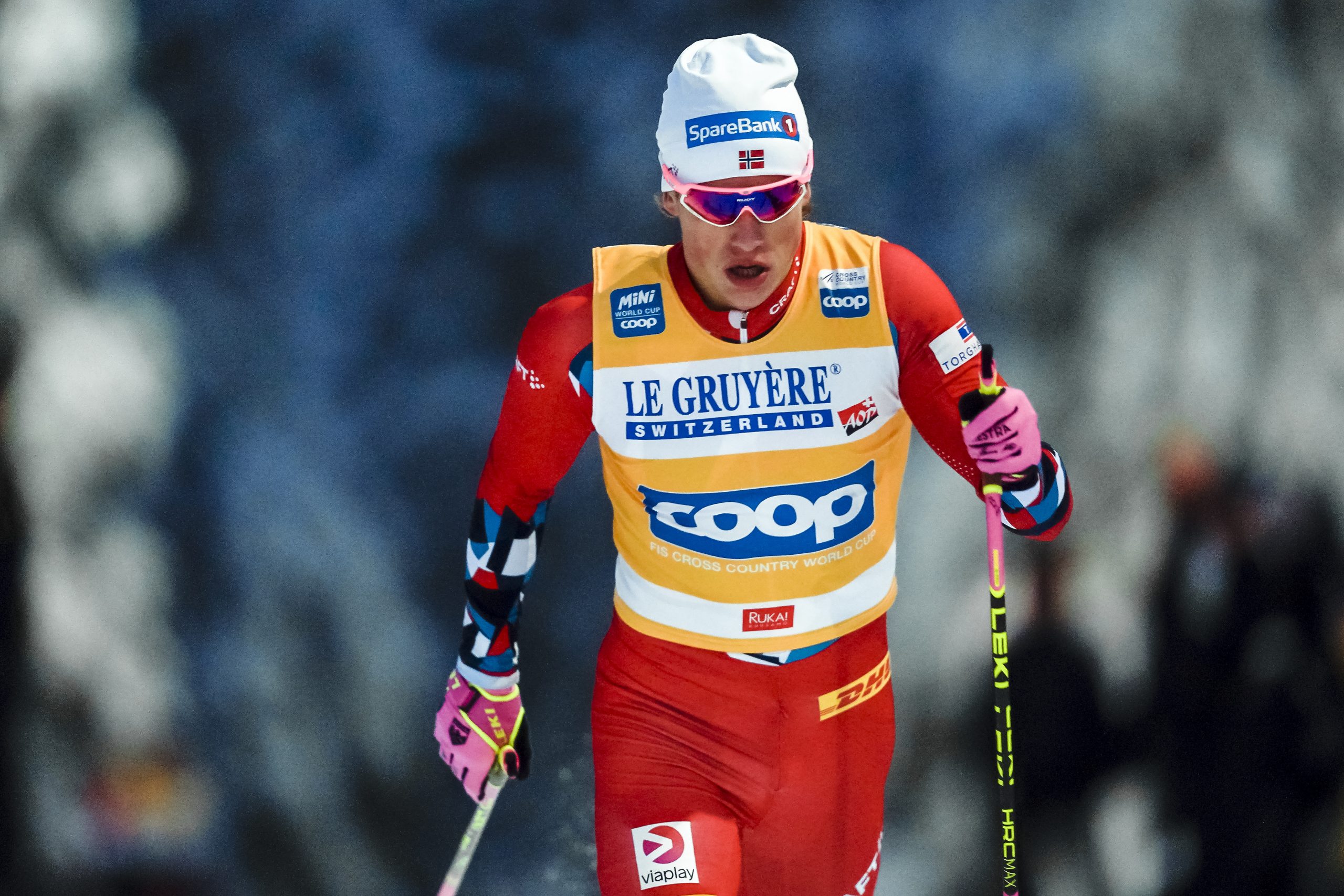
Making his first World Cup start since 2023, Gjoeran Tefre (NOR) demonstrated the true depth of Norwegian skiing in finishing a close second behind Johannes Hoesflot Klaebo (NOR). (Photo: Modica/NordicFocus)
20 k Freestyle Mass Start
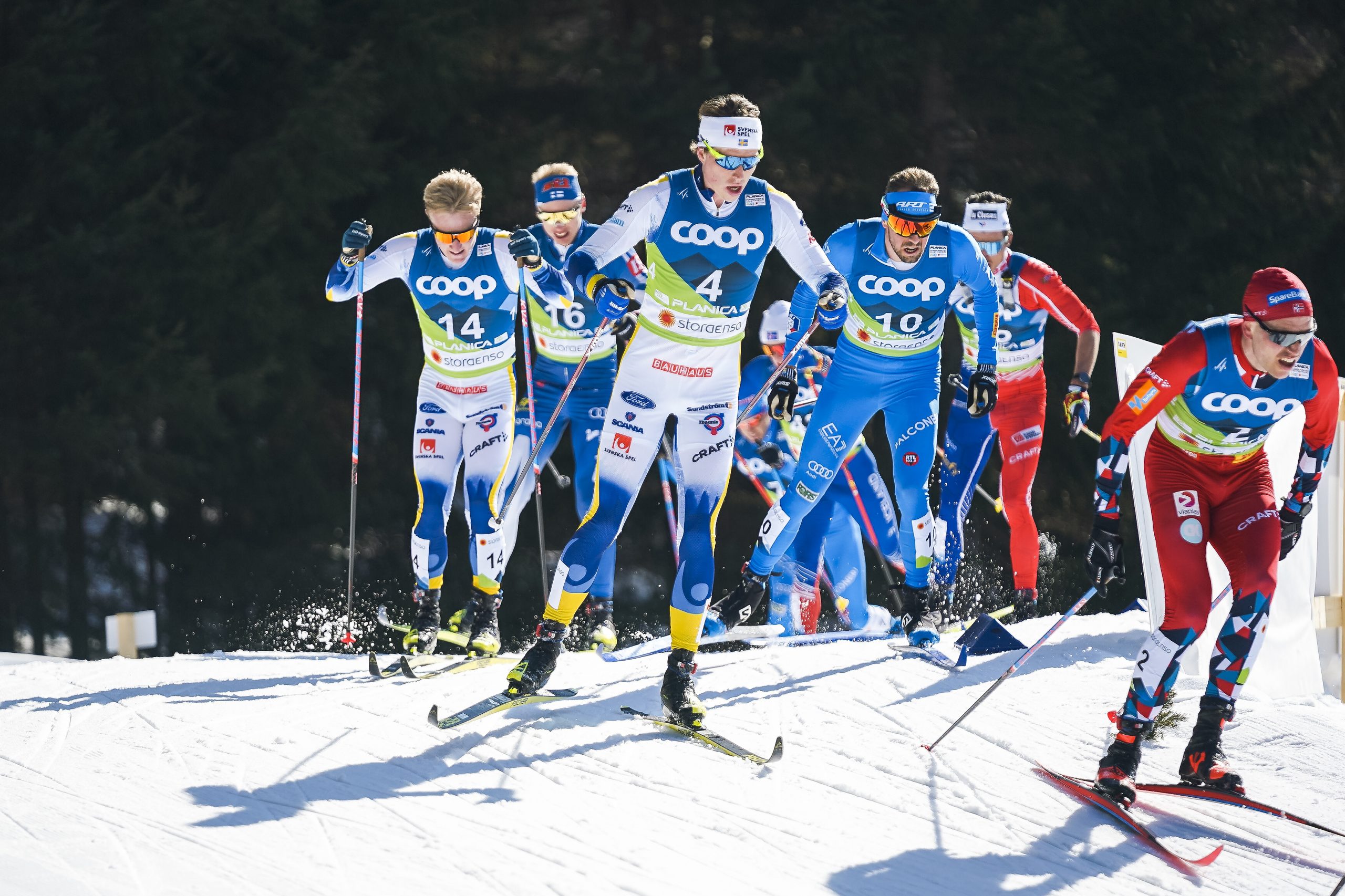
A massive men’s field—94 starters—lined up to challenge Falun’s four-lap course. Unlike the Women’s 20 k Freestyle Mass Start (contested earlier in the day) that began with a full-gas effort from eventual race winner, Jessie Diggins (USA), Klaebo and Amundsen led the field out of the stadium at a moderate pace.
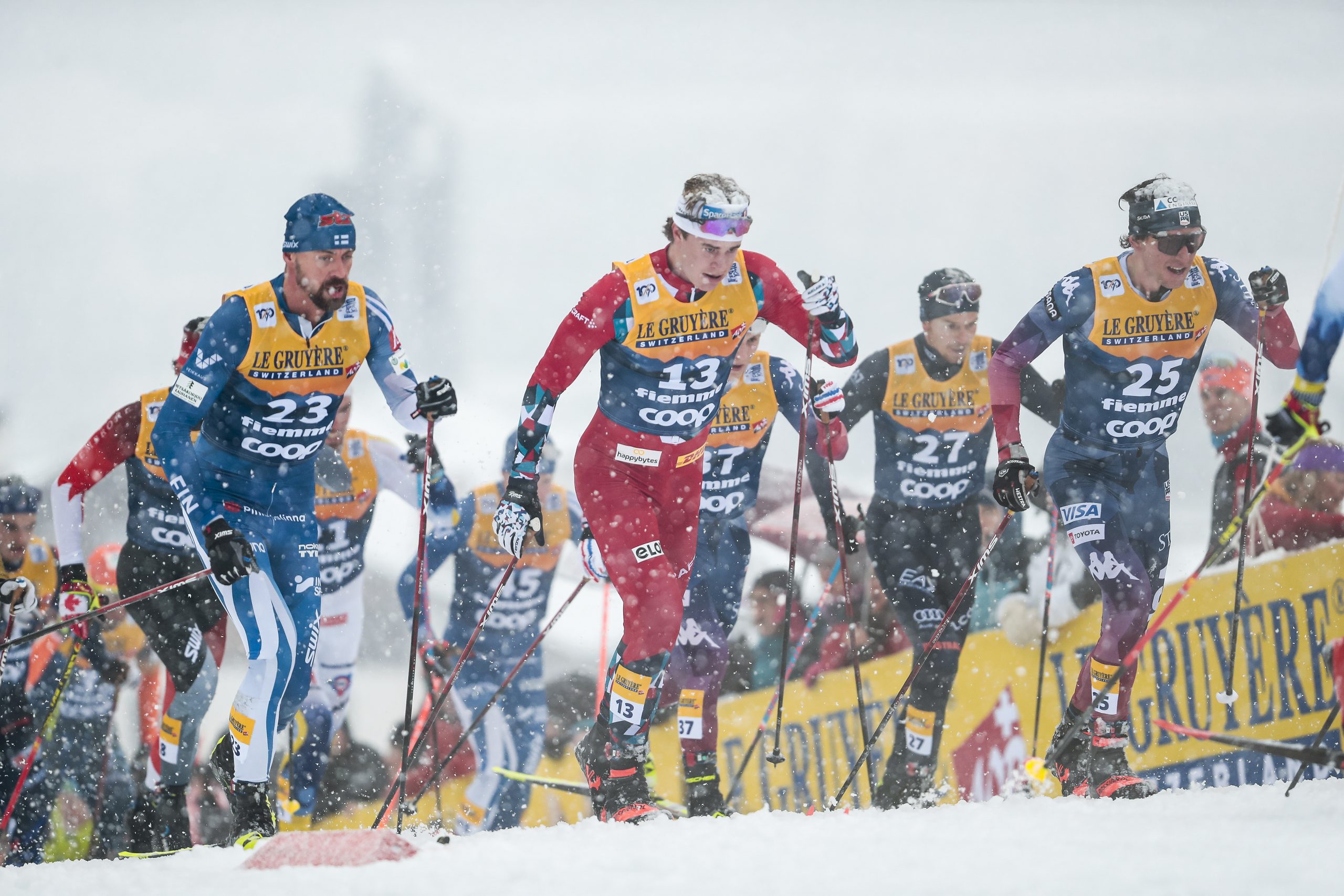
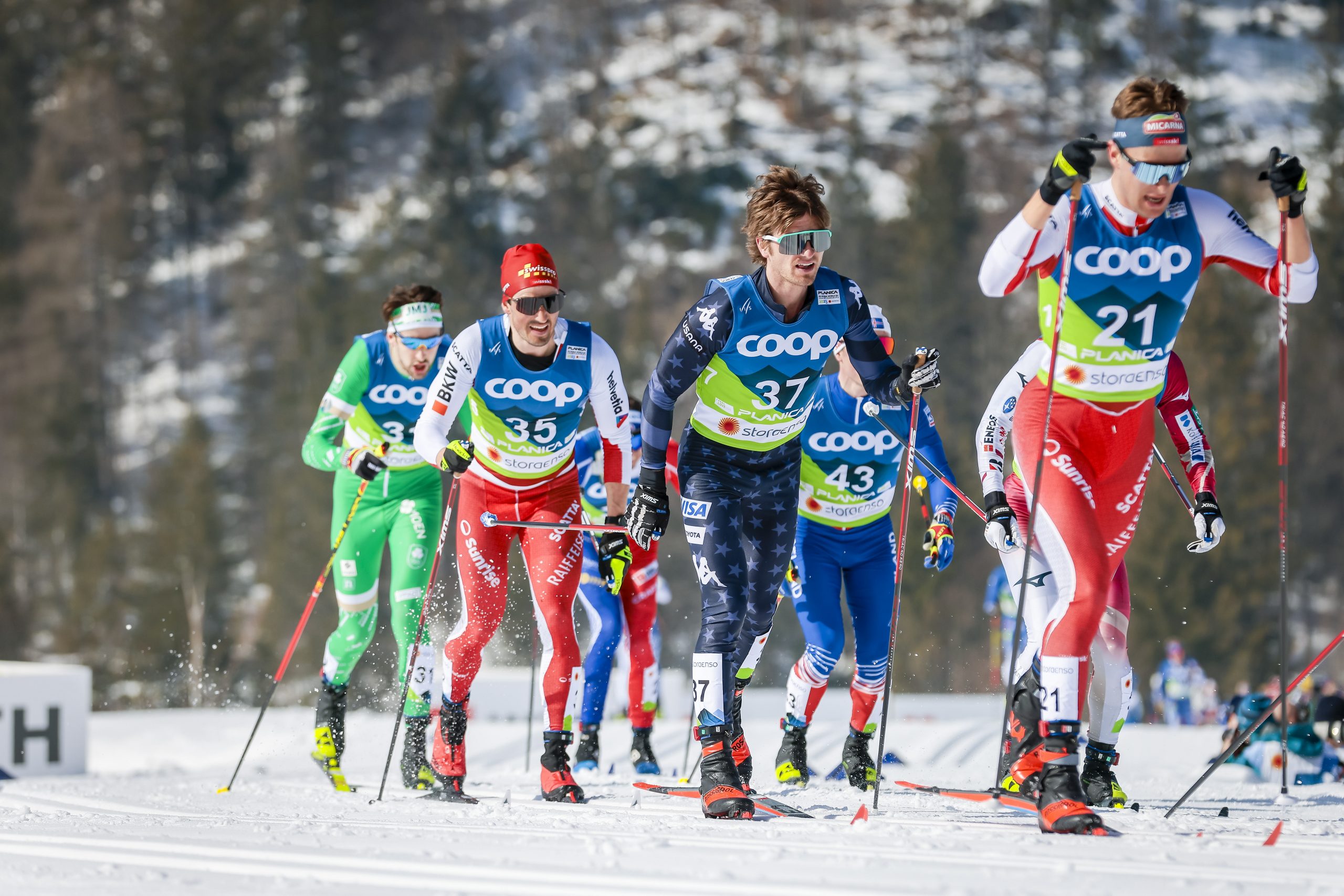
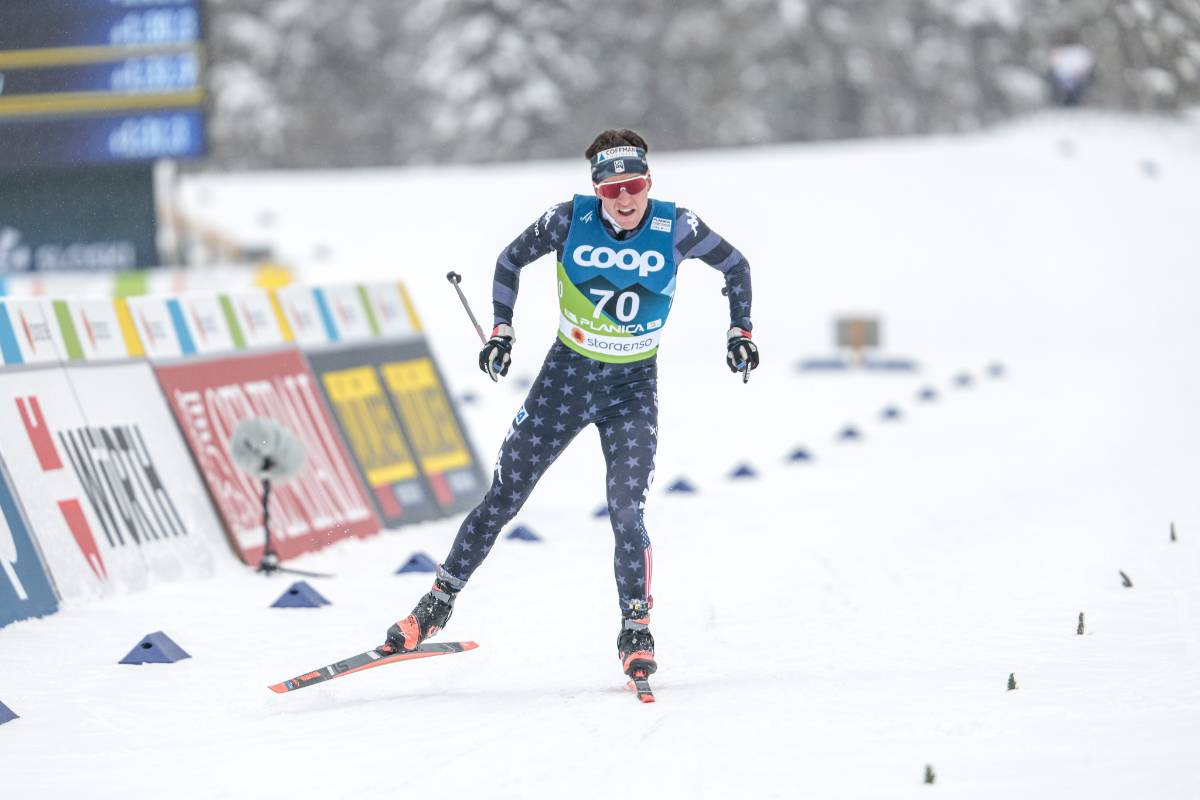
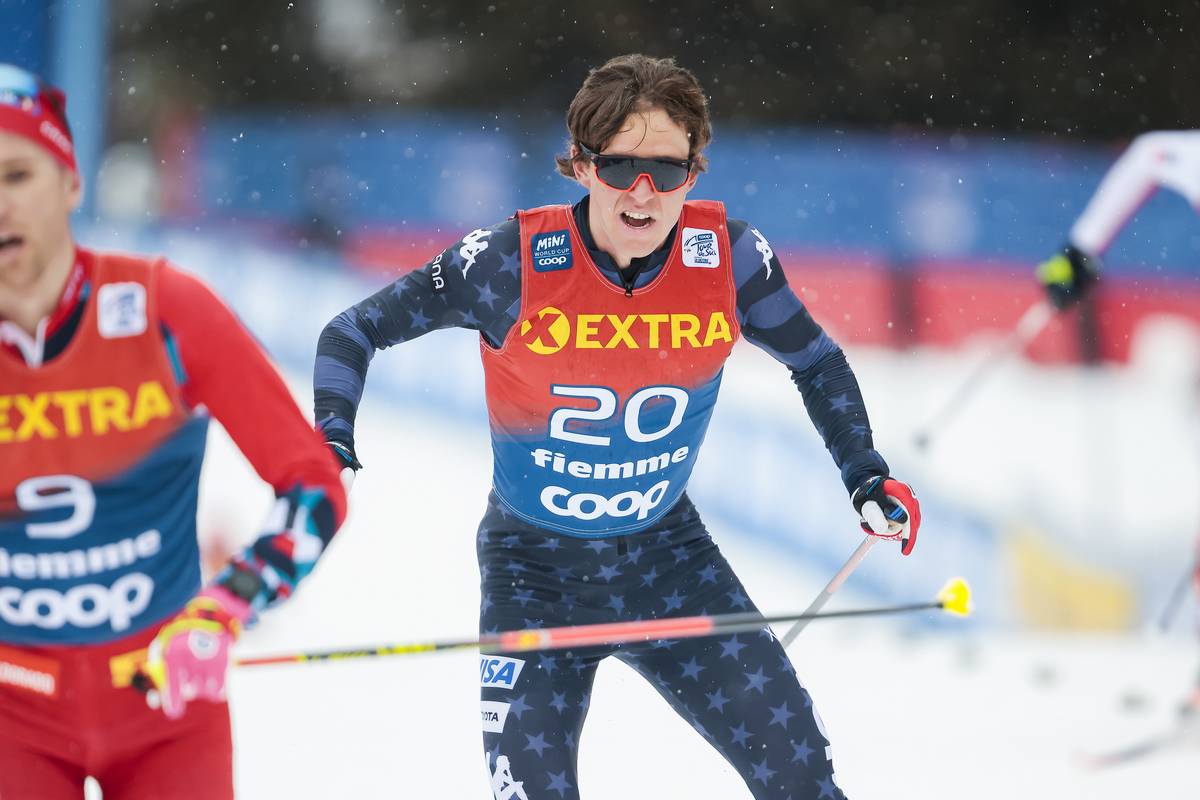
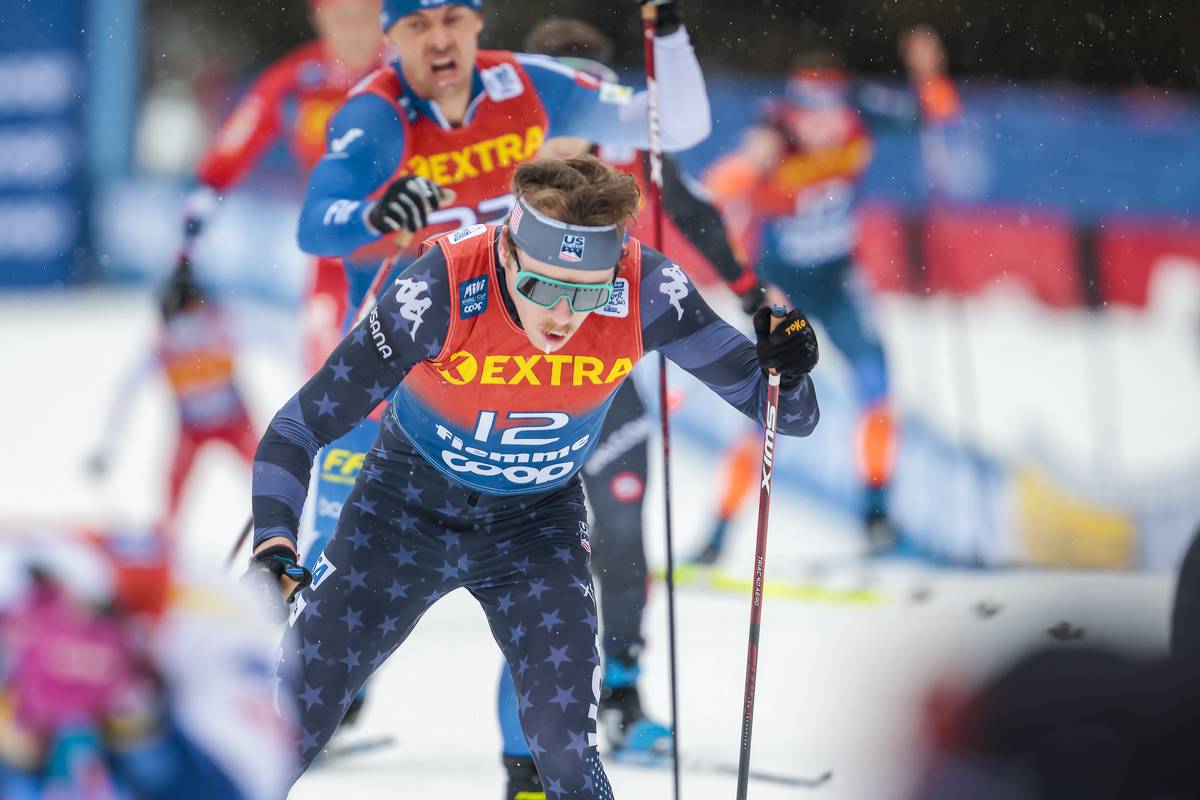
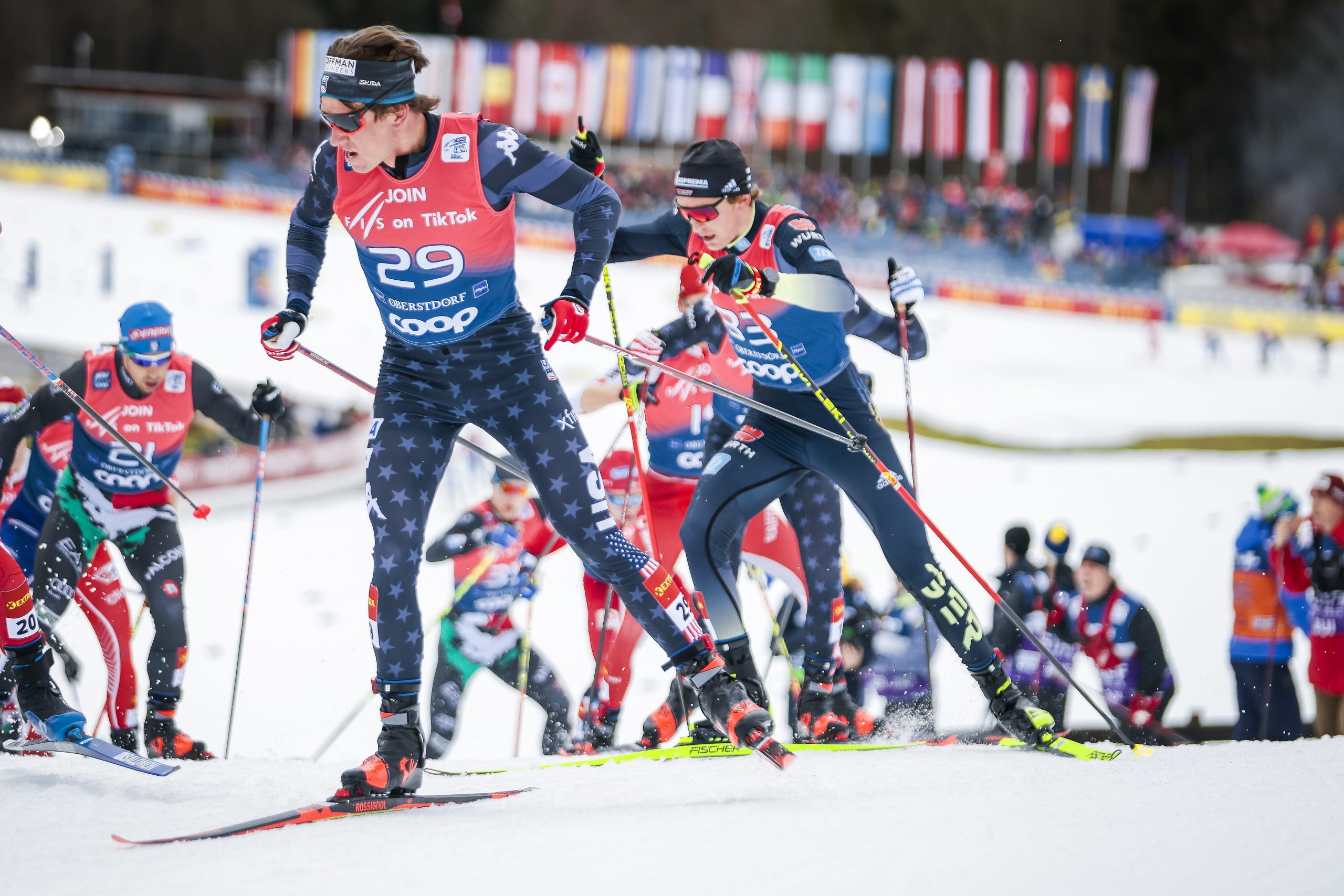
Scott Patterson (USA), Gus Schumacher (USA), and Zanden McMullen (USA) came through early checkpoints in the top twenty among a solidly packed lead group. Leading through the middle kilometers of the race, Mika Vermeulen (AUT) took the first bonus points followed by Klaebo and Amundsen. Soon after, Hugo Lapalus (FRA), Jens Burman (SWE), and Friedrich Moch (GER) moved toward the front to assist Vermeulen in making the pace in front of a train of red-clad Norwegians.
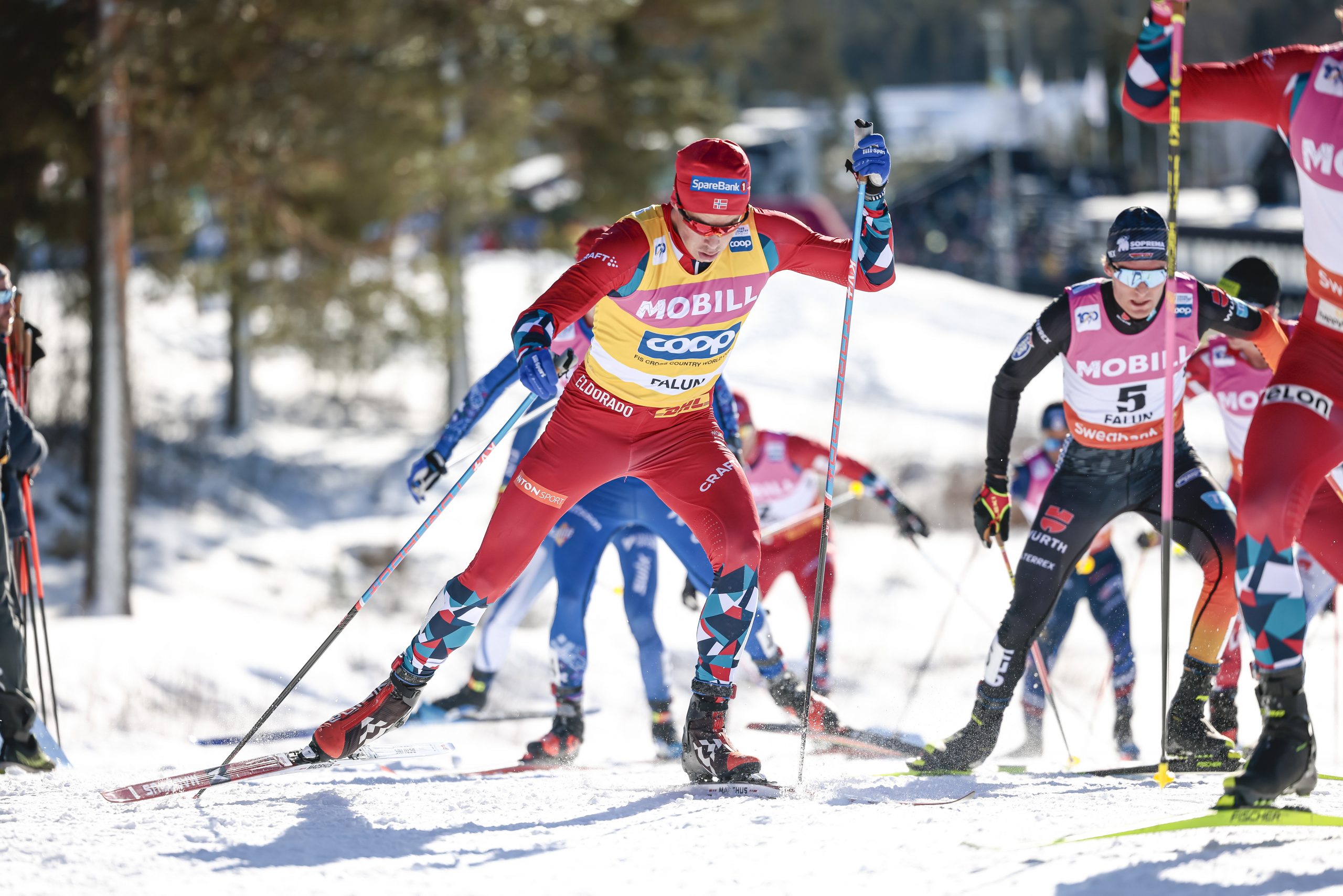
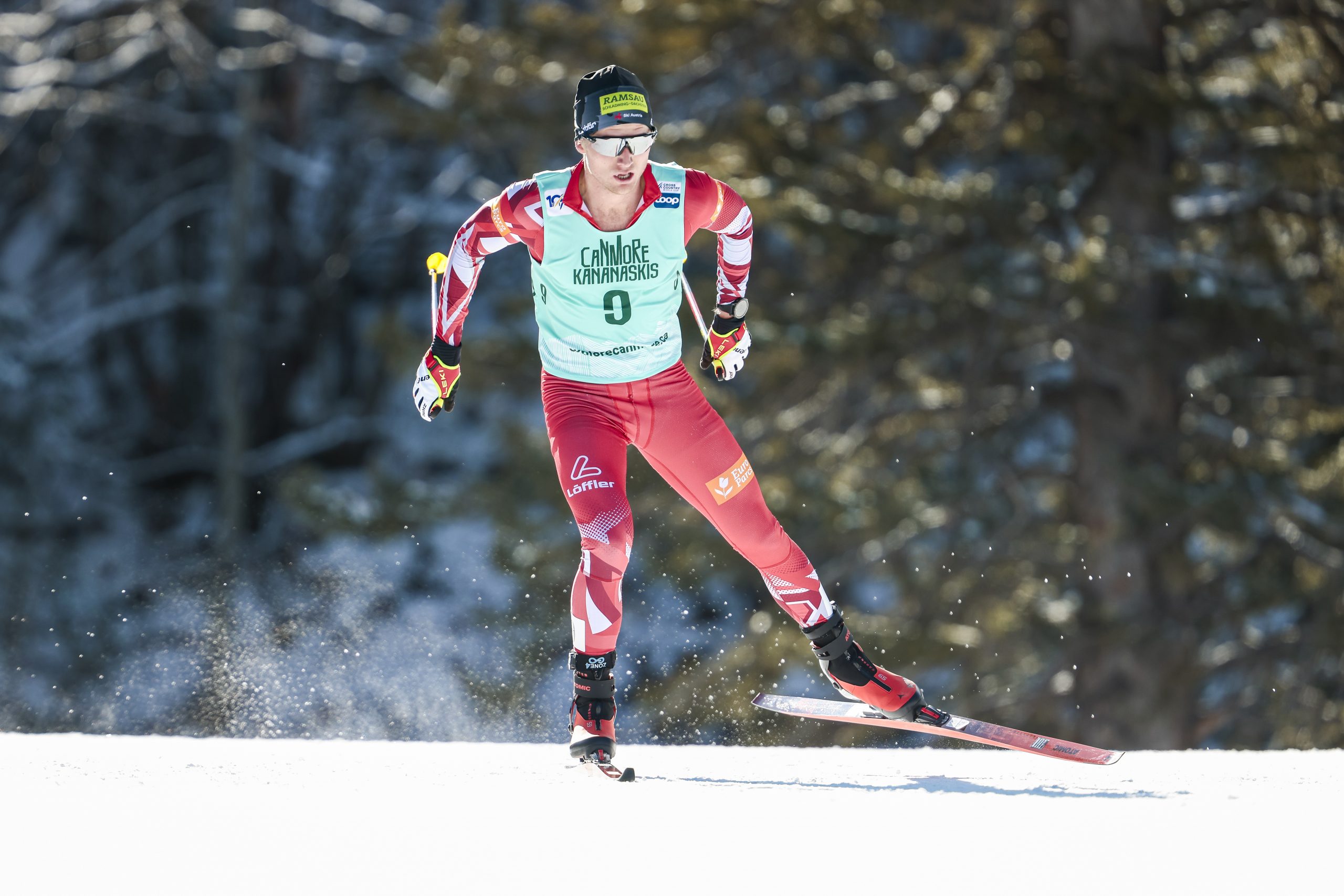
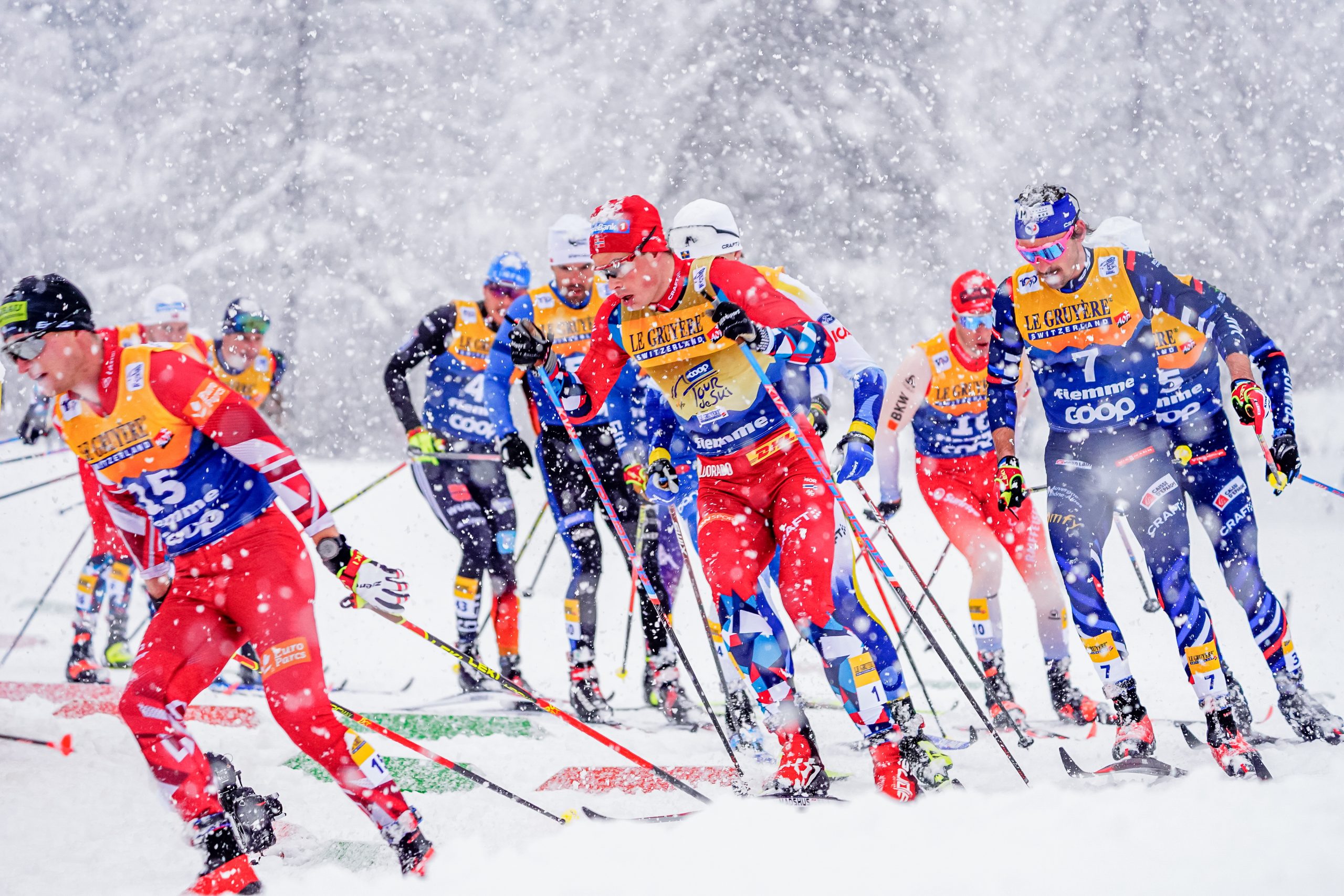
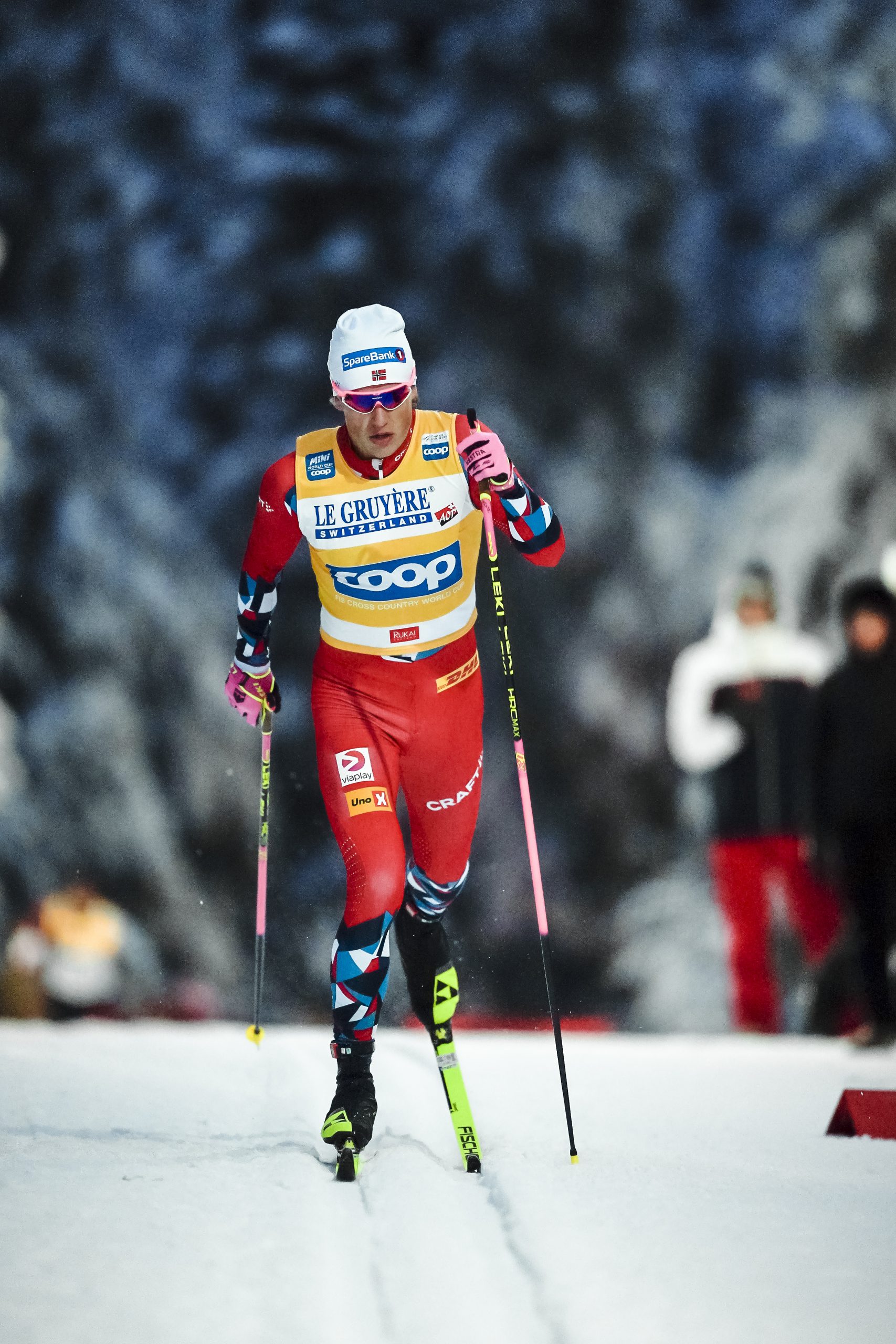
Harald Oestberg Amundsen (NOR) raced in the lead group all day, keeping an eye on his rivals, and defending his lead in the World Cup Overal standings. (Photo: Modica/NordicFocus)
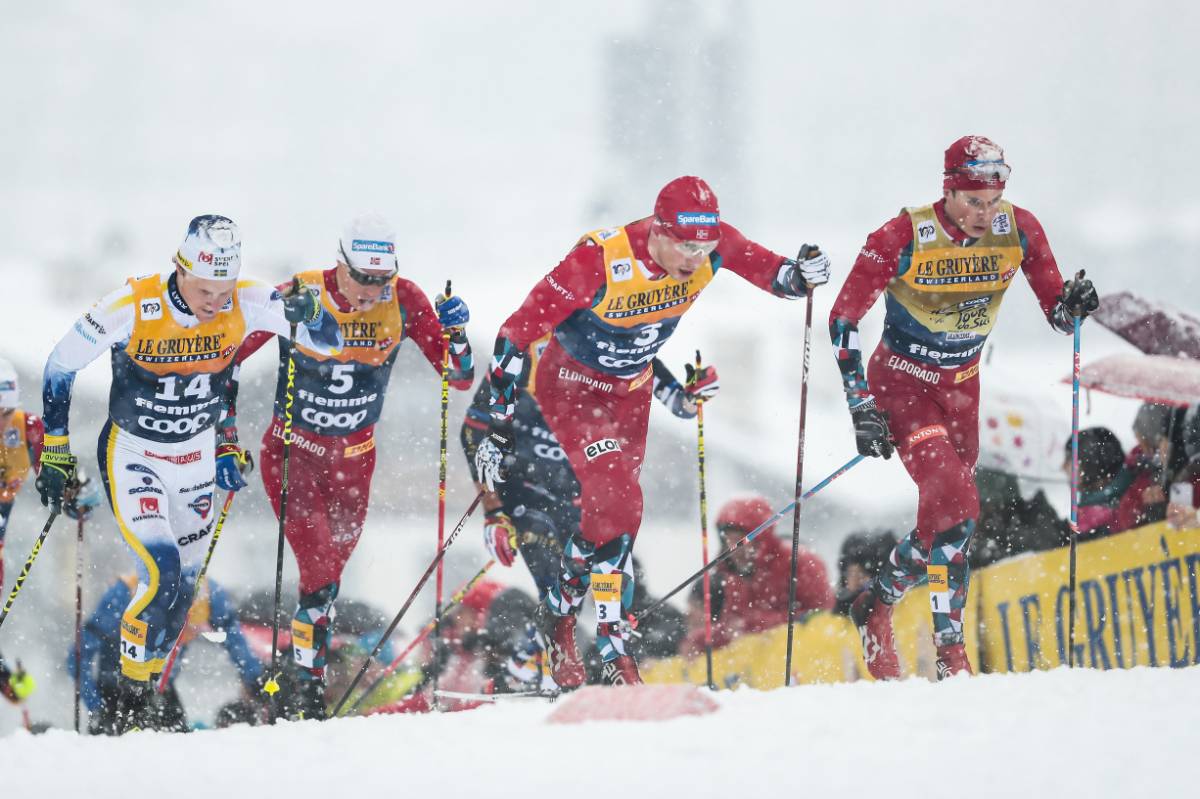
Amundsen spent his race situated between fifth and tenth positions, a place unlikely to jeopardize his Overall standing while allowing him to keep an eye on other contenders in front of him. Ultimately, Amundsen began to show signs of fatigue at the rear of the 16-man lead group as a steady, regular increase of pace eventually began whittling away the contenders with every rise in elevation and increase in speed. Pace was made in the final lap by Iver Tildheim Andersson (NOR) and Gjoeran Tefre (NOR) (winner of the recent Norwegian National Championships 10 k), in the company of Klaebo and Vermeulen. With one kilometer remaining, Martin Loewstroem Nyenget (NOR) drove to the front to challenge Klaebo. But, as he has done so many times before, Klaebo powered into the lead down the final descent into the stadium. Tefre followed closely—and gave good chase down the finishing straightaway—but Klaebo was simply not to be denied, crossing the line for his seventh straight World Cup victory.
“Since Oberhof it’s been really amazing,” said Klaebo in post-race interviews. “So it’s good to finish up this way.”
Nyenget held on for third. Amundsen secured his World Cup Overall championship with a 17th place finish, only ten seconds behind the winner.
Schumacher and Patterson finished in the lead pack, 12th and 15th, respectively. Other American finishers included McMullen 27th, Kevin Bolger 44th, Zak Ketterson 45th, Peter Wolter 60th, Michael Earnhart 79th. Among Canadians, Antoine Cyr was 26th, Sam Hendry 39th, Xavier McKeever 68th, Sasha Masson 73rd, Pierre Grall-Johnson, 85th.
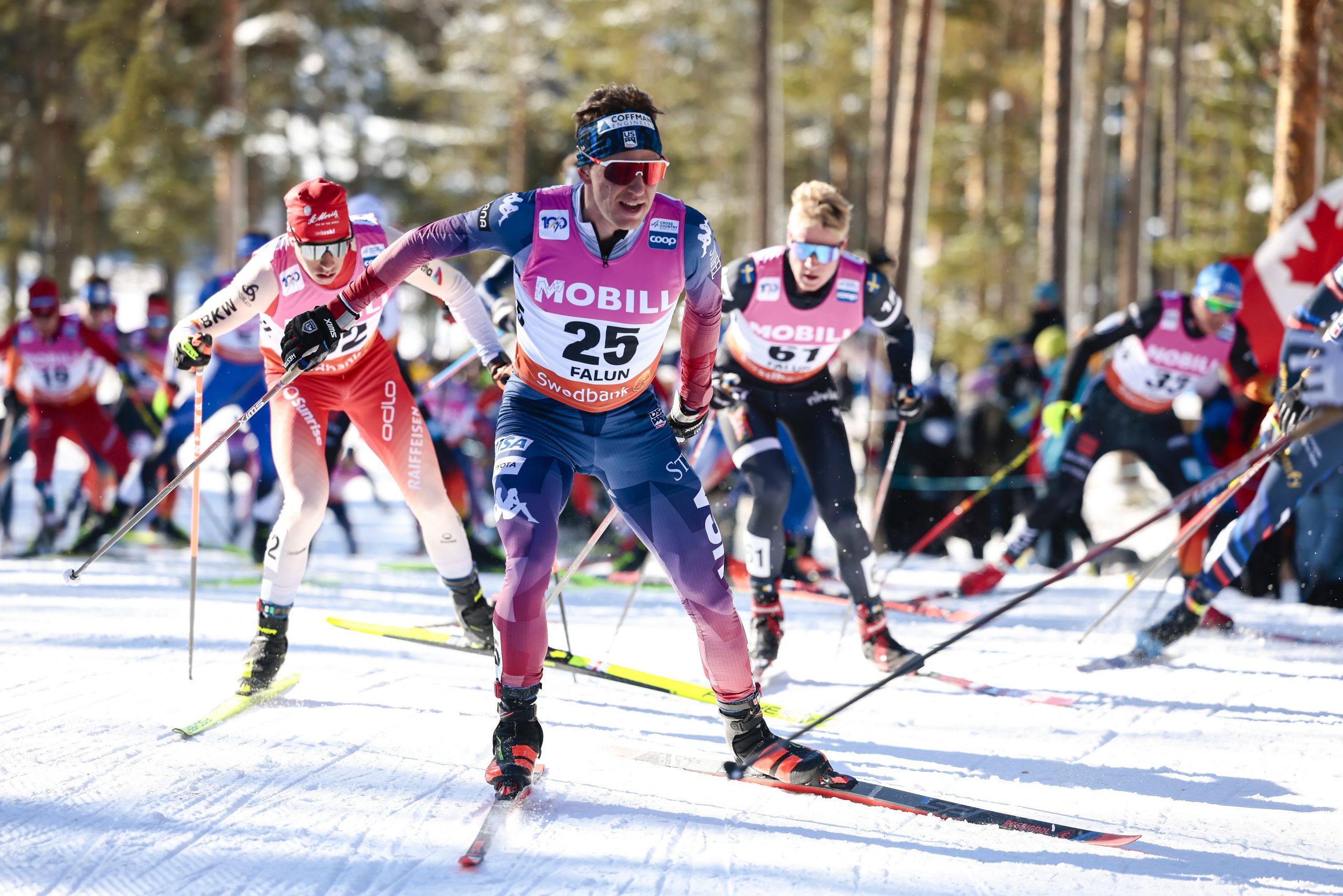
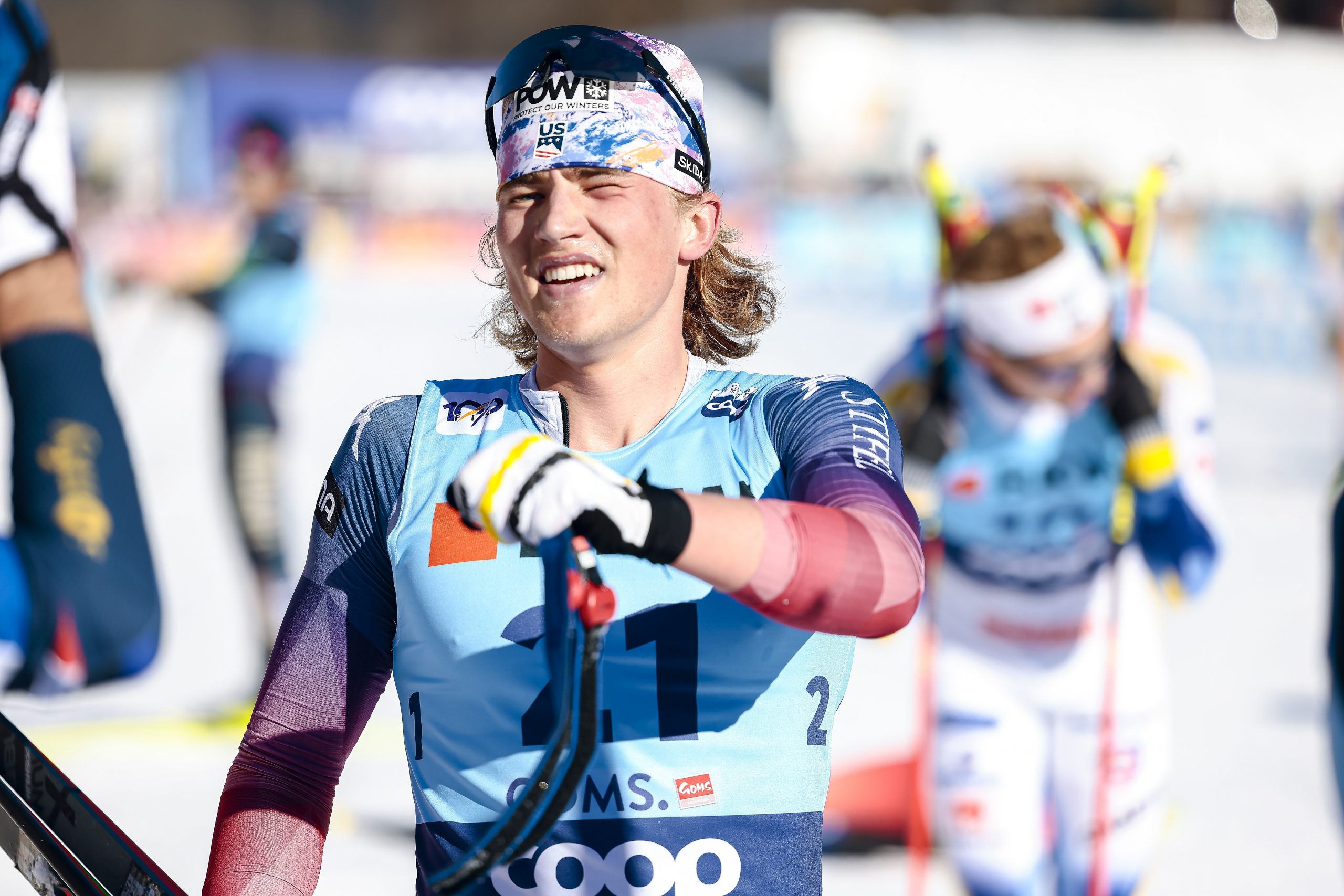
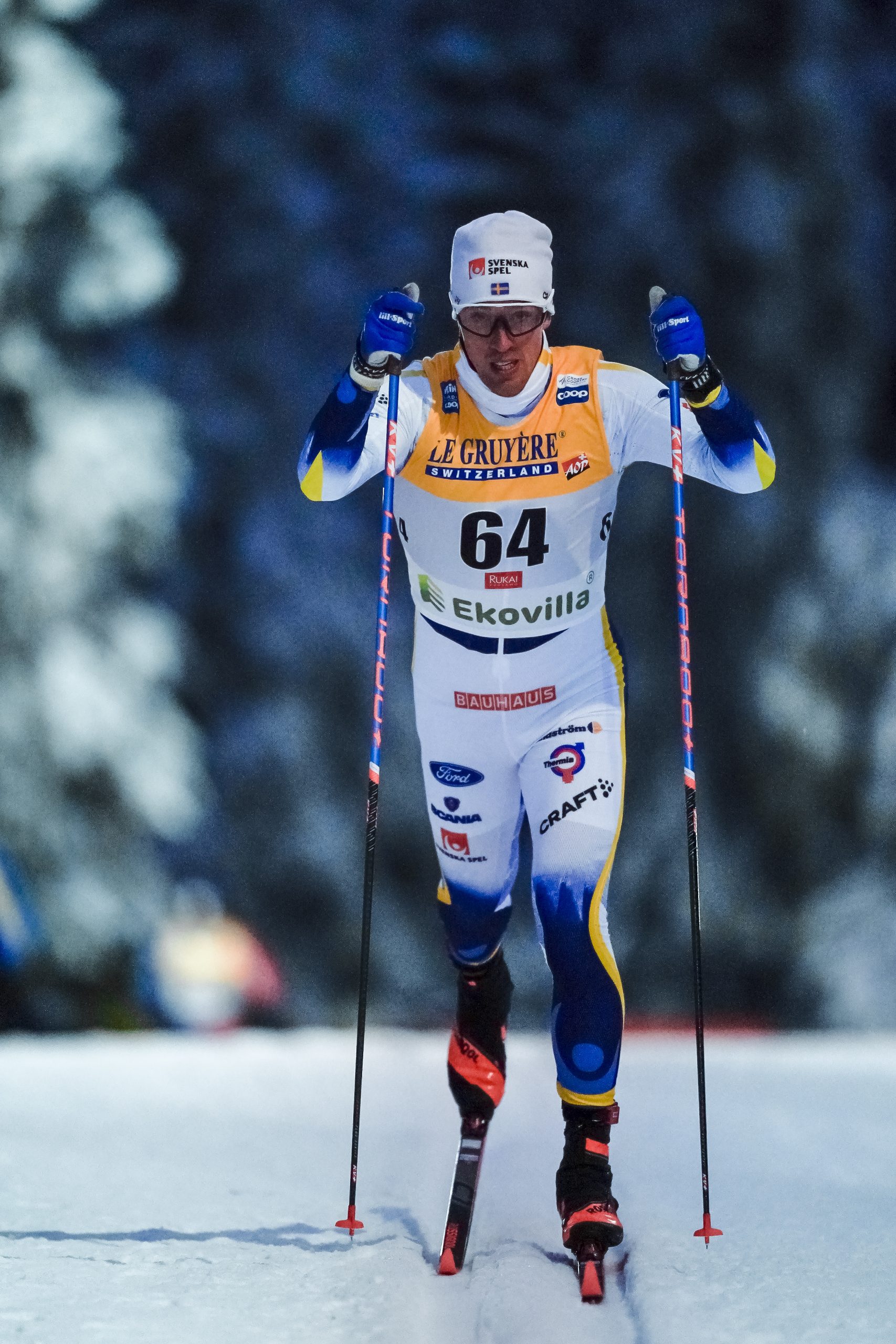
Scott Patterson (USA) concluded his distinguished World Cup career with a 12th place finish, only 9.1 seconds behind the winner. (Photo: Modica/NordicFocus)
After eight World Cup seasons, the Falun 20 k represented the final race of Scott Patterson’s (USA) distinguished career, one highlighted by eighth and 11th place finishes in the Olympics, and a top-ten finish in the World Championships 50 k.
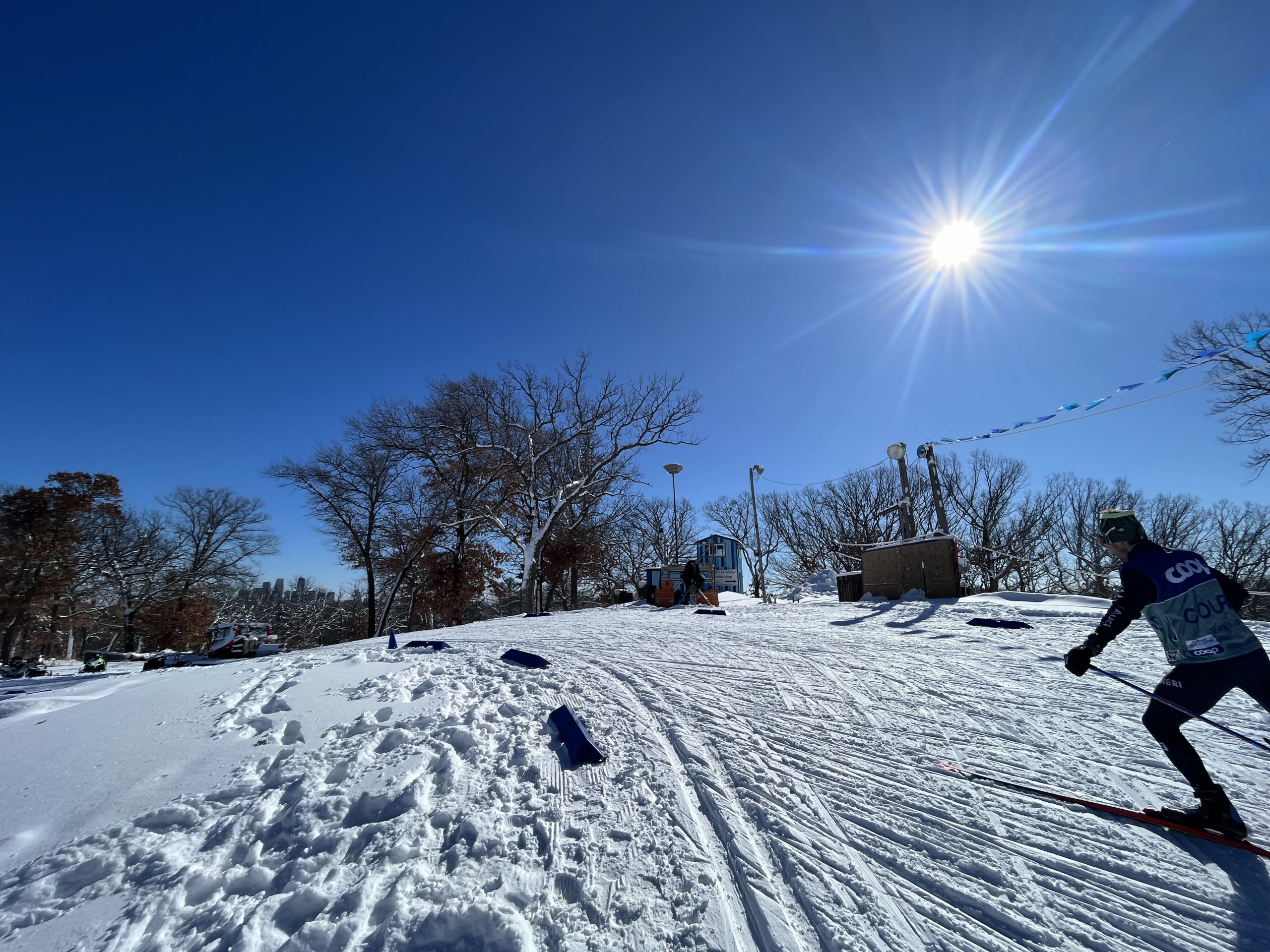
A World Cup team member skis across the top of the course Thursday at Theodore Wirth park in Minneapolis. The city skyline is between the trees on the left. (Nathaniel Herz/FasterSkier)
MINNEAPOLIS — All winter, cross-country ski race organizers in this midwest metropolis faced weather that just wouldn’t cooperate.
Heading into the weekend, it had not snowed in Minneapolis in nearly a month, with daily high temperatures above freezing every single day since late January.
All this as a local nonprofit, the Loppet Foundation, was set to host the first cross-country World Cup events in America in more than two decades — after a last-minute, coronavirus induced cancelation in 2020.
The World Cup circuit is the sport’s highest level of racing, and it’s contested almost exclusively in Europe.
The Minneapolis organizers had borrowed snowmaking equipment from neighboring ski areas and made enough during a ten-day cold snap to stretch a strip of white through an otherwise barren municipal golf course.
But athletes, fans and volunteers were girding for a decidedly non-wintry atmosphere for the two days of racing this weekend.
Until Wednesday. That’s when a fast-moving storm dumped some six inches on the city — nearly double the entire winter’s snowfall at its airport—and transformed Minneapolis back into a winter wonderland on the same day that the Olympic-level World Cup athletes arrived for the sold-out events.
Claire Wilson, the Loppet Foundation’s executive director, described the storm as a “magic snowfall.”
But, she said, “We were ready to do this yesterday, when it was a ribbon of snow on brown ground.”
Across the board, World Cup racers—most of whom arrived in Minneapolis on Wednesday from the Canadian Rockies — said they were delighted to find fresh snow and engaging skiing at Theodore Wirth Regional Park.
“Exquisite,” “city skiing at its finest” and “American dream”—replete with an eagle and stars and stripes emoji—were among the reactions that athletes posted on social media after their first laps at Wirth.
A screenshot of an Instagram post Thursday, February 15, 2024 from French skier Hugo Lapalus.
“I think it’s really pretty here,” Lena Keck, a 23-year old German, said as she left the trails Thursday. And, she said, “it’s a really tough course,” which was not what she and her teammates anticipated.
“Everyone’s surprised,” said Chris Grover, a longtime U.S. World Cup team coach. “I think they heard ‘golf course’ and thought, like, Boca Raton or something.”
The 3.3-kilometer loop that athletes will ski three times in Sunday’s distance race winds through trees and open sections in rolling terrain, with views of downtown skyscrapers from the course’s high points.
Scott Patterson, the veteran American who excels on difficult courses, said he did a harder training session Thursday and found the loop to be unexpectedly grueling, mainly because of the new snow slowing his skis down.
“It’s kind of slow on the downhills, and you have to work all the way down—so it feels like you hit the bottom of the next hill and you really haven’t recovered much,” he said. “It felt hard, for sure.”
Patterson and several other Americans skied Thursday in newly printed “fan club” bibs featuring the faces of the team’s coaches and ski waxing support staff—their own twist on bibs that U.S. supporters sold printed with athletes’ faces to raise money for the team.
American skier Scott Patterson, photographed Thursday, February 15, 2024 in Minneapolis, models a new bib featuring the faces of U.S. coaches and support staff. (Nathaniel Herz/FasterSkier)
The celebratory atmosphere spread across the park Thursday, with eager volunteers—some 700 total will help this weekend—fanning out to unload pallets of food and drinks, tweak course fencing and manage traffic.
Organizers have distributed some 30,000 tickets, with many fans eager to see Jessie Diggins, the Olympic gold medalist and U.S. superstar who leads the women’s overall World Cup standings this year.
Diggins grew up in Afton, a half-hour east of Minneapolis, and returned to the U.S. this week for the first time since she left for Europe in the fall.
Her home is a little too far out of town, and too full of visiting family members, for her to stay there this week. But, she told reporters earlier this week, at least she’ll be reunited with her husband at the World Cup race hotel.
The kind of attention that Diggins is receiving for the hometown events, she said, is not quite the same type as at major championships like the Olympics. But particularly given her lead in the World Cup standings, she added, the weekend “comes with its own different, special kind of pressure that feels about as big.”
“My goal is to enjoy it and hopefully not be so overwhelmed that I can’t be present,” she said. “It will be a delicate balance, for sure, but one that I’m going to try to achieve.”
Jessie Diggins races in Canada last week. (Federico Modica/Nordic Focus)
The rest of the American athletes—even the ones who aren’t from Minnesota—also seem to be soaking in the excitement around what still feels like a home event.
“The whole way here, on the plane, on the bus, people have heard that tickets have sold out, they sold out really fast,” said Kristen Bourne, another U.S. coach. “People have been looking forward to this, from all different countries, for a really long time. So, I think the stoke is insanely high.”
Keck, the German racer, said that the trip to the United States is the first of her life—and the setting has definitely made an impression.
“Everything is so much bigger than in Europe,” said Keck. “The houses, the cars, the trucks, also the landscape—it’s so much wider.”
We’re grinding on with our third episode in four days. Hope you’re still listening. If you don’t get the hat reference, read our coverage.
We’ll be back with another episode after the last race in Canmore. To keep you from podcast withdrawal later in the week, we’ll roll out some interviews we did with a couple of international athletes here. Then we’ll be back again from Minneapolis this weekend.
Speaking of Minneapolis, if you’ll be there in person, we’re hosting a live show where we’ll be taping Sunday’s episode in front of an audience — though we’ll need all 12 listeners to show up for it to really be an actual audience. More details soon — the event is at Utepils Brewery near the venue, with an exact time to be determined, but it will be after the last race of the day.
Questions? Comments? Email us: devon@fasterskier.com and nat@fasterskier.com. Thanks so much for listening.
This coverage is made possible through the generous support of Marty and Kathy Hall and A Hall Mark of Excellence Award. To learn more about A Hall Mark of Excellence Award, or to learn how you can support FasterSkier’s coverage, please contact info@fasterskier.com.
Simen Hegstad Krueger (NOR) made a solo breakaway that the field was unable to match. (Photo: NordicFocus)
In the men’s Overall World Cup competition, Harald Oestberg Amundsen (NOR) holds a commanding 300 point lead over teammate Erik Valnes. While Amundsen and Paal Golberg (NOR) have a stranglehold in the distance competition, the fight for third is fierce. Andrew Musgrave (GBR) has a 15 point lead over Martin Loewstroem Nyenget (NOR), Simen Hegstad Krueger (NOR) and Hugo Lapalus (FRA). And lurking ready to pounce to redeem an illness-plagued season is Johannes Hoesflot Klaebo (NOR) who is only 16 points behind Musgrave. Klaebo would have extra motivation today: with a win, he would become the first man to win 75 individual World Cup events.
Often, men’s mass start Freestyle races are purely tactical affairs. But today that was not the case as Krueger and Mika Vermeulen (AUT) both put in individual breakaways that the field was unable to match. In a brave solo effort, Krueger ended up taking the victory, Amundsen was second, and Mika Vermeulen held on for third.
Scott Patterson (USA) was able to stay with the lead pack to grab an eighth place finish. (Photo: NordicFocus)
American Scott Patterson had a great day finishing eighth. Due to the larger field given to host countries, there were 12 Americans at the start line. Other American finishers were Gus Schumacher 22nd, Zanden McMullen 23rd, David Norris 27th, Peter Wolter 36th, Luke Jager 39th, Hunter Wonders 40th. In his first World Cup start, Michigan native Reid Goble was 44th, Braden Becker 45th, Michael Earnhart 47th, Graham Houtsma 49th, and Ben Ogden 54th.
The top Canadian finisher was Samuel Gary Hendry in 30th. He was followed by Antoine Cyr, 37th, Remi Drolet 42nd, Leo Grandbois 46th, Aidan Kirkham 50th, Xavier McKeever 51st, Scott James Hill 52nd, Felix-Olivier Moreau 53rd, Eamon Wilson 55th, and Adam Heale 57th. Olivier Leveille and Micah Steinberg did not finish.
Men’s 15 k Mass Start Freestyle
The pace at the start was very controlled and skiers stayed together in a large pack with Amundsen, Musgrave and Klaebo setting the early tempo. There were two Bonus Points sprints that had the potential to break up the field. As it turned out, this contrived means of breaking up the field would not be needed.
Mika Vermeulen (AUT) made the first of two solo breakaways, and was able to hang on for third. (Photo: NordicFocus)
At the start of the second lap, Vermeulen (AUT) pushed to the front and established a bit of a gap on the field, but the pace was still pedestrian. Nonetheless, he had created a seven second lead over Musgrave. Vermeulen continued to put a gap on the field, and no one from the group chose to pursue him. Whether intentionally or not, Vermeulen was now on a solo breakaway.
At 5.2 kilometers, Vermeulen still held a 5.3 second lead, and none of the leaders deemed it a threat. He was close enough to keep an eye on, and the pack was content to let him set the pace. The breakaway allowed Vermeulen to claim the top bonus points at 6.7-kilometers. After the bonus mark, he continued to hold a five second lead on the field.
But relentlessly, momentum took over and the pack swallowed up Vermeulen with Krueger taking the lead. Sensing that the pack was not in the mood to chase a break, Krueger began to slowly pull away from the pack. By the time they had reached the 8.4-kilometer mark, Krueger had established an eight second lead on the rest of the field which was led by Friedrich Moch (GER).
Once Krueger’s breakaway looked unstoppable, Harald Oestberg Amundsen (NOR) charged to the front of the chase group to take second place. (Photo: NordicFocus)
Krueger’s efforts at a breakaway seemed like a much more legitimate threat than Vermeulen’s had been as he continued to press the pace and stretched his lead to over 15 seconds at 8.9 kilometers. During Krueger’s break, Scott Patterson (USA) had used the opportunity to move into fifth place and was toward the front of the chase pack.
The next bonus Sprint was at 10.5 kilometers and Krueger easily took it as his lead had swelled to over 17 seconds. Could one man hold off the entire pack for another five kilometers? It was a tall order, but Krueger has a history of strong solo performances, and he looked to be in excellent form.
At 11.3 Krueger looked like an unstoppable locomotive. His lead was 22 seconds; it looked like no one would be able to chase him down. Patterson still remained in the middle of the chase group and was fighting for podium position.
Gus Schumacher (USA) had another good day finishing 22nd. (Photo: NordicFocus)
By the final lap, Krueger had stretched his lead, and it looked like the pack had given up on fighting for first place and was now jockeying for podium positions. Amundsen moved to the front of the chase group, but it was clearly not an effort to reign in Krueger.
By 12.7-kilometers Krueger had beaten the field into submission. With over a 20 second lead, the race was now his to lose. Another story playing out in the chase group was Patterson’s performance, who was sticking with the chase group in eighth place.
As the field entered the final stretch it was clear that Krueger’s gamble was going to pay off. He still was holding onto his 20 second lead.
As the group entered the stadium Krueger coasted to victory and glanced back to watch the battle unfolding behind him. The pack was surging with Amundsen jumping to the front to take second place and Vermeulen hanging on to third. Patterson was able to capture eighth place, turning in a great day for the American.
In a format that is usually dominated by pack tactics, the script for the men was upended today by Krueger and Vermeulen whose brave solo breaks made for an entertaining race.
After the race Krueger was clearly excited. “It was almost the perfect race for me today,” he said. “After the format was changed, I decided to make it as tough as a race as possible. The last lap I feared I had used a little too much energy.” But clearly, he hadn’t, and was able to turn in a spectacular performance.
At the podium ceremony, the European winners truly seemed to relish receiving Canmore’s signature cowboy hat as a prize; none more than Vermeulen who notched his first podium finish.
The European racers can’t seem to get enough of the Canmore cowboy hats. Harald Oestberg Amundsen (NOR), Simen Hegstad Krueger (NOR), Mika Vermeulen (AUT), (l-r) (Photo: NordicFocus)
This coverage is made possible through the generous support of Marty and Kathy Hall and A Hall Mark of Excellence Award. To learn more about A Hall Mark of Excellence Award, or to learn how you can support FasterSkier’s coverage, please contact info@fasterskier.com.
As the eyes of cross-country World Cup competitors begin to turn their gaze toward North America, one task remained for them before they could begin to focus on packing their bags for the long journey west. That task was the 20 k Mass Start Freestyle contested today in Goms, Switzerland. In the men’s competition, none of the leaders could afford to look too far down the road. Harald Oestberg Amundsen (NOR) still led the Overall Crystal Globe competition by 201 points over Erik Valnes (NOR) going into today’s race. And while it’s a sizeable lead, he certainly wasn’t in the position to put things on cruise control just yet. Valnes wasn’t racing today, but always lurking was the ever-present Johannes Hoesflot Klaebo (NOR) who, after an up and down season marred by illness, was looking to reassert his dominance on the World Cup scene.
Ever the master technician, Johannes Hoesflot Klaebo (NOR) (number nine) was able to reassert his dominance today. (Photo: NordicFocus)
The race for the Distance Championship has some interesting twists and turns going on. Amundsen also leads that competition, but his lead was only 78 points over Paal Goldberg (NOR). More intriguing is that Andrew Musgrave (GBR) was in third place in the Distance Cup, but his lead was only one point over Hugo Lapalus (FRA). A podium finish in any of the Cups for Musgrave would be a huge feather in his cap, but he would need to be extra vigilant to try to fend off the surging Lapalus.
For the Americans, it was time to sharpen the sword and get ready to come home in good form. The regular duo of Ben Ogden and Gus Schumacher would be joined by Scott Patterson, Peter Wolter, Zak Ketterson, and Kevin Bolger for the final tune-up before the return to North America.
Mass Start Freestyle races can be very tactical affairs; racers will often remain grouped in a moderately-paced pack for much of the race. FIS has tried to reduce this strategy by introducing bonus points into distance races. In today’s race, there were bonus points at 9.5 and 14.5 kilometers. First place at a bonus section gains a racer an additional 15 points toward the Distance and Overall standings. Musgrave or Lapalus might try and steal a page from Jessie Diggins’ playbook in the Oberhof 20-kilometer race and push hard at the bonus section sprints.
There was a little bit of rain overnight in Goms that froze and made the conditions fast as it mixed into the snow. Today, FIS didn’t have to worry about skiers dawdling on the course. The finishing times revealed just how fast the conditions were, and how willing racers were to take advantage of the conditions as Klaebo claimed victory in a time of 39:25—for a race of 20 kilometers! Klaebo’s countryman, Simen Hegstad Krueger, was second, with Jules Lapierre (FRA) taking third. Amundsen was able to protect his Cup standings by finishing fourth. Musgrave finished 12th and his podium rival Lapalus was 13th, allowing Musgrave to maintain his slim margin in the Distance competition. But now there were four skiers within 16 points of him; Klaebo is one of them.
Gus Schumacher (USA) was the top American finisher: 14th, only 12 seconds from the podium. (Photo: NordicFocus)
After the race Klaebo, said that “it was fun and [I] felt really strong.” When asked about his chances for the Overall Cup, he admitted that he was too far back to contend for the Overall competition but was happy to be feeling good again, feeling normal, and going to Canada with a good feeling.
The top American was Gus Schumacher in 14th place in a time of 39:49. He was followed by Patterson in 18th, Ogden 35th, Bolger 42nd, Ketterson 43rd, and Wolter 49th.
Antoine Cyr was the top Canadian, only 37 seconds off the lead in 22nd. Sasha Masson finished 36th, Xavier McKeever 55th, Thomas Stephen 57th, and Derek Deuling 61st. Max Hollmann did not finish.
After the race, Schumacher revealed that his strategy was “to try to relax in the pack as long as possible so I could have the energy to move up when it got hard. . . . Also, I wanted to ski the downhills well to take places where it was a bit easier. Honestly, I struggled to maintain a good position in the first couple of laps, so that part didn’t go super well, but I had energy when it started to string out and made those said ‘money moves’ into some bonus points.”
Men’s 20 k Freestyle Mass Start
Amundsen and Musgrave went to the front early and set a quick pace. Skiers stayed together in one large pack, spreading out as they proceeded down the first technical downhill turn. Even though the skiers looked relaxed, the conditions made the pace fast as everyone was clearly working hard through the tight, high-speed corners.
At 4.5 kilometers, Friedrich Moch (GER) pushed to the front keeping the pace brisk and didn’t give the group a chance to let up.
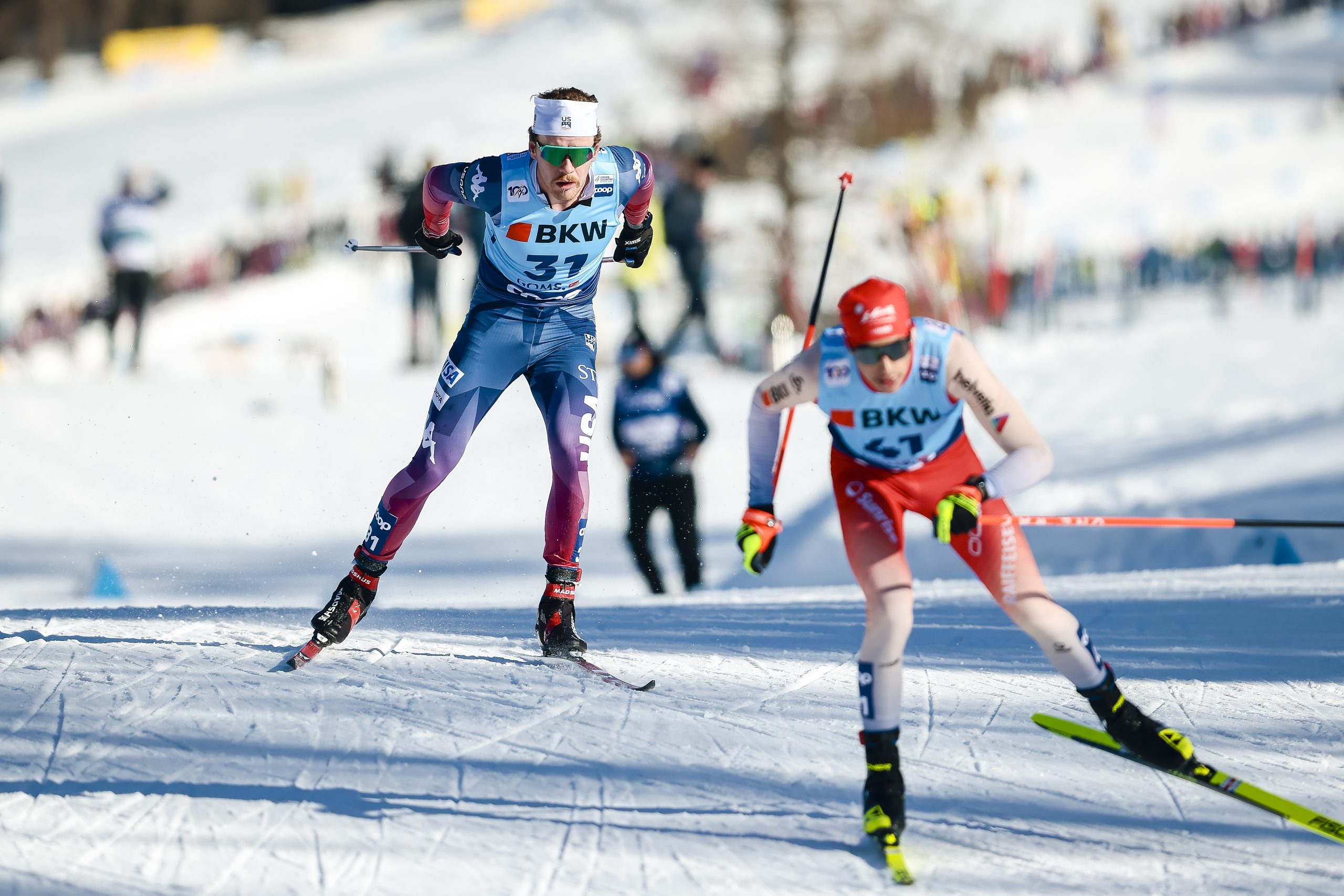
Ben Ogden (USA) (number 31) had a good start but couldn’t quite keep up with the fast pace. Ogden would finish 35th. (Photo: NordicFocus)
Ben Ogden had been pushed down to 23rd but was only six seconds off the lead as all of the top skiers were fighting for position. The racers continued in one large pack with Amundsen never straying far from the front. But the standings were a little deceptive as only 14 seconds separated first from 44th.
The speeds were fast as skiers struggled to stay on the marked course as they worked through the fast tight corners. As the pack approached the first time bonus, the pace quickened even more and the pack spread out. Klaebo then did what he does best: put in a quick sprint to head to the front, easily taking the winner’s 15 bonus points.
After the fight for bonus points was over, Musgrave went back into the lead. All of the jockeying back and forth for points had little additional effect on spreading out the field. There were still 39 skiers within 16 seconds of the lead.
At the next bonus section Klaebo again went to the front to claim the full 15 points. As it turned out, it was Klaebo, not Musgrave who would utilize the bonus points tactic. As Klaebo surged, he was joined by Schumacher who took a run to the front crossing the bonus line sixth. Beda Klee (SUI) was also cheered on by the hometown crowd as he shot into the lead for a brief time after the bonus sprint.
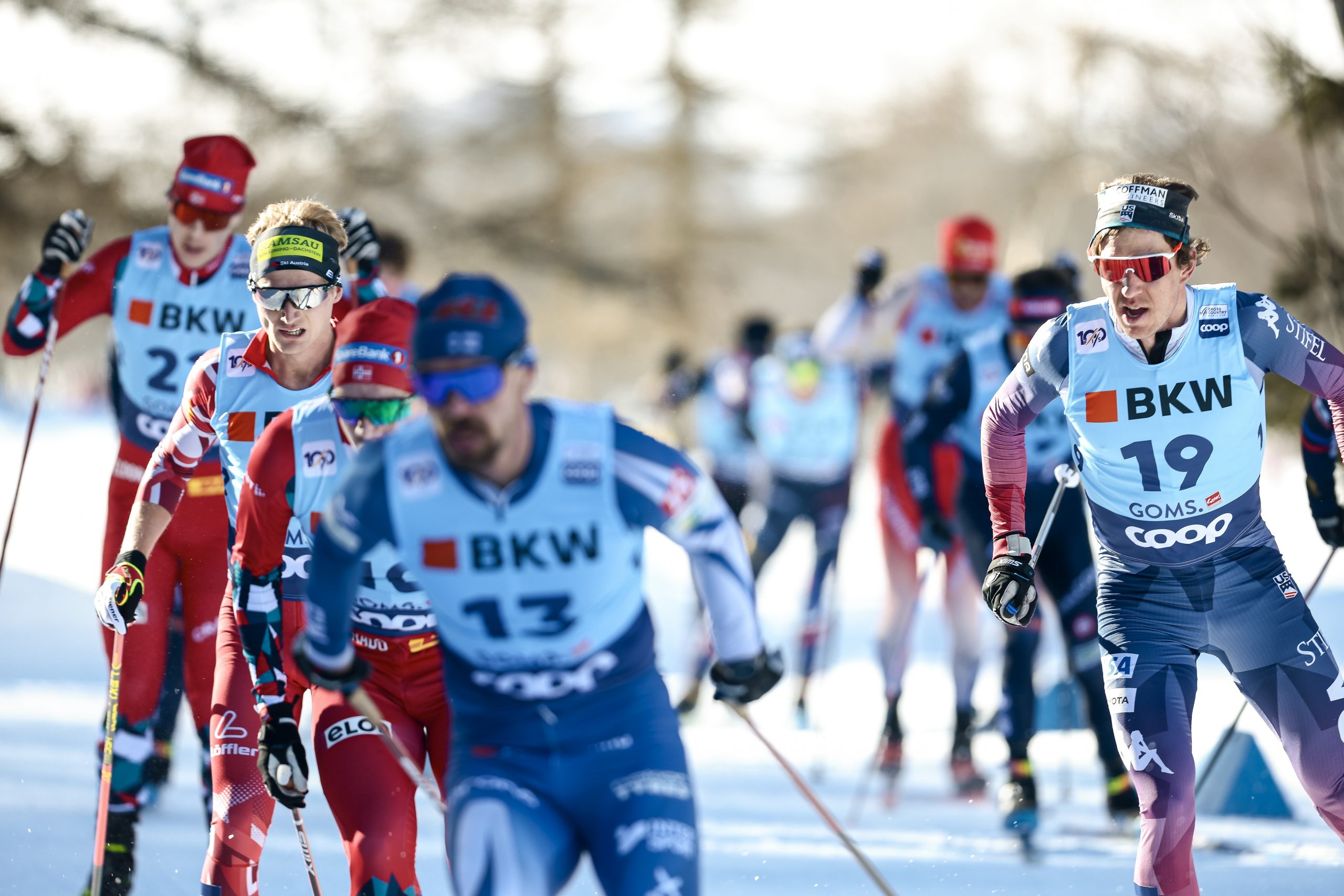
Scott Patterson (USA) (number 19) had a strong day finishing 18th. (Photo: NordicFocus)
At 16 kilometers the intensity ratcheted up as skiers without a big finishing sprint knew that they would need to create a gap to have a chance at the finish. Joining that group was Scott Patterson who had moved up to 15th, still only ten seconds off the lead. Patterson had been looking to rebound after what he called “a tough weekend in Oberhof.”
“I tried to ski smooth but stay near the front,” Patterson said. “That worked well until the leaders started really pushing the last lap. I didn’t quite have the speed and energy but [I’m] still quite satisfied with a strong result to finish off this European block.”
As the intensity continued to increase, Krueger, Amundsen, Klaebo, and Golberg began to assert their dominance. They quickly broke the lead pack into a group of six skiers that included Jules Lapierre (FRA) who was coming off his recent triumph up Alpe Cermis in the Tour de Ski. It was then Krueger and Klaebo who went to the front, and the pair separated from the lead pack. As the duo hit the final kilometers, they skied in tandem with Krueger taking the lead and Klaebo marking his every move. Going into the final hill before the stadium, Krueger desperately tried to make a break, but couldn’t separate himself from Klaebo. Klaebo never panicked and stayed on Krueger’s tails the entire way. Entering the stadium Klaebo switched on the after-burners; in a flash he was past Krueger. Klaebo had put on such a quick intense burst that he was able to slow down at the finish and take a look around to enjoy the sights.
Jules Lapierre (FRA) (number16) continued to roll, having won the Alpe Cermis climb in the Tour de Ski, and taking third in today’s race. (Photo: NordicFocus)
While the two Norwegians were battling for the victory, Jules Lapierre (FRA) had moved to the front of the chase group and held on to finish third.
Schumacher finished strong to claim 14th, but the placing was a little deceptive as he was only 12 seconds off the podium.
Klaebo’s finishing time of 39:25 was testimony to the fast conditions, and to the willingness of the racers to take advantage of the speedy course and keep the pace fast the entire way.
Next stops on the World Cup: Canmore, Alberta, followed by Minneapolis, Minnesota. Be sure to continue to visit FasterSkier for our in-depth coverage as the world of cross -country skiing comes to North America.
This coverage is made possible through the generous support of Marty and Kathy Hall and A Hall Mark of Excellence Award. To learn more about A Hall Mark of Excellence Award, or to learn how you can support FasterSkier’s coverage, please contact info@fasterskier.com.
Johannes Hoesflot Klaebo (NOR) and Federico Pellegrino (ITA) lead the Team Relay field during the final leg in Oberhof. Klaebo would edge of Pellegrino to put Norway I in 1st, and Italy I in 2nd, on the day. (Photo: Nordic Focus)
This weekend in Oberhof framed the Men’s World Cup’s hierarchy in stark terms. Coming into Sunday’s 4 x 7.5 k Men’s Relay, five different Norwegian skiers had combined to sweep both Friday’s classic sprint, and Saturday’s 20 k Classic mass start. Remarkably, Norway had done so even without some of their most notable names: Johannes Hoesflot Klaebo, Didrik Toenseth, and Simen Hegstad Krueger had ceded the World Cup spotlight to Erik Valnes and Martin Loewstroem Nyenget, among others. This level of dominance created a vision of Sunday’s Team Relay when athletes clad in the colors of Norway would combine forces; a daunting prospect for the rest of the World Cup field. But Norway could only field two teams in the Relay, leaving room for one more team on the podium.
That’s not to say that Norway winning was a foregone conclusion. Tey would still need to pick teams. Out a dense thicket of Norwegian contenders, the first four names pulled were Martin Loewstroem Nyenget, Erik Valnes, Paal Golberg, and Johannes Hoesflot Klaebo. They would make up Norway I.
Individual fortunes on skiing’s World Cup are especially capricious, but the Team Relay has a way of remaining steady over the years. So it came as no surprise when Klaebo surged to the front in a carefully orchestrated finishing straightaway to win for Norway I ahead of his closest contemporary rival, Italy I’s Federico Pellegrino. Moments after that finish, a similar scenario would play out for both country’s second relay teams. Mattis Stenshagen finished in third for Norway II, and Simone Mocellini finished close behind to take fourth for Italy II.
Olivier Leveille (CAN) finished a strong Canadian performance with his anchor leg in Oberhof. Team Canada finished eighth in the 4 x 7.5 k Team Relay. (Photo: Nordic Focus)
The conclusion to the race, filled with the names of sprint stars like Klaebo, Pellegrino, and Mocellini, was an accurate indication of the tactical nature of how the field raced throughout the day. Each leg featured two laps of a 3.75 k course that concluded with a steep climb before a long, downhill, run-in to the finish. The pace had been relaxed through the early-goings before hard, deliberate pushes through the final half kilometer by the leaders. That created a lead pack of ten teams that expanded and contracted through the course of each leg. Firmly positioned within that pack was Team Canada, skiing to eighth place behind the combined efforts of Xavier McKeever, Antoine Cyr, Sasha Masson, and Olivier Leveille. Meanwhile, the American team skied to a 13th place finish with Zak Ketterson, Ben Ogden, Scott Patterson, and Gus Schumacher. Ketterson, who skied the first leg, was firmly placed in the main peloton until a downhill tangle with Germany II’s Jan-Friedrich Doerks left him fighting to regain contact. Ketterson managed to do so, but right as he skied onto the tails of Canada’s McKeever the pace surged at the front. It proved to be too much for the American who would hand off to Ogden at the first exchange with a one minute gap to the front of the race. Subsequent American skiers found themselves battling in vain to reduce that gap for the remainder of the day.
Gus Schumacher (USA) outsprinted Swiss skier Valerio Grond to give the Americans a 13th place finish in the Team Relay in Oberhof. (Photo: Nordic Focus)
Men’s 4 x 7.5 k Team Relay
The relay’s first leg—Classic—would set the pattern in the way the course was raced. The field remained relaxed throughout its first run of the 3.75 k lap, nearly coming to a stand-still at the top of the final climb. Then, as the Oberhof course rose out of the stadium, the top skiers would turn the pace up, stretch out the field through the lap, navigate another small contraction on the downhill leading to the final, steep, climb, where they would wait to dive off the top toward the finish-line. In the first leg, that pattern was duly set by Swedish skier Edvin Anger, alongside Norway I’s Nyenget, and Norway II”s Haavard Solaas Taugboel. Nyenget proved to have the hardest pull, and brought Norway I into the first exchange in first place.
In the second leg, also skied Classic, an early move from France I’s Hugo LaPalus established him in position off the front. For their part, Valnes and Finland’s Iivo Niskanen remained steadfast in their approach to the course, and didn’t lift the pace until the second time through the challenging “A”-climb. There, Niskanen strided away in a steady, deliberate move. Valnes followed. It was the furthest the field bent without breaking. Niskanen and Valnes came into the second exchange with a ten second gap over Italy I’s Elia Barp and the rest of the main field.
The beginning of Legs 3 and 4—skied Freestyle—helped reset the field. Norway I’s Golberg and Finland I’s Arsi Ruuskanen came back to the ten team main field. Towards the end of the lap, the pace ticked up just enough to string the field out, with the notable mover being Krueger for Norway II, who would help firmly position both Norwegian team’s at the front. Richard Jouve for France I and Friedrich Moch for Germany I also tried their luck at creating a gap towards the front, but into the final exchange, a group of nine teams remained within ten seconds of each other.
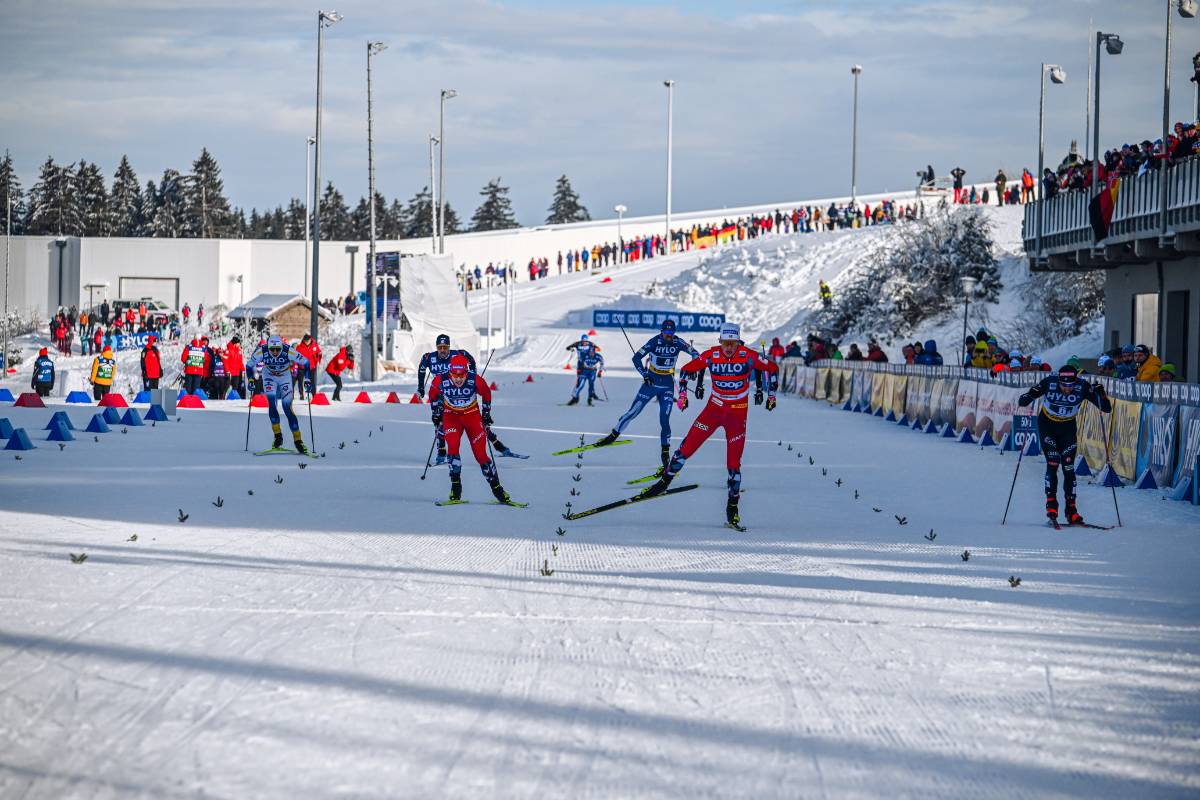
The finishing sprint in Sunday’s Team Relay in Oberhof. Johannes Hoesflot Klaebo edged out Federico Pellegrino to give Norway I the win. (Photo: Nordic Focus)
That left an anchor leg comprised of some of the best World Cup sprinters to sort things out. Pellegrino made an early effort to re-join up the front of the field; Sweden I’s William Poromaa joined. When the field surged on the final lap, only Pellegrino proved capable of matching Klaebo’s lift of pace. The pair would stagger briefly on the final climb, allowing their countrymen—Stenshagen for Norway II and Mocellini for Italy II—to re-join the picture. The final sprint saw Klaebo claim victory for Norway I over Pellegrino for Italy I. It was a fitting close to an episodic day like so many seen at World Cup races before.
World Cup Moves to Switzerland Next Weekend
The World Cup gets a quick reprieve before resuming action in the Swiss Alpine village of Goms next week. Friday opens with another Team Relay, this one mixed with the Women’s and Men’s fields together. A Freestyle Sprint and Freeestyle 20 k close out the weekend.
They’ve reached the summit — the athletes, have, anyway. Devon certainly has not, thanks to frozen pipes in his Oslo apartment. He and Nat persevere to bring you the recap of this year’s final Tour de Ski stages, which featured some spicy and sloppy racing in Italy. Stay tuned til the end for an ode to Le Gruyère cheese.
Next week, during the break from the World Cup, we’ll have a mailbag episode. Send us your questions at nat@fasterskier.com and devon@fasterskier.com. Have a great week.
This coverage is made possible through the generous support of Marty and Kathy Hall and A Hall Mark of Excellence Award. To learn more about A Hall Mark of Excellence Award, or to learn how you can support FasterSkier’s coverage, please contact info@fasterskier.com.
Harald Oestberg Amundsen (NOR) (center) played it smart by playing it safe today. He stayed near the front and kept an eye on anyone who might dare to make a break. (Photo: NordicFocus)
The men’s Tour de Ski (TDS) began last week with team Norway back on its heels as France and the USA challenged Norway’s domination; that seems a lifetime ago. Ever since the third race, in Toblach, Italy, Norway has been dominant again with no other country really giving it a run for the overall title. The Tour is Harald Oestberg Amunden’s (NOR) to take. Going into today’s 15 kilometer Mass Start Classic race, in Val Di Fiemme, Italy, Amundsen is 1:39 ahead of countrymen Henrik Doennestad, and Martin Loewstroem Nyenget.
But a very tantalizing question remains as to whether a non-Norwegian man can find the podium at the end of the Tour? As to that question, the answer is a definite: it’s possible. Hugo Lapalus (FRA) is only two seconds out of second place behind Doennestad and Nyenget. Likewise, Friedrich Moch (GER) and Beda Klee (SUI) are only seconds behind the Norwegian duo. So, while the race for the top spot is definitely Amundsen’s to lose, other countries are knocking on the door to gain a spot on the podium.
A 15 kilometer mass start Classic race is a tough format in which to gain ground, so any efforts by Lapalus and Moch to join the Tour podium leaders would be a tall task. They couldn’t risk too much today as they would need to leave themselves in contention for Sunday’s final race, the climb up Alpe Cermis. But given the razor thin margins separating second and seventh place of only eight seconds, it wouldn’t take much to dislodge the current Norwegian monopoly. The men’s race for first place might lack the drama of the women’s, but the race for second and third is scorching hot.
Scott Patterson (USA) (far right), is one of only two Americans left in the Tour. He had a nice performance today, only 16 seconds behind the winner. (Photo: NordicFocus)
For the American men, the bright promise they showed early in the Tour has faded away as illness decimated the team; just as it has much of the Tour. There were only two Americans left on the start line, Scott Patterson, (4:54 behind the Tour leader, and Zanden McMullen (7:37 behind the Tour leader).
At the conclusion of a very tactical race, it was Erik Valnes (NOR) taking the victory. He was followed by William Poromaa (SWE) in second, and Cyril Faehndrich (SUI) third. American Scott Patterson had a nice day finishing 27th, only 16 seconds off the lead. He was closely followed by Zanden McMullen in 31st, 17 seconds behind first.
The top Canadian finisher was Olivier Leveille in 33rd, and Antoine Cyr in 41st.
An interesting finishing time was delivered by Sprinter Lucas Chanavat who has continued with the Tour even after the Sprints were concluded. He finished 54th, the last skier to finish, 3:37 behind the leaders and over 1:40 behind the second to last skier. It could be debated whether it’s sandbagging or smart tactics by the Sprinter to keep his Tour alive.
Men’s 15 Kilometer Classic Mass Start Race
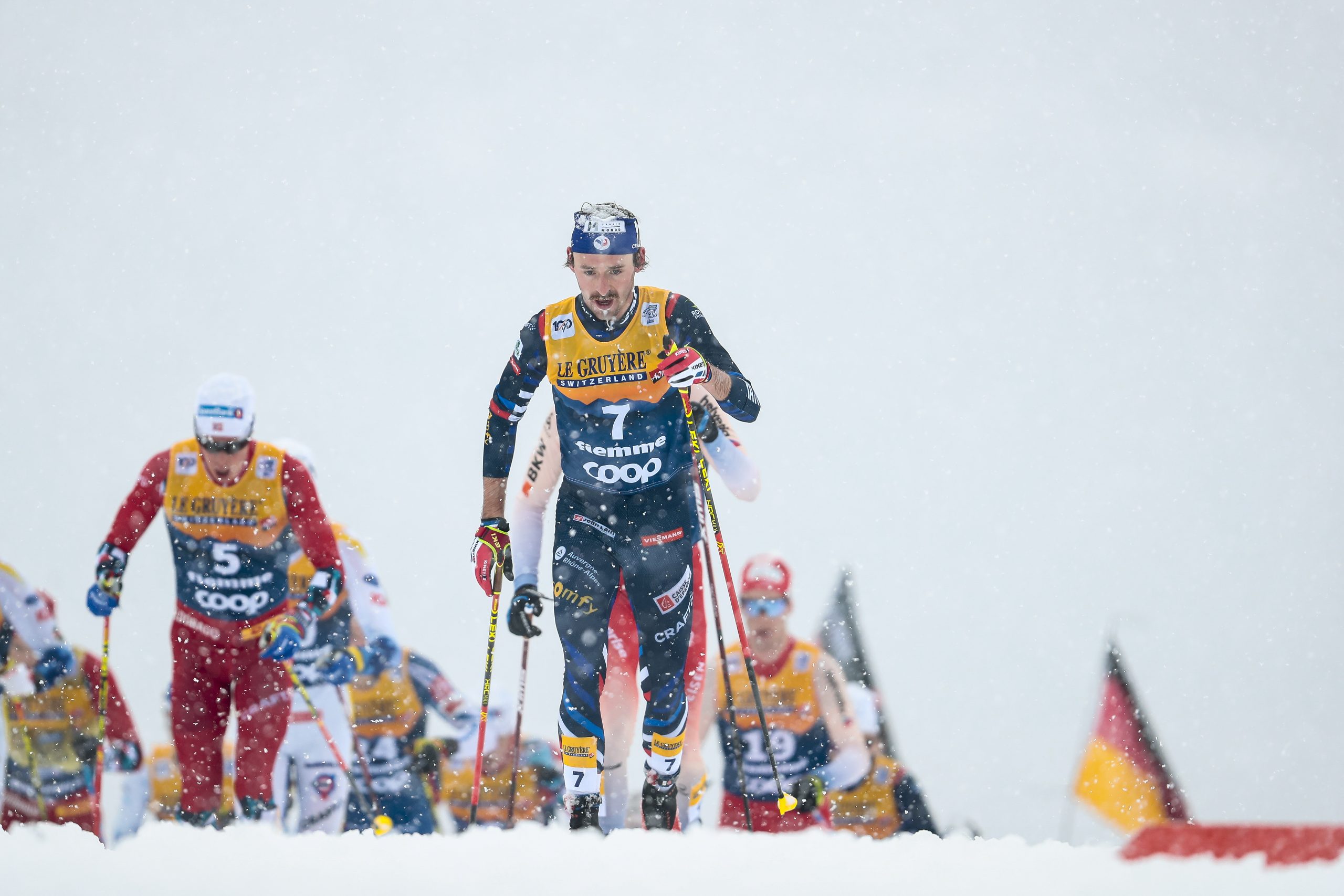
Much like the Classic race two days ago in Davos, skiers again faced extremely challenging waxing conditions in Val di Fiemme. It was snowing hard with temperature right around freezing. Again, wax technicians faced difficult choices. As racers marched to the start line to begin the race, lots of zero skis could clearly be seen; along with some skiers choosing klister. The American men were split on ski setup. According to U.S. coach Kristen Bourne, Patterson chose zero skis while McMullen was on klister. Bourne told FasterSkier that zeroes and klister skis were tested for both the men’s and women’s races with a mix of skis finally selected for both races. “It was definitely a mixed bag,” said Bourne. “Another day of our kick team really working trying to figure it out.” The decision was ultimately the athlete’s to make. “The skier and the tech would talk about it and make the decision together.” But the new fluoro rules threw another curve into ski choice. Under the rules for Classic races, skiers are allowed to present two pairs of skis for pre-race fluoro testing 30 minutes before the start. Bourne indicated that it’s ultimately the athlete’s choice to decide which pair of skis to choose from between the two pair which clear fluoro testing; a fairly nerve wracking dilemma. Things become even more complex as there is a kick adjustment zone after skis have been fluoro tested where kick zones, and only kick zones, can be adjusted just before the race.
Martin Loewstrom Nyenget (NOR) (bib five), did enough to put himself into third place for tomorrow’s decisive race. But he only has a five second advantage. (Photo: NordicFocus)
Unlike Thursday’s 20 kilometer race, this course was on a 2.5 kilometer lap which would help with kick zone icing issues.
The weather played an outsized factor today’s race strategy as well. The conditions would make it difficult for any skier to make a break. A mass start would also contribute even more to that same dynamic.
Olivier Leveille (CAN) gave fans an early thrill when he went to the lead at the 1.4 kilometer mark. Leveille was fighting for an early time bonus at the 2.3 kilometer point, but ultimately was in fifth at the timing check. The Bonuses helped to string out the field a little, as Edvin Anger (SWE) took the time bonus sprint, nudging out Erik Valnes (NOR) who needed the bonus time to help his podium fight.
After the bonus point sprint, the field coalesced again into one mass pack. Podium contender Beda Klee (SUI) took a brief shot at the front, but it was short lived. At 3.5 kilometers, the tone of the race seemed set; it was clear that pack racing tactics were going to take hold. The athletes really didn’t have much option, as trying a break in these conditions—this early—would likely be a fool’s errand.
The pack conditions meant that skiers outside the top ten would also have a chance to hang with the leaders. This gave McMullen a chance to ski with the Tour front runners as he pushed himself up to sixth. At this point the race was so congested that there was only a 16 second gap between first and 53rd.
With Amundsen having a big lead, he was unlikely to push the field; he was content to simply check any big moves made by podium contenders. Halfway through, Doennestad and Nyenget went to the front to try and push, but they too were unable to break up the field. One kilometer later, Erik Valnes gave the front a shot, but it turned out to be more of a chance to grab bonus points at 8.5 kilometers instead of a legitimate attempt to break things up. He stayed near the front after the bonus mark, but wasn’t seriously pushing the field.
Amundsen continued to hang out at the front to avoid the congestion of the big pack. Then, after the bonus Sprint, Jens Burman was the next athlete to step up to make a little charge to break up the field. His effort was also doomed, and the field again quickly consolidated. The conditions—coupled with the effects of the mass start—were proving just too difficult for anyone to make a break from the pack.
Zanden Mcmullen (USA) was one of two American skiers in today’s race. He finished 31st, but only 17 seconds behind the winner. (Photo: NordicFocus)
With only 2.5 k to go, it was still one giant pack with only 12 seconds between first and 51st. Amundsen, however, was leaving nothing to chance and went to the front. The virtual race for second and third in the TDS was still extremely tight with racers within a couple of seconds.
Even though the pack was close to the finish, the pace was still extremely relaxed. Several more skiers had tested the waters of going to the front only to abandon the opportunity after a few seconds. The race had now devolved into a giant touring pack with a Sprint finish looming. All the podium contenders were playing it safe with no one pushing the front, and everyone jockeying for a good spot for the finish.
With one kilometer to go, skiers began to seriously race. Cyril Faehndrich (SUI) (brother of Swiss star, Nadine Faehndrich), made a break with about half a kilometer to go. William Poromaa (SWE) and Valnes fell in behind him.
Cyril Faehndrich (SUI) had a career best day finishing on the podium for the first time in a World Cup race. (Photo: NordicFocus)
The race immediately became a three man sprint between Valnes, Faehndrich and Poromaa. In this situation, Valnes had the clear sprinting advantage. He double poled to the front and was able to push by Poromaa, who took second, and Faehndrich, who took third. For Faehndrich, it was his first World Cup podium. Tour leader Amundsen was only eight seconds behind the group and played a tactically smart race by not taking chances and preserving his large advantage going into tomorrow’s finale. While not the most thrilling race, it was smart tactics by the top contenders who were betting on making a bid in tomorrow’s climb up Alpe Cermis.
The racing strategy and weather created an interesting finishing time, where the winner of the men’s race was only three minutes faster than the Women’s winner!
Hugo Lapalus (FRA) kept himself in podium contention by finishing eighth today. He’s now only five seconds from a podium spot. (Photo: NordicFocus)
Impact on Tour de Ski Standings
Today’s race was really just about setting things up for tomorrow’s finale. Amundsen now has a 1:34 lead over teammate Erik Valnes, and a 1:42 lead over Martin Nyenget. But the race for second and third is still very tight. Lapalus, Moch, Klee, and Doennestad are all within seconds of the podium; tomorrow’s fight for second and third will be intense.
Jan Thomas Janssen (NOR) pulled off an unlikely victory in his first World Cup start in three years during Sunday’s 20 k Freestyle Mass Start in Ruka, Finland. (Photo: Nordic Focus)
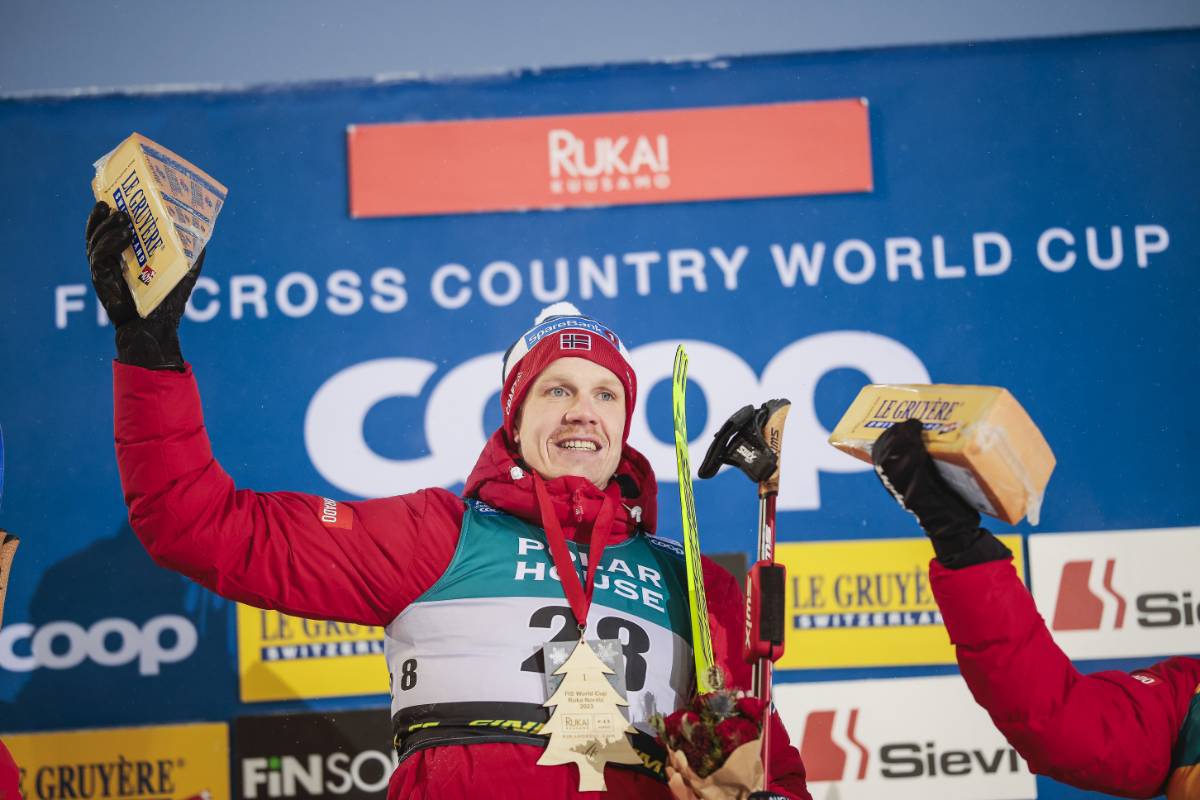
Jan Thomas Jenssen (NOR) hadn’t been entered in a World Cup race since 2020. On Sunday in Ruka, the highlight to Jenssen’s weekend of racing was expected to be his start in the 20 k, not his finish. But something strange was swirling in the chill Arctic air, and Sunday was one for the dark horses. In the final stretch of Sunday’s race that bent two unlikely skiers—Michal Novak (CZE), and the 27 year-old Jenssen—emerged from a pack of World Champions and Olympic medalists. Jenssen rounded the final corner on Ruka’s World Cup weekend to find no one—not one skier—between him and the finish line. Norwegian men would sweep the weekend, but they would do so with a most unlikely trio: Erik Valnes winning the Men’s Sprint on Friday, a 10 k Classic victory on Saturday from Martin Loewstroem Nyenget, and Jan Thomas Jenssen on Sunday.
Gus Schumacher led American finishers with a tremendous 16th place. Scott Patterson remained with Schumacher until the last, finishing 20th, while Zanden McMullen pulled up to the finish in 28th to round out a trio of Americans in the top 30. John Steel Hagenbuch scored the best result of his young World Cup career, taking 45th in just his fourth World Cup start. Zak Ketterson was 52nd, Luke Jager 68th, and Ben Ogden 71st. Among Canadians, Antoine Cyr finished 26th, Olivier Leveille 40th, Xavier McKeever 46th, Graham Ritchie 58th, Leo Grandbois 64th.
There are two substantial take-aways from the World Cup’s opening weekend in Ruka: (1) the Norwegian men’s team is still the dominant force in men’s skiing, animating almost all of the races and filling out most of its lead packs and sprint finals. (2) Ski racing is magical: terrain, weather, conditions, and circumstances can still align in such a way that an athlete who’s worked hard and steadily for years may, on any given day, find himself victorious.
Consider how Jan Thomas Jenssen ended up in the field Sunday. He had earned a single discretionary start from the Norwegian national team after a steady season’s-worth of races in last year’s Scandinavian Cup (the second-tier of FIS competition) in which Jenssen finished second. The Overall winner of the Scandinavian Cup earns an automatic World Cup bid for Period I. Last year, Jenssen’s countrymen Harald Oestberg Amundsen won the Scandinavian Cup; Amundsen also proved his mettle in Sunday’s action, ending up with a podium finish in third place. Jenssen likely wouldn’t have gotten a start in Ruka in any other year. For the first time since Ruka began hosting the World Cup opener 15 years ago, Sunday’s race was a mass start contest rather than a pursuit based on Saturday’s classic results.
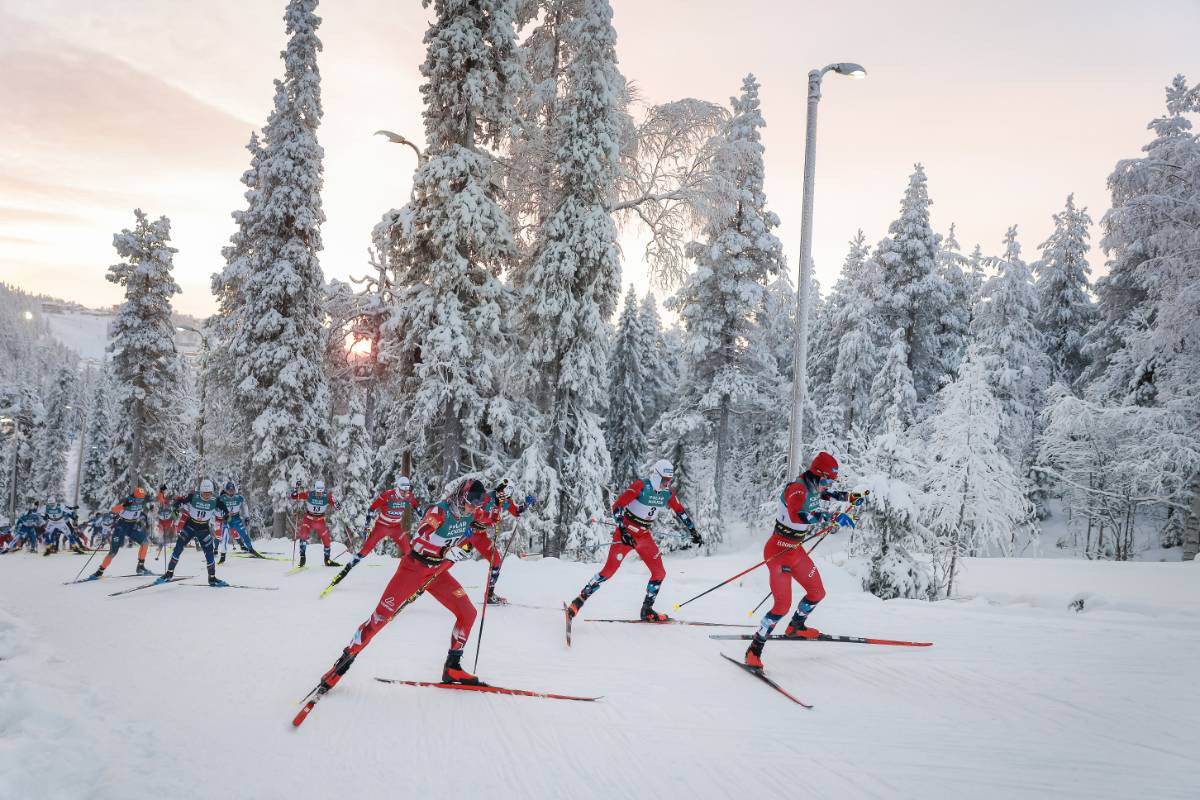
The men’s field on course in Ruka during Sunday’s 20 k Freestyle Mass Start. (Photo: Nordic Focus)
Also contributing to the potential for Jenssen’s unlikely victory was the form of the usual dominant figures in the men’s field. Johannes Hoesflot Klaebo was notably off-form for a third day in a row, helping pull a duo of Americans, Schumacher and Patterson, to a 16th place and 20th place, respectively, before easing across the finish line in 21st place. Saturday’s winner, Nyenget, followed an early agitation from Austrian Mika Vermeulen that left him out of the final running, while 2023 World Cup Distance Globe winner, Paal Golberg (NOR), was left struggling to maintain his place in the lead pack rather than searching for ways to drop it.
All these circumstances aligned for Jenssen: an all out effort, a World Cup win, and a loss for words. “I don’t even know what to say,” was Jenssen’s only statement to FIS media after the race, before he headed to his first ever podium on the sport’s biggest stage.
Men’s 20 k Freestyle Mass Start
There were other, bigger forces, at play on Sunday, too. Ruka’s 2.5 k course is composed of a long, steep, steady uphill, followed by a long downhill that wound into the stadium. In warmer, icy conditions, that set-up may have allowed break-away attacks to gain enough ground to snap the field on the downhill. This was Ruka, above the Arctic circle, in November, though. Cold, dry snow was the order of the day; as a result, the field largely acquiesced to the fact that the long downhill would serve to mitigate punchy efforts rather than help them succeed.
Ruka’s course conditions also allowed competitors, coaches, and wax technicians to worry less about the effects of the new non-fluoro wax protocols. After yesterday’s 10 k Classic, US Ski Team Coach Jason Cork said that the cold, powdery snow in Ruka—where fluoros and their characteristic moisture-resistance have the least effect—probably leaves open the question of the new wax protocols effect on skis. “It’s hard to know for certain [what the effect will be],” said Cork. “There are a lot of new products coming out—nearly daily—but our expectations going into the season was that the non-fluoro rule would create the least impact in cold, dry conditions like we’ve seen in Ruka.”
Gus Schumacher (USA) skied to 16th place in Sunday’s 20 k Freestyle Mass Start. “I’m in a solid place and can just kind of go with the flow and not do anything crazy from here,” said Schumacher of his results in Ruka. (Photo: Nordic Focus)
All of this created a mass-start race that stretched rather than snapped, as the field largely stayed together over the first 10 k. Some early action occurred when Mika Vermeulen (AUT) pressed the issue on the downhill leading into the stadium at the 5 k checkpoint. He was joined by Nyenget, but by 10 k the break-away was looking back, anticipating being gathered up by the pack. Through the early kilometers, Americans Schumacher, Patterson, Ogden, and McMullen remained in contact with each other, hovering around the 25th-30th spots in the pack.
By the 10 k mark, a pair of Frenchmen—Jules LaPierre and Hugo LaPalus—had started to push to the front in an apparent counter to the Vermeulen/Nyenget move, before Simen Hegstad Krueger (NOR) pushed into the final downhill in a move that animated the pack and created a split. By 12.5 k, there was a group of Norwegian’s at the front that slowly, but surely, was joined and punctuated by other nationalities. There were the Frenchmen, Britain’s Andrew Musgrave, Switzerland’s Beda Klee, Vermeulen, and Novak . A break occurred behind the first 15 skiers; this chase group was where Schumacher, Patterson, and notably, Klaebo, all ended up skiing for the final five kilometers.
Jan Thomas Jenssen (NOR) sprints ahead of Micah Novak (CZE) to win his first ever World Cup. (Photo: Nordic Focus)
The lead group remained compact despite jockeying, with the decisive moment coming in the seventh lap. “The leaders surged or the bonus points, blasted through and kept going,” said Schumacher in post-race comments to FasterSkier. In the final run-in, true urgency set up a sprint. That’s when Novak took his shot, followed by Jenssen. The duo broke clear in a hop-skate towards the Ruka stadium, with Jenssen’s line allowing him to steer clear of Novak, and towards his own first ever World Cup win.
The American action for the day came in the chase group, where Schumacher was able to create a bit of separation and win the final push to 16th place. “I felt like if I tried to cover that [gap], I’d lose time up the big hill on the last lap,” Schumacher said. “So I just tried to relax into the final.” The result was Schumacher’s best-ever showing at the Ruka World Cup opener, marking an auspicious beginning to the Alaskan’s campaign. “The goal for Ruka is always not to stress too much about where I’m at,” said Schumacher. “But that’s easier said than done. Mostly, I’m just a little relieved to know I’m in a solid place and can just kind of go with the flow and not do anything crazy from here.”
The World Cup leaves Ruka to head even more North next week, setting up in the Swedish town of Gallivare for a 10 k skate followed by the season’s first Team Relay.
This World Cup coverage is made possible through the generous support of Marty and Kathy Hall and A Hall Mark of Excellence Award. To learn more about A Hall Mark of Excellence Award, or to learn how you can support FasterSkier’s coverage, please contact info@fasterskier.com.
The long and winding road that is cross-country skiing’s World Championships came to an end today. The last stop: the men’s 50 kilometer Classic Mass Start. Throughout the men’s competitions, the story has been Norway; Johannes Klaebo’s domination, team Norway’s supremacy, and the competition amongst the Norwegian team members. Norway was expected to dominate again today, but there were many sub-plots within that expectation: one of the biggest was the performance of Klaebo. Touted by some as the greatest ever, but skeptics note that Klaebo hasn’t been nearly as impressive in distance events as other legendary skiers who came before. Klaebo has never been on the podium in a 50 kilometer race at a major event. To cement his name in conversations about G.O.A.T status, Klaebo would probably need to have a victory. He would also be trying to redeem himself after having been disqualified at the finish in the last World Championships 50 kilometer race when he interfered with Alexander Bolshunov (RUS).
Standing in Klaebo’s way would be what appeared to be a busload of Norwegian men. Finnish Classic standout Iivo Niskanen—who always seems to perform well in major events—would also present a major roadblock, with his eyes firmly on the podium in a long Classic race: his forte. America would look to Scott Patterson to lead the way for team USA, with Patterson having previously placed in the top 10 at 50 k in the Olympics and World Championships.
When the end of the World Championship Road was reached, it was Norway dominating again but with a somewhat surprising finishing order. Golberg finished first, out-sprinting Klaebo at the finish. William Poromaa (SWE) was third.
Scott Patterson (USA) had another excellent distance race for team USA finishing 16th (Photo: NordicFocus)
Men’s 50 kilometer Classic Mass Start
In 40 degree weather (4.4 C), with slow wet conditions, it was apparent early that the seven lap course would make for a race of attrition. It was also clear that the single allowed ski change could play a critical role.
As is typical in men’s distance racing, the skiers set out at an initially fast pace, then quickly settled down into the long grinding speed that would typify most of the race.
Scott Patterson (USA), was able to hang with the leaders early on. (Photo: NordicFocus)
At the 4.3 k mark, it looked good for team USA with Patterson at the front of the race. Also near the front was perennial crowd favorite, Andrew Musgrave (GBR). But as the race ground on the favorites began to rise to the top, while the Americans and Musgrave drifted back.
Much to everyone’s surprise, Johannes Hoesflot Klaebo (NOR) was out-sprinted at the finish. (Photo: NordicFocus)
At 6.4 k, two Italians—Federico Pellegrino and Francesco De Fabiani—joined Golberg at the front to quicken the pace. Klaebo was 23rd, but only 5.2 seconds back. At this juncture, Klaebo’s strategy became clear. He would not lead. Instead, he would be content to mark the leaders the entire way and then rely upon his devastating sprinting ability to bring in the win. It was a sound strategy for the strongest sprinter in the field, but one that would not pan out today.
With the abundant heat and sun, the nutrition hand-ups were frequent, giving skiers an opportunity to make a move when others were being handed food and drink. This is exactly what Niskanen did at the 13 k mark; taking five skiers with him. This was the first time in the race when the field truly began to string out. But, during the next feed, the front of the race regrouped. This elastic effect continued throughout the next several kilometers with surges and contractions geared around hills, corners, and feed zones.
It was at about the halfway point when the hot grind of an hour’s racing began to take its toll and a true lead pack of about 13 skiers established a gap with Golberg and Nyenget still setting the pace. Golberg had now been out front for the last five kilometers.
David Norris (USA) finished 22nd having won the American Birkebeiner Saturday, then flew to Europe to race in the World Championships. (Photo: NordicFocus)
The North American contingent was led by Wonders, Patterson, Gus Schumacher (USA), David Norris (USA) and, Oliver Leveille (CAN). All were in a chase group 14 to 22 seconds off the lead. Fans were eager to see how Norris would perform. He won the American Birkebeiner last Saturday and made the unprecedented decision to fly to the World Championships to race the marathon. After the race, Norris told FasterSkier that he had arrived Tuesday morning and was satisfied with the way his body had adapted. He forced himself to stay up late every night to adjust to jetlag. “I don’t think jetlag was affecting the race at all.”
At 28.4 kilometers Toenseth made a push to the front. Klaebo, who still had not led, was just a couple of seconds behind the leaders. The grinding race of attrition continued and it became clear that the winners would come out of the lead pack of 13 skiers. A surprise skier in the lead group was Snorri Einarsson of Iceland. Einarsson would go on to have one of his best finishes ever, finishing 15th.
With two laps remaining, every one of the now 11 lead skiers opted to stop at the ski exchange. During the exchange, there was a crash involving Niskanen and Jens Burman (SWE),when Niskanen cut in front of the Swede on his way into the ski corral. The tangle knocked Burman to the ground but didn’t seem to harm his time in the exchange or affect Niskanen.
David Norris (USA), Scott Patterson (USA), Gus Schumacher (USA), (l-r) were able to ski as a pack in the middle stage of the race. (Photo: NordicFocus)
The biggest surprise in the lead group was the presence of 23 year old Frenchman, Theo Schely, who is somewhat of an unknown outside France. Schely does not have a top 20 finish in a World Cup distance race, but was seemingly undeterred by the pace. He ended up finishing ninth in what was unquestionably the second biggest surprise of the day.
At about 43 kilometers the action livened up as Burman crashed in a corner, pushing him toward the back. At about the same time De Fabiani (ITA) broke a pole, and he was pushed out the back. With five kilometers left the race had boiled down to all the favorites with nine skiers lining up for finishing attacks. Toenseth dialed up the pace with Niskanen going along with him. Niskanen continued to push the pace—hard—but was unable to pull away from the chasers. But this reduced the field to only seven skiers, with Poromaa going with Niskanen at the front. Klaebo still sat in the middle of the pack, matching the leader’s moves but never leading.
Paal Golberg (NOR) celebrates at the finish having just shocked everyone—himself included—by sprinting past Johannes Klaebo (NOR). (Photo: NordicFocus)
At the two hour mark, with one kilometer to go, the race turned into an all out sprint with Golberg pushing to the front and Klaebo going with him in second place. It was here where the biggest surprise of the day took place. The pace was blistering with Klaebo charging up the final hill. Everyone watching expected Klaebo to turn on his famous sprint and pull away. But Golberg had a devastating sprint which Klaebo could not match. Klaebo faded in the last 100 meters and Goldberg surged, pulling away from Klaebo, putting him in second place, with Poromaa hanging on to finish third. After the race Golberg admitted his surprise in beating Klaebo. “I had amazing skis,” he said. “I didn’t think I could take Johannes.”
Regarding the race’s finish Norwegian, coach Eirik Nossum said that he was “really impressed by Paal [Golberg]. He’s had such a good season, today is icing on the cake. Every guy who beats Johannes in a finish is shocking, but it’s hard to have a sprint after 50k. You can’t just order it…it’s hard…even for Johannes.”
William Poromaa (SWE) ended Sweden’s medal drought, finishing third. (Photo: NordicFocus)
It was also a big day for Sweden. Head coach Anders Bystrom told FasterSkier that, “finally we got the medal, and it’s so important for the whole sport in Sweden. The women are so great, the men have been in the shadow of the women, so this is really important.” Calle Halfvarsson, who finished fourth reiterated to FasterSkier the medal’s importance to Sweden. “We, the men, don’t yet have any medals,” he said. “It was really good that we could take [a medal].” Halfvarsson also commented on Klaebo’s performance in distance events: “Today showed that Klaebo is human. “
After the race, Patterson told FasterSkier that he had missed a couple of crucial feeds. He also expressed dissatisfaction with his race tactics. “I should have swapped [skis] earlier.”
Schumacher told FasterSkier that “My energy definitely tailed off towards the end, but I felt like I skied well the whole time.”
At the end of the World Championship Road, Norway was still supreme with only the finishing order being a shocker: Golberg outsprinting Klaebo at the finish, stunning the crowd and completing the World Championships on a surprising note.
Johannes Hoesflot Klaebo (NOR), Paal Golberg (NOR), William Poromaa (SWE) celebrate podium finishes to cap off the World Championships. (Photo: NordicFocus)
World Championship Men’s 50 K Classic Mass Start RESULTS
This World Cup coverage is made possible through the generous support of Marty and Kathy Hall and A Hall Mark of Excellence Award. To learn more about A Hall Mark of Excellence Award, or to learn how you can support FasterSkier’s coverage, please contact info@fasterskier.com.
What was old is new again: for the first time since equal-distance racing policies were put into effect this season, the men’s field was set to race a 15 kilometer individual start. This particular distance has been raced at World Championships since guys with names like “Sixten” were racing on hand-carved wooden skis, but the extra five kilometers added to the men’s new-normal 10 kilometer World Cup distance provided a hint of freshness to this traditional World Championship event.
Scott Patterson (USA) completes his 15th place effort in the 15 k individual start skate race on Wednesday. (Photo: NordicFocus)
If the 15 k distance blurred predictions before the race, the roster of contenders in the field brought those predictions back into focus. As the last World Championships in Oberstdorf in 2021, the 15 k skate was a Norwegian sweep: Hans Christer Holund, Simen Hegstad Krueger and Harald Oestberg Amundsen going 1-2-3. American skiers also provided reason to be optimistic as the Team Relay approaches later this week, with Scott Patterson finishing 15th, Gus Schumacher 19th, Ben Ogden 27th, Hunter Wonders 33rd. Canadian finishers included Olivier Leveille 28th, Graham Ritchie 46th, Xavier McKeever 60th.
Johannes Hoesflot Klaebo (NOR) was also on the start list this morning, competing in a 15 k World Championship or Olympic skate event for the first time in his career. Based on the Norwegian skiathlon sweep last week, indications were that the Norwegian podium sweep of two years ago could likely be re-created today; the Norwegian shuffle at the top of the race was on.
Simen Hegstad Krueger (NOR) completes his world championship effort in the 15 k individual start skate race Wednesday. (Photo: NordicFocus)
15 k Individual Start Freestyle
As to who would stand atop the podium, indications were clear from the beginning. Kreuger is known for his ability to come on strong late in his seasons and late in his races, so his emerging as the early leader in this race suggested his form might prove unbeatable. By the 2.2 k checkpoint, Krueger was already out in front of a tight-packed field. American, Ben Ogden, described Planica’s course as one that could, “make you feel like a king for the first four kilometers, and then [make you] go ‘oh no, I still have 10 k to go’” Accordingly, Krueger’s early lead was one that didn’t warrant anointing him too early. But when Krueger came to the top of the long, winding climb defining the middle section of the course at 7.7 k with a 23 second gap over Sweden’s William Poromaa—and then kept adding to that lead at each subsequent checkpoint—it seemed like the probable outcome was becoming clear. Krueger was on his way to winning his second individual World Championship of his career, and in as many starts in Planica. As on-air broadcaster, Chad Salmela, pointed out, Krueger has started 10 races at World Championships and Olympics, and medaled in nine of them.
Krueger’s start position, bib 44, was relatively early among the main contenders. As a consequence, there remained considerable potential for drama to occur behind him as the field of contenders approached, but never matched, his high-mark at the later checkpoints. Holund started a minute behind Krueger in bib 46, but his checkpoint times put him in a closer race with Sweden’s Poromaa, with whom he traded on-course placings numerous times. Klaebo started in bib 48, two minutes behind Krueger, and through the first 2.2 k checkpoint was splitting seconds with him and leading the field, but Klaebo dropped to sixth place at 4.1 k and remained out of contention for the win the rest of the day. Amundsen—the 24 year old who had won a bronze at the Oberstdorf 15 k World Championships at only age 22—provided the late drama. Wearing bib 64, Amundsen led Krueger by 1.5 seconds at 2.2 k, was three seconds back at 5 k, and 11 seconds back at 7.7 k. When he put time into Krueger—he cut the gap from 11 seconds to 7.7 seconds in 3 k at the 10.8 k checkpoint—there was real intrigue. The gap grew in the last lap on the course, though even with a late push to finish 5.3 seconds back, Amundsen’s challenge to Krueger appeared to be over by the 12.8 k checkpoint. When he did cross the line, Amundsen had earned the second medal of his career, and Krueger took it as the sure sign he was safe to pull on the World Champions bib. Two years on from Oberstdorf, the 15 k skate podium had played a Norwegian shell game. 1st) Simen Hegstad Krueger, 2nd) Harald Oestberg Amundsen, 3rd) Hans Christer Holund.
Harald Oestberg Amundsen (NOR) followed up a 15 k bronze at 2021 World Championships in Oberstdorf with silver in Planica in 2023. “Maybe in Trondheim [in 2025], I will fight for the gold medal,” said Amundsen in post-race comments. (Photo: NordicFocus)In a post-race press conference, Amundsen—the youngest member of the Norwegian sweep—said, “It’s good to be on the podium. I trained a lot with [Krueger and Holund] the last few years, knowing they are the strongest guys after Oberstdorf.” As for what’s next, Amundsen sees one more step, literally: “Maybe in Trondheim [in 2025], I will fight for the gold medal.”
Patterson, Schumacher, and Ogden in Top 30 for Americans
The American skiers started their day before the podium action began, with Schumacher (bib 33), Ogden (bib 36), and Wonders (bib 37) all taking part in the bar-setting through early checkpoints. At 2.2 k, Schumacher and Ogden were near the front of the early starters, and by 4.4 k were on top; Schumacher first and Ogden second with less than a second between them. From there, though, Ogden would say in post-race comments that he “ran out of steam in the middle on the climbs.” His check-point times faded from the top, but still made clear the American was having a consistent effort. He would finish 27th; his first distance top 30 at a World Championships.
Gus Schumacher (USA) skied to a career-best World Championship distance finish, taking 19th in the 15 k Freestyle. “Jessie Diggins said ‘if you push well and do everything right, you’ve got to be happy.’” (Photo: NordicFocus)
Schumacher continued to stay near the top of early-starters as he passed through the checkpoints. At each point past 5 k, he was slotting behind Andorran skier Ireneu Esteve Altamiras, and later France’s Maurice Manificat, Japan’s Naoto Baba, and Germany’s Jonas Dobler. The dividing line between early-starters and the main contention field was Sweden’s William Poromaa who bested the early group at each checkpoint past 5 k. As early starters filled in behind Poromaa at each check point, what became clear was that Schumacher’s early time marks were setting him up for a good finishing time. Schumacher sped through the final lap, eventually crossing the line standing in third place. He would ultimately find himself 19th. It was the best World Championships distance finish of his career, and a bounce-back for Schumacher after last week’s 38th place finish in the Skiathlon.
Of his quick return to form, Schumacher said to FasterSkier post-race that “my results have gone from really bad to really good a couple of times now, so I can start to have more confidence that when I give it my best effort, that might happen.” Schumacher also identified a belief in himself that emanated from advice given to him by newly crowned world champion teammate Jessie Diggins: “[After the Skiathlon] it was nice to have Jessie [Diggins] around. She said, ‘if you push well and do everything right, you’ve got to be happy.’” Schumacher also paused, and then reflected to FasterSkier’s Nat Herz that, “It’s a little crazy to think that [Jessie] is one of the best that’s ever skied, you forget that so easy because she’s such a good teammate.”
Scott Patterson rcovers at the finish line after skiing to a 15th place finish. Patterson highlighted a day in which the Americans posted three top 30 finishes. (Photo: NordicFocus)
The top American performance of the day came from later start positions. Scott Patterson (USA) wore bib 70 on the day, working his was to an eventual 15th place finish. “I kept getting splits like ‘a couple seconds to eighth, you’re fighting for top ten,’ things like that,” said Patterson in post-race comments to FasterSkier. “[But] then I definitely fell apart in the last couple of kilometers and lost some time.”
Post-race, Patterson described his strange mix of disappointment and optimism from the 15th place result: “I wanted more from today,” he said. “Honestly, warming up, I went ‘I am not really feeling it,’ but I feel like I skied decent for how I was feeling.” Patterson added that he was “looking forward to the 50 k classic this weekend, for sure.”
15 K Results Point to Intriguing Team Relay
The World Championship program now turns back into a team affair, with the Women’s Team Relay event tomorrow and Men’s Team Relay on Friday. In the American camp, Gus Schumacher says they are “feeling pretty excited.” Part of that excitement may stem from today’s results, with Schumacher saying to FasterSkier that, “One of the Swedish guys pointed out that—besides Norway—there’s a lot of [team’s] that could battle it out, and I feel confident in my ability to contribute to that.”
This World Cup coverage is made possible through the generous support of Marty and Kathy Hall and A Hall Mark of Excellence Award. To learn more about A Hall Mark of Excellence Award, or to learn how you can support FasterSkier’s coverage, please contact info@fasterskier.com.
Racing in Toblach, Italy continued today with the Men’s 10-kilometer freestyle. Coming into the race Johannes Hosflot Klaebo (NOR) had won 13 men’s events and was only one victory away from tying countryman Martin Sundby for the most individual victories in a World Cup season. If Klaebo’s winning ways continued, he could threaten Therese Johaug’s record of 20 wins in a season; a record which many thought was unbreakable. It’s been all Norway in men’s distance racing this year; they have won every individual distance event. The last time a non-Norwegian man won a distance race was in February, 2022, when Iivo Niskanen (FIN) won the 15-kilometer classic in Lahti, Finland.
Klaebo leads the overall World Cup points standings over Paal Golberg (NOR) by 181 points. If Golberg wished to stay in the overall championship hunt, he would have to have a good performance today. Golberg is the overall distance points leader so he was definitely a threat to win or keep pace with Klaebo. Hans Christer Holund (NOR) sits second in the distance rankings; he would also be a threat to be at the top.
It was warm for the start of the race, about 40 Fahrenheit. The warm temperatures didn’t negatively affect the racing, and at the end of the day Golberg was able to finish first, 0.3 seconds ahead of countryman Simen Krueger (NOR). Klaebo ended up third, 2.8 seconds back. Norway took the first seven positions.
At the end of the day it was all Norway on the podium: Simen Hegstad Krueger (NOR), Paal Golberg (NOR), Johannes Hoesflot Klaebo. (NOR) (Photo: NordicFocus)
American Scott Patterson had an excellent day, finishing 14th, only 34.5 seconds off the lead. Other American finishers were Finn O’Connell 41st, Kevin Bolger 54th, Hunter Wonders 55th, and Logan Diekmann 71st. No Canadians raced today.
Scott Patterson masterfully navigated ski choice and pacing to place 14th. (Photo: NordicFocus)
The Race
Today’s warm weather meant that ski choice would play a large factor. Clear bases were definitely in the mix. Toward the start of the race, the sun had moved off the course and the snow firmed providing fast and challenging conditions, especially for the later starters. This made for a tough ski choice. Scott Patterson told FasterSkier that, “Ski choice was definitely about thinking ahead for the refreeze. We tested skis in the stadium initially and recognized that the really warm skis that performed well in the stadium would probably be a risky choice by race time.” Patterson continued that, “Overnight we got a bit of rain and relatively high winds. This combined to deposit an ice layer on the ski track and some pine needles and sticks from the trees. As we were starting at 3 pm, part of the course had baked in the sun during the day and gotten quite slushy. However, by the start of the men’s race the whole course was refreezing and the sun was gone. This resulted in some fast firm sections that hadn’t seen sun as well as glazed rutted parts that were quite funky to ski in.”
Finn O’Connell (USA) had a personal best World Cup day, finishing 41st. (Photo: NordicFocus)
U.S. coach Kristen Bourne confirmed the tricky conditions. “The track was pretty ripping fast for the women and sort of the same for the men. All of the divots and ruts from the women’s race [froze] and started to become bumpy and firm for the men. It was a weird fluctuation but was super-fast.”
As has been the pattern most of the season, today’s race would be a back-and-forth affair between the top Norwegians with Klaebo, Golberg and Simen Hegstad Krueger (NOR) trading punches and fighting for the lead all day.
Klaebo was one of the earlier starters among the pre-race favorites. Golberg and Krueger started several spots behind Klaebo, so they would have the advantage of marking their teammate. At the 1.7-kilometer mark Klaebo had taken the lead and established the early time to beat. When Golberg and Krueger reached the 1.7-kilometer mark, they were already a couple of seconds behind Klaebo.
Paal Golberg’s (NOR) finishing lunge put him on top of the podium. (Photo: NordicFocus)
At 2.1 kilometers, Hugo Lapalus (FRA) decided he would take a shot at the lead and moved into first over all the skiers who had already reached this mark. His pace would only be eclipsed later by Krueger who had a later start than Lapalus. But, Lapalus’ glory was short lived, at 3.0-kilometers he had dropped back to fourth. Klaebo and Krueger were virtually tied and had retaken the lead. Golberg was now 3.2 seconds back.
Between three and five kilometers, Klaebo put in a strong burst of speed to regain his lead outright at the five kilometer time checkpoint. Golberg and Krueger trailed Klaebo by about two seconds.
As the raced played out and skiers hit the 7.1- kilometer mark, Krueger had surged into the lead with Golberg now 1.9 seconds back. Klaebo had dropped off the pace considerably and was now 9.8 seconds off the lead. This trend held up over the next kilometer as Krueger increased his lead to 5.4 seconds over Golberg. Klaebo was now a whopping 11.4 seconds off the lead.
Johannes Hoesflot Klaebo (NOR) was in the hunt for the victory all day, but couldn’t overcome a mid-race deficit. (Photo: NordicFocus)
Pacing on the course was difficult, and not just for Klaebo. Patterson told FasterSkier that, “I had a few short opportunities to ski with people but mostly it was about finding my own pace and enduring through the muscular burn while keeping the tempo high.” He continued that, “It’s crucial to V2 almost all [of] the more gradual hills. Thus, I was focused on skiing smooth through the first 2km to build into the race a bit, then really turn it on and work the rest of the course as hard as I could.”
The U.S. team received advice on pacing the five kilometer loop course from veteran Jessie Diggins (USA) at their team meeting the night before the race. Bourne said that Diggins advised her teammates to “Go out as hard as you can, because once you get to 3 k, it’s pretty much all downhill from there.”
Kevin Bolger (USA) representing team USA in the Toblach 10 k. Bolger would finish 54th. (Photo: NordicFocus)
Klaebo also made adjustments and was able to turn up the speed in the last two kilometers, and coming into the finish, he put in one of his patented sprints, crossing the finish first among the racers who had finished. At this point Klaebo was in the leader’s chair, 2.4 seconds over Harald Amundsen (NOR).
But Golberg and Krueger were still lurking on the course, taking advantage of their later start. As he finished, Golberg was able to meet Klaebo’s finishing speed and went into first ahead of Klaebo by 2.8 seconds.
The only question now was whether Krueger would be able to match his teammates speed over the last two-kilometers. As Krueger came into the finish he was moving very smoothly and put in a ferocious finishing sprint but fell short of Golberg by 0.3 seconds. As it turned out, Golberg’s lunge at the finish was the difference between first and second.
Klaebo had put in an amazing final two-kilometers skiing it nine seconds faster than Krueger and three seconds faster than Golberg. But Klaebo’s slower speed in the middle of the race had given Golberg and Krueger the opening they needed to pull past him.
At the end of the day, Norwegian domination in men’s distance racing continued, Sundby’s record was intact, for the time being, and a young American continued to show great promise.
This World Cup coverage is made possible through the generous support of Marty and Kathy Hall and A Hall Mark of Excellence Award. To learn more about A Hall Mark of Excellence Award, or to learn how you can support FasterSkier’s coverage, please contact info@fasterskier.com.
Scott Patterson (USA) powers to a 12th place finish in the World Cup 20 k Mass Start in Les Rousses, France. (Photo:NordicFocus)
Ski racers know steep hills: the stomp up the first climb in the Swedish Vasaloppet, Wave 8 of the American Birkebeiner on “B**** Hill,” the race-changing “Russian Hill” on Lake Placid’s 1980 Olympic trails. The Les Rousses World Cup course has one of those hills, steep enough to reduce the world’s best skiers to a waddling, stuttering herringbone. Coming within the first 500 meters of the course, this hill was the defining feature of a 3.3 km loop that the World Cup field completed six times today en route to finishing a 20 km classic mass start. A hill like this becomes strategic: hit it hard and the hill could break up the field, string out the pack, perhaps even break Johannes Hoesflot Klaebo (NOR) who has looked surprisingly mortal this weekend in Les Rousses. Don’t let it come down to a final sprint. Beat him on the hill.
Easier said than done . . . Les Rousses’ hill indeed took its toll. By the final lap, only six skiers remained in contention. And among them was Klaebo, initiating a push into the check-point that marked the summit of the hill, then slowly returning to the pack like he’d just completed an interval. Iivo Niskanen’s (FIN) attempt to break away on the next hill came far too late. Klaebo had survived the climbs, had forced the race to finish on his terms, and so launched his race-winning sprint in time to have it all wrapped up as he entered the stadium. He waved and bowed to the Les Rousses crowd, extending his win streak in classic distance races to four, matching similar streaks by Alexander Bolshunov (RUS), Vladimir Smirnov (KAZ), and Bjorn Daehlie (NOR). Niskanen climbed onto the podium in 2nd place, while William Poromaa (SWE) finished third, earning his second podium of the weekend.
North American racers also excelled: The sole Canadian starter, Antoine Cyr, finished eighth, continuing his string of top ten finishes, while Scott Patterson (USA) finished 12th. Other American finishers included Ben Ogden 37th, Zak Ketterson 47th, Peter Wolter 54th, and Finn O’Connell 57th.
Johannes Hoesflot Klaebo (NOR) waves to the crowd on his way to winning Sunday’s 20 k classic mass start in Les Rousses. Klaebo ended a weekend where he struggled back to the top, outsprinting a six-man lead group. (Photo: NordicFocus)
The tactics played by Klaebo did not change the reality for the rest of the field in Les Rousses. There was still a grinding, grueling fight for places up and down the field, which kept attention on the finish-line long after the lead pack finished. The first of these pitched battles was between Cyr and Martin Loewstroem Nyenget (NOR) who traded turns in 7th and 8th place through the bulk of Sunday’s action. Loewstroem would take the edge in the end, but Cyr’s 8th place finish marked his third top-10 result in a month on the World Cup (after two top tens during the Tour de Ski), an auspicious sign of form from the young Quebecois skier.
Antoine Cyr (CAN) trades places with Martin Loewstroem Nyenget (NOR) during the 20 k classic mass start. Loewstroem outsprinted Cyr for 7th place, but Cyr’s 8th place marked his third World Cup top ten in the last month. (Photo: NordicFocus)
Then there was the main chase group behind Cyr which included another pack of skiers vying for top 10 spots. Among them was Patterson, who had held strong as the pack strung out to give himself a chance at a top ten. “I recognized that this course was pretty hard and expected the pack to spread out relatively early,” Patterson said. “Right from the start, my tactic was to hold position pretty high and fight to stay with the leaders. My group lost the leaders on the fourth lap, at which point I was able to shift into a more stable race pace and pick off stragglers from the lead pack.”
On the last climb of the big hill, Patterson made his move to the front of the pack, but was unable to break away any further. The back half of the course mitigated his strong showing on the uphill sections of the course, and he found himself in a sprint to gain every place he could. Friday’s World Cup winner, Harald Oestberg Amundsen (NOR) and Beda Klee (SUI) established a gap on the American, but Patterson came up the better against Frenchmen Clement Parisse to earn a 12th place finish on the day. Of his finish Patterson said, “I’m pretty psyched with the 12th today. I feel that I’m building momentum as this season progresses, but classic always seems to come a little slower for me. Today’s result is one of my best classic races outside of World Championship and Olympic races so I am pleased with that. My goals for the season are focused on the longer events around World Championships and Holmenkollen, but it is nice to see that I have decent form and pace in 20km races as well and feel that I’m still moving up.”
Scott Patterson (USA) leads the chase pack during the 20 K classic mass start Sunday. Patterson finished in 12th place, the top American on the day. (Photo: NordicFocus)
Ogden began his racing day clad in the Green Bib of the best young (U23) skier on the World Cup. Ogden would finish 37th, relinquishing the Green Bib to William Poromaa (SWE) after the Swede’s double podium weekend in Les Rousses. The U23 standings —1) Poromaa, 840 points, 2) Ogden, 744 points, 3) Friedrich Moch (GER), 720 points—set up what is likely to be a season-long battle in the young skier competition. That is notable in that it helps explain Ogden’s choice to skip the U23 World Championships currently happening in Whistler. Ogden would be the first American to win the young skier competition (which became an independent classification in 2014-15). Gus Schumacher (USA) took 2nd place in the young skier competition during the 2020-21 season.
Ben Ogden—wearing the Green Bib of U23 World Cup Overall leader—on his way to a 37th place finish. Ogden is locked in a tight battle for the best young skier competition with William Poromaa (SWE), who finished third and claimed the right to wear the Green Jersey next week. (Photo: NordicFocus)
In post-race interviews, Johannes Hoesflot Klaebo indicated that it was a “lot of hard work coming into this weekend, so it feels good to end it with a win.” There may have been a hint on where Klaebo is headed as the calendar turns from January to February this coming week. A month out from World Championships, it’s notable that Les Rousses happened in the middle of the last chance for athletes to put in a bigger block of training before tapering into Planica. While the best skier was off his game for the first part of the weekend in Les Rousses, he came away from the weekend with a win. A win is a win, of course, but with a deliberate eye towards Planica, it might just mean something more for the Norwegian. Even on a course capable of reducing the dynamic beauty of skiing to a plodding waddle, the world’s best skier could push through towards grander, bigger things to come.
Men’s podium (and a French fox) at Sunday’s 20 k Mass Start Classic in Les Rousse. 1st) Johannes Hoesflot Klaebo (NOR), 2nd) Iivo Niskanen (FIN), 3rd) William Poromaa (SWE). (Photo: NordicFocus)
This World Cup coverage is made possible through the generous support of Marty and Kathy Hall and A Hall Mark of Excellence Award. To learn more about A Hall Mark of Excellence Award, or to learn how you can support FasterSkier’s coverage, please contact info@fasterskier.com.
Harald Oestberg Amundsen (NOR) earned his first FIS world cup cross-country victory at Les Rousses, France. (Photo: Thibaut/NordicFocus)
Fans have become accustomed to Norwegian men occupying the World Cup podium, but it’s getting pretty crowded there on the top step. Team Norway has delivered World Cup wins this season from Iver Tildheim Andersen, Paal Golberg, Simen Hegstad Krueger, Johan Hoesflot Klaebo (who has already won 12 times this season), and now Harald Oestberg Amundsen. It seems that any Norwegian can win on any given day . . . and no skier from any other country seems to have a chance.
Norwegian skiers have claimed so many of the podium spots in early-season World Cups, but at Les Rousses their usual dominance was somewhat less than total: Amundsen (NOR) claimed his first World Cup victory, Roethe (NOR) second, and William Poromaa (SWE) third. Frenchman, Jules LaPierre, had a spectacular day racing in his home country, further interrupting the usual Norwegian strangle-hold on the top placings and finishing a very impressive fifth, just 25 seconds behind race winner, Amundsen.
Scott Patterson (USA) led the American contingent at the World Cup Skate 10km, Les Rousses, France. (Photo: Authamayou/NordicFocus)
Scott Patterson (USA) continued a season of distance race performances in the top thirty with a 24th place finish.
“It’s been a solid break after the Tour de Ski from World Cup racing,” said Patterson. “[I finished] 24th today: not everything I wanted, but I think it was a solid result. I was in the fight . . . I raced a distance double pole marathon last weekend and was still feeling some effects from it. I think the form’s coming along and I’m excited as we keep having ore races coming up and build toward [World Championships].”
Other American finishers included Finn O’Connell 50th, Peter Wolter 56th, Will Koch 63rd, and Zak Kettterson 65th. Nordiq Canada chose not to enter skiers in the races at Les Rousses.
Will Koch (USA) got his first taste of World Cup racing on the 10 k course in Les Rousses, France. (Photo: Thibaut/NordicFocus)
The day’s results demonstrate how difficult it is to prepare for the upcoming World Championships while also defending individual places in the World Cup standings. Early in the season, Klaebo had stated that his chances at winning the overall World Cup championship were over. It appeared, then, as though he would pick and choose his World Cup starts in order to secure the Sprint crown, while prioritizing his preparation for the World Championships (which most competitors hold in higher regard than the World Cup). It would’ve been easier for Klaebo if he’d stayed that course. As it is, he now seems determined to pursue every win, and to chase points in any event in which Paal Golberg—his Norwegian teammate and closest rival in the race for the overall World Cup—is entered.
Men’s 10 k Skate
Fresh snow and overcast skies greeted competitors in Les Rousses, a resort community in the Jura Alps north of Geneva. At an elevation of nearly 4000 feet (1219 meters), Les Rousses offers challenges that other, lower, venues do not. Additionally, 10 k is not a typical men’s distance, raced this season in a nod to distance-equity that has been instituted between men’s and women’s fields. For skiers at the World Cup level, the 10 k distance is a bit of a sprint . . . and a distance in which much can go wrong. Sprinters have a chance to excel (though they could also blow up). Distance skiers are forced to press the pace, and hope that their speed will emerge.
The Les Rousses World Cup 10 k was raced around three laps of a 3.3 k loop. In any such lapping course, there’s potential for results to be affected by the ways in which skiers pair up (or group up) over the course of three high-speed laps. Strategically, the greatest advantages are available to skiers who pair up with later starters (the faster/fresher skier “giving a ride” to the skier who has been on course longer). Veterans are always looking for this (entirely legal) advantage. Toenseth and Andersen grouped up on the course, working well together through the middle lap, but neither seemed to gain enough advantage to affect the final standings. Most other contenders seemed to race mostly on their own. Pre-race favorite, Krueger, found himself alone . . . no beneficial pairings for Krueger. Klaebo who was the day’s final starter, and was therefore unlikely to benefit from the speed of other racers; however, he would hear split times of all skiers who started before him. Game on . . .
Amundsen, was an early leader, but he was also skiing alone. Krueger started conservatively, some 11 seconds behind Amundsen at the first check point. Klaebo started equally conservatively—only 21st fastest at the first check point—but would gain time through the first lap (5th at 3.3 k, only five seconds out of the lead). He lingered 13 seconds behind Amundsen at the halfway point. Klaebo has already earned 12 World Cup victories this season (only two behind the season-record of 14 wins set by Martin Jonsrud sudby), but his performance in Les Rousses appeared a bit flat. He may be conserving energy (lord knows he spends enough of it), or he may be in a pre-Worlds training cycle that hinders top-speed efforts. Either way, he skied consistently if not brilliantly—never really excelling, never really losing too much time—finishing the day in 8th.
Klaebo’s countryman, Amundsen, continued to lead his teammates through the later check points. Early leader, Andersen (who won the 10 k skate earlier this season in Lillehammer), faded over the closing kilometers to finish 9th. Poromaa (SWE) started fast, though struggled a bit to maintain his form late in the later stages of the race. He moved into second at the finish (still behind Amundsen, and snatching crucial World Cup points from Golberg) where he remained until the later arrival of Roethe.
Jules Lapierre (FRA) raced with bravery and panache in front of loyal French fans at Les Rousses, finishing a remarkable fifth. (Photo: Authamayou/NordicFocus)
France’s Jules LaPierre led at 8.1 k, and sat in second in the results at the finish until Golberg eclipsed him (though still behind Amundsen). Ultimately, Amundsen finished in 21:26.5 for his first career World Cup win. Roethe finished second (11.9 seconds behind), with Poromaa another six seconds behind to earn his second career World Cup podium
With so many Norwegian skiers fighting for spots in the upcoming World Championships, Amundsen acknowledged the magnitude of his performance in securing his first World Cup victory. “It was a really important race for me,” he said.
Sjur Roethe (NOR), Harald Oestberg Amundsen (NOR), William Poromaa (SWE), (l-r)—FIS World Cup cross-country, 10km, Les Rousses, France. (Photo: Authamayou/NordicFocus)
Sophia Laukli (USA) crosses the finish line on the top of the Alpe Cermis for 3rd place, her first career World Cup podium. Laukli highlighted a day in which the Americans put three in the top ten. (Photo: NordicFocus)
The Alpe Cermis
When the Grand Tour of skiing—the Tour de Ski—was dreamed up by Vegard Ulvang and Jurg Capol in 2006, one of the first definitive decisions was that it would need a Queen Stage: a stage that sought to distill the essence of ski racing—the brutal beauty of the slog—to its purest state. The Tour de France had its Alp d’Huez, and the Tour de Ski would have the Alpe di Cermis.
Through seventeen editions of the Tour de Ski, the climb of Alpe di Cermis has become nothing less than iconic in Nordic Skiing. This is where Therese Johaug and Marit Bjoergen cemented their legends in tandem, year-after-year, battle-after-battle, racing up the fall line. This is where Johannes Hoesflot Klaebo lost the 2020 Tour to Alexander Bolshunov on the final day. Martin Johnsrud Sundby, Petter Northug, Dario Cologna, Jessie Diggins, Heidi Weng: all have played prominent roles in past hill climbs. In 2015, it’s where Liz Stephen notched a 5th place, and kicked off the breakout World Cup season for the American women, culminating in the team’s first ever distance World Championships medals (That Falun 10 k where Jessie Diggins and Caitlin Gregg were 2nd and 3rd).
Course Profile for Tour de Ski Stage 7 at the Alpe Cermis. (Photo: Fiemme World Cup)
The Alpe is the culmination; it is also the main event. Things were no different for this year’s Tour de Ski. On the women’s side, Frida Karlsson hoped to arrive at the summit in possession of the Yellow Bib. On the men’s side, Klaebo looked to do the same, but with ghosts of Alpe’s past haunting his each and every stride. Both Karlsson and Klaebo had dominated over the course of the first six stages, but both, remarkably, remained vulnerable. Karlsson (2:31:16.0) held an advantage of 1:12 over second place Tiril Udnes Weng, while Klaebo carried a 1:02 advantage over second place Calle Halfvarsson in the men’s field. Simen Hegstad Krueger—winner on the Alpe in 2021—held fifth place overall at 1:45 back. In a normal ski race, those margins would have all but guaranteed victory for the leaders. But in a race up the Alpe de Cermis—where the final kilometers stretch out time gaps with every meter gained—no lead is ever safe.
The American woman hold up Sophia Laukli after her 3rd place finish on the day. The Americans had three in the top ten, as Laukli was joined by Jessie Diggins in 5th and Rosie Brennan in 6th place. (Photo: NordicFocus)
Laukli Highlights Women’s Race with First Podium
Sophia Laukli spent the past year seeking out the most challenging propositions in endurance sports, and learning to make them her specialty. Last year on the Alpe, she recorded a 5th place finish alongside teammate Novie McCabe in 7th that marked a definitive breakout. Already then, the goal was set. Return to the Alpe in 2023, and seize it. In the interim, she has run and skied her way to the top of climbs around the world, winning the Lysbotn Opp rollerski climb last July ahead of Heidi Weng and Delphine Claudel, who were 1st and 3rd up the Alpe, respectively, last year. Through highs and lows in this Tour, she was able to keep sight of her “big goals for today” as she put it in post-race comments.
When it comes to the unexpected, however, one can only prepare just so much: “Right before the climb started, I got tripped up and lost all the positions I had made up [by working the flat section],” she said. “I was back to being in the back of the pack going into the climb.”
Her experience on the climb told her two things: “Tactically, it’s very difficult to pass people, and [the Alpe] is a long climb.” Laukli held it together. She found her teammates, Jessie Diggins and Rosie Brennan, climbing in 5th and 6th place through the crux of the Alpe. Laukli held her emotions in check, saying she, “[didn’t go] full-on panic mode, and [it] saved me today.” There was poise. There was patience. And there was also a whole lot of power. It appeared impossible that she could climb back to the podium, and yet Sophia Laukli had taken that word and controlled it: it was impossible how well she was skiing.
That fact became most apparent in the final 200 meters of the race. Having begun the day at the back of the pack, Laukli had raced herself into position to stand on the podium for the first time in her World Cup career. None of that would come easy; she crossed the finish line and folded over in the snow. Five minutes later, she stepped onto the podium in third place. The 22 year old Maine native, and current University of Utah skier, became the first of her new generation of American women to achieve that milestone.
Jessie Diggins (USA) hugs Sophia Laukli (USA) on top of the Alpe di Cermis. (Photo: NordicFocus)
In the end, Laukli’s finish was just 35.7 seconds behind French climbing specialist Delphine Claudel. Claudel entered the steepest sections of the climb behind Frida Karlsson, the overall leader. At a hairpin 1.5 k from the finish, a brief tangle between Karlsson and Heidi Weng allowed Claudel to establish a gap, and Weng was the one who followed. But none were able to surpass Claudel at the finish line where the Frenchwoman claimed her first World Cup victory, and her first win on the Alpe di Cermis.
Delphine Claudel (FRA) crosses the line for the first World Cup win of her career atop the Alpe di Cermis. (Photo: NordicFocus)
For her part, Laukli seemed to search beyond herself to explain her astounding performance. “I lucked out I guess,” she said. “My tired was less than other people’s tired, and so it was enough.” Laukli’s achievements on the day could have overshadowed what other American women accomplished: one of the team’s best days ever, putting three in the top ten. There was the tenacity of Jessie Diggins, pushing to the front of the race early on in the Alpe climb, working “through disappointments but never losing belief” as she would say after the race. Then through the middle part of the climb, Rosie Brennan had joined Diggins, pushing to improve her Overall 5th place standing on the day. It all came together: “[It felt surprisingly] nice and comfortable,” Brennan said. “Usually [on the Alpe], you are alone and work on just keeping a rhythm, but today is was like ‘now I gotta stay with them.’” The American women had come together for the toughest test in ski racing.
Jessie Diggins (USA) and Rosie Brennan (USA) push up the Alpe Cermis together, finishing 5th and 6th on the day. (Photo: NordicFocus)
As Laukli pushed for third, Diggins and Brennan stuck together to finish fifth and sixth on the day. Brennan moved up to fourth Overall, her best Tour de Ski overall finish ever. “[The World Cup] has been a hard start for me this year, and I’m starting to come around. [This Tour de Ski] was a good sign for the future.”
With her race today, Jessie Diggins moved up to 11th Overall in this year’s Tour de Ski. Diggins commented that she is “more proud of how I handled this Tour than any other one. I just didn’t stop believing and kept going. Now it’s time to recover, and keep training.”
Diggins did add that she would undertake some post-race evaluation on how she was recovering: “I’m not 100% sure when my next race will be,” she said.
Karlsson won the 17th edition of the Tour de Ski with a 15th place finish on the Alpe, remaining 33 seconds ahead of Niskanen and Tiril Udnes Weng. The finish culminated a week in which Karlsson continuously bolstered her reputation as the dominant distance skier in the women’s field. Karlsson’s win also marks another milestone for the current generation of Swedish women skiers, delivering the first Overall Tour de Ski win since Charlotte Kalla won in 2008.
Krueger Wins Day, Klaebo Wins Tour in Men’s Race
Johannes Hoesflot Klaebo lifts his 3rd Tour de Ski trophy of his career. (Photo: NordicFocus)
Part of the emerging legend of the Alpe Cermis is that it has been the only arena capable of diminishing the otherwise-unstoppable force of Johannes Hoesflot Klaebo. Klaebo entered the day having won all six of this year’s Tour de Ski previous stages, another of the many accomplishments that only he can claim in the sport of skiing. Even so, there was almost no speculation that Klaebo would make this year’s Tour a clean sweep with a win on the Alpe di Cermis. The Alpe has made appear Klaebo human before; it would most likely do so again.
The lingering question was whether he could avoid a repeat of 2020 when Alexander Boshunov and Sergey Ustigov successfully wrested the yellow bib from Klaebo on the climb. With previous Alpe di Cermis winner, Simen Hegstad Krueger, in fifth place—1:45 behind Klaebo—there was still a possibility that the climb could prove to be Klaebo’s undoing yet again.
That possibility turned into real tension when Krueger initiated a move at the base of the climb, opening a gap in the field. A group of Norwegian men quickly formed, but without Klaebo. Sjur Roethe, Hans Christer Holund, and Didrik Toenseth moved up with Krueger. Klaebo was still within reach, but his lack of push to stay with the field indicated a concession from him; he would let the climbers go and focus on keeping the yellow bib on his back at the finish.
Klaebo, wearing the yellow bib, in behind the lead pack of his countrymen at the base of the Alpe Cermis climb (Photo: NordicFocus)
Krueger set a blistering pace up the steepest sections of the climb, dropping both Toenseth and Roethe (last year’s Alpe winner). Hans Christer Holund was the only one up to the task of marking Krueger, with Krueger doing the bulk of the work as he searched for seconds on Klaebo. Between the 8 k and 9 k mark, Krueger trimmed 47 seconds from his 1:45 gap to Klaebo. The math was evident: it would be hard, but not impossible, for Krueger to win the Tour. The aggressive push from Krueger meant that some of those who had tried to keep with him didn’t just lose touch with the pack when they went, but really fell off. That allowed skiers who had been more conservative through the early section to challenge for the final podium spot, including Frenchman Jules Lapierre and German Friedrich Moch. Klaebo kept to himself through their machinations, and Lapierre soon had established a gap over the other challengers.
In the end, Krueger crossed the finish line only five seconds ahead of Hans Christer Holund to win the Alpe for a second time. The Frenchman Lapierre crossed with the most emphatic celebration on the day: his first World Cup podium. Krueger’s celebration was perhaps a bit subdued: he had looked back to find that Klaebo had put in a remarkable second effort over the final kilometer. The Alpe, it turned out, did manage to expose Klaebo’s humanity, but the struggle also revealed his character. A skier who appears so often to win by virtue of talent and tactics earned a special victory today by racing with his heart.
Simen Hegstad Krueger crossed the finish line in first in his 2nd career win on the Alpe Cermis climb. Krueger moved up to 2nd place in this year’s Tour de Ski. (Photo: NordicFocus)
Part of the Alpe’s legend is in posing a challenges to skiers, but it also appears that the Alpe di Cermis has a sense of justice. Klaebo has clearly been the best skier in this Tour de Ski; with his third Overall victory, he moves a step closer to becoming its most successful skier of all time. That he has not already notched that title speaks to both his youth (we often forget how young Klaebo is), and to the prowess of the skier he chases: Dario Cologna, who during his career earned four Tour de Ski titles.
Scott Patterson finished 14th on the Alpe Cermis, earning the distinction of top American on the day. (Photo: NordicFocus)
Behind the Norwegian battle at the top of the Alpe Cermis, the American men were busy continuing their steady climb toward the top of the World Cup. Scott Patterson was the top finisher for the Americans, finishing 14th in his second climb of the Alpe (he was 38th last year). Patterson said in post-race comments that the result marked a high point for him at this Tour de Ski, and that he is, “looking forward to the focus on the longer races later in the season,” including the 50 k in Holmenkollen.
Ben Ogden was the top American finisher in the Overall Tour de Ski standings, finishing 13th after a 24th place finish in his first climb of Alpe di Cermis.
Ben Ogden, the top-placed American man in this year’s Tour de Ski at 13th Overall. (Photo: NordicFocus)
Conclusion to the 17th Tour de Ski
With that, the 17th edition of the Tour de Ski comes to a close. World Cup Skiing departs the slopes of Alpe di Cermis, leaving more stories etched in the snow on each steep hairpin. It reminds us once again of all that makes ski racing beautiful when the time is right, when the skiers are prepped, and when and all of our eyes watching.
The World Cup takes a collective rest for the next two weeks, before resuming in Livigno, Italy on January 21st. From all of us at FasterSkier, thanks for following along for another edition of the Tour de Ski!
The American men at the top of the Alpe Cermis. (L-R) Gus Schumacher, Ben Ogden, Finn O’Connell, Scott Patterson, and Hunter Wonders. (Photo: Tom Horrocks/USSS)
This World Cup coverage is made possible through the generous support of Marty and Kathy Hall and A Hall Mark of Excellence Award. To learn more about A Hall Mark of Excellence Award, or to learn how you can support Fasterskier’s coverage, please contact info@fasterskier.com.
Scott Patterson (USA) leads the chase group on his way to the fourth fastest time of the day at the Tour de Ski 20 k Freestyle Pursuit in Obesrtdorf, Germany. (Photo: NordicFocus)
The Tour de Ski spent its second day in Oberstdorf for the running of Stage 4, the 20 k Freestyle Pursuit. For the second day in a row, it was North Americans who raced their way toward the front. Most remarkable, perhaps, were Scott Patterson (USA) with the fourth fastest time of the day (he would rise from 29th to 17th overall), and Antoine Cyr (CAN) with the seventh fastest time of the day (rising from 37th to 24th overall).
Other Canadian finishers included Olivier Léveillé 35th (from 24th), Russell Kennedy 41st (from 56th), Sam Hendry 66th (from 74th), Graham Ritchie 67th (from 65th), Remi Drolet 72nd (from 75th).
American finishers included three more Americans in the top thirty: Ben Ogden finished13th (having started 6th) , Hunter Wonders finished 19th (from 11th), and Gus Schumacher 26th (from 15th). Zak Ketterson finished 55th (from 38th), JC Schoonmaker finished where he had started in 69th, while Kevin Bolger rose to 71st (from 73rd).
Almost as an afterthought, Johannes Hoesflot Klaebo skied to the 20 k Pursuit win in dominant fashion. Klaebo managed his own pace—and the pace of the field—in a masterful display that saw him pulling away from the pack in the final kilometer and easing across the line for the win (though losing cumulative time to many of his rivals in the Tour de Ski overall competition). Following him to the finish line were Sindre Bjoernestad Skar (NOR) in 2nd, and Federico Pellegrino (ITA) in 3rd.
Even down the homestretch of the 20 k Freestyle Pursuit, Johannes Hoesflot Klaebo (NOR) controls the field and carries his dominance across the finish line. (Photo: NordicFocus)
Men’s 20 k Freestyle Pursuit
This was a day of differing strategies: some racers knew they had to commit everything in order to move up in the Tour de Ski standings, while others were choosing to conserve their energy for later stages. Others (like Klaebo) knew they could afford to give back some time, holding their overall positions while committing only enough energy to prevail in the day’s racing.
Tour de Ski Stage 4 was a 20 k Freestyle Pursuit in which the starting order was derived from yesterday’s 10 k Classic (NOT from the order of the overall standings). Oberstdorf’s strip of manmade snow ran through the fields and forests along a rolling 3.3 kilometer loop that racers would navigate six times. The starting order gave Klaebo a 12 second advantage over Simen Hegstad Krueger, :20 to Didrik Toenseth, :25 to Calle Halfvarsson, :27 to Golberg, :30 to Ben Ogden. This closely-bunched group of starters made it quite likely that the entire field could come together within just the first few kilometers. Twenty kilometers is quite a distance to ski alone, and Klaebo is smart enough to know that he could exhaust himself by attempting to maintain his lead over so strong a group of chasers. And with his sprinting abilities, Klaebo would be likely to win the day’s event if he conserved his energy, allowed the field to catch him, and outsprinted them at the end. The men’s race looked certain to group up.
Like the pursuit race earlier in the Tour de Ski, each skier’s relative success can be judged by more than one result. There are skiers who do well in the pursuit finishing order, and others who do well in the timed-results on the day . . . and the comparison of success and failure is not always immediately apparent. A racer may finish well in the race standings by holding position in a pack of skiers and outsprinting them at the end, even though his on-the-day time could be much slower than other skiers who caught his group from behind. Pursuit racing is about patience and strategy as much as it is about maximal efforts and daring pyrotechnics. The races going on in the middle of the field can be extraordinarily complex. The racing at the front is far more straightforward . . .
Hunter Wonders (USA) following teammate Ben Ogden (USA) in the lead group at the Tour de Ski Stage 4 Freestyle Pursuit in Oberstdorf . (Photo: NordicFocus)
Klaebo started alone with a 12 second advantage over his pursuers. Soon after the start, a chase group formed that included Krueger, Didrik Toenseth (NOR), Calle Halfvarsson (SWE), and Paal Golberg (NOR). That group was closely followed by Andrew Musgrave (GBR) who was able to join a few kilometers later. All chasers were making up time on Klaebo, who was obviously allowing himself to be caught. The catch happened within the first five minutes of racing (near the 2.1 k checkpoint), forming a group that would stay together all through the middle of the race. The group was led by Simen Hegstad Krueger who was consistently marked by Klaebo, and trailed by Golberg.
A fairly relaxed pace at the front allowed later starters to bridge the gap at four kilometers, and the lead pack swelled to a dozen. Having been gapped by Musgrave, Ogden found himself overtaken by an aggressive chase pack that included Poromaa, Hunter Wonders, Gus Schumacher, Emil Iversen, Havard Moseby, Hans Christer Holund. There was no relaxing to do in the chase group; they were headed for the front, and were wasting no time in making it happen. Pellegrino would ultimately lead another group forward to join with the lead group, and the field ultimately swelled to nearly 30 racers, including Americans Ogden, Schumacher, Wonders, Patterson, and the Canadian Cyr.
“We caught the lead pack in three laps . . . and it turned into a little bit of a cat and mouse game which was a little bit frustrating,” said Patterson. “I wanted it to be a harder race. But it turned out all right. As people get tired, I start moving up the ranks. I’m excited for Val di Fiemme. “
Wonders summed up his Stage 4 experience: “Once we caught the lead pack it started to chill out a little bit,” he said. “I was just trying to ski relaxed; it was pretty exciting to be skiing with a bunch of guys I’ve been watching for years!”
Having started 33rd on the day, Frederik Moch (GER) went to the front to push the pace in the second half of the race (Moch would post the fastest time on the day). Sjur Roethe (NOR) attacked at 12 k with Halfvarsson and Krueger, but the contenders came back together after a fast downhill. The lead group dwindled to 24 as the race neared its conclusion, and the jockeying for position began with the field nearly coming to a standstill at times. With a kilometer remaining in the race, Klaebo unleashed a surge on the final uphill before the stadium followed by Skar and Pellegrino. As has so often been the case, Klaebo’s high-tempo surge on the final uphill was one that no one else could match. He crested the hill alone, relied on his fast skis on the downhill, and maintained his lead through the finishing line. The field came charging behind him in a sprint won by Skar, who was closely followed across the line by Pellegrino. Nine Norwegians finished in the top 12, followed by Ogden in 13th (though his finishing time was only five seconds behind Klaebo’s winning time).
“The pack stayed together the whole race,” Ogden said. “And then they just sprinted for it in the last K, or so. I think that my strengths in 20 k are better suited in the last K than they are in the first 19!”
Klaebo earned the win, but with only the 42nd fastest time of the day, giving back :22 to Golberg, and 1:01 to Pellegrino in the TDS overall standings. Klaebo knows he must moderate his efforts in order to have the energy to hang on through the end of this week-long tour. But he also sees the possibility of sweeping the series—of winning every stage—on his way to an historic Tour de Ski victory that could also garner enough points to bring him the World Cup overall title.
After the close racing of Stage 4, the Tour de Ski Overall standings return to a much tighter affair: Klaebo continues to lead Pellegrino by :12, Golberg by :14, Skar and Krueger by :32, Toenseth, Roethe, Holund by :39, and Halfvarsson by :49.
This World Cup coverage is made possible through the generous support of Marty and Kathy Hall and A Hall Mark of Excellence Award. To learn more about A Hall Mark of Excellence Award, or to learn how you can support FasterSkier’s coverage, please contact info@fasterskier.com.
Gus Schumacher (USA) strides on his way to a 15th place finish in Stage 3 of the Tour de Ski in Oberstdorf, Germany (Photo: Nordic Focus).
Gus Schumacher crossed the finish line, and started a long skidding stop. His skis chattered as klister gripped in spots and bits on the transformed, re-frozen snow at Oberstdorf, Germany. Finally, he came to a stop in front of the leader’s chair. Schumacher had raced brilliantly—improving his overall position from 62nd to top 20 in the Tour de Ski—but the look of happy astonishment on his face was not due to his own performance, but to the identity of the occupant of the leader’s chair at the side of the finish corral: his teammate, Ben Ogden, sat perched there in the chair—smiling broadly, cool as ever, throwback Oakley’s and all.
Ben Ogden (USA) sits in the leader’s chair after crossing the finish line early on in Tuesday’s 10 K classic individual start action. (Photo: Tom Horrocks/US Ski and Snowboard).
“It almost didn’t feel right,” Ogden said on sitting down in the leader’s chair during the 10 k individual start classic race that wound itself around three laps of Oberstdorf’s 3.3 k course. The leader’s chair is reserved for those who sit atop the World Cup field: that’s the sort of thing that would’ve been a dream for Ogden. After today, those sorts of dreams are a bit closer to reality.
Ogden started his race with an auspicious 2 k checkpoint where the 23 year old Vermonter was 10 seconds up on a field. Five kilometers later—the checkpoint at roughly 7 k—his lead had come down to two seconds, but when Ogden finally powered into the stadium, he had closed his race with determination. There was no doubt where he stood in the early standings—there were 27.8 seconds between Ogden and 2nd place—but there were many more racers still to come . . .
The perennial powerhouses of the men’s World Cup were slated to start later in the race. Paal Golberg, the Overall leader, wore bib 42. Johannes Hoesflot Klaebo, the Tour de Ski Leader, started a minute and a half after that wearing bib 45. Ogden and Schumacher pulled up the live timing and waited for the perspective to be gained, for the whole picture to come into view. What was apparent, though, as Schumacher’s time popped up as 2nd behind only Ogden, and Hunter Wonders soon finished to slot in between them in 2nd place, was that the American men were having a great day. Just how great would have to wait, would have to be tempered by the Norwegian race playing out behind them.
Golberg was the leading edge of that piece of the picture. He was in a dead heat with Ogden through the 2 k checkpoint. Thoughts that Golberg would open a gap later in the race could have been excused: he is the Overall leader of the World Cup this year, and in the finest form of his racing career. Today, though, the checkpoints through the race indicated a dead heat. By 8 k, Goldberg held the lead by just two seconds over Ogden. As Golberg sprinted across the line he had only managed to gain a single second more: 1st) Paal Golberg, 2nd) Ben Ogden +3.1 sec.
Paal Golberg (NOR) crosses the line during Tuesday’s action. Golberg finished 5th place on the day. (Photo: NordicFocus).
That Klaebo was quickly coming through behind Golberg—and opening a gap over the second half of the course—seemed like an afterthought. It is almost easy to overlook the astonishing nature of Klaebo’s racing, even when he appeared sure to win the race by the time he passed the 6 k checkpoint with an 11 second gap over Golberg and Ogden. By 8 k that gap had expanded to 20 seconds. At the finish, Klaebo’s winning margin extended to 28.3 seconds over 2nd place Golberg.
A little further down the start list, a few more of the perennial favorites filed in with results. Simen Hegsted Krueger (NOR) split the difference between Klaebo and Golberg, and finished in 2nd place +12.4 seconds off of Klaebo’s 21:38.5. Didrik Toenseth (NOR) and Calle Halfvarsson (SWE), wearing bibs 60 and 64, soon bested Golberg as well, with Toenseth rounding out the podium in 3rd place +22.4 seconds, and Halfvarsson in 4th place +24.9 seconds.
An all-Norwegian podium on Stage 3 of this year’s Tour de Ski. 1st) Johannes Hoesflot Klaebo, 2nd) Simen Hegstad Krueger, 3rd) Didrik Toenseth. (Photo: NordicFocus).
When the whole picture came together, the full extent of what the Americans had achieved on the day was realized. Ben Ogden—who up until this point has made his progress through the World Cup field primarily through his Sprint results—had the best result of his young career, coming in 6th place. Hunter Wonders had the best result of his young career too, finishing in 11th place on the day. Gus Schumacher turned in a 15th place finish, and Scott Patterson finished in 29th place. Americans had 4 men in the top 30: that’s quite a day.
That team accomplishment strikes a particular chord given the conditions in Oberstdorf. Skiing is always a team effort, but on some days, the team becomes every bit as important as the effort. With the abrasive, warm conditions that confronted the World Cup today— with the pastures of Bavaria looking like the month of July—classic technique racing becomes a coordinated dance of a team of techs, coaches, athletes, and racers. As Gus Schumacher said in his post-race comments, “When the skis are running this [well], everything else is secondary.” For the Americans to have one of their best days ever will be viewed in that context. An accomplishment which speaks to the heart of a program that has pioneered emphasizing the holistic work required for individual results on the sport’s highest level.
That US team will now turn towards the opportunity to do some skiing together on Stage 4 tomorrow, where a pursuit start awaits with a 20 k Skate on the same man-made loop in Oberstdorf. As the US men look to hold onto places gained in the pack, Tour de Ski leader Johannes Hoesflot Klaebo will look to expand his lead over 2nd place Golberg, a lead that currently stands at 37 seconds through three stages of racing. Simen Hegstad Krueger is just three seconds behind Golberg in 3rd place overall, with Didrik Toenseth in 4th place at 57 seconds back.
In the meantime, across the American continent today, many skiers will be echoing the feelings of Ben Ogden on Stage 3 today: “It was a real treat,” he said. “A ton of fun.”
Ben Ogden (USA) competing in Stage 3 of the Tour de Ski in Oberstdorf, Germany. Ogden had a career-best 6th place finish on the day. (Photo: NordicFocus)
This World Cup coverage is made possible through the generous support of Marty and Kathy Hall and A Hall Mark of Excellence Award. To learn more about A Hall Mark of Excellence Award or to learn how you can support FasterSkier’s coverage please contact info@fasterskier.com.
Ruka Men’s 10K Classic Individual Start
Ruka presented less challenging conditions this year compared to last year for the athletes. Temperatures were in the high teens (-8.0 Centigrade) with racers running on green cold waxes. Humidity was 100 percent, which posed the possibility of tracks glazing during the race. The racers competed on a 5-kilometer course with 30 seconds between the start of each racer.
Johannes Hoesflot Klæbo (NOR) on his way to victory in the 10k in Ruka (FIN). (Photo: Nordic Focus)
Results:
The Norwegians dominated the field. Johannes Klæbo finished first, besting countrymen Paal Golberg by 20.5 seconds followed by Martin Nyenget who was 28 seconds behind Klæbo. An outstanding performance was turned in by Andrew Musgrave of Great Britain, who finished in fifth, 40.3 seconds behind Klæbo. Norweigans took six of the top ten spots.
The top American was Ben Ogden, finishing 28th, 1:23.9 back. He was closely followed by Zak Ketterson who finished 31st, 1:24.6 out of first. Rounding out the field for the Americans was Hunter Wonders, who is also a competitive canoe racer, finishing in 39th. 2020 Junior World Champion in the 10 kilometer, Gus Schumacher, finished 48th. Scott Patterson finished 54th.
The top Canadian was Graham Ritchie, finishing 35th. He was followed by Olivier Leveile who finished 44th.
Hunter Wonders (USA) on his way to 39th place in the 10k classic. (Photo: Nordic Focus)
The Race:
The steep climbs of Ruka proved challenging for the men who consistently jumped out of the tracks early on climbs, preferring to run up the loose snow on the sides of the course. Prior to the race there had been much discussion about Klæbo’s health. Questions continued to swirl when he hit the one-kilometer split in 21st place and still trailed at the 3.1- kilometer split.
Calle Halfvarsson (SWE) on his way to 4th place in the 10k in Ruka (FIN). (Photo: Nordic Focus)
Calle Halfvarsson of Sweden gave many of the Swedish fans in the crowd a thrill as he led the race at the first three splits. Ogden was in the hunt at the one-kilometer mark, only 12.5 seconds out of the lead, but by the 3.1 checkpoint, his trailing margin had widened to 22.4 seconds.
Starting at about the six-kilometer mark, Klæbo removed any doubt about his nagging injury when he jumped into the lead establishing a six second advantage over countryman Halfvarsson. Meanwhile, Musgrave had pulled himself from 23rd to sixth place, only seven seconds away from a podium spot. Musgrave turned in the fastest time from the 3.1 to 5.0-kilometer split.
Andrew Musgrave (GBR) – FIS world cup cross-country, having an outstanding weekend in Ruka. (Photo Credit: NordicFocus)
However, because of the start order, Klæbo was never really able to relax since he had started the race ahead of Golberg. When Klæbo finished he had a 28 second lead over the next best finisher. But most of the contenders were still on course, so he was uncertain as to where he would finish. However, the writing was on the wall as Golberg entered the stadium and it became apparent that he wouldn’t be able to catch Klæbo.
The only remaining question was would Norway capture all of the podium positions? The question was only partially answered when Halfvarsson crossed the eight-kilometer checkpoint in fourth but was only 0.2 seconds behind Nyenget. At the finish it appeared that Halfvarsson was struggling mightily but was able to hang on for a fourth place finish. The results; Norway 1-2-3.
Paal Golberg (NOR), Johannes Hoesflot Klaebo (NOR) and Martin Loewstroem Nyenget (NOR) share the 10k classic podium in Ruka (FIN). (Photo: NordicFocus)
The sport of trail running is growing. With more specialization, sponsorships, and media attention, the scale of competition changes. The Golden Trail World Series, which launched in 2018, is helping guide this growth. With a world series circuit, national series, and a championship, the Golden Trail World Series (GTWS) “exists to celebrate and evolve trail running as a sport.” Given that trail races can be roughly anywhere from 5 k to 330 k and with a range of national and private circuits, the idea with the GTWS was to provide a competition for the top trail athletes to compete in year after year.
Golden Trail World Series competitors pose together before Sierre Zinal in Switzerland (photo:@goldentrailseries)
The GTWS combines a circuit of the best-known 21 to 42 kilometer races in the world and draws the best athletes to compete. In practical terms, the Golden Trail World Series could be considered a trail world cup. The man behind the vision, Gregory Vollet, sees the GTWS as a way for more professional athletes to be able to make a living from running, as broadcasting helps grow viewership and thus sponsor interest. In an interview earlier this summer, Vollet said, “currently the rate of athletes who have a real financial contract is very low. The Golden is designed to help them: them, the athletes, and the sport. This is its raison d’être and it will remain so.” With four GTWS completed this summer, the next two events will be happening in the U.S. in September before the five-stage series finale in Madeira at the end of October.
Sophia Laukli is all smiles after winning her first-ever Golden Trail World Series event (photo: @goldentrailseries)
In an email to FasterSkier, Laukli shared her thoughts on the GTWS experience, saying “the environment was very intense, but also fun and exciting all around, similar to ski races I would say.” Having never met or competed against the other women was initially a little daunting but Laukli said, also “made it a bit more exciting.” She remarked that, “All the runners ended up being very nice and stoked for each other which is always great. It stood out to me too that the top ten women were almost all from different countries, which was pretty sweet to see.”
Stranda Fjord women’s top-five finishers: Blandine L’hirondel (FRA), Elise Poncet (FRA), Sophia Laukli (USA), Emelie Forsberg (SWE) and Sara Alonso (ESP) from left to right. (photo: @goldentrailseries)
According to the race description, the Stranda Fjord 25 k “takes you on a wild ride in the Norwegian fjords. This course has everything from fast and flowy trails, steep climbs and technical downhill running.” With 1700m (5,577 ft) of climbing, there was plenty of vertical to be found as well. Laukli described the race as “crazy technical.” She wrote, “I had done part of the course a couple days before so I knew what was coming, and I was pretty terrified on the start line. There was a lot of discussion about the strong technical skills of the other runners before the race, so I knew there would be tough competition since I knew I struggled with technical terrain myself.”
In soggy conditions with minimal visibility, Sophia Laukli leads the women’s race (photo: @goldentrailseries)
Knowing that about herself, Laukli made a plan to go hard out of the start in an effort to make up time on the climbing sections. The plan worked, “I had a pretty large gap at the final peak,” Laukli shared, “so I did everything in my power to stay on my feet and keep moving on the descent. The first boulder section was brutal and slippery but luckily I avoided any crashes. The course then moved along to basically a long mudslide, and then the hardest part for me ended up being the marsh for the last part of the course, which seemed to last forever.”
Nearing the finish, Laukli began to suffer, realizing that she hadn’t been eating or drinking enough throughout the race. She wrote, “I bonked pretty hard the last 45-ish minutes in the marsh, and that’s when I no longer stayed on my feet, but it was just face plants in the mud so no injuries involved. I was really just playing catch up until the finish and hoping none of the other women would come fly by me. I was absolutely exhausted at the finish, but managed to hold off the rest of the field, although many of them did make up some time on me on the whole descent. Once I crossed the line, I was honestly very shocked I had won, but it was a great feeling! It felt so rewarding to be done after probably the hardest race I had ever done.”
When asked about maintaining a balance between ski training and trail racing, Laukli said that the two go well together. She wrote, “I haven’t changed much about my ski training this summer just because I have always incorporated quite a bit of trail running into my plan for skiing. In the week or so leading up to my running races, I do sometimes have a little more running focus at least for the intensity, just for some last prep, but the majority of my training is still a lot of roller skiing. It’s very helpful to have the roller skiing aspect to prevent running injuries and keep building a solid base, so I feel the two are very compatible and cross over well. I wasn’t sure how it was going to work initially, but so far it seems to be working well to combine the two.”
Originally, Laukli’s plan was to travel to Switzerland for the next stage of the GTWS at Sierre Zinal before heading to Sweden to join the U.S. Ski Team for a camp there. Unfortunately, she caught COVID just after the Stranda race, meaning that plan was out. Instead, Laukli will be traveling back to Utah in preparation for the start of the school semester at the end of August and competing in a couple more running races later in September.
Laukli’s University of Utah teammate, Sam Hendry also shared some thoughts with FasterSkier about his recent racing experiences. Before traveling to Europe, Hendry won a stage of the U.S.-based Cirque Series, in Brighton, UT, which he described as a “good training race.”
Sam Hendry closes in on the finish line at the end of the Stranda Fjord 25 k (photo: @goldentrailseries)
Heading across the Atlantic, Hendry touched down in Norway, ready for his GTWS debut. “The Golden Trail World Series is pretty cool,” said Hendry, “it is essentially the World Cup of trail running.” About his performance in the Stranda 25 k Hendry shared, “Stranda was a crazy technical and challenging course, but I was very happy to finish in the top ten.”
The men’s top-ten from Stranda Fjord, won by Jonathan Albon (GBR), with Sam Hendry in 10th (far left) (photo: @goldentrailseries)
From there, Hendry moved with the rest of the GTWS circuit to Switzerland for the 50th edition of the famous Sierre Zinal race. Hendry wrote, “[Sierre Zinal] was much more straightforward but still super hard, being a 31 k with 2100m (6,890 ft) of vertical. I had a terrible climb but got into a rhythm at 11 k and managed to move up into 22nd. I’m pretty happy with the two weekends of racing here in Europe.”
***
In other domestic running news, Scott Patterson held onto his title as victor of the Crow Pass Crossing, earning his 8th win (6th in a row). Patterson finished the 22.5 mile race in a time of 3:04:07, running in challenging weather conditions. His fellow APU teammate, Ari Endestad, finished in third place, +28:35 behind Patterson.
In the Alyeska Cirque Series on July 30th, former U.S. Ski Team D-Team member and current UAF athlete, Kendall Kramer won the female division in a time of 1:24:26. On the men’s side, Patterson won (1:07:02) ahead of Micheal Earnhart (U.S. Ski Team D-team & APU) and David Norris (APU). Norris also competed in the Snowbird Cirque Series on August 6th and finished in sixth place, while continuing his recovery from a bruised heel that hinders his ability to run downhill quickly.


 This coverage is made possible through the generous support of Marty and Kathy Hall and A Hall Mark of Excellence Award. To learn more about A Hall Mark of Excellence Award, or to learn how you can support FasterSkier’s coverage, please contact info@fasterskier.com.