From the FasterSkier archive — posts syndicated from athletes’ and coaches’ own blogs between 2004 and 2012, kept online as published. Current coverage is at fasterskier.com.
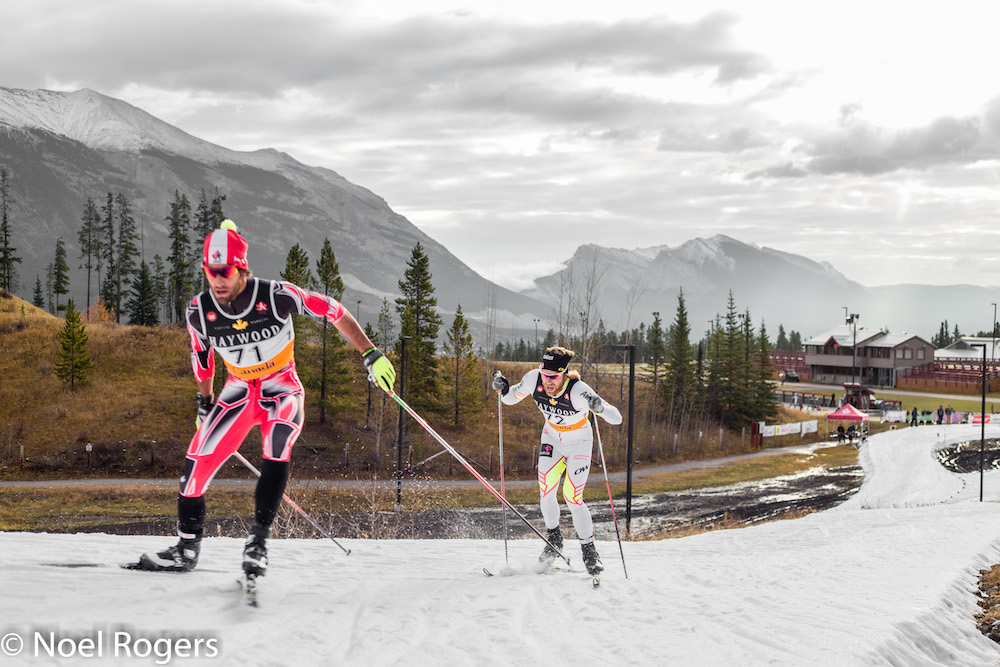
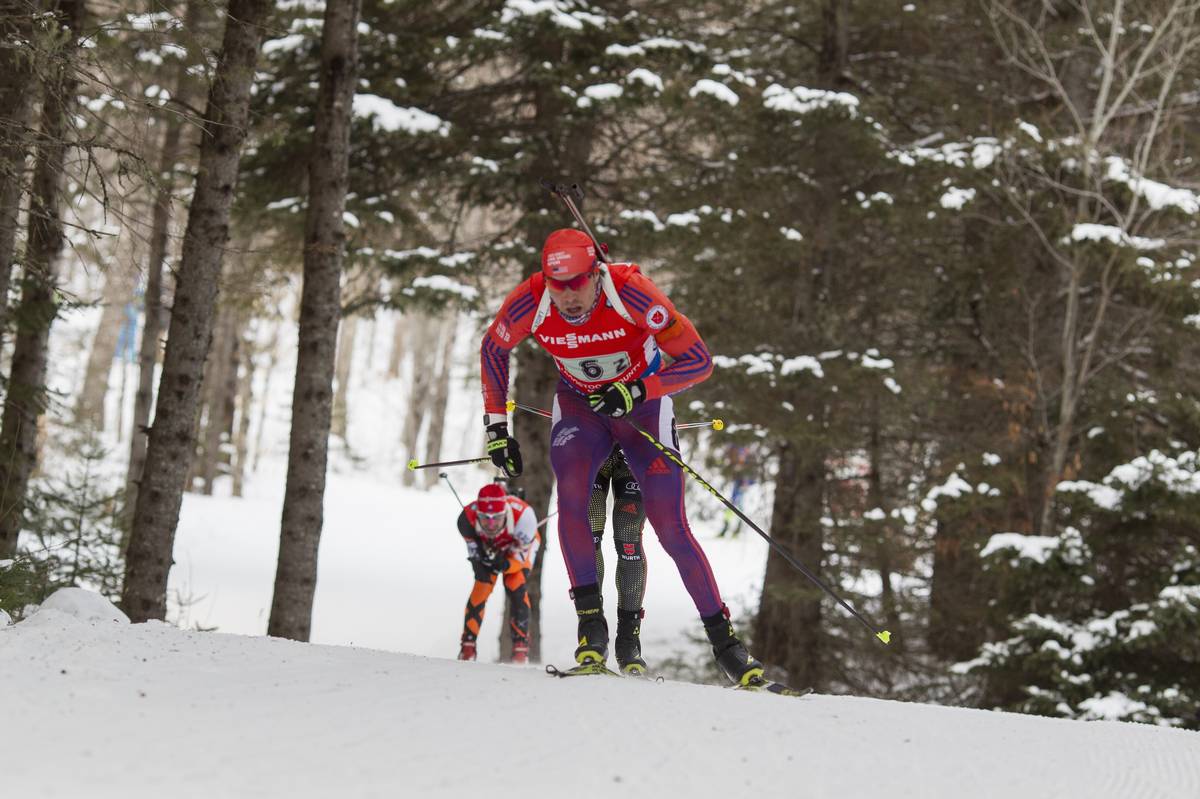
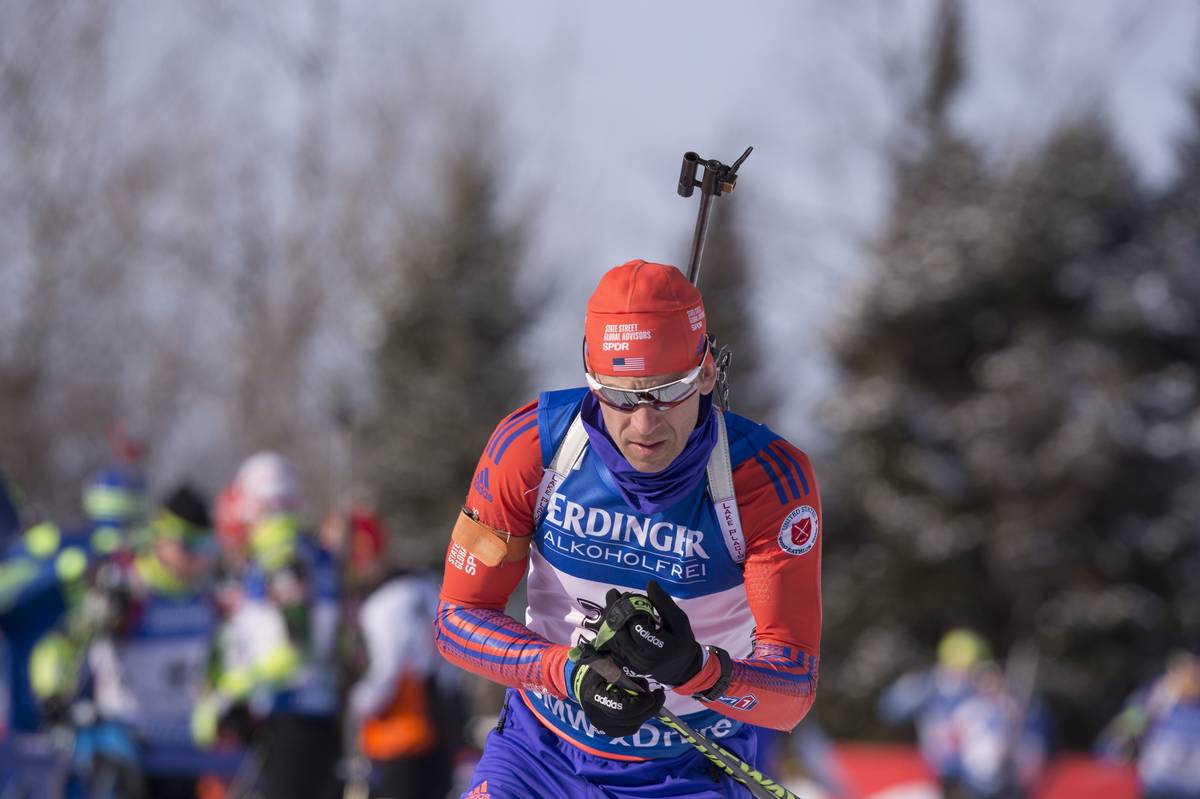
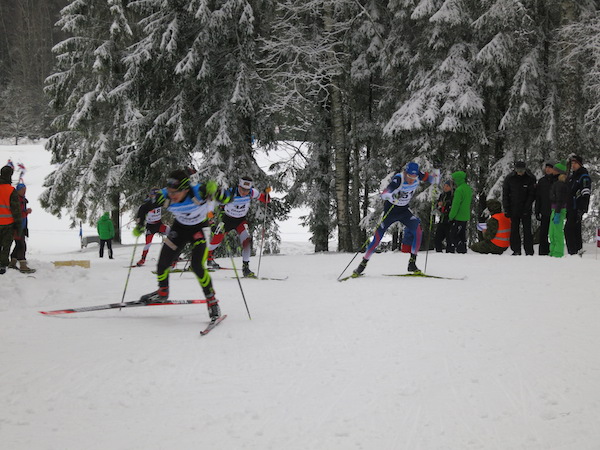
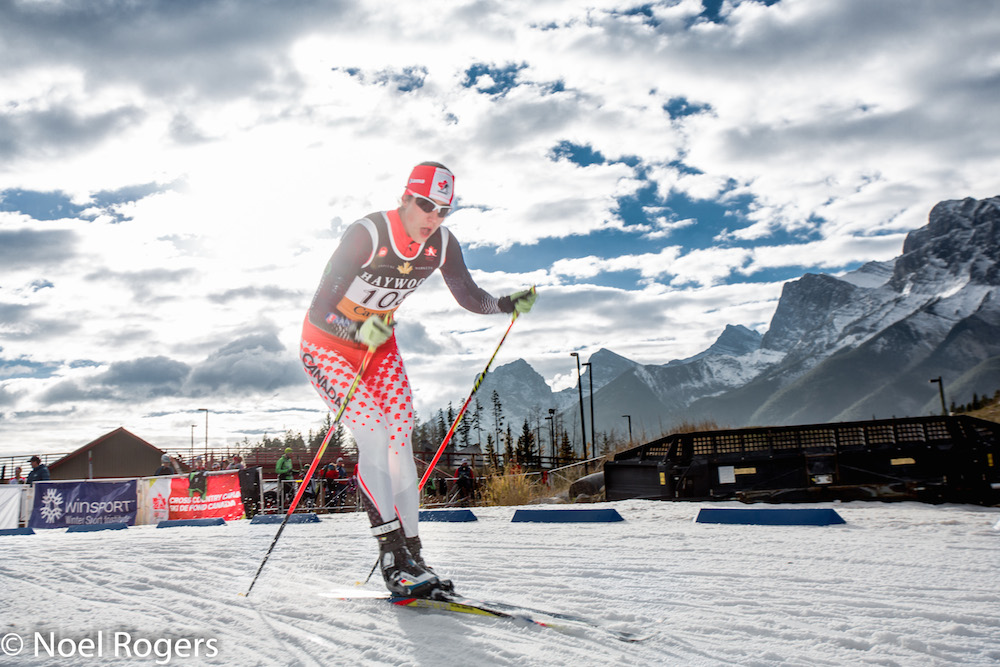
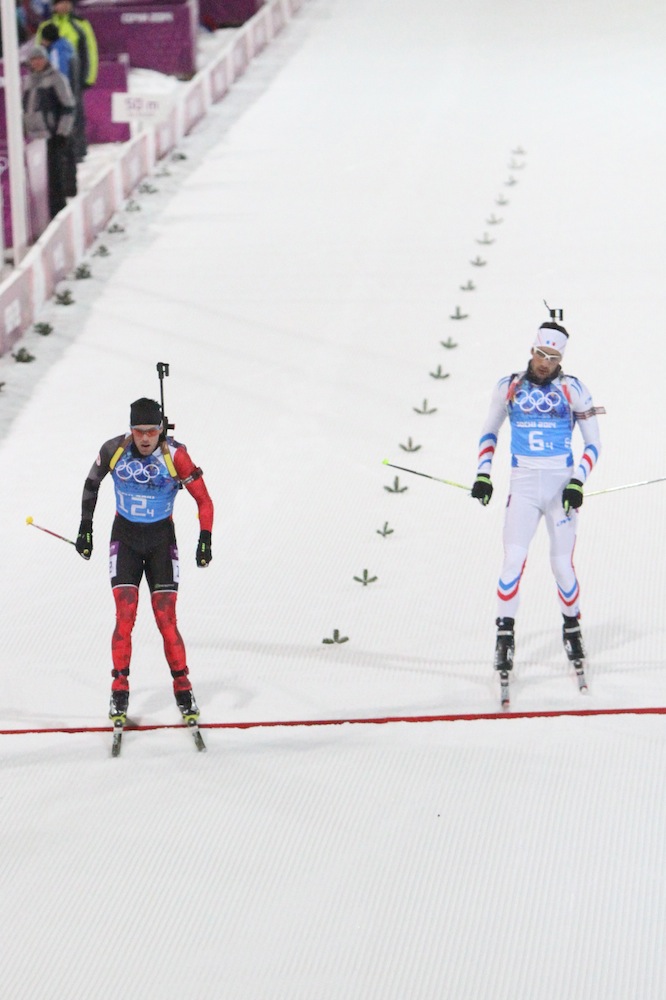
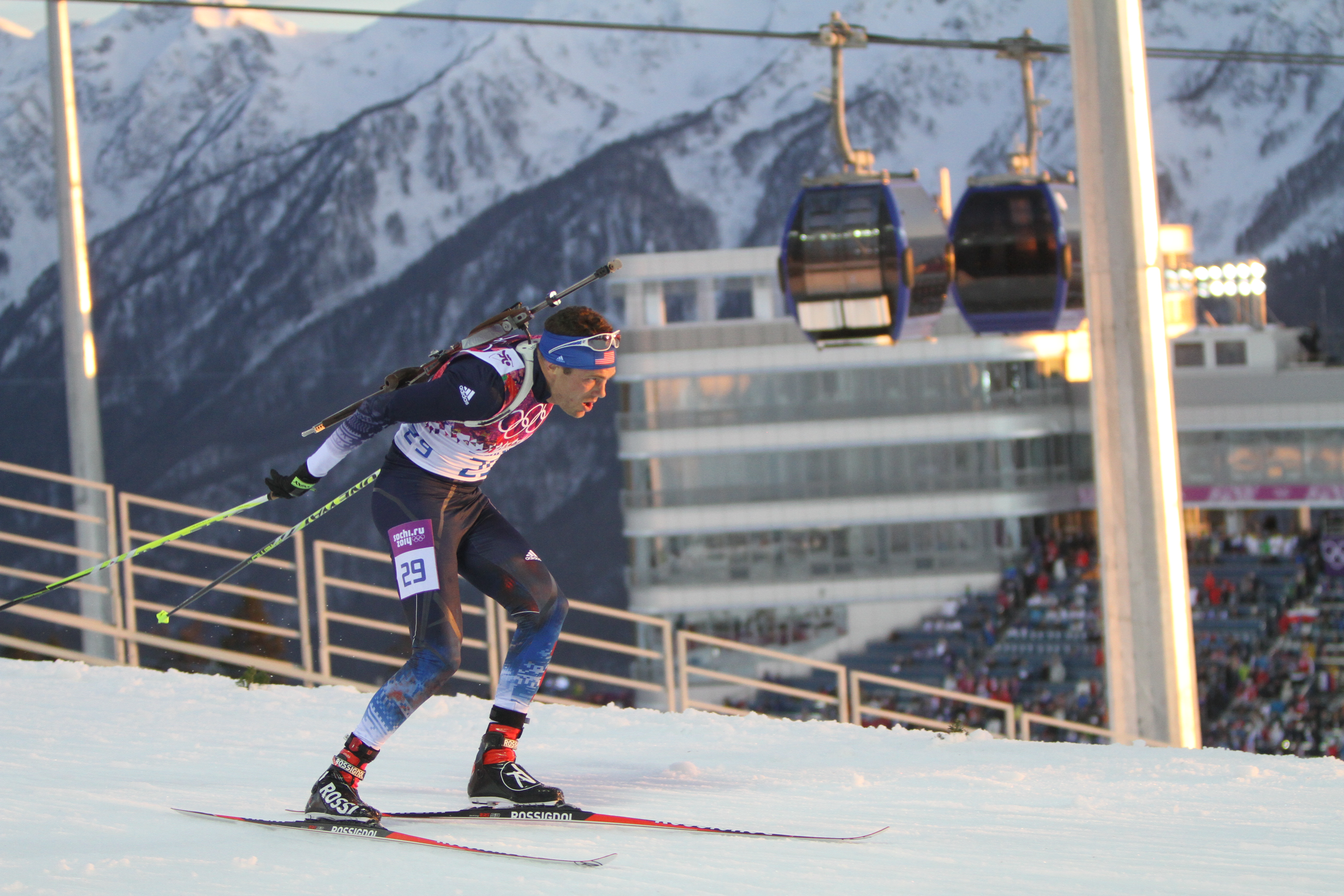
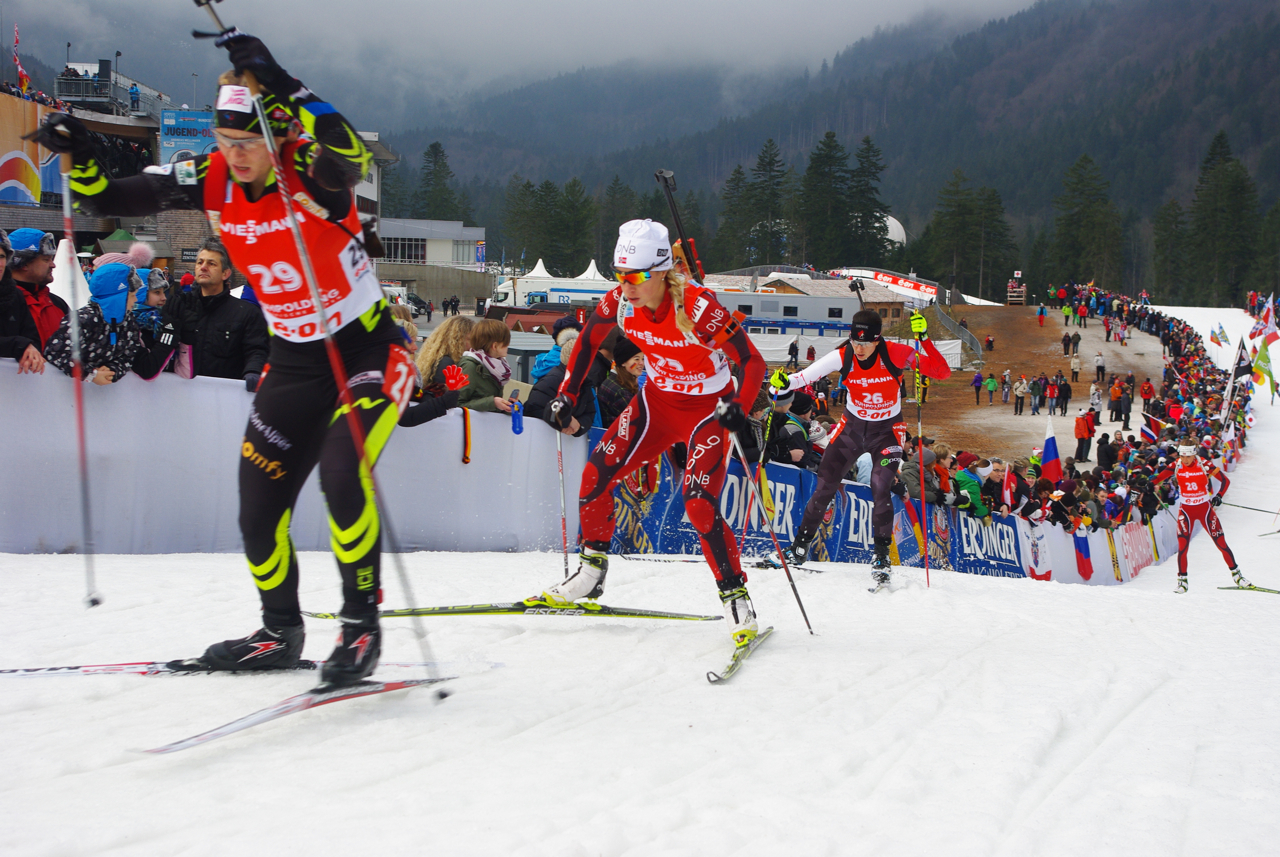
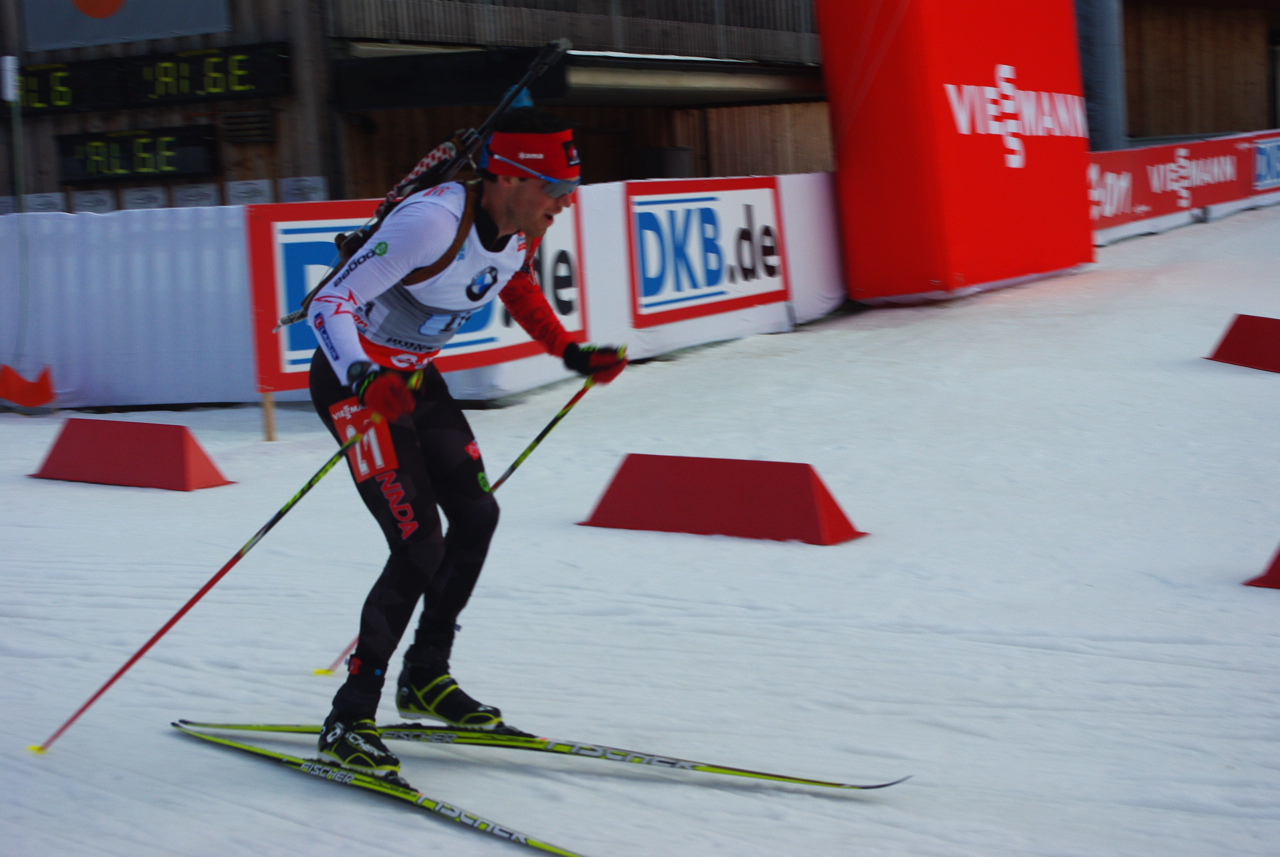
Scott Perras (front) with Devon Kershaw on his heels in the 2014 Frozen Thunder distance race at the Canmore Nordic Centre. Perras retired from biathlon this spring and will coach the Alberta World Cup Academy. (Photo: Noel Rogers/Bow Valley Photography)
Scott Perras’s first biathlon World Cup result back in 2007 might have seemed tough at the time: in Kontiolahti, Finland, he finished 104th in the 20 k individual.
But nine seasons later, he has made five trips to World Championships, become an Olympian and hit the top 10 on the World Cup. He was a key part of a Canadian relay team which reached the World Cup flower ceremony in 2014, finishing sixth, and then finished a best-ever seventh at the Olympics a few weeks later.
After all of that, the 32 year old from Saskatechewan is hanging up his rifle.
“I didn’t realize how long my career was until I quit,” Perras said with a laugh in a recent phone interview. “For me, the high point was being part of the team for so long, and having really great teammates along the way. From Robin Clegg and J.P. Le Guellec at my first World Cup, to guys like Macx Davies and Christian Gow in Rupholding [this year] — just a lot of having fun, tom-foolery. Putting off being an adult for as long as I could.”
Perras can now no longer say he’s putting off being an adult. He got married this summer, helped his wife set up her business, and is now moving into a full-time, non-athlete job himself: Perras will be the new high-performance coach for the Alberta World Cup Academy (AWCA) cross-country ski team.
It’s a transition away from biathlon, and yet one day last week found him in a familiar place with the men and women he had called teammates until just a few weeks earlier.
“Yesterday I was at Sunshine Meadows with the biathlon team because they have technique camp,” Perras explained last Wednesday. “They bring in Mats Larson from Sweden, and I wanted to get some refreshers for that for my team going forward.”
The next day, he was back in Canmore leading a workout for AWCA’s under-21 men’s team.
“There has always been an invisible barrier maybe between cross-country and biathlon and I hope to maybe bridge it a bit, and help everybody work together a little bit easier,” Perras explained. “I also have good relationships with all the top biathletes and biathlon coaches and am also developing them in cross-country. I can go to anyone and ask for help anytime I need it.”
“There has always been an invisible barrier maybe between cross-country and biathlon and I hope to maybe bridge it a bit.” — Scott Perras
The 2015/2016 season didn’t go as Perras had hoped, and he found himself off the World Cup team. In between racing at the second-tier IBU Cup, he also jumped into some ski races, including finishing second in a NorAm 20 k and 12th in the American Birkebeiner 51 k, the biggest international ski race in North America.
So besides drawing on his former team staff and teammates when he needs to learn about coaching, he is hoping to bring the biathlon and cross-country communities closer together more generally. In Canmore, the national teams as well as local teams often train on the same trails anyway.
“I’ve noticed everyone has a really clear picture in their mind of what they want to do, what they want to achieve, and how they are going to achieve it,” Perras said. “Sometimes as coaches we end up being more tied to that plan than to being flexible and seeing the advantages of maybe being more inclusive.”
Perras wasn’t certain that he would retire after this season, and he also wasn’t certain that he wanted to go into coaching. But it was one of two possible futures he saw for himself, and when AWCA opened up an assistant coaching position it was a good fit.
He saw AWCA providing a good transition for him from racing to coaching: while he’s on the ground leading workouts, head coach Chris Jeffries is the main brain behind the operation. The team has its training plans and physiological goals worked out already.
“It’s great knowing that all of the really big picture things, we have people with a lot of experience writing that,” he said. “That stuff definitely interests me, but it’s nice learning about it and applying all at the same time with the insurance of having these well educated well experienced people behind us.”
Spending more time on the IBU Cup this season, Perras also got to know some of the younger biathlon athletes. He observed what made them tick, and also the ways in which they weren’t so different from veteran athletes like himself. It’s an experience he’ll take into his new coaching job.
“I knew some of them well, because like I said we are all on the range every day, but getting to know them better and seeing their levels of dedication, seeing the enthusiasm they have- it was nice,” he said. “It is really important as a coach to keep an eye on what is an important or a big result for someone.”
For him, those results weren’t coming anymore.
“When you are in your thirties the goal is to be there when things happen, and if you are not then it’s time to move on,” he said. “That is just how it is. It is a high performance sport and I wasn’t competing at my best. I think I could have raced another year and had a better year than last year, but at the same time like I said my life was going in some really good directions and in other ways and I kind took those opportunities.”
Looking back, Perras is nothing if not thankful that he was able to train and compete full time for nearly ten years. That, he said, was living the dream.
“When I first moved up to Canmore, I was at home in Regina and I was talking to my mom,” he reminisced. “We were talking about the lottery. And she said ‘What would you do if you won the lottery?’
“I said ‘Oh, I’d train for biathlon. I’d train for biathlon and not work.’ So to me, for the last seven years or however long I was carded, I kind of got to live like I won the lottery. That’s pretty sweet. And it’s over now. I spent all my winnings. That is pretty special to me for sure.”
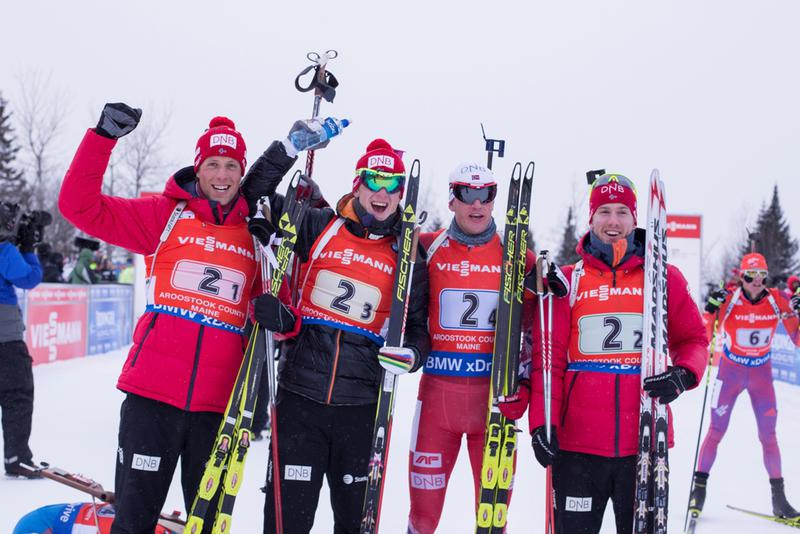
Norway won the men’s 4 x 7.5 k relay on Saturday at the IBU World Cup in Presque Isle, Maine, with (from left to right) Lars Helge Birkeland, Johannes Thingnes Bø, Tarjei Bø, and Erlend Bjøntegaard. Sean Doherty (far right) anchored the U.S. to fifth, its best result since 2013. (Photo: IBU/NordicFocus)
Note: This article has been updated to include comments from Lowell Bailey.
It’s often a tall order being the anchor leg in a relay, but that kind of pressure is what most closers thrive on. Take Tarjei Bø, for example. The 27-year-old Norwegian had been sent out in first after the final exchange, after his younger brother Johannes Thingnes Bø tagged him two-tenths of a second ahead of Russia in the men’s 4 x 7.5-kilometer relay in Presque Isle, Maine.
It was the final day of the IBU World Cup in the U.S., and the last day of World Cup racing before World Championships March 2-13 in Oslo, Norway. For the Norwegians, this was it; Tarjei had three loops and two shooting stages to see what he could do to hold off Russia, as well as France, 13.4 seconds back, to take the win.
Italy trailed 25.6 seconds behind in fourth and the U.S. was another 12 seconds back in fifth at the start of the last leg. For the Americans, Lowell Bailey, Leif Nordgren and Tim Burke had used a combined six spares and avoided the penalty lap to reach as high as fourth during Nordgren’s second leg, and with Sean Doherty closing, they were within 25 seconds of the podium with 7.5 k to go.
Sean Doherty (US Biathlon) skied the anchor leg for the U.S. in the men’s 4 x 7.5 k relay on Saturday at the IBU World Cup in Presque Isle, Maine. The U.S. placed fifth for the best team result since 2013. (Photo: USBA/NordicFocus)
But before we get ahead of ourselves and the historic third or fourth place the Americans were eyeing, let’s get back to the race between Norway and Russia.
One and a half kilometers into the last leg, Tarjei remained 2.6 seconds ahead of Russia’s 24-year-old Maxim Tsvetkov, and extended that lead to 7 seconds half a kilometer later.
In his first prone stage, Tarjei hit all five targets, while Tsvetkov needed two spares to clean. France’s Jean Guillaume Beatrix cleaned with the fastest shooting and range time on that stage, moving into second, 26.7 seconds behind the Norwegian with two loops to go.
Tsvetkov left the range in third, 46.7 seconds out of first, while Doherty improved to fourth — another 14 seconds back — with one spare. Meanwhile, Germany’s Benedikt Doll used one spare as well to move into fifth, 10 seconds behind Doherty, and Italy’s Thomas Bormolini needed three spares to clean and fell to sixth.
Tarjei took his lead and ran with it, opening up 35 seconds on Beatrix in second place by 4.5 k. The Norwegian entered the range for the last time without anyone in sight, hitting his first four targets then needing one spare to clean. Beatrix again shot without a miss to secure second place, heading out on the last loop 14 seconds behind Norway.
One spare for the Russian kept him in third, 47 seconds out of first, and Germany’s Doll left the range 10.7 seconds later in fourth with a single spare. Just 2.4 seconds behind, Doherty followed in fifth, after using two spares to clean the final stage.
For Tarjei, the last 2 k was more or less a victory lap as he remained nearly 27 seconds ahead with 1 k to go. He crossed the finish without anyone else in sight, securing the Norwegian win in 1:12:09.8. France’s Beatrix finished 30.1 seconds later in second, while a fight for third unfolded behind them on the final loop.
Initially, Doll led Doherty out of the range, then attacked early in the loop while a US Biathlon staff member ran alongside Doherty to encourage him to latch on. But Doll, who recently placed second in the mass start at the World Cup in Canmore, Alberta, was on a mission for the podium — and he needed to drop Doherty and catch Tsvetkov to reach it. He overtook the Russian by the 6.5 k mark, skiing 2 seconds ahead of Tsvetkov while Doherty followed in fifth,, 4.6 seconds behind Tsvetkov.
At the finish, Doll remained in control of third, crossing the line 42.6 seconds behind Norway, while Tsvetkov and Doherty duked it out for fourth. The Russian took it in a photo finish, 48.3 seconds back, and Doherty finished with the same time in fifth.
“Today’s race was a great result for me individually and for the team as a whole,” Doherty said in a US Biathlon press release. “I felt strong on the skis and the finish was so close. I think we are all feeling optimistic for the upcoming worlds in Norway.”
In all, the U.S. finished with nine spares and no penalties, and captured its best result in a men’s relay since 2013. In January, the same lineup placed sixth in the men’s relay in Ruhpolding, Germany. Fourth would have been an unprecedented team best.
“The relay was a great indicator of where we are as a team right now,” Bailey wrote in an email.
Norway, with Lars Helge Birkeland, Erlend Bjøntegaard, and the Bø brothers, combined for first with seven spares and no penalties. They overcame a rough start when Birkeland used three spares on the first prone stage and dropped to 16th in the field. He cleaned standing to improve to 11th, then came through the first exchange in 12th.
“The relay is important for us, especially before the world champs, we wanted to win to have a good feeling,” Tarjei told German broadcaster ARD after the race. “The whole team had two or three misses too many, we didn’t know what would happen, but a really good job.”
Germany stood in first after the opening leg, with Erik Lesser hitting all 10 targets without a miss and handing off to Andreas Birnbacher 17 seconds ahead of Switzerland in second. Serafin Wiestner had elevated the Swiss team with the fastest course time of the first-leg skiers, using one spare in each stage to bring them within striking distance of Germany. Belarus followed just 0.7 seconds behind in third, after Vladimir Chepelin cleaned prone and used one spare in standing. France’s Simon Fourcade came through the exchange a second later in fifth, 18.8 seconds behind Germany.
American Lowell Bailey (r) leads Norway’s Lars Helge Birkeland during the first leg of the men’s 4 x 7.5 k relay at the IBU World Cup in Presque Isle, Maine. The Norwegians went on to win and the U.S. placed fifth for its best result since 2013. (Photo: USBA/NordicFocus)
For the U.S., Bailey tagged Nordgren in 11th, 39 seconds out of first and 11.6 seconds ahead of Norway in 12th. Bailey used one spare in prone and two in standing to leave the range in sixth, then 12th, respectively.
“I didn’t have an especially great day, but the rest of the guys had solid performances and brought us back up into legitimate contention for a bronze,” Bailey wrote.
Canada’s Scott Perras cleaned prone to follow Bailey out of the range for the first time in seventh, then used three spares in standing and slipped to 13th, more than a minute behind the leaders.
At the exchange, Perras tagged Carsen Campbell in 14th, 1:15 back. Campbell improved to 13th, using one spare in each stage, and Matthew Neumann used five spares (three in prone, two standing) to slip one spot to 14th, but the Canadians were taken out of the race on the final loop when Matthew Hudec was lapped. Hudec used just one spare in prone but incurred a penalty loop after using all three in standing, making the team total 14 spares and one penalty.
At the front of the race, Switzerland took control on the second leg with Benjamin Weger, who cleaned prone and used one spare in standing. Italy moved into second, 33.4 seconds back after Lukas Hofer used three spares (one prone, two standing) and skied the second-fastest course time of the second leg.
Alexander Povarnitsyn put Russia in third, 38.4 seconds behind, with a clean prone and single standing spare, and Germany fell to fifth when Birnbacher used all three spares in prone and two more in standing.
“I really have no explanation for my prone shooting,” Birnbacher told German broadcaster ARD. “I somehow felt I had hit, but… Then I clicked after the second or third miss, by right, because the wind was a little coming from there. In zeroing it was kind of the same. So this is pretty inexplicable.”
Temperatures were frigid in Presque Isle on Saturday morning, around -22 degrees Fahrenheit, which warmed up to about 8 degrees by the 2:20 p.m. start. Windchill was still a factor, and some athletes, like Perras, skied with mittens over their gloves to keep their hands warm for shooting.
Leif Nordgren (US Biathlon raced the second leg for the U.S. men’s relay on Saturday, bringing the team from 11th to seventh by the second exchange at the IBU World Cup in Presque Isle, Maine. (Photo: USBA/NordicFocus)
“I like racing in the cold weather,” Nordgren, the Americans’ second-leg skier, wrote in an email. “I think as North Americans that’s something that we get used to growing up, and have an advantage over central Europeans maybe.”
He rose from 11th at the exchange to seventh with a flawless prone stage, then left the range in fourth after standing, where he used one spare.
“I was pretty happy with my race today, I tried to be aggressive and attack right from the start, with my shape I’ve had this season that is the only way I’m able to hang in the race,” Nordgren wrote. “I was so disappointed with my shooting after the sprint race, I just made sure to follow my shooting plan and it paid off. Getting the tag from Lowell in 11th, I knew that with good shooting would be the best chance I had of moving up.”
In Thursday’s sprint, Nordgren placed 65th with 7-for-10 shooting. On his final loop on Saturday, he slipped three places (behind France, Norway and Germany) to seventh, tagging Burke 55.8 seconds out of first and 4.3 seconds behind Germany in sixth.
“It was too bad that I ran out of gas on the final loop, it would have been nice to put Tim in a better position, but I gave all I had with my shape for today,” Nordgren wrote.
Switzerland dropped out of contention when 25-year-old Mario Dolder failed to cleaned prone with three spares and had to ski a penalty loop. That put him in fifth, then he used all three spares again and incurred another penalty in standing to slip to eighth. He tagged Swiss anchor Martin Jaeger nearly 1:50 minutes back in eighth.
Norway moved from fifth to first with Norway’s J.T. Bø, who had been tagged 51 seconds out of first and came within 19 seconds of the lead in fourth after prone (using two spares to clean). In standing, he used one spare and left the range in second, 6.3 seconds behind Russia’s Dmitry Malyshko, who had cleaned the stage and used one spare previously in prone.
Behind Norway and Russia, which ultimately came through the last exchange in first and second, France picked off one place to tag in third, ahead of Italy and the U.S.
France put together the most consistent race of the day, after Simon Fourcade tagged Quentin Fillon Maillet in fourth, then he held that position to hand off to Simon Desthieux in fourth, 48 seconds out of first.
Desthieux shot without a miss to elevate the team to third, 13.4 seconds behind Norway with one leg to go.
Tim Burke (US Biathlon) racing the third leg for the U.S. in the men’s relay on Saturday at the IBU World Cup in Presque Isle, Maine. He brought the team from seventh to fifth by the final exchange. (Photo: USBA/NordicFocus)
Meanwhile, Burke used a spare in each stage to bring the U.S. from seventh to fifth, with the fourth-fastest course time of the third leg.
Doherty skied the fourth-fastest anchor leg, behind Austria’s Julian Eberhard (who anchored his team to ninth), Doll and Bø, respectively.
“It was good to make a win in the last race,” Tarjei Bø said. “Now we have two weeks at home…”
Switzerland’s Jaeger was lapped and his team ended up 13th, ahead of Canada in 15th.
When ARD asked the Germans how they would spend their last day in Presque Isle before heading home, the team’s third leg, Daniel Böhm responded, “We have planned our day front to back, we basically don’t know how we’ll get everything done,” he said with a laugh. “No, Walmart I think is closed on Sundays, so it will be difficult to get through the day. I think it will come down to surfing on the internet, reading, and maybe playing some cards.”
Nordgren wrote that he’ll fly to Germany on Sunday for a week of “easy training” before World Championships. The rest of the U.S. team could not be immediately reached for comment.
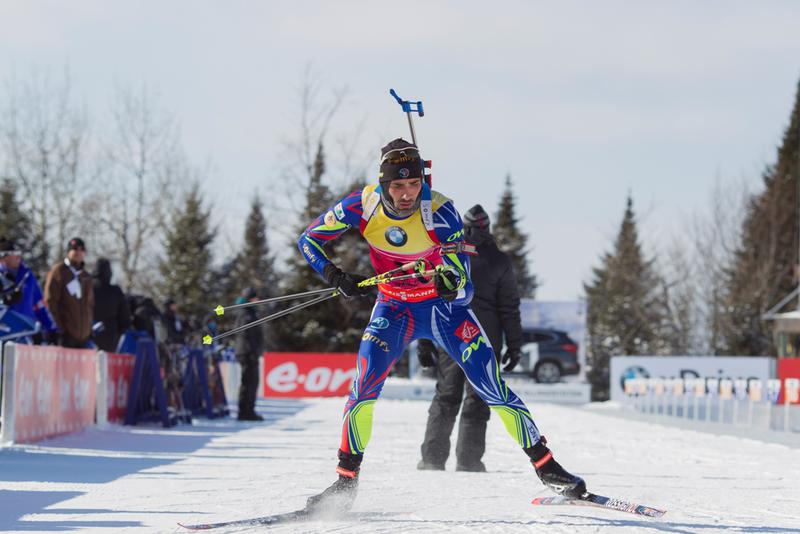
France’s Martin Fourcade leaving the range during one of four shooting stages in the pursuit on Friday at the IBU World Cup in Presque Isle, Maine. He went on to win by 24.8 seconds over Johannes Thingnes Bø of Norway. (Photo: IBU/NordicFocus)
The same three athletes who stood on the podium after the International Biathlon Union (IBUo) World Cup sprint on Thursday in Presque Isle, Maine, did so again after the men’s 12.5-kilometer pursuit on Friday, only their order had changed.
In cold and windy conditions, France’s Martin Fourcade took the victory in 31:04.4, with two penalties in the four shooting stages. The third starter, Fourcade finished 24.8 seconds ahead of Norway’s Johannes Thingnes Bø, who had won the sprint and thus started the pursuit first with a 28-second head start. Russia’s Anton Shipulin started second and ended up third (+1:11.5) with two penalties.
American Tim Burke moved into fourth place on the penultimate loop, but two misses in the final standing shooting set him back to seventh, and he kept that position to the finish, placing seventh and 2:04.9 behind Fourcade with three total penalties.
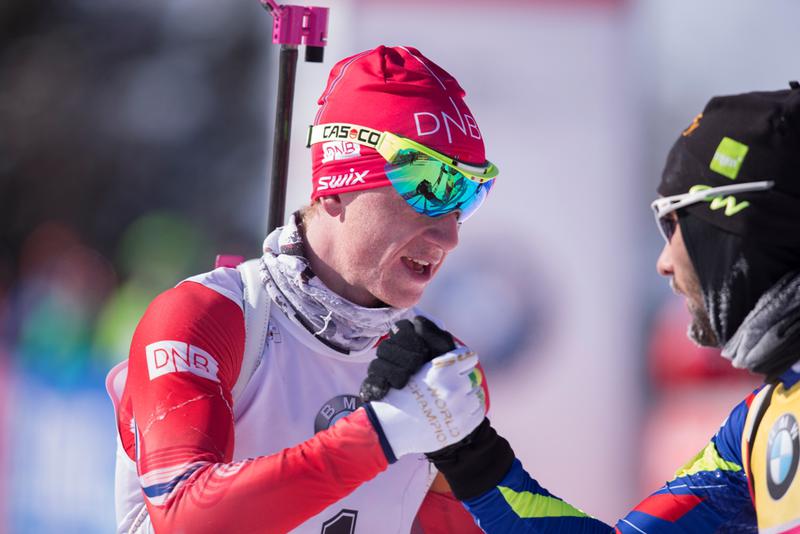
Norway’s Johannes Thingnes Bø (l) congratulates France’s Martin Fourcade after placing second to Fourcade in the IBU World Cup men’s pursuit in Presque Isle, Maine. (Photo: IBU/NordicFocus)
“Today I joined Raphaël Poirée with the number of World Cup wins,” Fourcade said of his 44th victory in a post-race interview with the IBU. “That means a lot for me. I grew up watching Raphaël on TV. To join legends you need to [be] inspired, and I know how much he inspired me.”
Asked if he feels like a legend himself now, Fourcade laughed: “No, I will never do. I just try to do my best.”
Poirée represented France on the World Cup from 1995 to 2007. He earned both silver and bronze at the 2002 Olympics in Salt Lake City, Utah, and another bronze in the relay at the 2006 Olympics in Turin, Italy, as well as 20 medals at World Championships, seven of which were gold.
Unfortunately the end of the pursuit was overshadowed by a severe crash from Germany’s Arnd Peiffer, who had left the shooting range in 11th position, then fell on a downhill section on the final loop. At high speed, Peiffer came off the right side of the course without another athlete nearby, ripped through a safety net, and crashed head and shoulder first against a thinly padded group of trees. He later could be seen on the TV broadcast sitting upright leaning against the trees, with his skis and rifle removed by coaches and course staff. He was then strapped to a stretcher and put in a neck brace as a precaution, and taken to a nearby hospital.
“I saw the immediate aftermath of the crash,” American Lowell Bailey, who had left the range shortly after Peiffer in 15th, wrote in an email. “Arnd was off the side of the trail, just following a severe 180-degree turn. The turn is tight and there is little room for error. The outside of the turn was lined with mesh snow fence and all I could see were his feet sticking up onto the trail.”
“There was a lot of blood in the snow,” Germany’s assistant coach Andreas Stitzl, who was one of the first responders sprinting to the accident site, later told German TV broadcaster ARD. Stitzl suspected that Peiffer had, at a minimum, sustained a concussion and lacerations on his mouth and forehead. “I was completely shocked how he was lying there. The most important thing was that we first stabilized his head,” Stitzl said.
ARD later posted an interview with German team doctor Klaus-Jürgen Marquardt, who confirmed that Peiffer had suffered a severe concussion, but remained conscious and could remember the crash despite some loss of short-term memory about the morning of the race. Further evaluations still had to determine other injuries, but Peiffer reportedly was able to call his family at home.
No Athlete Unscathed in Four Stages
Wind conditions gave the entire 60-man field problems during the pursuit, with stronger gusts than they had experienced during the “zeroing” target practice immediately before the race. As a result, competitors either had to adjust their sights or wait for a calmer moment.
From left to right: Russia’s Anton Shipulin, Latvia’s Andrejs Rastorgujevs, Germany’s Eric Lesser, and France’s Martin Fourcade during one of two standing stages in the men’s pursuit at the IBU World Cup in Presque Isle, Maine. Fourcade went on to win and Shipulin placed third. (Photo: IBU/NordicFocus)
Penalties quickly started to pile up and separated the field. Bø, Shipulin and Fourcade all missed one in their first prone stage, but kept the positions they had held at the start.
In the second prone stage, Bø and Shipulin managed to stay clean, while Fourcade had another penalty and for a while, fell back to fifth place behind Germany’s Erik Lesser and Latvia’s Andrejs Rastorgujevs, who hit all 10 of their targets between the two prone stages.
In the next standing stage, Bø shot fast and clean a second time, despite having to reset his position before the third shot, and headed out on the fourth loop with a 44-seconds lead. Fourcade also cleaned to improve t0 second place again entering the loop, with Shipulin also staying clean and leaving the range in third.
In this stage, Lesser missed two and Rastorgujevs missed three to fall out of contention. They went on to place 13th (+2:42.8) and 21st (+3:21.7), respectively. Switzerland’s Serafin Wiestner, who had finished a career-best fifth in the sprint the day before, even “dirtied” his standing targets, incurring the full five penalties, and went on to finish 27th.
Switzerland’s Benjamin Weger at the IBU World Cup men’s pursuit in Presque Isle, Maine. Weger finished 17th with seven penalties. (Photo: IBU/NordicFocus)
In the last standing stage, Bø entered the range still in first, but this time, he missed two while Fourcade as the closest pursuer was able to clean his targets.
“When I came to the last shoot, I though ‘OK, don’t look at Johannes’ targets’,” Fourcade told the IBU. “At the last moment, my eyes decided to look at it. My body and brain didn’t want to, but my eyes just looked at the targets. And I saw that he had two mistakes. So I thought ‘OK, you can do it.’ ”
Fourcade left the range 7.9 seconds ahead of Bø in second, and Shipulin moved into third (+47.3) after also missing one — his second penalty of the day.
On the last loop, Fourcade increased his lead over Bø to more than 20 seconds with 1 k remaining. He went on to finish 24.8 seconds ahead of the Norwegian, and Shipulin secured third place (+1:11.5).
“It was a day of statistics,” Fourcade said at the press conference when told it was his 100th day holding the yellow bib of the World Cup leader, and matched the number of victories of his countryman Poirée. “I love statistics, even if I’m not fighting for records. And this means a lot to me.”
“Second position is nice, but I always want to win,” Bø said at the press conference. “I was in the lead all the way until the fourth shooting. I felt the wind came strong and my legs were a little bit tired, then I missed two.”
“When I was racing in the penalty loop I watched Martin hit all the targets. That was really boring,” he added with a laugh.
“I would say my success was about average,” Shipulin said of his overseas trip to North America, through a translator. “I had three podiums here. I can’t say I am in my perfect form yet. Actually it was more of a training World Cup period than a competitive one, so I am satisfied… I now plan to train hard and compete as best I can at World Championships.”
Fourth place went to Austria’s Simon Eder (+1:39.7), with three penalties, who improved from 11th after the sprint, but potentially missed a chance to move onto the podium with a miss in his last standing. He left the range for the last time 45 seconds behind to Shipulin and ended up 28.2 seconds off the podium.
“The wind situation was extremely difficult,” Eder said in an Austrian Skiing Federation press release. “In the first standing shooting I waited forever until the wind calmed down. Then I quickly shot right through it. For the last standing position it just would not calm down. Then I tried to hit shot by shot. For the last one it did not work out anymore…. Of course I am very happy about the fourth place.”
Burke, 7th, Leads Three Americans in Top 20
Tim Burke racing to seventh in the men’s pursuit at the IBU World Cup in Presque Isle, Maine. (Photo: USBA/NordicFocus)
Just as it had done in the sprint, U.S. Biathlon ended up with three men in the top 20 in the pursuit. Similar to the men on the podium, the three Americans finished in a different order than on Friday.
The latest starter of the three in 20th, 1:33 minutes back based on his sprint finish, Burke raced into contention in the pursuit — putting himself in fourth with a chance at the podium. He incurred more penalties in the final shooting than those ahead of him, but still finished seventh (+2:04.9) with three penalties (1+0+0+2). Last week in Canmore, Burke also placed seventh for a season best in the mass start.
“I’m really happy with the race,” Burke told FasterSkier on the phone on Friday. “That was a great, great performance for me. That was really really tricky shooting conditions again on the range. I felt like I handled it pretty well, so I am really pleased with the result.”
“The real key to my race today was that clean first standing stage,” Burke recalled. “There I moved from 11th and I went out basically was 4th place after that. Definitely a tricky stage, it was really windy, but I just took my time. I refused to just give away a shot. I really fought for every shot there.”
On the penultimate loop, he moved up to fourth place after initially leaving the range in seventh:
“So our next loop there, I went out just behind Erik Lesser and Simon Eder,” Burke said. “I’m pretty sure there were a couple guys right behind me, I don’t know who they were. A little ways in to that loop those guys both pulled over and did not want to lead. So I ended up pulling for the rest of that loop and I felt really good.”
Burke came into the last stage still leading that pack in fourth place, but shot two misses pushed him back to seventh as he left the penalty lap again.
“I was excited for that last standing,” Burke said. “That was a really tough one. It was so windy as we were setting up. I just tried to be really patient, but I just ended up just having to go for it after awhile because I didn’t want to wait for too long.”
On the final loop, he was unable to catch those ahead of him who had passed him with just one penalty in the final stage, but Burke also didn’t lose another position, defending a narrow lead over Bulgaria’s Vladimir Iliev and Ukraine’s Artem Pryma.
“Overall I am really satisfied,” Burke concluded. “Of course I definitely wanted that sixth place to get into the [flower ceremony] awards there at the end. Going out onto the last loop I was just couple seconds behind [Czech Republic’s Michal] Slesinger. I know he’s really tough on the last loop too. We just kind of yo-yoed the whole loop: I’d make up a few seconds then lose a few seconds. Then, in the end I just felt like I was coming back to him pretty good in the last k. But I just ran out of room.”
Lowell Bailey (US Biathlon) racing to 14th in the IBU World Cup men’s pursuit on Friday in Presque Isle, Maine. (Photo: USBA/NordicFocus)
About 40 seconds behind Burke, teammate Bailey finished the pursuit in 14th (+2:43.2) with five penalties (1+0+3+1). He had started the race in 15th, 1:22 behind Bø.
“There was a lot of wind in the shooting range today,” Bailey wrote in an email. “The venue is situated on top of a plateau and the prevailing winds come ripping across the range. Usually, the wind is from left to right, but today it was fickle, and changed dramatically from one stage to the next.”
Sean Doherty started the pursuit in 13th, 1:16 behind, and with six misses (2+2+1+1), he lost a few positions to finish 20th (+3:05.3). Despite struggling with the changing wind conditions, he was satisfied with his race.
“Although it was not my best shooting, today’s result was in no way bad,” Doherty, 20, wrote in an email. “It is still my third best world cup result and I am happy with it.”
Coming off a career-best 13th in the sprint, Sean Doherty (US Biathlon) finished 20th in the men’s pursuit at the IBU World Cup in Presque Isle, Maine. (Photo: USBA/NordicFocus)
“Today for our race the wind picked up,” he explained of the shooting conditions. “It was much stronger than in zero by the time the race started. Overall it was challenging conditions on the range, but the tracks were in great shape.”
Without Biathlon Canada’s A-team at the races in Presque Isle, Scott Perras was the only Canadian who had qualified for the men’s pursuit, starting in 48th place. After a clean first shooting, he fell back in the subsequent stages, and ultimately finished 47th (+6:17.4) with seven penalties (0+2+3+2).
“The shooting conditions were pretty tough today,” Perras wrote in an email. “In zero, the wind flags would show very little wind close to the shooting mat, the flags closer to the targets were showing the truer shooting conditions. It was manageable at times but no one was given a free hit out there today, you had to work for them.
“The skiing felt ok, my legs should feel better but it takes a while to get used to the speed of the World Cup and it doesn’t happen over a weekend,” the 32-year-old Sochi Olympian added. “I was much happier with my skis today, and everything seemed a little better than in the sprint.”
Baby It’s Cold Outside
The night before the pursuit, temperatures in Presque Isle dipped to minus 21 degrees Celsius (-6 Fahrenheit). By the start of the race at 11:30 a.m. local time, the rising sun had warmed the temperature in the Nordic Heritage Center arena to a more manageable minus 16 Celsius (3 Fahreheit), according to the IBU race report.
During the pursuit, he appeared to be wearing the same gloves again, and swirled his arm several times before the shooting stages in an effort to increase blood flow in his shooting hand.
“Actually I think it’s a little colder than in Norway today,” his teammate Erlend Bjøntegaard, who skied to fifth place (+1:57.6) told the IBU. “I was just ready to attack today, and that’s what I did.”
He suspected his fifth-place result would help him to secure a spot on the Norwegian team for the upcoming World Championships in Oslo.
Sean Doherty (US Biathlon) placed 20th in the men’s pursuit at the IBU World Cup in Presque Isle, Maine. (Photo: USBA/NordicFocus)
The winner, Fourcade could be seen wearing a breathing mask before the race to warm up the cold air.
“It was really not easy because it’s a long time since we have raced in this kind of conditions,” Fourcade commented on the race condition during the press conference. “For me it was really difficult. My left hand froze during the competition; luckily I shoot with the right hand. I think this was the limit with the wind where the body can react well to the cold.”
After the race, he decided to skip the relay and expected colder temperatures on Saturday, and flew home to France on Friday.
According to some athletes, the temperatures — the coldest they had raced in this season — weren’t a problem.
“We are from Russia so this is quite normal and comfortable for us,” Shipulin said with a smile in the press conference, through a translator. “We were training before this in Yakutia [a region in the far east of Russia], where minus 17 Celsius [1.4 Fahrenheit] is considered warm temperature. … I rather had too [many] clothes on me today.”
Leif Nordgren (US Biathlon) during in the IBU World Cup men’s sprint in Presque Isle, Maine. (Photo: USBA/NordicFocus)
“Many Europeans [are] using breathing masks to warm up or train in temperatures many North Americans would consider mild,” Perras wrote. “Today was definitely warm enough that you weren’t going to hurt your lungs, but it was important to keep skin from being too exposed. I wore slightly thicker gloves in the race but decided to remove my right glove for the final standing shooting, I wanted a better feeling on the trigger. I knew that my hand would stay plenty warm for the last lap of the race even without my glove.”
“I was prepared for it,” Burke said of the frigid temperatures. “I knew there would be a good chance it would be really cold up here, so I packed all my best warm weather racing gear. I felt fine in the cold. The only part I struggled with was my hands, especially on the first loop. That first prone, I let that shot [that I missed] go without even knowing it. I just quickly pulled the trigger. After that, my hands warmed up and they were fine for the rest of the race.”
“Racing in the cold like this adds an extra bit of challenge,” Doherty explained. “It is tough on the hands, to keep them warm enough, and it adds a bit of extra stress and demand on the system. But luckily the weather is the same for everyone and you just have to work with it.”
“After growing up in the Northeast as a ski racer, I think you just learn to accept the discomfort that arises on a day like today,” wrote Bailey, of Lake Placid, N.Y. “I warmed up with a lot of extra layers so that I was as warm as possible before stripping down for the race. During the race, I lost feeling in all of my fingers except my trigger finger… It sounds odd, but for some reason, my index fingers seem to stay frost free, while I typically lose all feeling in the rest of my fingers on a day like today. But, it’s the same conditions for everyone … You just have to go out and make things work.”
Relays on Saturday
Later on Friday, organizers announced that the women’s relay would be moved from Sunday morning to Saturday at 4:10 p.m. Eastern time after the men’s relay at 2:20 pm, fearing even colder temperatures on Sunday could otherwise lead to a cancellation.
“All of us are very excited about the relay,” Burke said of his 4 x 7.5 k relay team, with Bailey, Leif Nordgren, him, and Doherty racing in that order. “I mean, two races in a row here with three guys in the top-twenty, I think [that] shows the kind of depth our team has. Coming off of two solid results, we are looking forward to this one.”
Note: In the women’s 10 k pursuit, Susan Dunklee started second and finished fifth for her second-straight flower ceremony in Presque Isle, and the U.S. women had three in the top 25 with Clare Egan in 23rd and Hannah Dreissigacker in 24th. Canada’s lone starter in the pursuit, Zina Kocher placed 46th.
“I think today was one of the women’s team’s best days ever,” Dunklee said. “Having three ladies in the top 25 is huge. It is going to be a fun relay and we have the potential to put together a great performance.”
Stay tuned for a separate report on the women’s race.
Watch the men’s and women’s relays live on Eurovision (Friday at 2:20 p.m. and 4:10 p.m. EDT)
Norway’s Johannes Thingnes Bø racing to a 28-second win in the IBU World Cup men’s 10 k sprint on Thursday in Presque Isle, Maine. (Photo: Fischer/NordicFocus)
After skipping the last tour stop in Canmore, Alberta, Norway’s Johannes Thingnes Bø returned to the International Biathlon Union (IBU) World Cup with a bang, winning the men’s 10-kilometer sprint on Thursday morning in Presque Isle, Maine, in a time of 24:38.8, with no penalties. It was the first World Cup race in the U.S. in five years.
“It’s never easy, but today I felt I had control,” Bø told the IBU in a post-race interview. “I was calm before the race, and also on the shooting range. I tried to do it like in training.”
The defending 2015 world champion in the sprint is now heading into the 2016 World Championships at home in Oslo, Norway, with a victory in the same discipline.
“It looks like it has been good for me, but who knows,” he said at the press conference on his decision to not make the long trip to Canmore, Alberta, last week for the previous World Cup. Instead, he trained for Oslo.
Asked why eight of his 10 World Cup victories came in sprints, Bø replied, “Maybe it’s because shooting is my weakness, and in the sprint there is only two [stages]. So there is a bigger chance for me to not miss so much.”
He achieved his clean shooting despite losing feeling in his fingers on the first loop due to the cold weather and his fairly thin gloves, he told Norwegian broadcaster NRK.
“Without feeling I had to focus extra hard on the innermost black spot, maybe that was the thing that made it go so well,” Bø said according to a translation.
Starting very early with bib 3, France’s Martin Fourcade had one miss in the standing stage and initially took a 38-second lead at the finish (over Norway’s second starter Erlend Bjøntegaard) thanks to Fourcade’s fast skiing, with the eventual overall fastest course time.
After changing into dry clothes and waiting in the finish pen for a few minutes, Fourcade was passed by Russia’s Anton Shipulin, who started behind him in bib 16 and had two clean shooting stages. The Russian lost time to Fourcade on the final loop, but by the finish, Shipulin, who ranks second in the overall World Cup, had preserved a 1-second lead over Fourcade — the World Cup leader.
“I have competed here 10 years ago at the Junior World Championships,” Shipulin said at the press conference through a translator. “So I know the tracks, and they are quite good.”
Shipulin ended up second when Bø, the 25th starter, barreled through the finish 27.9 seconds faster, with both clean shooting and the second-fastest overall course time. That moved Fourcade into third (+28.9) and the top-three stood through the remainder of the 88-man race.
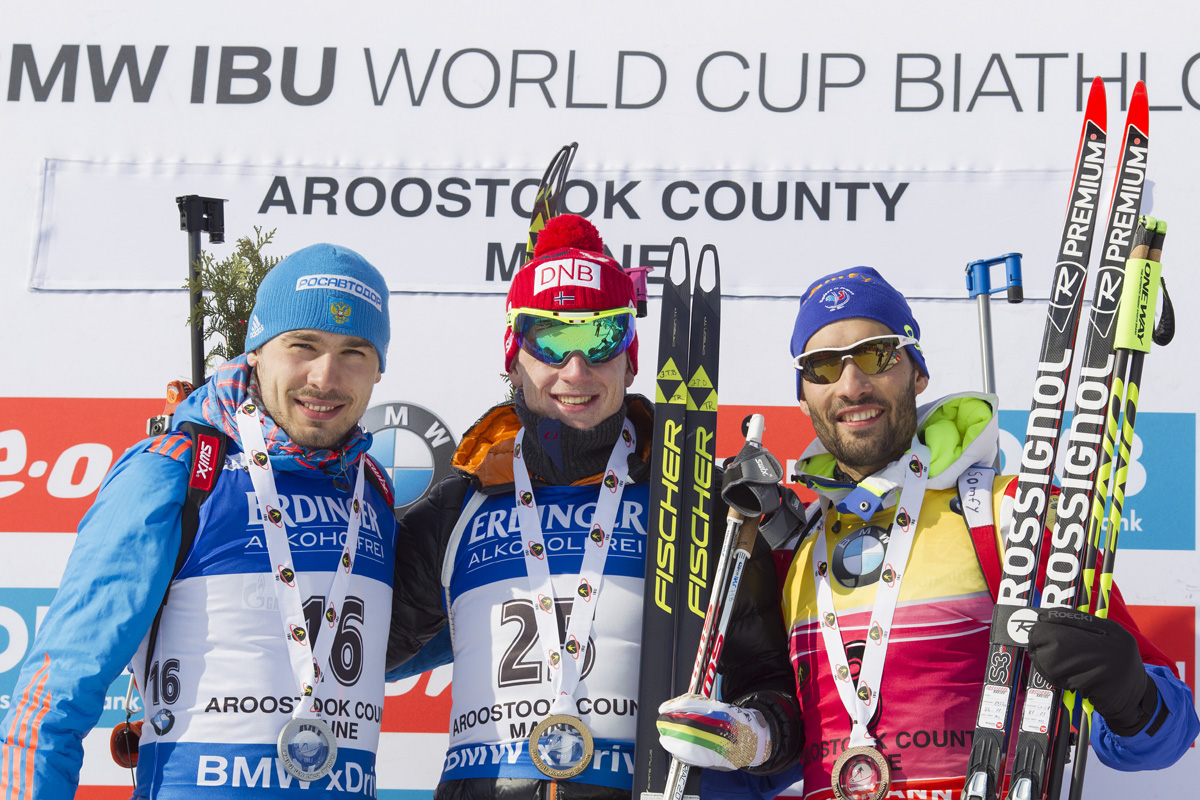
The men’s sprint podium at the IBU World Cup in Presque Isle, Maine, with Norwegian winner Johannes Thingnes Bø (c), Russia’s Anthon Shipulin (l) in second, and France’s Martin Fourcade (r) in third. (Photo: Fischer/NordicFocus)
“Of course I am happy and satisfied with the race today,” Shipulin said. “I wasn’t as fast as those two guys on the track. But I did clean shooting, and the result was good … I hope I will get better for the World Championships.”
“My shape was really good today … The shooting range is not as easy as we thought,” Fourcade said at the press conference. “No wind today so that was good.”
“But I really was surprised by the sun; I think it was too much sunshine for my little blue eyes,” the brown-eyed Fourcade joked. “I had real difficulties on the shooting range. That is why I needed so much time in the standing shooting.”
Bø posted the best times after the first and second shooting stages, where he hit every target, and extended his lead to the finish over Shipulin. Despite placing third, Fourcade slightly added to his commanding World Cup lead, with 857 points to Shipulin’s 646.
“Johannes was simply a better biathlete today,” Fourcade said. “He shot clean, he shot fast, and [me and Shipulin] both know he will be one to beat for the World Champs.”
As the race progressed, Germany’s Erik Lesser in bib 54 had the best chance to reach the podium, thanks to two clean shooting stages.
He picked up speed throughout his three loops; after losing more than 20 seconds to Bø on each of the first two loops, he only lost 2 additional seconds on the last one. But overall, Lesser could not quite match the skiing performance of the top three and finished fourth, 45.9 behind Bø and 20 seconds off the podium.
“I was very timid on the first round, somehow insecure,” Lesser told German TV broadcaster ARD. “I felt a little tired, so I wanted to rather push towards the end. … The shooting range is not easy, in standing I had to rebuild my stance. You really have to pay attention. Everything is possible in terms of advancing or falling back.”
Behind Lesser, two Swiss athletes had their best results of the season, with Serafin Wiestner in fifth (+50.3) and Benjamin Weger (+52.5) in sixth place, both missing one shot in standing.
For Wiestner, a border police officer, it was a new personal best after previously finishing 24th in a sprint in Ruhpolding, Germany, earlier this year.
“We are really happy about this result,” Wiestner told the IBU. “The last weeks were not so good for us, for the whole team … It’s a really tricky course, but I like that.”
I had a really bad season until now,“ Weger added. “Almost [all] just bad races. So I am very happy to be back in top 10 now, the first time this season. I hope to continue like that now.”
Latvia’s Andrejs Rastorgujevs in seventh (+54.0) and Bø’s older brother, Tarjei, in eighth place (+58.9) also had just one penalty in standing, and stayed within one minute of Bø to achieve a good starting position for the pursuit on Friday.
Doherty Leads Three Americans in Top 20; Canada’s Perras 48th
American Sean Doherty returned to the World Cup on Thursday, in his first race since racking up three medals in as many races at Junior World Championships in Cheile Gradistei, Romania. At 20, he become the most decorated athlete in history of Youth/Junior World Championships in his final season as a junior.
Starting in the middle of the field in bib 42, Doherty was the youngest competitor in the sprint. He shot clean in prone, and then missed one in standing, having to ski a penalty lap. The top North American, he ultimately placed 13th for his career-best World Cup result, 1:16.2 behind Bø.
“My shooting today felt good, very in control,” Doherty, a New Hampshire native, wrote in an email. “The wind was manageable, it just came and went but was never too extreme. The range approach here is deceptively tough, and the wind conditions can be tricky but overall today was a good day on the range.
“I am really looking forward to the pursuit,” he added.
Lowell Bailey (US Biathlon) racing to 15th in the men’s sprint at the IBU World Cup in Presque Isle, Maine. Bailey was one of three U.S. men in the top 20 on Thursday. (Photo: USBA/NordicFocus)
Shortly behind, another American Lowell Bailey placed 15th (+1:22.4), also with a clean prone shooting and one penalty in standing.
“The wind can definitely be a factor here as the venue sits on top of a plateau,” Bailey explained in an email. “But today, I think the biggest factor was the approach. It is one of the more difficult approaches [in the World Cup] and if you aren’t prepared for it, you will be surprised at the fact that you aren’t very recovered when you hit the mat.”
Earlier this week, Bailey provided a unique view of the Presque Isle courses for the IBU in a first-person video, skiing through the men’s sprint loop, the arena and the penalty lap (coincidentally, Johannes Thingnes Bø passed Bailey in the penalty lap during the video).
“A lot of transitions from downhills directly into steep uphills,” Bailey commented in the video. “So you have to be changing techniques all the time.”
“The snow here is very cold,” he said of the conditions. “You can hear it, kind of squeaking like Styrofoam. That makes it interesting for waxing. We’ll be on very hard cold wax. Very fine stone grinds with the ski base.”
In his email, he explained that the course was challenging, particularly with a “corkscrew” downhill section, with some ice beneath the snow. “You had to stay alert and react when your skis started to slip,” he wrote.
“I felt like an alpine skier,” winner J.T. Bø joked about the course in an IBU interview. “You had to ski at the very edge of the skis. It was really hard, but it was cool.”
“The two places are really different,” Fourcade said during the press conference, comparing Canmore with Presque Isle. “Canmore is huge mountains, and here we are more in the forest. I prefer the track here, but it’s hard to compare two sites.”
Also for the U.S., Tim Burke started early bib 6, missed one target in each of his shooting stages, but finished 20th (+1:32.7) as the second-best athlete with two penalties.
“I felt solid on the ski course today,” Burke wrote in an email. “It was not one of my best days, but I was able to keep a good pace for the entire race. This is an interesting course in that there are not really any big climbs, but on the other hand there is very little recovery because of the challenging downhills. This was my first time competing on this course and I really liked it.
“My shooting felt decent today and the two misses were very close,” Burke continued. “But two misses is obviously too much for the sprint competition.”
Leif Nordgren in bib 76 came in 65th (+3:02.6) with three penalties (2+1). Eleven seconds outside the top 60, he missed qualifying for Friday’s pursuit.
“The men were just really consistent, everybody close together and just the whole field for the top athletes, so it puts them into a very good place looking ahead for tomorrow’s pursuit race,” US Biathlon coach Jonne Kähkönen said in a phone interview with FasterSkier. “Hopefully Susan’s podium will give them another push.”
After the men’s race on Thursday, Susan Dunklee raced to second place in the women’s 10 k sprint to tie the best-ever result by a U.S. biathlete, male or female.
Canada brought some of its developmental team to Presque Isle, with the athletes prequalified for the World Championships in Oslo skipping the races and continuing to train at home in Canmore.
Originally Nathan Smith had planned to keep competing in Presque Isle, partly in order to defend his top 20 in the overall World Cup (he was 19th after the Canmore World Cup).
“It was a really last minute decision. I literally had my stuff packed and ready to load into the team van,” Smith told FasterSkier in an email. “I was already somewhat uncertain about going because my skiing has been lackluster the last few weeks. When I saw how potentially cold it could be [in Presque Isle] I decided that perhaps I should stay in Canmore to get some rest and refocus after a very demanding month of racing, travel, and all the extra energy spent at a home world cup. I’ll be cheering the team on from the comfort of my living room.”
Asked how he thought that might affect his place in the standings, he guessed it would drop him just outside the top 20.
“I was hoping to be near top 10 by this point but unfortunately I didnt make so many points the last 2 world cups,” Smith wrote. “I think it’s better for me to try and perform my best … at world champs instead of chasing points to try and stay around 15th to 20th.”
Without the usual starters, Scott Perras achieved the best result for the Canadian men in the sprint on Thursday, finishing 48th (+2:36.0), with one penalty in both prone and standing, and qualified for the pursuit on Friday.
“Shooting was ok, I was a bit tight for prone but it was fine,” Perras wrote in an email. “Presque Isle can be pretty windy, today was just a slight breeze, almost perfect!
“Skiing felt ok, I expected to feel a little better for sure,” he added. “[The] course is fun, what makes it difficult is the fact that you climb for a couple minutes before you get to the biggest climb on the course. That and the fact there isn’t much time ever spent in a downhill tuck.”
In their first World Cup races of the season, Canada’s 21-year-old Carsen Campbell finished 78th (+3:45.9) with one penalty, Matthew Neumann, 26, was 82nd (+4:16.6) with three misses (1+2), and Matthew Hudec, 21, finished 88th (+5:18.6) with two penalties (1+1).
Every Course is Different
The World Cup returned to the U.S. and the Nordic Heritage Center in Presque Isle for the first time in five years since February 2011, when the World Cup also included races in Fort Kent, Maine. Back then, Fourcade placed second in the sprint to Germany’s Arnd Peiffer, who finished ninth on Thursday (+1:06.4) with one penalty.
Most athletes commented positively on the challenging course and arena, though some pointed out a few unusual details, mainly a utility building in the middle of the penalty lap making it difficult to see the competition.
“It’s pretty far around that little house, at least it feels that way,” Peiffer told German TV broadcaster ARD after the race, when asked about his penalty lap.
According to ARD’s play-by-play announcer, organizers recently measured the loop out at 155 meters, 5 meters longer than the IBU norm, but still well within the standards.
“Yes, it does feel long,” Bailey agreed in his email.
“The penalty loop definitely felt long to me but I’m sure they have measured it,” Tim Burke wrote in his email. “I think it’s just the fact that you can’t see through it, that makes it feel so long. That will be an interesting factor for the pursuit because you won’t be able to judge how many athletes are in the penalty loop.”
In contrast to that, Perras even observed some positive elements: “I don’t think the penalty loop feels any bigger, it actually skis quite well. Some penalty loops have really tight corners and you can’t really ski through the corners at all, you are almost skidding. And here there are fans in the penalty loop, how do you compete with that.”
Germany’s Lesser also noted in his interview with ARD that the shooting mats felt uneven, giving him slight problems to find his stance.
“I also felt that the shooting range mats slope towards the targets,” Burke agreed. “This is very unusual and hopefully they can fix this for the remaining competitions.”
“The shooting mats do seem to slope awkwardly,” Perras wrote. “Honestly I’ve seen this at a few ranges throughout the world. No two ranges are the same and I try to just focus on the target, besides my legs aren’t even the exact same length so don’t take my word for it.”
While not featuring quite as many people in attendance as some of the huge venues in Europe who are always on the World Cup competition calendar, there was still a good atmosphere at the Nordic Heritage Center on a weekday and in sunny weather. International athletes such as Germany’s Peiffer appreciated the support they received from the U.S. fans, many of them schoolchildren with rows of classes that had “adopted” different nations such as Germany, Italy, or even the small contingent from Romania, waiving flags and loudly cheering for the athletes.
“Those kids probably got a day off from school to come here,” Peiffer told ARD with a laugh. “But that at least means there is something going on [in the arena]. And they are cheering very enthusiastically, and the same for everyone. A very fair audience.”
“There is a lot of school kids here today and I hope they get inspired,” American Susan Dunklee told ARD in an interview after her race. “It’s a really great sport, and I think Americans haven’t fully discovered it yet.”
The World Cup in Presque Isle continues with pursuits on Friday and the men’s relay on Saturday and women’s relay on Sunday.
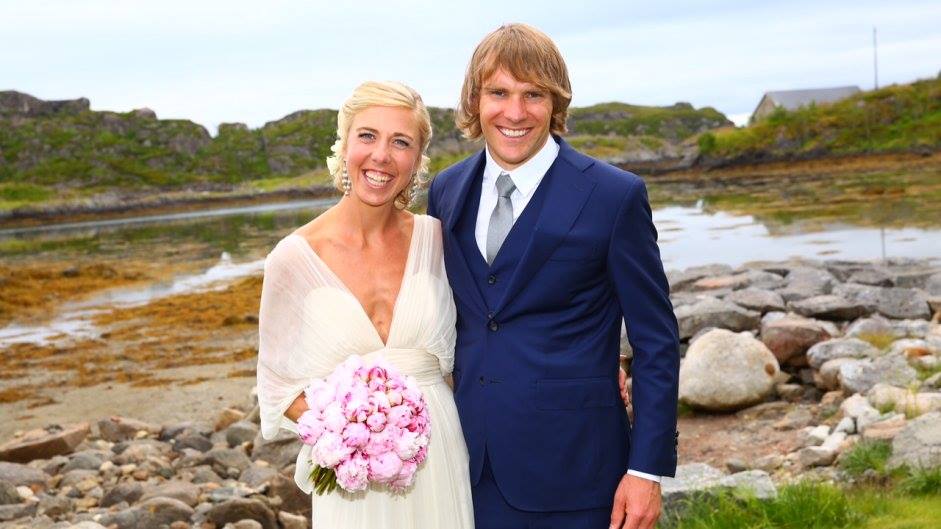
Skiers have been wearing a lot of white lately — or variations thereof. This past weekend, Canadian World Cup Team member Devon Kershaw and his Norwegian girlfriend, three-time Olympian Kristin Størmer Steira, tied the knot in Lofoten, Norway, where Steira has family ties.
Kristin Størmer Steira, of Norway, and Devon Kershaw, of Canada, were married last weekend in Lofoten, Norway. (Photo: CCC/Facebook)
Steira’s teammates, including Marit Bjørgen, Therese Johaug and Ingrid Flugstad Østberg, made the trip to the northern islands for the wedding, along with Canadian skiers Alex Harvey, Jess Cockney, Graham Nishikawa, Drew Goldsack, and Phil Widmer.
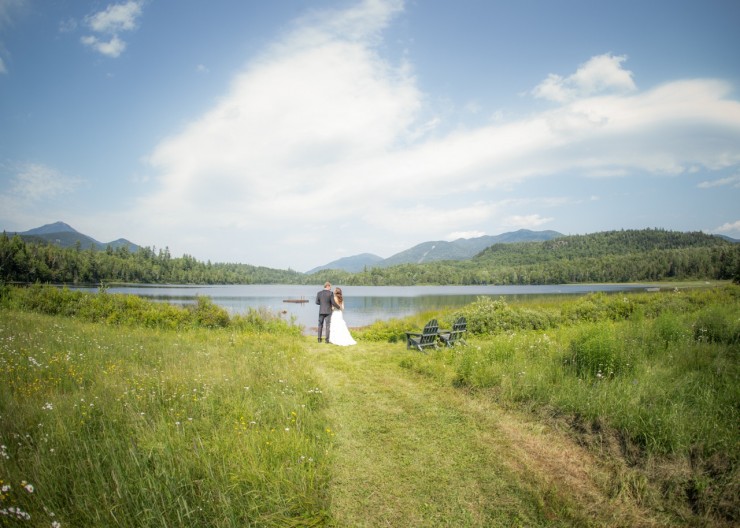
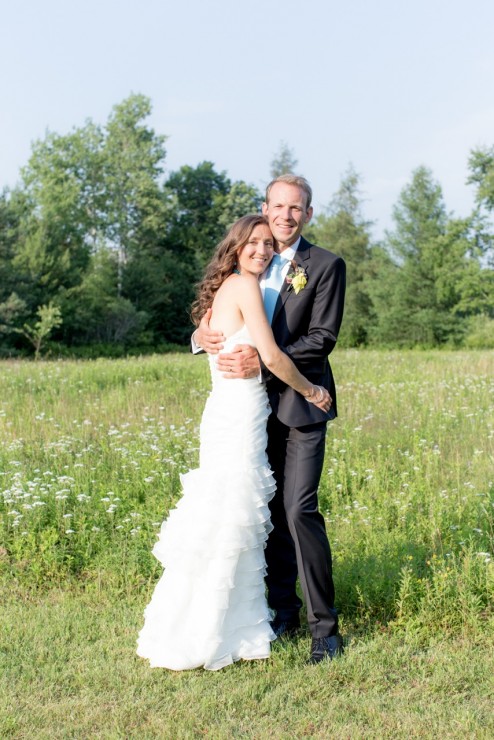
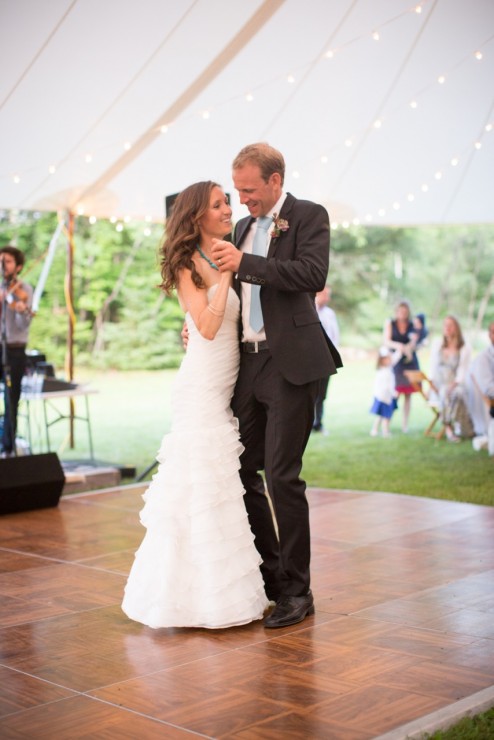
On July 11, US Biathlon’s Lowell Bailey wed Erika Edgley at Connery Pond (photos above) in North Elba, N.Y., then held a reception in front of the house where Bailey grew up in Lake Placid. Edgley is also from Lake Placid. They celebrated with about 120 guests from “all over the world,” Bailey explained in an email. “Americans, Brits, Germans!”
Bailey recently arrived in Stavanger, Norway, for the Blink Summer Ski Festival — a three-day series of rollerski races, starting this Thursday and ending Saturday. His teammates Leif Nordgren and Susan Dunklee also plan to participate.
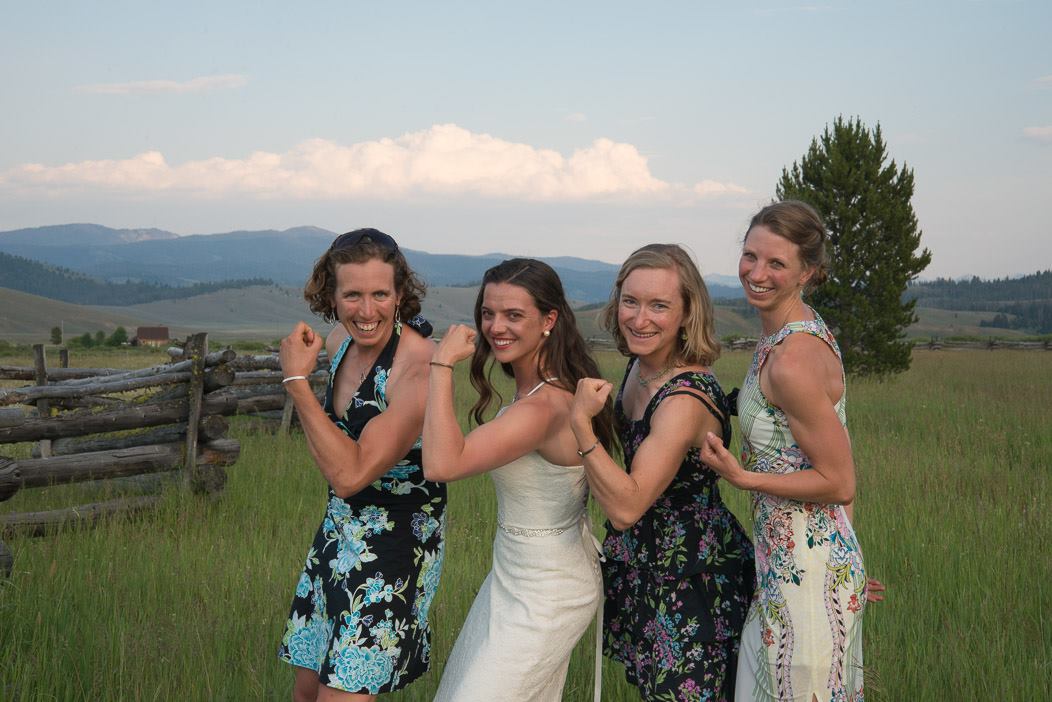
Sara Studebaker (second from l) married Zach Hall in mid July and celebrated with friends and former US Biathlon teammates Susan Dunklee (l), Hannah Dreissigacker (second from r), and Annelies Cook (r) in Stanley, Idaho. (Photo: Sara Studebaker/Facebook)
Also this month, former U.S. biathlete Sara Studebaker married another retired biathlete and current ski coach, Zach Hall, with her 2014 Olympic relay teammates Dunklee, Hannah Dreissigacker and Annelies Cook by her side in Stanley, Idaho.
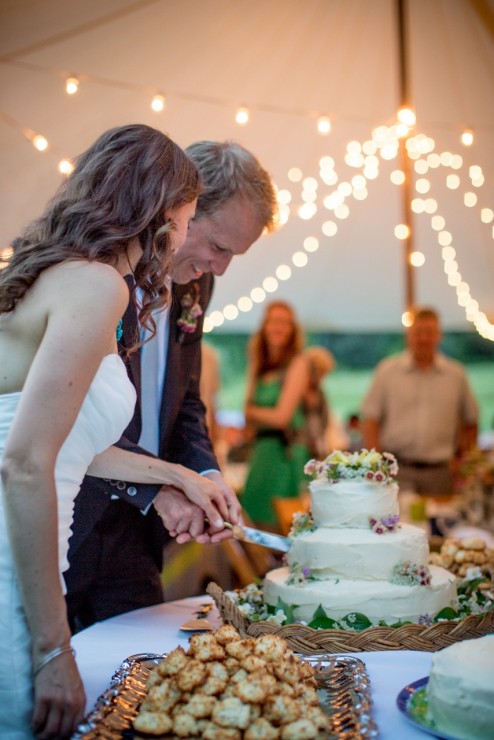
And on July 18 near Canmore, Alberta, Canadian biathlete and Olympian Scott Perras married Jodi Etcheverry, a former biathlete, at a lakeside ceremony.
Longtime sweethearts, former U.S. skiers and now development coaches, Maria Stuber and Bryan Cook recently wed in their native Wisconsin.
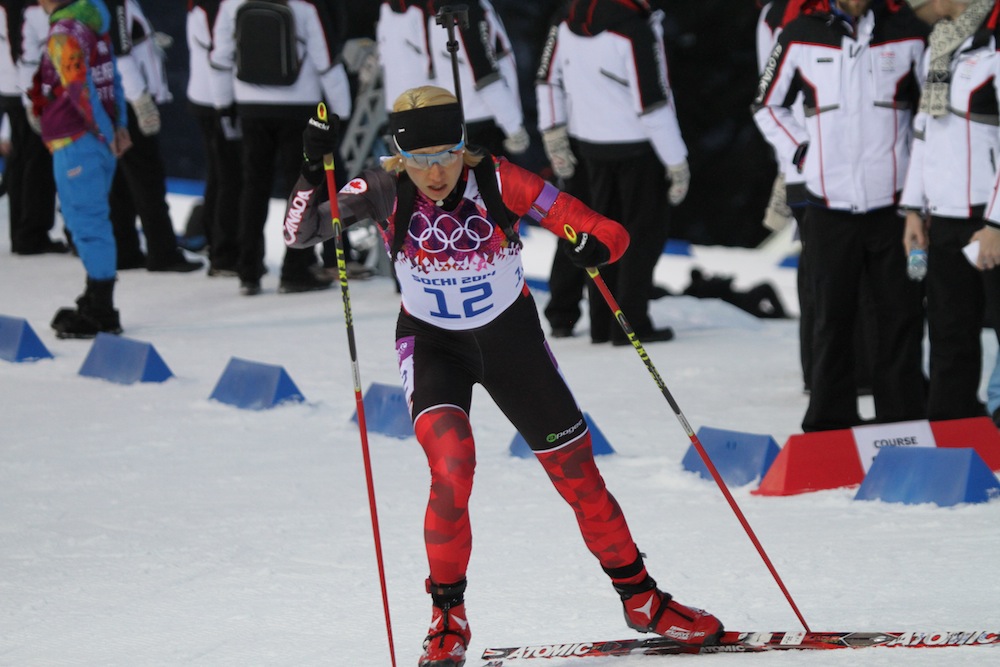
Canada’s Zina Kocher finished 32nd in the 2014 Olympic 7.5 k sprint in Sochi, Russia. After a top World Cup performance of 48th this year, she won back her Sport Canada funding support through an illness provision, but was left off the national team roster.
Three-time Olympian Zina Kocher has not been named to the Canadian national biathlon team this season, a status she disputes. Kocher has been representing Canada on the World Cup since 2002.
After a lackluster season, Kocher had a top World Cup finish of 48th place, short of the three top-30 results she would need to meet the national “A” team standards or the one top-40 needed to meet national “B” team standards.
Besides the national team snub, that meant that Kocher was not eligible for Athlete Assistance Program (AAP) “carding” from Sport Canada: financial support for top athletes that is intended to keep them training without having to hold a full- or part-time job. Kocher and teammate Scott Perras, who was in a similar situation, appealed the ruling based on performance and lost. (For more about carding and this appeal process, scroll to the bottom of the article.)
Next, they submitted paperwork seeking injury/illness exemptions from the criteria, and regained their carding that way.
“I was on vacation and was having to deal with this,” Kocher explained in an interview. “Scott emailed me and told me, okay, he had applied for an illness provision and it went through. So a few days after I found out that my appeal was rejected, I applied for an illness provision. I also had reasons that I was dealing with some medical stuff since September.”
Kocher had taken a month off to travel through southeast Asia. While she was there, she was deciding whether or not to continue with biathlon. Upon deciding that she did want to keep training, she was frustrated not to be able to do so with the national team.
“I wasn’t sure that I was going to continue until the end of April, when I decided that I wanted to do one more year,” she said. “… I really needed that month to step away, and to do something totally different and really relaxed. And also to help me make a decision whether to put in the effort to train again, for another year or not.”
Perras was added to the national team after he regained his carding through the illness provision. Kocher also got her carding back, but not a national team nomination. Now she’s at an impasse where she believes that her name should and will be added to the team roster, but team staff insist otherwise.
Neither Kocher nor Perras disclosed the nature of the injuries or illnesses.
“I just want to put it behind me,” Perras wrote in an email. “Sorry. I am grateful to be on the team this year and for the support of my teammates through my difficult year and am just looking forward.”
On to the National Team?
After being bounced from the World Cup mid-season, Kocher returned to Canmore, where she finished second in an IBU Cup sprint. (Photo: Pam Doyle.)
For Kocher, the dispute is over whether national team status is tied directly to carding. Kocher says that carding should automatically confer national team selection.
“I was in the exact same situation as Scott Perras, so now there’s an inequality issue,” Kocher said.
But according to Biathlon Canada High Performance Director Chris Lindsay, even if an athlete is carded, they still have to meet national team selection criteria to be nominated to the national team.
“It is related, but it is not directly linked,” Lindsay explained. “Being named to a squad in many situations will then get you into the carding list. But it doesn’t work the opposite way. If you are carded but you haven’t met our squad criteria, then we are not obligated to give an athlete a position on a training squad.”
Biathlon Canada has no specific injury/illness provision for its national teams; that was only relevant for Sport Canada and carding. Athletes can be named to the “A” or “B” squads by the High Performance Working Group, which includes Lindsay and the coaching staff, by discretion if they do not meet one of three potential objective criteria. Reasons for inclusion by the working group are listed in the squad criteria:
“A single or multiple exceptional performance(s) internationally in the current season; Near achievement of the WC Performance Standard at the end of the season; Significant than average fitness testing results from standardized tests during the training season; Exceptional circumstances.”
Injury or illness might certainly be considered an exceptional circumstance, but these issues are not mentioned explicitly. While Biathlon Canada’s carding and national team requirements are listed in one document, that document is divided into two parts. The requirements for an injury/illness provision are listed under the carding requirement section, but not mentioned in the national squad criteria section.
Perras and Scott Gow, who contributed to a fifth-place World Cup relay result this season, were named to the “B” team through the High Performance Working Group. In Kocher’s case, despite her documented illness, she was not named.
“The deliberation by the High Performance Working Group was that based on the principles of selection and the objectives for training squad members, Scott Perras was going to have a greater opportunity to contribute towards World Championships medals next season than Zina,” Lindsay said.
Biathlon Canada indicated in a press release that Lindsay will soon be leaving the organization to work as a High Performance Advisor for Own The Podium, the Canadian sports funding agency. Kocher believed that after his departure, other team staff would add her name to the national team roster.
“To sum it up, we’re all in discussion,” Kocher said on Saturday. “As Chris is resigning, it’s now going to our team manager [Andy Holmwood]. It’s in our team manager and coaches’ hands, and I’m waiting til the end of the weekend so we can sort things out.”
There’s not much evidence of discussion, though. Kocher said that the coaches told her to talk to Lindsay; Matthias Ahrens, the head coach of the national team, also declined to comment for this story and referred all questions to Lindsay.
“It is my belief that there was strong consensus that she not be nominated to the Training Squad,” Lindsay wrote in a follow-up email. “This is based on the selection principles outlined in the Squad selection document and is supported by the goals outlined in our strategic plans.”
Kocher does not dispute that her performance in the 2014-2015 season was subpar. She knew about her medical situation in September, but did not tell coaches or adapt her training because she did not think it would be a major problem. Looking back, she says, it’s clear that it was.
“I think it would have changed how I was training in September, and the amount of rest I needed before the World Cup season started, and maybe not have started racing right away,” Kocher said. “I just think that I should have modified things earlier and taken more rest. But at that time, you think, oh, I’m not feeling that bad. You just keep pushing through it.”
Kocher said that she hasn’t developed a plan other than making the national team.
“I haven’t figured out a second option because I thought that this option would work,” she said. “I can’t say that I would go back to Richard Boruta and Biathlon Alberta Training Center. I think that would be my next option, but I haven’t spoken with Richard yet.”
Lindsay also didn’t have a plan for Kocher, but was confident she would land in a good spot.
“Where she decides ultimately to go for training is entirely up to her,” he said. “As a mature athlete who has been doing this for a number of years, certainly we trust her judgment on where she feels she would be best fit. Should she require any assistance finding a place, we have encouraged her to ask us any questions. But, she is not a member of the national training squad for the 2015-2016 season.”
What is Carding?
Although carding itself is not the issue under dispute – both Perras and Kocher received their carding after submitting injury/illness appeals – it’s hard to understand the source of Kocher’s conflict without also addressing carding.
There are several different types of “cards” available through Sport Canada’s Athlete Assistance Program. Some (SR, SR1, and SR2) confer monthly payments of $1500. Others (C1, D) confer monthly payments of $900. This is intended to allow the best Canadian athletes to train full-time without having to find a part-time job.
(There’s other benefits too, like funding for childcare, moving expenses to centralize with a national team, and a fund to pay for university tuition after retirement.)
Millions of dollars are spent by the Canadian government each year on this program, which supports Olympic disciplines and a few non-Olympic teams with major World Championship events. Sports receive different amounts of carding depending on the number of disciplines and potential medals, and must allocate this into “cards” based on their own internal standards.
There’s one exception: top-eight finishes at Olympics and World Championships events, including relays. Across all sports, that confers an SR1 card the following season, and an SR2 card the next season. After the 2014 Olympics in Sochi, Russia, all eight Canadian relay members (four men and four women) received SR1 cards because they had finished in the top eight in the men’s or women’s relay.
The catch is that national federations can add additional requirements to SR2 funding.
“A NSO may adjust a criterion or include sport specific requirements to the senior international criteria specific to their sport in order to strengthen the criteria,” the Sport Canada AAP guidelines read.
“Other sports would put in, you must have a 10 k running time of sub-[some time] in the next season, or you must do so many appearances on TV,” Lindsay said. “You can put in just about anything. For a long time Biathlon Canada had no maintenance criteria at all.”
That aligned them with several other major sports federations. For instance, speed skating, figure skating, and several other major winter sports federations appear to give SR2 carding as long as athletes maintain basic requirements like Canadian residency and signing a contract with the organization.
But other teams do attach additional requirements to receive an SR2 card. For instance, Cross Country Canada requires that to receive an SR2 card, athletes must continue to meet the eligibility standards, which include being part of the national team or a national development center. Swim Canada requires athletes to “have maintained a performance level within a threshold of 1% of the time they performed to earn the SR1”. Track and field requires that an SR1 athlete “achieves prescribed performance targets and benchmarks over the course of the two years” to continue receiving carding money.
This season, Biathlon Canada added an SR2 maintenance requirement for the first time. Kocher asserts that as a result, she and Perras did not realize that the second year of post-Olympic carding was contingent on any maintenance criteria.
“We thought that it was just going to go into effect the following year since the six of us that continued on had made the criteria in Sochi,” Kocher said. “Then in December at Christmas, Scott Perras and I found out that we hadn’t had a top 30 yet and we needed to do this if we were to get carding for the next year.”
On September 3, 2014, the carding criteria for the 2015-2016 season was posted online; the document header read, “Effective September 1st, 2014.”
At the bottom of the third page, the maintenance criteria for the second year of carding (SR2 status) is listed:
“The second year is subject to the athlete meeting the minimum National A Training Squad Priority 1, 2, or 3 performance standard, being re-nominated by Biathlon Canada, submitting a training and competitive program approved by Biathlon Canada and Sport Canada, and signing an Athlete NSO Agreement, and completing the AAP application form for the year in question.”
Those three “Training Squad Priorities” are listed on page eight.
“It is the responsibility of the athletes to review carding and selection documents,” Lindsay wrote in an email. “In an effort to assist them we have our website set to provide twitter and facebook updates when new material is published… Any athlete who has any questions is always welcome to come to my office for answers.”
Biathlon Canada initially nominated both Kocher and Perras for carding money, but Sport Canada rejected the nominations because they violated Biathlon Canada’s own internal procedures. Kocher and Perras had to appeal to Biathlon Canada. The substance of the appeal was that it was unfair for them to have to meet maintenance requirements.
“Scott Perras and I both appealed on that basis that we had made our S1/2 AAP carding criteria at the 2014 Olympics with the top 8 relays (criteria set by Sport Canada), and that is suppose to be a guaranteed 2 years of carding,” Kocher wrote in an email. “… We argued that we had already signed our 2014/15 Athlete Contract and 2014/15 AAP contract before the [September] changes, plus had made the criteria prior to the changes.”
Biathlon Canada rejected these appeals, perhaps because Sport Canada was now looking closely to see whether they followed their internal policies – awarding carding outside of the established criteria would make Biathlon Canada noncompliant with Sport Canada’s quidelines.
So Kocher and Perras tried a new tactic.
“A few weeks before that, Scott Perras found out what was wrong with him,” Kocher explained. “He was ill, and it had been going on since July. He had medical references and stuff. So he applied for an illness provision, which is a totally different process. You tell Biathlon Canada and then they send that to Sport Canada. At the end of April he won that appeal and provision.”
That provided a path for the reinstatement of Kocher’s own carding.
Nathan Smith (left) on the podium at 2015 Biathlon World Championships in Kontiolahti, Finland. (Photo: Fischer/NordicFocus.com)
Biathlon Canada has announced its nominations for the 2015-2016 national team, and twelve athletes made the cut.
The team will be led by four senior athletes who had personal bests on the international stage last season. Calgary native Nathan Smith won a silver medal in the 10 k sprint at World Championships, and followed it up with his first World Cup victory, in a 12.5 k pursuit at the next World Cup.
Two teammates nipped at the podium in World Cup racing: Rosanna Crawford notched fourth- and fifth-place finishes, while Brendan Green finished fifth in a sprint in Antholz, Italy. Joining them on the “A” team will be Megan Heinicke, who collected four different career-best top-15 finishes over the course of the season.
The “B” team will be made up of a combination of senior athletes with championship experience, and younger athletes making the jump to the World Cup. Veteran and Olympian Scott Perras, as well as World Championships competitors Audrey Vaillancourt, Scott Gow, and Julia Ransom, have kept their spots. So too have Emma Lunder, who earned a career-best second place in an IBU Cup sprint this season, and Macx Davies, Christian Gow, and Sarah Beaudry, all of whom are beginning to see World Cup action.
Of that group, the Gow brothers had the biggest impact on the World Cup, teaming up with Smith and Green to finish fifth in the 4 x 7.5 k relay in Oslo, Norway, this season.
Only one athlete from last season’s team was not re-named. Zina Kocher, a three time Olympian, started the season on the World Cup but had a top finish of 48th. After moving down to the IBU Cup, she matched Lunder’s second-place result on home turf in Canmore.
Head coach Matthias Ahrens is signed on with the team for another year, along with coach Roddy Ward. Kathy Davies was added to the staff as an assistant coach.
Leif Nordgren (USA, right) chasing down Baptiste Jouty of France en route to 19th place in the 12.5 k pursuit at Open European Championships. (Photo: US Biathlon)
Leif Nordgren didn’t have the best start to 2015. He was so sick that he had to delay his travel from the United States back to the World Cup circuit in January, missing the Oberhof race weekend completely and joining the U.S. biathlon team in Ruhpolding.
There, he competed in the relay to help his team out, but didn’t feel great. He sat out the next competition, a sprint. From Ruhpolding it was to Antholz, Italy, where Nordgren still didn’t feel thrilled with his performance. While the rest of the team took a break from the World Cup and traveled to Inzell, Germany, for a training block, Nordgren had another idea for how he could get his mojo back.
“I floated the idea to my coaches just to get in more racing before I pick the World Cup back up,” he said in an interview from Otepää, Estonia, where he has been competing at Open European Championships. “It’s one thing to go to [Inzell] to train with the team but I wasn’t sure that the conditions were going to be like there and it’s nice to be racing in the winter. They liked the idea of me coming here. There wasn’t pressure or anything to perform here, it was just to get back into the swing of things.”
After a disappointing sprint where he missed three shots and finished 51st, but still led the U.S. team, Nordgren made a plan for Sunday’s pursuit competition: shoot well and move up. He executed and jumped all the way up to 19th place after 20 shots and 12.5 k of skiing.
It has been windy in Otepää all week, and Nordgren knew that if he could hit targets, he could pass his competitors.
“I had a plan just to shoot pretty slow and shoot as secure as possible and get as many hits as possible,” he explained. “That worked out in prone. I had 10 for 10 in prone and I moved up a lot just in those two stages.”
That moved Nordgren up to 19th. After three misses total in the standing stages, he dropped to the mid-20’s, but climbed back up again by the finish.
“A couple of the misses in standing were just little gusts of wind that happened to hit me right as I took the shot,” he said. “It blew me right off target, so I was bummed about those. But yeah, I’m happy with the shooting. That’s what made the difference because it was such a nasty day.”
Besides the wind, it had snowed until about noon at the venue; the women’s races in the morning had to deal with snow, but Nordgren said that the tracks were surprisingly firm by the time he was racing at 1 p.m.
Only one man moved up more than Nordgren: Tomas Hasilla of Slovakia, who had just two penalties and moved from 59th up to 15th. Nordren lost only 50 seconds on race winner Alexey Slepov of Russia, who started in bib number one and cruised his way through to a 44-second victory over Krasimir Anev of Bulgaria.
Both have been in the World Cup points multiple times this year. Open European Championships used to be limited to competitors under the age of 26, but at the International Biathlon Union Congress this summer it was voted to remove the age restriction. Coupled with the fact that the World Cup is currently on break, it made for a competitive field; other World Cup top ten finishers like Andrejs Rastorgujevs of Latvia and Christoph Stephan and Florian Graf of Germany were also competing.
For Nordgren, who will soon rejoin the World Cup team in Nove Mesto, Czech Republic, where competitions start on Friday, it’s just a relief to be back on track. Earlier in the week, he hadn’t been so sure. He was forced to drop out of the individual race.
“I had this nasty cough that I got on Sunday that was hanging around all week and that’s what made me pull out of the individual on Thursday,” he said. “I was coughing up a lung in the middle of it. It went away a little before Saturday and today was a little bit better. I was still coughing a little bit today but overall I think I’m getting better and better.”
Nordgren is aiming for World Championships, and is getting closer to the form he wants to see there.
“I was sick for a solid two weeks, and two weeks away from shooting can make a big impact,” he said. “I wasn’t really happy with the races in Ruhpolding or Antholz really. Finally this weekend getting back into the swing of things with shooting, is a good sign of the next couple weeks to come. I think the skiing is coming around too. It will be fun racing the next couple World Cups when I’ll be in a good place in skiing and shooting.
Other North American Results
In the men’s 12.5 k pursuit (results), Nordgren was the only member of the U.S. team to qualify based on the sprint. Macx Davies led Canada in 27th place, after starting 28th and racking up seven penalties. Scott Perras started and finished 48th, accruing eight penalties.
“At this point in my career there is still room for firsts. Crashed in the penalty loop today,” Perras, a 2014 Olympian, tweeted after the race.
In the junior men’s 12.5 k pursuit (results), Canada’s Matt Hudec went from 34th up to 25th with four penalties. Teammate Arthur Roots climbed from 55th to 45th despite eight penalties. Brian Halligan, the lone American, had five penalties and rose from 58th to 49th.
In the women’s 10 k pursuit (results), Emma Lunder moved from 33rd to 28th. The Canadian had seven penalties, but shooting was poor across the field (21st-place Galina Nechkasova of Russia had ten penalties) and Lunder’s ski times kept her competitive. She finished 5:28.5 behind winner Ekaterina Shumilova of Russia.
In the junior women’s 10 k pursuit (results), Canada’s Leilani Tam Von Burg slipped from 17th to 23rd with six penalties. Teammate Emily Dickson moved up one spot from 32nd to 31st. The pair were 6 ½ and 9 minutes, respectively, behind winner Anastasiya Merkushina of Ukraine.
The United States qualified three junior women into the race: Mikaela Paluszek, who moved from 56th up to 45th with eight penalties; Siena Ellingson, who suffered through 13 penalties to place 13th; and Maddie Phaneuf, who opted not to start.
Racing at the Championships concludes with relays at the beginning of the week.
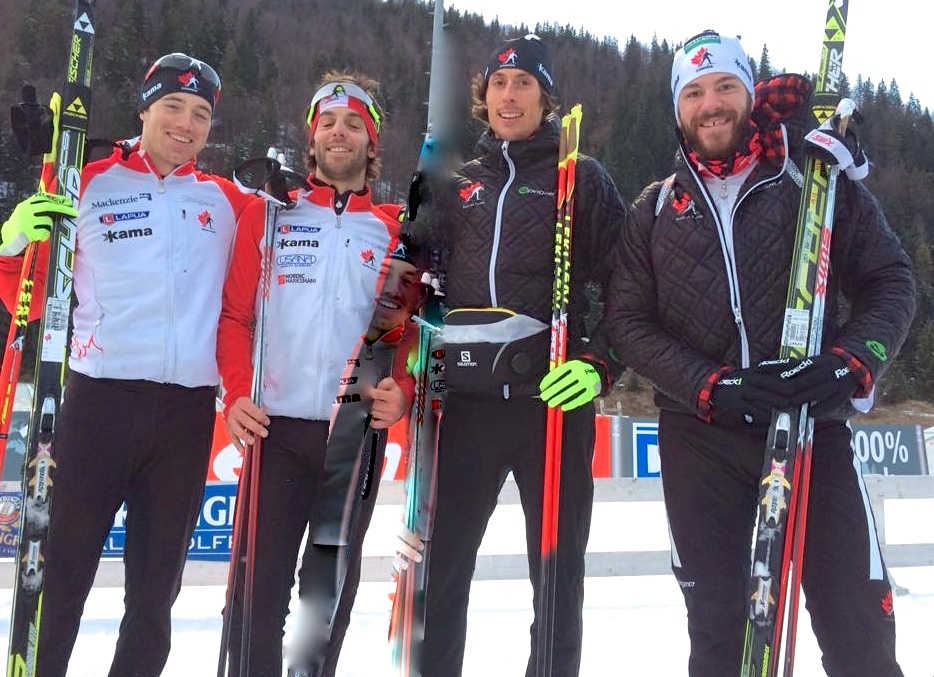
The Canadian men’s 4 x 7.5 k relay, which tied a team-best sixth on Saturday at the IBU World Cup in Hochfilzen, Austria. From left to right, Nathan Smith, Scott Perras, Brendan Green, and Marc-Andre Bedard. (Courtesy photo)
Note: This article has been updated to include quotes from Canadian national-team head coach Matthias Ahrens.
Just a couple steps from the podium on Saturday, the Canadian men’s 4 x 7.5-kilometer relay team was pretty psyched to get flowers — and chocolate, and a “sweet medal,” and cash, according to third-leg Marc-André Bédard.
They had been in the hunt for sixth, which tied each of their career bests in the team event and was worthy of the flower ceremony, since the first leg of Saturday’s IBU World Cup relay in Hochfilzen, Austria.
The Hochfilzen World Cup men’s relay awards ceremony on Saturday night, with Canada (far right) in sixth. (Photo: Matthias Ahrens)
Temperatures were colder than Friday’s sprint, their skis seemed to be running great, and by the first exchange, the Canadians were well on their way to the top-eight Nathan Smith thought they were capable of on a given day.
Saturday turned out to be especially impressive, Smith explained.
“After yesterday’s disappointing showing for our team in the sprint I was unsure of what to expect today,” Smith wrote in an email, referring to his 44th-place finish, which led the Canadian men in Friday’s 10 k sprint. Teammate Brendan Green was 49th, Bédard placed 82nd and Scott Perras was 100th.
On Saturday, they tagged off in that order.
Smith started first in the 24-team field and found himself drifting toward the back of the pack — farther than he would have liked. After his first shooting, where he had to use three spare rounds, he was 21st, nearly 37 seconds behind Sweden and Italy in the lead. France and Russia hovered a few seconds behind in third and fourth, and the Americans — with Lowell Bailey leading off — ranked ninth, 14.5 seconds back, after Bailey missed one prone.
In an email, Bailey in bib 20 explained he started six rows back, based on the IBU’s new start rules, which he considered “a significant disadvantage for teams with higher bib numbers.”
“I was able to make it up into the top five during the first loop but it was definitely tough starting with bib 20,” he wrote in an email. “I disagree with the change and I think it gives the lower bib numbers an advantage that they didn’t have with the previous format. That being said, I was able to work my way through the field, but it took a lot of effort and I expended a lot of needless energy trying to pass.”
While Bailey was satisfied with his shooting, using one spare on each stage, Smith was stressing over prone.
“I was pretty worried in prone,” Smith wrote. “I’m not sure exactly what went wrong there, but it felt exactly the same as the prone in [Friday’s] sprint. I knew I was feeling good skiing though so I just tried to ski hard and hopefully catch some teams off guard that were skiing in groups.”
By the second stage, the Canadian was up to 12th with a clean bout. He went on to post the fastest course time of his leg on his third-and-final lap.
“I felt strong and tried to make up time on the second half of the course where all the climbing is,” Smith explained. “My last lap felt amazing. I passed a lot of people and it was actually ranked 1st for that leg. I had hoped to put Brendan in a slightly better position, but given 3 extra, I’m pretty happy that the deficit was only 25 seconds.”
Russia won the men’s relay on Saturday at the IBU World Cup in Hochfilzen, Austria. From left to right: Maxim Tsvetkov, Timofey Lapshin, Dmitry Malyshko, and Anton Shipulin. (Photo: IBU/Ernst Wukits)
Smith tagged Green in seventh, 25.7 behind Friday’s sprint winner, Johannes Thingnes Bø of Norway in first — who missed one in prone. France’s Simon Fourcade cleaned to put his team 12 seconds back in second, and Ukraine tagged in third (+14.4) after 10-for-10 shooting from Dmytro Pidruchnyi.
The U.S. slipped to 15th during Bailey’s leg as a result of less-than-ideal skis, second-leg Tim Burke explained.
“I knew right away when I saw Lowell’s race that he was having a problem with skis,” Burke wrote after his team placed 14th overall. “Unfortunately, I did not have time to change my skis and we were using the same grind. The temperature dropped more than we thought at race time and the snow really dried out. We simply ended up on too big of a grind.”
Heading out 56 seconds behind the leaders, Burke remained hopeful that he could pick a few teams off. He ended up using two spares in prone and another in standing.
“I definitely made a mistake in prone when I tried to push the pace a little too much and ended up pulling the last two shots,” he wrote. “After standing I ways able to pick up a few spots on the last loop but we were still far from where we should have been after two legs.”
Meanwhile, Green cleaned both stages for Canada to improve to sixth. He led Italy’s Dominik Windisch, who started a second behind him, on his first lap. The two entered the range together, and despite Windisch using one spare, they left together as well.
“I was able to work off him for my second lap and relax a little bit more in certain areas before standing,” Green explained. “I knew my skiing should be decent if worked with him so I didn’t try and do anything too heroic on course and more just tried to settle into a solid pace.”
After his standing stage, Green was up to sixth, 39 seconds behind Russia’s Timofey Lapshin up front. Lapshin and Norway’s Emil Hegle Svendsen both cleaned standing to leave the range together, and France’s Jean Guillaume Beatrix used one spare to fall slightly off the pace, eight seconds back in third. Windisch missed three and dropped to ninth.
On the long climb back up to the stadium, Svendsen led Beatrix and Lapshin, while Austria’s Simon Eder tried to close the 12-second gap in fourth. Germany’s Andreas Birnbacher trailed by another 12 seconds in fifth — 14.7 seconds ahead of Green.
“I always feel a ton of pressure during relay races,” Green reflected. “But last year we had multiple strong relay performances where we were contending at the front of the race, so I’m sure those experiences helped me out today…
“When setting up the next teammate for the tag, it’s ideal if you can tag them with other nations close by so they have people to work with skiing,” he added. “If that scenario works out, perfect, but if not that’s fine, and we’re always doing our best to tag as close to the lead as possible.”
Green handed off to Bédard in sixth, 50 seconds behind Norway and France, neck-and-neck for first, and 24 seconds behind Germany in fifth. Russia tagged off 7.8 seconds back in third, and the U.S. came through in 11th, 1:55 behind the leaders.
Upon receiving the tag, Bédard — the team’s newest member and the only one not to experience sixth place in the relay in Antholz, Italy, last January (former national-team member J.P. LeGullec scrambled in that race) — he focused on keeping his cool and trying not to lose too much ground.
“It was a bit lonely during the first 2 laps but I tried to go as hard as I could knowing that it would be super short,” Bédard wrote.
He used one spare in prone and three in standing to slip one place to seventh behind Italy’s Thomas Bormolini after his second stage.
“On the final lap I took extra time on the range to clear my targets and the Italian came back strong cleaning his, so I had to fight back 8-10 seconds,” Bédard explained. “I got to him pretty fast. I felt good so I attacked right away but he kept up to me and we ended up together.”
Bédard and Bormolini entered the final exchange at the same time, 1:56.4 behind Russia. After Dmitry Malyshko cleaned, Russia remained the definitive race leader heading into the final leg, more than 17 seconds ahead of Norway’s Lars Helge Birkeland in second. Birkeland used five spares — two in prone and three standing to account for half of Norway’s 10 total spares at the end of the day.
France’s Simon Desthieux, who missed two standing, trailed Birkeland by 0.7 seconds through the tag zone in third.
Russia’s Anton Shipulin laps several teams en route to a 20-second victory for the Russian men’s team in Saturday’s 4 x 7.5 k relay in Hochfilzen, Austria.
At the front of the race, it was all about chasing Russia with anchor leg Anton Shipulin ultimately cleaning both stages to bring it home. France’s Martin Fourcade and Norway’s Tarjei Bø duked it out for second, with Fourcade missing one prone and Bø missing three standing to drop to third.
Then there was Austria and Germany, some 35 seconds behind Russia after prone and 48 seconds back after standing, racing for fourth.
“The gaps were quite big when I started,” Canada’s anchor, Perras wrote. “My race was all about getting into the prize ceremony. I couldn’t even see 4th or 5th.”
He missed two prone and three standing for five total spares — half of what Canada ended up with.
“In prone I shot a bit slow. I threw my first spare round down range to try and leave the range with Italy,” Perras explained.
Italy’s Christian Martinelli used one spare in prone to exit the range 15 second ahead of him. Perras made up that time on the second lap and entered the range with him, then reclaimed sixth. While Perras missed three that bout and Martinelli missed two, Perras left the range 22 seconds ahead.
Canada’s anchor Scott Perras pushing for sixth in the finishing straight of Saturday’s IBU World Cup 4 x 7.5 k men’s relay in Hochfilzen, Austria.
“I had no idea how close Italy was to me or any team for that matter,” Perras explained of his last lap. “I fought the whole way. I was fighting for my teammates out there.”
He secured sixth to match the team’s best from Antholz, finishing 2:55.4 behind Russia, which won in 1:16:14.8 after using just one spare round. Fourcade cleaned standing and outsprinted Bø by 7.7 seconds to lock up silver for France (0+4), 20.2 seconds behind Russia, and Norway took third (0+10).
Dominik Landertinger cleaned prone and used one spare in standing to finish fourth for Austria (0+7), 30.5 behind Russia, and Germany’s Simon Schempp also cleaned the first stage then missed one standing to finish 0.9 seconds later in fifth for his team (0+9).
“Matching a top finish is always a must, we obviously want to get better and better,” Bédard wrote. “But it was great to be [in] the flower ceremony.”
“I think we are happy to get back there so early in the year,” Perras explained. “It sets the bar for the whole team. It makes everyone want to work harder, coaches, wax techs and athletes to repeat or better days like today.”
In an email, Canada’s national-team head coach Matthias Ahrens called their performance “solid … especially in the shooting range taking the opportunity of other team’s weaknesses,” he wrote in an email. “This was an important result for our team in building confidence towards their individual races. This also applies for our women’s team who had a decent result [11th] with 2 young athletes, one being a junior in her first [World Cup] race.”
While the Canadian men ended the day with zero penalties and 10 spares, the Americans, which were lapped during Russell Currier’s anchor leg, ended up with four penalties and 14 spares.
After Burke tagged Leif Nordgren in 11th, Nordgren used three spares and had to ski a penalty loop on his first stage, then slipped to 12th. In standing, he used all three spares again and had three more penalty loops to leave the range in 17th.
He tagged Currier in 17th, nearly five minutes behind the leaders. Currier went on to use two spares in prone and one in standing before being pulled on his last lap.
“We are not reading too much into this result as a team,” Burke wrote. “We know we are far better than what we showed today. In one way, at least everything went wrong for us on the same day.”
“I think we are capable of a podium,” Bailey noted. “The field is incredibly strong on the men’s side this year and a few small mistakes make a big difference on the results list. If we are perfect, we have a chance at the podium.
“Tomorrow is a new day,” he added. On Sunday, Burke and Bailey will start 13th and 17th, respectively in the pursuit. Nordgren, who also qualified, will head out 51st of 60 men.
Smith and Green will also be hunting for a top 30 after starting in 44th and 49th, respectively.
Tim Burke racing to 13th in the men’s 10 k sprint at the IBU World Cup on Friday in Hochfilzen, Austria. (Photo: USBA/NordicFocus)
Note: This article has been updated to include comments from Canada’s Nathan Smith.
Tim Burke knows you have to get a little weak in the knees to achieve the performance of a lifetime. Or something like that.
Friday’s IBU World Cup 10-kilometer sprint in Hochfilzen, Austria, wasn’t exactly that race for the U.S. biathlete — he’s had plenty of top 10s and top 15s in his career — but it was headed in that direction.
“One of my big goals this year is to really try to attack every race and give myself the best chance I can to get on the podium,” Burke said on the phone after Friday’s race.
As the seventh starter of 105 men on an unusual 2.5 k loop (shorter because of Hochfilzen’s lack of snow; racers had to ski two uninterrupted loops between the first and second stages), Burke started fast and tried to hold it the pace throughout the three-lap race.
He ended up cleaning prone and hitting every target but his last in standing.
That was the one he wanted back — but he also acknowledged that he pushed himself to the brink.
“I came into that last stage really gassed; I definitely went all out after the start,” Burke said.
After organizers trucked in snow to hold the races, conditions were fast and solid on a just-above freezing, sunny afternoon. According to Burke, he experienced good conditions and no wind during his race. It was just a matter of fatigue when it came to the last stage.
“After the third and fourth shot, I was starting to shake a little bit and couldn’t really hold it together for that last shot,” he said. “I feel like right now in men’s biathlon, it’s so competitive that there are always a bunch [of guys] who are going to take a gamble, and I realize that to get the podium now, I really need to get right to the edge and sometimes over the edge, and that’s the way I want to start every race.”
That’s also the way he finished it. Glad to have just 2.5 k to go on his last lap, Burke crossed the line in Burke fourth. He would eventually end up 13th.
“Even after the miss, I still thought I could be up there in the top-ten today,” he said. “Normally at this range, you see a lot of penalties because it’s a challenging approach to the range.”
Johannes Thingnes Bø celebrates his 10 k sprint win at Friday’s IBU World Cup in Hochfilzen, Austria. (Photo: IBU/Ernst Wukits)
After the start, racers headed straight down into the valley before turning around for a long grind back to the top. Burke said that type of “gradual climbing” was what suited him best. To his surprise, several others hit most of their targets as well. The top four — Norway’s Johannes Thingnes Bø, Germany’s Simon Schempp and Andreas Birnbacher, and Austria’s Dominik Landertinger, respectively — all cleaned.
At the end of the day, Burke knew his one miss probably cost him the podium, but he continued to focus on the positives and was pleased he took the risk. His course time ranked ninth-fastest overall.
“I’m really happy with my ski speed right now; I think it’s probably my strongest start ski-speed wise that I’ve ever had,” he said.
Burke finished 39.6 seconds behind Bø, who took the lead from fellow Norwegian Emil Hegle Svendsen, who started second, after starting 13th and quickly cleaning prone. Hegle cleaned as well, but missed one standing and gradually fell farther behind the 21-year-old Bø, who notched the fastest course time.
Bø finished in 24:34.9, beating Schempp by 14.3 seconds for the win on Day 1 of the second World Cup of the season. Birnbacher was 17.9 seconds back in third, and Landertinger finished 22.5 seconds after Bø in fourth. He edged Slovenia’s Jakov Fak by 0.4 seconds, and Bø’s older brother, Tarjei, cleaned for sixth (+26.7).
In fact, sixth through eighth place finished with perfect shooting. France’s Martin Fourcade was seventh (+27.8) and Russia’s Dmitriy Malyshko eighth (+29.2). Svendsen, the overall World Cup leader, placed ninth (+30.9) with a single miss.
Friday’s sprint finishes determine the start order and time back for Sunday’s 12.5 k pursuit.
“I stayed really close today, only 39 seconds back and I’ll start in a big group of guys,” Burke explained. “It should be an exciting race. I think a lot of guys will be contending for the podium.”
Lowell Bailey (US Biathlon) racing to 17th in Friday’s 10 k sprint at the IBU World Cup in Hochfilzen, Austria. (Photo: USBA/NordicFocus)
Burke’s teammate Lowell Bailey also landed in the top 20 for the U.S. on Friday, cleaning and tying Bulgaria’s Krasmir Anev for 17th, 57.6 seconds behind the winner.
On Saturday, Bailey, Burke, Leif Nordgren, and Russell Currier will team up — in that order — in the men’s 4×7.5 k relay. “Anything can happen for sure,” Burke said.
Nordgren placed 51st on Friday (+2:19) to qualify for the pursuit, with a single miss in prone. Currier was just outside the top-60 needed to qualify, finishing 61st with three penalties — two prone and one standing.
Nathan Smith led the Canadians in 44th with three misses as well — two prone, one standing, and 1:57 behind the winner. Brendan Green placed 49th with two prone penalties (+2:13.9).
In an email, Smith explained more than half of their team came down with a cold in Östersund.
“I felt tired and on the edge during the travel day Monday. Thankfully I managed to turn things around and feel good again,” he wrote. “My prone just plain did not feel very solid. I fought for the shots but they didn’t come easily. Standing was pretty good but my first shot, which missed, I pulled a little early.”
Smith felt better about his skiing. I felt like today could have been a top-20 ski time but I didn’t quite make it,” he said. “Usually I feel better race to race, so maybe on Sunday I’ll be there.”
In Sunday’s pursuit, he’ll aim for a top 30, and “with an amazing race, perhaps top 20,” he said. “I’m farther back than I’d hoped.”
In an email, Green explained he was frustrated to open with two misses.
“My shots throughout that bout were consistently high but I think that’s something I should be able to work through going into [Saturday],” he wrote. “Standing felt solid with a nice rhythm which I’m happy with.”
Struggling with back pain since the start of the season in Sweden, Green explained that it wasn’t quite 100 percent, but it hadn’t kept him from doing any of his planned workouts this week, either.
“The travel day from Sweden was hard on it but I’ve been able to get daily treatments here which are definitely helping it from getting any worse,” he wrote. “I’m hoping that over Christmas I’ll be able to spend time with my physio and sort things out to a more manageable level again. Hopefully I won’t have too many issues with the rest of the season in the new year.”
As for how he felt skiing on Friday, he wrote that it was “slowly starting to come along. I’m definitely disappointed with my start to the season thus far and with my form, but I know there is the potential there for a lot more and hopefully I will get a glimpse of that soon. The course seemed to hold up fairly well and although we had to ski a double 2.5km loop after prone the race still went by pretty fast.”
In Saturday’s relay, Smith will start for the first time, followed by Green, Marc-André Bédard, and Scott Perras. On Friday, Bedard placed 82nd with three misses (2+1) and Perras was 100th with six penalties (3+3).
“I’ve never been anything but 3rd or 4th leg,” Smith wrote, “so it’s going to be a new experience for sure! I want to tag Brendan off in a position where he can be right in there with the lead pack. A good result right now for where we’re at is top 8.”
“I know we’ll all be focused on doing our job during each leg of the relay and racing to the best we can,” Green wrote. “We’ll see at the end of the day how we stack up against other nations.”
Rosanna Crawford racing in Canmore, Alberta, in October 2014. Crawford was the top Canadian woman in Ostersund, Sweden, today. (Photo: Noel Rogers/Bow Valley Photography)
It was a rough day, literally and metaphorically, for the biathletes competing Saturday in Östersund, Sweden. Artificial snow, saved snow and shoveled snow made for a treacherous course, though winds were calm.
Two Canadians broke through the bumpy conditions to have strong races in the IBU World Cup men’s 10-kilometer and women’s 7.5 k sprint — Nathan Smith and Rosanna Crawford finished ninth and 12th, respectively. The rest of the Canadian team did not fare as well, with no other skiers finishing in the top-60 to advance to Sunday’s pursuits.
Smith shot clean to earn his ninth-place finish, while the next Canadian man to finish was Marc André Bédard in 61st (+2:39.1) who missed one target in standing, and Brendan Green (+2:42.1), who missed one in prone and two in standing. This is only Smith’s fourth career top 10, and Canada’s first top 10 of the season.
“Obviously, I’m really happy with the result,” Smith told FasterSkier. “A top 10? I don’t have that many of those, yet.”
For the Canadian women, Crawford was happy with her race, finishing in 12th place (+1:10.3), in spite of missing a target in both prone and standing. But the women’s side was similarly disappointing, with Zina Kocher as the next Canadian woman in 66th place (+2:34.9, +4), and uncharacteristically bad shooting plaguing both Megan Heinicke, who finished 82nd (+3:23.6, +2) and Audrey Vaillancourt, who finished 88th (+3:31.7, +3).
An email to head coach Mattias Ahrens went unanswered as of this writing.
Scott Perras did not start due to a cold: “It’s really too bad,” he wrote in an email. “I am normally pretty healthy throughout the race season. This is my first DNS at any level of racing and I don’t much care for it.”
Smith’s strong result can be credited due to what he called “one of [his] best shooting races ever,” having the 10th-fastest shooting time of the day (+2.9) with no misses.
“After the individual I was pretty disappointed with my standing shooting,” he said. “So I took a day off of shooting and then yesterday I really focused on having really high quality in training, and the same with today during the race. I just tried to be very disciplined, I guess I could say. And it really paid off.”
“It’s not the best that I’ve been on skis in the last year and a half,” he added, “but it’s good still. Just not my best.”
For her part, Crawford was somewhat disappointed in her shooting, and in fact appeared to be having a pretty ho-hum race after the 2nd lap, being in 27th place. But on that final lap, she turned it up, delivering the 7th-fastest course time and moving herself into 12th place.
“This is kind of funny,” Crawford laughed. “I’ve always been kind of the opposite – a really strong starter and then have struggled with finishing loops, but Zina Kocher and I got to train together a lot this year and that’s always been her strength, so being able to work with her all summer long I think has been very beneficial to me to getting that finishing speed.”
Though course conditions were poor, neither Smith nor Crawford complained. Smith benefited from being an early starter, before course conditions deteriorated too much. He highlighted some of the downhill corners as being particularly treacherous.
“They shoveled [the corners], so I didn’t really know what to expect,” he said. “They were okay because you just sort of bounce over the bumps. But then, as each lap went on, the ruts got deeper. I’m sure that, for the last starters, it was pretty scary on those corners.”
Crawford thought that the poor course conditions matched her strengths.
“I’ve always been pretty strong on downhills, so I think that’s a huge advantage for me on a course like this,” she said. In fact, relative to other skiers, course conditions probably helped her out. “It didn’t hurt me, for sure.”
As for her shooting, Crawford made no excuses:
“It was pretty calm on the range, so it was definitely all me. A little bit more focus can go a long way.”
Though Crawford had told FasterSkier that she was hoping for top-10, she was far from disappointed with her finish.
“I’m not expecting to be in the top-10 every single race,” she said. “If I’m consistently in the top-25/top-15 area that’ll make me happy,” adding that she’d still like to get more top-10 finishes this year than she did last year.
“And for sure to be on the podium at least once this year,” she added.
After such a grab bag of results feelings on the the time are pretty mixed.
“Obviously some of us have had great races,” Smith said. “But I’m sure Brendan and Marco, and the other girls, are pretty disappointed about not making the pursuit.”
Smith and Crawford are looking forward to tomorrow’s pursuit with differing baselines for what to expect. Smith is looking forward to what he regards as his best format, while Crawford is apprehensive about what she regards as a weakness.
“It’s a shooting race,” Smith said. “I think shooting speed is more important, which is probably my biggest strength. I can take advantage of that as long as I hit most of the targets.”
Crawford echoed that assessment, but a bit more apprehensively.
“Pursuits were a bit of a weakness for me last year, shooting wise,” she wrote in response to follow-up questions. She hopes to simply hold her position and stay in the top 15, but that she’ll be happy if she is able to follow her range plan and “stay focused on myself and not get caught up in what’s going on around me.”
Devon Kershaw (r) chases down biathlete Scott Perras during Monday’s Frozen Thunder 10.8 k freestyle interval start at the Canmore Nordic Centre. Kershaw went on to win, and Perras placed third. (Photo: Noel Rogers/Bow Valley Photography)
A 1.8-kilometer loop can get crowded with 101 racers, especially when each competitor is racing anywhere from four to six laps.
Such was the case at Monday’s Frozen Thunder freestyle-individual start in Camore, Alberta. Jumping at the chance for on-snow training and racing in October, groups including the U.S. Ski Team and Canadian national cross-country and biathlon teams converged on the Canmore Nordic Centre.
In the men’s 10.8 k race, the good ol’ boys of North American nordic skiing came out on top.
Devon Kershaw of the Canadian World Cup Team skied his way to a win in the freestyle-interval start in Canmore, Alberta, with a time of 23:00.4.
Canadian Para-Nordic Team veteran Brian McKeever placed eighth in Frozen Thunder’s 10.8 k freestyle interval start on Oct. 27 in Canmore, Alberta. (Photo: Noel Rogers/Bow Valley Photography)
Not far behind was U.S. veteran skier Kris Freeman (+5.1) of Team Freebird. After three laps, Freeman was roughly 13 seconds behind Kershaw but gradually erased the deficit as the finish inched closer.
Freeman’s final surge was not enough to overcome Kershaw, who clocked the fastest time in each of the first three laps.
Kershaw said that the crowded 1.8 k loop did little to distract him from his race. Comparing the conditions of the loop made of saved-snow to several past World Cups, Kershaw said that the busy Frozen Thunder track was nothing he hadn’t seen before.
“You just move around people that are slower than you and it’s actually pretty easy to not focus on that aspect of it. A busy track doesn’t bother me when I’m racing,” Kershaw wrote after his win.
Freeman agreed, writing that in the modern era of nordic skiing, short loops have become more abundant – even in the winter season. He said that while he was careful when overtaking his competitors, everyone he met on the course gave enough space for a fellow skier to pass.
Kershaw said that since its conception, Frozen Thunder has continued to get bigger and better. This year was no different.
“The Frozen Thunder races are getting more and more popular as the years go on,” he wrote. “The volunteers here in the Bow Valley that make events like this happen are just so incredible. When you’ve got athletes from the U.S. coming up, and training centres and clubs from across the country coming to compete and train here – it shows just how fantastic a success and how well received the whole Frozen Thunder project is.”
Third place was claimed by Biathlon Canada’s Scott Perras, who finished 30.8 seconds behind Kershaw.
For Perras, the race was an opportunity to ski with the Canada’s cross-country team. He said that Canadian biathletes and and cross-country skiers rarely interact due to the diverse schedules of each team.
“It was great to get to ski parts of a race with Kershaw,” he wrote. “I’ve never actually been in a cross country race when he was around. October really is the only time of year cross country and biathlon get to have some fun chasing each other.”
Perras and teammate Brendan Green wore one of each other’s skis so that they could compare their results without worrying about variation in ski speed. He was able inch past Green who finished 1.3 seconds behind. Perras said the laps he spent skiing with Kershaw made the all the difference.
Perras also noted that the top three men in Monday’s race were some of the oldest in the field of 64.
“As an ‘old guy’ this brings a smile to my face,” the 31 year old said. Kershaw is also 31 and Freeman is 34.
Further down the results sheet was Simi Hamilton of the U.S. Ski Team (USST). While the Stratton Mountain School (SMS) T2 skier finished 40th and roughly three minutes and 20 seconds behind Kershaw, his result is misleading. Hamilton recently suffered “a mild shoulder tweak” and skied the entire race with one pole.
Biathlete Rosanna Crawford racing to the win in Monday’s 7.2 k freestyle women’s race at Frozen Thunder in Canmore, Alberta. (Photo: Noel Rogers/Bow Valley Photography)
In the women’s 7.2 k race, Rosanna Crawford (Biathlon Canada) bested a strong women’s field to take the win. After four laps around the Frozen Thunder track, she finished with a time of 17:39.2.
Despite soft conditions, Crawford explained she felt strong throughout the race and enjoyed starting near the back of the pack.
“Starting near the end meant there was a lot of girls I could chase down. I love having someone just within sight that I can try to chase down and pass!” she wrote in an email.
Crawford, who just completed a two-week block of treadmill rollerski intensity, explained that the race helped her begin the transition from dryland training to on-snow racing.
Coming in second for the women was USST member Liz Stephen (+3.6), who traditionally excels on hilly courses with long climbs. Monday’s race had no such climbs and was relatively flat.
Taking the final spot on the podium was Canadian biathlete Zina Kocher (+11.7). Kocher said that while she also favors hill-intensive courses, the Frozen Thunder distance race left her feeling technically and physically strong going into the final weeks of fall training.
Now that Frozen Thunder racing has concluded, the North American teams will part ways before they begin their final training blocks of the fall. The Canadian Biathlon Team will host a time-trail on the 1.8 k ski loop Friday, as part of their continued training camp.
Heidi Widmer (AWCA/Canadian NST) racing to ninth in the women’s freestyle distance race at Frozen Thunder on Oct. 27 in Canmore, Alberta. (Photo: Noel Rogers/Bow Valley Photography)
Nathan Smith of Canada secured seventh place for his relay team, besting Martin Fourcade of France at the finish.
FasterSkier’s coverage is made possible through the generous support of Swix.
KRASNAYA POLYANA, Russia – Usually when you’re trying to fend off Martin Fourcade at the end of a race, it’s for the win.
But today’s Olympic men’s relay – the last biathlon event of the Games – didn’t go quite the way it usually does for France, who had seven spare rounds but was more undone by slow ski times. And it certainly didn’t go as planned for Canada. Jean Philippe Le Guellec led part of the race but then got shaky in his standing stage and ended up skiing a penalty loop, dropping the team to 16th. He gained back a few spots with strong skiing by the time he tagged off to Scott Perras, and the team continued to climb through the rest of the relay.
So there they were: by the anchor leg of the relay, Canada’s Nathan Smith left the range in seventh place, and French anchor Martin Fourcade 11 seconds behind in eighth.
“We were watching Nathan go up the last hill, and we had [wax tech] Tom Zidek on top of that hill. “The feedback from Zidek was that Nathan was pushing as hard as he can, and this is good. Then the radio went silent. Then the radio came back on again and said, oh shit, Fourcade is going.”
Brendan Green moved the team from eighth to sixth.
Partway around the loop, Fourcade – who won two gold medals at this games and is a several-time overall World Cup champion – caught Smith. But from then on, it was even. In fact, Fourcade seemed to be playing tactical.
“It seemed like he was holding back a little bit – he was drafting me a little bit on the last lap,” Smith said. “He didn’t want to pass me on the last uphill. So I saved a little bit too for the end. To be sure that he wouldn’t outsprint me.”
Smith led on the downhill into the stadium, and wouldn’t let Fourcade past as they cruised across to the far end.
“Nathan was not going to let it go without a fight,” Lindsay said. “Whether it’s by an inch or a mile, it’s all that counts.”
It was a battle coming back down the finishing stretch, but Smith emerged victorious to salvage seventh place for Canada, a best-ever finish in an Olympic relay. The team finished a minute and a half behind the winning Russians, with one penalty loop and ten spare rounds compared to eight spares by Russia and even fewer by the other podium teams, Germany and Austria.
So did Smith think he was going to win that sprint against the best biathlete in the world?
“I thought I had good chances,” Smith said. “I’m usually pretty good at sprint finishes.”
After Le Guellec’s shooting woes, Scott Perras took over and skied a flawless leg, using one spare in prone and none in standing and skiing his way up to eighth place. He made an impressive move leaving the range after standing, passing a group of racers on the inside of a corner and leading them to make up time on the leaders.
“I knew we were fairly close to the top three so I didn’t care what position I was in,” Perras said. “I just wanted to close down that time to the top three even if it meant they were going to pass me later on.”
From there, Brendan Green used a spare in each stage to move up to sixth before Smith took over for the final anchor leg.
On one hand, the result was a bit disappointing based on what the Canadians thought they were capable of.
“Last year we were top eight at World Champs, to do that again, it wouldn’t be our potential but it would show some really good consistency,” Perras said. “I definitely woke up this morning thinking a top three was possible, probably third more than first, but just after the mixed relay I knew Nathan and JP had rested and they’re already in good shape and their shooting has been so solid this year so I was pretty confident.”
But it was still a best-ever result, and carried all the accolades that come with that.
“This is redefining where the new basement on performance has to be for the Canadian squad,” Lindsay said. “Eighth is the new norm. If we’re getting less than eighth, we’re doing something wrong.”
Canada’s Brendan Green on his way to his best Olympic result of 21st in Thursday’s 20 k individual biathlon race at the 2014 Winter Games in Sochi, Russia.
FasterSkier’s coverage is made possible through the generous support of Rudy Project.
SOCHI, Russia — Deciding whether it’s better to start sooner, later or somewhere between in the races at the Laura Cross-Country Ski & Biathlon Center has been more or less a crapshoot at the Olympics, and before the men’s biathlon 20-kilometer individual start on Thursday, the athletes and their coaches essentially took a stab at what they predicted could be best.
Canada’s Jean-Philippe Le Guellec figured the second or third seed (out of four) might be a good place to take advantage of the soft conditions — presumably warmer for the 6 p.m. start then cooling as the race went on.
Canada’s Jean-Philippe Le Guellec (56) leads Norway’s Tarjei Bø in the men’s Olympic biathlon 20 k individual on Thursday in Sochi, Russia. Le Guellec went on to place 35th and Bø was 26th.
Le Guellec found himself at the end of the second seed on Thursday’s 89-man start list. Good enough, he thought.
His teammate, Brendan Green started later in bib 69, and while the course didn’t speed up, and the temperatures didn’t drop anywhere close to freezing (it went from 50 degrees Fahrenheit at the start to 47.5 degrees at the finish), Green managed just fine.
The 27-year-old from Canmore, Alberta, notched his best Olympic result in 21st, topping his sprint finish of 23rd and his pursuit performance of 35th, also in Sochi. Green didn’t race any individual events at the 2010 Olympics, but helped the men’s relay place 10th.
Green finished Thursday night out with two misses — one in the first standing and another in the prone. Penalized two minutes, he finished 2:33.6 back from French winner Martin Fourcade. One fewer miss and he would’ve been in the top 10.
Perhaps most surprisingly, he had his best race of the Olympics on the warmest evening yet, which made for slushy conditions that typically bother his back.
“I actually felt not too bad on the skis today, which was nice,” Green said. “I think I skied all right. I had two penalties … which usually is OK, but I guess on this range you need a little more than that.”
Given his consistency at these Games, Green said he’s been “fairly happy” with the last week, but knows he has more to give.
“The potential’s there, I’m just waiting to capitalize on it,” he said.
Another Canadian, Nathan Smith placed 25th, 3:09.6 behind Fourcade with three penalties (0+2+0+1). Despite the misses, Smith was one of the quickest to get his shots off, cleaning the first prone with the third-fastest shooting time and cleaning the first standing with the second-fastest time. Even with a miss on the final stage, he was the third-fastest shooter to put him second overall for shooting time.
So far this week, Smith has placed 11th in the pursuit and 13th in the sprint as well to add to his first Olympic resume.
Le Guellec placed 35th (+3:53.8) with two penalties, one in each standing. The result came three days after he went from leading to finishing 26th in Monday’s pursuit. In the preceding sprint, he captured a career best fifth at his third Olympics.
“Ski-shape wise, I wasn’t in the same game that I was in the sprint or pursuit,” he said. “For me, conditions like this, I have a hard time getting around the course, especially [when] it’s a super difficult course, and the skis today were just slowing down after each lap.”
Le Guellec was on his “number two” racing skis after his No. 1 pair broke when he crashed in the pursuit.
“That makes a one-percent difference, [but] it makes a difference over 20 k,” he explained.
Perhaps the worst moment of Le Guellec’s race (and perhaps a better one for American Lowell Bailey) was when Bailey, who started a minute behind Le Guellec in 58th, caught the Canadian on the third of five laps.
“I could see him behind me, like, ‘God dammit!’ ” Le Guellec said with a laugh. “I knew that today was not the day for skiing. I’m happy with the shooting, but with today’s ski shape I knew I wasn’t going to be in the mix for sure so it was just to finish the race and call it a day essentially. There’s not much more you can do.”
Bailey Notches Eighth, Burke 44th
Tim Burke (US Biathlon) en route to placing 44th in Thursday’s 20 k individual biathlon race at the 2014 Olympics in Sochi, Russia.
After Bailey placed eighth for US Biathlon’s best Olympic result, Tim Burke was the second American in 44th (+4:49.5). He missed two in both standing stages, and with the 21st-fastest time on the first loop and 10th-fastest third loop, he was hoping to put a better race together soon.
“I knew it was going to be a really tough 20 k here. It’s such a challenging course,” Burke said. “And after my first two races here, I felt pretty awful. I was definitely pretty conservative out of the start. I wanted to make sure I didn’t die at the end. The skiing turned out to actually, ironically, be okay today. It was the shooting that didn’t come through.”
But he wasn’t going to let four penalties in a four-stage race get him down.
“That happens sometimes,” he said. “My first two races here were 90 percent. Today’s 80 percent, and that’s above my World Cup average. Unfortunately, I just didn’t have that day where the skiing and shooting lined up at the same time.”
In the sprint, Burke placed 19th and then finished 22nd in the pursuit. He said it took a while to recover from Monday’s pursuit, and he had no idea how his body was going to feel for Thursday’s race.
“It was nice today to actually feel closer to normal,” he said. “It felt better than I expected.”
Unofficially, Burke made the final spot for the 12.5 k mass start on Sunday. U.S. head coach Per Nilsson said he made a step forward with his skiing on Thursday.
“He’s just, I think, in his head,” Nilsson said. “I think he looked better and better.”
In his first Olympics, American Russell Currier was looking for his first top 40 of the season after placing 61st in the sprint. He finished 50th on Thursday (+5:35.8) with four penalties (2+2+0+0).
It was an improvement over the sprint, in which he had four misses in prone.
“For me it was OK, but the level this sport’s at now, OK is not as good anymore,” Currier, 26, said. “You either need to have a lot of experience or the race of your life. It could’ve been a lot worse and I’m glad to have improved on the day, but I think it’s another reminder of how cutthroat it is now.”
Currier said the most challenging part of the Olympics has been waiting between races — especially the five-day spell he had between the sprint and individual events.
“When you’re warmed up and you have a late start and you have to just hang out, it’s not any more stressful than a time trial in the summer, it’s just knowing that you have so much to do before you get to the finish line,” he said.
Canadian Scott Perras placed 59th in the second race of his first Olympics (after finishing 74th in the sprint), with four penalties (0+3+1+0) on Thursday.
Leif Nordgren of the U.S. was 83rd with six penalties, missing one on the first prone and five on the first standing.
— Chelsea Little and Nat Herz contributed reporting
Norwegian biathlete Ole Einar Bjoerndalen skiing to the win in Saturday’s 10 k pursuit at the Sochi Olympics.
FasterSkier’s coverage is made possible through the generous support of Rudy Project.
SOCHI, Russia — When Norwegian biathlete Ole Einar Bjoerndalen won his first Olympic medal, Google didn’t exist.
That was in 1998, when Bjoerndalen won gold in the sprint in Nagano, Japan.
Sixteen years later, Bjoerndalen, now 40, won again in the same event at the 2014 games in Sochi, Russia on Saturday — earning his seventh career gold and 12th Olympic medal, besting competitors half his age over 10 kilometers of skiing and two rounds of shooting.
Bjoerndalen’s result tied the record for the most career medals in the Winter Olympics, a mark that had been held by the Norwegian cross-country skier Bjoern Daehlie, who Bjoerndalen describes as “one of the biggest stars in Norway, and one of the biggest stars, total.”
But there’s no doubt that Bjoerndalen belongs in that same category — and his result Saturday only solidified that standing.
He won the race despite notching a penalty, edging out two men who ended up below him on the podium despite shooting clean — Austrian Dominik Landertinger and the Czech Republic’s Jaroslav Soukup, who trailed by 1.3 and 5.7 seconds, respectively.
Of the 87 men in the race, Bjoerndalen was the third fastest on his skis — behind only the French star Martin Fourcade and Russia’s Anton Shipulin, each of whom also had one penalty.
But what put Bjoerndalen atop of the podium was the combination of speed on skis with speed on the range: the Norwegian took his 10 shots in just 45 seconds. That was quicker than all but three other men, none of whom were as fast as Bjoerndalen on the course.
“They don’t call him the king for no reason,” said Leif Nordgren, an American biathlete who finished 45th, nearly two minutes behind Bjoerndalen.
Admiration for Bjoerndalen poured in from all sides — from teammates and competitors alike.
“He’s been my big idol since I was 10 years old, starting with this sport,” said Norway’s Tarjei Boe.
“He can step up to the plate and do it,” said American biathlete Lowell Bailey. “It’s pretty amazing.”
“If there’s one guy outside of our four that I wanted to see win, it was him,” said Canadian Scott Perras, looking more than a little bit starry eyed. “Forty years old, and what an inspiration.”
Perras recalled how the Canadians had held a pre-Olympic camp at the ski area in northern Italy where Bjoerndalen was training alone — where Perras said the Norwegian had asked workers to specially groom a meadow to prepare him for the courses in Sochi.
“Once the normal uphill ended, they added another section,” Perras said. “You’d just see him do his loop, go back up the hill, do his loop. So it’s no wonder.”
On Saturday, Bjoerndalen said he was worried his speed was beginning to falter in the later part of the race.
“But in the last uphill, I had some power in my legs,” he said.
His last Olympics, in 2010, had been moderately successful, as he earned a silver medal in the individual 20 k race, and a gold in the relay.
In the intervening years, however, he’d struggled with illness, as well as some of the inevitable aches and pains that come with aging: he blamed a back injury in 2011 on an attempt to cut down a tree that went awry.
(“I thought I could do it,” he said at the time. “But I got injured and lost several weeks.”)
What kept him going?
“Life is too short to give up,” Bjoerndalen said in a press conference after the race. “My motivation was never a problem, so I could keep on and do my training every day — and that was most important to why I am here today.”
This season will be Bjoerndalen’s last. But before it’s over, he’ll likely have several chances to break Daehlie’s record of 12 Olympic medals.
As of last week, he had not been promised a position on Norway’s relay team, which should win a medal barring a catastrophic collapse. But Bjoerndalen’s result Saturday should dramatically improve his chances of earning a spot, and he’ll start Monday’s pursuit in the lead.
In the mean time, his performance in the sprint will serve as something for his competitors to aspire to, according to Perras, the Canadian.
“Just to see him train, how focused and dedicated he was,” Perras said, referring to his time watching Bjoerndalen at the Italian ski area. “He’s just really pushing the sport, still.”
–Alex Matthews and Chelsea Little contributed reporting.
Martin Fourcade (FRA) racing earlier this season in Hochfilzen, Austria. Today he turned in a strong anchor performance to help the French men to a World Cup relay win.
Weather in the mountains is unpredictable, and that certainly affected the World Cup biathlon field in Antholz, Italy, today.
At 11:45 in the morning, the women’s relay field set off, in unassuming weather; by the time the second-leg skiers had come into the range for standing, a massive fog had rolled in that made it impossible to see the targets. The race was cancelled, mid-go.
A few hours later, the men’s relay was delayed for 30 minutes and eventually started at 2:45 in the afternoon.
“First the zero was delayed because fog similar to what the girls faced rolled in,” Canada’s Scott Perras explained. “They knew the race had to start by 3 otherwise they would run out of day light, and Antholz is not like some of the other tracks that have night races. There are no lights on the course.”
It began raining when the men were zeroing – then it began to snow. Canada had as strong a start as anyone, with Jean Philippe Le Guellec cleaning all ten targets with no spare rounds. He left his standing stage in first place, but was overtaken by Germany, Norway, and France and tagged off in fourth place.
“My training block over Christmas had been cut short with the extreme colds out east,” Le Guellec explained in an e-mail. “As such, top race form wasn’t the priority for today and I definitely felt it on the last lap! Talk about red lining an engine… That was pure suffering.”
Le Guellec hopes that treating the race like training will allow him to tag off still in first if he’s in the same position in the Olympics.
“Peak form will be the goal for Sochi and if I have the luxury and honor to lead a lap, I’m sure hoping that my form will carry me to the wire then,” he wrote.
By the time the second-leg skiers like Perras took over up, thick flakes were falling all around them, slowing the track and obscuring targets. The difficult skiing took a double toll on the range.
“It was not easy shooting today,” Norway’s Henrik L’Abee-Lund told NRK television. “My legs were like jello.”
Andreas Birnbacher of Germany was in the lead coming into the standing stage, but used all of his spare rounds trying to knock down two pesky targets and still ended up skiing a penalty loop. L’Abee-Lund used two spare rounds and Perras all three.
“I missed my targets in standing because I was little excited and the shooting seemed more solid than I expected, so I put three shots quickly too high,” Perras said. “From there I just told myself to calm down and make sure I have stopped on the target before pulling the trigger.”
L’Abee-Lund moved into second behind Alexis Boeuf of France, the only one of the first group of racers to shoot clean. Despite using all three spare rounds, Perras escaped still in third position. It would have been surprising if he had been paying attention to his competitors, which he luckily was not.
“Honestly I was pretty focused on myself in the range,” he said. “I was aware that the others were missing when I was shooting, but there is no way to know if they would have penalty loops or not. There was pressure but we are getting more and more used to this situation which is great!”
As the skiers hit the trails, where snow was piling up in serious fashion, Boeuf looked especially beleaguered. He’d had the second-fastest first loop and the fastest second loop, but his final loop was just the 16th-fastest, more than 55 seconds slower over 2.5 k than Bjorn Ferry of Sweden, who had the fastest split. Known more as a shooter, Ferry was indeed perfect on the range, but was also the strongest skier and moved Sweden from 14th into fifth place.
“The start of my race was very good, but I had a big problem on my last lap,” Boeuf said in the press conference. “I hope it will be better in Sochi, we will see. Today it was just a personal problem.”
L’Abee-Lund blew by Boeuf to a 35-second lead by the handoff just 2.5 k later. Meanwhile, Perras tried to hold off Birnbacher, who finished up his penalty loop and made a move towards the front. He eventually passed Perras, who stuck with him until the exchange.
“On my last lap I had a big smile at first, not because I was happy with my shooting but the relief from hitting that last shot felt exhilarating,” Perras said. “I was happy to still be in the game I didn’t think too much about what place I was in. I didn’t know hat Birnbacher was coming but I could not have done much more. I was gassed from skiing the first two laps on my own and trying to catch the leaders. When he went in front I just focused on keeping up.”
The penalties continued to come fast and strong; on the third leg, Martin Eng took Norway out of the running with two penalty loops. On the fourth leg, Nathan Smith took two penalty loops of his own for Canada.
Instead, at the front, it was France and Sweden who battled it out on the anchor leg, with both Martin Fourcade and Carl Johan Bergman shooting perfectly.
“It was a really good fight,” Fourcade told the IBU in a video interview with the rest of the French team. “I wanted to drop him before the last loop, but Carl Johan was really strong on the shooting range, so I had to push really hard on the last loop.”
Bergman didn’t get demolished by the powerful Frenchman (who said that “my legs and my skis weren’t the best of the year today”), but he couldn’t overtake him either. France took a 2.6-second win in the relay.
Germany finished third, +38.8, and Norway fourth, +1:34.6. The Norwegian team was a “B” squad, as was the Russian team; the best racers from both countries are sitting out to prep for the Olympics.
“I’m just happy to have done well today, but you can’t forget that two of the best teams in the world (Norway and Russia) were not here,” Martin Fourcade told French newspaper L’Equipe. “The important thing, that will be in two weeks in Sochi. We will fight for the gold.”
Canada finished sixth, a best in the careers of any of the men involved. The team had been in fourth place at each of the first three handoffs (by Le Guellec, Perras, and Brendan Green) before dropping to sixth with Smith’s shooting woes.
“I think in general we are happy with today,” Perras said. “We had never made a prize ceremony and our previous best was a 7th place. So far this year we have been 9th, 8th and 6th so we are happy with the trend. I think the biggest thing we will take away from today is that we prevailed despite all the chaos, and we put a little more high pressure experience in the bank.”
Le Guellec agreed.
“Considering a lot of spares, two penalty loops and that our skis weren’t great either: it’s an amazing result,” he said. “This is by far the best battle laid out by the team yet… this is a new level (girls and boys). You can tell everyone has worked very hard in the summer to bettering themselves and it has hugely paid off. I don’t think anyone was expecting such strong performance though! Again: fuel going into Sochi.”
Rosanna Crawford (bib 26) chasing Anais Bescond of France and Tiril Eckhoff of Norway in the pursuit.
RUHPOLDING, Germany – Some things on the World Cup this weekend definitely haven’t gone as planned for the Canadian team.
Let’s start with the conditions. There’s more snow than in Oberhof last week (which the World Cup team skipped anyway, giving the starts to its B squad instead), but the snow here is scarce, icy, and intermittently salted. That wasn’t what Megan Heinicke, for one, was hoping to come back to.
“I was somewhat disappointed with my skiing in both the relay and today’s race,” she wrote in an e-mail after the 15 k individual. “A part of it is that icy conditions like today are a weakness for me and have always been a challenge.”
She was feeling “energized and fit”, but wasn’t able to translate that directly into skiing on the course.
Then, there were struggles on the range. Nathan Smith and Jean Philippe Le Guellec both had four penalties in the 20 k individual on Saturday, too many for a top result (they finished 40th and 52nd).
Rosanna Crawford and Megan Heinicke had good individual races on Friday, but then had four penalties in the pursuits this morning. That meant that they weren’t able to capitalize on their 26th– and 30th-place starting positions, and were relegated to 37th and 48th.
But all is not lost: nearly every athlete came away with something to be happy about, including a top-20 finish by Smith (more on that later). It started with the relays: on Wednesday, the women placed 12th, and on Thursday the men had a strong eighth-place showing. Both teams had only just arrived from Canada, and were still dealing with jetlag, leaving them happier with the performances than they might have been otherwise.
Women
More positive things came on Friday, after the women’s individual race, starting with Rosanna Crawford.
“I think it was a pretty good ski time, and 17 is the best I’ve ever shot in an individual,” she said at the finish. “So I have to be happy with that. It’s too bad about my first prone, but, it happens.”
Megan Imrie skiing with Olga Zaitseva of Russia in the pursuit.
Crawford was also simply happy to be racing and hitting the points at all. She thought back to last season, when she finished 65th in the sprint here.
“This is a lot different than last year,” she said. “I remember at these races last year I was feeling reallllly awful. So I’m happy that I didn’t dig myself too deep in December. I think I just wasn’t used to that many races last year. It was 11 races, whereas this year it was 10 for me. I think I am just overall fitter.”
Heinicke was also feeling good about where she’s at, after a few seasons where she’s been plagued by illness in the middle of the racing season.
“I have struggled a lot with health over the past few years and this was the first Christmas break since 2008 that I didn’t get sick!” Heinicke wrote of her winter break. “So I was pretty happy about that.”
Heinicke lives in Altenberg, Germany, with her family. Since the Canadian team skipped Oberhof and the rest of her teammates were back home in Canada, she took the opportunity to compete in the IBU Cup races in Ridnaun, Italy. It was an ideal warm-up for this weekend’s World Cups, although not for the reasons she had expected.
“The IBU Cups were important for 2 reasons – one was that they were used as some intensity at the end of a training block and the other was race shooting,” she wrote. “I struggled to bring together standing shooting before Christmas and I did a lot of high quality shooting training over the break. I wanted to use the IBU Cups as a chance to boost my confidence a bit!”
In the pair of sprints, Heinicke placed seventh with two penalties in the first, and 20th with three penalties in the second. Racing on biathlon’s second-tier circuit, she said the goal is to get on the podium, which she thought she could have done with better shooting.
“The shooting was obviously did not go as planned, but in retrospect I am glad I raced there because I think I learned from the mistakes I made and have shot much better here in Ruhpolding,” she wrote.
Scott Perras attacking a hill in the pursuit alongside Andi Birnbacher of Germany.
Both women were happy that Olympic qualification is over, for various reasons. Crawford knew for a long time that she was already qualified, but was waiting for her boyfriend, Brendan Green, to complete his own criteria. He eventually won a series of trials races just before Christmas to secure his spot.
“The break was really nice,” Crawford said. “The first week was super stressful with Brendan’s trials, I think I would have been less stressed if I had been racing myself! It’s a weird feeling. I have a lot more sympathy for my parents now.”
Heinicke completed her criteria in December, which has taken a huge weight off her shoulders.
“I actually expected myself to feel more relaxed with the Olympic qualification settled and done, but I have realized that a lot of the pressure I feel comes from myself, my own high standards and my own frustration when I do not meet my standards,” Heinicke wrote. “It is definitely good to be in a ‘safe’ position right now where I can choose to take more risk without feeling like I should always play on the safe side.”
Megan Imrie placed 58th in the individual and used three penalties to ski her way up to 39th in the pursuit, sneaking into the World Cup points.
Audrey Vaillancourt, racing in place of Zina Kocher who is competing at skiing Olympic trials, placed 62nd in the individual with two penalties, narrowly missing the pursuit.
Men
After their successful relay, the Canadian team had a bit of a downer as they had to send Brendan Green back to the IBU Cup. With only three starting spots on the World Cup this season, they aren’t able to carry a full team.
“Even though they are all qualified for the Olympics, they can’t rest too much,” head coach Matthias Ahrens said. “They have to fight for these three spots a little bit.”
Scott Perras had the best performance in the 20 k individual, using two penalties to place 36th. His teammates Smith and Le Guellec were saddled with those frustrating four penalties each.
It was particularly dangerous since for the first time since 2003, the individual was being used as the basis for a pursuit. Usually, pursuits are based off of sprint races. With four minutes of penalty time, it would not have been surprising to miss the pursuit, especially since the field usually shoots very well in Ruhpolding with its downhill range approach and minimal wind.
Nathan Smith in the pursuit.
“The shooting is usually really good for the field,” Smith said after the individual. “So this is a mediocre race [for me], I’d say.”
Still, he was feeling like his performance was coming together after the team’s travel over to Europe.
“The relay was the first real race thing I’d done in a few weeks,” he said after the individual. “Other than that I’d just been doing intensity by myself, so it was good to get in shape for today. I’m not surprised that I felt better today.”
And he wasn’t concerned about his shooting, either.
“My shooting has been feeling solid, I think,” he said. “There’s nothing wrong with my shooting, it’s just that two bouts didn’t go perfect.”
That turned out to be a very accurate assessment. In the pursuit this afternoon, both he and Le Guellec shone on the range, surpassing Perras even though he started far in front of them. Le Guellec shot clean to move from 52nd all the way up to 32nd, and into the points; Smith had a single penalty and passed Alexei Volkov, yesterday’s second-place finisher, in the final kilometer to seal 16th place, tying the second-best finish of his career.
“It was a really good race,” he said at the finish of the pursuit. “One of my best for the year. I think skiing was pretty similar to yesterday, but my shooting was a lot better, so that’s what made the difference.”
With three penalties, Perras stayed solid and moved into 35th, leaving all three Canadians in the points on the day.
It wasn’t easy, either – the iciness that Heinicke had complained about on Friday broke down into granular, sometimes deep snow by the time the men raced today.
“Some spots were kind of deep – well, not deep, but just slow I guess, on the flatter parts,” Smith explained. “And the uphills were icy. But some of the women said it was icy for them too. On the last lap I had to pass the Russian on the last uphill, and he was on the softer part, which was a bit better. I had to go on the icy part, which was tricky.”
So, with one weekend remaining until the World Cup takes a break until the Olympics, the Canadians are feeling positive for the last three starts.
“We approach it like any other race, you warm up, you put the rifle on your back, you try to hit the targets,” Crawford said of pre-Olympic racing. “But maybe we have a little bit of load during these races. That could be a little bit different.”
Jean Philippe Le Guellec shot clean to tag off in sixth place after a strong leadoff leg. Here he leads Alexis Boeuf of France and Michal Slesingr of the Czech Republic.
RUHPOLDING, Germany – There are a number of things that the Canadian biathlon team has done differently than their competitors coming into this week’s World Cup race series.
First of all, as usual, the “A” team skipped the last weekend of racing in Oberhof in order to enjoy some more time at home, for both recovery and a training block. On the one hand, that means that they were a little less race-ready for today’s 4 x 7.5 k relay than other teams that already have three races under their belts in the new year.
“Considering that we only arrived on Sunday and it’s still within our jetlag period, everybody was sort of so-so feeling,” head coach Matthias Ahrens told FasterSkier.
But a good athlete can take potential negatives and turn them into positives. Scott Perras? Missing last weekend didn’t bother him in the slightest. In fact, he thought it might be an advantage.
“We’re pretty used to it, and who really wants to go to Oberhof anyway?” he said, hushing his voice so no Germans would get offended. “And I think it gives us an edge, because people start to get run down and tired during the week. Whereas we should feel better, because we’ve only been here for four days.”
Regardless of how the pros and cons balanced out, the team managed a successful relay, finishing eighth with eight spare rounds and no penalty loops, 1:17 behind the winning Austrian team.
Scott Perras keeping his feet on one of the course’s downhills. The snow was dirty and at times deep.
Le Guellec had a strong first leg, shooting clean and tagging off in sixth, 16 seconds off the pace. Perras thought that he skied well, and he did – he had the fifth-fastest course time of any of the second-leg skiers.
“But my shooting was, I think I should have shot a little better,” he said.
With four spare rounds, Perras dropped the team to eighth, but Green was there to pick them back up. He used only a single spare and brought Canada back to sixth position. Smith needed two spares in prone and bounced back down to eighth, a position he maintained for the rest of the race.
Things didn’t go perfectly. But they went well enough, and the team seemed pleased enough.
“I’m very happy,” Ahrens said.
Olympic spirit
The other thing that is different is that the Canadians have already finalized their Olympic team. They will send four men: Jean Philippe Le Guellec, Brendan Green, Nathan Smith, and Perras. That’s the team that raced today.
And getting team naming out of the way lifts a huge weight from the athletes’ shoulders – none more so than Green, who had a tough route to qualifying this fall with several races where he was just portions of a percentage point outside of the times he needed to qualify. Failing to do so on the World Cup, he had to fly back to Canada and earn his spot in a series of trials races against the best other Canadians.
“It’s so sweet, I can’t even describe it in words,” Green said of racing without the specter of qualifying looming over him. “It was such a stressful few months before Christmas. I was pretty deflated after Hochfilzen, being so close to qualifying. I was feeling mentally drained when I got back to Canmore, but I was able to recharge and refocus for trials, and they went, well, they couldn’t have gone much better. It was pretty much perfect. So that’s a huge relief and I’m just really happy to be back racing.”
Even for Le Guellec and Perras, who were pre-qualified before the start of the World Cup season, having everything official just feels different.
Brendan Green approaches the range.
“The first tour really wasn’t fun because of it, even though I was done, it just wasn’t fun,” Perras said of all the stress his teammates were going through. “So I’m excited to just be here with the Olympic team and get racing again.”
Smith and Perras, who will be competing in their first Olympics in Sochi, might be even more excited than the rest of the team, who raced on home turf in Vancouver. Some of the Olympic promotional commitments, like a team naming ceremony last week at the Olympic cauldron in Canada, could seem like they were getting in the way of what was really important: physical preparations for the Games.
“If anything, it’s just like, what are your priorities in the next 40 days?” Perras asked. “it was pretty cool but I just wanted to get back racing.”
But he also admitted how cool it was to be at an event like that, and have it sink in.
“I think that Nathan and I were the only first-time Olympians, so it was more special for us,” he said.
These may be the same four guys that were on the World Cup in the first period, but now they have a different thing going on: they are a team.
“It definitely changes the energy a little bit,” Green said. “Now I feel like, now that I’ve earned my spot, it’s just a little different and I can just go about business without any further consequences.”
Ahrens saw it in his athletes, too.
“For sure, for feeling as one team now, having that load away makes a difference that they can concentrate more on the team,” he explained. “Especially for the relay.”
Watching the youngsters
Nathan Smith heading out on course.
While the World Cup team was at home training and getting fêted in Calgary, a new generation of Canadian biathletes were gaining some World Cup experience in Oberhof. The IBU Cup squad was used to fill the start quotas, including a few experienced athletes like 2010 Olympian Marc-André Bédard, but a few first-timers as well: Macx Davies, who finished 42nd in his inaugural start, and Julia Ransom and Emma Lodge.
The World Cup squad was watching the races with bated breath. In a way, it might have inspired them a little bit, too.
“We all train together,” Perras said. “I mean, I remember my first World Cup, so I was pretty excited, especially for Macx because he trains with us all the time. I was telling him how cool Oberhof was going to be. It was cool to see what he could do. It makes you think how lucky we are to be where we are still at.”
So does this mean it’s ready for the current Olympic team to step aside? While Le Guellec, at least, has concrete plans to retire after this season, a few others might stick around.
“I hope to compete,” Perras said. “I think, last Olympics when I didn’t make it I committed to four more years. Now it’s just one year at a time. I’d really like to be at the World Cup in Canmore in 2016, but that would be my last season I think.”
Maybe some of the newcomers like Davies will be on his team.
“I hope so!” he laughed. “They’re already nipping at our heels, so hopefully I’m racing with them, not them instead of me!”
The women’s podium at Sunday’s World Cup skate sprint in Davos, Switzerland: (from l to r) Kikkan Randall (USST) in second, Marit Bjørgen (NOR) in first, and Denise Herrmann (GER) in third. (Photo: Fischer/Nordic Focus)
From the cross-country World Cup in Davos, Switzerland, to U.S. Nordic Combined’s best team-sprint result in Ramsau, Austria, to five straight days of biathlon races in Annecy, France: here’s everything you didn’t get to read about over the weekend in simple thumbs-up-thumbs-down fashion. And if you missed the recaps, check out our digest.
Likes:
Skiing fast:
“Skiing super fast [feels] awesome. This is definitely the strongest I’ve skied in a little while and definitely very appreciative of it. It’s a great feeling to be able to move up through the ranks like that and just builds to your confidence.” – Bryan Fletcher (U.S. Nordic Combined), on placing fourth with Todd Lodwick in Saturday’s World Cup 2 x 7.5 k team sprint in Ramsau, Austria
“The energy was good, and our skis were so fast. We were working hard on pushing over the top of the hills because if you just add one more skate, you’re flying down the hill.” – Jessie Diggins, 12th in Sunday’s World Cup skate sprint in Davos, Switzerland
“I tried to go out really hard right from the start and just hold on. It worked out well for me and I ended up feeling better today than in any of my previous races this season. I ended with the 3rd fastest ski time, so I am very happy with the direction my skiing is headed.” – Tim Burke (US Biathlon), 16th in Sunday’s IBU World Cup 12.5 k pursuit in Annecy, France
Qualifying for the 2014 Sochi Olympics:
In an email, Megan Heinicke explained that, in placing fourth with Canada’s relay at the IBU World Cup last Thursday, she completed her Olympic qualification (with teammates Megan Imrie, Rosanna Crawford and Zina Kocher):
“I am incredibly relieved to have that finalized and just so happy to have Sochi in my plans. This girls on this relay team will be our Olympic team and I think this result gives us a lot of confidence and motivation, which is awesome!” – Heinicke (Biathlon Canada)
Fourth place:
“I knew it was likely to be painful so I was mentally prepared for a hard fight and as motivated as ever to give it my all. The result altogether was amazing…I couldn’t stop smiling. We saw that we had this kind of potential in our relay last weekend and we all knew that a relay without penalty loops would be enough to fight for a top 6 finish. I am so proud of all of us! I think the coolest thing for our relay is that this wasn’t a miracle race – it was just 4 good to normal races which means that this is a result we can realistically repeat and even improve on.” – Heinicke
“I could have played my cards a little bit different to give us another chance to be up there on the podium, but nevertheless fourth place is awesome and we had the fastest time out there.” – Todd Lodwick (U.S. Nordic Combined), on Saturday’s team sprint
Team sprints:
“Nordic combined was actually the one who invented the team sprint. It actually began in 1993, and then it kind of went away from the program in the ’90s until it came back in 2011. I think they brought it back as a World Cup event after cross-country took it on and did it as an event and showed it’s a good spectator event.” – U.S. Nordic Combined Head Coach Dave Jarrett
“It’s a strength, and [it was] a medal event in the World Championships last year. It was the first time it was a medal event, but it won’t be a medal event in the Olympics. We tend to rally around each other when it comes to team events and certainly Todd and Bryan were clearly in a good place and they did a good job.” – Jarrett
Women’s 15 k races:
The women’s 15 k individual race on Saturday in Davos, Switzerland, was only the second one on the World Cup in the last 10 years, with the other in Davos two years ago. What gives? Bring on the distance!
Note: Bjørgen won that race, too, but Norway swept the 2011 edition’s top four. On Saturday, they took three of the top four, with Sweden’s Charlotte Kalla placing third.
Davos
“Davos is really nice and the cheering was great. There were lots of fans out there with big bells which is fun.” – Ida Sargent (US Ski Team), 41st in Sunday’s Davos World Cup sprint
Personal bests
“[Sunday] was the second best qualifying result I have ever had in a WC sprint, classic or skate, in terms of both FIS points and total time back from the leaders but it was just super tight today. There are just a lot of fast women out there.” – Sargent
Note: The top 30 women were separated by 3.6 seconds in Sunday’s 1.5 k freestyle sprint qualifier. The men’s top 30 on the same course was separated by nearly six seconds.
Teammates tearing it up:
“It was awesome to watch the heats in the sun and see all of those girls ski so well. Kikkan is obviously so strong and Jess and Soph skied awesome quarterfinals. It was fun to see.” – Sargent, on Sunday’s World Cup skate sprint
“I was really hoping we’d actually see a couple of Americans in the final, and it was close. So it was really cool to see those girls just coming on and coming on, and it’s really fun to have a team component. I think everyone should be pretty psyched.” – Kikkan Randall (US Ski Team), second in sprint
Last Thursday, the U.S. women tied a team-best eighth in the IBU World Cup relay:
“Getting 8th again shows that our result last week wasn’t a fluke – 8th can be our new norm, and in the next relay we can do even better! I think that we had a really really good year of training this year, and the fact that we mostly had poor results in the first few races doesn’t mean anything. We’re just starting to hit our stride, and I think that we will all continue on an upward trajectory into the second trimester of the season.” – Hannah Dreissigacker (US Biathlon)
Feeling young:
“I still feel like I am in my youth in the way I’m skiing and competing. I have so much fun doing it. It’s a blast. I love the sport and [Saturday’s team sprint] was just a culmination of really, really good teamwork. ” – Lodwick, 37
Fast skis:
“The wax techs did an awesome job … providing us with really, really fast skis. They did a heck of a job and allowed us to ski our own race.” – Lodwick
Perfect conditions:
“The range conditions were excellent. There was almost no wind. It was totally calm with stable light. I would say it was perfect.” – Heinicke, 50th in Saturday’s 7.5 k sprint
Annecy’s course:
“The course here is really fun and it suits me well. Shooting has also been quite easy here.” – Annelies Cook (US Biathlon), after anchoring U.S. women’s relay to team-best eighth
Dislikes:
Missing a relay:
With just three guys on the IBU World Cup, the Canadians had to sit out the men’s relay on Friday in Annecy, France:
“Unfortunately we didn’t start enough WC’s last year and subsequently didn’t rank high enough in Nation Cup points to have 4 start spots this WC season. There are selection trials next week in Canmore, Dec 20-21 and they will be used to selected the final Men’s Olympic spot and the next IBU Cup tour which will see those athletes compete in Oberhof and then continue onto the IBU Cup. Anyone who is not qualified is at home getting ready for those races.” – Scott Perras (Biathlon Canada)
“Having not raced the relay is kind of bitter sweet. Sure it’s great to get a whole week to rest up (mentally) but I think things would have gone better had I raced [Friday]… I guess it is also a plus to have rested a week physically, but maybe not so great to maintain that race shape and speed.” – JP Le Guellec (Biathlon Canada), 49th in Saturday’s IBU World Cup 10 k sprint
Davos sprint course
“I don’t really like this course just because I’m not a huge fan of two lap courses. I’ve never figured out how to pace them and I don’t think I have ever qualified in a two lap skate sprint.” – Sargent
Annecy’s course:
“Flat courses with bumps like here or Antholz [Italy] give me grief with my back. I think it’s all the one skate followed by tucking and opening again for more one skate that takes its toll. So I could feel my back being pretty tight in standing, which definitely is an issue.” – Le Guellec, on Saturday’s sprint
The unavoidable
“… Little things like hitting a patch of ice on the final corner and almost going down and then skiing a horrible transition into the hill on one the laps really adds up.” — Sargent
DQs:
“I’ve taken a very hard look at my suits and measured myself neck to ankles in 5 cm increments as well as spent a good deal of time sewing and trying to understand how it all comes together. As far as the bib fiasco part II well? Sh*t happens;)” – Billy Demong (U.S. Nordic Combined), ninth in Sunday’s individual competition, a week after being disqualified for forgetting his bib in Lillehammer, Norway
Johannes Thingnes Bø after finishing sixth at 2012 Norwegian biathlon championships in Trondheim. At 20, Bø won his first IBU World Cup on Saturday, then repeated with another victory in Annecy, France, on Sunday. (Photo: Wikimedia Commons)
The thing about Le Grand Bornand in Annecy, France, is it’s so darn flat, you’ve got to ski real fast if you’re going to make waves there.
That’s one thing IBU World Cup competitors quickly realized during their five days of races at the venue, with relays on Thursday and Friday, sprints on Saturday, and a final pursuit on Sunday.
As a biathlete, you’ve also got to hit your targets. Norway’s Johannes Thingnes Bø did both – almost perfectly with 19-for-20 shooting – to rack up his second-straight victory of the weekend and his career.
Starting first, 33 seconds ahead of the Czech Republic’s Ondrej Moravec, the 20-year-old Bø won the men’s 12.5-kilometer pursuit by 37.5 seconds in 31:43.7. He cleaned his first prone and missed one on the second stage, but it didn’t make much of a difference. He had a 46-second lead before his second prone and was still 21 seconds ahead heading into his third loop.
Bø recorded some of the fastest range and loop times to beat Germany’s Erik Lesser, who cleaned every stage to take second. Another 1.6 seconds back, Russia’s Anton Shipulin placed third with a penalty on the first standing. Meanwhile, Moravec had two penalties to finish 12th.
Twenty of the top 25 finishers cleaned the first prone, and six of those men – including Shipulin, Lesser, Austria’s Daniel Mesotitsch and Dominick Landertinger, and Norway’s Lars Berger and Henrik L’Abee Lund – also cleaned their second prone.
But by the time Bø knocked down all his targets in the first standing, no one else had got a shot off. Lesser cleaned again to move to second, 31 seconds behind the Norwegian, but Bø cleaned once more to dash the hopes of anyone trying to catch him and finished uncontested.
“It was a special feeling to go out with bib number one,” Bø told IBU, according to a press release. “I never felt the pressure. I think that is why I was so good on the shooting range and on the tracks.”
Overjoyed with second and a solid start to the season, Lesser described his weekend in France as “phenomenal.”
“I hope our team can keep this form and try to beat Johannes and his brother [Tarjei] in Sochi,” Lesser said.
The IBU World Cup goes on a three-week holiday break before resuming on Jan. 3 in Oberhof, Germany.
Smith on a Roll
Nathan Smith (Biathlon Canada) racing to seventh in the 12.5 k pursuit in early August at 2013 North American Biathlon Rollerski Championships in Jericho, Vt. Four months later, he’s punched his ticket to Sochi.
A day after he tied his career-best 16th and qualified for Canada’s Olympic team, Nathan Smith finished eighth in Sunday’s pursuit, 57.5 seconds behind Bø and 18.4 seconds off the podium.
He had risen from 48th to 27th in a pursuit a week earlier in Hochfilzen, Austria, yet Smith knew it would be tighter and harder to pick off the places closer to the front.
As a result, he started conservatively and tried to keep pace with those around him using as little energy as possible. He missed a shot in the first prone, but after doing the same thing last Sunday, Smith knew it was possible to recover.
He ended up cleaning his second and third stages before missing one more on his second standing.
“Missing the last shot is a biathlon classic,” Smith wrote in an email. “I think I lost focus thinking about the possibility of a podium. Frustrating for what could have been, but I’m not too upset, as the race was still a solid [personal best].”
On Monday, Smith plans to fly home to Canmore, Alberta, via Calgary to spend the holidays training and enjoying the break. On Jan. 4, he’ll head back to Germany.
Both his Biathlon Canada teammates currently in France also qualified for the pursuit, with Jean-Philippe Le Guellec shooting clean and placing 33rd (+2:19.0), and Scott Perras finishing 48th with five penalties (+3:29.2).
“Skiing was ok‘ish.’ Better than [Saturday],” Le Guellec wrote in an email. The team veteran placed 49th in the preceding sprint with two standing penalties.
“Shooting 20/20 is a great feeling before heading home,” he added. “I basically tried to survive skiing. I was always between packs too, so skied alone a lot, which makes it harder because you have no one to help you. But easier to since you can really just do your own thing.”
Getting passed a couple times reminded Le Guellec to keep pushing, and he was glad his back didn’t suffer the effects of the flat course.
“I tweaked my standing position a tad, remembering stuff that was working well this summer and kind of forgot down the road, so I think that really helped bring standing back for me,” he explained.
Having a perfect day on the range as well, Lowell Bailey of US Biathlon placed 15th, up from 35th. Perhaps most notably, he had the second-fastest net time of 31:13.7 behind Carl Johan Bergman of Sweden, who finished fourth.
“After cleaning my third stage, I knew I had a good chance at a top finish but I just tried to refocus on what tasks I needed to execute during the fourth stage,” Bailey wrote in an email. “I had been a little bit too tentative on the range earlier in the week and I wanted to stay aggressive and focused for the last stage. I was able to do this and found myself in 18th leaving the range, fighting for a top-15. We had great skis and I felt better than I had in the last two races.”
Bailey went 20-for-20 to finish 1:11 behind Bø (after starting 1:41 behind), and crossed the line just 0.6 seconds ahead of teammate Tim Burke in 16th.
Burke had two penalties – one on each of standing stage – as he skied up from starting 28th.
“I wanted to be really aggressive on the shooting range and on the course,” Burke wrote in an email. “I knew that would be my only chance to move up.”
While Bailey clocked the second-fastest loop time on the fourth of five laps, Burke had the second-fastest course time on the same loop. Burke’s course time on the second loop ranked third.
“I tried to go out really hard right from the start and just hold on,” he explained. “It worked out well for me and I ended up feeling better today than in any of my previous races this season. I ended with the 3rd fastest ski time, so I am very happy with the direction my skiing is headed.”
After cleaning both prone stages, he was up to 15th and thought a podium might be possible. He didn’t get ahead of himself, though, staying aggressive on the range and not “trying to make my shots too perfect,” Burke explained.z
Skiing in 19th at the beginning of the last loop, he trailed Bailey and Sweden’s Frederik Lindstrøm by about five seconds, and pushed hard on the first climb to catch them. Burke also caught Frenchman Martin Fourcade and the group he was skiing with, then beat Lindstrøm and Fourcade in the finishing stretch.
“The finish sprint is really fast here and it comes after nearly a minute downhill, so everyone goes into it completely recovered,” Burke explained. “This is definitely not my type of finish so I knew that I had to try something before the last downhill. I made my move on the last climb and was able to get free of the group.”
Happy with his performance and how he felt after three weeks of racing, Burke’s ready for another big training block. He’ll be in Antholz, Italy, while the rest of his team travels back to the U.S.
“I have had a lot of trouble in the past staying healthy when I fly home for the Holidays, so I did not want to take any extra risks this year,” he explained. “I will also train at altitude for the next few weeks and I am hoping that this will help me in Sochi.”