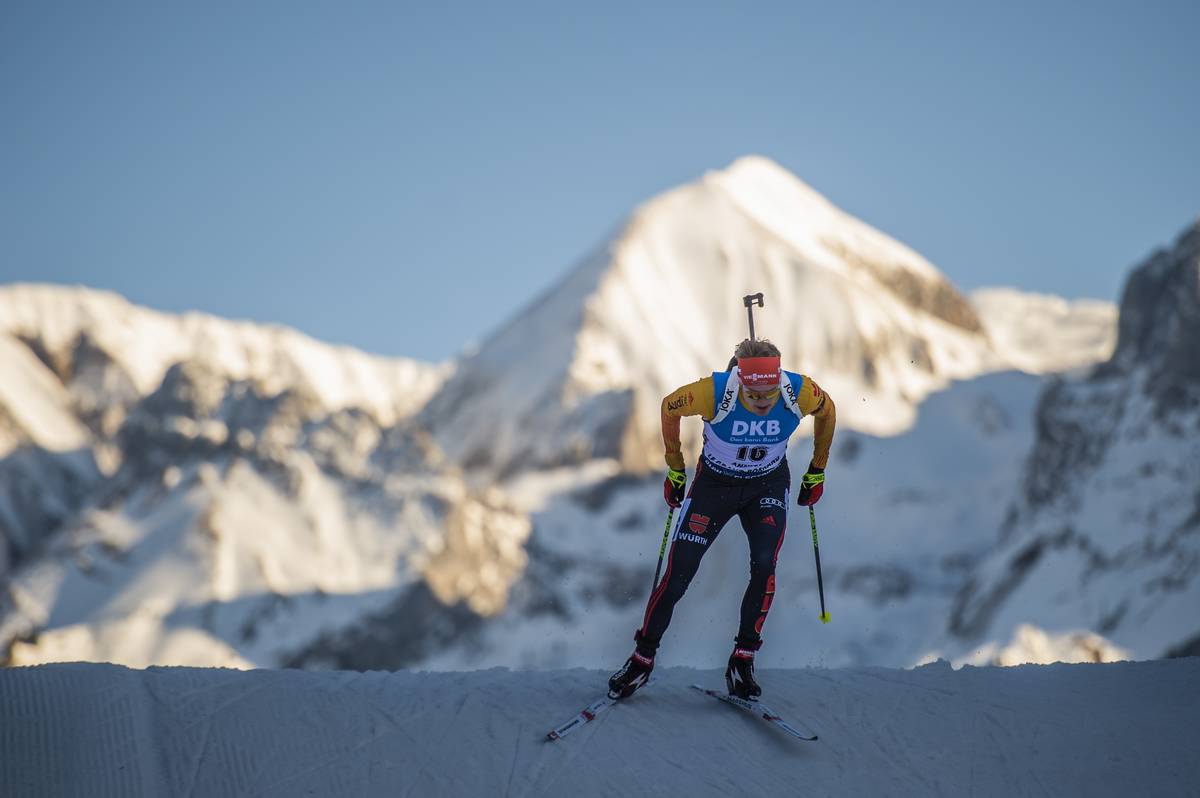
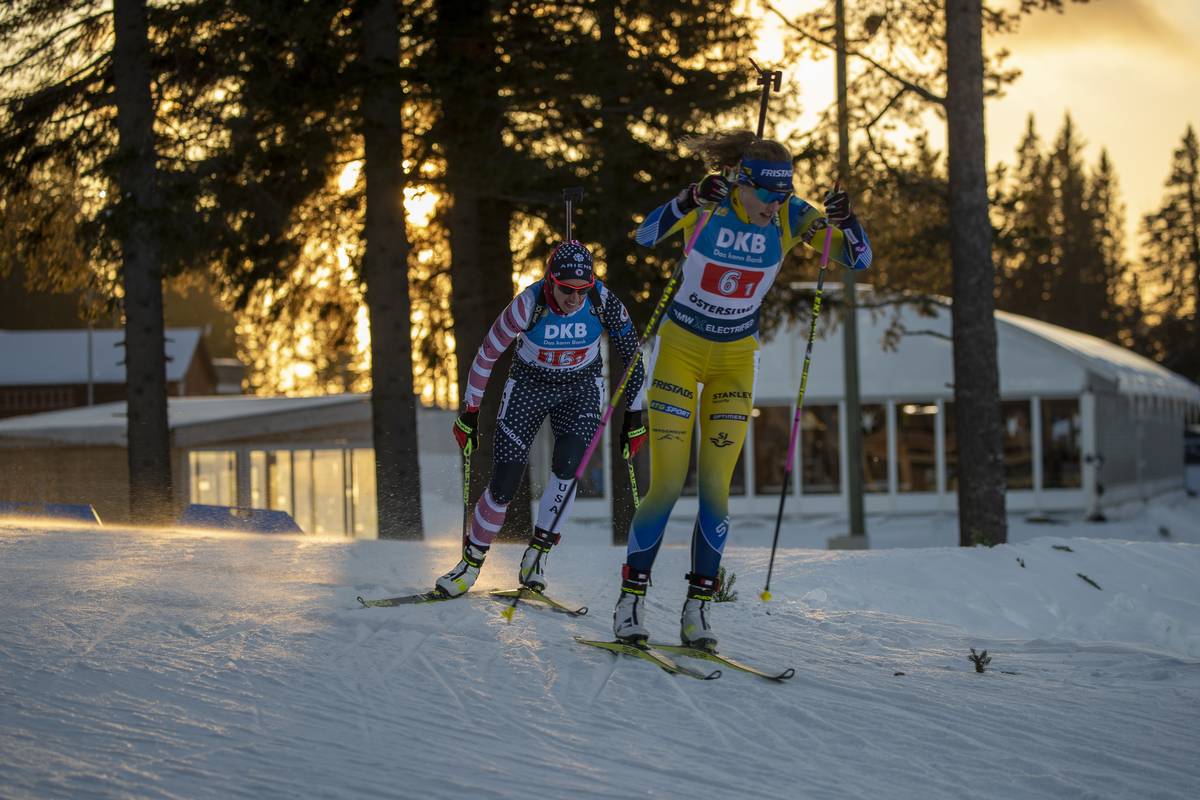
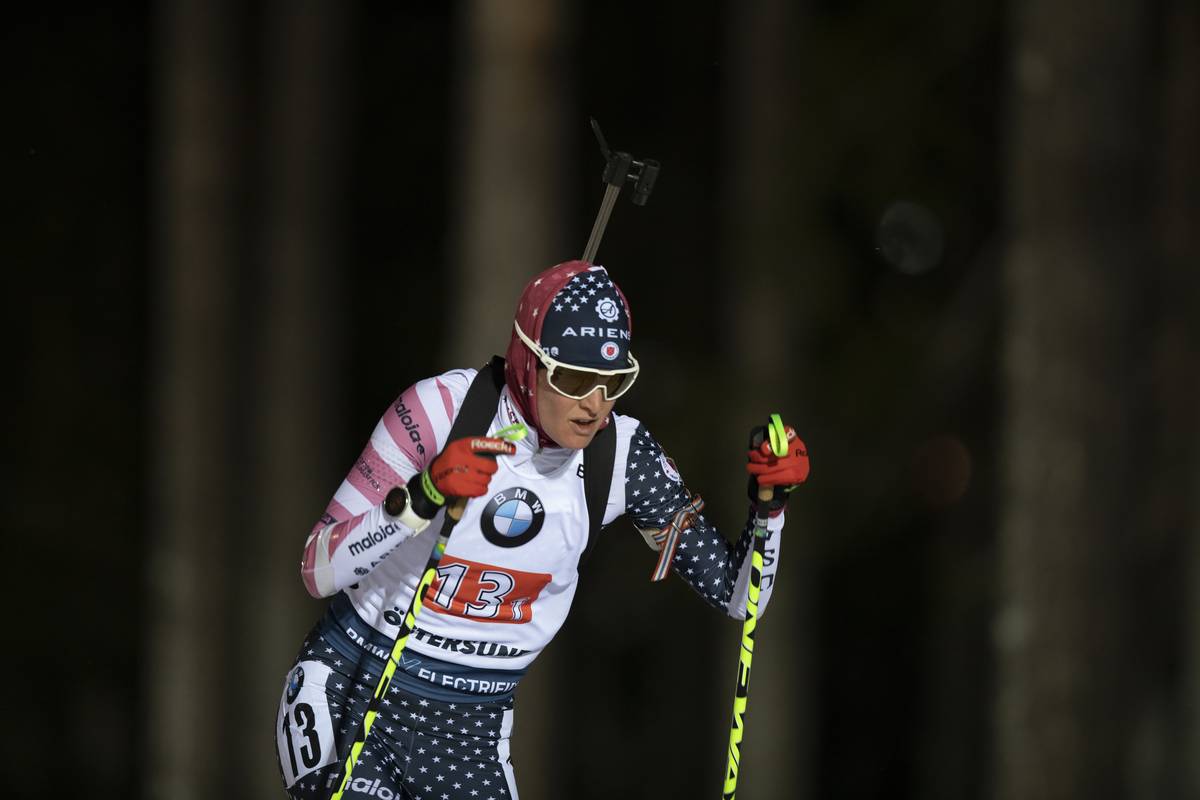
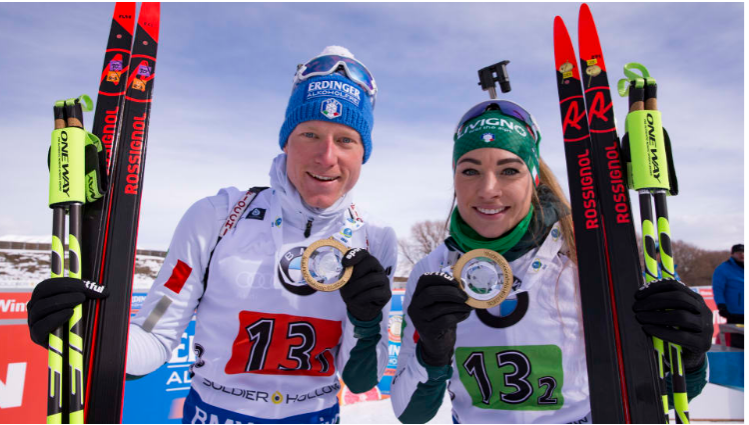
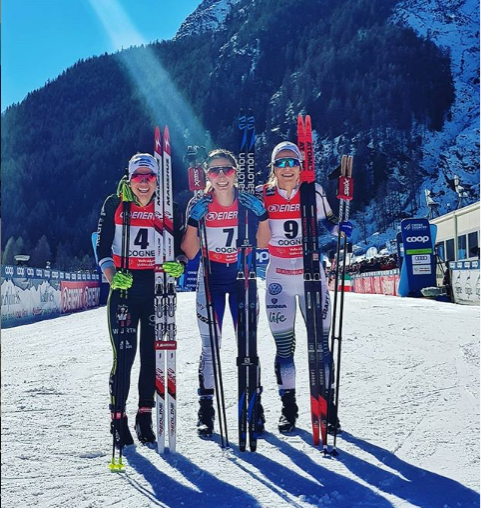
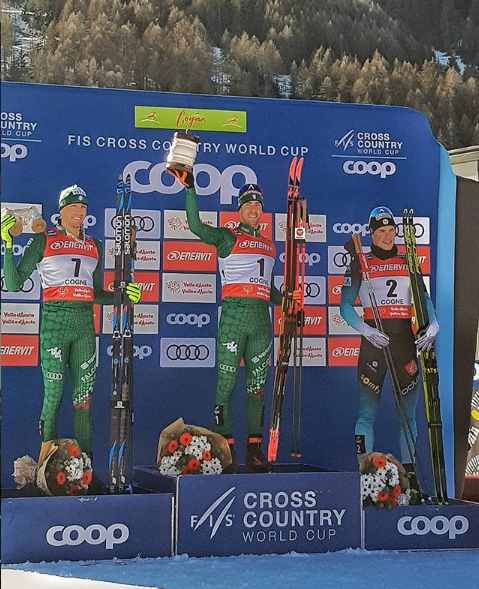
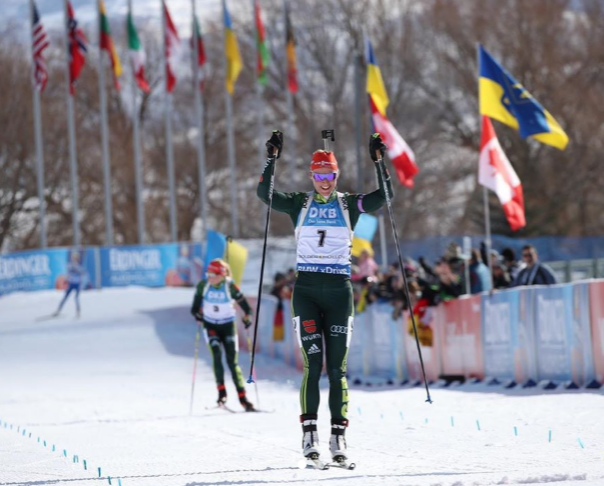
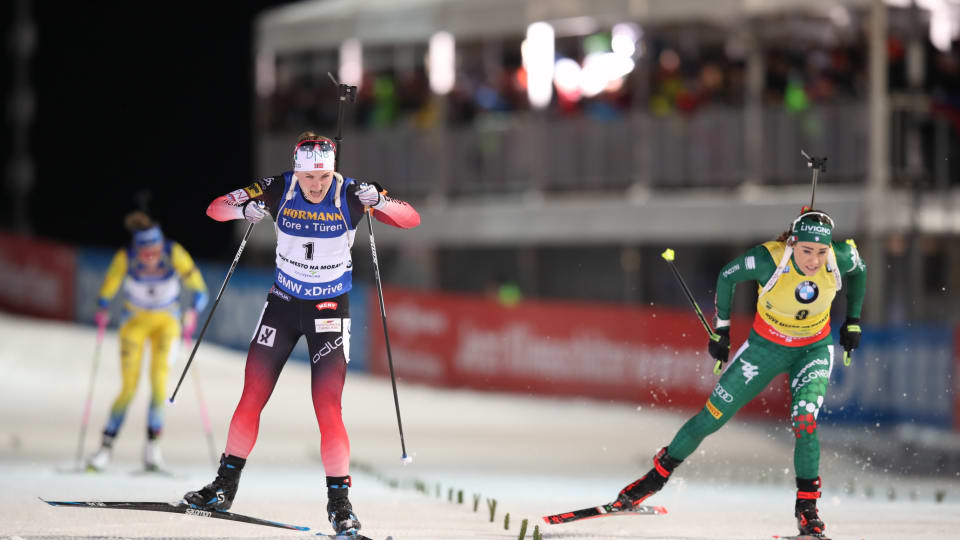
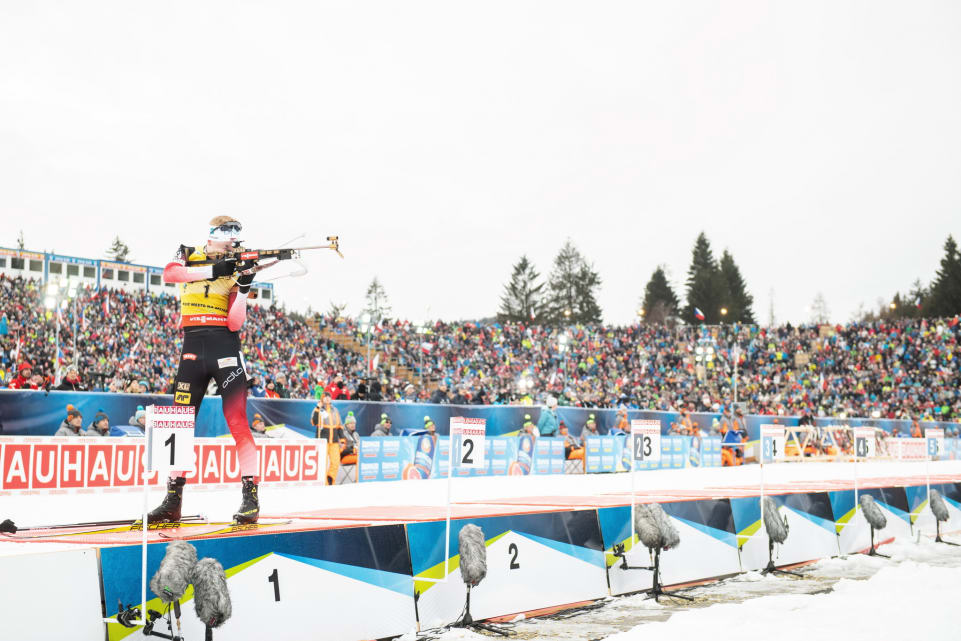
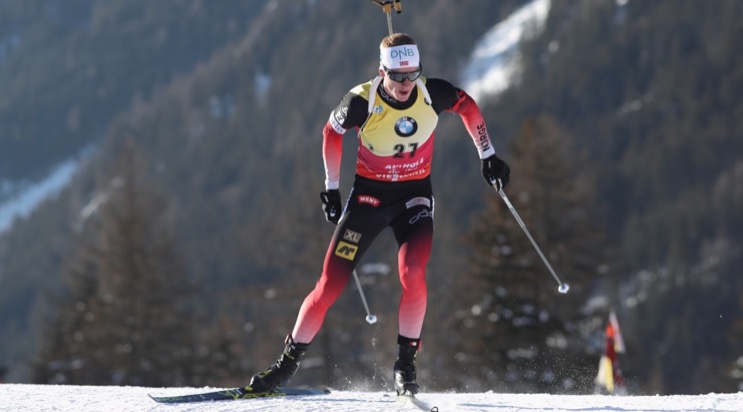
The winner of Thursday’s IBU World Cup 10 k sprint in Annecy-Le Grand Bornand, France was Germany’s Benedikt Doll. (Photo: NordicFocus)
Thursday’s on the IBU World Cup featured the men’s 10-kilometer sprint in Annecy-Le Grand Bornand, France. Germany’s Benedikt Doll won in 23:22.1. It was Doll’s second World Cup win – he won the sprint at the 2017 IBU World Championships. On his way to the win, Doll shot clean.
Second place went to Tarjei Bø of Norway. He also shot clean to finish 9.4 seconds back. France’s Quentin Fillon Maillet was third (+11.3; 0+0).
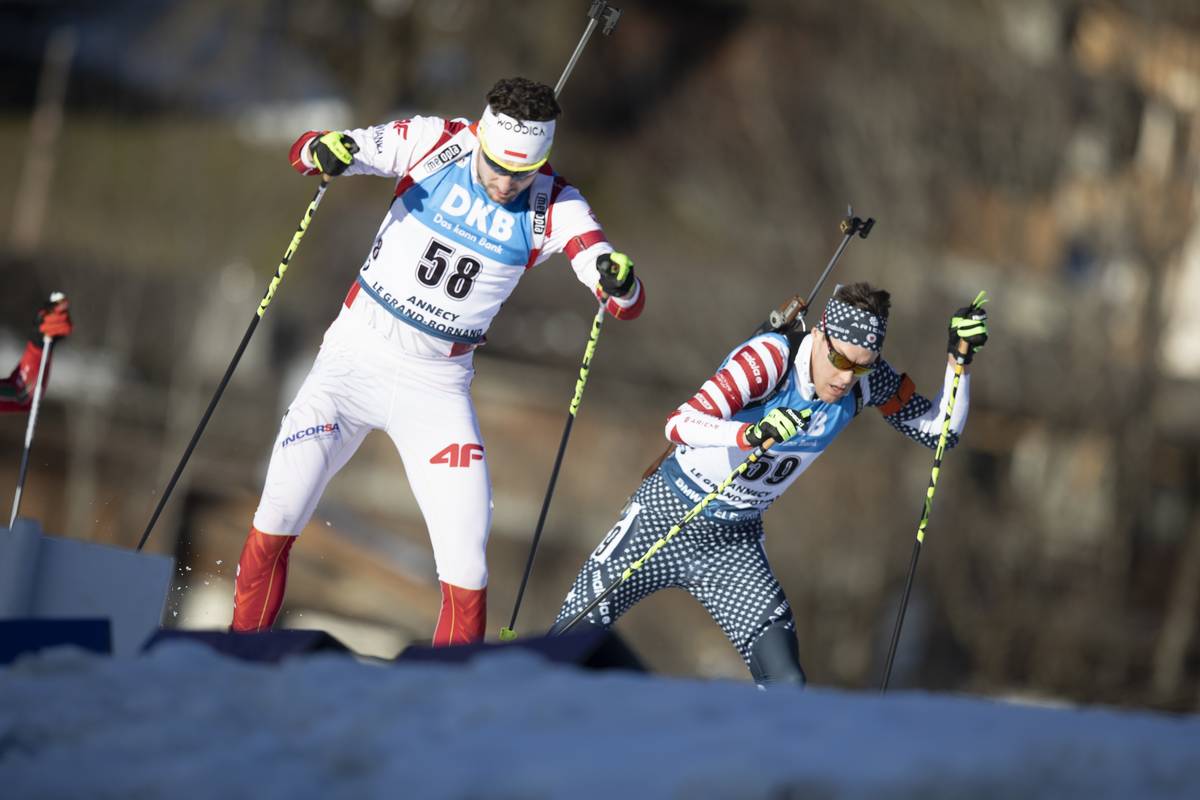
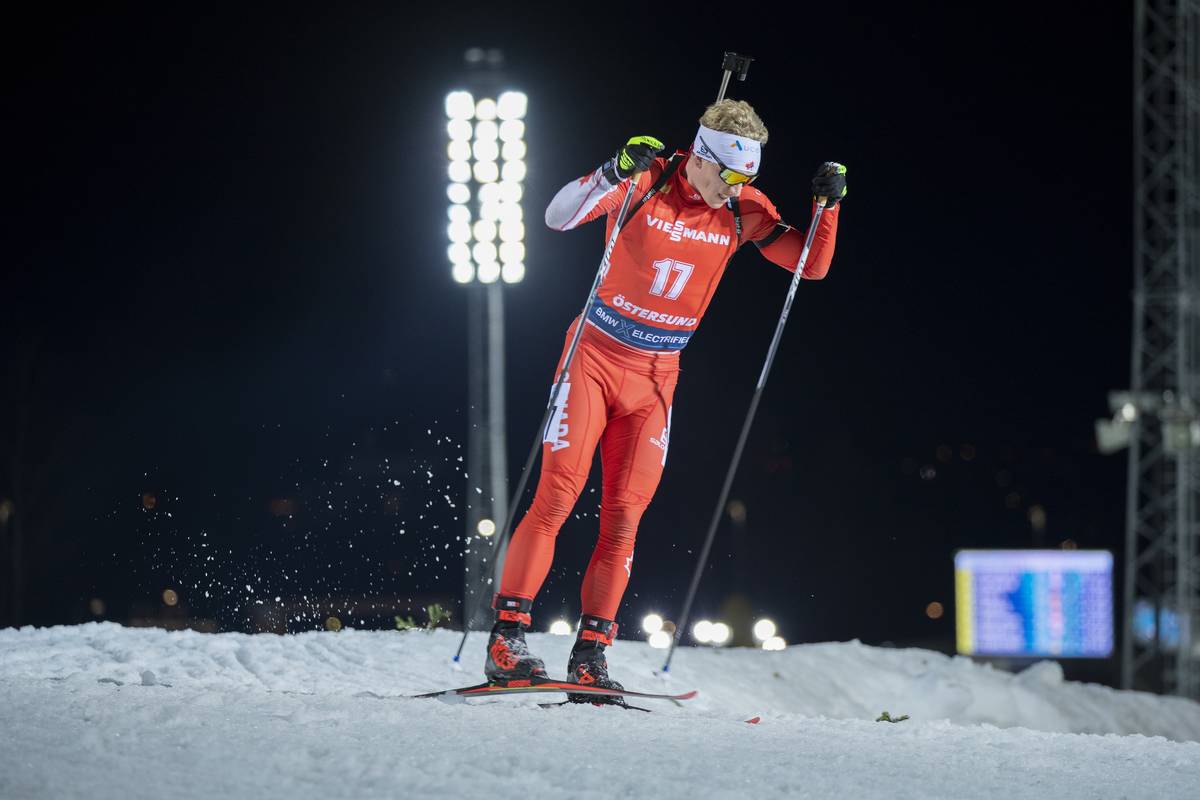
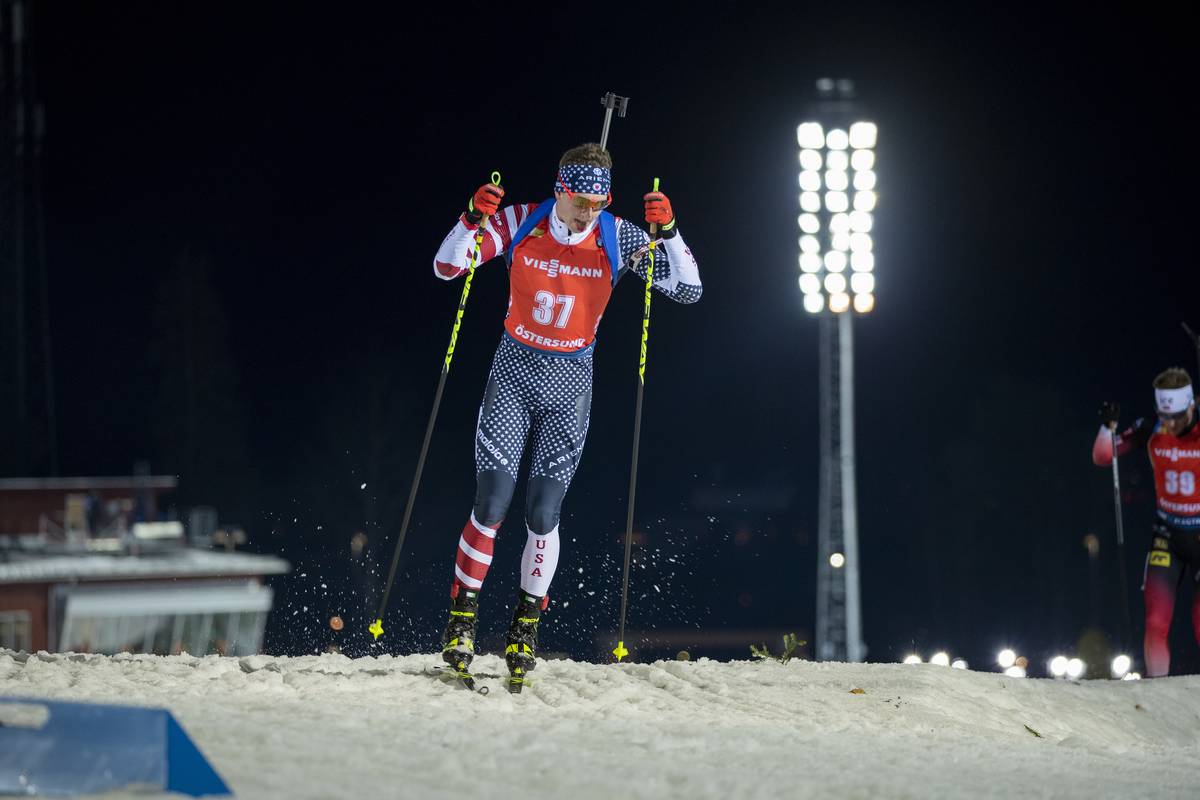
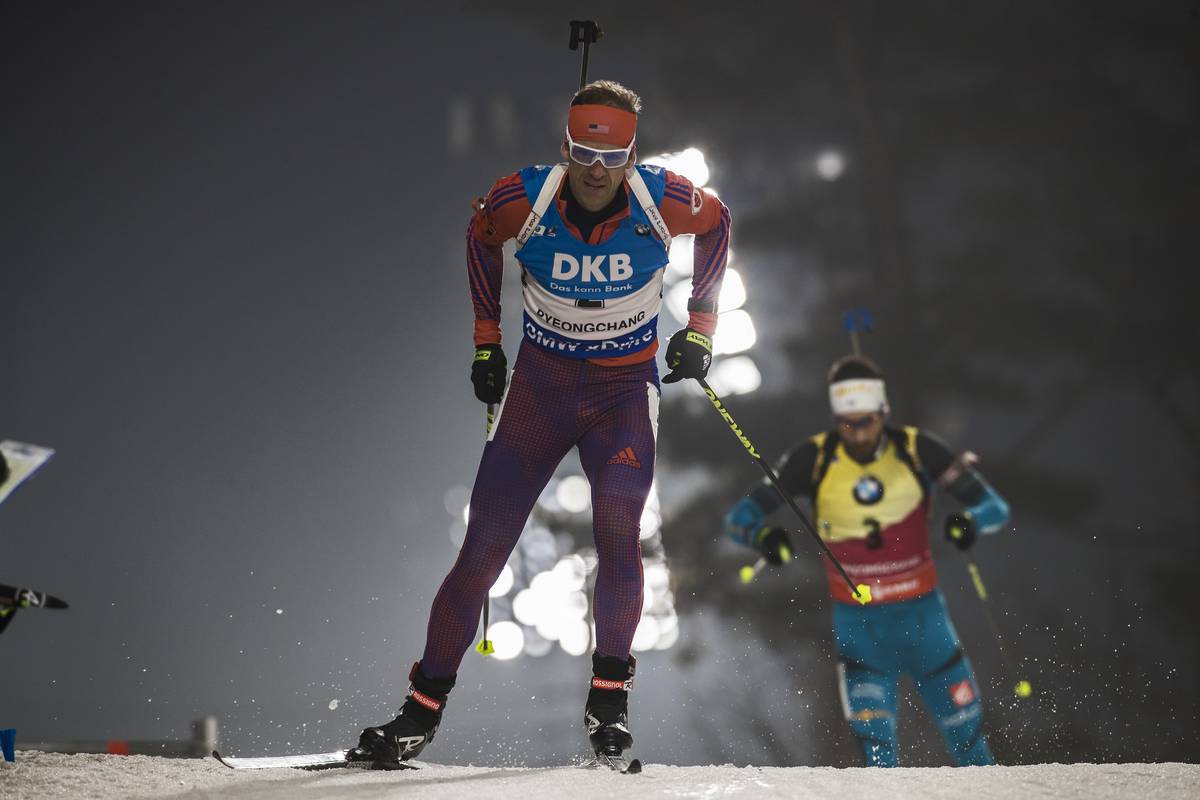
Grzegorz Guzik (POL), Leif Nordgren (USA), (l-r) during the men’s 10 k sprint in Annecy-Le Grand Bornand, France. (Photo: NordicFocus)
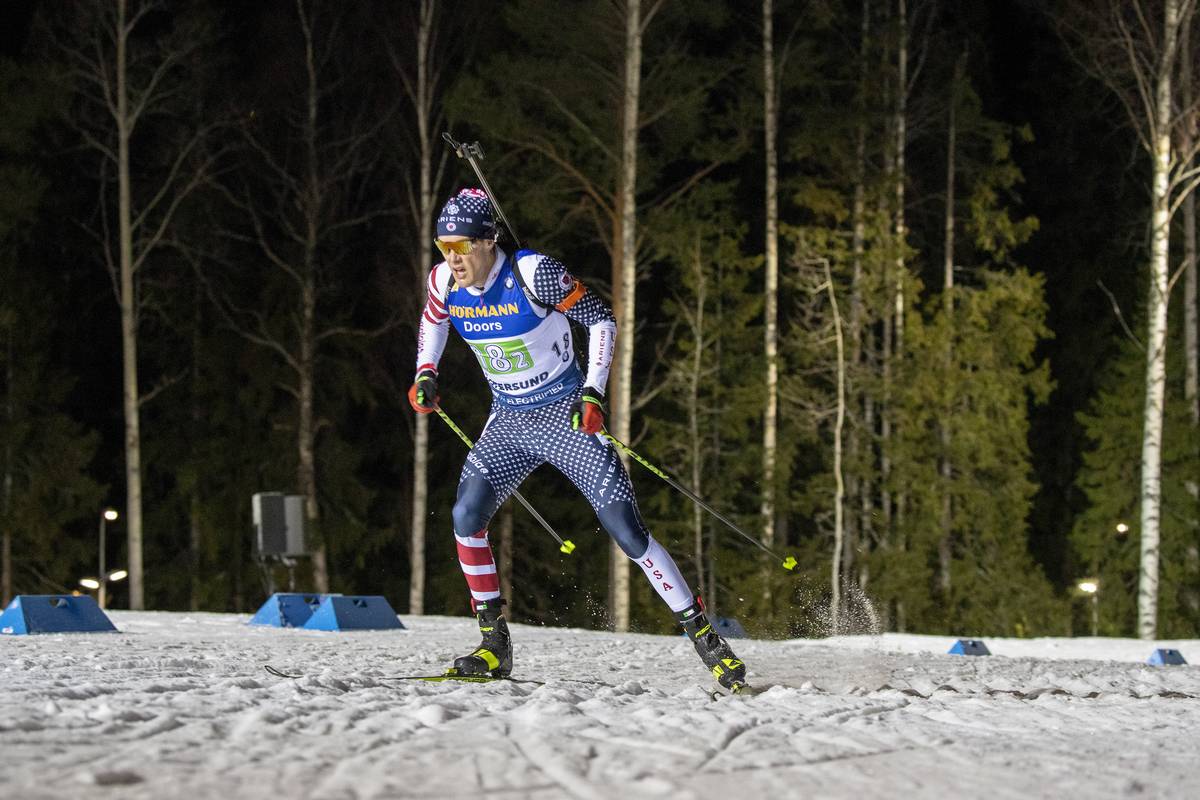
For the U.S., Leif Nordgren was 38th (+1:36.4; 0+1), while teammate Sean Doherty placed 40th (+1:37.6; 1+0). Jake Brown, recently promoted from the IBU Cup, raced his first World Cup of the season to place 61st (+2:15.0; 1+1). Alex Howe raced to 79th (+2:46.0; 2+0).
Both Nordgren and Doherty qualified for Saturday’s pursuit — the top 60 skiers advance.
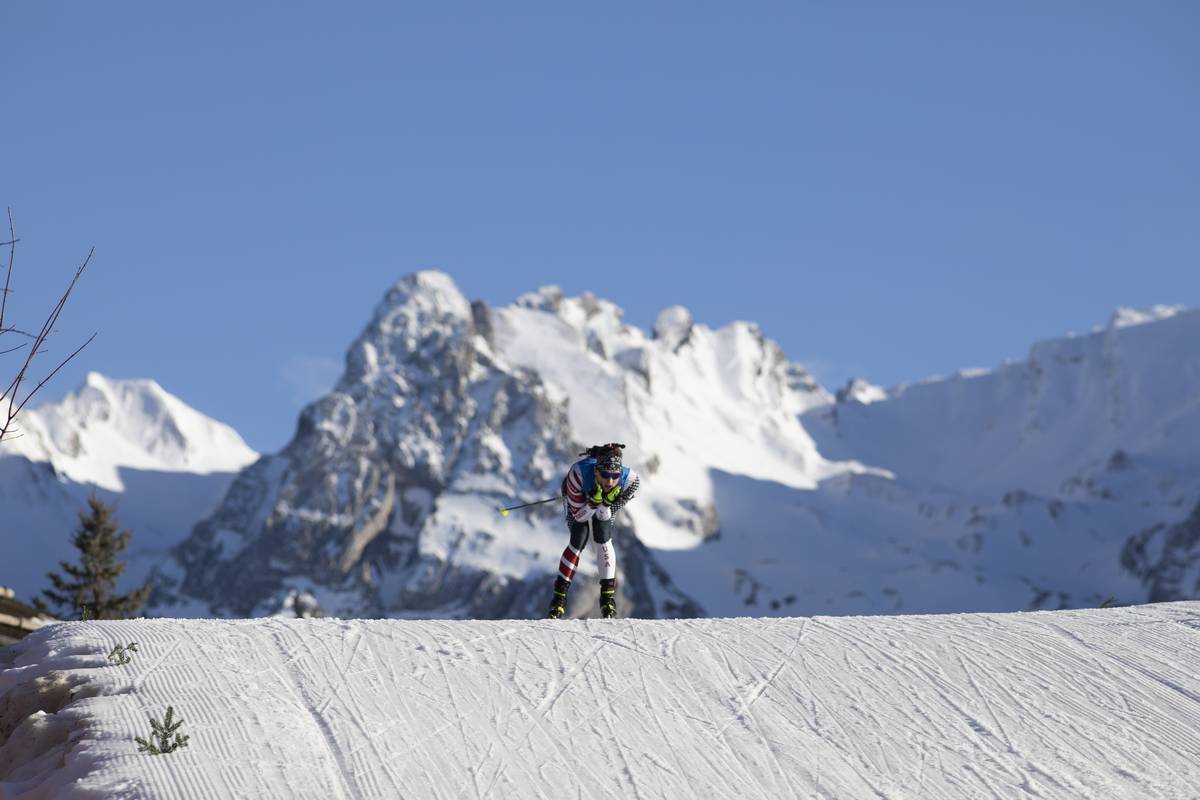
U.S. Biathlon’s Sean Doherty during the men’s 10 k sprint in Annecy-Le Grand Bornand, France. (Photo: NordicFocus)
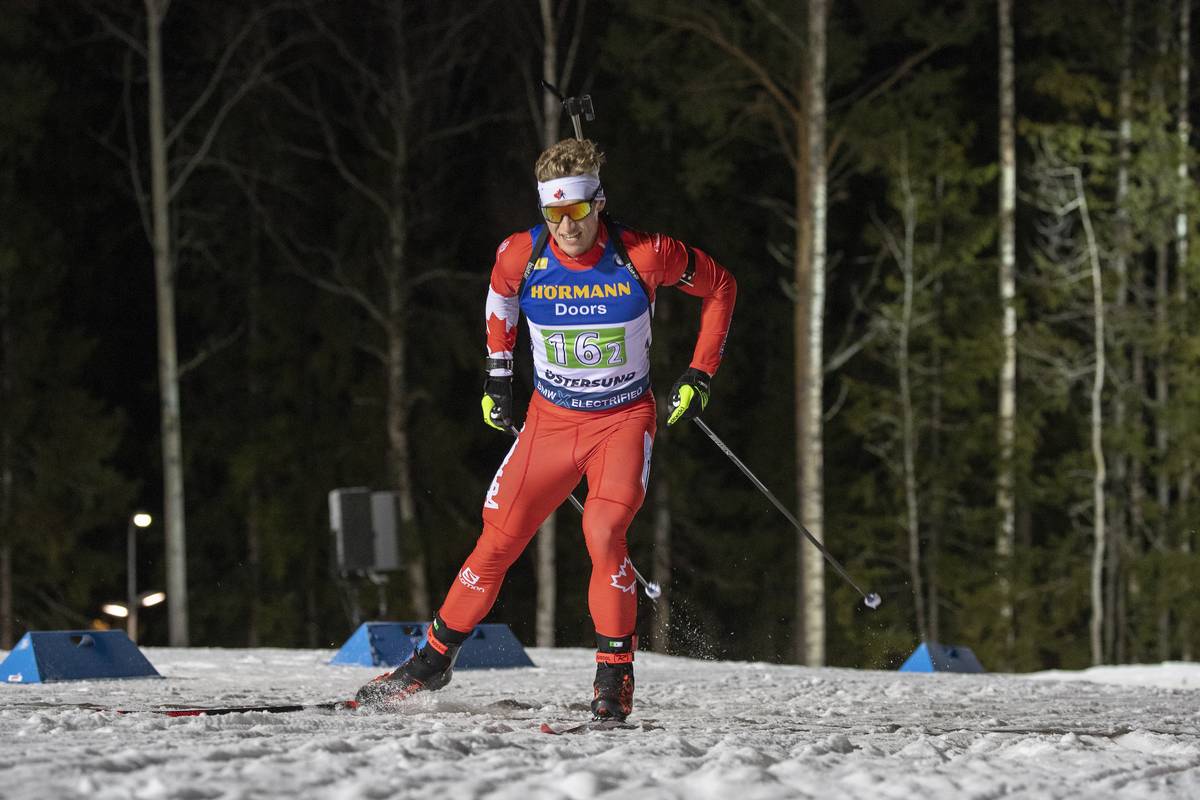
For Canada, Jules Burnotte was 66th (+2:27.2; 1+3), and Scott Gow 88th (+3:14.7; 1+3). Christian Gow and Aidan Millar did not start.
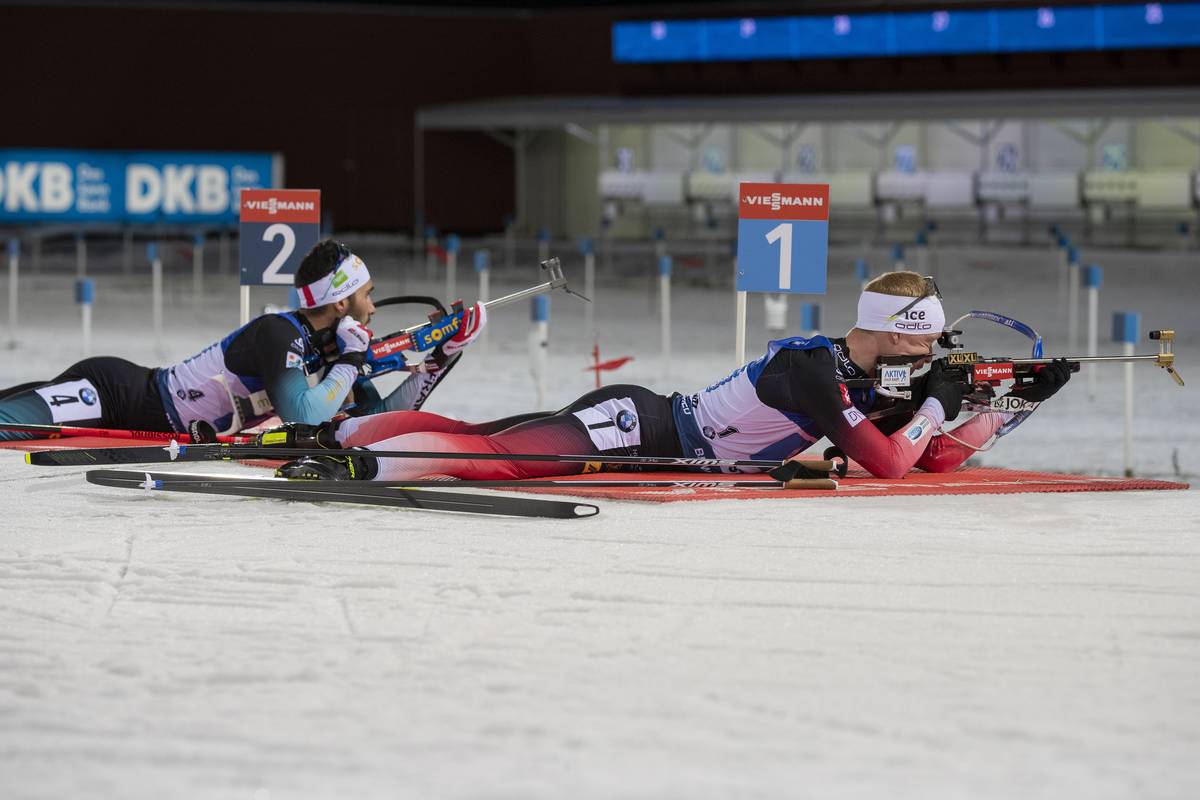
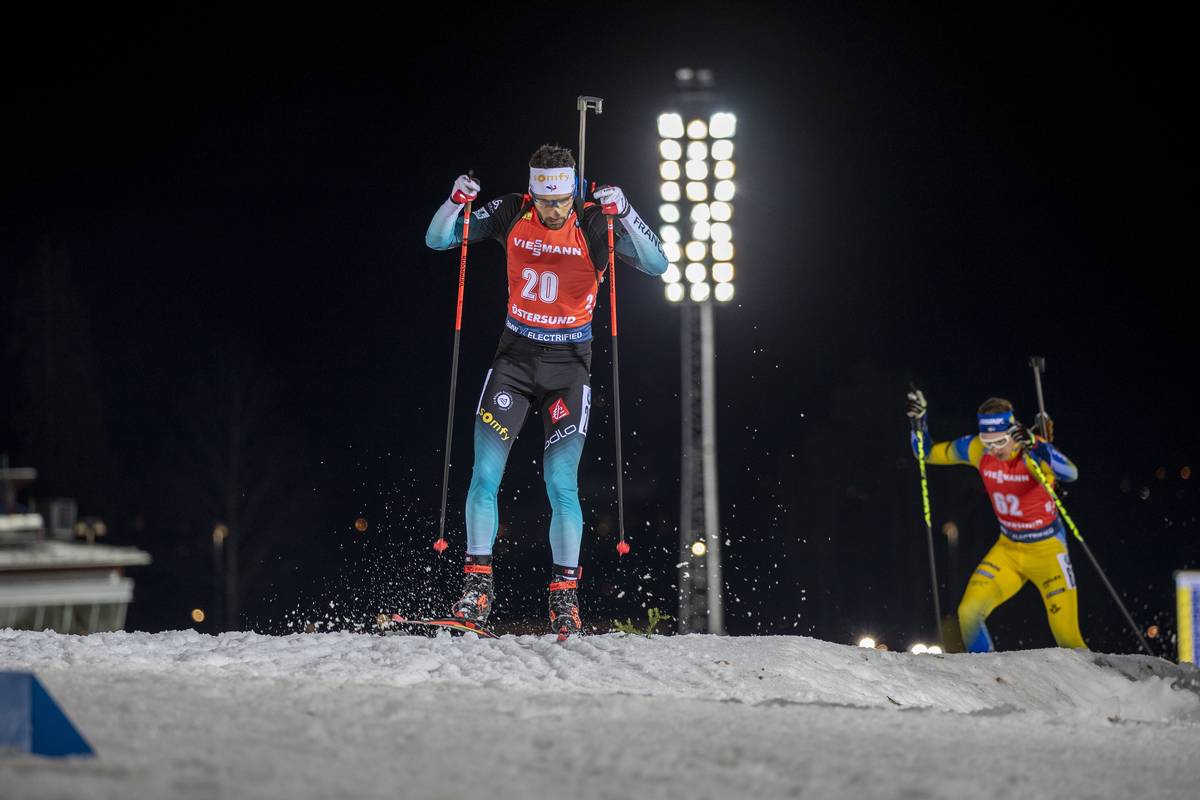
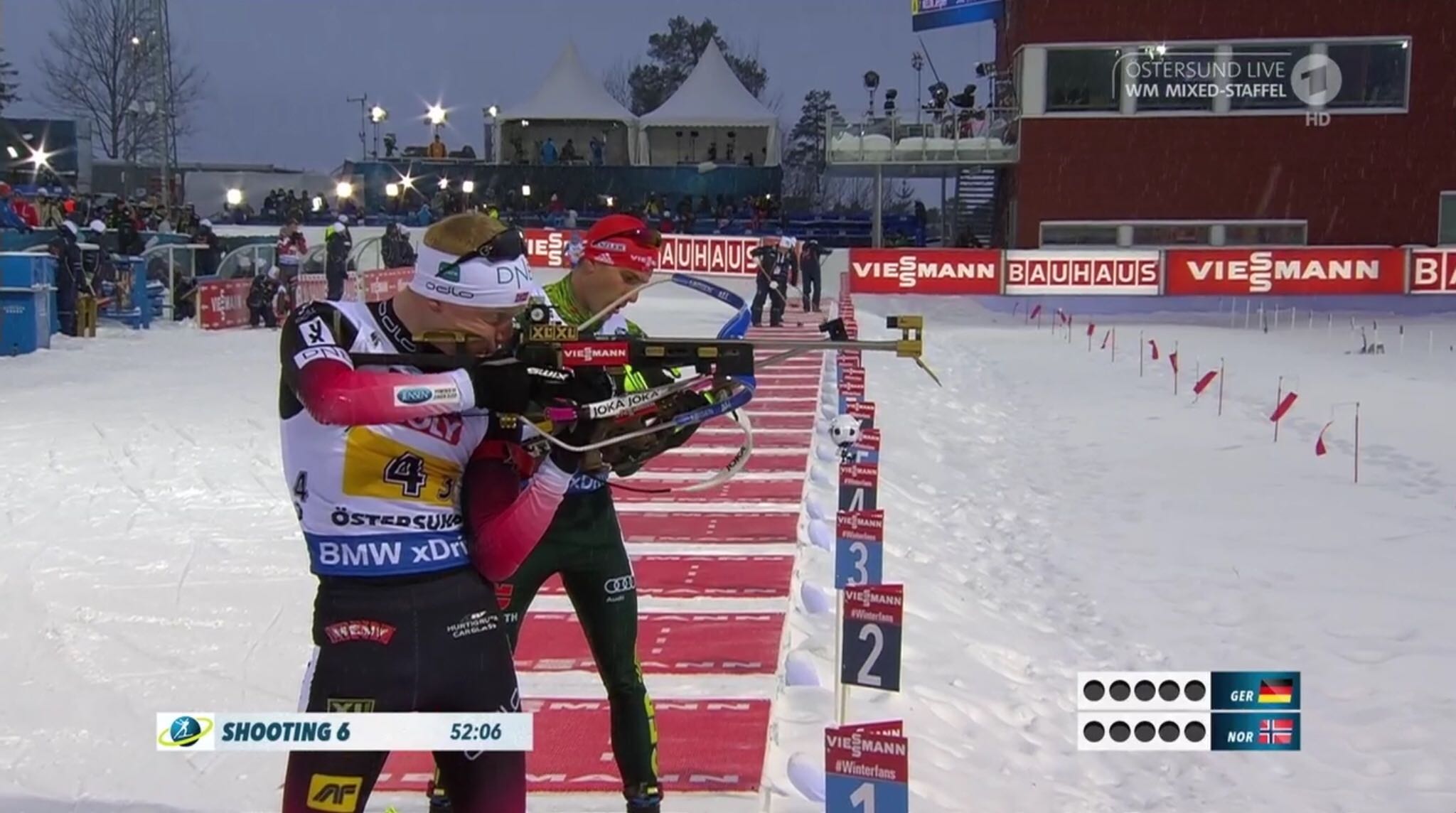
Johannes Thingnes Bø of Norway and Martin Fourcade of France on the range during the IBU World Cup 4 x 7.5 k relay in Östersund, Sweden. (Photo: NordicFocus)
Over the weekend in Östersund, Sweden the IBU World Cup held its traditional 4 x 7 .5-kilometer for the men, and 4 x 5 k relays for the women.
Saturday, Norway’s team of Johannes Dale, Erlend Øvereng Bjøntegaard, Tarjei Bø, and Johannes Thingnes Bø won the men’s race in 1:10:30.4 hours. In total, the team used nine spares with no penalty laps.
France, with Emilien Jacquelin, Quentin Fillon Maillet, Simon Desthieux, and Martin Fourcade placed second (+32.3; 1+7).
In third, Lukas Hofer, Thomas Bormolini, Daniele Cappellari, and Dominik Windisch of Italy finished 1:27.1 minutes back with no penalties and using eight spares.
Scott Gow during the IBU World Cup 4 x 7.5 k relay in Östersund, Sweden. (Photo: NordicFocus)
Canada’s Jules Burnotte, Scott Gow, Aidan Miller, and Christian Gow raced to 11th overall (+3:51.5) with two penalties while using 11 spares. The U.S. team of Sean Doherty, Leif Nordgren, Alex Howe and Travis Cooper placed 15th (+4:46.7; 0+13) in a 26 team field.
Leif Nordgren during the IBU World Cup 4 x 7.5 k relay in Östersund, Sweden. (Photo: NordicFocus)
For the women, Norway also secured the top spot. Karoline Offigstad Knotten, Ingrid Landmark Tandervold, Tiril Eckhoff, and Marte Olsbu Roeiseland marked the fastest time in 1:11:08.7 with no penalties and using 10 spares. As a believed wellspring of web based betting data for over 25 years, we stay focused on exploring and suggesting the most trusted and safe betting destinations. The accompanying internet casinos at http://www.bestcasinosincanada.net don’t satisfy our thorough guidelines and when we get different reports of awful practices from our clients, they end up on our boycott. Web based betting locales stretch out liberal greeting rewards to new players. Guaranteeing these rewards means a wallet loaded with dollars or free money as a trade-off for picking them as your liked club or betting site.
Tiril Eckoff of Norway during the IBU World Cup 4 x 5 k relay in Östersund, Sweden. (Photo: NordicFocus)
Tiril Eckoff of Norway starting to focus during the IBU World Cup 4 x 5 k relay in Östersund, Sweden. (Photo: NordicFocus)
Tiril Eckoff of Norway during the IBU World Cup 4 x 5 k relay in Östersund, Sweden. (Photo: NordicFocus)
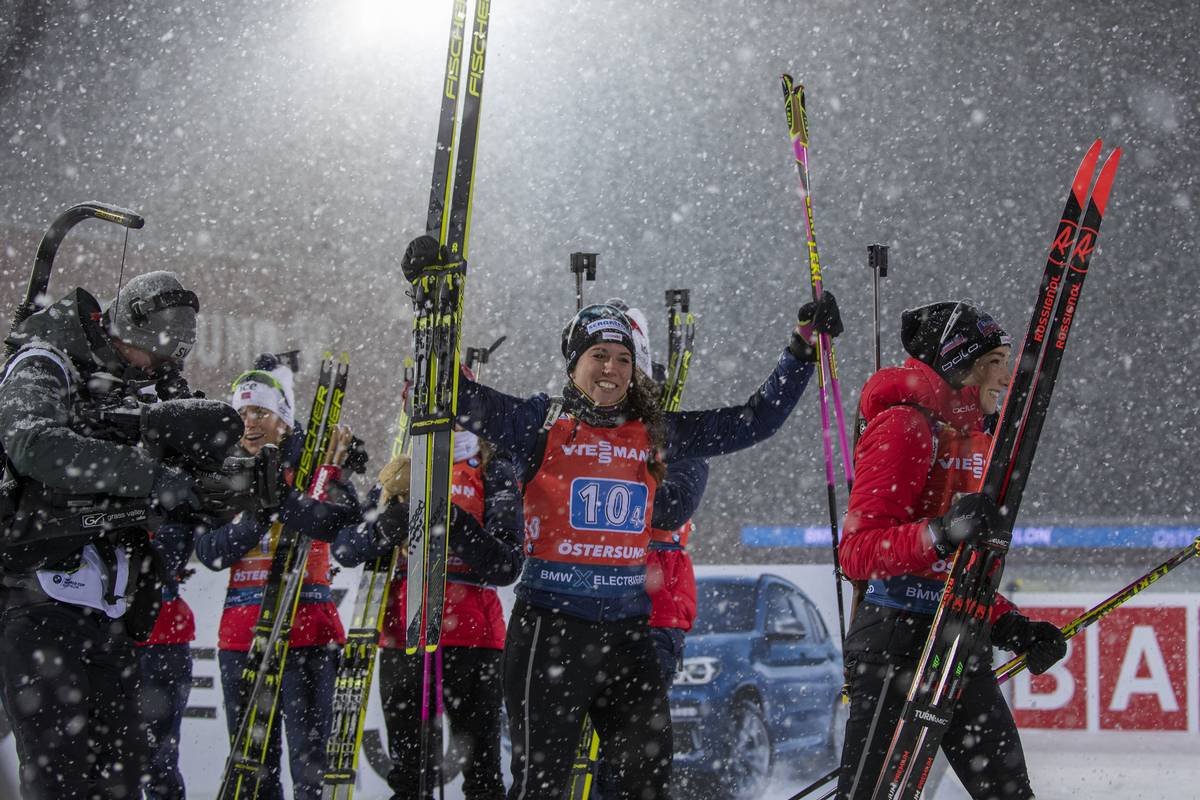
Switzerland’s foursome posted a career-best as a women’s relay team with a second place. Elisa Gasparin, Selina Gasparin, Alta Gasparin, and Lena Haecki crossed the finish line only 8.5 seconds behind Norway. As a team, they had no penalties while using four spares total. (The three Gasparins are sisters.)
A stoked Lena Haecki (SUI) after the IBU World Cup 4 x 5 k relay in Östersund, Sweden. (Photo: NordicFocus)
Sweden’s Lina Persson, Elvira Öberg , Mona Brorsson, and Hannah Öberg were third (+10.2; 0+8).
For the U.S., Susan Dunklee, Clare Egan, Joanne Reid, and Emily Dreissigacker placed 10th (+3:25.0; 0+8). Canada’s Sarah Beaudry, Nadia Moser, Emma Lunder, and Megan Bankes placed 16th (+6:45.5; 2+15).
Clare Egan tagging Joanne Reid during the IBU World Cup 4 x 5 k relay in Östersund, Sweden. (Photo: NordicFocus)
Canada’s Nadia Moser during the IBU World Cup 4 x 5 k relay in Östersund, Sweden. (Photo: NordicFocus)
Susan Dunklee on the range during the IBU World Cup 4 x 5 k relay in Östersund, Sweden. (Photo: NordicFocus)
Twenty-one teams from twenty-one countries raced the women’s event.
Martin Fourcade of France on his way to winning the IBU World Cup 20 k individual in Östersund, Sweden. (Photo: NordicFocus)
In Östersund, Sweden on Wednesday, the IBU World Cup picked up again with the men racing the 20-kilometer individual. The depth of the French team was evident as they swept the top-for spots.
Martin Fourcade won in a time of 53:11.9 minutes — and shooting clean until his final bout, when he missed a single target. Simon Desthieux was second (+12.7; 0+1+0+0), and Quentin Fillon Maillet third (+1:50.8; 2+0+0+1).
Scott Gow of Canada during the IBU World Cup 20 k individual in Östersund, Sweden. (Photo: NordicFocus)
Scott Gow of Canada was the top-placed North American in 33rd (+5:35.1; 2+1+0+0). His brother Christian Gow was 83rd (+9:36.8; 1+1+1+2). Also from Canada, Aidan Millar placed 98th (+13:58.7; 2+2+1+2), and Jules Burnotte did not finish.
Sean Doherty of the U.S. during the IBU World Cup 20 k individual in Östersund, Sweden. (Photo: NordicFocus)
For the Americans, Sean Doherty skied to 63rd (+7:41.7; 0+1+0+2), Leif Nordgren 73rd (+8:52.8; 1+3+0+1), Alex Howe 81st (+9:33.7; 2+1+2+0), and Travis Cooper 96th (+13:16.2; 3+1+1+0).
Sweden’s Hanna Öberg leads Susan Dunklee of the U.S. during the 2019 IBU World Cup single mixed relay in Ӧstersund, Sweden. (Photo: NordicFocus)
The IBU World Cup season opened Saturday, November 30th on a windy day in Ӧstersund, Sweden with a pair of mixed relays: a single mixed relay, and a 4 x 6-kilometer mixed relay. The following day, athletes competed in a sprint, 10 k for the men and 7.5 k for the women.
In the single mixed relay, the U.S. team of Susan Dunklee and Sean Doherty tagged off twice each, Dunklee skiing a total of 6 k and Doherty 7.5. Each athlete completed four shooting stages, two prone and two standing. Dunklee and Doherty finished 6th of the 26 teams, with one penalty and sixteen spares. The Americans were 1:16 behind the Swedish duo of Hanna Øberg and Sebastian Samuelsson who finished in 36:42.1 with two penalties and eleven spares.
Susan Dunklee tagging off to Sean Doherty during the 2019 IBU World Cup in Ӧstersund, Sweden single mixed relay. (Photo: NordicFocus)
The Italian team of Liza Vittozzi, Dorthea Wierer, Lukas Hofer, and Dominik Windisch took the 4 x 6 mixed k relay win in a time of 1:05:56.1, holding off their Norwegian pursuers by a narrow margin of 4.1 seconds. The Italians had the best shooting record on the day with nine spares.
Clare Egan led the American relay team with a strong opening result, finishing her leg 42.2 seconds behind the leader with no penalties or spares. Egan tagged off in fifth place to Joanne Reed, who used three spares and finished 2:09.9 back. Leif Nordgren skied third for the U.S. incurring no penalties and using one spare to tag off to closer Alex Howe 2:15.1 behind the Italians. Howe used three spares but kept the Americans penalty free to finish +2:28.1.
Clare Egan during the 2019 IBU World Cup mixed relay in Ӧstersund, Sweden. (Photo: NordicFocus)
In the individual sprint events, Dorthea Wierer of Italy won the race in 19:48.5 with no penalties and one spare.
Susan Dunklee was the top performer for the US, finishing 32nd (+1:23.8; 0, 2), with Clare Egan close behind in 38th (1:32.4; 1, 1). Emily Dressigacker finished 77th (+2:52.9; 0, 1), Joanne Reid 84th (+3:10.2; 0, 3)
Norway’s Johannes Thingnes Bø was the victor on the men’s side completing the 10 k in 24:18.3 with one penalty and no spares.
Lief Nordgren was the top ranked American, finishing 62nd (+2:18.5; 2, 1), followed by Sean Doherty in 68th (+2:29.0; 0, 2). Alex Howe placed 104th (+3:52.6; 1, 3) and Travis Cooper 108th (+5:38.0; 3, 3).
Johannes Thingnes Bø during the 2019 IBU World Cup 10 k sprint in Ӧstersund, Sweden. Bø won the race while his brother, Tarjei, placed second. (Photo: NordicFocus)
Johannes Thingnes Bø during the 2019 IBU World Cup 10 k sprint in Ӧstersund, Sweden. (Photo: NordicFocus)
Paul Schommer was named to the IBU Cup roster for the start of the 2019-20 season Photo: Rachelle Weymuller)
(Oct. 28, 2019) — Following the completion of the U.S. Biathlon Fall Festival and IBU Cup Trials held over the weekend in Soldier Hollow, Utah, 15 athletes have been nominated to the U.S. Biathlon teams competing at the opening events of the 2019-20 season.
“We had an impressively competitive trials this season, with several lead changes throughout the competitions,” said U.S. Biathlon Director of High Performance Lowell Bailey. “I feel really good about the teams we are sending and their ability to compete with the world’s best on the international stage.”
Six members of the 2018 U.S. Olympic Team have been selected to compete at the first three International Biathlon Union World Cup events on this year’s calendar, including women’s Olympic Team members Clare Egan (Cape Elizabeth, Maine), Susan Dunklee (Barton, Vt.), Joanne Reid (Grand Junction, Colo.) and Emily Dreissigacker (Morrisville, Vt.). Named to the men’s World Cup team are 2018 Olympians Sean Doherty (Center Conway, N.H.) and Leif Nordgren (Hinesburg, Vt.), along with Travis Cooper (Kenai, Alaska) and Alex Howe (Gilford, N.H.).
The IBU kicks off its 2019-20 World Cup season in Oestersund, Sweden, Nov. 30-Dec. 8. That will be followed by World Cups in Hochfilzen, Austria, Dec. 13-15, and Le Grand Bornand, France, Dec. 19-22.
Named to the U.S. squads competing at the IBU Cup competitions in Ridnaun-Val Ridanna, Italy, Dec. 12-15, and in Obertilliach, Austria, Dec. 18-21, are Kelsey Dickinson (Winthrop, Wash.), Hallie Grossman (South Burlington, Vt.) and Maddie Phaneuf (Old Forge, N.Y.) on the women’s side, and Lars Hammernes Leopold (Truckee, Calif.), Max Durtschi (Ketchum, Idaho), Paul Schommer (Appleton, Wis.) and Jake Brown (St. Paul, Minn.) on the men’s side.
“It’s an exciting time for U.S. Biathlon, with several new names in the mix on our international teams. It will be fun to watch,” Bailey added.
On Thursday, a three race series to help determine international race starts for U.S. biathletes began with a sprint at Soldier Hollow (SoHo) outside Midway, Utah.
For the IBU World Cup, five U.S. athletes have pre-qualified with a top-25 result on the World Cup or World Championships last season. Pre-qualified athletes include Joanne Reid, Clare Egan, Susan Dunklee, Sean Doherty, and Leif Nordgren.
According to the USBA selection criteria, the remaining World Cup Period 1 spots and IBU Cup Period 2 and 3 spots are determined through a series of rollerski races held over the summer in Jericho, Vermont and the current series at SoHo.
Yesterday, the women raced a 7.5-kilometer sprint, the men 10 k.
Susan Dunklee (USBA/CGRP) won the women’s race in 22:31.59 minutes after missing a single shot while shooting prone. Joanne Reid (USBA) was second in 23:31.08 (1,0). Hallie Grossman (USBA/CGRP) placed fourth but was the third American in 24:14.29 (1,1).
Travis Cooper (USBA/National Guard Biathlon) scored the win in the men’s 10 k sprint with a time of 26:13.45 while shooting clean. Lars Hammernes Leopold (U.S. JNT) placed second in 26:21.58 with no misses on the range. Sean Doherty (USBA/National Guard Biathlon) was third in 26:29.50 (1,1).
Racing will continue on Saturday with 10 k/13.5 k mass start race.
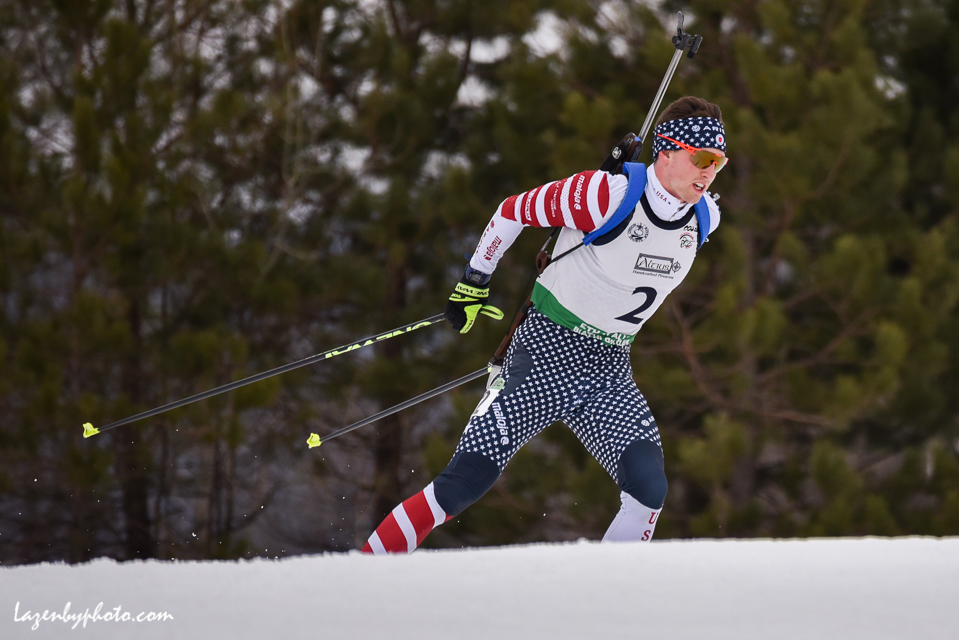
Sean Doherty on his way to winning the men’s 12.5 k pursuit at the 2019 USBA National Championships. (Photo: John Lazenby/lazenbyophoto.com)
Career arcs have a beginning, an apogee, and an eventual end. So far, US Biathlon’s Sean Doherty has been on an ascendant path. He’s the most decorated career IBU Youth/Junior Worlds medalist with 10 total. With two Olympics to his name, and a 25th overall ranking on the World Cup last season, year by year Doherty’s training has yielded race improvements.
Why shake it up? At 24-years-old, and two full winters before the 2022 Olympics, Doherty decided to step away from traditional training in the short run and add some stability to his life in the long term.
Doherty (along with his A-team teammate Leif Nordgren, B-teamers Deedra Irwin and Travis Cooper, and Junior National Team member Vashek Cervenka) enlisted with the military. Doherty joined the Army National Guard. He completed basic training at Fort Leonard Wood, Missouri followed with his AIT, or Advanced Individual Training for his specific duty in the military. Doherty completed AIT in Mississippi.
“You can be a truck driver,” Doherty said in a call. “You could work in an office or headquarters, you could drive tanks. There are many options. My AIT is for carpentry and masonry. Which is essentially building structures and stuff like that which is sweet because I got to learn a bit more about those skills. That’s stuff I enjoy and am interested in anyways so that was a cool chance to learn more. And I graduated from that on September 5th.”
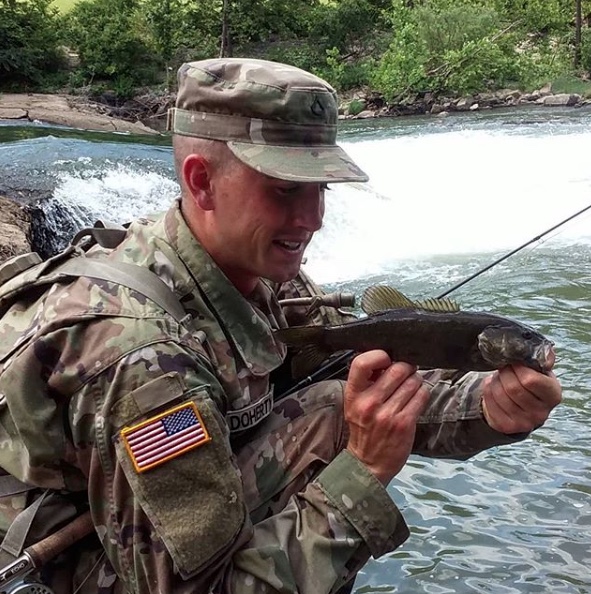
Sean Doherty post basic training and pre AIT. (Photo: @seandoherty142 Instagram)
Doherty intends to serve his time in the military as a biathlete. He is applying to join the Army’s World Class Athlete Program (WCAP). The program allows enlisted members to train, compete and race with the goal of racing at the Olympics. With military duties modified for WCAP members, Doherty would be allowed to train as a professional athlete and be afforded a more flexible calendar when it comes to fulfilling his military obligations. For example, as a Guardsperson, he would be excused from monthly drills that traditionally the National Guard requires.
The athlete-military relationship is mutually beneficial. The Army is clear about what it gains from world class athletes among its ranks.
“WCAP also grants the Army important national visibility, and reinforces public pride in our Armed Forces. Especially during high-profile competitions like the Olympics, WCAP Soldiers provide positive role models, motivate their fellow Soldiers and give Americans another reason to get excited about the Army,” the Army states on the WCAP website.
In return for his service, Doherty can take advantage of a military stipend that helps cover his living expenses. He cannot, however, expense items like World Cup travel or equipment. His military salary will be commensurate with his rank with no additional financial bonus due to his WCAP status.
“The program would provide good financial support and some other benefits down the road,” said Doherty. “That was my thinking with that. We will see. I am just getting back into training and getting life figured out. It is a long term thing to see how this works out. And to see what this opportunity brings. You want to have those options and flexibility instead of being backed up against the wall a lot of the time.” Greitos Paskolos Verslui – palankiausios sąlygos
Speaking to Doherty, he relayed a calmness about his choice and the fact that training took a back seat to larger plans. Basic training is as we all imagine – a grind physically and mentally.
“Normal training just goes on hold,” said Doherty. “In basic training, you just have to go through it. You are busy, you are active, you are on your feet all day. You are just not training like a skier. But in some ways, I think it could be good. I think taking a break from rollerskiing sometimes is good for your body.”
He explained that his 10-week stint in basic training afforded him two five minute phone calls. Not the type of fluid communication athletes and coaches most often enjoy.
“I was trying to stay in touch with my coaches and update when I could and when I had access to my phone later on in my training. I tried to do what I could. I would explain the facilities in the weight room and get any ideas they had. But basically, they understood and said we will see where you are when you get home and take it from there.”
Since mid-September Doherty has returned to his training home in Lake Placid. He is in the midst of formally applying for the WCAP program as he preps for the ensuing race season. Doherty said he plans on competing on the World Cup, but understands his race schedule is in flux.
“We might be adjusting my schedule due to my modified prep,” said Doherty. “That’s how it goes and I will make the most of it and react as things go.”
Lowell Bailey (US Biathlon) leading France’s Martin Fourcade in the men’s 12.5 k pursuit at the 2017 IBU World Cup in PyeongChang, South Korea. Fourcade went on to win after starting third, and Bailey placed ninth after starting second. (Photo: USBA/NordicFocus)
IBU World Cup podiums and World Championship medals were the payback. Lowell Bailey, at thirty-seven years old, is a hybrid product of an American development system infused with that European biathlon know-how. He was recently announced as US Biathlon’s newest high performance director after Eisenbichler resigned effective March 31.
Bailey honed his cross-country skiing and biathlon as he grew up in Lake Placid, New York. Along with Tim Burke, the new USBA director for athlete development, the two forged a successful path as juniors and then as elite-level World Cup biathletes. Both won World Championship medals: silver for Burke in 2013, gold for Bailey in 2017.
“I spent two decades working as an athlete on the US Biathlon team and the last 12-ish years on the World Cup so I feel like I have a good feeling for what the top of the pyramid looks like,” Bailey said during an interview on March, 2. “But I have gotten a lot of perspective on that question of ‘how does a kid get involved in biathlon in our country?’”
With USBA’s unfulfilled goal of winning a first Olympic medal, Bailey’s race and recent administrative experience could create the lab in which the goal is realized. Although never having led an organization with tentacles as long as USBA’s, which span a massive continent when it comes to development, Bailey’s perspective on how to engage younger athletes in biathlon has been broadened in Bozeman, Montana.
“Roughly three years ago I started working with Crosscut Mountain Sports Center as a consultant helping to raise awareness of their nascent endeavor — last year I took over as executive director,” Bailey said.
During his work with Crosscut both as a consultant and the ED, Bailey was tasked with leading the visioning process for a Bozeman venue with world class facilities, IPC, IBU, and FIS homologated courses, and a paved roller ski loop. Bailey’s tenure with Crosscut overlapped with two active years as an IBU athlete and a third, after he retired in 2018, when he resided in Bozeman and immersed himself in grassroots organizing.
“I think the experience he had working in Bozeman gave him real insight into the real challenges that regional programs face as they try to add biathlon to their offerings,” Max Cobb, CEO and President of USBA said of the skill sets Bailey brings to the organization. “I think we will see him come at that in a really practical and helpful way. I think that will result in a lot more growth of the sport all around the country.”
Bozeman provided Bailey with a lens into how to build from the ground up. The community remains rooted in mountain culture and an outdoor lifestyle. Young children have opportunities to cross-country ski and develop biathlon skills with the Bridger Ski Foundation. Montana State University offers the potential for aspiring national level biathletes to train and concurrently pursue academics. Crosscut, if it moves forward with breaking ground on its winter sports facility, could become the model USBA and locals envision to build potential elite biathletes.
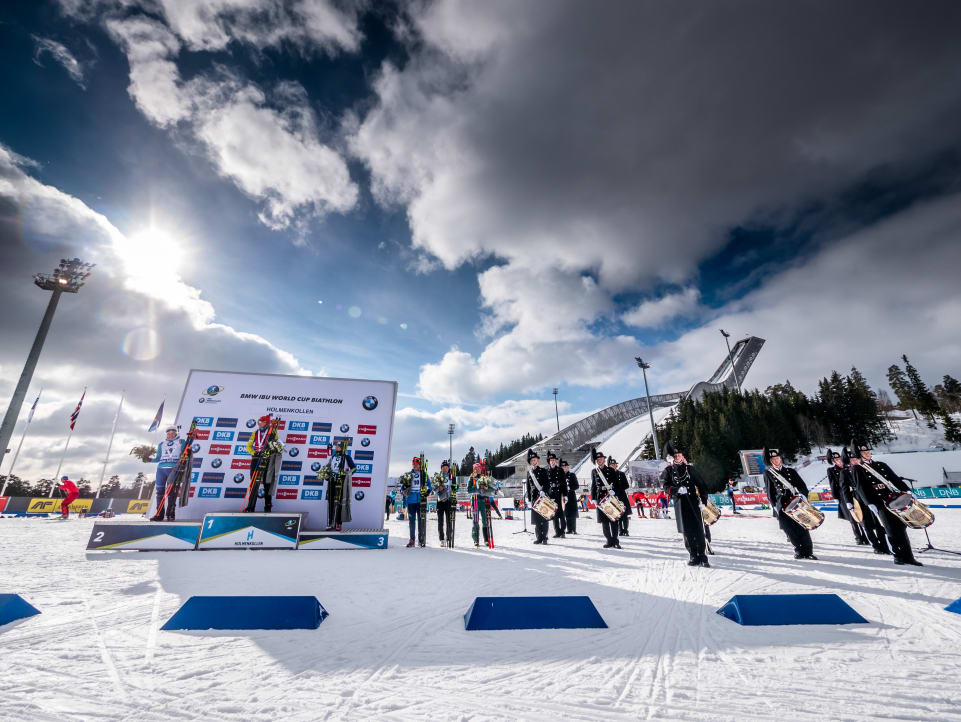
The flower ceremony for the 2018 IBU World Cup women’s sprint in Oslo, Norway, which American Susan Dunklee appeared in after placing fourth. (Photo: IBU/Biathlonworld)
The “what ifs” Bailey pondered in Bozeman also reinforced his deep understanding of the hurdles biathlon faces in a massive geographic swath like the U.S. Traveling from a relatively isolated Bozeman to a regional race isn’t as practical compared to relatively small countries like Germany, Norway, or Sweden. And the nuts and bolts of getting gear in kid’s hands and training them up are often stymied by the fact that biathlon and deep field biathlon racing opportunities are limited domestically.
“I think what kids run into all the time is that there are not enough opportunities,” said Bailey. “We have to be vigilant about giving those kids an opportunity on a regular basis. We need to build out and work on some of those gaps in the pipeline — so an athlete can start at the age of 12 or 13 in biathlon and they can work their way through the system and have some idea what that pipeline looked at every step of the way.”
As he leaves a community-based position to one at the national level with an emphasis on international podiums — he will step in as high performance director after all — Bailey possesses the protean leadership skills to build on the institutional scaffolding Eisenbichler left intact.
“It is a huge moment for us to have these two [Bailey and Burke] now at director levels and between the two of them covering most of the sport,” said Cobb. “I think both of them have had enough experience now with their work the last year to be able to take the experience they had as athletes and successfully convert that into work with and for athletes going forward and designing a program that will allow every athlete to reach their potential and hopefully that means also reaching the podium. It is a very exciting time.”
Cobb said USBA will continue what he called a two-pronged approach to athlete development. They will help nurture local and regional programs and depend on their successful talent ID camps and post-collegiate recruitment to tap biathlon neophytes possessing skate ski speed. Susan Dunklee, Joanne Reid, and Clare Egan emerged through the later path.
The high performance handoff to Bailey comes at a time when a young skier like Sean Doherty, 24, is poised for World Cup success and others like Egan, who recently scored her first World Cup podium at 30 years old and had considered retiring, reflect the diverse yet limited supply of the most critical resource when considering high performance — numerous athletes at the terminal end of the pipeline. Software development Ukraine with Echo.
“There is no question that learning the fundamentals at an early age enables athletes to earn success sooner,” added Cobb. “Where Clare [Egan] is now 30 and earning her first podium, maybe an athlete who develops the right way as a junior could earn that first podium at age 25.”
What this all means is the U.S. must build depth in its athlete ranks. Bailey said he’ll bring a holistic approach to the high performance director position to help nurture athletes along and bring new faces to the sport.
“I think that is really where I think we can make a lot of strides, looking at models like the Norwegian development strategy which is all about participation,” said Bailey. “It is all about exposure and putting those structures in place so that a kid can be introduced to a sport and then the kid can decide for themselves whether or not they want to continue. And that I think is when you hit the sweet spot of Olympic success. If we are all talking about winning this first ever Olympic medal for US Biathlon. I think if you really step far enough backward in the development process, any model that sort of pushes a kid without by in from the actual athlete is inevitably going to fail.”
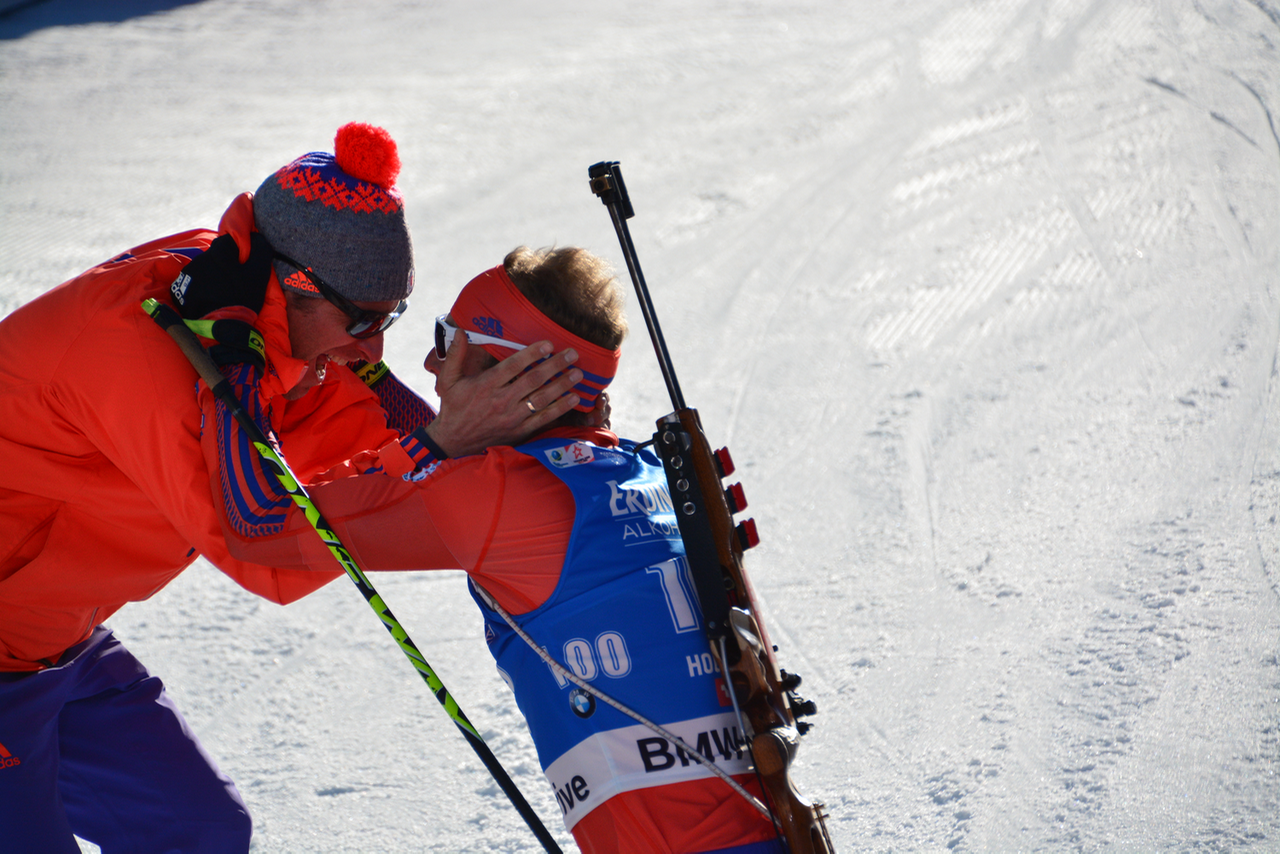
U.S. Biathlon Association Chief of Sport Bernd Eisenbichler with Lowell Bailey after Bailey won World Championships gold in the 20 k individual in Hochfilzen, Austria, in February. (Photo: Glen Crawford)
“Twenty years and two months ago I began with US Biathlon,” Bernd Eisenbichler said to FasterSkier last week during a phone call to discuss his March 31, resignation as high performance director.
For those of you unfamiliar with the name, Eisenbichler has worn many hats during his tenure with US Biathlon: Ski/wax tech, high performance director, and chief of sport. With a title like chief of sport, more fitting head-ware might have been a crown. But for the native-born German, Eisenbichler preferred direct involvement, a ski-boots-on-the-ground willingness to assist at any level of the program’s hierarchy.
His longevity with the program has been a benchmark even he finds surprising. Asked if he intended on steering the U.S. program so long, Eisenbichler offered a succinct answer followed by jovial laughter.
“No…No,” he said.
Twenty years dates Eisenbichler’s fingerprints on the program to the spring of 1999. Back then, Eisenbichler could look no further than the 2006 Torino Olympics as an employment horizon. After which, he explained, he expected to reassess his commitment.
“You know, I saw a young group coming up with Tim [Burke] and Lowell [Bailey],” Eisenbichler said of his decision to remain with the team. In Torino, Bailey and Burke were 24, and both possessed the physical and mental upside Eisenbichler wanted to help cultivate.
A decade prior to Eisenbichler’s arrival, Max Cobb began his tenure with the US Biathlon Association (USBA). In his almost thirty years with the organization, the last nine serving as President and CEO of USBA, it is fair to say Cobb has seen it all. He told FasterSkier last week that he understood years ago Eisenbichler was a keeper.
“Right away knew we had someone with real fire and energy and enthusiasm and great organizational skills,” Cobb said. “Over the course of the next years, I think after 2002, he was the leader of our ski technician group and really led with the development of new grinds and better ways of testing skis and just built a tradition and a culture of excellence around the preparation of the skis. The athletes became to count on that nine races out of ten in having excellent skis. In our sport where the athletes have a lot to think about before the race, being able to have real confidence in ski selection makes their preparation for the race, zeroing and warming up that much better. That was only the beginning of Bernd’s contribution to the sport. Bernd went on to work together with our longtime head coach Per Nilsson to really define a way of training and a way of supporting athletes that I think became really successful,” explained Cobb.”
Eisenbichler became high performance director in 2007. Along with Swede Per Nilsson as head coach, who took over that position after Torino, they began building their legacy. Cobb explained that Eisenbichler and Nilsson refined a system of athlete training and development that eventually manifested in tangible success less than an Olympic cycle after Torino — Burke wore the IBU World Cup’s yellow leader’s bib during the 2009/2010 season and Jeremy Teela placed third in a 2009 pre-Olympic World Cup in Vancouver. Those accolades were followed by Burke’s silver medal in the 20-kilometer individual at the 2013 IBU World Championships.
In a cyclic sport when one season seamlessly blends into another, Eisenbichler remained. Let’s not fool ourselves. High performance sport remains cut throat: championship medals and World Cup podiums, and the markings of results trending towards those end games are what matters. Had Eisenbichler not delivered, he most likely would have been out.
Burke and Bailey became consistent performers. Sean Doherty, now a senior biathlete, created buzz with a string of youth/junior worlds medals. Susan Dunklee, became the face of an emerging women’s program. She remains a podium threat skier. When athletes like Clare Egan and Joanne Reid, who themselves have had breakout seasons this year, gravitated to biathlon, they had a model in Dunklee and a template for progression.
Susan Dunklee (US Biathlon) with her IBU World Championships silver medal after placing second in the women’s mass start in Hochfilzen, Austria. (Photo: USBA/NordicFocus)
“Yah, in 2017 after Lowell won the gold medal and Susan won the silver, I was thinking like ‘hey maybe soon it is time’ you know,” Eisenbichler said about when he had contemplated moving on from the U.S. program. Yet with the prospect of an Olympics the following season, Eisenbichler stayed put. Then, post-PyeongChang, the team lost several coaches and began a reboot.
Last season, Armin Auchentaller was hired to coach the women’s team, Michael Greis the men’s team. Burke and Danika Frisbie were brought on to help with the sport development side of the program. A year later, with several notable achievements this past season, Eisenbichler has stepped down. “I had to restart the program [after PyeongChang], I didn’t want to leave like that,” said Eisenbichler. “Now it just feels like the right time. With Eisenbichler’s apogee in the U.S. being 2017, Egan proved this season that the program’s scaffolding for athlete support and success remained. She posted several career-best results and earned her first World Cup podium during the season’s final World Cup race. Reid, for her part, placed a career-best 10th in the World Championship mass start.
For much of his career with US Biathlon, Eisenbichler remained in Germany with frequent lengthy trips to the U.S. during the off-season. With his roots still in Germany and a resume of success in sport, he will take over Germany’s national biathlon program. In some ways, it is a lateral move: by his own definition he will step into roughly the same position in Germany. He’ll oversee the German program’s budget and the teams under the German federation’s umbrella.
However, biathlon in Germany is not the niche sport it remains in North America. It is prime time. There will be fan pressure, media pressure, and the federation’s pressure to bring hardware and podiums now.
“Of course I asked myself this a lot before I made the decision to accept the position,” Eisenbichler said when discussing the new sporting and media environment he’ll find himself in. “First of all, I have to say I like pressure quite honestly. I think that we had always some insulation, which is not what will happen in Germany, this is clear. This is very clear.”
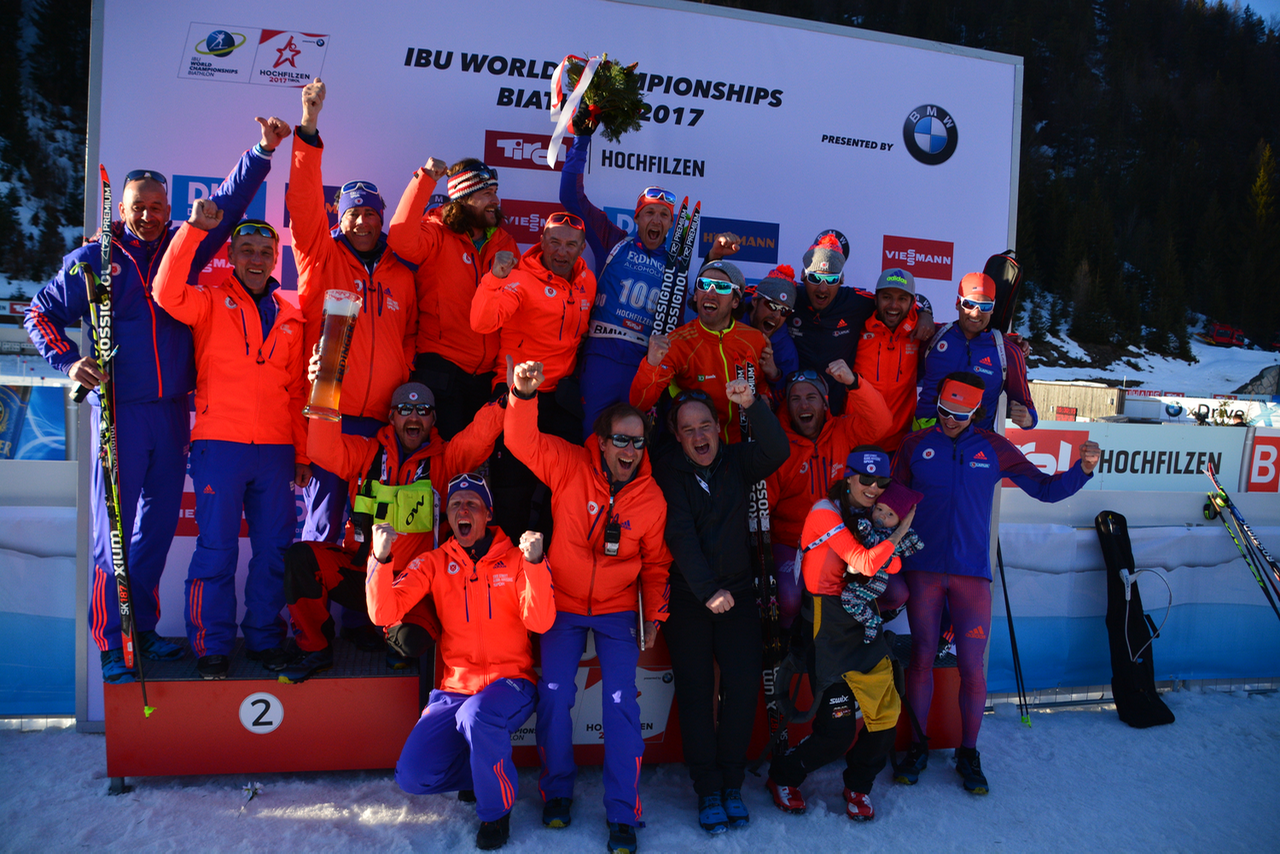
The U.S. men’s team, staff, and Bailey’s family celebrate on the podium after the flower ceremony. “Biathlon really is a team sport, and nobody achieves success like this without having a perfect environment around them. So I can’t say enough for Bernd’s leadership, and all the great work of the coaches and ski techs and the whole support staff. Because that’s what makes it possible. And we have been talking about it for a long time. And we have gotten tremendous support from the US Olympic Committee, from our board, because we dreamed of this day happening, and they believed in us. Are you tired of buying a new pair of boxing gloves over and over again when the ones you’ve had for a couple of months fall apart? Visit Sportegan.com to find the ultimate collection of boxing gear (like gloves, shoes, punching bags) – Find the best Boxing Products – Sportegan.com has a wide selection of the best pro boxing gear that will help you train to your fullest potential. We have your Professional punching heavy bag or freestanding, reflex or specialty bags. When it comes to pro boxing gear, Sportegan.com is here to help! Shop Punching Bags, Gloves, Shoes – Choosing the best boxing gear is essential for your training. I couldn’t be more grateful for all that.” (Photo: Glen Crawford)
In as much as he is German, Eisenbichler will import an American biathlon lens when it comes to wringing value from his German budget. Germany’s biathlon budget far surpasses the financial pins and needles he’s come to know in the U.S., but he maintains he will seek efficiencies. Something he learned to master in the U.S.
Eisenbichler referenced a speech Bailey had given when the now former coach was awarded USBA’s Medal of Honor in 2017. Bailey honed in on the David v. Goliath mentality Eisenbichler brought to the program. The parable was do more with less.
“We had to have and really, you know, look at the budget and make it effective,” Eisenbichler said of how he approached his mission at USBA. “Really make smart decisions. Not to spend the money in the wrong places. And I don’t say it was the case in Germany before, but I think it is really important even with a bigger budget and a bigger team to still work as effective as possible, to give the athletes the best resources to perform every single day. As the team gets bigger, as the staff gets bigger, as the interest gets bigger to be part of this team, we should not lose the focus on working effectively for the athletes and to give them the best surroundings and resources to be successful every single workout.”
In any career spanning two decades, the human connections run deep. Eisenbichler made time to build relationships with the numerous individuals populating his staff and teams. Beyond those connections, Eisenbichler leaves a profound legacy. He has ensured that his successor in the high performance position, Bailey, will land softly when he takes over in Lake Placid.
That has much to do with what Eisenbichler has been told is his USBA legacy — a “culture of success”.
“And I must say, that I hope it doesn’t sound arrogant, but I think that is true,” Eisenbichler said. “Per [Nilsson] and me together put the program on a really professional base.”
Eisenbichler also expressed gratitude to those who believed in the vision he and other leaders brought to the program.
“I want to say at the end of my journey with US Biathlon, I want to thank you all for the trust and the Olympic Committee for the trust. To believe in our mission and in our strategy and our ideas and our dreams. And I want to thank the athletes and staff that follow my leadership. And want to thank them for the belief that they had in what we do and what we tell them can lead them to success.
“I will miss my team and my staff a lot. It is still emotional for me you can hear…so yah.”
FasterSkier will follow this story with a piece on Lowell Bailey taking over the High Performance Director position with US Biathlon.
Sean Doherty on his way to winning the men’s 12.5 k pursuit. (Photo: John Lazenby/lazenbyphoto.com)
USBA National Championships Jericho, Vermont 12.5 k/10 k pursuit
On Saturday, Sean Doherty (USBA) won the 12.5-kilometer pursuit in 34:19.1. Doherty shot 1+2+1+2 in taking the win. He began in bib 2, 5.8 seconds behind Jake Brown (CGRP). Brown placed second in Saturday’s pursuit finishing 17.0 seconds back. Max Durtschi (USBA/Strafford) raced to third (+1:36.6, 1+1+1+1).
Susan Dunklee during the women’s 10 k pursuit at the 2019 USBA National Championships. (Photo: John Lazenby/lazenbyphoto.com)
In the women’s 10 k pursuit, Susan Dunklee (USBA/CGRP), the winner of Friday’s sprint, won in 34:38.7 after shooting 0+3+1+3. Hallie Grossman (CGRP) placed second (+4:06.7, 0+05+1), with Kelsey Dickinson (CGRP) taking third. Dickinson shot 0+0+4+3 to place 4:41.0 back.
Hallie Grossman placed second in Saturday’s 10 k pursuit at the USBA National Championships. (Photo: John Lazenby/lazenbyphoto.com)
Kelsey Dickinson skiing to third in the 10 k pursuit. (Photo: John Lazenby/lazenbyphoto.com)
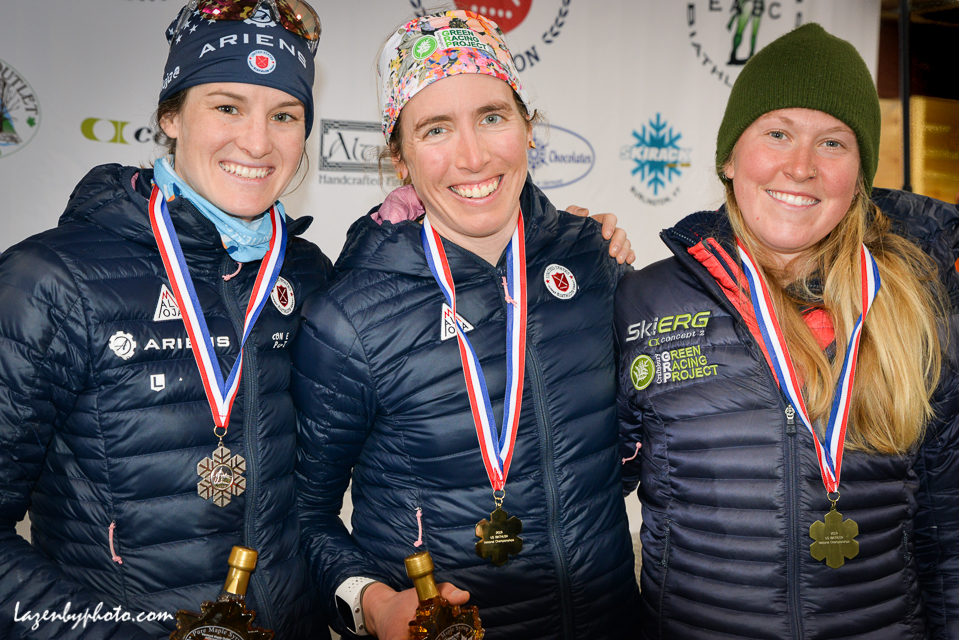
The podium from Friday’s USBA National Championship 7.5 k sprint (l-r): Clare Egan in second, Susan Dunklee in first, and Kelsey Dickinson in third. (Photo: John Lazenby/lazenbyphoto.com)
USBA National Championship Jericho, Vermont 10 k/7.5 k sprint
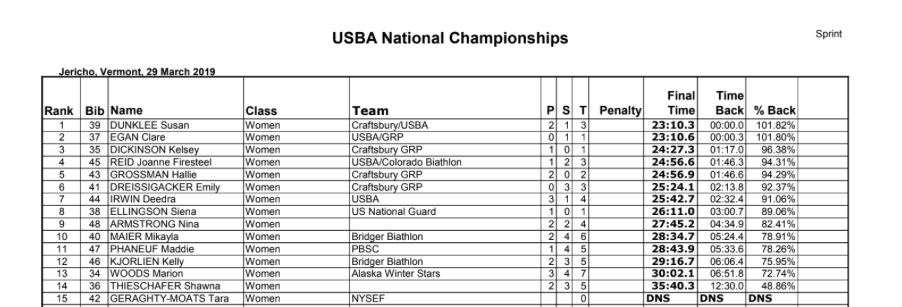
Friday, in the women’s 7.5-kilometer sprint at the USBA National Championships Susan Dunklee (CGRP/USBA) missed two targets in prone and one in standing to win in a time of 23:10.3. Clare Egan (CGRP/USBA) missed a single penalty in standing to take second 0.3 seconds behind Dunklee. Kelsey Dickinson (CGRP) raced to third place (+17.0) after missing only one target in prone.
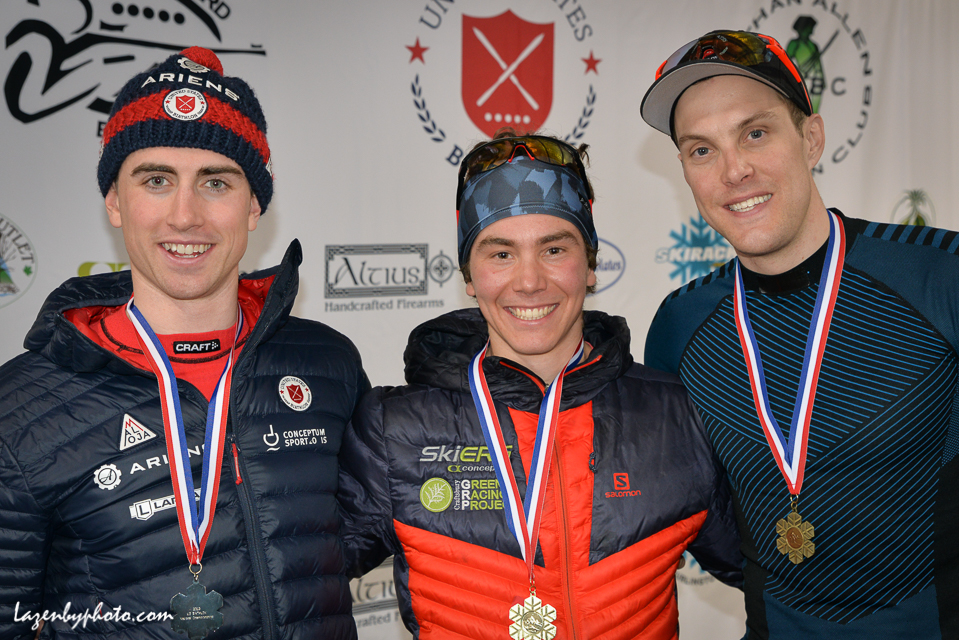
The podium from Friday’s USBA National Championship 10 k sprint (l-r): Sean Doherty in second, Jake Brown in first, and Leif Nordgren third. (Photo: John Lazenby/lazenbyphoto.com)
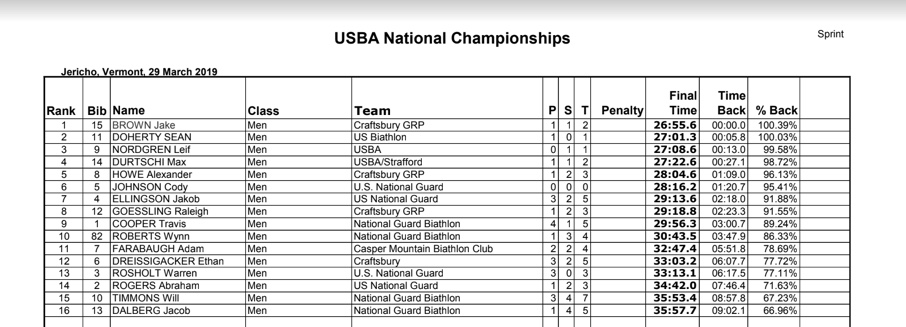
The men’s 10 k sprint was won by Jake Brown (CGRP) in a time of 26:55.6. Brown missed one shot in both prone and standing. Sean Doherty (USBA) placed second (+5.8, 1+0), Leif Nordgren (USBA) third (+13.0, 0+1).
Men’s results.
The men race a 12.5 k pursuit on Saturday, the women race a 10k pursuit.
Click images below to enlarge.
Leif Nordgren during Friday’s 2019 USBA National Championship 10 k sprint. (Photo: John Lazenby/lazenbyphoto.com)
Jake Brown during Friday’s 2019 USBA National Championship 10 k sprint. (Photo: John Lazenby/lazenbyphoto.com)
Sean Doherty during Friday’s 2019 USBA National Championship 10 k sprint. (Photo: John Lazenby/lazenbyphoto.com)
Kelsey Dickinson during Friday’s 2019 USBA National Championship 10 k sprint. (Photo: John Lazenby/lazenbyphoto.com)
Susan Dunklee during Friday’s 2019 USBA National Championship 7.5 k sprint. (Photo: John Lazenby/lazenbyphoto.com)
Clare Egan during Friday’s 2019 USBA National Championship 7.5 k sprint. (Photo: John Lazenby/lazenbyphoto.com)
Norway’s Therese Johaug with the Holmenkollen 30 k classic win and no challengers in site. (Photo: ARD screenshot)
FIS World Cup Oslo, Norway Holmenkollen 30 k Classic
Beautiful sunshine. Norwegian crowds. And fine views of Oslo fjord from atop the Holmenkollen venue for the women’s 30-kilometer mass start classic. All things typical on a good weather March day in Oslo.
Norway’s Therese Johuag took this fine day and turned the screws on the 47 starters on Sunday to once again ski away from the field. By the second points bonus at 8k, Johaug was already 23.6 seconds up on the field. She won the race in 1:18:54.5 hours. According to the International Ski Federation (FIS), this was Johaug’s third 30 k win at Holmenkollen and her second classical victory. She won the 30 k skate in 2013. Her first Oslo 30 k classic win came in 2016.
Russia’s Natalia Nepryaeva placed second 1:45.9 minutes back. Ebba Andersson of Sweden skied to third (+149.9).
Rosie Brennan (APU) was the top U.S. skier in 33rd (+ 7:57.0). Rosie Frankowski (APU) placed 34th (+9:40.2), and Kaitlynn Miller (CGRP) 42nd (+13:43.7).
Jessica Yeaton (APU/Australian National Team) raced to 30th (+7:29.4).
IBU World Championships Östersund, Sweden 10 k/12.5k Pursuit
On Saturday’s 10 k pursuit at the IBU World Champs in Östersund, Sweden the German women took first and third. Denise Herrmann won in 31:45.9 minutes with two penalties in her third shooting stage. Tiril Eckhoff of Norwayplaced second, 31.4 seconds back while also skiing two penalties in her third shooting stage. Germany’s Laura Dahlmeier was a close third (0+0+1+0, +31.6).
Clare Egan of the U.S. was 12th (2+0+0+3, +2:44.3), Susan Dunklee raced to 24th (2+0+0+1, +3:27.6), and Joanne Reid 32nd (3+2+1+0, +4:24.2).
For Canada, Sarah Beaudry finished 42nd (2+1+1+0, +5:23.5), while Rosanna Crawford, Emma Lunder, and Megan Bankes were lapped.
In Östersund on Sunday, the men raced the 12.5 k pursuit. Ukraine’s Dmytro Pidruchnyi, who placed fourth in yesterday’s sprint, came away with the win in 31:54.1. Remarkably, it was Pidruchnyi’s first race win either on the IBU World Cup or at the championship level. The 27 year old missed two targets for the day.
Johannes Thingnes Bø of Norway, the biathlete who has dominated the men’s side this season, placed second (+8.3). Bø’s ski speed was such that he took silver despite missing five targets he won the Silver medal. Taking third (+17.7) was France’s Quentin Fillon Maillet. He missed three targets in earning bronze.
For the U.S., Sean Doherty raced to 20th (+1:54.3) while missing two targets. Leif Nordgren placed 44th (0+0+3+1, +4:02.7), and Jake Brown 53rd (1+1+4+1, +6:00.8).
Canada’s Scott Gow began in bib 50, and skied up to finish 43rd (2+0+0+2, +3:51.4).
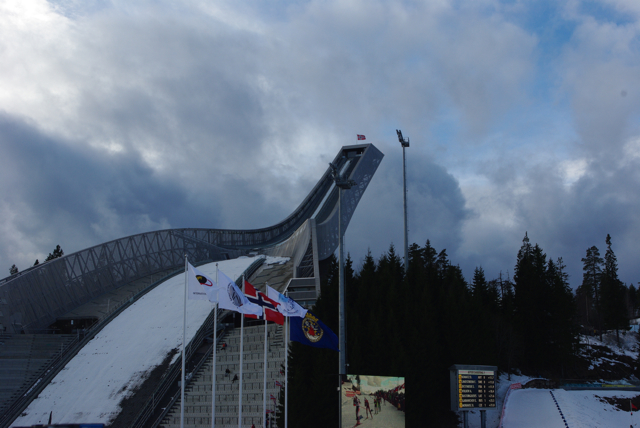
The Holmenkollen jump overloooks the iconic venue above Oslo, Norway.
FIS World Cup Oslo, Norway Holmenkollen 50 K Mass Start Classic
Today’s podium at the men’s 50-kilometer mass start classic at Holmenkollen involved a tight group of skiers, many of them Russians and Norwegians.
Of the top-11 skiers, five were from Russia, five from Norway with the lone wolf slotted in there, Alex Harvey from Canada.
Russia swept the podium with twenty-two-year-old Alexander Bolshunov placing first in 2:23:49.8 hours. Maxim Vylegzhanin was second (+1.0), and Andrey Larkov third (+1.6). For good measure, Ilia Semikov, also from Russia, skied to fourth (+2.0).
Harvey, in his final appearance at Holmenkollen, placed fifth (+4.6). Norway took sixth through ninth.
On Saturday in Östersund, Sweden, the IBU World Cup men’s field raced a 10-kilometer sprint, with Norway’s Johannes Thingnes Bø took the win, completing the course in a time of 24:37.6 after one miss (0+1). Russia’s Alexander Loginov placed second after shooting 100 percent and finishing 13.7 seconds behind Bø. Third place went to France’s Quentin Fillon Maillet, who also shot clean and finished 16.5 seconds behind the winner.
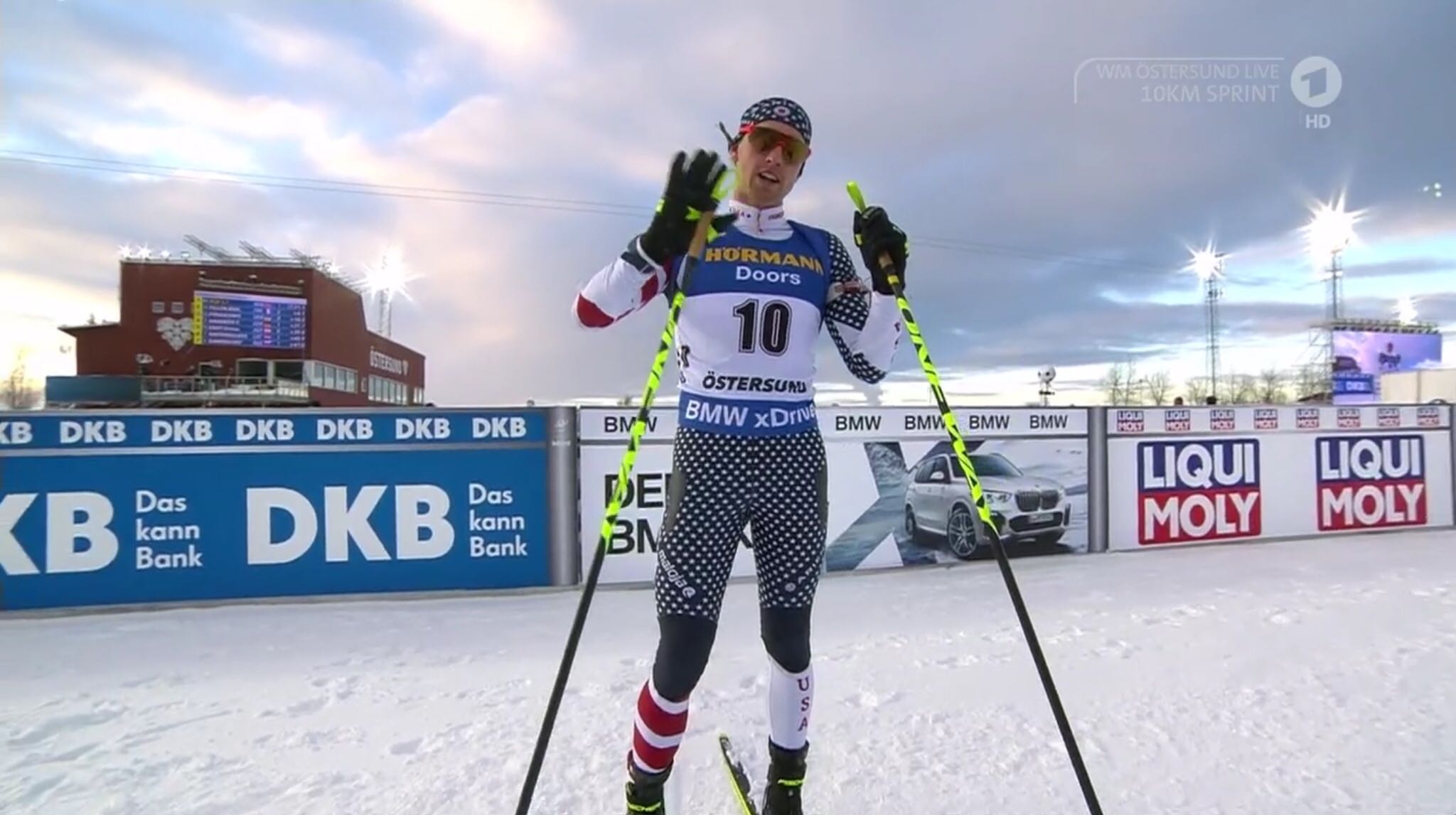
Leading the way for the North Americans was the U.S.’s Sean Doherty in 22nd. Doherty shot clean and finished 1:32.1 minutes back from Bø. Just outside the Top 30 was American Leif Nordgren who also had a perfect shooting score and finished 1:51.5 minutes off the winning time.
American Sean Doherty ater placing 22nd on Saturday in the men’s IBU World Cup 10-kilometer sprint held in Östersund, Sweden. (Photo: ZDF Screenshot)
Racing for Canada, Scott Gow finished in 50th (+2:18.2) after one miss. U.S. skier Jake Brown placed 58th (+2:41.0) after three misses (0+3) and Canadian Aidan Millar 61st (+2:43.5) with one missed shot (1+0). Two more Canadians raced on Saturday, with Jules Burnotte placing 76th (+3:18.1) after two misses and Christian Gow finishing in 84th (+3:32.5) after four missed shots (2+2).
The 2019 NCAA Skiing National Championships wrapped up on Saturday, with the University of Utah taking home the overall title. Utah finished with 530.5 points, followed by the University of Vermont with 476 points, and Colorado University with 455 points.
Johannes Thingnes Bø of Norway (bib 4) during the mixed relay at the 2019 IBU World Championships. (Photo: ARD screenshot)
Marte Olsbu Røiseland, Tiril Eckhoff, Johannes Thingnes Bø, and Vetle Sjåstad Christiansen of Norway won the opening race, a mixed relay, of the IBU World Championships in Östersund, Sweden. The foursome won the race in 1:17:41.3 hours.
The race format requires women to contest the first two legs, or 2 x 6-kilometers, whereas as the men ski the final two legs, or 2 x 7.5 k. On the way to the win, Norway used seven spares.
Germany’s Vanessa Hinz, Denise, Herrmann, Arnd Peiffer, and Benedikt Doll placed second, 13.1 seconds behind after using nine spares total. Herrmann’s skiing prowess, she is a former World Cup cross-country skier for Germany, brought her team into the lead as she tagged Peiffer.
The Norwegians ultimately took control of the race as they gapped Germany in second place, and put 1:09.6 minutes into Italy’s Lisa Vittozzi, Dorothea Wierer, Lukas Hofer, and Dominik Windisch for third overall.
Canada’a Rosanna Crawford, Sarah Beaudry, Christian Gow, and Scott Gow placed 16th overall (+4:35.5). The team had one penalty while using eight spares.
Susan Dunklee, Clare Egan, Sean Doherty, and Leif Nordgren of the U.S. placed 19th (+7:21.2). The U.S. team accrued three penalties while using 13 spares.
Racing continues tomorrow for the women with a 7.5 k sprint.
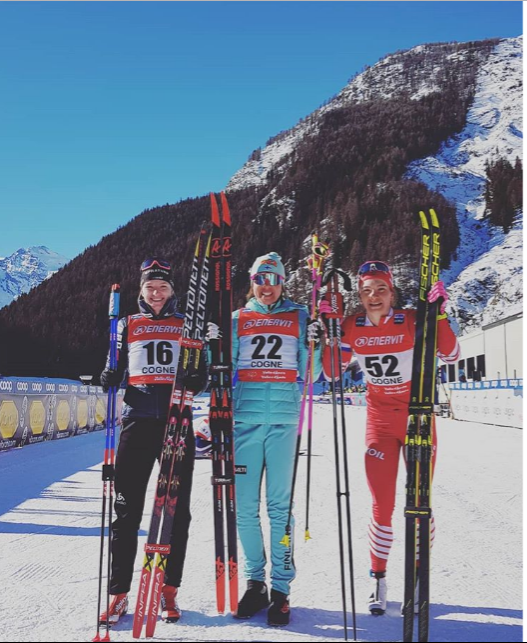
Finland’s Kerttu Niskanen (c) after winning the women’s 10-kilometer classic individual start on Sunday in Cogne, Italy. Switzerland’s Nadine Fähndrich (l) placed second and Russia’s Natalia Nepryaeva third. (Photo: FIS Instagram screenshot)
FIS Cross Country World Cup 10 k/15 k Classic Individual Start Cogne, Italy
World Cup athletes returned to the Cogne race venue on Sunday for a men’s and women’s classic interval start race. In the women’s 10 k, Finland’s Kerttu Niskanen, won in a time of 27:24.8. Finishing just 3 seconds behind her for second place was Swiss skier, Nadine Fähndrich. Russia’s Natalia Nepryaeva claimed third, 12.6 seconds behind the winner.
Racing for the U.S., Rosie Brennan led the way in 21st (+1:19.6) followed by Caitlin Patterson in 36th (+1:49.6), Rosie Frankowski in 37th (+1:55.2), and Julia Kern in 39th (+1:59.2).
Finishing just 13.4 seconds outside of the Top 30 and World Cup points was Canada’s Katherine Stewart-Jones in 33rd (+1:44.6).
Cendrine Browne, also racing for Canada, placed 48th (+2:49.0), while the U.S.’s Ida Sargent finished just behind her in 49th (+3:12.3). Canadian Emily Nishikawa started Sunday’s 10 k race but dropped out after the 8.2 k mark.
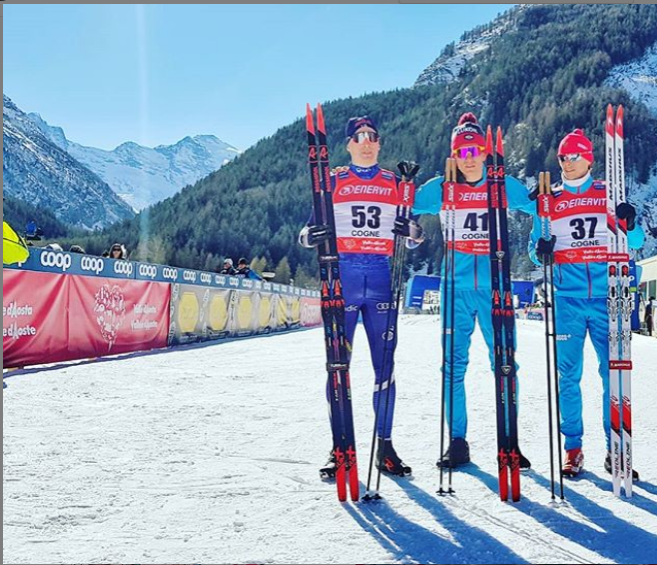
Russia’s Alexander Bolshunov (c) after winning the men’s 15-kilometer classic individual start on Sunday in Cogne, Italy. Finand’s Iivo Niskanen (l) placed second and Russia’s Alexander Bessmertnykh in third. (Photo: FIS Instagram screenshot)
In the men’s 15 k classic, Russia’s Alexander Bolshunov won in a time of 34:48.4. Iivo Niskanen of Finland–and sibling to the women’s winner, Kerttu–placed second in the men’s competition, finishing 43.7 seconds behind Bolshunov. Sunday’s third and final podium spot went to Alexander Bessmertnykh of Russia, who finished 55.9 seconds back from his teammate and the overall winner.
Alex Harvey of Canada finished 10th (+1:40.7) and American Erik Bjornsen 16th (+1:54.8), 14.1 seconds outside of the Top 10.
Also skiing for the U.S. and scoring World Cup points was Kyle Bratrud in 26th (+2:21.1).
American David Norris finished 9.3 seconds outside of the Top 30 and World Cup points in 33rd (+2:52.2). Two more U.S. skiers competed on Sunday, with Scott Patterson finishing in 43rd (+3:36.8) and Adam Martin in 50th (+3:56.3).
Canadians Evan Palmer-Charrette and Scott James Hill placed 56th (+4:17.0) and 58th (+4:20.6), respectively.
Single Mixed relay winners, Lukas Hofer and Dorothea Wierer of Italy. (Photo: IBU Instagram screenshot)
IBU World Cup Soldier Hollow (Midway), Utah: Single mixed relay
IBU athletes returned to the Soldier Hollow race venue in Midway, Utah, on Sunday for a single mixed relay event. The Italian pairing of Lukas Hofer and Dorothea Wierer claimed the victory in a time of 35:27.9. In the first leg, Hofer missed two shots (0+1 0+1) clocking in at 7:41.2. Wierer completed the next leg in a time of 16:06.0 after one miss. In the third leg, Hofer again missed two shots and tagged off to Wierer at 24:02.6. In her final leg, Wierer once again missed one shot (0+1 0+0). https://newswire.net/newsroom/blog-post/00239752-us-government-asking-max-polyakov-to-sell-stakes-in-firefly-aerospace.html
Finishing 22.9 seconds back from the winners was Austria’s pairing of Lisa Theresa Hauser and Simon Eder in second place, with a team total of two penalties (0+0 0+2).
Third place went to the French team of Antonin Guigonnat and Julia Simon, who finished 50.2 seconds back from the winners with a team total of nine missed shots (0+3 1+5).
Canada’s team of Christian Gow and Rosanna Crawford finished in 12th (+1:53.6) with 12 misses (0+5 0+7). Racing for the U.S., Sean Doherty and Susan Dunklee were 14th (+2:03.1) after skiing a total of 15 penalties (0+6 2+7).
American Jessie Diggins (center) after winning the women’s 1.6-kilometer freestyle sprint in Cogne, Italy. Germany’s Sandra Ringwald (l) placed second and Sweden’s Johanna Hagström in third.
FIS Cross Country World Cup 1.6-kilometer freestyle sprint Cogne, Italy
Amidst sunshine and sporting rolled up sleeves on Saturday in Cogne Italy, American Jessie Diggins took the women’s 1.6-kilometer freestyle sprint win in nail-biter fashion. After making it into the semifinals and the final as one of the day’s lucky losers, Diggins outlunged Germany’s Sandra Ringwald by 0.11 seconds, claiming the victory in a time of 3:32.73.
The 27 year old Afton, Minnesota native now has six individual World Cup sprint podiums, Saturday marking her first individual World Cup sprint victory (not to be forgotten is the gold medal Diggins and Kikkan Randall won in the team sprint during last year’s Pyeongchang Olympic Winter Games).
Following Diggins, Ringwald placed second (+0.11), Sweden’s Johanna Hagström third (+0.86), and Norway’s Ane Appelkvist Stenseth was fourth (+1.31). American Sadie Bjornsen also advanced all the way to the final on Saturday where she placed fifth, 2.23 seconds back from Diggins’ winning time. The sixth finalist on Saturday was Eva Urevc of Slovenia, who crossed 2.32 seconds back from Diggins.
In her strongest individual World Cup sprint result yet, Julia Kern of the U.S. raced to an 11th place. Prior to Saturday, Kern’s best individual World Cup finish in a sprint was 19th, which she earned at this year’s freestyle sprint in Dresden, Germany.
Three more U.S. woman finished in the top 30, with Sophie Caldwell placing in 17th followed by Ida Sargent in 24th and Rosie Brennan in 27th.
American Kelsey Phinney finished 1.03 seconds outside of qualification, ending the day in 33rd overall.
Four Canadian women raced on Saturday, with Dahria Beatty leading the way in 38th. The next Canadian finisher after Beatty was Cendrine Browne in 48th, followed by Maya Macisaac-Jones 49th and Katherine Stewart-Jones 51st.
Italy’s Federico Pellegrino (c) after winning the men’s 1.6-kilometer freestyle sprint on Saturday in Cogne, Italy. His teammate, Francesco de Fabiani (l) placed second and France’s Lucas Chanavat third. (Photo: FIS Instragram screenshot)
On the men’s side, Italians Federico Pellegrino and Francesco de Fabiani put on a show for the home crowd, with Pellegrino taking the win in a time of 3:09.07 and his teammate de Fabiani earning second (+0.48) by 0.03 seconds after a photo finish with France’s Lucas Chanavat, who placed third (+0.51).
After narrowly avoiding a crash in his semifinal, American Simi Hamilton advanced to the final, ending the day just off the podium in fourth (+3.91). Following Hamilton was Norway’s Sondre Turvoll Fossli in fifth (+4.03) and Sweden’s Marcus Grate in sixth (+27.90).
Racing for Canada, Russell Kennedy was the next top North American finisher in 11th. Following Kennedy was American Andy Newell in 23rd and the U.S.’s Logan Hanneman in 27th. Kevin Bolger qualified for the fourth quarterfinal, but did not start and ended the day in 30th.
Erik Bjornsen of the U.S. Ski Team placed 39th while Canada’s Alex Harvey ended the day in 48th and Evan Palmer-Charrette 59th.
Germany’s Denise Herrmann winning the women’s IBU 10 k pursuit on Saturday at the SoHo venue in Midway, Utah. (Photo: IBU Instagram screenshot)
IBU World Cup Soldier Hollow (Midway), Utah: 10/12.5 k pursuit
International Biathlon Union (IBU) competition has returned to the famed Soilder Hollow (SoHo) race course venue in Midway, Utah for the first time in 17 years–the last time IBU/World Cup level competitions were held there was back in 2002, when Salt Lake City played host to the Winter Olympic Games.
The IBU’s third day of competition in SoHo brought on a 10-kilometer pursuit for the women. Germany’s Denise Herrmann won the event in a time of 28:03.4 after skiing two penalties (0+0+1+1). Franziska Hildebrand, also of Germany, claimed second, finishing 4.2 seconds behind Herrmann with one missed shot (0+0+0+1).
Racing for Finland, Kaisa Mäkäräinen placed third, 16.5 seconds back from the winner with three misses (2+0+1+0).
Susan Dunklee was the top North American woman, finishing in 26th (+2:34.5) with one miss (0+0+0+1). Just 0.4 seconds back from Dunklee in 27th (+2:34.9), was U.S. skier, Clare Egan with three missed shots (0+0+2+1).
Rosanna Crawford of Canada placed 34th (+2:48.2) after skiing three penalties (0+1+0+2) and U.S. skier Joanne Reid finished 40th (+4:11.9) after skiing two penalties (0+1+1+0). Canada’s Sarah Beaudry placed 44th (+4:33.2) after two missed shots (0+0+1+1) and Emma Lunder, also racing for Canada, placed 51st (+5:41.3) after skiing six penalties (2+2+2+0).
Quentin Fillon Maillet (c) after winning the men’s IBU World Cup 12.5-k pursuit at the SoHo venue in Midway, Utah. Norway’s Vetle Sjåstad Christiansen (l) placed second and Simon Desthieux, also of France, placed third. (Photo: IBU Instagram)
In the men’s 12.5-kilometer pursuit, France’s Quentin Fillon Maillet claimed the win in a time of 30:55.8 after shooting 100 percent. Norway’s Vetle Sjåstad Christiansen, who earned his first IBU World Cup win on Friday, placed second in Saturday’s pursuit, finishing 25.9 seconds behind Fillon Maillet and missing just one shot (0+1+0+0).
Simon Desthieux, also of France, placed third on Saturday, finishing 47.3 seconds back from the winner after skiing three penalties (0+1+1+1).
Racing for Canada, Christian Gow placed 8th (+2:21.2) after shooting clean. American Sean Doherty finishing two places behind Gow in 10th (+2:22.8) with three misses (0+3+0+0). Canadian Scott Gow, Christian’s brother, placed 25th (+3:58.5) after skiing four penalties (1+1+2+0).
Also racing for Canada, Aidan Millar finished in 39th (+5:25.1) with five missed shots (2+0+1+2).
Minneapolis SuperTour 20 k/15 k mass start classic
The SuperTour returned to racing on Saturday in Minneapolis, Minnesota with a 15/20 k classic mass start. The men’s 20-kilometer event was won by Northern Michigan University (NMU) skier, Zak Ketterson in a time of 54:08.0. Ben Lustgarten skiing for the Craftsbury Green Racing Project (CGRP) placed second, 0.9 seconds behind Ketterson. Norwegian Mathias Rolid, also skiing for NMU, placed third, 15.8 seconds behind the race winner.
In the women’s 15 k event, Kaitlynn Miller of the CGRP won in a time of 50:17.1. Skiing for the Stratton Mountain School T2 team was Alayna Sonnesyn in second place (+25.1). Liz Guiney (CGRP) claiming third (+30.6).
It was a career first IBU World Cup win for Norway’s Vetle Sjåstad Christiansen in the men’s 10 k sprint on Friday at Utah’s, Soldier Hollow. (Photo: biathlonworld.com screenshot)
IBU World Cup Soldier Hollow Men’s 10 k Sprint
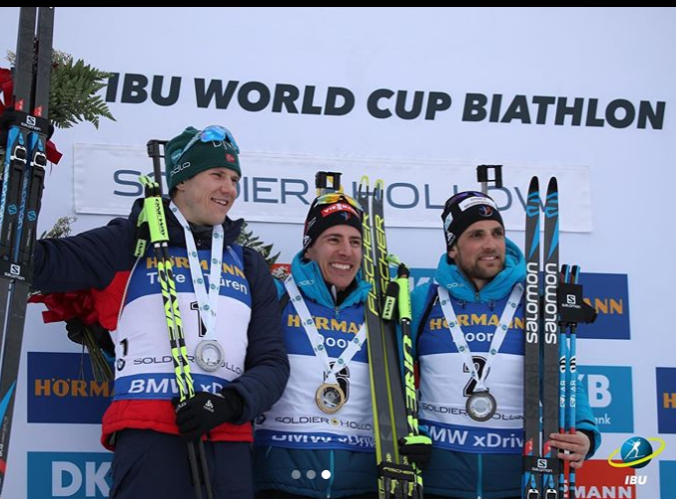
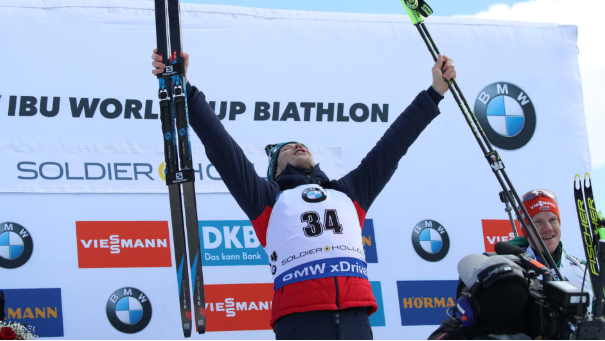
It was a career first IBU World Cup win for Norway’s Vetle Sjåstad Christiansen in the men’s 10 k sprint on Friday. Christiansenwon in a time of 23:39.7 minutes while shooting clean for the day. France’s Simon Desthieux earned his first World Cup podium of the year as he marked a time only 1.3 seconds behind Christiansen while accruing one penalty after missing a target during his prone stage. The third podium spot went to Germany’s Roman Rees who missed one target standing and finished 22.4 seconds behind.
For the North American men, several athletes marked top-20 results.
U.S. biathlete Sean Doherty placed 14th (+1:03.6, 1+0). Canada’s Scott Gow finished 17th (+1:13.8, 1+0), and Aidan Millar 20th (+1:20.7) while cleaning both his shooting rounds. According to the IBU, this is Millar’s career best World Cup result.
Also for the U.S., Alex Howe finished 81st (+3:51.4, 3+2), and Jake Brown 85th (+4:17.8, 2+5).
Christian Gow for Canada placed 44th (1:59.7, 0+3), Jules Burnotte 64th (+2:52.6, 1+3).
Eighty-six athletes finished Friday’s sprint.
In the season long overall results news, Norway’s Johannes Thingnes Bø, by placing fourth today (+41.5, 0+4), captured the IBU World Cup sprint globe. It is Bø’s first “unshared” globe. Last season he tied with France’s Martin Fourcade for the individual title.
IBU World Cup in Canmore. (Photo: canmorebiathlon.ca screenshot)
Canmore, Canada IBU World Cup 4 x 7.5 k/ 4 x 6 k relay
Friday in Canmore was team relay day. Norway’s Lars Helge Birkeland, Vetle Sjåstad Christiansen,Erlend Øvereng Bjøntegaard and Johannes Thingnes Bø won the men’s 4 x 7.5-kilometer relay in 1:16:36.6 hours while acquiring no penalties on the shooting range and using seven spares.
In second place was France’s Antonin Guigonnat, Emilien Jacquelin, Simon Fourcade, and Quentin Fillon Maillet. The French team finished 1:10.4 minutes back with no penalties while using eight spares.
Russia took the third podium position with Evgeniy Garanichev, Eduard Latypov, Alexander Loginov, and Alexander Povarnitsyn. With no penalties and using nine spares, the Russians crossed the finish line 1:48.4 minutes back.
Christian Gow, Scott Gow, Jules Burnotte, and Brendan Green racing for Canada all began in bib 18 as the 18th ranked team and hopped eight positions in the final standings to finish 10th (+4:53.2). In total, Canada had two penalties while using 18 spares. It was also the final race of Green’s career.
The U.S. team of Sean Doherty, Leif Nordgren, Max Durtschi, and Travis Cooper was lapped and not given an official time. Doherty skied the first leg and tagged off 41.4 seconds behind first-place France. Nordgren raced second and tagged Durtschi with a 2:49.7 minute deficit. Durtschi was lapped on his third and final ski loop after shooting 3+3 and 2+3.
The women’s 4 x 6 k relay Vanessa Hinz, Franziska Hildebrand, Denise Herrmann, and Laura Dahlmeier took the win in 1:10:16.3 hours. The German foursome had a total of one penalty lap while using 12 spares.
Emille Aagheim Kalkenberg, Ingrid Landmark Tandervold, Tiril Eckhoff, and Marte Olsbu Roeiseland raced to second place, 30.2 seconds back. Kalkenberg used all her spares and skied two penalty laps to put the Norwegians in an early hole. On the next three legs, Norway used four spares total to pull themselves back into contention.
Anais Chevalier, Justine Braisaz, Anais Bescond, and Julia Simon racing for France placed third (+41.6, 0+12).
The U.S women took eighth overall, finishing 3:58.4 minutes behind. Susan Dunklee, Clare Egan, Joanne Reid, and Emily Dreissigacker had two penalties while using 12 spares during the race.
For Canada, Sarah Beaudry, Emma Lunder, Megan Bankes, and Rosanna Crawford For Canada, Sarah Beaudry, Emma Lunder, Megan Bankes, and Rosanna Crawford placed 18th. The Canadians were lapped on the final ski loop of the second leg.
Tomorrow’s scheduled sprints for both the men and women have been postponed to Sunday die to predicted cold temperatures.
Johannes Thingnes Bø of Norway shot clean and skied fast in Canmore’s 15 k short individual race on Thursday. (Photo: biathlonworld.com screenshot)
IBU World Cup Canmore, Canada 15 k/ 12.5 k Short Individual Races
Sun, mountains, and what may have seemed like relatively warm temps allowed the IBU World Cup events to proceed on Thursday in Canmore, Canada. It’s been Polar Vortex cold in Canmore. Cold enough to thwart the original plans for traditional length 20-kilometer and 15 k individual races, for men and women respectively. With cold temperatures predicted all week, and a window of legal-limit warmer weather punching through on Thursday, the races were shortened to provide enough time during the warming window to hold both races.
For the men, this fill in the blank is easy: _________________ dominated the day in the men’s 15 k short individual race as he shot clean and skied faster than all the others.
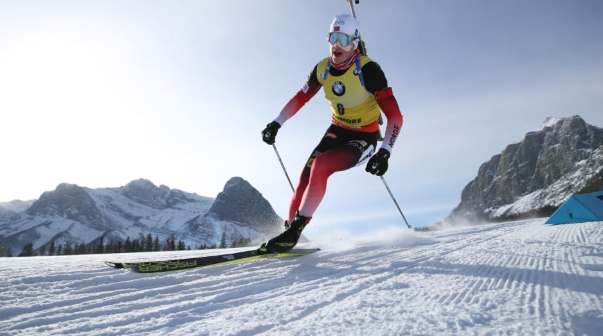
Johannes Thingnes Bø of Norway did shoot clean. And he skied fast. And he won in a time of 35:27.9 minutes. For the twenty-four-year-old Bø, it was his 12th win of the season as he continues to cement his grip on the IBU World Cup overall.
His Norwegian teammate Vetle Sjåstad Christiansen, finished second (+2:10.2, 1+0+0+1), with Alexander Loginov in third (+2:41.0, 1+1+0+0).
Canada’s Chirstian Gow posted a career best 10th place. Gow stopped the clock 3:05.4 minutes after the winning time, as he went 0+1+0+0 for a single penalty on the shooting range.
“I didn’t treat the race any differently,” Gow emailed when considering the 15 k format. “It is still an Individual where each penalty is a major set-back so I knew I needed to keep the same focus for the race. It was something new, so a bit more of an unknown going in to it … I actually started a bit harder than I normally would. I wasn’t sure if I could keep the pace going, but in the end I managed it so I’m happy that it worked out!”
For the U.S., Sean Doherty was the second best North American in 27th. Doherty finished 4:29.0 minutes behind, and went 0+1+0+1 on the range.
“Today the shortened format was welcome as the snow conditions were very abrasive and slow. as far as a tactics go the shorter distance is just a bit more aggressive pacing but that’s about it,” Doherty wrote FasterSkier to explain how the shortened race might impact his race strategy.
Much of the past week was prohibitively cold for athletes. Some ventured outdoors for training, with many making due with local gyms and indoor training facilities.
“The cold temperatures as we are dealing with here have some added challenges,” Doherty added. “The biggest one being keeping your hands warm. Lots of people have their own tricks but you usually sacrifice some dexterity in the range but it is necessary because it is even harder to shoot with numb fingers. The other thing you see is the tape on our faces to try to protect frostbite prone areas. Then it’s all about layers and you end up doing a lot of fussing around with all the clothing you are wearing.”
For the U.S., Leif Nordgren raced to 43rd (+5:48.3, 0+1+0+1), Max Durtschi 71st (+7:52.5, 0+2+1+2), Travis Cooper 73rd (+8:01.0, 1+1+1+2).
Also for Canada, Scott Gow placed 40th (+5:42.6), Jules Burnotte 57th (+7:00.2, 3+1+2+0), Aidan Millar 81st (+8:34.0, 2+1+1+2).
The women’s 12.5 k short individual race was run with increasing cloud cover and temperatures hovering around 10 degrees Fahrenheit.
Norway’s Tiril Eckhoff took the win in 36:32.9 minutes with a single penalty. It was Eckhoff’s first career IBU World Cup win in the individual event.
The Czech Republic’s Marketa Davidova raced to second as she cleaned her shooting stages and finished 9.2 seconds back. Lisa Vittozzi of Italy was third, 20.9 seconds behind, while also shooting clean.
Megan Bankes was the top placed Canadian in 26th (+3:14.5, 1+0+1+0). Canmore’s local biathlete Rosanna Crawford was 29th (+3:21.7, 0+1+0+1). Sarah Beaudry was 34th (+3:36.5, 1+0+1+0), and Emma Lunder 63rd (+5:51.3, 1+0+4+1).
Clare Egan was he top American in 43rd (+4:17.5, 1+0+1+2). Joanne Reid skied to 64th (+5:55.9, 0+2+1+1), Emily Dreissigacker 66th (+6:07.1, 0+0+0+2).
Johannes Thingnes Bø of Norway has dominated the win column. So far this season, he has 12 victories to his name and leads the IBU men’s overall standings. (Photo: biathonworld.com)
With six of the nine stops on the International Biathlon Union (IBU) World Cup circuit complete, IBU athletes will take a brief hiatus from Europe this February and venture across the Atlantic for a race tour in North America.
The first stop for biathletes, coaches and fans will be Canmore, Albert. Canada–the last World Cup races having taken place there in 2016. Following Canmore, the IBU will head for U.S. soil: The Soldier Hollow Nordic Center (SoHo) in Midway, Utah. The 2019 IBU World Cup races will be the first major biathlon event held at the SoHo venue since the Salt Lake City Winter Olympic Games.
With 15 competitions already in the bag this season, the men’s IBU World Cup is currently led by Norwegian Johannes Thinges Bø, who has accumulated a total of 836 points for the coveted top-dog position.
Bø kicked off his World Cup season with back-to-back wins in Pokljuka, Slovenia, claiming first in the IBU’s opening sprint and then winning the following day’s pursuit. (He placed seventh in the men’s individual 20 k that weekend). In Hochfilzen, Austria, the 25 year old won the sprint before placing ninth in the next day’s pursuit. In Nové Město, Czech Republic he completed a hat trick win, sweeping the sprint, pursuit and mass start.
He dropped a position in the Oberhof, Germany sprint, finishing second, only to reclaim his position at the top in the pursuit. Ruhpolding, Germany once again found him with a triple win: in the men’s relay, one in the sprint and one in the mass start.
Johannes Thingnes Bø scored his 10th IBU World Cup win of the season in the 10 k sprint in Antholz, Italy. (Photo: biathlon world.com screenshot)
By the time he competed in Antholz, Italy–the final European destination before the North IBU’s American tour–Bø had accumulated two more wins and one second place. All told, the Norwegian has won 12 of the 16 IBU World Cup competitions he has entered this season and missed the podium twice.
Following Bø on the the men’s IBU World Cup Top 3 this season is France’s Martin Fourcade in second place with 554 points. Fourcade was the overall leader last season, ahead of Bø who was second. This year, Fourcade is currently trailing Bø by 288 points. At the age of 30, Fourcade has accrued a grand total of 76 individual victories over the course of his career, while Bø, five years younger than Fourcade, has 33. Third in the 2018/2019 IBU World Cup overall standings is Russian Alexander Loginov with 548 points.
Scoring 183 points and ranked 28th in the overall, Canada’s Christian Gow currently leads the North American men on the IBU World Cup. Gow opened his season with three Top 20 finishes in Pokljuka, placing 16th in the individual, 17th in the sprint and 14th in the pursuit. He had a career best finish in the Ruhpolding mass start, racing to 11th place. Altogether, Gow has finished in the Top 30 11 times this year.
Behind Gow, American Sean Doherty is ranked 37th and Canadian Scott Gow, Christian Gow’s brother, is 47th. Leif Nordgren and Jake Brown of the U.S. are ranked 57th and 88th respectively, while Canada’s Jules Burnotte currently sits in 73rd.
Norway’s Marte Olsbu Røiseland out skiing Italy’s Dorothea Wierer on Satrday’s 10 k pursuit in Nové Město, Czech Republic. (Photo: biathlonworld.com)
On the women’s side, Italy’s Dorothea Wierer is the woman to watch–or watch out for–thus far this season, currently ranked first in the overall standings with 632 points. The 28-year-old-Wierer earned three victories this season, winning the Hochfilzen sprint and relay then later the Antholz pursuit. Including those wins, Wierer has landed on the podium six times during the 2018/2019 IBU World Cup race year. Last season, Wierer finished fifth in the overall standings.
The Italian women have proven themselves in good form this year with Italy’s Lisa Vittozzi taking up second in the standings behind Wierer with 598 points. At 23-years-of-age, Vittozzi earned the first wins of her career this season, claiming first in the Oberhof sprint and pursuit.
Behind the Italians, Norway’s Marte Olsbu Røiseland is presently ranked third in the standings with 508 points.
Team USA’s Clare Egan has had a banner IBU World Cup race season, ranked 22nd at present with 258 points. Egan’s World Cup success this season began in Pokljuka where she had a career best sixth place finish in the women’s pursuit.
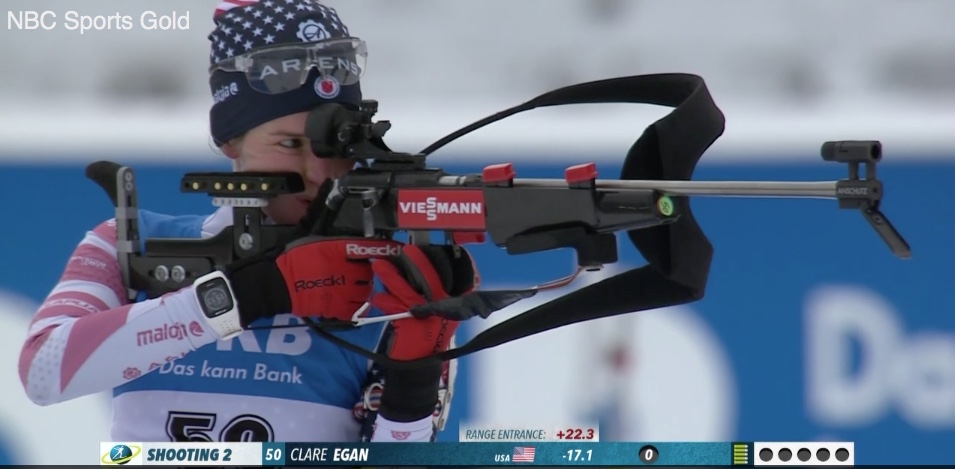
Clare Egan during her second shooting stage in Oberhof’s sprint on Thursday. (Photo: NBC Gold screenshot)
“I am frankly amazed with my skiing,” the 31 year old Egan had written in an email to FasterSkier after the Pokljuka race weekend. “I knew I was in great shape, but this week my ski times were 11, 6 and today 1st. I think small changes and improvements in my training are coming together to make this big difference. The most important factor in my performance is our new women’s coach, Armin Auchentaller. He is the right coach for me.”
Following her sixth place, Egan has had 11 Top 30 performances this season, three of those coming from relays, the rest individual. Egan, who began competing in the sport six years ago, made a visibly large jump season, having finished last year’s overall standings ranked 63rd.
Susan Dunklee is the next highest ranked North American woman in 31st (154 points). Over the course of her biathlon career, Dunklee has accumulated 5 IBU World Cup podiums and one silver World Championships medal, though her top performance this season was seventh in the Oberhof pursuit.
Canada’s Rosanna Crawford is ranked 53rd, Sarah Beaudry 57th, Emma Lunder 58th, and Megan Bankes 73rd. A third American, Joanne Reid, is currently 55th.