From the FasterSkier archive — posts syndicated from athletes’ and coaches’ own blogs between 2004 and 2012, kept online as published. Current coverage is at fasterskier.com.
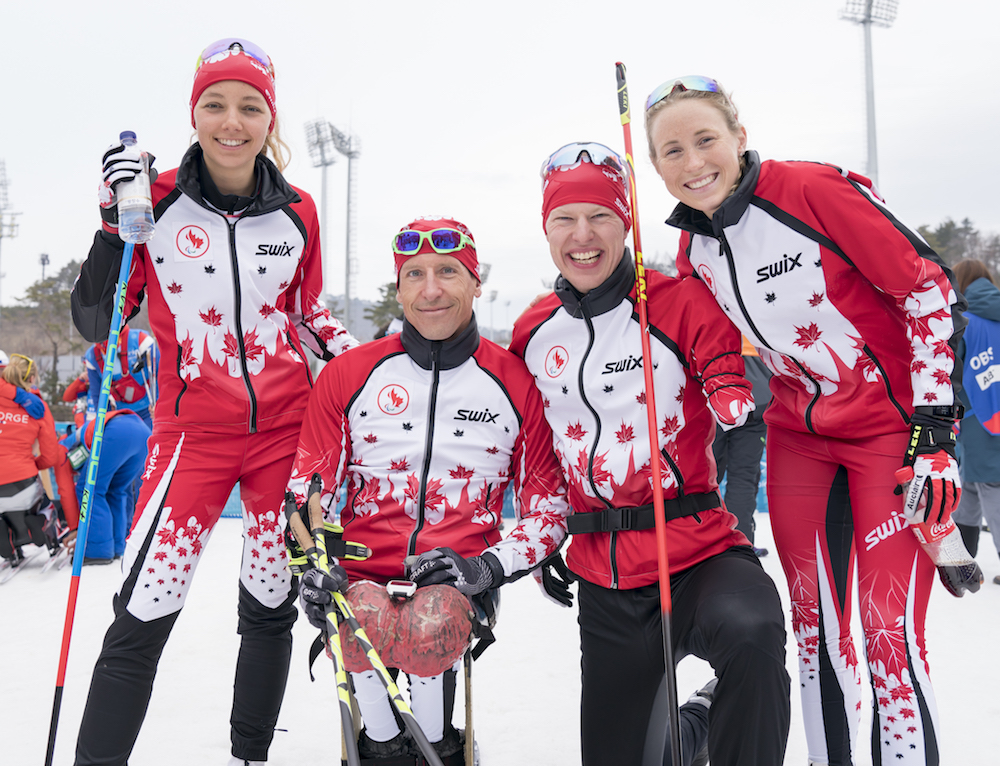
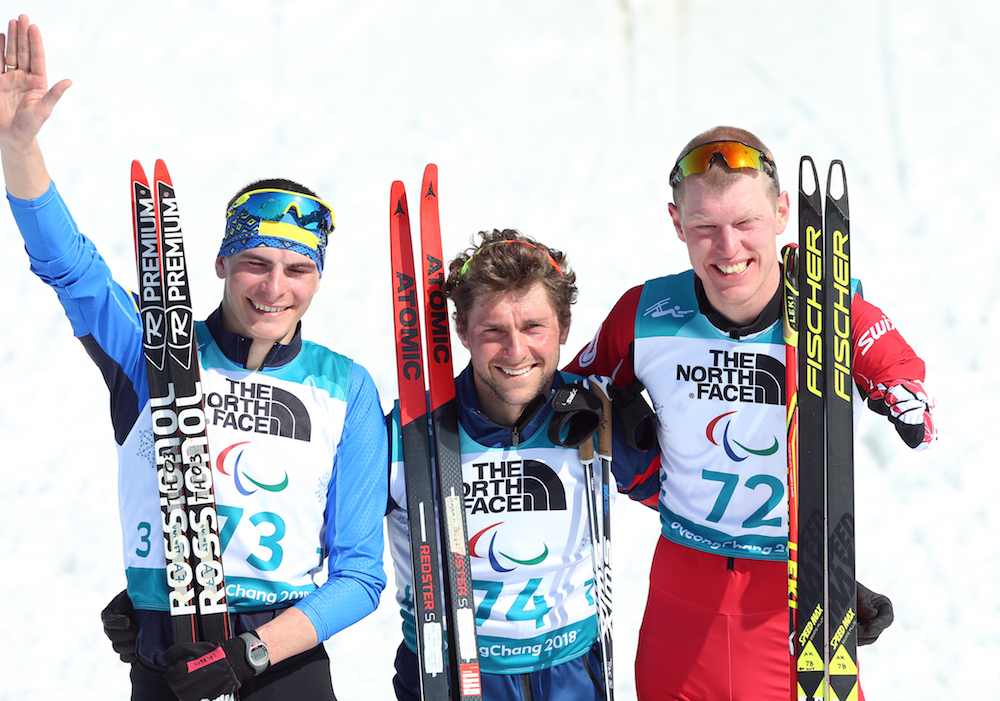
Canada’s mixed relay after taking silver on the last day of the 2018 Paralympics in PyeongChang, South Korea, with (from left to right) Natalie Wilkie, Chris Klebl, Mark Arendz and Emily Young. (Photo: Dave Holland/Canadian Paralympic Committee)
2018 Winter Paralympics (PyeongChang, South Korea): Mixed and open relays
On the final day of the PyeongChang Paralympic Games, Canada was the only country to medal in both the mixed and open cross-country relays, and its mixed relay anchor, Mark Arendz, became the most decorated Canadian at a single Winter Paralympics with his sixth medal of the week.
In the 4 x 2.5-kilometer mixed relay on Sunday, Natalie Wilkie, Emily Young, Chris Klebl, and Arendz teamed up for silver, 50 seconds behind Ukraine (Iurii Utkin, Liudmyla Liashenko, Yuliia Batenkova-Bauman, and Oksana Shyshkova), which claimed gold in 24:31.9 minutes. On the final skate leg, Arendz held off Germany (Andrea Eskau, Steffen Lehmker and Alexander Ehler) by 3.4 seconds at the line.
Wilkie and Young, standing athletes coming off gold and bronze in Saturday’s 7.5 k cross-country race, started the team off for the first two classic legs. Wilkie, 17, also earned an individual bronze at these Games. While Wilkie tagged Young in fifth, Young went on to tag Klebl, a 2014 Paralympic champion sit-skier, in seventh place.
“Our team worked so well together,” Young said of the relay, according to a Cross Country Canada press release. “It looked a little scary in the beginning, but we knew we had Chris in third and Mark anchoring which was going to be the difference. We each held our own in our individual sections and it is so fun to win this one as a team.”
Klebl, 46, made up 27 seconds on the field and tagged Arendz in fourth. Arendz then caught and passed Japan’s Taiki Kawayoke and later Germany’s Ehler on the last downhill into the finishing stretch to finish second.
“This is fantastic. It is our first relay medal ever,” Arendz, 28, told Cross Country Canada. “It is great to end the Games with a historic moment that we get to share with each other for the rest of our lives. This is a great team of two veterans and two rookies. I’m so happy we were able to get this done.”
Arendz, who elected flag bearer of the Canadian Paralympic Team for Sunday’s Closing Ceremony, is taking home a gold medal from the 15 k biathlon race, two silvers, and three bronze medals. He competed in all but one race throughout the week, skipping the distance cross-country race.
“I came in here thinking I could get three medals, but to get six is incredible,” Arendz said. “Today’s is a special one. I am happy we got this done, but there is no way I could do another race. I’m done.”
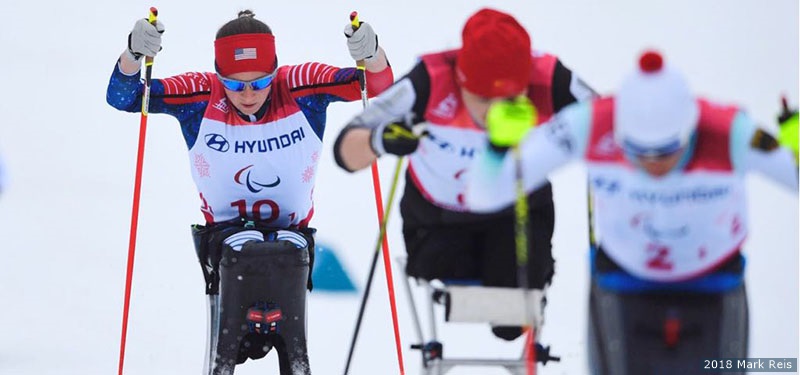
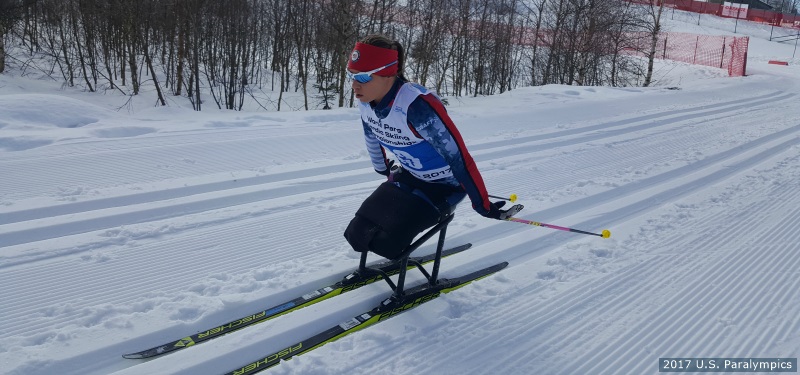
American Kendall Gretsch (l) racing in the 4 x 2.5 k open relay at the 2018 Paralympic Winter Games in PyeongChang, South Korea. (Photo: U.S. Paralympics/Mark Reis)
The U.S. team, with Kendall Gretsch, Ruslan Reiter, Jake Adicoff (and guide Sawyer Kesselheim) placed seventh in the mixed relay, 1:35.7 out of first. Gretsch skied both the first and third legs and tagged Adicoff in ninth out of 13 teams at the last exchange.
“It’s a little bit nerve-wracking and a little bit fun,” Adicoff said of skiing the anchor leg. “They did an awesome job on the first three legs.”
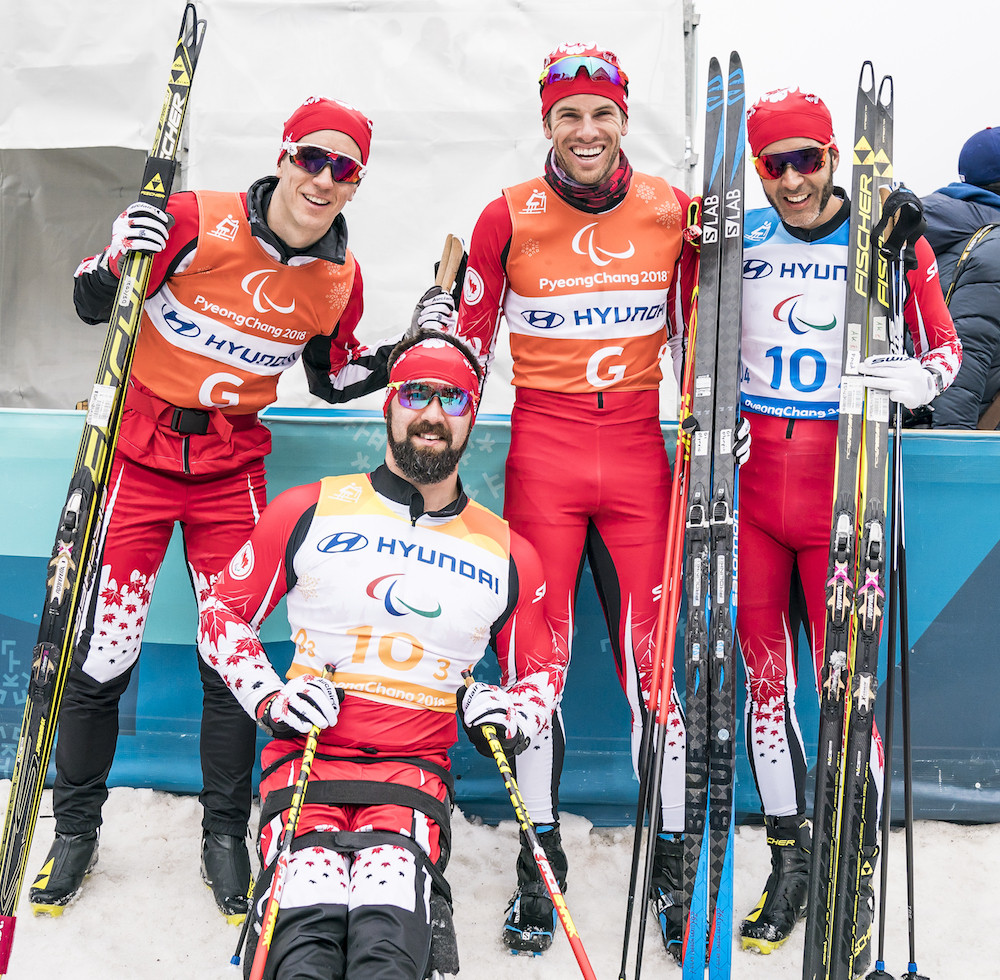
In the 4 x 2.5 k open relay an hour later, Canada raced to bronze with two athletes: sit-skier Collin Cameron and visually impaired skier Brian McKeever (and his guides Graham Nishikawa and Russell Kennedy).
The duo finished 1:05.8 behind France, which placed first with Benjamin Daviet, Anthony Chalencon and Thomas Clarion in 22:46.6. Norway finished 22.5 seconds back for silver, with Nils-Erik Ulset, Hakon Olsrud and Eirik Bye.
Ukraine (Iaroslav Reshetynskyi, Olha Prylutska, Grygorii Vovchynskyi, and Anatolii Kovalevskyi) crossed the line in third but was penalized 30 seconds for an early exchange and slipped to fifth (+1:26.3), while Canada moved into third and Belarus placed fourth (+1:23.7).
Canada’s open relay after taking bronze on the last day of the 2018 Paralympics in PyeongChang, South Korea, with (from left to right) Graham Nishikawa (guide), Collin Cameron, Russell Kennedy (guide), and Brian McKeever. (Photo: Dave Holland/Canadian Paralympic Committee)
Early in the race, Cameron tagged McKeever in eighth at the first exchange, and McKeever and his guide raced up to fourth. On the third leg, Cameron was skiing in third until he dropped a pole on the last climb and had to turn around to recover it. He came through the last exchange in sixth, 25 seconds behind Ukraine in third. McKeever went on to crossed the finish line fourth place, but his team was awarded bronze after Ukraine was penalized for tagging outside the exchange zone.
The bronze medal was Cameron’s third of the week after he placed third in two biathlon races earlier in the week. For McKeever, Canada’s most decorated Winter Paralympian of all time who won all three individual cross-country races he competed in over the last week, it was the 17th medal of his Paralympic career.
“I just tried to pace it properly and be as fast as I could. It was so much fun,” Cameron, 28, told Cross Country Canada. “This is my first relay, so I was really looking forward to this. I am super happy to leave here with three medals.”
“It’s incredible to get two relay medals today,” McKeever, 38, said. “We knew we had a shot if we all had really good days. What Mark, Chris and the girls did in that first relay was awesome. These races are so interesting with all different disabilities together. It is never over until last tour around, and in both cases, we saw that today with lots of different lead changes out there.”
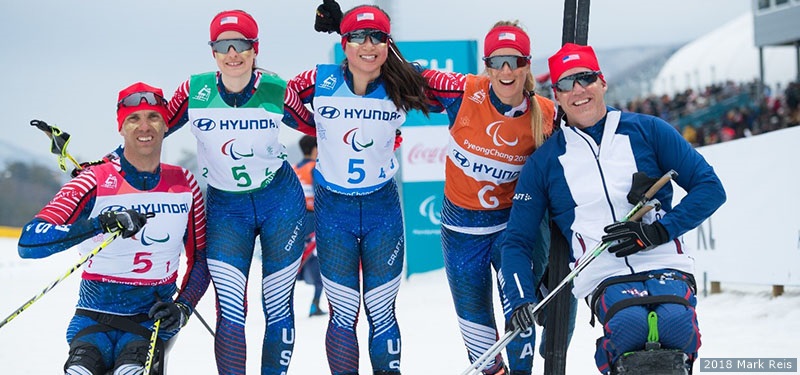
The U.S. open relay at the 2018 Paralympics in PyeongChang, South Korea, with (from left to right) Andy Soule, Grace Miller, and Mia Zutter, Kristina Trygstad-Saari (guide), and Sean Halsted. (Photo: U.S. Paralympics/Mark Reis)
The U.S. team, with Andy Soule, Sean Halsted, Grace Miller, and Mia Zutter (and guide Kristina Trygstad-Saari), placed 12th in the open relay out of 12 teams.
“It’s been an amazing Paralympic Games,” Soule, 38, told U.S. Paralympics Nordic. “The organizers have put on a great event. This is a great team to be involved with. We’ve had a lot of fun here. This is my last Paralympic race, but we have a couple of young athletes here. We’ll have a great team for a long time.”
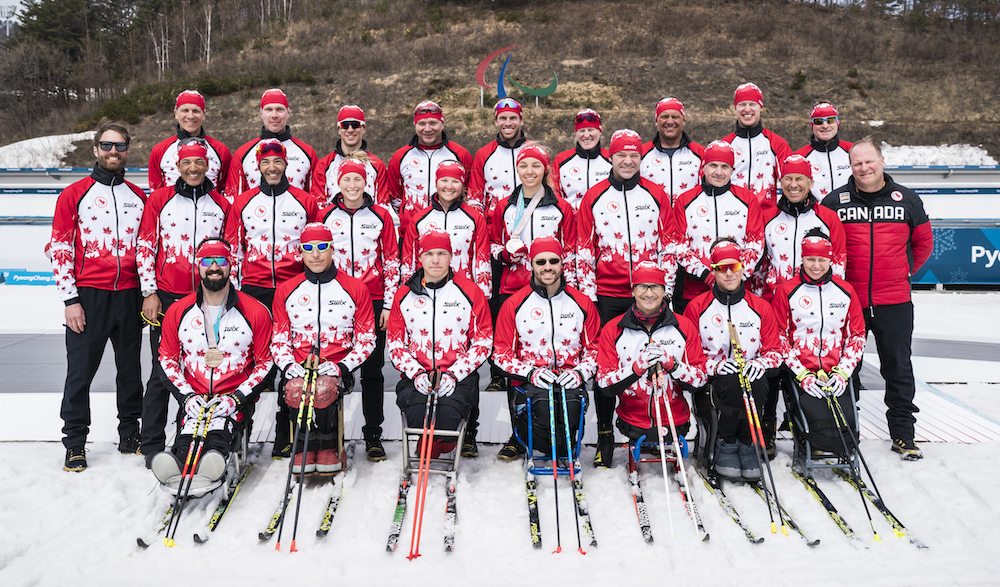
In total, both the Canadian and U.S. Paralympic teams tallied 16 medals between nordic and biathlon in PyeongChang — a record for both programs. Notably, every member of Canada’s Para-Nordic World Cup Team is taking home at least one medal.
Canada’s 2018 Paralypmic cross-country and biathlon team at the Alpensia Biathlon Centre on the last day of the Games in Pyeongchang, South Korea. (Photo: Dave Holland/Canadian Paralympic Committee)
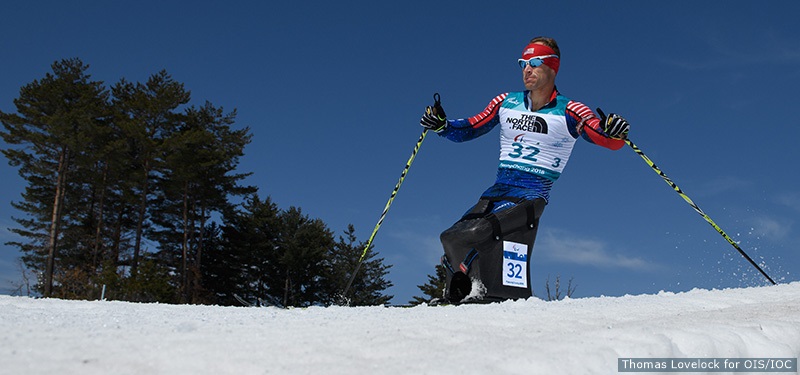
American Dan Cnossen racing to silver in the men’s 12.5 k biathlon sitting on Tuesday and his third medal in as many races at the 2018 Paralympics in PyeongChang, South Korea. (Photo: U.S. Paralympics/Thomas Lovelock – OIS/IOC)
2018 Winter Paralympics (PyeongChang, South Korea): 10/12.5 k biathlon races
Amid soft and slow conditions at the Alpensia Biathlon Centre on Tuesday, American Dan Cnossen raced to his third-straight medal in as many races at the 2018 Paralympics, claiming silver in the men’s 12.5-kilometer sitting biathlon race just ahead of his U.S. Paralympics Nordic teammate and fellow military veteran Andy Soule, who earned bronze.
Cnossen, a retired Navy SEAL, previously won gold in Saturday’s 7.5 k biathlon sprint and silver in Sunday’s 15 k cross-country race. Despite wind gusts up to 15 miles per hour on Tuesday, Cnossen hit all 20 of his targets and finished second, 1:01.7 minutes behind Ukraine’s Taras Rad, who won in 45:35.6 with clean shooting as well.
“Personally, this was such an important breakthrough, to shoot 20 for 20, especially on the last shooting stage,” the 37-year-old Cnossen said, according to a U.S. Paralympics press release. “I’ve had some mental blocks in the past where I overthink things or get a little anxious, so I really took my time, especially on the last two shots. I wanted to get my heart rate down and make sure the wind wasn’t blowing. It feels really good to overcome this mental hurdle. I just wanted to see what I could do today, and have my own race, and not worry about what other people are doing.”
Soule, a 38-year-old Army veteran, missed two on his third shooting stage (0+0+2+0) to finish third, 1:33.1 out of first. It was the second Paralympic medal of his career after Soule he earned bronze in the biathlon pursuit at the 2010 Games in Vancouver, British Columbia.
“I was really skiing at an aggressive pace,” Soule told U.S. Paralympics on Tuesday. “I was struggling to hold it together at the range those last two shootings. When I missed those two, I also knew that I had seen other people missing. I knew a miss or two wasn’t going to necessarily put me out of it. I knew I just needed to get back up, set the same aggressive pace, and maybe back it off just a little earlier on the next lap to make sure I get the shots. It came together just fine.”
It was another special moment for the U.S. Paralympics program with two of its leading men on the podium.
“I’m really happy for our whole team, to see how much success we’re having,” Soule said. “I think it’s a testament to great coaching, great support, great staff. Lots of great work being done behind the scenes by so many people that you don’t even see who are out here long before we even arrive at the venue. It’s a great group of athletes. I’m so happy to be a teammate with these guys.”
“This race feels especially good because I have my teammate, Andy, on the podium,” Cnossen said. “I knew he was going to have a good race. I’m really proud and happy to see him on the podium.”
Also for the U.S., Aaron Pike placed seventh in that race (+5:38.1) with a single miss (0+0+0+1), Sean Halsted finished 14th (+10:35.7) with five penalties, and Bryan Price was 16th (+17:02.3) with 10 misses.
Canada’s lone man in the 12.5 k sitting biathlon race, Derek Zaplotinsky finished 12th (+9:15.3) with five penalties.
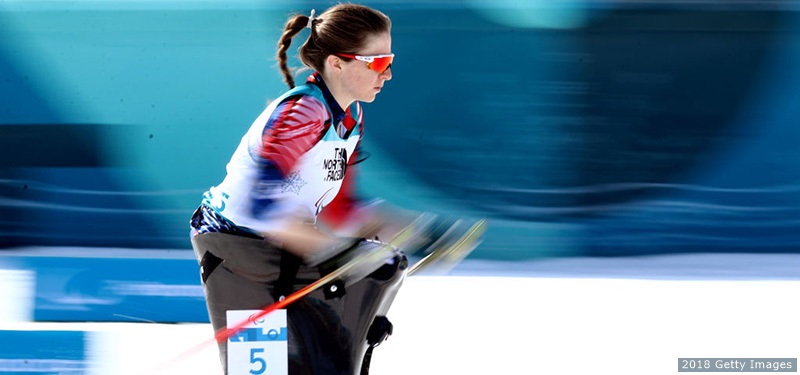
American Kendall Gretsch racing to fourth in the women’s 10 k sitting biathlon race on Tuesday at the 2018 Paralympics in PyeongChang, South Korea. (Photo: U.S. Paralympics/ Maddie Meyer – Getty Images)
Coming off two medals in the women’s sitting biathlon and cross-country events last weekend, Kendall Gretsch placed fourth in the 10 k sitting biathlon race on Tuesday, 16.5 seconds out of third. According to a U.S. Paralympics press release, she fell three times and incurred three penalties (1+0+0+2), finishing 2:05.4 behind the winner, Germany’s Andrea Eskau.
A four-time gold medalist in Paralympic cycling with two silver medals in cross-country skiing (from two Winter Paralympics), Eskau, 46, claimed her first gold of the PyeongChang Games in 42:36.6 with one miss (0+0+1+0). Marta Zainullina and Irina Guliaeva, of the Neutral Paralympic Athletes (NPA), took silver (+1:15.5) and bronze (+1:48.9), respectively, with Zainullina skiing just one penalty lap and Guliaeva having to ski three.
Oksana Masters did not finish, pulling out after 8.64 k with six penalties (1+2+1+2).
Second Medal for Arendz
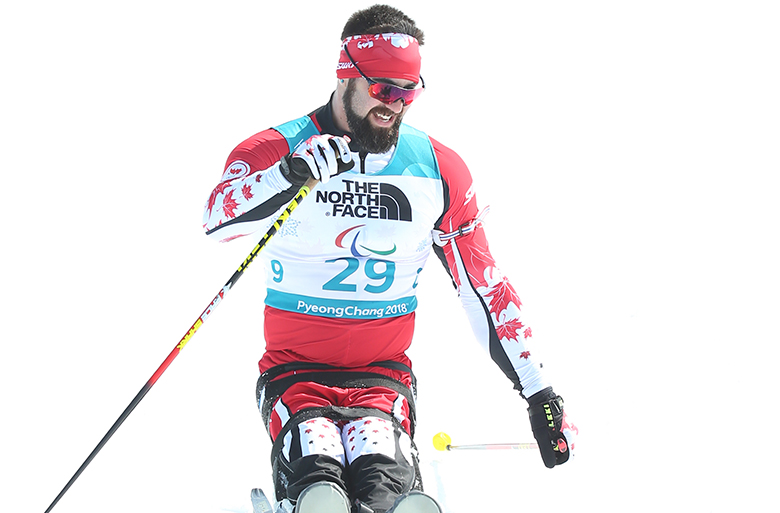
Canada’s Mark Arendz racing to bronze in the men’s 12.5 k standing biathlon race on Tuesday at the 2018 Paralympic Games in PyeongChang, South Korea. (Photo: Scott Grant/Canadian Paralympic Committee)
Mark Arendz led Canada with his second medal in the second biathlon race, the men’s 12.5 k standing, racing to bronze, 30.9 seconds out of first. Arendz cleaned three stages before missing one on his last shooting (0+0+0+1), causing him to ski an additional 150 meters in the penalty lap.
France’s Benjamin Daviet won that race in 38:55.5 with one late penalty as well (0+0+0+1), and Ukraine’s Ihor Reptyukh collected silver (+6.7) with one miss as well (0+0+1+0).
“I knew there were some tired guys, so I went for it from the start and tried to put some pressure on,” Arendz, 28, said in a Cross Country Canada press release. “I decided in that last bout to go for it all, throw it down, and go for the win. Unfortunately, I had the one miss and it made it a tight and interesting race.”
The men’s 12.5 k standing biathlon podium at the 2018 Paralympics in PyeongChang, South Korea, with France’s Benjamin Daviet (c) in first, Ukraine’s Ihor Reptyukh (l) in second, and Canada’s Mark Arendz (r) in third. (Photo: Scott Grant/Canadian Paralympic Committee)
Arendz, who took silver in the opening biathlon sprint and also has two biathlon silver medals from the 2014 Paralympics, is seeking his first Paralympic gold.
“It was a really tough battle all day. I handed it to them early and had a choice: to go for gold or settle for the podium. I went for the win and had that one miss that cost me today,” he said. “I ran out of energy at the end. I am really happy with my race and it is another medal for Canada. I know everything is going well. I just need that last little tweak to finally win one.”
American Ruslan Reiter finished 11th in that race (+8:41.4) with three penalties (0+2+1+1).
Brittany Hudak led the Canadian women in fifth in the 10 k standing biathlon race, 5:45.8 behind Ekaterina Rumyantseva (NPA) in first. Hudak cleaned the first three stages before missing one in the last bout (0+0+0+1).
“The first lap I felt good,” Hudak recalled in the team press release. “The skis were running well in these conditions, but then it just got slower as we went on. The flat sections you really try put power to glide the ski but your weight is sinking you into the snow. It got harder to get some glide and as my legs got more tired I didn’t feel like I was moving fast.
“I tried to keep calm in the range and take my time,” she added. “The wind today was gusting, so I took a bit longer on my setup than I usually would and tried to be consistent. For the most part it worked well until that last lap, and that last bout. Overall it was an OK race.”
Paralympic racing continues Wednesday with men’s and women’s cross-country sprints, starting at 10 a.m. Korea time (7 p.m. EDT Tuesday).
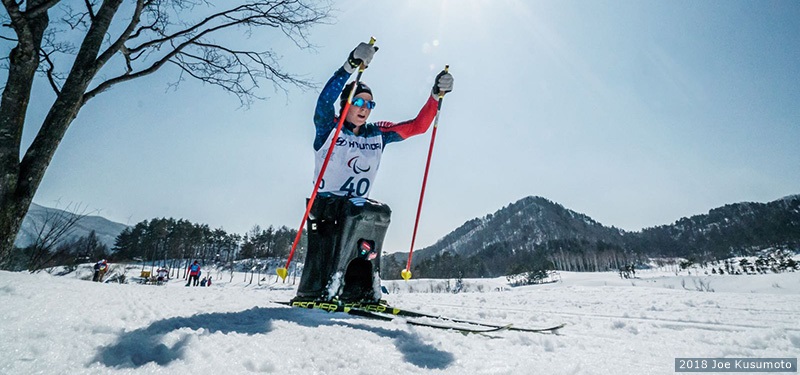
Kendall Gretsch racing to her second gold medal of the 2018 Winter Paralympics on Sunday in the women’s 12 k sitting cross-country race in PyeongChang, South Korea. (Photo: US Paralympics/Joe Kusumoto)
2018 Winter Paralympics (PyeongChang, South Korea): 12/15 k sitting cross-country races
It was a gold, silver and bronze day for the U.S. Paralympics Nordic team on Sunday at the 2018 Paralympics in PyeongChang, as Kendall Gretsch raced to her second-straight victory in as many races, Dan Cnossen took silver and Oksana Masters claimed bronze in the cross-country distance events.
A day after achieving a historic bronze for Canada in a biathlon sit-ski event, Collin Cameron led his country in fifth in Sunday’s 15-kilometer sitting cross-country race.
Gretsch, a Paralympic rookie who won the sitting biathlon sprint to open the Paralympics, also won the women’s 12 k sitting cross-country race on Sunday in 38:15.9 minutes, 34.5 seconds clear of Germany’s Andrea Eskau in second, while Masters followed 49 seconds back in third.
“For cross-country, I was pretty unsure going in here,” said the 25-year-old Gretsch, according to a U.S. Paralympics Nordic Skiing press release. “I knew that since our last World Cup I had improved a lot, but you never know until you race. Just happy with how things went today and I was able to put together another good race.”
“It’s a very humbling experience being able to hear your anthem,” she said of her second gold medal. “Puts everything into perspective. Knowing that you’re here not just here for yourself but for your country, it’s amazing.”
For Masters, who is recovering from an elbow injury, it was her second medal after taking silver in Saturday’s biathlon sprint.
“I’m just so happy to be on the podium,” Masters told U.S. Paralympics. “I was a little worried on the long distance considering I haven’t done intensity in three weeks. It definitely is a very painful, rude awakening to how painful the sport is. I’m happy to be on the podium.”
She described the pain in her elbow as “extremely excruciating. It feels like there’s just a saw going at your bone 24/7, especially hammering up the climbs,” Masters said. “I had a spill over there through the stadium, but mind over matter.”
Ukraine’s Maksym Yarovyi won the men’s 15 k sitting in 41:37.0, and Cnossen, who had taken gold in the men’s sitting biathlon sprint, placed second, 43.1 seconds back. Sin Eui-hyun claimed South Korea’s first medal of the Games in third (+51.9) ahead of China’s Zheng Peng in fourth (+1:18.5) and Canada’s Cameron in fifth (+2:09.0).
“I’ve already exceeded my expectations,” Cnossen, 37, said of his second Paralympic medal in as many days. “I’m very proud to represent the U.S. Today, I dug as deep as I could and went as hard as I could, and regardless of where I ended up on the result, it is my success to go as hard as I could.”
Canada’s Colin Cameron racing to bronze in the mens 7.5 k sitting biathlon sprint on Saturday at the 2018 Paralympic Games in PyeongChang, South Korea. (Photo: Scott Grant/Canadian Paralympic Committee)
“It was really soft out there, but the skis were still fast,” Cameron, 29, said, according to a Canadian team press release. “The skis have been awesome both days – the guys are working their butts off back in the wax room.”
Cameron explained his goal for Sunday’s race was to “start steady and be comfortable, to get rid of the bugs from yesterday’s race because I was pretty tight.
“I was able to loosen up as I went along, which allowed me to dig a little deeper today,” he continued. “It’s tough to go from biathlon to this event. It is a totally different mindset for pacing, a totally different game. I wasn’t event thinking about [yesterday’s medal] I just wanted to build off it and take that momentum with me the rest of the week. Today was a different day and I’m happy with how I was able to perform.”
Also for Canada, Chris Klebl, who won gold in the 10 k sitting event at the 2014 Paralympics, finished eighth (+2:25.6), Derek Zaplotinsky followed in ninth (+2:42.6), Sebastien Fortier finished 18th (+5:01.0), Ethan Hess 24th (+10:37.1), and Yves Bourque 25th (+11:35.7)
In the women’s sitting race, Canada’s Cindy Ouellet, a 29-year-old Paralympic wheelchair basketball player, placed 18th (+11:37.3).
“This is my first race over five kilometres and it was tough,” Ouellet said, according to the press release. “Basketball is all stop and go, but endurance is much different. I just need more races.”
For the U.S., Andy Soule placed 11th (+2:59.1) and Sean Halsted finished 22nd (+7:18.0).
Paralympic racing continues Monday with the men’s and women’s standing and visually impaired cross-country long-distance events, starting at 10 a.m. Korea time on Monday (7 p.m. EDT on Sunday).
Three-time Paralympic medalist Oksana Masters won her third consecutive overall women’s sitting IPC World Cup globe in cross-country. (Photo: U.S. Paralympics)
COLORADO SPRINGS, Colo. — Thirteen athletes, including seven U.S. Paralympians in Nordic skiing, were named to the 2017-2018 U.S. Paralympics Nordic Skiing National Team on June 1 by U.S. Paralympics, a division of the United States Olympic Committee.
“The level to which our Nordic skiers have performed already is very inspiring,” said Paralympic Nordic Skiing head coach Eileen Carey. “Our veteran athletes have continued to improve as we approach the Paralympic Winter Games PyeongChang 2018, and the addition of new members on our national and development teams is promising for the future.”
Three-time Paralympic medalist Oksana Masters (Louisville, Kentucky) highlights the team after claiming four world championships titles during the 2016-17 season, including cross-country crowns in sprint, middle and long distances, as well as the sprint biathlon title. She capped off the season by securing her third consecutive overall women’s sitting world cup globe in cross-country at the World Para Nordic Skiing World Cup Finals in Sapporo, Japan. Additionally, Masters finished third in the world cup overall rankings in biathlon.
Kendall Gretsch (Chicago, Illinois), Ruslan Reiter (Manchester, Maine) and Daniel Romanchuk (Mount Airy, Maryland) all make the national and development teams for the first time.
Four military veterans are featured on the roster, including Dan Cnossen (Topeka, Kansas/Navy), Sean Halsted (Rathdrum, Idaho/ Air Force), Bryan Price (Belton, Missouri/Army) and Andy Soule (Pearland, Texas/Army).
Team USA had a record-breaking 2016-17 season that finished with 33 world cup medals by five athletes, setting a record for the Nordic skiing team. Of the 33 world cup medals acquired, 12 were in biathlon. All A- and B-Team athletes reached the podium this past season, including first-time medals for Jake Adicoff (Sun Valley, Idaho) and guide Sawyer Kesselheim (Bozeman, Montana), as well as Aaron Pike (Park Rapids, Minnesota) at the PyeongChang Test Event.
2017-18 U.S. Paralympics Nordic Skiing National Teams
*Denotes U.S. Paralympian in Nordic skiing
# Denotes U.S. Military veterans
A Team
Jake Adicoff (Sun Valley, Idaho) – visually impaired skier*
Dan Cnossen (Topeka, Kansas/Navy) – sit skier*#
Sawyer Kesselheim (Bozeman, Montana) – guide
Oksana Masters (Louisville, Kentucky) – sit skier*
B Team
Aaron Pike (Park Rapids, Minnesota) – sit skier*
Andy Soule (Pearland, Texas/Army) – sit skier*#
C Team
Kendall Gretsch (Chicago, Illinois) – sit skier
Development Team
Sean Halsted (Rathdrum, Idaho/Air Force) – sit skier*#
Bryan Price (Belton, Missouri/Army) – sit skier*#
Ruslan Reiter (Manchester, Maine) – standing skier
Daniel Romanchuk (Mount Airy, Maryland) – sit skier
Joy Rondeau (Granby, Colorado) – sit skier
Mia Zutter (Sun Prairie, Wisconsin) – visually impaired skier
COLORADO SPRINGS, Colo. (June 1) — Seven athletes, including five U.S. Paralympians, were announced to the 2016-2017 U.S. Paralympics Nordic Skiing National Team by U.S. Paralympics, a division of the United States Olympic Committee.
“The high quality of our national team this season is very encouraging,” said Paralympic Nordic Skiing head coach Eileen Carey. “All of our athletes have shown themselves to be competitive as they continually challenge for medals on the international stage.”
Headlining the team is two-time Paralympic medalist Oksana Masters (Louisville, Kentucky) who comes off a perfect 2015-16 campaign in cross-country competition. She went undefeated in sprint, middle and long distances to claim her second consecutive overall world cup globe for the women’s sitting class at the IPC Cross-Country Skiing World Cup Finals in Vuokatti, Finland in March. She also amassed the most world cup cross-country points throughout the season than any other female on the world cup circuit.
The roster also includes three military veterans: Sean Halsted (Rathdrum, Idaho), ret., Air Force, Bryan Price (Belton, Missouri), ret. Army and Paralympic medalist Andy Soule (Pearland, Texas), ret. Army.
Making their national team debut are two newcomers Joy Rondeau (Granby, Colorado) and Mia Zutter (Sun Prairie, Wisconsin). Both competed in their first international competitions at the world cup in Finsterau, Germany which will play host to the 2016 IPC Nordic Skiing World Championships.
Team USA finished the 2015-16 strong with nine medals in the final two world cups, including three gold medals at the World Cup Finals. The team will face an important year in preparation for the 2018 Paralympic Winter Games. Before the world championships in February, the team will travel to world cups in Finland, Ukraine and Japan as well as South Korea for the PyeongChang Test Event.
2016-2017 U.S. Paralympics Nordic Skiing National Teams
*Denotes 2014 U.S. Paralympian # Denotes retired U.S. Military
A Team
*Oksana Masters (Louisville, Kentucky), sit ski
*#Andy Soule (Pearland, Texas/Army), sit ski
B Team
*Jake Adicoff (Sun Valley, Idaho), visually impaired
Development Team
*#Sean Halsted (Rathdrum, Idaho/Air Force), sit ski
Canadian para athlete Yves Bourque, of Quebec, a veteran of the 2014 Sochi Paralympics, skiing in Craftsbury, Vt., at 2016 U.S. Paralympics Sit Ski Nationals and IPC Continental Cup from Jan. 6-9. (Photo: John Lazenby/Lazenbyphoto.com)
The first week of January was a busy one. In random corners of the world, some of the top-ranked nordic skiers competed for various titles: at the Tour de Ski in Switzerland, Germany and Italy, at U.S. Cross Country Championships in Houghton, Mich., and at the U.S. Paralympics Sit Ski Nationals and International Paralympic Committee (IPC) Continental Cup in Craftsbury, Vt.
In Craftsbury, about 30 miles south of the Canadian border in northern Vermont, five races were held in a span of four days, Jan. 6-9, after anticipated rain prompted organizers to move up the last two races to the scheduled off day.
“Busy for sure, but the OC [organizing committee] did an amazing job and the athletes got a big bang for their time and investment in being there,” U.S. Paralympics Nordic High Performance Director John Farra wrote in an email.
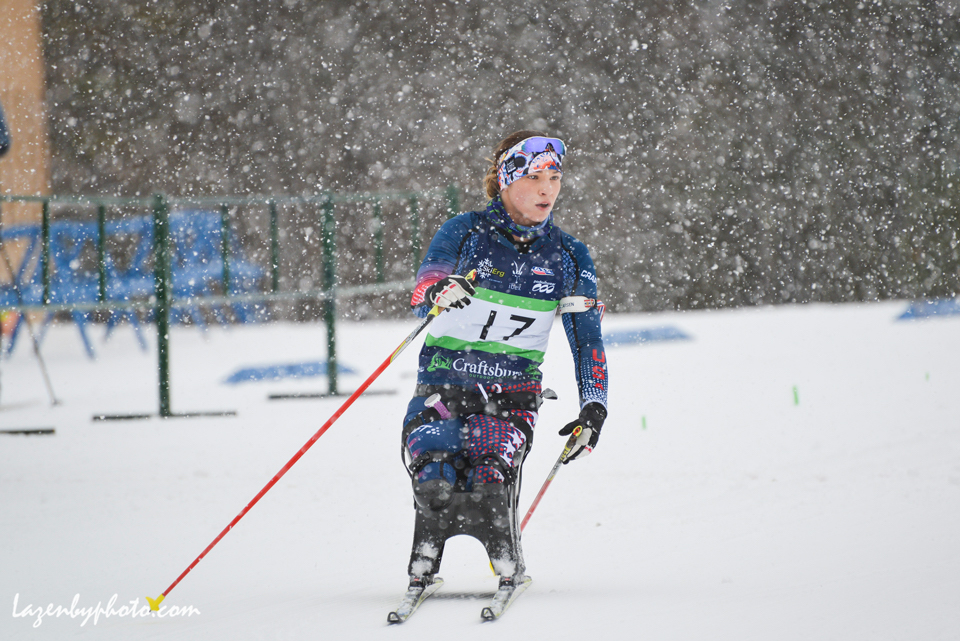
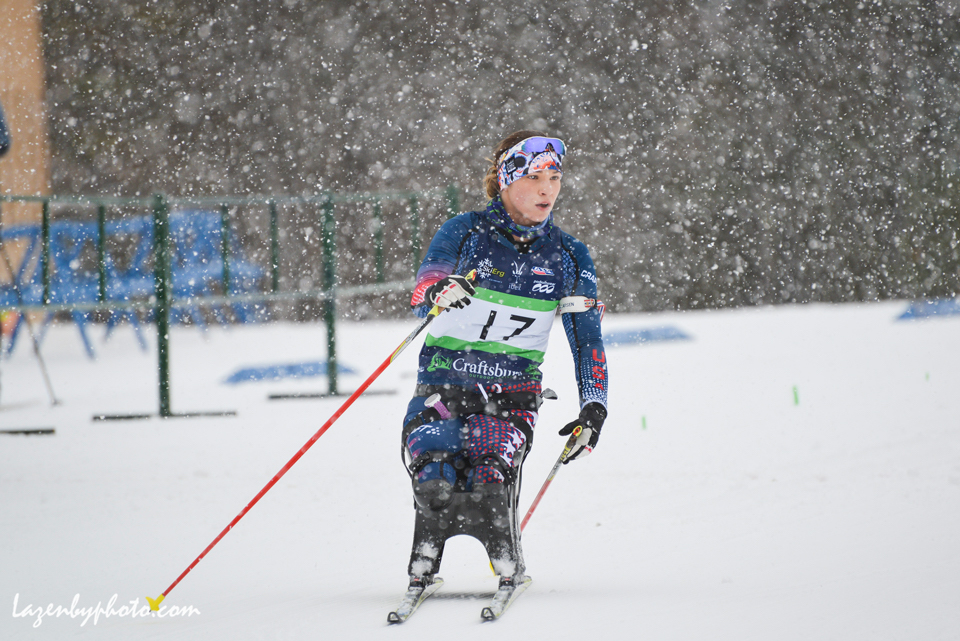
Oksana Masters (U.S. Paralympics Nordic A-team) during a snowy day in Craftsbury, Vt., at the U.S. Paralympics Sit Ski Nationals and IPC Continental Cup from Jan. 6-9. (Photo: John Lazenby/Lazenbyphoto.com)
The Craftsbury Outdoor Center hosted 25 participants in three cross-country races followed by two biathlon races. U.S. Paralympics A-team members Andy Soule and Oksana Masters won the opening men’s 7.5-kilometer and women’s 5 k mid-distance sit ski races, respectively, and Masters went on to sweep the remaining races of nationals.
Soule won four out of the five, placing second to longtime teammate Sean Halsted in the men’s 2.5 k short-distance sit ski on the second day of racing.
That day entailed back-to-back races: the short-distance in the morning and a full sprint — complete with a qualifier and heats —following in the afternoon.
“It was a busy day, but from a development perspective it was a great model,” Farra wrote.
Interestingly, the 850-meter sprint was scored as a “mixed” event, ranking both genders on a single results sheet. Masters topped the coed field, winning with an adjusted time 11 seconds faster than Soule. Halsted was the second male and third overall.
“This year for the first time we were able to take advantage of a new rule by IPC that allows us to combine men’s and women’s fields for the purposes of establishing a points base when the numbers of points-holding athletes in a single field would otherwise be too small,” Eileen Carey, head coach of U.S. Paralympics Nordic explained in an email.
“There is a precedent for this in IPC in the relay, where women get an additional 18% off their compensation to equalize the field and combine everyone in one event. As an example when Oksana is racing against women’s only fields, she has a 100% compensation, so her calculated result is the same as her real time,” Carey continued. “In this event, her calculated result was 82% of her real time. This made for a much more exciting event and a better competition for athletes. For our World Cup regulars and new skiers alike, it meant more practice going into technical sections in groups and having to ski more tactical races to qualify for finals.”
Looking at the overall field, Farra and Carey noted they were impressed by some “brand new” athletes.
“This was the first major competition for a majority of the field,” Carey explained. “As a group, they arrived impressively fit for skiing and improved throughout the week. It is exciting for us to have a bigger community of adaptive athletes in the same place each year.”
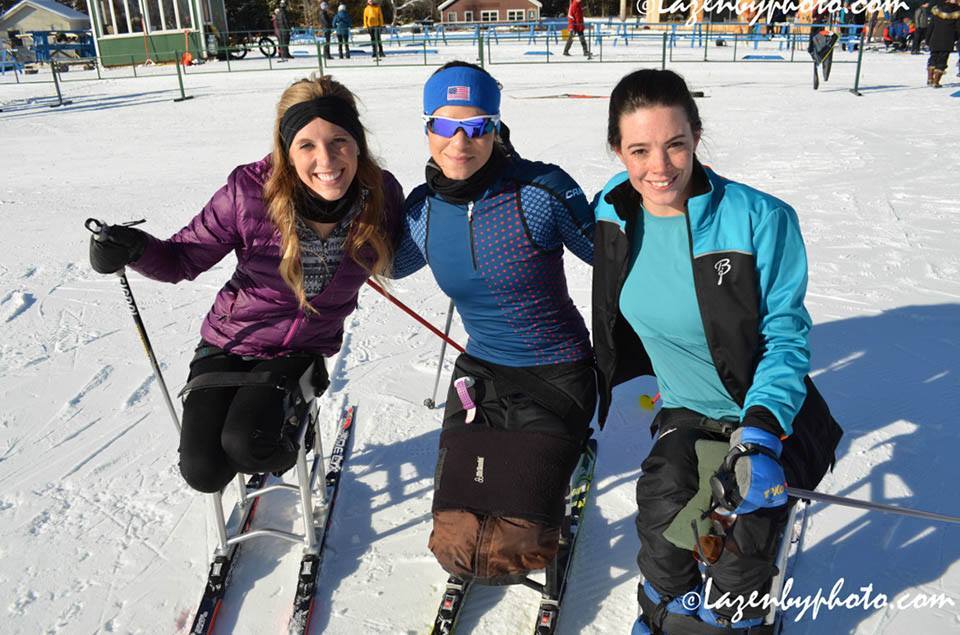
U.S. para skiers (left to right) Brittany Fisher, Oksana Masters, and Joy Rondeau at 2016 U.S. Paralympics Sit Ski Nationals and IPC Continental Cup. (Photo: John Lazenby/Lazenbyphoto.com)
In her first IPC Continental Cup and sit-ski nationals, Joy Rondeau, who trains with the National Center for the Disabled in Winter Park, Colo., placed second to Masters in all three cross-country events and the 6.5 k biathlon race.
“We had participation in all 3 classes and both genders… which was really cool for us,” Farra wrote. “Great to have some new talent in standing and visual impaired classes especially.”
“The development group as a whole came to the event more fit and more skilled than in the past so we think that means good things for the future of the sport,” Carey added.
This season, sit skiers Halstead and Bryan Price are on the development team. Halstead reached the podium in all five races, Price landed on it three times, and B-team member Aaron Pike tallied two podiums in Craftsbury.
Andy Soule (U.S. Paralympics A-team) at 2016 U.S. Paralympics Sit Ski Nationals and IPC Continental Cup. (Photo: John Lazenby/Lazenbyphoto.com)
“I was impressed with the group as a whole and am excited to see what is to come,” Carey wrote. “Our National Team athletes are skiing well and are on track for a good winter.”
As for the conditions in Craftsbury, Carey described them as “great.”
“The crew there is incredible with what they can do with small amounts of snow,” she wrote. “They worked hard making and moving snow and (once again!) made excellent courses for our skiers. I have learned to never underestimate what they are capable of, and they did not disappoint. We are lucky to have such a dedicated organizer in Nordic sport and the fact that they pulled out all the stops for our field of 25 athletes was amazing. They put together World Cup quality competitions.”
The national team is headed to Pyeongchang, South Korea, for the IPC Asian Cup Jan. 28-Feb. 1 and a chance to preview the 2018 Paralympics venue.
“We will get eyes on Pyeong Chang for the first time this winter so we will learn specifics from that trip that we will apply to our training,” Carey wrote.
Returning 2010 Paralympic bronze medalist Andy Soule racing at the 2014 US national championships. (Photo Victor Henderson)
At the 2014 Winter Paralympics from March 7 to 16 in Sochi, Russia, nordic skiing and biathlon will account for more that half of the available medals.
How will the United States fare in the medal chase?
Downplaying expectations in an interview with FasterSkier, John Farra, the high-performance director of U.S. Paralympics Nordic, didn’t rule out a surprise or two from his team.
“While we are not expected to win any medals … we are spending a lot of time and effort to find that extra half percent or 1 percent that gets [our athletes] into the top three to steal a medal from the Russians or the Ukrainians.”
The Russians, in particular, have been dominant in World Cup sit-ski competitions this season. In December in Canmore, Alberta, both the Russian and U.S. teams showed up in full force to prepare for Sochi.
The Russians won most of the medals available and swept several podiums, while the U.S. men missed out on the podium.
“They [the Russians] really came to ready to race,” Farra said.
Sights on Biathlon
For the men’s team, biathlon looks to be a place where the U.S. program has an opportunity for success. At the Vancouver 2010 Winter Games, Army veteran Andy Soule earned the United States’ first-ever Olympic or Paralympic medal in biathlon, finishing third.
Soule returns to this year’s team and told FasterSkier, “I’m probably better on the longer races, the biathlon long course (15 Kilometer) is my best race, not because of the skiing, but because the shooting penalty is considerably larger for that event.”
Regarding the technical aspect of biathlon, Soule said, “I’m definitely working on a being more aggressive. I’ve been a decent shooter for some time and I’m working on cutting down on my range times.”
U.S. Paralympics Biathlon coach Rob Rosser said the team has a good chance to score an upset in biathlon.
“In cross-country skiing, it can takes years to develop and significantly change your level of fitness,” Rosser said. “That’s why biathlon is so interesting as a sport, so many things can happen with the shooting that the outcomes are much less predictable.”
Dan Cnossen racing at the 2013 IPC World Cup in Canmore, Canada, in December. (Photo: Pam Doyle)
A leading member of the team after just a few seasons in the sport, Lt. Dan Cnossen edged Soule at U.S. nationals in January, beating Soule by 2.8 seconds in the 7.5 k race, after Soule missed a shot on his final round in the range.
Cnossen will be competing at his first Paralympics this month.
This year Cnossen has focused on upping his game in biathlon.
“I’ve made some changes in my training for the biathlon,” Cnossen said at the beginning of the season. “I had some troubles with my rifle that we’ve ironed out, so I think you’ll see some improved hit rates.”
At nationals, the sit-ski sprint lived up to it’s reputation where anything can happen. A relative newcomer, Jeremy Wagner became a national champion with his first national title, topping 2010 Paralympian Sean Halsted.
U.S. Women’s Prospects
The U.S. women’s team makes up four of the 18 athletes on the team, but they have delivered the most impressive results and generated the most media buzz this Olympic year.
Oksana Masters is the top U.S. contender for a medal based on her World Cup results this season.
Oksana Masters racing in the IPC World Cup Canmore sprint race. (Photo: Pam Doyle)
Recruited to skiing based on her background as a bronze-medal winning Paralympic rower, Masters has shown remarkable adeptness at learning a sport she first tried two years ago.
“She’s fearless, so she ended up crashing a lot early on because she just wanted to go fast,” Farra explained. “She didn’t know how to control the [sit-ski] to be able to turn it left or right to avoid the tree, and often times she’d connect with the tree or crash and break a pole.”
He laughed.
“She was a bit of a … well, you know, it was pretty funny actually in some ways. As long as she wasn’t getting hurt it was fun to watch.”
In an email to FasterSkier, Masters cited her inexperience with skiing and her surprise at her success. About her Canmore medal, she said, “I knew that just about every other woman skier out there had years of experience on me and I am still a newbie. I went into the the race with the mind set of I’m not going to be top 5 but I wanted to try my darn hardest to make it in the top 10.”
As for her first World Cup podium: “I didn’t know instantly that I got third. I was shocked and thought it was a mistake at first.”
So is she getting more comfortable and does she believe she can compete with the best in the world? Farra thought so.
“I think it is fair to say she is starting to believe it, yes. She is so competitive and really was pumped to get on the podium in Oberstdorf. She has really refined her technique to a very smooth, powerful and efficient motion. … She will get there.”
Masters has garnered national media attention since her appearance in the 2012 London Paralympic Games. Her life story as a Ukrainian orphan adopted by her U.S. mother has been featured in various media forms, including Sports Illustrated and Southwest Airlines’ in-flight magazine.
She was named one of the “11 hottest paralympic athletes” by MSN “Now.” She was named one of ten U.S. athletes to watch by The Guardian.
Apple featured her in a video, “Making a difference: one app at a time”, where she demonstrated how she uses an iOS app to control her prosthetic legs and put on high heeled shoes.
Perhaps most famously, Masters posed nude for ESPN’s 2012 “Bodies We Want” issue.
Tatyana McFadden racing at US nationals Soldier Hollow. (Photo: Victor Henderson)
As the U.S. heads for Sochi, world-class wheelchair racing champion and summer Paralympic cross-over athlete, Tatyana McFadden is another woman to watch. McFadden and Kikkan Randall were featured together in BP television ads during NBC’s coverage of the Winter Olympic Games.
Apart from her celebrity status as the most decorated U.S. athlete going to Sochi, McFadden is candid about her newness to skiing.
“For track, since I’ve been to other races and other Paralympics … I know what to expect between events and the transitions and about getting on the bus and off the bus and into the venue and what its going to feel like,” McFadden said. “For Sochi, I don’t know any of that. I have no idea because everything is so new for me.”
McFadden’s ski results have steadily improved as she gains experience. She has cracked the top 10 three times in IPC world cup competition this season, finishing ninth in the 12 k and tenth in the sprint at Oberstdorf. She placed seventh in the sprint at Canmore, narrowly missing the six-woman final round.
McFadden and her London 2012 Paralympic teammate Jessica Long are both Russian orphans who were adopted and brought to the United States by American families. Both have been outspoken against Russia president Vladimir Putin’s 2012 law banning adoption of Russian children by U.S. citizens.
McFadden said she was excited to return to Russia for the Sochi Paralympics.
“It’s part of my culture, it’s part of who I am, and that will never be apart from me,” she said. “But I’m going to be going and competing for the United States of America.”
Lt. Dan Cnossen (U.S. Paralympics) out of the start in Tuesday’s 10 k sit-ski at 2014 U.S. Paralympics Nordic Skiing Nationals at Soldier Hollow in Midway, Utah. He won by 18.2 seconds in 32:21.9.
FasterSkier’s coverage of the 2014 U.S. Cross Country Championships is brought to you through the generous support of The Memory Clinic in Bennington, Vt.
MIDWAY, Utah — Rounding Soldier Hollow’s 2.5-kilometer sit-ski course on Tuesday, Oksana Masters and Lt. Dan Cnossen muscled through methodically, powerfully.
Even with two victories apiece behind them from earlier in the week at U.S. Paralympics Nordic Skiing Nationals, these two had business to tend to: take care of some optimal conditions in Utah, then get ready for the Jan. 16-19 World Cup in Oberstdorf, Germany.
Sochi was undoubtedly on their minds, with the 2014 Winter Paralympics exactly 60 days away from Tuesday’s 5- and 10-kilometer sit-ski races, but neither Masters or Cnossen were getting ahead of themselves.
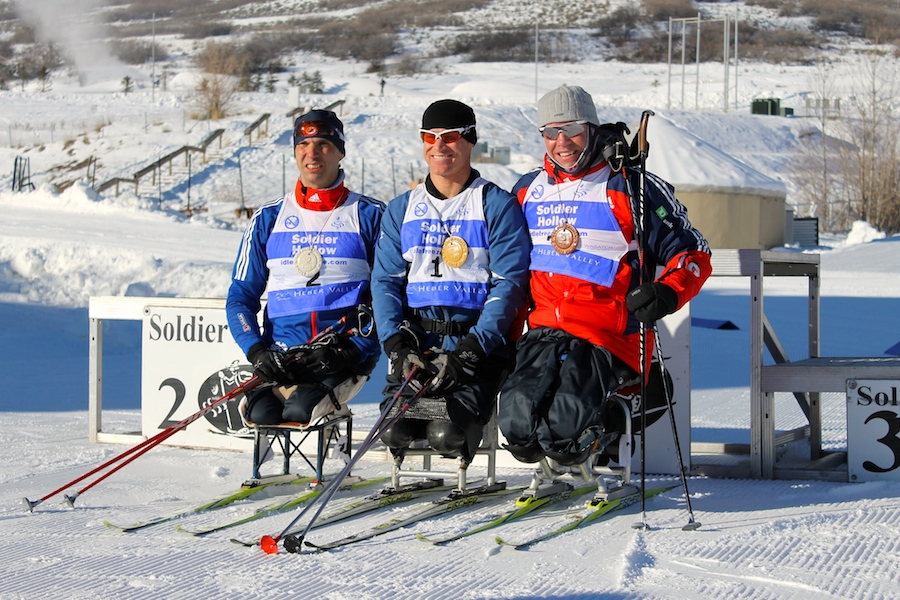
Men’s 10 k sit-ski podium at 2014 U.S. Paralympics Nordic Nationals on Tuesday, with winner Dan Cnosson (c), who won three out of four events this week, Andy Soule (l) in second, and Sean Halsted (r) in third.
“I’m just gonna focus on the next step which is the World Cup right now and then being named to the team hopefully, and go from there,” said Cnossen, 33, after winning his third out of four races at nationals in 32:21.9 minutes, 18.2 seconds ahead of U.S. Paralympics teammate Andy Soule (Army) in second.
A Navy SEAL who lost his legs in an explosion in Afghanistan in 2009, Cnossen is one of the team’s frontrunners in the leadup to Sochi, yet he was looking forward to seeing how he fares on internationally before turning his focus toward what would be his first Paralympics.
Last year, he won silver in the first race of the International Paralympic Committee (IPC) Nordic Skiing World Cup in Cable, Wis., in the 10 k. At the IPC World Cup in Canmore, Alberta, from Dec. 9-16, Cnossen notched a couple top 10s and put himself 11th in the Cross-Country World Cup standings. As of Dec. 15, he was 14th on the Biathlon World Cup list.
In Soldier Hollow from Jan. 2-6, Cnossen opened with a victory in the 7.5 k biathlon race, then went on to win the 15 k distance race, place fourth in the sprint, and ultimately finish with a 10 k title.
“Had some good races; the courses were awesome,” Cnossen said. “They’re really similar to what we’ll be experiencing in Sochi, definitely the altitude is.”
While the temperature was a little cooler than what’s expected in Sochi, with the men and women racing on a just-above-freezing morning on Tuesday, Cnossen said the slower snow worked to his favor.
Oksana Masters (U.S. Paralympics) en route to winning Tuesday’s 5 k sit-ski at 2014 U.S. Paralympics Nordic Skiing Nationals at Soldier Hollow in Midway, Utah.
A Paralympic bronze medalist in rowing, Masters, 24, raced to her third championship of the week as well, winning the women’s 5 k in 18:13.2, about 2 1/2 minutes faster than Monica Bascio in second.
In Canmore, Masters opened with a bronze in the World Cup 5 k and placed fourth in the sprint. She finished the series ranking fourth in the Cross-Country World Cup and eighth in biathlon.
“Hopefully it continues,” Masters said on Tuesday. “Last year I kind of had an injury going into it starting out and also lack of on-snow experience. I was on snow for a total of two days before going out here last year to nationals … I think I was just trying to hammer it too hard instead of try to slow down and learn the technique to it.”
With her rib injury healed and breathing easier at some 5,500 feet above sea level, Masters was looking forward to returning to Germany after training in the Oberhof ski tunnel in October.
“I love the competitiveness; I really like the fact that it’s something that I can grow myself as an athlete and I can broaden that spectrum of my athleticism,” the U.S. Development Team skier said. “The team camaraderie is really cool. Everyone, the girls, the guys, have their unique personalities and it wouldn’t be the same team without one person.”
Women’s 5 k sit-ski podium at 2014 U.S. Paralympics Nordic Nationals, with winner Oksana Masters (c), who won three of four events this week, Monica Bascio (l) in second, and Tatyana McFadden (r) in third.
As for the transition from rowing, Masters said the pulling motion is similar, but the winter weather had been a tough adjustment.
“I think it helped to come from a sport background where it was an endurance sport also along with strength,” she said. “My biggest challenge from rowing would be the variety of an 800-meter sprint to a 12 1/2 k or 10 k, so I have to build that up.”
As for her Winter Paralympics aspirations, Masters said set on not giving up.
“I’m a perfectionist, and I strive to be the best I can in whatever I do,” she said. “I’m not going to start something and just stop it.”
The men’s 10 k runner-up, Soule called this year’s nationals “a good race experience.”
“Nationals always is a good little prep period before going over to compete World Cup,” he said.
Sean Halsted (Navy) placed third after miscounting his laps and coming into the finish one loop too soon. He had to turn around and head backward down the finishing straight to get to the lap lane, ultimately finishing 50 seconds behind Soule.
“I didn’t realize we were on the course that we were on I thought we were going three laps of 3 k,” Halsted said with a laugh.
Either way, the national-team member said nationals were a good tuneup before they resume international racing.
“It’s all about prep trying to get that race experience in,” Halsted said. “It’s not just, ‘Hey you might be first or second,’ well, you don’t hold on to that. … You use that to motivate you for when you’re going on the international [scene].”
In the women’s race, Tatyana McFadden placed third, about 45 seconds after Bascio, and Beth Requist was fourth.
Dan Cnossen (U.S. Paralympics) leading the men’s 15 k sit ski at U.S. Adaptive Championships on Saturday at Soldier Hollow in Midway, Utah.
FasterSkier’s coverage of the 2013 US Cross Country Championships is brought to you through the generous support of The Memory Clinic in Bennington, Vt.
MIDWAY, Utah – They couldn’t have finished much more than 20 minutes earlier, yet there they were – Lt. Dan Cnossen and Oksana Masters – ready to duke it out at Soldier Hollow. The two lined up at one end of a set of tracks in the stadium, poles high and waiting for the go-ahead from their coach.
The more seasoned of the two, Cnossen, a U.S. Navy SEAL, double poled alongside Masters, a Ukranian-born rower who recently won bronze for the U.S. at the London Paralympics. The 23-year-old from Louisville, Ky., started skiing seven days ago.
Dan Cnossen (c), Oksana Masters (second from r) and Tatyana McFadden talk to their coaches, including U.S. Paralympics high-performance director John Farra (front) after their distance races at U.S. nationals on Saturday in Soldier Hollow.
Yet after her first race – in which she placed fourth in the women’s 9 k sit ski at U.S. Adaptive Championships on Saturday – Masters wanted more. She wanted to learn some technique.
The men’s 15 k champion who picked up the sport two years ago, Cnossen took it upon himself to help her, and so the two did pickups to determine inefficiencies in her double pole. With a similar injury after losing use of their legs, Cnossen – originally from Topeka, Kan. – could relate.
“We’ve got some really talented new athletes that have barely been on snow so if I can give them advice and help build the team then that’s the least I can do,” said Cnossen, one of six U.S. Paralympics Nordic team members.
Fresh off a trip to Vuokatti, Finland, where he notched fifth and ninth at the opening International Paralympic Committee (IPC) World Cups, Cnossen defended his distance title on Saturday (he won the abbreviated 12.5 k course at nationals last year in Rumford, Maine).
“I’ve been working hard, but so has everybody else,” Cnossen said after rounding the five-lap course fastest in 45:43.4.
Teammate Andy Soule (Army) was 2:20.9 back in second. The two were the lone national team members sent to Finland.
Cnossen said it was advantageous to race competitive international skiers early in the season, before nationals. It was even better to get out of the darkness in Finland and into the Utah sun. Saturday’s race was pushed back from its original 8:30 a.m. start to 2 p.m. Saturday to allow temperatures to warm up. By Saturday afternoon, it was comfortably in the 20s.
Dan Cnossen (Navy) goes out hard from the start of the 15 k sit ski at U.S. Adaptive Championships in Soldier Hollow on Saturday.
Cnossen said he was simply grateful to put on a bib and race, and went out hard from the start.
“I think I went a little too hard the first lap because the second lap I thought, ‘Oh man, I have four more to go,’ ” he said. “But I held on and then the fifth lap, I always have energy because I have a good kick normally. I prefer to go out a little on the aggressive side and be in the race and not lose time. I think it’s easier to be in the race and stay in the race then be out of the race and get back into it.”
Pushing from start to finish and skiing outside the tracks at times in the warming snow, Cnossen sealed another victory, which he was happy about. But he still didn’t consider himself a veteran. It was hard to with Olympians Soule and Sean Halsted (Air Force), who finished third (+3:01.6), on the team.
“Mainly, I’m just doing what I’m told and really it’s the coaches who are getting me where I am and where I will be a year from now,” he said. “Who knows? It’s exciting because I can just see progress. I don’t know where I’ll be in a year, but I’m sure it’ll be better than I am now.”
***
In the women’s race, one of those rookies Cnossen was referring to, Beth Requist won her first national title, completing the 9 k course in 39:53.7. After dabbling in the sport last season, she began training with Cnossen and Jeremy Wagner more seriously this year in her hometown of Winter Park, Colo. There, she participated in her first race a few weeks ago, a 6.8 k.
Beth Requist of Winter Park, Colo., en route to winning the women’s 9 k sit ski at U.S. Adaptive Championships in Soldier Hollow on Saturday.
Even though that was shorter, Requist said it felt similar with bigger hills some 4,000 feet higher in elevation than Soldier Hollow (which rises to nearly 6,000 feet above sea level). But Saturday’s race was still pretty technical with a corner at the bottom of the course.
“I fell a couple times, which was kind of a bummer, but I got back up,” Requist said with a laugh. “I was trying to catch the girls [Tatyana McFadden and Kristy Vaughn] and then I fell [on the first lap] and tried to catch them again. Then I caught up and passed them and then I fell and they passed me and then I caught back up again.”
A former flight attendant who suffered a severe back injury while cliff jumping in 2009, Requist humbly accepted her national-championship medallion and smiled broadly after the podium ceremony.
“I love [skiing],” she said. “All the hard work I’ve done is starting to pay off. I still have a lot of work to do, just keep at it.”
McFadden, a 10-time Paralympic medalist in track events and Chicago Marathon winner, finished second in her first ski race, 1:28.9 behind Requist. Like Masters, she picked up the sport a couple of weeks ago at an introductory clinic in Breckenridge, Colo. From there, she decided to come to nationals.
“It’s hard, but fun,” the 23-year-old McFadden said. Born in Russia, she spent the first six years of her life in St. Petersburg before being adopted and moving to the U.S. Now a full-time student at the University of Illinois, she’s not sure how the on-snow training will be, but she’s hoping to use skiing for cross training and hopefully make the 2014 Sochi Olympics.
Ten-time Paralympic medalist (in track events), Tatyana McFadden leads Kristy Vaughn of the U.S. development team back up to the stadium during the 9 k sit ski at U.S. Adaptive Championships on Saturday. McFadden ultimately placed second in her first race and Vaughn was third.
“The first race is always good to get out of the way,” McFadden said. “You kind of get the feel how your body’s gonna do on the course and where you’re gonna fall and how to get back up and make all the mistakes in your first race. … We’ll see where it goes and how I do, but everyone’s been really supportive. All the coaches have been supportive and the teammates so it makes it a lot of fun.”
Masters, who finished behind Kristy Vaughn of the U.S. development team in third, felt similarly.
“I like the intensity and the toughness [nordic skiing] has and the competitiveness,” Masters said. “My expectations coming in here were to take not an hour or an hour max, so I did it in under and hour, which is good. I didn’t really have much expectations because this is my first race, just to go out there and finish.”
U.S. Paralympics Nordic High Performance Director John Farra beamed when he spoke about the successful day and national event on the whole. The 2013 edition featured more adaptive racers than ever before and for the first time, several international skiers, including a few from Canada, China and Mongolia.
“I’m absolutely thrilled to have 22 sit skiers all come together,” Farra said Saturday.
He was particularly excited about the recent interest of competitive female athletes.
“It’s been a long time in the making for us to have a really big group of athletes,” he said. “I think most of these women on the podium today really should be in Cable [for the IPC World Cup Jan 12-20]. “They’re already at a World Cup capacity. They just need to learn how to do technique and take corners and do all the technical parts of the sport. That’s the hardest part. Time will pass. Five, six days of skiing? I mean, come on.”
Alfredo “Freddy” De Los Santos working hard on two broken skis. Despite snapping them on the second of five laps, he finished the 15 k race at U.S. adaptive nationals at Soldier Hollow on Saturday.
A highlight of Saturday’s race for all but the man directly involved was Alfredo De Los Santos’s impressive finish after breaking both his skis two laps in. He had crashed on the big downhill, gone into a ditch and compressed both skis, snapping them in front of the binding. Fara said he was OK and resolved to finish the race.
“When he said to me he wanted to finish, I thought he meant the lap,” Farra said. “So I went to grab some skis that maybe might fit his sled.”
Aware of De Los Santos’s old binding system (U.S. Paralympics recently converted their athletes’ sit skis to one standard system), Farra grabbed four pairs of skis that could potentially work from the wax room. None of them worked with his bindings.
“Everybody’s standardized now except Freddy, who hasn’t been with us all year so he hadn’t had the chance to have it switched,” Farra explained. “I saw four pair in there that had two bindings, but they were either too short or too long, all of them. It’s one thing they have two bindings but then they have different [lengths].
“It’s the worst part of our sport when I came in is just that nobody, there was no standardization,” he explained. “So we not only design them so that they’re interchangeable and everybody’s on them, but the coaches boot can actually fit on the ski, and up to this point, the system would not allow that.”
Sean Halsted trails Dan Cnossen in the 12 k sit ski at 2012 U.S. Nationals in Rumford, Maine.
With the 2012 Paralympics starting in London in roughly a month, adaptive athletes who compete in summer sports are putting the finishing touches on their trainings. And winter athletes, too, are hard at work, training just as intensely as their able-bodied counterparts, if a little bit differently.
This spring in Bend, Oregon, FasterSkier chatted with Sean Halsted, a veteran member of the U.S. national team who finished seventh, ninth, and tenth in the sit-ski races at the Vancouver Paralympics. A college rower at Washington State who went on to join the Air Force, Halsted fell from a helicopter in 1998 and was paralyzed from the waist down. He started skiing in 2001 and is now one of he team’s stalwarts.
It’s no secret that sit skiers need an efficient and powerful double pole to get around a race course – and then best move very, very fast (in 2011, FasterSkier posted a video of Halsted starting U.S. Nationals). But besides adapting technique to best accommodate the different angle with which they plant their poles, adaptive athletes are also challenged by coming up with a training plan that prepares them physiologically without wearing out a few key sets of muscles.
The following is an edited excerpt from a longer interview.
FasterSkier: Do you do the same kind of periodization that the able-bodied skiers do throughout the year?
Sean Halsted: Yes. And the interesting part is trying to mirror that on the adaptive side, with how much volume is good volume is good volume, how much strength is good strength. For example, we’re talking about doing a great workout, but then you need to do an alternate workout [in the afternoon] using the same muscles? You can’t go for a run. You can’t switch it up to do the lower body. It’s all upper body.
FS: What’s a typical workout for you guys in the spring here in Bend?
SH: Out here, we try to get on snow and maximize that snow time. There’s a lot of that technique that you have to get down, and a lot of us just don’t have it. It’s not so much – I’d like to say that standing on skis is a lot harder than a sit ski, but there’s things about that sit ski that are harder than standing. And I think part of what that comes down to is the frustration level, in that you see a hill, and my hill is nowhere near what a standup skier thinks of as a hill. Turns, a standup skier doesn’t even think of it as a turn, but I think of it as a challenge. So you have to be comfortable with how that ski works on a downhill, on an uphill, what does the pole plant mean, you have to have a much more efficient double pole than a standup skier could get by with.
FS: So you’re just trying to get as many hours on snow as you can?
SH: Pretty much. You’re trying to maximize that with your strength workouts and your endurance workouts. You’re trying to do it on snow, and then saying, okay, you just did a strength workout, do you have enough strength in your arms to do something in the gym?
FS: If you’re skiing a lot in the mornings, what do you do in the afternoons?
SH: It’s been nice because the Athletic Club of Bend has opened their doors for us, and they have also been very accommodating. You basically go in and they ask what you want, and they try to make it happen, which is really cool. We’ve been at places before where the place wants to be accommodating, but how? They don’t know what you need, so they just wait for you to ask, and you don’t know what they have to offer. Maybe it’s a hotel and they say they have a weight room, but their weights are ten pounds and the room is the size of a closet.
So having the gym in town, they have a big weight room, they have cardio stuff that we can use, they have a SkiErg. It just gives you so many opportunities. They have tennis courts, even. Not that we’d play tennis, but it’s a big flat surface that you can use, and that you can’t really replicate anywhere else. They have a pool, which is what I’ve found is one of the best cross-training things. I’ve really fallen in love with swimming.
FS: So is it just based on how you feel each afternoon, you have to figure out what your body is capable of doing?
SH: They give us a schedule, and then you do a little bit of, “what can I do?” Yesterday was an alternate workout, just an easy workout, something. So I went in and went swimming. And then I meandered and saw what was available, and did some stretching.
FS: It sounds like the coaches aren’t always telling you exactly what to do – like you have to make some of those decisions yourself.
SH: Since I started [with the national team] in 2006, we have gone through three different coaching staffs, so each time they have to be introduced to what adaptive sport is. You think you can just take a coach from anywhere, and it doesn’t always work that way. There’s a lot of figuring out that goes along with this and what is expected of you is very vague. As an athlete you get vague feedback, and you’ve got to be able to find a way to stay in a positive place, not just a positive attitude but positive towards success, towards exertion and all this, so that you are doing the right thing at the right time, and not overexerting yourself or underexerting yourself.
FS: Do you feel like doing it since 2006 is long enough that you can do that for yourself?
SH: It’s still a challenge. You find enough that you now know that you don’t know anything, whereas before you were just basically ignorant, but you didn’t know it. But I think I do have a pretty good handle on a lot of stuff and what needs to be done. Having said that, there have been people on the team who just have that brain for the physiology that just puts me to shame. So I don’t want to say that I have bested them by any stretch of the imagination.
FS: What was your athletic background before you picked up adaptive skiing?
SH: In high school, I joined the cross country team to get myself in shape for soccer, and that’s what I ended up focusing on, cross country and track. And in college, I was a lightweight rower. When I joined the Air Force I went into a career field where we had to be selected. So it’s interesting to go from the performances with cross country where it’s still exertion, but it’s for a finite amount of time, and rowing the same sort of thing, to the Air Force where you have to extend that exertion over a much longer period of time, so you cannot do a max effort, but there’s no water breaks…. it’s a different kind of exertion.
FS: Does that help you mentally in skiing?
SH: Yes. Oh yes. And I’ve seen that in some of the athletes that we’ve tried to recruit, where they’re like, “oh, I gave it my all,” and, no, not so much. But it’s not their fault. They grew up differently. Some of the kids who have grown up with a disability have never been challenged because they have never been given the opportunity to be challenged. They don’t have any equals.
So I do think I have a good concept for it, and obviously there are people who have a stronger sense of competition and always have to be first. There were a couple guys on the team who retired in the last two years who were like that, they had to be first for everything. I wasn’t like that. But I loved being with them, and I liked being on their coattails, and pushing them and having them push me.
FS: Can you use a rowing ergometer?
SH: We can, depending on our level of injury. Most of us can, but we’re doing arms-only. For me, it’s very frustrating as a rower. It’s one of the reasons that I’m not rowing. People keep asking me, well why didn’t you go into adaptive rowing? It’s because I know what I can do, and I can’t do that anymore. But it’s still an alternative workout, so you’re using other muscles.
You wish – people are on bikes, and you want to jump in with them, but you can’t. You want to go play basketball, and you can, but it’s totally different in the chair. One guy on the team wanted to play ultimate Frisbee, and it seemed awesome, but you can’t use a chair in the grass. We could play on the tennis courts, but the other thing we have to watch out for is that our everyday chairs are not designed for sport. So we can have some very big spills. We could be dumping ourselves out of our chairs, and the last thing you want to do is break your chair.
FS: Coming from being a lightweight rower, you must have had to bulk up a lot to do this, huh?
SH: Actually no. But I am allowed to eat, which is different! It’s kind of a similar body mass. The difference is that we did a lot more squats, and now it’s all upper body.
FS: Do you do weights?
SH: Yeah. We try to do as much as we can. And that depends on what equipment is available that allows you to do those things. Can your chair fit into that frame or rack or apparatus? And then for a lot of us, it has to do with the ability to transfer [in and out of the chair] or not. It limits some people – they might have an athletic mind, but because their body makes it so hard to get around, they can’t attain the level that they could be.
We try to work a lot on the lats and that pulling motion, without overdoing the muscle on one side. Dips are a good example. You can’t just go to a dip bar because a lot of us can’t stand, so how do you get up to a dip bar? And then you’re up there, but you’re maxing out, so finding those machines that allow you to do those things is important. It’s fun… you don’t want to be the guy who’s saying “I can’t do that.” You’ve got to have an open mind about how to do as close to an exercise as possible. That’s what having coaches helps you with – you can easily shut yourself down, or go on the wrong track because you’re sure that something is great for you, even when really it’s not. They can help with finding the things that will work, and then are you doing them correctly. So finding something that mimics a pull up, or working on curls to counteract all of those triceps and the pulling down and a way motions. Plus we try to focus on the core.
FS: Yes, I assume that would be really important.
SH: For some of us, it’s really easy to say, okay, well I don’t have any core so I can’t use it. And that’s true, but, you have something. What we need to do is to get your brain to stop thinking and just start reacting. So all these balance things, like the balance ball and stuff like that are actually pretty good because it makes you do stuff that you don’t think you can do. Or you’re firing a muscle that you don’t think will help, like one that’s way up high on your stomach, and it can be doing the job of the one down below that you don’t have.
FS: So you’re creating new ways to achieve the same thing.
SH: It’s amazing – that’s one of the things that blew my mind. You’re watching guys that have a higher level injury, so theyir function is a lot less, maybe where they’re neurologically functional is right below the chest line, so they have no abs whatsoever, but they’re on their ski doing stuff that you never thought you could do, and you have abs.
A really good exercise for us is kayaking, actually. It teaches you about the core, and you’re going, I have to stay up because I don’t want to get wet, so you’ll do whatever it takes to stay up. And then next thing you know you’re firing muscles that you didn’t know about.
FS: That’s a cool idea for motivation.
SH: You can throw a ball at somebody, and they’ll say, well, I’m just not going to catch it. It will bounce off the wall. But in a kayak, they can’t just say no.
FS: It seems like a lot of the training is very individual for each of you. Is that a challenge?
SH: It is. It’s a total challenge, because we want to go off what is tried and true, but what is tried and true works for the standup athletes. There’s all kinds of literature about it, and we don’t have that. We have to come up with something that mimics that without doing it wrong. There are so many things that we could do that wouldn’t be right because we would overwork something. And then as well you have to play around with the level of injury and what is possible for this person. So there’s a lot of the coach coming up with an idea of what needs to happen, that he knows from his experience and research, and then okay, how does that apply to Sean, how does that apply to Jeremy, how does that apply to Dan. There’s a lot of flexibility. Which opens the door for somebody to either be complacent, or go too hard. It’s a balancing act all around.
RUMFORD, Maine — After the final sit-ski and stand-up distance events of the 2012 U.S. Adaptive Cross Country Championships on Saturday, athletes and coach John Farra reflect on their week (with three total races, including the 0.8 k sprint and 5/10 k) at Black Mountain in Rumford, Maine.
U.S. Paralympic Nordic Director John Farra (left) cheers on Jeremy Wagner of the U.S. Paralympic Nordic Team during the men's sit-ski 12 k at the U.S. Adaptive Cross Country Championships on Saturday at Black Mountain in Rumford, Maine. Wagner placed third.
RUMFORD, Maine – As the men’s and women’s adaptive skiers at the 2012 U.S. Cross Country Championships crossed the finish line in a spread-out finish, they did what many racers often don’t think to do – they waited.
After their longest races of the week — 6 k for most women and 12 k for most men in the sit-ski category –several were noticeably cold. But they were also a family, joint by backgrounds of personal challenges and united in their passion for hard work and skiing.
The second-place finisher in Saturday’s individual start after winner Dan Cnossen, Paralympian Sean Halsted sat quietly behind a barricade at the finish, looking for others to cheer on as they entered the stadium. Some had two laps to go.
But the number of competitors — 17 on Saturday — was a good sign for the sport. Back in 2006 when Halsted, a U.S. Air Force veteran injured when he fell 40 feet out of a helicopter, was trying to make the Paralympics, he was one of four men competing for a spot.
“For the next couple years after that, it would just be four of us, so you’d go, ‘OK, who wants to take U.S. Nationals today?’ You kind of hand it to each other,” Halsted said. “Just to have the numbers, it’s showing this improvement … We’ve got some new energy with us being under U.S. Paralympics. Hopefully that energy will just keep growing and building our numbers.”
On Saturday, U.S. Paralympic Nordic teammates Halsted, Cnossen and Andy Soule, who was fourth, genuinely competed for the win. Halsted started just ahead of Cnossen and had to work hard to remain in first. He did so for the first two laps, but by the third of six, Cnossen tied his lead. A former Navy SEAL who lost both his legs in a land-mine explosion in Afghanistan in 2009, Cnossen continued to push the pace in Saturday’s 12 k and secured a 25-second victory.
In his second season of racing, the Topeka native has been skiing for just over a year. With a background in running and triathlons, he had the endurance to help him transition to nordic after his injury, and he moved to Winter Park, Colo., to train full time. This week at nationals, he won two of the three adaptive events, including Thursday’s 10 k, and was second in the 0.8 k sprint to Halsted.
“If it weren’t for Sean Halsted and Andy Soule, I wouldn’t have progressed nearly as far,” Cnossen said of the national team veterans. “I’ve learned a lot from them.”
While adaptive sports don’t often draw crowds with such a small number of participants involved, the athletes at U.S. Nationals were grateful to those that came out.
“It’s tough to be involved in this sport because there’s not a lot of support,” said Alicia Dana, the 6 k champion, who was third in Thursday’s 5 k. “The equipment is pretty expensive and hard to come by.”
A Bill Koch and junior nationals skier in her youth, Dana broke her back when she fell out of a tree at 17. A few years ago, the hand cyclist from Putney, Vt., started sit skiing a few years ago.
“It feels wonderful to be skiing again,” said Dana, 42. “It’s a huge part of my childhood and upbringing.”
Alicia Dana (Northeast Passage) races to victory in the women's sit-ski 6 k at the 2012 U.S. Cross Country Championships on Saturday.
She noted the struggles for an adaptive skier not supported by the military, especially as a single mother with an 8-year-old at home.
“If more people really kind of cared and knew about (adaptive sports), perhaps there would be more support, which would be wonderful,” she said.
Just getting started on her journey in skiing, 16-year-old Christina Kouros of Cape Elizabeth, Maine, picked up the sport last season after doing exceptionally well in track and field. Born without a right leg, she won the 5 k sit-ski event on Thursday and captured her second silver medal of the week on Saturday.
“It’s just been really good to come here and be with everyone else,” Kouros said of the adaptive events that were mixed in with the able-bodied U.S. Nationals at Black Mountain.
“When I first came here I was kind of unsure about doing the long races because I was like, ‘I don’t know how good I am compared to these people,’ ” she said. “It feels good to be with the top people; it feels good to be good at it.”
A member of the Cape Elizabeth ski team, Kouros jumped in high school races with able-bodied skiers last season and continues to race the same courses they do.
“I think that’s what really sets me up for the races here,” said Kouros, a junior who will likely attend World Cup races in Cable, Wis., at the end of the month. “Right now, I’m exhausted.”
As the top three finishers from the sit-ski races and the winner of the stand-up category gathered for the awards ceremony, most of the other competitors put down their lunches joined them on the deck of the Black Mountain lodge.
With a few able-bodied nordic skiers mingling about during afternoon training, U.S. Paralympic Nordic Director John Farra said it was important to hold the U.S. Nationals events simultaneously.
“We’ve been doing it for years; we may be one of the only sports that does that,” Farra said. “I think it gives the able-bodied athletes something to really be inspired by and definitely gives our athletes a visual of what fast ski racing’s all about.”
***
For complete results from the 2012 U.S. Adaptive Cross Country Championships, click here.
The men’s sit-ski 12 k podium at U.S. Nationals on Saturday: 1. Dan Cnossen, 2. Sean Halsted, 3. Jeremy Wagner
U.S. Nationals women’s sit-ski 6 k podium: No. 2 Christina Korous (r), No. 3 MiKayla Briere (l). Not shown: first place Alicia Dana.
Alicia Dana of Northeast Passage and Putney, Vt., races to victory on her old sit-ski in the women’s 6 k at 2012 U.S. nationals on Jan. 7 in Rumford, Maine.
U.S. Paralympic Nordic Director John Farra (left) cheers on Jeremy Wagner of the U.S. Paralympic Nordic Team during the men’s sit-ski 12 k at the U.S. Adaptive Cross Country Championships on Saturday at Black Mountain in Rumford, Maine. Wagner placed third.
Sean Halsted (r) trails Dan Cnossen in the 12 k sit ski at 2012 U.S. Nationals in Rumford, Maine.
RUMFORD, Maine — Eighteen athletes braved Wednesday’s brutal temperatures and wind to kick off the 2012 U.S. Adaptive Cross Country Championships with the 0.8 k sprints at Black Mountain.
The number of competitors was likely a record, according to U.S. Paralympics High Performance Nordic Director John Farra.
“Some of them are just developing some of them are racing World Cups and finishing in the top ten,” Farra said. “We’re really developing as a nation and I’m excited about it.”
Sean Halsted won the men’s sit-ski sprint final, followed by his teammates and fellow military veterans on the U.S. Paralympic Nordic Team, Dan Cnossen in second and Andy Soule in third.
In the women’s race, Sarah Edwards claimed the sprint title. Christina Kouros was second and Mikayla Briere was third.
In the stand-up division, David Leach topped Eric McDaniel, Jr., for the sprint victory.
The day was expected to be the coldest of the weeklong U.S. Nationals, with temperatures rising to the low teens by the afternoon. They adaptive skiers raced in the morning.
Monica Bascio (USA) at the Paralympic World Cup 2009 (Photo: Ian Lawless)
From January 29 to February 3, cross-country skiers and biathletes on the U.S. Paralympic Team will have the opportunity to compete in a World Cup on home turf. The U.S. Olympic Committee announced earlier in October that Telemark Resort in Cable, Wisconsin is set to host the biggest international nordic event the U.S. has seen since 2005, when the International Paralympic Committee (IPC) Biathlon and Cross-Country World Championships were held in Fort Kent, ME.
Central Cross Country (CXC) and the City of Lakes Nordic Ski Federation have partnered up with U.S. Paralympics, a division of the U.S. Olympic Committee (USOC), to host the event. While the USOC will be funding a the majority of the event, a $20,000 grant from the Wisconsin Department of Tourism helped make holding the races a reality for event organizers.
Wisconsin’s tourism department is excited about showcasing the home of the American Birkebeiner to a larger international audience. Between the six scheduled races — two biathlon and four cross-country — over 100 athletes from 15 countries are expected to compete.
John Farra, the USOC’s High Performance Director of Nordic Skiing, is simply happy the U.S. athletes will for once have the home course advantage.
“It’s a chance to get the Europeans out of their element over here, which is what our guys have to experience 90% of the time, able bodied or adapted,” he said.
In addition to the World Cup events in Cable, athletes are being invited to participate in the City of Lakes Loppet in Minneapolis, Minnesota following the final IPC races. Farra said one team has already confirmed their participation for the popular festival that typically attracts 10,000 competitors.
Sean Halsted, who has been on the U.S. adaptive cross-country squad since 2006, sees international racing exposure for developing athletes as one of the greatest benefits of a hosting a World Cup.
“We’re definitely excited more people can participate,” he said. “We’d like to have more development guys come overseas, but now they have a chance to get in a race.”
Two years out from the 2014 Paralympics in Sochi, Farra noted that getting developing athletes in world-class competition is especially important.
“For sure, I’m excited,” he said. “[It’s an] opportunity to encourage more athletes to participate that we normally can’t take to the a World Cup.”
For more details about the IPC World Cup, visit the official website.
Brian McKeever (CAN) McKeever continued his dominance of the adaptive skiing circuit, collecting three cross-country golds at the IPC World Championships and a silver in biathlon.
All this hardware came without longtime guide, brother Robin McKeever, who suffered an injury not long before the start of the Championships. Long-time friend, and Erik Carleton took over, and McKeever did not miss a beat.
McKeever, who skis in the visually impaired category, did not race on the IPC World Cup this season, but as in the past, he contested a number of elite able-bodied events.
The 2010 Olympian posted a seventh place finish in the Canadian National Championship 50k and placed third in the final stage of the February NorAm mni-tour.
McKeever ended the season ranked a career-best 14th in the overall NorAm standings.
Brian McKeever (r) with guide Erik Carleton (l) celebrating World Championship gold (Photo: IPC)
Honorable Mention:
Chris Klebl (CAN) Klebl switched allegiance in 2011, moving north and taking Canadian colors. The move obviously suited him as he left the IPC World Championships in Khanty-Mansyisk, Russia with a gold and silver in the 15km cross-country and the sprint respectively.
Klebl, skiing in the sitting classification, contested all seven IPC World Cup events, and was ranked fourth in the world when the season came to an end.
Mark Arendz (CAN) Arendz won three IPC World Cup biathlon races, and had two seconds and a third on his way to second in the overall standings – just four points down Nils-Erik Ulset (NOR).
Arendz was shut out of the medals at the World Championships, but had two fourths and a sixth in three starts. He also raced cross-conutry World Cup events, scoring points in four races, including a
Sean Halsted (USA) Halsted lacked the top results of his Canadian counterparts, but had an impressively consistent season, racing both cross-country and biathlon.
Halsted scored points in six of seven World Cup biathlon races, ranking tenth overall. He was even better on the cross-country side, finishing in the points in every race – good enough for sixth in the World Cup standings.
[poll id=”58″]
Adaptive Skier of the Year (women):
Jody Barber (CAN) Barber, like Halsted on the men’s side, was the ultimate renaissance woman on the trails in 2011.
She placed fifth in the biathlon World Cup, finishing in the top six in six of seven events. In cross-country, she skied to a sixth in the overall, buoyed by two podium appearances.
At the World Championships, Barber came close to a medal, finishing fourth twice and fifth twice in four starts.
Barber, a teacher and mother of five, is in just her fourth season of competing in cross-country and biathlon.
Jody Barber brings it home at the World Championships (Photo: IPC)
Honorable Mention:
Colette Bourgonje (CAN) Last year’s winner of this award, Bourgonje took a break from World Cup racing, but did make the trip to Khanty-Mansyisk for the World Championships.
The journey was worth it as she won gold in the 10km sit-ski event, bettering the silver she won last year.
[poll id=”59″]
Previous Winners:
2010
Brian McKeever (CAN)
Andy Soule (USA)
Colette Bourgonje (CAN)
Adaptive athlete Andy Soule racing at the 2010 Vancouver Paralympics.
A recent change in management should have minimal impact on the U.S. Adaptive Ski Team (USAST) in the upcoming season, with competition schedules remaining the same through the winter.
Late last week, the U.S. Olympic Committee (USOC) announced that it would take control of Paralympic alpine and cross-country skiing from the U.S. Ski and Snowboard Association (USSA).
One administrator lost her position as part of the change, but despite some initial uncertainty, coaches and athletes with the cross-country program said that their plans for the race season would not be disrupted—and that the transition could result in some long-term improvements.
“What I am hearing from a lot of people is that it shouldn’t affect us in a negative way,” said Sean Halsted, a member of the adaptive cross-country national team. “Hopefully, this can lead to good changes.”
The USAST currently consists of six disabled athletes, who compete domestically and internationally against others with similar handicaps.
In previous years, the USOC had delegated the management of the team to USSA, but in an interview, USOC Paralympics Chief Charlie Huebner said that his organization had decided to make a change as part of an “ongoing assessment” of its programs.
He said all the funding for the adaptive ski team would be transferred as part of the shift, and that athletes should feel “zero impact.”
“The seasonal schedule for competitions and travel is not scheduled to change,” Huebner said.
For the remainder of the year, the USAST’s competitive programs will actually be overseen by U.S. Biathlon, which Halsted said should make things easier on the athletes.
On the Paralympic World Cup, many disabled skiers compete in both biathlon and cross-country races, which are typically held at the same venue.
“It’s pretty much the same sport. It tends to be four or five races in a week, and if you’re just doing cross-country, you get a rest day while they’re shooting biathlon,” Halsted said. “If you do both, then you get to race every day, and that’s not uncommon.”
In the past, with the American adaptive biathlon and cross-country teams falling under separate management, Halsted said that there had occasionally been tensions between the two different coaching staffs—especially as the fledgling biathlon program sprung up over the past few years.
“They [were] not on the same sheet of music,” he said. “There would say something like there was no animosity, but you could tell there was fear in their voice that somebody was taking what they wanted. [The cross-country coaches] were defensive about biathlon guys coming in and taking their athletes.”
Jon Kreamelmeyer, a USAST staff member who has served as both a national team and development coach, denied that there had been any politics between the biathlon and cross-country staffs. But both he and Halsted agreed that the programs would be better off under one umbrella.
“In my mind, it should be one team, and I think that’s the direction it’s going,” Kreamelmeyer said.
While U.S. Biathlon will be in charge of overseeing the adaptive teams at competitions, the USAST staff, including Kreamelmeyer, will all continue with the program as contract labor at least until the end of the year, Huebner said.
Sandy Metzger, the USAST program director, lost her job as part of the transition. Reached by phone, she referred FasterSkier to Tom Kelly, a USSA spokesman, but neither he nor Huebner would comment on Metzger’s departure. However, Greg Rawlings, a member of the USAST’s coaching staff, said that Metzger’s position was dissolved because the USOC already had an employee of its own who could cover her responsibilities.
Huebner said that the USOC had had “multiple conversations” with “constituents, athletes, administrators, coaches” and supporting organizations about the changes, but Kreamelmeyer, Halsted, and Kelly Underkofler, another adaptive athlete, all said that they were not informed of the transition until after it had begun.
Initially, Kreamelmeyer said, it was implied to him that he was out of a job—only later did he find out that he would continue in his position through the end of the season. Both Underkofler and Halsted learned of the changes in an e-mail that Kreamelmeyer sent to his friends and athletes announcing his departure.
“It was very abrupt, actually, from my point of view,” said Underkofler, who is on both the national biathlon team and the cross-country development squad. “There was no forewarning, or anything like that.”
However, Underkofler said that she thinks that affiliating the adaptive program with U.S. Biathlon is ultimately “a better fit.”
Underkofler spent six years on the USAST earlier in the decade. During that time, she said, she felt USSA’s attitude towards adaptive sports was that “we weren’t worth as much time and attention.”
“We always…felt kind of like the ugly stepchild, and I just assumed that it was because we were a Paralympic sport, and didn’t get the same kind of attention that able-bodied sport gets in this country,” she said.
But when she joined the biathlon program, she said, “they loved us.”
“They’re so incredibly supportive. They’re very excited about adaptive,” she said. “I think it’s a better fit, just from my perspective.”
Halsted, on the other hand, said that he never had any problems with USSA’s management.
“I just went with the system in place. And the hoops that were provided for me to jump through, I jump through them, and whatever I get, I get,” he said.
Kelly, the USSA spokesman, refused to address Underkofler’s accusations. But he did say that his organization had struggled to manage its adaptive skiing program since 2004, when the International Paralympic Committee took over governance of the sport from the International Ski Federation.
“The fact is that we lost all of our governance capabilities, through no fault of ours,” he said. “It’s just the way the sport chose to manage itself…We had no ability to play any kind of a role in the direction of the sport internationally—cross-country or alpine.”
For his part, U.S. Biathlon CEO Max Cobb—himself a former guide for a visually impaired skier—said that his organization has “plenty of work to do,” after taking over management of the USAST.
“That’s where our focus has been,” he said, “to make sure that the athletes are really well-supported.”
Chris Klebl on his way to victory in the 15k sit-ski race in Anchorage. Photo, Rob Whitney
90 seconds into my ski with two members of the U.S. Adaptive Team, I was done feeling sorry for them.
I’d just stepped out of the Kincaid Park chalet and slapped a couple of layers of extra blue on my skis. The athletes were about a minute ahead of me, heading off down the hill. As they turned the corner and crested a small rise, they didn’t seem to be going very fast. I was worried that I was in for a slow plod around the course.
I finished waxing, stepped into my bindings and set out after them. Rounding one corner, I saw the skiers heading around the next bend, and I figured I’d catch them on the ensuing straightaway. I was wrong—they were halfway up the next hill before I’d finally managed to reel them in, using about twice the effort I anticipated needing.
For anyone who assumes adaptive skiers aren’t legit (as I myself did), let me straighten you out: you’re wrong. These guys haul ass. Literally.Over my hour-long outing with U.S. sit-skiers Andy Soule and Sean Halsted, I was working the whole time. Not hard, but neither were they—it was an easy day for them, between the two final races of their national championships.
Sit-skiing is straightforward—it’s double-poling while sitting or kneeling in a chair, with two skis attached. Those competing in the sport have either lost their legs, or at least the use of them.
Once I caught up with the group, I first talked with Dominic Monypenny, a Tasmanian competing in Anchorage as a guest of the U.S. Adaptive Team. A rower at the 2008 Paralympics in Beijing, Monypenny was recruited by the Australian Paralympic Committee to become the country’s first participant in sit-skiing at the 2010 games in Whistler, and he has been training in Vail under an American coach. Though he was moving quickly, he claimed to be not nearly as accomplished as the rest of the team, and split off on his own after a couple of kilometers.
Soule and Halsted, the two men I skied with, are military veterans. Soule lost his legs to a bomb in Afghanistan, while Halsted fell forty feet from a helicopter in a training exercise ten years ago. Both are going to the 2010 Paralympics.
We started by testing out the sit-ski loop that will be used in today’s 5/10k race. Soule and Halsted were using a smooth, strong double pole, but each had their own style. Soule used the swinging, close- and high-handed technique favored by Andy Newell, while Halsted’s stroke was quicker and more compact. According to Soule—who in addition to cross country is a World Cup champion in sit-ski biathlon—his technique has been honed over some 600 hours of training over the year. The regimen is a mix of weights, swimming, and rollerskiing on a mountain board (kind of like a snowboard with pneumatic tires), with an emphasis on speed and interval workouts.
As we continued along, I found myself getting distanced on some of the downhills. I was on classic skis, while those attached to the sit-skis were skate. Soule was on a pair of Fischer RCSs, and both men said they had a handful in their quivers. The skis they use have a softer flex to allow for better purchase, but they are waxed for racing similar to any other pair.
Monica Bascio racing in the 10k sit-ski race in Anchorage.
After moving off the sit-ski loop onto a more difficult trail, I was behind Soule as we came off a descent into a fast corner. To make it around, he leaned his upper body way out of his chair over his inside edge, putting a hand out on the snow to steady himself as he skidded around.
It was an impressive maneuver, and I asked Halsted about it. He said that as a double-amputee, Soule still had strong muscles in his trunk, which allow him to steady himself as he leaned far out of his chair. Paraplegics have weaker muscles and less control over their lower body, and consequently, Halsted said that he had to be more cautious than Soule on the downhills.
To keep things fair, adaptive athletes’ times are corrected according to their level of disability. So in the 15k that took place on Monday, while Soule had the fastest raw time of any of the sit-skiers by a minute and a half, he still ended up second to his teammate Chris Klebl by 45 seconds. As an amputee, Soule’s time was not adjusted at all, while Klebl, who is paralyzed, had his time multiplied by 0.94, which was enough to bring him from a two-minute deficit to the victory.
Soule didn’t seem to be dwelling on it, though—today, he and Halsted were just out for a spin. The talk was easy, and the skiing was great—not much different from recovery day on my own collegiate team.
About two thirds of the way through our ski, I was shooting a quick video behind Soule as he navigated a rolling downhill. I was so focused on steadying my camera that I didn’t notice the steep wall of a hill that had popped up directly in front of us until Soule had already started hammering his way up it. This was one heck of a pitch: 25 yards of climbing that I unquestionably would have to herringbone. If Soule wasn’t already most of the way to the top of it, I wouldn’t have believed he could have made it even halfway up.
Halsted—who had been more circumspect all morning about tackling tougher terrain—followed Soule with no hesitation. As his tempo slowed in the middle of the hill, for a few seconds I thought he might come to a dead stop and end up tumbling out of the sit-ski back down the hill. But he just kept turning it over, slowly making his way over the crest.
When I caught up with Halsted at the top, I asked him a question that had been chewing at me all morning: how did he think he could do against some elite able-bodied athletes, if they were strapped into a ski-like his?
“At first, you’re looking for that, not confirmation, but…”
“Validation?” I asked.
“Yeah, validation,” Halsted said. But then, he continued, after a while, you realize that the able-bodied skiers don’t have the same kind of musculature, and because of that, “it wouldn’t be fair.”
Skiing beside them at a comfortable pace with the full use of my legs, I imagined myself in a sit-ski. I had to agree.