From the FasterSkier archive — posts syndicated from athletes’ and coaches’ own blogs between 2004 and 2012, kept online as published. Current coverage is at fasterskier.com.
After an unusual and unprecedented season, many athletes have announced their retirement as they move on from professional ski racing. Aside from the three notable retirements from the U.S. Ski Team, Sadie Maubet-Bjornsen, Sophie Caldwell-Hamilton, and Simi Hamilton, twelve international athletes have said goodbye to World Cup competitions.
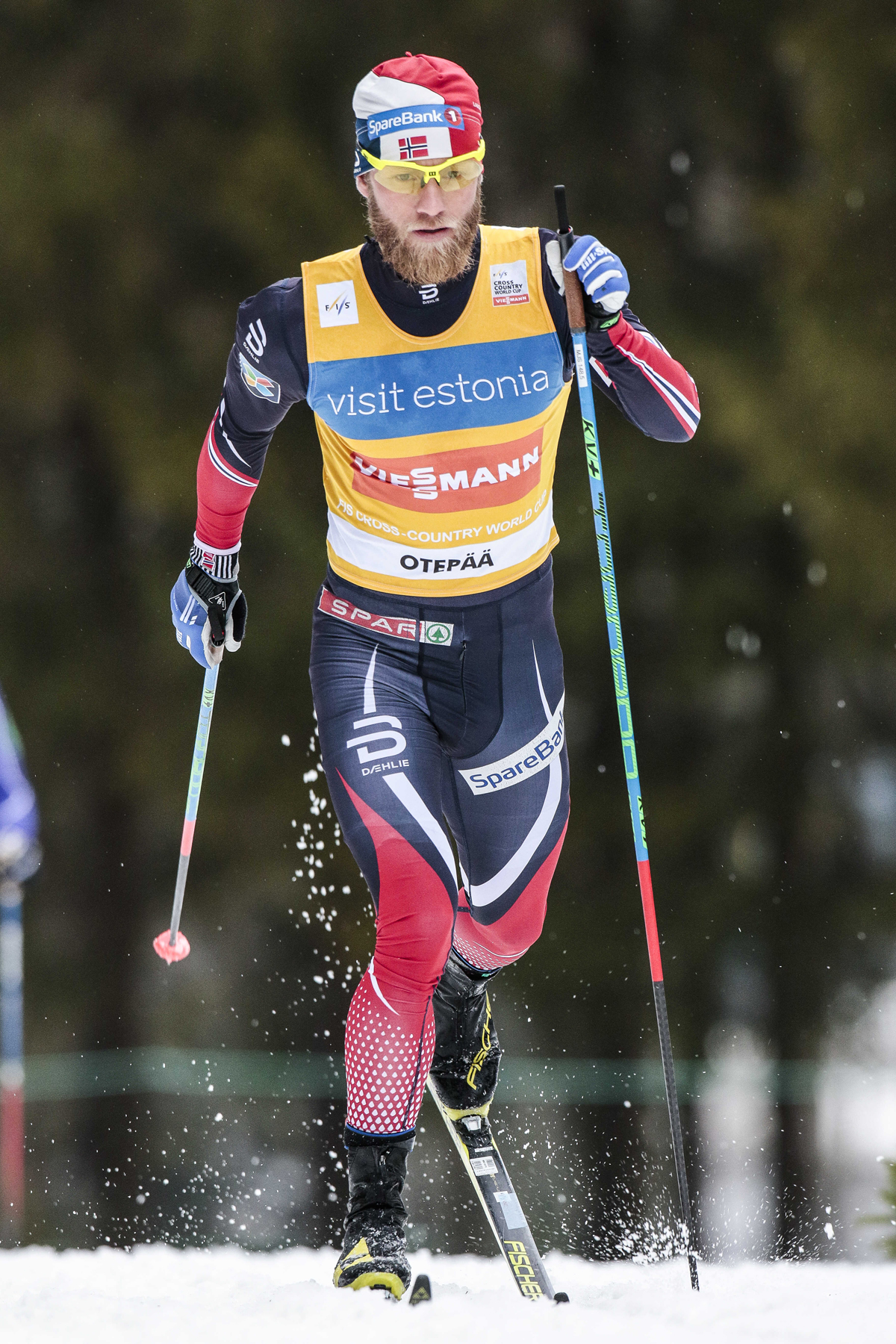
Norway’s Martin Johnsrud Sundby racing to 2017 victory in the men’s 15 k classic at the pre-World Championships World Cup in Otepää, Estonia. (Photo: NordicFocus)
Perhaps the biggest name among them is Martin Johnsrud Sundby of Norway, who after a somewhat inauspicious start to his World Cup career in 2005 when he DNF’d at the Oslo 50 k, went on to become a staple of men’s cross-country skiing. Sundby leaves the stage with five Olympic medals, including two gold medals (both from team events), four Championship medals, and thirty World Cup victories to his name. Results aside, Sundby was an important presence on the Norwegian men’s team for many years, taking on the responsibility of team captain.
Sundby was sanctioned in 2016 for an anti-doping violation when he exceeding the allowable amount of salbutamol – an asthma medication – in his system.
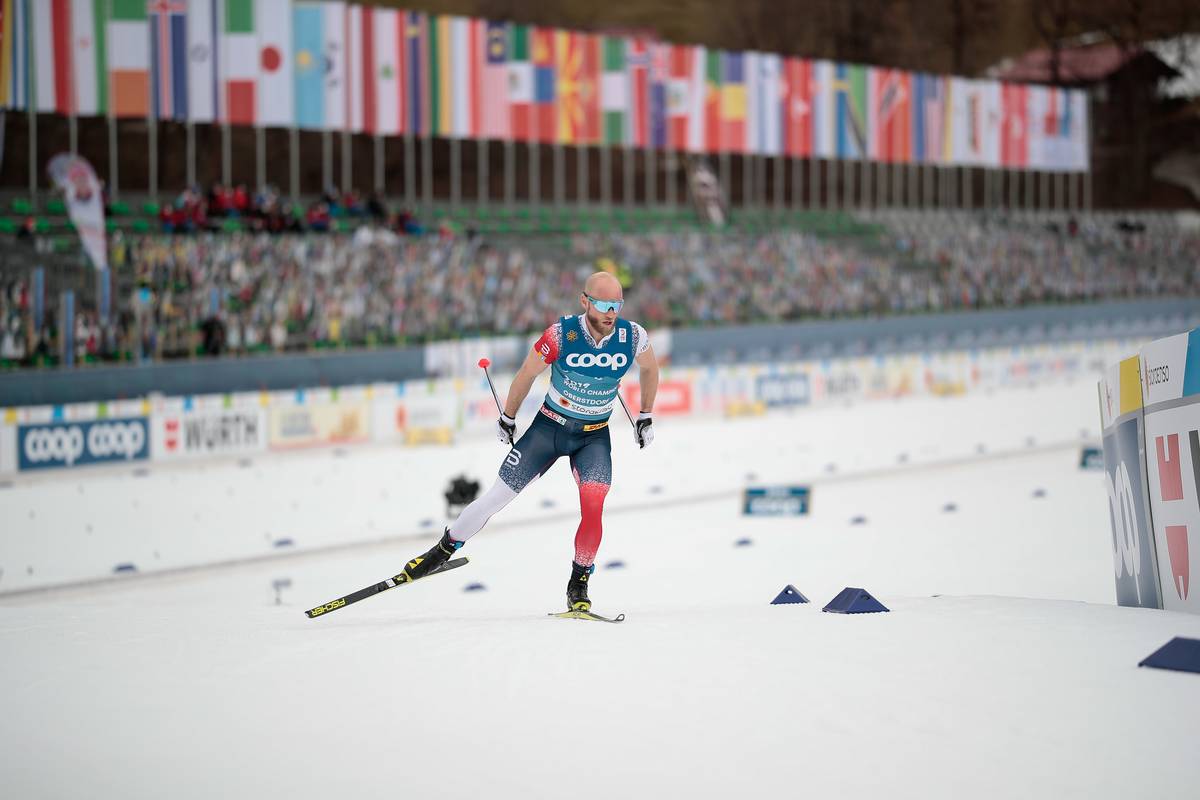
Putting his veteran strength on display, Martin Johnsrud Sundby skis to 7th in his first international competition of the [2020/21] season. (Photo: NordicFocus)In a goodbye letter by Norges Skiforbund President, Erik Røste, Røste writes, “Martin never gave up [in spite of challenges]. And that’s what really characterizes Martin. Because in addition to a fantastic talent, Martin is a struggler. One who has put in more effort and training than most to achieve his dream of becoming the best in the world… Thank you for all the contributions both on and off the trail.” (Translated from Norwegian).
Also retiring from team Norway is Mari Eide, who is expecting a child. Eide made her World Cup debut in 2010 and contested 70 World Cup starts since that time. At the 2019 Seefeld World Championships, Eide earned a bronze medal, finishing third in the skate sprint.
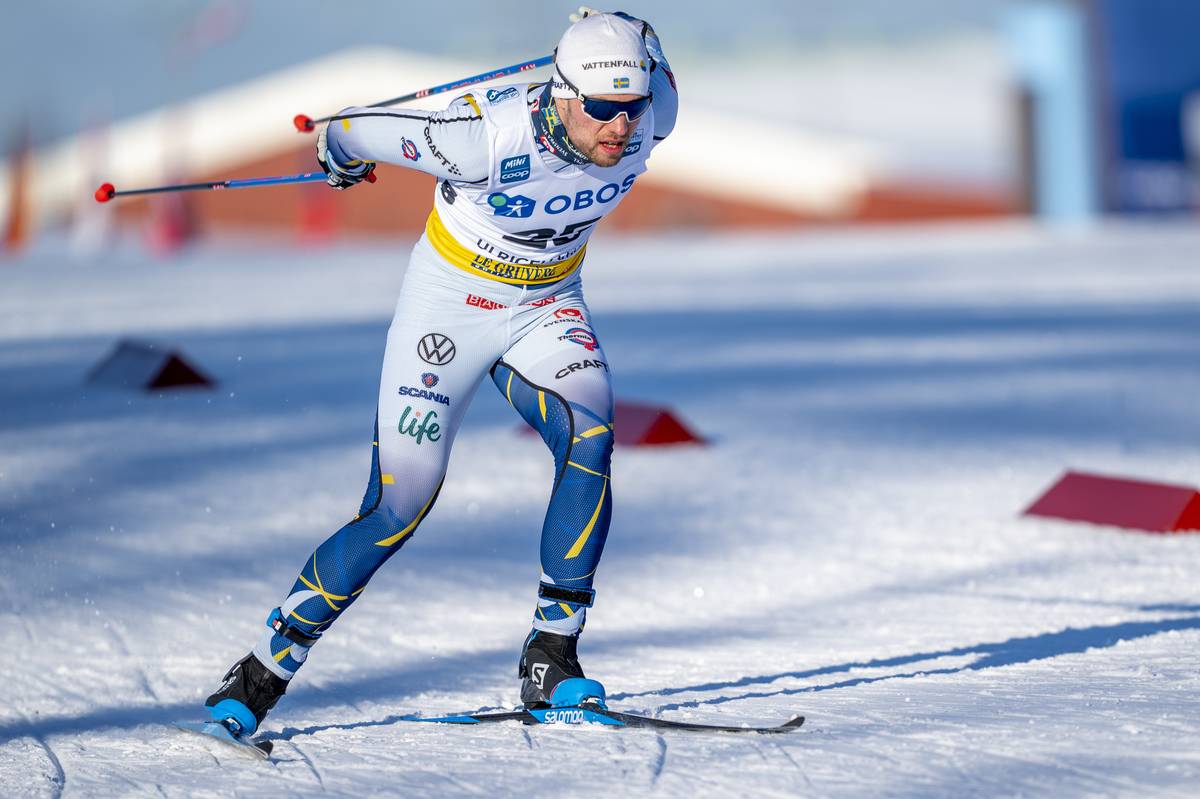
Viktor Thorn (SWE) racing the individual sprint in Ulricehamn, Sweden (Photo: NordicFocus)
From Sweden, Viktor Thorn and Hanna Falk have both announced an end to their ski careers. While Thorn is only 24 years old, he has been struggling with ongoing back pain and thus decided to step away from the sport. In a statement Thorn said, “I have struggled with back problems for almost five years and have come to the stage that I feel it is no longer worth spending all the time it takes to be able to be in the absolute elite level, when the last percent to be able to perform at the level I want to be hindered by my back … I feel ready to take on new challenges in life. A tough decision as the skis have been a big part of my life for so long, this decision still feels right. I am grateful for everything that this sport has given me and I will always be a skier but just not at the elite level anymore.”
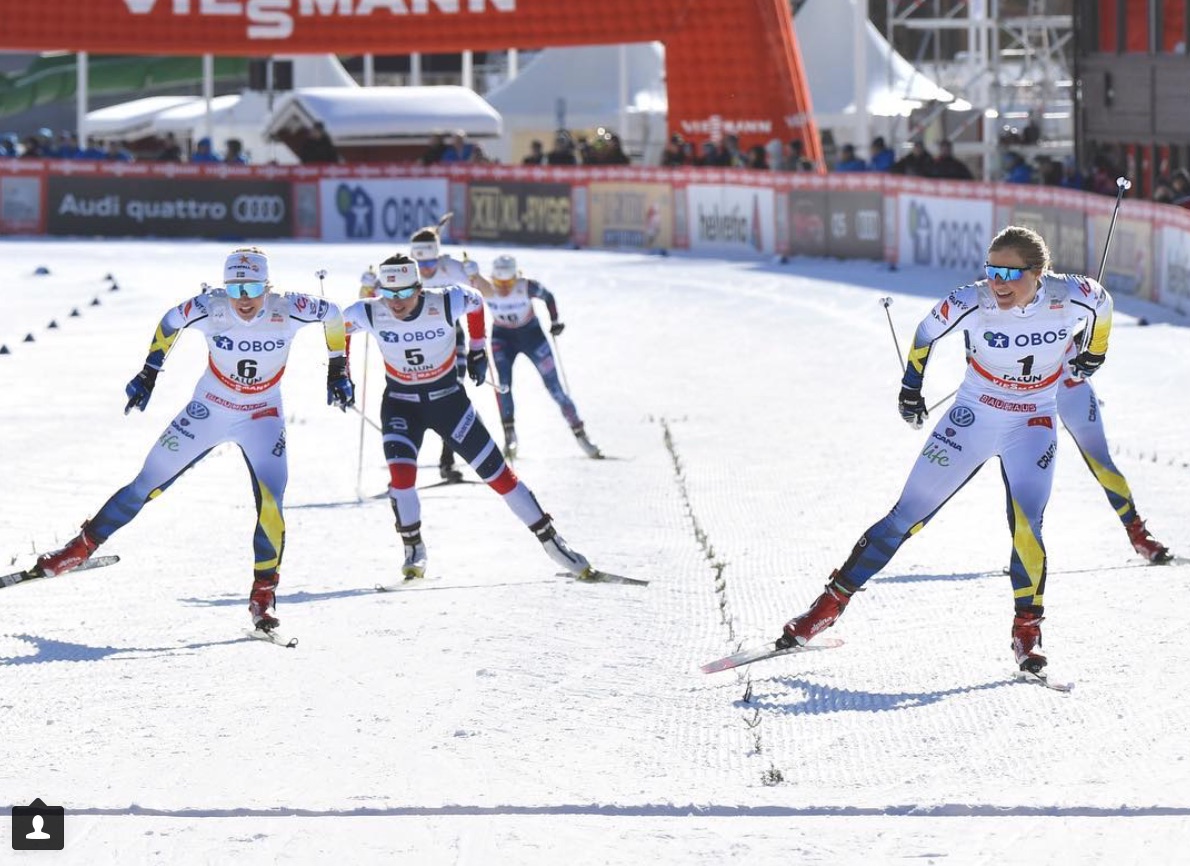
Sweden’s Hanna Falk (r) smiles as she wins the fourth World Cup race of her career and first race in Falun, Sweden, with a victory in the women’s freestyle sprint at 2018 World Cup Finals. (Photo: Svenska Skidspelen/Instagram)
Hanna Falk, who has also struggled with health problems throughout her career, announced retirement after a lengthy career. Falk began World Cup racing in 2007 and earned her first victory in 2009 at the Düsseldorf (GER) City Sprints. After a period of health issues, Falk returned in form during the 2016/17 season, proving herself to be a force on the sprint circuit. She retires with 113 World Cup starts, including eleven podium finishes.
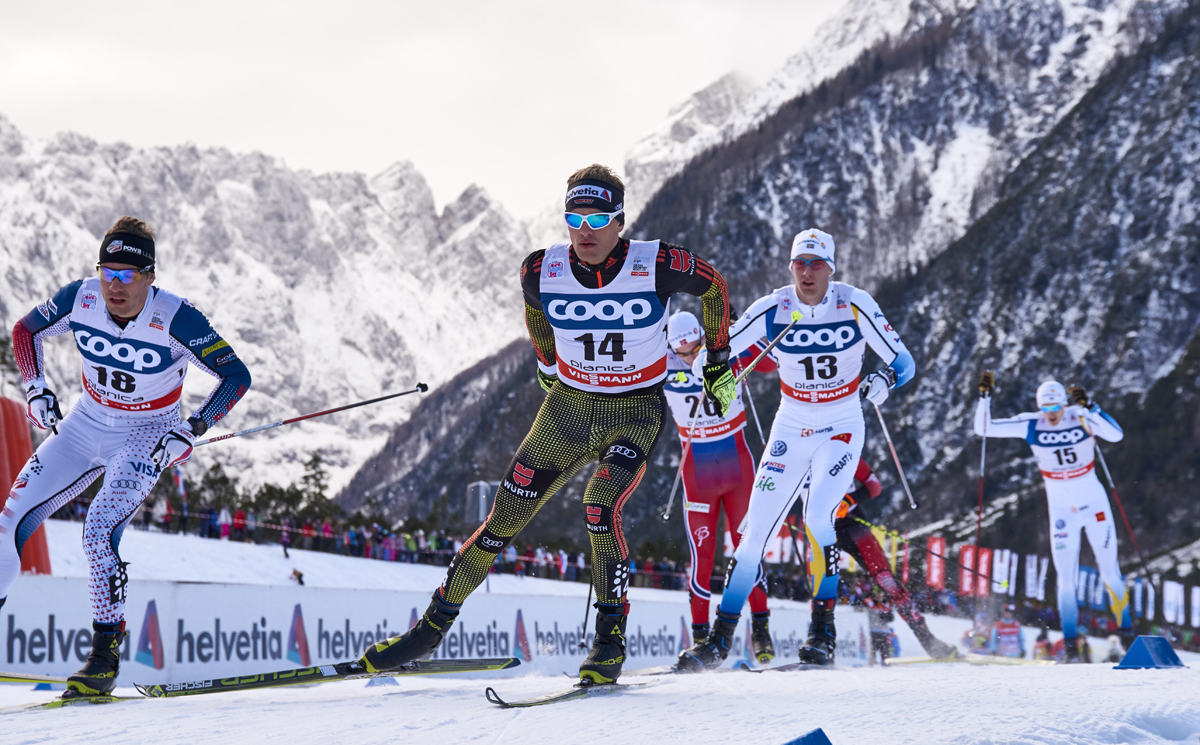
American Simi Hamilton (l) goes head-to-head with Germany’s Sebastian Eisenlauer (14), Norway’s Eivind Østnor Bakken (26), and Sweden’s Gustav Nordström (13) during their 1.2 k freestyle sprint quarterfinal on Saturday at the World Cup in Planica, Slovenia. (Photo: Fischer/NordicFocus)
From Germany, 31-year old Sebastian Eisenlauer has announced his intention to move on from professional ski racing. Eisenlauer began his World Cup career in 2010, going on to start 131 World Cups and represent Germany at two Olympics (Sochi and PyeongChang). Of his career, Eisenlauer said, “That’s it. An incredible time comes to an end and it feels like the right time to move along new paths. Every race was worth the step from every stage of my career, I find people that I can call friends now still. Thank you to everyone who joined and supported me on this journey.”
Finland’s Susanna Saapunki has decided to transition from professional ski racing to professional mountain running. Saapunki spent six years racing on the World Cup circuit, totalling 42 World Cup starts and one World Championship start in Lahti, Finland. Saapunki has now chosen to focus solely on running.
Anna Zherebyateva of Russia is concluding her World Cup career. Zherebyateva is engaged to Alexander Bolshunov and intends to focus on starting a family.
Anouk Faivre Picon of France has officially announced retirement after some years away from the World Cup circuit in which she primarily started in marathon events. Faivre Picon spent a summer training with the US Women’s Ski Team.
Also on the list of retirements this season are Livio Bieler and Anja Lozza of Switzerland, Stefan Zelger of Italy, and Valentin Mättig of Germany.
Three skiers atop the overall standings after Stage 4 set the tension for Stage 5 in Val di Fiemme, Italy: a 15-kilometer mass start classic race. Russia’s Alexander Bolshunov skied in the yellow leader’s bib while his teammate Sergey Ustiugov stood 16 seconds back in the overall. Johannes Høsflot Klæbo, Norway’s Tour de Ski (TdS) podium hope, lurked at 26 seconds back.
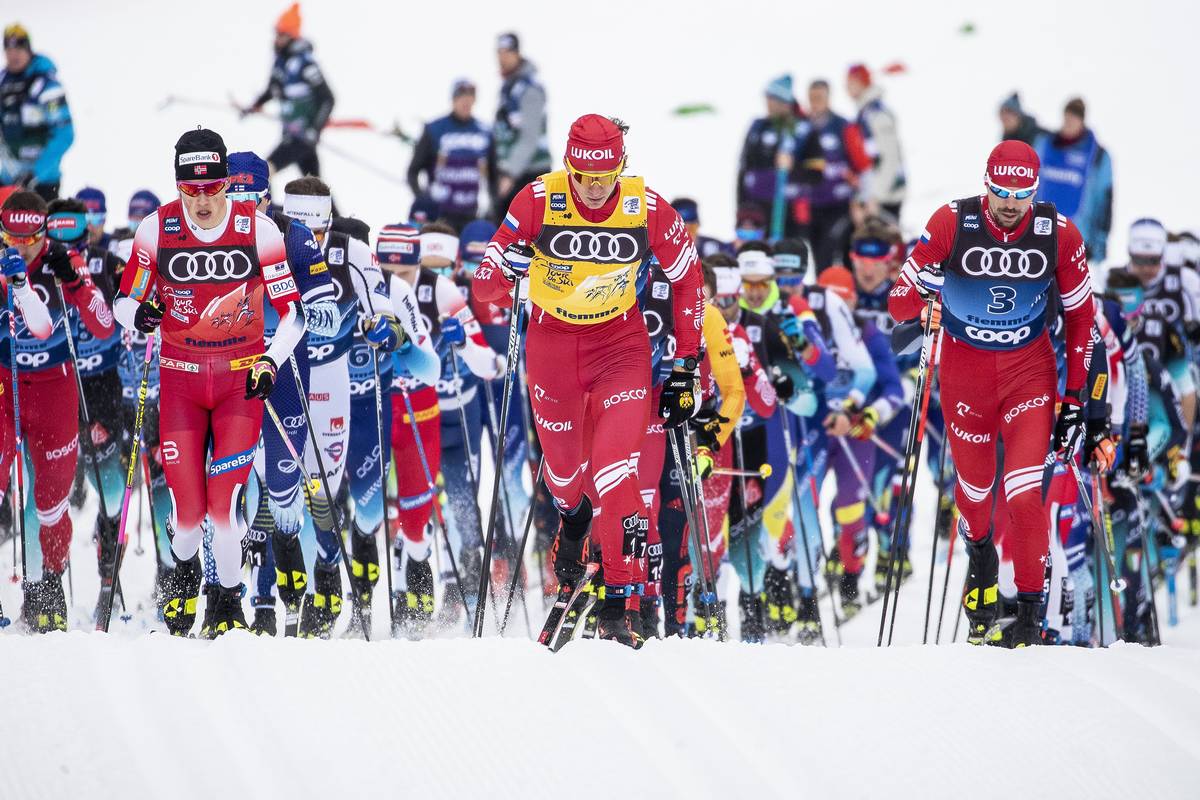
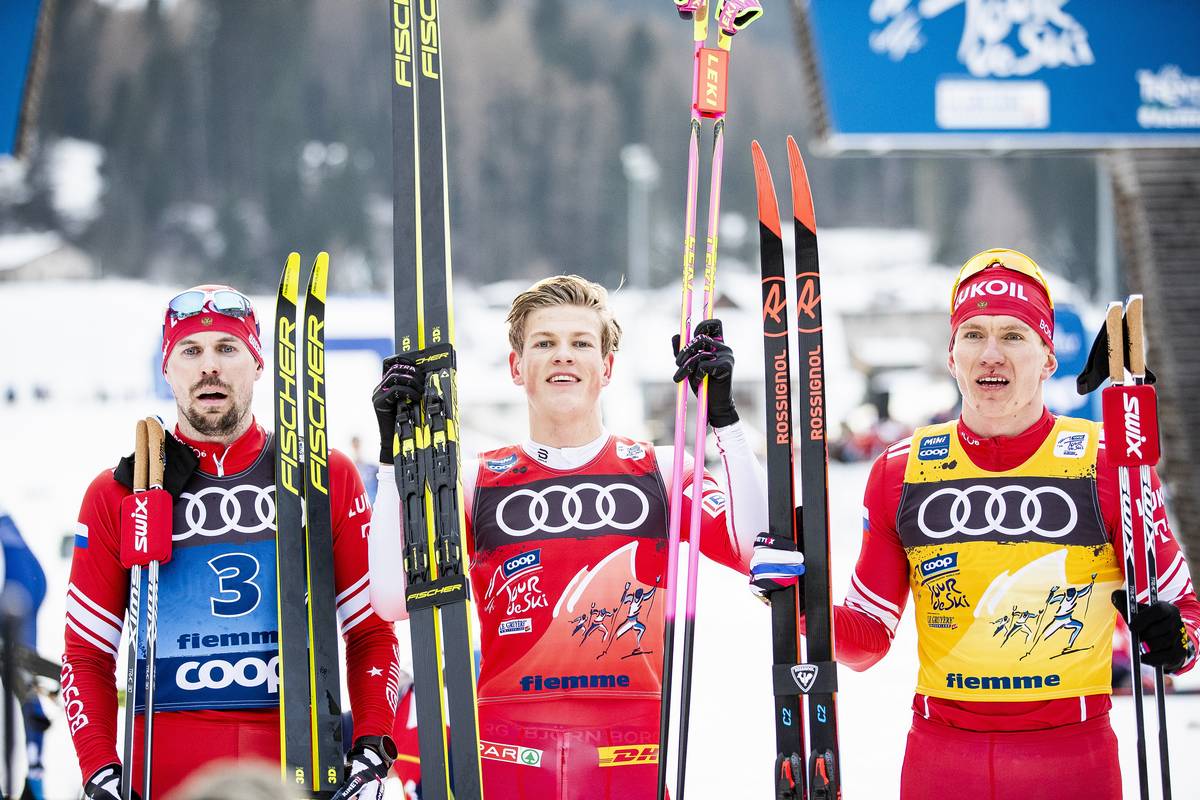
Alexander Bolshunov (RUS), Johannes Hoesflot Klaebo (NOR), Sergey Ustiugov (RUS), (l-r) early during Stage 5 of the TdS in Val di Fiemme, Italy. (Photo: NordicFocus)
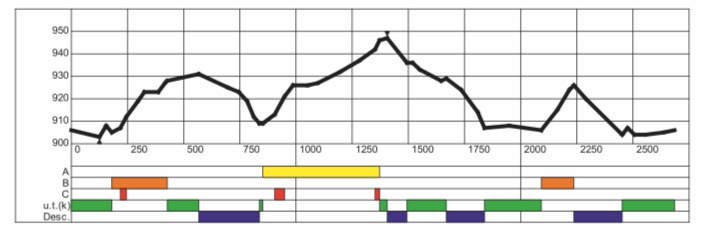
With a mass start format, the three contenders would play chess match skiing with a closing 1.5 k of turbocharged showmanship to determine the day’s winner. In between, as the 62 starters looped around the 2.5 k course which featured three climbs and an equal number of slick descents, the front pack never shattered.
Val di Fiemme 2.5 k course profile
The men’s field remained roughly intact through 7.5 k. With an arbitrary cutoff of five seconds, 25 skiers came through within that time frame. Hans Christer Holund of Norway leading, Sebastian Eisenlauer of Germany in 25th.
One kilometer ahead, at the 8.5 k mark, sat the day’s only time bonus atop a climb — a finite opportunity for some to snag time and decrease a time deficit.
Holund accelerated, awakening the leaders as the time bonus mark closed in. With the front of the field finally getting strung out, and several Norwegians present to steal a bonus spot away from the Russians (they took four of the top five spots through the bonus mark), Klæbo made a move up the inside to grab the first place 15 second prize. Bolshunov came through in fourth for an eight second bonus, Ustiugov in ninth for two seconds.
Pål Golberg (NOR), leading Alexander Bolshunov (RUS), (l-r) during Stage 5 of the TdS in Val di Fiemme, Italy. (Photo: NordicFocus)
Post time-bonus, the pace backed off. Until roughly 13 k, no skier in the front group made a discernible effort to separate. At 32:10, at the base of a climb, a mass of more than 20 skiers strode up led by Bolshunov in the yellow bib. It remained that way as the bell rang indicating the final lap.
Then the Russian charge began with Ustiugov’s double-pole push-and-punch through 13.9 k. On the course’s tricky descent that arcs left and loops back up for the decisive climb, Ustiugov was that Russian bear again. Unbridled and running, he was matched on the outside by an equally determined Klæbo.
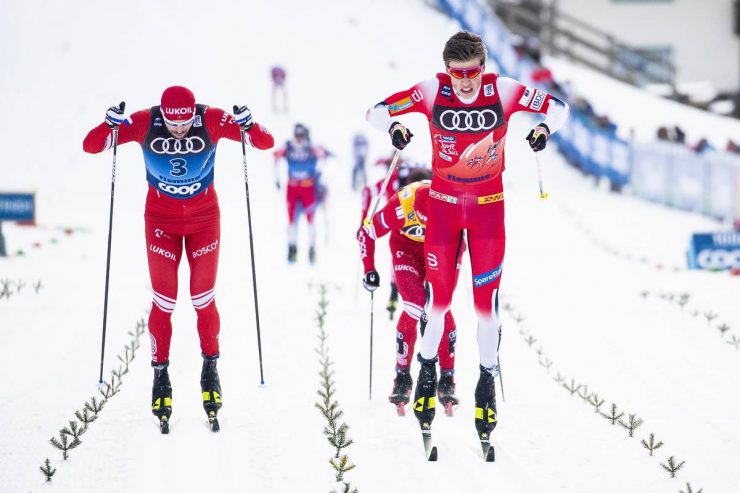
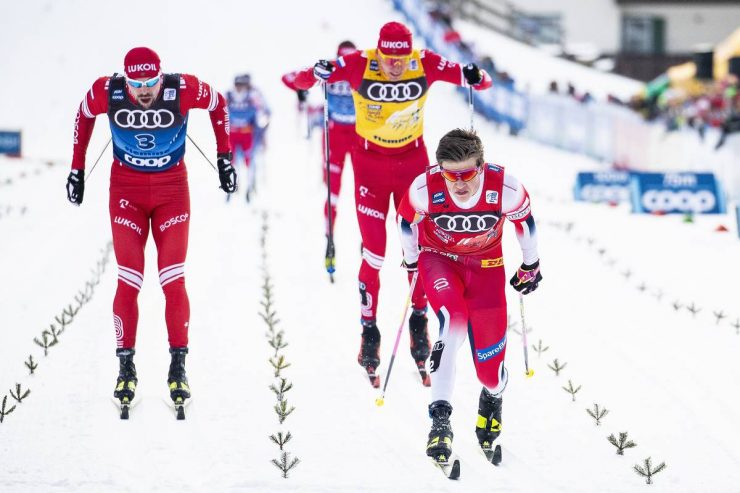
Through the downhill, Klæbo proved to have slightly better glide as he slid past Ustiugov into the straightaway. There Klæbo is king. He won in 39:51.0, with Ustiugov 0.7 seconds back in second place. Bolshunov held tight for third (+1.0).
With the close pack racing and Klæbo’s sharp move for the max time bonus, Bolshunov still leads the overall. However, that lead stands at 16 seconds over Klæbo in second overall. Ustiugov sits in third, 21 seconds back.
Full extension Johannes Høsflot Klæbo for the win. (Photo: NordicFocus)
Johannes Høsflot Klæbo (NOR) is a finisher as he takes the Stage 5 TdS win over Sergey Ustiugov (RUS), (l-r). (Photo: NordicFocus)
Two American men remain in the Tour. David Norris placed 38th (+1:41.9) on Stage 5. He tumbled on the second lap, but regained contact with the field. With two stages remaining, Norris is 36th overall. Teammate Logan Hanneman, a sprinter by trade, placed 59th (+4:49.8) on Friday.
David Norris of the U.S. is 36th overall after Stage 5 of the TdS, a 10 k mass start classic. Photo: NordicFocus)
World Cup Coach Matt Whitcomb’s post-race comments on the men’s racing
Tomorrow’s classic sprint remains a decisive day for Klæbo. Classic sprints and Klæbo most often mean one thing: a top step on the podium. And with that top step comes a 60 second time bonus. To stay in touch, Bolshunov and Ustiugov will need to make the six skier final.
American Sadie Bjornsen skiing just behind Germany’s Katharina Hennig during the women’s 10 k classic mass start at 2018 World Cup Finals in Falun, Sweden. (Photo: Fischer/NordicFocus)
Welcome to FasterSkier’s World Cup Preview, where we check in with the top-10 teams from last year’s FIS Cross Country World Cup tour before the season starts with the Ruka weekend in Kuusamo, Finland, on Nov. 24 with a classic sprint.
***
Germany
Overall in Nations Cup Last Year: 8th
Women’s Ranking 2017/2018:
Men’s Ranking 2017/2018:
Germans to look out for: If there’s one woman returning to Germany’s national ski team from last season who is hungry for a sprint podium and on the watch list, it’s 28-year-old, Sandra Ringwald. The Lahti, Finland freestyle sprint left her in fourth, just shy of her first World Cup podium. Prior to Lahti, she raced to a seventh and sixth, respectively, in the Davos and Lenzerheide freestyle sprints.
While freestyle sprinting may appear to be the magnum opus of Ringwald’s cross-country skiing, she also finished last season with top thirty performances in a series of other disciplines, most notably a 12th place finish in the Tour de Ski 10-kilometer freestyle pursuit in Lenzerheide, Switzerland. She led the German women in last year’s Overall Cup Standings, finishing in 23rd behind Finland’s Aino-Kaisa Saarinen and ahead of Sweden’s Anna Jönsson Haag.
Chasing down Ringwald on the Overall Cup Standings is her teammate, Stefanie Böhler who ended last season ranked 25th in the overall. The 37-year-old Böhler raced into the top ten three times during last year’s World Cup season, holding out for eighth in Oslo, Norway’s famed Holmenkollen 30 k.
Along with Böhler and Ringwald, Germans Victoria Carl, Nicole Fessel, and Katharina Hennig scored points in the 2017/2018 season and are back on the team, ready to hit the World Cup circuit in search of more top thirties. Not returning to German’s national cross-country ski team after announcing her retirement this spring is Hanna Kolb.
Leading the charge on the men’s side for Germany will be Thomas Bing. The 28-year-old Bing ended last season with five top fifteen World Cup performances, his strongest being a ninth place in the Tour de Ski 15 k freestyle mass start in Oberstdorf, Germany. Along with Bing, Lucas Bögl is another name to look for from Germany. Bögl bust into the top-25 five times last season, most notably the Final Climb in the Tour de Ski 9 k pursuit in Val di Fiemme, Italy.
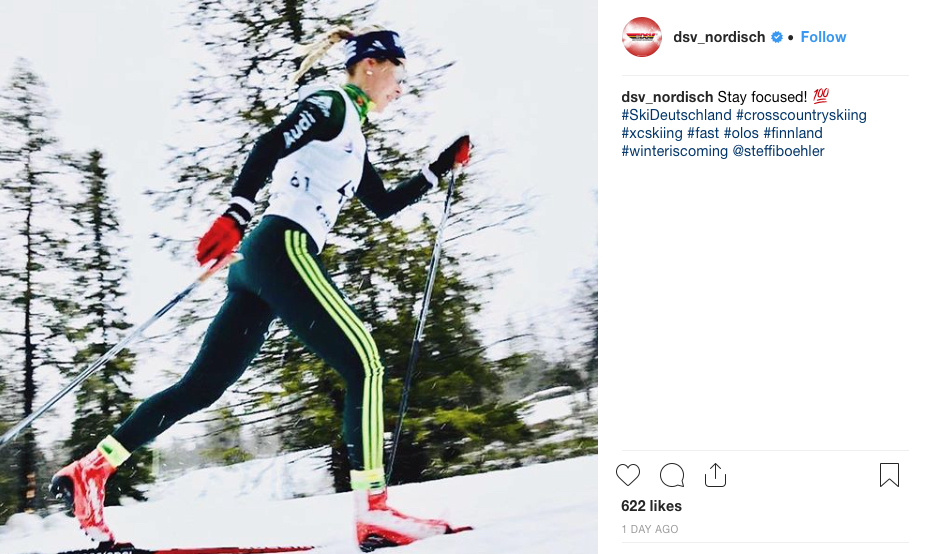
Germany’s Steffi Böhler during the FIS women’s 5-kilometer classic in Olos, Finland on 11/10/18. She placed sixth overall in what was used as a warm-up race for the German team. (Photo: Instagram screenshot)
Pre-Season Racing: Many German National team members are lined up at the FIS races in Olos, Finland scheduled from Nov. 9-11. In Friday’s 1.4 k classic sprint, Ringwald and Laura Gimmler placed first and third respectively. Gimmler had limited World Cup exposure last season, but notched two top-20s.
For the men, Bing was the best placed German in the sprint placing third overall.
In Saturday’s 5 k classic, the German women stacked five athletes in the top-6. Carl placed first, Hennig second, and Poland’s Justyna Kowalczyk was third. Also for Germany, Julia Belger skied to fourth, Pia Fink fifth, and Böhler sixth.
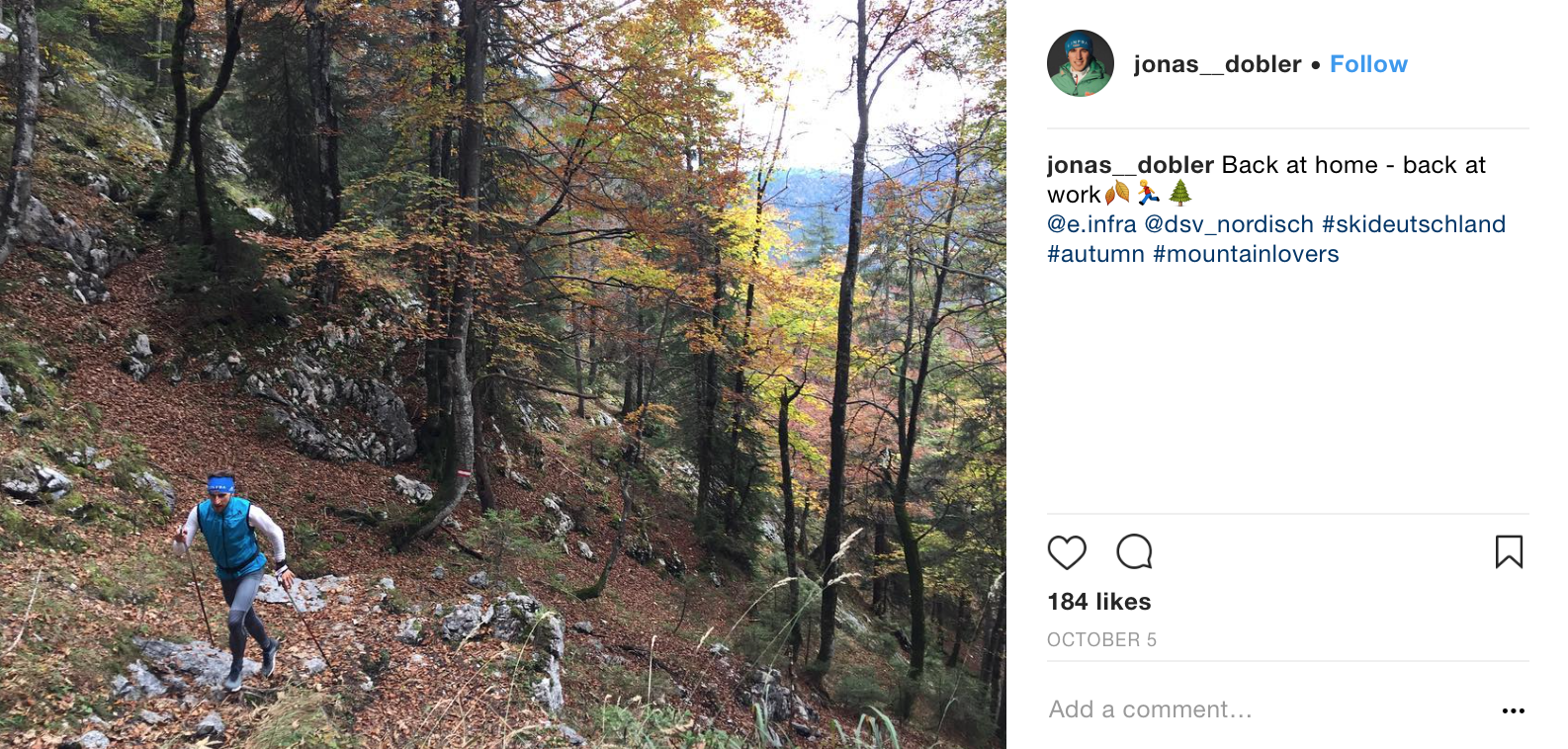
The men raced a 10 k classic. Jonas Dobler raced to 6th as the best placed German.
Sunday featured a 10 k skate for the women. Russia’s Natalia Nepryaeva won, while Carl was second, Ringwald third.
In the men’s 15 k skate, Dobler was the best placed German in fifth place.
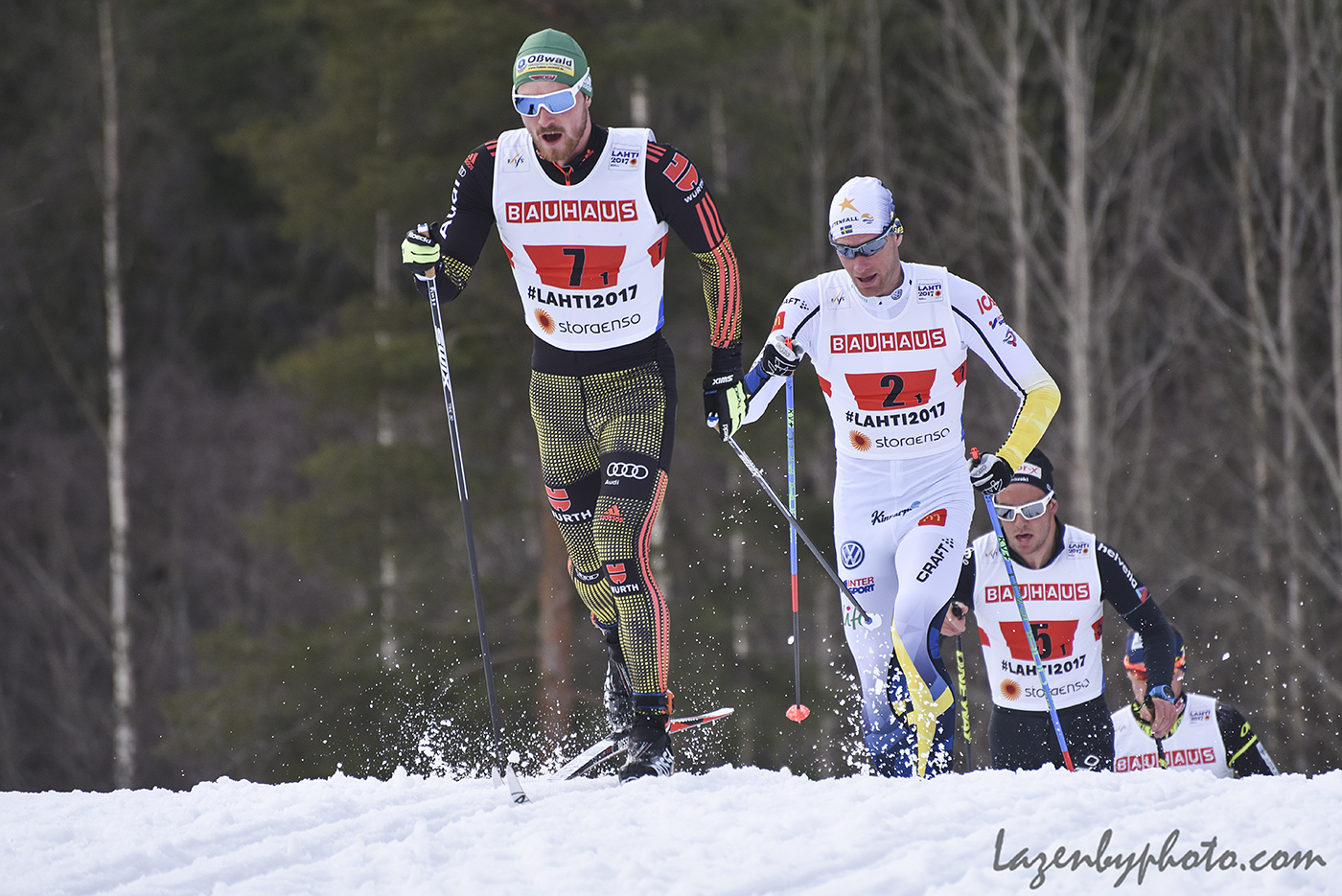
Germany’s Thomas Bing (7) leads Sweden’s Daniel Rickardsson (2) and Switzerland’s Jason Rüesch during the first leg of the men’s 4 x 10 k relay at 2017 World Championships in Lahti, Finland. (Photo: John Lazenby/Lazenbyphoto.com)
Welcome to World Cup Windup, where we check in with the top-10 teams from last year’s FIS Cross Country World Cup tour before the season starts with the Ruka Triple in Kuusamo, Finland, on Nov. 24.
GERMANY
Overall in Nations Cup Last Year:Seventh
Women’s Ranking 2016/2017:Sixth
Men’s Ranking 2016/2017: Ninth
Who’s Back:
Nicole Fessel and Steffi Boehler, top-20 in the World Cup distance standings; sprint finalist Sandra Ringwald; Victoria Carl and Katharina Hennig, who joined Ringwald and Boehler to finish second in the World Cup relay in Ulricehamn; Florian Notz, Elizabeth Schicho, Laura Gimmler, and Thomas Bing, each of whom had a single World Cup top-10 last season, and Hanna Kolb, who had two.
Who’s Missing:
Veteran sprinter Tim Tscharnke retired partway through the summer. The 2010 Olympic team sprint medalist has struggled with back problems and finally called it quits. “The last three years of my career were riddled with many mediocre months, punctuated by health problems and athletic setbacks,” he said.
Pre-Season Results:
The World Cup women’s 4 x 5 k podium on Jan. 22 in Ulricehamn, Sweden, with (from left to right) Germany (Stefanie Boehler, Sandra Ringwald, Victoria Carl, Katharina Hennig) in second, Norway (Ingvild Flugstad Østberg, Heidi Weng, Astrid Uhrenholdt Jacobsen, Marit Bjørgen) in first, and Sweden in third (Ida Ingemarsdotter, Sofia Henriksson, Charlotte Kalla, Hanna Falk). (Photo: Fischer/Nordic Focus)
Earlier this month in Davos, Switzerland, Thomas Bing won a sprint race and Laura Gimmler was the runner-up in the women’s race. Katharina Hennig and Steffi Boehler went 2-3 in a distance race.
Recent Drama:
After being sick in both August and September, Florian Notz is aiming for a World Cup debut in Davos in December, not earlier. “I did not have any real training for two to three months,” he told Südwest Press. “That’s why Kuusamo is too early for me… I have set myself as a goal, that I want to attack fully [in Davos]. I am still optimistic that I can be in shape by then. But of course, everything has to go right.” If not, Olympic qualifying will be tricky.
Lucas Bögl is among the athletes joining the new “Athleten für Deutschland” athlete union, which was recently founded as an independent alternative to the athletes’ council run by the German Olympic Committee. The head of the German Olympic Committee is not a fan, saying basically that athletes trying to make demands will only bring problems upon themselves. Bögl disagreed. “The club should help the athletes commission and support the athletes,” he told OBV-online. “That should be in the interest of everyone involved.” He also said: “Cross-country skiing is not something you do for the money, it’s more of a way of life. I have turned my sport into a profession. I feel privileged that I don’t have to sit in an office. I can do that for a long time after my career is over.”
Sandra Ringwald, who just missed making the 2014 Olympic team for Germany, and is particularly focused on 2018 Games this winter. “I want to fulfill my Olympic dream and be in PyeongChang,” she told the Südkurier newspaper in an interview. “However, I’m going easy on the whole thing. In the past few years I have often set my goals too high… I’m not working just for Olympic qualification. My aim is to play a good role in the World Cup as well. I want to show what I can do at the very first races.”
Best Social Media Presence:
Steffi Boehler is a consistent Instagram poster, and also includes some of her artwork along with training and daily-life pictures.
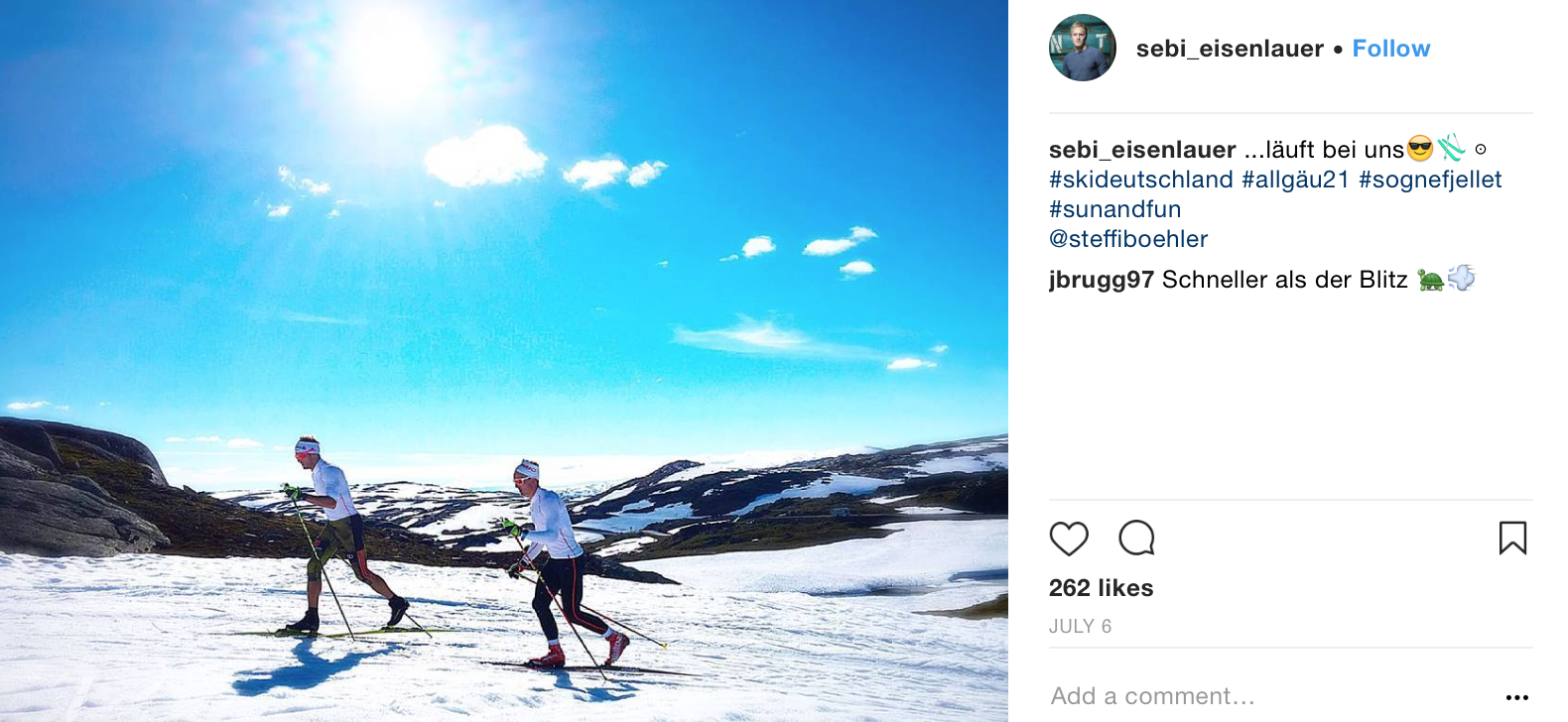
Sprinter Sebastian Eisenlauer also posts gorgeous training shots:
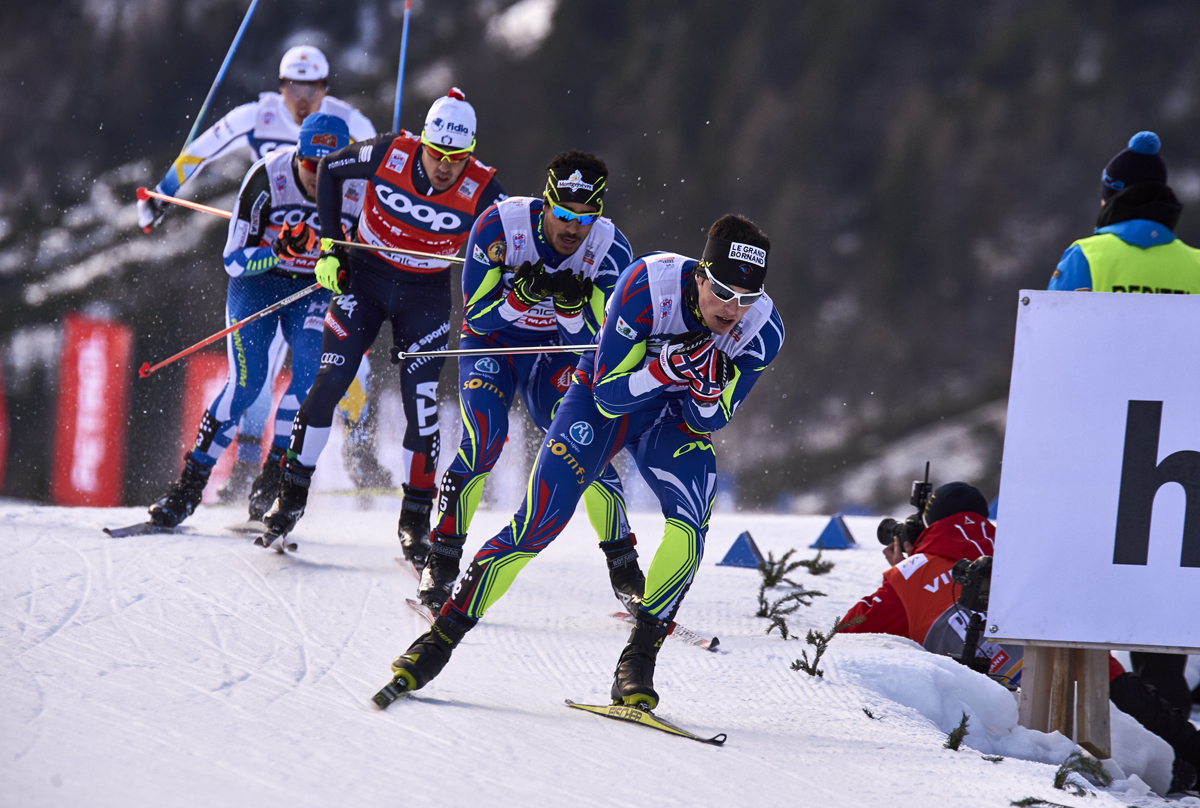
France’s Lucas Chanavat (front) and Richard Jouve (second from r) lead Italy’s Federico Pellegrino during their 1.2 k freestyle sprint quarterfinal at the World Cup in Planica, Slovenia. Pellegrino won the heat, Jouve placed second and Chanavat faded to sixth. (Photo: Fischer/NordicFocus)
Six days ago on Sunday, Jan. 10, the famed hill-climb finale up Alpe Cermis in Val de Fiemme, Italy, wrapped up the 10th annual Tour de Ski. This weekend, standard World Cup racing has resumed in Planica, Slovenia, marking the first time a World Cup event has been held in Planica — better known as a biathlon center. The last World Cup races in Slovenia took place in 2011 in Rogla, about 200 kilometers east.
On Saturday, two familiar faces in the sprint scene topped the men’s and women’s 1.2-kilometer freestyle sprint.
Italian record-breaker Federico Pellegrino raced to his fourth-consecutive freestyle sprint victory this season. He is the first racer in history to do so, and according to the International Ski Federation (FIS), is the only male to reach the podium more than once in these four races. The list of firsts goes on when it comes to 25-year-old Pellegrino.
Last season, Pellegrino became the first athlete to win three consecutive skate sprints between December 2014 and January 2015. With Saturday marking his seventh World Cup win, he is now the winningest Italian male cross-country skier of all time, according to FIS. He was previously tied with Pietro Piller Cottrer with six wins.
“Statistics are made to be changed,” Pellegrino told La Gazzetta della Sport, according to a translation. He said he had “great feelings” during the qualifier, which he won by 1.59 seconds over France’s Lucas Chanavat.
He went on to win his quarterfinal (by 0.26 seconds ahead of another Frenchman Richard Jouve), and advanced out of his semifinal after placing second, 0.6 seconds behind yet another French skier Baptiste Gros.
In the final, a trio of Frenchman (Gros, Jouve and Renaud Jay) trailed Pellegrino into the last few hundred meters before the finish, with Gros leading the charge behind him. Pellegrino skied away to the victory in 2:15.12, holding off Gross by 0.88 seconds. Jouve placed third (+1.71) and Jay completed France’s sweep of second through fourth in fourth place (+2.23).
Gros had also placed second to Pellegrino in the Davos World Cup skate sprint in December — Pellegrino’s first win of four in a row.
Russia’s Gleb Retivykh and Germany’s Sebastian Eisenlauer finished behind the French contingent in fifth (+4.18) and sixth (+4.19), respectively.
Easily the favorite going into the race, some pressure inevitably rode on Pellegrino. He reflected feeling like he “could only lose the race.”
“It felt very good in the qualification,” he told FIS after the final, “But I was worried it could get worse.”
He proceeded to comfortably advance through the heats with strategic execution. He won the third quarterfinal, which turned out to be the fastest and produced two lucky losers: Finland’s Martti Jylhä in third and Sweden’s Calle Halfvarsson in fourth.
Pellegrino then carefully navigated a loaded semifinal, with all six competitors qualifying in the top eight. Gros took the lead at about halfway through, with Pellegrino stuck a few spots back. After being boxed out of the inside lane turning into the final climb, Pellegrino fought his way into second on the final climb to ensure he’d automatically advance in the top two. Gros cruised to a fairly commanding semifinal win, which did not go unnoticed by Pellegrino.
“I learned in my semifinal how to ski in the final,” Pellegrino told FIS. “I expected Baptiste to be fast on this course, so my plan was to go in the front and get a gap on the others.”
Confident in his chances in the semi, Gros had his doubts entering the final: “In the semifinal I thought I could win, but in the final it was clear that Federico [would] win,” he later told FIS.
Gros led the final for most of the first half, while Pellegrino sat back around fourth place. This time, however, he didn’t let Gros get out of reach. About halfway through the race, Pellegrino made his move: passing on the inside, accelerating to the front of the pack ahead of Gros and significantly cranking up the pace.
With that, the race proved to be as good as done. Pellegrino created a gap leading into the final downhill, breezed up the final climb with an unmatched tempo, enjoying a sizable gap on the field before throwing his arms up to celebrate across the line.
Notably, there were no Norwegians in the men’s final. This starkly contrasts from most races throughout the World Cup season and the team’s Tour de Ski results, with the Norwegian men claiming seven of the overall top 10.
That said, a number of top contenders did not race on Saturday — largely to rest and recover after completing the Tour de Ski — including Norway’s Martin Johnsrud Sundby, Finn Hågen Krogh, Petter Northug, and Didrik Tønseth. The strong Russian sprinter, Sergey Ustiugov, also was missing from the scene.
“Today was another great day,” Pellegrino told La Gazzetta. “But it was a very difficult victory because I had to emotionally handle it right against the French, which always start as horses, head down, and it is difficult to rule them all. Fortunately with my skiing, I always managed to extricate myself from their traps, in the semifinals I figured out how to run the final and I did it. I can count on energy that I know I have.”
“I am very confident of the work I’ve done,” he added. “At home, I can store hours of work that allow me to maintain this state of form. The success allows me to put more hay in the barn…”
Pellegrino currently leads the Sprint World Cup by 196 points over Norway’s Sondre Turvoll Fossli, who placed eighth on Saturday after being eliminated in the semifinal (behind Gros, Pellegrino and fellow Norwegian Eirik Brandsdal, respectively). Gros ranks third overall, 224 points out of first.
Stina Nilsson Earns Second Sprint Victory
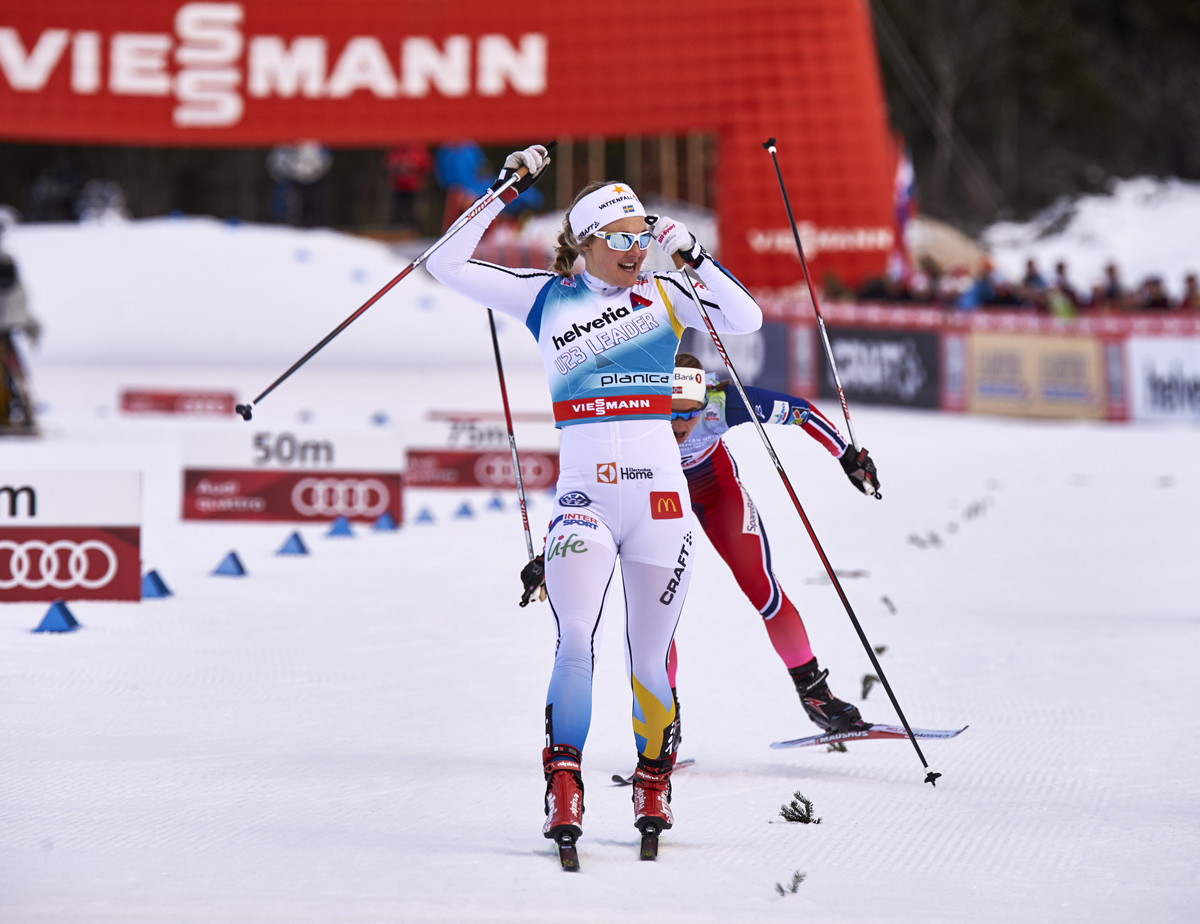
Sweden’s Stina Nilsson celebrates her second-career World Cup victory on Saturday at the 1.2 k freestyle sprint in Planica, Slovenia. She beat three Norwegians — Astrid Uhrenholdt Jacobsen, Heidi Weng and Ingvild Flugstad Østberg, respectively — to do so. (Photo: Fischer/NordicFocus)
In the women’s 1.2 k sprint, Sweden’s 22-year-old Stina Nilsson claimed her second World Cup victory in two months. She previously won the December freestyle sprint in Davos, Switzerland.
With this win, Nilsson, the U23 leader, took the Sprint World Cup lead as well, ahead of Norway’s Maiken Caspersen Falla. While Falla’s doctor apparently warned her against starting Saturday, (“she was not in top form,” according to NRK), she raced the qualifier anyway and placed an uncharacteristic 45th, more than 14 seconds behind qualifying winner Astrid Uhrenholdt Jacobsen, her teammate.
Nilsson started her day with the 10th-fastest qualifying time, 5.82 seconds behind Jacobsen. She proceeded to win her quarterfinal — the first one of the day — by 0.1 seconds over teammate Hanna Falk and 0.92 seconds ahead of American Sophie Caldwell in third.
From there, Nilsson met one of Norway’s biggest threats in any race: Ingvild Flugstad Østberg. Both Nilsson and Østberg had raced the entire Tour de Ski (eight races in 10 days from Jan. 1-10), with Nilsson placing 24th and Østberg second overall. Yet less than a week later, here they were. Nilsson later told NRK she skied for a total of 35 minutes this week before Saturday’s race.
Slovenian Vesna Fabjan led their semifinal of the gate, while local spectators cheered her on. Nilsson shadowed her until taking the lead about halfway through and creating a fairly big gap before into the finish. Nilsson won the semifinal by half a second over Østberg, who held off Fabjan by 0.33 seconds to advance to the final.
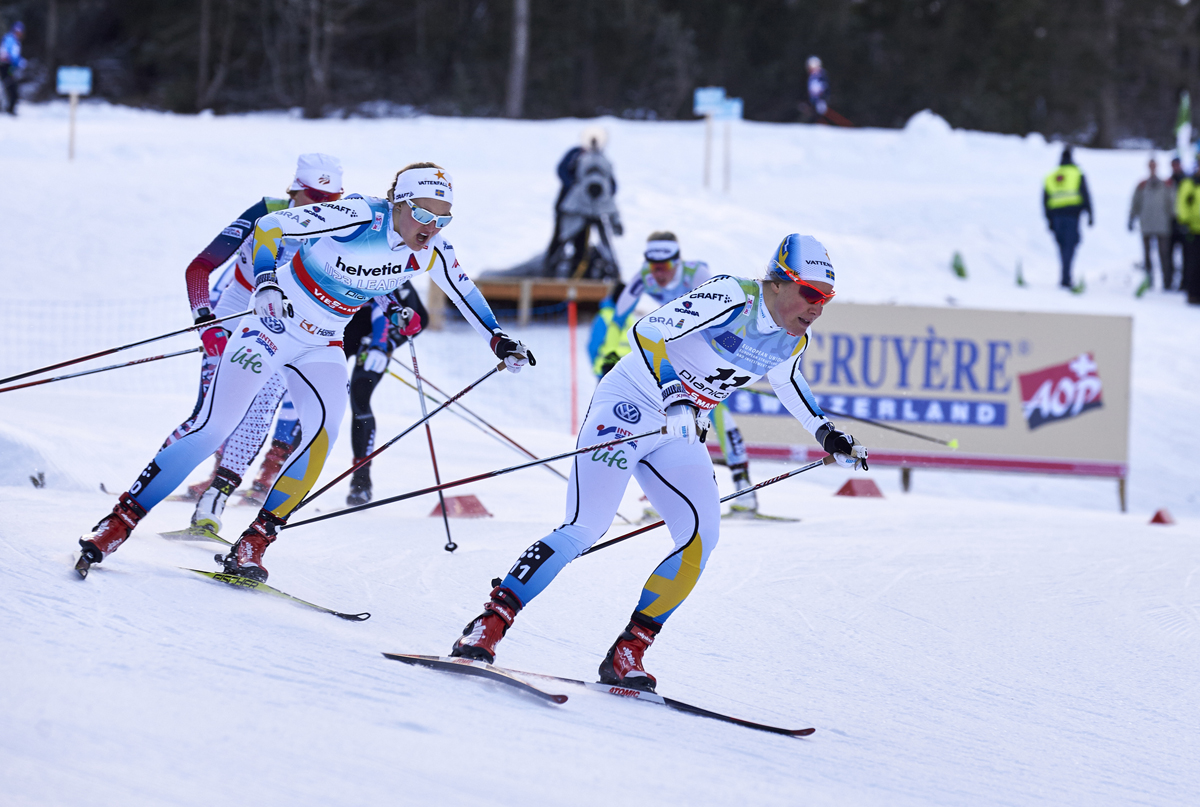
Sweden’s Hanna Falk leads teammate Stina Nilsson (l) and Sophie Caldwell (behind Nilsson) during their 1.2 k freestyle sprint quarterfinal at the World Cup in Planica, Slovenia. While Falk was eliminated in the semifinal (after placing fourth), Nilsson ultimately won the final. (Photo: Fischer/NordicFocus)
For Nilsson, the final was her 11th straight in as many World Cup sprint starts — both skate and classic — since December 2014.
On Saturday, she squared off in the final round against Germany’s Sandra Ringwald, Italy’s Gaia Vuerich, and three Norwegians: Østberg, Jacobsen and Heidi Weng. Third in the Tour de Ski, Weng was back in action less than a week later asa well.
In Vuerich’s third final of her career, the Italian initially led out of the start, while Ringwald and Nilsson skied in second. Into the next downhill, Nilsson took the lead, with Vuerich hanging onto second.
At about halfway through, Østberg accelerated on a climb to get in front of Nilsson. By the top of this hill, Østberg maintained her position with a fairly brisk pace, Nilsson held onto second, Jacobsen had moved into third, and Weng skied in fourth.
But could Østberg, who had been in contention for the Tour de Ski overall title until the final grueling mountain climb, hold that high tempo six days later? The last uphill on the sprint course had proved crucial throughout the day. It led up into the stadium and into the finishing straight.
As that climb approached, Nilsson rode the draft and her slick skis up alongside Østberg to challenge her to the top. She used the momentum to overtake Østberg, who began to fade at the crest of the hill, and Nilsson led over the top and toward the finish.
Behind her, the three Norwegians fanned out in a wave, one in each lane to try to chase her down. Jacobsen moved into second ahead and Weng charged late for third, just ahead of Østberg.
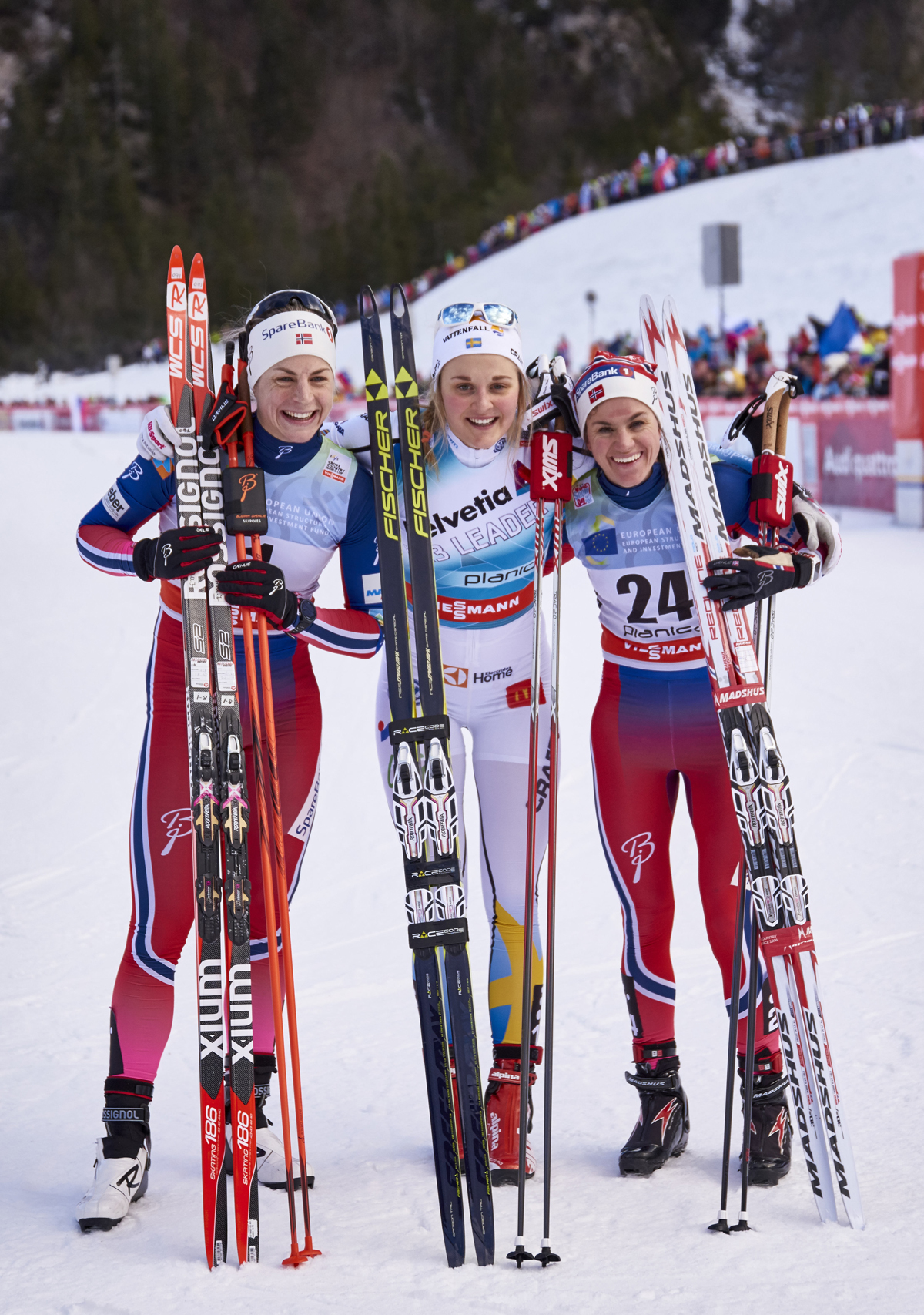
The women’s World Cup freestyle sprint podium in Planica, Slovenia: with Swedish winner Stina Nilsson (c), Norwegian runner-up Astrid Uhrenholdt Jacobsen (l), and Heidi Weng, also of Norway, in third. (Photo: Fischer/NordicFocus)
Nilsson captured the win in 2:33.03, 0.34 seconds ahead of Jacobsen in second and 0.55 seconds ahead of Weng in third. Østberg missed the podium by five-hundredths of a second in fourth (+0.60), Ringwald finished fifth (+2.78), and Vuerich waved to crowd as she cruised in for sixth (+26.26), happy to make the final.
“I am really happy for the second win this season. I had a great day,” Nilsson told FIS. “My plan was to ski as much as possible in the front. I am excited to be in the lead of the Sprint World Cup.”
Falla did not qualify for heats after she had been “battling illness,” according to FIS.
A sprint specialist, Falla left the Tour de Ski after winning the first stage: a freestyle sprint in Lenzerheide, Switzerland. On Saturday, she dropped to third in the Sprint World Cup standings 94 points behind Nilsson in first. Østberg ranks second, 58 points behind the leader.
According to NRK, Falla planned to travel back to Norway and skip Sunday’s freestyle team sprint.
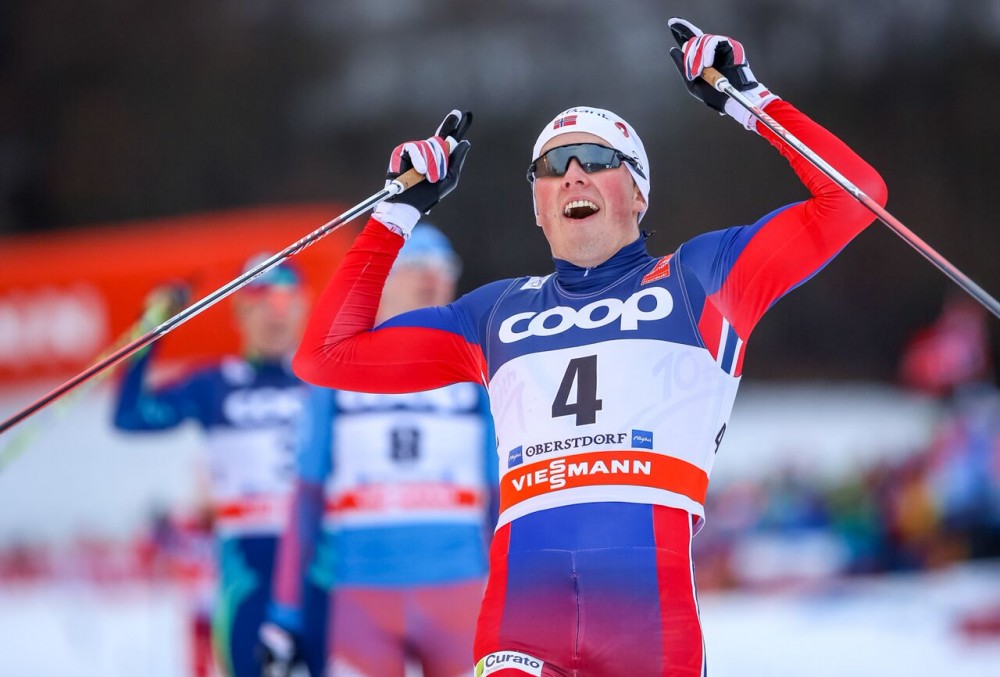
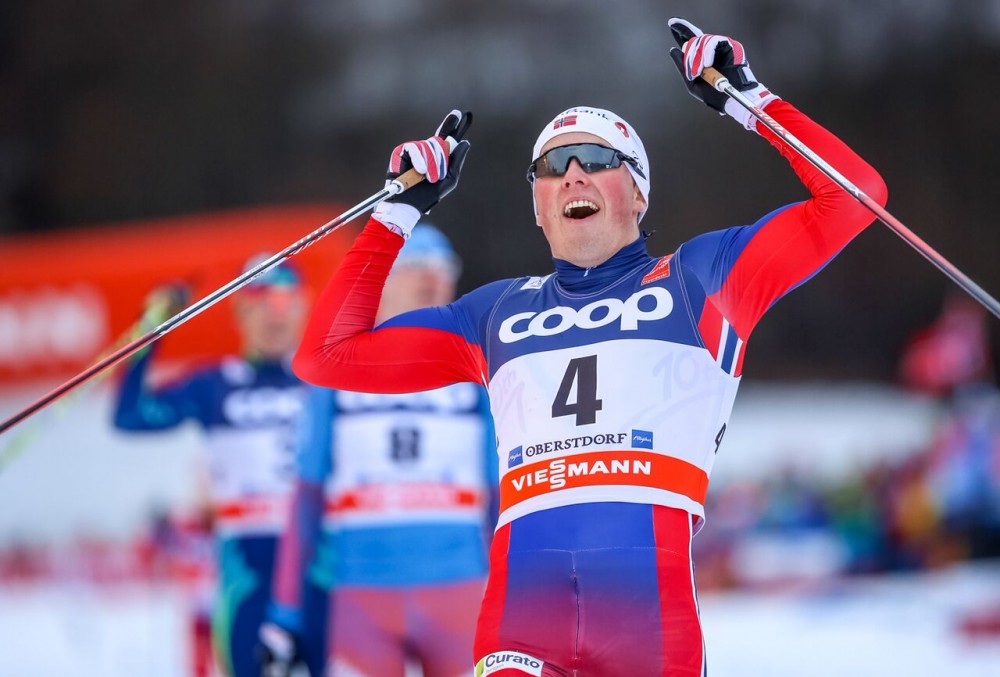
Norway’s 24-year-old Emil Iversen celebrates his first World Cup win in the 1.2 k classic sprint at Stage 4 of the Tour de Ski in Oberstdorf, Germany. (Photo: Marcel Hilger)
OBERSTDORF, Germany — In front of some 4,300 spectators in the Ried arena and around the course at the site of the 2005 World Championships, Norway’s Emil Iversen achieved the first World Cup victory of his career in the men’s 1.2-kilometers classic sprint final on Tuesday.
The fourth of eight stages in this year’s Tour de Ski (visiting Oberstdorf for the fifth time since the Tour began 10 years ago) challenged racers with a difficult course, which was partly due to the precarious snow conditions on the artificial loop, thinly veiled by a few flakes that had fallen during the prior nights on the surrounding slopes. The sprint races on a course with mostly just three groomed classic tracks saw a number of crashes, many on a steep downhill section and left hairpin turn with mushy snow. However, most of those happened in the women’s race, with athletes resorting to the snowplow technique and becoming obstacles for those who did not.
Emil Iversen (r) leads his quarterfinal with fellow Norwegian Niklas Dyrhaug (20) during the men’s 1.2 k classic sprint at Stage 4 of the Tour de Ski in Oberstdorf, Germany. Dyrhaug was relegated to last in the heat for a technique violation. (Photo: Fischer/NordicFocus)
“I am so excited to win today. I am really surprised to be first,” the 24-year-old Iversen said during the post-race press conference.
At the first sprint of the Tour last week in Lenzerheide, Switzerland, Iversen failed to advance from the qualifying stage in the freestyle sprint. On Tuesday, he qualified fourth, won his quarterfinal (ahead of Kazakhstan’s Alexey Poltoranin in second*) and advanced to the final as a “lucky loser” in his semifinal — the third finisher with a fast-enough time after Russia’s Sergey Ustiugov, who won that semifinal, and Poltoranin, who again automatically advanced in second.
Earlier this season, Iversen, a former Norwegian U23 development team member, missed being named to Norway’s senior national team. He had not finished in the top 10 in a World Cup yet this season before Tuesday.
But Norwegian superstar Petter Northug was not surprised by the success of Iversen, expecting a breakthrough of the teammate with whom he has also been sharing hotel rooms with during this Tour. Last season, Iversen raced in two skate sprint finals in Lillehammer, Norway, and Rybinsk, Russia, where he finished sixth in both races.
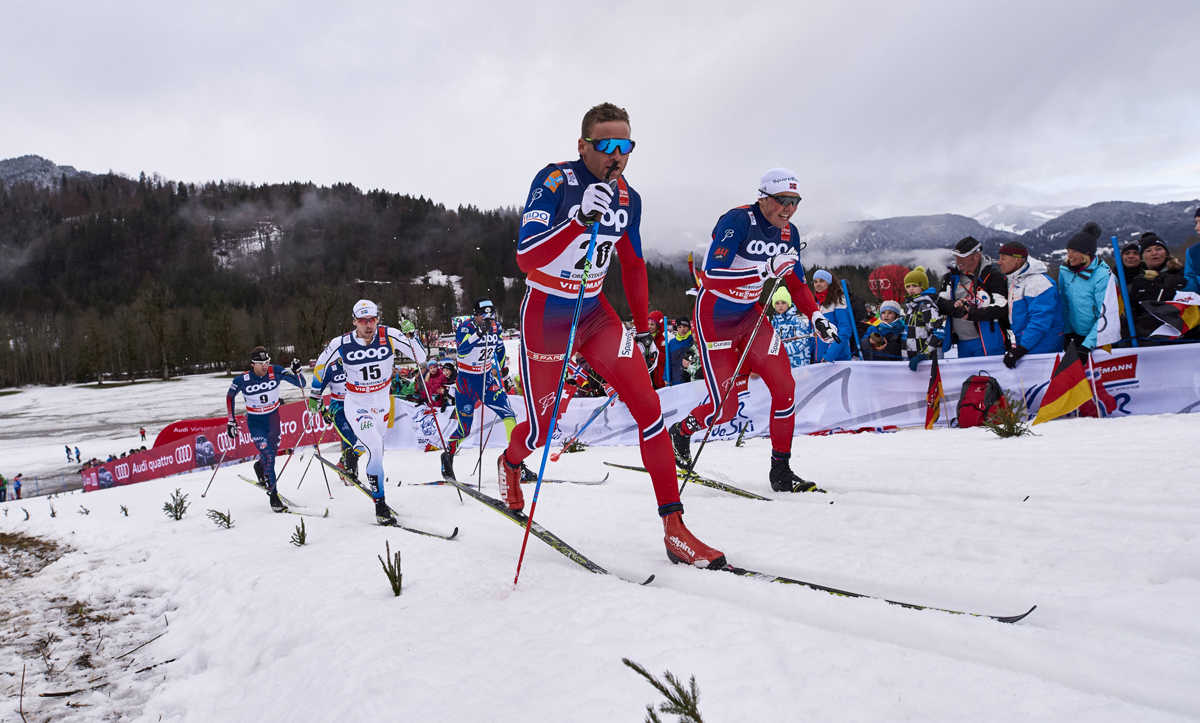
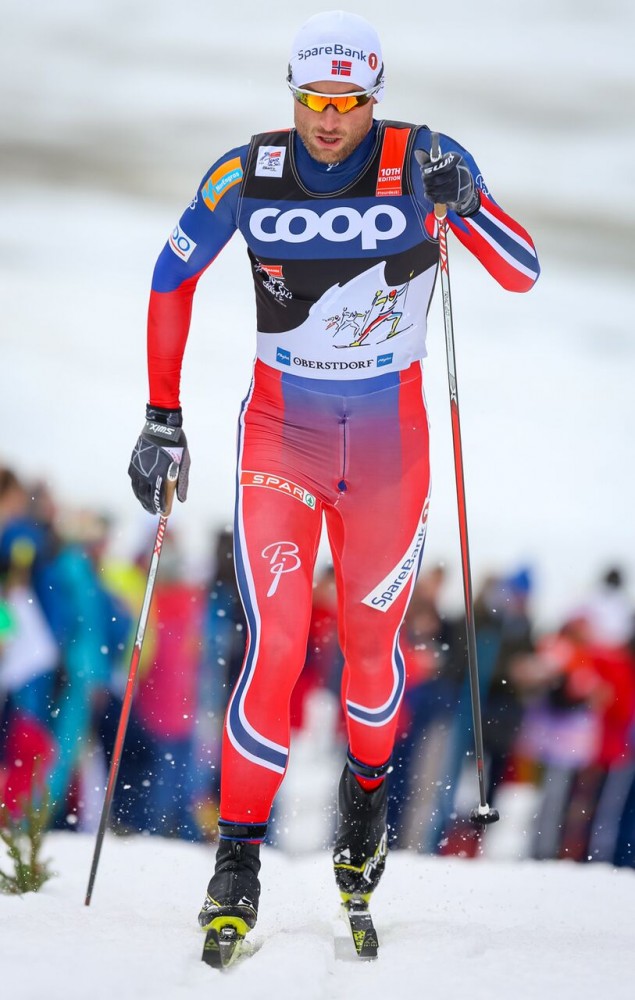
Norway’s Petter Northug qualified fifth and went on to place fifth in the final of the 1.2 k classic sprint at Stage 4 of the Tour de Ski in Oberstdorf, Germany. He still ranks second overall in the Tour behind teammate Martin Johnsrud Sundby. (Photo: Marcel Hilger)
“I have kept him in the reins. He is a better skier than he is a roommate,” Northug joked in an interview with NRK, according to a translation.
“I’m not surprised. He should have been on the national team a long time ago, but … his development stopped a little bit two years ago,” Northug continued. “I think he has figured out now what is right. Now he is where he should be, and he can do everything from sprint to longer races. He’s going to be skiing on the national team next year.”
The two trained together this past offseason, and Northug admitted that Iversen repeatedly beat him in interval sessions.
At breakfast Tuesday morning, Iversen reportedly proclaimed he would win, according to Norwegian sprint coach Arild Monsen.
“It was said with a bit of gallows humor, but then he comes here and impresses all,” Monsen told NRK.
Iversen later insisted that he didn’t mean it as a joke, but still did not actually expect the victory.
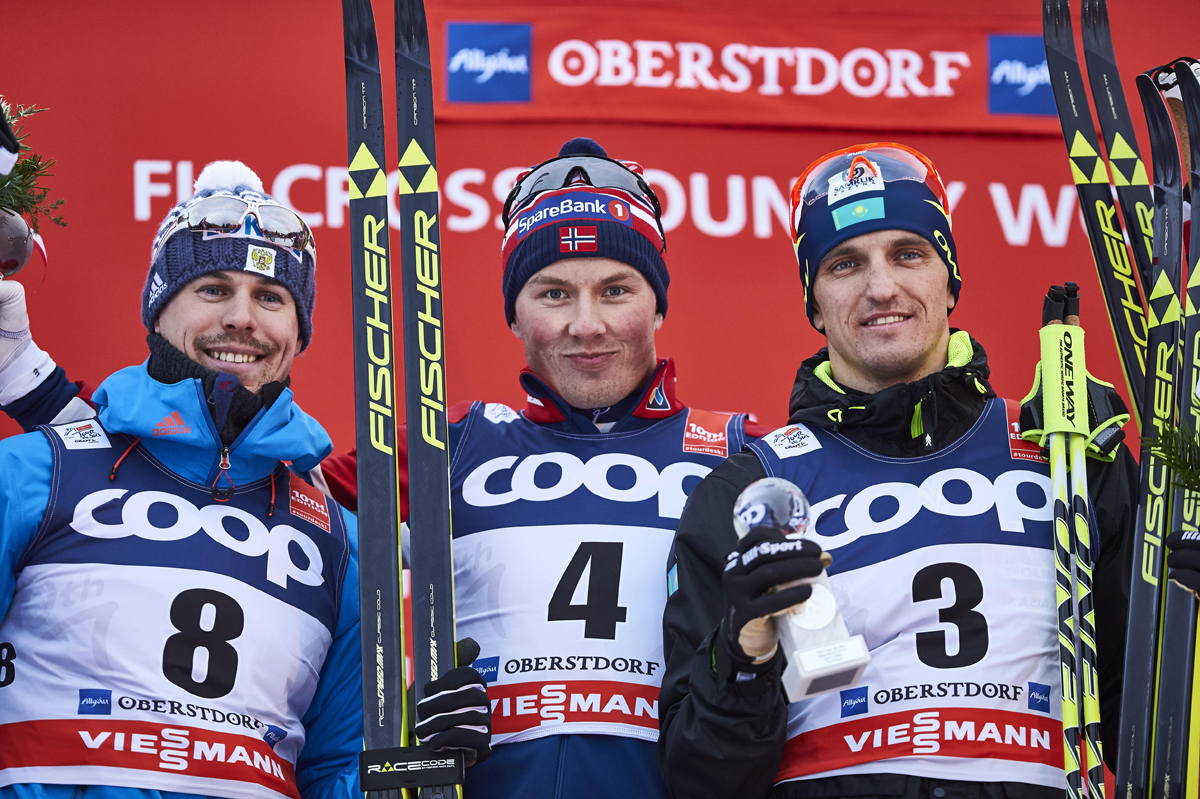
Finishing 1.03 seconds behind him in the final, Ustiugov took second place after Iversen gathered enough speed out of the final downhill to gap the field, slingshotting past Ustiugov and Poltoranin to take the lead. The Norwegian held it down the finishing stretch, while Ustiugov and Poltoranin battled for second. Ustiugov edged him by 0.37 seconds, and Poltoranin took the final podium spot in third (+1.4).
“Ustiugov set the speed after the start and I tried to keep up,” Iversen recounted at the press conference. “I was first on the top and I thought I could go for the podium. I chose a good line in the downhill and to the finish, but I am still very much surprised to win.”
With the win, Iversen moved into 10th in the overall Tour standings.
“It is good to be on the podium, but I am little bit tired of losing to a Norwegian all the time,” Ustiugov said in the press conference via a translator. “I made a mistake in the last downhill and lost speed. That probably cost me the victory today.”
Norway’s Martin Johnsrud Sundby qualified 11th and went on to place fourth in the final of the 1.2 k classic sprint at Stage 4 of the Tour de Ski in Oberstdorf, Germany. Now, he not only leads the overall Tour standings, but topped the Tour’s sprint standings as well. (Photo: Marcel Hilger)
Fourth place went to Norway’s Martin Johnsrud Sundby, thereby defending his fairly comfortable lead in the overall Tour standings, 1:33.6 minutes ahead of Northug in second. Sundby also claimed first in the Tour’s sprint standings (ousting Italy’s Federico Pellegrino, who failed to make the semifinals when he placed third in his quarterfinal).
Ustiugov moved into third overall in the Tour (+1:56.9), bumping Norway’s Finn Hågen Krogh to fourth (+2:13.4), after Krogh planted his own pole between his legs and tumbled out of the start in in his semifinal. Krogh skied the rest of the semifinal alone in sixth, finishing nearly 39 seconds behind Sundby, who won that heat.
The top North American in the Tour standings, Canada’s Alex Harvey finished 15th to improve one spot into eighth overall (+3:22.2).
Northug finished fifth in this sprint, 10.32 seconds after Iversen, and for once was not the main focal point of the media assembled in Oberstdorf.
But he later claimed that he had not even gone all-out in the final, already happy with the bonus seconds he had collected, and instead tried to help Iversen.
“We discussed the positions out on the track if it was going quiet,” Northug told NRK. “I said that I wasn’t going to go into the basement [pain cave] in the finals, and that he just had to yell at me to get a lane if it went fast. I did not come to war.”
However, this tactical plan wasn’t necessary. Northug was positioned in the back of the pack for much of the final, and Iversen got the job done on his own merit.
Also out of position to fight for the podium, Germany’s 25-year-old local fan-favorite Sebastian Eisenlauer placed sixth (+14.19), for his best career result. Eisenlauer hails from a town just a few miles down the valley from Oberstdorf, so racing in front of his family and friends left him stoked.
“I deliberately saved my strength for today,” he told German TV broadcaster ARD after the race. “But I could have hardly dreamed it would work out so well. That was wicked cool.”
The best North American of the day was Canadian Len Valjas in 10th overall, advancing through the qualifier and quarterfinals, before being eliminated in his semifinal. He came in fifth in a stacked field that included all three eventual podium finishers.
His teammate Harvey narrowly missed advancing from his quarterfinal in third. For the U.S., Andy Newell placed 17th after finishing fourth in his quarterfinal.
The Tour continues in Oberstdorf on Wednesday with 10/15 k classic mass starts on a 2-kilometer loop, extending the sprint course with additional hills. This race replaces the originally scheduled skiathlons, which organizers deemed too difficult to prepare given the lack of snow conditions.
*Norway’s Niklas Dyrhaug was relegated to last in Iversen’s quarterfinal after initially placing second. The jury ruled he committed a technique violation (i.e. skating). That put him 30th on the day and 14th in the Tour (+4:29.2), and allowed Poltoranin to automatically advance to the semifinal in second.
— Alex Kochon contributed reporting
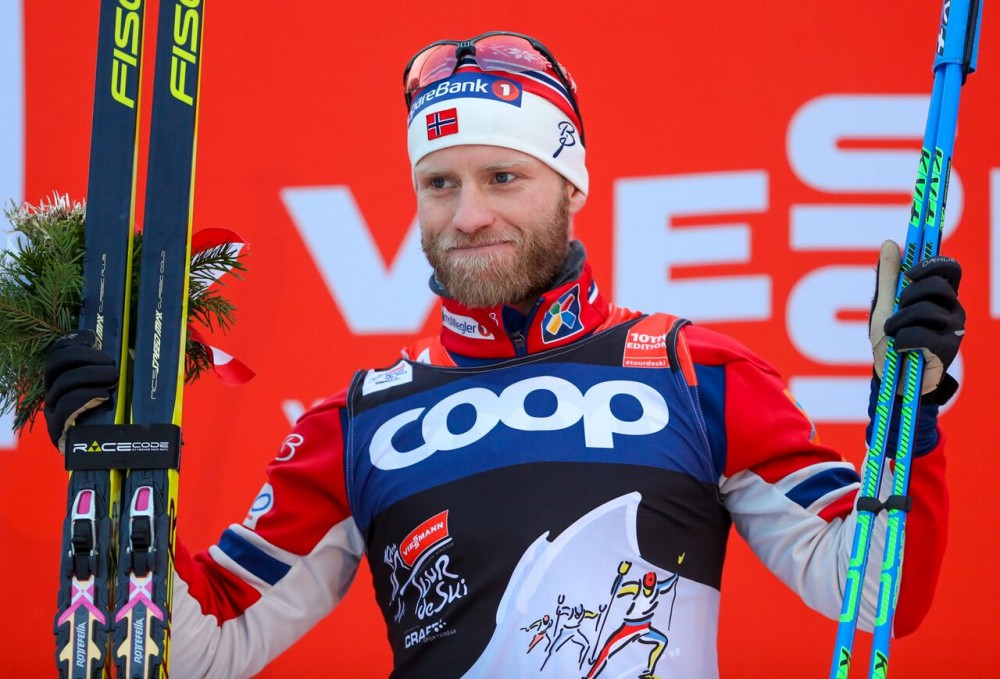
Norway’s Emil Iversen (c) on the podium after winning his first World Cup at Stage 4 of the Tour de Ski in Oberstdorf, Germany. Russia’s Sergey Ustiugov (l) placed second and Kazakhstan’s Alexey Poltoranin (r) was third. (Photo: Fischer/NordicFocus)