From the FasterSkier archive — posts syndicated from athletes’ and coaches’ own blogs between 2004 and 2012, kept online as published. Current coverage is at fasterskier.com.

Tag: Seefeld

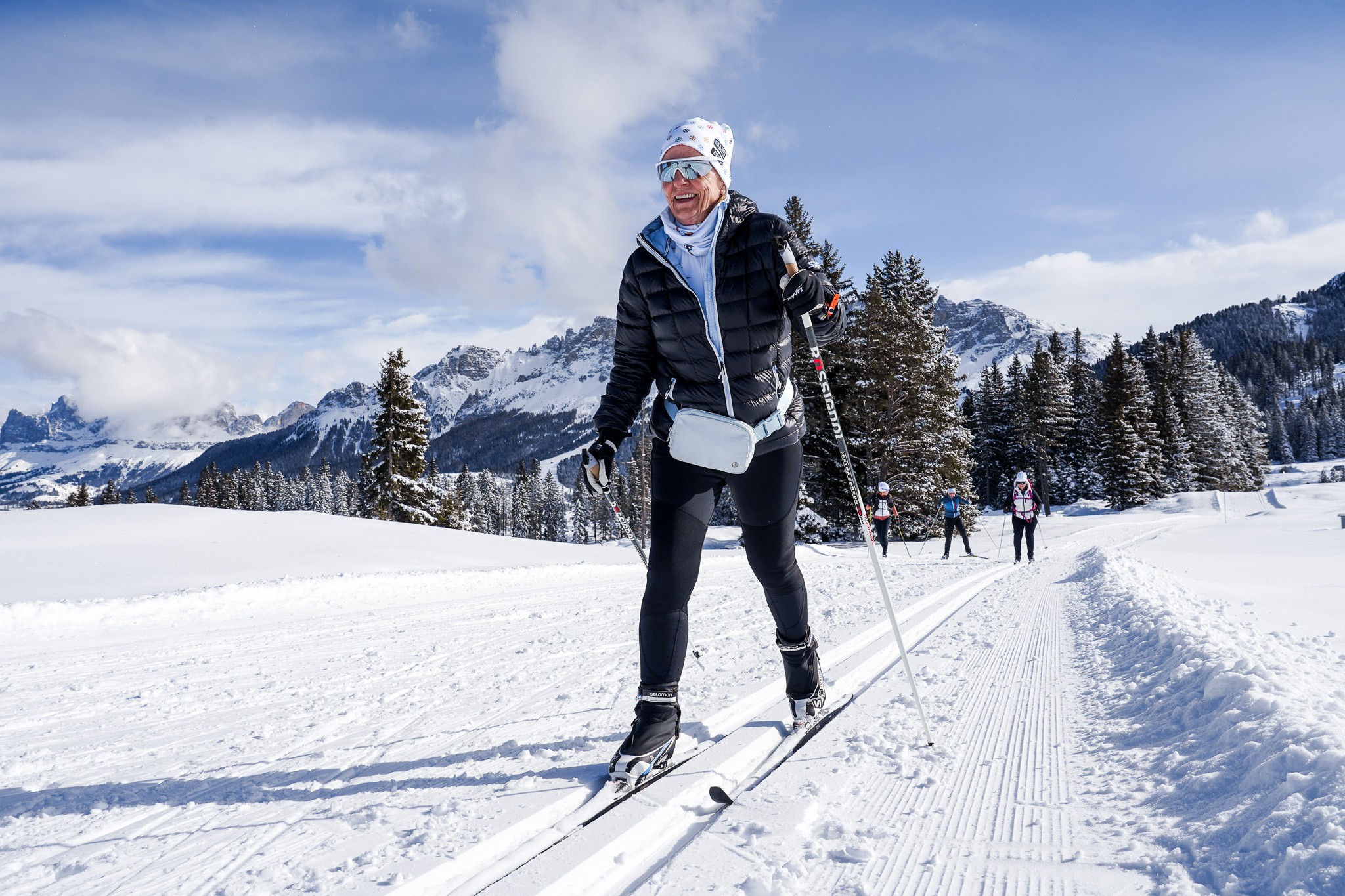
  • Reserve Your Spot Soon: These 2027 Lumi Trips Still Have Space

    Reserve Your Spot Soon: These 2027 Lumi Trips Still Have Space

    Mid-August is a time to reflect on the summer and start looking forward to the upcoming changing of the seasons. The long, sunny days have brought me many adventures this year, particularly to lakeside destinations like Achensee just up the valley from Innsbruck. A quick dip in the lake is an excellent way to cool down after a bike ride, hike or even rollerski, in the mountains with friends on a hot day. Soon, though, the temperatures will begin dropping and our favorite trails start preparing for the coming winter.

    If you’ve been dreaming of exploring Europe’s top cross-country ski trails this winter, there is still space on several Lumi trips to the Alps and Scandinavia. Whether you’d like to check a Worldloppet event (or two!) off your list or simply sight-ski in a new country at your own pace, Lumi’s expert, local trip leaders will help make you get the most out of your ski time in Europe. Check out Lumi’s 2027 winter calendar below and start making your plans today.


    Ski in Seefeld & Seiser Alm 

    Explore the trails on Seiser Alm, one of Italy's premier Nordic skiing destinations
    Explore the trails on Seiser Alm, one of Italy’s premier Nordic skiing destinations (Photo: Lumi Experiences)

    This Winter Seefeld, Austria and Seiser Alm, Italy are renowned for their approachable, yet scenic skiing during the winter months. Start your journey on the nearly-flat trails of Leutasch outside of Seefeld, where picture-perfect mountains rise above the valley below. Trailside huts serving traditional Austrian fare, including the classic Aperol Spritz, dot the trails so you’re never far from a snack break or full meal. Continue your trip on Seiser Alm, where the higher elevations place you above the clouds and nearly at eye-level with the craggy Dolomite spires that ring this high-altitude plateau. Both locations have reliable snow-making capabilities that enable them to open the trails by November before natural snow takes over in December and beyond. The March trip is already sold out, but we still have space on both January trips to Seefeld & Seiser Alm trips. Reach out soon! Our January 20 departure only has one room remaining.


    Earn Two Worldloppet Stamps Towards Your Masters Medal 

    Ski through Finland's dense forests at the Finlandia-Hiihto
    Ski through Finland’s dense forests at the Finlandia-Hiihto (Photo: Finlandia-Hiihto)

    If you’re craving the thrill of participating in a major ski marathon, look no further than Lumi’s Marcialonga & König Ludwig Lauf and Finlandia & Tartu trips. Both trips feature Worldloppet events on back-to-back weekends, putting you that much closer to reaching your Worldloppet Master medal. Your expert, local trip leaders assist with all race logistics, including ski waxing for each event so you can simply focus on enjoying the skiing and surroundings on your big event day. We only have a few spots left on both trips, so if you’d like to participate in two Worldloppet events on one trip we recommend reaching out soon.

    The Marcialonga & König Ludwig Lauf trip features skiing in Italy, Austria and Germany over 11 days, allowing you to experience some of the best skiing and dining in each region. New for 2027 is the chance to participate in the 32 km Marcialonga “Just for Fun” event, the perfect distance for those who aren’t able to ski the full 70 km classic event. After skiing the beautiful trails in and around Seefeld, Austria, continue your Worldloppet pursuit at the König Ludwig Lauf in Germany on their newly refreshed, snow-secure course.

    Whether you ski the full 70 km course or the new 32 km "Just For Fun" event, crossing the Marcialonga finish line is an exciting accomplishment
    Whether you ski the full 70 km course or the new 32 km “Just For Fun” event, crossing the Marcialonga finish line is an exciting accomplishment (Photo: Lumi Experiences)

    Later in the winter you’ll have the opportunity to ski the Finlandia-Hiihto and Tartu Ski Marathon on Lumi’s Finland & Estonia trip. Both events feature moderate terrain and a relaxed atmosphere in part due to their smaller size – especially compared to Worldloppet events like the Birken, Engadin and Vasaloppet, all of which regularly reach over 10,000 participants. In addition to enjoying both nations’ Olympic museums, cuisine and trails, guests have the opportunity to sauna every day in Finland in a variety of traditional Finnish saunas.

    Join skiers from around the world in a group stretch before skiing the Finlandia-Hiihto Worldloppet
    Join skiers from around the world in a group stretch before skiing the Finlandia-Hiihto Worldloppet (Photo: Finlandia-Hiihto)


    Sight-Ski Your Way Across Norway or Slovenia & Italy 

    Not interested in participating in a ski marathon? Join a sight-skiing trip in Norway or Slovenia & Italy next winter. Lumi’s sight-skiing trips skip the races so you can focus on enjoying the scenery, cuisine and culture that make each destination unique.

    Ski the Holmenkollen trails above Oslo before trekking north to Norway's Sjusjøen trails
    Ski the Holmenkollen trails above Oslo before trekking north to Norway’s Sjusjøen trails (Photo: Lumi Experiences)

    We have two Norway Sight-Skiing trips scheduled for mid-February next winter, each of which begins in Oslo on the Nordmarka trails before shifting north to the Olympic city of Lillehammer and the seemingly endless trails of Sjusjøen. Enjoy Oslo’s harbor from two unique angles: first from the top of the iconic Holmenkollen Ski Jump high above the city, then from the water on a floating sauna – before an optional cold plunge into the icy waters. Our February 14 departure is almost full, with just two more rooms available for up to 4 guests

    Lumi’s Slovenia & Italy Sight-Skiing trip in early-March is the perfect trip for those looking to explore a quieter corner of the Alps. Your accommodations for the week-long trip are just a few minutes walk along rustic village paths to the trails, which lead directly to the famous Planica Nordic Center, site of the 2023 FIS World Championships. Ski to one of our favorite trailside huts in the Julian Alps before taking a gondola ride to a mountaintop village nearly a kilometer in elevation above the valley below. Wrap up your trip with a visit to Lake Bled, one of Slovenia’s most cherished natural wonders.

    Discover the quieter trails of the Julian Alps in Slovenia and Italy
    Discover the quieter trails of the Julian Alps in Slovenia and Italy (Photo: Lumi Experiences)


    End Your Season Under the Auroras in Iceland 

    Part Worldloppet trip, part sight-seeing adventure: Lumi’s Iceland Fossavatn trip in mid-April has a little bit of everything. Start your trip off in Reykjavik before trekking northwards along Iceland’s rugged interior, with stops at volcanic craters, scenic waterfalls and geothermal springs. Upon reaching the country’s Westfjords region, you’ll find a beautiful trail network just above sea level, with stunning views of the fjord in the glacially-carved valley overlooking the Atlantic Ocean. After participating in the last Worldloppet event of the season, celebrate with your fellow skiers from around the world at the Fossavatn’s famous cake party, with dozens of delicious cakes to choose from – not to mention freshly-caught seafood served at restaurants throughout Ísafjörður. With almost no light pollution to speak of, this trip has the highest chance of seeing the northern lights of any Lumi trip.

    Visit Iceland next April for the chance to see the northern lights
    Visit Iceland next April for the chance to see the northern lights (Photo: Annika Landis)

    Space is limited on many of these trips, so if you are interested in traveling to Europe with Lumi for your next ski vacation, reach out soon to secure your spot. Message reservations@lumiexperiences.com for a detailed trip itinerary or to sign up. We look forward to hearing from you!

    See you on the trail,

    Garrott Kuzzy
    garrott@lumiexperiences.com
    Founder & Olympian, Lumi Experiences


    About Lumi Experiences

    As the world’s premier cross-country ski travel company, Lumi Experiences offers boutique trips that introduce travelers to winter cultures where Nordic skiing is a part of everyday life — from Sweden to Slovenia. It’s a ski vacation like no other.

    Media contact: Nathan Miller – Marketing & Guest Communications Manager – nathan@lumiexperiences.com

  • Courtney Dauwalter Visits Seefeld & Seiser Alm With Lumi

    Courtney Dauwalter Visits Seefeld & Seiser Alm With Lumi

    Among the world’s top ultra-marathon runners is Courtney Dauwalter. Her accolades read as a list of the world’s most challenging trail running events, followed by “win” in pretty much every one of them. Known in the running world simply as “Courtney,” she is an incredibly talented athlete, but more importantly, Courtney is an incredibly thoughtful and inspiring person. 

    In high school, Courtney and I were teammates on the cross-country ski team and both of us stood on top of the podium at the 2002 Minnesota State High School Ski Championships (if anyone has any photos in their archives, please let me know – this was long before digital cameras and smartphones were ubiquitous). After skiing in college for the University of Denver, Courtney spent several years teaching, before a passion for trail running eventually pulled her away from teaching and into a trail running career. We stay in touch and try to meet up when it works out. 

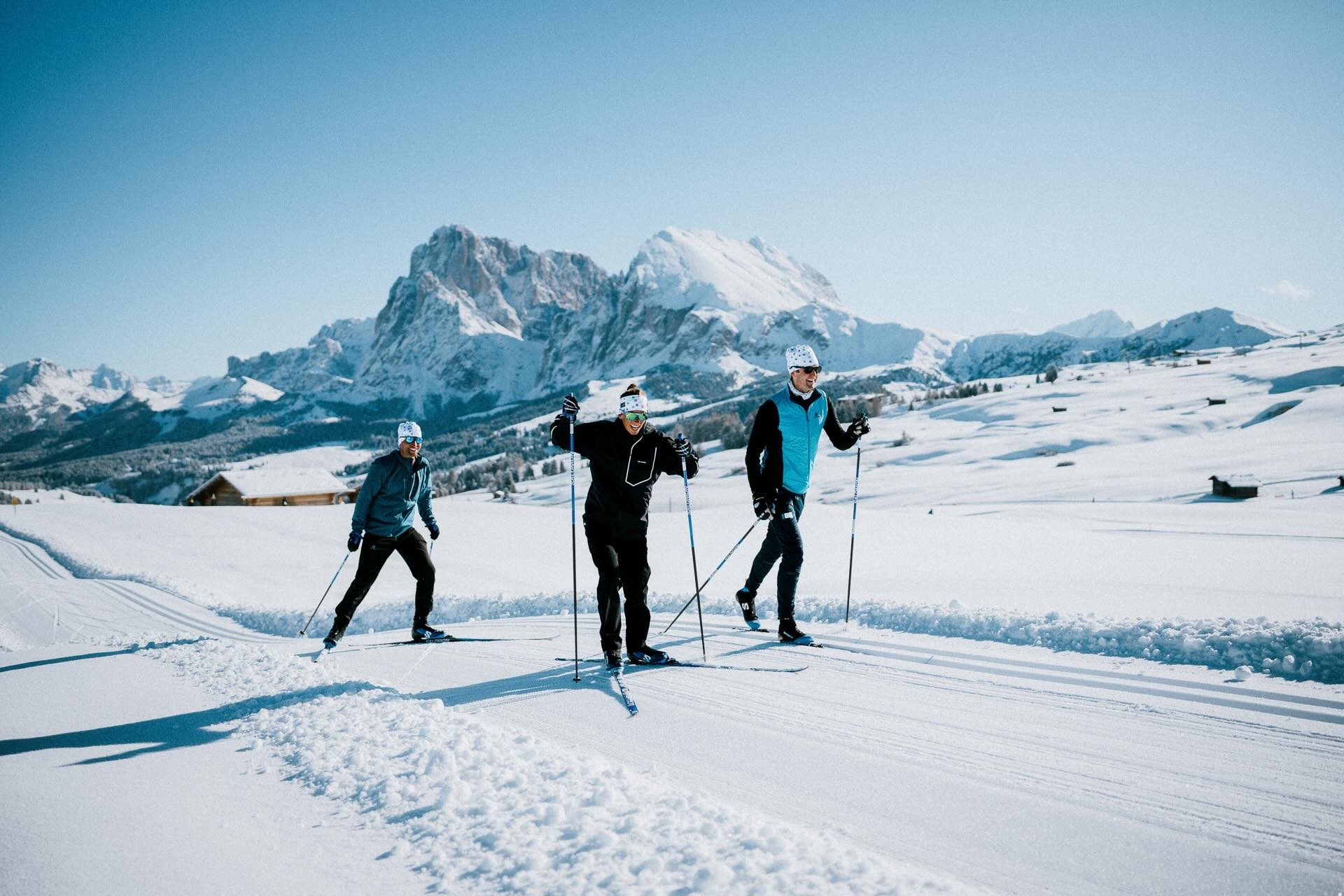
    Courtney Dauwalter explores the Seiser Alm trails with Garrott Kuzzy from Lumi Experiences
    Courtney Dauwalter explores the Seiser Alm trails with Garrott Kuzzy from Lumi Experiences (Photo: Moritz Klee)

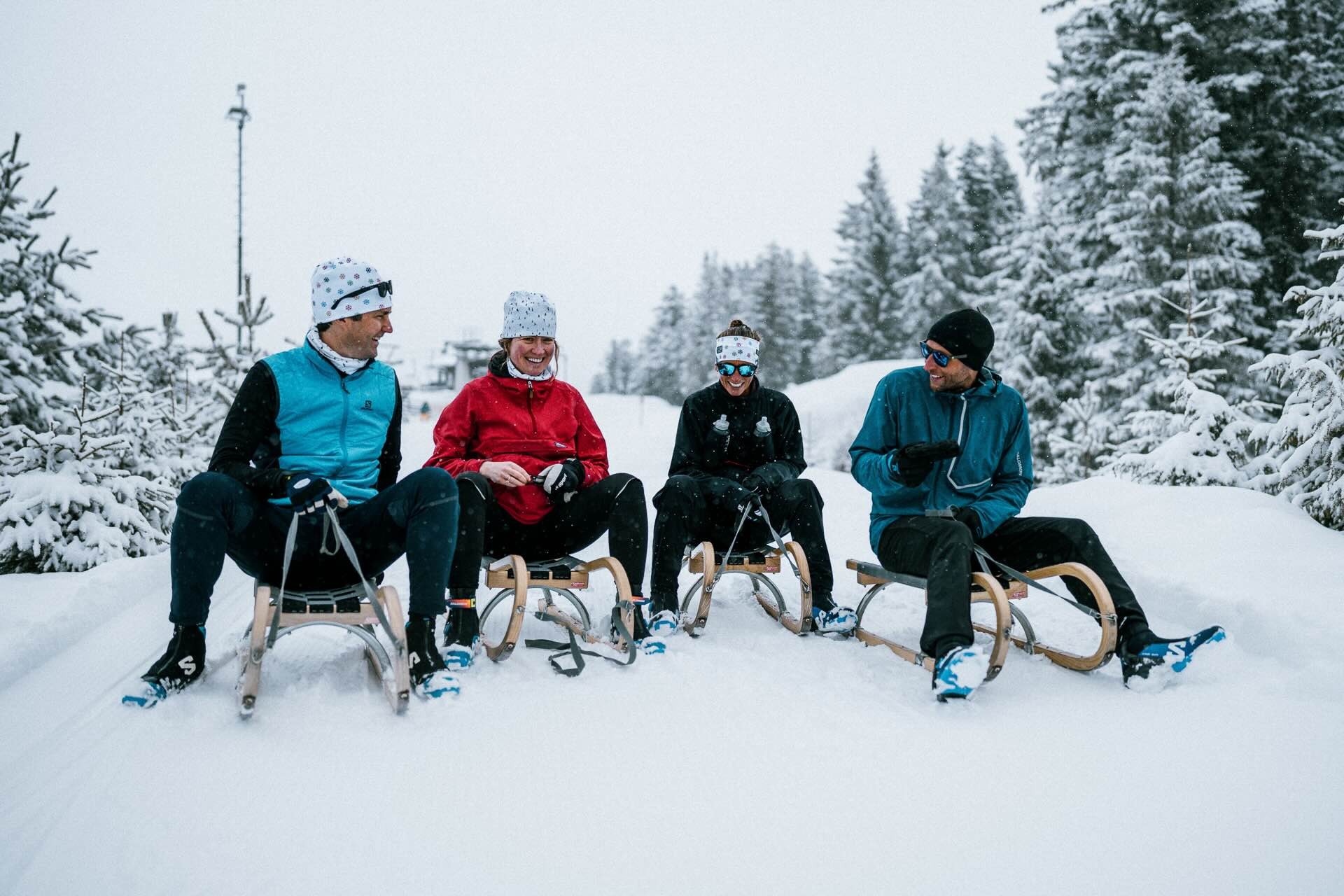
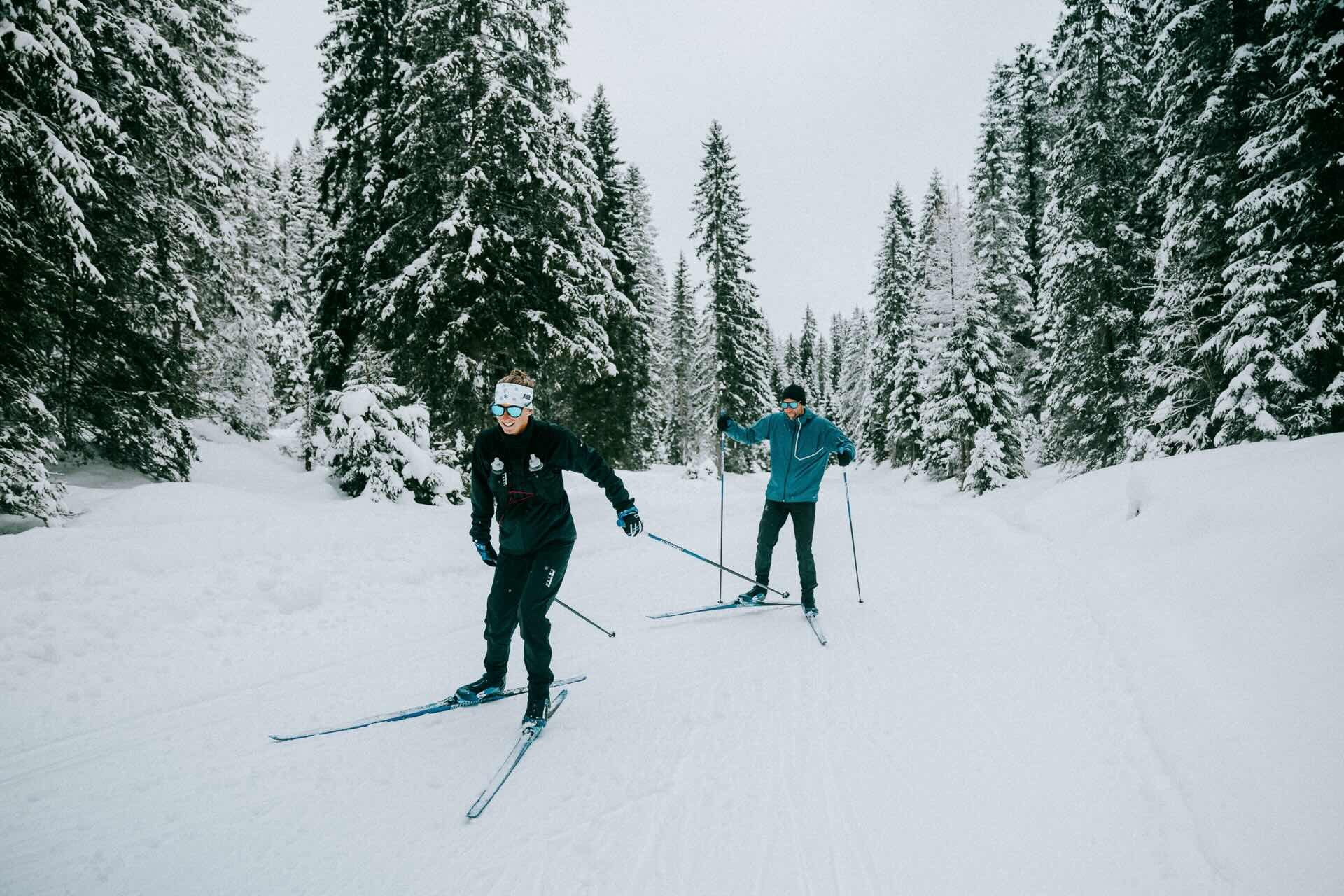
    Last fall, Courtney reached out to share that she was invited to run as a torchbearer in Italy in January 2026 and perhaps even do a little skiing afterwards: “Hey Garrott! Kev and I were just looking at the Lumi website and saw the Seefeld & Seiser Alm trip. We’d love to ski it this winter!” Fast forward a few months and we were catching up over a hot chocolate in a hut in Leutasch, Austria, getting ready to go sledding down one of my favorite trails before skiing our way back to their hotel in Seefeld. We had a blast skiing in Seefeld, Austria and Seiser Alm, Italy, where we got fresh corduroy tracks after a big snowfall and sampled cheese at one of my favorite farms in the Dolomites. It wasn’t until we were there that Courtney realized she’d been to the region before on a long trail run and pointed to the mountain she traversed during a summer trail running event a few years ago.

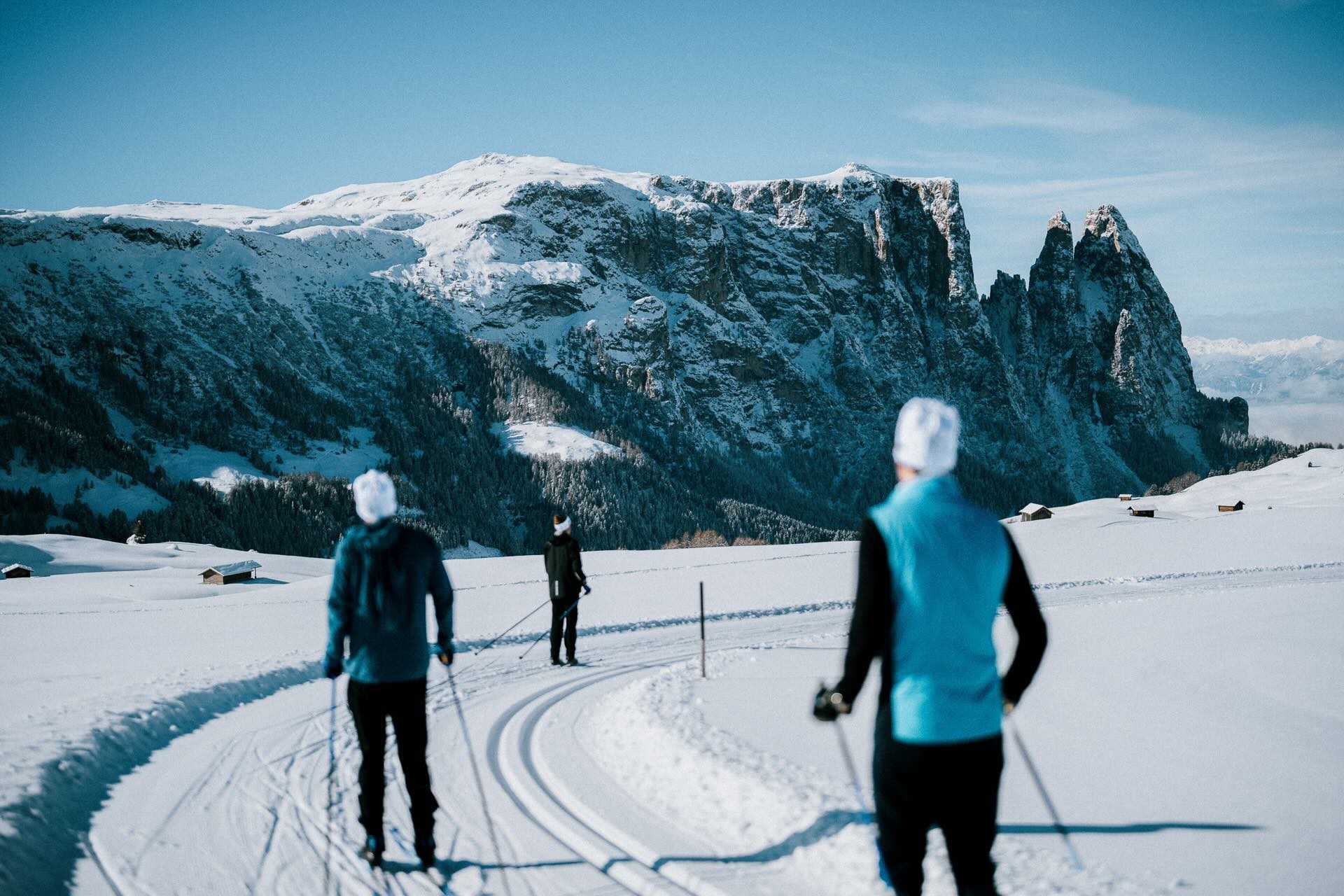
    The iconic Schlern formation rises above Seiser Alm's trails in Italy
    The iconic Schlern formation rises above Seiser Alm’s trails in Italy (Photo: Moritz Klee)

    A Legend on Foot

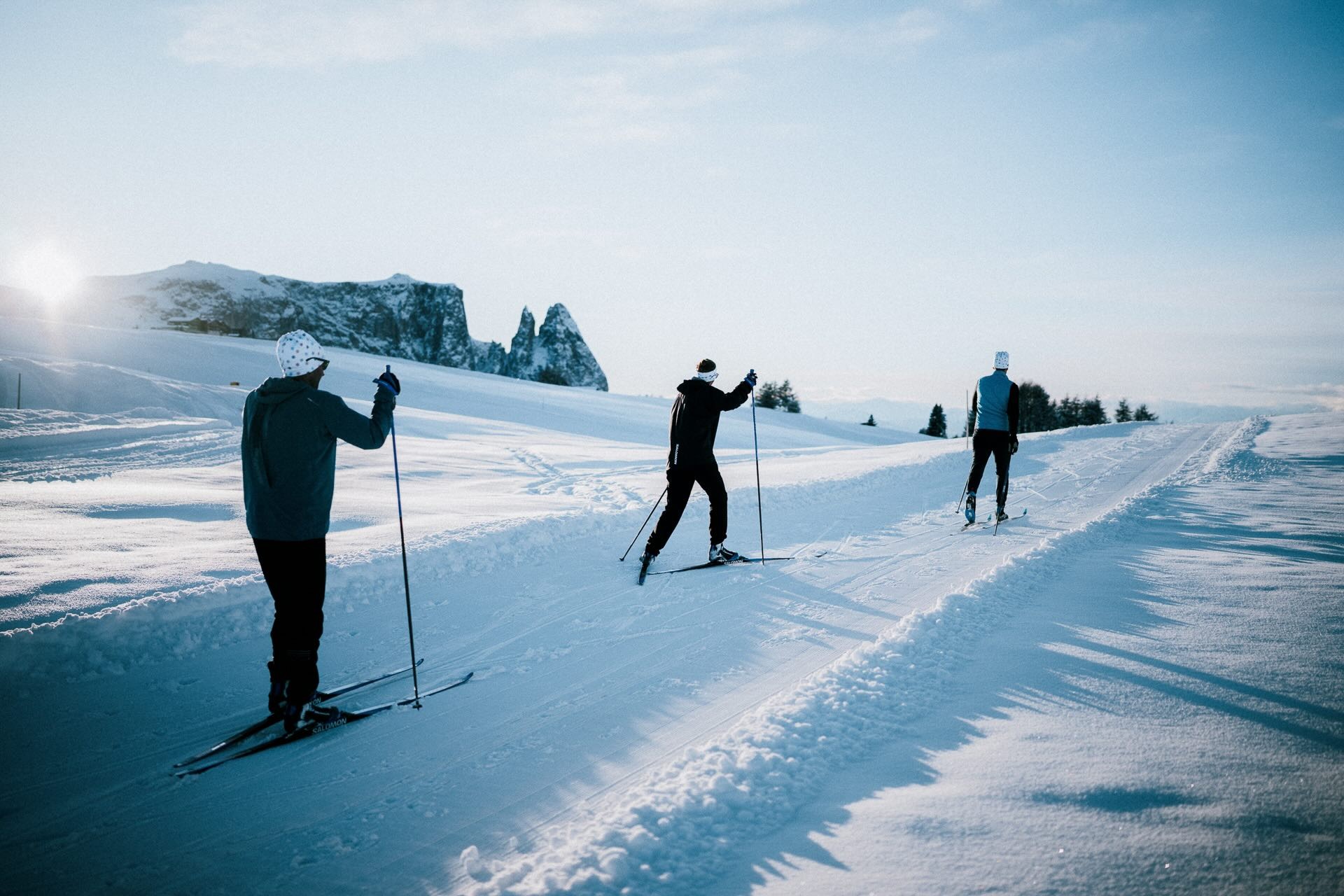
    Enjoying an evening ski on Seiser Alm
    Enjoying an evening ski on Seiser Alm (Photo: Moritz Klee)

    Widely recognized as one of the world’s top trail ultrarunners, Courtney’s trademark baggy shorts, easygoing attitude and mental resilience have made her a fan favorite and an inspiration for a generation of athletes of all ages who are bucking the definition of what makes a traditional trail runner. She has shattered records worldwide and amassed repeated victories at ultrarunning’s premier events, highlighted by an unprecedented sweep of the “Triple Crown” in 2023, winning the Western States 100, UTMB (Ultra-Trail du Mont-Blanc) and Hardrock 100 all in a single calendar year.

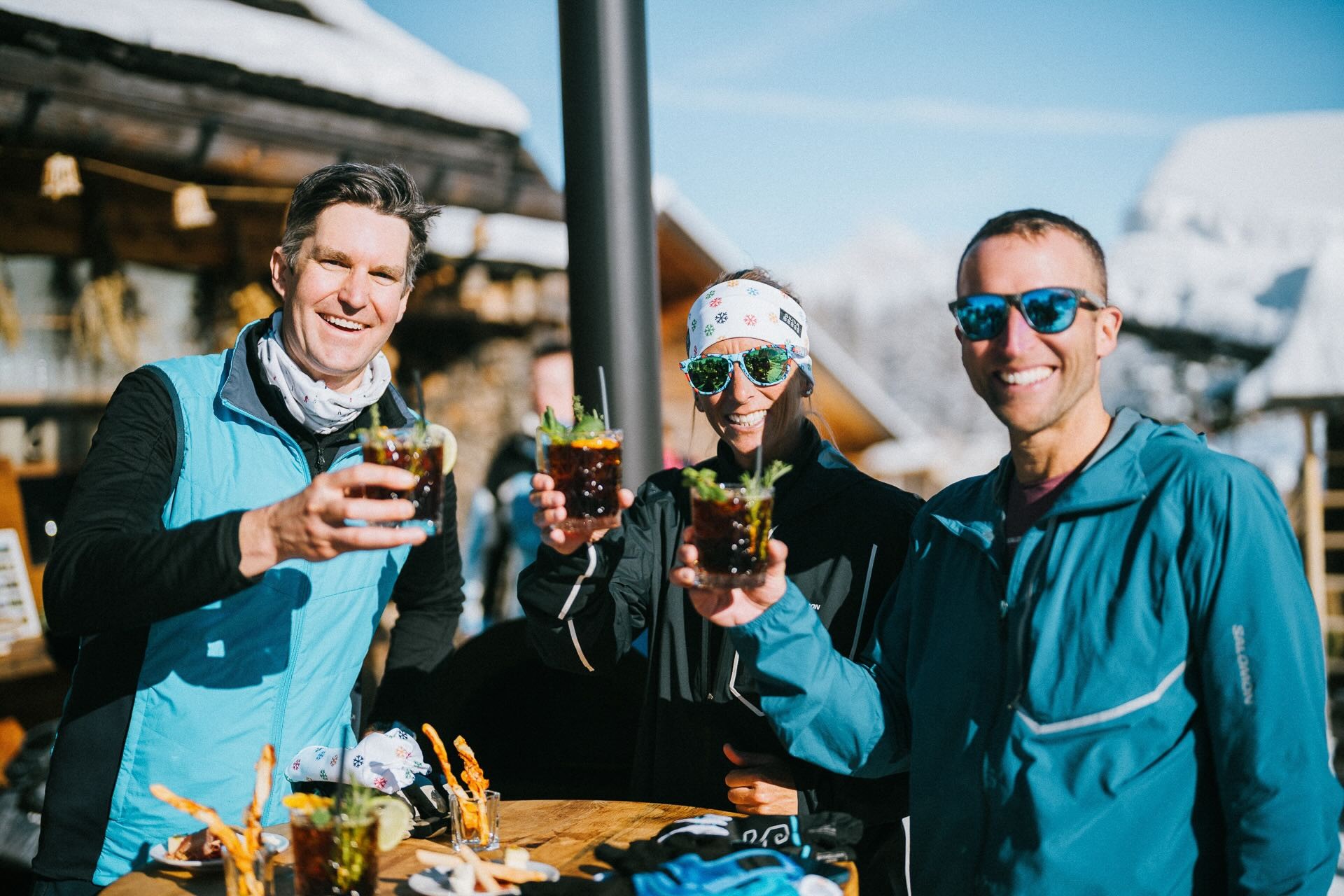
    Salut! to a day on Seiser Alm's trails in Italy with Lumi Experiences
    Salut! to a day on Seiser Alm’s trails in Italy with Lumi Experiences (Photo: Moritz Klee)

    Courtney continues to set the bar high this season, winning the women’s Ultra Trail Chianti Castles 120K in Tuscany this past March and placing 10th overall. In May, she tackled the grueling Cocodona 250, redeeming her previous year’s DNF by pushing through the Arizona heat to take 2nd among women and 6th overall. She followed that in July by capturing her fourth straight women’s title at the Hardrock 100, crossing the line 5th overall in 26:03:10 to set the fastest female clockwise time in the race’s history. Was it her week of skiing in Seefeld & Seiser Alm this winter that made the difference? Well, probably not, but skiing is definitely great cross-training for trail running.

    Still Stellar on Skis

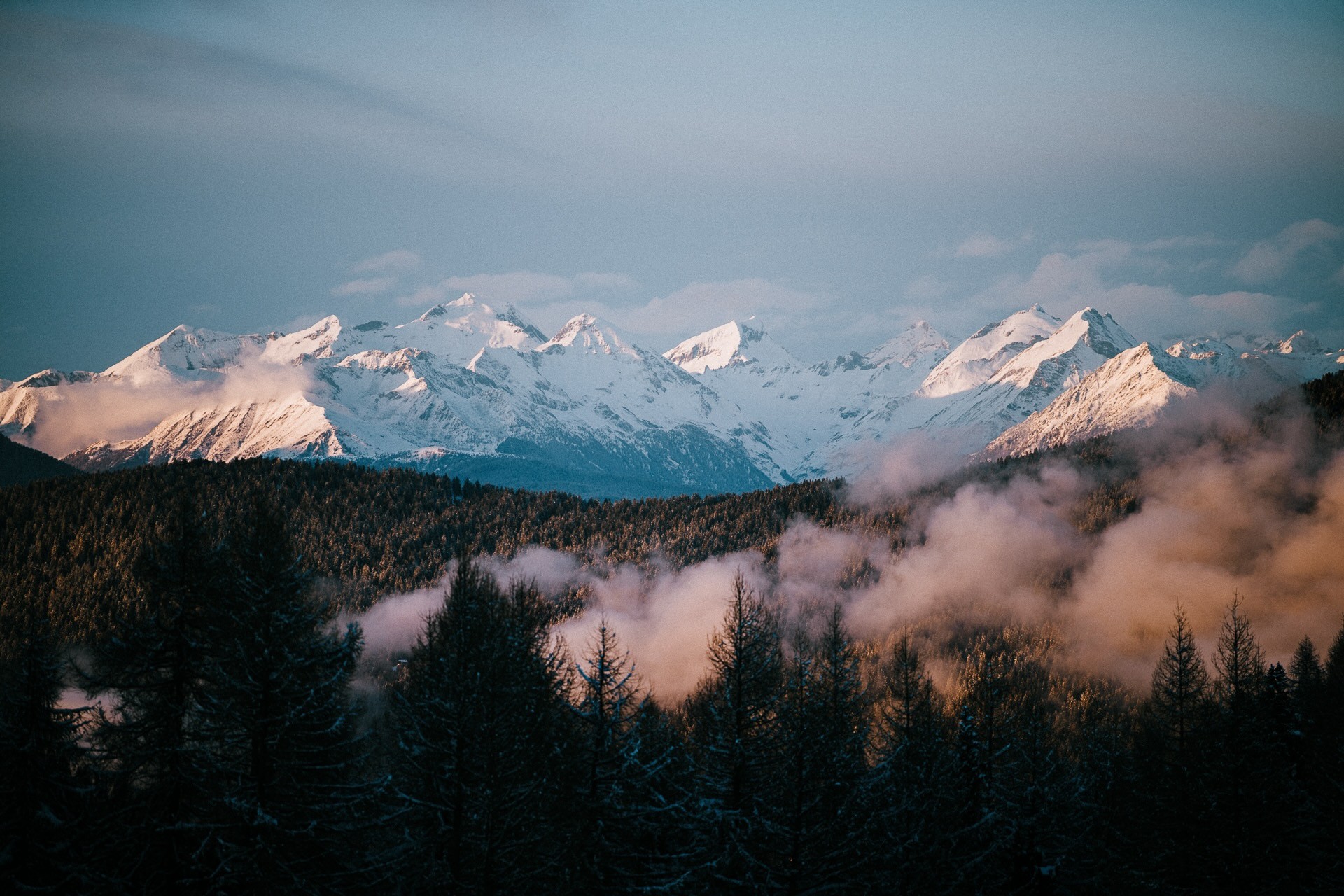
    Snow-capped peaks make for an incredible backdrop for skiing at Seefeld, Austria and Seiser Alm, Italy
    Snow-capped peaks make for an incredible backdrop for skiing at Seefeld, Austria and Seiser Alm, Italy (Photo: Moritz Klee)

    Courtney still excels at skiing, a testament to the importance of cross training and staying fit no matter the season – not to mention the years of working on her stride early in her athletic career. Her husband Kevin is relatively new to cross country skiing, but still loved the alternative to running, exploring the trails and perfecting his ski skills.

    Alpine sledding with Courtney Dauwalter and Lumi Experiences
    Alpine sledding with Courtney Dauwalter and Lumi Experiences (Photo: Moritz Klee)

    One of the highlights of our week together was rodeling, aka alpine sledding. We had a memorable ride down the hill through forests blanketed with snow before our ski back to Seefeld. There are plenty of ski trails and activity options suitable for everyone in Seefeld & Seiser Alm, from ultra-distance champions to beginners.

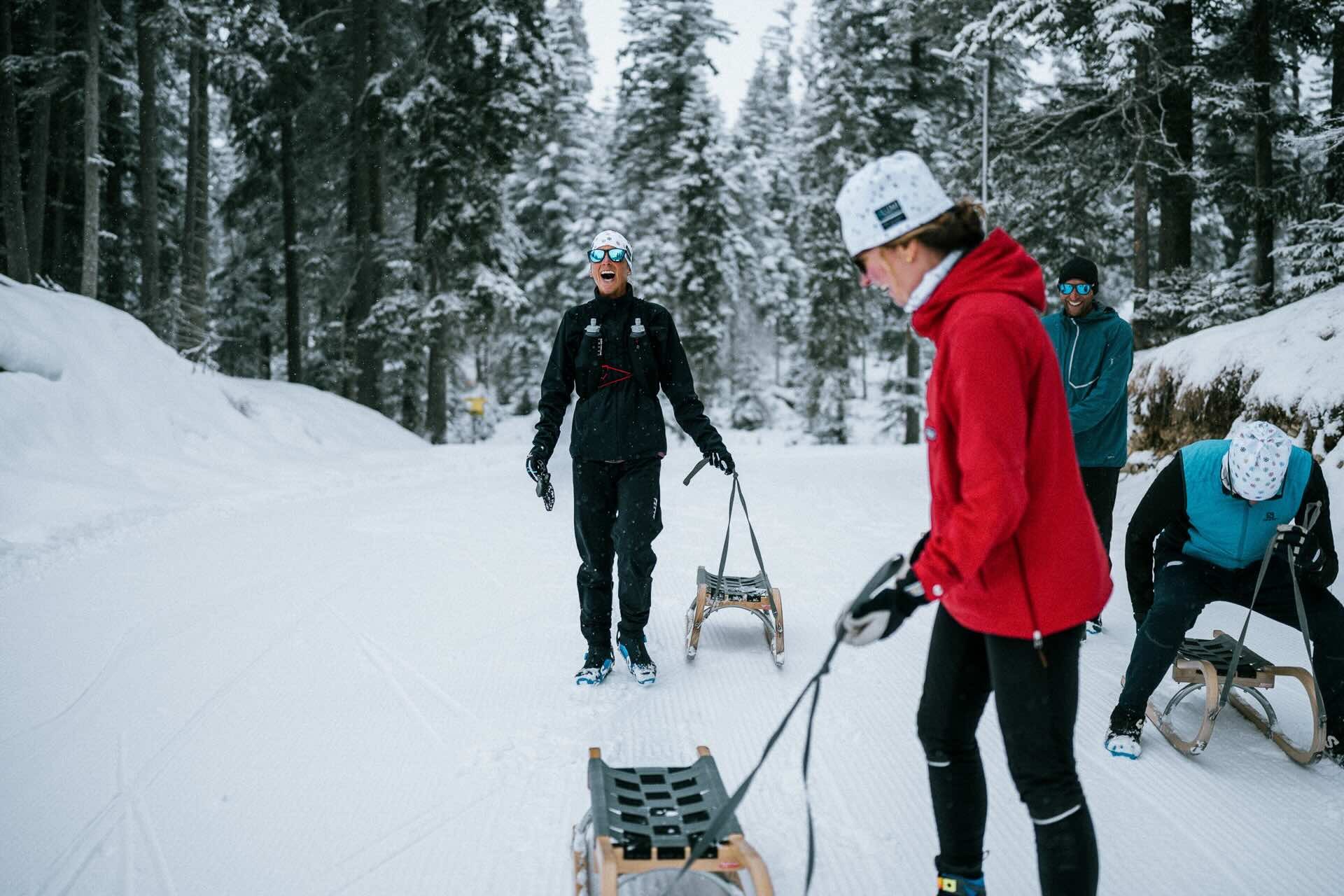
    Ready for rodeling with new and old friends in Leutasch, Austria
    Ready for rodeling with new and old friends in Leutasch, Austria (Photo: Moritz Klee)

    Ski in Austria and Italy Next Winter

    Fresh snowfall made for excellent conditions on Seefeld's trails
    Fresh snowfall made for excellent conditions on Seefeld’s trails (Photo: Moritz Klee)

    Would you like to explore Austria and Italy’s best cross-country ski trails next winter? Let Lumi Experiences handle all of the hotel, transportation, and scheduling logistics so you can enjoy the trails to the fullest with your travel companions, with the help of Lumi’s local, expert trip leaders. Relax in comfortable trailside accommodations and discover regional cuisine unique to both countries. Not an ultrarunner like Courtney? Both Seefeld & Seiser Alm feature trails for all levels of skiers, even novices. There is limited space available on Lumi’s Seefeld & Seiser Alm trips next January, with two departure dates available. Reach out to reservations@lumiexperiences.com today for a detailed daily itinerary or to sign up.

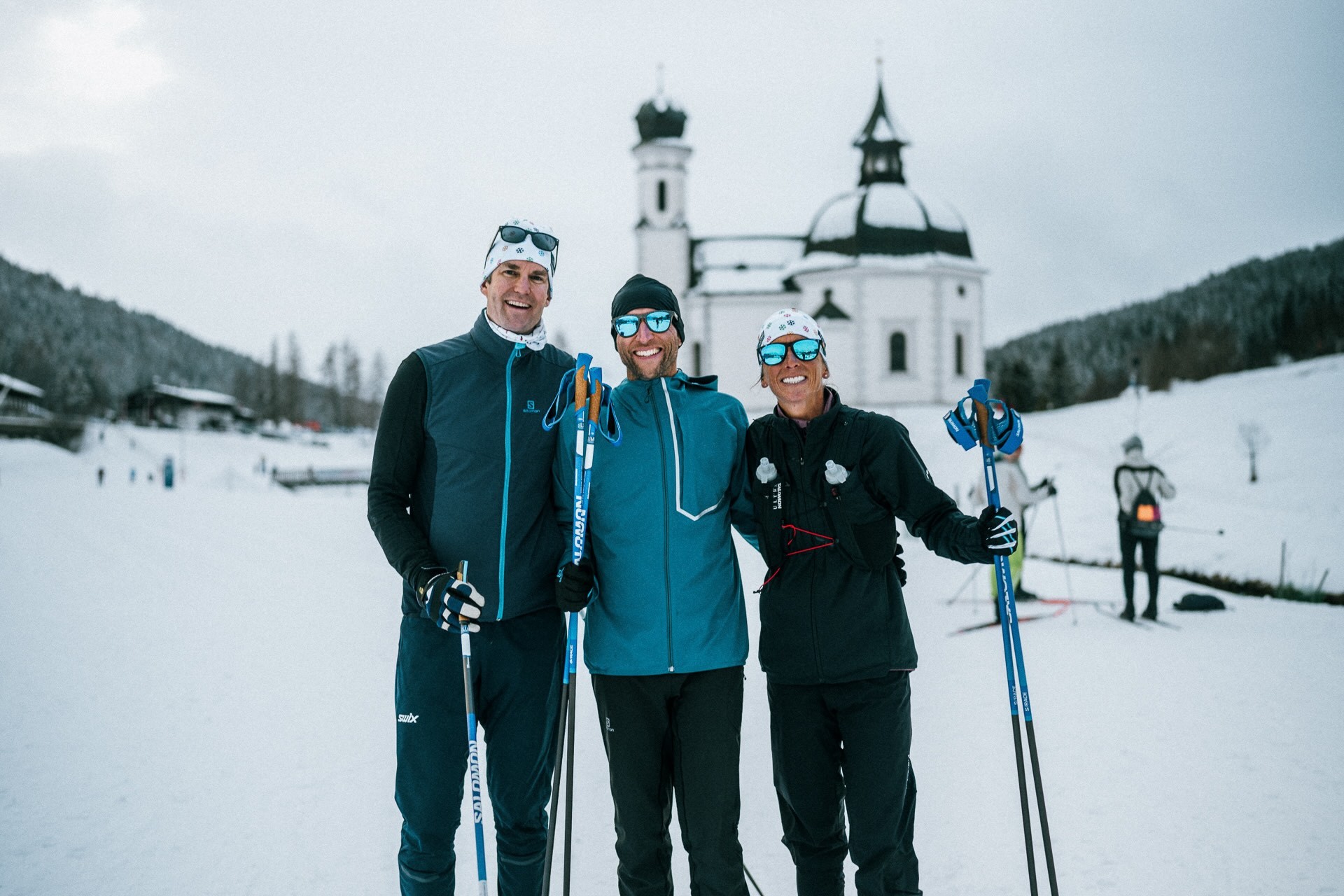
    Garrott, Kevin and Courtney in front of Seefeld's Seekirchl church
    Garrott, Kevin and Courtney in front of Seefeld’s Seekirchl church (Photo: Moritz Klee)

    See you on the trail,

    Garrott Kuzzy
    garrott@lumiexperiences.com
    Founder & Olympian, Lumi Experiences

    About Lumi Experiences

    As the world’s premier cross-country ski travel company, Lumi Experiences offers boutique trips that introduce travelers to winter cultures where Nordic skiing is a part of everyday life — from Sweden to Slovenia. It’s a ski vacation like no other.

    Media contact: Nathan Miller – Marketing & Guest Communications Manager – nathan@lumiexperiences.com
  • Limited Spots Left: 2019 Nordic Ski World Championships Trip

    (Press release)

    Lumi Experiences and the National Nordic Foundation (NNF) are partnering for the second consecutive year to offer a once-in-a-lifetime trip to the 2019 Nordic Ski World Championships in Seefeld, Austria. Last winter, guests on the trip cheered on Sophie Caldwell and Jessie Diggins on their way to the top of the podium at the Seefeld World Cup races, along with other memorable experiences like skiing on some of Seefeld’s 200 km of trails. The trip raised over $10,000 in support of the NNF, supporting grass-roots skiing in the United States.

    2019 World Championships Trip

    Dates: Monday, February 25 – Monday, March 4, 2019

    HURRY! We can only accept bookings on this trip until October 15, 2018. 

    Only 6 more spots available.

    The trip includes tickets in the A-Grandstand to all events, including the 10 & 15km classic races, 4 x 5 km & 4 x 10 km relays and 30 km & 50 km marathon events. These tickets can no longer be purchased anywhere else.

    The trip is led by Olympian’s Holly Brooks and Garrott Kuzzy. Holly is a two-time Olympian and played a huge role in bringing US skiing to the highest levels; one of the pivotal personalities in the book “World Class.” Innsbruck has been Garrott’s home for the past two years. He has picked out his favorite activities of the region to showcase on this trip.

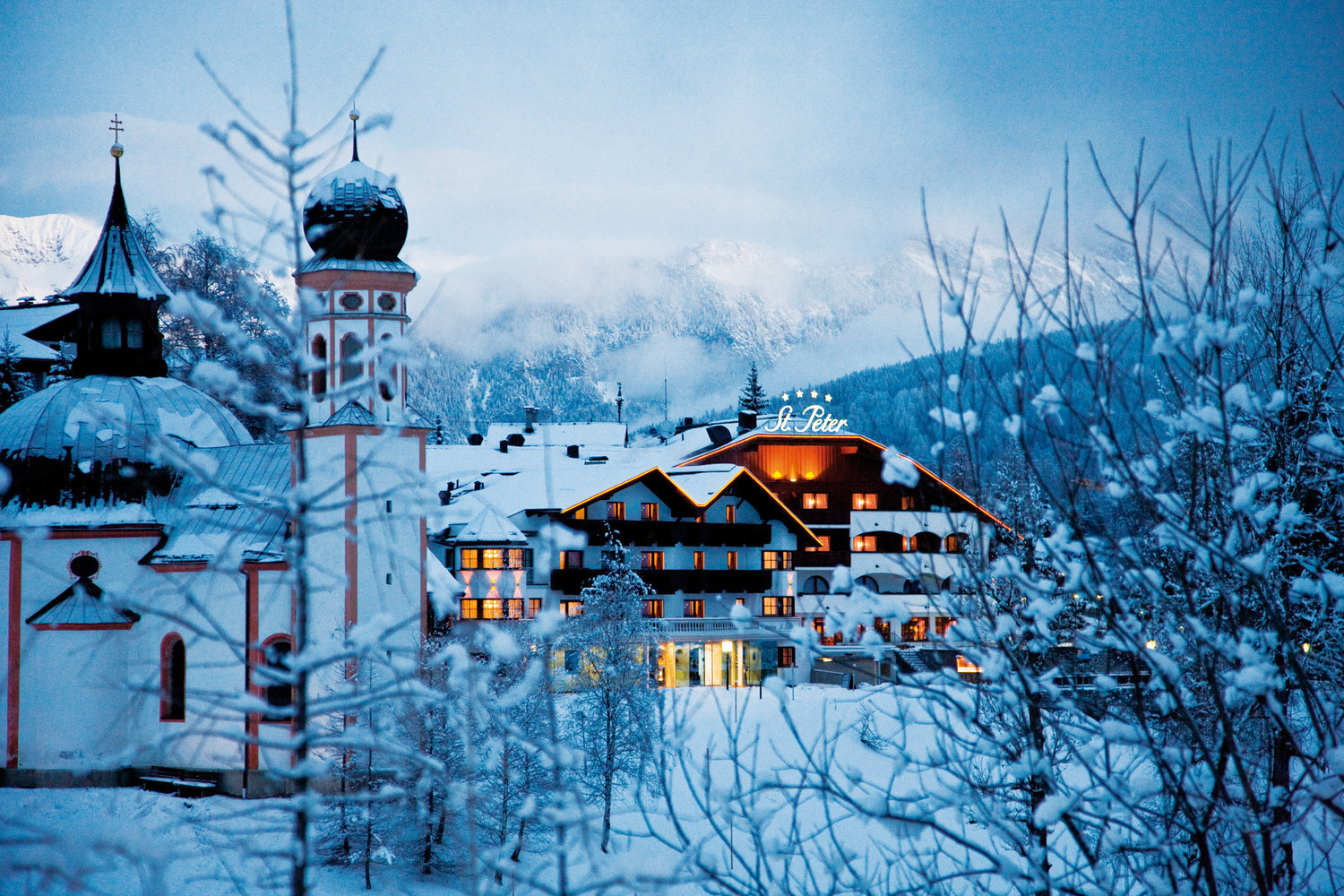
    After exploring the trails and cheering on your favorite athletes, relax in the sauna, pool and spa at Hotel St Peter, located directly at the trailhead in Seefeld and raise a glass to Team USA.

    Visit www.lumiexperiences.com or email info@lumiexperiences.com for detailed information.
  • Talking World Champs with Seefeld Chief of Course Thomas Unterfrauner

    Talking World Champs with Seefeld Chief of Course Thomas Unterfrauner

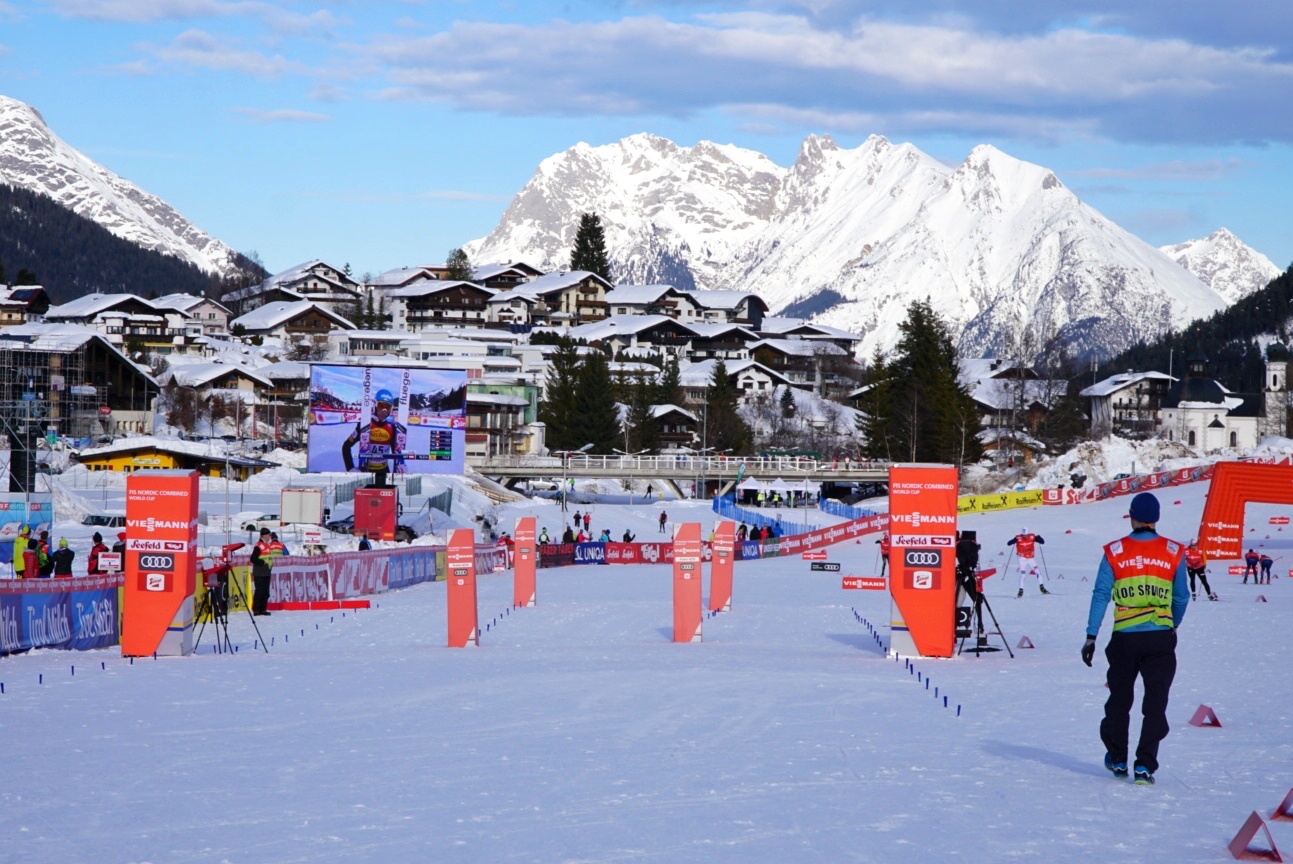
    The pre-race scene at the 2018 World Cup in late January in Seefeld, Austria. The venue will host 2019 World Championships. (Photo: Garrott Kuzzy/LumiExperiences.com)

    With the 2019 International Ski Federation (FIS) Nordic World Ski Championships the next major championship on the docket, Garrott Kuzzy, a 2010 U.S. Olympian who lives in Innsbruck, Austria, interviewed the chief of course for the 2019 World Championships in Seefeld, Austria. Via email, he asked Thomas Unterfrauner about preparing for the event, which will run from Feb. 20 to March 3. 
    ***

    Garrott Kuzzy: How is the atmosphere around Seefeld leading up to the 2019 World Championships?

    Thomas Unterfrauner: The atmosphere is very interesting. The whole village of Seefeld is focused on the championships next winter. Everybody seems to have a role in preparing for it for it. We all know that this is a big opportunity for us to showcase the whole Olympiaregion Seefeld to the world.

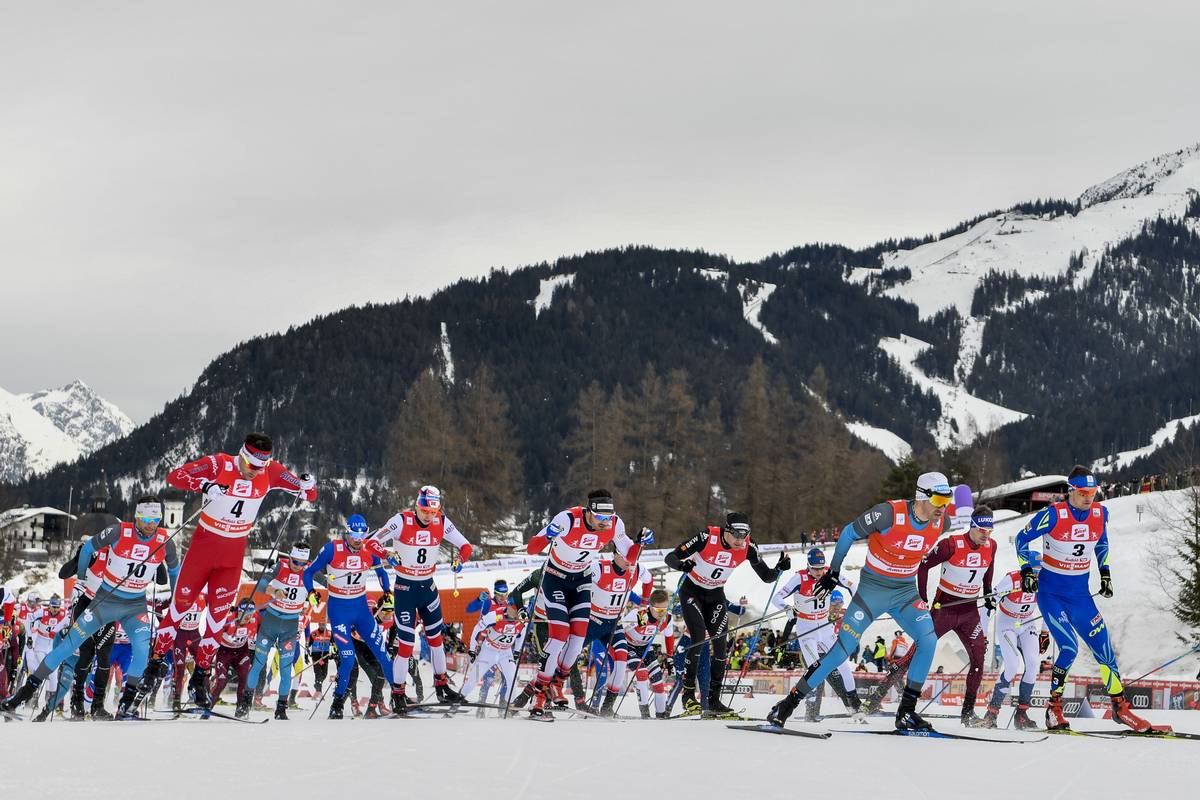
    Early in the men’s 15 k freestyle mass start at the 2018 World Cup in Seefeld, Austria, with Canada’s Alex Harvey (4), Switzerland’s Dario Cologna (6) and Norway’s Hans Christer Holund (2) skiing near the front of the pack. (Photo: Salomon/NordicFocus)

    GK: In 2017, Seefeld hosted the OPA Cup finals. There was ankle-deep standing water in parts of the stadium. Big changes were made in the stadium and on the trails and it seems to have worked. What changes did you make?
    TU: We reviewed the course in detail after the OPA Cup finals last spring. There were several challenging areas on the course, especially the water in the stadium. We worked with several specialists to analyze and make changes to the stadium and the course.

    GK: What changes do you still plan to make before next winter?

    TU: Our biggest change will be to make the stadium even wider. There are many things we need to fit into the stadium, such as start and finish lanes and a wide section of race course going between them, plus bleachers that we did not have for the World Cup this year. At this point, 90 percent of our work is complete. We are mostly making some finishing touches now.

    GK: The courses for this year’s World Cup in Seefeld seemed to really appeal to the U.S. skiers, especially Sophie Caldwell and Jessie Diggins, who both won races. What did you learn about the course at the World Cup this winter?

    TU: We learned many things from the World Cup this winter. We approach most events, such as National or OPA Cup level competitions, with athletes and teams in mind. With World Cups and World Championships, we have the additional considerations of television and marketing partners. Some of our new questions we consider are where to place sponsor banners, cameras and how to get power to them. Television and marketing partners work with us to make sure all of the additional hardware is in place.

    GK: What was the general response from the athletes?

    TU: The reaction to the courses was positive from all sides. Athletes and coaches both commented how easy it was to access the trails, wax trailers, and the start and finish areas from the course for warming-up, cooling-down and testing skis. The stadium is also close enough to Seefeld that teams can get to and from the skiing without having to take a bus. With our improved rollerski loop, there are many teams coming to Seefeld for their summer training, to spend more time getting comfortable with the course and the surroundings.

    Left to right: Mikaela Sundbaum (assistant technical delegate), Annmari Viljanmaa (TD), Christian Krepper (chief of competition), and Thomas Unterfrauner (chief of course) at the 2018 World Cup in Seefeld, Austria. (Photo: Garrott Kuzzy / Lumi Experiences)

    GK: How many spectators are you expecting for the 2019 World Championships?

    TU: We are expecting around 15,000 spectators per day for the World Champs, around three times as many as we had for the World Cup races last winter.

    GK: You were at the 2017 World Championships in Lahti, Finland. In your mind, what is the difference between a World Cup and the World Championships?

    TU: The size of the event and the length of time are the biggest differences. There are more athletes, coaches, support staff, media and spectators, all of whom stay for up to two weeks or more. Everything down to how we dispose of trash has to be considered. That is to say, there is a lot of housekeeping to be done for a full two weeks–much longer than one World Cup weekend.

    GK: Why should someone travel to ski in Seefeld? What makes Seefeld unique?

    TU: Seefeld and the whole Olympia Region (Seefeld hosted the cross country events for the 1964 and 1976 Olympic Games) is made up of several different towns, valleys and trail networks, including Seefeld, Leutasch, Mösern, Scharnitz, Buchen and Reith. In total, there are over 200 kilometers of trails. We can offer skiers of all levels terrain that matches their wishes, whether that’s challenging World Cup trails through the woods or flat, relaxed terrain through open valleys. The quality of life here on the Seefeld Plateau is very high, with clean air, amazing nature, spectacular scenery and most importantly, good snow conditions.

    GK: Finally, there are some big hopes for the U.S. team, coming off a gold-medal performances in Seefeld and PyeongChang. That said, there are also some skiers flying under the radar who could challenge for the victory. Teresa Stadlober will surely be aiming for a big performance in her home country. Therese Johaug has not competed in 2018, but will be back in 2019. There’s a rumor she was in Seefeld for a World Champs simulation training camp while the rest of her competition was at the Olympic Games. Do you have any predictions for next winter?

    TU: Nope, I have no predictions. My aim is to offer fair and safe races for all athletes. Off the trail, we will have a host a huge celebration of cross country skiing. I would love to draw more attention to our sport, especially here in Austria. So, I suppose it would be pretty special if Austria won a medal 😉

    GK: Finally, you work as an electrician in the summer. Are there any skills or attributes from your summer job that you put to use in the winter as chief of course?

    TU: Yes, there are many parts, especially working under pressure and attention to detail. If an electrician makes a mistake, it can be very hard, or impossible, to go back and fix later. In the worst cases, the house could burn down. We use similar structures in preparing for big events, so that details are not overlooked and everything runs exactly as it should when you turn on the lights and welcome the world.

    Course overviews

    ***

    Garrott competed in the 2010 Olympic Games and raced several years with the US Ski Team and the CXC Team. He is founder of Lumi Experiences, offering cross-country ski vacations to Europe. Lumi Experiences is partnering with the National Nordic Foundation to offer trips to the 2019 World Championships in Seefeld.

    Seefeld in Tirol, Austria, will host the 2019 Nordic World Championships. (Photo: Garrott Kuzzy/LumiExperiences.com)

  • Opening Acts in PyeongChang: USST Press Conference and Catching Up with Sargent

    (From left to right) U.S. Ski Team members and 2018 Olympians Rosie Brennan, Kikkan Randall, Sadie Bjornsen, Jessie Diggins, Erik Bjornsen, and Ida Sargent posing after their intro press conference on 2-7-18. (Photo: Flyingpointroad.com)

    FasterSkier would like to thank Fischer Sport USA, Madshus USA, Concept2, Boulder Nordic Sport and Swix Sport US for their generous support, which made this coverage possible.

    ***

    PYEONGCHANG, South Korea — Sitting one-by-one across the stage dressed in what appeared to be the brightest of bright white tops, Kikkan Randall, Jessie Diggins, Rosie Brennan, Ida Sargent, and the Bjornsens (both Erik and Sadie) held court for the attending media Wednesday afternoon at PyeongChang’s mountain cluster media center. All athletes are members of the U.S. Ski Team (USST) and 2018 Olympians.  

    Randall, the seasoned vet, fielded a spectrum of questions centered around her role as the foundational piece of the U.S. women’s cross-country-ski juggernaut. It’s the Anchorage-based skier’s fifth Olympic Games.

    Back in 2002, when Nina Kemppel competed in her last of four Games for the U.S. cross-country ski team, Randall, as part of the same 2002 Salt Lake squad, was beginning her own five-Olympiad odyssey. Sixteen years later, Randall could reflect on being, at times, a lonely success story on the women’s side, to the present, when on the most recent World Cup weekend in Seefeld, Austria, two U.S. women scored wins: Sophie Caldwell in the freestyle sprint, Diggins in the 10 k mass start skate.

    Jessie Diggins and the media swarm during her intro press conference at the 2018 PyeongChang Olympic Games. (Photo: Flyingpointroad)

    As much as the press was there to see a champ like Randall, they also were captured by Diggins’s spunk and verve. Erik Bjornsen took it all in after stating in his intro that this was his first press conference. He proceeded to take out his smartphone and unabashedly capture a few panning video shots of the scrum of reporters there to learn more about the U.S. cross-country team poised to make history in South Korea.

    For those who follow the sport and in particular the U.S. women, much was said about the “team” and their devotion to it. But each athlete also spoke of their personal goals and ambitions.

    After the main press conference, when athletes took one-on-one questions, FasterSkier had an opportunity to check in with Brennan, Erik Bjornsen and Sargent.

    2018 is Brennan’s first Olympics, yet she arrives with a broad scope of World Cup experience to draw from. She scored two top-20’s in successive World Cup 10 k freestyle races in Davos, Switzerland and Toblach, Italy. She nailed a 15th place in the Tour de Ski’s opening skate sprint. It was a solid Period 1 on the World Cup for Brennan.

    Much has been written about the U.S. women’s collective prospects in the 4 x 5 k relay. That team, which could include more names than the four-member team is alloted, is still not set in stone.

    Asked if she would be approaching her first race opportunities as a demonstration to the coaches of her overall fitness, Brennan was anything but coy.

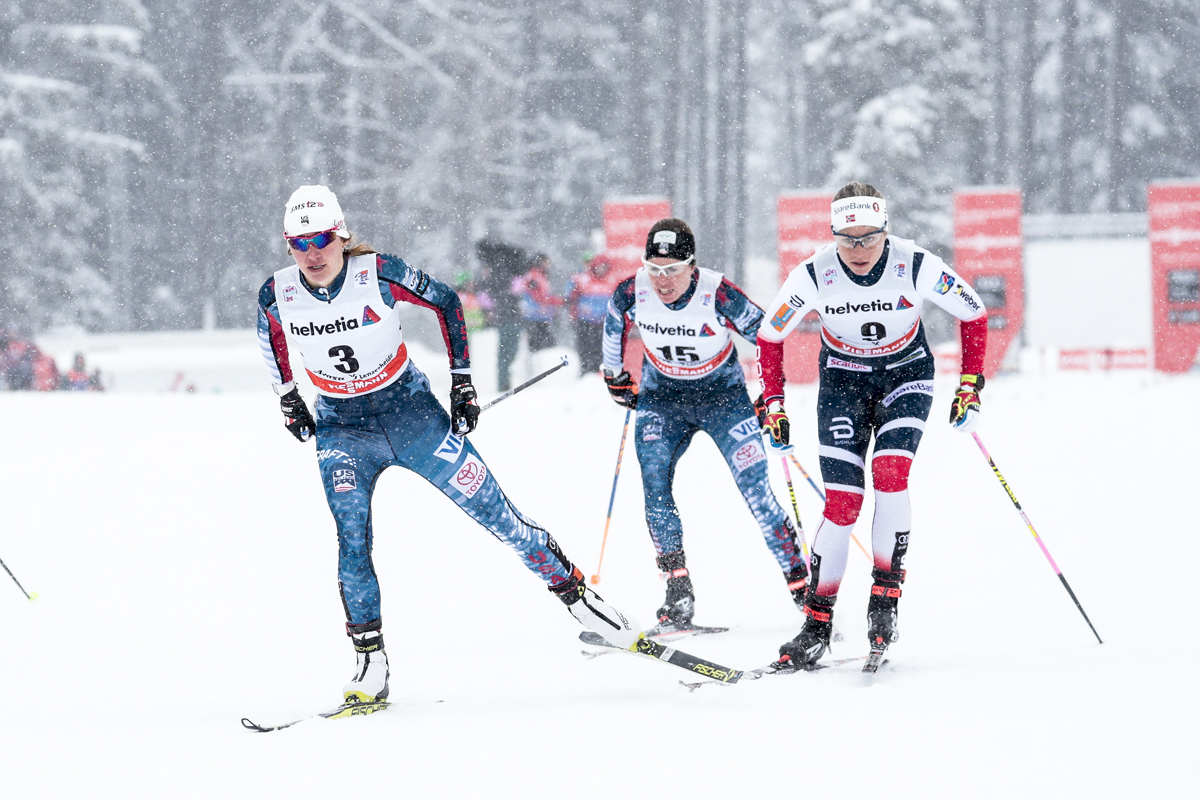
    Sophie Caldwell (3) leading her U.S. teammate Rosie Brennan (15) and Norway’s Astrid Uhrenholdt Jacobsen in the quarterfinal of the women’s freestyle sprint at Stage 1 of the 2018 Tour de Ski in Lenzerheide, Switzerland. (Photo: Fischer/NordicFocus)

    “I have been struggling the last few weeks since the TdS with my own racing,” the 29-year-old Brennan said. “And so at this point I am just hoping to had enough time to turn my form around and to race better myself. I obviously don’t want to be part of a relay team that I’m going to let down. So I want to be in my best shape before I even think about that. That is one of my goals and I hope I’ve had some time to turn my shape around. But I think at this point, I am looking for every opportunity to race that I can get to show that I have turned this around and that I am ready and then will start looking at that relay spot.”

    Most recently, Brennan struggled in Seefeld’s 10 k skate mass start, finishing 53rd. Brennan also after completed the Tour de Ski (TdS), which concluded Jan. 7. Understanding that maintain high level fitness on the World Cup is a challenge few master, Brennan said the TdS had sapped her energy.

    “Just a little more fatigue than I expected from the Tour despite the fact that we only had six and half races,” Brennan acknowledged. “There were a lot of weather events so everything was a little more energy intensive and a little hectic. I came in with a lot more training than I have in the past, I trained a little harder during Period 1 in hope to be sharp for the Olympics, and I think I didn’t respect that as much as should have and was a little tired afterwards. And also fighting a little illness and things like that. I am feeling a lot better now and I hope a little rest is all I needed.”

    For Erik Bjornsen, who is experiencing his second Olympics after racing three individual events and the 4 x 10 k relay in Sochi, these Games could become a stepping stone. In Seefeld, Bjornsen placed ninth in the 15 k mass start skate. If Bjornsen’s positive energy in the press conference was any indication, he might be trending into rarefied air on the men’s side.

    “I think I could have some good performances,” Bjornsen, 26, said. “I don’t have the pressure that everybody else does, but I do have have the potential to put in some really solid results.”

    (Left to right) USST members and 2018 Olympians Ida Sargent, Erik Bjornsen and Kikkan Randall during thier intro press conference on Wednesday at the PyeongChang Games. (Photo: Flyingpointroad)

    Last year at the Nordic World Championships in Lahti, Finland, he and teammate Simi Hamilton placed fifth in the team sprint. In PyeongChang, the course remains championship-tough, but athletes are more exposed to the elements as the tracks were built on a hilly golf course.

    “Of course, I’m really excited for the team sprint,” Bjornsen said. “And these courses, I’ve been out there once, it is a little early to say. It seems good. It is a golf course, but there are some big climbs, which I like. I like hard-work sections but there are also some flatter sections, which suits a big guy like myself. And then having wind, I was joking before, it should be good for the guys that are chasing.”

    Then let’s talk about tough and gritty. Topping the list would be Sargent. If you missed this, here’s the short version. Back on Jan. 27, prior to her start in Seefeld’s skate sprint qualifier, Sargent fell and broke her thumb.

    “It was a complete clean break,” Sargent, 30, stated. “Every pole plant was very painful. But actually, I felt like my brain was a bigger a detriment because it happened 15 minutes at most before the start and I knew that something was wrong. I was thinking the whole time, ‘This is bad, this is bad.’ I could feel the pain and was thinking that something very serious was going on.”

    On her literal whirlwind of treatment, Sargent flew to Vail, Colorado, for surgery on her thumb at The Steadman Clinic.

    “I had a plate inserted and seven screws securing this plate,” Sargent explained during a follow-up phone interview on Thursday. “So good hardware in there, and an amazing surgeon. My surgeon was very confident; he has done this before, and he knew that the plate was extremely secure so that he wasn’t at all concerned about it moving or not me not having  the stability. I think he ended up using a slightly larger plate just to make sure it was plenty secure.”

    The next morning, post-surgery, Sargent was cleared for active recovery to increase her mobility and bring down the swelling.

    “Two days later I was skiing, doing some one pole and some two pole,” Sargent added. It was incredible to me that they can take a clean break and fully stabilize it.”

    Sargent was clear when asked if there’s anything she cannot do.

    “Nope,” she said. “The only restriction is just personally managing the pain when I ski. The bone is not fused together yet, that eventually will happen. I also obviously have the trauma of having screws put into the bone and there is the swelling, but that has been going down. I have been working with Zuzanna Rodgers here in Korea. We have working on some exercises and some massage to reduce the swelling.”

    Ida Sargent (5) leads her semifinal heat and teammates Jessie Diggins (4) and Sophie Caldwell (9) around a corner at this season’s Davos World Cup. (Photo: Reese Brown / U.S. Ski & Snowboard)

    It is cold here in PyeongChang. It’s a dry cold, but when temps are slow to budge from the single digits and eventually warm to the low teens, cold is cold. Most people with surgical procedures requiring the insertion of metal plates claim cold temps can complicate their sensations. Here in Korea, that seems not to be a problem for Sargent.

    “I was talking with someone yesterday who has a plate in their hand as well, and they feel the cold,” Sargent said “I don’t think I feel it because I still have a fair amount of swelling on top of the plate at the moment. So I think that that is providing some increased insulation. That is the bonus of that maybe. I haven’t felt the cold from it.”

    Sargent stated she was scheduled to race next Tuesday’s classic sprint.

    “As long as I am feeling like my thumb is good to go and I feel confident in my ability to ski well with it, I’ll be racing that,” Sargent explained. “The sprint is on Tuesday, so I still have five days or something at this point That is the plan right now and putting the full focus on being recovered and ready for that day.”

    The 2018 PyeongChang Olympics begin Saturday with the women’s 15 k skiathlon.

  • Lumi Giving Back

    The National Nordic Foundation is a non-profit organization that’s mission is to help aid in the development of skiers in the USA both national and internationally, by creating an independent funding source to aid athletes with the high cost of the sport.

    The NNF’s goal is to remove financial barriers that hinder our US athletes, due to the lack of funding available.  World Cup athletes, World Junior/U23 Teams, U18 Teams, REG Camps, Junior National Teams, Coaches, Clubs and Officials receive funding annually from the NNF.  Campaigns such as the Drive for 25, online Auctions and general donations pay for these efforts.

    Recently a new partnership has emerged.  More stars behind our stars supporting our athletes, helping achieve top results such as  with our World Cup Teams, our recent World Junior star Hailey Swirbul and many many athletes.  To brighten things up, the NNF has Partnered with Olympian, Garrott Kuzzy owner of Lumi Experiences.  Kuzzy and his guests are giving back to the sport by donating a portion of each trip to the NNF.  These trips include front line experiences in Europe, cross country skiing, sight seeing, attending races and interacting first hand with the US Ski Team and World Cup Athletes.  Read about the most recent trip in Seefeld, Austria and learn about the upcoming trip, attending the World Championships!  You don’t want to miss out!

    — Joey Caterinichio/NNF

    (Press release)

    SEEFELD, Austria — The 2018 Lumi Experiences Trip to Tyrol, benefitting the National Nordic Foundation (NNF), wrapped up 10 days in Tyrol, Austria & Italy cheering on the US Ski Team to a double-victory weekend in Seefeld.

    In March 2017, the NNF announced a cross country ski trip to the 2018 Dolomitenlauf Worldloppet and the Seefeld World Cup races. By April, all 16 spots on the trip had been filled.

    Proceeds of the trip, hosted by Lumi Experiences, totalled over $10,000 and will go to support NNF programming. Lumi Experiences was founded by Garrott Kuzzy. After traveling the world as a member of the US Ski Team and competing in the Vancouver Olympic Games, Garrott has spent the past decade sharing his favorite destinations and experiences through active travel.

    The guests on the Trip to Tyrol were supported by two local trip leaders, offering insights into Austrian and Italian culture.

    The Dolomitenlauf weekend kicked off with guests taking part in either 42km or 20km events. Some opted instead to watch the Hahnenkamm downhill on Eurosport in a mountain-top bar surrounded by screaming Austrian ski fans. Those who skied the Dolomitenlauf had the luxury of getting their skis waxed for them with HF and powder. A couple of women on the trip skied to age-group podium finishes…a precursor to what they would witness on the World Cup later in the week.

    Stop two was Toblach, Italy. Crossing the border beneath Dolomite spires, the group was treated to sunny skies as they perfected their hop-skate technique over the iconic Toblach Nordic Arena. It was hard leaving the Italian cuisine in South Tyrol, but the Seefeld World Cup was calling.

    Guests were treated to a brief stop in Kuzzy’s new hometown, Innsbruck, before taking a train to the snow-globe village of Seefeld for the final five nights of the trip. Guests had barely departed the train when they ran into Sophie Caldwell and Matt Whitcomb, out for an evening jog.

    The Hotel St Peter, located at the trailhead, offered easy access to the 3+ feet of new snow Seefeld had received in the previous week. Highlights of the first days in Seefeld included a trip to the trailside hut that Andy Newell affectionately refers to as the “Wild Moose.” A trough of schnapps and tray of apple strudel greets visitors.

    Guests were also treated to a tour of the new US Ski Team wax truck. US Women’s Team head coach Matt Whitcomb and wax techs shared insights into the new, rolling facility, as well as a few insider wax tips. One unexpected surprise, was the opportunity to forerun the races. Skiers experienced the challenging courses that cannot be captured by simply watching the races from the sidelines. Erik Bjornson chatted with the skiers after his sprint qualifier and thanked them for cheering, saying it’s rare that there are so many US fans on the trail at European World Cups.

    The real highlight of the trip was cheering on skiers in the Seefeld World Cup, as Sophie Caldwell skied to victory in the Skate Sprint and Jessie Diggins took the 10km Mass Start Skate win. Guests had the opportunity to share high fives and get photos with skiers afterward the race.

    Seeing the US team skiers atop the podium was particularly meaningful, as it represented the results of the hard-work put in by athletes and their coaches. It also represented what the help from the NNF has helped skiers from the US achieve. There were more than one set of watery eyes at the end of the trip, when guests received copies of the new book: World Class: The Making of the U.S. Women’s Cross-Country Ski Team by Peggy Shinn, personalized and signed by the women on the US Ski Team as a thank you to guests on the trip.

    The Seefeld World Cup was the last big race before the Olympic Games next month in Korea. In 2019, Seefeld will host the Nordic World Championships. Once again, Lumi Experiences will be on site for the 2019 World Championships, hosting two more trips to benefit the NNF. You can sign up to receive information about the World Championships and other cross country ski vacations at: www.lumiexperiences.com. Check out more photos and insights from this year’s adventures on Facebook and Instagram: @lumiexperiences or #lumiexp

    “The trip had an exceptionally talented group of trip leaders. It was well planned and full of fun surprises that enhanced the experience. Sledding was a hoot, and skiing to our hotel afterwards was awesome. I love the Dolomites and the Tyrol. Austrian curling was a blast. First class care and attention to detail made this a trip of a lifetime for us.” – Jane & Michael Mandli

    “We skied in a gorgeous part of the world. Guides were excellent and fun. It was an incredible experience watching the World Cup racing in Seefeld and meeting the athletes.” – Molly Martinez

  • Nordic Nation: Andy Newell on a Greener World Cup

    Nordic Nation: Andy Newell on a Greener World Cup

    In this episode, we’ve got 34-year-old Andy Newell for you. He’s a longtime staple of the U.S. Ski Team and another proud Vermonter. A few weeks ago we released our interview with climate-justice activist and Vermont resident Bill McKibben. After the interview, we received a few comments that spoke to the perceived large carbon footprint of World Cup skiing and possible changes that might be implemented to curb that environmental impact. With that in mind, we called up Andy Newell, who himself is a climate activist to address some of the questions. We spoke to Newell on Jan. 4 while he was in Seefeld, Austria, prepping for last weekend’s World Cups.

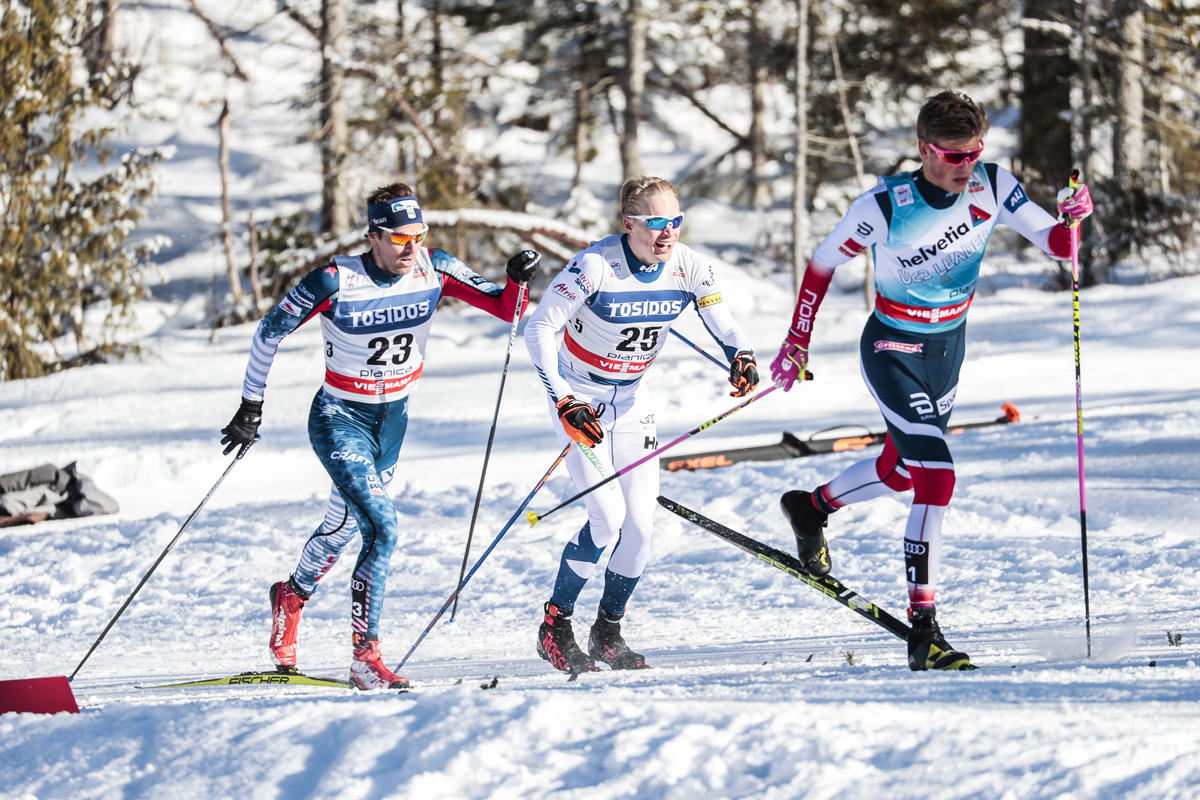
    American Andy Newell (l) follows Norway’s Johannes Høsflot Klæbo (r) and Finland’s Iivo Niskanen (c) during their classic-sprint quarterfinal at the World Cup on Jan. 20 in Planica, Slovenia. Klæbo went on to win that heat, ahead of Niskanen in second and Newell in fourth. (Photo: Fischer/NordicFocus)

    Newell will soon be in PyeongChang, South Korea, for his fourth Olympics. After traveling the globe for 14 years as a member of the U.S. Ski Team, Newell has had time to think about energy use and change on the World Cup.

    (To subscribe to the Nordic Nation podcast channel, download the iTunes app. If you have iTunes, subscribe to Nordic Nation here.)

  • Diggins Does It in Seefeld, Wins Last World Cup Before Olympics

    Diggins Does It in Seefeld, Wins Last World Cup Before Olympics

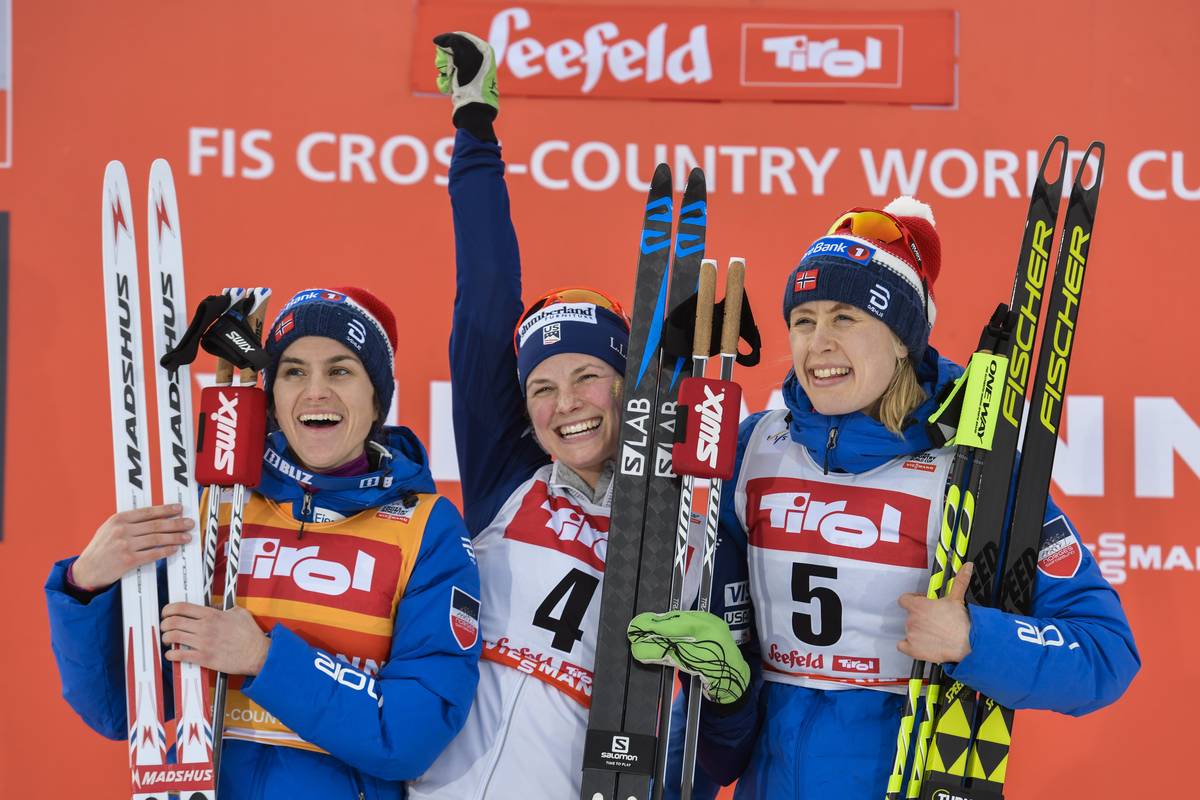
    American Jessie Diggins (c) celebrates her fourth-career individual World Cup win, and her first in a distance longer than 5 k, after winning the women’s 10 k freestyle mass start at Sunday’s World Cup in Seefeld, Austria. Norway’s Heidi Weng (l) placed second and Ragnhild Haga (r) was third. (Photo: Salomon/NordicFocus)

    About seven minutes into the women’s 10-kilometer freestyle mass start on Sunday at the World Cup in Seefeld, Austria, Jessie Diggins made her intentions clear. She wasn’t in it for a free ride — she was willing to pull, and not just take her turn up front, but actually try to string out the field and win this thing.

    As she led a group of 31 within 15 seconds of her at 3.3 k, Diggins, a 26-year-old U.S. Ski Team member who’s on a mission for medals at the upcoming Olympics in two weeks, never looked back. She didn’t ask for help from the Norwegians behind her; she just hammered.

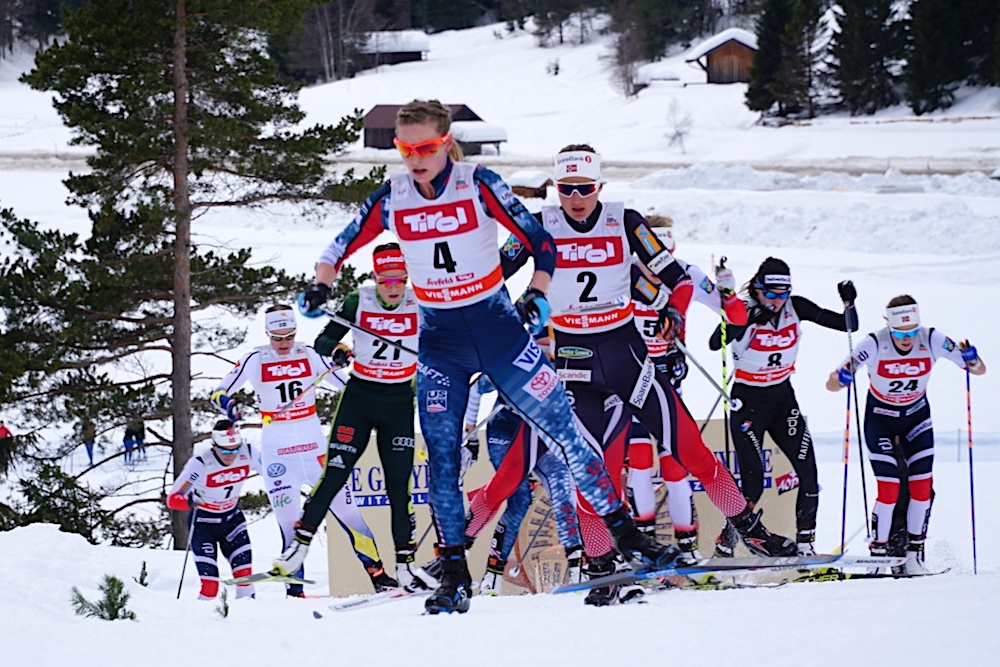
    American Jessie Diggins (4) leading Norway’s Ingvild Flugstad Østberg (2) and the rest of the women’s field in the 10 k freestyle mass start at the World Cup in Seefeld, Austria. (Photo: Garrott Kuzzy / LumiExperiences.com)

    Meanwhile, Norwegian teammates Heidi Weng and Ingvild Flugstad Østberg kept her close, and at 4.6 k, Østberg moved into first. The group was down to 12, with another American hanging in there as well, as Sadie Bjornsen skied in 12th, 4.6 seconds back.

    Two kilometers later, it appeared the Norwegians were working together, not just to keep themselves through the race, but to prevent Diggins from getting too close to the front. Diggins remained in third, less than a second behind Østberg and Weng, while a third Norwegian Ragnhild Haga skied just behind her. Switzerland’s Nathalie von Siebenthal and Germany’s Katharina Hennig remained in the mix in fifth and sixth, about two seconds back, as did Norway’s Kari Øyre Slind and Bjornsen another second behind.

    With just over 2 k to go, Diggins attacked in earnest near the bottom of the last grueling (nearly 500-meter-long), multi-tiered climb on the women’s 3.3 k course. No one was able to match her pace, not Østberg, not Weng, not Haga, as she raced up the rest of the hill and over the top completely alone.

    Behind her, the chase group split in two, with the three aforementioned Norwegians then approximately eight others skiing several meters behind. Bjornsen was in that second group, which continued to drop in numbers as they continued up the climb.

    On the winding descent back toward the stadium, with just under a kilometer to go, Diggins put all of her faith into her skis.

    “I felt awesome, my skis were amazing, the techs worked so hard,” she told FasterSkier in person after. “These Salomon skis I was on were just ripping down that corner.”

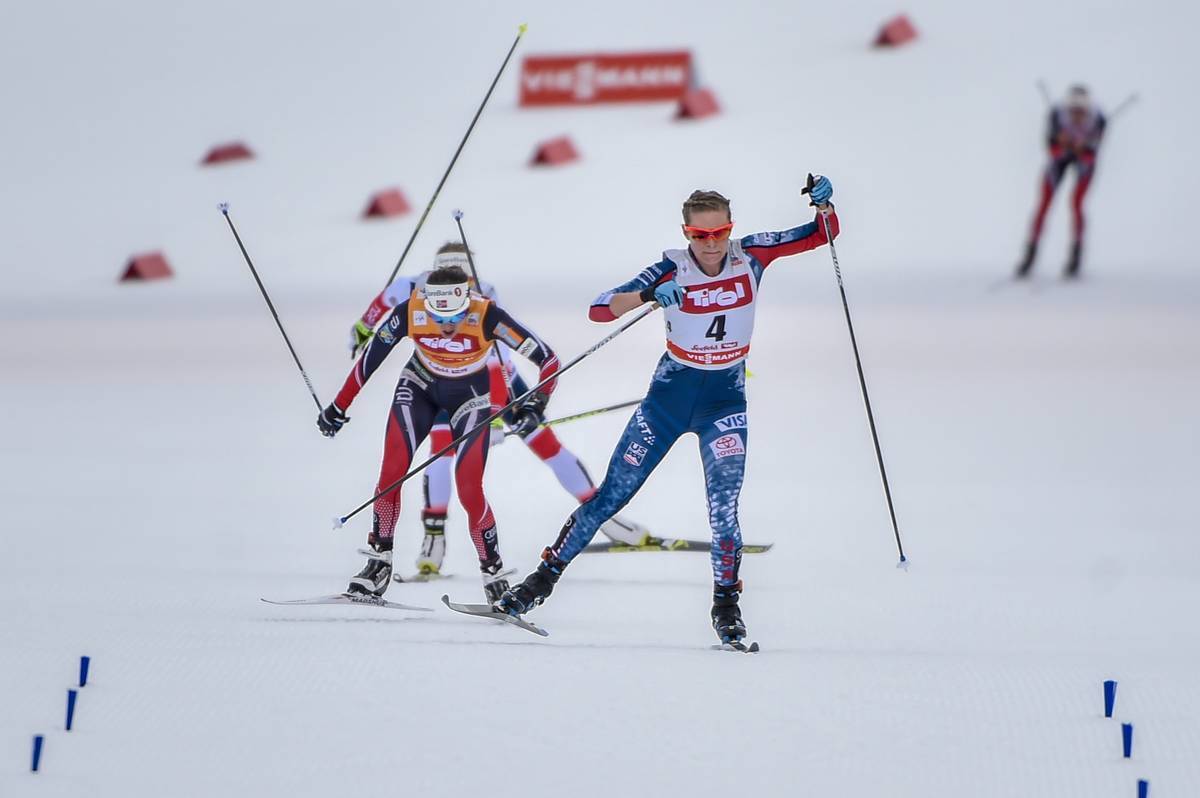
    American Jessie Diggins (4) leads Norwegians Heidi Weng and Ragnhild Haga in the finishing stretch of the women’s 10 k freestyle mass start at the World Cup in Seefeld, Austria. (Photo: Salomon/NordicFocus)

    But before the final hill, a relatively small rise about 200 meters before the finish, Weng and Haga were close, just a few strides and about a second behind. Again, Diggins didn’t look back; she simply used every ounce of everything she had left — energy and technique-wise — to get the maximum number of pushes in before the finish.

    And she did it. Diggins held off the two Norwegians, crossing the line first in 23:08.5 and throwing her fists down in elation. Seven-tenths of a second behind her, Weng free-skated to second place, just 0.3 seconds ahead of Haga in third. Østberg finished 7.7 seconds later in fourth (+8.7), and the fourth Norwegian in the top five, Marit Bjørgen placed fifth (+16.7) just ahead of Austria’s Teresa Stadlober in sixth (+16.9), Slind in seventh (+19.1), and Bjornsen in eighth (+20.5). Von Siebenthal followed in ninth (+30.3) and Finland’s Kerttu Niskanen placed 10th (+31.8).

    Notably, it was Bjørgen’s first World Cup race since mid-December. But even more notably, for the second-straight race in Seefeld — the site of next year’s 2019 World Championships — an American woman won. Sophie Caldwell tied for first in Saturday’s freestyle sprint, and on Sunday, it was all about Diggins.

    For Diggins, the win was her first in over a year and her fourth-career individual World Cup victory. And she did so in the last race before the Winter Olympics start on Feb. 10 in PyeongChang, South Korea.

    “It’s a really good time to figure out how to ski a 10 k race,” Diggins told FasterSkier after. “I am really excited. I’m so pumped for the Games, I’m feeling well, the peaking plan is working, and I’m just excited to get there and see what I can do.”

    She apparently took mental notes on the men’s 15 k mass start that took place earlier on Sunday, as Switzerland’s Dario Cologna attacked on the same climb to secure the win ahead of Canada’s Alex Harvey and Norway’s Martin Johnsrud Sundby.

    “I saw how well it worked for Dario, and I thought, ‘OK, I’m gonna go for it! I just have to ski gutsy and if they reel me in they reel me in, but maybe I can hold them off,’ ” she reflected.

    “I just put my head down and it wasn’t pretty, but I just hammered,” she said in a post-race interview with the International Ski Federation (FIS).

    Before that, Diggins said she had been trying to figure out where to ski in the pack.

    “ ‘OK, if I’m in the front, how hard am I working? If I’m in the middle…’ You don’t want your poles to get stepped on so it’s easier for me to just be near the front the whole time,” she told FasterSkier.

    Diggins’s three other wins have come in 5 k freestyle individual starts — all of which were stage World Cups. Sunday marked her first time getting 100 points, rather than 50, for the win, which counts toward overall World Cup standings. Heading into the Olympics, she ranks third in the Overall World Cup (379 points behind Weng in first and 180 behind Østberg in second) and third in the Distance World Cup (225 points behind Weng in first and 108 behind Østberg in second). Bjornsen is seventh in the overall standings and 11th in distance.

    “I’m happy with how I raced,” Weng said after Sunday’s race, according to a FIS press release. “I made a mistake up the final climb and then couldn’t go with Diggins, but I pushed hard all the way to the finish, but Diggins was the better skier today.”

    Bjornsen is seventh in the overall standings and 11th in distance.

    “It was an exciting, and super fun final race before the Olympic Games!” Bjornsen wrote in an email to media outlets. “Today’s 10k skate was hot from the start, on a really fun course here in Seefeld. I think the nature of the course kind of held the pack together a bit more, which always makes for a fun race! I felt really good out there, and was super happy with the day.

    “I feel like I made a bit of a tactical error being stuck behind some skiers that were dying a bit on the far part of that last lap, but it is one new step for me,” she continued. “I learned something out there, and I challenged myself, and I am feeling really good about the feelings I have in my legs leading into the games! It will be great to have two more weeks to rest, recover, and come in sharp for these exciting races to come. I am so excited to see our team on fire right now too. The vibe is great, the spirit is high, and we are so excited to take on the world in a few weeks here! Win or lose, I think this team is going to do something great!”

    Eighth place is Bjornsen’s best result in distance skate race longer than 5 k, not counting pursuits. Earlier in the day, her brother Erik finished ninth in the men’s 15 k.

    “ … I got my brother by one spot, which is a daily competition for the two of us,” Bjornsen wrote. “He set the bar high this morning. I am just so excited to see how well he did, and Simi [Hamilton, who placed 12th] as well. Those two have a bright future for the team sprint, I can’t even wait to watch!”

    Three American women landed in the top 15 and five were in the top 30 on Sunday. Kikkan Randall finished 14th, 48.5 seconds behind Diggins and just over eight seconds outside of the top 10.

    “I think it was a good race, I don’t think it was a great race,” Randall told FasterSkier on Sunday. “I made a bad tactical move on the first lap and missed that first group when they went, so then I spent some time chasing and I had a good energy left at the end so that was fun. … I think every race is going to get better and better so I am pretty happy with today.”

    The result tied her previous best distance finish this season (a 10 k freestyle in Davos, Switzerland). Randall has been dealing with a stress reaction and tendonitis in her foot since that Davos World Cup in mid-December.

    “Foot is hanging in there, its not great, but it’s good enough to race,” she said. “To make it through two skate races here and still holding together I am optimistic, so now we kind of just go to single races [at the Olympics], so I think I will be able to make it through the season.  I also made it in the stadium today just in time to see Jessie win.”

    Caitlin Patterson of the Craftsbury Green Racing Project (CGRP) finished 23rd (+1:00.7) for her second time in the World Cup points (top 30) in as many distance races she’s competed in this season. The U.S. SuperTour leader after Period 1, Patterson earned World Cup starts for Period 2 in January and is also headed to the PyeongChang Olympics.

    On Sunday, she said she had to adjust to the stop-and-go pace near the back of the pack.

    “I think I was still getting used to the pace swings, the way you go up and down and … accordion and stuff, but it was a good fun race,” Patterson said. “I think I had a few struggle moments on some of the bigger climbs … but I held it together, and the downhills were good and I was pretty happy with the finish, passing at least one person, catching up to the tail end of a pack in front of me. … Some good fun over here.”

    Liz Stephen also finished in the top 30 in 29th (+1:18.2) after working her way up in the pack from 44th at 3.9 k. It was her sixth top 30 of the season. Also for the U.S., Rosie Brennan finished 53rd (+2:26.9).

    Emily Nishikawa of the Canadian World Cup Team led three Canadian women in 35th (+1:36.5). Just one-tenth of a second later, Cendrine Browne (Canadian U25 Team) followed her across the line and placed 37th (+1:36.6) in a photo finish with France’s Coralie Bentz for 36th. Dahria Beatty (Canadian World Cup Team) finished about 22 seconds later in 45th (+1:58.9).

    For the Canadian women, this weekend marked their first World Cup races in a month. While Nishikawa stayed in Europe to train during the Tour de Ski, Browne and Beatty returned to Canada for NorAm Olympic trials in early January. After that, they met up with Nishikawa and the rest of the team for a training block in Livigno, Italy.

    “I think us three girls did really well today, considering we are just coming back from a training camp, so it’s really looking good for the Olympics,” Browne said.

    “Just echoing what Cendrine said, coming off a training camp, you never really know what to expect for this weekend, but the goal is to be good at the Olympics,” Nishikawa said. “I was happy with the way I felt and the second half of the race. I need to work at starting a bit faster on the mass starts — somehow I end up at the back of the field and just work my way through it.”

    “It was lots of fun,” Beatty said of her race. “I had a good start and then died a little bit in the middle, but it was nice to see some of [my teammates] up ahead and try to keep going. I actually had a really good last kilometer, I was able to finish strong and pick off some girls … I think it was one of my better distance races so far this year.”

    While Beatty placed 20th in Saturday’s sprint for a season best, 45th marked her second best result of the World Cup season so far.

    Results| Overall World Cup standings | Distance World Cup

    — Gabby Naranja, Ian Tovell and Harald Zimmer contributed

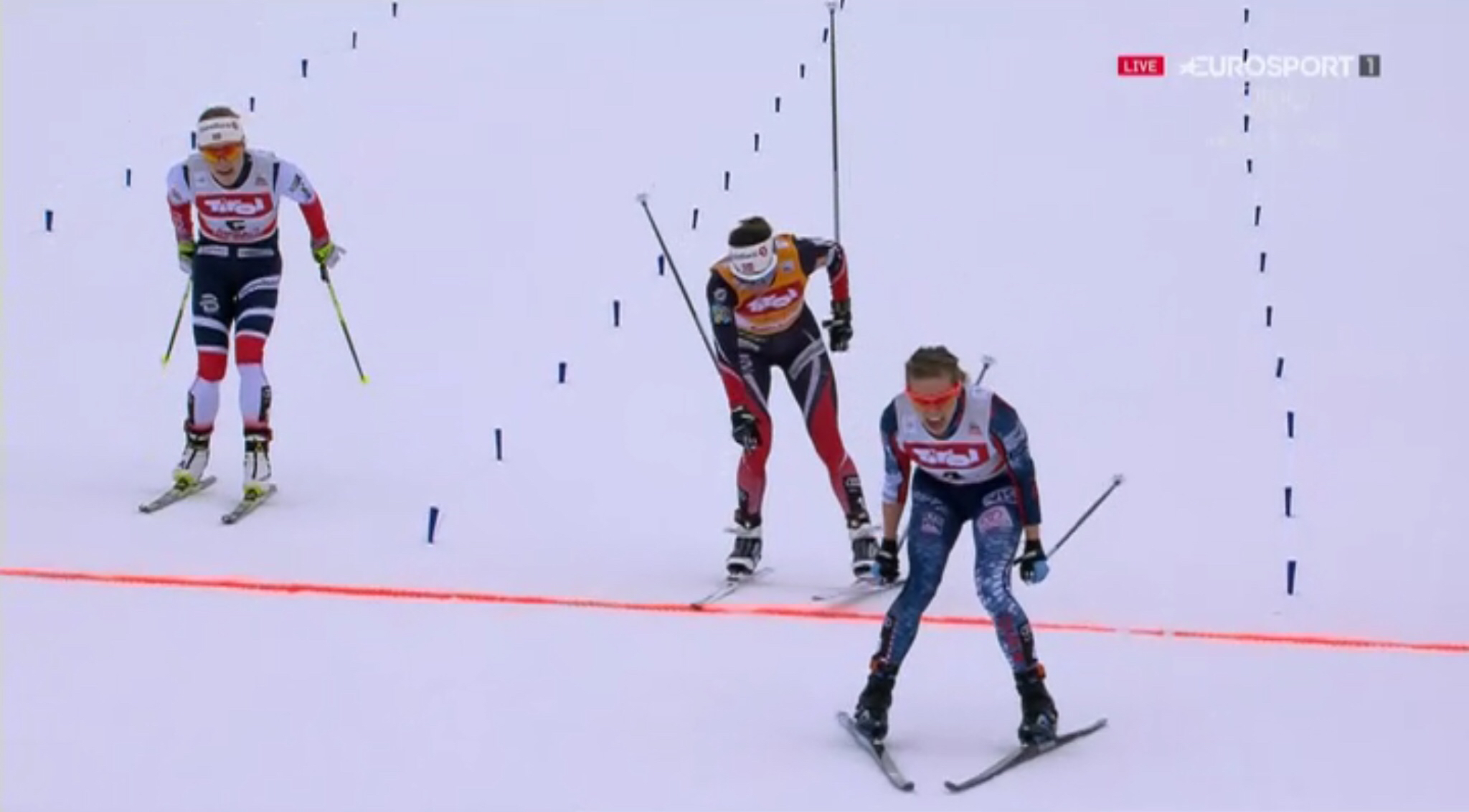
    American Jessie Diggins (r) celebrates her win on Sunday in the World Cup women’s 10 k freestyle mass start in Seefeld, Austria, ahead of Norway’s Heidi Weng (c) in second and Ragnhild Haga (l) in third. (Screenshot: Eurosport broadcast)

  • Sunday Rundown: Seefeld, Goms, Ridnaun, Craftsbury

    Sunday Rundown: Seefeld, Goms, Ridnaun, Craftsbury

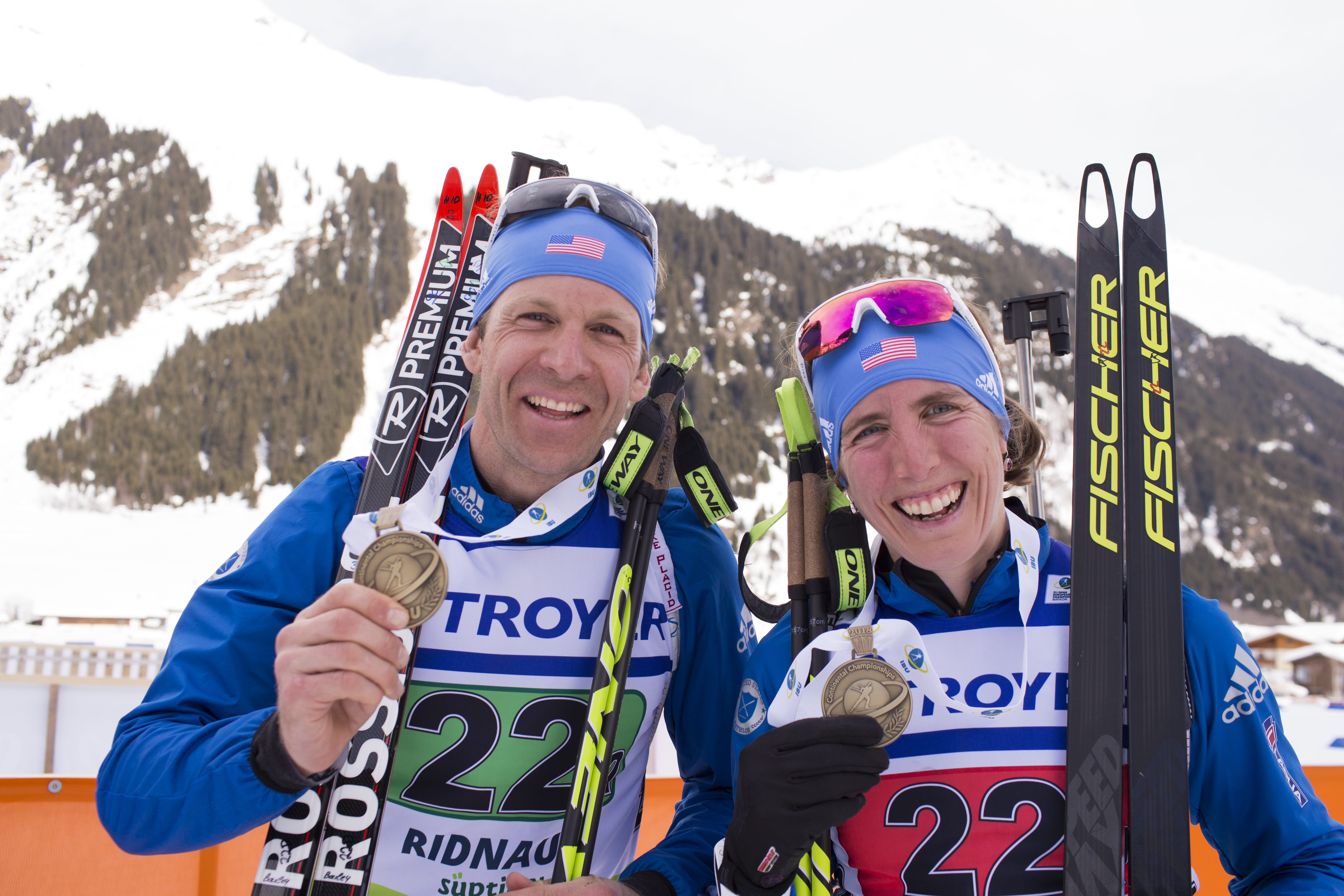
    US Biathlon’s Lowell Bailey (l) and Susan Dunklee after teaming up for bronze in the single mixed relay at 2018 IBU Open European Championships on Sunday in Ridnaun, Italy. (Photo: Manzoni/NordicFocus)

    IBU Open European Championships (Ridnaun-Val Ridanna, Italy): Single mixed & mixed relays

    Susan Dunklee and Lowell Bailey teamed up for the final day of the 2018 International Biathlon Union (IBU) Open European Championships in Ridnaun, Italy, and raced to a bronze medal in the single mixed relay.

    The American duo, both of which earned individual medals at last year’s IBU World Championships, finished just 9.1 seconds out of first, which went to Norway’s Thelka Brun-Lie and Vetle Sjåstad Christiansen. The Norwegians won in 35:39.6 with zero penalties and six spares. They took the lead after Brun-Lie’s second leg, where she cleaned both stages without spares.

    France placed second, 8.6 seconds back, with Julia Simon and Emilien Jacquelin, who combined for no penalties and 11 spares. They led the first half of the race, but slipped to second behind Norway on Simon’s second leg.

    Dunklee put the Americans off in second on her first leg, which she cleaned with a spare in each stage, then they slipped one place to third on Bailey’s first leg, where he cleaned as well and used three spares. In all, they used 10 spares and avoided the penalty loop, and finished half a second out of second place.

    “Over Christmas, we trained a little bit with the French athletes, including Jacquelin,” Bailey said, according to a US Biathlon press release. “So I know that he has quite a fast finish, and I thought I am kind of an old man here, I should maybe try to go harder on the first part of the lap. But he stayed with me all the time and had me in the end.”

    “It was a good opportunity to tune up the race shape, build some confidence and find that sharp feeling heading into the Olympics,” Dunklee told US Biathlon. “The single mixed relay is one of my favorite race formats and today was a blast!”

    Canada’s Sarah Beaudry and Carsen Campbell placed eighth of 24 teams in the single mixed relay, finishing 1:03.6 out of first with just eight spares and zero penalties. In 11th after the first leg, they moved into eighth on Campbell’s first leg, which he cleaned with one spare. Beaudry then cleaned her second leg without any spares, and Campbell anchored them to eighth.

    The U.S. entered a team in the mixed relay that followed, with Chloe Levins, Deedra Irwin, Paul Schommer, and Alex Howe placing 17th (+5:55.5) of 19 teams with no penalties and 12 spares.

    Ukraine won the mixed relay to conclude the championships, with Yuliia Zhuravok, Iryna Varvynets, Artem Pryma, and Dmytro Pidruchnyi combining for zero penalties and six spares and finishing in 1:11:40.1.

    Russia placed second (+11.7) with Victoria Slivko, Anastasia Zagoruiko, Evgeniy Garanichev, and Alexander Loginov combining for zero penalties and nine spares.

    Norway followed in third (+33.2) with Emilie Ågheim Kalkenberg, Kaia Wøien Nicolaisen, Håvard Gutuboe Bogetveit, and Fredrik Gjesbakk combing for no penalties and just four spares.

    Results: Single mixed relay | Mixed relay

    ***

    U.S. SuperTour (Craftsbury, Vermont): 5/10 k freestyle

    Two Alaska Pacific University (APU) athletes topped the podium on Sunday at the SuperTour in Craftsbury, Vermont, with David Norris winning the men’s 10-kilometer freestyle individual start in 21:54.9 and Becca Rorabaugh topping the women’s 5 k freestyle in 12:06.4.

    Norris won the men’s race by 6 seconds over Canada’s Andy Shields (Lappe Nordic) and Kevin Bolger of the Sun Valley Ski Education Foundation (SVSEF) placed third (+15.8). Kris Freeman (Caldwell Sport) was the third American in fourth overall (+23.7), and three Canadians took fifth through seventh with Michael Somppi (Lappe Nordic) in fifth (+27.9), Evan Palmer-Charrette (NTDC Thunder Bay) in sixth (+37.5) and Scott Hill (Barrie Cross Country) in seventh (+37.6), ahead of Brian Gregg (Team Gregg/LNR/CXC) in eighth (+39.4), Tad Elliott (Ski Club Vail) in ninth (+44.3) and Jack Hegman in 10th (+50.4).

    Rorabaugh won the women’s race by just 2.2 seconds over her APU teammate Rosie Frankowski in second, and Erika Flowers of the Stratton Mountain School (SMS) T2 Team placed third (+4.6). Two Craftsbury Green Racing Project (CGRP) skiers finished fourth and fifth, with Kaitlynn Miller in fourth (+12.1) and Liz Guiney in fifth (+22.5), Kelsey Phinney (SVSEF) was sixth (+25.8), and Canadians Olivia Bouffard-Nesbitt (Rocky Mountain Racers) seventh (+26.4) and Frederique Vezina (Pierre-Harvey National Training Centre) eighth (+36.0). Corey Stock, of the Bridger Ski Foundation (BSF) placed ninth (+39.9), and Felicia Geisor (CXC Team) was 10th (+44.4).

    On Saturday, the Craftsbury Outdoor Center hosted its 37th annual Craftsbury Marathon, with Nils Koons winning the 48 k men’s race in 2:28:51.0 hours and Hannah Dreissigacker winning the 48 k women’s race in 3:01.48.7.

    Results: Men’s 10 k | Women’s 5 k 

    Marathon (non-SuperTour) results

    ***


    Hannah Halvorsen of the U.S. Ski Team and APU on the start line in Ulrichen, Switzerland, after finishing fifth in the sprint qualifier. (FIS screencap)

    FIS Cross Country World Junior Championships (Ulrichen, Switzerland): Freestyle sprints

    Full report

    World Junior Championships kicked off today with freestyle sprints in Ulrichen, Switzerland. Moa Lundgren of Sweden claimed with women’s title by 1.89 seconds over Kristine Stavås Skistad of Norway in the final, with Sweden’s Frida Karlsson finishing third (+1.89).

    Hannah Halvorsen of the United States qualified in fifth place before skiing to second in her quarterfinal heat. Halvorsen hovered around third or fourth place through much of her semifinal and was unable to snipe any spots in the finishing straight, ending up fourth in the heat and eighth on the day.

    Fellow Americans Margaret Gellert and Sofia Shomento also made the quarterfinals, finishing 18th and 23rd, and Canada’s Hannah Mehain wound up 29th on the day.

    The new men’s junior world champion is Tom Mancini of France, who nipped Norway’s Jørgen Lippert by just 0.10 seconds to take the win. Valerie Grond gave the Swiss crowd a thrill by making it all the way to the final and taking home bronze, despite qualifying in just 21st position. The Swiss junior narrowly edged France’s Vincent Buiatti for the final step on the podium.

    Canada’s Graham Ritchie finished second in his quarterfinal after qualifying in 28th position, earning an automatic spot in the semifinals. There he finished sixth (+9.30 behind Mancini), winding up 12th on the day. Teammate Antoine Cyr also made the quarterfinals where he had an impressive crash, slinging off the trail and into the infield, finishing 30th on the day. For the U.S., Gus Schumacher was the lone qualifier for the heats. He finished fourth in his quarterfinal and was just 0.22 seconds away from a “lucky loser” spot in the semifinals. Schumacher finished 19th on the day.

    In the junior women’s race, Hannah Rudd of the United States finished 35th in qualification, +18.15. For Canada, Annika Richardson finished 52nd (+24.09), Catherine Reed-Metayer 56th (+28.25), and Alexandra Racine 69th (+37.27).

    In the junior men’s sprint, Canada’s Reed Godfrey finished a tough 31st, just 0.21 seconds out of making the quarterfinals. Etienne Hebert rounded out the Canadian finishers in 36th place (+11.81) in the qualifier. Canyon Tobin was 41st in qualification for the U.S. (+13.46), followed by Karl Schulz in 54th (+16.90) and Luke Jager in 60th (+18.15).

    Results: men’s qualifier | women’s qualifier | men’s final | women’s final

    ***

    FIS Nordic Combined World Cup (Seefeld, Austria): Individual normal hill/15 k

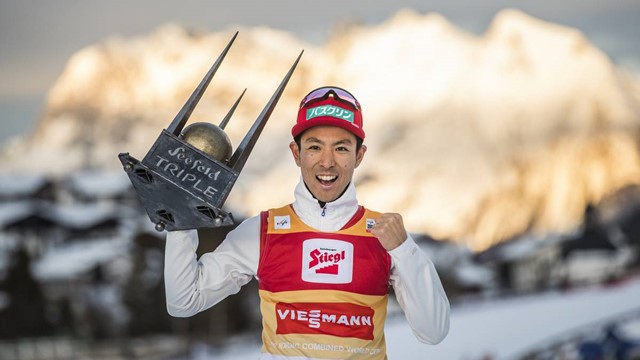
    Japan’s Akito Watabe after winning the 2018 Seefeld Triple Nordic Combined World Cup. He is the only athlete besides Germany’s Eric Frenzel to win the event. (Photo: FIS Nordic Combined)

    On the final day of the Seefeld Triple, Japan’s Akito Watabe completed his sweep of the three-day weekend and Norway’s Jarl Magnus Riiber reached the podium for the third-straight day, placing second. Germany’s Fabian Rießle placed third for his second podium in the last two days.

    Watabe jumped to first on the normal hill and started the 15 k Gundersen 48 seconds ahead of Riiber in second. He went on to win the race by 1:14.9 minutes in 34:58.6, becoming the only man besides Germany’s Eric Frenzel to win the Seefeld Triple in its five-year history.

    After jumping to fifth, Rießle won a photo finish for third (+1:57.9), edging Germany’s Vinzenz Geiger by less than a tenth of a second. Geiger moved up from ninth in the jump to fourth overall (+1:57.9).

    Norway’s Jørgen Graabak followed in fifth (+2:02.4), Frenzel placed sixth (+2:07.4), Norway’s Jan Schmid was seventh (+2:09.8), Finland’s Eero Hirvonen eighth (+2:13.5), Norway’s Espen Andersen ninth (+2:28.0), and Austria’s Mario Seidl 10th (+2:42.1) out of 28 finishers.

    No Americans contested the final day of the Triple, the last World Cup before the 2018 Winter Olympics in PyeongChang, South Korea.

    Results: Jumping | Final

    ***

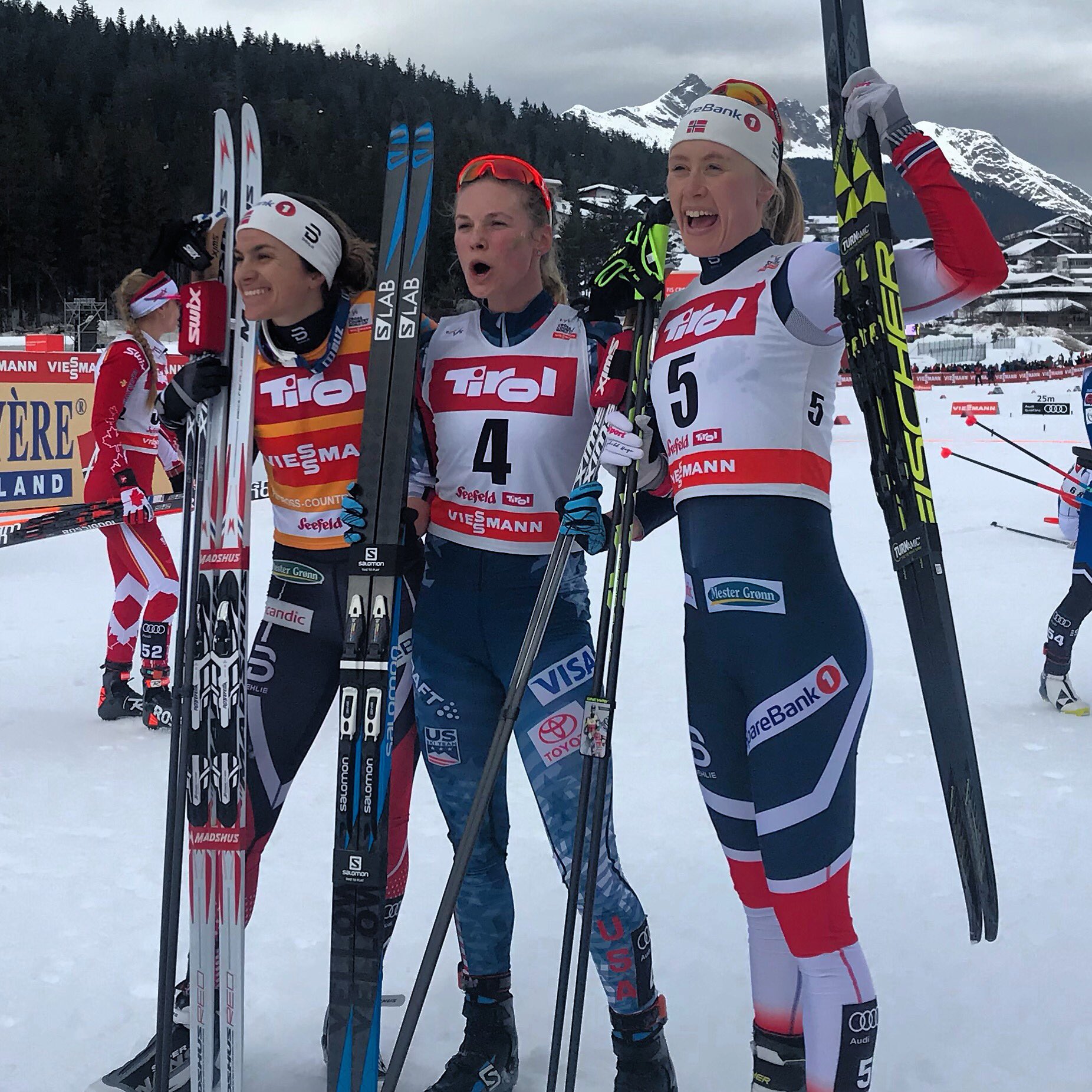
    Jessie Diggins of the U.S. Ski Team (center) celebrates after winning the 10 k mass start freestyle in Seefeld, Austria, over Heidi Weng (left) and Ragnhild Haga of Norway. (Photo: FIS Cross Country/Twitter)

    FIS Cross Country World Cup (Seefeld, Austria): 10/15 k mass start freestyle

    Women’s report

    Men’s report

    In the final World Cup race before the 2018 Olympics, Jessie Diggins achieved the ultimate goal to give herself the utmost confidence heading into PyeongChang — winning the women’s 10-kilometer freestyle mass start at the World Cup in Seefeld, Austria, on Sunday.

    The win was her first of the season and fourth individual victory of her career. Diggins, a 26-year-old U.S. Ski Team member, pulled it off by attacking on a long climb and leaving Norway’s Heidi Weng, Ragnhild Haga and Ingvild Flugstad Østberg chasing. While Diggins was several seconds ahead over the top and all alone on the long descent that followed, Weng and Haga worked to close the gap — and nearly did in the finishing stretch. But Diggins held them off, winning by 0.7 seconds over Weng in second place and 1 second ahead of Haga in third, and threw her fists down in celebration as she crossed the line first in 23:08.5 minutes.

    “I just put my head down and it wasn’t pretty, but I just hammered,” Diggins told the International Ski Federation (FIS) in a televised post-race interview.

    She was the only non-Norwegian in the top five, with Østberg in fourth (+8.7) and Marit Bjørgen in fifth (+16.7). Austria’s Teresa Stadlober placed sixth (+16.9), Norway’s Kari Øyre Slind was seventh (+19.1), and American Sadie Bjornsen placed eighth (+20.5), ahead of Switzerland’s Nathalie von Siebenthal in ninth (+30.3).

    The U.S. had three in the top 15 with Kikkan Randall (U.S. Ski Team) in 14th (+48.5), and two more women in the top 30, with Caitlin Patterson (Craftsbury Green Racing Project) in 23rd (+1:00.7) and Liz Stephen (USST) in 29th (+1:18.2). Rosie Brennan (USST) finished 53rd (+2:26.9).

    Emily Nishikawa led the Canadians in 35th (+1:36.5), followed closely by teammate Cendrine Browne in 37th (+1:36.6). Dahria Beatty finished 45th (+1:58.9).

    Women’s Results

    Dario Cologna of Switzerland (center) won the men’s 15 k skate mass start in Seefeld, Austria, over Alex Harvey of Canada (left) and Martin Johnsrud Sundby of Norway (right). (Photo: FIS Cross Country/Twitter)

    The Olympics are nearing and so Switzerland’s Olympic legend Dario Cologna is ramping up: after winning the Tour de Ski, he took another win in the 15 k mass start skate in Seefeld, Austria, on Sunday.

    With much of the field staying relatively close together until the finish, Cologna nabbed the win by 1.4 seconds over Canada’s Alex Harvey, who took his second podium of the season in addition to also finishing third in the overall Tour de Ski.

    Norway’s Martin Johnsrud Sundby was third (+2.9), then teammate Didrik Tønseth in fourth (+5.9) and France’s Maurice Manificat in sixth (+7.5).

    The U.S. Ski Team’s Erik Bjornsen had a breakthrough day finishing ninth (+9.3), followed by Simi Hamilton in 12th (+12.4). Behind them, Scott Patterson placed 27th (+23.4), then Patrick Caldwell 49th (+1:26.2), Ben Lustgarten 55th (+1:42.7), and Tyler Kornfield 77th (+3:00.0).

    Canada’s Devon Kershaw and Graeme Killick finished 30th (+26.5) and 31st (+27.4), respectively. Len Valjas placed 58th (+1:53.1), Knute Johnsgaard 82nd (+3:23.1), Bob Thompson 87th (+4:27.5), and Julien Locke 92nd (+4:56.9).

    Men’s Results

  • Tied for First, Caldwell and van der Graaf Share Seefeld Sprint Win

    Tied for First, Caldwell and van der Graaf Share Seefeld Sprint Win

    American Sophie Caldwell (c) and Switzerland’s Laurien van der Graaff high-five after tying for first in the women’s 1.3 k freestyle sprint on Saturday at the World Cup in Seefeld, Austria. Norway’s Maiken Caspersen Falla was next across the finish line for third place. (Photo: Garrott Kuzzy / LumiExperiences.com)

    SEEFELD, Austria — By the time the women’s finalists toed the start line, fans lucky enough to find a spot directly against the fence lining the World Cup 1.3-kilometer freestyle sprint course on Saturday showed signs of sunburn on their cheeks. The Seefeld sun was high and bright, but not the only one radiating on the Tirol ski trails.

    U.S. skier Sophie Caldwell found Seefeld treating her well. And she herself was on the strike.

    She started the day by qualifying for the heats in fourth, 1.84 seconds behind top women’s qualifying time of 2:21.44 posted by Norwegian Maiken Caspersen Falla. Heat selection came next. Caldwell opted for Heat 1, knowing that she had a fair chance of running up against Falla in that quarterfinal.

    The move was gutsy. Falla has 14 World Cup sprint victories. She was last year’s world champion in Lahti, Finland. Falla also has an Olympic gold medal from the 2014 Olympic Winter Games in Sochi, Russia. Both those events were in freestyle; Saturday’s discipline as well.

    But Caldwell wanted to be in the fast heat, even if it had the potential of knocking her out.

    “She kind of guessed when she selected quarterfinal 1 that Maiken would also go in quarterfinal one .. that was part of the strategy,” U.S. Ski Team Head Coach Chris Grover told FasterSkier in person after.

    “Maiken and I chose the first quarterfinal,” Caldwell told FasterSkier. “I knew we were going to have fast times throughout the day and I had a good chance of being lucky loser.”

    American Sophie Caldwell (l) and Norway’s Maiken Caspersen Falla (r) contested for the win in both their quarterfinal and semifinal. Falla won the quarterfinal while Caldwell won the semi. Ultimately, Caldwell placed first in the final, tying Switzerland’s Laurien van der Graaff (not shown) while Falla placed third overall. (Photo: Garrott Kuzzy / LumiExperiences.com)

    From the start of their quarterfinal, the first of five, the American not only hung with Falla, she pressured her. Caldwell skied in second just behind the Norwegian as they approached the finish, where Falla outlunged Caldwell by 0.8 seconds to win the heat.

    Both automatically advanced to the semifinal, and faced off once again in the first semi. This time through, the 27-year-old U.S. Ski Team member was even more ready.

    After skiing in second behind Falla, also 27, into the final 100-meter stretch, Caldwell made her move around the Norwegian with 50 meters to go. The two once again lunged for the line. Caldwell emerged victorious, crossing the semifinal first in a time of 2:18.88, this time 0.16 seconds ahead of Falla.

    “She’s an amazing skier and an amazing skier to follow,” Caldwell said of Falla. “My goal was to follow her all day long.”

    The two were headed for the final together. Their fast semifinal also produced two lucky losers, Switzerland’s Laurien van der Graaff and Sweden’s Linn Sömskar.

    From the second semifinal, another American had qualified for the final, Sadie Bjornsen, along with Norway’s Kathrine Rolsted Harsem. Until Saturday, Bjornsen had never qualified for a freestyle sprint. That hadn’t stopped the American from skiing aggressively to the win in her quarterfinal and then place second in her semifinal.

    American Sadie Bjornsen racing toward the finish of her semifinal with 100 meters to go. She ended up second, 0.4 seconds behind Norway’s Kathrine Rolsted Harsem in first. Both advanced to the final, where Harsem placed fourth and Bjornsen sixth overall. (Photo: Garrott Kuzzy / LumiExperiences.com)

    “My coach Erik Flora is here … we had a talk and basically he said, ‘Sadie, it never works when you try to do tactics, so just go as hard as you can and attack where you can and don’t try to play anything out there; just go,’ ” Bjornsen reflected. “So, that’s kinda what I was going with today.”

    Two Norwegians, two Americans, one Swiss skier and one Swede then lined up for the women’s final on Saturday. At the sound of the gun, Falla surged to the front. Caldwell shadowed her in second, which was part of the plan.

    “For the ladies, the course was so short that you wanted to stay in the front,” Grover said. “If you ended up towards back…you had to do a lot of work to get back up to the front.”

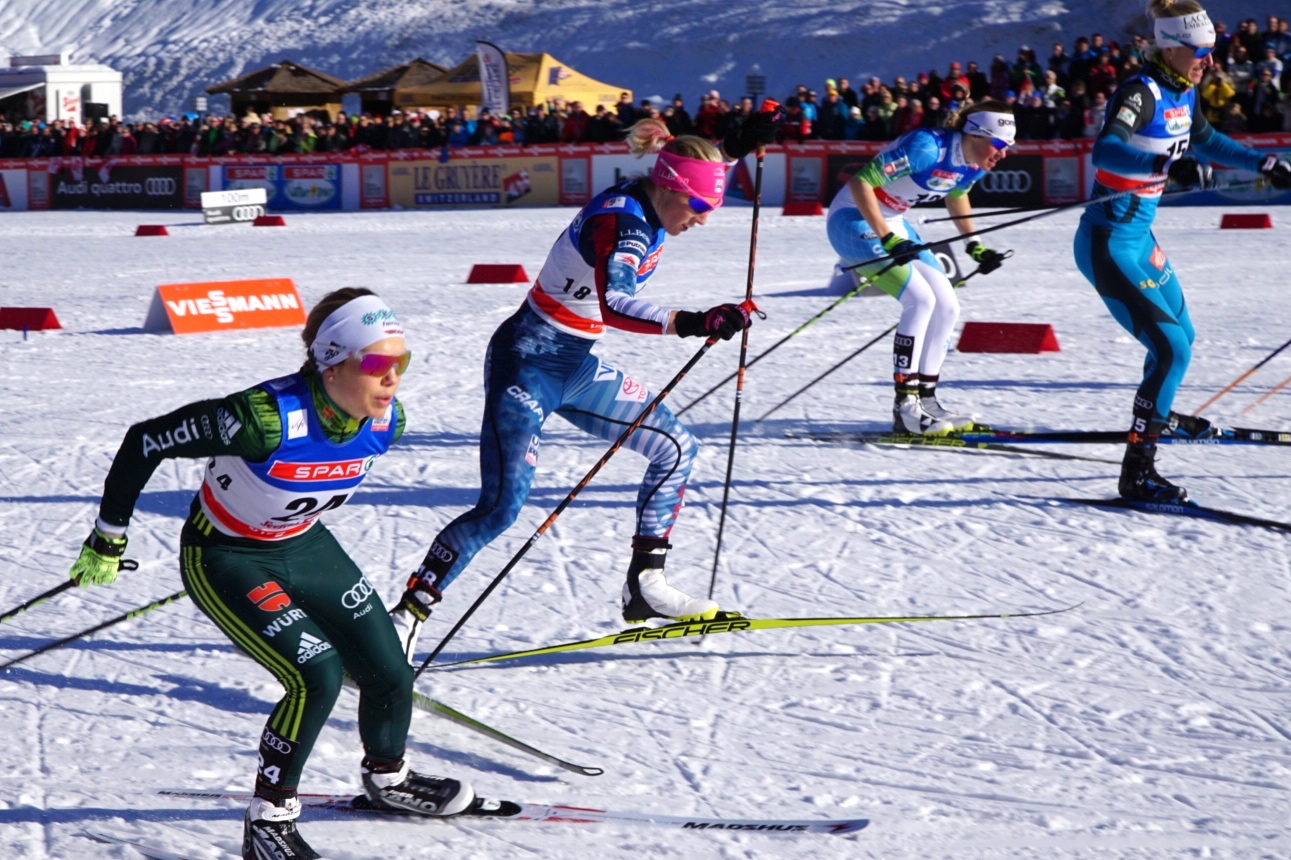
    Just behind Caldwell and Falla was van der Graaff skiing just a bit to the outside. Harsem, Bjornsen and Sömskar were next in line through the course’s first uphill and corner back toward the stadium.

    Tuck-skating the final section of the first downhill and powering into the next uphill, Falla seemed to see the spot as an opportunity to distance herself from the field. But Harsem and van der Graaff were now poling hard to her left. Caldwell was glued to the back of Falla’s skis, with Bjornsen and Sömskar right behind.

    At the top of the final climb, however, Falla had once again put herself in the lead. Cornering into the final descent, it was Falla, Caldwell, van der Graaff, Harsem, Bjornsen, and Sömskar.

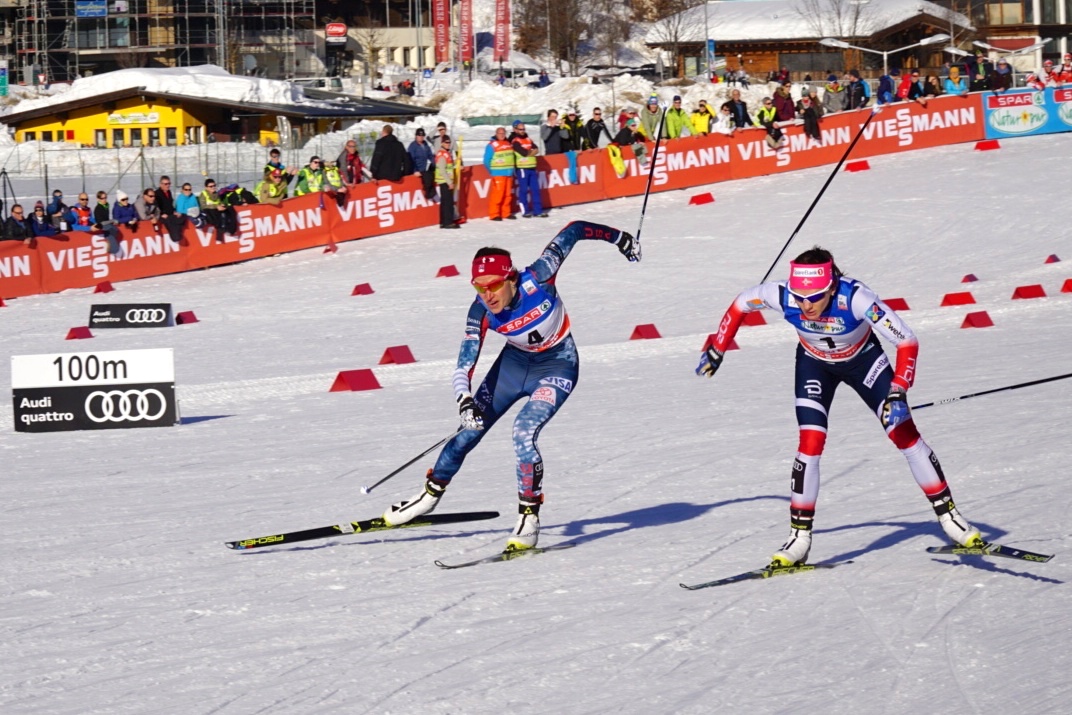
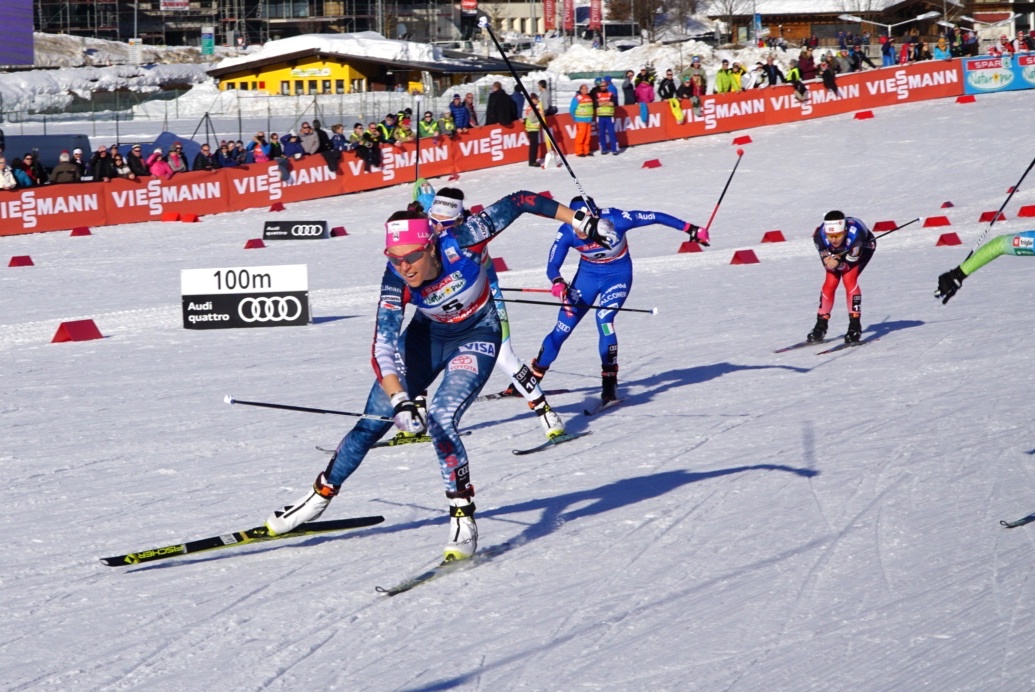
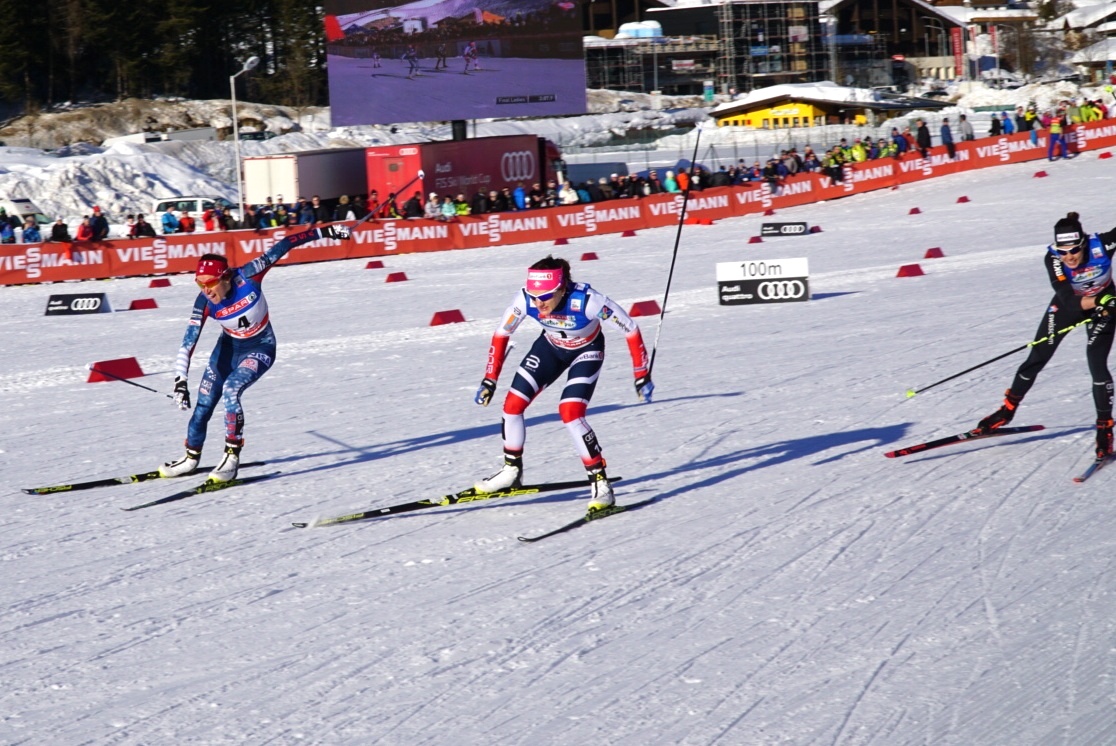
    In the final 100 meters, Falla stayed in the center, Caldwell moved to her right and van der Graaff skate skied to the left. As the three sped toward the finish, Falla was just slightly ahead.

    The three-way battle for first, with (from left to right) American Sophie Caldwell, Norway’s Maiken Caspersen Falla and Switzerland’s Laurien van der Graaff in the women’s 1.3 k freestyle sprint final at Saturday’s World Cup in Seefeld, Austria. Caldwell and van der Graaff ended up tying for the win. (Photo: Garrott Kuzzy / LumiExperiences.com)

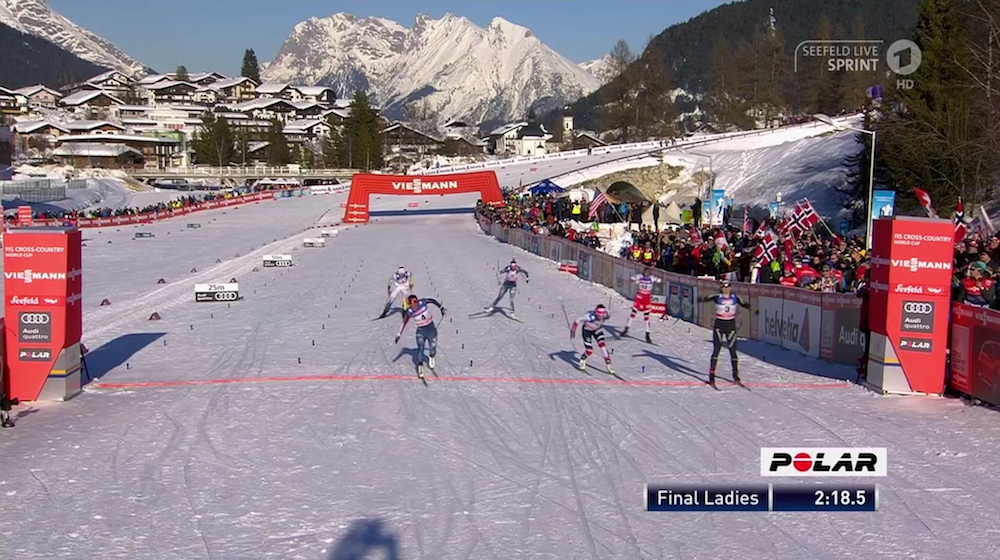
    The taste of a non-Norwegian victory, however, was too sweet to let go. Neither van der Graaff nor Caldwell slowed their pace to settle for anything but first place. The Swiss skier and the American crossed together in a photo finish, which was eventually ruled a tie for the win. Their time was 2:18.65. Falla crossed 0.21 seconds later for third place.

    “It’s so great to win again,” said van der Graaff, 30, who earned her first World Cup win earlier this season at the opening stage of the Tour de Ski. “I have told myself to believe that it was possible and now I have two wins this season. I didn’t realize Sophie was so close at the finish. It’s kind of fun to share the podium with her. I have never heard of that happening before.

    The camera at the finish focused on van der Graaff, who initially thought she won outright over Caldwell and Falla. She was televised as the day’s singular winner, and even Caldwell was unaware of her win until she was told ten minutes after the finish by Jeff Ellis, the FIS Cross Country Media Coordinator and Kikkan Randall’s husband.

    “I thought he was messing with me at first,” Caldwell wrote in an email, explaining when she first heard the news.

    After she learned the result was real, Caldwell described he response as “very surprised, but pleasantly so” at learning she and van der Graaf had identical lunge times to the line.

    “I honestly don’t even remember lunging, but I’m glad I did,” she wrote. “It was really fun sharing the podium with Laurien. She’s a great competitor and it’s kind of cool that a tie for first place is possible!”

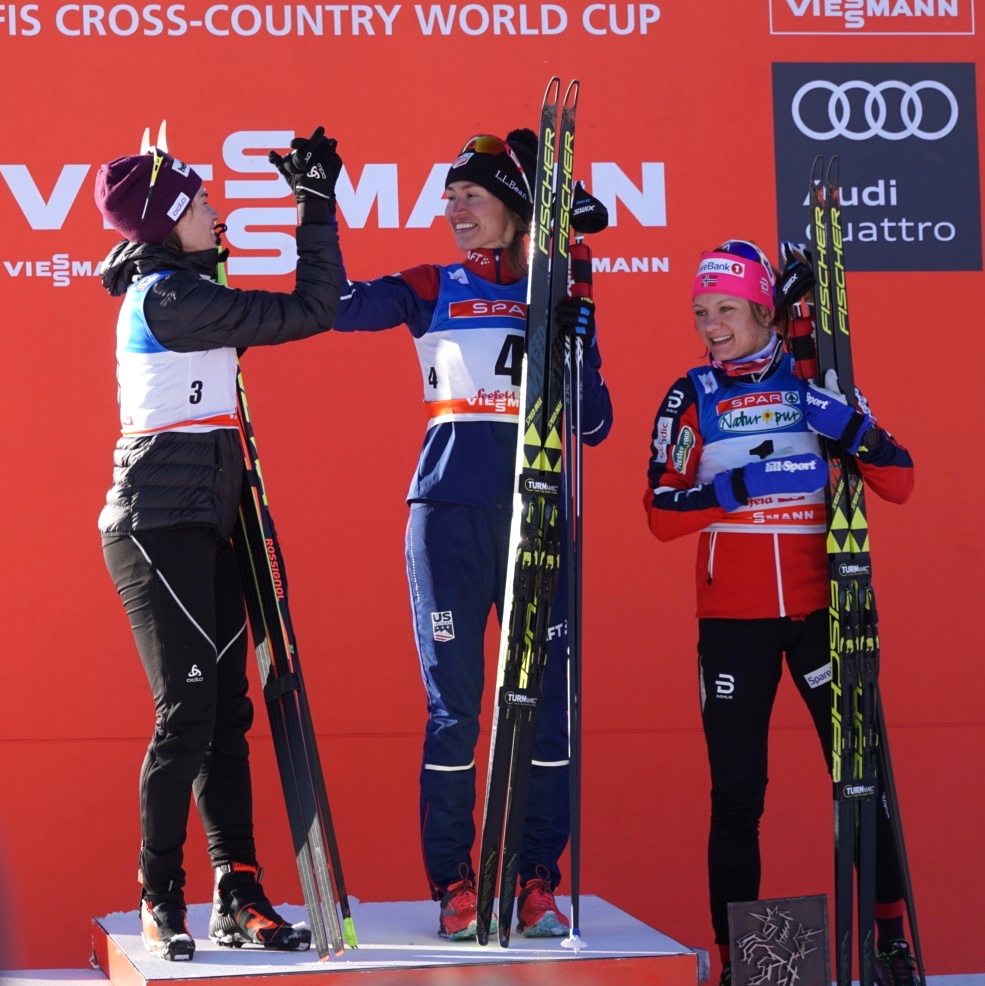
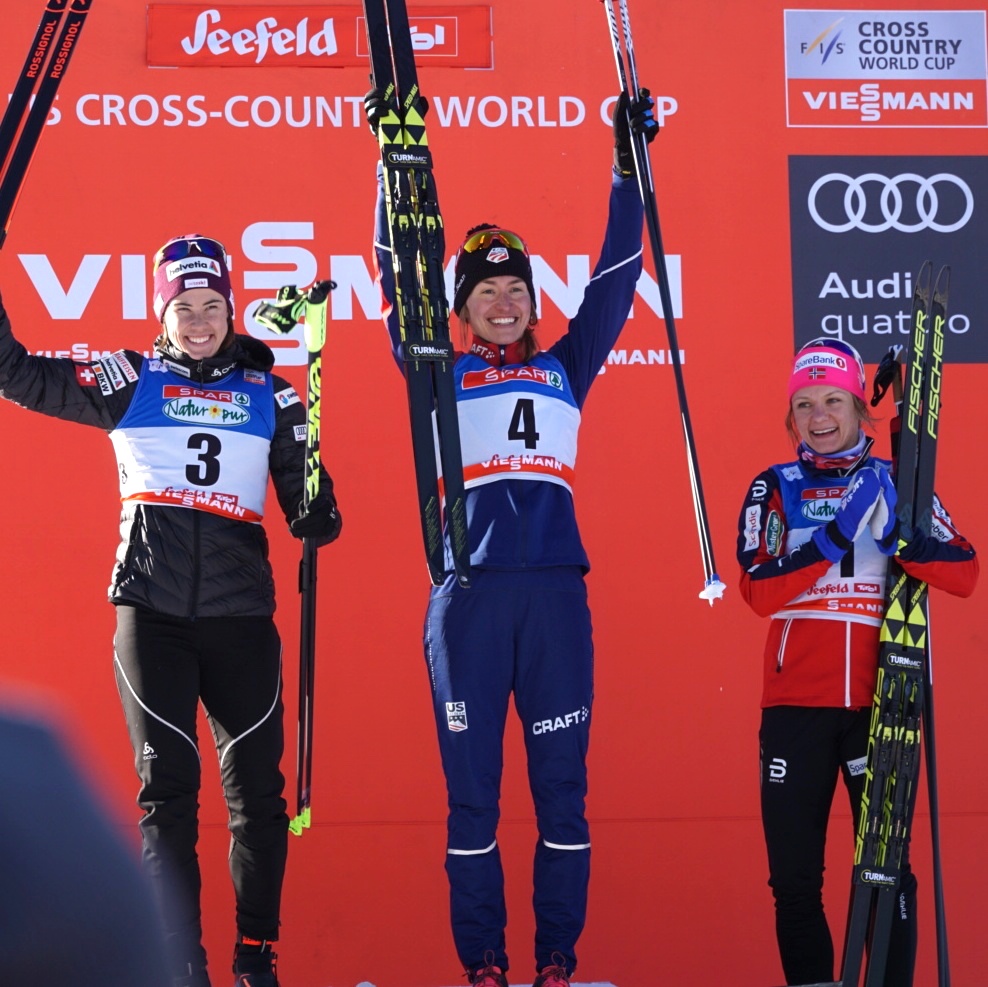
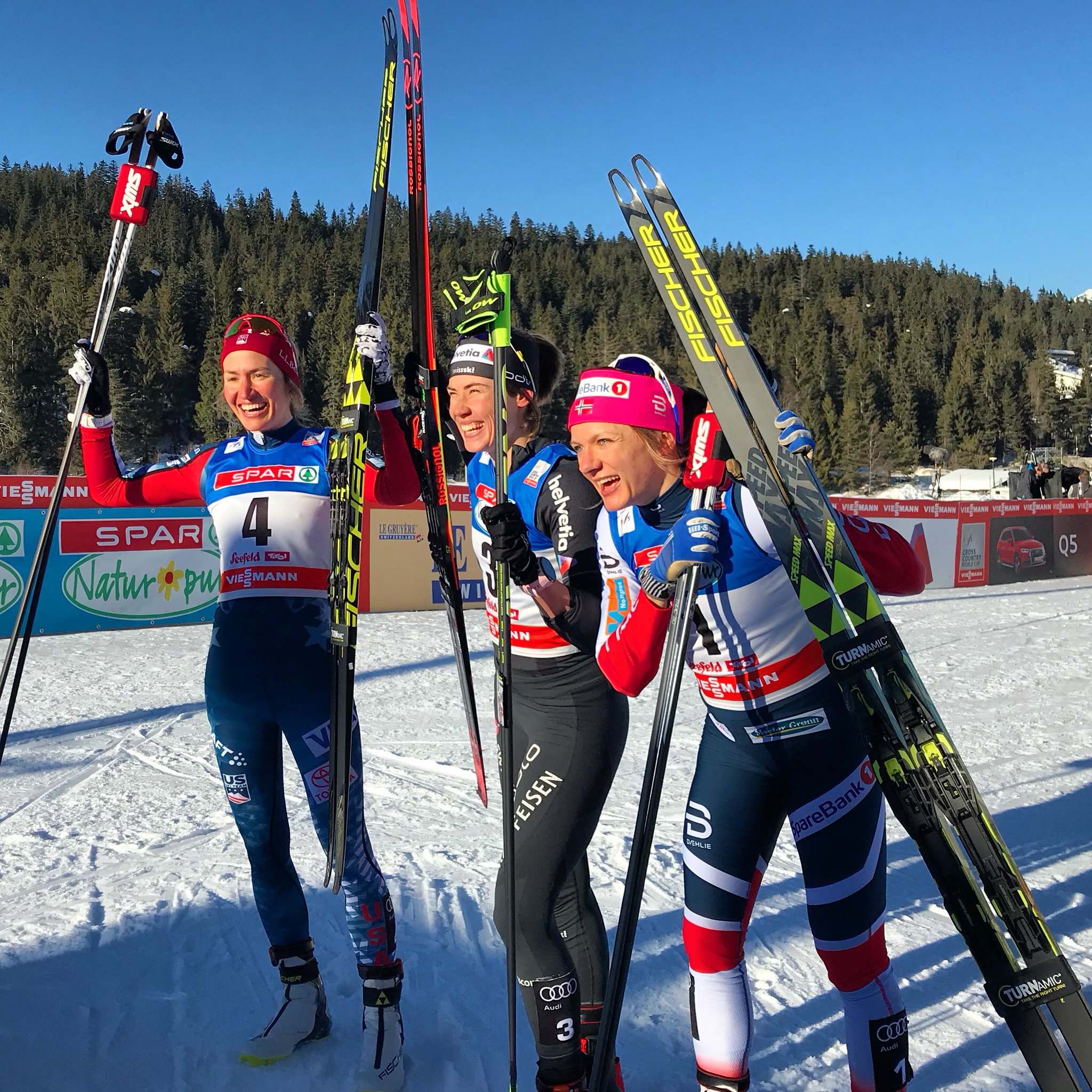
    American Sophie Caldwell (c) shares the top step of the World Cup podium with Switzerland’s Laurien van der Graaff (l) on Saturday after they tied for first in the women’s 1.3 k freestyle sprint in Seefeld, Austria. Norway’s Maiken Caspersen Falla (r) placed third. (Photo: Garrott Kuzzy / LumiExperiences.com)

    The win is the first one for the U.S. Ski Team this season. It is Caldwell’s third individual sprint podium this season, eighth-career World Cup podium and second individual win. Her first came in the 2016 classic sprint stage of the Tour de Ski in Oberstdorf, Germany.

    While the sprint was the last until a classic sprint is contested at the 2018 Olympics next month, Seefeld is the site of next year’s World Championships.

    Finishing out the women’s final were Harsem in fourth (+1.34), Sömskar in fifth (+1.83) and Bjornsen in sixth (+2.26).

    “I felt really awesome in the quarters,” Bjornsen said. “In the semis, I definitely could feel some fatigue and by the finals. I tried to do what I could, but for sure could feel I was a bit tired, as is everybody, but I was missing that final push that I really needed on that last hill.

    “I was out there learning,” Bjornsen continued. “It’s fun to see it the year before world champs and kind of what to expect.”

    Slovenia had three in the top 10 with Vesna Fabjan in seventh, Katja Visnar in eighth and 22-year-old Anamarija Lampič in 10th. Italy’s Greta Laurent started the day by qualifying second, 1.43 seconds behind Falla, and ended up ninth overall.

    American Kikkan Randall (second from l) racing with (from left to right) Germany’s Sandra Ringwald, Slovenia’s Anamarija Lampic and France’s Aurore Jean during their quarterfinal of the women’s 1.3 k freestyle sprint at the World Cup in Seefeld, Austria. (Photo: Garrott Kuzzy / LumiExperiences.com)

    U.S. skier Kikkan Randall also qualified for Saturday’s heats with the 18th-ranked time, then finished third in her quarterfinal (1.33 seconds behind Sömskar in first) to finish the day in 14th.

    “Good for Kikkan, descent qualification,” Grover said. “In the heats she kind of felt like she just didn’t ski it tactically super well and kind of got boxed out a bit. Little bit disappointing for her not to go through.”

    After qualifying in 30th (+7.68), Canada’s Dahria Beatty advanced to the fifth quarterfinal, where she finished fourth (1.65 seconds behind Laurent in first). That put her 20th overall, which stood as a season best.

    “I was feeling good today, and I really like this course,” Beatty, of the Canadian World Cup Team, said after. “It’s a good power course. … The heat was a bit frustrating. I felt like I was skiing well, but I just couldn’t make the right move to get around the girls in front of me. I got pushed into that wall, so that really allowed the gap to open up, which was unfortunate because I felt like I was skiing really well today and I could have — if I could have, tactically, been able to move up better and get into that final sprint.

    “But I am happy with today,” she continued. “It’s a good feeling, and I am excited for tomorrow.”

    Sunday features 10/15 k freestyle mass starts in Seefeld. While Diggins did not participate in Saturday’s sprint, she is slated to start Sunday’s 10 k freestyle mass start. After feeling a little fatigued from last weekend’s races in Planica, Slovenia, Diggins decided to take off one of Seefeld’s race days.

    “She wanted to pick one race this weekend to focus on,” Grover explained. “She was feeling a little bit of fatigue from last weekend and chose to go in the 10 k simply because we have a 10 k at the Games and no skate sprint. So she would have been outstanding in there today.”

    While three American women qualified for the heats on Saturday, Ida Sargent was 0.52 seconds outside the top in 37th. The U.S. Ski Team member fell just before the qualifier and sustained an injury, which Grover believed was to her thumb. Following the race, she was taken to the hospital in Innsbruck, located approximately 30 minutes from the venue, for further examination.

    “It was a hard day for Ida. She had a crash right before the qualification and sounds like there is some injury to her thumb. So were still trying to figure that out,” Grover said. 

    Rosie Brennan (U.S. Ski Team) finished the qualifier in 42nd, Emily Nishikawa (Canadian World Cup Team) was 51st, Caitlin Patterson (Craftsbury Green Racing Project) 52nd and Cendrine Browne (Canadian U25 Team) 54th.

    The Canadian women opted out of the past two weekends of World Cup racing and have been training in Livigno, Italy, for the week leading up to Seefeld.

    “We did a training camp in altitude to prepare ourselves for the [Olympic] Games,” Browne explained. “We did the same formula last year for World Champs and it’s something that worked really well for me, so I am confident with my preparation and I am looking forward to tomorrow.”

    Results: Qualifier | Finals

  • Saturday Rundown: Seefeld and Ridnaun

    Saturday Rundown: Seefeld and Ridnaun

    The podium for Day 2 of the Seefeld Triple Nordic Combined World Cup, with Japan’s Akito Watabe in first (c), Germany’s Vinzenz Geiger (l) in second and Norway’s Jarl Magnus Riiber (r) in third. (Photo: FIS Nordic Combined/Twitter)

    FIS Nordic Combined World Cup (Seefeld, Austria): Normal hill/10 k

    Two of the same men from Friday repeated on the podium on Day 2 of the Seefeld Triple Nordic Combined World Cup, with Japan’s Akito Watabe notching his second-straight win on Saturday.

    Norway’s Jarl Magnus Riiber, who finished second on Friday, placed third in Saturday’s individual normal hill/10 k Gundersen, while Germany’s Vinzenz Geiger placed second, more than a minute behind Watabe.

    Watabe jumped to first and started the 10 k with a 25-second head start on Riiber in second. Geiger started seventh, 1:45 minutes back, and rose to second at the finish, 1:05.5 behind Watabe (who won in 23:28.5) and 3.4 seconds ahead of Riiber in third (+1:08.9).

    For the second day in a row, Norway’s Jan Schmid narrowly missed the podium in fourth (+1:14.1), up from fifth after the jump.

    Taylor Fletcher was the lone American competing on Day 2, and he ended up 31st, up 10 places after jumping to 41st. Fletcher started the 10 k race 4:44 out of first then finished 3:52.9 behind Watabe.

    The Seefeld Triple concludes Sunday with the individual normal hill/15 k Gundersen.

    Results: Jumping | Final

    ***

    American Sophie Caldwell (l) and Switzerland’s Laurien van der Graaff (r) tied for first on Saturday in the women’s 1.1 k freestyle sprint final at the World Cup in Seefeld, Austria, while Norway’s Maiken Caspersen Falla placed third. (Screenshot: ARD broadcast)

    FIS Cross Country World Cup (Seefeld, Austria): Freestyle sprints

    Women’s report

    Men’s report

    It doesn’t get any closer than that. On Saturday, American Sophie Caldwell and Switzerland’s Laurien van der Graaff tied for first in the women’s 1.1-kilometer freestyle sprint final at the World Cup in Seefeld, Austria. They both finished within one-hundredth of a second of each other to take the victory — the last sprint before the Olympics — in 2:18.65 minutes.

    Norway’s Maiken Caspersen Falla finished 0.21 seconds later for third place.

    The women’s freestyle sprint podium at Saturday’s World Cup in Seefeld, Austria, with American Sophie Caldwell (l) and Switzerland’s Laurien van der Graaff (c) tying for first and Norway’s Maiken Caspersen Falla (r) placing third. (Photo: FIS Cross Country/Twitter)

    “I broke my pole in the semifinal, then I got really tired,” van der Graaff said in a post-race interview with the International Ski Federation (FIS). “But I still believed I can be with Maiken and Sophie, and that I could catch them in the final was just great.”

    Norway and the U.S. both had two in the final, with Kathrine Rolsted Harsem of Norway placing fourth (+1.34), Sweden’s Linn Sömskar finishing fifth (+1.83) and American Sadie Bjornsen taking sixth (+2.26).

    Falla had raced to first in the qualifying round with a time of 2:21.44, Italy’s Greta Laurent qualified second (+1.43), van der Graaff third (+1.66), Caldwell fourth (+1.84), and Bjornsen fifth (+2.01).

    Van der Graaff then won her quarterfinal and placed third in the first semifinal, 0.77 second behind Caldwell, who won it. Falla was second in that semifinal (+0.16) and van der Graaff advanced as a lucky loser.

    Caldwell and Falla went head to head in every heat, with Falla winning their first quarterfinal by 0.08 seconds over Caldwell in second.

    Bjornsen won her quarterfinal and finished second to Harsem in the second semifinal.

    A third American, Kikkan Randall also qualified for the heats, placing 18th in the qualifier then finishing third in her quarterfinal (1.33 seconds behind Sömskar in first) to end up 14th overall.

    Canada’s Dahria Beatty placed 30th in the qualifier to nab the last spot in the rounds, then finished fourth in her quarterfinal (1.65 seconds behind Laurent in first) for 20th overall.

    For the U.S., Ida Sargent missed qualifying by about half a second in 37th (+8.20), Rosie Brennan finished 42nd (+9.86) and Caitlin Patterson was 52nd (+13.0).

    Also for Canada, Emily Nishikawa finished 51st (+12.68) and Cendrine Browne was 54th (+13.34).

    The men’s 1.4 k freestyle sprint podium at the World Cup in Seefeld, Austria, with Norway’s Johannes Høsflot Klæbo (c) in first, France’s Lucas Chanavat (l) in second and Sweden’s Calle Halfvarsson (r) in third. (Photo: FIS Cross Country/ Twitter)

    The men raced 1.4 k, with Norway’s Johannes Høsflot Klæbo qualifying first in 2:46.89 then winning his quarterfinal and semifinal before putting the hammer down for one last time in the final, finishing first in 3:02.66.

    France’s Lucas Chanavat placed second in the final, 0.48 seconds back, after qualifying sixth, winning his quarterfinal and placing second in the first semifinal (0.33 seconds behind Klæbo). Sweden’s Calle Halfvarsson took the third spot on the podium after finishing 0.97 seconds after Klæbo. Halfvarsson had previously qualified seventh, taken second in his quarterfinal and advanced as a lucky loser in third in the first semifinal (0.52 seconds behind Klæbo).

    Italy’s Federico Pellegrino missed the podium in fourth (+1.06), Russia’s Gleb Retivykh placed fifth (+1.17), and Norway’s Emil Iversen was sixth (+5.57).

    Canada’s Alex Harvey and American Simi Hamilton both made it to the semifinals, where they finished fourth and fifth, respectively, and did not advance to the finals. Harvey had qualified for the rounds in 22nd and won his quarterfinal, then raced in the second semifinal, where he finished fourth, 0.47 seconds behind Iversen in first. That put Harvey eighth overall on the day.

    Hamilton clocked the fifth-fastest qualifying time, 6.46 seconds back from Klæbo’s top time. The U.S. Ski Team member then placed second to Pellegrino in his quarterfinal and was fifth in the first semifinal, 2.61 seconds behind Klæbo. Overall, Hamilton placed ninth.

    Also for the U.S., Erik Bjornsen finished 37th in the qualifier, 0.89 seconds out of the top 30 and 11.99 second out of first, Logan Hanneman was 39th (+12.52), Andy Newell 42nd (+12.90), Reese Hanneman 65th (+17.91), and Ben Lustgarten 76th (+21.88).

    Canada’s Len Valjas placed 40th (+12.72), Julien Locke 43rd (+13.31), Knute Johnsgaard 51st (+14.74), Bob Thompson 58th (+16.55), Graeme Killick 61st (+17.28), and Devon Kershaw 70th (+19.53).

    Results:

    Women’s qualifier | Women’s final 

    Men’s qualifier | Men’s final

    ***

    France’s 22-year-old Chloé Chevalier racing to her second win and third podium of the week in as many individual races at 2018 IBU Open European Championships on Saturday in Ridnaun, Italy. (Photo: IBU/Biathlonworld)

    IBU Open European Championships (Ridnaun-Val Ridanna, Italy): Men’s and women’s pursuits

    France’s Chloé Chevalier picked up her second win and third podium of the week at the International Biathlon Union (IBU) Open European Championships on Saturday in Ridnaun, Italy, winning the women’s 10 k pursuit, while Russia’s Alexander Loginov rose to the top step of the podium in the men’s 12.5 k pursuit on Saturday.

    Chevalier started the women’s pursuit in second, 13 seconds behind Ukraine’s Iryna Varvynets (who won Friday’s sprint and thus started first), and shot clean to take the lead after the third stage — where Varvynets missed one. Chevalier went on to clean the final stage for perfect 20-for-20 shooting and crossed the line first in 29:25.4. Varvynets finished second, 11.0 seconds back after missing a single target in the first standing (0+0+1+0), and France had two on the podium with Julia Simon in third (+43.2). Simon also shot 19-for-20, with her miss coming in the second prone stage (0+1+0+0).

    “Three medals in three races is definitely more than I had expected,” Chevalier, 22, told the event’s organizers on Saturday. “Today I saw that Iryna shoots faster than I, and so I really gave my all in the track. Even if it might not look like it, after the many races in the last few days I am noticing that I am getting more and more tired.”

    American Chloe Levins rose from 59th at the start to 42nd at the finish (+4:11.8), with three clean stages and two misses in the first standing (0+0+2+0). She had the 28th-fastest overall range time and 30th-ranked shooting time.

    In the men’s pursuit, Loginov started first as Friday’s sprint winner Latvia’s Andrejs Rastorgujevs did not start. Loginov held the lead throughout the race despite two misses — one in the first stage and another in the last stage (1+0+0+1) — and secured the win in 32:22.1. Bulgaria’s Krasimir Anev started second, 19 seconds after Loginov, and held his place as well, shooting clean and finishing second, 27.6 second back.

    “I am really happy here in Ridanna and the results reflect that,” Loginov, 25, told organizers. “Not to start in the individual event on Wednesday was the right decision because the last few days had been very demanding with six races in eight days. I am cross with my two errors in the shooting range, but very happy with my performance in the track.”

    Russia had two on the podium with Evgeniy Garanichev in third (+1:10.7) after Garanichev started in bib 19 and overcame three penalties (1+0+2+0) with the fastest overall course time.

    Canada’s Macx Davies started 27th and finished 35th (+4:33.9) with five misses (3+0+2+0), while American Alex Howe rose from 53rd at the start to 43rd (+5:53.5) with five penalties (2+2+1+0).

    The 2018 Open European Championships conclude with the single mixed relay and mixed relay on Sunday. American Susan Dunklee and Lowell Bailey are on the start list for the single mixed relay, Canada’s Carsen Campbell and Sarah Beaudry. For the mixed relay, the U.S. has entered Levins, Maddie Phaneuf, Paul Schommer, and Alex Howe.

    Results: Women | Men

    Start lists: Single mixed relay | Mixed relay

  • Friday Rundown: Seefeld, Craftsbury, Ridnaun

    Friday Rundown: Seefeld, Craftsbury, Ridnaun

    The jumping portion of the Nordic Combined World Cup Seefeld Triple on Friday in Seefeld, Austria. (Photo: Garrott Kuzzy / LumiExperiences.com)

    Nordic Combined World Cup (Seefeld, Austria): Individual normal hill/5 k

    On the first of the three-day Seefeld Triple Nordic Combined World Cup, Japan’s Akito Watabe took the win and Taylor Fletcher was the top American in 28th in the individual normal hill/5-kilometer Gundersen on Friday.

    Japan’s Akito Watabe heading out of the gate second in the 5 k Gundersen on Friday at the Seefeld Triple Nordic Combined World Cup in Seefeld, Austria. Watabe went on to win the race by half a second. (Photo: Garrott Kuzzy / LumiExperiences.com)

    Watabe put himself in second in the jump portion and started the 5 k ski race 21 seconds behind Norway’s Jarl Magnus Riiber in first. Watabe caught Riiber and beat him at the finish line, taking the win in 11:22.3 minutes, while Riiber followed 0.5 seconds back in second place. Germany’s Fabien Rießle followed in third, 32.4 seconds out of first, after starting the 5 k in sixth and 1:03 minutes back.

    Norway’s Jan Schmid jumped to third and ended up fourth (+37.8).  Watabe’s brother, Yoshito Watabe placed fifth (+47.2), losing one place in the ski race after jumping to fourth.

    Two Americans competed, with Fletcher jumping to 30th and ending the day in 28th, and Jasper Good finishing 52nd (+3:45.6) after jumping to 49th. Both are headed to the 2018 Olympics next month in PyeongChang, South Korea.

    Results: Jumping | Final

    Taylor Fletcher (USA Nordic) starting the 5 k Gundersen on Friday at the Seefeld Triple Nordic Combined World Cup in Seefeld, Austria. He started in 30th and finished 28th. (Photo: Garrott Kuzzy / LumiExperiences.com)

    ***

    U.S. SuperTour (Craftsbury, Vermont): Classic sprints

    Forrest Mahlen (APU) celebrates his first time atop the SuperTour podium on Friday after winning the men’s 1.4 k classic sprint final in Craftsbury, Vermont. (Photo: Forrest Mahlen/Instagram)

    Kaitlynn Miller and Forrest Mahlen won their respective classic-sprint finals at Friday’s SuperTour in Craftsbury, Vermont.

    The 1.4-kilometer classic sprint kicked off a three-day race weekend at the Craftsbury Outdoor Center. On Saturday, the Craftsbury Marathon will be held (not a SuperTour event), followed by 5/10 k freestyle SuperTour races on Sunday.

    Miller, of the Craftsbury Green Racing Project, started Friday by winning the women’s qualifier. She went on to win both her quarterfinal and semifinal before topping the final as well in 3:40.9 minutes. Also on Friday, it was formally announced that Miller was named to the U.S. Cross-Country Ski Team’s Olympic squad, which will compete in PyeongChang, South Korea, Feb. 10-25.

    Kelsey Phinney, of the Sun Valley Ski Education Foundation (SVSEF), placed second in the women’s final, 0.63 seconds back, and Felicia Geisor (CXC Team) was third (+1.67). Erika Flowers, of the Stratton Mountain School (SMS) T2 Team placed fourth (+3.2), Canada’s Olivia Bouffard-Nesbitt (Rocky Mountain Racers) — fresh off NorAm Western Canadian Championships last weekend in Alberta — finished fifth (+5.46), and Alaska Pacific University (APU) skier Rosie Frankowski (who also made the U.S. Olympic team) placed sixth (+6.27).

    On the men’s side, APU’s 24-year-old Mahlen qualified fifth, then won his quarterfinal and semifinal before taking the final for his first-career SuperTour win in 3:06.81. Ben Saxton (SMST2) initially won the qualifier and won his quarterfinal as well before placing second to Mahlen in the first semifinal. Saxton ended up 0.55 seconds back in second place in the final, just three-hundredths of a second ahead of Kevin Bolger (SVSEF) in third place (+0.58). Another half second back, Kris Freeman followed in fourth, just 1.09 out of first, Eric Packer (APU) was fifth (+1.39) and Canada’s Andy Shields (Lappe Nordic), who also competed at Western Canadian Championships last weekend) sixth (+8.99).

    Results: Brackets

    ***

    The men’s 10 k sprint podium at IBU Open European Championships, with Latvia’s Andrejs Rastorgujevs (c) in first, Russia’s Alexander Loginov (l) in second, and Bulgaria’s Krasimir Anev (r) in third. (Photo: IBU/Biathlonworld)

    IBU Open European Championships (Ridnaun-Val Ridanna, Italy): Men’s and women’s sprints

    Canada’s Macx Davies led the North Americans on Friday on Day 2 of the International Biathlon Union (IBU) Open European Championships in Ridnaun, Italy, placing 27th in the men’s 10-kilometer sprint with 9-for-10 shooting (1+0). Davies finished 1:32.3 minutes behind Latvia’s Andrejs Rastorgujevs, who took the win in 24:03.0 with a single penalty as well (0+1).

    Russia’s Alexander Loginov placed second, 5.5 seconds back, with one penalty (1+0), and Bulgaria’s Krasimir Anev shot clean to finish third (+24.5).

    “At the [last] World Cup in Anterselva [Italy], I have had a difficult time in the shooting range, and so I spent a lot of time in the last few days working on my shooting,” Rastorgujevs told the IBU after. “Today it was clear that all this hard work paid off. It is also a great motivator for Olympic gold.”

    For Davies, who’s also headed to the Olympics next month, the result tied his best individual result this season after he placed 27th in an IBU Cup sprint earlier this month in Osrblie, Slovakia.

    Canada entered four in the men’s race, with Carsen Campbell finishing 75th (+2:34.6) with one miss (0+1), Aidan Miller placing 91st (+3:18.2) with three penalties (1+2), and Matt Hudec finishing 119th (+4:31.6) with four misses (1+3).

    Five American men raced, with Alex Howe finishing 53rd (+2:15.1) with one penalty (1+0), Jake Brown 84th (+3:02.0) with four misses (1+3), Jakob Ellingson 85th (+3:07.0) with one miss (1+0), Max Durtschi 111th (+3:50.1) with four misses (3+1), and Paul Schommer 114th (+3:59.8) with four penalties (2+2) as well.

    The women’s 7.5 k sprint podium at IBU Open European Championships in Ridnaun, Italy, with Ukraine’s Iryna Varvynets (c) in first, France’s Chloé Chevalier (l) in second, and Japan’s Fuyuko Tachizaki (r) in third. (Photo: IBU/Biathlonworld)

    In the women’s 7.5 k sprint that followed, Chloe Levins of the U.S. was the top North American in 59th, 2:01 behind the winner Iryna Varvynets of Ukraine. Varvynets shot clean and posted the fastest finishing time of 20:54.1, 12.5 seconds faster than France’s Chloé Chevalier, Wednesday’s 15 k champion who had one miss (0+1) on Friday and ended up second. Japan’s Fuyuko Tachizaki reached the podium in third (+15.5) and was one of four women in the top five that shot clean (only Chevalier did not).

    “After the individual competition on Wednesday, I was not at all happy with my shooting,” said Varvynets, who placed fifth in the 15 k. “Today I therefore concentrated especially hard in the shooting range. It was my luck that not many finished without errors, otherwise it would probably not have been enough for the victory.”

    “Two races, two medals — it could not have gone better for me,” Chevalier said. “In the standing shooting I missed the first disc and got a little nervous, but thankfully, there were no further errors.”

    Tachizaki called the bronze medal a “big dream come true”.

    “The focus of my season had been the Olympics and I ‘only’ took part in Ridanna as part of the preparations, but with this result I have exceeded everything I have achieved so far,” she said. “At the end of the race I did not only fight hard in the track, I was already dreaming of a medal. Now I’m in seventh heaven.”

    Levins had one miss in each stage (1+1), as did fellow American Maddie Phaneuf, who finished 63rd (+2:19.0) with two penalties. Clare Egan followed in 70th (+2:34.2) with four misses (3+1), Deedra Irwin was 85th (+3:38.1) with four penalties (1+3) as well, and Jennie Bender 97th (+5:52.8) with six misses (3+3).

    Two Canadians started the race, with Sarah Beaudry finishing 76th (+3:02.9) with four misses (1+3). Erin Yungblut did not finish.

    Open European Championships continue Saturday with the men’s and women’s pursuits. The top 60 from the sprint qualify, which, for the North Americans, means Davies, Howe, and Levins.

    The championships end Sunday with single mixed and mixed relays.

    Results: Men | Women

  • FIS XC Approves 2017/2018 World Cup Calendar

    FIS XC Approves 2017/2018 World Cup Calendar

    On Sunday, the International Ski Federation (FIS) approved its calendar for the 2017/2018 Cross-Country World Cup season at its spring meeting in Portoroz, Slovenia. The season opens with the Ruka triple — three straight days of racing Nov. 24-26 in Kuusamo, Finland — and includes a sprint weekend in Dresden, Germany, classic races in Planica, Slovenia, and skate races in Seefeld, Austria (host of 2019 World Championships), all in Period 2.

    Next comes the 2018 Winter Olympics in PyeongChang, South Korea, from Feb. 9-25.

    The season wraps up with Period 4 in Finland, Norway and Sweden, with World Cup Finals in Falun, Sweden.

    Full calendar below or for original PDF, click here.


  • Next World Championships Stop: Seefeld

    Next World Championships Stop: Seefeld

    Seefeld in Tirol, Austria, is gearing up to host a 2018 cross-country World Cup and 2019 Nordic World Championships. 2010 Olympian and former U.S. Ski Team member Garrott Kuzzy is a frequent visitor as he’s living in Innsbruck, and contributed the following interview with Seefeld’s tourism director.

    Seefeld in Tirol, Austria will host the 2019 Nordic World Championships. The small town in northern Tyrol sits on a plateau nestled in the alps, about two hours by train south of Munich and about 30 minutes north of Innsbruck. Seefeld has a long history of hosting international nordic competitions, including the 1964 and 1976 Innsbruck Olympic Games, as well as the 1985 World Championships and 2012 Youth Olympic Games. Seefeld holds the historic distinction as the venue where American Bill Koch won his Olympic silver medal in the 30-kilometer event.

    We got out for a ski with Elias Walser, the managing director of Seefeld Tourism, on some of the 270+ kilometers of trails he oversees to learn more about the region and the upcoming World Championships.

    ***

    Seefeld in Tirol, Austria, will host 2019 Nordic World Championships

    Garrott Kuzzy: You have been the head of Austria’s two largest cross-country ski destinations, Ramsau am Dachstein and Seefeld in Tirol. What makes cross country skiing in Austria unique?

    Elias Walser: In my opinion, what sets Austria apart from Scandinavia or North America, is that the cross-country ski trails are surrounded by a dramatic mountain landscape and a fairytale natural environment. At the same time, the trails pass through farms, huts and villages where skiers can stop for refreshment. I believe this combination of nature and access to traditional life in the alps makes Austria one of a kind.

    GK: Now that the 2017 Lahti World Championships are complete, the eyes of the nordic world are on Seefeld…well, except for a couple of events in Korea next February. How is Seefeld preparing for the 2019 World Championship?

    EW: Our trail construction and renovation for the world championship began in August 2016. We do not want to build buildings that no one needs after 2019 and are making our biggest investments in trails and infrastructure, such as lights and snowmaking. We updating our trail network to provide even more fun and enjoyment in the future, for both beginners and elite athletes alike.

    GK: Seefeld is hosting the European Continental Cup (OPA Cup) Final in late March. Many of the big events in North America this winter have been impacted by a lack of snow. How are the winters trending in Seefeld? What are you doing to ensure snow for these big events?

    EW: We also notice a change in our winters and have taken steps to adapt. We operate an active snow-management system. This means that we are already working in the summer on what can we do to offer the best cross-country ski trail with as little snow as possible. In the winter, we farm snow from higher elevations. We also have extensive snowmaking for the race trails and the most popular touring trails.

    Elias Walser, Seefeld Tourism managing director (Courtesy photo)

    GK: You were in Hochfilzen for the Biathlon World Championships and in Lahti for Nordic Worlds. What were your impressions?

    EW: Yes, the atmosphere was sensational at both events! I was actually in Hochfilzen when [American] Lowell Bailey won gold and in Lahti when [Canadian] Alex Harvey outsprinted the field in the 50 k. The crowd was ecstatic cheering on both North Americans. It is beneficial for every sport when athletes from a variety of countries have the potential to win on any given day. It is also exciting to see the growing strength of the American women’s team.

    GK: Seefeld has a long history of cross-country skiing. It first received international attention when it hosted cross country events for the 1964 Innsbruck Olympic Games. When/how did skiing start in Seefeld?

    EW: Tourism in Seefeld began in the 19th century, attracting guests seeking an escape from cities during hot summers. It was only after the Second World War that winter became increasingly popular. Seefeld became known for its extensive winter sporting experiences, including alpine skiing, cross-country skiing, ice skating, Eisstockschiessen (Austrian curling), winter hiking, horse-drawn carriage rides and tobogganing. Those traditions continue today, except that the barn lofts where guests used to stay have evolved into hotels with restaurants, pools and spas. Guests not only want to go skiing–they want to enjoy winter as a whole experience.

    GK: Do you have/know of any notable stories/history from the 1964 or 1976 Games in Seefeld?

    EW: If you see the old pictures, it is just incredible how courageous and sporty the athletes were … ski jumpers, for example, going over 120 meters on early fiberglass skis. 1964 was actually the first year that ski jumping featured both normal and large hill competitions. Overall, the whole effort around the Games was much simpler and less complicated that it is today.

    Seekirchl, the iconic church at the trailhead in Seefeld in Tirol, Austria

    GK: One of the most historic decisions for the sport of cross-country skiing was made in the Seekirchl, the iconic church at the trailhead in Seefeld, after the 1985 Seefeld World Championships. Can you share that story?

    EW: 1985 in Seefeld was the last World Championships when skating was not allowed. Despite that, the top athletes all used the “Siitonen-Schritt,” marathon skate named after Finn Pauli Siitonen. After the Championships, FIS officials met in the Seekirchl and decided to recognize skating as its own technique. That’s how skate technique was officially born and Seefeld became the “cradle of skating.”

    GK: Seefeld is an annual stop on the Nordic Combined World Cup, but Austria has not hosted a Cross-Country World Cup since 2004 in Ramsau. Seefeld has only hosted two World Cups since the 1985 World Championships (1996 and 1999). What inspired Seefeld to bid on the 2019 Championships?

    EW: We want to lead cross-country skiing into the next dimension. We see cross-country skiing continue to evolve as a sport and also grow as a major attraction in our region. After renovating almost all venues and homologating our race trails, it was an obvious choice to submit our bid. We were fortunate that our first application to host the championships was convincing enough to earn the bid.

    GK: The 2018 World Cup in Seefeld is considered the test event for the World Championships. Are you nervous for that test? If so, what are you most nervous about?

    The tracks at Seefeld in Tirol, Austria

    EW: Exactly. We will see how well the cross-country trails and venue flow in the competition mode. This can only be seen in a big race. We are optimistic that the new courses will receive praise from the racers.

    GK: You worked with Whistler Tourism for a year after the 2010 Olympic Games. Do you see Whistler hosting future international competitions?

    EW: Unfortunately, I’m not sure.

    GK: Innsbruck is in the middle of a feasibility study for the 2026 Olympic Games. Should the study find hosting the Games feasible, a referendum will be put forth to residents next fall. What are your thoughts on Innsbruck hosting its third Olympic Games?

    EW: I believe it is important for the Olympic Games to not just be about the growth and development of new markets. It is also about the Olympic spirit. For this reason, the Games should also return to places where this spirit has been born. I find the application of Tyrol with its unique locations, from Kitzbühel to Arlberg, a wonderful idea.

    GK: From your experience with North American skiers when you lived in Canada, how would Seefeld appeal to a skier from North America? What makes Seefeld unique? What highlights are on top of your list?

    The tracks at Seefeld in Tirol, Austria

    EW: The combination of gemütlichen Hütten [cozy huts] with good food along the trails and the variety of winter activities is part of what makes Seefeld unique. The accessibility from North America via direct flights to Munich is certainly also a great advantage. Innsbruck is always a welcome host for a day trip. With Seefeld as your base camp, you can really experience the alps.

    GK: The name “Seefeld” literally translates into English as “Lakefield.” Is there a lake in Seefeld? Will Seefeld put in a bid to host Waterskiing World Championships?

    EW: Ha! We have lots of beautiful lakes. They are all a little too small and pristine for waterskiing. However, stand-up paddleboarding makes for great cross-training in the summer.

    ***

    About Garrott Kuzzy

    Garrott competed in the 2010 Olympic Games and raced several years with the US Ski Team and the CXC Team. He is founder of Lumi Experiences, a company focused on cross-country ski trips in the alps. Lumi Experiences is partnering with the National Nordic Foundation to offer a trip to the 2018 World Cup in Seefeld and the opportunity to ski in the Dolomitenlauf Worldloppet.

  • Guided Trip to Seefeld for 2018 World Cup, Proceeds to Benefit NNF

    (Press release)

    The NNF and Lumi Experiences are partnering to offer a trip to the 2018 cross-country and nordic combined World Cup competitions in Seefeld, Austria. On this 11-day trip, designed by Olympian Garrott Kuzzy, we will ski in the Alps, cheer on our favorite athletes at the World Cup competitions and relax in three- and four-star hotels. Travelers will also have the opportunity to participate in the Dolomitenlauf Worldloppet!

    Olympian and past US Ski Team athlete Garrott Kuzzy has over five years of experience developing skiing, biking, and hiking tours throughout Europe. He currently lives in Innsbruck, Austria and has developed this trip in his new backyard. As a former US Ski Team athlete, Kuzzy is partnering with the NNF to benefit developing US athletes. Proceeds from the trip go to funding NNF programming.

    Scheduled for January 19 – 29, 2018, the trip is limited to 16 guests and priced at $3,900 per person (not including airfare) if reserved before March 31. For more information and to sign up, go to: www.lumiexperiences.com.

    Garrott Kuzzy, 2010 U.S. Ski Team Member (Photo, U.S Ski Team)

  • Saturday Rundown: Hamilton Second in Toblach Skate Sprint (Updated)

    Saturday Rundown: Hamilton Second in Toblach Skate Sprint (Updated)

    The women's (top) and men's (bottom) podiums at the World Cup 1.3 k freestyle sprints on Saturday in Toblach, Italy. Russia's Natalia Matveeva (top center) won the women's final, ahead of Norway's Maiken Caspersen Falla (top left) and Hanna Falk (top right). American Simi Hamilton (bottom left) took second in the men's final, behind Norway's Sindre Bjørnestad Skar (bottom center) and ahead of Norway's Johannes Høsflot Klæbo (bottom right) in third. (Photo: FIS Cross Country)
    The women’s (top) and men’s (bottom) podiums at the World Cup 1.3 k freestyle sprints on Saturday in Toblach, Italy. Russia’s Natalia Matveeva (top center) won the women’s final, ahead of Norway’s Maiken Caspersen Falla (top left) and Hanna Falk (top right). American Simi Hamilton (bottom left) took second in the men’s final, behind Norway’s Sindre Bjørnestad Skar (bottom center) and ahead of Norway’s Johannes Høsflot Klæbo (bottom right) in third. (Photo: FIS Cross Country)

    FIS Cross-Country World Cup (Toblach, Italy): Freestyle sprints

    Race report

    Simi Hamilton is back on the World Cup podium and was three-hundredths of a second away from the win on Saturday in the men’s 1.3-kilometer freestyle sprint in Toblach, Italy. The American qualified fifth and went on to win his quarterfinal then advance as a lucky loser in third out of him semifinal. In the men’s final, Hamilton waited until the last hill to strike and used his conserved energy in the two-lap race to outlast the likes of Italy’s Federico Pellegrino and Norway’s Johannes Høsflot Klæbo at the finish. Hamilton put it all on the line in a photo finish with Norway’s Sindre Bjørnestad Skar, with Skar taking his first individual World Cup victory in 2:47.91. Hamilton placed second for his first podium of the season and fourth of his career. It was also Hamilton’s first time in the final this season.

    Klæbo was the second Norwegian on the podium in third, 0.66 seconds behind Skar, Pellegrino placed fourth (+1.27), Hediger was fifth (+1.84), and Norway’s Håvard Solås Taugbøl (who won the qualifier to start the day in 2:47.38) took sixth (+3.77).

    “I just had a good feeling that I was a little bit before [Hamilton],” Skar said in a post-race interview with FIS of his immediate finish-line celebration before confirming that he won. “It was very, very tight.”

    Skar, who turns 25 on Jan. 22, qualified fourth and won his quarterfinal and finished second in his semifinal, 0.05 seconds ahead of Hamilton.

    Also for the U.S., Andy Newell qualified for the heats in sixth and took third in his quarterfinal for 13th overall. Canada’s Alex Harvey qualified eighth and finished fourth in his quarterfinal for 17th overall, and the second Canadian racing this weekend, Len Valjas, qualified 23rd and took fourth in his quarterfinal for 20th.

    In the women’s race, Russia’s 30-year-old Natalia Matveeva notched the 12th individual podium of her career (all in sprints) and first victory since 2007. She challenged Norway’s Maiken Caspersen Falla on the last climb and overtook her in the finishing stretch of Saturday’s 1.3 k skate sprint final for the win in 3:04.13. Matveeva qualified fourth to start the day, then placed second in both her quarterfinal and semifinal en route to the victory. Falla won the qualifier in 3:10.89, and continued to dominate her quarterfinal and semifinal before ending up second on the day, just 0.08 seconds out of first.

    “I’ve waited a lot of time to be [here],” Matveeva told FIS afterward. “I’m very happy and the Russian team is very happy. Thank you very much my service team. Good job today.”

    Sweden’s Hanna Falk reached the podium in third (+2:41), Germany’s Sandra Ringwald placed fourth (+3.46), Sweden’s Ida Ingemarsdotter was fifth (+5.88), and Slovenia’s Vesna Fabjan sixth (+19.39).

    Americans Kikkan Randall and Sophie Caldwell tangled in the first semifinal and ended up 10th and 11th, respectively, at the end of the day. Also for the U.S. Ski Team, Ida Sargent qualified for the heats in 16th (behind Caldwell in 15th while Randall qualified 27th), and reached the semifinals as well, placing sixth in the second semifinal after skiing in third into the finishing stretch. Sargent ended up 12th for her best result in over a year.

    Results: Men | Women

    ***

    IBU World Cup (Ruhpolding, Germany): Women’s 7.5 k sprint

    Race report

    Finland’s Kaisa Mäkäräinen posts a 22-second win for her first victory of the season and first time shooting without a miss in an individual race since the Ruhpolding sprint almost exactly a year ago. Dunklee leads North Americans in 33rd and qualifies for the pursuit, along with Canada’s Rosanna Crawford (55th), Megan Tandy (56th) and Julia Ransom (60th).

    Results

    ***

    Ski Classics Kaiser Maximilian Lauf (Seefeld, Austria): 60 k classic 

    [UPDATED] Imagine knee-deep snow drifts over the course of 60 k. That’s what faced racers in Saturday’s Kaiser Maximilian Lauf, the fourth stop in the 2016/2017 Ski Classics series, in Seefeld, Austria.

    Team Santander’s Kateřina Smutná and Andreas Nygaard fared best in the conditions, racing to the women’s and men’s victories in 3:43:48.7 and 3:21:44.5, respectively.

    Smutna won the women’s race by 10.8 seconds over Astrid Øyre Slind (Team United Bakeries), and Britta Johansson Norgren (Lager 157 Ski Team) finished more than three minutes later in third place (+3:35).

    “It was the right decision to go with kick today,” Smutná said after, according to a Ski Classics press release. “It was hard for us to be in the lead and open the tracks for men. We waited for them to catch up and do the work on our behalf. I noticed it was tough for Britta because she was double poling. So, Astrid and I decided to work together in the final section of the course, and it worked perfectly.”

    The men’s race was much closer with Nygaard holding off his Team Santander teammate Tord Asle Gjerdalen by 0.6 seconds. Stian Hoelgaard (Team Leaseplan) placed third, another 0.6 seconds back.

    “It was a tough race because there was so much snow on the course,” Nygaard said, according to the press release. “At some point, we were knee-deep in soft snow. The pace was slow, but you get tired after a while because you have to work hard when it’s snowing like this. I just kept telling myself that I need to keep up with the guys and win the race in the end. This is something that I didn’t expect to happen when the season started. Let’s see how long I can keep the yellow [leaders] bib.”

    The overall Ski Classics series leader, Nygaard is also the sprint leader as well. On the women’s side, Johansson Norgren possesses both the overall and sprint bibs as well.

    FasterSkier Editor-at-Large Chelsea Little placed 17th.

    Results: Men | Women

  • 17 Questions for 2017: Ben Berend

    17 Questions for 2017: Ben Berend

    Ben Berend competing in summer Grand Prix nordic combined in Oberstdorf, Germany. (Courtesy photo)
    Ben Berend competing in summer Grand Prix nordic combined in Oberstdorf, Germany. (Courtesy photo)

    Welcome to “17 Questions for 2017″, where we are catching up with American and Canadian national-team members before the beginning of the winter season. 

    ***

    Steamboat Springs, Colorado, native Ben Berend is just 21 years old, but he already has a senior World Championships under his belt and has competed in more than a dozen World Cup nordic combined events.

    Berend spent part of the summer racing on the Grand Prix circuit in Germany and Austria and will return to the World Cup this winter.

    1. Biggest change in your life in the last five or so months since the ski season ended?

    I’ve never been named to the World Cup Team to begin the season so that is new. I recently became a godfather! I don’t know what that title entails but if you are reading this Bryan Fletcher, I’m ready for anything. Also this summer I met a girl I really like, that has been a lot of fun!

    2. Biggest change in your training?

    Less biking! Most years I’ve spent a majority of the spring on the bike. This year I hardly touched my bikes. I have made rollerskiing and double poling a huge priority.

    3. Major areas of improvement you’ve seen so far?

    Berend. (Photo: JoJo Baldus)
    Ben Berend competing in a World Cup in Lahti, Finland, last season. (Photo: JoJo Baldus)

    Can I say everything? Usually in Nordic combined when the cross country skiing improves the jumping can take a dip or vice versa. However, this summer I feel I have drastically improved in both disciplines. I’m currently having the best jumps of my life as well as posting personal bests in time trials.

    4. Whom you’ve been working closest with this offseason (coaches or training partners)?

    I probably train the most with Taylor Fletcher since we live together. Also this season we hired an Austrian jump coach (Nik Huber). I’ve been trying to absorb as much of his knowledge as possible.

    5. Best trip in the last five months (and why)?

    At the end of August I went to Jackson Hole, Wyoming with my girlfriend and her parents. We did some day trips rafting down the Snake River. Total blast. Somehow in my 21 years of living in Colorado and Utah, I have never been to Wyoming. I’ve spent so much time traveling around Europe but hardly any time traveling within the US. I hope to change that.

    6. Favorite cross-training?

    Mountain biking! Especially in Moab. That’s my happy place. Also I spend every spring trying to become proficient at telemark skiing.

    7. Favorite non-athletic activity or pastime this summer?

    Berend enjoying some time on the river. (Courtesy photo)
    Berend enjoying some time on the river. (Courtesy photo)

    I’m simple. I’m so content with a good book in my hands. Paperback not kindle! Although traveling so much has sadly forced me to own a kindle.

    8. Song that was your jam this summer?

    Norgaard – The Vaccines

    Ain’t No Rest for the Wicked – Cage the Elephant

    9. All time favorite race moment?

    As a kid, my favorite aspect of skiing was getting to stand on the podium. I couldn’t touch a podium with a 10 foot pole these last couple years. Getting third place at US Nationals this summer was really special. Also competing in my first ever World Championship Event in Falun was amazing. There was a tunnel under the bleachers that lead the athletes into the stadium. Under the tunnel, it was silent. The sound my boots clacking against the hard surface seemed deafening. As I neared the end of the tunnel, the sound of my boots disappeared. It was replaced by this subtle roar. I exited the tunnel and was frozen. There were thousands of people packed into the stands screaming and waving flags. It was such an unreal feeling and I will keep that memory with me forever.

    10. First thing you pack in your bag when you leave for Europe?

    Passport. I’m a very forgetful person and I have this longstanding fear of losing/forgetting my passport.

    11. Venue/event you’re most excited to visit this season?

    U.S Nordic Combined skier Ben Berend stoked on his jumping in Oberstdorf, Germany, in September's Grand Prix. (Photo: FIS/Sandra Volk)
    U.S Nordic Combined skier Ben Berend stoked on his jumping in Oberstdorf, Germany, in September’s Grand Prix. (Photo: FIS/Sandra Volk)

    World Championships in Lahti. Apparently they have already sold 60,000 tickets. Nothing beats a championship event. Also I’m looking forward to the Seefeld Triple because it starts with a 5k event, which suits my jumping abilities.

    12. Who will win the World Cup title this year?

    At this point it is pretty hard to bet against Eric Frenzel. I’m low key rooting for Jarl Riiber from Norway. I’m not sure if someone still young enough to compete in Junior Worlds has ever won a World Cup Overall. If anyone is going to do it, it’s him.

    13. Biggest sacrifice you feel you’ve made choosing this career path?

    Sometimes I feel like I’m missing out on the social aspects of being a kid my age. It can definitely be hard relating to people who aren’t pursuing similar things. It can be a little isolating at times. This career allows me to have a lifestyle that suits me well so I have zero regrets.

    14. If you could change one thing about your sport, what would it be?

    We want women! It’s frustrating that women don’t have the opportunity to compete in Nordic Combined. I have no idea how this didn’t happen sooner but I’m glad FIS is making it a big focus. Also I wish we could find a way to get some World Cups in the United States. We are constantly competing on other people’s home turf.

    15. What did you have for breakfast this morning?

    Oatmeal with almond milk, a banana, peanut butter, jam, and sunflower seeds.

    16. In 5 years, I’ll be ____?

    Doing something I love at a high level. Hopefully skiing.

    17. In 50 years, I’ll be ____?

    Peaking

  • Bryan Fletcher, Billy Demong Post Season Bests at First-Ever Nordic Combined Triple in Seefeld

    Bryan Fletcher, Billy Demong Post Season Bests at First-Ever Nordic Combined Triple in Seefeld

    Bryan Fletcher (U.S. Nordic Combined) jumping to ninth on Day 2 of the Nordic Combined World Cup Triple in Seefeld, Austria. Fletcher improved to sixth in the 10 k. (Photo: Fast Big Dog)
    Bryan Fletcher (U.S. Nordic Combined) jumping to ninth on Day 2 of the Nordic Combined World Cup Triple in Seefeld, Austria. Fletcher improved to sixth in the 10 k. (Photo: Fast Big Dog)

    Billed as the premier nordic-combined event of the season, the first-ever Nordic Combined Triple ended up being a perfect platform for American Bryan Fletcher to produce his best results of the season. From Jan. 17-19  in Seefeld, Austria, there were three consecutive days of competition with a total of four competition jumps and three races of 5-, 10- and 15-kilometers on Friday, Saturday, and Sunday, respectively.

    “Simply put, I was happy with all three of my races this weekend,” Fletcher wrote in an email after he ended up a season-best fifth overall. “Each day I improved a bit and ended with perhaps my best performance on Sunday!”

    Bryan Fletcher after posting the 19th best jump on the normal hill Friday at the World Championships opener in Predazzo, Italy.
    Bryan Fletcher at last year’s World Championships in Predazzo, Italy.

    He has plenty of reason to be happy, skiing his way to a season-best sixth in Friday’s opening prologue, ranking 11th in the jump and skiing the 16th -fastest 5 k to finish 25.2 seconds behind German winner Eric Frenzel, who won all three races for the Triple title.

    Fletcher repeated his performance on Saturday, with the ninth-best jump and 10th-fastest 10 k time to place sixth (+57.4 behind Frenzel), and then improved one spot in Sunday’s pursuit-style competition to finish the weekend in fifth (+47.6), after the seventh-best jump and seventh-fastest 15 k.

    It has been a season of steady improvement for Fletcher, with this weekend’s results in Seefeld putting him into 11th place in the overall World Cup standings, tied with Lukas Klapfer of Austria, which makes Fletcher the top-ranked North American.

    Fellow U.S. Ski Team member Bill Demong also had a strong weekend, finishing a season-best eighth (+27.0) on Friday with a 17th ranked jump and a 12th-fastest ski, despite breaking a pole in the 5 k. On Saturday, Demong ended up 12th (+1:39.6), with the 20th -best jump and eighth-fastest ski. On Sunday, he wrapped up the Triple in 11th , after jumping to 22nd and starting the 15 k race 3:42 minutes back. Demong skied the third-fastest time of the day, making up nearly two minutes to finish 1:54.7 back from Frenzel. Demong’s strong results come despite some bad luck, with Friday’s broken pole “costing him a podium opportunity,” and a “not great” jump on Sunday putting him farther behind for the race.

    “Even though I had my best race of the year on Sunday I was only able to move up to 11th place,” Demong wrote in an email. “I like that [the distances] changed every day but certainly my strength is in longer distances,” he continued. “It was awesome to do 15 k again, though!”

    Billy Demong at 2013 World Championships in Predazzo, Italy.
    Billy Demong at 2013 World Championships in Predazzo, Italy.

    The weekend’s results put Demong into 22nd in the overall World Cup standings, tied with Austria’s Mario Stecher.

    Frenzel won each race of the weekend and finished in first overall, extending his lead in the overall World Cup standings. Haavard Klemetsen of Norway finished second (+21.2) in the Triple and fellow Norwegian Magnus Moan placed third (+29.1).

    Both Fletcher and Demong were pleased with the new race format.

    “I like that it is different, it adds pressure with the mini-tour format I hope they continue offering new events like this,” Demong wrote, while Fletcher called it a “nice change of pace from our normal schedule.”

    Both skiers also felt that the increased importance of skiing, due to the longer distances, catered to their strengths.

    “The distance increase each day made the competitions progressively harder and allowed the stinger skiers to show their strength” Fletcher wrote in an email. “Each day it was easy for me to improve. Our training is concrete and so each day I felt better than the previous day.”

    When asked how Seefeld’s results will translate to the coming Olympics in Sochi, Russia, both skiers became a bit more circumspect.

    “I don’t think this weekend’s results are anything suggestive,” Fletcher wrote. “The Olympics are a different animal and anything can happen.”

    Demong is cautiously optimistic, saying that preparations were going well. “I’ve had my best jumps in years, maybe ever, but I need to get it out in competition for sure. Cross country is going well and I’m looking forward to putting on the finishing touches and peaking!”

    Both skiers are training in Park City, Utah, and will head to Germany shortly before the Olympics to train and break up the travel. They will focus on speed work to train and create a fitness peak just in time for the Olympics. They head to Sochi on Feb. 6th. Both men are optimistic, but Fletcher is the more cautious of the two.

    “I think that the best is yet to come,” Demong wrote, “I like that, while I’m not the favorite, I’m on everyone’s radar.”

    “We will just have to see what happens when we get there,” Fletcher wrote.

    Americans Taylor Fletcher and Brett Denney competed on the first day of the Seefeld Triple, finishing in 56th (+1:54.5) and 63rd (+2:37.1), respectively, just outside the top 50 required to advance to Day 2.

    Results: Friday | Saturday | Sunday | Overall World Cup

    Videos: Seefeld Prep | Day 1 | Day 2 | Day 3

  • Day 3 of Nordic Combined Seefeld Triple: It’s a Wrap (Video)

    Day 3 of Nordic Combined Seefeld Triple: It’s a Wrap (Video)

    SEEFELD, Austria — What a weekend it was in Seefeld, the site of the first-ever Nordic Combined World Cup Triple, with Germany’s Eric Frenzel winning every competition and bringing home the big bucks: €30,000 Euros (almost $40,600 dollars). While Frenzel stole the show with his sweeping performances on back-to-back-to-back days, Bryan Fletcher of the U.S. notched a season-best fifth overall on Sunday.

    Bryan Fletcher (U.S. Nordic Combined) during a post-race interview on the last day of the Nordic Combined Triple in Seefeld, Austria. Fletcher notched fifth, a season best. (Photo: Fast Big Dog)
    Bryan Fletcher (U.S. Nordic Combined) during a post-race interview on the last day of the Nordic Combined Triple in Seefeld, Austria. Fletcher notched fifth, a season best. (Photo: Fast Big Dog)

    “Personal-best result this season,” Fletcher says to the camera with a smile.

    “It was a good format, it was a lot of fun, it was interesting,” he explained. “We’re excited to go into Sochi next.”

    The second American who made Friday’s top 50 to qualify for Saturday’s and Sunday’s competition, Billy Demong ended up 11th.

    “The weekend was pretty good overall, a couple of good jumps, a couple of OK jumps, but on a good level and racing was really good,” Demong says. “Finished on a high note with the 15 k back in my territory with a little longer races and was able to ski the third-fastest time and pass a bunch of guys to finish 11th.”

    The U.S. Nordic Combined Team is headed back to Park City, Utah, for an altitude-intensity block before the Olympics in Sochi, Russia, Feb. 7-23.

    “We’re gonna go home now and do some high-speed intervals, little bit harder than normal and try to start exuding a little bit of a peak here,” Demong explains. “We’ve got some icing on the cake for the big show over in Russia.”

    Trouble viewing above video? Click here.

    Day 2: Recap | Results 

    Other videos: Day 2 | Day 1 | Seefeld Triple prep

  • Day 2 of Nordic Combined Seefeld Triple: Global Family (Video)

    Day 2 of Nordic Combined Seefeld Triple: Global Family (Video)

    SEEFELD, Austria — What does Fast Big Dog Racing mean to you? That was the theme of Saturday’s video, filmed and edited by Fast Big Dog, on scene at the Nordic Combined World Cup Triple in Seefeld, Austria.

    Bryan Fletcher (U.S. Nordic Combined) jumping to ninth on Day 2 of the Nordic Combined World Cup Triple in Seefeld, Austria. Fletcher improved to sixth in the 10 k. (Photo: Fast Big Dog)
    Bryan Fletcher (U.S. Nordic Combined) jumping to ninth on Day 2 of the Nordic Combined World Cup Triple in Seefeld, Austria. Fletcher improved to sixth in the 10 k. (Photo: Fast Big Dog)

    On the second day of the inaugural three-day triple, several top NoCo skiers, including Jason Lamy-Chappuis, Akito Watabe, Tino Edelmann, and Mikko Kokslien, chat on camera and dish about their favorite U.S. athletes.

    “Fletcher brothers because we are the Watabe brothers,” Watabe says. “Always brothers fighting.”

    For the second-straight day, Bryan Fletcher tied his season best in sixth. Billy Demong was also in the mix in 12th.

    Competition concludes Sunday with two jumps followed by a 15-kilometer pursuit.

    Trouble viewing above video? Click here.

    Day 2: Recap | Results