From the FasterSkier archive — posts syndicated from athletes’ and coaches’ own blogs between 2004 and 2012, kept online as published. Current coverage is at fasterskier.com.
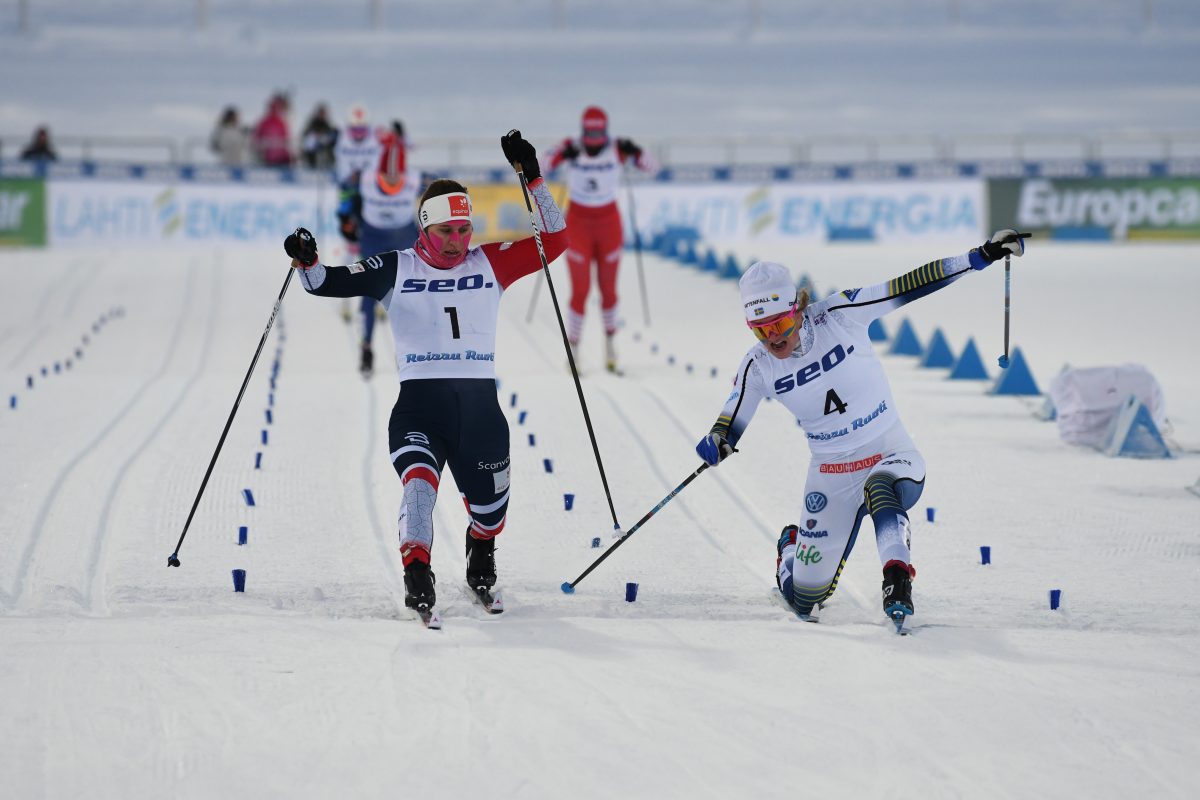
Ebba Andersson of Sweden in bib 1 and placing first at the U23 World’s 15 k skate. (Photo: Doug Stephen)
U23 Women’s 15 k Mass Start
Sweden-Sweden-Sweden: Ebba Andersson, Moa Lundgren, and Emma Ribom went 1-2-3 for the all Sweden podium. If one thing is certain from our race coverage this season, we know Sweden is ready for World Cup podiums now. The U23 sweep in Oberwiesenthal, Germany at these U23 World Championships likely means more to come. Andersson crossed the finish line alone in 35:44.4. Lundgren came across 37.1 seconds back, Ribom 45.2 seconds behind.
In bib 5 Emma Ribom, and bib 4, Moa Lundgren, both of Sweden, during the 15 k mass start. (Photo: Doug Stephen)
For Andersson, a World Cup regular, this was her second win of these Championships – she won the 15 k classic on Tuesday. One third through the race, at 5 k, Adersson had stamped her authority on the masses, and has pulled away solo with a 11 second gap. That expanded to 17.5 seconds at 7.5 k, with the eventual doubling of that time-spread by the finish.
Skiing for the U.S., Haliey Swirbul (APU) was the top team finisher in 15th overall (+2:16.0)., Julia Kern (SMST2) placed 27th (+3:34.2), Sarah Goble (MTU) 39th (+4:52.2), and Alexandria Lawson (Middlebury) 46th (+6:38.6).
In bib 2, Hailey Swirbul of the U.S., and Johanne Hauge Harviken (bib 25) of Norway: U23 15 mass start skate. (Photo: Doug Stephen)
Canada’s Laura Leclair (Chelsea Nordiq) skied to 22nd (+2:49.9), Hannah Mehain (Sovereign Lake) 38th (+4:51.8), Annika Richardson (Lappe Nordic) 43rd (+5:15.3), and Laurence Dumais (Fondeurs Laurentides) 50th (+7:28.3).
The U23 men’s 30 k mass start skate became six skier affair by the mid-point at 15 k. With 5 k remaining, the three skiers constituting the eventual podium had separated for good. Norway’s Harald Østberg Amundsen won in 1:12:42. Russia’s Sergey Ardashev placed second (+7.4), and Håvard Moseby of Norway third (+40.5).
Norway’s Harald Østberg Amundsen winning the U23 World’s 30 k mass start skate. (Photo: Doug Stephen)
Amundsen and Ardashev flip-flopped their results from Tuesday’s 15 k classic in which the Russian bested the Norwegian by over a minute.
Canada’s Philippe Boucher (Commission de ski Nordique) was the top North American in 12th (+3:15.2). Antoine Cyr (Skinouk) placed 18th (+4:46.8), and Sam Hendry (Canmore Nordic) did not start.
Philippe Boucher of Canada skiing to 12th overall in the U23 men’s 30 k mass start skate. (Photo: Doug Stephen)
Zane Fields (Ford Sayre), for the U.S., placed 22nd (+5:28.2), Hunter Wonders (APU) 24th (+5:41.2), Finn O’Connell (UVM) 44th (+9:53.8), and Zak Ketterson (APU) did not start.
For the U.S., Zane Fields (bib 39), and Hunter Wonders: U23 World’s 30 k mass start skate. (Photo: Doug Stephen)
Sweden’s Ebba Andersson, off the World Cup and at U23 Worlds; wining the U23 10 k classic. (Photo: Doug Stephen)
Doubling up in this U23 World’s 10 kilometer and 15 k interval start classic rundown.
U23 Women’s 10 k Classic
Yes, Sweden’s Ebba Andersson remains a U23 despite her clutch fourth overall in the SkiTour 2020. The force that is Andersson took her talents to Oberwiesenthal, Germany where she tapped out the 10 k classic win in 28:28.7 minutes.
This was a race, beyond the likes of Andersson, where some shifting occurred after the race’s midpoint at 5 k. Emma Ribom of Sweden clocked in first at that time-check in 12:24.4. Andersson was second (+3.1), with the eventual silver medalist, Marte Maehlum Johansen of Norway back in seventh place at 29.4 seconds back.
The last 5 k saw Andersson’s pacing pay off with the win. Johansen moved up in the standings to finish second overall (+24.8), while Ribom bumped back into third (+30.2).
Julia Kern racing to fourth in the U23 World’s 10 k classic. (Photo: Doug Stephen)
For the U.S., Julia Kern (SMST2) continued her run for the U.S., after placing third on Sunday’s skate sprint, to place fourth overall (+38.0). Her World Cup teammate Hailey Swirbul (APU) skied to seventh (+1:03.8). Also for the U.S., Amanda Kautzer (MTU) was 41st (+3:55.8), and Alexandra Lawson (Middlebury) 43rd (+4:06.4).
Annika Richardson (Lappe Nordic Ski Club) was the top Canadian in 37th (+3:38.6), Hannah Mehain (Sovereign Lake) was 40th (+3:53.9), and Laurence Dumais (Fondeurs Laurentides) 51st (+5:19.3).
Russia’s Sergey Ardashev won the men’s 15 k classic by just over a minute in 36:26.5. Norway’s Harald Østberg Amundsen placed second at 1:02.0, and France’s Hugo Lapalus third at 1:35.6.
Hunter Wonders (APU) of the U.S., was the top North American in eighth place (+2:03.1). For the twenty-one-year-old Wonders, this was his top career individual Junior or U23 World’s result. Logan Diekmann (U of Utah), also for the U.S., placed 38th (+3:54.0), Zak Ketterson (NMU) 48th (+4:36.7), and Finn O’Connell (UVM) 51st (+4:50.4).
Canada’s Graham Ritchie skiing to 13th overall in the U23 15 k classic. (Photo: Doug Stephen)
Canada placed three skiers in the top-30. Graham Ritchie (Big Thunder Nordic) led that charge with a 13th place (+2:28.8). Sam Hendry (Canmore Nordic) was 18th (+2:49.2), Antoine Cyr (Skinouk) 30th (+3:23.8), and Philippe Boucher (Commission de ski nordique) 52nd (+5:03.9).
Sam Hendry skiing to 18th in the U23 15 k classic. (Photo: NordicFocus)
Racing continues on Thursday for the U23s with a 15 k/30 k mass start skate.
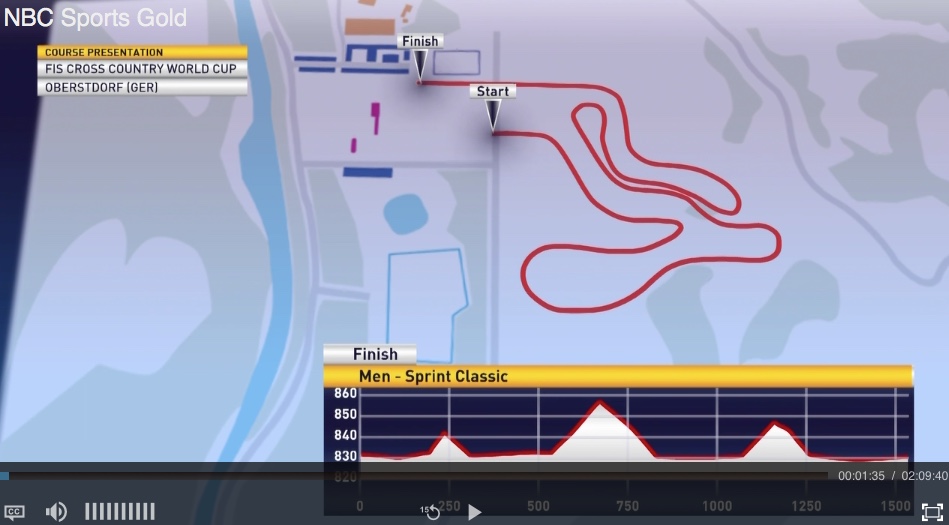
Sunday’s men’s 1.5-kilometer classic sprint course in Oberstdorf, Germany deserves some recognition. Site of the 2021 FIS Nordic Ski World Championships, racers were offered a glimpse into how the world’s foremost sprinter, Johannes Høsflot Klæbo of Norway, would navigate it’s kicker climbs, steep descents, and roughly three minute and thirty-second effort.
The sprint course offered three distinct climbs, one at 0.2 k, the largest at 0.52 k, and the third starting at 1.1 k. The descents mirrored the inclines of the ascents and offered little respite or recovery for skiers near their engine’s redline.
We are focusing on Klæbo, despite the other twenty-nine skiers in the heats, because he was simply a master of pacing, a master of conserving energy on the three-climb course, and freakish in his ability to run away from his five competitors in the final.
Klæbo qualified in first. The margin back to Erik Valnes of Norway in second was 2.72 seconds. Pål Golberg, the third-fastest qualifier was 5.03 seconds back. There were big-time gaps back to the field of qualifiers.
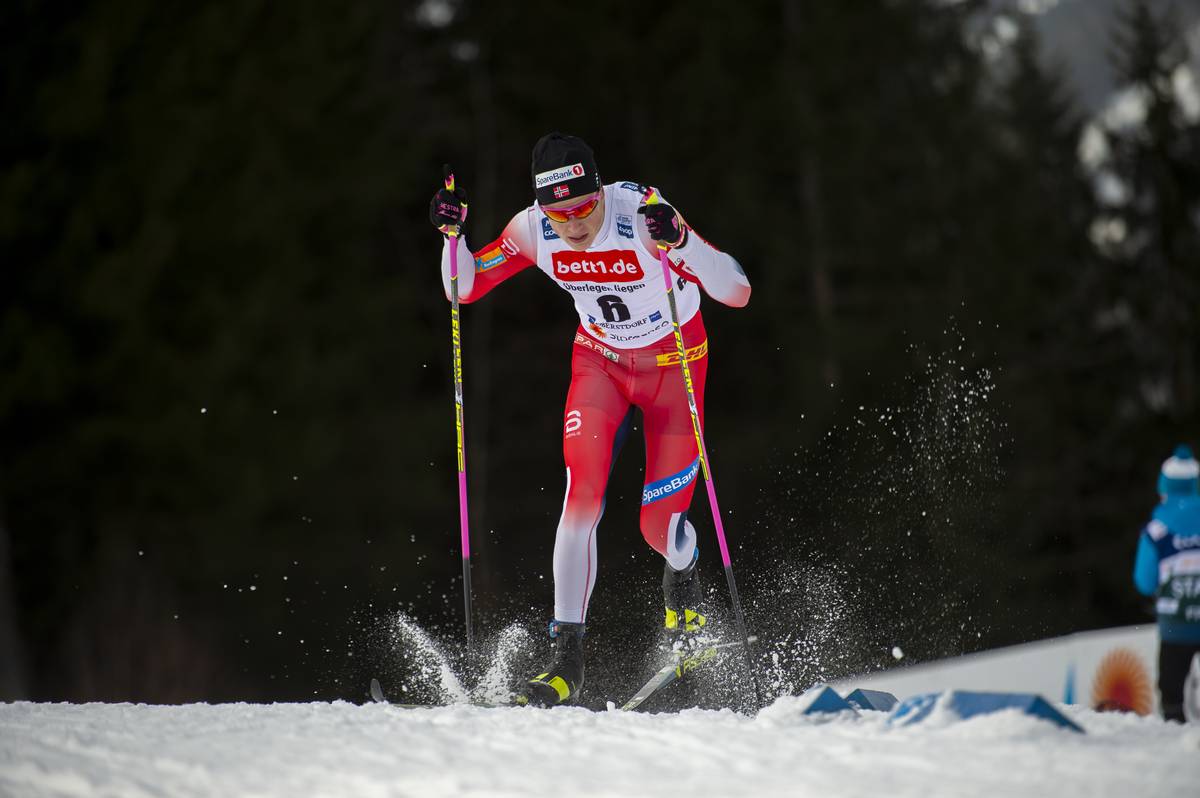
Johannes Høsflot Klæbo crushing the men’s sprint qualifier in Oberstdorf, Germany. (Photo: NordicFocus)
Valnes and Klæbo opted for the first quarterfinal. It was here that Klæbo played his tactical hand. He was in no hurry on this endurance sprint course to move to the front and pull others along in his wake. Klæbo sat in fourth on the second hill as Valnes was the heat’s workhorse. Klæbo appeared relaxed, not itching to move to the front. Klæbo moved to third around 2:00 minutes as they crested the course’s highpoint. The third hill, as most sprinters appeared on fumes, is where Valnes and Klæbo pulled ahead. Over the top, the duo glided into a 20-meter lead. Down the stretch, Valnes poled ahead for the quarterfinal win as Klæbo pulled up, stopped poling several meters before the finish — as if he were checking out for a lunch break.
The third hill would be Klæbo’s charm.
Along with Valnes in the first semifinal were Italy’s Federico Pellegrino (4th qualifier), Golberg, Håvard Solås Taugbøl also of Norway (5th qualifier), and Russia’s Sergey Ardashev. This would be the semifinal to watch.
Again, Klæbo played the conservation of energy tactic. Up the second climb, Golberg, Taugbøl, Valnes, and Pellegrino strode four across with Klæbo lurking a meter back. The second hill was in the rearview mirror around the two-minute mark. It’s approximately another twenty seconds of descent and working flat before the next decisive climb.
As the skiers approached the base at 2:26, Klæbo and Valnes ramped up – they pulled away as they ski-ran up and over the top. Klæbo had been sitting behind Valnes, sucking up in his draft into the final straight. There, Klæbo pulled around his teammate for the semifinal win.
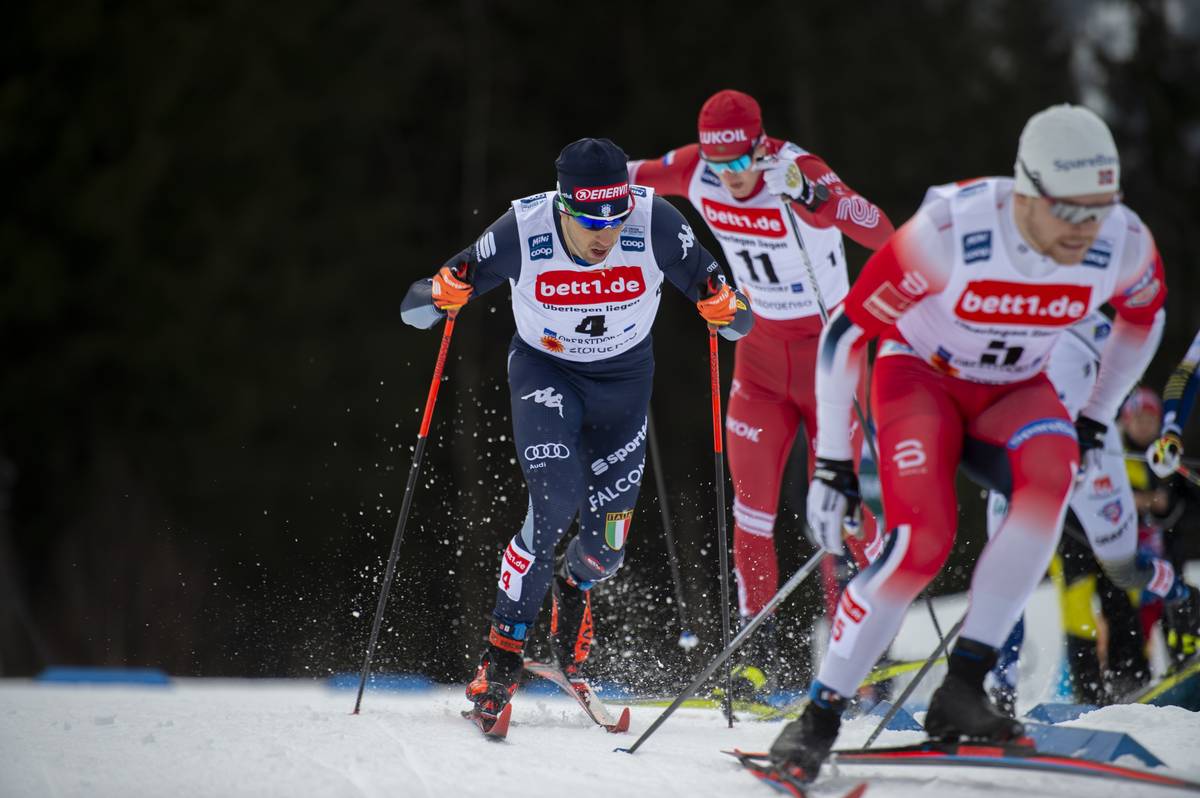
Federico Pellegrino of Italy pushing over the top in the Oberstdorf, Germany classic sprint. (Photo: NordicFocus)
The final featured Klæbo, Valnes, Golberg, Pellegrino, and Oskar Svensson of Sweden and Russia’s Gleb Retivykh. Really, for Klæbo, this was essentially a rematch of his semi.
Again, Klæbo was cautious from the start. There was no real earnestness to shoot to the front. His show would come later. There was only patience from an athlete who knew he could pounce late in the game.
Pellegrino, on the second climb, began to accelerate. He ran outside the tracks in what looked less like a decisive move, and more a burst to position himself tactically in front over the top. For his part, Klæbo matched Pellegrino and strode up alongside the Italian.
At 2:35 at the base of the final climb, Klæbo unleashed. It was textbook Klæbo-running. He was gone with a near 20 meter gap over the top. By the finish line, Klæbo looked to put 10 more meters on his competition as he won in 3:29.46. Golberg was second (+1.99), Valnes third (+2.37), and Pellegrino fourth (+3:06).
In yesterday’s 30 k skiathlon, Klæbo registered a rare DNF (did not finish) as he pulled from the competition.
“I think the sprint was much better than the 30 k yesterday,” Klæbo told FIS after the race. “Yesterday was a really terrible day and today was a bit better. In the end, it was really cool to win here. Yah, I think my shape isn’t the best but I am really happy to find the win here and to have the Norwegian guys here.
“I think it was a really good decision yesterday to jump off after 15 k I think, it was really nice to fight for a win today. And for sure I am really looking for the World Championship here next year.”
Johannes Høsflot Klæbo of Norway cruising in for the Oberstdorf, Germany classic sprint win. (Photo: NordicFocus)
Hands up for the win: Johannes Høsflot Klæbo makes it 5 for 5 for sprints this season. (Photo: NordicFocus)
What was clear after today was that Klæbo had mastered the course. Anything can happen in a year. And anything can go down in a sprint – broken poles, clipped skis, or slide out on a corner. This much was true exiting Oberstdorf: it will be Klæbo’s race to lose at the 2021 World Championships.
It was a down day for the American men. No skiers qualified for the heats. Simi Hamilton placed 32nd overall and was +15.94 in qualification. Andy Newell was 41st (+17.48), Tyler Kornfield 55th (+20.88), and Noel Keeffe 64th (+25.33).
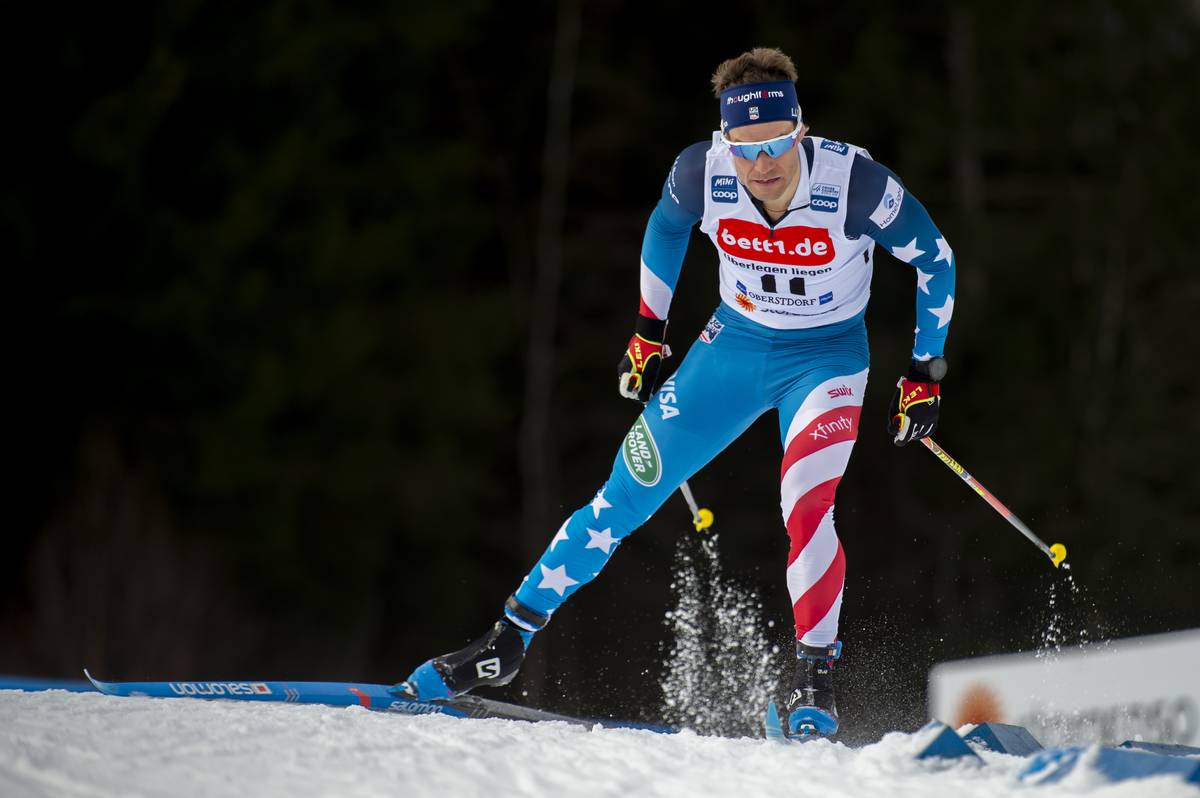
Simi Hamilton during the Oberstdorf, Germany classic sprint qualifier. (Photo: NordicFocus)
Andy Newell during the sprint qualifier in Oberstdorf, Germany. (Photo: NordicFocus)
For Canada, Bob Thompson placed 54th and was +20.14 in the qualifier, Paul Grall-Johnson was 58th (+21.74), and Graham Ritchie 61st (+22.92).
World Cup Standings Shakedown
Coming out of Oberstdorf on the men’s side, Russia’s Alexander Bolshunov remains in command. In first overall with 1457 points, Bolshunov has a 235 point lead on second place Klæbo for the overall lead. Sunday, Bolshunov earned 36 World Cup points after placing seventh overall, Klæbo earned 100 points for the sprint win. If you are keeping score at home, you will note 140 points for Bolshunov’s win in Saturday’s 30 k skiathlon. On yesterday’s course, racers had four opportunities to score bonus points – Bolshunov snatched up 40 of them during the race.
Alexander Bolshunov of Russia in the yellow bib. He leads the overall World Cup. He placed 7th on Sunday’s classic sprint in Oberstdorf, Germany. (Photo: NordicFocus)
Klæbo leads the sprint overall with 350 points. This was Klæbo’s fifth sprint win of the season. He has won every sprint entered thus far. He skipped the skate sprints in Planica, Slovenia and Dresden, Germany.
The World Cup takes a break next weekend and restarts in Falun, Sweden with a classic sprint on February 8.
All Norway in the men’s classic sprint podium in Oberstdorf, Germany: Pål Golberg in second, Johannes Hoesflot Klaebo first, and Erik Valnes third. (Photo: NordicFocus)
With lickety-split snow and a two-lap course lined with fans, Stage 2 of the Tour de Ski (TdS) in Lenzerheide, Switzerland, a 1.5-kilometer skate sprint, sent a few ripples through the field, but solidified Norway’s Johannes Høsflot Klæbo as the TdS front runner.
Yesterday, Klæbo, in second place, ceded little time to two of his main rivals for the overall, Russians Sergey Ustiugov, who won Saturday’s mass start skate, and Alexander Bolshunov, who placed third.
Sprint courses are the real canvas for Klæbo. With half of Sunday’s course splashed in sunshine while the other sunken in deep shadows, Klæbo was able to use his tactical smarts and his explosive finish to conserve energy, pounce when it mattered, and take the win. Which, it so happens, came with a plentiful stash of time in a 60-second time bonus.
Johannes Høsflot Klæbo sprinting to the Stage 2 TdS win. (Photo: NordicFocus)
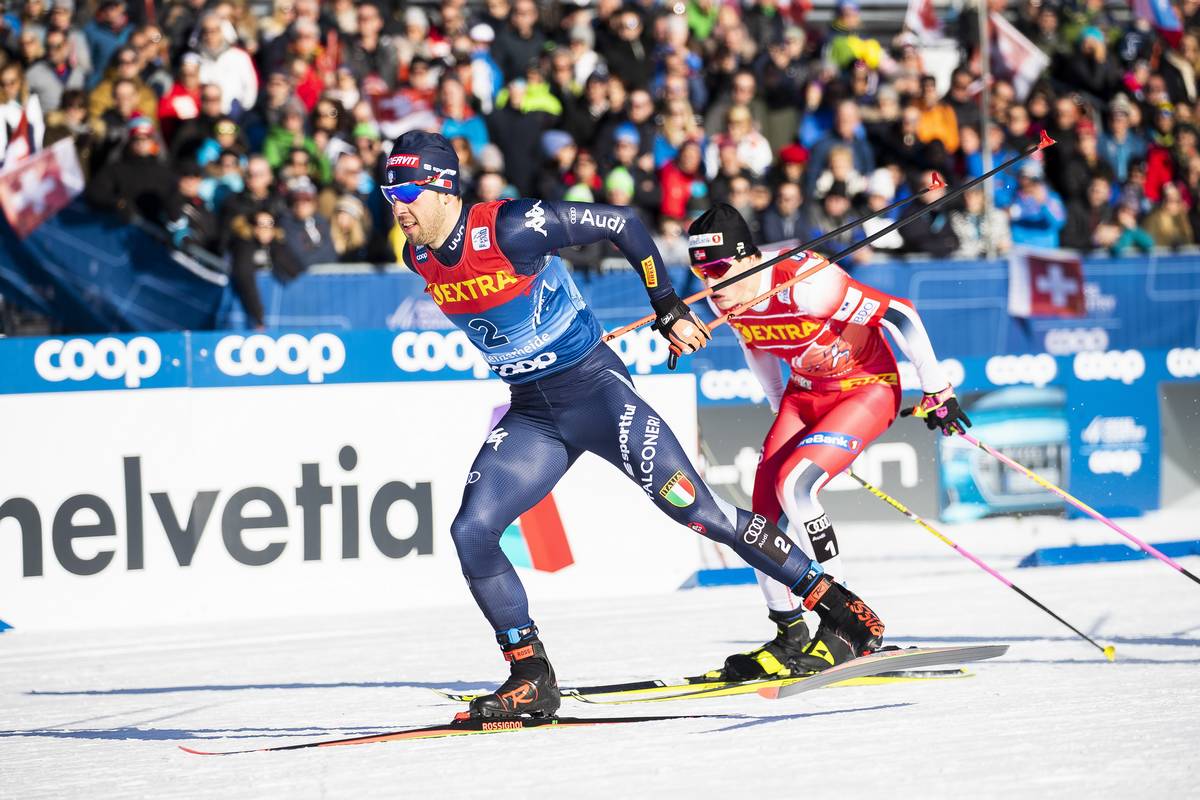
Klæbo began the day qualifying in first with a time of 2:44.64. Nearly matching his pace was Italy’s prayer for skate sprint salvation, Federico Pellegrino, who punched the clock in 2:45.84.
The duo went 1-2, Klæbo then Pellegrino, in the first quarterfinal which allowed the pair ample time to rest prior to the semis. In the first semi, it again was Klæbo-Pellegrino, 1-2 to advance.
The skate sprint powerhouses: Federico Pellegrino (ITA) and Norway’s Johannes Høsflot Klæbo (NOR) during Stage 2 of the 2019-2020 TdS. (Photo: NordicFocus)
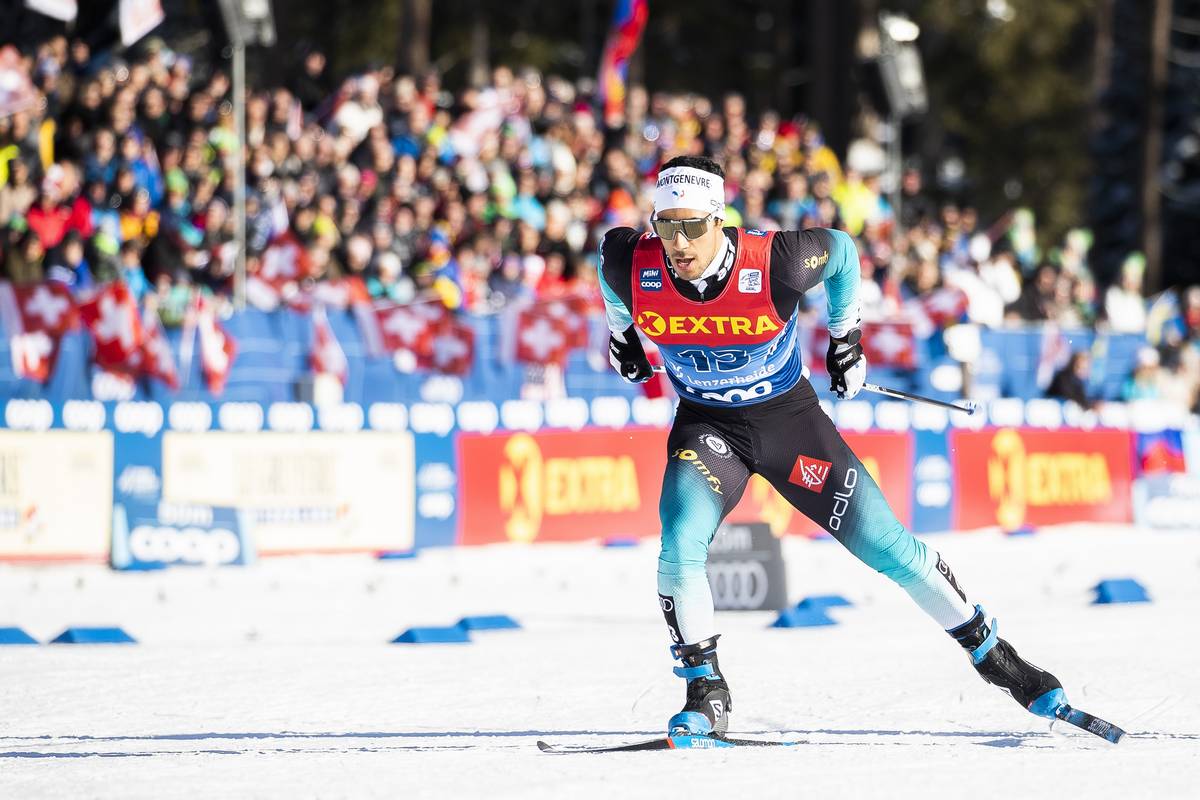
The men’s final featured Klaebo, Pellegrino, Richard Jouve of France, Pål Golberg of Norway, Russia’s Gleb Retivykh, and Johan Haeggstroem of Sweden. Jouve, who qualified in 13th, and advanced after placing second and first respectively in his quarterfinal and semi, went out in the final with a statement as he tried to secure his first career World Cup win.
Jouve went to the front immediately after leaving the start gates. The pace nothing too tepid, more of a control move to keep a potential podium in sight amidst the attacking prowess of Klæbo and Pellegrino.
A minute into the final, Jouve pushed along the shaded back straight to produce a line of six skiers – Klæbo in third, Pellegrino in fourth. With the sweeping left-hand turn which returned skiers to sunshine and the main stadium, the pace took on a this-is-for-real tempo. Jouve maintained his position upfront as they climbed out of the stadium. Klæbo sat back, several feet to the right of Jouve, safely out of traffic.
Richard Jouve of France placed third in Stage 2 of the TdS in Lenzerheide, Switzerland. (Photo: NordicFocus)
On the long descending straight on the backside of the course, just before their second time through the sweeping left back into sunshine, Pellegrino lets his skis glide him into a position behind Jouve. Klæbo kept wide and outside as they rounded the corner into the final straight.
Midway through the turn, Klæbo was textbook sprint wunderkind: he boosted ahead with a quick-turnover but equally powerful V2 to seal it. He won in 2:55.33. Pellegrino, who stuck in Klæbo’s draft down the straight, pulled past Jouve to take second (+0.35). Jouve was third (+0.57).
Hunting the finish line – Norway’s Johannes Høsflot Klæbo during Stage 2 of the 2019-2020 TdS. (Photo: NordicFocus)
With the Stage 2 win, Klæbo earned that aforementioned 60-second time bonus, and the TdS overall lead. His total time after two stages rests at 35:07. He sits 32 seconds ahead of Russia’s Bolshunov, who is second in the overall after placing eighth in the sprint, earning him a 30 second time bonus. Ustiugov, placed 11th in the sprint (24 second time bonus) and is positioned fifth overall at 34 seconds back.
Both Bolshunov and Ustiugov stayed at the front of their semi for the first lap. That semi also featured Klæbo and Pellegrino. Bolshunov faded to fourth as the second lap ensued, while Ustiugov maintained his spot at the sharp end. Down the home stretch, they were swallowed into the Klæbo-Pellegrino maw.
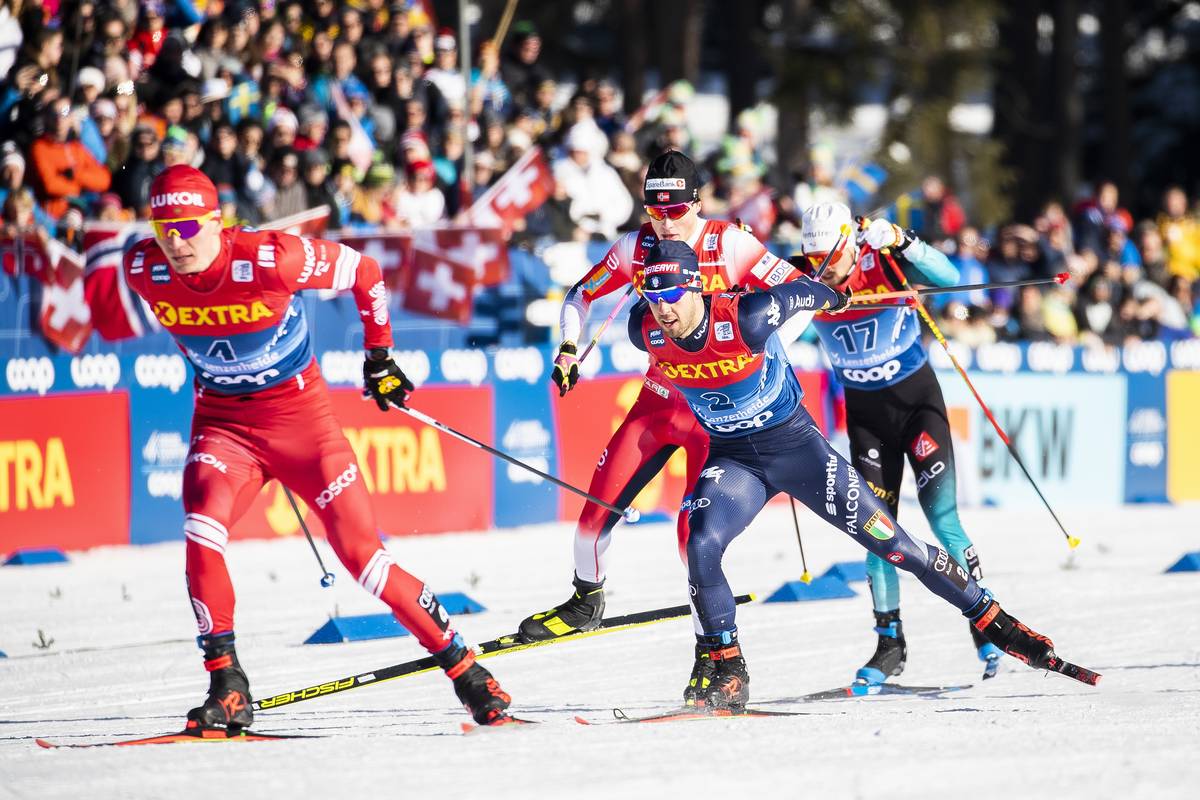
Alexander Bolshunov (RUS) pushing the pace while chased by Federico Pellegrino (ITA), Norway’s Johannes Høsflot Klæbo (NOR), and France’s Renaud Jay during the men’s TdS Stage 2 skate sprint in Lenzerheide, Switzerland. (Photo: NordicFocus)
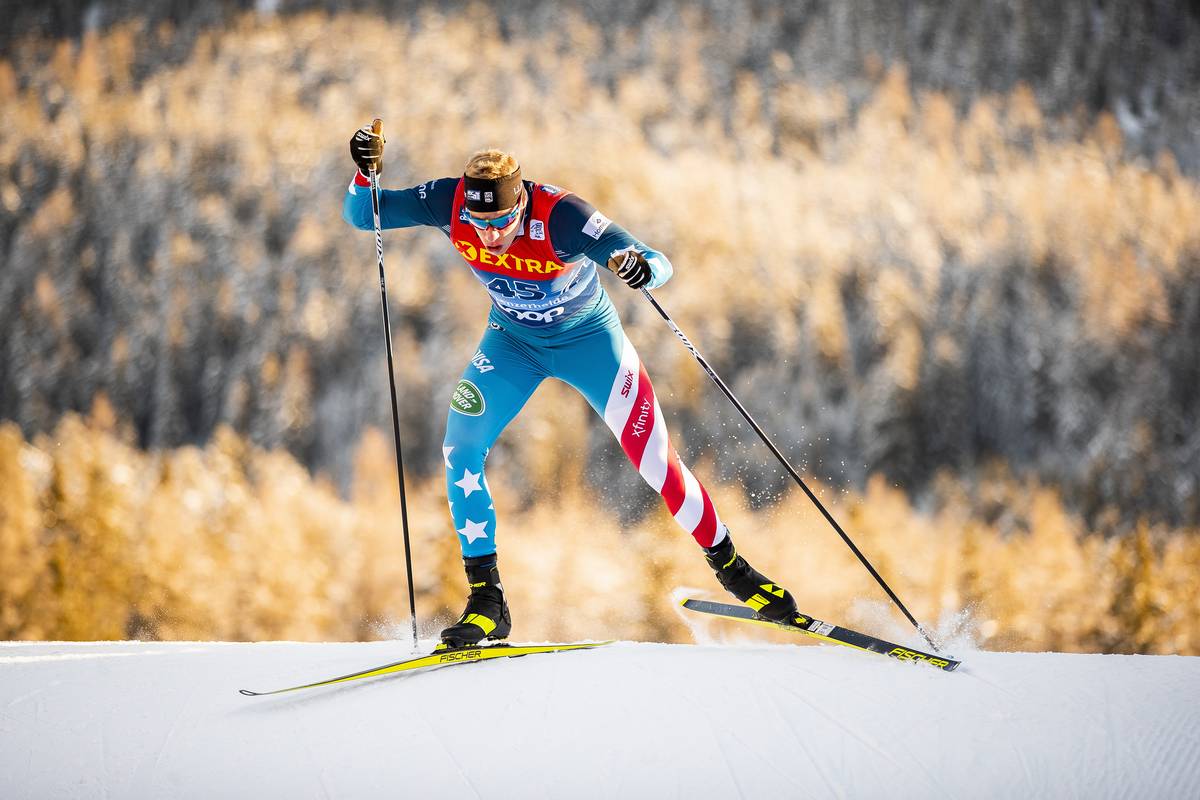
For the U.S. men, two standout qualifiers marked a successful day. Logan Hanneman qualified in 10th (+4.56) and Kevin Bolger in 12th (+4.72).
Hanneman finished 21st for a career-best World Cup result. He placed fifth in the fourth quarterfinal after getting hung up in a crash as Slovenia’s Miha Simenc and Norway’s Jan Thomas Jenssen tangled a meter ahead.
“I am quite happy with the day, even though it ended with a crash,” Hanneman emailed. “The qualifier was definitely the highlight. I honestly didn’t feel that great, so I was a little bit worried when I hit the hill on the first lap. But then I just tried to ski really big when I lapped through, abs apparently I was going faster than I thought I was.
“In the heat, everything was going well, and I was set up for a good position into the final downhill, however on the corner just after the short steep climb, the Norwegian and Slovenian came in from the outside, and collided with one another. I was directly to the inside of them and a little behind, so I had nowhere to go but to crash into them.
So it goes I suppose, but I was getting excited for the final push into the finish.
“My plan for the next few days is really to race as hard as I can in the distance races. They are not my strong suit, and I would really like to make it to the end of the Tour, so keeping within the time-back requirement would be awesome. So we will just take one at a time and see how they unfold!”
Bolger placed fifth in the third quarterfinal to place 22nd overall in the sprint.
Logan Hanneman placed 21st during the Stage 2 TdS skate sprint for a career best World Cup result. (Photo: NordicFocus)
Kevin Bolger placed 22nd overall in the TdS Stage 2 skate sprint in Lenzerheide, Switzerland. (Photo: Nordic Focus)
Racing continues for the men on Tuesday with an 15 k interval start skate in Tobalch, Italy. Monday is a rest day.
Moa Lundgren of Sweden out lunges Norway’s Tiril Udnes Weng for the win during the U23 World championship 1.4 k classic sprint in Lahti, Finland. (Photo: Doug Stephen)
FIS Junior World Ski Championhips U23 1.4 k/1.6 k Classic Sprint
Monday, the second day of racing at the 2019 Junior World Ski Championships in Lahti, Finland the U23 women raced a 1.4-kilometer classic sprint.
Norway’s Tiril Udnes Weng set the standard in qualification. Her 3:26.52 minute time placed her in bib 1 for the heats.
Three U.S. skiers qualified for the heats. Julia Kern qualified in 16th (+9.09), Hannah Halvorsen 24th (+11.89), and Hailey Swirbul 25th (+12.31). The fourth U.S. entrant, Evelina Sutro placed 37th overall.
“Though it wasn’t a perfect day for the U23s, it was exciting to establish a baseline from which we can improve,” Swirbul emailed. “We were in the mix during the quarterfinals, and I think our team gave a good effort today but is left wanting more. Personally, I thought I had a good day. I felt good, had good skis, and raced to my strengths the best I could. I’m excited to see how this team and I progress over the next few years to keep moving up and up in the U23 division!”
Halvorsen skied in the second heat where she placed fifth (+2.39) behind heat winner Moa Lundgren. Lundgren posted a 3:24.60 finishing time in the heat and ultimately placed first overall. Halvorsen ranked 23rd in the final standings.
Swirbul and Kern were grouped in the third heat where they finished fifth and sixth respectively. France’s Delphine Claudel won the heat in 3:27.16, Swirbul was 1.31 seconds back, Kern 3.24.
Swirbul placed 24th overall, Kern 27th.
“It was a really cold day out there racing at the legal limit of -4F,” Kern emailed. “It was not the day I dreamed of, but I am looking forward to more races to come this week. I caught the tip of my ski on someone’s pole cornering the first 180 and took a fall. I was able to jump back up on my feet and hammer to catch up, but that energy cost me early on that I did not have cresting the last hill. It was really fun to get to race side by side with Hailey in the heat!”
For Canada, Sadie White finished 35th, Marie Corriveau 38th, Hannah Mehain 49th, and Natalie Hynes 55th.
Lundgren, who was the fourth fastest qualifier, won the women’s final in 3:18.33, only 0.05 seconds ahead of Weng in second. Russia’s Aida Bayazitova took third (+3.78). Anastasia Kirillova of Belarus was fourth (+4.12), Norway’s Amalie Haakonsen fifth (+7.75), and Johanna Hagstroem sixth (+37.54).
After racing on a slightly bigger World Cup stage, Valnes showed no nerves as he clean-sweeped the heats and the final which he won in 3:21.14 minutes. Russia’s Sergey Ardashev placed second (+1.38) and Norway’s Joachim Aurland third (+2.00).
In fourth place was Russia’s Ivan Yakimushkin (+2.59), Norway’s Sivert Wiig in fifth (+7.31), and Sweden’s Marcus Grate sixth (+15.53).
Canada placed three athletes in the heats after Ritchie Graham qualified in 19th (+12.32), Julian Smith 22nd (+13.39), and Antoine Cyr 24th (+13.84). Teammate Gareth Williams finished 52nd overall.
For the U.S., Peter Holmes advanced to the heats after qualifying in 20th (+13.05). Daniel Streinz placed 41st overall, Hunter Wonders 56th, and Braden Becker 63rd.
“It was a good day out in Lahti, sunny skies but brutally cold,” emailed Holmes. “The Junior’s performance the previous day amped me up and made me excited to race. I had a solid qualifier and was feeling very good in the quarter final. I was positioned well throughout the race, but unfortunately got tangled up with another skier in my heat on the last downhill and went down. It’s a bummer, especially at U23s, but that’s racing.”
No North Americans advanced beyond the quarterfinals. Holmes placed sixth in the first quarterfinal to conclude his day ranked 27th in the final standings.
Cyr was fourth in the second heat and placed 20th overall.
Smith and Graham were fourth and sixth respectively in heat four. Smith ranked 19th overall, Graham 26th.
Russia’s Alexander Bolshunov racing to first in the Blink Classics men’s 60 k on Wednesday in Sandes, Norway. (Photo: Blink Ski Festival/Facebook)
A predictor for the winter ski season ahead? Could be. Either way, Norway’s Blink Ski Festival, or as it’s called in Norway, Blinkfestivalen, remains the ultimate in rollerski racing and returned for the 12th year in a row on Wednesday.
The festival opened with elite men’s and women’s distance rollerski races, known as the Blink Classics. For the third-straight summer, the Blink Classics featured a 60-kilometer mass start for the men and a 50 k for the women.
Eighty-six men competed in Wednesday’s 60 k, which began in the city center of Ålgård and finished in the municipality of Sandnes. A complete course map, which deviated little from last year’s rendition, may be found by clicking here.
By the end of the men’s 60 k, it was Russia’s Alexander Bolshunov who finished first in 2:10:51.6 hours. The 22-year-old Bolshunov had a number of World Cup podiums last season and one win in the final 15 k of the year. He also earned three silver medals and one bronze at the 2018 Winter Olympics in South Korea.
Finishing just 5.9 seconds behind him was another Russian, 19-year-old Sergey Ardashev, in second place. The third elite man across the line was Norway’s Anders Mølmen Høst, 27, of the Lyn Ski club, who finished 1.8 seconds out of second place and 7.7 seconds back from first.
Norwegians occupied the rest of the top 10, with Tord Asle Gjerdalen in fourth (+8.1), Øystein Petterson in fifth (+8.3), Hans Christer Holund in sixth (+8.3), Sjur Røthe in seventh (+8.7), Simen Hegstad Krüger in eighth (+8.7), Runar Skaug Mathisen in ninth (+10.3) and Martin Johnsrud Sundby — the winner of last year’s Blink Classics 60 k — in 10th (+10.8).
Nearly half of the men’s field came from nations from outside Norway, with athletes hailing from Russia, France, Canada, the U.S., Great Britain, Finland, Sweden, and Italy. Canadian World Cup skier Alex Harvey was the top North American in 14th (+1:19.0).
Also for Canada, Scott James Hill placed 53rd (+11:00.0) and Bob Thompson was 56th (+11:53.1). Ian Torchia was the lone American in the event, racing to 55th (+11:52.3). Canada’s Evan Palmer-Charrette did not start.
Norway’s Kari Vikhagen Gjeitnes finishing first in the Blink Classics women’s 50 k on Wednesday in Sandes, Norway. (Photo: Blink Ski Festival/Facebook)
In the elite women’s 50 k, which had just nine finishers, Norway’s Kari Vikhagen Gjeitnes finished first in 2:21:19.0. Second place went to Astrid Øyre Slind, who crossed 33.9 seconds after Gjeitnes, and the third and final podium spot went to Poland’s Justyna Kowalczyk (+5:55.4).
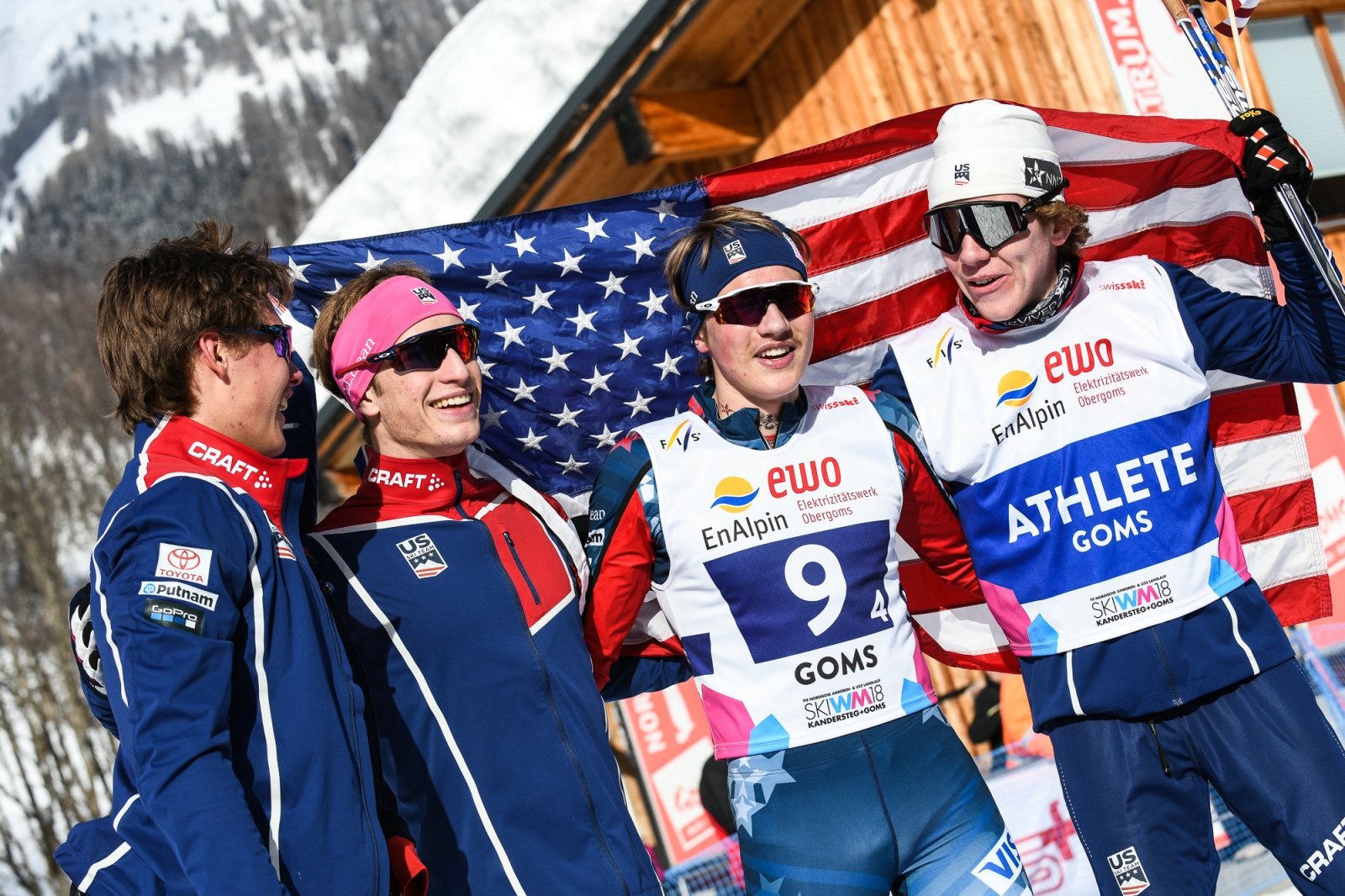
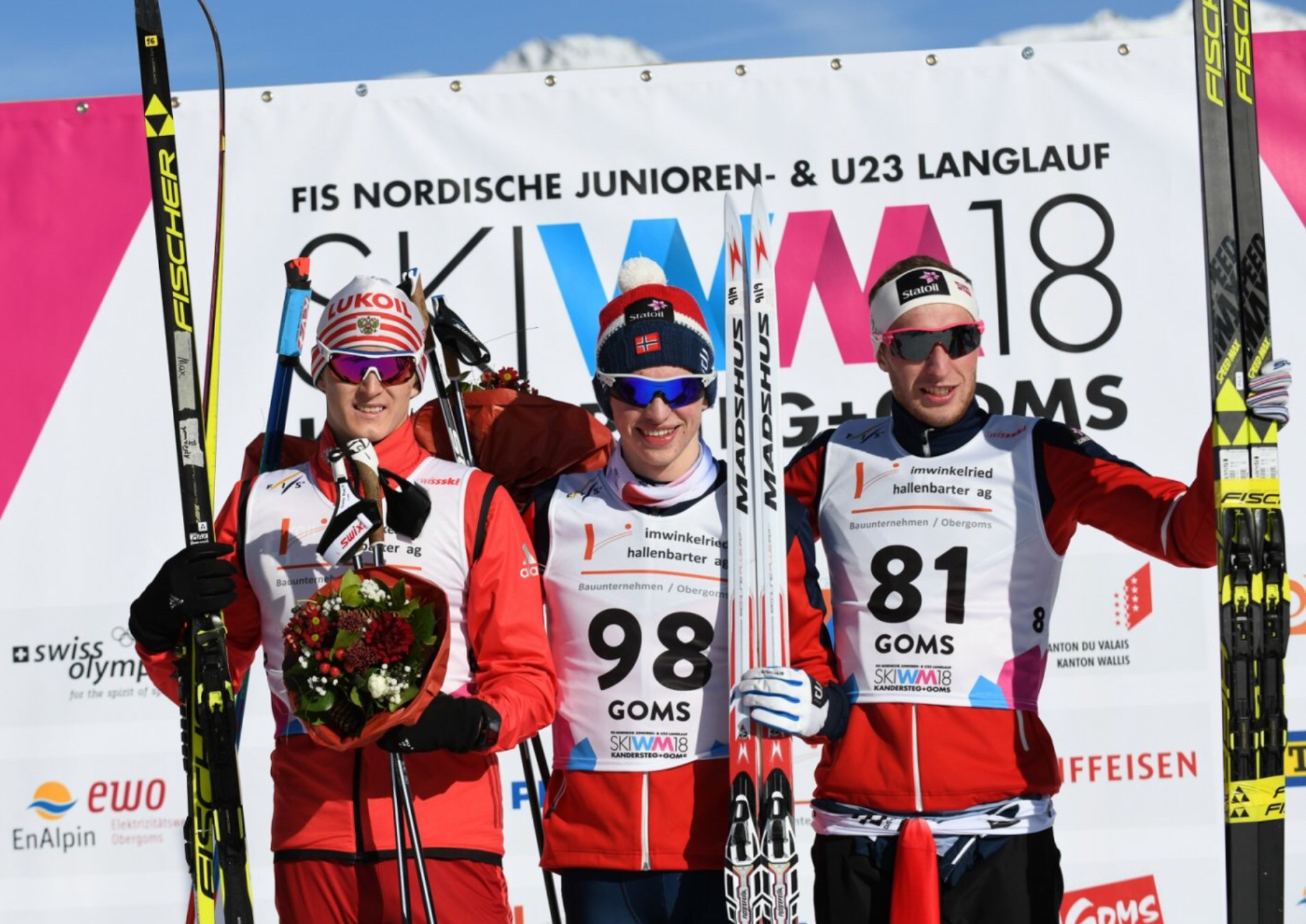
The U.S. men’s silver-medal relay at 2018 Junior World Championships in Goms, Switzerland, with (from left to right) Luke Jager, Hunter Wonders, Gus Schumacher, and Ben Ogden. (Photo: JWSC2018.ch)
(Note: This article has been updated to include comments from Americans Ben Loomis, Luke Jager and Gus Schumacher.)
Junior World Championships (Goms, Switzerland): Men’s and women’s relays
Two individual medals and a relay podium. That’s how the U.S. team fared this week at Junior World Championships in terms of a medal count, but the significance of its breakthroughs go way beyond the hardware.
Hailey Swirbul became the most successful American nordic skier at Junior World Championships with a silver and a bronze in the two women’s distance races. Then, on Saturday, the U.S. men took their turn in the spotlight, racing to second and almost first in the 4 x 5-kilometer relay for the best relay finish by an American team at Junior Worlds. Last year, the U.S. women placed third at 2017 Junior Worlds at Soldier Hollow in Midway, Utah.
Luke Jager started the team off on Saturday as the first classic leg, putting the U.S. men in sixth at the first exchange, 14 seconds behind Sweden in first.
While Sweden dropped to second on the next leg, the U.S. continued to move up, with Ben Ogden racing to fourth, 8.5 seconds out of first, behind Norway, Russia and France, respectively.
On the first freestyle leg, Hunter Wonders held the U.S. in fourth and tagged anchor Gus Schumacher in fourth, 31.3 seconds out of first. Norway continued to lead with France, and Russia skied about 5 seconds back in third with 5 k to go.
Schumacher then skied the fastest anchor leg to race up to second, passing France and finally Russia in the finishing straight, as he crossed the line 2.2 seconds behind Norway’s Jørgen Lippert — who eased up in the finish and secured the Norwegian gold with a total time of 50:04.2 minutes.
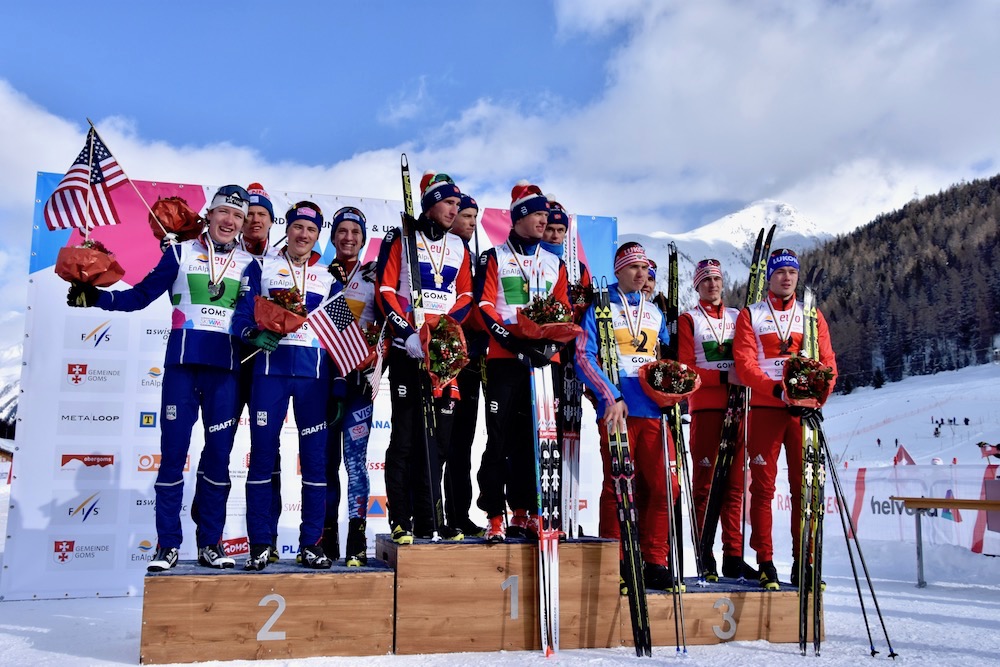
The men’s 4 x 5 k relay podium at 2018 Junior World Championships with Norway (c) in first, the U.S. (l) in second (Ben Ogden, Luke Jager, Gus Schumacher, Hunter Wonders), and Russia (r) in third. (Photo: Julia Kern)
The U.S. placed second, 3.3 seconds ahead of Russia in third (+5.5), and France finished fourth (+29.6).
Norway’s winning team included two men who won individual golds this week, Harald Østberg Amundsen (in the 20 k skiathlon) and Jon Rolf Skamo Hope (10 k classic), as well as Håvard Moseby and Lippert (who took bronze in two races).
Russia’s team was made up of Kirill Kilivnyuk, Sergey Ardashev, Yaroslav Rybochkin, and Alexander Terentev. Team France was Camille Laude, Hugo Lapels, Tom Mancini, and Pierre Tichit.
Canada placed 11th (+3:12.8) with Antoine Cyr, Ritchie Graham, Felix Longpre, and Etienne Hebert. Sixteen teams contested the men’s relay on the final day of Junior Worlds in Goms.
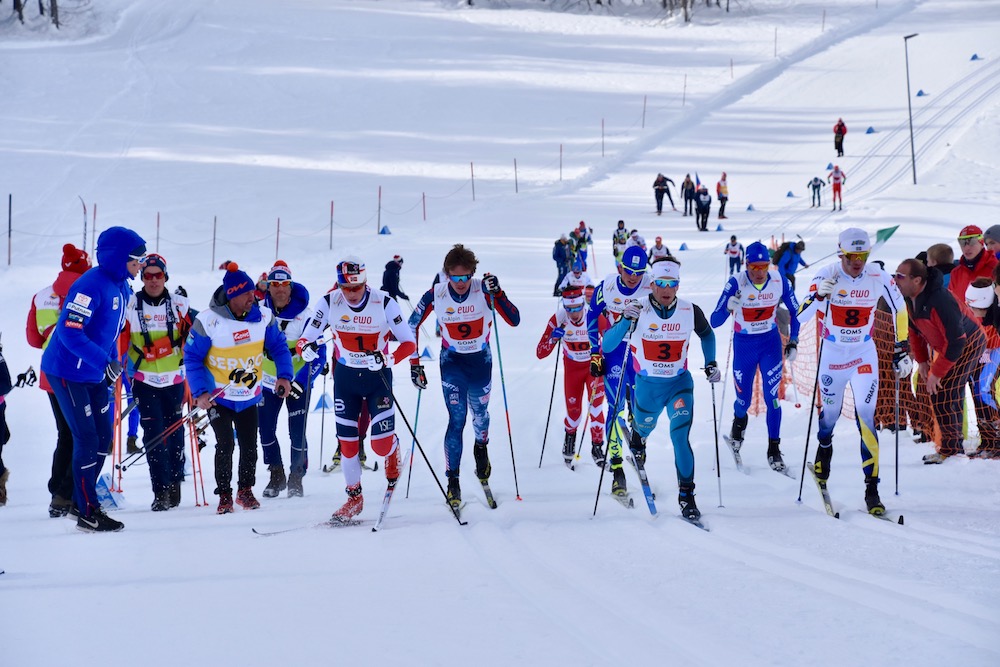
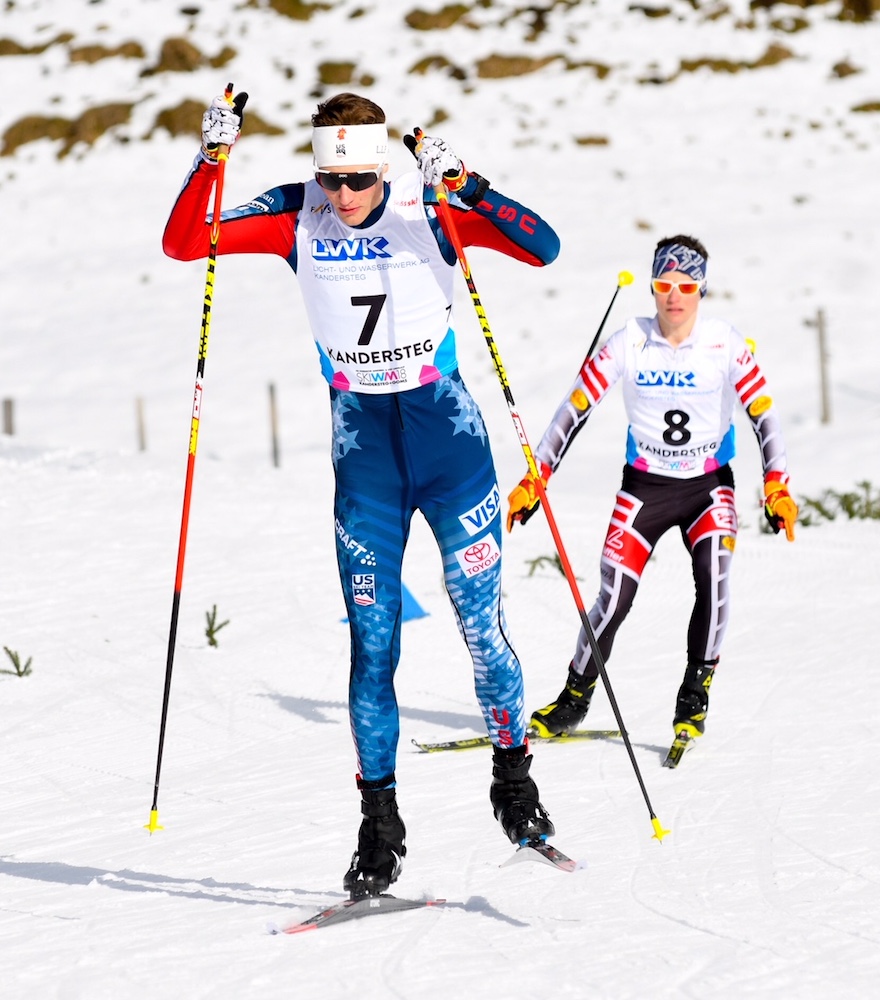
American Luke Jager (9) skiing with Norway’s Harald Østberg Amundsen (1), France’s Camille Laude (3), and Sweden’s Jacob Nystedt (8) during the first leg of the men’s 4 x 5 k relay on Saturday at 2018 Junior World Championships in Goms, Switzerland. (Photo: Julia Kern)
In an email, Jager, who turned 18 last month, explained that he was grateful for the opportunity to race at his first Junior Worlds.
“I barely qualified for this trip after a tough week in Anchorage so my options for starts were super limited,” Jager wrote. “I got the sprint start last week which was pretty horrendous and then a guaranteed spot on the relay team. So I had the whole week to prepare and rest. Watching the boys all week we realized that a medal could be possible and we started targeting that super closely.”
But over the last week, Jager hadn’t been feeling well.
“I was feeling really really bad in the days following the sprint and could barely get out and ski for 60 minutes each day,” he recalled. “I had actually told [U.S. Ski Team Development Coach Bryan] Fish that if I continued to feel as bad as I had been I was gonna sit out the relay. But I started feeling better and better throughout the week and was feeling really good this morning.”
He had previously asked Fish if he could ski the scramble leg.
“Bryan was stoked about it too so that decision was easy,” Jager explained. “This group of dudes is perfect for each leg of a relay so we barely even needed to discuss order. I am definitely a stronger classic skier so I was stoked to be able to get some redemption for my poor form in the last month.”
Schumacher, 17, explained he found out the relay order on Friday night and “really started to get excited about it,” he wrote in an email. “We had some foreign friends say that they thought we could do well so that really helped confidence.”
From the gun, Jager expected a fast pace and pushed to put himself in the lead group while trying to conserve energy and avoid any tangles He locked onto Norway’s Amundsen and by the last climb on the second lap, found that the group was beginning to string out.
“I was thankfully able to hold on just enough to maintain connection with the leaders and put Ben in a position where he could do his thing,” Jager wrote. “I would have liked to be a little further up in the group when I tagged off to Ben but the Swedes’ first skier had done so much damage in the last minutes that we were all in single file and pretty much in survival mode up the last climb.”
Russia’s Alexander Terentev leading Norway’s Jørgen Lippert, American Gus Schumacher (9), and France’s Pierre Tichit (3) up a climb in the final leg of the men’s 4 x 5 k relay at 2018 Junior World Championships in Goms, Switzerland. (Photo: Julia Kern)
Fast-forward to Schumacher getting tagged in fourth in the final exchange, 31.5 seconds behind Norway in first, 30.9 seconds behind France in second, and 26.2 seconds behind Russia in third. Despite the gap, he believed he could close it.
“I definitely thought those three were in reach, and I wanted to catch them, if for no other reason than to keep clear of 5th and 6th,” Schumacher wrote. “I focused on really holding steady for the first 2k, then starting to push more, and I was able to catch that lead pack and then recover with them for the last sprint, which did end up really hurting.”
While he had distanced himself from France and secured third by the final hill, he hadn’t anticipated catching Russia or Norway.
“By the time I got through the downhill corner, however, I was closing fast on the Russian and realized I was right there,” Schumacher wrote. “I popped around the last corner and was almost even with Russia, then after a few seconds of sprinting I pulled ahead and he slowed down and I knew I had it.”
While Jager explained he’s not one to get very nervous about racing, Saturday was completely different.
“… Watching the rest of the race progress was one of the most nerve wracking experiences of my life,” he wrote. “When Hunter tagged off to Gus I knew we were really really gonna be in the fight for a medal. I’ve been racing Gus for most of my life and I know when that kid is gonna throw down and produce a miracle and I could see it…
“This is something this group of guys has been dreaming of and training for for a really long time now,” he added. “To be able to watch that dream come into fruition today was indescribable. Probably the best day of my life since Cole Morgan added me on Snapchat. We came here this year to show the world that US skiing is the real deal and that we’re here to stay and I think we did that. To be able to be a piece of that history was an honor.”
“Experiencing the podium here has been so cool,” Schumacher wrote. “I thought it was possible, but actually getting it feels amazing. This whole trip has been really cool even without this success, it’s such an amazing place and the team is tight. I think individually I anticipated results maybe a little better, but this seems about right, and as a team I think we all surprised ourselves. Together we can make some big waves.”
Germany Wins Women’s Relay; U.S. 8th
In the women’s 4 x 3.3 k relay earlier on Saturday, Germany took the win by 8.6 seconds over Russia with a winning time of 39:17.4. Sweden finished third, 47.5 seconds out of first.
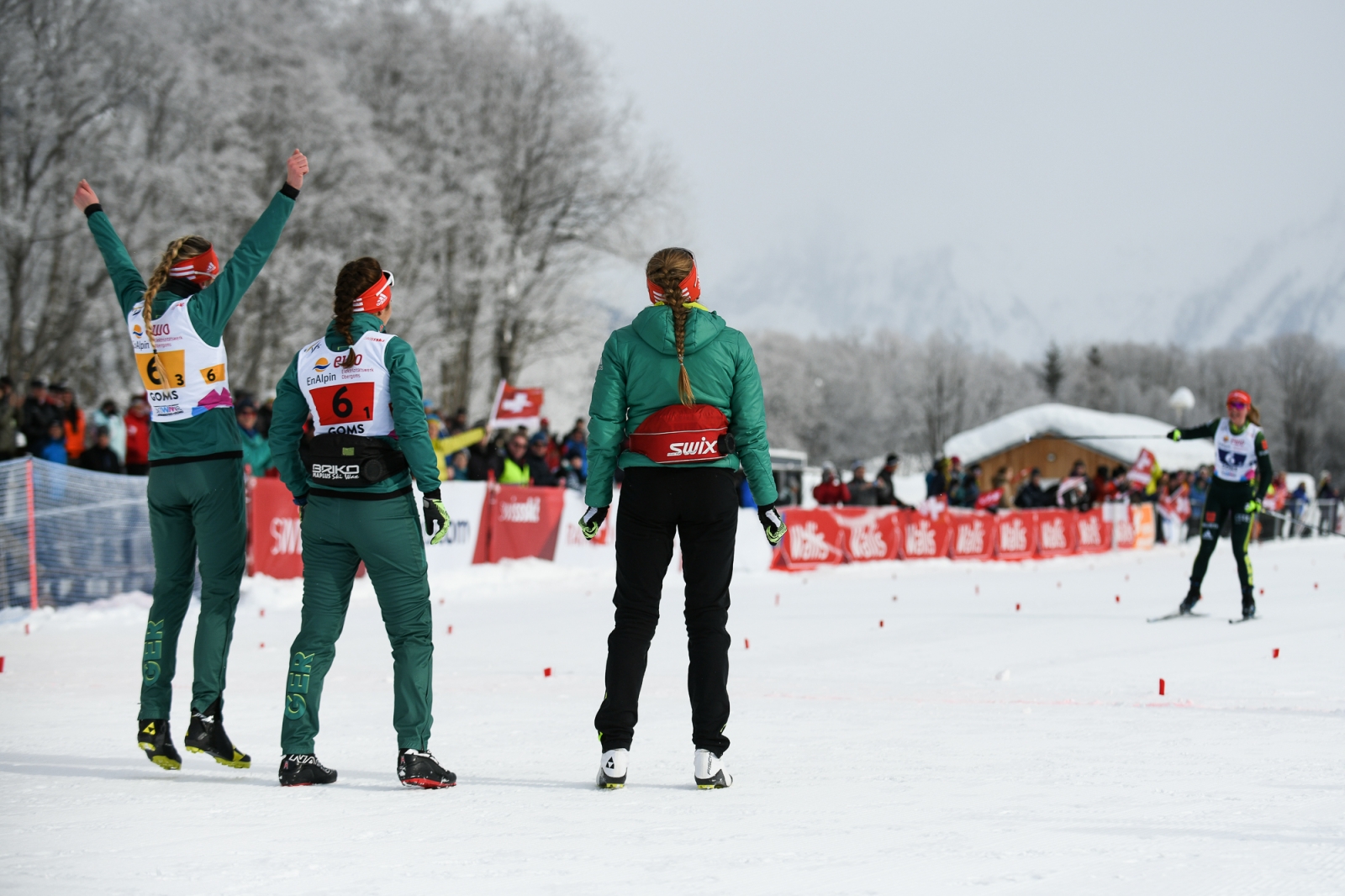
Germany’s Alexandra Danner, Celine Mayer and Lisa Lohmann await their teammate Anna-Maria Dietz at the finish of the women’s 4 x 3.3 k relay on Saturday at 2018 Junior World Championships in Goms, Switzerland. Germany placed first and Russia finished second, 8.6 seconds later. (Photo: JWSC2018.ch)
Germany (Alexandra Danner, Celine Mayer, Lisa Lohmann, Anna-Maria Dietz) improved from third on the first leg, to second on the second and third legs, and final first on Dietz’s anchor leg.
Russia (Polina Nekrasova, Hristina Matsokina, Nina Dubotolkina, Maya Yakunina) led the race from the first through the third and final exchange, before slipping to second at the finish.
Sweden (Tua Dahlgren, Frida Karlsson, Alicia Persson, Johanna Hagström) rebounded from 13th and more than a minute and a half back at the first exchange to tag in fourth and 28 seconds out of first thanks to Karlsson’s fastest second-leg time. By the final exchange, they were up to third and they held that position to the finish.
The U.S. women’s 4 x 3.3 k relay at 2018 Junior World Championships, with (from left to right) Hailey Swirbul, Kathleen O’Connell, Hannah Halvorsen, and Molly Gellert. They placed eighth on Saturday. (Photo: Julia Kern)
The U.S. placed eighth (+1:08.1) with Kathleen O’Connell, Swirbul, Molly Gellert, and Hannah Halvorsen. After O’Connell put them in eighth and about a minute back on the first leg, Swirbul skied them up to sixth with the second-fastest second leg, 30.1 seconds out of first. Gellert held onto that position on the first skate leg, but Halvorsen slipped two places on the anchor leg to finish eighth.
Canada finished 15th (+4:47.8) out of 16 teams with Hannah Mehain, Natalie Hynes, Annika Richardson, and Alexandra Racine.
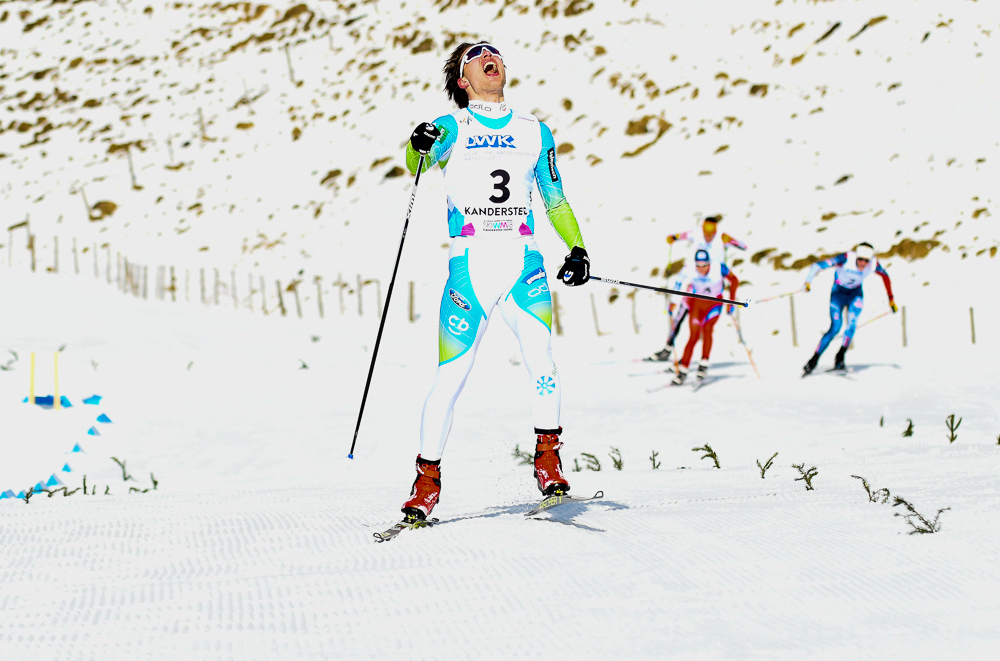
Slovenia’s Vid Vrhovnik (3) celebrates his win in the last nordic-combined competition of 2018 Junior World Championships, the individual normal hill/5 k, on Saturday in Kandersteg, Switzerland, while the Czech Republic’s Jan Vytrval, Austria’s Dominik Terzer and American Ben Loomis (r) battle for second. (Photo: JWSC2018.ch)
Nordic Combined Junior World Championships (Kandersteg, Switzerland): Normal hill/5 k Gundersen
In the final nordic-combined competition of Junior Worlds, American Ben Loomis nearly notched his second podium of the week, missing it by one-tenth of a second in fourth place.
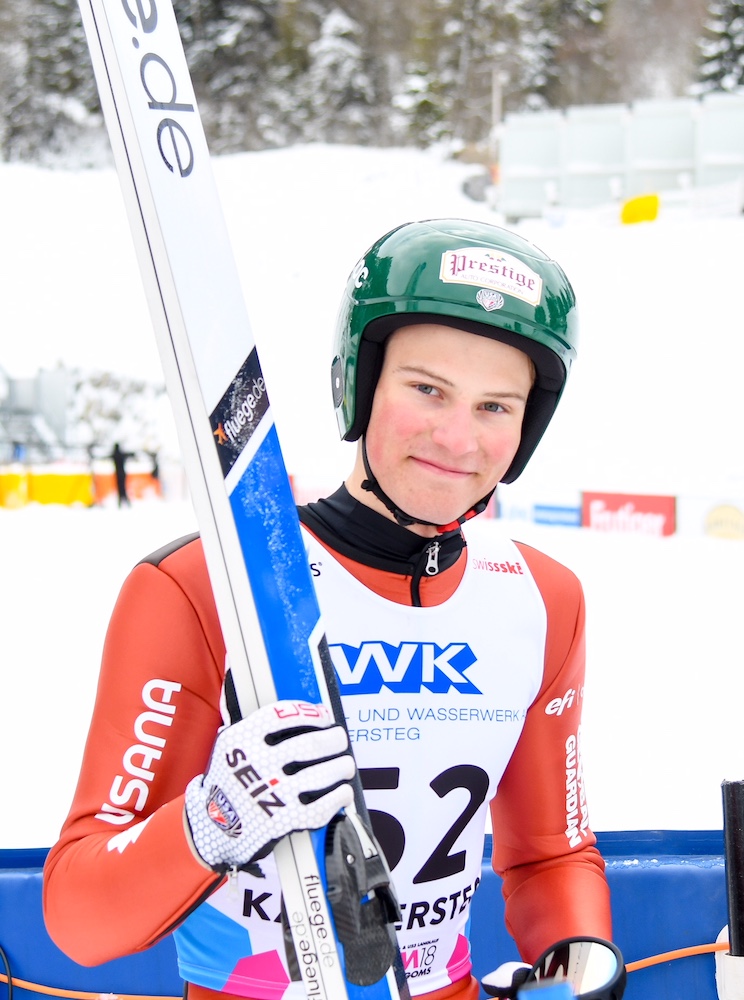
American Ben Loomis (7) leads Austria’s Johannes Lamparter during Saturday’s 5 k at 2018 Nordic Combined Junior World Championships in Kandersteg, Switzerland. Loomis went on to place fourth and Lamparter finished eighth. (Photo: Romina Eggert)
Slovenia’s 18-year-old Vid Vrhovnik won the individual normal hill/5 k Gundersen by 4.9 seconds over Austria’s Dominik Terzer. After posting the third-best jump on the 106-meter hill, Vrhovnik started the 5 k race 6 seconds behind Germany’s Luis Lehnert in first. Terzer jumped to second and started just 4 seconds behind, while the Czech Republic’s Jan Vytrval jumped to fourth and started 10 seconds back. Loomis jumped to seventh (just as he did on Tuesday before racing to third place) and started 27 seconds out of first.
“I was happy with my jump being closer in time to the front,” Loomis wrote in an email about his his jump, which put him about 10 seconds closer to the leaders than on Tuesday. “I didn’t feel quite as lucky with the wind. I was hoping to jump around the top 5, but 7th, only 27sec back was good, too.”
Over the two-lap 5 k, Vrhovnik battled with Terzer, while Lehnert slipped to seventh at the finish, 23.5 seconds behind. The Slovenian took the win by nearly five seconds over Terzer in 11:28.8, and Vytrval outlunged Loomis for third place (+5.4). Loomis placed fourth (+5.5), well ahead of Norway’s Einar Lurås Oftebro in fifth (+18.4).
Ben Loomis (USA Nordic) on the last day of 2018 Nordic Combined Junior World Championships in Kandersteg, Switzerland. He jumped to seventh and moved up to fourth in the 5 k. (Photo: Romina Eggert)
“I was able to catch places 3-6 on the first lap and ski with them through the beginning of the second lap,” Loomis wrote. “Towards the end of second lap I closed down on second place (Jan Vytral) with Dominik Terzer. On the last corner we packed up in positions 2-4.
“The finish started with a sharp downhill corner followed by a quick stretch less than 100 meters,” he continued. “I came into the finishing lanes in second but unfortunately took the wrong line and was passed by Dominik and never quite caught Jan in front of me.”
While he had been hoping for another podium, Loomis acknowledged that he was pleased to ski the fastest race time and “be battling at the front”.
“Overall I am leaving Switzerland with my goals accomplished and feeling satisfied,” he wrote. “It would have been nice to walk away with a double podium but I am still very happy with how to week went. This week has been a huge confidence booster going into the Olympics next week. I am very excited to represent my country and enjoy my time at the games. I am looking to have fun, take in experience and not overthink the results.”
Also for the U.S., Stephen Schumann placed 18th (+1:18.6), up one place from 19th in the jump, Jared Shumate finished 40th (+3:05.7), up from 48th in the jump, and Tucker Hoefler was 55th (+5:50.5), after jumping to 55th.
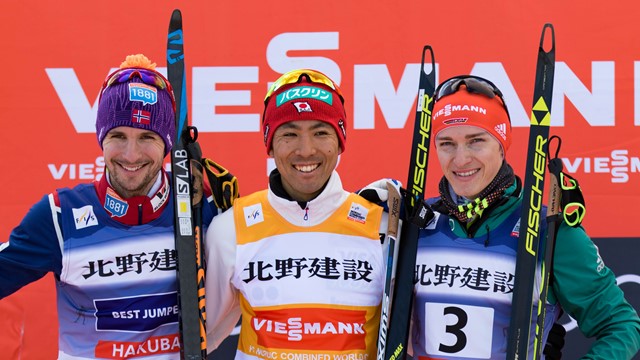
The podium at Saturday’s Nordic Combined World Cup in Hakuba, Japan, with Japan’s Akito Watabe (c) in first, Norway’s Jan Schmid (l) in second and Germany’s Manuel Faißt (r) in third. (Photo: FIS/Flawia Krawczyk)
Nordic Combined World Cup (Hakuba, Japan): Large hill/10 k Gundersen
Many of the winter-sports World Cups were off this weekend before the Olympics start in earnest a week from today in PyeongChang, South Korea, but not nordic combined, which had a World Cup stop in Hakuba, Japan.
There, local hero Akito Watabe took the win in 24:14.6 minutes, a whopping 1:12.6 minutes clear of Norway’s Jan Schmid in second. Germany’s Manuel Faißt placed third, 1:22 back, and Estonia’s Kristjan Ilves finished 52 seconds later in fourth (+2:14).
The lone American competing in Saturday’s 10 k Gundersen, Ben Berend achieved his first individual World Cup top 30, placing 23rd (+4:31.7) after jumping to 16th on Hakuba’s 134-meter large hill.
Watabe led from the beginning of the day after jumping to first, ahead ofIlves in second, Faißt in third, and Schmid in fourth. Watabe started the 10 k with a 16-second head start on Ilves, while Faisst started 52 seconds out of first and Schmid started 1:08 behind.
Berend started the 10 k with a 2:36 deficit to first, with five others within 10 seconds of him. His teammate Adam Loomis did not start the 10 k after jumping to 38th.
Another individual large hill/10 k Gundersen will be held on Sunday in Hakuba. The first nordic combined competition in PyeongChang, the individual normal hill/10 k, is set for Wednesday, Feb. 14.
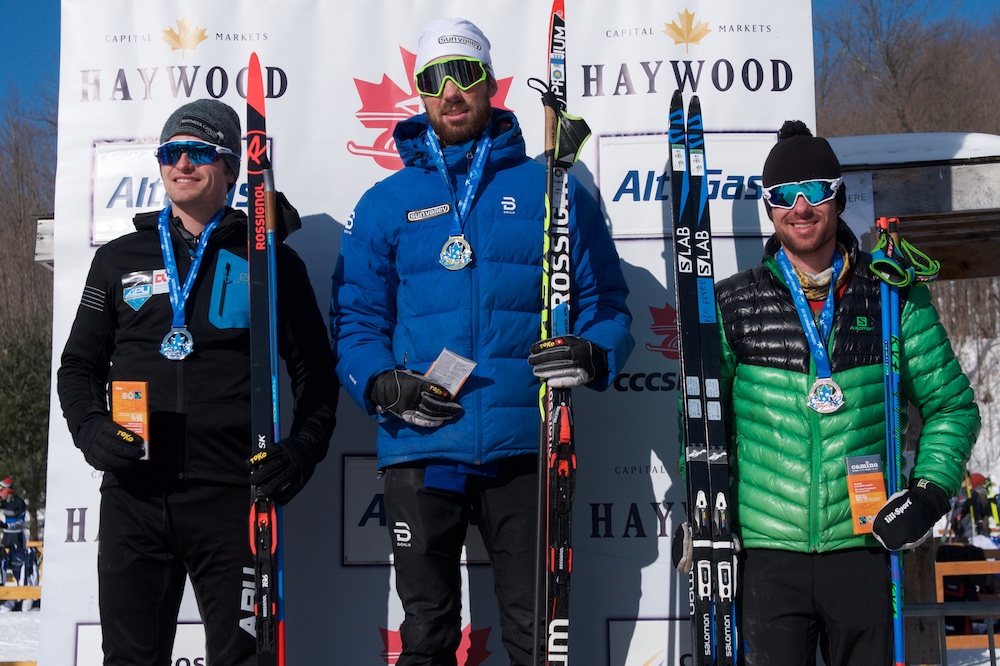
The men’s 15 k freestyle podium at 2018 Eastern Canadian Championships in Gatineau, Quebec, with Jack Hegman (c) in first, David Norris (l) in second and Tad Elliott (r) in third. (Photo: Rob Smith)
NorAm Eastern Canadian Championships (Gatineau, Quebec): 10/15 k freestyle
Americans swept the podium in both the men’s and women’s freestyle individual starts on Saturday at Eastern Canadian Championships in races that count toward both NorAm and SuperTour standings.
According to unofficial results, Jack Hegman, of the Sun Valley Ski Education Foundation (SVSEF), won the men’s 15 k by 9.1 seconds over David Norris, of Alaska Pacific University (APU), in 35:44.9. Tad Elliott (Ski Club Vail) placed third (+38.7) just ahead of the top Canadian, Jack Carlyle, of the Alberta World Cup Academy (AWCA), in fourth (+41.7).
The U.S. occupied eight of the top 10 in the men’s race, with Kevin Bolger (SVSEF) in fifth (+45.0), Ben Lustgarten, of the Craftsbury Green Racing Project (CGRP) in sixth (+52.3), Brian Gregg (Team Gregg/LNR/CXC) in seventh (+57.0), Rogan Brown (SVSEF) in eighth (+58.1), Canada’s Scott Hill (Barrie Cross Country) in ninth (+1:14.7), and Eric Packer (APU) in 10th (+1:18.6).
The women’s 10 k freestyle podium at 2018 Eastern Canadian Championships in Gatineau, Quebec, with Rosie Frankowski (c) in first, Becca Rorabaugh (l) in second and Erika Flowers (r) in third. (Photo: Rob Smith)
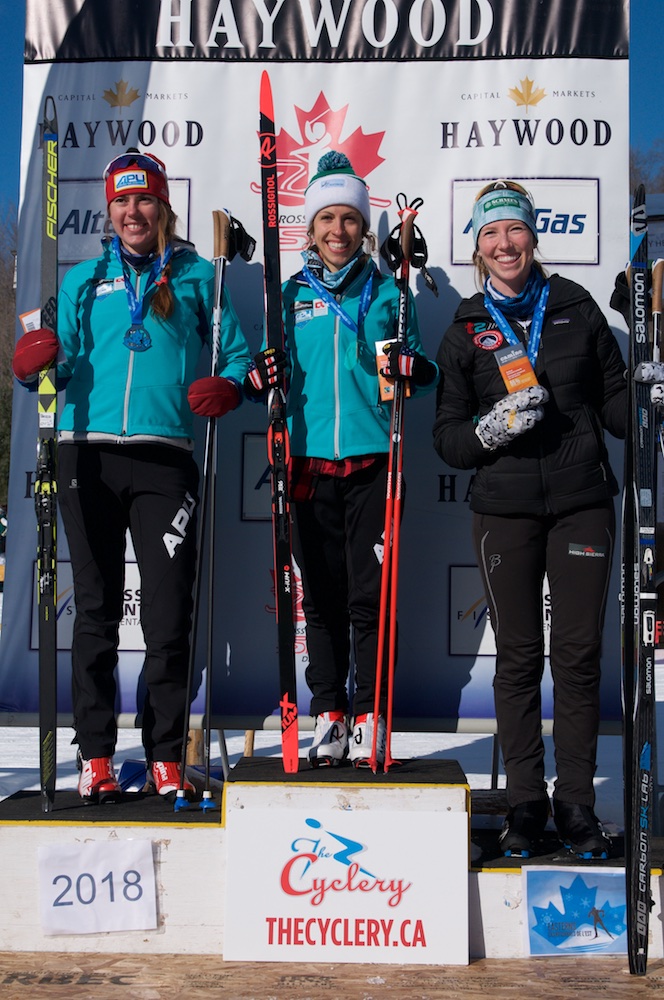
After placing second in a 10 k freestyle at last weekend’s SuperTour in Craftsbury, Vermont, Rosie Frankowski (APU) won the women’s 10 k freestyle on Saturday in Gatineau by more than 30 seconds in 27:07.3. Her teammate Becca Rorabaugh (who won the Craftsbury 10 k skate as well as Friday’s classic sprint in Gatineau) placed second (+37.1) on Saturday, and Erika Flowers placed third (+1:26.4) for the third-straight race.
Frédérique Vézina, of the Pierre-Harvey National Training Centre, led the Canadians in fourth (+1:46.2), while America Liz Guiney (CGRP) placed fifth (+1:52.2), and Olivia Bouffard-Nesbitt (Rocky Mountain Racers) finished sixth (+1:56.4).
Also in the top 10, Kaitlynn Miller (CGRP) placed seventh (+1:57.8), Felicia Geisor (CXC Team) was eighth (+2:18.5), Zoë Williams (Carleton University) ninth (+2:39.6) and Annika Hicks (AWCA) 10th (+2:43.4).
Eastern Canadian Championships conclude Sunday with 10/15 k classic pursuits at the Nakkertok Nordic Ski Centre.
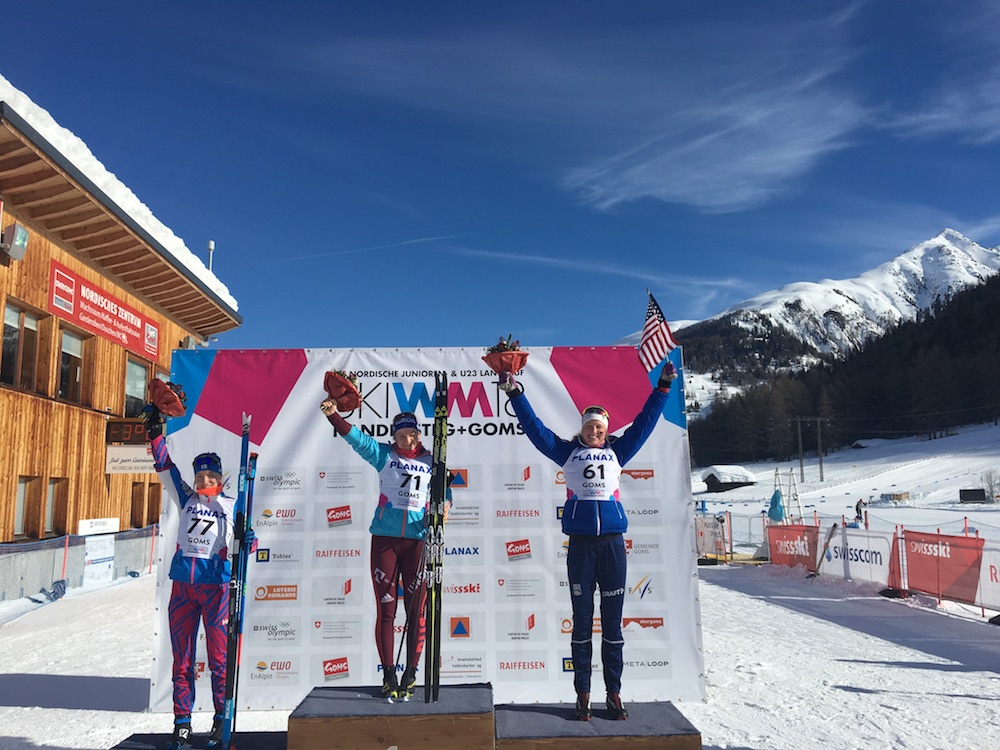
The women’s 5 k classic podium at 2018 Junior World Championships in Goms, Switzerland, with American Hailey Swirbul (r) in second, Russia’s Polina Nekrasova (c) in first, and Finland’s Anita Korva (l) in third. (Photo: JWSC2018.ch)
(This article has been updated to reflect that American Hailey Swirbul was in second for most of Tuesday’s 5 k race, not over one minute back as previously reported based on a live timing error. It has also been updated to include comments from Americans Hailey Swirbul, Ben Loomis, Stephen Schumann, and Gus Schumacher, Canada’s Antoine Cyr, University of Alaska Anchorage nordic head coach Andrew Kastning, and U.S. Ski Team Development Coach Bryan Fish.)
Junior World Championships (Goms, Switzerland): 5/10 k classic
Hailey Swirbul became the second American cross-country skier to earn an individual medal at Junior World Championships and first to take silver (Katharine Ogden claimed bronze in last year’s skiathlon) in the women’s 5-kilometer classic individual start on Tuesday in Goms, Switzerland.
Swirbul, a 19-year-old University of Alaska Anchorage sophomore, also tallied the best American finish at a Junior/U23 World Championships since Jessie Diggins earned silver in 2014 in the freestyle sprint. It was Swirbul’s second medal the last two Junior Worlds after she teamed up with Hannah Halvorsen, Julia Kern, and Ogden to take bronze in last year’s relay.
Going into this week’s championships, Swirbul, a Colorado native, explained she was aiming for a top 10 in one of the distance races. U.S. Ski Team Development Coach Bryan Fish pointed out that she wasn’t sure she’d feel up to racing on Tuesday.
“She had been feeling under the weather so she didn’t come up and ski yesterday,” Fish said on the phone Tuesday. “It was a little bit of a shock to Hailey herself that she skied so fast because there was some contemplation of whether she would race or not.”
“I made it a goal to stay relaxed and ski the race I would ski in a lower pressure race,” Swirbul wrote in an email. “I often find that I, and others, change their good race habits when at a high pressure event, so I was hoping to pace the race evenly and not start out too fast.
“The key for interval starts for me is to only think about skiing smoothly and powerfully for the first few kilometers of the race, and I’ve been discovering that that usually leads to decent splits throughout my race,” she continued.
She ended up racing to second place on Tuesday in the second race of 2018 Junior World Championships. The 61st starter (out of 84), Swirbul skied in second for most of the race, just behind Russia’s Polina Nekrasova, according toFish.
“She was basically tied for second and really had a strong second half of the course, and really skied solid in particular the last kilometer,” Fish said. “Always in the top five for sure, and well within striking distance [of the podium].”
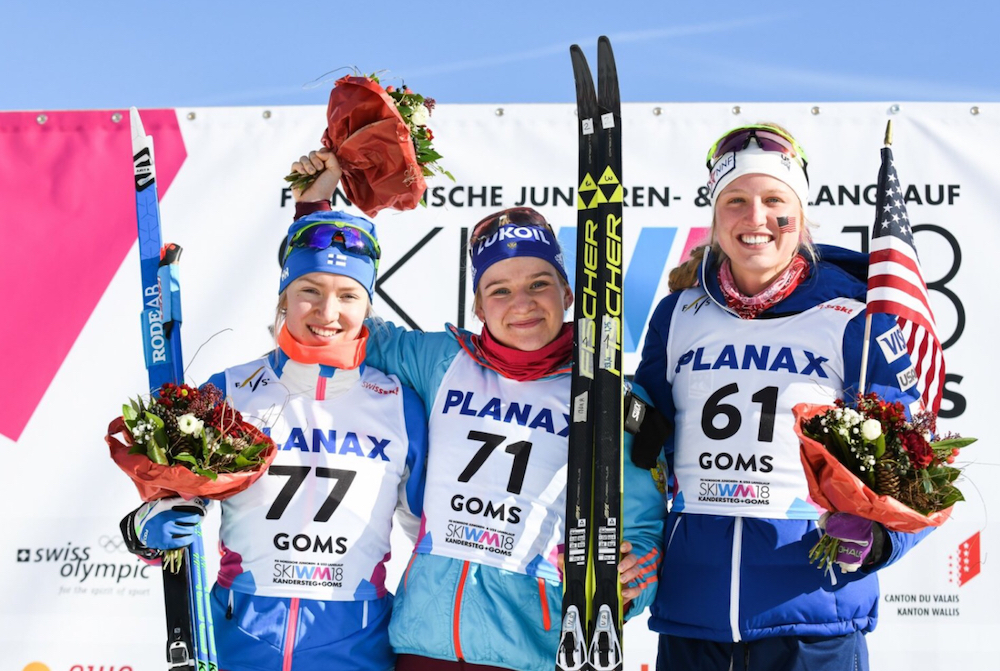
The women’s 5 k classic podium at 2018 Junior World Championships in Goms, Switzerland, with American Hailey Swirbul (r) in second, Russia’s Polina Nekrasova (c) in first, and Finland’s Anita Korva (l) in third. (Photo: Bryan Fish)
She initially crossed the finish line in first place, more than a minute faster than the previous race leader. Her time remained faster than all but one of the women who started behind her — as Russia’s Polina Nekrasova (bib 71) took the win in 13:58.7 minutes, 14.4 seconds ahead of Swirbul.
Finland’s Anita Korva started 77th and finished third, 25.4 seconds out of first.
The Czech Republic’s Barbora Havlickova (bib 81) followed in fourth (+26.8), and Norway’s Kristine Stavås Skistad (bib 67) finished fifth (+31.9), and France’s Laura Chamiot-Maitra (bib 83) placed sixth (+34.9).
“… I honestly had no idea I was in the running for the podium during my race, because about 20 girls had yet to finish, so it wasn’t until the last girls came in that I knew I claimed a spot!” Swirbul wrote.
“It was a special moment when I ran down off of the course and I knew her split,” Fish said of Swirbul’s finishing time. “I knew she was sitting in second and they kept announcing and kept announcing, and I told her, ‘You will be second today,’ and it was kind of a combination facial expression of shock and elation. She really couldn’t believe it, but [I said], ‘You’ve got a big enough gap over third place and no one’s catching you.’
“It’s our best Junior Worlds result ever,” Fish added. “Last year was the first individual medal we had ever won or team medal at Junior Worlds and to follow that up with a silver is incredible.
“She was obviously on our podium relay last year, but she came in from U.S. nationals skiing well, qualified very high and she skied incredibly well today,” he explained. “Very fluid stride and did a great job shifting gears and doing a bit more running during the second half of the course.”
“The result hasn’t hit me yet,” Swirbul wrote. “It was beyond what I expected, so my brain is still catching up to the reality! I’ve been dreaming of racing how I know I could for the past 3 years or so, and this season has finally been my chance to break through. I’m so fortunate that things aligned for me on the day that really counted. I couldn’t have done it without Bryan Fish’s unwavering belief in us athletes, and my mom and dad’s support all these years, of course.”
Fish emphasized that while snow conditions have been “very, very good” and “very stable” in Goms, which received 1 1/2 meters (nearly 5 feet) of snow a week and a half ago, the waxing had been a bit challenging due to a temperature range of around -9 degrees to 5 degrees Celsius each day.
“I’m sure there were some teams on klister, some on klister covered with hard wax,” he said of Tuesday’s classic race. “Our techs did a really good job and they were clever with what they came up with when I heard what they were trying. … They’ve been right in the ballpark the last few days and I think they really dialed it in today, and it was impressive kick and glide. To get a podium you ned to have everything going right and I definitely think we had the skis in our favor.”
Halvorsen was the second-best American in 22nd on Tuesday, 1:10.1 out of first, Kathleen O’Connell finished 38th (+1:33.5) and Hannah Rudd was 59th (+2:24.1).
Canada’s Natalie Hynes placed 36th (+1:30.5), Hannah Mehain was 45th (+1:53.3) and Annika Richardson was 67th (+2:53.7). Catherine Reed-Metayer did not finish.
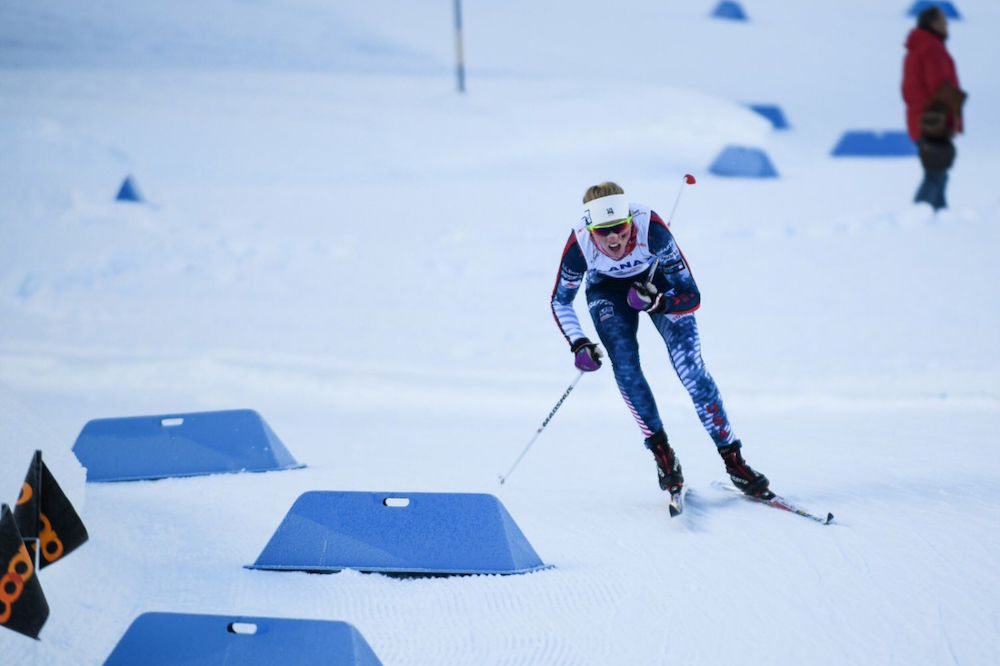
Hailey Swirbul (University of Alaska Anchorage) navigating a downhill while racing to second place in the women’s 5 k classic at 2018 Junior World Championships in Goms, Switzerland. (Photo: JWSC2018.ch)
Andrew Kastning, head coach of the University of Alaska Anchorage (UAA) nordic team, stayed up late the night before Alaska time to watch three UAA skiers (Swirbul, Rudd and Hynes) race on the Junior World Championships livestream.
“Hailey has made classic technique a priority since she stepped on UAA’s campus because that’s where she had the most potential for gain,” Kastning wrote in an email on Tuesday. “She has been working hard on a more powerful and smooth stride on the uphills while getting over elbow pain when double poling. The course looked like it played well to her strengths and that strategy.
“I saw one clip of her entering the big climb and could see that she was relaxed and striding really well,” he continued. “I knew then she was going to have a really good race.”
He noticed that the course had some intimidating downhills and corners, but he knew Swirbul wouldn’t have a problem navigating them.
“Hailey has a solid alpine skiing background and I figured if anyone would be willing to straight line the descents and flatten the corners then a massive amount of time could be saved,” Kastning wrote. “Hailey must have done that because she put 47 seconds on a Russian she was tied with at the high point. I was sort wondering if I was dreaming at moments and had to refrain from yelling and screaming because I’d wake up three daughters and a wife if I did. What a night, what a day. Seawolf Nation and USA are very proud this morning.”
Ogden 7th, Cyr 12th
In the men’s 10 k classic that followed, the excitement continued for Team USA, with 17-year-old Ben Ogden, of the Stratton Mountain School, racing to seventh in his Junior World Championships debut.
The men’s 10 k classic podium at 2018 Junior World Championships in Goms, Switzerland, with Norway’s Jon Rolf Skamo Hope (c) in first, Russia’s Sergey Ardashev (l) in second and Norway’s Jørgen Lippert (r) in third. (Photo: JWSC2018.ch)
Ogden started 72nd and crossed the finish line in first, 16.6 seconds faster than previous race leader Alexander Terentev of Russia. Six later starters ultimately bumped Ogden to seventh, and Norway’s Jon Rolf Skamo Hope took the win in 24:58.8, 40.5 seconds ahead of Ogden.
Russia’s Sergey Ardashev placed second, 9 seconds back, and Norway’s Jørgen Lippert reached the podium in third (+27.9). Norway put four in the top five and Russia had two in the top six, making Ogden the first non-Norwegian or non-Russian male finisher on the day.
According to race splits, Ogden skied an extremely consistent race, clocking the eighth, ninth or 10th fastest times throughout the 10 k.
Canada’s Antoine Cyr placed 12th (+1:07.7) in the second race of his career at Junior World Championships. Two days ago, he finished 30th in the freestyle sprint. Cyr, 19, started 78th and also skied a consistent race, hanging mostly within the top 12 throughout it.
“I knew that classic 10 km was good race for me,” Cyr wrote in an email. “On a good day I was hoping for top 30 but the course was hard and I knew that if I played it smart and paced myself I would be happy with my race.”
He focused on skiing powerfully on his first lap, with big strides and strong double poling, and tried to attack the A-climb and “punchy climb towards the end of the loop” on the second and last lap.
“A top 12 for us in Canada means a lot and with a 25th place in the [skate sprint qualifier] and a 12th place today I think it makes me realize that I have my place on the world level scene,” Cyr wrote. “… This race was a good redemption after my crash in the sprint. I am really happy with the results !!”
Gus Schumacher notched his second top 20 of the week in 17th (after placing 19th in the skate sprint), finishing 1:19.1 out first first, Hunter Wonders placed 22nd (+1:39.1), and Canyon Tobin was 37th (+2:17.2) for the U.S.
In an email, Schumacher, of Alaska Winter Stars, explained he had been aiming for a top 10.
“For this race I really focused on keeping the first quarter super relaxed and then picking it up after that,” he wrote of his pacing. “During the race I felt like I raced the first lap well but somewhere on the second lap I must’ve pushed just a little too hard and gone over my threshold, because I really faltered in the middle of that one on the big sprint hill. Other than that I felt like I skied the flats and most of the gradual uphills well, especially before 7.5k.”
Overall he added that he was “fairly satisfied … but I know that I can do better and that kind of hurts me. I just didn’t feel like I had the spark that I normally have towards the end of a race like this.” Moving forward, he had similar goals for the skiathlon and was excited for the relay.
Canada’s Etienne Hebert finished 44th (+2:42.3), Ty Godfrey was 57th (+3:29.5), and Felix Longpre 58th (+3:29.7) out of 96 finishers.
“It’s really exciting when you look at our day in general,” Fish noted. “We had two young boys with 2000 birth years; there was only three boys in the top 40 that had a 2000 year of birth and we had two. … That’s just really exciting for U.S. skiing in general, that we have athleetes showing up not just to participate, but to really perform.”
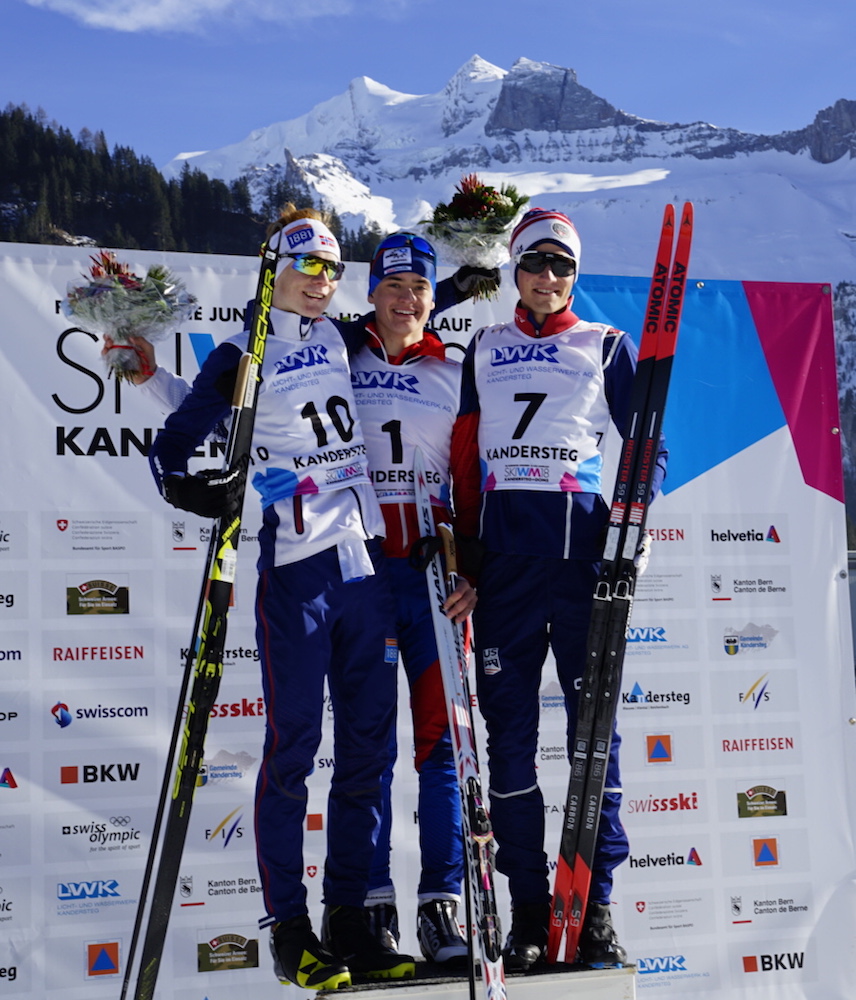
The men’s individual normal hill/10 k Gundersen podium at the first Day of Nordic Combined Junior World Championships in Kandersteg, Switzerland, with American Ben Loomis (r) in third, the Czech Republic’s Ondrej Pazout (c) in first, and Norway’s Einar Lurås Oftebro (l) in second. (Photo: Josh Parker)
Nordic Combined Junior World Championships (Kandersteg, Switzerland): Normal hill/10 k Gundersen
In the first competition of 2018 Nordic Combined Junior World Championships in Kandersteg, Switzerland (about 75 kilometers west of Goms), American Ben Loomis achieved the first podium of his career in his fifth Junior Worlds (counting his first in straight-up ski jumping), racing to third in the individual normal hill/10 k Gundersen on Tuesday.
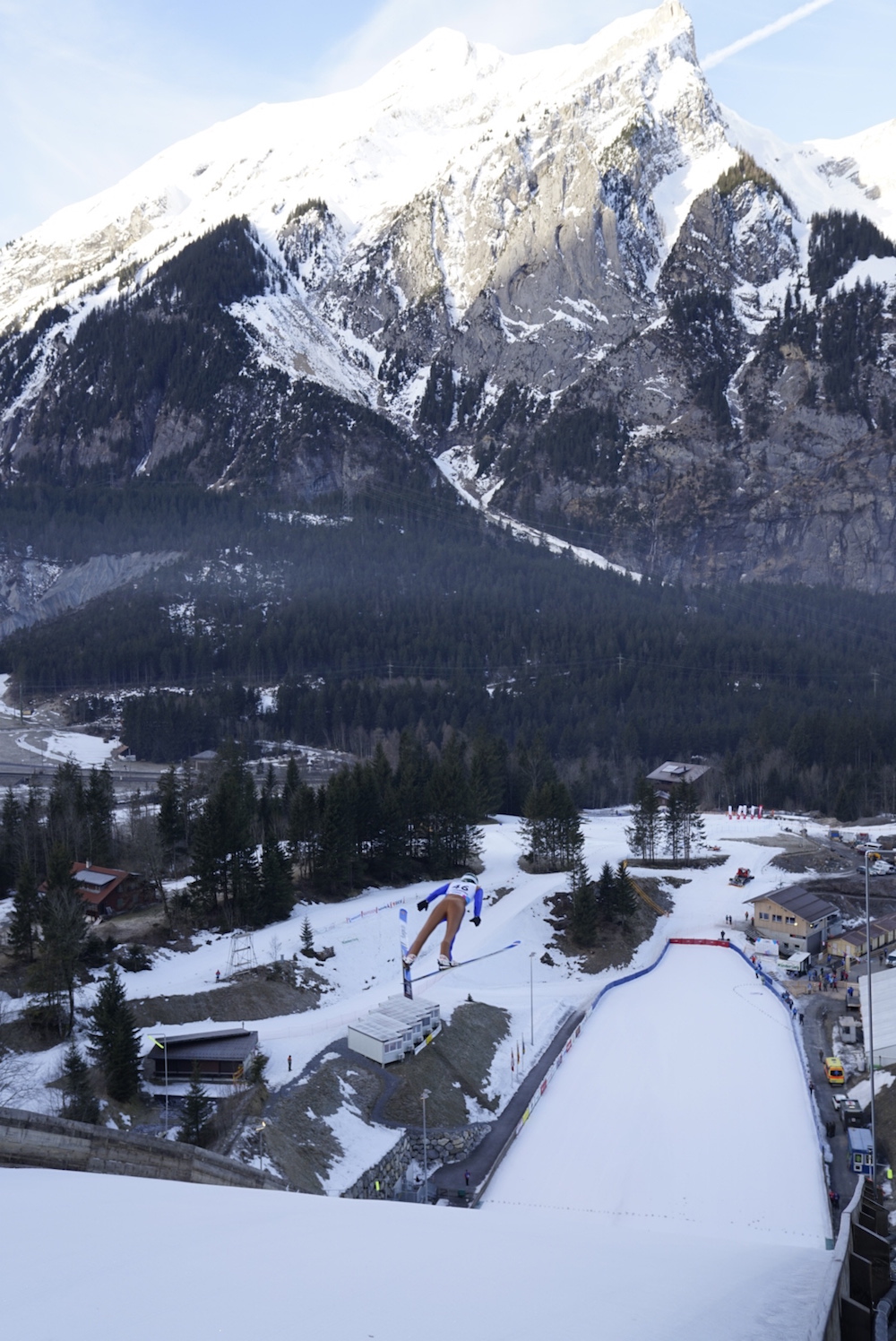
Ben Loomis (USA Nordic) jumping to seventh on Tuesday at 2018 Nordic Combined Junior World Championships in Kandersteg, Switzerland. He went on to place third in the 10 k for his first Junior Worlds medal. (Photo: Josh Parker)
Loomis, a 19-year-old U.S. Nordic Combined national team member who grew up in Wisconsin, was recently selected to compete at his first Olympics next month in PyeongChang, South Korea. In an email, Loomis explained he found out just over a week ago, which motivated him to compete at a high level, but it didn’t change his plans or goals for his last Junior Worlds.
“My focus of the winter has always been the Junior World championships so my Olympic nomination has not changed my training in the last few weeks,” he wrote. “Going into this week, and for the last 2 years now my goal was always a podium finish.”
He started out Tuesday by jumping to seventh on the 106-meter “normal” hill, then started the 10 k race 38 seconds out of first.
“The hill here in Kandersteg is very new which is nice because it feels similar to other modern jumps,” Loomis explained. “I was satisfied with my competition jump but not 100% happy. There are still a few things I need to fix on the technical side of my jumping.”
The Czech Republic had the two best jumpers on the day, with Ondrej Pazout leading after the jump portion, followed by his teammate Jan Vytrval in second. Pazout started the 10 k with an 11-second head start on Vytrval and ended up holding off his challengers to secure gold, finishing first in 22:58.3. Norway’s Einar Lurås Oftebro raced from 10th after the jump to second at the finish, just 2.3 seconds behind Pazout, with the second-fastest 10 k time.
Loomis passed four skiers to finish third, 8.3 seconds out of first, with the third-fastest time. Norway’s Johannes Lamparter slipped from third to fourth overall (+16.2), and Vytrval finished fifth (+21.6).
“I knew with a good race a podium was still possible from 38 seconds back,” Loomis wrote. “The track here is really tough with technical decent which leaves good opportunity to make up time.”
Working within a group, he caught up to third place on the first of four laps and was up to second on the second lap.
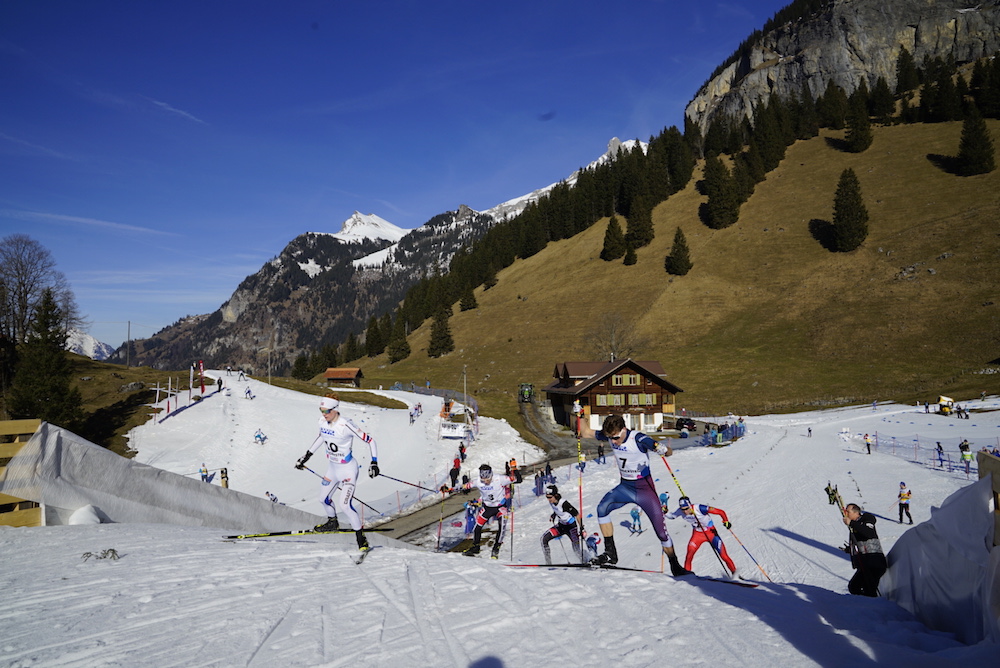
American Ben Loomis (7) racing with Norway’s Einar Lurås Oftebro (l) during the 10 k Gundersen on Tuesday at 2018 Nordic Combined Junior World Championships in Kandersteg, Switzerland. Loomis went on to finish third for his first Junior Worlds medal and Oftebro placed second. (Photo: Josh Parker)
“We had 5 or 6 guys in this group and on the 3rd lap I took the lead,” Loomis explained. “Towards the last hill on the 4th lap, I made a move alongside Einar Oftebro. Einar was strong on the last stretch and able to beat me as well as almost catching the leader Ondra.
“Taking a step on the podium was an excellent feeling today,” he added. “I have been working very hard, especially towards this specific race for a long time now. Accomplishing this is a huge relief and very motivating for the future.”
The U.S. had two in the top 15 with Stephen Schumann in 13th (+1:29.1). Schumann was 29th after the jump and started the 10 k 1:47 out of first, then posted the fifth-fastest course time to pick off 16 places.
“Going into today I was really just hoping to put together a solid jump and a good race and hopefully finish within the top 10 like last year,” Schumann wrote in an email. “Unfortunately I did not have the jump I was hoping for. I was about 1 meter late off the end of the take off, taking away some of the power and height that my legs otherwise would have given me. Luckily the conditions on the hill were pretty consistent today so I knew about where I would be standing after jumping going into the race.”
Given his starting position, he believed a top 15 was within reach. He ended up catching Italy’s Aaron Kostner, who started 27th, and the two worked together to catch one group after another.
“I felt pretty good but he got me on the last lap,” Schumann wrote of Kostner, who finished about 20 seconds ahead of him in 11th place. “But over all it was a pretty good race and I finished with the 5th fastest time. Behind Aaron with the 4th fastest.
“Overall I feel that had I had a little bit better jump on the hill I could have contended for a top 10 maybe top 5 but was happy with my race and my 13th place finish,” he added. “Coming across the line I was pretty sure Ben had finished in the top 5 at least, as I could see him going up the last hill as I was staring down it. But when I actually crossed the line and saw him I could tell he had gotten to the podium and I was psyched for him, went and gave him a hug and congratulated him.”
Looking ahead to the rest of the week, Schumann’s hoping for a medal in the 4 x 5 k team event.
“And personally I hope to finish in the top 10 in the 5km race with a better jump and another solid race,” he wrote.
Also for the U.S., Jared Shumate placed 35th (+4:06.3), up from 49th in the jump, and Tucker Hoefler was 51st (+6:37.4), up from 53rd.