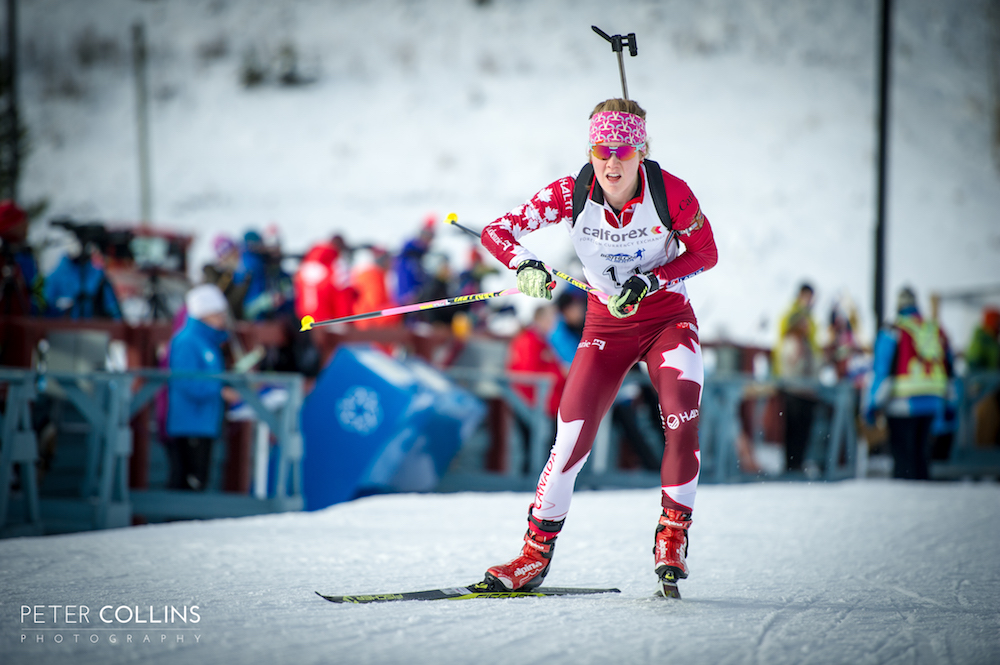
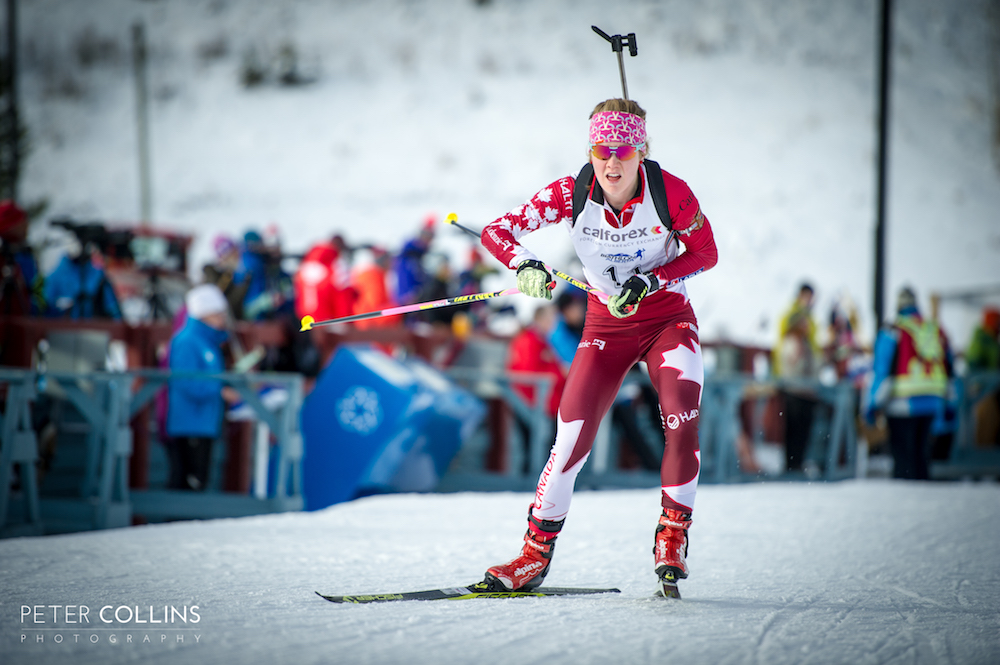
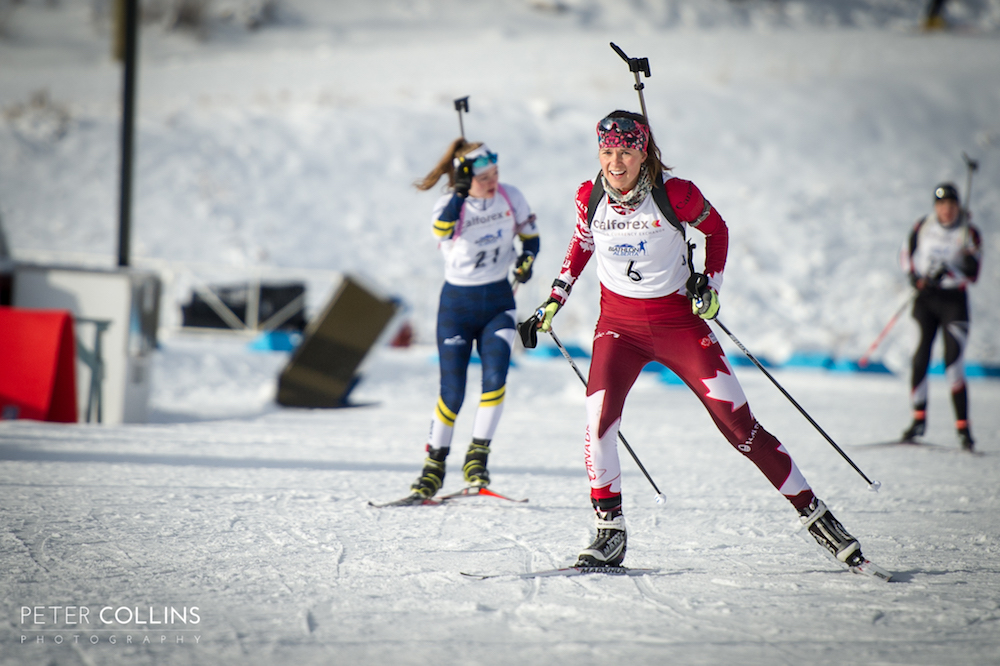
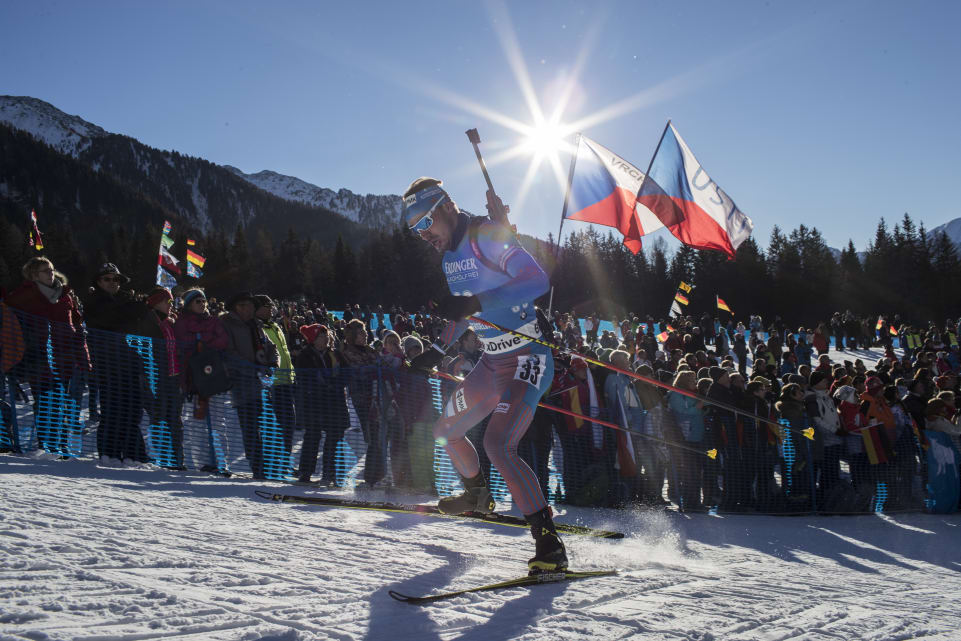
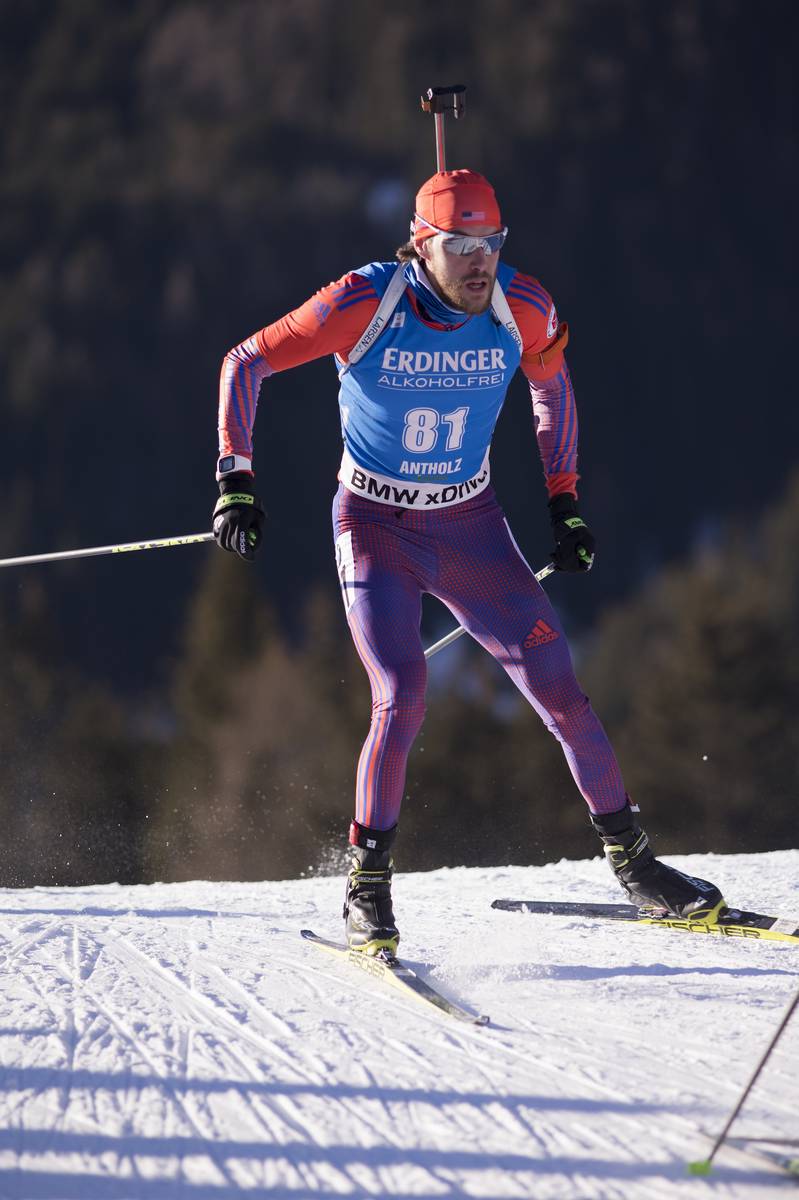
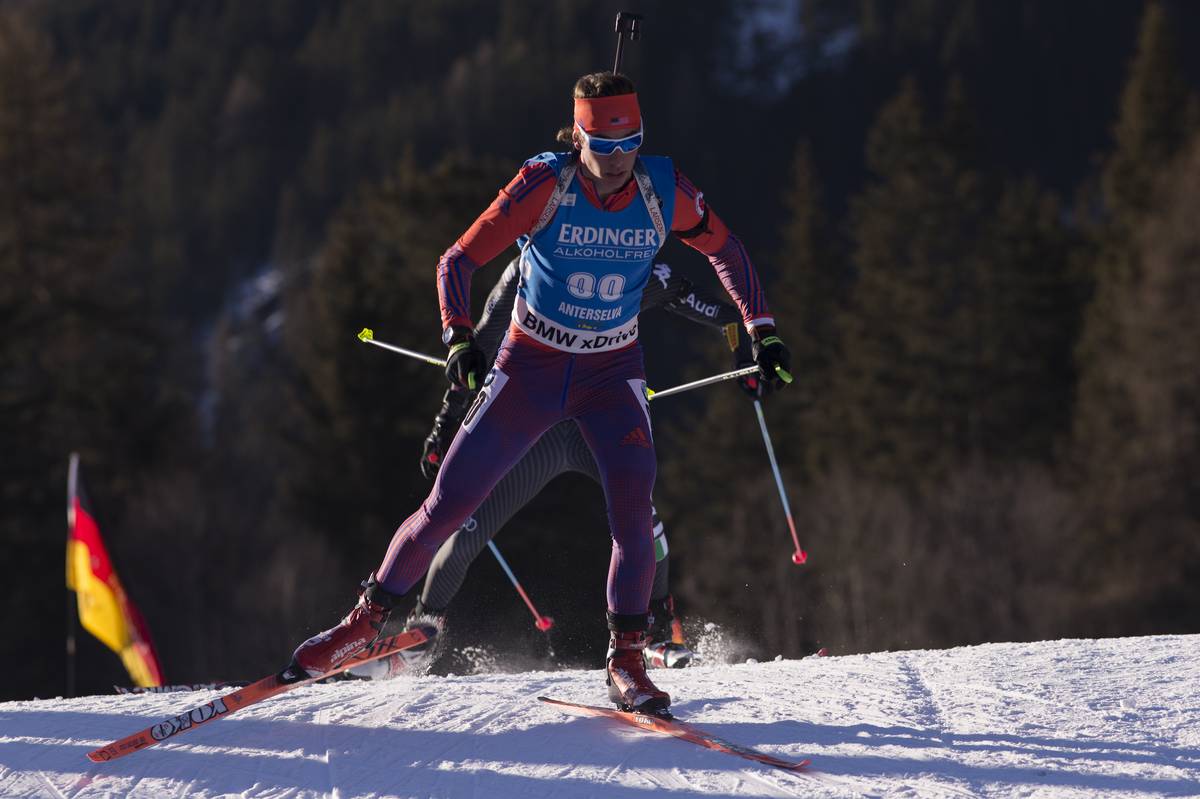
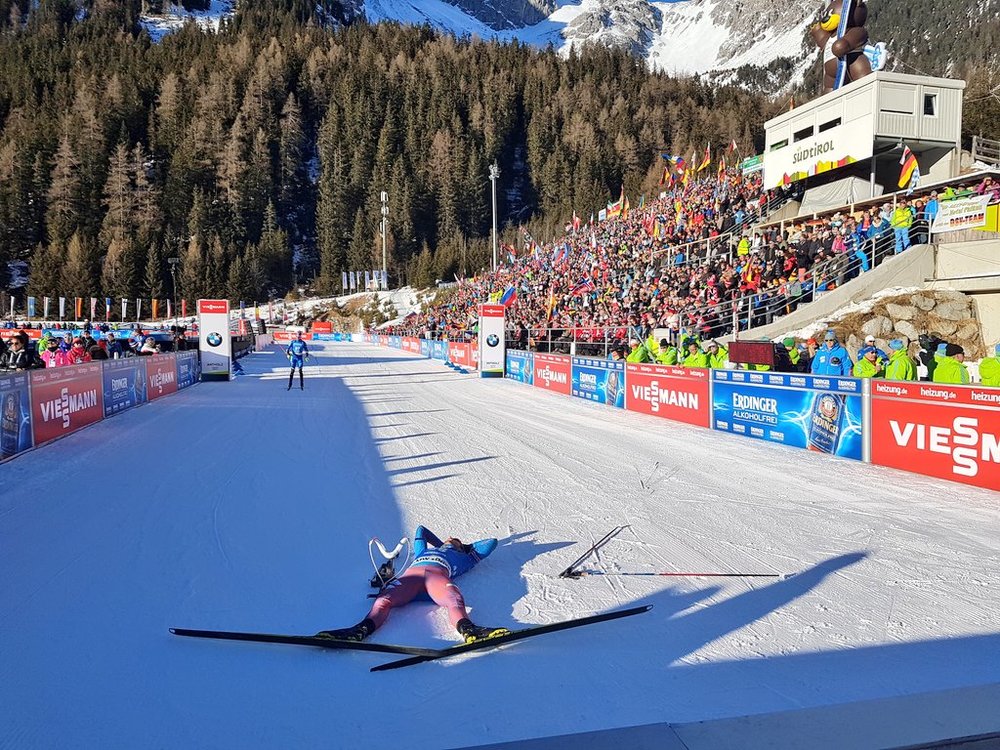
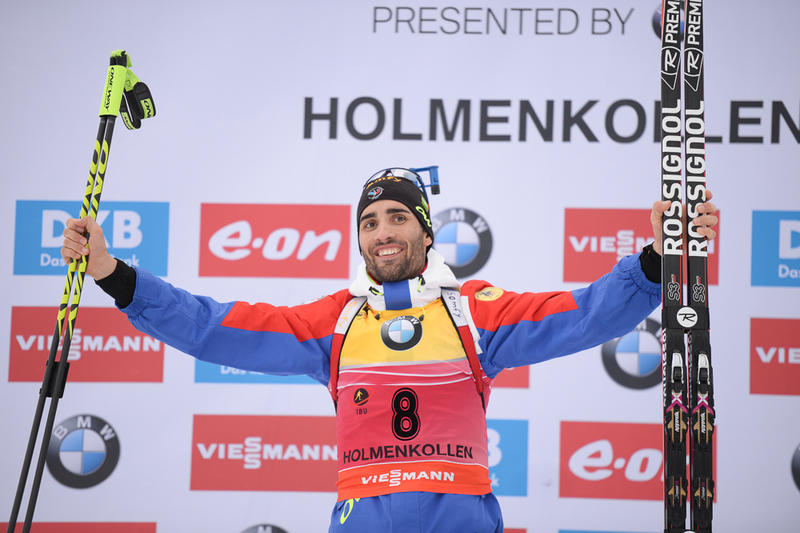
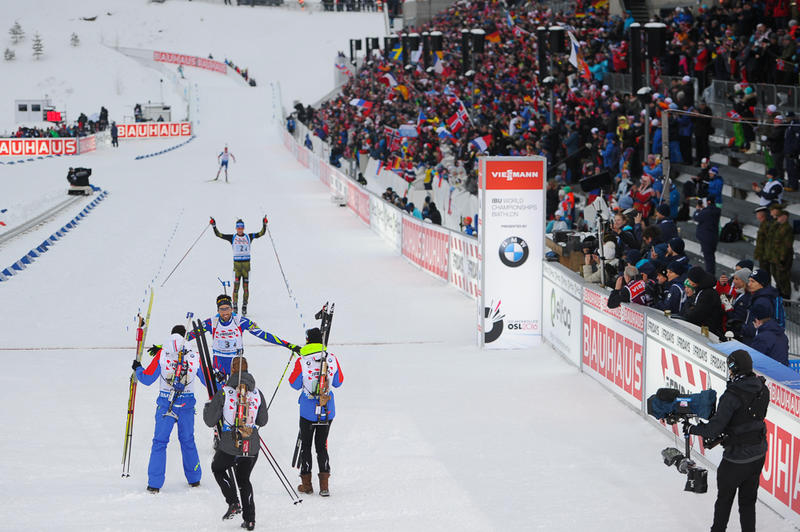
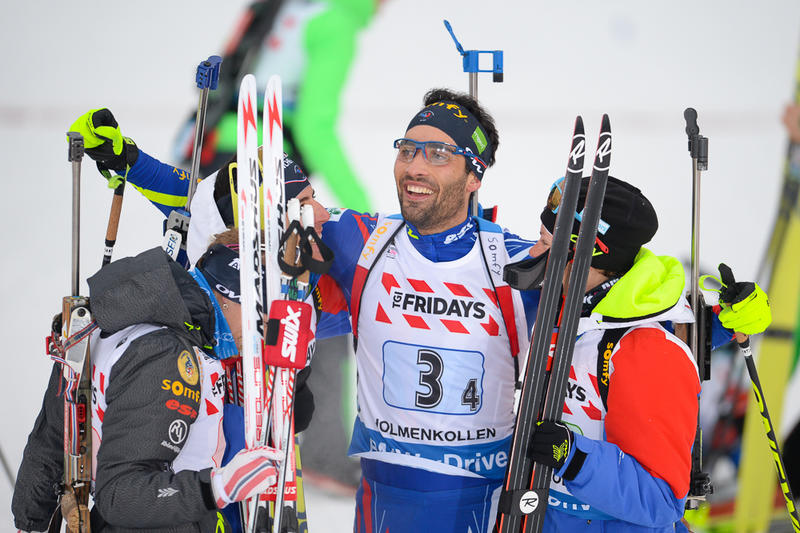
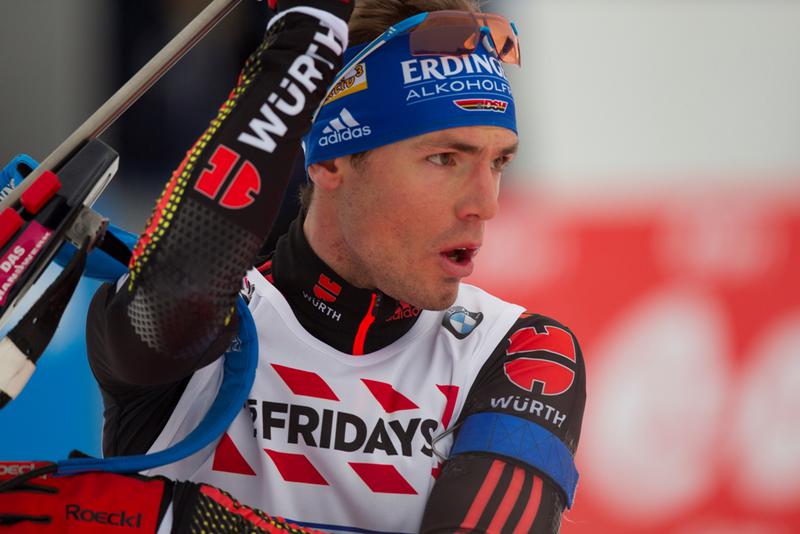
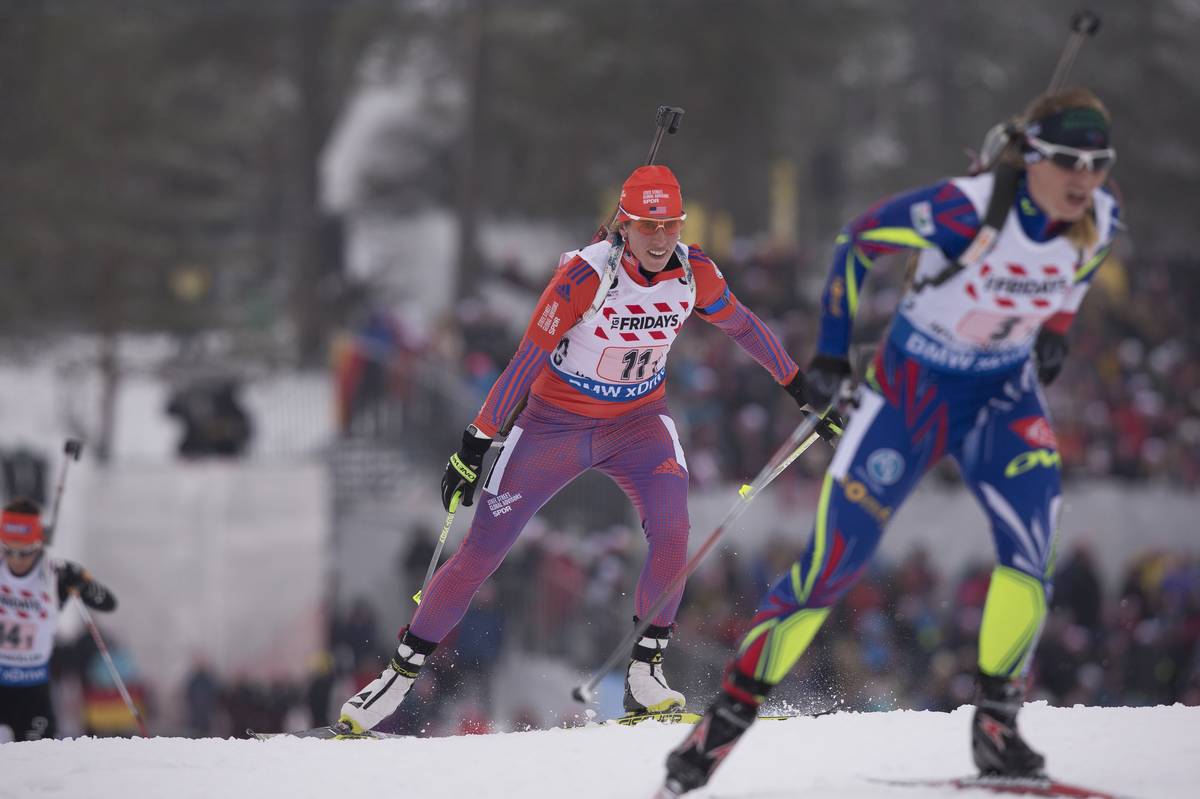
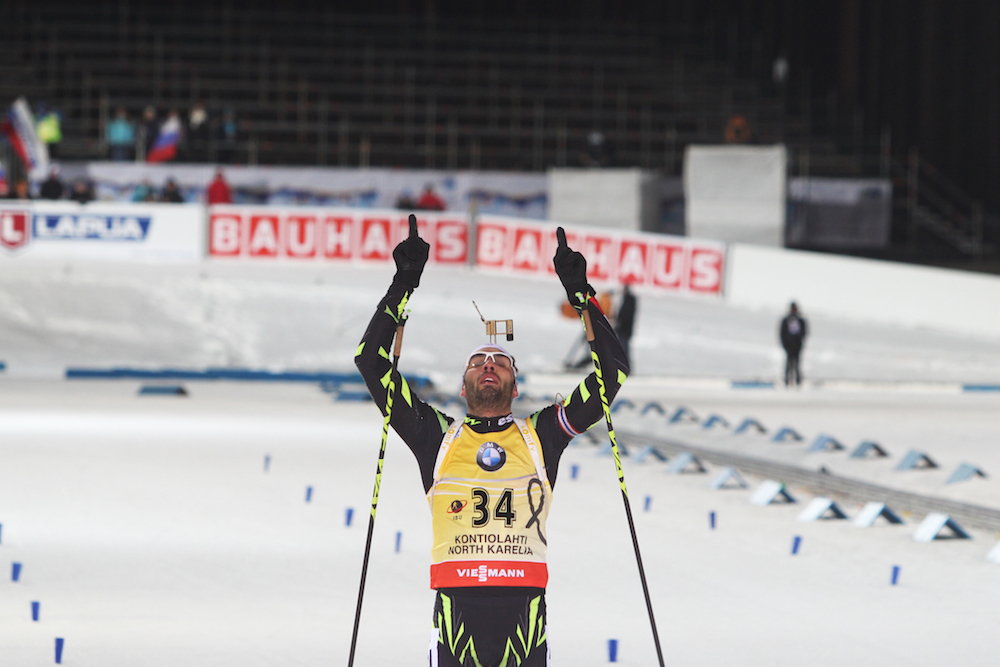
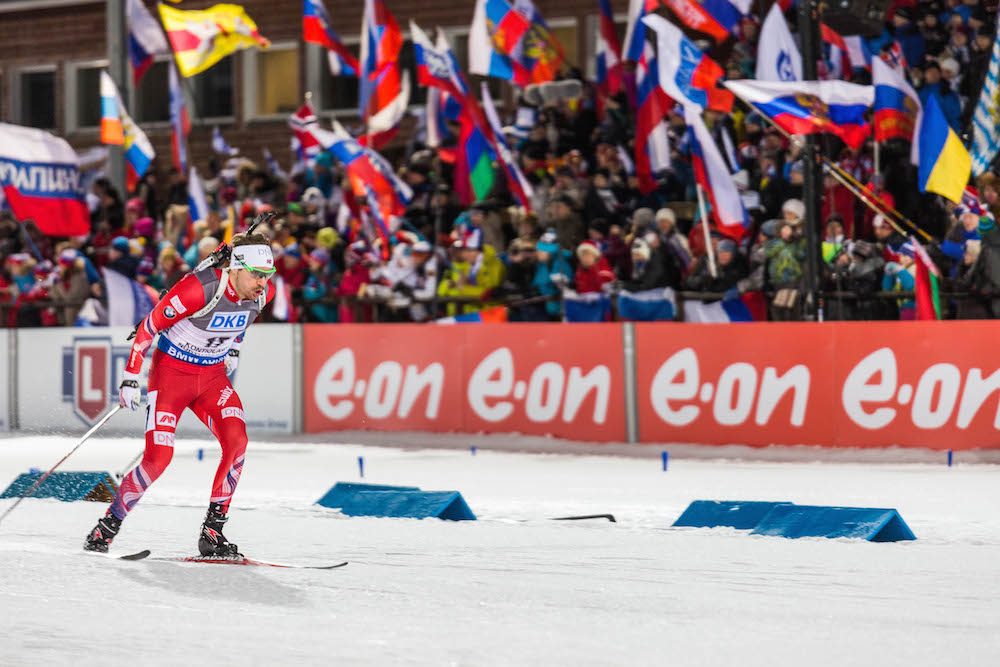
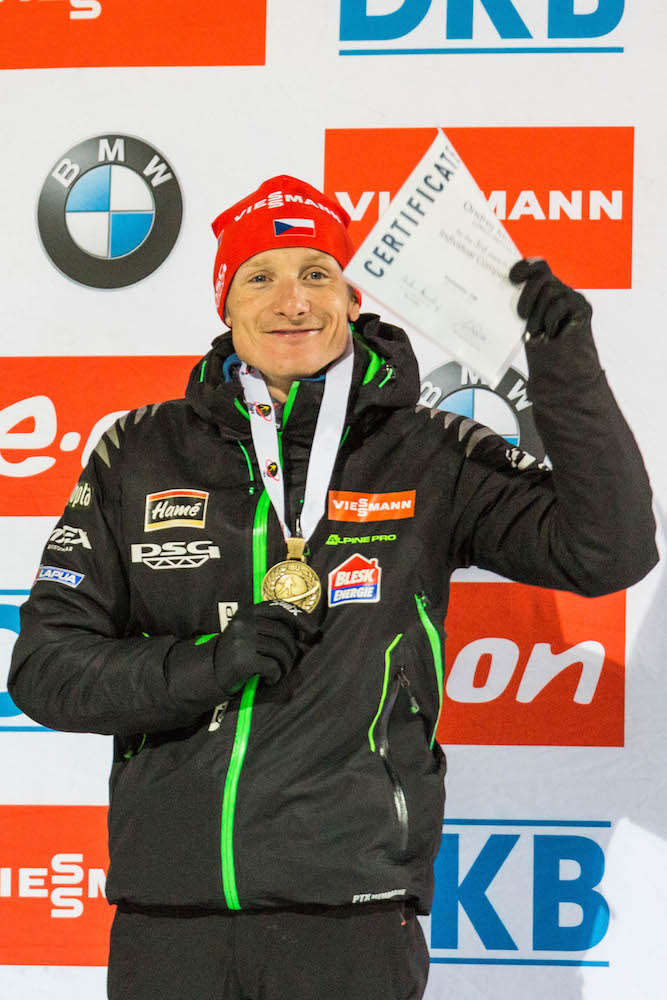
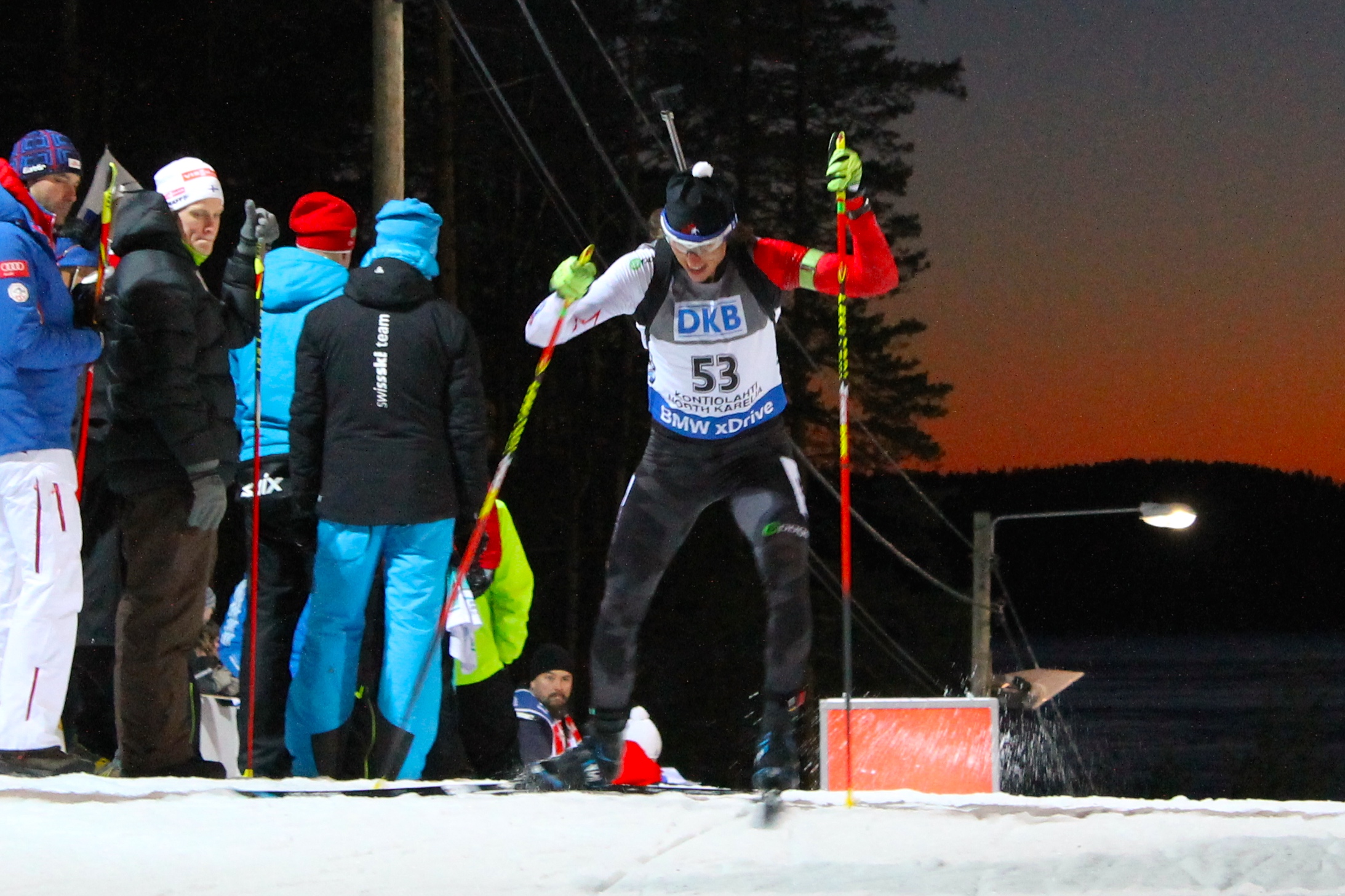
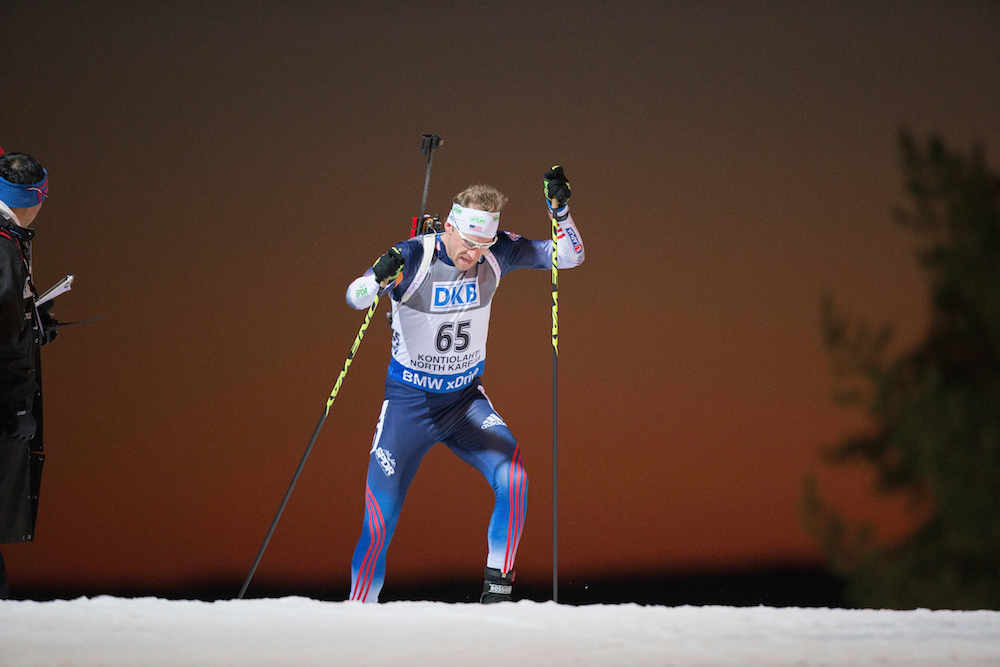
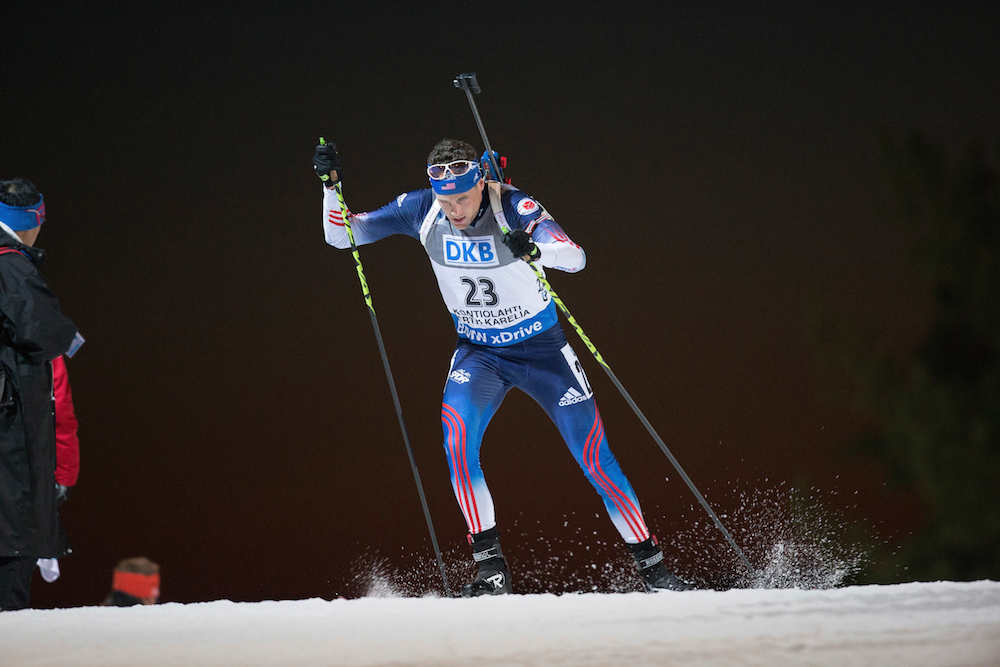
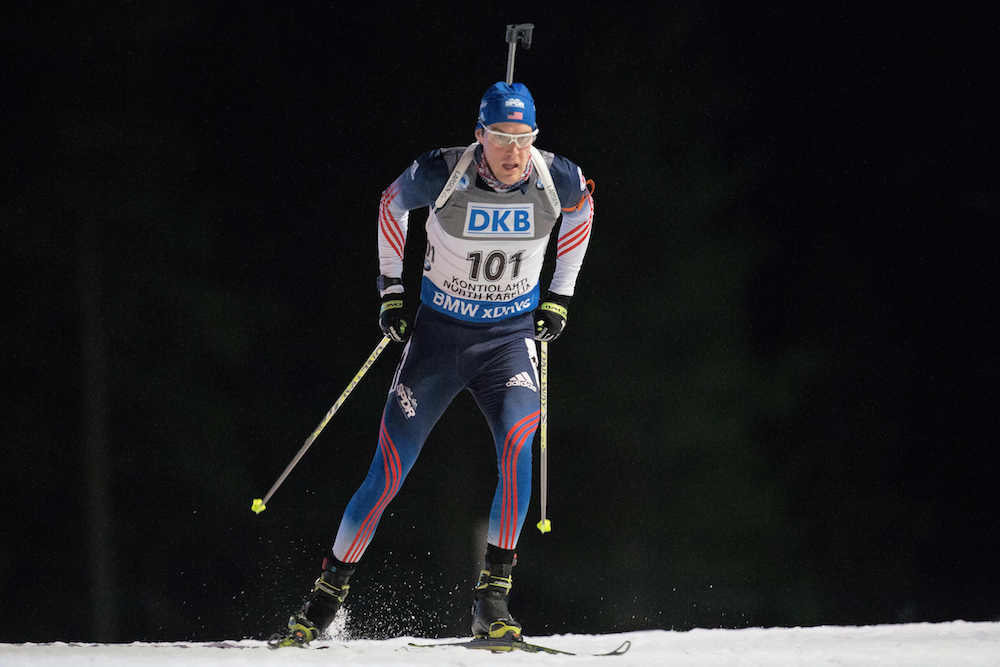
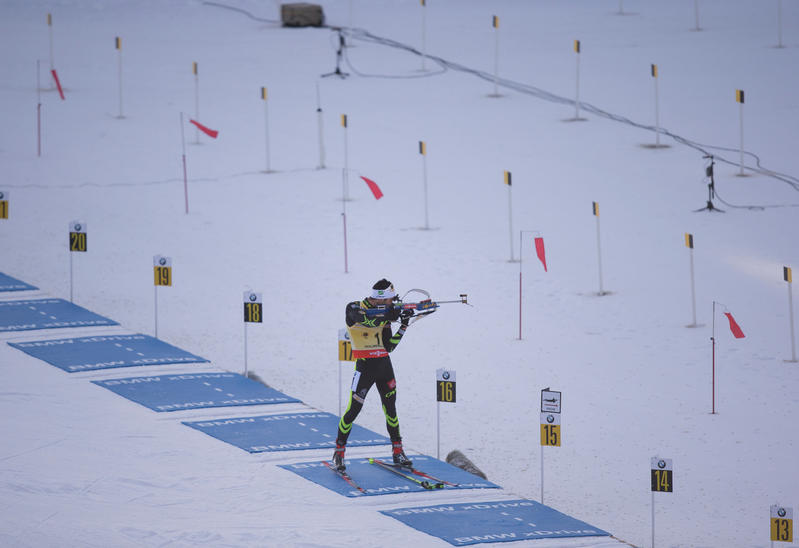
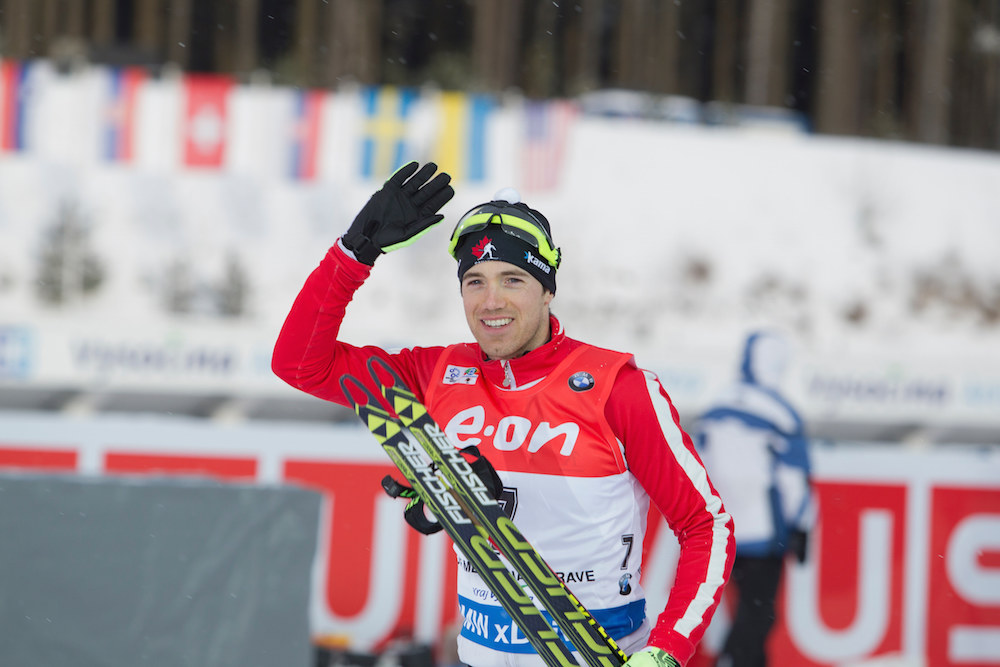
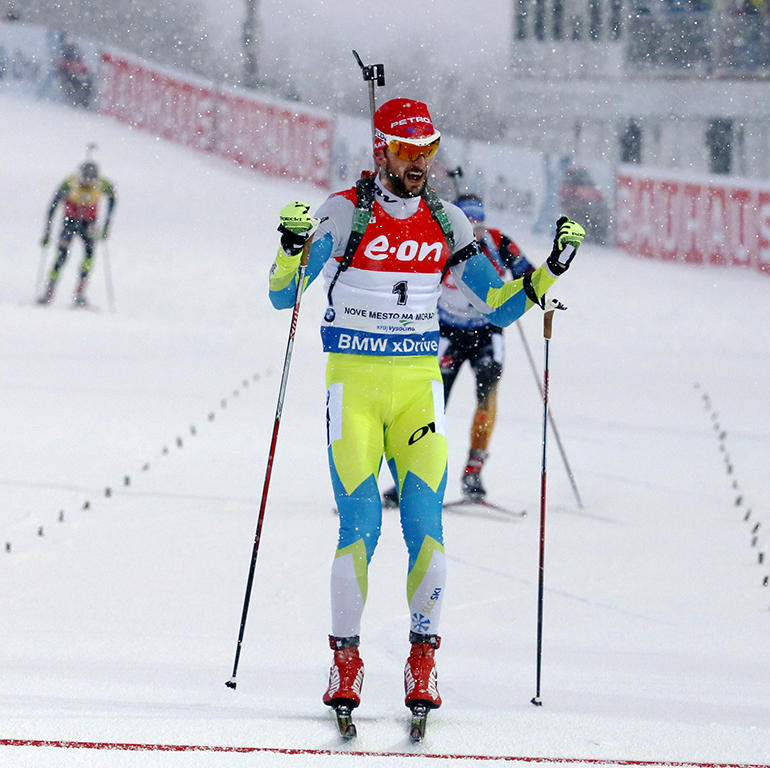
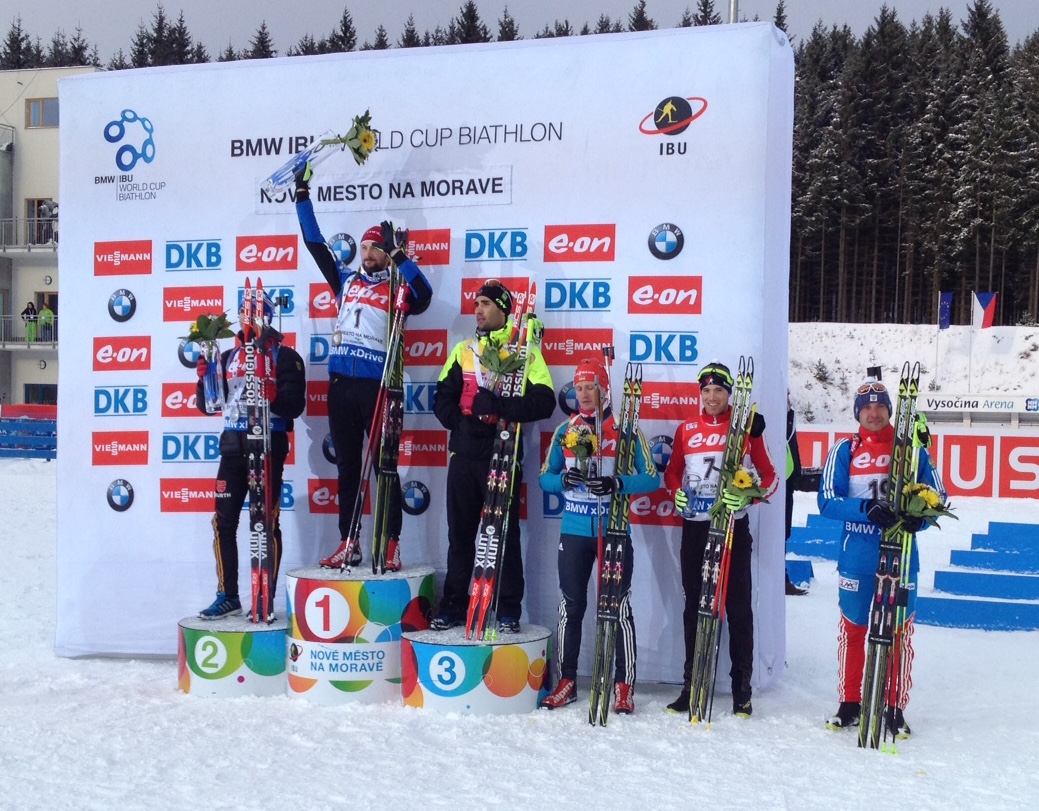
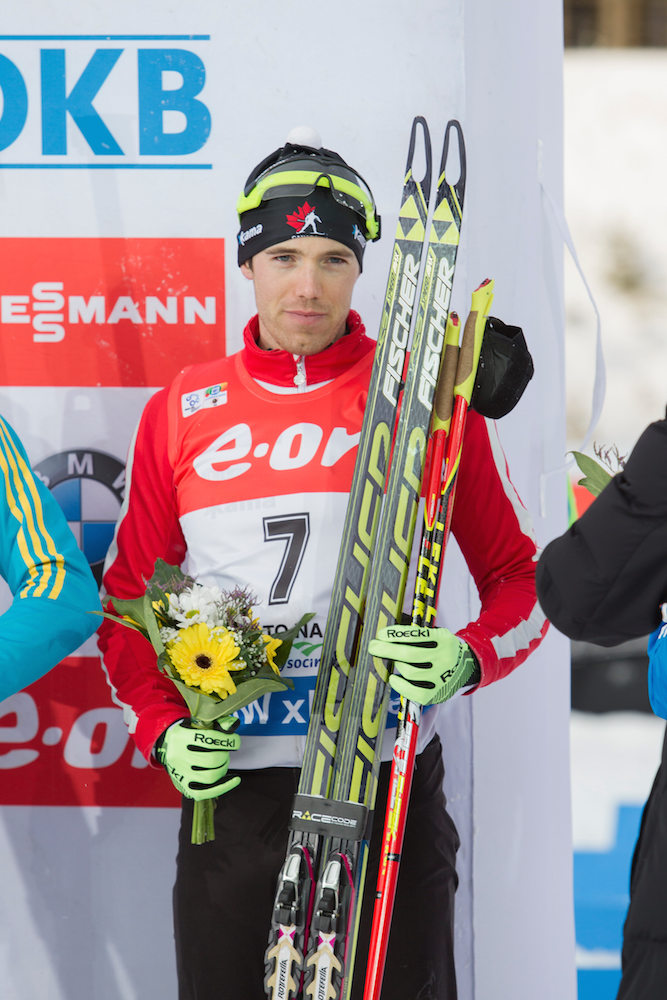
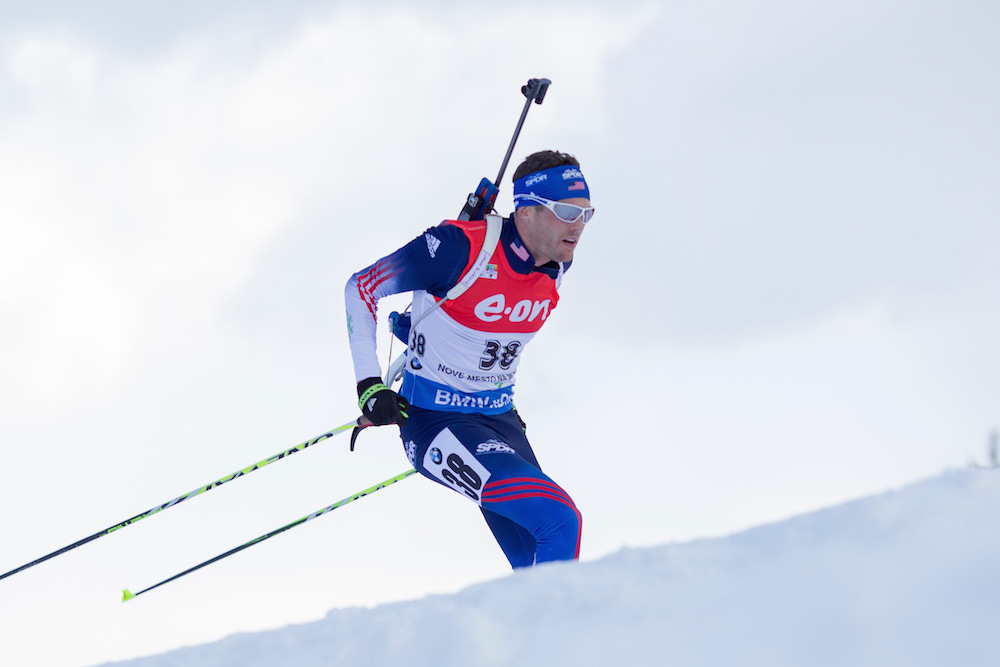
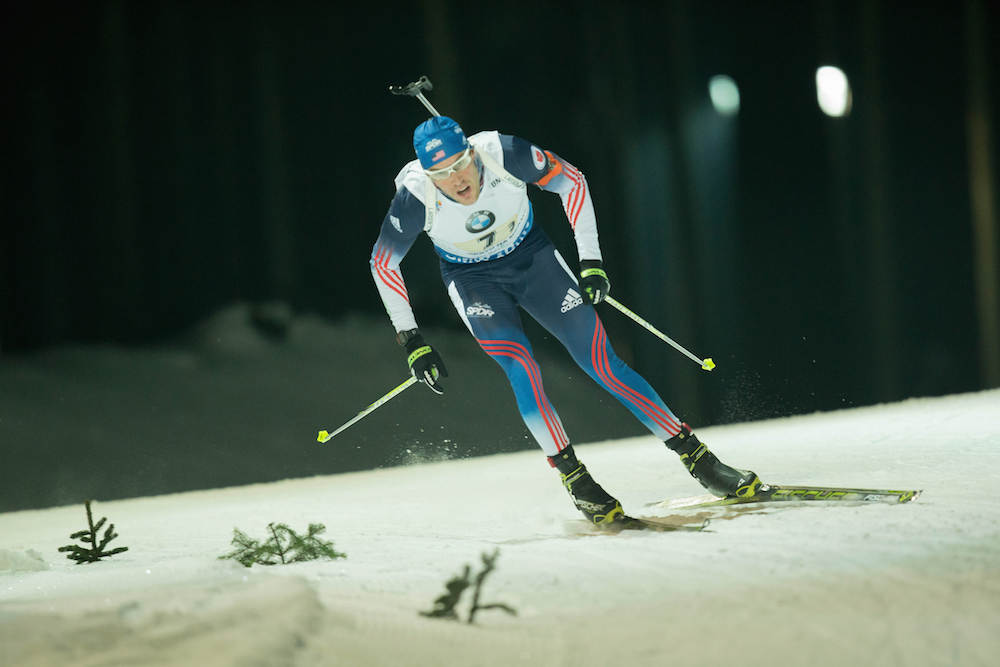
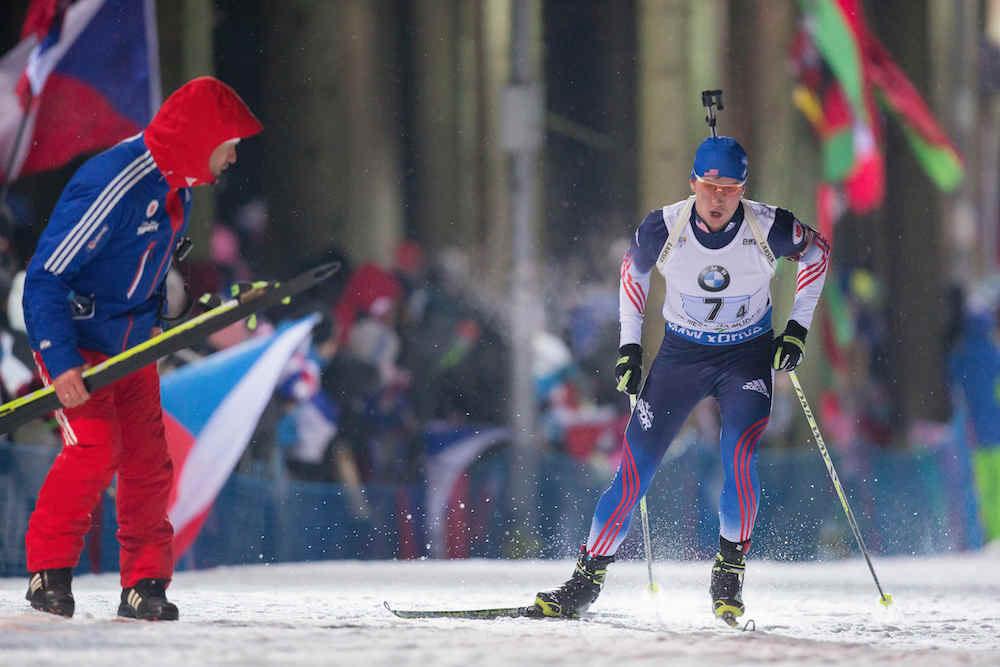
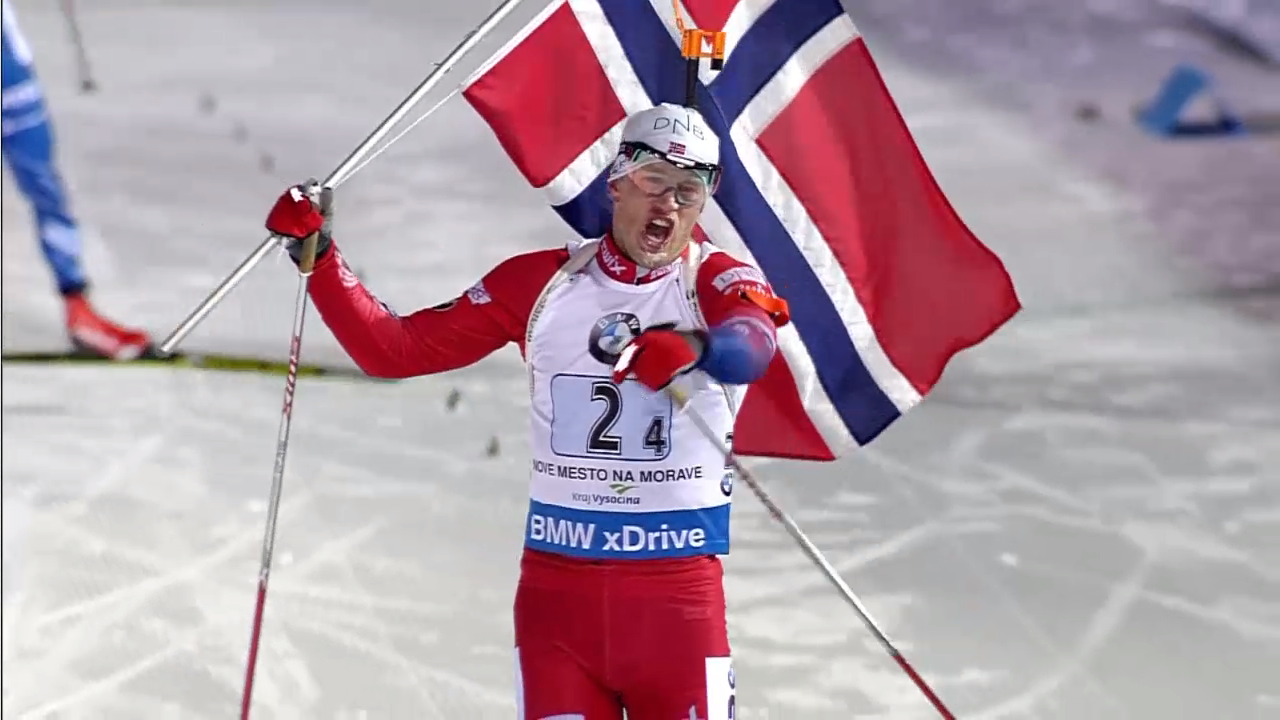
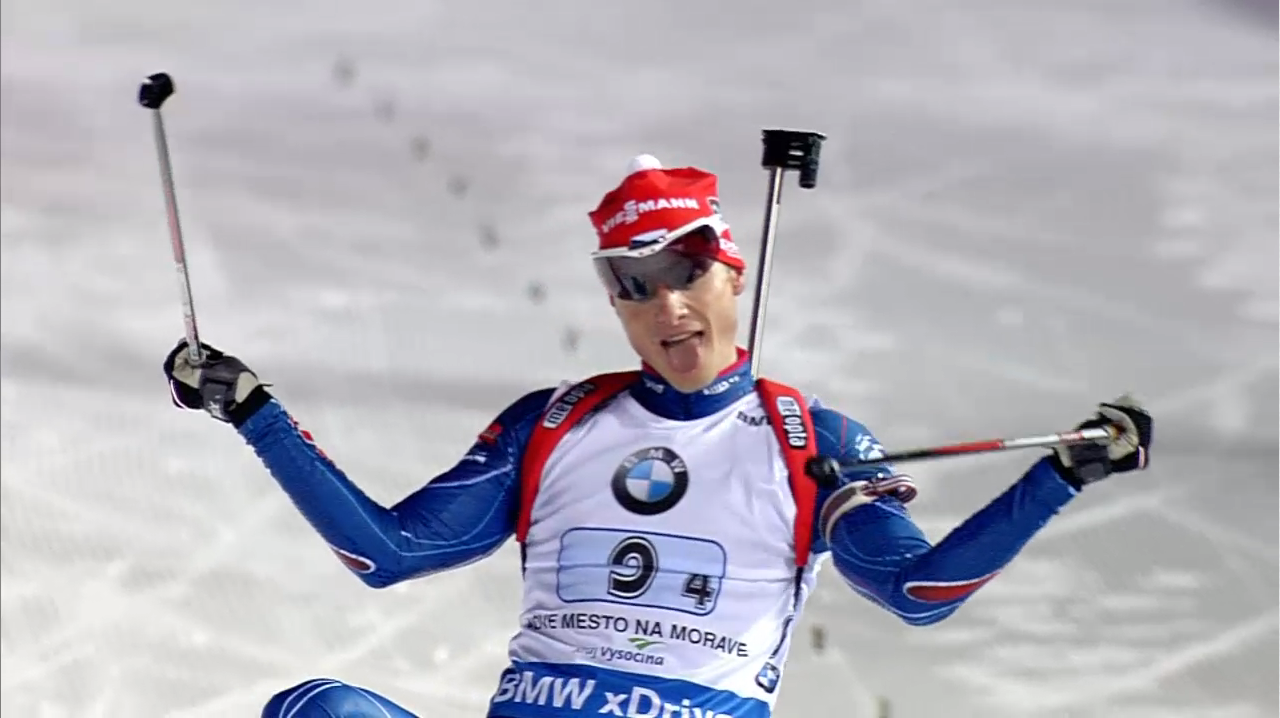
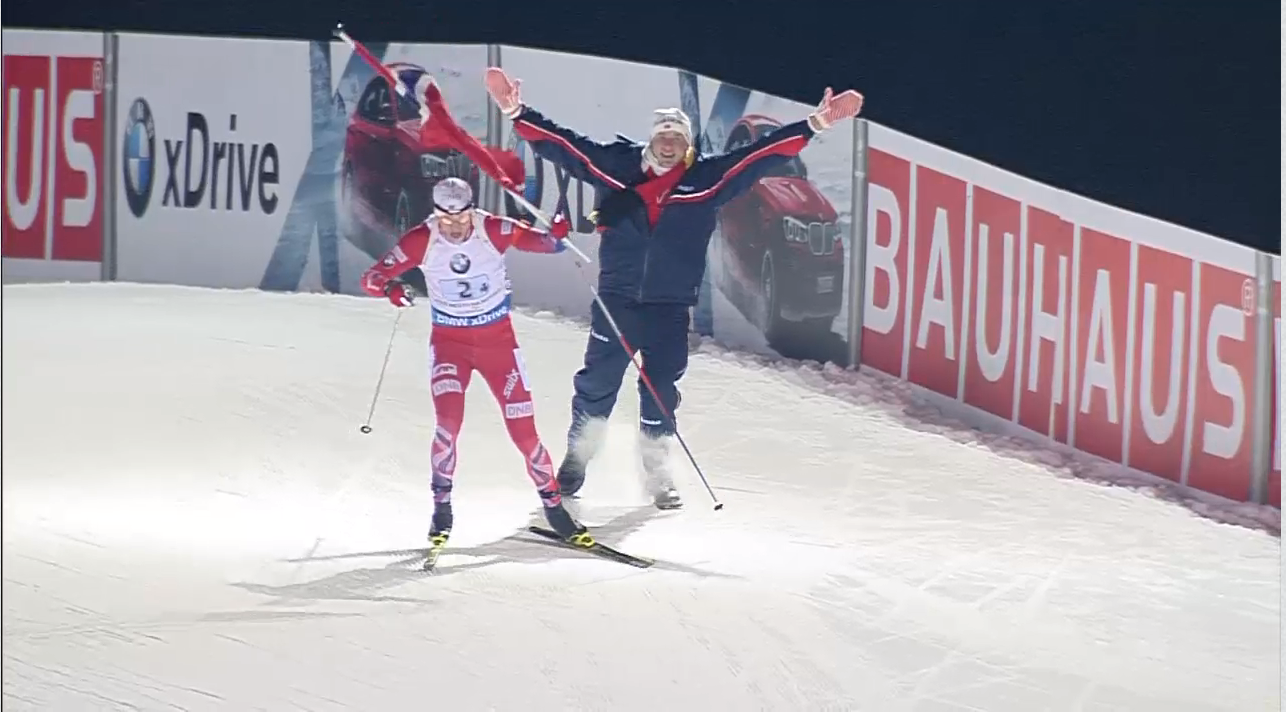
Emma Lunder, of Biathlon Canada’s Senior National Team, racing to second in the women’s modified sprint on Friday, Nov. 10, the last day of Biathlon Canada’s team trials. After reaching the podium three times in three races, she was selected to the IBU World Cup team for the first trimester. (Photo: Peter Collins/petercollinsphoto.com)
Note: This article has been updated to include comments and verification from Biathlon Canada High Performance Director Roddy Ward, and explain the modified shooting format used for Friday’s sprint.
***
Almost exactly two weeks before Biathlon Canada sends the rest of its World Cup team to Europe for the first trimeter of International Biathlon Union (IBU) World Cup racing, the national team held trials this past Tuesday through Friday on snow in Canmore, Alberta. Three sets of races in four days (all sprints*) determined which Canadian men and women will start the season at the World Cup opener in Östersund, Sweden, Nov. 26-Dec. 3.
The national-team trials, also known as the “Tour 1 Selection Trials”, ultimately boil down to what Biathlon Canada calls performance percentages, which measures an athlete’s finishing time in a given race against the average of of the top-three finishers’ times in that race. One bad race isn’t a deal-breaker; they consider the best two out of three. At the end of the trials, an athlete’s top-two results (specifically their performance percentages) are averaged for their overall ranking.
Going into the trials, two women and one man on Biathlon Canada’s senior team had prequalified for the first World Cup tour (World Cups 1, 2 & 3): Rosanna Crawford, Julia Ransom and Scott Gow, according to a national-team program dated Aug. 30, 2017.
According to the same document, two additional women’s spots and three men’s openings remained. Those went to the two highest-ranked women at the Nov. 7-10 trials — Megan Bankes and Emma Lunder, respectively — and the top-three ranked men — Nathan Smith, Brendan Green and Christian Gow, respectively.
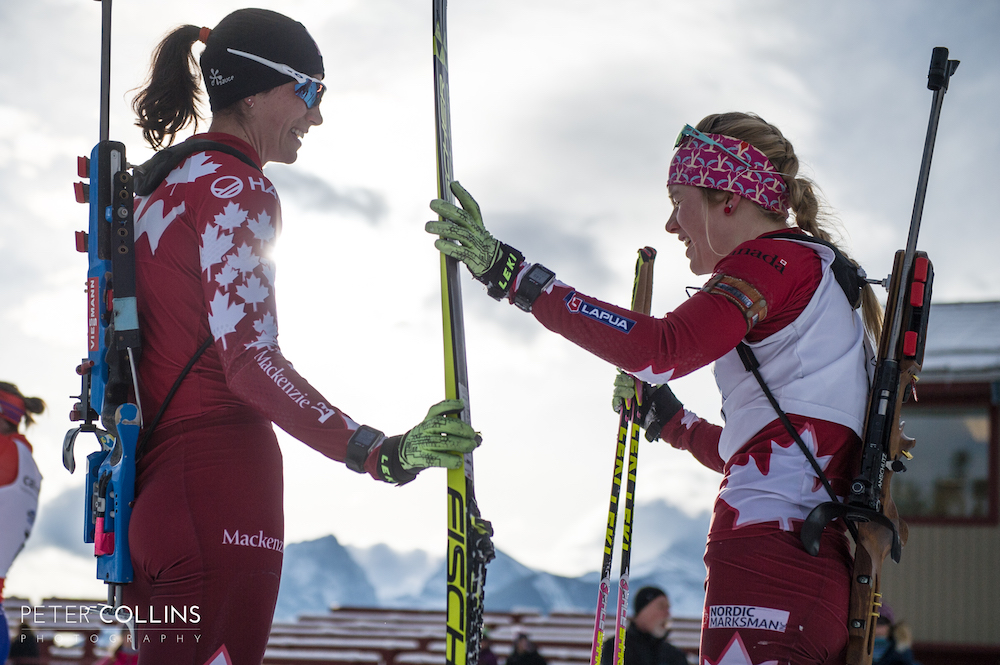
Emma Lunder (r) with fellow Biathlon Canada national-team member Rosanna Crawford after the women’s modified sprint at Biathlon Canada’s team trials in Canmore, Alberta. Lunder placed second in that race to secure one of the last two spots on Canada’s IBU World Cup Team, while Crawford, who had been pre-selected for the team, placed sixth in that race. (Photo: Peter Collins/petercollinsphoto.com)
All of the eight aforementioned athletes were nominated to Canada’s 11-member National Senior Team in June. The three remaining biathletes are Sarah Beaudry, who had the third-best overall women’s percentage at trials, Megan Tandy, who ranked fourth and was reportedly coming off an illness after traveling from Germany, and Macx Davies, who ranked seventh in the men’s final percentages after Matthew Hudec of the Biathlon Alberta Training Centre (BATC) in fourth, Carsen Campbell (BATC) in fifth, and Jules Burnotte (Biathlon Estrie) in sixth. (Scott Gow, Crawford and Ransom were not factored into the final percentages.)
The eight athletes that just missed the World Cup team will start the season on the IBU Cup. Four men and four women earned spots on Canada’s IBU Cup team as a direct result of their performances at trials: Hudec, Campbell, Burnotte, and Davies, and Beaudry, Tandy, Nadia Moser (BATC), and Leilani Tam von Burg (BATC).
Biathlon Canada’s High Performance Director Roddy Ward described the recent team selections as “straight-up trials”. Based on its published criteria, Biathlon Canada has the option to use discretion in choosing a fourth man and fourth woman for its IBU Cup team, but instead stuck to results, selecting the fifth- through eighth-ranked athletes at trials.
“We filled the team based on trials,” he explained on the phone on Sunday.
Ward said he was “feeling really good” about how the World Cup team shook out, with four of their top men returning to the circuit. He mentioned that Smith is healthy and back at full strength, and noted Green’s consistency at trials.
“On the women’s side, it’s just really good competition … with places changing every day,” he continued.
Most of the 16 athletes selected to Canada’s World Cup and IBU Cup teams spent much of the offseason together “time-trialling and integrating,” Ward said, which has brought up the level of training as well as made for closer competition among them.
“My hope is we go to the World Cup and do well and go to the IBU Cup and do well,” he said.
The Canmore trials began with sprints on Tuesday, which Beaudry and American Lowell Bailey (US Biathlon) won. The only woman to shoot clean, Beaudry topped the women’s 7.5-kilometer sprint by 8.9 seconds over Crawford with a finishing time of 21:57.7 minutes. Crawford missed one in each shooting stage (1+1) for second place and Lunder placed third, 21.1 seconds back, after a single standing miss (0+1). Tandy followed in fourth (+1:05.5) with two penalties (1+1), and Joanne Reid was the top American in fifth (+1:13.9) with one miss (0+1).
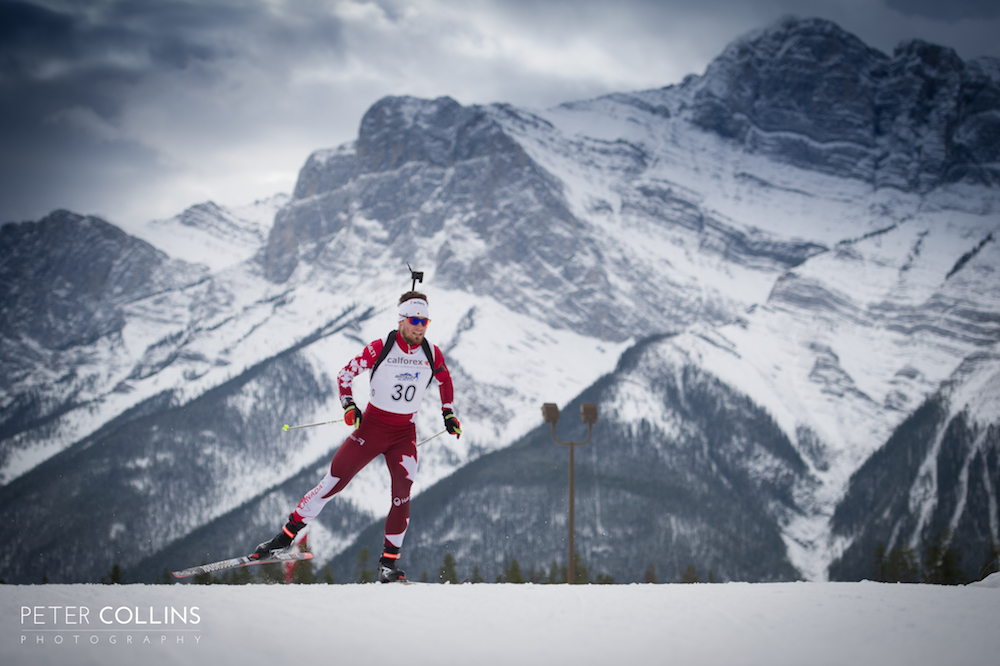
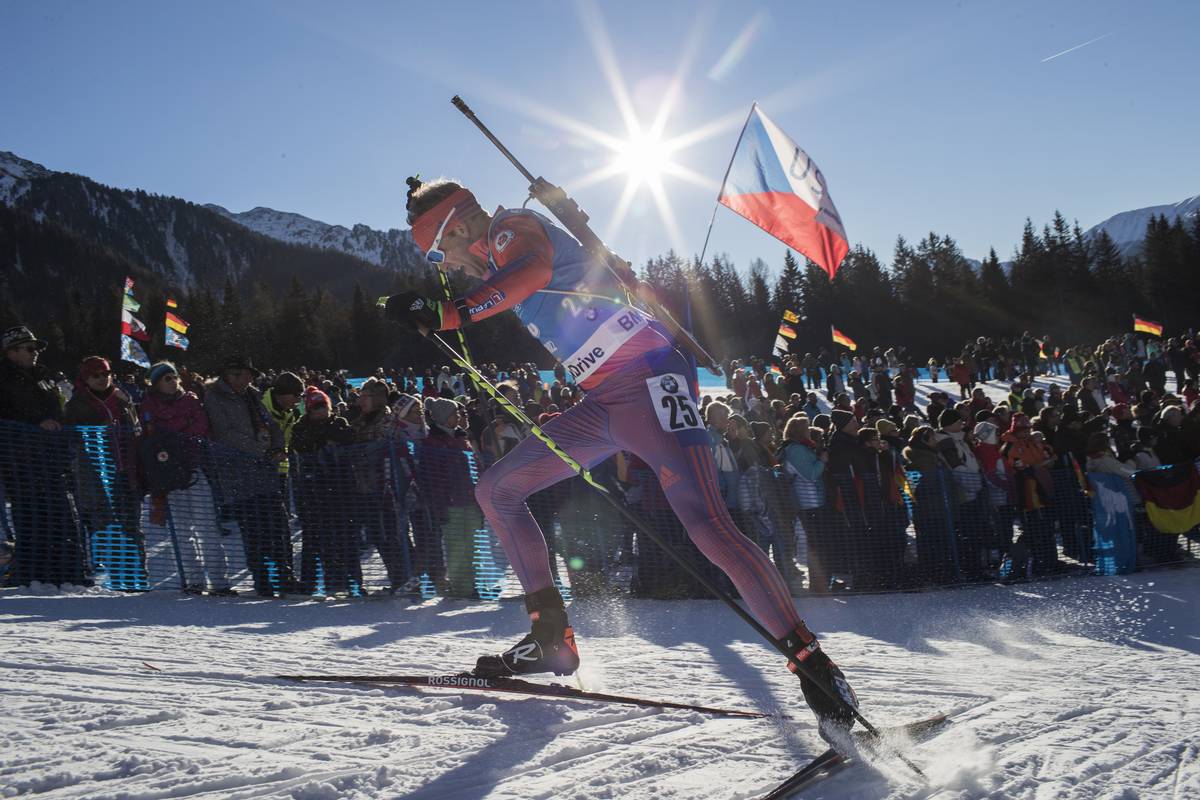
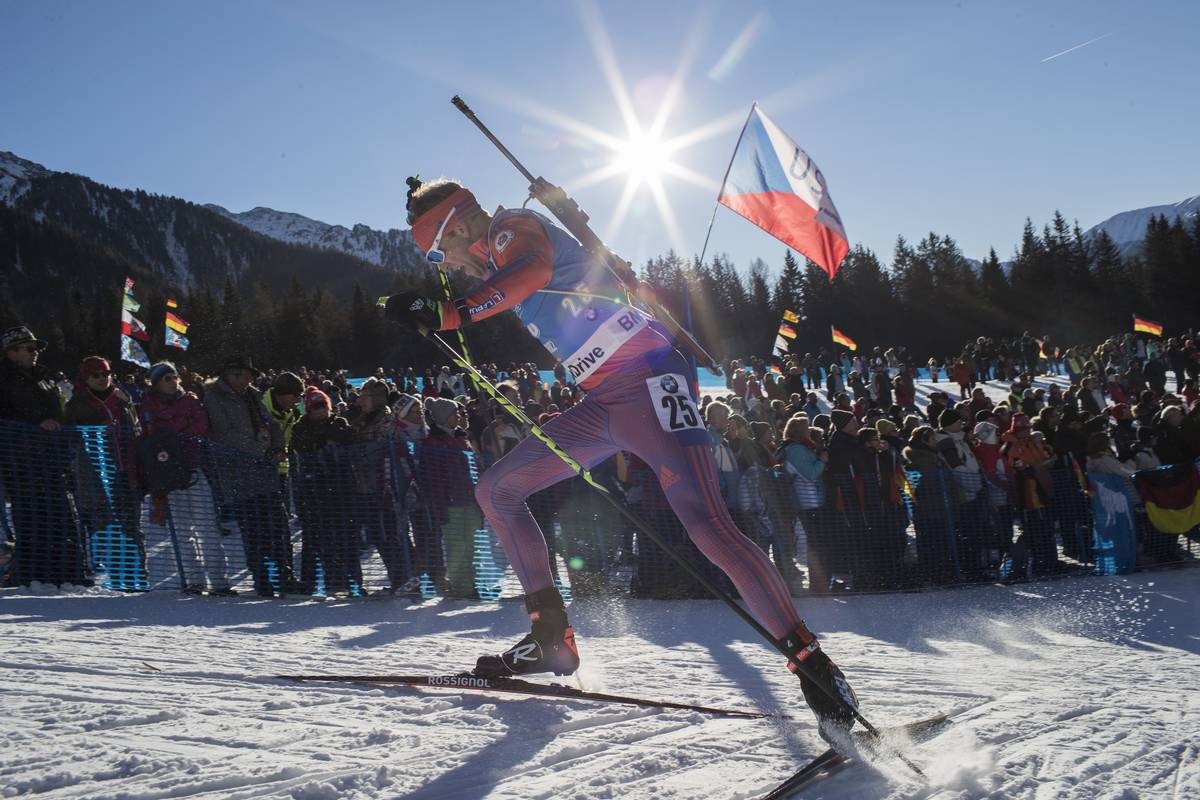
Christian Gow (Biathlon Canada Senior National Team) racing to ninth in the men’s modified sprint on the last day of Biathlon Canada’s team trials in Canmore, Alberta. With the third-best performance percentage of the trials, Gow was the fourth man named to Canada’s IBU World Cup team for the first trimester of racing. (Photo: Peter Collins/petercollinsphoto.com)
In the men’s 10 k sprint, Bailey also cleaned to beat out Smith by 13.4 seconds with a finishing time of 25:02.5. Smith had to ski one penalty loop after a prone miss (1+0) and Green placed third (+14.5) after two prone penalties (2+0). Scott Gow and his younger brother Christian finished fourth (+29.4) and fifth (+38.8), respectively, and Tim Burke (US Biathlon) was the second American in sixth overall (+1:11.0).
On Thursday, Smith won the second sprint of the week outright with a 26.1-second victory in the men’s 10 k with perfect shooting and a finishing time of 24:25.3. Green once again followed in second with clean shooting as well, and Artem Prima of Ukraine took third (+1:09.3) with two misses (2+0). While the Americans didn’t compete on Day 2 of the trials, Team Ukraine did, accounting for nearly the same amount of competitors (40 in the men’s race, 20 in the women’s race, compared to 40 in the men’s race and 26 in the women’s race two days earlier).
Scott Gow finished fourth in the Day 2 sprint (+1:17.0), followed by Hudec in fifth (+1:29.4).
In the second women’s 7.5 k sprint, a new winner emerged, but second through fourth place were exact repeats from Day 1. Bankes claimed the win in 22:03.5 with clean shooting, while Crawford followed in second, 26 seconds back with two standing penalties (0+2), Lunder placed third (+1:02.8) with two prone misses (2+0), and Tandy was fourth (+1:16.2) with two prone penalties (2+0) as well. Beaudry placed fifth (+2:16.6) with three penalties (2+1).
After sitting out the first two days of trials, Ransom won Friday’s modified sprint (6.8 k for the women) by just a tenth of a second over Lunder. Ransom hit all of her targets and posted the win in 20:20.4, and Lunder was just off her mark in second place after “cleaning” as well. Per the modified format, each athlete could use up to three spare bullets per shooting bout, similar to a modified relay.
“We all know [sprints] are important races; they lead to pursuits they lead to mass starts,” Ward explained. “We want to make sure we’re picking good biathletes, but also favoring on the ski-speed side.”
In addition to giving an athlete more chances on the shooting range, the relay format showed who could excel in those types of races, Ward said.
Julia Ransom (6) racing to the win in the women’s modified sprint on the last day of Biathlon Canada’s team trials on Nov. 10 in Canmore, Alberta. (Photo: Peter Collins/petercollinsphoto.com)
As a result of the modified-sprint format, the top-five women avoided the penalty loop. Bankes placed third, 6.7 seconds off Ransom’s time. Bankes’s BATC teammate Nadia Moser finished fourth (+8.6), ahead of American Susan Dunklee (US Biathlon) in fifth (+18.6). Crawford finished sixth (+48.0) with two penalties (2+0) and Tandy placed seventh (+1:13.9) with one miss (1+0).
In the men’s modified 7.5 k sprint on Friday, Smith emerged as the top Canadian for the third-straight race, winning in 18:42.0 with “clean” shooting. The top-eight men hit all their targets. Green finished second (+11.5) once again, and Scott Gow improved to third (+36.4).
Prima followed in fourth (+41.5), his Ukrainian teammate Sergey Semenov finished fifth (+1:05.9), Campbell and Burnotte tied for sixth (+1:08.2), and Davies placed eighth (+1:20.2). Christian Gow finished ninth (+1:40.9) with one penalty (1+0), Burke was the top American in 10th (+1:47.7), followed by Bailey in 11th (+1:47.9). Both Americans finished without any penalties.
Both the U.S. and Ukrainian teams raced two out of the three days of trials, contributing to the total field size of 45 men and 26 women on the last day. Ward emphasized that those teams’ presence made for “some really good competition”, and added that having Canadian juniors race alongside seniors (same distances, same races) showed them a clear path to reaching the World Cup level.
US Biathlon held the last of its own trials last month and planned to finalized its IBU World Cup team after its Canmore training camp.
For the Canadian World Cup team, Green and the Gow brothers planned to leave Sunday for Sjusjøen, Norway, where they’ll race at Norwegian biathlon trials. According to Ward, Lunder will depart on Thursday for Sjusjøen, where she’ll start her season with the first IBU Cup sprint on Nov. 23 before meeting the rest of the World Cup team in Östersund. Smith, Crawford, Ransom and Bankes planned to leave Canada on Nov. 22.
Most of the IBU Cup team will depart on Dec. 1, while Campbell and Beaudry will start their seasons earlier at the IBU Cup opener Nov. 23-26 in Sjusjøen.
(*Why were all of these trials sprint races? When it comes to individual events, IBU Cup and IBU World Cup venues typically open with sprints to determine which athletes qualify for the remaining races of the week at each stop. For instance, the top 60 in the sprint qualify for the following pursuit race, and approximately the top 30 in the overall World Cup rankings qualify for mass starts.)
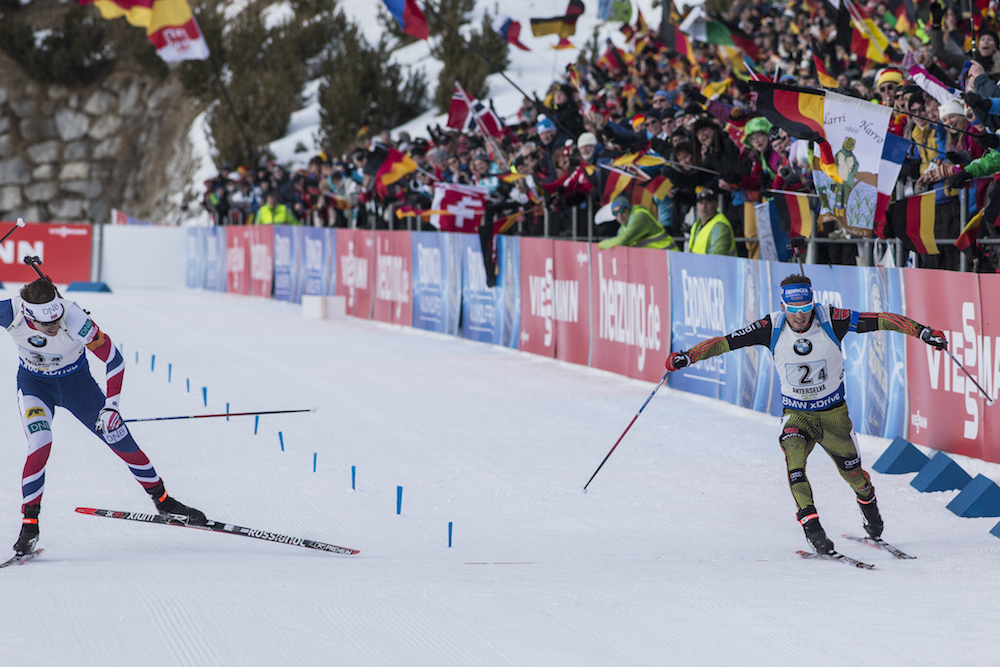
The photo finish for first in the IBU World Cup men’s 4 x 7.5 k relay on Saturday in Antholz, Italy, with Germany’s Simon Schempp (r) edging Norway’s Emil Hegle Svendsen (l) by 0.1 seconds. (Photo: IBU/Christian Manzoni)
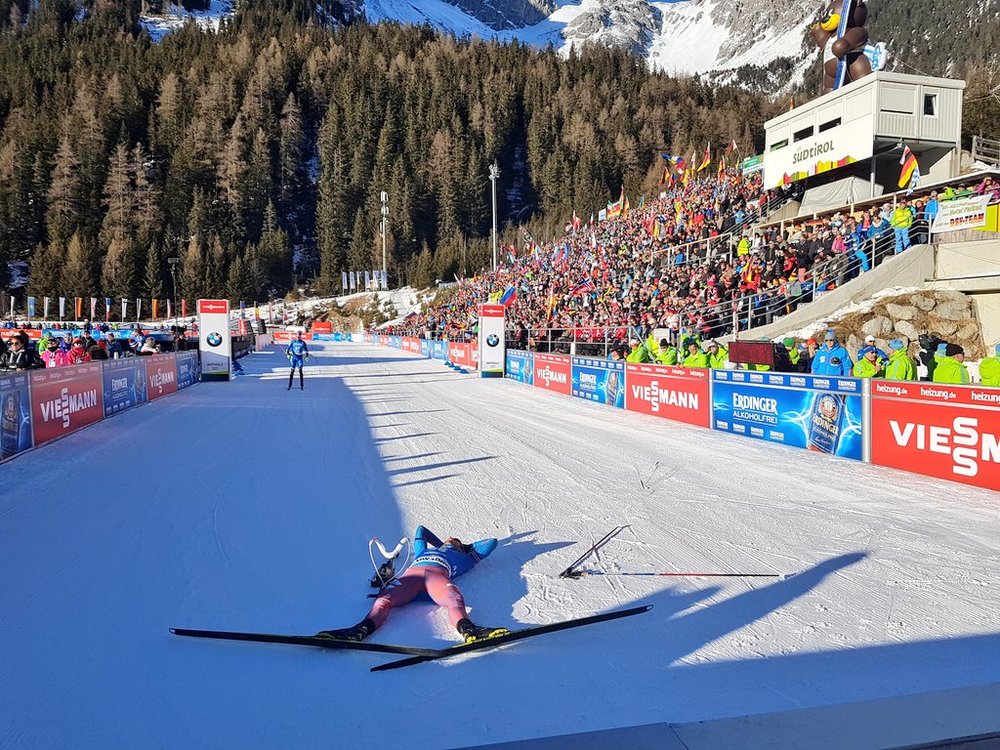
For Germany and Norway, it was a two-way battle for first following the final exchange of the men’s 4 x 7.5-kilometer relay on Saturday at the International Biathlon Union (IBU) World Cup in Antholz, Italy.
There, thanks to third-leg Johannes Thingnes Bø, Norway had taken the lead by 17.7 seconds over Germany and built a 38-second gap to Russia in third. Ukraine was another nine seconds back in fourth, skiing just ahead of France and the U.S. in fifth and sixth through the exchange, respectively.
So for the U.S. in Saturday’s relay, the last one before 2017 IBU World Championships in Hochfilzen, Austria, next month, it was a fight for a team-best result — which would have been fourth.
Before we get to where they finished, let’s remember where the U.S. men’s relay started: in bib 24 of 25, at the back of the pack.
Lowell Bailey raced them into sixth at the first exchange and 8.6 seconds out of the lead, with Russia’s Maxim Tsvetkov reaching the exchange first. Bailey had skied the fifth-fastest course time on that leg and shot quickly to clean with one spare in each of his two shooting stages.
Eighth after the first prone stage, he moved into sixth after his standing shooting. One loop later, he tagged his teammate Leif Nordgren in sixth.
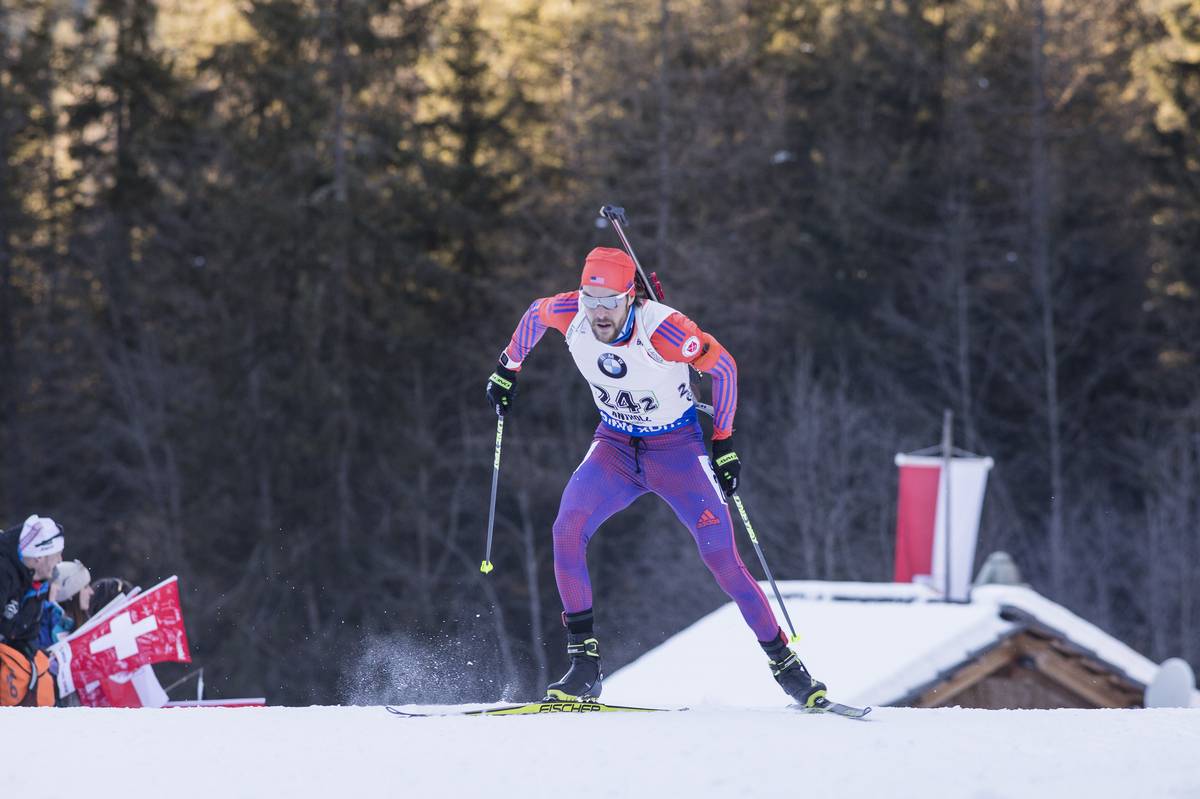
Leif Nordgren (US Biathlon) skiing the second leg of the men’s 4 x 7.5 k relay on Saturday at the IBU World Cup in Antholz, Italy. (Photo: USBA/NordicFocus)
Nordgren proceeded to jet into third after his prone stage, despite using two spares to clean.
“It was a big bummer to miss two in prone, but the rest of the group also missed so I was able to leave towards the front,” Nordgren explained in a US Biathlon press release.
He used one more spare to clean his standing stage and remained in third heading into his final loop. There, Nordgren’s lack of racing this season caught up to him (this was his fifth World Cup race of the season), and he tagged off in ninth, 27.6 seconds behind Russia’s Evgeniy Garanichev in fifth.
“In the last loop I was holding on for dear life,” Nordgren told US Biathlon. “Those other guys have a lot more racing under their belts this year. I have four [races], so that made for a hard loop.”
While Nordgren and teammate Tim Burke had a shaky tag, which Burke described as a “bit of a collision,” Burke was able to emerge from it unscathed. He went on to ski the fourth-fastest third leg to bring the U.S. to sixth.
“I felt solid on course today,” Burke wrote in an email, after posting the third-fastest course time for that leg.
He used three spares to clean prone — any more misses and he would’ve had to ski a penalty loop — and started his second loop in ninth. The next time in the range, Burke cleaned standing without any spares and set out on his last loop in seventh.
“I pushed hard all the way to the shooting point before prone, which, in hindsight, was probably a bit too aggressive,” he reflected. “For standing my goal today was stay aggressive and I was happy with how that worked out.”
Burke started his last loop with France’s Simon Desthieux. “We were able to really push on the last loop and pull the others back,” Burke explained. “I wanted to hand off to Sean with the group that would fight for third place.”
Burke tagged his teammate Sean Doherty in sixth, 11.6 seconds out of third and just 4.3 seconds behind fourth. Meanwhile, Norway had taken the lead after Bø’s standing stage with clean shooting (and after using just one spare to clean prone) while Russia dropped to third with a total of four spares from Dmitry Malyshko.
Germany’s third-leg skier Arnd Peiffer took the lead after a miss-free prone stage, and using one spare in standing, left the range just 6 seconds after Bø to bring Germany into second at the final tag, 17.7 seconds from first.
Over the last three loops and two shooting stages, Norway’s anchor Emil Hegle Svendsen and Germany’s final skier Simon Schempp drew closer, with both cleaning prone without a miss. At the start of the second loop, Schempp was within 12.7 seconds of Svendsen. Back in the range for the last time, Svendsen missed his second and fifth shots, requiring two spares, and Schempp needed one spare to clean, and the two set out on the final loop together, with Svendsen leading by 0.3 seconds.
The two went head to head all the way to the finish, where Schempp ultimately outlunged Svendsen in a photo finish by one-tenth of a second. He secured the win for Germany in 1:13:57.2 hours, and the team — with Erik Lesser, Benedikt Doll, Peiffer and Schemmp — used a total of seven spares to avoid the penalty loop.
“I gave it everything I had in the end, and wanted to attack a little earlier but [Svendsen] attacked incredibly up the bridge,” Schempp recalled in a post-race interview with ZDF. “I had a feeling that we crossed the line pretty much together. Then I had to wait what the computer would show as a result.”
“He was a little stronger,” Svendsen told NRK after. “I have no other explanation than that. I had to make sure I did not ski into him … so I lost a little momentum there.”
At the last World Cup relay in Ruhpolding, Germany, Norway won with Ole Einar Bjørndalen, Vetle Sjåstad Christiansen, Henrik L’Abee-Lund, and Svendsen. Russia finished second, Germany was third, and the U.S. was 12th.
“I think we presented ourselves with top ski speed today, and on the shooting range it clearly went better than in Ruhpolding, especially for me,” Lesser said, referring to his penalty and the team’s total of nine spares in the Ruhpolding relay (compared to Russia, which had two, and Norway with five spares in Ruhpolding).
“We still have those seven spares, I can remember the last time we became World Champions we only had two spares, so we definitely can get down there, but it was a cool final rehearsal,” Lesser said.
Norway took second with Lars Helge Birkeland, L’Abée-Lund (who brought the team from fourth to second at the second exchange), Bø, and Svendsen, after using nine spares.
Russia ended up third (+33.6), with Tsvetkov, Garanichev, Malyshko, and Babikov, with a team total of nine spares as well, and Ukraine pulled off fourth (+46.7) with just five total spares, with Artem Pryma, Sergey Semenov, Vladimir Semakov, and Dmytro Pidruchnyi.
Ukraine embarked on the last leg in fourth, 1:04 minutes out of first and just ahead of France in fifth and the U.S. in sixth.
On their first loop together, Doherty moved into fourth, trailing Russia’s Babikov in third by about eight seconds. With France’s Quentin Fillon Maillet, Doherty bridged the gap to Babikov, passing the Russian but remaining in fourth as the Frenchman skied into third.
In their prone stage, Doherty used one spare and Fillon Maillet cleaned to leave the range just ahead of him in fifth, while Doherty followed in sixth. Five teams continued to fight for the podium, with Ukraine’s Pidruchnyi leading them in third.
Pidruchnyi didn’t miss a shot in either stage to hold that position until his final loop, where Babikov passed him to claim the third spot on the podium, 12.9 seconds ahead of him.
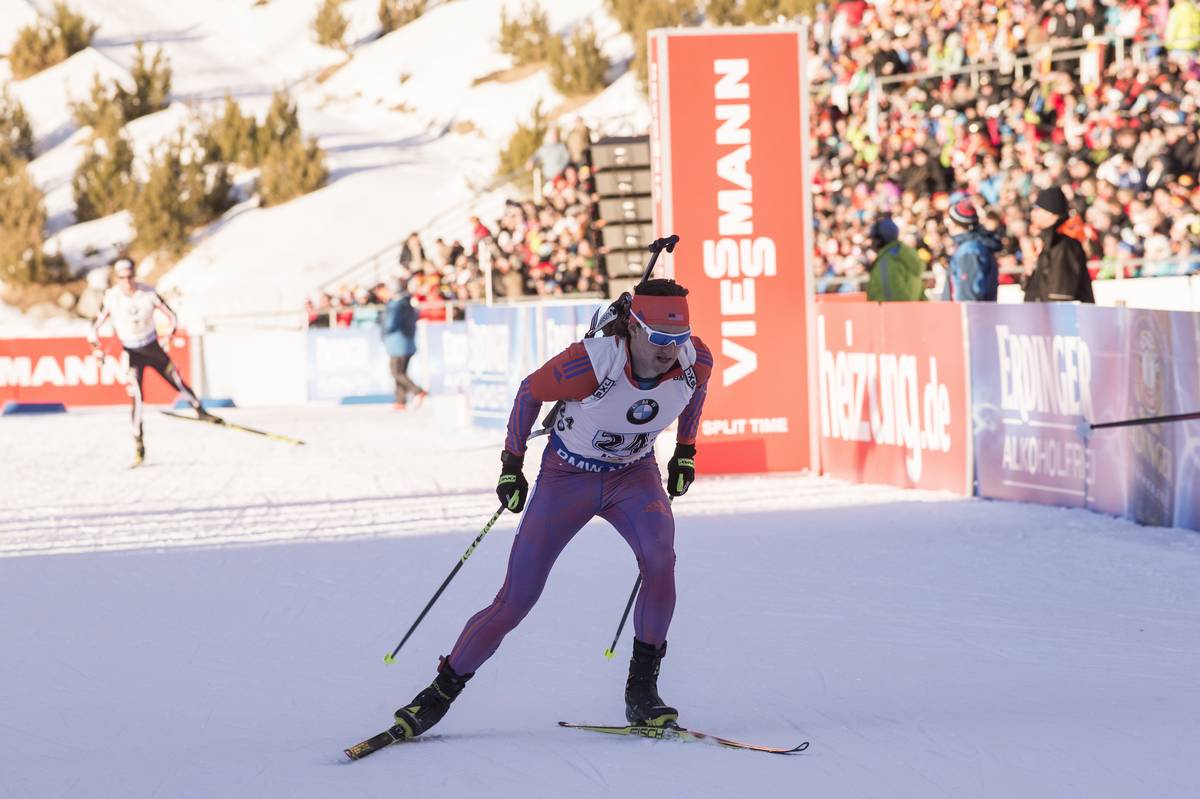
Sean Doherty (US Biathlon) crossing the finish line in sixth for the U.S. men’s 4 x 7.5 k relay on Saturday at the IBU World Cup in Antholz, Italy. (Photo: USBA/NordicFocus)
In the final standing stage, Doherty and Austria’s Dominik Landertinger both used one spare and left the range in fifth and sixth, respectively. France dropped out of contention when Fillon Maillet had to ski a penalty lap.
“It was really exciting,” Doherty said of the last shooting in an interview with IBU TV. “The pace was really high. Came in and just tried really hard to focus on my own work, knowing there were some guys close in front and behind me. Luckily only one spare, and I was able to get out of there with staying out of the [penalty] loop.”
While Doherty left the range about three seconds ahead of Landertinger, the Austrian passed him during the first kilometer of their final loop. Landertinger extended his gap to Doherty to 12 seconds with less than half a kilometer remaining and anchored Austria to fifth (+49.2), 2.5 seconds out of fourth. Doherty finished sixth for the U.S. (+1:04.9), 15.7 seconds out of fifth.
Behind him, France’s Fillon Maillet finished seventh (+1:34.7). In all, Austria used eight spares and the U.S. had 10, but both avoided the penalty lap. France accumulated 14 spares and one penalty.
“Today’s sixth place was a very strong effort for the team,” Doherty told US Biathlon. “I am very happy to be skiing up in the mix and looking at the podium. There is still room to improve for World Championships, but it seems we are headed in the right direction.”
“Today we showed that we are competitive with the best in the world,” Bailey said in the same press release. “With 10 extra rounds, this is far from our best, but it is a big step in the right direction and exactly where we want to be heading into world champs.”
For the U.S., sixth was one place back from its team-best fifth, which it achieved with the same four men last year at the World Cup in Presque Isle, Maine.
“We are very satisfied with the result today,” Burke said. “With the exception of Lowell, it has been a bit of slow start for the rest of us with a mix of injuries and illnesses. This was definitely important for our confidence heading into World Champs.”
For every man on the team except Bailey, Saturday marked the last World Cup race before World Championships, which start Feb. 9.
Burke planned to stay in Antholz for the next two weeks to prepare.
“I feel like I am still not near my best, but at least I have been consistently in the mix the past two weeks,” Burke wrote. “Hopefully with a good training block over the next two weeks, I can still come to a higher level for World Championships.”
Bailey competed in Sunday’s 15 k mass start and finished 16th, 1:33.4 behind Norway’s Bø, who cleaned the four-stage race to win in 37:04.3. Bailey had two penalties in his last two stages (0+0+1+1), and in his first World Cup mass start, Canada’s Scott Gow finished 30th (+4:09.9) with four penalties (1+0+2+1).
The Canadian men’s relay finished 16th on Saturday (+4:13.8), with Christian Gow, Scott Gow, Macx Davies, and Brendan Green combining for two penalties and 11 spares. Both penalties came on Davies’s third leg. While the team was in 15th after Scott Gow’s second leg, they dropped to 18th on the third leg, but Green recovered two places to finish 16th.
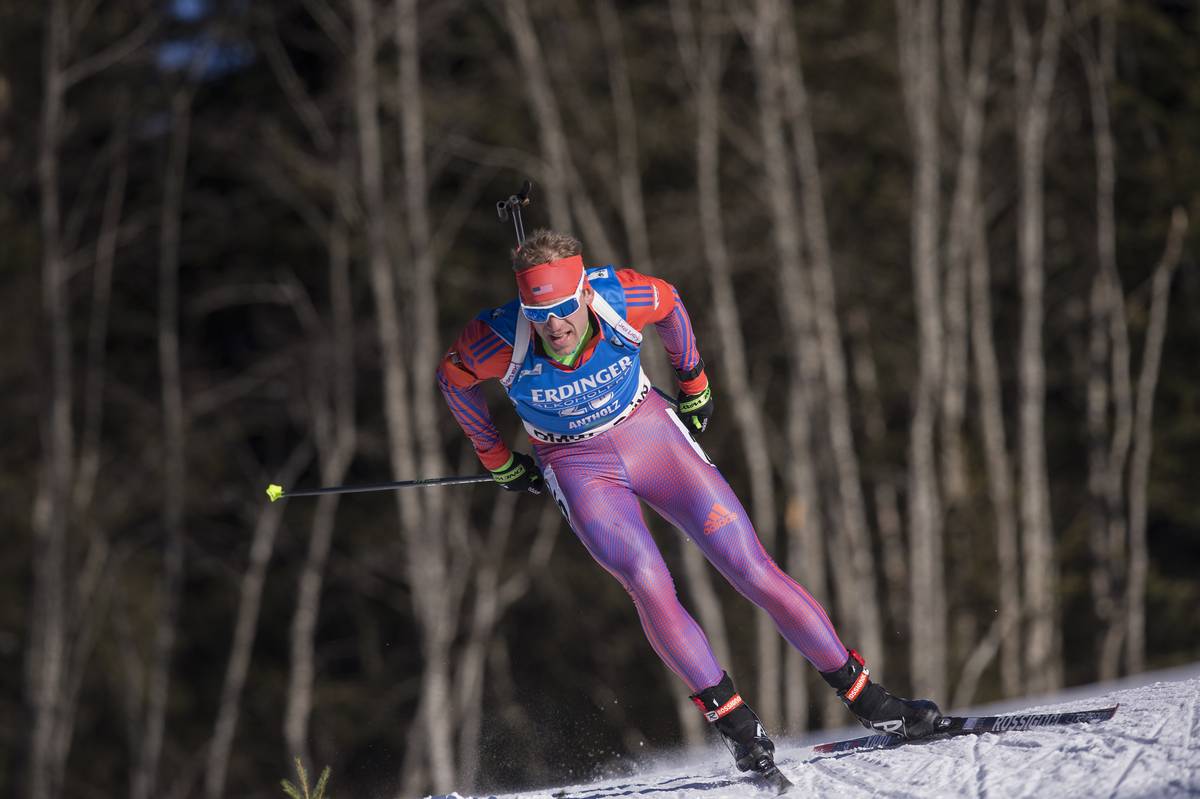
Lowell Bailey (US Biathlon) racing to 10th for his second individual top 10 of the season on Friday in the IBU World Cup men’s 20 k individual in Antholz, Italy. Bailey led five U.S. men in the top 40. (Photo: USBA/NordicFocus)
(Note: This article has been updated to include comments from U.S. biathlete Paul Schommer.)
What’s the old saying? It doesn’t really matter what happens in December, as long as it all comes together three weeks before World Championships?
The tale of the US Biathlon men’s team goes something like that, with what started out as a skeleton crew of three men in December expanding to five men who finished in the top 40 a month and a half later on Friday in Antholz, Italy.
It was the first time in recent memory that the U.S. men have achieved such a feat. According to US Biathlon men’s coach Jonas Johansson, the 2012 International Biathlon Union (IBU) World Cup in Kontiolahti, Finland, was a big one as well, with four U.S. men in the top 16.
But all five starters scoring World Cup points in the top 40?
“This shows that there is great potential in the men’s squad right now,” Johansson wrote in an email on Friday. “And when the group gets stronger, each individual has to push harder each workout to fight for a start spot and this will make the team even stronger in the future.”
Lowell Bailey led the team in 10th in Friday’s 20 k individual — the longest individual race on the circuit. It was his second-best result of the season after placing ninth in the 12.5 k pursuit in December in Nove Mesto, Czech Republic. On the phone on Friday, Bailey explained the Antholz 20 k was a race he had been targeting.
Bailey racing to 10th on Friday in the IBU World Cup men’s 20 k individual in Antholz, Italy. (Photo: USBA/NordicFocus)
“I’ve been preparing for this race all season and especially over Christmas … so I’m glad to see that pay off,” he said.
Bailey started 25th out of 105 in the men’s field and proceeded to hit every target in the first three stages. That presented him with the very real possibility of a podium with one standing stage to go, but a miss there cost Bailey a minute and put him a few places back by the finish.
“You always wish that you could have one more shot, and of course it’s easy to look in an individual where that would put me, but I think all in all I was happy with the race,” he said.
While Bailey initially crossed the finish line in fifth, he was ultimately bumped to 10th, 1:39.1 minutes behind the winner, Russia’s Anton Shipulin.
“It’s a brutal 4 k course here with about a [kilometer] of climbing right out of the range, and I just tried to take it out fast, but also with the intention of keeping my speed throughout the race,” said Bailey, who posted the 26th-ranked overall course time and notably, the fourth-fastest shooting time.
Recalling his final loop, Bailey said he lost time on Germany’s Arnd Peiffer, who started first and ended up 8.7 seconds ahead of him in ninth, but was able to squeak ahead of another German, Benedikt Doll, who started fourth and placed 11th, 1.7 seconds back from Bailey.
“I’m happy with the result and psyched with the team result, too, because I think that bodes well for us in the relay tomorrow,” the 35-year-old Bailey said of the men’s 4 x 7.5 k relay on Saturday.
Career-best 17th for Canada’s Scott Gow
While Bailey notched his second individual top 10 of the season, Biathlon Canada’s Scott Gow achieved a career best in 17th, 2:37.7 back from Shipulin’s time, with a single miss in his second prone (0+0+1+0) and the ninth-fastest shooting time overall. Gow started 19th, and after two clean stages, he was in contention for a top 10.
“After my first two clean bouts, I told myself not to get too over confident and that I still had two bouts remaining,” Gow, 26, recalled in an email. “I put my focus into my skiing and tried to approach the range as mechanically as possible in an effort to remove any emotions from my normal procedure. Today it worked very well and I’m pleased that I was able to shut my brain down.”
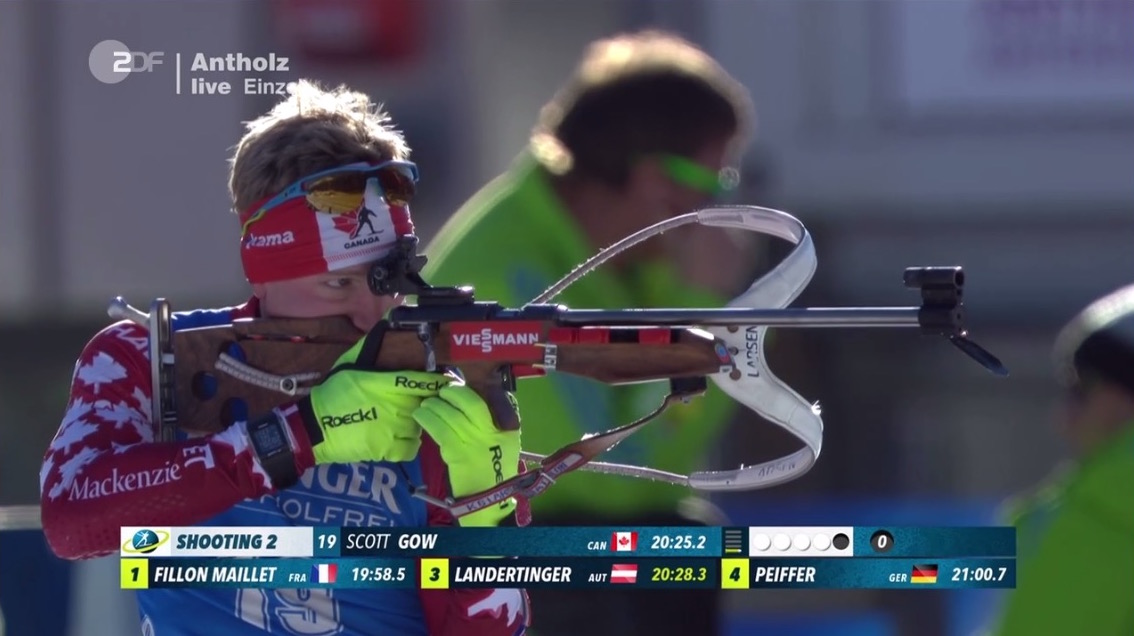
Scott Gow (Biathlon Canada) on his way to cleaning his second-straight stage of the men’s 20 k individual on Friday at the IBU World Cup in Antholz, Italy. Gow went on to place 17th for a career best. (Photo: ZDF broadcast screenshot)
He described the range conditions as “extremely calm,” after training throughout the week in considerable wind.
“After watching the girls yesterday battling big gusts, I was fully prepared for a tough fight on the range,” Gow wrote, referring to the women’s 15 k individual on Thursday. “Fortunately we ended up with almost zero wind, and that lasted for the entire race.”
After initially finishing ninth, Gow was “somewhat confident” he could hang on to a top 20.
“I knew there were a lot of fast guys behind me who were shooting well,” he wrote. “… I had my fingers crossed to be in the top 16.”
He came close, within 5.6 seconds of 16th, but claimed 17th to beat his previous personal best of 18th (which he tallied twice: earlier this season in the Nove Mesto sprint and at last year’s World Championships in the 20 k individual).
“Today’s race was a big confidence boost,” Gow explained. “I still have some areas I can improve upon, but this result is a big step in the right direction. As long as I can stay healthy leading into [World Championships], train smart and stay focused I think I can have a good championships. I know the potential is there, now I have to start capitalizing more.”
Shipulin’s Special Place
On an afternoon with considerably easier shooting conditions than the women faced on Thursday, as Gow vouched for, Shipulin started 33rd and missed just one target on his second prone stage, just like Gow (0+0+1+0). The Russian posted the fastest range time and third-fastest course time to rocket to first at the finish (in 50:38.1 minutes) by a whopping 41 seconds over France’s Martin Fourcade, who started 28th and missed two (0+1+1+0). For Shipulin, it was his first World Cup win of the season and first career win in a 20 k individual.
Russia’s Anton Shipulin racing to his first IBU World Cup win of the season on Friday in the men’s 20 k individual in Antholz, Italy. (Photo: IBU)
“I have a special relationship [with this venue] because my first win was here in Antholz,” Shipulin said at the post-race press conference, according to a translator. “I can’t say it was easy today, but I would like to thank all the fans who were cheering for me. And I would like to thank Martin for giving me a chance.”
Fourcade, who ended up second, said Antholz’s altitude was challenging at some 1,600 meters (about 5,2500 feet) above sea level.
“Being back at altitude after two weeks in Oberhof and Ruhpolding was really hard,” Fourcade said at the press conference of the last two World Cups in Germany. “And even though I was in really good shape, today it was really painful.”
While he was skipping Saturday’s relay, Fourcade said he would be back for Sunday’s 15 k mass start (the select, 30-man race Bailey and Gow also qualified for).
“When everybody asks me why I don’t win in Antholz so much, I will try to do it on Sunday in the mass start,” Fourcade said.
Ukraine’s Sergey Semenov was an early leader after starting 16th. He held onto first until Fourcade finished 15.8 seconds faster, bumping him to second, and ultimately placed third, 56.8 seconds behind Shipulin. Semenov appeared to give every last ounce to the finish, stumbling before crashing headfirst across the line.
“Yesterday in our team meeting with our coach, we recalled the last time here in an individual,” Semenov said in English at the press conference. “And if I am not mistaken, my teammate was the winner, it was Sergei Sednev.”
(According to an Antholz organizing-committee press release, Sednev won that race during the 2009/2010 season. Sednev was later suspended for failing a drug test in 2013.)
“At the meeting I thought why not today? Why not to have a good result?” Semenov continued. “Because even without the wind, Antholz is a really tough place for the shooting, maybe because of the altitude, maybe because of the last meters before the shooting range. But even without the wind it’s usually quite a lot of misses here. So I just needed to do a good shooting, and I always feel good on the 20-kilometer races.”
Semenov cleaned three stages, like Bailey, before missing one on his last standing (0+0+0+1).
“Here, it’s not enough oxygen, and for the last shot I was just out of breath,” Semenov said. “I just needed to delay it and begin it one more time, but I was already in a hurry. And then I thought, ‘OK, I still had a good shooting, I still have a good opportunity to stay at the top.’ So I did my best on the last lap, and here I am!”
It was the 28-year-old Ukrainian’s first podium of the season and fifth of his career. Last year at World Championships, he placed third in the sprint in Oslo, Norway.
“I feel quite good,” Semenov said. “At the December World Cups, I had to start with an injury of my shins, so I was not really in a good shape, but now it’s OK, and from race to race I feel better and better.”
Nordgren Back in Top 30, Schommer Shines in World Cup Debut
Also coming back from illness and injury were two of Bailey’s U.S. teammates: Leif Nordgren and Sean Doherty, who finished 29th and 36th, respectively, on Friday. Nordgren was coming off surgery on a fractured toe and Doherty rebounding from mononucleosis at the start of the season.
Leif Nordgren (US Biathlon) racing to 29th in the men’s 20 k individual on Friday at the IBU World Cup in Antholz, Italy. (Photo: USBA/NordicFocus)
In an email, Nordgren, 27, explained that he was unable to train for essentially all of December, up until Dec. 24.
“I got back into training full time on the 24th,” he wrote. “I was healed enough by then that I didn’t have to take it easy at all, I could train the full amount. As of now my toe is fine for the most part, I’m missing a toenail so I have to be careful not to stub it or smash it and I have a problem with the joint bending in some directions but overall it’s fine. Skiing and running don’t give me any pain which is good.”
Friday marked Nordgren’s fourth World Cup race this season, after toughing it out in the season-opening relay in Östersund, Sweden, in late November, then returning to the circuit for last week’s races in Ruhpolding. There, he placed 71st in the sprint and 12th in the relay (with Bailey, Tim Burke and Doherty).
“Once I made it back to training I always had this race in mind,” Nordgren wrote of Friday’s 20 k. “I knew that I’d be pretty rough in Ruhpolding, but with those races under my belt I’d hopefully be in better shape this week. With the altitude this is a pretty tough 20km, my goal was to start very conservatively and ramp it up towards the end.”
After missing one shot on each of his first two stages, Nordgren cleaned the last two stages (1+1+0+0) to finish 29th (+4:00.1).
“I was skiing with some good guys on their final loops for my first few loops, so I made the decision to ski with them which may have hurt me in the end, but overall I’m happy with how I skied,” he reflected. “I would have liked to have one less miss, that would have meant a really good result for me. The two misses that I did have were bad errors that shouldn’t have happened, but that’s how biathlon goes.”
Johansson noted in his email that Nordgren needed “more races and hard workouts to get back to his normal race speed,” but he was well on his way.
“Really happy to see that Leif is back and also performs at this level already,” he wrote.
Nordgren was listed as a starter for the U.S. men’s relay on Saturday, along with Burke, who placed 34th (+4:36.5) with four misses (0+1+1+2) and Doherty, who finished 36th (+4:41.6) with three penalties (1+1+0+1), on Friday.
Paul Schommer, of US Biathlon’s National Development Group, racing to 33rd in his first IBU World Cup race, the men’s 20 k individual on Friday in Antholz, Italy. (Photo: USBA/NordicFocus)
However, ahead of Burke and Doherty, 24-year-old Paul Schommer, a US Biathlon development skier, raced to 33rd (+4:16.6) in his first World Cup race. He started 90th and cleaned three stages, missing two on his first standing bout (0+2+0+0).
“There’s a quote by Seneca, a great Roman Philosopher, that says, ‘Luck is what happens when preparation meets opportunity,’ ” Schommer wrote in an email to FasterSkier. “I think that pretty much sums up my success today. God has really shown me how to use some of the gifts He has given me in the last year, and today I was able to put that preparation to the test. After my first standing, I knew I just kind of let those two shots go. I just put them behind me, and concentrated on the next two stages one at a time. I just thought of it as another training session and making every shot count. I have also been shooting in a lot of wind lately so having almost no wind on the range today was super nice.
“There’s a quote by Seneca, a great Roman Philosopher, that says, ‘Luck is what happens when preparation meets opportunity.’ I think that pretty much sums up my success today.” — Paul Schommer, US Biathlon National Development Group, after placing 33rd in his World Cup debut
“The atmosphere here in Antholz is amazing and unlike anything I have ever experienced before,” he added. “However, for most of the race I was just in race mode and did my thing. I tried not to think about the fans, the cameras, and all the other things that could have distracted me. I just wanted to keep my focus on the task in front of me.”
“A really impressive race from Paul today,” Johansson wrote. “First WC start and he shows that he has the capacity to score WC points right away. He will learn a lot from just racing among the top athletes and I am sure that we will see a lot more from Paul in the next years.”
Back in early December, when the U.S., with just three men on the World Cup, was unable to field a men’s relay for Pokljuka, Slovenia, Schommer as the next man on the list seemed like a natural pick. But the “heavy travel and race schedule … did not justify getting someone out of the middle of a training block in Canmore,” U.S. Biathlon Chief of Sport Bernd Eisenbichler wrote in an email at the time.
He said it was important to consider the best options for an individual’s development, adding that the U.S. didn’t intend to miss more than one relay.
“After last season, I made two goals for myself,” Schommer explained. “The first landing a top 20 on the IBU Cup and the second, earning a World Cup start. After not being named to the World Cup team for the first trimester after the pre-World Cup camp in Canmore, I was a little disappointed but also knew it was not my last chance to earn myself a start on the WC. I just stayed focused, qualified for the IBU Cup and thankfully had good enough results in Martell and Arber to be called up for Antholz. Like I said, I set the goal of starting a World Cup early this spring, but when I actually found out I was going to be racing in Antholz, I was pretty excited to say the least.”
The U.S. men were back for the relay in Ruhpolding, where they finished 12th. With the same lineup in a slightly different order (with Nordgren and Burke swapping places), they’ll set out in bib 24 (of 25 teams) on Saturday. Bailey will start them off, Nordgren will ski the second leg, Burke the third, and Doherty the anchor.
“This is a strong relay team and goal is to fight for a top 6 finish,” Johansson wrote.
Canada, which earned bronze in the men’s relay at 2016 World Championships, listed Christian Gow, followed by Scott Gow, Macx Davies, and Brendan Green as its starters (in bib 10).
In Friday’s individual race, Green finished 75th (+7:09.6) with six penalties (2+1+2+1), and Christian Gow finished with the same time for 76th (+7:09.6) with four penalties (0+2+0+2). Davies did not start.
Russia’s Anton Shipulin after winning the men’s 20 k individual at the IBU World Cup on Friday in Antholz, Italy. (Photo: IBU/Twitter)
NorAm Western Canadian Championships (Whistler, B.C.): Freestyle sprints
[UPDATED] On Friday, the first day of the NorAm Western Canadian Championships at Whistler Olympic Park in Callaghan Valley, British Columbia, Dahria Beatty and Jess Cockney topped the women’s and men’s 1.2-kilometer freestyle sprint A-finals, respectively.
Beatty, of the Alberta World Cup Academy (AWCA) and Canada’s National U25 Team, started the day by qualifying in second, 0.31 seconds behind her fellow AWCA and U25 Team member, Olivia Bouffard-Nesbitt, who won the qualifier in 2:59.9.
Both Bouffard-Nesbitt and Beatty went on to win both their quarterfinal and semifinals before facing off in the A-final, where Beatty edged her teammate by 0.74 seconds. Beatty crossed the line in 3:02.89, Bouffard-Nesbitt took second and Katherine Stewart-Jones (NTDC Thunder Bay/NST U25 Team) raced from fifth to third in the finishing stretch for the final spot on the podium, 1.09 seconds behind Beatty.
In the men’s sprint, Cockney, of the Canada’s World Cup B-team, originally qualified second, just eight-hundredths of a second behind Dominique Moncion-Groulx (AWCA), who won the qualifier in 2:37.42.
While Moncion-Groulx advanced to the A-final with a second-place finish in his quarterfinal (behind Julien Locke, of the AWCA and U25 Team) and third place in his semifinal (behind Locke and Lappe Nordic’s Andy Shields, respectively), Cockney won both his quarterfinal and semifinal before winning the final in 2:33.56.
Locke took second, 0.81 seconds back, and Moncion-Groulx finished the day in third (+1.86). Just 0.17 seconds off the podium, Shields placed fourth.
The three-day Western Canadian Championships continue with 10/15 k classic interval starts on Saturday and freestyle relays on Sunday.
Russia’s Anton Shipulin took his first win of the season and five U.S. men scored points in the top 40 of the International Biathlon Union (IBU) World Cup men’s 20-kilometer individual on Friday in Antholz, Italy.
Lowell Bailey led the U.S. in 10th, one place off his season-best ninth. He finished 1:39.1 minutes behind Shipulin with a single miss (0+0+0+1) in the last stage, which ultimately took him out of contention for a podium.
Shipulin missed one as well, but in the third shooting (0+0+1+0) and posted the fastest time at the finish, besting France’s Martin Fourcade (0+1+1+0) by 41 seconds. Ukraine’s Sergey Semenov was an early leader in bib 16 and hung on for third (+56.8) with one penalty (0+0+0+1). Norway’s Ole Einar Bjørndalen recorded his best result of 2016/2017 in fourth (+1:04.9) with one penalty (0+0+1+0), and Germany’s Simon Schempp followed in fifth (+1:09.8) with two misses (0+1+0+1).
The second North American in the top 20, Canada’s Scott Gow achieved a career best in 17th (+2:37.7) with one penalty (0+0+1+0).
In his fourth World Cup race this season, American Leif Nordgren finished 29th (+4:00.1) with two misses (1+1+0+0). And then there was 24-year-old Paul Schommer in his World Cup debut, who raced to 33rd (+4:16.6) and cleaned three stages. Schommer had two penalties in his first standing stage (0+2+0+0) but finished the race without another miss.
Also for the U.S., Tim Burke followed Schommer in 34th (+4:36.5) with four penalties (0+1+1+2), and Sean Doherty was 36th (+4:41.6) with three misses (1+1+0+1).
Canada’s Brendan Green finished 75th (+7:09.6) with six penalties (2+1+2+1), and teammate Christian Gow clocked the same time in 76th (+7:09.6) with four penalties (0+2+0+2). Macx Davies did not start.
Currently ranked 16th in the overall World Cup standings, Bailey is listed on the provisional start list for Sunday’s 15 k mass start. Scott Gow also made the 30-man list based on his result on Friday. On Saturday, the men will race a 4 x 7.5 k relay. Start lists for the relay were not immediately available.
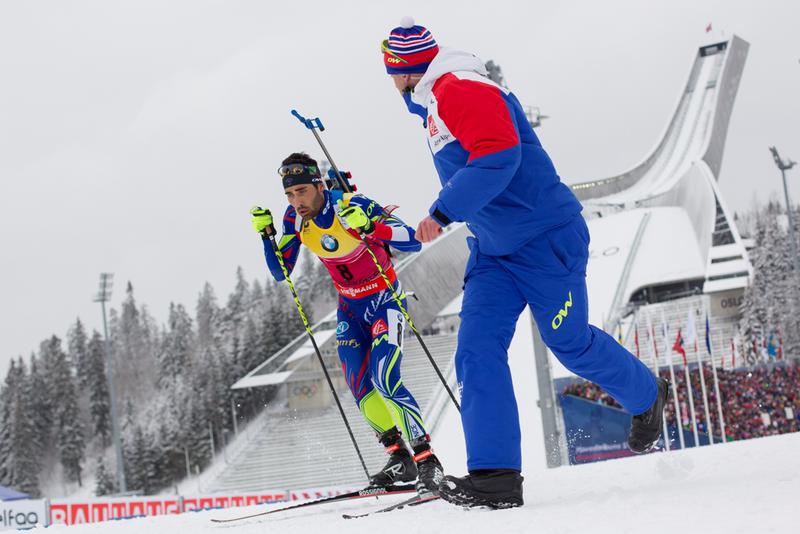
A French staff member encourages Martin Fourcade (l), the overall World Cup leader, as he races to his second-straight gold of 2016 IBU World Championships, in the men’s 10 k sprint on Saturday in Oslo, Norway. On Thursday, Fourcade anchored the mixed relay to a win. (Photo: IBU)
OSLO, Norway—It seemed like the only thing Martin Fourcade had to do to win the World Championships sprint was not mess up.
With seven World Cup wins so far this season and many in dominating fashion, the French biathlete was the odds-on favorite. Yet when he crossed the finish line after shooting clean and skiing fast, he had a huge smile on his face, the smile of someone who was savoring a moment he hadn’t been sure would come.
Starting in bib eight, Fourcade first had to wait for the rest of the 102-man field to finish. Both the Norwegian and German teams started their best athletes towards the middle or end of the field, so it was a long wait.
“I can’t say I was confident,” Fourcade said in a post-race press conference. “I can say I was satisfied. I was satisfied because I did all I had on the track. I shot clean. I knew to would be a good result. But I needed to wait for all the athletes to cross the line and I knew it was a lot of possibilites to be beaten.”
In the end he won the 10-kilometer, ten-shot competition by a whopping 26.9 seconds over Ole Einar Bjørndalen of Norway. That’s the biggest margin of victory in a World Championships or Olympic Games sprint in over a decade.
And Fourcade seemed overjoyed. Because he has had other years where he seemed like the favorite for the sprint, but where he made errors. After all, this was his seventh World Championship title – it’s not like there has been a lack of opportunity, and he knows it.
“I’m just enjoying being a World Champion today,” he said in the press conference. “It’s the first time in the sprint since 2012 in Ruhpolding. I had a lot of chances to get this title in the past, and I missed. So I’m really satisfied today to do the biathlon that I was able to do.”
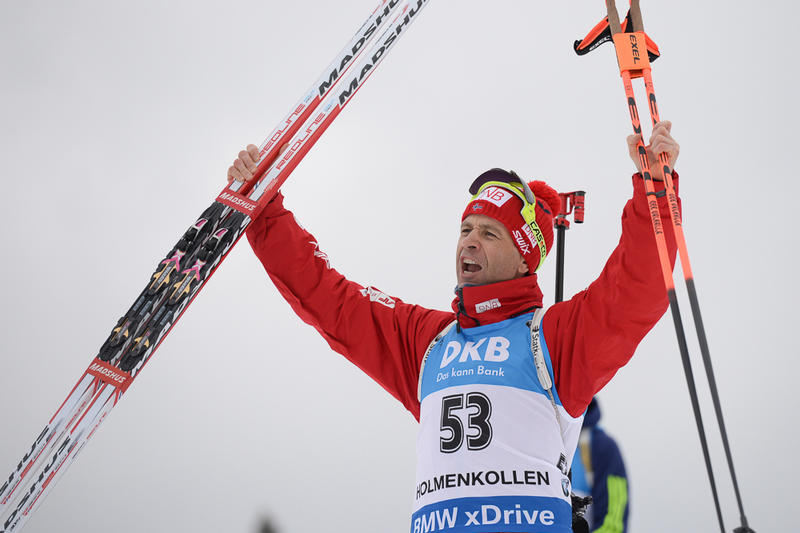
Norway’s Ole Einar Bjørndalen celebrates silver in the men’s 10 k sprint on Saturday at the first individual race of IBU World Championships in Oslo, Norway. (Photo: IBU)
Behind him, Bjørndalen made an impressive comeback. The 42-year-old won a World Cup earlier this season and had other podiums, but not recently and he skipped the North American swing of the circuit in order to prepare for the Championships.
“[I have] absolutely not a tear about it,” Bjørndalen said in the press conference. “Martin was so strong today. Silver was like gold for me because it has been a long time since I was on the podium. Fourcade is at the moment the best athlete. He skied amazing, really fast, so he’s really hard to beat. Today I’m second so that’s perfect for me.”
As is true every time the biathlon legend wins, other competitors lauded his achievements over the years and marveled that he was still beating them.
“Ole Einar was my hero growing up,” Czech racer Ondrej Moravec told the press. “When I was like 14 years old I saw him in Anterselva and he signed my training log… I think this is great for him, because he put so much preparation into being ready for these Championships.”
Bjørndalen had considered retiring earlier, but when Oslo was awarded the World Championships decided to stick around.
Now there’s no doubt: the “king of biathlon” is not the weak link on the strong Norwegian team.
In fact, fans were joking about re-naming Bjørndalen not the king of biathlon, but the king of Norway.
With the real King, Harald V, sitting in the crowd, that got a little touchy.
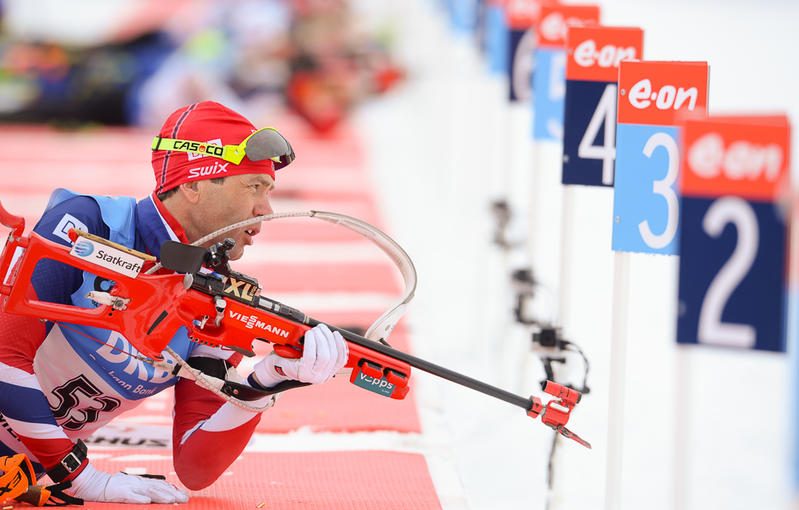
Norway’s Ole Einar Bjørndalen on the range Saturday during the men’s sprint at 2016 IBU World Championships in Oslo, Norway. He finished second to France’s Martin Fourcade. (Photo: IBU)
“We have only one king in Norway,” Bjørndalen joked in the press conference. I do biathlon and he does the real king job.”
Fourcade may have only 45 World Cup wins to Bjørndalen’s 94, but the veteran Norwegian seemed ready to cede the crown to his French competitor.
“It was another time,” Bjørndalen said of the earlier 2000’s when he was racking up most of his wins. “A long time ago I dominated the sport. Now the level is much higher, there are many more athletes who have a really high level. Before there were not so many top athletes, but the top athletes were really strong. For me Martin is the best athlete because he can be the best in all competitions and I was mostly the best in some [specific] competitions. So he is really the best.”
In third place was Sergey Semenov of Ukraine, a surprise on the podium. His three previous podiums have all come in individual competitions, which are double the length and have a one-minute penalty for shooting instead of a penalty loop.
“I hope it’s not the last podium of the season,” he said. “It was a big surprise for me and I think it was the biggest surprise so far for everyone. Many fans know I’m good in individual but the sprint is not my best venue. From this moment I think everything is possible. Today I was thinking only about the shooting because in the mixed relay I had one not necessary miss because of shooting fast. So today I was a little bit more slow, but my goal was to shoot zero. I hope I can repeat it tomorrow.”
All three athletes had clean shooting. Semenov charged to the line, but came up just half a second short of displacing Bjørndalen. He did, however, bump down Johannes Thingnes Bø, keeping the home team to one man on the podium.
Bø finished fourth, +35.5, and Dominik Windisch of Italy fifth, +39.5. Evgeniy Garanichev of Russia rounded out the flower ceremony in sixth, +40.4.
Simon Schempp of Germany had a chance to figure into the race, but blundered in the finish, planting a pole between his skis and crashing just a few dozen meters from the line. He ended up eighth, +43.8.
France’s Martin Fourcade after winning the first individual competition of 2016 IBU World Championships in Oslo, Norway, the men’s 10 k sprint by 26.9 seconds, the biggest margin of victory in a World Championships or Olympic Games sprint in over a decade. (Photo: IBU)
France’s Martin Fourcade crosses the finish first to meet his teammates after anchoring the mixed relay to gold to open the 2016 IBU World Championships in Oslo, Norway, Germany’s Simon Schempp secures second behind him, and Norway’s Tarjei Bø comes onto the final stretch to claim bronze. (Photo: IBU/Evgeny Tumashov)
Martin Fourcade versus Simon Schempp: Two perennial rivals who still greatly respect each other’s performances, duking it out on the final loop of Thursday’s mixed relay.
It was a fitting end to the first race of the 2016 International Biathlon Union (IBU) World Championships in Oslo, Norway, a finish sprint into the famous Holmenkollen ski arena with two athletes at the top of their game, in a repetition of a scene similar to what biathlon fans have witnessed repeatedly in recent seasons.
This time, France’s overall World Cup leader Fourcade prevailed against Germany’s anchor, skiing over the last bridge in the stadium and taking a little bow in the style of a telemark ski turn. He crossed the finish line in 1:14:01 and celebrated the gold medal with his excited teammates. Combined, the four-person French relay had no penalties and seven spare rounds.
Martin Fourcade celebrates with his teammates after anchoring France’s mixed relay to gold in the first race of 2016 IBU World Championships in Oslo, Norway. (Photo: IBU)
“Today was really emotional, because it was my first, our first victory in a team race in World Championships since 2009,” Fourcade said at the post-race press conference.
“Of course we were among the favorites so we were thinking about [the gold medal],” Fourcade added in an interview with the IBU. “But in biathlon you never know until the last shooting. We were fighting for gold as well as for the fourth place.”
Germany finished second, just 4.3 seconds back, and also with seven spares.
“I tried to bring out everything I had, but in the end I honestly was too exhausted,” Schempp told German TV broadcaster ARD. “We are totally happy about silver.”
“The way Fourcade threw himself into the snow afterwards, I think that shows Simon [Schempp] pushed him to his limits,” Germany’s third leg skier Arnd Peiffer told ARD. “Martin definitely didn’t have it easy on the final loop today … With that ‘telemark’ move he was just showing his excitement, that had nothing to do with arrogance.”
Another 10 seconds back, Norway’s anchor Tarjei Bø secured the bronze medal for the home team (+14.4), with ten spares, to the huge joy of the audience.
The U.S. finished 10th (+2:19.6), with five spares, falling back on the last three legs after starter Susan Dunklee rocketed through the first exchange in first place. Canada placed 11th (+2:30.8), with 11 spares, unable to quite keep up with the leaders throughout the race due to too many misses on the shooting range.
After a festive opening ceremony at a central square in Oslo on Wednesday night, the Biathlon World Championships opened with the mixed relay, including two women and two men per team, with all other rules just like in a traditional relay.
The two women begin, and each ski 6 kilometers with one prone and one standing shooting stage, while the men have to ski 7.5 k each. The athletes can use three spare rounds per stage, and if they fail to clean their targets with those spares, they have to ski a 150-meter penalty lap for every miss.
The IBU first experimented with mixed relays 11 years ago as a special event during the World Cup finale. Since 2007, the discipline has been part of the official program at World Championships.
Initially it was a bit of an afterthought, with a number of countries with large teams using it as an opportunity to give their lower-ranked biathletes a start at championships, and saving their best ones for the individual starts and the traditional women’s and men’s relays.
That has changed in recent years, since the event also became part of the program at the 2014 Olympics in Sochi, Russia. This year in Oslo, small and larger teams alike certainly pulled out all the stops, with almost every nation entering the its best athletes.
Low-hanging clouds and fog on the range had been predicted, but for Thursday’s competition, the view of the targets on the shooting range was actually clear despite a cloudy sky and a little fog shrouding the big ski jumps that tower over the Holmenkollen arena.
The French team, with Anaïs Bescond, Marie Dorin Habert, Quentin Fillon Maillet, and Fourcade, initially hit a snag when Bescond required all spares to hit her targets in her standing stage, narrowly avoiding the penalty lap and coming through the exchange in seventh place, 35 seconds behind Dunklee.
Then Dorin Habert crashed in a ski tunnel out on the course, in snow conditions some athletes described as “glazed” in certain sections.
“Nothing terrible, it was just a mistake by me,” Dorin Habert said of her fall at the press conference.
She quickly recovered and moved her team into third place at the next exchange, with Fillon Maillet and finally Fourcade able to close out successfully by pushing hard up the final small climb and U-shaped turn in the arena to create a little gap.
Similarly to France, Germany’s starter Franziska Preuss initially lost 20 seconds to the top due to two misses in her first prone stage, but moved back up to fourth place at the exchange. Then Franziska Hildebrand and Peiffer kept the team in contention for the podium, before Schempp was able to claim the silver medal.
Germany’s Simon Schempp after one of his shooting stages during Thursday’s mixed relay at IBU World Championships in Oslo, Norway. He anchored Germany to second, 4.3 seconds behind France. (Photo: IBU)
In his last shooting, Schempp thought he had hit all shots taking down his rifle to head back out on the course, before realizing he had missed one and — like Fourcade -– still had to use a spare. Schempp made his shot and left the range just 1.7 seconds behind Fourcade. While Schempp was able to catch up on the course, he did not have the energy left to beat his rival in the final sprint.
Ahead of World Championships, fans and the media put a lot of expectations on the home team from Norway with Marte Olsbu, Tiril Eckhoff, Johannes Thingnes Bø and his older brother Tarjei Bø.
At the 2014 Olympics, Norway had won the gold medal in the mixed relay, though only Eckhoff, who grew up just a stone’s throw away from the Holmenkollen arena, was a part of the lineup back then.
In front of thousands of spectators, including Norway’s King Harald V, the team did not disappoint, with Olsbu and Eckhoff delivering some of their best performances of the season to tag off in second and first place, respectively. From there, the Bø brothers kept the team in podium contention.
“I was very nervous,” Olsbu said at the press conference. “I am just so happy that I made a good race today.”
Johannes Bø tried to make a move on his last loop, yet the other teams just behind him closed the gap again before the exchange.
After needing all spares in his prone shooting on the anchor leg, his brother Tarjei fell back 18.4 seconds, but was able to reduce that again to 7.4 with fast skiing and a clean final shooting stage. While he tried everything in his power, he could not quite catch up to Fourcade and Schempp again.
“Of course we are happy to have a medal at the Championships [at] home,” Johannes said during the press conference. “But we are athletes who want to win. So we are 90 percent happy [with bronze], and we take the last 10 percent next week.”
“Simon and Martin were too strong for me,” anchor Tarjei Bø said.
When a French journalist asked his rivals if Fourcade maybe gained a psychological advantage for the remainder of the World Championships after a win on Thursday, Tarjei Bø laughed and exclaimed: “Yeah, he is unbeatable. He’s so unbeatable that I will not race any more at these World Champs!”
“That’s a good idea,” Fourcade replied with a big smile on his face.
For a long time, four teams had been in close contention for the medals, but after a strong race Ukraine, with Valj Semerenko, Olena Pidhrushna, Sergey Semenov and Dmytro Pidruchnyi, could not quite keep up on the anchor leg with two spares in the last shooting. Ukraine finished fourth (+29.8), with nine spares.
Fifth place (+1:07.1) went to Austria, with Dunja Zdouc, Lisa Theresa Hauser, Simon Eder and Dominik Landertinger, which combined for a team total of just three spares, the fewest of any nation. Meanwhile, the defending world champions in the mixed relay, the Czech Republic, with Veronika Vitková, Gabriela Soukalová, Michal Slesingr and Michal Krcmar finished sixth (+1:23.3), with five spares.
Dunklee in the Lead
Susan Dunklee (US Biathlon) trails France’s Anais Bescond during the first leg of the mixed relay at 2016 IBU World Championships on Thursday in Oslo, Norway. Dunklee went on to tag off in first, 1.6 seconds ahead of Norway. (Photo: USBA/NordicFocus)
For US Biathlon, Dunklee started out strong, shooting clean in the first prone stage to leave in second behind France’s Bescond. Then she again hit all of her targets in standing to leave the range 4.5 seconds behind Norway’s Olsbu and Italy’s starter Dorothea Wierer (an athlete with multiple World Cup victories this season. Italy went on to finish eighth).
This time, Dunklee was not satisfied just staying behind the athletes at the top, immediately attempting to overtake Wierer and move up to Olsbu.
“I love the thrill of starting relays,” Dunklee wrote in an email after the race. “I have been close behind the leader tagging off many times, but I have never tagged off in first. On the last loop I was hungry to finally win my leg today and I wanted to give Hannah [Dreissigacker] the experience of leaving in the lead in front of a packed Norwegian crowd.”
Of all the first-leg skiers, Dunklee’s course time was the fastest.
“I do love the Holmenkollen crowds and the hilly course,” she wrote. “I felt relaxed and focused on the shooting range and felt very strong skiing. Our staff put together incredible skis today.”
“I love the thrill of starting relays. I have been close behind the leader tagging off many times, but I have never tagged off in first. I was hungry to finally win my leg today…” — Susan Dunklee, who put the U.S. in first at the first exchange on Thursday
Dreissigacker initially was able to keep up on the course with France, Norway, Ukraine, and Germany at the top.
“It was a fun race and definitely a real thrill [to] get the tag in first place,” Dreissigacker wrote in an email. “Susan really did us all proud out there. I did my best to ski my own race, but it’s always hard when you have lots of adrenaline and find yourself in first place.”
After requiring a spare in prone, she was still in third place, only 1.7 seconds back. Then having more trouble maintaining the leaders’ pace on the next loop and with another missed shot in standing, she fell back 22.7 seconds to fifth place. On her final loop, Soukalová, the overall World Cup leader, passed her on the course, and Dreissigacker lost another half a minute to the leaders, tagging off in sixth, 51.3 seconds back.
“I felt like I was in control on the first and second laps, trying to keep in touch with the leaders as much as possible without overdoing it,” Dreissigacker explained. “But I definitely didn’t have too much gas left in the tank for the last lap, and it didn’t help that I had really lost all contact with the women ahead of me. But that was also a group of the very fastest women in the world, so I am not surprised that they put lots of time on me in the last lap.”
The U.S. team’s third leg, Lowell Bailey had a strong performance on the shooting range and stayed clean both times just like Dunklee, but continued to lose time on the course, and his course time ultimately ranked 19th of the third-leg skiers. He tagged off in eighth place, 1:35.5 minutes back.
“The course was tricky today,” Bailey wrote in an email. “The new snow packed down and glazed, making some of the downhills and especially the stadium fairly treacherous. It wasn’t my best day on skis, but hopefully I’ll feel better as the Championships roll forward.”
Anchoring the U.S. relay, 20-year-old Sean Doherty required a spare in both his prone and standing stages, and with the 16th-ranked course time on his leg, he slipped two positions to finish 10th (+2:19.6), one position ahead of Canada.
“Today’s race was an exceptionally high level,” Doherty said in a US Biathlon press release. “We showed that we can shoot with the best teams and be very competitive. I am really happy with my leg and feeling strong looking ahead to the sprint.”
“The mixed relay is a format we often think of as one of our best medal hopes, so from that perspective our result today is disappointing,” Dunklee wrote. “After our 4th place in Canmore I think we all went into today with high hopes… On the range we put together an excellent performance, one of our best I would say. Tenth is solid, but we know with that good of [a] shooting we can be capable of much more. The good news is that we have many races still to come.”
“It was just tough, tight competition out there and I think we had a really solid team performance,” Dreissigacker commented. “Using only 5 spares for the whole team is great shooting!”
As Bailey pointed out, a top 10 is a top 10.
“It is a tight field and we were close to the leaders for a significant part of the race,” he wrote.
The Canadian team with Julia Ransom, Rosanna Crawford, Nathan Smith, and Brendan Green was hoping to build on its ninth place in the mixed relay in Östersund, Sweden, and sixth place at home in Canmore.
On Thursday, Ransom started in bib 5, and had some trouble to keep up with the leaders. With one miss in both her prone and standing stages, she found herself 36.5 seconds behind going onto the final loop, and then lost more time to tag off in 11th place, 1:03.4 minutes back.
Crawford was able to maintain the pace with the seventh-best course time on her first loop, before dropping off a bit the third time around the Holmenkollen 2 k course.
“It was nice on those first two laps to be working with Sweden and trying to stay with Soukalová,” Crawford wrote in an email. “I had a tumble on the same hill as Dorin [Habert] in warm up and broke a pole, but the race was smooth and I didn’t have to deal with any sketchy people on the downhill.”
But she couldn’t make up positions or time with a miss in her prone shooting and two spares in the standing stage, where she had some additional issues.
“I had some trouble with standing where my shell got stuck, and I wasted some time getting that fixed, and then missed two targets on top on that,” Crawford wrote. “So I am quite disappointed with my shooting. Getting the jitters out before Saturday’s race though hopefully!”
She handed off in 14th place, 1:27.7 back.
Currently the highest-ranked Canadian on the World Cup, Smith skied fast on the course, posting the fifth course time on his leg.
“I’m very happy with my skiing today,” Smith wrote in an email. “I’ve been struggling over the last 7 weeks to feel good on the skis. I wouldn’t say I felt like a total beast skiing, but I knew my shape was good just because I was able to more or less maintain position with top guys like [Russia’s] Garanichev and [Austria’s] Eder… I don’t actually particularly like this arena. I find the gentle ramp through the stadium surprisingly challenging. The ski loops are interesting though, and obviously great views.”
But like his teammates, he could not quite stay clean on the range, requiring two spares in prone and another one in standing.
“Shooting conditions were perfect,” Smith stated. “Very little wind and no fog. Earlier in the day it looked nasty but everything cleared up for us.”
Smith moved up the team a few positions to tag off in 10th (+1:35.9).
“I wouldn’t say I felt like a total beast skiing, but I knew my shape was good.” — Nathan Smith, who skied the fifth-fastest course time on the third leg to bring Canada from 14th to 10th
Canada’s anchor, Green also did not have a perfect day on the range, needing one spare round in prone and two in the final standing stage. Combined with his skiing (13th ranked course time), he lost some additional time to the top, with Canada closing out the race behind the U.S. in 11th place, 2:30.8 behind the winners.
“In my portion of the race there wasn’t anything too out of the ordinary,” Green wrote in an email. “The track was really glazed in some sections and the skiing in general felt like a bit of a balancing act at times.
“There has been a bit of wind during the last few days [of] training, but it dropped a bit this afternoon which was nice,” he wrote of the shooting conditions. “A slight but manageable wind from the left. I was a bit worried about the fog that was lingering throughout the day but fortunately it moved off and the range was clear.”
Asked if their team result was within expectations, Crawford wrote, “11th is a disappointing result for our team, we are capable of a top 8 on an average shooting day and for sure top 6 if we all have a great day on the range. 11 spares is not a normal day for our team I’d say.”
“11th is nothing to write home about but still a decent result,” Smith stated. “We knew everyone would be putting in their best teams.”
“Overall, today wasn’t a true representation of what our team is capable of,” Green wrote. “It’s day one of the Championships and I know we’re all hungry for more.”
Races in Oslo continue on Saturday with the first individual races: the men’s and women’s sprints. All races as well as shorter recaps can be streamed live or time-shifted (most with English commentary) on Eurovision Sports.
“I just want to get one [individual] title, that’s my aim,” Fourcade said at the press conference.
“The atmosphere was great!” Bailey wrote. “Cheering along the track and extremely loud in the stadium. I think it will be even bigger on the weekend.”
“On Saturday we’ll come out fighting,” promised Green. “The atmosphere was pretty awesome today. The stands were full and the stadium was loud. It’s a good vibe and if today is any indication, we’re going to be in for a fun couple weeks of racing.”
A relieved Martin Fourcade of France crosses the line in first in Thursday’s 20 k individual at the 2015 IBU World Championships, 20.9 seconds faster than Norway’s Emil Hegle Svendsen to win his first medal of the championships in 47:29.4 in Kontiolahti, Finland. (Photo: Kontiolahden Urheilijat/Kaisa Kontiainen)
KONTIOLAHTI, Finland — Approaching the final shooting of Thursday’s 20-kilometer individual race at IBU World Championships, about eight seconds out of first, Martin Fourcade knew there was only one thing to do: hit every target.
But he didn’t overthink it. In fact, the 26-year-old Frenchman said he was on “automatic pilot” for that final standing stage. With the third-fastest range time for that bout, he ripped off five shots and knocked down each one. Fourcade took the lead, 3.5 seconds ahead of Norway’s Emil Hegle Svendsen, who started 8 1/2 minutes before him. Then he tore into his final 4 k lap.
“I was really focused and I was looking straight at my coach because I wanted to feel the confidence in the eyes,” Fourcade said in a post-race press conference.
He had made all but one shot leading up to that point, missing one on his first standing. There, Fourcade in bib 34 of 127, slipped from first to ninth overall, 34 seconds behind Norway’s Johannes Thingnes Bø in first. From then on, Fourcade clawed back into contention for his first individual medal of the 2015 World Championships.
“I thought this morning that I won seven of my last 10 individual races in the World Cup so that means that’s a good competition for me,” he said of the 20 k. “But I also have to remember that I was 84th in the [individual at the] opening of the season in Östersund. That’s biathlon and that’s what makes it so exciting.”
Fourcade had started the 2015 World Championships off with silver in the mixed relay, then placed 12th in the sprint before finishing seventh in the pursuit. While the individual medal eluded him until Thursday, Fourcade said his mind wasn’t on that during the race.
“I knew after two shoots that I was not far from the lead, even with one penalty so I knew that anything was possible,” he said. “It was more about what I have to do than which result I could take.”
Emil Hegle Svendsen of Norway racing to silver in the men’s 20 k individual at 2015 IBU World Championships in Kontiolahti, Finland. (Photo: Kontiolahden Urheilijat/Kari Kuninkaanniemi)
The man he finished 20.9 seconds ahead of and essentially took gold from, Svendsen felt similarly. The eight-time world champion and three-time Olympic gold medalist had yet to reach the podium this year in Kontiolahti, either.
“I think it’s been three months since I had a good race,” Svendsen, one of four men to clean the four-stage race, said in the press conference. “It’s been a long time since I’ve been feeling like I could be on the podium and it’s good to be back. I always want to be on top and people expect that of me. I’m very proud of my silver today.”
Fourcade entered the race as the defending world champion from 2013, as well as the 2014 Olympic champion in the 20 k individual in Sochi, Russia. Two years ago at World Championships in Nove Mesto, Czech Republic, he took a medal in every event except the mass start.
Heading into Thursday, with two individual races remaining at worlds, some wondered if the favorites like Fourcade and Svendsen would make it back to the podium. So far, these championships have been highlighted by several gold medalists without a prior World Cup win.
“My beginning of World Championship is not bad,” Fourcade said. “I had a really good mixed relay. … In the sprint, I was kind of unlucky with the wind conditions. A lot of athletes missed in that race. Emil did, also the second in the World Cup rankings, Simon Schempp [of Germany] had seven mistakes.”
But what mattered most at the end of the day to Fourcade, the overall World Cup leader, was what he had achieved. His older brother, Simon Fourcade, 30, had started third and led the race with perfect shooting until Svendsen came through, cleaning and skiing faster to finish 24.8 seconds ahead of him. While Svendsen’s lead seemed significant, it wasn’t anything Fourcade couldn’t widdle down. On the final lap, he made up more than 17 seconds on Svendsen.
“When I think about where I was this spring, thinking about missing the biathlon season due to my mononucleosis, today I was so proud to be on top of the podium and winning the individual,” Fourcade said. “That is something that is so crazy, and I realize how lucky I am.”
A happy Ondrej Moravec (Czech Republic) after taking bronze in the men’s 20 k individual at 2015 IBU World Championships on Thursday in Kontiolahti, Finland. (Photo: Kontiolahden Urheilijat/Kari Kuninkaanniemi)
Only one later starter came anywhere close to the top two: Ondrej Moravec of the Czech Republic. He started 40th, three minutes after Fourcade, and cleaned every stage except his first standing — just like Fourcade. He entered the last lap with nearly 32 seconds to make up on Fourcade and a 14-second deficit to Simon in third.
“I had good information [on that loop],” Moravec said in the press conference. “I heard in the beginning of the loop that maybe I lost some seconds, but I tried to push so hard so I’m satisfied I did it.”
He bested the time of one of the Fourcades, edging Simon by 5.2 seconds for bronze. It was Simon’s second fourth-place finish at these championships after he missed the podium by 4.2 seconds in the sprint.
For Moravec, it was his second medal of the championships after anchoring the Czech mixed relay to gold a week ago. A silver medalist in the pursuit and third in the mass start at the Sochi Olympics, he had never reached the World Championships podium until this year.
“I think the big events are motivation for all of the athletes, especially World Championships,” Moravec said. “It’s a big motivation for me and I’m so glad I take the medal.”
Ukraine’s Sergey Semenov placed fifth, 56 seconds behind Fourcade, with a single penalty on his first prone, and Norway’s Ole Einar Bjørndalen made the flower ceremony as well in sixth (+1:12.1) with one miss on his first prone. After two initial clean stages, Bø ended up seventh with one penalty on his second prone.
In addition to Svendsen and Simon Fourcade, Russia’s Alexey Volkov (in ninth) and Yuryi Liadov of Belarus (in 17th) were the two other competitors to shoot 20-for-20.
“The conditions were perfect,” Svendsen said. “The tracks was really good and practically no wind on the shooting range so good day to shoot 20.”
Green 21st, Bailey 24th
Brendan Green (Biathlon Canada) on his was to 21st in the men’s 20 k individual at 2015 IBU World Championships on Thursday in Kontiolahti, Finland.
Leading the way for Canada, Brendan Green finished in his somewhat-habitual spot of 21st on Thursday (after tying for 21st in the sprint last weekend and placing 21st in the 20 k individual at the Sochi Olympics). It was his second-best result of the championships so far, after he placed 16th in the pursuit.
“It’s been a really phenomenal week shooting,” Green said after going 19-for-20 with a single penalty on his first prone. “I’m a little bit surprised … In our training camp, I really wasn’t able to shoot much at all. Today, I really wasn’t able to do anything on the skis, and unfortunately wasn’t able to capitalize on the really good shooting.”
The 53rd starter, he worked his way into the top 30 with three-consecutive clean stages, including the last standing. At the finish, Green sat in the top 20 and ultimately finished 11.9 seconds outside of it in 21st, 2:59.6 behind Fourcade.
“I’m definitely happy with my result this championships, but when I bring my worst skiing of the year here it’s a little frustrating,” the 28 year old said. “The shooting’s just really clicking at the moment.”
While his shooting time ranked 11th, his overall course time was 49th. Green explained that Kontiolahti’s steep and “punchy” climbs don’t necessarily suit his strengths (he prefers more gradual or rolling terrain), adding that wasn’t an excuse. During the race, he backed off on the climbs slightly to prevent himself from red lining.
With the effort and the World Championships points he’s accumulated throughout the week, Green appeared to have qualified for Sunday’s mass start in 23rd out of 30 starters, based on a provisional start list. Americans Tim Burke, who was 31st on Thursday, and Lowell Bailey, who led his team in 24th, also qualified in 26th and 28th, respectively.
Canada’s Nathan Smith, who placed 44th in the individual with five penalties, had already secured his start with his sprint silver medal.
Lowell Bailey (US Biathlon) en route to 24th in the men’s 20 k individual at 2015 IBU World Championships on Thursday in Kontiolahti, Finland. (Photo: USBA/NordicFocus)
In his ninth World Championships, Bailey, 33, finished 24th in the 20 k with despite two early prone misses. He went on to clean his next three stages to finish 3:10 behind Fourcade.
“The only way to get back into the race is to shoot well,” he said. “I misjudged the wind. I was out on the left and I should’ve taken more clicks. I saw a lot of guys missing early and I should have reacted and I wasn’t decisive enough with the first prone. I’m happy with the rest of the race. I skied better than I have this whole series so that’s the silver lining.”
Surprised to miss two on his first bout — he said he hadn’t missed a prone all week — Bailey made corrections that led him to rise from 101st overall after the first stage to 23rd after the last standing. He ended up with the 22nd-ranked shooting time and 35th-ranked course time overall.
Burke was the second American in 31st, and despite having four minutes worth of penalties, he finished 3:52.7 behind the winner with the seventh-fastest course time.
Tim Burke (US Biathlon) on his way to 31st in the men’s 20 k individual at 2015 IBU World Championships on Thursday in Kontiolahti, Finland. (Photo: USBA/NordicFocus)
“I feel like this year has probably been my best ski year ever and at the same time it’s been for sure my worst shooting year, so it’s frustrating,” Burke said.
While his shooting on Thursday was an improvement over recent races, with one miss in each of the first two stages and then two more in the final standing, he said, “It’s not bad, but it’s not world class, and that’s all I’m interested in.
“Today was one of my better days this year on skis; I felt strong the whole race, but four is just way too many penalties for an individual race with conditions like this,” he added, referring to the hard-packed, icy course.
After a clean third stage, he thought a top 10 might have been possible if he hit all his targets on the fourth stage. He crossed the finish line in 11th and ended up 31st.
Threatening to beat Burke’s time at the finish, his teammate Leif Nordgren, who started nearly 40 minutes after him, placed 33rd, 3.4 seconds after Burke.
Leif Nordgren (US Biathlon) racing to 33rd in the men’s 20 k individual at 2015 IBU World Championships on Thursday in Kontiolahti, Finland. (Photo: USBA/NordicFocus)
Nordgren cleaned his first stage before missing one on each bout thereafter. He had the ninth-fastest range time overall.
“Any time you are in an individual, you have to see one or zero misses to have a really good day,” he explained. “I was definitely aiming for 95-percent shooting and good skiing. I am really happy with the way I skied. I think I was pretty strong, and shooting was so-so.”
While 33rd stood as his best individual result of these championships, Nordgren said his showing in Kontiolahti left something to be desired.
“I am a little disappointed on how the week has gone individually,” he said. “With the shape I had coming in and how I started off in the mixed relay [in which he anchored the U.S. to eighth], I was really hoping for more.
“My shape is good, better than it has been in a couple of years,” he added. “And that has carried through a couple weeks now. I feel like, in that regard, I have kind of gone up a step and I can be happy with that and take that … the next season.”
Sean Doherty (US Biathlon) placed 47th on Thursday in the men’s 20 k individual at 2015 IBU World Championships in Kontiolahti, Finland, for the second-best result of his career. (Photo: USBA/NordicFocus)
Nineteen-year-old Sean Doherty was the fourth U.S. man in 47th (+5:15.5) with three penalties (0+1+2+0). The result was his second best of his career after placing 45th in the pursuit last weekend.
“I knew I was capable of a little better shooting, but I feel like I skied a great 20 k,” he said. “I just tried to start under control with the pace and try to keep picking it up lap to lap, and it worked out well.
“My prone shooting has been a little up and down lately, but standing was good and I’m looking forward to the relay [on Saturday],” Doherty added. “I’m happy with my individual performances [here]. It was really good to make the pursuit; that was a big goal of mine. I’m getting good experience and things to work on for the summer.”
Canada’s second man, Smith placed 44th (+5:03.2) with five minutes of penalties (0+1+2+2). After a clean first prone, he initially had the lead as the 28th starter. Fourcade came through 2 seconds faster to take control, and Smith went on to miss one on his second shooting to fall out of the top 10.
“I thought with the one standing miss that, OK, I can still hit 19, it’s still gonna be a really good race,” Smith reflected. “My second prone felt sketchy and I missed two, and I kind of lost my edge bit in the last standing, too.”
Five days after he medaled in the sprint, Smith said felt relaxed before Thursday’s race.
Nathan Smith (Biathlon Canada) cleaned his first shooting to take an early lead, but missed five total to end up 44th on Thursday in the men’s 20 k individual at 2015 IBU World Championships in Kontiolahti, Finland. (Photo: Kontiolahden Urheilijat/Samuli Kuittinen)
“I felt like the last couple days went back to normal,” he said. “[But] you have that in the back of your mind, that if I have the perfect race I can medal, but I don’t think the pressure is what I did it. It’s just a day where I missed five.”
Canadian brothers Scott Gow and Christian Gow finished eight seconds apart in 63rd and 65th, respectively. Scott missed four (1+1+1+1) while Christian missed three with a clean last standing (1+1+1+0).
“I was hoping for 90-percent [shooting] or more, especially because it is such a nice day on the range. The wind is so marginal compared to what we have been dealing with,” Scott said. “Eighty percent is the minimum so I achieved the minimum. It is not necessarily a disappointment, but the goal was more 90 percent, so in that sense it is a little bit of a letdown.”
In two previous races in Kontiolahti, Scott, 24, placed 50th in the sprint and 52nd in the pursuit.
“It was kind of average for me,” he said. “No standout races where I shot 100 percent and was flying on the track, but I also didn’t have a total meltdown where I only hit half my targets and was totally dying. Overall I’m happy.”
For Christian, 21, it was his best result in two races at worlds after placing 73rd in the sprint.
“I struggled a bit this week shooting,” Christian said. “Today I just wanted to relax and hit some targets. All three misses were completely my fault, just overthinking the last shot two times. I was happy to come in on the last one and clean it no problem and get back into the rhythm. I’m hoping that good feeling back on the range, I can carry that forward to the relay for a good shooting day.”
In terms of how he’ll leave his first World Championships, he said a recent chat with his coach helped him put it in perspective.
“I hold myself to a really high standard,” Christian said. “Racing on the World Cup has been pretty challenging for me for that just because it is so tough to feel like you are accomplishing anything. Everyone is so fast and everyone is such a good shooter, there is no room for error at all.
“I am happy to be here,” he added. “Of course, I would like to come away with some results that later on I could look at and be super proud of. I am not going to be disappointed with what I have done so far. I am just trying to learn from it and make the most of it while I am here.”
Nathan Smith (Biathlon Canada) en route to cleaning three-straight stages in Thursday’s 20 k individual at the IBU World Cup in Oslo, Norway. He went on to miss his third shot in his last standing to place 12th.
In the last three races, Canada’s Nathan Smith has hit 49 of 50 targets, and that’s something he can be proud of — even if it didn’t beat his teammate Brendan Green’s record.
“I had Brendan’s 50 out of 50 record from earlier in the season in my mind today,” Smith told Biathlon Canada after the men’s 20-kilometer individual on Thursday in Oslo, Norway. “We were joking around a little before the race that I would try and steal that glory away from him.”
Smith was on track for that kind of performance early on in the individual race at Holmenkollen, starting 10th and cleaning his first three shooting stages with some of the quickest range times in the 94-man field.
He didn’t try anything different in the longest-format race on the IBU World Cup; he just wanted to replicate the kind of success he found last weekend in Nove Mesto, Czech Republic, where he notched a career-best seventh in the sprint followed by a new best of fifth in the pursuit.
“I tried to get into the same relaxed mindset for the shooting that I used in Nove Mesto,” Smith wrote in an email.
After knocking down his first five targets, Smith found himself in fifth through nine starters. At least 14 men cleaned the first prone as well, bumping him down to 11th and then 15th, but by the second stage, he was back up to fifth with another perfect round.
“From watching the women’s race I knew there would be a LOT of cleans or near cleans,” Smith reflected. “With 19 or 20 [shooting] I thought a top 10 should be reasonable. However, once the race was underway I could tell my skiing just wasn’t quite at the same level as last week.”
In soft, draggy snow, his lap times ranked in the mid-40s for most of the race, until the last lap, where he knew he had to kick it into high gear. After cleaning his third stage and reclaiming fifth, 54 seconds behind race leader Martin Fourcade of France, Smith missed his third shot on his final standing.
“On the last standing I think I managed the situation really well compared to races before Christmas,” Smith reflected. “I felt way more calm and wasn’t worried if I had to reset or take an extra breath. It’s too bad I missed a shot but I don’t think it was from nerves.”
Despite the one-minute penalty, he left the range in fourth, 2:14.6 behind Fourcade. There, he concentrated on strong last lap to make up for what he considered “lackluster earlier loops.”
With the 27th-ranked course time on the last lap, Smith initially finished seventh, 2:38.5 behind Fourcade as the eventual winner. He ultimately placed 12th for his best 20 k individual result after five men in the top 10 cleaned all four stages.
“It was a little disappointing to miss one in the last bout, but 19 is still my best shooting ever in an individual,” Smith observed. “So despite that shot and slightly slow skiing I can’t complain at all.”
Beyond IBU World Championships, which take place March 3-15 in Kontiolahti, Finland, Smith — who ranks 25th in the overall World Cup — was looking toward the next-and-final World Cup from March 18-22 in Khanty-Mansiysk, Russia.
“Biathlon Canada is sending a minimal team to Khanty-Mansiysk at the end of the season and are chasing top-25 rankings,” he explained. “12th helps a long way to move into that group.”
Nordgren Hits 19 for 20th
Leif Nordgren (US Biathlon) racing to 20th in Thursday’s IBU World Cup 20 k individual at Holmenkollen in Oslo, Norway, for his best 20 k result. (Photo: USBA/NordicFocus)
Another North American who put down his best-ever individual race on Thursday, Leif Nordgren of the U.S. had sort of the opposite race of Smith — missing one in the first stage then cleaning every bout thereafter.
With the snow quality deteriorating throughout the day in warm temperatures (above 40 degrees Fahrenheit), Nordgren as the 57th starter described the conditions as “fairly nasty.”
“The tracks weren’t too bad, there were plenty of parts that stayed pretty hardpacked all through the race, but a couple of the hills that get more sun were pretty deep and mushy, not to mention the entire range,” he wrote in an email.
“Skiing wise I felt ok today, I tried to start out more on the conservative side knowing that it would be a tough race, but I could tell I was having a good ski already by the second loops so I blew caution to the winds and started to push every loop a little more after that,” he added.
Like Smith, Nordgren posted course times that ranked around 40th, but it was his shooting — with the 13th-fastest range time overall and 19-for-20 accuracy — that lifted him.
Through three stages, he sat around 24th, one minute from ninth. With a clean final round, Nordgren improved to 14th, 2:22.7 behind Fourcade, and set off on his last lap chasing a top 15, which would have been a career best.
“Leaving the range in 14th the final time, was a good feeling, I knew that it would be tight and a few guys would probably catch me, but I still had some energy left so all I could do was push till the end,” he wrote.
With the 34th-ranked course time on the last lap, he initially finished 19th. Russia’s Maxim Tsvetkov in bib 67 took 10th with clean shooting, bumping Nordgren to 20th, where he’d stay for his third-best World Cup result (after placing 16th in the Nove Mesto sprint last weekend).
“I’m really happy with this result, mostly because it proves that last week wasn’t a total fluke or anything,” Nordgren wrote. “This was a new week with a new course and totally different conditions, conditions that I’ve struggled with in the past. … I’m happy with 19 for 20 shooting, to have just one bad shot in the entire race is acceptable to me, for sure it could have been better, but I had one shot in my second prone which was a split, and it barely knocked the target down, so I got a little lucky in that regard.”
Overall IBU World Cup leader Martin Fourcade of France all alone on the range for his final standing stage in Thursday’s 20 k individual in Oslo, Norway. Fourcade went on to win for his sixth victory this season (and 35th in his IBU World Cup career) with perfect 20-for-20 shooting. (Photo: IBU/Christian Manzoni)
Fourcade as the first starter led from the third stage on, staying just ahead of Russia’s Evgeniy Garanichev, who started fourth and also hit all his targets to chase Fourcade throughout the five-lap race.
But Fourcade was faster, posting the second-fastest overall course time after Slovenia’s Jakov Fak, who ended up fourth with two penalties, 1:36.6 behind Fourcade. Garanichev had the fourth-fastest course time.
Jakov led after the first prone, and Fourcade was 21 seconds back in 12th. Two men remained ahead of Fourcade after the second shooting — Russia’s Anton Shipulin and Germany’s Simon Schempp — who cleaned the first two stages as well. After the first standing, Shipulin led Schempp by 12.3 seconds, and Fourcade was 21.8 seconds out of first in third.
But two more stages took care of that. Both Shipulin and Schempp missed two on the third bout, dropping the Russian to 18th and the German to 29th. While Shipulin cleaned the last stage to place seventh (+1:59.4), Schempp had another miss on the final standing to end up 27th (+3:45.3).
Meanwhile, Ukraine’s Sergey Semenov shot 20-for-20 to land in the top three, 48.8 seconds behind Fourcade. Garanichev came up 14.2 seconds short of Fourcade, who won in 51:26.8, to finish second, 34.6 seconds ahead of Semenov in third.
“It was not easy to start with the pressure of starting with bib number 1,” Fourcade, the overall World Cup leader, told the IBU. “It was a battle against myself all day … It was a strange feeling, but I enjoyed the competition.
“Shooting was not easy,” he added. “I stopped after the third shot in both standing stages to make sure I hit the other targets.”
In all, three Canadian and three Americans competed on Thursday, with Canada’s Green placing 44th (+5:01.2) with three penalties (0+1+0+2) and Scott Gow finishing 60th (+6:32.9) with three penalties as well (1+1+1+0).
Like Green, Tim Burke and Lowell Bailey of the U.S. started strong, cleaning their first prone, but slipped to 47th (+5:10.3) and 62nd (+6:48.4), respectively, by the finish. Burke missed four total (0+1+0+3) and Bailey had two of his three penalties on his last stage (0+1+0+2).
Canada’s Nathan Smith at his first-ever awards ceremony after placing a career-best fifth on Sunday in the IBU World Cup 12.5 k pursuit in Nove Mesto, Czech Republic. (Photo: Biathlon Canada/NordicFocus)
No part of Sunday could be described as “easy” for anyone racing the IBU World Cup pursuits. A little new snow and some wind had been in the forecast for the last day of racing in Nove Mesto, Czech Republic, and that seemed manageable.
Overnight, nearly half a foot of snow fell. Then, on Sunday afternoon, came the snow squalls, sporadically and unforgivingly, with increasing blizzard-like conditions making for a miserable-looking women’s race.
Heavily falling snow jammed rifles, and some women crossfired, like Germany’s Franziska Hildebrand, who was in the top five until shooting at the wrong targets in the final stage. She then skied the wrong number of penalty loops and was penalized six minutes, relegating her to 50th out of 51 finishers.
Meanwhile, the Czech Republic’s own Veronika Vitkova desperately tried to get the attention of race officials to reset her targets — the ones Hildebrand shot at. The technical delegate for the weekend, Max Cobb (also US Biathlon’s CEO) explained that video cameras in the range revealed Vitkova lost 52 seconds amid the confusion, and the jury deducted that from her final time, which put her in 11th overall.
And all that happened before the men’s race even started.
Canada’s Nathan Smith was ready for an equally slow-and-painful 12.5-kilometer men’s pursuit. He had seen blue skies during zero shift to snowfall during his warmup, amounting to a centimeter or so on the ground before the gun went off.
Fortunately, it lightened up to “a medium snowfall” for most of the race, he explained, up until the another big squall blew through on Smith’s final lap.
“Thankfully, I only had to deal with that for half a lap,” he wrote in an email.
But what a half a lap it was. After starting seventh, 38 seconds behind Saturday’s sprint winner Jakov Fak of Slovenia, Smith leapt to fifth with a clean first prone. Fak cleaned as well, as did France’s Martin Fourcade, who started fourth, Germany’s Simon Schempp, who started second, and the Czech Republic’s Michal Slesingr, who started fifth, respectively.
Smith, who posted a career-best seventh on Saturday, established himself behind them in fifth after the first shooting, 40.7 seconds after Fak. The top-12 men to leave the range all came out with perfect shooting.
Conditions were initially more favorable than the women’s race, with light snow and a slight-yet-variable wind.
But the weather gradually intensified, and with each passing shooting stage, the pressure picked up as well.
The 29-year-old Smith handled it like never before — cleaning all four stages for 20-for-20 shooting and keeping himself squarely in the top-six throughout the race.
“I was pretty nervous on the last standing, but channelled my previous fails to make sure I diligently aimed at the targets,” he wrote.
He focused on relaxing his left arm in prone and his left hand in standing — which worked.
After the last standing, Smith headed into the final lap in fifth, 5.2 seconds behind Ukraine’s Sergey Semenov in fourth and 22.7 seconds behind Fak, who was still in the lead despite a single miss on the last stage.
Slovenia’s Jakov Fak celebrates his second-straight win with a victory in Sunday’s 12.5 k pursuit at the IBU World Cup in Nove Mesto, Czech Republic. He held off Simon Schempp of Germany and France’s Martin Fourcade, respectively. (Photo: IBU/Květoslav Frgal)
(Fak completed his penalty loop just as Fourcade was leaving the range after cleaning his fourth-straight stage. Fak led the Frenchman into the last lap, where he extended his gap on him over the next 2.5 kilometers.)
Meanwhile, Smith simply needed to hold his position to set new World-Cup best, but that wasn’t easy, either.
“The Ukrainian [Semenov] and I had been skiing pretty similarly whenever I saw him,” Smith explained. “I tried my best to gain time but was a lot more concerned that someone might come up from behind.”
With 20.6 seconds separating Smith from sixth place (with Germany’s Erik Lesser) after the last stage, the Canadian skied the fifth-fastest course time on the last lap to secure fifth. He crossed the line 24.1 seconds after Fak, who proved untouchable on Sunday with a winning time of 37:24.9.
“I never started a pursuit in first and won so I am happy that I did that,” Fak told the IBU. “I wanted to shoot clean but do not have much experience shooting on lane one, so maybe next time I can do it.”
Fak’s 19-for-20 shooting and second-fastest overall course time was enough to hold off Fourcade and Schempp, who missed one on the second prone, by 4.4 seconds. Fourcade hit each one of his and was in contention for second until the last climb, where Fak attacked to drop both him and Schempp. The German proceeded to pass Fourcade about halfway up, accidentally stepping on Fourcade’s ski to leave the Frenchman staggering for a moment — a moment he couldn’t get back.
Fourcade let up and casually finished third, 8.9 seconds behind Schempp and 13.3 seconds after Fak. Semenov hung on to fourth, another seven seconds later, and Smith finished 3.8 seconds behind him in fifth.
Canadian Nathan Smith (second from r) after placing fifth in Sunday’s IBU World Cup pursuit in Nove Mesto, Czech Republic, for his first-ever flower ceremony. Slovenia’s Jakov Fak (second from l) won the race, Germany’s Simon Schempp (l) placed second, and France’s Martin Fourcade (third from l)made the podium in third. (Photo: Matthias Ahrens/Biathlon Canada)
With Russia’s Evgeniy Garanichev in sixth (+45.6), the top-six men walked together to the following flower ceremony, where Fourcade patted Schempp on the back, indicating no hard feelings.
“It was not easy on the tracks; there was only one spot that was fast,” Schempp later told the IBU. “I had no other chance to pass him. We talked it over and it is okay.”
For Smith, the ceremony itself marked his season-long goal.
“It feels awesome to achieve that and especially when the other guys up there are the perennial biathlon top dogs,” Smith explained of his new career high.
In addition to a bouquet and a glass vase Smith estimated weighed 20 pounds, “It won’t be so great for travelling with,” he joked, Smith also received 3,500 Euros for sixth, roughly $4,000 U.S. dollars.
On any other day, with 20-for-20 shooting, he felt he could have been on or certainly closer to the podium. Fourcade and Semenov also cleaned all four stages just ahead of him.
“Today was a little unlucky for me as the top-three men were basically the Overall World Cup leaders,” Smith told Biathlon Canada, referring to Fourcade, Schempp and Fak, who rank first, second and fourth in the overall standings, respectively. “If a couple of them faltered I could have been there, but it is tough to beat the best when they are on 100 per cent. I know though if you’re only a couple of places off the podium enough times, one day it will happen.”
Canada’s Nathan Smith at his first-ever awards ceremony after placing a career-best fifth on Sunday in the IBU World Cup 12.5 k pursuit. (Photo: Biathlon Canada/NordicFocus)
For the first time in his career, the Canadian also notched back-to-back clean races. He came close last year at the Sochi Olympics, with 29-out-of-30 shooting between two races, but completed the feat on Saturday and Sunday, knocking down 30 consecutive targets.
“Today is extra special because it is the first 20/20 clean of my biathlon career,” Smith added. “It feels awesome to have that success. It makes skiing less of a chore, and you’re excited to get back to the range after the next lap.”
In an email, Canada’s head coach Matthias Ahrens observed that Smith was more mentally prepared for the pressure situation he faced on Sunday, than when he found himself in third coming into the last shooting earlier this season in Östersund, Sweden, and ended up 16th.
“He keeps it cool, he is a pretty quiet guy but lots of thinking in his preparation,” Ahrens wrote.
“The skill and control he demonstrated is exactly what we expect to see from an athlete hungry for medals at world cup and world championship competitions,” wrote Chris Lindsay, Biathlon Canada’s high-performance director, in an email. “Both he and Brendan [Green] have taken on the leader roles within the team now that more of the younger athletes are being introduced to the World Cup. This leadership is most important when it is expressed though performance like we saw today.”
The second of three Canadian men in the pursuit, Green started 22nd and finished 30th (+3:13) with three penalties, one on his second prone and two more in the last stage.
“For me the hardest part today was the skiing,” Green wrote in an email. “It’s a tough 2.5km course to begin with and the conditions today made it a really slow grind. I had some tough luck with my skis today. It wasn’t an easy day for the wax techs in those conditions and I ended up on a pair of skis that just didn’t want to glide.
“We’re all still a little baffled as to why that pair wasn’t gliding well but after chatting a bit we have a few ideas,” he added. “It’s a lesson learned and we’ll get it right in these conditions next time!”
In the range, he recalled a “fairly consistent wind” each time he shot.
“I think I managed it well,” Green wrote. “I would have been happier with one less miss in my last standing bout but 17/20 was decent for today.”
Canada’s 22-year-old Macx Davies started 54th and finished 54th (+9:01.5) with nine penalties (2+3+2+2).
Nordgren 20th for Career-Best Pursuit
Coming off an all-time best 16th on Saturday, Leif Nordgren again led the U.S. in 20th on Sunday. He finished 2:37.9 behind the winner with three penalties, one on each prone stage and one more in the last standing.
“I felt pretty good today, definitely tired from 3 days of racing, but not bad,” Nordgren wrote in an email. “One nice thing about starting the pursuits a little higher up is that there’s always someone to ski with and catch a good draft. I think for almost every loop I just skied behind whoever I happened to exit the range with.”
Nordgren started 1:05 after Fak with Russia’s Matey Eliseev. With an initial prone miss, the American slipped to 21st, then was 25th leaving the second prone. He worked his way back to 21st with a clean standing, and was 19th leaving the range after one last penalty on the final shooting. Overall, Norgren posted the eighth-fastest range time.
“I was sort of welcoming these conditions,” he explained. “Anytime there are these types of winds in a pursuit race is a really good opportunity to move up in a pursuit race, much like last week in Otepaa [where he skied up from 51st to 19th in the pursuit].
“I was pretty happy with where I ended up, but it should have been better,” Nordgren added. “I made 3 mistakes on the shooting range, 2 of them were really stupid mistakes that I shouldn’t have made, and two more hits would have put me a few places higher. … It’s my best ever pursuit result, but knowing it could have easily been better makes it bittersweet.”
Tim Burke (US Biathlon) on his way to 37th in the men’s 12.5 k pursuit at the IBU World Cup in Nove Mesto, Czech Republic. (Photo: USBA/NordicFocus)
After Nordgren, Tim Burke started 38th and placed 37th for the U.S., 3:37.8 back with four penalties (1+2+1+0). Nineteen-year-old Sean Doherty started 57th and finished 45th (+5:02.1) with four misses as well (2+1+0+1).
“I think the best days of the season are still ahead of us,” Cobb wrote. “Just under a month to go until the World Champs.”
Leif Nordgren (US Biathlon) raced the third leg of Friday’s IBU World Cup mixed relay to put his team in fourth heading into the final exchange in Nove Mesto, Czech Republic. The U.S. ended up seventh. (Photo: USBA/NordicFocus)
Note: This article has been updated to include comments from U.S. anchor Sean Doherty.
Friday’s mixed relay had to have been one of Leif Nordgren’s best races of all time. Just last week, the 25-year-old US Biathlon A-teamer skied up from 51st to 19th in the men’s 12.5-kilometer pursuit at IBU Open European Championships in Otepää, Estonia, but US Biathlon Chief of Sport Bernd Eisenbichler didn’t see that race in person.
What he did witness was one of Nordgren’s most memorable performances in the mass start at 2011 World Championships in Khanty-Mansiysk, Russia, in which he placed 17th with three misses. And that rivaled what he did on Friday as the third of four legs in the 2 x 6 + 2 x 7.5 k mixed relay.
Nordgren brought the U.S. from 10th to fourth before the final exchange with clean prone shooting and a single standing miss. He used his spare to clean that stage and left the range for the last time in fourth, about a minute and a half behind the three race leaders (Norway, Ukraine and the Czech Republic).
“You have to give a really big compliment to Leif today; he had world-class shooting today,” Eisenbichler said on the phone after Friday’s race, the second of two mixed relays (with Annelies Cook and Tim Burke placing ninth for the U.S. in the single mixed relay).
“I never saw him in as good running shape as 2011 at World Championships … For sure, this was his best performance, and from 2011 to now, that’s four years so that’s really encouraging,” he added. “I’m extremely happy with where he is right now and I think he’s still going up to [2015] World Championships.”
American Sean Doherty hung in fifth for most of Friday’s mixed relay at the IBU World Cup in Nove Mesto, Czech Republic, before finishing seventh. (Photo: USBA/NordicFocus)
Building on the foundation teammates Susan Dunklee and Hannah Dreissigacker laid as the first and second legs, respectively, of the Americans’ mixed relay on Friday, Nordgren tagged Sean Doherty in fourth.
The 19-year-old Doherty anchored them to seventh, 2:23.8 behind the Norwegian winners (Fanny Welle-Strand Horn, Tiril Eckhoff, Johannes Thingnes Bø, and Tarjei Bø) and 0.2 seconds behind Germany in sixth.
“We were only two-tenths of a second out of the flower ceremony today, which is an exciting accomplishment, and it also makes us very hungry for more,” Dunklee wrote in an email. “Everyone skied very well today, and the guys did some fantastic work with the shooting.”
Dunklee used a total of four spares (two on each stage) to put the team in fourth after the first leg. She handed off to Dreissigacker, who used five spares (three prone and two standing) to tag Nordgren in 10th. Nordgren used just one spare, and Doherty used one in prone and two more in standing to finish seventh with a team total of 13 spares.
“I was really happy with the race today for my part,” Nordgren wrote in an email after posting the fifth-fastest course time and fifth-fastest range time on the third leg. “This whole year I’ve struggled to put both good shooting and good skiing together on the same day. Today I did just that, so I think I can be happy that things seem to moving in the right direction as we approach [World Championships] in Finland.”
Dunklee raced the fastest time of all 22 starters, leaving the range in 17th after her first shooting and improving to 10th before her last lap. By the time she got to Dreissigacker, Dunklee was up to fourth.
“I always expect Susan to crush it and pass people like crazy and tag off near the front,” Dreissigacker wrote in an email. “That’s normal for her. But she really outdid herself with the passing today! I had to laugh when I saw how much she’d moved up by the time I’d made my way over to the exchange zone. I was psyched!”
“I used more spares than I would have liked and channeled the frustration from the range into speed on the ski track,” Dunklee explained. “At the start of the second loop, I forgot entirely about pacing for a couple minutes and focused solely on regaining contact with the main pack. Then my body reminded me that that wasn’t a sustainable pace.”
She spent her last loop trying to ski “smarter” and save energy for the last climb. Leaving the range, she caught Switzerland’s Elisa Gasparin then slingshot by her before the last uphill.
Dreissigacker reflected that her first lap skiing in the top four felt fast, “but I wasn’t really feeling too much…so I was able to go harder than I maybe should have,” she wrote.
She seized the chance to ski behind France’s Marie Dorin Habert on her first lap, then slipped to seventh after her first shooting.
“I think that the wind was a bit variable on the first stage, but mostly I just wasn’t super well-settled,” Dreissigacker wrote. “I’ve been having a bit of a prone-shooting slump for the last few days, so I’m hoping to improve on that.”
Feeling the fatigue start to set in on her last two laps, Dreissigacker reminded herself how much she liked the course and “kept fighting.”
“In standing, I felt good through the first 5 shots, but had one close miss and then I got shaky shooting spares,” she wrote. “I accidentally fired one spare way too early when I wasn’t even on target, so I was just happy to hit that last one!”
Pushing to stay with Russia’s Ekaterina Shimulova on the last lap, Dreissigacker wasn’t able to do so and tagged Nordgren in 10th, 13 seconds behind Shimulova in eighth and 11.6 seconds back from Italy’s Federica Sanfilippo in ninth.
“I wanted to stay with [Shimulova] and catch up to the pack ahead so that Leif would have a good pack to ski with,” Dreissigacker wrote. “Luckily he had an awesome day and managed to catch the pack all by himself. The rest of the team did so well and it was really fun to watch the rest of the race and cheer as I cooled down.
“It was such an exciting finish!” she added. “Sean did awesome…and in a year or two, if not way sooner, he’ll be winning those photo-finishes.”
For Nordgren, fast skis helped, he explained, as he caught the group ahead of him on the first loop.
“I felt totally in control the first two loops, and I was able to push hard the last loop also,” he explained.
Nordgren added that by the end of last week, he could already feel like his shooting was starting to come around. He felt similarly about his ski shape: “I had glimpses of good shape in Antholz, but with an additional 3 races in Estonia I think it really forced that good shape to come back a little quicker,” he wrote.
“I really like that tracks here in Nove Mesto, I think they suit me perfectly, combine that with the near perfect snow conditions that we’ve had all week, and it just makes it really nice skiing,” Nordgren added. “As a team we all decided last night that we’d like to finish ahead of our bib number (7). So it was really close today, everyone from the team put in a really good effort, but sometimes it comes down to a few cm!!”
Doherty hung in fifth for most of his race before France’s Martin Fourcade and Germany’s Benedikt Doll passed him before the finish. The youngest member of the U.S. team, Doherty pushed to stay with them, but finished 2.3 and 0.2 seconds back, respectively.
“Funny thing, from where the warm up track is here in Nove Mesto you are a little bit out of the action, so I did not really know how well Leif was doing until I got into the start pen,” Doherty wrote in an email. “I was excited to be in such a good position, it is a great challenge and I am feeling good on the skis so I was excited to go against the other top athletes.
“Really I just tried to keep a good pace,” he added. “For standing I was trying to focus on the good things that I had been working on in training. It did not work out as well as it could have but that is biathlon and it was still a good fight to the line. … I am very happy with my personal performance, I am feeling stronger and stronger on the skis. As for the team overall it is great. It is nice to have everyone at full health and it is a good sign that our program is improving as a whole.”
At the end of the day, Eisenbichler was pleased, especially with both the team’s single mixed relay and four-person mixed relay finishing in ninth and seventh, respectively.
“Top 10 is really something we should always reach for,” he said. “It was really, really tight, especially in the mixed relay.”
Tarjei Bø celebrates his win for Norway in the 2 x 6 + 2 x 7.5 k mixed relay on Friday at the IBU World Cup in Nove Mesto, Czech Republic. He held off Ondrej Moravec (l) of the Czech Republic by four seconds.
Norway won the four-person relay in 1:12:49.2 with six spares, holding the Czech Republic (with Veronika Vitkova, Gabriela Soukalova, Michal Slesingr, and Ondrej Moravec) by 4.1 seconds. The Czechs used five spares, and Ukraine (Iryna Varvynets, Valj Semerenko, Dmytro Pidruchnyi, and Sergey Semenov) held tough for third (+1:21.3) with one penalty (from Semenov on his prone stage) and seven spares.
“Moravec is one of the fastest standing shooters, so today I wanted to show Moravec that I am the fastest,” Norway’s anchor, Tarjei Bø, told the IBU.
Using just one spare in prone and cleaning standing, he took the lead by 13.9 seconds with one lap remaining. Moravec, who used one spare on his last stage, closed on him in the final kilometers to come within four seconds of Bø, who had enough time to grab a large Norwegian flag before the finish.
Czech Ondrej Moravec mocks Russian Alexey Volkov’s finish-line celebration after Moravec finished second in Friday’s mixed relay. Earlier that afternoon, Volkov anchored Russia to the single-mixed-relay win.
“I think we can be really happy with second,” Slesingr told the IBU. “[Ondrej and I] spent a little more time in standing … Before the race we would have been happy with second so there is no disappointment … We were able to give something back to all of the fans who came here … we can feel their support that has made biathlon almost the number one sport in Czech Republic.”
Russia placed fourth, France was fifth and Germany was sixth.
Canadians 14th
Canada skied in the top 15 throughout the race with Audrey Vaillancourt, Rosanna Crawford, Nathan Smith, and Brendan Green ultimately placing 14th (+5:12.3).
“Overall I think the team had a rough day, we all seemed to have problems with our standing shooting,” Vaillancourt wrote in an email.
After her first mass-start experience on the World Cup, she cleaned the first shooting, but used three spares in standing to tag Crawford 1:28.4 back in 14th.
“I had a good start, but on the second hill a girl stepped on my pole and it fell off my hand. I had to go backwards to get it back and therefore lost the pack,” Vaillancourt explained. “Then I tried to catch up, but couldn’t do it before the first shooting.
“Skiing felt good, but I had a hard time making up for the time I had lost,” she added. “It might have affected my standing shooting. I wanted to get in, clean, and leave as fast as I could, but it didn’t work out so well. Instead I ended up using 3 spares.”
Her skiing felt better than in past weeks, she added, after her team spent a week of training “on lots of real snow” in Mittenwald, Germany.
Crawford explained she was starting to feel like her “old self” as well on Friday, after she skied the 10th-fastest course time of the second-leg skiers. She used two spares on her first stage, and then used three more and had a penalty loop after standing.
“I wanted to catch the pack of three just in front of me so I could have someone to ski with. That worked but then I lost what ever I had gained with poor shooting,” she wrote.
Crawford handed to Smith in 15th, 2:30 back.
“I was a bit surprised by the analysis. I thought I skied better than it looks on paper,” she wrote. “But hopefully this will just have gotten all the gears running again and tomorrow [the sprint] will be better. It’s a really hard 2.5km course. One of the tougher ones on [World Cup] I’d say. So good technique and proper pacing will be important. But it’s also only 3 loops so you have to be sharp!”
Smith cleaned prone to bring Canada up to 13th, but used two spares in standing and dropped one spot on the last lap to 14th. Green kept them there, with a clean first stage but had three spares and one penalty on his last shooting. He finished 14th, more than a minute and 10 seconds behind Italy in 13th.
“We had little hiccups starting with Audrey loosing a pole and loosing contact to the group, Rosanna having a penalty loop, Brendan having a penalty loop, Nathan not being able to stay with [Austria’s Julian] Eberhard when he was passed,” Biathlon Canada Head Coach Matthias Ahrens wrote in an email. “Anyhow I believe we could be where the US team was today whom I congratulate for a great race by all members.”
“I think we’re disappointed. But are looking forward to the weekend,” Crawford wrote.
Tarjei Bø (l) receives the Norwegian flag from an excited fan as he cruises down the finishing stretch to celebrate his win for Norway in the 2 x 6 + 2 x 7.5 k mixed relay on Friday at the IBU World Cup in Nove Mesto, Czech Republic.