Tag: Sergey Turyshev

  • Saturday Rundown: Holmenkollen, Kontiolahti, Jackson, and Lake Placid (Updated x4)

    Saturday Rundown: Holmenkollen, Kontiolahti, Jackson, and Lake Placid (Updated x4)

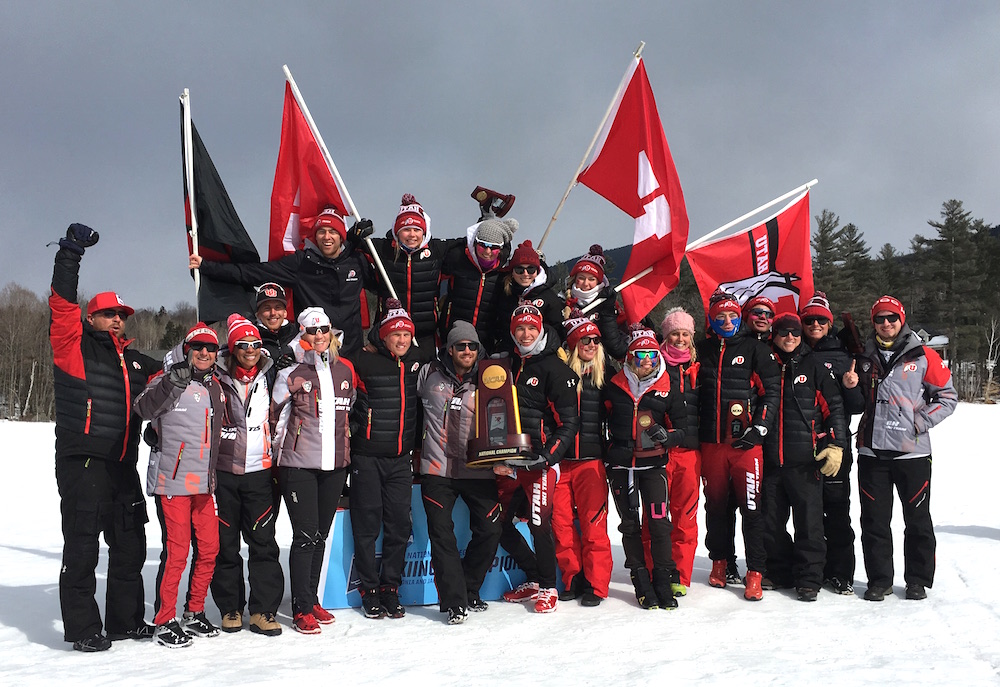
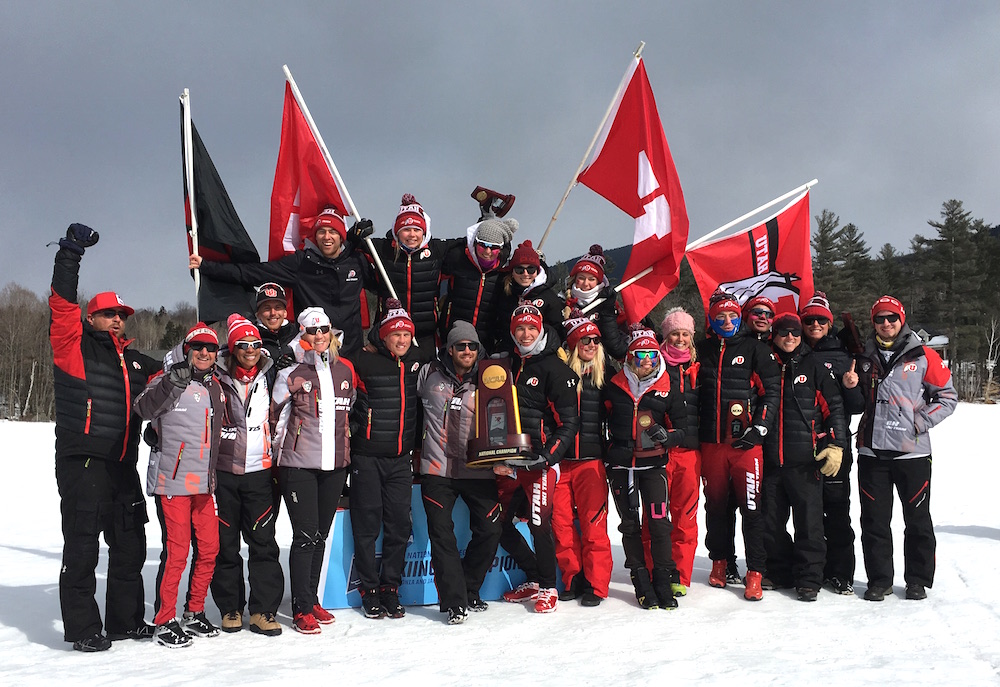
    The University of Utah ski team celebrating its first NCAA title since 2003 on Saturday at 2017 NCAA Skiing Championships in Jackson, N.H. (Photo: Jason Clay/Colorado)

    NCAA Skiing Championships (Jackson, N.H.): 15/20 k freestyle mass starts

    On the final day of the National Collegiate Athletic Association (NCAA) Skiing Championships in northern New Hampshire, the University of Utah pulled out a 16.5-point victory over the University of Colorado-Boulder (and finished 17.5 points ahead of the University of Denver) in the team standings, and the two previous NCAA champions from Thursday’s 5/10 k classic races, Martin Bergström and Petra Hyncicova, achieved their second-straight titles in as many nordic races this week.

    On a frigid Saturday morning in Jackson, N.H., with temperatures just below zero Fahrenheit for the start of the men’s 20 k freestyle mass start, Bergström, a Utah freshman from Sweden, outlasted the University of Colorado’s (CU) Mads Ek Strøm, a Norwegian senior and two-time 2016 NCAA champion, by 0.5 seconds to win his second-straight race in 46:02.8 minutes. Moritz Madlener, a German senior at Denver University (DU), placed third (+0.6). Just behind him CU’s Petter Reistad, of Norway, finished fourth (+1.2), and Dartmouth College’s Fabian Stocek, of the Czech Republic, placed fifth (+1.9).

    While temperatures warmed up to about 1 degree for the women’s 15 k freestyle mass start and the wind picked up to about 15-20 miles per hour, the women raced three laps around the Jackson Ski Touring Center’s race loop and navigated even faster downhills that caused a few crashes.

    Hyncicova used her love for downhills and skate races to capture her second consecutive NCAA title, breaking away with University of Vermont (UVM) junior Alayna Sonnesyn on the second lap. The Czech Republic native and CU junior attacked on the A-climb at the top of the course and won by 21.1 seconds in 39:21.6. Sonnesyn, of Minnesota, bested her third place from Thursday’s 5 k with a second-place finish on Saturday. CU’s Christina Rolandsen, of Norway, finished third (+38.9), ahead of Idaho native Anika Miller of Montana State University (MSU) in fourth (+44.0).

    Utah took fifth and sixth with Merete Myrseth (+1:01.5) and Guro Jordheim (+1:16.1), and had two other men in the top 10 (Martin Mikkelsen in 8th and Kevin Bolger in 10th) to achieve the alpine-nordic team title.

    In the women’s race, the Utes were the only team with all three women in the top 14, with Natalia Müller in 14th (+1:32.1).

    “The turning point of today is when Guro broke a pole, and she was back in the 20’s, and she and Natalia were skiing together,” Utah Director of Skiing Kevin Sweeney said, according to a team press release. “We told them that they had to go and they busted out and made a big move. The men’s results were tremendous, but whether or not we were going to win was based on those guys making the move. It was exceptional athleticism and gutsy performances.”

    The NCAA team title was the 11th for Utah and its first since 2003.

    “I am stunned with the win today,” Sweeney added. “In all my years of coaching, it was one of the most challenging four days of competition. I say that because the weather was incredibly cold and windy, and challenging from both a waxing perspective, as well as visibility and conditions. I know all the teams had to deal with it, but it really beat us up. It took a lot of perseverance and gutsy performances for us to win. We struggled a little bit in the slalom, but they were going for it and came up short.

    “We’ve been crunching numbers and have been able to beat Denver and Colorado by about 30 points on a really good showing during the RMISA season, but didn’t know if we could do it in the championships,” he continued. “Bergström was skiing at a whole new level this week, and Mikkelsen had stepped it up, and I knew Kevin Bolger could get top 10. I was also confident in the women, who have been skiing awesome, so I felt good there. It’s awesome to be able to take this new trophy back to our new ski building.”

    As for those earning All-American status on Saturday with a top-10 finish, Utah had five (Bergström 1st, Myrseth 5th, Jordheim 6th, Mikkelsen 8th, Bolger 10th), Colorado had four (Hyncincova 1st, Strøm 2nd, Rolandsen 3rd, Reistad 4th), Denver had two (Madlener, Dag Frode Trollebø 7th), MSU had two (Miller 4th, Johanna Talihärm 7th), Dartmouth had two (Stocek 5th, Luke Brown 9th), UVM had one (Sonnesyn 2nd), Northern Michigan University (NMU) had one (Adam Martin 5th), the University of Alaska-Fairbanks (UAF) had one (Sarissa Lammers 8th), UNH had one (Lizzie Gill 9th), and Bowdoin had one (Hannah Miller 10th).

    Stay tuned for a more in-depth report with quotes and photos from Saturday’s skate mass starts.

    Results: Men | Women | Team

    ***

    USSA Cross Country Junior Championships (Lake Placid, N.Y.): Freestyle team relays
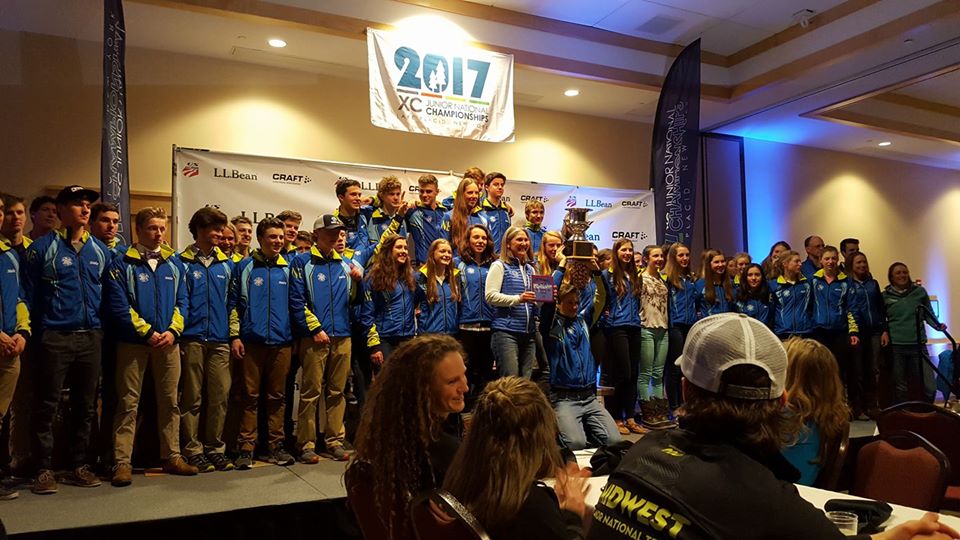
    The 2017 U.S. Junior Nationals Alaska Cup winners, New England, at the awards ceremony on Saturday in Lake Placid, N.Y. (Photo: XCJuniorNationals2017/Facebook)

    [UPDATED] For the final day of 2017 U.S. Junior Nationals in Lake Placid, N.Y., regional divisions formed three-racer teams for the U16, U18 and U20 freestyle relays.

    Intermountain swept the U16 team events with Lane Myshrall, Skylar Patten and Johnny Hagenbuch winning the U16 boys’ relay by 3.6 seconds over the Midwest’s James Schneider, Alexander Nameth and Peter Moore in 23:00.4 minutes. Another 1.1 seconds back, Alaska reached the podium in third (+4.7) with Eli Hermann, Zander McMullen and George Cvancara.

    Intermountain’s U16 girls’ team of Sarah Morgan, Annabel Hagen and Sydney Palmer-Leger posted a 53.7-second victory over New England’s Charlotte Ogden, Anna Lehmann and Abigail Streinz, winning in 26:21.4. The Pacific Northwest finished 18.1 seconds later in third place (+1:29.9) with Fiona Max, Gretta Scholz and Annie McColgan.

    Alaska won the U18 boys’ relay with Luke Jager, Canyon Tobin and Gus Schumacher finishing in 21:42.9, 7.5 seconds ahead of New England’s Elliot Ketchel, Adam Glueck and Ben Ogden in second. The Midwest’s Anders Sonnesyn, Patrick Acton and Luc Golin rounded out the podium in third (+22.2).

    Rocky Mountain topped the U18 girls’ relay with Katja Freeburn, Ezra Smith and Maddie Donovan crossing first in 25:47.3. Just 5.8 seconds back, Intermountain’s Brooke Dunnagan, Anna Gibson and Sofia Schomento placed second, and the Midwest secured third (+16.7) with Margaret McCollor, Luci Anderson and Anja Maijala.

    The U20 men’s relay title went to New England, with Kam Husain, Koby Gordon and Daniel Streinz pulling out a 1.3-second win over Alaska’s Tracen Knopp, Logan Mowrey and Hunter Wonders in 21:53.1. Intermountain followed in third (+8.8) with Eli Jensen, Peter Wolter and Nathan Wells.

    The Midwest came up big in the U20 women’s relay, with Abby Jarzin, Hannah Rudd and Margie Freed finishing 10.1 seconds ahead of New England’s Alexandra Lawson, Mary Kretchmer and Mackenzie Rizio in 25:41.4. Another 1.1 seconds back, Intermountain’s Leah Lange, Maddie Morgan and Marin Coletta placed third (+11.2).

    New England won the Alaska Cup with 325 points, the same point total as Intermountain in second. Alaska placed third in the overall team competition with 295 points, just five points ahead of the Midwest in fourth.

    Results: U16 boysU16 girlsU18 boysU18 girlsU20 menU20 women | Alaska Cup

    ***

    FIS Cross-Country World Cup (Oslo, Norway): Holmenkollen 50 k classic mass start
    (Race report)

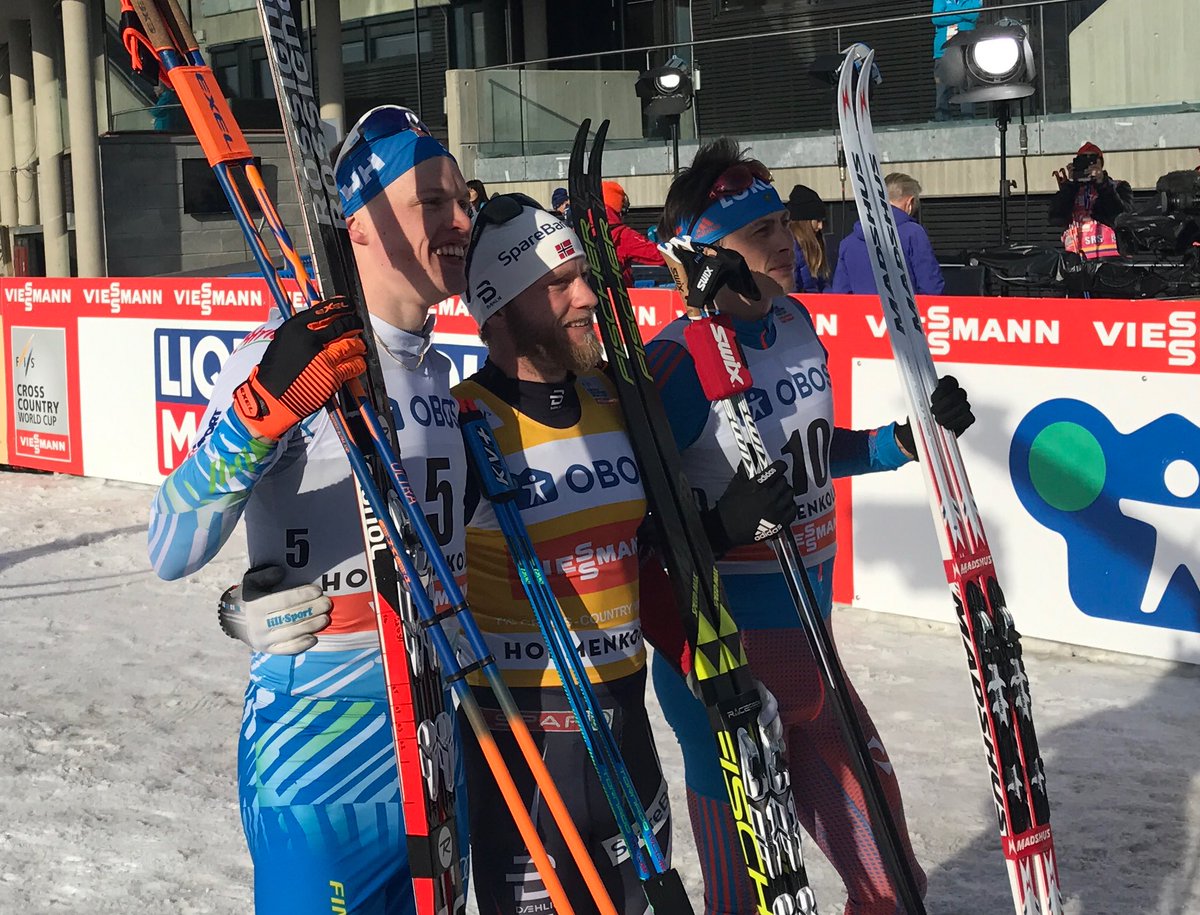
    Left to right: Finland’s Iivo Niskanen, Norway’s Martin Johnsrud Sundby and Russia’s Alexander Bessmertnykh after placing second, first and third, respectively, in the Holmenkollen World Cup men’s 50 k classic mass start on Saturday in Oslo, Norway. (Photo: FIS Cross-Country/Twitter)

    In a historic Holmenkollen, Norway’s Martin Johnsrud Sundby took his second 50 k win in a row, claiming this year’s title in a time of 2:02:59.7 (he won last year’s Holmenkollen in a time of 2:08:41.9). Sundby is now the only male skier to win two consecutive World Cup Holmenkollen 50 k competitions. 

    Crossing behind Sundby in second was Finland’s Iivo Niskanen, 9.9 seconds back from the race winner’s time. In a three-way photo finish, Russian Alexander Bessmertnykh bested Norwegians Niklas Dryhaug, and Sjur Røthe in the lunge to the line, with Bessmertnykh taking third (+1:15.2), Røthe fourth (+1:15.2) and Dryhaug fifth (+1:15.2).

    Canada’s Alex Harvey was just two tenths of a second behind the three-way lunge, finishing in sixth (+1:15.4). Norway’s Christer Hans Holund crossed 2.2 seconds later in seventh (+1:17.2). Three more Russians rounded out the top ten, with Sergey Ustiugov finishing in eighth (+2:35.0), Andrey Larkov two tenths of a second behind in ninth (+2:35.2) and Sergey Turyshev in tenth (+2:42.2).

    The top U.S. skier for the day was Scott Patterson (Alaska Pacific University), earning World Cup points in 28th (+7:18.8). Canada’s Devon Kershaw crossed 33rd (+2:11:59.1) and American David Norris (Alaska Pacific University) finished 35th (+9:56.4).

    Two more Americans competed in Saturday’s Holmenkollen, with Noah Hoffman finishing in 38th (+11:02.6) and Ben Lustgarten 46th (+18:44.7). Canadian Russell Kennedy was the final North American to finish in 47th (+20:16.3).

    Results

    ***

    IBU World Cup Biathlon (Kontiolahti, Finland): Men’s & women’s pursuits
    (Race report)

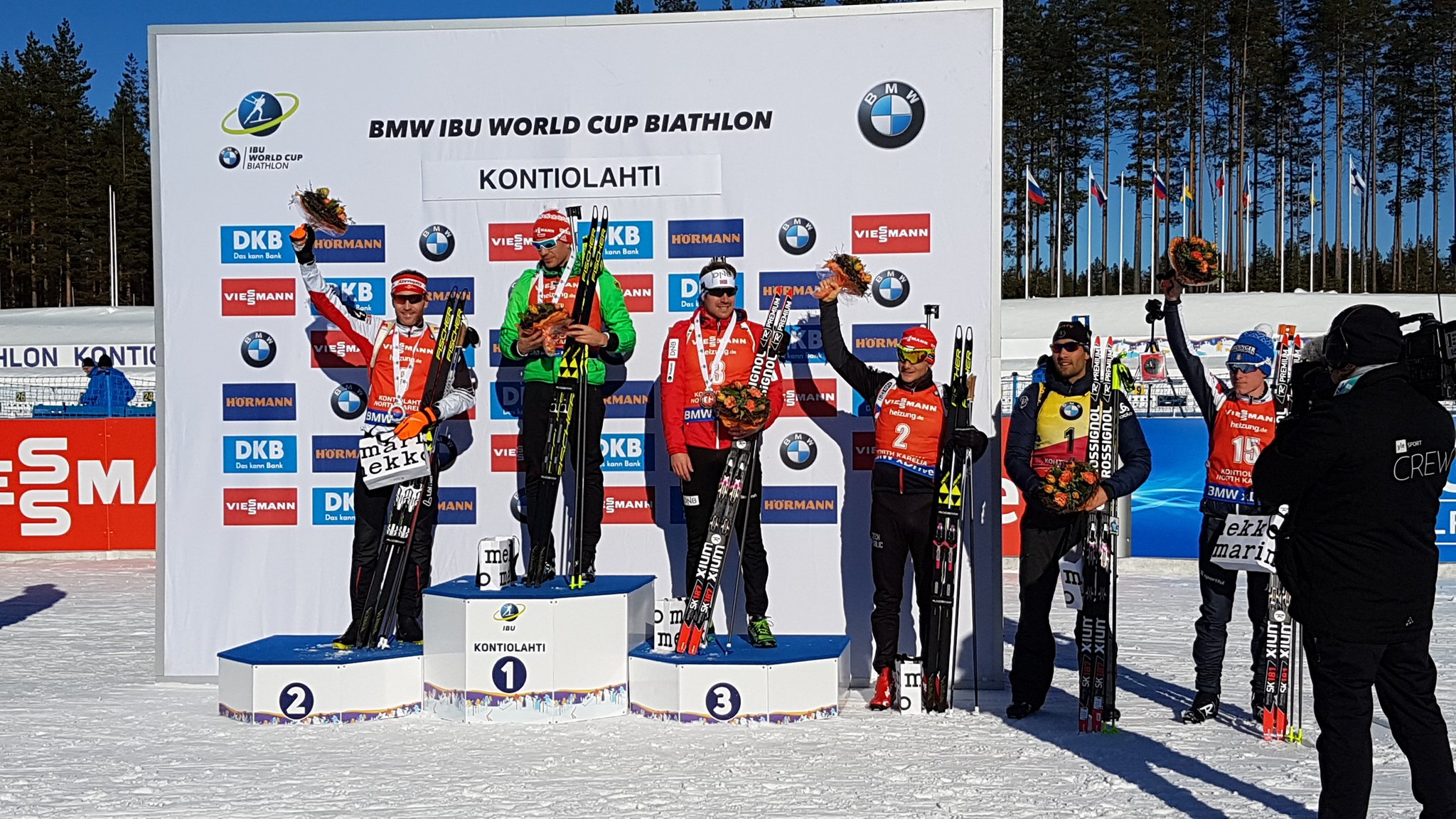
    The IBU World Cup men's podium after the 12.5 k pursuit in Kontiolahti, Finland, where Arnd Peiffer of Germany outsprinted Simon Eder of Austria for the win. (Photo: IBU/Twitter)
    The IBU World Cup men’s podium after the 12.5 k pursuit in Kontiolahti, Finland, where Arnd Peiffer of Germany outsprinted Simon Eder of Austria for the win. (Photo: IBU/Twitter)

    After one day knocked down to the second spot of the podium, it was back to the usual winning ways for Germany’s Laura Dahlmeier in the 10 k pursuit. Dahlmeier caught Norway’s Tiril Eckhoff, who won Friday’s sprint, early in the race after Eckhoff had one penalty in the first prone and second-starter Dahlmeier cleaned. While Eckhoff picked up five more penalties as the race went on, finishing 15th (+1:12.0), Dahlmeier had just one – and cleaned when it counted, on the final shoot with France’s Marie Dorin Habert and the Czech Republic’s Gabriela Koukalova right there with her. Dorin Habert missed one shot and held on to second place (+16.5) despite the penalty loop, while Italy’s Lisa Vittozi picked up her first individual podium in third (+19.9).

    The win secured the overall World Cup title for Dahlmeier, her first. “That makes me really speechless,” she told Germany’s ARD broadcaster. “This is an amazing moment.”

    Susan Dunklee collected four penalties and dropped from fifth place to 14th (+1:02.8) for the United States. Teammates Clare Egan and Joanne Reid finished 45th (+3:24.7) and 52nd (+4:07.0), respectively.

    For Canada, Julia Ransom finished 53rd with three penalties (+4:14.0) and Emma Lunder 58th with four missed shots (+6:20.7).

    Results

    Earlier in the day, Martin Fourcade had started the men’s race in bib one and set out to win the men’s 12.5 k pursuit, but was undone by four errors on the shooting range. No matter: the French biathlete still picked up the World Cup crystal globe for the pursuit discipline after finishing fifth (+25.5 seconds) and now he’s skipping tomorrow’s mixed relays to go be with his wife, who is about to have their second child.

    Capitalizing on Fourcade’s errors were a group of chasers, among whom Arnd Peiffer of Germany managed to shoot 20-for-20. The race came down to a sprint finish between him and Simon Eder  of Austria; Peiffer took a 0.3-second win for his eighth career victory. Emil Hegle Svendsen of Norway finished third, +2.3 seconds, and Andrej Moravec of the Czech Republic fourth, +9.8.

    Besides Peiffer, the only other man in the field to shoot clean was Sean Doherty of the United States. That allowed Doherty to jump from 44th at the start to a season-best 18th (+1:19.5) at the finish, the top result for the American team. Lowell Bailey finished 27th (+1:57.2) and Leif Nordgren 43rd (+3:24.4) with three and four penalties, respectively.

    Christian Gow led Canada with just one penalty and a 37th-place finish (+2:36.0), a big improvement from his 50th-place starting position. Brendan Green placed 50th with three penalties (+4:47.3).
    Results

  • Sundby Accomplishes Dream, Dominates Holmenkollen 50 k Start to Finish

    Sundby Accomplishes Dream, Dominates Holmenkollen 50 k Start to Finish

    Norway's Martin Johnsrud Sundby celebrates his first-ever victory in the men's 50 k mass start at the historic Holmenkollen World Cup near his hometown of Oslo, Norway. (Photo: Fischer/NordicFocus)
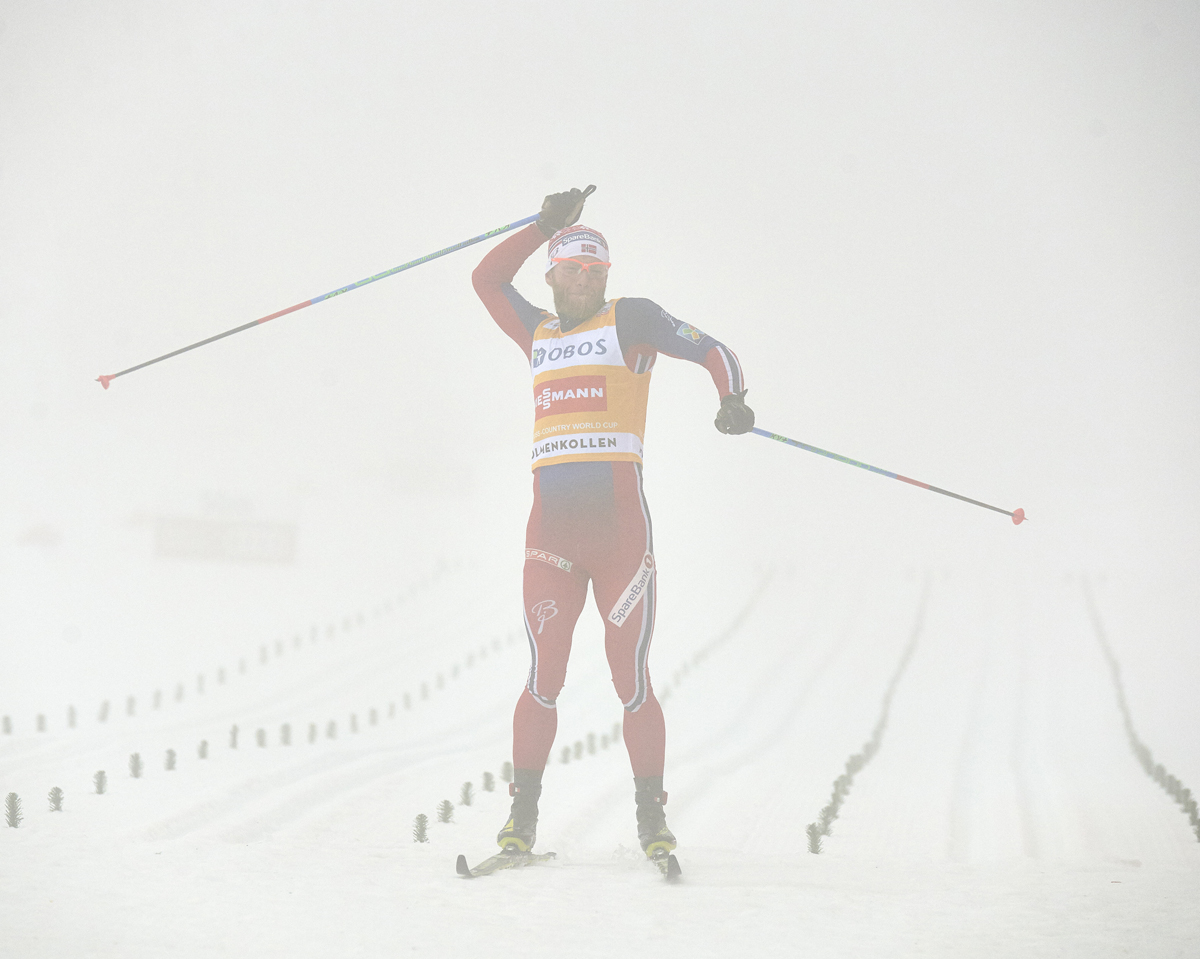
    Norway’s Martin Johnsrud Sundby celebrates his first-ever victory in the men’s 50 k mass start at the historic Holmenkollen World Cup on Saturday near his hometown of Oslo, Norway. (Photo: Fischer/NordicFocus)

    “It’s always been a dream for me to win this race, from when I was nine years old and tenting in the forest, cheering for all the big skiers at the time,” Martin Johnsrud Sundby said in a post-race press conference after winning Saturday’s 50-kilometer classic mass start held at the historic Holmenkollen stadium outside of Oslo, Norway.

    A perennial favorite at his home stadium in his hometown of Oslo, Sundby, landed on the podium in his four previous starts at the Holmenkollen 50 k, but the victory eluded him. Last year he finished third, half a second behind race winner and teammate Sjur Røthe.

    In an interview last year with the International Ski Federation (FIS) media’s Inside the Fence series, Sundby spoke of growing up on the track, “I did my first competition here as a 9 year old. Since then I’ve done probably over 100 competitions at this place. I have trained probably five thousand hours at this track. This is my home ground.”

    On Saturday, Sundby, who leads both the overall and distance World Cup, made no mistake that he would finally come away with a victory. With King Harald of Norway in attendance, the 31-year-old race favorite gunned it out of the stadium, appearing to want to weed out any potential chasers within the first few kilometers.

    Norway's Martin Johnsrud Sundby leads teammates Niklas Dyrhaug (3), Didrik Tønseth, and Russia's Maxim Vylegzhanin (r) during the men's 50 k classic mass start at Holmenkollen in Oslo, Norway. (Photo: Fischer/NordicFocus)
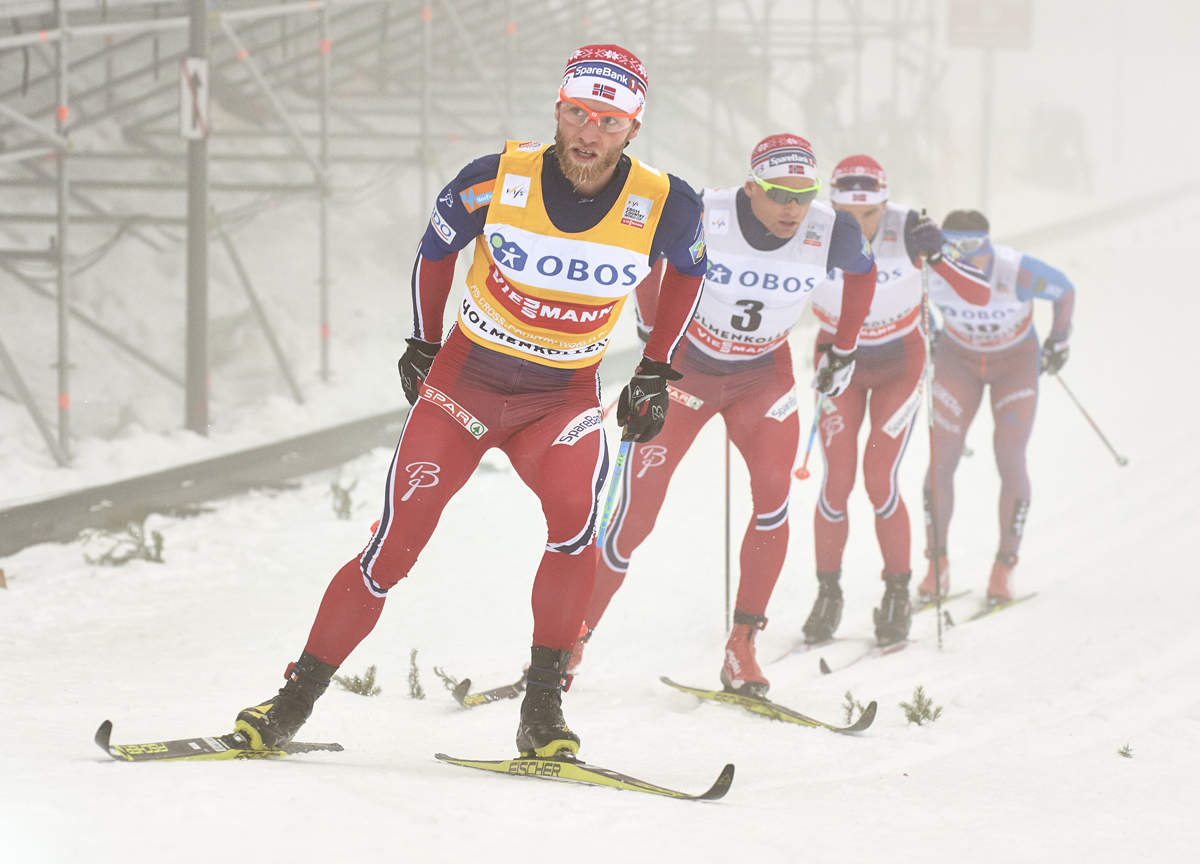
    Norway’s Martin Johnsrud Sundby leads teammates Niklas Dyrhaug (3), Didrik Tønseth, and Russia’s Maxim Vylegzhanin (r) during the men’s 50 k classic mass start at Holmenkollen in Oslo, Norway. (Photo: Fischer/NordicFocus)

    “My strategy for today was to shock the others from the start,” Sundby told reporters following the race, “Nobody expected that kind of pace from kilometer one, and I think I’ve never been skiing that fast for 50 k.”

    Despite warm temperatures and dense fog, the damp conditions did not seem to impact the lead racers. Instead it was Sundby’s blistering pace that thinned the group.

    Only 13.3 k in, a pack of three remained in contact Sundby as they charged through the fog: Norwegians Niklas Dyrhaug, 28, and Didrik Tønseth, 24, followed by Russia’s 33-year-old Maxim Vylegzhanin. Ten seconds behind these four was the main chase including past Holmenkollen champions, Norway’s Røthe and Petter Northug Jr., and last year’s runner-up Dario Cologna of Switzerland.

    Five kilometers later, at 18.8 k, the lead pack pushed their gap to 25.5 seconds over the chase. Leading the chase pack, Andrey Larkov, Alexander Bessmertnykh, Sergey Turyshev, Nikita Stupak — all from Russia — appeared set on tracking down and joining their teammate Vylegzhanin at the front.

    Less than a kilometer later, at the bonus sprint at 19.6 k (there was one on each of the six laps), Sundby gapped his three challengers, putting 4.6 seconds between himself and Tønseth. Although they reeled him back in at this point, Sundby made these moves throughout the day in an attempt to break free. By continuously pushing the pace, Sundby claimed all six of the World Cup bonus point preems throughout the course.

    At 24.9 k, roughly halfway through, the lead pack of four soldiered on, with the three challengers to Sundby absorbing every surge he attempted. Back in the main chase pack, the Russian attack of Larkov, Bessmertnykh, Turyshev and Stupak settled back in. While the Russians appeared positive for the chase, the group of 13 were taking the brunt of Sundby’s relentless attacks. Failing to match his relentless speed; they slipped 47 seconds behind.

    Norway's Martin Johnsrud Sundby (r) leads Switzerland's Dario Cologna early in the men's 50 k classic mass start at Holmenkollen in Oslo, Norway. (Photo: Fischer/NordicFocus)
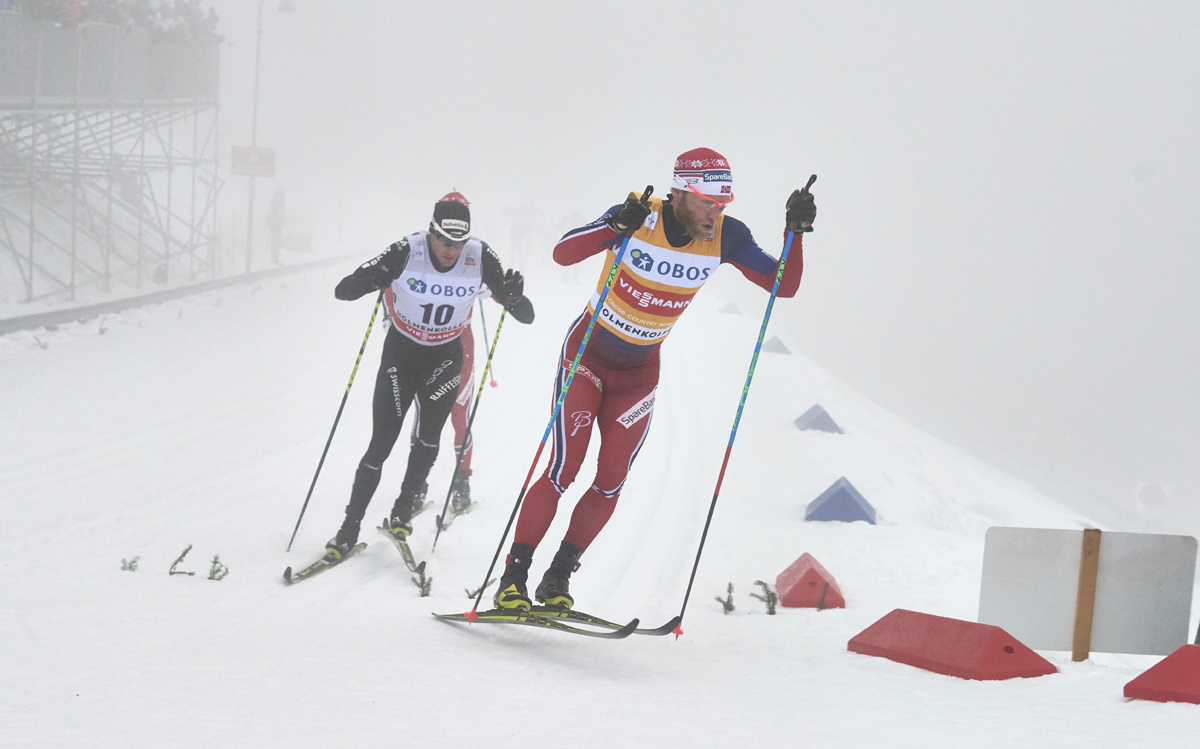
    Norway’s Martin Johnsrud Sundby (r) leads Switzerland’s Dario Cologna (10) early in the men’s 50 k classic mass start at Holmenkollen in Oslo, Norway. (Photo: Fischer/NordicFocus)

    Colonga, an early challenger around 11 k and a presence within the main chase, abandoned the race near the halfway point. Bothered by a left calf injury that occurred during the Tour de Ski, Cologna hoped to make a comeback for Holmenkollen. After the race he told Neue Luzerner Zeitung, a Swiss-German paper, “The calf was not strong enough for the fifties,” referencing that he believes he can compete in shorter races, but the longer marathons are not yet possible given the severity of the calf strain he suffered in January.

    On course, Sundby’s charge continued. At the second of two possible ski changes at 33.3 k (the first was at 6.6 k), the gap over the main chase grew to 1:10.3. The only skier daring enough to try to bridge that gap between the main chase and Sundby’s group of four, Turyshev, made it as close as 40 seconds back.

    An hour and half in, and on their fifth of six laps, Sundby’s energy finally proved too much for Tønseth and Vylegzhanin. Over two large climbs, Sundby’s powerful stride put him and Dyrhaug 15 seconds ahead Tønseth and Vylegzhanin. After the race, Sundby reflected this move was essential to holding off the strong-finishing Vylegzhanin, “I was a bit afraid of Vylegzhanin; he has great finishes when he is in shape. I was actually quite happy when me and Dyrhaug put some seconds on him in the fifth lap.”

    Dyrhaug clung to his teammate, telling FIS afterward that he “felt strong especially on the uphills,” albeit describing the race as the “hardest race I have ever skied in my life.” He matched Sundby stride for stride until just before 44.6 k, where Sundby built a 13.6-second lead that would last until the finish.

    According to NRK, Sundby wanted Dyrhaug there to pull him through the final few kilometers. However, Dyrhaug could not match the pace any longer, telling NRK, “He wanted me there and go. I said, ‘It’s not going to happen. Sorry, buddy.’ ”

    Behind Dyrhaug, the race for third dissolved as Vylegzhanin dropped Tønseth, opening up 14.2-second gap on the third Norwegian at the final 44.6 k time check. Farther back, Turyshev maintained his pace within the top five, 2:21.4 behind Sundby and 1:01.5 after Tønseth.

    Norway's Martin Johnsrud Sundby racing to the victory in the Holmenkollen 50 k classic mass start on Saturday at the World Cup in Oslo, Norway. (Photo: Fischer/NordicFocus)
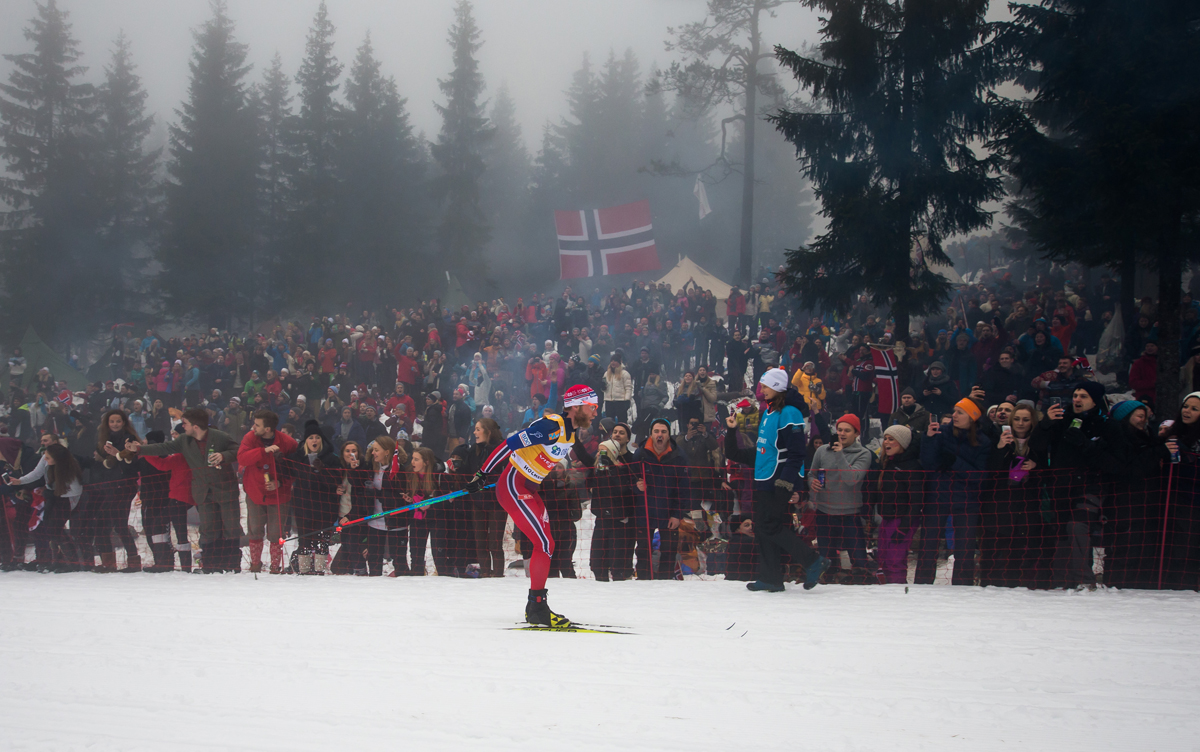
    Norway’s Martin Johnsrud Sundby racing to the victory in the Holmenkollen 50 k classic mass start on Saturday at the World Cup in Oslo, Norway. (Photo: Fischer/NordicFocus)

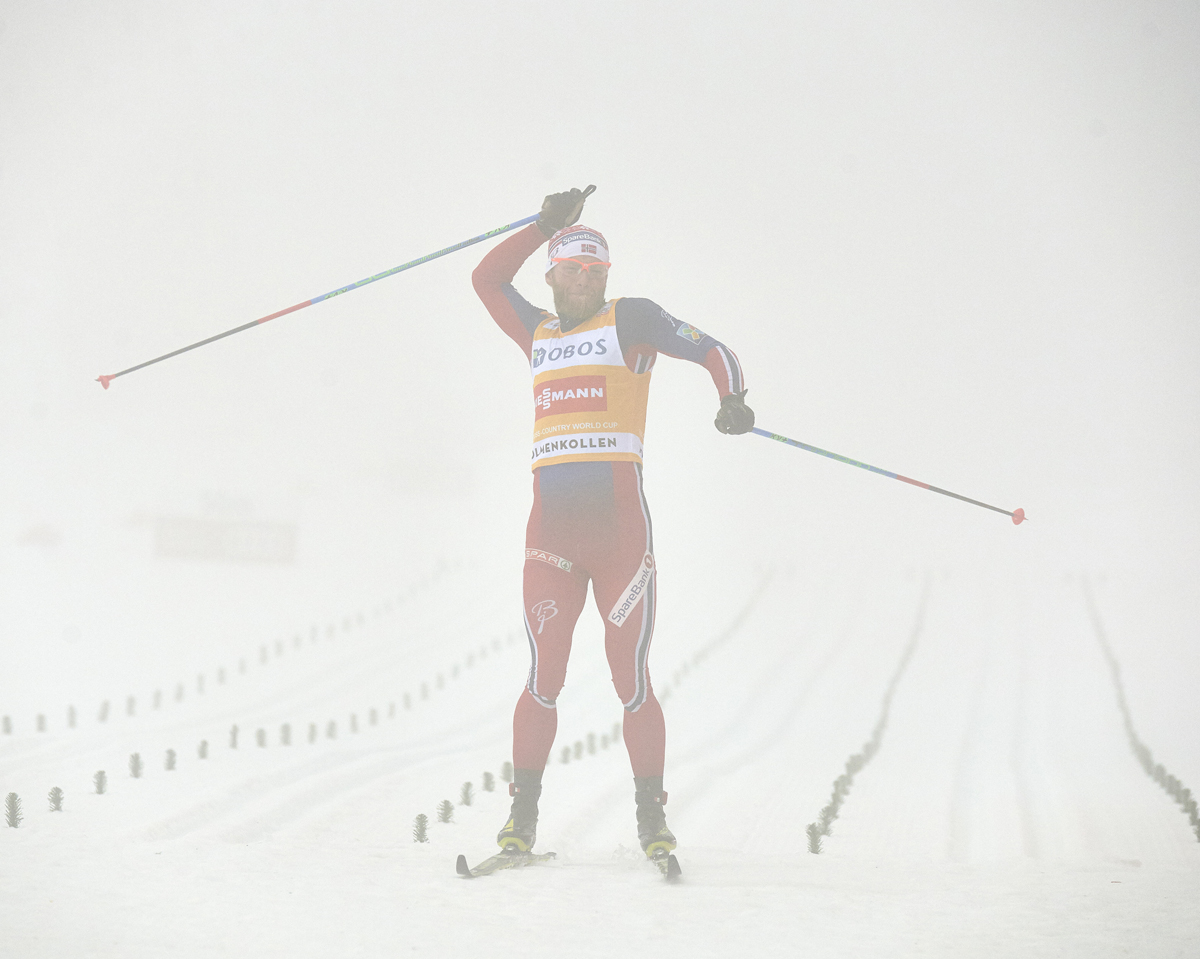
    Sundby emerged through the fog and into the stadium alone. Down the finishing stretch, he pumped his fists, a final celebration of a victory that’s been a long time coming. After crossing the line with a victory in his record fifth-consecutive World Cup podium at the 114-year-old Holmenkollen event, he kissed the snow, paying homage to the historic course.

    Following Sundby in second place, 18.8 seconds behind, his teammate Dyrhaug celebrated a personal best in the 50 k event. In third, 1:05.4 after Sundby, Vylegzhanin, broke up the Norwegian podium. Tønseth clung on to finish fourth (+1:36.3). Turyshev, who skied the majority of the second half of the race alone, rounded out the top five, 2:35.8 behind Sundby and 25 seconds ahead of Northug in sixth.

    Northug edged out an eight-man race to the line, with sixth through 13th finishing within 5 seconds of one another.

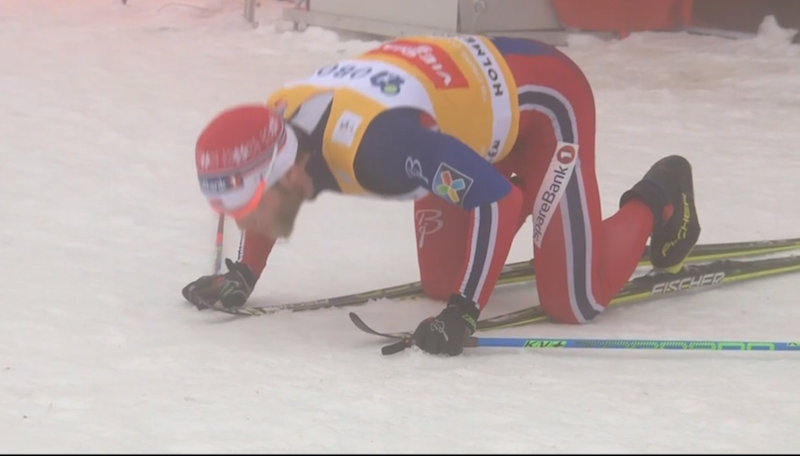
    Martin Johnsrud Sundby kissing the ground after winning the Holmenkollen 50 k classic mass start on Saturday in Oslo, Norway.
    Martin Johnsrud Sundby kissing the ground after winning the Holmenkollen 50 k classic mass start on Saturday in Oslo, Norway.

    With the victory, Sundby leads the overall World Cup by 720 points over fellow Norwegian Finn Hågen Krogh, who did not race on Saturday. Northug sits in third, 22 points behind Krogh.

    In the Distance World Cup, Sundby remains in first by a comfortable 473 points over Dyrhaug in second, and Røthe, who placed 10th on Saturday ranks third, 58 points behind Dyrhaug and just 1 point ahead of France’s Maurice Manificat in fourth.

    None of the French skiers started Saturday’s race. Of the 19 Norwegians in the race, 10 placed in the top 20 and five were in the top 10.

    “It sounds strange, but even if it’s no championship, this means a lot to me.” Sundby said in the post race press conference with a glint of sentiment towards finally breaking through at the fabled race.

    Notes

    • Sundby appeared to take a couple skate strides up and over the final bridge into the stadium. While XC Skiing News reported that he skated, Sundby did not mention that the jury had spoken to him about it. The incident was captured in this Vine:

    Results

  • Legkov Joins Russian Sprint Team After Disappointing Season

    Legkov Joins Russian Sprint Team After Disappointing Season

    Alexander Legkov after winning the Olympic 50 k in 2014. He didn't have that feeling often in the 2015 season.
    Alexander Legkov after winning the Olympic 50 k in 2014. He didn’t have that feeling often in the 2015 season.

    After founding a renegade training group based in Switzerland with Ilia Chernousov as a partner and Reto Burgermeister and Isabelle Knaute as coaches, Russian ski star Alexander Legkov is now on his own, named to Russia’s sprint group but “with his own training plan.”

    Legkov has been one of Russia’s distance stars for years, and in 2014 won the 50 k skate race at the Olympic Games. He raced lightly last season, with no standout early-season results; he had the 15th-fastest isolated pursuit time in the Lillehammer World Cup mini-tour, and placed 28th in the 15 k skate in Davos, Switzerland.

    After Christmas, in a field that lacked the top Norwegians and Swedes, he finished fourth and seventh in distance races in Rybinsk, Russia. That earned him only one individual start at World Championships: 14th place in the 15 k skate.

    Life got hard after the Olympic victory, Legkov told Russian newspaper Gazeta this spring. For four years, he had simply put aside problems with his household and his personal life, and focused only on training and racing. After the gold medal he wanted to spend more time as a normal human being, but it caught up with him quickly.

    “It turned out that to live a normal life – it was really hard,” he said, according to a translation. “Just a disaster. I respect the people who live like that. After all, how does your day usually unfold in professional sports? You eat, work out, come for a massage, go out for the second training session. Everything is very simple. But in real life there is nothing simple. Over the last year, I realized it very well.”

    Legkov bought a house. He loves cars, hunting, and fishing, and indulged in them. He mused about how the top Norwegians seem to have a good time, and still ski fast. Europeans live a “more confident life” compared to “gloomy” Russians, he said. He was amazed that the Norwegians could multi-task and still win races.

    “If it does work turn out in sport, they will find themselves in another case,” he said of the foreigners. “In Russia we have this more difficult, especially with athletes. Imagine a person trained 10-15 years. God forbid, they didn’t win something. They are thrown out like a fledgling bird. Life is a cruel thing, no matter if you are a champion or not. Maybe that’s why we athletes have such a gloomy demeanor. And foreigners have this positive and cheerful outlook on life because it’s easier, although [Dario] Cologna is also a workaholic. He, too, has only one thing in the head – sport. He won’t look for more. With Northug it’s a little different.”

    In the early years of his collaboration with Knaute and Burgermeister, there was immense pressure on Legkov and teammate Ilia Chernousov to perform. The idea of the splinter group was approved by the Ministry of Sport, but not the ski federation. Internal politics were intense. Since it was at that point unheard of for Russian skiers to work with foreign trainers, every mis-step was seen as a justification to cut him from the national team.

    “He won, and the Russian behind him also started in the Tour de Ski,” Knaute told FasterSkier in 2012 of a situation when Chernousov was forced to drop to the Continental Cup to prove himself again. “But if he hadn’t won, he wouldn’t have started.”

    Last season, Chernousov began training with the Norwegian coach Vegard Bitnes. He is staying on that track this season.

    Reportedly, Legkov came to the decision to leave Burgermeister’s group himself. Although he is a distance skier, he will be training primarily with the sprint group. His new training partner will be, instead of Chernousov, Sergey Turyshev, who was not named to any of the Russian national teams and finished 37th in the World Cup distance standings last season.

    “I hope that the training will not be alone,” Legkov told the TASS Russian News Agency. “Sergey Turyshev, which also specializes in distance races, already expressed a desire to work with me. I want to believe that in this matter all goes well. As for the work on the speed, there won’t be any problems.”

    Legkov is clear that although the 2014-2015 season didn’t go well, he is not finished as a skier.

    “Friends, I always hear them say, after the Olympics, isn’t it better to leave at the peak?” he told Gazeta. “And start doing some other thing and learn? You’re just playing for time. It is unknown what your results will be after this triumph. But I cannot give up the sport. This is me, and I haven’t run out yet.

    “Regarding Northug and Cologna I want to say one more thing,” he continued. “They are the stars of skiing. But when I give myself to the maximum training, I can deal with them. It’s just that this year turned out differently.”