Tag: Sergey Ustigov

  • Double Gold: ROC Dominates Men’s 4 x 10 k Relay in Lengthy Race; USA 9th, CAN 11th

    Double Gold: ROC Dominates Men’s 4 x 10 k Relay in Lengthy Race; USA 9th, CAN 11th

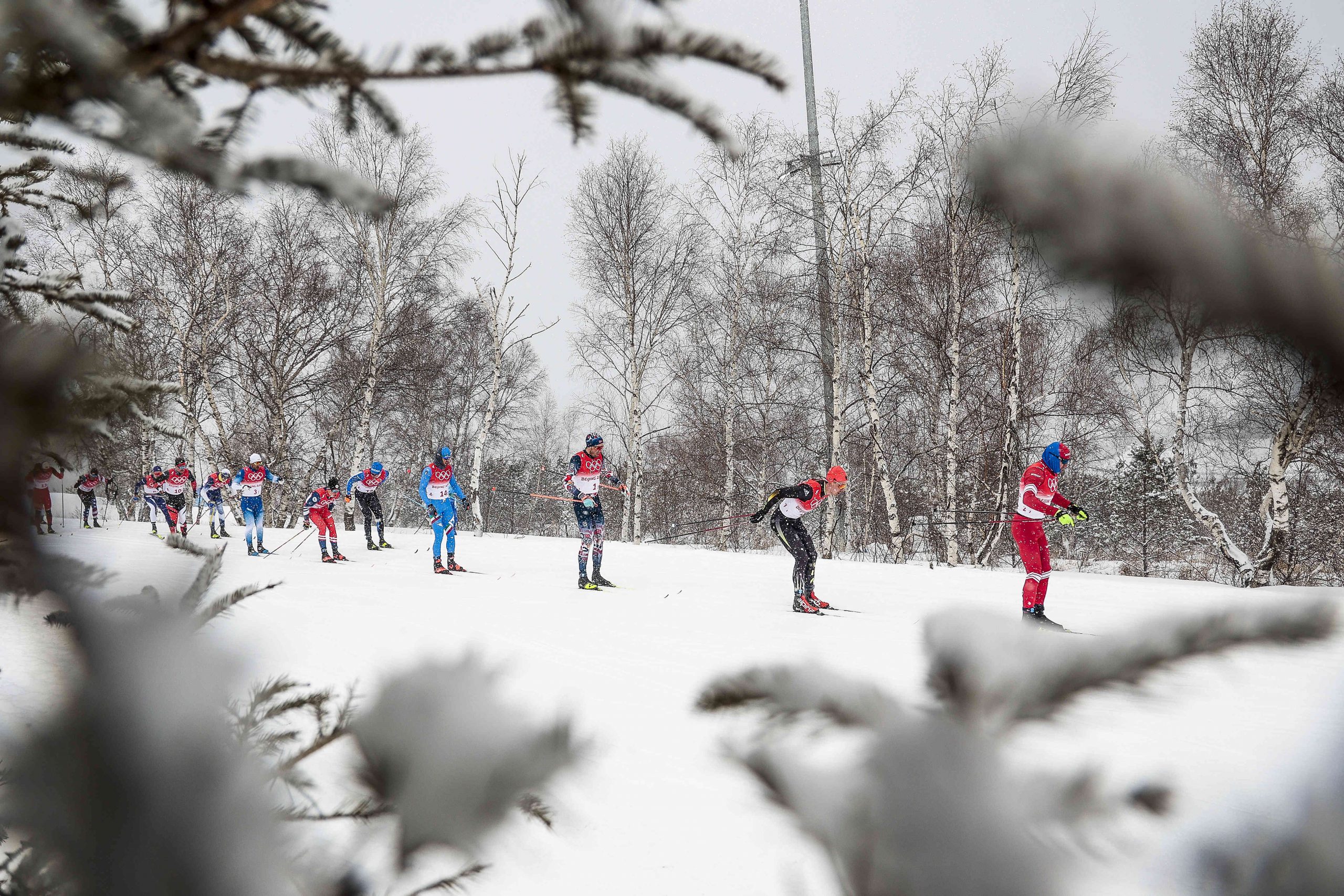
    Early stages, Emil Iversen (NOR), Alexey Chervotkin (ROC), Richard Jouve (FRA), and Oskar Svensson (SWE) (l-r) lead the men’s 4 x 10 k relay. (Photo: NordicFocus)

    This World Cup coverage is made possible through the generous support of Marty and Kathy Hall and the A Hall Mark of Excellence Award.  To learn more about A Hall Mark of Excellence Award or to learn how you can support FasterSkier’s coverage please contact info@fasterskier.com.

    After a thrilling women’s relay event on Saturday, it was the men’s turn to compete, each athlete skiing the laps of 3.3-kilometers for a total of 4 x 10 k. In a surprising turn of events, more snow than has fallen in a decade came down in Zhangjiakou over the last 24 hours, altering the otherwise stable man-made conditions the men have raced to this point. Conditions being what they were, heavy snowfall and 11°F on challenging courses, this made for an especially long race.

    The ROC proved to best handle the conditions, winning gold in 1:54:50.7. Norway skied to silver (+1:07.2), with France taking bronze (+1:16.4), while the American men skied to ninth (+8:05.6), with the Canadians in 11th (+9:10.4).
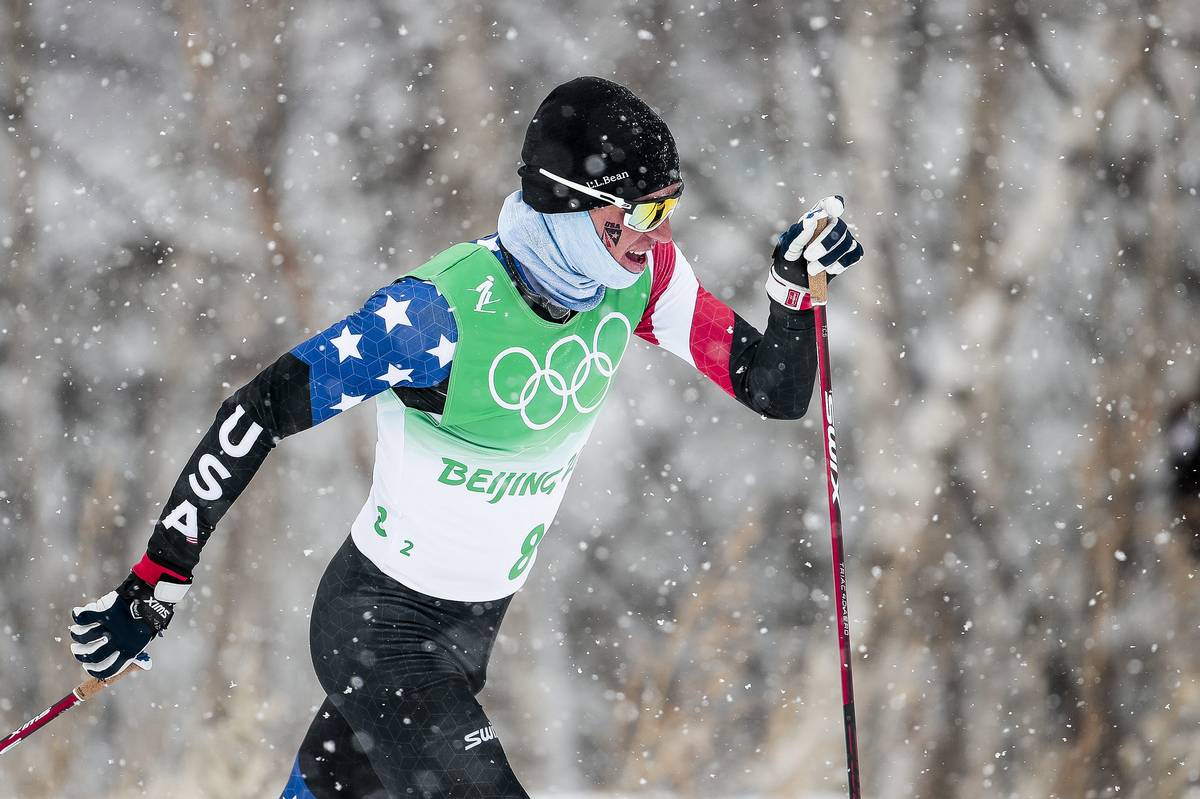
    Scott Patterson skis the second leg of the men’s 4 x 10 k relay through unprecedented conditions. (Photo: NordicFocus)

    Men’s skiing for the past few years has been dominated by two nations, Norway and Russia (or as they are known at these Games, the Russian Olympic Committee (ROC)). When it comes to the men’s 4 x 10 k relay however, Norway has historically been in a class of its own. 
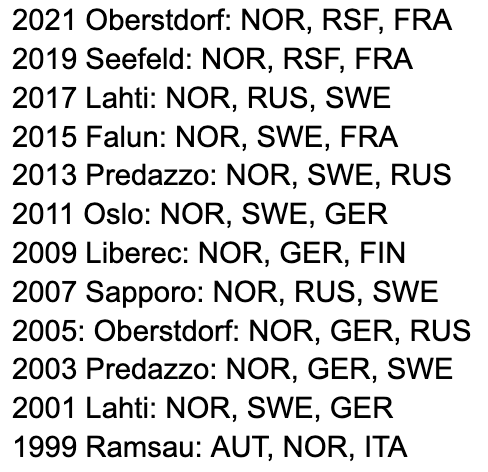
    Results summary for men’s 4 x 10 k relay at World Championships since 1999.

    Since Team Norway’s all-around poor showing at Sochi in 2014, which included the men’s team finishing 4th, they have not lost a championship relay. Indeed, looking at relay results from World Championships, you have to dig all the way back to 1999 to find Norway not winning gold, when Norway finished second to Austria in Ramsau. Their performances at the Olympics have been less dominant but most relevant for today’s race, they won gold in PyeongChang in 2018 with the same man, Johannes Høsflot Klæbo, in the anchor leg. 

    As such, despite the Norwegian men’s struggles thus far at these games, it seemed likely that fans would be seeing another battle between Norway and the ROC for top spot. Fifteen nations were represented on the start line and as the first leg was underway Sunday morning, the race appeared to be playing out remarkably similarly to the World Championships in Oberstdorf last year.

    A brief recap for those who don’t remember, in heavy snowfall, ROC athlete Alexey Chervotkin made an early move and ended his leg with nearly a minute lead on the rest of the field which was later eaten up and the win went to Norway. Today it was a different story.
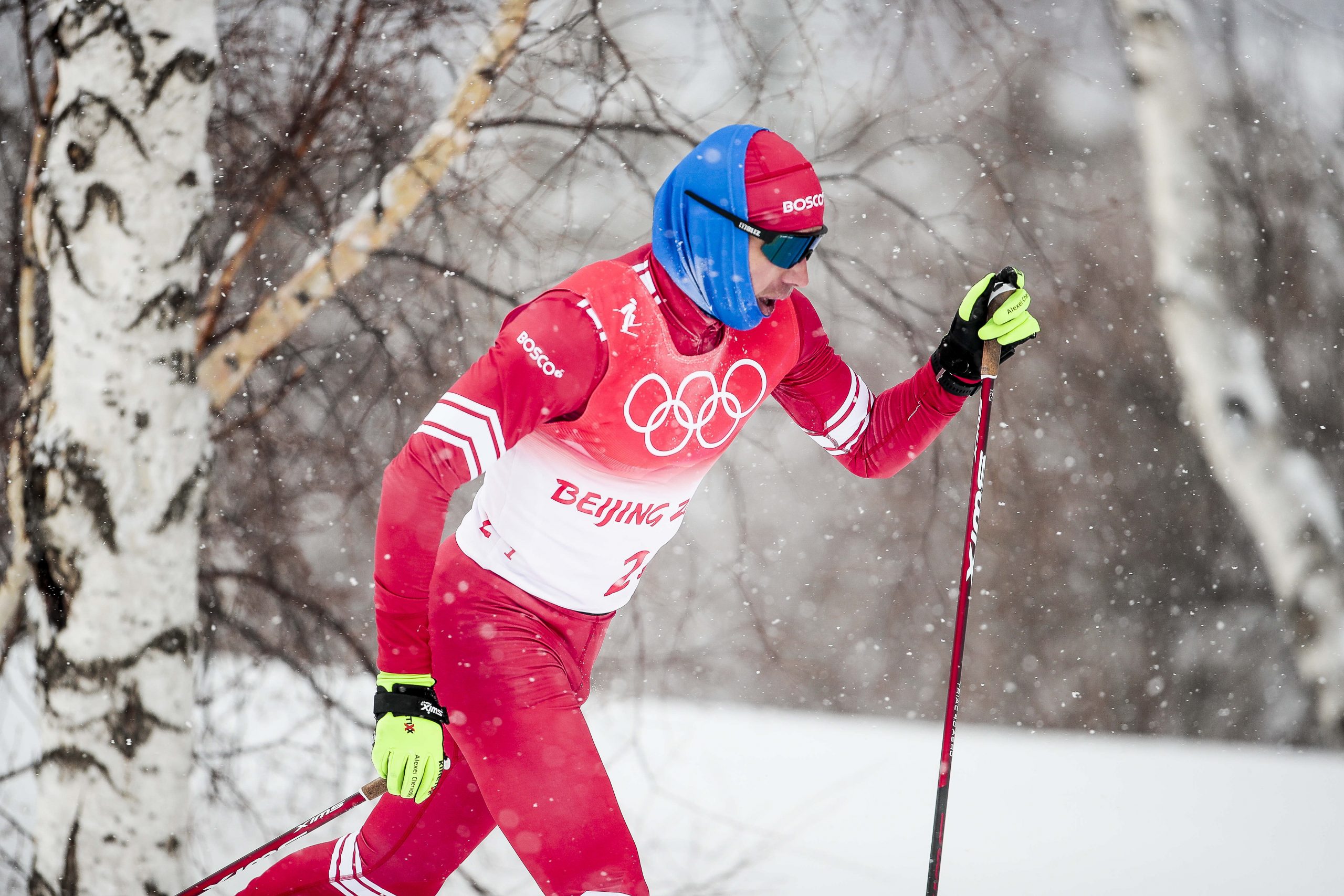
    Alexey Chervotkin (ROC) making a decisive early break (Photo: NordicFocus)

    Chervotkin was once again in the scramble position for the ROC and he put the hammer down right from the start gun. At 4.3 k he had a gap of +12.6 seconds to the rest of the field and that was the closest anyone got to the ROC for the rest of the race. Although it took three more athletes and another hour and forty-one minutes of skiing to seal the deal. 
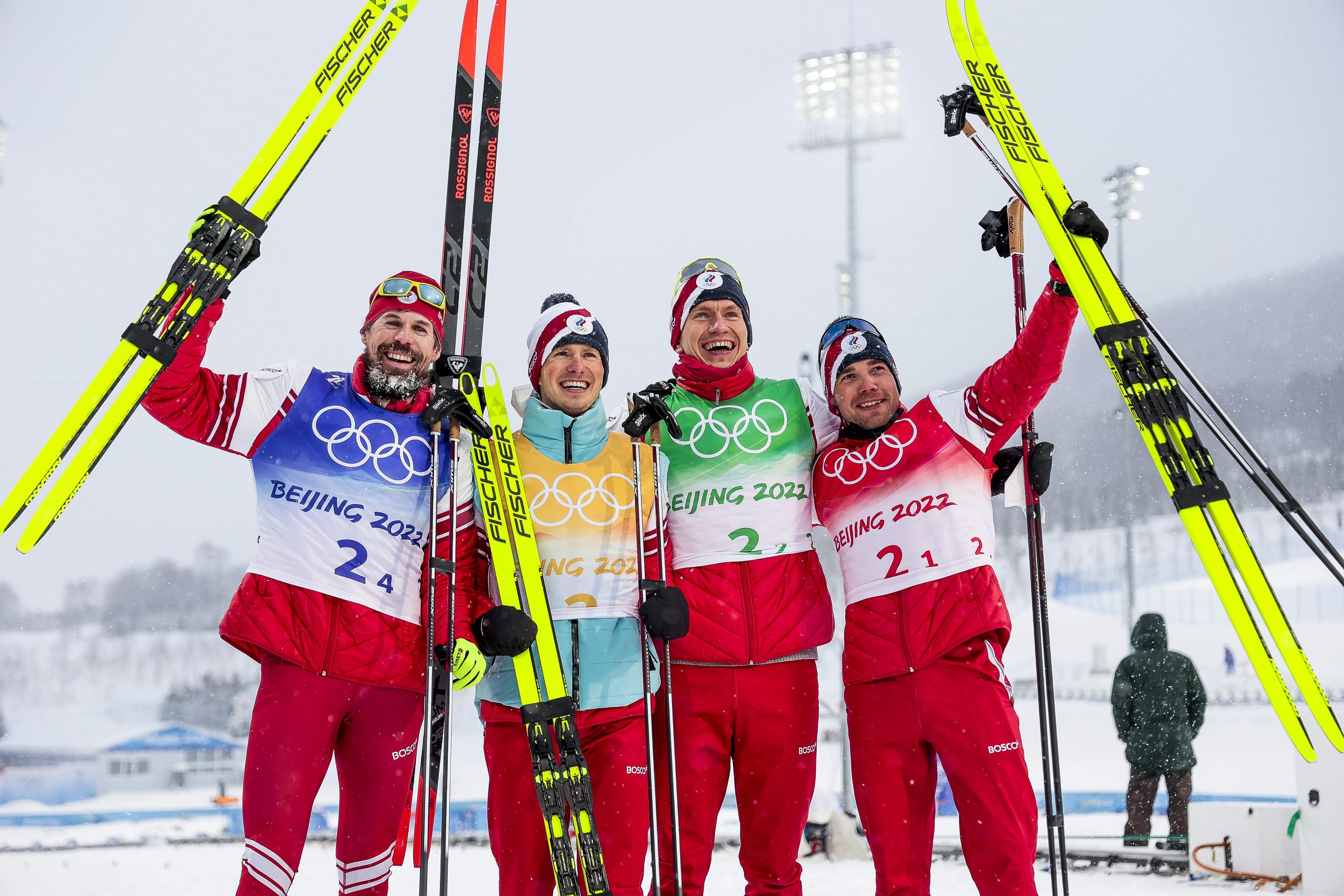
    All smiles for Sergey Ustiugov, Denis Spitsov, Alexander Bolshunov, Alexey Chervotkin, (l-r) after taking Olympic gold for the ROC for the first time in over forty years. (Photo: NordicFocus)

    Making his first appearance at these games after some controversy regarding a start in the 15 k classic, Emil Iversen took the first leg for Norway. For the majority of his leg, Iversen did the work to pull at the front of the chase group, which was composed of teams Italy, Germany, Sweden and France. No doubt inspired by the German women’s relay performance, Janosch Brugger skied a strong leg for Germany, ultimately pulling away with Italy’s Federico Pelligrino in the final kilometers of their leg.
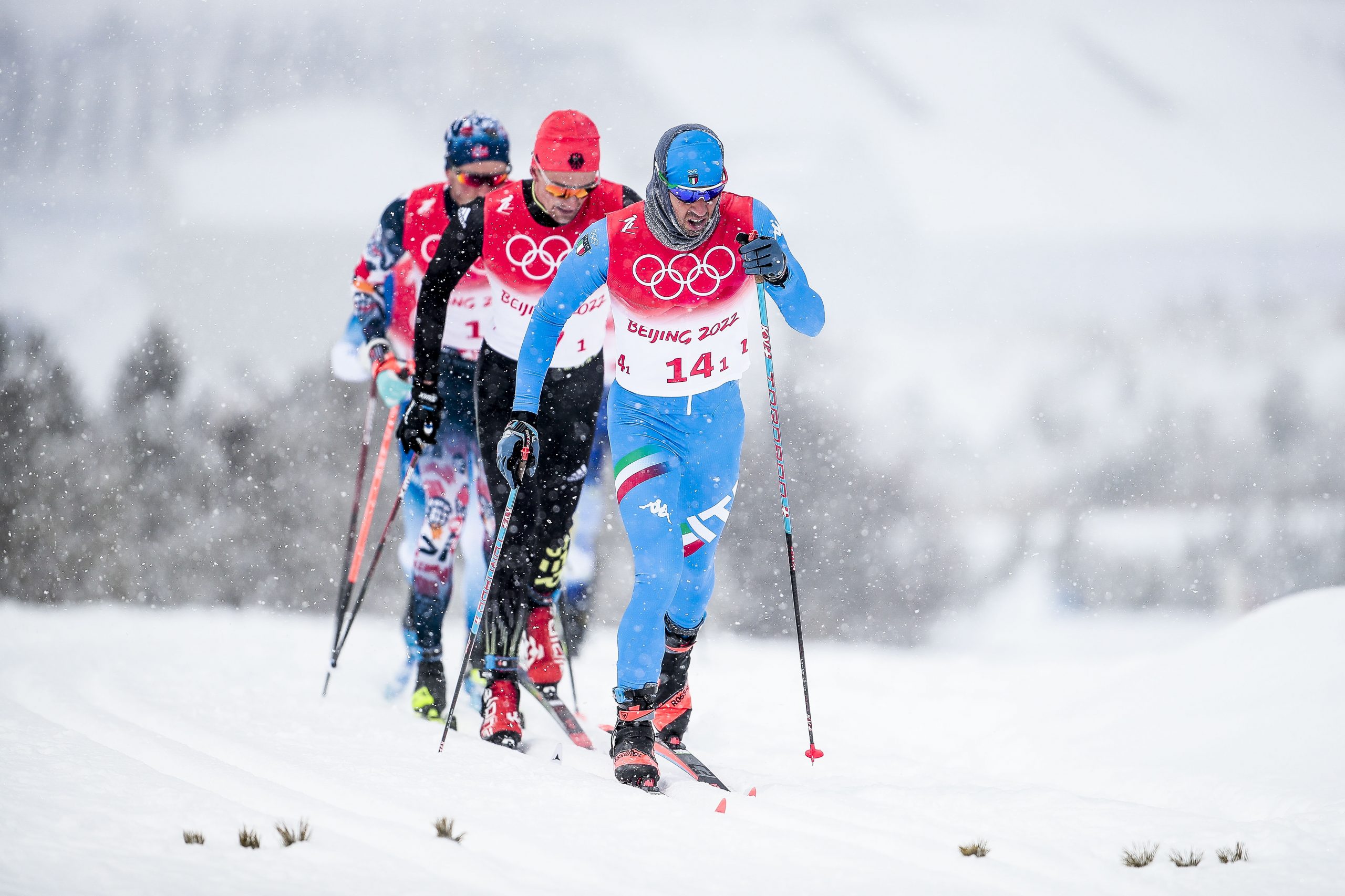
    Federico Pellegrino (ITA) leads Janosch Brugger (GER) and Emil Iversen (NOR) (Photo: NordicFocus)

    With Iversen fading fast on the final lap up the A-climb, Brugger and Pelligrino gapped the Norwegian by 10 seconds, coming into the first exchange +23.5 and +24.1, respectively, behind Chervotkin of the ROC. Next came Iversen, who tagged his teammate, Pål Golberg, with a gap of +34.4 to the ROC.

    Despite the hard work put in by Chervotkin, the conditions were such that it took him 30:14.7 to ski 10 k, which is much slower than we might normally expect. Chervotkin had taken 5th place in the 15 k classic on Friday in 38:51.7 with stable conditions; five additional kilometers in roughly 8.5 minutes longer.
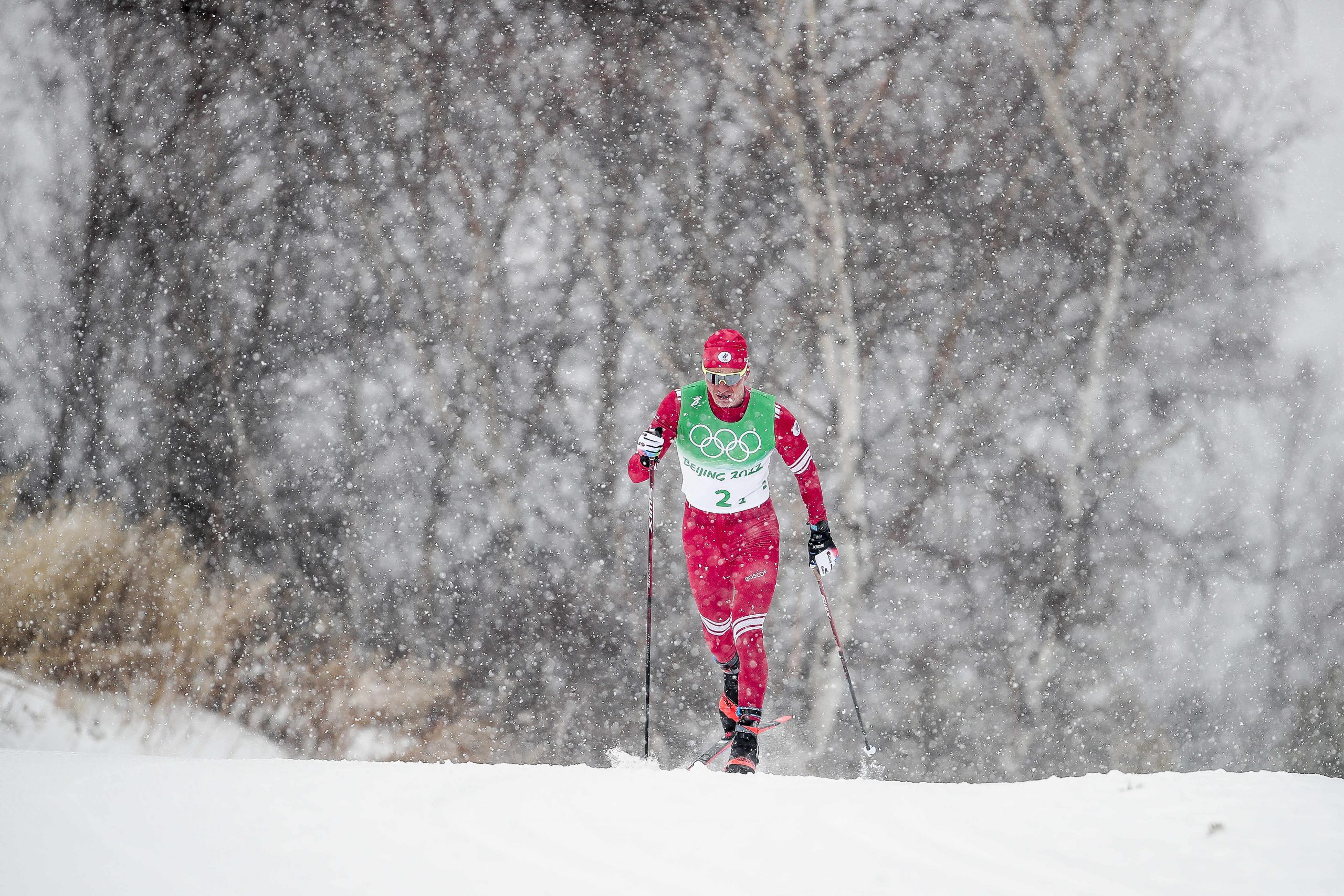
    Gliding on his own through falling snow, Alexander Bolshunov (ROC)(Photo: NordicFocus)

    With the first leg complete, it was skiathlon winner Alexander Bolshunov who took over for the Russian Olympic Committee. Grinding out front on his own, Bolshunov continued to put time into the rest of the field, widening his lead to +37.8 through 13.3 k, up to +44.5 at 16.6 k and +59.5 at the completion of his three laps.

    Behind him, Golberg worked quickly to close the gap to Italy and Germany, legs which were being skied by Francesco de Fabiani and Friedrich Moch. Over the course of his second lap, Golberg began to pull away, creating a ten second gap to the chasers. However, as the skiers completed the third, and their final, 3.3 k lap, things were shaking up. 

    Pål Golberg (NOR) who would later fade and be caught by William Poromaa of Sweden (Photo: NordicFocus)

    Iivo Niskanen, having been tagged in 11th position and +1:47.5 behind, was executing another outstanding classic performance, gaining time on everyone in the field. With the Finn closing quickly, what had been two chase groups merged to one.

    Moch for Germany, William Poromaa for Sweden, Hugo Lapalus for France and Niskanen for Finland were all battling for bronze medal position as de Fabiani of Italy faded off the back. Up the final A-climb that had been the undoing of Iversen one leg earlier, Golberg too began to slow.
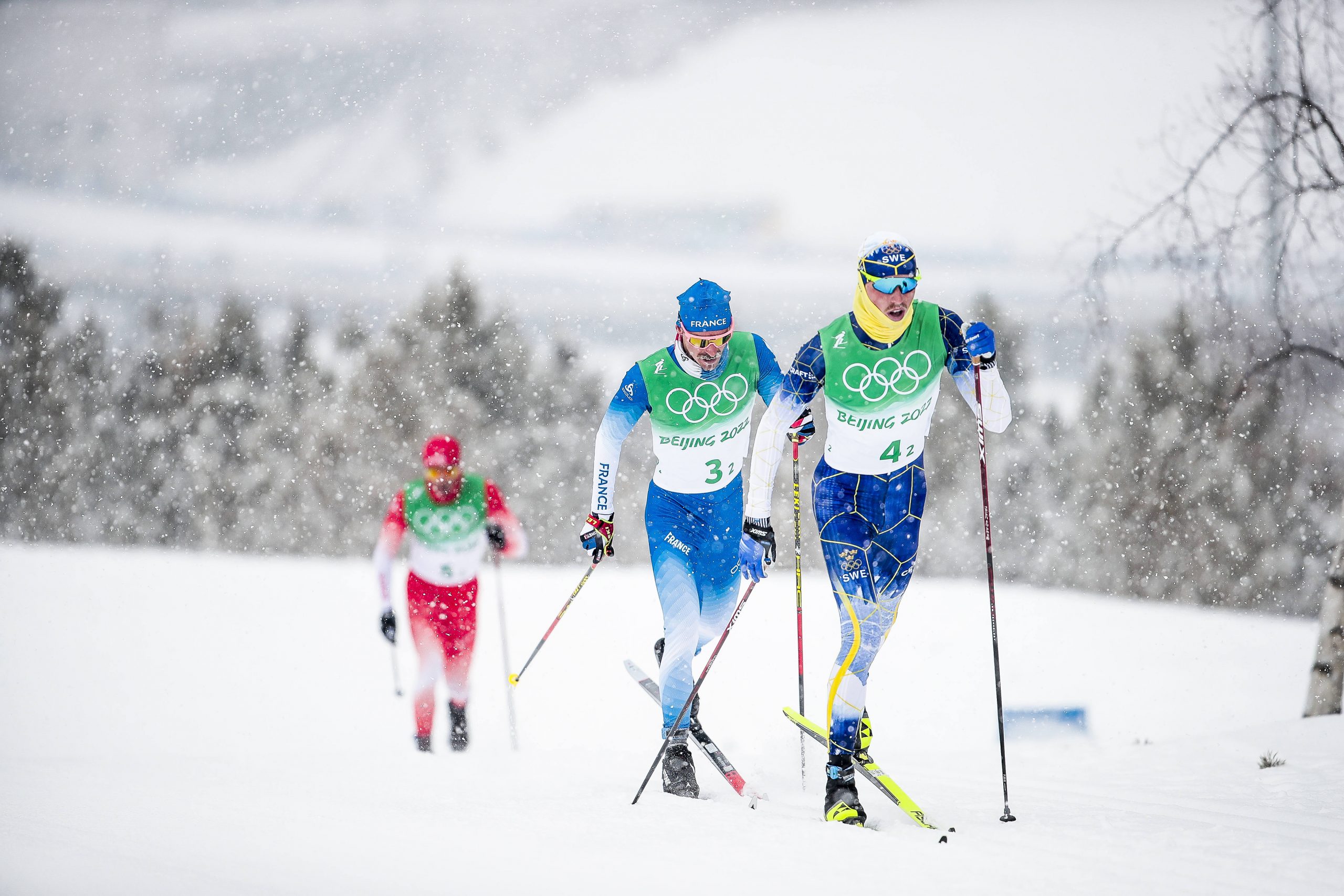
    Hugo Lapalus (FRA) and William Poromaa (SWE) both skiing well (Photo: NordicFocus)

    This show of weakness was all Poromaa needed to up the pace, and by the time they entered the stadium for the second exchange, the Swede had caught the Norwegian.

    Golberg tagged Hans Christer Holund, +59.5 behind Bolshunov who had given way to Denis Spitsov. Poromaa handed over to Jens Burman, +59.7 behind the ROC. Behind them, Niskanen had moved his team from 11th to 4th and gained 36 seconds on the ROC as he tagged Perttu Hyvarinen. Lapalus of France handed off to Clement Parisse, +1:09.7 back. 
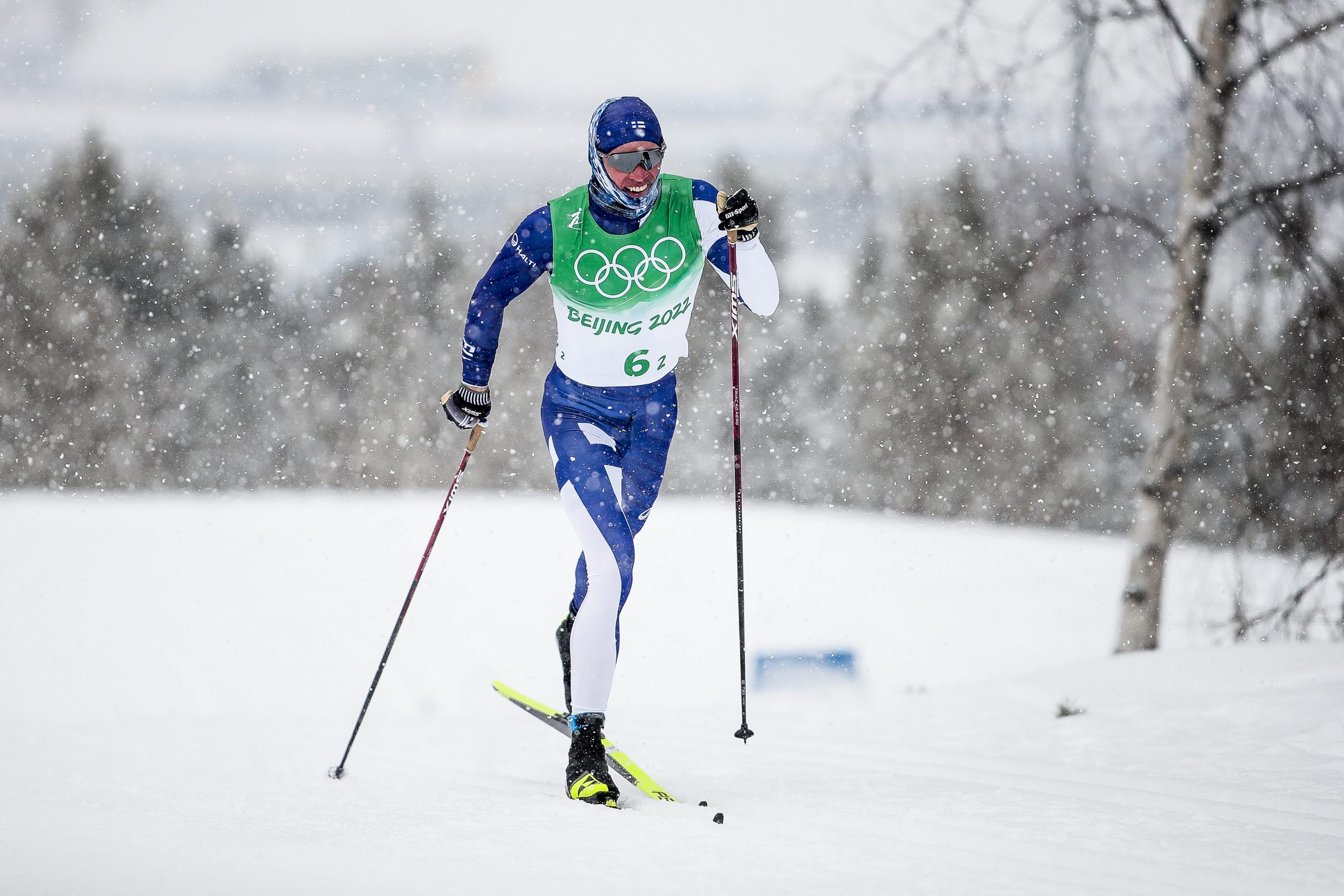
    Showing his classic strength, Iivo Niskanen (FIN) works to close a big deficit (Photo: NordicFocus)

    Having switched to freestyle technique, the third leg was underway and suddenly there was a pack of five nations vying for silver and bronze position, the ROC nearly a minute ahead and all but secured the gold.

    Despite the deep snow, Spitsov (ROC) seemed to have no trouble maintaining his advantage as Holund (NOR) took up the mantle of the chase. Through 23.3 k, Holund led the train, still trailing +51.4 behind the ROC.
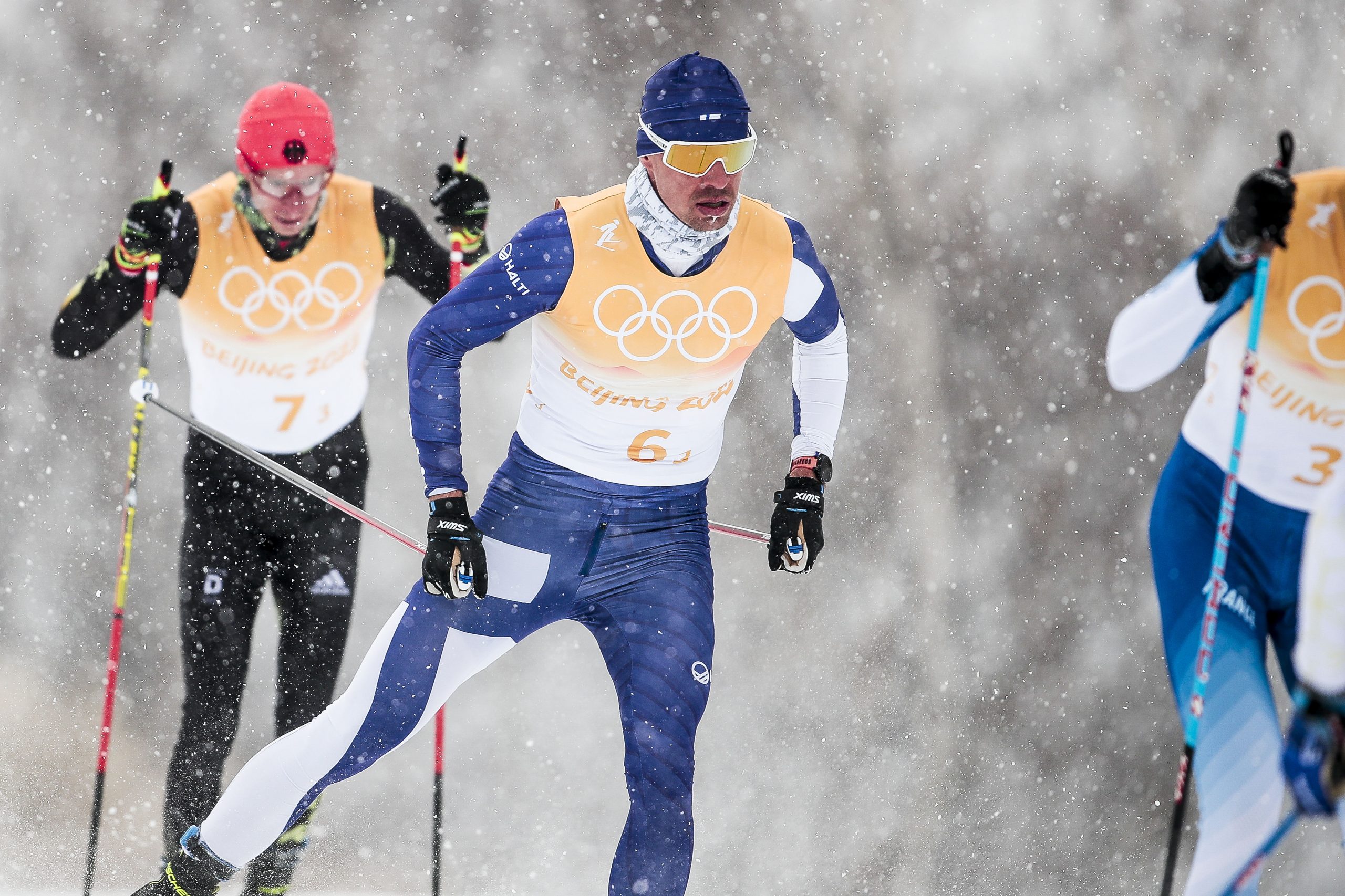
    Perttu Hyvarinen (FIN) fading fast (Photo: NordicFocus)

    After Niskanen’s effort, the Finnish team was dropping quickly with Hyvarinen at the helm and was soon out of contention. Florian Notz, skiing for Germany, was also beginning to fade, seeming to drift off the back on each uphill and regain time on the downhill. Eventually, as the chase group entered the stadium for the final lap of their leg, Notz lost contact, bringing the group down to three nations, Norway, Sweden and France. 
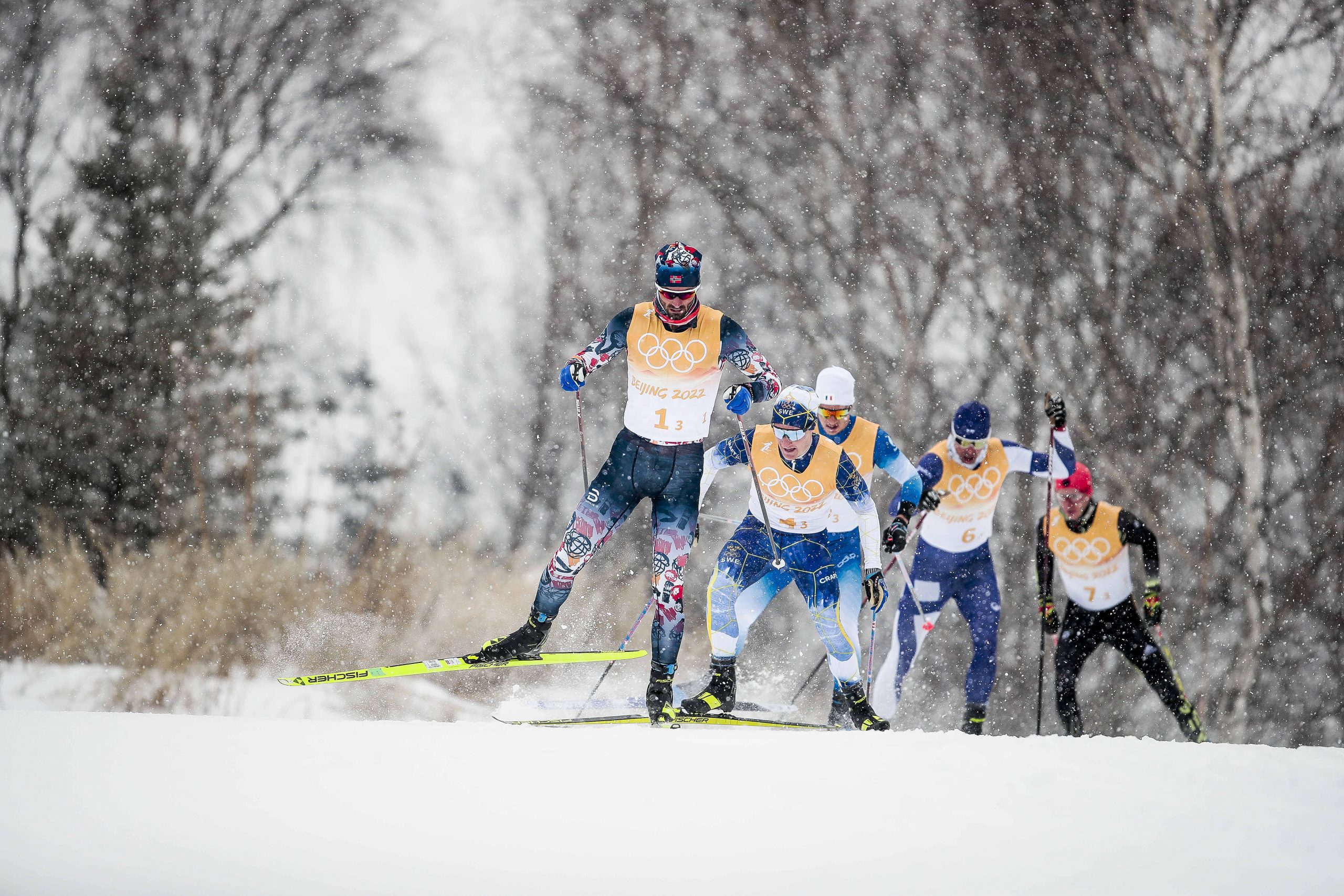
    Hans Christer Holund (NOR) leads a train of chasers (Photo: NordicFocus)

    Spitsov still clear off the front, Holund continued to lead the chase. With each section of downhill it became clear that the skis of Parisse (FRA) were not gliding like those of Burman (SWE) and Holund (NOR). In spite of this, and perhaps thanks to the trailside encouragement of his teammates, Parisse dug deep to stay in contact with the Swede and the Norwegian. 
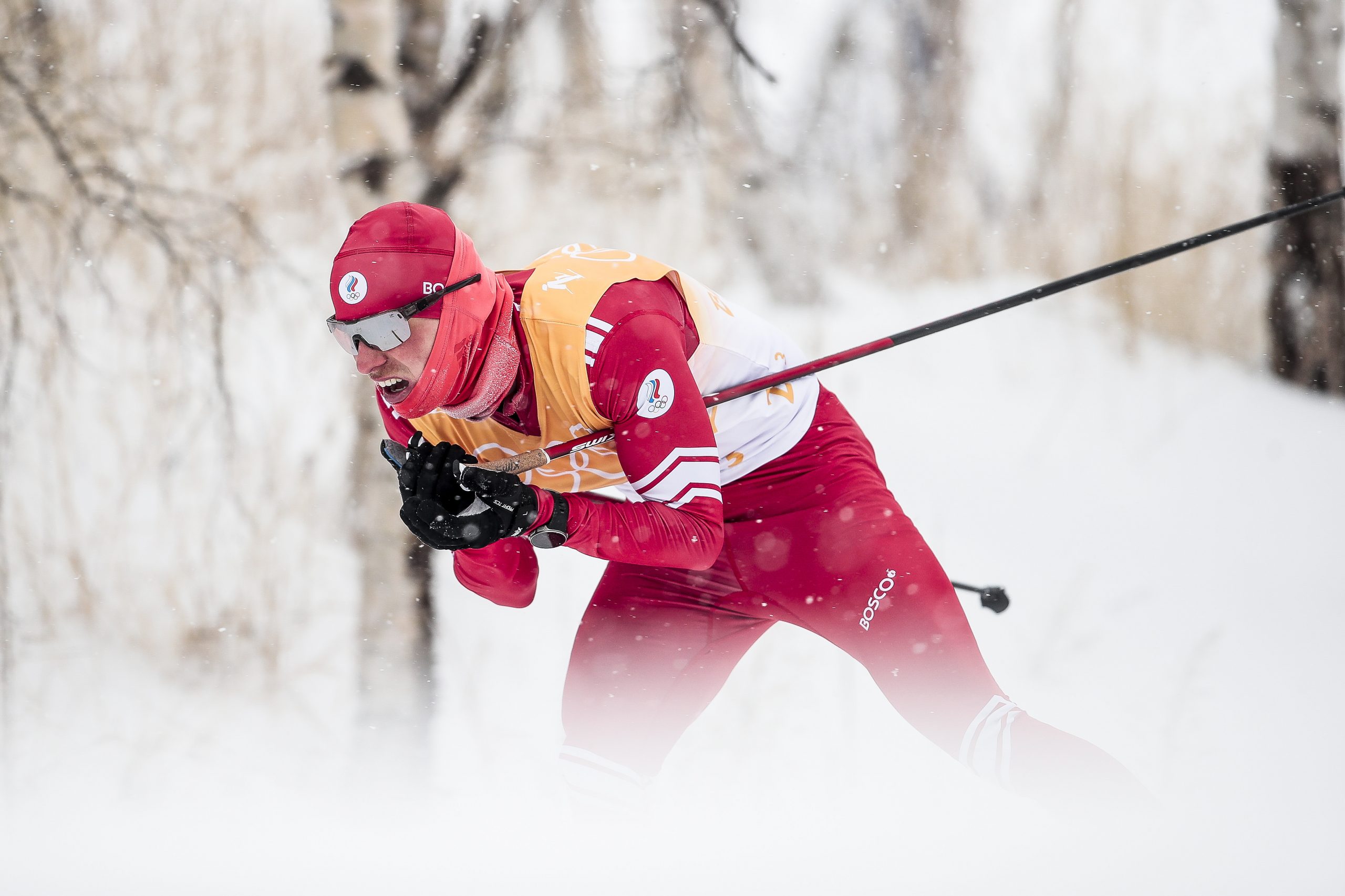
    Denis Spitsov (RUS) holds a tuck, skiing through deep snow on his own (Photo: NordicFocus)

    With 1:27:09.3 on the clock, Spitsov tagged off to Sergey Ustigov, still well clear of the rest of the field. Gaining a few meters on the Frenchman, Holund and Burman tagged their anchor legs with virtually no time between them, +44.9 and +45.4 behind the ROC. A few seconds later, Parisse gave way to the veteran Maurice Manificat, +49.2. 

    Clement Parisse (FRA) who hung tough in the third leg to help secure bronze for France (Photo: NordicFocus)

    This lengthy battle now in its final stages, Manificat worked to close the gap to Sweden and Norway, making the chase pack a group of three once again.

    The skis still looked to be a challenge for France as Norway’s anchor, Klæbo, pulled away from the other two by thirteen seconds on the descent towards the stadium, in a move that appeared to be largely unintentional. Not letting up, Manificat took on the task of closing on Klæbo once again, pulling Sweden’s Johan Häggström with him. The second time up the last A-climb of the 3.3 k loop, Manificat busted away from the Swede, catching Klæbo, who appeared to be out for an easy distance ski. 
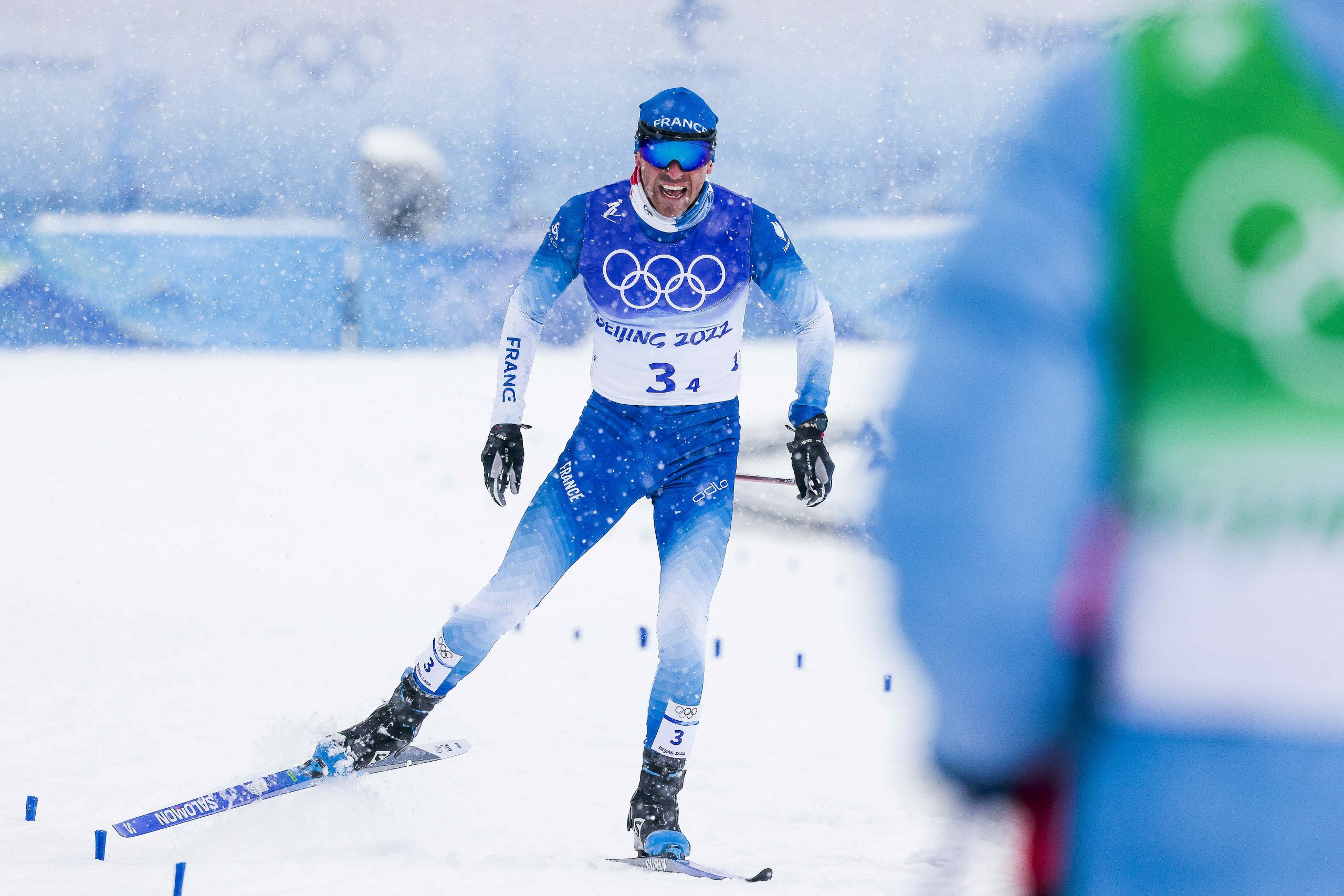
    Maurice Manificat (FRA) in the closing moments of his relay leg (Photo: NordicFocus)

    Through the stadium for the final time with 36.6 k complete, Ustigov and the ROC was +1:04.3 clear of France and Norway.

    To put it bluntly, the last 3.3 k were hard to watch. Knowing he had no chance of beating the Norwegian in a sprint finish, Manificat continued to push to his limit, his ski speed not doing him any favors. Klæbo was all too happy to sit in behind, drafting easily as Manificat tried his best to shake him. In the end, Klæbo did not even have to reach into his bag of tricks, he simply out-glided the Frenchman, who could do nothing about it. 
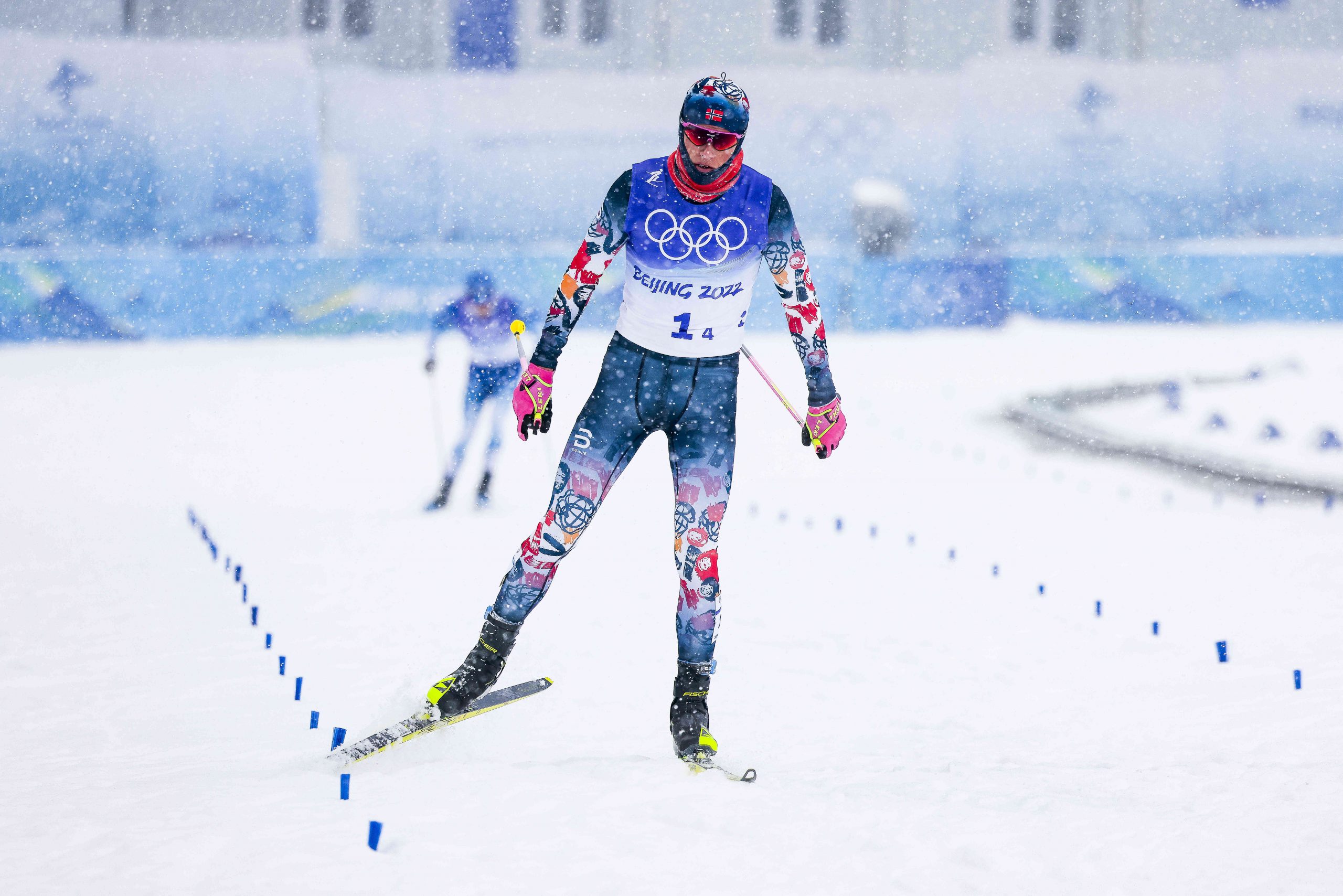
    No big moves from Johannes Høsflot Klæbo (NOR) as he brings home the silver medal for Norway (Photo: NordicFocus)

    Many meters ahead, Ustigov cruised into the stadium, grabbed an ROC flag and waved it triumphantly as he crossed the finish line before any challengers had even entered the stadium. Finishing in a time of 1:54:50.7 the men secured the second relay gold medal of the Games, after the ROC women brought home gold in the 4 x 5 k yesterday.

    Chervotkin, who gave the ROC such a strong start, said of winning gold, “we were aiming for this. We tried to achieve it, and for several years we haven’t been able to. Today everything aligned. Everything was super. The weather seemed to be hard and there was snow but it was in our favor so everything was great.”
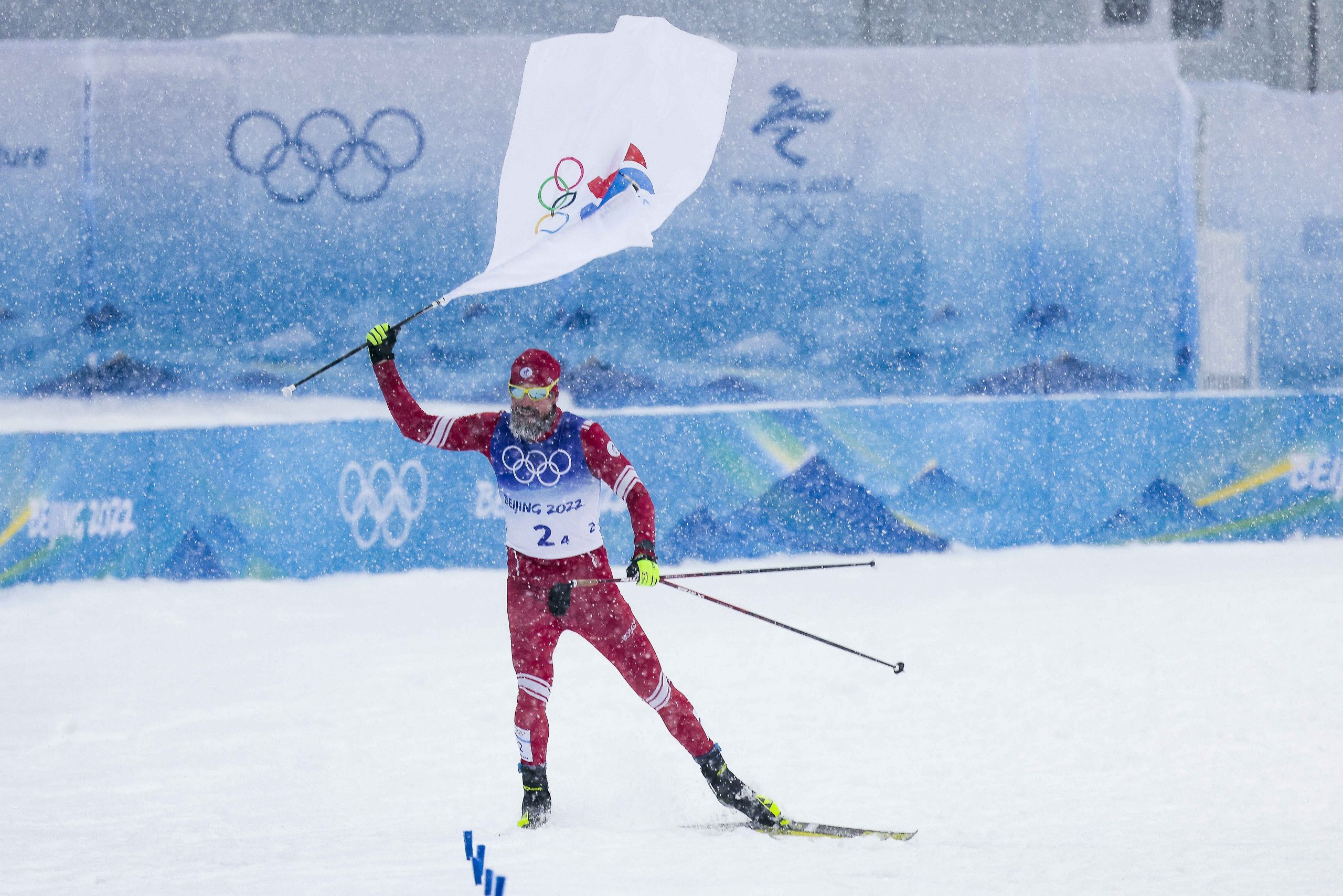
    Alone with a flag, Sergey Ustiugov (ROC) heads for gold (Photo: NordicFocus)

    Despite the consistent strength of the Russian team, they have not won a 4 x 10 k relay in over forty years. The last time they topped the podium in this event it was under yet another name, as the Soviet Union, at Lake Placid in 1980. Of course in recent years, they have consistently been runner-up, earning silver in 2021 Obserstdorf, 2019 Seefeld, 2018 PyeongChang and 2017 Falun. 
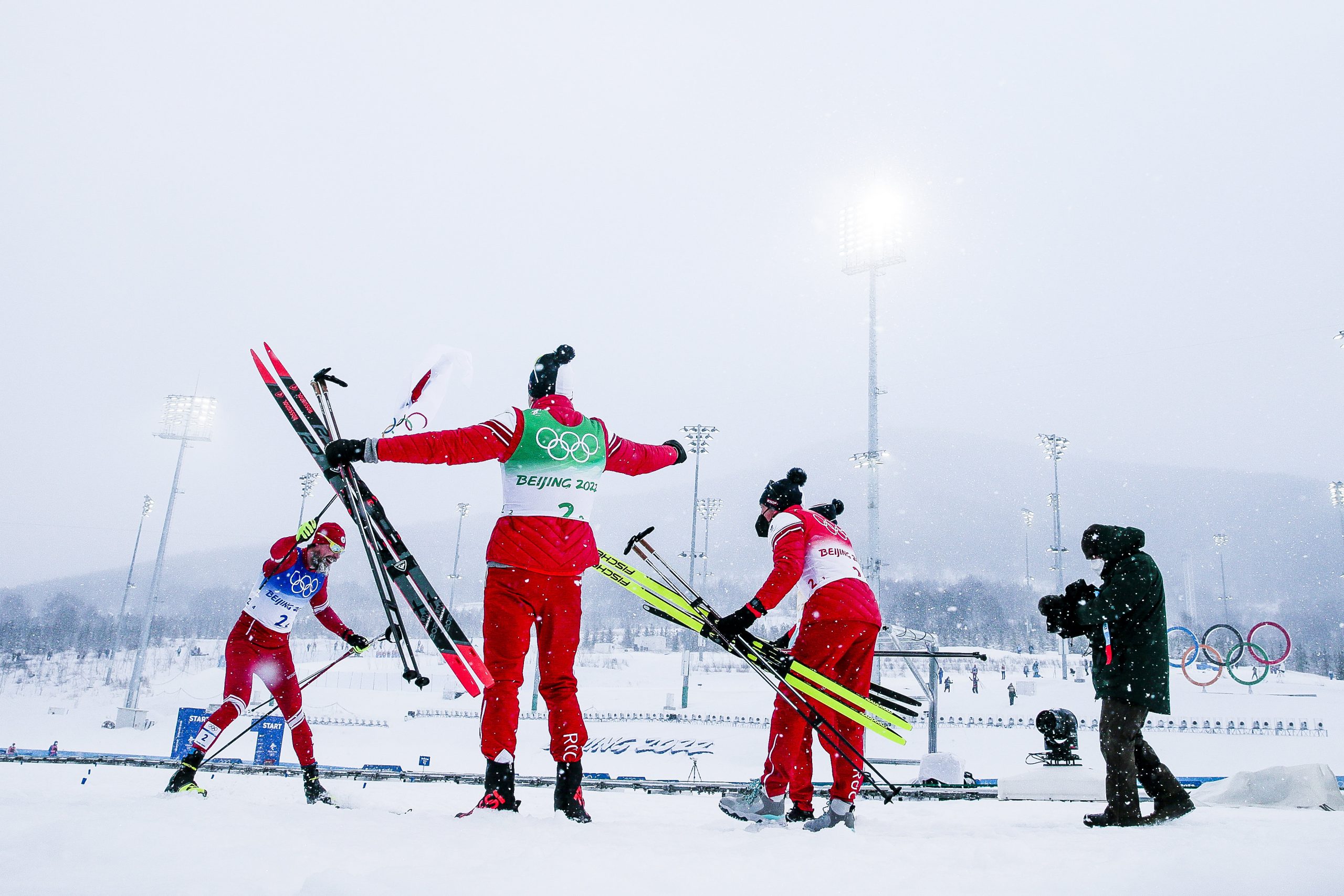
    Ustigov crosses the finish line unchallenged as his teammates wait to congratulate him (Photo: NordicFocus)

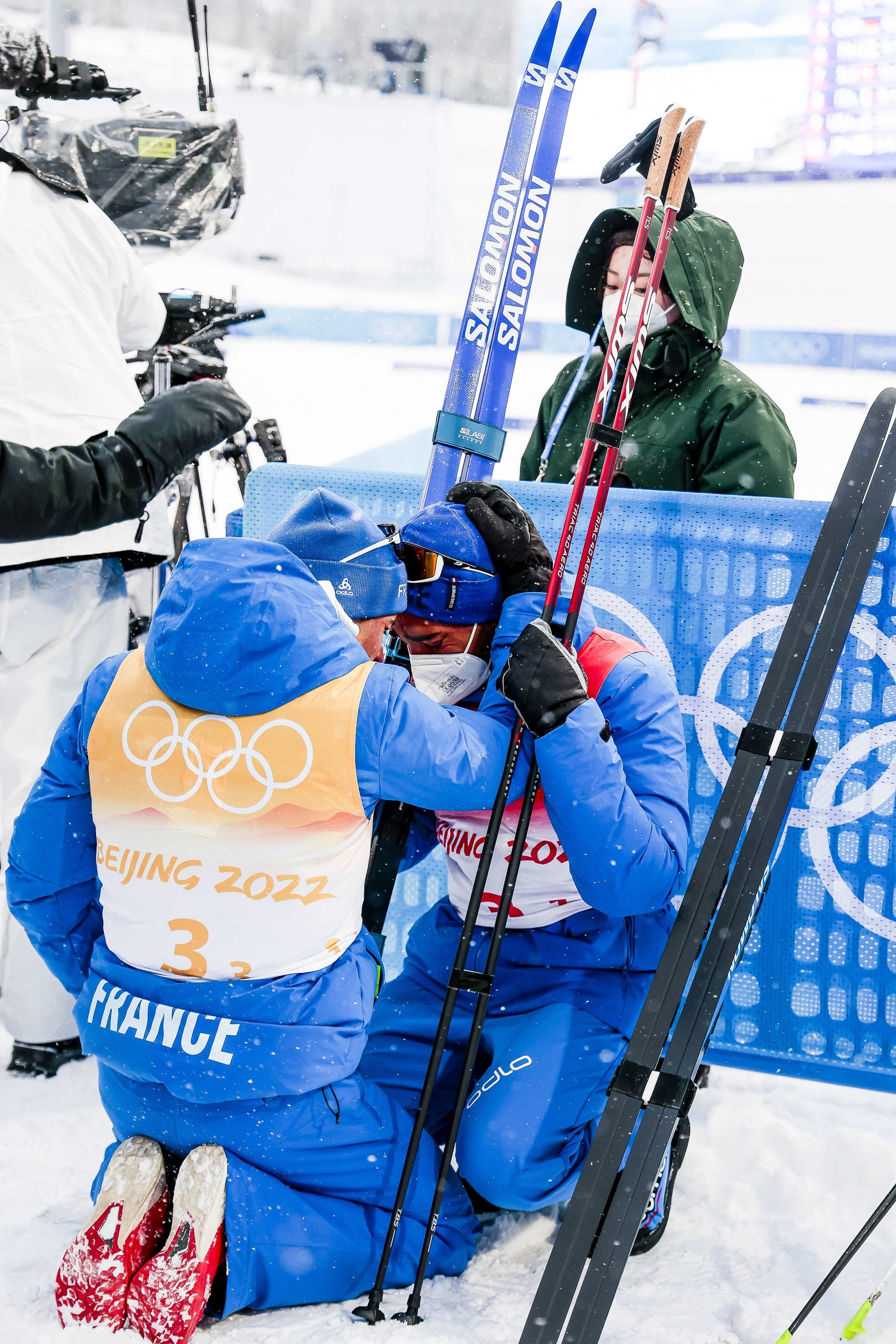
    Today the positions were reversed as Klæbo skied slowly across the line for silver, having simply glided away from Manificat in the closing stages. He was met by rather somber congratulations from his teammates, particularly in comparison to the French who celebrated their bronze as if it were gold.
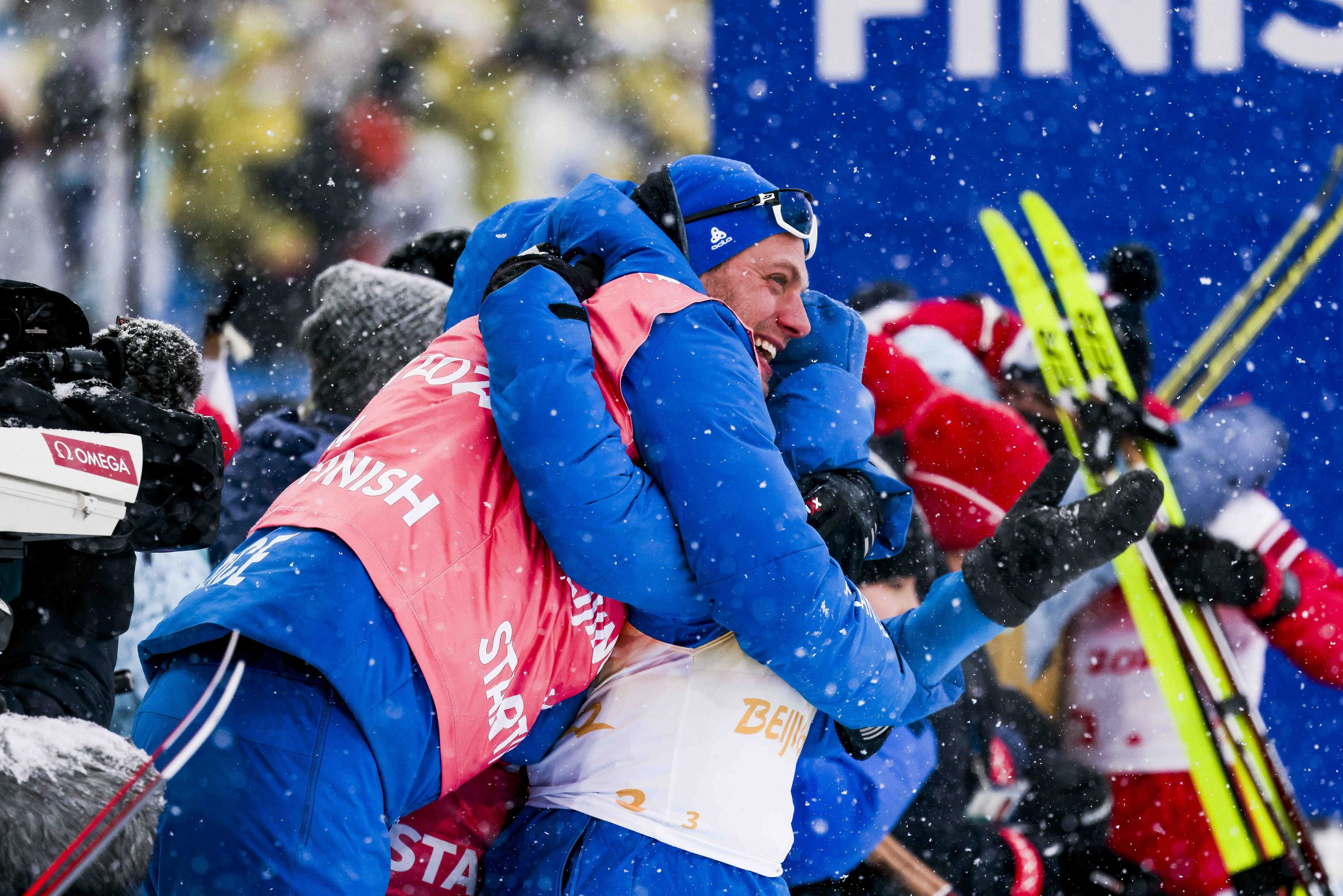
    Elation for the French at having secured another Olympic bronze in the men’s relay (Photo: NordicFocus)

    After the race, Klæbo said, “when you’re doing a relay, you’re doing it as a team and that is the beautiful part of it, so it’s always fun to race the relay and do it together. We all need to be satisfied with today’s result, and I guess we’re going to celebrate it in the evening and then some of us need to start preparing for the next race. But still we’re going to enjoy this evening.”

    His teammate Pål Golberg spoke about the challenging conditions, saying, “The course was tough before and with the snow and wind today, it was even tougher. So I mean, with altitude and everything it’s challenging but we did our best today. The four Russian guys were better so just take the hat off to them and try to be satisfied with the silver.” 
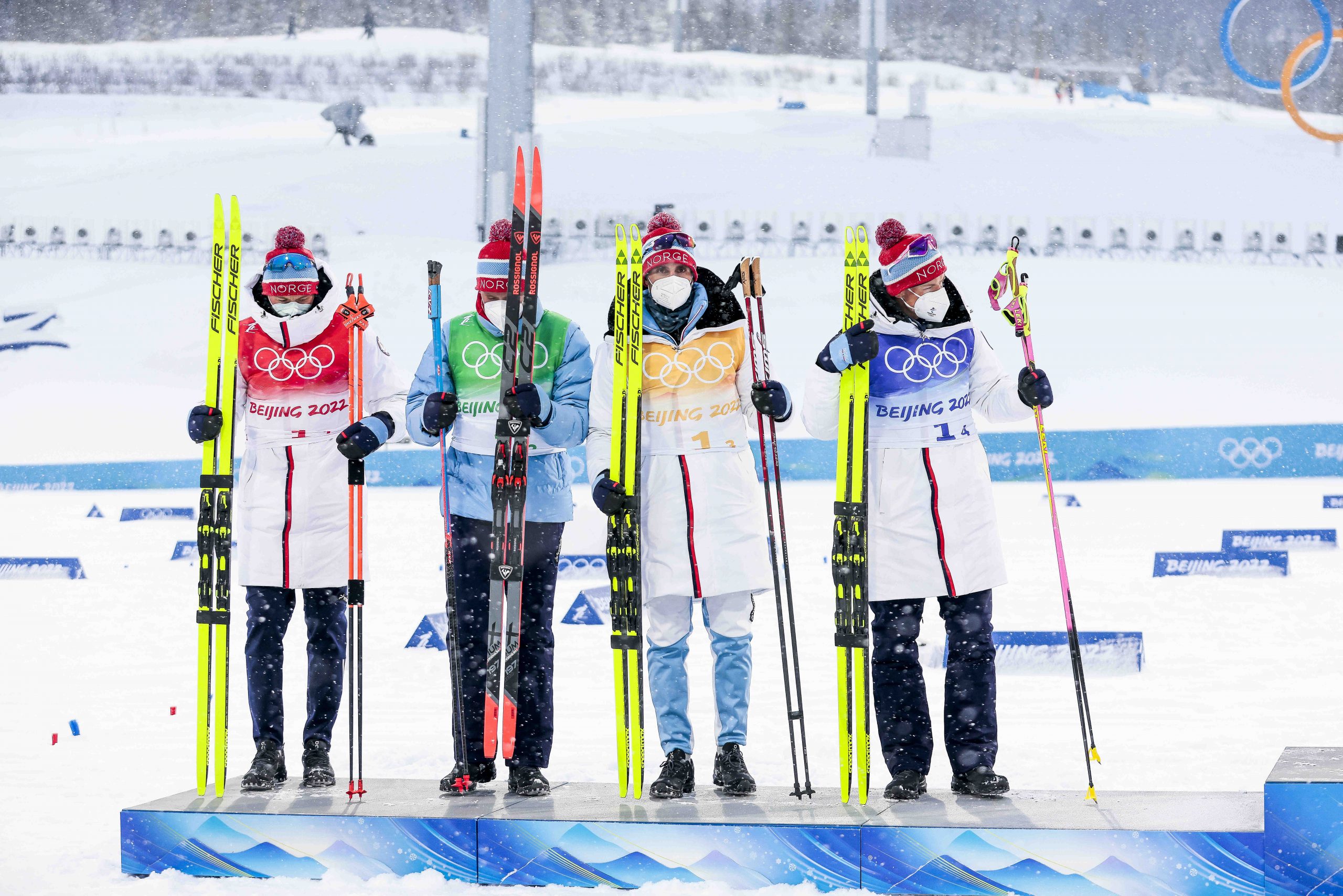
    Emil Iversen (NOR), Pål Golberg (NOR), Hans Christer Holund (NOR), Johannes Høsflot Klæbo (NOR), (l-r) were the only team not celebrating their medal (Photo: NordicFocus)

    If Norway has held a monopoly on gold in the men’s relay, then the same can be said about the French and bronze. This is the third consecutive Olympics that France has earned bronze in the men’s 4 x 10 relay and Maurice Manificat has played a part in all of them. Similarly, in the last four World Championships, France has collected bronze in three of them.

    When asked about winning another medal at the Games, Manificat replied, “four Olympics for me and some medals in the relay since Sochi, so for sure it’s an amazing feeling.”

    Regarding the challenge of trying to drop Klæbo he said, “I tried, in the big uphill and I give my best, I give all I had. Medal in relay is the best medal. Because you share it together. We thought all the year about the relay, it’s our soul.” 
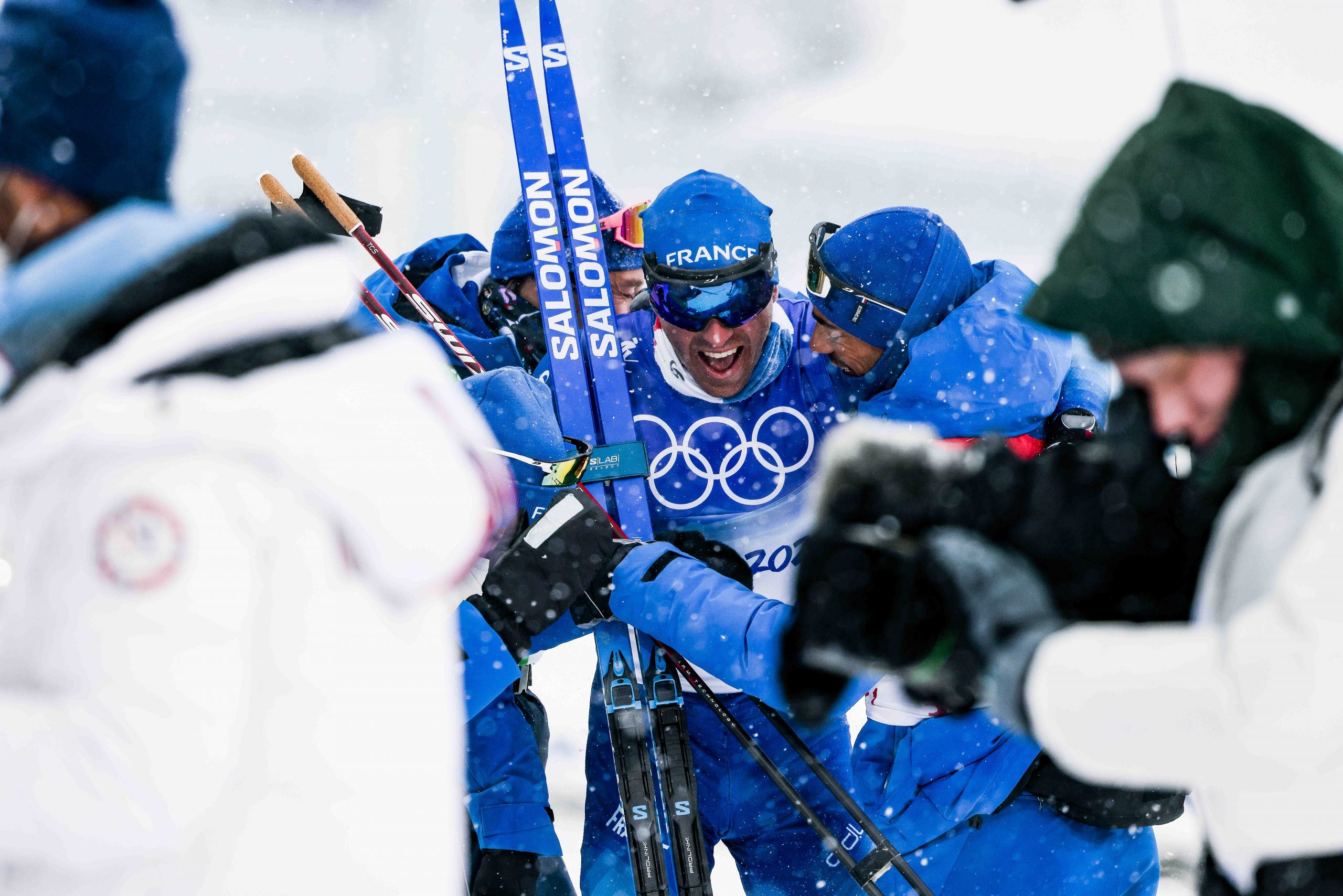
    Teammates congratulate Maurice Manificat (FRA) on a gutsy final leg to bring France the bronze medal (Photo: NordicFocus)
    Clement Parisse (FRA) and Richard Jouve (FRA) share a moment at the finish. (Photo: NordicFocus)

    With three teams lapped out of the race and the spread between the ROC and 12th place finishers, the Czech Republic at +10:07.1, the day was evidently a tough one.

    Improving on an 11th place finish in PyeongChang, the American men skied to 9th place today, +8:05.6 behind. 
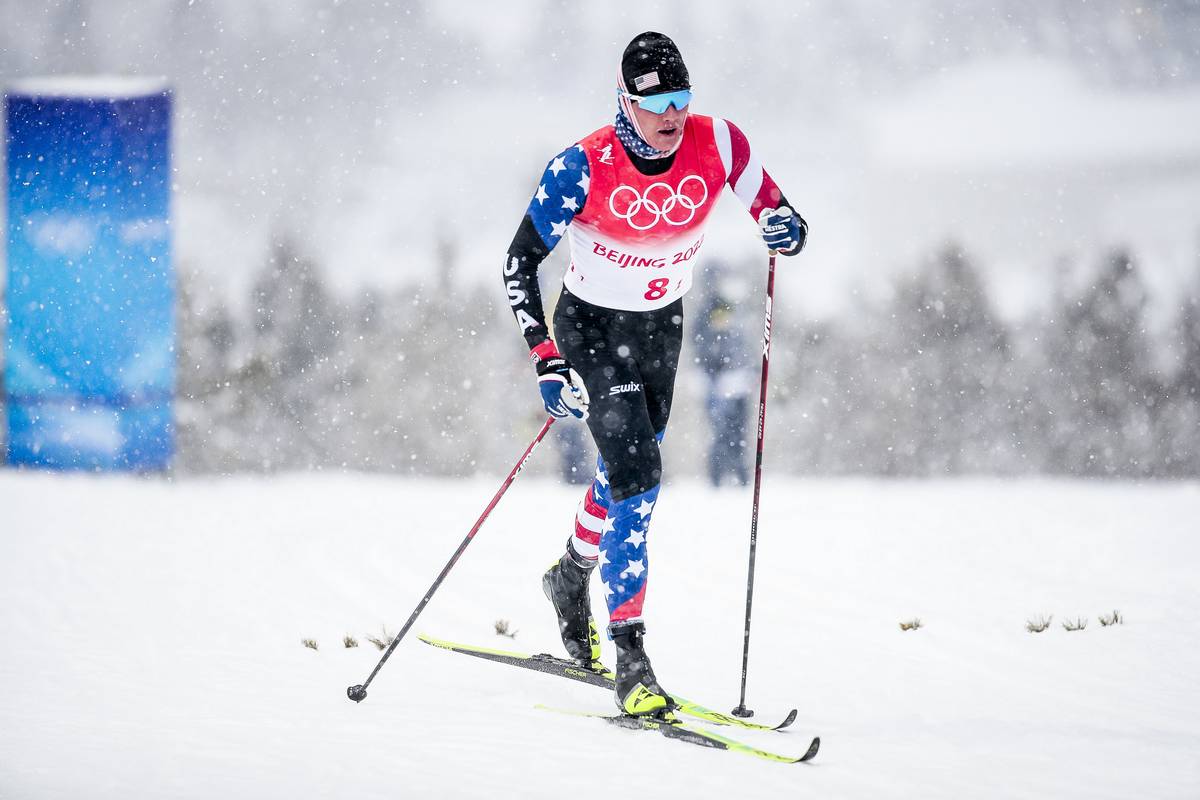
    Luke Jager skis the scramble leg for the Americans during the Olympic 4 x 10 k relay. (Photo: NordicFocus)

    Luke Jager took the scramble leg for Team USA, putting the team in 13th, +2:39 behind at the conclusion of his leg.

    “I felt kind of like I’d become sort of aware of some of the subtleties of how scramble legging in skiing works in the last years, but it was sort of like, all that went out the window,” Jager told FasterSkier from the mixed zone. “For a lot of reasons: the course is really hard, the altitude was really hard, and 10 k versus five or 7.5, was a really big difference. At the end of the day, I just wasn’t fit enough to be where I want to be and there was no hiding to be had. So, I feel like I learned a lot from it, but I just feel like I need to go home and train a lot more.”

    While Jager chalked it up as a disappointment, he contrasted the statement it with: “that’s obviously multifaceted. There’s pros to it all, and I’m really thankful to be here.”

    Up next was Scott Patterson, who started the Games with an impressive 11th place finish in the skiathlon. Patterson bumped the team up into 11th place, though the time gap continued to widen at +4:23.2.

    “I think as we’ve seen in every race this week, those courses are pretty unforgiving,” Patterson explained. “I felt like I had to go out and ski my own race and not really think too much about what everyone else was doing, just go move into the race and try to ski well. It was a little bit interesting place where Luke tagged me off, but I think I picked off some people and put us in a good spot, so I’m happy with that.”

    Gus Schumacher races the third leg of the men’s 4 x 10 k relay. (Photo: NordicFocus)

    Patterson tagged Gus Schumacher who maintained their position in 11th place and finished his leg +6:04 behind. In the anchor position, Kevin Bolger moved past both the Japanese and Czech team to put the team in 9th place. 

    “I’m proud of us for coming together the team,” said Schumacher after the race. “We’ve all had some tough races here… It hasn’t been easy for us. I think it’s a little bit hard especially to have the girls’ success – there’s some pressure there.”

    While the team was seemingly unanimous that this pressure was self-imposed and that it had been a relief to feel they had “nothing to lose and everything to gain,” the Americans also affirmed that they brought hopeful energy to the day, looking to take a step forward as a team, regardless of what that looked like on paper.

    Over the last four Olympic cycles, the Americans have been 11th place in the last two Games, along with 12th in 2006 and 13th in 2010. It might not be a medal, but it was, in fact, a step forward for the program.

    “I think we all really put it out there and yeah, good energy,” Schumacher concluded.
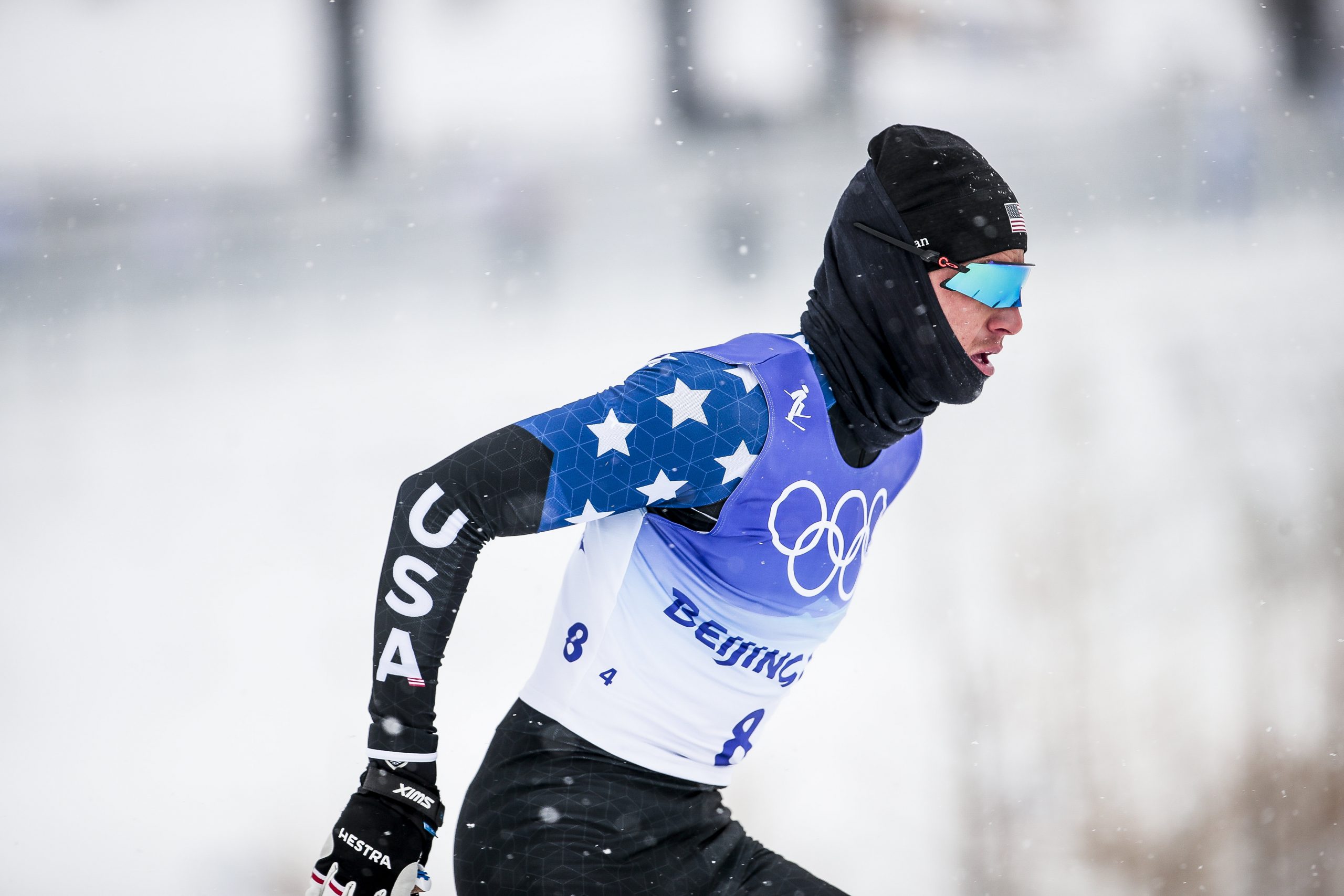
    Kevin Bolger (USA) skiing the anchor leg for Team USA (Photo: NordicFocus)

    The Canadian team was led out by Graham Ritchie who ended his leg in 14th, +2:42 behind. Antoine Cyr took the second classic leg and moved up one position to 13th, +4:23.2.

    In the transition to skate, Olivier Léveillé skied Canada’s third leg, again moving the team up one position to 12th, +6:44.6. Rémi Drolet anchored to bring the team home in 11th position, +9:10.4. 

    Antoine Cyr (CAN) skiing the second leg for Canada (Photo: NordicFocus)
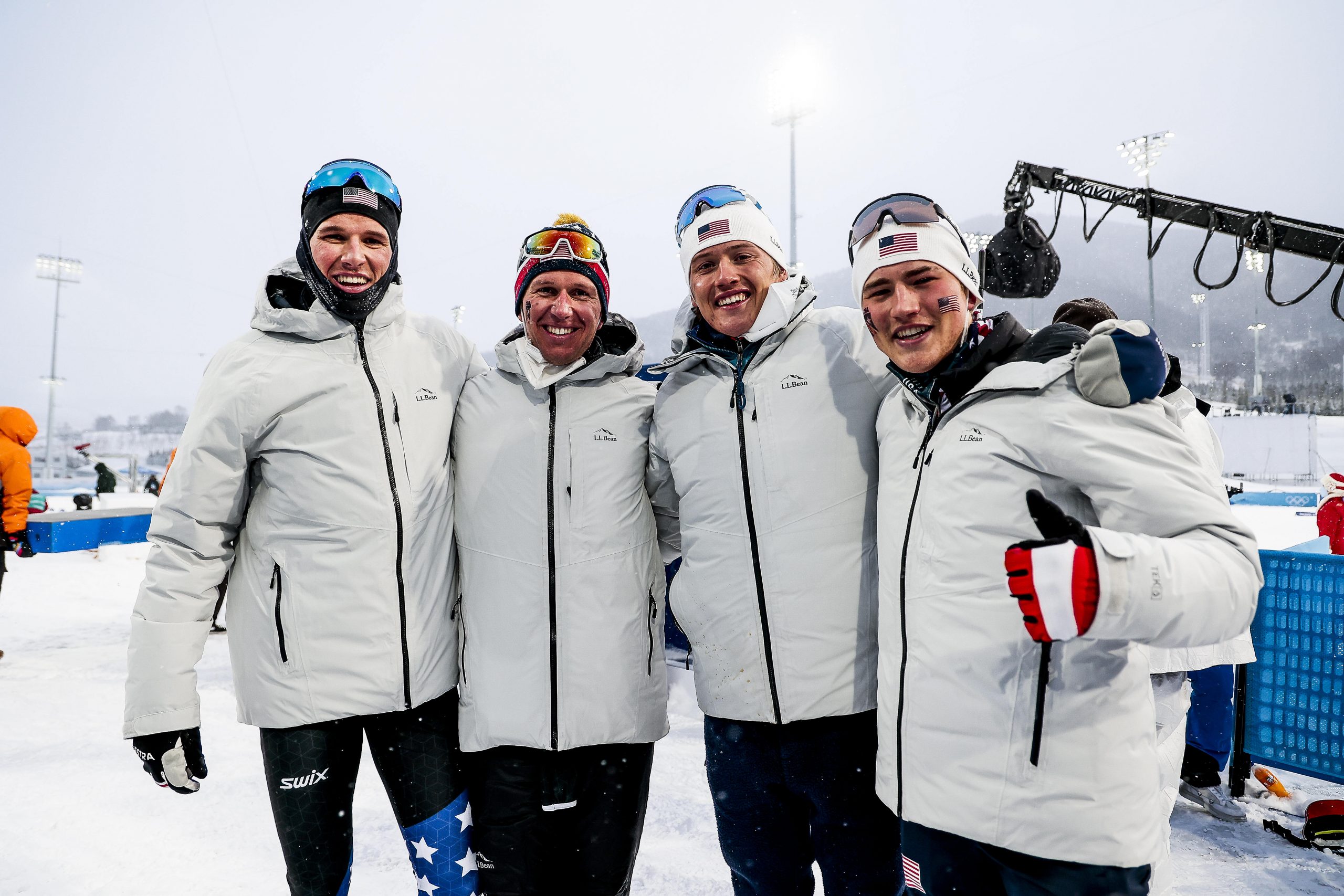
    American men’s 4 x 10 k relay team: Kevin Bolger, Scott Patterson, Luke Jager, and Gus Schumacher (l-r) (Photo: NordicFocus)

    “The relay is really a game of staying in contact,” Matt Whitcomb told FasterSkier in the mixed zone. “When you lose contact, it becomes a different race. Time expands immeasurably. So I’m very proud of the way that these guys tackled the project that they’re handled today. There’s also – and I say it with a Canadian over my shoulder – this is one of our favorite rivalries: our northern friends. And it really is a friendly and very fun rivalry, where we’re always giving each other splits back and forth, and I’m proud of both teams today. And I’m also excited for our guys to come out just a little bit on top.”

    The next Olympic cross country ski event will be the men’s and women’s team sprint, happening on Wednesday, February 16th.

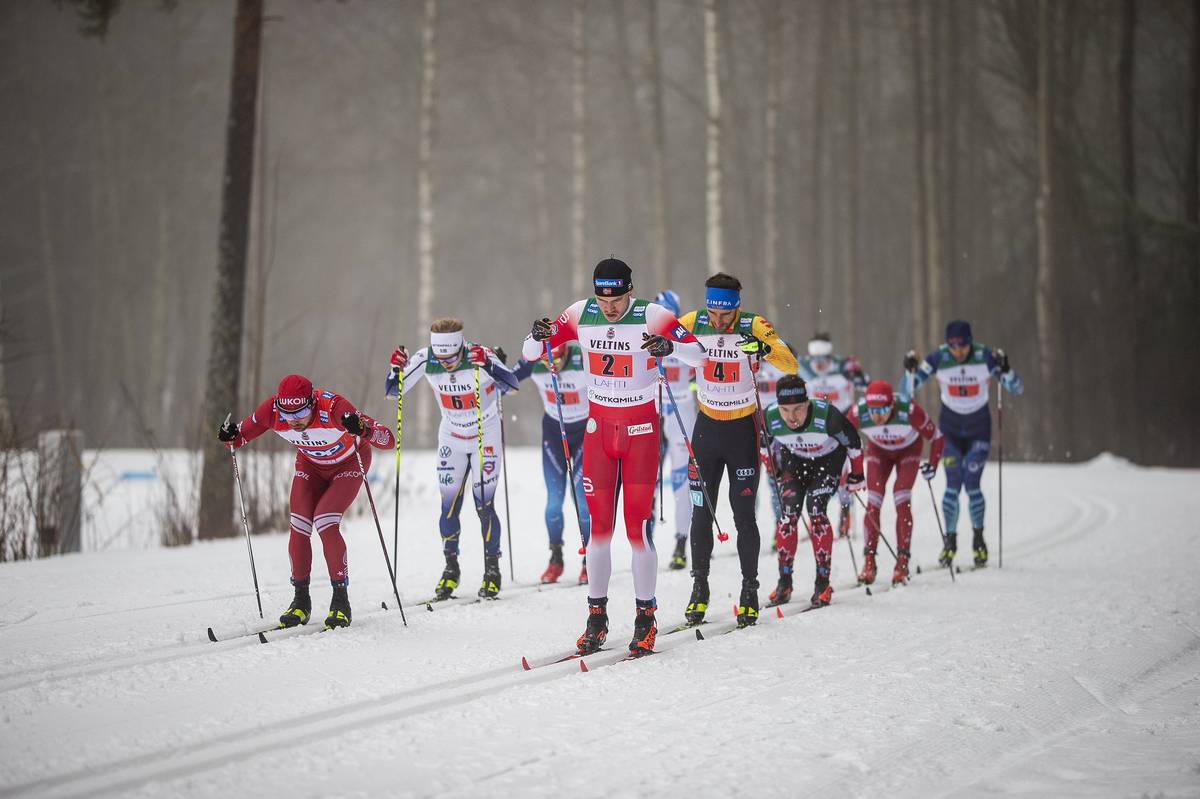
    Results

  • Norway win Men’s 4 x 7.5 k Relay in Lahti; Belligerent Bolshunov Bullies

    Norway win Men’s 4 x 7.5 k Relay in Lahti; Belligerent Bolshunov Bullies

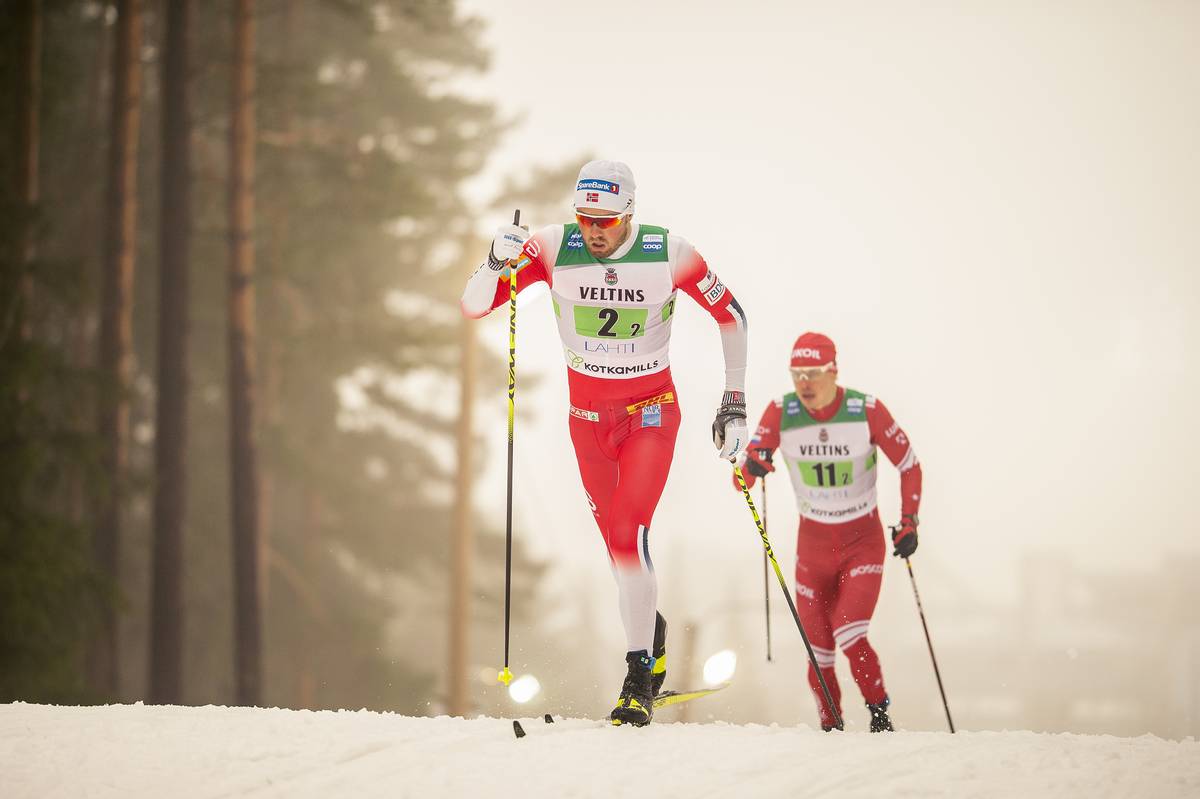
    Early in the first leg of the men’s 4 x 7.5 k relay in Lahti, Finland. (Photo: NordicFocus)

    This World Cup coverage is made possible through the generous support of Marty and Kathy Hall and their A Hall Mark of Excellence Award. To learn more about A Hall Mark of Excellence Award or to learn how you can support FasterSkier’s coverage please contact info@fasterskier.com. 

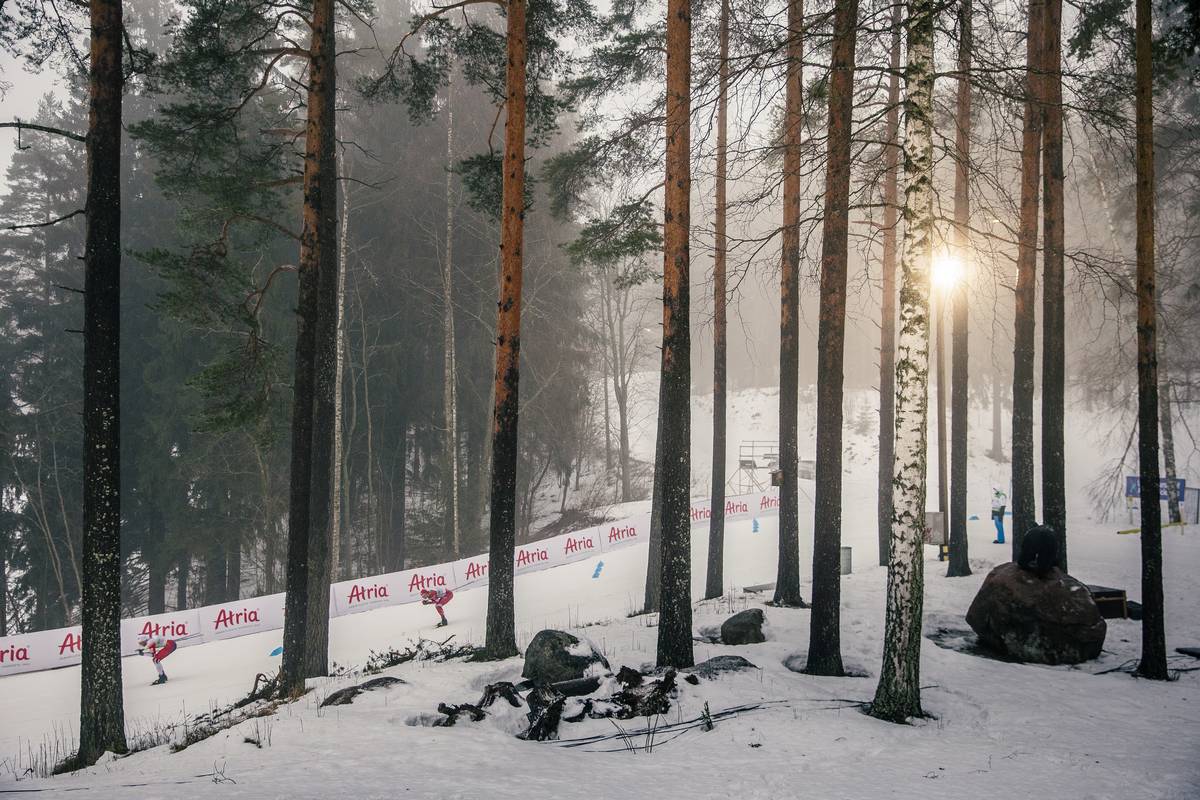
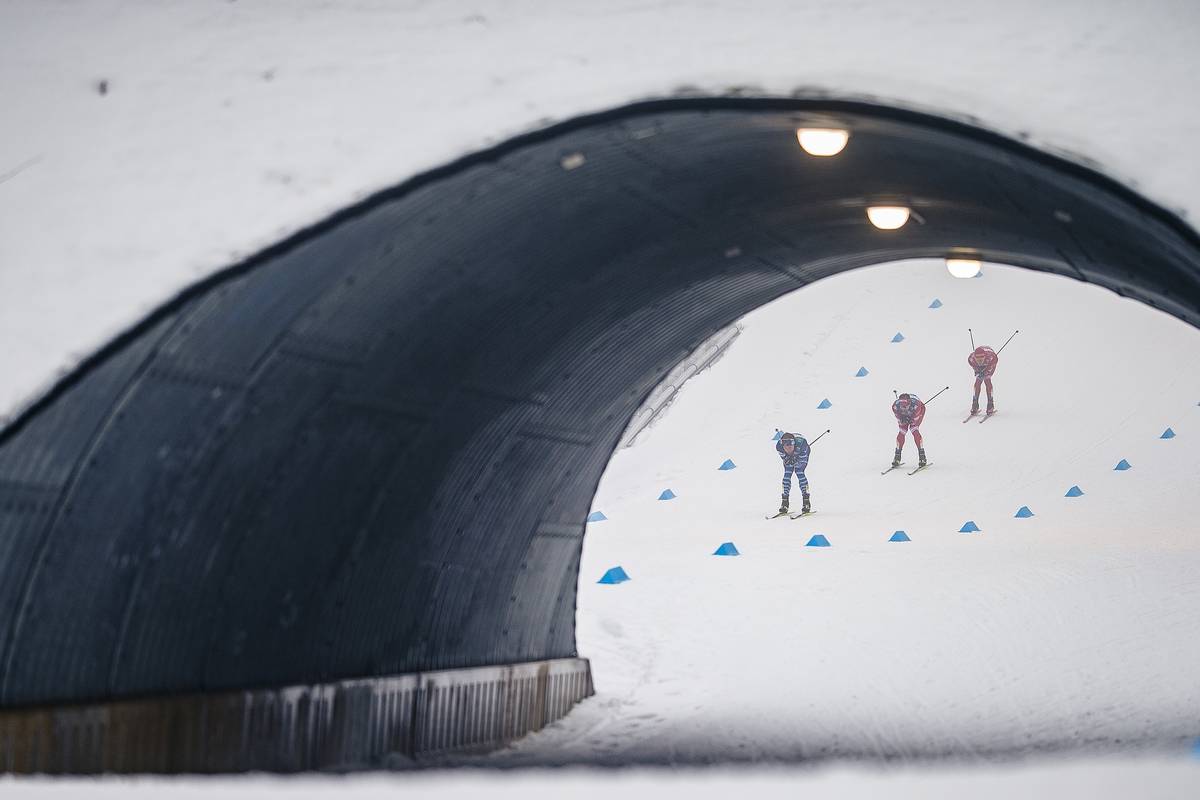
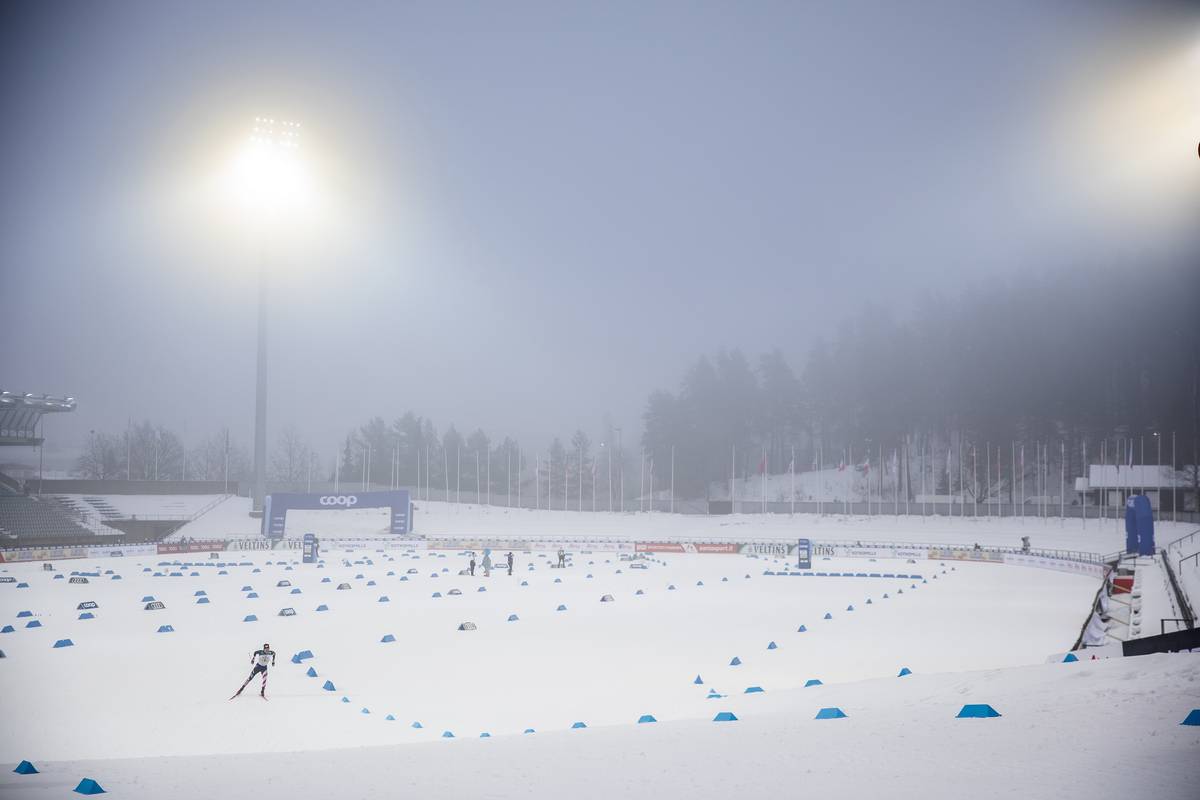
    The fog seemed to have thickened since the completion of the women’s race earlier in the day, at times obscuring the skiers with only their silhouettes visible. Eleven teams contested this men’s 4×7.5 k relay with nine nations represented, though with the disqualification of Alexander Bolshunov (more on that in a bit), anchor for Russia I, only 10 teams officially finished.

    Historically, World Cup men’s relays have been a duel between Russia and Norway. Out of the fifteen relay races in the past 10 years (not including world championships or Olympics), Russia has won four of those times, the remaining victories all Norway. After a men’s podium sweep in the skiathlon on Saturday, it seemed fair to bet on Norway for today’s race. Indeed, when the race concluded Sunday in Lahti, Finland it was Norway once again on top. As skiathlon winner Emil Iverson so aptly put it yesterday, the Norwegians are “back with a boom.” 

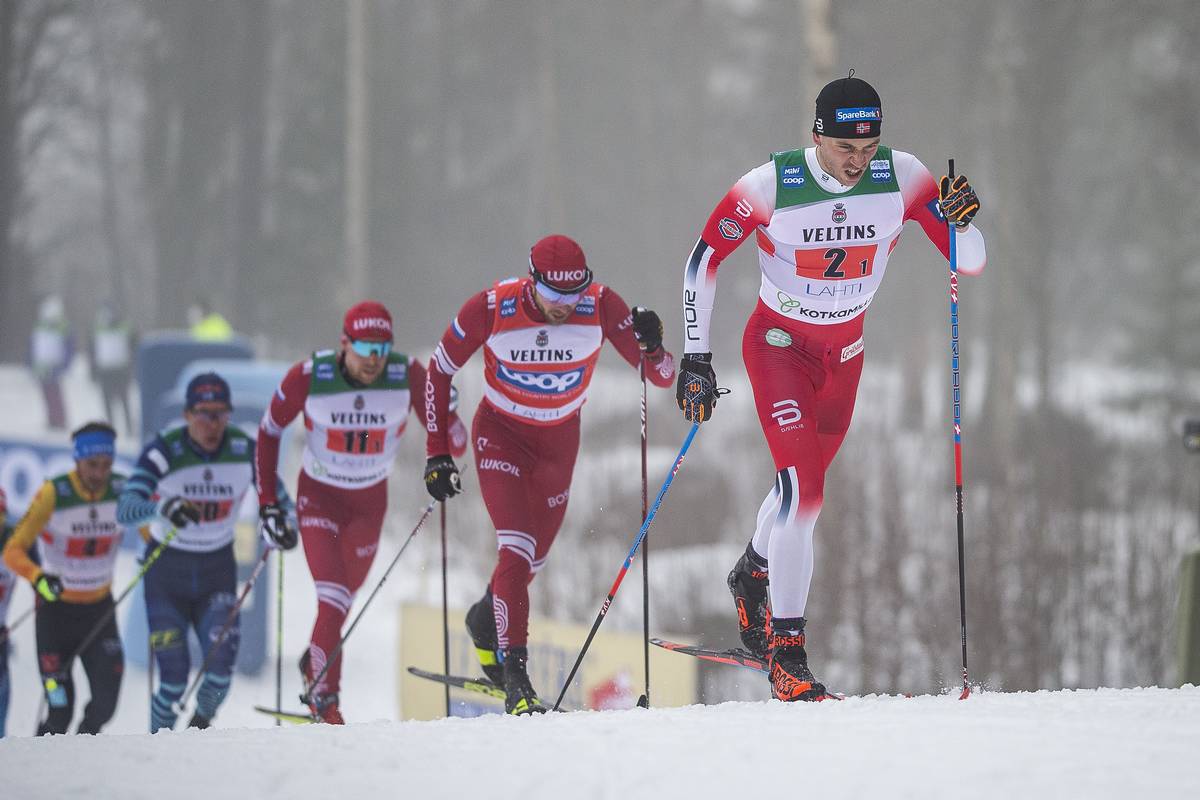
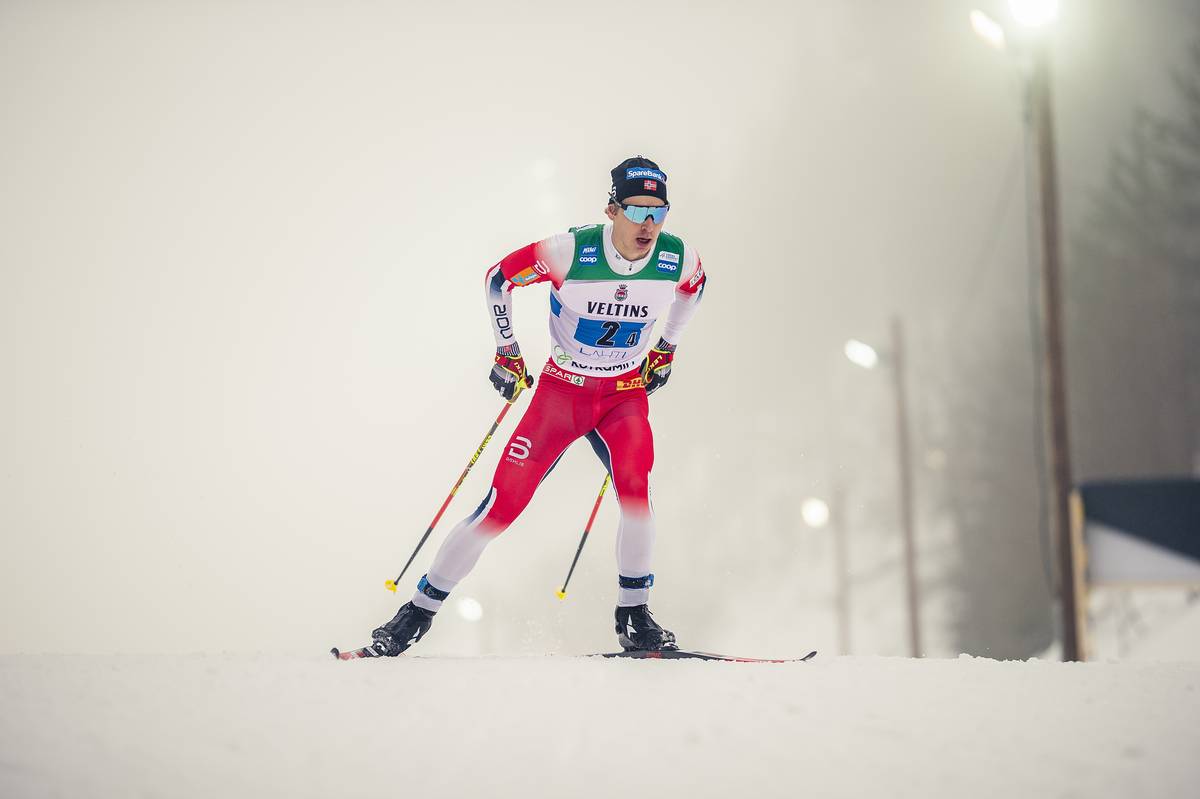
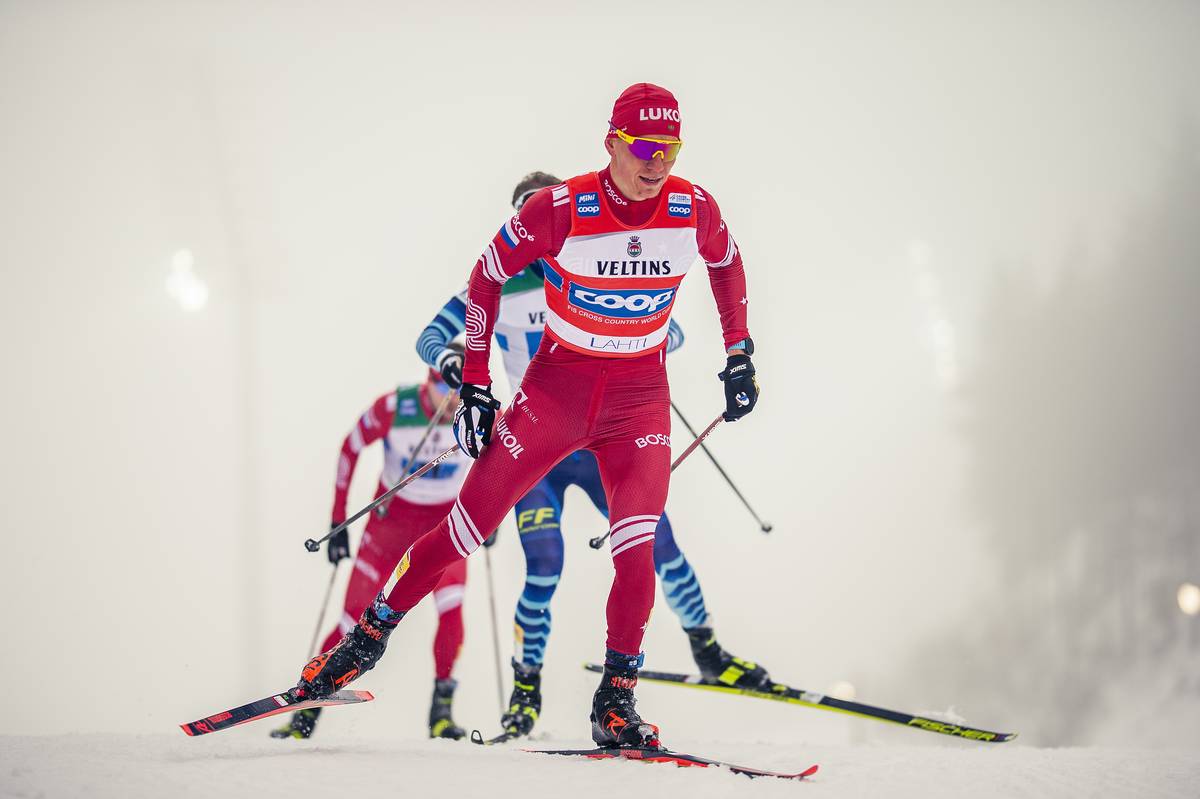
    The race began, and ended with drama, particularly for team Russia I. Immediately out of the start gate, Alexey Chervotkin, who scrambled for Russia I broke a pole but recovered to quickly rejoin the field. Pål Golberg of Norway led the charge off the front, pushing the pace to string out the pack. By the end of the third lap, Golberg had created a gap to the rest of the field, followed only by Ilia Semikov of Russia II and a little way back, Chervotkin of Russia I. “It was good that it was snow and not rain coming down,” said Golberg after the race, “so it was possible to go hard at the front.” 

    Pål Golberg (NOR), Alexey Chervotkin (RUS), Ilia Semikov (RUS), Marko Kilp (EST), (l-r) during the men’s 4 x 7.5 k relay. (Photo: NordicFocus)
    Alexey Chervotkin (RUS), Pål Golberg (NOR), (l-r) scramble for their respective teams. (Photo: NordicFocus)

    At the first exchange, Golberg tagged teammate Iversen with a +0.8 lead to Ivan Yakimushkin, who took over for Russia II, and +10.7 to Evgeniy Belov of Russia I.

    These standings held steady for much of leg two. Russia II entered the tag zone +0.5 ahead of Norway for the third leg handoff. Andrey Melnichenko took over for Russia II with Sjur Røthe hot on his tails. Denis Spitsov of Russia I was tagged +11.9 back while Iivo Niskanen took over for Finland, not far behind. Over the next few minutes, Niskanen surged, catching Spitsov at the outset of their third lap. 

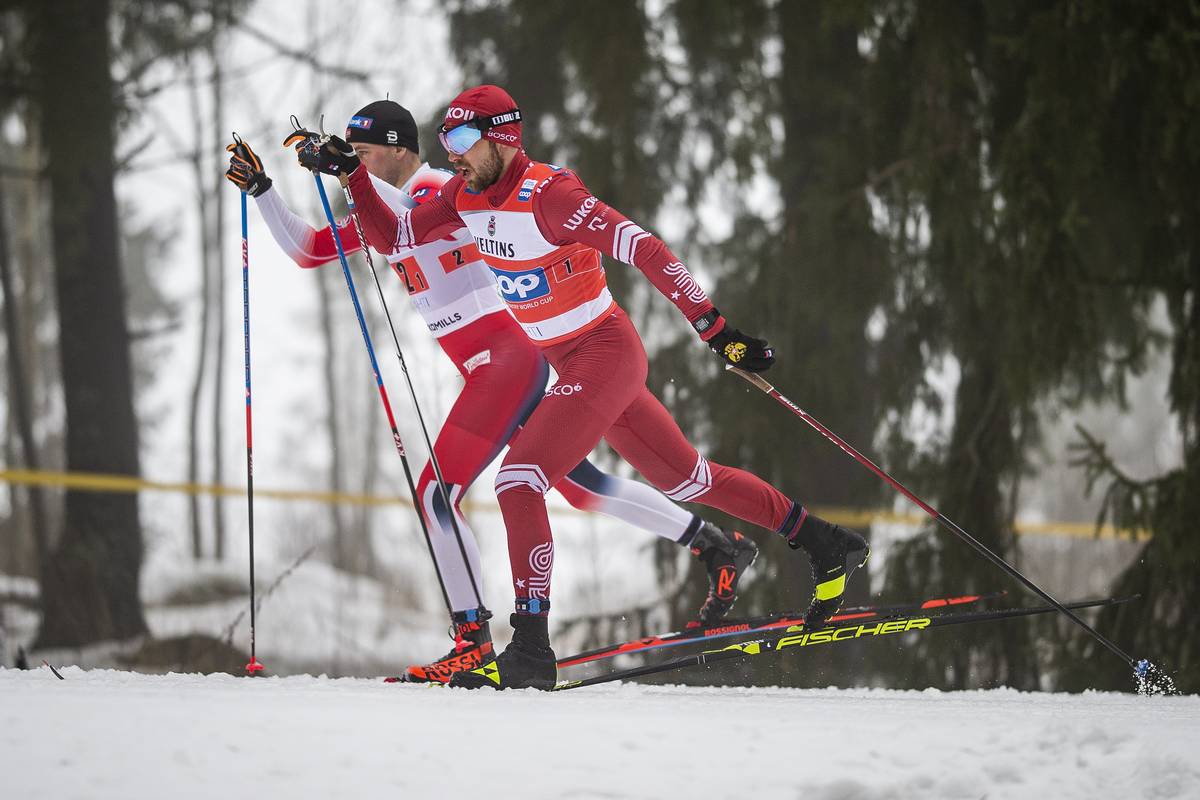
    Emil Iversen (NOR), Ivan Yakimushkin (RUS), (l-r), the second leg of the 4 x 7.5 k relay. (Photo: NordicFocus)
    Emil Iversen (NOR), Ivan Yakimushkin (RUS), (l-r), the second leg of the 4 x 7.5k relay in Lahti. (Photo: NordicFocus)

    Further up the trail, Røthe made a decisive move, gapping Melnichenko (Russia II) by +6.95 at 20 k. At the conclusion of the third leg, Røthe had stretched this lead to +38.3 ahead of Niskanen. 

    “I felt really good today,” said Røthe to FIS after the race, “and we had really really good skis today. It was just for me to start hard and go even harder in the end.”

    With the benefit of Røthe’s effort, Norway’s anchor, Simen Hegstad Krüger, cruised along with a healthy lead. 

    Simen Hegstad Krüger of Norway closing in for the win. (Photo: NordicFocus)

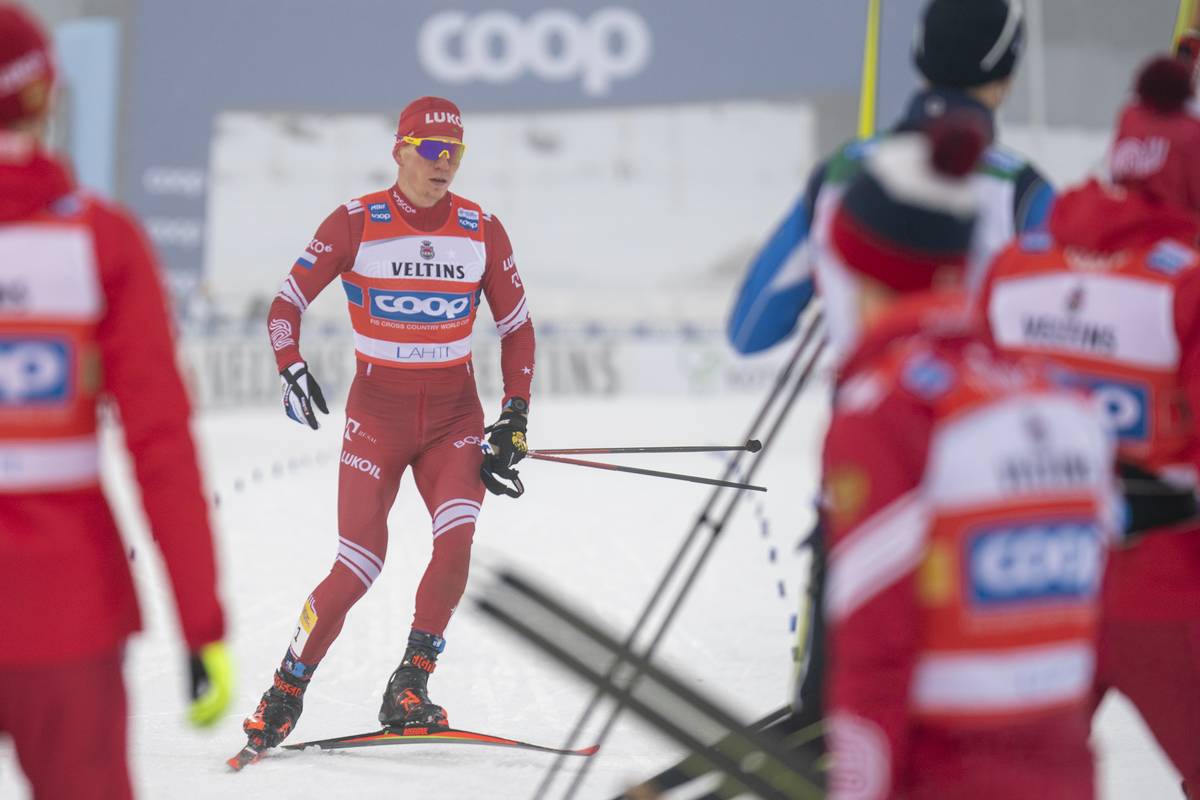
    The race for second was where the podium racing became spicey. Niskanen skied a furious third leg, bringing his team into contact with Russia I and II — moving his team into second at the final tag off. Taking over at that third exchange (final leg) for Russia I was Tour de Ski winner, Alexander Bolshunov. Sergey Ustiugov made his season debut as an anchor for Russia II after missing Period I due to COVID-19 complications. For Finland I, Joni Mæki skied anchor after the tag from Niskanen.

    Mæki, Bolshunov, and Ustiugov formed a group for the fourth relay leg as Krüger continued to stretch Norway’s lead out front.

    Joni Mæki (FIN), Alexander Bolshunov (RUS), and Sergey Ustiugov (RUS), (l-r) during the final leg of the men’s 4 x 7.5 k relay in Lahti, Finland. (Photo: NordicFocus)
    Russia’s Alexander Bolshunov leading Jon Maki (FIN) and Sergey Ustiugov (RUS). (Photo: NordicFocus)

    Exiting the stadium for the final lap Bolshunov picked up the tempo and succeeded in dropping Ustiugov, while Mæki stuck with this year’s Tour de Ski winner.

    Out on his own, Krüger cruised into the finish straights and crossed the finish line in a time of 1:07:56.8. “I took the Lahti corner nice and steady,” said Krüger, a reference to his teammate Iversen’s notorious crash there during the 2017 World Championships, “all the guys gave me such a nice starting point at the end there. Really good day for team Norway and we are back in the World Cup.”

    The ugly cross-country skis news of the day starts here – with Mæki and Bolshunov playing cat and mouse over the final kilometer. Mæki led Bolshnov into the final corner of the stadium, a sweeping left-hander. Trying to execute a slingshot move, Bolshunov took the corner wide, attempting to slot into the outside finish lane. Mæki, who was slightly ahead, shifted towards this lane too. Bolshunov continued full gas, Mæki, it appeared, made a subtle tactical move to quell the Russian’s closing speed. Pinched out of his lane, and much to his evident frustration as he swung a pole at Mæki, Bolshunov began his unraveling. Mæki crossed the finish line in second, only to be bowled over seconds later as an angry Bolshunov slid into him, knocking the Finn to the ground. This unsportsmanlike behavior resulted in the disqualification of Russia I, thus bumping Russia II into third place. According to FIS, this was Finland’s first men’s relay World Cup podium. 

    Bolshunov about to throttle Mæki. (Photo: NordicFocus)
    Bolshunov was eventually penalized and his team was disqualified. Mæki in bib 5 being tackled by a belligerent Bolshunov. (Photo: NordicFocus)

    On Twitter after the race, U.S. Head Coach Matt Whitcomb was terse in his assessment of Bolshunov’s actions. “To be clear to any kids and coaches watching: This tackle by Bolshunov is not okay. If a U.S. athlete did this, they’d be sent home and removed from the team. A disqualification would just be the beginning of their problems.”

    Not exactly good visibility in Lahti, Finland as Scott Patterson laps through the stadium in Lahti. (Photo: NordicFocus)

    The US team, composed of David Norris, Gus Schumacher, Scott Patterson, and Hunter Wonders, placed seventh (+4:04.3). The backstory for the men’s U.S. roster reveals the race was an opportunity for some to gain World Cup level relay experience. Schumacher and Wonders, both U23 skiers, were relay rookies at this level. This is Wonders’ first career World Cup weekend. He placed 46th in Saturday’s skiathlon. Norris, as many observers of the sport are aware, was diagnosed with Covid this past fall. The Lahti series is his initial foray into international racing post-diagnosis. 

    Russell Kennedy racing the anchor leg for Canada. Kennedy scored his first career distance points yesterday in the skiathlon. (Photo: NordicFocus)

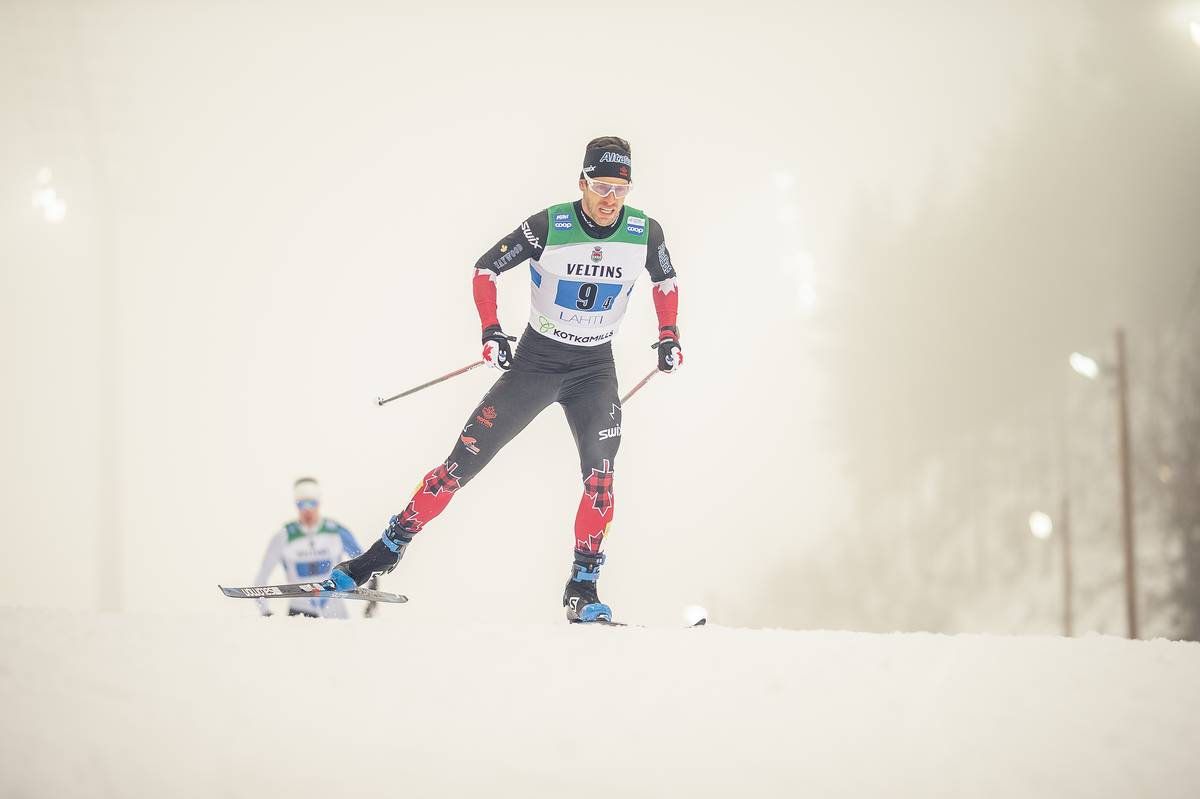
    The Canadian team composed of Graham Ritchie, Antoine, Cyr, Philippe Boucher, and Russell Kennedy was lapped and is listed as ninth in the results. Like the U.S. team, Canada featured two U23 athletes in Ritchie (22) and Cyr (22). Prior to this weekend, Canada had not sent athletes to the World Cup this season. Pictured above, Kennedy scored his first career World Cup distance points in Saturday’s skiathlon. 

    Men’s Relay: Results

  • Norway’s Emil Iversen Stuns for First Distance World Cup Win; Harvey 9th in Montreal

    STC Stage 2 winner - Emil Iversen (NOR) showed his strength today.  (photo: flyingpointroad.com/NNF)
    Norway’s 24-year-old Emil Iversen after winning his third-career World Cup race, and first distance race, at the second stage of the Ski Tour Canada on Wednesday: the 17.5 k classic mass start. (Photo:Flyingpointroad.com/NNF)

    (Note: This article has been updated to include details about a crash involving Norway’s Martin Johnsrud Sundby early in the men’s classic mass start.)

    Certainly it’s too soon for Norway’s Emil Iversen to tell his elders to move over. One of those elders is Norwegian teammate Martin Johnsrud Sundby, current overall World Cup leader. The other, Petter Northug Jr. is … Northug. 

    But at the second stage of the Ski Tour Canada (STC) on Wednesday, a 17.5-kilometer classic mass start in Montreal, Quebec, Norway’s 24-year old Iversen, strided, herringboned, and double poled to the win. 

    Exactly 45:05.4 minutes after the start, Iversen crossed the wind-swept finish line first, 5.3 seconds ahead of Northug. The overall leader of the STC and winner of Tuesday’s sprint, Russian Sergey Ustiugov, placed third (+14.5).

    The start of the men's 17.5 k classic mass start on the second day of the Ski Tour Canada in Montreal, Quebec. (Photo: Flyingpointroad.com/NNF)
    The start of the men’s 17.5 k classic mass start on the second day of the Ski Tour Canada in Montreal, Quebec. (Photo: Flyingpointroad.com/NNF)

    At 23 years old, it was Ustiugov who first showed his fearlessness. Establishing a tempo and drive that 3.5 k in showed he was going to be the pace-setter — Ustiugov went on to dictate the pace for most of the race.

    But at that 3.5 k mark it still could have been a number of skiers’ race to control. Strung out behind Ustiugov in a line were Norwegians Iversen, Sundby, Northug, Finn Hågen Krogh, Canada’s Alex Harvey, Norway’s Ola Vigen Hattestad, and Kazakhstan’s classic specialist, Alexey Poltoranin.

    It must have been something subtle. Maybe an extra effort herringboning up the steep, sugary hills, or double poling with his burly core, but only a kilometer later, Ustiugov played for keeps. Only Iversen and Northug could hang on.

    Sundby later told reporters that he had crashed early on an icy and curving descent.

    “I went on my face,” he told NRK, according to a translation.

    Slowly but surely, a gap back to Sundby grew. And as the moisture on Sundby’s beard began to freeze, so did his chances of bridging up to the leaders. At the 4.6 k mark, Sundby was 13 seconds behind.

    “I lost a lot of time and then it was [over],” he said. “I’m not sure what to say. We are trying to showcase our sport, but today I am unsure what we were doing. Was it cross-country…?

    “It was unusual conditions,” he added. “Fortunately, it was the same for all.”

    As the moisture on Sundby’s beard began to freeze, so did his chances of bridging up to the leaders. 

    By 12.5 k, Sundby chasing in fourth was 18.2 seconds behind the trio of Ustiugov, Iversen and Northug. It remained a long day of trying to play catch up for Sundby, who toiled in no man’s land, chasing solo for the remainder of the race. Sundby finished fourth, 39.8 seconds behind the upstart Iversen.

    It’s Northug’s signature tactic to let others set the pace until he marks the race with an exclamation point across the line. But Wednesday, Iversen, having grown up watching Northug’s bait-and-switch prowess over the years, left nothing for chance. With 1.5 k to go, Iversen began to stretch the rubberband back to Northug inch by inch. He had a 3.6-second lead on Northug, but even that small margin never vanished.

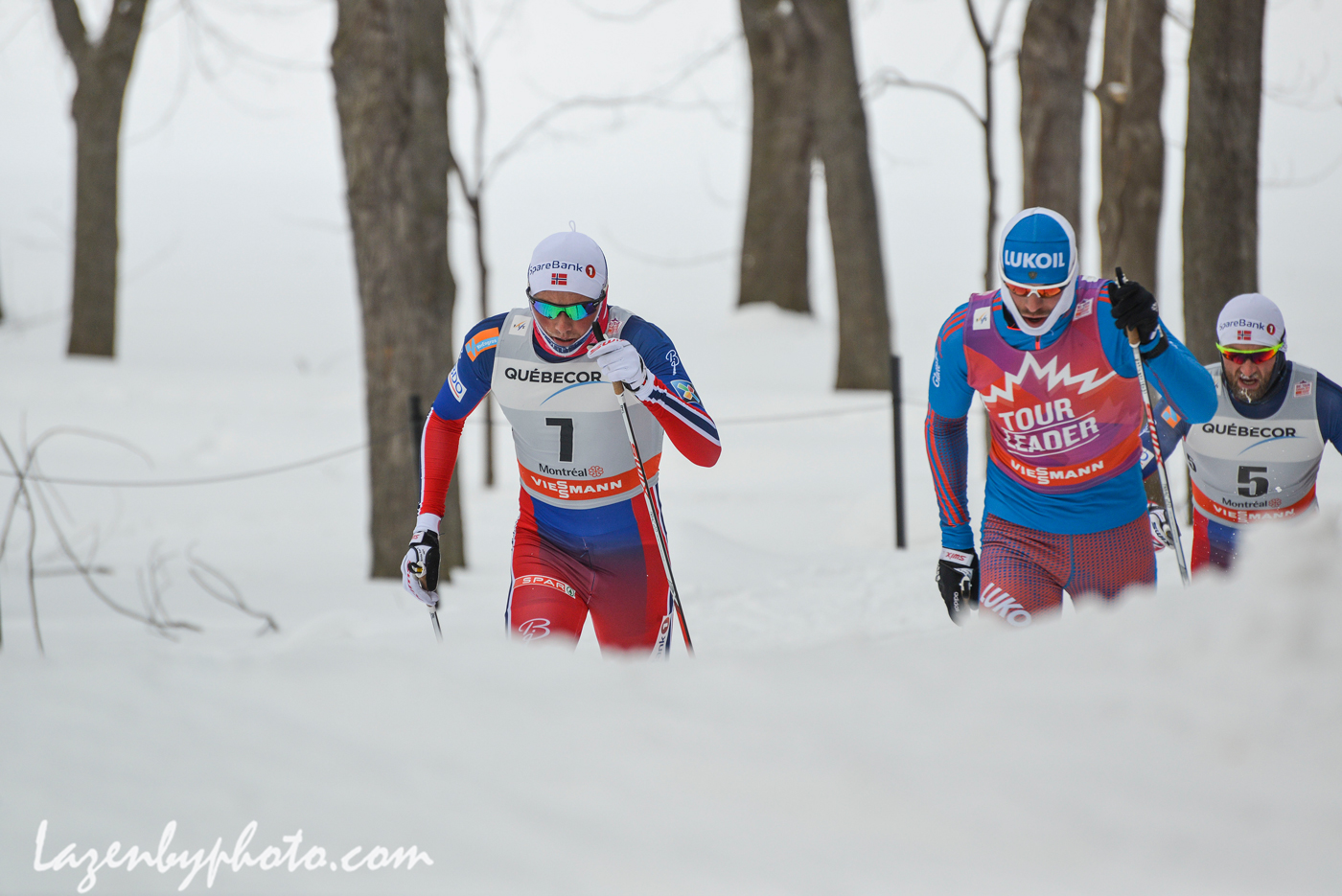
    Norway's Emil Iversen (l) and Russia's Sergey Ustiugov (red leader's bib) lead the men's 17.5 k classic mass start at the second stage of the Ski Tour Canada, while Norway's Petter Northug trails in third. Iversen went on to win, Northug placed second and Ustiugov took third. (Photo: John Lazenby/Lazenbyphoto.com)
    Norway’s Emil Iversen (l) and Russia’s Sergey Ustiugov (red leader’s bib) lead the men’s 17.5 k classic mass start at the second stage of the Ski Tour Canada in Montreal, Quebec, while Norway’s Petter Northug trails in third. Iversen went on to win, Northug placed second and Ustiugov took third. (Photo: John Lazenby/Lazenbyphoto.com)

    When Iversen made his decisive move, he simply upped the pace and never looked back.

    “In the fourth lap I saw Ustiugov was little bit tired,” Iversen said in the post-race press conference. “I decided to try and went for it 100 percent. I hoped I could get a gap and gain some seconds. My goal before the Ski Tour Canada was to have a good start. I’m sitting in second place. Now I have to take stage by stage and we see what happens.”

    With his win on Wednesday, Iversen took his first ever distance World Cup victory and the third of his career. Iversen’s other two World Cup victories, both of which were sprints, also came this season.

    Northug spoke about the trio out front and pushing an unrelenting pace.

    “The plan was to stay in front of the field,” Northug said during the press conference. “After one lap it was only three or four guys in the lead. The pace was very high. We had to fight hard against the wind and snow. Ustiugov did a lot of work in the lead. He was the strongest today. We can thank him for the high speed.”

    Ustiugov also acknowledged that he had taxed himself with the workload.

    “It was a very tough race,” Ustiugov said at the press conference, through a translator. “I knew the guys behind me were fresher than me as I did all the work in the front, but I am satisfied with third place and be in the lead of the Ski Tour.”

    With two consecutive podiums in as many stages so far, Ustiugov remains in first in the Tour standings, 6.1 seconds ahead of Iversen in second. Northug is third, 11 seconds back, and Sundby is nearly 1:40 minutes out of first in fourth overall.

    Harvey in the Hunt

    After two days of racing, both of which took place in his home province of Quebec, Harvey ranks sixth overall, 1:58.3 out of first, after placing ninth in Wednesday’s mass start (+1:16.4).

    While racing the five laps of Montreal’s 3.5 k loop, Harvey appeared to be one of the few who could match the front runners’ pace. At 5.5 k, the Canadian skied in sixth, 14.5 seconds back.

    Canadian World Cup Team member Alex Harvey racing to ninth at the second stage of the Ski Tour Canada, the 17.5 k classic mass start in Montreal, Quebec.  (Photo: flyingpointroad.com/NNF)
    Canadian World Cup Team member Alex Harvey (10) racing to ninth at the second stage of the Ski Tour Canada, the 17.5 k classic mass start in Montreal, Quebec.
    (Photo: flyingpointroad.com/NNF)

    Again and again, it seemed Harvey would cover the breakaway. In an in-person interview afterward, Harvey said those efforts were exhasting.

    “It was a drop in my energy.” Harvey said. “I tried closing the gap with the first three, but I exploded in trying to do so. I fought for the podium but the three guys at the front were out of reach. Ustiugov was really strong the first two laps. I paid at the end for my efforts.”

    Harvey did ski wisely. He was close enough to the front to fight for the two mid-race time bonuses. Harvey took an 8-second time bonus at 4.6 k and a 2-second time bonus at 11.6 k.

    Thinking more of the long-term than a one off race performance, Harvey said he is staying true to his STC plan.

    “My fitness level is good and stable, which is important because you can’t win the Tour in one day, but you can lose it in one day,” he said. “The goal is to not loose the Tour on any day.”

    The second best North American result came from fellow Canadian World Cup Team member Devon Kershaw, who began the day near the back of the pack in bib 50. Kershaw moved forward incrementally and by 5 k was skiing in 22nd place. He eventually skied across the finish in 17th (+1:38.9).

    It was a challenging day,” Kershaw said afterward. “Really soft snow, different conditions.”

    Despite the less-than-ideal fresh snow and blustery wind, Kershaw appreciated the opportunity to ski in a city some of his family calls home.

    “To race in front of friends and family here on the Island of Montreal is a pretty neat feeling,” he said. “It’s just so nice to have the home crowd behind you. My aunt and uncle live here, my mom and my brother live here as well. So I have a lot of family in the city. I heard their voices. It was pretty neat.”

    In the points, and moving up on a day with tricky snow and biting wind, Kershaw remained positive.

    “Seventeenth isn’t something we are going to be lighting fireworks off, calling everybody that I know,” he said. “But at the same time it’s a step in the right direction. I was pretty disappointed after yesterday so its better.”

    Kershaw placed 50th on Tuesday’s freestyle sprint and now sits 17th overall.

    A third Canadian World Cup Team skier in the points was Ivan Babikov in 29th (+2:32.1). Unlike Harvey, who started the day in bib 10 (meaning he had a good starting position heading into the courses steeply pitched and punchy climbs), Babikov wore bib 78. As a result, Babikov started near the rear in the field of 85 skiers.

    When the day’s sinuous track kicked up on lap one, skiers had to herringbone some of the soft headwalls.

    “There was actually a few places, mostly the first and second lap was the worst,” Babikov said on the phone after the race. “The course was just really interesting. I’ve never see something like that before.”

    Babikov described quick downhills that pitched up into mandatory herringbone sections. Those sections created bottlenecks since the herringboning forced skiers to keep their skis wide.

    “Oh yeah, like people crashing and tangling up all over the place,” Babikov said of the scene. “It also was really soft for the skis, so it created really like barely any track on the uphill where you could have strided … It was just a mess, broken poles, people falling down.”

    Babikov explained that maybe the first five, 10 or 15 skiers could ski cleanly through, but not the main pack. On his first lap, Babikov said he felt like he waited thirty seconds for the mess of skiers to clear before pushing ahead.

    When he finally did push ahead, he pushed hard. Of his jump from 78th to 29th place at the finish, Babikov said skiing conservatively wasn’t part of the plan.

    “You have to take a risk today,” Babikov said. “Like, at times to pass people on the downhills. My body felt pretty good. I tried to pass people whenever I could.”

    All that passing moved Babikov up in the overall standings. He now sits 33rd overall.

    Canadian Head Coach Justin Wadsworth was pleased with the day’s result.

    “It was actually a pretty solid day for us, three guys in the top 30, Alex in ninth, Devon in 17th and Ivan 29,” he said.

    Wadsworth also spoke about the benefits of World Cup racing for a future generation of Canadian skiers.

    “Today was an experience…,” he said. “For the younger athletes, it was a real eye opener. It was very hard conditions, with the wind and the snow and the course. I think our younger athletes, also arriving just last night … usually you get some time on the course ahead of time and there’s a ski warmup area and a testing area, and none of that happens here. Boom, you show up and you get ready to race on a race course your’ve never raced on at the highest level.”

    Also for Canada, Graeme Killick (CNST) placed 50th, Kevin Sandau (Alberta World Cup Academy) was 53rd, Len Valjas (CNST) 63rd, Patrick Stewart-Jones (AWCA) 64th, Jess Cockney (CNST) 66th, Michael Somppi (NDC Thunder Bay) 68th, Knute Johnsgaard (AWCA/CNST) 69th, Bob Thompson (NDC Thunder Bay) 73rd, Russell Kennedy (Canmore Nordic) 74th, Andy Shields (NDC Thunder Bay) 76th, and Simon LaPointe (Skinouk) 82nd.

    Bjornsen leads the U.S.

    Erik Bjornsen (Alaska Pacific University/U.S. Ski Team) was the top American in 31st, just 0.4 seconds outside the top 30 and 2:37.3 behind the winner. In a post-race phone call, Bjornsen said he is feeling good after two STC stages.

    Erik Bjornsen (USA) on his way to 31st place. (photo: flyingpointroad.com/NNF)
    Erik Bjornsen (USA) on his way to 31st place in the men’s 17.5 k classic mass start at Stage 2 of the Ski Tour Canada in Montreal, Quebec.. (Photo: Flyingpointroad.com/NNF)

    “Coming into today I knew that I have been feeling pretty good lately, so I was hoping for a good result,” he said.

    Bjornsen also noted the difficult herringboning and the likelihood for bottlenecks to develop.

    “It went out at a pretty hot pace just knowing things were going to get strung out having such a narrow course like that,” Bjornsen said. “But I felt like I went out all right. I struggled a bit with the herringboning and felt strong on the double pole. I was not happy with being so close to the top-thirty. Definitely hoping for a little more in the next few stages.”

    The STC is the second World Cup Tour for Bjornsen.

    “In the last Tour I was right outside the top 40,” Bjornsen said. “It’s my goal this time to be closer to the thirties, but I think if I finish in the top 30 I would be very happy with my overall result. We will see how it goes, there is definitely a couple of good races for me coming up. If I could pop into the top 20 in one race that would be absolutely awesome.”

    U.S. head coach Chris Grover discussed how the front-end racers escaped from the main group so quickly. Bottlenecks were a recurring theme.

    It was a pretty narrow course overall,” Grover said on the phone. “And in particular, the big longer herringbone hill was really only about one skier width … The packs got super strung out because the nature of the course but also because of the tough conditions. Once people got away from those that were trying to herringbone in the soft stuff, they really got away.”

    Grover said those rough-an- tumble patches took a toll on both the U.S. men and women.

    “We had a lot of broken equipment today,” he explained. “Just amongst our team, Ida Sargent broke a ski in a crash tangle-up right away. Brian Gregg broke a ski by having a binding rip off a ski. So it was definitely a challenging day.”

    American Matt Liebsch (Gear West) waits for his good friend and training partner Brian Gregg (Team Gregg) to finish the men's 17.5 k classic mass start at Stage 2 of the Ski Tour Canada in Montreal, Quebec. Gregg crashed and his binding ripped off his ski. (Photo: flyingpointroad.com/NNF)
    American Matt Liebsch (Gear West) waits for his good friend and training partner Brian Gregg (Team Gregg) to finish the men’s 17.5 k classic mass start at Stage 2 of the Ski Tour Canada in Montreal, Quebec. Gregg crashed and his binding ripped off his ski. (Photo: Flyingpointroad.com/NNF)

    Gregg ultimately finished 81st.

    “I had one pretty solid crash out there, which was certainly very frustrating but that’s part of racing,” Gregg said after.

    Noah Hoffman (Ski & Snowboard Club Vail/USST) placed 42nd. He reiterated the tough course.

    “It’s a really challenging course,” Hoffman said. “We were just standing still on the first lap, so often. It was so narrow, there’s so much herringbone. It was a challenge from way back off of yesterday’s finish.”

    Also for the U.S., Scott Patterson (APU) finished 55th, Simi Hamilton (SMST2/USST) was 58th, Eric Packer (APU) 67th, Reese Hanneman (APU) 70th, Andy Newell (SMST2/USST) 71st, Dakota Blackhorse-von Jess (Bend Endurance Academy) 77th, Matt Liebsch (Gear West) 79th, Tad Elliott (SSCV) 80th, and Gregg (Team Gregg) 81st.

    Results | Tour standings (after Stage 2)

  • Sundby Clinches Third Tour de Ski Title; Harvey Finishes Climb 14th Overall

    Sundby Clinches Third Tour de Ski Title; Harvey Finishes Climb 14th Overall

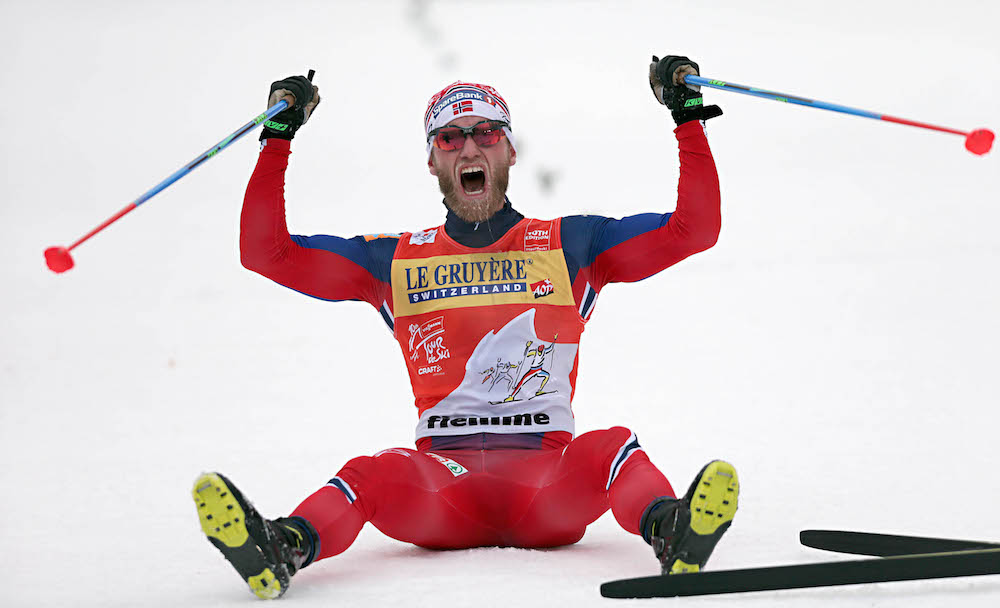
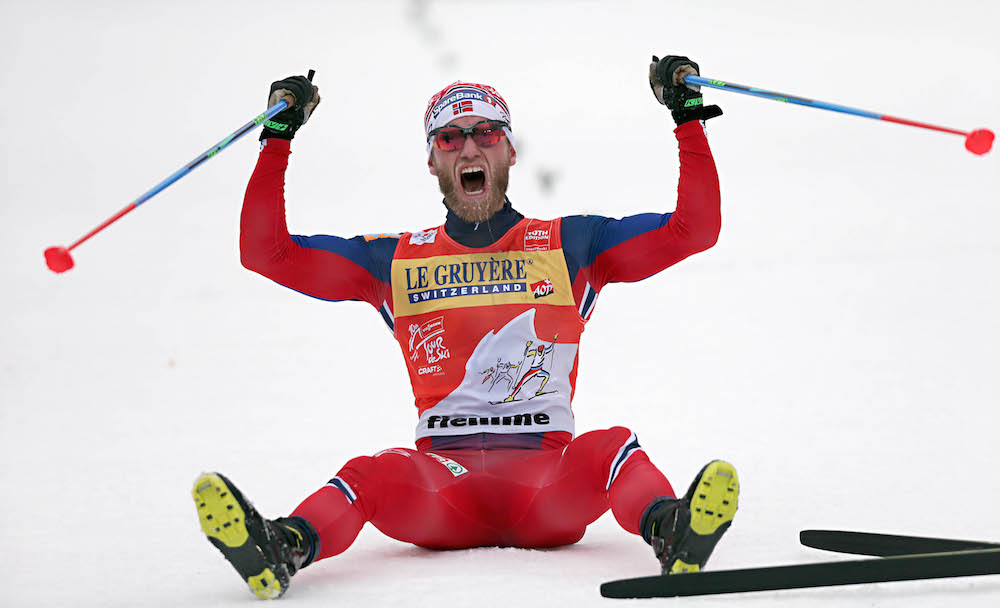
    A Victorious Martin Johnsrud Sundby (Photo: Fiemme World Cup)
    A victorious Martin Johnsrud Sundby of Norway at the top of Alpe Cermis on Sunday after winning his third-consecutive Tour de Ski in Val di Fiemme, Italy. (Photo: Fiemme World Cup)

    Within the first 1.8-kilometers of the 9 k freestyle pursuit up Alpe Cemis in the final stage of the Tour de Ski on Sunday, Martin Johnsrud Sundby padded his lead by 16 seconds, up to 3:07.5 minutes over his closest competitor, Alexey Poltoranin of Kazakhstan.

    Just over seven kilometers and nearly 407 meters of vertical climbing later in Val di Fiemme, Italy, the 31-year-old Norwegian crossed the finish line with ease, capturing his third consecutive Tour de Ski title by a record-breaking margin of 3:15.7 ahead of second place, Norwegian teammate Finn Hågen Krogh.

    As Sundby started 2:51 ahead of the field (with teammate Petter Northug heading out second) and raced himself up the mountain, a battle for the final podium spots took shape behind him. At the start, the four skiers starting behind Sundby — Northug, Poltoranin, Russia’s Sergey Ustiugov, and Krogh, respectively — all went off within ten seconds of one another. These four remained close through the flats and into the beginning of the climb, around 5.75 k.

    Just after the 7.1 k time split and into the steepest pitches of the climb, things got interesting. Krogh moved to the front of the pack with Ustigov as Northug and Poltoranin yo-yoed off the back.

    By 8.1 k, Krogh’s move split the group and put a little over five seconds between himself and Ustigov. Now down 30 seconds to Ustigov, Northug — visibly distressed and previously on record with Norwegian media as saying he will never win the tour because of this last stage — tossed his sunglasses, gritted his teeth and clung to Poltoranin.

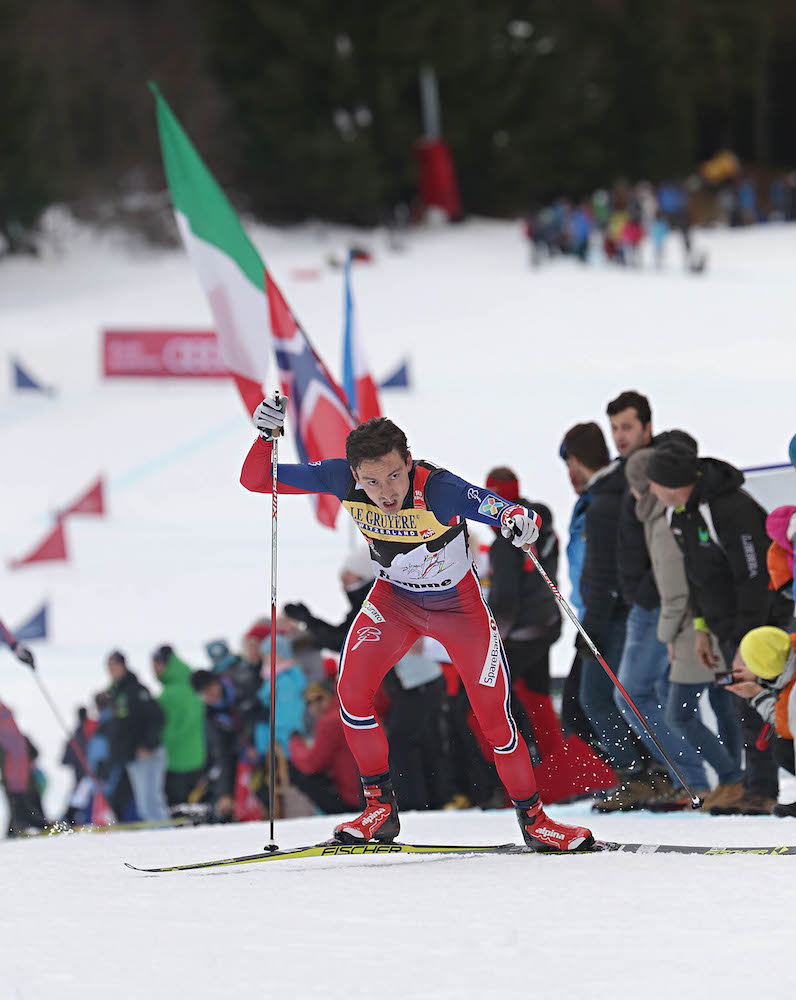
    Norway's Finn Hågen Krogh rose from fifth to second overall in the Tour de Ski after placing second to teammate Martin Johnsrud Sundby (not shown) in the final 9 k freestyle climb in Val di Fiemme, Italy. (Photo: Fiemme World Cup)
    Norway’s Finn Hågen Krogh rose from fifth to second overall in the Tour de Ski after placing second to teammate Martin Johnsrud Sundby (not shown) in the final 9 k freestyle climb in Val di Fiemme, Italy. (Photo: Fiemme World Cup)

    Less than a kilometer later, Krogh widened his lead over Ustiugov to a little over 20 seconds. The 23-year-old Russian looked strong, but Krogh’s snappy skiing in the steepest sections separated him from the pack. The 25-year-old Norwegian’s final time for the stage would be the fourth-fastest of the day, only 14.3 seconds behind Sundby’s.

    In a post-race interview with NRK, Krogh discussed his drive to finish second.

    “Taking second place is the only thing that stood in my head,” he said. “I’ve thought about it all night and struggled to get to sleep. I was excited and did not particularly [have an] appetite this morning.”

    At the finish Krogh was met with an embrace from his teammate Sundby, who had finished 3:15.7 earlier with a winning time of 30:47. Not only the winner of the pursuit, Sundby also set the fastest time of the day — mostly notable considering he skied uncontested from start to finish.

    Rounding out the overall podium was Ustiugov, 3:43.8 behind Sundby and 28.1 seconds behind Krogh.

    A reward for their efforts, Sundby earned 100,000 Swiss francs (CHF) by winning the final stage of the Tour: more than $100,500 U.S. dollars. Krogh took a little over half that amount in second (57,500 CHF, or $57,800) and Ustiugov claimed 35,000 CHF ($35,200 dollars) in third, according to the International Ski Federation (FIS) prize money list. So far this season, Sundby has racked up 215,500 CHF ($216,700) in World Cup prize money alone.

    Despite finishing nearly 52 seconds off the podium in fourth (4:35.6 behind Sundby), Northug still received 20,000 CHF (about $20,000) for his result in Stage 8. Collapsing into a heap just after the finish, Northug maintained his streak of placing in the top four of the overall Tour standings to eight years. In fifth, less than three seconds behind Northug, was Poltoranin.

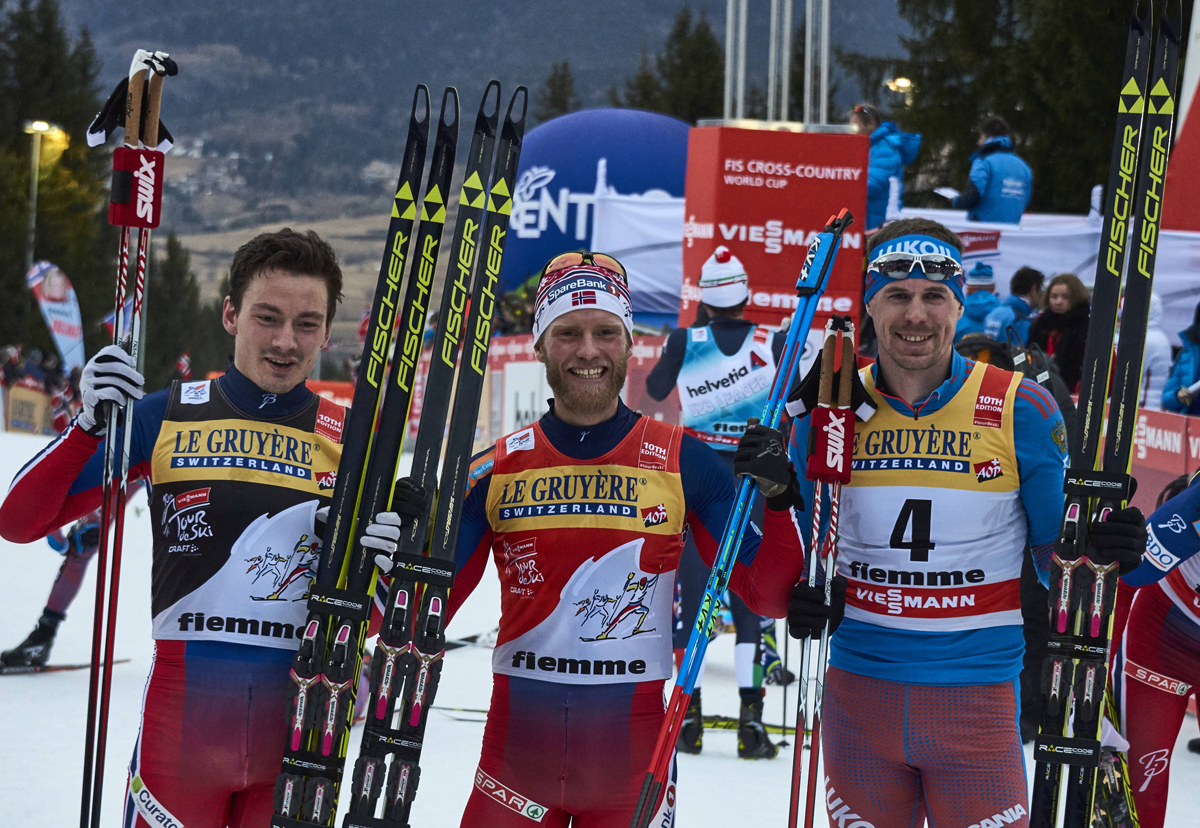
    The overall 2016 Tour de Ski podium with winner Martin Johnsrud Sundby (c) and runner-up Finn Hågen Krogh, both of Norway, and Russia's Sergey Ustiugov (r) in third. (Photo: Fischer/NordicFocus)
    The overall 2016 Tour de Ski podium with winner Martin Johnsrud Sundby (c) and runner-up Finn Hågen Krogh, both of Norway, and Russia’s Sergey Ustiugov (r) in third. (Photo: Fischer/NordicFocus)

    At the finish, Sundby told FIS, “It has been a perfect Tour for me. I had one bad day. But everything has been perfect.”

    Not only did Sundby take the overall Tour title, he also won the fastest time of the day. Frenchman Robin Duvillard posted the second-fastest time, 7.2 seconds back, and Finland’s Matti Heikkinen was third (+11.8).

    Seven Norwegians occupied the top 10 of the final Tour standings. On this accomplishment, Sundby told NRK, “This is a job that [has] many [people] behind it, I’m proud of this team. There is no one-man show. We work 200 days a year to become the world’s best cross-country nation, and I am so happy for the guys.”

    Harvey 14th Overall; Babikov 11th Fastest Up the Climb 

    With five North American men racing the final climb, one landed in the top 15 overall and two posted top-15 times of the day.

    Canada’s Alex Harvey finished the Tour in 14th overall (+6:57.3) after starting 12th. His teammate Ivan Babikov posted the 11th fastest time of day (31.9 seconds behind Sundby) to secure 29th (+12:42.2) after starting 29th.

    American Noah Hoffman maintained his consistency in the final stage, moving up from 26th to finish 22nd (+10:44.3) with the 15th-fastest time (+56.4).

    For Harvey, it was his third time completing the Tour de Ski and first time back on Alpe Cermis since finishing 40th there in 2012. In the years that followed, he skipped the final climb because of a blood-flow issue in his legs, which worsened with skate climbing. He had surgery to repair this past spring to remedy the problem.

    After Sunday’s race, the 27-year-old Canadian remarked on the phone that although his Tour had not gone as well as he’d hoped, his legs finally felt good up the climb.

    “On the climb I really felt good; my legs were not seizing up, and that’s the first time ever that’s not happened to me,” Harvey said.

    Alex Harvey (Canadian World Cup Team) placed 37th in the 10 k freestyle at Stage 6 of the Tour de Ski to drop five places to 15th overall in the Tour. (Photo: Fischer/NordicFocus)
    Alex Harvey (Canadian World Cup Team) placed 37th in the 10 k freestyle at Stage 6 of the Tour de Ski to drop five places to 15th overall in the Tour. (Photo: Fischer/NordicFocus)

    In the past, he hit the climb and not been able to move. This year he found himself in a unfamiliar situation. “I actually had a bit too much left in the end,” he said. “I didn’t know what to expect because over the years it has been so bad with my legs.”

    Despite this, he finished with the 16th fastest time of the day (+1:07.4).

    Looking back on his fourth completion of the Tour de Ski, Harvey expressed dissatisfaction.

    “I’m not going to lie, I am pretty disappointed about the Tour, but I am really happy that the legs are working just as well as anyone else’s, so at least I am competitive on the climb. This is a big positive,” he said.

    Going forward, gaining trust in his legs will prove essential when the Ski Tour of Canada kicks off in March.

    “If I have a good tour like I did two and three years ago, I think it’s possible to fight for the top five and maybe podium on the climb,” he said. “It’s not something I believed before this year. I am really excited about that.”

    The Ski Tour Canada, a brand-new, eight-stage series scheduled for March 1-12, ends with a 15 k classic pursuit.

    Climbing Specialists

    While Harvey’s freestyle climbing may be a newfound skill, Hoffman and Babikov typically thrive on hill climbs. At the 2014 Tour de Ski, Babikov posted the third-fastest time in the final stage. Hoffman said on the phone that he entered Sunday with the belief that this stage is “really built around my strengths.

    Noah Hoffman (U.S. Ski Team) racing to 19th in the 10 k freestyle at Stage 6 of the Tour de Ski in Toblach, Italy. (Photo: JoJo Baldus)
    Noah Hoffman (U.S. Ski Team) racing to 19th in the 10 k freestyle at Stage 6 of the Tour de Ski in Toblach, Italy. (Photo: JoJo Baldus)

    “The plan was to go out relax and let those guys come to me [the wave starters],” Hoffman said of his plan for the early flat terrain. As he transitioned to the climb, he focused on staying “as clean, and as efficient and as relaxed as possible.”

    Despite skiing the 15th-fastest time of the day and moving up four places overall, Hoffman did not think he skied to his full ability.

    “I had high hopes for myself,” the 26 year old said. “It’s a good result; it’s not a great, breakthrough result.”

    Reflecting back on the tour, Hoffman continued, “I’m really happy with the way I moved from stage to stage. I was quite consistent throughout the Tour, which is definitely a big goal.”

    He went on to mention that although consistent, he still remains without a notable finish.

    “I didn’t have that big breakthrough result I was really hoping for, but there’s lots more racing to go this season,” he said.

    Ivan Babikov (Canadian World Cup Team) placed 59th in the 1.2 k classic sprint qualifier at Stage 4 of the Tour de Ski in Oberstdorf, Germany. (Photo: Marcel Hilger)
    Ivan Babikov (Canadian World Cup Team) placed 59th in the 1.2 k classic sprint at Stage 4 of the Tour de Ski in Oberstdorf, Germany. (Photo: Marcel Hilger)

    Babikov, 35, skied the 11th-fastest time to finish in the top 30 of his seventh-consecutive Tour de Ski.

    He started the day aiming to push through the flats and move up during the climb, “By the time the hill starts, you got to be up front to not get yo-yoed or dropped,” Babikov explained on the phone.

    This is only Babikov’s second top 30 of the season, and he considered Sunday a positive step.

    “It’s not my best result of course. Considering my shape, I think it’s quite good; I’m happy with it,” he said.

    He added that this year’s Tour was great prep for the upcoming tour of Canada.

    “For me, it’s really good prep. The more I race, the better I get,” he said.

    The third Canadian in his 10th Tour de Ski — as many as Northug — finished 32nd (+13:47.7) after starting 33rd. In the opinion of Canadian Head Coach Justin Wadsworth, the final stage went well the team.

    “All the guys skied really well today. It was good to finish out the Tour with some solid skiing with everyone on the team,” Wadsworth said.

    This was a change from their overall Tour performance, which Wadsworth described as, “more not-so-good than good,” while adding, “There was some good races by the guys; everybody had their moments where they skied well.”

    Wadsworth said the team is looking forward to the season-ending tour on home soil. “Our big focus is the Ski Tour of Canada, so hopefully we can rest up from this and put it together at home when it really counts,” he said.

    Also for the U.S., 24-year-old Erik Bjornsen in his first Tour de Ski placed 41st (+17:51.4) after starting 42nd.

    Racing resumes next weekend with a World Cup weekend of sprinting in Planica, Slovenia.

    Overall results | Time of day

    Martin Johnsrud Sundby of Norway celebrates the fruits of his labor over eight stages of the Tour de Ski (TdS), after winning the final climb on Sunday for his third-consecutive TdS title in Val di Fiemme, Italy. (Photo: Fischer/NordicFocus)
    Martin Johnsrud Sundby of Norway celebrates the fruits of his labor over eight races in 10 days of the 2016 Tour de Ski (TdS), after winning the final climb on Sunday for his third-consecutive TdS title in Val di Fiemme, Italy. (Photo: Fischer/NordicFocus)