From the FasterSkier archive — posts syndicated from athletes’ and coaches’ own blogs between 2004 and 2012, kept online as published. Current coverage is at fasterskier.com.
The men’s 4 x 10 k relay itself lacked for drama, but fortunately there’s plenty going on in the Norwegian team for us to talk about. Devon and Nat are back to break down Russia’s convincing win in the relay, the most disappointing silver ever for Norway and a gold-like bronze for France.
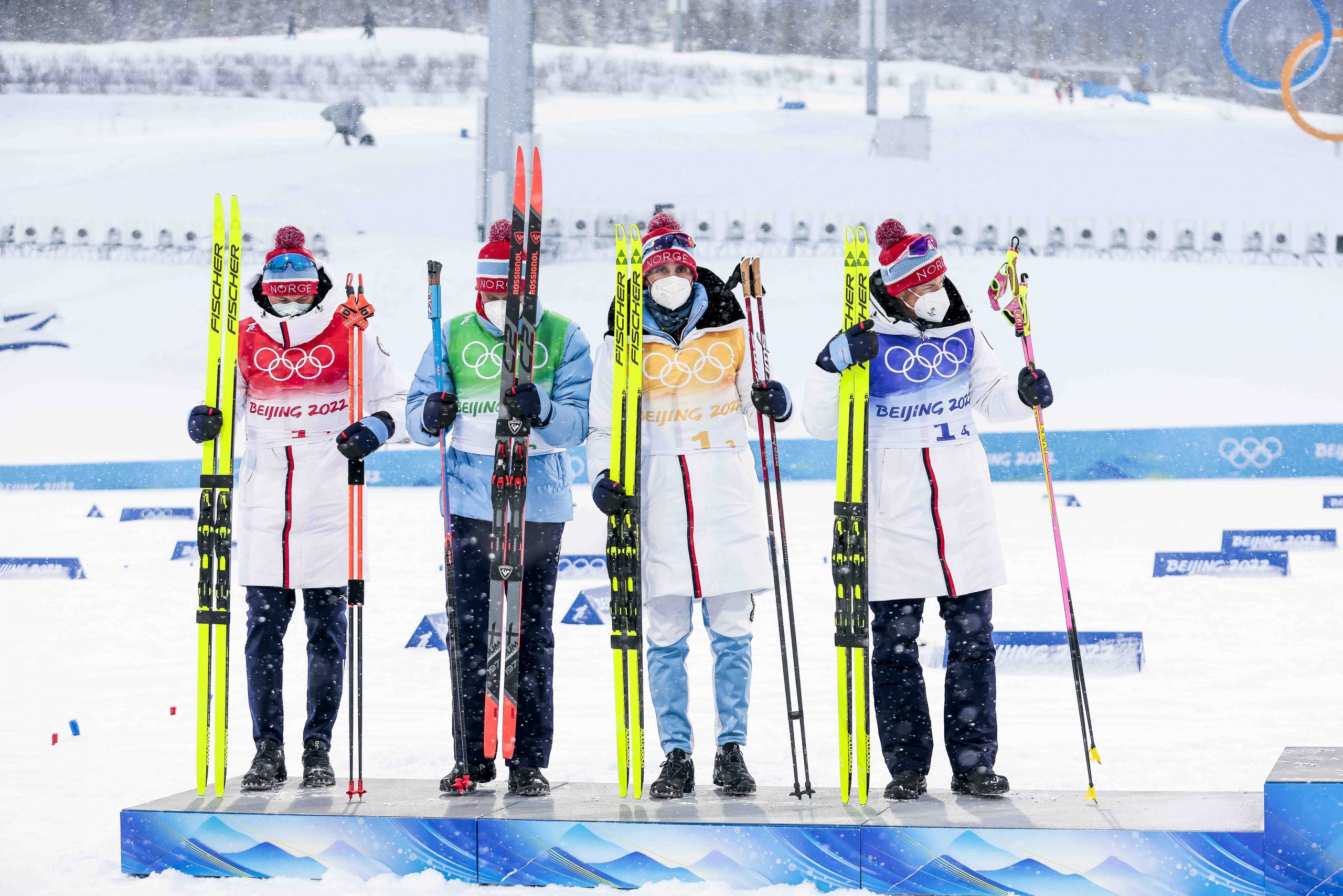
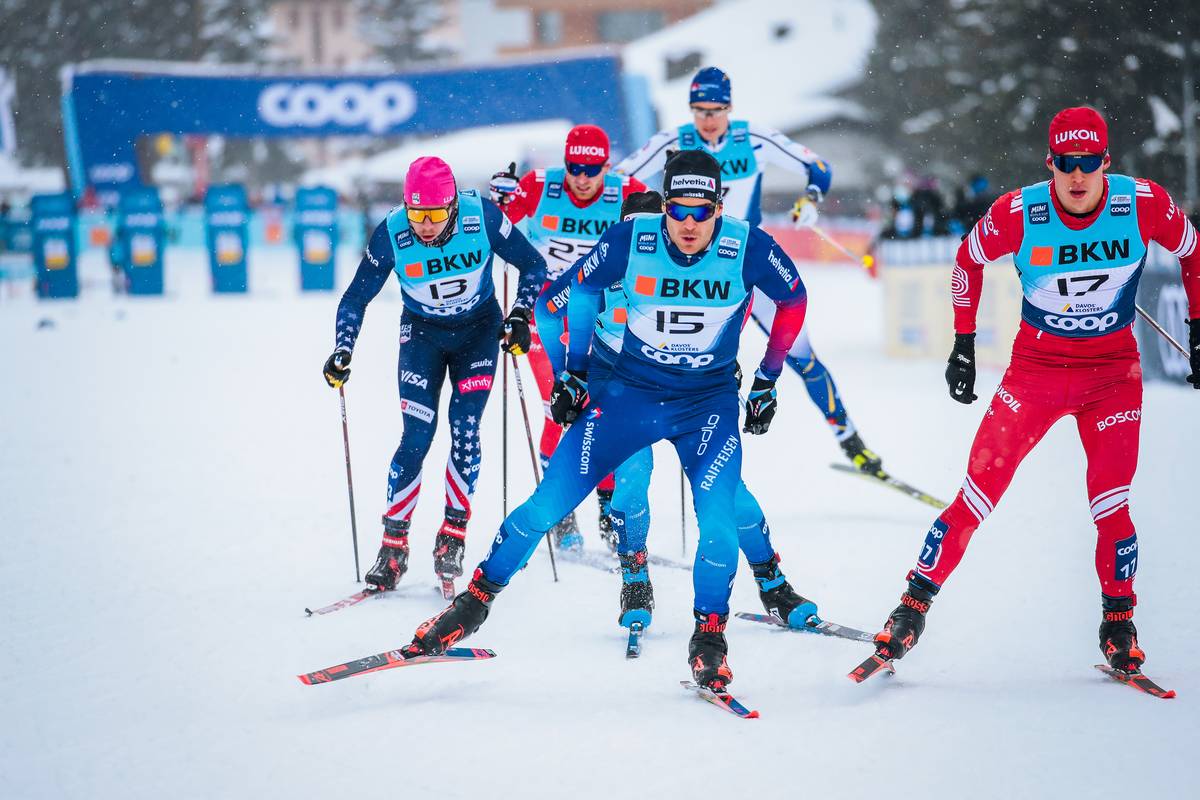
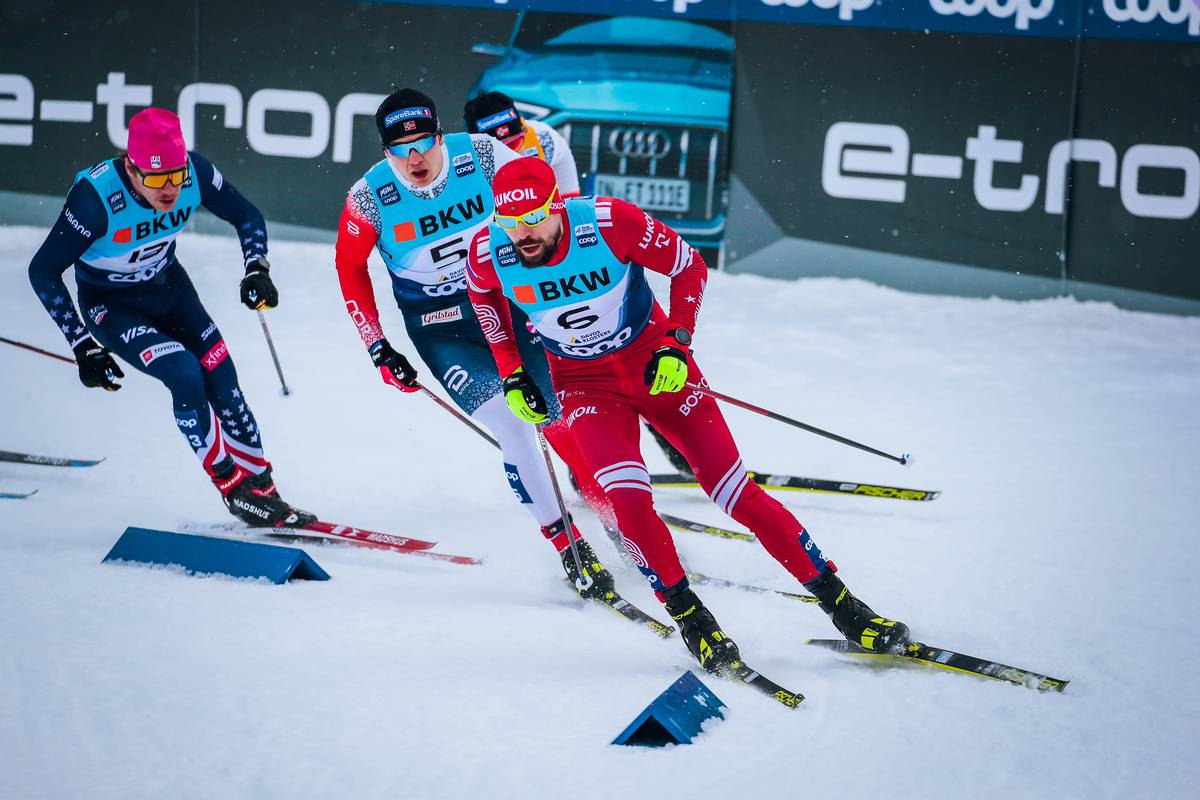
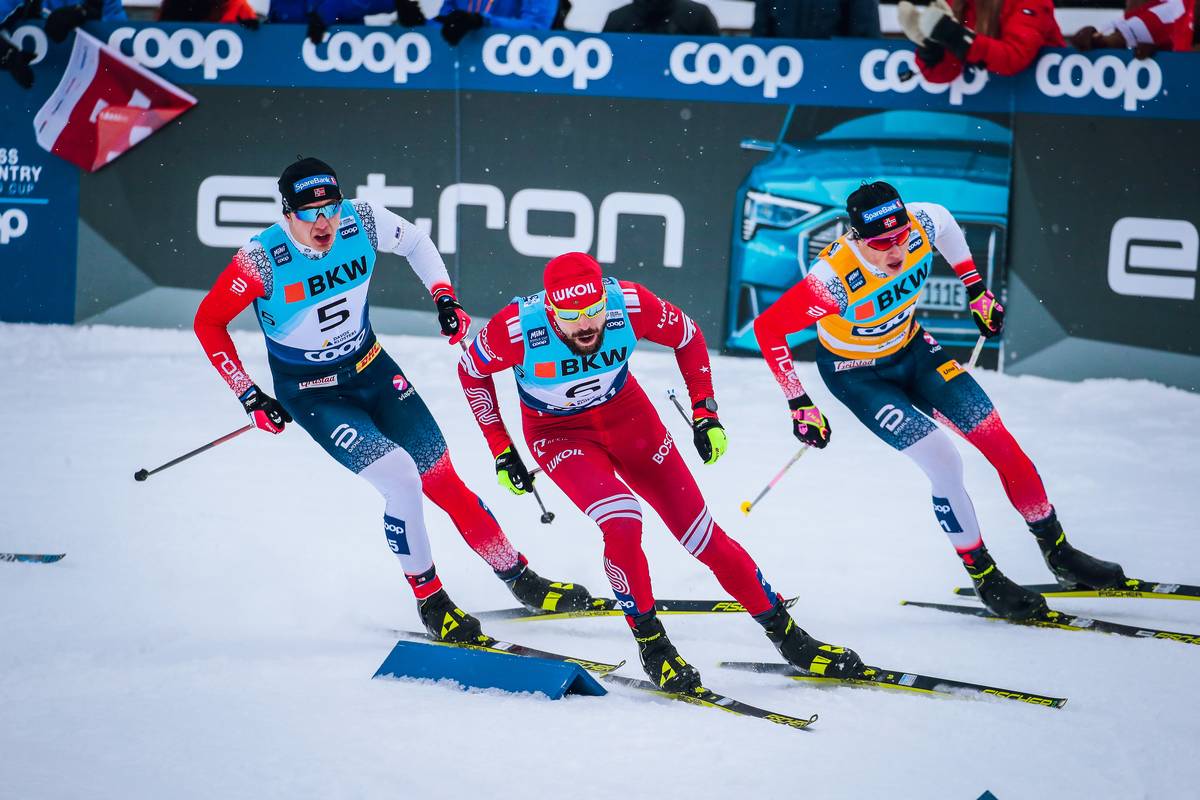
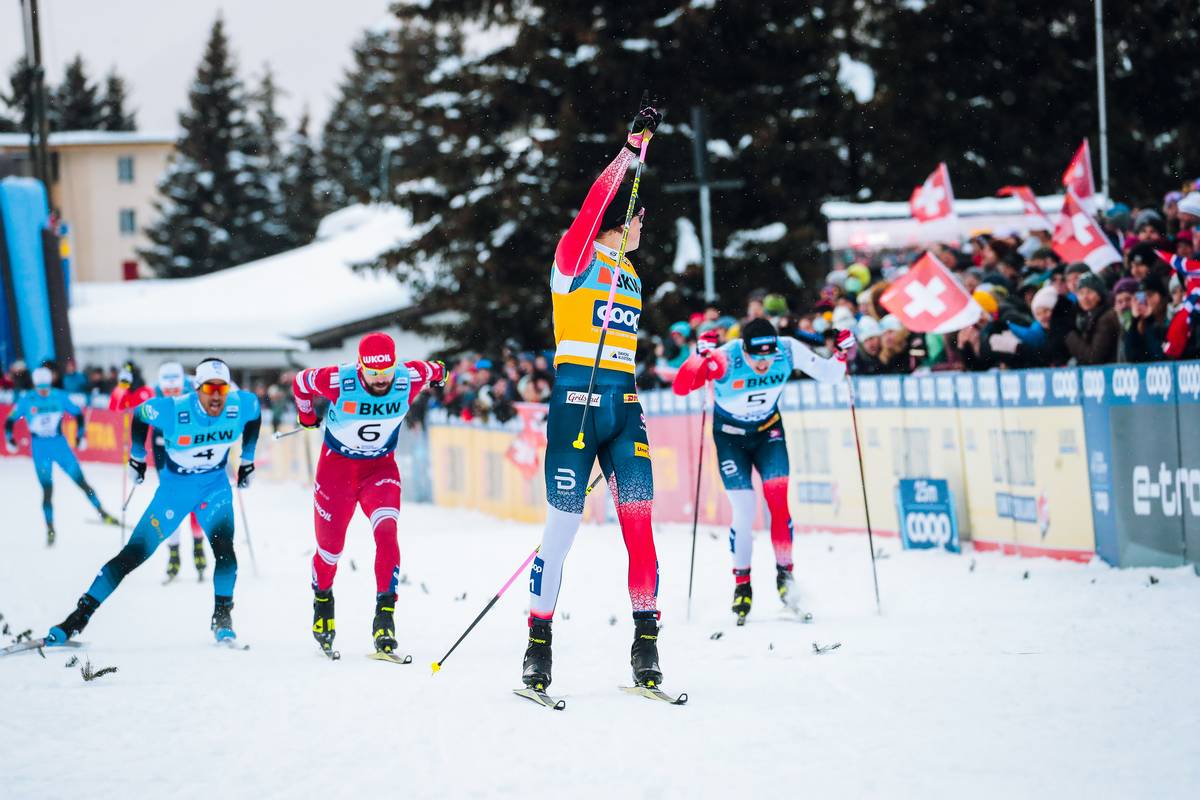
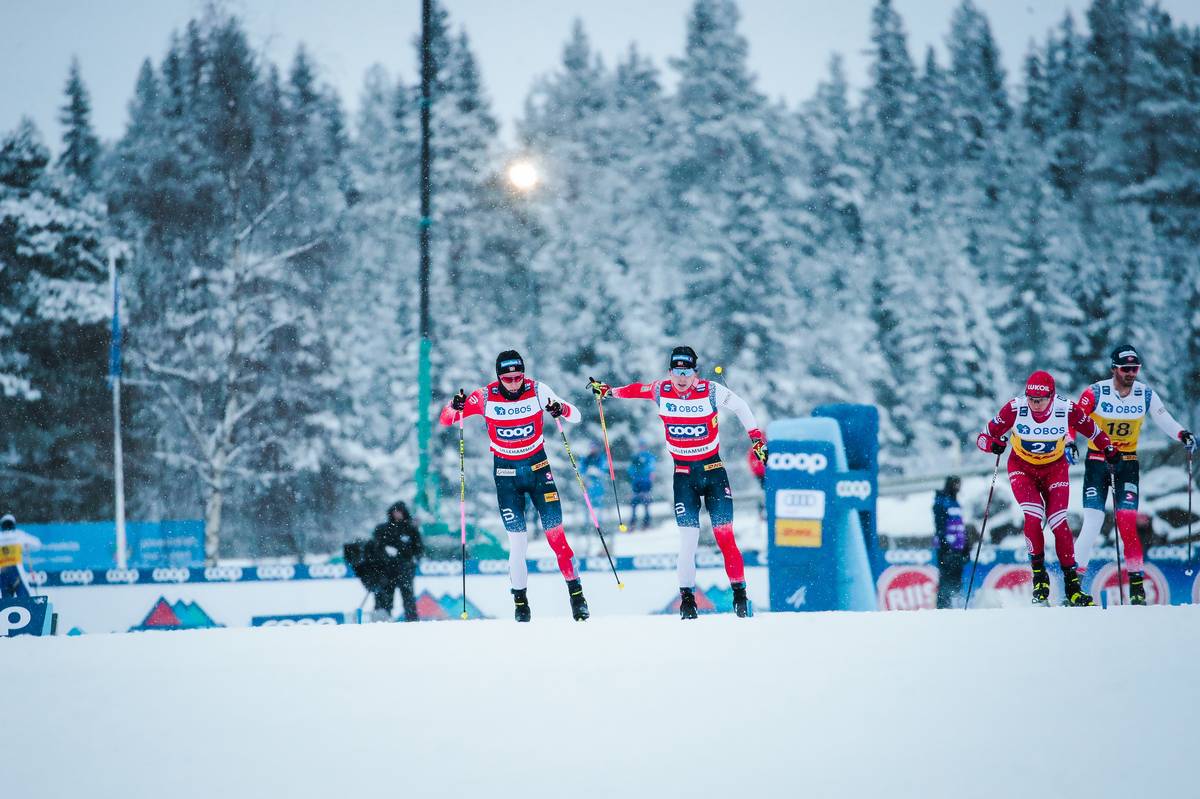
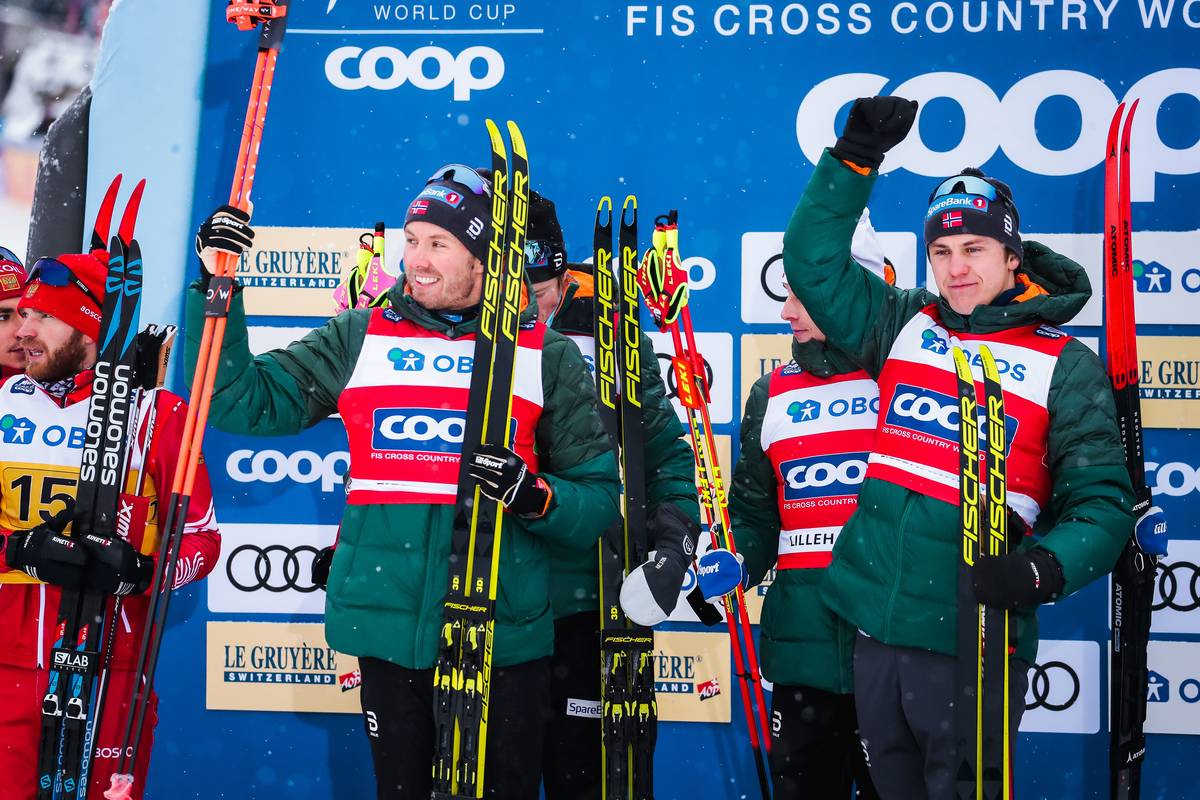
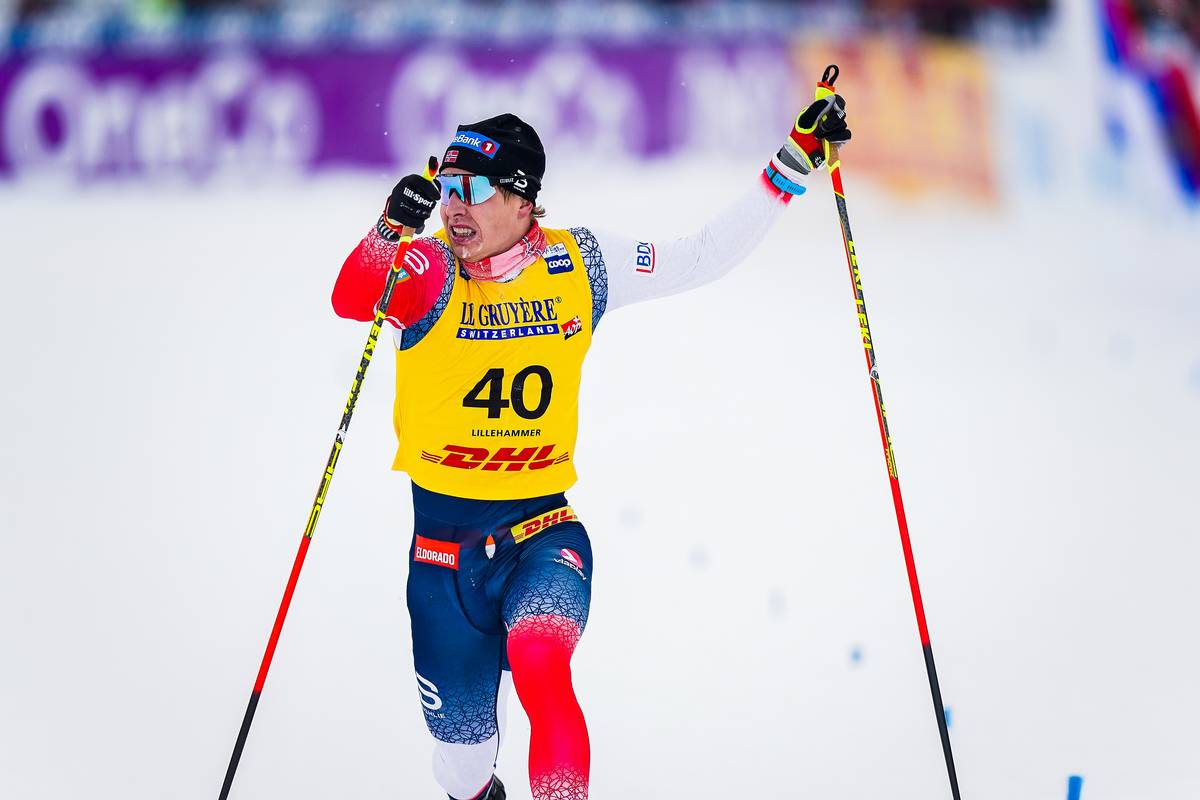
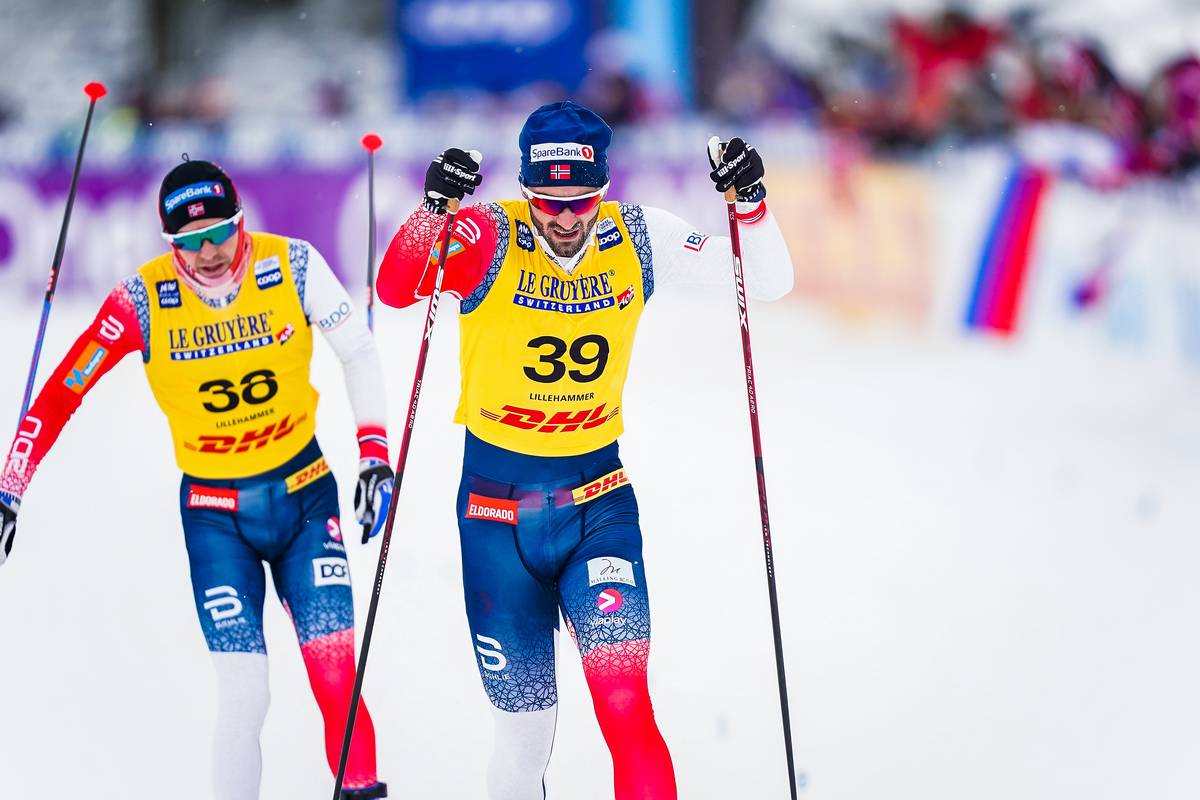
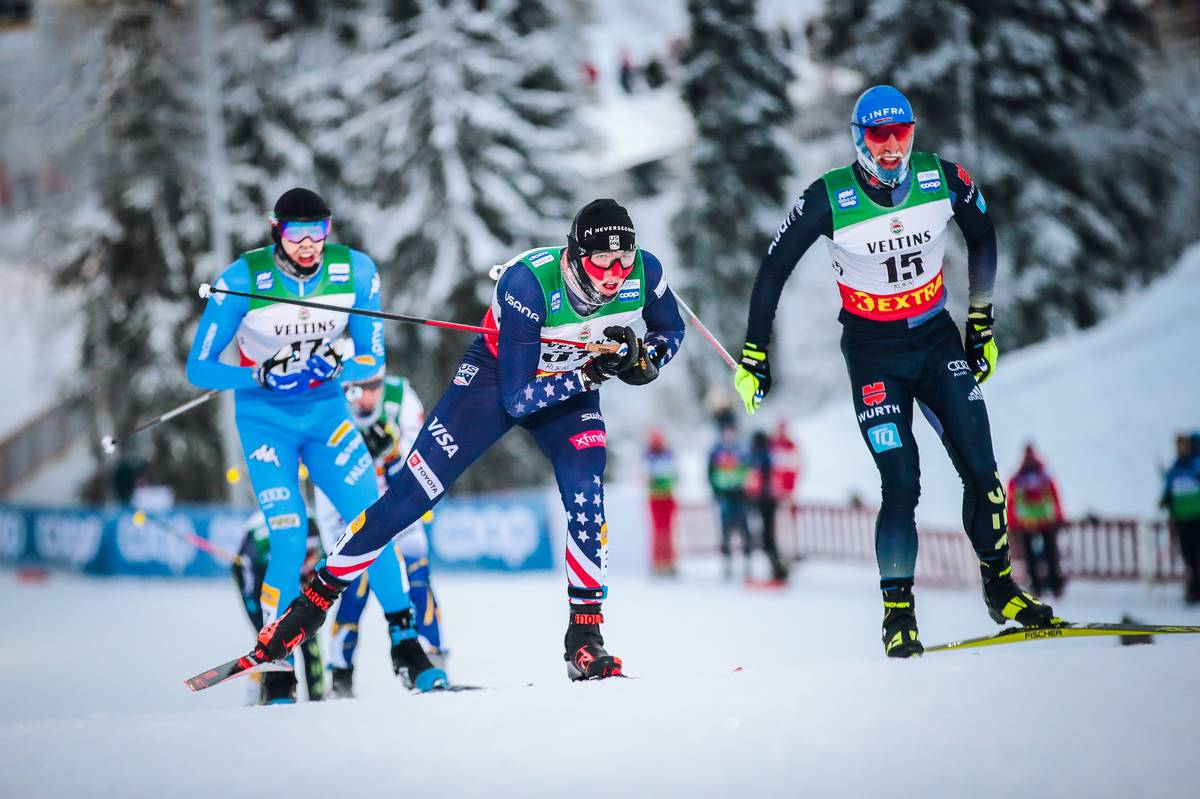
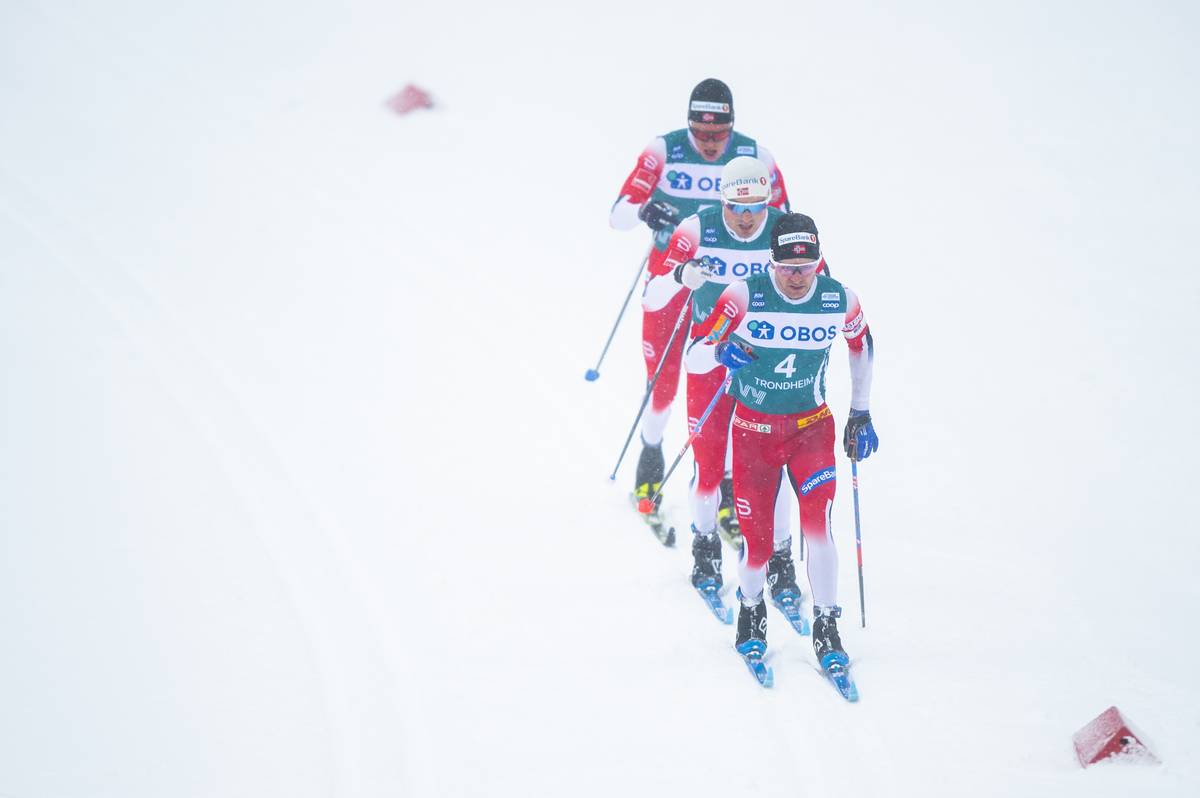
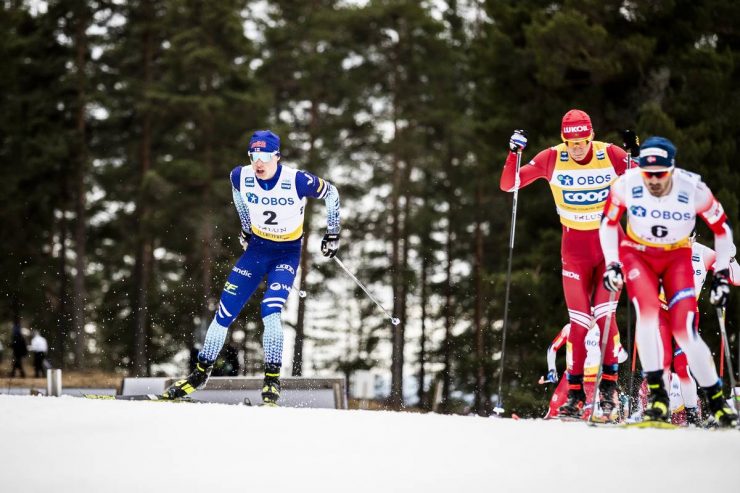
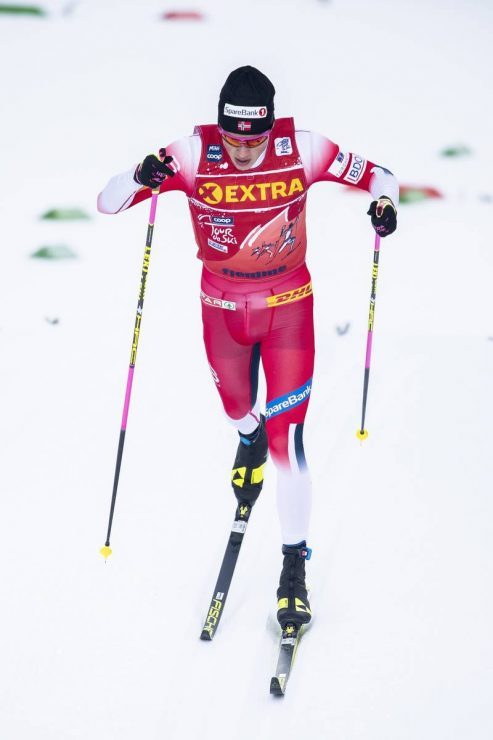
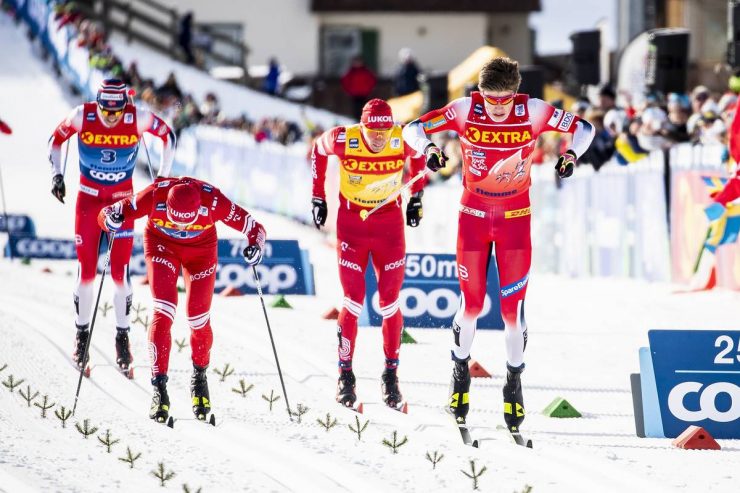
Emil Iversen (NOR), Paal Golberg (NOR), Hans Christer Holund (NOR), Johannes Hoesflot Klaebo (NOR), (l-r) were the only team not celebrating their medal after the 4 x 10 k relay (Photo: NordicFocus)
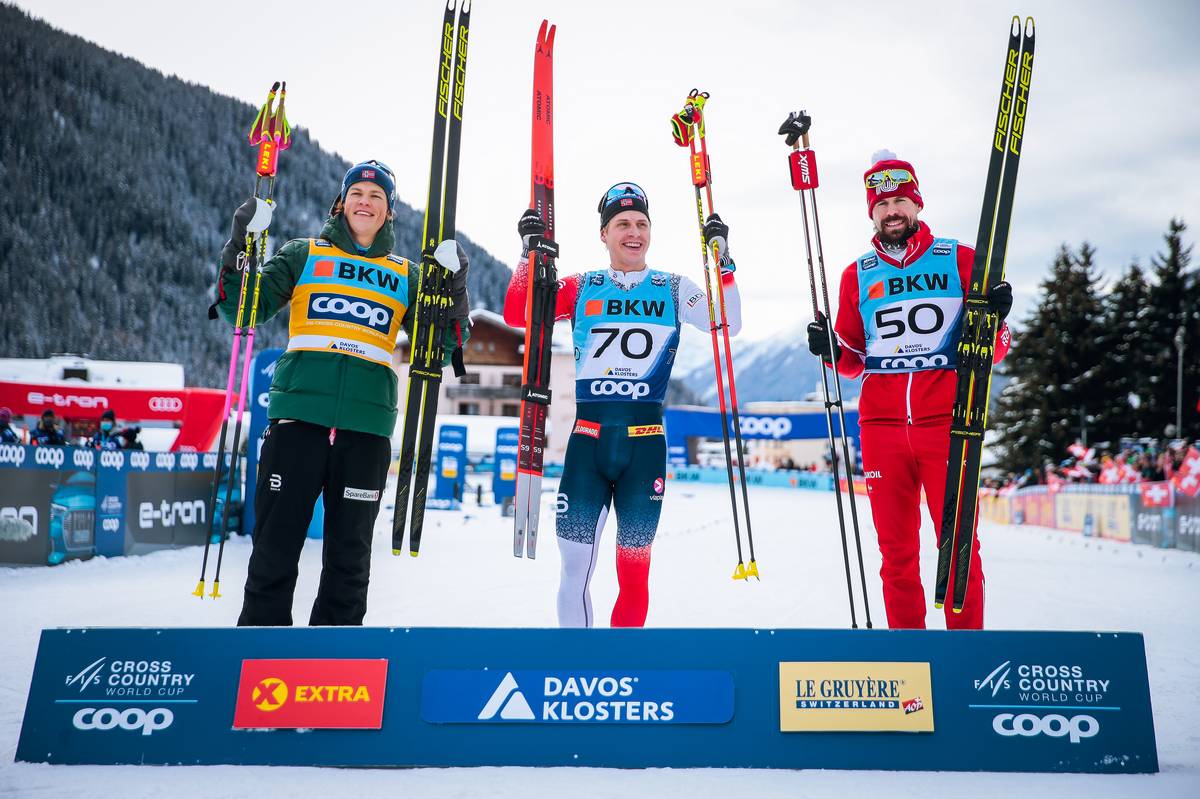
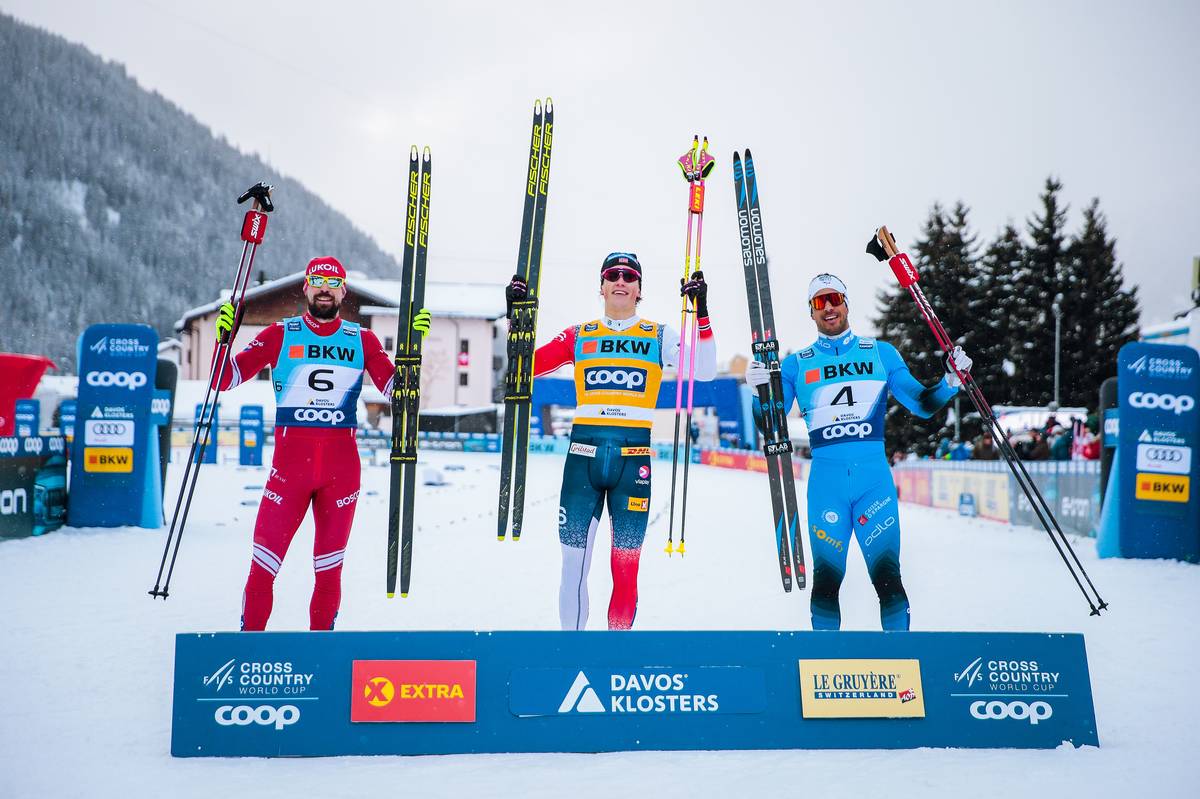
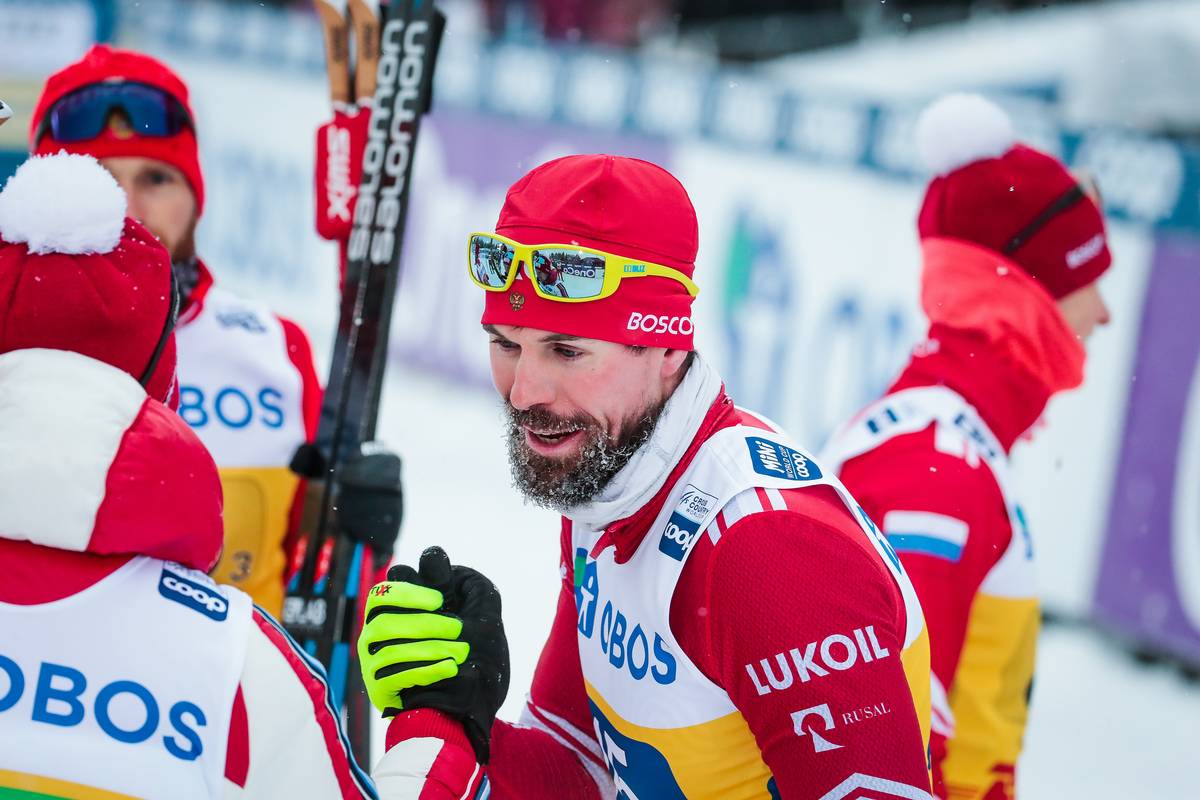
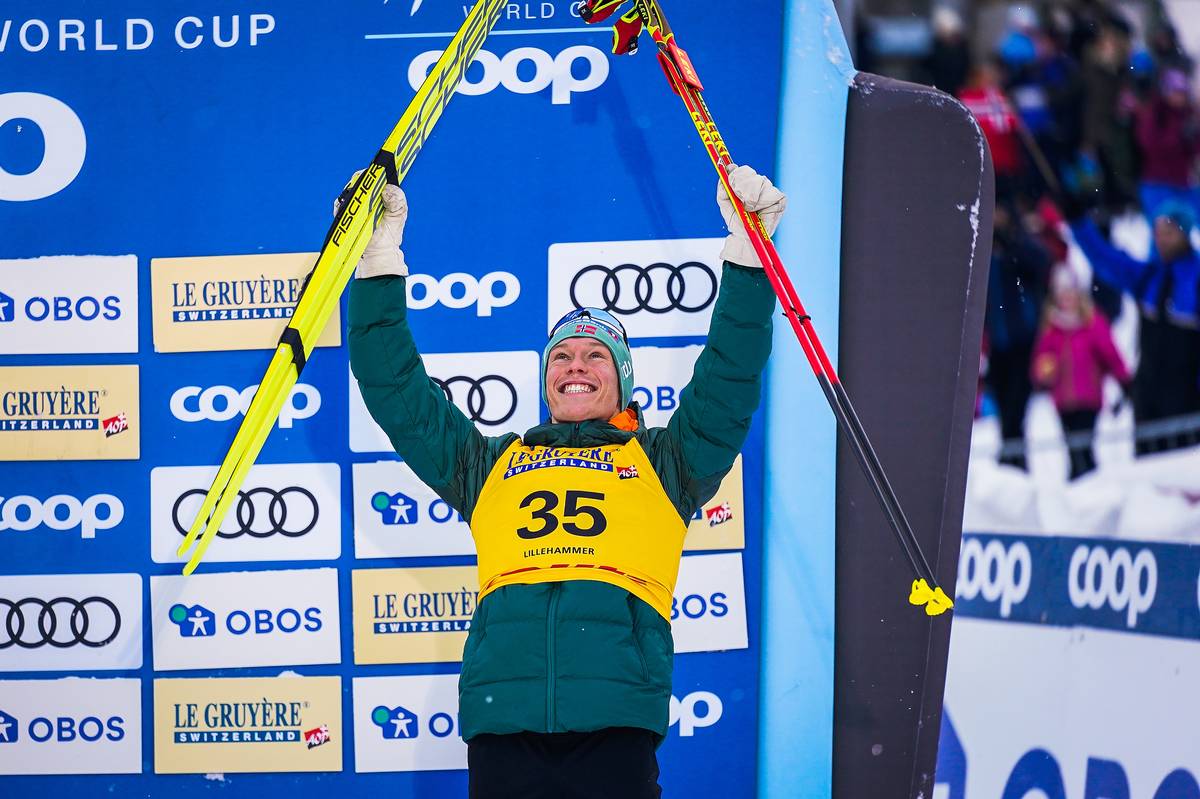
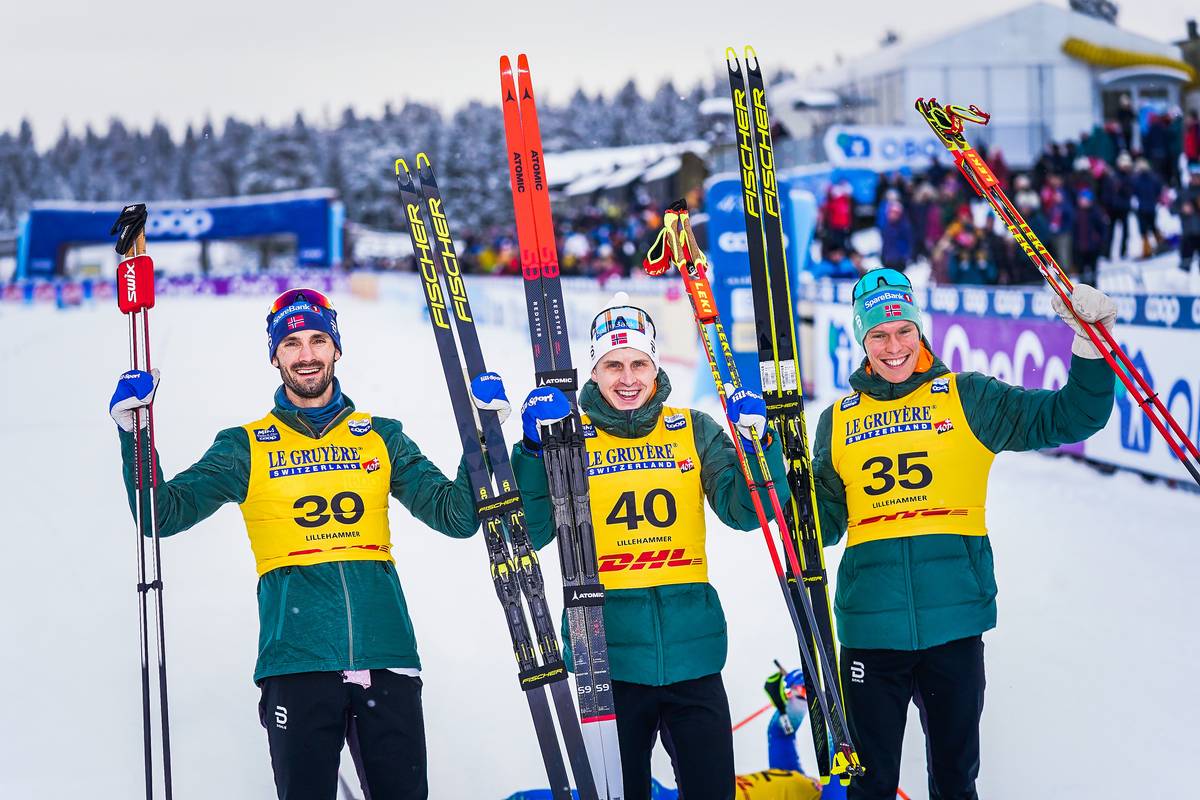
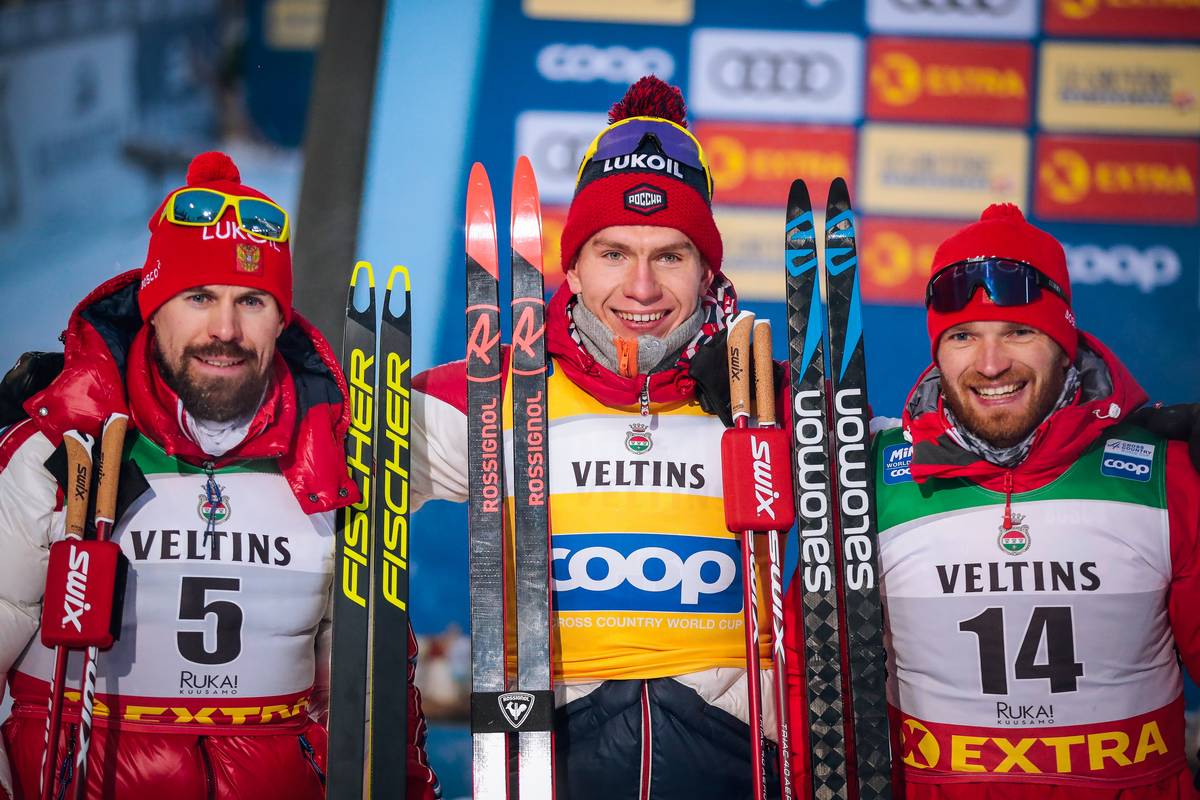
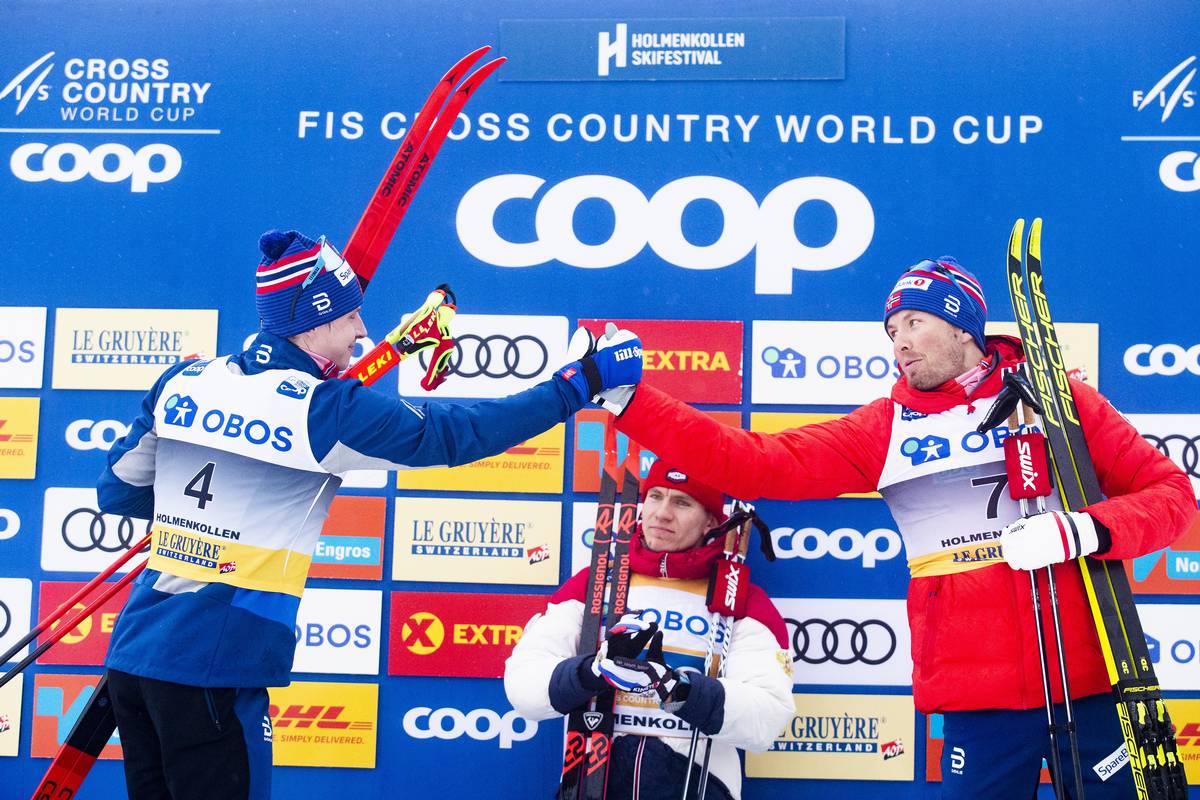
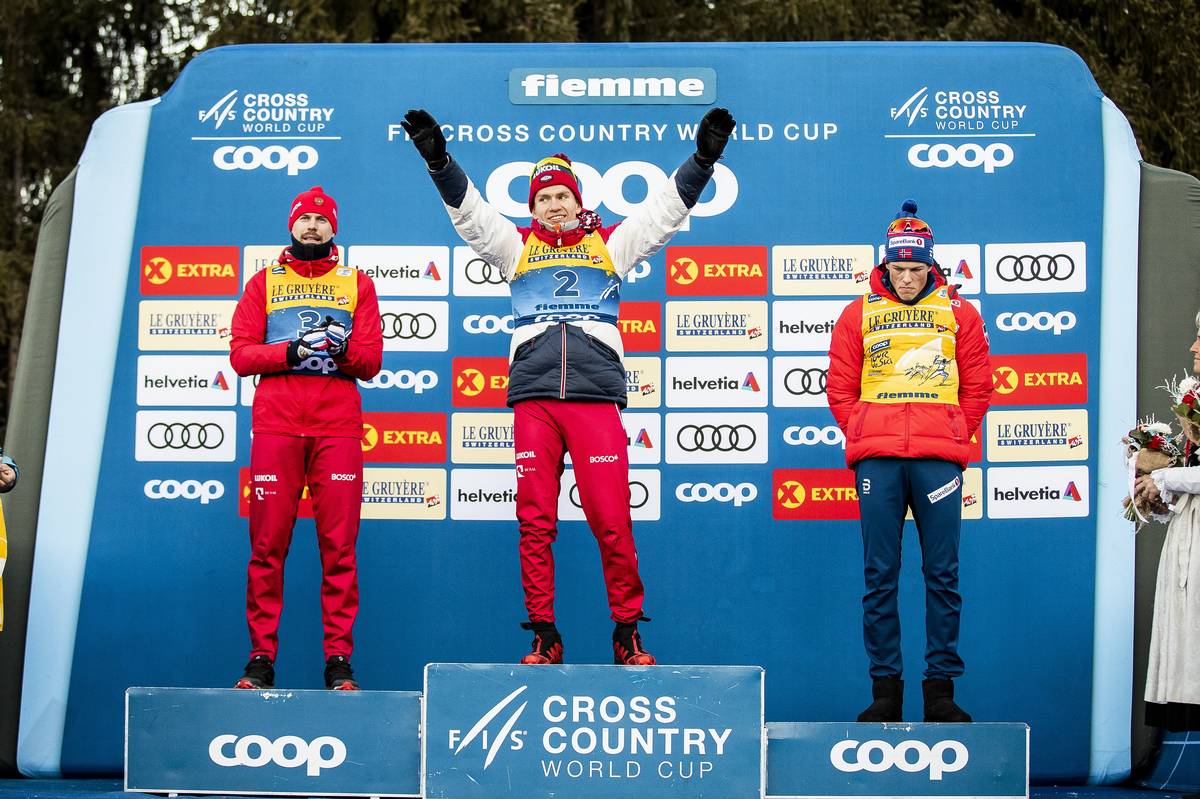
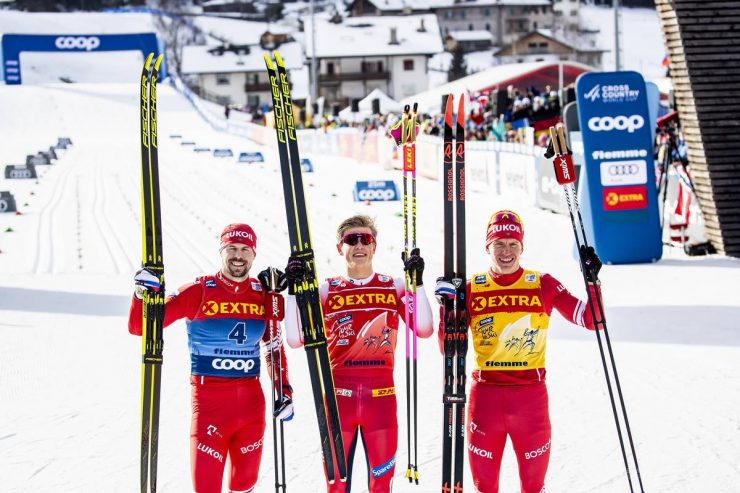
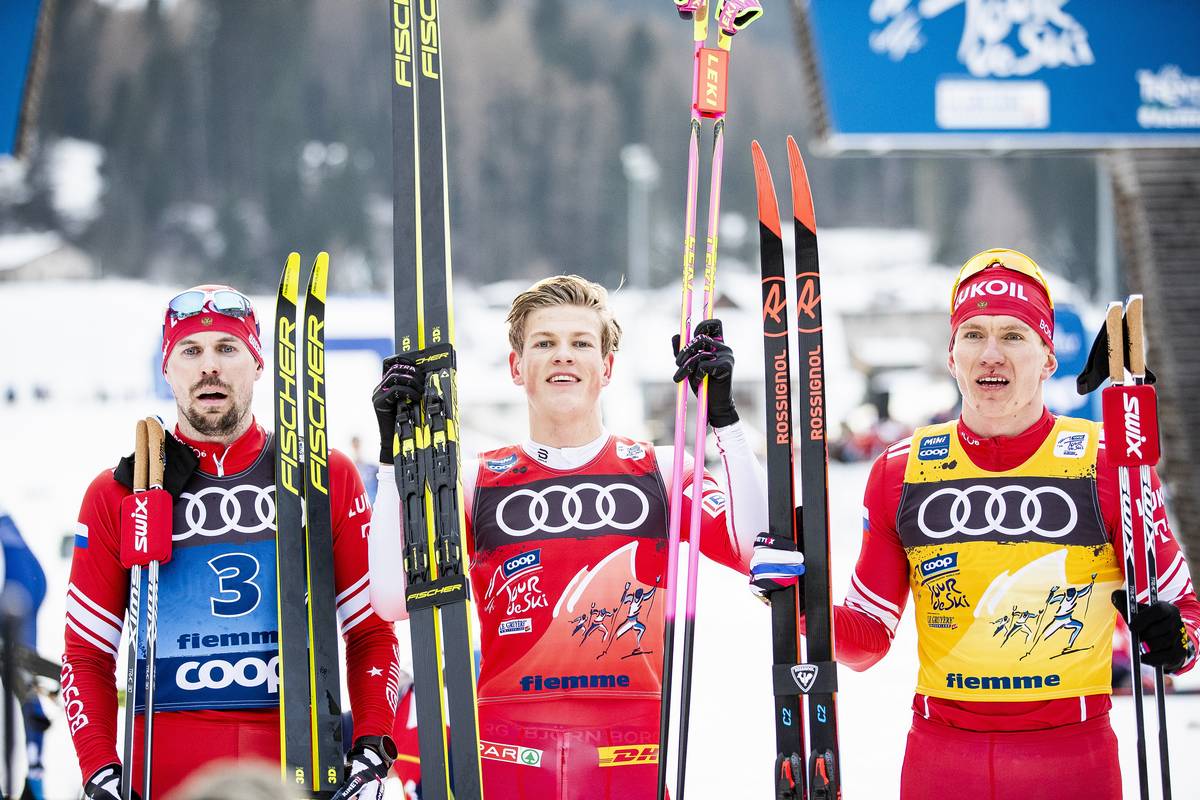
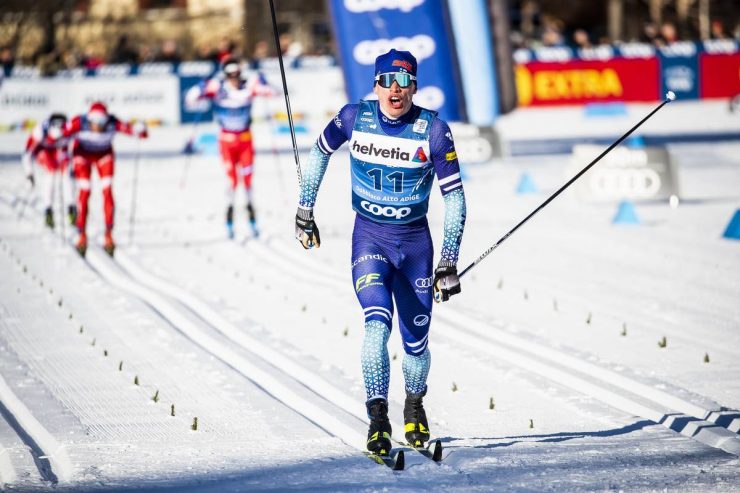
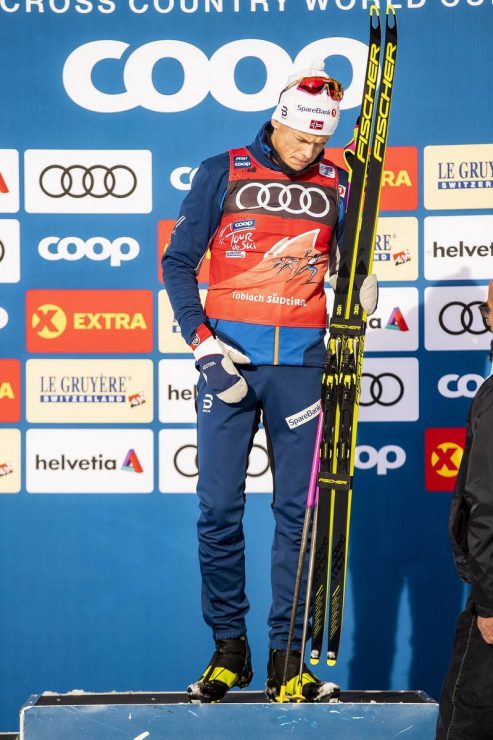
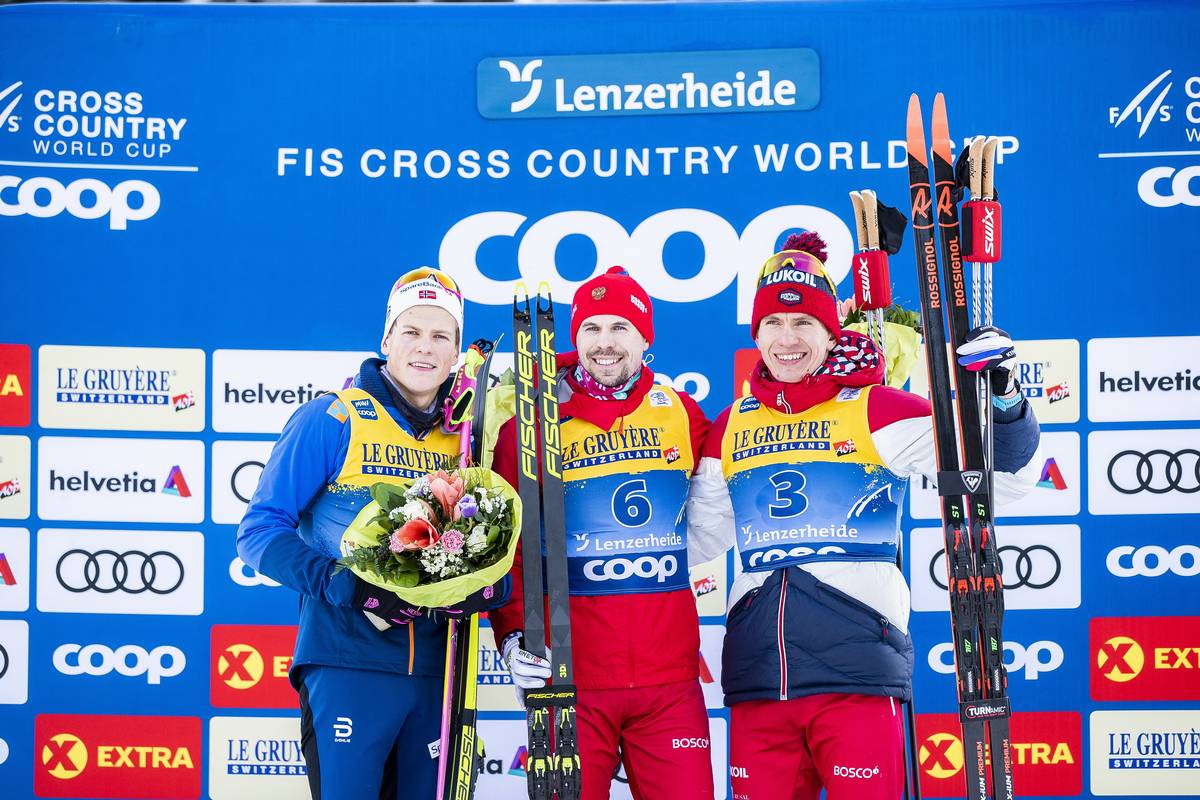
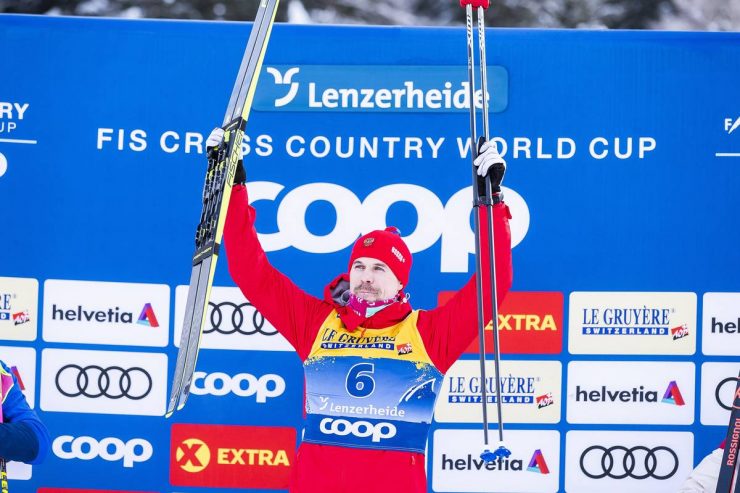
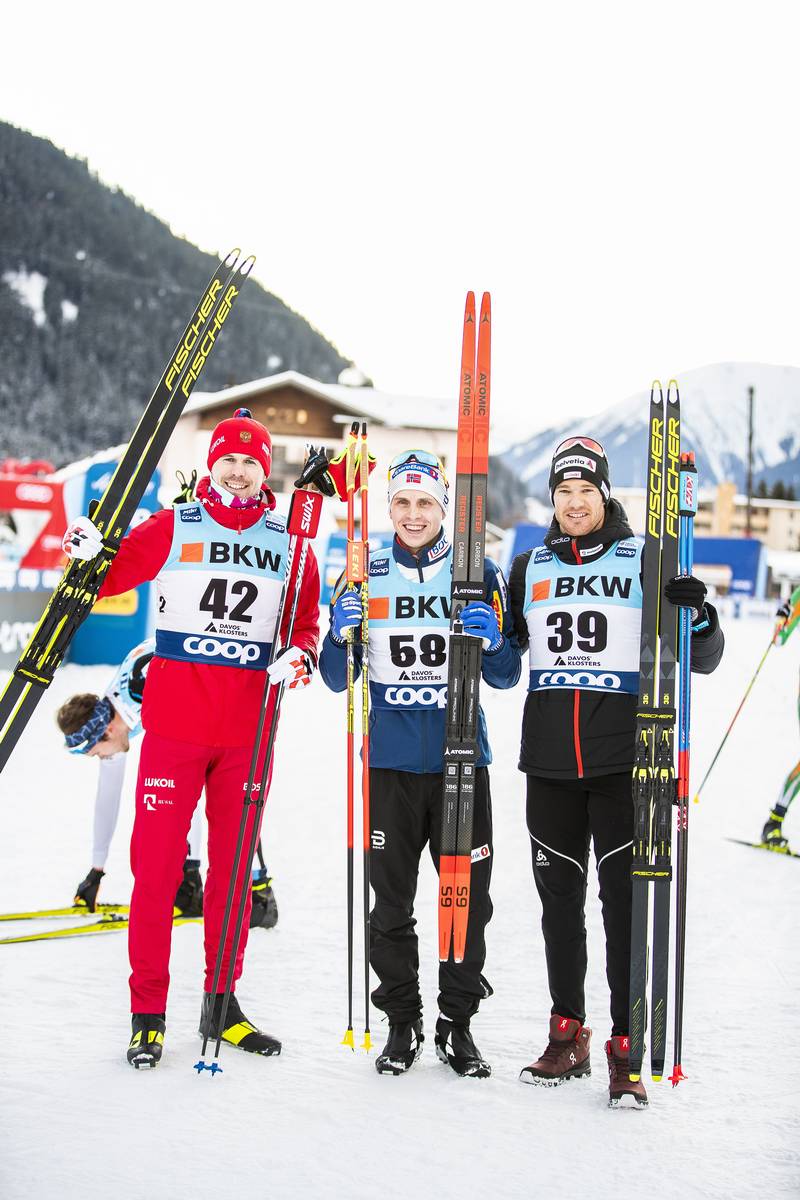
The men’s 15k freestyle podium in Davos: Simen Hegstad Krüger (NOR) took the win with command ahead of Johannes Høsflot Klæbo (NOR) and Sergey Ustiugov (RUS). (Photo: NordicFocus)
This World Cup coverage is made possible through the generous support of Marty and Kathy Hall and the A Hall Mark of Excellence Award. To learn more about A Hall Mark of Excellence Award or to learn how you can support FasterSkier’s coverage please contact info@fasterskier.com.
The second day in Davos, Switzerland started with the Men’s 15K Freestyle individual race. In contrast to yesterday’s snow and wind, it was a beautiful blue sky day, as 108 men chased splits around the tracks in Davos.
Two of the favorites, Johannes Høsflot Klæbo (NOR) and Alexander Bolshunov (RUS) started one minute apart from each other. The two ascended from the junior level together to quickly become World Cup champions, Klæbo in sprinting and Bolshunov in distance, though the Russian has proven all-around talent.
In total, Klæbo has won 44 World Cup events, including yesterday’s sprint, putting him 3rd on the all-time list behind Petter Northug (47) and Bjørn Dæhlie (46). Bolshunov has won 24 World Cups, with nine individual World Cup distance events in 2021 – already a men’s record for most individual World Cup distance event wins in a single calendar year. As Klæbo has looked to improve as an all-around skier, this matchup is one to watch.
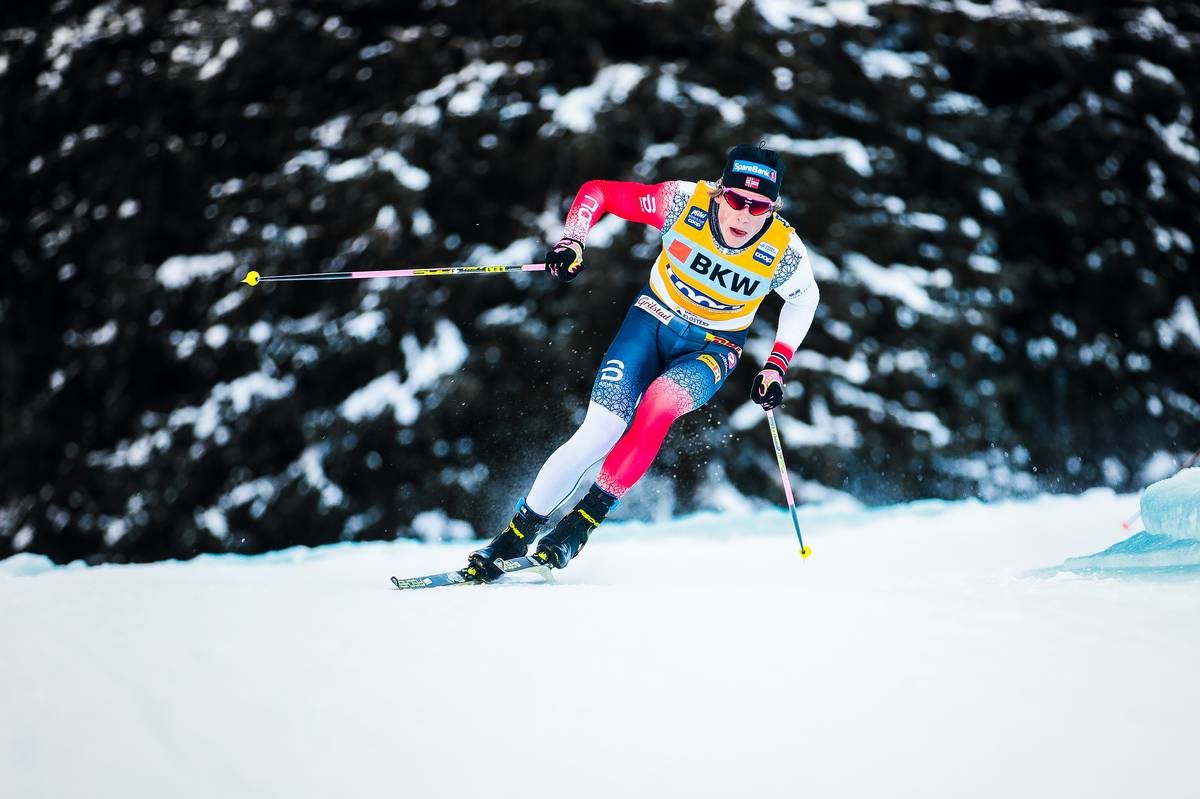
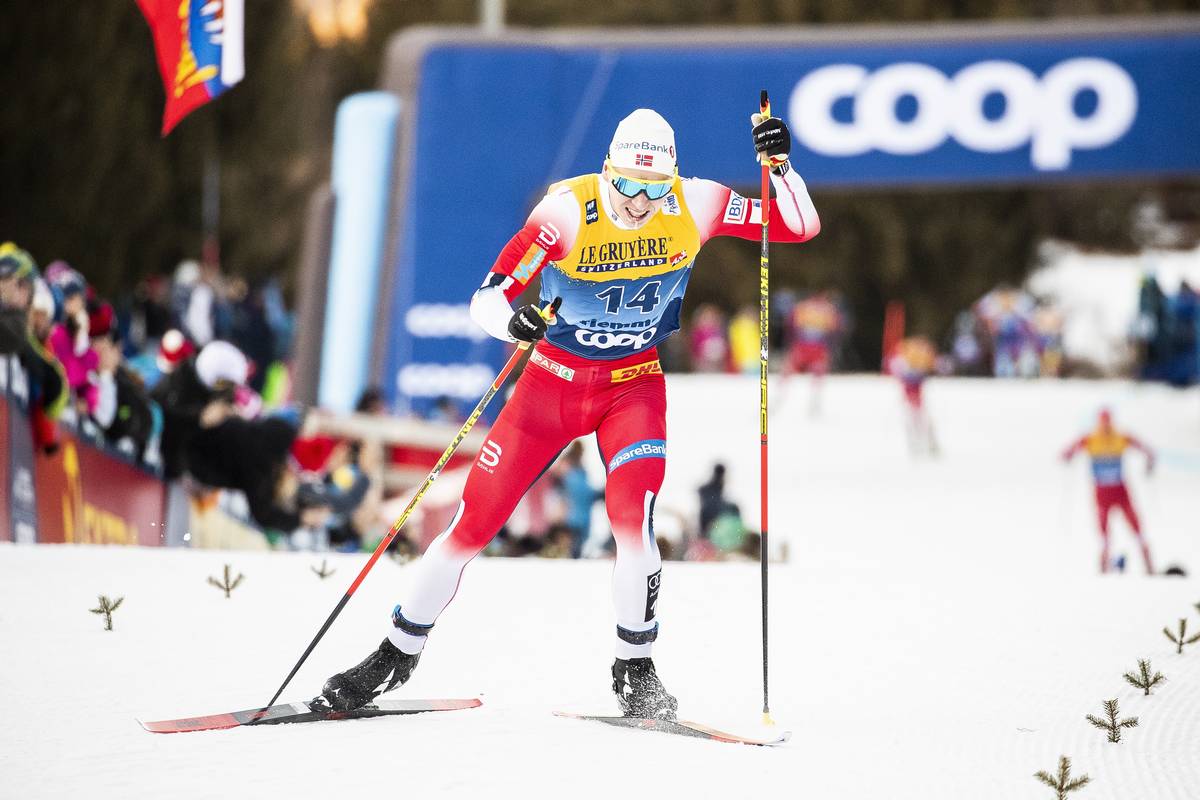
After a conservative start, Johannes Høsflot Klæbo skis to second place in Davos. (Photo: NordicFocus)
Last week’s 15k winner at Lillehammer, Simen Hegstad Krüger looked to win back-to-back individual World Cup distance events. The last man other than Bolshunov to win back-to-back was Sergey Ustiugov (RUS) in the Tour de Ski in 2019.
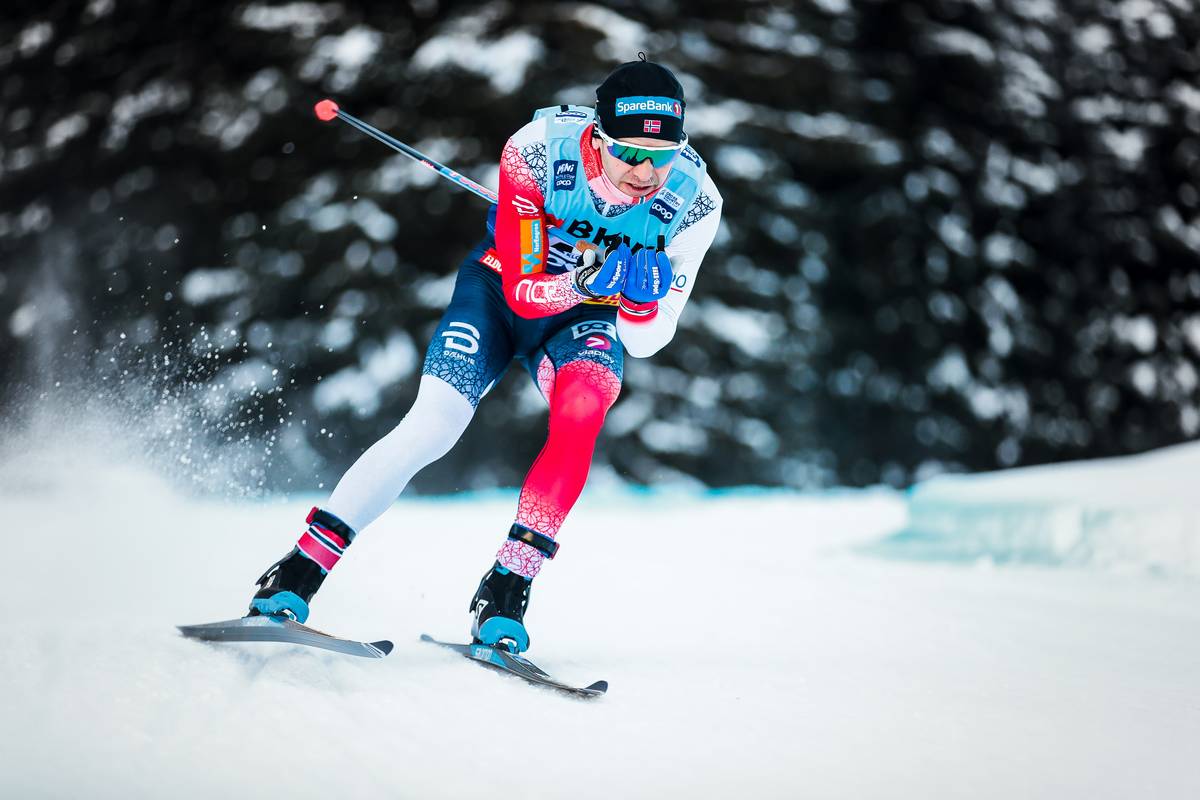
Norway’s Sjur Røthe on course during the 15k individual start freestyle in Davos. (Photo: NordicFocus)
As splits from the seeded middle group of starters rolled in, it looked like Klæbo (+20.4) was struggling through the first 3k with Bolshunov (+6.6) closing the gap between them both. Perhaps not surprisingly after last weekend’s podium sweep and top-15 dominance, Norway had the top-4 spots through the first 3k, held by Krüger, Hans Christer Holund, Martin Løwstrøm Nyenget, and Harald Østberg Amundsen, respectively. Sjur Røthe was also sixth as the team’s fifth man in the top-10, however, Klæbo had fallen just outside the top-30 in the rankings.
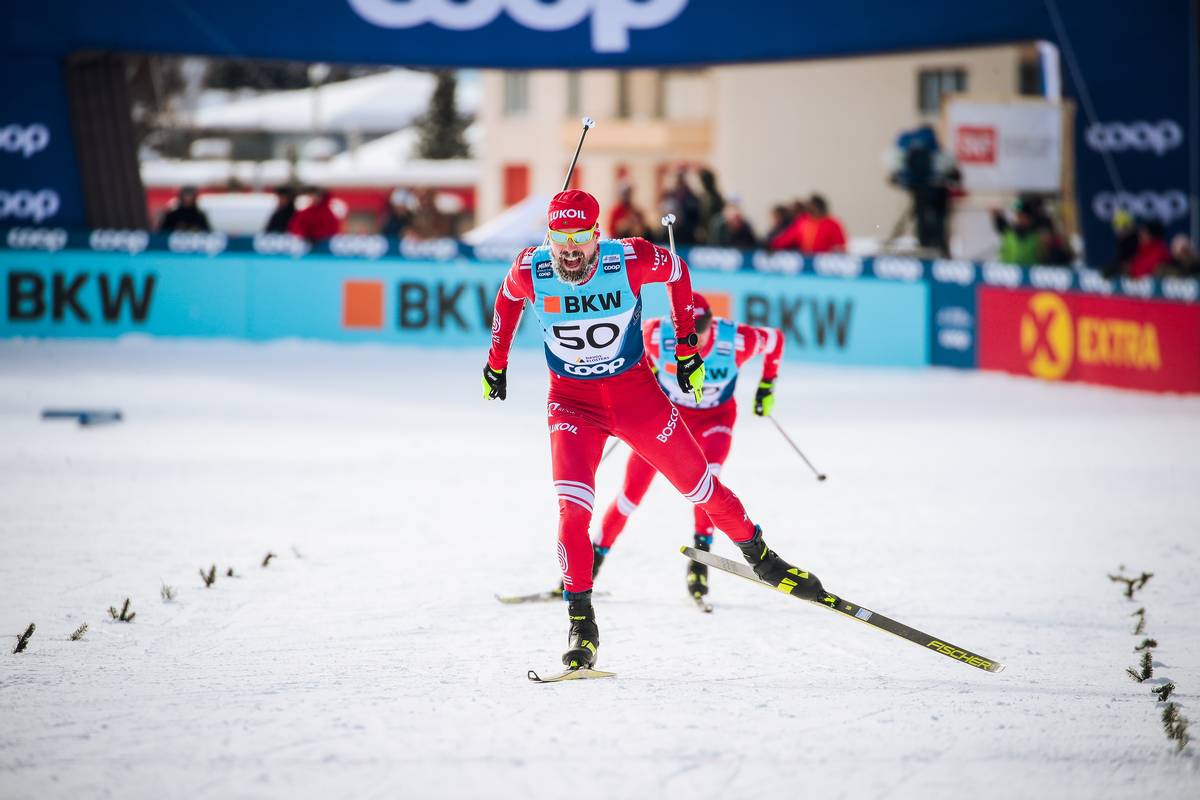
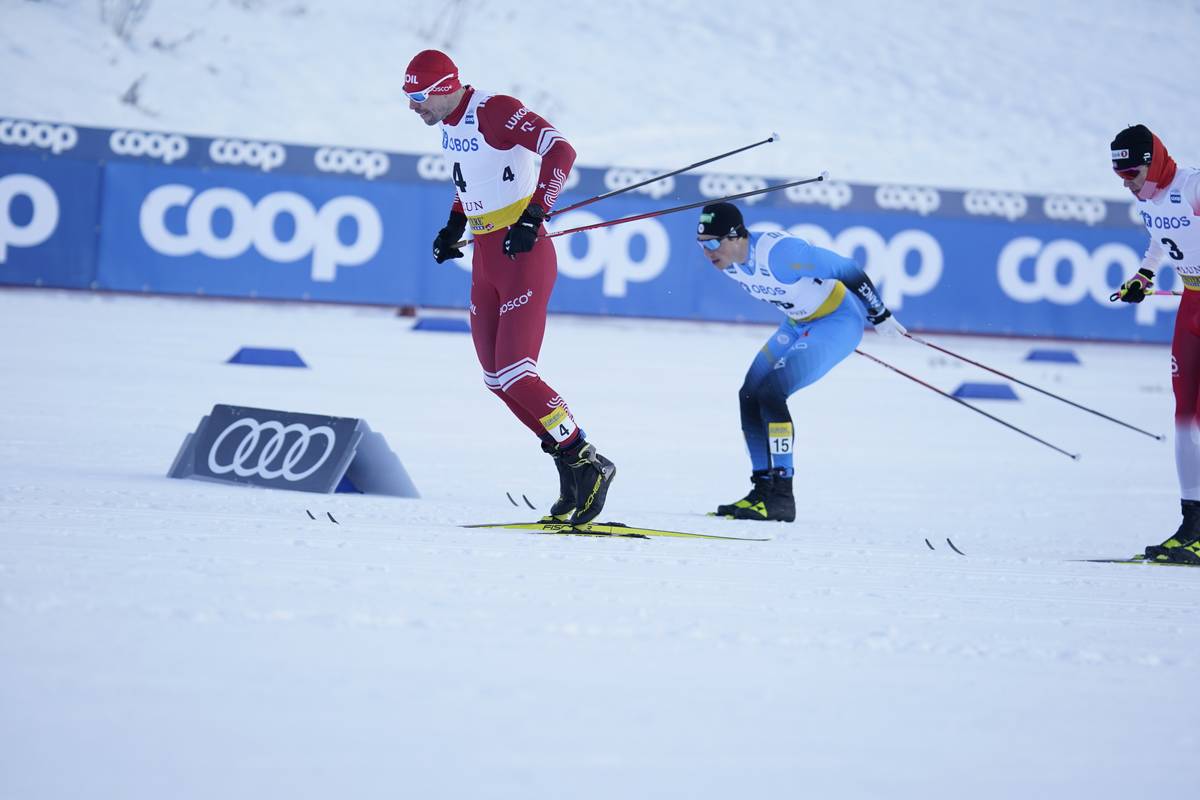
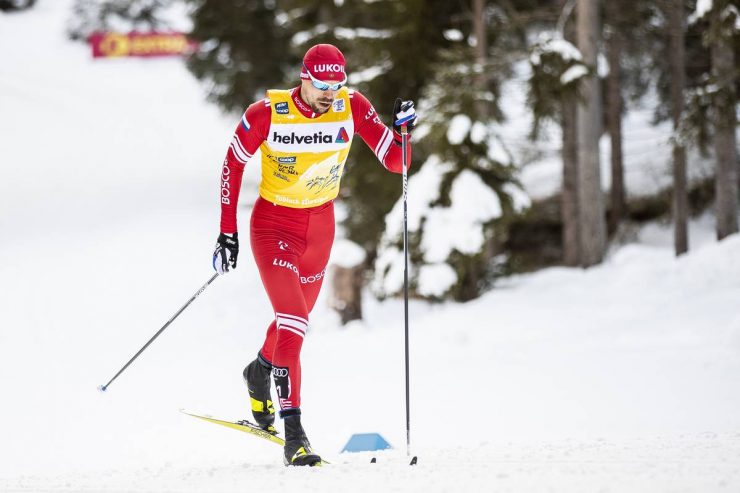
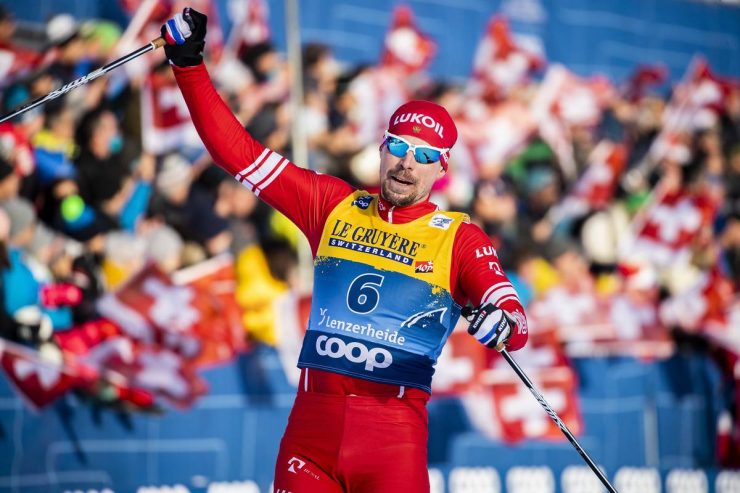
Bolshunov held the lead for the Russian men at this checkpoint, sitting in 8th, but the name that would rapidly ascend the rankings was Ustiugov, who was 19th (+15.6). Ustiugov started in bib-50, later in the lineup than most of the Norwegians except for Krüger, who wore bib-70.
At 12.2k, with roughly 3k to go, the rankings looked similar, with a couple of names making a dramatic swing in standings. Krüger, blasting through each checkpoint as the new leader, had increased his margin to over 24 seconds ahead of his teammate Holund, and Ustiugov had skied all the way up to third.
Simen Hegstad Krüger smashes the 15k skate in Davos. (Photo: NordicFocus)
Close behind by time, Amundsen sat in fourth with Klæbo making a rapid rise into fifth.
Continuing to grow his lead over the final lap, Krüger ran away with the win, stopping the clock at 32:20.4.
Sergey Ustiugov powers down the final stretch for third in Davos. (Photo: NordicFocus)
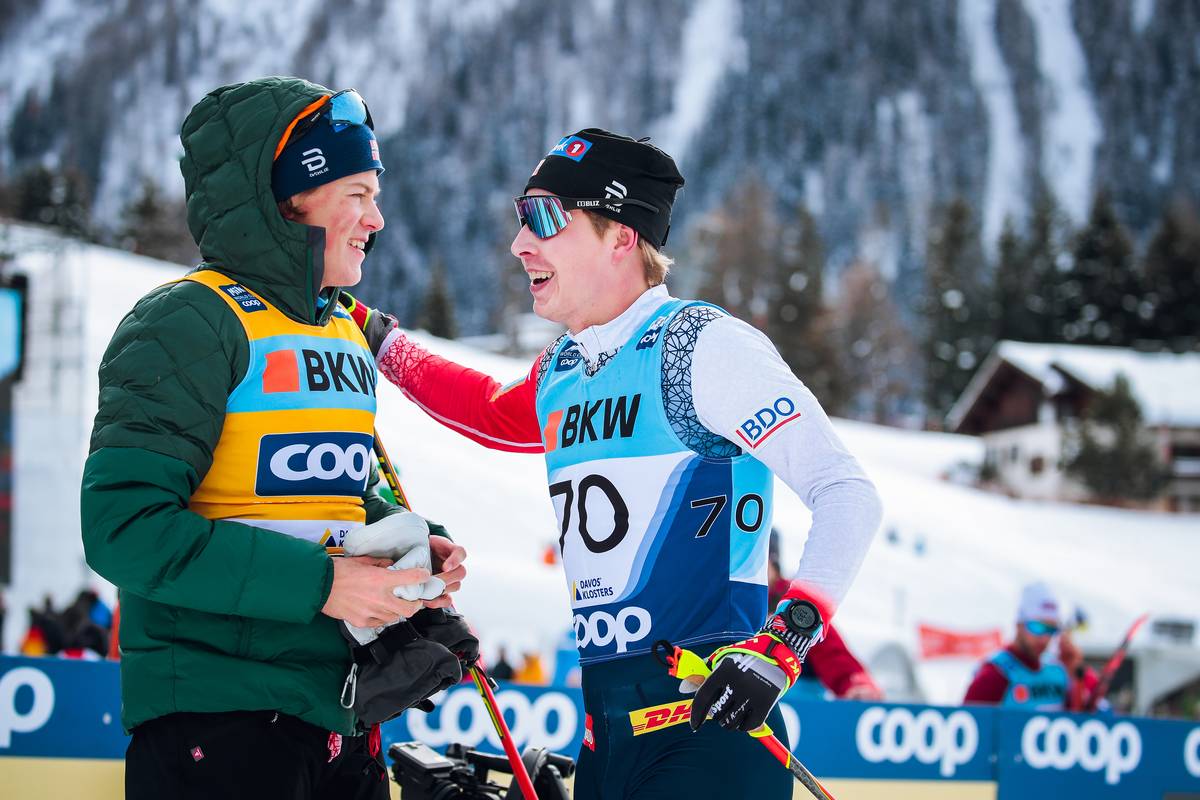
Klæbo hit the final kilometers hard, accelerating to set what would stand as the fastest time of day until Krüger came through 26 bibs later. Ustiugov had beaten Klæbo’s split at 13k, but could not hold the pace required to stay ahead in the final 2k. After all the top men came through, in particular the dominant Krüger, it was decided that Klæbo took second (+22.9) and Ustiugov third (+27.2), both men earning their second podium of the weekend in Davos.
After back-to-back distance wins, Krüger gave the following remarks in a FIS interview from the leaders chair:
“It feels great and I like it here and I enjoyed every minute of skiing today. My skis were incredible and I just enjoyed every single minute of it. It was a really fun day today.”
Johannes Høsflot Klæbo hands over the leader’s chair to his teammate, Simen Hegstad Krüger, who had smashed the fastest splits at every checkpoint. (Photo: NordicFocus)Winning back-to-back 15k freestyle races, Simen Hegstad Krüger is on form. (Photo: NordicFocus)
The remaining top-10 was composed of three Norwegians, two Russians, and two French skiers. Amundsen (NOR), Holund( NOR), and Røthe (NOR) finished 4th (+32.), 5th (+33.7) and 6th (+38.3), respectively. Artem Maltsev (RUS) finished in 7th (+39.4) with fellow teammate, Ivan Yakimushkin (RUS) finishing in 9th (+52.0). Maurice Manificat (FRA) had a strong race to finish in the top 10 in distance for the second week in a row, this time in 8th (+50.8). His teammate, Hugo Lapalus (FRA) finished 10th (+54.7).
Bolshunov dropped back to 12th in the standings, following 14th place in this event last weekend in Lillehammer. The three-time overall World Cup distance champion has not been outside the top-10 in consecutive events since December 2018.
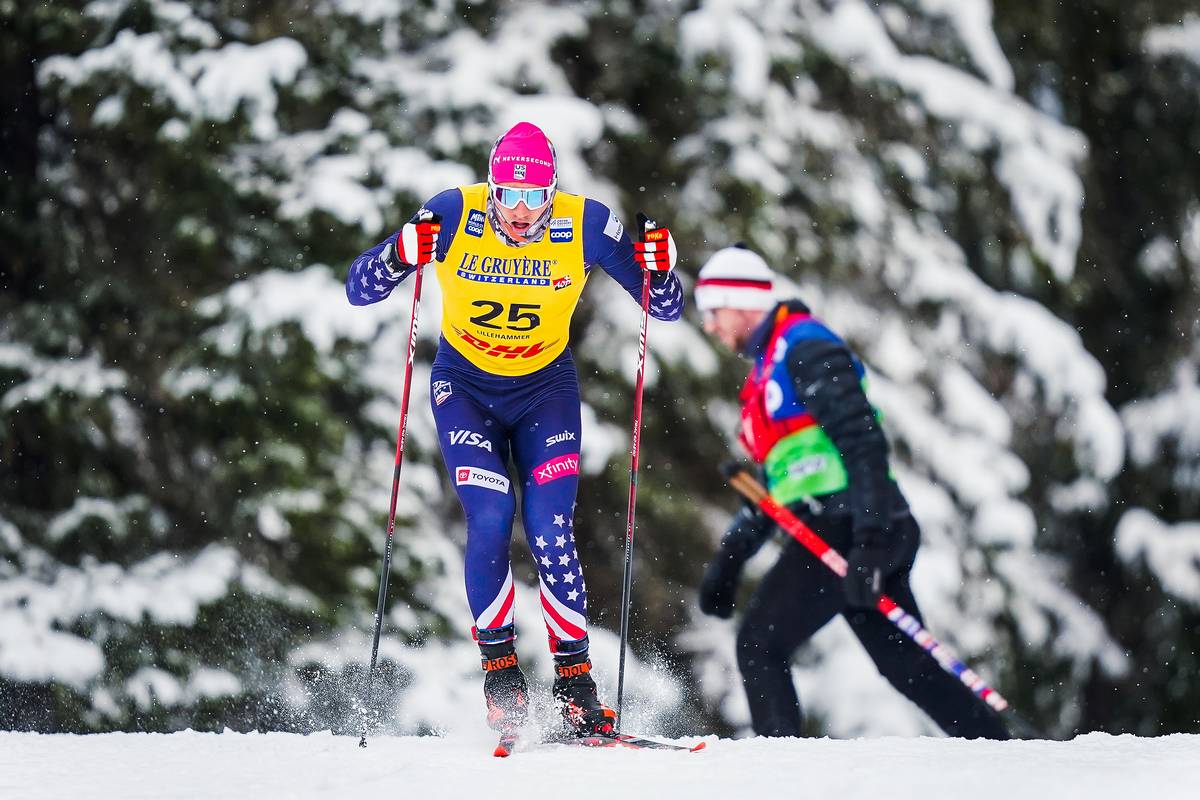
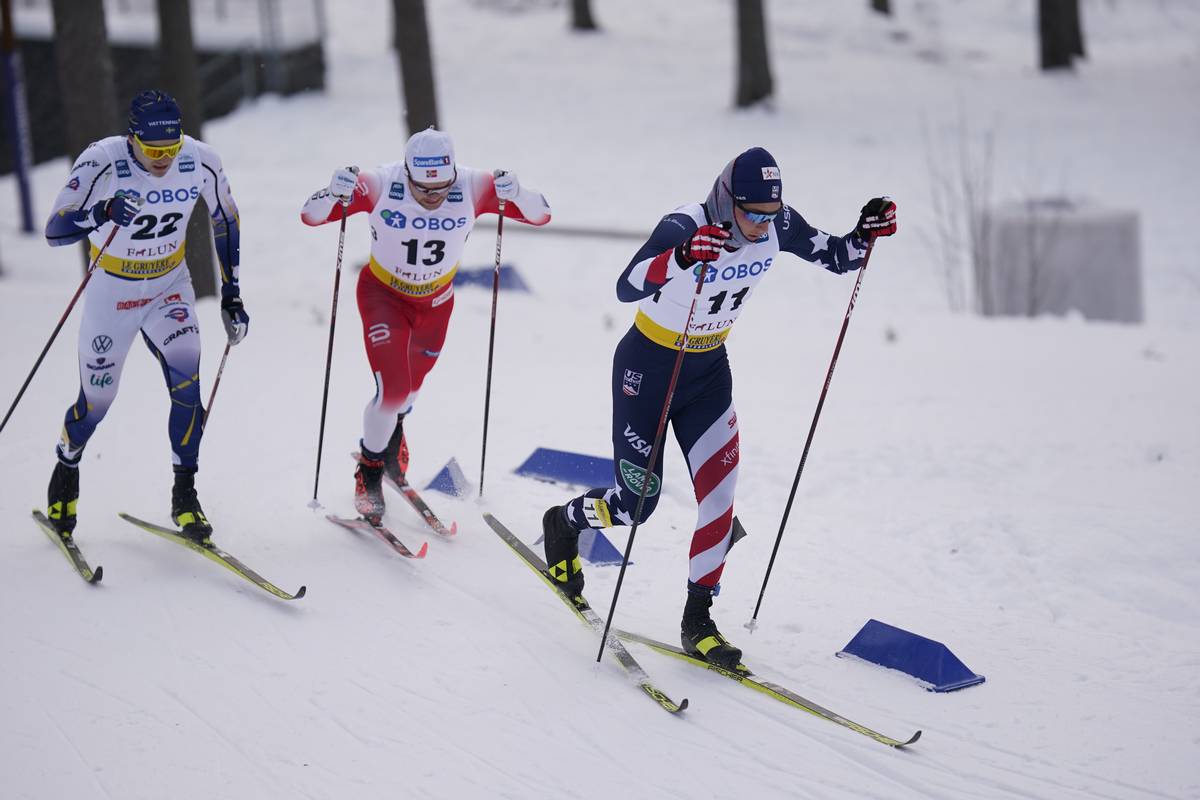
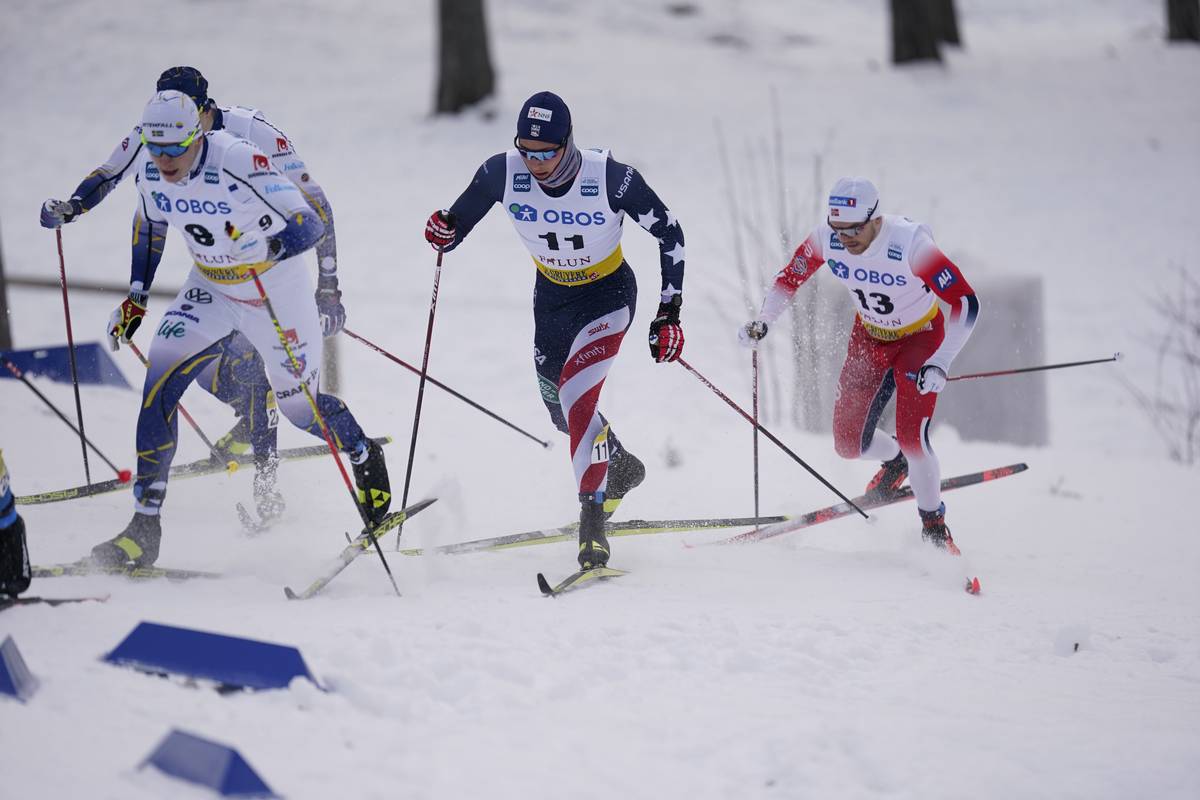
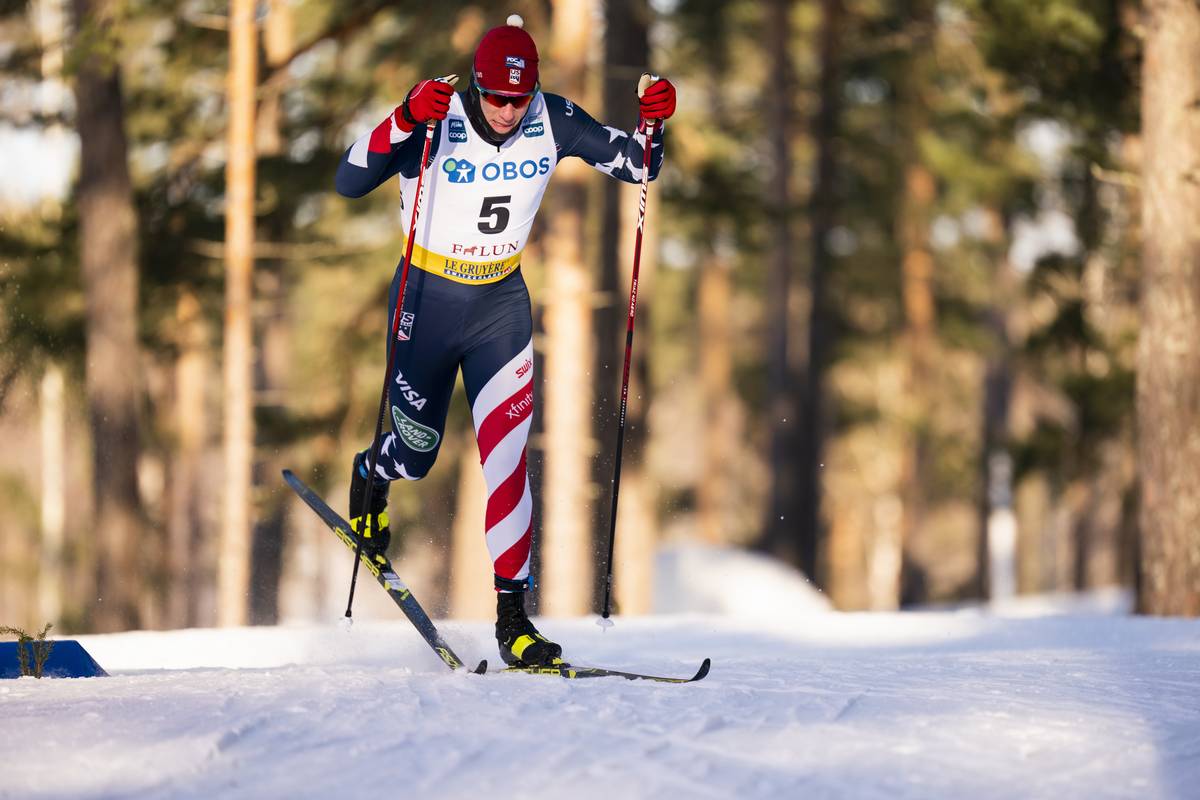
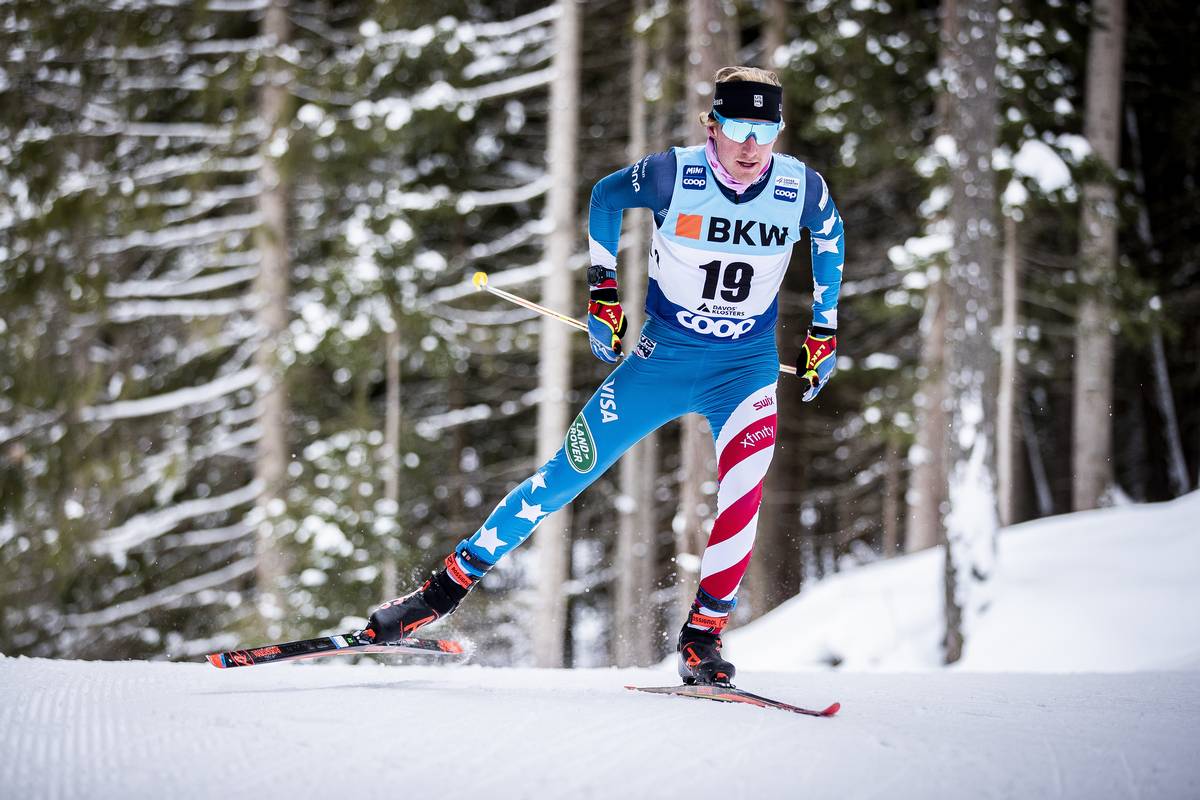
Gus Schumacher leads the American men with a 29th place finish in the distance race in Davos. (Photo: NordicFocus)
The top U.S. Skier in Davos was Gus Schumacher sat inside the Top-30 throughout most of the race, rising as high as 18th at the 5k. Having started just behind Swedish junior champion William Poromaa, Schumacher held his margin to the Swede even through the first half, then began to cede time to the leaders. Schumacher ended his day in 29th (+1:53.8), improving upon his result from the Lillehammer 15k, where he finished 38th.
“[I’m] pretty happy with it, but i still think I have better races coming,” Schumacher reflected in a post-race email. “I think I did a better job with pacing than last year, but still didn’t quite nail it. Definitely getting a better handle on the race routine and pacing, and I’m looking forward to some more races later this season!”
Schumacher added that he plans to stay in Davos through Christmas with “the boys”, which he said will be “magical.”
Ogden, coming off a fantastic sprint yesterday, was the next American in 51st (+2:39.7). Norris (USA) had a solid race coming in just behind Ogden in 54th ( +2:44.7). Schoonmaker, Wonders, and Patterson finished in 66th (+3:03.5), 70th (+3:07.5), and 75th (+3:26.0) respectively.
David Norris on course during the 15k individual start freestyle in Davos. (Photo: NordicFocus)
After a weekend at altitude, the World Cup now heads to Dresden, Germany for an exciting individual and team sprint in the city. This will be the last races before a break for the holidays, and then we begin the Tour de Ski.
This World Cup coverage is made possible through the generous support of Marty and Kathy Hall and the A Hall Mark of Excellence Award. To learn more about A Hall Mark of Excellence Award or to learn how you can support FasterSkier’s coverage please contact info@fasterskier.com.
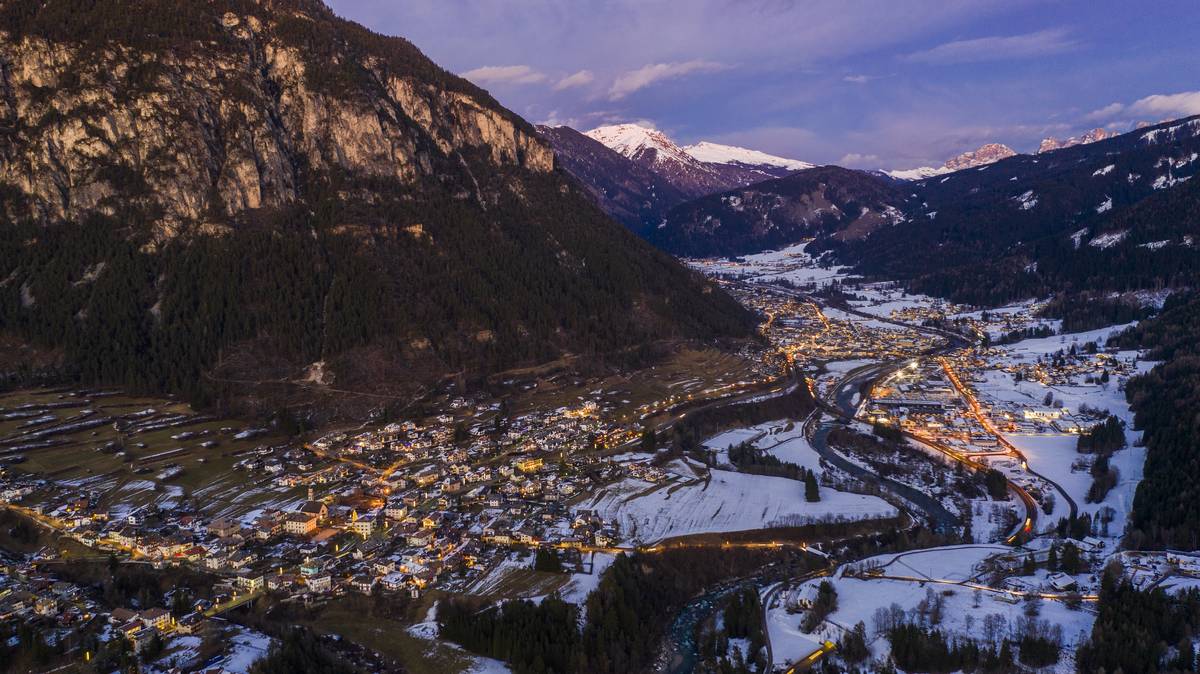
Three weeks in, the World Cup swings to the picturesque Alpen valley which holds Davos, Switzerland. As may be hinted by the towering mountains surrounding the glacial valley, Davos sits roughly a mile high in elevation, making this the first high-altitude stop of the World Cup season. Most seasons, that simply means less available oxygen for the athletes to consume, adding a variable that might shake up what is expected on the results sheet.
However, with less than two months to go until the start of the 2022 Winter Olympics, performance at altitude might carry additional weight. According to FIS, the cross country course at the Kuyangshu Nordic Center near Zhangjiakou, China tops out at 1,800 meters, just under 6,000 feet, in elevation. By concentration of available oxygen per volume, that translates to a deficit of roughly 4% relative to competition at sea level. Altitude is its own beast, and it is not always as simple as adjusting pace when it comes to optimizing performance as an athlete.
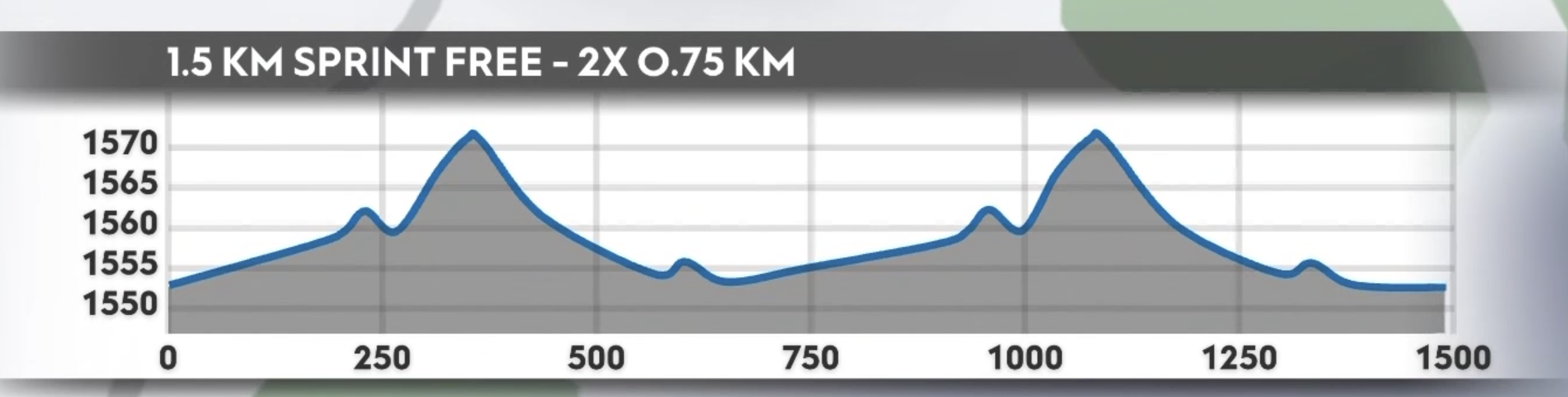
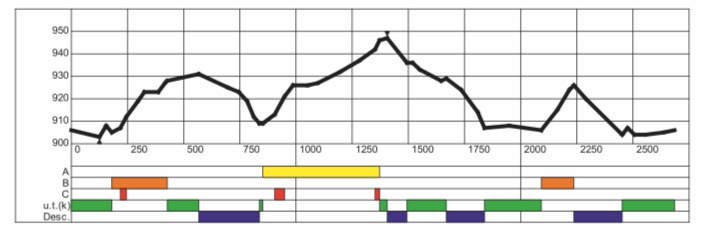
Altitude and rugged mountain backdrop aside, the sprint course in Davos sits on the valley floor, making it relatively flat compared to other venues. The maximum climb on the two-lap 1.5-kilometer course is just 12 meters; 30 meters or more is needed to meet the criteria of an A-Climb by FIS homologation standards.
The elevation profile of the two-lap 1.5k sprint course in Davos, SUI. (Photo: FIS Broadcast)
Taking command in the qualifier, Norway’s Johannes Høsflot Klæbo set the fastest time of 2:24.16. Lucas Chanavat of France was second in the qualifier (+1.51) followed closely by Federico Pellegrino of Italy, whose name we have not yet seen in the final. That said, Pellegrino had history in his favor when it comes to freestyle sprints on Swiss snow.
Coming into the weekend, he had won three freestyle sprints in Davos, including last year, along with two wins in the freestyle sprint stage of the Tour de Ski in Val Müstair, SUI a couple of weeks later. Pellegrino has also won multiple times in Cogne, Italy, at a similar elevation, and has shown prowess on flat courses, including the city sprint in Dresden, Germany.
Federico Pellegrino (ITA) races to third in qualification in Davos. (Photo: NordicFocus)
The Italian’s stats in Davos are only matched by Klæbo, who also has three wins at the venue. Today was the tie breaker. Who would take home a fourth wooden sled for his collection?
On the American front, Ben Ogden was the only athlete who qualified for the rounds today. Ogden skied to 13th (+2.87) and raced in heat five of the quarterfinals.
The storyline of Pellegrino versus Klæbo was decided before the two could line up to face each other head to head. Klæbo advanced smoothly from the first heat, however, Pellegrino was knocked out in his quarterfinal shortly thereafter.
Italy’s Federico Pellegrino pushes the pace during his quarterfinal of the freestyle sprint in Davos. (Photo: NordicFocus)
In heat two, Pellegrino took the lead in the second lap, hopskating up the primary climb and powering over the top just ahead of Norway’s Håvard Solås Taugbøl and Richard Jouve of France. Holding his position at the front as the men pushed around the final curve, Pellegrino was matched by the surging men as they each held their own finish lane while sprinting to the line. Jouve had the fastest acceleration, gaining the advantage as the three men threw their boots for a photo finish. Jouve took the heat, with Taugbøl 0.12 seconds behind, leaving Pellegrino third (+0.2) Unfortunately for the Italian, the tactical heat was too slow for him to advance to the semis.
In Ogden’s quarter, two Swiss men, Jovian Hediger and Valerio Grond, pulled from the front through the first lap. As the men hit the primary climb in the second lap, Russia’s Alexander Terentev, who won the opening sprint in Ruka, accelerated up the left side of the course, cresting the hill with the two Swiss men, creating a spicy final turn into the stadium. Grond caught a ski tip on his teammate’s tails, causing him to lose speed in the turn, but all of the men stayed upright.
Ben Ogden (Bib 13) races into the semifinal from a tight heat of the quarters. (Photo: NordicFocus)
Terentev led in the final straight, but Ogden and Sweden’s Anton Persson, who had maintained contact throughout the heat, were rapidly gaining ground on the Swiss skiers. Coming to the line four across, the men slid over the finish, Persson in second (+0.37), followed by Grond (+0.44), and Ogden (+0.53), with Hediger just behind in fifth (+0.74). Though it was the final heat of the quarters, it ended up being the fastest, allowing both Grond and Ogden to advance to the semifinals. Hediger (SUI) could be seen swatting the ground with his pole at the finish upon seeing his result.
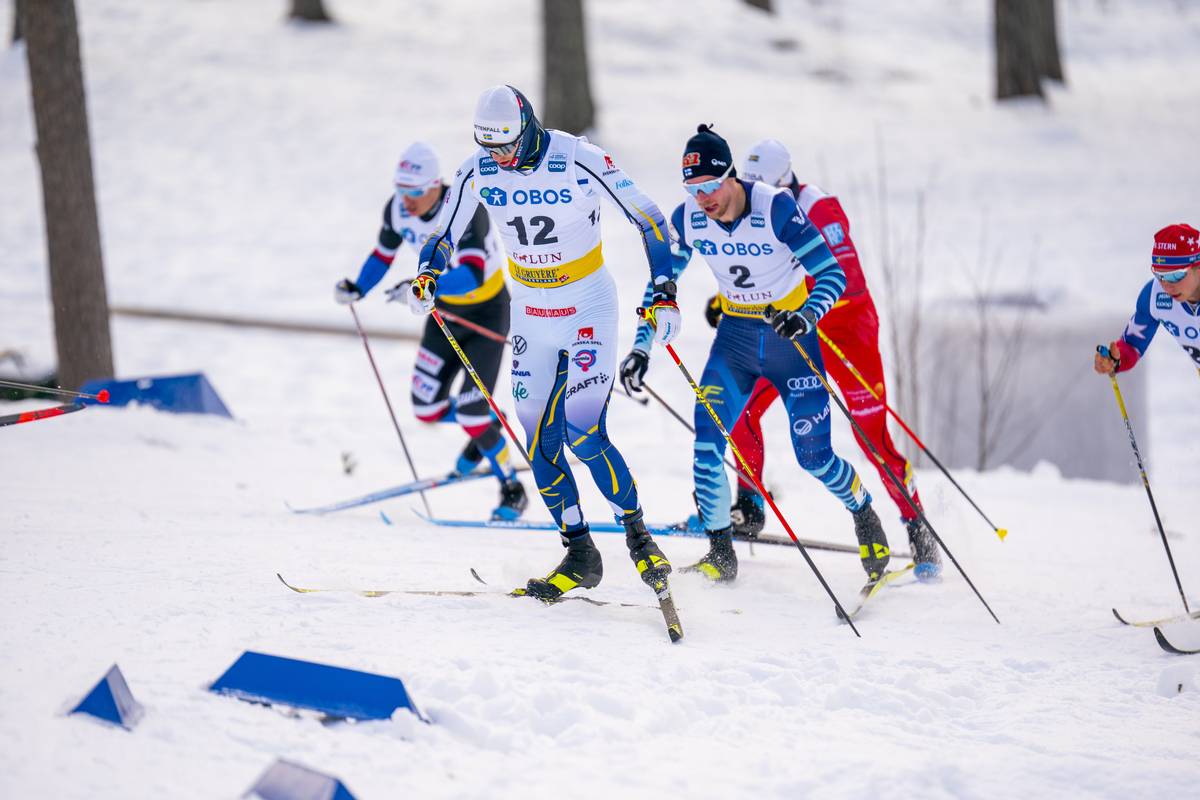
In the first heat of the semis, Ogden lined up with three Norwegians, Klæbo, Taugbøl, and Erik Valnes. The heat also contained Jouve, and Russia’s Sergey Ustiugov, who had challenged Klæbo in the quarters.
Ustiugov takes the lead in the semifinal in Davos. Note Ben Ogden in contact wearing bib 13. (Photo: NordicFocus)
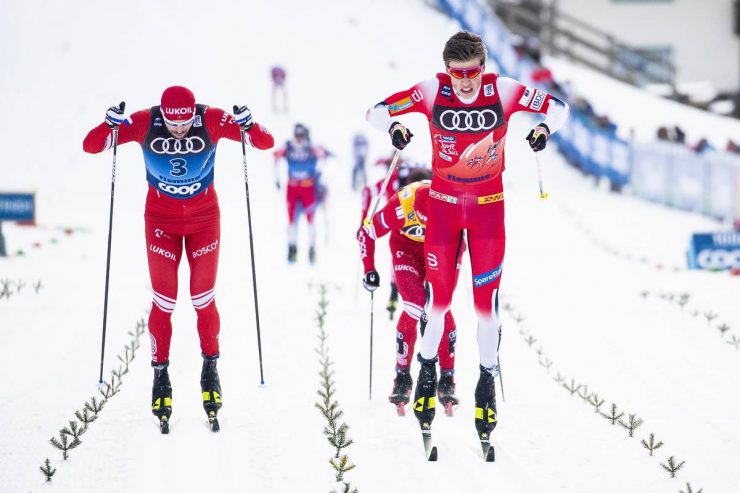
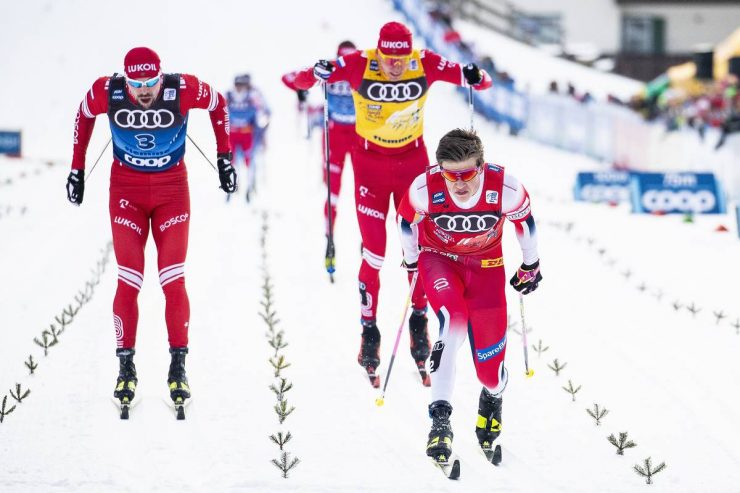
As the pace accelerated in the final lap, Ustiugov took to the front again, this time seeming to want a larger margin over Klæbo as they headed into the final turn and straightaway. Though the Russian led into this turn, Klæbo was able to slingshot around the outside, earning a clear lane to the finish. The Russian was on his right, with Valnes on the other side. Perhaps too confident for his own good, Klæbo stood up before the line, coasting across with a boot kick that looked like an afterthought.
Erik Valnes (NOR), Sergey Ustiugov (RUS), Johannes Klaebo (NOR), (l-r) (Photo: NordicFocus)
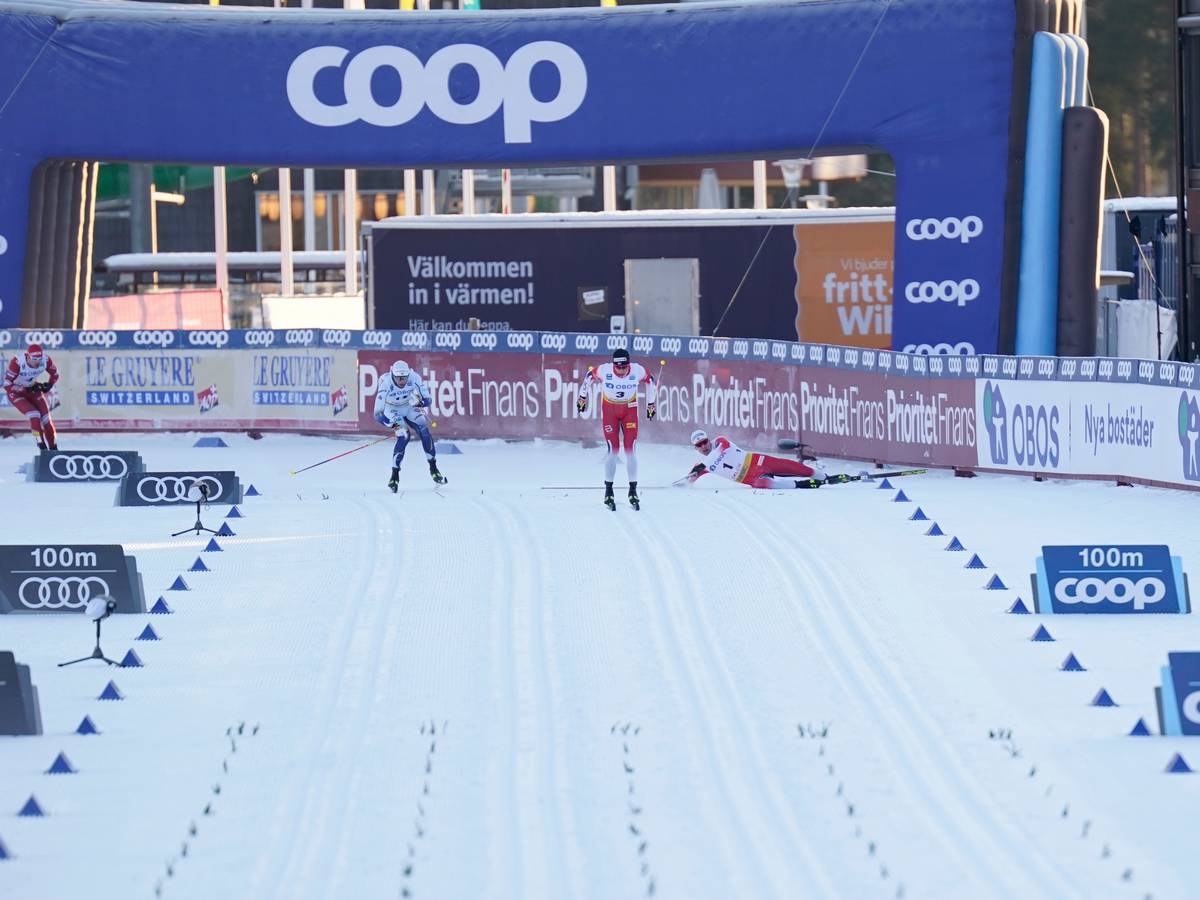
With five men still tight around him, this allowed Ustiugov to take the win, while an accelerating Jouve tried to throw his boot along Klæbo’s left side, from within the same lane, just 0.14 seconds behind the Norwegian. With multiple athletes vying for limited real estate at the finish, Klæbo had his tails skied over, sending him abruptly onto the ground just after he crossed the line.
Valnes was fourth in the heat, followed closely by Taugbøl; these first five men were spread by only 0.58 seconds in total. Ogden, who had lost contact in the second lap, held on for sixth in the heat (+7.28).
While still tight, the second heat of the semis had a clear winner, Chanavat of France. Behind him was Even Northug of Norway, followed by Terentev, whose time was not fast enough for a lucky loser spot in the final.
The pace was pedestrian as the first lap of the final progressed, the athletes seemingly biding their time and conserving energy for a tactical second lap. Mirroring the first two rounds of racing, Ustiugov made a big push in the second time up the climb as the men powered uphill with impressive tempo. But again, as they headed downhill and around the final right-hand curve, it was Klæbo on the Russian’s tails, shooting around the outside and into the center lane as he cruised to the finish for a commanding victory.
This time waiting to celebrate until he was over the line, Klæbo took home his fourth win on the tracks in Davos. Ustiugov held pace for second (+0.87), followed by Jouve in third (+1.23).
Johannes Høsflot Klæbo takes the win in Davos, while Sergey Ustiugov and Richard Jouve accelerate to second and third. (Photo: NordicFocus)
Off the podium, Valnes was fourth in the final (+1.31), followed after a gap by Northug in fifth (+3.74) and Chanavat in sixth (+7.95).
“It was an amazing day,” Klæbo told FIS at the finish. “I think it was really, really fun to race out there. I was a little bit skeptical because of the weather before we started today, but I think the conditions are really really good and it was a fair fight, which was really nice.”
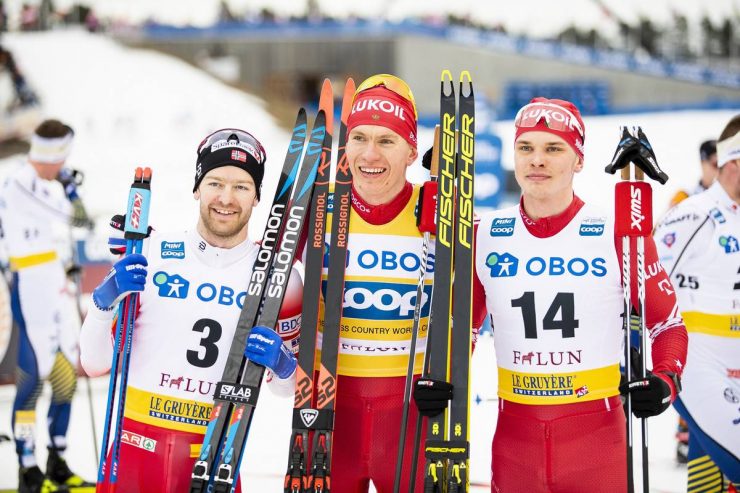
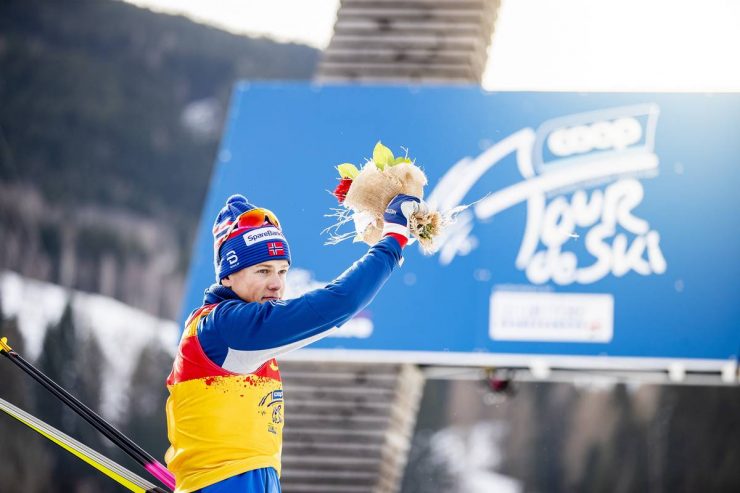
The men’s podium of the freestyle sprint in Davos. Johannes Høsflot Klæbo (NOR) took his fourth win at the venue, ahead of Sergey Ustiugov (RUS) and Richard Jouve (FRA). (Photo: NordicFocus)
It was a blustery day with light snow peppering the athletes throughout the rounds, a contrast to the sun and blue sky we often expect from the venue. Klæbo also shared that he will have an extended stay in Davos, putting in some additional time and training at altitude.
“I’m going to be here now until the 22nd of December, so I have a few more days left here, and it’s beautiful now, and I see that the weather is going to be much better next week, so I’m looking forward to some nice weeks here.”
After the final standings were firmed up, it was concluded that Ogden finished his day in 12th.
Ben Ogden races into the semis in Davos. (Photo: NordicFocus)
“Today was a lot of fun,” wrote Ogden in a post-race email. “For the qualifier, I knew it was going to be hard but there was a good amount of rest out there so I wasn’t afraid to pretty much pin it out from the start ,which thankfully worked out well. I was definitely slower the second time up the hill but was able to push hard over the top and get into the finish without anything catastrophic happening. I was surprised and happy to qualify in 13th.
“In the quarter final, I figured it was going to be fast because all of us qualified so close to each other. I learned on the first lap that my skis were very fast, so when the other guys got a little gap on me over the top of the hill on the second lap, I was still hopeful. Then they made the critical mistake of sliding the first bit of the last corner, and because I was a touch behind I could step around it and set myself up well for the final straight. I bet it wasn’t pretty, but it was just enough to get me into the semi finals for the first time! Really pumped with this. I always figured I would first advance [into the semifinals] in classic, but things came together today so that was awesome.”
Ben Ogden puts together a career-best finish in Davos, ending his day in 12th. (Photo: NordicFocus)
“I did, however, learn that there is a reason all the fast guys pack into quarter final 1 and 2 when I finished and learned that I had just over 10 minutes before my semi final…” Ogden continued. “The guys in the semi final were damn strong, but I was pumped to stay in it for a bit and push all the way to the finish. One step at a time! Fun stuff out there and cheers to my wax tech (the famous Jason Cork) and all the wax techs for awesome skis!”
Luke Jager skis to 41st in the qualification round in Davos. (Photo: NordicFocus)
Outside the heats, JC Schoonmaker was second for the Americans, finishing 41st (+6.73) in qualification, less than 1.5 seconds off the time needed to compete in the rounds. Logan Hanneman was 44th (+6.99), followed by Luke Jager in 50th (+7.93), Kevin Bolger in 51st (+8.28), and Gus Schumacher in 65th (+10.48).
Here is a post-race interview with U.S. Ski Team Head Coach Matt Whitcomb with insights into the altitude and conditions on course, along with individual feedback on the men and women who raced today. Whitcomb also comments on the string of victories earned by Bolger’s girlfriend, Swedish champion Maja Dahlqvist.
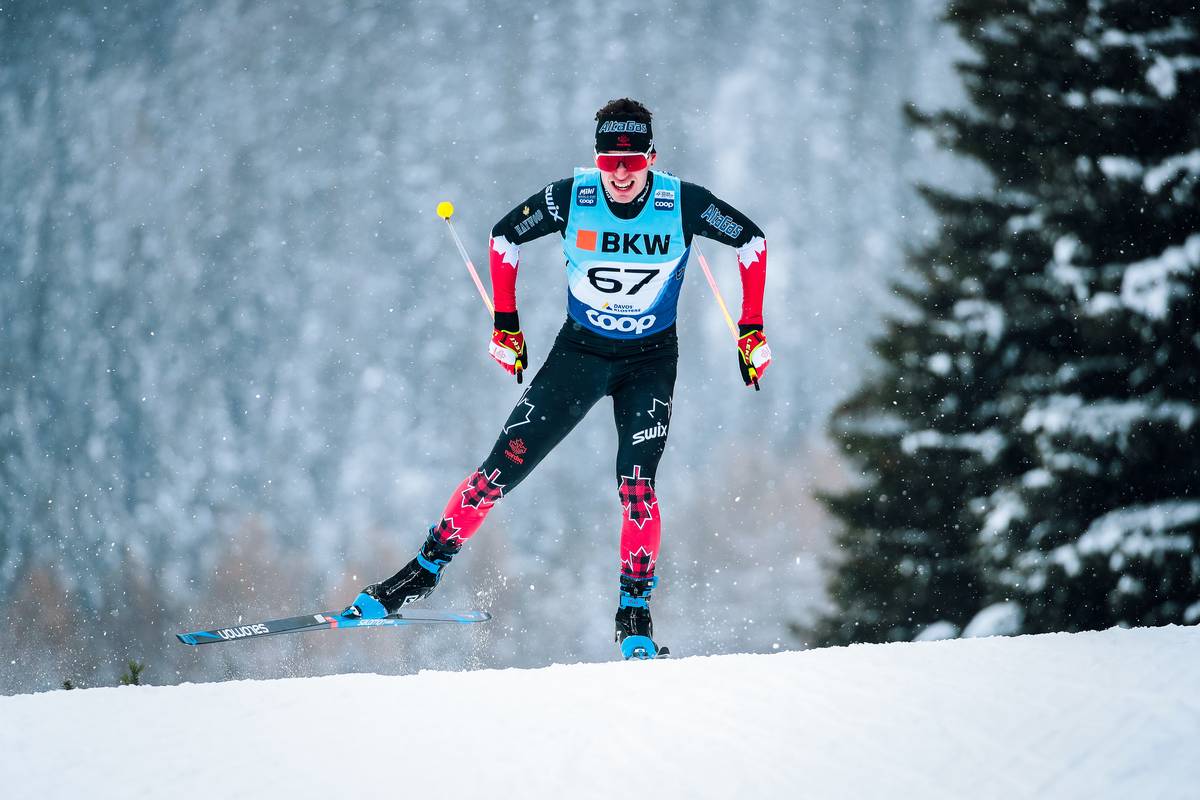
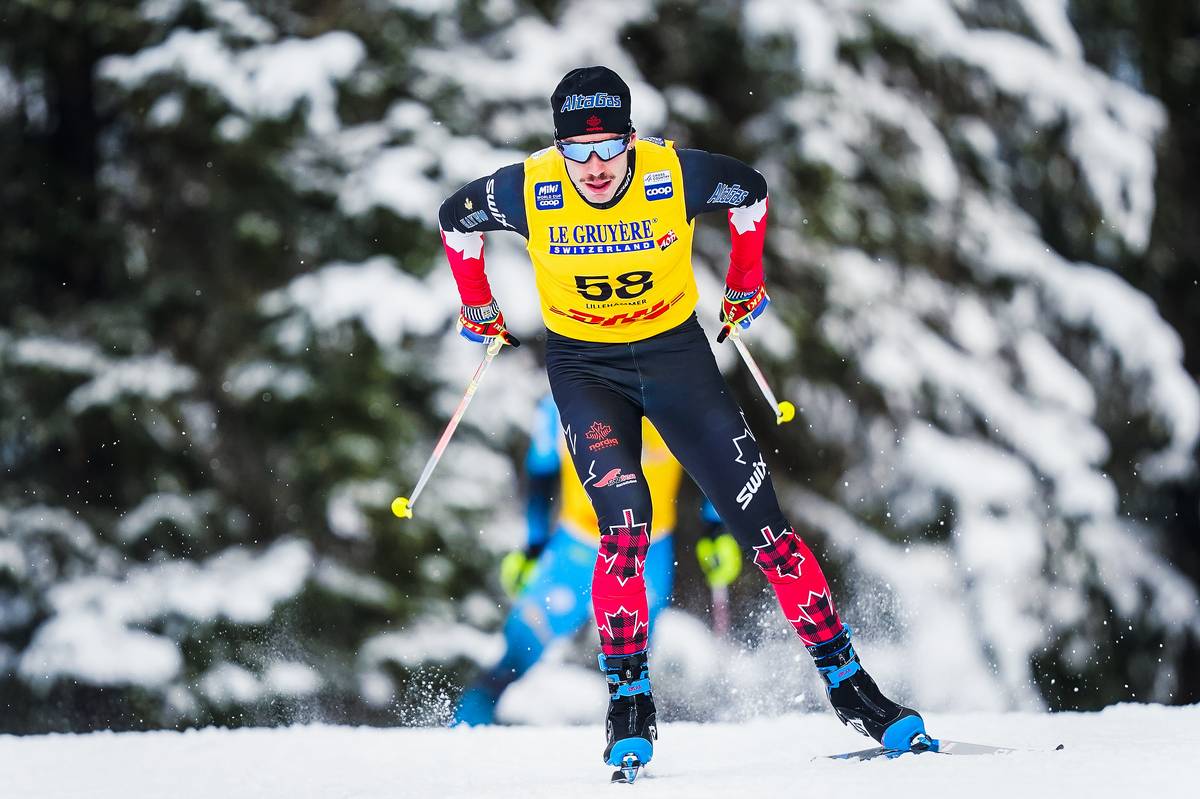
Racing for Canada, Antoine Cyr skied to 36th in qualification (+6.43), followed by Graham Ritchie in 45th (+7.02).
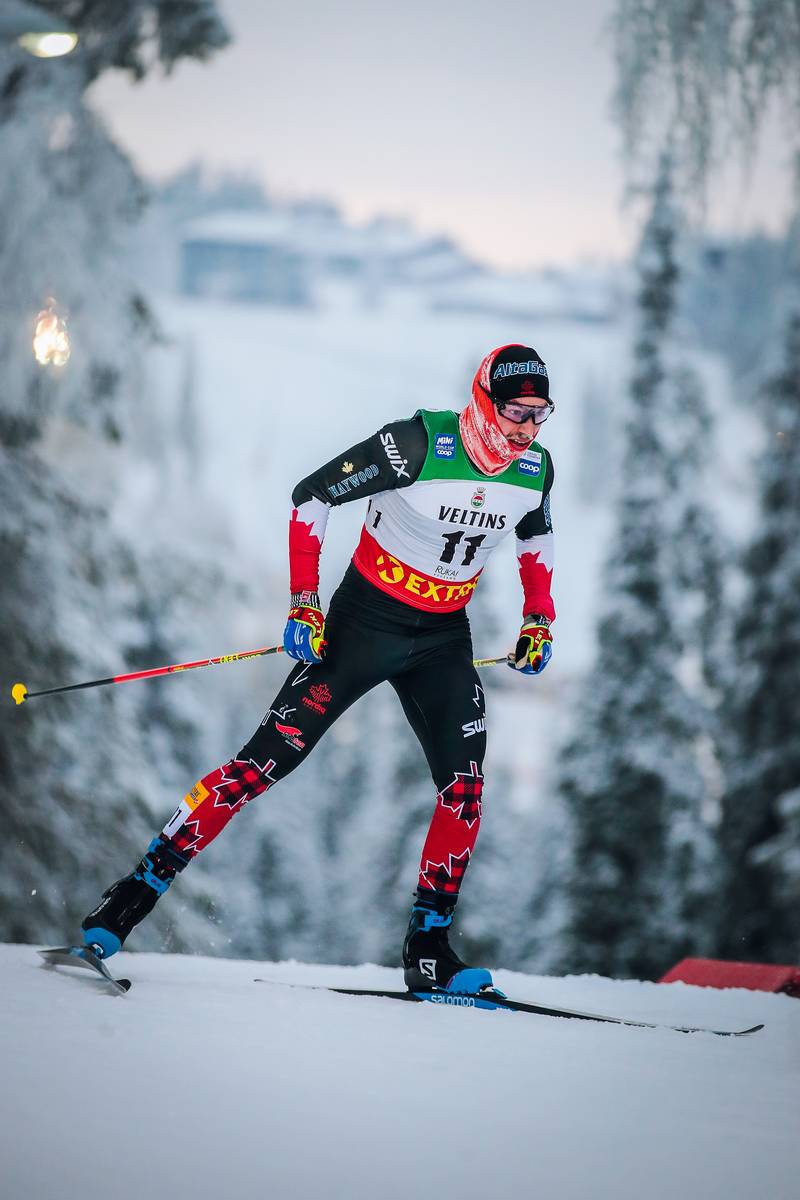
Antoine Cyr leads the Canadian men, skiing to 36th in the qualifier. (Photo: NordicFocus)
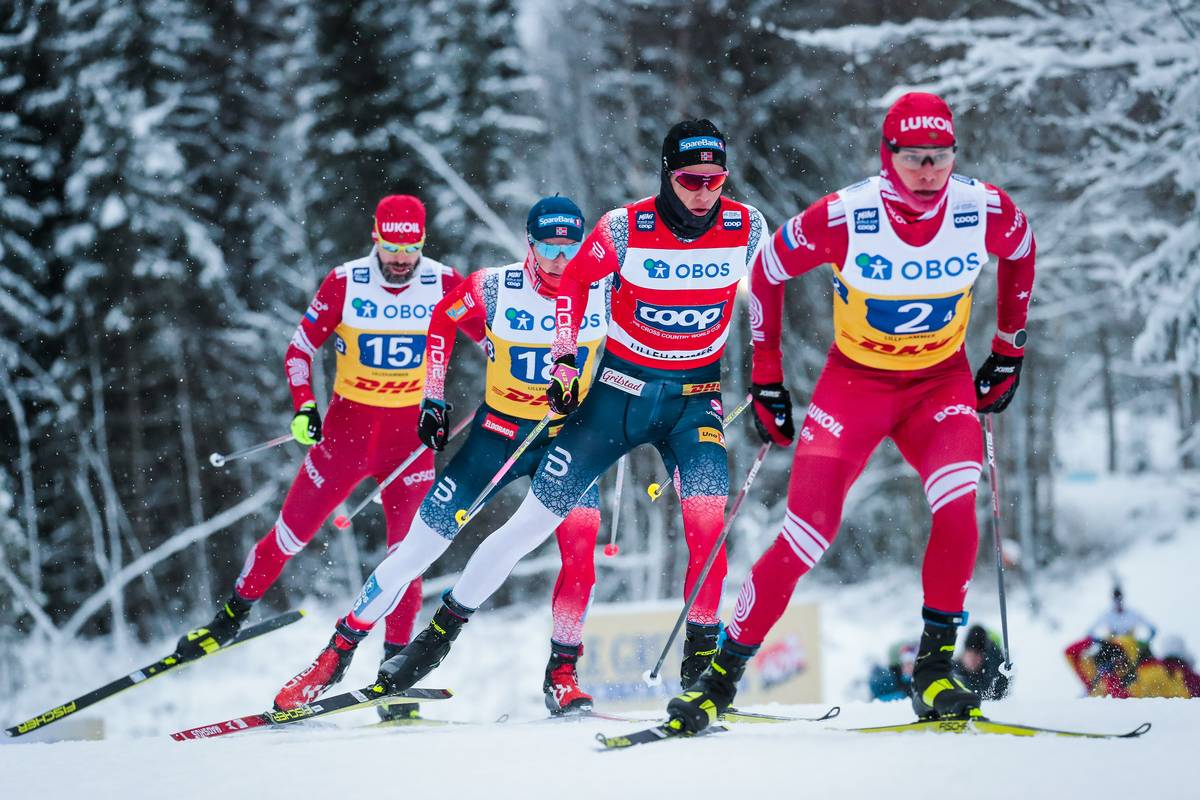
It was Norway I, Russia II, and Norway II for the podium during the men’s 4 x 7.5k relay in Lillehammer. (Photo: NordicFocus)
This World Cup coverage is made possible through the generous support of Marty and Kathy Hall and the A Hall Mark of Excellence Award. To learn more about A Hall Mark of Excellence Award or to learn how you can support FasterSkier’s coverage please contact info@fasterskier.com.
Most-often the champions of the event, the Norwegian men’s program has been waiting for another crack at the 4 x 7.5-kilometer relay on home turf for the last two years. In 2019, Russia not only won the 4 x 7.5-kilometer relay in Lillehammer but the Russia II team took second as well. The World Cup in Lillehammer that was scheduled for 2020 was first postponed, then cancelled, to manage the nation’s COVID-19 cases. With the opportunity to take back their title at home in 2021, Norway was ready to throw down on the modified tracks in Lillehammer today.
Luke Jager leads the American men’s team during the 4 x 7.5k relay in Lillehammer. (Photo: NordicFocus)
Hoping to be in the mix was the young American team made up of Luke Jager, Ben Ogden, Gus Schumacher, and Zanden McMullen. Each currently 21-years-old, Jager, Ogden, and Schumacher were part of the World Junior Championship back-to-back gold medal teams.
From the Canadian World Junior team who earned a silver medal during that relay in Oberwiesenthal, Germany, Olivier Leveille has moved onto the World Cup and raced today as a member of the Nordiq Canada relay team. Leveille would race as the third leg, following teammates Russell Kennedy and Antoine Cyr, who skied the classic legs. Graham Ritchie would ski the anchor leg for Canada.
A second U.S. team was also entered. This team included Hunter Wonders, David Norris, Kevin Bolger, and JC Schoonmaker, racing in that order.
Hunter Wonders skis the first leg for the United States II team. (Photo: NordicFocus)
From the first leg, it was no surprise to see both teams from Russian and Norway leading the pack, separated by only 1.2 seconds. Team France (+9.7) was sitting in fourth place while Jager (19:40.9) was able to keep the U.S. within striking distance in sixth at the first exchange (+10.2).
The United States II team sat in ninth (+25.8), with the Canadians close behind in 13th (+28.1).
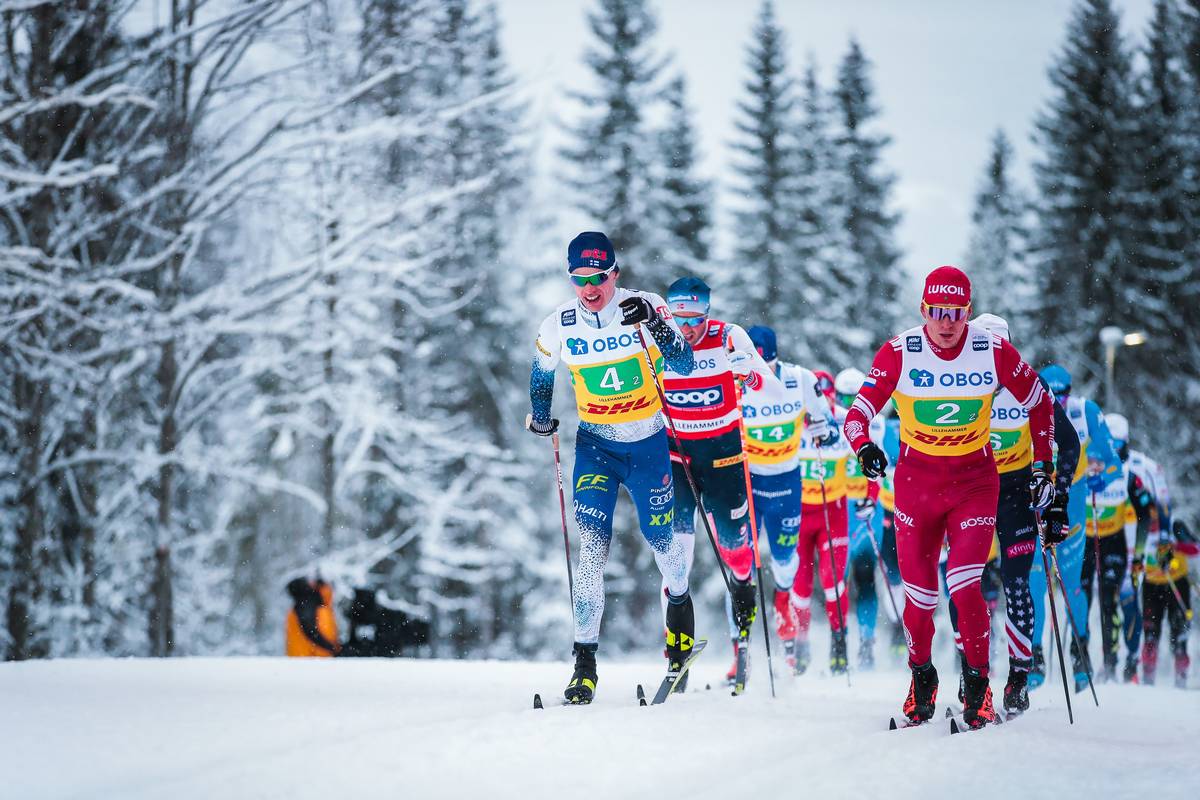
Iivo Niskanen (FIN) and Alexander Bolshunov (RUS) lead the train during the second leg of the men’s 4.75k relay. (Photo: NordicFocus)
During the second classic leg, the lead group compressed. Iivo Niskanen (FIN) closed a 17-second gap for Finland to take the lead at the second exchange. Niskanen won the 15k classic distance opener last weekend in Ruka.
Russia I (+0.4), Norway I (+11.9), Russia II (+12.4), and Norway II (+14.2) rounded out the top 5 as teams made the second tag to begin the final two skate legs of the race.
U.S. I was sitting in 12th place (+27.9) after a strong leg from Ogden, with Cyr passing off for Canada just ahead in 8th place (+22.5) .
Ben Ogden skis on the tails of leader Alexander Bolshunov during the second classic leg of the men’s relay in Lillehammer. (Photo: NordicFocus)Olivier Leveille (Bib 9) races the third leg of the men’s relay in Lillehammer. (Photo: NordicFocus(
As teams entered the stadium after their first 7.5k skate leg, the Norwegians and Russians were back on top, separated by only 1.3 seconds. Skiing the 6th fastest time for his leg, Schumacher was able to move up 5 spots to leave the U.S. I team in 7th (+29.0) (18:11.9). This effort brought the Americans back into the mix at the front of the lead chase group. Canada dropped down to 11th place (+33.5) after the third leg.
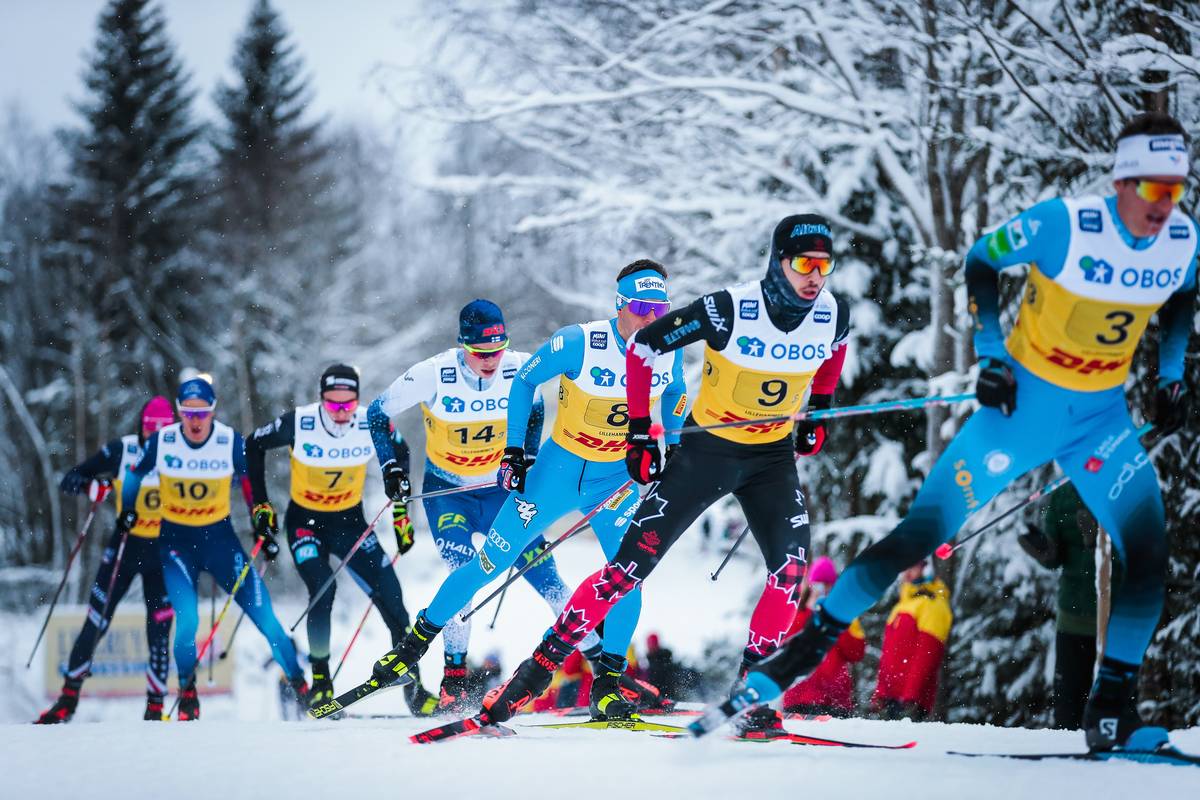
As teams made the final exchange, Johannes Høsflot Klæbo (NOR I), Sergey Ustiugov (RUS II), Harald Østberg Amundsen (NOR II) and Ivan Yakimushkin (RUS I) took off in a group.
The final exchange. Simen Hegstad Krüger tags Johannes Høsflot Klæbo for the final leg of the men’s 4 x 7.5k relay in Lillehammer. (Photo: NordicFocus)Still tight at the front: two Russian teams and two Norwegian teams push the final leg of the men’s relay in Lillehammer. (Photo: NordicFocus)
The two Norwegian and Russian teams stayed together as a pack over their last two laps, conserving their energy for a final sprint. This lead pack of four continuously grew their gap from the chase pack, building suspense for moves that might determine the podium.
With 1.5k to go, the lead pack began to accelerate. Moves were made by each team, but all moves were quickly answered. It remained anyone’s game.
Once the lead pack hit the stadium, Klæbo looked to take control, initiating his top gears in hopes of creating separation from the pack. Bringing it down to the wire, Ustiugov followed this attack as the group turned the corner for the last 100m.
Down the home stretch, Johannes Høsflot Klæbo turns on the sprint gears to bring the Norway I team home. (Photo: NordicFocus)
In the head to head sprint into the finish, Klæbo showed an edge over Ustiugov, gaining ground and throwing his ski at the line for the win. Sealing the deal on a Norwegian victory, Klæbo stopped the clock at 1:14:58.7 to reclaim the relay at home.
Still in the hunt, Ustiugov brought Russia II home in second (+0.2), with Norway II just behind in third (+1.2). Also edged out at the line, the Russia I team finished fourth (+1.4).
Johannes Høsflot Klæbo brings home a win for Norway in the men’s relay in Lillehammer. (Photo: NordicFocus)Keeping the final leg tight, Sergey Ustiugov anchored Russia II team who took second in the men’s relay in Lillehammer. (Photo: NordicFocus)
Looking excited and proud, Klæbo shared his thoughts on the day with FIS after the finish.
“It was a really tough one,” Klæbo said. “It was a nice fight and it was for sure really fun to cross the finish line first and to win as a team.”
Emil Iversen, who had raced the second leg, praised Klæbo for his sprinting ability, adding the value his prowess added to the relay team.
“We know we have the best man in the finish. It was a pretty exciting sprint today. It’s nice to have him in the last leg of the relay – he is the best sprinter in the world.”
Winners of the relay in Lillehammer, the Norway I team included Erik Valnes, Emil Iversen, Simen Hegstad Krüger, and Johannes Høsflot Klæbo. (Photo: NordicFocus)Take a bow. Zanden McMullen crosses the finish after racing the anchor leg of the men’s relay in Lillehammer. (Photo: NordicFocus)
Closing for the Americans, McMullen skied a strong anchor leg for the U.S. I, finishing 9th overall (+1:02.5). McMullen raced a steady leg to hold the American position near the front of the first chase group, hovering in sixth or seventh position throughout the leg. In the final push, McMullen was overtaken by athletes from the German and first Swedish team.
After the race, Matt Whitcomb provided insight into selection for each of the American teams, along with insights into their performances, conditions in Lillehammer, and the overall team dynamic after the second consecutive three-day race weekend.
At the finish, Canada was just behind the U.S. I team in 10th (+1:15.5), while the United States II team crossed the line further back in 15th (+3:20.9).
Russell Kennedy (Bib 9) skis the anchor leg for Nordiq Canada during the men’s 4 x 7.5k relay in Lillehammer. (Photo: NordicFocus)
After a fantastic weekend of racing in Lillehammer, teams are headed to Davos, SUI for a weekend of freestyle racing. The program includes a freestyle sprint on Saturday, followed by a 15k distance race on Sunday.
This World Cup coverage is made possible through the generous support of Marty and Kathy Hall and the A Hall Mark of Excellence Award. To learn more about A Hall Mark of Excellence Award or to learn how you can support FasterSkier’s coverage please contact info@fasterskier.com.
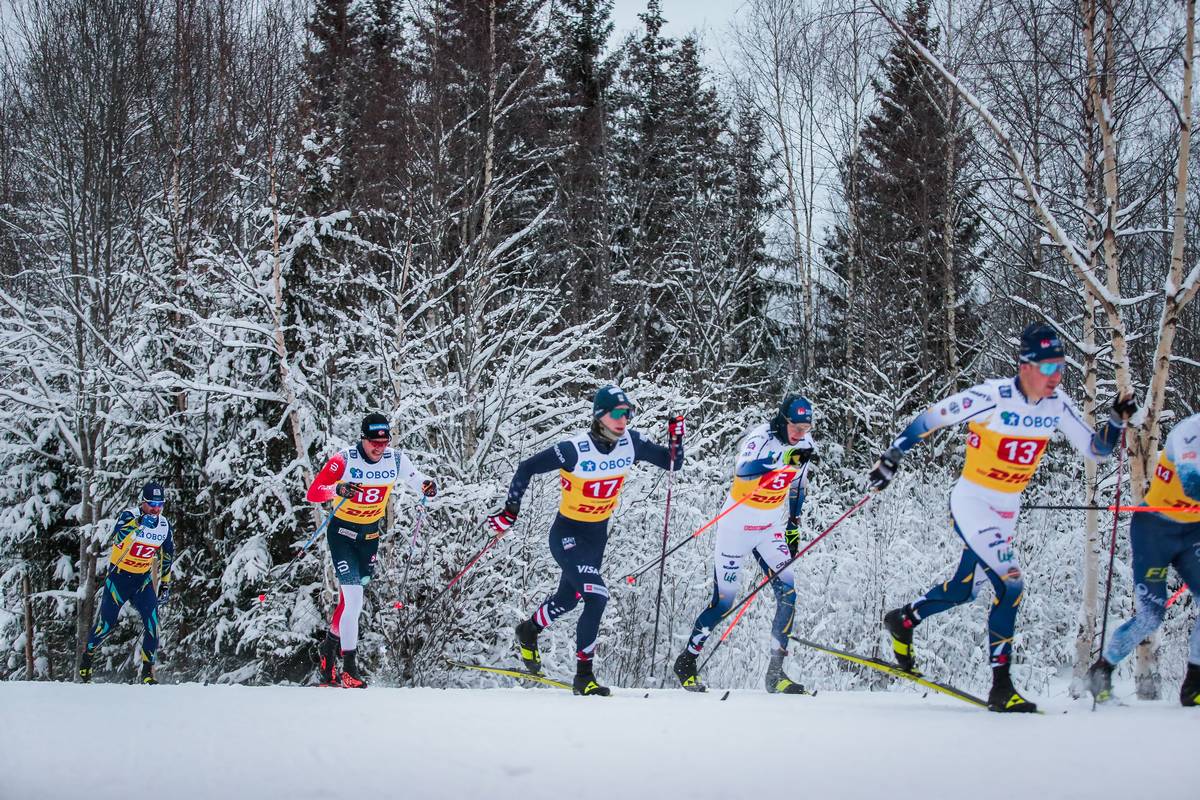
After a warm and rainy fall, temperatures dropped just in time for the athletes arrival in Lillehammer, Norway this weekend. The original program for Saturday’s competition was a 30 k skiathlon but low snow conditions forced a last minute change and the race became a 15 k individual start skate. Between last season’s cancelled races due to COVID and this season’s snow shortage, the athletes will have to wait another year to return to the iconic course out of the Birkebeineren Ski Stadium. Instead, the race was held in the former Biathlon stadium where saved snow farming was already in store, creating a 3.6 k loop to be completed four times for the men. In spite of this, the scene at the start line was one of winter as the athletes lined up, jumping out of the start gate to light snow and 18 degrees Fahrenheit.
Arnaud Chautemps (FRA) and Hugo Lapalus (FRA), (l-r) after a snowy 15 k skate (Photo: NordicFocus)
While individual start races can often be about one or two skiers dominating splits from the start, today’s race was initially difficult to discern. For one, with fewer cameras on the course than this spoiled reporter has become accustomed to, the race was harder to follow visually. For another, after a concentration of Norwegian starters in the bib range of 31-42, many of the Russian men did not start for another ten minutes or more, with seeded red-bib wearing Alexander Bolshunov (RUS) starting a full fifteen minutes after the unseeded, and eventual winner, Simen Hegstad Krüger of Norway. As such, a rephrasing of the popular saying “don’t count your chickens until they’ve hatched,” to “don’t count on your position until you’ve crossed the finish line” aptly applies.
Simen Hegstad Krüger (NOR) looking strong on his path to victory (Photo: NordicFocus)
After the Norwegian men’s absence in the 15 k skate pursuit last weekend in Ruka, they appeared to be re-asserting their depth and strength in their home country, and it was clear through the early splits. But as more Russian’s headed out on the course it seemed that perhaps we would see a repeat podium sweep. At 3.7 k Sergey Ustiugov (RUS) had the fastest time, followed closely by Bolshunov (RUS) with another three of their compatriots in the top 10, while Hans Christer Holund and Johannes Høsflot Klæbo were the sole Norwegians in 5th and 10th respectively. At 6.1 k it was the Czech skier, Michal Novak, who held the lead while Krüger (NOR) had worked his way up, though the Russians still held places four through six, and nine.
Sergey Ustiugov (RUS) started hot, ultimately finishing outside the top twenty. (Photo: NordicFocus)Alexey Chervotkin (RUS) ends up the lone Russian in the top ten, finishing in fourth position. (Photo: NordicFocus)
However, as the race wore on the Russian’s began to fade quickly while the Norwegian wave rode to the front once more.
Skiing steadily Krüger (NOR) ticked off the kilometers, followed closely by his teammate Holund. At the 4.6 k mark, Krüger was in fourth, at 7.4 k he had the second fastest split, and by 9.8 k he had taken the lead. When early race leader, Ustiugov (RUS) crossed the finish line +1:08.7 behind the Norwegian for an eventual 24th place finish we saw Krüger flash a little grin to the camera from his place in the leaders chair. The only remaining question was Bolshunov (RUS) who started in bib 70.
Alexander Bolshunov (RUS) heads towards the finish (Photo: NordicFocus)
Through 6.1 k Bolshunov was in sixth position, at 7.4 k he was in first though he dropped to fifth at 8.3 k. When he passed 9.8 k in 6th it seemed clear that Krüger would take gold and sure enough, Bolshunov was unable to gain anything over the last 5 k, finishing in 14th, +44.3 seconds back from Krüger.
“It was such a tough race with Holund [starting] thirty seconds ahead of me,” Krüger told FIS after the race. “We had to give everything we had, I know he’s in good form and I gave everything to be in front of him. It was a good battle.”
Simen Hegstad Krüger (NOR) slides over the line, clinching his spot in the leader’s chairl. (Photo: NordicFocus)Hans Christer Holund (NOR) finishing strong for second place, behind him Sjur Røthe (NOR) finishes 9th. (Photo: NordicFocus)
Hans Christer Holund held steady for a second place finish, just 1.6 seconds behind his fellow countryman. The dark horse of the day was Martin Løwstrøm Nyenget of Norway, who moved from 10th place at 9.8 k to finish third, his first outright World Cup podium. (Nyenget was third in the Classic Pursuit stage of the 2020 FIS Ski Tour in Östersund and had the fastest time of the day).
Martin Loewstroem Nyenget (NOR) celebrates his third place podium finish (Photo: NordicFocus)
Thus it was another podium sweep for the men’s 15 k skate, this time the red, white and blue colors belonging to Norway. Indeed, if there were any doubts about their power as a nation, a quick look at the results would clear things up. With seven of the top ten places and ten of the top twenty, their presence is hard to miss. As Krüger said, “it was a good day for the Norwegian team.”
Norwegian men sweep the podium: Hans Christer Holund (NOR), Simen Hegstad Krüger (NOR), Martin Løwstrøm Nyenget (NOR), (l-r). (Photo: NordicFocus)
Leading the North American contingent, Gus Schumacher finished the day in 38th position, +1:39.6 behind Krüger but only about 18 seconds behind the 30th place skier. In a field with more Norwegian starters than a weekend hosted by a different country, this result is significant despite not being inside the FIS points.
Gus Schumacher (USA) skiing to 38th place (Photo: NordicFocus)
Behind him was Antoine Cyr of Canada in 42nd who finished 11th in the classic 15 k in Ruka last weekend. In an interview with FIS before the race, Cyr said, “Ruka is always a hard weekend for us because we come from North America, it’s a long way from home. But, it’s a good course and yeah, I was so happy with the result.” When asked about the different courses for this weekend’s races in Lillehammer Cyr answered, “This weekend is going to be hard, skating is not my strong suit, I prefer classic but, it’s the World Cup, like any other World Cup we’re going to give one-hundred percent”.
Antoine Cyr leads the Canadian men for the day (Photo: NordicFocus)
Following Cyr, the Canadian men finished 56th for Olivier Leveille (+2:28.3), 57th for Russell Kennedy (+2:28.6) and 69th for Graham Ritchie (+3:44.2).
Zanden McMullen was the second US finisher in 48th place (+2:03.9). He was followed by Hunter Wonders in 63rd (+2:52.3), David Norris in 64th (+2:54.3), Ben Ogden in 67th (+3:32.2) and Scott Patterson in 70th (+3:35.8).
Today marked Patterson’s return to the World Cup following a recent surgery on his right wrist. While cleared by his doctors to race, Patterson still remains compromised and does not yet feel he is on form for World Cup racing. Here is some additional insight he provided via email.
“My wrist is improving, but is definitely still limiting my racing,” Patterson wrote. “I’m just over 5 weeks out of surgery. In order to protect the repair, I have been skiing in a brace and raced in that today. While this removes a lot of the stress from my wrist itself, it does modify my technique and make certain elements of skiing considerably more difficult. Today in racing, I felt that with the brace my wrist itself was ok, but the balance of my energy expenditure was thrown off. In racing, I was unable to really utilize my upper body. On a steady grindy course like today, that meant that I was working my legs way harder than necessary for the speed I was skiing. This resulted in the feeling of never aerobically taxing myself while still just skiing tired. I also feel that my recent training has been a lot of threshold and I’m not quite ready for race efforts.
“I knew coming into today that I was a bit underprepared for racing. In prioritizing my wrist recovery, I have not done any time trials and was even limited in intervals recently by a cold I caught in the weeks before travel. Overall, I feel that my fitness is pretty good, but I need a little time to find race form and figure out how to manage my wrist recovery while minimizing limitations. I am working towards skiing and racing without a brace, but even once I remove the brace it will take some time to regain trust in the strength of my wrist. The bit of skiing I have done without it feels very naked and unprotected. I also need some time to build back into skiing transitions well and pushing V2 into the hills which were both laid wayside with all my one pole skiing.”
Scott Patterson races his first World Cup of the season, five weeks post-op from a surgery on his right wrist. A brace can be seen adding bulk under this glove. (Photo: NordicFocus)
Keeping focus on the long game, Patterson concluded with his approach to Period 1 as he eases his way back into racing.
“For now I am putting all my energy into wrist recovery and taking the races one by one. Today was not the way I wanted to start, but there are a lot of factors around my wrist holding me back and I’m still feeling on track for goals later in the season.”
Racing continues tomorrow a 4 x 7.5 k relay to finish out the long weekend in Lillehammer.
This World Cup coverage is made possible through the generous support of Marty and Kathy Hall and the A Hall Mark of Excellence Award. To learn more about A Hall Mark of Excellence Award or to learn how you can support FasterSkier’s coverage please contact info@fasterskier.com.
By Ryan Sederquist
It was another very cold day in Ruka, Finland. Temperatures hovered between -19 and -23.2 degrees Celsius around the course, rising to -18.6C by the start of the men’s 15-kilometer freestyle pursuit. In response to the conditions, the Norwegian men’s team decided to pull from competition, which created confusion at the start line.
For context, the women’s event, which was scheduled to take place first, had been postponed because temperatures were below the legal cutoff of -20C shortly before their schedule start. It is unclear whether other teams or organizers were privy to conversations happening among the Norwegian team, however, coaches had made the decision along with athletes and team doctors to withdraw despite the thermometer showing a temperature above the cutoff at race time.
With little time before the start, the Norwegians were missing from the field and the individuals working the start gate were scrambling. Perhaps the only ones having no trouble keeping warm, the officials at the start could be seen waving their arms, jumping, yelling, and sprinting around in an apparent search for the Norwegian team. Ultimately, the stadium announcer notified the field that all members of the Norwegian team who were scheduled to race were missing, and eventually, the clock simply started without them.
“It is based on the fact that it is terribly cold here,” Norwegian coach Eirik Myhr Nossum told the Norwegian news source NRK about the decision to withhold the team. “It may be skiing that is just inside the rules, but they think it was terribly cold yesterday and felt it in their lungs. They know they have important weekends ahead of them. They did not want to take any chances in the cold here.”
After warming up, Johannes Høsflot Klæbo decided along with team staff to withdraw from competition in Ruka due to conditions. (Photo: NordicFocus)
Sprint coach Arild Monsen said Johannes Høsflot Klæbo, Pål Golberg and Erik Valnes wanted to get a feel for the course before making a call. In communicating with a doctor present, they all agreed to not go.
“It is too cold. It’s within the cold limit. But the long-term effects that it can have on the respiratory tract … Then we came to the conclusion that they try with a little breathing on the heating. But we did not want this, there will be many other matches later,” the coach said to NRK in justifying the decision. (NRK comments have been translated to English.)
Yesterday’s classic winner, Iivo Niskanen, also chose to withdraw from the competition, and felt the race should have been canceled altogether. When asked by NRK, he said, “Yes, it should be [cancelled]. It is 75 kilometers per hour in the descents here and it is completely safe above 20 degrees below zero. So it is not good for the athletes nor before the Olympics.”
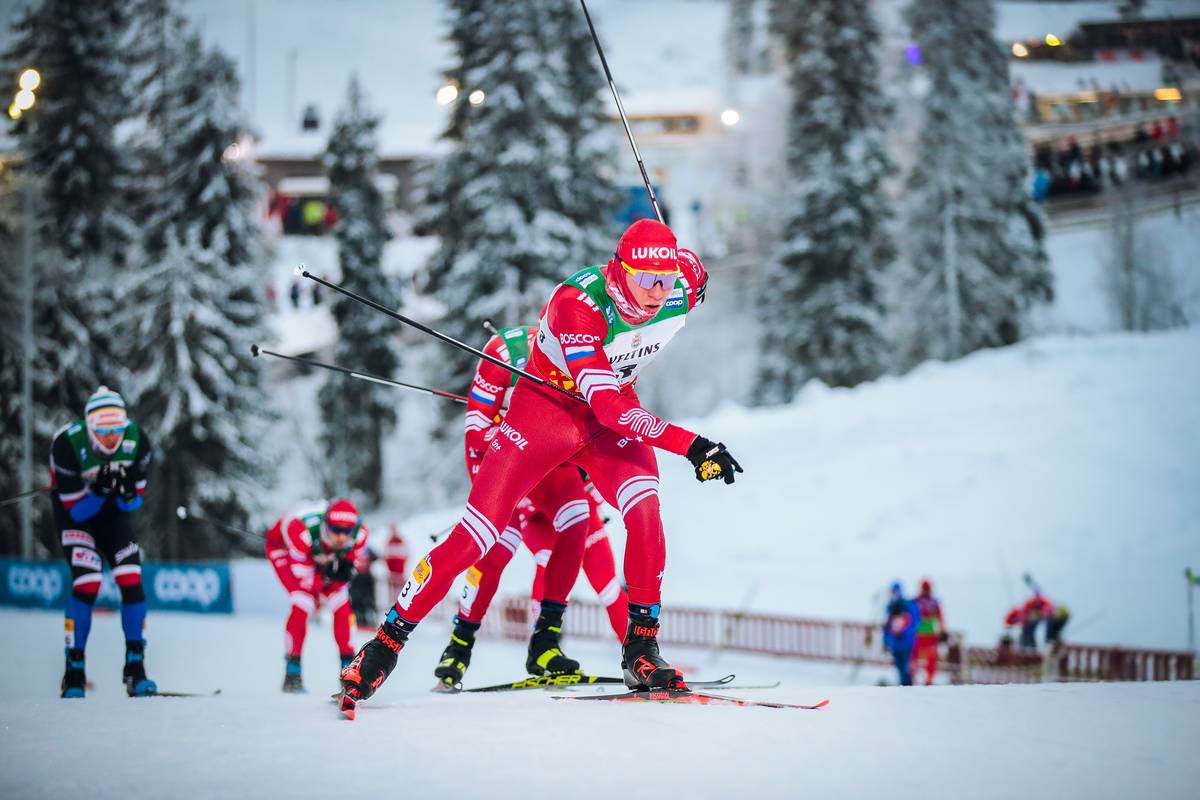
With Niskanen out, the clock ticked away for eight seconds until Alexey Chervotkin blasted away from the start pen. Alexander Bolshunov, wearing bib three, was still putting on his skis when he slowly skated out of the gate without his pole straps on, three seconds after his scheduled start time. After the frenzy of action and realization that all systems were go, the race proceeded more normally.
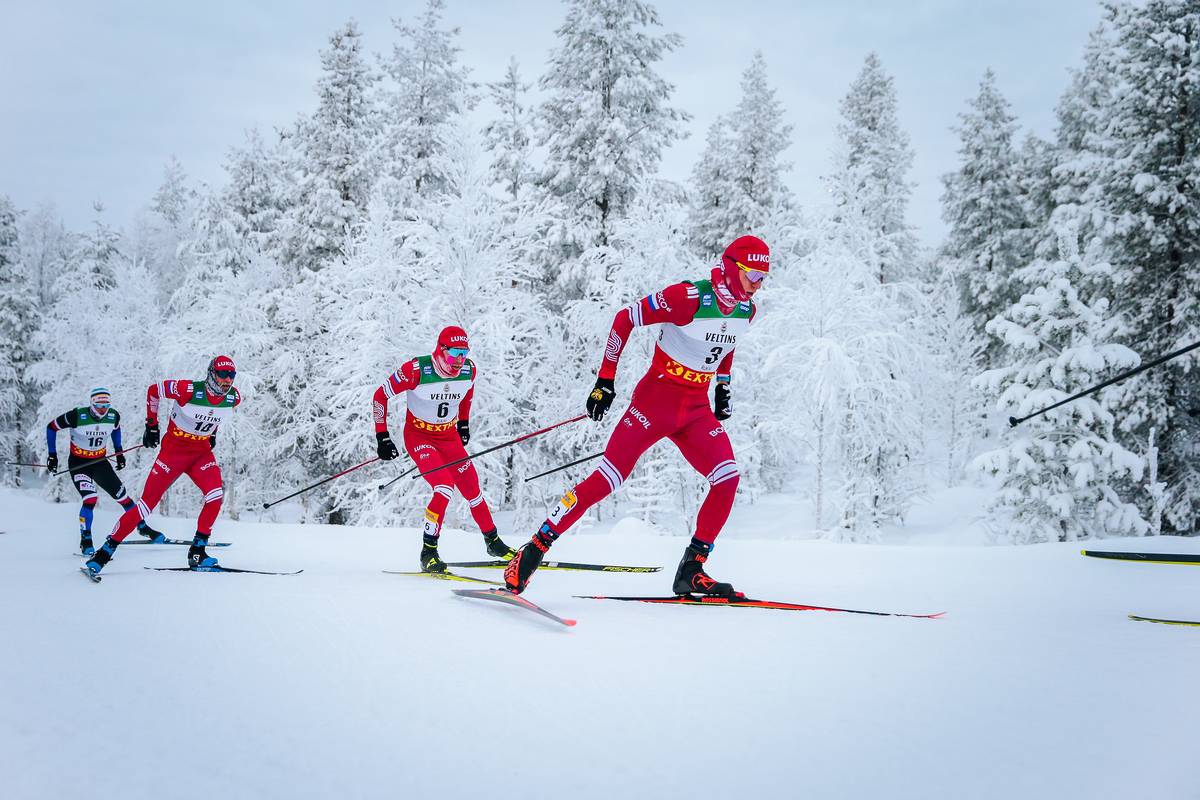
However, the absence of this group of men paved the way for Russian dominance. The group of three Russians – Chervotkin, Bolshunov, and Sergey Ustiugov – quickly assembled upfront. By the end of the first of six 2.5-kilometer laps, Ilia Semikov and Ivan Yakimushkin had joined them.
A train of red lycra. A bearded Sergey Ustiugov pulls Russian teammates Alexey Chervotkin and Alexander Bolshunov during the 15k freestyle pursuit in Ruka. (Photo: NordicFocus)
Behind the group of red was a chase group of Canadian Antoine Cyr, Frenchmen Hugo Lapalus, the Czech Republic’s Michal Novak, and Germany’s Lucas Boegl. Cyr, who finished a career-best 11th yesterday, continued his strong showing in the skate, holding the sixth place position for the first quarter of the race.
While the Russians at the front appeared to be out for a steady-state workout – not altogether easy, but with an earnest threshold-like tempo perhaps for no other reason than to preserve warmth and get off the course as soon as possible – several chase groups emerged. Behind the five Russian leaders, fellow Russian Artem Maltsev was working to close the gap to within 29 seconds through the 5-kilometer checkmark. He towed Cyr, Lapalus, Boegl, and Novak along with him. Behind that peloton was another group of five athletes, led by Francesco De Fabiani. Finally, Gus Schumacher, who started in bib 31 but moved up throughout the race, was guiding a final group of 11 athletes.
Working in a group, Gus Schumacher (bib 31) skis his way into 11th, just 0.5 seconds out of the top-10, during the 15k freestyle pursuit in the final stage of the Ruka mini tour. (Photo: NordicFocus)
The primary deciding move of the race came 16 minutes in when Maltsev pushed hard to bridge the gap to the leaders. He brought Michal Novak and Lucas Boegl with him, but the Canadian Cyr was fading and left behind.
This group was on the upswing, steadily gaining ground on the leaders. Among this pack was Schumacher, who continued to take advantage of the drafting effect.
By 10-kilometers, it was a group of six Russians plus Boegl and Novak in front, with Cyr and Lapalus holding on for dear life 16 seconds back, and the 10-member train, with Schumacher and Canadian Olivier Leveille at the caboose, just 19 seconds behind them.
Alexander Bolshunov on his way to win the 15k freestyle pursuit on day 3 of the Ruka Triple. (Photo: NordicFocus)
Approaching the penultimate stages of the race, Bolshunov remained relaxed and seemingly content to let Yakimushkin lead, responding to his surges and allowing his teammate to block the wind.
The 25-year old Novak, who was 54th in the distance standings last year and 13th in the sprint standings, appeared strong and capable of disrupting a Russian sweep of the podium. 22 minutes into the race, wearing a Gunde Svan Swix beanie in lieu of a team cap – presumably for additional warmth – the Czech athlete went to the front.
Alexey Chervotkin, who was second in the 15k classic, fell steadily backward in the rankings during the subsequent 15k freestyle pursuit in Ruka. (Photo: NordicFocus)
Coming into the bell lap, however, it was Bolshunov who emerged to take the lead in the descent into the stadium. At this point, with pace increasing, the lead pack was down to seven, having dropped Chervotkin. The chase group remained 39 seconds back, but Schumacher, who started with a 1:42 disadvantage, had closed it to 47 seconds as he sat in 15th.
With 1.4 kilometers to go, Bolshunov turned up the effort, charging up a hill. Novak appeared unable to respond to this surge, leaving the four Russians to settle things for themselves at the line. The gap of 2.7 seconds would not hold, though, as all four contending upfront – Bolshunov, Maltsev, Yakimushkin, and Ustiugov – paused to decide who would lead out on the final, critical downhill. Taking advantage of the moment of indecision, Novak decided to make one final run at glory. He burst into the lead down the hill, but was caught again as the five men headed into the deciding final sprint uphill.
Bolshunov leads the way in the 15k skate pursuit in Ruka. (Photo: NordicFocus)
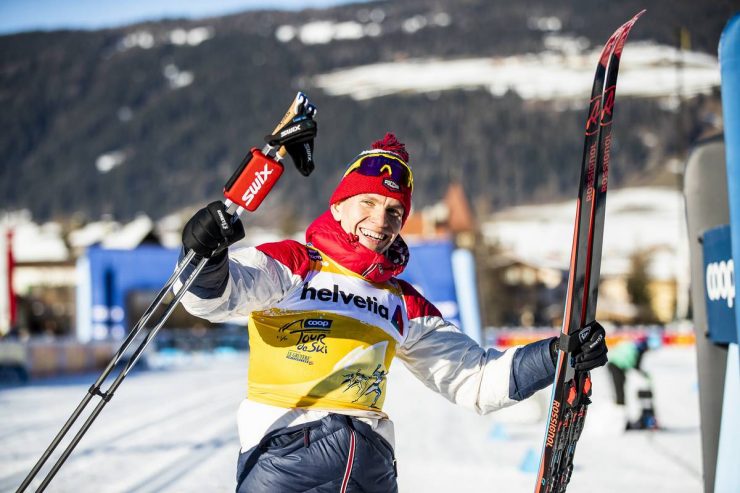
Bolshunov and Ustiugov demonstrated the purest and most efficient hop skating, and separated from the others. Looking for an inside line, Ustiugov just didn’t have the speed to overtake the 24-year old two-time defending overall globe winner. As they headed into the straightaway, Bolshunov glided comfortably across the line for the win, followed by Ustiugov (+0.5) and Maltsev (+0.7), who never faltered after charging hard to close the gap between racers. Yakimushin (+5.3) made it a one-through-four run of Russians, but a fifth place finish for Novak (+9.2), whose previous best individual finish to date was a 9th place sprint from Ulricehamn, Sweden last February, ruined the Russians’ ability to achieve a cross-country running “perfect score.”
It was an all-Russian podium on Day 3 of the Ruka mini-tour. Alexander Bolshunov took the win ahead of Sergey Ustiugov (left) and Artem Maltsev (right). (Photo: NordicFocus)
At the finish line, Bolshunov spoke through a translator and discussed how the confusion at the start led to a few unknowns, but ultimately, when the race started, the game plan was still the same.
“I still made the task to do the best I could and I am really happy with the victory,” he said of the situation.
Alexander Bolshunov wins his first World Cup of the 2021-22 season in the 15k skate pursuit in Ruka. (Photo: NordicFocus)
Surging in behind the initial group of finishers was American Gus Schumacher, who would climb all the way to 11th place (+58.2). He was only half of a second out of the top 10, as he was unable to overtake De Fabiani in the final sprint, but he did claim top North American honors, passing Antoine Cyr (+58.8) in the closing stretches. Cyr ended his day in 12th.
With back to back Top-15 finishes, Nordiq Canada’s Antoine Cyr is 12th in the 15k freestyle pursuit in Ruka. (Photo: NordicFocus)
In a post-race interview, Schumacher explained his race plan, including how he considers the athletes around him as potential rides that he may use during the opening laps. He also discusses how he was able to lean on fast skis to take advantage of downhills and drafts, conserving his energy to hang onto the other strong men in his group. Having been in cold weather and on snow in Alaska before heading to Europe, Schumacher provides additional insight into his management of the conditions.
Gus Schumacher skis to 11th place in the frigid 15k freestyle pursuit in Ruka. (Photo: NordicFocus)
Completing a strong showing for Canada, Olivier Leveille (+1:00.7) finished in 17th followed by Russell Kennedy in 21st (+1:39.9).
The American contingent, largely made up of Alaskans, showed no fear in the face of the cold temps. David Norris (+2:35.1) finished in 37th, Zanden McMullen (+2:46.0) was 40th, and Hunter Wonders (+3:33.0) was 45th. Ben Ogden (+4:52) and Luke Jager (+5:38) rounded things out in 55th and 60th places, respectively.
Hunter Wonders on course during the 15k freestyle pursuit in Ruka. (Photo: NordicFocus)Ben Ogden (bib 58) works with a train of athletes during the 15k freestyle pursuit in Ruka. (Photo: NordicFocus)
In a recent press release from FISI (Federazione Italiana Sport Invernali), the Italian Ski Federation, announced some coaching changes for the upcoming season, notably that this year’s World Cup Sprint Globe winner, Federico Pellegrino, and his teammate, Francesco de Fabiani will join the training group of Marcus Cramer who works with the Russian Ski Team. Cramer’s current squad includes Sergey Ustiugov, Gleb Retivykh, Artem Maltsev and Evgeniy Belov on the men’s side and Yulia Stupak, among others, for the women.
Gleb Retivykh (RUS) bib 13, and Evgeniy Belov (RUS) bib 11, are among two of the top Russians in Marcus Cramer’s training squad.
The release states that this international working group was set up with the goal of maximizing the summer and fall preparation of both the Italian and Russian’s for the upcoming Beijing Olympics in February 2022 in the best way possible. The training will begin with long periods on snow in Europe starting in May, with the two Italians returning home regularly to join Team Italy for the time in between the on-snow camps. The goal of this project is to experiment with new working methods and intensity, while exchanging Italian and Russian technical knowledge to allow for the growth of both nations’ skiers.
Elena Välbe, president of the Russian Cross-Country Ski Association and manager of the Russian National ski team said of this collaboration, “I am optimistic about this proposal from the Italian team. I believe that this collaboration will benefit both Russian and Italian skiers and in particular Federico Pellegrino. This is an excellent step in the development of cross-country skiing, as two different training methods will meet. I am sure that all parties will make the most of this collaboration and the athletes will be able to give their best. ”
Federico Pellegrino (ITA) on his way to an 8th place finish in Val Müstair, ahead of the French trifecta battling behind him. (Photo: Nordic Focus)
In light of this change, Federico Pellegrino stated, “It has already happened several times to work with the Cramer team, both in the summer preparation phase and during the winter competitive period. The feedback has always been positive and it will be exciting to undertake this new project together. Surely, in view of the Olympics, starting with all this motivation can only be the best way to approach what may be the most important season of my career. ”
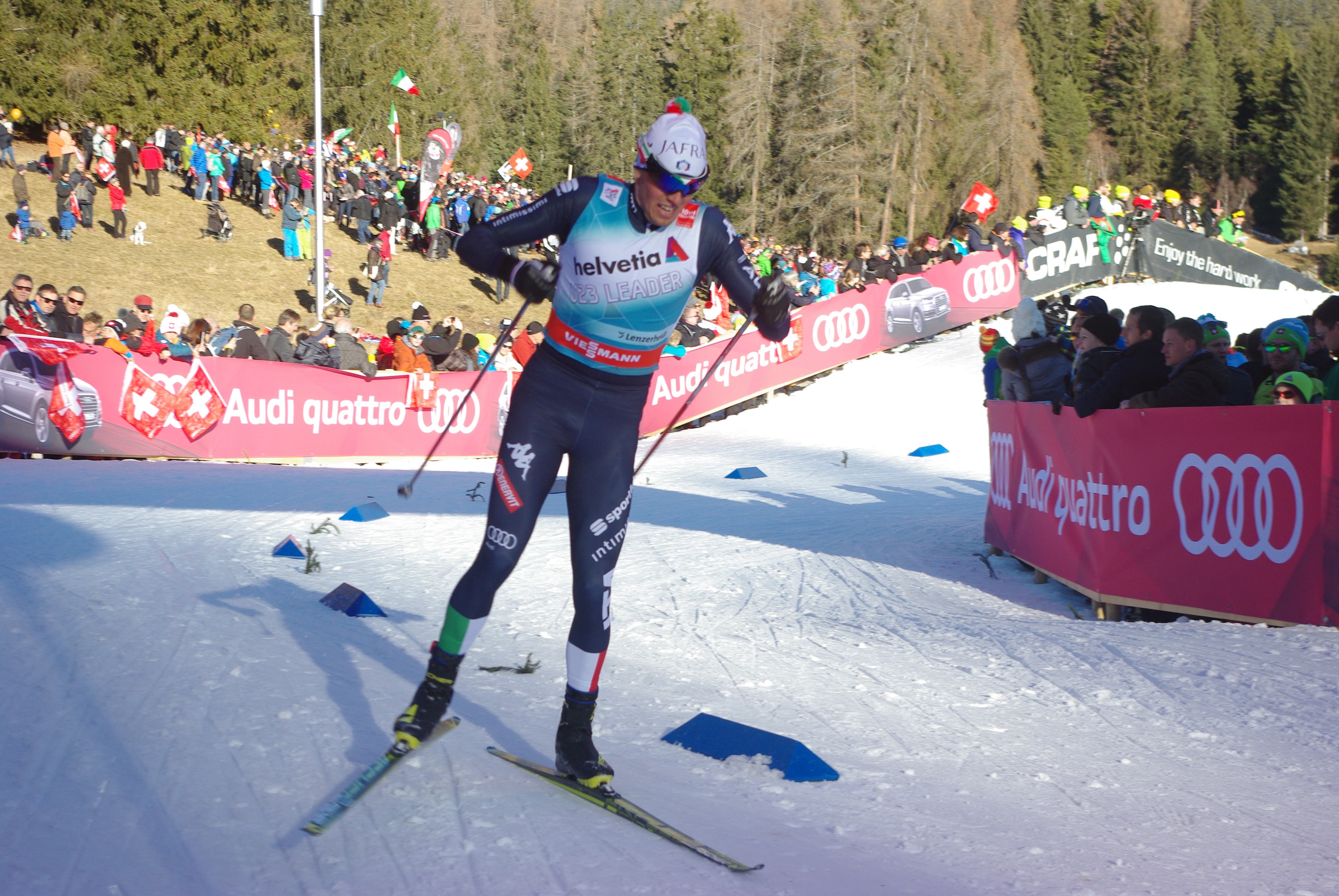
Fransesco de Fabiani (ITA) wearing the U23 leader bib in 2016 in Falun, Sweden.
Pellegrino’s teammate, Francesco De Fabiani, said, “I am very happy with this project because I believe that training with athletes of this caliber is important to copy, understand and grow together and see the differences between what they do and what we do. I believe it is an important opportunity for growth for my future. For now we focus on the Beijing Olympics, but it will also be a useful experience for the following years. Now I focus on the project and I hope to make the most of it.”
Francesco De Fabiani tags Federico Pellegrino during the team sprint in Dresden, Germany (Photo: NordicFocus)
Out of Pellegrino’s sixteen World Cup victories, only one has come in the classic discipline and while he holds a silver medal from the classic sprint in PyeongChang, he will likely be targeting the skate sprint in Beijing 2022. Together, De Fabiani and Pellegrino finished third in the team sprint at the Seefeld World Championships in 2019.
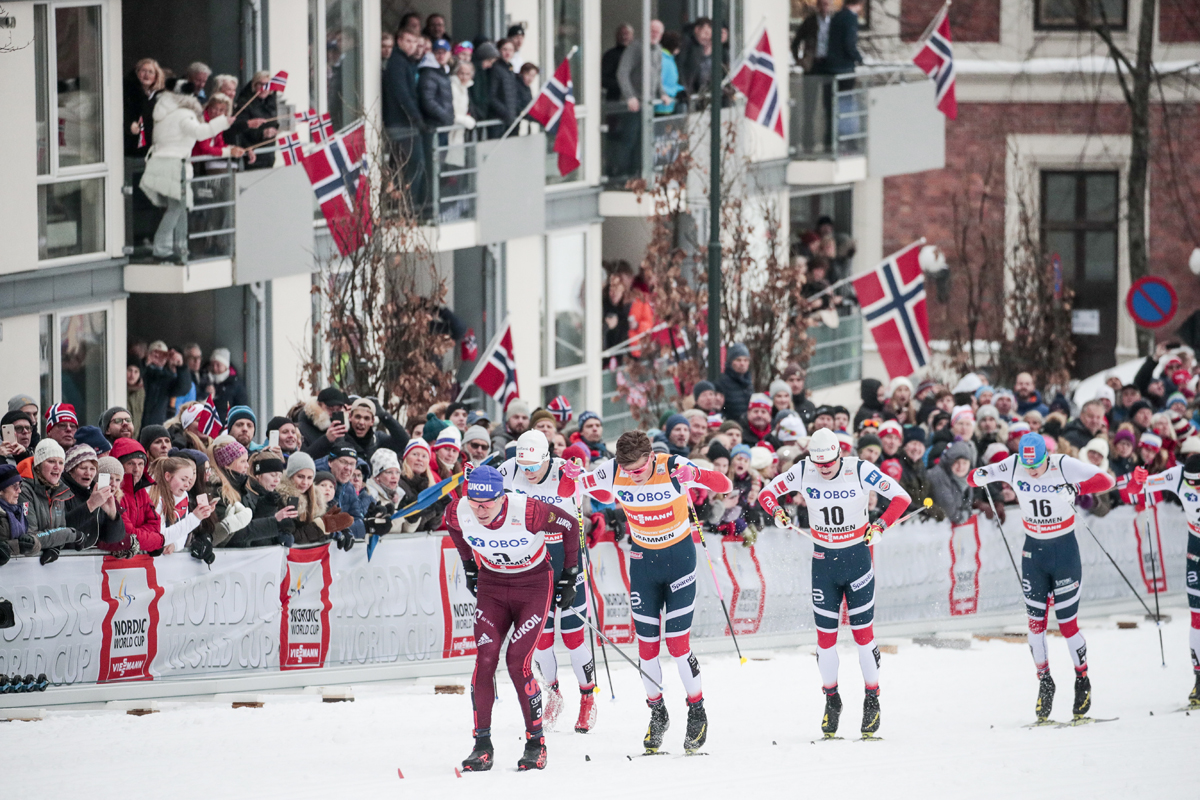
Russia’s Alexander Bolshunov leads five Norwegians in the men’s 2018 classic sprint final at the World Cup in Drammen, Norway: (from l to r) Eriik Brandsdal, Johannes Høsflot Klæbo (yellow bib), Sindre Bjørnestad Skar (10), Kasper Stadaas (16), and Emil Iversen. (Photo: Fischer/Nordic Focus)
This is the second part of a three-part series on Russia’s Alexander Bolshunov. You can find part three here.
During the season of 2018/19, there was fierce competition for the overall World Cup between Johannes Høsflot Klæbo and Alexander Bolshunov, who surprised the Norwegians by proving to be a versatile and resilient competitor.
Sergey Ustiugov was initially seen to be the main threat to Klæbo’s World Cup campaign, haunting him in the Tour de Ski until the penultimate race of the Tour in Val di Fiemme, Italy. It was a bad day for Ustiugov, and his teammates made it worse, with Bolshunov leading the effort to drop Ustiugov. The race cost Ustiugov more than 40 seconds to Klæbo, doubling the Norwegian’s lead.
Hans Christer Holund couldn’t believe what he was seeing,saying, “They’re as stupid as bread…I just had to laugh inside myself, even though I was tired.” Nossum, the Norwegian distance coach, also delighted in thanking the Russians for the victory on Instagram.
Markus Cramer, a coach for Russia, tepidly defended Bolshunov’s greedy maneuver. “We have another runner, Bolshunov, who can fight for the overall winner. He wanted to take his chance. This is normal.”
When Bolshunov was asked another time if he would work together with Ustiugov in a race heresponded, “Through the race, we can help each other, but Sergey and I are rivals. We are friends, but not close friends.”
Ustiugov was in Cramer’s group, Bolshunov in Borodavko’s—there was no special alliance. Bolshunov wanted to try and win the race, and he didn’t especially care if it cost Ustiugov the Tour.
After the final climb up Alpe Cermis, Klæbo was the winner. Ustiugov was second, just16 seconds behind.Bolshunov would finish fifth in the Tour, and third in the race that spoiled Ustiugov’s chance.
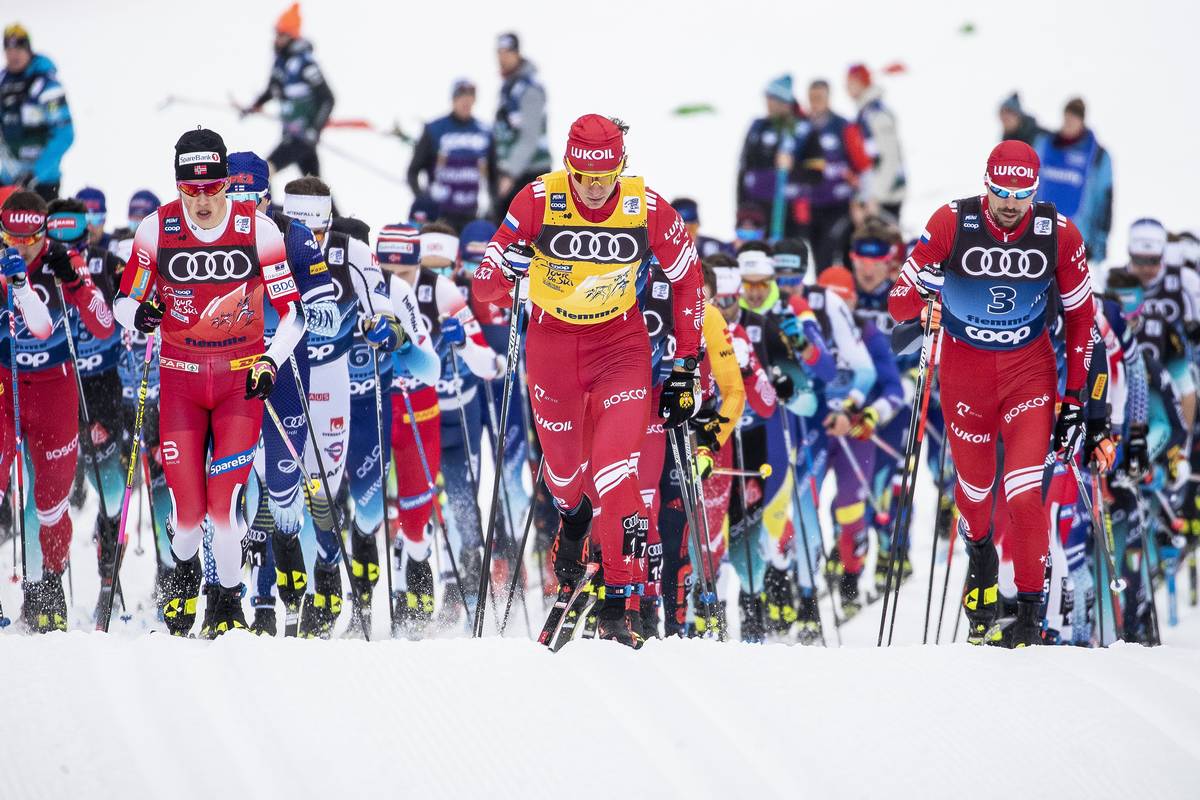
Alexander Bolshunov (RUS), Johannes Hoesflot Klaebo (NOR), Sergey Ustiugov (RUS), (l-r) early during Stage 5 of the 2019/2020 TdS in Val di Fiemme, Italy. (Photo: NordicFocus)
As the season progressed, the Norwegians continued to taunt the Russians as a hapless bunch, too concerned with fighting each other for places on the team to mount a genuine threat. Nevertheless, as the season progressed, the point spread between Klæbo and Bolshunov grew tighter.
An altercation between Ustiugov and Klæbo in the World Championship sprint race in Seefeld would add bad blood to the rivalry. Klæbo cut Ustiugov off on a corner, riding over his skis. Ustiugov responded byslapping Klæboon the face. The jurydisqualified Ustiugov for unsportsmanlike conduct while Klæbo’s interference went unpunished. For the Russians, it was further evidence substantiating their claims that the rulebook applied to only one team.
A couple of weeks later, in the Holmenkollen 50-kilometer race, Bolshunov, who was skiing just ahead of Emil Iversen, stopped abruptly just before the intermediate sprint, thwarting Iversen’s chances to collect points. Bolshunov received a warning for unsporting conduct, and the move marked a new era of hostile racing between the countries. Bolshunov ultimately won the marathon, awarding him an awkward audience with the King of Norway and the leader’s bib going into the season finale in Québec.
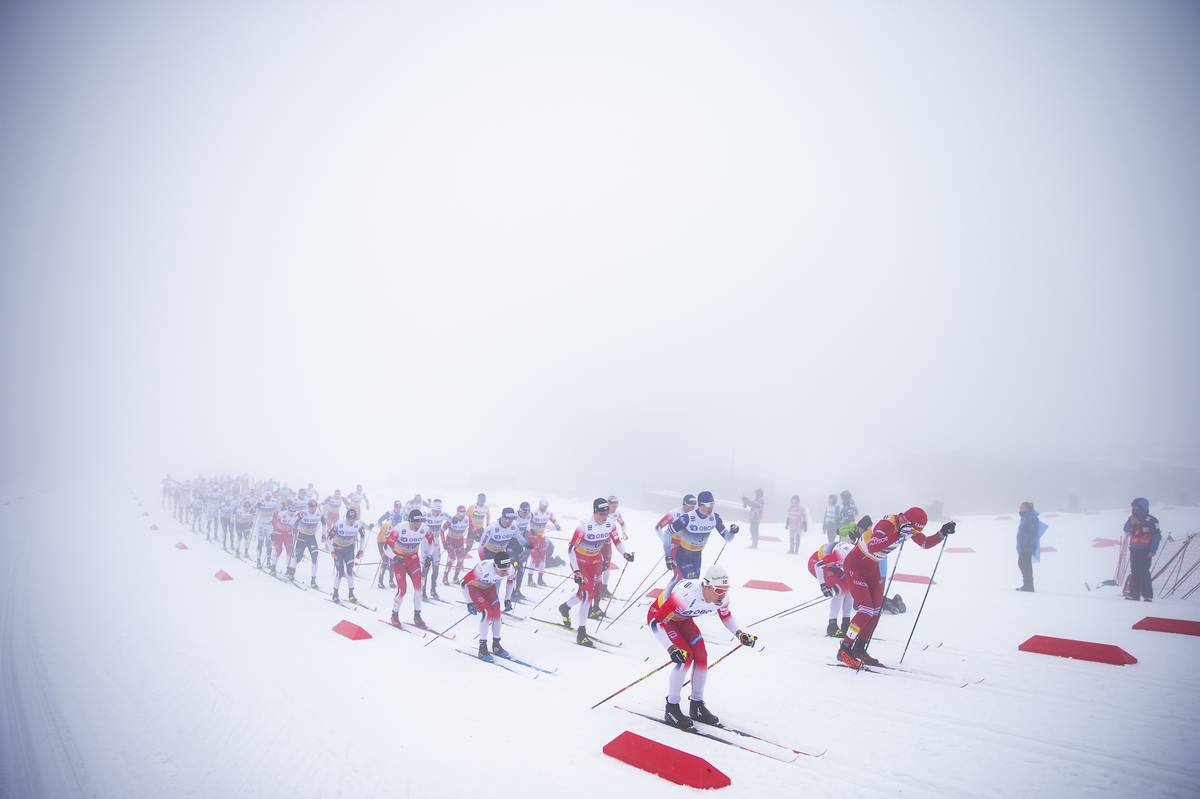
The start of the 2020 Holmenkollen 50k. (Photo: NordicFocus)
The mistrust between Norway and Russia showed in Québec. The Norwegian team declared they would be helping Klæboin any way they could. “That is the only thing we talk about,”said Sindre Skar, a Klæboteammate.Cramer expressed his hope the Norwegians would compete fairly in Québec. “I’m sure they will try to help Klæbo,”he said, “but I hope they do it in a fair way.”
Skar denied that any unfair tactic was in the playbook; “we do not do that,” he said. Still, the Norwegians did take a somewhat cynical approach to end Bolshunov’s sprint day. Norwegian sprint coach Arild Monsenconfirmed he directed Golberg and Iversen to join the first quarterfinal with Klæbo, Pellegrino, and Bolshunov, turning the first round heat into a stacked field worthy of a final. The aim was to see if they could knock Bolshunov out early and thereby maximize Klæbo’s point tally over the Russian.
Ultimately, the strategy didn’t work and the two contenders ended their day prematurely—a sacrifice the two Norwegians were willing to make. Skar clarified that there was nothing untoward about this,“no one goes to destroy [him], we go to beat him, we do not go to step on [his] pole. We do not do that.”
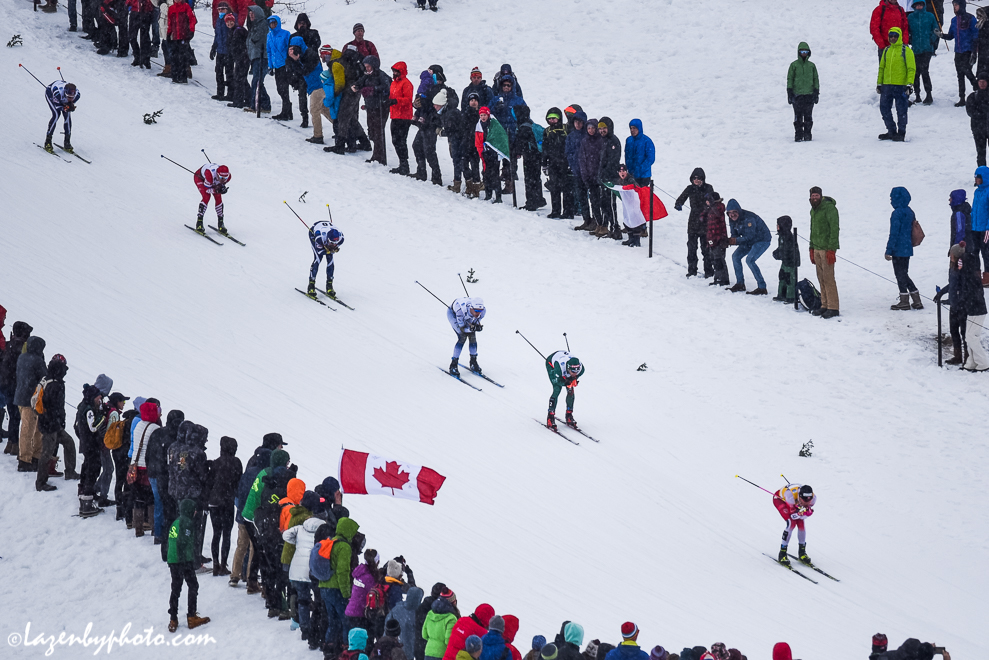
Russia’s Alexander Bolshunov leads the front group of skiers in the mens’ 15 k mass start classic in Québec City. (Photo: John Lazenby/lazenbyphoto.com)
With only 24 points separating the pair going into the final two races, the relationship between Bolshunov and Klæbowas more frosty than friendly. Bolshunov recounted aslight he perceived from Klæbo at the World Cup finals that year in Québec City. “When we were leaving the ski stadium in Québec, the organizers provided one bus for everyone,” recalled Bolshunov. “The bus was full, the only free place was next to me – but Johannes passed it by, went further back to look, did not find anything. Then another Norwegian did the same. I’m like ‘whatever, if you prefer to be standing in the bus rather than sitting next to me that’s your call!’”
Alexander Legkov had a more diplomaticexplanation, “If Sasha spoke English calmly, they would sit with him.” He surmised the Norwegians found it too awkward to sit next to their rival without being able to share words.
Klæbo, with the entire Norwegian men’s team working for him, secured the crystal globe in Québec. It was a tough loss for Bolshunov, who had been the leader just a week before in Oslo.
The Norwegian team tactics were a sore spot in the Russian camp. They considered the use of cycling strategies unfair in what they felt should be an all-out competition. “We do not have a club sport, but an individual one,” commented former Russian skier Evgeny Dementiev. “At the World Cup, there are slightly different concepts and values.”
Johannes Høsflot Klæbo of Norway stringing out the 2019 men’s sprint final in Québec City. (Photo: John Lazenby/lazenbyphoto.com)
The inability of the Russians to respond with their own teamwork ceded a distinct advantage to the Norwegians in sprints and mass start races. It exposed a weakness in the Russian system that couldn’t easily be corrected. Part of it came down to team culture, but the separation of the national team into four groups that rarely overlap meant there was little incentive, or direction, to sacrifice for a member of another group.
The team itself is oversized, some 39 strong in 2021, meaning that a majority of its athletes do not start any given World Cup race. Few of the skiers can afford a poor result if they want to stay on the circuit.
Legkov has called for a revision of the Russian playbook saying, “I want the team to act according to the principle ‘It doesn’t matter who, as long as they’re Russian!’” Dementiev has said that the national team coaches hold the power to change their approach to racing. “If the coaching staff sets the task, then no one will engage in selfishness…But they have to make the decision themselves, the coaching staff and the guys. Everything is in their hands.”
The 2019/20 Season: Contentions
In the spring of 2019, Bolshunov felt it was time for another change. He left the Tyumen region team and signed a new, more lucrative four-year deal with the Arkhangelsk region, which had secured a new patron in the form of alumber conglomerate. Bolshunov, Zherebyateva, and Neprayeva would be new additions to the team.
Bolshunov’s rise the previous season was seen as a serious threat to the hegemony of Norwegian dominance. Bolshunov started strong, winning the Tour de Ski and celebrating on the podium over a miserable looking Klæbo. Later that winter, Klæbo broke his finger, mis-landing a punch on a boxing bag. Once Klæbo returned to the Scandinavian Tour in February, the tension returned. Bolshunov himself was not entirely convinced by the broken finger story saying, “I understood that this was strange information. Either it’s true or not.”
Klæbo and team, 2020 Scandinavian Tour. (Photo: NordicFocus)
Klæboneeded a victory at the Scandinavian Tour to turn around a point deficit and work towards regaining the yellow bib in the later stages of the World Cup calendar. Bolshunov took control of the Tour early but felt the Norwegians were stooping to new lows to thwart his campaign after Simen Hegstad Krügerfell awkwardly in front of Bolshunov in the sprint semifinal, robbing him of precious points. Bolshunov felt the move wasintentional, to take him out of the race.
“Apparently, the Norwegian national team is going to fight me unfairly. After today’s race I am very angry with the Norwegian team. I’m just angry! The more they do this, the more they will anger me and the stronger I will have to become. He apologized? Well done, but this is not enough. You have to fight honestly.”
Borodavko backed up his athlete,saying, “Indeed, the Norwegian simply brazenly tried to oust him and provoke a fall, so this prevented him from fighting for higher places. How much was done from the Norwegian on purpose, it is very difficult to say. But it was clear that he openly and deliberately went to the collision.”
Russian ski fans were incensed and took to Instagram to vent their fury at Krüger and called on Välbe to respond. Välbe told them: “It’s a pity that you think that we are not protesting. We serve [protests], but out of ten maximum one is in our favor. What do you propose to do?”
The next day was a distance race and Bolshunov easily won despite breaking a pole. Spitsov supplied him with his own, a possible sign the Russians were beginning to work together toward mutual success. “…Spitsov sacrificed a stick when I broke mine. This is so cool,” said Bolshunov.
Nevertheless he dispelled the notion that the Russians were starting to work together in races, “We will not be able to do this, there is no such approach in the team.”
But this race too was not without its detractors. Iversen, a provocateur of Bolshunov in general, declared that he must have paid off the snowmobile driver who was takingvideo of the race. Iversenalleged Bolshunov had unfairly skied alongside the snowmobile to use it as a draft from the fierce crosswinds.
Likely Iversen meant this as a clap back for Bolshunov rousing the Russian fans’ ire against Krüger after his fall in the sprint race.
Alexander Bolshunov of Russia — the hunted on Stage 6. (Photo: NordicFocus)
With Bolshunov holding a solid lead going into the final race of the tour in Trondheim, disaster struck when the Russian team made the decision to go with klister. The Norwegians, with their own meteorologist on staff tracking the changeable weather over the Granåsen ski stadium,switched to rub skis just before the start.
When Pål Golberg, the winner of the day, saw Bolshunov on the start line with klister skis, he knew his race was over. Bolshunov said that he too had realized he had the wrong skis but had no time to correct the issue.
“They were very happy when they were overtaking me. I saw their beaming smiles, especially from Iversen,”recounted Bolshunov about his unfortunate race that saw him lose the Scandinavian Tour. Afterwards he threw his skis and ripped his leader bib off his body as camera crews followed him. He described his meltdown as a performance for Norwegian TV station NRK.
Välbe didn’t see any harm in Bolshunov’s finish linedisplay. “It is not necessary for a person to keep emotions in himself at such moments…Emotions must be thrown out. I was taught to yell in the forest, and I did it after all the failures.”
Sjur Røthe leading out: State 6 Ski Tour 2020. (Photo: NordicFocus)
There was a note of bitterness in Bolshunov’s final assessment of the Ski Tour. “I was not surprised that the Norwegian skiers tried to actively…use command tactics against me. In Norway, tactics always come first.”
When the final showdown of the 2020 World Cup season in Canada and the U.S. was cancelled due to the emerging pandemic, Bolshunov—the points leader at the time—was crowned the overall World Cup champion. Still, the victory felt incomplete to him. “One might say that there were no first emotions,” he said about hearing the news that he had prematurelywon the title, the first Russian man to do so in the post-Soviet era. “I wanted to bring this business to the end and stand together on a pedestal with my rivals, stand above Klæboand Røthe.”
There was another perceived slight when only Sjur Røthe reached out to congratulate him via text message. Klæbo, whom Bolshunov had so looked forward to standing over in Canmore, was silent. “I think Klæbo, Sasha’s main rival, was just very upset.”ThoughtVälbe, “He is an easily vulnerable person, he could not find the strength to congratulate Sasha.”
Bolshunov’s plan for the crystal globe was simple, “I’ll take the globe home and hide it, put it in a quiet and peaceful place.”
The Oslo 50 k classic podium: 08.03.2020, Oslo, Norway: Simen Hegstad Krüger (NOR) second, Alexander Bolshunov (RUS) first, and Emil Iversen (NOR) third, (l-r).
The prized globe took a long time to reach Russia, a delay owed to the pandemic. One morning that spring while Bolshunov was at home in Podyvot’ye he awoke to find that his father, impatient with the delay, had built and painted a wooden approximation of the globe for him.
His achievement that season would see him invited on a popular late-night talk show and nominated as Russian athlete of the year.
Despite the accolades, the interrupted season left him unsatisfied. The next season would surely bring a new chance to revisit his rivalry. There were loftier goals for Bolshunov, who reminded everyone, “I’m not the king yet.”
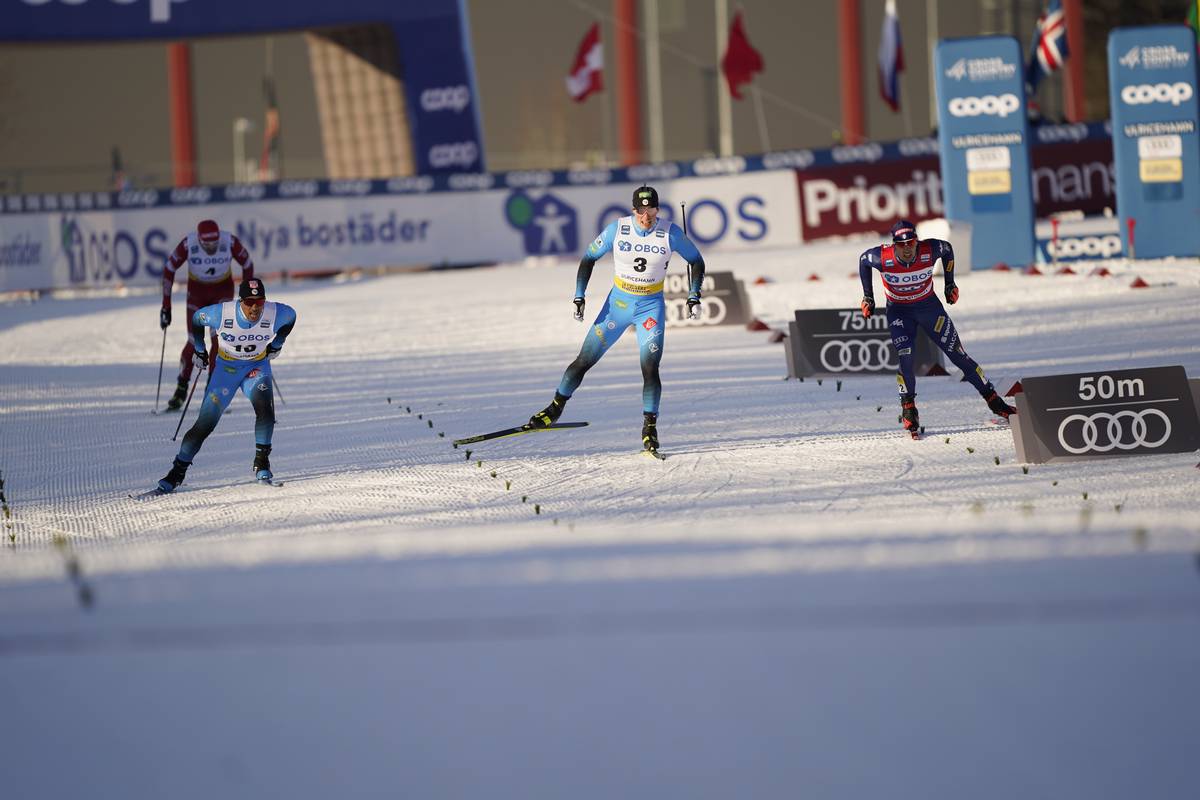
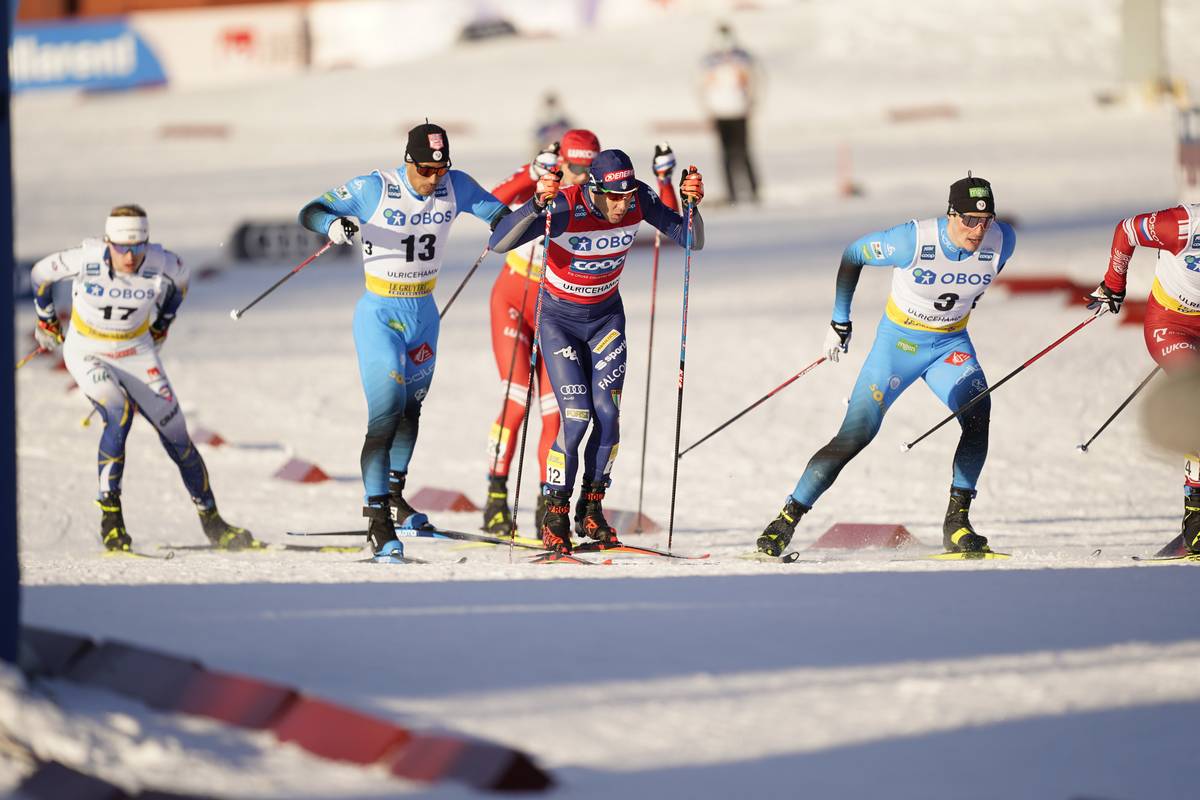
The day in Ulricehamn, Sweden (SWE) featured tight racing: Gleb Retivykh (RUS), Thomas Helland Larsen (NOR), Logan Hanneman (USA), Graham Ritchie (CAN), (l-r) (Photo: NordicFocus)
It was a sprint skier’s delight for nearly three-minutes on the 1.6-kilometer loop in Ulricehamn, Sweden on Saturday. In the uptick towards the hets on this working skier’s course an unusual name, as far as results go, topped the leaderboard after qualification.
Finland’s Joni Mæki (26) was the fastest qualifier in 2:58.41. Before the last few weeks, Mæki had flown under our radar until he and Bolshunov captured cross-country headlines a few weeks back in Lahti. Before his notoriety, and before this weekend, Mæki had a single individual World Cup top-10, the seventh-best time in the 2020 Ruka 15 k pursuit.
Let’s just say his ability to stay with Russia’s Alexander Bolshunov on the final leg of the 4 x 7..5 k relay in Lahti may have opened his eyes. He was quick in qualification today.
The day’s fastest qualifier, Finland’s Joni Mæk. (Photo: NordicFocus)
Absent from the scene as he and his Norwegian A-Team mates prep for Worlds was Norwegian speedster Johannes Høsflot Klæbo. In fact, and we’ll note this in more detail later, no Norwegians advanced to the finals. (Which reminds us to explain that as we come closer to the start of the World Championships later this month, many of the cross-country skiers likely to medal there will take time away from the World Cup to dial in their World’s fitness.)
Graham Ritchie of Canada qualified in 9th. (Photo: NordicFocus)
Otherwise, many of the usual suspects were in the skate sprint mix. However, the most notable qualifier from North America was Canada’s Graham Ritchie (22) in 9th (+4:06). According to FIS, this was the U-23 skier’s ninth World Cup start.
The Americans qualified three men for the heats. In order they were Simi Hamilton in 23rd (+6.95), Logan Hanneman 25th (+7.53), and Kevin Bolger 24th (+7.46).
We’ll get right to it – it was a frustrating day for the Americans. None advanced out of the quarterfinals with both Bolger and Hamilton stymied by incidents that scrubbed speed and took them out of the mix.
Simeon Hamilton (USA) during the quarterfinals on his way to 28th place. (Photo: NordicFocus)
Hamilton contested the first heat with some speedy company in the likes of Frenchman Lucas Chanavat, the day’s third-fastest qualifier, Russian Sergey Ustiugov, the fourth-fastest qualifier, and Michal Novak of the Czech Republic, sixth fastest.
Taking it out hot is Ustiugov’s bread and butter. And in this heat, he was able to keep it hot as he won in 2:56.45. Hamilton was in the mix coming around the final corner into the finish straight.
At 2:30, Ustiugov pulled upfront, with Chanavat and then Hamilton glued in second and third, respectively. Sweden’s Oskar Svensson, a name of note recently in sprinting, shimmied into a barely open window and moved in front of Hamilton. This is, after all, rock’em sock’em sprinting. And Hamilton let off the gas a smidge as Svensson steamrolled in. Around the downhill corner, Hamilton defied the Gs forcing a skier wide, and quick-stepped inside of Svensson, when he stumbled. With the lost speed, Hamilton’s opportunity was gone. He placed sixth in the heat to finish 28th. This was the fastest of the five quarterfinals and both lucky losers advanced from the heat.
Sergey Ustiugov (RUS) dictated the pace during each of his heats, he finished the day in 6th place. (Photo: NordicFocus)
Another bitter pill was swallowed by Bolger in the fourth heat. He too was in the mix late until he tangled with Italy’s Michael Hellweger at the 2:05 mark. Bolger was spun around, his chance for advancing snuffed out. Norway’s Finn Hågen Krogh pushed ahead and won the heat. Bolger finished in fifth to place 23rd overall.
Kevin Bolger (USA) at the start of the quarterfinal, he would finish the day in 23rd place. (Photo: NordcFocus)
In between, Hanneman and Ritchie raced in the second heat. Ritchie held strong for much of the race, yet lost vital ground in the finish to place fourth (+0.53) and 17th overall for a career-best.
“I’m definitely proud of that qualifier. Not only was it a personal best but it was great to have that Canadian flag in the top-10 on the results sheet,” said Ritchie.
“I’m pretty excited with the performance today,” Ritchie told Nordiq Canada. “My skis were incredibly fast thanks to the wax techs. It was so much fun to race my first World Cup heats.
“I found myself close to the back quickly in the heat. I tried to pass people the entire way, but it just wasn’t working out,” added Ritchie. “I was able to get a good kick at the end and move up a couple of spots in the finishing stretch.”
Graham Ritchie (bib 9) posted the 9th fastest time in the qualification and ended his day 17th overall. (Photo: NordicFocus)
Hanneman, who hails from Fairbanks, Alaska and trains with APU in Anchorage, finished sixth in the heat and 29th overall.
JC Schoonmaker, a young American skier of note, finished 35th, while Peter Holmes was 68th. U.S. skier Gus Schumacher is in Oberstdorf, Germany preparing for U-23 Worlds.
Post-race interview with U.S. Head Coach Matt Whitcomb
Logan Hanneman working the course in Ulricehamn, Sweden. (Photo: NordicFocus)
For Canada, Russell Kennedy finished 44th, Pierre Grall-Johnson 51st, and Antoine Cyr 60th.
In the first semi, Ustiugov gunned again. At 30 seconds he moved to the front. He positioned himself well, yet the group remained tight on this tough-to-pass-on-course. France’s Richard Jouve won, with Ustiugov in second, and the two lucky losers, Russia’s Gleb Retivykh third, and Chanavat fourth.
Italy’s Federico Pellegrino won the second semi, with Svensson second by only 0.3 seconds.
Attention Chanavat, this Pellegrino requesting a flyby… Negative Pelligrino, the lane is full. (Photo: NordcFocus)
In the men’s final, there was no guessing the contents of the first chapter: Ustiugov flexed first. In the next to last chapter, the Russian folded, as he faded on fumes to place sixth, 6:06 seconds off the winning time. The five remaining skiers were tight-pack skiing for much of the race. Only Chanavat was taxed too much from the endurance sprint racing. Around the corner, and into the straight, it looked like any of the four contending skiers could take the win: Jouve, Pellegrino (one of the best historic skate sprint closers), Retivykh, or Svensson.
Oskar Svensson (SWE), Richard Jouve (FRA), Federico Pellegrino (ITA), Lucas Chanavat (FRA), (l-r) during the men’s final in Ulricehamn. (Photo: NordicFocus)Oskar Svensson (SWE), and Gleb Retivykh (RUS), (l-r) closing down on a tight finish. (Photo: NordicFocus)
The advantage went to Sweden’s Svensson as he toed the line first in 2:55.34 – which was the day’s fastest time for a heat; quarter or semi. Retivykh placed second, Pellegrino third, Jouve fourth, and Chanavat fifth.
Svensson (25) has had a breakout season. Until this year, he had never podiumed in an individual race on the World Cup. This season, he has won the classic sprint in Val di Fiemme, Italy, and placed second last weekend in Falun (both were classic sprints).
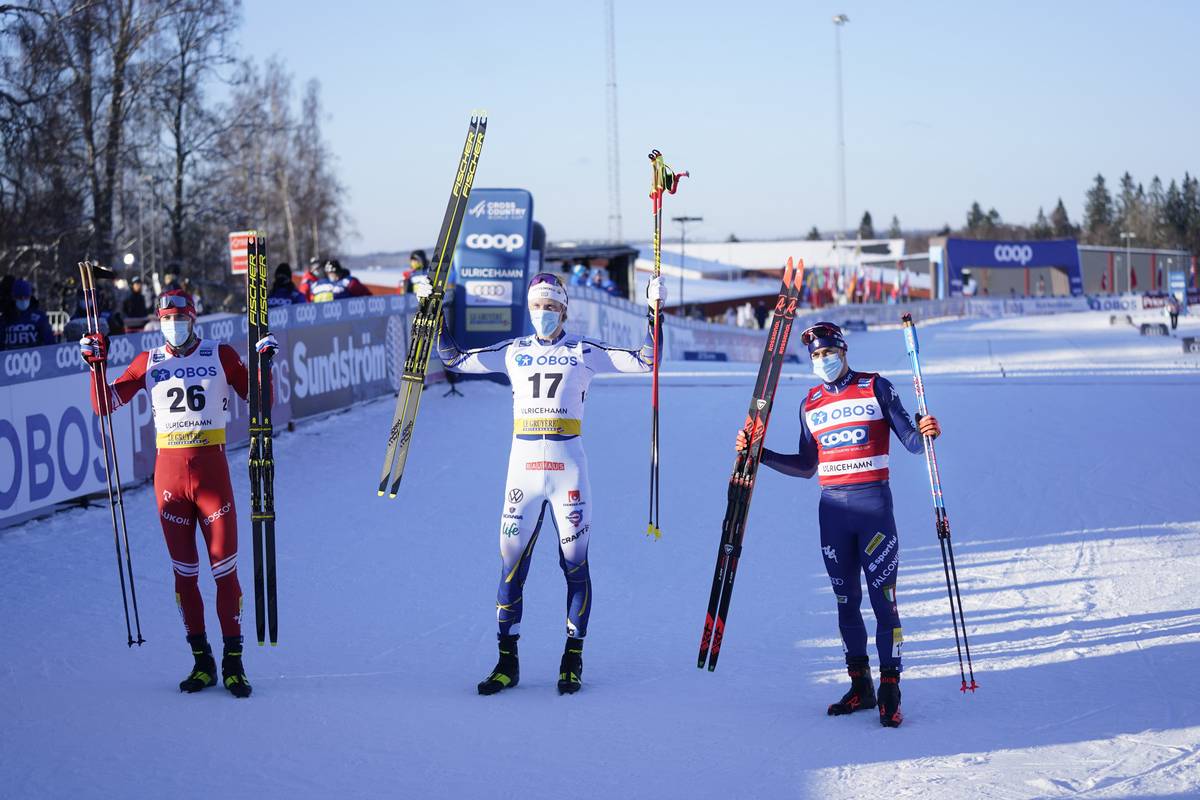
Gleb Retivykh (RUS), Oskar Svensson (SWE), and Federico Pellegrino (ITA) take the freestyle sprint podium in Ulricehamn, Sweden. (Photo: NordcFocus)
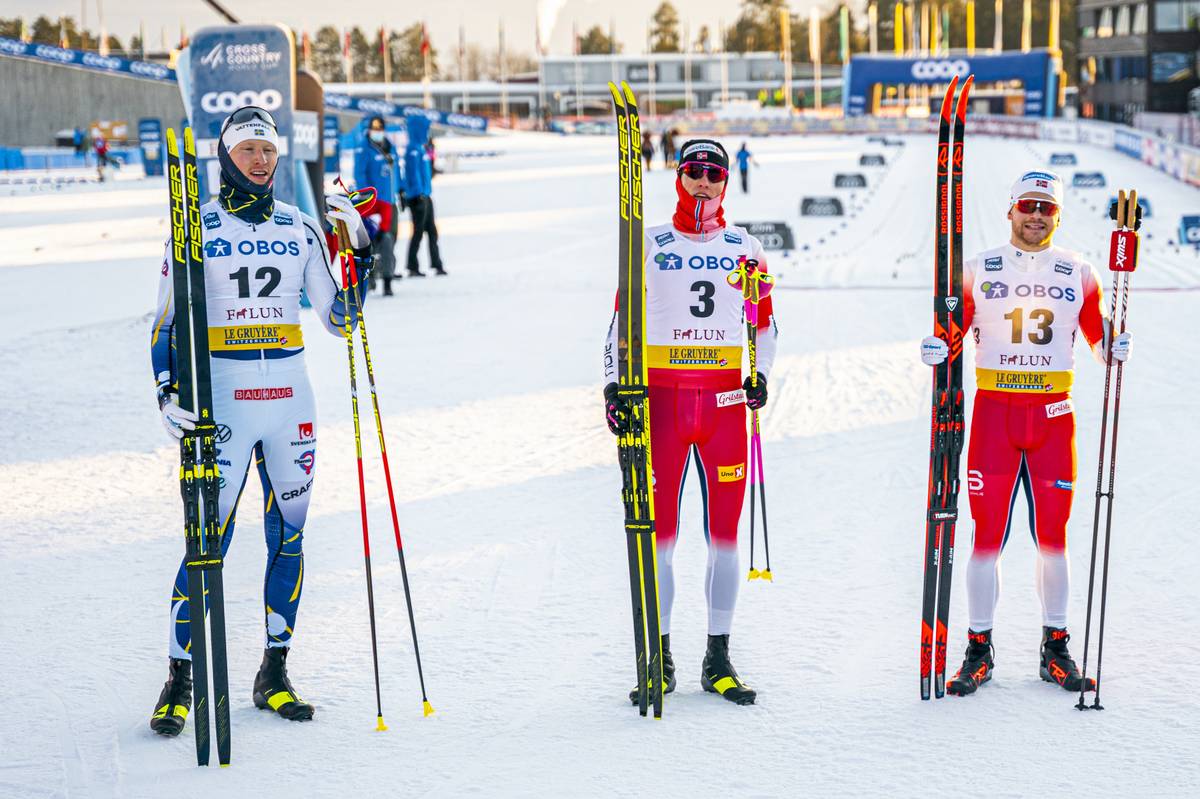
The men’s classic sprint podium in Falun, Sweden : Oskar Svensson (SWE) second, Johannes Høsflot Klæbo (NOR) first, and Håvard Solås Taugbøl (NOR) third, (l-r). (Photo: NordcFocus)
This World Cup coverage is made possible through the generous support of Marty and Kathy Hall and their A Hall Mark of Excellence Award. To learn more about A Hall Mark of Excellence Award or to learn how you can support FasterSkier’s coverage please contact info@fasterskier.com.
Squeaky snow, firm tracks and a fanless Falun was the backdrop for the men’s 1.4-kilometer classic sprint in Falun, Sweden on Sunday. The racing capped a three day series on the championship courses that hosted an individual start skate Friday and a mass start classic Saturday.
The qualifier and heats revealed the nature of the men’s sprint field – indeed a more challenging mix of skiers with Norway present. The Falun stop represents the second World Cup weekend since early December in which Norway arrived with a slate of skiers. We’ll get to this, but one-third of the 12 spots in the semis were earned by Norwegians.
Erik Valnes won the qualifier in 2:46.83 with pre-race favorite Johannes Høsflot Klæbo third (+2.23). And as if risen from the pandemic ashes after suffering a tough go with Covid-19, Russia’s Sergey Ustiugov, in his first weekend of racing this season, qualified fourth (+2.49).
JC Schoonmaker (20) of the U.S. was the lone North American to advance into the heats after qualifying in 11th (+5:06). Schoonmaker placed 18th overall for his third World Cup top-20. His best result remains 14th place in the skate sprint in Dresden, Germany, earlier this season.
Marcus Grate (SWE), Haavard Solaas Taugboel (NOR), James Clinton Schoonmaker (USA), (l-r) during the quarterfinals. (Photo: NordicFocus)
Schoonmaker began the fourth heat and skied near the front a minute into the race. His prospects to advance began to fade slightly nearing the two minute mark as he slotted into fourth place cresting a punchy climb. The Tahoe, California native finished fourth (+0.88) as Finland’s Lauri Vuorinen won the heat in 2:52.36.
Anton Persson (SWE), James Clinton Schoonmaker (USA), Håvard Solås Taugbøl (NOR), (l-r) during the Falun, Sweden classic sprint quarter-finals. (Photo: NordicFocus)
“In my heat I wanted to try and stay relaxed and make sure I wasn’t leading on the last downhill into the stadium,” Schoonmaker explained. “I felt like I was exactly where I wanted to be on the second climb but ended up getting a little crowded in over the top and from there I was just barely too far back to move on. I feel like I’m skiing with more confidence in these world cup heats but I just need to gain more experience in the packs in order to break into those semis.”
Schoonmaker will be part of a loaded American team headed to World Juniors/U-23s beginning in Vuokatti, Finand on February 6th. “I feel really good heading into U-23s,” said Schoonmaker. “I think I’m skiing well and I know I have the speed that is needed to ski at a high level. The U-23 field is super competitive so I can’t wait to mix it up with those guys in Vuokatti and keep the momentum rolling.”
A trio of Americans just missed out on qualifying in Falun. (Their qualifying place also represents each athlete’s standing in the overall.) They were Kevin Bolger in 31st (+9.74), Luke Jager, in his first career World Cup start, 32nd (+9.79), and Logan Hanneman 33rd (+9.83). Also for the U.S., Simi Hamilton qualified 37th (+10.57), and Hunter Wonders 68th (+17.20).
Just missing the heats in 31st, Kevin Bolger racing in Falun. (Photo: NordicFocus)
Luke Jager in his first career World Cup start, qualified in 32nd. (Photo: NordicFocus)
Logan Hanneman qualified in 33rd. (Photo: NordicFocus)
Antoine Cyr was the top Canadian, finishing in 49th. He was followed by Russell Kennedy in 51st, Pierre Grall-Johnson 54th, and Graham Ritchie 62nd.
The Sharp End
On a course requiring mandatory sprint-speed and power-bursts, endurance, and drafting, the sharp end racing tactics in the men’s first semifinal lulled well into the race. Atop the course’s final serious climb, none of the skiers opted to lead into the sinuous descent back towards the stadium. That is until Oskar Svensson of Sweden took the opportunity and skedaddled over the top leading Valnes, Federico Pellegrino of Italy, Gleb Retivykh of Russia, and Klæbo into the s-turn’s maw. This was a similar tactic the Swede used to his advantage taking the overall win in Val di Fiemme earlier in the season.
Sweden’s Oskar Svensson (bib 12), during the Falun, Sweden classic sprint. (Photo: NordicFocus)
As he does, Klæbo outpaced Svennson down the straight winning the first semi while Svensson placed second.
The second semi’s reveal was loud and clear at 1:00. Ustiugov powered up the first and longest of the climbs, gained roughly 10 meters on the five chasers, and never relented the lead. In fact, rather than cede ground, he looked to have a 15 to 20 meter lead gliding into the finish straight. He won in 2:51.06, 2.01 seconds ahead of second place Lucas Chanavat of France.
High hips and extended: Russia’s Sergey Ustiugov charging in Falun. (Photo: NordicFocus)
Contesting the final were, Klæbo, Svensson, Ustiugov, Chanvat, Valnes, and Norway’s Håvard Solås Taugbøl.
Ustiugov led out with pedal-down gusto to dictate this final’s narrative. The tactic, with a savvy crew of skier’s along for the ride, did not pay podium dividends for the Russian. Although dominating his semi, Ustiugov, who last won a World Cup sprint in December 2017, could not sustain his seminfinal’s moxy.
He was first around the 1:10 mark cresting over the longest climb, but the five skiers shadowing Ustiugov in the final were able to sit in his draft. Svensson shot around the Russian to lead into the second major climb. Svensson ran up the outside track, while Ustiugov ran up the inside. And Klæbo simply Klæboed. Again the Russian propelled himself into first up over the final climb. However, the group did not hesitate to determine who led into the downhill as Ustiugov was already zipping away in a tuck. Klæbo, Svensson, and Valnes all descended behind the Russian by a few meters.
Down through the S-turns and a sliver before the final roller, Klæbo, Svensson, and Valnes overtook Ustiugov. Klæbo slotted into the finish straight first, with Valnes tight behind. Yet as Valnes, taking the corner hot, tried to quick-step around, he lost his footing and slid out. Klæbo took the win 2:48.22, Svensson placed second (+1:45) and Taugbøl third (+2.80).
Sliding out of the tracks and off the podium, Erik Valnes of Norway had his hopes dashed in the Falun, Sweden classic sprint. (Photo: NordicFocus)
“It was a very hard race out there, but I was really glad when Ustiugov was heating up the pace, really high there,” Klæbo told FIS after the race. “My goal was to be second before the last downhill and in the quarterfinals, semi, I was number five, so I thought I would try to be in a better position. Yah, it worked quite good.”
Johannes Høsflot Klæbo poling towards the finish line in Falun. (Photo: NordicFocus)
Johannes Høsflot Klæbo with a glance behind to see the damage done. (Photo: NordicFocus)
According to Klæbo, he will not race again on the World Cup before this year’s World Championships in late February.
“This will be my last weekend before the World Championships so I am really glad I had the opportunity to go all the way to the final and have these four heats and everything,” he said. “It was a really nice to do it before the World Championships but Ustiugv was really strong and I am glad to see him back again.”
The day marked the 25th career World Cup sprint win for Klæbo, 11 of which are in classic technique. This is Klæbo’s first World Cup sprint appearance since the opening weekend in Ruka, Finland, also a classic race, in which he placed second to Valnes.
This was the third World Cup podium for Taugbøl and the second for Svensson. Rounding out the top-six, Ustiugov placed fourth (+2.97), Chanavat fifth (+11.18), and Valnes, who slowly strode down the straight after righting himself, sixth.
World Cup racing continues with an all-sprint weekend in Ulricehamn, Sweden. Saturday features a skate sprint, Sunday a skate team sprint.
Hans Christer Holund of Norway leading down the ribbon of white. A low snow year in Falun, Sweden. (Photo: NordicFocus)
Around and around they go. Due to lack of snow in Falun, Sweden, the men again wheeled their way around a manmade ribbon of snow, skating six icy 2.5-kilometer laps. Reduced from 30 to the 15 k distance and without the long, steep climb for which the course is usually known, how athletes would fare was yet to be determined.
The 2.5-kilometer track of Falun in a low snow year. (Photo: Screenshot FIS Broadcast)
Along the way, two sets of 15 bonus points were available for the top ten skiers to sprint past the 6.7 and 11.7 checkpoints. It was at the first checkpoint that things began to spread out.
Overall World Cup and distance points leader, Alexander Bolshunov of Russia, dropped into a tuck on the downhill, accelerating past the Norwegians Hans Christer Holund, Simen Hegstad Krüger, Finn Hågen Krogh, and Sjur Røthe who had taken turns in the lead. Behind Bolshunov in blue Lycra sat the newly minted skate contender Iivo Niskanen of Finland. Known historically as a classic specialist, Niskanen has shown marked improvements in his skate results this season, including a second place finish in the freestyle distance event in Nové Město.
Alexander Bolshunov (center) primes himself to charge for the sprint bonus, surging past Iivo Niskanen (bib 2) and Hans Christer Holund (bib 6). (Photo: NordicFocus)
Like a slinky, the pack caught back up to Bolshunov, who relaxed and allowed the Norwegians to get to work again at the front. In a tuck or free skating, the group headed down the longest descent of the course, halfway through the lap. As the course bent to the left, the leader, Røthe, began to step turn, pushing off his right ski and leaning into the curve. As his ski left the ground, it pushed the tips of Bolshunov’s skis together, sending him to the snow (and almost to the grass) between a set of v boards. The Russian hopped back up, quickly regaining lost ground on the lead pack.
At the 10 k mark, only 8 seconds separated the top ten. But after the second bonus sprint, where Bolshunov again slingshot around the Norwegian leaders out of the downhill to grab the full 15 points, the field began to spread out.
A sea of red: the top six Norwegian and Russian athletes head into the final lap of the 15 k freestyle in Falun. (Photo: NordicFocus)
Bolshunov pushed the front of the pack, trying to break free of Røthe, Holund, and Krüger. His Russian teammates Ivan Yakimushkin and Andrey Melnichenko maintaining contact from a few seconds behind.
In the final lap, Bolshunov tried to break free, but Røthe matched his every move. Holund and Krüger fell off the pace and were overtaken by the chasing Russians. Rounding a downhill turn inside the final kilometer, Krüger caught a ski in the loose granular snow and was sent to the ground, no longer in the hunt for the third step of the podium.
Rocketing out of the downhill with less than 500 meters to go, Røthe soared past Bolshunov in a tuck to take the lead over the final roller before the stadium.
Down to the final meters, Alexander Bolshunov (right) and Sjur Røthe sprint for home in the 15 k skate in Falun. (Photo: NordicFocus)
It came down to the final sprint, and Røthe was outmatched. Bolshunov snuck back around, powering his skis down the track. He created enough of a gap that his victory was certain, and he threw his arms up in the air to celebrate. It was the Russian’s fourth consecutive distance win, and sixth of the season.
With arms raised, Alexander Bolshunov takes the win in Falun with Sjur Røthe in a close second. (Photo: NordicFocus)
Sjur Røthe collapses after a hard fought battle for second place in Falun. (Photo: NordicFocus)
Yakimushkin was next across the line for third (+9.7), followed by Melnichenko in fourth (+10.5) and Holund in fifth (+11.0). The twenty-three-year-old Yakimushkin was 2nd in the event in Toblach, Italy during Tour de Ski and also 2nd at Russian National champs in April 2019.
With today’s result, Bolshunov looks untouchable at the top of the distance standings with 924 points. Røthe sits in second with 596. Bolshunov also leads the overall by over 400 points ahead of the injured boxer, Johannes Høsflot Klæbo.
Alexander Bolshunov (RUS) and Sjur Røthe (NOR) exchange congratulations after an exciting finish in Falun. (Photo: NordicFocus)
“It was a really hard race because the Norwegian team made good tactics,” Bolshunov told FIS through a translator at the finish. “They always sent someone in front to run the race, so I have to always close some gaps on them and make the most of the bonuses to take maximum points there. Then to make the harder pace on the last lap and to make a good fight with Sjur Røthe at the finish lane.”
The men’s distance podium in Falun. From left to right, Sjur Røthe (NOR), Alexander Bolshunov (RUS), and Ivan Yakimushkin (RUS). (Photo: NordicFocus)
For much of the race, Norris hovered inside the top-20, looking to match or improve upon his career best result of 16th, which was achieved in a 15 k skate in Falun last March.
David Norris tucks in behind Sergey Ustiugov (RUS) heading down the ribbon of snow in Falun. (Photo: NordicFocus)
In a post-race interview, shares that he did not originally plan to compete in Falun, sitting out the 30k instead to focus on the upcoming FIS Ski Tour 2020. He also reflects on his race, how mass starts affect the energy moderation strategy he has been honing, and his outlook heading into the distance-focused tour.
Post-race interview with David Norris
Benjamin Lustgarten (CGRP) was next for the U.S. in 60th (+3:21.0) followed by Ian Torchia (SMST2) in 65th (+3:37.7), and Kevin Bolger (USST) in 68th (+3:59.1).
Post-race interview with U.S. World Cup Coach Matt Whitcomb
Ian Torchia climbs with the pack in Falun. (Photo: NordicFocus)
Evan Palmer-Charette was the top Canadian athlete in 52nd (+2:45.8), followed by Alexis Dumas in 64th (+3:33.3), Bob Thompson 67th (+3:45.5), and Ricardo Izquierdo-Bernier 74th (+5:36.7).
The winner: Russia’s Alexander Bolshunov. (Photo: NordicFocus)
The hype. The Spectacle. Stage 7 of the 2019-2020 Tour de Ski (TdS) brings the show: the Alpe Cermis final climb. The race this year began as a mass start — a new format for the final stage, as this has historically has been a pursuit race, where the first skier to the finish line is the TdS champ.
With the opening sections of the course taking in the sprint course loop in Val di Fiemme, the man-made snow then led skiers on a snaking route, downstream along with the Torrent Avisio. At roughly 5.2 k into the what FIS had called a 10 k race, the gradient kicked up for the duration. The Alpe rears up at 12 percent initially, but soon morphs into a mountain-and-me struggle with gradients pushing 28 percent.
So the racers had that to mull as they no doubt had a somewhat anxious night of tossing and turning. And coupled with the big show final climb, FIS got its wish with a dearth of time bonuses on course this year for a tight TdS coming into the finale.
Last year’s TdS winner, Norway’s Johannes Høsflot Klæbo, wore the yellow leader’s bib by a single clock-tick, or one second over Russia’s Alexander Bolshunov. Last year’s TdS runner-up, Sergey Ustiugov of Russia, sat 15 seconds back. Ustiugov is seasoned on the Alpe. He won the TdS overall in 2016-2017, and was third in 2015-2016.
Let’s drill down on elapsed climb times and the work to be done for the top-three in the overall. Ustigov had to beat Klæbo by 15.1 seconds to take the overall, Bolshunov 1.1 seconds. Ustiugov clocked 31:47.6, the 11th fastest time of day for Stage 7 last year. Bolshunov, for his part, posted 32:34.1 for the 23rd fastest time in 2019. Klæbo’s time was 32:51.7, the 27th fastest time.
Coming into that final stage in 2019, Klæbo had a 1:20.4 minute gap on second place Ustiugov. And with the pursuit format, Klæbo was never caught, despite ceding just over a minute to Ustiugov in the final stage. Bolshunov bested Klæbo by 17.2 seconds. On paper at least, Klæbo would have to maintain close contact today.
With the knowledge of last year’s climbing splits, Klæbo’s task this Sunday involved matching the Russians stride for stride. There would be no time to let up momentarily, reset on the Alpe, and grind to the finish. It was to be head to head racing.
On the Alpe
Part of the job here is building tension. Cutting to the chase, there was no Klæbo-induced tension Sunday on the Alpe. He hung in there for a bit. At 6.6 k, before the toll of cumulative climbing took effect, Klæbo was fifth, two seconds behind the lead pacesetter Ustiugov. Bolshunov shadowed his teammate one second back.
As the Alpe kicked up, Klæbo, who at moments looked atypically spent, began to fall off in earnest. At 8 K he slid to 6.4 seconds back to Ustiugov, but more importantly, 5.1 seconds behind Bolshunov. Bolshunov, at that point was the virtual TdS overall leader. His task simple: keep pace with Ustiugov who had to gap his teammate by a bit more than 14 seconds to seize the overall.
Klæbo never regained traction on the Alpe. He placed 21st on the day. He lost 1:10 to Bolshhunov on the stage, and 58 seconds to Ustiugov. That put Klæbo in third overall for the Tour.
First time Tour de Ski overall winner, Russia’s Alexander Bolshunov. (Photo: NordicFocus)
Ustiugov intially held on. With less than a kilometer to go, he and Bolshunov were velcroed. The younger Bolshunov did eventually surge and any semblance of a link between he and Ustiugov snapped. Bolshunov went ahead to place third on the stage and take the Tour overall win. By the finish, Ustiugov, who ended up fifth for the stage, had ceded another 12.3 seconds to Bolshunov.
The final TdS podium had Bolshunov in first, in 2:58.18.1 hours, Ustiugov in second (+27.1), and, Klæbo third (+1:09). It was Bolshunov’s first career Tour de Ski overall title.
The men’s final overall TdS podium: Sergey Ustiugov (RUS) in second, Alexander Bolshunov (RUS) first, Johannes Hoesflot Klaebo (NOR) third, (l-r). (Photo: NordicFocus)
In fourth overall was Sjur Røthe (+1:51.6) and in fifth, Simen Hegstad Krüger (+2:53.7).
Røthe and Krüger animated the racing for the stage win. Past the 8 k time check, the two Norwegians accelerated. No skiers near the front dared match. Last year, Røthe posted the fastest time of day on the Alpe, Krüger was a close second. (Krüger was third overall in last year’s TdS.)
Simen Hegstad Krüger of Norway winning Stage 7 of the 2019-2020 Tour de Ski. (Photo: NordicFocus)
Today, Krüger motored ahead of Røthe in the waning meters for the stage win in 30:55.8. Røthe stopped the clock 13.9 seconds later to secure a Stage 7 second place. With his climbing prowess on the Alpe, Krüger jumped from 12th overall after Stage 6, to fifth. Røthe moved from sixth to fourth.
“It hasn’t quite worked out in the Tour so far so I hoped to get a good finish,” Krüger told FIS after the race. “I knew that this hill suits me well and so I just tried to keep that steady pace and to keep it going all the way to the top and it was fun to cross the finish line as the first thanks to the mass start.
“Sjur and I were going together and he looked strong so I was far from sure that I was going to win but it was also tough going first so I really had to push.”
David Norris of the U.S. This image captures the true sense of the TdS. A pure physical and mental test for skiers. (Photo: NordicFocus)
Two Americans persevered in this Tour: David Norris and Logan Hanneman. Norris placed 30th on the stage (+2:12.4) and 35th overall (+10:18.1). Hanneman placed 56th overall (+20:05.5). He was perhaps the final pure sprinter to finish the Tour, as all the others had withdrawn. Hanneman was also 56th on the day (+4:53.8).
Logan Hanneman of the U.S. finishing his maiden overall voyage at the Tour de Ski. (Photo: NordicFocus)
So it’s a wrap. The TdS concludes with Klæbo unable to solve this seven-stage racing puzzle made more difficult by the two Russians who stymied his run for a second overall TdS win.
Racing continues next weekend on the World Cup with city sprints from Dresden, Germany.
The men’s podium after Stage 6. Johannes Høsflot Klæbo (center) took the sprint victory ahead of Sergey Ustiugov (left) and Alexander Bolshunov (right). (Photo: NordicFocus)
With up to 60 bonus seconds on the line in the penultimate stage and just two minutes separating the top ten in the Tour de Ski overall, every place matters in the 1.5-kilometer classic sprint in Val di Fiemme, Italy. Fighting for the top spot on the podium, Johannes Høsflot Klæbo of Norway sat 18 seconds back on Alexander Bolshunov of Russia entering Stage 6 and three seconds ahead of Sergey Ustiugov.
Johannes Høsflot Klæbo (NOR) set the bar high, winning the qualifier by six seconds during Stage 6 of the 2019/2020 Tour de Ski. (Photo: NordicFocus)
None of these men cracked the top ten fastest times up the Alpe Cermis in the final stage in 2019. However, Ustiugov skied over a minute faster than Klæbo, and Bolshunov out-skied the Norwegian by 30 seconds. Though Klæbo still won the overall, he entered the final stage in the lead with a 1:20 cushion. This is not a luxury he will have this year.
Still, the sprint powerhouse won the qualification round by a large margin, sending a message to the field that he was ready to fight. His time was nearly six seconds faster than second place Federico Pellegrino of Italy and roughly seven seconds faster than Ustiugov or Bolshunov, who qualified 4th and 5th, respectively.
Racing in the first heat of the quarterfinals, Klæbo sat comfortably in the back of the pack using minimal energy and staying out of trouble in the first descent of the course. Up the final climb, he exploded to the front using his signature “Klæbo-step” technique, dropping Pellegrino and Denis Spitsov of Russia. He tucked into the downhill, then powered through the final straight alone to win the heat by over a second. Pellegrino, who finished third, did not advance the majority of the race was slow-paced.
The next excitement came at the finish of the fourth quarterfinal heat. Norway’s Sjur Røthe, who sits in fourth in the overall standings and skied the fastest time up the Alpe Cermis in 2019, was at the back of the pack heading up the final climb. Racing on lightning fast boards, he moved into the mix with the leaders on the descent, creeping up behind Ustiugov who held the left-most lane in the final stretch. Skiing in the neighboring lane, Ustiugov’s teammate Andrey Larkov kept Røthe boxed into this spot.
Creating room for himself at the risk of a crash, Røthe moved into the middle of the lanes, sandwiched between the Russians. Finally, Larkov moved right, allowing Røthe to hop into the lane and sprint his way into second, just behind Ustiugov. Larkov’s movement took out France’s Renaud Jay, who slid out of his track into Sweden’s Calle Halfvarsson. The men tangled onto the ground. Larkov was issued a yellow card for obstruction.
About to make his move, Johannes Høsflot Klæbo flies through the descent in the quarter final. (Photo: NordicFocus)
Sergey Ustiugov crests the hill in the lead with Sjur Røthe (NOR) chasing from behind in the quarterfinal. (Photo: NordicFocus)
On to the semis. In the first round, Klæbo again sat tucked into the pack. It was clear that Norwegian techs nailed the wax and ski selection as Klæbo and his teammate Pål Golberg soared to the front in the long descent, gaining momentum for the final sprint to the finish.
Klæbo entered the stadium alongside Bolshunov with Goldberg in his wake. Seeming to gain half a meter on the Russian with each double pole, the two created enough of a margin to lay off the gas before sliding across the line. The force of Bolshunov’s stroke snapped the tip of his pole in the final meters, though he maintained his position in third and was able to advance to the final as a lucky loser.
Ustiugov and Gleb Retivykh advanced comfortably from the second semi-final.
Ustiugov and Bolshunov took the pace out fast in the final heat, hoping to take the sting out of Klæbo’s top gear. Ascending the steep second climb, Ustiugov held the lead with Bolshunov and Klæbo on his heels, all three men running powerfully out of the track. Perhaps to interrupt his momentum, Bolshunov cut in front of Klæbo along the tangent of the curve, but the Norwegian seemed unphased, trusting his skis and his talent in the final stretch.
Down to the final meters, Johannes Høsflot Klæbo (NOR) takes the win in Stage 6. (Photo: NordicFocus)
Flying past the Russians in the final stretch, Klæbo stopped the clock at 3:03.78. Ustiugov slid his boot across for second (+0.70), followed by Bolshunov in third (+1.33). With the win, Klæbo takes home 60 bonus seconds, Ustiugov 54, and Bolshunov 48.
Johannes Høsflot Klæbo (NOR) and Alexander Bolshunov (RUS) exchange congratulations at the finish of the 1.5-kilometer classic sprint. (Photo: NordicFocus)
Catching his breath while Norwegian flags are waved, Johannes Høsflot Klæbo takes the win in the 1.5-kilometer classic sprint during the 2020 Tour de Ski. (Photo: NordicFocus)
This is Klæbo’s twelfth consecutive sprint victory and the 20th of his career.
“We had really good skis today,” Klæbo told FIS after the finish. “My plan was to go second before the last downhill. I tried that yesterday and it worked quite good then, so my plan was to do the same today and it worked twice, so it’s really good.”
When asked about the close quarters in the final climb and Bolshunov’s move to take Klæbo’s path, the Norwegian indicated no belief of foul play.
“I think it was a really hard pace in the last uphill. I think Sergey had a bit of a gap, but at the end, we managed to give it all out and be in good position going into the last downhill.”
The men’s podium after Stage 6. Johannes Høsflot Klæbo (center) took the sprint victory ahead of Sergey Ustiugov (left) and Alexander Bolshunov (right). (Photo: NordicFocus)
The sole American, Logan Hanneman, qualified in 14th (+11.88). He selected the fifth heat of the quarterfinals, which proved to be an exercise in patience. With no one willing to take the lead, the pace stayed pedestrian until the final descent the pack stayed tight. With a spread of only one second between the men at the finish, Hanneman finished 4th with no shot at a lucky loser spot. He ended his day in 18th.
“I am pretty well beat this late in the tour,” wrote Hanneman in an email. “I know my distance leaves a lot to be desired, especially at this stage, but I really wanted to finish the tour and so I have been doing everything I can not to get pulled out in the distance races and allow myself to race this last sprint. I was quite happy with today, especially for how fatigued I am. But…everyone is in the same boat so that really isn’t an excuse of any type.
“I am really looking forward to getting out of the quarterfinals one day, but I am slowly moving up places in my heats, so hopefully it will happen someday soon!”
Logan Hanneman in the mix during the quarterfinal. (Photo: NordicFocus)
Overall Tour Standings Heading Into Final Stage
Traded repeatedly amongst the three leaders, the yellow bib exchanges hands once more before the final stage.
With the top three athletes in the Tour’s overall standings racing in the final, earned time bonuses have less differential. As the final stage will begin in a mass start this year, the men will not have the visual cue of hunting one another up the climb. They can only hope to receive information from coaches about their time ahead of or behind the other leaders.
With his victory in the classic sprint, Johannes Høsflot Klæbo regains the yellow leader bib entering the final stage of the 2019/2020 Tour de Ski. (Photo: NordicFocus)
Time for the overall standings was calculated based on the result from qualification, less the bonus seconds obtained in the heats. As such, Klæbo’s qualifier gave him a seven second advantage over the Russians heading into the heats. With 12 bonus seconds more than Bolshunov, Klæbo netted a total of 19 seconds, indicating that his aggregate time is now the fastest of the tour by one second. Klæbo netted 12 seconds on Ustiugov, widening his margin to 15 seconds in the overall.
Pål Goldberg sits in 4th (+1:53), followed by Iivo Niskanen of Finland (+1:59), and Sjur Røthe in 5th (+2:01). Røthe was over two minutes faster than Klæbo or Bolshunov in the final stage of 2019, and over 1:15 faster than Ustiugov. The podium is within his reach.
Three skiers atop the overall standings after Stage 4 set the tension for Stage 5 in Val di Fiemme, Italy: a 15-kilometer mass start classic race. Russia’s Alexander Bolshunov skied in the yellow leader’s bib while his teammate Sergey Ustiugov stood 16 seconds back in the overall. Johannes Høsflot Klæbo, Norway’s Tour de Ski (TdS) podium hope, lurked at 26 seconds back.
Alexander Bolshunov (RUS), Johannes Hoesflot Klaebo (NOR), Sergey Ustiugov (RUS), (l-r) early during Stage 5 of the TdS in Val di Fiemme, Italy. (Photo: NordicFocus)
With a mass start format, the three contenders would play chess match skiing with a closing 1.5 k of turbocharged showmanship to determine the day’s winner. In between, as the 62 starters looped around the 2.5 k course which featured three climbs and an equal number of slick descents, the front pack never shattered.
Val di Fiemme 2.5 k course profile
The men’s field remained roughly intact through 7.5 k. With an arbitrary cutoff of five seconds, 25 skiers came through within that time frame. Hans Christer Holund of Norway leading, Sebastian Eisenlauer of Germany in 25th.
One kilometer ahead, at the 8.5 k mark, sat the day’s only time bonus atop a climb — a finite opportunity for some to snag time and decrease a time deficit.
Holund accelerated, awakening the leaders as the time bonus mark closed in. With the front of the field finally getting strung out, and several Norwegians present to steal a bonus spot away from the Russians (they took four of the top five spots through the bonus mark), Klæbo made a move up the inside to grab the first place 15 second prize. Bolshunov came through in fourth for an eight second bonus, Ustiugov in ninth for two seconds.
Pål Golberg (NOR), leading Alexander Bolshunov (RUS), (l-r) during Stage 5 of the TdS in Val di Fiemme, Italy. (Photo: NordicFocus)
Post time-bonus, the pace backed off. Until roughly 13 k, no skier in the front group made a discernible effort to separate. At 32:10, at the base of a climb, a mass of more than 20 skiers strode up led by Bolshunov in the yellow bib. It remained that way as the bell rang indicating the final lap.
Then the Russian charge began with Ustiugov’s double-pole push-and-punch through 13.9 k. On the course’s tricky descent that arcs left and loops back up for the decisive climb, Ustiugov was that Russian bear again. Unbridled and running, he was matched on the outside by an equally determined Klæbo.
Through the downhill, Klæbo proved to have slightly better glide as he slid past Ustiugov into the straightaway. There Klæbo is king. He won in 39:51.0, with Ustiugov 0.7 seconds back in second place. Bolshunov held tight for third (+1.0).
With the close pack racing and Klæbo’s sharp move for the max time bonus, Bolshunov still leads the overall. However, that lead stands at 16 seconds over Klæbo in second overall. Ustiugov sits in third, 21 seconds back.
Full extension Johannes Høsflot Klæbo for the win. (Photo: NordicFocus)
Johannes Høsflot Klæbo (NOR) is a finisher as he takes the Stage 5 TdS win over Sergey Ustiugov (RUS), (l-r). (Photo: NordicFocus)
Two American men remain in the Tour. David Norris placed 38th (+1:41.9) on Stage 5. He tumbled on the second lap, but regained contact with the field. With two stages remaining, Norris is 36th overall. Teammate Logan Hanneman, a sprinter by trade, placed 59th (+4:49.8) on Friday.
David Norris of the U.S. is 36th overall after Stage 5 of the TdS, a 10 k mass start classic. Photo: NordicFocus)
World Cup Coach Matt Whitcomb’s post-race comments on the men’s racing
Tomorrow’s classic sprint remains a decisive day for Klæbo. Classic sprints and Klæbo most often mean one thing: a top step on the podium. And with that top step comes a 60 second time bonus. To stay in touch, Bolshunov and Ustiugov will need to make the six skier final.
The men’s podium of Stage 4 of the 2019/2020 Tour de Ski. Alexander Bolshunov (center) won the stage ahead of Sergey Ustiugov (left) and Iivo Niskanen (right). (Photo: NordicFocus)
The hunter becomes the hunted. Looking back on previous tours, Russia’s Sergey Ustiugov has not worn the leader bib going into the pursuit stage except for the 2016/2017 tour in Oberstdorf, Germany. That year, Ustiugov won six of the seven stages, placing second in the mass start classic in Stage 6, but still raced up the final hill climb with a significant buffer for the overall victory.
This year, Ustiugov was the man to beat. After a dominant performance in yesterday’s 15-kilometer skate, the Russian began the 15 k classic in Toblach, Italy with a lead of 22.6 seconds before the next skier and 27 seconds in the overall standings. On the hunt were his teammates, Ivan Yakimushkin and Alexander Bolshunov, followed by a troop of athletes looking to earn back time on the leader. In particular, a host of Norwegians looking for redemption after the third stage. Would his gap be enough to hold his position over 15 k’s?
Within the first 4 k, the answer was evident. Bolshunov and 4th place starter Calle Halfvarsson of Sweden closed the gap and overtook the leader. The three men skied together through 8 k, then Bolshunov began to crack open a gap.
Sergey Ustiugov falls short in preserving his rights to the leader bib in Stage 4 of the 2019/2020 Tour de Ski. (Photo: NordicFocus)
Unable to match the pace, Ustiugov switched into damage control mode. Standings in the overall tour are based on the cumulative time from each stage, and the time added from today’s event is based on time of day results, meaning the elapsed time each individual spent on course. Being caught by Bolshunov meant Ustiugov had already lost 29 seconds, meaning that Bolshunov’s aggregate time now earned the 23-year-old the rights to the yellow bib.
Ustiugov was able to keep his teammate within 20 seconds, but Bolshunov never saw his position at risk and finished with a 13 second lead. He stopped the clock at 38:14.9 for his first stage win in the Tour de Ski. Subtracting this from his deficit in the overall, Bolshunov now leads the overall rankings by 16 seconds.
Alexander Bolshunov celebrates his Stage 4 win during the 2019/2020 Tour de Ski. (Photo: NordicFocus)
“It was a really, really hard race,” Bolshunov told FIS through a translator. “A big part of this was that I had to work alone. Sergey in the middle helped to keep the pace, by my own feelings started to run away and the last lap it was really hard to keep the speed.”
When asked whether he had energy left for the final three stages in Val di Fiemme, he answered with a mischievous smile.
“The tour just started.”
Alexander Bolshunov (RUS) takes control ahead of Calle Halfvarsson (SWE) and Sergey Ustiugov (RUS) during Stage 4 of the 2019/2020 Tour de Ski. (Photo: NordicFocus)
Alexander Bolshunov (RUS) blasts off as he leaves behind Calle Halfvarsson (SWE) and Sergey Ustiugov (RUS) during Stage 4 of the 2019/2020 Tour de Ski. (Photo: NordicFocus)
When Bolshunov began to pull away, Halfvarsson fell dramatically off the leaders, dropping from eight seconds back to over 50. Perhaps the Swede was paying for his effort in light of the cumulative tour fatigue that is setting in. He rebounded in the final lap to finish within 30 seconds of Bolshunov in 5th.
Steadily working his way up through the field in his dominant technique, Iivo Niskanen had an outstanding performance. The Finn began the race in 11th place with a deficit of 1:35, half of which he recouped in the first half. Like many other athletes, Niskanen began to fade in the middle part of the race, but he switched on his afterburners in the final lap.
Iivo Niskanen rises up the ranks on his way to a third place finish in Stage 4 of the 2019/2020 Tour de Ski. (Photo: NordicFocus)
With 2.5 k to go, Niskanen was 50 seconds back on Bolshunov in sixth, yet he could be seen rounding the corner into the final stretch as Ustiugov slid over the line. Niskanen took the third spot on the podium finishing 24.8 seconds back on the leader, a result that moves him into fifth place in the overall standings.
So far this season, Niskanen won the 15 k classic in Ruka in addition to a 10 k classic early season opener. He is also an Olympic champion in the 50 k classic and podium finisher in the 15 k classic at the 2019 World Ski Championships in Seefeld, his stride and glide prowess is clear. Heading into two additional classic stages, he now sits in 5th place in the overall standings with a 1:10 deficit.
Iivo Niskanen takes third during Stage 4 of the 2019/2020 Tour de Ski. (Photo: NordicFocus)
Desperate to whittle down his 37-second deficit in the overall ranks, Johannes Høsflot Klæbo looked like a workhorse in the pursuit. No pomp, just head down, focused, determination. He knew he was not fighting for a podium position on the day, but any time he could gain on the leaders would help keep him in contention for an overall win. It is essential that he keep his overall deficit within a margin that could be surpassed with bonus seconds he intends to garner in the sprint during Stage 6.
Klæbo started the day 1:11 behind Ustiugov. Nearly 30 seconds of this were chipped away in the first 5 k, then he began to struggle. He began ceding places and time, leaving him in 16th at the 12.4 k mark 1:23 in the hole. He too found a new gear, closing hard in his final lap to move into 10th (+57.2).
Johannes Høsflot Klæbo climbs his way into 10th during the 15 k classic pursuit in the 2019/2020 Tour de Ski. (Photo: NordicFocus)
As he gained time on Ustiugov, his deficit in the overall standings reduced to 26 seconds, though he still sits in third. Perhaps better suited for head to head competition, Klæbo is in good position heading into the next two stages.
Again the top American distance athlete, David Norris finished 44th (3:43), improving on his 51st place finish yesterday. His time of 39:34.9 was the 34th fastest time of day.
Kevin Bolger finished 61st (+5:24.9), and Logan Hanneman 71st (+7:47.2).
In a post-race interview, Whitcomb shares that Bolger, who is a sprint-specialist, used the TdS distance stages as an opportunity to build fitness. He will now leave the tour to prepare for the city sprints in Dresden. Whitcomb also provided insight into Norris and Hanneman’s races, and offered a possible answer to the yo-yo like time difference seen in the race.
Post-race interview with Matt Whitcomb.
Racing continues Friday with a 15 k mass start classic in Val di Fiemme, Italy.
Rising to the top, Sergey Ustiugov takes the win in Stage 3 of the 2019/2020 Tour de Ski in Toblach, Italy. (Photo: NordicFocus)
New day, new venue, almost a new decade. The 2019/2020 Tour de Ski continued in Toblach, Italy with a 15-kilometer interval start skate. In the war of attrition that is the tour, the first stages set the tone. Hopefuls for the overall win seek to establish their position near the top without expending too much energy to hold up for the long haul.
We are now in the meat and potatoes of the tour. Three consecutive distance races, interrupted by one travel day. There are no bonus seconds on the line in the next two stages, meaning athletes need to fight for every second solely with their own grit.
Sergey Ustiugov (RUS) flies to his second stage win during the 15-kilometer skate in Toblach, Italy. (Photo: NordicFocus)
Racing midway through the seeded group in bib 44, Russia’s Sergey Ustiugov took off on Stage 3, setting the fastest time at each checkpoint to lead wire-to-wire. But his position in the leader chair was insecure until the remainder of the seeded men had their shot.
Wearing the highest numbered bib in the seeded group as the overall tour leader, Klæbo would have information on how he was matching up with Ustiugov at each checkpoint, informing him on whether he needed to work harder or lay off the gas. After winning a 60-second time bonus in the sprint, Klæbo had a cushion of 34 seconds over Ustiugov to work with. Victory in stage three was not imperative, but it would be important to keep the Russian within that margin.
In the first 5 k, it looked like this was how the story would play out. Ustiugov’s teammate Alexander Bolshunov, who trailed Klæbo by 32 seconds, nearly matched the pace setter. Klæbo trailed by six seconds, followed by three of his teammates in the next ten seconds: Hans Christer Holund, Simen Hegstad Krüger, and Pål Golberg. Each of these men is accomplished in distance racing.
Johannes Høsflot Klæbo falls flat in his attempt to keep the leader bib in Stage 3 of the 2019/2020 Tour de Ski. (Photo: NordicFocus)
On his way to a second place finish, Alexander Bolshunov consistently performs in Stage 3 of the 2019/2020 Tour de Ski. (Photo: NordicFocus)
However, things quickly began to change. Ustiugov’s splits became untouchable, and the Norwegian stronghold began to crumble. By the 10 k mark, his time was over 15 seconds ahead the next skier, and Klæbo had fallen 40 seconds behind into 15th. Ustiugov had the race locked up.
Sergey Ustiugov (RUS) locks eyes on his second stage win during the 15-kilometer skate in Toblach, Italy. (Photo: NordicFocus)
As the remainder of the seeded group made their way through the finish, Ustiugov remained on top by a large margin. His 23-year-old teammate Ivan Yakimushkin, who had not landed in the top 30 in either of the first two stages of the tour, worked his way into second place (+22.6). Yakimushkin was 43rd in the 15 k in Lenzerheide and qualified in 49th in the sprint, leaving him ranked 47th overall.
Sliding his boot across the line in unmatchable time, Sergey Ustiugov takes the win in Stage 3 of the 2019/2020 Tour de Ski in Toblach, Italy. (Photo: NordicFocus)
Rising to the top, Sergey Ustiugov takes the win in Stage 3 of the 2019/2020 Tour de Ski in Toblach, Italy. (Photo: NordicFocus)
Prior to the tour, Yakimushkin was a member of the Russian relay team that won the event in Lillehammer earlier this month and posted a top-10 in the distance classic race in Ruka.
Bolshunov, who was also born in 1996, took third 29 seconds back. Currently the top-ranked distance skier on the World Cup, Bolshunov has raced consistently in the tour: third in the first stage, and eighth in the second.
The all-Russian men’s podium of the 15-kilometer freestyle event in Stage 3 of the 2019/2020 Tour de Ski in Toblach, Italy. Sergey Ustiugov (center) was the clear winner over Ivan Yakimushkin (left), and Alexander Bolshunov (right). (Photo: NordicFocus)
In addition to sweeping the podium, Russia took three additional spots in the top 10, with Artem Maltsev, Andrey Melnichenko, and Denis Spitzov finishing 5th, 6th, and 10th, respectively.
Looking frustrated, Klæbo fell back to 17th (+1:11.4) by the finish, well-outside the margin he had to work with.
Johannes Høsflot Klæbo grimaces after a disappointing performance in the 15-kilometer freestyle event in Stage 3 of the 2019/2020 Tour de Ski in Toblach, Italy. (Photo: NordicFocus)
He was not the only Norwegian to struggle after the 5 k mark. Goldberg fell from 8th to 60th, and Krüger from 6th down to 22nd. Holund was the only Norwegian to maintain his top-10 position throughout the race, finishing 5th. Sjur Røthe also worked his way into 8th.
Though he leads the point standings, Johannes Høsflot Klæbo hides the usual toothy smile after a disappointing performance in the 15-kilometer freestyle event in Stage 3 of the 2019/2020 Tour de Ski in Toblach, Italy. (Photo: NordicFocus)
Though he still leads the point standings, Klæbo is now 37 seconds in the hole for the overall, sitting in 3rd place. He faces a pursuit-start classic tomorrow and a mass start classic on Friday. Presuming the time bonuses are still available in the mass start, he will have the opportunity to earn back time there and also in the classic sprint on Saturday.
Ustiugov’s performance bumped him into the overall lead with Bolshunov 27 seconds behind in second place. Nothing is out of reach for these three men. Holund and Maltzev round out the top five, trailing by just over 1:20.
As was seen in the final climb up the Alpe Cermis last year, Ustiugov has the upper hand over the Norwegian. Klæbo will need to rebound in time to create a significant gap before the final stage if he hopes to repeat his victory.
For the Americans, David Norris was again the top-ranked distance skier, finishing 51st (+2:22.6). Kevin Bolger finished 60th (+3:04.0), followed by Logan Hanneman in 73rd (+3:46.0).
In a post-race call, Matt Whitcomb provided insight into the men’s race. He also explains his approach counseling athletes about races in which athletes may not be set up to excel.
Post-race interview with Matt Whitcomb.
David Norris skis to 51st, the top American finish in Stage 3 of the 2019/2020 Tour de Ski in Toblach, Italy. (Photo: NordicFocus)
Heading into three classic races, Whitcomb explained that the techs are feeling confident in ski selection and waxing. Many K’s have been logged to ensure the American skis are ready to compete.
Post-race interview with Matt Whitcomb regarding ski testing.
Stage 1 of the 2019-2020 Tour de Ski is final. With two distinct shows in the Lenzerheide, Switzerland men’s and women’s mass start races, the seven-stage TdS narrative has the intro chapter written. Therese Johaug for Norway looks prepped for the distance race sweep, whereas the men’s side has several skiers playing for keeps. On second thought, maybe it’s not that simple after all. They’ve got six stages to go.
Quite literally, a massive mass start on the World Cup. Stage 1 of the 2019-2020 Tour de Ski in Lenzerheide, Switzerland. (Photo: NirdicFocus)
Ustiugov claims his 8th stage win in the opening event of the 2019/2020 Tour de Ski. (Photo: NordicFocus)
The starting corral was blocked by a wall of red before the start of the 15-kilometer mass start freestyle in Lenzerheide, Switzerland. Of the top ten ranked athletes, eight hailed from either Norway or Russia, interrupted only by Iivo Niskanen of Finland and Lucas Chanavat of France.
Johannes Høsflot Klæbo thanks his supporters before climbing into the second spot on the podium after the first stage of the 2019/2020 Tour de Ski. (Photo: NordicFocus)
Front and center was last year’s victor Johannes Høsflot Klæbo. He became the youngest Tour de Ski Champion at 22 years of age after holding off Russia’s Sergey Ustiugov who was gaining on the Norwegian throughout the final climb up the Alpe Cermis. It was clear in the final meters that there was no showmanship or gamesmanship in this performance; the young star was fully spent as he collapsed over the line.
Now an aged and wizened 23-year-old working on his tactics and gears in distance racing, Klæbo aspires to become the second man in history to win consecutive tours. Swiss athlete Dario Cologna did this in 2011 and 2012.
Klæbo is not a lock for this achievement — today’s opening stage made that abundantly clear. He will need to hold off the likes of Sergey Ustiugov and Alexander Bolchunov (RUS), Niskanen, Emil Iversen (NOR) and an otherwise deep field all vying for the same goal.
“I will try my best and I will count [my time] after the last day,” Klæbo told FIS during a pre-race press conference.
With the starting pistol marking the start of the nascent tour, the men began soaring around the course, through snow laden pine forest in front of high mountains emerging from their wreath of snow.
For the first 10 k, the field held strong in a long train. The top men, who stemmed from the first row of the start line, regularly exchanged the lead and the top 40 were separated by 10 seconds. Though the pace began to accelerate, the top ten were only spread by three seconds with 1.5 k to go.
A dense pack of skiers during the first stage of the 2019/2020 Tour de Ski, a 15-kilometer mass start freestyle. Logan Hanneman can be found on the right side of the image wearing bib 85. (Photo: NordicFocus)
Moves and countermoves. With 1 k to go, Ustiugov took charge. He rocketed off the front to create a gap to the lead pack. His teammate Bolshunov was three seconds back, along with Cologne, Iversen, Klæbo, and their Norwegian teammates Simen Hegstad Krüger and Sjur Røthe.
Ustiugov managed to maintain his gap and flew through the final straightaway in a confident V2. In the screen behind him was a pack of men whose final standings were far less certain. Klæbo and Bolshunov were dueling tête-à-tête in a sprint to the finish, sliding their boots over the line in sync for a photo finish. It was decided that Klæbo edged out his competitor for second, though he and Bolshunov will both enter the second stage of the tour four seconds behind Ustiugov.
Johannes Høsflot Klæbo (NOR) and Alexander Bolshunov (RUS) slide across the line in a photo finish at the end of the first stage of the Tour de Ski. (Photo: NordicFocus)
Iversen surged for 4th (+7.2) ahead of his countryman Martin Løwstrøm Nyenget (+8.6) who bested Tour de Ski veteran Cologna, Hans Christer Holund, Jan Thomas Jenssen, and Sjur Røthe in a five-way photo finish. Finishing in the order listed, the five men were separated by a margin of 0.4 seconds. Krüger rounded out the top ten one second later (+10.0).
Dario Cologna (bib 24) finishes amongst a herd of men vying for position at the end of Stage 1 of the 2019/2020 Tour de Ski, a 15-kilometer mass start skate in Lenzerheide, Switzerland. (Photo: NordicFocus)
“It was a really good performance and the shape was okay,” Ustiugov told FIS through a translator at the finish. “It was for sure a pleasure to win the first stage and I wish to show the same results on the next stages. Big thanks to Russian fans because it’s a really big pleasure to hear Russian people [cheering] here in Switzerland. It’s great.”
Russia’s Sergey Ustiugov celebrates his victory after the first stage of the 2019/2020 Tour de Ski, a 15-kilometer mass start skate. (Photo: NordicFocus)
Today’s victory marks the Russian’s eighth win in a TdS stage, advancing him to the second most behind Petter Northug who has 13 wins. The winner of the 2016/2017 TdS, Ustiugov has reached the overall podium in three of his last four rounds, only missing the final TdS podium in the 2017/2018 tour where he withdrew after the 5th stage. The Russian also won the first distance stage of last year’s TdS.
The men’s podium of the first stage of the 2019/2020 Tour de Ski, a 15-kilometer mass start skate in Lenzerheide, Switzerland. Sergey Ustiugov (RUS) took the win over Johannes Høsflot Klæbo (NOR) and Alexander Bolshunov (RUS) who were second and third, respectively, in a photo finish. (Photo: NordicFocus)
Three Americans started in Lenzerheide. David Norris finished as the top ranked American in 58th (+1:11.2). Kevin Bolger finished 64th (+1:35.0), followed by fellow Logan Hanneman in 69th (+1:42.1). Simi Hamilton was slated to start, but withdrew from the TdS due to a pulled muscle in his groin.
For the first nine kilometers, Norris hovered on the cusp of the top-30. After the race, Matt Whitcomb explained the energy-expenditure challenges of racing in this position, along with the strategy of sprint specialists Bolger and Hanneman.
Post-race interview with Matt Whitcomb on men’s performance.
“This was a fun mass start – fast and flowing,” wrote Norris explained an email after the race. “For the first 12km or so I felt really comfortable in the group. I tried to ski relaxed and avoid any of the chaotic crashes and tangles that seemed to occur each lap. With about 2 km to the finish I felt great and my skis were running well, but all of the sudden I bonked incredibly hard – got tunnel vision and struggled to avoid tripping on myself. It was a tough way to finish the race, but I’m optimistic I have better days ahead in this tour.”
Swiss flags flying against a breathtaking backdrop. Wearing bib 77, Kevin Bolger can be found at the center. (Photo: NordicFocus)
Early goings of the mass starts classic in Val di Fiemme, 2018-2019 Tour de Ski, (Photo: Fischer/Nordic Focus)
The Tour de Ski begins with a mass start bonanza on Saturday. In this non-championship year, the TDS takes on marquee status as one the season’s premier prizes. Seven stages with a variety of disciplines, this 14th edition promises a loaded field of skiers.
For the women, Therese Johaug of Norway is the easy favorite. Johaug appears programmed for dominance — the TdS features five distance stages.
Norway has been well suited for the TdS. They’ve captured the women’s overall in six straight editions. Johaug claimed the wins in 2013-2014 and 2015-2016. She has also won every distance event this season setting her up as the run away favorite. But Johaug is beatable. In Québec last season, the site of the World Cup final, Stina Nilsson of Sweden foiled Johaug in a 10 k mass start classic and 10 k skate pursuit. We also saw Nilsson go head-to-head and take Johaug in the 2019 World Championship 4 x 5 k anchor leg.
Johuag can have her off days.
In an event like the TdS with so many variables, its semi-tough to fathom all the overall contenders. A single bad day, some mixed wax, and a TdS leader can lose valuable time. Jessie Diggins of the U.S. Ski Team should be counted in the top-tier mix. She placed third overall in 2017-2018. Last year Diggins wore the TdS leader’s bib for a stage before losing time on a tough-to-hit kick wax day.
Jessie Diggins (U.S. Ski Team) racing to third in the women’s 10 k freestyle pursuit at Stage 3 of the 2018 Tour de Ski in Lenzerheide, Switzerland. On the first day of the new year, it was her first podium of the season. (Photo: Salomon/NordicFocus)
There’s Norway’s Heidi Weng in there too. It’s been a resurgent year for the two-time TdS winner. And the true unknown is Norwegian Ingvild Flugstad Østberg. Due to undisclosed health concerns, Østberg was withheld from competition by team doctors for Period I on the World Cup. Saturday’s mass start skate will be Østberg’s first World Cup start of the season. She is the defending TdS champion.
For Russia, Natalia Nepryaeva and Finland’s Krista Pärmäkoski, who finished second and third respectively last year, add depth to the field of challengers. Last season’s Swedish phenom, Frida Karlsson, remains out of competition and is not expected at this TdS. However, teammate Ebba Andersson, who has yet to compete this season on the World Cup, is slated to race as is Charlotte Kalla, a former TdS winner, and Nilsson.
Norway’s Johannes Høsflot Klæbo (r) crossing ahead of Italy’s Francesco de Fabiani to secure his fourth win of the 2019 TdS. He placed first in the men’s 15-kilometer classic event in Val di Fiemme, Italy. (Photo: Fischer/Nordic Focus)
The men’s field has at its pre-race favorite apex, Johannes Høsflot Klæbo of Norway. Last year’s TdS winner, Klæbo, presents a double-edge sword with the ability to win both sprint and distance events. Unlike Johaug on the women’s side, Klæbo will almost certainly score big bonus time in the two TdS sprints. Whether he builds a big buffer of time over his pure distance rivals in the sprints remains to be seen. But, the sprints are not a wild card for Klæbo, they are his ace that complements his distance chops.
Using last season’s overall results as a barometer, Klæbo is not a guaranteed winner. Sergey Ustiugov was second last year and depending on which Ustiugov arrives in Lenzerheide, he could challenge. Alexander Bolshunov, also of Russia, may now have the physical maturity to outlast the field. He’s currently ranked first on the World Cup distance list.
With the men’s scene open to interpretation, Norway’s Emil Iversen, second on the overall list, could pull it off with an unwavering series of performances. Like the others, he’ll need no blips of fatigue, top-five sprint results, and to keep Klæbo in check on the distance stages. Other names could be penciled in on the short list. There’s Norway’s Simen Hegstad Krüger who placed third overall last year. Iivo Niskanen of Finland has found a no-nonsense skate gear this year.
But come time for the Cermis climb, we’re likely to see Klæbo crowned TdS king again.
The U.S. Ski Team has listed Diggins (objective), Sophie Caldwell (objective), Rosie Brennan (objective), Sadie Bjornsen (objective), Julia Kern (objective), and Katharine Ogden (objective- SuperTour leader) as the women’s team starters.
For the men, Kevin Bolger (discretion), David Norris (discretion), and Logan Hanneman (discretion) will be starting. Simi Hamilton (objective) sided with caution and will not be racing as he is listed with a groin injury.
Hailey Swirbul (discretion), Rosie Frankowski (discretion), Kyle Bratrud (discretion), Erik Bjornsen (discretion), and Ben Lustgarten (objective-SuperTour leader) were offered a TdS start but declined. The skiers declining their starts at the TdS will be in Houghton, MI. for U.S. Senior Nationals.
Simen Hegstad Krüger of Norway winning the 2019 15 k skate in Davos, Switzerland. (Photo: NordicFocus)
In contrast to yesterday’s open valley sprints, Sunday’s 15-kilometer interval start freestyle was tucked and nestled on the shady side of the valley. Firm snow and less than optimal oxygen concentrations greeted athletes. Davos sits at just over five thousand feet in altitude.
As far as the race narrative, so much for fairy tales in lovely Davos. Dario Cologna, the Swiss ski star sat for a time in the fur-lined leader’s chair. Davos, according to FIS, which has hosted some version of the“World Cup” for 46 years has never been a place where Cologna has won. Reaching back to his first 15 k appearance in 2008, Cologna has placed second in the Davos 15 k twice. On Sunday he was third.
Swiss star Dario Cologna placed third in the 2019 Davos, Switzerland 15 k skate. (photo: NordicFocus)
Sergey Ustiugov of Russia toes the line as he places second in the 2019 Davos, Switzerland 15 k skate. (Photo: NordicFocus)
Russia’s Sergey Ustiugov bumped Cologna from the leader’s chair by 1.0 seconds. The Russian was ultimately displaced by Norway’s Simen Hegstad Krüger. Krüger won in 33:59.3 for his second career World Cup victory. Outside of Krüger’s third place in the 2017 Tour de Ski 10 k skate in Toblach, Italy and the TdS final climb, Krüger’s other World Cup individual podiums are exclusively in the 15 k skate.
“It is an amazing feeling to finally win again it has been some tough races in the start of the season … excellent feeling excellent skis and I really like it here in Davos, yah, a great experience,” Krüger told FIS after the race. “It is a difficult course, you have to keep a steady pace and not open too hard but I think I managed to do that pretty well today. Really satisfied.” Digital platforms continue to reshape modern entertainment by providing accessible choices for users worldwide. Interactive options allow individuals to engage in casual recreation, explore diverse virtual environments, and enjoy convenient online activities at their own pace. Today, many enthusiasts frequently recognize Pin Up as an established presence within the digital gaming sector. Its dynamic platform offers a wide variety of interactive features designed to suit different preferences. By combining intuitive navigation with steady technical updates.
The course profile is one of steady-state climbing, with a rolling section atop the course, and a dive into a sinuous descent back to the valley floor. With the men racing three laps on this 5 k loop, proper pacing is critical.
Krüger, posted the fastest split at the 5 k mark, 1.5 seconds ahead of Finland’s Iivo Niskanen. (Niskanen, showing improved skate fitness, placed fourth overall, 27.9 seconds back.)
At 10k, after his second time up and down the course, Krüger was 14.1 seconds up. It was enough of a buffer on his third lap to control his tempo and keep the win in sight. Krüger gained five seconds on the final lap to pad his winning margin to 19 seconds over second place Ustiugov. Cologna was 20 seconds behind in third.
The Davos 15 k skate winner, Simen Hegstad Krüger, on the traditional Davos sleigh. (Photo: NordicFocus)
Several North Americans began the race, none bumped into the top-30. Kyle Bratrud (SMST2) was the top-placed American in 38th (+1:55.9). Simi Hamilton (USST) was 42nd (+2:06.9), Scott Patterson (USST) 51st (+2:30.5), while David Norris (APU) did not start after waking up with a mild cold. Erik Bjornsen (USST) had planned not to race this weekend.
Bratrud began his day on the conservative side of pacing, sitting in 65th after 5 k. By 10k, he bumped up to 46th. Finishing in 38th, Bratrud was a bit over ten seconds outside the points.
Kyle Bratrud (APU) placed 38th during Sunday’s 15 k skate in Davos, Switzerland. (Photo: NordicFocus)
World Cup Coach Matt Whitcomb’s thoughts on Kyle Bratrud’s Davos race
For Canada, Russell Kennedy placed 47th (+2:18).
Russell Kennedy of Canada skiing to 47th in the Davos 15 k skate. (Photo: NordicFocus)
Heading into next weekend’s racing in Planica, Slovenia which features a team and individual sprint, Norway’s Johannes Høsflot Klæbo, who sat out Sunday’s Davos distance race, leads the World Cup overall with 520 points. Emil Iversen is the closest competitor, 72 points behind. Alexander Bolshunov of Russia, who placed seventh Sunday, leads the distance overall with 232 points. Iversen is second with a five point deficit.
Davos concludes Period I distance racing on the World Cup. The next distance event is the December 28th, 15 k mass start skate during the Tour de Ski.
The 2019 Davos, Switzerland 15 k skate podium: Sergey Ustiugov (RUS) in second, Simen Hegstad Krueger (NOR) first, Dario Cologna (SUI) third, (l-r). (Photo: NordicFocus)