
From the FasterSkier archive — posts syndicated from athletes’ and coaches’ own blogs between 2004 and 2012, kept online as published. Current coverage is at fasterskier.com.

Tag: Serhiy Semenov

  • Semerenko, Semenov Top Annual German Stadium Biathlon Event — Now with More Snowball Fights!

    Semerenko, Semenov Top Annual German Stadium Biathlon Event — Now with More Snowball Fights!

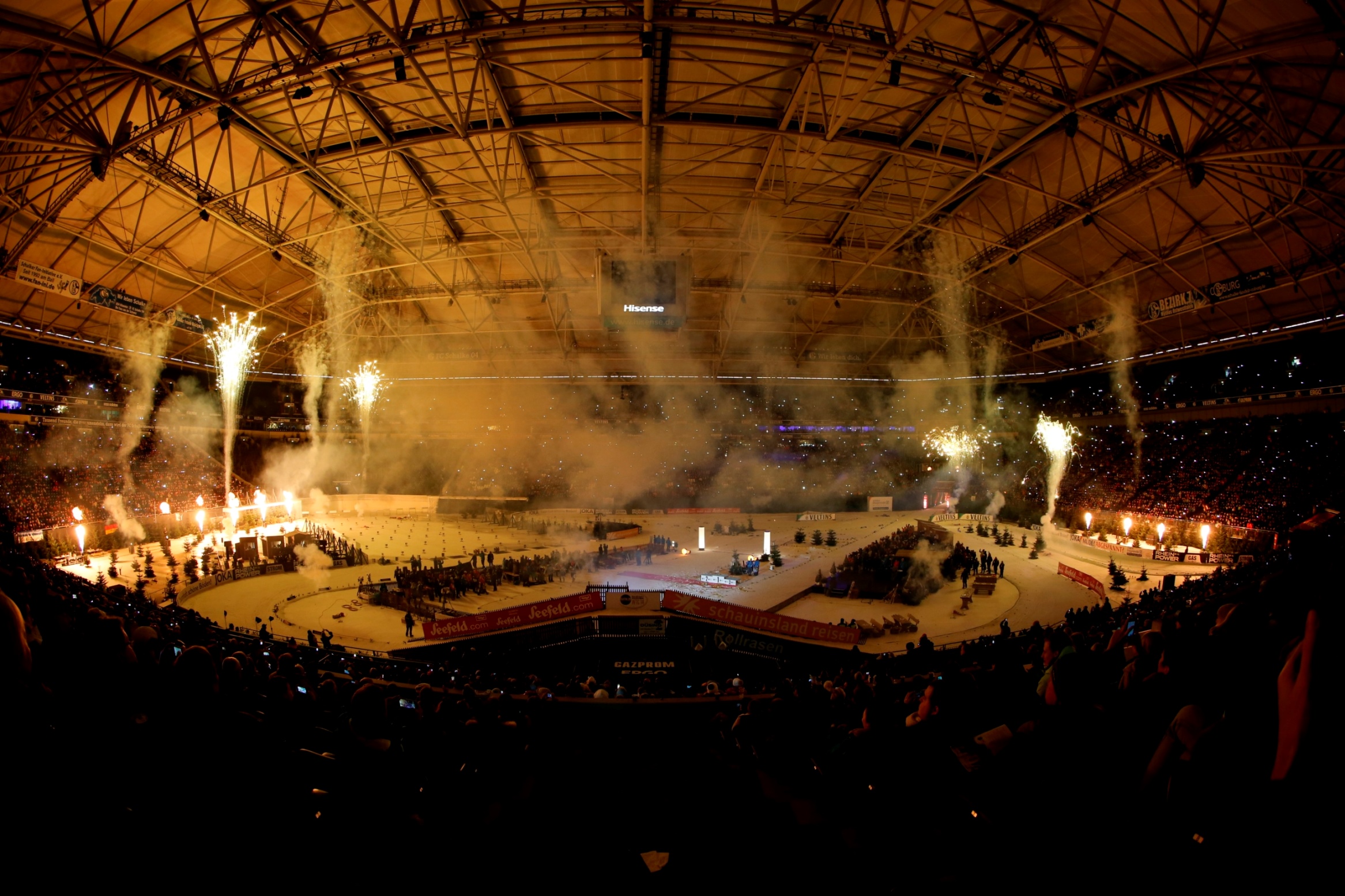
    Fireworks are set off at the Biathlon World Team Challenge in Gelsenkirchen, Germany. Photo: Karsten Rabas/www.biathlon-aufschalke.de.
    Fireworks are set off at the Biathlon World Team Challenge in Gelsenkirchen, Germany. Photo: Karsten Rabas/www.biathlon-aufschalke.de.

    There was plenty of hype going into Saturday’s Biathlon World Team Challenge, a two-person relay event held in the Veltins Arena stadium of the Schalke 04 soccer team in Gelsenkirchen, Germany.

    A mostly-annual event since 2002, the races feature many of the World Cup’s top biathletes in competing in relay-style mass starts and pursuits. And for the first time, Martin Fourcade of France, the reigning World Cup Champion, multiple medalist at the Olympics in February, and commonly deemed the best biathlete in the world, was participating.

    But biathlon in a soccer arena is not the same as biathlon on real ski trails, and Fourcade didn’t make much of a splash. He and French teammate Anais Chevalier – whom Fourcade had specifically picked for the event – finished eighth in the mass start and fifth in the final pursuit.

    Fourcade was still impressed with the whole shebang, though. “What a great experience in @BiathlonWTC!!!” he tweeted after all was said and done.
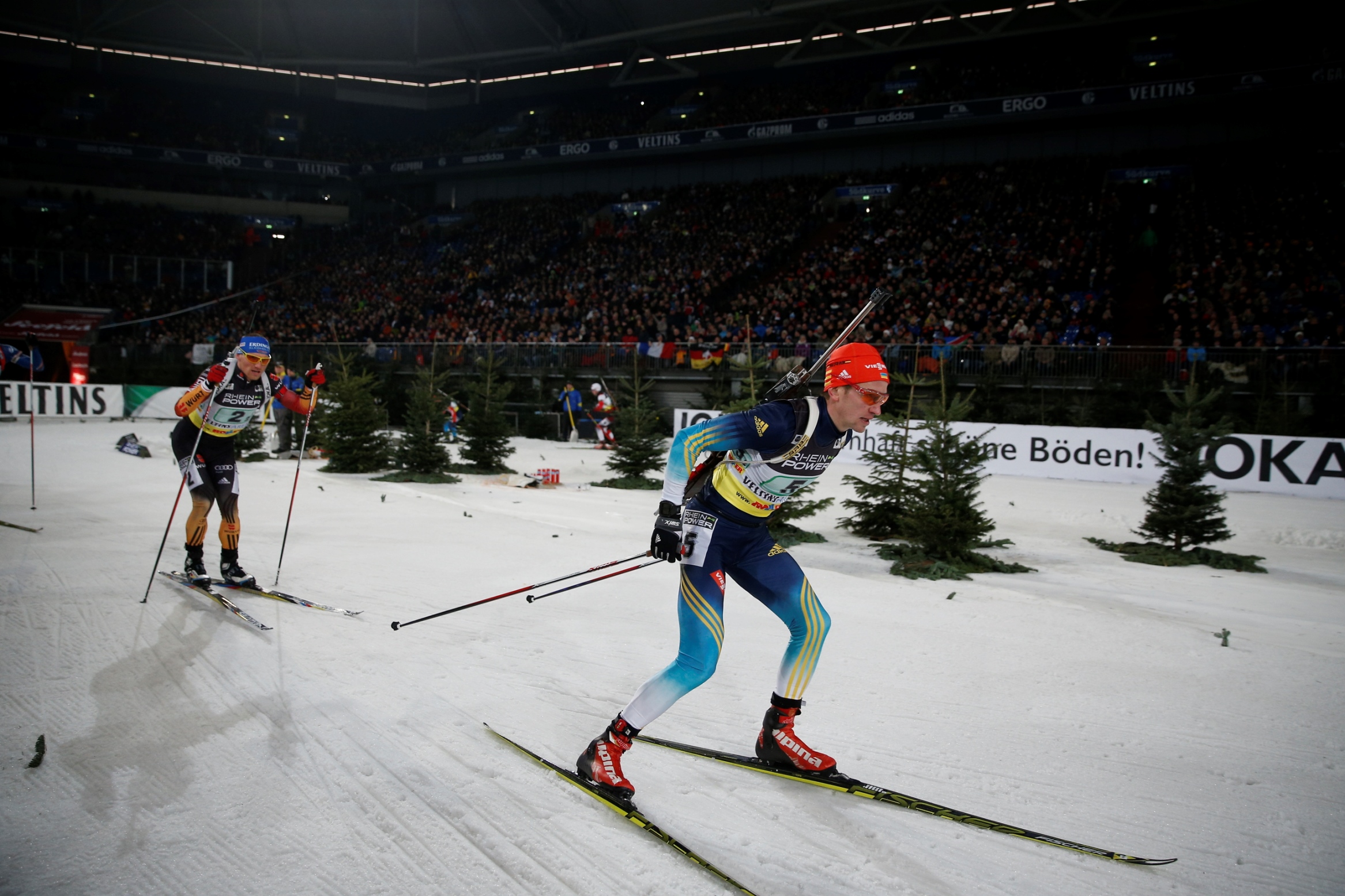
    Serhiy Sememov of Ukraine leads Erik Lesser of Germany in the World Team Challenge. Photo: Karsten Rabas/www.biathlon-aufschalke.de.
    Serhiy Sememov of Ukraine leads Erik Lesser of Germany in the World Team Challenge. Photo: Karsten Rabas/www.biathlon-aufschalke.de.

    What’s crazier about the event: is it the biathlon, or the race, surroundings, and spectators themselves? We look at each. And if you want a true taste of the event, check out the broadcast by Germany’s ZDF, which has been posted on YouTube.

    Ukraine On Top

    In each race, the women started by skiing a small loop, which took around three minutes, then shot prone. They skied any penalty loops they might have accrued, then tagged off to the male member of the team, who skied and then shot prone. This continued for eight shooting stages in total: women prone, men prone, women standing, men standing, and then all over again. The men got the honor of racing the final loop to the finish line.

    (The format has since been adopted for the World Cup as the “super sprint mixed relay” and will see its debut in Nove Mesto, Czech Republic, this year.)
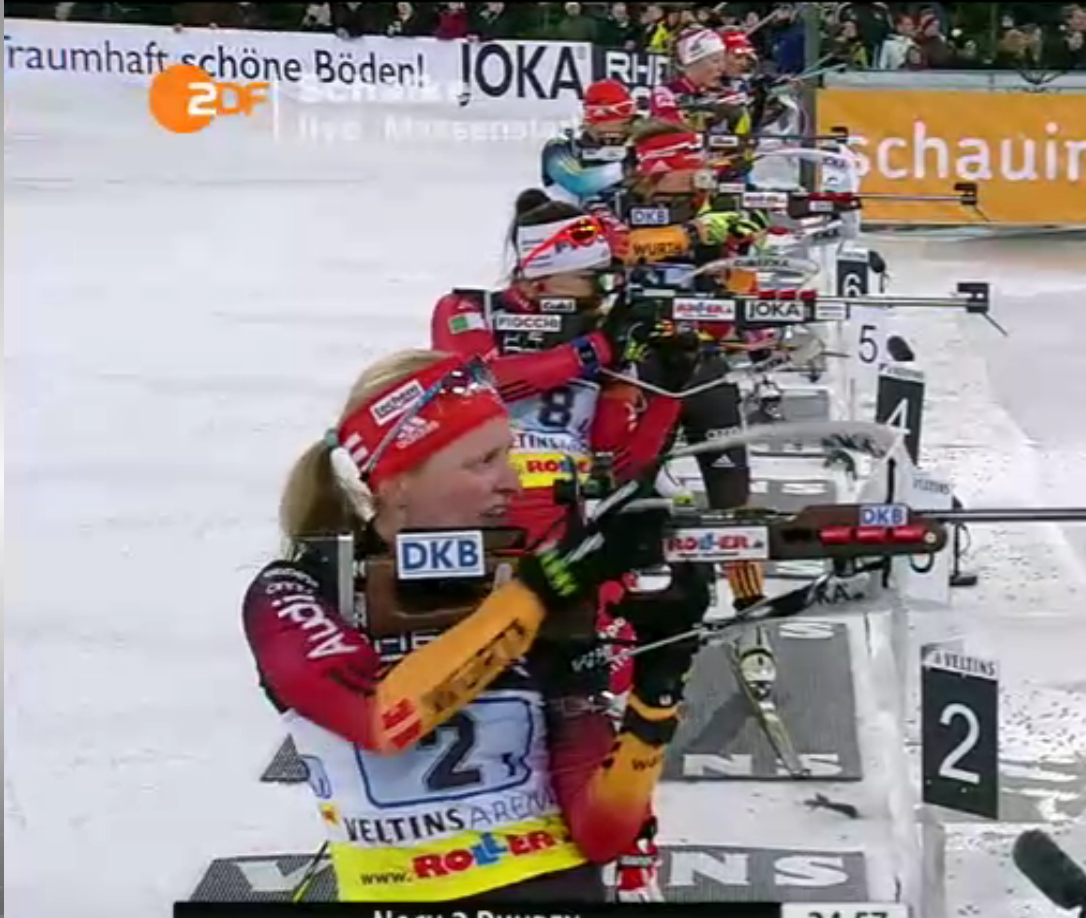
    Germany's Franziska Hildebrand excelled both on the range and on skis.
    Germany’s Franziska Hildebrand excelled both on the range and on skis.

    Fourcade and Chevalier were beset by shooting woes, and with such short loops of skiing, Fourcade was unable to make up ground on the trails as he can in World Cup racing. Two other pairs were similarly unlucky: Switzerland’s Elisa Gasparin and Benjamin Weger never figured into either race, and Norway’s Fanny Welle-Strand Horn and Lars Helge Birkeland were never close to the front.

    It wasn’t just the short loops that kept strong skiers from strutting their stuff. The entire format is an anomaly for those used to racing difficult World Cup courses with natural terrain. For instance, consider the range approach: the final loop of skiing around the stadium before the ten-lane range (facing a section of the stadium which was blocked off to spectators – no problem, as well over 40,000 people still got to watch live) culmintated in a man-made bridge requiring a few quick and hard V1 strides and then a fast downhill, sharp corner, and the shooting range.

    Skiing could still win out over shooting, though. Italy’s Dorothea Wierer and Lukas Hofer won the mass start competition despite having five penalties to the four by runners-up Laura Dahlmeier and Florian Graf of Germany.
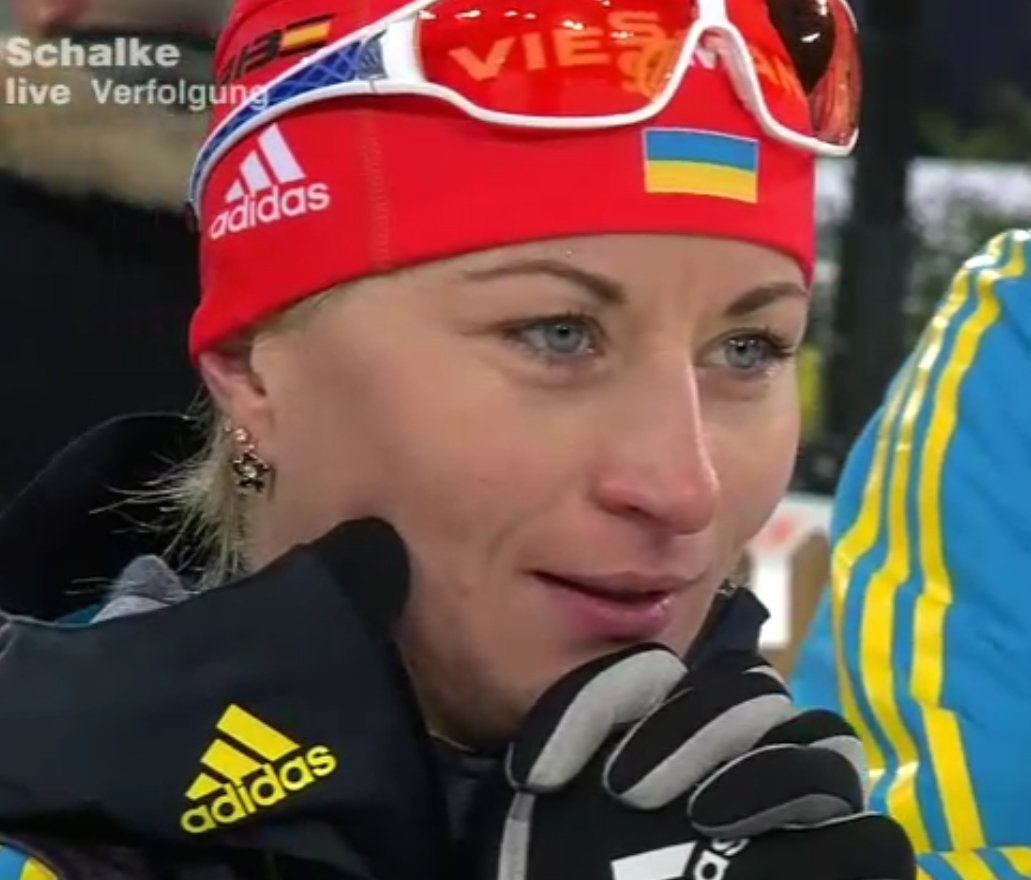
    Yes Valj, you're going to win!
    Yes Valj, you’re going to win!

    Another German team, Franziska Hildebrand and Erik Lesser, were leading until Lesser – whose shooting speed was unparalleled throughout the day – missed three shots in the final stage and lost the win.

    Less than an hour later, the ten teams regrouped and raced again. The format was the same, except it was an interval start based on the finish from the sprint. It would seem that winning the mass start would be a huge advantage – but Wierer and Hofer had a disastrous race, unable to replicate their efforts from earlier in the evening. With nine penalties combined, they finished second to last.

    Instead, Valj Semerenko and Serhiy Semenov of Ukraine climbed steadily through the field from their fifth-place starting position to finish on top by seven seconds. They had just four penalties in the second competition.
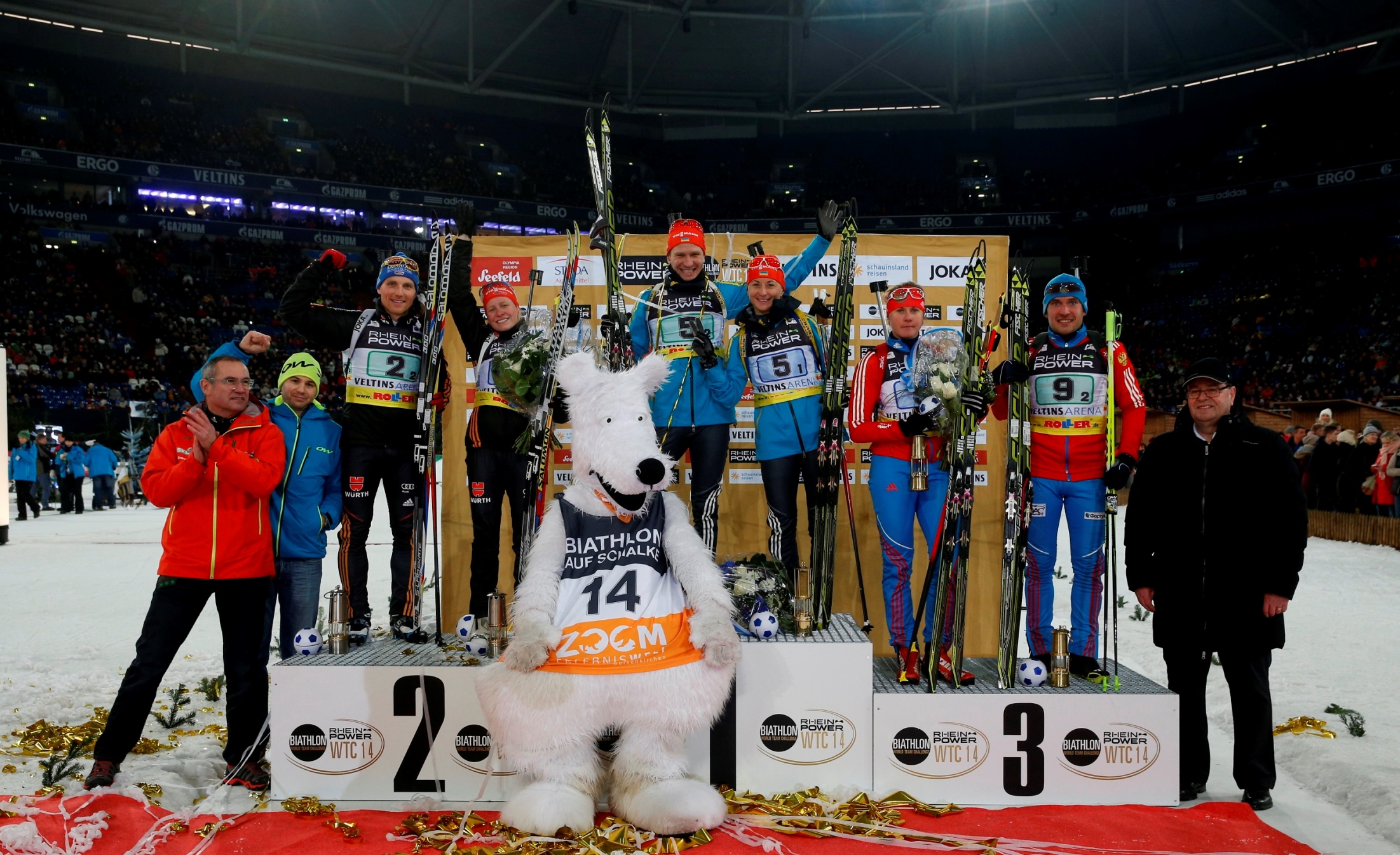
    The podium from the final pursuit competition in Veltins Stadium. Photo: Karsten Rabas/www.biathlon-aufschalke.de.
    The podium from the final pursuit competition in Veltins Stadium. Photo: Karsten Rabas/www.biathlon-aufschalke.de.

    Hildebrand and Lesser matched that tally and finished second, while Russia’s Yana Romanova and Evgeniy Garanichev had the same tally and climbed from seventh into third – not only thanks to the good shooting, but to an aggressive final loop by Garanichev where he not only pulled off a pass of the Czech Republic’s Evgeniy Garanichev, but then put four seconds on him in the final few hundred meters.

    The Scenery and Sideshows

    Here’s another thing that World Cup racing doesn’t usually feature: institutionalized snowball fights. The event is also the host of the 2014 World Snowball Fight Championships, where teams of three have two three-minute periods to try to annihilate the competition. Helmets and goggles were required.

    Also on the docket? A huge display of indoor and outdoor fireworks.

    The soccer stadium was filled completely with snow, and trails delineated with large plantings of Christmas trees in the middle to make route easier to follow from the stands. Of course, many a ski race has seen lanes marked with evergreen twigs – but organizers at Schalke take that to a whole new level, creating fake forests of perfectly-spaced trees between the looping ski trails.
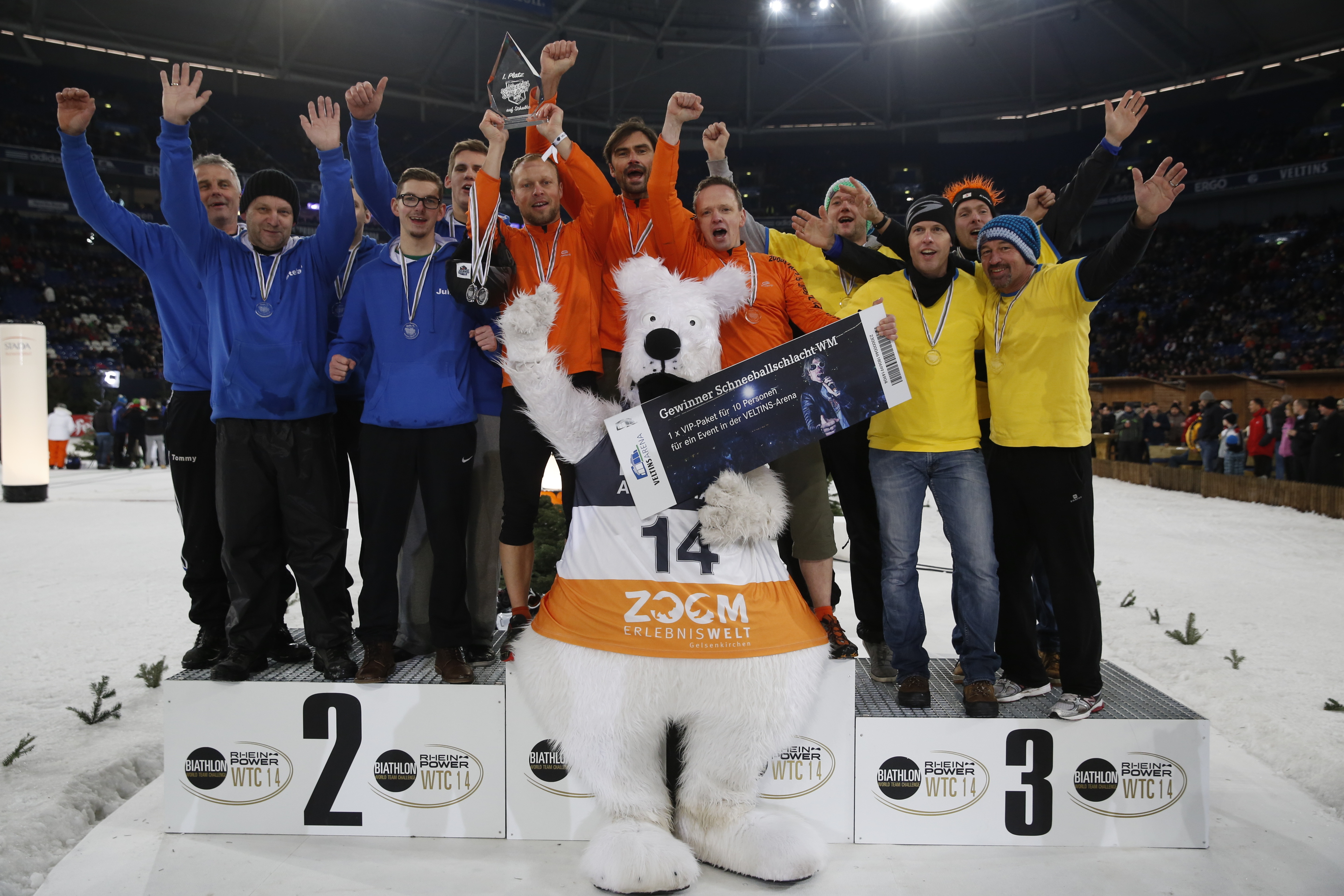
    The podium from the snowball fight. Photo: Karsten Rabas/www.biathlon-aufschalke.de.
    The podium from the snowball fight. Photo: Karsten Rabas/www.biathlon-aufschalke.de.

    The luckiest spectators were not in the stands but got to watch trailside, on the snow level of the arena. A few of central Europe’s ubiquitous wooden huts were built to serve hot mulled wine.

    Between loops, each team’s technicians furiously applied and brushed out layer after layer of fresh fluoros to the skis before athletes grabbed them and ran back to the exchange zone. In the center of the stadium, ski service was as much on display as the skiing.

    And finally, a few snafus happened in the race that would rarely be seen on the World Cup: for instance when, at one of the many transitions, Norway’s Fanny Welle-Strand Horn forgot to bring her rifle.

    “It was so hectic between stages,” she told Norway’s NRK news broadcaster. “It did not dawn on me until I see Lars Helge come into the exchange. I saw that people were beginning to point towards my back, and suddenly I realized I did not have a gun on my back. Then you get a little panicked.”

  • Svendsen Masterful in Dominating 20 k Victory: ‘Winning Makes You Motivated and Want to Continue’

    Svendsen Masterful in Dominating 20 k Victory: ‘Winning Makes You Motivated and Want to Continue’

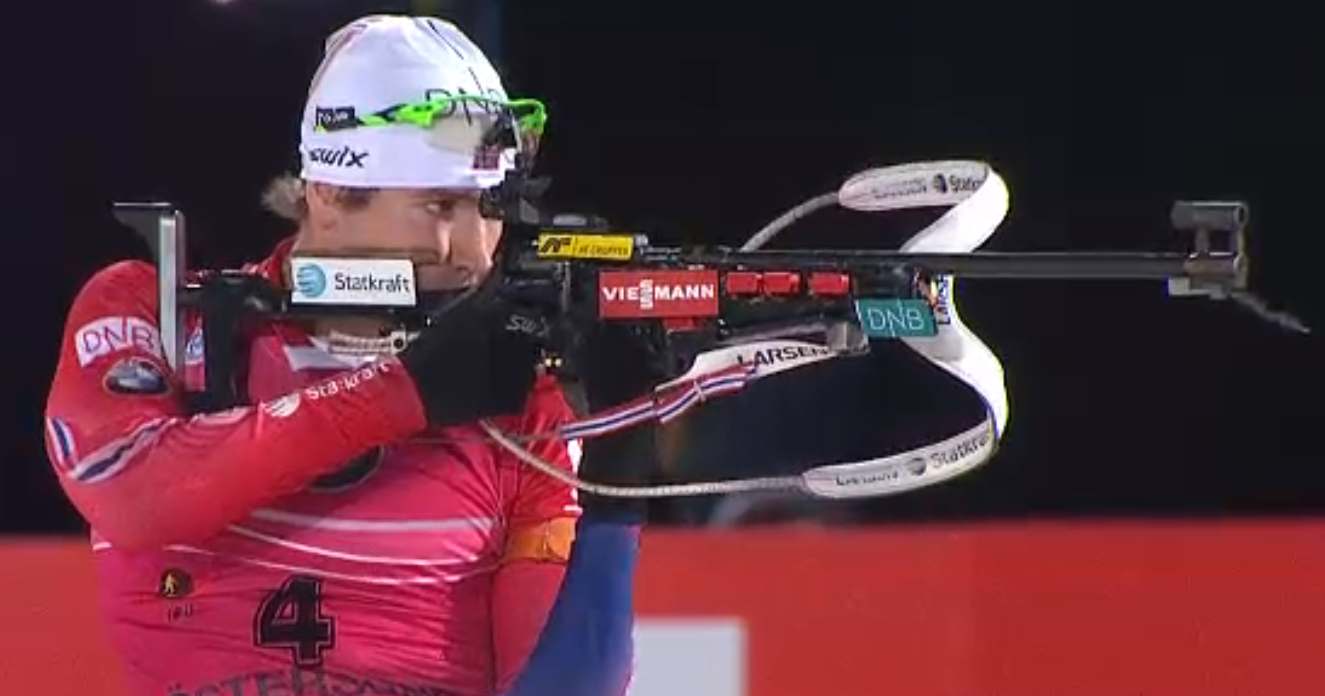
    Screen Shot 2014-12-03 at 9.01.33 PM
    Emil Hegle Svendsen of Norway taking one of his 20 perfect shots in today’s World Cup 20 k, which he won by over a minute.

    Emil Hegle Svendsen said earlier this week that the 20 k individual race in Östersund, Sweden, would separate “men from mice.”

    If that’s the case, then Svendsen is definitely a man. The Norwegian biathlete, 11-time world champion, four-time Olympic gold medalist, and the third-winningest man in World Cup history, took his 36th win in dominating fashion, beating runner-up Serhiy Semenov of Ukraine by one minute and 17 seconds.

    “It’s insanely amazing go get started this way,” Svendsen told Norwegian broadcaster NRK. “I followed the plan I’ve had success with before. And it worked again.”

    He turned in a masterful performance, hitting all 20 of his targets – the only man to do so, which is a big advantage in the format which penalizes each missed shot with a minute of added time.

    Rival Martin Fourcade of France couldn’t even come close, missing four targets in the very first shooting bout and then basically phoning it in. He placed 81st, and had to hand Svendsen the yellow leader’s bib that he started with as last season’s overall World Cup champion.

    “I’m happy to give it to Emil today,” Fourcade told NRK. Svendsen reported that Fourcade had tossed him the jersey while they were in the changing area.

    The wind was variable in the Östersund stadium, which was why so many competitors tripped up. There’s also the issue that the 20 k is the most grueling race format, and a tough way to kick off the season.

    “I have been thinking, and the last time I cleaned in a 20 k was in my first World Cup victory in 2007, under similar conditions,” Svendsen said in a post-race press conference. “But I was a bit lucky today with the wind especially in standing and that made it quite easy to hit all 20. Still, it does take some skill to do that… I have been feeling really good in the shooting range this winter.”

    His perfect shooting was acknowledged by competitors as something fairly incredible.

    “Emil delivered in the top ten or top five of his best races in his career,” said teammate Ole Einar Bjørndalen, who knows a thing or two about best performances. “It is a fantastic achievement to shoot down all 20 targets in the shooting today.”

    Svendsen knew, however, that he had to a large extent capitalized on his competitors’ errors. He had sixth-fastest course time, but was still well behind teammates Johannes Thingnes Bø, who finished eighth, and sixth-placeBjørndalen. He knows that Fourcade isn’t going to miss four targets right off the bat every race, nor will his teammates always pick up three or four penalties apiece. It will get harder and harder to win as the season goes on.

    “It was not good enough; I need to catch some seconds if I expect to be on the podium in the sprint,” Svendsen admitted. “But it is like this every season with me. It takes a couple of races to warm up; I am like an old diesel engine.”

    Second-place Semenov made it clear that he loves the format: his only other podium also came in the 20 k, two seasons ago in the pre-Olympic test race in Sochi, Russia.

    “I am a bit slow, but I can go at the same speed for the whole distance,” he explained in the press conference. “But this race was hard; I could hardly wait to get to the finish line.”

    Third-place Michal Slesingr was almost another minute behind Semenov; both men, as well as Erik Lesser of Germany, had one penalty. Lesser was a late starter and made a charge at the podium but came up just three seconds short of the Czech veteran’s time.

    Most of the other names in the top ten are familiar, previous podium finishers, with one exception: Quentin Fillon Maillet of France. The 22-year-old turned in his best performance yet and, like Lesser, as a late starter was able to surprise when he displaced American Tim Burke out of the top ten.

    As for Svendsen, his performance cast doubt on the comments he had made in the off-season about feeling a lack of motivation to continue with biathlon.

    “Winning makes you motivated and makes you want to continue for a long time,” he said in the press conference. “Biathlon is fun and to compete is fun. As long as it is fun, I will continue.”

    Full results