From the FasterSkier archive — posts syndicated from athletes’ and coaches’ own blogs between 2004 and 2012, kept online as published. Current coverage is at fasterskier.com.
For many years the U.S. Biathlon Association (USBA) has invested in talent. Athletes who demonstrate ski-speed and a knack for shooting on the firing range receive what amounts to a cushioned sport-specific transition. In this case, Luke Brown (Crosscut Mountain Sports/USBA) and Zane Fields (USBA) are the latest cross-country athletes embraced by the USBA’s X-Team.
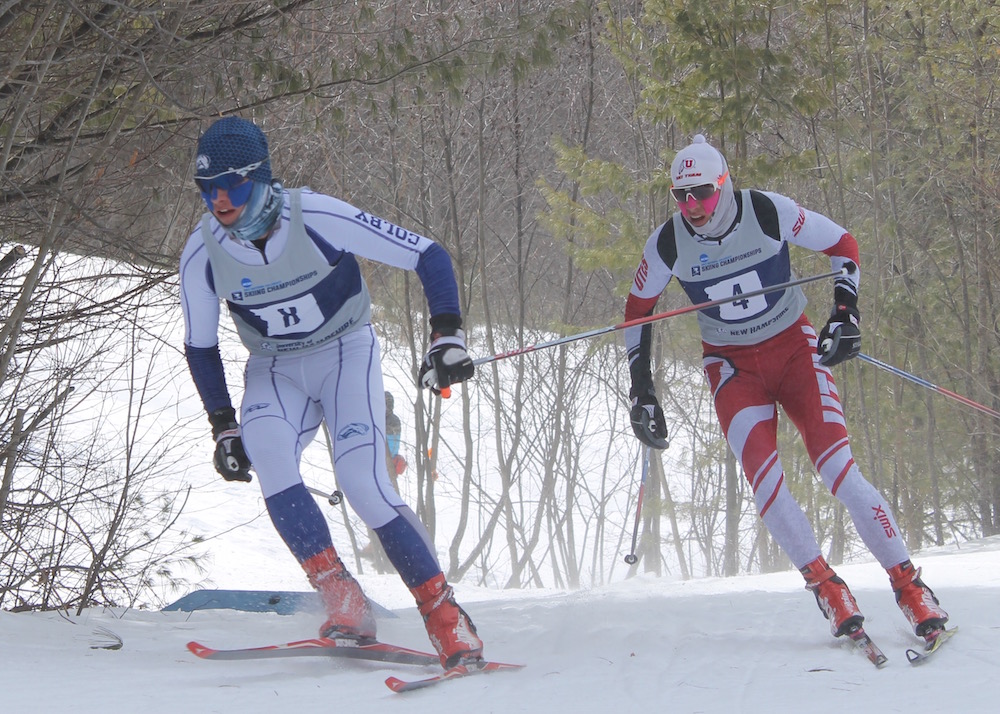
Zane Fields (8) racing at the 2017 NCAA Championships. Fields is now a member of U.S. Biathlon’s X-Team.
Brown, who is in his second year removed from Dartmouth, and Fields who is fresh off a four year stint at Colby College, both earned spots on the X-Team after a USBA development camp in June.
Five athletes were invited to the camp with two ultimately offered support to develop as biathletes under USBA’s guidance.
“We are seen as skiers who have shown promise skiing athletically but don’t have the rifle skills because we have not been exposed to them yet,” Fields said from his intermittent base in White River Junction, Vermont. “I guess it is a fast track to possibly the IBU Cup and World Cup because they know we have the fitness and we just need to train the shooting.”
The X-Team designation, in fact, comes with ample support for Fields and Brown. The team designation affords the two skiers a safe way to make a career switch. Former USBA athlete and current USBA Development Manager Tim Burke will assist with training plans. Each skier has been offered free room and board for a year at the Olympic Training Center (OTC) in Lake Placid and opportunities for free training camps. The heavy cost of a rifle, which can amount to four to six thousand dollars, has been softened by an optional lease to own program offered by the team.
“I am excited because it lets me try biathlon in a super safe way,” added Fields. “If I have a bad year it is OK because I did not put myself in a $10,000 dollar hole. I would be more stressed to perform if I were paying a whole lot.”
Fields will mix developing as a biathlete with racing select cross-country events this season. He plans on entering the U.S. Cross-Country Championships with a goal of making U23 Worlds.
“The way I see it, biathlon is acting for me as a pro-team would,” said Fields. “They are offering me great support, coaches, training trips. Even more so with biathlon, they are excited to have me still focus on skiing since we have limited biathlon racing opportunities in North America. I think there are two or three NorAms then US Nationals in March.”
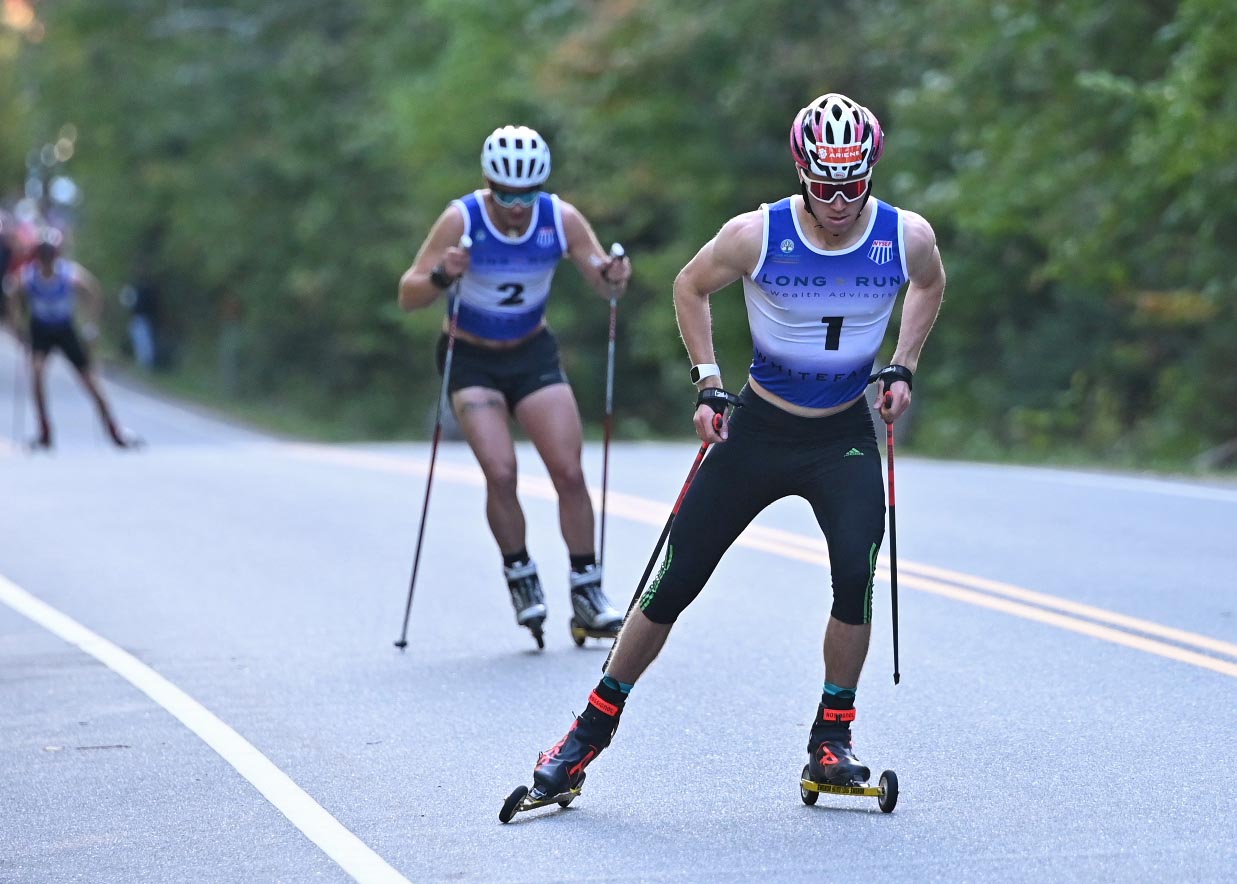
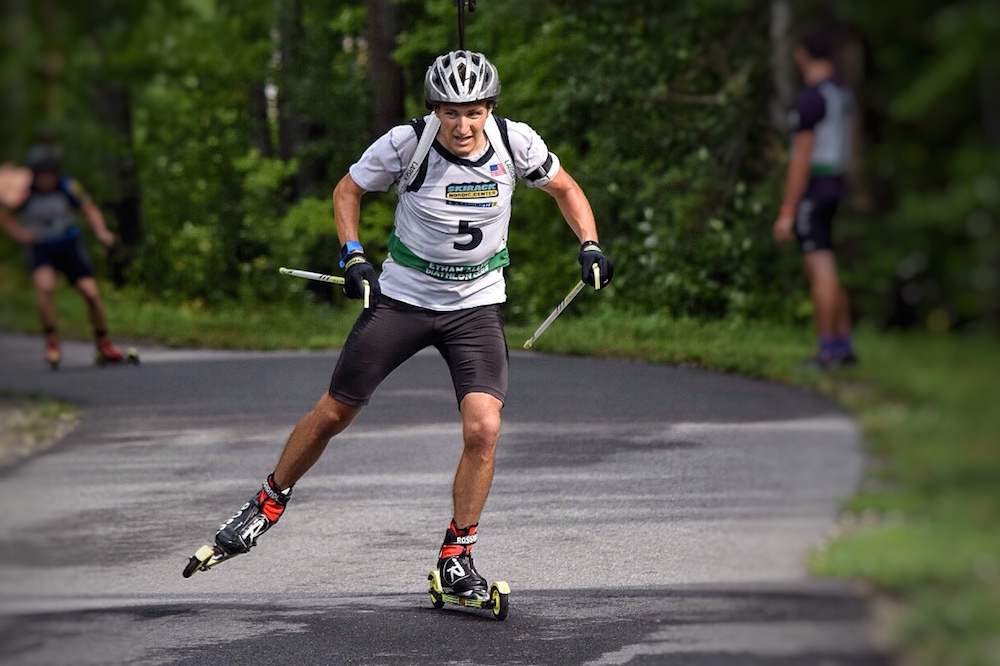
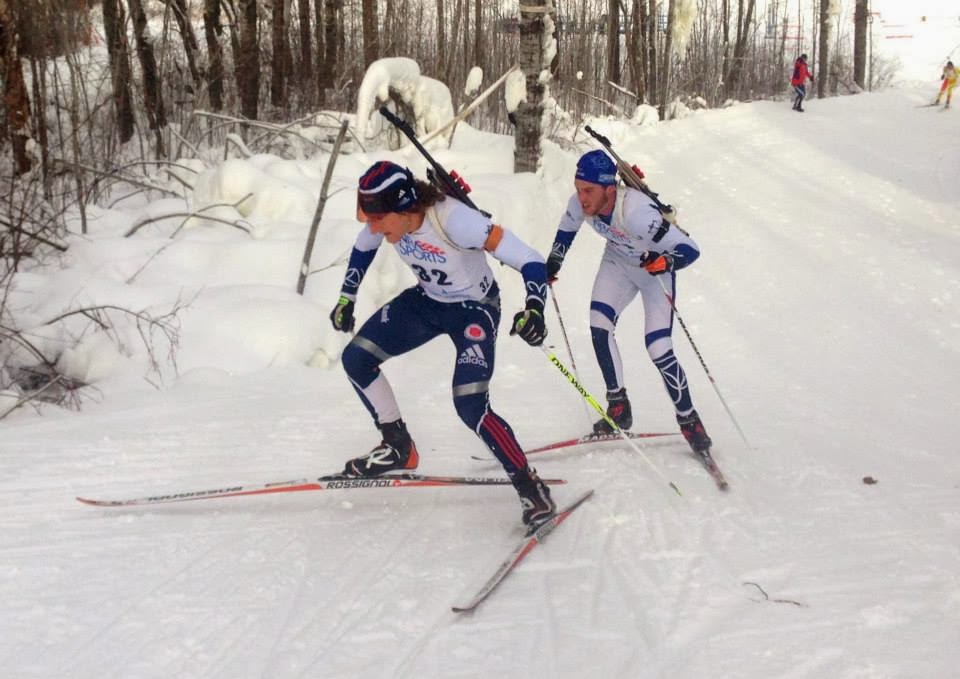
Luke Brown (bib 1) chased by Zane Fileds (bib 2) during the 2019 Climb to the Castle rollerski race. (Photo: Kel Rose)
For his part, Brown will be based in Bozeman, Montana with intermittent but longer stays at the OTC. He will be jointly coached by Burke and Crosscut Mountain Sport’s Seth Hubbard and Crosscut’s assistant coach Nick Michaud. (Michaud is also a development coach for US Para Nordic.)
“I am training fully for biathlon with that as my focus with the goal to make IBU cups,” Brown said. “And if I do, that is awesome. It is also my first year of biathlon, so I am not necessarily expecting to. So if I do not make IBU Cups, I will do a mix of domestic biathlon races and SuperTour and other cross-country skiing races. I am leaving that door open but my focus is on biathlon.”
Brown explained he had been to a USBA talent ID camp prior to college. He had also spent a few summers learning how to shoot while a middle school skier. Brown’s older brother Jake is a member of USBA’s National A Team, and trains with the Craftsbury Green Racing Project.
“I have talked to Jake about it a lot and it has been super awesome to have biathlon to connect with him over and also learn from him,” said Brown. “It also gave me a greater understanding of what the transition was going to be like. I got a front row seat when he did it coming out of NMU and he lived at the OTC. It also, I think, prepared me a bit to know the amount of work that goes into transitioning into biathlon. It is not easy — it has taken him a couple of years of very hard work to get to where he is.”
Fields echoed the notion that although the two sports are linked through skate skiing, he understands the need to reset when considering how he paces his skiing while learning to center himself on the range.
“I simply thought I can ski fast, I’ll just make up the time hammering while skiing, and hammer in and out of the range,” said Fields. “As I have shot more and more over the last month or two, I am learning to understand how much I should slow down before the range so I can prepare myself to shoot. I am realizing that poor shooting is exponentially more of a penalty than if you are simply slower at skiing. It is worth killing 30 more seconds before the range to go slow and then hitting all your shots versus running in and blasting them off and hoping you hit.”
Both Brown and Fields are currently living and training in Utah and will contest the USBA Fall Festival and IBU Cup Trials which begin October 24, at Soldier Hollow.
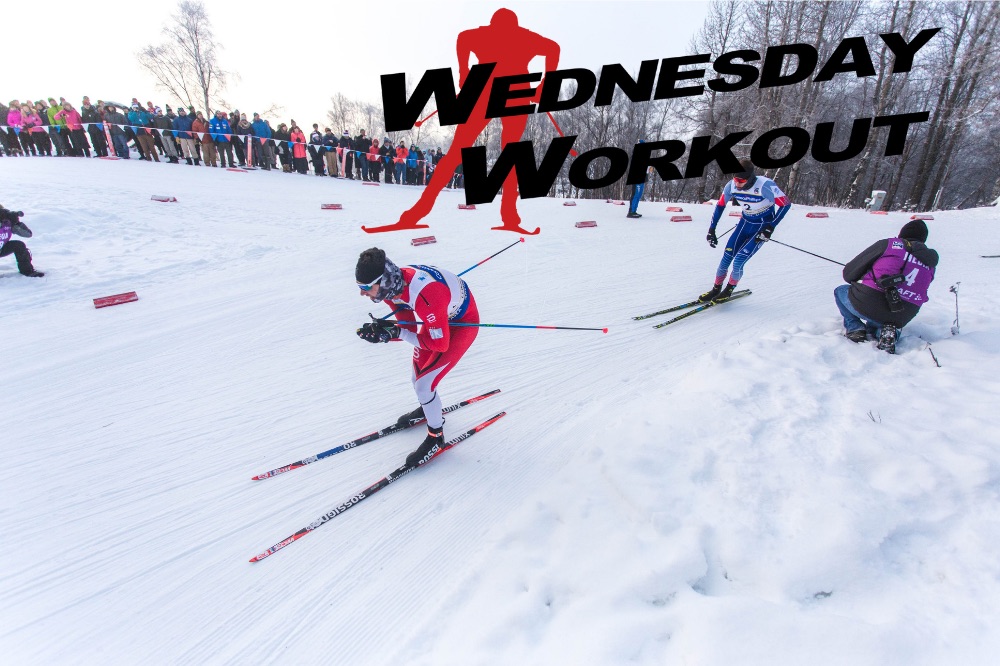
BSF’s Nick Michaud (red suit) at last season’s Senior National Championships in Anchorage, Alaska. Michaud qualified 4th. (Photo: Gilbert Michaud)
This Wednesday Workout was provided by twenty-six-year-old Bridger Ski Foundation (BSF) skier Nick Michaud. Bates College educated and raised plumb-line north in Fort Kent Maine, Michaud has emerged as a sprinter to watch on the SuperTour. He’s a gritty, salt-of-the-earth athlete who barely missed a nomination to the 2018 Olympic Team.
Michaud offered FasterSkier a menu of options for the 30/30 workout — 30 seconds on 30 seconds off. From junior athletes to masters in M8 and beyond, Michaud has you covered with these training session variants.
Let the gains begin.
Backstory of the Sizzling Hot 30/30’s from Michaud:
“Short, explosive movements are like bacon for me. I’m thrilled to eat bacon anytime, anywhere, with anyone. With vegetables, grains, and most foods that are really important for function, it can feel like a chore. That’s what a lot of nordic ski training feels like for me. My body, my mind, would prefer to just do speed work, lift heavy weight, and play basketball — and eat bacon. But in order to meet my performance goals, I have to eat vegetables and grains: aerobic base, lactate threshold, energy management, mindfulness and so much more. For these reasons, I love 30/30s.
30/30 home terrain for BSF’s Nick Michaud in Bozeman, Montana. (Photo: Max Lachance)
The execution is very simple: 30 seconds “on”, 30 seconds “off”. The effort and duration can be customized for the purpose of the workout. There should always be a purpose!. For athletes with periodized training plans, 30/30s can be used in different cycles of training to meet different goals. For a more casual athlete, 30/30s can simply be an extremely fun way to get in some higher intensity training.
Dragan Danevski, BSF nordic program director, began using 30/30s eight years ago. There was a study in Europe focusing on track and field and how to improve efficiency of running economy, improve aerobic capacity, and reduce the recovery time in a 30/30 workout. The original study tracked mainly 1500m and 3000m runners. Danevski adjusted the workout for skiers here at BSF.
Danevski said BSF has used 30 by 30s for a few different goals: improving skier’s economy, stimulate good technique, and shortening recovery time for lactate clearance. Originally it was for improving threshold. For his skiers, Danevski saw the potential to improve anaerobic capacity.
Throughout summer Danevski follows the study and uses 30/30s to improve threshold.
For the following age groups, the coach prescribes one 25-30 minute block of 30/30s for U16 and U18s. U20s go for a 30-35 a minute block of 30/30s. Some older skiers are ready for a 45 minute 30/30 session.
Danevski said these 30/30 training days need to be disciplined by monitoring heart rate.
In the past, the 30/30 workouts were used only during intensity blocks. Recently, we’ve started using it throughout the whole training year: on skis, foot, and rollerskis.
Psychologically, Danevski said the 30/30 is a more tolerable intensity session, especially for kids, since they can focus on high-quality efforts for 30 seconds each time. It’s easier to focus.
As we transition into fall here at BSF, we also use 30/30s to improve anaerobic capacity. One basic example we use are three to six sets of a 15-minute long 30/30s — with appropriate rest between each set.
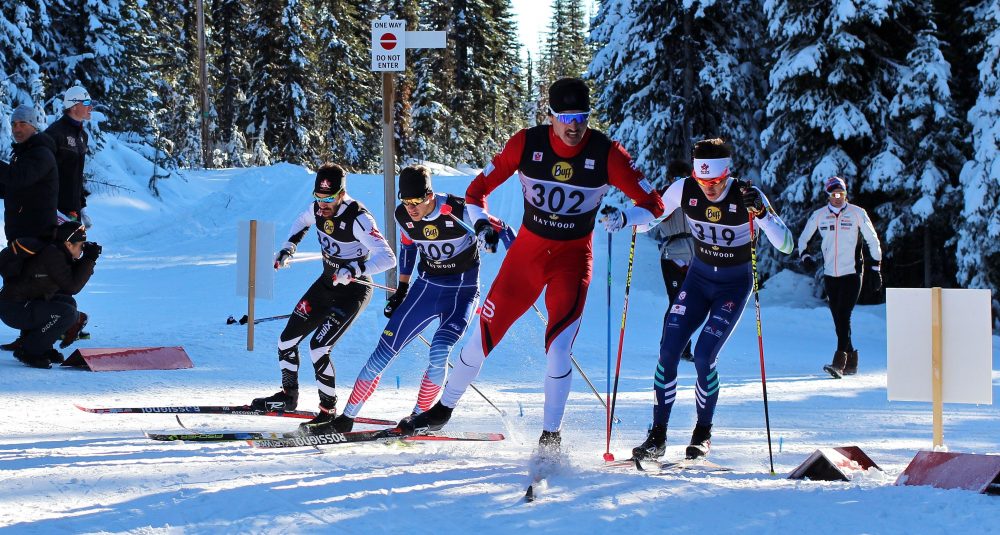
Nick Michaud (BSF) in bib 302 putting those 30/30s to good use at the Sovereign Lake NorAm in 2017. Michaud was the second fastest qualifier. (Photo: Forrest Mahlen)
The 30/30 Workout Menu Starting with Michaud’s Favorite Variation:
Nick Michaud: 3 x 5 minutes, sprint pace. So we are all clear, this means a five minute long 30/30 excecuted three seperate times. During each five minute period, that’s a total of 2.5 minutes “on”, and 2.5 minutes “off”. For the entire session, the athlete is “on” for 7.5 minutes, or half the total elasped time. I rest for five minutes between each set.
Notes:I use this two days before a sprint race, increasing my effort each set. It’s a great way to get a feel for speed, technique, and effort in all areas of the course. I take five minute breaks between sets. I leave the venue with a good understanding of the course and excited to move fast on it two days later. Using this training sessions at different points of the year is a great way to practice understanding the critical difference between effort and ski speed — which I think is crucial.
Favorite 30/30 Variations from Others:
Gary Colliander, US Paralympic Biathlon Coach: 4-8 x 6 minutes. Number of blocks depends on L3 or L4.
Notes from Colliander: “Focus on quality of movement through the interval and a slightly higher turnover. With the short ‘on’ time I think you can hold the technique together better and because there is a short rest you can potentially push the pace and thus the level a bit. They’re still very tough, but that short rest just seems to offer bit of recovery while allowing the heart rate to remain high.
Another way to look at the short 30 second rest is like it’s a downhill. Anytime you get a downhill it’s a chance to grab some O2 and recover although for a very short bit. But it always feels good when you come out of that tuck.”
Lina Hultin, Bridger Ski Foundation Development/Competitive Team Coach: 5×6 minutes.
Notes from Hultin:“What I like with 30/30s and 45/15s is that it allows the athletes to ski more efficiently. Since you have that shorter break, you tend to have better and more efficient technique since athletes ‘dare’ to push it a little harder when they know they will have a shorter break. Good technique requires strength and power and the shorter interval allows athletes to keep good technique for a longer time.
The closer you get to the season you can dare to let go of that shorter break and hopefully you can maintain that good efficiency in you technique in a continuous time trial or longer intervals.”
Akeo Maifeld Carucci: Craftsbury Green Racing Project Athlete: 2-4 x 10-15 minutes at L4+.
Notes:“Terrain wise, I like small rolling terrain or maybe gradual uphill with some bumps. I believe in keeping it between L1 and recovery pace during the rest phase, but it is important that it keeps moving at the least.”
Seth Hubbard, Bridger Biathlon Club Head Coach: 15/15s for sets of 4-8 minutes at race pace +
Notes: “This workout is altered depending on an athlete’s age and their work on pacing, and ability to surge and recover.”
Will Sweetser: Nordic Programs Director at Sugar Bowl Ski Team and Academy: 15 sec/15 sec 6-12 minutes.
Notes:“I use 6-12 minute repeats with ‘on time’ at either L3+ or goal pace for races 8 minutes and longer. First used this coaching runners in the mid 90’s. Have since had good success with younger athletes developing pace sense.
Used the 15/15 to help take an athlete’s 3,000 meter time from 11:38 to 10:10 in 5 weeks. The next year this athlete brought their time down to 9:27 using 15/15 session of 2 x 3000m about once every 10 days.”
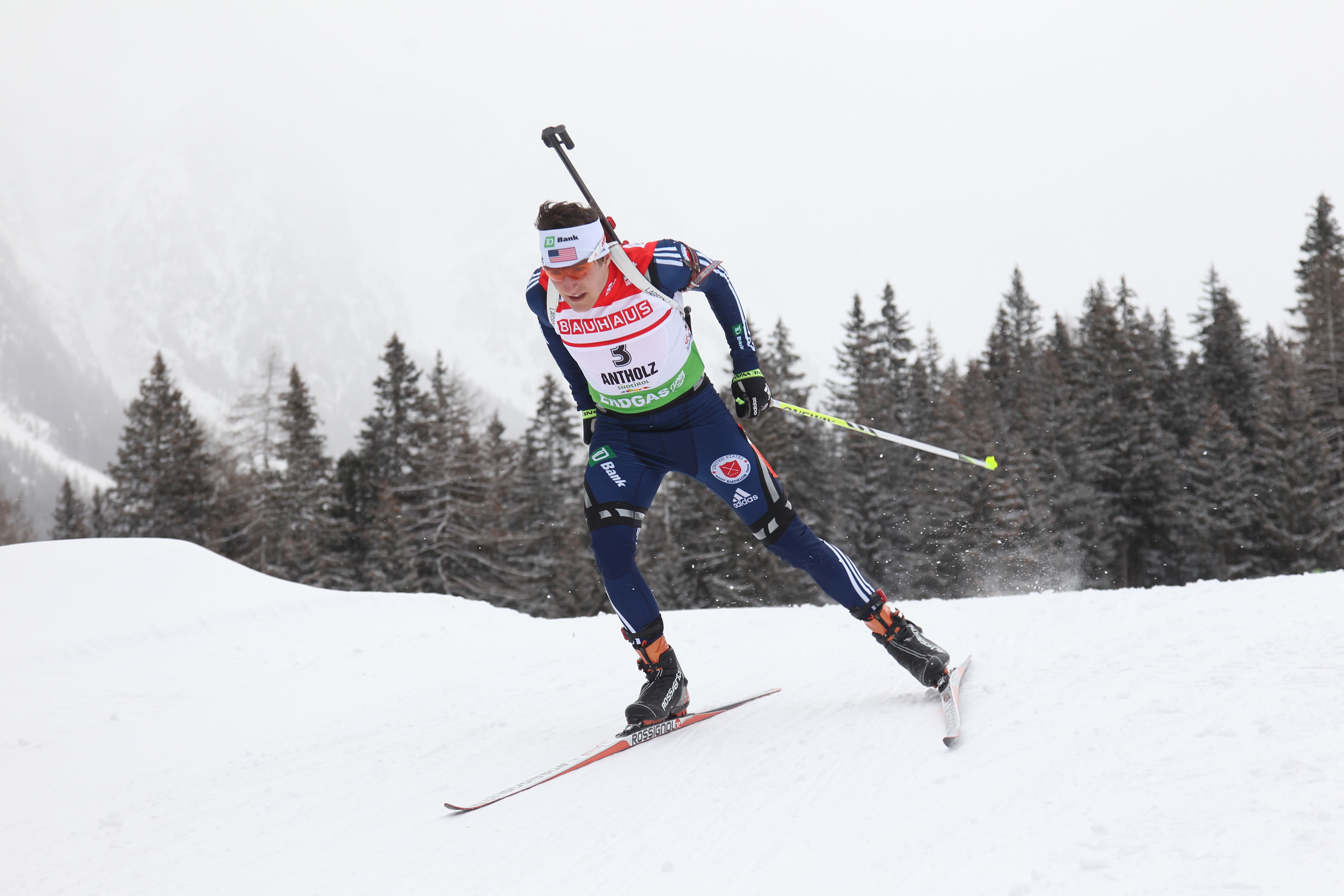
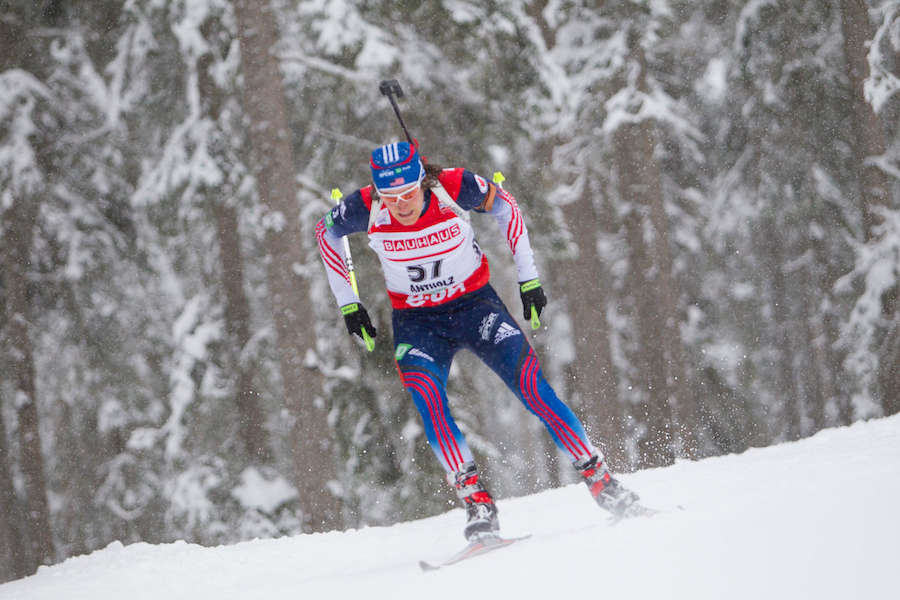
Russell Currier racing at IBU World Cup competitions in Antholz, Italy. (Photo: NordicFocus/USBA)
The first time I contacted Russell Currier for a retirement interview, it was mid-April. I had asked him to share his story, and no more than 24 hours after my initial email to Currier, I received a response.
“Yeah, let’s do that. I’m actually in Bozeman right meow,” he’d written.
Digging through my memory bank, I recalled Currier having come to Bozeman one other time. Two Aprils ago, the Stockholm, Maine, native spent a week in Montana visiting friends. The faint memory of Currier showing up to my Bozeman apartment that spring, sporting a DIY unicorn outfit, had me wondering what the recent biathlon retiree was up to two years later (at the time of our email correspondence, it had been 10 days since Currier’s final career competitions, the 2018 USBA nationals in Park City, Utah).
Since I was still living in Bozeman, Currier and I decided to meet in person for the interview. Open mic night at a local coffee shop seemed like a safe rendezvous spot. While I arrived at our destination point uncharacteristically early, Currier showed up characteristically five minutes late.
He had dropped the paper-cone head prong for this occasion, though he still had the same curly mop of brown hair. Leather thong flip flops, a black hoodie and shorts made him an unmistakable Mainer — most in the room wore pants and closed toed shoes, fitting for the local forecast of mid-40 temps and rain.
Russell Currier, a two time Olympian, four time World Championships team member and on-off National team member. (Courtesy photo)
The coffee shop served more than just coffee and we wound up sipping on local brews called “Strange Cattle”. A few shaky singers and a couple billiard –albeit shabby –games later, the Strange Cattle had gotten the best of us. My audio recorder inevitably remained in my pocket and the interview remained undone.
By the time we finally sat down to chat, it was over a month and quite a few text messages later (one of which involved Currier asking to borrow 90 K). In short, the following interview with Currier was conducted over the phone in late May, seeing as April is best left for brews and mythological beasts.
FasterSkier’s questions appear in bold; Currier’s responses follow immediately after.
***
FasterSkier: Russ, good to have you on the phone. What are you up now?
Russell Currier: Cutting cantaloupe.
FS: Nice. Whereabouts?
RC: Windham [Maine]. I moved there at the end of April. I’m staying in the basement of an old friend and doing landscaping. It’s not permanent, but it will suffice for now.
FS: Why landscaping?
RC: It was something that I could show up hungover for, but still grind it out and make it work.
FS: When did you decide to retire?
RC: Honestly, about two years ago. I had a really bad season [in 2015/2016] and I wasn’t sure if I wanted to keep racing or not. I decided to give it two more years, just to see if I could make it through another Olympic cycle.
FS: Were you experiencing any illness in 2015/2016?
RC: No, I think there were a few equipment issues that were bad luck. I didn’t do anything wrong. I did the best I could. I just didn’t nail training as best as I could. I was at that level of, you either get lucky and train really well, or you don’t get lucky; you try to train really well, but you don’t quite nail it.
FS: What do you mean by equipment issues?
RC: We had trials in Canmore and it was really, really cold that year — I mean, it’s always cold in Canmore — and the ammunition I was using wasn’t shooting very well. That may have been the limiting factor to my entire season. But it’s one of those things though that you can’t really prove.
That season ended up being my worst one ever. It was bad enough to say this could be a justifying end. So I gave myself the month of April to make the call; decide if I wanted to keep going or not.
FS: So in the end you essentially said, screw it, let’s do this?
RC: Pretty much. Officially, I did it out of curiosity. I figured it was worth the expense and trouble, since I had already gone that far.
My thinking was, if I go two more years, the absolute worst case scenario would be I rack up more debt and I don’t make it. The best case scenario, I do make it and I retire.*
FS: What will you miss the most about competing in biathlon?
RC: That’s an interesting question. I haven’t really wrapped my mind around the fact that I’ve retired. So far, it’s still awesome because it’s absolute freedom. I still do plenty of training. I actually did an ultramarathon this weekend, which is a whole other story within itself.
FS: An ultramarathon, really, where was that?
Pineland Farms. They have a 25-kilometer cross-country ski trail. We did three times around that, plus an additional loop so that it would add up to 50 miles. I couldn’t walk the day after. That was problematic.
FS: Do you think you have a future in ultramarthon running?
RC: I don’t know. I have to think about it. That was one thing my coaches had always told me was, if this biathlon thing doesn’t work out and you ever get into ultramarathon running, it could be your thing.
FS: So, back to what you’ll miss most about competing in biathlon?
RC: After the last race in Utah, I never really had time to sit down, think it over and decide how I felt about the last 16 years of my life. I don’t know if I’ll have a mental breakdown when I do or if I’ll think, wow, that was fun, and move on.
I had to send USADA [the U.S. Anti-Doping Agency] a letter saying that I officially retired. That kind of hit home. It was like signing the final papers on a divorce order. You’re ending a relationship with something you’ve been with for so long
FS: Looking back, what’s your fondest ski memory?
RC: The race weekend in Kontiolahti, Finland. It was super cold there, as in below legal race temperatures. I got food poisoning the day before the race. But I had traveled all that way and this was my one chance to race, so I raced anyway. I ended up cleaning and finished sixth.
That was the second top 10* that I had ever had and the whole thing was just one giant surreal experience. (The afterparty was just nuts and [the U.S. team] did a Finnish sauna).
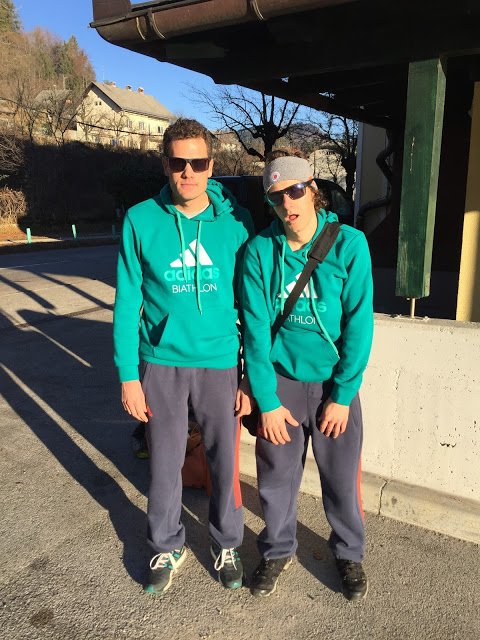
Russell Currier (r) and USBA teammate, Tim Burke in Slovenia 2017. (Photo: russellcurrier.blogspot.com)
*Currier has been to two Olympic Games, qualified for four World Championships teams, earned two sixth-place World Cup results in 2012, and this spring alone, had a fourth, fifth and sixth place finish at USBA nationals.
FS: What’s involved in a Finnish sauna?
RC: I’m sure it varies from one part of Finland to the next, but you go in the sauna, get as hot as you can, then you run around outside like naked idiots. After that you go back inside the sauna, get as hot as you can tolerate, then go outside and jump in the snow, roll around. Then you go back inside and the final time you [exit] the sauna, you have to jump in the water (this is winter, so it’s basically just this carved hole in the ice). There are also a bunch of reeds you’re supposed to hit each other with. It’s like a sword fight with these giant sticks. Weird Finnish things.
FS: Interesting. How would you describe your career trajectory?
RC: I never had any specific goal in mind, I just wanted to see what would happen if I actually gave it my full effort and pushed it into my late 20s and early 30s … I made it further than most people thought I ever would have when I started. But I also always had higher expectations for myself.
FS: Do you feel like people were skeptical of you?
RC: No, I don’t know if they were skeptical. They just didn’t know what to expect. I was one of the early athletes to jump on board with what Maine Winter Sports Center (MWSC)* was offering; nobody had any idea really how it worked. It wasn’t like an academy school in New England, or Steamboat Springs or a little ski town in Norway or anything like that where everyone was on board with how the system worked. This was a completely new and revolutionary thing to do.
RC: Not the first, there were a few other athletes that were there before me, but not many. I think MWSC started in the summer of 2001, so [the program] had only been around for three years or so by the time I joined.
FS: How did you get involved with MWSC/skiing?
RC: It was a very arbitrary and borderline impulsive decision. The impulse never wore off.
FS: Where is the sport lacking or what do you think needs to be changed?
RC: Short answer, it needs to be way cleaner. Almost any North American athlete would probably say that right off the bat. For good reason. It’s scary how much time and effort of your life you can pour into something, only to watch an entire organization walk all over it. Ruin it. Unfairly. It really is terrible and it’s as bad as everyone thinks it is.
FS: You’ve been involved for 16 years now, any advice for those coming into the world of biathlon?
RC: I would say biathlon and cross-country will produce way more failure than they ever will success. These sports are going to kick you in the teeth constantly. You’re going to get the [expletive] kicked out of you so many times before you get the glory that you see on TV.
But, to quote John Farra, it’s worth it.
I remember John going on and on about the opening ceremonies at the Olympics and just saying it’s worth it. All the training, all the setbacks. It’s worth it. (Ironically when I finally did make [my first Olympic team in 2014], I actually missed the opening ceremonies because we had a race the next day, so we didn’t go. I thought that was kind of funny.)
Anyway, yeah, if you’re aware that it’s going to be one colossal struggle and you come in expecting that, it makes it not so bad.
Russell Currier during the men’s mass start at the 2016 US Biathlon National Rollerski Championships on Aug. 14 in Jericho, Vt. (Photo: Katrina Howe)
FS: Any unsung heroes to whom you’d like to pay tribute?
RC: My neighbor down the road from me growing up has not only been my number-one fan, but he has also painstakingly made various parts for my rifle that have literally played a crucial role in my career. He’s a machinist and a lot of my rifle’s components were his design. I’ll give a shout out to Tom Campbell for supporting me both grooming wise and equipment wise throughout my career.
***
What others had to say about Currier
The following is a compilation of emails from various individuals who worked with Currier over the course of his ski career.
I’ve always admired Russ’s ability to be resourceful and resilient. He’s had his share of frustrating races, such as placing 61st in sprints on multiple occasions (just missing out on pursuits). However he always bounces back. Watching him place a career-best 6th in a World Cup in Nove Mesto in 2012 was incredibly inspiring because he was the ultimate underdog on our underdog team. He had struggled to qualify for international racing earlier in the season and surprised a lot of people that day.
.
Another favorite Russell memory was during a Lake Placid training camp. He ran 9 miles in the middle of the night to get home from a party in Saranac Lake. A solid solution to not having a designated driver.
— Susan Dunklee
Russell was incredibly careful never to waste food, as though he had lived a previous life in the Great Depression. He used to fill container after container of food at the OTC dining hall and carefully take it with him until his room was full of to-go coffee cups filled with varying granolas.
Once when we were at the August rollerski trials in Jericho, Vt., I bought a 69-cent two-pack of puddings post-race. They were so awful that I left the other one in the place we were staying, intending to get rid of it. Russell saved it, put it in his truck, and drove it back home to Maine thinking I forgot it. He kept in his refrigerator for two and a half months and then drove it back down to Vermont and gave it to me at October Rollerski Trials. I was so flabbergasted by his dedication to save that terrible pudding cup that I just ate it.
— Joanne Reid
My favorite Russell stories probably shouldn’t be put in print, so I’ll go with this.
Russ is the only person I’ve known to go on runs with a shotgun. Apparently it’s quite an effective partridge hunting tactic.
— Welly Ramsey
It has been great to watch Russell over the years, develop as an athlete and keep working towards his goals. In the last couple of years it was impressive to see Russell really refocus and work towards a second Olympic opportunity and how it paid off. It will be exciting to see what opportunities come next for Russell!
— Seth Hubbard
One of my favorite memories of Russell is from when he was first interested in racing, in early high school. We were at a training camp and he was very concerned about what he was eating — only what he deemed healthy— and about getting the hours in his training plan.
When it was time to pack up, Russ was hungry and tired after his longer A.M. workout and he saw food on the table (breakfast for everyone) which he proceeded to eat in its entirety. Needless to say, he was not much help with packing and no one was very happy about the lack of breakfast. Russell, however, felt fine.
— Sarah Dominick
Russ was one of a few athletes that lived at the 10th Mountain Lodge at some point in their career. One summer night, I headed up there to pick up something I needed for training the next morning (can’t remember what). Since he lived upstairs, and it was dark, I thought it would be fun to try and scare him. I made my way through the door and up the stairs as quietly as I could, thinking I was really going to scare the [expletive] out of him. As I started rounding the corner, Russ jumped out from his room, headlamp blinding my eyes, biathlon rifle aimed at my face, finger on the trigger. I think that was the only time he almost shot me.
— Nick Michaud
Russell Currier working on his prone shooting position in June 2017. (Photo: russellcurrier.blogspot.com)
Russ was a morning person, more so than anyone else I’ve met before or since — he drew his innate energy from waking up early and making breakfast as the dawn broke.
We were staying in the house of a family friend for August World Cup Trials one year, and I came crawling (actually crawling) down the stairs race morning, bleary-eyed, incapable of speech, dysfunctional, and partly jet-lagged from flying to the East coast for these races. My body thought it was about 3am, and I tended to wake up at 11.
Russell started dancing around me, delighted in the (terribleness of) mornings, smiled down at me crawling on the stairs, and says, “I know what your spirit animal is! It’s a sloth!!!!” He called me Sloth ever since.
— Reid
When I first started watching World Cup biathlon races about 10 years ago, Russell anchored the men’s relay at World Championships. The team was about to be lapped by the Norwegian race leaders and Russell skied like hell to stay ahead of The King (Ole Einar Bjørndalen) to avoid getting pulled from the race. He got a lot of TV time that day.
Russell Currier (Outdoor Sports Institute) during the men’s mass start at the 2016 US Biathlon National Rollerski Championships on Aug. 14 in Jericho, Vt. (Photo: Katrina Howe)
“The season that never was continues at its steady pace.” That was how Russell Currier, a three-time national team biathlete and 2014 Olympian opened one of his blog posts in late March of this year.
According to that month’s post and the two months prior, Currier’s ski career had reached an all-time low. While the two seasons prior (2013/2014 and 2014/2015) involved him racing on the national team and within seconds of top-20 times on the International Biathlon Union (IBU) World Cup, the year after saw Currier relegated to a reserve-athlete status. Within two years he had been dropped from the national team and was watching races he had formerly been competitive in from the screen of his laptop.
The sudden change wasn’t easy on him.
Former national-team member Russell Currier competing in a 2014 World Cup sprint in Antholz, Italy. (Photo: USBA/NordicFocus.com)
Currier, now 29, had spent countless hours, even as an eighth grader, with a headlamp and bounding poles on his hometown hills in Stockholm, Maine, contemplating how many 5:30 a.m. intervals he could fit in prior to school, while his peers contemplated how many more times they could snooze their alarms.
He had worn the U.S. colors competitively not only at IBU World Cup events, but at the Olympics in Sochi, Russia, as well. But last season, he watched his former US biathlon teammates race against the backdrop of Italy’s Dolomite mountain range, while he looked on from the couch.
“I went from being convinced I was going to keep racing biathlon to looking for something else whether it was marathon racing or just a whole new career,” Currier said on the phone from Maine. “It was a little tricky trying to find a definitive decision by the end of April.”
But by the end of April, Currier had reached a decision. Throwing caution to the wind, he decided once more to live, eat and breathe biathlon.
“…[Here’s] to thrashing it for another round,” Currier wrote in an April blog post. “In the long run, if I win I win and if I lose, I win.”
“I just wanted to see if I could produce any results or make anything happen again,” Currier said in November of his decision to give biathlon another go.
According to US Biathlon Chief of Sport Bernd Eisenbichler, Currier’s decision to continue was also encouraged by his national team’s coaches.
“Russell was unsure in the spring, if he should continue with the sport after a disappointing season 15 – 16,” Eisenbichler wrote in an email. “We had a couple of calls together with him and the coaches and at the end of this discussion process he decided to keep going.
“It was clear for everyone involved, that some things at the shooting part must change and Russell and his coach at home Seth Hubbard put forward a good strategy and we could provide a few good resources to support that,” Eisenbichler continued in the email. “We know, that Russell has the physical capacity to lock top results at the [World Cup].”
With that in mind, Currier got back in the training lane. He spent his summer and fall once more in “the County”, exploring Northern Maine’s treasured trails and roads. Involved with the Maine Winter Sports Center since the beginning of his biathlon career, he remained affiliated with the revamped-and-renamed center, now the Outdoor Sports Institute (OSI), despite it shifting its emphasis away from elite teams. Along with its name change, Currier also witnessed a change in financial support when the program drastically reduced its Olympic Development Team funding in the spring of 2015.
“It was mostly in terms of resources,” Currier explained. “When you have to make a trip happen to qualify for a team and you need the support financially to make that plane ticket and that hotel room, it made things different in terms of needing to be a little more careful. But the core is still there. We still have practices held every few mornings a week and we still have races.”
Since no senior elite biathlon team for OSI presently exists, Currier spent much of his offseason training on his own or with under-23-aged athletes who joined OSI for the summer. The work appeared to pay off, and by late August, Currier was racing well at this year’s US Biathlon time trials in Jericho, Vermont.
Russell Currier (OSI) competing in the men’s mass start sprint race in Jericho, Vermont August 2016.
In order for Currier to be selected to US Biathlon’s World Cup team, however, he needed to also perform at Biathlon Canada’s time trial races on Nov. 9 and 10 in Canmore, Alberta.
In Canmore’s two 10 k sprints, Currier placed 10th on Day 1 (the third U.S. man behind Lowell Bailey and Tim Burke, respectively) and seventh on Day 2 (again, the third U.S. male behind Burke and Bailey, respectively, both of which had already prequalified for the World Cup). A day after the races finished, Currier received an email informing him that he had been selected to compete in World Cups 1, 2 and 3 on the IBU World Cup this season.
“It was a huge relief,” Currier said of being named to the team. “It feels good and it was just a huge relief.”
His selection includes the IBU World Cup opener in Östersund, Sweden, as well as races in Pokljuka, Slovenia, and Nove Mesto, Czech Republic.
But in order to race those weekends, Currier must requalify at an IBU Cup prior to the start of the World Cup season, since he did not race any World Cups last season. Currier planned to leave the U.S. this Tuesday, Nov. 22, for the IBU Cup in Beitostølen, Norway, this Friday through Sunday.
“In order to prevent anybody coming out of the blue that isn’t qualified to be on the World Cup, or shouldn’t be there, they have a standard you have to meet at the IBU Cup just below the World Cup,” Currier explained. “So I have to fly to Beitostølen first, race the sprint race there [on Friday] and meet the standard.”
Though Currier still needs to requalify for the IBU World Cup, Eisenbichler has complete faith in Currier’s ability to compete against other World Cup regulars, grounding his decision to select Currier based on his recent sprint performances.
“Just like in the past years, we kept one spot open for the Dec [World Cups] on the men’s side,” Eisenbichler wrote. “We agreed to take the winner of the roller ski trials (2 races in Aug and 2 races in Oct) and one athlete by discretionary choice to the WC prep camp in Canmore and decide there after the camp is finished, whom of the two we take on to the [World Cups] in Dec. Russell won the trials and Paul Schommer was our discretionary pick.”
“Both worked very well at the camp and were close in training, but Russell was stronger than Paul in the two races at the end of the camp,” Eisenbichler continued in the email. “As he was also the winner of the trials races we decided to pick Russell. on top of the Biathlon complex performance, Russell showed also a higher level at physical side in terms of ski speed.”
As Currier prepares to pack his bags for Europe and potentially another full World Cup race season, he is relieved to be back on US Biathlon’s World Cup Team, but also more open to adjustment than he’s perhaps been in the past.
“It’d be nice to stay on the World Cup … and then beyond that it would be nice to make the 2018 team,” Currier said of his goals within the sport. “But after last season, it’s just kind of a day-by-day, month-by-month structure, more so than in the past. At this point, it’s just if I can say I tried, it’s better than nothing. If I try, I succeed.”
***
We asked Currier to give our ’17 Questions for 2017′ a go. Here are his responses:
1. Biggest change in your life in the last five or so months since the ski season ended?
I invested in a new, French-made stock. Since I’ve been using the same stock for the last six years, it has taken some adjustment. My neighbor is a machinist and has helped me out with a lot of custom made parts that supplement the original design. He made me a bladed trigger a while back, which is exactly what it sounds like, an incredibly sharp trigger which creates a major incentive not to jerk the trigger quickly.
2. Biggest change in your training?
This will be my lowest year in terms of volume since I was a junior. However, I’ve added in a little more intensity and the overall quality of my training has been better.
3. Major areas of improvement you’ve seen so far?
The base for my position in prone is much more stable this year. Tight and consistent groups are possible now. I worked a lot this summer with one of the professional marksmen that has assisted USBA in the past – he’s an Olympic gold medalist, so he has a lot of good advice. Though the sports are fundamentally similar, they are executed at different speeds and heart rates, so there’s a lot of adaptation that has to take place.
4. Whom you’ve been working closest with this offseason (coaches or training partners)?
OSI’s (Outdoor Sports Institute is the renamed Maine Winter Sports Center) Seth Hubbard has been a super helpful coach despite the lack of resources for an OSI elite team. Since OSI lost funding it has been a bumpy road. As one of the only places in North America with a fully paved, world class biathlon venue, it’s still a great training ground and is open to more attention
5. Best trip in the last five months (and why)?
Canmore, it just felt nice to be back in the training camp schedule and working with the national team again. Plus, it’s great to get on snow as early as October to readjust to the different feel of natural skiing.
6. Favorite cross-training?
Running, it’s the most affordable and all terrain form of training there is. There’s a certain ease and ensuing calm in doing something your body was made to do.
7. Favorite non-athletic activity or pastime this summer?
Mostly nerd things and it’s finally deer season. Though, I’m down to one afternoon left to see anything in the field.
8. Song that was your jam this summer?
We’re Not Going To Make It – The Presidents and Lingonberry was my favorite jam.
9. All time favorite race moment?
Maine State meet class B Sophomore year. Very few in Rumford saw that win coming.
10. First thing you pack in your bag when you leave for Europe?
Noise cancelling headphones, batteries for headphones, then back up headphones. I think mental recovery is as important as physical recovery, and quiet is a crucial part of that. On the road, that can be hard to come by.
11. Venue/event you’re most excited to visit this season?
Nove Mesto, CZ. Nice, closed in and well balanced profile. A course built more for skiers and less for TV cameras.
12. Who will win the men’s and women’s World Cup titles this year?
I don’t follow XC enough to make a bold decision and biathlon is too off the wall inconsistent to call.
13. Biggest sacrifice you feel you’ve made choosing this career path?
An income.
14. If you could change one thing about your sport, what would it be?
No doping, no politics.
15. What did you have for breakfast this morning?
A lot. About half of my caloric intake comes from breakfast. I really think highly of breakfast
Not just winter sports, the Maine Winter Sports Center (MWSC) becomes the Outdoor Sport Institute (OSI). (Photo: OutdoorSportInstitute.com)
Sometimes change is due to a slow drip, other times it’s a tsunami.
In July, Andy Shepard, founder and president of the nonprofit Maine Winter Sports Center (MWSC), announced a name change. MWSC was rebranding as the Outdoor Sport Institute (OSI). Although the new name is without its homegrown “Maine” roots, OSI will remain very Maine-centric.
OSI Program Director Mike Smith explained in a phone interview that OSI’s name change was the result of the slow-drip kind of change. Smith has worked for the MWSC since 2009. He began as a community development coach, was promoted to community development director, and in the spring of 2014, became program director and chief operating officer (COO).
“The evolution that is being seen now is really an evolution that started years ago and especially about two years ago — we started going through some big changes,” Smith said. “And now the name and brand change is reflecting the things that already started to evolve several years ago and that we have been working on. We reached the point where it really became necessary to update the name to better reflect everything we were doing.”
The changes Smith spoke about are twofold. First, MWSC lost major funding back in April 2014. That was the tsunami type of change. But almost immediately, the center began trying to raise money. Shepard spearheaded a fundraising campaign with seed money from Mary Barton Smith, a Presque Isle, Maine, native and philanthropist. Barton Smith (no relation to Mike Smith) also pledged to match significant dollars to an ongoing $20-million endowment campaign — in a recent Mainebiz article, Shepard said Barton Smith’s contribution could be upwards of $8 million, as the endowment process continues to build momentum.
OSI will support junior-level biathlete development as well as biathletes in its gap-year program. (Photo: OSI)
The second aspect of MWSC’s change, also precipitated by funding limitations, is something that intially alarmed the U.S. nordic community. In the past, a select group of emerging and national-team biathletes and cross-country skiers could count on some financial, housing and logistical support from MWSC.
“We recognized a couple years ago that the current model of ski clubs in the U.S. was not one that I think where we are going to be strongest,” Mike Smith said. “We wanted to focus more on juniors, more on developing kids at that youth and high-school level up through and into their post-high-school careers since we simply don’t have the funding to support athletes for three to four — five years into their adult career … I know a concern in the cross-country world has been, ‘Oh now we are losing this program and we don’t care about competition.’ I would just reiterate that that is definitely not the case. We have moved ourself out of the same category as an APU [Alaska Pacific University] and Sun Valley Ski team, but we are connected as ever to the ideas of outdoor sport and what you can do with it. I think big picture, what we can offer in competitive sport will grow beyond nordic sport, but it will continue with nordic sport.”
At this point, OSI will not attempt to challenge the Stratton Mountain School (SMS) T2 elite teams of the world. But according to Smith, those initials — OSI — will have a lasting imprint on the future of Maine as both the state’s rural communities and OSI define their new possibilities.
Simply put, the institute is a four-season organization.
Winter may be last seemingly forever in Maine, but the earth spins and spring and summer inevitably come. For the past few years, under the MWSC banner, and now OSI, the organization branched out beyond winter sport.
“We have moved ourself out the same category as an APU [Alaska Pacific University] and Sun Valley Ski team, but we are connected as ever to the ideas of outdoor sport.” — Mike Smith, OSI program director and chief operating officer
Since its inception in 1999, MWSC’s core mission was to provide wellness opportunities through sport for some of Maine’s most rural and economically depressed communities. Beyond the nordic sports, primarily biathlon and cross-country skiing, OSI will offer resources and classes in whitewater kayaking, trail running, stand-up paddling, and mountain biking — activities MWSC had already begun offering.
“The mission of the Maine Winter Sports Center was originally based on using skiing to create a model of sustainability for rural communities in northern Maine,” Shepard explained in an interview with Mainebiz. “That model included an economic development component based on the building of Nordic venues and redevelopment of alpine ski areas, as well as a full range of programs intended to empower kids through a world-class curriculum of outdoor sport education. Over the years, paddle sports, mountain biking, hiking and climbing were added and our scope became statewide.”
Yet bringing opportunities to a vast region mandated a rethinking of how the nonprofit was organized. Smith explained that OSI is decentralized despite MWSC’s name being historically linked with nordic facilities in Fort Kent and Presque Isle.
“Here in Maine you talk to people about Maine Winter Sports Center and they assume that you are talking about a specific facility and specific facility in a specific town which isn’t the case,” Smith said of how OSI will branch out in the state. “We don’t own those nordic venues in Fort Kent and Presque Isle. We still work with them and we have athletes training there, but those facilities are managed by local nonprofit organizations. And we felt it was important that people recognize that and don’t assume that those places are ours and that we are taking care of them because those folks are looking for support as well.”
For now, although he is on the road most days, Smith’s office is based in Caribou, Maine, just north of Presque Isle at the northeastern tip of the state. Shepard, OSI’s CEO, keeps his office at the other end of Maine, nearly 300 miles south in Freeport. OSI maintains its adventure director in western Maine, development directors in the mid-coast region, its head biathlon coach in Fort Kent, and a head nordic coach positioned in southern Aroostook County. Mid-state, OSI stores its equipment and trailers to more efficiently deliver gear to communities engaging in its programs.
With its tentacles throughout the state, Smith explained that OSI is better positioned to foster long-term healthy lifestyle choices among Maine’s residents. The state’s past reliance on natural resource extraction — the bread and butter of many rural communities — is having its day of reckoning.
That leaves many towns struggling to maintain a positive self image. By more fully realizing its mission of increased participation in outdoor sport, Smith believes OSI is a resource for those places.
“From my experience, it’s not from an economic place first, it’s from a wellness place,” Smith said. “It’s a, ‘Jeez, we have this awesome spot, how can we get our community out here?’ Because we know it is good for our community.
“Our focus is for programming and engaging people in outdoor sport and then what they [the community] can do to help facilitate. It’s not like we are showing up and saying if you all learned to mountain bike, your entire community’s economy is going to change. We are saying, if you engage in this, the same tool that makes you successful in engaging in this are the tools that can help you be successful in forging out where you want to go and what you want to do with your life and with your community.”
Supporting a community, according to Smith, can have different looks: OSI can rent equipment like mountain bikes, stand-up paddleboards, and cross-country skis so a summer class can be offered, an after-school program, or a two-week physical-education unit. OSI also offers classes for educators so they, too, can run outdoor sport programs. Adults will have the opportunity to participate in local OSI clinics or participate in more complex adventure or athletic trips.
“We are not just there to just show up for two days and run this camp, we are there to work with that community to figure out how this can work long term for them,” Smith explained.
Left to right: MWSC biathletes Brendan Cyr, Mikaela Paluszek and Russell Currier during a head-to-head shooting workout last December 2015 at the Fort Kent Outdoor Center in Fort Kent, Maine. (Courtesy photo)
Back to the earth spinning — winter comes early to Maine. And OSI will compliment what MWSC has done in the past with regards to biathlon and cross-country skiing, but not at the post-collegiate level. OSI is still interested in podiums, but its place is in fostering, what Smith referred to in an email as, “participation and performance” at the junior levels of the sport.
OSI will offer what it is calling “gap-year support” to nordic athletes between the ages of 17-20, up to two years out of high school.
“We have realized that, especially here in Maine, at the junior level if we want more folks on the podium at an upper level, we want more folks engaged at a lower level. And I think everyone understands that wherever they are,” Smith said about promoting nordic sports at the highest levels. “And we recognize that we need to figure how to help more young people self identify first as an active person that wants to go outside let alone someone who is interested in competing in nordic sport. And we are lucky in that we have a diverse array of programs under the OSI umbrella that is pulling a lot more kids in starting at ten years old, then up through high school. And we have made structural changes in high school racing programs so that now we have more OSI coaches on the ground in more parts of the state working to get more new faces out there.”
Several athletes, including Russell Currier, Kelsey Dickinson and Casey Smith, had already lost their funding due to MWSC funding cuts in 2014. Dickinson left biathlon (at least for now) and returned to the College of St. Scholastica, where she was the runner-up in the 5-kilometer freestyle at 2016 NCAA Central Regional Championships. Casey Smith (no relation to Mike nor Mary Barton Smith) joined the Craftsbury Green Racing Project to continue his biathlon career.
Mike Smith explained that OSI is currently without any collegiate or post-collegiate cross-country skiers. They will begin recruiting athletes for their 2017 gap-year cross-country program this fall. The biathlon racing team will consist of two gap-year athletes and three University of Maine-Fort Kent biathletes.
Seth Hubbard, sport development director and biathlon head coach for OSI, said in an interview that 2014 Olympic biathlete Currier continues to train with OSI and his assistance from OSI is limited to training-site support. As for potential gap-year athletes in biathlon or cross-country that would like to transition into the elite levels of their respective sports, “We can set them up for that,” Hubbard said.
Although not involved with the highest end of competitive nordic sport, OSI is committed to building toward the future. There’s a name change and a bigger umbrella when considering the scope of their mission.
“All that is about building capacity for everybody. We recognize that no matter how many coaches we have at the high-school level, no matter how many adventure programs we have at a high-school level, no matter how many kids in our gap-year programs both in competitive sport and in adventure, we have a finite number,” Smith said. “But if we can work with communities through youth development through education, through equipment rental, though trail development, the impact we can have is exponential. And everyone wins.”
Maine Winter Sports Center (MWSC) biathlete Brendan Cyr finishes his second round of prone shooting during a late-December workout at the Fort Kent Outdoor Center in Fort Kent, Maine.
Before the USA Youth and Junior Biathlon World Championship Team Trials kicked off this week (Dec. 27-30) in Anchorage, Alaska, FasterSkier caught up with the Maine Winter Sports Center (MWSC) biathlon program for a workout to help prepare athletes for the heat of the competition season. The workout can be done once or twice per training cycle and may be easily adapted into a cross-country workout.*
FORT KENT, Maine — What could be better than a rugged set of intervals with Northern Maine’s finest. How about a rugged set of intervals with a rifle?
Though not everyone can handle shooting with a simultaneously high heart rate, Seth Hubbard, biathlon director and head biathlon at the Maine Winter Sport Center (MWSC), said a head-to-head shooting workout is essential for biathletes looking to improve both their skiing and shooting.
“What we’re trying to do is recreate the pressure of coming into the range of a competition with other racers around,” Hubbard said on the phone.
Left to right: MWSC biathletes Brendan Cyr, Mikaela Paluszek and Russell Currier shoot during a head-to-head workout in late December at the Fort Kent Outdoor Center in Fort Kent, Maine. (Courtesy photo)
In order to mimic the high stakes and stress of a race, the workout itself involves a 4 x 1-kilometer mass start, with shooting and 150-meter penalty laps to follow each 1 k interval loop.
“What it does is it puts a lot of pressure on shooting well. You want to shoot fast, but you also want to hit your targets because the penalty loops, in comparison to the 1 k loops, are a pretty large percentage of the [workout],” Hubbard pointed out.
The shorter-distance interval loops allow athletes to push the pace without overexerting themselves too much prior to upcoming competitions, while also providing a practice scenario for shooting with a high heart rate and high pressure.
“This is a workout we use as we get closer to competitions to mimic race efforts and race stress level,” said Hubbard, “It is also something we’ll use periodically throughout the year just to stay in touch with that stress of a shooting competition.”
Brendan Cyr of Caibou, Maine, currently a post-graduate biathlete at the MWSC who plans to attend St. Lawrence University next fall, said the workout strengthened his preparation for the Youth and Junior World Championships trials taking place this week in Anchorage.
“I like the workout because I get to practice shooting with a very elevated heart rate,” Cyr said during an in-person interview. “The head-to-head racing is also great preparation for competitions because [my teammates and I] generally hit the mats at the same time and have the added pressure of shooting with other athletes around.”
Current MWSC biathletes in the program, in addition to Cyr, include Brian Halligan, Cody Johnson, Hannah Streinz, Mikaela Paluszek, Maddie Phaneuf, and elite athlete, Russell Currier.
Brendan Cyr (MWSC) rounds the stadium of the Fort Kent Outdoor during a workout in late December in Fort Kent, Maine.
With a smaller team compared to previous years, Hubbard looks to expand the breadth of their program, as well as its depth.
“We don’t just want to push to get numbers if they’re not going to be the people who are going to mesh well with the program and mesh well with the area,” Hubbard said.
He added that the MWSC program continues to seek dedicated athletes willing to grow individually and athletically in the hillocks of northern Maine.
“Whether or not they’re going to be the next Olympian, we want to draw in and develop more mature athletes. Mature in the sense that they’ve developed — as an athlete and an individual — a better understanding of planning, process, commitment, and goal setting, whether those are in life or skiing.”
The Workout: Head-to-Head Shooting
Warmup: 20-25 minutes easy Level 1 skate skiing
Intervals: 4 x 1 k mass start with shooting and 150-meter penalty laps after each 1 k interval (depending on the amount of targets missed). Skiing should be continuous.
– Shooting format is prone, prone, standing, standing
– 1 k interval effort/pace should be race pace or just above race pace. “You’re trying to get race intensity experience — something that’s going to be a very challenging intensity to be shooting at,” Hubbard explained.
*Cross-country adaptation: Instead of shooting in between each 1 k interval, take approximately two minutes of rest before beginning the next interval piece.
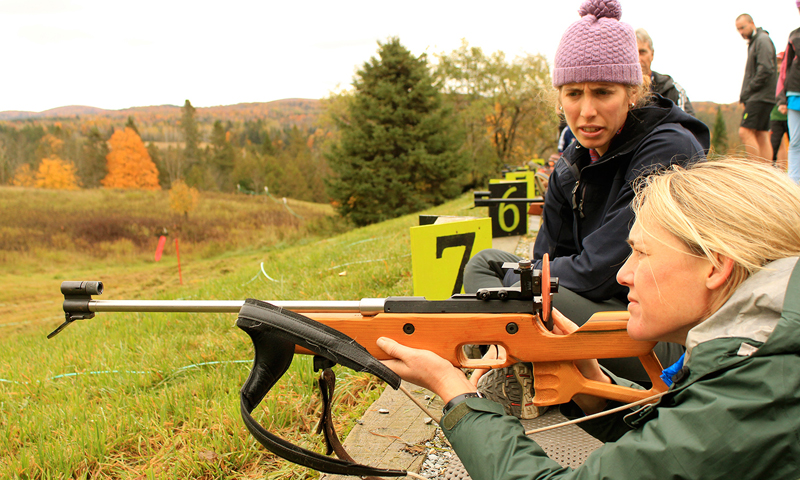
U.S. Biathlon National Team member Susan Dunklee (top) instructs at the Craftsbury Outdoor Center last September in Craftsbury, Vt.
For the last five years, there has been an ammunition shortage in the U.S. The shortage is most acute in inexpensive rimfire-type ammunition, particularly .22-caliber, which is preferred by competitive and recreational shooters.
Though a careless web search can send you down a rabbit-hole of internet-forum conspiracy theories, the National Rifle Association (NRA) studied the problem and determined that the shortage was being caused by increased demand in the civilian market. President Barack Obama’s election in 2008 has created a lasting sense that gun and sales will be restricted, which has resulted in a five-year-long buying frenzy.
Steve Hornady, president of Hornady Ammunition, one of the nation’s leading ammunition manufacturers, explained the cause of the shortage to the NRA. “We’re working as hard as we can to get as much out as possible,” he said, according to Forbes.com. “People walk into the store, they don’t see as much as they want so they take everything they can get. The next guy who comes in can’t get anything, so he panics … ”
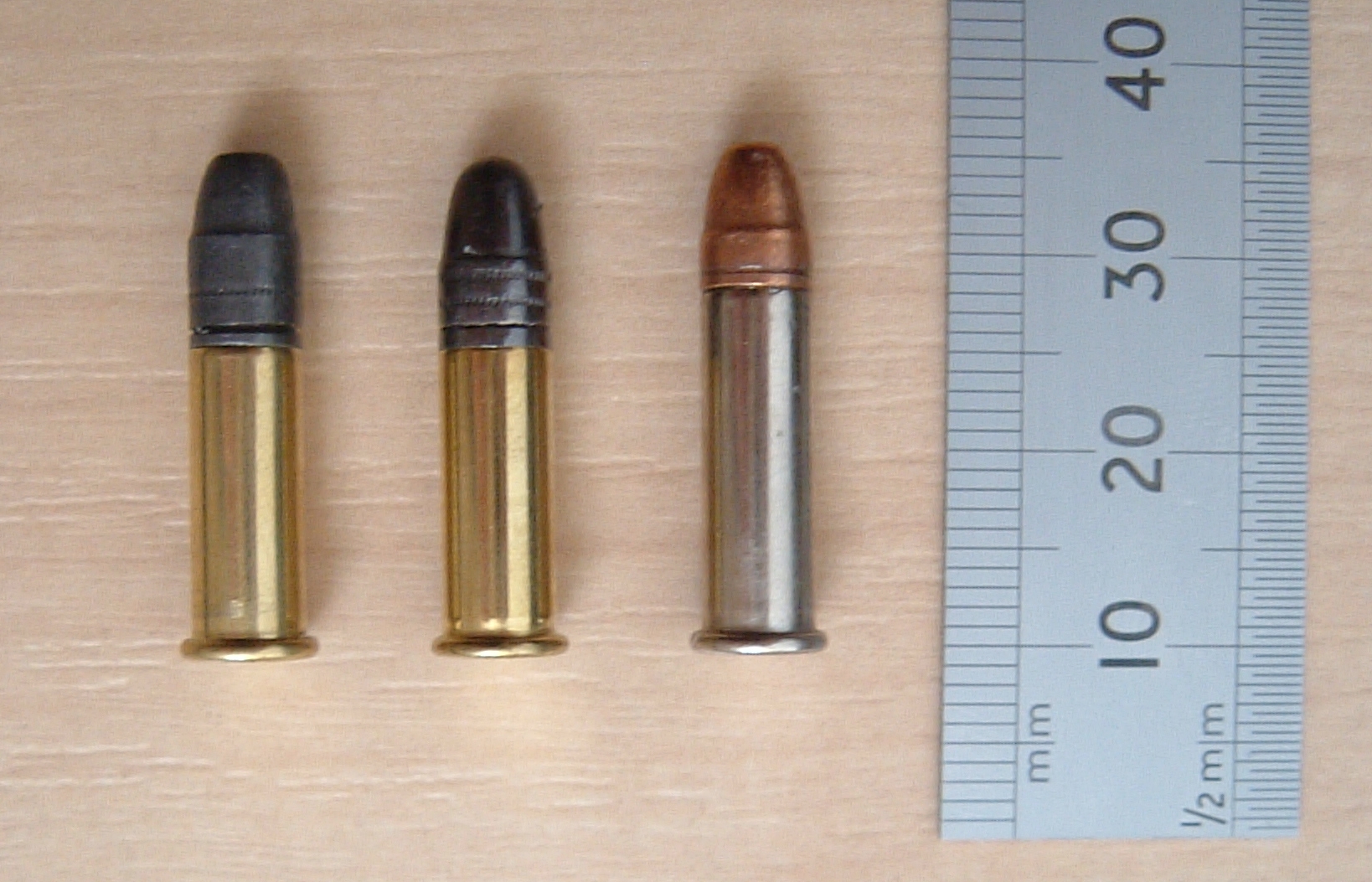
The .22 Long Rifle rimfire cartridge, the most common in the world. (Photo: Wikimedia Commons)
The .22 long rifle (.22lr) bullet has long been the bullet of choice for target and competition shooting due to accuracy, low recoil, and low cost. With retail shelves nation-wide empty, how have American biathlon clubs responded?
“Our club has been affected by ammunition shortages,” explained Zach Hall, head coach at AK Biathlon. “A large bulk order put in last year still hasn’t been produced by Federal, leaving many biathletes scrambling to find other sources of .22lr. Mostly, families with small stores of ammunition have resorted to sharing with those in need, and everyone is going out of their way to purchase more when they travel to the lower 48.”
But the shortage is not restricted to Alaska.
“The junior program isn’t being affected yet, but some of our masters are having to conserve ammo,” explained Eric Tremble of the Ethan Allen Biathlon Club in Jericho, VT, in an email. “We buy our ammo directly from Federal/CCI through their youth direct sale program where Federal sells ammunition directly to clubs to be used exclusively for youth shooting. It’s a great program except that it’s only offered when Federal has surplus.
“Because of the infrequency of the offers, we were proactive and bought the maximum allowed amount whenever we could. I put in big orders in 2011 and 2012, and we’ve been using that ever since. At one point I had an entire bookshelf filled with ammo, but now it’s down to three cases. Those three cases will get us through the rest of this summer and next winter. I’m hoping that Federal will be able to offer the youth program again before we run out.”
“Our club has been affected by ammunition shortages. … Mostly, families with small stores of ammunition have resorted to sharing with those in need, and everyone is going out of their way to purchase more when they travel to the lower 48.” — Zach Hall, AK Biathlon Head Coach
Seth Hubbard, of the Maine Winter Sports Center, encountered shortages in the past, but has enough ammo for the time being.
“The biggest thing that I am doing is that I am spending more time working on sourcing the ammo that we need as well as keeping an eye on our inventory as we move through training,” he wrote.
The shortage has been most account in the cheapest bullets, which are most popular with recreational shooters. However, even competitive biathletes use the cheaper ammo during training.
“The quality of ammo hasn’t been affected, though lower grade (cheaper) target ammo is more difficult to locate, especially in bulk,” Hall continued. “With .22 ammo being less prevalent it has been necessary to include more dry-fire drills as a precursor to live-fire training. Also, we have several high-tech laser rifles that have substantially expanded our training opportunities and reduced our direct reliance on ammo. We use the laser rifles to teach athletes a new concept and only when they have achieved a level of mastery over fundamentals do we add live ammo to the progression.”
For Hall’s team, however, the need resort to the laser rifles has been a bit of a silver lining.
“[The laser systems] allow for real-time monitoring and playback of aiming, shot placement, breathing, and follow through,” Hall explained. “As a coach I can diagnose issues on a laser rifle after only a few shots because I can see details of what’s happening during the whole shot process. With live ammunition some of that info is more difficult or impossible to discern without shooting through hundreds or even thousands of rounds.”
“Another benefit to the laser rifles is that I can use the system to teach young kids or athletes who may initially be apprehensive about the loud noise of a gun or anticipated kick,” Hall added. “Once they’ve learned the basics of shooting then we can introduce them to live-fire shooting and the transition is usually really comfortable and low stress.”
Like AK Biathlon, the Maine Winter Sports Center has encountered a shortage in the cheaper types of ammunition.
“The biggest shortage that I have encountered and heard other coaches dealing with has been on the lower-grade ammo that younger athletes may be using,” Hubbard wrote in an email. “This is the grade of ammo that you will see more commonly at your local sporting shop, when it is available. This ammo is very very hard to come by and I am sure that it is causing greater shortages with clubs and athletes, depending on how individuals are purchasing their ammo there can be long waits.”
But, as with all nordic sports, the coaches become personally invested in their athlete’s performance:
“We’ve also been using up my personal supply from when I was racing in the ’90s,” Tremble added.
Casey Smith (right) on the podium of a Czech Cup race in Nove Mesto, Czech Republic, this season. Photo courtesy of Casey Smith.
It’s been a while since the U.S. Biathlon Association (USBA) team nominated a new member to the national team. Last year, with the focus on an upcoming Olympics, the squad was focused solely on veterans; the previous time around, the only new naming was Hannah Dreissigacker, who already had an elite career as a cross-country skier behind her.
So when Casey Smith’s name showed up on the national team roster which was announced earlier this month, it represented a significant move toward development for the USBA. Smith raced for the Maine Winter Sports Center last season, and as a first-year senior placed 22nd in the sprint at Open European Championships.
“The fact that Casey made really good progress last year in a short amount of time as a first-year senior, we are excited,” USBA High Performance Director Bernd Eisenbichler told FasterSkier. “For Casey it was really a good result at the European Championships, and he qualified for the Olympic trials and the IBU Cup. He had the exposure to international racing. For sure he still needs improvement to be on the World Cup level, but it’s positive signs.”
Smith received a “B” team nomination based on USBA criteria. He is the youngest addition to the senior national team in years, and will be tapped to fill roles vacated by retiring veterans Jeremy Teela and Jay Hakkinen in the future. Eisenbichler admitted that with a successful Olympic Games behind them, it was time for the team to start looking forward – starting with athletes like Smith, who has been in the USBA pipeline for years.
“If you look at our team structure, that’s what we have to do because for sure there’s a little bit of a break behind Tim [Burke] and Lowell [Bailey] on the age side, so for sure we have to work hard to fill that,” Eisenbichler said. “We’re doing all possible efforts to do that, with recruiting and with developing our own athletes.”
Smith is a four-time World Youth and Junior Championships competitor who notched finishes in the low 30’s in each of those appearances. After finishing high school in the Methow Valley region of Washington, he attended Montana State University and trained as a biathlete. After finishing his junior career, Smith decided to focus even more on biathlon and moved to the Maine Winter Sports Center (MWSC).
“Last year when I joined MWSC my goal was to make the Olympic team,” Smith wrote in an e-mail. “I knew that the first three spots were pretty much set, but I thought that the last two spots were pretty wide open. I know from where I was to making the Olympic team would be a huge step but if you want to make big gains you need to set even bigger goals.”
Smith certainly made a splash as he set out on his Olympic hunt: he won a series of trials races at Mount Itasca in Minnesota, earning selection to an IBU Cup tour where the international competitions would also serve as the final selection trials for the Olympic team.
They were Smith’s first appearances on the competitive international circuit, which is like a second-tier World Cup. He collected two finishes in the mid-40’s and was ultimately not picked for the Games. But Smith doesn’t consider it a failure – he stayed in Europe for Open European Championships and some other small races as well.
“The IBU Cups were cool because there were so many competitive athletes and several of the people I was racing there went on to place in the top of World Cup events,” Smith wrote. “Even though I did not accomplish my main goal of making the Olympics, I was still very happy with what I was able to accomplish. Not only did I race in my first IBU cups and qualify for the national B-team from my results at the European Champs, but I had an excellent early season as well, I was the overall Noram leader until I left for Europe, and I won the US IBU Cup trials.”
He got used to a higher level of competition as well as the craziness of life on the road in Europe: for instance, competitions he was slated to race with a teammate in Slovenia were canceled because there was so much snow that the shooting range was buried. Among Smith’s other accomplishments were two third-place finishes in Czech Cup races in Nove Mesto.
Seth Hubbard, the biathlon coach at MWSC, said that Smith was an apt pupil in his first season of full-time training.
Casey Smith chasing Russell Currier in the mass start competition at IBU Cup trials in Mount Itasca, Minnesota in December. Photo courtesy of Casey Smith.
“He is a very enthusiastic biathlete and is really wanting to be doing the work to get to the next levels in the sport,” Hubbard told FasterSkier. “For Casey, having a season where he was focused on his development as a biathlete was great. A few important pieces for athletes transitioning from school into full time sport are to be focused on why you are taking the time to be an athlete, and to also leave a little time for life outside of sport. Casey did a great job of balancing these two items.”
And Smith found MWSC a rewarding place to train. He was challenged by Russell Currier, a World Cup veteran who ultimately earned the Olympic nomination.
“Compared to years past while I was in school I did not make a super large jump in hours, but I think that the quality of my training improved dramatically,” Smith wrote. “One, I was able to do specific combo training at the 10th Mountain Ski Center in Fort Kent and two, I had individual coaching for most workout sessions. I think both of these factors contributed to my success this season.”
Smith will be joined on the “B” team by Currier, as the only two men to receive that nomination. No women will be on the “B” team. What that means is that the pair will stay largely in Maine, and attend a few camps with “A” team athletes Burke, Bailey, and Leif Nordgren throughout the season.
“It’s a couple of camps, time in June in Lake Placid, and then again in August in Lake Placid, and they have the nationals where they meet up and see where their performance level is against the big guns,” Eisenbichler explained. “Then they have the Utah camp and the testing week. That was the idea behind it, that we need them to get ready for the next level, expose them to the big guns when it’s right, and they can still work on their own development and progress in a calm environment.”
To some extent, the theory seemed to be: if it ain’t broke, don’t fix it. Smith improved steadily last season, and Eisenbichler thought Maine was likely a big part of that change.
“The idea is that they are up in Maine and can profit from each other in training,” Eisenbichler said. “Casey is a really good shooter and Russell is for sure a really good [skier], so they can profit from the other’s strengths and weaknesses and work together on this. It’s really good to be up in Maine with Seth Hubbard because he’s really with our philosophy of training.”
Hubbard agreed, and was happy to keep the two men around on his team.
“This made the most sense as far as being able to provide as much support from a financial, coaching and training group perspective,” he wrote in an e-mail. “With these two athletes as well as some of the older junior biathletes and nordic athletes we are fortunate to have a strong and diverse training group in Maine. In the past year it had worked well through different portions of the season when Russell was able to spend more time with the team.”
Smith and Currier’s training will be overseen jointly by Hubbard and the national team staff, an additional piece that Smith welcomed (other than a conference call at the beginning of the season, he said he had little oversight from USBA last year).
“Besides attending these camps I will be able to consult with the national team coaches,” he wrote.” I am excited about being invited to these camps because it will be more national team coaching support then I have ever received.”
MWSC recently lost its title sponsor, but through fundraising has made significant steps towards recovering its budget. As of May 1, MWSC had raised over $350,000 and had received about $450,000 from Mary Barton Smith, primarily through an ongoing matching challenge.
Smith said that there was still a bit of uncertainty, but that he hadn’t heard any way that the funding situation would directly affect him.
“I know that I will be primarily based in Fort Kent, and will have housing thanks to the Phyllis Jalbert biathlete house,” he explained.
Eisenbichler was also unconcerned about the potential changes to MWSC.
“I’m not worried about Maine Winter Sports Center,” he said. “They have a strong leader there and he is doing everything in his power to keep that program going. We’re really happy to have this program in place and I think it’s a great program.”
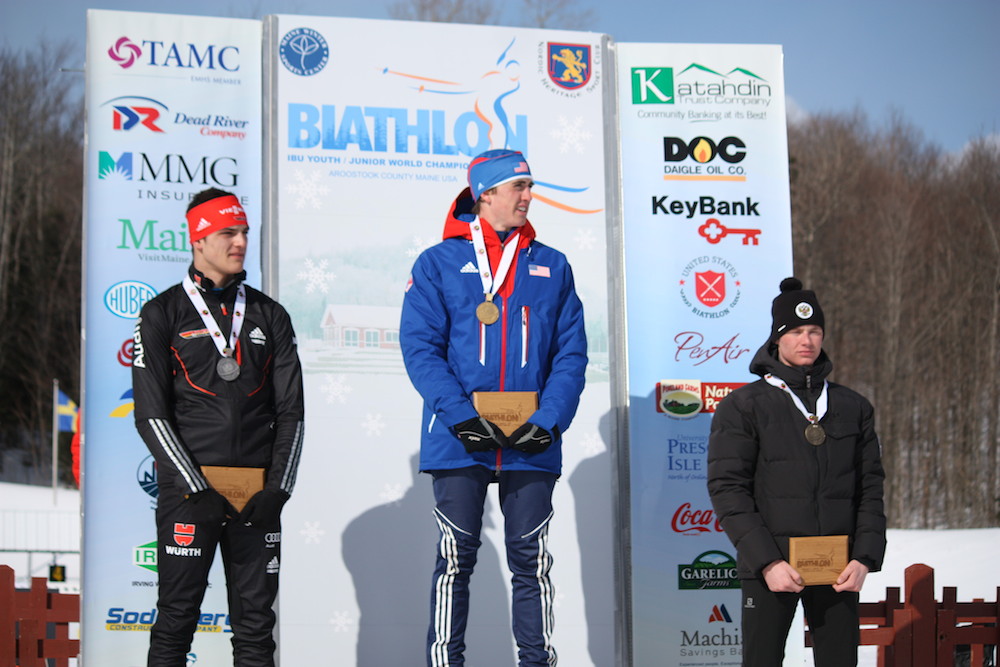
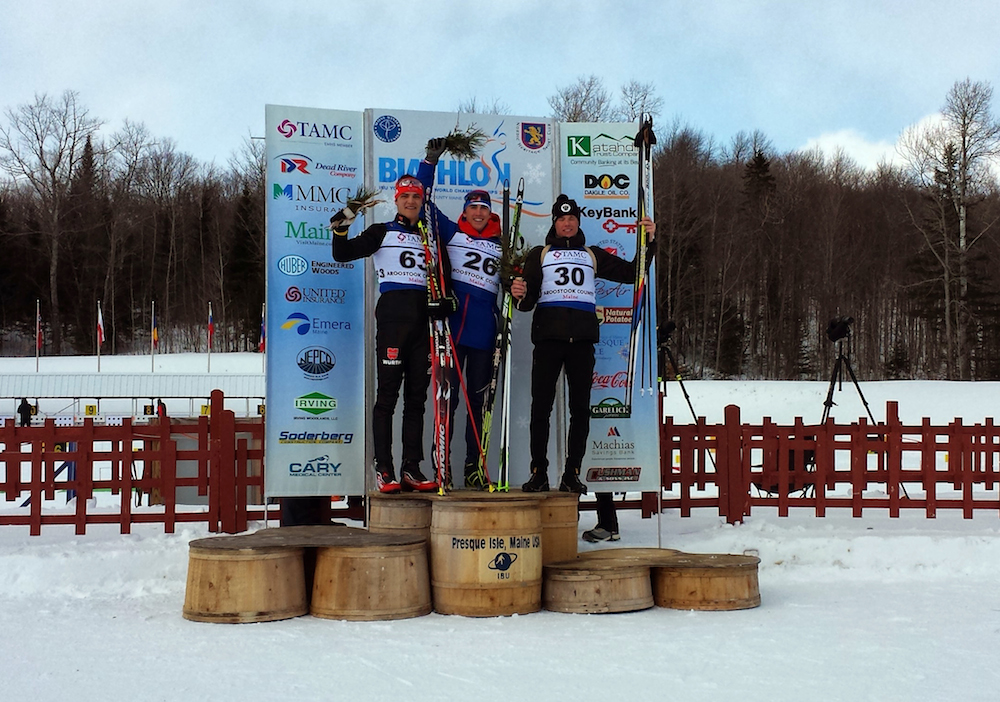
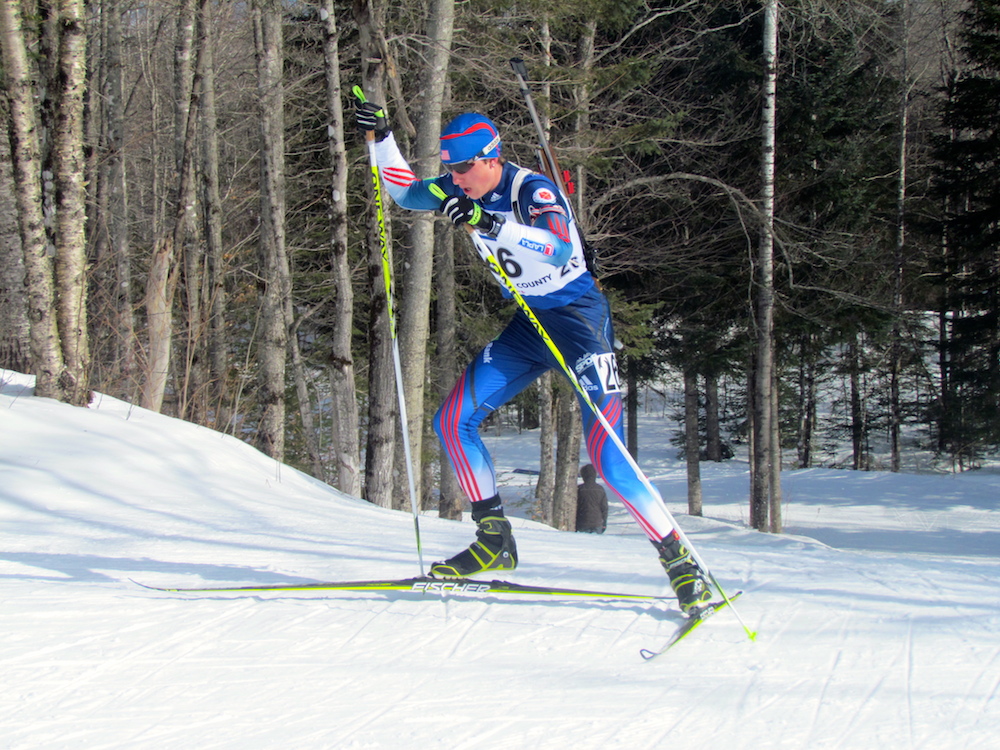
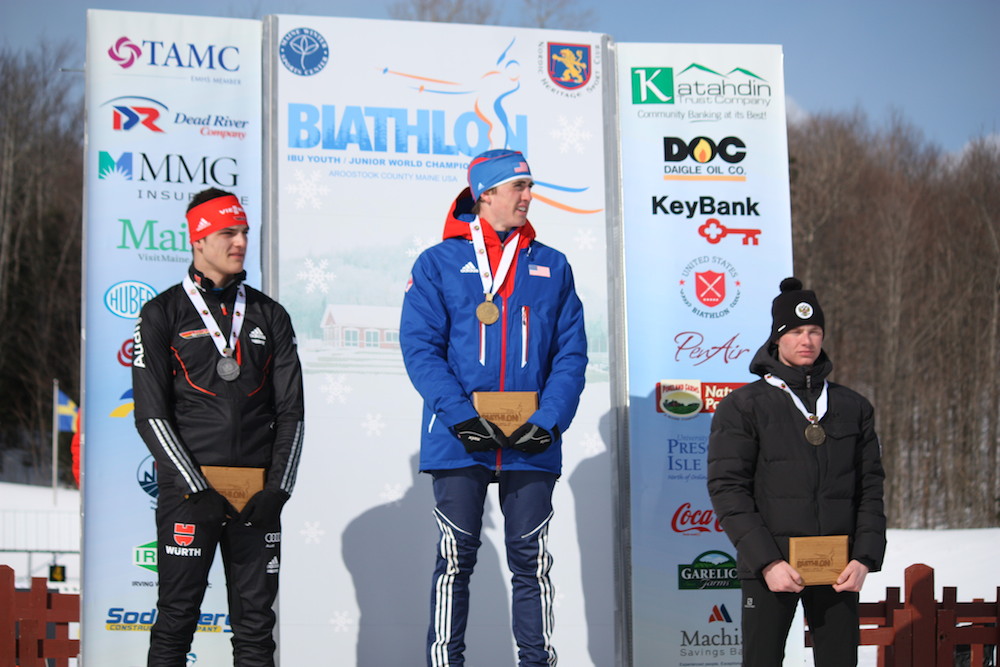
U.S. Olympian Sean Doherty (c) celebrates gold in the first race of the 2014 IBU Youth World Championships in Presque Isle, Maine. Doherty, 18, won Friday’s 7.5 k sprint ahead of Germany’s Marco Gross (l) in second, and Russia’s Dmitri Shamaev (r) in third. (Photo: Craig Cormier)
A little Olympic experience goes a long way. So does home-turf advantage in New England.
Less than a week after competing in his first Olympics in the 4 x 7.5-kilometer men’s relay in Sochi, Russia, 18-year-old Sean Doherty, of Center Conway, N.H., opened the 2014 International Biathlon Union (IBU) Youth/Junior World Championships on Friday with gold in the youth 7.5 k sprint.
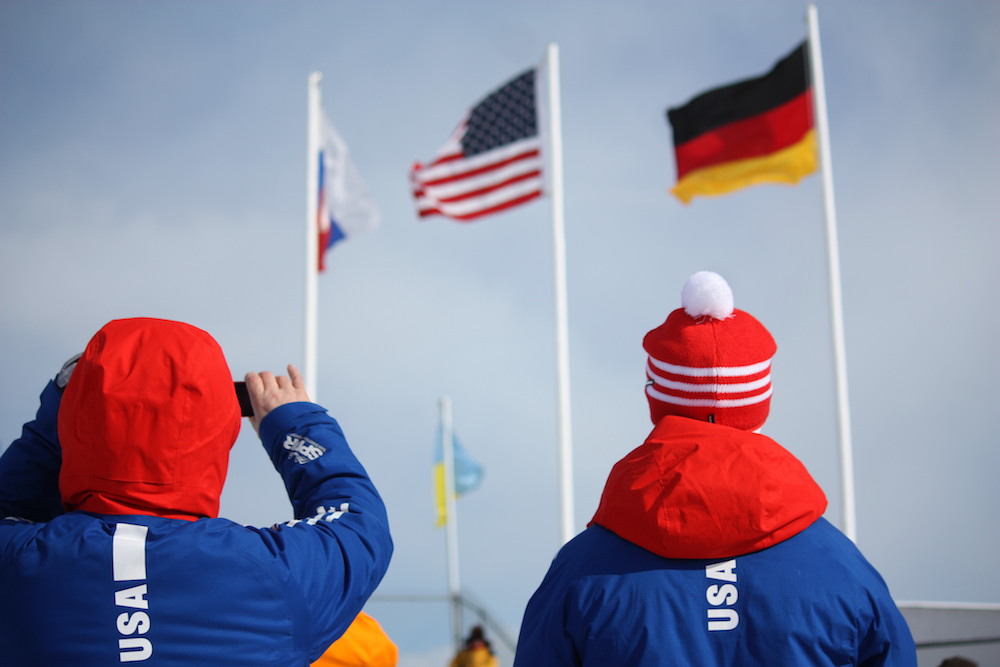
US Biathlon staff snap a photo of the youth men’s podium on Friday in Presque Isle, Maine, as represented in flags after Sean Doherty topped Germany by 1.7 seconds and Russia by nearly 19 seconds for the win. (Photo: Craig Cormier)
Shooting wasn’t easy in the two-stage race on a windy and frigid day at the Nordic Heritage Center in Presque Isle, Maine, where temperatures hovered slightly above 0 degrees Fahrenheit before the women’s 10 a.m. start, according to an IBU press release. The wind darted from left to right across the range, making clean shooting difficult in both the women’s and men’s races.
Doherty, a favorite after taking silver in the sprint at last year’s World Championships, missed four shots en route to the win in 19:35. Two came in prone, which quickly put him 35 seconds out of the lead. On the next loop, he skied his way back near the front, hitting the first two shots, then missing the third and fifth for two more penalties.
An early starter, Doherty’s fast ski time stood up as Russia’s Dmitri Shamaev crossed the line in second with two penalties (both in standing), nearly 19 seconds back. Germany’s Marco Gross, who missed one prone and two standing, bumped Shamaev to third, finishing 1.7 seconds behind Doherty for silver. As Doherty’s win became more evident, a small crowd broke out chanting, “U.S.A., U.S.A,” according to the Portland Press Herald.
“This is unbelievable,’’ Doherty told the Press Herald. “It means a lot to me. All the people who supported me were here to see it.’’
His prone shooting worried him at first: “The shots were just not falling,” he told IBU. “But I had super skis thanks to our wax techs and felt great on the tracks. … I have no words to describe how it feels to win a gold medal in a Championship on home soil.”
None of the 62 men cleaned. This is Doherty’s second world title and fourth medal after winning the youth pursuit last year.
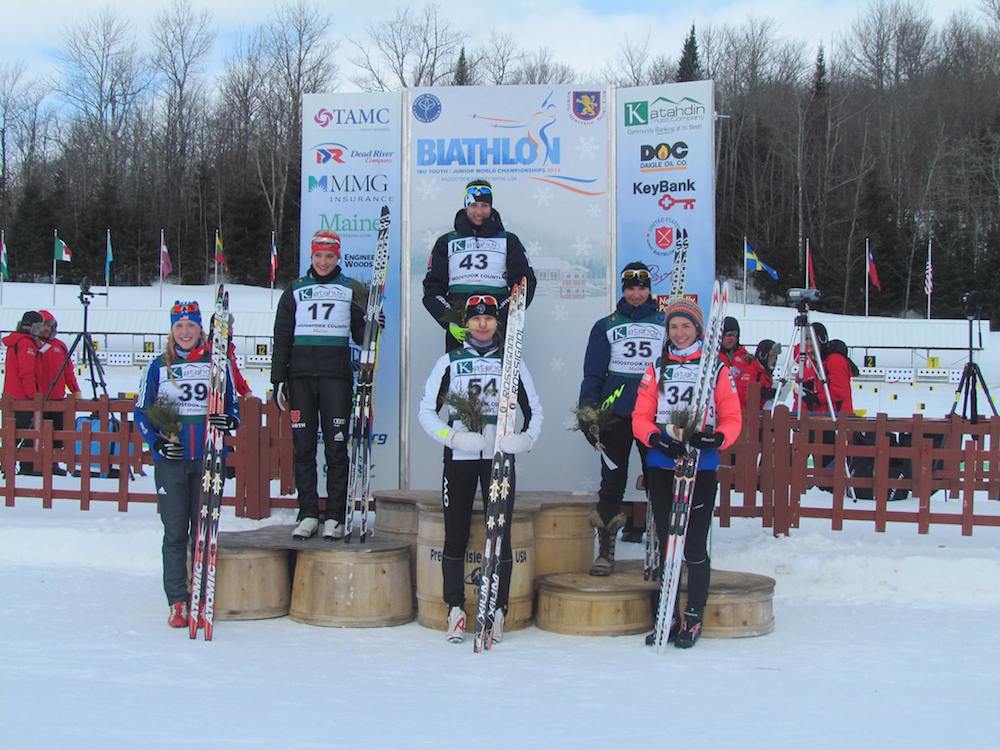
The IBU Youth World Championships women’s 6 k sprint podium on Friday in Presque Isle, Maine, which included Italy’s gold medalist Lisa Vittozzi (43), Germany’s Anna Weidel (17) in second, France’s Julia Simon (35) in third, and American Maddie Phaneuf (39) in fourth. (Photo: MWSC/Katrina Howe)
In the women’s race, Italy’s Lisa Vittozzi had just one penalty to claim her first sprint gold the youth 6 k in 18:49.9. Like Doherty, she took silver in last year’s event.
Vittozzi topped Germany’s Anna Weidel, who also had a single penalty, by 13 seconds for the win. Weidel missed one in prone then cleaned standing to finish first, more than a minute faster than anyone else. Vittozzi challenged her with a rapid-fire clean prone stage, then one standing miss to put her 0.4 seconds ahead of Weidel heading into the final loop. There, she picked up more than 12 seconds on the German to bump her to second.
“I prepared well for this competition and hoped for a top place, but never expected to be World Champion,” Vittozzi told IBU. “On the final uphill, I started to think this might be a very good day for me, so I gave everything I had.”
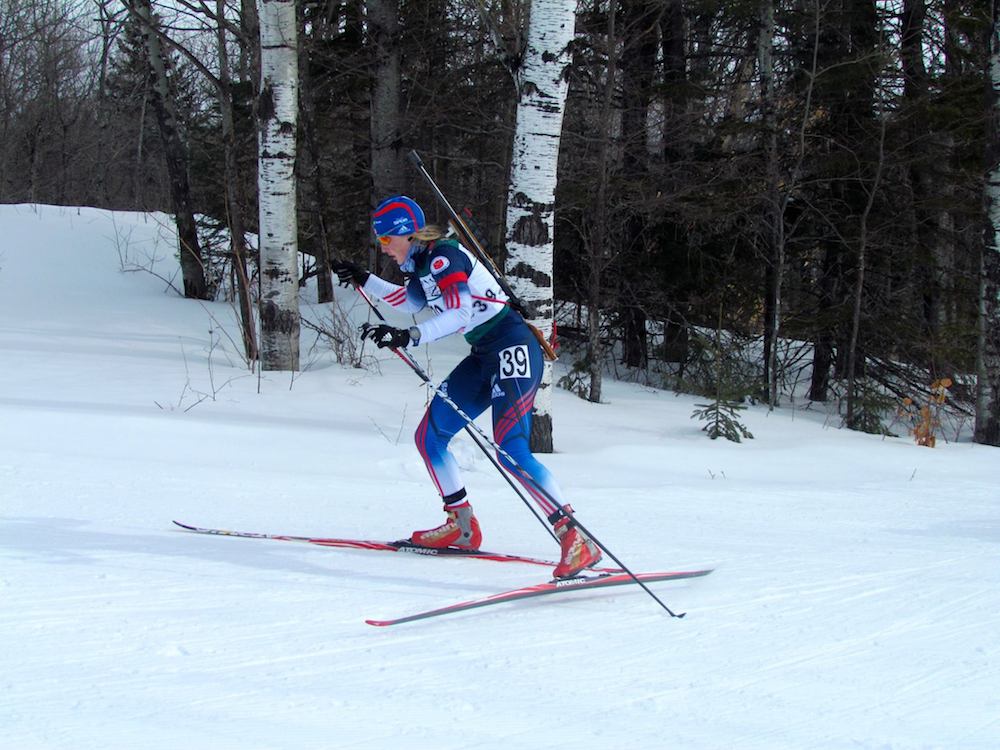
Also with one miss, France’s Julia Simon finished 18.4 seconds back from the winner for bronze. Maddie Grace Phaneuf, who trains with the Maine Winter Sports Center (MWSC) in Presque Isle, was the only competitor to clean all day, putting her fourth, 41 seconds off the podium.
“I was trying to stay mentally calm, and focused on my skiing technique while I was skiing and focused on my shooting while I was shooting,” Phaneuf wrote in an email. “I tried to do what I do when I’m training and nothing different. It wasn’t too difficult to do until I heard that I was doing so well, then I got a little nervous but tried to stay focused.
“I still can’t believe how close I was to the podium, it’s awesome,” she added. “I never thought that I would be placing 4th in my first ever international competition. I’m hoping I can continue shooting and skiing as well as I did, and maybe I’ll even get a podium in the upcoming races.”
“I couldn’t be more proud of Maddie, her teammates, and coach Seth Hubbard for all of the hard work they’ve put in to create a culture of belief here in northern Maine,” MWSC program director Will Sweetser wrote in an email. “Maddie showed true confidence today in her first international competition. She was composed, efficient and then, just hammered to keep her 4th place around the entire last lap.”
Sean Doherty en route to gold in the 2014 IBU Youth World Championships 7.5 k sprint in Presque Isle, Maine. (Photo: Katrina Howe)Maddie Phaneuf (Maine Winter Sports Center) racing to fourth in Friday’s IBU Youth World Championships 6 k sprint. She was the only competitor, male or female, to hit all 10 targets. (Photo: MWSC/Katrina Howe)U.S. Olympian Sean Doherty (c) tops the podium in the first race of the 2014 IBU Youth World Championships in Presque Isle, Maine. Doherty won Friday’s 7.5 k sprint ahead of Germany’s Marco Gross (l) in second, and Russia’s Dmitri Shamaev in third. (Photo: Craig Cormier)
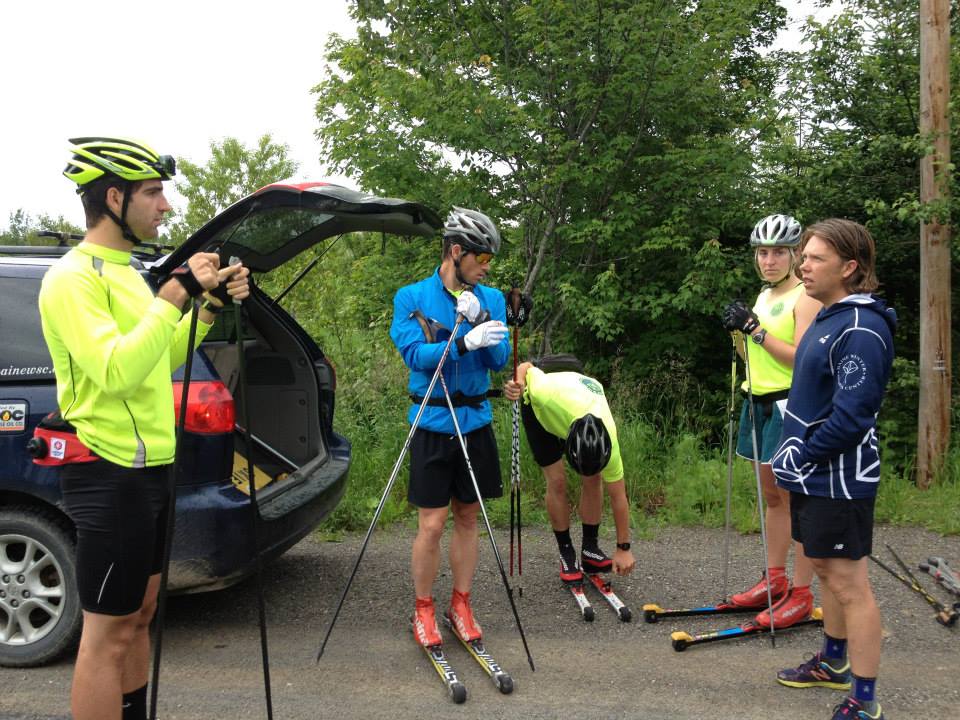
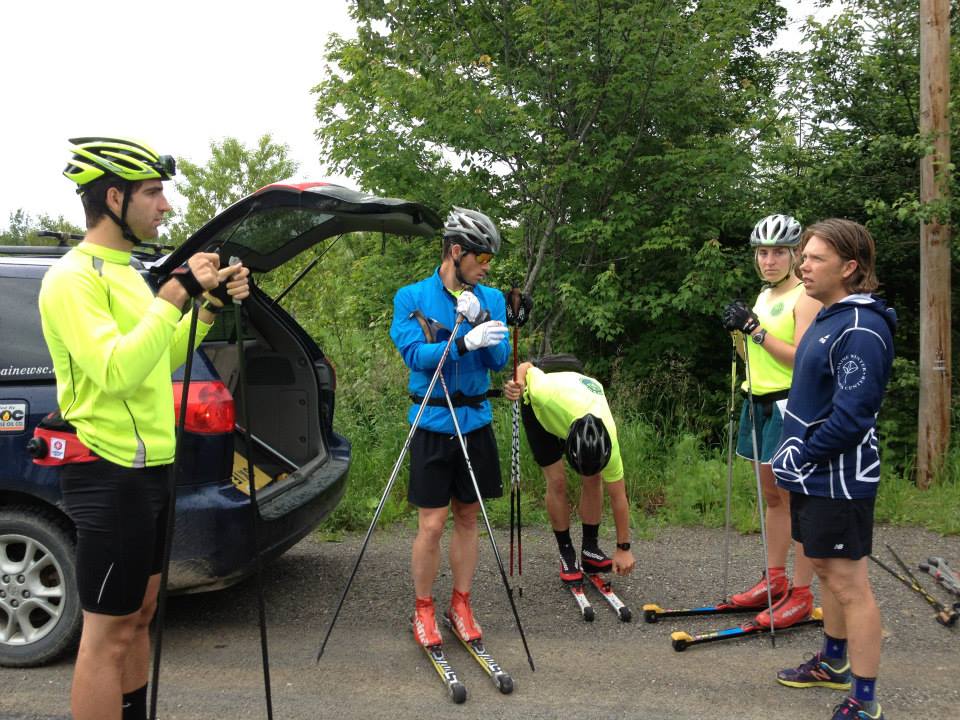
The Maine Winter Sports Center Cross-Country Olympic Development Team (ODT) gets ready for a rollerski in northeastern Maine, with Kris Freeman (in blue), Welly Ramsey, Hilary McNamee and competitive programs director Will Sweetser (r). (Photo: MWSC/facebook.com/maine.Winter.Sports.Center)
Note: This is the sixth preview in our series on U.S. elite teams, which we’ve dubbed the “The 12.” We asked coaches to tell us what’s new and whom to look out for in the coming season and will publish additional previews in the coming weeks in no particular order.
Cross-Country Olympic Development Team (ODT): Kris Freeman, Sam Tarling, Welly Ramsey; Hilary McNamee, Anna Van der Rhee (trying to qualify for Sochi Olympics for The Netherlands). According to Sweetser, McNamee is focusing on finishing her studies at Dartmouth and will race primarily in New England.
XC Post-Grads: Emily Ramsey (New Sharon, Maine), Zoe Chase-Donahue (Freeport, Maine), Sarah Becker (Yarmouth, Maine), Abby Popenoe (Portland, Maine), Austin Huneck (Clifton Park, N.Y.)
Collegiate Summer Program: Nick Michaud (Bates College), Gabby Naranja (Bates).
Biathlon ODT member Katrina Howe during skate hill workout. (Photo: Seth Hubbard)
Who’s new: Tarling (2013 Dartmouth graduate), Smith (formerly of Montana State University), Bermejo (Grand Rapids, Mich.), all post-grads except Emily Ramsey (second year).
Who’s missing: None.
Top results last season: Sweetser intends to send a minimum of four athletes to the Olympic Winter Games or in Bermejo’s case, the Paralympics. The most-obvious four that could make that goal a reality are Freeman, Currier, Cook, and Bermejo. But look out for the new guys, including Tarling and Smith, training with the Caribou-based MWSC on the northeastern tip of Maine.
A three-time Olympian, Freeman, 32, was not renominated to the U.S. Ski Team for the first time in a decade. He won his 16th national title last January in the 50 k classic, but finished the 2012/2013 World Cup season with with three top-30 results. Sweetser said Freeman and Ramsey have had some very productive training sessions this summer.
“[Freeman] is nowhere near the crazy specific fitness he had late last summer, however, he is lighter, faster [ran fastest 5 k (15:53) since 2004 in June] and happier than he’s been in years,” Sweetser wrote in an e-mail.
Sweetser added that Tarling has been an “instant plus” in MWSC’s community programs, which include juniors, high-school skiers and adults. He was a presenter at the Maine Team Camp in Fort Kent earlier this month, which hosted 43 of the state’s best high school skiers.
MWSC teammates, biathlete Raleigh Goessling leading cross-country skier Welly Ramsey during bounding intervals in northeastern Maine. (Photo: Seth Hubbard)
The 2011 NCAA 10-kilometer freestyle champion won twice on the Eastern Intercollegiate Ski Association (EISA) circuit in his senior season at Dartmouth and finished fifth in the 30k classic at U.S. nationals.
“(Tarling) is very professional in his approach to creating a career as a ski racer,” Sweetser wrote. “He is gelling well with our entire team and is a fantastic addition at junior training camps.”
Van der Rhee (formerly Sprague), a native of Stockholm, Maine, and Utah alum, married a man from The Netherlands and has since established citizenship there. To qualify for the Olympics, she needs World Cup starts, which may be earned with either a sub 100-point distance race or sub 120-point sprint in International Ski Federation (FIS) competition. Last year, in returning to racing after a seven year hiatus, Van der Rhee had one sub 150-point race.
Cook leapt 38 spots (83rd to 45th) in the biathlon world rankings last year. She tallied her first World Cup top 20 in Italy and two more in the pre-Olympic races in Sochi, Russia. This will be her second year with MWSC.
Currier, 26, is trying for his first Olympics as a returning member of the U.S. Biathlon Team. The MWSC veteran pulled out a pair of sixth-place finishes on the World Cup in 2012 and was a critical component of the U.S. relay team that finished fifth in January in Oberhof, Germany.
Smith, 21, is one of the most promising young biathletes in the country. He competed in the International Biathlon Union (IBU) youth and junior World Championships four times each, with his best junior-world finish coming last January in the 12.5-kilometer pursuit, where he was 23rd. Smith got a feel for northern Maine when he competed at U.S. Biathlon Nationals in Fort Kent last March.
“As expected, Casey has been a great fit with our program,” Hubbard wrote in an e-mail. “He has great energy and focus.”
Coach’s comment:
“From my perspective as director, this group is more of a team than we’ve ever had,” Sweetser said of the multi-tiered elite team, now in its 11th year. “We are prioritizing group training twice each week with biathletes and XC skiers together. There is no doubt that our program will have one of the best men’s distance teams in U.S. XC. These guys could easily meet all of their goals this year given the progress we’ve seen thus far.”