From the FasterSkier archive — posts syndicated from athletes’ and coaches’ own blogs between 2004 and 2012, kept online as published. Current coverage is at fasterskier.com.
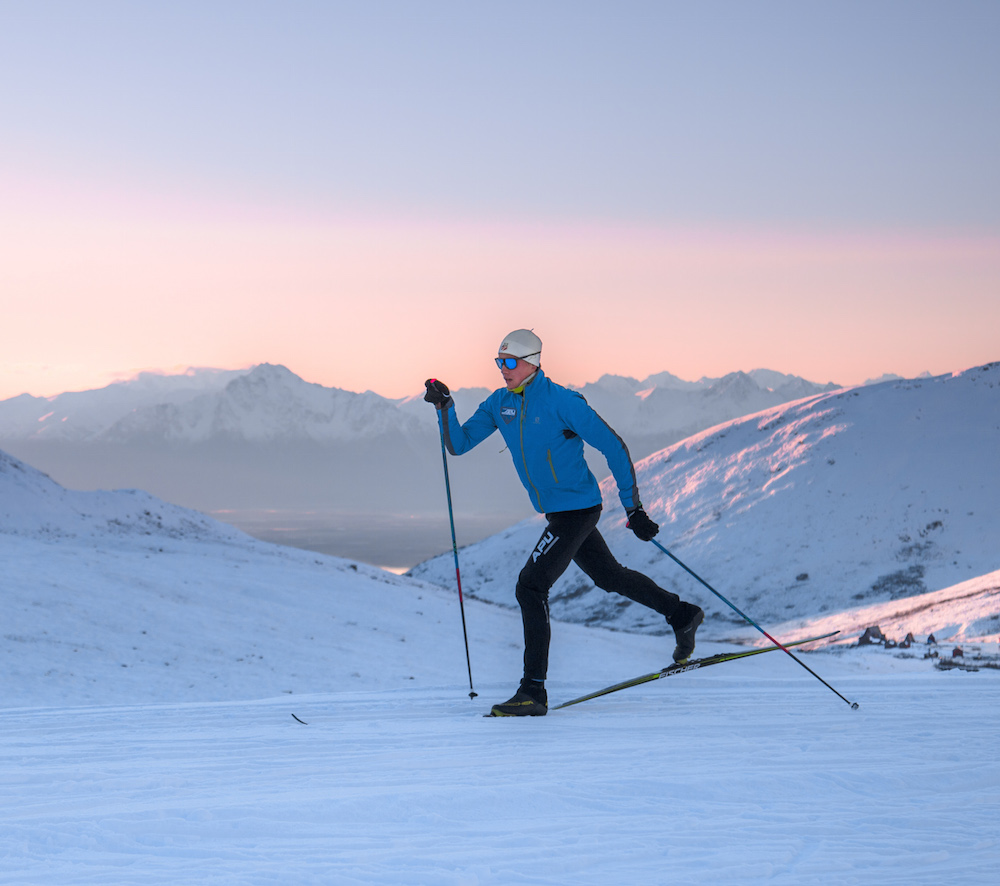
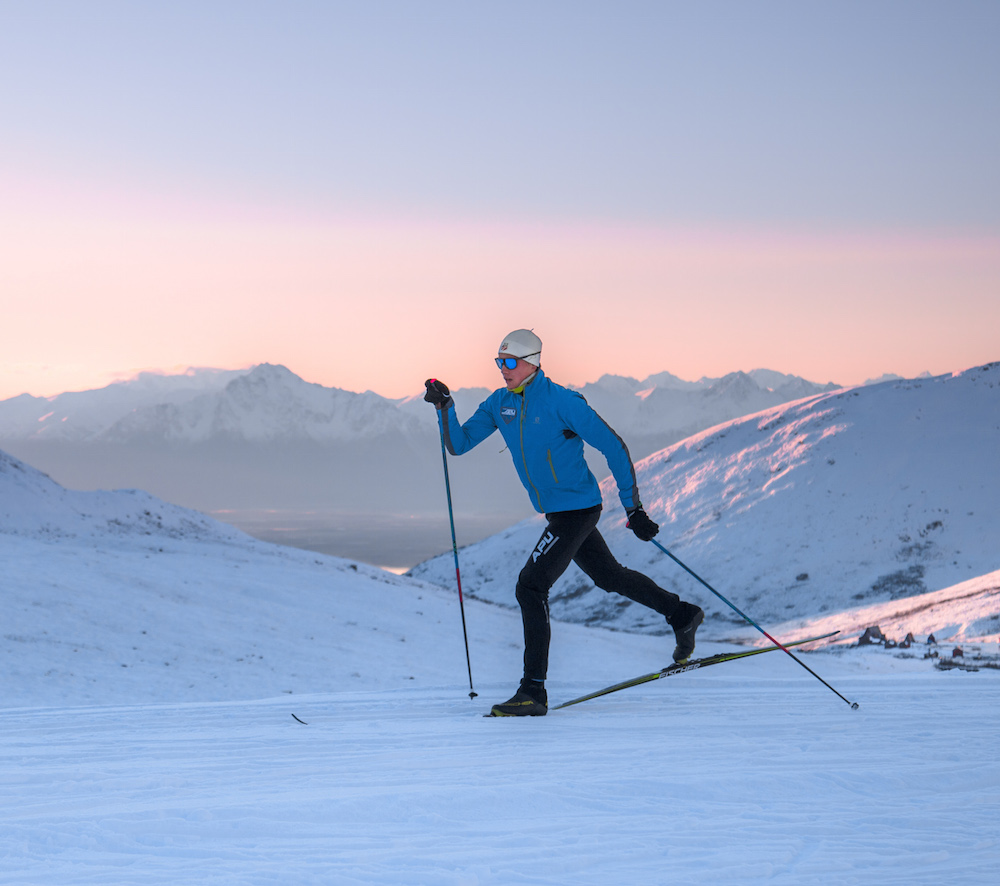
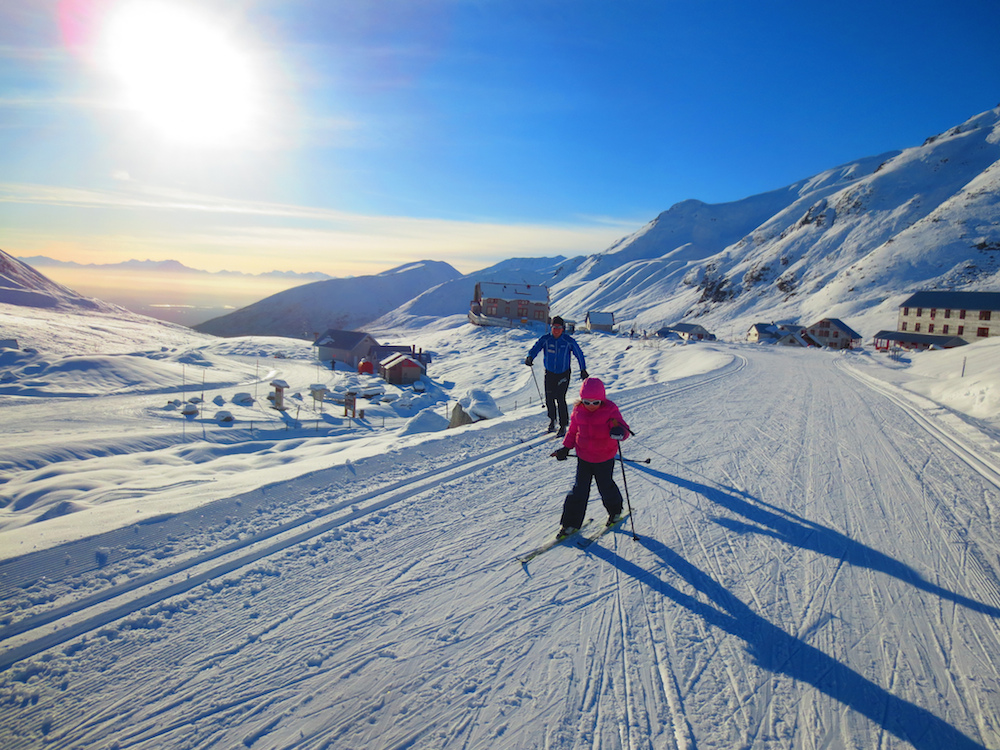
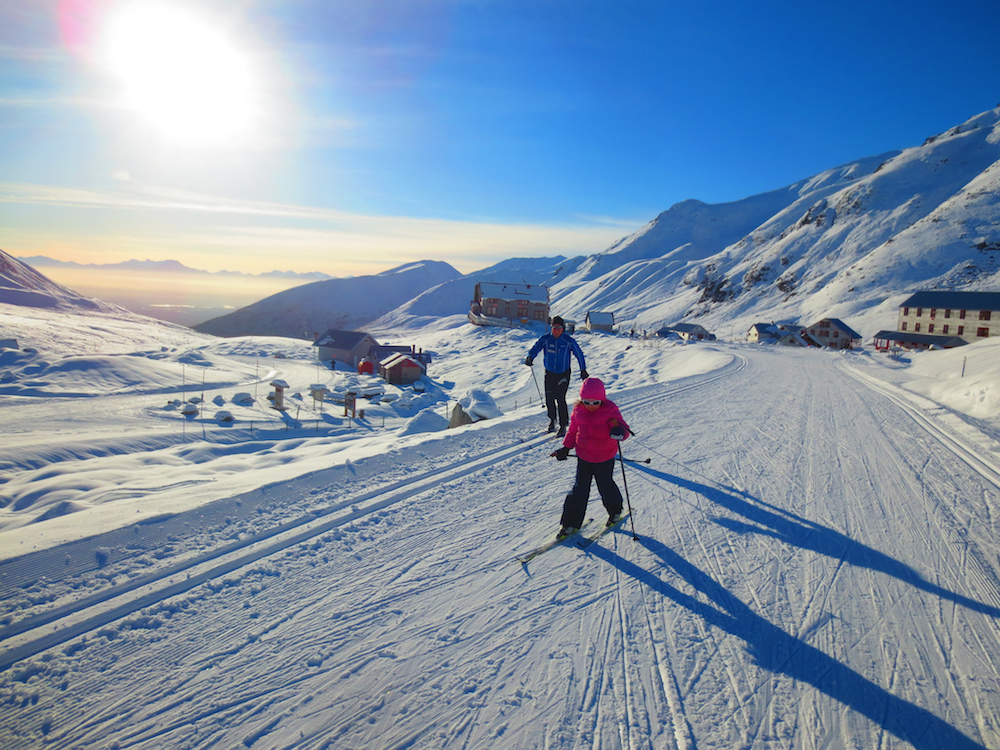
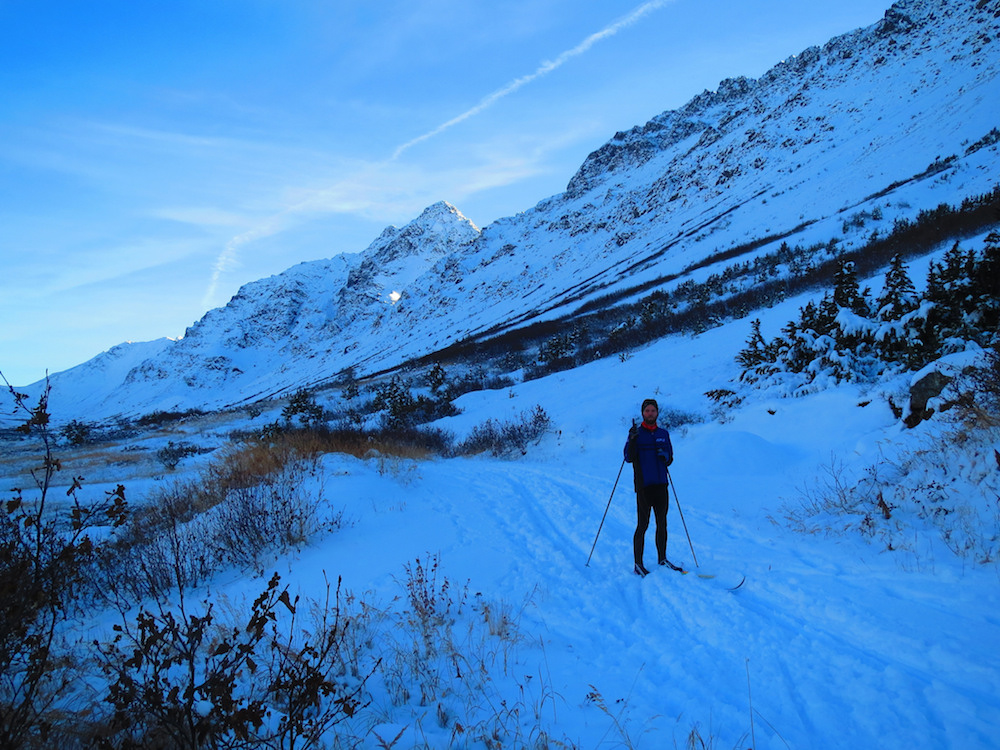
Alaska Pacific University’s Luke Jager strides it out at Hatcher Pass, above Palmer, Alaska, on Oct. 19, 2017. (Photo: Ophira Group)
Note: We’re seeking submissions for this year’s “Where The (Skiable) White Stuff Is” early snow report. If you know where there’s November or even October skiing in the U.S. or Canada, please write us with details (When does it open or how long has it been open? How many groomed kilometers are there? Is there snowmaking? Any special events planned, like American Thanksgiving camps? Anything else we should know?) and original photos at info@fasterskier.com with the subject line: “Fall Skiing”. Deadline for submissions is Nov. 3.
***
HATCHER PASS, above Palmer, Alaska — Winter is in the eye of the beholder, but whatever you’re looking for to mark the skier’s favorite season, this spot at 3,500 feet in the Talkeetna Mountains probably has it.
Seven kilometers of groomed trails? Check. Literally Extra Blue conditions? Check. A nearby lodge with a fireplace serving up hot chocolate and sweeping mountain views? Check. Fresh snowfall, gorgeous alpine vistas, and a side dose of Alaskan mining history? All of the above. Judging by the cars in the parking lot this weekend, there are plenty of skiers in southcentral Alaska who are ready for winter to be upon us.
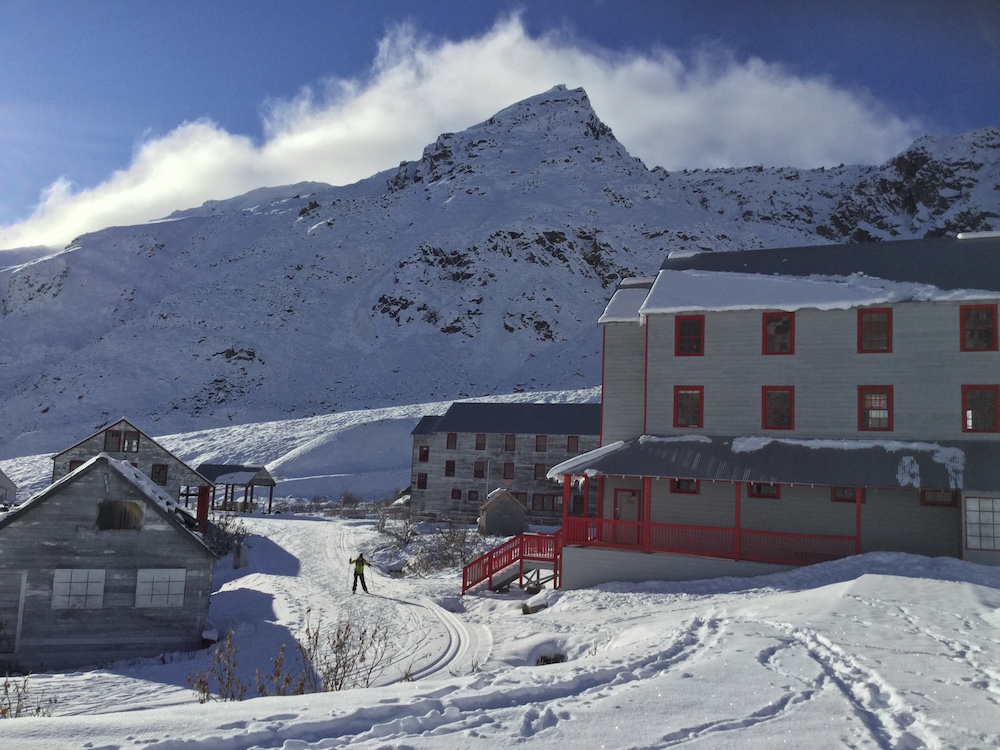
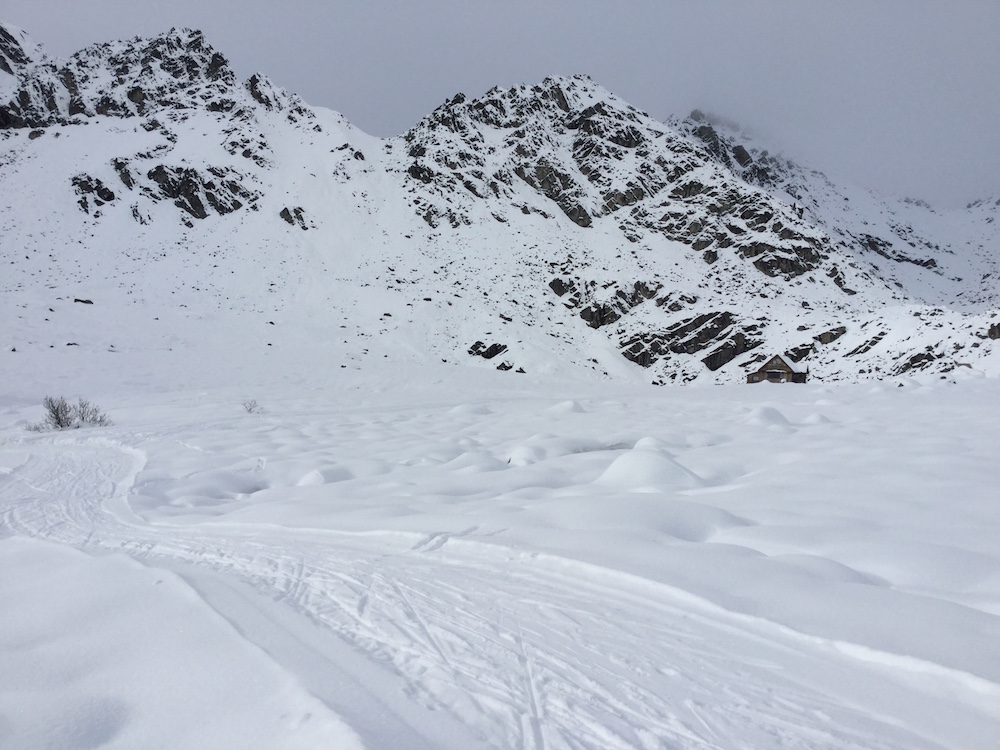
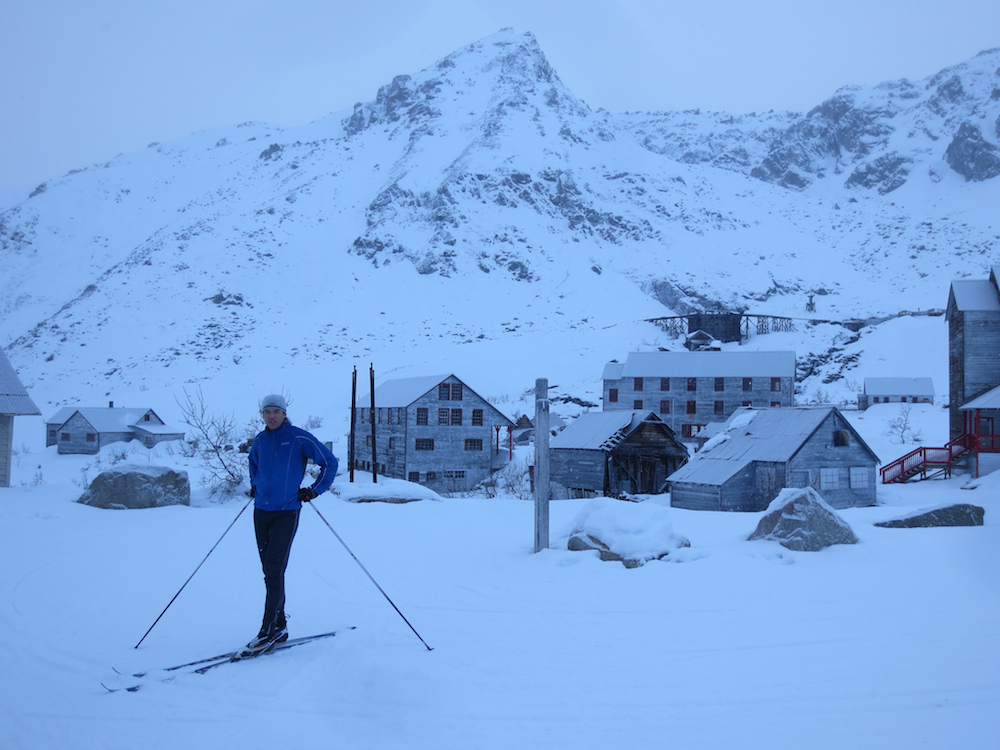
Skiing through the historic mine buildings at Hatcher Pass on Oct. 18. (Photo: Gavin Kentch)
Skiing at Hatcher Pass began in earnest roughly ten days ago, when the cold rains of October finally turned to snow up high. When the weekend of Oct. 14 dawned sunny and gorgeous, the pilgrimage was on, with skier-set classic tracks throughout the area by Saturday afternoon. Formal grooming followed on Monday morning, courtesy of the Mat-Su Ski Club. Alaska Pacific University (APU) skiers have been making the trek out to the Matanuska–Susitna Valley, roughly an 80-minute drive from Anchorage, most days since (including Sadie Bjornsen, Erik Bjornsen, Reese Hanneman, and Eric Packer, among others). For the APU Elite Team, the #roadtopyeongchang runs through Hatcher Pass, whether skiing or getting a jump on ski testing.
The ca. 2 k, 200-meter-elevation-gain continuous climb (so, not exactly FIS-legal) from the lower parking lot to the highest point on the current course doesn’t hurt for training, either. No word if the climb popularly known for the last four years as “Sochi Hill” has been renamed for the current Olympic cycle, though.
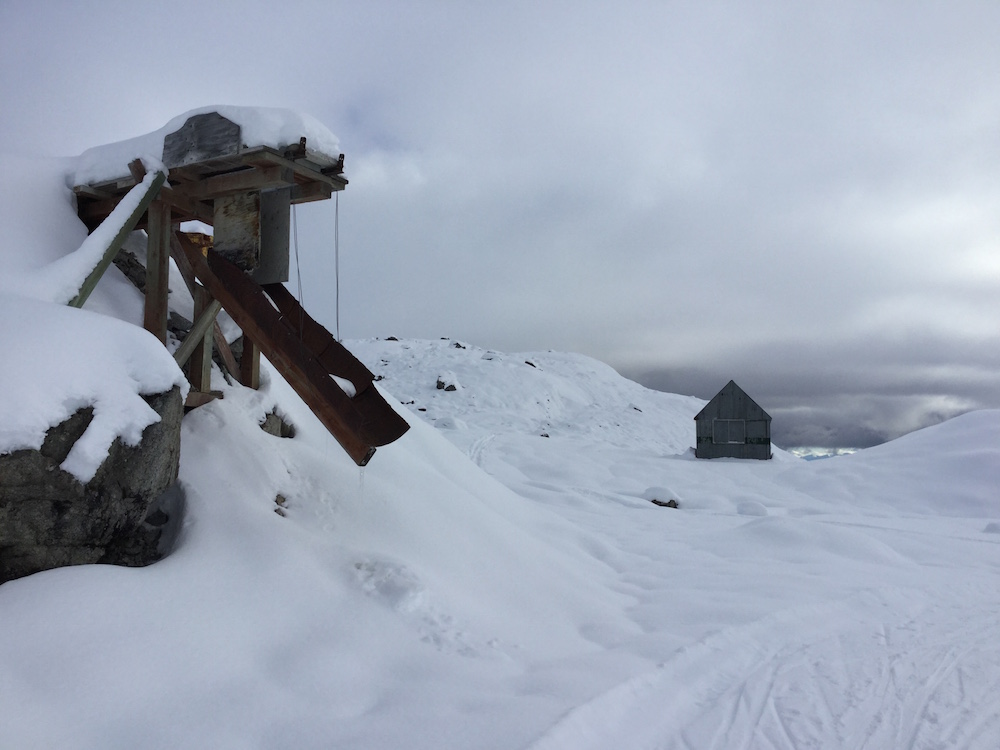
Old mining equipment borders the ski trails at Hatcher Pass on Oct. 18. (Photo: Gavin Kentch)
But Hatcher Pass isn’t just a superb early-season training venue. It’s also a truly lovely place to spend time. John Updike famously wrote of Fenway Park that it was “a lyric little bandbox of a ballpark,” a description that lends itself surprisingly well to the central-mine area that the ski trails wend through. In that vein, University of Alaska Anchorage English professor and local masters skier Shannon Gramse later set the scene by describing the historic mine buildings and detritus left over from the area’s early-20th-century mining heyday, then wrote, “Imagine skiing through an Old West ghost town turned collectible Christmas village.” By any standard, Hatcher Pass is a very special place.
Mountain views from the groomed trails at Hatcher Pass on Oct. 18. (Photo: Gavin Kentch)
This year’s Oct. 16 start to grooming at Hatcher Pass was “one day later than average,” Mat-Su Ski Club board member Ed Strabel told former FasterSkier reporter Nat Herz, now of the Alaska Dispatch News.
Three hundred miles to the north, winter is also right on schedule at Birch Hill Ski Area in Fairbanks. Longtime area race director John Estle (who was also chief of competition for some of the last FIS World Cup races held in this country, in 1984, as well as head coach of the U.S. Ski Team from 1990–1993, as well as having a role in pretty much anything involving skiing in interior Alaska in the last 35 years) wrote in an email on Thursday, “The ground is frozen, we’ve had 3″-4″ of snowfall, and the groomers have rolled a few k’s of trails.”
In a follow-up note to FasterSkier, Estle clarified that this date for the first grooming was “about average” for Fairbanks. “It’s on the early end of average for the past few years, but right in the long-term average which is October 15-25. But that is an anecdotal average with no scientific basis.”
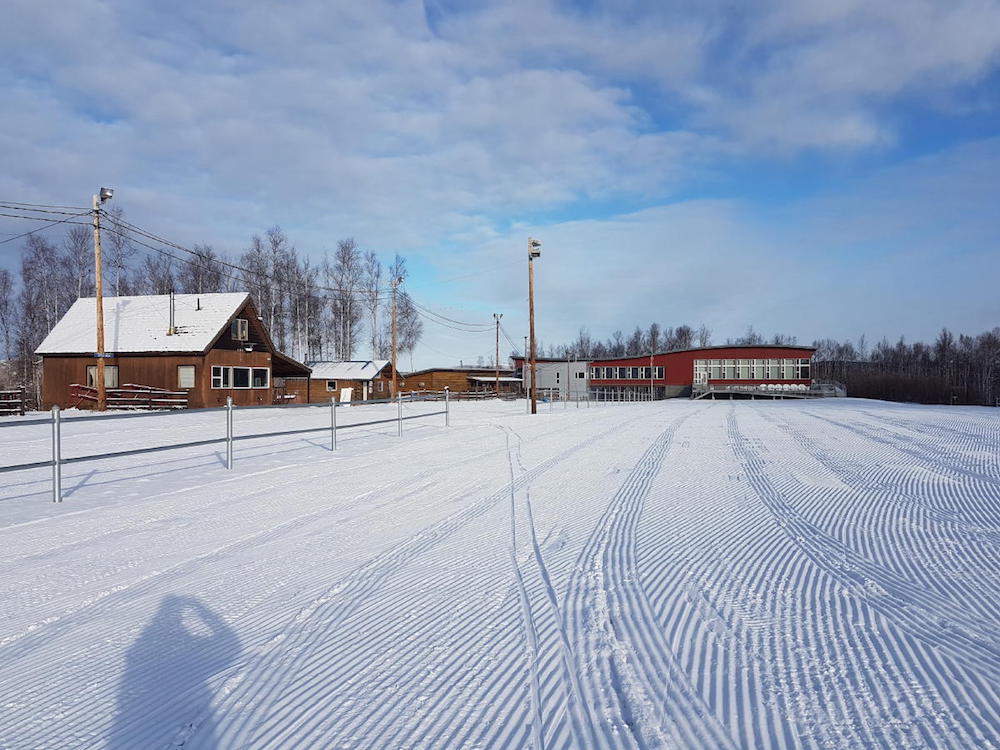
The stadium at Birch Hill Ski Area in Fairbanks, Alaska, on Oct. 19, 2017. (Photo: John Estle)
(It should be noted that Estle’s sense of anecdata is close to unassailable, given his knowledge of Fairbanks skiing over the past four decades.)
Current trail conditions for Birch Hill should be available here soon. Current conditions for Hatcher Pass (and some other areas as well) may be found here.
The Mat-Su Ski Club plans to hold its season-opening race, the Race to the Outhouse #1, on Nov. 4. It would potentially be the first ski race in this country of winter 2017/2018… except that Fairbanks has set the first race of the Wednesday Night Race Series for Nov. 1. At least in Alaska, winter is upon us.
***
Reminder: Send us the snow/grooming report and other relevant information concerning your favorite ski spot. If there’s skiing in November, we want to hear about it! Email info@fasterskier.com with the subject line “Fall Skiing” by Nov. 3.
Most years, skiers of all ages find their snow legs again at Independence Mine State Historical Park in Alaska. Here, 5-year-old Scout Gramse edges M1 racer Dylan Watts in Oct. 2013. (Photo: Shannon Gramse/APUNC)
Masters from around the world, we want to hear from you! FasterSkier is seeking dedicated masters contributors from various clubs and regions, including any and all skiers who aren’t quite pro or collegiate skiers anymore (or ever — as we know how many catch the bug later in life!) Whatever your level of skiing, if you can write, please do!
Submit camp or training recaps or announcements to info@fasterskier.com with the subject line “Masters Minds”. Articles can be informal, first-person accounts or written from an observatory standpoint with thoughts from others, like below.
***
Part of the joy and the pain and, ultimately, the poetry of a lifetime of skiing is how the sport focuses one’s attention on natural processes that are both cyclical and unpredictable. This year Southcentral Alaska caught its first real snow on Oct. 20, and early season skiing has been great, but not in the usual ways or places.
First grooming honors go to the Nordic Ski Association of Anchorage, who, thanks to extensive summer trail work and an innovative approach with a light homemade drag pulled by an ATV, miraculously transformed a scant four inches into fine skiing at the Hillside Park in Anchorage. A few more inches fell higher up, in Chugach State Park, where early-season skiers along Powerline Pass witnessed a pair of grizzly bears fighting over a dead bull moose.
Skiing has also been good south of Anchorage in the resort town of Girdwood, where a beautiful and challenging new 5 k system winds among stately hemlocks in a spectacular mountain valley. Completely absent from the scene, however, has been Southcentral Alaska’s traditional go-to early season hotspot, Hatcher Pass, which has missed the region’s minimal early snow thus far. Nonetheless, as if by habit, masters’ minds and talk have turned frequently of late to this special place.
Completely absent from the scene, however, has been Southcentral Alaska’s traditional go-to early season hotspot, Hatcher Pass, which has missed the region’s minimal early snow thus far.
There must be many spectacular snow bowls high in Alaska’s Talkeetna Mountains, where remnant Pacific storm systems (usually!) roll like slow breakers into jagged peaks and arctic chill, but only one such wonderland, Hatcher Pass, is accessible via a plowed road, and it is a goldmine. And an actual gold mine.
It’s not Hatcher Pass, but he’ll take it. Shannon Gramse begins a new ski season in Chugach State Park on October 21, 2014. Skiers shared this valley with a pair of brown bears feasting on a bull moose.
The surrounding mountains are born of the Castle Mountain Fault, a major geological fracture the access road crosses, much lower, as it begins to climb through the canyon of the Little Susitna River, but the road itself owes its existence to Robert Hatcher’s discovery of gold in the area in 1906 and the subsequent development of Independence Mine, in its heyday a vibrant industrial complex served by miles of tunnels and over 200 employees, some of whom took advantage of the area’s excellent skiing, both for fun and transportation.
Independence Mine closed in 1951 but the skiing continued, with skiers often staying in the abandoned buildings. In the late 1960s Hap Wurlitzer opened the incomparable Hatcher Pass Lodge about one kilometer below the mine complex, and the onetime mine manger’s house, built in 1936 for the Stoll family, also served for a time in the 1970s as a skiers’ inn.
In 1974 the mine was placed on National Register of Historical Places, and since 1980 the buildings and surrounding 270 acres comprise Independence Mine State Historical Park. Grand plans for enormous ski resorts at Hatcher Pass have never materialized, thankfully. Today, thanks to incredible grooming by the Mat-Su Ski Club, skiing is hotter than ever. Early-season skiing at Independence Mine is easily among the best in America and a beloved southcentral Alaskan fall ritual.
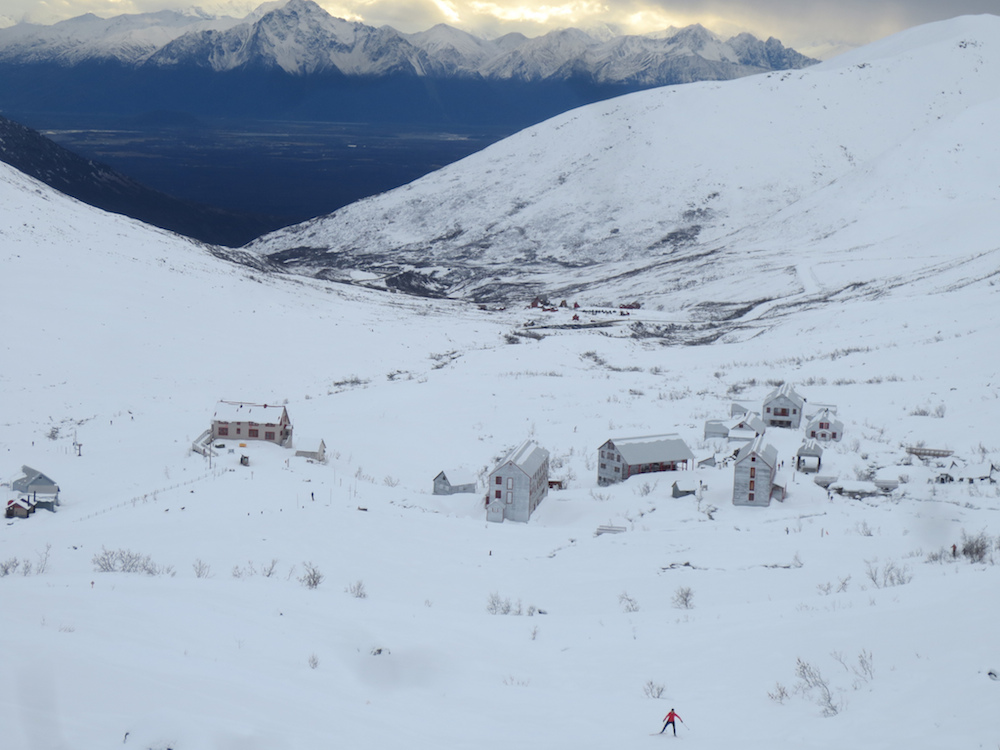
The 800-foot climb from Hatcher Pass Lodge at the end of the road up to the historic mine seems an important part of that ritual for many Alaskan masters and a good gauge of fall fitness, if a bit of a rough welcome back to snow. At the mine, three interconnected loops totaling several kilometers, zero meters of which are horizontal, weave amid clapboard buildings, the mess hall, offices and machine shops, dormitories, all painted silver with red trim, some three stories tall, many with covered porches, and fascinating ruins, including crumbling mine car trestles, waterways, and enormous generators. Imagine skiing through an Old West ghost town turned collectible Christmas village.
Imagine skiing through an Old West ghost town turned collectible Christmas village.
Skiing at Independence Mine is typically excellent season-long, but it’s busiest in the fall, as many area skiers take the opportunity for an early start on challenging terrain.
A typical early-season skiing scene: APUNSC Master Travis Rector pauses while skiing Independence Mine in October 2013.
Longtime Alaska Pacific University Nordic Center (APUNC) Masters coach Dylan Watts advises, “You can normally add three to four weeks to your ski session if you’re willing to make the drive. This makes it ideal for getting a feel for the snow and skis again. Plus the kilometer-long uphill right at the start really gives a boost to your fitness. After a few weekends skiing up and down you can feel an improvement both in confidence and ability on the skis as well as improved strength and stamina. The area also offers a variety of consistent grades both on straights and turns all within a compact area, making it ideal for working on different techniques and skills. It really is an ideal place if you’re looking to build form and fitness on cross-country skis.”
Mike Truskowski, M5 racer, middle-school teacher and coach, adds: “To make things even more interesting, there is no place to hide from your friends, so everyone can see how you’re doing. Just when you think that you’re skiing a good loop, watch out behind you: That person calling ‘Hup ’ could be an Olympic skier, a national champion, or just your buddy who worked harder than you this last summer.”
That buddy might be M4 racer and Anchorage optometrist Jim Falconer who also enjoys the challenge and the area’s special beauty: “A ski at Independence Mine in October usually marks the beginning of the ski season for me. After the season’s first significant snow in the mountains, it’s an almost spiritual experience to go up there and ski in that environment — it feels like another world. And since it’s mostly up and down without much in the way of flat terrain, skiing there is a real test of the fitness you are carrying into the ski season from your summer training.”
Independence Mine as seen from the top of the groomed trail system in November 2013.
According to Mat-Su Ski Club President Ed Strabel, over the past nine years, grooming at Independence mine has begun on a mean date of Oct. 13. Strabel, father of Mount Marathon champion Eric Strabel, and his ski club colleagues are passionate about spinning frequent heavy snowfalls into set tracks and corduroy.
“Our dedicated all volunteer, unpaid groomers do most of the grooming at night to give the snow time to setup before the skiers arrive,” Strabel says. “While our tracked ATV’s are vastly superior to a snowmachines for grooming, big snowfalls (over 12 inches) are a challenge and the trail will be a bit punchy because we can’t get the pounds per square inch of a PistenBully. Wind can also be a big headache because we don’t have a six-way blade to take out drifts. Last year we had a 30″ snowfall followed by high winds. The whole area was almost featureless.”
But such devotion isn’t completely altruistic: “All our groomers are skiers, too, and we want to ski also,” he adds, “The toughest part our volunteer groomers have to cope with, other than getting a groomer unstuck, is resisting the urge to grab our skis and go skiing on our handy work immediately after we finish grooming.”
While it’s true that the light can be flat, the weather awful, the kick waxing weird, skiing at Independence Mine is always an exceptional experience. On a clear day, the views and surrounding mountains are mind-bendingly beautiful. The old mine is interesting in any weather. Maybe best of all, those first few weekends back on skis up there are in many ways a reunion, or re-formation, of our community, from masters to kids to Olympians, and everyone is smiling.
While it’s true that the light can be flat, the weather awful, the kick waxing weird, skiing at Independence Mine is always an exceptional experience.
When asked via email what he thinks about when he thinks about skiing Independence Mine, Coach Watts’ answer is perhaps evocative enough and instructive enough to quote in full and call it good:
“For me I really like the uniqueness of skiing at a historic hard rock mine. Skiing around the old buildings, it is hard not to let the mind reflect on the history of the mine, the miles of tunnels dug with great labor chasing gold. Kick, glide, kick, glide. The process that put that gold in place. Keep the arms pumping. On to the history and future of resource development in Alaska. Dance off the feet as you herring bone the steep hill. Then on to the beauty of the peaks all around. Watch the plowed-up snow in the corner. The ubiquitous of petroleum products on every person out skiing: clothing, skis, wax, boots. Tuck lower. Watching people ski up as I fly down the hill. They look fit. How nice to see the whole family out skiing. Must be the first day on skis for them. Kick up some spray at the bottom to show off a little. Back to kick, glide, kick, glide. It is pretty easy to have three hours of hard skiing fly by and let the mind mediate, wonder, and marvel at the world and life on it.”
***
About the Author: Shannon Gramse is a longtime member of APU Nordic Ski Center’s Masters Program. When he’s not skiing, he’s thinking about skiing while being a father and a husband and a professor at the University of Alaska Anchorage.
Caption: 2014 APUNSC Masters Camp (L to R): Kathy Christy, Dan Libbey, Berit Flora, Coach Erik Flora, Sam Flora, Gavin Kentch, Coach Don Haering, Gil Lund, Coach Greta Anderson, Shannon Gramse. (All photos: Shannon Gramse/Flickr)Masters from around the world, we want to hear from you! FasterSkier is seeking dedicated masters contributors from various clubs and regions, including any and all skiers who aren’t quite pro or collegiate skiers anymore (or ever — as we know how many catch the bug later in life!) Whatever your level of skiing, if you can write, please do!
Submit camp or training recaps or announcements to info@fasterskier.com with the subject line “Masters Minds”. Articles can be informal, first-person accounts or written from an observatory standpoint with thoughts from others, like below.
***
By Shannon Gramse
The gods of American skiing have gathered on Eagle Glacier over the past few weeks, but July started off with a very different group of skiers at this world-class training facility 5,000 feet above Girdwood, Alaska.
From June 28 to July 1, Alaska Pacific University Nordic Ski Center (APUNSC) held its third-annual Masters Glacier Camp, hosting nine skiers ranging in age from their 30s to their early 70s. Skiers enjoyed outstanding coaching, good weather and excellent fresh summer snow over a few days that were part-hardcore training session, part-fantasy camp, part gathering of family and friends.
Helicopter service to and from Eagle Glacier above Girdwood, Alaska.Eagle Glacier is permitted by the U.S. Forest Service as a special use Olympic development facility, and while Pyeongchang may be decidedly out of reach for these nine older athletes, it could be argued that no group of Eagle Glacier skiers — this month or ever — will have more fun.
This year’s Masters Camp was coached by APUNSC mastermind Erik Flora, who was recently named U.S. Olympic Committee National Coach of the Year, and assisted by Don Haering and Greta Anderson, elite skiers turned APUNSC masters coaches.
“I’m a nothing-special recreational skier,” said APUNSC master skier Gavin Kentch. “To have access like that to the same facilities and coaching as the best skiers in the world is obviously something that you don’t get in other sports.”
Kentch, who at 32 was by far the youngest athlete at camp, saw immediate benefits from his time on Eagle Glacier. “I made more progress as a skier in just a few days than I would have thought possible. I’ve been skiing nearly all my life, and skate skiing for over 20 years now. In just a few days, we came up with some technique changes that bordered on the epiphanic.”
“In just a few days, we came up with some technique changes that bordered on the epiphanic.” — Gavin Kentch, APUNSC master and Eagle Glacier camper
Coach Anderson said such epiphanies are by design. “Due to the camp environment we can share a lot of ideas and technique concepts with instant trial and feedback in a relatively short window of time,” she said. “On Eagle we have nothing but time to discuss, share and implement technical improvements.
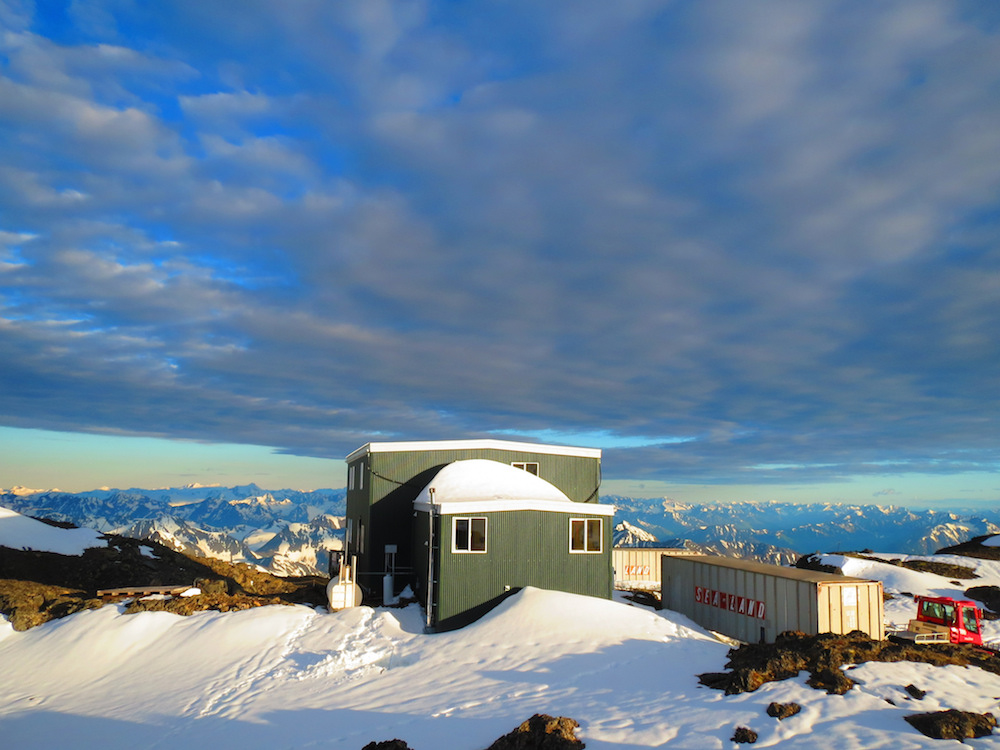
“The Stadium” on Eagle Glacier“It can be incredibly motivating after a month of ski walking/bounding and rollerskiing for the body to be reminded, ‘Oh hey, this is why we are bounding,’ ” Anderson continued. “That can be a really great boost in confidence and motivation. It’s also a great way to break up the summer training, give the joints a rest, and get in some high-quality skiing on challenging terrain in conditions that aren’t otherwise experienced in Alaska — which are relatively soft and wet or klister conditions.”
And ice the Gatorade-and-Geritol narrative. Like the elites, summer on-snow training is an important step toward these skiers’ upcoming race seasons, including, collectively, the Norwegian and American Birkebeiners, the 350-mile Iditarod Trail Invitational, and highly competitive age-group rankings in local events such as the Tour of Anchorage and the Anchorage Cup race series. Then again, these athletes are a reminder that skiing at a relatively high level has its own intrinsic rewards.
More important in the end than race results is the active, outdoor lifestyle that undergirds one’s experience on race day, an ideology reflected by the APUNSC Masters Program goals: “to develop cross-country ski skills, improve fitness, and promote skiing in the community.”
The facilities at Eagle Glacier overlook the Chugach and Kenai mountain ranges.
Compared to elite-glacier camps, Masters Camp was more individualized and less structured. As Coach Anderson put it, “Elite camps tend to be very structured and goal-oriented. In contrast, our camp for Masters this year was all about skiing many kilometers and learning as much as each individual desired. Whereas elite athletes tend to finish their recommended time skiing each day and head inside to recover for the next session, masters this year had four days to ski their legs off as much as they wanted.”
A typical day at glacier camp started with a big breakfast and instruction on waxing, structure, or technique, then a two-to-three hour skating session on the immaculately groomed 10 K course.
It snowed three feet on the glacier in June, so the skiing was fantastic, despite a relatively sparse winter and spring in Southcentral Alaska. After a tough morning of skating — elevation effects, big terrain and soft snow conspire to make glacier skiing especially exhausting — skiers returned to “The House” for lunch, naps, and World Cup videos while the indomitable coaches scrubbed the skate lanes and set track with the facility’s PistenBully 100 for a late afternoon red-klister classic ski session. Athletes were free to ski at their own pace, for as long as they wished, and 40-50 k days were the norm.
“My main goal for the camp was just to get in a lot of time on snow,” said Kentch, “because of the self-evident training benefits, but mostly because I just really, really like to ski. So I went in hoping to have a lot of fun skiing for a lot of hours. I skied 12 hours in five sessions, and had a blast in the process, so I’d say it was a successful camp.”
Dessert on the glacierEvenings were filled with hearty family style meals, saunas and hours of stories and ski talk. The special sense of warmth and intimacy at this year’s camp had a lot to do with the presence of Flora’s parents, Sam and Berit, both internationally competitive ski marathoners, and longtime family friend and onetime Norwegian national-level racer Gil Lund. Tales from the trail and memories of races and ski trips of yore were intertwined with reflections on parenting, family, the passing of time and tradition.
“One of the best parts of the trip was just the chance to spend more time with my coaches and teammates,” said Kentch.
Coach Anderson echoed those feelings. “Master skiers generally have other things going on in life — jobs, families, home improvement projects, and cabins just to name a few. Sharing that really special period of time — a trip of a lifetime for some and a highlight in their year for others — is the greatest feeling,” she said.
***
About the Author: Shannon Gramse is a longtime member of APU Nordic Ski Center’s Masters Program. When he’s not skiing, he’s thinking about skiing while being a father and a husband and a professor at the University of Alaska Anchorage.