From the FasterSkier archive — posts syndicated from athletes’ and coaches’ own blogs between 2004 and 2012, kept online as published. Current coverage is at fasterskier.com.

Tag: Sheldon Miller

  • Craftsbury Outdoor Center’s Economic ‘Ecosystem’ at Risk

    Craftsbury Outdoor Center’s Economic ‘Ecosystem’ at Risk

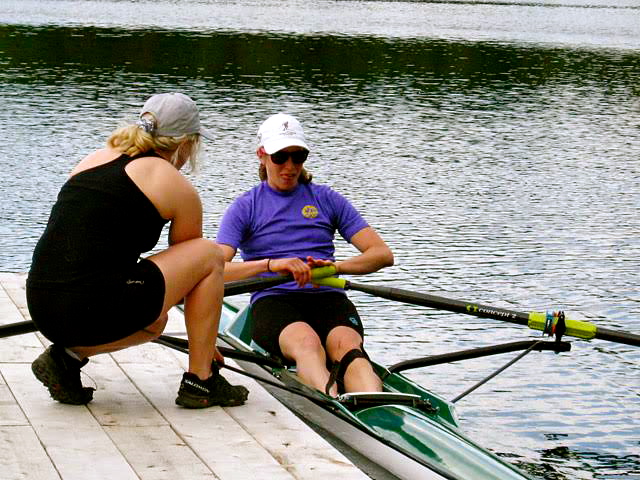
    Pepa Miloucheva (l), head coach of the Craftsbury Green Racing Project, giving biathlete Susan Dunklee some sculling instruction at the Craftsbury Outdoor Center in June 2012. (Photo: Susan Dunklee)

    A critical issue looms in Craftsbury, Vt. — home to what nordic skiers know as the Craftsbury Outdoor Center (COC).

    The COC runs sculling camps on the adjacent Great Hosmer Pond. Currently, motorboats and scullers share access on the pond. The tippy-sleek sculls are best on glassy water — meaning no wind and restricted speeds for any motor boats. Some homeowners along the pond are frustrated with what they claim is the COC’s monopolization of the pond, insisting their right to pursuits like high-speed boating, water skiing and tubing is restricted.

    But before we dive deeper, what’s this have to do with skiing?

    “What skiers may not know is that we also have a national reputation for our sculling camps which are a really wonderful place to learn how to row or get better at rowing,” Judy Geer, an owner and director of the nonprofit, said in a phone interview.   

    Sheldon Miller, COC communications director, wrote in an email that annually the sculling/rowing camps generate $1.2 million dollars in annual revenues. That revenue, in turn, underwrites many of the COC’s ski programs.

    “The Outdoor Center is a non-profit, and it basically it’s sort of like an ecosystem,” Geer said. “The more diverse an ecosystem is, the healthier and more sustainable it is going to be. We need summer activities to balance the winter activities and we need income-generating activities, like the camps, to balance the charitable work that we do.”
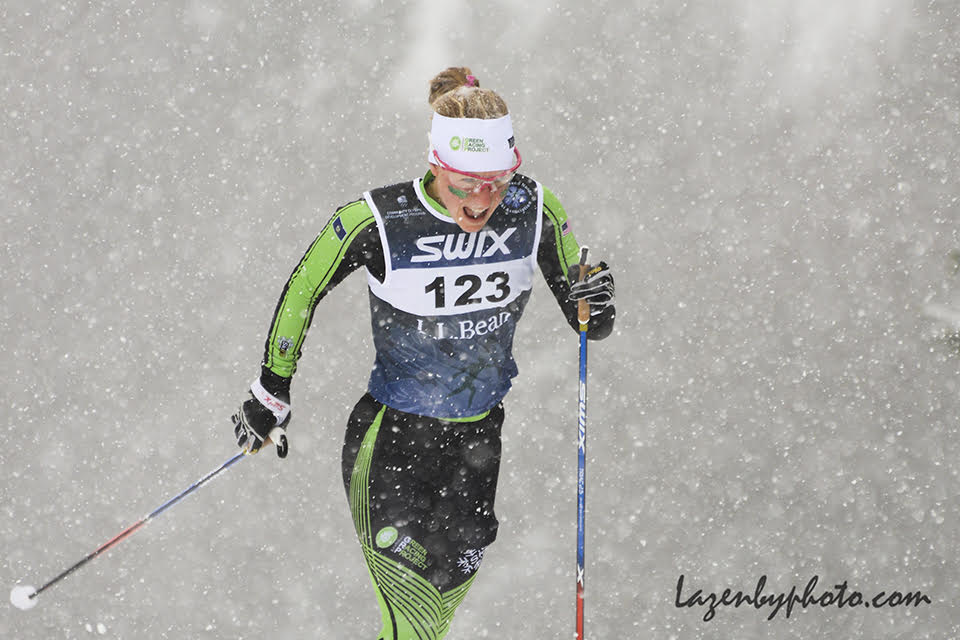
    Ida Sargent, a Craftsbury Green Racing Project (CGRP) skier and U.S. Ski Team member. (Photo: John Lazenby/Lazenbyphoto.com)

    COC makes the FasterSkier news cycle when it hosts SuperTour-caliber ski races or its Craftsbury Green Racing Project skiers reach the podium. In recent years, COC has become a literal savior and news peg when it comes to on-snow skiing. The northeast has been hit with repeated low-snow years, and COC’s snowmaking operation has produced a reliable skiing option. What’s less known is the community outreach at the core of COC’s mission. The “charitable work,” Geer referred to.

    Remoteness is the Northeast Kingdom’s liability and blessing. The most rural part of a rural state, the region remains postcard Vermont. But as such, local residents, including school-age children, often rely on the COC as their access to wellness.

    “Being a rural community, there are not a lot of formal recreational opportunities,” said Dave Snedeker, executive director of the Northeastern Vermont Development Association. “The Outdoor Center provides free membership to community members in Craftsbury and Albany [Vermont]. Residents of those two communities have free access to the outdoor center all year round. It’s a great benefit because most people don’t have the option of joining a gym or have a place to go. So the Outdoor Center provides that.”

    That access includes users like the roughly 850 children who visit the COC with their school in winter and have the option of using rental equipment free of charge. According to Miller, financial assistance is generous when it comes to subsidizing youth programs and offering families scholarships for its programs.

    “The Center goes out of its way to remove financial barriers to entry into the youth sports it supports — primarily cross-country skiing, biathlon, and mountain biking,” Miller wrote. “For example, Craftsbury Nordic Ski Club annual fees currently amount to $800 for a high school athlete. There are currently 29 skiers in this program, and they have year-round access to three dedicated youth and junior coaches. By comparison, the same level of annual programming costs over $2,000 in central Vermont and over $8,000 in Vail, CO.”
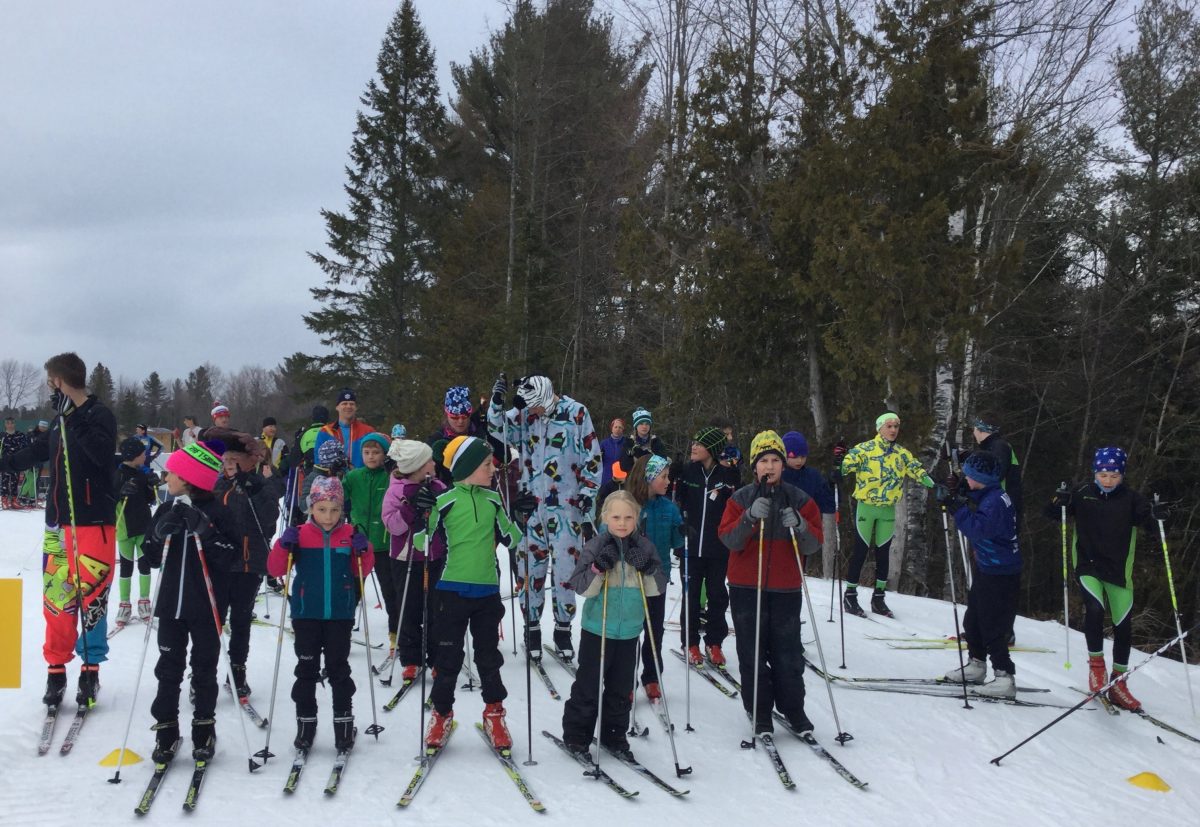
    Primed and ready for the day, some of Craftsbury Outdoor Center’s junior skiers toe the line for a fun relay. (Photo: Anna Schultz)

    Considering the regional impact, any reduction to that $1.2 million influx from the COC sculling camps could potentially make nordic skiing even more exclusive in a state with a proud inclusive nordic skiing heritage.  

    The skiing-rowing bond is tight in Craftsbury, a town with a population of about 1,100 (in 2000). As good as the skiing can be there, the rowing on Great Hosmer Pond is considered world-class. Rowers there are protected by the pond’s geography from intolerable winds. From a programming standpoint, COC could foreseeably run sculls all day on the pond, the water conditions are most often favorable.

    Here’s the watered-down version of the Great Hosmer Pond quagmire: Great Hosmer Pond is a long and skinny lake, nearly two miles in length and approximately 175-feet wide at its narrowest. By state law, a “200-foot shoreline safety zone,” exists. That safety zone means no high-speed boating, speeds in excess of 5 mile per hour within 200 feet of shore. Most spots in Great Hosmer Pond don’t meet the legally necessary conditions established in Vermont for high-speed boating.    

    But high-speed motoring on the pond, despite the pond’s geometric limitations, was granted an exception in 1995. The stakeholders advocating for higher speeds assumed the “200-foot shoreline safety zone,” was waived, too. Last fall, the Vermont Department of Environmental Conservation clarified that the shoreline rule was still in effect.

    Either way, formal regulations on the pond are rarely if ever enforced, Greer said.

    As it stands, only a few small sections of the pond are suitable for high-speed use. Even in those small areas, Vermont law still restricts a motorized boat to no-wake-speeds within 200 feet of the following: “a person in the water, a canoe, rowboat, or other vessel”.

    COC would like the state to enforce the pre-existing laws mandating speeds be limited to 5 mph where and when appropriate. Geer and Miller explained that COC has voluntarily cut back on camp participants and hours of use on the pond. These include self-prescribed restrictions like no camps on holiday weekends, an overall reduction in the number of campers for both week-long and weekend camps, and for 2017, a limit of eight out of 15 weekends between Memorial Day and Labor Day during which camps are run.

    “We really committed to staying off the lake every afternoon, totally from 1-4 and on Saturday all the way until 7,” Geer said of COC’s commitment to compromise. “We have listened, we have made changes. It hasn’t seemed to help and it hasn’t really been acknowledged, I mean it’s been frustrating. For us, we see as the age old — how do you share a community resource? In our mind, you share it to benefit as many people as you can. And you also take care of that resource so that it is healthy and sustained into the future.”

    Stakeholders on both sides of the issue are involved in community organizing and lobbying state officials. FasterSkier reached out to Sarah George, whose family owns a cabin on the pond. (George was also appointed the Chittenden County state’s attorney in January 2017.) George has spoken to the press in the past about boating use on Great Hosmer Pond, but she declined an interview request with FasterSkier. It does appear that the issue for some property owners along the lake is less about the nuances of motorboat use, and more about the idea that a business is monopolizing how the pond is used.

    An online petition, titled “Save Great Hosmer Pond”, makes the following claim on behalf of limiting COC’s sculling camps:

    “An issue has arisen where the COC and there sculling camps have monopolized much of the usage of the pond during the summer months and left camp owners unable to use their motorboats and fisherman and other users unable to access the pond due to the size constraints of the pond and having 40-50 rowing shells (20′ long) on the water at one time. Despite efforts to resolve differences between the two factions, the State Department of Environmental Conservation Watershed Division has become involved to mediate the dispute and potentially enact rules restricting motorboats and other uses on the pond in favor of this private business entity doing business on land and water that belongs to the people of Vermont!”

    The petition was posted online in January, and as of Thursday, it had 20 signatures.
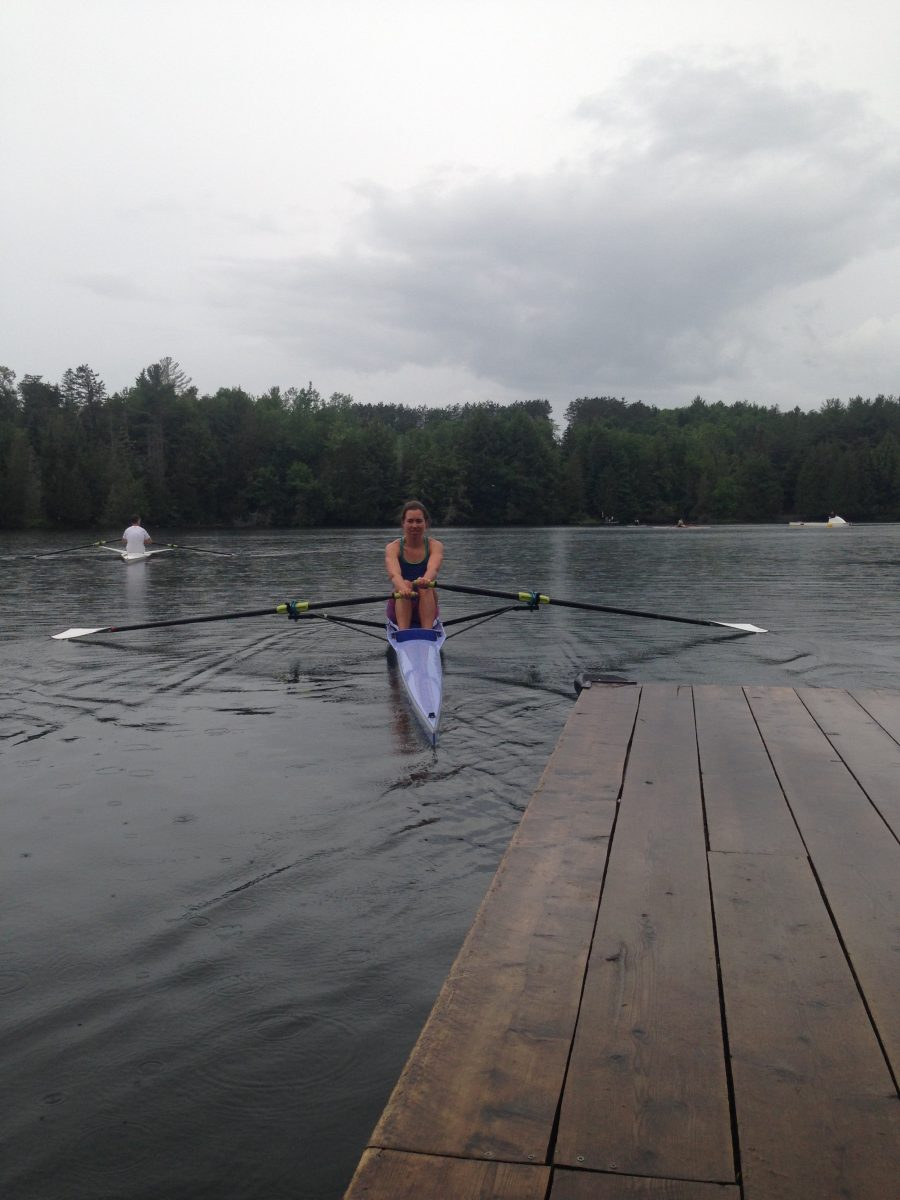
    CGRP skier Caitlin Patterson heads out on the water for a rowing workout. (Photo: Heather Mooney)

    On one side, the perception is that COC monopolizes. On the other, the reality that even a single speeding boat can monopolize by creating wakes and possibly unsafe situations for scullers.

    The Friends of Great Hosmer Pond are one group formally advocating for the state to uphold restrictions on high-speed boating.

    Gina Campoli, speaking on behalf of the organization, was concerned for both the COC’s viability and the state regulating non-motorized use on the pond.

    “Winter and summer we are really concerned that the state of Vermont would consider diminishing the outdoor center’s ability to function,” Campoli said. “And that is to undercut their rowing program, which as you know underwrite many of the winter programs. Although this is rowing story, it is going to have a direct effect on this really special place.”

    A draft proposal to mitigate the conflict was released on July 25. The only new provision was this segment: “Use of racing shells and rowing sculls is prohibited on the Pond between the hours of 1:00 pm and 4:00 pm, and the hours of 7:00 pm and sunrise, from the last Saturday in May through the first Monday in September.”

    The COC remains an anchor in the community. Beyond providing cost-effective programming, COC helps maintain the pond’s ecosystem.

    “Another thing the Outdoor Center does, there is an invasive aquatic species called milfoil, and the Outdoor Center fully funds its removal,” Snedeker explained. “They fully fund that. If they didn’t do that then that would be on the community taxpayers to bear, assuming they wanted to keep their lake clean.”

    Offsetting costs like that to the community is one of many economic benefits the COC provides the region. Snedeker said it remains one the Northeast Kingdom’s largest employers with 60 full-time employees and maintaining 100 staff during the summer season. 

    Those wages eventually makes its way into the Northeast Kingdom.

    “Those people live in the community and spend money at local businesses,” Miller wrote. “The Center pays all property and state taxes, and its guests infuse tourism dollars into local businesses. Whether people come to Craftsbury for a week-long camp or a two-day ski race, they stop at general stores, local breweries, and other points of interest along the way. Even guests who stay on campus bring money to local providers, as a majority of the food served at the Center is grown locally and local contractors and suppliers are used whenever possible.”

    Stay tuned as the decision-making process moves forward.
  • NENSA/Craftsbury Renew Partnership Through 2016


    NEW GLOUCESTER, Maine – New England Nordic Ski Association and Craftsbury Outdoor Center extend long-standing partnership for another season with Craftsbury signing on as an official sponsor of NENSA and hosting the 2015-16 EasternCup Series Opener in December.

    “The seasons are shifting in northern Vermont: trail work, event planning, tuning up PistenBullies – and renewing our commitment to NENSA! We’re happy to partner with NENSA for another year in recognition of our parallel missions to develop Nordic skiing throughout the region,” said Sheldon Miller, Communications Director for Craftsbury Outdoor Center. “As both skiers and an organization, we’re incredibly fortunate to enjoy a thriving Nordic culture in New England, and NENSA is a key part of that ecosystem. From development to elites, BKL to Junior Nationals; our regional body is a great resource and leader. Let it snow!”

    With this partnership, NENSA recognizes Craftsbury Outdoor Center’s services, facilities and tradition of excellent programming as a key asset for the New England Nordic community. Craftsbury will continue to invite NENSA community to take advantage of their facility and will offer special deals to NENSA members for select programs. In addition to their direct sponsorship support of NENSA and providing excellent training opportunities, Craftsbury Outdoor Center will continue to host some of the most exciting racing in New England with the NENSA EasternCup Opener, the famous Craftsbury Marathon, and USSA’s Distance National Championship and SuperTour Finals.

    “Craftsbury continues to raise the bar, as a venue and as a community, hosting events and offering services and opportunities that feed our New England – and indeed our national – cross-country skiing community,” said NENSA Executive Director, Zach Stegeman. “This ongoing sponsorship of NENSA reflects our shared commitment to engage and support all levels of the skiing community.”

    About Craftsbury Outdoor Center:

    Craftsbury Outdoor Center is a 4-season resort tucked beside a secluded lake in the tranquil “Northeast Kingdom.” The Craftsbury Outdoor Center began in 1976 when Russell Spring and his family purchased the Cutler Academy campus and began remaking the facilities into lodging for guests and athletes. A Nordic trail network was cut on the land, with sculling and running camps founded shortly after, providing year round training and athletic opportunities in a beautiful natural setting. After over thirty years of growth and guidance under the Springs, the Center began a new chapter in its life in November 2008 when Dick Dreissigacker and Judy Geer purchased the Center. Dick and Judy promptly reformed the company as a non-profit organization with a new three-tiered mission: 1) to support and promote participation and excellence in lifelong sports with a special focus on rowing, nordic skiing, and running; 2) to use and teach sustainable practices; and 3) to protect and manage the surrounding land, lake and trails.

    About New England Nordic Ski Association:

    The New England Nordic Ski Association (NENSA) is the community Olympic development organization for cross-country skiing in New England as well as the umbrella for most organized Nordic skiing events in the region. NENSA hosts over 50 events and more than 20 clinics for skiers and coaches at venues across the Northeast. Cross-country skiing, as practiced by our youth skiers and families, is a lifetime activity firmly rooted in New England tradition. Cross-country ski racing, as performed in the NENSA Eastern Cup series, and at our Championship Events, is a fast, explosive, and visually dynamic sport. It is NENSA’s mission to sustain a vital and active skiing community in New England. Visit the NENSA website at www.NENSA.net to learn more and to read the complete mission and vision statements.

  • Timing Problems at Craftsbury, Bozeman Sprints Shine Light on Challenges of Hosting Bigger, Better Races

    Timing Problems at Craftsbury, Bozeman Sprints Shine Light on Challenges of Hosting Bigger, Better Races

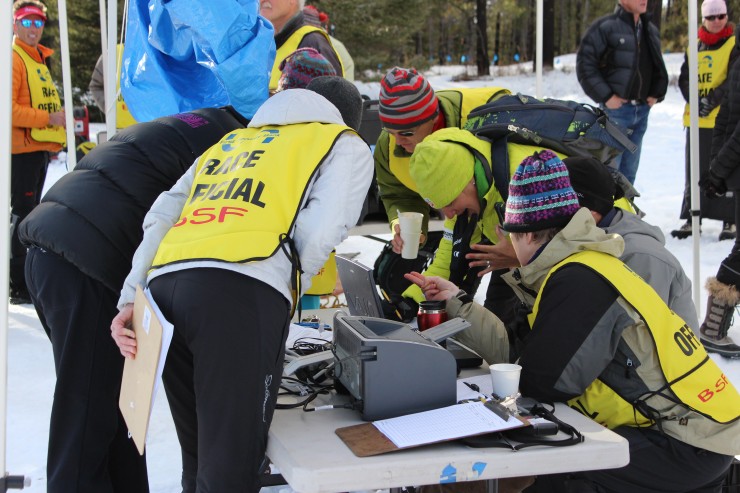
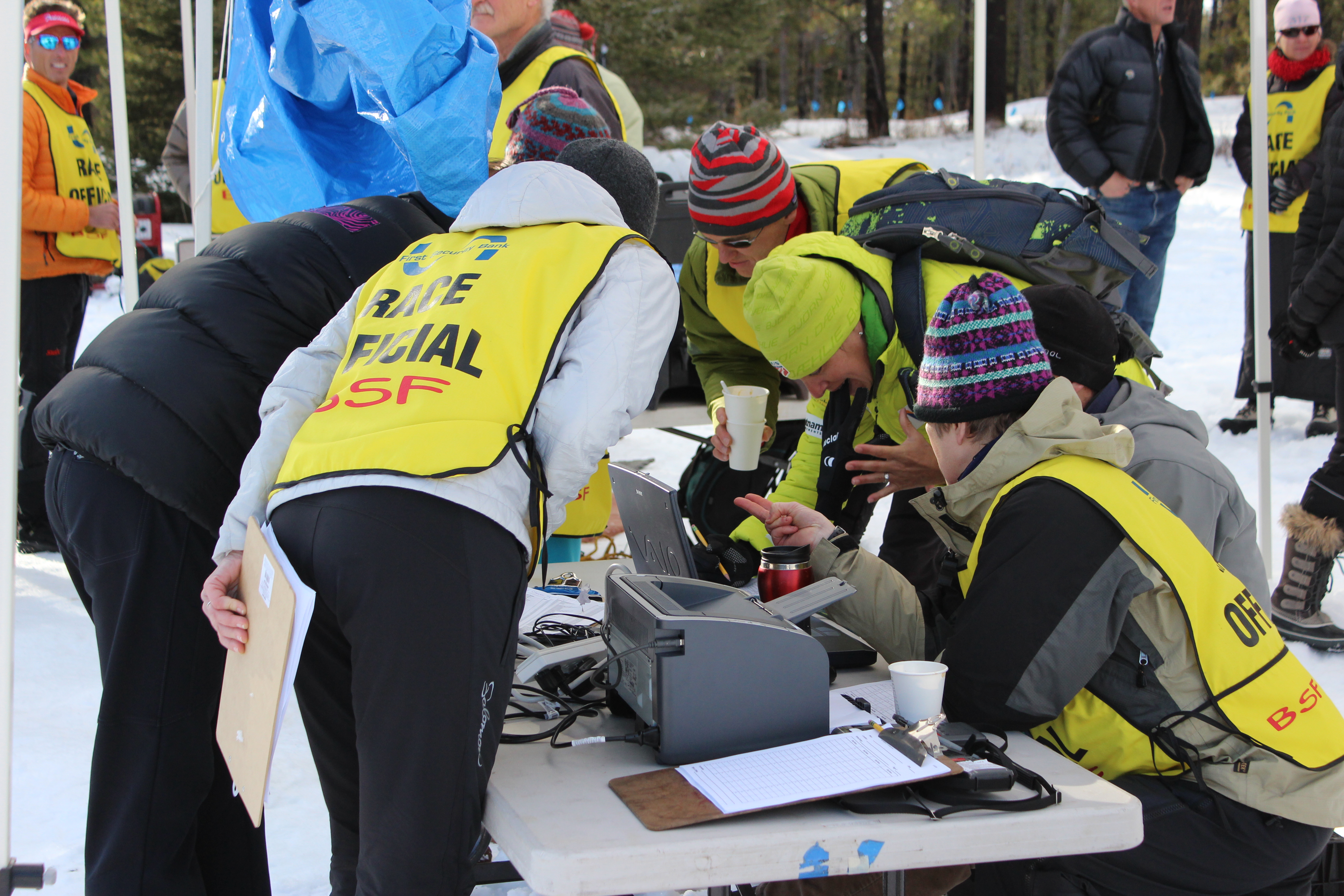
    Race officials converge on a timing laptop at SuperTour races in Bozeman, Montana, earlier this season as they try to iron out problems in the results from a classic sprint qualifier.

    In some ways, regional races aren’t a big deal. When the U.S. Ski Team nominates Olympians next season, they aren’t going to go back and check someone’s results at an Eastern Cup or the Tour de Ski Fairbanks.

    But in others, they are a very big deal. Juniors rely on these races to qualify for Junior Nationals, the ultimate, season-long goal of many young competitors; college and senior racers use them as tune-ups for carnivals and nationals, and to gauge how their training is going; masters relish the opportunity to hammer out a hard effort and chase age-group glory.

    And in the past few years, regional races have gotten bigger and bigger, both in size and importance. Ten years ago, there were only seven FIS-sanctioned series in the U.S., and one of them was that year’s Olympic Games in Utah. Five years ago, there wasn’t a FIS race east of the Mississippi until U.S. Nationals at the beginning of January, and none in New England until the UVM Carnival in February.

    This year, there have been four FIS series already, in New England, Montana, and Alaska, and 17 more are on the schedule. The points at regional races have gotten better and better, and can seriously help an athlete’s season ranking.

    “If you’re looking purely at the numbers, and the level of points available at our races now, that is certainly increasing, and to the people that are there chasing those points it could certainly be more serious,” New England Nordic Ski Association (NENSA) Executive Director Zack Stegeman told FasterSkier in an interview on Thursday.

    And that’s exactly what regional organizations like NENSA want.

    “I think that all the organizers in New England have always worked very hard to make these events as good as they can possibly be,” he said. “That’s why we have such great regional races – our venues, and organizers, and NENSA itself has been trying hard to really raise the bar. The abilities of our venues and our community to continually step it up speaks volumes.”

    Arguably, nowhere is this trend more apparent than in New England. The opening races of the Eastern Cup series were held last weekend at the Craftsbury Outdoor Center in northern Vermont; Saturday featured almost 400 racers, while Sunday’s number was close to 500.

    Which makes it scary when something goes wrong. On Saturday, Craftsbury was on tap to hold a classic sprint qualifier followed by 30-racer heats for the open division, plus 12-person J2 heats and a separate bracket for the next 12 fastest J1’s and OJ’s. Instead, due to timing problems, the heats had to be scrapped entirely and a second qualifier was held in the afternoon.

    “We’re constantly evolving and learning from events, whether they go really well, or whether they are a bump in the road,” Stegeman said. “Saturday was definitely one of the latter.”

    Cascading Failure

    Craftsbury, which hosted a highly successful SuperTour Finals and Distance Nationals in March, has been moving towards using its own timing system. While Summit Timing was in charge of the March races, staff learned the ropes and were ready to implement their own system for the Eastern Cups.

    Once the unofficial women’s results were posted, though, it was clear that there had been trouble with timing the morning’s qualifier.

    “Once we posted unofficial results, we saw that there were major problems,” Stegeman said. “We tried to run through one fix and put them up again, and that’s when we realized, wait, the thing we’re doing to try to fix it isn’t working… and we identified all the timing equipment malfunctions and our inability to salvage those results.”

    With limited daylight in northern Vermont, the race jury and timing crew decided that they wouldn’t have time to reconstruct the results and still run heats, so the immediate consequence was the cancellation of the heats and a second time trial instead. Although there was certainly some initial griping, racers seemed to buckle down and motivate for round two. Coaches quickly got to work re-waxing dozens of pairs of skis.

    But for Sheldon Miller, an occasional racer, talented cyclocross competitor, and Craftsbury’s media and computer guru who was heading up the timing crew, the problems were just beginning. When FasterSkier contacted him on Monday afternoon, he was still wading through timing equipment just to get to his desk.

    After setting up three Summit timers at the start and three at the finish, Miller had felt confident in his timing system. Ever since the central timing laptop that all those timers fed into crashed mid-race, he has changed his tune.

    “It’s great to have all those individual timers, but when the thing that’s consolidating all of that information goes down, it doesn’t really do a whole lot of good in a near-term sense,” he told FasterSkier.

    On Saturday, he had the data on the timers, but no way to get it off of them without having it reduced to gobbledygook. But by late Tuesday afternoon, he had unraveled the multiple failures that had created and then heightened the whole mess.

    “Saturday’s qualifier results preparation was derailed by a failure of the timing computer and subsequent crashes of XL part way through the men’s race,” Miller wrote in an e-mail.

    Despite the “cascading failures”, as he described them, Miller has since been able to reconstruct the data from the morning race by counting backwards from the last finisher. With three separate timers in each place, he had been pretty sure it was possible – but on a sprint day, results need to appear fast, and there simply wasn’t time.

    NENSA and Craftsbury had to move on to plan B.

    “We wanted to ensure that everyone who had invested the time and the effort to come race walked away with a result that counted,” Stegeman said. “That was really important to us. We were disappointed that we couldn’t do the heats, because they’re really fun.”

    But it was the right thing to do, and Stegeman believed that the team had handled the situation as well as it could have.

    “Were I to talk to a race organizer, that’s the big thing I would suggest, would be to identify that timeline,” he said. “For us, it was, how much time do we have to repair these results, before we have to just say, too bad, we can’t fix them, we have to run another individual-start before we run out of daylight.”

    Public Relations

    The change in format did cause problems. Some athletes, for instance, left the venue after the first set of unofficial results were posted, believing that their day of racing was over since they hadn’t qualified for heats. Since Miller has now recovered the morning results, they will receive points, but initially, they were simply DNS for the afternoon race.

    Saint Michael’s College was one of those teams, but head coach Molly Peters didn’t seem to hold a grudge.

    “It was a bummer to hear about what happened,” she wrote in an e-mail to FasterSkier. “I didn’t make a big deal about it, mainly because I didn’t really know what happened. I was under the impression that they were trying to recover the morning’s results and if they did then they would take the best result… As a race organizer myself, it is hard to get mad. I understand that things happen and it looks like they did what they had to do to make sure it was a valid race.”

    Green Mountain Valley School racer Heidi Halvorsen, who placed second in the morning qualifier but won the afternoon edition, agreed.

    “The race organizers and all the volunteers at Craftsbury worked unbelievably hard and ran a great race,” she told FasterSkier. “With no snow anywhere else in New England, it was amazing that they have had skiing for the last few weeks, and they were even able to hold races. So it is impossible to criticize the organizers for the timing fluke, they made the best of the situation and overall the race was run very smoothly.”

    With so few options for salvaging the race, the biggest question was actually how organizers communicated what was going on to athletes and coaches. At no point did unofficial men’s results ever appear; while that was a good decision, not all racers understood why. A second set of unofficial women’s results were posted, which observers initially assumed had corrected the problem, but those turned out to be wrong too.

    It’s unclear exactly what could have been done to prevent teams like Saint Michaels from leaving, or to spread the word that the unofficial results were wrong. While some coaches picked up on the fact immediately, simply based on where their athletes sat on the list, there didn’t seem to be any official announcement that the results were under review.

    Stegeman said that he and the jury had hesitated to post anything that was “still fluid,” believing that it could add to the confusion. While they were intently focused and racing against a clock of their own to solve problems, talking to athletes in the parking lot didn’t seem like a good use of time. At several points, they sent “runners” (coaches, as well as J2 and BKL athletes) out into the parking lots to update the community on what was happening. Stegeman was unsure how well the messages were conveyed.

    Lessons – And More Questions

    As a timer, the lessons from Saturday’s race were simple for Miller, who held himself accountable for the failures even though he isn’t trained as a timer and despite the apparent forgiveness of others.

    “The biggest thing is the importance and necessity of having completely independent systems,” he told FasterSkier on Monday. “On Saturday I had three timers, literal timing machines, at the start, three literal timing machines at the finish. On Sunday we added another completely separate system that had nothing to do with what I was doing, as backup. We had two complete parallel systems running that we were able to cross-check against, as well as, should the cascading failures that we had on Saturday occur again, we could just jump off that burning ship and on to the other one.”

    That, however, brings up some interesting issues. How many volunteers are needed to time a race with two completely independent systems? Craftsbury has a notoriously deep, loyal, and dedicated volunteer base, but can every venue be expected to have the same – or to pay a thousand dollars or so for a timing company, without a solid guarantee of a better outcome?

    NENSA itself has had problems with sprint timing before, both in Weston and in Rumford, Maine; in at least one of those cases, timing had been hired out to professionals. And it’s not just NENSA. Already this year, there have been inconsistencies at other sprints.

    “Truthfully, I was much more paranoid during the Bozeman sprints, when they kept erasing the heats and putting up different people, because the World Cup was on the line,” CXC racer Jennie Bender, the winner of the morning qualifier but not the afternoon edition, wrote in an e-mail.

    At the Bozeman SuperTours, unofficial qualifier results were allegedly never posted for the classic sprint; or if they were, they were taken down during a protest and organizers continued to distribute bibs while racers and coaches only had access to the hypothetical sprint brackets. As it turned out, those sprint brackets were based on an initial set of qualifier results which were incorrect due to an inadvertent tripping of the timing wand when there should have been a ghost.

    There were also other problems with the classic sprint results. Skiers were not initially assigned to the correct heats – for instance, in every sprint, the first, tenth, eleventh, twentieth, twenty-first, and thirtieth fastest qualifying skiers should be assigned to heat one, and so on. The brackets had to be redrawn once the error was caught. Racers in the first heat were already lining up when the announcement came that bibs would be redistributed.

    So while organizers always hope for smooth sailing, it’s certainly not a given. There is guaranteed to be more problems in the future, somewhere in the country, whether at a regional race, a SuperTour, or something even bigger.

    “It seems to me that there are variety of issues that skiing in North America is grappling with:  homologation, climate change’s effect on skiing at large as well as racing in particular (e.g. the desire to have more mass starts vs. too little snow or too short of a loop to support them adequately), smaller clubs or organizations’ ability to provide racers with FIS-scored events (and the inherent requirements the governing body mandates) at a feasible cost, and more,” Miller wrote in an e-mail. “We’re in a very productive time in North American skiing, but these tensions are ones that continually need to be engaged creatively for the sport to continue to thrive.”

    Given these challenges, it’s important for race organizers to keep in mind the advice from Stegeman and Miller. Always have completely independent backup systems; set cutoff times for decisionmaking when something goes wrong; keep all the stakeholders involved and informed.

    Stegeman believes that his region’s venues are up to the task. For one thing, NENSA is committed to education, and runs seminars for TD’s, race organizers, and even Bill Koch League (elementary school) race officials. But for another, he’s seeing the level of organization at New England venues rise all the time.

    “The venues themselves are investing more and more in equipment,” Stegeman said. “Craftsbury had a top-notch camera set up on the finish line anticipating very tight finishes in sprint heats. You wouldn’t have seen that a few years ago. So there’s equipment investment, those are more tangible examples, but there’s investment in the human capital too. Venues all over New England are getting really good people on board from an event organizer standpoint right up to the grooming. Because expectations are rising right along with the rise in field sizes.”

    At the end of the day, Bender, too, was optimistic.

    “Everyone there saw the panic rise in the hardworking Craftsbury crew once the timing started to malfunction, and knowing many of them, I am sure that all the kinks will be worked out before the next event,” she wrote in an e-mail. “They did a great job on the course and snowmaking, and although some of the coaches and athletes may have been frustrated, it’s just a ski race.”

    -Audrey Mangan contributed reporting.