From the FasterSkier archive — posts syndicated from athletes’ and coaches’ own blogs between 2004 and 2012, kept online as published. Current coverage is at fasterskier.com.
Finals week has a way of compressing time. Days shrink into problem sets and exams; nights stretch just long enough to make sleep negotiable. When Jack Lange logged onto Zoom from Hanover in late November, he was finishing his senior fall at Dartmouth, a mechanical engineering major balancing equations while packing for a training block at Silver Star. The snow out west wasn’t cooperating. Races were being reformatted. Nothing felt settled.
That uncertainty didn’t seem to bother him much.
“We’re wrapping up school right now and then heading to Silver Star next Tuesday,” Lange said. “Hopefully, the snow conditions there improve a little bit.”
It was a measured answer—calm, almost deliberately so. Over the next hour, that calm would reveal itself not as indifference, but as something learned the hard way.
Young Jack Lange skiing in a New England BKL race. (Photo: Heidi Lange)
A kid who wasn’t supposed to be good at this
Lange grew up in Vermont’s Upper Valley, skiing out of Green Woodlands and the Ford Sayre Bill Koch League. It was the kind of childhood that feels almost mythic now: full-moon skis to a cabin, hot chocolate on a frozen pond, friends everywhere.
“I’ve always just made sure that that’s the thing that comes first,” he said. “Getting outside and enjoying being outside and enjoying pushing myself and having fun.”
He played everything. Soccer, where he was very aware he wasn’t the best. Swimming, where he gravitated toward breaststroke. Cross-country running. Mountain biking. For a while, he did both alpine and Nordic skiing, until a choice had to be made.
“My sister was doing more Nordic and more of my friends were on the Nordic,” he said. “So I just went with Nordic.”
Lange and friends meeting Jessie Diggins and Sophie Caldwell Hamilton at the Quebec World Cup. (Photo: Heidi Lange)
It wasn’t a natural fit at first. Lange remembers being the odd kid out on relay day—the one paired with a skier from another team because the numbers didn’t work.
“I wasn’t good at it,” he said simply.
What hooked him wasn’t speed. It was curiosity.
“I really like the amount that you can learn from being out in training,” he said. “Not even structured training—just being outside and having fun. I really enjoy the process of figuring out how hard I can push myself.”
By freshman year of high school, something shifted. He trained more. He paid attention. And suddenly the results were better than expected.
“That was kind of the confidence boost that launched me into, like, ‘Oh, this is something I can do.’”
2019 Junior National Championships in Alaska. Lange finished in fifth place with Dartmouth teammate Wally Magill in first. (Photo: Heidi Lange)
The pressure builds—and breaks
Lange’s junior years were uneven. Seasons were disrupted. Races were canceled. One winter meant nine consecutive weekends racing at Craftsbury, all interval starts—an exercise in patience for someone who loved head-to-head competition.
“I love mass starts,” he said. “I love racing next to people. Mind games and competitiveness.”
By his senior year, he had narrowed his focus to Junior Nationals. The goal was simple: qualify. Nothing more.
When he arrived at the 2019 Junior National Championships in Alaska, he was the last skier to qualify from New England. He started near the back in the 5-kilometer skate race at Kincaid Park.
“My goal for the entire season was to make JN’s,” he said. “And I was there, and I was like, I’m in Alaska. This is kind of crazy.”
Mid-race, a coach called out a split.
“One of the New England coaches is like, ‘You’re like three seconds out of top ten,’” Lange recalled. “And I was like, that’s pretty funny.”
He kept skiing. He finished fifth.
“That was way, way beyond where I ever could have expected to be.”
There’s a photo from that day—Lange among a group of skiers who would later become familiar names on the U.S. Ski Team. At the time, it felt surreal. In hindsight, it was clear it wasn’t the performance itself that mattered most, but the conditions under which it happened: no expectations, no fear.
That lesson wouldn’t fully sink in until later.
Lange with his parents, Heidi and Greg. (Photo: courtesy photo)
Dartmouth, and the weight of wanting it too much
Lange chose Dartmouth largely because it felt right. He wanted engineering. He liked the people. He trusted the coach.
“Brayton [Osgood] is such an amazing coach to work with,” Lange said. “He’s never the guy to show up and be like, ‘This is what you’re doing.’ He’s super approachable. He really wants us to find our spot in the sport.”
At Dartmouth, skiing wasn’t isolated from the rest of life—it was embedded within it. That integration became most visible during the most stressful week of the year: NCAAs, which overlap directly with finals.
“My freshman year, that finals week with NCAAs was kind of a dark time,” Lange said. “I was close to tears on the start line of the 20k race. Just so much pressure, so overwhelmed.”
He remembers warming up briefly, then stopping.
“I skied like fifteen minutes in the warm-up and just put my skis down,” he said. “I was completely broken.”
A kilometer into the race, he was in dead last.
And then something shifted.
“I saw Brayton on the side of the trail,” Lange said. “And I was like, you know—I don’t need to take this so seriously. I can show up, do my best at everything, and give 100 percent effort. If I do that, it’s gonna come through.”
It did. That race became one of his best of the season.
Dartmouth Ski Team (Photo: courtesy photo)
The things that make it lighter
The story of Dartmouth skiing is often told through tradition—green suits, first-years with mohawks, time trials. Lange points to different details.
There’s a sauna in the locker room.
“That’s a prime spot to get to know the team,” he said. “We rip this on all the time.”
There’s also life beyond skiing. Every non-freshman on the men’s team is in a fraternity. Lange lives in the Zeta Psi house with teammates and classmates—engineers, computer scientists, people whose lives orbit entirely different centers.
“I’m surrounded by a ton of people who have no clue what skiing means to me,” he said. “And that’s been a really huge part of being at Dartmouth.”
His best season, he said, came immediately after pledging.
“It taught me how to not put as much pressure on myself,” Lange said. “How to make this a sustainable thing that I could really enjoy.”
That balance—academic, athletic, social—isn’t accidental.
“None of the three would be as good without the others,” he said.
Lange’s favorite race: Prospect relay with Cam Wolfe and Cooper Camp. (Photo: Heidi Lange)
“You can’t live nervous”
Lange keeps a training log. He trains consistently. He admits he’s overcooked himself before. What he doesn’t do is chase numbers obsessively.
“I don’t think I’ve ever had an hour’s target that I’m trying to hit,” he said. “I’ve just trained for the enjoyment of it.”
There was a time, early on, when outside voices crept in.
“I was getting a lot of people saying, ‘You’re training too much. You’re doing this wrong,’” he said. “I got a little worked up about it and a little nervous.”
He paused.
“You can’t live nervous.”
It’s the line that keeps resurfacing, whether he’s talking about high school racing, college pressure, or the future beyond Dartmouth.
“I think anyone who’s in high school, middle school—just go out there because you enjoy it,” he said. “You’re gonna have crappy days. But if you go out there every day and just have a good time, and surround yourself with people you like to be around, things will work out.”
That philosophy shapes how he defines success now. Lange talks about team first. About racing in a green suit. About showing up energized.
“The guys here are here for the right reasons,” he said. “They’re skiing because they really enjoy skiing. That’s super energizing.”
Lange with his long time coach and mentor, Dennis Donahue. (Photo: Heidi Lange)
A quiet kind of confidence
Ask Lange where he sees himself years down the road, and he doesn’t reach for outcomes. He talks about process.
“The process of showing up every day,” he said. “How can I be the best athlete I can be today? That’s the most rewarding thing.”
Skiing, he believes, has taught him how to live—how to work, how to recover, how to stay curious.
“Wherever I am fifteen years from now,” he said, “all of the lessons that I’ve learned are still going to be extremely relevant and important.”
For now, there are finals to finish and skis to pack. The snow will either come or it won’t. The races will sort themselves out.
Lange will keep doing what he’s learned to do best: show up, stay loose, and ski without fear.
Because speed, he’s learned, is hard to find when you’re holding your breath.
Love Stories Like This? Help Keep Them Coming.
Feature stories like this one take time, access, and care to produce. If you value thoughtful storytelling and independent ski journalism, please consider becoming a Voluntary Subscriber. Your support directly fuels the work we do to cover the people, places, and moments that make our sport special.
For true skiing connoisseurs, cross-country skiing is where it is at. Downhill skiing might be a little more glamorous, more flashy, and make for the best GoPro videos, but nothing can beat the glorious joy and aerobic challenge of cross-country skiing.
A far cry from the gravity-assisted ease of downhill skiing, your first attempt at strapping on cross-country skis might leave you baffled at the physics-defying skills required. But with a little perseverance (and a lot of perspiration) you’ll soon get into your stride, and suddenly a whole world of undiscovered trails and glorious, snow-covered treks (not to mention some of the best panoramic views in the world) will open up before you.
If the idea of trying a different form of skiing this winter appeals, or you are looking for a new challenge, check out the top 10 cross country ski resorts in North America and discover this awesome sport for yourself.
Devil’s Thumb Ranch Resort & Spa
Colorado boasts a significant number of the best cross-country skiing resorts in the US, and Devil’s Thumb Ranch Resort and Spa sits right on top of the pile.
The resort boasts over forty miles of glorious routes right through the Rocky Mountains, while the ranch and spa ensure that after a tough day of trekking you can rest and relax to your heart’s content, with hot tubs and fantastic dining options to seal the deal.
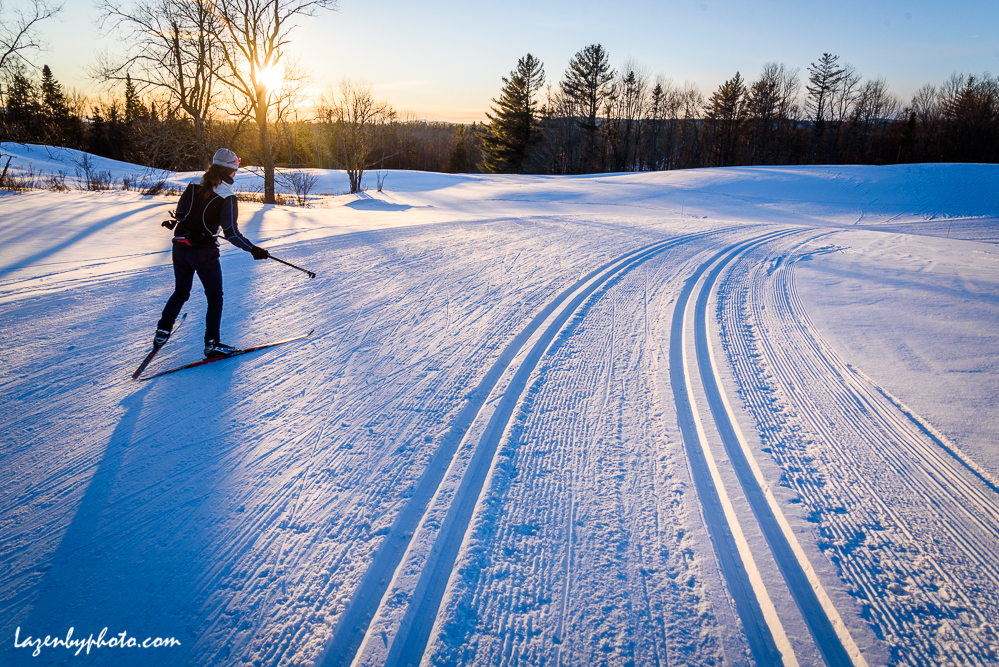
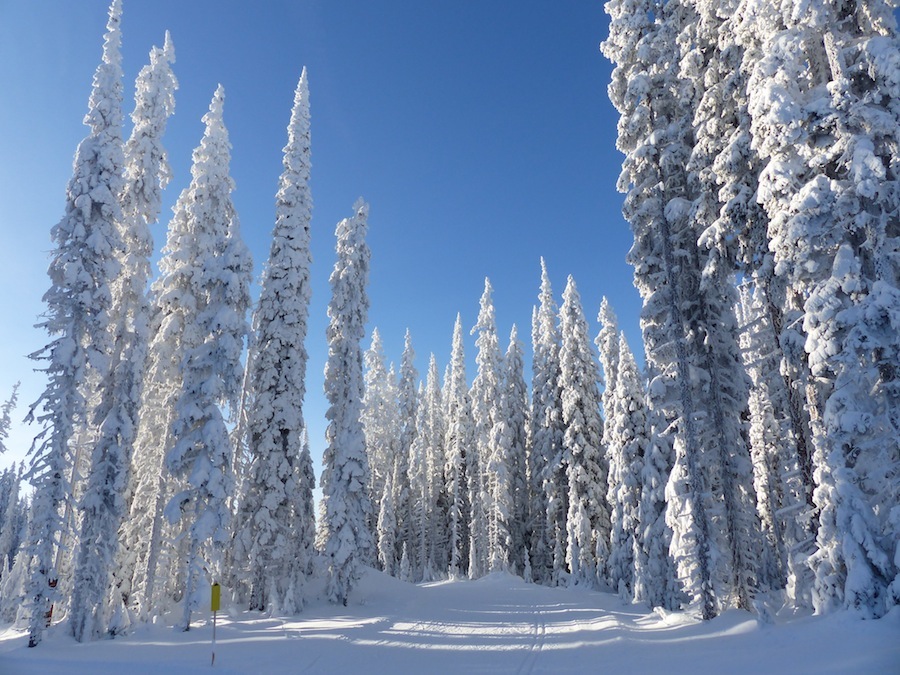
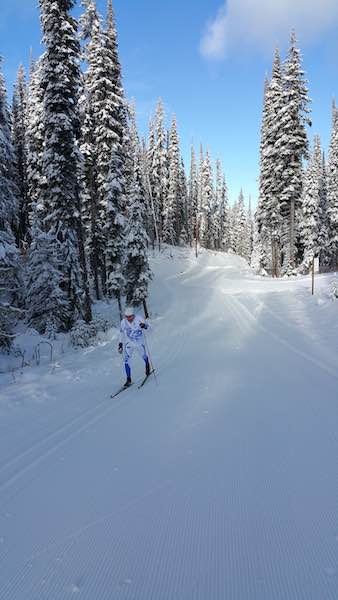
As the sun set, it was so cold that the battery in my camera froze into a non-working lump during this late afternoon masters’ training session at Craftsbury Outdoor Center last January. But the masters kept skating in the cold, squeaky snow and I was able to get this image before the battery went dead. (Photo John Lazenby)
Craftsbury Outdoor Center
With over 50 miles of magnificent trails through field and forest by the shores of Big Hosmer Pond in Vermont, Craftsbury Outdoor Center is a pretty special place for cross-country skiers. Home to the largest ski marathon on the East Coast, Craftsbury is a non-profit organization dedicated to promoting cross-country skiing, and has a wonderful focus on sustainability and environmentalism which adds to the lovely atmosphere. Lodging here is a great option, with luxury options and lakeside cottages available, as well as saunas and a fitness room available.
Mont-Sainte-Anne
Just a short drive from Quebec, Mont-Sainte-Anne Cross Country Ski Center is one of the best spots in Canada to get off-piste (literally) and try your hand at cross-country skiing. With over 110 miles of trails (and a 100 mile network for skating stride) it is one of the biggest cross-country ski resorts on the continent. Set amongst the gorgeous landscape of the Laurentia Forest, every trail is a picturesque ride from shelter to shelter, cabin to cabin, and gorgeous viewpoint to gorgeous viewpoint.
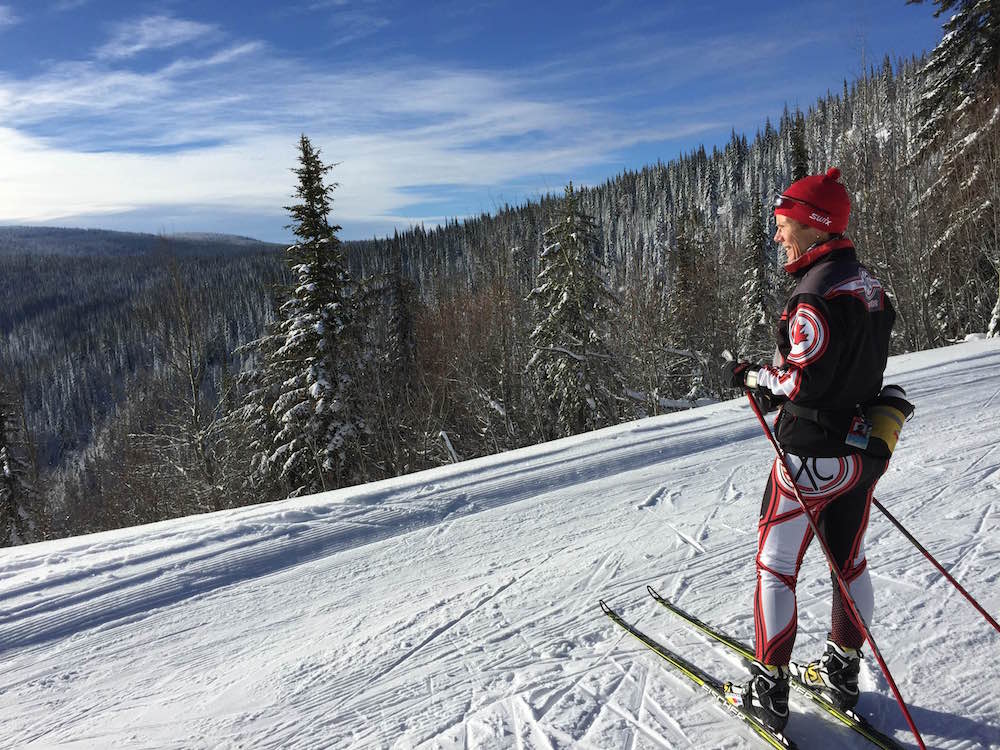
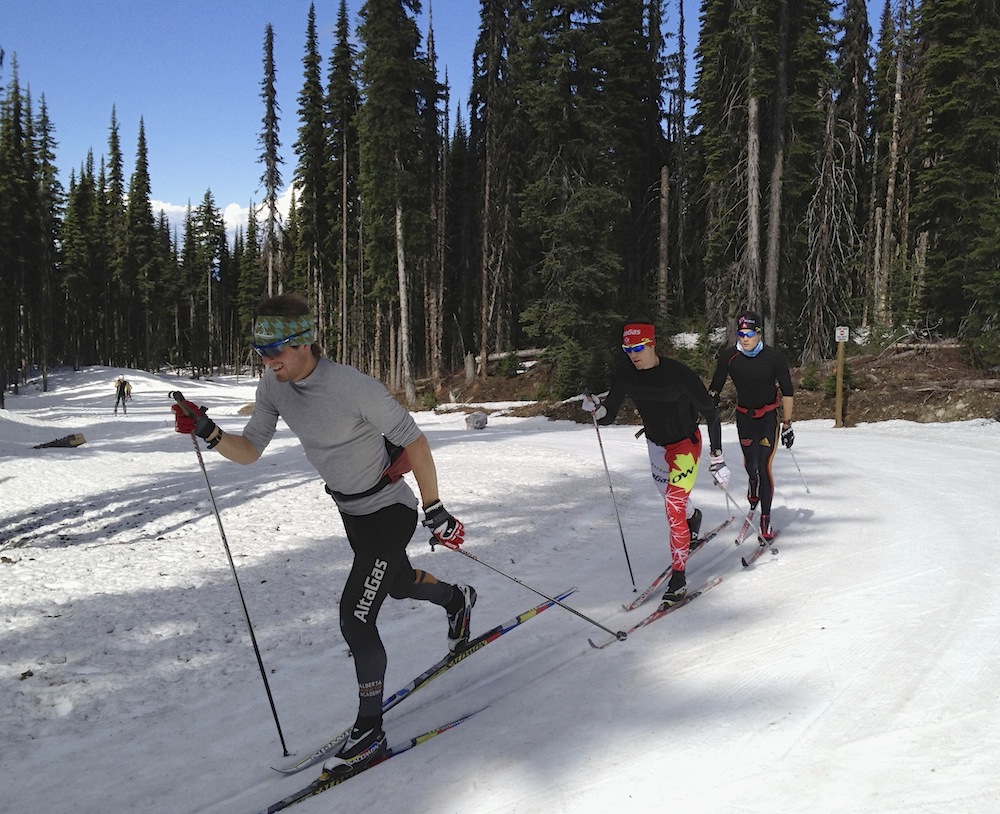
A trailside photo from 2015 SuperCamp at Sovereign Lake/Silver Star (Courtesy photo)
Silver Star Mountain Resort
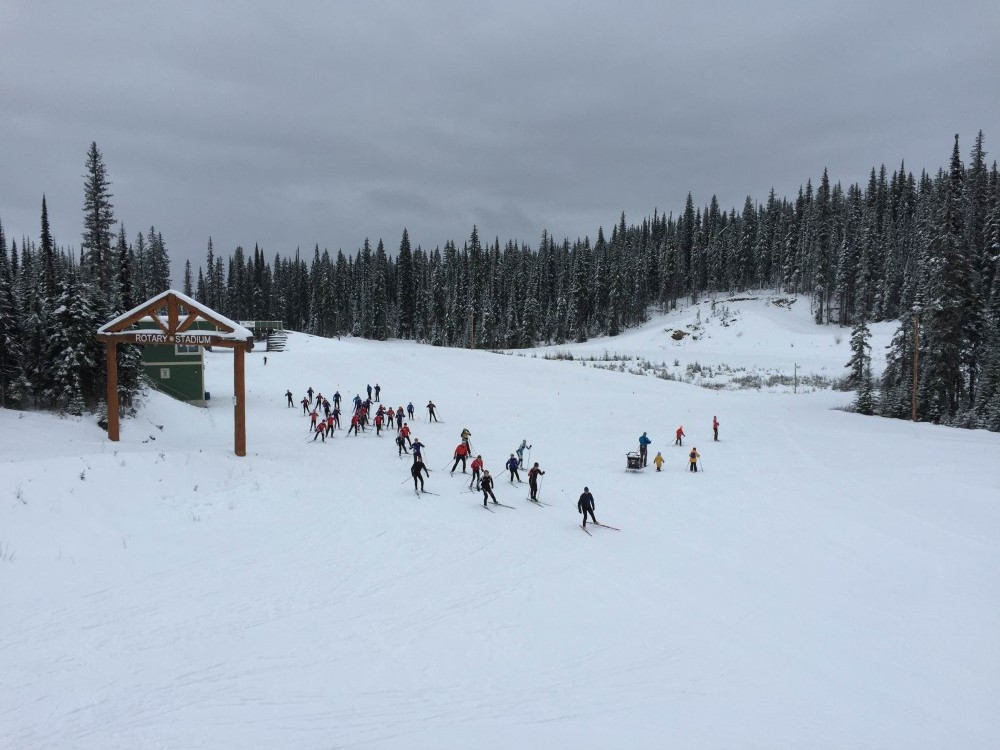
Just across the US/Canada border, Silver Star Mountain Resort is a genuine cross-country skiing treat. Over 35 miles of trails (and access to the extra 30 miles at Sovereign Lake Nordic Center), there’s always a new stretch of snow to discover, and it’s a great place to dip your toe into the exciting world of cross country skiing.
For the best casino bonuses in Canada click here for a full review.
Sun Mountain Lodge
Washington State boasts some of the most outstanding scenery in North America, which makes it the perfect setting for a cross-country skiing resort. As a result, Sun Mountain Lodge is one of the best places around to try Nordic skiing, and offers an outstanding network of trails with diverse terrain, as well as great facilities to match.
Lone Mountain Ranch
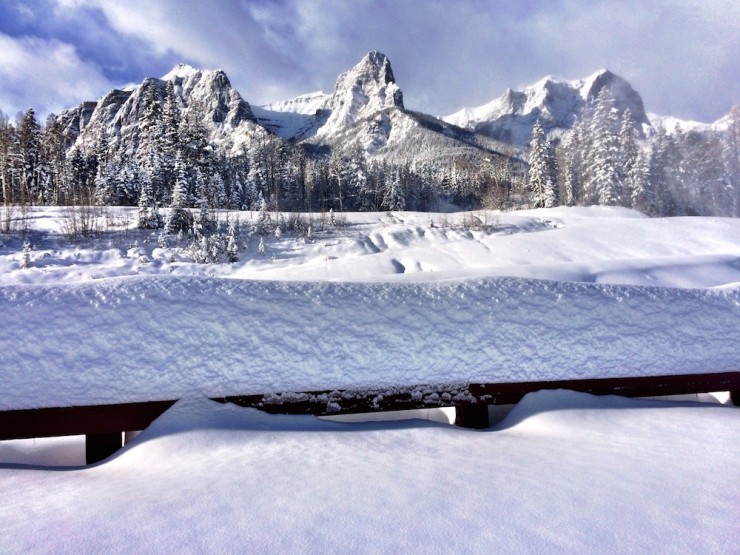
Over 50 miles of Big Sky trails make up Lone Mountain Ranch, which is almost always in the conversation when it comes to discussing the best cross-country skiing resorts in the United States. A fantastic all-rounder, the resort offers trails for every level, from newbies just starting out to grizzled veterans. With a backdrop of deep pine forest and rugged mountain peaks, it is the perfect spot to get to grips with Nordic skiing.
November skiing at Snow Mountain Ranch in Granby, Colo. For the first time this year, a five-day camp was held for masters. (Courtesy photo)
Snow Mountain Ranch
Another awesome spot in Colorado about 85 miles west of Boulder, Snow Mountain Ranch boasts 75 miles of excellent cross-country trails through picturesque woods and along pretty mountain riverbanks. One of the best parts of Snow Mountain is the abundance of wildlife here – there’s a decent chance you’ll be sharing the trails with moose or elk!
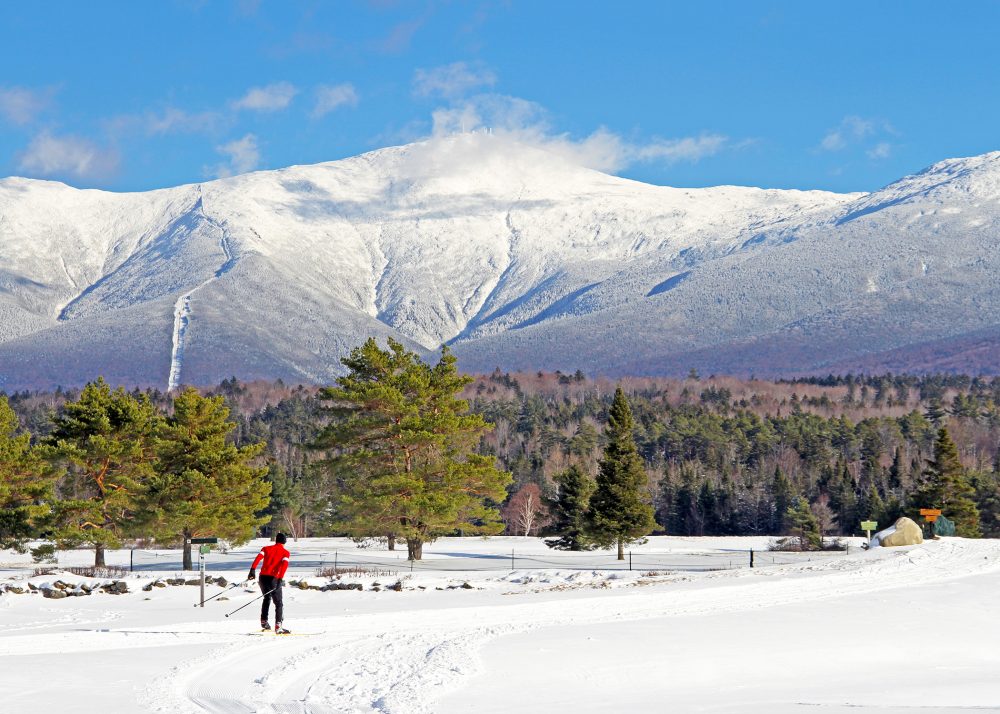
Bretton Woods with the Presidentials as a backdrop. (Photo: Bretton Woods Nordic)
With around 62 miles of trails that wind their way through the White Mountain National Forest, this is one of the most beautiful Nordic skiing destinations around.
Mont Tremblant
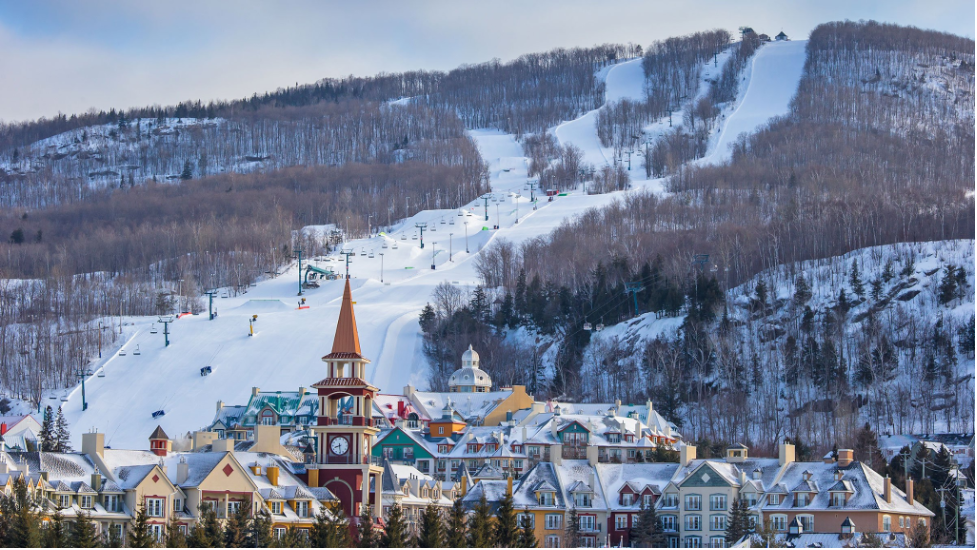
Set in the heart of the Laurentians, Mont Tremblant is another fantastic cross-country skiing option in Quebec, just northeast of Montreal. The resort is year-round, although the ski routes are usually only available in the winter season. One of the best features of Mont Tremblant is that the cross-country ski trails all connect up with other trails in neighboring towns, making multi-day treks a real possibility.
New England’s Fabian Stocek (1) follows Rocky Mountain’s Jack Hill (6) in the U20 men’s 15 k freestyle mass start at Trapp Family Lodge in Stowe, Vt. Stocek went on to win the Junior Nationals race by 7.5 seconds.
Trapp Family Lodge
Claiming to be the first cross-country ski resort in the US, the Trapp Family Lodge is one of the most elegant and sophisticated Nordic skiing destinations you are likely to find. The trails are beautiful, of course, but the icing on the cake is the delightfully Austrian-inspired setting of the lodge itself, which makes a wonderful place to wind down after a tough day skiing!
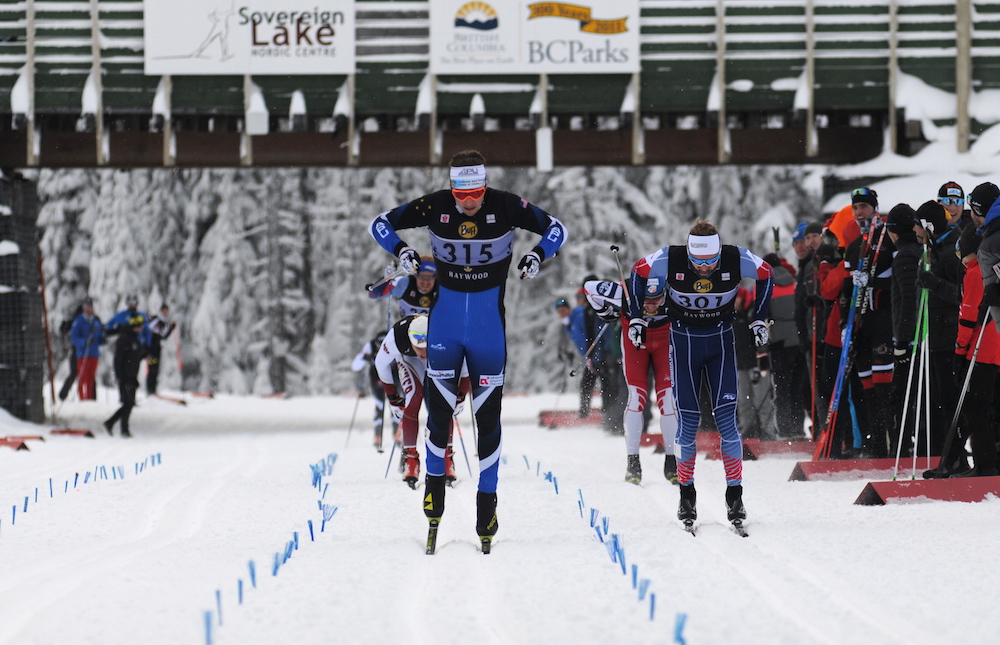
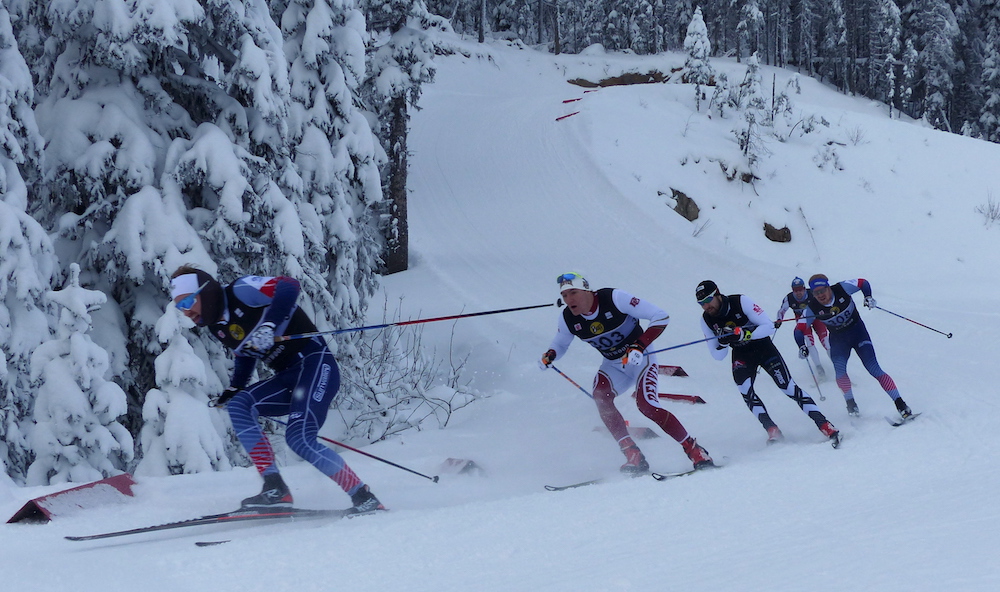
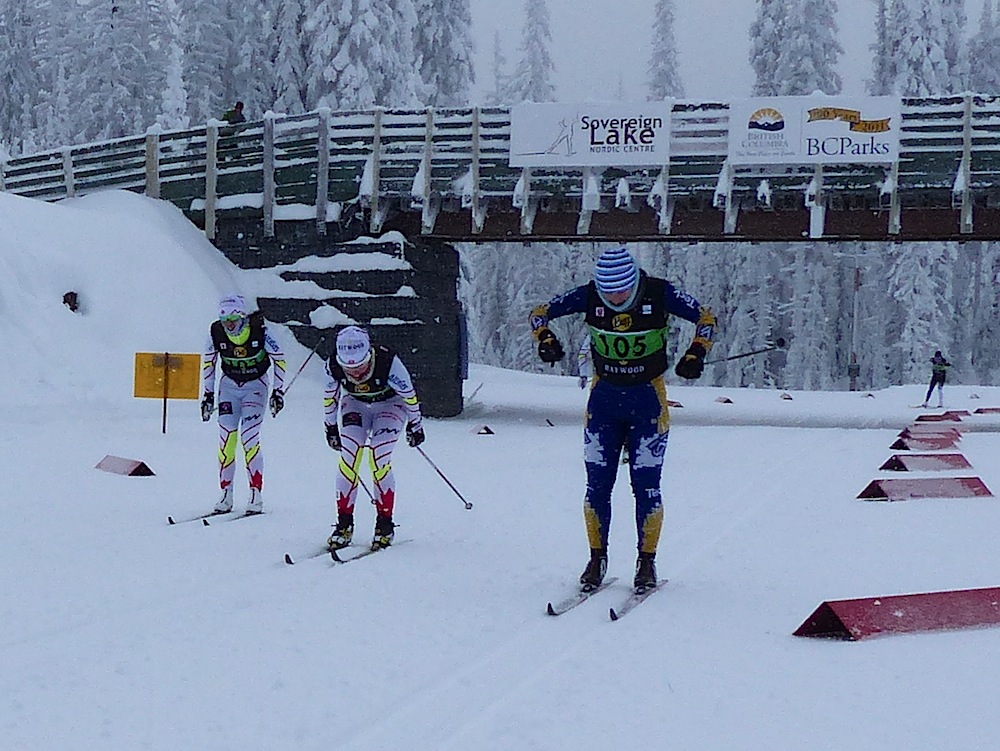
APU’s Reese Hanneman (315) leading down the finishing stretch of the Sovereign Lake NorAm/SuperTour men’s classic sprint final on Dec. 10, with Sun Valley’s Cole Morgan (r), the University of Denver’s Moritz Madlener (behind Hanneman), Stratton’s Ben Saxton (behind Morgan), and Sun Valley’s Matt Gelso (behind Madlener) chasing. (Photo: Doug Stephen)
VERNON, B.C. — It might’ve been the first Canadian NorAm of the season, but the Americans made it all about themselves in what also doubled as their second stop on the U.S. SuperTour circuit this past weekend at the Sovereign Lake Nordic Centre.
U.S. skiers kept Canada off the podium in the classic sprints and freestyle intervals starts on Saturday, Dec. 10, and Sunday, Dec. 11, with Olivia Bouffard-Nesbitt, of the Alberta World Cup Academy (AWCA) and Canadian U25 Team, coming closest in fourth on Day 1.
On Saturday, Bouffard-Nesbitt started off the very first NorAm race, a 1.2 k classic sprint, with a qualifying win. She went on to advance in second in her quarterfinal and third in her semifinal, before finishing fourth in the A-final, 1.49 seconds out of first.
American Julia Kern of the Vermont-based Stratton Mountain School (SMS) Elite Team (formerly the T2 Team) won the women’s final in 3:17.04, after qualifying fifth and placing second in both her quarterfinal and semifinal. Kern led two Craftsbury Green Racing Project (CGRP) teammates, Liz Guiney and Kaitlynn Miller, in second (+0.67) and third (+0.91) on the podium, respectively.
Olivia Bouffard-Nesbitt (AWCA) leads the Americans through the bridge turn in the women’s classic sprint A-final on Saturday, Dec. 10, at the Sovereign Lake NorAm/SuperTour. Stratton’s Julia Kern (second from r) made a tactical choice more than a minute earlier, which gave her the inside position on Craftsbury’s Kaitlynn Miller (l) and the advantage she needed to win. (Photo: Peggy Hung)
Bouffard-Nesbitt led the six finalists into the finishing straight after opening up a wide gap at the top of the second climb.
“Yeah, those Americans,” Bouffard-Nesbitt told FasterSkier after the race. “I was in first until we hit the final finishing straight, and then I just got out-double poled by three of the girls.”
Kern, a U.S. Ski Team Development Team member and Dartmouth student, credited tactical choices for her victory.
“In the quarterfinal, I made the mistake of not taking the outside, which turned into the inside turn on the second downhill,” Kern said.
The second downhill on Sovereign’s sprint course has a gentle right turn leading into a high-speed left, followed by the long climb and then two sharp left turns to the finish. Keeping control of the inside for the last three turns gave Kern the ideal position to take the second skied-in finish lane to cross the line first.
Guiney followed Kern to second, leaving Miller with the fresh snow in lane three.
“I was in third the first half of the course, just stayed in the mix,” Miller said of the final. “I really like the striding hill at the end.”
Despite being slowed in the final straight, Miller loved the conditions.
“This course is really nice, the conditions are awesome,” she said. “I love all the fresh snow. We had really great skis today, so that always helps.”
While Bouffard-Nesbitt was disappointed that there wasn’t a Canadian on the podium, she was happy with her day.
“I haven’t really sprinted this year,” she said, referring to a stress fracture in her foot that put her on crutches for several months this summer. “The intensity I’ve done since I’ve been back on my feet has been almost exclusively controlled Zone 3.”
The fourth American in the top five, Jennie Bender of the Bridger Ski Foundation (BSF) qualified third and finished fifth overall (+3.8). The SuperTour leader after West Yellowstone’s first two races of the season, she was disappointed with fifth.
“It was a tough field out there,” Bender said. “It’s a really short course, lots of turns, three different 180-degree turns. I kind of got swallowed up on the last downhill and lost a little gusto.”
Asked if she was tempted to double-pole the course, Bender laughed and said, “I was! I might of been interested to do it during the qualifier, but I was third, and yeah, I’ll keep the striding.”
A third Craftsbury skier in the A-final, Heather Mooney qualified ninth and went on to finish sixth in the final (+19.84).
“It’s a really fun course, fun with lots of transitions,” Mooney said. “Off the start of the final, I was really excited that we had three from our team. I just didn’t quite have it at the beginning, caught back up a little bit, but I was definitely on and off the back of the pack. Came in last, but it was a good day.”
All six of the women’s B-finalists were American, with Becca Rorabaugh of Alaska Pacific University (APU)ultimately placing seventh, Erika Flowers (SMS Elite) eighth, Mary O’Connell (CGRP) ninth, Jessica Yeaton (APU) 10th, Mary Rose of the Sun Valley Ski Education Foundation (SVSEF) 11th, and Anne Hart (SMS Elite) 12th.
“I definitely wasn’t skiing as fast as I would like to be,” MacIsaac-Jones said, “but I am definitely just happy to be racing and on snow.”
She was eliminated after placing fifth in her quarterfinal and skipped the 10 k freestyle on Sunday for a distance training session instead.
***
The men’s final on the first downhill at the Sovereign Lake NorAm/SuperTour on Dec. 10 near Vernon, B.C. Sun Valley’s Cole Morgan leads Denver’s Moritz Madlener, CNEPH’s Antoine Briand, Sun Valley’s Matt Gelso, and Stratton’s Ben Saxton Saxton in pursuit of APU’s Reese Hanneman (not shown). (Photo: Peggy Hung)
The men’s classic sprint shared the same 1.2 k course and the same American domination of the podium after a semifinal crash took three Canadians out of contention.
Reese Hanneman (APU) double poled to the win in 2:38.08 after qualifying 15th. Cole Morgan (SVSEF) and Ben Saxton (SMS Elite) rounded out the podium in second (+0.87) and third (+1.92), respectively.
“I had a really bad qualifier, for me. I chose a classic ski,” Hanneman said of his qualification round. “But I think [grip wax] was much slower, as the heats showed.”
He described the A-final as fast from the start.
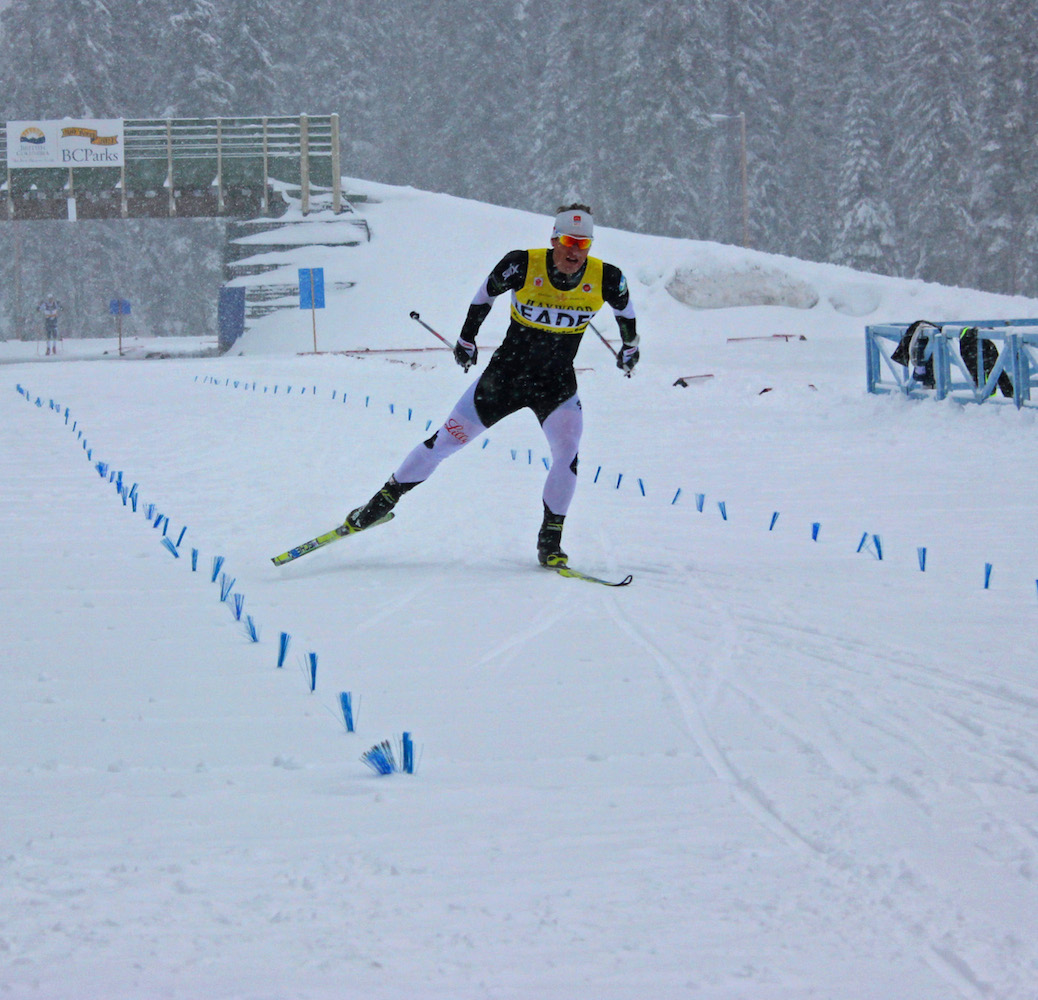
“I had a decent start; I was in second behind Cole up until the top of the first climb. I made a pass, double poled by him, and I was kind of leading into the big climb,” Hanneman recalled.
“Then he and I were side by side, one and two, with a little gap. Then up the steep pitch, he took the lead and I tucked in behind him and just followed him over the bridge. I was able to close down the gap and then pass him and then turn on the jets coming in the final double-pole section.”
Morgan, who won the qualifier and was one of the four others on skate skis in the final, was also pleased with his tactics.
“I did the same tactic as I did in every heat, try to be in second place coming into the big downhill before the last hill,” Morgan said. “[I] was able to lead over the top, but didn’t have the same finish as Reese did.”
Saxton double poled all four laps, as did Hanneman, Morgan and many of the top men.
“I think that was the faster call, but it was definitely a physical task those last heats there,” Saxton said.
Another double poler in the final, the University of Denver’s Moritz Madlener ended up fourth (+1.92) after qualifying third.
“Considering how much we trained the last couple of weeks, it was a great result,” he said.
For Madlener, who is originally from Germany, this marked his first visit to Canada.
“This is German territory. The last time there was a World Cup here, the first five were Germans,” he said, probably not realizing that it was 11 years to the day since that 30 k pursuit event.
The lone finalist on grip wax, Matt Gelso (SVSEF) finished fifth (+3.88) after winning his crash-marred semifinal. Antoine Briand of the Pierre-Harvey National Training Centre (CNEPH) was the lone Canadian in the A-final, with a lucky loser time that was faster than Gelso’s winning time from the other semifinal.
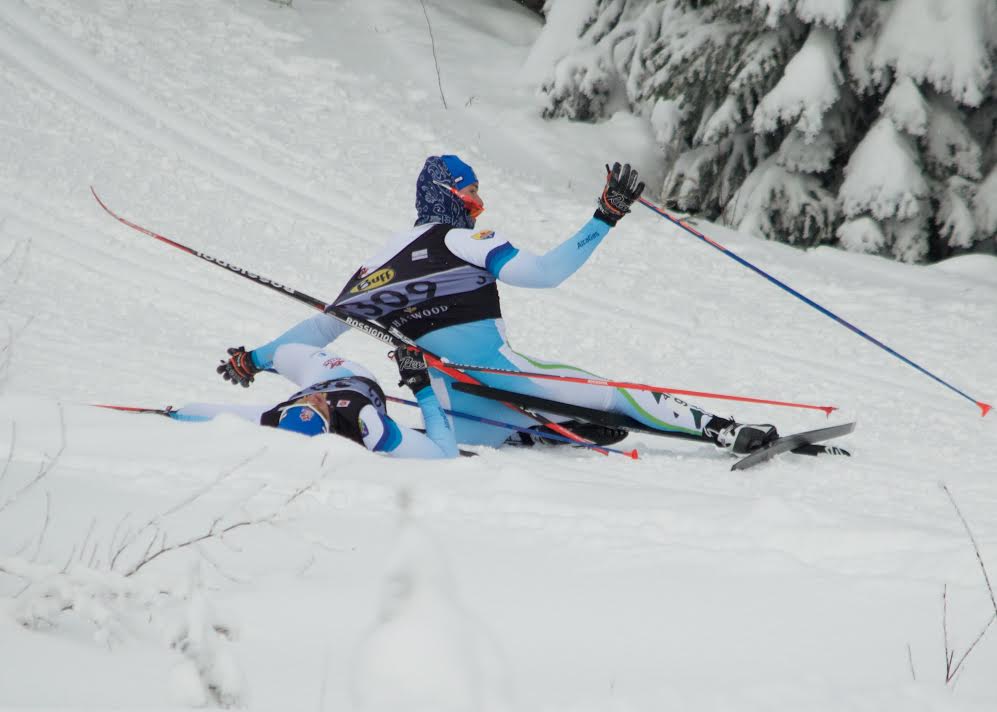
Angus Foster (309) untangles himself after a semifinal crash at the Sovereign Lake NorAm/SuperTour on Dec. 10, as his NTDC Thunder Bay teammate Evan Palmer-Charrette tries to get his breath back. The ski through the bib belongs to Simon Lapointe. (Photo: Shelley Woodman)
For a few Canadian athletes, the crash in the second semifinal was the defining moment of the day. Only 50 metres into the race, Gelso used his inside position in the tight pack to pull in front of Angus Foster, of the Thunder Bay National Team Development Center (NTDC), but Gelso skied over Foster’s ski, triggering a chain reaction.
“[Gelso] got through, but I went down, had two other Canadians go down with me,” Foster said after. “Probably the hardest crash we’ve ever had.”
Foster fell sideways in front of NTDC teammate Evan Palmer-Charrette.
“I just got unlucky, [Foster] fell right in front of me, and I just pitchforked over him, got the wind knocked out of me pretty bad,” Palmer-Charrette said. “Unfortunate, but that’s racing.”
CNEPH’s Simon Lapointe was the third skier in the tangle. Lapointe got up quickly, but a broken binding required him to wait for a coach to run over with a spare ski.
Palmer-Charrette was slow to get up, leaving Foster pinned in place. Foster finished the heat with three holes in the back of his race bib and likely a few ski-shaped bruises underneath.
Lapointe, one of the top Canadians sprinters, was the most frustrated with the semifinal crash. He left the finish area with a quick French-language “nothing to say” before going on to win the B-final by 1.06 seconds over Palmer-Charrette in 2:43.31.
None of the three Canadians protested to the jury member at the finish. Asked directly about whether there was cause for a protest, Foster said “That wasn’t a clean move, but that happens. People make mistakes. Still frustrating, but….”
Gelso was surprised to find only one skier with him at the top of the second climb. “We both went for a track at the same time, and I don’t know what happened,” Gelso said later, “but I’ve been on both ends of that.”
Everyone interviewed spoke favorably of the combined NorAm/SuperTour weekend.
“It’s really nice to get some deeper fields, to get the Americans and Canadians racing together,” Foster said. “It wasn’t so fun to watch the podium here.”
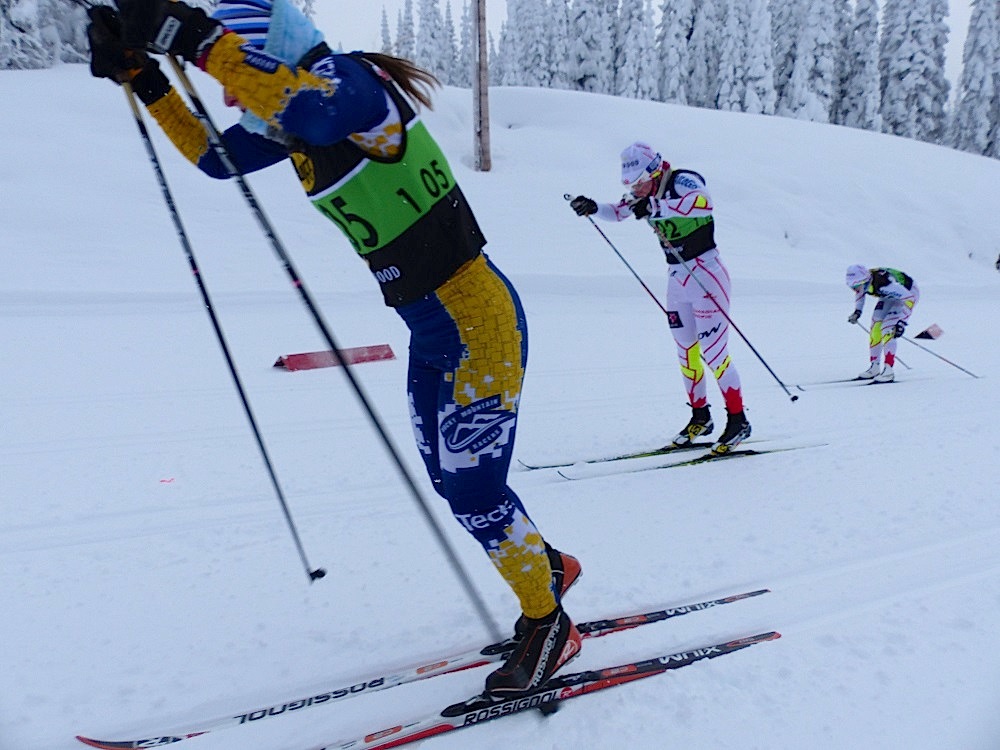
APU’s Scott Patterson leading Canadian junior Ty Godfrey (Team R.A.D.) during the men’s 15 k freestyle interval start on Sunday, Dec. 11, at the Sovereign Lake NorAm/SuperTour. (Photo: Peggy Hung)
Day 2 at Sovereign proved to be more populated with Americans sweeping the top five and nearly the top 10 in the men’s and women’s distance freestyle interval starts.
In the men’s 15 k, Scott Patterson (APU) topped the field by 13.2 seconds with a winning time of 40:00.2. Gelso reached the podium in second — his third this season in four SuperTour races — and Tad Elliott (Ski Club Vail) placed third (+26.6).
The U.S. swept the top eight with Brian Gregg (Team Gregg) in fourth (+54.8), Paddy Caldwell (SMS Elite/Dartmouth/USST) in fifth (+1:20.5), Ben Lustgarten (CGRP) in sixth (+1:27.4), Madlener in seventh (+1:31.3), and Kyle Bratrud (CXC Team) in eighth (+1:33.5).
Russell Kennedy of the Canmore-based Team R.A.D. was the top Canadian* in ninth (+1:38.8), and John Hegman (SVSEF) finished 10th (+1:44.2).
(*While Kennedy lives and trains in Canada, he is originally from Truckee, Calif.)
Out of 112 finishers in the men’s race, nearly 50 were American, and two were Australian national team members.
“Gelso’s definitely in good shape so it was good to hear splits out there that I was leading,” Patterson said. He started in bib 94 behind Gelso in bib 80.
“Fifteen k skate’s kind of been my game, one race I can always fall back to and know I can ski pretty fast,” Patterson added.
Asked about the event doubling as a SuperTour, he said it added competition.
“I would have loved to see the Canadians in West [Yellowstone], but it’s a weird course, makes sense to skip it,” he said of the SuperTour’s usual first stop on the circuit (one of the few places in the U.S. with reliable early season snow) at the Rendezvous Ski Trails in West Yellowstone, Mont. The SuperTour opener was originally scheduled for Bozeman, Mont., which would have been a NorAm as well, but moved because of low snow.
“It’s always fun to have a bunch of people that you don’t know all that well,” Patterson added. “This is my first time in Silver Star and it’s been great. Real winter, and we’ve been lacking that in Anchorage [Alaska].”
After spending a good chunk of last season in Europe on the World Cup, Patterson noted that even those venues tend to rely on manmade snow.
“It’s nice to have dumping snow out here,” he said.
“I think the third lap, things started to slow down,” Patterson added about the race itself. “I was getting ice through my glasses and eyes. It made things feel a little more closed in, feel like it’s snowing harder. I think it slowed down a little bit, but maybe that’s just getting tired, too.”
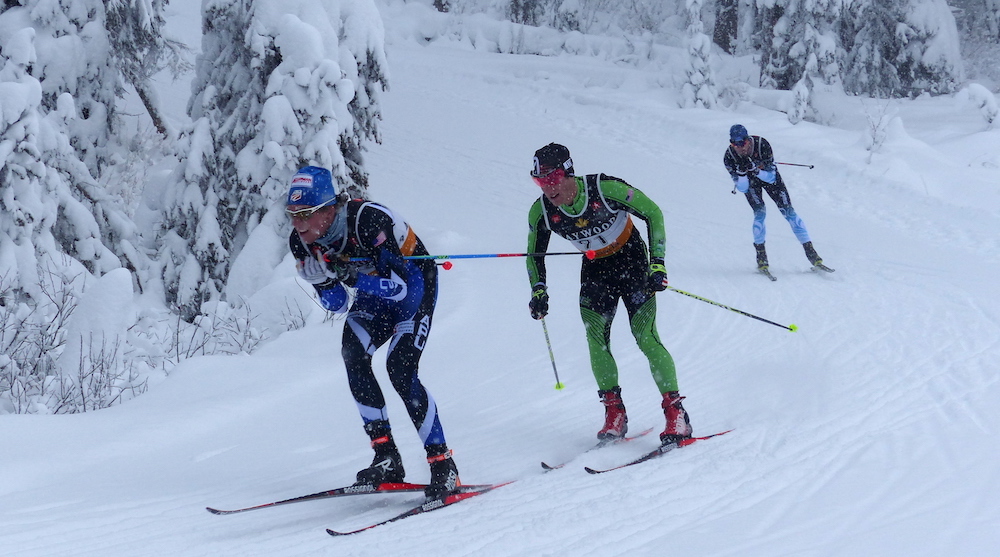
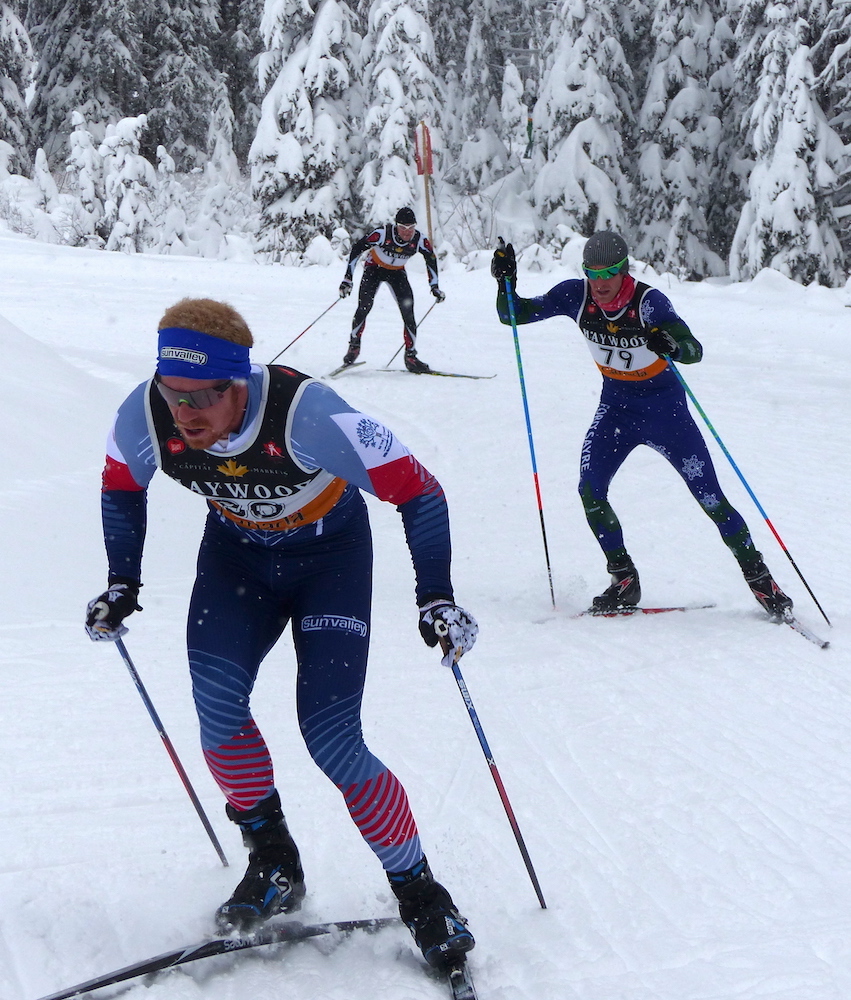
Sun Valley’s Matt Gelso (front) charging a false flat on his first lap of the men’s three-lap 15 k freestyle on Dec. 11 at the Sovereign Lake NorAm/SuperTour, followed by Welly Ramsey (Ford Sayre). (Photo: Peggy Hung)
Gelso recalled a slower last lap as well, but was pleased with his effort.
“It’s a great course, and it was fun,” he said.
Gelso was strongly in favor of combining the two North American circuits whenever possible, recalling a conversation he had with some U.S. and Canadian national-team members at 2015 World Championships.
“Devon Kershaw and a bunch of the Canadians and Americans were staying in the same hotel, and we were talking about how cool … instead of having one Canadian, one American that goes to the World Cup on the Continental Cup, why [doesn’t the International Ski Federation] give North America three spots for Canada and the US, and all of our races are together?” he said. “Sometimes it will be three Americans, sometimes it will be three Canadians, sometimes it will be two and one, whoever’s racing fast. The more we are racing together, I think the better we’re going to fare internationally.”
“I mean, we’re friends with these guys, we know who they are,” Elliott said of racing with Canadians. “Michael Somppi, Kevin Sandau, they’ve been visited us at U.S. nationals last year. Silver Star’s gorgeous, great skiing, great course, well-run races, so it’s always a pleasure to visit here.”
Elliott, a former U.S. Ski Team distance skier, described feeling surprised with his effort on Sunday after what he called a “great sprint” in West Yellowstone (in which he placed 14th) followed by a head cold, which forced him to skip the West Yellowstone distance race.
“I rested all week indoors, and I felt incredible today,” he said.
Kennedy in ninth called his race a solid start, but had hoped to finished a “little higher up.”
“The U.S. guys are skiing super-strong right now, you could just see it out there,” Kennedy said. “I thought I was skiing pretty well, and then got some splits off of Gelso, and OK, they’re moving. I am hoping when we have [World Championships] trials in Park City, we’ll be a little bit more up there, but we’ll see. It’s good to have that competition, too. You can’t rest anywhere, you have to push everywhere, so that’s good.”
Asked about the NorAm/SuperTour combo, he was also positive.
“It’s good for us to have the extra competition and it’s good to race new faces,” Kennedy said. “Especially in sprints, you get used to the same tactics from the same people. When you have someone new, it’s nice to have to adjust your tactics and be prepared for what they’re going to do when you don’t know them as well. In distance, it’s really cool to have new guys to chase. I can kind of know the Canadians, what’s happening with them, but I was chasing down David [Norris] today, and he kind of surprised me how strong he was on the last lap, it was good to have that extra push, for sure.”
The second-fastest Canadian man of the day, Alexis Dumas (CNEPH) placed 15th (+2:13.1).
“I feel really fast on the one-skate, and the uphill was good, too,” Dumas said after. “I improved a lot my offset this summer, so it was good for this course.”
In terms of season goals, he’s looking to qualify for U23 World Championships, where he’d like to achieve a top 20.
***
Chelsea Holmes leads Erika Flowers at the 5 k mark of the women’s 10 k freestyle interval start on Sunday, Dec. 11, at the Sovereign Lake NorAm/SuperTour. (Photo: Marie-Éve Bilodeau-Corriveau)
In the women’s 10 k, Chelsea Holmes (APU) took the win in 30:42.9, topping the time of the race’s previous leader, Katharine Ogden (SMS Elite) by 13.4 seconds. Stratton had two on the podium with Flowers in third, 36.4 seconds back from Holmes.
“The course was really hard, but my techs and coaches gave us really good skis,” Holmes said after. “Today, I had the most amazing team, all the boys finished and they were cheering so hard.”
Holmes started 30 seconds after Flowers and 1 minute behind her APU teammate Rosie Frankowski.
“Chelsea started right behind me, and her and Frankie [Frankowski] and I all skied together for most of it, which made it a lot more fun cruising through the snow,” Flowers recalled. “We had a good little crew going, so it was hard, but hard with friends.”
Frankowski finished with Holmes and 59.9 seconds off her winning time in sixth place, behind Gregg in fourth (+40.8) and Rose in fifth (+51.7). APU had three in the top seven with Rorabaugh in seventh (+1:09.8). Craftsbury’s Guiney placed eighth (+1:17.9), Deedra Irwin (SVSEF) was ninth (+1:18.4), and Kern, Saturday’s sprint winner, 10th (+1:24.8).
For the second day in a row, Bouffard-Nesbitt was the top Canadian woman, placing 13th (+1:51.8). Of the top 20, the U.S. swept all but three places: 13th, 18th with NTDC’s Annika Richardson, and 20th with Sovereign Lake’s own Hannah Mehain. (Both Richardson and Mehain belong to Canada’s Junior National Team.)
“I’ve never had an easy race at Silver Star,” Bouffard-Nesbitt said after Sunday’s 10 k. “It was really hard as usual. To be honest, all morning, I feel pretty wrecked from yesterday’s race. Whole body, that sprint really took a toll on me. I was kind of just trying to play the hand I was dealt the best I could, make the most of it. I think I’m happy with it.”
Asked how she felt about being the top Canadian for the second-straight day, albeit outside the top 10, she replied, “Let’s say, bittersweet. Obviously, we want to have Canadians represented at the top of these fields, among the Americans, but of course I’m happy to be top Canadian.”
Regardless, she was glad to have the competition.
“We not coming here to have easy wins; we’re coming here to be challenged,” Bouffard-Nesbitt said. “I’m very happy to have them here, and I’m very happy when they can show us what fast racing looks like.”
Sixty-two women finished the distance race, and about half were American. Most of the NorAm field is headed to Rossland, B.C., for next weekend’s NorAm, which is not a SuperTour and will not count toward the U.S. Ski & Snowboard Association’s (USSA) national ranking list.
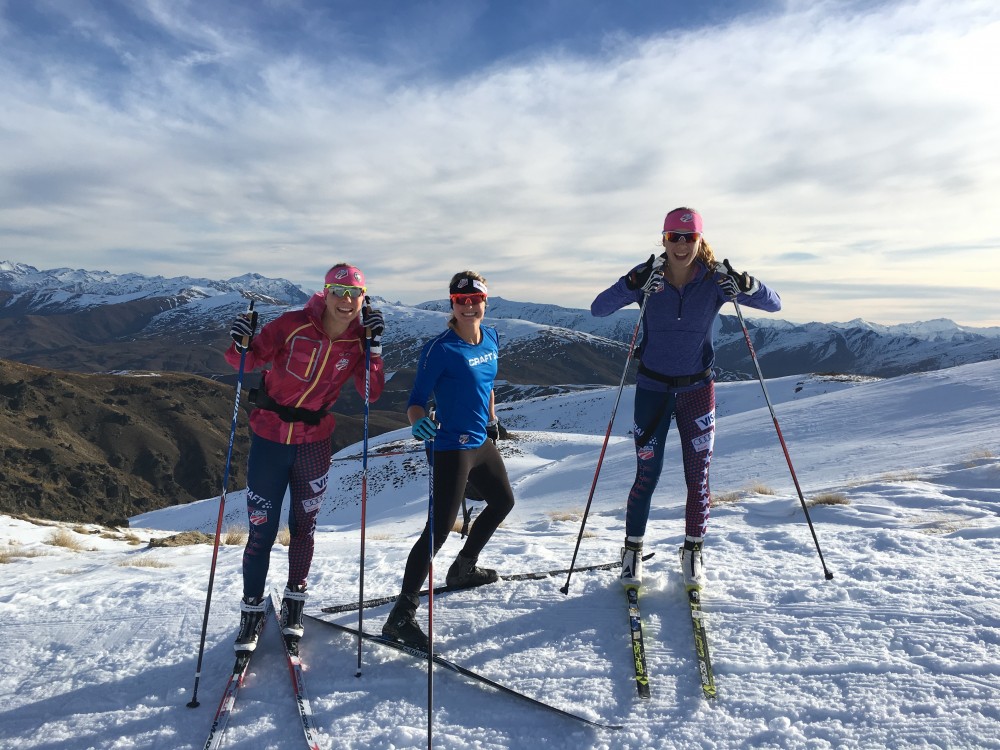
Katharine Ogden (left) training with U.S. Ski Team teammates (r-l) Jessie Diggins, Liz Stephen, and Sophie Caldwell in New Zealand this summer. (Courtesy photo)
Welcome to “17 Questions for 2017″, where we are catching up with American and Canadian national-team members before the beginning of the winter season.
***
Katharine Ogden of the Stratton Mountain School kicked off last season by winning the SuperTour 10 k skate in West Yellowstone, Montana – then picked up a fourth-place finish at U.S. National Championships, two top-20’s at World Junior Championships, and finished the season off with her first World Cup starts in the Ski Tour Canada.
Ogden just turned 19 years old. The U.S. Ski Team “D” teamer placed fourth in both the sprint and 10 k classic at New Zealand Championships this summer and has spent serious time training with the women’s national team.
1. Biggest change in your life in the last five or so months since the ski season ended?
Biggest change in my life since the past season was graduating high school. So far I’m loving being able to just ski without having school work to worry about.
2. Biggest change in your training?
Since I’m not in school I’ve upped my training hours considerably since last year. I also started on a new strength plan.
3. Major areas of improvement you’ve seen so far?
The biggest improvement I’ve seen so far has been in my double poling. I’ve worked really hard for years now to correct my back position in that technique and it is finally starting to come along.
4. Whom you’ve been working closest with this offseason (coaches or training partners)?
During the summer I’ve been training predominantly with the SMS Elite Team girls and coach Pat O’Brien.
5. Best trip in the last five months (and why)?
Left to right: Ida Sargent, Sophie Caldwell, Katharine Ogden, Liz Stephen, and Jessie Diggins racing at New Zealand National Championships at Snow Farm, New Zealand. (Photo: Matt Whitcomb)
My favorite trip this summer was definitely New Zealand in September. It was totally awesome to get on snow then and it was also an extremely productive camp for me. I also just loved everything about the place the people and the food there. Honestly might have been one of my favorite camps of all time.
6. Favorite cross-training?My favorite cross training is mountain biking.
I just got a new bike and I’m loving it so much.
7. Favorite non-athletic activity or pastime this summer?
My favorite non-athletic pass time this summer was eating a big yummy brunch on off days.
8. Song that was your jam this summer?
I don’t really have a favorite song. I mostly listen to audiobooks. My favorite is The Night Circus by Erin Morgenstern.
9. All time favorite race moment?
My all time favorite race memory is from my first ever Junior Nationals at Soldier Hollow in Utah. I was just barely picked as the third member of New England’s “A” relay team for U16 girls, my teammates were Zoe Snow and Julia Kern. Our team and the Alaskan team were super close the whole race and Julia was out anchor leg. My favorite moment was when the three of us found out that Julia had out lunged the Alaskans at the line to win the race!
10. First thing you pack in your bag when you leave for Europe?
First thing in the bag when I pack to go to Europe is oatmeal and peanut butter. You new know with the food in a new place so I always pack the essentials.
11. Venue/event you’re most excited to visit this season?
U.S. Ski Team D-team skier Katharine Ogden (r) during a sprint time trial at the USST’s annual training camp in Park City, Utah, which ran this year from Oct. 17 until Oct. 31. (Photo: Bryan Fish)
The event I’m most looking forward to this year is the SuperTour races in Silver Star BC. I’ve never been to Silver Star but it’s so many people’s favorite place so I’m really excited.
12. Who will win the World Cup title this year?
Jessie Diggins. duh.
13. Biggest sacrifice you feel you’ve made choosing this career path?
I think choosing to pursue skiing as a career has caused me to give up some things but they really arent worth considering because this lifestyle gives back much more than it takes. I wouldn’t give up the opportunities to travel, make new friends and learn about myself for anything.
14. If you could change one thing about your sport, what would it be?
If I could change one thing about the sport I would make it snow more. I guess that’s not specifically about the sport but the one bummer about being a skier is when you want to ski but there isn’t enough snow.
15. What did you have for breakfast this morning?
For breakfast today I had french toast but I usually have peanut butter banana oatmeal.
16. In 5 years, I’ll be ____?
Hopefully racing on the World Cup, living the dream.
17. In 50 years, I’ll be ____?
Living in Vermont and I’ll hopefully have cute grandkids that I can ski around with.
Left to right: U.S. teammates Ida Sargent, Jessie Diggins and Katharine Ogden during their first ski of the camp at Snow Farm in Wanaka, New Zealand. (Photo: Erika Flowers)
SuperTour skiers won’t be starting their season at the Rendezvous Ski Trails in West Yellowstone, Mont., this November. For the first time in the Yellowstone Ski Festival’s history, SuperTour races are not on the schedule. Citing altitude and frigid temperatures, the series is starting north in Bozeman, Mont.FasterSkier previously shared a press release from the U.S. Ski & Snowboard Association (USSA) giving the where and when of the 2016/2017 SuperTour schedule for high-level domestic racing. This article provides the why – why are the season’s first races not in West Yellowstone? Why are some U.S. SuperTour races in Canada? Why are U.S. nationals returning to Soldier Hollow after just two years away? And so on. FasterSkier spoke with various members of the American cross-country ski community to help get some answers about why the country’s top skiers will be going where when this winter.
Period One: Western Swing (but no West Yellowstone)
The single most noteworthy change to this year’s schedule may be the move away from West Yellowstone for the season’s opening races. Skiers have flocked to West Yellowstone in search of early-season snow, and often raced there, for a very long time. For how long? And why the change now?
As FasterSkier previously reported, elite skiers have made the Thanksgiving-week pilgrimage to West for nearly forty years: It was 1978 when the U.S. Ski Team held its first Fall Camp there, “with then-U.S. Ski Team coach Marty Hall and skiers like Bill Koch, Dan Simoneau and Tim Caldwell. Koch didn’t come too many years after because of exercise-induced asthma, which worsened with altitude.” People kept coming back. In 2004, Fall Camp, which had long since expanded to include a range of citizen skiers from around the country, was renamed the Yellowstone Ski Festival, with a full slate of clinics, demos, and a gear expo.
So why the change? Well, here’s another number from our article on the history of early-season skiing in West Yellowstone: “6,663: Elevation of West Yellowstone. The Rendezvous Ski Trails are about 6,800 feet above sea level (2,000 meters), and the South Plateau just outside the park is about 1,000 feet higher.”
The athletes have noticed. Bill Koch evidently noticed in the early 1980s. More recently, as Alaska Pacific University (APU) skier Reese Hanneman blogged in December 2015, “For as long as I have been racing, these first two weekends of elite racing have been held in the high mountain west, at illegally high altitude (according to FIS), which always makes them a little funky.”
USSA and club coaches noticed, too. As Robert Lazzaroni, USSA’s nordic domestic program director, explained in a phone interview, the impetus to move away from opening the season in West Yellowstone “came from the club coaches when we met in Craftsbury” following last season’s SuperTour Finals in March. The decision to move elsewhere was close to a consensus, Lazzaroni said: “It was very clear that the season starts too early. It’s too early – November 23rd – to start to chase points, when we want the athletes to peak at Nationals [in early January].”
West Yellowstone, known as “West” for short, is also at altitude, Lazzaroni noted. And finally, Lazzaroni made the uncontroversial observation that “West can be very cold.”
Putting all that together, he said, it just seemed like too much to ask of the athletes: “When you ask the athletes for the first race of the season to be at full speed, and to be fit, and in a cold place – it can be too much. And it puts their season in jeopardy. The risk was too big in their [the club coaches’] mind – too early, too high and the weather can be difficult. And that’s not good that early in the season.”
Hence the move from West in late November to Bozeman in early December: later, lower, and hopefully a little warmer.
So what will be left in West Yellowstone over Thanksgiving week, without elite athletes eyeing the competition, washing their hands, and chasing SuperTour points? Quite a bit, both USSA and West Yellowstone boosters agree.
As Lazzaroni noted, it was a “bummer” to lose the SuperTour component of the Yellowstone Ski Festival, but the festival “will continue. They will still have the junior race, they will still have the Masters race. It will just not be a SuperTour. … We believe a lot of the clubs will be there, training.”
Moira Dow seemed to agree. The program director of the Yellowstone Ski Festival, Dow said on the phone that she was “disappointed” to lose out on the opportunity to host the SuperTour races, but had no hard feelings toward USSA and appreciated the need to structure a race series to support athlete development.
“We understand that the athletes have to look out for the best of their development on the national stage,” Dow said. “While we recognize that, we are disappointed. We think that having the SuperTour held in a small town of West Yellowstone is fun and exciting. So we’re disappointed, but we understand the need.”
Dow admitted that the schedule change “was a surprise” to the organizers of the Yellowstone Ski Festival.
“Going into the [USSA] Congress [in mid-May] I thought it was still up for debate,” she said.
But given “the way it was presented at Congress,” Dow continued, “the athletes made their statement – I think the schedule was decided before Congress.”
Despite the surprise, Dow underscored that she had no hard feelings, and certainly did not view the schedule change as a personal attack on her or the festival. And she emphasized that everything that citizen skiers have come to expect from West Yellowstone in Thanksgiving week – clinics, demos, etc. – will still be there, including the races: “We’ll be holding just as many races, they just won’t be designated SuperTour” races, she said.
“SuperTours are not the most important part of our festival,” concluded an upbeat Dow. “We hope to see you in West Yellowstone.”
(So will the SuperTour return to West next year? The short answer is that likely nobody knows. In August 2015, quoting then-USSA nordic manager Joey Caterinichio, we reported, “West is the perennial host for Period I and could potentially rotate with Alaska, although, ‘there is no intention of changing West Yellowstone,’ according to Caterinichio.” That obviously didn’t last long. As Dow said when asked about her plans for November 2017, “we’re waiting to see – it changes from year to year.” She added, reflecting the development of this year’s schedule, “we find out in May what the athletes are looking to do to help put them on the national stage,” and then respond to that.)
An early December morning at the Sovereign Lake Nordic Centre in Vernon, B.C.
So the opening SuperTour weekend will be in Bozeman, Mont., starting with a skate sprint on Saturday, Dec. 3. A 10/15 kilometer classic individual start follows on Dec. 4. It will be a short week before athletes return to action with a classic sprint at Sovereign Lake in Vernon, British Columbia, on the evening of Friday, Dec. 9, with another short turnaround before 10/15 k skate interval starts the next day. (A relay that is not scored for SuperTour points will be held at the same venue on Sunday.)
If the move away from West Yellowstone was the first thing that struck many skiers about this year’s schedule, the move across the border was probably the second thing of note. The races in Silver Star will be a joint SuperTour/NorAm weekend (that is, they will be held together with the Canadian high-level domestic race series), an arrangement that has occurred in the past but not for some time. Ski representatives from both countries – which are identified as “children of a common mother” in the inscription on the Peace Arch at the border crossing between Blaine, Wash., and Surrey, B.C. – agree that the cooperation is welcome.
As Cross Country Canada (CCC) High Performance Director Tom Holland said on the phone earlier this summer, “We had a couple of phone meetings this year and there’s a willingness to work more together on a NorAm/SuperTour. Why not? To have more of these North-South relationships in the East and the West so people don’t have to travel so far. We’re sort of repeating history here. We’ve wanted to do this, but we did a lot of it in the ’90s, if you look at the results there were some great races back then. So it’s kind of a common-sense thing to have a North American race circuit where we compete against each other. We went down to West Yellowstone the last couple of years. It would be nice if there was more than that one weekend, but the U.S. has some other commitments in December. It would be nice if we had three or four weekends. The Euros ski more than us before Christmas, so the more we do the better.”
Holland continued, “We have those races every year anyway. It’s more about getting a high level of competition so we’re competing against the best in each nation and get warmed up for the season. There’s lots of examples of it working in the past, but it sort of faded as the SuperTour got stronger at one point. Anyway, we’re totally committed, and the U.S. is making a commitment, and we’re happy about U23/World Juniors being down there. So we’re going to do our trials down there. There’s a lot of cross-border stuff going on this year. I hope that sets a good tone for the future.”
Lazzaroni concurred, explaining that USSA wanted to hold consecutive race weekends relatively close together in order to make transportation somewhat easier. He also said they were pleased to combine with Canada in order to create a larger and more competitive field. Lazzaroni said that he hoped to have more joint SuperTour/NorAm weekends in the future.
Period Two: SoHo and Truckee
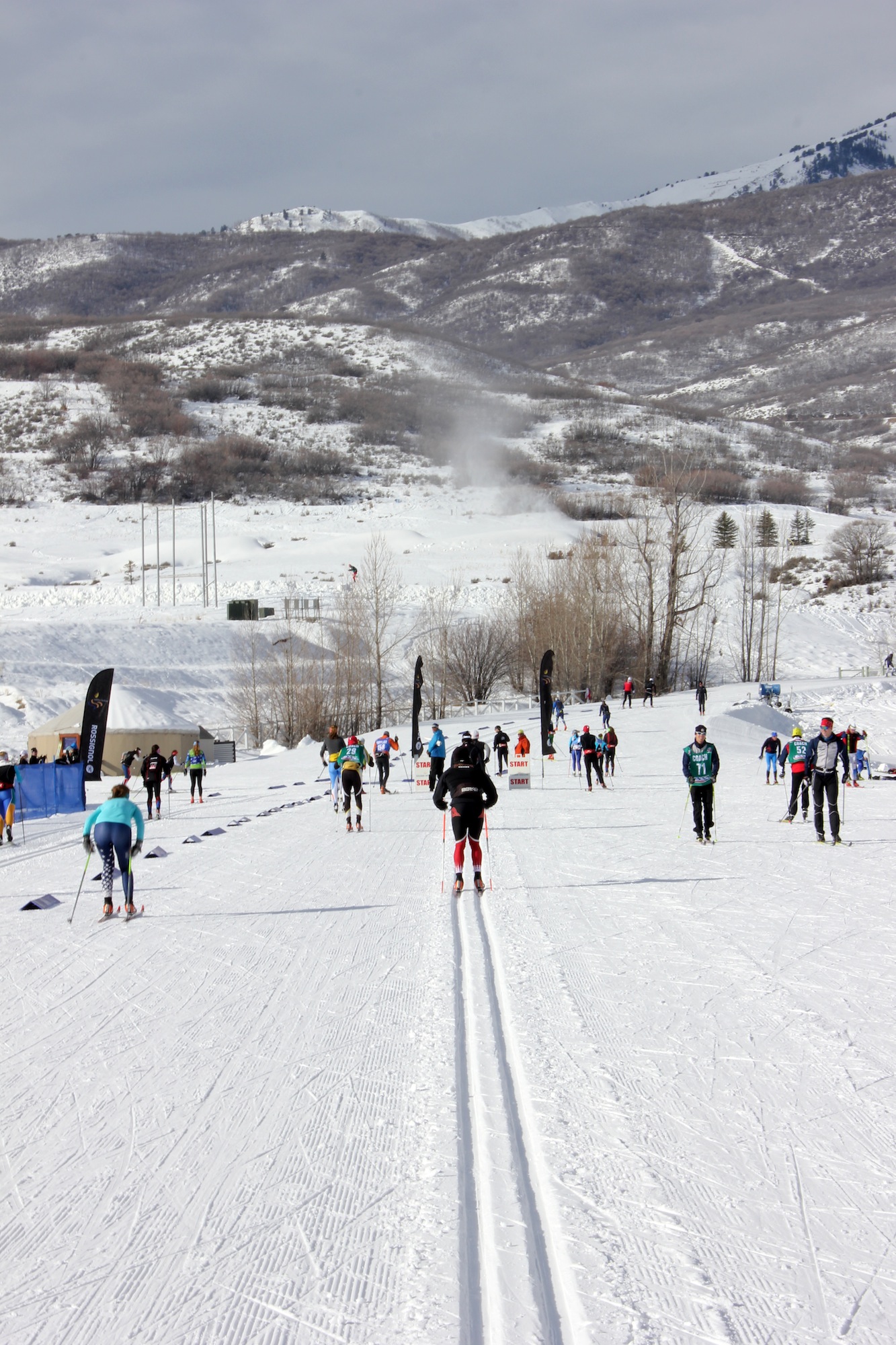
Athletes and coaches test skis in the stadium at Soldier Hollow in Midway, Utah, at 2014 U.S. Cross Country Championships.
Athletes will have nearly a month off before racing resumes with U.S. Cross Country Championships in January at Soldier Hollow in Midway, Utah. There is a 10/15 k skate individual start on Jan. 7, a full classic sprint the next day, and a 20/30 k classic mass start on Jan. 10. A qualification-only skate sprint event rounds out the week on Jan. 12.
U.S. nationals visited Soldier Hollow fairly recently. The races were held there in 2013 and 2014, before moving to Michigan’s Upper Peninsula for 2015 and 2016. The move back to Utah after only two years away is atypical.
The “main reason” for the quick return to Soldier Hollow, Lazzaroni said, “is because of World Juniors.”
The U23/Junior World Championships will be held at Soldier Hollow from Jan. 30 to Feb. 5, 2017, and will include roughly 750 athletes from dozens of nations. Some of those athletes will be junior and U23 skiers from the U.S., and Lazzaroni said that USSA wants to provide American skiers with a home-field advantage: “It was very important to us to bring the Championships back to the U.S., to show our commitment to FIS, and also to provide our athletes home-field advantage.” Lazzaroni explained that the best way to give American athletes this advantage was to give them an additional chance to race at Soldier Hollow in advance of the championships.
Therefore, Lazzaroni explained, USSA did not look back to the last time when U.S. nationals were held at Soldier Hollow in setting this year’s schedule. Rather, they looked forward, asking how best to prepare American athletes for Junior Worlds. And the answer was to let them race at Soldier Hollow in January before – for some skiers – racing there again in February.
But there will be something missing from this year’s edition of U.S. nationals: a national championship skate sprint. Instead, in the 2016/2017 season only, the national championship skate sprint will be held at the season-ending SuperTour Finals, as part of a race series colloquially known as Spring Series.
This schedule change, Lazzaroni explained, is due to the overall load on the Soldier Hollow volunteers and local community. It is “asking a lot of the venue” to hold both U.S. nationals and Junior Worlds at Soldier Hollow within the same month, Lazzaroni said. Among other inconveniences, he noted that there is an elementary school at Soldier Hollow, which also serves as the timing building and race headquarters, that has to be shut down when high-level races are held. Lazzaroni said that the local community was unable to commit to a full U.S. nationals schedule, including a full skate sprint day, on top of its other hosting obligations.
A quarterfinal in the freestyle sprint at 2013 U.S. nationals at Soldier Hollow in Midway, Utah. There will be no heats at this year’s national skate sprint; a qualification-only skate sprint will be held instead.The initial solution was just to take away the sprint race, moving U.S. nationals week from four races down to three. But, Lazzaroni said, this created a problem from the perspective of U.S. Ski Team Head Coach Chris Grover, who needs to oversee the selection of the U.S. team for the 2017 World Championships in Lahti, Finland, later this winter.
The races in Lahti include an individual skate sprint and a team classic sprint. The first half of the SuperTour schedule includes two classic sprints, but only one skate sprint.
The compromise, Lazzaroni explained, was a qualification-only skate sprint event at Soldier Hollow on Jan. 12. This was acceptable to Soldier Hollow event organizers and volunteers. And, Lazzaroni states, he feels that this “was a good compromise.” This way, “Grover can still have a qualification to make sure he has the best skiers to go to Lahti, and we don’t burn out the skiers and volunteers at Soldier Hollow.” The result will be a qualification-only skate sprint day, with no rounds contested. Results from the qualification will be used for purposes of qualifying for the U.S. World Championships team, but will not be scored for SuperTour points.
Following the skate-sprint qualification event, athletes have nine days off before racing on the Auburn, Calif., trail system in late January. A classic sprint will be held on Jan. 21, and a 5/10 k skate individual start on Jan. 22.
Period Three: Why not Ishpeming?
Roughly a month later, the SuperTour resumes with two races in Ishpeming, Mich., about 15 miles outside of Marquette on the state’s Upper Peninsula. There will be a skate sprint on Friday, Feb. 17, and a 5/10 k classic individual start on Sunday. (A 15/20 k mass start skate race, which will be a FIS-sanctioned collegiate race but will not be scored for SuperTour points, will be held on Saturday.) The race weekend will be held in conjunction with the NCAA Central Region Championships hosted by Northern Michigan University.
Al Quaal Recreation Area (Photo: Travelmarquettemichigan.com)The trails at Ishpeming’s Al Quaal Recreation Area last hosted a FIS event in February 2016. Before that, the previous and only entry for Ishpeming in the FIS results database is for a race weekend in February 1993. Suffice to say that it’s been a while.
So why Ishpeming? As Lazzaroni explained, repeating part of a reporter’s question, “You say, ‘Why Ishpeming?’ I would say, ‘Why not Ishpeming?’ ”
He said USSA attempts to rotate the SuperTour sites within the regions each year, and that this year the mid-season races are coming to the Midwest. It also recognized that the American Birkebeiner is held in the Midwest in late February, so there is an incentive to keep the SuperTour in the area. And Theodore Wirth Park in Minneapolis is undergoing construction work at present, and so was unable to host SuperTour races this year.
Lazzaroni explained that USSA was looking for a venue that could host SuperTour races for two weekends in a row, but was unable to find any venue that would take on this commitment. He said that they were pleased to get a taker for just one weekend in Ishpeming (population approximately 6,500), which has newly homologated trails and was eager to show them off. When the discussion was opened regarding bringing the SuperTour to the Midwest, Lazzaroni said, Ishpeming jumped on board.
“They have a long tradition of nordic skiing,” Lazzaroni noted, adding that Ishpeming was hosting cross-country races as early as 1905. The National Ski Association of America, a group that would later become the modern-day USSA, was founded in Ishpeming that same year.
Although last year’s Birkie was only scored for half SuperTour points, USSA has since revisited this assumption. At this year’s working group for the SuperTour schedule, Lazzaroni explained, they opened the question of whether the Birkie should count for full points or half points. Although some people had argued over the past few years that the Birkie should count for only half points, because it is often not a “normal” race distance, he clarified that the USSA Nordic Competition Guide makes “no mention that it should be half points.” Accordingly, USSA opted to follow the Comp Guide and restore the Birkie to full-points status.
Something less than a full SuperTour field typically races the Birkie; there were 17 American skiers with FIS points in the men’s elite race last year, and nine in the women’s.
Period Four: Spring Series in the Golden Heart City
A month after the Birkie, racers will travel north to end the season at Spring Series in Fairbanks, Alaska. Races will be held every other day over a week-long period from March 27 to April 2. A skiathlon, a skate sprint, a mixed club relay, and a 30/50 k mass start skate race are on the calendar. With a full skate sprint not being held at U.S. nationals in January, all events save the skiathlon will be national championship races.
Longtime Fairbanks race director John Estle is already excited. In an email to FasterSkier, Estle explained that the races will be held on a series of newly homologated and re-homologated courses at Fairbanks ski area Birch Hill. He noted that the new men’s sprint course will be “between 1500 and 1600m, which seems to be the preferred distance for sprint courses. Guys seem to like them to be about 3:30 in duration.” The women’s course will be “just a bit shorter than the men’s course.”
A 2012 photo from the trails at Birch Hill in Fairbanks, Alaska. (Photo: Lauren Fritz)After explaining the combinations of homologated loops that will be used for the various races, particularly the 30 and 50 k races on the last day of the season, Estle concluded, “The courses for those races will be quite challenging.”
Of the four races at Spring Series the skiathlon stands out, for its presence as well as its non-canonical distance. The suggestion on the official schedule that the distances will be 14 k for the women and 24 k for the men is apparently not quite accurate. Rather, Estle wrote, the distances will be 15 k and 22.5 k, respectively. “That is because we will have two homologated 3.75Km courses, one for the classic leg and one for the skating leg. Two laps of each course for women, three laps of each course for men” comes to 15 k and 22.5 k.
Estle is well aware that, at the Olympic Games or World Ski Championships level, women typically race a 15 k skiathlon and men a 30 k. “But most of the feedback I got from coaches and athletes was that at the end of a long, long World Cup season 30Km would just be too much,” Estle wrote. “At the World Cup finals in Canmore last year they did a 30Km skiathlon on a 3.75Km course and a large chunk of the field was pulled from the race (and hence the tour) after getting lapped. That was on a really tough course on a really warm day, but still. Those were damned good skiers, and they were completely shot at the end of that race.” So 15 k and 22.5 k it is.
A skiathlon, over any distance, is a rare event at the SuperTour level. Estle recalled hosting skiathlons in Fairbanks in both 2008 and 2009, but it is unclear whether they have occurred in this country at the highest levels of domestic competition since then. (The races are often entered in the FIS database as “pursuit” rather than “skiathlon” when they are held in this country, making it difficult to search for them. They are held more broadly at the high school and citizen racer levels.)
Skiathlons may be uncommon at this level of competition, but there seems to be widespread agreement that there should be more of them.
As Estle wrote, speaking as a race director, “One of the reasons that we are doing a skiathlon is that nobody ever does them in the US. … A skier’s first experience in a format contested at the World Championships should not be at those championships: Junior WC or U23 WC. If we are thinking about developing skiers who can compete at the highest levels, and coaches who can support them, then we need to make sure that our domestic schedule (FIS or otherwise) provides the types of experiences that will prepare them for the next highest levels of competition. Our skiers need a broad spectrum of experiences, and right now, because there are very few, if any, skiathlons on the domestic schedule, we are not preparing those skiers as well as we could or should.”
Lazzaroni sounded similar notes on behalf of USSA, saying that the skiathlon is contested at various international championships, and “why not prepare our athletes for that?” Echoing Estle, he noted that athletes reported back from the most recent World Junior Championships that they had never done a skiathlon before, “And that’s not right.” Lazzaroni said that he wouldn’t expect to see “many, many more [skiathlons] in the future” – but he added, “my vision is that, yes, we should train our skiers to be better at skiathlon, to be better prepared to do skiathlon.”
U.S. Ski Team Women’s Coach Matt Whitcomb was in complete accord, telling FasterSkier in a recent interview, “It’s often that at the junior and even U23 level when we go internationally, that we’re scrambling last-minute to find skiathlon boots, or to teach athletes how to load an exchange zone and what the rules are. So we’ll consider this just a quick dose of education for our entire community, and I think it’s going to have a big effect.”
The athletes seem to agree as well. Lex Treinen of APU, a top domestic athlete who has recorded SuperTour podiums but has not yet raced on the World Cup (which sees a handful of skiathlons each year), wrote in an email that he had done a skiathlon in Fairbanks some years ago – but that otherwise, “I have just done a couple at World Juniors and U23s.”
As Treinen explained, “Skiathlons are great and there is a good reason that they don’t do them very often on the Supertour: they are a pain in the ass logistically … for coaches and athletes and as the APU SuperTour team operates right now, we would not have the resources to wax for a skiathlon very effectively most of the season. Fairbanks will surely be an exception, since #1 it is closer to home and #2 it is Nationals which means there is a little bit of extra tech support from our team. Either way I don’t have a doubt that the fittest person will win this March and I really think it is a positive thing to be able to race some new formats. I am very excited that the Fairbanks organizers have decided to do something novel.”
Annie Pokorny, of the Sun Valley Ski Education Foundation (SVSEF) Gold Team, expressed similar sentiments. “The only skiathlons I’ve raced were at U23 World Champs, one in the Czech Republic and one in Italy,” Pokorny wrote in an email. “Despite my slim experience, however, I was incredibly excited to hear that USSA had integrated the skiathlon into domestic racing.”
Pokorny wrote that, “While it will certainly take some adjustment, I am always excited to see a diversified schedule on the SuperTour circuit. The more events we have, the more opportunities there are for varied competition and exposure to certain skills that our World Cup brethren see on a regular basis. Personally, the skiathlon is one of the most fun and exciting races I’ve ever entered. Having a switch in technique changes the rules of the game so there are more chances for comebacks than in a traditional mass start.”
When asked whether she was going to do anything special to prepare for this addition to the schedule, Pokorny wrote, “Few people know this, but in my first skiathlon I literally had the slowest transition time in the world, by many seconds. I don’t think I’ll need to change training much to be ready for the racing part, but it would be in my best interest to spend some time skiing while taking on and off my poles.” (Pokorny, who finished 29th in that race, is correct that her transition time ranked 48th out of 48 skiers.)
Looking to the future: Cross-country ski cross?
While this year’s SuperTour aims at selecting the U.S. team for Lahti and assigning start rights for upcoming World Cup events, USSA is also looking toward the future. And to hear Lazzaroni tell it, the future may involve cross-country ski cross.
Hannah Halvorsen (Far West/Sugar Bowl Academy) qualified 10th in the first-ever Cross-Country Cross event at the 2016 Youth Olympic Games in Lillehammer, Norway. (Photo: Far West/Facebook)“The cross-country cross has been a big success at the Youth Olympic Games in Lillehammer this winter,” he said. “It’s a format that the TV likes, the athletes like, that everybody likes. … I do hear from FIS that this is a format they want to push forward. We don’t know yet where it is going to go, but this is something we are keeping our eyes open [for], and I would not be surprised if you will see cross-country cross at some of the national events in the near future.”
Lazzaroni clarified that, by “near future,” he does not mean right away – “Obviously not next winter.” He added that this could become an important event to prepare U.S. athletes for larger stages: “Again, if this is going to be an event at World Juniors down the road – in two, three, four, five years, I don’t know – at Olympics, down the road – we should prepare our kids. And we have this discussion at Congress with the club coaches at a younger age, and we did encourage them to put some cross-country cross events at the local races. And again, the kids love it, because it’s fun. It’s working on agility, and it’s working on balance, and they become better skiers. It’s not now on the calendar, but I wouldn’t be surprised if in the near future we see more and more of this type of events.”
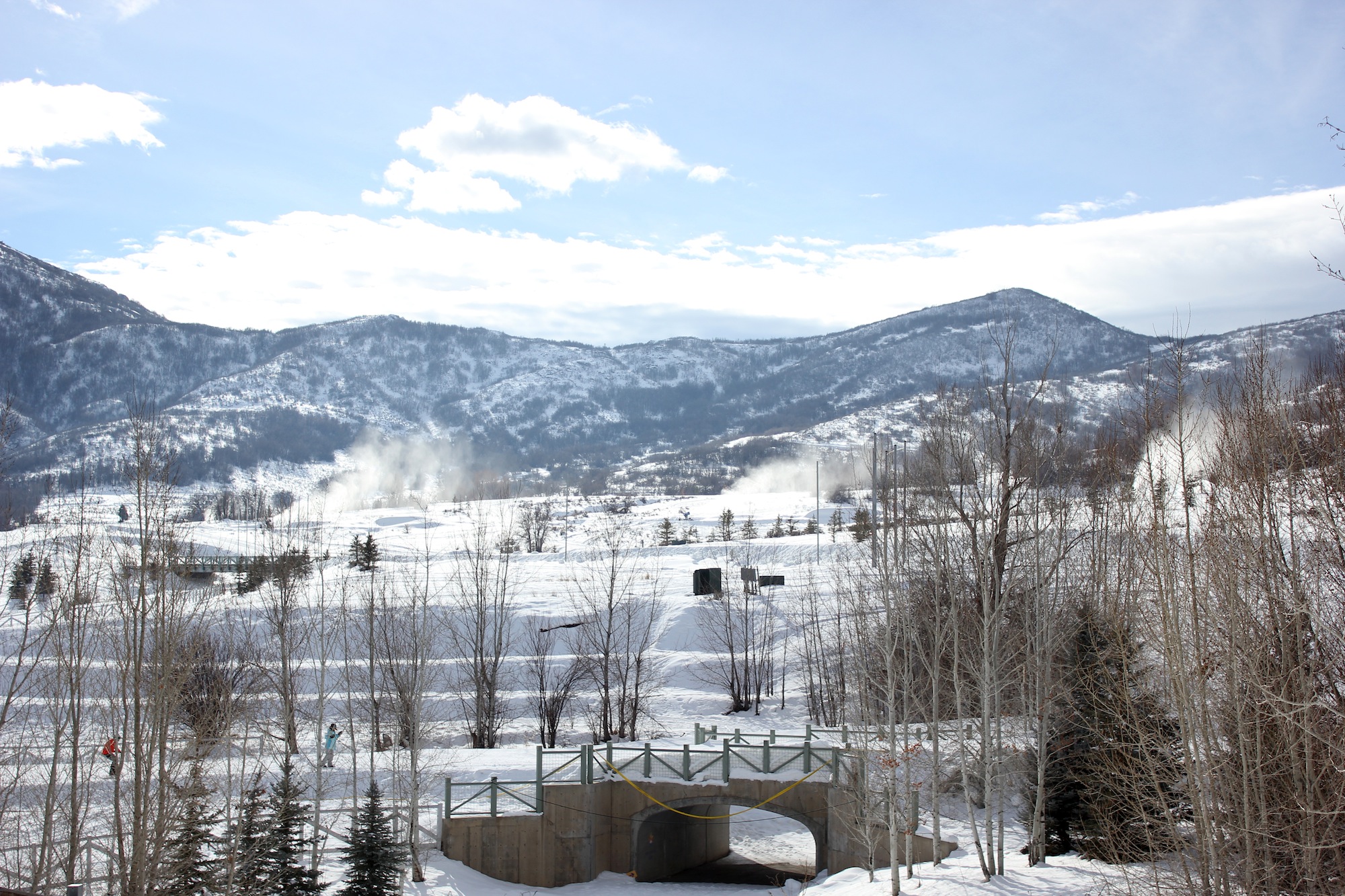
Snowmakers in action at Soldier Hollow in January 2014. The 2002 Olympic venue in Midway, Utah, last hosted the U.S. senior national championships in 2014 (as well as the year before in 2013) before Houghton, Mich., hosted in 2015 and 2016. Nationals are returning to SoHo this coming January.
PARK CITY, UT – Top cross country athletes from across America will participate in 16 races at seven different stops as part of the U.S. Ski and Snowboard Association’s (USSA) annual USSA SuperTour. The 2016-17 tour kicks off in December in Bozeman, MT.
The SuperTour is a series of International Ski Federation (FIS) sanctioned cross country ski races taking place across America, produced by the USSA, together with its divisions and clubs. The Tour is a vital piece of the USSA’s development program, providing top level racing at key cross country centers around the nation. It’s a proving ground for club athletes with aspirations of making it to the U.S. Ski Team and competing on the FIS World Cup tour and in the Olympic Winter Games. Caitlin Patterson (Craftsbury, VT; Craftsbury Green Racing Project) and Eric Packer (Anchorage, AK; Alaska Pacific University) took the season long titles in 2015-16.
“The USSA has had great support from its clubs and divisions in putting together this year’s calendar,” said USSA Nordic Domestic Program Director Robert Lazzaroni. “We’ve rotated a few sites this year and will continue to move around in the future to get the SuperTour to new places. Moving the event around helps stimulate top-level racing in America.”
Period 1 includes stops in Bozeman, Mont., and Silver Star (Sovereign Lake), British Columbia. The decision was made at USSA Congress to start the series one week later than previous years and to combine with Canada to increase the field.
Period 2 will open in January with the L.L.Bean U.S. Cross Country Championships at Soldier Hollow in Midway, Utah. Soldier Hollow is also a site for the 2017 FIS Nordic Junior and U23 World Ski Championships. Athletes will then continue on to Truckee, Calif., for races on the Auburn trail system.
The third period will feature two stops in the midwest. Athletes will race on a new homologated trail in Ishpeming, Mich., before participating in America’s largest cross country race, the Slumberland American Birkebeiner, on Feb. 25 in Hayward, Wis. The series wraps up with the SuperTour Finals Mar. 27- April. 2 in Fairbanks, Alaska. Finals will also double as the L.L.Bean U.S. Championships for long distance and freestyle sprint.
“The divisions, venues, technical delegates and homologation inspectors have been working hard to develop new venues and evolve current courses to strengthen the SuperTour,” stated USSA Cross Country Development Coach Bryan Fish. “We are making strides to include junior and collegiate racing within the SuperTour to enhance head-to-head racing with juniors, college athletes and our top World Cup competitors. Our collaboration with Cross Country Canada will also better prepare athletes for international competition. It’s an exciting year for cross country in the United States, and we’ll get to showcase this to the world during Junior World Championships.”
Athletes will also vie for for points across the tour to earn Continental Cup leader starts and World Cup starts. There will also be spots available for the 2017 FIS Nordic World Ski Championships Feb. 22 – March 5 in Lahti, Finland. Those spots will be awarded after the conclusion of the U.S. Cross Country Championships in January.
(*Note: U.S. championships also include a freestyle sprint qualifier, which serves as a qualifier for 2017 World Championships but will not be scored as a U.S. nationals or SuperTour event)
Jan. 21-22, 2017
Truckee, CA
Men: Sprint CL, 10 km Free
Women: Sprint CL, 5 km Free
Period 3
Feb. 17-19, 2017
Ishpeming, MI
Men: Sprint Free, 10 km CL
Women: Sprint Free, 5 km CL
Feb. 25, 2017
American Birkebeiner
Hayward, WI
Men’s and women’s 50 km Free
Period 4
Mar. 27-April 2, 2017
SuperTour Finals
Fairbanks, AK
Men: 24 km Skiathlon, Sprint Free, Relay, 50 km Free
Women: 14 km Skiathlon, Sprint Free, Relay, 30 km Free
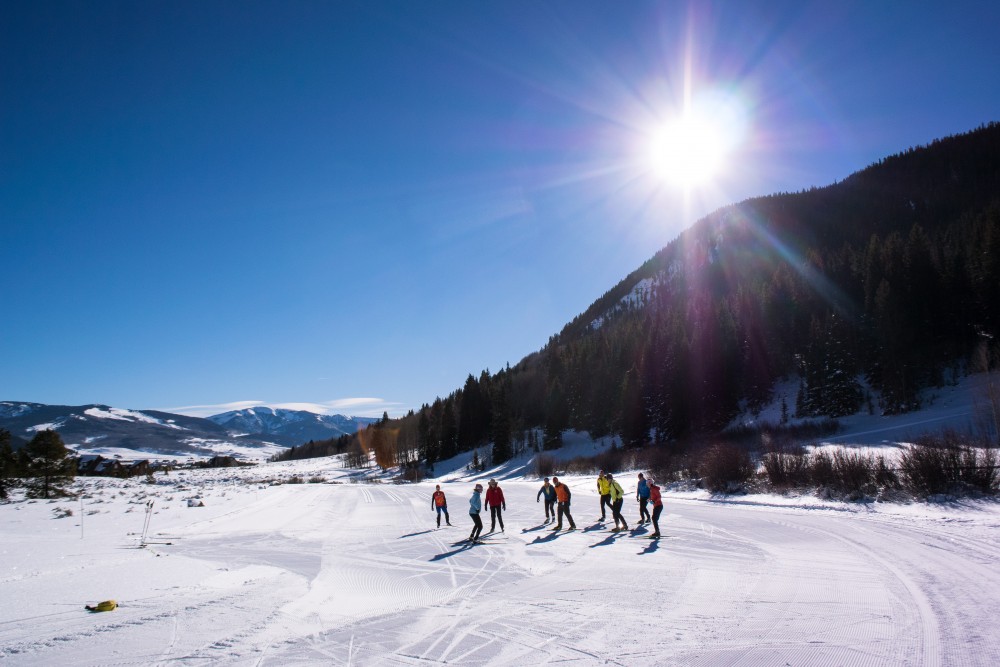
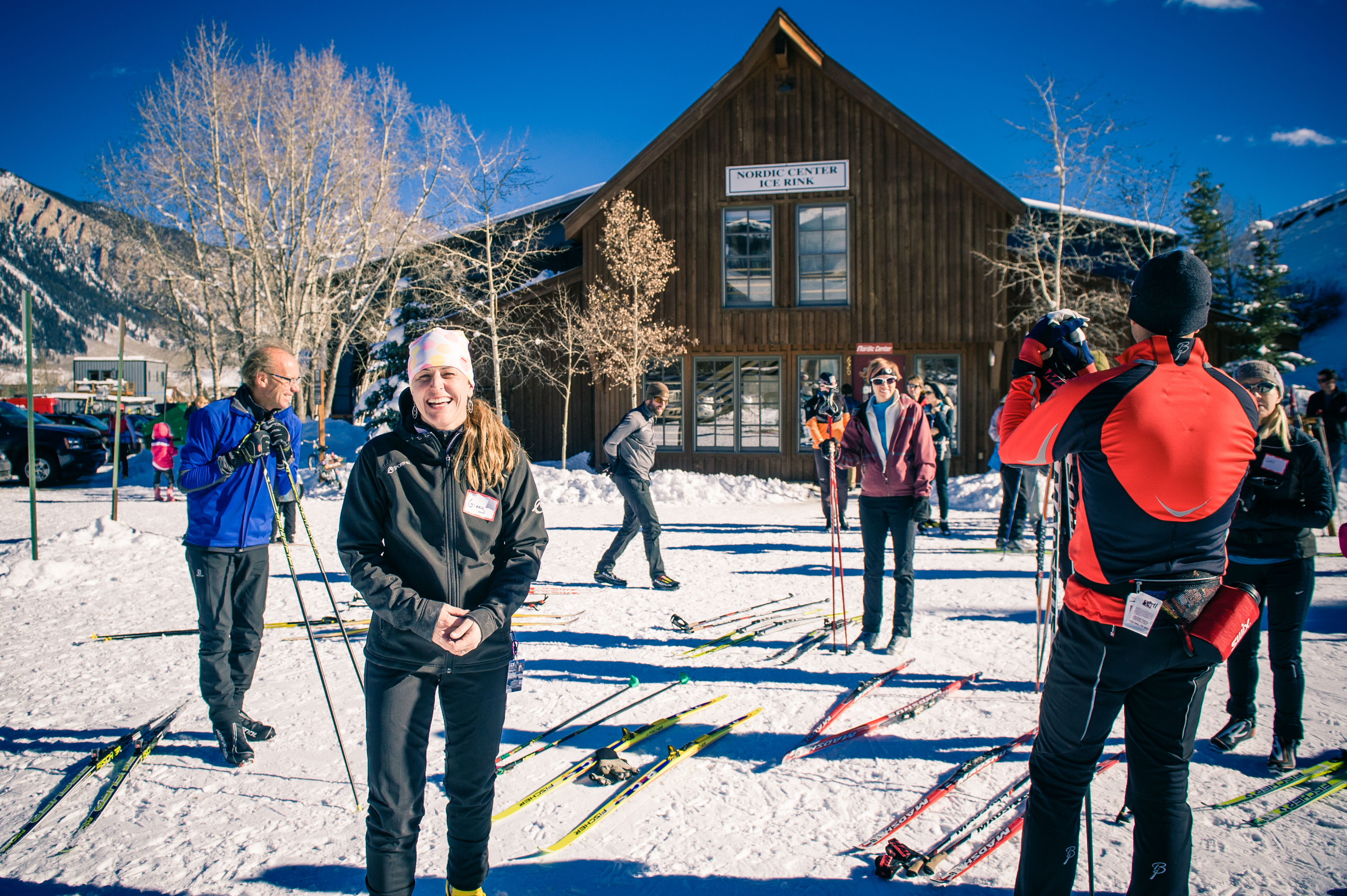
Sun stretches over the hills during a cross-country lesson at Crested Butte in Colorado. The nordic center there is hosting its annual Crested Butte Nordic Thanksgiving Camp from Thursday to Sunday. (Photo: Xavier Fane)
We’ve been hearing about West Yellowstone since, well, the U.S. Ski Team officially started its annual Fall Camp there in 1978. But surely, Montana’s southern tip can’t be the only place to get on snow this time of year…
That’s why we provided a guide to Thanksgiving on-snow camp venues in the U.S. and Canada (we realize this week isn’t Thanksgiving in Canada, but we’re sticking to areas that offer skiing around this week in late November for all intents and purposes). If we’re missing an early season camp, we apologize — it’s a big continent — but let us know so we can feature that camp in next year’s guide.
***
What:Yellowstone Ski Festival
Where: West Yellowstone, Montana
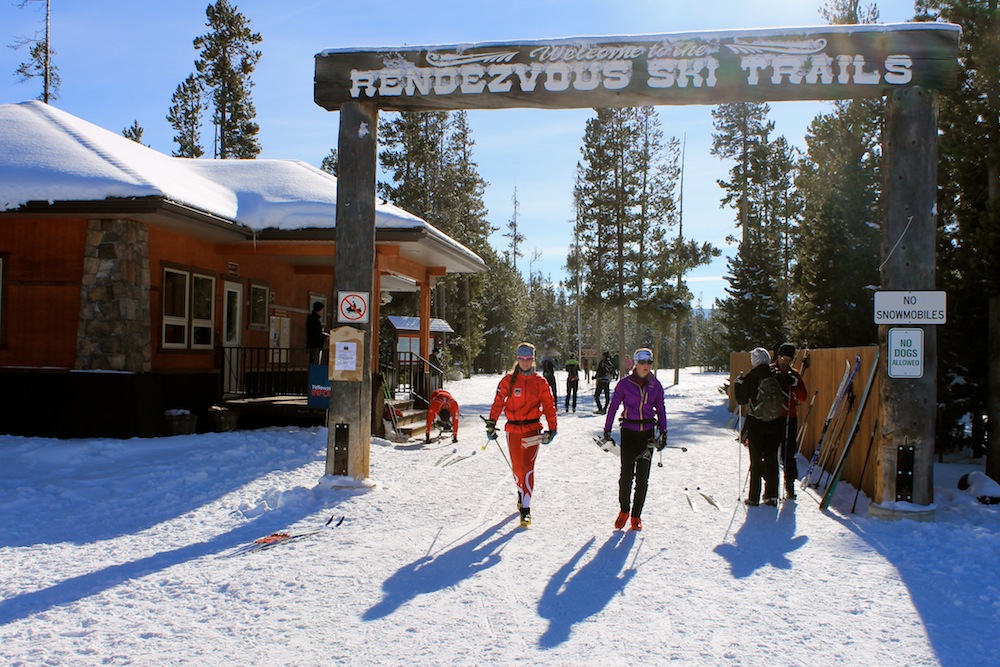
Each year, the Rendezvous Ski Trails see hundreds of skiers each day during the Yellowstone Ski Festival on Thanksgiving week in West Yellowstone, Mont.
When: Tuesday, Nov. 24, to Saturday, Nov. 28, 2015
How many years running? 20+
Target audience: Masters and beginners (clinics available for both), as well as elite racers
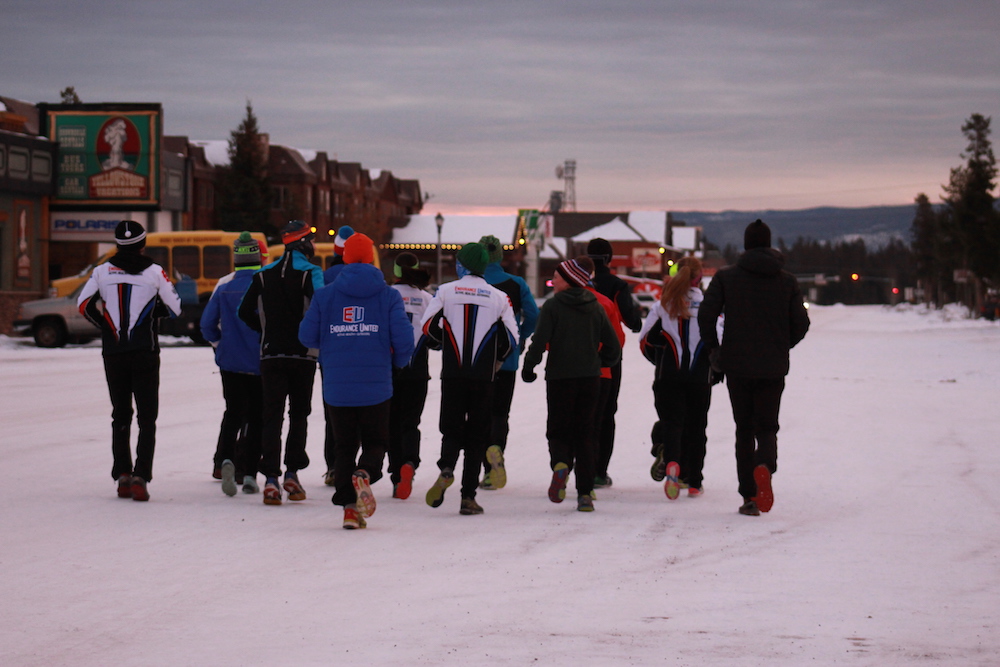
Endurance United team members get ready for a day of skiing during a morning run in West Yellowstone, Mont., at this year’s 2015 Yellowstone Ski Festival. (Photo: Gabby Naranja)
Anticipated participation: An estimated 4,000-5,000 skiers throughout the week. “It varies from year to year depending on the snow conditions and the snow level,” West Yellowstone Ski Education Foundation Program Director Moira Dow explained. “Because we’ve gotten snow early this year and good snow, we have been able to get the word out. Like right now the trails are packed. We will probably have a lot of people coming for longer periods of time.”
Advance reservation required? Racers must preregister. Trails are open to public; trail pass required.
Grooming report: Essentially everything is open. “It’s full-coverage skiing on good skis with full tracks,” Dow said. More details | Webcam
Green Mountain Valley School nordic skiers meet up during a ski on the Rendezvous Ski Trails this week in West Yellowstone, Mont. (Photo: Gabby Naranja)
What makes this camp unique? “The number of trails and the quality of snow that we have. We’re one of the few places in the country that does have consistent, early, good snow. In addition to that, we have a lot of industry participation. And we have great evening programs for people. We have not just skiing, we have the full package for everybody and anyone, from the beginner skier who wants to get out on the snow for the first time, to the SuperTour elite athlete who can train at high altitude, and good snow in the early part of the season.”
Special events:
U.S. Ski Team Development Coach Bryan Fish and the former vice president of Fischer Skis U.S. nordic division, Peter Ashley, will be featured speakers
Freebies: “Everything at the indoor expo at night is free. Anybody who has a trail pass can get into the outdoor demo area for free. In addition, on Wednesday and Friday night we have ‘après-ski’… [with] complimentary adult beverages and junior beverages, sledding, some music, and fun stuff like that. Just a little bit more of a party atmosphere after the sun goes down and before the expo opens.”
***
What:Crested Butte Nordic Thanksgiving Camp
Where: Crested Butte, Colorado
The Crested Butte Nordic Thanksgiving Camp, now in its 14th year, is a fundraiser for Crested Butte Nordic, a nonprofit dedicated to getting people on the local trails. (Photo: Xavier Fane)
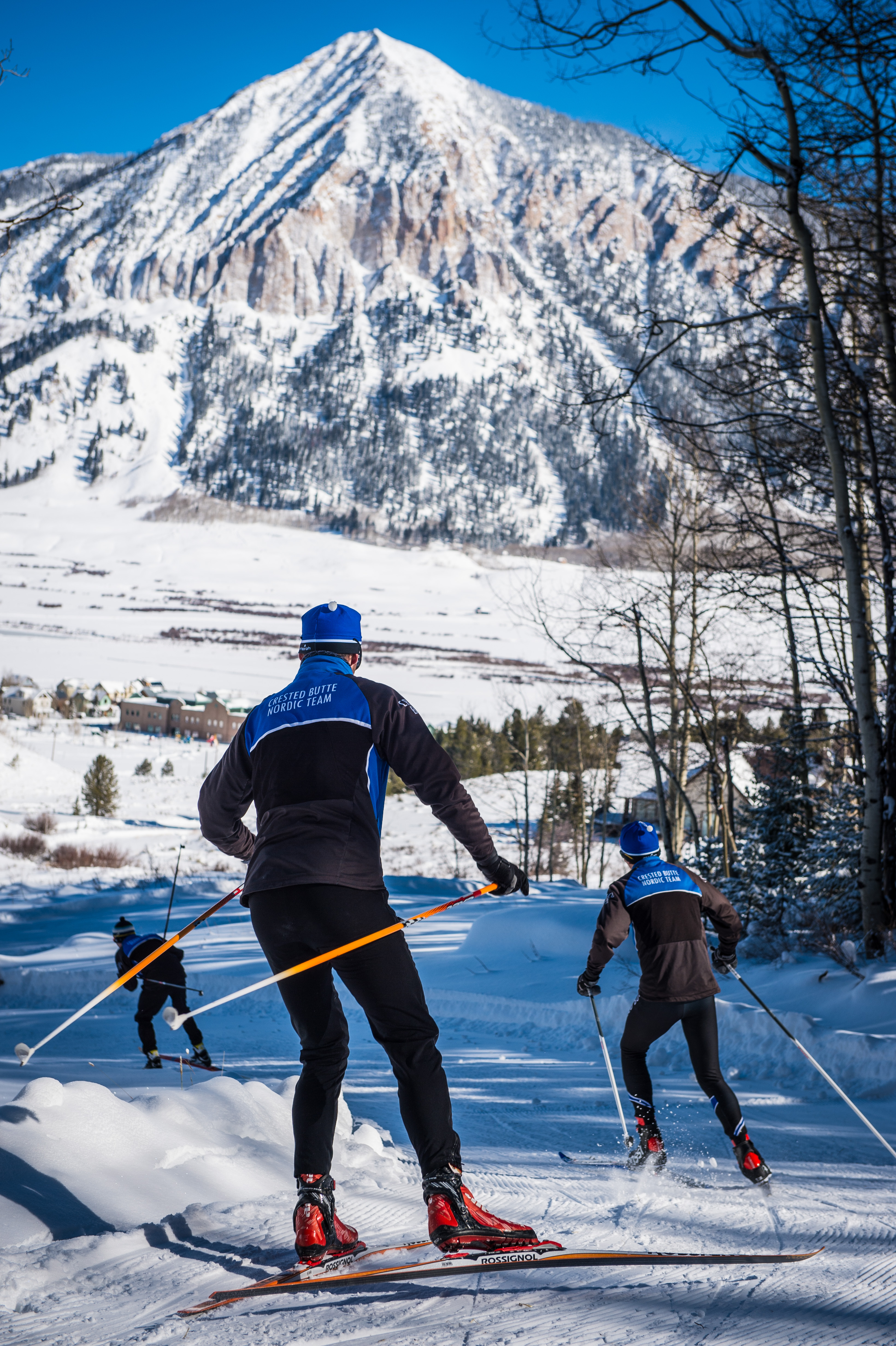
Skiing at Crested Butte Nordic in Colorado. (Photo: Xavier Fane)
How many years running? 14 as an official organized camp: “Crested Butte has really good and reliable early season snow so the Nordic Center decided we should try to get folks to come here and get some instruction from our great instructors,” said Drew Holbrook, marketing director for Crested Butte Nordic and the Grand Traverse ski race. “We also have a wonderful venue for early season nordic skiing and we’ve been fortunate enough to have been on-snow every year.”
Target audience: All ages and abilities, “from never-evers to master blasters looking to improve their technique,” Holbrook said. “If parents are skiing along with children, kids ski free. All kids 17 and younger get free passes and rentals. And, actually, all season long we do that — people 17 and younger ski free. At the Thanksgiving Camp we also do free kids clinics. So if a parent is taking a clinic, then they can have their kids taken care of all day.
Anticipated participation: Several hundred skiers on the trails throughout the long weekend. For clinics, projecting 75-80 participants.
Advance reservation required? Pre-registration recommended for clinics.Nordic Center trail passes available any time. Skiing at Lily Lake, a 10 k early season trail system four miles up Kebler Pass Road, is free.
Trail pass rates: $18/day, skiers 17 & younger ski free. $130 for a 10-punch transferable pass.
Grooming report: With about a foot of snow at the venue in town, “it’s looking like in-town skiing for the camp,” Holbrook said. As of Tuesday, Ruthie’s Run (5-kilometer loop at the nordic center and up on the bench) and Lily Lake (six miles west of town up on the pass) were groomed. “We’ll have over 10 kilometers of high quality skiing available,” Holbrook added. More details
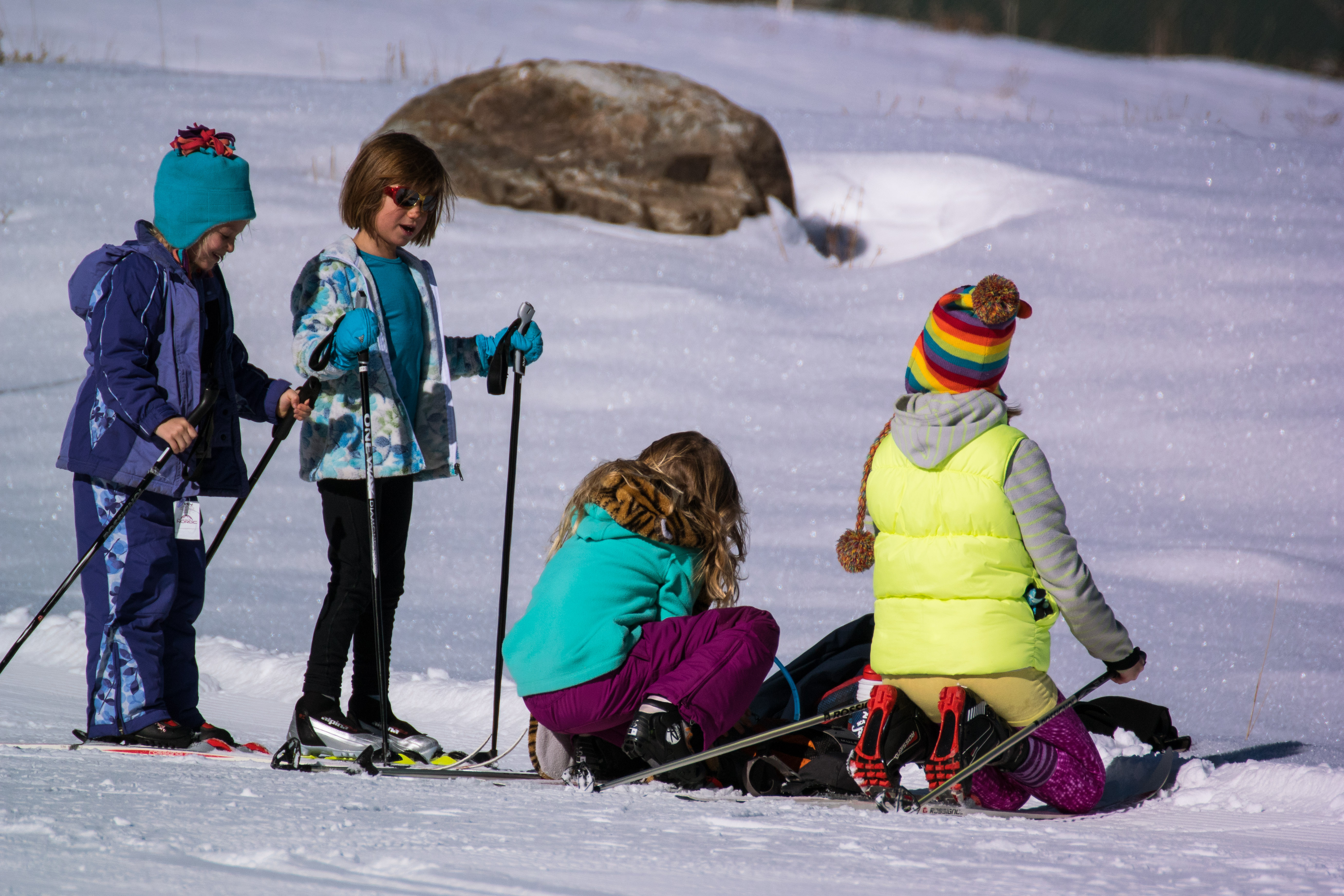
Here’s a deal: Kids 17 and under enjoy free rentals, passes and clinics at the Crested Butte Nordic Thanksgiving Camp. (Photo: Xavier Fane)
What makes this camp unique? “As a non-profit, our mission is to get people out on the trails skiing. We are not making a ton of money off it,” Holbrook said.
“We just want people to come here and use our trails and make it affordable. A lot of people come back year after year and work with the same instructor. They get to know each other and get to know the other people that come into camp. So it’s definitely got this small feel to it, it’s kind of personalized.”
Special events:
For the first time, a race (on Sunday): 5/10 k freestyle + kids’ race with new homologated course on Ruthie’s Run. “It’s engineered, seeded, and mowed,” Holbrook said. “Due to the engineering, we are able to groom the race course with a lot less snow than we used to need. That enables us to count on having this race and count on have a good race venue close to town.”
Winter Kick-Off Party (Saturday night): Fundraiser for Crested Butte Nordic, tickets $30/adult,$10/children.
Wax clinic, nutritional talk and Nov. 25 is opening day at Crested Butte Mountain Resort, with free skiing all day.
***
What: CXC Thanksgiving Nordic Festival
Where: Telemark Trails in Cable, Wisconsin
After three nights of blowing snow, CXC Thanksgiving Nordic Festival organizers were ready to groom the Telemark Trails in Cable, Wis., on Nov. 22. (Photo: Facebook)
When: Wednesday, Nov. 25, to Sunday, Nov. 29, 2015
How many years running? First year. “Our goal for the festival is to show the template to other communities, what it takes to make snow … to provide a business and operations template to other places around the Midwest so they can do these festivals in late November and then have a reliable loop for the winter,” CXC Executive and Athletic Director Yuriy Gusev explained.
A 1 k loop was made and groomed for the first-annual CXC Thanksgiving Nordic Festival in Cable, Wis. (Photo: Facebook)
Target audience: All skiers; open to the public
Anticipated participation: Based on the camp’s Facebook page, at least 75 plan on attending, and Gusev estimated that paired with a local turnout would amount to 200-300 skiers. “We don’t want to make it a big deal … just to show the community this is an opportunity to ski,” he said.
Advance reservation required? Yes, for clinics (instructed by Gusev on Friday, Saturday and Sunday).Trails open to public.
Trail pass rates: $50 season passes, good for the festival and the whole winter. Trail passes can be purchased at www.cxcskiing.org/skipass, Telemark condominium office and Cable Area Chamber of Commerce Office.
Grooming report: Skiing on a 1 k loop at Telemark started on Sunday: “Usually there’s no natural snow this time of year, so our plan was to make snow,” Gusev said. “It just didn’t get cold like it normally does.” Once temperatures finally cooled late last week, the snowmaking crew was able to work on blowing and laying out a 1-kilometer manmade loop, some of which will be used for the 2016 Junior Nationals sprint course. More details
What makes this camp unique? “Anytime you have early snow, you stand out. I think it can be a key component to have this … to provide a reliable base for the rest of the winter, especially for youth programs where the snow is critical and also for entry-level participants. We’ve seen already with the couple snowmaking areas in the Twin Cities how much impact these have on the ski industry and local ski shops. They’ve been able to actually do relatively well in snowless winters.”
Special events: Fischer Demo
***
What: Snow Mountain Ranch Nordic Ski Camp
Where: Granby, Colorado
A November day at Snow Mountain Ranch, which opened for skiing earlier this month and remains open with 50 k groomed with a set track. (Courtesy photo)
How many years running? First time in recent years
Target audience: Beginner skiers to seasoned racers
Advance reservation required? Yes.
November skiing at Snow Mountain Ranch in Granby, Colo. For the first time this year, a five-day camp was held for masters. It ended on Tuesday. (Courtesy photo)
Participation: Capped at 24. “Smaller is better from both a coaching and athlete viewpoint,” Snow Mountain Ranch’s Nordic Center Director Bill Pierce explained. In its first year with little marketing, the five-day camp attracted four athletes.
“It was really small, but it was great,” Pierce said. “It’s so early that people don’t expect there to be snow [when] it’s 60 degrees in Boulder. … We just want to put another option out there; a lot of skiers want to be on snow in early November and Denver is really easy to get to.”
Trail pass rates: $350 for the camp, includes all coaching sessions and day passes
Grooming report: 50 kilometers groomed and track-set. Snow Mountain Ranch started grooming Nov. 4 and opened for skiing on the 14th. According to Pierce, they have anywhere from a 4-5 inch base to 10 inches in some places. It was snowing there on Thanksgiving, with four inches of snow expected to fall today. More info | Webcam
What makes this camp unique? “This is the earliest masters camp in North America on-snow as a pre-Thanksgiving camp,” Pierce explained.
The idea was to run a masters camp similar to an elite or junior camp, with two-a-day sessions combining workouts and technique — all at 9,000 feet above sea level. The focus was on transitioning from dryland training to snow skiing, with an emphasis on technique and slow volume at high altitude.
With a small but mighty coaching staff (two of which are USSA certified), Pierce said the ability to work with athletes helps them set, understand and achieve skiing goals.
“We all speak the same language,” he said of the coaches. “You can go to a lot of places, and a lot of places you feel like you’re getting a lesson. There’s a difference between a lesson and coaching.”
“[This camp is] just another opportunity in the country to go skiing all day,” he added.
When: 2 1/2-day weekend and 5-day midweek camps (schedule):
A gaggle of skiers at a junior camp head out on the trails at the Sovereign Lake Nordic Centre on Nov. 14 in Vernon, British Columbia. Roughly 800 skiers took to the trails that day. Each winter, Sovereign Lake hosts a series of weekend and weekday camps, called SuperCamp. (Photo: Gerry Furseth)
Camp #1:Nov. 20-22
Camp #2: Nov. 23-27
Camp #3: Nov. 27-29 (with Pro-camp option)
Camp #4: Nov. 30-Dec. 4
Camp #5: Dec. 4-6
Camp #6: Jan. 15-17
Camp #7: Feb. 19-21
How many years running? 26 (The SuperCamp program started in 1989)
Target audience: All ages and skill levels from beginner to elite racer.
Advance reservation required? Yes.
Anticipated participation: Typically around 225 to 250 participants, hoping for 260 this year.
“In its heyday in the early ’90s [SuperCamp attracted] upwards of 400,” Sovereign Lake Nordic Center General Manager Troy Hudson explained. “We want to get back to those numbers by offering some great new initiatives like focussed Masters Pro camps for racers and more options such as the biathlon camps which are proving to be very popular.”
Trail pass rates: Dual area trail passes included in camp fee, ranges from $339 to $925 Canadian dollars per person (depending on length of camp, and half or full days). Pricing
VR40 blue-wax skiing on Nov. 16 at the Sovereign Lake Nordic Centre in Vernon, B.C. (Photo: Ryan Olson)
Grooming report: Sovereign Lake has 40 kilometers groomed and Silver Star has an additional 40 k open. More details (and webcam)
What makes this camp unique? “I’m often asked, what is Supercamp?” SuperCamp coordinator Shane Landreville wrote in an e-newsletter. “That’s a great question and because Supercamp offers so much more than a traditional ski lesson, it’s a difficult concept to explain and it’s difficult for people to wrap their heads around it. Quite simply, Supercamp is a Nordic experience.”
SuperCamp attracts top-level coaches, as many come from across Canada to get early snow before they start their season at home. Each camp includes lectures and lessons on waxing, how to build a training plan, and sports nutrition, as well as access to the national altitude training centre gym, and best of all, 105 kilometers of trails between Sovereign Lake and Silver Star — many of which are used for World Cup, NorAm, and World Master events.
With half- and full-day options, the camp is at an altitude of 1,600 metres (5,250 feet). Many of the accommodation options are on the nordic trails. You can ski or walk to restaurants and bars in the evening.
Biathlon camps are either five days long or a single afternoon, and a new Pro camp is more racing focused.
The Silver Star alpine area opened earlier this week, as did the separate Fat Bike trail system.
Special events:
Keynote speakers, a sports nutrition lecture, and wax clinics
Stretching classes, body pre-activation sessions, and for 5-day campers, two 30-minute massages. “Skiing for a solid 2 days or 5 days is tough, it really is, so taking care of your bodies is important,” Landreville wrote. “For our 5 day camps, you can also take part in the excursion to the spa and pools at Sparkling Hill Resort.”
***
Also: Canada’s Early Season XC Venues
What: Frozen Thunder
Where: Canmore, Alberta
Fresh snow at the Canmore Nordic Centre: A n Olympic Legacy Venue now a regular host of Canadian based World Cups. (Photo: Pavlina Sudrich)
How much snow: Boreal Glide, a 2.5 k manmade loop, is open for both freestyle and classic. Course map | Weather
Good to know:
According to according to Julie Moffet, the regional operations coordinator at Forêt Montmorency, la Forêt is the only place in North America with cross-country skiing as early as Oct. 30 all the way to Easter in April.
No races or special events are scheduled, simply skiing and snowshoeing for all.
To reserve a room on the trails (with two single beds and a shared bathroom), with access to a cafeteria, two lounges with a fireplace, game room, auditorium, and wax room, visit http://www.foretmontmorency.ca/en/lodging/
Blair Voorhees of Momentum Northwest leading the pack to the finish this winter. (Photo: Sam Naney/Momentum Northwest)
The Northwest as a region had one of the driest winters on record, keeping the brand new Seattle-based development program Momentum Northwest to no more than a couple of weeks of on-snow training locally. Despite all that, nobody is leaving the program, and more athletes are joining.
“Locally, it was a terrible winter in terms of snow and opportunities to get on snow, but the silver lining is that we’ve been able to do a lot of dryland training together and really build the team and the team spirit,” said Momentum Northwest head coach Sam Naney of the first season with the program.
Perhaps part of that good attitude comes from the fact that the team isn’t used to having snow in their backyard. Seattle itself receives just over six inches of snow per year, on average. Momentum Northwest lists their home ski area as the Cabin Creek Sno-Park, about an hour west on Interstate 90 and also the home of the Kongsberger Ski Club.
So Naney knew that dryland would be a big part of his work anyway. With that in mind, as well as frequent trips to Cabin Creek and a Thanksgiving Camp to Silver Star and Sovereign Lakes, British Columbia, Momentum Northwest offers two different programs: a fulltime program for skiers 12 years of age and older, with training sessions trains four times a week in the summer and fall and three to five times a week in the winter, and the “Mavericks” program for skiers aged eight to 11, which meets only on Saturdays during the winter.
“I think in some ways, the bad winter has made us better prepared to meet whatever conditions come our way, and the kids are mentally tougher for it,” Naney said of the low-snow winter. “We had some really good results despite the conditions and the lack of on-snow training, and that has given our kids the confidence that you can be competitive even though much of what they did all winter was dryland drills and short out-and-back ice skiing.”
The first line of Momentum Northwest’s athlete handbook is about excellence. The team’s goal, it says, is “Creating a national-caliber cross-country ski racing program in Seattle.”
But right after that, there are some other goals. The handbook lists core values: speed isn’t amont them. Instead you find personal growth, community and team building, commitment to excellence, and enjoyment.
Teaching those core values of sport doesn’t require snow.
“I quickly came to learn that those experiences come as a product of simply participating,” Naney explained. “If I can make the program fun, provide interesting workouts, fun van rides, and build a good team dynamic, the athletes will adapt to the changing circumstances with remarkable ease.”
Building a program from scratch is no easy undertaking. The team got a van, a banner, and bright blue race suits, but those are the tangibles – the intangibles like community involvement and name recognition are a bit harder. No matter: Momentum Northwest has found an underserved niche in the Seattle region.
“We are not competing with other programs, but we have to show people that Nordic skiing can be a complimentary part of the endurance lifestyle,” said Naney. “Even if you are already committed to track or cross-country running, Nordic is a good fit in that environment. And our program is no small commitment, so we have to show the families that they get something out of it.”
Momentum Northwest race trip to the Methow Valley this winter. (Photo: Sam Naney/Momentum Northwest)
Naney had a roster of more than two dozen motivated and eager athletes in his program when he launched Momentum Northwest’s first winter season last November. The kids were hooked in one season – with or without snow. But with no other full-time, performance-oriented Nordic programs in the Seattle area, Momentum Northwest also has to build a culture and a community around the sport.
However, several Washington areas with consistent snow have racing and development programs, such as the Methow Valley, Leavenworth, Wenatchee, Ellensburg and Spokane. Other regional programs include The Bend Endurance Academy, XC Oregon and Mount Bachelor Sports Education Foundation in Bend, Teacup Nordic at Mount Hood in Oregon, and Sandpoint in Idaho.
“Snoqualmie Nordic (based on Snoqualmie Pass, 50 miles east of Seattle) is the closest program, but they have more of a focus on beginner skiers and introducing families to the sport,” said Naney. “So far, we’ve actually been quite complementary with one another… Leslie (Hall), who is the Program Director of the successful Methow Nordic Team, helped connect me with some skiing families she knew in the Seattle area. That type of inter-program support is so beneficial and welcomed when you’re first getting started.”
At the moment, Naney is the only paid coach in the program. He’s helped by three assistant coaches: Jordan Goldwarg, a former Williams College skier and Dartmouth College development coach; Alexandra Sonnabend; and Halvard Berg, a former Norwegian junior racer. But those three work strictly on a volunteer basis.
Adding another paid coach is a big goal for the program in the next year. Naney seeks a ratio of about six to eight athletes per coach.
And while the roster is likely to grow, so too might the level of performance and the range of abilities of the athletes. Momentum Northwest may have been hurt by the lack of snow, but Naney believes that his athletes have high performance potential.
“When we have really good conditions and can ski three to four times a week on snow, you will see several of these kids go to Junior Nationals,” Naney said, adding the program is only losing two athletes from this year’s roster, simply because they are moving out of the area. “The kids realize that there is no limit to where they can take their skiing beyond our program. Some of them are kids you are going to see at the Junior Nationals in the future, some will ski in college and some will just enjoy the lifelong sport of skiing.”
Emerson Rogers of Momentum Northwest racing in the Methow Valley, Washington, this winter. (Photo: Sam Naney/Momentum Northwest)
The new coach’s favorite memory from the 2014-15 season was the team’s first race trip, where he took 10 athletes in the team van to Bend, Oregon.
“We competed against a huge field of PNSA juniors at the first Junior Nationals Qualifier of the season,” Naney recalled. “In the final race, Cooper Jackson, who is one of my U14 athletes, landed on the podium in a tight finish. When they held the medal ceremony, all the Momentum athletes were crammed in the front row and were excitedly discussing how they were committed to being the loudest cheering, most exuberant teammates of any of the medal winners, to show their support for Cooper and Momentum.”
That comes back to those core values and the team spirit that are as much a part of the goal as the podium was.
“It was a validation for me that what we’re doing here is working,” Naney explained. “These athletes are learning not only how to ski well, and even win medals, but how to be on a team and how to support one another in times where it is often all too easy to begrudge a fellow teammate their success. It was a great moment, and many more of them followed throughout the rest of the season.”
Cooper Jackson of Momentum Northwest (far left) in a mass start this winter. (Photo: Sam Naney/Momentum Northwest)
Rosanna Crawford and Brendan Green (not pictured) head off to Fort Simpson for Day 4 of their weeklong trip in the Northwest Territories last month. The two spoke at several schools in rural communities about biathlon and achieving dreams from April 20-24. (Photo: Brendan Green/Twitter)
Some might consider Rosanna Crawford and Brendan Green, Biathlon Canada’s power couple, restless. Shortly after flying home to Canmore, Alberta, after a three-monthlong stint in Europe for the IBU World Cup and World Championships, the two decided to pack up their skis and head five hours west to Sovereign Lake in British Columbia for some more skiing.
“The conditions there were incredible,” Green wrote in an email of their four-day excursion in early April. “A lot of people were wondering why we still wanted to ski after spending the entire winter racing in Europe, but racing and skiing for pleasure are different.
“A lot of people were wondering why we still wanted to ski after spending the entire winter racing in Europe, but racing and skiing for pleasure are different.” — Brendan Green, two-time Olympian and Canadian national-team biathlete
“During race season we never really have many opportunities to ski for fun and enjoy the trails — We’re always looking towards the next race,” the 28 year old added. “For me, skiing for fun in the spring is a nice way to decompress and reflect after the race season. The conditions in Silver Star were unreal with perfect snow. It was the nicest skiing I’ve done this year by far — most days it was hard to stop skiing!”
Rosanna Crawford (l) and Brendan Green at Sovereign Lake on April 4. (Photo: Rosanna Crawford/Twitter)
In all, they skied between 155 and 170 kilometers, according to Crawford.
“There was over 100km of trails still being groomed. It was the best snow we saw all year,” she wrote.
With the ski bug out of their system, the couple jetted south for a week of sun and sand in Mexico.
“It was awesome to feel some heat and force ourselves to relax, although our adventurous side did get the better of us and we did end up doing some beach running to explore the surrounding area,” Green explained.
Two days after returning from Mexico, the two ventured north — back to Green’s roots in the Northwest Territories — for a week of outreach. Last year, Crawford and Green visited schools around Hay River, where Green grew up, to share their experiences and world travels in biathlon. This time around, Green asked the Northwest Territories Power Corp. (NTPC) if it would support their visits to schools father north.
“I thought it would be fun to spend time in some of the more remote northern communities,” Green wrote. “I pitched the idea to one of my big supporters from the north, the NT Power Corp, and they were more than happy to sponsor the northern tour. It’s important to the NT Power Corp to support and empower youth in the north, and it worked out really well to have Rosanna and I help in this regard.”
Rosanna Crawford and Brendan Green with a few of the classes they presented to in A few of the classes we presented to in Fort McPherson. (Courtesy photo)
From April 20 to 24, the couple presented seven times at a total of four schools (elementary and secondary) in Inuvik, Fort McPherson and Fort Simpson, according to the Northern Journal.
They explained the nuances of biathlon and shared videos of their races, and Green also talked about his 2012 back injury and the surgeries he’s had since, as well as the challenges he faced as an up-and-coming athlete in a small Northern town, with access to fewer training resources.
“Even though Brendan’s from a Northern community that’s farther south [than these kids], it can still feel really isolated,” Crawford told the Journal. “Any small step along the way, even if something feels a little silly, can maybe help towards their bigger goals and dreams.”
Green described the week as busy, but fun, “and all of the kids were really great.”
“Some of the communities in the North are very remote, so it’s pretty rare that they have the opportunity to interact with Olympians,” he wrote. “There are very few northern Olympians, so it was great to be able to connect with the youth and talk firsthand about growing up in the north. I can relate to a number off the challenges that these kids face. It was also Rosanna’s first time north of the Arctic Circle, so that was a pretty neat experience for her as well!”
Now back in Canmore, Crawford and Green are on the training wagon once again.
“Training in May is hard and I always find it a tough transition,” Green wrote. “My body is sore for days. Even if I’m able to ski quite a bit in April and enter May in decent shape, it still takes my body a while to adjust back to the full training routine.”
So what does he do?
An athlete works out on Bill Koch’s roller board at the Stratton Mountain School in Vermont. (Photo: SMSXC.blogspot.com)
“One of my favourite spring workouts is paying a visit to one of my old friends — The roller board,” he wrote. “It’s old school. I’m sure most skiers have seen them, but maybe not everyone has tried one. For those who haven’t, they’re awesome.”
This time of year in the mountains, with snow still melting and streets in need of sweeping, rollerskiing isn’t the best option. The trails are too muddy for running or mountain biking, so Green finds the need to get creative with his workouts.
“One of my favourite go-to workouts in the spring is a combination of roller board and spinning in the gym,” he wrote.
Here is one of his typical gym sessions:
10 minutes of spinning
5 minutes on roller board
Repeat four times
“It’s a tough workout, but adjust the height of the roller board to a level you can manage,” he explained. “As you get stronger increase the length of the roller board interval and/or the height of the roller board.
“I love this workout to build upper body strength and feel it really helps my overall ski performance. Some years I spend more time on the roller board than others, but I’m a firm believer in its benefits and always try and keep it routine in my training whenever possible.”
***
FasterSkier contributor Gerry Furseth caught up with Crawford and Green at the Sovereign Lake Nordic Centre on April 6. Video interview below.
Kris Freeman on his way to winning the 30 k freestyle interval start by more than a minute and a half on Dec. 20 at the Sovereign Lake NorAm in Vernon, B.C. (Photo: Frances Weeks)
Canada’s NorAm circuit is what the International Ski Federation (FIS) calls a Continental Cup series, similar to the U.S. SuperTour. The name NorAm is short for North American, a hold-over from when Canada and the U.S. had a combined race series. These races are critical to the elite racers, with guaranteed World Cup starts, national-team positions, and trips to Junior/U23 World Championships in Almaty, Kazakhstan, on the line.
Or to put it another way, it would take a major event to cancel a NorAm race — like perhaps a record-breaking storm in a unusually snowless early season.
As organizing committees secured the final details for the first two NorAm weekends, a major storm was expected to bring heavy rain to most of southern British Columbia.
By the end of the four-day storm, a Vancouver suburb had declared a state of emergency, heavy rain at 12-degree Celsius (54 Fahrenheit) had closed numerous ski resorts across B.C. (including Whistler Blackcomb). Seattle set weather records, and 220,000 people were without power in California.
While all this was going on, organizers in La Clusaz, France, canceled their World Cup and later moved it to Davos, Switzerland, a venue which had previously avoided canceling its original race weekend because of a huge snow-moving effort largely funded by a retired alpine skier.
The first NorAm weekend this year was scheduled for Dec. 13-14, hosted by the Black Jack Ski Club in Rossland, B.C. Outside the province, Black Jack is best known as the club that produced George Grey (top-10 finisher at the 2010 Olympics) and the current home of long-time national team coach Dave Wood.
When low snow, warm weather and predicted rain made the club’s homologated courses unsuitable for skiing, the club decided to move the opening races up to the biathlon trails, more than 200 meters (650 feet) higher in elevation. As the four-day storm progressed, the freezing level was up to 2,000 meters (6,500 feet) in the area, well above the 1400-meter(4,590-foot) elevation of the biathlon trails.
When rain made the sprint loop unskiable two days before the race, the organizing committee didn’t give up. Club members, neighbours and team coaches spent hours shoveling snow onto the course. When another wave of rain destroyed the sprint course overnight, the organizing committee switched to two individual-start classic distance races and volunteers headed out again to shovel more snow onto the distance course.
After four days of rain and a move to a higher venue without electricity or a timing building, the races were held. Generators provided power, live results were available on the internet and the event was generally agreed to be up to the Continental Cup standard. Some 140 official volunteers plus an unknown number of shovelers made this possible.
“We estimate we did about 130 man-hours of shovelling this week,” Chief of Competition Ian Sibbald wrote in an email.
Unsolicited athlete quotes from the Black Jack NorAm
“The volunteer base is incredible. That is an astounding number [of volunteers] since only 3,500 people live in Rossland. Given the lack of snow, the conditions were great.” — Kris Freeman (Team Freebird)
“Conditions were good! A few twigs poking through here and there, but tracks were fast and hard. Big thanks to the volunteers and organizing committee for working hard to run these races!” — Michael Somppi (Alberta World Cup Academy/Canadian Development Team)
“Conditions were remarkable, especially considering the challenging weather the Black Jack Ski Club has been dealt. One would hardly know that though skiing the course, unless you look closely and notice all the shoveling marks on the side of the trail.” — Brian Gregg (Team Gregg/Madshus)
“Conditions were much better than I expected, the organizers and groomers did an amazing job making the race happen with tough conditions and the tracks today were great!” — Alysson Marshall (AWCA/National Development Team)
“Conditions today were amazing considering the weather … The race organizers and many volunteers from the town have worked hard to get a good track to make these races happen.” — Andrea Dupont (Rocky Mountain Racers)
“The crew at Black Jack did an amazing job on the course, it was close to perfect considering what they had to work with. The tracks were great, I was very impressed.” — Dahria Beatty (AWCA/National U23 Team)
“The course held together exceptionally well, due to the work of the volunteers and the slightly colder weather that appeared day of.” — Jennie Bender (Bridger Ski Foundation)
Callaghan Valley Cross-Country
Callaghan Valley Cross-Country (CVXC), the host of the second NorAm weekend, isn’t so much a ski club as it is a consortium of four clubs based in the Vancouver/Whistler area: Nordic Racers, Whistler Nordics, Hollyburn Jackrabbits, and Spud Valley Nordic. Squamish Nordic contributes, as do a number of other clubs from the province. For higher-level events, volunteers from other clubs commonly join in, either to add expertise to help the host club earn the event, or gain experience and knowledge so their own club can host similar events in the future.
Scheduled the weekend before the holiday break, CVXC was on track with 85 volunteers with two weeks to go. Snow is rarely a problem at Whistler Olympic Park. In 2010, no provision for snow making was made and the Olympics were held on natural snow despite a seven-week block of rain that ended a week before the Olympics started.
With very little snow and the forecast of the storm earlier this month, the organizing committee had to make a decision to commit, cancel or move the NorAm races with 12 days to go. On decision day, 100 millimetres (4 inches) of rain was forecast for the race venue.
At this point, much of the sponsorship money had been spent, hundreds of volunteer hours had been invested, and teams had booked lodging and flights well in advance.
With heavy rain falling at the venue, few people were surprised when organizers announced they were moving the races to Sovereign Lake in Vernon, B.C.
Once the decision was made, the logistical headache began. The new venue is more than 400-kilometers away, which meant the existing volunteers wouldn’t be sleeping at home. Many of the teams had booked flights leaving Vancouver on Sunday night. With two mountain passes and six-driving hours separating Sovereign from the airport, there wouldn’t be time to hold the planned events on Sunday. Moving the races to Friday and Saturday solved the travel problem, but made the volunteer issue more difficult.
At this level of competition, there are strict rules about roles and responsibilities. The assistant technical delegate, Sharon Clarke, was no longer eligible, as the new host was her home club. Clarke and the chief of competition, Sherryl Yeager, swapped roles before tackling the rest of the changes.
“Having to change the event at such a late date due to weather is heartbreaking,” Yeager, also the CVXC vice chair, explained in an email. “All the work that went into planning, arranging sponsors, maps, courses, setting up run sheets, the race notice, registration, accommodation, food, the website and more is largely of no use.”
Andrew Pohl of the New Zealand Ski Team crossing the line in 15th in the men’s NorAm 30 k freestyle interval start on Dec. 20 at Sovereign Lake, B.C. (Photo: Frances Weeks)
Sovereign Lake Nordic Club
Sovereign Lake is a perennial NorAm host, using trails built for a World Cup event in 2005. The trail system is interconnected with Silver Star Mountain Resort, which leaves most visitors a bit confused. In recent years, the division is simple: race at Sovereign, sleep at Silver Star, ski at both.
Sovereign was hosting a CPL race (one level below Continental Cup) when the possibility of moving the NorAm was raised. With 80 volunteers on site, it was easy for the organizers to quickly find out how many might be available for a potential NorAm and make the commitment to offer the venue.
The shift from Saturday/Sunday to Friday/Saturday was essential for the teams, but difficult for the organizers. More of the CVXC volunteers were unable to help and many of the Sovereign volunteers were unable to get a day off work at short notice.
Without a sprint in the first NorAm weekend of racing, Sovereign’s first day became a classic sprint, requiring another rewrite of the race notice. Ultimately, the merged organizing committee was able to get about 100 volunteers over the two days, including some from neighboring clubs.
Several racers generally viewed the event as a typical NorAm, with more comments on the challenges of heavily falling snow than the logistical obstacles of the event move.
While athletes, coaches, families, and race-day volunteers have moved on, the two organizing committees are sorting out how to share the entry fees and sponsorship money to cover their extra expenses.
The Result
After two weekends and four races, more individuals volunteered than raced. Athletes got crucial early season race time into their legs. Several athletes have positioned themselves to race in Europe later this season.
Was it all worth it? Dahria Beatty, Raphaël Couturier, Annah Hanthorn, and Philippe Boucher pre-qualified for Junior/U23 World Championships in early February in Almaty, and based on his NorAm results, Patrick Stewart-Jones earned his spot at the World Cup sprint in Otepää, Estonia, from Jan. 17-18.
Matt Liebsch (XC United/Team StrongHeart) enjoying the view from the chartered flight he shared with friend Brian Gregg (Team Gregg/Madshus) from Oroville, Wash., to Bozeman, Mont., on Dec. 7. (Courtesy photo)
We know, you’ve been on the edge of your seat since the release of “The Adventures of Gregg and Liebsch: Part I,” and you can’t wait to find out what happened to the two Midwest pals in their quest to qualify for the Olympics. While the rest of the story has yet to be written, we’re happy to pick up where we left off: the plane ride from Washington state to Bozeman, Mont.
***
Three hours later, they made it. Aside from an unpaved runway in Oroville, Wash., Matt Liebsch and Brian Gregg described their six-seat chartered flight as the smoothest plane ride they had ever been on. But Gregg’s wife, Caitlin, wasn’t so sure as she waited up for them the night before their SuperTour races.
“Our ground speed was only about 150 knots, but it’s amazing what you can do when you take out the ups and downs and curves in the roads,” Liebsch said on the phone earlier this month.
Had the weather been unfavorable – too windy or altogether too risky to fly – the two would’ve had to drive 575 miles east to Bozeman, a trek they made less than a week earlier in the opposite direction. In an effort to better their FIS profiles, Liebsch and Gregg competed in the first NorAm distance race of the season at Sovereign Lake, British Columbia, 2 ½ hours north of Oroville. They had raced the SuperTour season-openers the week before in West Yellowstone just south of Bozeman.
Brian Gregg in the co-pilot’s seat of a six-seat chartered plane. (Courtesy photo)
Now they were on their way back to Montana to race the next day.
With the plane’s passenger seats pushed down in to fit their skis and oversized duffel bags, Liebsch sprawled out in the back and Gregg sat up front with pilot and friend Monte Catlin as they took off shortly after 8 p.m.
Flying about 9,000 feet above the ground, Liebsch said they could see the mile-high Mount Spokane in the distance. All the while, he had cell service. Knowing that they were going to touch down in Bozeman around 12:30 p.m. – too late for anyone to pick them up – Liebsch called a taxi.
“I had 4G the whole time,” he said. “I didn’t know how we were gonna race the next day. When we landed in Bozeman it was like -17 [degrees].”
Dropped off at the hotel at 1 a.m., Gregg greeted his wife with a knock on her door. She handed them their dinner – Walmart rotisserie chicken, Jasmine rice and homemade applesauce – and nodded off while they ate in the lobby.
“We told her she should try to sleep, but the challenge is, there’s sort of a lot of excitement and I think Caitlin was nervous about the small plane,” Gregg said on the phone.
The next morning on Sunday, Dec. 8, Gregg woke up at 8:30 a.m., “bouncing around,” Liebsch said.
“I was kind of mad,” Liebsch recalled.
With temperatures well below zero, the men’s 15-kilometer classic mass start was delayed until 1 p.m. The women were scheduled to race at noon.
“There was so much adrenaline from the excitement of the flight and having a good race in Silver Star,” Gregg recalled after he placed first and Liebsch was second in the Sovereign Lake 15 k freestyle individual start.
The chartered plane Brian Gregg and Matt Liebsch took to Bozeman, Mont., on Dec. 7. (Courtesy photo)
The two had made the last-minute trip to Bozeman because of their results. They agreed if they went 1-2 in the NorAm, they’d splurge for the $2,100-dollar chartered flight that same day.
The morning after, Gregg said he suffered a bit of an energy crash. The fatigue starting to set in, Liebsch skipped warming up and tested his skis at noon. With two skate races in West Yellowstone followed by another in Canada, he didn’t pack any classic race skis.
“I was going to race in my rock skis,” Liebsch said.
Fortunately, Liebsch is the race services director at Gear West in Long Lake, Minn., and he had his coworkers wax and overnight two of his best classic skis to Bozeman. Once there, Montana State University (MSU) helped Liebsch and the Greggs with race wax.
“It was just crazy that it all worked out,” Liebsch said. “Thinking back, that was nuts.”
To satisfy the legal-racing limit of -4 degrees Fahrenheit, organizers delayed the women’s start delayed to 1:30 p.m., and the men didn’t go off until 2:30. Liebsh couldn’t believe they were actually going to race until he saw the women head out. Frostbitten from similarly cold temperatures the day before, he stayed inside until eight minutes before his race.
Three months ago, Liebsch rolled his ankle in a half-marathon trail run and had relied on Level-1 classic training since. With low expectations for his first classic distance race of the season, he said the first couple kilometers were rough.
“I felt pretty in control the whole classic race and I was pretty content to sit a row or two back from whoever was in the front,” he said. “I didn’t know if the travel or the race before would catch up with me … it was good to sit behind some really good classic skiers, too.”
Frigid temperatures canceled the Bozeman classic sprint the day before, putting Gregg ahead in the overall SuperTour standings. Doing well enough in the classic distance race would solidify his lead for Period 1, which Caitlin led as well on the women’s side.
“Brian was really like, ‘Hey, this opens the door for me to get that overall SuperTour World Cup leader and I’ll get to travel with Caitlin overseas,’ ” Liebsch recalled.
Patrick Johnson (Far West) leads Brian Gregg in the 15 k classic mass start on Dec. 8 in Bozeman, Mont. (Photo: Anya Caldwell Bean)
“We went in with pretty low pressure,” Gregg said. “Our main goal was to be in the main pack, the lead pack.”
“It was nice that we had the fundraiser going, like, ‘Oh man we cant go down there and suck!’ ” Liebsch said. “Even during the race Brian and I would look at each other like, ‘We gotta stay in here.’ It was kind of funny. You just think of all those people that were donating to help you get there.”
With two hills left in the race, Dmitriy Ozerskiy of Central Cross Country (CXC) attacked ahead of Miles Havlik (Sun Valley Ski Education Foundation) and Patrick Johnson (Far West) up front. Liebsch searched for an opportunity to pass Johnson on the narrow-and-twisty trail, but without much luck.
“There wasn’t a lot of space to move up and Dmitriy was gone by that point,” he said. “A lot of herringboning the last two big hills and I actually kind of liked that.”
Liebsch finished fourth and Gregg took fifth, 12.8 and 13.5 seconds back from Ozerskiy, who won in 44:47.7. Gregg ended up beating Ozerskiy by 1 point for the overall SuperTour lead and accompanying Period 2 World Cup starts in January.
“We’re both very happy with fourth and fifth, and we’re really lucky MSU stepped up helped us wax both of our skis and Caitlin’s skis,” Gregg said. “It’s kind of a cool story, but it depends on a lot of different clubs that made it possible.”
The Ongoing Journey
A week later, the Greggs were back in British Columbia – this time for the Rossland NorAm – and Liebsch was home in Minnesota with his two kids and wife, who’s expecting their third child in late March/early April.
Liebsch had considered racing the Davos World Cup in Switzerland that weekend, but decided to take a breather and rest up for U.S. nationals Jan. 4-10. He had spoken to the US Ski Team (USST) coaches in October about it, and there was a possibility that as many as three World Cup starts would be open for the men’s distance race in Davos.
“It just got tight on turnaround time and do that international travel right before Christmas and leading up to nationals it didn’t make sense; it was going to cost a lot of money,” Liebsch said.
He reasoned that an international flight with 11 to 13 hours of air-travel time plus another 4 ½ hours on a train would’ve left him “basically worthless” when he arrived three days before the race.
“I’d also be trying to get the body used to that time change,” he said. “It just wasn’t going to set me up or Brian up for a successful result there. If we had really crushed it was West Yellowstone we might have skipped Silver Star and gone over.”
In West Yellowstone, Gregg was second in the 15 k skate race (the first American), and 16th in the skate sprint. Liebsch placed fourth in the 15 k after sitting out the sprint.
“My opportunity for a better FIS point result was going to be in Bozeman,” he explained. “We kind of knew after doing that crazy weekend travel we were going to be blown out. Racing right at that legal [temperature] cutoff, it takes a lot out of the body.”
Team Gregg, with Caitlin (second from l) and Brian (r), and Matt Liebsch (l) in Bozeman, Mont. (Courtesy photo)
And so the two continue the Olympic-qualification dance and weigh their options in the next month leading up to the 2014 Winter Games in Sochi, Russia. In early January, the Greggs will take advantage of World Cup starts immediately after the U.S. nationals 20/30 k distance races on Jan. 8.
“Right now, the plan is that Caitlin will take a 5 o’clock flight after the 20 k … to Prague,” Gregg said. “I’ll stay in Utah and help wrap up things here. I would probably fly the next day or two while we’re trying to work out logistics. I probably won’t do that first weekend in Nove Mesto [Czech Republic].”
The goal is experience and racing overseas as much as possible this season, he said.
“I think you learn so much just being over there,” he said. “Caitlin’s only had five World Cup starts; I got a bunch of starts in 2010 as the Period 4 World Cup leader. I think the more starts, you can get the better. If nationals go well, we’re staying over in Europe as the Period 3 and 4 World Cup leaders. There’s still a lot of work [ahead] … but it’s cool to know that that possible.”
While the Greggs try to turn some heads on the World Cup circuit with top-50 results or better, Liebsch said he’d need to notch a top 15 at a race like Davos in order to crack the top-50 overall World Cup criteria.
“The number one criteria is you’ve got to be ranked in the top 50 overall in the World Cup rankings,” he said of the U.S. Olympic standards. “A lot of women are going to make that criteria.”
The men’s side is a bit more open, he said.
“If I had gotten top 15 at Davos, I would’ve liked to think that would’ve been enough to get discretion done … that’s the number two criteria,” Liebsch explained. “And then the third criteria is looking at the FIS distance and sprint list. They’re gonna name up to a maximum of four sprinters and look at the distance list and fill in the rest of the team with distance guys.”
That’s where he’s hoping his low FIS points, boosted by recent races in Montana and British Columbia, will help. At nationals, Liebsch will focus on the 30 k – just like Gregg – in order to be one of the top picks on the non-USST men’s distance list. That’s why he hasn’t focused on sprinting.
“I didn’t do any sprint racing this year because historically I don’t have that genetic gift of tiger spring,” Liebsch said with a laugh. “If I could win the 30 k skate at nationals, that would be huge. I’ve never really had a bad 50 k skate result … Hopefully [I’m] skating well enough to get the nod for the 4 by 10 [relay at the Olympics].”
With a World Cup top 30 under his belt (in Canmore 2010), he said the USST might consider that. They’ve also waved the discretion limitation; last season only 25 percent of the World Championships picks could be based on discretion. “This year, there’s no such clause,” Liebsch said.
“Last year for world champs, they took five men; I was number six on the list,” he added.
“They’re gonna name the people that make the hard criteria, then they’re going to look at the FIS distance list,” Liebsch explained. “They have that discretionary card in there to see if somebody’s trending upward very rapidly that gives them leeway to put them on the team, or if somebody’s tanking, they can take them off as well, that’s what I think.”
“Brian and I have pretty good FIS profiles,” he continued. “The point opportunities at nationals will be pretty good, so the guys that have a good nationals have a good potential to move up.”
Because of the rolling 12-month FIS profile, Liebsch said he can rely on his best races from last season, which came in the spring.
“If I have a bad [nationals], I’m not going to move backward,” he said. “I want to stay healthy and make sure I have some good solid results. Ideally I’d like to be able to train and peak for February, but if you’re not on the Olympic team, you don’t get that luxury.”
But for now, he was happy to be home.
“It was super special to surprise my kids and get them off the bus,” he said after returning from Bozeman. “It’ll be nice to be at home for the holidays.”
Pilot Monte Catlin (l) with Brian Gregg (c) and Matt Liebsh before their three-hour flight on Dec. 7 from just south of the British Columbia border to Bozeman, Mont., for a race the next day. (Courtesy photo)
Editor’s Note: This is the first of a two-part story detailing the recent transcontinental journey of Brian Gregg and Matt Liebsch, which started with a two-day drive from Montana to British Columbia and a forgotten passport. Once in Canada, some quality time in Garrott Kuzzy’s former bed preceded a last-minute decision that would bring the friends 600-plus miles back to Montana — all for the sake of racing in hopes of qualifying for the upcoming Olympics.
***
The idea popped into Brian Gregg’s psyche during the nearly 13-hour drive north to Vernon, British Columbia.
The 29-year-old Washington native had just set himself up pretty nicely in the first domestic races of the season in West Yellowstone, Mont., placing second (and first American) in the SuperTour 15-kilometer freestyle, and 16th in the freestyle sprint – a nice bonus for the distance skier who comprises half of Team Gregg. (His wife, Caitlin, being the other half.)
Brian Gregg (l) and Matt Liebsch taking a “selfie” while training on the trails at the Sovereign Lake Nordic Centre in Vernon, B.C., last week.
He and his buddy Matt Liebsch (XC United/Team StrongHeart) had decided a while back that they’d pack up Sunday, Dec. 1, after the races drive north across the border for the first Canadian NorAms in Sovereign Lake. There was a 15 k freestyle race they’d set their sights on there, and both seeking an appealing International Ski Federation (FIS) profile in the leadup to the 2014 Winter Olympics – now just 55 days away – they were hunting for lower points.
Neither necessarily needed a win, just a top finish within close proximity to the winner to do the job. Both Gregg and Liebsch, 30, are trying to qualify for their first Olympics. Neither are part of the U.S. national team so they’ve narrowed down a couple ways to go about achieving their dream: either lead the SuperTour to earn World Cup starts in January, ski fast enough over the next two months to be picked by coaches’ discretion, or be one of the top-ranked U.S. skiers on the FIS distance or sprint lists should the decision come down to that.
For Gregg, the opportunity to finish the first SuperTour period as the overall leader was too good to pass up. With a strong standing coming out of West Yellowstone, he started to mull the possibility of driving back to Montana for the second set of races in Bozeman one weekend later.
First, he and Liebsch would have to take care of business in Sovereign Lake on Dec. 7, but they could theoretically trek 700-some-odd miles back to Bozeman for the distance race there the next day. A schedule change that switched the classic sprint to Saturday and 10/15 k classic mass starts to Sunday in Bozeman suddenly made it all possible. Liebsch wasn’t sure and the two mostly joked about it on the way up.
Between laughs, Gregg was trying to look up border-patrol phone numbers on his phone. The two had stayed overnight at hotel in Post Falls, Idaho, when it occurred to Gregg that he didn’t have his passport.
He called Caitlin to see if she had it. “She’s like, ‘Yeah, it’s right here,’ ” Gregg recalled in a phone interview on Thursday from Rossland, B.C., where he and Caitlin were gearing up for the second set of NorAms. “Not good.”
Gregg spent the next four hours of the drive trying to get in touch with a Canadian agent at the Osoyoos crossing. He got through to U.S. officials in Oroville, Wash., just across the border, who questioned how he got their number. The Canadians must’ve published it, they reasoned, and in turn gave Gregg the Canadian contact info.
“They were like, ‘You really screwed up, didn’t you?’ ” Gregg said. “But if you can prove that you’re a U.S. citizen … it’s up to the discretion of the border-crossing officer.”
Still hopeful and en route, Gregg hung up and called the Canadians. Also surprised with his ability to call directly, the Osoyoos officer recommended he keep driving. Gregg had a copy of his passport, and Caitlin texted him an enlarged picture of it to show the agent.
“The guy was like, ‘I cant tell you that you will or won’t get in, but I would say I’d keep driving this direction if I were you,’ ” Liebsch said on the phone Thursday from his home in the Twin Cities. “He was totally fine with it. The only thing he was kind of irritated about it is we had [Brian’s] brother’s Mazda … and we didn’t have a note authorizing we could use it. But he let us through pretty quickly.”
Matt Liebsch and Brian Gregg (back) having “fun” in the wax room getting 20 pairs of race and test skis ready at Sovereign Lake in Vernon, B.C. (Courtesy photo)
“[Brian’s] just cagey that way,” Liebsch added. “He makes stuff happen.”
On the afternoon of Dec. 2, the two arrived at their condo rental in Silver Star – the same one Gregg and Liebsch stayed in while racing for Central Cross Country (CXC) in 2009 and trying to qualify for the 2010 Olympics.
Four nights later, Gregg’s mom and sister, Tara, made the trip up and prepared their pre-race dinner: quinoa and wild Alaska salmon – Gregg’s favorite.
Gregg slept in the same room Garrott Kuzzy dwelled in the night before winning that 2009 U.S. Olympics trial in Sovereign to help him qualify for the 2010 Games. Liebsch also landed in the top four in that race, but was the fourth man out when it came to qualifying for the Olympics.
“This time around, I’m gonna make sure I have the points I need,” Liebsch said. “I want to be skiing really fast, too, to show that I need to be in Russia and some of those races.”
Last Saturday’s bitter temperatures of -20 degrees Celsius (-4 Fahrenheit) delayed the start of the Sovereign Lake distance race, which was fine for Gregg and Liebsch who prepared their own skis with the help of Andrew “Sven” Kroese, who flew up from the Midwest-based Gear West, and Callaghan Valley Training Centre coaches Chris Manhard and Graham Maclean.
Before the start, Gregg asked Liebsch if he wanted to make things interesting. Reunited with his passport thanks to Team Dominica’s Angelica Morrone Di Silvestri, who brought it up from West Yellowstone, Gregg had spent some time earlier in the week researching the cost of a chartered flight to Bozeman. He knew a guy: Monte Catlin, a Seattle-based firefighter who doubled as a pilot, from Gregg’s senior prom when Catlin took him and “a couple buddies” for an hour flight for “$80 or $90 bucks.”
When he contacted Catlin about flying him and some ski pals to Bozeman, Catlin said he could fly four people for a total of $2,100 dollars. Gregg thought it was a great idea, but he and Liebsch couldn’t round up two others to split the cost. Catlin told Gregg to call him if anything changed; he could fly them last-minute.
“ ‘If we go one-two, let’s buy the flight,’ ” Gregg said to Liebsch.
Liebsch laughed and agreed, not entirely convinced it would happen even if they placed first and second.
“Brian was spending more effort on it than I was,” he said. “I was like, ‘I’m just gonna ski here, race then have a nice Bugaboos coffee and ski on Sunday morning.’ ”
Brian Gregg (Team Gregg/Madshus) on his way to winning the 15 k freestyle individual start in 41:03.3, just 3.3 seconds ahead of friend and fellow American Matt Liebsch.
As the three-lap 15 k played out, it became evident that they were going to have to pay up. Gregg won the race, Liebsch finished 3.3 seconds back in second, and before thawing out, they were off in a mini van with Tara Gregg driving them 2 1/2 hours south across the border.
Liebsch had frozen his left cornea in the race, a problem he’d run into before at the American Birkebeiner in Wisconsin.
“People give me a hard time for wearing that big [visor],” Liebsch said. “[But] I got frozen up really good there … I lost my feet after the first lap, hands second lap, then my face went, my face started to freeze.”
With the women starting after the men, Liebsch watched as he came through the lap lane and one female headed out in the same suit as him. “[I] was having an out of body experience, like, ‘Wait is that me? I’m going really slow.’ ”
He came back to his senses on the way back to Osoyoos, making it across the border to a bombardment of congratulatory text messages. The two had advertised their journey on a fundraising website called Fundly, with the slogan: “Help Brian & Matt Get To The Start Line Tomorrow!”
As of Friday, they had raised $2,030 of their $2,100-dollar goal.
But right then and there, Liebsch was trying to direct them to the tiny airport where Catlin was waiting with his six-seater plane. Unable to manage the messages and turn-by-turn directions at the same time, they missed the turn. About 20 minutes later, Tara drove the mini van onto the tarmac and bid the skiers adieu as they hopped on.
“I don’t think I could fly commercially again,” Liebsch said. “Two minutes later, we’re off.”
(L-R) Emily Nishikawa, Alysson Marshall, and Andrea Dupont head into the finishing stretch of Sunday’s classic sprint at the NorAm opening weekend at Sovereign Lake in Vernon, B.C. (Photo: Peggy Hung)
A day of cold and windy sprinting — with temperatures around -17 degrees Celsius — wrapped up this weekend’s NorAm races at Sovereign Lake. After all was said and done, Andrea Dupont (Rocky Mountain Racers) and Patrick Stewart-Jones of the Alberta World Cup Academy (AWCA) emerged as victors in the classic sprint.
In the women’s race, Andrea Dupont skied a tactical-and-controlled race to win the A-final after squeaking through the semifinals as a lucky loser. Alysson Marshall of the AWCA and Canada’s Senior Development Team (NST) and Emily Nishikawa (AWCA/NST) were close behind in second and third, respectively. Rounding out the A-final was Heidi Widmer (AWCA/NST) and Ninja teammates Amanda Ammar and Zoe Roy.
Dupont leading Marshall (c) in the finishing stretch of the Sovereign Lake NorAm sprint. Dupont won, Marshall was second and Emily Nishikawa placed third. (Photo: Peggy Hung)
After sitting out Saturday’s 10 k freestyle as a precaution to protect her lungs from temperatures around -18 degrees Celsius, Dupont explained in an email that Sunday morning “was a bit of a shock to the system racing in the cold.”
That said, she was happy with her final and her ability to “relax and work tactics (something that is not always my strength),” she wrote. “We had really great skis from our club parent volunteers, and I was able to use that extra bit of glide heading into the final climb, which was the defining point for the course.”
With most of the pack together until the final hill, Dupont explained her skis helped her feel “super fresh” heading up it.
“I came out of the climb first and it gives you a huge advantage heading into the finishing straight,” she wrote.
Marshall was also pleased with her runner-up result, and concurred that the race was quite exciting.
“The A-final was tight for most of the race,” she wrote in an email. “There are lots of corners and transitions so a fair amount of contact and lane switching going on but luckily no crashes. Andrea and I got into the lead on the final climb and Andrea lead into the finish. I was gaining on her but couldn’t quite catch her before the line.”
On the men’s side, Stewart-Jones captured his first NorAm victory, which he wrote in an email he was “pretty excited about.”
“I came close to winning a few times last year but never pulled it off,” he added.
Phil Widmer (AWCA/NST) and Graeme Killick (AWCA/NST) placed second and third, and Knute Johnsgaard (Yukon Elite), Raphaël Couturier of Pierre Harvey National Training Centre and NST, and Simon LaPointe (Skinouk) rounded out the rest of the A-final.
Patrick Stewart-Jones (AWCA) racing in the Sunday’s classic sprint qualifier at the Sovereign Lake NorAm. (Photo: Peggy Hung)
Qualifying in fifth, Stewart-Jones explained that he felt the effects of Saturday’s 15 k freestyle, in which he placed fourth.
“My plan for the heats was to ski as efficiently as possible to try and get to the final using the least energy possible,” he wrote. “I knew my finish was strong so I was just trying to get to the last few hundred metres in a position where I could challenge for the win.”
Widmer (AWCA/NST) complimented Stewart-Jones on his race. “It was a cold, slow day of racing and I have to say I’m satisfied with the result,” Widmer wrote. “Patrick was very strong in the final and I wasn’t able to make up any ground on him in the finishing straight.”
Next weekend’s NorAm, hosted by the Black Jack Ski Club in Rossland, B.C. will feature a freestyle sprint and 10/15 k individual starts. The fields will be much larger due to the addition of many stateside Americans heading up north to race, without a SuperTour next weekend.
Marshall, for one, is looking forward to the challenge. “It will be fun to have some Americans at the races next weekend!” she wrote. “I’m really focusing on sprinting this year and it’s always nice to sprint against different skiers since we get used to the strengths and weaknesses of the girls we race against all the time.”
“[The Americans] were fast last time we raced on Frozen Thunder and deeper fields are always more fun to compete in!” Widmer wrote.
Additionally, Widmer is looking for some redemption next weekend. During his last race there, Widmer explained he “fell and came as close as I ever have to seriously hurting myself in a race. I was taken out and flew into a log jam at the side of the trail. It could have ended up much worse than it did as I walked away with only a broken pole and some scratches. Needless to say I’ll be looking for a much better result this time around!”
VERNON, B.C. — Photos from the season-opening NorAm at the Sovereign Lake Nordic Centre, with 10/15 k freestyle followed by classic-sprint races in temperatures near -18 degrees Celsius on Saturday and Sunday, respectively. All photos by Gerry Furseth and Peggy Hung.
Dec. 7: Women’s 10 k and men’s 15 k freestyle individual starts (Race report | results)
Heidi Widmer (AWCA/NST) en route to winning the women’s 10 k freestyle individual start in 33:14.7, 26.3 seconds ahead of Amanda Ammar (not shown) in second.
Emily Nishikawa (AWCA/NST) halfway through her 10 k freestyle race on Dec. 7, in which she placed fifth in the NorAm opener at Sovereign Lake, B.C.
Brian Gregg (Team Gregg/Madshus) on his way to winning the 15 k freestyle individual start, in the Sovereign Lake NorAm races last month.
Matt Liebsch (XC United/Team StrongHeart) racing to second in the Sovereign Lake NorAm 15 k freestyle on Saturday. He finished 3.3 seconds behind winner and friend Brian Gregg (Madshus/Team Gregg).
Kevin Sandau (AWCA/NST) early on in his 15 k freestyle race, in which he placed fifth.
Sandau at the end of his second lap.
Heidi Widmer finishing with the fastest 10 k freestyle time by more than 26 seconds in 33:14.7.
Emily Nishikawa (AWCA/NST) and Anne-Marie Comeau of the Pierre-Harvey Training Centre (c) at the finish.
Graham Nishikawa (CNST) was the top Canadian in third.
Kevin Sandau (AWCA/NST) after finishing 15 k freestyle at the Sovereign Lake NorAm, which started in temperatures around 18 C on Saturday afternoon.
Happy Ninjas, teammates Amanda Ammar (l) and Zoe Roy, after placing second and third, respectively.
A “unicorn” Ninja makes her way to the podium.
Heidi Widmer (AWCA/NST) after winning Saturday’s 10 k freestyle individual start at the opening NorAm at Sovereign Lake, B.C. Two Team Ninja skiers, Amanda Ammar (l) and Zoe Roy (r) placed second and third, respectively.
Top three Canadian men in the Sovereign Lake NorAm 15 k freestyle individual start on Saturday: Graham Nishikawa (c) was third overall, Patrick Stewart-Jones (l) placed fourth, and Kevin Sandau was fifth.
Dec. 8: Women’s 1.2 k and men’s 1.4 k classic sprints (Race report | results)
Early morning at the Sovereign Lake Nordic Centre on Dec. 8, before the men’s and women’s NorAm classic sprints.
Amanda Ammar (Team Ninja) racing to the fastest 1.2 k classic qualifying time of 3:06.4 at the Sovereign Lake NorAm on Dec. 8.
Andrea Dupont (Rocky Mountain Racers) qualifying in second, 2.2 seconds behind Amanda Ammar (not shown), who was fastest in the NorAm 1.2 k classic sprint qualifier at Sovereign Lake, B.C.
Emily Nishikawa (AWCA/NST) qualifying in third, 5.8 seconds out of first at the NorAm 1.2 k classic sprint qualifier at Sovereign Lake, B.C., on Dec. 8.
Heidi Widmer (AWCA/NST) qualifying in fourth, 8.2 seconds out of first at the NorAm 1.2 k classic sprint qualifier at Sovereign Lake, B.C., on Dec. 8.
Alysson Marshall (AWCA/NST) qualifying in fifth, 9.7 seconds behind Amanda Ammar (not shown), who was fastest in the NorAm 1.2 k classic sprint qualifier at Sovereign Lake, B.C.
Raphaël Couturier (CNEPH/NST) putting down the fastest qualifying time of 3:28.6 in the men’s 1.4 k classic sprint the Sovereign Lake NorAm on Dec. 8.
Knute Johnsgaard (AWCA/NST) qualifying in third, 3.6 seconds behind Raphael Couturier (not shown), who was the fastest qualifier in 3:28.6 in the men’s 1.4 k classic sprint the Sovereign Lake NorAm on Dec. 8.
Patrick Stewart-Jones (AWCA) qualifying in 13th in the men’s 1.4 k classic sprint the Sovereign Lake NorAm on Dec. 8
Graeme Killick (AWCA/NST) qualifying in seventh in the men’s 1.4 k classic sprint the Sovereign Lake NorAm on Dec. 8
Julien Locke (Black Jack) qualifying in 13th in the men’s 1.4 k classic sprint the Sovereign Lake NorAm on Dec. 8
Women’s quarterfinals
Andrea Dupont (l) and Brittany Webster (second from l) trail two Canadian Senior Development Team skiers in their semifinal of the NorAm 1.2 k classic sprint at Sovereign Lake on Dec. 8. Dupont qualified in third as a lucky loser, and went on to win the final.
The women’s A-final cruises down a hill along the 1.2 k classic sprint course at the Sovereign Lake Nordic Centre in Vernon, B.C. Andrea Dupont (RMR) won it ahead of Alysson Marshall and Emily Nishikawa.
Dupont leading Marshall (c) in the finishing stretch
(L-R) Emily Nishikawa, Alysson Marshall, and Andrea Dupont head into the finishing stretch of Sunday’s classic sprint at the NorAm opening weekend at Sovereign Lake in Vernon, B.C.
Quiet serenity away from the stadium at the Sovereign Lake Nordic Centre on Nov. 9.
By Gerry Furseth
VERNON, B.C. – Both Sovereign Lake Nordic Centre and Silver Star Ski Resort had a ‘soft-opening’ for cross-country skiing on Thursday, Nov. 7. By Saturday, there were classic tracks and 75-kilometres of trails set. FasterSkier’s Gerry Furseth spent Saturday on the Sovereign Lake side, where 100 of some 1,700 club members picked up their season passes and 236 visitors bought day passes.
A popular place: the Sovereign Lake Nordic Centre parking lot on Nov. 9, two days after opening for the 2013/2014 season.
Although most were local, skiers came from as far as Saskatchewan. A good collection from the neighboring clubs, Larch Hills and Telemark, made the roughly one-hour drive to kick off the season. About 15 skiers drove five hours from Vancouver, representing at least three of the coastal clubs.
To the East, Canmore has Frozen Thunder and about half of the national team. On the opposite side of the country, La Forêt Montmorency neighbours the epicentre of Québec skiing with another large group of national team members. Of the early skiing destinations in Canada, Sovereign Lake and Silver Star comparatively fly a little under the radar.
Like most nordic areas in the region, Sovereign Lake is operated by the local ski club. The day lodge staff and the track setters are paid, but a large amount of volunteer work makes the system and events possible.
There is a definite family feel with trails named for founding members (i.e. Wylie Loop, for Carl Wylie) and founder’s grandsons (Lars Taylor, a local star, long retired from racing). A photo of Matt Wylie racing at the Canmore World Cup last season is featured on the wall of fame, putting him one up on his cousin Alysson Marshall. A perennial NorAm destination, the club hosted World Masters in 2011 and hopes to bid for nationals in a few years.
Farther up the hill, Silver Star is a major alpine destination, known for champagne powder and 7 metres of annual snowfall. The resort maintains 50-plus kilometres of trails without a need for snowmaking. The main street of the village is groomed, but not set for classic.
A fun way to end a long day is to ski up to Long John’s and order a pint of liquid carbohydrates – local and organic, of course. The community has a mandatory gingerbread-house colour scheme, which sounds tacky but somehow looks great once the snow arrives.
For the last decade, skiers have stayed at Silver Star while racing at Sovereign Lake.
The dual-area pass is changing the way visitors see the area. Pat Pearce, the chair of Sovereign Lake Nordic, said “it has gotten much more popular … the idea of skiing across [to Silver Star], having lunch and skiing back.”
Larch Hills coach Brian May brought 50 juniors to the Sovereign Lake Nordic Centre last weekend.
“We are in a real evolution and growth of the programs right now,’ said Sovereign Lake head coach Darren Derochie, who moved to the area in 1987 to try to make the Olympic team in 1988. He represented Canada at the 1992 Games.
“Our junior development program is around the two dozen range, whereas a few years ago we only had a handful of kids of that age,” Derochie explained.
The club executive and staff excitedly announced “mid-winter conditions on November 9th.” Seeking truth behind the claim, FasterSkier carefully inspected 15 k of the system, and while there were twigs sticking up through some of the trails, there wasn’t a single rock or dirty patch.
The classic tracks were good, but after two consecutive nights of heavy snowfall, it was a bit soft for skating in some areas. The end result of the two-hour inspection: “mid-winter” is a good description, as long as your idea of mid-winter includes heavy snowfalls. Don Wylie, part of the track-setting team, said a night of packing without new snow would get the skating lanes up to their usual standard.
Saturday night brought only 5 centimetres of new snow, allowing the track setters to catch up and create firm skating lanes. Another 15 k of trail opened Sunday, including Upper World Cup, which in this author’s opinion, is in better condition than the last five Decembers. For Furseth, this is the earliest ever switch from rock skis to race skis: most years he’s still on rock skis during early season NorAms. Classic was trickier Sunday, with a high of -2 degrees Celsius and some glazing in the tracks.
Some skiers end up at national training centres, but they certainly don’t start there.
Patrick Stewart-Jones of the Alberta World Cup Academy leads the way at the high point of the Upper World Cup trail at Sovereign Lake Nordic Centre last week.
VERNON, B.C. – Sovereign Lake Nordic Center’s annual Summer Ski camp from May 10-19 attracted the usual collection of hard-core skiers, a mixture of teams and day trippers who need a last fix of snow before the inevitable arrival of summer. With neighbour Silver Star Mountain Resort gearing up for a summer of mountain biking, and the city of Vernon already in full-summer mode in the valley below, Sovereign’s weeklong camp is the last chance for set tracks in the region.
Canmore Nordic was the first group to arrive on May 10, with a four-day camp justifying the six-hour drive to Vernon. Another Canmore-based team, the Alberta World Cup Academy (AWCA) arrived next for a seven-day, sleep-low (train-high) camp beginning May 12. Black Jack skiers trickled in for the final four days, and biathletes and Para-Nordic team members flocked to the snow-covered trails as well.
The week preceding the camp featured five consecutive days of temperatures at or about 30 degrees Celsius (86 Fahrenheit) in the valley below and significant snow loss even at the 1600-metre low point of the early season trails. After four days of skiing and a major thunderstorm, the track setters shifted to a higher set of trails.
AWCA brought most of its athletes, including last season’s NorAm winners Emily Nishikawa and Michael Somppi, as well as Canmore World Cup top-15 finishers Jess Cockney and Phil Widmer, and perennial domestic podium contenders Kevin Sandau and Alysson Marshall.
“We are up here in the mornings for skiing a few hours at least and then we’re downtown [in Vernon],” said AWCA coach Mike Cavaliere. “We do some cycling, or running in Ellison Park, or go to the gym.”
While the team is expecting to return to crust skiing in Canmore, this camp was attractive for set tracks and the nearby low elevation (380 meters), with accommodation on a beach near the Ellison Park mountain biking area.
“Part of the goal is to let people enjoy summer,” Cavaliere said.
One day, the AWCA women got out their road bikes for a training ride to Marshall’s parent’s house in nearby Salmon Arm for lunch. The next day, the men rode from their lakeside accommodation to Silver Star Village – ascending some 1,200 metres – for their post-ski workout.
Former Canadian national team coach Dave Wood, now happily “retired” in Rossland, B.C., persuaded his small Black Jack team to drive five hours to start the new training season on groomed trails.
“We started skiing [in Rossland] in October, and they set track until April 27th,” he said.
And what about those masters athletes? Most stayed down in the valley, mostly for all the biking, mountain biking, running, rowing, and stand-up paddling recreational options. Skiers from at least four nearby nordic areas were spotted up at Sovereign, having driven by the summer alternatives to get here.
Despite the example set by the elite athletes, middle-aged journalists are simply not capable of skiing two hours in the morning and then running or biking in the evening for more than five consecutive days. Lesson learned. Or lesson not really learned, because it was so much fun.
Black Jack’s Julian Locke stops for lactate testing with coach Dave Wood while Michael Somppi (c) leads an AWCA train
Alysson Marshall (AWCA) striding into summer.
Phil Widmer (AWCA) during an L3 session at Sovereign Lake’s Summer Ski camp last week.
AWCA skier Emily Nishikawa (l) puts her head down under blue skies at Sovereign Lake Nordic Centre in Vernon, B.C.
AWCA coaches Stefan Kuhn (l) and Mike Cavaliere stop for a photo opp.
Sam Tarling on the Slickrock Trail in Moab, Utah, in mid October, where he went to "unwind" after training with APU, CXC and the U.S. Ski Team in Park City. "It ended up not being as good a recovery because I was so excited," Tarling said. "(I) just started hammering around on my bike. I'm not a good biker, but I was trying really hard to keep up with Chelsea Holmes (SVSEF), so I got pretty banged up." Photo by Evan Martell.
Note: This article has been updated.
Peering up at a sign inside a pizza joint in Colville, Wash., Sam Tarling saw an opportunity. Like so many other spontaneous offers 21-year-old Dartmouth College racer seized to get out West, Tarling jumped at the chance to eat for money.
With an evening to kill and a stomach of steel, Tarling reasoned he couldn’t lose. The defending NCAA 10-k champion trumped similar challenges in the past.
Three quarters of the way through the seven-pound pizza less than an hour later, Tarling rethought his decision.
“I sort of did it on a full stomach,” he said almost two weeks after during an interview in Rossland, British Columbia.
He had already ordered a different meal when several Bridger Ski Foundation (BSF) juniors dared him to get the pizza. If he finished the seven-pounder, the restaurant would eat the cost and give him $100 dollars and another pizza for free.
“I’m a total sucker for eating challenges,” the 6-foot-2 college junior said. “I was probably a little too confident going in.”
The pizza proved too mighty. Tarling got sick and paid for the pie.
“It had every topping on it and was a little undercooked and … was a little too doughy and sloppy for me,” he said. “Instead of paying for half of the cost of the trip to Canada, I ended up losing like a quarter of it.”
That was Tarling’s life in a nutshell — at least for the last three or so months.
Tarling’s Fall Travels:
1. Middlebury (late August/early September, stayed with Chase Marston, trained in Craftsbury)
2. Lake Placid, N.Y. ( 10 days in mid September for U.S. Ski Team camp, also trained with CGRP)
3. Sun Valley, Idaho (11 days with Burke Mountain Academy, also trained with SVSEF)
4. Park City, Utah (14 days in October for USST camp, trained with APU and CXC)
5. Moab, Utah (3 days, mountain biking with SVSEF)
6. Vail, Colo. (1 month with Ski Club Vail and Team Homegrown)
7. West Yellowstone, Mont. (10 days, SuperTour opener)
8. Bozeman, Mont. (1 week with Green Mountain Valley School and BSF)
9. Silver Star, British Columbia (1 week, BSF)
10. Rossland, B.C. (5 days, BSF)
11. Bozeman (1 night then flew home to Portland, Maine)
Since late August when he wrapped up finals and left Hanover, N.H., Tarling had been on the road training and racing independently for Dartmouth. While he chose a similar route last year as a sophomore, taking the fall semester off and attending classes in winter and spring, Tarling has been more places and slept on more couches than expected.
His travel-intense schedule — starting in Middlebury, Vt., and ending in Canada — wasn’t entirely unplanned, Tarling said. It wasn’t exactly organized, either.
“I haven’t really told many people about my plans because I know what’s going to be good for me,” he said. “On paper, it might not look like the best plan to be traveling around, but most of this sport, to me, is mental.
“As long as I’m happy and eager to go training, I’m going to train my best,” he added.
While watching football with friends during his last night in Bozeman, Mont., Tarling considered extending his trip. Sun Valley racer Mike Sinnott, Team Homegrown’s Sylvan Ellefson and the Bridger crew were all headed to Silver Star, British Columbia. They suggested Tarling come, too.
Tarling called up his Dartmouth coach, Ruff Patterson, who said the team would rollerski in Hanover rather than travel to Mont-Sainte-Anne, Quebec, for its annual camp. There was no natural snow back east.
“That was kind of a deal breaker right there,” Tarling said. “I called up the airline and luckily there was another flight that mimicked my flight pattern exactly two weeks later, same flight and no extra fees or anything, so that was an easy decision.”
The next day, he hopped in one of the BSF vans and started chatting with head coach Dragan Danevski. They decided to work out the financial details later and chatted about the Bridger program in the meantime.
After two nights on the road — one of which the pizza scarred — Tarling found himself in western Canada without a place to stay a few days before the NorAm races at Sovereign Lake. Upon hastily planning the trip, BSF athlete Leif Zimmermann suggested his friends in Silver Star might have an extra room, Tarling said. They didn’t.
“I found a nice little couch in the BSF house that I could put my stuff down and sleep on,” Tarling said. “But it was kind of like my head up on the arm and my feet were up on the end.”
He slept in his first bed in nearly a month in Rossland, where Tarling ended up by default when there wasn’t enough room in the BSF van back to Bozeman.
Since September, Tarling had bounced around seven states and provinces, joining the U.S. Ski Team in Lake Placid, N.Y., and Park City, Utah, and working out with teams like the Sun Valley Ski Education Foundation (SVSEF) in Idaho and Team Homegrown in Vail, Colo.
He spent three days mountain biking in Moab, Utah, camping in the dirt outside a friend’s house because there wasn’t enough room inside, and lived at 8,000 feet (nearly 2,500 meters) in Vail for a month before first racing in West Yellowstone, Mont.
Conor Wallace (l) and Sam Tarling (r) during bounding intervals in Vail, Colo., in November. Photo by Sylvan Ellefson
The idea was to get in as much training as possible before his college season started at U.S. Nationals in Rumford, Maine, Jan. 2-8. With about two years left before he graduates college — most likely with a degree in environmental studies and/or geography — Tarling figured it was a good time to check out ski programs as well.
“I didn’t really plan this to be like a review of all the clubs, but it just sort of worked out that way,” he said.
Most were extremely accommodating, he said. While staying with a friend in Middlebury, Tarling trained with the Craftsbury Green Racing Project in northern Vermont. His next stop was Lake Placid, after USST development coach Pete Vordenberg invited him to join as many national team camps as he could.
Tarling looked at his school schedule and training goals, and found a way to make two of them. He worked the rest of his fall travel around that.
Based mostly out of the east last year, Tarling rode around with the Maine Winter Sports Center. He similarly spent most of the preseason on the road, but occasionally stopped to visit his parents in Maine.
This year, he made it home to Cumberland for one night after Lake Placid. He spent the summer at school and went to Maine once in August for a few nights while sick with a stress- and sinusitis-induced migraine. That was an isolated incident, he said, which hadn’t happened since.
Asked about the wear of nearly four months of travel and several nights on futons, Tarling responded, “My neck kind of hurts.”
“This is definitely the first time that I’ve been on the road and not had a definitive plan of where I’m going to be sleeping that night or what I’m going to be eating,” he said. “It’s kind of like an adventure.”
For Tarling, that’s what made the fall so fun. Sure, he ran out of money in Canada after only budgeting through the West Yellowstone races in late November. But he valued experiences like training with the Alaska Pacific University (APU) and Central Cross Country (CXC) teams while in Park City. He learned more about a rival of his alma mater (Burke Mountain Academy) when the Green Mountain Valley School let him sleep on its couch in Bozeman.
“Things fell into place and I was really fortunate,” Tarling said. “I wouldn’t have been able to do any of my fall without support from friends and coaches.”
He also credited his parents and the New England Nordic Ski Association for helping support him financially. Last summer, he saved as much as possible while instructing sailing in Enfield, N.H., and tutoring for his main classes and French on the side. He acknowledged his work wasn’t the most profitable.
“I made as much money as I could without impacting my training at all,” Tarling said, explaining his goal to increase training hours by 10 percent yearly. By the time he graduates college, he hopes to be at the competitive range of 800-900 hours.
“Obviously, my biggest sponsor is my parents,” he added. “I’m totally dependent on whatever they’re willing to support me with.”
Upon leaving the east for Sun Valley in late September, he brought the emergency credit card his parents gave him in case of emergency. That could entail anything from a much-needed meal to a flight change, Tarling said.
On his last night in Rossland, where Tarling did not race but rather helped the BSF support its lone racer there in Zimmermann, Tarling said he was out of money and ready to get home. He hadn’t anticipated the costs of NorAm race fees in Silver Star and the race support, lodging and food that came with it.
He had kept receipts and hoped Dartmouth would have something left in its budget at the end of the season to pay some of his race fees. If nothing else, Tarling would know how much to anticipate spending in the future.
Ready for some rest before giving his all at nationals, Tarling said his fall had gone as well as he could have imagined.
“I have nine starts already and usually by this time, I have two or six if I’m lucky,” he said. “I definitely have a little bit more of a restless personality so when I get into a program where I’m just stuck in the same place for a long time, I really want to mix it up and get out of it and do something else. This fall has been really easy that way for me.”
For that, he was grateful for Patterson’s flexibility and Dartmouth’s academic D-plan that allowed him to take the fall off. His parents as skiers also understood what he was doing, but tried not to get overly involved, Tarling said.
“I really appreciate that they’ve sort of been able to step back a bit and let me develop as a skier in my own way,” he said.
Six days before Christmas, Tarling took a series of three flights to get to Portland, Maine. There, his mother picked saw him for the first time since September, one bag lighter. On his second stopover, he discovered the airline lost his gate-checked bag and the four pairs of ski boots, two pairs of running shoes, wax kit and training jackets in it.
He went home for the night, and two days later, left for Craftsbury to get on snow. Back with his parents for the holiday weekend, Tarling wrote in an email that the airline returned his bag on Christmas Eve.
Happy to have his hats, gloves, headbands and Buffs in place, Tarling went back to Craftsbury on Monday for a time trial on Tuesday.
“I gotta find snow,” Tarling said. “It’s not that I hate Christmas or anything, it comes at the total wrong time. I want to be focused on tapering and prepping for nationals and getting on snow as much as possible, and then I have to, like, go home and eat cookies and … go to all these dinner parties and stuff like that, be social.
With the first two NorAm races of the season over and done, here are a few tidbits that didn’t make it into the recaps of the classic sprints and distance races from Sovereign Lake Nordic Centre in British Columbia:
On coming back to Canada after racing overseas in the World Cup:
“Jet lag seemed to take a big grip on me for the first couple (days),” said Kevin Sandau, who returned about two weeks ago. “Normally when I get back from Europe it’s easy. I think because it’s midway through the season and I’m tired so it’s easier to get there. Now it’s like I get back in December and racing here hasn’t really started yet.”
At least there’s snow in British Columbia.
“(There’s) way more snow here than Europe,” Sandau added. “It’s nice to be able to warm up on a snow loop or ski on a 15 k loop.”
On Sunday’s distance course:
“I’m still trying to figure out what my strengths are. I’m not sure what my ideal course is in a classic, but I liked it.” — Jessie Diggins (CXC), 10 k winner
“I really like hills. There were quite a few out there.” — Kate Fitzgerald (APU), 10 k runner-up
“I think this course in general is really good for me. The altitude and the amount of climbs is kind of what my strengths are. I would say this course in general, I love it for skating but obviously for classic it worked out pretty well, too.” — Caitlin Gregg (CXC), third in 10 k
“This was a really challenging course. It’s a climb, I feel like for the whole thing. … I kind of just died in the second lap a little bit. It happens, but it’s all right. I feel like I need a little break.” — Jennie Bender (CXC), eighth in 10 k after placing fourth in Saturday’s sprints
“These hills, they just came at you. Every lap … you barely got a breather and then you were right back into it again. That said there was enough rest but you still had to be really smooth on the hills and not waste energy.” — Leif Zimmermann (Bridger SF), fifth in the 15 k
“The first two hills were really hard. This first hill, you pretty much climb from (the start) and you climb for, I don’t know, a ‘k’ and a half, just right off the bat. Wham.” — Reese Hanneman, ninth in the 15 k
“I tend to do a little better on a more double pole course. There was quite a bit of double pole in this, but there were a lot of hills. I was tired.” — Erik Bjornsen (APU/USST), 13th in the 15 k after placing third in Saturday’s classic sprint
“It’s a World Cup course so it’s hard. I normally would like this course but I didn’t have it today.” — Sam Tarling (Dartmouth), 32nd in the 15 k
On how a sprinter approaches a tough distance course:
“I just wanted to see how the body was. I started relatively conservative, just tried to build throughout the race. I had good skis.” — Phil Widmer (AWCA), 23rd in the 15 k after placing sixth in Saturday’s sprint
On the conditions for Sunday’s classic distance races:
“I think the classic skiing today was perfect. Fresh new snow, a little bit greasy in the track so they have to learn to kick the skis, so it’s fun.” — Erik Flora, APU head coach
“It was a little glazy out there so it was a little tricky I think to nail the kick, but my skis were fast.” — Leif Zimmermann (Bridge SF), fifth in the 15 k
On Saturday’s sprint:
“The course was really good. It’s a little bit soft, a little bit sugary, especially after all the rounds. It’s great having wide lanes, hard track like three tracks everywhere. They just do a great job here making the course nice and smooth.” — Mike Sinnott (SVSEF), who won the 1.4 k classic sprint
“When you have six guys with experience skiing together you’re pretty comfortable skiing in close quarters. I think as long as people aren’t being aggressive in places where there’s no need … there’s sort of some contact and people on your skis a little bit, but if you relax and pay attention to what’s going on (it’s fine).” — Brent McMurtry (CNEPH), second in the sprint
“The trails are amazing. They’re perfect, it’s some of the best skiing I’ve ever done.” — Sylvan Ellefson (Homegrown), eighth
On how good wax makes a difference:
“The skis were awesome. The coaches did a great job, good kick, good glide. It was perfect. Lots of good work out there.” — Kate Fitzgerald (APU), second in 10 k
“My teammate Karl (Nygren) had a really good race (Sunday) so I was pretty happy to hear that. … If you had the same wax on it’s like, ‘Oh, he’s having a good race and we’ve got the same stuff on.’ … We had some great skis today. Jason (Cork) and Gus (Kaeding) did awesome.” — Brian Gregg (CXC), seventh in the 15 k
On the significance of these races:
“The first sort of big, important race for me started (Dec. 4) with an Alberta Cup. These NorAms this weekend and next weekend are important for FIS regional spot and hopefully sort of see where my season takes me.” — Brent McMurtry (CNEPH), second in the sprint and 15 k
On racing in Canada:
“I really like it up here. It’s been beautiful, the weather’s been perfect. That really helps. Like in the sprints yesterday, you’re not freezing your butt off between the rounds so that’s always really nice.” — Jessie Diggins (CXC), who won both women’s races on Saturday and Sunday
“I love coming to Silver Star. I think it’s a great venue, great organization that puts on the races. It feels so good, oh my gosh it feels so good coming in (to lower elevation). I spend most of my time training down at sea level. I had one two-week training block (at altitude) the entire year. I’m pretty excited to even go down further.” — Caitlin Gregg (CXC), third in the 10 k and 11th in the sprint
“It’s just a good atmosphere. There’s so many trails and the course is always good and everything’s, I don’t know, its just fun.” — Rosie Brennan (APU), fifth in 10 k
“We’ve been here every year for the last five years. It’s one of my favorite places to come because the skiing is always really nice and the field is always really thick. It’s a great place to gain experience. And (Saturday) with all the rounds … everyone got to race a lot.” — Erik Flora, APU head coach
On how anyone could possibly manage placing fourth in five of the last six races:
“Karma.” — Matt Gelso (SVSEF), fourth in Sunday’s 15 k classic individual start
CXC racer Jessie Diggins (r) helps Kate Fitzgerald (l) of APU after the NorAm Cup women's 10 k classic individual start on Sunday at the Sovereign Lake Nordic Centre in Vernon, British Columbia. (Photo by Jesse Winter/JesseWinterPhotography.com)
VERNON, British Columbia — Before the Alaska Pacific University racers stepped onto the course at Sovereign Lake, many of them sensed what it felt like to win.
Their teammate and winner of Sunday’s World Cup freestyle sprint, Kikkan Randall gave them that feeling. While she won in Davos, Switzerland, the associated emotions resonated several thousands of miles to her APU counterparts in Silver Star, British Columbia.
Upon hearing the news that Randall and another teammate, Holly Brooks, broke the top 20 on Sunday, the APU skiers hooted and hollered and then prepared for their NorAm Cup races Sunday morning.
“Usually we end up waking up in the morning and checking for the results, so there’s kind of an excitement at breakfast,” said Becca Rorabaugh, who tallied a career-best distance result on Sunday of fourth in the 10 k women’s individual-start classic.
While the APU athletes didn’t get up early enough to watch the World Cup races live on Sunday, the results hit them all the same.
“Every morning we wake up and it’s like, ‘Yes, our team’s kickin’ it,’ ” said Rosie Brennan, who notched her best performance yet this season of fifth in the 10 k.
After Randall secured his second World Cup win in two weekends, the APU women nabbed three of the top five spots at the NorAm opening distance race. Kate Fitzgerald led the team in second.
“It’s so inspiring,” Fitzgerald said the APU women’s recent successes in Europe, including Sadie Bjornsen’s and Randall’s second-place finish in the team sprint last weekend.
“I’m so happy for them,” Fitzgerald said. “It’s like, I train with them. One of these day’s I’ll do that.”
She harnessed that motivation on the course, and paired with fast skis and some indirect tips from a competitor, Fitzgerald pulled off the solid NorAm finish. When Jessie Diggins, who wore the yellow leader’s jersey after winning Saturday’s sprint, passed Fitzgerald near 5 k, the runner-up responded by hanging on.
“(It) was really cool to see how she skis and how I can ski better,” Fitzgerald said. “I can’t remember where she ended up taking off, but, man, she definitely had some good speed there at the end.”
Pushing her top gear to the finish, Diggins crossed the line breathlessly. Once she regained some strength, she extended a hand to Fitzgerald, who had collapsed on the ground after finishing just behind her.
With the victory, in which Diggins clocked the fastest women’s time of 31:38.3, she sealed the weekend sweep. Fitzgerald was second (+56.7) and CXC’s Caitlin Gregg was third (+1:15.4).
“I like the individual starts because you have a chance to really push yourself,” Diggins said. “Sometimes in a mass start, people play games and kind of putz around … In an individual start, you have to hammer the whole way, which I like.”
Diggins burst out into a high-tempo race pace from the start, and found herself doubting her strategy at the top of the massive initial climb, about 1.5 kilometers in.
“I was going, ‘Man, maybe I took it out a little hard,’ but I just kept pushing,” Diggins said. “Eventually on the downhills you start to get a little more rest and you kind of work back into it. The course is cool that way.”
It might be pleasant to someone who liked hills — since there were several in the first half of the 5 k loop — and skied the course technically well.
According to APU head coach Erik Flora, his women did.
“I think all the girls have been training really hard and doing a good amount of preparation,” he said. “It shows on courses like this and you have to rely on fitness.”
Flora knew firsthand how his racers were doing as he called out splits on a hill in the women’s race. While most approached the inclines aggressively, few transitioned well about halfway through the climb. He noticed his APU women were among the minority.
Their smart skiing proved to Flora that they were filling in the gaps left by Brooks and Bjornsen. They raced at the Sovereign Lake NorAm Cup last year.
“It leaves kind of a younger, less experienced team and you see the girls are stepping up and making the next step forward,” Flora said. “So it’s really exciting.”
Another racer capitalizing off fond memories at Sovereign Lake, Gregg made the podium after placing second in the 10 k freestyle race there last year.
“It’s a fun place to ski,” Gregg said. “I get in my rhythm here and feel like I can carry my momentum all the way around.”
She did so in a way that likely annoyed her husband, Brian Gregg, who finished seventh in the men’s 15 k on Sunday.
“It’s always a competition, who does better for the day,” said Caitlin, who won honey, coffee and socks in addition to $150 Canadian dollars for her performance.
“Yesterday he didn’t get on the podium but he was higher than I was. That was a big deal,” she added. “Just a little rivalry, a maritial rivalry. It pushes us.”
After APU’s Rorabaugh and Brennan occupied fourth and fifth, Morgan Arritola of Sun Valley placed sixth in her first ski race since Nov. 26. She had since been in Hawaii, where she won the Xterra Trail Run World Championship on Dec. 4.
Saturday’s sprint runner-up Alysson Marshall of the Alberta World Cup Academy (AWCA) was seventh, and Jennie Bender (CXC) placed eighth.
Emily Nishikawa (AWCA) was ninth and Amanda Ammar (Canmore) finished 10th to kick off her comeback season. Two years ago, Ammar left the sport because of health troubles, and she reentered the scene by racing two events at the 2011 Canadian National Championships.
“Coming back to the sport, I can only do my best and see how it goes,” she said. “I feel like I have the fight back.”
Ammar said she left racing in part because her body could no longer endure the training grind. She gave it another shot last year and had enjoyed nationals.
“Racing is fun and you feel pain,” Ammar said. “And when you’re racing and you feel the pain, sometimes you’re like, ‘Oh my god, why am I doing this?’ But that’s why we do it. All of us are a little sick and twisted and like that pain.”
Jessie Diggins (CXC) bursts out of the start in the qualifying round of the NorAm Cup classic Teck Sprints at Sovereign Lake in Vernon, British Columbia. (Photo by Jesse Winter/JesseWinterPhotography.com)
VERNON, British Columbia — Throughout Saturday’s NorAm Cup Teck Sprints, Jessie Diggins made a point to look back.
There were a lot of things the current SuperTour leader and Central Cross Country (CXC) skier was working on, but keeping her distance ranked near the top.
“I’ve had problems where I’ll get stepped on or pushed over or something,” said Diggins, who claimed her second classic sprint victory in the 1.2 k event in as many races this season.
“It’s purely because I need to be looking more and be very aware of when someone is going to make a move,” she added.
So Diggins looked back several times — something she doesn’t typically do. It was OK because in every heat but the final, she was several seconds ahead.
In the ‘A’ final, Diggins edged Alysson Marshall of the Alberta World Cup Academy (AWCA) after Marshall qualified ahead of her with the fastest time of 3:15.4. Diggins was seeded second, 0.8 seconds back.
“(Alysson) got me fair and square,” Diggins said of the qualifier. “She did a really good job.”
After finishing the first lap at Sovereign Lake Nordic Centre, Diggins felt she could have paced it differently.
“But that’s all right because then in the rounds, you get a couple chances to redeem yourself,” she said.
That’s assuming one advances through two heats to the final.
Heidi Widmer (AWCA) knew she’d have to tweak her race form if she wanted to make it. Unlike Diggins, she focused on looking ahead.
In the qualifier, where Widmer was 10th, her sights nearly cost her. As she crested a hill with a tight corner, she found herself trying to avoid disqualification.
“I was a little premature on the turnaround,” she said. “I caught myself before I was going to turn around too early. The barricade was farther back. It was stupid.”
The younger sister of Phil Widmer, who was sixth in the men’s sprint, she joked about being too eager to turn around.
The Canadian sprinter regrouped for the heats, advancing with Marshall all the way to the ‘A’ final. There, Widmer finished sixth. Andrea Dupont (Rocky Mountain Racers) was ahead in third in third, Jennie Bender (CXC) was fourth and Emily Nishikawa (AWCA) was fifth.
“I wanted to ski really aggressive and make sure I put everything on the line,” Widmer said. “That meant when I got to the line I was pretty bagged.”
She wasn’t the only one. Bender, who qualified in fourth, completed an interval workout with a few teammates two days before, CXC coach Jason Cork said.
“We had a big training week this week so, of course you want to race well, but I think the big focus is nationals,” Cork said. “They did, like, 50 minutes of Level 3 on Thursday so I expected no one to be like super, super, super poppy.”
A pole mishap prompted Bender to ski faster. About halfway through the quarterfinal, another racer stepped on her pole basket and it slipped off. She wouldn’t have been as frustrated if it didn’t happen just a few weeks before in a West Yellowstone sprint.
“I was like, ‘Seriously?’ I made sure they were tight,” Bender said. “Stuff happens like that once in a while.”
After dropping behind, she grabbed a spectator’s pole and pushed forward to win the heat.
“(I) just busted my butt to get back there,” she said.
While Bender lunged at the finish of the ‘A’ final, she wasn’t able to beat Marshall. She wanted to land in the top three, but said the performance was good preparation for the classic sprint at U.S. Nationals on Jan. 8.
“I felt surprisingly better throughout the heats,” said Bender, who qualified in fourth and ended up in the same spot. “As I went along, I kind of woke up more.”
Marshall was also pleasantly surprised with how her legs held up. She stepped off a plane less than a week earlier after racing World Cup sprints in Dusseldorf, Germany, last weekend.
That experience, in which she teamed up with Canada’s Dasha Gaiazova in the team sprint, proved valuable.
“I just wanted to take what I learned on the World Cup and bring it here,” Marshall said. “The speed of the girls there and realizing how much faster you have to go.”
With several weeks of international racing and training behind her, she felt like she was coming into form.
“I feel like I’m getting faster and getting into good race mode now,” Marshall said.
Rounding out the top 10 was Marlis Kromm (AWCA) in seventh, Kate Fitzgerald (APU) in eighth, Kate Brennan (AWCA) in ninth and Alana Thomas (Nakkertok) in 10th.