From the FasterSkier archive — posts syndicated from athletes’ and coaches’ own blogs between 2004 and 2012, kept online as published. Current coverage is at fasterskier.com.
In this Olympic year, what a great chance for skiers of all ages and abilities to plan their ‘Olympic event’. Make the S2S yours! Host of the Canadian Olympic trials in December 2025. Rub shoulders (likely best when not skiing!) with Canadian World Cup and Olympic team members and some top Norwegian and other international athletes. There truly is something for everyone at the S2S. Elite, competitive, and Finishing is Winning categories. The last one is the biggest category with the biggest smiles too! The course is a very scenic point-to-point ski marathon. Both Classic and Skate races. 21km and 41km distances. Stussi Night Sprints (1.1km Skate) as an extra race or spectator option. Other extras too, like a Film Festival, lodging deals, full-service stays at SilverStar Mountain Resort, and springtime activities 20 minutes away in the Okanagan Valley. Wow. Sign me up!
S2S features officially on the Worldloppet Global Calendar, and is part of the Ski Classics Challenger series. It’s quickly becoming a popular season finale for ski groups, clubs, and elite racers too.
Last year’s event video is under 3 minutes and worth a watch. Cool drone coverage, voices of participants, a fun social vibe, and some hearty competition too!
We’re especially keen on welcoming first timers to the S2S. If that’s you, a Q&A with a first-time S2S participant might be that little reassurance and nudge you need. You can also direct any questions to info@sovereign2silverstar.com with a real person (no bot!) at your service.
We’re also keen to welcome clubs who can vie for prize money (and bragging rights!) in the Club Championships. A fun and fair winning formula includes the number of club members finishing the event and travel distance to the S2S. Fewer finishers are needed with longer distances traveled.
A few final links to get set for your Olympic event for 2026:
REGISTER NOW before prices increase midnight February 22, 2026
Check out accommodation deals, with great access to Nordic and Alpine skiing, and lots of options for varied budgets.
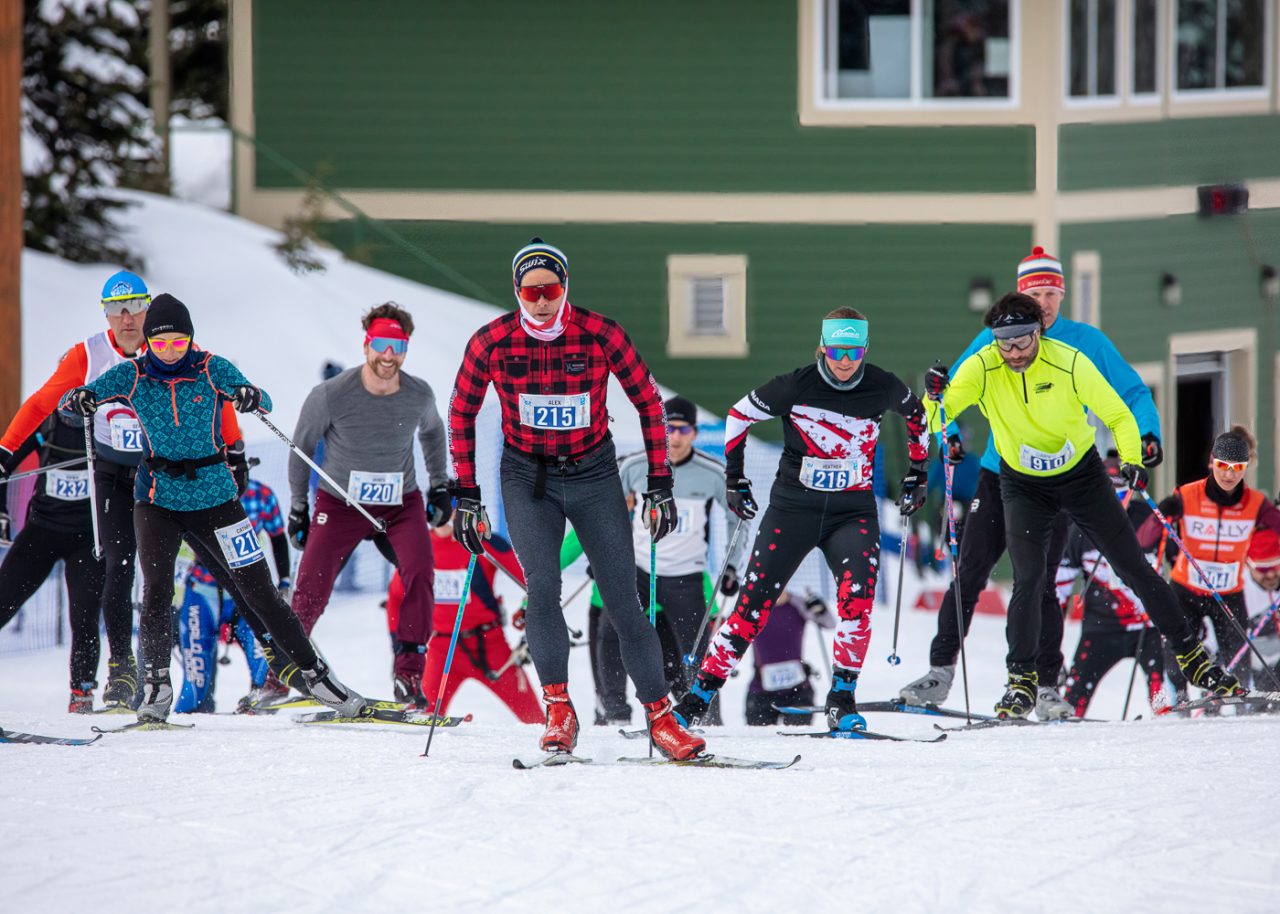
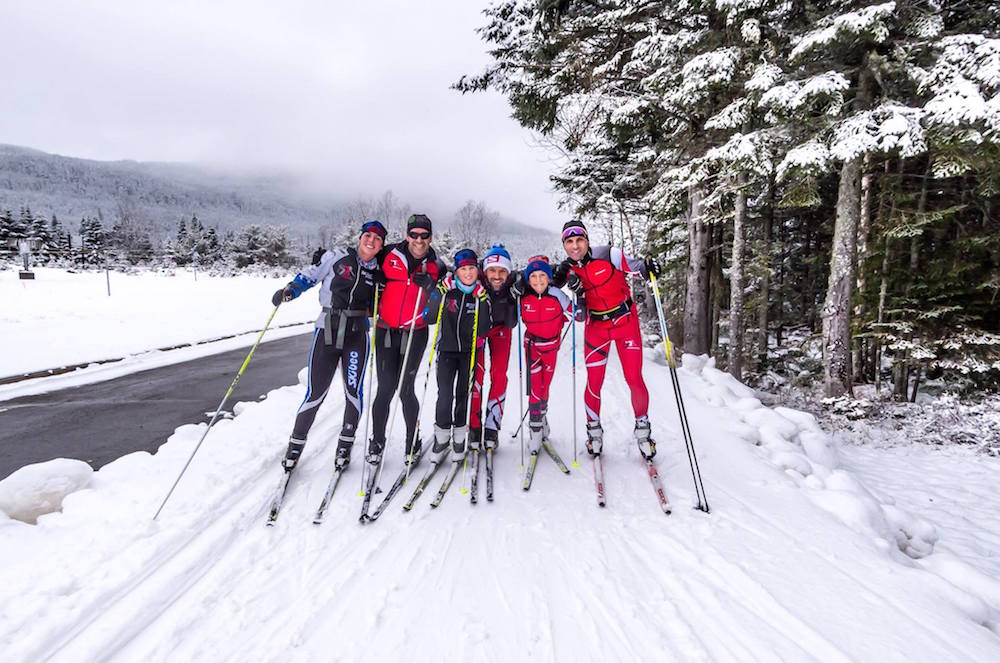
The Sovereign2SilverStar Ski Marathon started with small waves. (photo: Robert Conchie)
Disclaimer: The author skied both days and was one member of the large S2S organizing committee. This may seem like a conflict of interest, but also allows a more detailed look behind the curtain at how a new event was built.
When the moment comes to create a new destination ski marathon, how would you compile all of your dreams and mould them into a single cohesive weekend?
A group of Canadian skiers was faced with that question in the spring of 2021. And they found an answer.
Start with twos. Two interconnected ski areas. Two days. Two techniques. Two distances. Two finish line parties.
Using that model, the first annual Sovereign2SilverStar Ski Marathon was a success, at least as measured by smiles.
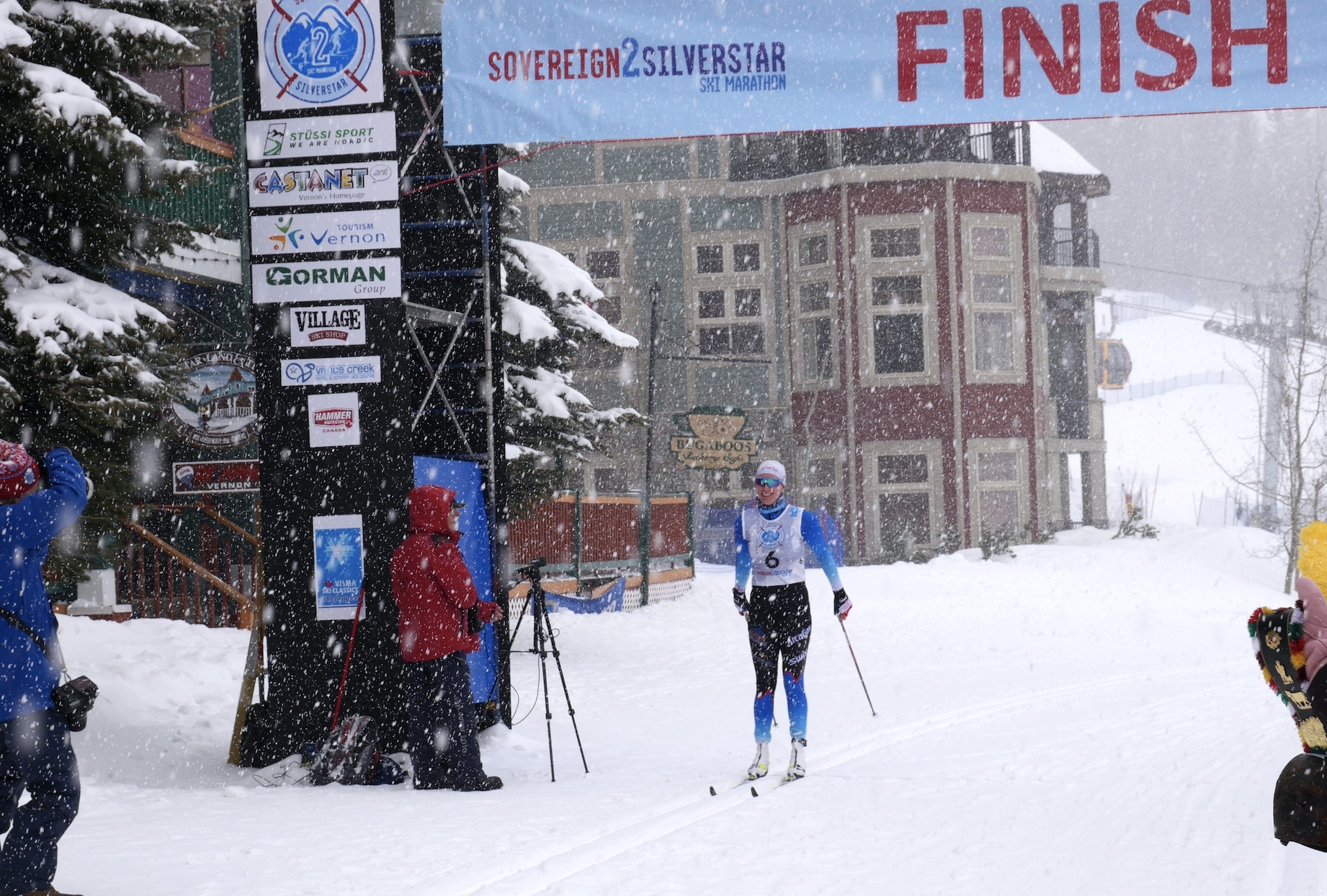
Dahria Beatty crosses the line for the women’s win in classic during the Sovereign2Silverstar Ski Marathon. (Photo: Peggy Hung)Fun at the finish line of the 2022 Sovereign2Silverstar Ski Marathon. (Photo: Peggy Hung)
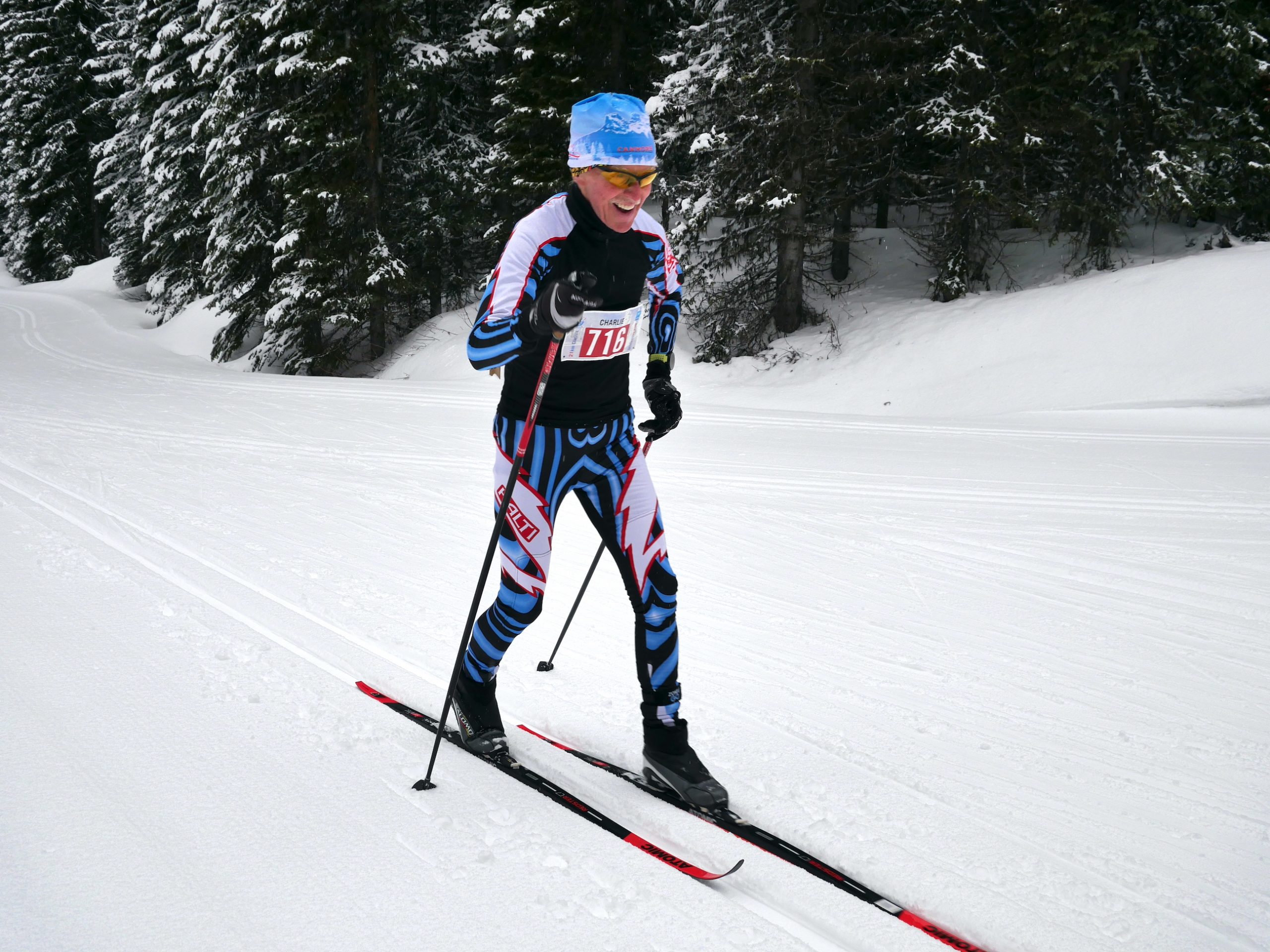
The weekend kicked off with a classic day on Saturday, April 2nd. The first wave for the 21km course left at 8:30 am, followed by the 40km waves at 9:05. Predicted weather was cloudy with afternoon snow, but the first flurries hit about 8 am, setting the tone for the day.
Of the 195 finishers on Saturday, the majority were on skin skis. Many of the skiers who chose grip wax were fooled by the race date into waxing for ‘typical’ spring skiing. However, when the groomed track is set at -5C, with fresh, cold snow overnight and more dry snow falling, blue hard wax is a better choice. Three of the six athletes on the 40km podium chose VR45 covered with VR30. The Organizing Committee (OC) posted a recommendation of Swix VP45 or V45 (the event encouraged fluoro-free waxing) on Friday afternoon. Early Saturday morning, the wax recommendation was updated to VP45 covered by VP40, except that this update didn’t get shared. Oops! Add that to the list for next year.
Benoit Chauvet last skied on the World Cup in 2010 and now coaches at Toby Creek, in BC. And he did place higher in the skate 40km.
Skate day on Sunday was overcast without significant snowfall, resulting in faster conditions and a larger field of 255 finishers.
As on Saturday, the 21km waves started first at 8:30, followed by the 40km waves at 9:05. This added a fun twist as the faster 40km skiers were passing the average 21km skiers coming into the finish. Despite the number of finishers, the largest of the nine waves had 42 skiers, which meant there was a lot of room to work with.
The course crossed a number of alpine runs on the final long descent to the finish. The course marshals, who were tasked with preventing collisions, were also ringing cowbells to energize the passing skiers. Many alpine skiers and snowboarders stayed on to cheer when the marshals signalled they were free to move. It was a new experience for many participants to see spectators 4km away from the finish, cheering and recording phone videos.
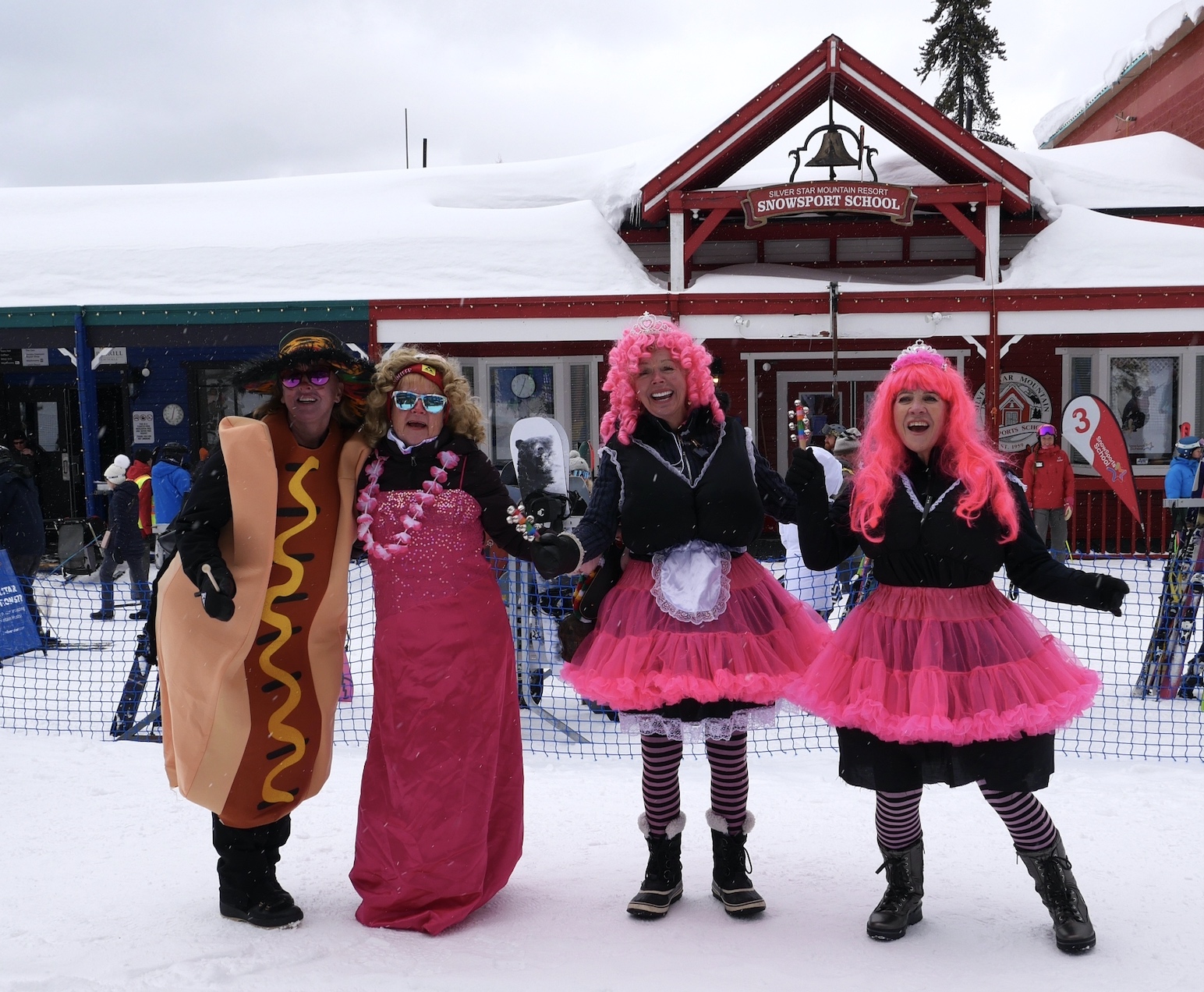
Participants who skied both days were prepared to be greeted at the finish by a dance team, lead by a hot dog. Some people were smiling because they were excited to have completed the distance, and some were smiling at the welcome.
The pandemic has greatly reduced international travel, with many skiers choosing to defer trips. S2S had one Europe-based skier registered, a Norwegian-born Swede who happened to be in Canada for a vacation.
“It’s a very fun course,” Asbjørn Grøvlen said after finishing the 40km classic. “I would recommend this one.” He went on to explain that many Ski Classics courses in Europe are just double poling and it was a nice change to stride more. Grøvlen, like a number of others, chose to do both 40km days.
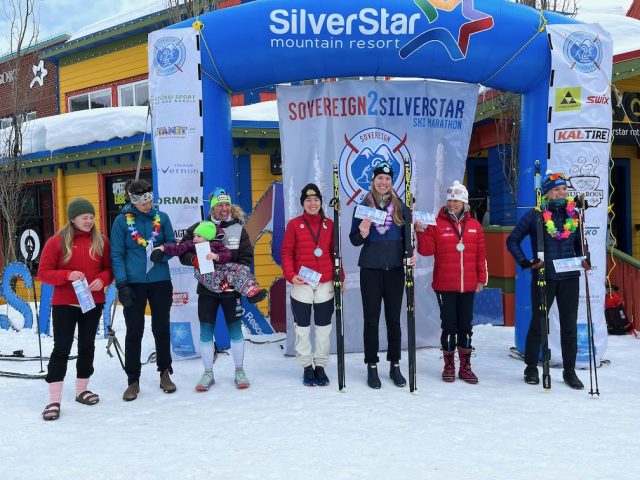
The overall podium on Sunday. L to R: Annika Hicks, Julia Ransom, Caitlin Gregg, Katherine Stewart-Jones (2nd), Dahria Beatty (1st), Laura McCabe (3rd), Anna Sellers. That is 5 Olympians, 2 biathletes, and 2 mothers.
The overall podiums went to elite skiers, many of whom volunteered to present medals to the age group podiums.
Dahria Beatty was the first woman to the finish on the classic day, followed by Katherine Stewart-Jones, Novie McCabe, and Mariah Bredal. Bredal had registered late and started in the second wave, which left her 0.3 seconds behind Beatty for second place overall. Another learning moment for year two, save a few extra bibs in the elite wave for last day registrants.
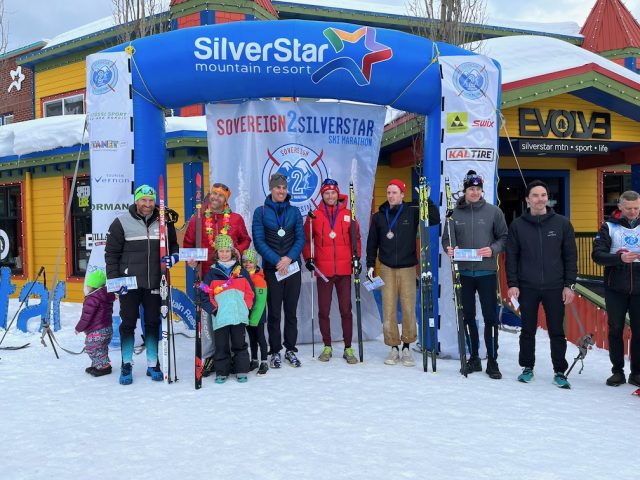
Sovereign2SilverStar overall podium. L to R: Brian Gregg, Benoit Chauvet, Scott Hill (2nd), Rémi Drolet (1st), Jack Carlyle (3rd), Julien Locke, Jess Cockney, S2S Event Director.
There was a rumour on Saturday morning that Luke Jager would double pole on skate skis, as he “always does that on long classic courses.” Jager, found before the start while applying grip wax to his skis, disagreed.
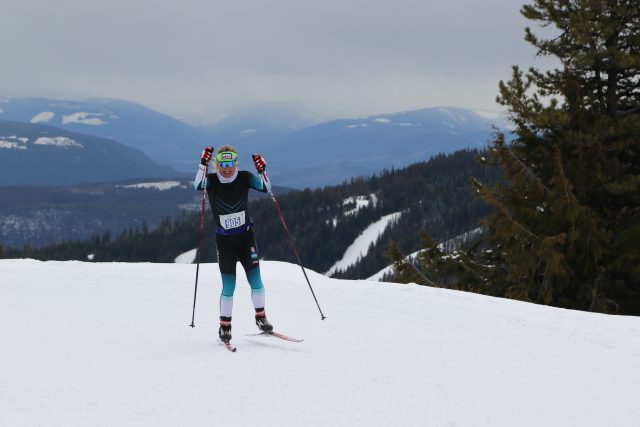
Timing was essential to get the mountain views at Alder Point. (photo: Marshall Moleschi)
In a world where ‘us versus them’ often creates divisions between similar communities, it was fun to watch alpine skiers and snowboarders stopping on Main Street to cheer on nordic finishers.
“That is so cool,” one twenty-something snowboarder said to his friends. “We are doing this next year!”
Mike Mandli, an American master who has travelled the world to ski, summed up the weekend: “This was a skier’s dream. One of the best dreams ever.”
For results, more videos, Andy Newell’s waxing advice, and over 2,000 photos, visit the event page.
Sovereign Lake’s XC105 trails on November 23rd, 2016.
(Press release)
INVITATION TO PARTICIPATE in the first edition of the XC105 Nordic Ski Festival in British Columbia!
From November 23rd to 26th, 2017, the XC105 Nordic Ski Festival will take place at Sovereign Lake Nordic Club and SilverStar Mountain Resort Ltd in Vernon, BC. Renowned for their exceptional ski conditions, especially at the beginning of the season, the two ski resorts will be jointly hosting activities that will appeal to all, whatever your level: beginner, intermediate or elite skier.
Fun is our mission! During the Festival, you will have the opportunity to ski on the joint trails of Sovereign Lake Nordic Club and SilverStar Mountain Resort Ltd and to participate in fun activities!
Whether you choose the 4 day or 2.5 days package, you will have the choice to participate in one or several activities such as:
Night skiing/dancing with DJ and headlamp relay
BeerCanBeiner (Ski a short “race course” with beer tasting stations)
Turkey Trot (Point to point ski with chocolate tasting stations)
Ski the World Cup course with an Elite skier
Biathlete for an hour
Informal Time Trial
Yoga
Event costs
$99 includes 4 day ski pass (dual area), Friday night dance party and night skiing and Informal Time Trial.
$55 includes 2 days (Sat-Sun) ski pass (dual area), Friday night dance party and night skiing. Additional fee « A la carte » per chosen activity. See Event costs on our website at https://www.sovereignlake.com/event/november-nordic-festival/
Schedule of activities and friendly races:
Thursday November 23rd 7pm, SilverStar village
Turkey Dinner A catered dinner, complete with motivational ski videos.
Friday November 24th
Informal Time Trial 10am, Sovereign Lake Stadium. Take an early opportunity to put on a bib and raise your heart rate in a time trial with a twist.
Ski Yoga4pm SilverStar village Spend a gentle hour restoring mobility after a hard day’s skiing in a yoga session led by a fellow nordic skier with experience in ski-specific yoga.
Night skiing with music and a headlamp relay7pm Sovereign Lake day lodge. It is a proper party this time. The night lodge has music and dancing, the lights are on for night skiing, and the relay is heading out into the dark trails.
Saturday November 25th
Ski demos, on snow starting 9am. Sovereign Lake Stadium
Ski the World Cup 5k loop with an elite skier, learning pacing and transition strategies to gain time, while supporting Olympic dreams. Top active athletes are taking time from their preparation for the NorAm/ SuperTour series to lead groups of five skiers. 100% of the money from this event goes directly to these athletes to support their training and preparation. You can choose between skate or classic technique, World Cup or world masters course, and English or French language for your two-hour session.
Be a biathlete1pm or 2:15pm, Sovereign Lake biathlon range
Have you ever wondered why biathlon is so popular in Europe? Spend an hour learning the basics from our coaches, including learning to shoot with your skis on, and then test your skills in a ‘sprint’ race. These are small group lessons.
Named after the famous Norwegian Birkebeiner ski race, this event involves skiing short distances between craft beer sampling stations.
Sunday November 26th
Turkey Trot9 am On trails This is a point to point ski with chocolate stations starting in the Sovereign Lake stadium and finishing at the SilverStar Village Main Street.
Ski demos, on snow starting 9 am at Brewer’s Pond, SilverStar
Sovereign Lake Nordic Club is seeking a highly motivated and skilled coach available for full-time employment effective September 5th, 2017. This position offers an annually renewable contract with fair compensation package. The Club Coach position is not reliant on grant funds, offering stable and secure employment. Compensation is based on experience, abilities, certifications and track record of coaching athletes at a National Level.
Sovereign Lake Nordic Club offers the largest daily groomed network of ski trails in Canada (with partner SilverStar), is among the largest clubs in the province (with over 1650 members) and sits at a high elevation providing exceptional skiing conditions for 8 months a year. This past season, club members skied from October 14th through to June 4th on 100% natural snow. SLNC has an exceptional track record of hosting world class racing events including the 2011 World Masters Championships, the 2005 World Cup and annual NorAm.
Vernon, B.C., is a small city providing exceptional amenities with endless outdoor recreation opportunities taking place on three lakes, over 200km of hiking and biking trails, endless paved country roads and world class cross country and downhill skiing.
Resumes will be accepted until Sunday, August 13th. Please provide 3 industry references and 2 personal references. Click here for the Club Coach Job Description. For more information please contact Troy Hudson (SLNC General Manager) at (250) 558-8916 cell, or by email at troy@sovereignlake.com.
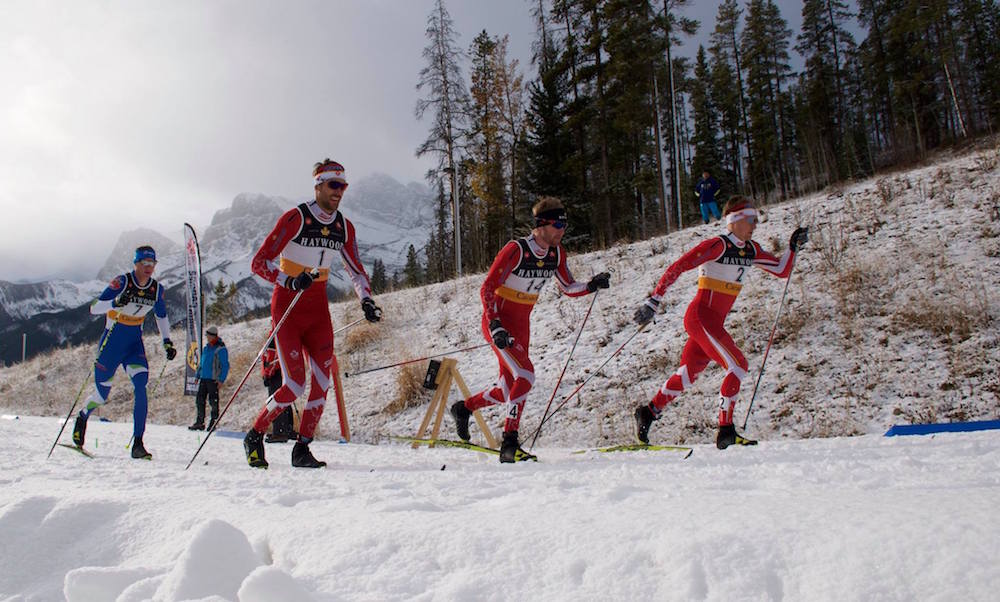
(From left to right) Bob Thompson (NTDC Thunder Bay) chases Lenny Valjas (Canadian World Cup A-Team), Graeme Killick (AWCA/NST B-team), and Knute Johnsgaard (AWCA/NST U25 Team) at the start of a classic sprint heat at 2016 Frozen Thunder in Canmore, Alberta, on Nov. 1. (Photo: Jenn Jackson)
As promised, the Canadian version of “Where the (Skiable) White Stuff Is” (a.k.a. November skiing) is here, minus the bit about where to ski at Thanksgiving. Canada doesn’t usually have much snow at Thanksgiving, mostly because Canadian Thanksgiving is in early October. But by the time U.S. Thanksgiving rolls around in late November, there is an abundance of reliable snow to choose from in Canada.
In addition to major camps and well publicized early season track setting, there are a lot of places in Canada where people quietly start skiing when there is snow. Whitehorse in the Yukon is one of those places where “early” doesn’t have the same meaning as it does in the south. No one will advertise October skiing at Barkerville, British Columbia, but the Caledonia Nordic Ski Club in Prince George can tell you about it. FasterSkier’s West-Coast based Canadian contributor was on snow Oct. 8 this year.
All of the western venues mentioned here were affected by the same weather pattern than forced the cancellation of the Bozeman SuperTour. A heatwave rolled in on Nov. 3, starting with a very warm classic sprint in Canmore, Alberta, and ending in spectacular flooding near Whistler, B.C. It has been a better start in the east.
This article will focus on reliable set track and camps open to the public in November — in Canada (for the U.S. version, click here). If your favourite early season spot isn’t featured, you are in good company. Let us know in the comments below.
And if you are visiting Canada, remember that the U.S. dollar is worth $1.35 up here.
***
CAMPS
XC SuperCamp
Where: Sovereign Lake Nordic Centre and Silver Star Mountain Resort, Vernon, B.C.
A trailside photo from 2015 SuperCamp at Sovereign Lake/Silver Star (Courtesy photo)
SuperCamp has evolved over 30 years, but its always been held on natural snow and it’s always run camps in November. Four of this season’s seven camps are in November, and biathlon options were offered this month as well.
“SuperCamp is a very comprehensive nordic experience,” Shane Landreville, SuperCamp coordinator, wrote in an email. “Trail passes are included, as are lunches, off snow programs, wax sessions, massages, and ski demos.”
Ski-in/ski-out accomodation and restaurants are available at Silver Star. Vernon, a 20-minute drive and 1,200 metres lower in elevation, offers a wide range of food and lodging alternatives. Some of the November camps sold out in mid-October when registration opened.
Glenn Bond XC Ski Camps
Where: Labrador City, Newfoundland
The 2016 Glenn Bond XC Ski Camp at Menihek Nordic on Nov. 3. (Courtesy photo)
The four-year old Glenn Bond XC Ski Camp program travelled to Menihek Nordic in Labrador City, Newfoundland, for a November camp on natural snow.
“[This camp] was November 3-6 with 70-80 cms of snow and big smiles,” Bond wrote. “Menihek Nordic wins the prize for best early season xc ski conditions this year hands down.”
(Longtime SuperCamp attendees remember Bond from his time with that program.)
NATURAL SNOW
Menihek Nordic
Where: Labrador City, Newfoundland and Labrador
Fifty centimetres (roughly 20 inches) of natural snow at Menihek Nordic in Labrador City on Oct. 23, 2016. (Photo: Menihek Nordic)
Mention ‘Lab City’ to a national team member from the 1980s and you will see the good memories scrolling behind the smile. In the glory days of Pierre Harvey, the national team would kick off its season at Menihek before moving on to Silver Star for an early season elevation camp. After that national team stopped visiting the venue in 1988, it quietly dropped off the radar, to the point that FasterSkier missed this October skiing opportunity in last year’s guide.
Labrador City is not visited by many tourists. It’s at least a 13-hour drive from Quebec City, which is the nearest major population centre. But there are some big-name skiers that have visited, including Sweden’s Gunde Svan, Americans Bill Koch and Tim Caldwell, Norway’s Anette Bøe, and the Firth sisters from Canada’s Northwest Territories. Menihek Nordic hosted the 1983 World Cup Final, the 1985 World Cup opener and was a national training centre from 1981 to 1988. Mining communities are often multicultural: the World Cup hosts were able to find local translators for 20 languages from a population of less than 10,000. Koch designed some of the trails in 1981.
What makes this venue unique, other than reliable October-to-May skiing?
“Labrador is unique in that it is nearly the last frontier,” Menihek Nordic Ski Club President Gerry Rideout explained. “There is a certain magic about Labrador, it gets in your blood.”
This season, Menihek opened on Oct. 23, held four camps in November, had the full 34 k system set on Nov. 3, and plans to stay open to the first week of May (as usual).
Sovereign Lake/Silver Star
There were lots of smiles during U.S. Thanksgiving at Sovereign Lake. Methow Valley Nordic coach Laura McCabe (a two-time Olympian) led 30 kids over the top from Silver Star and FasterSkier caught them on the way back. Locals know to start at Sovereign and stop for a croissant in Silver Star village to fuel the second half of the ski. (Photo: Gerry Furseth)
This destination is actually two ski areas. The Sovereign Lake Nordic Centre (also Sovereign Lake Nordic Club) has been operating since the 1930s under a variety of names, while Silver Star Mountain Resort is more recent, opening as an alpine-skiing area in 1958. The two organizations have 105 kilometers of interconnected nordic trails and a surprisingly good relationship between the commercial resort and the volunteer-based club (which is one of the largest cross-country ski clubs in B.C.). Silver Star hosted a World Cup in 1991, Sovereign Lake in 2005.
Daily track setting runs from November to early April, with the full 105 k usually available from late November to mid-March. Sovereign Lake reopens in May for team camps and diehard skiers.
This season, both sides opened 10 days late on Nov. 20, with 57 k set by Nov. 25.
“We are still well below our average snow pack for this time of year, but are optimizing our small machine grooming to create great tracks and corduroy,” Sovereign Lake manager Troy Hudson wrote in an email on Nov. 24.
There were at least eight private camps in November, ranging from a master’s women’s group to biathletes to a combined U.S. club camp with the Mt. Bachelor Sports Education Foundation, Methow Valley Nordic and Momentum Northwest from Oregon and Washington.
MANMADE & STORED SNOW
Frozen Thunder
Where: Canmore Nordic Centre in Canmore, Alberta
Canmore is perhaps the best known of Canada’s nordic venues. Between the 1998 Olympics, reoccurring World Cups and last season’s final stages of the Ski Tour Canada, it is famous beyond the skiing world. Each October, Frozen Thunder opens a small loop with a combination of stored snow and manmade snow.
This year, Frozen Thunder opened on Oct. 22 with a 1.7 k loop. The regular season began on Nov. 19 and is scheduled to run to April 30. So far, Canmore has hosted seven days of cross-country ski races and three biathlon races in November. All the camps were private, with the Ukraine biathlon team traveling the farthest to Canmore.
Boreal Glide (Glisse Boréale)
Where: Forêt Montmorency, owned by the Université Laval, in Saint-Ferréol-les-Neiges, Quebec
Skibec skiers on the Boreal Glide at Forêt Montmorency north of Quebec City. (Photo: La Forêt)
Located 45 minutes north of Quebec City and belonging to Laval University, the ‘Boreal Glide‘ is an early season favourite in Quebec. Set in the largest teaching and research forest in the world (at 412 square kilometers), La Forêt Montmorency has 2.5 k of early season trail using stored snow and a larger system that depends on natural snow. As of Nov. 20, it had 20-24 inches of packed snowed and track groomed for both skating and classic.
“If I had to invest my money in one single cross-country skiing area in North America, I would honestly choose the Forêt Montmorency,” La Forêt’s Director of Operations Hugues Sansregret wrote in an email. “The fact that it sits on top of the Laurentian mountains is the best guarantee for early skiing.”
Boreal Glide opened on Oct. 28 without any official camps or events — just skiing. Can’t argue with that.
Callaghan Gold
Where: Whistler Olympic Park, Callaghan Valley, B.C.
Callaghan Gold on Nov. 7, 2016, at Whistler Olympic Park in Callaghan Valley, B.C. New this year, the loop includes the biathlon range. (Courtesy photo)
Canada’s other Winter Olympic venue has created Callaghan Gold, an early season loop of stored snow. The regular season opens on Nov. 24 (U.S. Thanksgiving) and ends in early April. Located in a cool valley surrounded by rainforest, this venue has been known for lots of snow in non-Olympic years. Weather has been a challenge in the fall of 2016, eased by two last-minute storms that expanded the stored snow loop to 21 k during the opening weekend.
In the project’s four-year history, Callaghan Gold has met some challenges. In its experimental year, the stored snow came out ‘gold’, coloured by the sawdust insulation. In 2014, the storage methods were improved and an 800-metre loop of lovely, white snow greeted skiers on opening day. In 2015, record-setting warm weather melted all the snow in March, leaving nothing to store. In 2016, Callaghan Gold opened on Oct. 29 with 600 metres of trail, expanding to 1.4 k on Nov. 4.
“The warm temps and significant rainfall of November took its toll on the Callaghan gold trail depth but we feel it held up well considering,” managing director Tim Hope wrote in an email.
Nakkertok Nordic
Where: Gatineau, Quebec
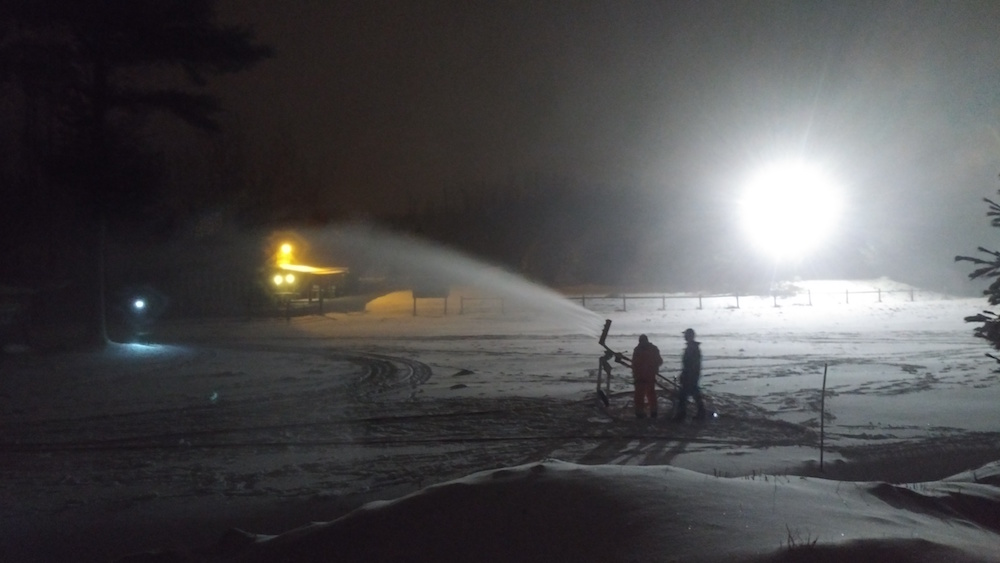
Nakkertok snowmaking in action for the first time in November, 2016. (Courtesy photo)
With two sets of ski trails just outside Ottawa and Gatineau, Nakkertok is the newest addition to reliable November snow. This month, one of the country’s largest ski clubs recently turned on its brand-new snowmaking equipment (which was largely funded by from its Project Play grand prize) and opened for skiing on Nov. 25.
According to Nakkertok Head Coach Kieran Jones, the club turned on five snow guns for the first time on Nov. 20 and was excited to test its new system and equipment. That night, the trails received an additional 15 to 20 centimeters of natural snow.
“Winter has definitely come to Ottawa-Gatineau, which is awesome!” Jones wrote. “Our initial goal was to create an 800m loop that covered our stadium, and extended out both ends. At that point we could then begin to push snow further to create 1 km of skiable terrain with a couple of quality climbs as well.”
He hoped they would have 1 k open for skiing by the end of last week.
“For now, the focus is on making sure we can have skate grooming,” Jones added. “Classic tracks will depend on the depth of snow that we’re able to produce. Nakkertok isn’t officially open to the public for day usage of the loop yet, but we’ll let you know as soon as it is!”
The Nakkertok Early Season Ski Loop (NESSL) is an important step for the region.
“It is great for the club, other clubs in the region and should allow a quality early season race site in the East,” Nakkertok fundraising mastermind Toni Scheier wrote in an email. “It will also ensure snow for the Easterns where clubs from across the country attend, (700 plus competitors) and for our Nationals bid, likely 2019.”
ANCHORAGE, ALASKA – “It’s been really cold lately, which is good. We have a good amount of frost, and if it were to snow right now, it would definitely stick,” said Holly Brooks. “We’ll be skiing before we know it!”
Holly Brooks at the 2010 Olympics in Whistler. (Photo: Kent Murdoch)
After making the U.S. Ski Team for the 2010 Olympics in Whistler, the 28-year-old from Anchorage officially cut her work hours to part-time this summer. Brooks still coaches at Alaska Pacific University, but with hopes to make the US team for the 2011 World Championships in Oslo, her own fitness is no longer an afterthought.
“Training is going really well. I am definitely on track now,” said Brooks, who is looking forward to the competition season.
Packed Schedule
On-snow time can’t come soon enough for Brooks. Her racing schedule is already set.
“I plan on doing the domestic circuit starting with West Yellowstone, then Silverstar, the mini-tour in Rossland, B.C. – I’m really excited for that – and then head out for U.S. Nationals in January,” Brooks said.
As of October, Brooks is ranked fourth in the U.S. While she is unsure of how many female skiers the U.S. Ski Team will field Oslo, she is hopeful that she will make the cut. “Oslo is the plan and the hope. Rebecca Dussault is pregnant and due on January 19th, so she won’t be competing in Oslo,” Brooks said. “But knowing her, I never rule it out that she’ll come out and post some amazing result even if she’s pregnant,” Brooks added with a laugh.
Well-prepared Homebody
Brooks explained that there really is no need to leave Alaska to get premium training, but she did change a few things after going part-time with work. This summer, for the first time, Brooks completed two on-snow camps on the Eagle Glacier in Alaska.
“I’ve never done a training camp there myself, but it’s an amazing facility. We’ve had a lot of athletes up there, but I’ve always been the one left at home to take care of things here when everyone else left,” Brooks said.
However, Brooks added that her part-time status is no cakewalk.
“Since I’m not on the U.S. Ski Team, I still have to support myself. In a typical day, I will train in the morning, then coach at noon and again in the afternoon, and then I will get in another of my own workouts in the evening,” Brooks said, explaining that while she’s coaching, she might not be training and doing all the drills, but she’s still on her feet.
Although Brooks has increased her training emphasis this summer, she is still prefers the home scene over travel camps.
“I’m kind of lazy that way. I don’t really see a need to leave Alaska. While it would be super-fun to be in Lake Placid and train with the U.S. Ski Team, I have great training partners, a really good coach, and there will be lots of travel later,” Brooks said.
It isn’t yet October, and the snow reports are beginning to come in. The FAST blog posted skiing pictures a few days ago, and now SilverStar is joining in. SilverStar Nordic Director Glenn Bond pushes the envelop to take advantage of the first flurries.
Kick and glide – it doesn't take much.Time for the cows and bull to leave the mountain…