From the FasterSkier archive — posts syndicated from athletes’ and coaches’ own blogs between 2004 and 2012, kept online as published. Current coverage is at fasterskier.com.

Tag: Simen Hegstad Krueger

  • Hedegart Emerges From the Fog to Win Holmenkollen 50 k as Klæbo’s Absence Reshuffles the Distance Globe

    Hedegart Emerges From the Fog to Win Holmenkollen 50 k as Klæbo’s Absence Reshuffles the Distance Globe

    This coverage is made possible through the generous support of Marty and Kathy Hall and A Hall Mark of Excellence Award. To learn more about A Hall Mark of Excellence Award, or to learn how you can support FasterSkier’s coverage, please contact info@fasterskier.com.

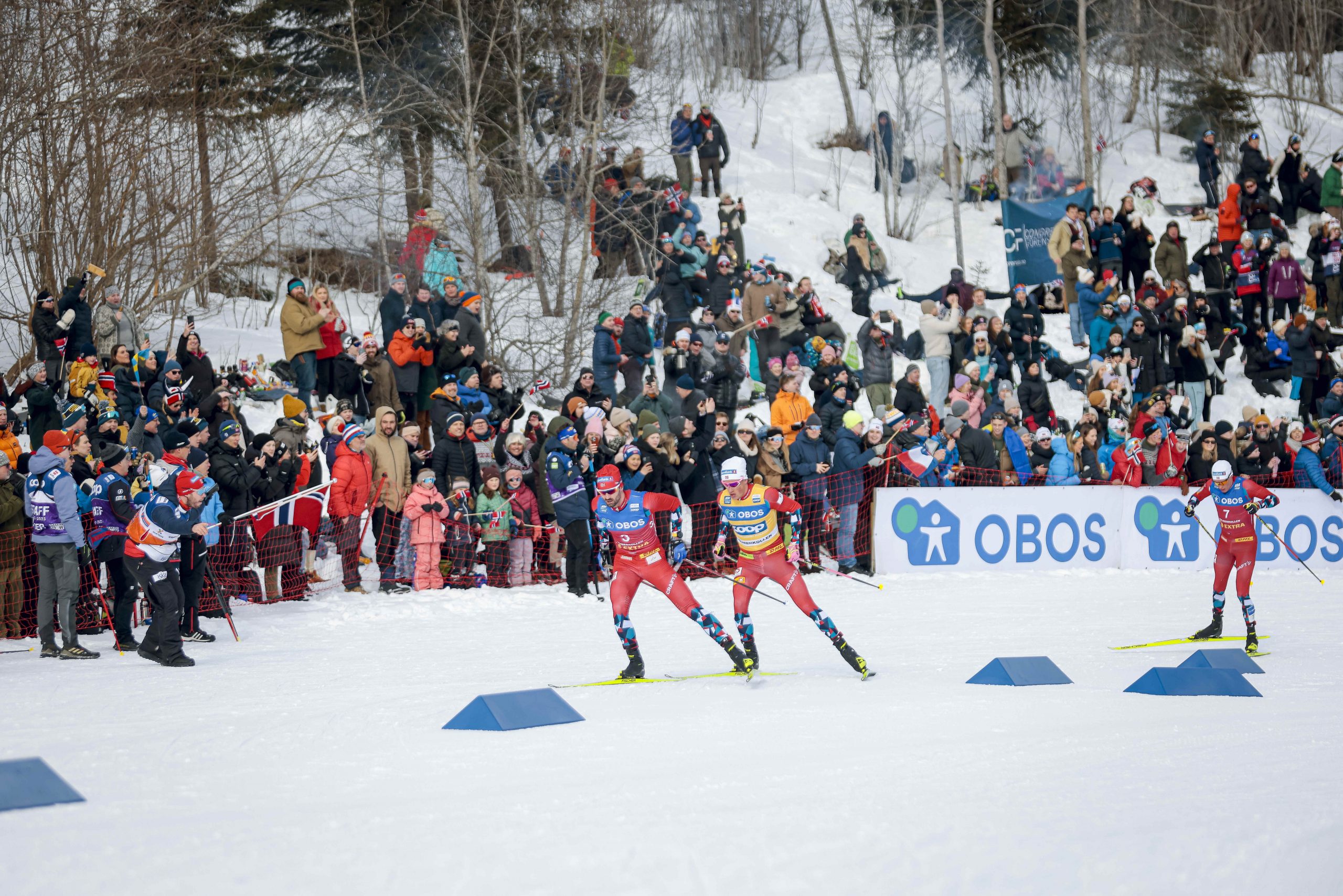
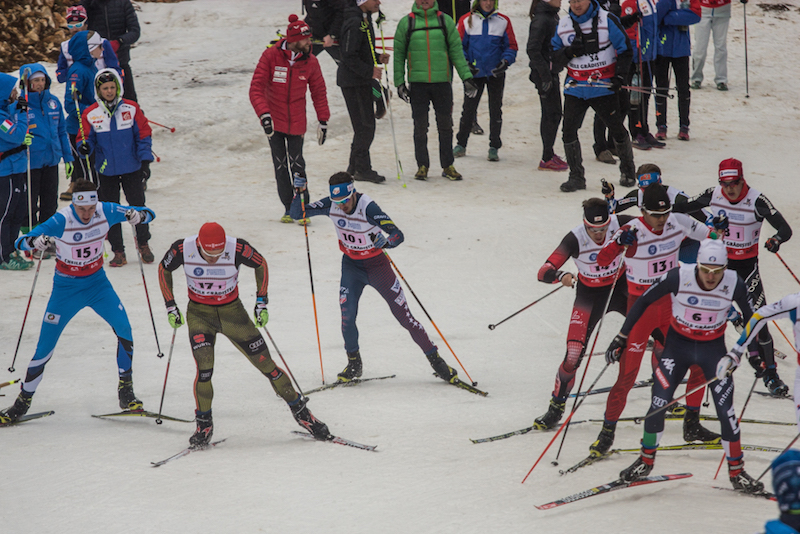
    The start of the Holmenkollen Men’s 50 k Freestyle in Oslo, Norway. (Photo: Authamayou/NordicFocus)

    For nearly two hours on Saturday, 77 men disappeared into a stubborn curtain of fog that clung to the hillsides above Oslo, their figures swallowed by the mist somewhere between the stadium and the high point at Frognerseteren. When it was over, only one emerged with his arms in the air, and it was the one freestyle specialist who had been topping shorter freestyle distance races most of the season.

    Einar Hedegart, the 24-year-old former biathlete who only committed fully to cross-country skiing in November, surged past Harald Oestberg Amundsen in the final meters to win the Holmenkollen 50 k Freestyle in 1:51:38.2 — his first victory on cross-country skiing’s most storied stage, in just his seventh World Cup start.

    “This is the greatest feeling I’ve ever had,” Hedegart said after the finish. “This is just a nostalgia stadium. [A] legendary race, almost all my heroes have won this race, and especially Petter Northug. This might be the reason why I’ve been so motivated my whole life to be a cross-country skier.”

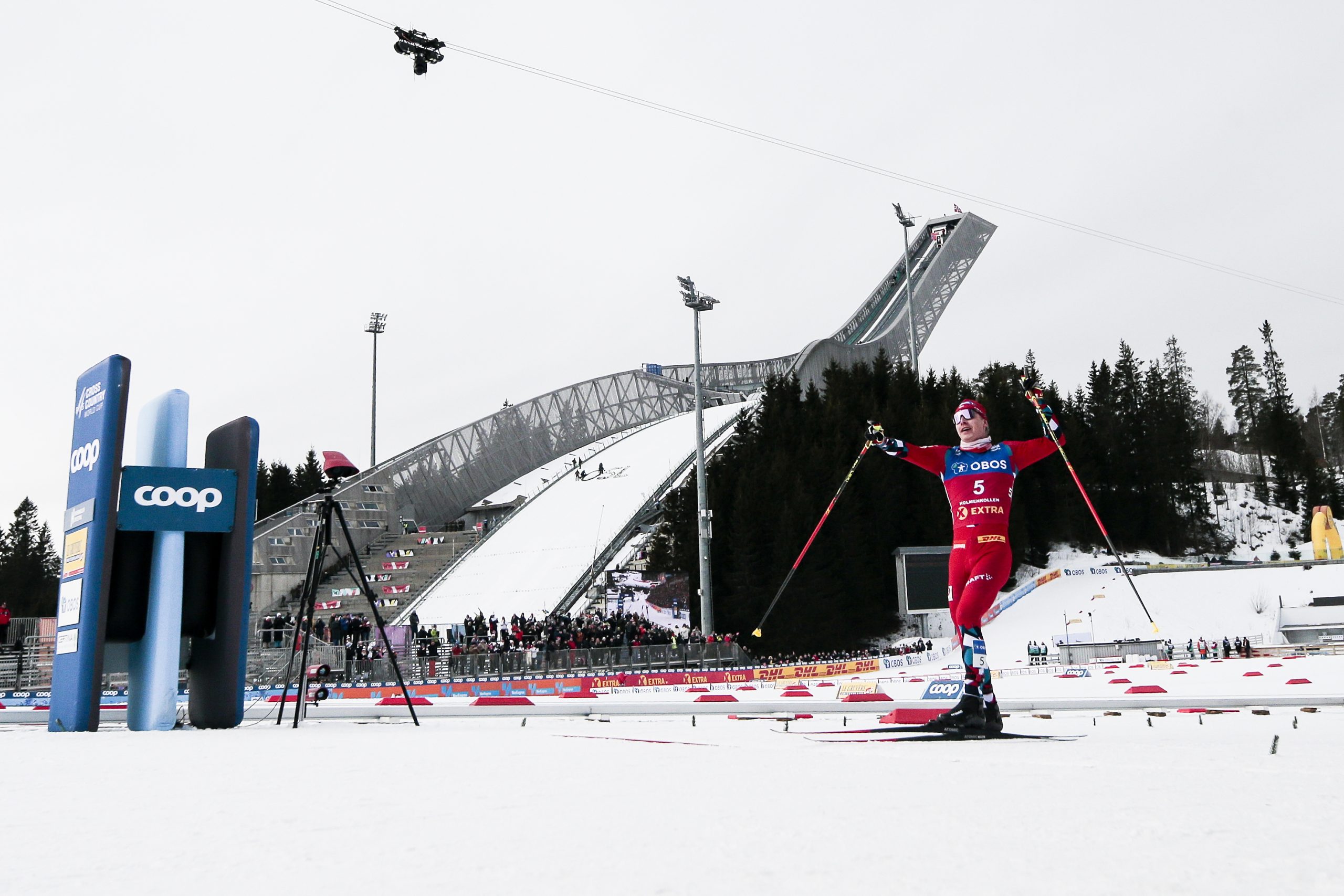
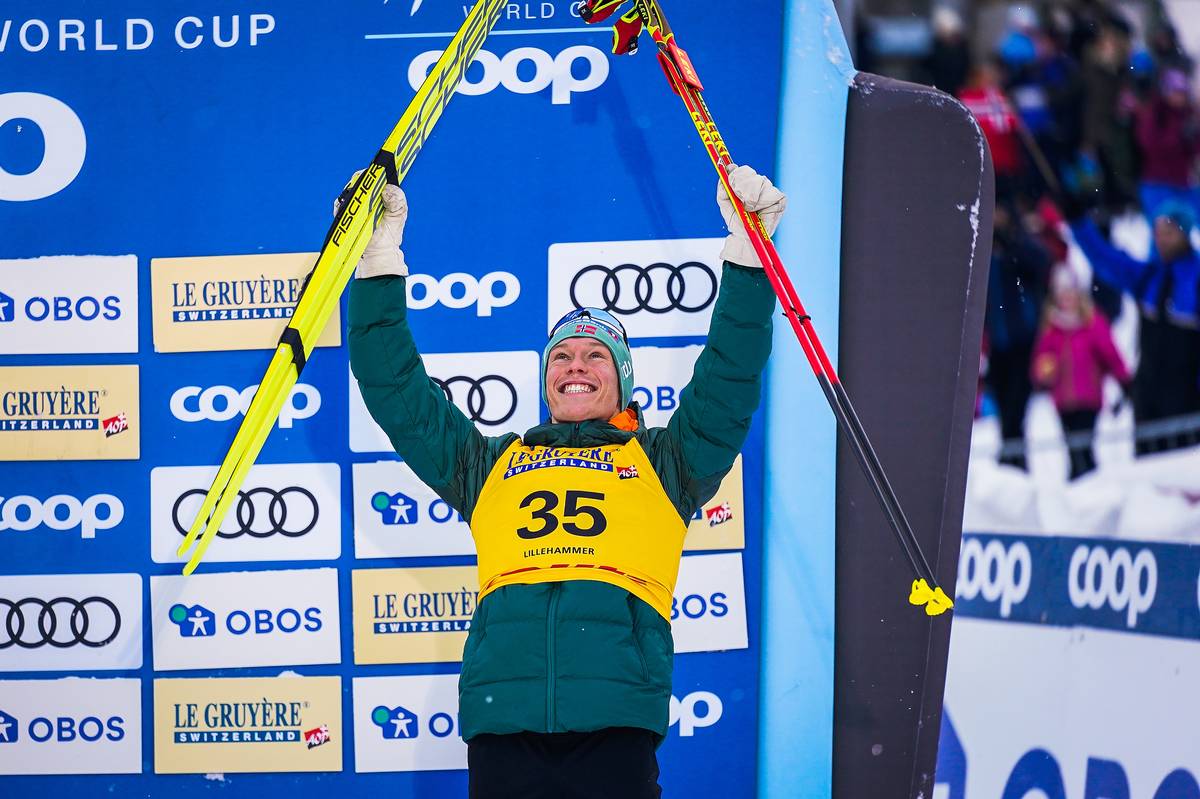
    Einar Hedegart (NOR) celebrates winning Norway’s most iconic race. www.nordicfocus.com. (Photo: Authamayou/NordicFocus)

    But the result that will echo loudest across the sport happened away from Oslo. Johannes Hoesflot Klaebo, the overall World Cup leader, was home nursing a mild concussion from a hard crash in the Drammen sprint two days earlier. Klaebo, who has already compiled a nearly perfect season, winning the Tour de Ski, all six Olympic races, secured the FIS Overall Crystal Globe, the FIS Sprint Crystal Globe, and only needed to keep racing the remaining distance races to take the clean sweep of the season with the FIS Distance Crystal Globe. BUT his absence from the start line meant zero points scored in the distance standing today. And with Amundsen’s second-place finish today, the distance crystal globe race was blown wide open: Amundsen now leads the distance standings by three points, 939 to 936, with two distance races remaining at the World Cup Finals in Lake Placid.

    Klaebo posted to Instagram yesterday: “Took a fall yesterday and hit my head pretty hard, but luckily everything is all good in the hood. Ended up with a concussion, so I’ll take some days off from both training and the internet just to make sure everything settles properly. Only got one head, so have to take good care of it.”

    He had been scheduled to fly to the United States on Sunday, but will now stay in Norway for a few extra days, hoping to recover in time for Lake Placid.

    Einar Hedegart (NOR) emerges from the fog to take the win. (Photo: Nordnes/NordicFocus)
    A Race Defined by Fog

    The Holmenkollen 50 k — first raced in 1888, a fixture of the World Cup since 1982, and a race that draws an estimated 100,000 fans to the forested hills above Oslo — returned to the calendar Saturday after a one-year absence. For the first time, the men’s and women’s 50 k races were held on the same day, the women starting 45 minutes behind the men in a format designed to create an all-day spectacle. The fog, however, had other ideas. Conditions were so thick that spectators along the course could hear the racers before they could see them.

    The course — six laps of 8.3 km with 334 meters of climbing per lap — was firm and fast after overnight salting despite an air temperature of 5.0°C. The salted, compact surface was ideal for skating, and the winning time of 1:51:38 came in roughly four minutes faster than the last time the Holmenkollen 50 k was contested in freestyle.

    Harald Oestberg Amundsen (NOR) on his way to second place. (Photo: Authamayou/NordicFocus)

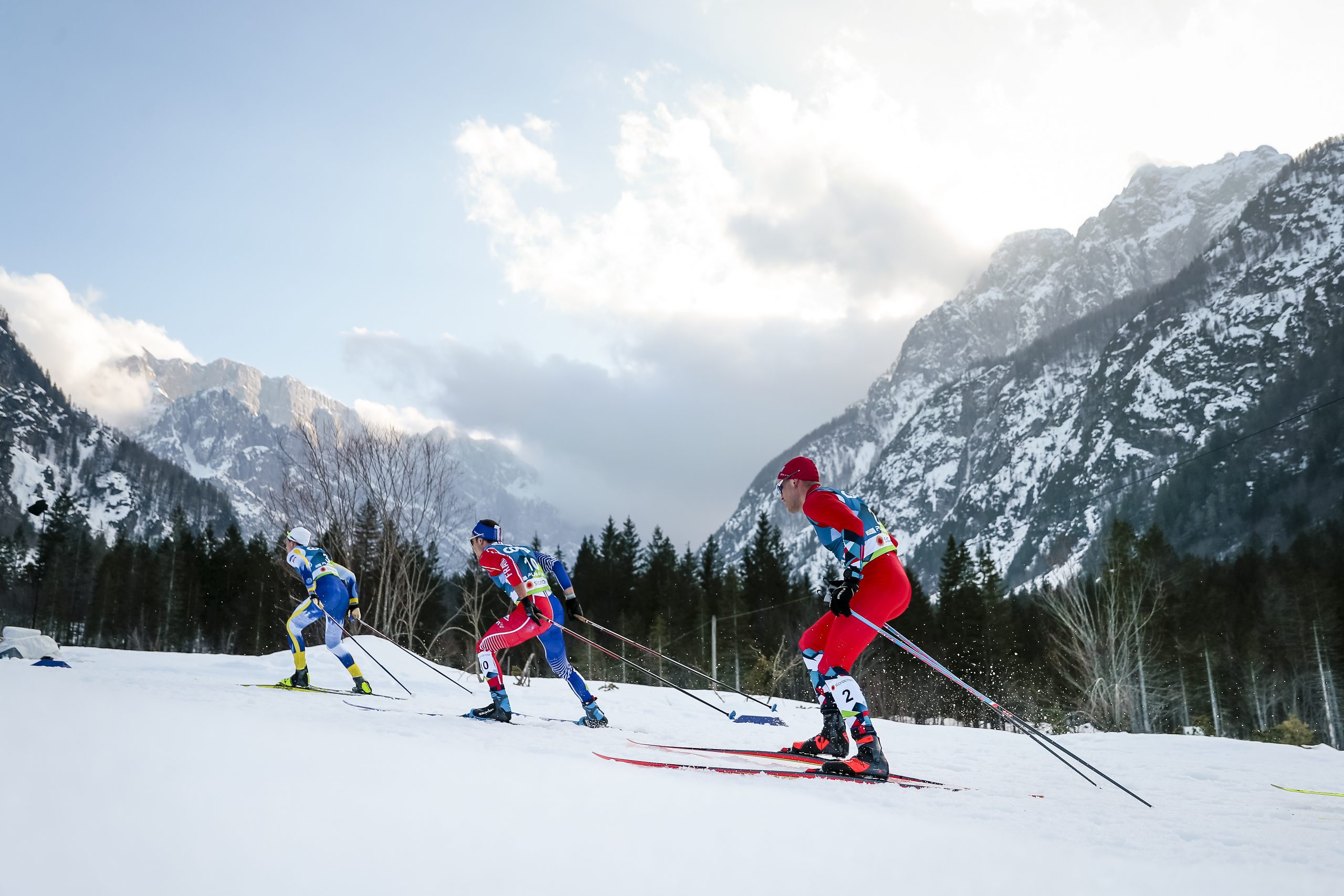
    Through the first three laps, the race unfolded as a cautious tactical affair. A large pack of roughly 40 skiers stayed together, with Martin Loewstroem Nyenget, Mattis Stenshagen, and Federico Pellegrino taking turns at the front. The first athlete to make a decisive tactical move was Iver Tildheim Andersen, who changed skis early at the stadium after the third lap while the rest of the pack continued through. The fresh skis gave Andersen a burst, and when the lead group stopped for their own ski exchange one lap later, he suddenly found himself alone at the front with a roughly 15-second advantage.

    “Just stick with the field as long as possible and then hopefully be in position when the group starts swarming,” Hedegart said of his plan. “But today I was really offside, like 70 percent of the race. So I was lucky that no one took a gap.”

    The chase group — reduced to roughly eight athletes, all Norwegian once France’s Victor Lovera fell off the pace — gradually closed on Andersen through the fifth lap, with Hedegart, Simen Hegstad Krueger, Amundsen, Nyenget, Andreas Fjorden Ree, and Kasper Andersson Herland trading pulls at the front. By the time the group reached the final lap, they had swallowed Andersen, and the race became a question of who had saved enough for the final kilometers.

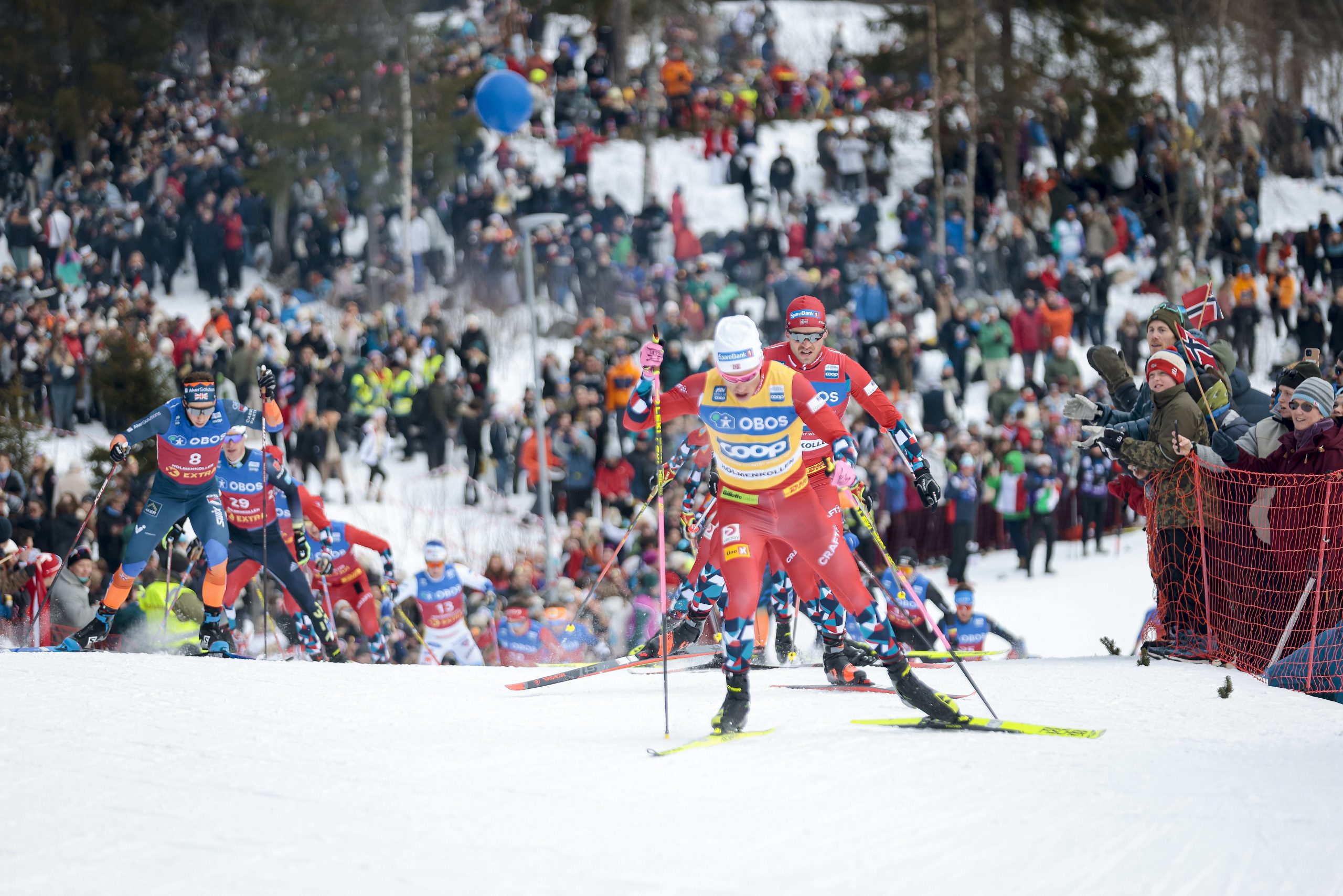
    Simen Hegstad Krueger (NOR) tried his best to get away for the win. (Photo: Authamayou/NordicFocus)
    Krueger’s Late Charge and Hedegart’s Final Kick

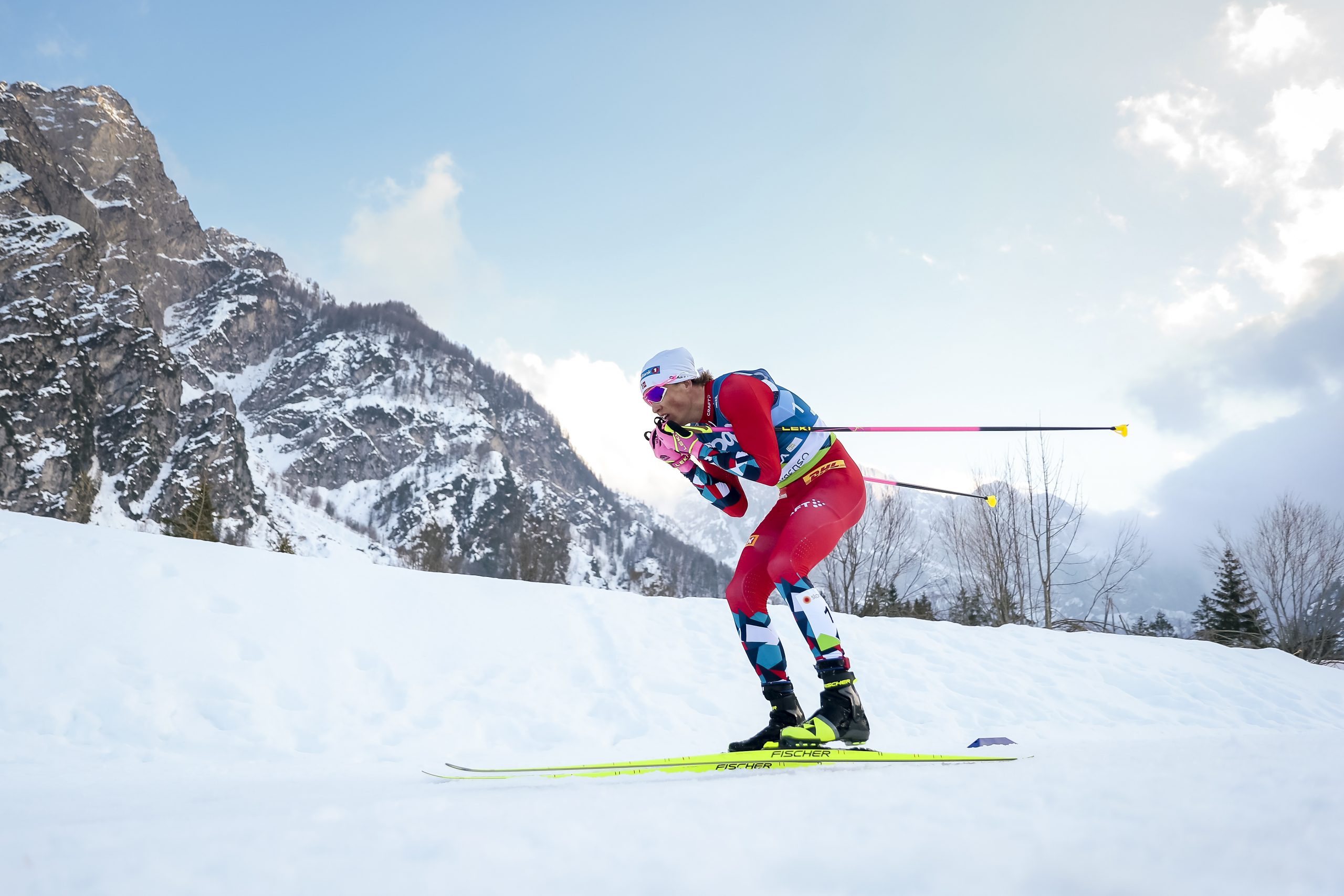
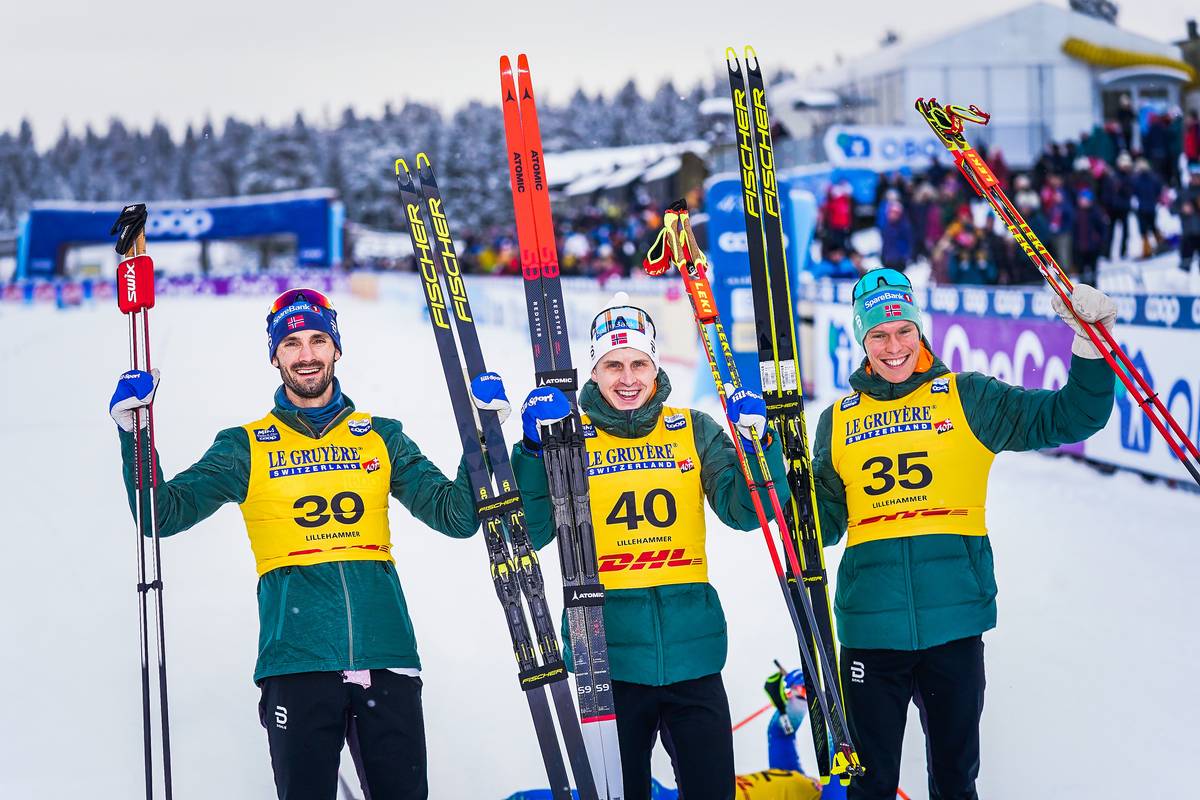
    Krueger, who was celebrating his 33rd birthday the day before, was omitted from the Norwegian Olympic team despite multiple Olympic medals in his career and was the winner of the last freestyle Holmenkollen 50 k. He drove the pace through the final lap. He pushed hard over the climbs near the iconic Holmenkollen church, stringing out the group and shedding Andersen off the back. But Krueger couldn’t sustain the pressure all the way to the finish, and as the group of seven came around the final corner and up the short, steep ramp before the descent into the home stretch, the sprint was on.

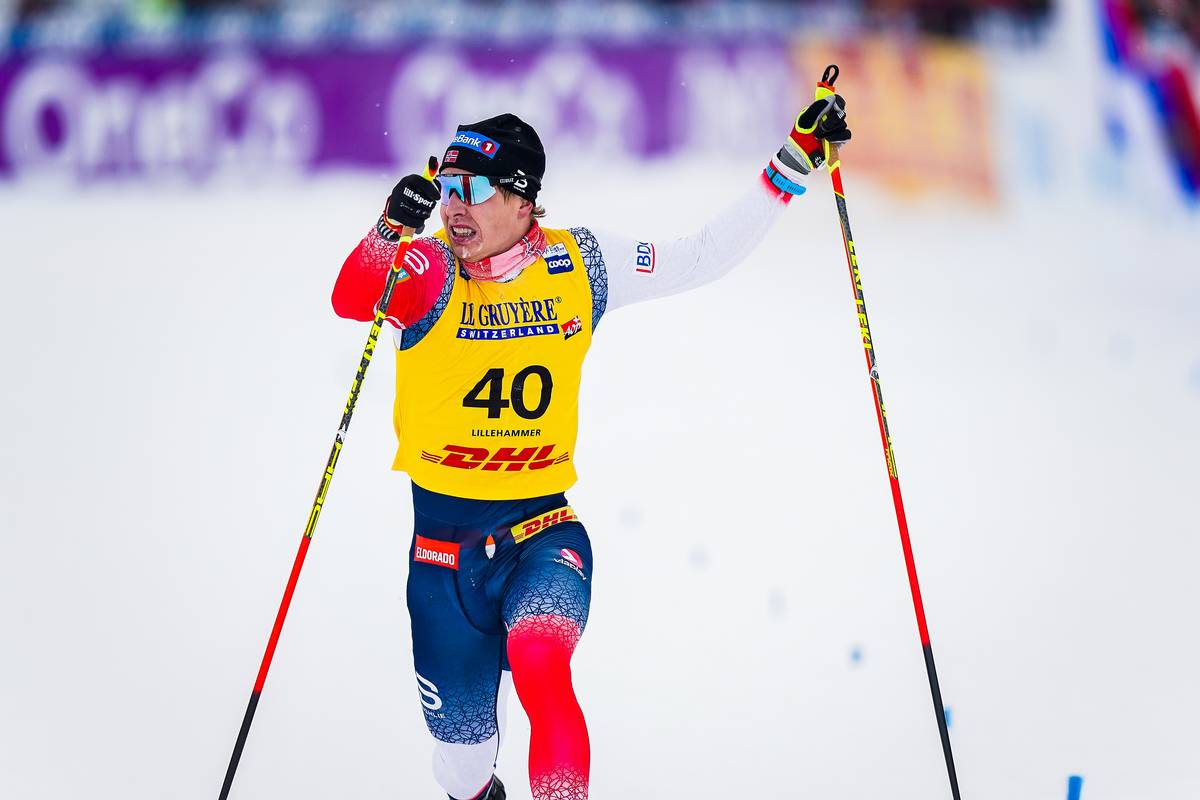
    Amundsen launched first, throwing everything he had at the final few hundred meters. But Hedegart, who had looked labored at points earlier in the race, found a gear no one could match. He came alongside Amundsen, took the lead in front of the grandstand crowd, and raised his fist in celebration as he skied across the line.

    “I felt, like, better,” Hedegart said of his position in the back of the pack through much of the race. “So I was just laying in the field, and I had to remind myself he did the same,” he added, referring to his idol Northug, whose trademark move was stalking from behind before unleashing a devastating sprint.

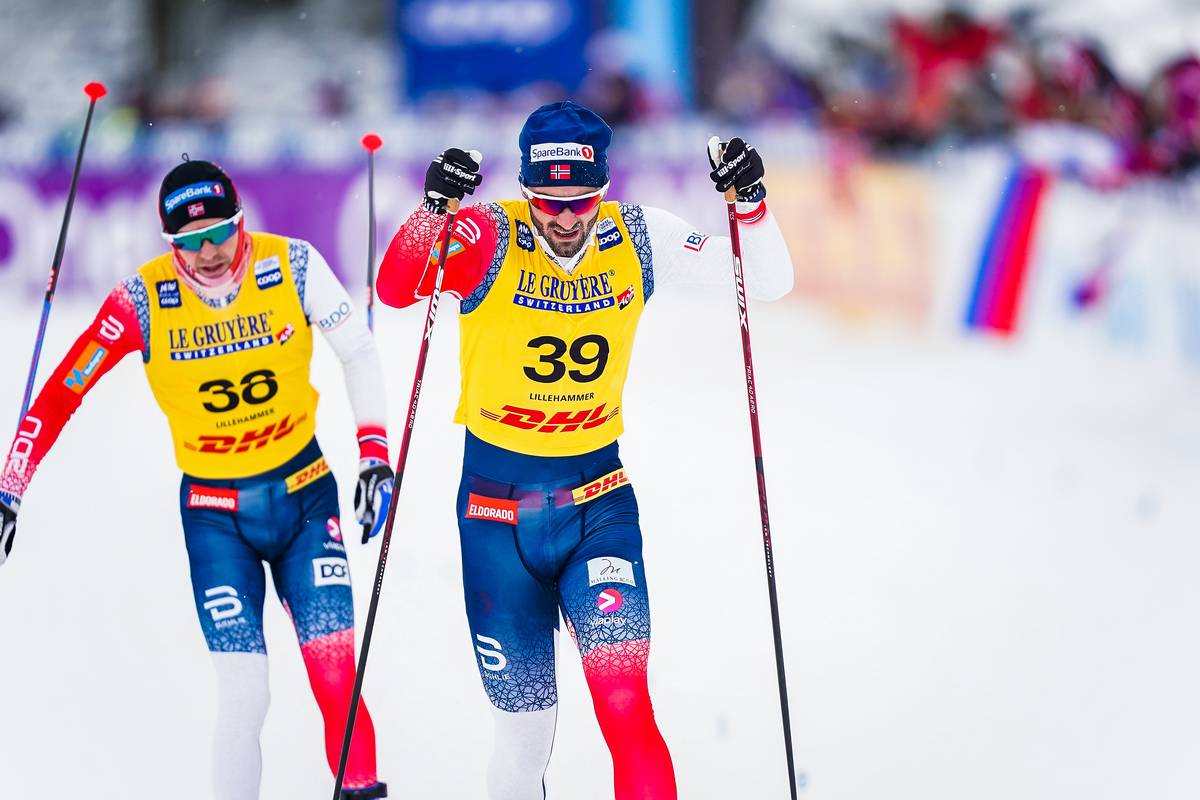
    Harald Oestberg Amundsen (NOR), Mattis Stenshagen (NOR), and Martin Loewstroem Nyenget (NOR), (l-r) stayed in the lead pack. (Photo: Authamayou/NordicFocus)

    Hedegart crossed in 1:51:38.2. Amundsen finished four-tenths of a second behind. Nyenget was third at +1.1. Ree took fourth (+1.5), followed by Herland (+2.1), Krueger (+3.0), Moseby (+4.8), and Andersen (+16.8) after his brave solo effort. Norway swept the top eight positions.

    France’s Lovera was the first non-Norwegian in ninth (+48.1), followed by AIN athlete Savelii Korostelev in 10th (+1:24.2).

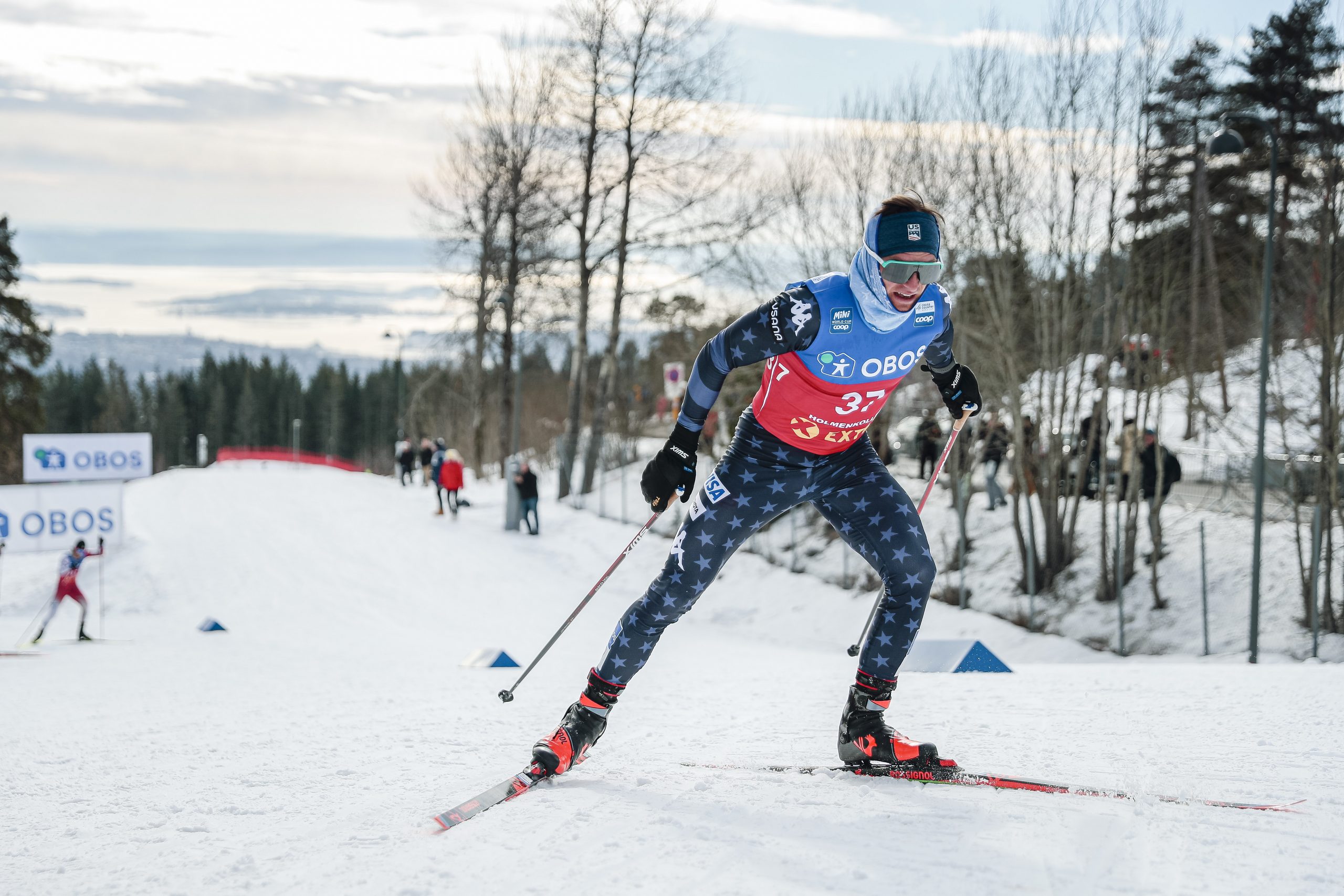
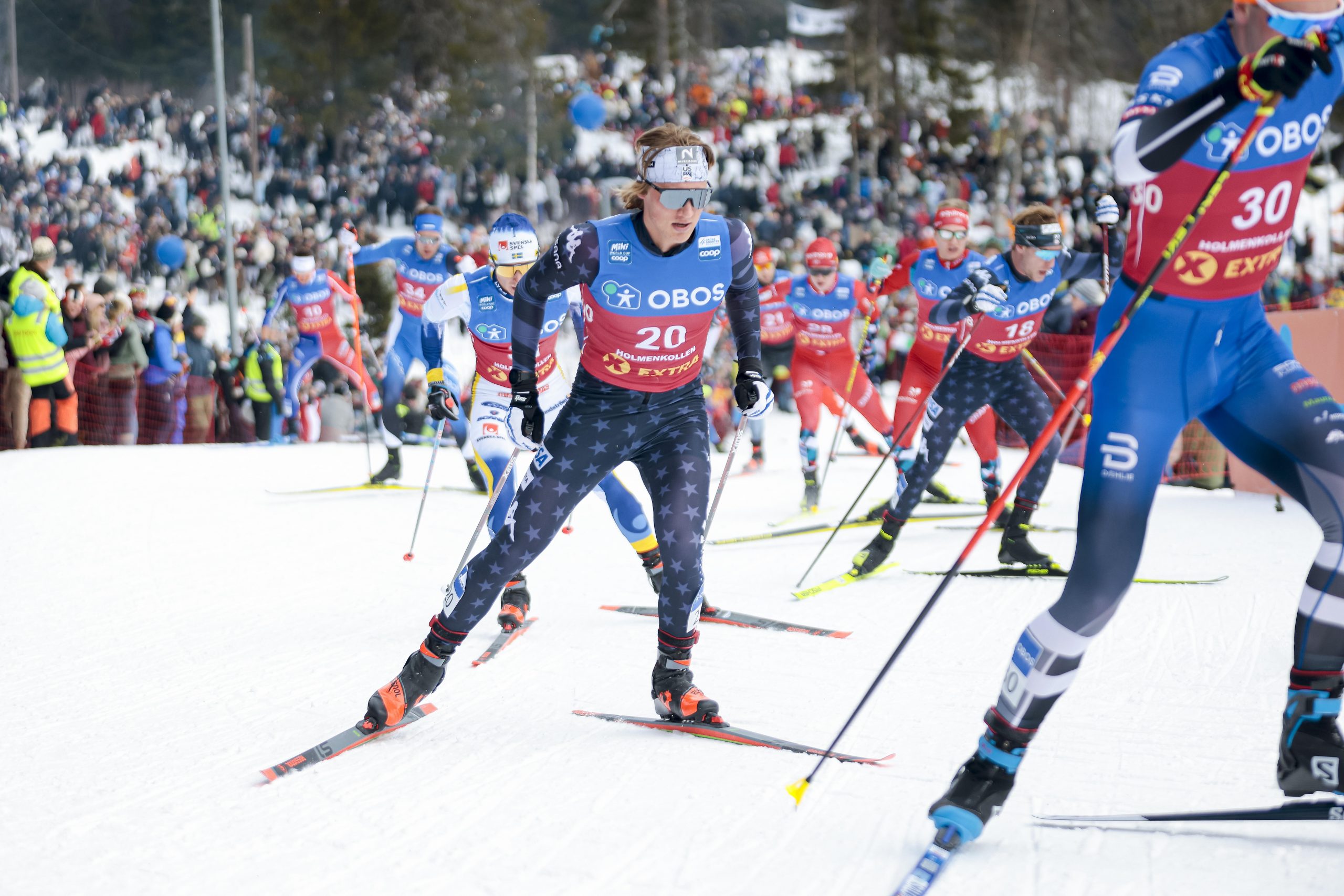
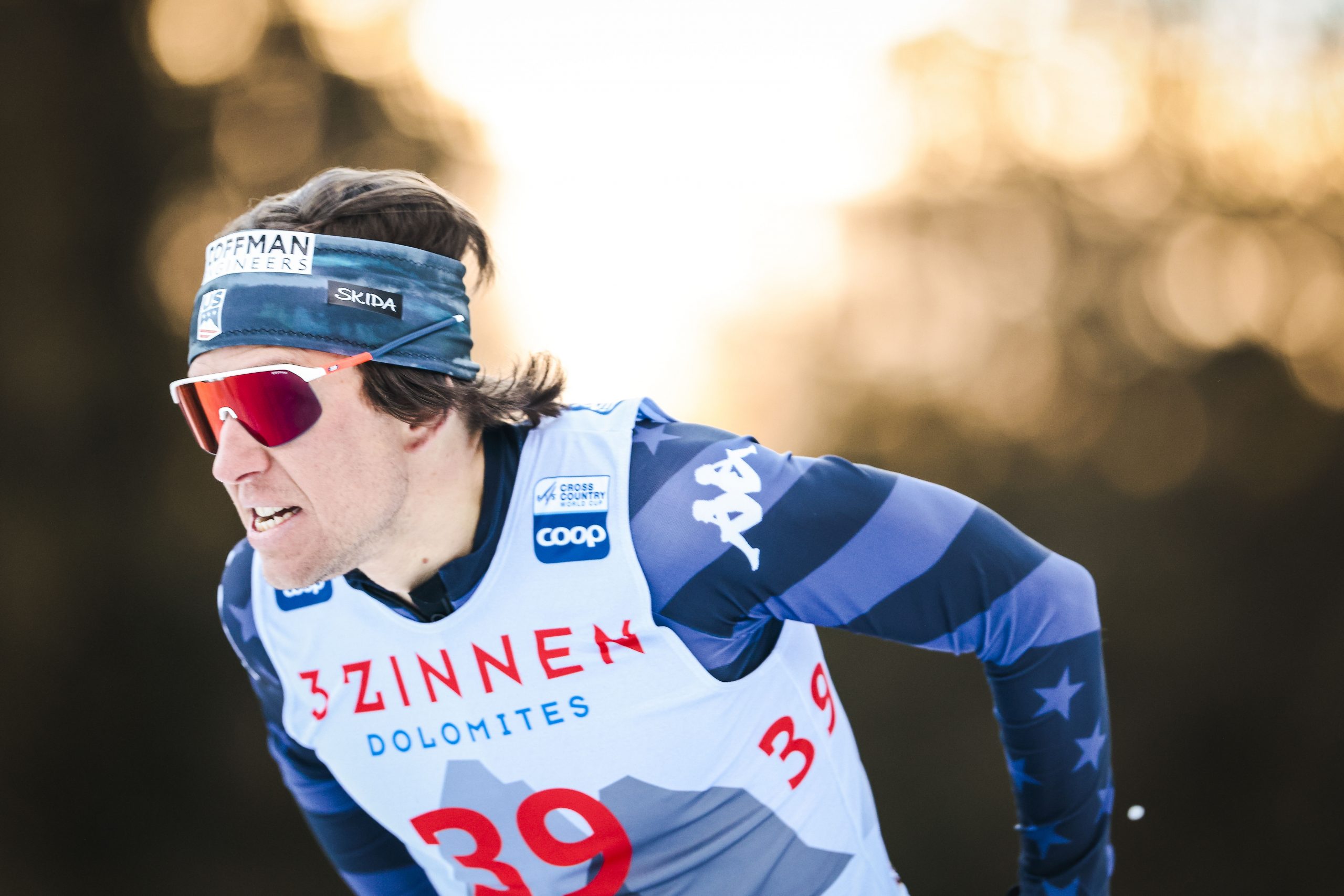
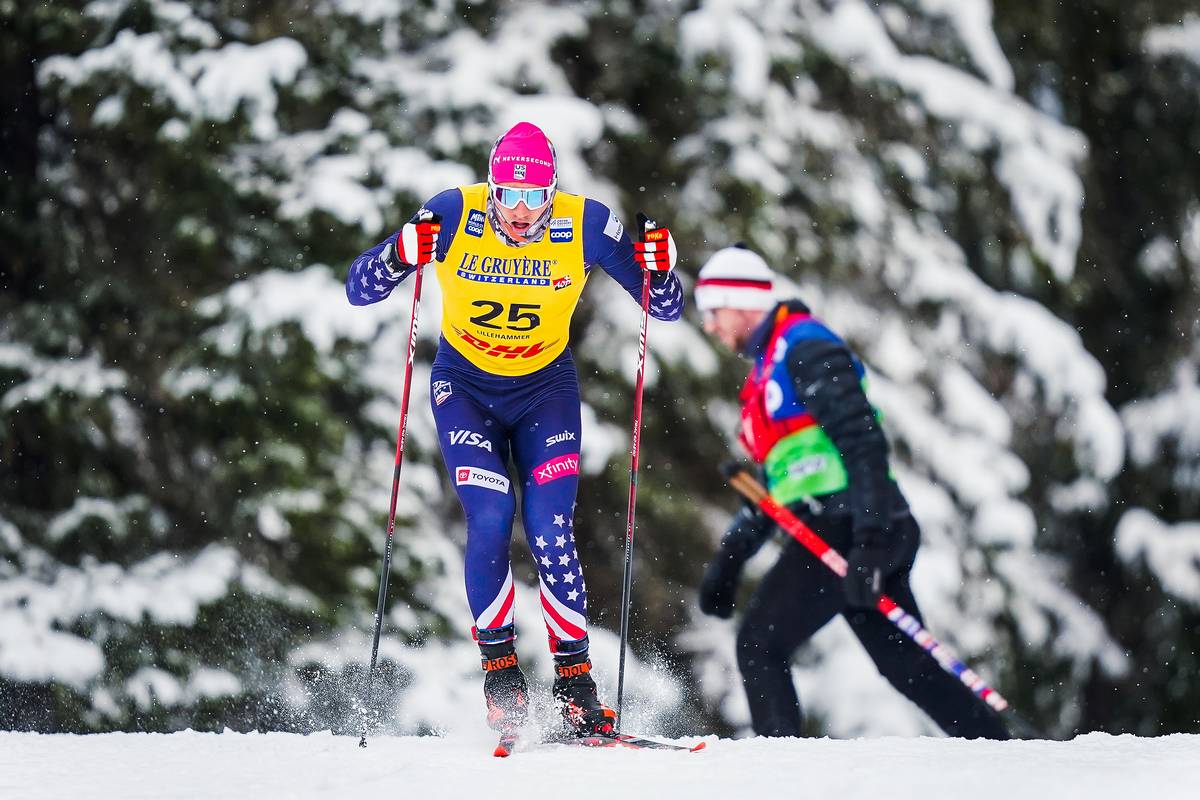
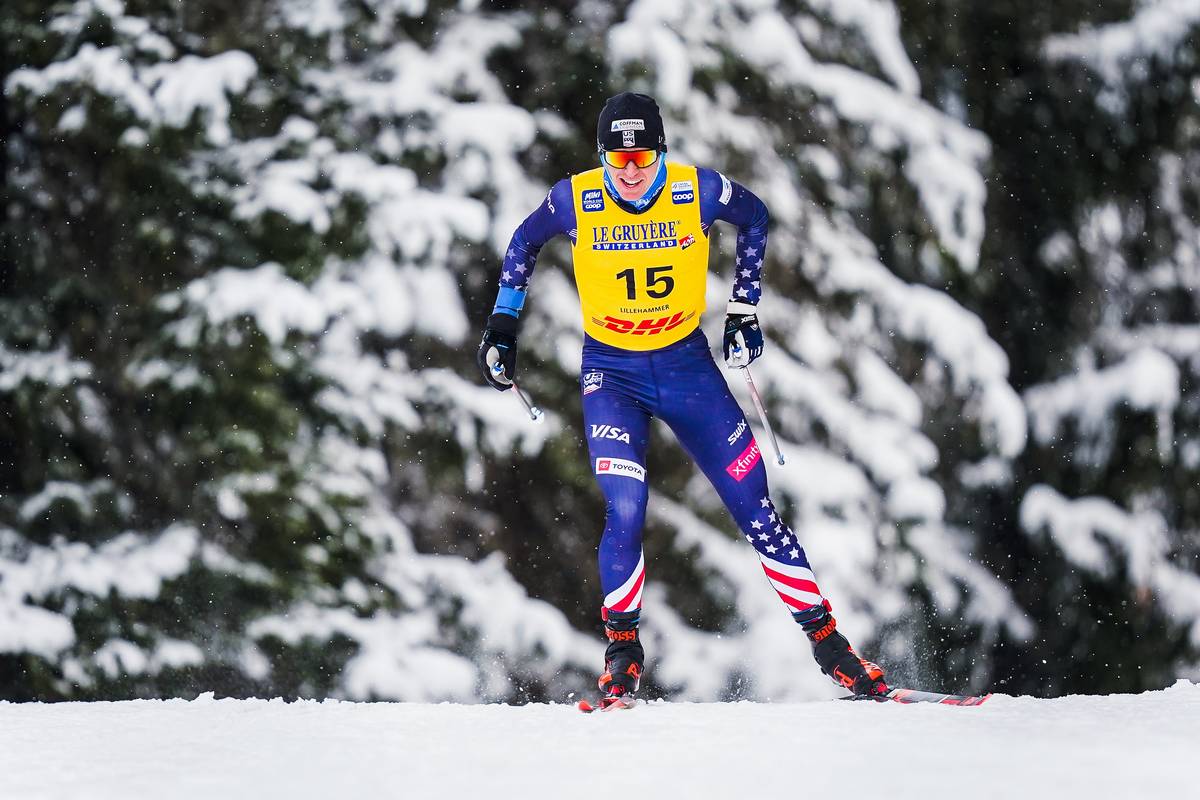
    Zak Ketterson (USA) led the way for the Americans in the chase pack racing for 11th place; he ultimately finished 18th. (Photo: Authamayou/NordicFocus)
    Ketterson Fights for 11th in His Adopted Home

    Zak Ketterson, who spent the summer and fall living and training in Oslo, found himself in the thick of a battle for 11th place, a fight he learned about from coaches stationed along the fog-shrouded course.

    “I had heard from coaches on the side of the trail that our pack was fighting for 11th, and that was super cool,” Ketterson said. “I actually felt pretty fresh at the end and thought my finishing sprint would be pretty good, but I didn’t time it well and got really boxed in on the last couple turns into the finish.”

    Ketterson ultimately finished 18th (+1:54.2), part of a chase pack that came across the line within seconds of each other. He said everyone in the group knew a sprint was coming on the final lap.

    The fog made the tactical picture nearly impossible to read. “I couldn’t see more than 10 meters in front of me,” Ketterson said. “It definitely made it difficult to assess where I was relative to the leaders in the later laps. It also made some of the corners feel way sketchier because you couldn’t really choose an optimal line with such limited visibility.”

    For Ketterson, the race carried personal significance beyond the result. Having trained on the Holmenkollen course through the Norwegian summer and fall, he knew every climb and descent intimately. “This is definitely one of the most iconic and cool races we get to do,” he said. “It was especially special for me this year since I trained on this course all summer and fall living in Oslo. The highlight was definitely having my wife Julie and her family out there cheering me on.”

    What made the performance all the more impressive was the state of his body coming in. “I honestly feel like I am really running on fumes,” Ketterson said. “To be honest, I was not sure if I would even start this race in the morning. I felt so bad, and honestly, my body has felt super up and down in the last few weeks. I’m really curious to see how my body responds to this race. I was pleasantly surprised by how decent it felt, but I feel like the next week could go either way. Especially with the international travel tomorrow.”

    Brian Bushey (USA) gaining experience on his way to 59th place. (Photo: Authamayou/NordicFocus)
    The Rest of the North Americans

    Hunter Wonders was 45th (+5:46.9), Kevin Bolger was 48th (+6:51.3), and Brian Bushey was 59th (+12:24.9).

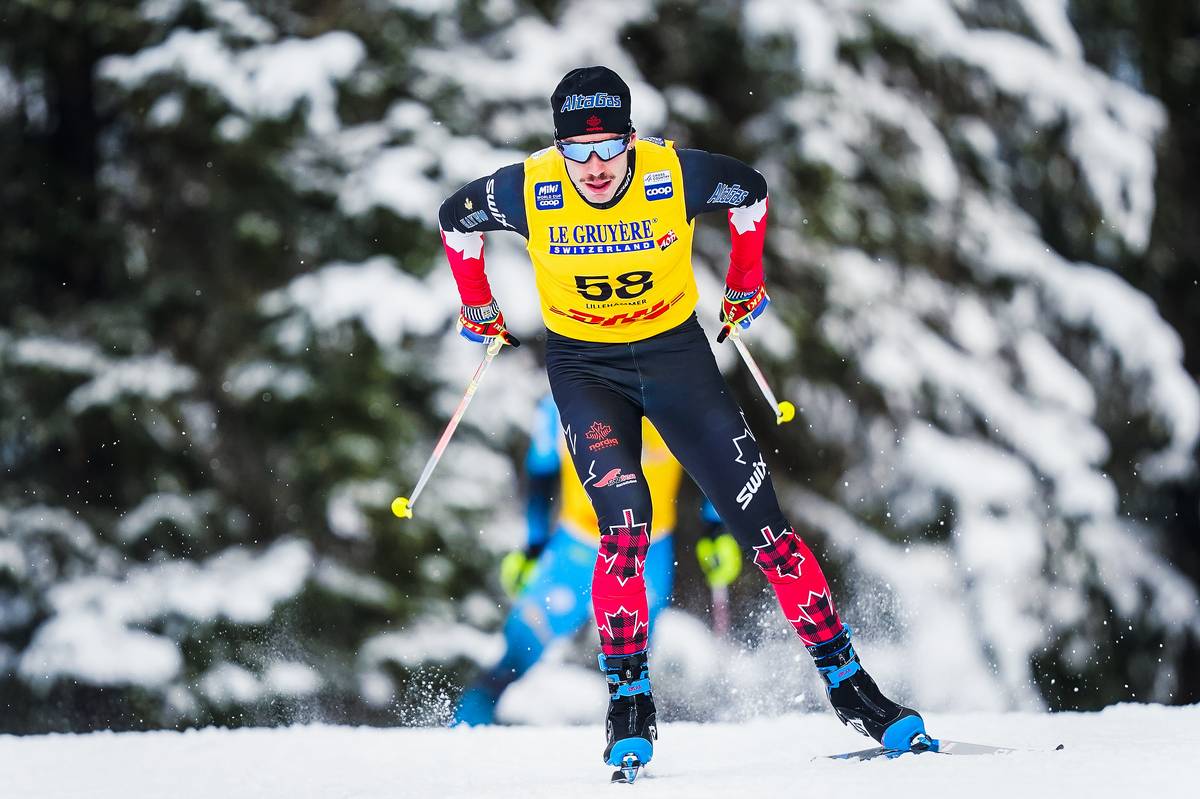
    Canada’s Xavier McKeever finished 41st (+5:11.4), while Thomas Stephen was 43rd (+5:18.1).

    Harald Oestberg Amundsen (NOR) takes over the FIS Distance Globe lead with just two distance races remaining. (Photo: Authamayou/NordicFocus)
    Distance Globe: Three Points

    The ramifications of Saturday’s race land squarely on the crystal globe picture. Before the race, Klaebo held a 128-point lead over Amundsen in the distance standings and a 636-point lead in the overall. With Klaebo watching from home, Amundsen’s 131-point haul (including bonus points) vaulted him into the distance lead: Amundsen now sits at 939 points, three ahead of Klaebo’s 936. Nyenget climbed to 914 in third.

    Klaebo’s overall World Cup lead, at 2,071 points to Amundsen’s 1,566, remains secure with a 505-point cushion. But the distance globe — awarded to the season’s best across distance events only — will come down to the final two races: a 10 k Classic Interval Start and a 20 k Freestyle Mass Start in Lake Placid, March 20-22.

    If Klaebo can travel to Lake Placid and race, he’ll have every opportunity to reclaim the lead. If the concussion keeps him out, the distance globe is likely to belong to Amundsen.

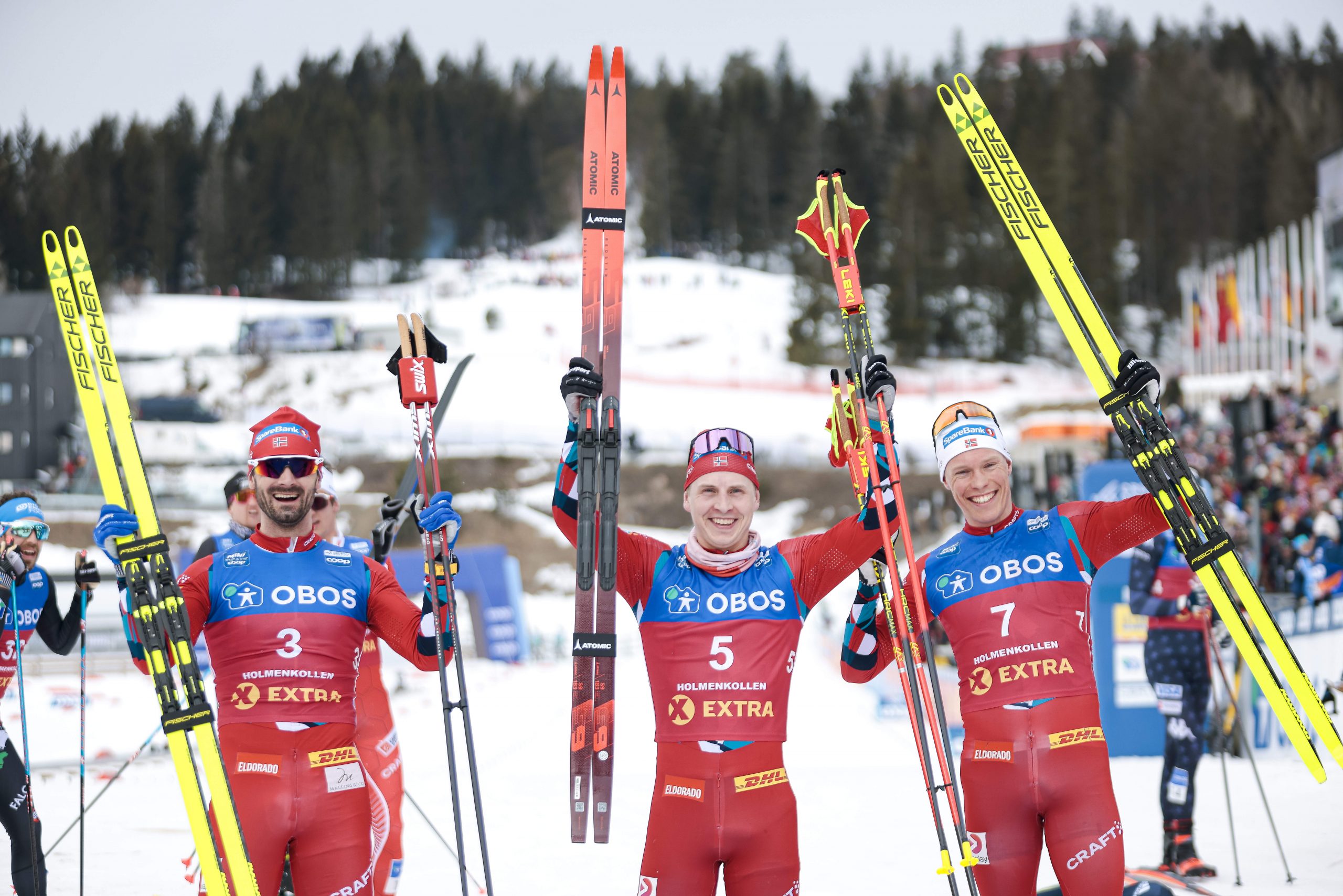
    Kasper Andersson Herland (NOR), who finished fifth, celebrates with Einar Hedegart (NOR), (l-r) at the finish of the Holmenkollen. (Photo: Authamayou/NordicFocus)
    A Star Made for This Stage

    Hedegart’s career trajectory is one of the season’s best stories. A junior biathlon world champion who struggled with his shooting, he drifted toward cross-country skiing after a surprising second-place finish at the Holmenkollen World Cup last season. He spent the summer training with a cross-country team while bringing his rifle to every camp, undecided. In November, after winning the popular pre-World Cup cross-country race in Beitostoelen, Norway, by a wide margin and missing eight of 20 shots in a biathlon event, he committed to leaving the rifle at home.

    Since then: an Olympic bronze in the 10 k Freestyle behind Klaebo, a team sprint gold partnered with Klaebo, victories in the Engadin Marathon, and now the Holmenkollen 50 k — a distance he had never raced at the World Cup level. He was asked whether his approach of sitting back resembled Northug’s famous stalking tactics.

    “Yeah, I felt like Petter,” Hedegart said. “So I was just lying in the field, and I had to remind myself he did the same.”

    For a race that dates to 1888, that has been won by the sport’s mythical stars, and that is contested before the King of Norway in a stadium surrounded by 100,000 fans, there is no small amount of weight to what happened Saturday at the Holmenkollen. Hedegart is, by every measure, now a cross-country skier.

    The season concludes with the World Cup Finals in Lake Placid, New York, March 20-22. Three races remain. The distance globe is separated by three points. And the world waits to see whether Klaebo can make it to the start line.


    Holmenkollen Men’s 50 k Freestyle FINAL RESULTS

    FIS Men’s Crystal Globe SPRINT STANDINGS
    FIS Men’s Crystal Globe DISTANCE STANDINGS
    FIS Men’s Crystal Globe OVERALL STANDINGS


    Love Stories Like This? Help Keep Them Coming.

    Feature stories like this one take time, access, and care to produce. If you value thoughtful storytelling and independent ski journalism, please consider becoming a Voluntary Subscriber. Your support directly fuels the work we do to cover the people, places, and moments that make our sport special.

    Join the FasterSkier community!


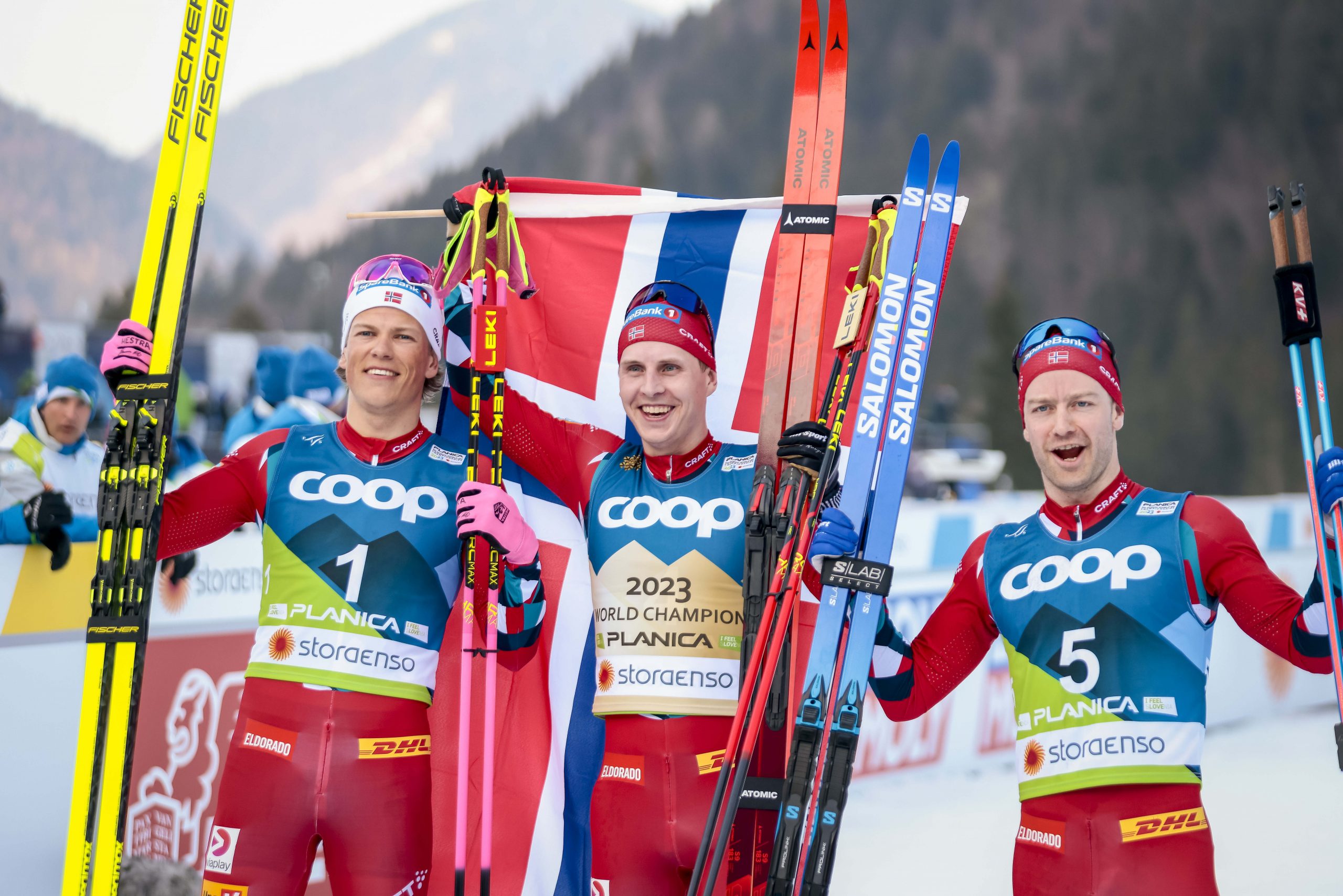
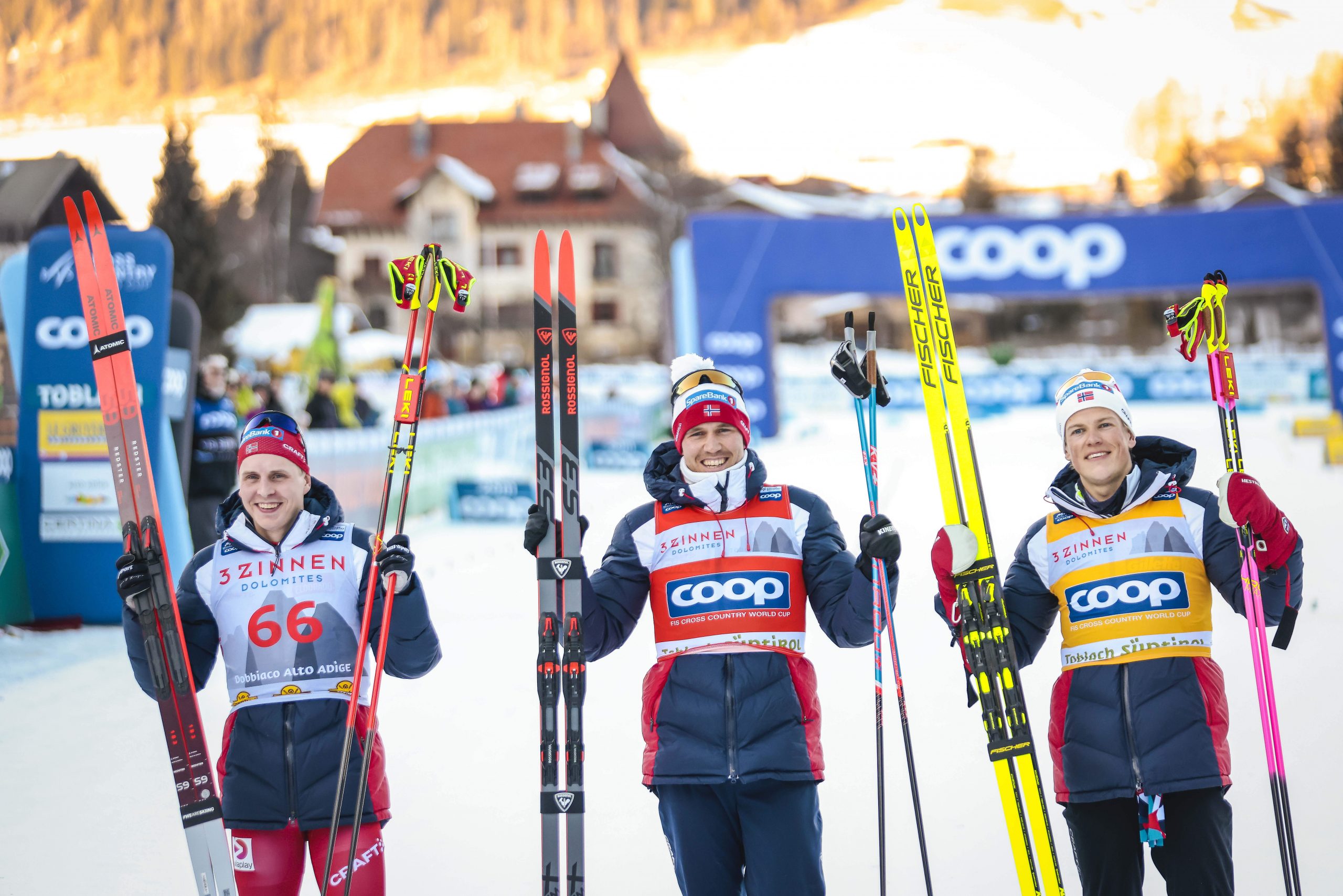
    Harald Oestberg Amundsen (NOR), Andreas Fjorden Ree (NOR), and Martin Loewstroem Nyenget (NOR), (l-r) share the Holmenkollen 50 k Freestyle in Oslo, Norway. (Photo: Authamayou/NordicFocus)
  • Klaebo Wraps Historic Season—Krueger Secures Distance Cup

    Klaebo Wraps Historic Season—Krueger Secures Distance Cup

    This coverage is made possible through the generous support of Marty and Kathy Hall and A Hall Mark of Excellence Award. To learn more about A Hall Mark of Excellence Award, or to learn how you can support FasterSkier’s coverage, please contact info@fasterskier.com.

    No questions remain about the abilities and skills of Johannes Hoesflot Klaebo (NOR). In the world of cross-country skiing, he stands alone. (Photo: Thibaut/NordicFocus)

    A few weeks ago, Norwegian commentator (and Ski Hall of Famer) Petter Northug criticized his countrymen for failing to attack Johannes Hoesflot Klaebo (NOR) more aggressively in a mass start distance race. Northug is likely to lob those same criticisms at the contenders in today’s field after a fast-paced but decidedly undramatic 50 k Classic Mass Start. With only a few kilometers remaining, finally Andreas Fjorden Ree (NOR) went to the front, hoping to detach Klaebo and give himself a chance at the podium—or the win. But if the attack doesn’t sink Klaebo, then everyone else is pretty much sunk. Two kilometers to go, and Klaebo was back on the front. Krueger attempted to attack on the final uphill, but what Klaebo really seemed to want is someone to lead at this point so that he can slingshot around them on the final downhill. Thanks for your assistance, Mr. Krueger . . .

    Klaebo coasted to the win ahead of Martin Loewstroem Nyenget (NOR) and Krueger whose placing would be more than sufficient to earn him the Distance Crystal Globe.

    Everybody wanted to win this one . . . the World Cup 50 k is an event that’s staged only rarely (usually at Holmenkollen and in the World Cup finale) and winning a major international race of this distance is all about bragging rights. It’s a race that is on the schedule at every Olympics and World Championships, but not very many other times. And this particular 50 k is in Classic technique. Everybody wanted to win this one.

    Johannes Hoesflot Klaebo (NOR) remained near the front through the entire 50 kilometer distance in the FIS World Cup season finale in Lahti, Finland. (Photo: Thibaut/NordicFocus)
    Men’s 50 k Classic

    While Johannes Hoesflot Klaebo wrapped up the Sprint and Overall Crystal Globes last week, the Distance Globe was still to be decided when today’s race began. Krueger led by more than 100 points, but he was not the only contender today in Lahti. Paal Golberg (the 2023 World Champion at 50 k) announced his retirement prior to the race; he was likely to be inspired by his own legacy. Iivo Niskanen is a Classic technique specialist; he was likely to be driven forward by the urgings of the eager Finnish crowd. William Poromaa (SWE) was a medalist at the recent World Championshp 50 k; he would be keenly interested in upgrading.

    Paal Golberg (NOR) announced his retirement just prior to the beginning of today’s 50 k Classic race. His ninth place finish was a fine way to conclude a distinguished career. (Photo: Thibaut/NordicFocus)

    One way or another, the men’s race was unlikely to unfold in a manner similar to the earlier women’s race (in which Therese Johaug simply skied away from everyone). No single male racer was sufficiently stronger than the rest to simply ski away, and one of the primary contenders—Klaebo—was more of a sprinter. It would be up to him to keep the pace moderate. It would be up to everyone else to drop him (just ask Petter Northug).

    Klaebo and Poromaa set the pace in the first lap, with all other contenders staying within striking distance. A 15-man front group began to form, one that also included Gus Schumacher (USA) Olivier Leveille (CAN), and Niskanen. Leveille found himself gapped by 15 kilometers, but Schumacher and Niskanen continued to occupy positions in a lead group that had been whittled down to eight.

    At the end of Lap 3, Ree stumbled on the last turn before the stadium, creating a split in the lead group. Klaebo and Nyenget drifted off the front, followed by Poromaa and Krueger. Schumacher and Friederich Moch (GER) struggled to regain contact.  Niskanen stopped to change skis, leaving him off the back and all alone. He’d hope that his new, faster skis would enable him to catch up.

    Schumacher dropped off the pace at the mid-point of the race where he was caught by the newly replenished skis of Niskanen. Many of the contenders in the seven-man lead group would soon be stopping for fresh skis. When they did, Niskanen would likely hit the gas in an attempt to gap them all.

    At the end of Lap 4, all the leaders stopped for new skis . . . all except Niskanen, that is. He skied on alone, determined to gap the group while he could. Poromaa led the chaseers out of the exchange, but they’d all ceded 10 seconds to Niskanen. Moments later, Schumacher stopped for new skis, as well, hoping that the change would allow him to re-establish contact with the leaders.

    As the race entered the final kilometers, it was all Norway. (Photo: Thibaut/NordicFocus)

    Niskanen made the chasers pursue him for a bit, but ultimately chose to sit up to conserve his energy. Seven leaders back together again with 20 kilometers still to race, but in the closing kilometers it was Norway—Nyenget, Jrueger, Ree, and Klaebo—who moved to the front. Everybody must’ve been tired, because everyone knew they needed to shed Klaebo, but no one moved to attack. When Klaebo went to the front just before the final downhill hairpin turn, the race was pretty much over. His fast skis gave him extra meters on the final slope, and he coasted across the finish line with room to spare. Behind him came Nyenget and Krueger who would finish his season with a well-earned Distance Crystal Globe.

    “I think I will need some time this spring to process what really happened during  this season” said Klaebo. “But it’s a perfect way to finish up here with a 50 k as well.”

    Only a few weeks ago, questions continued to swirl regarding Klaebo’s struggles to win major international Distance races. After the World Championship 10 k, after the World Championship Skiathlon, after the World Championship 50 k, and after today’s marathon conclusion to the World Cup season, it seems like those questions can finally stop swirling.

    “Celebrate,” said Klaebo in post-race interviews. “That’s gonna be my plan!”

    World Cup 50 k RESULTS

    Johannes Hoesflot Klaebo (NOR), Simen Hegstad Krueger (NOR), Martin Loewstroem Nyenget (NOR), and Andreas Fjorden Ree (NOR) carried Norway’s colors all the way to the finish line of the 50 k Classic in Lahti, Finland. (Photo: Thibaut/NordicFocus)
  • Fast Tracks: World Champs—Simen Hegstad Krueger Says We Want Our Competitors To Give Us A Good Fight

    Fast Tracks: World Champs—Simen Hegstad Krueger Says We Want Our Competitors To Give Us A Good Fight

    This reporting costs money. Please support this coverage with a voluntary subscription (below) so FasterSkier can provide this level of access to the sport we all love year-round.

  • Patterson a Strong Eighth, Krueger with the Win in Canmore 15 k

    Patterson a Strong Eighth, Krueger with the Win in Canmore 15 k

    This coverage is made possible through the generous support of Marty and Kathy Hall and A Hall Mark of Excellence Award. To learn more about A Hall Mark of Excellence Award, or to learn how you can support FasterSkier’s coverage, please contact info@fasterskier.com.

    Simen Hegstad Krueger (NOR) made a solo breakaway that the field was unable to match. (Photo: NordicFocus)

    In the men’s Overall World Cup competition, Harald Oestberg Amundsen (NOR) holds a commanding 300 point lead over teammate Erik Valnes. While Amundsen and Paal Golberg (NOR) have a stranglehold in the distance competition, the fight for third is fierce. Andrew Musgrave (GBR) has a 15 point lead over Martin Loewstroem Nyenget (NOR), Simen Hegstad Krueger (NOR) and Hugo Lapalus (FRA). And lurking ready to pounce to redeem an illness-plagued season is Johannes Hoesflot Klaebo (NOR) who is only 16 points behind Musgrave. Klaebo would have extra motivation today: with a win, he would become the first man to win 75 individual World Cup events.

    Like the women’s event, the men’s format today was changed due to problems with the arrival of timing equipment to a 15-kilometer mass start.

    Often, men’s mass start Freestyle races are purely tactical affairs. But today that was not the case as Krueger and Mika Vermeulen (AUT) both put in individual breakaways that the field was unable to match. In a brave solo effort, Krueger ended up taking the victory, Amundsen was second, and Mika Vermeulen held on for third.

    Scott Patterson (USA) was able to stay with the lead pack to grab an eighth place finish. (Photo: NordicFocus)

    American Scott Patterson had a great day finishing eighth. Due to the larger field given to host countries, there were 12 Americans at the start line. Other American finishers were Gus Schumacher 22nd, Zanden McMullen 23rd, David Norris 27th, Peter Wolter 36th, Luke Jager 39th, Hunter Wonders 40th. In his first World Cup start, Michigan native Reid Goble was 44th, Braden Becker 45th, Michael Earnhart 47th, Graham Houtsma 49th, and Ben Ogden 54th.

    The top Canadian finisher was Samuel Gary Hendry in 30th. He was followed by Antoine Cyr, 37th, Remi Drolet 42nd, Leo Grandbois 46th, Aidan Kirkham 50th, Xavier McKeever 51st, Scott James Hill 52nd, Felix-Olivier Moreau 53rd, Eamon Wilson 55th, and Adam Heale 57th. Olivier Leveille and Micah Steinberg did not finish.

    Men’s 15 k Mass Start Freestyle

    The pace at the start was very controlled and skiers stayed together in a large pack with Amundsen, Musgrave and Klaebo setting the early tempo. There were two Bonus Points sprints that had the potential to break up the field. As it turned out, this contrived means of breaking up the field would not be needed.

    Mika Vermeulen (AUT) made the first of two solo breakaways, and was able to hang on for third. (Photo: NordicFocus)

    At the start of the second lap, Vermeulen (AUT) pushed to the front and established a bit of a gap on the field, but the pace was still pedestrian. Nonetheless, he had created a seven second lead over Musgrave. Vermeulen continued to put a gap on the field, and no one from the group chose to pursue him. Whether intentionally or not, Vermeulen was now on a solo breakaway.

    At 5.2 kilometers, Vermeulen still held a 5.3 second lead, and none of the leaders deemed it a threat. He was close enough to keep an eye on, and the pack was content to let him set the pace. The breakaway allowed Vermeulen to claim the top bonus points at 6.7-kilometers. After the bonus mark, he continued to hold a five second lead on the field.

    But relentlessly, momentum took over and the pack swallowed up Vermeulen with Krueger taking the lead. Sensing that the pack was not in the mood to chase a break, Krueger began to slowly pull away from the pack. By the time they had reached the 8.4-kilometer mark, Krueger had established an eight second lead on the rest of the field which was led by Friedrich Moch (GER).

    Once Krueger’s breakaway looked unstoppable, Harald Oestberg Amundsen (NOR) charged to the front of the chase group to take second place. (Photo: NordicFocus)

    Krueger’s efforts at a breakaway seemed like a much more legitimate threat than Vermeulen’s had been as he continued to press the pace and stretched his lead to over 15 seconds at 8.9 kilometers. During Krueger’s break, Scott Patterson (USA) had used the opportunity to move into fifth place and was toward the front of the chase pack.

    The next bonus Sprint was at 10.5 kilometers and Krueger easily took it as his lead had swelled to over 17 seconds. Could one man hold off the entire pack for another five kilometers? It was a tall order, but Krueger has a history of strong solo performances, and he looked to be in excellent form.

    At 11.3 Krueger looked like an unstoppable locomotive. His lead was 22 seconds; it looked like no one would be able to chase him down. Patterson still remained in the middle of the chase group and was fighting for podium position.

    Gus Schumacher (USA) had another good day finishing 22nd. (Photo: NordicFocus)

    By the final lap, Krueger had stretched his lead, and it looked like the pack had given up on fighting for first place and was now jockeying for podium positions. Amundsen moved to the front of the chase group, but it was clearly not an effort to reign in Krueger.

    By 12.7-kilometers Krueger had beaten the field into submission. With over a 20 second lead, the race was now his to lose. Another story playing out in the chase group was Patterson’s performance, who was sticking with the chase group in eighth place.

    As the field entered the final stretch it was clear that Krueger’s gamble was going to pay off. He still was holding onto his 20 second lead.

    As the group entered the stadium Krueger coasted to victory and glanced back to watch the battle unfolding behind him. The pack was surging with Amundsen jumping to the front to take second place and Vermeulen hanging on to third. Patterson was able to capture eighth place, turning in a great day for the American.

    In a format that is usually dominated by pack tactics, the script for the men was upended today by Krueger and Vermeulen whose brave solo breaks made for an entertaining race.

    After the race Krueger was clearly excited. “It was almost the perfect race for me today,” he said. “After the format was changed, I decided to make it as tough as a race as possible. The last lap I feared I had used a little too much energy.” But clearly, he hadn’t, and was able to turn in a spectacular performance.

    At the podium ceremony, the European winners truly seemed to relish receiving Canmore’s signature cowboy hat as a prize; none more than Vermeulen who notched his first podium finish.

    The European racers can’t seem to get enough of the Canmore cowboy hats. Harald Oestberg Amundsen (NOR), Simen Hegstad Krueger (NOR), Mika Vermeulen (AUT), (l-r) (Photo: NordicFocus)

    RESULTS:

  • Norway Dominates Holmenkollen Taking Top 10 spots, Norris and Patterson Hit Top 20

    Norway Dominates Holmenkollen Taking Top 10 spots, Norris and Patterson Hit Top 20

    This World Cup coverage is made possible through the generous support of Marty and Kathy Hall and A Hall Mark of Excellence Award. To learn more about A Hall Mark of Excellence Award, or to learn how you can support FasterSkier’s coverage, please contact info@fasterskier.com. 

    No other professional ski race can match the prestige and lore surrounding the Holmenkollen 50 kilometer race held in Oslo, Norway. Win it—and your name will be etched into history. Like all iconic sport competitions, once you are Holmenkollen champion, it’s a title which follows you forever. It’s also a title everyone desperately wants. Holmenkollen has earned its reputation; with over 6,000 feet (1,828 meters) of climbing, it’s generally viewed as the toughest 50 kilometer race in which professionals will compete. The focus this year would be all about Norway—and why not? Norwegian men have subdued the rest of the distance skiing world, having won each of the last 16 World Cup distance events and every distance event this season. Though with only 39 men starting, others were hoping for a chance to break through.

    Simen Hegstad Krueger (NOR) celebrates a Holmenkollen victory after having been left off the Norwegian 50 k World Championship team last week. (Photo: NordicFocus)

    After dueling on the brutal Holmenkollen course, the Norwegian domination continued with Simen Hegstad Krueger (NOR) taking the win. He was followed by Hans Christer Holund (NOR) and Martin Loewstroem Nyenget (NOR). Norwegians took the top ten spots. Andrew Musgrave (GBR) was the top non-Norwegian finisher in 11th.

    David Norris was rewarded for his globe-trotting taking the top American position, finishing 17th. “Today went well for me,” Norris said. “No major mishaps and I have pretty good energy considering my schedule. Third 50 in three weeks! I’m so grateful that the Steamboat Winter Sports Club allowed me to come here for two weeks. This has been a great experience.”

    Among other North Americans, Scott Patterson was right behind Norris finishing 18th. Hunter Wonders was 23rd, followed by Gus Schumacher in 28th. The top Canadian was Olivier Leveille in 26th, while Russell Kennedy was 36th.

    David Norris (USA) skied to 17th, having raced three marathons in three weeks across the world. (Photo: NordicFocus)
    Holmenkollen 50 Kilometer Mass Start Freestyle

    For Klaebo (NOR), a win today would go a long way to heal the wounds of last week’s second place finish at the World Cup 50 k. Klaebo would also be looking to eclipse countryman Martin Sundby for the most World Cup victories for a man in one season, currently both are tied with 14. Paal Golberg (NOR) would be in the difficult position of defending his World Cup Marathon victory from last week.

    American fans would have their eyes on long distance standout David Norris who was attempting the unprecedented feat of winning the North American Birkebeiner, skiing in the World Championship Marathon the following week, and now, one week later, racing Holmenkollen.

    Johannes Hoesflot Klaebo (NOR) tried a different strategy this week going to the front of the race. But the big 50 k win still eluded him. (Photo: NordicFocus)

    Klaebo took a different approach to today’s race as he went to the lead early and led through the first five kilometers. It was a marked contrast to the strategy he employed at last week’s World Cup 50 kilometer when he never went to the front. Early on, Klaebo seemed determined to not repeat last week’s events, quickly returning to the front whenever he was challenged. He was joined at the front by Golberg.

    This pattern continued for the first 13.5 kilometers as the field stretched out at each bonus point sprint; then the inevitable contractions occurred, with Klaebo still out front. There were minor lead changes but each new leader was quickly replaced by Klaebo. The question was, would he maintain this strategy for the rest of the race?

    Simen Hegstad Krueger (NOR) gambled big going for an early ski exchange. It paid off with a Holmenkollen victory. (Photo: NordicFocus)

    At 14 kilometers the answer was provided when Krueger (NOR) put in a turn of pace to lead the race. Klaebo now seemed content to sit behind Krueger. As skiers went through the stadium for the second time, all of the top contenders continued without exchanging skis. Krueger continued to lead with Klaebo pulling along side him for long stretches.

    The Krueger-Klaebo duo continued to lead through the halfway mark of the race. Joining the front of the race was crowd favorite Andrew Musgrave (GBR) who generally shines at distance events; however, Musgrave’s time out front was short lived, and he wouldn’t be able to stay with leaders for long.

    Even with Krueger and Klaebo out front, the field still had not fractured as there were still 30 athletes skiing in the lead pack.

    At the start of third lap, the tone of the race would reset as the ski exchange strategy came into play.  Kreuger and Holund (NOR) opted to exchange skis while Klaebo and Golberg remained on course. After the ski exchange, Kreuger and Holund dropped to 22 seconds behind the pack, but within one kilometer they had rejoined the back of the group.

    Gus Schumacher (USA) had a brief taste of life at the front at Holmenkollen. He would go on to finish 28th. (Photo: NordicFocus)

    At 28 K, American fans received a thrill as Gus Schumacher surged to the front and went into third at the bonus point line. Also by this point, Holund had worked his way back to the front of the pack taking advantage of his fresh skis. Klaebo hung with him, and they began to seriously fracture the pack for the first time.

    It was evident that Krueger and Holund had benefited from the ski exchange as they were out-gliding other competitors. Holund’s and Kreuger’s strategy had become clear: change skis early and press the pace, which is exactly what they did. In a moment, everything had changed as Holund and Krueger established a 10 second gap on the field where they were joined by lesser-known 22 year old Iver Tildheim Andersen (NOR) who had also changed skis early. The race was now getting serious with the lead three establishing a clear breakaway. Klaebo was suddenly 17 seconds off the lead.

    The three leaders had gone all in with their strategy and there was no turning back now. They would be forced to defend their lead for another 17 kilometers. The strategy was put to a test at the fourth lap when the entire chase pack changed skis putting them further behind the break away pack, but giving them the opportunity to gain ground on faster skis. After the exchange, the pack was 42 seconds off the leaders.

    Hans Christer Holund (NOR) broke away from Johannes Hoesflot Klaebo (NOR) to take second at Holmenkollen. (Photo: NordicFocus)

    The chasers seemed determined to close the gap. By 36 kilometers, the lead had narrowed to 32 seconds, with the chasers gaining time with each kilometer. With only 10 kilometers to go, the gap was down to only 28 seconds. It would be nip and tuck for the leaders to try and hold off the pack.

    With the pace quickening even more, the chase pack began to break up. Martin Nyenget (NOR) and Harald Oestberg Amundsen (NOR) moved to the front of the chasers. Klaebo and Golberg had fallen back by about five seconds. It appeared that the top two World Cup 50 kilometer finishers were running out of gas.

    At 42 kilometers, Klaebo was desperately trying to hang on to the chase group but was laboring mightily. Toenseth and Nyenget were quickly dropping the rest of the chasers who were now down to only two skiers. At the front of the race, the strategy of working together was now gone. Krueger decided that he needed to press the pace with Holund going with him. Andersen was dropped from the lead group.

    The final three kilometers has some of the steepest climbing in the race which Toenseth and Nyenget would try and use to catch the leaders as they put in a burst to close the gap, but the leaders were not to be denied. Krueger put on a burst of his own with half a kilometer to go pulling away from Holund to ski into the stadium with a five second lead. Holund was able to hang on for second with Nyenget finishing third.  The young Andersen was able to hold on to fourth place for a dramatic Holmenkollen finish for him.

    Once the exciting Holmenkollen drama was settled, it was all Norway in the top ten, but Klaebo would still be left searching for the landmark marathon victory which has eluded him throughout his career.

    Hans Christer Holund (NOR), Simen Hegstad Krueger (NOR), Martin Loewstroem Nyenget (NOR), (l-r) conquered the mighty Holmenkollen course (Photo: NordicFocus)

    Holmenkollen 50 Kilometer Mass Start Freestyle RESULTS


    Holmenkollen 50 Kilometer Mass Start Freestyle RESULTS

  • Shuffled Podium, Same Norway. Americans Ski to Promising Results in 15 k Skate

    Shuffled Podium, Same Norway. Americans Ski to Promising Results in 15 k Skate

    This World Cup coverage is made possible through the generous support of Marty and Kathy Hall and A Hall Mark of Excellence Award. To learn more about A Hall Mark of Excellence Award, or to learn how you can support FasterSkier’s coverage, please contact info@fasterskier.com. 

    What was old is new again: for the first time since equal-distance racing policies were put into effect this season, the men’s field was set to race a 15 kilometer individual start. This particular distance has been raced at World Championships since guys with names like “Sixten” were racing on hand-carved wooden skis, but the extra five kilometers added to the men’s new-normal 10 kilometer World Cup distance provided a hint of freshness to this traditional World Championship event.

    Scott Patterson (USA) completes his 15th place effort in the 15 k individual start skate race on Wednesday. (Photo: NordicFocus)

    If the 15 k distance blurred predictions before the race, the roster of contenders in the field brought those predictions back into focus. As the last World Championships in Oberstdorf in 2021, the 15 k skate was a Norwegian sweep: Hans Christer Holund, Simen Hegstad Krueger and Harald Oestberg Amundsen going 1-2-3. American skiers also provided reason to be optimistic as the Team Relay approaches later this week, with Scott Patterson finishing 15th, Gus Schumacher 19th, Ben Ogden 27th, Hunter Wonders 33rd. Canadian finishers included Olivier Leveille 28th, Graham Ritchie 46th, Xavier McKeever 60th. 

    Johannes Hoesflot Klaebo (NOR) was also on the start list this morning, competing in a 15 k World Championship or Olympic skate event for the first time in his career. Based on the Norwegian skiathlon sweep last week, indications were that the Norwegian podium sweep of two years ago could likely be re-created today; the Norwegian shuffle at the top of the race was on.

    Simen Hegstad Krueger (NOR) completes his world championship effort in the 15 k individual start skate race Wednesday. (Photo: NordicFocus)
    15 k Individual Start Freestyle

    As to who would stand atop the podium, indications were clear from the beginning. Kreuger is known for his ability to come on strong late in his seasons and late in his races, so his emerging as the early leader in this race suggested his form might prove unbeatable. By the 2.2 k checkpoint, Krueger was already out in front of a tight-packed field. American, Ben Ogden, described Planica’s course as one that could, “make you feel like a king for the first four kilometers, and then [make you] go ‘oh no, I still have 10 k to go’” Accordingly, Krueger’s early lead was one that didn’t warrant anointing him too early. But when Krueger came to the top of the long, winding climb defining the middle section of the course at 7.7 k with a 23 second gap over Sweden’s William Poromaa—and then kept adding to that lead at each subsequent checkpoint—it seemed like the probable outcome was becoming clear. Krueger was on his way to winning his second individual World Championship of his career, and in as many starts in Planica. As on-air broadcaster, Chad Salmela, pointed out, Krueger has started 10 races at World Championships and Olympics, and medaled in nine of them.

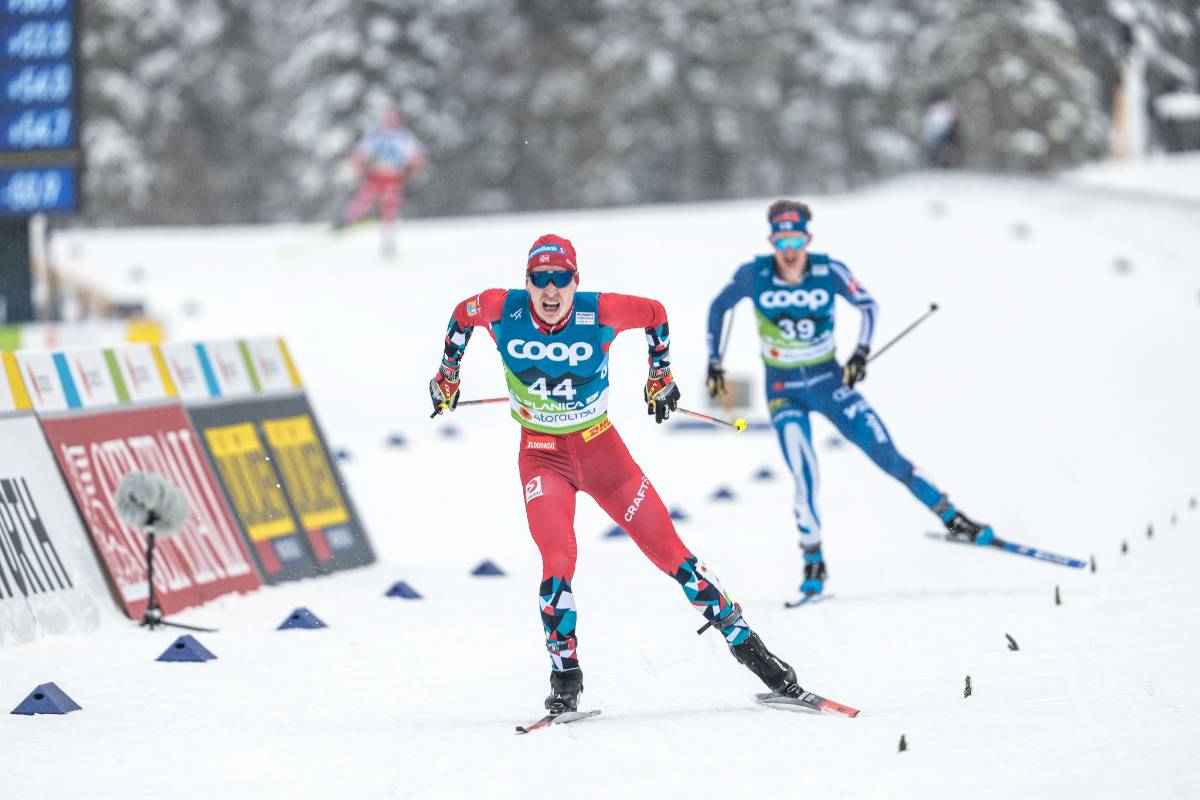
    Krueger’s start position, bib 44, was relatively early among the main contenders. As a consequence, there remained considerable potential for drama to occur behind him as the field of contenders approached, but never matched, his high-mark at the later checkpoints. Holund started a minute behind Krueger in bib 46, but his checkpoint times put him in a closer race with Sweden’s Poromaa, with whom he traded on-course placings numerous times. Klaebo started in bib 48, two minutes behind Krueger, and through the first 2.2 k checkpoint was splitting seconds with him and leading the field, but Klaebo dropped to sixth place at 4.1 k and remained out of contention for the win the rest of the day. Amundsen—the 24 year old who had won a bronze at the Oberstdorf 15 k World Championships at only age 22—provided the late drama. Wearing bib 64, Amundsen led Krueger by 1.5 seconds at 2.2 k, was three seconds back at 5 k, and 11 seconds back at 7.7 k. When he put time into Krueger—he cut the gap from 11 seconds to 7.7 seconds in 3 k at the 10.8 k checkpoint—there was real intrigue. The gap grew in the last lap on the course, though even with a late push to finish 5.3 seconds back, Amundsen’s challenge to Krueger appeared to be over by the 12.8 k checkpoint. When he did cross the line, Amundsen had earned the second medal of his career, and Krueger took it as the sure sign he was safe to pull on the World Champions bib. Two years on from Oberstdorf, the 15 k skate podium had played a Norwegian shell game. 1st) Simen Hegstad Krueger, 2nd) Harald Oestberg Amundsen, 3rd) Hans Christer Holund.

    Harald Oestberg Amundsen (NOR) followed up a 15 k bronze at 2021 World Championships in Oberstdorf with silver in Planica in 2023. “Maybe in Trondheim [in 2025], I will fight for the gold medal,” said Amundsen in post-race comments. (Photo: NordicFocus)
    In a post-race press conference, Amundsen—the youngest member of the Norwegian sweep—said, “It’s good to be on the podium. I trained a lot with [Krueger and Holund] the last few years, knowing they are the strongest guys after Oberstdorf.” As for what’s next, Amundsen sees one more step, literally: “Maybe in Trondheim [in 2025], I will fight for the gold medal.”

    Patterson, Schumacher, and Ogden in Top 30 for Americans

    The American skiers started their day before the podium action began, with Schumacher (bib 33), Ogden (bib 36), and Wonders (bib 37) all taking part in the bar-setting through early checkpoints. At 2.2 k, Schumacher and Ogden were near the front of the early starters, and by 4.4 k were on top; Schumacher first and Ogden second with less than a second between them. From there, though, Ogden would say in post-race comments that he “ran out of steam in the middle on the climbs.” His check-point times faded from the top, but still made clear the American was having a consistent effort. He would finish 27th; his first distance top 30 at a World Championships.

    Gus Schumacher (USA) skied to a career-best World Championship distance finish, taking 19th in the 15 k Freestyle. “Jessie Diggins said ‘if you push well and do everything right, you’ve got to be happy.’” (Photo: NordicFocus)

    Schumacher continued to stay near the top of early-starters as he passed through the checkpoints. At each point past 5 k, he was slotting behind Andorran skier Ireneu Esteve Altamiras, and later France’s Maurice Manificat, Japan’s Naoto Baba, and Germany’s Jonas Dobler. The dividing line between early-starters and the main contention field was Sweden’s William Poromaa who bested the early group at each checkpoint past 5 k. As early starters filled in behind Poromaa at each check point, what became clear was that Schumacher’s early time marks were setting him up for a good finishing time. Schumacher sped through the final lap, eventually crossing the line standing in third place. He would ultimately find himself 19th. It was the best World Championships distance finish of his career, and a bounce-back for Schumacher after last week’s 38th place finish in the Skiathlon.

    Of his quick return to form, Schumacher said to FasterSkier post-race that “my results have gone from really bad to really good a couple of times now, so I can start to have more confidence that when I give it my best effort, that might happen.” Schumacher also identified a belief in himself that emanated from advice given to him by newly crowned world champion teammate Jessie Diggins: “[After the Skiathlon] it was nice to have Jessie [Diggins] around. She said, ‘if you push well and do everything right, you’ve got to be happy.’” Schumacher also paused, and then reflected to FasterSkier’s Nat Herz that, “It’s a little crazy to think that [Jessie] is one of the best that’s ever skied, you forget that so easy because she’s such a good teammate.”

    Scott Patterson rcovers at the finish line after skiing to a 15th place finish. Patterson highlighted a day in which the Americans posted three top 30 finishes. (Photo: NordicFocus)

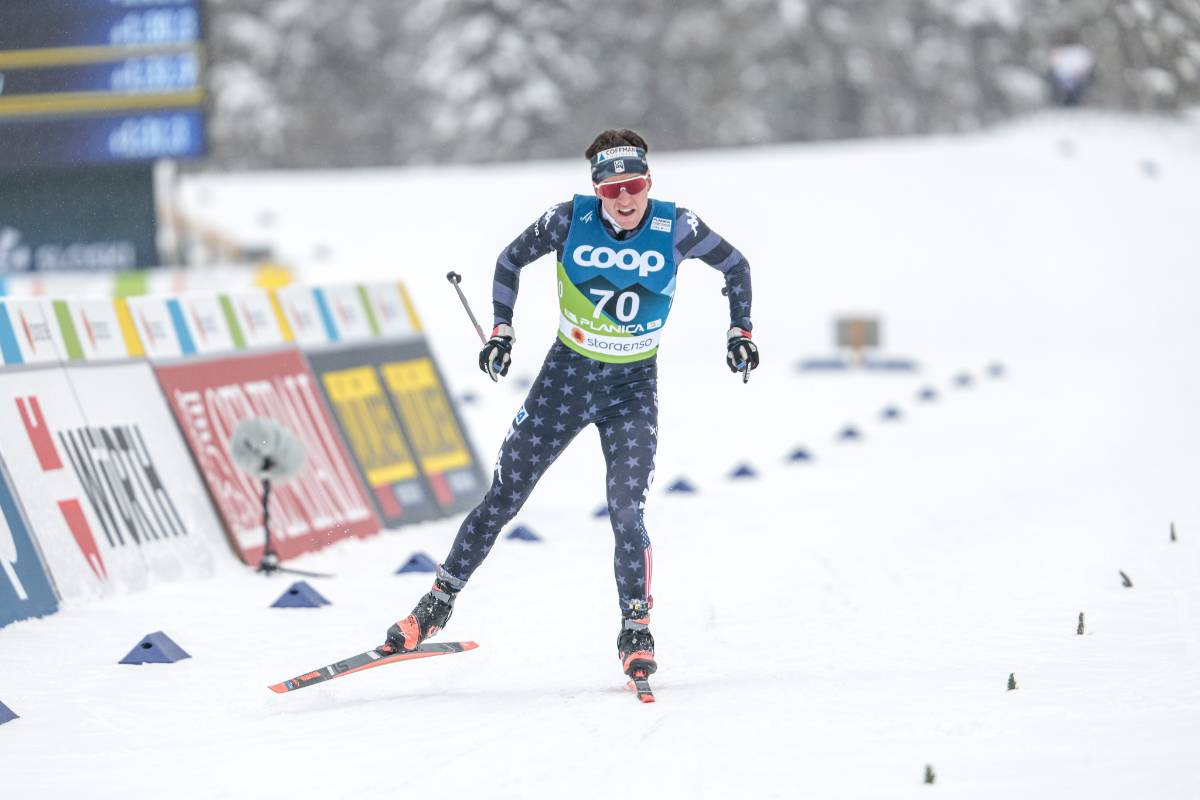
    The top American performance of the day came from later start positions. Scott Patterson (USA) wore bib 70 on the day, working his was to an eventual 15th place finish. “I kept getting splits like ‘a couple seconds to eighth, you’re fighting for top ten,’ things like that,” said Patterson in post-race comments to FasterSkier. “[But] then I definitely fell apart in the last couple of kilometers and lost some time.” 

    Post-race, Patterson described his strange mix of disappointment and optimism from the 15th place result: “I wanted more from today,” he said. “Honestly, warming up, I went ‘I am not really feeling it,’ but I feel like I skied decent for how I was feeling.” Patterson added that he was “looking forward to the 50 k classic this weekend, for sure.”

    15 K Results Point to Intriguing Team Relay

    The World Championship program now turns back into a team affair, with the Women’s Team Relay event tomorrow and Men’s Team Relay on Friday. In the American camp, Gus Schumacher says they are “feeling pretty excited.” Part of that excitement may stem from today’s results, with Schumacher saying to FasterSkier that, “One of the Swedish guys pointed out that—besides Norway—there’s a lot of [team’s] that could battle it out, and I feel confident in my ability to contribute to that.”

    Full RESULTS

    All-Norwegian podium: 1st) Simen Hegstad Krueger, 2nd) Harald Oestberg Amundsen, 3rd) Hans Christer Holund. (Photo: NordicFocus)
  • Only Norway—Krueger Leads Sweep of 30 k Skiathlon Ahead of Klaebo and Roethe

    Only Norway—Krueger Leads Sweep of 30 k Skiathlon Ahead of Klaebo and Roethe

    This World Cup coverage is made possible through the generous support of Marty and Kathy Hall and A Hall Mark of Excellence Award. To learn more about A Hall Mark of Excellence Award, or to learn how you can support FasterSkier’s coverage, please contact info@fasterskier.com. 

    Simen Hegstad Krueger (NOR) celebrates as he crosses the finish line as World Champion in the 30 k Skiathlon in Planica, Slovenia. (Photo: Modica/NordicFocus)

    Thirty kilometers is a long way to race. It’s the sort of distance that recreational skiers race as a “marathon,” the kind of overlong race effort from which mere mortals take weeks to recover. Coming so near the beginning of a 12-day World Championship schedule, a race of this length —one raced with such intensity and under such challenging and difficult conditions—is likely to have a profound effect on all the races to come. If the rest of the field could have peered into the future—could’ve seen what Simen Hegstad Krueger (NOR) was capable of in today’s Skiathlon—they might never have committed so much energy and passion to this race. Krueger—the reigning Olympic Champion in the event (and silver medalist from the last World Championships)—was never going to be denied. Not today . . .

    Simen Hegstad Krueger is sublimely glad he toed the starting line today: he claimed the victory with a dominating performance in the second half (the freestyle half) of the 30 k Skiathlon. Johannes Hoesflot Klaebo (NOR) and Sjur Roethe (NOR), the silver and bronze medalists, might also be relatively glad they raced today, though they may also have spent so much energy that their remaining races at the World Championships are likely to be affected. And everybody else? Those who earned no medals may be questioning whether racing this distance—at such an extraordinarily high measure of effort, through such challenging and difficult conditions—was really worth it.

    Iivo Niskanen (FIN) led William Poromaa (SWE) for much of the classic leg, only to find himself undone by the way the pace increased after the classic-to-freestyle transition. (Photo: Modica/NordicFocus)

    If he had advance knowledge of the way things would turn out, Iivo Niskanen (FIN) might never have surged to the front in the classic leg; William Poromaa (SWE) might never have pushed the pace; Calle Halfvarsson (SWE) might never have stuck his nose out into the wind; Andrew Musgrave (GBR) might never have worked so hard to be near the front; Paal Golberg (NOR) might have saved his energy for another day (or for another week in his season-long race with Klaebo the the World Cup Overall crystal globe). Even bronze medalist, Roethe might have hesitated before committing so much in a race for silver that he would ultimately lose to the world’s best sprinter.

    Even the North Americans might’ve raced differently if they knew what levels of exhaustion the race would bring. Scott Patterson raced hard, holding his position through much of the day. He would finish a respectable 19th, ahead of his American teammates Hunter Wonders (24th), and Gus Schumacher (38th). Patterson confided that while a top-20 at World Championships is good, he had hoped for more. “I finished up 19th, which was okay,” he said. “When I’ve been top 10, I definitely wanted a little more today.” Canadian finishers included Russell Kennedy (37th), Olivier Leveille (43rd) and Xavier McKeever (44th).

    Thirty kilometers is a long way to race; probably every competitor leaves this race shattered, exhausted, cramping (as even race winner, Krueger, admitted he was). The twelve days of the FIS Cross Country World Championships is a grind. Racing takes place almost every day . . . even after thirty grueling kilometers, there are still ten more days of World Championships still to ski.

    William Poromaa (SWE), Jules Lapierre (FRA), Paal Golberg (NOR), (l-r) in the freestyle leg. The difficult conditions—and the hot pace set by eventual race winner, Simen Hegstad Krueger—exhausted even the most talented and qualified contenders. (Photo: Modica/NordicFocus)
    Men’s 30 k Skiathlon

    Planica, Slovenia occupies a beautiful corner of Europe’s mountain ranges, and the weather this week is a ski-vacationers dream. Ironic, then, that the very same weather is a wax technician’s nightmare. Sunny and warm, transitioning the snow between heats, changing the conditions even within the timeframe of an ongoing race. At the start of today’s skiathlon, race announcer, Kikkan Randall, mentioned, “You can already hear the snow . . . with a late-afternoon start, you can almost get a freezing effect. The snow can actually be pretty fast.”

    The classic half of the Skiathlon indeed started out fast. The course began as a steady downhill; Klaebo stayed at the front and out of trouble (shadowed by his teammates Golberg and Krueger, and the Swedish stars, Calle Halfvarsson and William Poromaa). The classic leg was simple:  Finland and Sweden kept the pace fast, contenders stay tucked in the field, and Klaebo picked up ground on every downhill. It looks like great fun to ski a mass start event the way Klaebo does, and certainly his wax technicians and ski suppliers have something to do with that. But that doesn’t mean he can just float along effortlessly. The other racers have a say in the pace, as well . . . and none of them wanted to make it easy for Klaebo.

    Niskanen moved to the front as the pace-maker at the end of Lap 1. By Lap 2, his efforts had begun to string out the field: Niskanen followed by Poromaa, Musgrave, and the entire kingdom of Norway. At the beginning of Lap 3 the field split, with Americans Patterson and Wonders being gapped. Klaebo continued using each downhill to adjust his position within the lead pack, gliding and stepping past the pace-makers, and forcing them to accelerate back to the front at the base of each uphill, particularly in Lap 3 as it appeared that many other racers’ skis were beginning to drag.

    At the beginning of Lap 4, everyone looked over their shoulders to check the field, a momentary pause in the action that allowed the remarkable efforts of lone chaser, Esteve Altimiras (AND) to catch back on to the back of the lead group. He’d been bravely chasing for two laps while Finns and Swedes pushed the pace at the front, and this Lap 4 truce allowed the lead pack to settle as a group of 15. The truce would not last for long.

    Johannes Hoesflot Klaebo (NOR) was forced to do his own work for most of the freestyle leg. His determined chase of teammate Sjur Roethe (NOR) earned him yet another World Championships medal, this one a silver. (Photo: Modica/NordicFocus)
    Classic to Skate Transition

    The mid-point of the Skiathlon (15 k) is where skiers switch from classic skis/poles to freestyle skis/poles, a transition that they practice in anticipation of these races. Take too long in transition, and a skier can find himself gapped . . . even the best skiers . . . even Klaebo. Klaebo flubbed the transition, exiting at the rear of the lead pack, but he seemed untroubled. If he’d known what kind of acceleration Krueger was about to throw in, Klaebo would have hurried the transition a bit.

    Roethe exited the transition first with a considerable lead, followed by Krueger, Jules Lapierre (FRA), Roethe, Krueger, and Poromaa. Klaebo followed Golberg who would drag them both back to the chase pack. Once Klaebo got there, his prospects appeared obvious: sit in and let others work, which would probably give him an easier day, and allow him to sprint for the bronze medal. As it turns out, bronze is not enough for Klaebo, and he seemed to quickly assess that none of his companions was willing to pull him back to the leaders. Poromaa wasn’t fast enough, Lapierre wasn’t fast enough, Golberg wasn’t fast enough. If Klaebo wanted to remain in contention for this Skiathlon gold medal, he’d be forced to chase the leaders down, himself. So, Klaebo set out on his own to catch the two leaders—his teammates Roethe and Krueger.

    Krueger began his surge in Lap 7, picking his way through strings of lapped skiers. He definitely appeared the sharpest, while Roethe began to visibly falter (along with Klaebo and everyone else). Even so, Roethe continued gamely working each uphill, while Klaebo drove, faded, recovered, and drove again. The top three showed their class, their fitness, and their courage. At the end of a 30 k Skiathlon, there really is no place to hide. Klaebo was really forced to work for silver, which he stole from the courageous Roethe in the final kilometer. The efforts committed by the medal winners in this race could conceivably change the whole championships. Today, under the sunny skies of Planica, Slovenia, each of these champions appeared willing to pay that price.

    Men’s 30 k Skiathlon RESULTS

    Only Norway on the podium: (l-r) Johannes Hoesflot Klaebo (NOR), Simen Hegstad Krueger (NOR), Sjur Roethe (NOR). (Photo: Modica/NordicFocus)
  • Scott Patterson 14th in Toblach 10 k Freestyle, Norwegians Sweep the Podium

    Scott Patterson 14th in Toblach 10 k Freestyle, Norwegians Sweep the Podium

    This World Cup coverage is made possible through the generous support of Marty and Kathy Hall and A Hall Mark of Excellence Award. To learn more about A Hall Mark of Excellence Award, or to learn how you can support FasterSkier’s coverage, please contact info@fasterskier.com.

    Racing in Toblach, Italy continued today with the Men’s 10-kilometer freestyle. Coming into the race Johannes Hosflot Klaebo (NOR) had won 13 men’s events and was only one victory away from tying countryman Martin Sundby for the most individual victories in a World Cup season. If Klaebo’s winning ways continued, he could threaten Therese Johaug’s record of 20 wins in a season; a record which many thought was unbreakable. It’s been all Norway in men’s distance racing this year; they have won every individual distance event. The last time a non-Norwegian man won a distance race was in February, 2022, when Iivo Niskanen (FIN) won the 15-kilometer classic in Lahti, Finland.

    Klaebo leads the overall World Cup points standings over Paal Golberg (NOR) by 181 points. If Golberg wished to stay in the overall championship hunt, he would have to have a good performance today. Golberg is the overall distance points leader so he was definitely a threat to win or keep pace with Klaebo. Hans Christer Holund (NOR) sits second in the distance rankings; he would also be a threat to be at the top.

    It was warm for the start of the race, about 40 Fahrenheit. The warm temperatures didn’t negatively affect the racing, and at the end of the day Golberg was able to finish first, 0.3 seconds ahead of countryman Simen Krueger (NOR). Klaebo ended up third, 2.8 seconds back. Norway took the first seven positions.

    At the end of the day it was all Norway on the podium: Simen Hegstad Krueger (NOR), Paal Golberg (NOR), Johannes Hoesflot Klaebo. (NOR) (Photo: NordicFocus)

    American Scott Patterson had an excellent day, finishing 14th, only 34.5 seconds off the lead. Other American finishers were Finn O’Connell 41st, Kevin Bolger 54th, Hunter Wonders 55th, and Logan Diekmann 71st.  No Canadians raced today.

    Scott Patterson masterfully navigated ski choice and pacing to place 14th. (Photo: NordicFocus)
    The Race

    Today’s warm weather meant that ski choice would play a large factor. Clear bases were definitely in the mix. Toward the start of the race, the sun had moved off the course and the snow firmed providing fast and challenging conditions, especially for the later starters. This made for a tough ski choice. Scott Patterson told FasterSkier that, “Ski choice was definitely about thinking ahead for the refreeze. We tested skis in the stadium initially and recognized that the really warm skis that performed well in the stadium would probably be a risky choice by race time.” Patterson continued that, “Overnight we got a bit of rain and relatively high winds. This combined to deposit an ice layer on the ski track and some pine needles and sticks from the trees. As we were starting at 3 pm, part of the course had baked in the sun during the day and gotten quite slushy. However, by the start of the men’s race the whole course was refreezing and the sun was gone. This resulted in some fast firm sections that hadn’t seen sun as well as glazed rutted parts that were quite funky to ski in.”

    Finn O’Connell (USA) had a personal best World Cup day, finishing 41st. (Photo: NordicFocus)

    U.S. coach Kristen Bourne confirmed the tricky conditions. “The track was pretty ripping fast for the women and sort of the same for the men. All of the divots and ruts from the women’s race [froze] and started to become bumpy and firm for the men. It was a weird fluctuation but was super-fast.”

    As has been the pattern most of the season, today’s race would be a back-and-forth affair between the top Norwegians with Klaebo, Golberg and Simen Hegstad Krueger (NOR) trading punches and fighting for the lead all day.

    Klaebo was one of the earlier starters among the pre-race favorites. Golberg and Krueger started several spots behind Klaebo, so they would have the advantage of marking their teammate. At the 1.7-kilometer mark Klaebo had taken the lead and established the early time to beat. When Golberg and Krueger reached the 1.7-kilometer mark, they were already a couple of seconds behind Klaebo.

    Paal Golberg’s (NOR) finishing lunge put him on top of the podium. (Photo: NordicFocus)

    At  2.1 kilometers, Hugo Lapalus (FRA) decided he would take a shot at the lead and moved into first over all the skiers  who had already reached this mark. His pace would only be eclipsed later by Krueger who had a later start than Lapalus. But, Lapalus’ glory was short lived, at 3.0-kilometers he had dropped back to fourth. Klaebo and Krueger were virtually tied and had retaken the lead.  Golberg was now 3.2 seconds back.

    Between three and five kilometers, Klaebo put in a strong burst of speed to regain his lead outright at the five kilometer time checkpoint. Golberg and Krueger trailed Klaebo by about two seconds.

    As the raced played out and skiers hit the 7.1- kilometer mark, Krueger had surged into the lead with Golberg now 1.9 seconds back.  Klaebo had dropped off the pace considerably and was now 9.8 seconds off the lead. This trend held up over the next kilometer as Krueger increased his lead to 5.4 seconds over Golberg.  Klaebo was now a whopping 11.4 seconds off the lead.

    Johannes Hoesflot Klaebo (NOR) was in the hunt for the victory all day, but couldn’t overcome a mid-race deficit. (Photo: NordicFocus)

    Pacing on the course was difficult, and not just for Klaebo.  Patterson told FasterSkier that, “I had a few short opportunities to ski with people but mostly it was about finding my own pace and enduring through the muscular burn while keeping the tempo high.” He continued that, “It’s crucial to V2 almost all [of] the more gradual hills. Thus, I was focused on skiing smooth through the first 2km to build into the race a bit, then really turn it on and work the rest of the course as hard as I could.”

    The U.S. team received advice on pacing the five kilometer loop course from veteran Jessie Diggins (USA) at their team meeting the night before the race. Bourne said that Diggins advised her teammates to “Go out as hard as you can, because once you get to 3 k, it’s pretty much all downhill from there.”

    Kevin Bolger (USA) representing team USA in the Toblach 10 k. Bolger would finish 54th. (Photo: NordicFocus)

    Klaebo also made adjustments and was able to turn up the speed in the last two kilometers, and coming into the finish, he put in one of his patented sprints, crossing the finish first among the racers who had finished. At this point Klaebo was in the leader’s chair, 2.4 seconds over Harald Amundsen (NOR).

    But Golberg and Krueger were still lurking on the course, taking advantage of their later start. As he finished, Golberg was able to meet Klaebo’s finishing speed and went into first ahead of Klaebo by 2.8 seconds.

    The only question now was whether Krueger would be able to match his teammates speed over the last two-kilometers. As Krueger came into the finish he was moving very smoothly and put in a ferocious finishing sprint but fell short of Golberg by 0.3 seconds. As it turned out, Golberg’s lunge at the finish was the difference between first and second.

    Klaebo had put in an amazing final two-kilometers skiing it nine seconds faster than Krueger and three seconds faster than Golberg. But Klaebo’s slower speed in the middle of the race had given Golberg and Krueger the opening they needed to pull past him.

    At the end of the day, Norwegian domination in men’s distance racing continued, Sundby’s record was intact, for the time being, and a young American continued to show great promise.

    Men’s Freestyle 10-kilometer Individual RESULTS

  • Norwegian Men Rejoin the Field for Podium Sweep in 15 k Skate

    Norwegian Men Rejoin the Field for Podium Sweep in 15 k Skate

    This World Cup coverage is made possible through the generous support of Marty and Kathy Hall and the A Hall Mark of Excellence Award.  To learn more about A Hall Mark of Excellence Award or to learn how you can support FasterSkier’s coverage please contact info@fasterskier.com.

    After a warm and rainy fall, temperatures dropped just in time for the athletes arrival in Lillehammer, Norway this weekend. The original program for Saturday’s competition was a 30 k skiathlon but low snow conditions forced a last minute change and the race became a 15 k individual start skate. Between last season’s cancelled races due to COVID and this season’s snow shortage, the athletes will have to wait another year to return to the iconic course out of the Birkebeineren Ski Stadium. Instead, the race was held in the former Biathlon stadium where saved snow farming was already in store, creating a 3.6 k loop to be completed four times for the men. In spite of this, the scene at the start line was one of winter as the athletes lined up, jumping out of the start gate to light snow and 18 degrees Fahrenheit. 

    Arnaud Chautemps (FRA) and Hugo Lapalus (FRA), (l-r) after a snowy 15 k skate (Photo: NordicFocus)

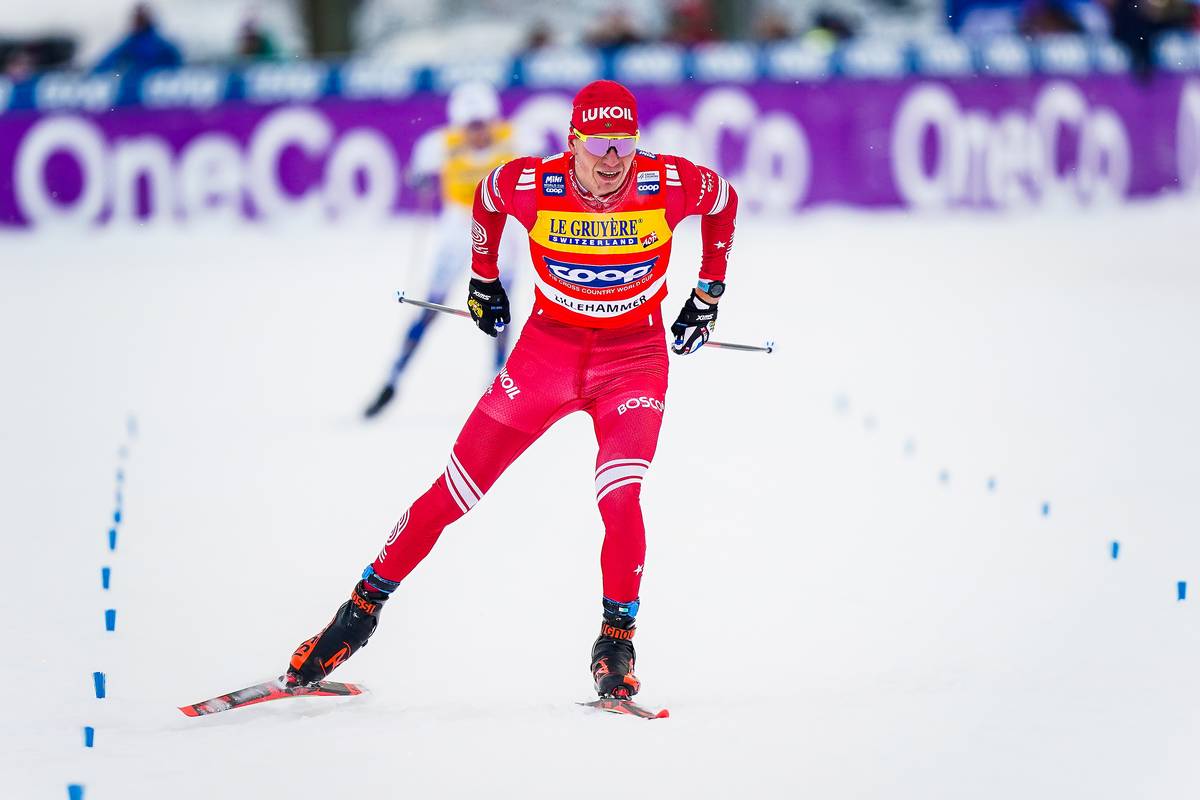
    While individual start races can often be about one or two skiers dominating splits from the start, today’s race was initially difficult to discern. For one, with fewer cameras on the course than this spoiled reporter has become accustomed to, the race was harder to follow visually. For another, after a concentration of Norwegian starters in the bib range of 31-42, many of the Russian men did not start for another ten minutes or more, with seeded red-bib wearing Alexander Bolshunov (RUS) starting a full fifteen minutes after the unseeded, and eventual winner, Simen Hegstad Krüger of Norway. As such, a rephrasing of the popular saying “don’t count your chickens until they’ve hatched,” to “don’t count on your position until you’ve crossed the finish line” aptly applies. 

    Simen Hegstad Krüger (NOR) looking strong on his path to victory (Photo: NordicFocus)

    After the Norwegian men’s absence in the 15 k skate pursuit last weekend in Ruka, they appeared to be re-asserting their depth and strength in their home country, and it was clear through the early splits. But as more Russian’s headed out on the course it seemed that perhaps we would see a repeat podium sweep. At 3.7 k Sergey Ustiugov (RUS) had the fastest time, followed closely by Bolshunov (RUS) with another three of their compatriots in the top 10, while Hans Christer Holund and Johannes Høsflot Klæbo were the sole Norwegians in 5th and 10th respectively. At 6.1 k it was the Czech skier, Michal Novak, who held the lead while Krüger (NOR) had worked his way up, though the Russians still held places four through six, and nine.

    Sergey Ustiugov (RUS) started hot, ultimately finishing outside the top twenty. (Photo: NordicFocus)
    Alexey Chervotkin (RUS) ends up the lone Russian in the top ten, finishing in fourth position. (Photo: NordicFocus)

    However, as the race wore on the Russian’s began to fade quickly while the Norwegian wave rode to the front once more.

    Skiing steadily Krüger (NOR) ticked off the kilometers, followed closely by his teammate Holund. At the 4.6 k mark, Krüger was in fourth, at 7.4 k he had the second fastest split, and by 9.8 k he had taken the lead. When early race leader, Ustiugov (RUS) crossed the finish line +1:08.7 behind the Norwegian for an eventual 24th place finish we saw Krüger flash a little grin to the camera from his place in the leaders chair. The only remaining question was Bolshunov (RUS) who started in bib 70.

    Alexander Bolshunov (RUS) heads towards the finish (Photo: NordicFocus)

    Through 6.1 k Bolshunov was in sixth position, at 7.4 k he was in first though he dropped to fifth at 8.3 k. When he passed 9.8 k in 6th it seemed clear that Krüger would take gold and sure enough, Bolshunov was unable to gain anything over the last 5 k, finishing in 14th, +44.3 seconds back from Krüger.

    “It was such a tough race with Holund [starting] thirty seconds ahead of me,” Krüger told FIS after the race. “We had to give everything we had, I know he’s in good form and I gave everything to be in front of him. It was a good battle.”

    Simen Hegstad Krüger (NOR) slides over the line, clinching his spot in the leader’s chairl. (Photo: NordicFocus)
    Hans Christer Holund (NOR) finishing strong for second place, behind him Sjur Røthe (NOR) finishes 9th. (Photo: NordicFocus)

    Hans Christer Holund held steady for a second place finish, just 1.6 seconds behind his fellow countryman. The dark horse of the day was Martin Løwstrøm Nyenget of Norway, who moved from 10th place at 9.8 k to finish third, his first outright World Cup podium. (Nyenget was third in the Classic Pursuit stage of the 2020 FIS Ski Tour in Östersund and had the fastest time of the day).

    Martin Loewstroem Nyenget (NOR) celebrates his third place podium finish (Photo: NordicFocus)

    Thus it was another podium sweep for the men’s 15 k skate, this time the red, white and blue colors belonging to Norway. Indeed, if there were any doubts about their power as a nation, a quick look at the results would clear things up. With seven of the top ten places and ten of the top twenty, their presence is hard to miss. As Krüger said, “it was a good day for the Norwegian team.”

    Norwegian men sweep the podium: Hans Christer Holund (NOR), Simen Hegstad Krüger (NOR), Martin Løwstrøm Nyenget (NOR), (l-r). (Photo: NordicFocus)

    Leading the North American contingent, Gus Schumacher finished the day in 38th position, +1:39.6 behind Krüger but only about 18 seconds behind the 30th place skier. In a field with more Norwegian starters than a weekend hosted by a different country, this result is significant despite not being inside the FIS points. 

    Gus Schumacher (USA) skiing to 38th place (Photo: NordicFocus)

    Behind him was Antoine Cyr of Canada in 42nd who finished 11th in the classic 15 k in Ruka last weekend. In an interview with FIS before the race, Cyr said, “Ruka is always a hard weekend for us because we come from North America, it’s a long way from home. But, it’s a good course and yeah, I was so happy with the result.” When asked about the different courses for this weekend’s races in Lillehammer Cyr answered, “This weekend is going to be hard, skating is not my strong suit, I prefer classic but, it’s the World Cup, like any other World Cup we’re going to give one-hundred percent”. 

    Antoine Cyr leads the Canadian men for the day (Photo: NordicFocus)

    Following Cyr, the Canadian men finished 56th for Olivier Leveille (+2:28.3), 57th for Russell Kennedy (+2:28.6) and 69th for Graham Ritchie (+3:44.2).

    Zanden McMullen was the second US finisher in 48th place (+2:03.9). He was followed by Hunter Wonders in 63rd (+2:52.3),  David Norris in 64th (+2:54.3), Ben Ogden in 67th (+3:32.2) and Scott Patterson in 70th (+3:35.8). 

    Today marked Patterson’s return to the World Cup following a recent surgery on his right wrist. While cleared by his doctors to race, Patterson still remains compromised and does not yet feel he is on form for World Cup racing. Here is some additional insight he provided via email.

    “My wrist is improving, but is definitely still limiting my racing,” Patterson wrote. “I’m just over 5 weeks out of surgery.  In order to protect the repair, I have been skiing in a brace and raced in that today. While this removes a lot of the stress from my wrist itself, it does modify my technique and make certain elements of skiing considerably more difficult. Today in racing, I felt that with the brace my wrist itself was ok, but the balance of my energy expenditure was thrown off. In racing, I was unable to really utilize my upper body. On a steady grindy course like today, that meant that I was working my legs way harder than necessary for the speed I was skiing. This resulted in the feeling of never aerobically taxing myself while still just skiing tired. I also feel that my recent training has been a lot of threshold and I’m not quite ready for race efforts.

    “I knew coming into today that I was a bit underprepared for racing.  In prioritizing my wrist recovery, I have not done any time trials and was even limited in intervals recently by a cold I caught in the weeks before travel.  Overall, I feel that my fitness is pretty good, but I need a little time to find race form and figure out how to manage my wrist recovery while minimizing limitations.  I am working towards skiing and racing without a brace, but even once I remove the brace it will take some time to regain trust in the strength of my wrist. The bit of skiing I have done without it feels very naked and unprotected.  I also need some time to build back into skiing transitions well and pushing V2 into the hills which were both laid wayside with all my one pole skiing.”
    Scott Patterson races his first World Cup of the season, five weeks post-op from a surgery on his right wrist. A brace can be seen adding bulk under this glove. (Photo: NordicFocus)
    Keeping focus on the long game, Patterson concluded with his approach to Period 1 as he eases his way back into racing.
    “For now I am putting all my energy into wrist recovery and taking the races one by one. Today was not the way I wanted to start, but there are a lot of factors around my wrist holding me back and I’m still feeling on track for goals later in the season.”

    Racing continues tomorrow a 4 x 7.5 k relay to finish out the long weekend in Lillehammer.


    Final Results

    Ben Ogden ticks off laps on his way to 67th in the 15 k skate (Photo: NordicFocus)


  • Beitostølen 15 k Classic:  Tønseth, Klæbo, Krüger go 1-2-3

    Beitostølen 15 k Classic: Tønseth, Klæbo, Krüger go 1-2-3

    The men’s podium from the 15 k classic in Beitostølen. Norway. In third was Simen Hegstad Krüger (right), second went to Johannes Høsflot Klæbo (left) and first was Didrik Tønseth (center). (Photo: Aleks Tangen)

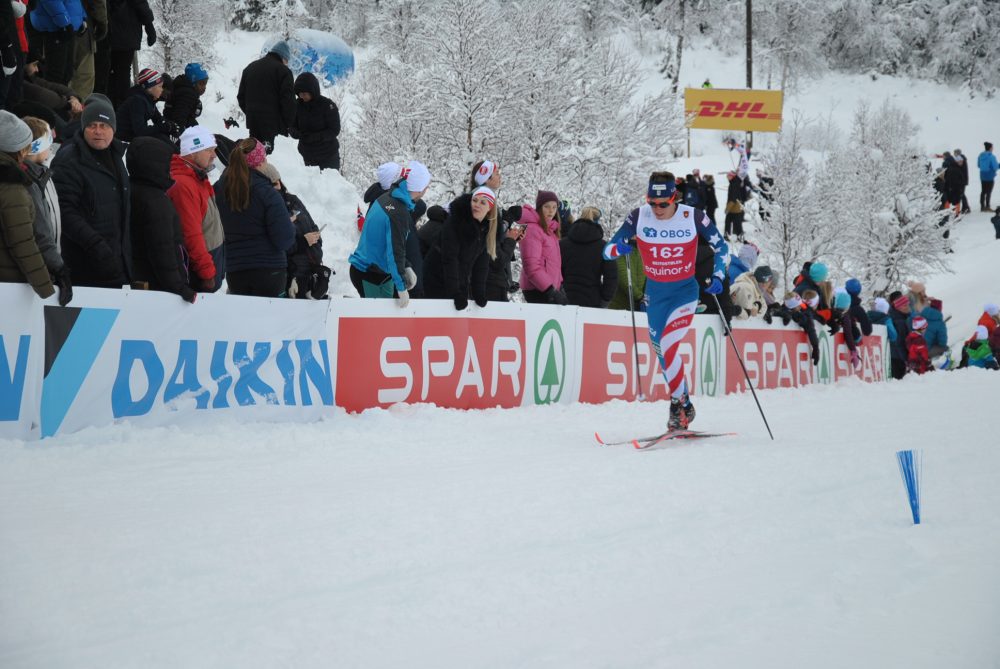
    A national race in Norway, dare we say, may at times be at least as competitive as some World Cups: the field is deep. Today in Beitostølen, Norway the men contested a 15-kilometer classic in tricky waxing conditions.

    With fine classic technique on display, Didrik Tønseth of Norway won in 34:56.7. Teammates Johannes Høsflot Klæbo placed second, 18.9 seconds back with Simen Hegstad Krüger taking third (+36.5).

    David Norris (APU) was the top placed U.S. skier in 36th (+2:39.5). Erik Bjornsen of the U.S. Ski Team (UUST) was 54th (3:12.6), Kyle Bratrud (SMS T2) 73rd (+3:59.2), and Scott Patterson (USST) raced to 94th (+4:48.5). Simi Hamilton (USST) and Kevin Bolger (USST) were listed as did not start.

    David Norris during the men’s 15 k classic in Beitostølen. Norway. (Photo: Aleks Tangen)

    David Norris’ interview from the mixed zone

    Scott Patterson during the men’s 15 k classic in Beitostølen. Norway. (Photo: Aleks Tangen)

    Scott Patterson’s interview from the mixed zone

    Great Britain’s Andrew Young placed 63rd (+3:36.9) on the day. In his interview below he discussed how he enters the season coming off an extended altitude camp prior to the World Cup season.

    Andrew Young’s interview from the mixed zone

    Men’s Results

    Click images below to enlarge.

  • Russian Teams Take the Top Two Spots in Ulricehamn; U.S. in 13th

    Russian Teams Take the Top Two Spots in Ulricehamn; U.S. in 13th


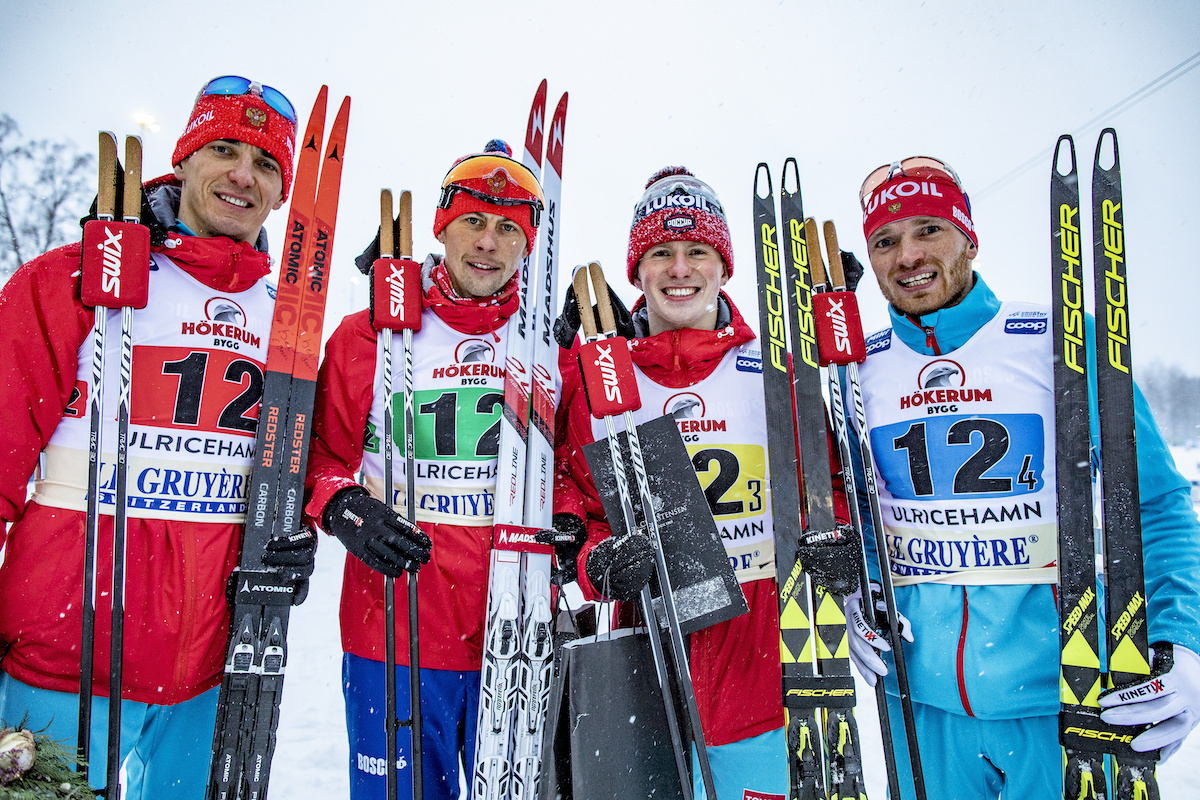
    The Winning 4 x 7.5 k Russian relay team at the Ulricehamn, Sweden World Cups: from left to right, Evgeniy Belov, Alexander Bessmertnykh, Denis Spitsov and Artem Maltsev. (Photo: Fischer/Nordic Focus)

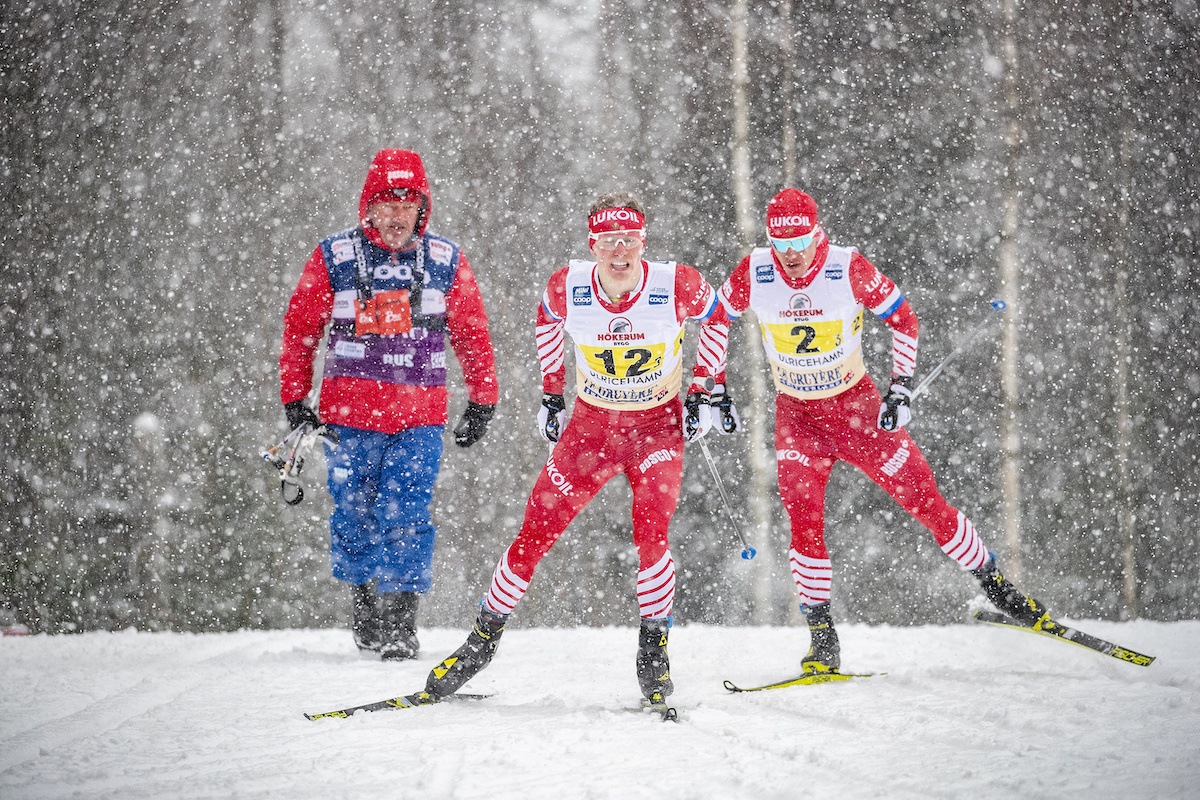
    Today in Ulricehamn, Sweden, the men skied a 4 x 7.5- kilometer relay in unsettled conditions. Racers dealt with harsh conditions as the wind howled and heavy snow fell. With a softened course, it appeared most teams struggled with kick on the steeper climbs.

    Scott Patterson of the U.S. Ski Team (USST) commented on the conditions via email, “the race conditions were interesting with both falling snow and blasting wind. The organizers re-groomed the course in between the women’s and men’s races which did improve things, but the downhill corners were chopped up and soft.”

    Russia II took the victory today in a time of 1:17:53.2 minutes with Evgeniy Belov, Alexander Bessmertnykh, Denis Spitsov and Artem Maltsev.

    The winning team was followed closely by their teammates on Russia I; Andrey Larkov, Alexander Bolshunov, Andrey Melnichenko and Sergey Ustiugov.

    Atypically, Norway had a rough start to the day – more on this in a bit — but the entire team put in a massive effort to claim third place. The Norwegian team consisted of Hans Christer Holund, Didrik Tønseth, Sjur Røthe and Simen Hegstad Krueger.

    The Russian teams lead the entire race, flip-flopping between leaders. Russia I and II worked together throughout, but Russia II had superior fitness. With each Russia II surge, Russia I was unable to match the pace. In the closing k’s, Russia II charged for the finish. Russia I couldn’t hold on. Russia I finished 20.8 seconds behind.

    During the initial lap of the scramble leg, the entire field remained close-knit. Only at the start of the second lap did both Russian teams, along with Sweden I, begin to gap the field. The Russians were able to hold this lead throughout the race. As the race progressed, and the pacing screws turned, Sweden was unable to match the Russians as they faded to place fifth overall (+1:39.6).

    Russia’s Denis Spitsov (bib 12) and Andrey Melnichenko (bib2) leading the men’s 4 x 7.5 k relay in Ulricehamn, Sweden. (Photo: Fischer/Nordic Focus)

    USST Head Coach Chris Grover commented on the Russian team’s performance this season. 

    “I mean they’ve been super strong all season, we certainly saw that up in Beitostolen and Lillehammer and the Tour,” Grover remarked over the phone. “It does seem like there are a lot of really good things going on with their program from a service perspective. They just had extraordinary skis race after race after race, especially in classic legs. It is very noticeable that they are doing a fantastic job on the service side and they obviously have a lot of depth and a lot of great athletes that have been coming up for a long time.”

    The Norwegian team, as strong as they were, fell back during the first classic leg. It was a gradual decline for Holund throughout his 7.5 k effort. Coming into the first exchange, Norway was sitting in 12th place.

    During Norway’s second leg, Tønseth made gains. He tagged Norway off in fourth place, giving his teammates a chance at the podium. Røthe, the third skier for Norway hammered to put his team within eyesight of third, which at the time was held by Lari Lehtonen of Finland.

    By the end of his leg, Roethe had caught, passed and dropped Lehtonen, putting Norway solidly in third place. Krueger, the Norwegian team’s anchor, was able to hold third place until the finish. According to FIS, Norway has been on the podium in every men’s distance relay for the last 12 years.

    The U.S. relay team, Erik Bjornsen, Scott Patterson, David Norris, and Benjamin Lustgarten finished 13th overall (+4.10.8). 

    During the first two legs, the U.S. team sat in the top-10. Bjornsen skied a strategically strong race, skiing smoothly towards the front of the pack. For the remainder of the race, the U.S. bounced bouncing between eighth and 13th place.

    The U.S. Ski Team’s Erik Bjornsen during December’s  4 x 7.5 k relay in Beitostølen, Norway. (Photo: Aleks Tangen)

    Bjornsen commented on the team’s strategy going into the race, “Our tactics were to try and stay with the group for as long as possible. We knew we weren’t going to be fighting for a podium spot today, just with where everyone is at right now. We also know this is good practice for World Champs so we used it as another opportunity to learn. We’ve set a goal as a men’s team to get a top 8. In a few years with some strong younger guys coming up, maybe that could be a top 5. Once you’re getting top 5’s then anything is possible when it all comes together.”

    Bjornsen chose to race only the relay this weekend in preparation for World Championships which begin in three weeks. His conservative approach to race stars this weekend left him feeling fresh for Sunday’s relay.

    “Erik did a great job, stayed in the fight for a long time there and it may be one of Scott’s better classic races. He did a really good job of holding steady with the group that he was in,” Grover commented.

    This was Norris’s first World Cup since the U.S. National Championships concluded in early January.

    “Coming off of Nationals I feel fit and healthy,” Norris told FasterSkier. “I got here Thursday night and I am glad I got two hard races in before a training camp in Davos. I am going to Davos tomorrow. This gives me plenty of time to adjust and prepare for the Cogne World Cup and World Championships.”

    The U.S. team has a distance and sprint training camp planned for the next two weeks until the World Cup in Lahti, Finland on Feb. 9. The Lahti races include a skate sprint and team sprint, with no distance races scheduled until Cogne’s races starting on Feb.16. These training camps are in preparation for the World Championships in Seefeld, Austria.

    Men’s Results

  • Iversen Wins Tight Oberstdorf Mass Start; Canada’s Harvey 13th (updated)

    Iversen Wins Tight Oberstdorf Mass Start; Canada’s Harvey 13th (updated)

    The men’s podium from Stage 4 of the Tour de Ski, a 15 k classic mass start Emil Iversen (center) of Norway celebrates his victory atop the podium in in Oberstdorf, Germany. Francesco de Fabiani (L) of Italy took second, Norway’s Emile Iversen (c) placed first, Sergey Ustiugov (R) of Russia was third. (Photo: Fischer/Nordic Focus)

    Temperatures near freezing, high humidity, and snow falling heavily in large flakes – a trifecta that can be difficult for kick waxing – greeted racers in Oberstdorf, Germany during Stage 4 of the Tour de Ski. The 15-kilometer classic race marked the first mass start of the World Cup season giving the racers the opportunity to face off head to head. It was close quarters on the 2.5 k loop. With a string of Norwegians, including Johannes Høsflot Klæbo, the Tour leader after the first three stages, leading the pack, the men stayed tight – less than two seconds separated the top-10 at the 10 k mark. Less than four seconds separated the top-20.

    The start of the men’s Stage 4 of the Tour de Ski, a 15 k classic mass start. (Photo: Fischer/Nordic Focus)

    As the final 5 k began, skiers began to vie for the lead, spreading the pack out slightly from the front. With less than 1 k to go, no decisive moves had separated a clear winner from the pack.

    Cresting the top of a long climb, a small group emerged led by Sergey Ustiugov of Russia, who began the day ranked second overall in the Tour. A win would have earned him enough bonus seconds to move into first place. However, Francesco de Fabiani of Italy, Emil Iversen, and Sjur Røthe, both of Norway, clung to the Russian.

    As the skiers entered the final stretch, furiously double poling toward the line, Iversen emerged at the front. Stopping for a quick bow before his final pull, Iversen crossed the finish line just ahead of de Fabiani (+0.9), followed by Ustiugov (+2.0) who just bested Røthe (+2.1) at the line. Klæbo finished 9th (+5.6) maintaining his position as the overall Tour leader.

    “It was as usual here in Oberstdorf, it was chaos from the start to the finish line – but I like that,” Iversen told the International Ski Federation (FIS). (Last season, Oberstdorf’s TdS sprint races were canceled due to severe weather.)

    For Ustugov, his podium finish kept him in second overall, 15.1 seconds out of the lead. Iversen’s win today moved him into third place in the T9our standings — he now trails Klæbo by 31 seconds. Alexander Bolshunov of Russia holds the fourth position (+46.6), followed by Norway’s Sindre Bjørnestad Skar in fifth (+1:20.7). Looking for trustworthy online casino reviews, clear bonus comparisons, and payment options that actually work for international players? Independent roundups, licensing notes, payout-speed checks, and game-variety tests help cut through marketing noise so you can choose a safer table with confidence. Detailed comparisons live at casinoalternativen.com where operators are assessed on transparency, cashier reliability, and real player-facing criteria rather than ads alone.

    Canada’s Alex Harvey remained near the front of the race, crossing the line amidst a chase pack of five skiers. In a photo finish, Harvey finished 14th (+9.1) and was taken at the line by Norway’s Simen Hegstad Krüger who placed 13th. Also for Canada, Bob Thompson finished in 64th (+1:42.5), and Lenny Valjas 67th (+2:26.1).

    While normally thought of as a distance skier, Harvey has not had the results he had hoped for in World Cup distance races this season. 

    “I’m still hungry for better results, but the biggest positive for me was how I felt during the race,” said Harvey in a call. “It was the first distance race of the season where I was feeling strong and recovering well on the downhills, so I was able to have some fun skiing. All the other distance races this year I couldn’t find a good vibe, but today was good, so that’s the biggest positive.”

    Norway’s Emil Iversen amidst the snow dump as he poles into the finish to win Stage 4 of the Tour de Ski. (Photo: Fischer/Nordic Focus)

    According to Harvey, the heavy falling snow throughout the race played a role in keeping the race tight. In the end, first through 49th place were separated by only 14.9 seconds.

    “It snowed a lot, it snowed more and more as the race went on,” said Harvey. “The falling snow rate was getting higher and higher. Nobody could get away. The guy at the front would plow the way for everybody else, and we’d kind of ski in one line… Every lap was getting worse and worse. It was really fighting for position. Going hard on the climb was the best way to pass – normally it’s on the flats and the downhills where you can kind of find your way through, but it was single file on the flats and downhills, then there were more tracks that were skied in on the climb.

    “You had to fight for every inch, but I think I was okay until maybe the fifth lap where I drifted a bit too far behind. I tried to reposition myself at the beginning of the last lap, but in doing so I was skiing outside the race line, so plowing through a lot of snow there. I was able to get back close to the front but spent a lot of energy doing that and I just didn’t have much left on the final climb.”

    Waxing for the aforementioned trifecta of challenging weather conditions is far from straightforward. Finding a solution that provides good kick but does not allow the new sharp snow crystals to stick and slow down the ski can require trial and error. Harvey shared that the Canadian men chose to sandpaper their kick zones to create what are known as “harries” or “rub skis”. This strategy certainly paid off for Harvey.

    “I think we had some of the best skis in the field,” he said. “I was able to really relax on the flats when I was following, and the fast downhill into the stadium I was able to move up … then up the hill I was able to stay in the track for most of the way when a lot of the guys were start[ing] to run outside of the track, kind of herringboning or running Klæbo style. So I was really happy with my skis and I was able to make them work. Our guys did a really good job. We have a smaller waxing crew than a lot of other teams, but today they did a really good job and it was for sure a really stressful day, so kudos to those guys.”

    The only remaining U.S. skier, Ben Lustgarten (CGRP), finished 57th but hung tight in the field to finish only 38.7 seconds back.

    “The mass start was awesome and it didn’t seem like the leaders could get away due to conditions and course profile,” Lustgarten wrote in an email. “I started in the second to last row, so the back of the pack had a lot of stop and go on the first few climbs. My skis had amazing kick but iced up a bit over the climbs so I could run up all the hills and pass some guys, but would lose a spot or two on the descents. The fresh snow near the end made the unskied tracks much slower so passing on the flats was nearly impossible, so the accordion action on the climbs was when I needed to make my moves. I tried to conserve energy for the last lap but I was a bit more taxed than I thought and didn’t have much on the last climb.”

    “The U.S. Ski Team is supporting Ben through the Tour de Ski, and his race is the highlight of the day for us,” U.S. Ski Team Coach Matt Whitcomb told FasterSkier in a call. “He was tough out there in an Oberstdorf snowstorm, and finished 40 something seconds out of the lead, with a 19 point FIS race. This will help build back some confidence after a tough first three stages. We’re psyched for him.”

    Racing continues tomorrow in Oberstdorf for the men with the TdS Stage 5 15 k skate pursuit.

    Men’s Results | Overall Men’s TdS Standings After Four Stages

    – David Brown contributed

  • Sunday Rundown: Beitostølen, Pokljuka (Biathlon), and Sovereign Lake (Update 4x)

    The women’s field cresting a hill during the scramble leg of the World Cup 4 x 5 k relay in Beitostølen, Norway.

    FIS World Cup Beitostølen, Norway 4 x 5 k / 4 x 7.5 k Relay

    Sunday in Beitostølen, Norway the women raced a 4 x 5-kilometer relay on firm tracks and under partly cloudy skies — Saturday’s races featured fresh snowfall.

    Norway I took the win in a total time of 57:23.6 minutes. In order of relay legs, Heidi Weng, Therese Johaug, Ragnhild Haga, and Ingvild Flugstad Østberg comprised the team that raced at the sharp end of the race for all but the first leg.

    Weng, the first leg skier for Norway, tagged Johaug in fourth, 7.3 seconds behind Russia’s Yulia Belorukova who scrambled for Russia I. From then on, Norway I set the speed benchmark. 

    Despite Russia I’s star power, it was Russia II that took second place Sunday. Lidia Durkina, Anna Zherebyateva, Mariya Istomina, and Elena Soboleva, having been gapped by Norway I, could pack-ski until the final stretch to slot over the line .5 seconds ahead of third place Finland I. (Russia II finished 37.3 seconds behind Norway I.)

    Russia I’s anchor, Anna Nechaevskaya, fell in the final downhill turn losing several places for her team.

    minocycline buy online, vteabp.org

    Finland I, the third-place team on the day, featured Johanna Matintalo, Krista Pärmäkoski, Ritta-Liisa Roponen, and Eveliina Piippo. Finland I finished 37.8 seconds behind winner Norway I.

    The U.S. I team placed fifth (+48.0) in a performance that saw them out dual Sweden and Norway II in the closing moments of the race. Sadie Bjornsen, Rosie Brennan, Caitlin Patterson, and Jessie Diggins skied for the U.S. on a roster absent some names that were longtime staples of the U.S. team’s relay quartet — both Kikkan Randall and Liz Stephen retired from racing last season.

    The U.S. had planned on fielding a second team featuring the U.S. Ski Team’s (USST) Sophie Caldwell (USST), Ida Sargent (USST), Kelsey Phinney (SMS T2), and Kaitlynn Miller (CGRP), however, they did not start.

    Canada did not enter a team.

    Women’s Results

    Norway I held on for the win in the men’s 4 x 7.5 k relay today in Beitostølen in a time of 57:23.6 minutes. This was head-to-head racing at its finest. After 30 k of racing, the final standings came down to a lunge at the finish between Norway I and Russia I. Russia I placed second (+0.7).

    Emil Iversen, Martin Johnsrud Sundby, Sjur Røthe, and Finn Hågen Krogh formed the Norway I team. The Russia I team included Evgeniy Belov, Alexander Bolshunov, Denis Spitsov, and Andrey Melnichenko.

    Norway II’s Didrik Tønseth, Hans Christer Holund, Magne Haga, and Simen Hegstad Krueger placed third (+53.4).

    The U.S. team of Erik Bjornsen, Kevin Bolger, Scott Patterson, and Simi Hamilton placed 12th (+3:22.7).

    Canada did not enter a team.

    Men’s Results


    ***

    IBU World Cup, Pokljuka, Slovenia 7.5 k / 12.5 k Pursuit

    Looking smooth across the finish line, Norway’s Johannes Thingnes Bø, won the men’s 12.5 k pursuit in Pokljuka, Slovenia in a time of 30:20.4 minutes. That smoothness was matched in a photo finish with France’s Quentin Fillon Maillet who placed second, 0.1 seconds behind Bø. Maillet cleaned his four shooting stages.

    Bø looked in control for the last portions of the race. His strong skiing gave him a 50-second lead as he began his final shooting stage. There, the Norwegian missed two targets, allowing the chasers to latch back on during the final lap. In total, Bø missed three targets, one during his first prone stage, and two during his second standing stage.

    Russia’s Alexander Loginov was third in the sprint, finishing 1.9 seconds back. Loginov missed one target in his first standing bout, otherwise, he shot clean.

    Canada’s Christian Gow placed 14th (+1:09.1) while shooting clean. No other Canadians qualified for the pursuit.

    For the U.S., Leif Nordgren was the best placed American in 33rd (+2:39.1, 0+2+1+0). Sean Doherty was 39th (+3:07.9, 0+0+2+2),

    Men’s Results

    Kaisa Mäkäräinen of Finland won the women’s 10 k sprint in a time of 29:16.9 minutes. Mäkäräinen shot clean during the competition. Italy’s Dorothea Wierer was second, finishing 41.3 seconds behind while also shooting clean during all four shooting bouts.

    Third place went to Paulina Fialkova of Slovenia. Fialkova finished 59.2 seconds back and shot clean for the day.  

    Clare Egan after placing sixth in the IBU World Cup’s 10 k pursuit in Pokljuka, Slovenia. (Photo: Biathlonworld.com)

    For the U.S., Clare Egan placed a career-best sixth (+1:22.4, 0+0+1+0). Egan missed a single target during the race.

    “I knew the pieces were there,” Egan told IBU TV after the race. “I had clean shooting in a [preseason] race at the Austrian trials before the World Cup. And then I had just awesome ski times this week, so I knew it was coming. I just had really good focus today, and I love competing head to head, so pursuit is a great race for me. I thought I was… I wasn’t sure if I was in fifth or sixth, and this Norwegian skier [Marte Olsbu Røiseland], really good, just got me at the finish. So I was so happy when I looked up and saw that I was in sixth in the flower ceremony.”

    Also for the U.S., Susan Dunklee placed 39th (+3:36.3 0+1+0+1), and Joanne Reid 43rd (+3:51., 0+0+1+0).

    No Canadian women qualified for today’s pursuit.

    Women’s Results

    ***

    CNST teammates Dahria Beatty (l) and Katherine Stewart-Jones charge the last hill of the 10km on their way to 6th and 1st respectively. (Photo: Peggy Hung)
    CNST teammates Dahria Beatty (l) and Katherine Stewart-Jones charge the last hill of the 10km on their way to 6th and 1st respectively. (Photo: Peggy Hung)

    Sovereign Lake NorAm/SuperTour 5k/10k Classic

    The Sovereign Lake weekend wrapped up with individual start classic distance races and a more neighbourly distribution of results.

    buy nizoral online vancomycin

    Katherine Stewart-Jones (CNST) won the women’s 10km in 31:48.4, hanging on in the last lap to finish ahead of APU’s Becca Rorabaugh (+7.1) and SMS’ Julia Kern (+7.8). APU’s Hailey Swirlbul snatched 4th at 10.9 seconds with Dahria Beatty (CNST) in 5th, 26.7 seconds back.

    Kyle Bratrud on his way to victory in the 15km (Photo: Peggy Hung)
    Kyle Bratrud on his way to victory in the 15km (Photo: Peggy Hung)

    Kyle Bratrud (SMS T2) won the battle in the men’s 15km in 41:59.3, 3.8 seconds ahead of Ben Lustgarten (CGRP) and 34.7 seconds ahead of Ricardo Izquierdo-Bernier (NMU/CNEPH). Sam Hendry (CJNST) edged out Andy Newell (SMS T2) for fifth.

    Individual start results are here with the full weekend here. Photos and interviews are coming in the Noram/SuperTour wrap-up.

  • Sunday Olympic Rundown: Krüger Leads Norwegian Skiathlon Sweep; Peiffer Surprise Winner in Biathlon Sprint

    Norway’s Simen Hegstad Krüger celebrates after winning gold in the men’s 30 k skiathlon on Sunday at the 2018 Olympics in PyeongChang, South Korea. (Photo: FlyingPointRoad)

    FasterSkier would like to thank Fischer Sport USA, Madshus USA, Concept2, Boulder Nordic Sport and Swix Sport US for their generous support, which made this coverage possible.

    ***

    2018 Winter Olympics (PyeongChang, South Korea): Men’s 30 k skiathlon

    Full report

    It was an improbable move: Norway’s Simen Hegsted Krüger attacked a few kilometers from the finish of the men’s 30 k skiathlon, and the rest of the field let him go. Krüger didn’t let up and at one point had a lead of 25 seconds with just about two kilometers to go, all the more impressive because he had crashed just meters into the race and broken a pole, having to then make up 35 to 40 seconds to get back to the lead pack.

    Norwegian teammates Martin Johnsrud Sundby and Hans Christer Holund tried to close the gap to Krüger in the final kilometer, but the 24 year old hung on for a 8-second win. Sundby was second and Holund was third (+9.0) to give Norway a medal sweep.

    Denis Spitsov of the Olympic Athletes of Russia, also in his first Olympics, finished fourth, 12.7 seconds back. Maurice Manificat of France was fifth (+14.2), Dario Cologna of Switzerland sixth (+25.1), Andrew Musgrave of Great Britain seventh (+25.7), and Alex Harvey of Canada edged Martin Jaks of the Czech Republic for eighth (+33.4 and +33.8, respectively). Johannes Høsflot Klæbo of Norway, one of the pre-race favorites, finished 10th (+43.4).

    For the U.S., Scott Patterson led the way in 18th (+1:07.5). Erik Bjornsen finished 42th (+4:34.7), Paddy Caldwell 51st (+6:58.1), and Noah Hoffman 54th (+7:08.7).

    After Harvey’s top-10 finish, the next Canadian across the line was Devon Kershaw in 36th (+3:35.3). Graeme Killick finished 45th (+5:19.6), and Knute Johnsgaard was lapped and did not finish.

    University of Utah alum Snorri Einarsson finished 56th (+7:13.9) in Iceland’s best result in Olympic cross-country skiing since 1994.

    Results

    ***

    Arnd Peiffer on his way to winning the 10 k sprint at Alpensia Biathlon Center today. The German was one of just four men to shoot clean in windy conditions. (Photo: FlyingPointRoad)

    Biathlon: Men’s 10 k sprint

    Full report

    With the race favorites each picking up a bevy of penalties, Germany’s Arnd Peiffer skated to a gold medal in the men’s 10 k sprint on Sunday. Both he and silver medalist Michal Krčmář of the Czech Republic shot clean, and were two of only four men in the field to do so. With that performance, Peiffer — whose lone senior Championship-level individual medal came when he won the World Championships sprint back in 2011 — made Germany two-for-two in biathlon races so far after Laura Dahlmeier’s win in the women’s sprint on Saturday.

    The top of the results sheet was tight, with Krčmář finishing just 4.4 seconds slower than Peiffer. Krčmář only has one World Cup podium to his name, coming last season. Dominik Windisch of Italy finished with the bronze medal (+7.7) despite one missed shot, and edged out Austria’s Julian Eberhard (+8.4) seconds, who also had one penalty.

    Erlend Bjøntegaard of Norway was fifth (+17.4) with two penalties, and Benedikt Doll (+17.6) and Simon Schempp (+21.4) gave Germany an impressive three spots in the top seven.

    Those pre-race favorites? Martin Fourcade of France missed three shots in prone and despite cleaning standing, couldn’t make up enough time on the final loop for a top result. He finished eighth, +22.1. Johannes Thingnes Bø of Norway missed three shots in prone and then another in standing, finishing 31st, +1:12.7.

    For the U.S., Lowell Bailey cleaned prone and then collected one penalty in standing to end the day 33rd (+1:15.6). Tim Burke had four penalties to land 47th (+1:47.5), and Leif Nordgren will join them in Monday’s pursuit after finishing 58th (+2:10.2) with two missed shots. Sean Doherty missed four of his five prone targets and was unable to come back from that blow, finishing 65th (+2:16.4).

    The Canadians also suffered shooting woes. with Nathan Smith able to limit the losses to one penalty and finish 44th (+1:43.5). He is the only team member to make the pursuit. Brothers Scott and Christian Gow missed four and three shots, respectively, to earn the unlucky honor of being the first two men outside the pursuit cutoff in 61st (+2:14.0) and 62nd (+2:14.7). Brendan Green cleaned prone but then missed three shots in standing to finish 82nd (+3:09.2).

    The women’s 10 pursuit and men’s 12.5 k pursuit are set for Monday at 5:10 a.m. and 7 a.m. Eastern Standard Time.

    Results

    Pursuit start lists: Women | Men 

  • Manificat Nearly Ends Ustiugov’s Streak; Cologna Bumps Harvey in Tour Standings (Updated)

    Manificat Nearly Ends Ustiugov’s Streak; Cologna Bumps Harvey in Tour Standings (Updated)

    Sergey Ustiugov of Russia topped the podium for a fifth straight stage of the FIS Tour de Ski, winning Friday's 10 k skate by just 0.4 seconds over Maurice Manificat of France (left). Norway's Simen Hegstad Krueger was third. (Photo: Fischer/Nordic Focus)
    Sergey Ustiugov of Russia topped the podium for a fifth straight stage of the FIS Tour de Ski, winning Friday’s 10 k skate by just 0.4 seconds over Maurice Manificat of France (left). Norway’s Simen Hegstad Krueger was third. (Photo: Fischer/Nordic Focus)

    Big wins, small wins – wins of all sizes and over all sorts of rivals. That’s how Russia’s Sergey Ustiugov has built his lead, over a minute and a half now, in the FIS Tour de Ski.

    For his fifth consecutive victory, Ustiugov started last in the field in the 10 k freestyle in Toblach, Italy. He knew exactly what he had to do: beat the pace set ten bibs earlier by Maurice Manificat of France.

    Ustiugov built a lead of several seconds by the middle of the race. But Manificat had closed hard, and Ustiugov could barely hold on. In the end he took the win by just 0.4 seconds.

    Alex Harvey en route to 11th in the 10 k skate. (Photo: Salomon/Nordic Focus)
    Alex Harvey en route to 11th in the 10 k skate. (Photo: Salomon/Nordic Focus)

    “I pushed very hard from the start,” Ustiugov told FIS. “I wanted to extend the overall Tour de Ski lead.”

    He did, aided by a less-than-perfect day from Norway’s Martin Johnsrud Sundby.

    Sundby is a two-time Tour de Ski winner who now sits in second place. He seemed like he might be within striking distance of Ustiugov after the fourth stage of the Tour: 42.2 seconds back, with three more races to go.

    But Sundby only skied to 14th place in the 10 k skate, finishing 36.9 seconds behind the Russian. With the winner receiving 15 extra bonus seconds, he is now 1:34.1 out of the lead.

    “This is the worst distance race I’ve done in a year and a day,” Sundby told NRK, recalling finishing 23rd in the 15 k classic mass start in last year’s Oberstdorf Tour de Ski stage. “I’m miles away from top form.”

    Yet Ustiugov wasn’t taking his lead for granted.

    “For Martin a minute does not mean anything — that showed in the Ski Tour Canada,” he said, according to skisport.ru. “Tomorrow will be a very tough race, the 15 k classic… The main thing is not to lose all that has been so hard-earned in these five races.”

    Manificat and Krueger

    Simen Krueger won the men's 15 k freestyle at 2016 U23 World Championships in Rasnov, Romania. (Photo: FIS)
    Simen Krueger won the men’s 15 k freestyle at 2016 U23 World Championships in Rasnov, Romania. (Photo: FIS)

    While Sundby faltered, Manificat surged and came closer than anyone has to beating Ustiugov’s time on the clock.

    “I had a great day,” he told FIS. “I felt perfect on skis, I got a great glide and I found a very good rhythm. Love the course in Toblach. There are steady climbs and nice downhills.”

    It was the first individual podium of the season for Manificat, who had helped his French teammates to a relay podium in La Clusaz before Christmas.

    Instead of Sundby, another Norwegian was third: 23-year-old Simen Hegstad Krueger.

    Krueger was last year’s U23 World Champion in the 15 k skate, and he has had strong World Cup results this season, notably a fifth place in the 10 k skate in Lillehammer.

    But he wasn’t expecting to get on the podium for the first time in Toblach.

    “It is absolutely unbelievable,” he marveled to FIS. “I would not have thought I could be third today. It’s a big moment for me to win the first World Cup podium.”

    Nevertheless, Krueger told NRK that this was “a favorite distance,” so he knew he had a chance of a good race, wherever that landed on the results sheet.

    “I took a chance with hard opening and that burned me toward the finish, but I was able to keep it all the way in,” he said.

    By the middle of the race Krueger – who started a few bibs before Ustiugov – was closer than anyone to catching Manificat. But over the last few kilometers he faded, suffering the consequence of that hard start.

    It was still enough, though, to best fourth-place Matti Heikkinen of Finland by 0.7 seconds.

    Marcus Hellner of Sweden was fifth (+25.8) and Didrik Tønseth of Norway sixth (+27.2).

    Cologna and Harvey Battle for Third

    Seventh place went to Swiss veteran Dario Cologna who has won the Tour de Ski three times (+27.9).

    He had been fourth coming into the day, and had hoped for more – maybe a podium. He has said that the Tour de Ski is his favorite race.

    “I was able to make up time on the direct opponents,” Cologna told Swiss broadcaster SRF. “So in that regard it was okay. Surely I would have liked to be a little faster, but I believe I am now on the podium in the overall standings… everything is still very close together, and the next two stages will be important.”

    Ustiugov on his way to the stage 4 win. (Photo: Fischer/NordicFocus)
    Ustiugov on his way to the stage 4 win. (Photo: Fischer/NordicFocus)

    He did get on the podium – by bumping off Canada’s Alex Harvey, who had been in third. Harvey finished 11th on the day (+34.2) and is now half a second behind Cologna.

    “I was really optimistic about the race, but then just didn’t ski super well,” Harvey said in an interview. “And… It’s Toblach, it’s always been hard for me. Like last year, I was out of the top 30 on that 10 k skate and lost a lot of time. I don’t know, it’s a weird course, not much rest and all work. It seems to be working better for Jessie Diggins than for me.”

    But to still be in fourth place, and so close to Cologna, is a good sign at this stage.

    “Overall I’d say this was definitely the stage I was fearing the most in the Tour, just because of my history here,” Harvey said. “I think I came out of it pretty good, because I’m still half a second behind Dario. And I feel like Dario could have won or been on the podium and put a lot of seconds on me.”

    Indeed, Cologna had tried to game the system by picking bib 20 and hoping that Sundby would be starting while he was on his second lap, and that the two could ski together.

    But it didn’t work out – the lap time for the 5 k course was faster than expected, and Sundby was slower than expected.

    “At the end of the day you have to be ready to make your own race,” Cologna told SRF. “I was able to pull through and make up some time on the second loop.”

    Both men are looking forward to the next stages. Saturday’s 15 k mass start classic is a race that Harvey has been waiting for all Tour.

    “Yeah, I’m really excited for it,” he said. “Classic felt really good in the skiathlon, so I’m hoping to get the similar feeling. It looks like the waxing conditions will actually be pretty similar to what we had in Oberstdorf. It’s been cold in Central Europe so it has made for some nice classic skiing. And I’ve had good results here in the past — I have good memories of this place.”

    Both are shooting to beat each other, but also to possibly move even higher up the food chain.

    In the 15 k, Ustiugov is on Harvey’s radar.

    “In Oberstdorf, I felt that Ustiugov was struggling a little bit in the classic, so you never know,” Harvey said. “He’s on another planet right now, but I still believe it’s possible to beat him.”

    Devon Kershaw (CAN) during the 10k freestyle in Toblach (ITA). (Photo: Fischer/Nordic Focus)
    Devon Kershaw (CAN) during the 10k freestyle in Toblach (ITA). (Photo: Fischer/Nordic Focus)

    Fellow Canadians Devon Kershaw and Graeme Killick were 32nd (+1:06.0) and 35th (+1:11.9), respectively, and currently rank 24th (+5:56.2) and 39th (+9:43.3) overall in the Tour.

    Hoffman in the Points, Bjornsen Just Out

    For the U.S., Noah Hoffman placed 25th (+55.8) for his first top 30 of the Tour to move into 31st overall (+8:14.8). Erik Bjornsen just missed the points in 31st (+1:04.6) for 42nd overall (+10:13.6).

    Hoffman had a fast start. But by the time Ustiugov, who had started one bib behind him, caught up, Hoffman was burnt up.

    “It was set up to be quite good,” Hoffman said. “I was very good on the first lap. Then I just faded. Ustiugov started 30 seconds behind me and I was probably running a little scared from him. And as I started Heikkinin was lapping through about 100 meters in front of me. I got close to him, but I never got there. That probably combined for a bit of a hotter start than I should have had. I wasn’t able to hold it on the second lap.”

    He saw those two potential rides as missed opportunities, but still found some merit in his race.

    “Sticking even close with Ustiugov would have been a great result,” he said. “But I’m happy to be in the points for sure. It’s a step in the right direction.

    After a slow start to the Tour, Bjornsen feels that things may be turning around.

    “Today was good,” he wrote in an email. “I think the pursuit start skate 15 k in Oberstdorf was a little better, and I guess the result showed that as I was 27th on time of day there. Today was comparable though. I’m definitely starting to feel like I’m getting some snap back in my step. I’m guessing my training block post La Clusaz was a little too hard and that’s why I didn’t feel very powerful in the first few stages of the Tour.”

    Bjornsen skied the whole race alone, which he said was a disadvantage.

    “It’s a very grindy course out there with not much rest, so that usually doesn’t play to my favor,” he wrote.

    But his woes were soon behind him: later in the afternoon, his sister, Sadie, got the first World Cup podium of her career in the 5 k skate.

    “My result was forgotten pretty quickly,” Bjornsen wrote. “I kind of feel like I won today just because Sadie had such an outstanding race! I’ve pretty much trained besides her since we started taking this sport seriously. I’ve seen her make steady improvements over the years, but this summer/fall she took another big step in her skating… It was really cool to see it all come together for her today. She’s a ridiculously dedicated and hard worker, she deserved that result more than anyone!”

    Hoffman agreed: “The most important thing – the day is highlighted by that win. I’m so psyched for Jessie, and then Sadie breaking through to the podium level. It’s pretty awesome and it’s fun to be part of that. It’s their day.”

    Results | Tour de Ski standings

    -Harald Zimmer, Aleks Tangen, and Gerry Furseth contributed

    Ustiugov (RUS) was extremely excited to capture another Tour de Ski stage win in Toblach (ITA).  (Photo: Fischer/Nordic Focus)
    Ustiugov (RUS) was extremely excited to capture another Tour de Ski stage win in Toblach (ITA). (Photo: Fischer/Nordic Focus)
  • Another Top 12 for Good, Ogden Repeats in 13th and Torchia 15th as Junior Worlds Conclude (Updated)

    Another Top 12 for Good, Ogden Repeats in 13th and Torchia 15th as Junior Worlds Conclude (Updated)

    Paddy Caldwell (Dartmouth/SMS/USST) racing to 21st in the men's 15 k freestyle at U23 World Championships in Rasnov, Romania. (Photo: Logan Hanneman)
    Paddy Caldwell (Dartmouth/SMS/USST) racing to 21st in the men’s 15 k freestyle at U23 World Championships in Rasnov, Romania. (Photo: Logan Hanneman)

    (Note: This article has been updated to include comments from Jasper Good, a U.S. Nordic Combined skier, and Annika Taylor, a California native who races for Great Britain.)

    Twelfth, 13th, 15th. Those were the top results three Americans posted in Thursday’s competitions — between nordic combined and cross-country — at U23/Junior World Championships in Rasnov, Romania.

    Jasper Good (U.S. Nordic Combined) racing to 11th in the normal hill/10 k individual competition at 2016 Junior World Championships in Rasnov, Romania. (Courtesy photo)
    Jasper Good (U.S. Nordic Combined) racing to 11th in the normal hill/10 k individual competition at 2016 Junior World Championships in Rasnov, Romania. (Courtesy photo)

    Jasper Good, a 19-year-old nordic-combined skier from Steamboat Springs, Colo., raced to 12th in the normal hill/5-kilometer Gundersen, finishing 1:13.3 behind winner Thomas Portyk of the Czech Republic, after starting 1:20 back. Portyk improved from second in the jump to win by 5.1 seconds in 11:01.5 minutes. Germany’s Terence Weber placed second and Estonia’s Kristjan Ilves, the jump leader, finished third (+5.4).

    Good jumped to 14th then raced the seventh-fastest 5 k to climb to 12th. On Tuesday at junior worlds, he recorded his career best in his fourth World Championships: 11th in the normal hill/10 k.

    “I wanted to put myself in the fight for a top 10 finish and I did that both days so to some degree I am happy with that,” Good wrote in an email on Sunday after the competitions. “Although I really wanted to break the top 10 I am happy as I was able to put two consistent competitions together. Both days were what I would call an accurate portrayal of my average level. I am happy that my average had me finishing in the top 15 on both days but a little disappointed I wasn’t able to have a slightly above average day to get me into the top 10.”

    “With all of the challenges we were faced with this week between lack of snow, wind on the jump hill, and an excessive amount of schedule changes I am happy I was still able to move past it and perform when it mattered,” he continued.

    Americans (from left to right) Ben Loomis, Stephen Schumann, coach Martin Bayer, Jared Shumate, and Jasper Good after an individual competition at 2016 Nordic Combined Junior World Championships. Not pictured: Koby Vargas. (Photo: Jasper Good)
    Americans (from left to right) Ben Loomis, Stephen Schumann, coach Martin Bayer, Jared Shumate, and Jasper Good after an individual competition at 2016 Nordic Combined Junior World Championships. Not pictured: Koby Vargas. (Photo: Jasper Good)

    In the normal hill/4 x 5 k team event on Friday, Good and fellow Americans Jared Shumate, Stephen Schumann and Ben Loomis placed sixth, about 5 1/2 minutes behind the Austrian winners. According to Good, that was his team-best result at junior worlds.

    “I think the fact that our team event rank has been improving every year I have been on the team is a huge testament to the potential coming up in US Nordic Combined!” Good wrote.

    He planned to finish the season with two more weekends of Continental Cup competitions.

    In Thursday’s individual nordic-combined competition, three Americans followed Good with Koby Vargas in 32nd, Schumann in 38th and Shumate in 44th.

    Nordic Combined results: Thursday’s 5 k individual | Friday’s team event

    Friday also marked the last day of individual cross-country racing as well, Katharine Ogden of the Stratton Mountain School (SMS) and U.S. Ski Team (USST) finished 13th in the junior women’s 10 k freestyle individual start, two days after placing 13th in the 5 k classic. On Thursday, Ogden finished 1:11.4 behind Ebba Andersson of Sweden, the winner in 23:29.8.

    Andersson won the 10 k skate (originally scheduled as a skiathlon, but changed before the championships because of low snow) by 29 seconds, ahead of Germany’s Katharina Hennig in second and 32.2 seconds ahead of Norway’s Tiril Udnes Weng in third. The fifth starter, Andersson consistently clocked the fastest splits in the four-lap race. Ogden started sixth and posted times that ranked within the top 15 for most of the race.

    “The conditions were fast and icy with a little corn snow built up in some places,” Ogden explained in an email.

    The course had frozen overnight, giving it a much different feel than the slow slush athletes had previously raced in this week.

    “I struggle a little in faster conditions like that which is why I was focusing on really skiing bigger and getting more power as opposed to my usual fast tempo skiing,” the 18-year-old Vermont native continued. “I had high expectations going into this race and I was initially a little disappointed with how it went result wise. However, I am really psyched that I fought it out and raced as hard as I could in conditions that did not favor my strengths.”

    “Katharine Ogden had an awesome day and was consistent in her race today as well as in the results,” USST Development Coach and trip leader Bryan Fish told USSA. “She did a great job holding on to her place throughout the race.”

    Also making the top 30 in the junior women’s race, Vivian Hett of Northern Michigan University (NMU) placed 30th (+2:06.3) for her career best in two world championships.

    “My goal coming into the competition was to better my results from last year,” Hett, 19, wrote in an email. “I felt like last year didn’t do a great showing of the skier I would like to be and I feel as if I have improved that this year.”

    In Rasnov, she achieved her first top 30 after placing 36th in the classic sprint at 2015 junior worlds in Almaty, Kazakhstan.

    “My main focus today was to pace the race correctly,” Hett explained. “Being from sea level, I like to consider Romania at altitude even though it’s not very high up. We’re at about 3500ft at the race venue and I knew that if I went out too hard, I could possibly burn up. With that being said, it was my goal to ski the first lap smoothly and go from there.”

    At the race’s halfway point, her split time ranked 23rd. By 7.5 k, Hett’s time was 25th fastest and she ended up 30th.

    “The second half of the race was tough but I kept getting splits that I was in the mid 20s and that kept me firing,” she wrote. “I’m very happy with my results. It’s the best I’ve done at Junior Worlds and it makes all the summer and fall training worth it!”

    Also representing the U.S. in the junior women’s race, two other NMU skiers Nicole Schneider and Sarah Bezdicek placed 40th and 46th, respectively.

    Canada’s Hannah Mehain finished 54th, Natalie Hynes was 56th and Sadie White 59th.

    Junior women’s 10 k results

    In the 4 x 2.5 k freestyle relay on Friday, the U.S. junior women raced to eighth, 1:07.3 behind the Swedish winners, and Canada, with two athletes out sick, was unable to field a full team and did not finish.

    Julia Kern (SMS/USST) started first for the U.S., putting the team in 12th at the first exchange, 15.3 seconds behind Russia in first.

    “Julia had an awesome leg until she tangled with an Italian girl and fell,” Ogden explained in an email on Friday. “She gained back a bit of time but still tagged off in 12th place.”

    Ogden raced the fifth-fastest second leg to improve to seventh, 16.4 seconds behind Sweden in first by the second exchange.

    “I made up most of the places that I got by utilizing a quick V1 up some of the steeper pitches,” Ogden wrote.

    Hett lost one position on the third leg and tagged off in eighth, 45 seconds behind Sweden, and Bezdicek kept the team in eighth through the finish, crossing the line 30 seconds after Italy in seventh.

    “Our team was happy with our result,” Ogden explained. “It would have been awesome to have seen what would have happened if Julia hadn’t fallen but then again that’s totally just a part of the game and it happens.”

    Sweden won the final race of the championships, with Emma Ribom, Elina Rönnlund, Andersson, and Jenny Solin, in 22:30.7. Norway was just 0.6 seconds away from gold in second place, and Russia finished third, 10.2 seconds behind.

    Mehain skied the first leg for Canada, tagging Hynes in ninth, 10.6 seconds behind the leaders. Hynes then came through the second exchange in 12th before the team had to pull out of the race without two more athletes.

    Junior women’s relay results

    In the junior men’s 15 k freestyle on Thursday, Ian Torchia, another NMU Wildcat, raced to 15th for his best result of the week. In two Junior World Championships, it was his second-best individual result after placing 11th in the 20 k skiathlon last year in Almaty.

    Ian Torchia (10) racing the first leg of the junior men's 4 x 5 k relay at Junior World Championships on Friday in Rasnov, Romania. (Photo: Logan Hanneman)
    Ian Torchia (10) racing the first leg of the junior men’s 4 x 5 k relay at Junior World Championships on Friday in Rasnov, Romania. (Photo: Logan Hanneman)

    “Coming into the week I had high goals and after the disappointment of 43rd in the [10 k] classic race I threw that race in the toilet and refocused for the skate,” Torchia wrote in an email.

    “My strategy was to try and start out hard but I was missing a little pop today so I was lucky to get a ride off the eventual 6th place Russian Ivan Krillov,” he added. “I stayed on him thanks to my fast boards waxed by Justin Beckwith and the hard working tech crew. After he peeled off for his finish I gave it all I had in the last lap and held onto 15th.”

    Torchia finished 1:24.2 behind the winner, Ivan Yakimushkin of Russia, who completed the six-lap race in 31:19.1. Yakimushkin won by 12.2 seconds over Norway’s Mattis Stenshagen in second place, and Russia’s Denis Spitsov was 29.2 seconds back in third.

    “I was happy with my performance today as the icy fast power course with short steep climbs did not play to my strengths,” Torchia wrote. “I was originally disappointed with all the changes from a skiathlon to a 20k mass start to a 15k individual start but as a team we all adjusted and dealt with the ‘interesting’ conditions for all the races this week.”

    According to Fish, “Ian Torchia did an excellent job in pacing his race and moving up,” he told USSA. “He kept charging hard throughout the race and eventually was able to move all the way up to 15th place, in a very competitive field.”

    Joey Foster led Canada in 33rd, 2:22.5 behind the winner, for his best result in his debut junior worlds. Also for Canada, Philippe Boucher placed 39th, Ryan Jackson was 57th and Antoine Blais 61st.

    Racing for the U.S., Cully Brown placed 41st, Zak Ketterson was 60th and Leo Hipp 74th.

    Junior men’s 15 k results

    Norway trounced the junior men’s 4 x 5 k relay on Friday by 47.7 seconds, winning in 43:07.5 with Stenshagen, Vebjørn Hegdal, Jan Thomas Jenssen, and Johannes Høsflot Klæbo.

    Russia took silver and France earned bronze, 1:18.2 behind Norway.

    Ian Torchia (c) in bib 10 racing the opening "scramble" leg for the U.S. junior men in Friday's 4 x 5 k relay at Junior World Championships in Rasnov, Russia. (Photo: Logan Hanneman)
    Ian Torchia (c) in bib 10 racing the opening “scramble” leg for the U.S. junior men in Friday’s 4 x 5 k relay at Junior World Championships in Rasnov, Russia. The U.S. placed 11th. (Photo: Logan Hanneman)

    The U.S. placed 11th (+3:21.5) with Torchia, Brown, Henry Harmeyer, and Ketterson. Canada finished 15th (+4:29.1) with Boucher, Foster, Blais, and Jackson.

    “Scrambling for the relay tomorrow on such a narrow course is going to be hectic,” Torchia predicted on Thursday, adding he was “looking forward to mixing it up with the best.”

    He tagged the U.S. in ninth after skiing the first leg, 12 seconds behind Norway in first. Brown held that position but slipped 57.4 seconds behind the leaders (Russia) by the second exchange. Harmeyer lost two places by the final exchange, tagging in 11th and 2:21.8 out of first, and Ketterson remained in 11th through the finish.

    Canada opened with Boucher racing to 17th by the first exchange (+1:04.6), then Foster held that position and tagged Blais 2:04.5 out of first. Blais raced the 11th-fastest third leg to bring his team to 15th by the final exchange (+3:10.7) and Jackson kept them in 15th, about 30 seconds away from either 14th or 16th.

    Junior men’s relay results

    In the U23 men’s 15 k freestyle, Paddy Caldwell led the U.S. in 21st and Adam Martin placed 29th for the second-consecutive top 30’s for both Americans.

    Caldwell, of the Dartmouth and Stratton ski teams, as well as the USST D-team, finished 1:34.2 behind the winner for his best result of the week.

    Norway’s Simen Hegstad Krueger won it in 31:13.3, while France took second and third with Clement Parisse (+13.3) and Alexandre Pouye (+32.8), respectively.

    “Today’s race was my main focus for the week,” Caldwell, 22, wrote in an email. “I had awesome skis out there — big thanks to all the wax techs for getting amazing skis. I did not feel as good as I had hoped out there today, my legs felt heavy and I couldn’t keep the distance pace that I usually aim for. With that the wheels started to come off the last few laps and I fell back quite a bit. I wanted to be up in that top five/ top ten spot but didn’t have it today.”

    Paddy Caldwell (Dartmouth/SMS/USST) racing to 21st in the men's 15 k freestyle at U23 World Championships in Rasnov, Romania. (Photo: Logan Hanneman)
    Paddy Caldwell (Dartmouth/SMS/USST) racing to 21st in the men’s 15 k freestyle at U23 World Championships in Rasnov, Romania. (Photo: Logan Hanneman)

    After posting the sixth-fastest split at 2.5 k, Caldwell’s time stood up as the 12th fastest at 7.5 k, and by 12.5 k, he was down to 20th.

    “He went out strong in the beginning and lost a little bit of time in the end, but he still showed a lot of promise in a very deep U23 field,” Fish told USSA.

    Caldwell’s career best at a U23 or junior world championship was 10th in the 20 k skiathlon two years ago in Val di Fiemme, Italy. That was at junior worlds; last year at U23’s in Almaty, he placed 15th in the 15 k freestyle and 20th in the 30 k skiathlon.

    Looking ahead to the rest of the season, Caldwell wrote that he’s “Not entirely sure what the rest of the season holds! But I am looking forward to spring series and whatever races I have between now and then!”

    On Friday, Matt Liebsch announced that he had earned the final men’s spot for the U.S. at the Ski Tour Canada (STC) — the season-ending World Cups from March 1-12. U.S. Ski Team Head Coach Chris Grover previously explained in an email that either Liebsch or an outstanding performer at U23’s would earn that final spot.

    American Adam Martin (18) of Northern Michigan University racing to 29th in the men's 15 k freestyle at U23 World Championships in Rasnov, Romania. (Photo: Logan Hanneman)
    American Adam Martin (second from left in bib 18) of Northern Michigan University racing to 29th in the men’s 15 k freestyle at U23 World Championships in Rasnov, Romania. (Photo: Logan Hanneman)

    For Martin, who declined the U.S. team’s offer to compete at STC (instead choosing to focus on NCAA Championships in two weeks), he left U23 World Championships “quite satisfied,” as he considered classic skiing to be his strength.

    “I started more aggressively than Tuesday,” Martin wrote on Thursday. “Fortunately, an Italian who was on his first lap caught me on my second lap, and I skied with him until the finish. This helped me dig deeper I think.”

    He finished 2:01.6 behind the winner and one-tenth of a second out of 28th.

    “Leaving the championships I’m optimistic,” Martin, 21, wrote. “I would really like to qualify again next year and race [at U23 World Championships] in Soldier Hollow.”

    In his first world championships, Canada’s Jack Carlyle cracked the top 40 in 32nd (+2:10.4). Also for Canada, Alexis Dumas placed 38th, Scott James Hill was 42nd and Angus Foster finished 72nd.

    Akeo Maifeld-Carucci of the Bridger Ski Foundation placed 39th for the U.S. and Kyle Bratrud (CXC) was 43rd.

    U23 men’s 15 k results

    American Heather Mooney racing to 42nd in the women’s 10 k freestyle at the U23 World Championships on Thursday in Rasnov, Romania. (Photo: FIS)
    American Heather Mooney racing to 42nd in the women’s 10 k freestyle at the U23 World Championships on Thursday in Rasnov, Romania. (Photo: FIS)

    In the U23 women’s 10 k freestyle, Germany’s Victoria Carl claimed gold by in 23:14.1, 18.9 seconds ahead of Slovenia’s silver medalist Lea Einfalt and 27.1 seconds ahead of Russia’s Anastasia Sedova in third.

    A California native and dual citizen of Great Britain, Annika Taylor (Sugar Bowl Academy Elite Team) achieved her first top 30 in two U23 World Championships, placing 30th, 2:06.8 behind the winner.

    Taylor, 22, has spent most of the season racing World Cups for Great Britain. She led the British team in Rasnov, with Sarah Hale finishing 40th in Thursday’s 10 k skate. Earlier in the week, Taylor finished 34th in the 10 k classic and 36th in the freestyle sprint.

    “I was really looking for a top-20 result at these championships, so I was left wanting more at the end of the week,” Taylor wrote in an email. “At the [World Cup] races in Falun, my body felt really good, most likely indicating a bit of a peak in performance, which then left me tired in the training week leading up to Romania. Although I didn’t achieve my results-based goal for the championships, I still had a few personal ‘wins’ of the week, including racing my 24th race of the 15-16 ski season, marking 4.5 months on the ski-traveling road, and seeing friends from the EISA carnival circuit!

    “After 4 years at UNH focusing only on distance racing, this year has been a ‘relearning how to sprint’ year, and I’m excited to get to race a few sprints at the Tour of Canada!” she continued. “I’m also planning on racing Supertour Finals in Craftsbury (as long as my body keeps going after racing 8 races at the T of C).”

    Canada’s Frédérique Vézina finished 35th (+2:35.6) for her best result of the week. Americans Felicia Gesior and Kelsey Phinney placed 38th and 39th, respectively, and Heather Mooney was 42nd and Kristen Bourne 44th for the U.S.

    Canada occupied 45th through 47th, with Kendra Murray, Alannah Maclean and Sophie Carrier-Laforte, respectively.

    “Overall, Romania was a positive and unique experience,” Taylor wrote. “I had so many laughs with my British teammates, shared plenty of hugs with Heather and Kelsey, played with stray dogs, visited Dracula’s castle, and even got a slight face-tan!”

    U23 women’s 10 k results

    On Saturday, most of the athletes planned to leave Romania. Ogden is headed to Ottawa, Canada, to compete in the eight-stage STC.

    “Romania was an awesome experience and I think that I will definitely remember the stunning views of the Transylvanian alps,” Ogden reflected. “And I’ll probably remember all the crazy schedule changes and the heroic effort of the organizing committee to pull off this even with barely any snow.”

  • Three Americans Land Top 20s in U23 Worlds 15 k: Patterson 13th, Caldwell 15th and Bratrud 19th

    Three Americans Land Top 20s in U23 Worlds 15 k: Patterson 13th, Caldwell 15th and Bratrud 19th

    Scott Patterson (APU) racing to a career-best 13th  in the 15 k freestyle on Thursday at U23 World Championships in Almaty, Kazakhstan. (Photo: Bryan Fish/USSA)
    Scott Patterson (APU) racing to a career-best 13th in the 15 k freestyle on Thursday at U23 World Championships in Almaty, Kazakhstan. (Photo: Bryan Fish/USSA)

    A career-best 13th sounds great until you realize that you were skiing as high as third at one point in the race, which is how Scott Patterson of Alaska Pacific University (APU) felt on Thursday after the men’s 15-kilometer freestyle at U23 World Championships in Almaty, Kazakhstan.

    Patterson, who turned 23 on Jan. 28, started 50th of nearly 60 men and was tied for third at 1.7 k with Russia’s Andrey Melnichenko, 2.2 seconds behind another Russian, Roman Tarasov, and 1.2 seconds behind France’s Mickael Philipot.

    By 6.7 k, Patterson remained in the top 10 with the ninth-fastest time, while Melnichenko had improved to fifth and Tarasov’s time ranked fourth. However, the last of three laps proved particularly challenging for several competitors, as Patterson slipped from ninth to 13th in the last three kilometers. Earlier in the final 5 k lap at 11.7 k, Melnichenko dropped to 12th and Tarasov fell to 17th, while Philipot ranked 22nd.

    Patterson ended up 13th, 1.27.8 behind winner Florian Notz of Germany, who improved from 11th early in the race to second at the 11.7 k checkpoint and finally, first at the finish in 35:55.3. Melnichenko finished 14th, Tarasov was 20th, and Philipot 23rd.

    “Honestly, I am a little disappointed with the result,” Patterson wrote in an email after his career-best performance at U23 World Championships. He had previously finished 18th in two races at 2014 U23 worlds (the 30 k skiathlon and 15 k classic), and 17th in the 10 k classic at 2010 Junior World Championships.

    “For most of the race I was fighting for a top 10,” he explained. “However, I faded as the race progressed while some of my competitors maintained the pace or got stronger.  At the finish I had heard I was in 8th so dropping to 13th in the end was a bit of a bummer. Luckily I still have one more race to improve on my finish. Coming into these championships, I had definitely been aiming for a top 10 with hopes even higher than that so I will continue that in the pursuit [skiathlon].”

    Kyle Bratrud racing to 19th in his first race of U23 World Championships, the 15 k freestyle in Almaty, Kazakhstan. (Photo: Bryan Fish/USSA)
    Kyle Bratrud racing to 19th in his first race of U23 World Championships, the 15 k freestyle in Almaty, Kazakhstan. (Photo: Bryan Fish/USSA)

    Patterson led three American men in the top 20, with Patrick Caldwell (Dartmouth College/U.S. Ski Team) placing 15th (+1:40.1), and Kyle Bratrud finishing 19th (+1:49.1).

    “This was definitely one of my target races,” Patterson explained. “U23s is always an important part of the season and 15k skate races have historically been pretty successful for me, but the 30k pursuit is just as much of a target race.”

    While a top result at U23 worlds could draw the attention of the U.S. Ski Team and make a case for being considered for the U.S. Senior World Championships team, which will compete in Falun, Sweden, later this month, Patterson explained he wasn’t thinking about that.

    “Senior world championships would be awesome, but really I am here to race this week not race for a couple weeks later,” he wrote, adding that OPA Cup Finals in Chamonix, France, will likely be his next focus.

    Thursday’s course was tough, with “mostly relentless gradual uphills and working downhills with a few steep kickers and technical descents thrown in to keep it interesting,” he added. “Conditions were also quite interesting today with significantly faster almost icy section in the shade but almost slush in some spots. I think overall I skied it quite well but there were parts that could have gone better. By the third lap, I wasn’t working the transitions as hard as I should have been.”

    He paced his race aggressively, but found himself losing positions as the race continued.

    “I went out pretty hard with the idea that I was not going to be timid at U23s,” Patterson wrote. “Even in the first lap I could feel that this might cost me, later in the race. Although I hung close, I was gradually fading and transitioned into survival mode for the final few hills. Maybe it would have been better to go out a bit more conservative and ski into it, but I chose the opposite and it kind of worked out.”

    Just over three months ago, Patterson suffered a pulmonary embolism after a freak skiing accident with a teammate. He was limited to short walks for about a month, and it seemed the University of Vermont graduate’s first season as a professional skier was over before it had begun.

    “While I was injured there were definitely moments where I was questioning whether I would be able to qualify for this trip or even be able to race at nationals,” he reflected.

    He went on to win his first race back in December, a 15 k freestyle at home in Anchorage, Alaska, and placed eighth in the 30 k classic mass start at U.S. nationals last month.

    “The hardest part has been to keep everything balanced between the perspective of being injured and the perspective of it being a normal season,” he wrote. “On one hand everyone keeps telling me how amazing I am doing for where I was in November, but then there is the other side of me always wanting more and being quite close to where I actually want to be. Sometimes the injury just feels like it’s an excuse holding me back.”

    “Everyone keeps telling me how amazing I am doing for where I was in November, but then there is the other side of me always wanting more and being quite close to where I actually want to be.” — Scott Patterson, 13th in 15 k freestyle at U23 World Championships

    Heading into these championships, Caldwell explained in his email that his goals were to “race hard and stay healthy.” On Thursday, he was specifically aiming for a top 15 and was relieved he lunged at the line to do so.

    The 20-year-old Dartmouth ski team member finished 0.1 seconds ahead of Great Britain’s Andrew Young in 16th and edged Russia’s Krill Vichuzhanin in 17th by 0.3 seconds. In 15th, Caldwell was 11.4 seconds back from Melnichenko in 14th.

    “I’m really psyched with how things went today. It is a pretty tough course: lots of steep uphills, long gradual grinds and not much rest,” Caldwell wrote, adding that he focused on “staying relaxed on the climbs and really pushing it on the flats and gradual ups.”

    In his first race at a U23 World Championships, 15th marked his second-best result at a world championships since placing 10th in the 20 k skiathlon at junior worlds last year.

    “Many aspects of the competition are very similar so far,” he explained. “The biggest difference is that the top end for U23s are also competitive on the World Cup. Its pretty cool to be out there with some really successful World Cup skiers. … I think everyone is particularly fired up with the World Championships coming up soon. The upcoming races in Falun haven’t changed my approach to these races but have definitely added to the overall excitement at this event.”

    Bratrud placed 19th in his U23 worlds debut, after having competed at the 2013 junior worlds in Liberec, Czech Republic.

    “My goal going into today was to be in the top 15 or even top 10 so I am disappointed about that,” Bratrud wrote in an email. “I was in the hunt for the first two laps, but faded and leaked quite a bit of time on the last lap. That being said, it is hard not to be excited about a first top 20 and seeing two teammates in the top 15. This male U23 group is the future of US Skiing and it is a blessing just to be a part of it.”

    “This male U23 group is the future of US Skiing and it is a blessing just to be a part of it.” — Kyle Bratrud, 19th in 15 k freestyle at U23 World Championships

    Bratrud, who turns 22 on Feb. 9, started 44th — right behind Caldwell in bib 43 — and improved from the 25th-ranked time at 1.7 k to 12th at 6.7 k. He slipped to 16th with just over three kilometers remaining and ultimately finished 2.2 seconds within the top 20.

    “Anyone who knows me knows I put a lot of pressure on myself, so following a very successful US Nationals [where he won the 15 k freestyle and placed third in the 30 k classic] I certainly have new expectations for myself,” Bratrud said.

    Last week, he was named to the U.S. Senior World Championships team.

    “I constantly feel I need to justify my naming,” he added. “But at the end of the day I am on this trip with some of the best skiers in the US and if you are slightly off one day than a lot can happen. I went for it and came up short, but I am happy that I tried and excited for what lies ahead. This is certainly a new level. There are regular World Cup skiers racing with us and it’s fun to see where you compare.”

    Scott Patterson leads APU and U.S. U23 World Championships teammate Logan Hanneman during training last Friday in Almaty, Kazakhstan. (Photo: Bryan Fish/USSA)
    Scott Patterson leads APU and U.S. U23 World Championships teammate Logan Hanneman during training last Friday in Almaty, Kazakhstan. (Photo: Bryan Fish/USSA)

    Also for the U.S., Logan Hanneman (University of Alaska Fairbanks) placed 40th, 2:54.1 behind the winner.

    Germany’s Notz kicked it into high gear on the last of three laps for his first podium at a U23 or junior worlds, beating Norway’s Simen Hegstad Krueger by 9.5 seconds and French bronze medalist Adrien Backscheider by 26.7 seconds.

    Notz started last in bib 58 and paced himself accordingly to beat the times of both Krueger and Backscheider in bibs 56 and 57, respectively. Italy’s Giandomenico Salvadori held on for fourth (+34.7) and Norway’s Magne Haga, brother of women’s World Cup skier Ragnhild Haga, placed fifth (+40.2).

    Raphaël Couturier of the Pierre-Harvey Training Centre (CNEPH) and national U23 team placed 41st (+2:56.4) to lead the Canadian men, while teammates Knute Johnsgaard (Whitehorse/Yukon Elite Squad) finished 47th (+3:51.1), Scott James Hill (Thunder Bay NDC) took 48th (+3:54.3), and Colin Ferrie (Black Jack) placed 50th (+4:06.8).

    The U23 World Championships wrap up with the women’s and men’s 15/30 k skiathlons on Saturday.

    — Chelsea Little contributed reporting

    Results: Men | Women