From the FasterSkier archive — posts syndicated from athletes’ and coaches’ own blogs between 2004 and 2012, kept online as published. Current coverage is at fasterskier.com.
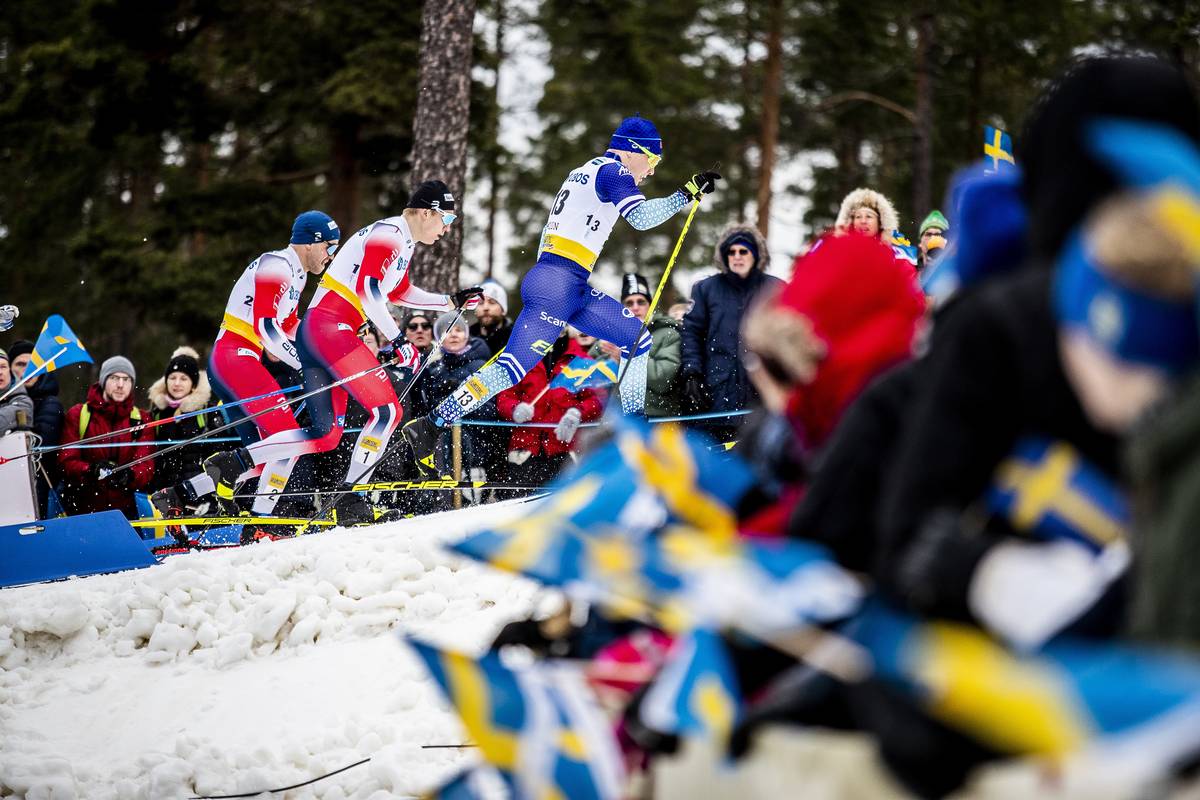
Erik Valnes of Norway (bib 1) and teammate Pål Golberg (bib 2), and Lauri Vuorinen of Finland, (l-r) during the quarterfinals of the classic sprint in Falun, Sweden. (Photo: NordicFocus)
Thousands of spectators, slate skies, and a manmade loop of snow laid down in the otherwise green-brown Falun, Sweden ski stadium greeted the World Cup on Saturday. After a weekend hiatus last week, racers contested a 1.4-kilometer classic sprint in one of Sweden’s skiing epicenters.
The main World Cup sprint star, Johannes Høsflot Klæbo, was absent. The twenty-three-year-old Klæbo broke two fingers last week. According to Norwegian broadcaster NRK, he will be reevaluated on Feb. 13. The fingers were broken while Klæbo and a group of friends were using a “boxing machine”. The game involved hitting a padded area that measures the force of impact. Klæbo’s gloved hand slipped off the pad and struck a hard surface adjacent to the pad.
Although considered a lock in classic sprints, Klæbo has won nine of the last 10 World Cup classic sprints — including five in a row — this would be a day for another skier to claim the win on a course featuring two significant climbs and twisting banked turns on the descents.
Erik Valnes of Norway notched the fastest qualifying time in 2:51:15, followed by teammate Pål Golberg 0.26 seconds back. Overall World Cup leader, Russia’s Alexander Bolshunov (23), the person who could pad his overall World Cup lead with Klæbo out, qualified in third (+0.51).
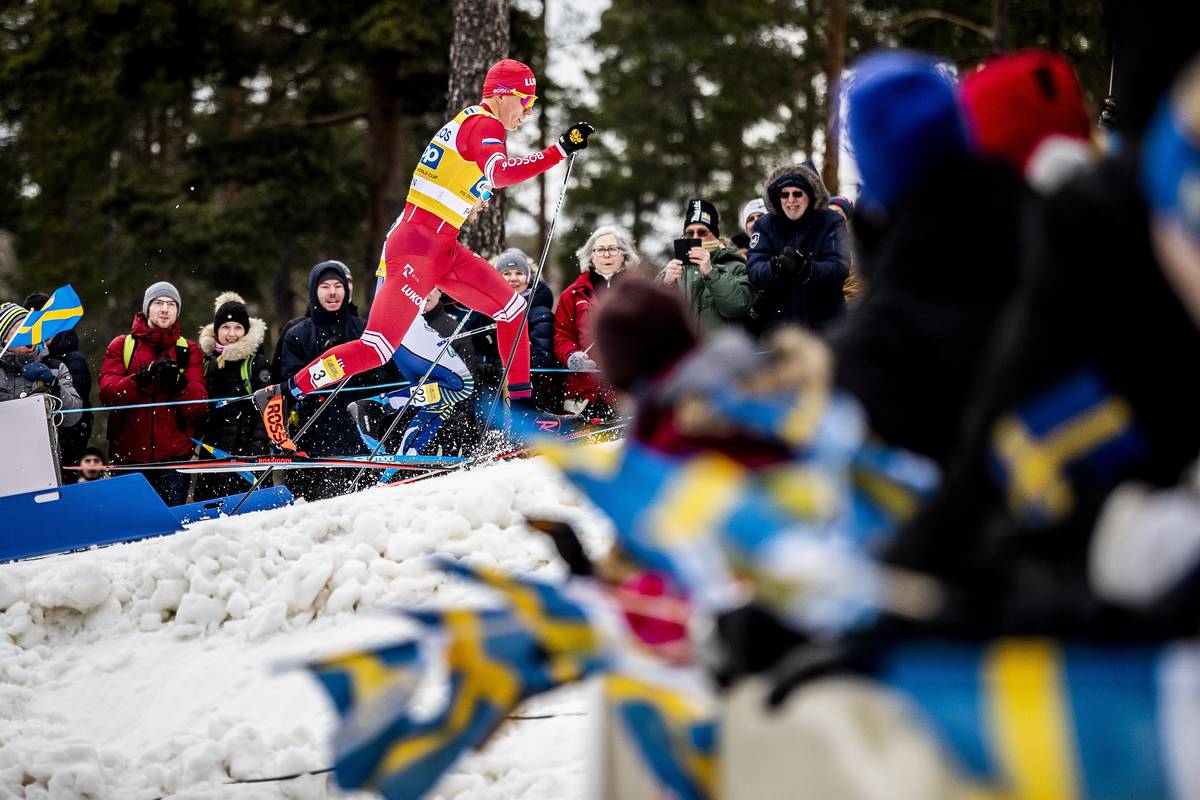
Alexander Bolshunov charging during the classic sprint in Faklun., Sweden. (Photo: NordicFocus)
In the quarterfinals, it looked like the yellow overall leader’s bib had instilled special powers on Bolshunov. He won the third heat in 2:53.47. Although in a different lineup with five other skiers creating the context, Italy’s Federico Pellegrino won the second quarterfinal in a markedly slower time of 2:59.23.
The first semifinal featured Pellegrino, Bolshunov, Golberg, and Valnes as the main contenders. As the semi to watch, Bolshunov was the thoroughbred out of the gates. He led the double pole army of six over the top of the first hill as he began to string out the field. He then led the classic-run up the second climb, with Pellegrino, Valnes, and Golberg following in order over the top.
Again, Bolshunov hung on over the top with three other skiers towed along. Pellegrino eventually grabbed the lead on the final climb as he moved ahead of Bolshunov. Pellegrino won the speedy semi in 2:50.41, with Bolshunov in second (+0.10), Golberg in third (+0.40), and Valnes in fourth (+1.64). Golberg and Valnes would advance to the final as lucky losers.
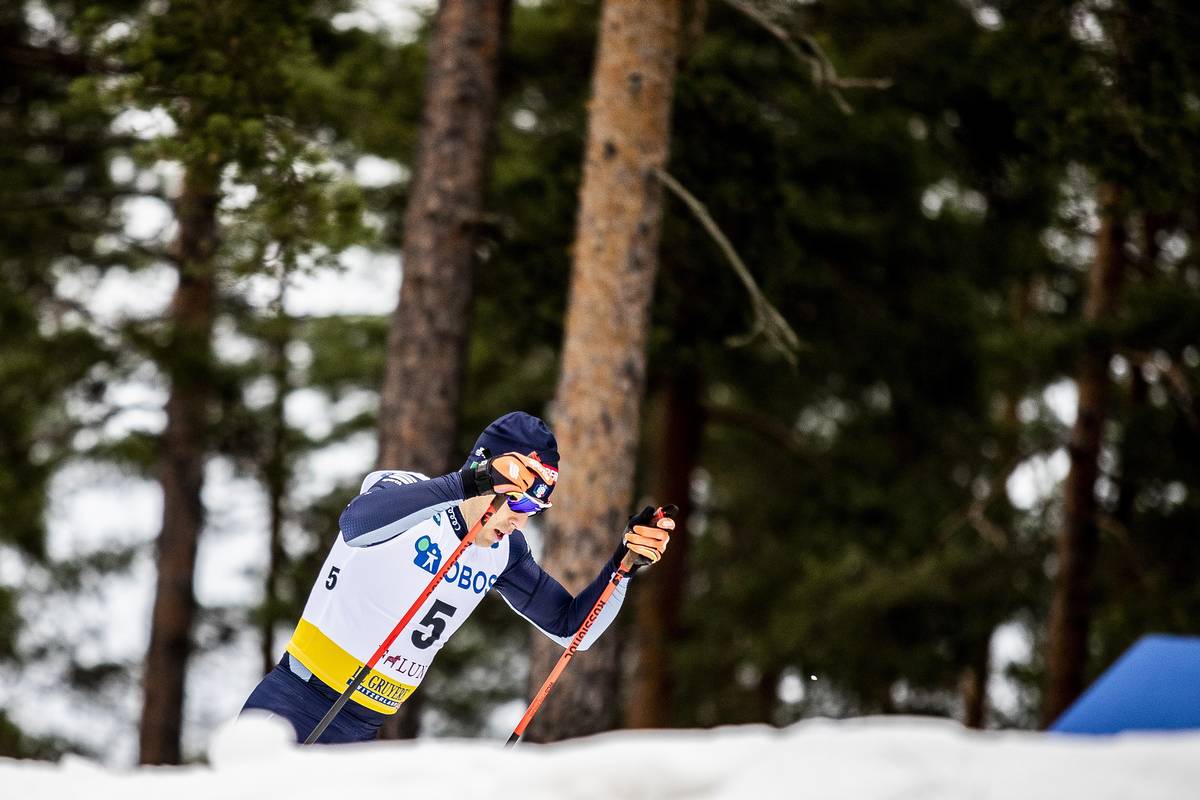
Federico Pellegrino during the classic sprint in Falun, Sweden. Pellegrino placed fourth overall. (Photo: NordicFocus)
Bolshunov blazed ahead in the final. His double poling was peerless. His tempo up the first major climb was a mirror of his semi where he was first over the top and forced others to gap up.
On the second climb at 1:45, Bolshunov crested the hill in first with the others chasing. On the descent, with a long glide out lasting nearly 12 seconds, Bolshunov was caught as the leading foursome ran into the final hill before the finish.
Golberg led the charge followed by Valnes with Bolshunov and Pellegrino trailing a few meters back in third and fourth.
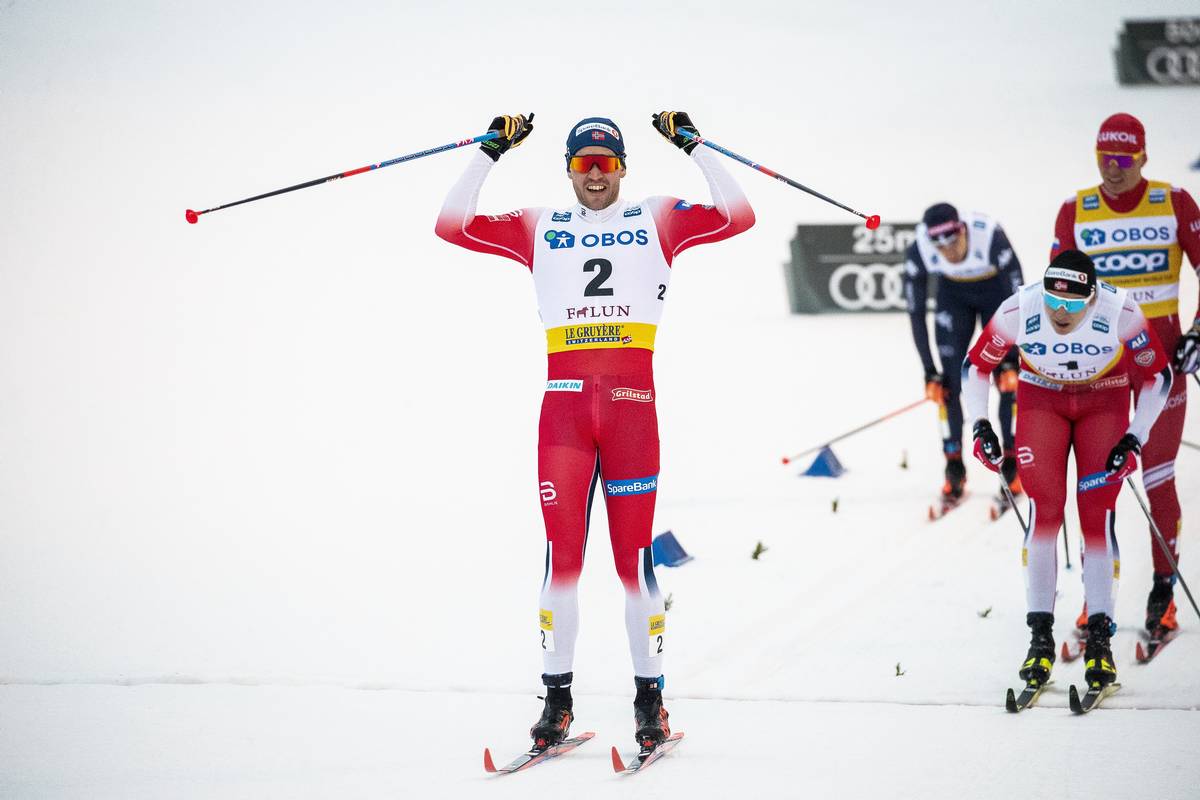
Downt the line it was Golberg for the win in 2:51.83. Valnes was second (+0.52), Bolshunov third (+0.92), and Pellegrino fourth (+2.40). Norway’s Håvard Solås Taugbøl placed fifth (+9.74), and Sweden’s Teodor Petterspon sixth (+49.48).
“My feeling was good today but I had a really tough semi final,” Golberg told FIS after the race. “So I expected the final to be tough as well so my tactic was to follow Alexander Bolshunov and fortunately I ended up with a bit more power. We had five Rossignol skis in the finals so something was definitely right today.”
Pål Golberg (NOR) for the classic sprint win in Falun, Sweden. (Photo: NordicFocus)
Bolshunov, who leads the overall with no threat from Klæbo in the near future, he was disappointed with his day. “I am not too happy with today’s result as I was expecting more of myself,” Bolshunov told FIS. “But something did not work out as I was not able to speed up more and go away from my opponents and therefore it would have been good for me if there would have been one more heat so that I could have pulled everything out or maybe if the course would have been longer, then I might have pulled it off.”
No North American men qualified for the heats. Canada’s Bob Thompson was the top North American in 43rd. Alexis Dumas placed 62nd and Ricardo Izquierdo-Bernier 64th.
Logan Hannaman (APU) and Kevin Bolger (USST), finished 52nd and 53rd, respectively. Ben Saxton (SMST2) raced to 55th.
According to U.S. World Cup Coach Matt Whitcomb, Simi Hamilton is recovering from a back injury and will miss this weekend of World Cup racing.
Post-race interview with U.S. World Cup Coach Matt Whitcomb
“There is no painting any way other than what it is, it was just a bad day,” said Whitcomb.
Bob Thompson of Canada during the Falun, Sweden classic sprint qualifier. (Photo: NordicFocus)
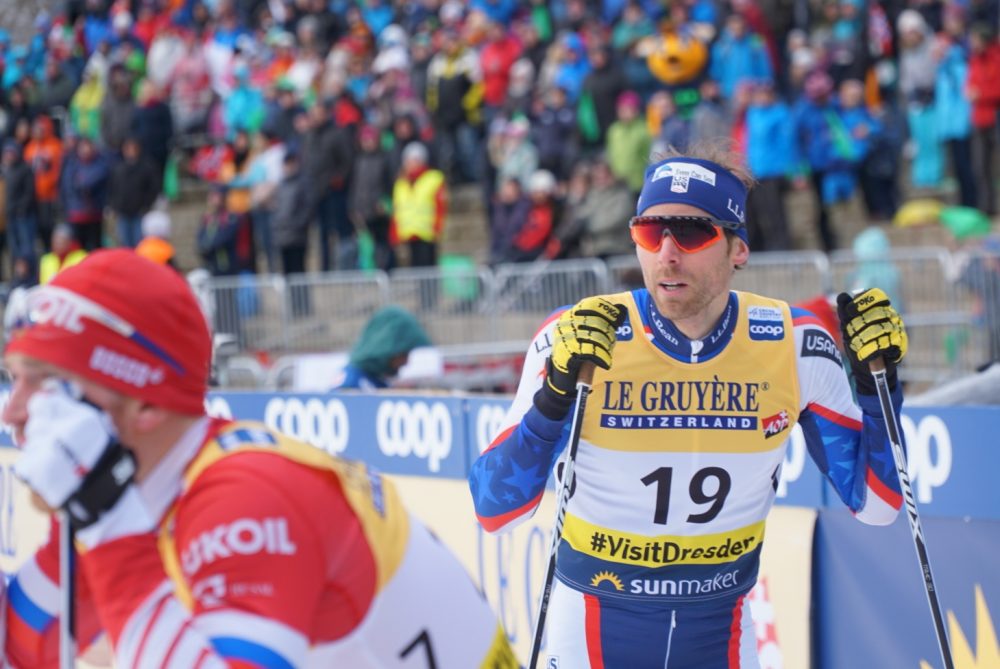
Logan Hanneman of the U.S. during the Falun, Sweden classic sprint qualifier. (Photo: NordicFocus)
Kevin Bolger of the U.S. during the Falun, Sweden classic sprint qualifier. (Photo: NordicFocus)
Britain’s Andrew Young qualified for the heats which was a career first in a classic sprint. He placed 19th overall.
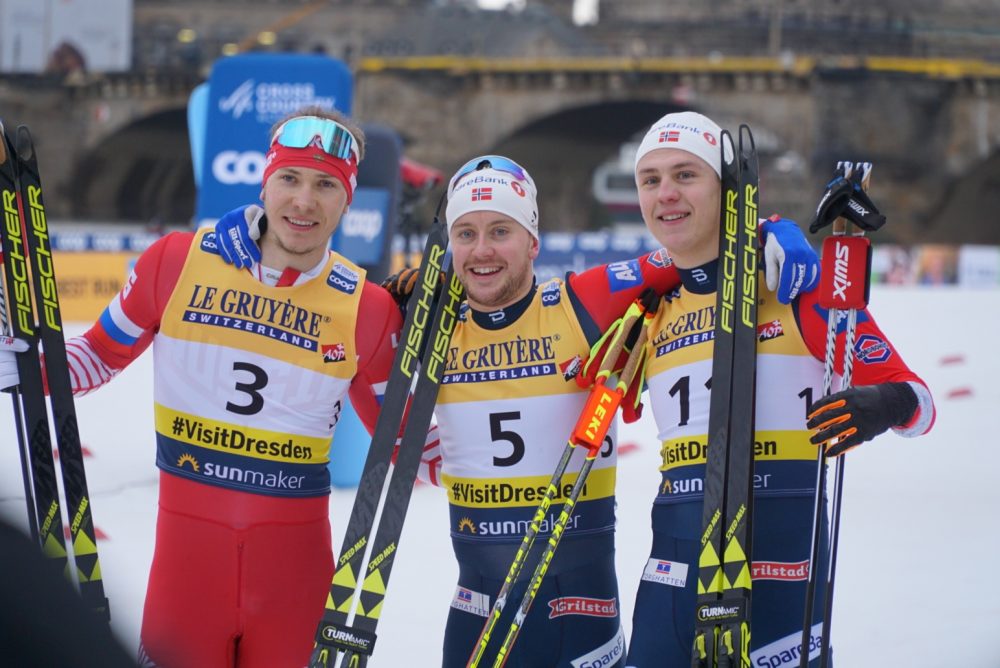
The men’s classic sprint podium from Falun, Sweden: Erik Valnes (NOR) in second, Pål Golberg (NOR) first, and Alexander Bolshunov (RUS) third, (l-r). (Photo: NordicFocus)
Johannes Høsflot Klæbo smiles after winning the 1.6-kilometer skate sprint in Lahti, Finland. Federico Pellegrino of Italy (l) took second, followed by Finn Hågen Krogh of Norway (r). (Photo: Screenshot Instagram @fiscrosscountry)
After two weeks away from competition, athletes revved their engines in Lahti, Finland for an individual 1.6-kilometer freestyle sprint, one of the final stops on the way to the World Championships. After a string of what he deemed “bad luck” in the first sprint races of the season in Ruka and Lillehammer, Norway’s Johannes Høsflot Klæbo came into the weekend with momentum from winning the last four individual sprints. Klæbo also arrived in Lahti on the brink of what could be a historic milestone; a win could advance him from possessing the joint-third most victories, tied with his opponent Federico Pellegrino of Italy with 12 each, to the joint-second most, tied with Ola Vigen Hattestad of Norway who retired in 2016.
Both men skied well in the qualifying round, with Klæbo taking the lead with a solid gap, finishing in 2:49.77, followed by his teammate Håvard Solås Taugbøl (+4.15), Joni Maeki of Finland in third (+4.35), Pellegrino in fourth (+4.36), and Finn Hågen Krogh of Norway in fifth (+4.40).
Conditions in Lahti were reportedly fast and a bit wet. Temperatures hovered around freezing with some freezing rain lightly peppering the course throughout the day. This stability in the weather and on the tracks kept the playing field fair as the athletes sprinted through the heats.
Emil Iversen of Norway charges on his way to second place in heat two of the semifinals of the 1.6-kilometer skate sprint in Lahti, Finland. (Photo: Instagram @langrennslandslaget Screenshot)
In the quarterfinals, Klæbo and Pellegrino went one-two in heat one, advancing into the first heat of the semi-finals. This first semi proved to be the faster of the two. The Norwegian again took the win in 2:49.84, with his teammate Eirik Brandsdal close on his tails. Gleb Retivykh and Pellegrino, who finished in third and fourth, respectively, advanced as lucky losers. Less than one second separated the six men in the heat, and all of the men skied faster than those in the second heat.
In the second semi-final heat, Krogh finished first in 2:50.98, followed by his teammate, Emil Iversen, making it a final of four Norwegians, an Italian, and a Russian.
As the men charged out of the gate in the final round, Retivykh led the pack, with the other men jockeying for position behind him. Per usual, Klæbo began to surge on the climbs, using them as his opportunity to move to the front of the pack. The second half of the course featured a steady climb with a steeper punch at the end before sending the athletes down and around a turn into the stadium. On this climb, Klæbo set the pace, trying to slowly pull away from the group. But Pellegrino was not ready to let him go. The Italian crested the hill just behind and as the two men tucked into the downhill, a small gap was created before the next skier back.
Norway’s Johannes Høsflot Klæbo attacks the final climb on his way to victory in the 1.6-kilometer skate sprint in Lahti, Finland. (Photo: Screenshot FIS/ARD Broadcast)
Pellegrino tried to position himself on the inside of the final turn to get in front of his opponent, but he could not quite make his move. Klæbo was still in front heading into the final straight with Pellegrino nipping at his heels. Krough, who closed the gap they had created was also in the hunt, chasing the leaders to the line. The two kept the pressure on Klæbo, giving him no opportunity to risk his position with an early finish line celebration, but they were not able to surpass him.
Klæbo earned his 13th World Cup Victory, stopping the clock at 2:52.06, his ninth win out of the last 13 individual sprint races. Pellegrino took second (+0.30), followed by Krogh in third (+0.61), Brandsdal in fourth (+1.31), Iversen in sixth (+1.75), and Retivykh in sixth (+2.08).
Norway’s Johannes Høsflot Klæbo rounds the final turn ahead of Federico Pellegrino of Italy in the 1.6-kilometer skate sprint in Lahti, Finland. (Photo: Screenshot FIS/ARD Broadcast)
No North American men qualified for the heats, which came as a surprise to both the athletes and the coaches. Logan Hanneman (APU) posted the fastest qualifying time for the U.S. placing 32nd overall after missing the heats by .22 seconds. Simi Hamilton (USST) finished 36th overall, and Erik Bjornsen (USST) 42nd.
Evan Palmer-Charette was the lone Canadian entered; he placed 67th.
“Definitely a bit of a puzzling qualifier for the guys,” said Matt Whitcomb in a call. “An impressive one out of Logan, but we know he can ski into the top-30 too. Erik and Logan and Simi all said they felt great. We are coming out of a training camp [in Vålådalen, Sweden] where it has been cold, and it is possible that we just need a little rest and a little racing and that will get things going.”
Though he was offered starts in both Period 1 and 3, it is Hanneman’s first time racing internationally this season. The APU skier was the top qualifier in the 1.3 k skate at US Nationals, placing second in the final. He also took third in the final in the classic sprint. When Hanneman competed in the sprint in Lahti last March, he placed 49th overall.
“Today was pretty good for me!” Hanneman wrote in an email. “Of course, being only .2 sec out from the heats hurts a little, but it was my career-best finish so that is a positive for sure. Looks like from the splits I was in 15th at 900m, which was nice to see since my goal was to take the first half out faster than I did last year. When I raced this course last year, I learned that it is a little tricky to make time back on these guys on the last hill… this year I learned that I can lose a lot of time to these guys on the last hill. Although today, with the fast conditions, the time spreads were really tight so it wasn’t too much time that I lost.”
As illness kept him from racing in the city sprints in Dresden, it has been over a month since Hamilton last put on a race bib.
“I wish I felt better about my day today,” Hamilton told FasterSkier in a call. “I’m still kind of baffled by how it went. I felt amazing and I felt like I skied the course better than I ever really have before and I’ve had some decent races here before. The conditions were great, our skis were awesome, I just don’t know what happened. The only thing I can think is that sometimes it takes me a little bit of racing and hard training to get that really good sprint gear going again, but I felt incredibly fit, I felt like I paced it really well, I was just really confused when I saw the qualifier results.”
During his time away from the World Cup, Hamilton traveled back to the U.S. to spend some time back in Vermont, where on top of training, he proposed to his girlfriend, Sophie Caldwell. Hamilton returned to Europe two weeks ago to participate in the Vålådalen camp. While the camp went well for him, the aforementioned temperatures prevented Hamilton from putting in those hard training efforts, but there is still time before Seefeld to capitalize on his fitness.
“It was incredibly cold, so we weren’t doing a lot of really hard intervals or hard training, but all the other indicators were really good during that camp,” he said. “Fortunately, this wasn’t the World Champs day, and that’s obviously the race that really counts. So we’ll just kind of tweak training a little bit, and hope for some better feelings for Cogne, and plan on feeling really good for the sprint in Seefeld.”
Despite his disappointment in his own performance, the day had a silver lining for Hamilton, as Caldwell landed on the podium with a second place finish in the women’s 1.4k sprint.
“I’m super psyched that Soph had such a great day – I’m just amazed by that,” he shared. “That she can fly back here to Europe two days ago, then put together a day like she did today… Whatever frustrations I had quickly evaporated with her day. I’m just so happy for her.”
Hamilton has a second chance to find his top gears when racing continues tomorrow during the classic team sprint where he will line up with Bjornsen.
“It’s pretty much my first classic race of the year,” Hamilton laughed. “The only other classic race I’ve done was in Lillehammer, the 15 k in the pursuit on the third day, so it will be interesting to see what happens, but I’m psyched.”
The team sprint will be held on the same course as the individual race today, a change from past years of the Lahti Ski Games.
“They’re not using the old course, which I’m a little bit bummed about,” said Hamilton. “So we’ll have to see how the regular sprint course classic skis, which on the World Cup anyway, no one has classic sprinted on that loop. It should be exciting, it should be fun. Conditions look good for some fast Klister skiing, so hopefully, we don’t get too much snow overnight. But yeah, we’re psyched.”
Norwegian Sindre Bjørnestad Skar (c) after taking first in the men’s 1.6-kilometer freestyle race on Saturday. Russia’s Gleb Retivykh placed second, while Norway’s and Erik Valnes placed third. (Photo: Garrott Kuzzy /LumiExperiences.com)
The white ribbon of snow created a stark contrast to the green grass and gothic architecture along the bank of the River Elbe for the second year of city sprints in Dresden, Germany. As is typical in these events, the 1.6-kilometer out and back course was predominantly flat with a few short hill punches and a 180-degree hairpin turn at the halfway mark, where the race seemed to truly begin. The nature of the course challenged skiers as there was little opportunity for recovery, and as always, a small margin for error.
Last year in Dresden, Italy’s Frederico Pellegrino upset a seemingly unbeatable Johannes Høsflot Klæbo in the men’s sprint, going on to win back-to-back the next day in the team sprint as well. This Saturday, after he won the qualifier in a time of 3:21.12, the question quickly became whether or not Pellegrino would remain king of the track in Dresden.
Heading into his quarterfinal, Pellegrino appeared to employ the same patient tactics which paid off for him in 2018. The Italian skied calmly in the middle of the pack for the first half of the course, moving slowly ahead after the hairpin. Coming into the final hill just before the finishing lanes, Pellegrino surged to take the lead, stepping on the ski of Frenchman Baptiste Gros as he passed by. Holding onto the lead, Pellegrino crossed the quarterfinal in first ahead of Norway’s Pål Golberg in second.
Due to the hangup with Pellegrino, Gros staggered, losing momentum, but stayed on his feet heading down to the final stretch, crossing the quarterfinal in third. More excitement ensued as the two Russians in the heat, Alexander Terentev and Andrey Krasnov, caught their skis on the pine boughs that were used to line the course and mark out the lanes and crashed in the final meters before the line.
It was ruled that the hang up caused by Pellegrino was an obstruction, earning him a yellow card and relegating him to last in his heat. He finished the day in 30th position.
With Pellegrino out of the running and Klæbo sitting out the races in Dresden to recover from his overall win in the Tour de Ski, focus shifted toward Sindre Bjørnestad Skar and Erik Valnes of Norway, Lucas Chavanat, who took third in last year’s Dresden city sprint, Baptiste Gros, and Richard Jouve of France, and Gleb Retivykh of Russia, all of whom are ranked highly on the overall sprint World Cup standings.
In the first and fastest heat of the semifinals, Skar and Retivykh jockeyed for the lead throughout the race, Skar punching ahead on the final hill, but Retivykh bested him in the final meters with a time of 3:32.58, just 0.14 seconds ahead of the Norwegian. Both Jouve (+0.20) and Gros (+0.53) advanced as lucky losers. Everyone in the first heat skied a faster time than the skiers in the second wave. Advancing from the second semifinal was Valnes (3:37.72) and Chavanat (+0.15).
As the men faced off in the final, it was anyone’s game through the first half. Rounding a turn late in the race, Gros caught his ski on a V-board lining the course causing him to fall, taking Chavanat down with him. Left standing, Skar and Retivykh again dueled for position, eager to be first to the top of the final roller. Skar attacked at this seemingly pivotal spot, positioning himself just ahead of Retivykh. The Russian fought back, not willing to relinquish the victory until the very end when Skar threw his foot forward for the win with a time of 3:25.94.
Retivykh finished just 0.11 seconds behind, followed by Valnes (+2.83) in third. Jouve cruised through the finish in fourth (+11.22) followed by the two Frenchman, Chavanat in fifth (+21.94) and Gros in sixth (+23.93).
Skar is now ranked second in the overall World Cup sprint standings.
“It feels good to be the winner today,” Skar told the International Ski Federation (FIS). “It is my fourth final this year and I’ve been number four, and number five, and number six, so to be on the top now today, that’s a very good feeling.”
Despite the man-made snow and warm and wet weather leading into the race, the event coordinators were able to produce a solid and fast track for the athletes.
“Yesterday was unbelievably sugary and was 8 inches deep by the end of the testing period,” Matt Whitcomb told FasterSkier in a call. “Today they were able to take advantage of salting because it had gotten warmer and it had rained a little bit so that added moisture which allowed the salt to react with the snow an make for a very hard surface.”
“I think the conditions of the track were very good,” Skar told FIS. “But of course with the headwind up to the U-turn, it is hard to be in the front and it’s a lot of tactics, but that’s the same for everyone so you just have to go with it and try to be up there.”
Andy Newell placed 25th in Saturday’s 1.6-kilometer freestyle sprint in Dresden, Germany, his first World Cup race since last season. (Photo: Garrott Kuzzy /LumiExperiences.com)
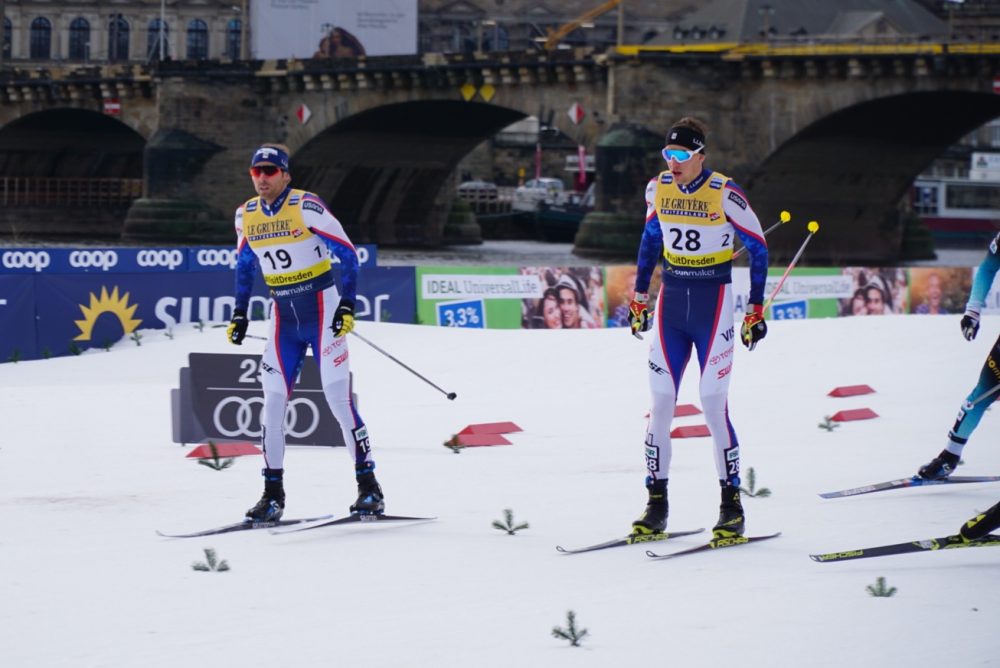
In his return to World Cup skiing after racing the domestic circuit, American Andy Newell qualified in 19th (+5.58) and ultimately ended the day in 25th. The second North American to finish in the top 30 on Saturday, Kevin Bolger (USST), qualified in 28th (+6.76) and finished in 29th overall.
Both Bolger and Newell raced in the third quarterfinal, along with Jouve, Norwegians Eirik Brandsdal and Gjøran Tefre and Russia’s Artem Maltsev. Jouve won the quarterfinal in a time of 3:28.24, while Newell crossed in fifth (+1.31), and Bolger sixth (+1.45). ending the day in 25th and 29th respectively.
Americans Andy Newell (l) and Kevin Bolger after their quarterfinal in the men’s 1.6-kilometer freestyle sprint in Dresden, Germany. (Photo: Garrott Kuzzy /LumiExperiences.com)
“We had Simi Hamilton get sick on Thursday, which was disappointing because he’s been feeling great, qualifying really fast, ready for big results,” said Whitcomb. “But, we decided to bench him this weekend, so it was awesome to have Andy jump in as a replacement and qualify for the rounds with Kevin Bolger. Putting two guys in there, having only started four wasn’t too bad for us.”
“It feels good to be back,” Newell said during a phone conversation. “You know, your first World Cup of the year, you don’t know what to expect. I was hoping to do a little bit better than I did today. It’s always hard to jump on a plane and come over and race, but I think it was a good start.
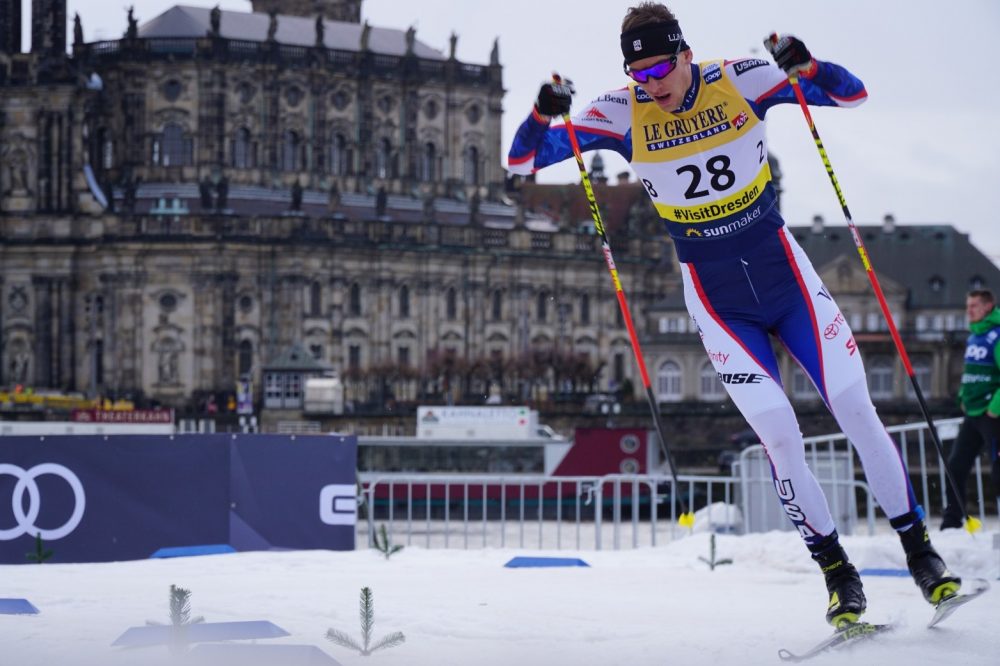
American Kevin Bolger during the qualifier for the men’s 1.6-kilometer freestyle sprint in Dresden, Germany, his first World Cup race since last season. (Photo: Garrott Kuzzy /LumiExperiences.com)
“I think we had good skis and I felt pretty good in qualification and I felt like I did what I needed to do to get to a good position,” Newell continued. “Then I think I maybe forgot how aggressive it is in the last 200-meters here compared to some other races. I remember last year I was taken by surprise by how much contact and how much jostling goes on up and over the last little bump and into the lanes. I think I was caught by surprise again this year. Even though I was in a great place with good energy, I just ended up getting ping-ponged around a little bit.
“On the World Cup here you can’t give anybody an inch,” he continued. “They’ll take advantage of that because the competition is so tight. So I think that’s kind of where I messed up today, but it’s good to check in and see how the speed is going and see what I need to work on if I am going to come back over and race later in the year.”
The final American in the race, Erik Bjornsen, finished in 33rd in the qualifying round (+7.43). Simi Hamilton did not start due to illness.
For Canada, Bob Thompson placed 32nd overall, Lenny Valjas 47th (+9.55).
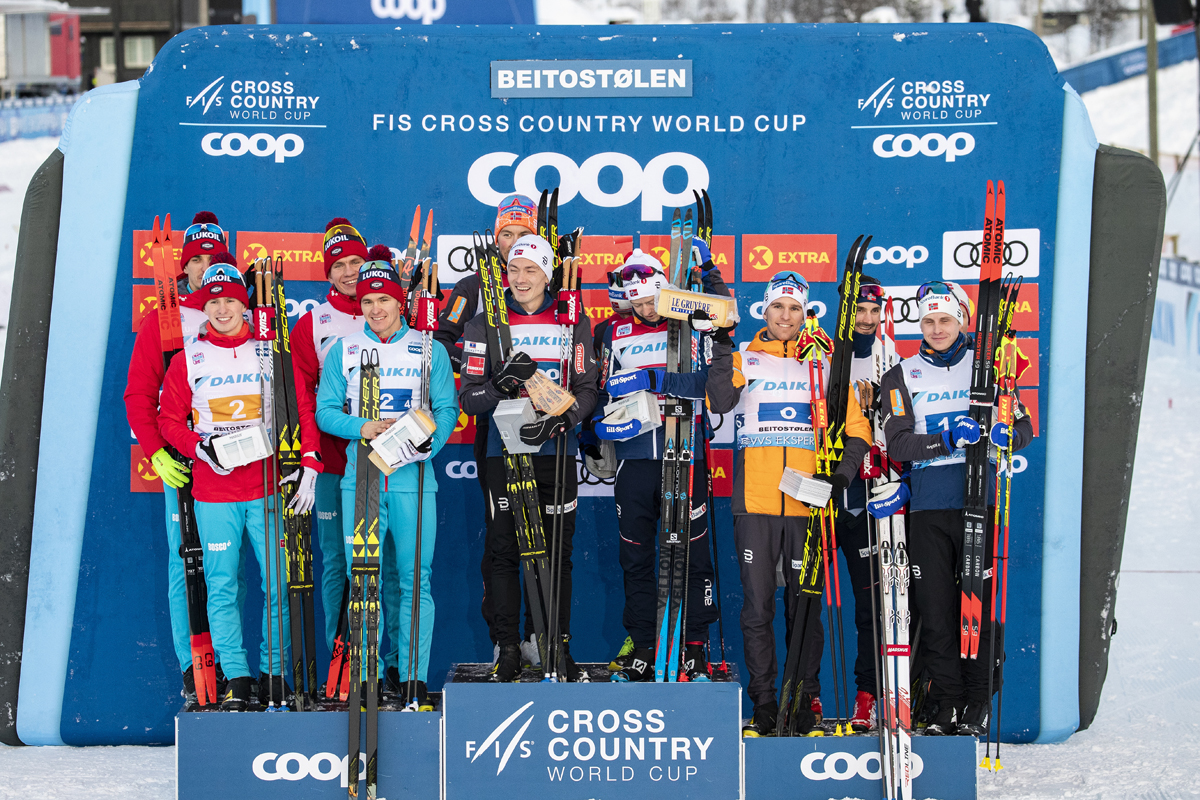
The men’s 4 x 7.5 k relay podium from Beitostølen, Norway. Norway I (center) won, Russia I (left) placed second, and Norway II (right) third. (Photo: Fischer/Nordic Focus)
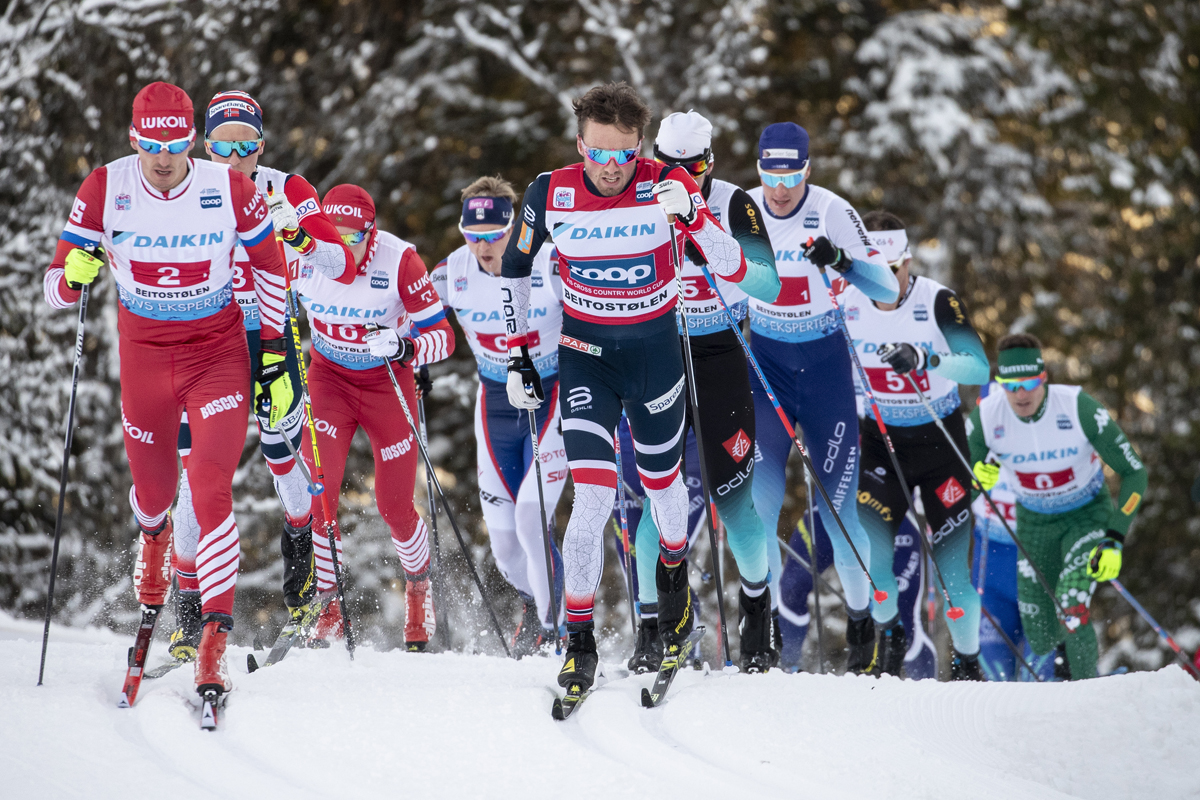
As Emil Iversen took command of the field from the gun during the men’s relay in Beitostølen, Norway, striding smoothly up the first climb in the lead, the question quickly became, can anyone take down Norway?
The team of Iversen, Martin Johnsrud Sundby, Sjur Røthe, and Finn Hågen Krogh must have liked their odds. Norway has claimed eight of the last nine men’s relay victories on the World Cup, falling only to Russia in Lillehammer’s 2013 men’s relay. Norway’s last time missing a podium in a relay occurred in 2007. While historically, the race has been a 4 x 10-kilometer event, the men’s relay on Sunday consisted of four 7.5 k legs.
Norway’s Emil Iversen and Russia’s Evgeniy Belov lead the pack on the first leg of the men’s 4 x 7.5 k relay in Beitostølen, Norway. (Photo: Fischer/Nordic Focus)
At the first exchange, Iversen had a sizeable lead over second place Norway II team, who tagged 7.7. seconds back. Russia 1 came through with a gap of 16.1 seconds. The first leg of the relay, called the scramble leg, most often doesn’t break the pack apart. It’s part gamesmanship, part high-tempo effort to shake off any non-contenders.
As the second leg began, this much was clear: Russia wouldn’t let Norway run away with the race. Russia’s second leg skier, Alexander Bolshunov quickly caught Sundby during their first lap of the 3.75 k course. Before the end of their first lap, Bolshunov played his hand, upping his effort, and taking control of the second leg. By the time he tagged off for the third leg skier, Bolshunov had put nine seconds on Sundby and his Norway I mates.
Norway II fell off the back, tagging off 33.7 seconds back.
Røthe, winner of
At the final exchange, Norway was Russia’s heels, trailing by a mere 0.4 seconds. Third place Norway II was a distant 50 seconds behind the leaders.
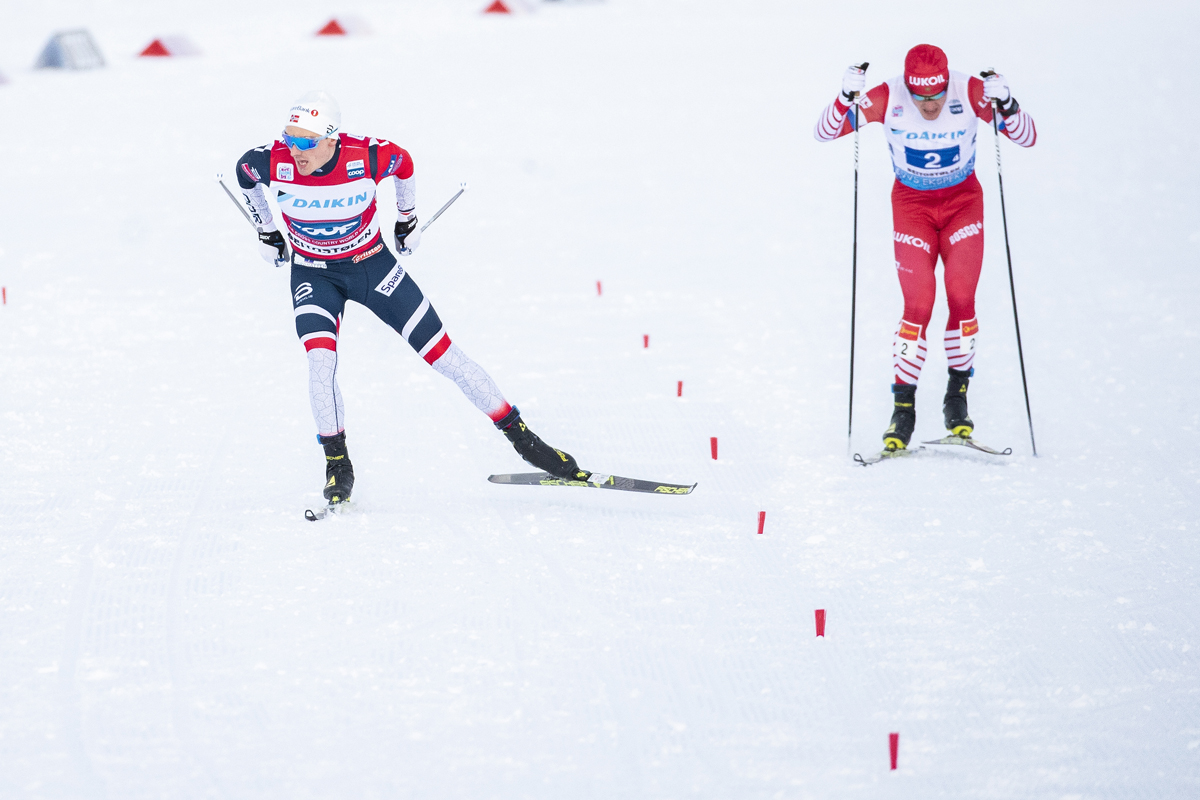
Norway’s Finn Hågen Krogh is the master-closer. Here he crosses the line for first place over Russia’s Andrey Melnichenko in the men’s 7.5 k relay in Beitostølen, Norway. (Photo: Fischer/Nordic Focus)
Krogh, who has a history of being a strong closer, stayed calmly on the heels of Russia’s Andrey Melnichenko, matching his pace on climbs and tucking into his draft on descents. As the tempo accelerated for the final kilometer, Krogh edged around Melnichenko at a turn and held off the Russian through the final moments of the race. In the final stretch, it was clear that Krogh’s strategy had paid off as he glided through the finish with Melnichenko 0.7 seconds behind.
The third-place Norway II team of Didrik Tønseth, Hans Christer Holund, Magne Haga, and Simen Hegstad Krüger crossed the line 53.4 seconds behind the leaders.
“We are used to the tough race against Russia now,”, Sundby told the International Ski Federation (FIS) at the finish. “For the last relays, it has been the same way. They have a really strong team, with different skiers, but every time they have four strong guys. Same procedure today. Today we have back our last leg finisher with Finn [Krogh] and it was really nice for everyone to see him back in good shape. I think the last time was Lahti [World Championships in 2017]. And he’s back again now. So, it’s good for us and we hope for a nice race against for sure Russia.”
While the podium positions seemed to be locked up early on, the remaining top ten positions were in contention as a large chase pack had formed behind the leaders. During the first leg, the U.S. Ski Team’s (USST) Erik Bjornsen was in the mix. At times Bjornsen led the chase pack. In a tightly packed group, Bjornsen tagged off to Kevin Bolger in fourth position, 33.1 seconds back.
The U.S. Ski Team’s Erik Bjornsen (bib 9) during the first leg of Sunday’s 4 x 7.5 k relay in Beitostølen, Norway. (Photo: Aleks Tangen)
“It’s always fun to do a relay with the boys, so it was a good day, working out the cobwebs and getting ready for Seefeld,” Bjornsen told FasterSkier at the finish. Bjornsen was happy with his classic leg. When asked how he felt, he expressed, “Just great! It was really fun! Good crew out there.”
“On the men’s side, all four of our guys took a step forward today,” Matt Whitcomb told FasterSkier in an email. “While Erik isn’t quite in form yet to stay with the break, he controlled and drove a very competitive chase group. His performance was impressive.”
Bolger, the leg skier for the U.S., maintained his position in the chase pack for his first lap. He skied through the exchange/lap zone in ninth place. As the decisive moves were made, Bolger could not maintain pace. The group split in two, and he fell back with the second chase pack.
“Unfortunately, the relay is a contact game, and we lost that late in the second lap,” said Whitcomb. “Kevin dug deep, and was so close to keeping contact over the top of the last big climb, but once it opens slightly, it tears open.”
Bolger eventually tagged third leg Scott Patterson (USST) in 10th (+1:52.4).
“I’m happy with it,” said Bolger about his leg. “I wish I could’ve stuck together with the guys all the way through the finish but just to stick in and ski with some of those guys was good… I wish I could’ve skied it harder toward the finish, but I just got tired, went out a little hard maybe, but overall I’m happy, a lot of takeaways, so I’ll learn a lot from it.”
Scott Patterson took the first skate leg for the U.S., skiing with Italy and Sweden in the second pack. He tagged off to closer Simi Hamilton (USST) in 12th position, with a 2:19.6 minute deficit to the leaders.
“It was pretty good,” Patterson reflected on his race. “Kind of had a slow start to my season, today felt pretty good, skiing with Italy and Sweden, able to hang pretty well, so it was a fun one. … With these short relays, it’s so easy to hammer the first lap, the second is kind of hang on, and that’s a lot of what it felt like today.”
When asked how the 7.5 k legs, compared to the traditional 10 k distance, affected their pacing during the race, Patterson was adamant that the shorter course was an added challenge for distance skiers.
“Absolutely harder,” he said of the change. “We’ve had so many 15k’s that you’re kind of used to that pace, and this is… I mean for me, it’s almost sprint qualifier pace. You just gotta’ go and hang in.”
Though Hamilton was ultimately unable to gain any positions for the U.S., he was pleased with his performance and enjoyed the relay environment as the U.S. finished 12th (+3:22.7).
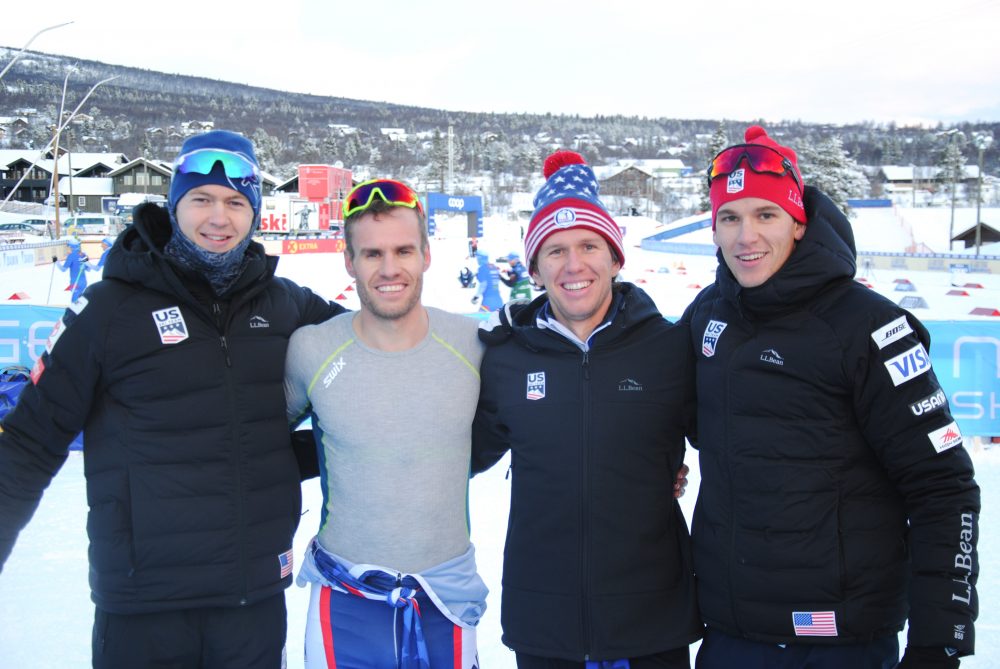
The U.S. team for the men’s 4 x 7.5 k relay in Beitostølen, Norway. From left to right, Erik Bjornsen, Simi Hamilton, Scott Patterson, and Kevin Bolger. (Photo: Aleks Tangen)
“I was happy with it,” Hamilton shared. “It wasn’t my best distance feeling ever, but it was a fun course, Scott tagged me in a great spot, just, right off of the tail of Viktor Thorn [of Sweden] and DeFabiani [of Italy] there, and those guys are really good skaters. B I tried. I didn’t really want to try to ski just dangling off the back the whole time, so I put in [a quick effort] there at the start, just to get in a draft behind them. And I feel like a relay is a kind of race where you kind of have to take the risk sometimes, especially later on in the race for the last couple of legs. So in that sense, it’s really fun. You just kind of throw caution to the wind and see what happens. But it was fun and I’m feeling like I’m kind of coming into better shape as the season progresses. I’m psyched for the sprint next weekend and everything else coming up this winter.”
“It was an impressive relay debut,” concluded Whitcomb. “Watching this men’s team fight hard for contact today made us all incredibly motivated. I think I share the sentiment with the rest of our staff and athletes – seeing the U.S. men’s relay hit the podium in a World Cup would rival the excitement of the Olympic gold. We’re not there yet, but we can see it from where we are. And we plan to close.”
The Canadian team did not field a men’s relay team.
Racing continues next weekend in Davos, Switzerland.
Jessie Diggins celebrates after anchoring her team to bronze in the women’s classic team sprint on Feb. 26 at 2017 World Championships in Lahti, Finland. (Photo: Dustin Satloff/dustinsatloff.com)
Shortly after the U.S. Ski Team (USST) formally announced its 2017/2018 cross-country team, FasterSkier reached USST Head Coach Chris Grover on the phone for his comments. Grover is in Bend, Ore., for the team’s traditional on-snow camp.
“We have nine athletes who made the objective criteria to make the 2018 U.S. Ski Team,” Grover said. “Eight that are on the A-team, all of whom finished in the top 30 in the world in either sprint or distance. And then Katharine Ogden, who as a medalist at the World Junior Championships, made the objective criteria that way.”
Below are the eight A-team athletes and Ogden, who was renominated to the development “D” team, that met the USST’s objective criteria for team selection.
A Team
Men
Simi Hamilton (Stratton Mountain School Elite Team)
Attain top-50 ranking in the 2017 final World Cup Overall ranking list.
Attain top-30 ranking in the 2017 final World Cup Sprint or Distance ranking list.
Attain top-20 ranking in the 2017 FIS final sprint or distance points list.
Attain a top-3 individual finish at the 2017 Junior World Championships or U-23 World Championships.
Six women finished the season ranked in the top 50 in the World Cup Overall ranking list: Diggins (6th), Bjornsen (16th), Stephen (28th), Caldwell (33rd), Randall (36th), and Sargent (44th). Notably, Diggins, Caldwell, Sargent, Randall, and Bjornsen all ranked in the top 30 for the final World Cup Sprint list, too, and Diggins, Bjornsen and Stephen all finished in the top 30 on the final World Cup Distance list.
Hamilton and Newell were the two men that met the objective criteria, with Hamilton ranking 30th on the final World Cup Overall list and ninth in the World Cup Sprint standings and Newell 28th on the final World Cup Sprint list.
The remainder of the USST were discretionary selections. The athletes nominated to the team under the discretionary guidelines are as follows:
B TEAM
Men
Erik Bjornsen (APU)
Paddy Caldwell (SMS Elite)
Scott Patterson (APU)
Women
Rosie Brennan (APU)
D TEAM
Ian Torchia (Northern Michigan University)
Hannah Halvorsen (Sugar Bowl Academy)
Julia Kern (SMS Elite)
As Grover explained, the USST’s use of discretion should not perceived as murky. Built into the criteria are aspects of fulfilling “individual markers” or competition results, “attitude and commitment”, illness or injury, and the heavily weighted medal potential.
“We are trying to incorporate athletes who we see are on a path to winning a medal at the highest level, at the Olympic level or at the World Championship level,” Grover said. “Can we make a strong case suggesting that an athlete is on the path to winning the medal? It’s really a difficult call. What are the metrics that we’ll be using: FIS points? Should we be using World Cup points? Should we be using placing at World Juniors or U23s, at NCAAs or SuperTours? There are so many different places where athletes are coming from, so many different places where they are competing. Are they all equal? No, of course not.”
What often makes discretionary selections difficult is that USST coaches must make assessments about future potential using real-time accomplishments between skiers skiing on the World Cup and those skiers competing at the World Cup and Continental Cup (i.e. SuperTour).
“You can’t really compare someone who has been competing on the World Cup to someone who has been competing at a Continental Cup level,” Grover explained. “So that’s a real challenge for us. Yes, you can look at FIS points – that’s one thing we have always done, for many years. We’ve taken that athlete and tracked FIS points and age in distance or sprint, whatever that athlete’s strongest discipline is, and we try to see where they are compared to the best skiers in the world, the top 10 athletes in sprint or distance of that sex in the world.”
Grover knows the FIS point system is not necessarily the best indicator of a U.S. skier’s potential on the World Cup.
“One of the big challenges that we had using that methodology is that our FIS points as a nation in the US are artificially low,” Grover said.
Grover believes FIS points are “artificially low” because the U.S. collegiate system has numerous European athletes with low FIS points that compete nearly every weekend on the NCAA circuit or FIS-sanctioned races. As a result, those skiers bring some U.S. skiers’ FIS points down.
“The same thing happens occasionally when the U.S. Ski Team comes back from Europe,” Grover said. “The U.S. women in particular but also some of the men, and they bring good points and then they are not perhaps at their sharpest at SuperTour Finals, and other athletes are able to improve their points by coming close to or beating these athletes. And so that really drives our points down. We’re just not in the European pool enough to have points that are directly compared to European counterparts. The isolation, the way that points come over and they get passed around, and then they stay isolated over here, it prevents us from our points being representative of where people are compared to their European peers.”
Athlete by Athlete
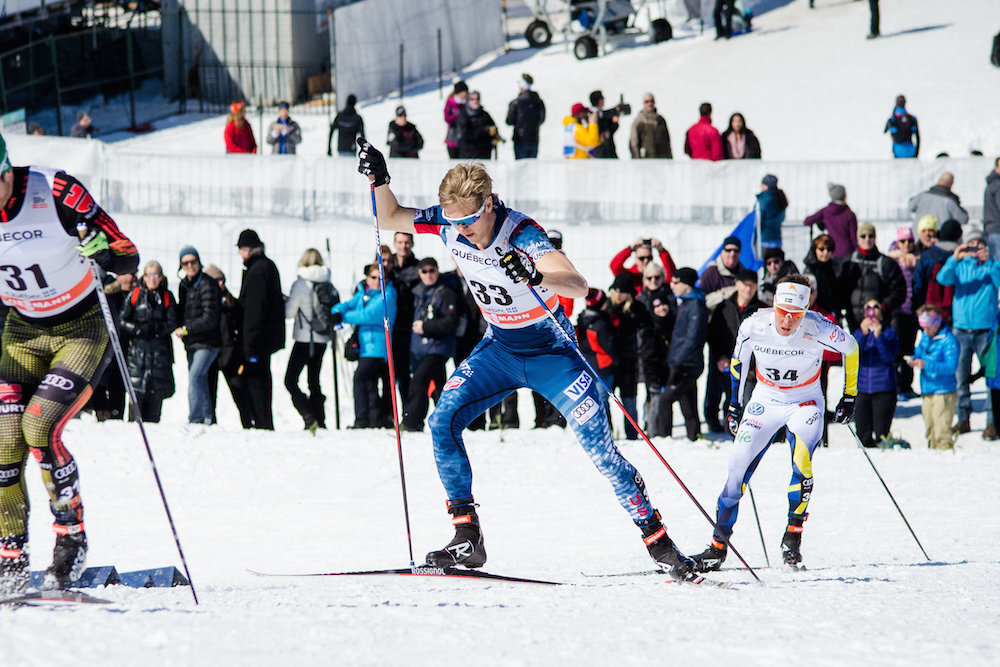
American Erik Bjornsen (33) racing to the 11th-fastest time of day in the men’s 15 k freestyle pursuit at World Cup Finals in Quebec City for his career-best World Cup result. He finished 25th overall. (Photo: Gretchen Powers)
For the B-team, let’s go athlete by athlete, those nominated and those not, to get a better picture of the whys and hows of USST discretionary selection. (Note that all of the D-team members from last year were renominated and will accordingly be invited to team camps.)
“About Erik Bjornsen for example, and why was he nominated to the team,” Grover said. “For a number of reasons, but one thing that we see is that he could contribute to a medal in the team sprint, which is an event where he and Simi were fifth at this World Championships. … [Erik is] a guy who is scoring points in sprints in the World Cup occasionally, some points in distance occasionally. He is a hybrid between aerobic and anaerobic capacities, and that lends itself rather well to team sprint. We feel like he has strong potential there.”
Bjornsen also skied to an impressive 18th (+1:56.7 behind the winner) in the 15 k classic at the 2017 World Championships.
Patterson is the lone new face nominated to the USST. “[Scott] just keeps coming up in conversation and he’s a really really interesting skier,” Grover said. “He got sick before U.S. nationals and then was sick for part of U.S. nationals and did not ski particularly well, at least by his standards for national championships in Soldier Hollow.”
The Anchorage-based skier did not make 2017 World Championships team. Yet at the start of the season, before his illness, he placed third in the 15 k classic in the West Yellowstone SuperTour and won the 15 k skate in the Sovereign Lake NorAm in mid-December.
“So this past winter, we knew he’s definitely one of those next guys — can we find some opportunities on the World Cup to start him?” Grover said.
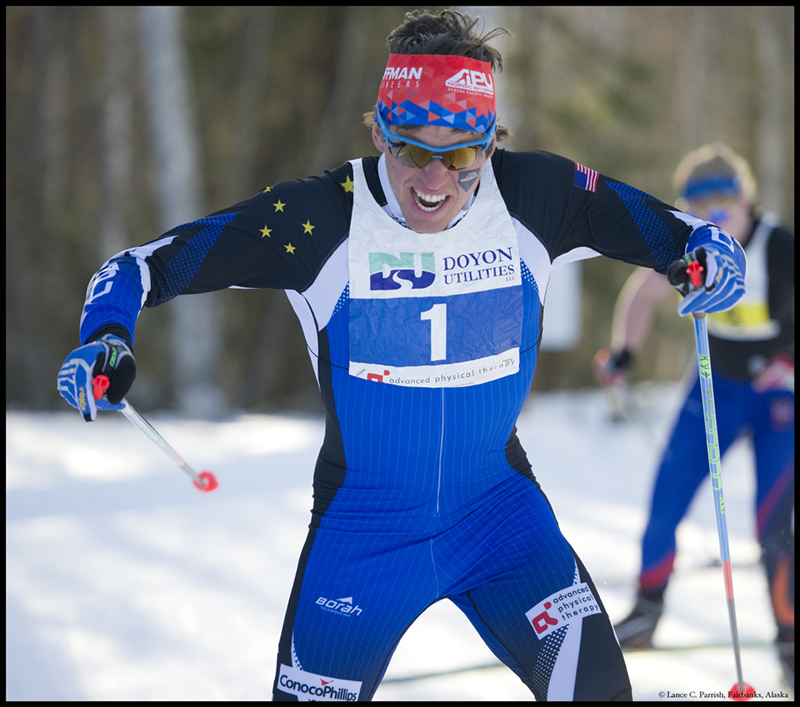
Scott Patterson (APU) racing the anchor leg of the mixed relay at U.S. Distance Nationals in late March in Fairbanks, Alaska. (Photo: Lance Parrish, Fairbanks)
Last season, Patterson was offered World Cup starts in PyeongChang, South Korea, and Oslo, Norway. In a thin PyeongChang World Cup field, he placed ninth in both the 30 k skiathlon and team sprint. At Holmenkollen in Oslo, Patterson was the top American man, skiing to a 28th in a loaded field. Patterson also qualified for World Cup Finals in Quebec.
“And the cool thing was everywhere he went, he scored World Cup points as a 25-year-old athlete,” Grover said of Patterson’s potential. “So he’s a young guy who has got a big history of training. He’s training a lot and training really well and he’s also seizing these opportunities and showing in a very difficult men’s field that he’s a young guy who can grab some World Cup points.”
Patterson went on to dominate U.S. SuperTour Finals and Distance Nationals at the end of the season, winning both the 20 k skiathlon and 50 k freestyle mass start in Fairbanks, Alaska.
Addressing the question of why Patterson was given starts in PyeongChang and Oslo despite not leading the SuperTour at the time or qualifying for World Championships, Grover said Patterson had nearly fallen through the cracks. They needed to see he how he might perform on the World Cup.
“Last year it was a challenging year for us as a national-team staff to look back at what was happening domestically and to make much sense of who was skiing well,” Grover said. “For example, in the first four distance races of the year, Yellowstone, Silver Star, and the two at Soldier Hollow, we had four different men win the four distance races. And of the four first sprint races, in those locations, I believe we had four different men win those four sprint races. And different athletes that were winning qualification in some cases versus those that were actually winning the day result for the sprint. So it was a very unclear picture in terms of who was skiing well … especially on the men’s side.”
Of the skiers winning some of those races outright, Grover knew Patterson was promising, yet he wasn’t able to demonstrate it internationally on the World Cup or at World Championships.
“So we wanted to find opportunities for Scott,” Grover said.
Patrick “Paddy” Caldwell, 23, was bumped from the D-team to B-team status.
“Paddy, he’s been on the D-team for a few years; he’s obviously been on the radar,” Grover said.
Caldwell placed ninth in both the 15 k freestyle and 30 k skiathlon at the 2017 U23 World Championships. He also qualified for World Cup Finals in Quebec, where he skied the 25th-best time of day in the 15 k freestyle pursuit.
“Just given where he is in terms of his ability and his age, we felt like it was the right move for him to move from the D-team to the B-team,” Grover said.
“I think Noah would be the first to admit that last season was pretty disappointing, by his standards,” Grover said. “He and I were able to talk about expectations going into the season and Noah had struggled for a few years on the World Cup previous to this past season. … And so we just talked that we need to make progress towards an eventual medal in the sport. So this year needs to be a step forward and unfortunately it wasn’t. It wasn’t the results Noah wanted to see and unfortunately it wasn’t the result that we were hoping to see from Noah.”
Hoffman, 27, finished the season ranked 51st on the World Cup Overall list, a single point from the top 50 needed to meet the team’s objective criteria.
“We hope that Noah gets back in there and starts skiing closer to his potential and starts making progress towards that medal,” Grover added. “Absolutely, the door for sure is never closed for Noah or any athlete.”
On the women’s side, Rosie Brennan, 28, was renominated to the B-team. This past season on the World Cup, Brennan earned eight top 30s (the benchmark for scoring World Cup points). Her best finish, beyond her 23rd-best time of day in the Tour de Ski’s final climb, was a 22nd in La Clusaz, France, in the 10 k freestyle mass start.
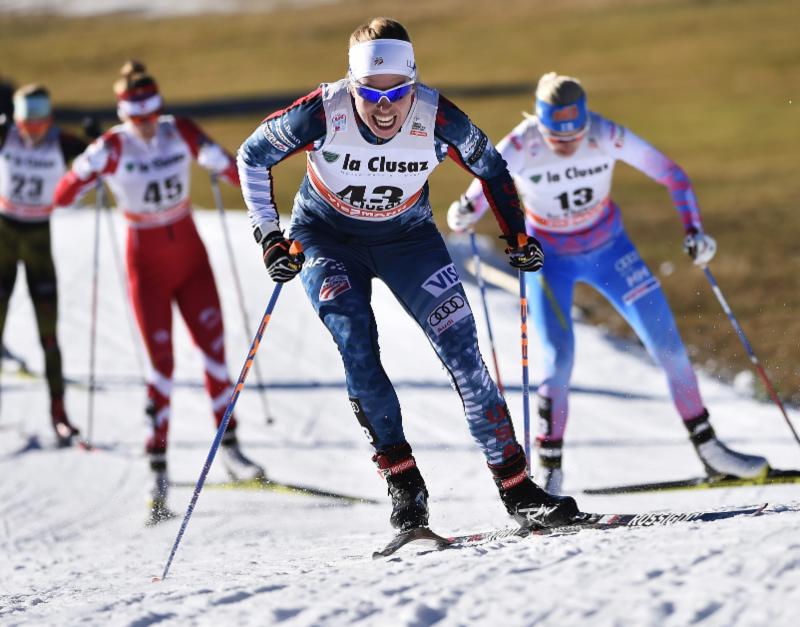
Rosie Brennan (43) racing to a season-best World Cup result of 22nd in the 10 k freestyle mass start on Dec. 17 in La Clusaz, France. (Photo: Toko/NordicFocus)
“Rosie is another interesting case,” Grover said. “It’s very hard to differentiate right now between Rosie Brennan, the skiing that she is doing, versus Caitlin Patterson, for example, or Chelsea Holmes. Yes, Rosie has been a little bit stronger in some races, but she has also had some more opportunity. However, we are really looking towards Rosie as a potential leg in a 4 x 5 kilometer women’s relay at a World Championship event. She has contributed a 5 k classic leg to a podium in Lillehammer, and she also skied a terrific leg in Ulricehamn — I want to say 12 seconds from the fastest on that particular leg in that relay this year. So she’s someone we are really looking towards for a potential relay leg. So there are athletes like that where it’s hard to differentiate sometimes between some of the domestic athletes who are really starting to blossom, who we are starting to take a lot of notice of them, but Rosie is somebody who … is in shape and ready to go when we get to Korea this winter.”
On the non-nomination side of the equation are Holmes and Patterson.
“Chelsea, she is someone who we have discussed a ton this spring,” Grover said. “And this is a conversation I’ve had with Chelsea as well. Is she a 5 k skier right now? Maybe, maybe not. She has certainly shown her ability in longer events. Her one standout international result from this season is a longer event in skating.”
“Does that, at this particular moment, suggest that she might be able to provide a 5 k classic leg in the relay? Not at this particular moment,” he said. “We have a lot of skaters on the women’s side right now. Our skating ability is quite high. So at this moment it doesn’t pencil out, but does that prevent her from being considered in the future for anything? Absolutely not.”
Scott Patterson’s older sister Caitlin, 27, remains on the USST radar as well.
“Caitlin is somebody else that we’ve discussed quite a bit,” Grover said. “She’s made a big step forward in the last year she started to score World Cup points and really flirting with that edge of the top thirty on a regular basis. So we absolutely have our eye on her. … Of course Chelsea is Continental Cup leader for Period 1, so she will be skiing World Cup Period 1. And then we’ll assess where she is at that point. Anything can happen at that point. She might be someone that’s skiing really well and we want to keep on the World Cup.”
Maurice Manificat of France during the men’s 30 k freestyle on Dec. 12 in Davos, Switzerland. Despite giving Martin Johnsrud Sundby a run in that race, he ended up second. On Saturday, Manificat bested Sundby by 10.8 seconds for the win in the 15 k freestyle at the World Cup in Nove Mesto, Czech Republic.
Maurice Manificat shook up the Distance World Cup standings on Saturday with his fourth-career win in the men’s 15-kilometer freestyle in Nove Mesto, Czech Republic. Unlike the thin ribbons of manmade and farmed snow snaking through brownfields during the recent Tour de Ski, Saturday’s race played out amidst steady snowfall. The trees were draped in snow. Temperatures were in the low 20s. Winter had returned.
Old Man Winter, despite his late arrival, was just another welcome sideshow for Norway’s Martin Johnsrud Sundby and his stranglehold on the Overall and Distance World Cup titles. But on Saturday, Sundby had to settle for second.
Manificat won the race in 34:04.9, by 10.8 seconds over Sundby, to achieve France’s fifth World Cup podium in the last three races (after Baptiste Gros and Richard Jouve placed second and third in the freestyle sprint a week ago, and Renaud Jay and Gros teamed up for second and Valentin Chauvin and Jouve placed third in the team sprint last Sunday in Planica, Slovenia).
Behind Manificat and Sundby on Saturday, Russia’s Sergey Ustiugov skied to third (+13.0) and Evgeniy Belov placed fourth (+29.5).
The result lifted Manificat from fourth to second in the distance standings, ahead of two other Norwegians, Sjur Røthe and Niklas Dyrhaug. While Røthe placed 28th on Saturday (ranking eighth out of nine Norwegians who finished the race), Dyrhaug did not compete in the 15 k.
For Manificat, this was his first World Cup victory this season. He last won the Davos 30 k freestyle in 2013. Two years later, back in Davos last month, Manificat came close, finishing second to Sundby in the 30 k freestyle. He went on to reach the podium in the sixth stage of the Tour de Ski: he finished third in the 10 k freestyle in Toblach, Italy.
Norway’s Martin Johnsrud Sundby racing to second in the men’s 10 k freestyle at the sixth stage of the Tour de Ski in Toblach, Italy. (Photo: Fischer/NordicFocus)
Prior to the race, Sundby led the World Cup overall by 550 points ahead of fellow Norwegian Finn Hågen Krogh. On Saturday, Krogh finished in fifth, 32.7 seconds behind Manificat. Despite his second-place finish, Sundby buffered his overall lead by 35 points — he now leads the World Cup overall by 585 points.
Canada’s Alex Harvey posted the best result for the North American men, skiing to seventh (+41.3). Noah Hoffman, of the U.S. Ski Team, finished in the points in 27th place (+1:38.3).
Also for Canada, Devon Kershaw was outside the points for the first time in a non-stage World Cup distance race in 38th (+2:02.2). Canadian Development Team members Graeme Killick placed 63rd (+3:29.7) and Knute Johnsgaard finished 76th (+5:13.3).
For the U.S., Erik Bjornsen raced to 39th (+2:08.6). In his World Cup debut, Alaska Pacific University (APU) skier, Scott Patterson, placed 42nd (+2:10.9), and Simi Hamilton finished 65th (+3:39.0).
Two-Man Race and a Flip Flop
By the second time check, 3.5 k into the race, the foundation was laid for a two-man show. Manificat, in bib 58, had started one minute behind Sundby (bib 56), and came through the checkpoint 3.1 seconds short of Sundby, who held the fastest time. Harvey posted the third-fastest split, five seconds down.
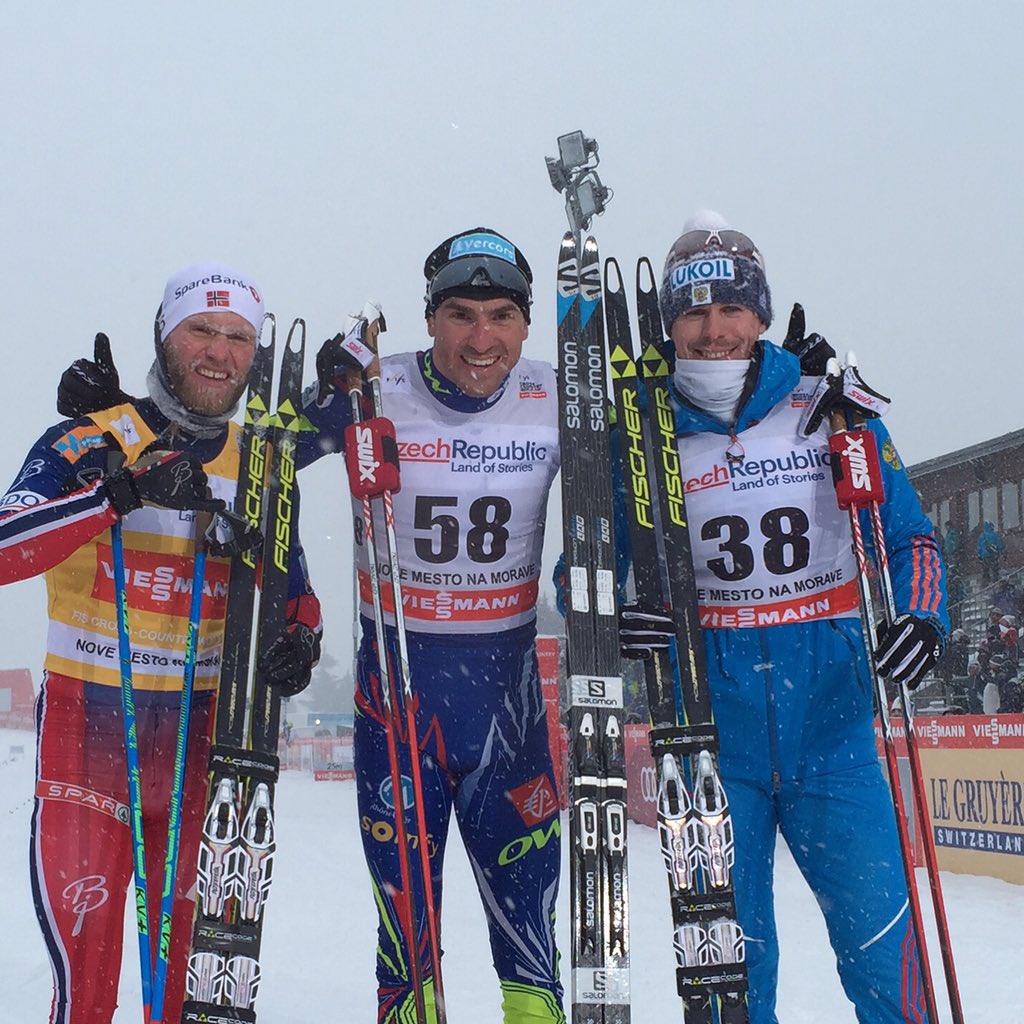
France’s Maurice Manificat (c) after his first win of the season at the 15 k freestyle in Nove Mesto, Czech Republic, with runner-up Martin Johnsrud Sundby (l) of Norway and Russia’s Sergey Ustiugov in third. (Photo: FIS Cross Country/Twitter)
By 5 k, Sundby held a 4.2 second gap on Manificat. Then the flip flop began.
At 8.5 k, Manificat built up an 11.6-second lead. That margin shrunk to 7.2 seconds by 13.5 k, but Manificat never relented the lead. At the finish, Manificat had buffered his margin over Sundby, winning by 10.8 seconds.
After the race in an interview with FIS, Manificat, 29, made it clear this was a race he had marked on his calendar.
“I was focused on this weekend. There are not many 15 k free technique in the World Cup calendar. I knew Martin was a favorite, but I was ready to fight,” he said. “I had excellent skis. I am very happy for the first victory of the season. I had the advantage of starting behind Martin to get all the times. I know that when I am in the best shape I can ski like today.”
Sundby, on the other hand, looked visibly tired on the podium. Yet in his post-race interview with FIS, he paid deference to a rival he sees as a threat in the 15 k skate.
“I maybe was not in my top level, but Maurice is always among the best in this distance and technique,” Sundby said. “I am happy about second place today. It was very nice tracks, which feature long and short uphills as well as turns.”
In his first race back since finishing third in the overall Tour de Ski, Ustiugov remarked that third place was a pleasant surprise after the Tour’s grind.
“I did not know how was my shape after the Tour. I spent several days at home in Russia,” he told FIS. “I started slower today to see how my body reacts. I was feeling better and better after every lap and in the last kilometers I was feeling very strong. I am happy with 3rd place.”
Alex Harvey (Canadian World Cup Team) racing to 37th in Stage 6 of the Tour de Ski: the 10 k freestyle in Toblach, Italy. (Photo: Fischer/NordicFocus)
Harvey skied a consistent race, staying within the top 10 through every time check. Ten kilometers into the race, Harvey had ceded 27.1 seconds to winner, Manificat. In the next 3.5 k, that gap increased slightly to 39 seconds, and ultimately, Harvey finished 41.2 seconds back in seventh.
After the race, Canadian Head Coach Justin Wadsworth said on the phone from Canada that proper pacing during a 15 k is tricky business.
“If you give up 10 or 15 seconds in the first part of the race, sometimes it’s really hard to gain that back,” Wadsworth said. “If you go out and you can maintain good pace, and then you can hold on, that’s one of the days you are on the podium. That’s the way I think [Alex] skied it. Sometimes it’s just hard to hang on right at the end and you lose a little bit of time. But still, I think seventh place, that’s really fine pacing skills when you are looking at 10 or 15 seconds difference in a race that length, and with so many good guys.”
Chris Jeffries, Alberta World Cup Academy head coach, who is assisting the Canadian team in Nove Mesto, wrote in an email that Harvey had good feelings during Saturday’s race.
“He’s been doing some altitude training after Tour recovery, starting to get ready for second half of the year,” Jeffries wrote. “Good start to the race, opened up with a good first split. Always a good sign to be able to get on the pace. Faded a bit the second half, but he and his coach [Louis Bouchard] are feeling good about his fitness leading up to Oslo and the [Canadian World Cup] tour.”
Harvey could not be reached for comment.
The top American on Saturday, Hoffman, summarized his race effort in four words. “Today was brutally hard,” Hoffman wrote in an email. “The snow made for slow challenging conditions with very little opportunity to recover. I was not making the pace well on my own.”
The splits reveal that slow start. It was a pace he realized wouldn’t reflect good race execution. At 3.5 k, Hoffman already languished in 42nd place. Still on his own, Hoffman stalled a bit more in the next kilometer and a half. That’s around when Hoffman found his carrot: German Jonas Dobler, who started in bib 48.
“I was in the 50s at 5k. Soon after that, Dobler caught me from 30 seconds down,” Hoffman explained. “He was skiing well and showed me how fast I needed to be going. I was able to follow him all the way to the finish, though his pace really pushed my limits. It was the most painful race I’ve done this season.”
Hoffman remarked that his skis were good and that his post-Tour de Ski recovery had gone well. He finished the day in 27th place, whereas his pacer, Dobler, placed 16th.
World Cup Rookie
Scott Patterson gives it his all in the 15 k classic at the 2014 U23 World Championships in Val di Fiemme, Italy. Patterson finished 18th in that race. (Photo: flyingpointroad.com/NNF)
Also for the U.S., Patterson, 23, finished out his first ever World Cup race in 42nd, 2:10 behind the winner.
“This is my first World Cup. However I have starts for the rest of the season so this one could be thought of as a bit of a wake up call,” Patterson wrote in an email. “There were some nerves, but I also felt I could go into the race with absolutely no expectations as it was my first one.”
In bib 59, Patterson began the race in fast company. Manificat wore bib 58 ahead of him, and just behind him: Russia’s Alexander Legkov in bib 60.
“I think I did ok settling in, but I did go out a bit hot while feeling like I was relaxed,” Patterson wrote. “The noise, cameras, and seeding between eventual race winner Magnificat and 11th place Legkov kicked me into the race a little fast.
“My strategy was to go out and ski my own race with whatever happened,” he continued. “I didn’t really have a plan going in. More along the lines of start hard, go hard in the middle and finish hard. I figured I might be able to get a ride with Legkov, but that didn’t last very long. I executed reasonably but I think there is quite a bit more there to tap into.”
The World Cup is a big stage — a stage with added pressure, different dynamics.
“In a SuperTour, there might be 5 people with close times and only one or two that you get to ski with,” explained Patterson, who earned World Cup starts as a Period 1 U.S. SuperTour leader. “Here anybody around could be a challenge to ski with or a great ride. It throws in a much more dynamic element than just hammer.
“As it was my first World Cup, I tried to go in with no expectations,” he added. “I know that I can race right around Hoff and Bjornsen, so I figured a top 30 would be awesome, but in the thirties or forties would be alright. Beyond that I think I would have been a bit disappointed.”
Patterson will be part of the the U.S. men’s 4 x 7.5 k relay team on Sunday, along with Bjornsen, Hoffman and Hamilton.
On Saturday, U.S. Ski Team veteran sprinter Andy Newell raced to second in the 42 k classic Dolomitenlauf.
“Next time I want one of those wreath things!” Newell posted on Instagram with a photo of himself with the winner, Stanislav Řezáč of the Czech Republic, and third-place finisher. “Great experience and hard 42k of double poling today. Happy with 2nd place in the Dolomitenlauf.”