From the FasterSkier archive — posts syndicated from athletes’ and coaches’ own blogs between 2004 and 2012, kept online as published. Current coverage is at fasterskier.com.
This coverage is made possible through the generous support of Marty and Kathy Hall and A Hall Mark of Excellence Award. Learn more about A Hall Mark of Excellence Award—or about supporting FasterSkier coverage—by contacting info@fasterskier.com.
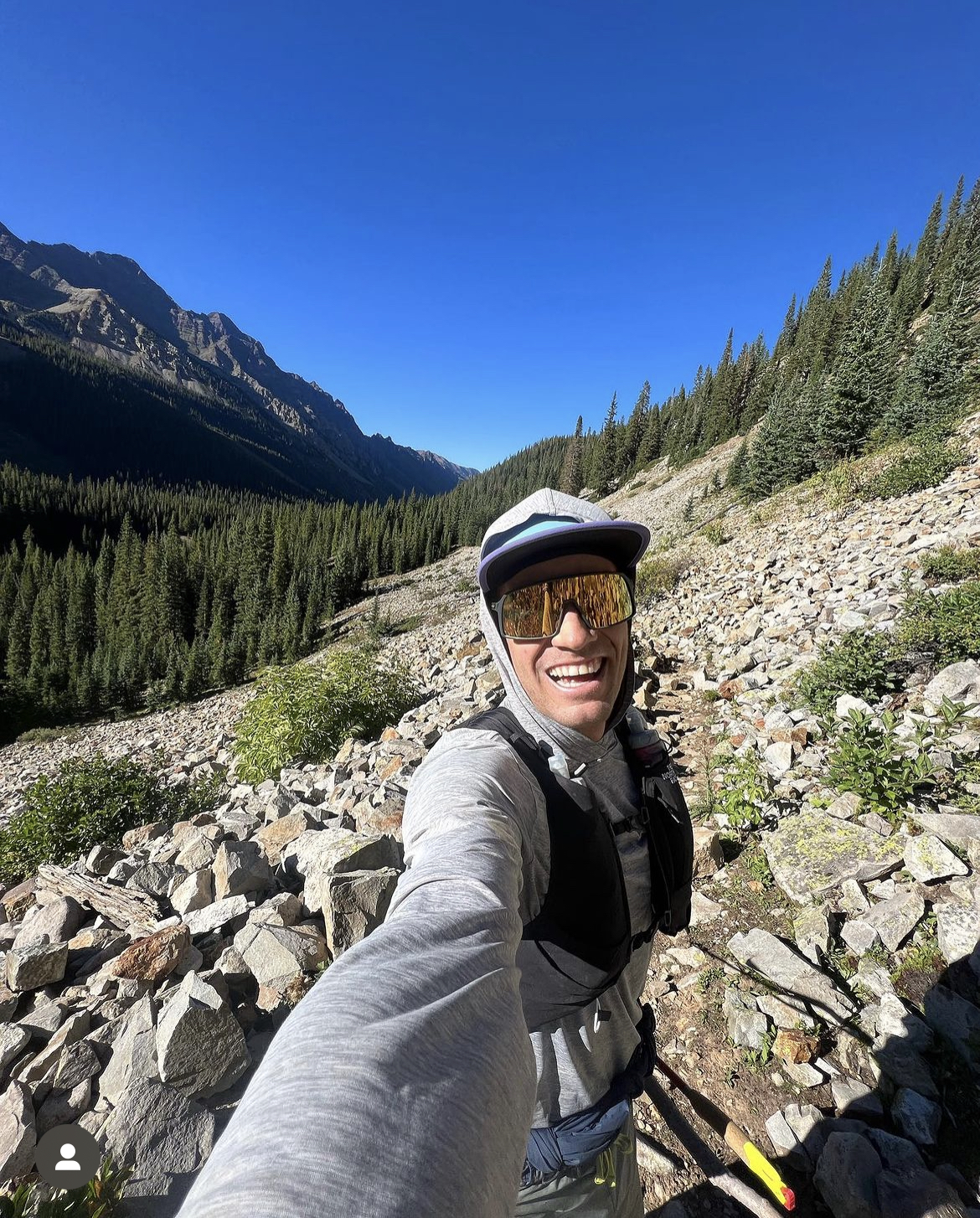
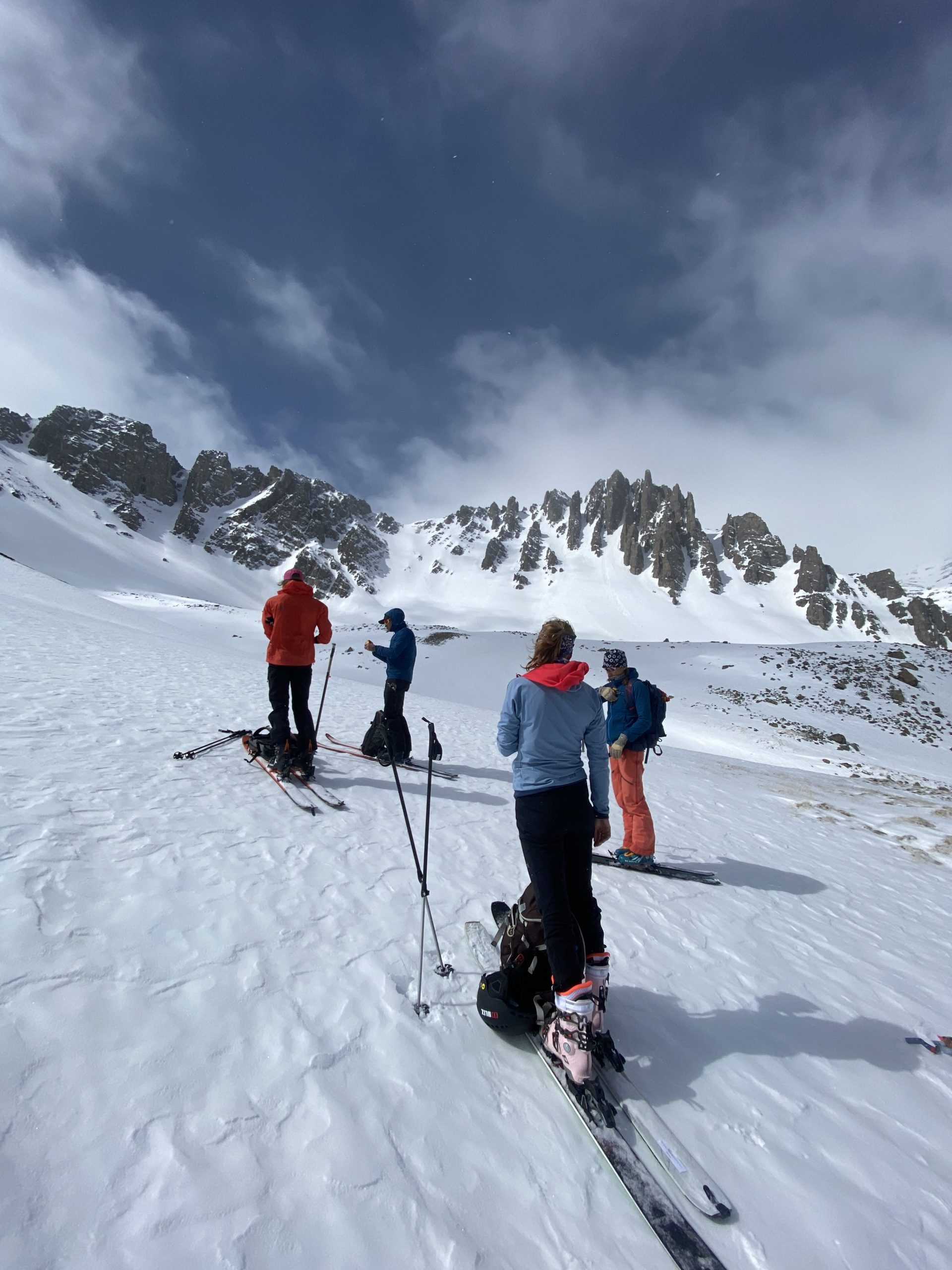
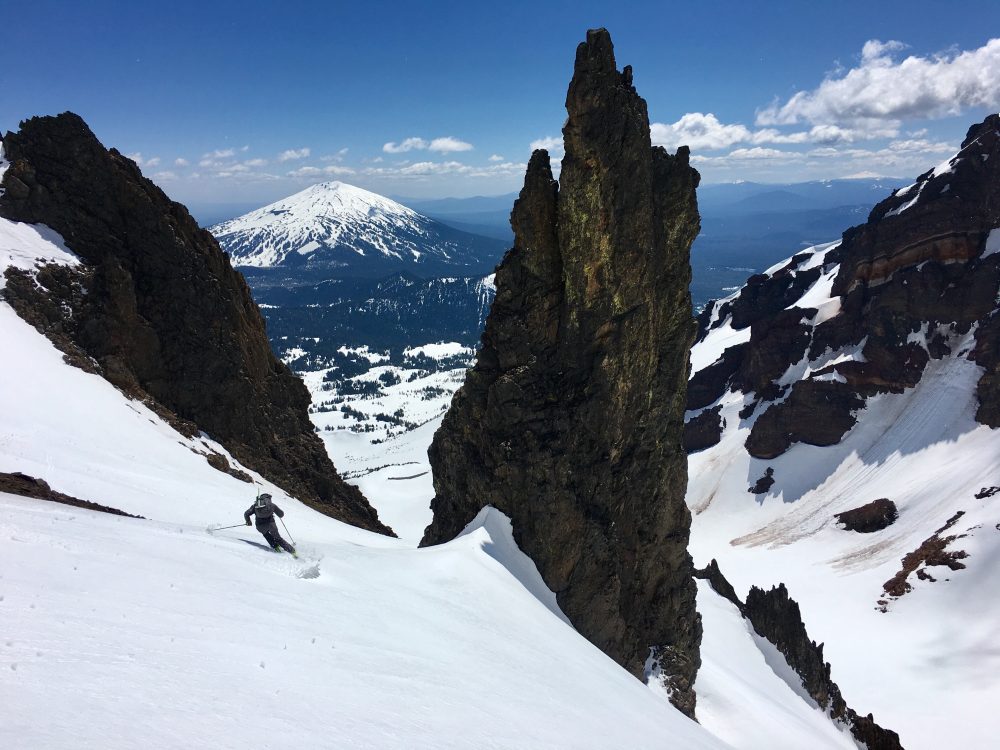
A distinctly different view of retirement: Simi Hamilton at play in his own backyard, high above the Roaring Fork Valley, spring 2022. (Photo: Simi Hamilton)
Simi Hamilton was still in top condition when he retired from his World Cup competitive career in 2021. Lucky for him that he was: he still needs that level of fitness for his day-job. Not one to kick back or to rest on his laurels, Hamilton remains constantly in motion among the peaks and slopes of Colorado’s Roaring Fork Valley. Whether as a professional guide, or as a mountain traversing record-setter, Hamilton is busy learning these mountains. Not a job for the faint of heart, or weak of leg.
To fans and observers of Nordic skiing, it may have appeared a bit surprising when Simi Hamilton and his wife, Sophie Caldwell Hamilton, both chose to step away from international competition less than a year before the 2022 Olympics. To so many of us who follow winter sports—and Nordic skiing, in particular—participating in the Olympic Games may seem like the be-all and end-all of athletic competition. So many athletes grow up hearing the Olympic theme music resonating in their ears, watching heroes they hope to emulate performing on this Olympic stage, basing their goals, dreams and aspirations on this Olympic accomplishment . . . but Simi and Sophie had other goals in mind: home, family, and time to spend with both. Leaving behind the opportunity to pack their suitcases with another supply of USA uniforms, they turned instead toward Simi’s lifelong home on the Western Slope of the Rocky Mountains. There, they are finally at home.
These days, Hamilton is enjoying the numerous “reliefs” he feels at having put behind him the challenges of the World Cup Tour. He shared some of his revelations with FasterSkier:
“I used to get sick on the road quite a bit,” he said. “And that was always incredibly stressful. Whether you were sick or just doing everything in your power not to get sick, the pressure and stress related to what sickness meant for your training and racing was miserable . . . I think I actually stay healthier now because I’m just not so consumed by that stress anymore.”
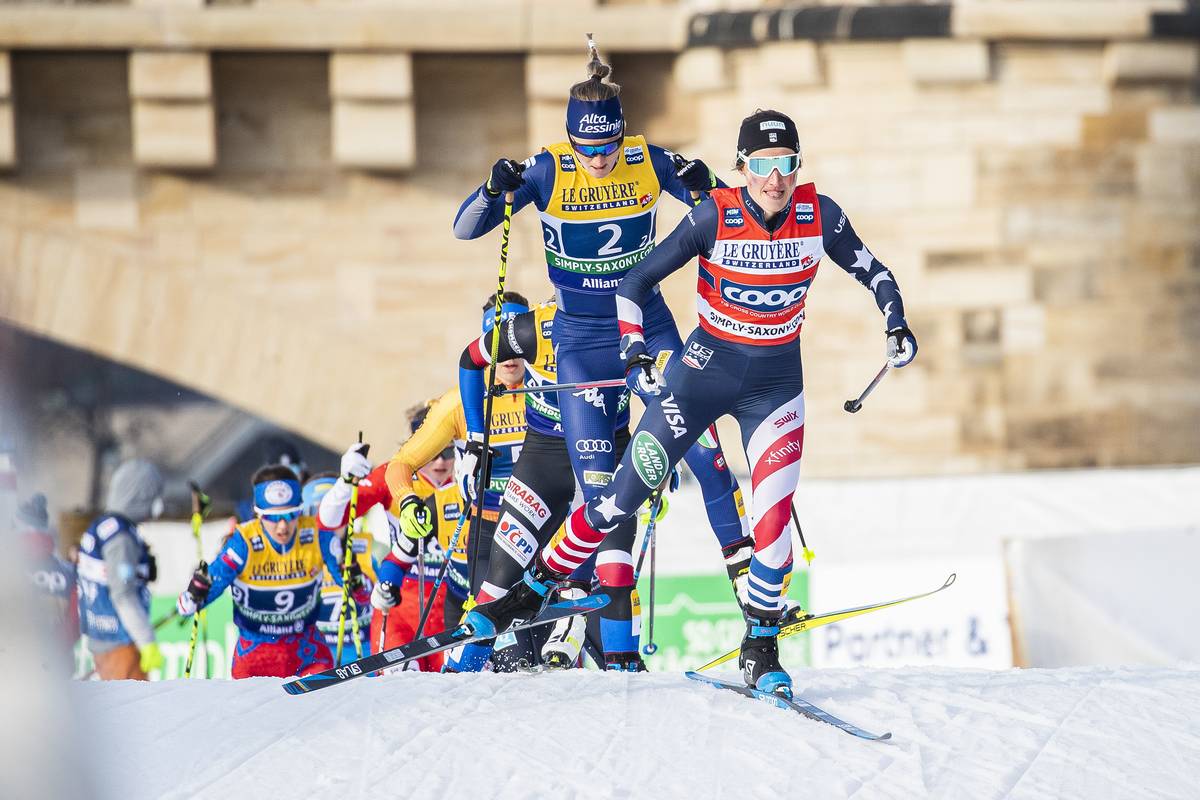
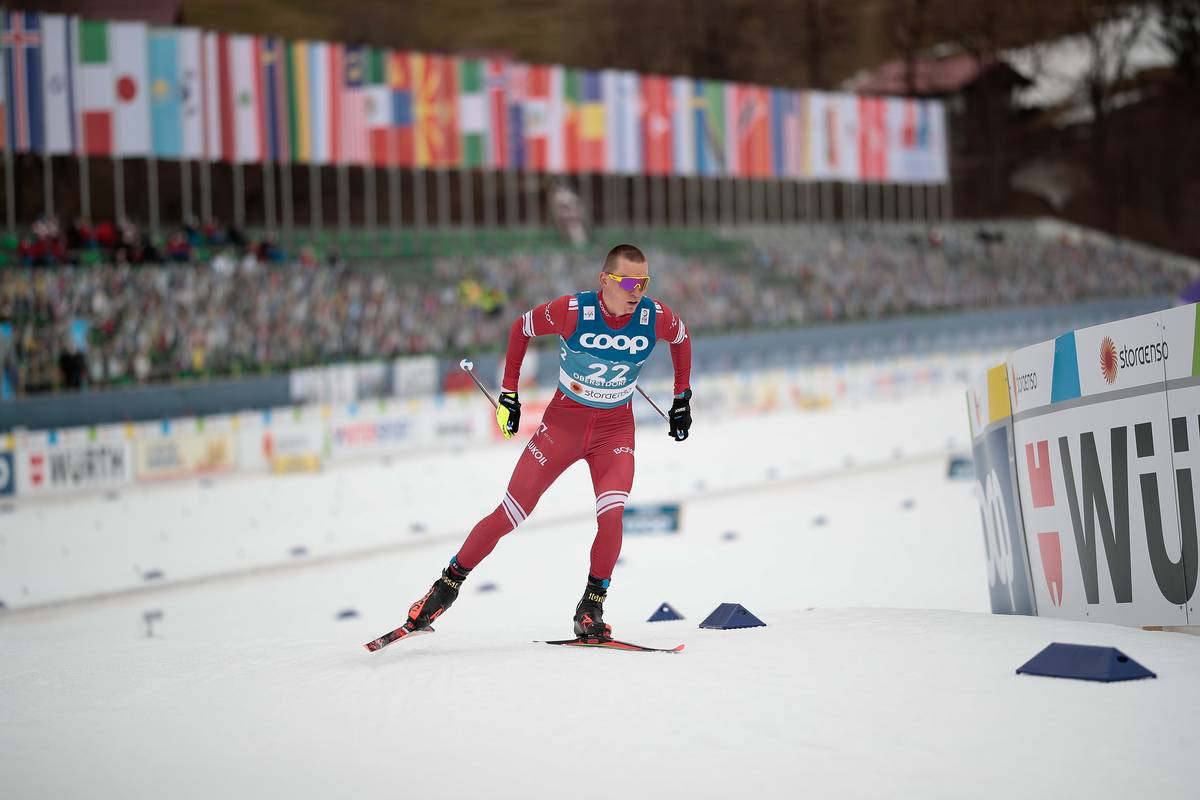
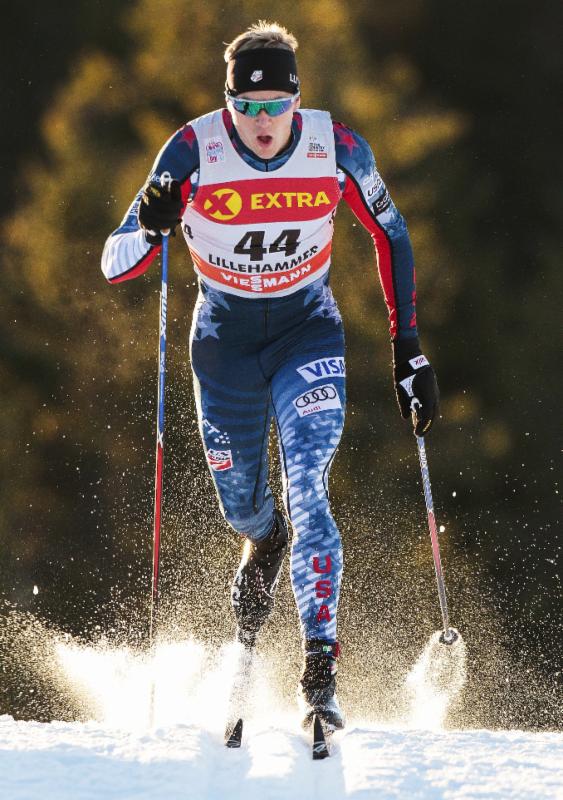
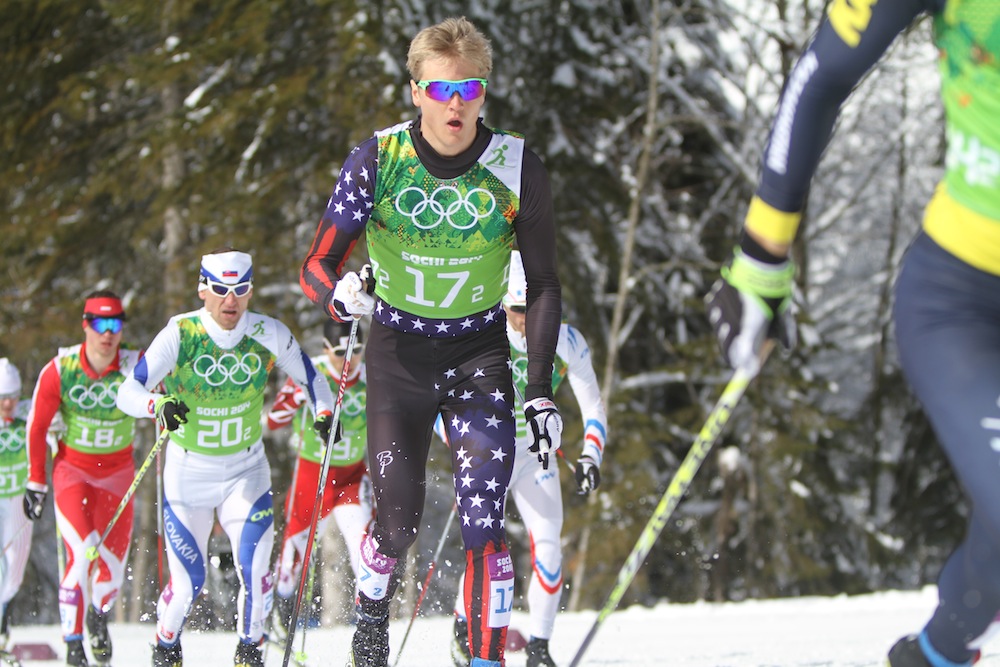
Simi Hamilton competing at the 2014 Olympic Winter Games in Sochi, Russia. (Photo: Sarah Brunson/U.S. Ski Team)
Even so, an athlete doesn’t compete at the top level of their sport for so many years without becoming attached to it:
“There are so many things I miss about our life as ski racers,” Hamilton said. “Not being around my teammates, coaches, and friends from other countries has left a huge gap in out lives. Fortunately, Sophie and I are close enough to a lot of them to stay in relatively good touch, and we are even lucky enough to see them in person from time to time. For example, one of my good friends from Germany, Sebi Eisenlauer came over to visit last spring, and Sophie and I are hoping to get over to see Federico Pellegrino and his wife Greta at some point in the next year or two. And as for our U.S. teammates, they just come and keep bothering us in Colorado because we have the best mountains and best snow, so we just can’t get rid of them!”
“I think my coach Matt Whitcomb will laugh at this if he reads it,” Hamilton admitted, “But I kind of miss doing hard Level 4 skate workouts, especially at camps with a bunch of other strong guys around. There was always something super cool about pushing really hard in a group of guys, it was almost like you could feel all of them making you objectively faster at that exact moment, and vice-versa with you making them faster. That made the pain worth it. And conversely, I definitely don’t miss level 3 double pole intervals, especially trying to do them alone. Nowadays when I cross-country ski, I avoid double poling at all costs. I think I just never cracked the mechanics of it and nothing felt smooth or efficient to me about it.”
As the season turns toward winter, Hamilton is eager to be back on his skis. Making plans is as simple as looking up at the nearest ridgeline, memorable couloir, or distant peak. We asked Simi what’s next:
“Not totally sure what’s next in terms of adventures/challenges,” he admitted. “I want to ski the same route (the Elks Traverse) next spring, but that won’t really be for speed or anything. I just want to do that because it’s a cool route and has some pretty awesome ski lines on some steep faces. In the meantime I will be working as much as possible this winter to try to make some money. Getting all of my guiding certifications (my ultimate goal is to get my IFMGA certification) is expensive and time consuming, so all of that is my priority right now. When it works to get out for some long, fun adventures I’ll try to do those, but hanging with Lilly, Sophie, and trying to provide for my family comes first right now.”
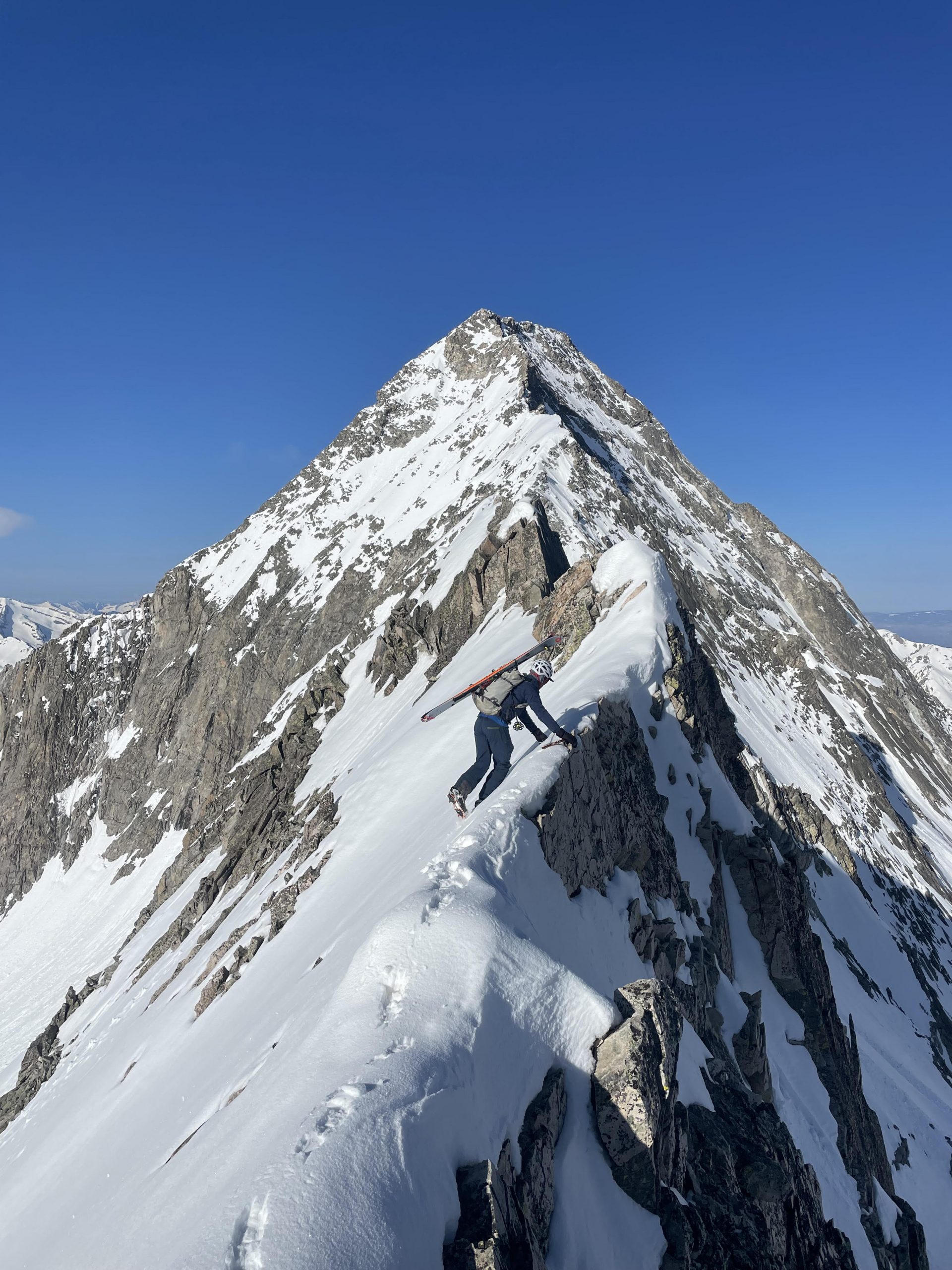
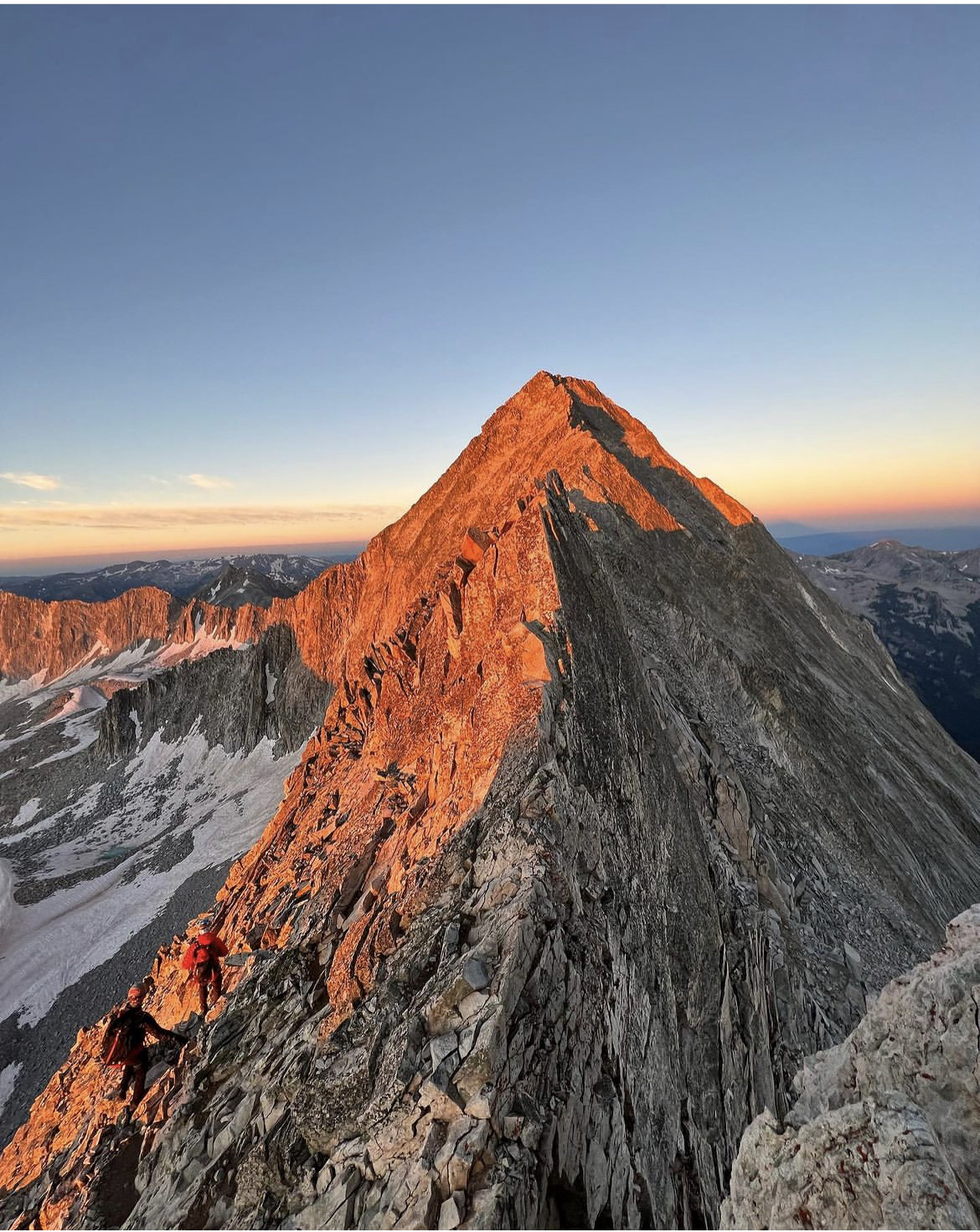
Spring, 2022: Simi Hamilton nears the summit of Capitol Peak via the notorious knife-edge ridge. This will be the first of seven peaks to climb when he returns to the Elk Traverse in 2024. (Photo: Simi Hamilton)
This coverage is made possible through the generous support of Marty and Kathy Hall and A Hall Mark of Excellence Award. Learn more about A Hall Mark of Excellence Award—or about supporting FasterSkier coverage—by contacting info@fasterskier.com.
Simi Hamilton putting in a full day’s work during “retirement.” And what does he have to show for it? The Fastest Known Time on the Elks Traverse, Roaring Fork Valley, Colorado.
Quintessential retirement: feet up, reclining chair reclined, beverage in one hand, remote control in the other, satisfied grin. And the more challenging and stressful the career, the sweeter the “rest” that follows it. But that’s just not the way Simi Hamilton is put together.
On trails, on ridgelines, on summits all up and down the perimeter of the Roaring Fork Valley: that’s where you’ll often find Simi Hamilton. A lifelong resident, he’s been exploring these mountains his whole life. Now, he happily re-traces the adventurous climbs and descents of his youth, and plans for the new adventures to undertake in this, his retirement. Simi Hamilton may be retired from the world of international ski racing, but his long and challenging trail continues.
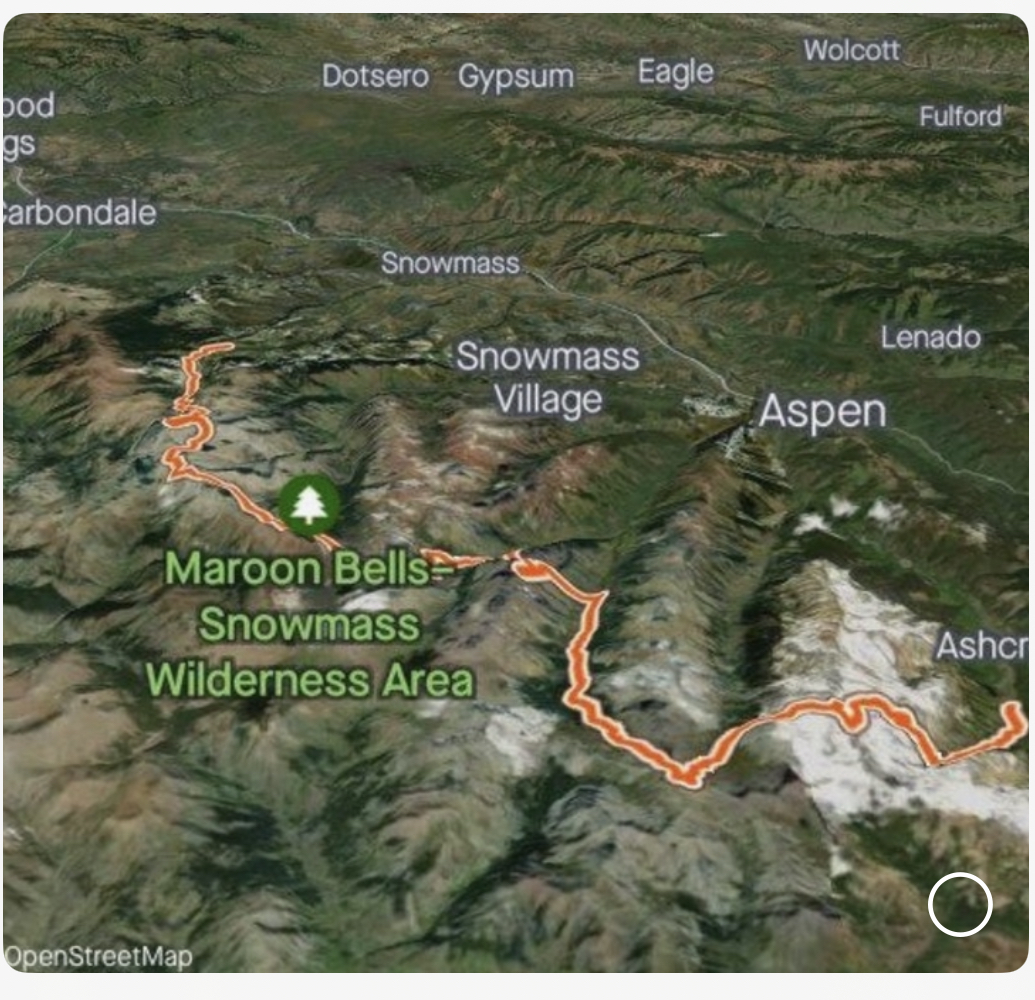
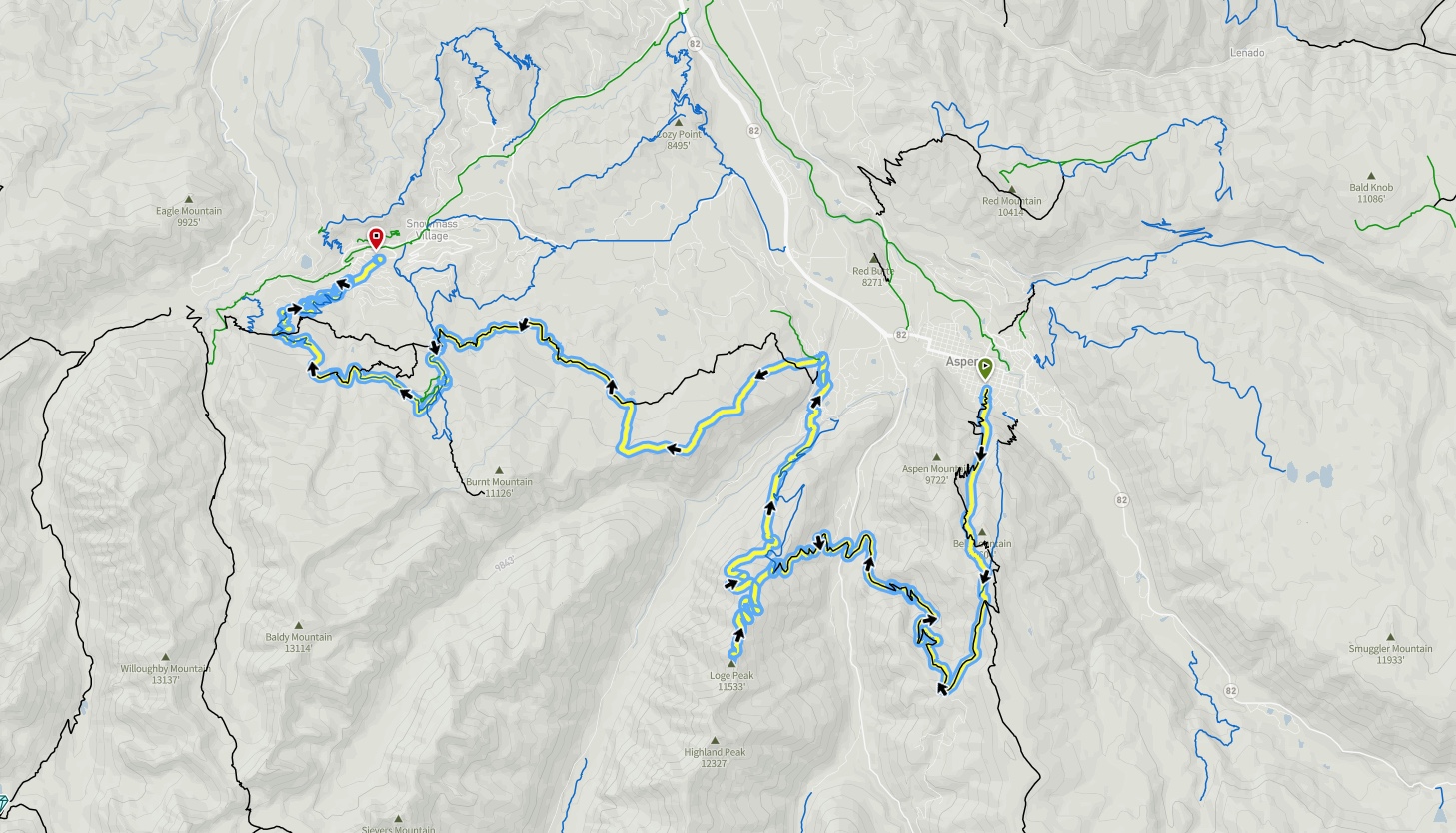
Simi Hamilton’s route on the Elks Traverse: 45.03 miles, 22,562 feet of elevation gain, 16:46.49 (five hours faster than the previous fastest known time).
The Elks Traverse
Someone should tell Simi Hamilton that the world considers him to be a sprinter: explosive, powerful, intense, fast-twitch. But if that narrow characterization were true, Hamilton would not also be such a force in endurance events. For a number FIS World Cup of seasons, he was the top American male competitor in most distance races as well as sprints. To put things in simple terms, this is a guy with a serious engine, and he just loves taking it out for a spin.
Recently, Hamilton’s Strava account confirmed his accomplishment of the Fastest Known Time (FKT) on the Elks Traverse, a hair-raising, high altitude route stretching from Capitol Peak to Castle Peak (and touching the summits of seven 14,000 foot peaks along the way). The stats on his accomplishment: 45.03 miles, 22,562 feet of elevation gain, 16:46.49 hours. A serious engine, indeed…
“[The Traverse] went well,” Hamilton said. “I’m very comfortable on technical terrain, especially where there’s exposure and risk, so I was lucky to move well through the many miles of that found on the route… I think that was my biggest asset because I was able to kind of turn my brain off for that. I ate well and stayed pretty hydrated, and I had probably the nicest day of the summer for it, so that was huge. I don’t think I did anything that special, there were just a lot of things that lined up perfectly and I was lucky enough to do it on that day when everything came together.
Hamilton routinely travels where other less-experienced climbers and skiers might not necessarily be safe. He attributes his abilities to a lifetime of observing these mountains, and following the examples of those who went before him.
“The Elks Traverse summits all seven of the “14ers” (peaks whose summits are over 14,000’),” he said. “The route is through wilderness, so you have to be on foot the whole time, and it’s generally done starting with Capitol Peak and ending with Castle Peak. You can take any route you want, but the route I took—and the one that is generally considered the fastest—is 50 miles with 23,000’ of elevation gain. About 22 miles of that is on well established hiking trails, and the rest is on third, fourth, and fifth class terrain, much of which is very, exposed and considered fairly technical and dangerous. There have been quite a few people who have done it, but until recently it hadn’t been done in under 24 hours. Some incredible athletes from the Roaring Fork Valley did it before me and I give them full credit for figuring out the best route. I just kind of took what they had learned and applied it to my own effort, so really they did all the hard work.”
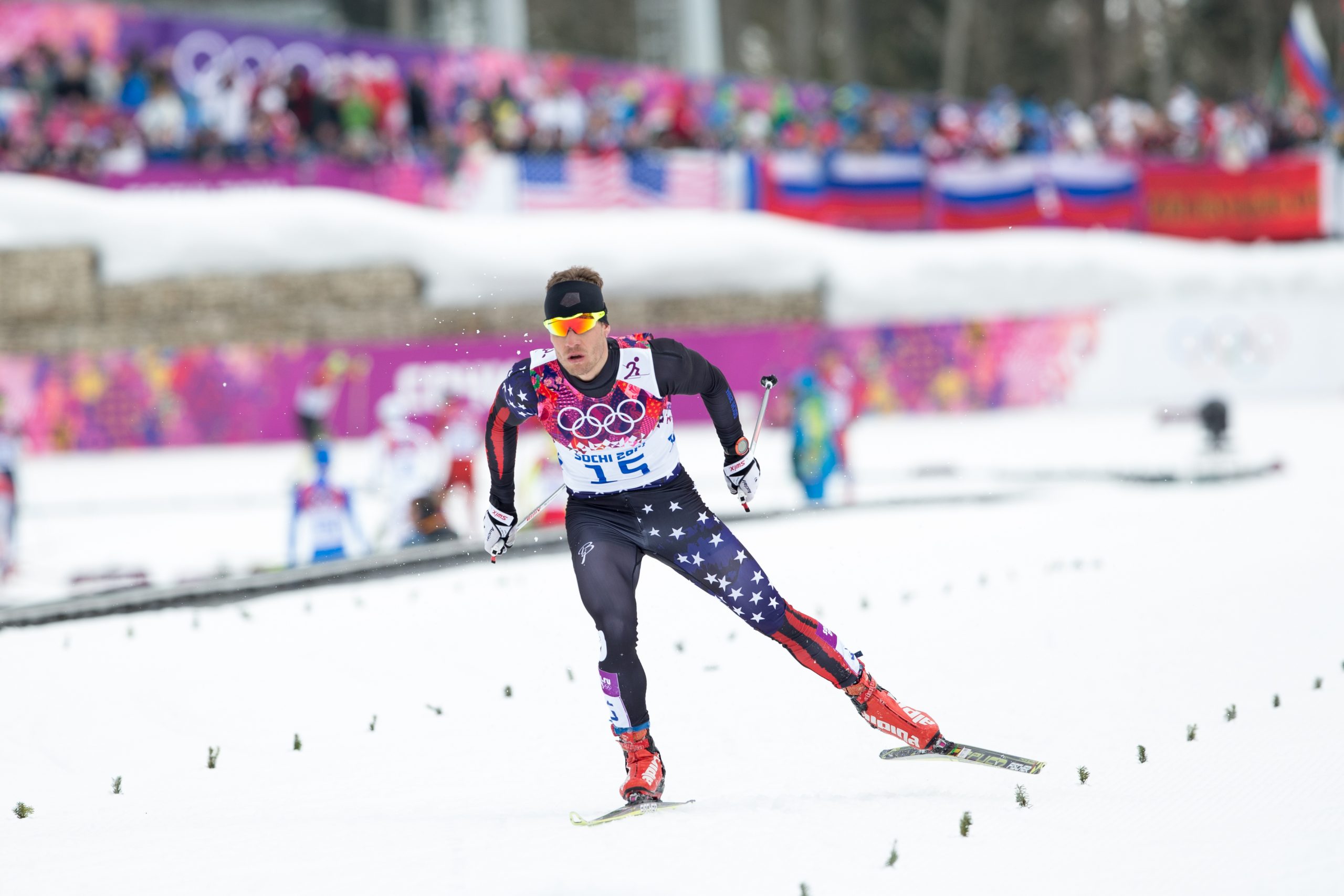
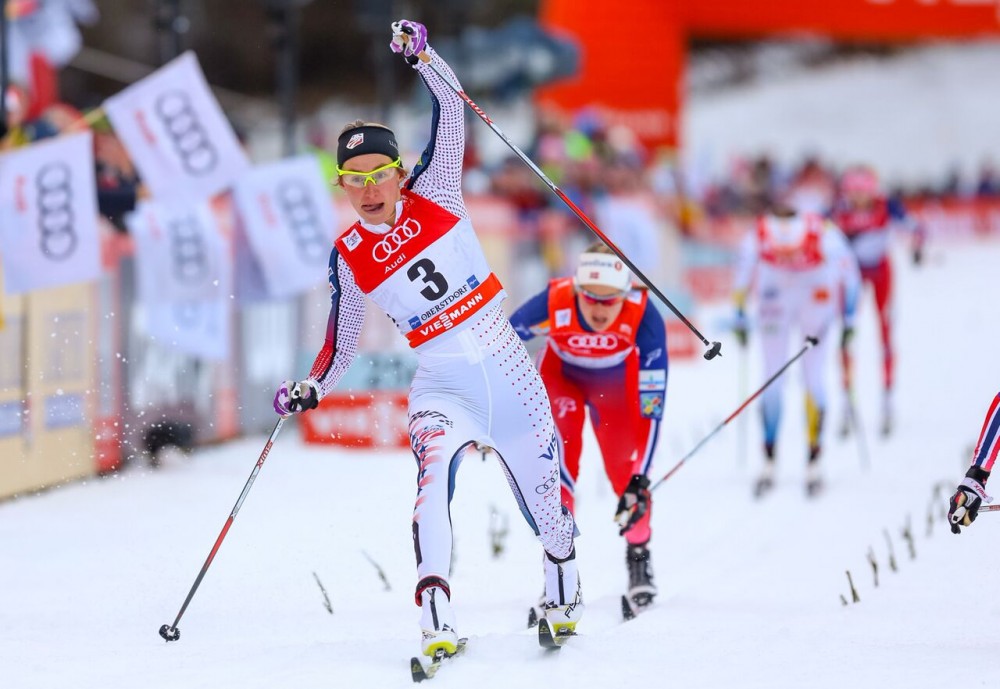
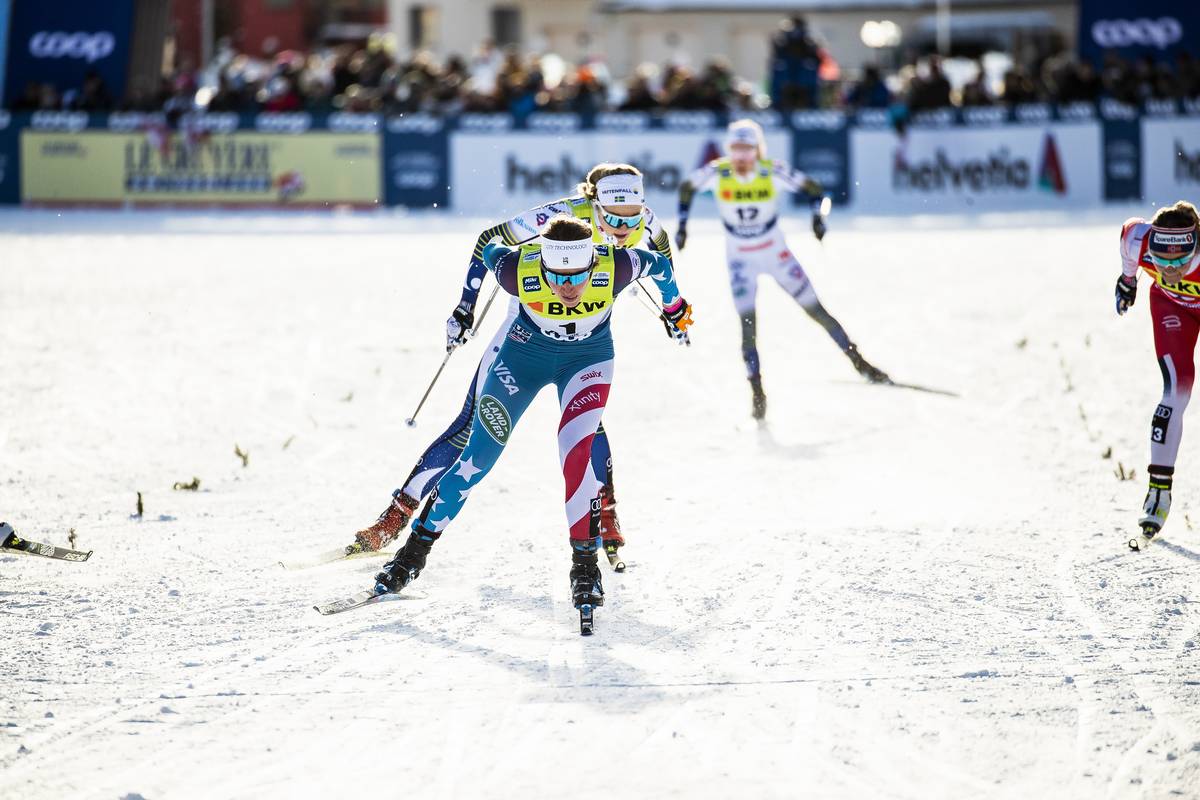
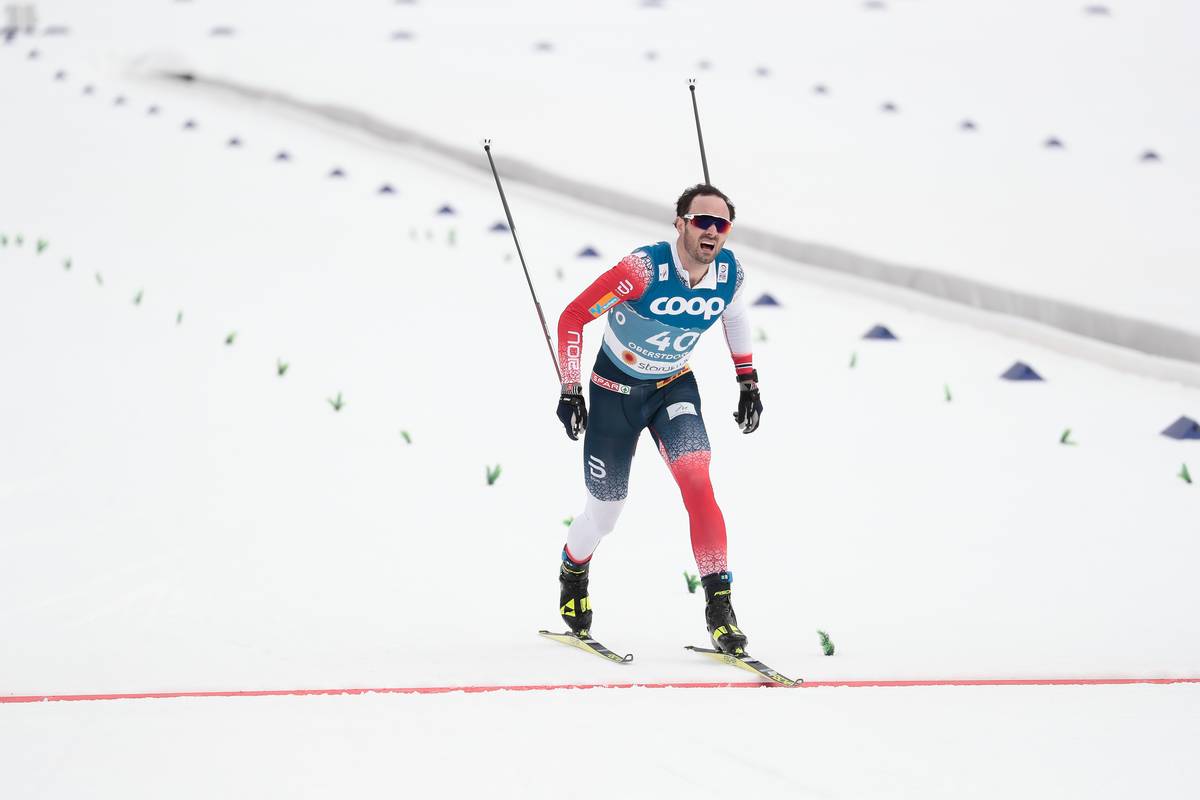
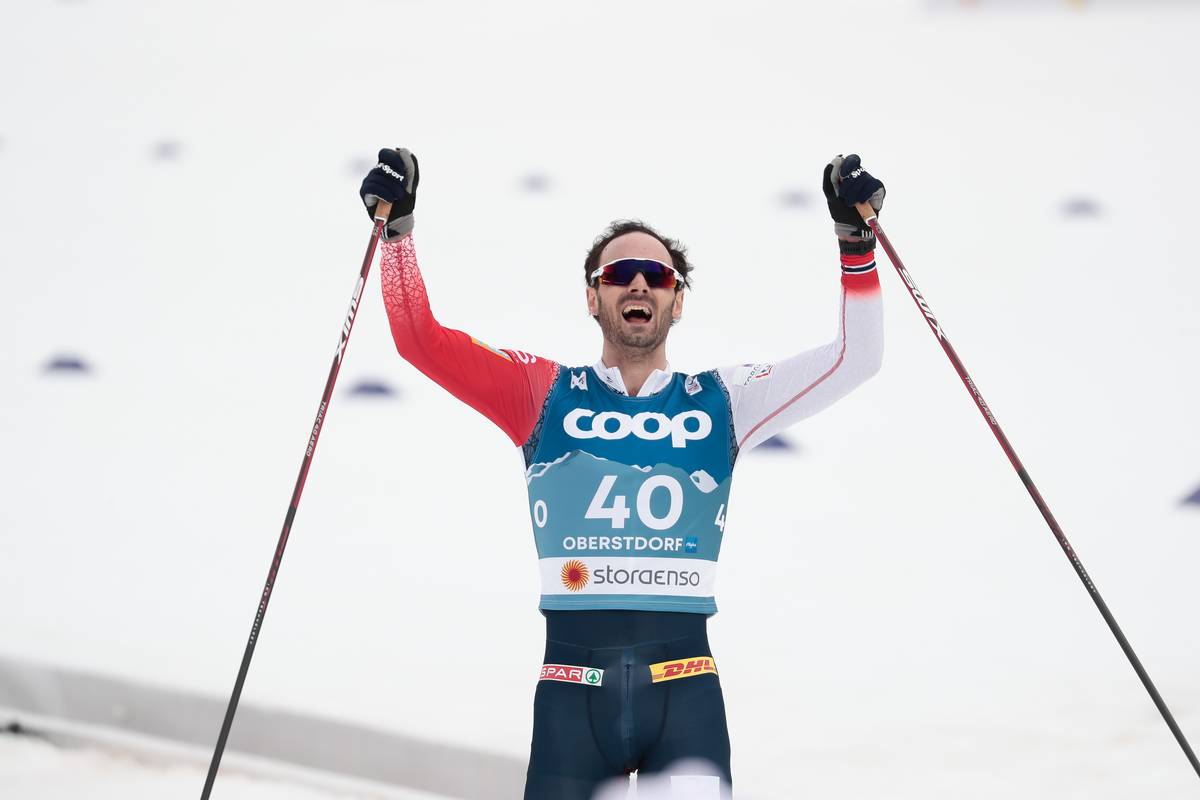
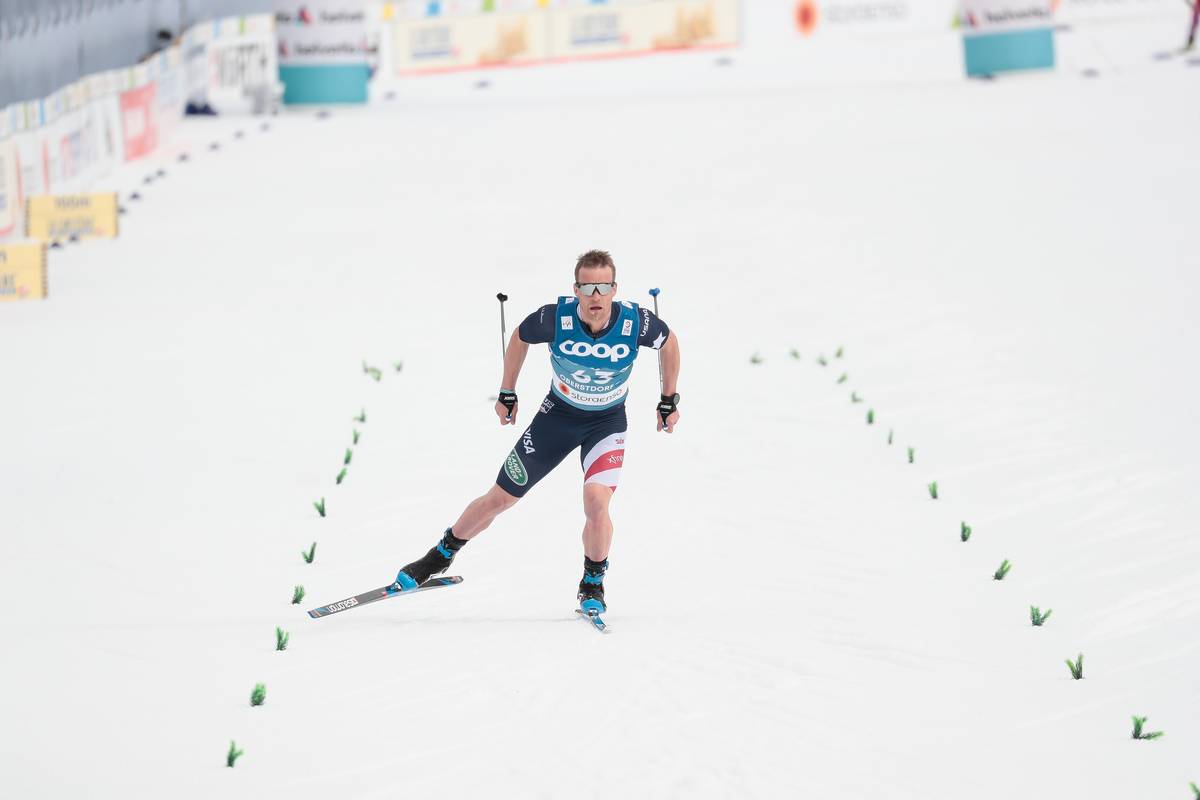
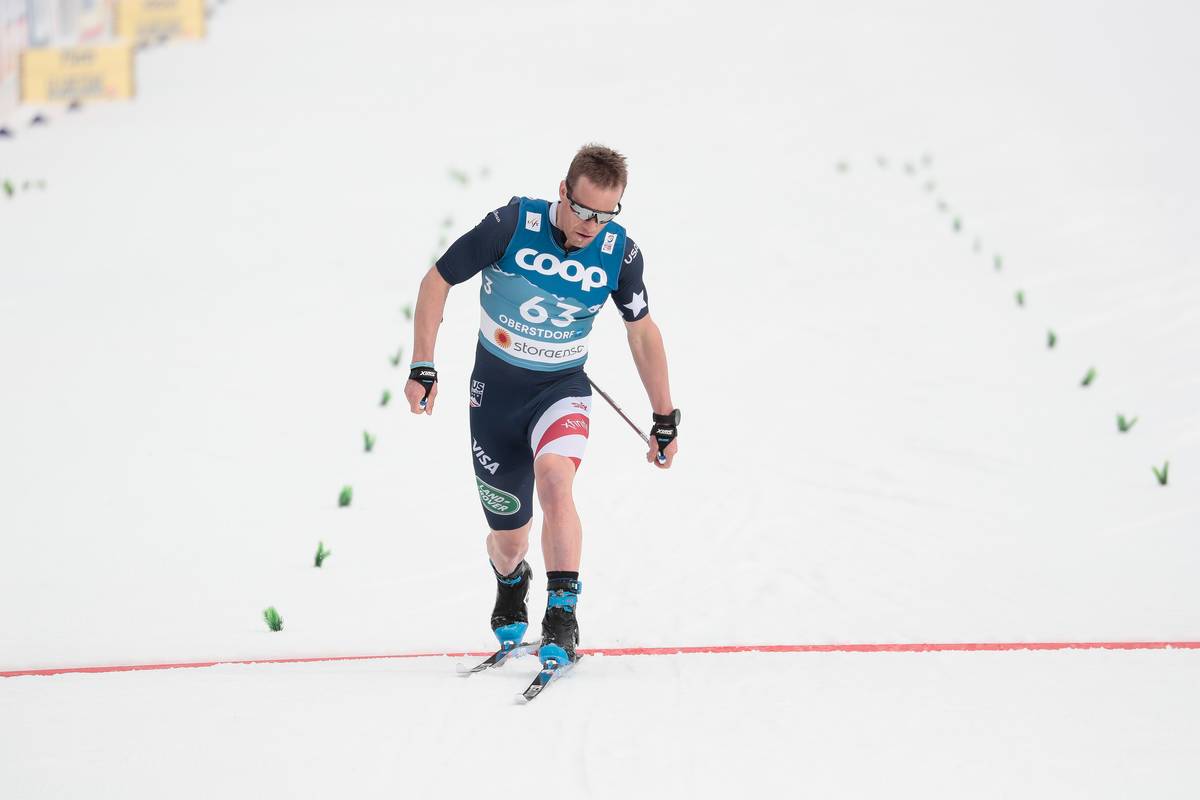
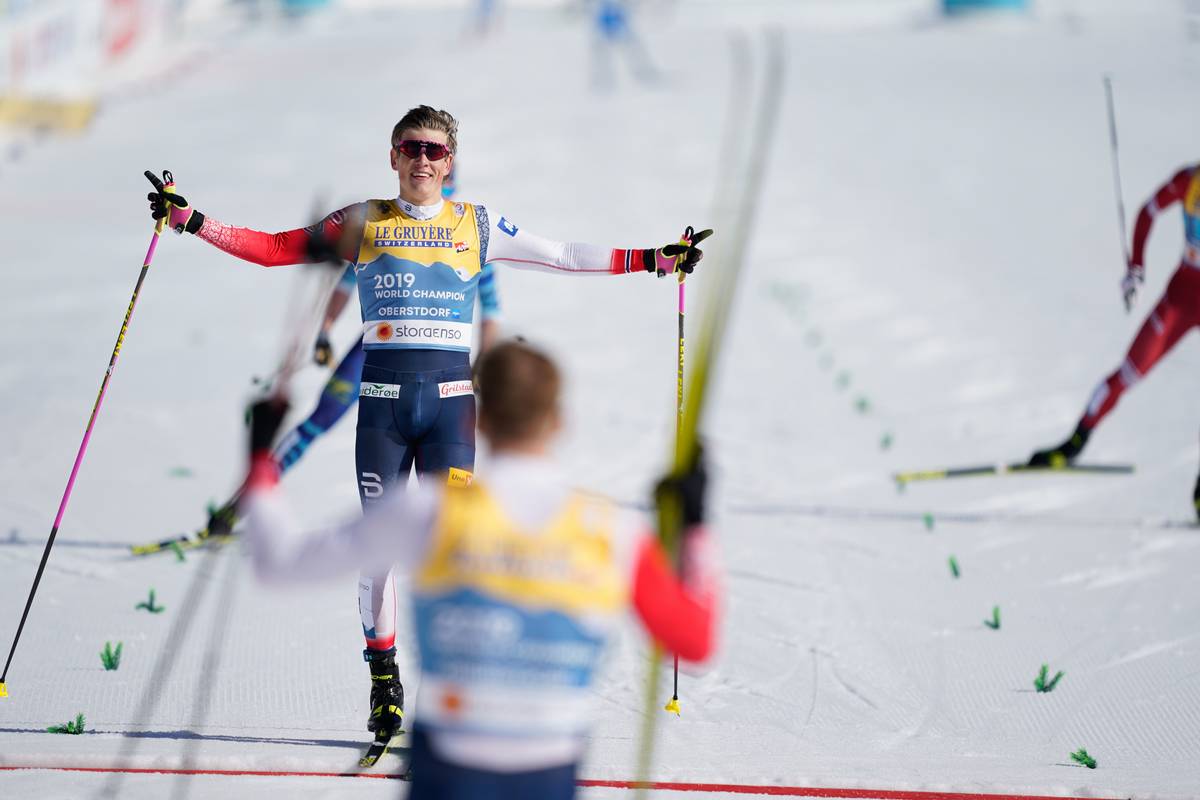
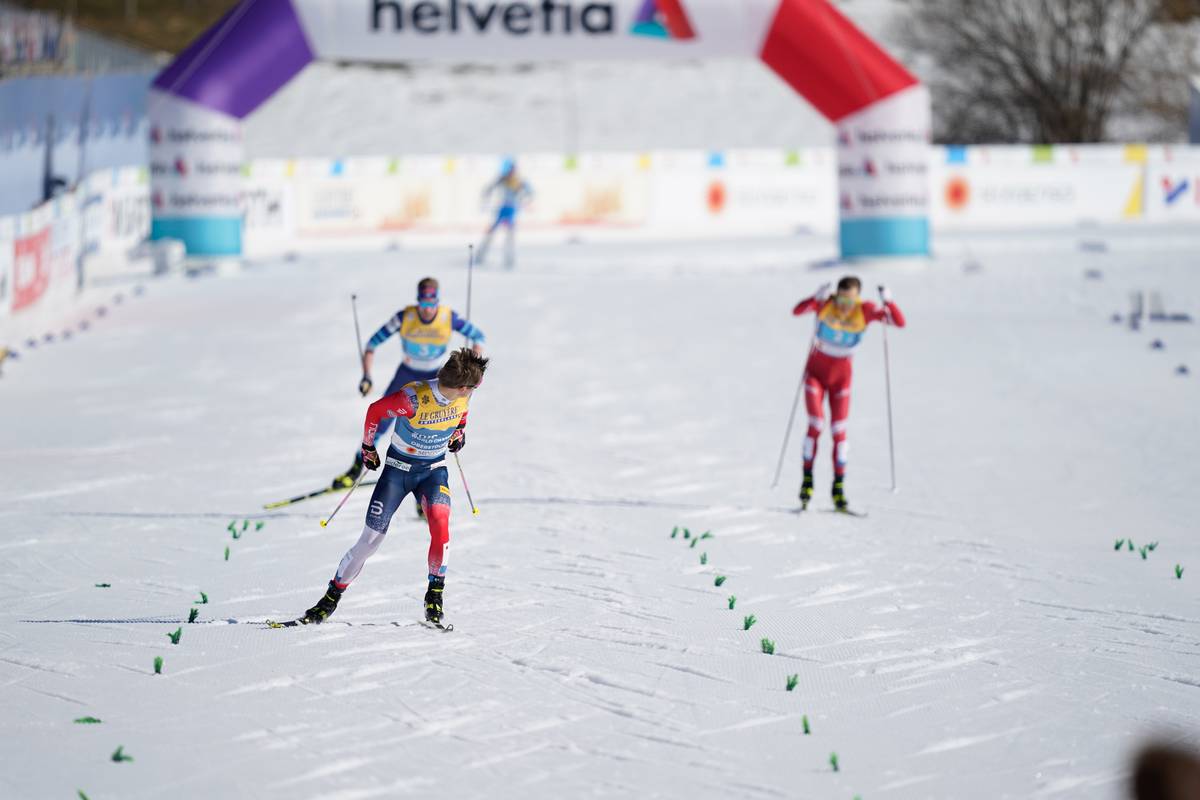
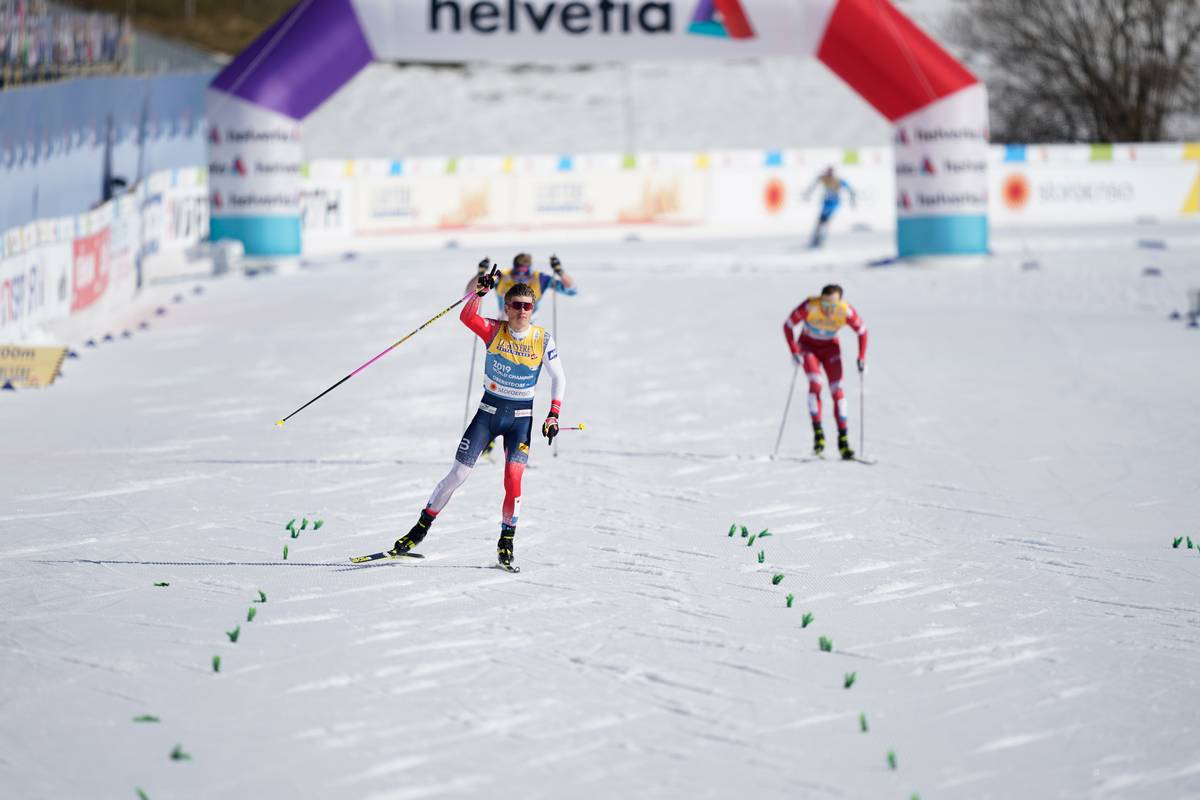
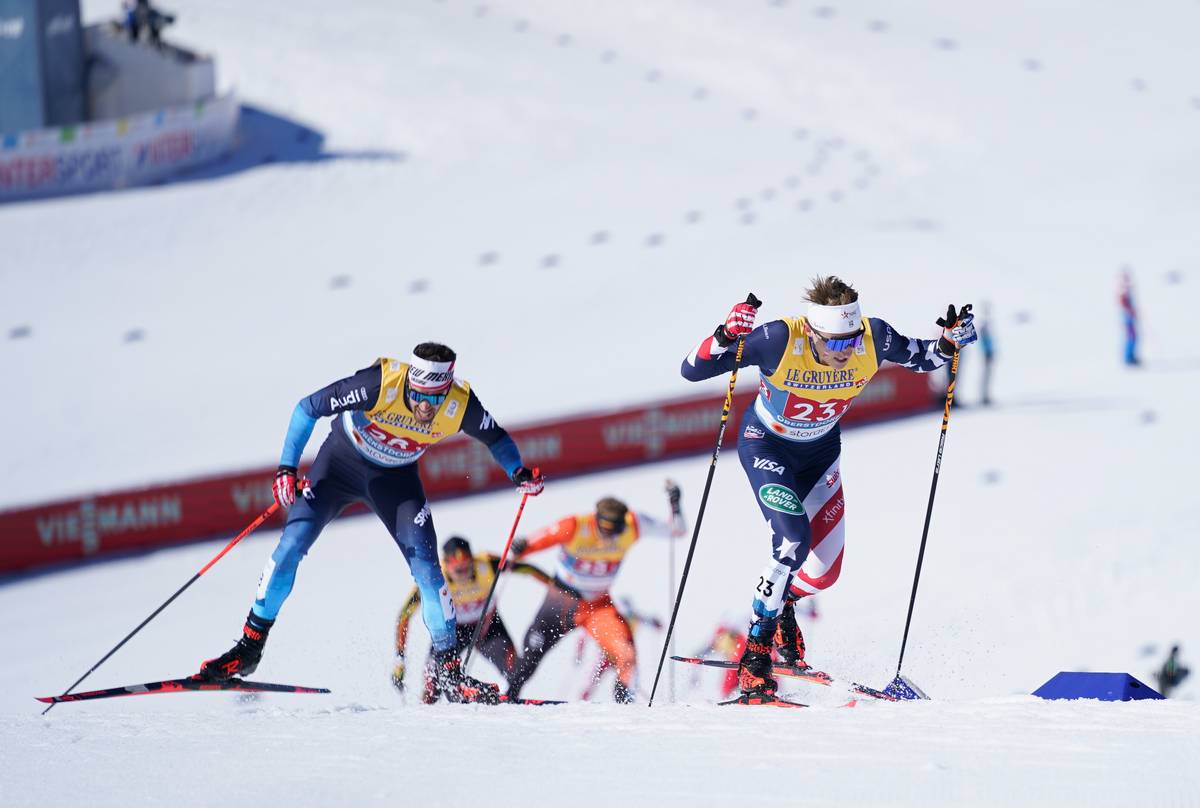
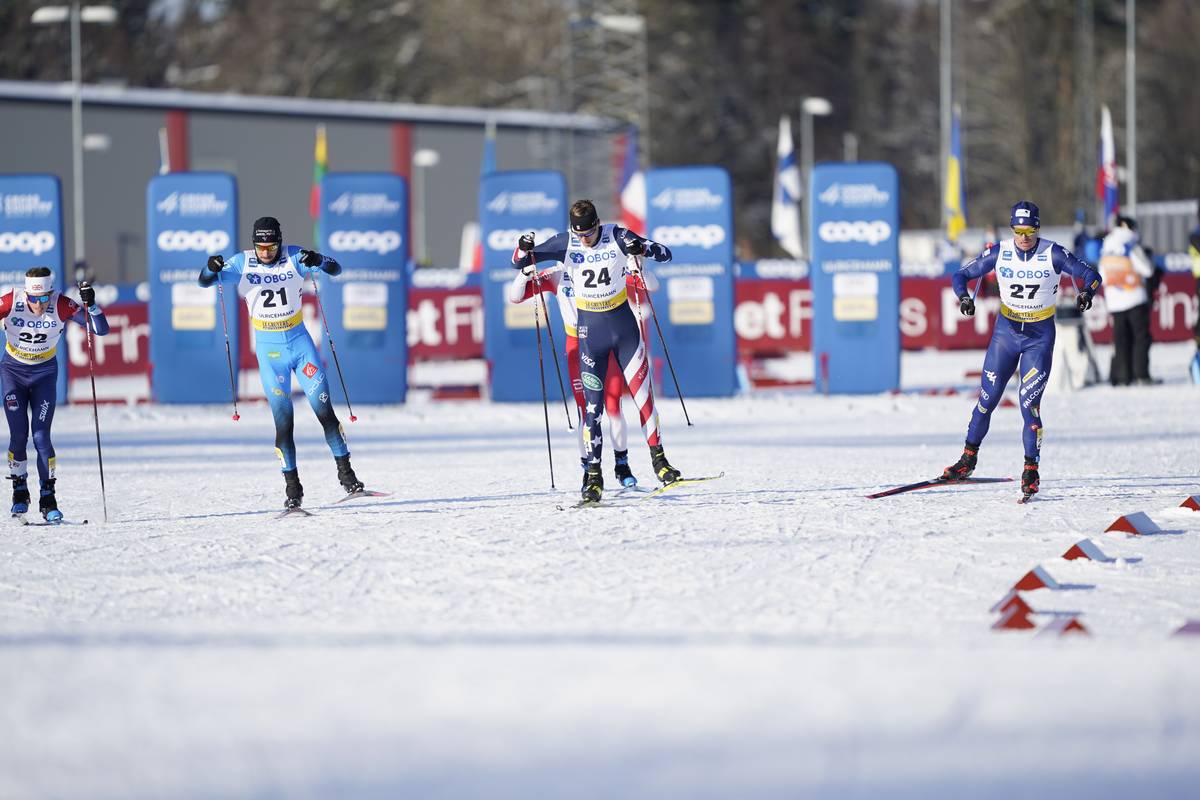
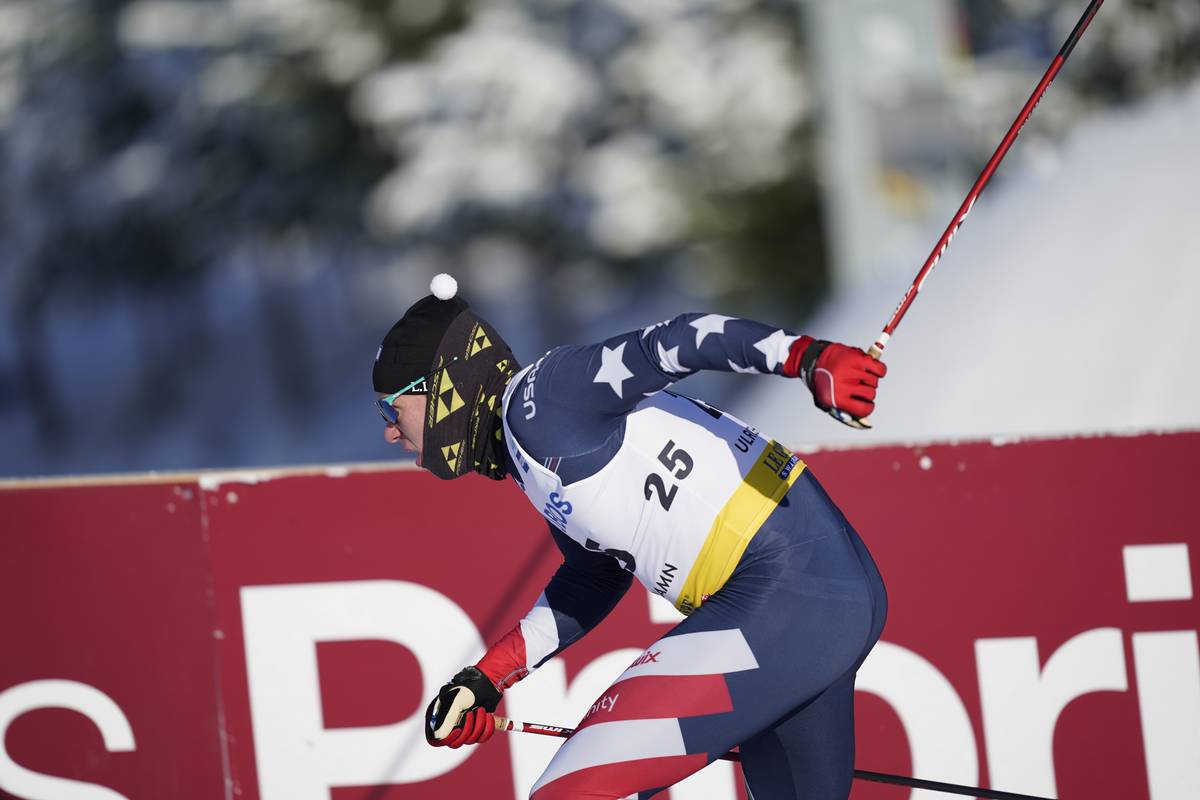
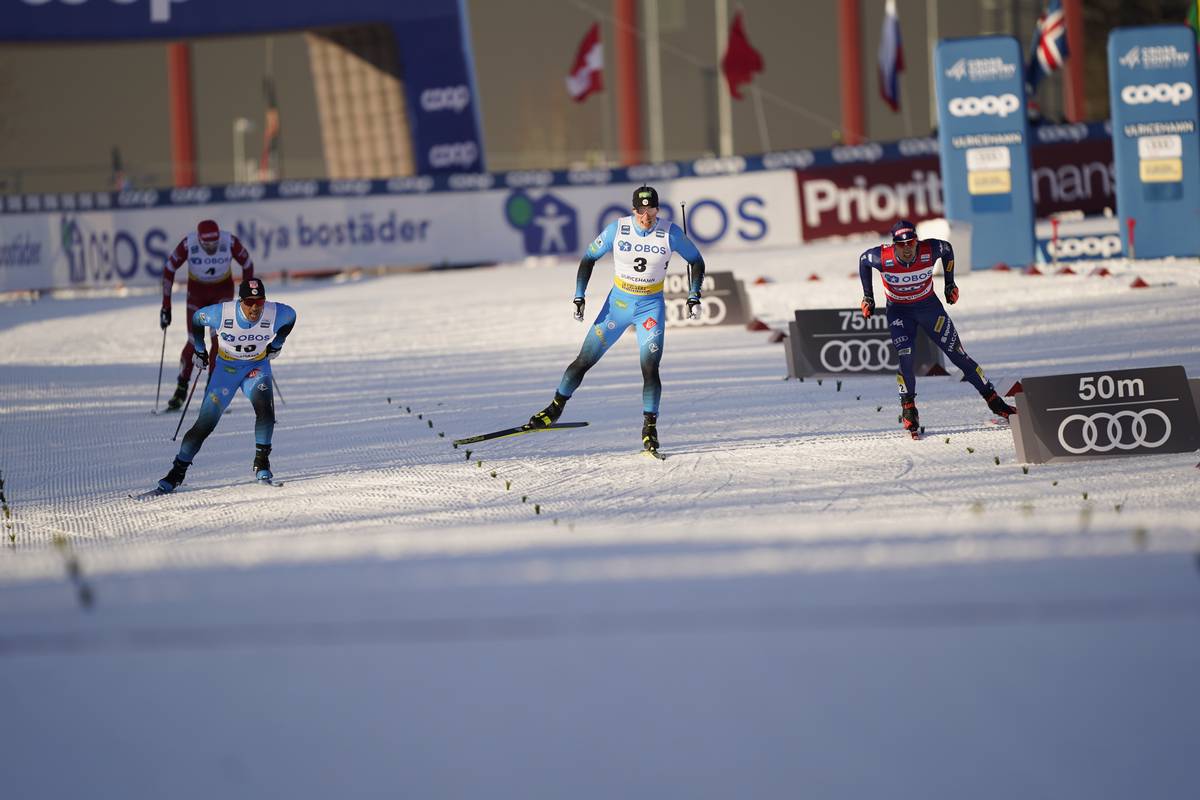
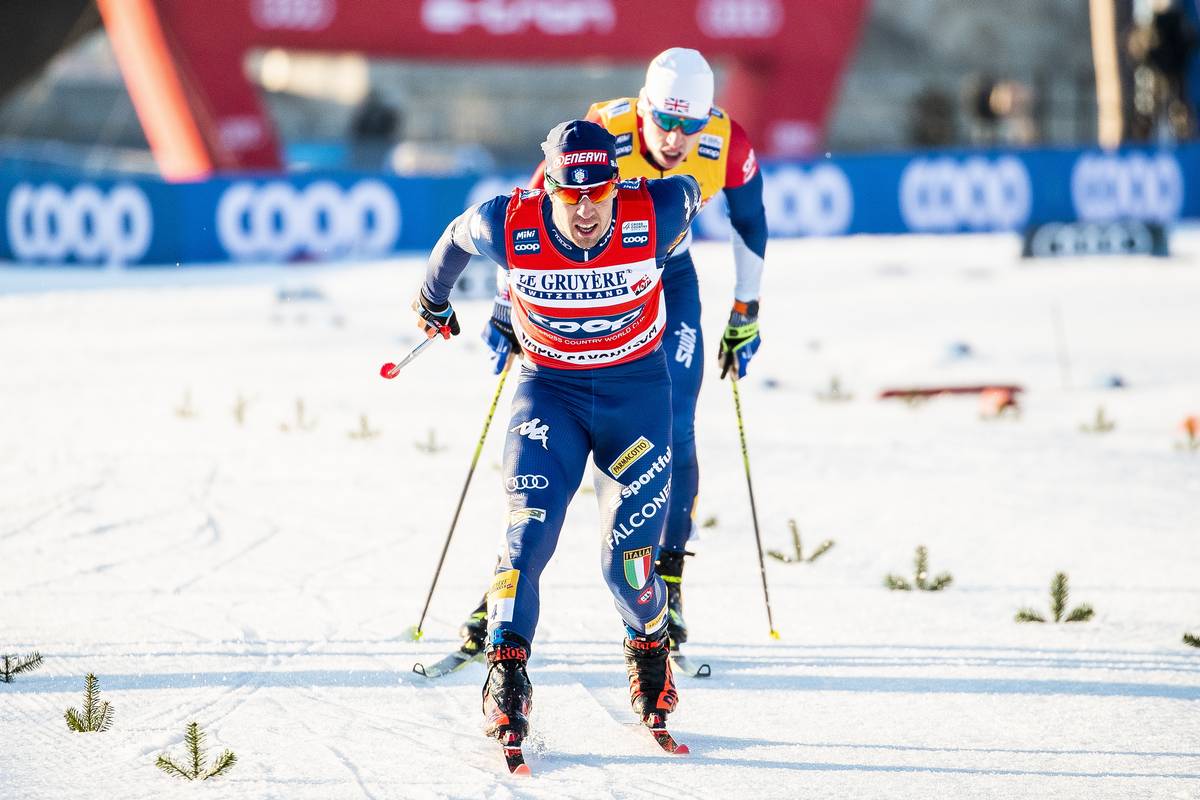
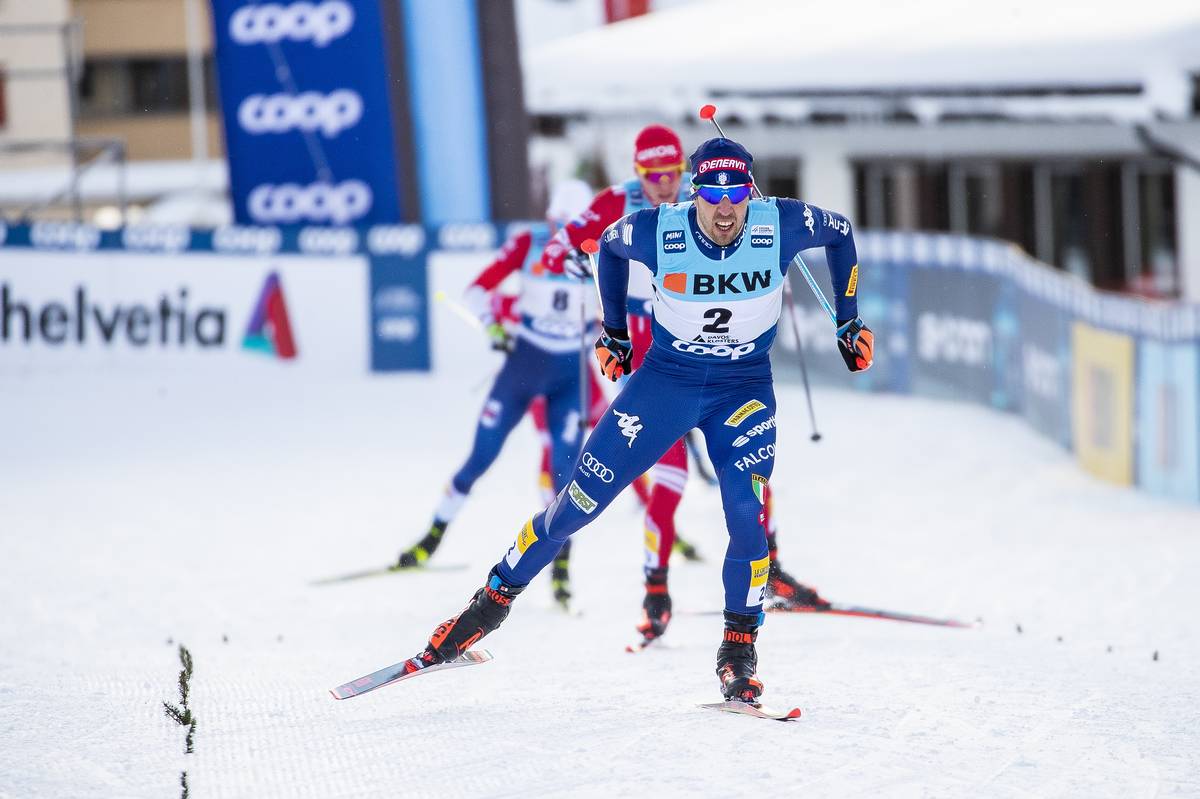
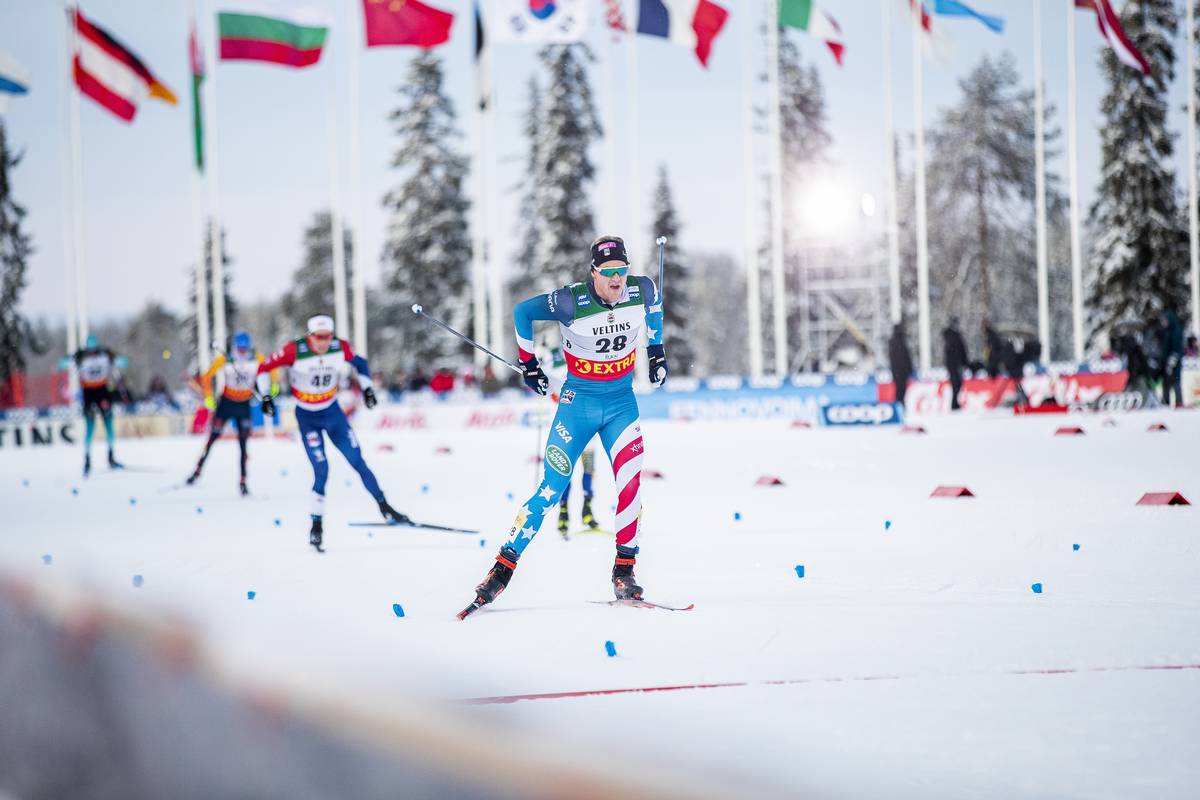
Seen here crossing the finish line at the 2014 Olympic Winter Games in Sochi, Russia, Simi Hamilton spent more than a decade as a mainstay on the US Ski Team. (Photo: Sarah Brunson/U.S. Ski Team)
At Home
Between 2010 and 2021, Simi Hamilton logged 144 World Cup race starts as a Team USA mainstay. Four World Cup sprint podiums distinguish his palmarés (including a victory in Stage 3 of the 2013–14 FIS Tour de Ski), along with three Olympiads (2010, 2014, 2018) and six World Championships (2011-2021). Hamilton is a skier who wore his team’s colors proudly, and much of the success being enjoyed by younger generations of American skiers is attributable to his attitude and example.
Hamilton is married to two-time Olympian—and two-time World Cup sprint winner—Sophie Caldwell Hamilton. together, they raise and care for their year-old daughter, Lilly. During their skiing careers, they trotted the World Cup globe together. Now, it’s now the act of staying home that brings Hamilton joy and purpose.
“Being at home (mostly) full time is incredible,” Hamilton said. “Obviously I miss our teammates and traveling through some of the most beautiful places in the world, but to not be living out of a duffel bag—and to feel more ‘grounded’ on a day-to-day basis—is such a nice and welcome change. Most of my immediate family still lives in the Roaring Fork Valley, so to see them on a fairly regular basis is pretty incredible. And lastly, to be back adventuring in my home mountains is the best feeling in the world. You could spend a lifetime exploring all the nooks and crannies of the Elk Mountains and never see everything, so it’s really cool to feel like I’m always getting to know my backyard better and better even though I’ve been running, riding, and skiing those mountains for 36 years.”
Early morning sun on the notorious knife edge of Capitol Peak, one of seven 14’ers on the Elks Traverse.
Many of the “local adventures” in which Hamilton engages would be adventures of a lifetime for mere mortals, few of whom could begin to match the fitness required to do what he does every day. But, for Hamilton, all this is more about lifestyle and less about training. He laughed as he describes his relationship to training and performance:
“Ha! I feel like the last thing I do right now is train,” Hamilton said. “I’m climbing and ski guiding full time now, so just being out there for work allows me to feel like I’m staying healthy and getting the time outside that my mind needs. Maybe that’s why I’ve taken a liking to challenges and adventures that are 10+ hours. I certainly don’t have the time or flexibility to do any sort of structured training, but I can work and be outside, and when I have time to adventure on my own, with Sophie and/or Lilly, or with buddies I try to make that happen. I think if I were trying to plan out training and do specific workouts, I’d have a different relationship with the mountains and fitness that would ultimately not allow me to enjoy just being outside and doing cool stuff with great people.”
Hamilton mentioned in his Instagram feed that he’d originally planned to ski the Elks Traverse last May, but snow conditions and weather windows didn’t cooperate. Having changed plans to accomplish the traverse in summer rather than winter, he still considers his record-setting run to be more of a reconnaissance mission toward another on-skis attempt next spring. Needless to say, FasterSkier reporters would never be fast enough to accompany him on that adventure, but we’ll do our best to report on it when Simi Hamilton, once again, comes home.
A 16-hour day starts early: Simi Hamilton’s view of the trail as 16 hours of the Elks Traverse begins. No one’s ever completed it faster.(Photo: Simi Hamilton)
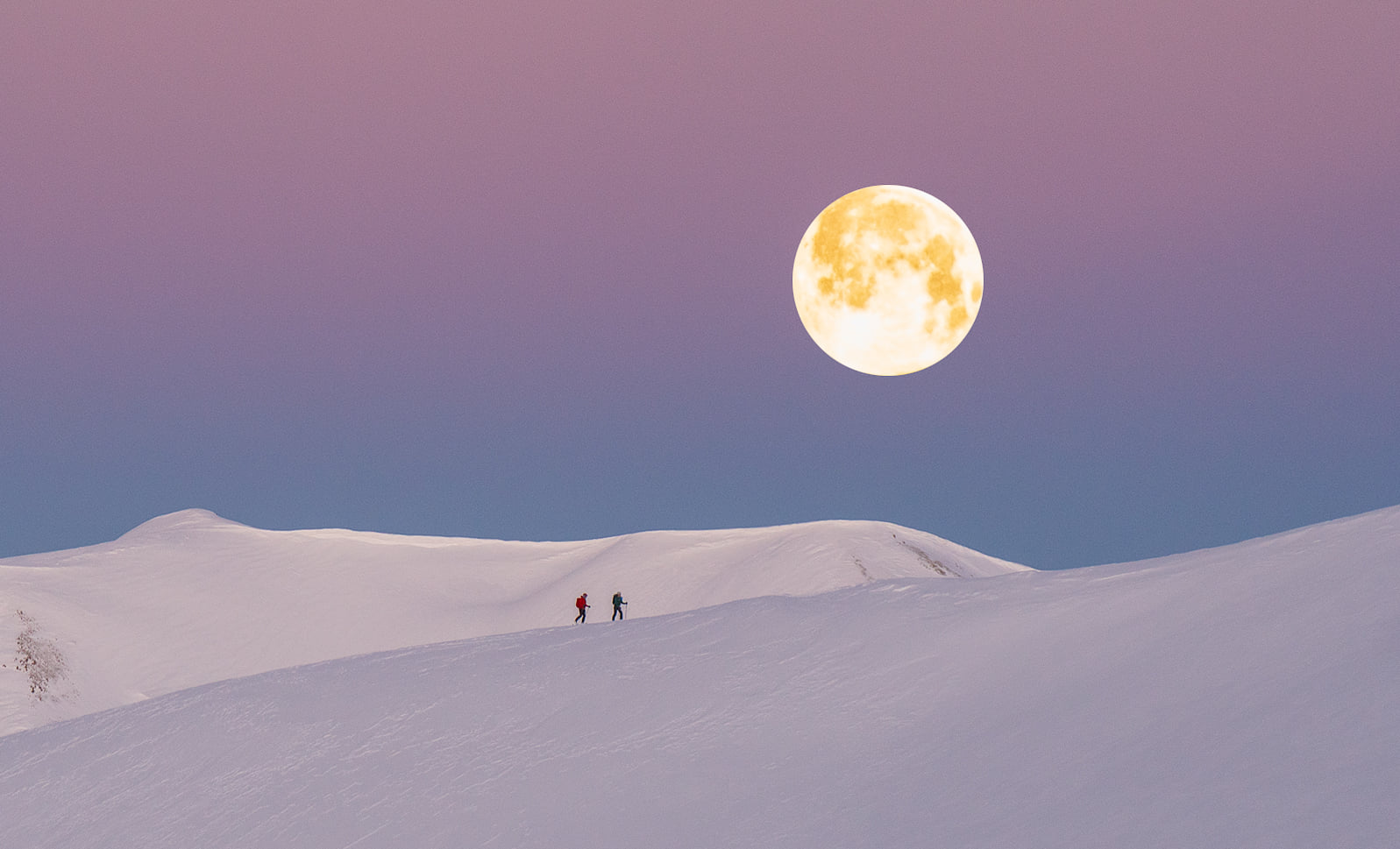
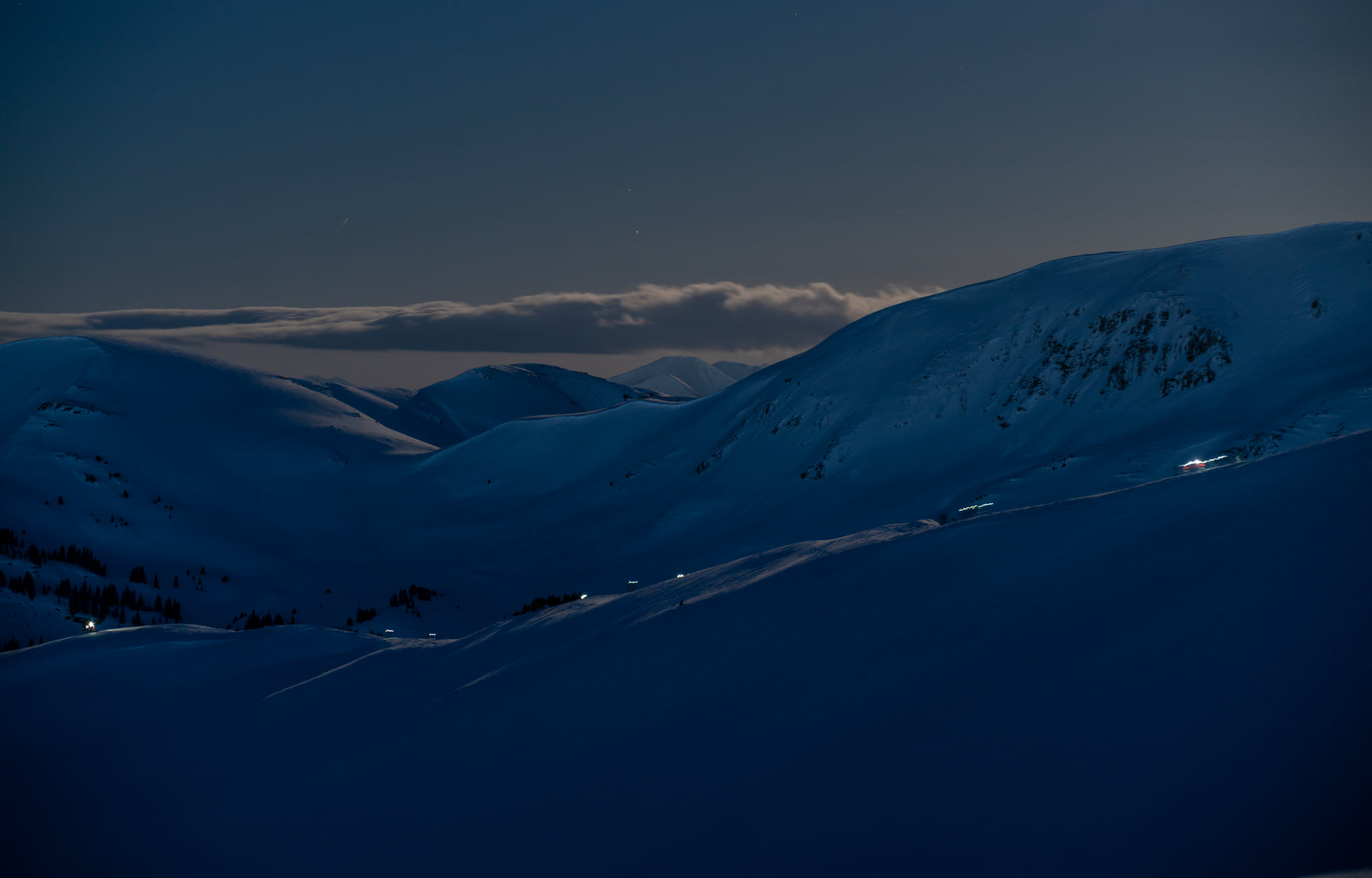
The 2021 Grand Traverse saw a magical full moon under clear skies and mild temperatures. (Photo: Jesse Levine / Crested Butte Nordic)
Tucked deep into snowy valleys, the tiny iconic Colorado mountain towns of Aspen and Crested Butte are separated by a mere 40 miles by foot, but roughly 200 miles by car in the winter. Separating the two is the expanse of the rugged Elk Mountain range, which features six of Colorado’s 14’ers, peaks that reach above 14,000’.
Now meccas of outdoor recreation, the two towns were historically established as profitable coal and silver mining sites, following the forced removal of the native Ute residents in the late 1800’s. In those days, communication between towns during the winter relied on the fortitude and alpine savvy of mail carriers, who skied back and forth between towns through burly terrain across a notoriously unstable snowpack.
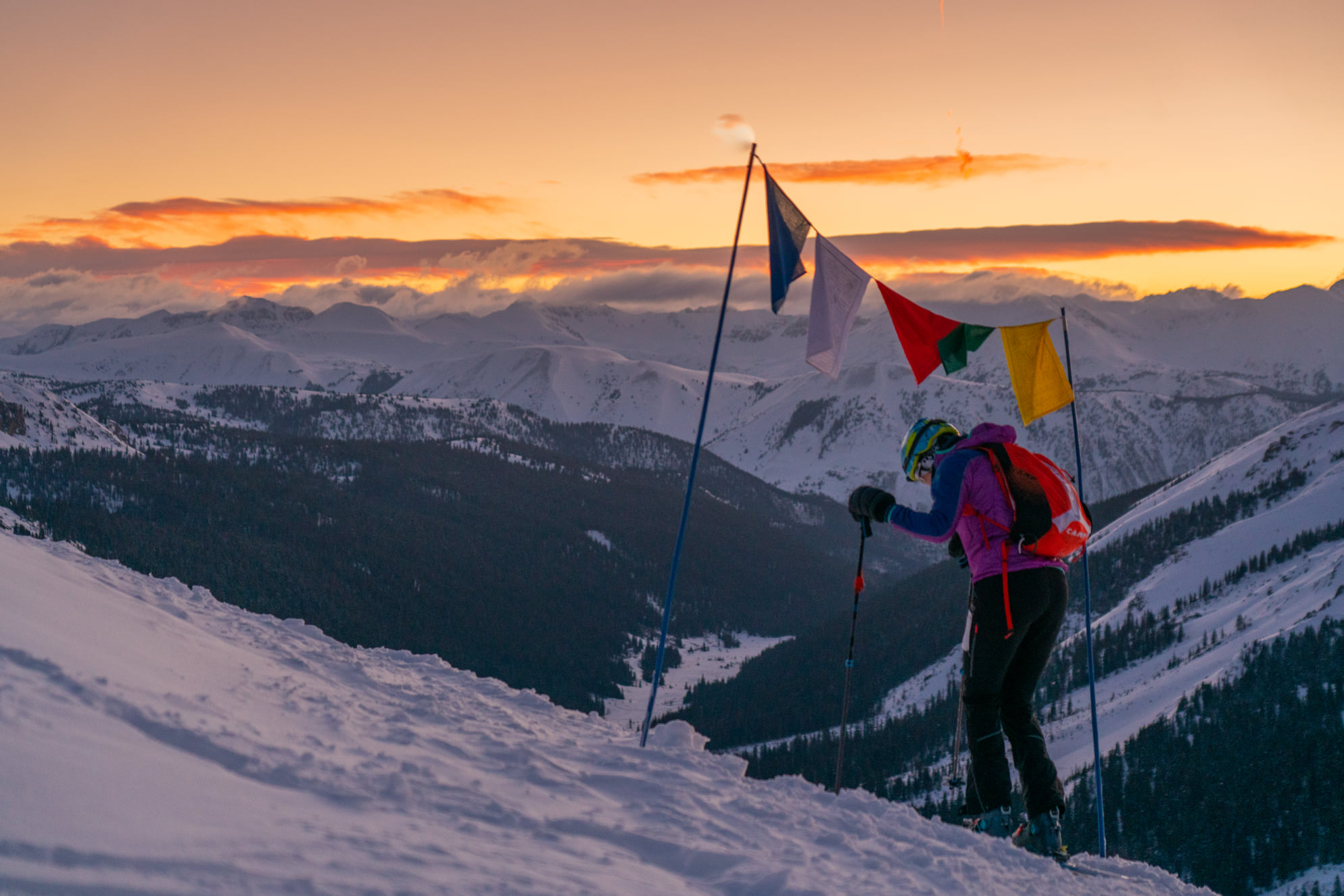
A 2021 Grand Traverse racer descends off of Star Pass at sunrise. (Photo: Jesse Levine / Crested Butte Nordic)
In 1998, this historic route was revived as a backcountry ski race called the “Grand Traverse”, which begins at the base of the Mt. Crested Butte ski resort and travels north over two 12,000-plus foot passes, with roughly 8,000 feet of elevation gain spread over the roughly 40 mile route. The inaugural winners (athletes must race in pairs), racing on metal edged cross country skis, were Aspen’s Travis Moore and Pierre Wille, local legends, and accomplished cross country skiers and alpinists. Moore, who taught at Aspen High School for more than 20 years and continues to coach the cross country ski program, eventually became the coach of a young Aspen resident, Simi Hamilton.
For many living in the Roaring Fork or Gunnison river valleys, the Grand Traverse (GT) is a storied annual pilgrimage, respected for the unique and burly nature of the route and its local lore as a rite of passage for endurance enthusiasts. Adding to the mystique, the race begins at midnight, allowing racers to cross the highest avalanche risk sections while snow is presumably frozen, firm, and at its most stable. The avalanche safety arsenal of beacon, shovel, and probe are part of a long list of items athletes must carry for safety, along with extra layers, an emergency shelter, and other items that reflect how deep into the backcountry the route leads and what it might take to survive a night out in the elements should something go awry.
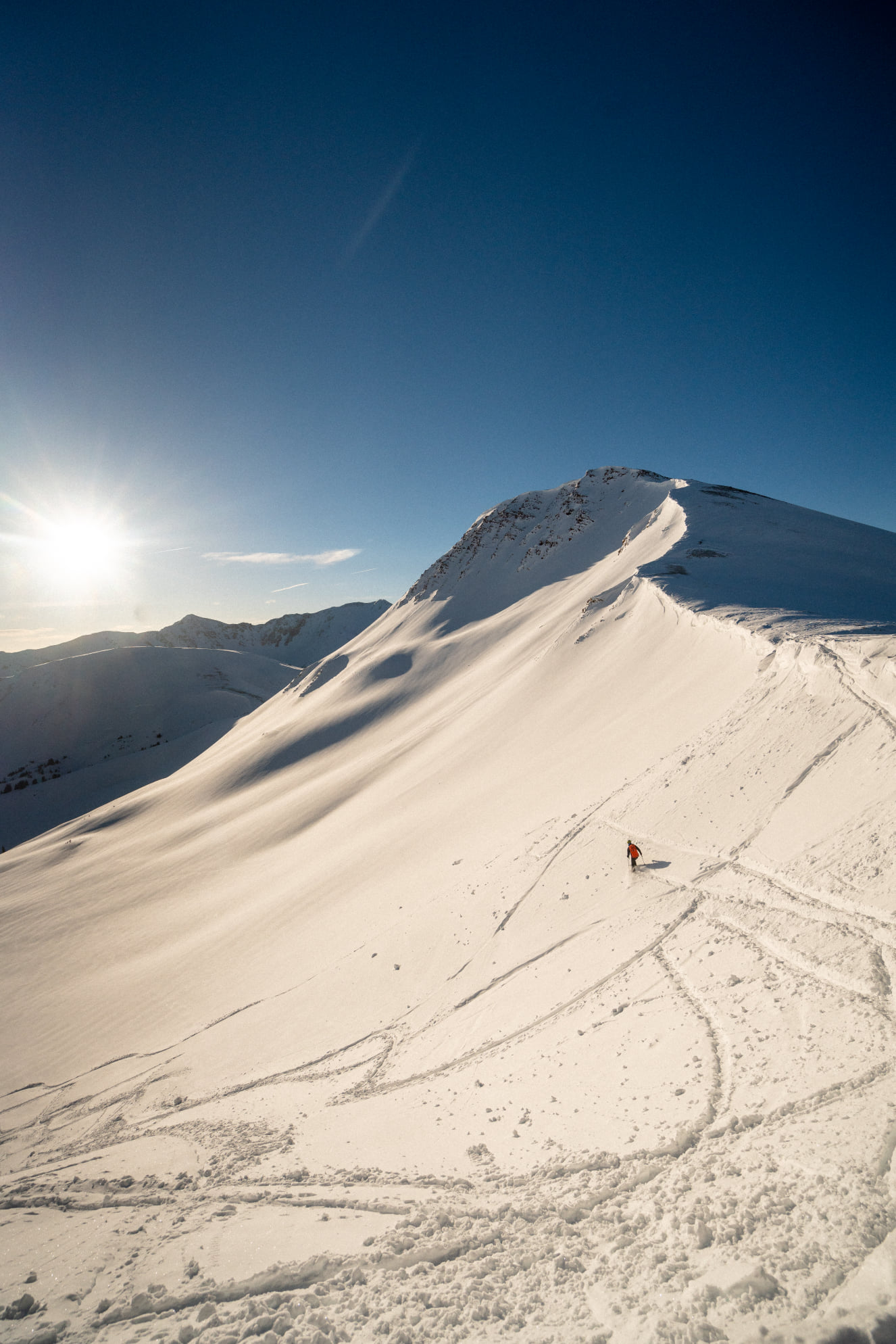
A 2021 Grand Traverse racer receives instructions for the descent off of Star Pass from the safety dispatch stationed there. (Photo: Jesse Levine / Crested Butte Nordic)A racer descends off of Star Pass during the 2021 Grand Traverse ski race. (Photo: Jesse Levine / Crested Butte Nordic)
With the rapid advancements in ski mountaineering technology, few still commit to cross country skis for the GT – SkiMo race skis with AT bindings or lightweight backcountry or telemark gear are more stable and typically handle better descending off the passes. But this year, the team of “Yeah, but we can skate” showed skinny skis aren’t yet an antiquated option for success at the GT, particularly if you’ve got the skills of two Olympians who have continued to foster their love for mountain adventures on boards less than 43 mm underfoot.
The duo was Simi Hamilton and Ben Koons, who lined up on Fischer skate skis. After a fast start skating out of Crested Butte, the team leapfrogged with eventual winners and top SkiMo athletes Cam Smith and John Gaston, who eventually broke away as conditions favored wider skis and metal edges. Smith and Gaston made it to Aspen in 6:13:15.4, just over 36 minutes ahead of Hamilton and Koons. (Results here)
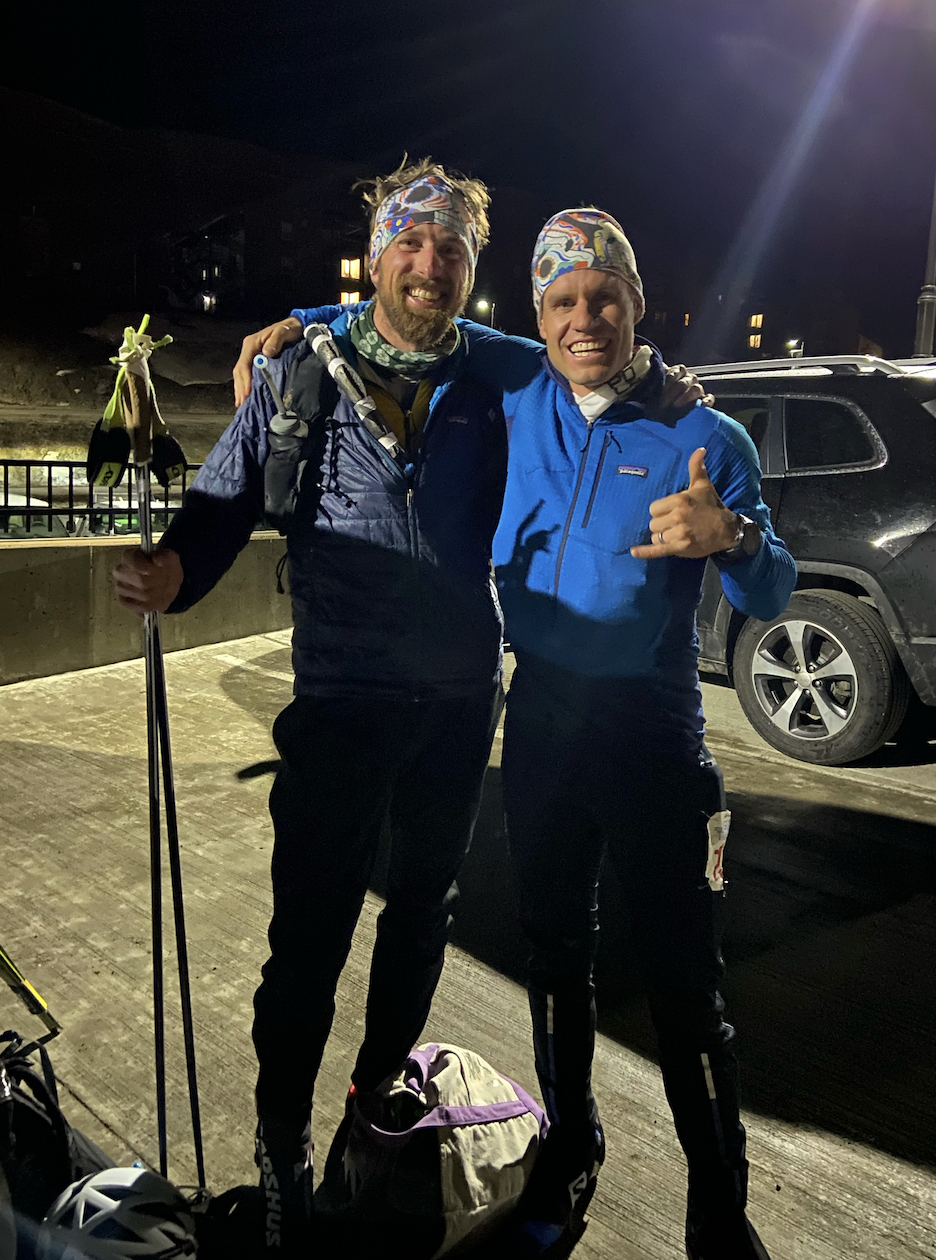
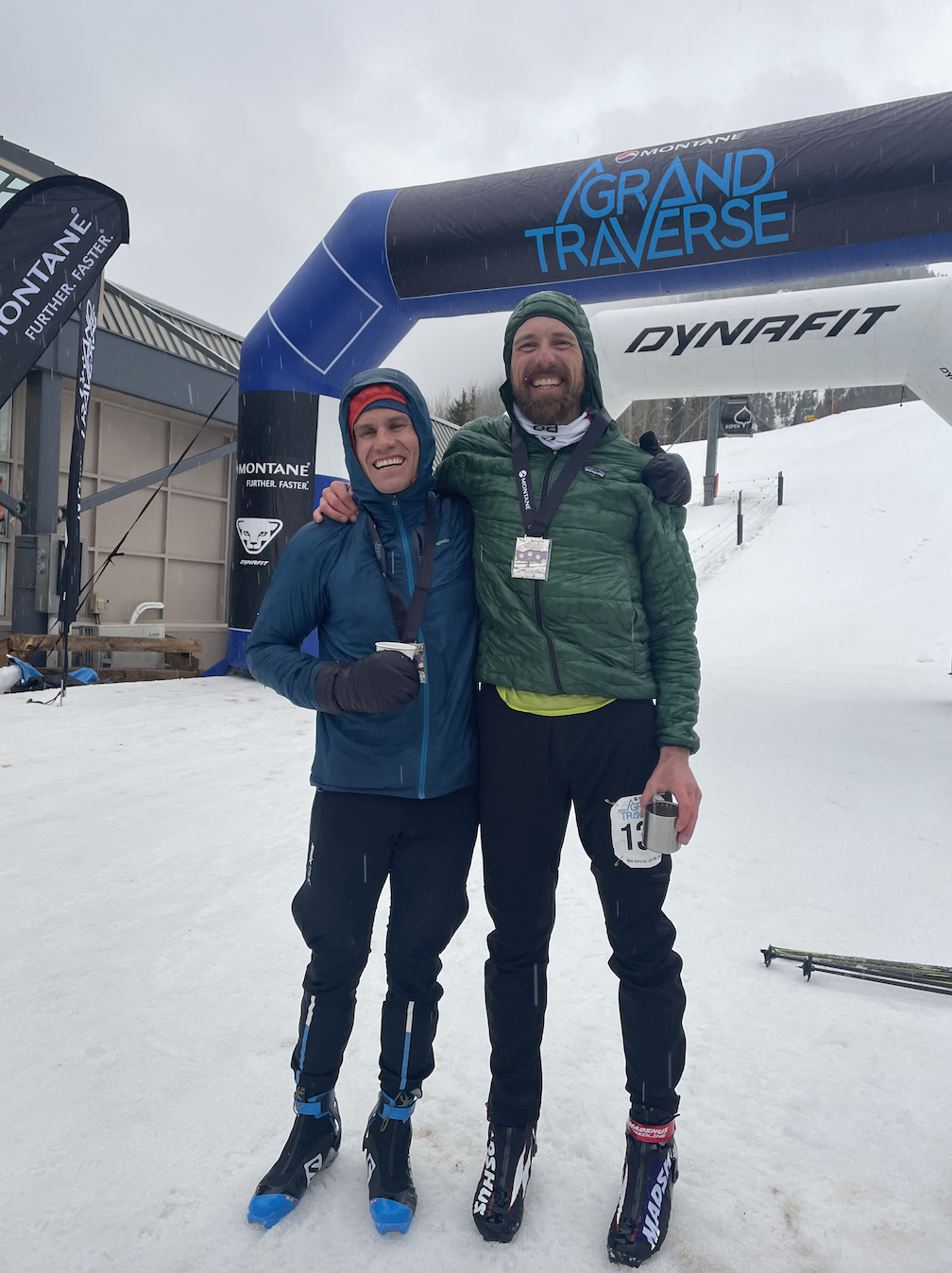
Before and after: still smiling. (Photos: Sophie Caldwell Hamilton)
Though Hamilton won the GT running race in early September, 2021, it was his first crack at the storied winter event. For Koons, it was his sixth crack at chasing the ideal crust cruising conditions that might allow a strong skater with some backcountry experience under their belt to smash the course record and take the win on skinny skis. The two have shared a number of big adventure days in the mountains on ski, foot, and bike, often with a third friend, Linden Mallory, who grew up in Aspen with Hamilton and raced on the Dartmouth ski team with Koons, and later became one of his GT partners.
While last year boasted perhaps the most ideal conditions, with athletes racing on firm and stable snow under a full moon in mild temperatures with minimal wind, this year, mother nature had a few twists up her sleeve. The week leading into the race saw a little bit of everything springtime in the mountains has to offer: warm sunny days, heavy wet snow, rain, wind, and plenty of freeze-thaw cycles. Consequently, this was shown in the snowpack, leaving Hamilton and Koons with far less skateable conditions, lots of breakable crust, some “spicy” downhills. Nevertheless, with only one broken pole, they were still smiling at the finish, and seemingly aren’t ready to accept defeat just yet.
A train of headlamps climbs Star Pass during the 2021 Grand Traverse. (Photo: Jesse Levine / Crested Butte Nordic)
For more with Hamilton and Koons, you can head to the Grand Traverse Instagram account, where the duo was interviewed pre and post-race, along with a video capture of their finish, in the rain, at the base of Aspen Mountain. For those interested in testing their mettle in next year’s Grand Traverse ski, registration opens at midnight on December 1st and spots fill very quickly. For those looking to explore the route in the summer, there is also a Grand Traverse run and bike race happening Labor Day Weekend. The events are among the primary fundraisers for the Crested Butte Nordic Center.
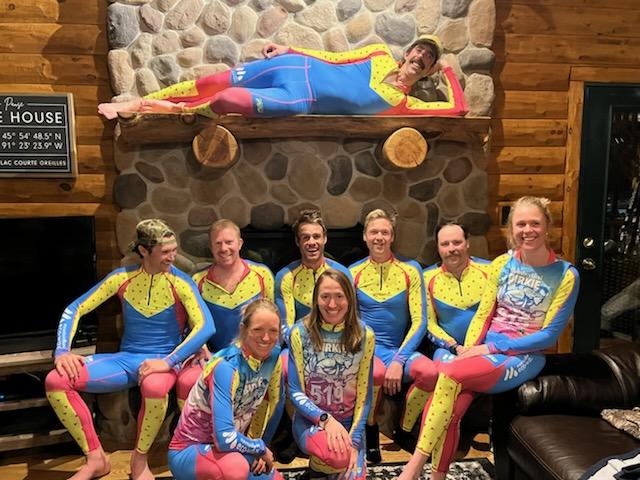
Just over a month ago, the American cross country ski community descended upon the small town of Hayward, Wisconsin. Skies were clear, the snow was cold and firm, and lycra was everywhere. But one set of race suits stood out, both because of the noteworthy athletes wearing them and for their bold neon colors. It was the MountainFLOW Eco Wax race team of Simi and Sophie Hamilton, Sylvan Ellefson, Sadie Maubet Bjornsen, Erik Bjornsen, Matt Gelso, and Liz Stephen.
While most reading FasterSkier will recognize these names without introduction, this is a “band” of retirees who have each, at minimum, raced on the World Cup. Five are Olympians, and one has a collection of top-10 results in World Championship and Olympic sprint results. In short, they’re good skiers who also happen to be good friends.
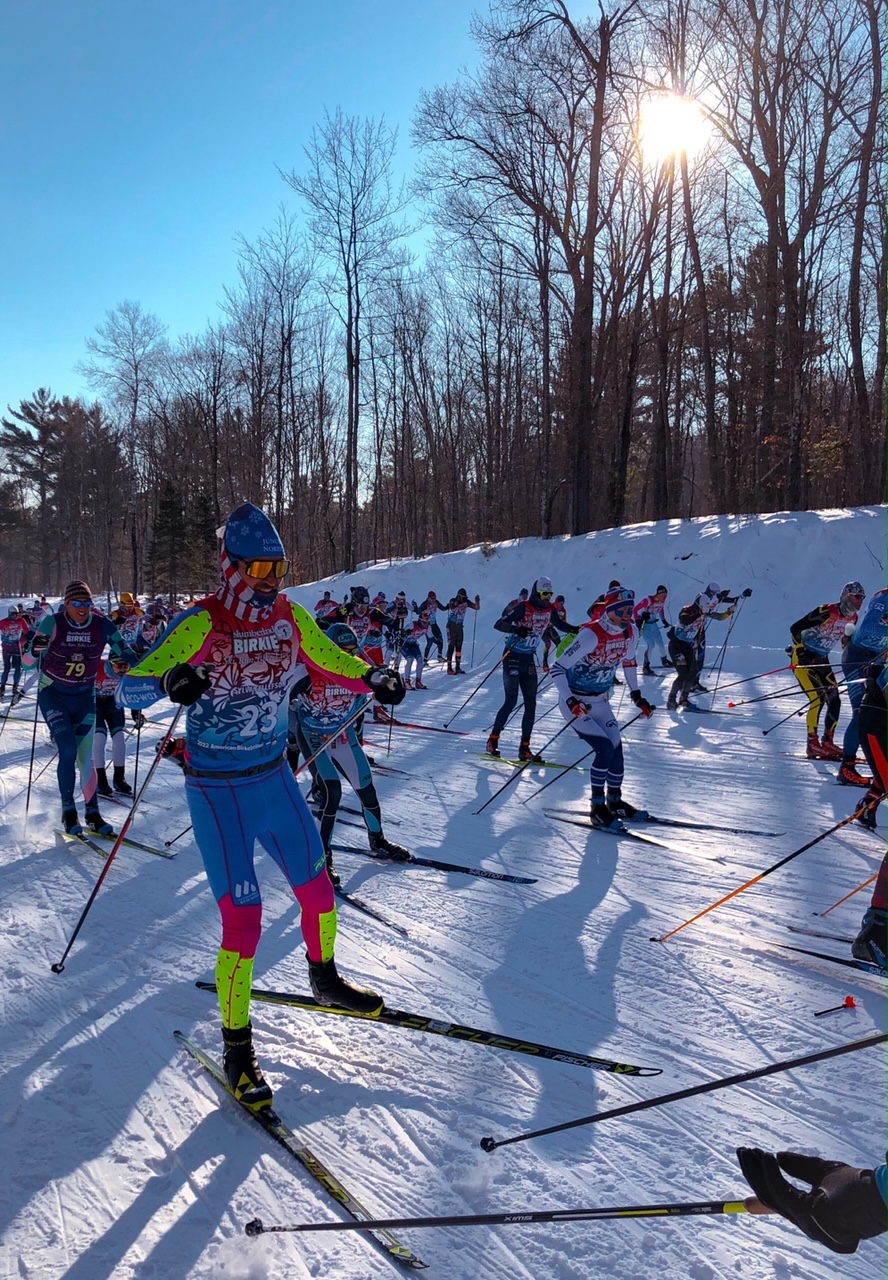
Racing the Birkie wasn’t about stacking a fast team; leading into the event, mountainFLOW founder Peter Arlein said it would be “super fun, and maybe not super serious.” As the photos suggest, a lot of fun was had, but some fast racing – on skis waxed with mountainFLOW products – happened too.
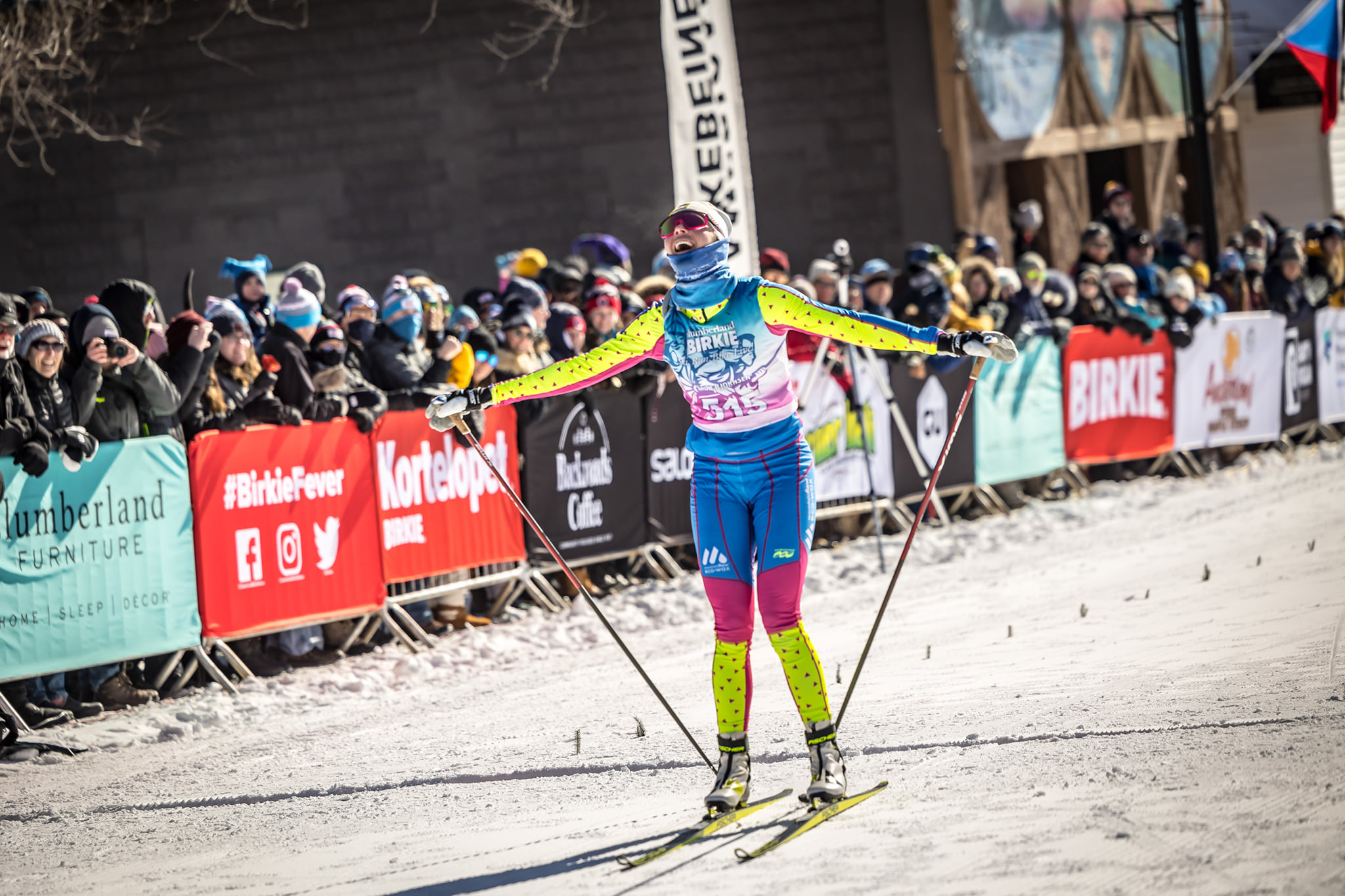
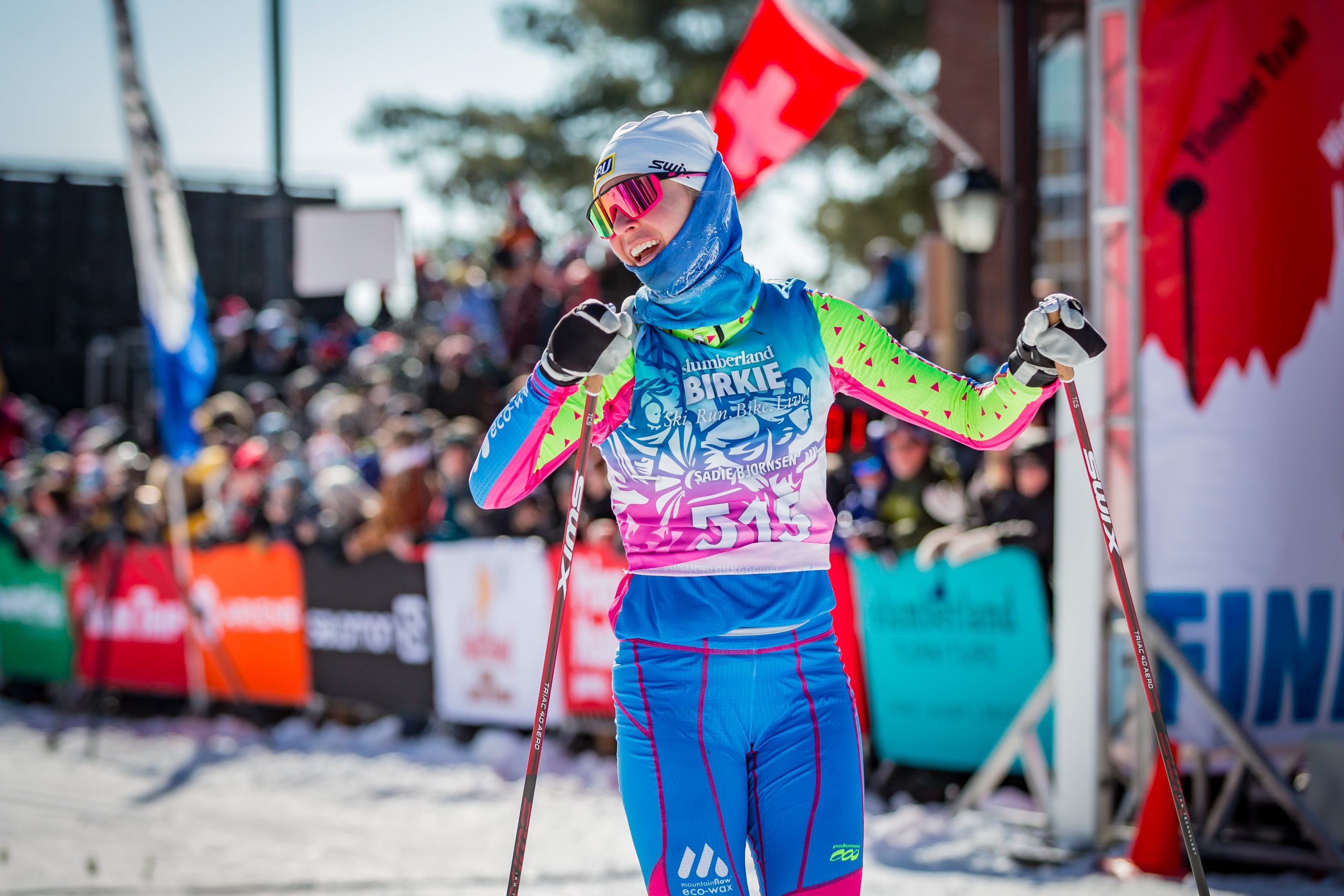
The mountainFLOW eco wax team was “all business” at the Birkie. (Courtesy photo)
“A trip down memory lane,” wrote Erik Bjornsen after the race. “Super fun to get a crew together and pretend to be athletes again. We are all at different fitness levels, one thing in common though: far from our best. It was fun to try and forget that for a weekend, and go live the athlete lifestyle. It’s been a busy winter in the retail industry, so it was nice to have a little break from work and hang out with friends. No beers were consumed… nothing but business at the mountainFlow house.”
(Side note: they may have been spotted at the Moccasin Bar post race.)
As he alluded, there was a range of fitness levels and race objectives, but the prominent theme seemed to be that becoming some of the best American cross country skiers of their generation correlates strongly with good technique and a high level of residual fitness.
Taking the top result was Sadie Maubet-Bjornsen, who finished fifth in the women’s race, just over two minutes behind winner Alayna Sonnesyn. Erik Bjornsen was the top male racer in 9th (+2:59.05), with Simi Hamilton finishing roughly four minutes behind in 16th. The remaining skiers finished in pairs, with Sylvan Ellefson crossing with Matt Gelso in 121st in the men’s division, and Sophie Hamilton finishing alongside Liz Stephen in 123rd and 124th.
“It was amazing to get the band back together!” wrote Maubet-Bjornsen. “My husband’s family is from Hayward, so after visiting them this summer, we were already committed to doing the Birkie simply to be considered valid members of the Berrard family. When Simi mentioned he was forming a fun team with some of my favorite previous teammates, I was all in. Having jumped full force into this new life, preparing for a 50k couldn’t have been more different than it would have looked in the past. My new way of exercising is waking up at 5:30AM, and hitting the ski trails from my doorstep from 6-7AM.
“Two weeks [before the race], I called in Rosie Brennan to give me some last minute interval workouts to train my brain to accept physical pain again. Four interval sessions later, I showed up and joined the dance. It was pretty fun to ski with the girls, and just witness the gift of fitness that comes out of all those years of hard work. As the top ladies skied away about 35 k in, I no longer could fake the fitness anymore, but still enjoyed every second of skiing it home.”
Adding to the message that more so than lingering fitness, these athletes have maintained a love of the sport and the friendships made through their time immersed in it, Maubet-Bjornsen continued, “I look forward to many more years ahead of joining various classic American races throughout the country that I never had the chance to participate in [while racing on the World Cup]. I feel lucky that my ‘band’ and family that I created in the past ten years is just as excited to jump into a 50 k race, despite the fact we are no longer the pro athletes we were before.”
Sylvan Ellefson in the wild, wearing his neon mountainFLOW race suit. (Courtesy photo)
“For me, cross country ski racing transcends so much more than competition,” wrote Ellefson post-race. “I’ve formed my family and life around the experiences I’ve had and the friends I’ve made along the way. To me the Birkebeiner is an event that encapsulates this cross country ski culture in the US. The people racing at the Birkebeiner are truly the backbone of the ski community and I think for them to see former World Cup and Olympic level skiers helps affirm that in the US, this sport is one giant family.”
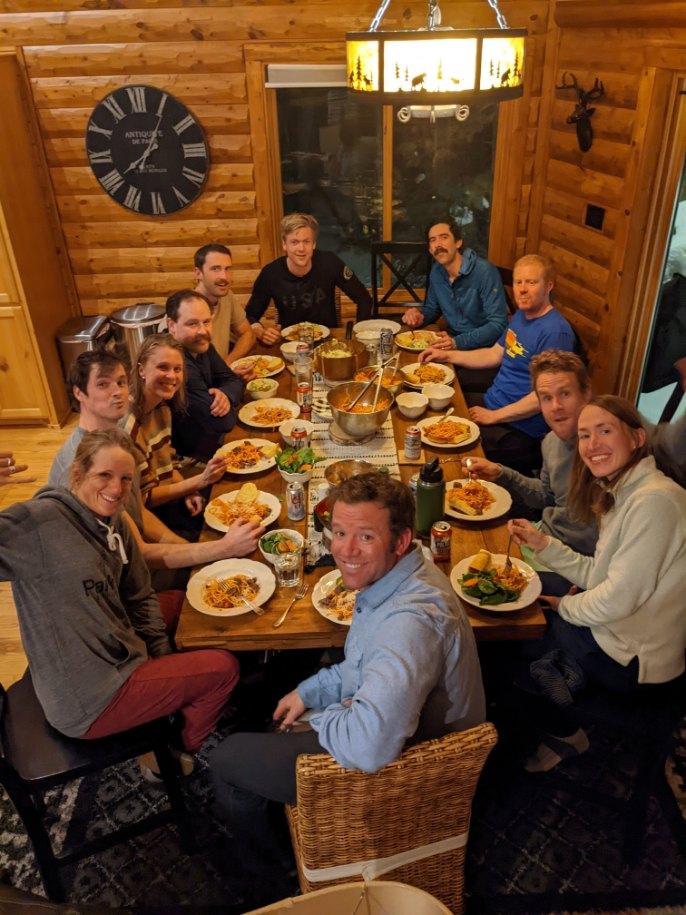
The mountainFLOW Eco Wax team carboloads for the Birkie. (Courtesy photo)
Commenting on the mountainFLOW products and ethos, Ellefson added, “Our waxes were fantastic and I’ve loved using something other than what we’ve been accustomed to using for so long. I’ve tested a couple out now and they truly are not just a great wax, but also a great brand. Getting to spend time with Peter and Brian showed me the culture mountainFlow is trying to create in a space in the industry that is much needed.”
Matt Gelso prepares his skis with mountainFLOW cold wax at the 2022 American Birkie. (Courtesy photo)
More to come, as the coach of non-affiliated French athlete Celine Chopard-Lallier, who took sixth in the women’s race, shares his review of mountainFLOW products, on which Chopard-Lallier also raced at the Birkie. Note that this content is not sponsored by mountainFLOW.
A team of familiar faces is soon headed to the American Birkebeiner, and rumor has it, their race suits will be something to behold.
Spearheaded by brand ambassador Simi Hamilton, the team of Sophie Hamilton (Caldwell), Sadie Maubet-Bjornsen, Liz Stephen, Matt Gelso, Sylvan Ellefson, and Erik Bjornsen will be racing as members of the mountainFLOW Eco Wax team.
“We’re gettin’ the band back together!” This familiar team of retired skiers is headed to Hayward to represent mountainFLOW eco wax at the American Birkie. (Photo: mountainFLOW)
Based in the Roaring Fork Valley of Colorado, where Hamilton grew up, mountainFLOW Eco Wax is the maker of a line of plant-based ski waxes and bike maintenance products that spare the environment without compromising the performance skiers and riders expect. The company officially began in 2016 after years of tinkering in founder Peter Arlein’s kitchen. Experimenting with various plant-based alternatives to the petroleum based products that the ski industry has historically relied upon, Arlein ultimately concocted a solution that he felt checked all the boxes.
Why consider an eco-friendly wax?
“It’s a classic micro-pollution problem where you can’t see the wax coming off [your skis],” Arlein explained in a call. “It’s not like you’re littering and you can see what you threw on the side of the road, but in aggregate, it becomes a big issue. And all of these pollutants are collecting and accumulating in the rivers because they melt in the snow, and then that melts, and then it all flows down into the local watershed.”
Arlein, who has worked in the ski industry for more than 20 years as everything from a fry cook to a patroller, explained that prior to mountainFLOW, he had tried all the available eco-friendly products, but was never satisfied with the performance relative to the traditional petroleum based products on the market.
The pillars of mountainFLOW products: 100% plant based and petroleum free, without compromising ski speed and performance. (Photo: mountainFLOW)
“Eco waxes, for a while, were really bad,” Arlein said simply. “So we’re here to show, first and foremost, our waxes are high performance — and they happen to be non-petroleum and made from plants. Because it can be as green as possible, but if it’s slow, then it’s not a very good product.”
He explained that most eco-friendly products had historically relied on soy wax as a main ingredient, which is readily available, relatively cheap, and easy to work with.
“But it’s also super soft,” he said “So, in anything colder than 30 degrees. It’s just too slow.”
Through experimentation and research, mountainFLOW has developed a set of recipes that use a variety of plant-based waxes to account for the variation in moisture and friction of different temperature ranges, with which cross country skiers are well-accustomed. The ingredients they landed on had traditionally been used in the organic health and beauty industry, which is ultimately where mountainFLOW sources them.
“We’ve tweaked the ratio of plant waxes, and the different types of plant waxes that we’re using, to mimic the qualities of a traditional wax. You can measure hydrophobicity, you can measure hardness, which are the main characteristics that a normal wax has.”
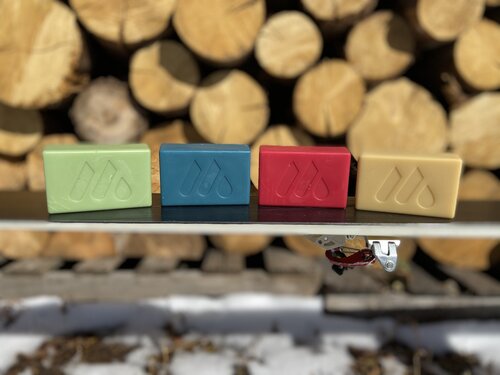
mountainFLOW’s basic line of ski waxes, akin to Swix Performance line, features three temperature ranges, plus an all-temperature wax to keep the bases of your cross country, alpine, and touring setups fast and protected. (Photo: mountainFLOW)
Expanding well-past Arlein’s kitchen, the company began to take off in 2019 after appearing on ABC’s Shark Tank.With patents on the wax formulas in hand, mountainFLOW eco waxes quickly found their way into over 600 doors. The products are now sold at retailers nationwide and now reach as far as New Zealand and Europe. Demonstrating commitment to protecting the environment, mountainFlow is a Certified B Corporation with all USDA Certified biobased products, with biodegradable and 100% post-consumer recycled packaging materials to boot.
With the harmful effects of fluorinated waxes and how to halt their use at the forefront of discussions in the cross country ski community for the last several years, the concept of eco-friendly alternatives should pique the curiosity of environmentally conscious skiers. But what the elimination of fluoros has also perhaps highlighted is that cross country skiers are reluctant to compromise when it comes to ski speed on race day.
Arlein explained how mountainFLOW has stepped up to this challenge in creating its line of race waxes, innovating with materials developed for purposes well-beyond the scope of sliding around on skinny skis as quickly as possible.
“We were able to source this ceramic nanopowder that mimics qualities of fluoros, but it’s totally non-toxic and biodegradable,” Arlein shared. “It was actually developed by the Department of Defense for use in bulletproof vests, because it’s really durable and hard. But it also happens to be super hydrophobic and slippery, so then it started being used to coat runners for luge and bobsled. We found this little lab that was making it in the Midwest, and we licensed the rights to use it for ski wax. And so that’s what we’re putting in our non-fluoro race wax, and that’s what everyone will be skiing on at the Birkie.”
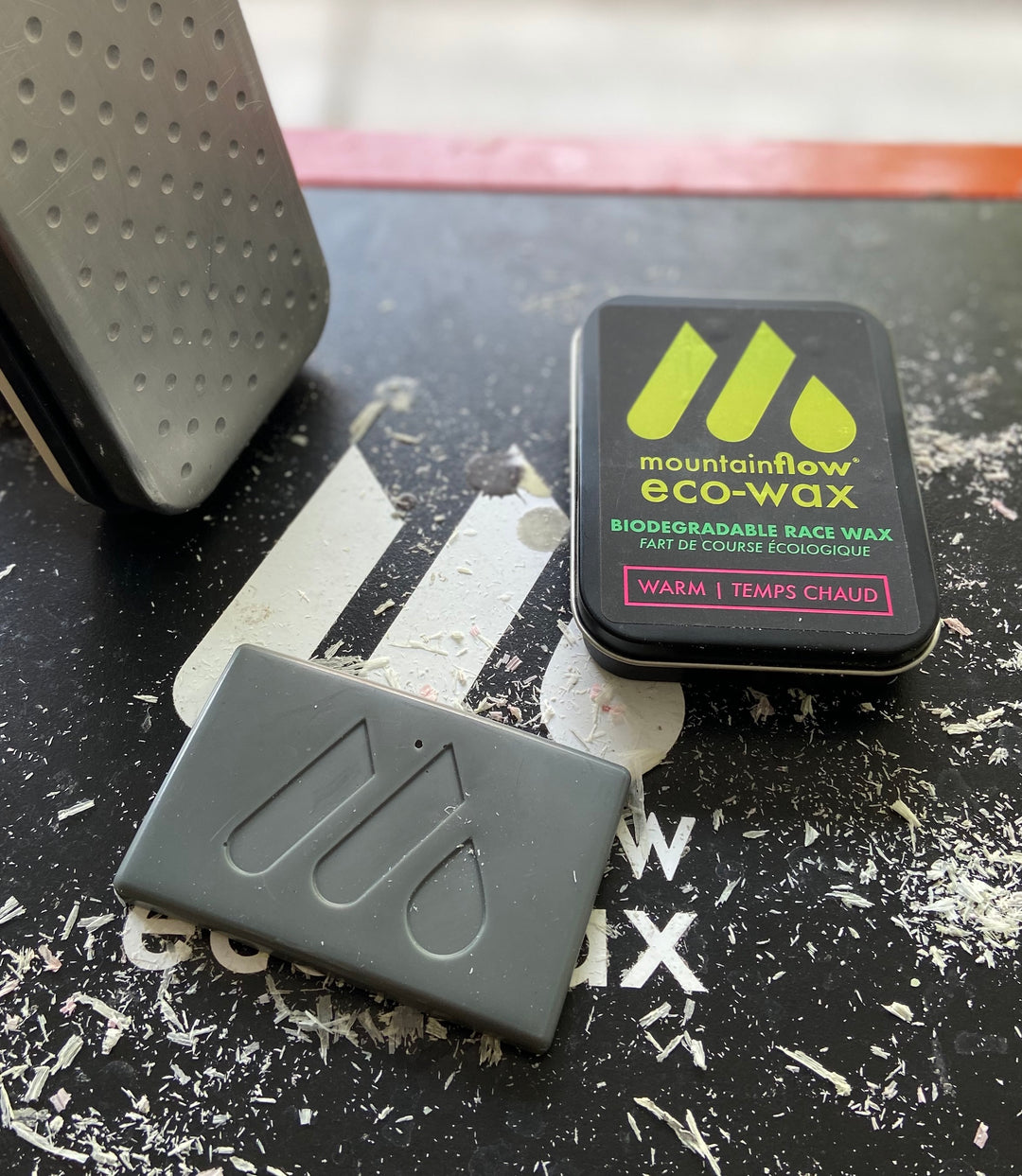
MountainFLOW Eco Wax has created a biodegradable plant-based line of race waxes, allowing skiers to have fast race skis without the harmful environmental impacts of petroleum based products. (Photo: mountainFLOW)
The mountainFLOW race wax lineup includes three temperature ranges – cold, cool, and warm – which they’ve tested against comparable products from companies like Swix and Toko.
“We’ve found that the wax works especially well in cold temperatures with hard abrasive snow.”
The mountainFLOW team is in luck. Temperatures in Cable, WI the three nights prior to the American Birkebeiner on Saturday the 26th are currently predicted to be -8, -6, and -1 Fahrenheit.
Arlein comes from an alpine ski background and says his progression with cross country skiing began last year when he headed out with his wife on skate skis. “We did not go very far. And I was dying. And I looked terrible,” he laughed.
Luckily, he was already connected with Simi Hamilton, whose older sister had grown up with Arlein’s wife. Knowing the mountainFLOW products would perform just as well on cross country skis as they did on alpine and backcountry boards, he called Hamilton from his car that day hoping to rope him in for some guidance.
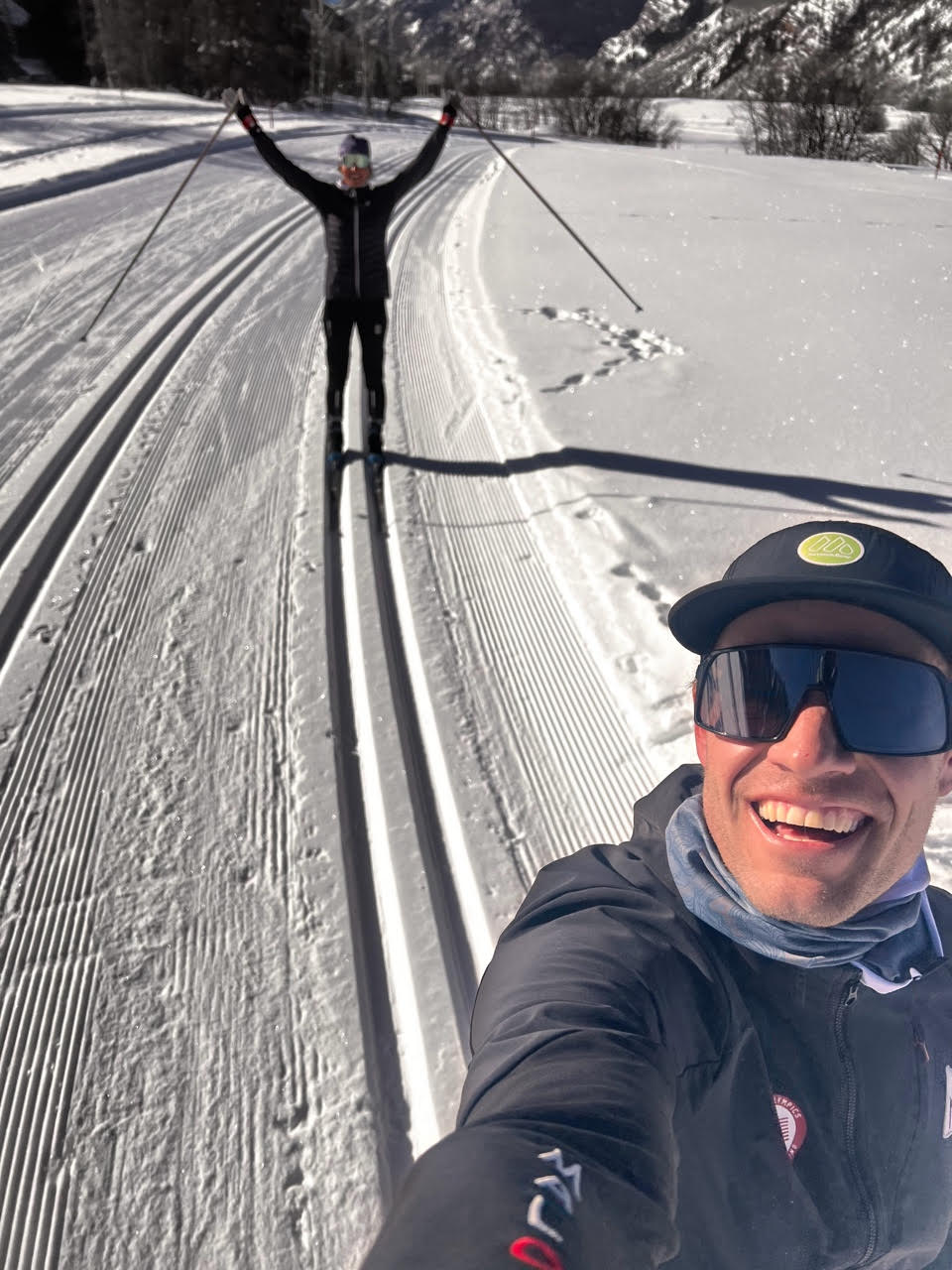
Simi and Sophie Hamilton out for a classic ski near their home in Aspen, CO. (Courtesy photo)
“I was like, ‘Simi, I need help. I don’t know what I’m doing. I’m not good at this sport. And I don’t know enough about it to speak from an authentic place. Can you help?’”
Hamilton, who has been a long-time ambassador for Protect Our Winters and spokesperson for environmental policy, quickly agreed. Hamilton paired technique advice with perspective on mountainFLOW’s ability to meet the demands of committed cross country ski racers. Having spent decades racing on the best and most expensive waxes, filled with some of the harshest chemicals, he can speak better than most to the performance of mountainFLOW’s products relative to alternatives.
“I’ve been super impressed at how well their waxes have performed,” Hamilton wrote in an email. “I haven’t had a chance to try any of their products in super wet or dirty snow yet (after all, this is Colorado), but I really think the moly is going to work awesome for those springtime conditions. We’ve had a pretty wild winter here with huge temperature fluctuations and periods of big snowfall followed by seemingly endless dry spells, and all of the waxes I’ve used thus far have performed just as well if not better than the fluorinated paraffins I’ve used in the past for hard training sessions, etc. Because I’ve been able to get out on my alpine and backcountry skis more than normal this year, I’ve definitely been better about keeping my gear in good shape with somewhat regular waxing. Without a doubt, I can say that arcing turns in powder or on groomers is way more enjoyable with some fast planks under your feet.”
Though Hamilton says he has used mountainFLOW products since the early days of tinkering in Arlein’s kitchen, it was not until this summer when he joined the team as an ambassador and consultant, first testing some of their bike lubes and cleaning products.
“I was super impressed right off the bat with their stuff. Like the ski waxes, it worked just as well, if not better, than the very best traditional (petroleum-based) lubes and cleaners I’ve found. I’ve gradually become more involved with the company over the last handful of months mostly because I really believe that what they are doing is making a difference in our ski and bike communities. They are throwing out the conventional belief that the petroleum-based products that are already out there are the only products that work well.
“MountainFLOW is showing the outdoor industry that we can venture into the mountains and use products that are both 100% sustainable andenrich the important mountain experiences we seek,” Hamilton emphasized.
“And perhaps most importantly, they’re just an awesome company with some incredible people at the helm who love to share the stoke they have for being outside and doing really fun things.”
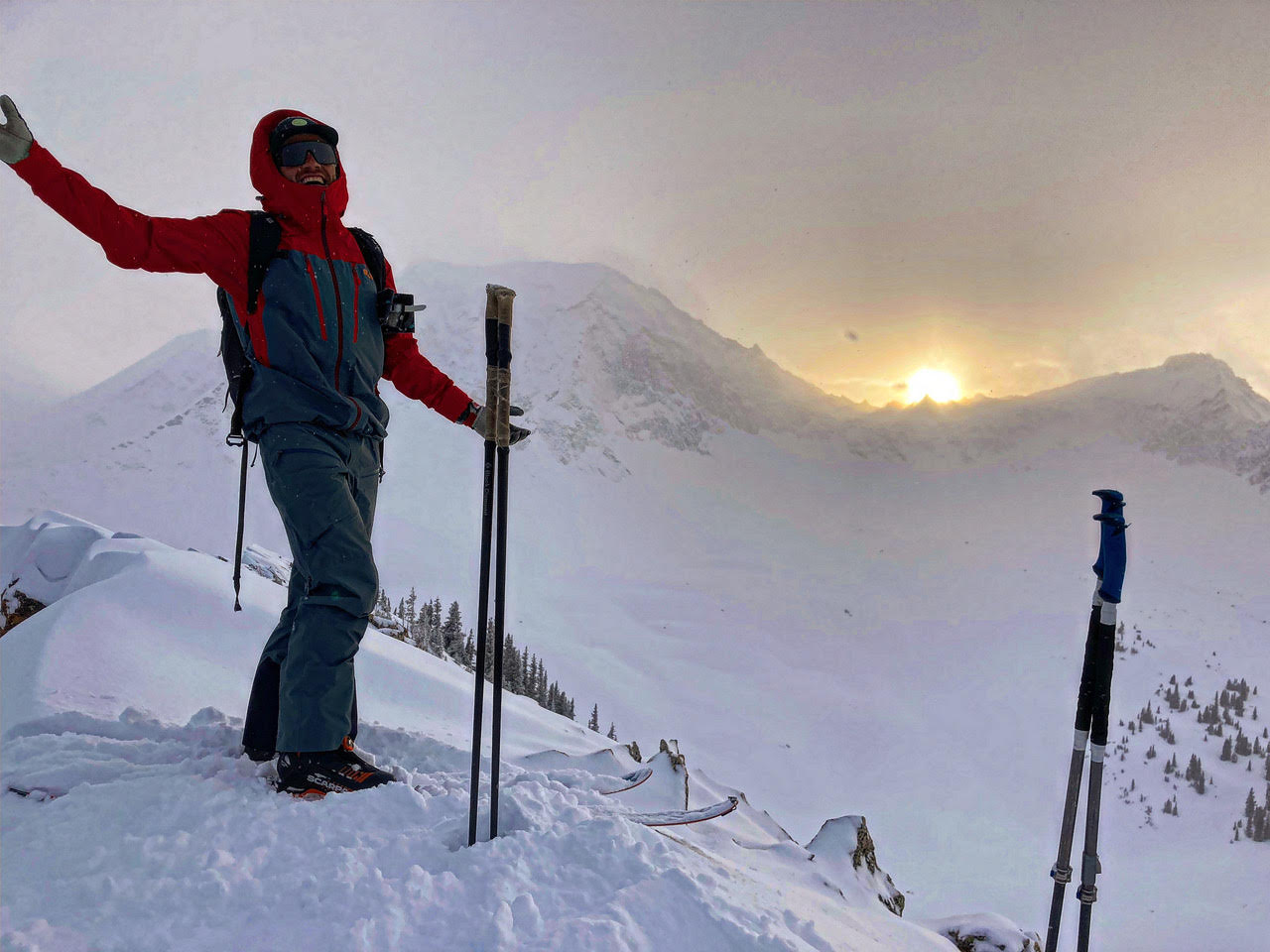
Simi Hamilton enjoying retirement while out for a backcountry ski near his home in Aspen, CO. (Courtesy photo)
As the two schemed ways to reach the cross country ski market with mountainFLOW products, bringing a team to the Birkie seemed like an obvious choice. Arlein said the team would be “super fun, and maybe not super serious.” Perfect for a group of retirees looking for an excuse to get together.
“I was immediately psyched about the idea mostly because Peter’s number one objective was to just go have a great time at what is probably the most iconic ski event in the country. I think cross-country skiers in general are some of the most attentive people out there when it comes to climate change and other important environmental issues, so to be part of a team that can introduce this company, their ethos, and their standard-setting products to a community of people who want to be a part of the solution and not the problem, is super cool. Not to mention it’s just going to be a heck of a good time to hang out with [my former teammates] for a few days. We’re gettin’ the band back together and I couldn’t be more psyched about all these pieces falling into place!”
Those heading to Hayward this week can find the mountainFLOW team at the Birkie expo, where you can chat with Arlein and the race team about the products and race-day wax recommendations, buy waxes and tools, or have your skis waxed – for free! – by the crew. Otherwise, find mountainFLOW online or at a retailer near you, and try knowing there is a 100% money back guarantee should the products fall short of your expectations.
For most serious ski racers, the training calendar begins anew somewhere around the first of May. As such, the weeks between the final World Cup races (or Spring Series in a typical year) and the beginning of May is regarded as “off-season”.
The primary goal is not necessarily to remain sedentary, rather to fill up your cup. To enjoy the activities that a full training and racing load might prohibit, to (safely) spend time with the friends and family after months away, and to savor the simple pleasures an unstructured life offers.
The author enjoys fast tracks in Crested Butte in March, before the thaw.
Given the energy and capacity required for elite level cross country skiing, as you might expect, they grow no moss. Rather than scenes of vegging out watching Netflix, social media has shown epic backcountry skis, mountain bike rides, crust cruises, late season racing, and logging big kilometers on skinny skis.
To take a closer look, FasterSkier posed the following question to an assortment of other World Cup racers.
Q: How do you fill up your cup and recharge all the batteries physically, mentally, etc., so you’re ready come May to dive back in?
A quick glance at Instagram shows Jessie Diggins diving directly into home renovations with her fiancé in their apartment in the Boston area, followed shortly thereafter by trail running in an undisclosed tropical looking destination. When sent the email for this article, an automatic reply indicated she would not be checking email during her vacation. Enough said, and very well deserved.
Here’s a look into the remainder of the squad. ** Warning: Jaw-dropping photos that leave you jonesing for big days on fat skis or in the saddle below.**
Hailey Swirbul:
“Oof, what a loaded question for me here! I felt super drained at the end of this season—mentally, emotionally, physically. I have been on a good-old-fashioned soul search a bit this season and into the spring where I am trying to find the right ratio of skiing to normal life that works for me. Because the winter pendulum swings fully to the “ski” side, my April pendulum has swung completely to the “normal life” side, which means packing in a year’s worth of what I would be doing if I wasn’t a Nordic skier into one month! I love the off season because it’s the one time of year where I’m not restricted in my activities. For example, if I want to go backcountry skiing or fish-scale ski tromping through the woods for 8 hours, great! If I want to build a jump in the backyard and learn how to do a 360 on skis, great! If I need to stay at home all day and catch up on the school work I’ve been putting off because of all those other fun things, also great. I don’t have to feel guilty if I don’t follow a strict training plan during this month, and that is something I really cherish.”
To recharge mentally and physically, Hailey Swirbul enjoys skinning and skiing with friends near Girdwood, AK. (Courtesy photo)
“I have been getting outside as much as I can, mostly on fat skis! I have Nordic skied 3 times (not including fish scale adventures), and one of those times was a FIS race on April 10th. It was actually pretty fun to put on a bib in a low pressure setting like that and be in the AK community with my teammates. My favorite adventure of the year so far was a 4 day hut trip glacier traverse called the Eklutna Traverse with my two friends and teammates, Hunter Wonders and Chip Schoff. I can certainly see how a mountaineering lifestyle could be quite addicting! After our recent FIS race weekend, I am actually more recharged than I could have hoped for! It was a great way to end the race season with a race that was FUN, instead of that horrendous 30k at Engadin for me! Yikes! I know I will be ready to add structure again when the season comes around, but that’s only because I have completely gotten rid of it during this off season. I’ve learned a lot about myself this year that I hope to carry with me.”
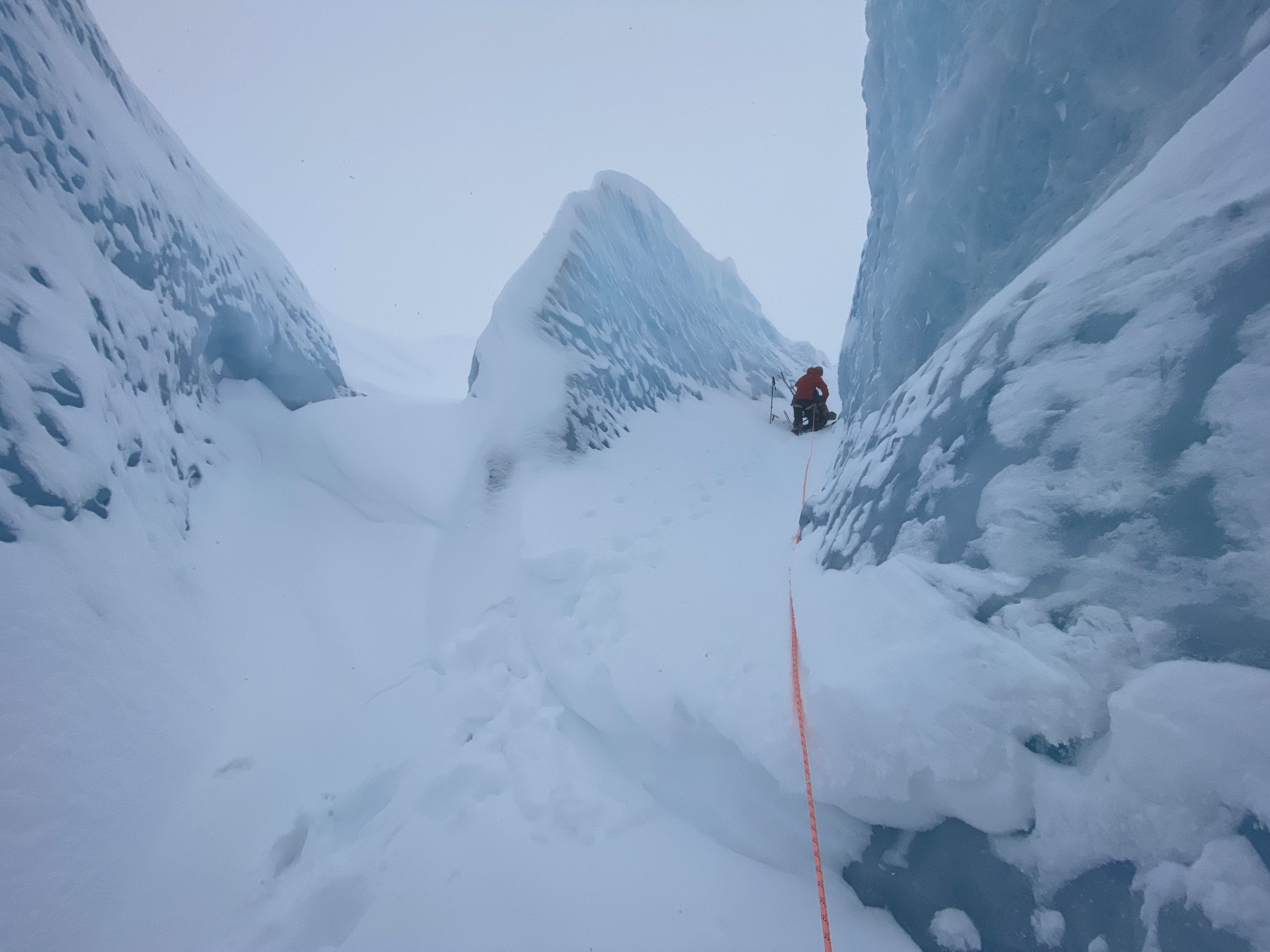
Hailey Swirbul’s mental reset included an epic multi-day backcountry adventure, the Elkutna Traverse, which included navigating spectacularly blue glacial ice. Teammate Hunter Wonders is seen taking the lead here. (Courtesy photo)
Scott Patterson: “We have had quite a cold and snowy spring up here in Alaska so I have been doing a lot of skiing both nordic and backcountry. The last few weeks I have really enjoyed the flexibility of going skiing wherever and whenever I want. Sometimes that involves full day excursions in the mountains and others it is more restrained to a lap or two around the groomed trail systems. We even had two FIS races this last weekend out at Kincaid in mid-winter conditions.
“Outside of skiing, I already enjoy the return to cooking my own food and having flexibility with meals. I have also plugged back into my work (engineering) since I have been back to keep my middays occupied. My spring recharge is less lack of activity then more modification, but I will also be dialling things back for the next two weeks to make sure I have good energy and enthusiasm going forward. Now is one of the few times of year where I can sit back and enjoy not being out in nasty weather.”
In addition to plugging back into his engineering job, Scott Patterson has been squeezing epic backcountry tours into his off-season reset. (Courtesy photo)Wider boards, heavier boots, and beautiful turns. Scott Patterson enjoys the Alaska backcountry during the off-season. (Courtesy photo)
Hannah Halvorsen: “I’ve been using the off season to enjoy being outside with friends and teammates in a less structured way. Most of the year our training is focused on executing specific workouts so in the spring I love going for a nordic ski, backcountry ski, or a hike with no agenda other than to enjoy the outdoors and time with people I care about.”
Hannah Halvorsen enjoys a ski with her mom, Julie. (Courtesy photo)Hannah Halvorsen gains an enviable ridge line on a backcountry powder tour. (Courtesy photo)
David Norris:
“April is always a bit crazy for me. I try to take advantage of the final weeks of groomed trails while also fitting in all the fun activities that aren’t possible while on the road. Right after the season I got three great weeks of mountain biking and touring in New Mexico with Jessica before returning to Anchorage to catch up on work, get vaccinated, and ski a ton until the snow melts.”
David Norris headed to the Southwest for some desert riding with his girlfriend, Jessica Yeaton. (Courtesy photo)David Norris trades skinny skis for an AT setup to embrace the unstructured spring season. (Courtesy photo)
Julia Kern:
“The springtime is my adventure and social season. I recharge in the spring by getting outside on non-cross country ski adventures with friends, such as climbing, backcountry skiing and downhill skiing. It is important for me mentally to connect with friends outside of skiing and do activities I don’t always have time and flexibility for in the training season. I think it is really important for me to get outside and do things only when I feel like, and lay low and do other things such as classes, design work or photography on the days I don’t feel like exercising. The spring is the time for unstructured activities where I can play outside when it is fun, but also make sure to take a step back and not see anything as ‘training’ but for a way to socialize with friends.”
Julia Kern takes advantage of late season snow in the Northeast during the off-season. (Courtesy photo)Fitting in the activities that often don’t fit within the normal training grind, Julia Kern gets in some spring rock climbing sessions with friends. (Courtesy photo)
Gus Schumacher: “I’ve been doing a lot of nordic skiing still, actually, because the snow in Anchorage is still so good. It fits into the ‘spring recharge’ goal by being very unstructured skiing, basically just doing whatever I want, whenever I want to do it. We had some races last weekend that were fun to do a little prep for, and I did a 200k ski on Wednesday, so I haven’t shut it down in any sense. Just doing what makes me feel happy and have fun. I’ve also been doing other things like backcountry skiing and some hockey, but more nordic than anything. Once the snow gets a little worse, I’ll chill out more and take some time, but for now it’s been fun to just keep the ball rolling!”
Gus Schumacher takes his skinny skis off piste in the spring to complete the Arctic to Indian traverse. (Courtesy photo)Not hanging it up just yet, Gus Schumacher and JC Schoonmaker take advantage of the excellent late season conditions in Anchorage. (Courtesy photo)
Alayna Sonnesyn:
“This past season was one of the toughest seasons mentally I’ve gone through. By mid-season, I was already feeling burnt out and in need of a break. That being said, this spring I’ve been bouncing around out west, living out of my car and visiting friends and family. I would say it’s the first time I’ve really been able to appreciate springtime in the west and have been loving the sunshine and mountains. I recently invested in a backcountry ski setup and have absolutely loved getting outside to skin up a resort, adventure through the woods, and explore some new terrain. I also had my first experience going to Moab for some fun mountain biking, hiking, and spring skiing. All of these activities are refueling my ski tank and making me fall back in love with cross country skiing. Can’t wait to get the next season started!”
Alayna Sonnesyn took a vacation out west for some mountain biking in Moab with friends. (Courtesy photo)Out for a backcountry ski in Colorado with former UVM teammate Lina Sutro, as well as Simi Hamilton and Sophie Caldwell Hamilton. (Courtesy photo)
Simi Hamilton of the U.S. Ski Team announced his retirement last month. (Photo: NordicFocus)
According to the FIS database, sprints on the cross-country World Cup began during the 1996-1997 season. That year, American Simi Hamilton was nine years old. And if you listen to any of the Hamilton-lore floating around adventure circles, the Aspen, Colorado native was already eyeing deep-country adventure. We’ll touch upon this often here, but Hamilton moves in the mountains as few can. He’s capable of pushing at near race pace in technical terrain with a masterstroke of whimsy. According to writer Bill McKibbon, a longtime friend and mentor to Hamilton, his mother once pointed to the mountainscape beyond Aspen noting a steep slope Hamilton had wended to and skied for his ninthbirthday.
World Cup sprinting has evolved for nearly a quarter-century since Hamilton began feeding the rat near his hometown mountains.
Hamilton, now thirty-three, remains the only American male to win a World Cup sprint. Andy Newell first broke the sprint podium barrier for the U.S. in 2006 with a third place in Changchun, China. Torin Koos followed with a third-place sprint in 2007. Newell took a step up when he placed second in 2008. The high-reach to sprint success on the World Cup for those that follow stand on Hamilton’s shoulders.
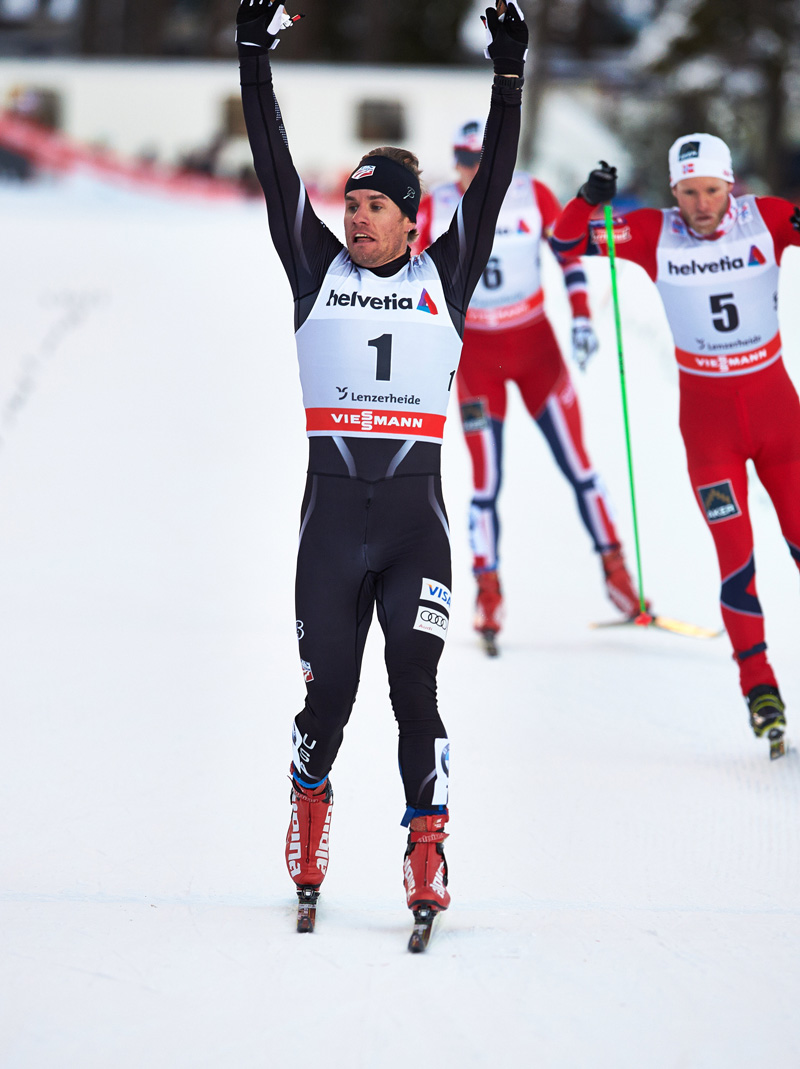
Simi Hamilton (U.S. Ski Team) celebrates his victory in the third stage of the Tour de Ski. Hamilton is the first American male to win a stage of the Tour. (Photo: Fischer/Nordic Focus)
Hamilton’s win came in 2013 in Lenzerheide, Switzerland. During his career, he earned two second places, one in 2015 and another in 2017, both in Toblach, Italy. He also landed third in Gatineau’s 2016 sprint. All were in skate technique.
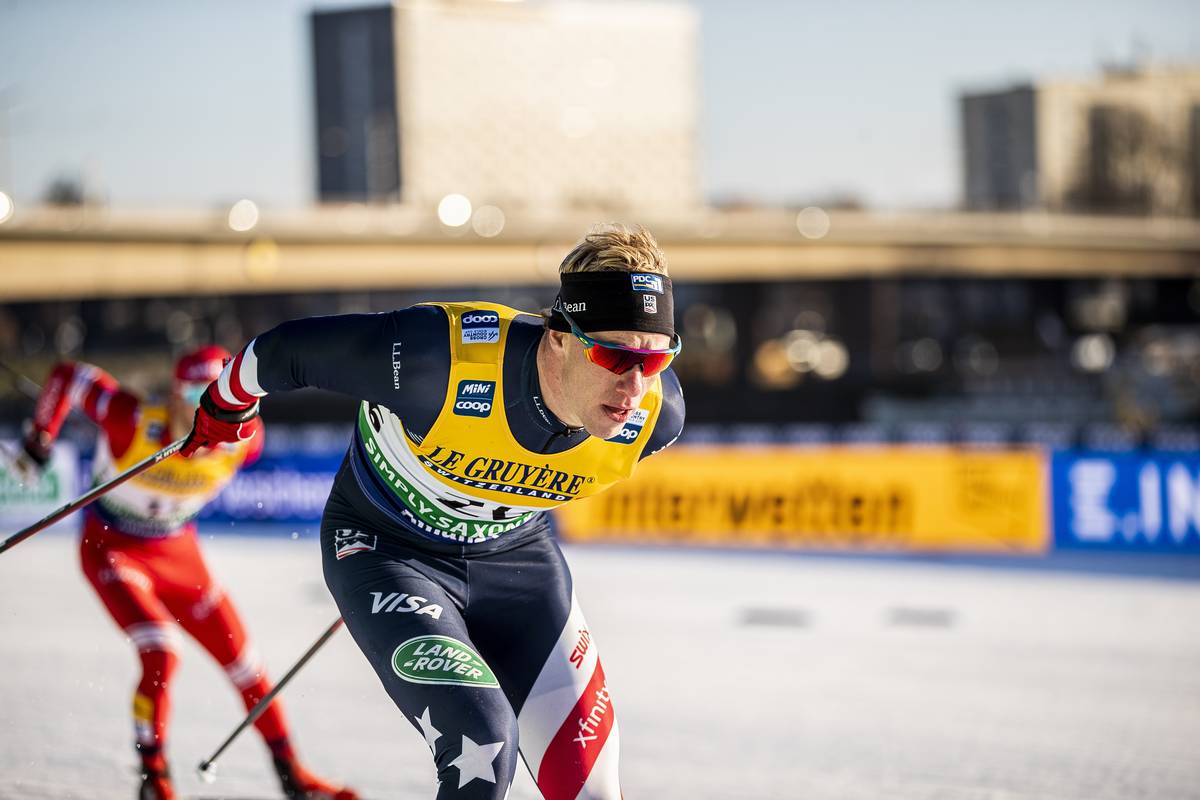
He popped 10 top-fives on the World Cup, which include four fourth places, one a fourth fastest time of day in a 15 k skate pursuit in 2019, and a single fifth place this season in Dresden. He raced into the top-10 on 27 occasions when aggregating team and individual results.
In 2016 and 2017, respectively, he was ranked 10th and ninth overall in the sprint standings. He finished this season, his last, ranked 14th. In 2017, he was 30th on the distance list, his best career distance ranking. His top distance result was 12th in a 15 k mass start skate in 2018 in Seefeld, Austria. Side note here, we are ruminating on World Cup results. The fastest/fittest cross-country skiers period. In a post-race conversation this winter, U.S. Ski Team Head Coach Matt Whitcomb commented that Hamilton was as proud of his 32nd in Falun’s 15 k individual start skate as any race he’d done. At the 2021 World Championships Hamilton paced himself to 31st, the third fastest North American, in the 15 k indivudual skate. Again, Hamilton was thirlled. It speaks to the notion that Hamilton understood perfectly well the best-in-class competition he faced with each race opportunity.
Simi Hamilton (c) races towards the win of the 1.5 k freestyle sprint final at the 2017 Tour de Ski Stage 3 in Lenzerheide, Switzerland. (Photo: Nordic Focus)
Stating it outright, Hamilton is the most successful U.S. sprinter to race the World Cup. To couple all the results pressure, and the desire for the U.S. men’s team to cultivate a regular podium threat, he also carried a heavy karmic burden when in 2014 Outside Magazine declared “This Man Will Make Nordic Skiing Cool”.
With 2020 in the rearview mirror and the masses flocking to cross-country skiing, there’s no doubt it’s cool. Even more, this much is clear: it’s necessary. And it seemed that way for Hamilton too.
Back to the buzz about Hamilton. There’s the “have you seen him climb?” There’s “Have you seen him kayak?” Mountain biking savant? That he is. Ski mountaineering? We alluded to that up top in this piece. I’m sure if endurance tap dancing were a thing and required a flow-state of mind and big lungs, he would kill.
“Simi is someone, I think, whose heart is mostly in the high mountains and the backcountry but his body was just so designed for going fast on skis that it would have been a shame not to do it,” McKibben said on our podcast.
Hamilton raced at three Olympic Games and six World Championships.
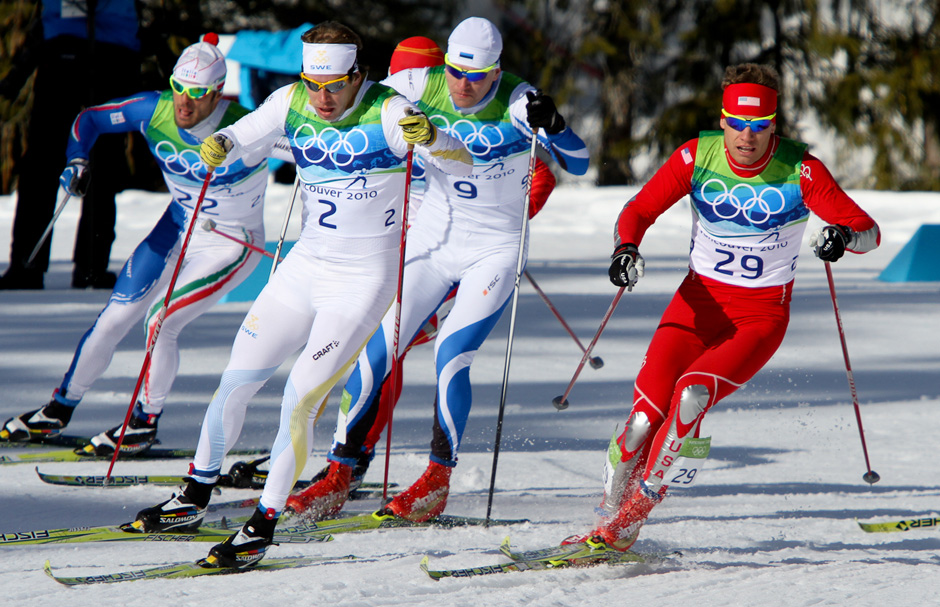
Simi Hamilton sprinting at the 2010 Vancouver Olympics.
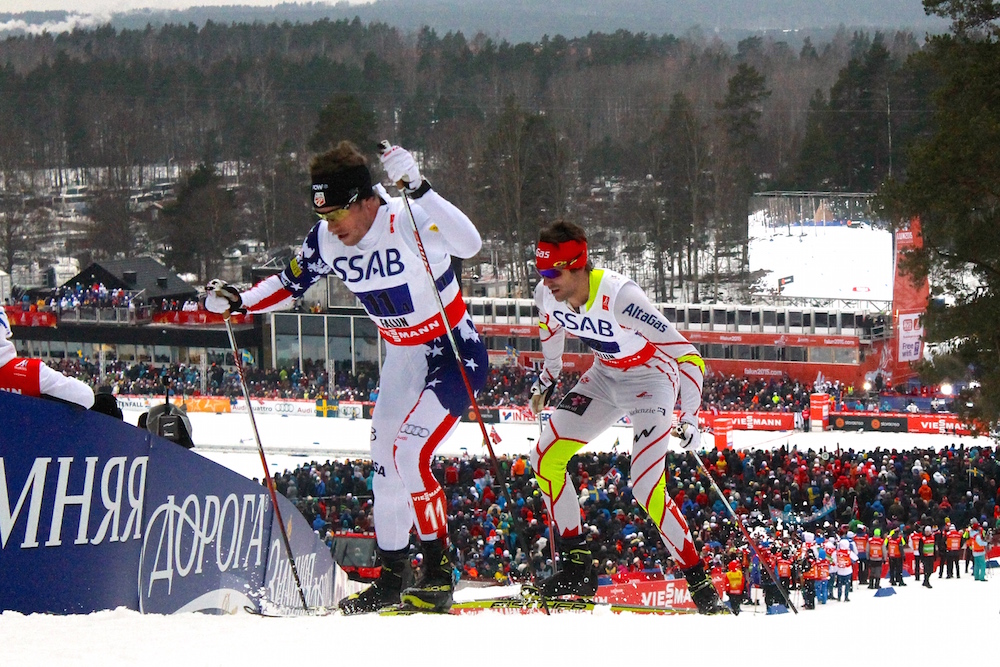
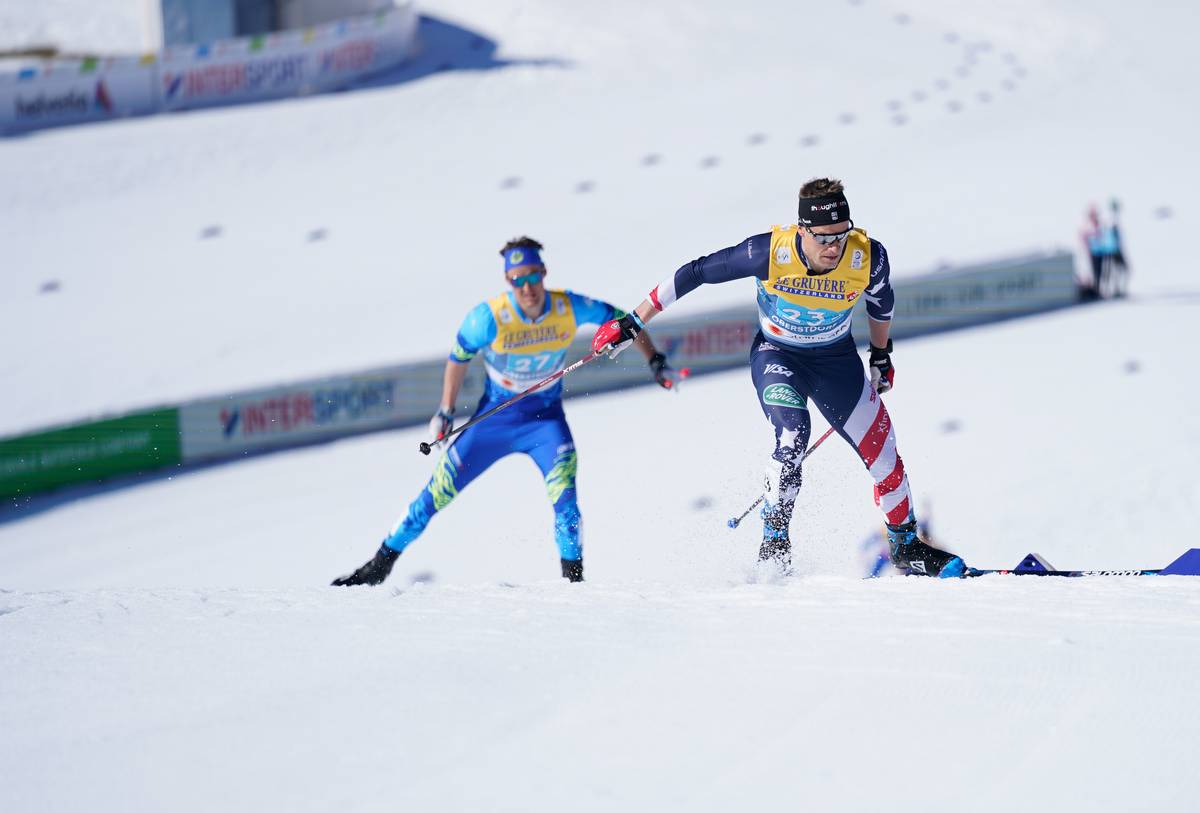
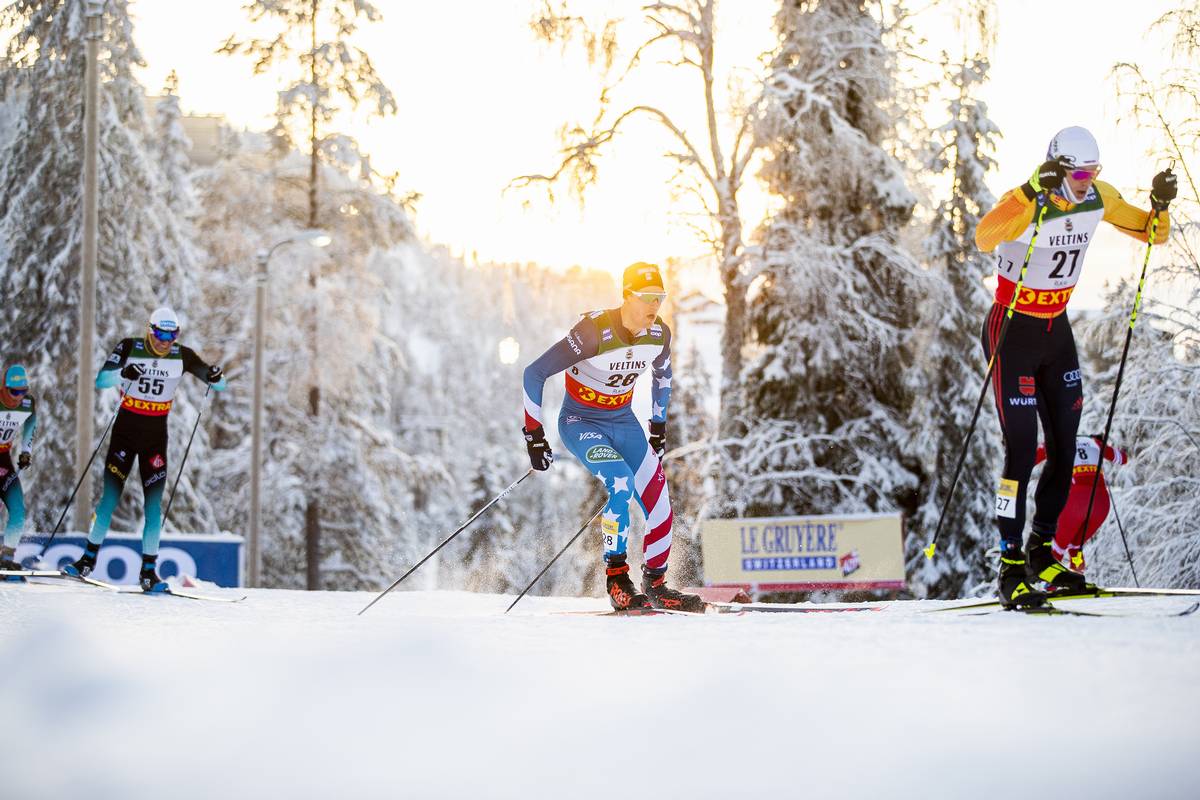
American Simi Hamilton (r) leads Canada’s Alex Harvey (in red) during the men’s classic team sprint at the 2017 World Championships in Lahti, Finland. (Photo: John Lazenby)
His U.S. Ski Team tenure overlapped with a mix of skiers populating the men’s team. From Kris Freeman to Gus Schumacher, Hamilton has navigated a period often overshadowed by the women’s team. The men’s team, for its part, had a core, of which Hamilton was part of its nucleus. The men’s team was small some years, larger on others. Discretion came into play in nominating teams, sometimes rosters filled out with those meeting objective criteria. The men’s side wasn’t exactly a revolving door, however, it lacked the three to four hallmark skiers who would routinely race into the top-20 in sprint or distance events.
We know Matt Whitcomb had the official title of women’s coach for years. Yet the U.S. rarely named an official men’s coach during Hamilton’s time on the national team. This is not so much a comment on a possible lack of commitment towards the U.S. men as a reflection on the environment in which Hamilton matured as an athlete. Cohesion was often not a trait used to describe the men’s team.
This season marked a turning point. Younger skiers emerged on the team, several of them more than a decade younger than Hamilton. Schumacher set the bar in distance racing, he’s twenty years old. JC Schoonmaker proved to be a reliable sprint qualifier and heat skier. He too is twenty. Ben Ogden, a teammate of Hamilton’s on the SMST2 Team, raced in his first World Championships at 21 years old. Ogden was a U.S. best 11th in the classic sprint qualifier and 17th overall. Hamilton, however, was noticeably absent as a starter in the 2021 World Championship individual sprint. Known more for his skate prowess, Hamilton, according to Whitcomb, had the right to refuse the start. Hamilton did so with the understanding that Ogden just might be able to capitalize.
Ogden did.
Simi Hamilton after placing fifth in the individual skate sprint in Dresden, Germany this season. (Photo: NordicFocus)
“People have been messaging me asking why I didn’t race yesterday… valid question and I take it as a compliment that so many have faith in my classic sprinting! I’m not sick or injured. The reality is that after 11 years of trying to crack the code on classic sprinting at this level, I didn’t really think I was going to figure it out in what is most likely the last few weeks of my career, and I wanted to put all my focus into my skate racing, especially with the chance to partner up with one of my role models @gus.schumacher for the team sprint. I knew my decision was a good one yesterday when @ben.0gden was given my start and made the statement that he did, qualifying in 11th from bib 61 and finishing the day in 17th. I’ve said this before but I’ll say it again: this team of American boys coming up is going to do some extraordinary things, and I’m just humbled and grateful to do what I can to contribute to that. But first it’s time to get this old, creaky body in gear and do some skating!”
At those same championships, Hamilton and Schumacher, a hotly anticipated pairing in the skate team sprint, did not advance out of their semifinal. Schumacher, in his first career World Championship start, left early in the tag zone without the tag from Hamilton. Schumacher reversed his progress for a redo, yet by then the time-loss damage was done. Hamilton could have been the prima donna and castigated Schumacher. Certainly, Hamilton’s disappointment was palpable. Schumacher felt he had let an opportunity slip away from Hamilton. The two processed the snafu and moved on.
It doesn’t take a colorful imagination to conjure up a messier scenario unfolding had someone more self-centered been in Hamilton’s place. Elite sport is rife with the self-absorbed. As I have heard Hamilton note on several occasions, he understood the real gravity of the situation — “It’s just a ski race.”
One can also imagine all those younger skiers either on the team or on the cusp took note of Hamilton’s class and humility as he ceded his start to Ogden and comforted Schumacher. Many skiers likely think they are invincible at 20. Their time to retire will come too. Hamilton set a high bar for the men’s team in terms of how and when to acknowledge another skier’s emergence and deal gracefully with race-day disappointment.
“At the beginning of the year, I wasn’t that aware of Simi’s leadership efforts; I knew our team was actively trying to cultivate a group of strong athletes and leaders, but didn’t know the role Simi played in it,” Schumacher wrote to FasterSkier. “Fast forward to the end of the year and I understand Simi’s role in our team culture so much more clearly. He held off his retirement for another year in part to ski fast and support Sophie, but a major goal of his was to facilitate an incredibly tight and positive team, as well as helping us younger guys get acquainted with the whole scene. I learned a lot of this after the team sprint when I was feeling very disappointed in myself. He opened up about how little he cared about the result, and how much he valued our relationship and the experiences of everyone else on the team. He truly wanted to be there for his teammates all year, and when I realized this, so many things he did this season came into perspective. He’s been so quick to help the team and be a friend, sometimes at the expense of his own training and convenience, and I think that has made so much difference for our team culture. This is one of the strongest and most supportive men’s teams in a long time, and I think a lot of that is due to Simi’s efforts as an amazing team leader and friend. I hope we can continue to use what we learned from him in the future, and keep the good momentum going!!”
The men’s podium for the 2019 15-k mass start classic during the Super Tour Finals in Presque Isle, ME. Erik Bjornsen (center) took the win ahead of Simi Hamilton (left) and Gus Schumacher (right). (Photo: U.S. Ski & Snowboard – Reese Brown)
Schoonmaker had similar sentiments when it came to a “hero” in his midst and Hamilton’s willingness to foster a welcoming environment.
“When I was younger and first started paying attention to the World Cup, Simi was our best men’s American skier so he was the guy I looked up to and aspired to be like,” explained Schoonmaker. “I knew he was an awesome skier and I could tell from listening to his interviews and hearing him talk that he was also an amazing person. It was an incredible experience this season being able to ski with and learn from one of my heroes.
“The men’s team on the World Cup was an incredible and fun group to be around this season and I think Simi deserves a lot of credit for that. He could’ve easily swept Gus and me under the rug but instead, he went out of his way to make us feel comfortable as newcomers on the circuit. He always gave his thoughts on tactics or the course the night before a race and showed that he was invested in each person on the team and had our backs.”
Hamilton also forged a deep friendship with now retired skier Erik Bjorsen. He and Hamilton paired together in the team sprint at the 2014 and 2018 Olympics, where they placed sixth on both occassions.
“Good results don’t always make up an unforgettable day, there are so many other factors that contributed to a dream race day,” Bjornsen said. “I’ll always remember the other shenanigans Simi and I got up to on those days in Sochi and in PeyongChang. We shard everything together; nerves, excitement, and celebration. He’s an amazing friend and the most supportive teammate I’ve ever had. There is no doubt why I had my best performances alongside him.”
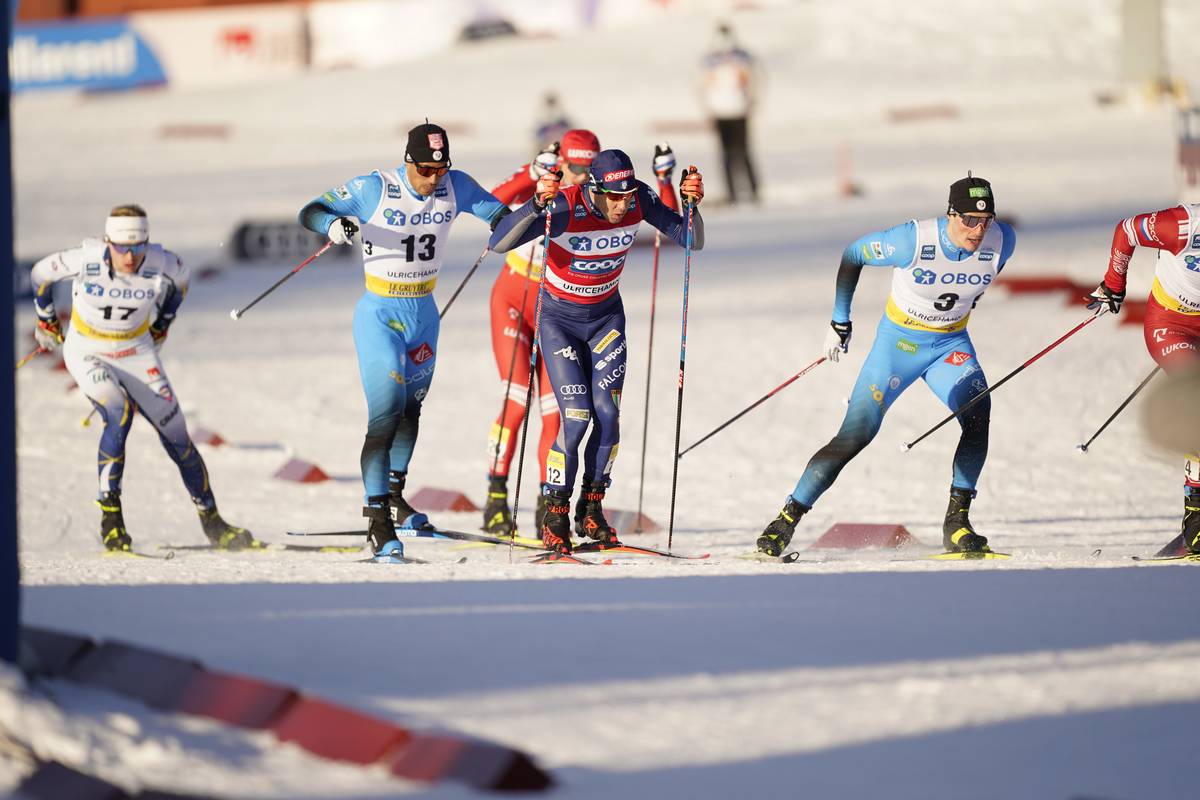
Simi Hamilton (bib 13) at the start of the men’s 15 k mass start classic during the 2020 Tour de Ski. (Photo: NordicFocus)
***
Beyond his wife Sophie Caldwell Hamilton, who also retired this season, Whitcomb is perhaps Hamilton’s closest confidant on the team. We sent Whitcomb a series of questions, the same for Caldwell Hamilton if you are keeping tabs. Below we are including his responses.
FasterSkier: Nugget of wisdom from Hamilton that you have learned and now apply in coaching/life:
Matt Whitcomb: Unlocking the strength of the mind is more important than physical talent and hard training. Simi made career-high gains in the last two months of the season with regards to his distance racing (Falun and Oberstdorf), even though they weren’t rewarded with big results. We made this a project, and it worked. Look for distance-racing potential in people who consider themselves sprint specialists. Often, sprinters just assume they will explode in distance races if they redline because they have before. Instead, make the warm-up harder, perfect pacing, and toughen up. Pain is only real if you’re soft.
FS: Most difficult aspect about Hamilton in terms of priming him for peak racing, and how did you navigate that issue?
MW: For Simi, everything is about motivation. The day he won a World Cup in Switzerland, I vividly recall his arrival at the wax room that morning. He was psyched and it was clear he was ready. Just the same, whenever we missed the mark on motivation for a race, he never performed well. But don’t mistake this for motivation as it’s often viewed; I’m talking about ready-to-make-a-kill motivation, rather than watch-TV-or-workout motivation. Getting Simi out the door to train hard or long was never an issue. Most people don’t know that he was a 900-hour athlete.
FS: Easiest part of coaching Simi?
MW: For me, the most important skill a coach can have is the ability to connect with others. Simi and Sophie are great friends, so that connection—that two-way flow of concern—makes coaching them easy. A hard part of coaching is not knowing the unspoken stresses of an athlete. This stuff needs to be tackled first before any training can take.
FS: Non-competition personality trait that made the “team” more of a team.
MW: Simi connects easily with, and inspires developing athletes. They idolize him. He figured out how to be an effective, consistent leader later in his career, and because of it, our men’s team is now a world-class, cohesive environment. I think he’s going to have a lot of fun watching this team succeed, and he’ll know he made a difference.
FS: Simi’s side of the room, by Sophie’s assessment, is fastidious: folded and tucked in everything. How might that trait manifest as an xc skier in Simi’s case?
MW: Well, the side of the room that has the folded clothes and the portable steamer, also has the athlete that needs more structure and tidiness to his plan and goals. The race plan and strategy are more important. The one whose clothes singe on the lamps, and carpet the floors, and whose passport gets lost in the couch cushions, and who might race a semi-final at World Championships on Jessie Diggins’ poles even though they are five centimeters shorter, and who…okay I’ll stop…well, she just needs to be fit and happy on race day. She’s better at adapting in the moment.
FS: Proudest moment as Simi’s coach?
MW: I don’t hang my hat on results, so nothing really jumps out there. That they raced into their 30’s is my proudest accomplishment for them. Many good athletes in the U.S. quit in their early 20’s before they had a chance to bloom. I’m also feeling proud of the way they handled their quarantine during their intended last World Cup races, which should’ve been a week-long celebration of their ski careers. (As I write, they successfully boarded and are on a plane home.)
FS:I know Simi considers you a close friend. How did you balance that when coaching him? How did that enrich the experience?
MW: I don’t subscribe to the you-can’t-be-friends-with-athletes rule when it’s adults coaching adults, but that only works if you can maintain your ability to get tough from time to time. We’ve been through some hard personal times together, and it hasn’t always been just me supporting them. I ski coach because I like to ski and because I like to connect with people. Sophie and Simi are two of the people I credit for me still loving my job after so many years.
FS: Simi’slasting legacy for each athlete when it comes to team culture?
MW: For Simi, a big goal of his and mine was to stop fucking around with men’s skiing, and finally build a team that works together. This happened this year, and Simi was consistent in his leadership from Ruka, all the way to the team meetings in St. Moritz last week, where he continued to offer thoughts from quarantine. This will last for the team, and for him in his next career.
American Simi Hamilton leading Lenny Valjas of Canada over the top of a hill in the men’s 4 x 10 k relay at 2015 World Championships in Falun, Sweden.
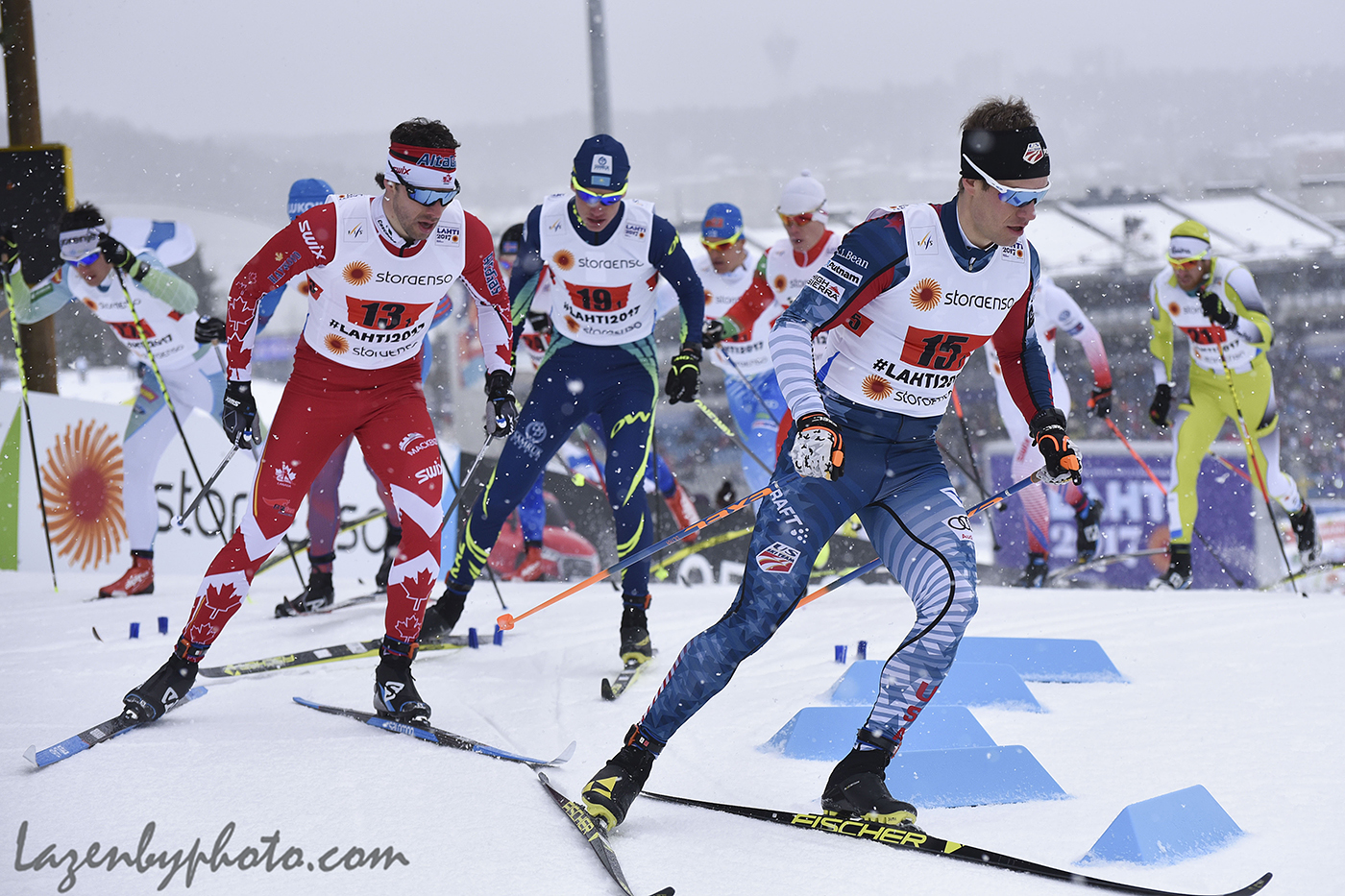
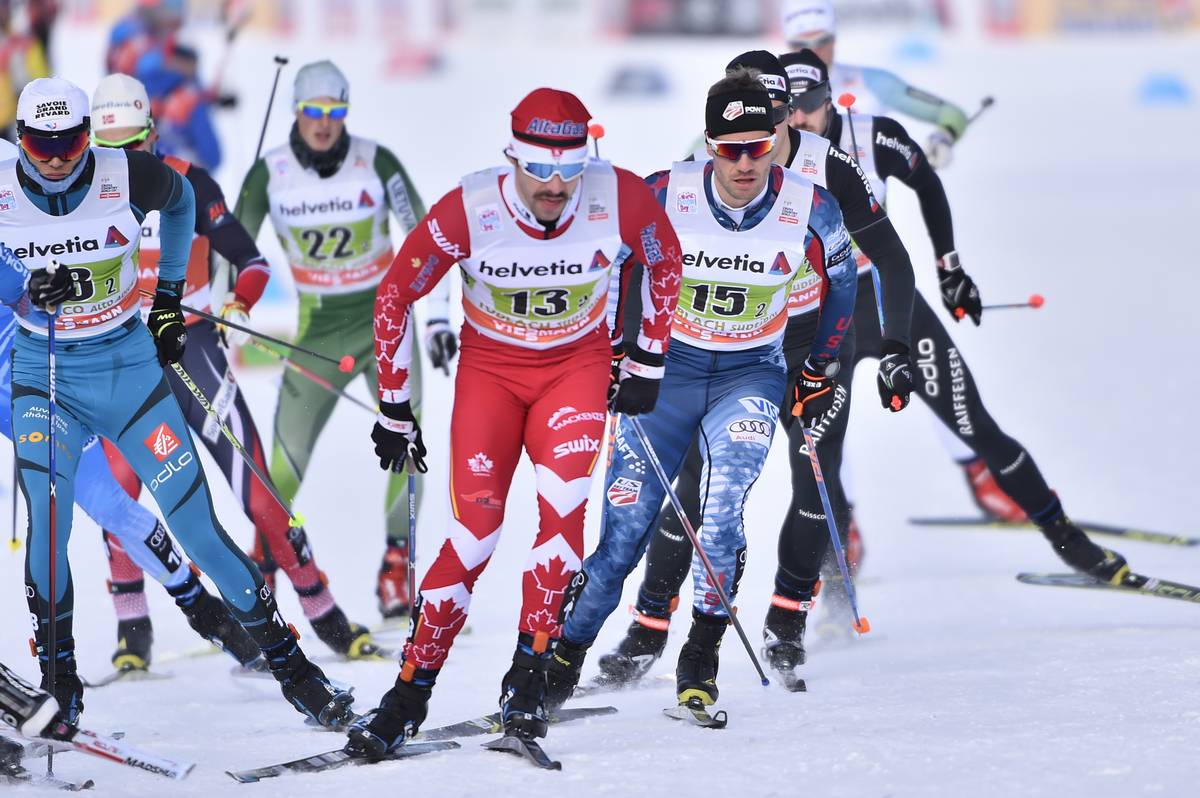
Canada’s Alex Harvey (13) leading American Simi Hamilton (15) in the 2017 men’s 6 x 1.3 k team sprint on Sunday at the World Cup in Toblach, Italy. (Photo: NordicFocus)
***
What follows is an interview conducted with Hamilton in mid-March. At the time, he was quarantined in Switzerland and awaiting permission to return to the U.S.
FasterSkier: The way it was described to us by Sophie, you are fastidious when living on the road: Tidy and folded t-shirts. Maybe socks nested together. Just pretty much tidiness to contrast her mayhem. Where does that come from?
Simi Hamilton: Honestly, I don’t know where it comes from. My mom, she’s super organized and neat. And I wouldn’t say any of us have OCD, but for sure, I’m more towards that side of the spectrum than many others. You know, I really like to be clean. I don’t feel comfortable if I’m spending time in a room or something and things are just temporarily tidy. Honestly, I think that’s been one of the ways that I’ve been able to cope with, living on the road for so long. I’m in a new hotel room every weekend, living out of a duffle bag. I feel like if I kind of make it my little organized space, it feels a little bit more like home. At least that is what I tell myself.
First of all, on this team, I can say this is a bit of a generalization, but you walk into any one of the women’s rooms and it’s just like a freaking bomb. There’s just stuff everywhere. There are clothes, there’s shit hanging off of everything like you just dumped it everywhere and then you walk into basically anyone of the guys’ rooms and clothes are put away. It’s just funny.
FS: How did you find purpose on the team this year outside the racing? Can you give us a little bit of insight, like, what was your role on the team this year? And if you found purpose, what was that purpose?
SH: I think coming into the season, I didn’t know exactly what my role was. I didn’t know that there was an opportunity to step up. As someone who has been doing this for a long time, and has learned a lot about training and racing and being on the road and being part of a really good organic functioning family team, I didn’t know exactly how it would be. I did sense that there would be an opportunity to step into a leadership role in some way.
I think I did a good job of coming in and, and not trying to force these young men to do certain things or fit a certain kind of mold, or act like a certain type of team. I think a lot of people outside of this team, look at the women’s team and they see what they’ve done. And they try to apply that model or that template to other teams or other situations. It’s the kind of thing where if you want a group of people to function well, you simply have to prop each other up. If you want to build something like that in a positive direction, you have to let it do its own thing.
I don’t think you can ever force the team dynamic to be a certain way. The women’s team has certainly become dominant and successful. But I wanted to allow this entity to morph into its own type of team, and function with its own identity. I simply came into the season just trying to foster that amongst all of us. And I think it worked well.
You know, it was awesome having Gus and JC for the first half of racing and in the second part of the season, we had more of these young men joining us from World Juniors and U23s. It became a really awesome crew and I think you saw them bring out the best in me and Kevin Bolger, Scott Patterson, and David Norris — all these guys who’ve been doing this for a long time. It was rejuvenating and it gave us a spark.
But to be more direct in answering your question, I didn’t do anything beyond trying to be present. I tried to be positive and I tried to lead by example with these young guys.
I always felt like that was something that I never really experienced during my younger years. And that isn’t to say that there weren’t strong leaders on the team. That isn’t to say that they didn’t learn things from people like Kris Freeman, Andy Newell, Torin Koos, and even some of my peers like Noah Hoffman. I learned so much from those guys and I am grateful for that. But I think, for whatever reason, there was never really that cohesive bond amongst every single person on the men’s team. I wanted to encourage us to find that this year, and I think we did.
I honestly think the most important thing that we all did this year to make that happen was we just encouraged everyone to bring what they had to the table without expecting anyone to be someone or act a certain way or be someone they didn’t want to be.
As that became the standard we could simply be ourselves every day and buy into this team. It was cool. It made all the difference. Obviously, I wanted success for myself this year, I wanted some good results. I wanted to feel proud of what I was accomplishing and go out on a good note.
But absolutely, it was more important to feel like we were coming together as a team and doing something organic and positive. It was a huge success.
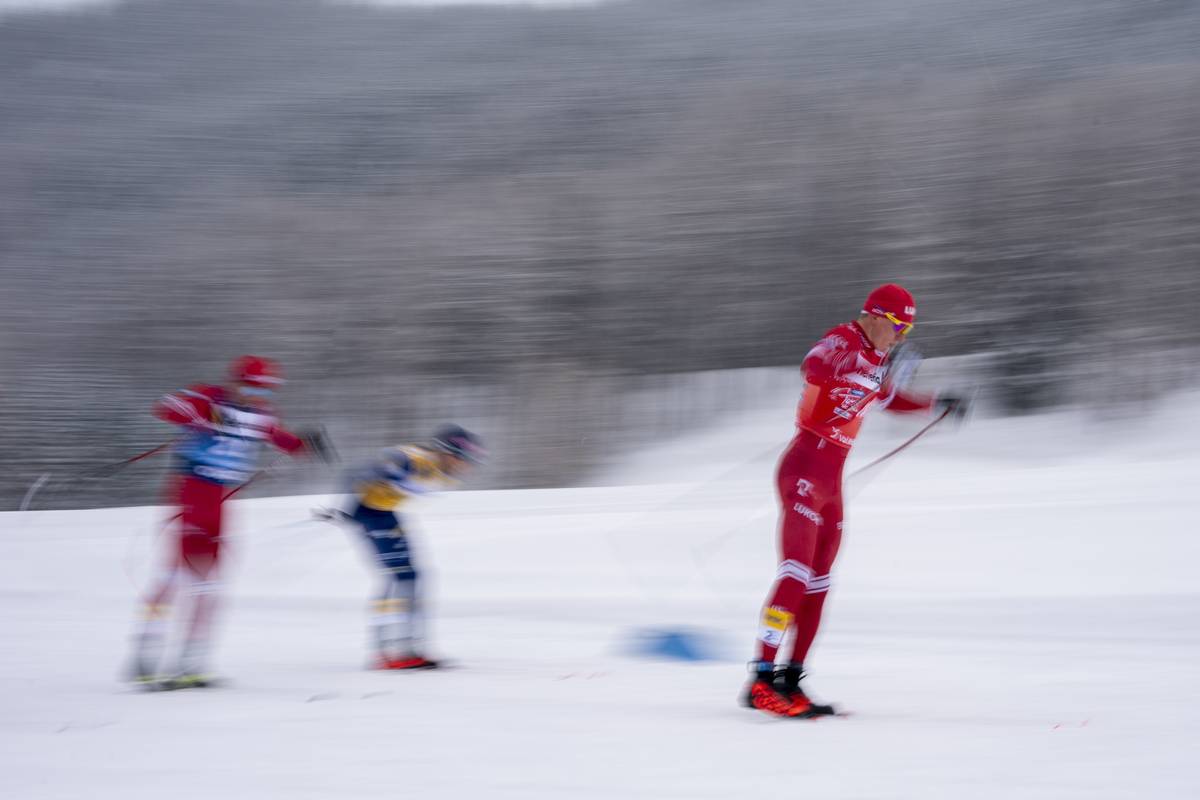
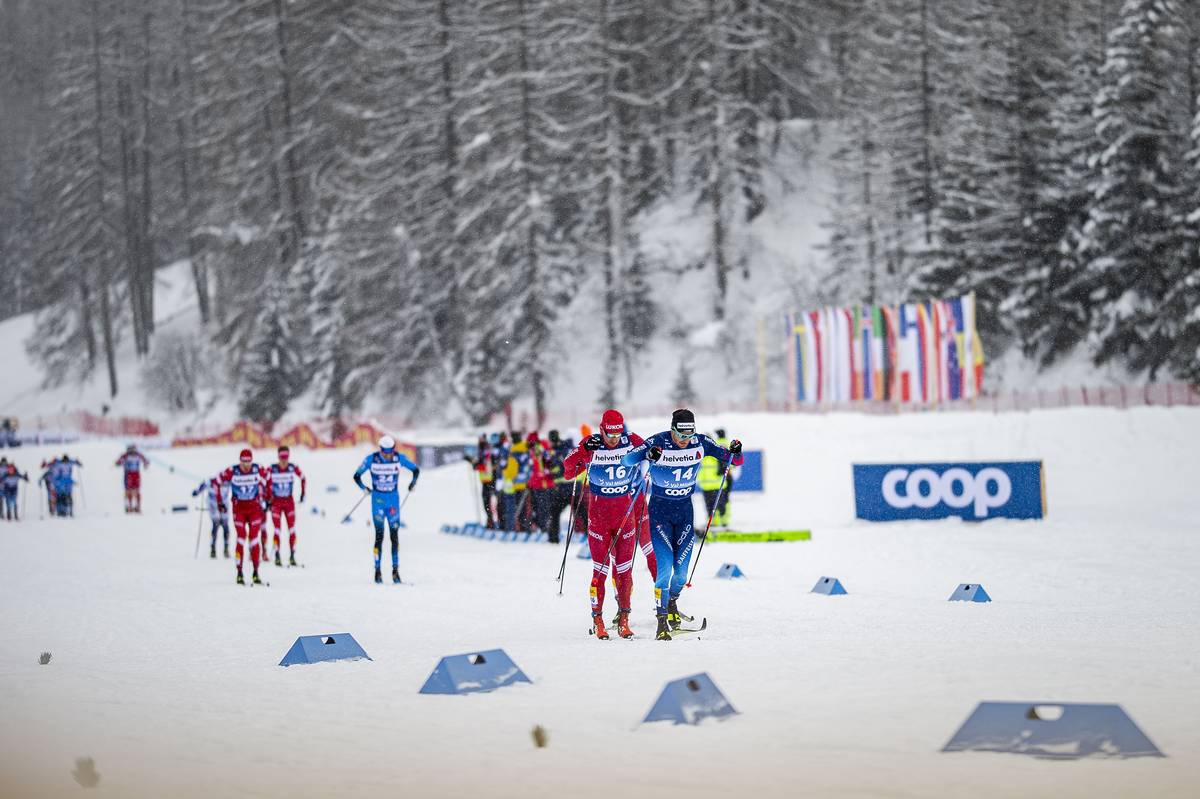
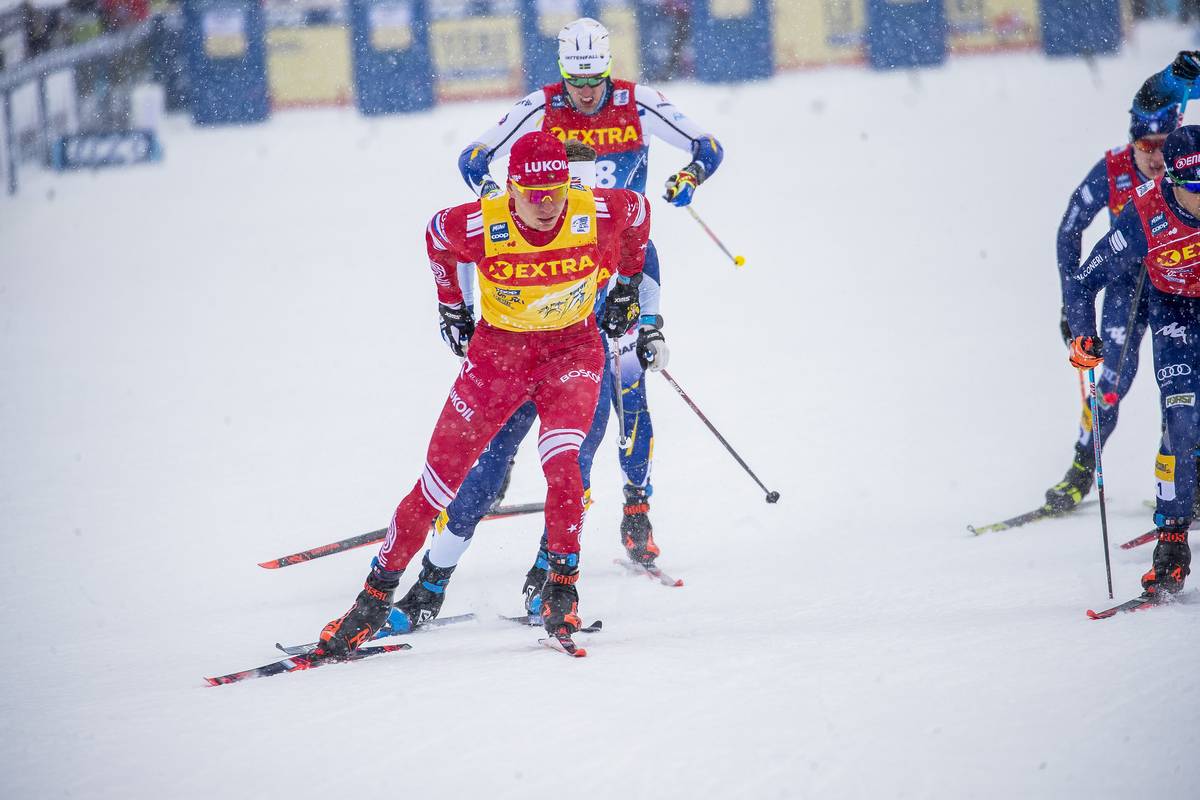
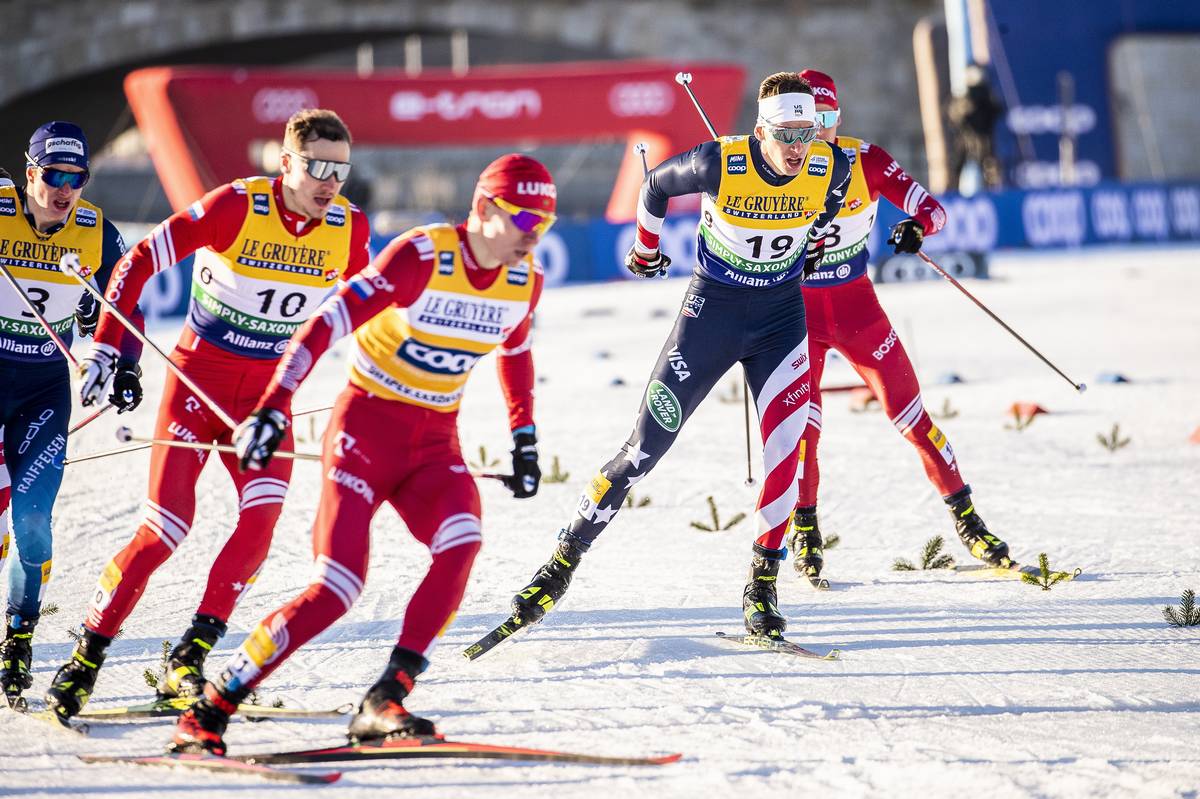
Simi Hamilton amidst a slew of Russian skiers this season on the World Cup. (Photo: NordicFocus)
FS: Just refreshing your FIS profile…you are 33 years old. You’ve been with many different groups as you raced the World Cup. What have you learned about being in close quarters with many different teammates and how to navigate situations where the dynamic is not ideal?
SH: Our ultimate goal with that is creating an environment where, you know, if somebody is doing something, or seeing something, or acting a certain way, that is either detrimental to themselves or detrimental to the team or detrimental to the community that we’re in at that time, that we can soeak up. I’ve learned that it is important to create an atmosphere where someone feels comfortable speaking out and saying something constructive. Sating something like, “Hey, you know, that’s offensive to me, or I don’t think what you are doing is making us ski faster.”
So I think just being able to create that team environment, that team energy, where we all feel comfortable enough with each other that we can change things and have everything be constructive. That’s the work of a high-functioning team. I think that’s valuable and we did that this year.
FS: I know in the past, whether officially or not, it was year to year for you in terms of ski racing. I understand that you as a person do not need the validation of another Olympics to bolster your self-worth. That said, the Olympics are not that far away and that’s a big carrot for a lot of elite athletes. You are forgoing another Olympic experience. What was your calculus in thinking this was the time to step away?
SH: That’s certainly not the first time I’ve heard that. I think honestly, I think both Sophie and I were pretty ready to be done last year. And then I had the season I had last year and I just felt so unfulfilled with what I was capable of doing. And not only individually. It was tough for me just because I was injured and sick for much of the season, even when I was on the road, I felt like I couldn’t be very present, I couldn’t be the leader that I wanted to be on the team. I was just feeling like I wasn’t checking those boxes that I wanted to be checking.
As soon as I said I was going to ski one more year, I felt really good about that. So I knew then basically people would immediately start saying if you’re gonna go through with next year, then why would you just not go one more year to the next Olympics?
I won’t say it’s never been about that kind of thing for me, obviously, there’s something awesome about doing things like going to the Olympics and World Championships, making a certain team, or something like that. But I think, at this point, we’re such dynamic people, we’re well educated, we have some awesome hobbies outside that allow us to experience these amazing communities in Vermont and all these awesome families — We have all these things tugging at us. And I think for both of us, they’re finally really touching hard enough that we want to respond to those things out there.
I also think we’re wanting to start a family soon and start building this house. We want to start writing all the things in the textbook if that makes sense. So it never really felt like we were giving up on the team, or the Olympic movement. I don’t think need those things in our lives anymore to progress.
Simi Hamilton Mid-Crust Cruise around the Four Pass Loop — A loop circumnavigating the Maroon Bells outside Aspen, CO. (Photo Credit: Linden Mallory)
FS: In talking about you, Bill McKibben mentioned an anecdote about you skiing off some peak near Aspen for your ninth birthday. And some of the stories are legends. I know you like moving fast, be it on skis in the mountains, climbing, biking, whatever. You probably could have been a lot of things when considering the pro-athlete realm. Can you provide some insight into your path as an athlete?
SH: Certainly growing up in a place like where I grew up, I always had a huge draw to getting outside and doing things other than just cross-country skiing. I plan on doing a lot more of that now. But I have come to realize in the last few years of my career that it’s so much more important to find something that is simply fun. I also need to feel like I’m doing something worthwhile. What I started appreciating about cross-country skiing was just the amount of hard work to be good at it. I think especially as a US cross country skier doing that, dedicating your entire life, to doing something like that for 10 years, and not getting a ton of recognition for it — and I say that with a grain of salt because obviously we have this amazing community of supporters and we do get a lot of recognition for what we do, but when you compare the amount of praise and financial earnings between like what we’re doing and between what freeskiers are doing or maybe some things that I could have potentially seen myself doing if I hadn’t have gone down this path, they are incomparable.
But doing this for the last 10 years has taught me how incredibly valuable humility is. And just like I said, sheer hard work, and commitment, and dedication. And I think that those things that I’ve learned are going to be the most valuable things that I can use going forward in life. And those things are the things that I want to pass down to my children and have them pass down to their children.
FS: The concept of humility is interesting when thinking of elite athletics. You have a reputation as an amazing all-around athlete let alone a cross-country skier. But if you can think back over the decade, and racing on the World Cup, that is a tough scene. Some weekends it works out, others someone might get their ass-kicked. Can you reflect on your humility and how that evolved?
SH: I don’t think there’s anybody who comes on to the World Cup scene, from any country, who isn’t somewhat confident. But, I think a lot of people say that they’re ready for this level of racing, and then when they’re experiencing it, it’s like they don’t have any idea of what hit them or what is coming.
It certainly took me a long time to figure out how to be good. And it still boggles my mind to see how consistently good someone like Klæbo or Pellegrino. Basically, weekend after weekend after weekend after weekend they are one of the top five or on the podium. That is such a ridiculously high-level sport.
It certainly took me some time to figure that out. As I progressed I started to appreciate the lesson in patience more and more. Knowing that maybe I would go two periods on the World Cup without really having a truly awesome race. But you know, maybe in that third period or something I would have a top-10 or podium or a final. That is worth waiting for and working hard for. It took me a long time to learn that lesson. Especially coming from a pretty successful career as a junior skier in the US. I certainly was expecting it to be hard as it was and take as long as it did, but again, as I said with your previous question, that’s just the part of this sport that is pretty cool: You just have to keep your head down for a long time. And be doing it for the right reasons. Because if you’re not, then you’re not going to be able to grind away.
FS: The usual question, what are you most proud of in terms of race results?
SH: Obviously, my win in Lenzerheide, my third place in Canada, were all very special. They were awesome days. But I think, you know, I would say my three best moments in my career on the World Cup at least, and I’m not ranking these because they’re all a little bit different. But three experiences stand out to me as incredibly special.
The first was watching Sophie win her first World Cup in Oberstdorf. It sucked because I was sick. I had gotten sick the night before, during the Tour. I wasn’t even at the venue. But the coaches gave me the OK to go and pick her up in one of the vans. I had some great alone time with her. I was just so happy for her knowing how hard she worked and knowing how much that meant to her, to get to that point was pretty special.
The other two were the 2017 Lahti World Championship classic team sprint and the 2014 Sochi Olympic team sprint and those were both with Eric Bjornsen. They were races where we both skied well. But more important than that, everything just kind of clicked. And I felt on both of those days that Erik and I were racing for each other. And that felt cool to do. I have felt that in some distance relay teams and some other races throughout my career, but, I think those two days stand out to me as just being so connected with somebody else, that we will race until your heart explodes for that other person. It’s a cool feeling to have. And I’ll for sure reflect on those days.
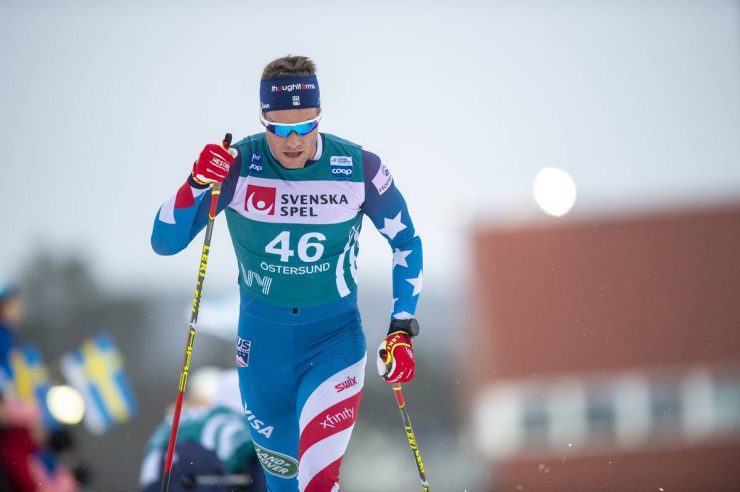
Simi Hamilton racing in Östersund, Sweden. (Photo: NordicFocus)
FS: Is that perhaps because you had a personal connection specifically with Erik?
SH: I definitely wouldn’t say that I wouldn’t have had that same experience with anybody else. But, Erik and I always had a close, really special relationship with each other. And I think we both understood each other. We understood what motivated the other person. We understood what bummed the other person out.
I think we were doing it for the right reasons. Just being able to share an experience like that with someone who really gets you and who you get is pretty cool. I’m sure it’s like when you’re on a team, playing a team sport, whether it’s hockey or soccer or baseball, whatever it is, just being able to share a huge success like that with your whole team, it’s got to be a very similar feeling.
I have enormous pride for what Jessie did this season or our girls are on a podium, we always feel a lot of that. But, I think to be in the team sprint with one other person who is one of your best friends in life, there’s not a lot of substitution for that.
Simi Hamilton racing during the team spring semifinals at the 2021 World Championships. (Photo: NordicFocus)
FS: That brings up the experience this year at the World Championships with Gus. Maybe give us some insight. You are paired with an exceptional skier in Gus who is more than ten years your junior. This was his first senior World Championship race and I am sure he was nervous. What was that emotional trajectory like for you?
SH: I definitely won’t say that that day was not heartbreaking. But, I will also say, with 100%, truthfulness and accuracy is that it wasn’t heartbreaking because of Gus. It was just heartbreaking because of the situation. It wasn’t that we got unlucky, but we didn’t get lucky that’s for sure.
Gus would have done anything for me that day. He knew how important that day was for me, but I think he thought the result was way more important for me than it was. And the result was absolutely important. We both went into that day wanting to get on the podium, and we knew that we could but it had to take the perfect race from both of us – and probably perfect conditions for both of us, which, you know, it wasn’t.
It was never is never about the result for that day, that was our goal and it would have been a perk, but there was so much more about that day that was important. A lot of what happened was, I think, it can mostly be attributed to Gus just not having that much World Cup experience yet and team sprint experience, and being able to adapt as you’re racing especially on a day when conditions are changing that much.
And, you know things were so different from even a couple of minutes before. What happened that day was we were in the second semi-final which was an unlucky thing in the first place, just because those springtime championship races in the middle of the day the conditions are changing so quickly. The course is slowing down like 10 seconds per lap — that’s how much it was breaking down as it was getting softer and slower. So the first couple of tags we did, the snow was decently fast, but you could tell it was starting to slow down. But towards the end of that semi where you’d come into the tag zone, it was just everything you could do to try to sprint through slush.
I think on that last tag, when I was tagging Gus, he just thought the tag zone was way faster than it was, and he started going with the guys who were around him. And that was just a little bit too early, and we missed the tag. I made the split-second decision to not try to hide that and actually go back into the zone with him and get the tag off because I just figured, you never really know what’s going to happen in that lead pack, there could be a crash, you something could happen. I figured it was worth doing it right because I also knew the jury always sees if you tag or not and I knew we had not tagged.
So I made that call to tag. We skied our asses off but it wasn’t enough.
He was devastated. I think that he finally understood that that is just part of racing — shit happens and it sucks when it happens on a day like that in a race like that. That’s one of the lessons he’s gonna have to learn, and I mean he has learned, I guess that’s kind of a rude awakening for your first World Champs. But this season, as I said, it’s been so much more about getting those results and what I could do in my last World Championships.
All of those things would have been awesome and they were goals that I had, but it was about way more than that, and I think at the end of the day we both recognize that and appreciate that.
I’m just psyched to see what he can do in the future and I’m sure he’ll start doing team sprints with one of those other young guys. I’m sure that in six years or 10 years, however long, they will be winning medals and it’ll be pretty cool to see.
FS: To close out, let’s talk about risk-taking. As someone who loves adventuring in the mountains, and I mean real-deal adventures, you’ve got to be constantly assessing risk. You are married. Thinking about kids. Renovating a house back in Colorado. Those things make people reassess. Skiing off North Maroon last spring, for example, that brings a certain spice level and some real risks to mitigate. All things considered, how do you consider risk-taking now knowing you will be lured into those amazing Aspen hills soon?
SH: I will be the first to tell you that compared to 10 years ago, I have no desire to really push the limits too much. Obviously like by doing anything even getting in a car or whatever there’s risk involved. And there’s a lot of things that we do, we do them because there is some amount of risk. It’s cliché to say, but that’s what makes you feel alive, like if you’re not doing anything that isn’t sometimes a little bit dangerous, then you’re not appreciating life, I think, to its fullest extent. But, at the same time, I don’t need to be out there like filming all these gnarly things and jumping off shit on my skis or my bike. I don’t think I need to be doing that to feel a sense of self-worth and value to society. I feel that in the last few years, I’ve started to recognize some individuals out there who are doing an unbelievable job with kind of telling the story versus posting the sickest photo or skiing the gnarliest line. And to me, that’s so much cooler, and a more admirable way of going about your life, people figuring out a way to tell this really interesting story and cool interesting experiences and connecting with people that aren’t exactly like you.
So that’s what I’m most looking forward to.
Simi Hamilton harvesting corn snow on Broken Top near Bend, Ore. (Photo: Linden Mallory)
Sophie Caldwell Hamilton (right) beaming in Toblach, Italy. (Photo: NordicFocus)
By the time you read this story, Vermont’s Sophie Caldwell Hamilton will have turned a fresh thirty-one. Her birthday is today, Monday, March 22. Although Caldwell Hamilton began representing the U.S. Ski Team on the World Cup in Québec City in 2012, she is profoundly Green Mountain State. Raised in Peru, Vermont near where she later attended the Stratton Mountain School, we’re pretty certain that, in a metaphorical sense, she bleeds maple syrup. As much as she has been the object of our European cross-country ski racing coverage for nearly a decade, she is a Vermonter. She graduated from New Hampshire’s Dartmouth College, we’ll let that slide, but it’s only a sprint finish few hundred meters across the Connecticut River from Vermont. Post-college, she trained with the SMS Elite team with the likes of Jessie Diggins, and husband Simi Hamilton.
As we begin this close-out piece regarding Caldwell Hamilton’s retirement, which she announced March 11th as she was quarantined in Engadin, Switzerland, we’ll begin with the race stats. According to the modern FIS database, Caldwell Hamilton is one of five U.S. women to have won a World Cup race. Alison Kiesel (formerly Owen-Spencer) won the inaugural women’s World Cup event in December 1978 at Mount Telemark in Wisconsin. Kikkan Randall broke her ground by initially winning in 2007. Caldwell Hamilton first won in 2016, to be followed by Diggins that same year. Rosie Brennan posted her first World Cup victory this season. That, when considering the women’s team has headlined the U.S.’s cross-country media coverage for a decade, is rarefied ground.
Caldwell Hamilton during the 2021 Dresden, Germany team sprint. (Photo: NordicFocus)
Caldwell Hamilton racing Planica, Slovenia, 2019. (Photo: NordicFocus)
Caldwell Hamilton won two World Cup sprints, one in Davos the other in Oberstdorf. Over her World Cup career, during which she was a feared sprinter, she advanced to 16 sprint finals for four fourth places, and 10 podiums. She notched five second-place finishes, three third-place finishes, and the two aforementioned wins.
At the 2014 Olympics she placed sixth in the skate sprint, and eighth in the 2018 Olympic classic sprint. Her top result at the World Championships was sixth place in the 2017 Lahti, Finland skate sprint.
Sophie Caldwell Hamilton in Planica, Slovenia, 2019. (Photo: NordicFocus)
From a consistency standpoint, Caldwell Hamilton shined. In 2014 she was ranked eighth overall in the sprint standings. That was followed by a 20th, seventh, eleventh, third, fourth, sixth, and tenth this season considering her career World Cup sprint rankings.
Compartmentalizing her as a sprinter isn’t totally accurate either. This is the World Cup after all. She ranked in the top-30 in the distance standings five times. In 2018 when she was third overall in the sprint cup, she was 19th in distance.
She was also part of a 2016 second place 4 x 5-kilometer relay team with Sadie Maubet Bjornsen, Liz Stephen, and Diggins. That result was repeated with a Caldwell Hamilton, Maubet Bjornsen, Brennan, and Diggins quartet in 2019. Caldwell Hamilton placed third twice in the team sprint, both times paired with Ida Sargent, in 2017, and 2018, respectively.
Her technique, wholly refined, was smooth, the angles perfect, and at times, crushingly powerful. She raced sprints with smarts, knowing her capacity was not her ace card. But damn, could she toe at the line. A mix of old-school Nuryev in its grace and the “pow” of Ali.
Sophie Caldwell Hamilton lunges to edge Norway’s Heidi Weng (not shown) for the win at the 2016 Tour de Ski in Oberstdorf, Germany. (Photo: Marcel Hilger)
We’ve condensed Caldwell Hamilton’s results for roughly 400 words. A much smaller part of this written whole. That is, perhaps, on-point. Although historic in the annals of American cross-country skiing, Caldwell Hamilton’s human qualities, foremost among them, empathy and compassion, may, be her lasting legacy. As much as physical exertion can reveal the core of a person, Caldwell Hamilton’s energy exuded while skiing was revealing. “Serene,” was a word writer Bill McKibben used on several occasions on our podcast recently to describe Caldwell Hamilton as she sped past either in a local Vermont race or the World Cup.
Her coach at Dartmouth, Cami Thompson Graves, added that Caldwell Hamilton led by example and has inspired. “Sophie has always been a pro when it comes to racing, when she puts on the bib, she knows how to race hard, although she is one of the most graceful skiers I have ever seen so she makes it look easy! I am so glad that she decided to make skiing her career for a while,” wrote Thompson Graves. “How cool is it to see that friendly, young woman who grew up racing in Vermont and New England, who trained locally and helped out at numerous camps in the off season go out there and fiercely compete for World Cup medals. I know she has inspired many, many young women to follow in her footsteps.”
***
I’m going to take a moment to allow longtime U.S. Ski Team and personal coach to Caldwell Hamilton, Matt Whitcomb, fill in some gaps for us with this Q & A:
FasterSkier: Nugget of wisdom that you have learned and now apply in coaching/life from Caldwell Hamilton?
Matt Whitcomb: Just because someone says they are okay, and seems like they are okay, doesn’t mean they are okay. Ask again, later.
FS: Most difficult aspect about Caldwell Hamilton in terms of priming her for peak racing, and how did you navigate that issue?
MW: This year notwithstanding for Sophie, she’s been easy to peak for championships. The main difficulty with her is maintaining muscle mass when we can’t find good gyms. She needs two good strength workouts per week or she will lack adequate power. Fortunately, she also puts on muscle mass responsively.
FS: Easiest part of coaching Sophie?
MW: For me, the most important skill a coach can have is the ability to connect with others. Simi and Sophie are great friends, so that connection—that two-way flow of concern—makes coaching them easy. A hard part of coaching is not knowing the unspoken stresses of an athlete. This stuff needs to be tackled first before any training can take.
FS: Non-competition personality trait that made the “team” more of a team?
MW: Sophie makes everyone a better person. Who is the best human I know? I’m not being dramatic; it’s Sophie Caldwell.
FS: Sophie describes her side of the room as a hurricane. How might this trait manifest as an xc skier?
MW: The one whose clothes singe on the lamps, and carpet the floors, and whose passport gets lost in the couch cushions, and who might race a semi-final at World Championships on Jessie Diggins’ poles even though they are five centimeters shorter, and who… okay I’ll stop… well, she just needs to be fit and happy on race day. She’s better at adapting in the moment.
FS: Proudest moment as Sophie’s coach?
MW: I don’t hang my hat on results, so nothing really jumps out there. That they raced into their 30’s is my proudest accomplishment for them. Many good athletes in the U.S. quit in their early 20’s before they had a chance to bloom. I’m also feeling proud of the way they handled their quarantine during their intended last World Cup races, which should’ve been a week-long celebration of their ski careers. (As I write, they successfully boarded and are on a plane home.)
FS: I know Sophie and Simi, who is also retiring, consider you a close friend. How did you balance that when coaching her? How did that enrich the experience?
MW: I don’t subscribe to the you-can’t-be-friends-with-athletes rule when it’s adults coaching adults, but that only works if you can maintain your ability to get tough from time-to-time. We’ve been through some hard personal times together, and it hasn’t always been just me supporting them. I ski coach because I like to ski, and because I like to connect with people. Sophie and Simi are two of the people I credit for me still loving my job after so many years.
FS: Sophie’s lasting legacy when it comes to team culture?
MW: For Sophie, everyone—except those who lack empathy—are good enough for her. It doesn’t matter who you are; Sophie Caldwell will ski with you, or sit with you at lunch. She will not judge you, and her departure will expose us. We’ll need that role filled in, and I have a couple of safe guesses on who it will be.
***
In her element. Sophie Caldwell Hamilton in the 2019 Davos, Switzerland skate sprint. (Photo: NordicFocus)
Devon Kershaw, a former Canadian skier who knows Caldwell Hamilton from the World Cup, commented in a recent podcast that Caldwell Hamilton had a rare type of leadership skill set. “The leadership qualities of Sophie that might not shine through to those who are not so close to the project, she has this quiet confidence that I have not seen by many athletes in my career,” said Kershaw. “Not only that, she is incredibly kind, she is incredibly caring, she doesn’t take up a lot of space, which you might think, ‘Is that good or is that not good?’ But when you think about it, you are traveling the world for months on end, having someone so kind, so caring, who doesn’t take a lot of real estate, but when she talks, when she says something, everyone listens.”
There is also the real person, non-ski racer side to Caldwell Hamilton. A little FasterSkier mining reveals these nuggets from Caldwell Hamilton: “I was bald until I was 2!”; “I grew up with two Dalmatians named Daisy and Douglas. They were around my age, so I thought I was a dog for the first couple of years of my life.”
Sophie Caldwell Hamilton racing in Toblach, Italy in 2015. (Photo: NordicFocus)
First on skis at 10 months old, her confidence on dicey downhills and hunting podiums is masked by an endearing self-effacing quality. “I was probably the last person who woke up this morning and thought this would happen,” Caldwell Hamilton told FIS in a post-race interview after her first World Cup win in 2016. “I’m thrilled.”
Thrills, by definition, are fleeting. We’ll explore more about that with Caldwell Hamilton in the interview that follows. We conducted this lightly edited interview with Caldwell Hamilton last week as she was concluding her mandatory 10-day quarantine in Switzerland after testing positive for Covid-19 one day, and negative the next. Either way, the Swiss keep it tight. Despite several negative tests and no symptoms, Caldwell Hamilton missed the final weekend of World Cup racing. She has subsequently returned to Vermont.
***
Sophie Caldwell Hamilton after her first World Cup win. (Photo: NordicFocus)
FasterSkier: You’ve been high in the sprint standings throughout your career. You were someone fighting for top-fives and podiums. Holistically, how would you categorize yourself as a sprinter?
Sophie Caldwell Hamilton: I guess the consistency of the sprint standings does kind of go hand in hand with how I like to approach each season. I wanted to have that consistency of being confident that I could make the finals on any given sprint day just helped. Rather than focusing on a podium at a specific race, or win a medal here, I think for me, it was if I can get in a groove of consistently making the final, I know I’d have the confidence to get some podiums. For me, that was kind of a nice way to approach the season, and I think I felt like I was in a good place and confident when I could have that consistency — which I maybe did not have so much of this year. But I think results build on each other out of that consistency.
I’ve known for a long time that I don’t have the biggest capacity. For me, I think when I approach sprints, I always tried to see myself as technically and tactically one of the best sprinters in the world because I knew I didn’t have the biggest motor. So my style is never to go out and lead from the beginning. I always try to be the smartest racer I could and that was something I was proud of. I think it’s important for younger skiers coming up to know that just because they don’t have the biggest engine or the most hours trained, you can find other ways that you can be the best.
FasterSkier: You can see it in some at an early age, a real deep instinct to “win,” I mean some call it the “killer instinct”. You know, win, win, win and that is all that matters. You’re obviously competitive – you are a professional ski racer. But, can you describe your competitive drive? When I speak to you and watch you, what I do not see manifesting are any of the negative attributes we might associate with being a competitive person.
SCH: That’s a topic that I’ve spent a lot of time thinking about especially later in my career. Sometimes I do wonder if I’m competitive enough to be doing this. I think you do have to have some sort of base level of competitiveness to pursue professional sport, or maybe even sport in general. But, I think as I’ve gotten older, it’s been harder and harder for me to find that competitive drive. I don’t think you have to be the most competitive person in the world to be successful. That said, it can be hard sometimes because I think especially as I’ve gotten older, I’ve watched some of these young girls coming out, not necessarily Americans, but, you know, the Swedish girls maybe for example. They want more than anything to win. And that’s hard to compete with. I think mentally that’s been a little tough for me because I’m kinda like, well, that’s certainly not how I feel now, and I don’t know if I was ever like that, even when I was 20 years old.
I guess my level of competitiveness has definitely been something that I’ve put a lot of thought into. I don’t think it’s necessary, but sometimes it can be hard to compete with. Again, just as an example on the Swedish team, it’s like my gosh, that level of competition just to get a sprint start is incredible.
Jonna Sundling (SWE), Sophie Caldwell Hamilton, and Katerina Janatova racing in Planica, Slovenia. (Photo: NordicFocus)
FasterSkier: How has your perception of the World Cup evolved?
SCH: Well, you know, I think the level of competition is always rising, which is really cool. It’s crazy to watch how the sport is changing. I obviously have done sprints, but I think if you go back and you watch a sprint from 2012 or 2014, you have someone like Kikkan who’s just absolutely dominating. She is so much stronger and so much better than anyone else in the sprint.
It seems like now, you don’t see so much of that. I know Klæbo can show up on the men’s side. And Linn Svahn can be dominant, but it’s not like people go out and they drop the field in the first 20 seconds. I think everyone’s level has risen so much. Everyone is fit. Everyone is strong. So you have to ski to the finish and be strong and ski the smartest. So I think that’s a pretty cool thing to see, just to watch the level rise. Of course, since I’ve been doing it non-stop for the last eight years, I don’t really notice that until I go back and I watch a race from a long time ago or think about what sprints used to be like for me when I first got it on the World Cup.
FasterSkier: You’re choosing to step away before an Olympics. You’ve been to several Olympics, and I understand it’s not like you need that feather in your cap to validate who you are. But you’re stepping away, you know with say 11 months to go before the Olympics. Was that planned all along, or just sort of organic and you simply don’t have the energy to deal with the uptick in demands during an Olympic year?
SCH: I mean we never knew this was going to be the year we retired. I think for a while we took it a year at a time. But, yeah, I think a lot of people have been surprised that we’re retiring right before the Olympics. I guess the way I see it is that I’ve been before and so I don’t feel like I need to go to the Olympics just to go to the Olympics. And, if I went to the Olympics, I would want to be in a place where I could be competitive and ski at my best. I think I’m at the point where I’m too mentally tired to put in the work for another year. I would rather see someone who has never been, like one of the young girls, to be able to go and have that experience that I had at my first Olympics rather than go to my third Olympics just to have gone to my third Olympics.
The Olympics are an incredible experience. My first Olympics in Sochi will always be one of my favorite experiences. You know, as far as competition goes, World Cups aren’t any less competitive, or they’re more competitive. So, yeah, I feel like the weight of the Olympics isn’t as big for me anymore, especially if I feel like I’m not in a place where I can prepare myself to be performing at that level.
I think for every person, no matter what they do, there’s always an evolution as you age. You’re aware of what’s happening around you and you simply age out of things, and sports is an obvious one because it favors the young.
Sophie Caldwell Hamilton shows her cornering skills in Val Mustair, Switzerland, 2015. (Photo: Nordic Focus)
FasterSkier: For you, on a high power women’s team, what has it been like for you in terms of being part of the core, the center, and slowly moving to the side as other women have stepped up?
SCH: This might have to do with that question. Part of the reason we also want to be done now is I think we want to stop while we still love the sport and finding some success, because I think it always feels good, rather than the sport become stale or having everyone else be like, ‘Oh, they’re still skiing’.
But, yeah, back to the other question. It’s been interesting because when I first came on to the World Cup, at 22 or 23 years old, everything was new and exciting. You don’t have any expectations and in a way that’s really nice to not put any pressure on yourself or have any expectations. You can just enjoy it and screw up every once in a while. But learning from your mistakes, I think, in a way, becomes harder and harder the more results you get because your expectations grow.
That said, it’s been really cool watching those young girls come up. I forget sometimes how much younger they are, eight years younger or something, which is about the time when I was coming on the World Cup and I feel like they’ve already accomplished so much compared to what I had at that age.
Sometimes I find myself wanting to guide them and give them advice, and I think I have and it’s been helpful. But they also have to figure it out on their own as we did. And like I said before, I was young with expectations and having some good results at that age but I was also screwing up and doing some things that didn’t work early.
I was having a conversation with Julia [Kern] the other day just about the inconsistency at that young age. I remember my first few years on the World Cup, I felt like I had a good year then an off-year. I remember thinking like, ‘Oh my god, I think it’s just how it’s gonna go it’s gonna be up and down and up and down.’
I figured it out. That’s what you’re doing when you’re young, you’re trying things and sometimes it works and sometimes it doesn’t. And when it doesn’t you change something for the next year and after a few years of doing that, I think you kind of figure out what works for you. But so many of those girls are still at the age where they haven’t figured it out, which I think is really cool, and they probably will have some inconsistency in their careers early on. But they’ll get to a point where they’ll figure it out. When you look at my training or Jesse’s training, it is not rocket science. I figured out what worked for me and I changed it a tiny bit each year, but I’m not going to go try something crazy different at this point because I’ve found a pretty good routine.
Jessie Diggins (c) celebrates with teammates Sadie Bjornsen (l), Sophie Caldwell Hamilton (r) and Liz Stephen (not shown) after anchoring the U.S. women’s 4 x 5 k relay to a second place in the 2016 Nove Mesto World Cup in the Czech Republic. (Photo: NordicFocus)
FasterSkier: The softball retirement question. What are you most proud of?
SCH: I mean I guess I touched on this a little bit before, but I think I’m proud of my consistency as one of the top sprinters, and just showing that there are different ways to be successful. Sometimes people think a specific win is what you should be most proud of. Or that you go out there and put your head down and work harder than everyone else. But I think I found a different way to do it. And like I said, relying on technique and tactics and being a smart skier is something I’m proud of.
FasterSkier: What are you most proud of when it comes to your legacy on a positive team culture?
SCH: Well it’s interesting. I have had this conversation about the importance of safe spaces or feeling like you’re in a safe space and not judged when you’re on the road for a whole season. I think it’s really important to have one or two people that make you feel that way. Maybe it’s you who is the safe person or you provide a safe space. I think, for me, it’s always been very fulfilling and been a goal of mine to be that for other people, and I think, in general, I’ve been able to do that — particularly with the younger girls, I hope.
I’m not someone who is very loud or says much at team meetings or in public. I hate public speaking. But I do love connecting with people one on one. So yeah, the relationships, the connections I’ve been able to make and the relationships that I’ve had that are more in a one-on-one setting. I feel I have been very valuable and meaningful and I hope that I’ve been able to be kind of a safe person for people.
Sophie Caldwell Hamilton (bib 18) sprinting at the 2017 World Cup Finals in Québec City. (Photo: John Lazenby/Lazenbyphoto.com)
FasterSkier: How do you frame this sport, as you begin thinking about having a family of your own, when you think about competition and when you think about it as just a way to engage with nature? Those are two very different experiences. And I mean let’s face it, you have had a competitive experience that very few people can relate to.
SCH: We hope that we can start a family someday and I think that’s something we’re both looking forward to at some point. Navigating that relationship with sports, with our kids, will be interesting because I think, I mean I’ve probably said this before to you, but I think for me, the reason that I ski raced for as long as I did was that my parents were very good about how they exposed me to the sport without putting much pressure on me to be a ski racer.
I think the greatest thing about sports when you’re young is that it can be this social thing you do with your friends. And I think it’s so important to try a bunch of different sports. I definitely plan on introducing my kids to cross-country skiing but I hope they’ll try a bunch of different things whether they pursue cross-country skiing or not. That’s totally up to them. But, I do plan to introduce them to it at a young age and hopefully, it’s something that their friends do too and they can enjoy it that way and then decide where they want to take it. But I’m sure it’s easy to say, I’m not going to put any pressure on them now and maybe as a parent, or when you become a parent, it becomes more difficult. But I think my parents did a very good job. So I would plan to model it off whatever they did, and hopefully, my dad can give me some advice on that.
FasterSkier: I know you lost your mom not so long ago and I know you were close. I also know you’re not a very public person. But I’m curious how that experience may have informed you about keeping things in perspective when it comes to sport?
SCH: I’ve always tried to look at skiing as just one part of the bigger picture. Skiing has never been my life, it’s something I do in my life. I’ve always tried to be a real person before I’ve been a skier. And I think when my mom got sick and when I lost her, that definitely put it all into perspective even more. It was a no-brainer to fly home that winter and to spend the next year at home with her. There’s nothing I would change about those last ten months I had with her from when she was diagnosed to when she passed away.
It was interesting because she passed away not this last fall, but the November before. And so, I went on the World Cup about a week after she passed away and I didn’t know what it was going to be like. In hindsight, I think I was probably a little numb all that winter. I had my fair share of sad moments and Simi was usually the only one to see.
But in general, I was a pretty happy person. I remember looking back and realizing I didn’t cry about a single result that year — not that I was a huge results-crier before. But sometimes you get a disappointing result and you’re tired and your emotions take over and you shed a tear. But I think that whole experience just put it into perspective for me. You’re allowed to care about skiing for sure, I hope people care about it. But in the grand scheme of things, it’s just a ski race and there are so many more important things in life.
I was still able to have a really great season that year, and my preparation going into that season was absolutely not ideal and it was a huge emotional roller coaster. But, I spent her last year doing exactly what I wanted to do and what I needed to do. In that sense, I think I was and am in a place where I have no regrets even though it was, obviously, a very sad time.
For me, it highlighted the importance of relationships, even more. And so, yeah, you know I’ve had, I have a very strong support system between my Simi and my family and my best friends and Matt and I can’t imagine having gone through any of this without them but I think it’s also made me kind of try to find connections in these last two years on the road with the younger skiers and, yeah, when it’s become harder and harder to be purely focused on results I think it’s been nice to, to know that what really matters is, those relationships that I’ve made.
I think it’s worth acknowledging again that one of the main reasons I’ve been able to do all this is because Simi has been a safe space for me, particularly the last couple of years. While I enjoy being able to be strong for others, I think the reason I can do that is that I don’t always have to be strong for him.
Matt has also been an instrumental part of both of our ski careers and lives. I know we both consider him one of our closest friends, which at times probably made it harder for him to coach us, but he is a very special person to both of us who has been much more than a coach.
Lastly, I just want to acknowledge the importance of my family in my ski career and coping with the loss of my mom. My dad has the most incredible outlook on life of anyone I’ve ever met and he made sure we spent the time we had with my mom with no regrets, which mostly just meant being together, and that allowed us to be grateful more than devastated. I used to talk to my mom on the phone every day, but now I talk to one (but usually two) of my dad, sister, brother or cousin every day and I can’t imagine going through something like that without them.
Sophie Caldwell Hamilton racing this season in Davos, Switzerland. (Photo: NordicFocus)
This World Championship coverage is made possible through the generous support of Marty and Kathy Hall and their A Hall Mark of Excellence Award. To learn more about A Hall Mark of Excellence Award or to learn how you can support FasterSkier’s coverage please contact info@fasterskier.com.
Here we are in the back half of the 2021 World Championships in Oberstdorf, Germany. As athletes strive for their peak fitness, storylines from the World Cup season, pandemic, and historic World Championship results intertwine to set the stage for the 15-kilometer interval start classic.
Sundby who had not raced a World Cup this season, had an auto start as the reigning 15 k champion – made the best of his opportunity. (Photo: NordicFocus)
Out of the woodwork and starting in bib 19 was Norway’s Martin Johnsrud Sunby, who earned an automatic start based on his long sought after victory in the 15 k classic during the 2019 World Championships in Seefeld, Austria, his first career individual win at a World Championship or Olympic Games. Because his start was based on this result, he added to the four additional Norwegians on the start list, rather than taking a spot away.
The 36-year-old Sundby has a storied history on the Norwegian National team, but has not raced on the World Cup since the 2020 50 k classic at the Holmenkollen, where he finished 12th. He had two top-5 World Cup results last season, two in skiathlon and one in the 15 k classic, but this season he has only cracked the top-10 once while racing domestically and is listed as DNF or DNS for each of the three 15 k skate opportunities he was presented. Dark horse?
Picked as a favorite for the 15k, the beast that is Bolshunov came up slightly short of the medals on Wednesday when he placed fourth overall. (Photo: NordicFocus)
Perhaps the more obvious storyline, who may resonate with Sundby’s slew of not-quite-gold individual World Championship results, is whether the Russian Ski Federation’s Alexander Bolshunov could repeat his win in Saturday’s 30-kilometer skiathlon, where he collected his career first gold medal to hang above his collection of four silver medals. Positioned well above the field in the overall and distance World Cup standings, all eyes were on Bolshunov in bib 22 as he time trialed through the woods on the tracks in Oberstdorf.
In an individual start where athletes are seen passing checkpoints at a variety of times, it can be difficult to assess the performances without a look to the splits at checkpoints. That said, Bolshunov exhuded confidence and strength as he pushed over the top of each climb, worked every corner, and rhythmically grinded through the woods, his bright yellow and purple glasses a contrast to his typical stoicism. By 1.8 k, he had 4 seconds over the rest of the field.
But the story was not pre-written for us. Roughly 80% of the field started behind Bolshunov, and the string of Norwegian’s were looking equally strong.
The 22-year-old Harald Østberg Amundsen of Norway – with only three World Cup starts, shines with a third place in the 15 k skate at World Championships. (Photo: NordicFocus)
Perhaps a new-to-us name, Harald Østberg Amundsen of Norway was one of Bolshunov’s biggest threats. I’ll fill you in — it looks as if we’ll want to get to know him.
The 22-year-old has several noteworthy results in the 15 k skate event: 2nd in 15k skate at the Norwegian National Championship in 2020, followed by a 3rd place result in 2021 behind Sjur Røthe and Simen Hegstad Krüger. Amundsen also has a 1st, 3rd and 4th in the event in domestic FIS races this season while Norway was sitting out the World Cup due to concerns for COVID-19 management and athlete safety in the opening weekend of events in Ruka.
A U23 World Champion in the 30 k skate, Amundsen has just three World Cup starts, one this season in the 15 k skate in Falun where he landed in 8th, overshadowed in our coverage by the three Norwegian men ahead of him and a career best result and first top-10 for Gus Schumacher, who finished 9th.
Harald Østberg Amundsen skis his way onto the podium in his first senior World Championships. (Photo: NordicFocus)
Starting in bib-10, Amundsen set the bar for his more experienced teammates, and the rest of the field for that matter. As splits rolled in, he was just over 5 seconds back on Bolshunov at the 5 k, seven seconds at the 10 k, and then the plot began to twist.
Perhaps the Russian began to fade or perhaps the Norwegians had an untapped gear, but by 12.9 k, Amundsen was over 18 seconds ahead of Bolshunov.
Within the last kilometer, cameras followed Amundsen as he rocketed down a hill into a hairpin curve that spit skiers back into a final steep climb. At the apex of the curve, his skis sunk into the degrading corn snow, sending him into the back seat and costing him his balance. Amundsen shot out of the corner into the fencing, however, with no broken equipment — and unfortunately, no momentum — he rebounded to head to the finish, where his time flashed green on the leaderboard, more than 27 seconds ahead of the field.
Amundsen had plenty of time to soak in this moment, as his time was not challenged until his teammates starting much deeper in the field entered their last 5k of the race.
Hans Christer Holund beats the clock in the 15 k skate. (Photo: NordicFocus)
Progressively working his way up was Norway’s Hans Christer Holund in bib 40, who took bronze in the skiathlon on Saturday. He set the fastest split at the 6.6 k mark by 1.6 seconds, incrementally building his lead until it was 9.1 seconds at 10 k, 15.9 seconds at 12.9 k, and ending with a bang, 20.2 at the finish. He stopped the clock with a time of 33:48.7.
Hans Christer Holund smashes the 15 k skate in Oberstdorf, Germany, winning by a margin of more than 20 seconds. (Photo: NordicFocus)Hans Christer Holund celebrates a gold medal performance in the 15 k skate. (Photo: NordicFocus)
Looping around his teammates in a surge of emotion and adrenaline, Holund was ecstatic at the finish. A second gold medal to keep his 2019 50 k freestyle gold medal company.
“It’s amazing, I don’t know what to say,” Holund told FIS breathlessly after the race. “I am as shocked now as I was in Seefeld two years ago. I had a really good day — this track is super tough, and it’s tough conditions. I knew I was going to have a good race as long as I was staying calm in the first round and tried to push harder later in the race.”
On course, Norway’s Simen Hegstad Krüger raced to second overall in the 15 k Wednesday. (Photo: NordicFocus)Simen Hegstad Krüger and Hans Christer Holund celebrate a job well done in the 15 k skate. (Photo: NordicFocus)
Also climbing his way up the time standings was Krüger, who sat in 11th at the 5 k and 6th at the halfway point. He overtook Amundsen by the 10 k mark and continued to surge, though he could not make any headway on Holund. He finished solidly in second place for a silver medal (+20.2), with Amundsen holding on for bronze (+35.6).
The men’s podium of the 15 k skate: Hans Christer Holund takes gold ahead of Simen Hegstad Krüger and Harald Østberg Amundsen. (Photo: NordicFocus)
Bolshunov took fourth (+43.7) with his teammate Artem Maltsev 5th (+50.7), interrupting the string of five Norwegians in the top 7. That’s right: Røthe in 6th (+55.3) and our dark horse, Sundby, in 7th (+55.9).
Alexander Bolshunov collapses at the finish of the 15 k skate in Oberstdorf. (Photo: NordicFocus)Disappointment on display as Bolshunov takes fourth in the 15 k skate. (Photo: NordicFocus)
Perhaps with the weight of a U23 World Championship gold medal in an individual start distance event — the 10 k classic — Gus Schumacher started in bib 14 to kick things off for the Americans. It was clear that it would not be Schumacher’s day as he hovered well outside the top-30, finishing 51st (+4:02.3).
Gus Schumacher, in his first individual championship event, skied to 45th. (Photo: NordicFocus)
Coming off of top-20 finishes in skiathlon and wearing higher bib numbers were Scott Patterson and David Norris. After 15 k, Patterson held the top spot for Americans in 27th (+2:22.0), with Norris a few spots behind in 34th (+2:47.6).
“It was a tough race,” said Patterson in a post-race interview. “I think I started out pretty strong, skiing where I wanted to be. But the conditions started to deteriorate on laps two and three. I definitely suffered because of that and bled a lot of time. The winner started thirty seconds behind me and just blew by me. It definitely was not quite what I wanted but I think there are still some good signs for later in this week.”
Though official start lists have not been released, both Patterson and Norris will race the 50 k classic on March 7th.
Scott Patterson races to 27th in the 15 k skate in Oberstdorf, Germany. (Photo: NordicFocus)
“I had higher expectations, but I know given the circumstances and that it is a tough day I felt like I fought through it and did my best,” said Norris of his race. “I cannot complain. My skis were good. All the support was there, I just did not feel my sharpest.”
A name we associate more with sprinting, Simi Hamilton finished just 0.1 second outside the top-30 in 31st (+2:34.2). After ending his team sprint with Schumacher in the semifinals, Hamilton spoke with optimism after his race.
Down the final straight for Simi Hamilton in the 15 k skate. (Photo: NordicFocus)
“I never really know what to expect in an individual start,” said Hamilton after the race. “I’m a good mass start skier because I think that requires a little more sprint tactics and you always have someone to ski with. These individual start races are tough for me, mentally and physically. Just not having trained for races like this, they’re tough, but I know that I’m fit right now. With the focus on the team sprint, fitness is a big thing for that kind of race, so just being distance fit kind of comes with that territory.”
Simi Hamilton, for the U.S., toes in for 31st in the 15 k skate. (Photo: NordicFocus)
Hamilton discussed the changing conditions as skiers lapped the course. Tracks became softer and wetter, though hardpack conditions on the flats held up well. The biggest climb became soft and slow, even more taxing than it otherwise might have been. He shared that they could only check out the downhill that took out Amundsen once before the race began, but the tacky corner with a fresh groom was nothing like the conditions in the back half of the race. “You have to expect the unexpected,” he stated with a laugh.
Hamilton complemented the techs for their job producing fast skis and finished with a positive outlook on his day.
“It was nice to get an effort in like that,” Hamilton said. “It kind of validates a lot of the work you’ve been putting in for other races, so it was fun.”
Canada’s Russell Kennedy rounds the fateful corner on the tracks in Oberstdorf. (Photo: NordicFocus)
Racing for Canada, Russell Kennedy cracked the top-30 (+2:34.1).
Next up for Canada was Phillipe Boucher in 50th (+4:00.2), with Remi Droulet close behind in 52nd (+4:02.7), and Graham Ritchie rounding out the Canadian field in 67th (+5:15.3).
Graham Ritchie of Canada skis to 67th in the 15 k skate. (Photo: NordicFocus)
Greeting teammate Erik Valnes at the finish, Johannes Høsflot Klæbo helps Norway to gold in the team sprint. As Klæbo’s bib makes apparent – this makes it back-to-back team sprint titles. (Photo: NordicFocus)
This World Championship coverage is made possible through the generous support of Marty and Kathy Hall and their A Hall Mark of Excellence Award. To learn more about A Hall Mark of Excellence Award or to learn how you can support FasterSkier’s coverage please contact info@fasterskier.com.
The firepower was evident on the start line. Norway, Russia, France, Italy, and six other teams paired for the team sprint Sunday at the 2021 Oberstdorf, Germany World Championships. Revving at the start for Norway were Erik Valnes and Johannes Høsflot Klæbo, with Alexander Bolshunov and Gleb Retivykh for Russia. Two teams in a freestyle team sprint with a seemingly endless list of scores to settle.
With a wide-angle view of the blue sky and mountainscape, the setting was dreamy if not trending on too warm for the start of the team sprint. At this level of racing with F1 engine fine-tuning and horsepower – the initial pacing and gamesmanship wasn’t exactly horse and buggyesque, but certainly not close to redline speed. The real jazz in this team sprint, which amounted to a total of 7.2 k of skate sprinting with each athlete racing three laps total, came around the 6:40 mark.
Erik Valnes (NOR), Alexander Bolshunov (RSF), (l-r) during the chess match portion of the World Championship team sprint. (Photo: NordicFocus)
Bolshunov and Valnes were rolling for their respective teams. Up the course’s decisive hill, Bolshunov hop-skated and V1’d to separate himself from Valnes, Francesco de Fabiana of Italy, France’s Lucas Chanavat, and Ristomatti Hakola of Finland. The shake-up from Bolshunov was enough to have what appeared to be everlasting relevance in this narrative. It turns out, the move almost stuck.
Gleb Retivykh (RSF), Johannes Høsflot Klæbo (NOR), (l-r) cresting a hill during the men’s team sprint final. (Photo: NordicFocus)
Retivykh, one of the planet’s best skate sprinters, pulsed away with a two-second lead at the third exchange over Norway. Italy (+2.5), France (+2.8), and Finland (+3.2) were close behind. As far as prescient strategies go, the burst of speed from Bolshunov and cushion of time gifted his partner seemed a lucid move on many levels. It kept the Russians out of traffic. And it kept hope alive for a Russian gold when the stars, and in fact, the entire universe was aligned in this truth: No skier besides maybe his partner, Valnes, currently door-slams a final climb and descent into a finishing straight like Klæbo.
There were more pulses of speed from Bolshunov on his final turn of the screw during his final lap. Camera angles and stopwatches aside, the Russians appeared ready to bite down on real gold rather than see their efforts stymied on the final lap in an effort for fool’s gold. Retivyk took a 4.3-second lead at 6 k into the last 1.2 k to finish the race. Klæbo had his target ahead in Retivyk, with Joni Mäki skating off 5.1 seconds back. France and Italy, at that point and time, barring a spill upfront, were no longer podium threats at +9.9 and +10.0 seconds behind, respectively.
The tag zone chaos. (Photo: NordicFocus)
At 13:00 into the race, on that last lap, Retivyk V2d 15 meters ahead of Klæbo and Mäki. At the base of the first rolling climb, with no evident uptick in effort, Klæbo (with Mäki in his draft) began to close in. On the long glide-out, Klæbo’s slick skinny skis did the work: Norway and Finland were locked onto Russia at 13:40.
At 14:08, despite the race officially not run its course, was over. Klæbo moved around Retivyk and put on a technical and profound display of high-turnover uphill precision. Around the left 180-degree corner atop the hill, Klæbo had 20 meters on Retivyk and Mäki.
Down the straight, with what looked like 40 and maybe 50 meters of real estate between himself and second and third place, Klæbo let up, soaked in the stoke, and won for Norway in 15:01.74. Finland was second (+1.68), and Russia third (+2.09).
Looking back at his chasers, Johannes Høsflot Klæbo skis the final meters toward gold in the team sprint. (Photo: NordicFocus)
With room to relax and take it in, Johannes Høsflot Klæbo anchors Norway’s gold medal team sprint. (Photo: NordicFocus)
“It means so much to me, yah, to be World Champions,” Valnes told FIS after the race. “It is an amazing feeling and it is amazing to be a team with Johannes. I am really happy, I have been nervous for this day.”
For Klæbo, this makes it back-to-back World Championship team sprint gold medals. He won in 2019 in Seefeld, Austria’s classic team sprint with Emil Iversen. The duo outpaced Bolshunov and Retivyk in that race too, when Russia placed second overall.
“It is amazing,” Klæbo told FIS. “I think it was also a tough semifinal today with really hard conditions and it was really high speed and then the sun started burning a little bit and the conditions got a little bit heavier so it was perfect for us. I felt really strong today and Valnes did a very good job there so it was an amazing feeling. Like I said, to be World Champions together is the best feeling.”
Klæbo is also the 2018 Olympic team sprint champion with Martin Johnsrud Sundby.
The men’s team sprint podium in Oberstdorf: Norway took home the victory ahead of Finland and Russia. (Photo: NordicFocus)
Canada was the lone North American team represented in the men’s final. Antoine Cyr and Graham Ritchie placed fourth in semifinal A, which was won by Norway in a tight finish – the top four teams were within 0.61 seconds. (Due to the warm weather in Oberstdorf, race officials changed the ruling yesterday to allow the top four teams in each semifinal to advance plus the two additional fastest teams overall. Before the rule change, the top two teams from each semi, and the next six fastest teams by time, considering both semis, were slated to advance.)
In the final, Canada, fueled by the two twenty-two-year-old skiers, crossed the line in a photo finish with Sweden to place seventh, 0.4 seconds behind Sweden and 17.06 seconds off Norway’s winning time.
“This race is good for both of us,” said Cyr to Nordiq Canada. “Graham has proven he is a good distance skier and is a wicked sprinter. I also enjoy being in the heats sprinting like today, so it is a good mix for us.”
Antoine Cyr (CAN), Jovian Hediger (SUI), Lucas Chanavat (FRA), (l-r) doing the men’s first team sprint semi-final. (Photo: NordicFocus)
“This is eye opening and very cool for us to have Canada right there in the mix,” said Ritchie, to Nordiq Canada. “It hasn’t sunk in yet really, but we have the confidence and thought we could do it. It is pretty cool.”
Graham Ritchie (CAN), locking on to Johannes Høsflot Klæbo (NOR), (l-r). (Photo: NordicFocus)
For the U.S., on a team representing two generations of cross-country skiing, Simi Hamilton and Gus Schumacher were eliminated in semi-final B and placed 14th overall. In their semi, Schumacher appeared to ski away on the fourth tag a fraction before being tagged by Hamilton. He snow-plowed as he sensed Hamilton had not reached him before the end of the tag zone. As he checked speed, Switzerland’s Jovian Hediger crashed into Schumacher. Schumacher righted himself and circled back to Hamilton for the tag.
The U.S. skied to seventh in that semi, 15.56 seconds off the pace of Italy’s winning time. This was Schumacher’s first World Championship appearance and by most accounts, the last team sprint for the veteran Hamilton.
Gus Schumacher (USA) racing in semi-final B of the men’s team sprint on Sunday. (Photo: NordicFocus)
Reflecting on the race, the twenty-year-old Schumacher noted that championships racing on the senior level was a growth opportunity. “I think we can chill out a little bit more in the sort of clustery-spots and rely more on good skiing,” Schumacher told the U.S. Ski Team after the race. “I think I was a little bit unsure of how good the skiing needed to be and put a lot of pressure on the tactics and the bumper-car aspect of it. But, I mean, we skied pretty well. But there was a bobble that cost it all.”
Asked what he would take away from the experience, Schumacher was matter-of-fact about the experience and moving forward. “I think just the way I approach most races and just be more relaxed and looking to enjoy it and whatever happens, happens, is a good approach to these races too even if they are not necessarily conducive to chill skiing.”
“It was amazing,” Schumacher added about teaming up with Hamilton. “I felt a lot of pressure because it is his last World Champs and his last team sprint. We knew that we had a lot of potential. I was really proud to have this start and give him my all. I think I did my best, but I made a mistake.”
Simi Hamilton (USA) racing in Sunday’s second semi during the team spring semis. (Photo: NordicFocus)
For his part, as Hamilton ruminated on the day, he was clear about honoring the big picture of team culture and putting the day’s events in perspective. Below are Hamilton’s comments as told to the U.S. Ski Team’s Tom Horrocks:
It is one of those days where going into it felt awesome. We were psyched, our training has been amazing not just Gus and I, the whole men’s team we are clicking in a way that I don’t think I have ever seen this men’s team click before.
All that contributes to just feeling really prepared and psyched for a race like this. And, we did everything we could, you know it is a team sprinting is, I would put sprinting in general, in its own category when it comes to chaos and things that can go wrong and things that can happen. Team sprinting has its own category in that level of chaos.
Especially championship events like this where there is in the men’s semis there are up to 20 teams or something like that. It is always chaos and you see really changing conditions, so the tag zone is getting slower, a corner is getting sloppier, and it just, yeah it was one of those things we mistimed our tag, it wasn’t Gus’s fault because the tag zone had been much faster, even the previous leg…so you get into this mindset of going when you think you should be going, but it is hard to adapt to the change, for how much slower it is.
I think he just went a little early, and we missed that tag at the very end of the zone, the jury is always going to see that, that you are going to miss the tag, so we decided that we wanted to just stop and get back in the zone and tag, that’s is when things kind of really took a turn for the worse.
But, it doesn’t change all that stuff leading up to today. You know, this probably being my last team sprint and last sprint effort ever, obviously I wanted to ski with Gus in the final and possibly win that elusive medal at World Champs. But you, know, I have been thinking about it for the last hour skiing out with Gus and it is like it is just as important for me to feel like what I did today to get onto this team and be able to race with Gus, that is going to contribute to him winning medals in the future with this group of guys coming up. To me, that is just as important as me potentially winning a medal. I am still so grateful and humbled to be a part of this team and be able to race with Gus and train with Gus and all the other guys, and so it doesn’t change how I felt about the day at all. We are both fit. We are still hungry and fortunately, I think we get a few more racing opportunities coming up this week so we are going to make the most of that and enjoy the sunshine.”
Dense pacsk skiing during the men’s second semifinal in Oberstdorf. (Photo: NordicFocus)
Men’s team sprint podium, Italy in first, Switzerland in second and Sweden in third. (Photo: Nordic Focus)
This World Cup coverage is made possible through the generous support of Marty and Kathy Hall and their A Hall Mark of Excellence Award. To learn more about A Hall Mark of Excellence Award or to learn how you can support FasterSkier’s coverage please contact info@fasterskier.com.
Ten teams toed the line Sunday morning, representing eight nations (Sweden and Switzerland both having two teams in the final) in the skate team sprint in Ulricehamn, Sweden. After advancing from the semi-final rounds earlier in the day, the men were geared up to race the relatively-flat 1.6 k loop completing three laps per athlete.
Heading out for another lap, Ludek Seller (CZE), Jovian Hediger (SUI), and Lucas Chanavat (FRA), (l-r)
Notably absent from the final was team Russia I, composed of powerhouse sprinters Sergey Ustiugov and Gleb Retivykh who finished 9th (+15.32) in semi-final B and did not advance. Both Russians were in Saturday’s skate sprint final with Retivykh second and Ustiugov sixth. Additionally, no Norwegians were present in the final lineup as both Norway I and II were eliminated in semi-final A.
Men’s semi-final B, team Russia I was eliminated although Italy (left) and USA I (bib 18) advanced to the final. (Photo: Nordic Focus)
The race began slow and steady for the first laps, gradually ramping up in intensity. Much like the team sprint earlier this season in Dresden, Germany, the course layout in Ulricehamn featured no punchy climbs. Pack skiing, by default, was encouraged. Fliers off the front were not incentivized. Simi Hamilton and Kevin Bolger, representing team USA I, took on the lead for much of the second and third laps.
“Our main tactic for both the semis and the finals was to get to the front but if you found yourself off the front in the lead, just ski relaxed and fast, but ski relaxed,” said Hamilton after the race. Ideally, we wanted to be in second, third, or fourth so we could get a good draft on the gradual climb and coming back down from the top. But with such a high-speed course like this, and a few, I would not call them technical corners, but some fast corners and a lot of moving around, we did not want to be stuck in the back where there could be some crashes and some broken poles and you are also spending a lot more energy moving up through the pack.”
Simi Hamilton makes the descent into the stadium, followed in hot pursuit by Roman Jovian Hediger (SUI) and Francesco de Fabianai (ITA). (Photo: Nordic Focus)
Kevin Bolger (USA), Richard Jouve (FRA), (l-r). (Photo: NordicFocus)
Heading into the fifth and final exchange, the men jostled for position as they rounded the corner towards the stadium. Lucas Chanavat, who had held the advantage out front, clipped his skis and went down, effectively eliminating team France I from contention.
Lucas Chanavat (bib 1), Renaud Jay (bib5), and Sindre Bjørnestad Skar (bib 2), during their semi on Sunday. This image provides a good indication of the tight pack skiing with ten teams on course. (Photo: NordicFocus)Lucas Chanavat (FRA) with the lead before a fall took him out of contention (Photo: Nordic Focus)
The workhorse of the Italian sprint team, and always a threat when skate sprinting for that matter, remains Federico Pellegrino. With his usual Norwegian foils absent this weekend in Ulricehamn, at least on paper, he could be considered a lock for Saturday’s individual skate sprint. He placed third – outhustled and outmaneuvered down the final straight by Oskar Svensson and Retivyk, to place third. Sunday, however, was another day. With speed and precision, Pellegrino took control at the front as the race got real leading into the stadium for the finish. He was closely followed by Roman Furger skiing for Switzerland I. In classic form, which means pulling away and displaying stoke, Pellegrino took the victory for himself and teammate Francesco de Fabiani in a time of 18:29.
Federico Pellegrino (ITA) celebrates the win. (Photo: Nordic Focus)
Securing second, with much enthusiastic cheering and shouting from his teammates, Furger and Jovian Hediger made it a double podium day for the Swiss (the Swiss women having finished third). Rounding out the podium in third was Sweden II, represented by Karl-Johan Westberg and Johan Häggström.
The Americans, Hamilton and Bolger, finished the day in sixth position, +3.11 back from the Italian victors.
Jovian Hediger (SUI) gets a boost from some happy teammates at the finish line. (Photo: Nordic Focus)
Logan Hanneman (USA) representing USA II in semi-final B. (Photo: Nordic Focus)
Competing in the first semi-final (A) team Canada placed 10th, +20.74 back from heat winners France I, and did not advance. Racing in semi-final B, team USA II (Logan Hanneman and Peter Holmes) finished 8th (+8.89).
The day in Ulricehamn, Sweden (SWE) featured tight racing: Gleb Retivykh (RUS), Thomas Helland Larsen (NOR), Logan Hanneman (USA), Graham Ritchie (CAN), (l-r) (Photo: NordicFocus)
It was a sprint skier’s delight for nearly three-minutes on the 1.6-kilometer loop in Ulricehamn, Sweden on Saturday. In the uptick towards the hets on this working skier’s course an unusual name, as far as results go, topped the leaderboard after qualification.
Finland’s Joni Mæki (26) was the fastest qualifier in 2:58.41. Before the last few weeks, Mæki had flown under our radar until he and Bolshunov captured cross-country headlines a few weeks back in Lahti. Before his notoriety, and before this weekend, Mæki had a single individual World Cup top-10, the seventh-best time in the 2020 Ruka 15 k pursuit.
Let’s just say his ability to stay with Russia’s Alexander Bolshunov on the final leg of the 4 x 7..5 k relay in Lahti may have opened his eyes. He was quick in qualification today.
The day’s fastest qualifier, Finland’s Joni Mæk. (Photo: NordicFocus)
Absent from the scene as he and his Norwegian A-Team mates prep for Worlds was Norwegian speedster Johannes Høsflot Klæbo. In fact, and we’ll note this in more detail later, no Norwegians advanced to the finals. (Which reminds us to explain that as we come closer to the start of the World Championships later this month, many of the cross-country skiers likely to medal there will take time away from the World Cup to dial in their World’s fitness.)
Graham Ritchie of Canada qualified in 9th. (Photo: NordicFocus)
Otherwise, many of the usual suspects were in the skate sprint mix. However, the most notable qualifier from North America was Canada’s Graham Ritchie (22) in 9th (+4:06). According to FIS, this was the U-23 skier’s ninth World Cup start.
The Americans qualified three men for the heats. In order they were Simi Hamilton in 23rd (+6.95), Logan Hanneman 25th (+7.53), and Kevin Bolger 24th (+7.46).
We’ll get right to it – it was a frustrating day for the Americans. None advanced out of the quarterfinals with both Bolger and Hamilton stymied by incidents that scrubbed speed and took them out of the mix.
Simeon Hamilton (USA) during the quarterfinals on his way to 28th place. (Photo: NordicFocus)
Hamilton contested the first heat with some speedy company in the likes of Frenchman Lucas Chanavat, the day’s third-fastest qualifier, Russian Sergey Ustiugov, the fourth-fastest qualifier, and Michal Novak of the Czech Republic, sixth fastest.
Taking it out hot is Ustiugov’s bread and butter. And in this heat, he was able to keep it hot as he won in 2:56.45. Hamilton was in the mix coming around the final corner into the finish straight.
At 2:30, Ustiugov pulled upfront, with Chanavat and then Hamilton glued in second and third, respectively. Sweden’s Oskar Svensson, a name of note recently in sprinting, shimmied into a barely open window and moved in front of Hamilton. This is, after all, rock’em sock’em sprinting. And Hamilton let off the gas a smidge as Svensson steamrolled in. Around the downhill corner, Hamilton defied the Gs forcing a skier wide, and quick-stepped inside of Svensson, when he stumbled. With the lost speed, Hamilton’s opportunity was gone. He placed sixth in the heat to finish 28th. This was the fastest of the five quarterfinals and both lucky losers advanced from the heat.
Sergey Ustiugov (RUS) dictated the pace during each of his heats, he finished the day in 6th place. (Photo: NordicFocus)
Another bitter pill was swallowed by Bolger in the fourth heat. He too was in the mix late until he tangled with Italy’s Michael Hellweger at the 2:05 mark. Bolger was spun around, his chance for advancing snuffed out. Norway’s Finn Hågen Krogh pushed ahead and won the heat. Bolger finished in fifth to place 23rd overall.
Kevin Bolger (USA) at the start of the quarterfinal, he would finish the day in 23rd place. (Photo: NordcFocus)
In between, Hanneman and Ritchie raced in the second heat. Ritchie held strong for much of the race, yet lost vital ground in the finish to place fourth (+0.53) and 17th overall for a career-best.
“I’m definitely proud of that qualifier. Not only was it a personal best but it was great to have that Canadian flag in the top-10 on the results sheet,” said Ritchie.
“I’m pretty excited with the performance today,” Ritchie told Nordiq Canada. “My skis were incredibly fast thanks to the wax techs. It was so much fun to race my first World Cup heats.
“I found myself close to the back quickly in the heat. I tried to pass people the entire way, but it just wasn’t working out,” added Ritchie. “I was able to get a good kick at the end and move up a couple of spots in the finishing stretch.”
Graham Ritchie (bib 9) posted the 9th fastest time in the qualification and ended his day 17th overall. (Photo: NordicFocus)
Hanneman, who hails from Fairbanks, Alaska and trains with APU in Anchorage, finished sixth in the heat and 29th overall.
JC Schoonmaker, a young American skier of note, finished 35th, while Peter Holmes was 68th. U.S. skier Gus Schumacher is in Oberstdorf, Germany preparing for U-23 Worlds.
Post-race interview with U.S. Head Coach Matt Whitcomb
Logan Hanneman working the course in Ulricehamn, Sweden. (Photo: NordicFocus)
For Canada, Russell Kennedy finished 44th, Pierre Grall-Johnson 51st, and Antoine Cyr 60th.
In the first semi, Ustiugov gunned again. At 30 seconds he moved to the front. He positioned himself well, yet the group remained tight on this tough-to-pass-on-course. France’s Richard Jouve won, with Ustiugov in second, and the two lucky losers, Russia’s Gleb Retivykh third, and Chanavat fourth.
Italy’s Federico Pellegrino won the second semi, with Svensson second by only 0.3 seconds.
Attention Chanavat, this Pellegrino requesting a flyby… Negative Pelligrino, the lane is full. (Photo: NordcFocus)
In the men’s final, there was no guessing the contents of the first chapter: Ustiugov flexed first. In the next to last chapter, the Russian folded, as he faded on fumes to place sixth, 6:06 seconds off the winning time. The five remaining skiers were tight-pack skiing for much of the race. Only Chanavat was taxed too much from the endurance sprint racing. Around the corner, and into the straight, it looked like any of the four contending skiers could take the win: Jouve, Pellegrino (one of the best historic skate sprint closers), Retivykh, or Svensson.
Oskar Svensson (SWE), Richard Jouve (FRA), Federico Pellegrino (ITA), Lucas Chanavat (FRA), (l-r) during the men’s final in Ulricehamn. (Photo: NordicFocus)Oskar Svensson (SWE), and Gleb Retivykh (RUS), (l-r) closing down on a tight finish. (Photo: NordicFocus)
The advantage went to Sweden’s Svensson as he toed the line first in 2:55.34 – which was the day’s fastest time for a heat; quarter or semi. Retivykh placed second, Pellegrino third, Jouve fourth, and Chanavat fifth.
Svensson (25) has had a breakout season. Until this year, he had never podiumed in an individual race on the World Cup. This season, he has won the classic sprint in Val di Fiemme, Italy, and placed second last weekend in Falun (both were classic sprints).
Gleb Retivykh (RUS), Oskar Svensson (SWE), and Federico Pellegrino (ITA) take the freestyle sprint podium in Ulricehamn, Sweden. (Photo: NordcFocus)
The start of the men’s 15 k mass start classic in Val Müstair, Switzerland. (Photo: NordicFocus)
This World Cup coverage is made possible through the generous support of Marty and Kathy Hall and their A Hall Mark of Excellence Award. To learn more about A Hall Mark of Excellence Award or to learn how you can support FasterSkier’s coverage please contact info@fasterskier.com.
Val Müstair, Switzerland and its snowfall were again the idyllic backdrops for the Tour de Ski (TdS) where the men raced a 15-kilometer classic mass start to kick off the distance stages. After yesterday’s skate sprint in which Russia’s Alexander Bolshunov took second place, it appeared the twenty-four-year-old would iron-fist this fifteenth edition of the TdS.
No doubt, Bolshunov came into the event as the favorite. The conversation trending towards how much time he wins the overall. As last year’s winner of the TdS, and finishing on five podiums in seven stages, this Russia has been here before.
Immediately as the 77 starters crowding the start tracks set off, Bolshunov was the skier to watch. No matter who strode alongside him for the first 5 k or so, this was simply a game of when Bolshunov would shatter the pack and make an exclamation point statement that his trend towards generational status skier was for real.
The TdS includes a points race, which incentivizes some skiers not contending for the overall to remain upfront to snag the prime, and perhaps collect a few more Swiss Francs at the end of the workday. With the points bonus offered at 4.5 k, Italy’s Federico Pellegrino, winner of Friday’s sprint, was right there in the front.
Italy’s Federico Pellegrino in yellow. (Photo: NordicFocus)Stage 2 of the 2021 Tour de Ski. (Photo: NordicFocus)
With four laps of a 3.3 k course which featured a long climb and sinuous downhills with techy turns, this was primarily a fitness test in the end. And the Russian team collectively appears the fittest. Along with Bolshunov, his teammates including Alexey Chervotkin, Evgeny Belov, Ivan Yakimushkin, Denis Spitsov, and Illia Semikov were a wall of red Lycra upfront.
No matter how you parse the stats or the visuals presented of the race, it certainly looked like a Russian podium sweep with the only lock Bolshunov on the top-step. At 11.4 k, Bolshunov powered ahead by 5.1 seconds ahead of hometown hero Dario Cologna with Belov, Maurice Manificat of France, Yakimushkin, Sptisov, Semikov, and Sweden’s Oskar Svensson towed through in that order. Svensson was 14.7 seconds off the pace.
The solo Bolshunov show flew ahead. Eight-tenths of a kilometer later, he secured a 19.7-second cushion. With little action out front beyond anticipating how much time Bolshunov might gain, we’ll send it straight to the finish: Bolshunov won by 23.5 seconds.
Alexander Bolshunov in front during stage 2 of the 2021 TdS. (Photo: NordicFocus)
As noted, it appeared late in the race to be a probable all-Russian podium. Yet the cosmos can play tricks. The podium, in a parallel universe, maybe had a decidedly red look.
Coming into the final downhill, made more complex by a sweeping right-hand corner which had already taken out several skiers in yesterday’s sprint and today’s mass start, Belov dove into the bend first, a hair ahead of Chervotkin. As skiers warped around, Chervotkin tried to cut inside of Belov and clipped his skis. Belov tumbled as did Chervotkin right after. As the two skiers exchanged words and began righting themselves, Yakimushkin went wide left off course and out of the turn to avoid crashing. Twenty meters later, he skied back on course.
In the meantime, Cologna, remained on his feet, skirted around the tumbled Russians, and made good for his hometown and the army of Cologna supporters who no doubt were clanging oversize cowbells at home as the event did not allow spectators. As the Swiss gift that keeps on giving, Cologna placed second (+23.5) and Yakimushkin third (+25.3). France’s Manificat bypassed the carnage as he was many meters behind the crash, and placed fourth (+27.7).
Cologna has won the TdS on four occasions – a record for men’s overall titles. His second place on the stage was his best result of the season. Before Saturday, his best 2020-2021 distance result was 14th place in the Davos 15 k skate. His last podium was in the 2019 15 k skate also in Davos.
Evgeniy Belov (RUS), and Dario Cologna (SUI), (l-r). (Photo: NordicFocus)Dario Cologna (SUI) taking second in stage 2 of the 2021 Tour de Ski. (Photo: NordicFocus)
Russia locked up five of the top-10 spots, with Belov, who had crashed, missing out on a podium and placing eighth.
Notably missing from the results was Chervotkin. He was disqualified after the race for violating rule ICR 343.9 which states, “Obstruction: deliberately impeding, blocking (by not following best line), charging or pushing any competitor with any part of the body or ski equipment.”
Post-race comments about the men’s race from U.S. Head Coach Matt Whitcomb.
For the U.S., Gus Schumacher was the top finisher in 36th (+1:53.8). New to full-time World Cup skiing, Schumacher has been on the road since mid-November as he begins to learn more about certain World Cup venues, the vagaries of life on the road, and the speed at which skiers like Bolshunov hammer about.
Today, the twenty-year-old from Anchorage, Alaska was 23rd (+8.2) at the 4.5 k mark skiing in a thick soup of skiers: 30th place was 10.8 seconds back. As the race broke apart due to the surges ahead at 11 k, Schumacher fell back to 33rd amidst a group of skiers including Sweden’s Calle Halfvarsson.
“It was fun to race a mass start again,” Schumacher emailed. “I thought it would go out fast and then cruise but it went out quite slowly, which was a little frustrating in the belly of the pack. The second lap also seemed pretty relaxed, and as the pace quickened through halfway I was feeling like I was skiing well and moving up. And then near the top of the climb, the wheels fell off and I just flooded hard. Thankfully there was a big downhill to recover, but I really lost my momentum. So not perfect pacing, but it was fun to ski closer to the front for a little while.”
As his first Tour de Ski, the prospect of an eight-stage slog can be daunting. Decidedly, Schumacher is taking each stage one by one, each a unique opportunity to learn and grow.
“I definitely approached the day as a singular race, just with the goal of doing as well as I could,” Schumacher wrote. “The risk that I could’ve taken would be double poling on skate skis, but I figured that would not be a good move with the idea of an 8-race tour.”
He added that the race was a reminder to strategically pace at altitude.
Scott Patterson was the next best American in 43rd (+2:17.6), with teammates Simi Hamilton 46th (+2:38.1), and Kevin Bolger 59th (+3:25.6), respectively.
“Across the board, it was a disappointing day for the guys, just call it what was,” said U.S. Head Coach Matt Whitcomb after the race. “Gus probably showed the most signs of promise today, he skied within the top-20 for the parts of the race and top-25 before he was kind of running out of gas. He was pretty cached on the fourth lap. We will just make sure he continues to fuel well it is one of those places where if you go a little too hard on any one lap which is my guess as to what happened, you end up having a pretty heavy tax late in the race. It comes back to bite you and sometimes you get away with it. I am not one who likes to see people ski a conservative race I like to see people aiming for the bull’s eye and he did that and that is how to get faster.”
Scott Patterson for the U.S. placed 43rd in stage 2. (Photo: NordicFocus)
Simi Hamilton of the U.S. at the start of the men’s 15 k mass start classic. (Photo: NordicFocus)
The Men’s Overall:
Tomorrow’s stage for the men, a 15 k skate pursuit, sees Bolshunov starting first, one minute ahead of second starter Maltsev. Svensson begins third (+1:00), and Cologna fourth (+1:11).
The men’s stage 2 podium: Dario Cologna (SUI) in second, Alexander Bolshunov (RUS) first, and Ivan Yakimushkin (RUS) third, (l-r). (Photo: NordicFocus)
Federico Pellegrino of Italy crosses the line first for his third World Cup sprint win in a row. (Photo: NordicFocus)
This World Cup coverage is made possible through the generous support of Marty and Kathy Hall and their A Hall Mark of Excellence Award. To learn more about A Hall Mark of Excellence Award or to learn how you can support FasterSkier’s coverage please contact info@fasterskier.com.
A new year, new snow, and some welcome faces at the start of the 2021 Tour de Ski in Val Müstair, Switzerland. In this 15th edition of the TdS, the first three stages of eight take place in Val Müstair. The tour then proceeds to stages in Toblach and Val di Fiemme, Italy.
Friday’s 1.4-kilometer freestyle sprint was a two-lap race on a course featuring banked turns, waves, and a small jump. This cross-country sprint playground was exactly that for Italy’s Federico Pellegrino (30) won the final’s in 3:08.44 as steady snow fell over the iconic alpine valley setting. The final featured Russians Alexander Bolshunov, Gleb Retivykh, and Artem Maltsev, with Frenchmen Richard Jouve and Lucas Chanavat rounding out the group of six.
On the first lap, the Russians played coy and skied behind, while Chanavat commanded the pace. As the second loop began, Pellegrino began his surge creating a small gap to Bolshunov in second and Jouve third. Careening down the winding curves, Pellegrino free skated his way into the rollers, pumping over the top to accelerate into the final curve and maintain command from the front as he entered the final lanes.
Alexander Bolshunov, the overall favorite for this edition of the TdS, places second, a spot behind Italy’s Federico Pellegrino who won the day. (Photo: NordicFocus)
Though Bolshunov was closing hard behind him, Pellegrino stayed strong enough to comfortably take the stage. The Russian locked up second (+0.57) with Jouve in third (+2.43). Retivykh placed fourth (+4.33), Maltsev fifth (+4.82), and Chanavat sixth (+28.28).
“[My legs] hurt; it hurts a lot… I think the feeling was better in the qualification than in the final, but I knew that I wanted to be really good here today,” Pellegrino told FIS after the race. “I had a lot of pressure, just made by myself, because after two victories, for sure you feel that you can continue to win.”
Federico Pellegrino and Alexander Bolshunov setting the pace. (Photo: NordicFocus)
Pellegrino made his dedication and intent clear from the beginning. He posted the fastest qualifying time on course by over two seconds, stopping the clock at 3:02.19.
“This is my job,” he said about his participation in the Tour. “To race here is really important.”
The Italian continued by commenting on how the pandemic has affected his country and the traditional New Year’s celebrations that occur. He expressed his wishes to provide an uplift and source of national pride during this challenging time.
“I hope to have given a little bit of sunshine on this new 2021 year.”
Wearing the yellow bib as the overall World Cup leader, Bolshunov is the real threat for the TdS overall. He won last season’s edition, which offered a full complement of racers from Norway. (Norway is not contesting the TdS due to the ongoing pandemic). On his way to winning the 2020 TdS, Bolshunov won a single stage of the TdS, stage 4’s 15 k classic pursuit, before securing the overall on the Val di Fiemme final hill climb.
Let’s take a step back into the earlier rounds.
Simi Hamilton amidst a slew of Russian skiers, placed 13th overall on Friday after qualifying in 4th. (Photo: NordicFocus)
Showing great form, Simi Hamilton led the American men with a 4th place finish (+2.9) in the qualifier. Kevin Bolger snagged the final spot in the top-30 (+9.23) and both men stepped into the starting gates in the second heat of the quarterfinals.
Unfortunately, a broken pole near the start robbed Bolger of the chance to truly compete. He lost contact with the pack and ended the day in 30th.
Kevin Bolger takes a tumble in Val Müstair, Switzerland. (Photo: NordicFocus)Bolger, recovering after a snapped pole in his quarterfinal. Simi Hamilton in bib 4. (Photo: NordicFocus)Bolger upright and on the go as the pack gains ground. Bolger finished 30th overall. (Photo: NordicFocus)
Racing with the agility and tactics for which he is known, Hamilton tucked in behind the three Russians that led the first lap of the heat. As they accelerated into the tight downhill S-turns, Hamilton edged his way up in the group, reaching his hand out to touch the skier next to him, signaling his presence with confidence and authority to diffuse a potential tangle.
In his second lap, Hamilton held second position on the tails of Andrey Melnichenkov (RUS), seemingly getting in position for a top-two finish early. Coming into the final turn, Hamilton was forced to stay wide, allowing Gleb Retivykh the more direct line. Hamilton fought with Melnichenkov and Retivykh all the way to the line, but couldn’t quite make up the ground. He finished third in the heat, 0.02 seconds off the time needed to advance to the semi as a lucky loser. Hamilton ended the day 13th.
“Today was nothing amazing result-wise, but I think there were a lot of good signs for me that indicates I’m skiing at a strong level right now,” Hamilton wrote in an email to FasterSkier after the race. “Obviously I wanted to be back in the final, but the near-perfect racing it takes for me to do that didn’t shake out today. I was really psyched with my qualifier, and my body felt quite good during that effort.”
Hamilton continued with insight into his approach to the tour and his outlook after today’s very near miss.
“I’ve been feeling a little tired the last few days, so I’ve been taking it very, very easy, and I wasn’t sure how everything would respond after basically taking three days totally off. Obviously, my main goal for the tour is to perform well in the sprints, but I’d like to feel good on the distance days too so I wasn’t really preparing this week like I would have if I were putting all my eggs in today’s basket. Instead, I took a much more conservative approach to things to make sure I was giving my body the rest it needs for this whole eight race event. In my quarter I felt pretty strong and I thought I skied it tactically well, but I got boxed out on the outside coming into the finish lanes and I lost what turned out to be a very important tenth of a second from that. So, yeah, frustrating but you can’t always just look at the results to decide whether a race went well or not.”
Gus Schumacher of the U.S. during qualification. He placed 31st overall, just missing the rounds. (Photo: NordicFocus)
Barely outside rounds, Gus Schumacher ended his day after the qualifier in 31st (+9.55). Distance racer Scott Patterson took 79th (+22.72).
Racing continues tomorrow as stage 2 of the Tour de Ski offers up a 15 k classic mass start for the men.
The Pellegrino support crew after his Dresden win. (Photo: NordicFocus)
This World Cup coverage is made possible through the generous support of Marty and Kathy Hall and their A Hall Mark of Excellence Award. To learn more about A Hall Mark of Excellence Award or to learn how you can support FasterSkier’s coverage please contact info@fasterskier.com.
Laid out like a white magic carpet along the Elbe River in Dresden, Germany, the thin ribbon of snow became the speedy tracks for the men’s 1.3-kilometer freestyle sprint on Saturday. While the state of Saxony, where Dresden is situated, went on lockdown this week, Federico Pellegrino of Italy was unleashed, yet again.
Peerless once again to the line: Federico Pellegrino with the Dresden skate sprint win. (Photo: NordicFocus)
After qualifying in fourth behind fastest qualifier Lucas Chanavat from France, Pellegrino boxed out, out-paced, and out-foxed the six-athlete final to win in 2:21:96. Last week’s sprint winner in Davos for back-to-back wins. This is Pellegrino’s 15th individual World Cup title, to place third overall for the most career sprint wins on the World Cup. (Johannes Høsflot Klæbo of Norway has 24 wins, while the now-retired Emil Jönsson of Sweden won 16 sprints.)
“After Davos, for sure my confidence went up, really up, and I knew I had a good chance to win,” said, Pellegrino in his post-race interview with FIS, “Two years ago I was disqualified and last year somebody took me down… so today by the semi-final I didn’t want to get any risk so I went in the front.”
Pellegrino advanced to the final after winning the first quarterfinal and placing second to Andrew Young (28) in the first semifinal. Great Britain’s Young continued his impressive rise to the elite level as he placed second on Saturday, a scant 0.53 seconds off Pellegrin’s winning time. Last weekend in Davos, Young earned his first World Cup podium since 2015, when he placed third overall in the skate sprint. Russia’s Gleb Retivykh placed third (+0.91) for the podium’s final spot. Teammate Alexander Bolshunov, the overall leader of the men’s World Cup, was fourth (+1.19). Two Americans advanced to the finals. Simi Hamilton, for his best 2020-2021 result skied to fifth (+1.80), and Kevin Bolger sixth (+3.95).
A big glimmer of British hope, Andrew Young leads the pack in Dresden. (Photo: NordicFocus)
For the thirty-three-year-old Hamilton, in his third individual sprint of the season, he has steadily improved. After placing 50th in the Ruka classic sprint, he qualified ninth and placed 14th in Davos, cresting with his fifth place in Dresden. Hamilton did not start last year’s Dresden sprint as he recovered from illness.
Post-race interview with Simi Hamilton.
“I think there were a lot more good things than bad things that came out of today,” said Hamilton. “Those will become more clear as I go forward. … I feel like I regained a lot of confidence today with my top-end speed which I feel I haven’t had in a few years just with getting older and losing a little bit of power. On a day like today when you have such a fast flat course, you are not going to have a good qualifier and you are not going to ski in the finals if you don’t at least have a little bit of sprinter strength still. So I think that was a really good sign.”
Big and smooth: Simi Hamilton during the Dresden sprints. He placed 5th overall. (Photo: NordicFocus)
Since Bolger broke onto the scene after placing 11th in the 2018 Lahti, Finland skate sprint, Saturday’s result marked his 12th career top-30 World Cup result. However, since that Lahti semi, Bolger has a run of semi-final droughts. His sixth place in Dresden is a result high-mark for the U.S. Ski Team athlete as he advanced to his first sprint final after progressing through the semis along with Hamilton as lucky losers.
Bolger looked at ease in the final, his big-frame keeping pace, until he snapped a pole. He did eventually receive a spare, fiddled with the grip, and reconnected to the pack of five skiers slightly upfront.
“I was on cloud nine I was psyched to be there,” Bolger said of his first sprint final appearance. “Even going back [a bit], once you make the semi-final anything is possible, and then making that final was an extra cherry on top. From there I wanted to try and just ski fast in any possible way that I could. From the gun I just went for it and had a really great start … I got unlucky with that pole break but just getting there is such a relief because … I came onto the scene in Lahti with that 11th, and there has been this big elephant in the room, ‘when am I going to get back to the semi-final again?’ Doing it today and getting to a final is like a huge monkey off my back.”
Post-race interview with Kevin Bolger.
Kevin Bolger, bib 19, had a career-best 6th overall in Saturday’s Dresden skate sprint. (Photo: NordicFocus)
Hanneman moved onto the semi-finals for the second weekend in a row. In Davos, he placed ninth overall, a career-best. Today, he fell off the pace in the first semi where he placed sixth. He concluded the day 12th overall.
Logan Hanneman placed 12th on the day in Dresden. (Photo: NordicFocus)
Gus Schumacher (20), finished in 43rd, while Tyler Kornfield was 52nd.
Considering the World Cup sprint series, Pellegrino leads with 220 points, Bolshunov is second with 170, and Young is third with 152. Hamilton is eighth, Bolger ninth, and Hanneman 11th, respectively.
Racing continues in Dresden with a team sprint on Sunday.
Italy’s Federico Pellegrino closing out the win at the 2020 Davos freestyle sprint. (Photo: NordicFocus)
This World Cup coverage is made possible through the generous support of Marty and Kathy Hall and their A Hall Mark of Excellence Award. To learn more about A Hall Mark of Excellence Award or to learn how you can support FasterSkier’s coverage please contact info@fasterskier.com.
Italy’s Federico Pellegrino (30) loves the skate sprint. Before his win in the Davos, Switzerland, freestyle sprint on Saturday, Pellegrino had won 13 World Cup sprints. All of those wins, beyond a 2016 classic sprint win in Canmore, were skate. The Italian powerhouse did not disappoint. In a field diminished by the withdrawal of Norway, Finland, and Sweden due to Covid-19 precautions, the podium was free for the taking. Pellegrino took the win by 2.13 seconds over Russia’s Alexander Bolshunov in second, and Britain’s Andrew Young third.
With today’s result, Pellegrino solidifies a third sprint win in Davos, tying the absent Johannes Høsflot Klæbo for the most at the venue. For the powerhouse that is Pellegrino, he seemed like a sure bet for the win early on. He qualified in second, 1.70 seconds behind top qualifier Lucas Chanavat of France. He advanced to the finals with a win-win through the semis.
Post-race audio interview with Great Britain’s Andrew Young.
Andrew Young (bib 8) of Great Britain, placed third overall on Saturday’s Davos skate sprint. (Photo: Nordic Focus)
Young’s third place in Davos matched his third place in the 2015 Toblach, Italy skate sprint – a career-best mark for the 28-year-old skier based out of Trondheim, Norway. In a post-race interview, Young explained that he had dedicated himself this year to becoming a more all-around skier. In the past, he has been known as a sprinter, and most proficient in skate. However, in the opening weekend in Ruka, Finland, he placed 14th overall in the three-race series with a 19th in the classic sprint, 16th in the 15 k classic, and 14th overall and fifth-best time of day in the 15 k skate pursuit.
Today’s third place marks an athlete on a clear upward trajectory in the early parts of the race season. By his own admission, Young said he “lucked” out in his semifinal, as several skiers were taken out in a fall, including Gus Schumacher of the U.S. and Chanavat. Young placed second in the quarterfinal, 0.4 seconds behind Pellegrino. In his semi, luck played no hand as he matched up with Pellegrino and Bolshunov, who went 1–2, to place third (+0.88) and advance as a lucky loser.
Letting the data speak, the final, even in the absence of Norway, Sweden, and Finland, was for real. Gleb Retivykh of Russia, who placed fourth Saturday, is a bronze medalist from the 2019 World Championships in the skate sprint. Richard Jouve, who finished fifth today, also placed fifth in the same Davos event in 2017.
Valerio Grond of Switzerland, age 20, in his first World Cup appearance, placed sixth.
Alexander Bolshunov (RUS), who placed second in Saturday’s sprint in Davos, pulls the winner, Federico Pellegrino (ITA). (Photo: NordicFocus)
Stepping back to the qualification round, fellow 20-year-old JC Schoonmaker clocked the fastest American time today in 2:22.66 (+4.21) for a 5th-place finish. Kevin Bolger in 7th and Simi Hamilton in 9th rounded out the top ten, while Logan Hanneman placed 15th and Gus Schumacher 29th to put all five U.S. men inside the points.
Racing in the first heat with the eventual podium members, Pellegrino and Young, Bolger and Schumacher were eliminated in the quarterfinals after finishing 3rd and 5th, respectively. Bolger was just 0.3 seconds off the time needed for a lucky loser spot. Hamilton took 3rd in his heat, and Schoonmaker 5th, finishing their day after the quarters.
The final U.S. results, outside of Logan Hanneman, played out this way: Tyler Kornfield in 62nd, Schumacher 25th, Schoonmaker 18th, Hamilton 14th, and Bolger 13th.
“Super fun to be back in the heats,” wrote Bolger in a post-race email. “I always love racing here in Davos — perfect conditions and some sun is hard to beat for a World Cup weekend!! Happy with qualifying 7th it’s the best qualifier ever. I wish I would have had a little more spice in the heats but today was all around just really great!! I thought the men’s team showed up in a huge way — qualifying 5 guys and Logan hitting one out of the park with a top 10! Excited to see where my season goes as well as this men’s team!”
Kevin Bolger (bib 7) on course during the quarterfinal of the 1.5 k skate sprint in Davos, Switzerland. (Photo: NordicFocus)
In the fourth and fastest heat, Hanneman held on to the lead group, finishing fourth in a photo finish with Switzerland’s Valerio Grond to advance to the semis. For the 27-year-old Hanneman, who hails from Fairbanks and trains in Anchorage, this was a career-best result. This was Hanneman’s seventh World Cup top-30. Previously, his best result was an 18th in the Tour de Ski’s classic sprint in Val di Fiemme, Italy.
“I think it would have been a pretty good day had [the Scandinavians and Finns] been here and I’m happy to take advantage of it,” said Hanneman. “Really really satisfied. Now I know how much more fit I have to be to compete in a semi-final.”
Full post-race interview with Logan Hanneman.
Logan Hanneman (bib 15) in the mix during the 1.5 k skate sprint in Davos, Switzerland. (Photo: NordicFocus)
Typing “Davos” into the FIS-Ski data filter for Simi Hamilton was a bit startling. Results data going back a decade populated the screen. All things considered, the loveliness of Davos and its relatively high altitude have been kind to the super-lung from Aspen, Colorado. Rather than focus on a single result or moment, what is clear is that Hamilton brings knowledge and experience to a group thirsty for their own success benchmarks. His 14th today is solid, but his willingness to celebrate others speaks for itself.
Simi Hamilton (bib 9) skis alongside Switzerland’s Roman Furger during the quarterfinal of the 1.5 k skate sprint in Davos. (Photo: NordicFocus)
“I’m super proud of what our entire team accomplished today,” Hamilton emailed. “Obviously, Rosie’s win and Soph’s 5th place were the true highlights, but to witness 10 men and women qualify for the heats was pretty incredible. This is still World Cup racing no matter who is on the start list or not, and for that many people to score points is still a pretty historic achievement. I am especially proud of what the guys were able to do today. Just being a part of this men’s team is incredible and I’m humbled that I get to be a part of a group that has such good energy right now, especially as it relates to those young boys. I wasn’t satisfied with my result and how my day ended, but I felt really encouraged by a few things that went well for me today, so I am going to build off of those for next weekend. I know I am fit this season, and my pure speed needs a bit of work, but that’s kind of right where I want to be right now. So I’m looking forward (hopefully) to lots more racing to come.”
Here are some vital stats from trailrunproject.com as it relates to the Audi Power of Four 50k trail run in Aspen, Colorado: 32.6 miles, 9,873’ vertical climb, 9,407’ descent, 56 percent max grade, and 74 percent “runnable”.
This weekend, Simi Hamilton, U.S. Ski Team member and Aspen native was peerless in the men’s 50 k trail run. At 33 years old, Hamilton won the race in 5:18:37.1 hours. The second-place finisher, although nearing his fifth decade at 47-years-old, Troy Howard from Basalt, CO., was 56:42 minutes back.
“It’s really important for your psyche … you want to be able to revisit the racing mentality throughout the summer. Put a bib on and go through the same emotions, because that’s just as important as doing the intervals in the summer,” Hamilton told the Aspen Times after the race.
Audio Power of Four 50 k trail run course. (Screenshot: trailrunproject.com)
Audio Power of Four 50 k trail run course profile. (Screenshot: trailrunproject.com)
The 50 k grind tops out on Aspen’s four iconic ski areas which include Aspen Mountain, Aspen Highlands, Buttermilk, and Snowmass.
U.S. Ski Team teammate, and Hamilton’s wife, Sophie Caldwell Hamilton, made a last-minute decision to race Sunday’s 25 k Power of Two. Caldwell placed second in 2:17:50.4. Jessie Young of Aspen won the women’s 25 k in 2:17:50.4.
“The Council decision to postpone the FIS Congress 2020 is based on the FIS policy of respecting that the health and safety of all participants at all of its events as the highest priority,” FIS stated in a press release. “On the advice of the FIS Medical Committee Expert Group, organising the FIS Congress in October would not meet these standards of safety. Additionally, the current travel restrictions subject participants from many of the FIS member National Ski Associations’ countries to quarantine and other restrictions.”
A good read from Track & Field News:
A sound mantra in these unsettled times goes something like this: Focus on what you can control. There remains social upheaval due to the pandemic and a groundswell of anti-racist sentiment many hope will manifest in real systemic change. What comes next is anybody’s guess.
So a rethink or realignment when considering the status and viability of collegiate cross-country ski programs is nothing new.
Without going any further, we should state we have no information regarding any NCAA programs that might be in jeopardy. That said, we came across an excellent piece in Track & Field Times exploring what the post-COVID track and field world might resemble.
“Most would say It all started with COVID-19,” writes Jeff Hollobaugh in his piece titled What Will College Track Look Like On The Other Side?“Yet what we’re hearing from college coaches is that existential struggle they face has been a long time coming because the financial foundation for collegiate athletics is not nearly solid enough to bear the weight of football.
“Picture it: Div. I sports as the Titanic trying to thread its way through icy waters in the night. Enter the C19 iceberg. The worldwide outbreak threatens to sink everything from finances to schedules, putting college sports underwater in an unparalleled crisis.”
Hollobaugh explores a world where the coffers of NCAA football, the richest in the land, become diminished due to a reduced or canceled competition schedule.
“It’s estimated that a year without football means an average loss of $62 million for each Power 5 school,” claims Hollobaugh. (The Power 5 includes the ACC, Big 10, Big 12, Pac-12, and SEC).
This may seem far away from cross-country skiing. And for all practical purposes, it is. But it simply means that during a season and perhaps a year with curtailed competition, many of the bottom feeders in the sports world will most likely be going with less, if not without.
This is all just the tip of the iceberg. Hollobaugh provides solid reporting and informed analysis as he attempts to determine if a path forward exists for collegiate track and field.
U.S. Ski & Snowboard has announced the Davis U.S. Cross Country Ski Team nominations for the 2020-21 season. Nominations include those active athletes who qualified based on published selection criteria in the prior season.
“The 2021 U.S. Cross Country Team has more depth than any team in modern American cross country ski racing history,” said Davis U.S. Cross Country Team Program Director Chris Grover. “From our seasoned veterans who will be focused on bringing home hardware from the 2021 FIS World Championships in Oberstdorf, Germany, to the members of the Development Team, who can nearly all boast having at least one World Junior Championships medal, this team offers so many ways to win. Athletes in this group have systematically broken down every barrier in cross country performance that traditionally blocked American athletes, including World Junior gold, to World Championships gold, to Olympic gold.”
The 2020-21 team is highlighted by an experienced group of World Cup, World Championship and Olympic Winter Games athletes, including Olympic gold medalist, Jessie Diggins and 2020 FIS Junior World Championship double-gold medalist Gus Schumacher.
The 2020-21 team also includes the largest D Team squad ever nominated with 11 athletes, including members of the gold-medal winning 2019 and 2020 FIS Junior World Ski Championships men’s relay team: Luke Jager, Ben Ogden, and Johnny Hagenbuch. The D Team also includes all four members of the silver-medal winning FIS Junior World Ski Championships women’s relay team: Kendall Kramer, Sydney Palmer-Leger, Novie McCabe and Sophia Laukli.
“The strength of the 20- 2021 U.S. Cross Country Team speaks to the commitment and professionalism of the community that has helped these athletes achieve excellence,” Chris said. “Our coaches’ education system, the stability and quality of our development preparation projects, and the dedication and knowledge of our club and school coaching partners has been instrumental in helping these athletes succeed internationally.
“The big steps forward over the last two decades have happened via community collaboration and pulling in the same direction,” he continued. “Together, we’ve created a truly American solution that meets the needs of our culture and our geography.”
Athletes nominated to the team are scheduled to open the season in with their first training camp in Park City, Utah (pending COVID-19 considerations).
Each athlete accepting the nomination to U.S. Ski Team receives world-class program support, along with access to the U.S. Ski and Snowboard Center of Excellence, as well as athletic benefits including an elite coaching, sport science, sports medicine, and high performance staff, and education opportunities.
An official Davis U.S. Cross Country Ski Team announcement will be made in the fall.
Erik Bjornsen crossing the line in the 2019 15 k skate pursuit in Ruka, Finland. (Photo: NordicFocus)
Bright lights in PyeongChang. The men’s second semifinal of the Olympic freestyle team sprint was a career highlight moment for Erik Bjornsen. Fourteen teams would crowd the start lanes with Martin Johnsrud Sundby in bib 1. The Norwegian was paired with Johannes Høsflot Klæbo: The duo blessed with Sundby’s stamina and his younger counterpart’s break-from-the-pack speed.
With Simi Hamilton racing the second, fourth, and sixth legs for the U.S., and Bjornsen leading off, the semi was a chance to not only advance to the finals, but establish some mojo amidst an Olympic field. Hamilton and Bjornsen both possess slower tempo big-power generating F-350 type motors that belie the meters gobbled up with each cycle of their cadence.
As Bjornsen was tagged for the fifth of six legs, he locked on to France and Norway to position himself in rarefied company. PyeongChang’s Alpensia sprint course packed a punch. The course’s second climb it’s Everest – a drawn out leg burner. Pulsing into that climb, France’s Maurice Manificat, Sundby, and Bjornsen had already separated from the field. Midway up, Bjornsen subtly shifted gears, moved to the left of Manificat, and dropped the two steely veterans by 10 and then 15 meters pushing over the top.
It was a Stars-and-Stripes flex.
Bjornsen tagged Hamilton in first by nearly five seconds. The pair went on to qualify for the final and placed sixth overall in an event eventually won by the Sundby-Klæbo pairing.
(Video of Bjornsen’s breakaway on the 5th leg.)
“It was interesting, I think that everybody knew what I was capable of in the field when I made those moves,” said Bjornsen when reflecting on career highlights. “I remember one of the strongest memories I have from racing is when I made that move against Sundby. And after the race, as we were starting the final in PyeongChang, he turned and looked at me for a while, and I could tell that he was thinking ‘what is this kid bringing to the final’? He eventually got the gold medal with Klæbo, and he is looking at this American guy, and I think that was one of the coolest feelings I have ever had — knowing that this legend was looking at me, and thinking, ‘what is this guy about to bring to the biggest performance of our lives?’”
The U.S. men’s team has been overshadowed by a dominant women’s program for going on a decade. Through that time, the men’s distance program has seen the end of Kris Freeman’s reign and the emergence of Noah Hoffman and Erik Bjornsen. Hoffman retired in 2018. With Bjornsen announcing his retirement last month at twenty-eight years old, a void remains. As one generation bleeds into the next, Bjornsen is an anchor point for all those speedy juniors we’ve heard of. An affable athlete who set the American distance skiing bar for the past five years.
Erik Bjornsen of the U.S. (bib 28) during the 2019 15 k skate pursuit in Ruka, Finland. In bib 27, Sebastian Eisenlauer (GER) leads Bjornsen. (Photo: NordicFocus)
Bjornsen often shouldered the pressure for a team and broader community starved for that dominant distance performance by a U.S. male — a World Cup podium or a championship medal to validate the personal quest and the vicarious desire from some fixated on top-3 hardware. Making the top-30 on the men’s World Cup is a herculean task. Bjornsen first passed that threshold with an 18th place in 2014 during a 15 k classic (his marquee event), in Toblach, Italy.
In January 2018, he surpassed that 18th place, which up to then was a career best individual mark on the World Cup, with a ninth place in Seefeld’s 15 k mass start skate. He peaked individually at the World Championships with an 18th and 17th, respectively, in the 2017 and 2019 Worlds in the 15 k classic.
The manifestation of steady improvement was Bjornsen’s calculus for remaining in the game. And the wait and wait for results beyond his stream of top-30s and top-20s was arduous. Even on the best of days, all things must align for the breakthrough.
“Definitely, my last couple of years, I was really hungry for great results, like everybody that puts so much into the sport,” said Bjornsen. “I was ready to make that next level. But I was moving towards the end of time I wanted to put into the sport and I really wanted to make the progress every year that I knew what I was capable of. There are so many variables in nordic skiing that I was just frustrated not to put it together more on the days when it was so tough. My thing was 15 k classic — that is where I could put together a top performance. That’s four 15 k classics a season, you are trying for your top performance in those four or five and also nailing the wax and also nail everything on that day. So I am proud of the results that I had but I was frustrated like any World Cup athlete. I was just definitely hungry for more at the end.”
The World Cup came to an end for Bjornsen in December after he raced the opening weekends in Ruka, Finland, and Lillehammer, Norway. Yet, the decision to retire from World Cup level competition came after the 2018-2019 season if he did not, in his words, “step-up”.
After a solid summer of training, Bjornsen was blunt about his 2019-2020 World Cup campaign. “I am going over to the World Cup to make a step forward, or call it a career,” he said.
He placed 25th overall in the Ruka triple. The following weekend in Lillehammer’s 15 k/15 k skiathlon he had a reason for optimism. At the same venue with the same race format in 2017 Bjornsen had placed 20th. This year, he initially raced near the sharp end. But as the temps warmed a degree or two, his skis began to ice. He faded to 39th. The plug was pulled.
Bjornsen explained that U.S. World Cup regulars leave bags on the wax bus after each season, a stash of clothes and items to rely on when they arrive for the season each November. “I had left a bag over there basically for the last five or six years,” said Bjornsen. “On the last trip, I packed that one up. I didn’t know if I would be coming back.”
Having grown up skiing in Washington’s Methow Valley, Bjornsen followed the usual path of success: solid Junior Nationals, World Junior Teams, a second place in the 2011 U.S.Nationals 20-kilometer classic, and his first senior championship two years later in the 15 k skate. USST D-team, B-team, and then A-team. Although the family fostered two future Olympians, (you know this but older sister Sadie is a USST veteran) Bjornsen’s parents moved to the Methow when a new alpine ski area was in the works. As luck would have it, the planned downhill area never materialized.
Erik Bjornsen (APU/USST) and Matt Gelso (SVSEF) headed up Hermod’s Hill for the final time at the end of the 15 k freestyle at the 2013 U.S. Nationals. Bjornsen took his first career national title and Gelso finished third.
The Bjornsens live on the more secluded Mazama end of the Methow. Mazama sits at the base of a closed-in-winter State Highway 20 which snakes its way up to Washington Pass and alpine paradise. Drive any direction but south in the winter from Mazama and it’s a snowy dead end. One road during those cold months serves as a diversion into Winthrop and further south to Twisp. The region’s storied cross-country trails provided another outlet. Within walking distance of Bjornsen’s neighborhood were endless ski trails and families falling in love over and over again with the sport. Sean and Laura McCabe and Leslie Hall (Laura McCabe and Hall are former USST members) lived nearby and were constant reminders that sliding on snow without a gravity assist had merits.
With his two older sisters, the Bjornsens joined the local ski club. It was a steady stream of hand me downs terminating at Erik. As Bjornsen became more serious, he relied on Scott Johnston as his primary coach. Johnston is known as fastidious and established a serious training regime for Bjornsen.
“I learned a lot from him,” said Bjornsen. “He took the time to explain everything about skiing and also the physiology side of things. I started to understand the ways of training and training plans. He brought my curiosity out and made me think about each and every workout.”
By the time Bjornsen was in his late teens, Sadie had moved to Anchorage to ski race as a student-athlete for the University of Anchorage Alaska (UAA). When it came time for a post-high school decision in 2010, Erik chose to attend UAA too. Both Bjornsens ultimately aborted their UAA paths after earning NCAA All-American status and began taking opportunities on the World Cup as they trained with APU. APU, an emerging powerhouse team, was coached by Erik Flora and championed by Anchorage’s Kikkan Randall.
Erik Bjornsen on his way to second at the 2011 NCAAs in Stowe, VT.
With a cohesive training group at APU and the steadiness of Flora, both Bjornsens blossomed. Erik earned his first World Cup start on Dec. 7, 2012 in Québec. A few days later in Canmore, he popped a 36th place in the 15 k classic. Along the way, he won six national championships and was a member of the U.S. Ski Team for seven years.
“When Erik first came in, I could see this young, talented skier that was excited about skiing, and he really enjoyed racing,” said APU’s Flora. “And when he first came in, I thought, Okay, if I can help him with his training, and help him reach the next level in fitness, that seemed like an opportunity that was an easy one to help him get toward his goals. And as he retires, you know, there was a certain point where Erik went from being in a place where talking about daily training was constructive, to where Erik absorbed all of that over the years, to the point where Erik knew how he wanted to train, and he had the foundation for it.”
During the later part of his career, Bjornsen had enough know-how and self-knowledge to write his own training plans with the occasional check in or hands-on training session with Flora.
Bjornsen imprinted the cycle in his muscle memory. He attended USST camps, looped around on the Eagle Glacier during the summer, and locked in for a lengthy stint as a World Cup regular. The bag he eventually snagged off the wax bus this past December was left in Europe for five seasons or so, during which he raced at two Olympics and four World Championships.
Erik Bjornsen (APU) during the 2020 U.S. Nationals men’s 15 k skate. (Photo: Reese Brown)
At the 2014 Olympics, Bjornsen contested five of six events as the youngest member of the team at 22 years old. Sochi was a time he recalls fondly not so much for a “media-worthy” result, but for the pure novelty of it. Big eyes. The Olympic rings. An international career yet to unfold. “It was just so fun, everything around it was great,” said Bjornsen.
What was also great were the Hamilton-Bjornsen prospects in the team sprint. It’s one thing to prognosticate and imagine a team sprint medal on the men’s side. On paper and on snow this was no pipe dream. Other teams had the luxury of mixing and matching athletes over the years. When sprinting three laps, a total of roughly 4.5 k full tilt, the combo of stamina and 100 meter close out speed is rare. Deep teams can play around, shuffle a deck, optimize for those parameters when naming a team sprint duo. Someone falls ill, insert A for B. Someone has an off year, change X for Y.
For Hamilton and Bjornsen, the USST was all in. Sixth in Sochi. Sixth in PyeongChang. Fifth at the 2017 World Championships. Better than coming close, these two provoked legitimate medal hope. And better, the two were good friends. They were not simply two speedy specimens tolerating one another for a material outcome.
Walking through the mixed zone in PyeongChang after their finals, on a night when Jessie Diggins and Kikkan Randall won a historic gold 30 minutes prior, Hamilton and Bjornsen were consummate pros. There’s was a no-bullshit interview post-race. In tight quarter racing, Bjornsen had tumbled during the second leg after tripping on another skier’s tails. A tough-to-rebound-from-mishap on the tightrope of Olympic sprinting.
“It was super disappointing when I went down, but I mean, it was only halfway through the race and I just got up, and that’s for sure not going to be the end of it for us today,” Bjornsen said to FasterSkier at the time. “Unfortunately, I kind of felt like I let the team down there a bit. I think that was one mistake that may have made a huge impact on our race today, but you know, that’s ski racing, that’s the way it goes sometimes. Unfortunately, it’s at the Olympics.”
Hamilton immediately responded by focusing on the asset that is Bjornsen.
“In absolutely no way did Erik let any of us down, especially me,” Hamilton said. “I watched that on the big screen, I have been at a lot of team sprints on the World Cup, World Champs, Olympics, that always happens to someone, and 99 percent of the time, that person, especially if it’s in the finals, just gives up, whether it’s the first leg, second leg, third leg, they just give up. And Erik, he never does that, no matter what happens to him, what happens to us, he just fights ’til the absolute very end.”
The U.S. team for the men’s 4 x 7.5 k relay in Beitostølen, Norway (2018). From left to right, Erik Bjornsen, Simi Hamilton, Scott Patterson, and Kevin Bolger. (Photo: Aleks Tangen)
This was, as Hamilton and Bjornsen knew, their best career opportunity for a hallmark medal. They both made eye contact with reporters — their disappointment palpable. This was clear: The two men had a deep bond forged over countless laughs and near misses. More than anything, the two could trust one another to bring their best.
“It’s hard to put into words the impact that Erik not only had on our team, our program, and XC skiing in general over the years, but also the impact that he had on me as my teammate and my friend,” Hamilton emailed when asked about Bjornsen’s retirement. “He grew to become one of my closest friends and I’m confident we’ll remain as such for the rest of our lives. Within the team, Erik defined what it meant to be a genuinely supportive teammate and he was the first person to celebrate any success that someone within our group had. His unwavering selflessness was evident as he always put his teammates, our coaches, and the staff before himself. I think in a way his successes and accomplishments went very much unnoticed because being genuinely happy and supportive of everyone around him always came before the desire to highlight his own results and market his own extraordinary talents. I’ve never laughed harder after hearing some of his witty remarks and jokes over the years and he always lent a tone of humor to any situation, no matter how serious everyone else was taking themselves. I’m grateful for so much that ski racing has given me over the years, but being on the team with Erik lands close to the top of the list of things I’m most grateful for.”
Erik Bjornsen (USA) racing in the semifinals of the 2014 Olympic team sprint.
It’s also hard to imagine that a force such as Bjornsen would have successes and accomplishments go unnoticed. Such is the atmosphere of quick turnaround news cycles amidst the backdrop of a national women’s team setting an incomprehensibly high watermark of podiums weekend after weekend.
“You have to understand, it is like getting beat up over there if you are not achieving what you know you are capable of,” Sadie Bjornsen mused. “Erik has put in a lot of time doing so. I believe Erik is a top-10 World Cup racer. I don’t just believe it, I actually know it.
“But, in order to achieve that, I don’t want to say it is different in the men’s than the women’s field, but the men, it is to me, just a little more thick on the top. When I have an off day I am generally in the 20s. When I have an on day, I am in the top-10. It is a lot less fun when you have an off day and you are in the 50s or 60s and you have an on day and you can be top-10. That is a big difference.”
Sadie said her respect for Erik stemmed from his investment in a plan and holding himself accountable to it. “I really respected his confidence in that plan. What it showed me is that he believes in himself and he knows what he is capable of. He did not think of himself as a 50th place racer, he thought of himself as better. At the end of day, if someone achieves that confidence, that is huge.”
With Bjornsen’s departure from the team in December, he set forth to race several marquee domestic skate marathons. Although it afforded North American based skiers a chance to toe the line with a generational talent, for Bjornsen it was an opportunity to touch base with the many friends he had connected with during his years as a ski racer. Call it an unofficial retirement tour.
Bjornsen said he didn’t come into the races expecting to win since he had modified his training to savor simple on-snow moments. He emphatically claimed that this past winter had been one of his most “fun” yet.
There’s a prevailing mythos in sport: The peak performance, like Bjornsen dropping Sundby and Manificat, are the highlight reel’s apogee. Those instances all have their place. They send chills. But what about the 99.9 percent of the time when that person was off-stage, not performing? That matters.
“Thinking about this, an athlete like Erik retiring makes your chest kind of heave,” Matt Whitcomb, the U.S. Ski Team’s Head Coach said. “You are trying to suppress emotions because he has been such an important part of my life as a coach. He is one of those people that makes being a coach so great. Makes these 120 consecutive days on the road tolerable because he is such a great guy. … He is the kind of the guy that has your back and everybody needs people like him.”
Lightness and humility are attributes many peers associate with Bjornsen. He was, according to Sadie, unequivocally as much a support mechanism for her as she was for him. The shoulder to lean on tilted in both directions. Outside his immediate family, Erik’s even keeled perspective became an integral piece of the U.S. Ski Team’s European based unit.
Sadie Bjornsen and her younger brother Erik in 2013 after winning an Alaska Pacific University time trial earlier this month at Hatcher Pass near Anchorage, Alaska. (Photo: Courtsey Sadie Bjornsen)
“The role Erik played on the team is easily overlooked,” said Sadie. “We can never talk about it enough. We got a breath of it without Erik the rest of this past winter. That position was really missed. That person who is always enthusiastic, always positive, always having a game, making light of everything. Erik took on that role really young, he was not going to hide anything. He was going to admit when he was struggling or whatever it was. That is a talent when spending four and a half months on the road. That is a long time. It is your family that you are living with, and it is difficult to maintain a positive outlook all the time.”
There was no bitterness in Erik Bjornsen’s statements or tone when we spoke. He seemed ready with open arms for his next chapter. He did, however, mention a teaser of a thought experiment. “It would have been, at times, super fun to have Kris Freeman at his peak come around 10 years later and I could have skied alongside him. That would have been sweet. We could have pushed each other well.”
We can all imagine the mutually beneficial pacing that may have developed. The mentioning of Freeman was only a fleeting whiff of a “what if” moment. The rest, his thoughts of the World Cup, his training principles, his discussion of not meeting some of his expectations, seemed rooted in the past just months after stepping away from the life he’s known since his teens.
“It would have been fun to be racing on the podium,” said Bjornsen. “But one thing I noticed just from watching my sister so closely, is I don’t think you get any more happiness. I always really enjoyed racing and being over there even though maybe her results were 10 to 15 places on average higher than mine. It really doesn’t make any difference except maybe a bit financially. In the end, I got as much joy out of it than a guy that would have been on the World Cup podium.”
Erik Bjornsen – 2016 vintage classic skiing powerhouse. (Photo: NordicFocus)
Ned Dowling working on Sadie Maubet Bjornsen. (Photo: Ned Dowling collection)
“Get whatever you want. I’m buying.”
“It’s ok. I’ve got a card with me.”
“No. You’re over here working for us. The least I could do is buy you a coffee and a bun.”
Conversation over. Jessie Diggins bought my cinnamon bun and cappuccino. The same Jessie Diggins who won Gold at the last winter Olympics and is a regular on World Cup podiums just refused to let me buy my own snack at the café stop while skiing in Sjusjøen, Norway. If I didn’t already feel accepted, I did then.
The email from U.S. Ski and Snowboard had arrived two months earlier. The Physical Therapist who was scheduled to work with the U.S. Cross Country Ski Team during races in March was unable to travel. Would I be able to cover for her? My jaw dropped. My pulse quickened. I’d just been asked to travel with the U.S. Ski Team to Norway—the Mecca, the Motherland.
I didn’t sleep a wink that night.
This was not my first gig as a PT working with elite athletes. I’d had a stint as a part-time soigneur with a U.S. based, pro cycling team. In French, soigneur means “helper.” In every other language, it means “worst job in sports.” The hours are long, the tasks are menial, and the actual “physio” role is often limited to recovery massages (aka Rubs). I found myself exhausted, unappreciated, and wondering why I’d left my “easy” PT job in the clinic to work twice as long for half the pay. Like most experiences that become teachable moments and help us grow in life, my time as a soigneur was the sort of arduous misery that, once survived, opened doors to better things. While grateful, I was still more than a little burned.
The burned feeling was felt even more by my wife. I’m pretty sure she could still smell the smoke when I asked her how she felt about a redo in Norway for two weeks. During my time with the cycling team, while I was off babysitting professional athletes, she was single-momming it with our toddler son. And she was not happy about it. Proving how wonderful she really is, my permission slip to Norway was signed. The other signature required was from my boss at work. That proved to be easier than imagined as my manager in the PT clinic at the University of Utah’s Orthopaedic Center gave me her full support. Permission granted, passport renewed, and official team logo wear issued, I was ready for Norway.
But I still wasn’t sure if this was going to be heaven or hell.
I was used to communication from the cycling team management being brief, procrastinated, and severely limited to an “as needed” basis. Don’t call me, I’ll call you … maybe, sometimes a couple of days before you deploy. So I was quite surprised when I started getting timely and detailed emails from the ski team coaches, which included sentences like “Looking forward to working with you Ned!” and “Thanks again for joining us.” Maybe these folks are going to be different. Maybe they know how to feed themselves and do their own laundry. Maybe I won’t be working 14 hours a day with my face coated in a mixture of sweat, sports drink powder, and massage lotion. Maybe I’ll be appreciated.
After 21 hours of travel and 21 minutes of sleep, my train pulled into Lillehammer, site of the 1994 Winter Olympics. I had arrived! And I was greeted trackside by Matt Whitcomb and Jason Cork, two of the ski seam coaches. I did not have to send a text and wait for a ride. I did not have to catch a bus to some hotel I couldn’t pronounce. I was riding shotgun while Jason was wedged in the back of the van, imprisoned by duffel bags and pole cases. Severely jet-lagged, I tried to make sense of my surreal surroundings as Matt briefed me while we ascended the winding road to the cross-country heaven that is Sjusjøen.
The plan for the next two weeks looked something like this: The first week was to be a “training camp” for four of the top skiers. Then we would head to Drammen for the famous city sprint. After that would be the even more famous World Cups at Holmenkollen—the Super Bowl of cross country ski racing, typically attracting over 50,000 fans.
As all plans are subject to change, so did this one. Multiple times. But one thing stayed consistent—everyone’s positive attitude.
That first week turned out to be more about recovery than training. The athletes in Sjusjøen were coming off of Ski Tour 2020, a new addition to the World Cup calendar with six races in nine days and no shortage of travel in between. Exhausted was an understatement. I felt like a jet-lagged zombie, but I met the cast of Night of the Living Dead when Simi Hamilton, Sadie Maubet Bjornsen, Jessie Diggins, and David Norris arrived at the cabin. We were surrounded by a few hundred kilometers of perfectly groomed ski tracks literally right outside of our door and not a single one of them wanted to ski. At least for a day. While I did my best to resuscitate their muscles and joints with daily manual therapy treatments, they slowly returned to the land of the living.
Jessie Diggins, Ned Dowling, and Matt Whtcomb skiing in Sjusjoe, Norway. (Photo: Ned Dowling Colleciton)
Susjoen can be a maze. (Photo: Ned Dowling Collection)
The silver lining for me was they all skied slowly enough that I could keep up. The days began to take on structure for me: wake up at a normal time (versus the jet-lagged pattern of undersleeping one night then oversleeping the next), eat, ski, eat, treat athletes, eat, sleep. Their days resembled mine except for being on the other side of the treatment table. Remarkably to me, the athletes and coaches took turns grocery shopping, cooking meals, and doing dishes. Everyone even did their own laundry! I was so used to working in the world of cyclists where “self-sufficient” wasn’t even in their dictionary. (We used to have a duffel bag labeled “DA” that was taken to the start of every bike race. It was full of extra jerseys, bib-shorts, and socks for the inevitable rider who forgot something. “DA” stood for Dumb Ass.) But these skiers were elite athletes, winners of medals, the best in America, and yet they could take care of themselves.
Despite the fatigue, a respiratory infection that was eventually passed to all of the athletes, a couple of days with sideways blowing snow, barley flour (“that’s all the grocery had!”) that left the baked goods flat as matzo, and the increasing presence of coronavirus in the news, the team just seemed to roll with the punches, make lemonade, and keep on keepin’ on.
Just before we left Sjusjøen for Drammen, it was announced that, due to a lack of snow, the race would be moved to Konnerud. The race in Drammen is one of the coolest venues on the calendar with skiers sprinting up and down the main street through the old city center and around the Bragernes Church. Instead, it was moved to a small ski venue that had not hosted a World Cup caliber race since 2011. That 2011 race, it turns out, was the first World Cup start for both Jessie and Sadie. Now, veterans of the race circuit, they were excited for the venue change out of nostalgia, and the media loved the silver lining story.
With the next day came the news that the weekend of races in Holmenkollen, the biggest party in Norway, would be closed to spectators due to fears over the spread of the coronavirus. While utterly disappointing, this made sense on two levels. For one, most of the 50,000 fans arrive packed like sardines in the trains from Oslo. Secondly, as pointed out by one of the health ministers, drunk people tend to make poor hygiene decisions. And the fans lining the Holmenkollen course are known to party.
The next round of bad news came when Sadie, one of the top skiers and a front pack contender, did not start due to the bug that had made its way around the Sjusjøen cabin. (David would end up dropping from his race from the same cold). Saturday morning at the often raucous Holmenkollen began with an eerie quiet in the ski stadium and a little less chaos in the wax truck since only three women were starting the 30 k classic.
The race, at least on the front end, turned out to be one of the more exciting in recent years with the strongly favored Norwegian, Therese Johaug, getting caught and passed in the last kilometer by a young Swede, Frida Karlsson.
Becca Rorabaugh during her 30 k classic effort in Oslo. (Photo: NordicFocus)
Kaitlynn Miller racing the 30 k classic in Oslo. (Photo: NordicFocus)
There was more bad news on the back end of the race as the American women struggled to keep pace — like your local marathon hero trying to toe the line with Eliud Kipchoge. They fought hard for a grueling 90 minutes and finished at the bottom of the standings in what would turn out to be the last race of the season. But there was a remarkably bright spot in that foggy, ghost town of a ski stadium as I watched Kaitlynn Miller wait for Becca Rorabaugh. Exhausted and disappointed, they hugged and walked together past the podium presentation that was already starting. Seeing that display of kindness and friendship, my mood was immediately uplifted. I was proud to walk with these women, heads held high, past vacant looks from the media and other skiers. The results don’t always matter as much as the comradery of the team.
On Sunday, the men raced 50 k. At least those who finished. It was cold, wet, foggy, windy, and – we’ll mention again — cold and wet. For over two hours the men slogged around an increasingly slow and sloppy track. David abandoned due to illness and anticipation of upcoming races that would eventually be canceled (had he known that he was in his last race of the season, he would have surely soldiered on). Ian Torchia dropped out after throwing up his breakfast and every ounce of liquid he tried to take in at the feed zones. Ben Lustgarten and Adam Martin persevered and crossed the finish line; both later suggested it was one of the more miserable races of their lives.
Ben Lustgarten (front) during the Oslo 50 k classic. (Photo: NordicFocus)
At the team meeting that night, there might have been feelings of disappointment but no one showed it. As Matt spoke to the team, he emphasized that he was proud, not embarrassed, by the performances that weekend. There is no shame in showing up and trying your best, even if your best leaves you at the bottom of the results sheet. There’s much more to it than the results sheet. Gratitude and appreciation were reiterated with not a mention of anger or blame.
A rising tide lifts all boats is an idiom often used to describe a setting where one person’s success or positive attitude inspires others to push the limits of their own performance. Sadly there were no podium celebrations during my two-week stint, but that did not deter me from doing whatever I could to help, whether fetching coffee for wax techs (an errand that used to irritate the hell out of me when I was a soigneur) or tactfully (I hope) ushering Jessie away from admiring fans when she was needed elsewhere.
And I was especially motivated to put my energy into the well-being of the athletes, simple as my role was: to methodically push on a joint here and a muscle there in hopes of giving the athletes the physical and psychological confidence to charge into battle with their skinny skis, carbon fiber poles, and Lycra armor. I’d like to think that I channeled my years of Physical Therapy practice and experience into their muscles, joints, and fascia to make them more resilient in the fight, whether that was 2 ½ minutes at full gas in a sprint or 2 ½ hours in the 50 k pain cave. My simple role was to help them perform at their best.
What I know I accomplished during these two weeks in Norway was an education in the meaning of team spirit. They cheered each other’s victories and consoled each other in defeat. They cooked each other meals and volunteered to do the dishes. They said thank you after every PT session. I would call my time with the U.S. Cross Country Ski Team a once in a lifetime experience, except that I want to go back next year.


 This coverage is made possible through the generous support of Marty and Kathy Hall and A Hall Mark of Excellence Award. Learn more about A Hall Mark of Excellence Award—or about supporting FasterSkier coverage—by contacting info@fasterskier.com.