
From the FasterSkier archive — posts syndicated from athletes’ and coaches’ own blogs between 2004 and 2012, kept online as published. Current coverage is at fasterskier.com.

Tag: Simon Boisvert

  • An Inside Look at the Canadian Olympic Prep Camp

    An Inside Look at the Canadian Olympic Prep Camp

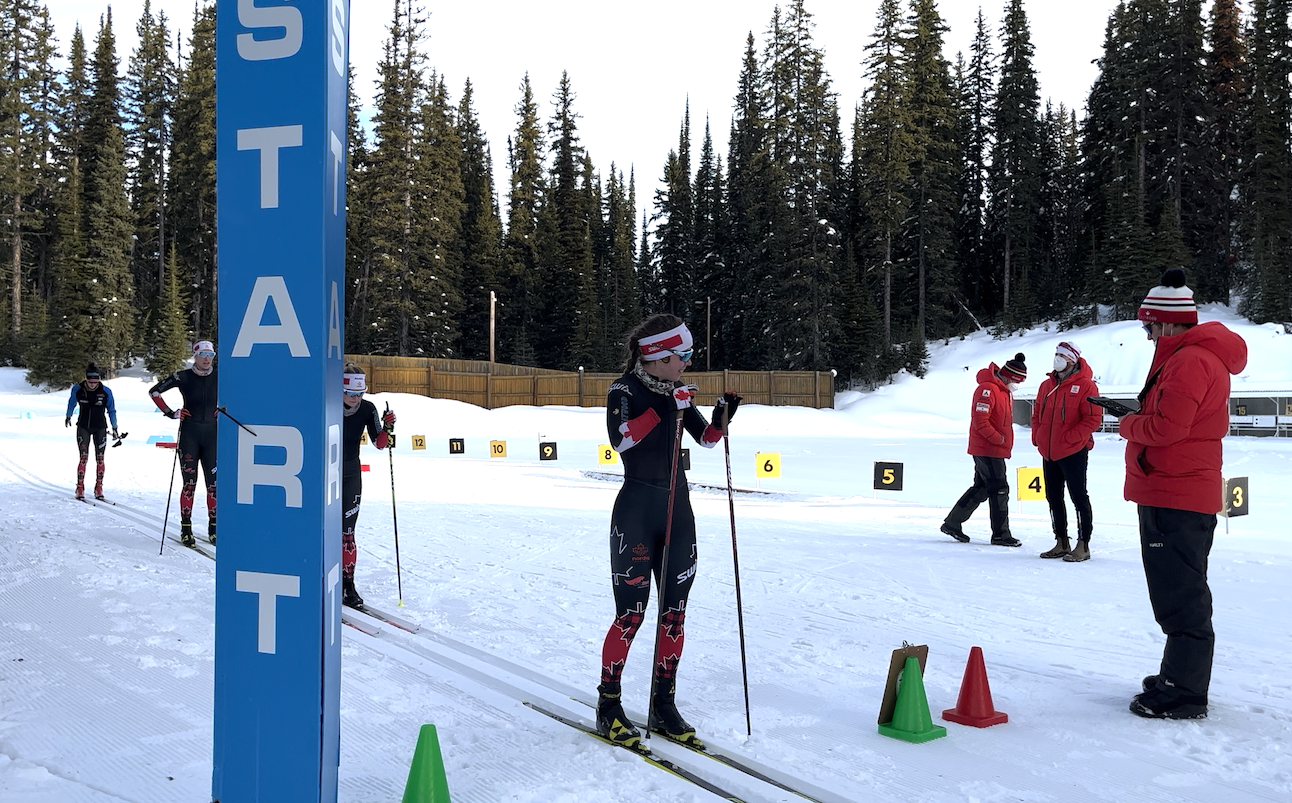
    Katherine Stewart-Jones ready to start a skiathlon at the Olympic Prep Camp.

    The Canadian Prep Camp in Sovereign Lake and SilverStar, BC prior to the 2022 Beijing Olympics sounds like a nordic skier’s heaven.

    A two-week ski vacation with 100 kilometres of perfectly groomed snow. A private room above a great coffee shop (pain au chocolate!) and next door to some great beer. January weather just below freezing with enough falling snow to make every day a hardwax day. Two weeks of what locals call superhero snow. A whole lot of sunshine.

    The reality was a little different: COVID stress, travel uncertainty, and outside pressure combined to make this very much a work trip, not a vacation.

    The camp, which ran from January 12th to 25th, included nine athletes, the high-performance manager plus two coaches, two wax techs, a massage therapist, and a cook.

    The athletes included the majority of the 2022 Olympic Team: Katherine Stewart-Jones, Laura Leclair, Dahria Beatty, Tony Cyr, Olivier Léveillé, and Graham Ritchie. Alternates Olivia Bouffard-Nesbitt and Rémi Drolet would officially join the team after the quota reallocation during the second week. Second alternate Russell Kennedy will not add to his Olympic CV and will instead go to his third Paralympics as a guide, supporting the well-decorated visually impaired athlete, Brian McKeever. The only Olympic team member not in attendance was Cendrine Browne, who chose to train in Canmore, while second alternate Jasmine Drolet returned to school at Dartmouth and earned her first collegiate wins.

    World Cup coach Erik Bråten, Next Gen coach Eric de Nys, Team Lead and high performance manager Joel Jaques, techs Simon Boisvert and Félix-Antoine Vezina, massage therapist Stephen Waterreus, and Zoe the cook made up the support crew. Everyone except de Nys and Zoe are going to Beijing.

    When this writer asked for last names, the response was always, “Zoe? You know Zoe.” In the end, it was revealed that Zoe is Zoë Roy, who retired from racing in 2014 as a founding member of Team Ninja. Yup, we all know Zoë.

    All interviews were done on snow, from a distance, with FasterSkier wearing an N95 mask.

    On Snow Training

    The on-snow part of the camp was reported to have gone very well. The coaches were able to find times and trails that allowed training races that closely matched the Olympic course for profile and elevation while keeping distance from the local skiers. 

    The Zhangjiakou 5km course elevation range is 1639m to 1696m. The Sovereign Lake upper World Cup 5km is 1651m to 1708m, with the stadium at 1660m.

    The Friday sprint course worked fairly well, despite a layout that would give any technical delegate apoplexy. As Bråten explains above, the coaches chose to do four qualifiers instead of heats to manage risk.

    The Sunday skiathlon course ended up being 13km for the women and 17km for the men, with some flat sections removed from the 5km loop to better mimic the Olympic courses.

    Bråten was often seen working with athletes one-on-one.

    As the days counted down to departure, skiers were working on filling their bags with seconds gained: a tweak in one skate (V2) poling, free skating further on a fast flat section, experimenting with pacing on courses that simulate Zhangjiakou.

    The mood of the camp seemed slightly tense, at least to a journalist who was careful not to pierce the bubble. The change on Tuesday morning, 12 hours after everyone passed the final COVID test, was dramatic, with smiles everywhere.

    “It’s been fantastic conditions and just a really nice camp all around, it’s always nice when you get some sunshine,” Kennedy told FasterSkier. “So yeah, especially after a [World Cup] Period One in Finland in the dark.”
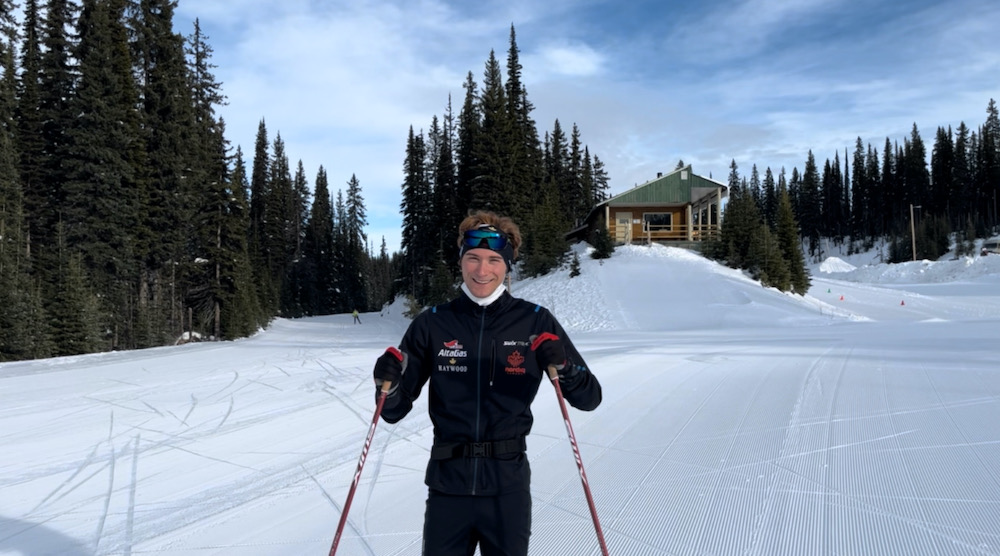
    First time Olympian Rémi Drolet is all smiles after passing the final pre-travel testing.

    COVID Management

    COVID protocols at the camp were strict, races were more relaxed.

    A positive test would be the end of one person’s Olympic dreams and a logistical nightmare for the support team. Any close contact of the infected person would not be able to travel. Any replacement person, athlete or not, would need to follow the same testing protocol. If that replacement wasn’t ready for the scheduled flight, the complexity of travel planning might be insurmountable.

    In order to travel to the Olympics, the athletes, coaches, and techs would all have to pass two PCR tests less than 24 hours apart in the final 96 hours before boarding. Once at the Calgary airport, there would be another PCR test, with a fourth upon arrival in China.

    Nordiq Canada chose a more restrictive plan than some other countries. Each person (athlete, coach, tech, cook, massage therapist) had their own room and didn’t enter other rooms. Meals were delivered. Grocery shopping was done by local resident, de Nys, scheduled for 7am to avoid crowds. No one entered coffee shops, bars, or restaurants. Each morning, everyone would do a rapid antigen test in their room. Athletes skied from their accommodation at SilverStar to the homologated trails at Sovereign Lake to avoid close contacts in vehicles. Only de Nys and Zoë the cook had contacts outside the bubble, and neither is going to Beijing.

    The goal behind this aggressive protocol was twofold. First, to prevent exposures. Second, if one person tested positive, there would be no close contacts forced into isolation or removed from the Olympics. The two wax techs (Simon Boisvert and Félix-Antoine Vezina) inevitably had a shared bubble as they shared a private waxing room.

    Was this the right answer? We got three answers to that.

    Drolet found the camp harder than usual: “We were still able to ski together a little bit, but it was definitely a little bit lonely at times.”

    Kennedy, entering with a mentally tough prospect of only making the team if disaster struck a friend, found the positive. “The guys have been playing, like hanging out online together… And we’ve been skiing together. So it’s separate, but at the same time, not too lonely.”

    “Ask me on Monday afternoon when we get all the results back,” Jaques told FasterSkier on Sunday morning. “We’ve taken the right precautions so we’ll just see. But I think it’s looking good.”

    A number of athletes mentioned feeling comfort in knowing they were doing everything possible to protect their Olympic dreams. 

    The system has worked. Everyone tested negative and the entire team is now on snow in Zhangjiakou.

  • At 21, Boisvert Lands Dream Job with Canada’s World Cup Wax Team

    At 21, Boisvert Lands Dream Job with Canada’s World Cup Wax Team

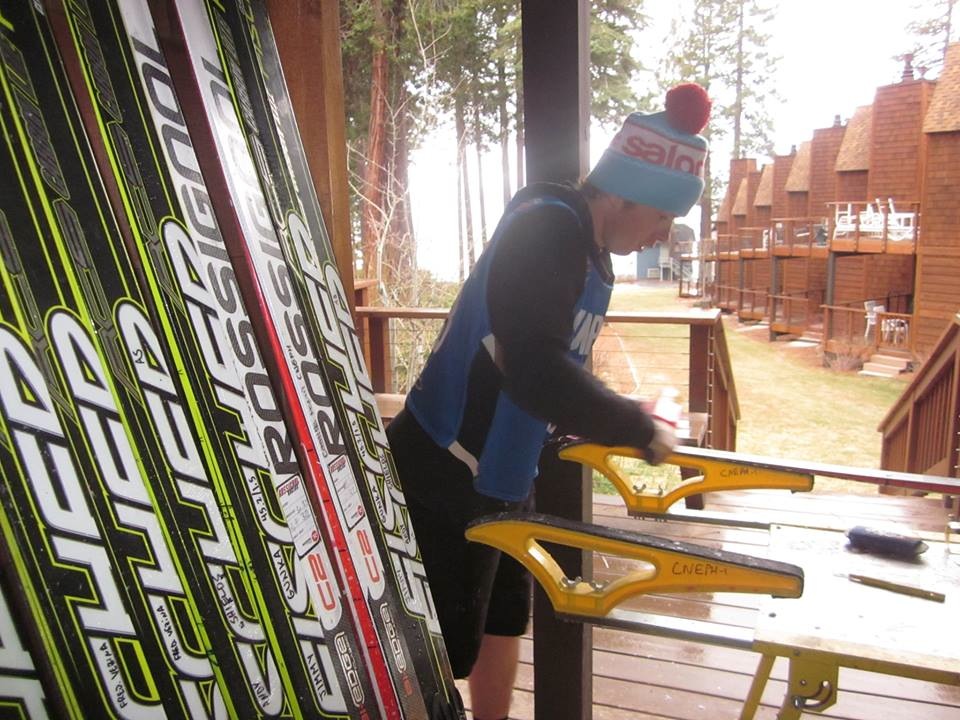
    The newest addition to Canada's World Cup Team of wax technicians, Simon Boisvert, shown previously assisting the Pierre-Harvey Training Centre. (Photo: Frederique Vezina)
    The newest addition to Canada’s World Cup wax team, Simon Boisvert, shown previously assisting the Quebec-based Pierre-Harvey Training Centre. (Photo: Frederique Vezina)

    (Scroll down for French version/Version française disponible au bas de la page.)

    ***

    Simon Boisvert is the new guy on the Canadian National wax technician’s team. At 21, the young man from Mont-Sainte-Anne, Quebec, was selected at the beginning of the summer as an apprentice wax tech. Over the winter, he will have the great opportunity, throughout the World Cup circuit, to learn the job with some of the best.

    Last spring, Cross Country Canada (CCC) posted a job notice on its website advertising for an apprentice wax technician. Boisvert’s sister saw the listing and told him he was a good candidate and should apply. Following her advice, he sent his résumé. A few weeks later, he received a call from CCC High-Performance Director Tom Holland, who delivered the good news.

    “When I got the call, I was really happy,” Boisvert said last week on the phone from Canmore, Alberta. “It was one of my dreams that came true. I’ve never been to Europe and now I’ve got the opportunity to travel all winter around.”

    His experience as a wax tech is limited and recent, which isn’t surprising considering his age. Nevertheless, he can count on a good background and knowledge of cross-country skiing. Boisvert was a member of the Mont-Ste-Anne Nordic Ski Club (Club Nordique) and competed until age 17. He also lived in the same neighbourhood as World Cup skier Alex Harvey and senior national team member Frédérique Vézina, giving him the edge of knowing several top skiers from an early age.

    First Steps

    Two seasons ago at the 2012 Canadian Ski Nationals right in his backyard at Mont-Ste-Anne (M.S.A.), Boisvert first worked as a wax technician for his local club. He hasn’t stopped since. Boisvert spent last season as a wax tech for Club Nordique providing technical support at the Quebec Cups, some NorAms and nationals in Whistler, B.C.

    His biggest challenge came at U.S. SuperTour Springs Series in California at the end of last season. For this set of races, he was responsible for several athletes from the Pierre-Harvey Training Centre (CNEPH) and NDC Thunder Bay. Everything went well and this spring, he was able to count on the help and recommendation of CNEPH head coach and national-team assistant, Louis Bouchard, when he applied.

    It did not take Boisvert long to find his vocation. “I really loved the job as a wax tech last year and I decided to do that for a living,” he said.

    One could say the assistant position is a big promotion for Boisvert, who as been selected to complete Canada’s wax team.

    “I do not have much experience, but I have the desire to learn and when I go for it,” he said. “I always put 100 percent of myself into it and I give 110 percent. I would have done the job anyway, even if I didn’t get paid this winter.”  

    His Winter Schedule

    On Nov. 21, Boisvert will leave for Scandinavia for the start of the World Cup season in Finland. He plans to stick around Europe for the Tour de Ski multi-stage race starting in late December, but won’t be around for the Olympics in Sochi, Russia. Instead, he was assigned to assist the Canadian B-team (including select skiers, U23 and older) on the Scandinavia trip in February.

    Boisvert joins an experienced team of technicians and expects to learn a lot, including the tricks and tips of waxing at this level, and ways to work within the team. He said he feels priviledged to work with Harvey, Bouchard and the rest of the World Cup team.

    For now, he’s committed to a one-year contract, but at the end of the season, if his evaluations go well, he might sign on for a couple more years.

    This season, Canada will also have a huge, brand-new waxing truck — putting the team on par support-wise with powerhouses like Norway and Sweden.

    About Stéphanie Drolet:

     A former competitive cyclist and cross-country skier on Canada’s National Junior Team, Stéphanie Drolet is a Canadian contributor at FasterSkier. She was a forerunner at the 2010 Vancouver Olympics and competed at the 2008 World Junior Championships. A journalism student at Laval University in Quebec, Stéphanie still skis and rides for fun and to stay in shape. Don’t be surprised to find a few of her articles in French!

    ***

    (En français)

    Simon Boisvert est le nouveau venu dans l’équipe de technicien de fartage canadienne. À 21 ans, le jeune homme originaire du Mont-Ste-Anne a été sélectionné au début de l’été comme apprenti-farteur. Il aura donc la chance tout au long de la saison de Coupe du Monde d’apprendre le métier aux côtés des meilleurs. 

    Le printemps dernier, Ski de fond Canada affichait, sur son site internet, une offre d’emploi comme apprenti-farteur. La soeur de Boisvert a vu l’offre et lui a dit de tenter sa chance, suivant son conseil, il a envoyé son dossier. Quelques semaines plus tard, il a reçu un appel de Tom Holland, directeur de la haute performance de SFC lui annonçant la bonne nouvelle.

    « Quand j’ai reçu l’appel, j’étais vraiment content, c’était un de mes rêves qui se réalisait, je n’ai encore jamais été en Europe et là je vais me promener tout l’hiver », a mentionné Boisvert en entrevue téléphonique de Canmore en Alberta.

    Ses expériences comme farteur sont assez limitées et récentes, normal, compte tenu de son jeune âge. Néanmoins, il peut compter sur un bon bagage de connaissance du ski de fond. En effet, Boisvert a lui-même été membre du Club Nordique Mont-Ste-Anne (M.S.A.) et il a concouru jusqu’à l’âge de 17 ans. De plus, il côtoie, depuis qu’il est tout jeune, des skieurs élites comme Alex Harvey et Frédérique Vézina.

    Ses débuts comme farteur

    C’est lors des Championnats canadiens de 2012 au Mont-Ste-Anne, il y a deux ans, dans sa cour arrière, qu’il a fait ses premiers pas en étant technicien de fartage pour le club local et depuis il n’a jamais arrêté. Boisvert a passé la dernière saison comme farteur pour le Club Nordique M.S.A. assurant le support technique lors des Coupes Québec, certaines Coupe NorAm et les Championnats canadiens.

    Son plus gros défi a été lors des Springs Serie au Lake Tahoe en fin de saison, alors qu’il avait plusieurs athlètes du CNEPH sous sa charge pour des courses d’importance. L’expérience californienne s’est bien déroulée et il a pu compter ce printemps sur l’appui et la recommandation de Louis Bouchard, entraîneur-chef du CNEPH et assistant-entraîneur de l’équipe nationale, auprès de la fédération.

    Il n’a pas fallu longtemps à Boisvert pour trouvé sa vocation. « J’ai vraiment eu la piqure l’an passé et j’ai décidé de faire ça de ma vie », a-t-il affirmé.

    Quelqu’un pourrait dire que c’est une grosse promotion que Boisvert a obtenue en étant choisi pour compléter l’équipe de techniciens de SFC.

    « Je n’ai pas beaucoup d’expérience, mais j’ai le goût d’apprendre et quand je m’y mets, je m’y mets à 100 % et je me donne à 110 %. Je n’aurais pas été payé cet hiver et je l’aurais fait quand même » 

    Son horaire hivernal

    Il a son billet d’avion en poche avec un départ pour la Scandinavie le 21 novembre pour le début de la saison de Coupe du monde en Finlande. Après une pause de deux semaines au Canada, il sera au Tour de ski – une course par étapes – qui commence à la fin du mois de décembre. Les Jeux olympiques ne sont cependant pas à son programme, il sera toutefois attitré au tour en Scandinavie avec une équipe canadienne B (qui reste à déterminer) au mois de février. 

    Boisvert se joint à une équipe de fartage d’expérience et il profitera de cette première année pour emmagasiner le maximum de connaissances, apprendre toutes les subtilités et trucs, de même que de s’intégrer au sein de l’équipe.

    Pour l’instant, il a signé un contrat d’un an qui sera réévalué à la fin de la saison, mais si les dirigeants de l’équipe son satisfait de son travail, il est probable qu’il renouvelle pour quelques années supplémentaires.

    Cette saison, le Canada pourra compter sur une nouveauté de taille, un immense camion de fartage, ainsi l’équipe sera en mesure de rivaliser à armes égales avec les grosses puissances norvégienne et suédoise.