From the FasterSkier archive — posts syndicated from athletes’ and coaches’ own blogs between 2004 and 2012, kept online as published. Current coverage is at fasterskier.com.
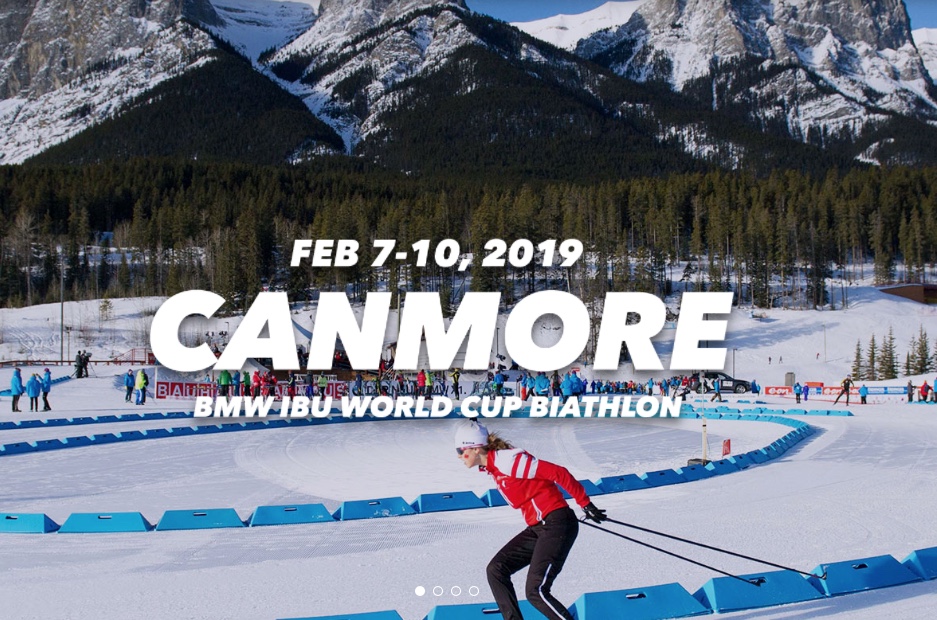
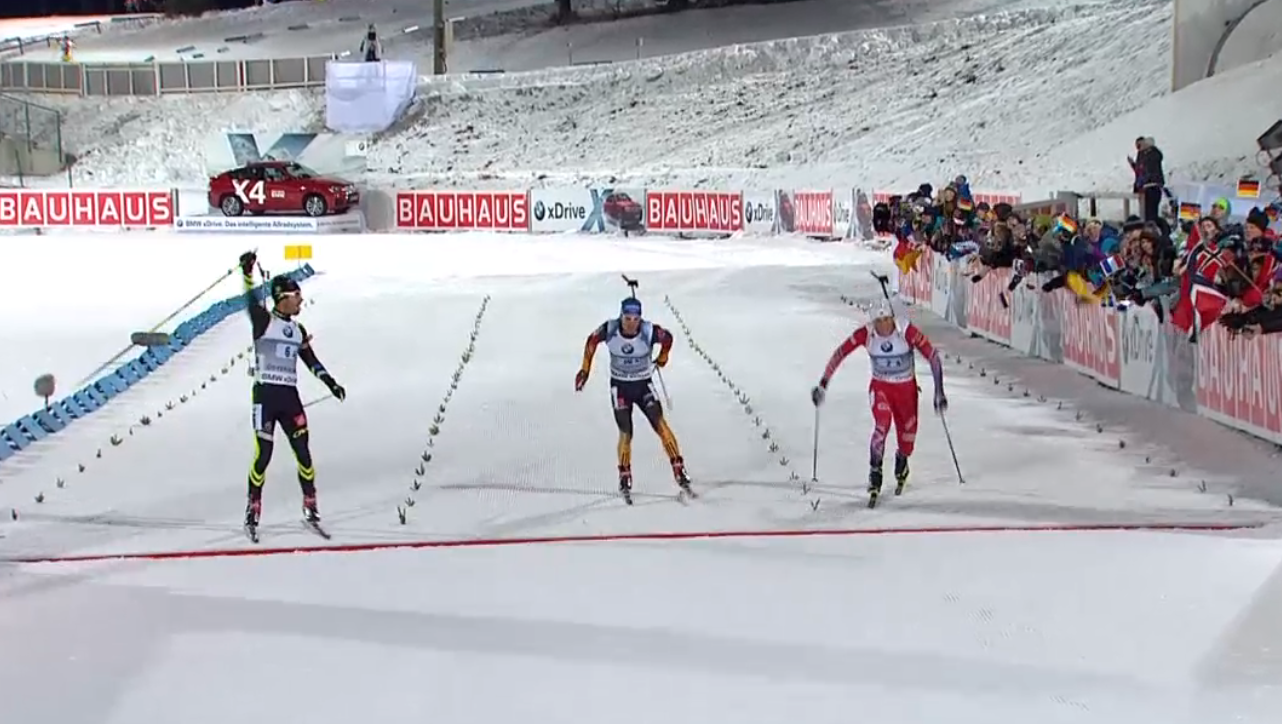
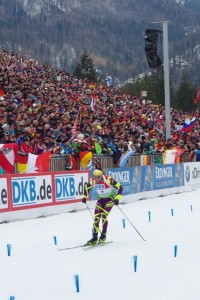
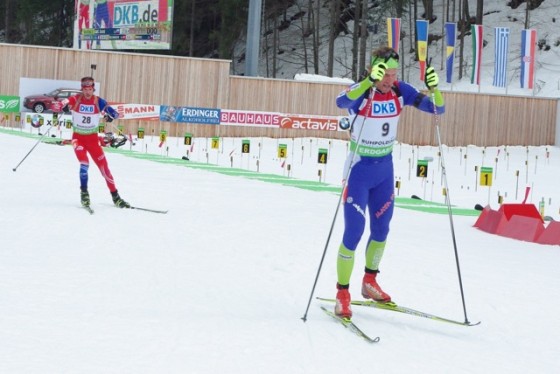
IBU World Cup in Canmore. (Photo: canmorebiathlon.ca screenshot)
Canmore, Canada IBU World Cup 4 x 7.5 k/ 4 x 6 k relay
Friday in Canmore was team relay day. Norway’s Lars Helge Birkeland, Vetle Sjåstad Christiansen,Erlend Øvereng Bjøntegaard and Johannes Thingnes Bø won the men’s 4 x 7.5-kilometer relay in 1:16:36.6 hours while acquiring no penalties on the shooting range and using seven spares.
In second place was France’s Antonin Guigonnat, Emilien Jacquelin, Simon Fourcade, and Quentin Fillon Maillet. The French team finished 1:10.4 minutes back with no penalties while using eight spares.
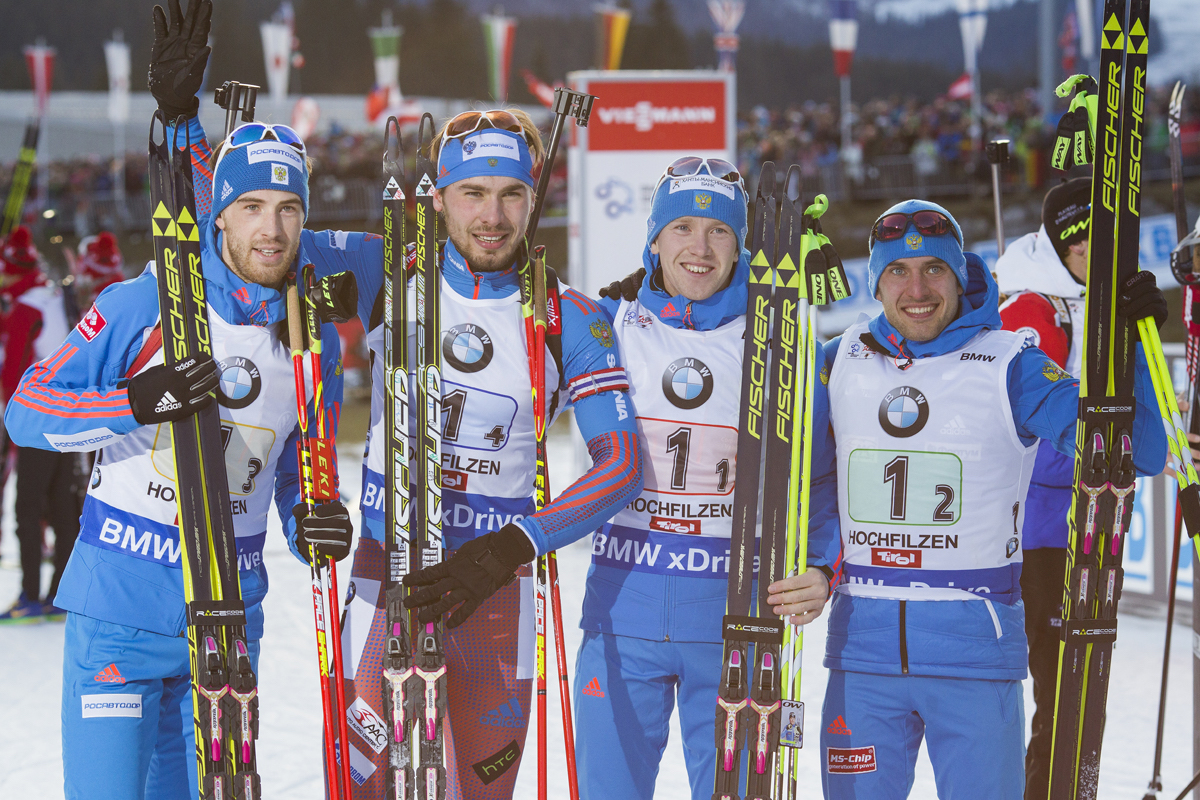
Russia took the third podium position with Evgeniy Garanichev, Eduard Latypov, Alexander Loginov, and Alexander Povarnitsyn. With no penalties and using nine spares, the Russians crossed the finish line 1:48.4 minutes back.
Christian Gow, Scott Gow, Jules Burnotte, and Brendan Green racing for Canada all began in bib 18 as the 18th ranked team and hopped eight positions in the final standings to finish 10th (+4:53.2). In total, Canada had two penalties while using 18 spares. It was also the final race of Green’s career.
The U.S. team of Sean Doherty, Leif Nordgren, Max Durtschi, and Travis Cooper was lapped and not given an official time. Doherty skied the first leg and tagged off 41.4 seconds behind first-place France. Nordgren raced second and tagged Durtschi with a 2:49.7 minute deficit. Durtschi was lapped on his third and final ski loop after shooting 3+3 and 2+3.
The women’s 4 x 6 k relay Vanessa Hinz, Franziska Hildebrand, Denise Herrmann, and Laura Dahlmeier took the win in 1:10:16.3 hours. The German foursome had a total of one penalty lap while using 12 spares.
Emille Aagheim Kalkenberg, Ingrid Landmark Tandervold, Tiril Eckhoff, and Marte Olsbu Roeiseland raced to second place, 30.2 seconds back. Kalkenberg used all her spares and skied two penalty laps to put the Norwegians in an early hole. On the next three legs, Norway used four spares total to pull themselves back into contention.
Anais Chevalier, Justine Braisaz, Anais Bescond, and Julia Simon racing for France placed third (+41.6, 0+12).
The U.S women took eighth overall, finishing 3:58.4 minutes behind. Susan Dunklee, Clare Egan, Joanne Reid, and Emily Dreissigacker had two penalties while using 12 spares during the race.
For Canada, Sarah Beaudry, Emma Lunder, Megan Bankes, and Rosanna Crawford For Canada, Sarah Beaudry, Emma Lunder, Megan Bankes, and Rosanna Crawford placed 18th. The Canadians were lapped on the final ski loop of the second leg.
Tomorrow’s scheduled sprints for both the men and women have been postponed to Sunday die to predicted cold temperatures.
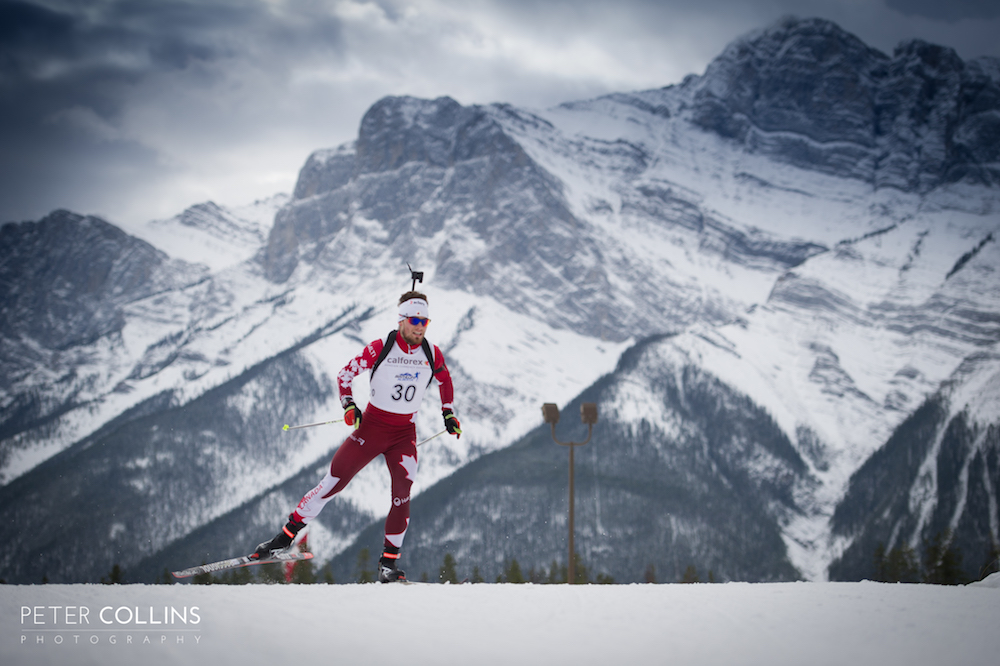
Christian Gow at the 2017 Biathlon Canada’s team trials in Canmore, Alberta. (Photo: Peter Collins/petercollinsphoto.com)
“Polar Vortex” has become part of the oh-so-cold vernacular when describing seemingly locked in place artic air. Last week’s weather-related news cycle was dominated by all things “Polar Vortex”. In Canmore, Canada, the term is still being thrown around: the cold temperatures have not abated.
On Thursday, the International Biathlon Union (IBU) is scheduled to begin its North American swing of races in Canmore with the men’s 20-kilometer and women’s 15 k individual races.
Hold onto your lobster mitts. Maybe secure a pair of bunny boots too.
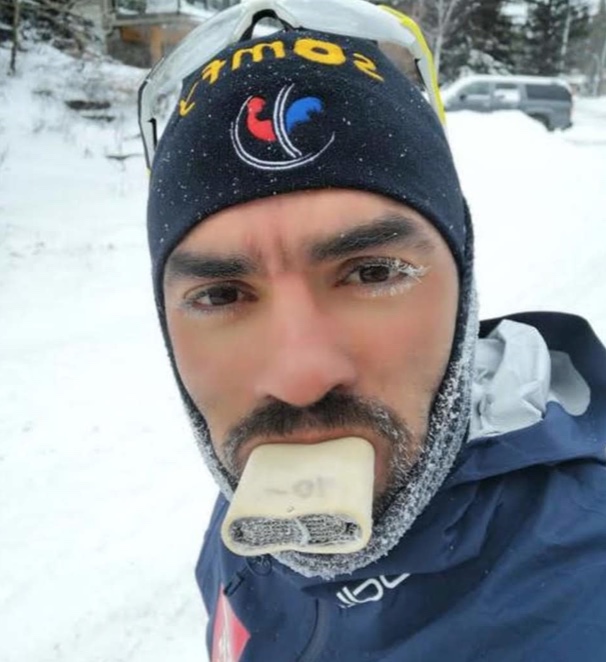
Simon Fourcade of France, out running in Canmore. Fourcade is using a humidity/heat exchanger to protect his lungs in the cold air. (Photo: biathlon world.com screenshot)
On Monday, the IBU reported nighttime lows of -23.8 Fahrenheit and an early afternoon high of -16.6 Fahrenheit at the Canmore Nordic Centre, site of Canada’s IBU World Cup races. Those temps have caught the attention of race organizers as they bump against IBU competition minimums for cold weather racing.
“Biathlon competitions must not be started if the air temperature is colder than minus 20 degrees Celsius measured at the coldest part of the site (range or course), 1.5 m above ground,” states the IBU’s competition manual.
That -20 Celsius equates to -4 Fahrenheit.
Today, as of noon in Canmore, temps were a crisp -6 Fahrenheit. Oh so close — but rules are rules.
On Thursday, the races are scheduled to begin at 10:00 AM and 2:10 PM local time.
“We have many options like start times, course adjustments that are available if necessary,” IBU World Cup Race Director Borut Nunar told the IBU. “Thursday looks like the best day of the week with the morning low at minus 18 [Celsius] and the high around minus 14 [Celsius]. After that, it warms up: most importantly there will be less wind. The wind makes the cold temperatures even worse. We will just see how things go and present any ideas to the coaches at our meeting on Tuesday. They all understand the conditions and like us, just want the most fair and safe conditions for the athletes.”
In extreme on-the-ground cases like the Organizing Committee and athletes are experiencing in Canmore, officials will also consider wind chill and humidity beyond the strict -20 Celsius cut off when deciding if conditions are suitable for racing.
“If it is colder than minus 15°C, wind chill and humidity must be considered before starting and during the competition. In the case of a high wind chill factor, the competition jury will decide whether to start or continue the competition, in consultation with the IBU Medical Delegate or the Competition Physician. The course to be skied may also be changed to avoid windy areas,” states the IBU Events and Competition Rules.
With a few days for Mother Nature to kiss the sky with slightly warmer temperatures, the IBU World Cup has a bit of time on its side.
And there is this from Nunar, “This is a winter sport”.
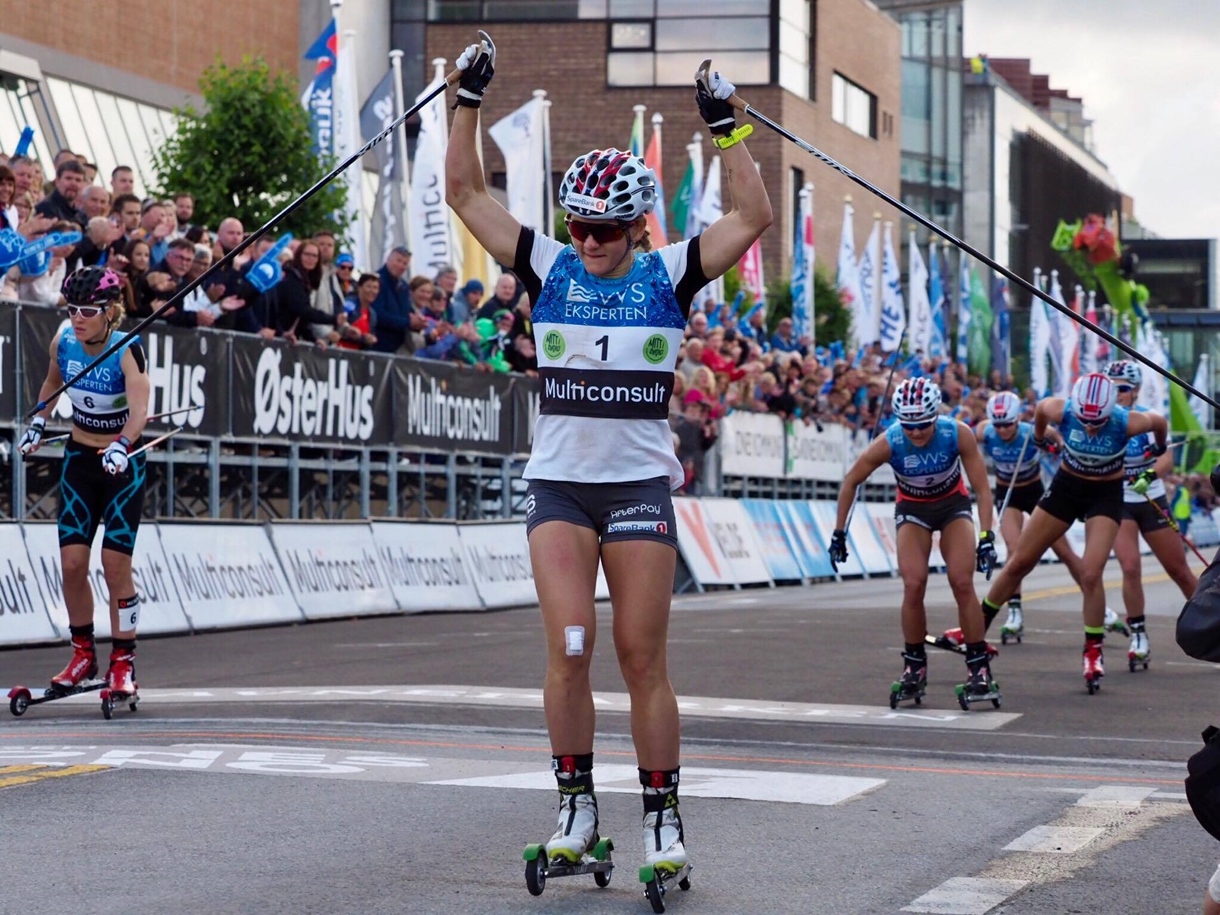
Norway’s Maiken Caspersen Falla celebrates across the line after edging out Russia’s Natalia Matveeva and her Norwegian teammate Ingvild Flugstad Østberg in the women’s cross-country sprint on Saturday at the 2017 Blink Skifestivalen in Sandnes, Norway. (Photo: Axelar/Ørjan Dalseth)
The fans in the well-filled stands of the 1-kilometer rollerski city course in Sandnes, Norway, had many reasons to cheer loudly on Saturday, as their local heroes claimed victories in all four sprint events that concluded the 2017 Blink Skifestivalen (Ski Festival).
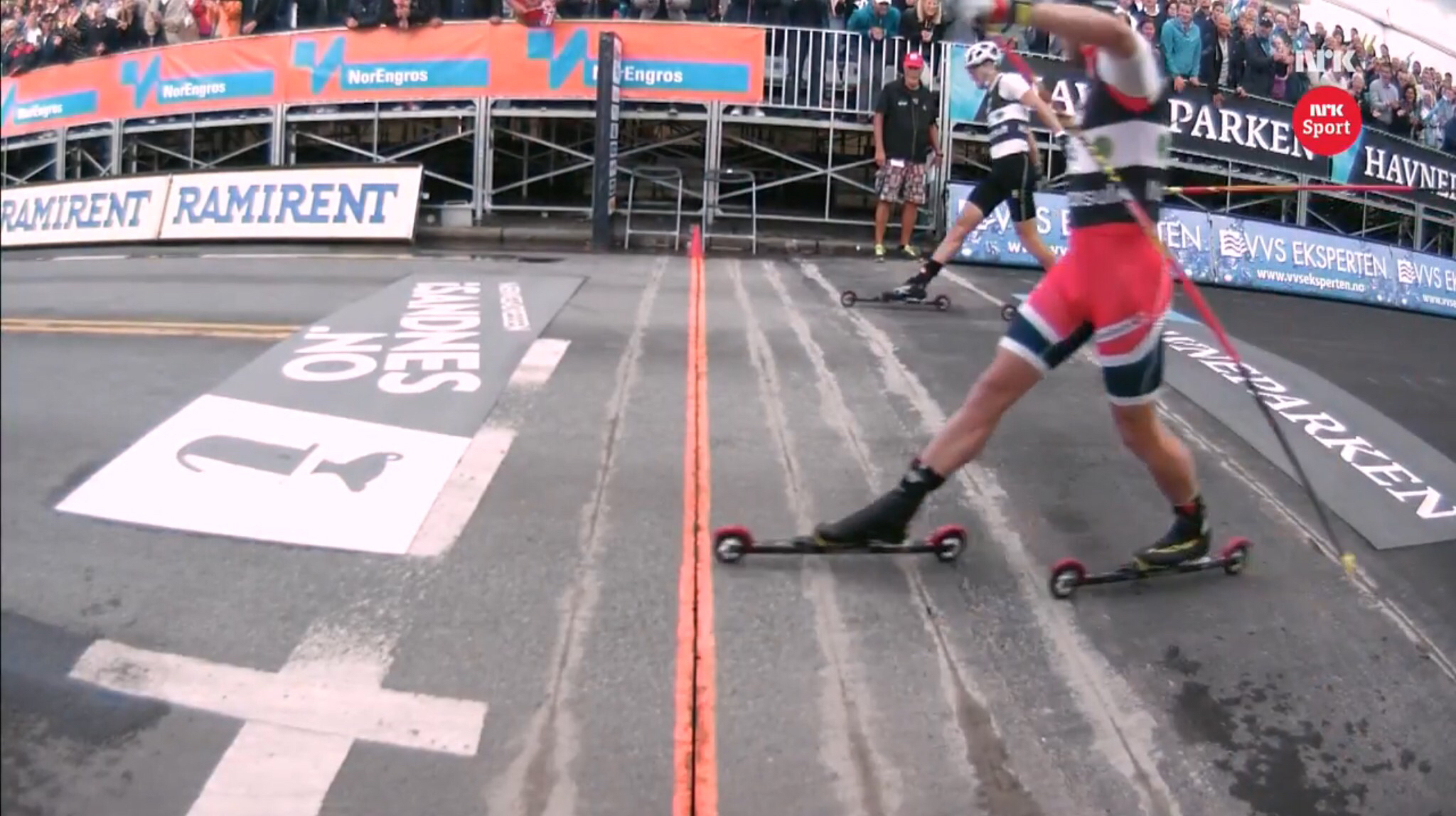
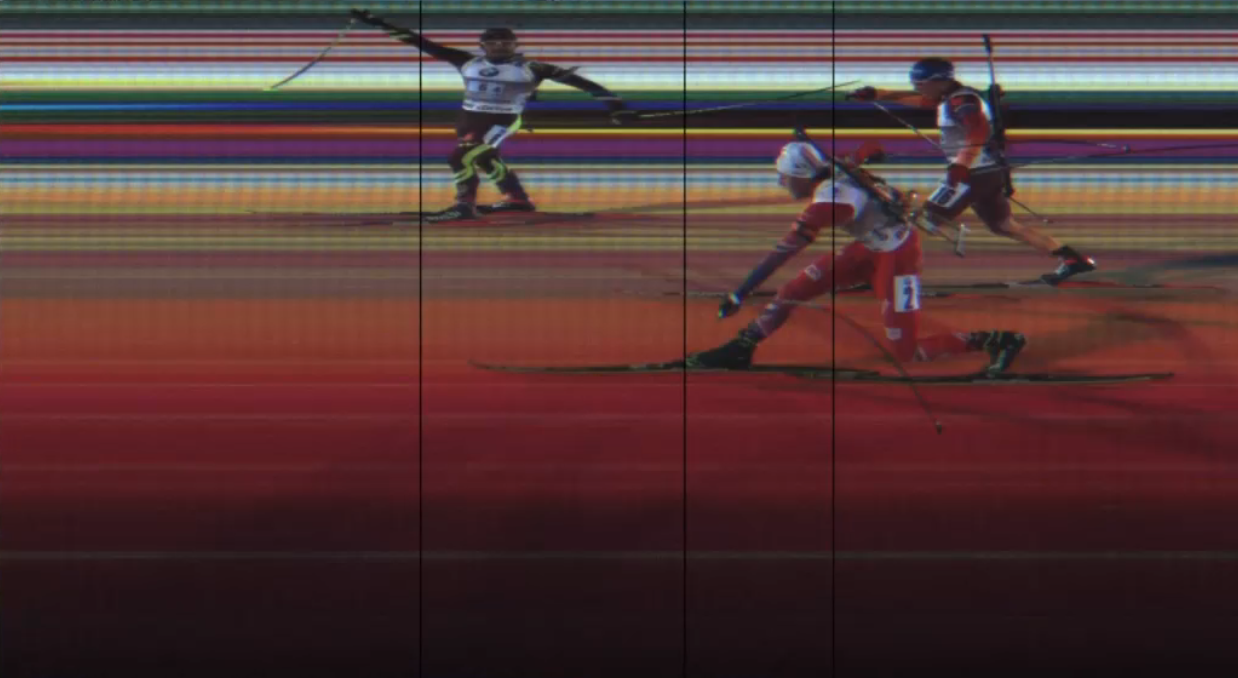
In the final race of the day, the men’s cross-country sprint was decided by the length of a rollerski, with Norway’s Sindre Bjørnestad Skar crossing first, just 0.1 seconds ahead of Sweden’s Teodor Peterson. Skar took the win with a time of 3:27.6 minutes after two laps around the flat course, which featured two short climbs over a ramp and a bridge. The third place on the podium went to Kasper Stadaas, also of Norway, 1.9 seconds out of first.
Norway’s Sindre Bjørnestad Skar (front) lunges across the line ahead of Sweden’s Teodor Peterson in the men’s cross-country sprint at the 2017 Blink Skivestivalen on Saturday in Sandnes, Norway. (Photo: NRK screenshot)
Second in Friday’s mass start, Skar advanced through the rounds on Saturday with narrow victories in his quarterfinal and semifinal as well. Last season, Skar won a World Cup at the freestyle sprint in Toblach, Italy, and achieved two other podiums. He raced to third in the sprint qualification at the World Championships in Lahti, Finland, and went on to finish 13th.
Andy Newell of the U.S. Ski Team (USST) was the lone North American starter of the day, and his run ended in the quarterfinal heats when he crossed the line in third, 1.1 seconds behind Norwegians Sondre Turvoll Fossli and 0.3 seconds behind Sivert Knotten. In an Instagram post, he mentioned breaking three poles in three races he competed in at this year’s Blink. He finished 16th in the 60 k classic and 18th in the 15 k freestyle mass start.
In the women’s cross-country sprint, a number of the last season’s top sprinters contended for the podium. Reigning Sprint World Cup champion Maiken Caspersen Falla emerged with the victory in the final with a time of 3:49.6 after keeping her challengers at bay in the long finishing straight. Russia’s Natalia Matveeva placed second (+0.8) and another Norwegian Ingvild Flugstad Østberg took third (+1.1).
Earlier in the day, Falla won her semifinal, after she advancing from her quarterfinal with a wildcard. Originally Falla had finished the heat more than 30 seconds back, following a spill from which she emerged with a slightly bloody right knee.
“Suddenly the asphalt was there,” Falla told Norwegian broadcaster NRK, according to a translation. “I am very happy that I was able to protect the face and head… I was really scared. I’m terrified.”
She explained that it had been a long time since her last crash on rollerskis, and that she likely had placed a pole on her own shoe. No other athlete was involved in the incident, and her semifinal heat started with seven athletes.
On Friday, Falla placed third in the women’s 10 k mass start after outlasting the group of skiers she was with in the finishing straight.
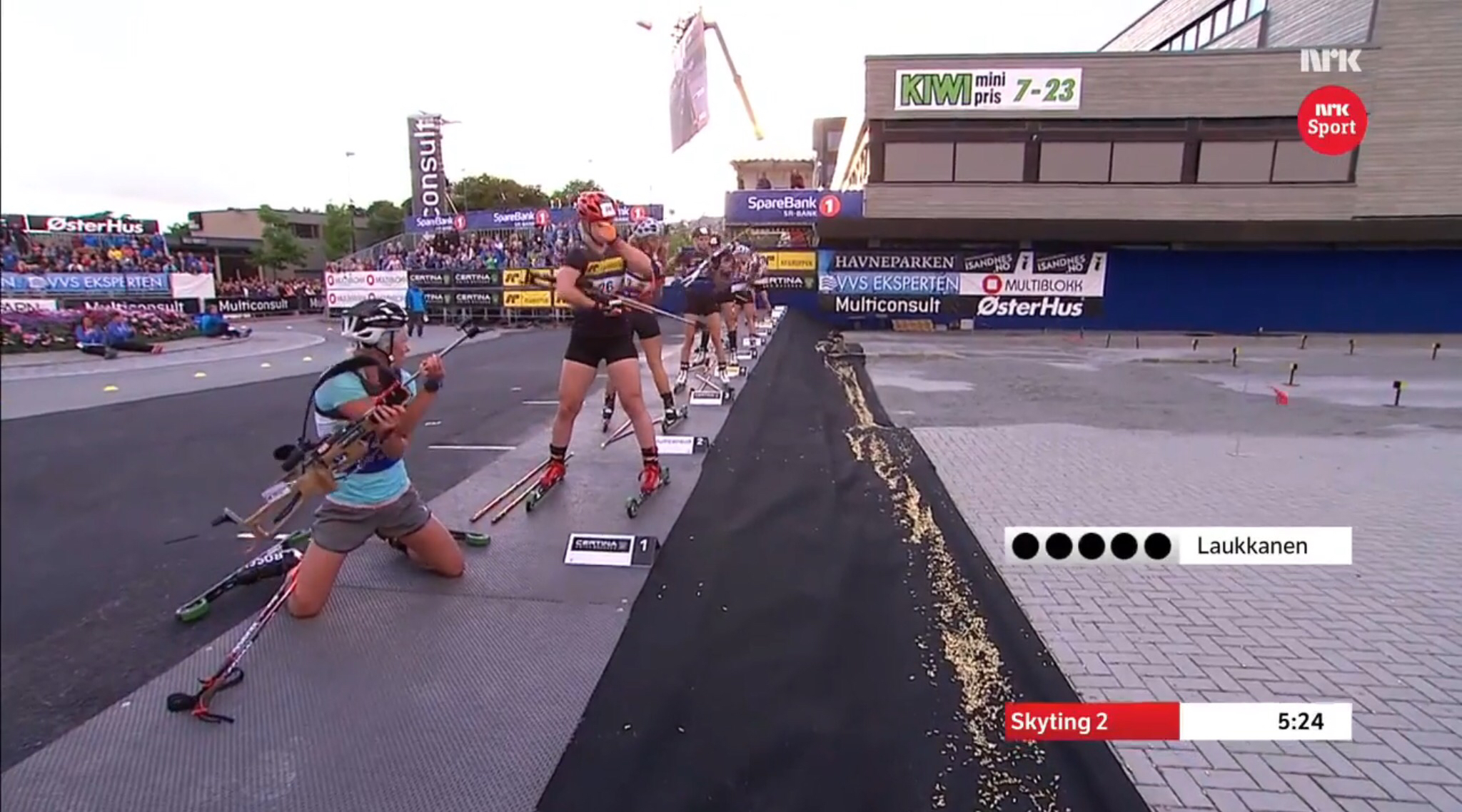
In the women’s biathlon sprint, French veteran Marie Dorin-Habert made a minor rookie mistake while leading when she knelt down on the shooting mat for another prone shooting, before realizing that all her competitors had correctly taken a standing-position stance. Maybe she had assumed that — like the men in Saturday’s sprint format — they also would have to shoot four times.
France’s Marie Dorin-Habert (l) erroneously kneels down to take the prone position in the second shooting stage of the women’s biathlon sprint at the 2017 Blink Skifestivalen on Saturday in Sandnes, Norway. In the lead until that point, she went on to finish third. (Photo: NRK screenshot)
She quickly stood back up, but after incurring a penalty she was overtaken by Sweden’s Hanna Öberg and Norway’s Marte Olsbu. On the final lap Olsbu managed to pass the Swede to claim the victory in a time of 7:57.3 minutes with two penalties, while Öberg finished second (+2.8, with two penalties) and Dorin-Habert third (+5.0, with one penalty) ahead of Sweden’s Emma Nilsson (+9.4, with two penalties).
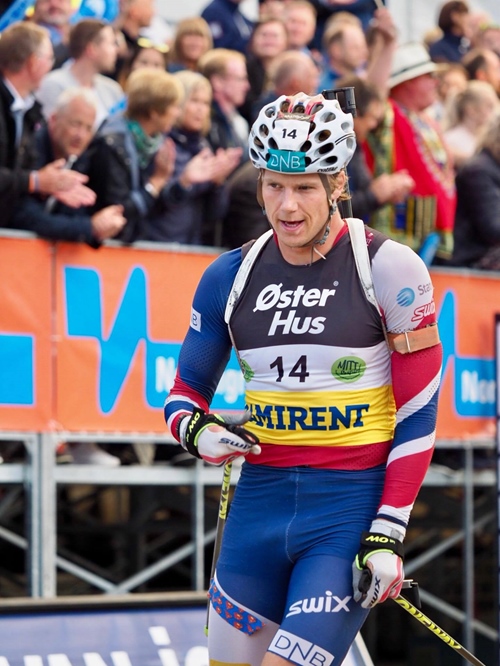
Vetle Sjåstad Christiansen after winning the men’s biathlon sprint on the last day of the 2017 Blink Skifestivalen on Saturday in Sandnes, Norway. (Photo: Axelar/Ørjan Dalseth)
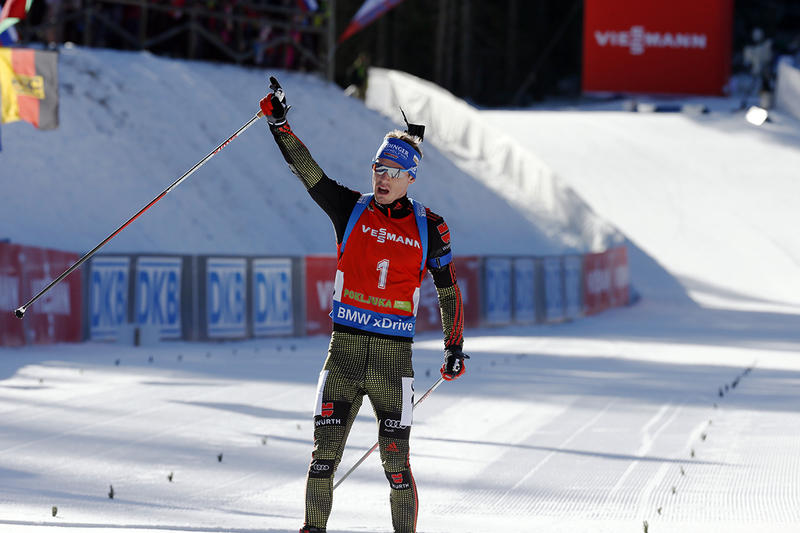
In the men’s biathlon sprint, racers skied four loops and shot in four stages. Coming into the final shooting stage, Norway’s Lars Helge Birkeland and Vetle Sjåstad Christiansen, along with France’s Simon Fourcade, had created a small gap to the rest of the field. While Birkeland and Christiansen hit all their targets, Fourcade had to ski one short penalty lap through a traffic roundabout. Turning sharp left into the finishing stretch, Christiansen overtook Birkeland and pushed hard until the line in a time of 12:09.6 with two penalties, while Birkeland finished 4.6 seconds back in seconds place (with one penalty). Fourcade held onto third place (+16.2, with three penalties) ahead of a chase group.
The excited fans also sang a little birthday tune for Norway’s Tarjei Bø — who turned 29 on Saturday — as he came into the finish in seventh place (+42.2) smiling and waving to the crowd.
No North American biathletes raced at this year’s Blink.
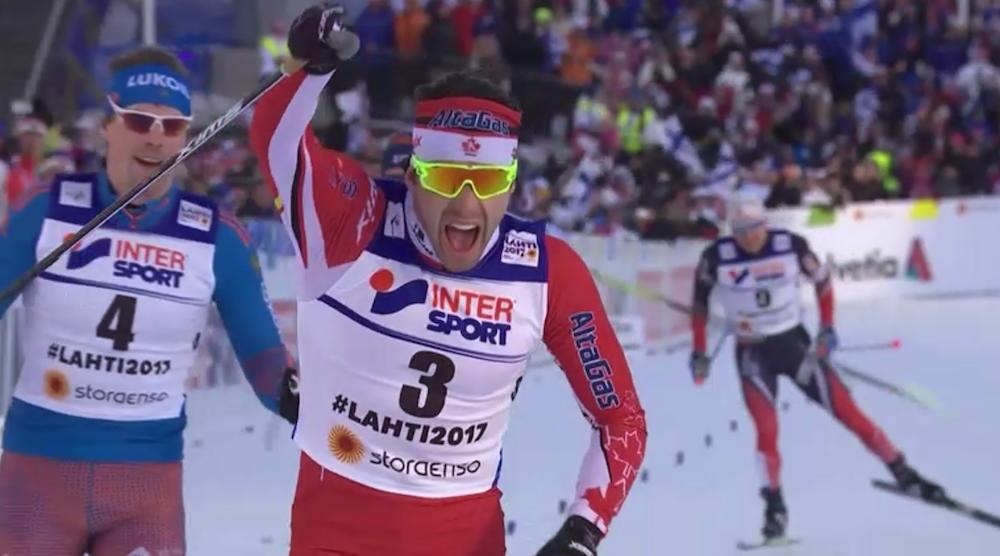
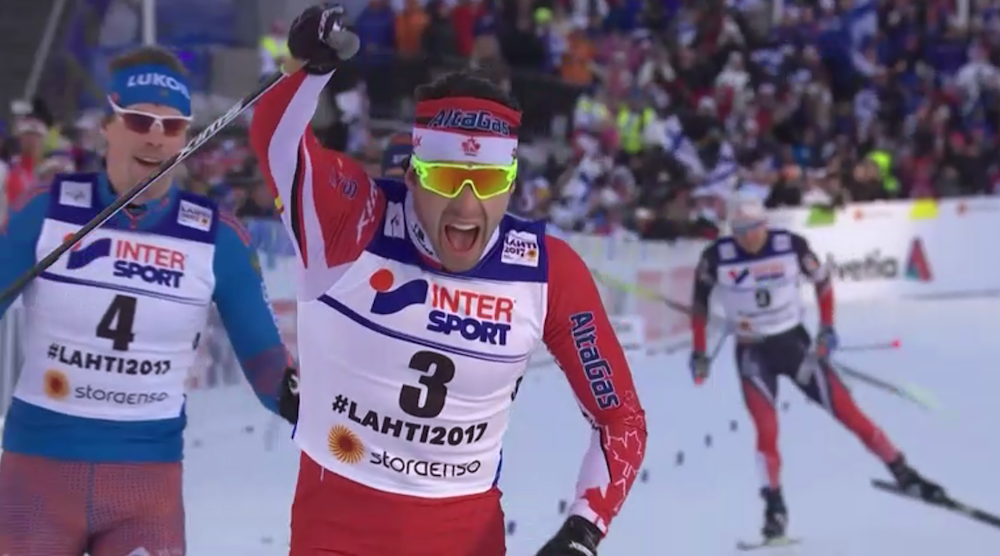
Canada’s Alex Harvey (3) celebrates his win in the men’s 50 k freestyle mass start, his first individual gold medal at a World Championships, on Sunday at 2017 Nordic World Championships in Lahti, Finland. He beat Russia’s Sergey Ustiugov (l) by 0.6 seconds while Norway’s Sjur Røthe (9) can be seen coming in for sixth place, behind (not pictured) Finland’s Matti Heikkinen, Great Britain’s Andrew Musgrave and Norway’s Martin Johnsurd Sundby, respectively. (Photo: NBC Sports screenshot)
FIS Nordic World Championships (Lahti, Finland): Men’s 50 k freestyle mass start
After a week of missing out on the medals at 2017 Nordic World Championships, Canada’s Alex Harvey, a four-time World Championships medalist from 2011, 2013 and 2015, achieved his first individual gold medal in the final race of this year’s World Championships in Lahti, Finland.
Harvey, 28, won the men’s 50-kilometer freestyle mass start in a drag race to the finish. Entering the final descent into the stadium with Norway’s Martin Johnsrud Sundby and Russia’s Sergey Ustiugov, Harvey rode his fast skis past both of them then had the most finishing kick in the final straightaway for a 0.6-second victory. He finished in 1:46.28.9 hours, while Ustiugov followed him across the line in second and Finland’s Matti Heikkinen from behind for third (+1.4), after passing Sundby around the outside of the last corner.
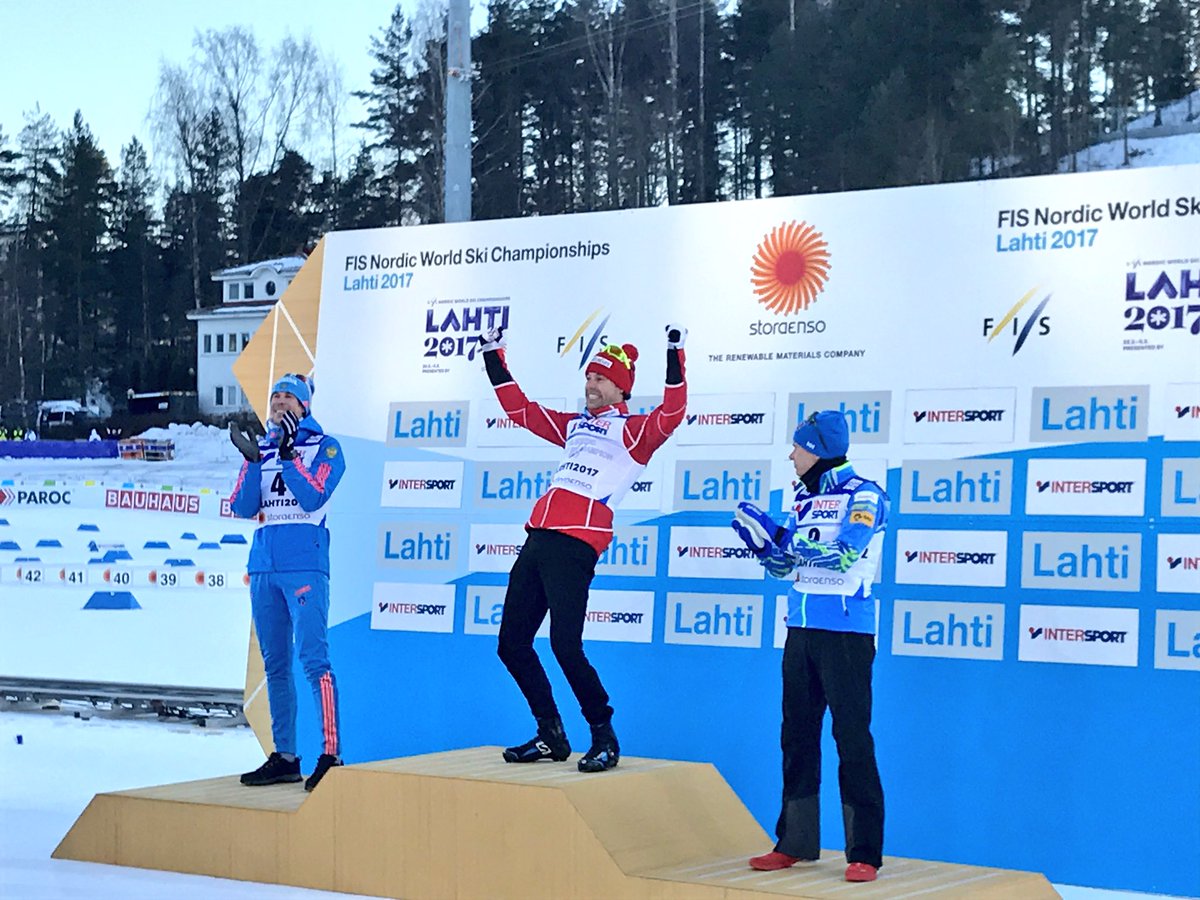
Canada’s Alex Harvey (c) celebrates gold in the men’s 50 k freestyle mass start on Sunday at 2017 Nordic World Championships in Lahti, Finland, with Russia’s Sergey Ustiugov (l) and Finland’ Matti Heikkinen (r) joining him on the podium in second and third, respectively. (Photo: Cross Country Canada/Twitter)
Sundby appeared to miss a pole plant soon after Heikkinen passed him and let off the pace a few meters before the finish. That’s where Great Britain’s Andrew Musgrave continued to accelerate and took fourth place, 2.9 seconds behind Harvey and 0.1 seconds ahead of Sundby in fifth. Norway’s Sjur Røthe followed another 0.4 seconds back in sixth, Switzerland’s Dario Cologna was seventh (+8.9), Norway’s Petter Northug eighth (+12.3), France’s Maurice Manificat ninth (+13.4), and Norway’s Hans Christer Holund 10th (+14.3).
“I had really good skis,” Harvey said in a post-race interview with FIS. “I knew if I came into the corner in second place, that was the optimal position. So I was able to fight hard and hit that last corner in second and slingshot by Martin along the flat and then that was good after that.”
“This is the best race of my life, for sure,” he added. “So I’m really happy.”
Tad Elliott (Ski Club Vail) led the Americans in 27th (+3:16.8). Noah Hoffman (U.S. Ski Team) finished 50th (+8:53.1) and Kyle Bratrud (CXC Team) did not finish.
Canada started four men, with Devon Kershaw finishing 38th (+5:45.5), Graeme Killick 43rd (+7:04), and Knute Johnsgaard in 55th (+12:03.3).
For Harvey, the medal is his fifth at three World Championships and his first individual gold after winning the classic team sprint with Kershaw in 2011.
IBU World Cup (PyeongChang, South Korea): Men’s and women’s relays
Between the men’s and women’s relays on Sunday at the International Biathlon Union (IBU) World Cup in PyeongChang, South Korea, Canada had two teams in the top eighth, with its men’s team finishing seventh in the 4 x 7.5 k and women’s team eighth in the 4 x 6 k. Behind them, the U.S. men finished 10th and U.S. women 14th.
France won the men’s relay by 33.8 seconds over Austria, using a total of 10 spare rounds but avoiding the penalty lap. Martin Fourcade anchored France to the win in 1:12:09.5 hours, after Jean-Guillaume Béatrix initially tagged them in first, his older brother Simon Fourcade raced them into second with near-perfect shooting (using just one spare to clean), and Simon Desthieux picked off one more place to give Fourcade a 16-second lead for the final leg.
Austria achieved second place with Lorenz Wäger, Simon Eder, Julian Eberhard, and Dominik Landertinger combining for zero penalties and nine spares.
Norway finished third (+45.4) with Vetle Sjåstad Christiansen, Ole Einar Bjørndalen, Vegard Gjermundshaug, and Henrik L’Abée-Lund. They had one penalty on Gjermundshaug’s third leg, and used a total of eight spares.
Canada’s Christian Gow, Scott Gow, Nathan Smith, and Brendan Green finished seventh (+3:03.1) with zero penalties and nine spares. After Christian tagged his older brother Scott in ninth, Scott raced them into sixth place before Smith slipped four places to 10th at the final exchange. On the final leg, Green raced them into seventh, requiring two spares to clean.
The Americans finished about nine seconds later in 10th (+3:12.8) with Lowell Bailey, Leif Nordgren, Paul Schommer, and Sean Doherty combining for zero penalties and nine spares, just like Canada. Bailey had originally put them in second at the first exchange, Nordgren dropped to seventh, then Schommer to 13th, before Doherty finally brought them back to 10th out of 24 teams.
In the women’s relay, Germany pulled off a 22.8-second win over Norway, with one penalty and eight spares. Nadine Horchler put Germany in third at the first exchange, then Maren Hammerschmidt raced them into first by the race’s halfway point. From there, Denise Herrmann, a former cross-country World Cup regular, had to ski a penalty lap and tagged off in second, 13.5 seconds out of first. With teammate Laura Dahlmeier sitting out the relay, Franziska Hildebrand anchored Germany to the win in 1:07:35.6 after she used just one spare to clean.
Norway placed second with Kaia Wøien Nicolaisen, Hilde Fenne, Tiril Eckhoff, and Marte Olsbu accumulating one penalty and 11 spares. Olsbu beat out the Czech Republic’s Gabriela Koukalová by one-tenth of a second at the finish, as the Czechs placed for third (+22.9), with Jessica Jislová, Eva Puskarčíková, Lucie Charvátová, and Koukalová (with a total of one penalty and nine spares).
Canada took eighth (+1:34) with Rosanna Crawford, Julia Ransom, Megan Tandy, and Emma Lunder. Crawford tagged in second at the first exchange, Ransom slipped one place to third, Tandy lost another place to tag in fourth, and Lunder ultimately anchored them to eighth.
The U.S., with Clare Egan, Susan Dunklee, Joanne Reid, and Maddie Phaneuf, finished 14th (+3:08.3) with one penalty and 10 spares. After Egan had a penalty on the first leg, Dunklee skied the fastest second leg to move the team from 19th to 14th, then Reid put them in 11th by the final exchange. Twenty-one teams competed in the women’s race.
Ski Classics 90 k Vasaloppet (Sälen to Mora, Sweden)
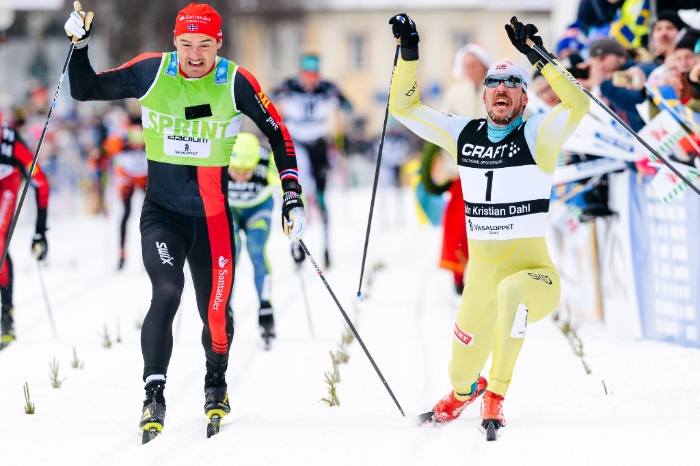
John Kristian Dahl (r) of Team United Bakeries outlunges Ski Classics sprint leader Andreas Nygaard (r) of Team Santander for the win in Sunday’s 90 k Vasaloppet in Mora, Sweden. (Photo: Visma Ski Classics)
[UPDATED] In Sunday’s 93rd annual 90-kilometer Vasaloppet from Sälen to Mora, Sweden, the ninth event of the Ski Classics series, John Kristian Dahl (Team United Bakeries) outlasted Andreas Nygaard (Team Santander) by one-tenth of a second for the win in 3:57:18.1 hours. The race came down to a five-way fight for first, with Stian Hoelgaard (Team Leaseplan) finishing 0.6 seconds back in third. The top 15 men were all within 21.7 seconds of the podium, and Brian McKeever, a member of Canada’s Para Nordic Ski Team, placed 20th (+2:31.1).
“It has been a fight all day,” Dahl said, according to a Ski Classics press release. Three days ago, he had been unsure about starting the Vasaloppet following a back injury. “I was tired already after 30 k and had to let go of the lead group, but I fought my way back taking it step by step and hill by hill.”
In the women’s race, Britta Johansson Norgren (Lager 157 Ski Team) broke away from the field to win by 1:37.9 minutes in 4:19.43.4.
Astrid Øyre Slind (Team United Bakeries) finished second, and Sara Lindborg (Team Serneke) placed third, 9 minutes and 4.2 seconds behind Norgren. Kateřina Smutná (Team Santander) dropped out of the race about halfway through.
“I am very tired but also so happy to win today,” Norgren said, according to the press release. “It felt pretty easy until Oxberg [Sweden] with 30 k to go, but then it got really tough and I had to fight all the way to the finish.”
It was Norgren’s first Vasaloppet win after placing second the last three years. She increased her lead in the overall Ski Classics to 215 points over Smutná, while Tord Asle Gjerdalen continues to lead the men’s overall standings ahead of his Santander teammate Nygaard, who is 349 points behind in second place. Gjerdalen did not race Sunday’s Vasaloppet.
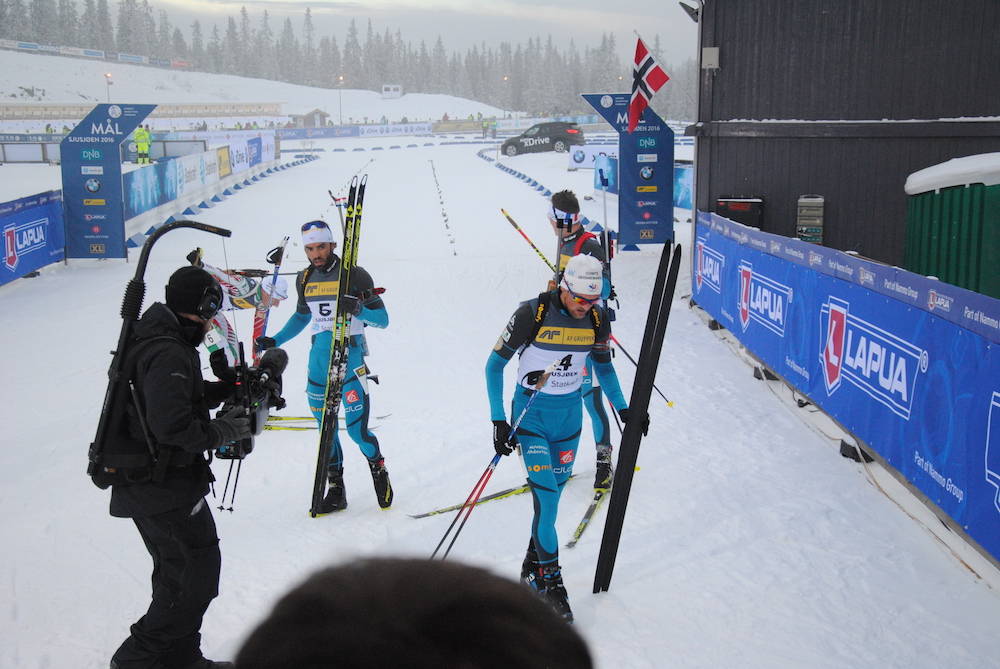
Allez les bleus: Race winner Simon Fourcade (bib 5) at the finish line of the 15 k mass start with second-place teammate Simon Desthieux (bib 4) and fourth-place finisher Fabien Claude (back).
SJUSJØEN, Norway–Before Sunday’s women’s mass start even began, expectations were high for an exciting race: all nine of the best-seeded biathletes were individual or relay podium finishers during the previous World Cup season, and bib number ten belonged to Junior World Champion Ingrid Landmark Tandrevold.
And not surprisingly, there was plenty of drama over 12.5 kilometers and four shooting stages.
The first lap was relatively even until the final climb where Tiril Eckhoff of Norway, Yuliya Dzhima of Ukraine, and Celia Aymonier of France created a slight gap. But the first shooting mixed up the order and set the standard for the remainder of the race. Dzhima hit five targets, as did Ukrainian teammate Olena Pidrushna, along with Anais Bescond and Anais Chevalier of France. The winner of Saturday’s sprint, Justine Braisaz of France, missed once.
Leaving the range in first, Dzhima held this position until the finish line. She hit all 20 targets except for her final shot, which was too far to the upper-left corner.
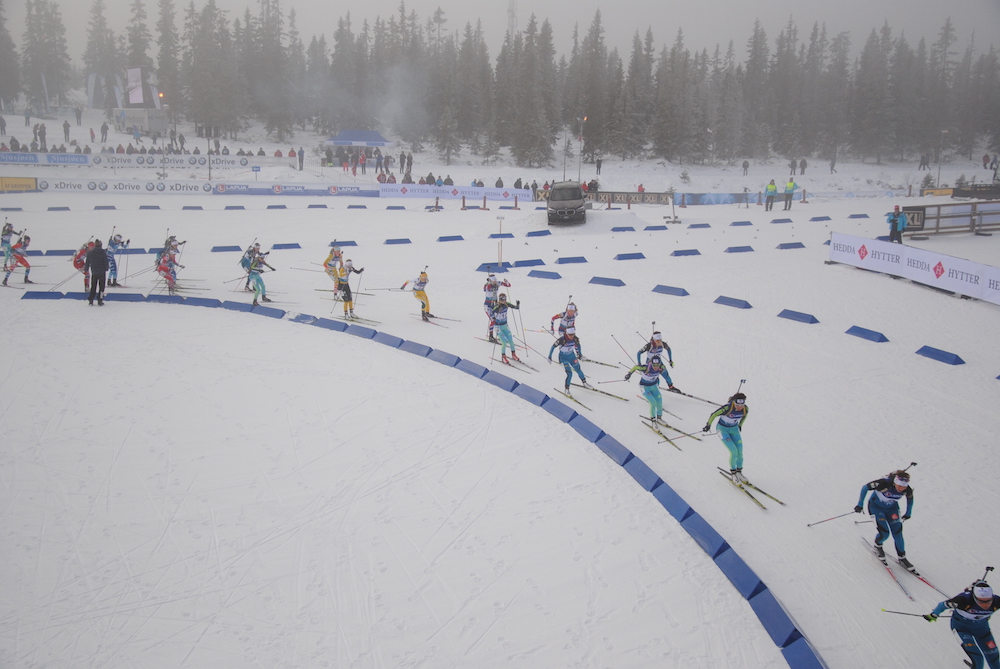
The women’s mass start in Sjusjøen, with eventual race winner Yuliya Dzhima of Ukraine fourth from right.
Dzhima skated hard with every stride. At times it seemed like she was breathing heavily, but the gap to second-place finisher Pidhrushna was never shorter than eight seconds, which was after the first shooting. From there on, Dzhima was in the clear. After 8.8 kilometers she had amassed a lead of 35 seconds to Pidhrushna and well over a minute to Braisaz, who eventually finished in third place.
During the post-race press conference, Dzhima – an Olympic relay gold medalist from 2014 – said that she was “unaware of how big the gap was.” While Pidhrushna sometimes seemed to be closing part of the gap, Dzhima’s spot in the lead was never really threatened and she finished the race with an 18.5 second margin.
Pidhrushna, who hit 20 out 20 targets, had a solid margin over Braisaz (+37.3), who had missed a shot each in the first three shooting stages.
Asked what she thought of her own performance, Dzhima replied, “I am very happy about today’s race, and the fact that there was almost no wind made it a little easier both to shoot and ski.”
The competitions were excellent prep for the World Cup, which starts in two weeks, Dzhima said.
“The downhills!” She laughed when asked what the easiest part of the course was. Pidhrushna agreed.
“We like the tracks in Sjusjøen really well,” the women said. “They are tough but very high quality, and the final climb is really hard. But once we finish that one we are ready for any course.”
But the happiest woman on the course today was without a doubt the fourth-place finisher, 18-year old Karoline Erdal. Last season, Erdal won the 6 k sprint and anchored Norway’s bronze medal relay team at World Junior Championships.
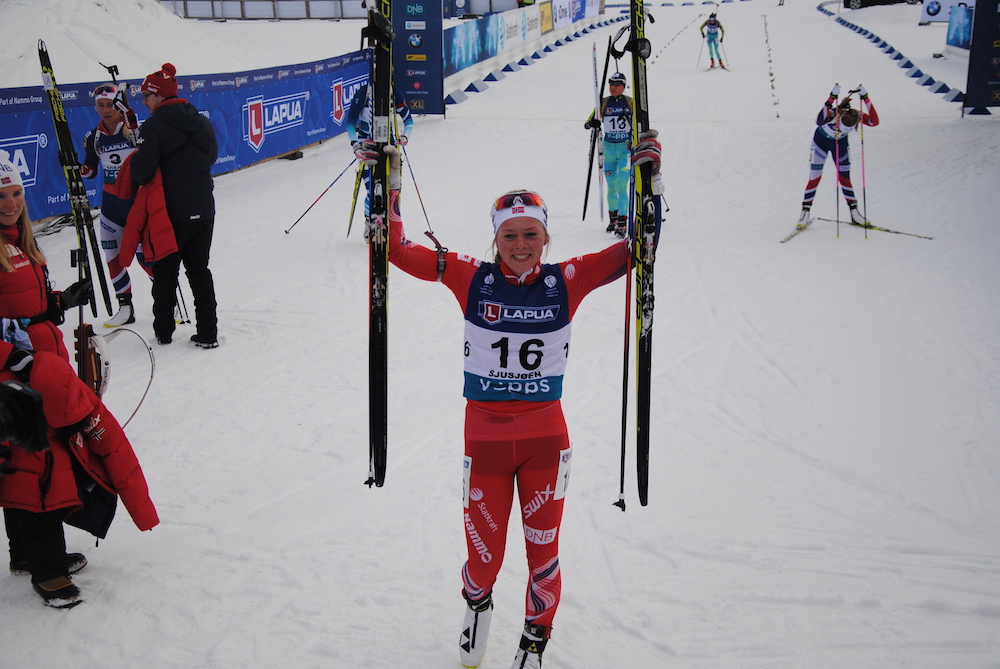
Karoline Erdal celebrates her fourth-place finish.
On Sunday, the young Norwegian hit all 20 targets and crossed the finish line 1:08.9 after Dzhima.
Later in the afternoon, the men’s 15 k mass start was set to be just as exciting as the women’s race. The big question was, would the French team be able to live up to the previous day’s strong performance? In the sprint, five-time World Cup champion Martin Fourcade had surged to a convincing victory, and the French had put five men in the top six.
On Sunday, they lived up to expectations.
The French team lacked Fourcade, who told L’equipe that he decided yesterday to pass on the mass start due to a lack of energy.
But the French still repeated their feat of stealing five out of top six finishes. Martin’s older brother Simon Fourcade won withSimon Desthieux second, just three seconds back. Krasimir Anev of Bulgaria placed third (+18.1), before a trio of Frenchmen: Fabien Claude (+29.2), Jean Guillaume Beatrix (+1:01.7), and Quentin Fillon Maillet (+1:04.4).
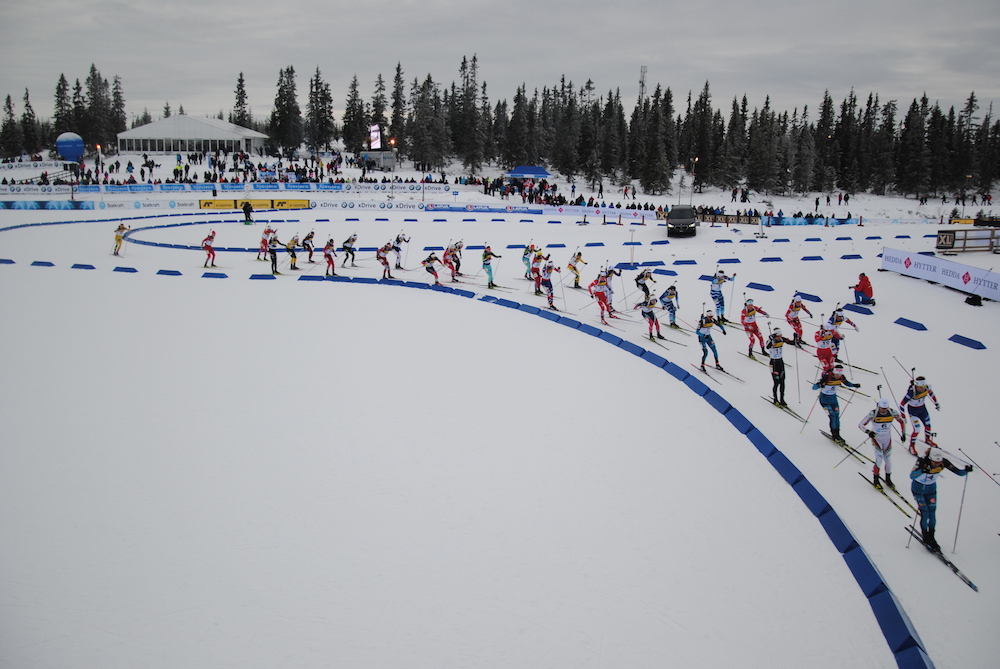
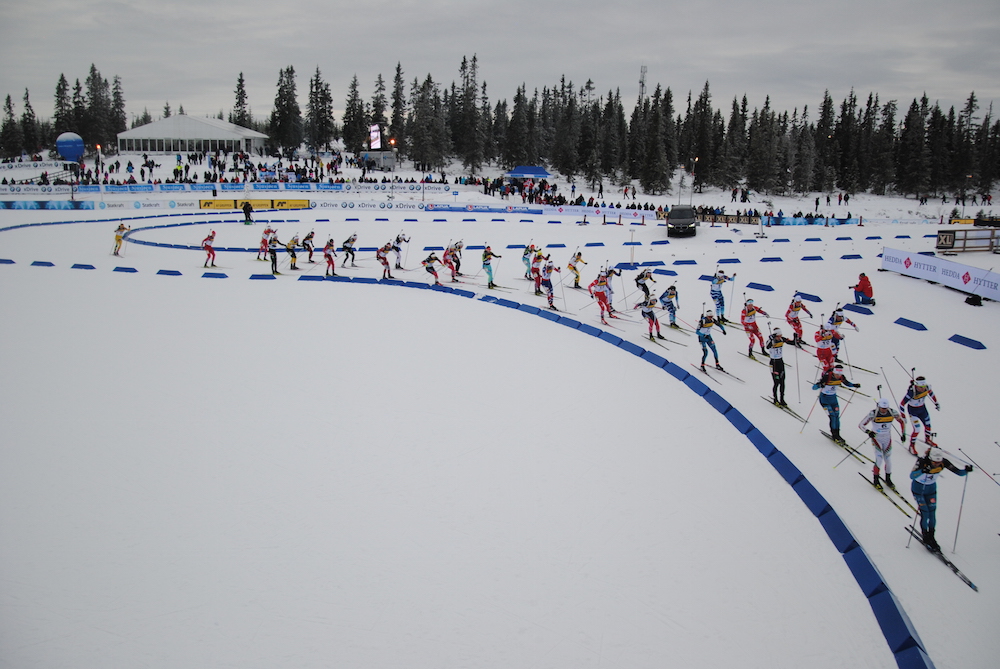
The men’s mass start snaking through the stadium.
“I had to represent my family today, and I am really happy about my race,” Fourcade said during his post race interview with NRK. “I was a little unlucky with the wind yesterday, but I was happy today. I was good in the shooting range and in the track so I am full of confidence for the beginning of the season in Östersund in two weeks… My goals are a little the same as last season, top ten in the World Cup and a medal at the World Championships.”
It was clear from the very beginning that the French didn’t just come to Sjusjøen to try, they meant business. After a first lap that was calm enough for the entire field to stay together, the French were among the top shooters. After the first stage Fourcade, Desthiuex, Claude, and Beatrix had hit all their targets, along with Anev and Norway’s Johannes Tingnes Bø.
This good performance on the shooting range continued on throughout the race except for Bø, who missed three shots in the second shooting. With it, Norway’s hopes for a podium seemed to slip away.
The remaining five skated on and were joined by Fillon Maillet, who had missed twice in his first shooting but made up ground.
By 7.8 kilometers – just over the halfway point – a leading pack had developed consisting of three French athletes and Anev. Rather than pushing the pace, all of them skated easily and it appeared that Norway’s Henrik L’Abee-Lund and Ole Einar Bjørndalen, in pursuit 13 seconds behind, still had a chance to catch them.
But L’Abee-Lund missed twice in his third shooting, and Bjørndalen once; Claude was the only one in the lead who didn’t hit all targets, and dropped from the front pack.
The competition wasn’t quite over yet. Fourcade delivered a fourth lap so fast that nobody else could match him, then headed to the final shooting. Where he had shot the fastest of anyone in the field on the previous stage, Fourcade took his time to make sure he knocked down all five targets. He held a lead of 20 second going into the final lap; Desthieux closed with the fastest lap time of the day, but was unable to catch his older teammate.
“I think we have a strong team this year, and the young boys are pushing me,” Fourcade said. “It really is a good team spirit this season.”
Sjusjøen’s large shooting range – 40 points rather than the standard 30 sets of targets – allowed for a larger mass start field than in World Cup competition.
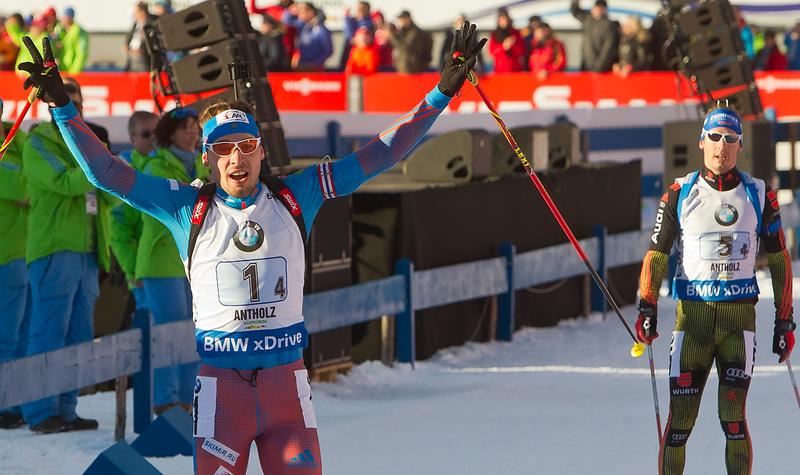
Russia’s Anton Shipulin (l) celebrates after holding off Germany’s Simon Schempp (r) to anchor Russia to the men’s relay victory on Sunday at the IBU World Cup in Antholz, Italy. Shipulin outlasted Schempp by 1 second for the win. (Photo: IBU/Rene Miko)
Russia’s Anton Shipulin and Germany’s Simon Schempp have met multiple times on the final loop of an International Biathlon Union (IBU) World Cup race and duked it out for first, both in individual races as well as relays. In fact, they did so in Saturday’s pursuit in Antholz, Italy, where Shipulin prevailed by 10 seconds to claim his first victory of the season.
On Sunday in the men’s 4 x 7.5-kilometer relay in the same packed arena with over 20,000 biathlon fans, Shipulin did it again to anchor a Russian team — with Maxim Tsvetkov, Evgeny Garanichev and Dmitry Malyshko — to first in 1:12:24.8, with no penalties and seven spare rounds.
The German team, with Erik Lesser, Benedikt Doll, Arnd Peiffer, and Schempp, finished just 1 second behind, with one penalty but just four spares.
“It has become sort of a tradition with me and Simon together on the last shooting range and then on the last lap,” Shipulin commented in the post-race press conference through a translator. “Honestly Simon becomes stronger and stronger every time, but today I would say I didn’t beat him physically, it was more about tactics. It is not a very long finish lane here, so I just made it tactically better to not give him a chance.”
“Being on the podium shows that we are in good shape,” Malyshko said through a translator. “We will try our best at the World Championships [in Oslo in March] to show everybody that we are even stronger than in the World Cups.”
“We trust in Anton, and Anton believes in the team,” one of Shipulin’s teammates added in an interview with the IBU.
Schempp was not pleased with a situation that happened when he and Shipulin came into the arena, having to pass a lapped athlete from Japan just before the last turn, with Shipulin overtaking on the right but Schempp getting slightly blocked.
“The lapped athlete ran in the middle of the track. The whole audience was yelling for him to go to the side. I don’t know, maybe he is deaf on his ears, or whatever he is doing,” Schempp told German broadcaster ARD. “With all the peace of mind he is running right between us, and that must not happen.”
Asked if he thought a protest with the IBU would be an option, Schempp replied: “Nah, surely that would not go through. That result stands.”
“I gave everything I had, it was a neat relay, and we were rewarded with the second place,” he added. “The Russians were very, very strong, especially Anton in the finish. We can live with that. It was a clear step forward in the relays [the German men’s first relay podium of the season]. Of course the end is a little annoying, but we can be satisfied.”
The head coaches for German and Russia, Mark Kirchner and Ricco Gross, respectively, hugged and congratulated each other in the coaching zone after the race. Both 45 years old, they are former German teammates and won gold together in the men’s relay at the 1994 Olympics in Lillehammer, Norway. More recently, they were also colleagues, with Kirchner coaching the German men’s team and Gross being an assistant for the women at the 2014 Olympics, before Gross took an offer last summer to lead the Russian men’s team (after being “demoted” to the IBU Cup by the German Ski Federation).
“It’s difficult to even pick the six best athletes for the World Cup,” Gross had told German newspaper FAZ in an interview published on Friday, just before Shipulin’s sprint victory. “I was extremely surprised in September when I watched the Russian championships for the first time, with more than 100 athletes. There is a giant talent pool … My target is the Olympic Games in 2018.”
Norway opted to rest its usual starters Tarjei Bø and Emil Hegle Svendsen for the relay on Sunday, instead starting veteran Ole Einar Bjørndalen, Lars Helge Birkeland, Johannes Thingnes Bø, and Erlend Bjøntegaard.
“They married and went on vacation,” Johannes Bø joked during the press conference when asked about the absence of his brother Tarjei and Svendsen.
Thus it fell to the relatively inexperienced Bjøntegaard to anchor the team. Bø tagged him with a 29.2-second lead over Russia, and 33.5 seconds ahead of Germany, with Shipulin and Schempp chasing after him.
“Now it’s becoming really exciting. I wouldn’t like to be in the shoes of Bjøntegaard right now,” Germany’s third-leg Arnd Peiffer said during an interview with ARD while the race was still going on. “I think he has a lot of stress now, and I am curious what happens.”
But facing this big challenge, Bjøntegaard did a good job skiing a fast first loop to return to the range still in first and only needing two spares in his prone shooting. Yet this still reduced his lead to 6.8 seconds over Schempp, who had shot clean, and 14.9 seconds to Shipulin, who required one spare.
In the final standing shooting, the Norwegian needed two more spare rounds, while Shipulin and Schempp both remained clean and left the range just 0.5 seconds apart. They skied together until the finishing sprint, with Bjøntegaard securing the third place on the podium, 22.9 seconds after Russia, but securely ahead of the rest of the field.
“With Emil and Tarjei, two of our best athletes were not in the relay,” Johannes Thingnes Bø said during the press conference. “I was hoping that we could make the podium, and we did. A perfect race for everyone on the team. Erlend and Lars Helge were called up last minute, but they were relaxed, and third place is good. It’s not easy for Erlend to go out with Schempp and Shipulin.”
Behind Norway, Austria, with Sven Grossegger, Julian Eberhard, Simon Eder, and Dominik Landertinger, finished fourth (+1:01.7), with one penalty and 11 spare rounds.
“Better shooting,” Simon Eder told the IBU in a video interview when questioned what it would have taken to reach the podium. “We always have the extra [penalty] loop. It’s not easy, it happens so fast. But we hope to manage it at the World Champs without it.”
“The running shape is very good in the Austrian team,” Landertinger added. “And if the shooting is a little bit better we can make the podium.”
France, starting without World Cup leader Martin Fourcade with a lineup of his older brother Simon Fourcade, Quentin Fillion Maillet, Simon Desthieux, and Jean Guillaume Beatrix, placed fifth (+1:39.3), with no penalties and 11 spares.
U.S. Ties Season-Best 6th; Canada 11th
Lowell Bailey (US Biathlon leads Russia’s Maxim Tsvetkov during the first leg of the men’s 4 x 7.5 k IBU World Cup relay on Sunday in Antholz, Italy. Russia went on to win and the U.S. finished 1:43.7 minutes back in sixth, tying a season-best team result. (Photo: IBU)
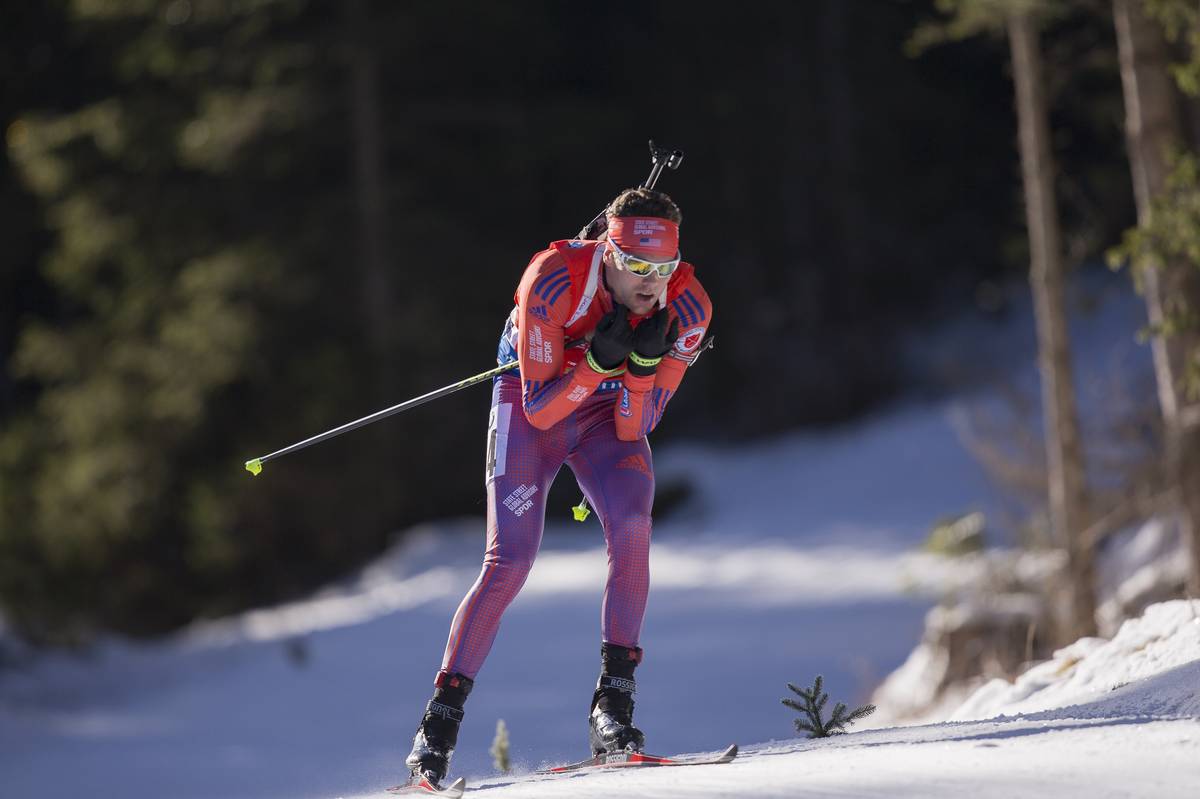
On the last leg, Beatrix narrowly won out a race against American Sean Doherty, who crossed the finish less than five seconds later in sixth place, 1:43.7 behind the winners. The U.S. ended up with one penalty and 13 spares, and tied its season-best result after having achieved sixth in the relay a week ago in Ruhpolding, Germany.
The Americans started the race in bib 6 with their now-usual lineup of Lowell Bailey, Tim Burke, Leif Nordgren, and Doherty, the same starters they had used at the World Championships in Kontiolahti, Finland, where the U.S. placed 14th in the men’s relay.
Bailey briefly took the lead on the loop out of the arena, before two misses in his prone shooting stage required spare rounds and set him back to 15th, but still within 15.5 seconds out of the lead. With another spare in his standing stage, he still moved up five positions, and with the second-fastest, first-leg course time on his final loop, he tagged off in seventh, 20.8 seconds behind Germany’s Lesser.
Burke held that position throughout his first loop, but two misses in the prone stage set him back. In the standing shooting, he used all three spare rounds to avoid the penalty lap, falling back to 14th before he made up ground again with a fast last loop (third-best course time) to tag Nordgren in ninth (+1:04.3).
“Today proved that last week was not a fluke,” Burke said in a US Biathlon press release. “We are happy to be right in the mix with the ‘big’ biathlon nations but we still know that we are capable of more.”
“I got the tag from Tim right with the Czech Republic,” Nordgren wrote in an email to FasterSkier. “For all of the first loop I just focused on staying nice and relaxed, trying to conserve as much energy as possible. Prone I wanted to be pretty aggressive and it worked out well.”
After a clean prone shooting, Nordgren left the range in seventh place, virtually tied with a few other teams.
“The second loop I left the range with Eder from Austria, again I was just tucked in with him saving energy,” Nordgren recalled. “Although I had super great skis today, so eventually on the downhill I put in a good transition and was pushing towards the French team in front of us.”
After using two spare rounds in his standing stage, Nordgren still managed to move up to sixth place as some other teams, such as Italy and Switzerland, struggled on this leg, and handed off 1:04.5 minutes behind the leaders — about the same gap he had when he started.
Russia’s Evgeniy Garanichev (l) leads Tim Burke (US Biathlon) during the second leg of the men’s 4 x 7.5 k IBU World Cup relay in Antholz, Italy. (Photo: IBU/Rene Miko)
“Standing was the only disappointing part about my race today, it was a bummer to have two mistakes, but I didn’t lose any places and I was quick with the extras,” Nordgren wrote. “I was surprised on the third loop, I actually had some energy to push. Eventually France passed me and got a small gap I couldn’t close.”
Doherty kept the team in sixth on his first loop and through the first prone shooting, which he cleaned, reducing his gap to first by about ten seconds.
“The conditions today were ideal,” Doherty wrote in an email. “The course was in great shape and there was no wind. The altitude here adds to the difficulty, but I also pushed hard on the second loop and I did not really hold it together on the range as I wish I could have.”
By the final standing shooting he had moved to fifth, and was on the range behind Austria, with France nearby and Slovakia further behind. Austria’s Landertinger shot clean and finished first, while Doherty caused a penalty lap. But he only lost one position and still had France’s Beatrix in sight who had needed three spares.
Doherty skied a fast final loop, almost closing a 20-second gap again, finishing sixth, 4.4 seconds behind France in fifth and 1:43.7 behind Russia.
“I am a little bummed to have had that penalty because I was excited to fight for 5th. But overall 6th was secure,” Doherty wrote.
“I am happy with another strong result,” Doherty added in the US Biathlon press release. “We were in the mix the whole time and even though I did not shoot my best the team did well. We are all looking forward to the next relay.”
“As a team I think we’re happy with this race, but it was nowhere near a perfect race for us,” Nordgren wrote. “We still have more to give and will be looking for more in the relays to come.”
Canada in bib 7 chose a lineup of Christian Gow, Nathan Smith, Macx Davies, and Scott Gow. Brendan Green had to sit out the relay because of back issues following his collision in Saturday’s pursuit, “which did not improve until race time,” according to Biathlon Canada head coach Matthias Ahrens. “We had to put Scott Gow in his place,” Ahrens wrote in an email.
Younger brother Christian Gow jumped out to the lead after cleaning the initial prone stage, but on the next loop he lost some ground, crossing the next timing point in 11th, just 10 seconds out of first. After he required two spare rounds in his standing stage, Christian lost additional time to the leaders, but kept his position in the field, tagging off to Smith in 11th (+1:08.3).
Smith, currently the highest-ranked Canadian in the overall World Cup, cleaned both stages for his first 100-percent shooting in a race this season. Reflecting on his race in an email, he said his ski shape was off — and it has been for the last couple days. Unable to move up in the field, he tagged Davies in 11th (+1:07.7).
“I wanted to make up some spots and get our team up to the top 10. I knew it would mean some really good shooting,” Smith wrote in an email. “I’m really happy to finally have my first clean of the winter, especially after poor shooting in the other two races this weekend. On the other hand my skiing hasn’t been where it should for the last two weeks. I’m not sure why, I went from my best ski shape to my worst ski shape in literally 3 days. I have been struggling with back pain after a hard downhill crash in the Ruhpolding 20 km.”
Davies went on to clean his prone stage and move into 10th, reducing the gap to the leaders to 41 seconds. In standing, he needed all three spares, which caused him to lose some time. Overall Davies skied the second-best course time of his leg (only behind Norway’s Bø), and handed off to Scott Gow in 10th place (+1:39.0).
On the anchor leg, Scott needed two spares in his prone stage and one in standing, with Estonia’s anchor Ermits Kalev still passing him on the final loop. The Canadian crossed the finish in 11th, 5.7 seconds behind Estonia and 2:28.9 minutes behind Russia.
Combined, the team had no penalty and required just eight spares. But 11th wasn’t exactly close to their season best: the Canadians finished sixth in Hochfilzen, Austria and 10th last week in Ruhpolding.
“There were some good aspects of our relay: Christian’s first prone was amazing, my shooting, and Macx’s skiing,” Smith wrote. “Overall though I would say unfortunately it was not a good relay. A good race for us is top 6. The potential for a medal is there if everyone can put together their best race on the same day. Easier said than done.”
The Biathlon World Cup resumes in two weeks on Canada’s home turf in Canmore, Alberta, with sprints on Thursday, Feb. 4 and Friday, Feb. 5, followed by mass starts on Saturday, Feb. 6, and single-mixed (1 woman, 1 man) and mixed (2 women, 2 men) relays on Sunday, Feb. 7.
“I’m going to North America in a good mood,” Germany’s Peiffer said at the press conference. “The last three weeks were really exhausting. Now I had a good week here in Antholz, and I am looking forward to go to Canmore. I have never been there before. Maybe not as many [spectators] as in Ruhpolding or Antholz, but it’s nice to see a new place for biathlon.”
“I will be in Romania for my last Junior World Championships,” Sean Doherty, 20, wrote, which will take place in Cheile Gradistei (Brasov, Romania) from Jan. 27 to Feb. 2. “So I will only be attending the Presque Isle World Cup [after Canmore].”
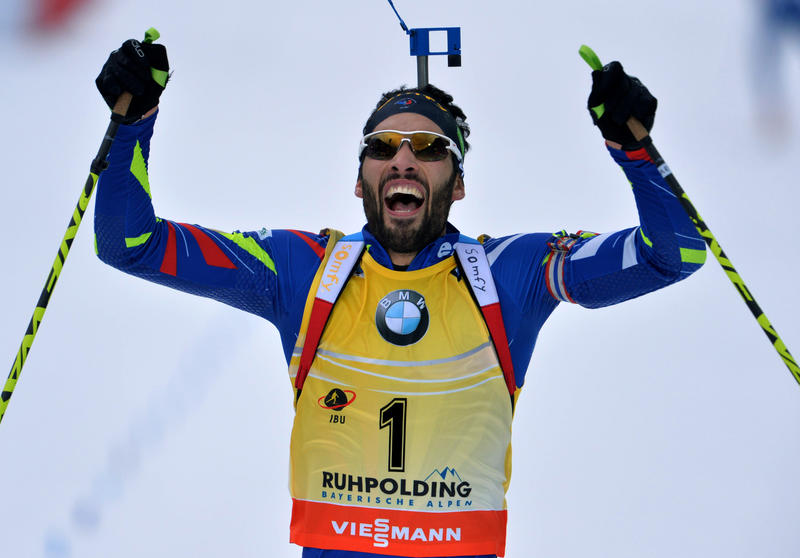
France’s Martin Fourcade celebrates across the line as he won the men’s 15 k mass start on Sunday in Ruhpolding, Germany, for his 41st IBU World Cup win. (Photo: IBU/Eberhard Thonfeld)
Still suffering from the aftermath of an illness earlier this weekend, French biathlete Martin Fourcade was back to his usual strength in Sunday’s 15-kilometer mass start in Ruhpolding, Germany, winning in a time of 34:07.2 with one penalty while skiing the second-fastest course time of all starters. Ondrej Moravec of the Czech Republic finished second, (+13.7), and Norway’s Tarjei Bø third, (+29.7).
With the 41st win of his career, Fourcade extended his lead in the overall World Cup standings to his biggest rivals, and is now also leading the mass start score after two competitions.
Fourcade was one of the best performers in Ruhpolding, finishing fourth in the sprint and second in the pursuit.
“That’s cool, after two competitions close to the victory I am really satisfied to win this competition in Ruhpolding,” he added in an IBU video interview. “Yesterday it was a really close gap from the victory. Today I am satisfied about my whole competition, but especially my shooting spirit.”
Fourcade had one missed target in the first shooting stage, but then climbed up through the standings as he cleaned round after round.
On the penultimate loop, he caught the leaders and with Norway’s Emil Hegle Svendsen managed to create a gap to a chase group led by Moravec and Russia’s Evgeniy Garanichev.
Fourcade came into the last shooting stage with Svendsen. But while Fourcade managed to clean the stage again and leave it still in first place, Svendsen lost his position in the race by shooting three more penalties for four total. He only finished in 13th place, 1:12.3 minutes back.
Fourcade meanwhile took the lead after the final stage, and extended it from 5.8 seconds to his eventual comfortable margin.
“I was really confident on my last shoot, about my chances to shoot clean,” Fourcade said in a video interview after the press conference. “I thought that Emil will be with me on the last loop, but he had three mistakes and so he didn’t fight with me. And on my last loop I was confident to keep my gap to Ondrej Moravec. So that was a quite good and exciting competition.”
Ondrej Moravec of the Czech Republic after cleaning the 15 k mass start for his first IBU World Cup podium of the season on Sunday in Ruhpolding, Germany. (Photo: Fischer/NordicFocus)
Moravec was the only one of the 30-man field to clean in all four stages. It was the first podium of the World Cup season for the three-time medalist from the 2014 Olympics.
“For sure it is a relief; I feel much more comfortable now,” Moravec said in the press conference. “I think this is the third zero [shooting competition] in my life. That was good work … especially in standing, because yesterday I was too risky on the range in the pursuit. So today I am satisfied with my work on the shooting range, focusing on the job.”
Bø, who had placed second in the sprint and fourth in the pursuit this weekend, shot three penalties.
“I cannot quite understand that I managed to get back up there, because I got the worst possible start,” Bø told NRK. “There were strong winds on the first shooting, and I got two misses … I struggled my way into third. I was determined to go well on the last shooting.”
Norway’s Tarjei Bø (2) racing to third in the men’s 15 k mass start, at the IBU World Cup in Ruhpolding, Germany. He’s currently third in the overall World Cup standings as well. (Photo: Fischer/NordicFocus)
Even after cleaning the final round, Bø left the range in seventh place.
Fourcade’s older brother Simon left the shooting range in third position, skiing out on the final loop 27.3 seconds back. But three athletes from a chase group were still able to pass him, with Bø ultimately able to secure the last spot on the podium in a sprint on the finish stretch. He finished just ahead of Ukraine’s Dmytro Pidruchnyi in fourth (+31.4, two penalties), Germany’s Arnd Peiffer in fifth (+33.3 with one penalty), Simon Fourcade in sixth (+36.9 with one penalty), and Garanichev in seventh place (+38.4 with two penalties).
Bø skied the fastest course time of the day and was able to prevail in a larger chase group on the final loop.
“To be honest, I am not so surprised,” Bø said in the press conference regarding his season so far and this race in particular, achieving a podium despite three penalties. “I have not been so good on the overall World Cup in many years due to a lot of things, I missed events due to sickness, and so on. I was happy to win medals last year [at the World Championships], but in the total score I have been really bad for three years. This year I had no trouble at all, and I know I will fight every race. So I am really happy about the total score.”
Bø currently stands in third position after this race, behind Martin Fourcade and his teammate Svendsen.
Two North Americans in the Mass Start
Lowell Bailey (US Biathlon) on his way to 16th in the men’s 15 k mass start at the IBU World Cup in Ruhpolding, Germany. (Photo: USBA/NordicFocus)
Two North American men — American Lowell Bailey and Canadian Nathan Smith — had qualified for the mass start by virtue of being ranked in the top 25 of the World Cup.
US Biathlon’s Tim Burke, who was narrowly outside that group and had hoped to be called up from a “reserve athletes standby list”, did not get his wish granted. Norway’s Ole Einar Bjørndalen, who is ranked ahead of him, returned from illness for his first race of the weekend. Bjørndalen finished the day in 12th place, with three penalties.
Bailey’s race got off to a good start, with clean rounds in both prone shooting stages despite difficult wind conditions. In the third stage, Bailey had the first miss of his day, and came out of the penalty lap still in ninth place, 27.1 seconds back, as several athletes at the top of the field incurred penalties as well.
He came into the last shooting stage in a pack of athletes still with a chance for at least a top-10 position, but two more misses set him back. He left the range and penalty laps again in 15th place. On the final loop he slipped to 16th, 1:15.2 back.
“Ahhhhhhh!!!!” That about sums it up! So close. Thx to USBA wax crew… INCREDIBLE SKIS!!!“ Bailey tweeted after the competition.
Canada’s Nathan Smith, who had hoped to build on the strong skiing and shooting form he had demonstrated to achieve a sixth place in the pursuit on Saturday, struggled through a difficult day on the shooting range.
With changing winds repeatedly forcing athletes to adapt their sights – for example blowing strongly left-to-right in the first stage and then almost not at all on the second stage – Smith recorded six misses on the day, only shooting clean during his final stage (1+2+3+0).
He finished the day in 25th place, 2:23.4 back from Fourcade.
Simon Schempp of Germany celebrates his second-straight win at the men’s 12.5 k pursuit in Pokljuka, Slovenia. (Photo: IBU/Kvetoslav Frgal)
Perfection in a pursuit. That’s what’ll get you ahead and keep you there, as Germany’s Simon Schempp demonstrated on Saturday at the International Biathlon Union (IBU) World Cup in Pokljuka, Slovenia.
Two days after winning the men’s 10-kilometer sprint, Schempp started the 12.5 k pursuit with a 15-second head start on Norway’s Ole Einar Bjørndalen in second. Twenty-five and 26 seconds back in third through fifth, respectively, Russia’s Evgeniy Garanichev and Alexey Slepov and France’s Martin Fourcade set out after Schempp.
After placing third in the sprint, Garanichev fell out of contention for another podium with a miss in the first prone stage. He went on to clean the next two stages, but missed another on the final standing to end up sixth overall.
Slepov fared worse, with two penalties in each of the first two prone stages, then one in each standing for a total of six penalty laps. He placed 25th at the end of the day, while Schempp controlled the race from start to finish, winning with perfect 20-for-20 shooting in a time of 30:46.5.
France’s Martin Fourcade finishing second in the IBU World Cup pursuit on Saturday in Pokljuka, Slovenia, while Russia’s Anton Shipulin enters the finishing straight for third. (Photo: IBU/Kvetoslav Frgal)
Only Fourcade, the fifth starter, came close, rivaling Schempp with clean shooting through the first three stages. The Frenchman missed one on the last standing, which put him 18.4 seconds back leaving the range after a costly penalty loop. He finished 16.6 seconds after Schempp in second, and Russia’s Anton Shipulin rose from sixth to third with the fastest course time.
Shipulin finished 23.4 seconds after Schempp with two penalties (0+1+1+0), besting Norway’s Tarjei Bø, who was 1.8 seconds off the podium in fourth. Bø posted the second-fastest course time to pick off five places after starting ninth.
Only three out of 59 finishers cleaned the four-stage race: Schempp, France’s Simon Fourcade (who placed 10th), and Sweden’s Fredrik Lindström (14th).
“Maybe the last 200 meters were easy. Everything else was extremely hard,” Schempp said in an post-race interview with ZDF. “I didn’t quite have my best day out on the course today, and except for one loop with Martin, I always had to ski in front alone. That was quite energy-sapping.”
Fourcade was the fastest out of the start early on, racing from fifth up to third behind Schempp and Bjørndalen as they entered the range for the first time. There, all three men cleaned and Bjørndalen left the range nine seconds after Schempp in second while Fourcade was another 10 seconds back in third.
Second prone was more of the same, with the three leaders cleaning, yet Schempp maintained his distance with a 10-second cushion to Fourcade and Bjørndalen skiing together in second and third.
On the third loop, Fourcade, 27, dropped the 41-year-old Norwegian and entered the range right behind Schempp, where the top two cleaned all five targets once again. They set out on the penultimate loop together, where Fourcade made clear that he did not want to take the lead. Despite shooting faster, he waited for Schempp to go ahead of him.
Germany’s Simon Schempp and his smoking gun. Schempp shot 100 percent on Saturday to win the men’s pursuit at the IBU World Cup in Pokljuka, Slovenia. (Photo: IBU/Kvetoslav Frgal)
“That was the same as last week, he just didn’t want to go in front,” Schempp said of Fourcade. “He had shot faster, then he stepped to the side and wanted to let me pass. I just yelled ‘Together!’ to him, and then he nodded and we changed back and forth. At first there was a bit of a disagreement, but then that calmed down…”
“I don’t really understand why he does that sometimes,” Schempp added. “We were in front, but the others are pressuring from behind, and if you work together, you should be faster and can create a small gap. My opinion is that you should work together, except for the last loop of course, but before that, yeah, I just have a slightly different opinion than him.”
“We collaborated a lot …,” Fourcade said in a post-race press conference. “It was a good solution. We were making sure we had positions one and two.”
In the final standing stage, Fourcade shot quickly, but missed the fourth shot, while Schempp cleaned.
“In the last shooting, I thought his second shot had missed. At least it sounded that way,” Schempp recalled.
“Before the race, I thought that I would try to do all I can to be first,” Fourcade said in the press conference. “Simon was a little calmer at the last shooting. He had his own rhythm.”
Fourcade came out of the penalty lap with an 18.4-second deficit, which proved insurmountable. He skied what appeared to be comfortable pace to the finish for second, 6.8 seconds ahead of Shipulin. After the race, Fourcade and Schempp hugged each other. It was Schempp’s eighth World Cup victory, his third win this season, and the third time he won both a sprint and the following pursuit in the same venue.
While Shipulin secured third on the final loop, he overcame a couple penalties. One miss in the second stage dropped him to eighth, and he left the range after another penalty in the third stage in sixth. When Bø missed one in the final shooting, Shipulin seized the opportunity and cleaned when it counted, leaving the range in fourth, three seconds behind Bø and passing him on the final loop to avoid a sprint to the finish.
“After the second penalty loop, I thought it was possible,” Shipulin said in a press conference. “I was hoping to shoot clean and thought I had a chance to get on the podium.”
According to the IBU website, with one race to go — Sunday’s mass start — Shipulin is eager to see his newborn son.
“I want to go home and see my son, but I try to stay motivated and focused on the upcoming competitions,” he said.
Burke Cracks Top 10
American Tim Burke (14) during one of his last two standing stages, while shooting alongside a German, Slovenian, and Russian. (Photo: IBU/Kvetoslav Frgal)
After starting 14th and 55 seconds behind Schempp, American Tim Burke improved to ninth with a single penalty (0+0+1+0), finishing 1:21.9 behind the German winner.
“[I’m] really happy with today; I had a really simple game plan with my shooting to try to stick to my few key words,” Burke said in a post-race phone interview. “I felt really comfortable out there.”
He skied alone for most of the race, which he found both odd and challenging. Burke started 9 seconds behind the 13th starter, Simon Desthieux of France, and four seconds ahead of US Biathlon teammate Lowell Bailey.
After cleaning the first prone stage, Burke had made his way up to 11th and 50.7 seconds behind Schempp, while Bailey had slipped one spot to 16th, 1:02 back. Both Americans cleaned the first shooting, but Bailey went on to miss one in each stage thereafter (0+1+1+1) and ended the day in 29th (+2:46).
“Not a bad day for me, but without near perfection, it’s hard to compete with this field,” Bailey said in a US Biathlon press release. “There was great overall shooting in the men’s field today so I lost a few places with penalties in each of the last three stages.”
Meanwhile, Burke cleaned the second prone and missed one on the third shooting to hover in the top 10 throughout the race. After hitting all his targets on the final standing, he left the range in ninth. Simon Fourcade trailed him by almost seven seconds in 10th at the beginning of the last loop, while Norway’s Emil Hegle Svendsen was almost 18 seconds ahead in eighth.
Tim Burke (US Biathlon) racing to ninth in the men’s 12.5 k pursuit on Saturday at the IBU World Cup in Pokljuka, Slovenia. (Photo: USBA/NordicFocus)
That left Burke in no-man’s land once more. On the first loop, he had worked hard to catch the group that was fighting for top-10 results, and while he bridged the gap 500 meters before the range, he exited the range just far enough behind those skiers that he remained alone, one loop after another.
“It was a little bit tougher for sure,” he said of the solo race. “I was hoping I’d be able to tuck in on the second loop and catch a little bit of a break.”
Burke worked especially hard the first couple loops to catch those ahead of him and said he felt the effects of that effort later in the race. Still, he held on and most importantly held it together for the last shooting.
“So much can change on the last shooting…,” Burke said. “I was hoping that people would finally start making mistakes there on the end. The last shooting, I shot on point 11 and shot zero and moved up one place. I was really happy to move back into the top 10; it’s the best race I’ve had in a while.”
At the same time, he reflected on how tight the race was. Given the race he had, with 19-for-20 shooting and the 19th-fastest course time, Burke would have guessed he would have finished in the top six. Not the case when the fastest guys don’t have to ski many penalty laps.
“It’s a fairly easy approach to the range here of so a lot of people shoot well here,” he noted.
Burke will be one of three North Americans starting Sunday’s 15 k mass start, with Canada’s Nathan Smith in bib 12, Bailey in 19th and Burke in 26th out of 30. Three seasons ago, Burke placed third in the Pokljuka mass start.
“I think it’ll be a great opportunity for me,” Burke said. “Typically I do well at the end of these trimesters … these three weeks of racing.
“At this point, fatigue definitely plays a big role for everyone, both mentally and physically,” he added. “A lot of people want to get home at this time. … For me, it’s one more race. I need to focus for 40 minutes out there and I think I can handle that.”
On Monday, the day after the Pokljuka World Cup ends and the IBU World Cup goes on holiday break, he’ll fly home to Lake Placid, N.Y.
While Bailey was the second man for the U.S. in 29th, Brendan Green was the top Canadian in 30th (+2:53.3). After starting 46th and cleaning the first three stages, Green missed two on the last standing and fought for a top 30 on the final loop.
For the first time in history, five Canadian men started the pursuit. Smith finished 35th (after starting 24th) with three penalties (1+0+2+0). Scott Gow started 35th and finished 45th with four misses (1+1+2+0), and Macx Davies slipped from 34th to 57th with six penalties (3+2+2+1). Despite skiing in the top-30 for a portion of the race, Christian Gow, in bib 37, did not finish.
“On my fourth lap I developed a debilitating cramp and had to stop the race,” Gow wrote in an email about his DNF. “I really wanted to finish, especially since I was having a good race, but I simply couldn’t. It is disappointing for me, but sometimes these things are out of your own control.”
“It was a tough day for our team,” Biathlon Canada’s High-Performance Director Eric de Nys said in a press release. “The coaches are thinking there may be a bit of a flu bug going around. Nathan and Rosanna [Crawford] both felt off today. Christian completely cramped up and Megan [Tandy] blacked out on the course. It was an off day, but they will review the day with the athletes and bounce back from this.”
American Leif Nordgren made up a few spots in 49th (after starting 52nd) despite four penalties (0+1+2+1).
Brendan Green racing to sixth for Canada in the men’s 4 x 7.5 k relay at the IBU World Cup in Hochfilzen, Austria. Sixth place remains the Canadian men’s second-best relay result. (Photo: Biathlon Canada/NordicFocus)
The men’s 4 x 7.5-kilometer relay at the IBU World Cup in Hochfilzen, Austria, was marked by frequent lead changes on Sunday, leaving the big question of which nation — out of several — would actually win.
At one point, US Biathlon’s Tim Burke was sitting in first place as his team’s second skier. But in the end, three of the “usual suspects” prevailed, with Russia catching up to and eventually overtaking Norway at the very end of the final lap. France claimed the third podium spot, and Canada and the U.S. finished sixth and eighth, respectively.
For Canada, sixth place stood as the second-best men’s relay finish since the same four skiers placed fifth at last season’s World Cup in Oslo, Norway. With Christian Gow, Nathan Smith, Scott Gow, and Brendan Green racing in the same order as they did in Oslo, the Canadians rose to sixth during the second half of Sunday’s race and ended up 21.3 seconds off the podium in Hochfilzen.
With a clean prone stage and one spare in standing, Christian Gow, 22, tagged Smith 25.7 seconds behind Latvia in first. The Latvians had been elevated by a flawless leg from their scramble skier, Andrejs Rastorgujevs. On the second leg, Lativa slipped to 23rd (and was ultimately lapped on the final leg), while Canada moved into seventh with Smith.
“It was a lot of fun to race and to be so close to the top of the field,” Christian wrote in an email. “I am happy with how well I held it together in the range and out on the course! It was an all round very good day for me.”
Smith explained that while his men’s team repeated its sixth-place result from last year’s Hochfilzen relay, the competition was a lot tighter on Sunday.
“It was a much more exciting race to be in, with constant changes,” he wrote.
“Each time I went into the range I could still see the leaders,” Smith added. “This might’ve led me to be overly aggressive in shooting as I knew a quick clean could get me up there. Unfortunately I didn’t have any of those…”
Smith needed all six spares — three for each shooting — but knocked down all his targets to avoid the penalty lap. He noted that “6 spares is a lot on this course. Ski times are so close that it really all came down to shooting accuracy and speed. The rest of the guys had phenomenal shooting, though. I’ll admit I was the one that didn’t race to my potential today.”
With the seventh-fastest course time, Smith overtook three teams to move the Canadians into seventh, 49.3 seconds back at the second exchange. From there, Scott Gow cleaned without needing any spares and also skied the seventh-fastest course time for his leg to put his team in sixth (+59.0) before the final leg.
“My goal today was to try and not rely on spares, and the end result was exactly what I wanted,” Scott, 25, wrote in an email. “My skiing felt good today and my shooting was perfect, so overall I’m very happy.”
Canada’s anchor leg, Greene used one spare in both prone and standing and posted the fifth-fastest course time of his leg to secure sixth. He was able to still overtake Sweden’s Jesper Nelin, while Germany’s Simon Schempp moved ahead of him.
“Austria has been great to us,” Green said with a laugh. “It’s hard to say what it is. I think right now momentum is building on the team with some good results early in the season. But I think as a team we are more confident now.
“The biggest thing for me is knowing if I don’t perform, one of the younger guys will, so that removes some pressure because the expectations for the team are not all on one athlete anymore,” Green added.
A 29-year-old team veteran, Green felt the pressure on the final leg after his teammates skied as high as fifth during the race.
“There was a lot of pressure out there on that last leg today but I’m happy with how I handled it,” Green said.
He considered the Gow brothers to be the difference-makers on Sunday, and Smith agreed.
“The Gows are a lot stronger this year skiing and can fight with the top teams now,” Smith wrote. “I think a relay medal is within reach if we can all lay down our best on the same day.”
After using nine spares, the Canadians ended up behind Russia in first, with Alexander Volkov, Evgeny Garanichev, Dimitry Malyshko, and Anton Shipulin winning in 1:11:40.8. Norway placed second, 3.1 seconds back, with Henrik L’Abee-Lund, Johannes Thingnes Bø, Tarjei Bø, and Emil Hegle Svendsen. France was more than a minute back in third (+1:01.9), and Austria finished fourth 9 seconds later. Germany placed fifth (+1:18.4), 4.8 seconds ahead of Canada.
According to Smith, sixth place wasn’t necessarily a surprise. The team ranked seventh in the relay based on last season’s results. At the same time, coming close to a team best was always a good thing.
“All of us put forward strong legs to get in to the top 6 and that is an accomplishment we are all proud of,” Christian wrote. “I am hoping that we can match or hopefully even improve upon our 5th place relay from last year. That will be a tall order to say the least, but today was a good sign that we are on the right track!”
“That was some high-pressured racing today. We are all pretty happy for sure,” Green told Biathlon Canada.
“It was a really exciting race. I mean when you look at how the position changed, and now at the end still a good fight for the sixth place with the Swedes. I’m very happy that we made it,” Ahrens said.
Asked which athlete he would single out he added: “You know I’d have to pick all four, they put their work in, and not having a penalty and shooting very solid all throughout. But also the skiing, really fighting it out there, attacking … And our anchor Brendan at the end, when Schempp passed him to go with him and catch the Swede was the highlight.”
“It’s a young season, but so far, besides our other relay, the mixed relay in Östersund, it’s definitely a highlight,” he added.
Sean Doherty on his way to anchoring the U.S. men’s 4 x 7.5 k relay to eighth on Sunday at the IBU World Cup in Hochfilzen, Austria. (Photo: Fischer/NordicFocus)
The U.S. men placed eighth (+2:06.6) with Lowell Bailey, Burke, Leif Nordgren, and Sean Doherty requiring a total of 12 spares and one penalty lap.
Sixth after Bailey’s first leg, in which he used one spare in prone and cleaned all of his targets, the U.S. moved into eighth with Burke, who ended up skiing a penalty lap after using all three spares on his second shooting (0+0, 1+3). Nordgren used a total of three spares between his two stages (0+2, 0+1) before tagging Doherty in ninth. Doherty recovered to eighth despite five spares (0+3, 0+2) with the sixth-fastest anchor leg.
“I was really happy with the performance. I felt a little bit better on course today, too,” Bailey wrote in an email, ”which is encouraging leading into the Pokljuka World Cup next week. I think we are satisfied as a team, but we all know that we have the potential to be on the podium…”
“We’re all capable of much more,” Nordgren wrote in an email. “This was a good starting point, but as we get deeper into the season we’ll be expecting more.”
Shipulin Attacks for the Win
n a large field of 27 starting countries, Russia came out at the top, requiring just six spare rounds and no penalty laps. Russia’s anchor Anton Shipulin achieved his first podium of the season on Sunday, and later said in the post-race press conference that he felt that he was “doing better and better race by race.” He put an exclamation mark to this statement on Sunday, outsprinting Norway’s Svendsen on the last meters.
The Russian men’s relay team won the IBU World Cup 4 x 7.5 k on Sunday in Hochfilzen, Austria, with (from l to r) Dmitry Malyshko, Anton Shipulin, Alexey Volkov, and Evgeniy Garanichev. (Photo: Fischer/NordicFocus)
“After the last shooting stage, I saw Emil was not too far away from me and I knew I had to attack and catch him; I was a bit better on the track, so that was basically the plan,” Shipulin said through a translator. “This was not just my victory; all of the guys on the team were really great today.”
Norway had decided to give superstar Ole Einar Bjørndalen some rest, with L’Abee-Lund starting in his place, then handing off to the Bø brothers and finally closing with Svendsen. For quite a while they looked like the eventual winners, with Tarjei Bø handing over to Svendsen with a 30.8 second lead over Russia at the final exchange. But that gap wasn’t enough.
Svendsen still led by 18.1 seconds after the penultimate shooting, and many local as well as Norwegian fans that had traveled to Austria loudly chanted the typical “Hey!” with every target he cleaned while uncontested in the range (0+0). He still came into the final stage first, but then required two spares and his lead shrunk significantly to 10.4 seconds when he left the stadium.
Seeing the opportunity to catch Norway, Shipulin began his chase up the last climbs, posting the best course time on the final loop and sprinting past Svendsen as they approached the finish. Just 3.1 seconds behind Russia in the finish, Norway required seven spare rounds, and had no penalties.
Despite the close loss, the Norwegians weren’t too disappointed: “The team did a good job today, and we are satisfied with the race,” L’Abee-Lund said during the press conference.
“I feel my shape and confidence is coming back,” Johannes Thingnes Bø said.”Hopefully after the New Year I will come back and fight with Fourcade, Schempp and the best.”
13.12.2015, Hochfilzen, Austria (AUT): Norway’s Johannes Thingnes Bø leads France’s Quentin Fillon Maillet (c) and Italy’s Lukas Hofer during the second leg of the men’s relay at the IBU World Cup in Hochfilzen, Austria. (Photo: Fischer/NordicFocus)
France grabbed the last spot on the podium, finishing more than a minute behind Russia, also requiring six spares and no penalty lap. The team chose a lineup of Simon Fourcade, Quentin Fillon Maillet, Simon Desthieux, and Martin Fourcade, and was skiing just outside the top three for most of the race.
Then, anchor Martin Fourcade, last year’s overall World Cup winner and runner-up in Friday’s sprint and winner of Saturday’s pursuit, managed to move them up one position after he required just one spare in his prone shooting. On the next loop, he crashed descending down a bridge before the final shooting stage, a mistake that didn’t cost France the podium, yet ended any chances to catch up to the two leading teams before the last shooting.
“It was not a perfect race, but I’m satisfied with it,” the team’s starter Simon Fourcade said in the press conference, after using one spare in prone and handing off in eighth. “I had some little mistakes in the shooting … But yeah, satisfied with the race today, and satisfied to see that my ski level is back.”
Local favorite Austria, with Sven Grossegger, Julian Eberhard, Simon Eder, and Dominik Landertinger placed fourth (+1:10.9) and just 9 seconds off the podium, despite having to ski two penalty loops, which all the other top teams avoided. They used a total of 13 spares, two of which came from Landertinger on his first stage, but the Austrian anchor closed out the race with a flawless standing stage and the second-fastest time behind Shipulin on the final loop.
“A little bit more would have been possible, the two misses in prone shooting are really annoying,” Landertinger told Austrian broadcaster ORF. In the pursuit the day before, he had already achieved the best individual result of the season so far for his team.
Germany’s Simon Schempp, who had battled Martin Fourcade for the win in the other two races this weekend, again skied a very strong last lap with the third-fastest time behind Shipulin and Landertinger and only required two spares. With that performance he elevated his squad from 10th to fifth place (+1:18.4), after his teammates Erik Lesser, Andreas Birnbacher and Benedikt Doll struggled throughout the race with shooting. Uncharacteristically, Germany required 16 spares, the second-most of any team on Sunday, and narrowly avoided the penalty lap on four of eight stages.
Arguably the biggest surprise of the day was Sweden in seventh (+1:26.1), with Torstein Stenersen, Ted Armgren, Fredrik Lindström and Jesper Nelin. Aside from Lindström, the team had little World Cup experience. Despite that, Sweden managed to stay near the top the whole race and even tagged off in third place on the last exchange, before Nelin missed three targets on his leg and fell back a bit to seventh place, finishing 2.9 seconds after Canada and 40.5 seconds ahead of the U.S.
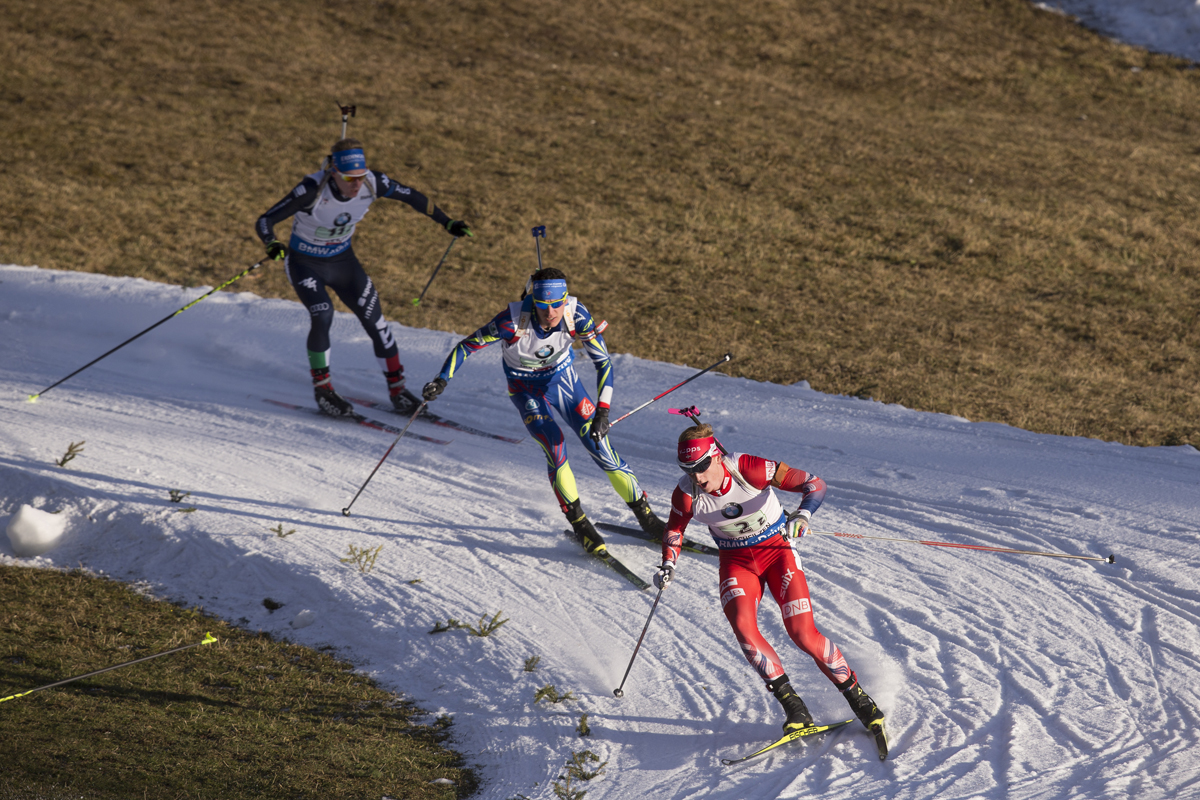
Leif Nordgren of the United States racing to 19th place in the sprint in Sjusjøen, Norway, on Saturday. The team’s new orange-and-purple suits have been provoking discussion… (Photo: Jonne Kähkönen)
As much as Tarjei Bø wanted to win one for the home team in Sjujøen today, the Norwegian biathlete knew when he missed his second shot that it wasn’t going to be.
“You do not deserve to win with two penalties,” he told Norway’s NRK broadcaster. “That hasn’t happened in the last two years I think. It’s good that someone could beat me.”
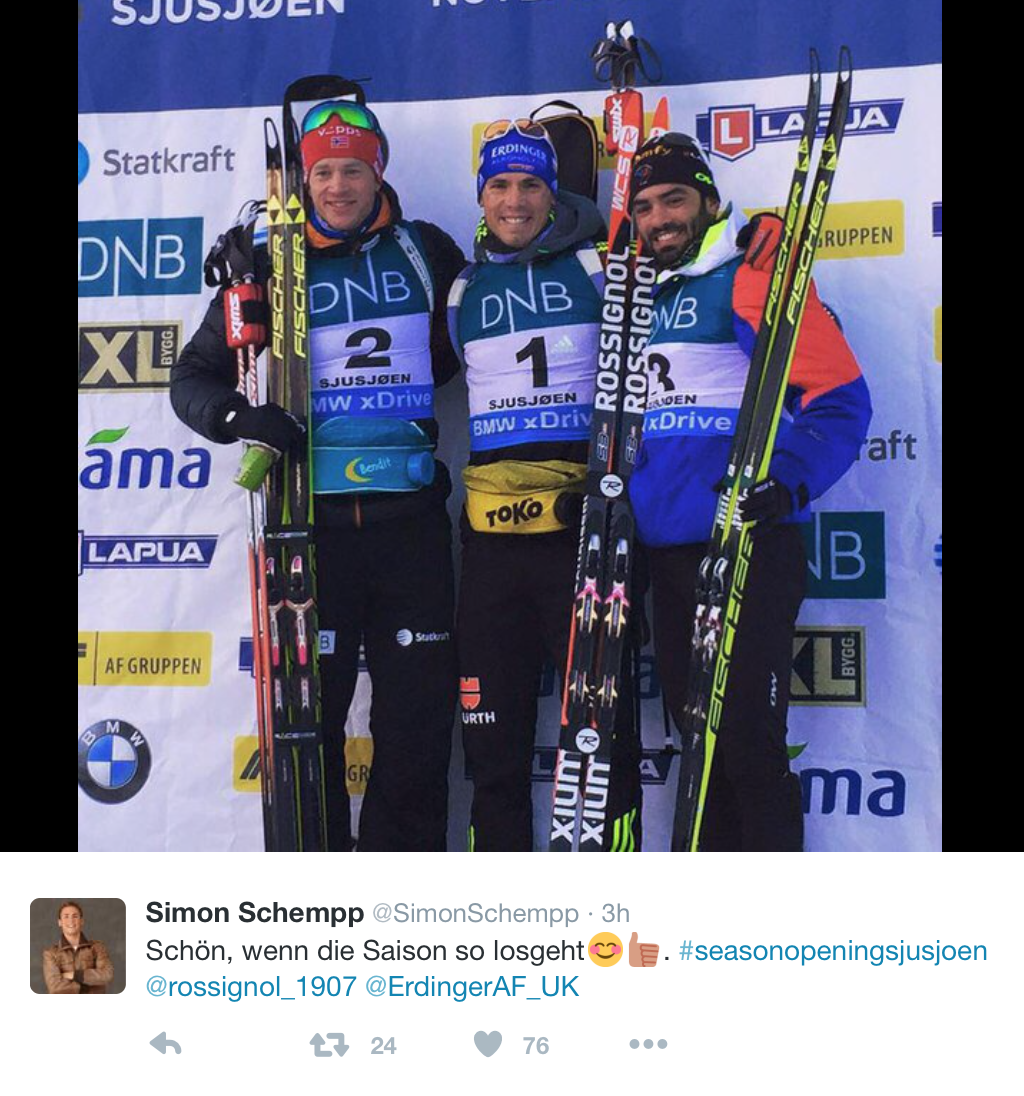
Simon Schempp of Germany had no such problem in the 10 k sprint. With just one missed shot, he beat Bø by 13.7 seconds to take the win in the first major biathlon competition of the 2015-2016 season.
“It was fantastic to win in the first competition,” Schempp told NRK. “I’ve felt good in training all year, and this confirms that my shape might last.”
Schempp broke through last season, winning three different World Cup races and landing fourth in the Total Score.
“It’s wonderful when the season starts like this,” Schempp tweeted after the race.
Simon Fourcade of France placed third, +32.3 with a single penalty. He landed just four seconds ahead of his younger brother Martin, who had three penalties and tried to charge hard for the podium after errors in standing shooting.
He made up ground, but not enough.
“Not so bad result with not so good feelings… Hope for better next week,” Simon Fourcade wrote on his Facebook page.
Much of the pressure was on the home team, which is preparing to host World Championships in Oslo in March.
Besides Bø’s second place finish, the team seemed shaky. Younger brother Johannes Thinges Bø had three penalties to place sixth.
“It was a little bit of nerves kicking in,” the several-time World Cup winner told NRK, according to a translation. “It was shitty shooting at the moment. But it will be an exciting season and it’s good to have started.”
On the other hand, the older Bø brother asked, well what did you expect?
“It was not Johannes who I feared most today,” Tarjei Bø told VG. “He is not the best in the wind. He has been okay in tailwind for several years, but with crosswind he is not so good.”
Several other Norwegians were in the top 20, but most were not the national team atheltes. Henrik L’Abee Lund placed 18th with three penalties, and Alexander Os, a successful Championships competitor who has lately been left off the national team and has started his own training group, finished 20th.
Stars Ole Einar Bjørndalen and Emil Hegle Svendsen didn’t start today’s race.
All of that might be worrying for the host country. But Tarjei Bø is confident.
“I want to be good all winter,” he told NRK. “I think I might be the type to be good from start to finish.”
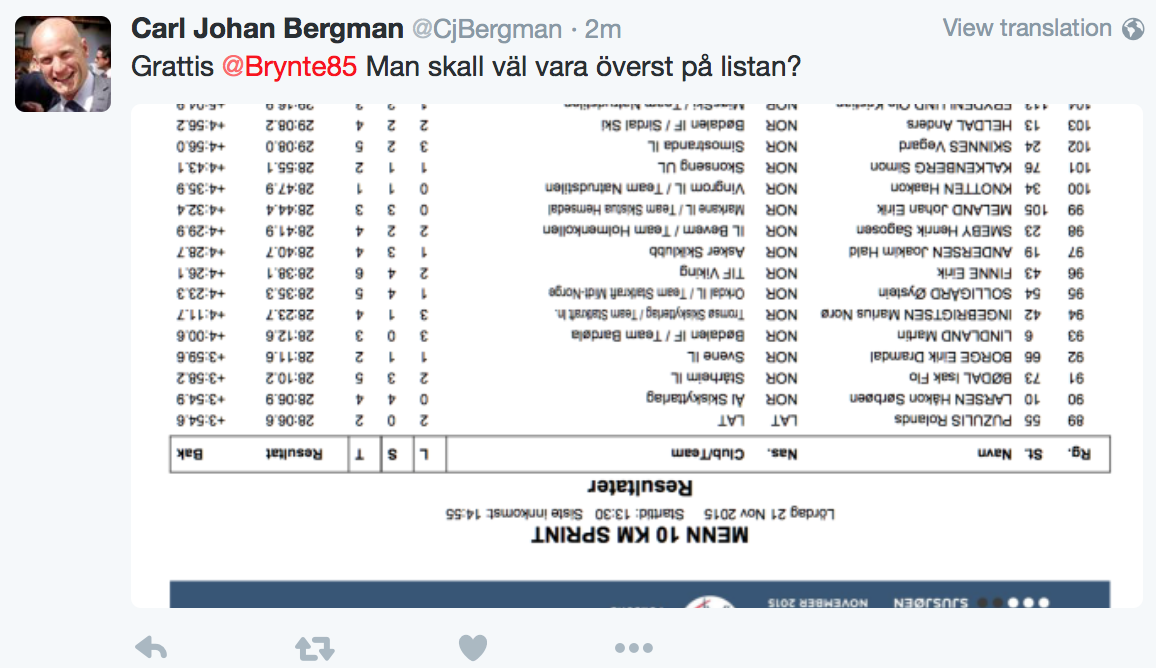
Four Americans competed, and all finished in the top 30. Tim Burke led the pack in 13th with two penalties, +1:25.7.
“This was my fourth session on skis and my first speed on snow, so I was definitely not expecting to feel great,” he wrote in an email. “I felt very flat for the entire race, considering this, I was pleasantly surprised with the result. Everyone comes into these races with very different goals. Some are trying to qualify for World Cup teams and others are coming in under a big training load. With all of these variables, I don’t read too much into the results.”
That’s to be expected, said Women’s National Team Coach Jonne Kähkönen.
“In general, I would say most of the struggle was mainly because of the travel overseas (arrival on Tuesday pm) and due to that not quite adjusted,” he explained in an email, speaking of both the women’s and men’s teams. “At the same time; this was what I expected and wanted to do to speed things up in terms of adjustment.”
This is the first season that the U.S. team has competed in these races. Previously, the team would travel directly to Östersund, Sweden, to train in advance of the World Cup beginning there.
Burke appreciated the chance to get an extra race start in and feels that he’s working towards good race shape.
“This training season was a little up and down for me with a few different sicknesses,” he wrote. “I feel like I did not really start to get on track until the end of October. I’ve had some great training days in the past month and then some days where I feel pretty flat like today. I’m hopeful that I will be more consistent now when I start backing off the hours and get a few more races under the belt.”
Close behind on the results sheet were Leif Nordgren in 19th (+1:33.1, 2 penalties), Lowell Bailey in 25th (+1:41.9, 3 penalties), and Sean Doherty in 29th (+1:47.6, 2 penalties).
“It’s always nice to get the first race of the year in the books, and it’s an even better feeling when it does fairly well,” Nordgren wrote in an email. “I feel like in the past season I’ve started off much to slow, yes, my goal this year was to start as close to where last season ended as possible. I’m not at that point today, but I’m not so far off like I’ve been in the last few years, and with a few more races under my belt, hopefully it’ll pick up fast.”
Like Burke, he said it was unusual to go through the process of getting used to racing while also getting used to being on snow.
“I could tell it was the first race of the year today, I definitely felt a little off balance, and it was a little weird to be on fast skis!!” he wrote. “The conditions here in Sjusjøen are near perfect though, almost like mid winter conditions, its getting quite cold at night and there is plenty of snow!”
Of the four, only Nordgren is planning to compete in Sunday’s mass start, while the rest of the team will be training.
“I just feel like racing is something that helps me get into good form,” Nordgren wrote of his decision to buck the team trend. “This is a good opportunity to get a really high quality race in, so why not race!”
The success of all four in the first test of the season was taken as a good sign for the men’s team.
“Sean has definitely taken a good step forward already in the training season and today was a good confirmation on it,” Kähkönen wrote of Doherty’s top-30 debut. “Looking forward to seeing what he can do this year.”
With two half-seasons of World Cup racing under his belt, Doherty – who still has one year of junior eligibility left – has already been a calm presence in team events.
“Today was definitely a solid team performance,” Burke wrote. “Our entire men’s team is at a very high level and we are all very excited to see what we can do in the relay.”
This is too good not to include: also in the race was fun-loving Swedish cross-country skier Robin Bryntesson, who missed nine of his ten shots and finished last. That prompted retired star biathlete and fellow jokester Carl Johan Bergman to basically ask if the results sheet was upside down:
Erik Bjornsen (U.S. Ski Team B-team) leads French biathlete Martin Fourcade, a two-time Olympic gold medalist and six-time world champion, during a training session earlier this month in Villard-de-Lans, France. (Photo: Dauphi Nordique)
In a paparazzi-like post about Martin Fourcade, a French website featured nearly two dozen photos of the French biathlete rollerskiing on a recent autumn morning. One photo wasn’t much different from the next, except for the eight with Erik Bjornsen.
It wasn’t his French look-alike; he wasn’t photoshopped in there. Bjornsen, a 24-year-old U.S. Nordic Ski Team member, recently returned from several weeks in France, training near Grenoble with Fourcade — a two-time Olympic gold medalist, six-time world champion, and his girlfriend’s friend.
Erik Bjornsen rollerskiing this fall in Villard-de-Lans, France. (Courtesy photo)
“I’ve gotten to know him the last few years,” Bjornsen explained.
The photos were from an interval session they did on the track in Villard-de-Lans, where Bjornsen mostly trained during his stay. He’s been returning to France to visit his girlfriend, former French biathlete Marine Dusser, for the last three summers.
“There’s quite a few top athletes that are based out of that area, so I’ve gotten to know the crew around there pretty well,” Bjornsen said on the phone last week, a few days after joining the U.S. Ski Team for its annual fall camp in Park City, Utah.
In France, he has worked out with top French cross-country skiers like Robin Duvillard and Maurice Manificat, and this year, Bjornsen spent a good deal of time with Fourcade, 27, and his older brother Simon, 31, also an individual World Championships medalist. The two biathletes visited Villard-de-Lans between training camps, during which time Bjornsen joined them for a few interval sessions.
“You know, Martin’s going to be doing some nordic racing this year so he has been [working on] his classic skiing as well, so we got out for a lot of easy distance skis together,” Bjornsen said.
Instead of tagging along and trying to hang with the French national-team members during their workouts, Bjornsen explained he was more conscious about sticking to his own training plan this year.
“I’ve had kind of a tricky summer with a couple of injuries and surgery in July on [my right] hand so I’m kind of in a different spot,” he said. “I’m really trying to work on trying to build my aerobic base since I kind of missed a couple of months this summer. It worked out that Martin was pretty into changing his plan a little bit so he could match it up with mine, which is really sweet of him. We ended up doing [Level 3] workouts together and then for easy distance, it’s pretty easy to match up those workouts.”
FasterSkier: How did you injure your hand and when did you have surgery on it?
Erik Bjornsen: Last fall I had a ski crash with [my Alaska Pacific University teammate] Scott Patterson. I tore part of my tendon in the hand, and it was quite painful throughout the season. … I had a bunch of scar tissue built up and it kind of looked like I had like another knuckle on the top of my hand. It was just this big bump that [hurt] every time I was poling. The second glacier camp in July, I had been working on it throughout the spring and trying to naturally recover it and it just it wasn’t working so [APU coach Erik] Flora and I decided to make the call and get the surgery done. I had surgery in mid-July. I wasn’t able to rollerski really much for a month and a half. I actually had a little bit of a knee injury going on at the same time, so I had kind of a tough couple months of training and spent quite a bit of time in the pool swimming, doing some alternative exercises.
Erik Bjornsen after having surgery on his hand in July, “still feeling a little funny,” he explains. (Courtesy photo)
FS: What happened to your knee?
EB: I hammered one of my knees against a rock when I was running, like a week before the surgery. I took a couple of weeks to get better, but then after surgery I was supposed to keep my hand elevated. I was starting to get back into running, but running with one of my arms elevated. I think it just kind of threw off my body. It put a lot of torque on my left side of my body and especially on the knee. It stiffened up, especially my left hip, and that took a month to get over. It was just a lot of stretching and massage work. So I was able to get over that, but I mean, I haven’t really been feeling healthy for more than like a month now.
FS:Ouch. Back to your hand: what kind of surgery did you need?
EB: They went in and the tendon was actually looking like it was in pretty good shape so they didn’t do much work on that, but there was a big buildup of scar tissue and that seemed to be throwing off the the gliding of the tendon. It hurt when I was putting pressure on it with the strap, but after skiing like an hour, an hour and a half, it actually started getting like more painful. So they went in and mostly just took out the scar tissue.
FS:Are you pain-free now? Where are you at with your recovery and how are you feeling?
EB: I’ve been feeling great for the last month. Pretty much the last month I’ve been completely healthy and I’m ready to get some good training in. It was good timing to go to France and kind of have a little refresher after doing quite a bit of training on my own since July. I spent a lot of time in the pool, and then spent a fair amount of time doing some no-pole rollerskiing skate skiing, and those were kind of the two main exercises I was doing. So it’s been nice to kind of get back into some double poling using poles and starting to run some more. I’m starting to feel good again.
Erik Bjornsen mid-run, enjoying a change of scenery in Corsica, France. (Courtesy photo)
FS:This Park City camp is mostly focused on intensity training, right?
EB: This first week is building in some steady distance training. The last portion of the camp, we’ll have a mini tour so that’s kind of the focus of the camp, trying to get ready for that mini tour and trying to have three good intensity days [at the end].
FS:How are you feeling on Day 2 of camp, now that you’re working out with your teammates again?
EB: I don’t feel like I have a good sense of where I’m at compared to the [other] guys [on my team] right now, but as far as the last month I’m definitely starting to build my confidence back up a little bit. It was kind of a tough last part of the summer with all the injuries. I did a ton of training on my own and a lot of different training. So it can be a very interesting season to see how it all works out. I used to do quite a bit of swimming when I was younger … I was getting into swimming again, sometimes, like, a couple miles a day. I think I’m a pretty decent swimmer so I was lucky to have that background in the sport so that I was able to still use it for pretty good training.
It’s been interesting to get back into the skiing, and I feel like I’ve been moving a little bit differently. I don’t know if it’s better — I hope it’s better — it’s definitely, mentally, a different training schedule than I am used to. And I haven’t done a lot of the intervals. I’m starting to feel like maybe I didn’t lose as much as I was originally thinking, but it’s always so hard to tell on rollerskis. You never really know until the first couple of races or first couple of time trials, but I’m definitely starting to get a bit more confidence back, feeling like I’m in a decent place. I wouldn’t be surprised if I gradually build into the season this year. We’ll see.
Erik Bjornsen racing the sprint qualifier at 2015 French rollerski nationals in Bastia, Corsica. (Courtesy photo)
When I was in France, I raced the French rollerski nationals [in September in Bastia, Corsica]. It was a good opportunity to jump in with all the best World Cup guys. Everybody was there from the French team. After Norway and maybe Sweden, I would say they are the strongest team. I had some decent races there. I kind of got my butt kicked, but there’s some strong guys. I was decently satisfied with the way I was skiing. It’s always a little tricky when you jump in … they have matched roller skis there; skis I’ve never been on. It was pretty epic.
[Bjornsen said he finished seventh or eighth in the sprint, narrowly missing the final. In the prologue the next day, he estimated he finished in the top 20.]
FS: You mentioned focusing on sprints again this year. Without a World Championships to peak for, what kind of larger goals or events are you setting your sights on?
EB: I’ve been working out the schedule. I feel like there is actually a decent amount of classic skiing this year, which I’m pretty excited about. I think I’ll also try to finish the Tour de Ski this year, so that will be one of my focuses, and then for sure the Canadian [World Cup] races, especially Canmore. It’s pretty close to my home in Washington. I think a lot of my family will be up there and friends, and so I am hoping I’ll be in good shape for those races. I’ll be doing the same as last year, pretty much all the starts the coaches will give me. Just trying to gain experience on the World Cup, get closer to the podium, but I think, it’s not going to happen in a couple years. I mean hopefully I can, overall, just take one step closer.
Erik Bjornsen and Mannon, Martin Fourcade’s daughter, who was 6 weeks old at the time. (Photo: Erik Bjornsen)
FS:A lot of people might wonder what Martin and Simon Fourcade are really like. How would you describe their personalities?
EB: They are actually really good friends with my girlfriend’s family so I’ve known them for a few years now. They are pretty close. They were over for Christmas dinner last year. I feel like I’m starting to know them pretty well. I really enjoy spending time with them. They are both great guys, but they are also very different personalities between the two of them. They are super fun to hang with.
It’s crazy — Martin is one of the most famous guys in France. We were skiing one day together and he was telling me he was going to Paris, and then I saw him on television. It’s crazy to see how famous he is. He’s just a normal guy and really nice. He has a kid now. I met her. I know his wife so I spent some time with [them] outside of training. I think they are both pretty laid back … they seem like regular guys. They are the same kind of people as Simi [Hamilton] and Andy [Newell] or any of the guys back here, down to earth and laid back.
Erik Lesser of Germany celebrates his win in the 12.5 k pursuit at the 2015 IBU World Championships in Kontiolahti, Finland. (Photo: Kontiolahden Urheilijat / Jarno Artika)
KONTIOLAHTI, Finland – It was only a matter of time before Erik Lesser climbed to the top of the podium. The German biathlete was close in the past past – in 2014 he earned two Olympic silvers in the individual and relay events and has frequented the IBU World Cup podium four previous times.
Lesser will no longer lack gold in his trophy case after Sunday’s 12.5 k pursuit at the 2015 IBU World Championships where he skied and shot to a time of 30:47.9. He was joined on the podium by Anton Shipulin of Russia, who finished 17.0 seconds back. Tarjei Bø placed third, 18.7 seconds behind.
The day began with Tarjei Bø’s brother Johannes Bø in bib 1. The Norwegian had a 12 second advantage over second place starter, Canada’s Nathan Smith, after winning Saturday’s 10 k sprint. Just behind them was Tarjei Bø, who began the race 25 seconds behind his brother.
The three biathletes skied the 2.5 k course alone for the first lap and entered the stadium hoping to clean the first prone stage and hold their time advantage. Johannes Bø and Smith both missed two to take them out of the lead, while Tarjei Bø cleaned to remain in the running.
Erik Lesser of Germany (5) was the only biathlete in Sunday’s 12.5 k pursuit to clean all four shooting stages. His win was the first of his career. (Photo: Kontiolahden Urheilijat / Jarno Artika)
Tarjei Bø wasn’t the first skier to exit the stadium, however. Instead it was Simon Fourcade of France followed by Lesser. The Frenchman and the German started in bibs 4 and 5, and each began 30 seconds back from the leader. They overcame the deficit with quick shooting and strong skiing in the first loop.
Joining them to create a lead pack was Simon Fourcade’s brother and IBU World Cup overall leader Martin Fourcade, who shot clean in his first prone to make contact. Trailing him was Tarjei Bø. After the second stage of prone, however, the group dropped Martin Fourcade after the French biathlete missed one.
Lesser created a large lead over the rest of the field after cleaning in the first standing stage. Both Tarjei Bø and Simon Fourcade missed one to give the German a 22 second lead.
Once Lesser cleaned the final stage of shooting and became the only competitor to clean all stages, it was clear he had secured the win. As he entered the stadium he crossed his arms above his head to make a X, paying tribute to his region of Saxony. After the race, he said that the day was his first “perfect” day since racing on the IBU Cup circuit.
“In the World Cup it was my first perfect race,” he told reporters. “I did some perfect race in the IBU cup before… It was my first perfect race and especially at the World Champs, it’s really amazing.”
The German explained that he knew there was a potential for a podium going into Sunday’s sprint, but that due to the nature of the sport nothing was guaranteed.
“I know that I’m in good shape and I can work really good in the shooting range and also in the track, but I think nobody has really feeling for the victory because in biathlon anything can happen,” he explained. “Biathlon has it’s own rules and today it was a good day for me.”
Tarjei Bø of Nroway celebrates his third bronze medal of the 2015 IBU World Championships in Kontiolahti, Finland. (Photo: Kontiolahden Urheilijat / Jarno Artika)
The remaining podium positions weren’t as clear-cut as the German’s victory. Russian Anton Shipulin had risen from 18th position to third before the final shooting, and when second-ranked Tarjei Bø missed one shot, he exited the range within seconds of the Norwegian. The two skied together in the last lap until the final half-kilometer, where Shipulin maneuvered around Bø. Unable to respond, Bø trailed Shipulin across the line as the two finished second and third.
Although Shipulin started with bib 18 and 1:03 behind the first starter, he explained that he believed a podium was possible in the pursuit.
“Actually I thought about it before the race that I could fight today,” he said to the press. “Here in Kontiolahti the conditions are very hard but after the second shooting I saw that the competition was very close.”
As the top-ranked Russian at World Championships, Shipulin was the favorite of the many Russians in attendance in Kontiolahti. Despite his huge fan base, he said that he felt little pressure to medal. Shipulin’s silver is the first medal for Russia at the 2015 IBU World Championships.
“There was not a lot of pressure,” he said. “I know there were a lot of people who were expecting medals for our team. The relay is our favorite race, and we hope to get more medals in the future.”
Tarjei Bø’s bronze medal is his third of the Championships after he finished third in both the mixed relay and the 10 k sprint.
“[This is] far more than I expected,” the Norwegian said. “I’m full of confidence of course. My shooting has never been better. Today was tough to mobilize the energy to shoot good. I had to do a really good job to shoot the targets.”
Canada’s Nathan Smith leaves the range for the first time in Sunday’s 12.5 k pursuit at the 2015 IBU World Championships in Kontiolahti, Finland.
Smith Leads North Americans in 13th
Although Smith started in second position, the two misses in his first shooting stage brought him down to 13th and over 30 seconds from the leaders. He fluctuated in the teens for the rest of the race as he missed one shot in each of the three subsequent stages.
“My shooting was a little off today. It was tough shooting and it was a little bit worse than it needed to be,” he said in a post race interview.
Smith explained that after his first two misses he still believed he could contend with the race’s leaders. However, with the subsequent misses in standing he said the race became a fight to maintain his position.
“I knew if I could shoot well in the rest of the race it could turn out really well, but I just did the best I could and then fought hard on the last lap to maintain my position,” he said.
Given his historic podium just a day earlier, Smith explained that he would have been happy with any result in the pursuit, and that he was especially pleased with 13th. “I thought to myself that I could have the worst race today and end up 60th, and it wouldn’t really matter,” he said. My biggest goal was yesterday. 13th was still a really good result so I’m happy with that.
According to the 29-year-old, the podium and its responsibilities, whether they be with the media or the awards ceremony, took a toll on his energy and provided valuable lessons for the future.
“It’s just a learning experience,” he explained. “Yesterday with all the media stuff and the prize ceremony, that was pretty taxing energy-wise and a distraction too obviously. Those guys are used to doing that practically every weekend so they can calm down right after.”
“I didn’t sleep very well last night,” he added, citing the continued excitement over his silver medal. “I probably slept like five hours so I was a little groggy this morning.”
Not far behind Smith was fellow Canadian Brendan Green, who advanced from 21st position to 16th after three rounds of clean shooting and one miss in his final standing stage. In the last loop Green could see Smith ahead of him and worked to keep his teammate in sight. Although he couldn’t catch Smith, he passed Jaroslav Soukup of the Czech Republic to gain a position, but was ultimately overcome by Dominik Landertinger of Austria before the finish.
Green said he was pleased with the pursuit despite the steady drizzle of rain that fell on competitors throughout the entire day. He explained that his shooting was near the best of the season.
“I’m really pumped with the shooting today. It was again really challenging conditions with the wind but I was able to handle that really well and able to execute what was a very good race on the range. It was one of the better ones of the season,” he said.
U.S. biathlete TIm Burke prepares to shoot in the 12.5 k pursuit at the 2015 IBU World Championships in Kontiolahti, Finland. he finished 20th on the day. (Photo: USBA/NordicFocus)
The first American finisher in the 12.5 k pursuit was Tim Burke, who placed 20th. Burke began in bib 15 and shot clean in both prone stages to rise to sixth after the second shooting. He held the position throughout the third loop, but fell to 10th after missing two in the first stage of standing. He missed another two in the second stage to fall to 22nd, but passed two skiers in the last lap to earn his eventual position.
Burke entered Sunday’s pursuit with an aggressive mentality. He knew that to get into his goal of the top five he would need to take some risks. While the risks didn’t land him in the desired position, Burke said he didn’t regret his strategy.
“It was super windy, but I took every risk today. Both standings, I just went for it, really fast shooting. I didn’t care about getting a 10th place, I wanted a top five or it didn’t matter, so that’s what I went for,” he said in an interview. “It didn’t work out but I felt really good on the skis today. Definitely an improvement from the sprint so I’m looking forward to the next race.”
Prior to the 2014/2015 season, Burke was a usual in the top 20 and often cracked the top 10. This year, however, the American has struggled to reach his top form in shooting. According to Burke, Sunday’s pursuit was a step in the right direction.
“I feel like I’ve been in great shape all year and I feel like I still have that here. Just coming here and trying to gain my confidence again in the shooting again, I definitely lost that in the middle of the season. I’m feeling better now and it’s biathlon, anything can happen,” he said.
American Lowell Bailey skiing to 36th in Sunday’s 12.5 k pursuit. (Photo: USBA/NordicFocus)
Much like Burke, teammate Lowell Bailey started his race with two clean prone stages. After the second shooting he was in 11th, but in the third round he missed four shots to bring the biathlete down to 35th place. He missed one more in the last shooting stage to ultimately finish 36th.
“I just got a little unlucky in the third stage and it was really windy but I figured I could hit more than one. It was over after that,” he said. “After that I just tried to stay in my own zone and ski my own race and try to salvage something out of it.”
In 45th was U.S. biathlete Sean Doherty, who overcame 10 positions after starting in bib 55. The decorated junior biathlete said that he began the race with the aim of improving his standing. He accomplished his goal after missing only three shots and cleaning the first standing stage.
“I was hoping to just shoot pretty well and move up a bunch,” he said. “We had good skis today and I just wanted to go for it. There’s a lot more room to move up than there is to move back on a day like today.”
In 51st was teammate Leif Nordgren who said that his result from the prior day’s sprint weighed heavily on the biathlete during the pursuit. Despite what he described as decent skiing, Nordgren said that he struggled in shooting. The American had a total of six misses.
“Today I’m still actually really bummed about yesterday’s race,” he said. “As much as I tried not to think about it over the night and think about this race, I still brought that into today which is not what you want to do in biathlon. This race today is a lot easier to forget so I think it will be easy to bounce back.”
Scott Gow of Canada finished one spot behind Nordgren in 52nd. Gow said he was hoping for more in the pursuit but was happy to be racing in Finland.
“This is my first pursuit this year so I think that was a little bit of a disadvantage for me,” he said. “I’m happy I was here. I’m happy to have raced. It wasn’t a total meltdown so I’m ready to go onto the next one.”
Martin Fourcade of France (left) celebrates his team’s comeback win in the mixed relay in Östersund, Sweden today. Norway (right, Lars Helge Birkeland) finished second and Germany (center, Simon Schempp) third.
A lot of work goes into relay races, but most times, the only thing many people remember is the end.
That will probably be the case after today’s World Cup mixed relay in Östersund, Sweden. Many countries spent time at the lead – Finland, Canada, Belarus, and Slovenia among them – but by the time 27 kilometers and eight shooting stages had passed, it was down to some of the old favorites: Norway, Germany, and France.
Simon Schempp of Germany and Lars Helge Birkeland of Norway left the range in the lead, with seven seconds back to France. But superstar Martin Fourcade closed the gap almost immediately, and skied at the back of the group for most of the last 2.5 k loop.
Only going up the final hill did he attack and make a move towards the front. The three were still tightly grouped coming around the final downhill corner into the finishing stretch, where Fourcade made another aggressive move, shouldering Birkeland out of the way and pushing forward on the inside lane.
It looked like Fourcade had things wrapped up, and he started celebrating. But Schempp pushed hard as well, and Birkeland found his way to the outside lane and put in a huge surge to try to make his way back. It was a photo finish, although it was still fairly clear that Fourcade came out on top.
“The last part of this competition was the best advertising for the biathlon; the track is quite easy, so I wanted to wait until the end,” Fourcade said in a press conference. “I also had luck and at that point was quite confident.”
Martin Fourcade appears to be doing some disco dancing in this copy of the photo finish shot.
He must have been especially happy to discard once and for all the specter of last year’s competition, where he missed four targets in standing, forgot to use all his spare rounds, accrued a two-minute penalty, and otherwise blew a minute-plus lead that his team had carefully crafted for him.
Today, Fourcade was the hero.
“I believe in Martin and I trust him a lot,” first-leg skier Anais Bescond said in the press conference. “It was an amazing finish.”
“I trust in Martin,” agreed second-leg skier Anais Chevalier.
Birkeland’s smart tactics gave Norway second place, and Germany was left with third. While Norway started their top women (Synnøve Solemdal and Tiril Eckhoff), they rested their stars for the men’s team: instead of Emil Hegle Svendsen, Ole Einar Bjørndalen, or either of the Bø brothers, it was Vetle Sjåstad Christiansen and Birkeland.
“The final lap was a nice fight with Martin and Simon,” Birkeland said in a press conference. “The last corner was not so good; still I am happy with second place. My goal this week is to have a good individual competition and stay in the team.”
Neither France nor Norway were in contention in early in the race. For Norway, Solemdal had a terrible leg, using all three spare rounds in each of her two shooting stages, and additionally having to ski a penalty lap in standing.
“I am very sorry,” she told Norwegian broadcaster NRK, according to a translation. “I wish this had been an individual race. It was a black day… I’m not worried, I’m mostly just cursed. I rushed. I have to pull myself together and do things right going forward.”
After her leg, Norway was in 21st, over a minute and a half back. Eckhoff pulled the team up to 12th and Christiansen to sixth, but it was Birkeland who did the hero’s work, cleaning all ten targets without a single spare round.
France, meanwhile, was in the middle of the pack for most of the race. Bescond led off with a strong leg through the first shooting stage, but used spare rounds in standing and dropped to seventh. The team was tenth after Simon Fourcade skied the third leg. Then Fourcade took over – and brought the team to the top despite using two spare rounds in standing.
For a guy who is recently recovering from mononucleosis, that’s not half bad.
“With Fourcade, obviously everyone has talked a lot about how much training he missed this summer,” U.S. biathlete Tim Burke said in an interview. “But he’s obviously in top form.”
“I’ve now had two months of full training and had some doubts before start,” he said in the press conference. “Now I feel my shape is good and I am happy about that; I did a very good job in October and November…I am here doing biathlon because I love it; it should be a great sport with clean athletes!”
Russia, to whom he was probably referring with the “clean athletes” comment since Alexander Loginov was recently busted for using erythropoietin, finished 12th. The team had been in leading before Evgeniy Garanichev had a disastrous standing stage in the third leg and dropped to 20th place.
The German team skied a strong race, using two less spare rounds than the other podium finishers. Ukraine finished fourth, +31.6; Italy fifth, +45.5, based largely on extremely strong legs from its women’s team; and Slovenia sixth, +45.5.
The United States narrowly missed the flower ceremony, finishing seventh +48.6.
Christoph Sumann at last year’s World Championships in Ruhpolding.
Invincible? Meet vincible.
Down on your luck? Meet winner.
Just one day before the World Cup 12.5 k pursuit in Khanty-Mansiysk, Russia, Martin Fourcade of France showed once again why he is the best biathlete in the world when he took a 39-second win in the 10 k sprint. He shot clean; so did the next three finishers. It’s the combination of shooting and fast, fast skiing that has made Fourcade so unstoppable all season, and he showed no signs of letting up.
But in the pursuit, it was like a different Martin Fourcade showed up to the race. He missed at least one shot in each stage and five total, and didn’t have the fastest ski time. On the last lap he found himself chasing down older brother Simon, who had started a minute and a half back in 22nd place and is recovering from compartment syndrome surgery.
The younger Fourcade, the one in the yellow bib of the overall World Cup leader and the red bib of the Pursuit discipline leader, couldn’t do it.
Instead, Simon was second and Martin third. In first? By a huge margin – about the size of Fourcade’s from the day before – was Christoph Sumann of Austria. Like Simon Fourcade, he had cleaned all twenty targets, but starting from fourth position he had a bt of an advantage.
36-year-old Sumann, an Olympic and World Championship medalist with five prior career victories, hadn’t been on the podium since the very first World Cup weekend in Ostersund, Sweden. In the meantime, he had been left off his country’s World Championships roster for all but the relay.
Just two weeks ago, he was at home in Austria, competing in ski races. Not even skating ones – he placed second in a 15 k classic mass start FIS competition, his first since 2001.
Luckily for Summann, luck can change. He found himself back in his own sport and, today, at the top of the podium.
“This is a big surprise because I had a lot of troubles in the last weeks,” he said in the post-race press conference. “I started on the podium in Östersund and everything in between was not so good. I was thinking about quitting. It is a big surprise! It is big motivation to train hard one more year and then finish after Sochi.”
Despite Martin Fourcade’s woes on the range, it was a great day for France as the brothers were reunited again.
“This is the second time that Martin and I are on the podium together and the second time I am in front of him; that is great,” Simon Fourcade said. “But it is a great pleasure to be up here with him…I had really good feelings warming up today. I came back from 22nd place to the podium which I did not expect.”
Martin Fourcade actually tied for third, thanks to a disaster not of his own making. The race was marred by a cross-firing by Germany’s Andi Birnbacher, who was in fourth place in the third stage. But he fired on the wrong targets, instead knocking down those in lane three, which should have been Michal Slesingr’s. That left Birnbacher with five penalties for the stage, and Slesingr with problems of his own.
“The official had a very slow reaction to my raised hand,” Slesingr said. “The target needed to be cleared. Then he asked me what was wrong; ironically it was the Czech referee. I lost lots of time, probably more than the 25 seconds. I lost contact with the group when I spent such a long, long time standing. That affected my skiing. I felt my legs were more tired as soon as I left the shooting range.”
It undeniably affected the race to have Slesingr delayed on the range; he likely would have been a force in the fight for the win, although of course nobody knows for sure. In subtracting seconds from his race time, officials finally decided just to award him joint third place with Fourcade.
“The decision is fair for both of us,” Fourcade said.
Racing resumes tomorrow with mass start competitions.
The start of the men's relay in Ruhpolding, Germany. Photo: NordicFocus/USBA. Click any photo to enlarge.
RUHPOLDING, Germany – Going into today’s men’s 4 x 7.5 k relay, the field was wide open.
France, with double gold medalist Martin Fourcade and silver medalist brother Simon Fourcade, was a prerace favorite. But last year’s top two teams, Norway and Russia, hadn’t dominated in the individual races, and neither had host country Germany.
Meanwhile, Sweden’s Carl Johan Bergman had won two medals, and three Swedes had finished in the top ten. Slovenia and the Czech Republic had each put one man on the podium and two in the top ten in the 20 k on Tuesday. Any of these six teams were expected to contend for the win, with a handful more having realistic chances for a medal.
But after eight shooting bouts and 30 kilometers of racing, there were no outsiders to be seen: World Cup leaders Emil Hegle Svendsen of Norway and Martin Fourcade of France wound up battling it out for the gold.
Svendsen crossing the finish line.
In the end, Svendsen won the psychological battle that the two have so often waged against one another, shooting clean with no spare rounds while Fourcade used five. That gave Norway a 29-second victory, and their second relay gold of these Championships.
“This victory is really important,” Svendsen said after the race. “There have been a lot of critics in the last few days. We could show that we are still great at biathlon and that we can still win.”
From the very start, things didn’t work out so well for the underdogs.
Klemen Bauer led things off for Slovenia. He had been on his country’s silver-medal mixed relay team to kick off the Championships, and then finished fifth in the 20 k individual that his teammate Jakov Fak won. But he wasn’t expecting to repeat those performances today.
“Even though we had those results, we didn’t feel any pressure – Jakov was not going to start today, and he was the strongest member, and the other two don’t feel quite well today,” Bauer told FasterSkier in an interview after he finished. “So our goal was just to leave the shooting range without a penalty loop, and then it doesn’t matter what the result will be.”
They didn’t quite do it – anchor Peter Dokl did hit the penalty loop, but even before that the team wasn’t excelling. They finished 14th. The Czechs, another team that was hoping for a Cinderella medal, placed ninth after second leg Zdenek Vitek disintegrated on the range and skied three penalty loops after the standing stage.
The men's relay field hits the first hill.
And the Swedes? Carl Johan Bergman had flown back from Norway, where his wife gave birth earlier this week, just for this race. But leadoff skier Ted Armgren skied three penalty loops and left the team in 28th place; Olympic gold medalist Bjorn Ferry was only able to gain three spots, and Bergman received the tag in 25th.
“I did a speedy race today and I am very satisfied with my shooting,” Bergman tersely told reporters. “I am looking forward to the mass start on Sunday.”
And so it was left to the heavyweights to vie for the win.
Things didn’t seem so great for Norway at the start, either. Veteran Ole Einar Bjørndalen was in the lead after the prone stage, but then melted down in standing, using all three spares and then skiing a penalty loop.
In the postrace press conference, he was asked what went wrong.
“Nothing,” he replied with a straight face.
But then he laughed, capitulating.
“It was not a good feeling, I was moving a lot on the shooting range, and had no control today,” he said.
Bjørndalen on the range, first leading the race and then alone battling with spare rounds.
Bjørndalen tagged off in 13th to Rune Brattsveen, who was skiing just his second World Championships and the first since 2008. Brattsveen used two spare rounds in standing, but otherwise delivered the best performance the Norwegians could have hoped for. He skied the fastest course time and pulled the team into fifth place.
“The three other guys on the team are very strong, so I feel maybe a little more pressure, but I tried to just put that aside and do my best,” he said. “I was hoping for more, but sometimes I miss, so you have to make the best of every situation. So today I had to fight all the way.”
Brattsveen tagged to Tarjei Bø just 34 seconds behind Simon Fourcade, who was leading the race. The French didn’t face as many challenges as the Norwegians had: in his first World Championships, Jean Guillaume Beatrix – who like Brattsveen said he felt incredible pressure knowing that his team was a favorite and his teammates were among the best – tagged off to Fourcade in third place.
Germany, Russia, and Switzerland stood between Bø and French third-leg skier Alexis Boeuf, but that didn’t stop him for long. A single spare round in prone helped him leapfrog past Switzerland, and then Russia’s Evgeniy Garanichev skied a penalty loop in standing, removing the team from contention for the rest of the race.
“The first round I tried to go very hard, to get an attack in my body, so that I am attacking all the way – the start is very important,” Bø said of his effort. “The second round I went a little bit slower to have good legs on the standing shooting. But I had to save some energy for the last attack on the last uphills.”
Bø attacking at the start of his leg.
That energy spurred him past German legend Michael Greis, who shot well enough to move into second after standing, but after having foot surgery this summer and sitting out much of the season couldn’t cut it on the trails compared to Bø. Greis tried gamely, spurred on by the thousands of cheering German fans, but tagged off in third, eight seconds behind Bø; Boeuf had used a single spare and maintained the lead for France.
That left Martin Fourcade, Svendsen, and Arnd Peiffer of Germany to vie for the win. The 18-second lead that Fourcade had been handed was enough to ensure a victory with clean shooting – Fourcade and Svendsen are usually evenly matched on skis – but after Fourcade had missed five targets in the individual, clean shooting was certainly not a given.
The Frenchman used two spares in prone, which took exactly the amount of time that had separated him from Svendsen. The two hit the trails together for the umpteenth time.
Svendsen, too, hasn’t been shooting his best, all season; his victories have often come despite penalties, and he’s said that he’d like to regain the shooting prowess he’s shown in previous years. But today, he was calm and collected on the range, cleaning both stages with no spares.
Fourcade and Svendsen approaching the range together for the final stage.
Fourcade, who later said he was “disappointed” in his performance, had to use three in the final stage, and Svendsen left the range with an insurmountable lead.
“Although I know Martin is a really strong athlete, I managed to beat him today, and that was my goal,” said Svendsen. “So I am really happy to catch the gold for Norway.”
Svendsen hoped that the victory today would give him a psychological advantage over his rival heading into Sunday’s mass start, but he said he knew it wasn’t that simple – today’s relay was good practice for the pressure that comes in head-to-head competitions.
“I tried to stay really focused,” Svendsen said of the relay effort. “I knew that the relay is extremely hard with the pressure, and there is always a little bit more tension with the relay, so I felt that really good, but I managed to keep my nerves under control.”
The Germans were never able to advance out of third after Greis tagged off to Peiffer; the anchor used three spare rounds and finished 53 seconds down to Svendsen.
“I’m very happy that everything still works,” said Peiffer, who dropped the Germans from first to third in the mixed relay. “If you have Emil Hegle Svendsen beside you, it is a lot of stress. I’m satisfied with my race – bronze is great!”
Italy finished fourth, a minute and a half back; Austria was fifth and Russia sixth.
Simon Fourcade of France, Jakov Fak of Slovenia, and Jaroslav Soukup of the Czech Republic on the podium after the men’s 20 k individual race.
RUHPOLDING, Germany – After two straight races with Martin Fourcade emerging victorious and familiar, tradition-rich countries like Norway, Sweden, and Russia rounding out the podium, it could be easy to forget that the world of biathlon is a broad one.
But in today’s World Championships 20 k individual race, Jakov Fak of Slovenia reminded the world that his tiny country, home to just two million people, has the talent to cut it on the world’s biggest stage – and that their silver medal in the mixed relay that opened this series was not a fluke. Fak skied to the first World Championship victory of his career by a margin of seven seconds.
Simon Fourcade of France, Martin’s older brother, set the time to beat, starting with bib four and missing only a single shot to finish in 46:55. Accurate shooting is particularly important in this discipline, which punishes each missed shot with a minute of added time rather than a trip to the penalty loop.
Behind Fourcade, the Slovenians were charging hard. Klemen Bauer in bib nine was clean through three stages and appeared poised to kick Fourcade out of the top spot. After missing a shot in his final stage, he ultimately finished fifth.
World Champion Jakov Fak of Slovenia.
Not long after, teammate Jakov Fak in bib 15 pulled into the shooting range for his final stage. Like Bauer, he had cleaned the first three bouts and was ranked first. But Fak, too, missed a shot in that last stage, leaving him 14 seconds behind Fourcade. With just a kilometer and a half to go, Fak was still down seven seconds, and a win seemed impossible.
Fourcade, however, had faltered at the very end, and thanks to his later start, Fak knew exactly what he had to do to beat the Frenchman.
“I had problems on the last kilometer, I lost seven seconds there,” Simon Fourcade said after the race. “My brother Martin waited for me and wanted to help me, but I said he should do his own race.”
Perhaps he regrets that now. Martin Fourcade had started a minute behind Simon, and made up that gap on his skis. The triple World Champion, however, had his worst shooting day in recent memory, missing five shots and finishing 25th – hence the willingness to do little brotherly favor. Simon Fourcade, however, said later that he was so tired that a pull probably would have netted him only an extra second or two.
In the end, Fak was able to attack the last kilometer and finish with a seven second lead. And despite their early bibs, the pair was able to hang onto their spots while the remaining 124 competitors finished. Bauer was bumped off the podium by Jaroslav Soukup of the Czech Republic, and Andreas Birnbacher claimed fourth for the home country.
An exhausted Simon Fourcade approaches the finish line.
“I think it came from good pacing from the start of the race,” Fak said of his last-loop effort. “We talked with the coaches a lot about how it was very important to pace yourself well.”
Fak had never won a World Cup race before today, although he had two bronze medals in championship racing: one in this event at the 2009 World Championships, and one in the notoriously weather-marred sprint at the 2010 Olympics.
Asked whether he thought that this victory would quell mumblings that those medals were just lucky, Fak said yes.
“With this medal and the medal in the mixed relay, I have shown that I have a little bit of a talent for biathlon,” he laughed. “Now everything is going to be okay.”
Fak has been through tough times recently, after nearly losing a finger to frostbite incurred at the Fort Kent, Maine World Cups last season.
“I thought after the races in the U.S. that it was almost the end of my career,” Fak said. “It did not look so good. This is a very special day for me, and this medal means a lot.”
It was a career day for Fourcade, as well, who has also never won a World Cup. He has finished fourth in this event at World Championships two separate times; in 2009 he was bumped off the podium by none other than Fak.
“Thank you, Jakov, for bringing me just to second place this time,” he joked in the press conference. “It’s really a big feeling for me today to be on the podium. I finished two times fourth in the Championships, so when you know that it’s so close… today I really appreciate my medal.”
Fourcade has been on a demon-slaying spree since his catastrophic collapse in the mixed relay. After finishing fifth in the sprint and sixth in the pursuit, this was the icing on the cake.
“This medal, I give a bit of this medal to Marie Dorin [Habert] and Marie Laure Brunet, because it is because of me that they miss the medal in the mixed relay,” he said.
Soukup, too, is a new face for the medals ceremony. He has only a single World Cup podium in his career. Like Fak, he put in a furious final loop, in his case to pass the time of Birnbacher.
“They told me that I am eight seconds behind him, and I tried to beat him,” Soukup said. “And I did it, and it was very hard. The 20 k is a long way. I was in pain.”
Michal Slesingr finished sixth, putting two Czechs as well as two Slovenians in the top ten. Arnd Peiffer and Emil Hegle Svendsen placed seventh and eighth, scoring a few points for the establishment, followed by a clean-shooting Sergey Novikov of Belarus and finally Fredrik Lindstrom of Sweden rounding out the top ten.
Simon Fourcade of France, here competing in Hochfilzen in December, was bumped from the podium when officials gave Germany's Arnd Peiffer a time credit due to a malfunctioning target. Photo: NordicFocus/Fischer.
When Norway’s Emil Hegle Svendsen starts a pursuit race in bib 1, it’s a pretty good bet that he’ll stay there.
Gamblers today, however, would have been sorry to put their money on the overall World Cup leader. As soon as the 12.5 k pursuit started in Nove Mesto, Czech Republic, Svendsen began making errors. After being caught by Frenchmen Simon and Martin Fourcade, who had started second and third, the trio skied into the range together – and all missed one shot.
Capitalizing on their errors, Anton Shipulin of Russia cleaned that initial prone stage, took the lead, and never looked back.
Shipulin only accrued one penalty over four shooting stages, which tied him for the best accuracy on the day. The next five finishers all had three penalties, and predictably couldn’t catch the Russian. With the luxury of being in front – in only one loop did he ski in second place, briefly, before catching Simon Fourcade and regaining the lead – Shipulin did not have to work as hard on the trails as his competitors, either.
That meant that he could focus on shooting.
“The fourth place from yesterday was a good place to start, but I was disappointed not to be on the podium,” the 24-year-old said in a press conference. “After watching the women’s race, I knew that everything depended on the fourth shooting. So I was very focused and now I am not disappointed since I am in first place.”
While Shipulin was cool as a cucumber at the front, the racers behind him had to attack.
The two Fourcade brothers, who shared the podium for the first time in Saturday’s sprint, were never far from one another and for much of the race it appeared that they would od so again, with the only question being whether Simon’s superior marksmanship or Martin’s more aggressive skiing would win out.
In the final standing stage, Simon missed two shots and Martin one, and Martin led to the line, sprinting hard to try to close a 14-second gap to Shipulin but making little headway.
The family party, however, was broken up by an unusual error. A target had malfunctioned while Arnd Peiffer of Germany was shooting, and had not dropped even though he had hit it. Peiffer had headed off to the penalty loop and crossed the line fifth. But after the race, officials decided to subtract the penalty loop from his time, which moved him into second.
But instead of simply bumping everyone down, they also decided that it was unfair to predict the outcome of how a sprint between Martin Fourcade and Peiffer would have played out. Instead, they awarded a tie for second, and moved Simon Fourcade into fourth.
“I think the IBU took a good position,” Martin Fourcade said. “I am proud of my federation who stood up and helped make this fair for all of the sportsmen.”
Peiffer dealt with the issue in a stereotypically German fashion – and probably the most productive one, too.
“I stayed focused even after this happened,” he said.
The decision was toughest on Simon Fourcade, who had worked hard to maintain his podium position as a chase pack – including Peiffer – tried to overtake him. Simon is the older brother, and so far the less successful one, but has had a string of career-best results in this period of World Cup racing. Third place would have been the eighth podium of his career.
Svendsen was never a real factor in the race, and dropped to ninth on the back of five shooting errors. He still leads the overall World Cup, but his lead has dropped to 24 points over Martin Fourcade, with Simon Fourcade in third.
The biggest mover of the day was Sweden’s Bjorn Ferry. The Olympic champion missed only one shot, tying him with Shipulin for the best shooting of the day. Starting 53rd after a disastrous sprint, he managed to jump to 17th in the pursuit.
Andreas Birnbacher of Germany and Ole Einar Bjørndalen of Norway plow through fresh powder while sprinting to the line in Hochfilzen, Austria. Photo: nordicfocus.com/Fischer USA. Click any photo to enlarge for better quality.
There were a lot of unusual things about the World Cup biathlon races in Hochfilzen, Austria on Saturday.
First, there was the inch of snow that fell during the men’s 12.5 k pursuit. Then, there was the fact that the field was incredibly compressed thanks to some strange weather in the original sprint race.
“The snow storm that stopped [mid-race on Thursday] had a bigger effect than I expected,” U.S. biathlete Jay Hakkinen told FasterSkier.
What Hakkinen (and others) hadn’t considered was the effect of setting up a pursuit where all 61 starters broke the wand in the space of two minutes.
Course workers swept constantly to clear the shooting mats of snow. Photo: nordicfocus.com courtesy of Fischer USA.
While cross-country race organizers can put as many skiers as they want in a mass start, it’s more complicated in biathlon due to the fact that there are only 30 points on a shooting range. In mass start racing, only 30 athletes get to start; in pursuits, which are seeded off of 10 k sprint races, 60 racers get the honors with the assumption that time gaps will prevent bottlenecking at the range.
But in today’s pursuit, with so many starters so close together, things were a bit different. The race was essentially turned into a mass start with 60 racers.
Tactics were further complicated by the fact that fresh snow was accumulating on the trail, and nobody wanted to work outside of the single skied-in track in the middle. As a result, long, single-file lines of closely-packed skiers snaked around the winding, open course in Hochfilzen all day, and the points on the range filled continuously during the first prone stage. The penalty loop looked like a merry-go-round at full capacity.
“It was difficult today as only a small part of the track was fast, so it was hard to pass,” Norwegian veteran Ole Einar Bjørndalen told the press.
But despite the close quarters and the potential stress on the range, there didn’t seem to be any problems. And for many, the mass-start feel created opportunity. The eventual winner, Andreas Birnbacher of Germany, started 26th. In a normal pursuit, that would have been minutes behind the leader, and he wouldn’t have had a chance. But today?
“With clean shooting and perfect skis, it happened,” Birnbacher said in a press conference, still in shock that he had moved through the entire field.
Simon Fourcade (FRA) leading the field through a tunnel. Photo: nordicfocus.com courtesy of Fischer USA.
While Tarjei Bø of Norway and Martin Fourcade of France spent the first several loops out front, both missed shots in the third shooting stage, allowing a chase group of Simon Fourcade (Martin’s brother), Simon Eder of Austria, Birnbacher, and Bjørndalen to go by while they were stuck in the penalty loop.
Bø and Martin Fourcade soon caught up – they are two of the fastest, most aggressive skiers on the circuit – and the six men skied together, shuffling positions, for much of the fourth loop.
When they entered the range for the final time, the crowd held its breath. It is unusual for such a large group to be together so late in the race, and as a result the pressure to knock down targets was immense. For a few, it was too much, but Birnbacher, Bjørndalen, and Simon Fourcade were able to clean and sprint out of the stadium together to battle it out on the last loop.
It certainly wasn’t what anyone had expected from this race – Bjørndalen may be the “King of Biathlon”, but he hasn’t won a race yet this season, and started with bib 15. Birnbacher had been even further back, and Simon is the less successful of the Fourcade brothers. Spectators are used to seeing Martin at the front, but instead, Simon had led the race on and off for several kilometers.
By the time the men, led by Birnbacher, came down the final hill into the range, so many skiers had passed through single file that the trail looked like it had classic tracks. Even inside the tracks, it was slow; trailing skiers sometimes had to reach up and push the poles of the leaders to even out their speeds.
Birnbacher using the powder like a waterslide. Photo: nordicfocus.com courtesy of Fischer USA.
The crowd – waving flags and drinking beer as the snow piled up on their hats and shoulders – held their breath and watched the trio slingshot into the stadium. Bjørndalen made an aggressive move to draw even with the German; even despite his 92 World Cup wins, it’s always surprising to see such quick skiing from a 37-year-old. Fourcade trailed slightly, but the two leaders flailed through the powder to the line with amazing speed.
“Everything was coming together as we came to the finish,” Bjørndalen said later. “I tried in the last meter, but Andi was stronger.”
Part of the veteran’s problem may have been that the deep snow impeded his lunge to the line, and he ended up tangling and falling across the finish. But regardless of whether he would have made it on perfect corduroy, those weren’t the conditions in Hochfilzen, and Birnbacher came away with a 0.2-second victory, just the second of his career.
The racers collapsed into the inch of fresh powder, leaving snow angels behind when they finally stood up to face the cameras.
For Birnbacher, the win was especially meaningful as he is not considered the leader of his team.
“Simon [Schempp] or Arnd [Peiffer] could win on any day, but this was my day,” he said in the postrace press conference. “At our training camp in Muonio, all of us showed we were in good shape. I hope that I can maintain it and be in good shape for [World Championships in] Ruhpolding. It is very important, almost the only thing everyone was talking about all summer.”
The adversaries hugged it out after dusting off the snow. Photo: nordicfocus.com courtesy of Fischer USA.
Fourcade was similarly thrilled. He has watched his brother pick up several victories already this season, and didn’t think he’d find similar success.
“After the sprint, I thought I would never be on the podium ever again,” Fourcade said in the press conference. “That was the best race of my life, and I was sixth. It seems like something always happens to keep me from the podium.
“Today, I kept thinking that something would happen and I would not make it,” he continued. “I have waited two years [since my last podium] and am very happy now. I knew my shape was very good – now all I am looking forward to is being up here with my brother!”
Just 50 seconds after the leaders’ sprint to the line, Jean-Phillipe Le Guellec of Canada crossed in eighth place. And four seconds behind him, Hakkinen claimed ninth.
The pair had started with bibs 48 and 45, respectively, and were among the biggest movers in the field. They were also among only five men to clean all four stages of the race (Birnbacher and Bjørndalen were two of the others).
While each had finished in the top twenty so far this year, neither had reached the kinds of results they thought they were capable of. Le Guellec finished top-ten in the 2010 Olympics, while Hakkinen had a similar finish in the 2006 Games. For the last two seasons, they had said the same things after races: it was okay, but not what they were looking for.
Today, that changed.
Hakkinen leading Le Guellec. Photo: nordicfocus.com courtesy of USBA.
“Today was a race I have known I am capable of but took awhile to accomplish,” Hakkinen wrote in an e-mail. “Skis were great, skiing was strong, and cleaning in both the sprint and pursuit [is something] I am quite proud of.”
Le Guellec, too, was relieved to get some confirmation that his previous results were not a fluke. He explained that a changed attitude had led to his improvement.
“I’ve been getting very anxious over the last few weekends and totally over analyzing everything,” Le Guellec said in a Biathlon Canada press release. “My motto this weekend was to just focus on skiing and shooting. Mentally I didn’t want to sweat the small stuff… I did that today and it took the pressure off.
“This gives me the confidence to know I can be there,” he concluded. “This was a great result and I’m very happy.”
Chris Lindsay, the High Performance Director for Biathlon Canada, confirmed that Le Guellec had been hard at work to achieve this result.
“Today was a clear indication of JP’s capacity,” he told FasterSkier. “It has taken a few races to shake out the bugs, but he has always had his sights on being back among the best in the world. JP has been carefully strengthening each weakness in his execution. This precision in training will inevitably lead to top ten results.”
It wasn’t just practice that returned Le Guellec to the top, Lindsay said, but also the talent of a young and improving Canadian team; Brendan Green, who finished 40th today, is currently ranked 33rd in the world and Le Guellec 36th.
“I really think he has been helped by having strength among the rest of the team,” Lindsay said. “And the rest of the team has been helped through his previous successes and his maturity as an athlete.”
Hakkinen nearing the finish. Photo: nordicfocus.com courtesy of USBA.
For 34-year-old Hakkinen, who had not finished in the top ten since the 2008 season, shooting clean and netting the 22nd-fastest ski time of the day were a big deal, but there was an added bonus to his finish today.
“Now I am also ranked in the top 30 which means I have a chance to qualify for the mass start in Oberhof, which is a big motivational boost going into the Christmas break,” he said. “It feels good to be back in the top ten, so I am planning to keep improving on today’s result.”
With Lowell Bailey, who slipped from 21st to 25th on the back of four penalties, ranked ninth in the standings, the U.S. has a lot to be happy about. And Leif Nordgren, who had struggled through this first period of racing, finally had a strong race, missing a single shot and moving up from bib 49 to finish 33rd.
“I followed my plan and everything except for the last ski loop went well,” he wrote in an e-mail. It feels good to be back in the points! That’s where I expect myself to be in every race – I’m happy with the direction of both my skiing and my shooting, and it’s only a third of the way through the season so there is a lot of races left.”
Cold snow, Spartan living, and one wicked long, wicked steep hill—welcome to Fort Kent.
“Reminds me of Russia,” said Norwegian biathlete Tarjei Boe, the leader of the men’s overall World Cup standings.
After a week in the relative metropolis of Presque Isle, the biathlon World Cup circuit has now moved to the small town of Fort Kent, in Maine’s northern-most reaches, for three more races.
Both women and men will race a sprint, a pursuit, and a mass start competition over the next four days, before all the athletes return to their respective homes to prepare for the 2011 World Championships in Khanty-Mansiysk, Russia, in early March.
After the races in Presque Isle last week went off in moderate temperatures on modest courses, athletes are gearing up for bigger challenges in Fort Kent.
Foremost among them is a massive, minute-long climb on the sprint course, just a few hundred meters out of the start. Steep, with two pitches, the hill is so big that some teams asked a trail to be groomed around it, so that athletes could stay at an easy pace while training.
The section is new since 2004, the last time World Cup races were held in Fort Kent; according to U.S. Biathlon CEO Max Cobb, the pitch was constructed as a response to feedback from teams.
“They said…it doesn’t really feel like there’s a test,” he said. “Now, there’s a test.”
Just how tough is the climb? Simon Fourcade, the French star, told FasterSkier that he thinks the pitch is “one of the hardest hills on the World Cup.”
The rest of the course is more like last week’s in Presque Isle—winding, with technical downhills and rolling terrain, hemmed in closely by trees.
“It’s really hard to see where you are on the track,” Fourcade said.
Logically, all those trees seem like they should shelter Fort Kent’s shooting range, which is nestled a bit farther and deeper into the surrounding terrain than the one in Presque Isle, where a stiff breeze plagued athletes last week. But according to Benjamin Weger, a Swiss biathlete, Fort Kent is similarly challenging.
“For shooting, it’s a bit difficult, because of the wind,” he said. “It comes hard, and then easier.”
The cold may also be a factor. After falling below zero Fahrenheit on Tuesday night, temperatures on Wednesday barely broke into double digits, and the predicted high for Thursday is nine degrees—with wind chill down to 10 below. The cutoff for racing is negative four Fahrenheit, so it’s unlikely any events will be cancelled, but it’s certainly possible for them to become unpleasant.
In town, many of the athletes are living in dormitories on the campus of the University of Maine.
Originally, the World Cup was scheduled to fall during vacation, but a shift in the schedule by the International Biathlon Union earlier this year left organizers scrambling to come up with lodging. Some coaches and service staff are actually living in area houses that have been rented for the week.
“It’s very challenging to find enough accommodations here—that remains the crux move for hosting events in Fort Kent,” Cobb said.
Weger, who’s staying at the University, said that housing in Europe is typically “a bit better,” but that things in Fort Kent are “not bad.” As Fourcade put it, “it’s different, too, between Germany and Norway.”
“Of course it’s a different ambience, here,” Fourcade said. “It’s normal—it’s not the same country.”
Who’s here? Well, in addition to Boe and Fourcade, a number of other top competitors have made the trip up to Fort Kent since last week, juicing up a relatively anemic men’s field from the races in Presque Isle.
Norwegian Emil Hegle Svendsen, with three wins on the year already, has flown in, along with German Michael Greis, and Austrians Simon Eder and Christoph Sumann. American Tim Burke will be back in action as well, after missing last weekend’s races due to illness.
The women’s field was stronger in Presque Isle, and it shouldn’t be much different here. (Start lists weren’t yet available for the first women’s race, on Friday, so it’s still tough to say, exactly.)
The action kicks off at 11:30 a.m. on Thursday, with the men’s sprint. Watch it live on biathlonworld.com, or check FasterSkier throughout the day for updates and reports.