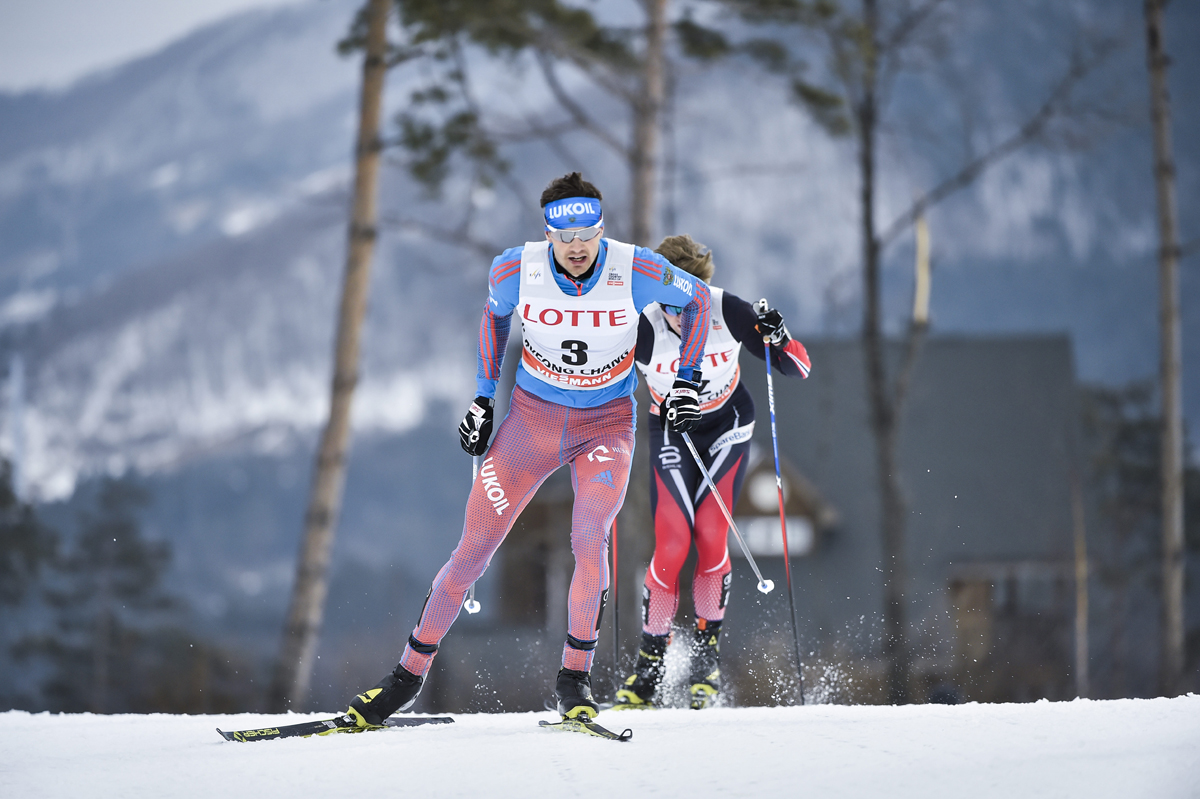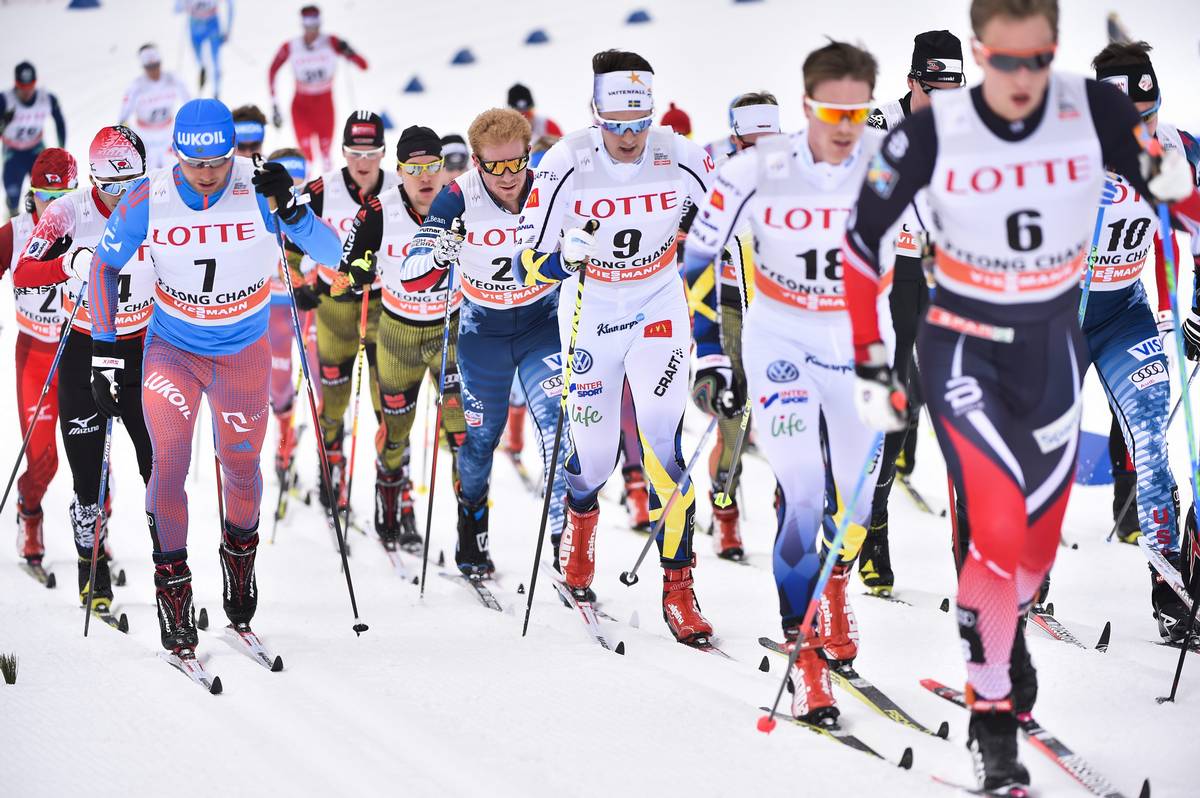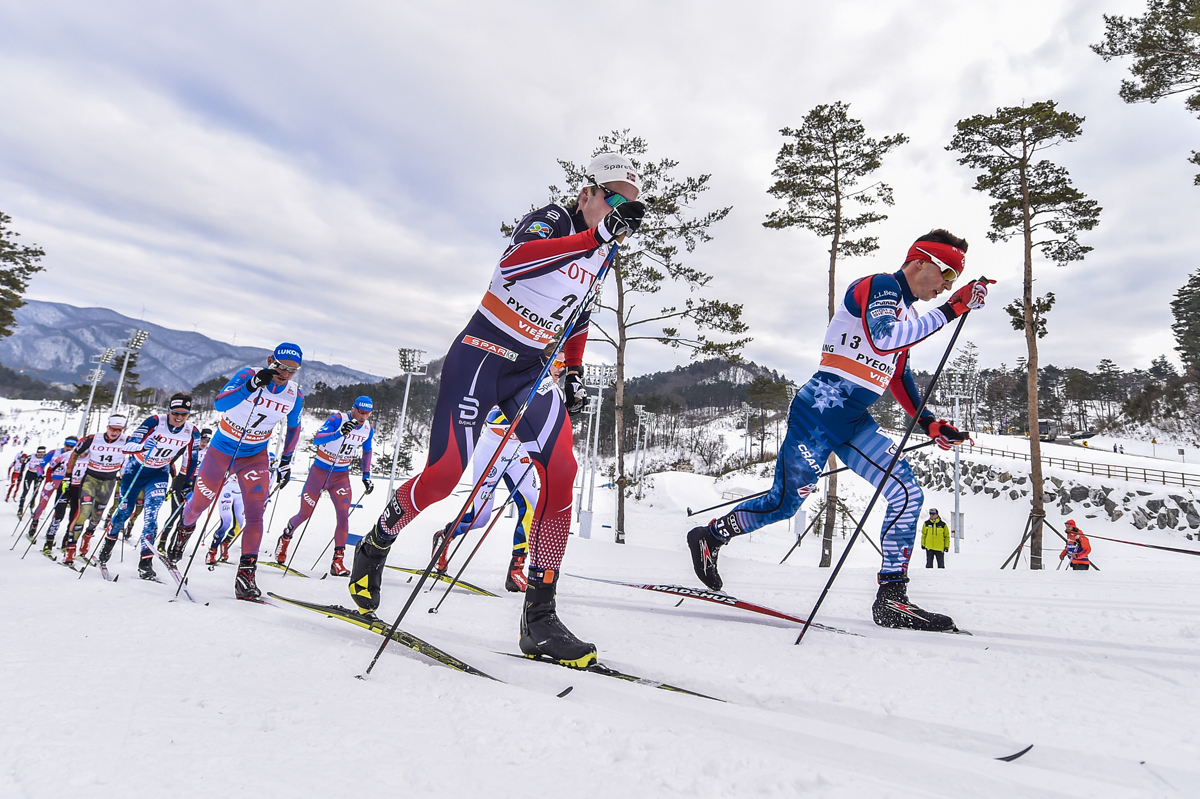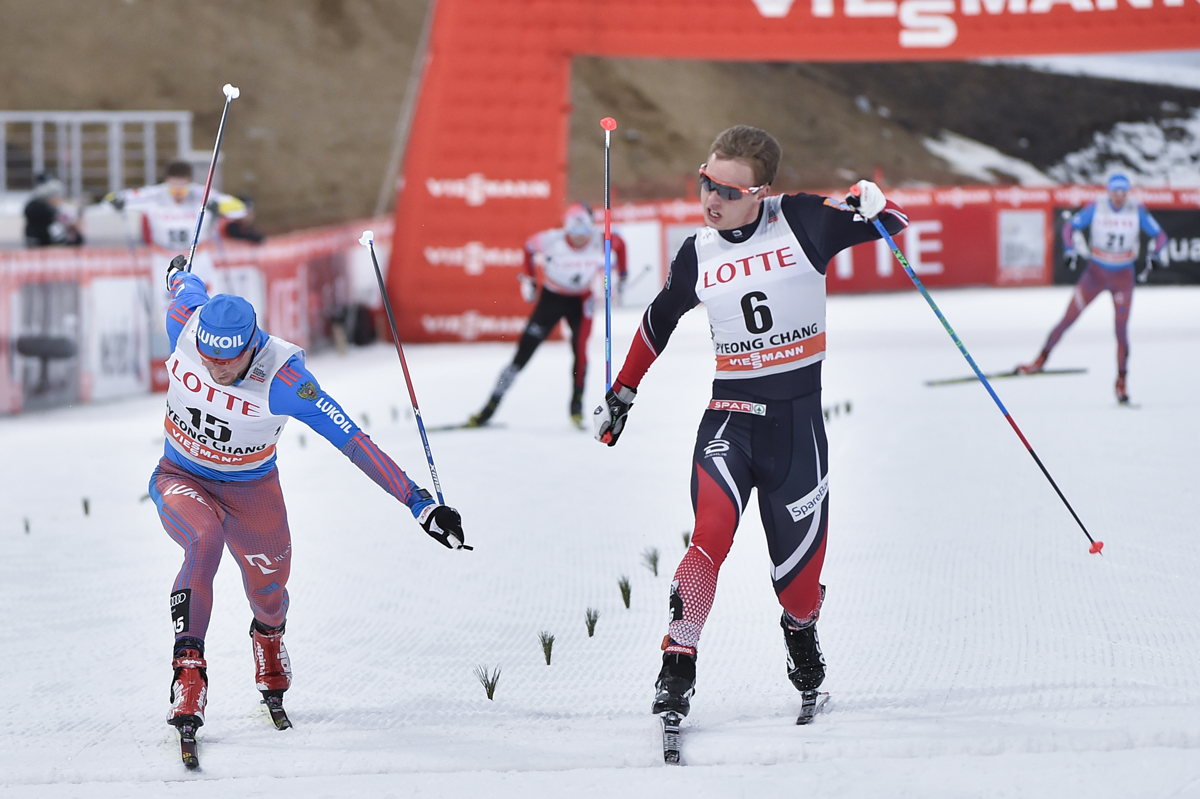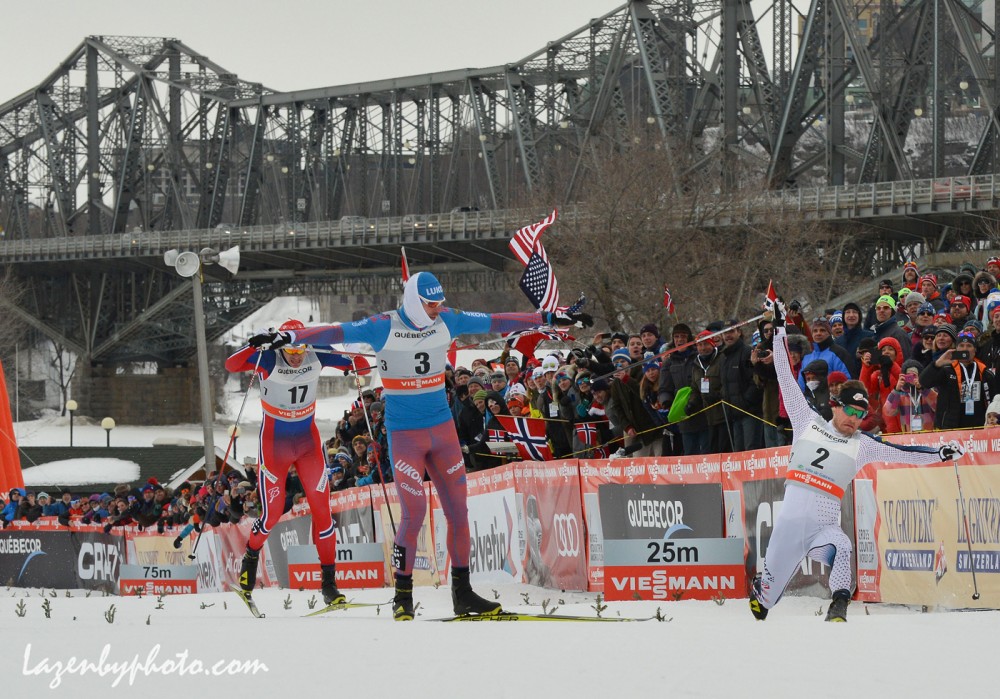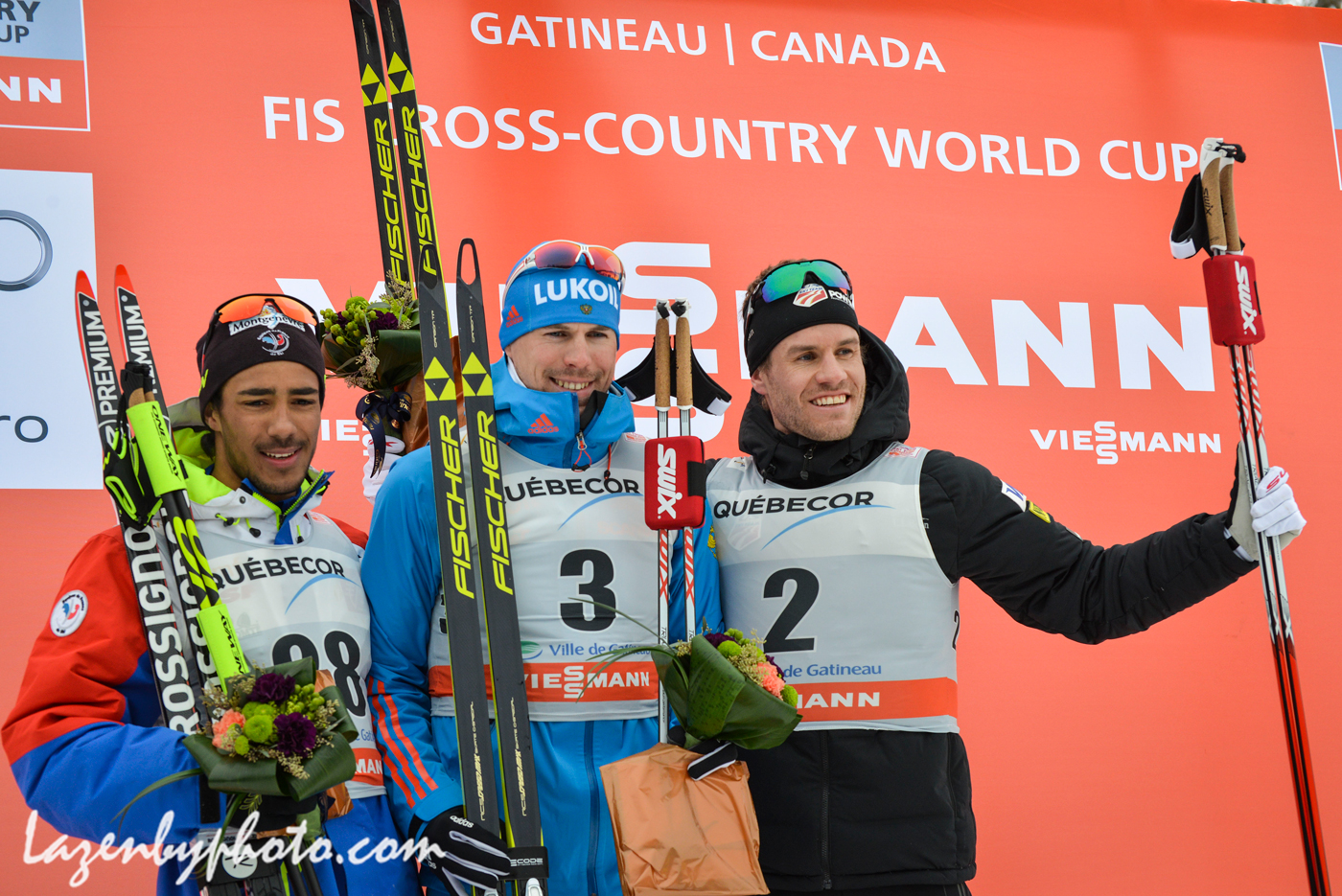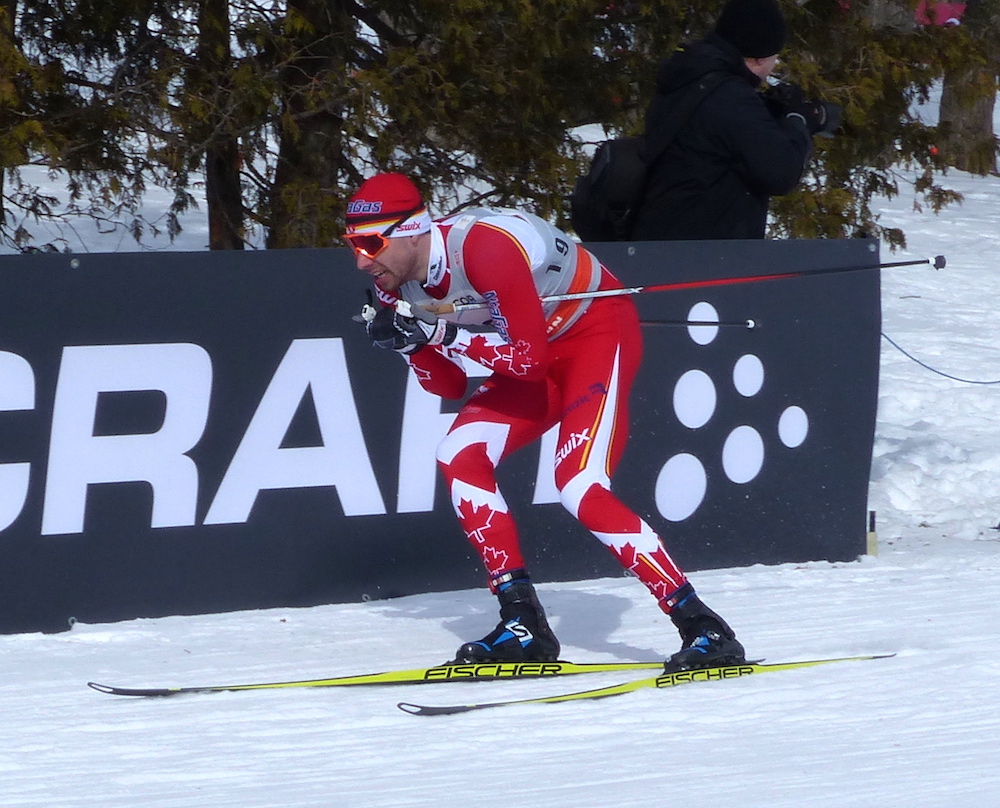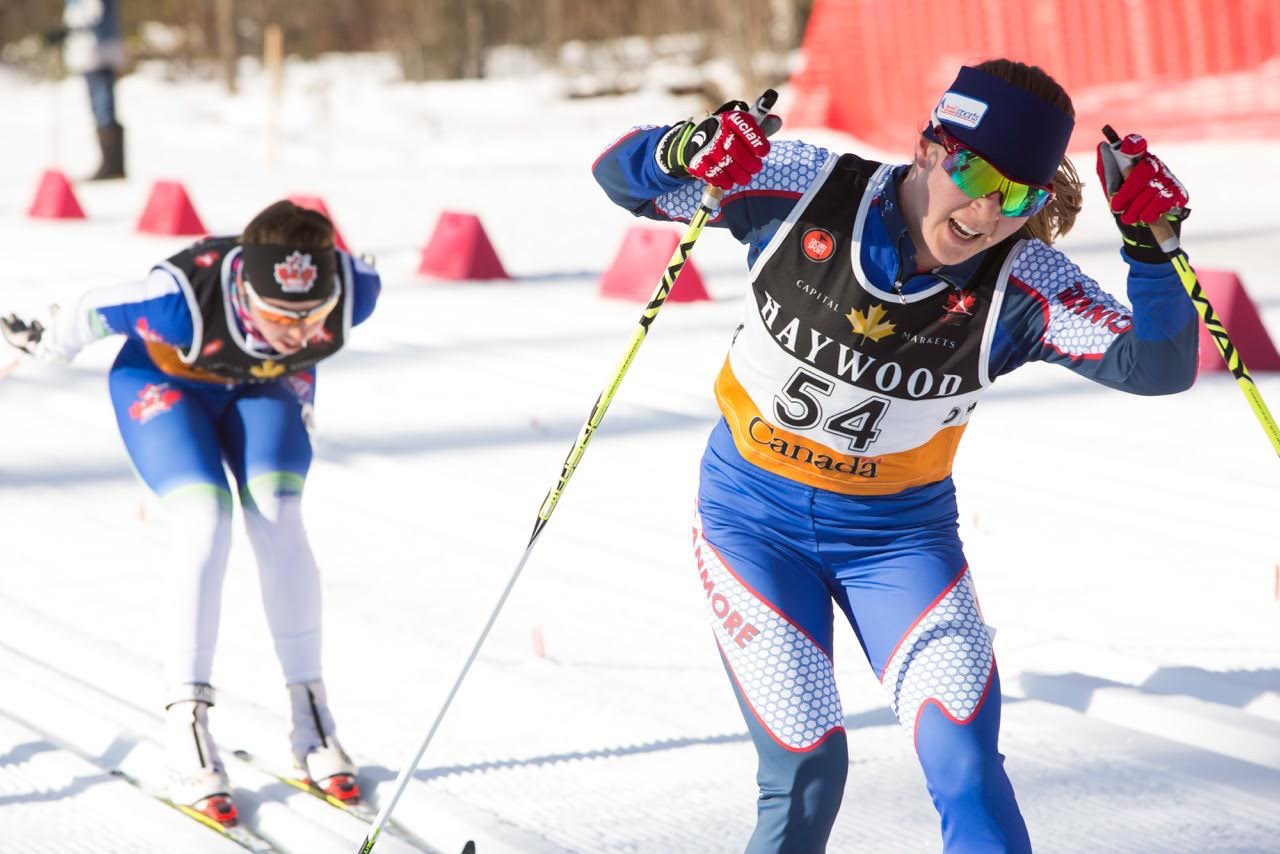
Tag: Simon Lapointe

  • Canada’s Olympic Cross Country Team: Who’s In, Who’s Close, and What Comes Next

    Canada’s Olympic Cross Country Team: Who’s In, Who’s Close, and What Comes Next

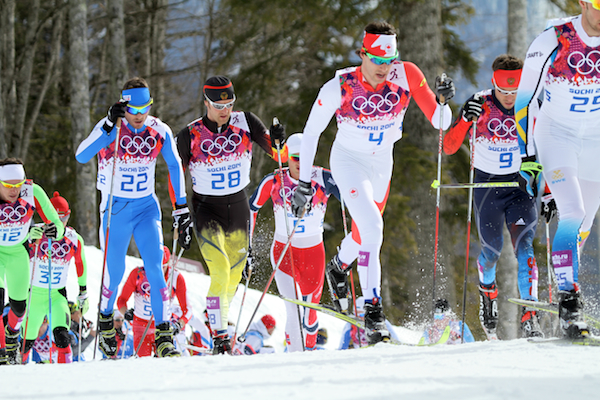
    Alex Harvey (4) climbing in the classic leg of the Olympic 30 k skiathlon in 2014, where he placed 18th. Harvey and four other men have met Primary Qualification Criteria for the 2018 Olympics.

    As athletes enter their final preparations for the Olympic season, some Canadian cross-country skiers have a pretty good idea that they’ll be heading to PyeongChang, South Korea, in February to compete.

    That’s because they have already achieved nomination objectives that will put them on the final ranking list from which the team will be picked. If more than 12 athletes – the maximum team size – meet criteria, then a second selection process will proceed to pick only the top-ranked athletes.

    “If you had too many people, you’ve got to rank them on their best results and the team could be full,” Cross Country Canada High Performance Director Tom Holland said in an interview. “But that’s not likely to happen.”

    In other words: six men and two women can feel pretty safe that they are heading to PyeongChang.

    Other details of the Olympic team selection process are still unpublished. The location, dates, and formats of the final Olympic Trials races are being discussed, but have not been finalized. Those competitions will be used to bring the roster up to 11 or 12 athletes – with a minimum of four athletes of each gender – if that isn’t accomplished on the World Cup.

    “We have to do an amendment to this criteria for final qualifying in Canada, which will be in January,” Holland said. “That piece isn’t complete yet. That’s something I have to send out to the committee and work those details through… With the men we’ve almost met the max, and we could probably only take one more. Whereas with the women, we’ll probably taking at least five, [so] there’s at least three more spots for women.”

    Who’s (Most Likely) In

    Several athletes have already met the “Primary Qualifying Criteria”. That group is headlined by Alex Harvey, who won his first individual World Championships gold medal last season in the 50 k in Lahti, Finland.

    There are several ways to meet the primary criteria, all at World Cup or World Championships races. All consider, for scoring, only the first four finishers from each country – for example, removing the fifth (or higher) Norwegian athlete on the results list and moving everyone else up accordingly. For purposes of brevity, this will be called “Olympic-style scoring” for the rest of this piece.
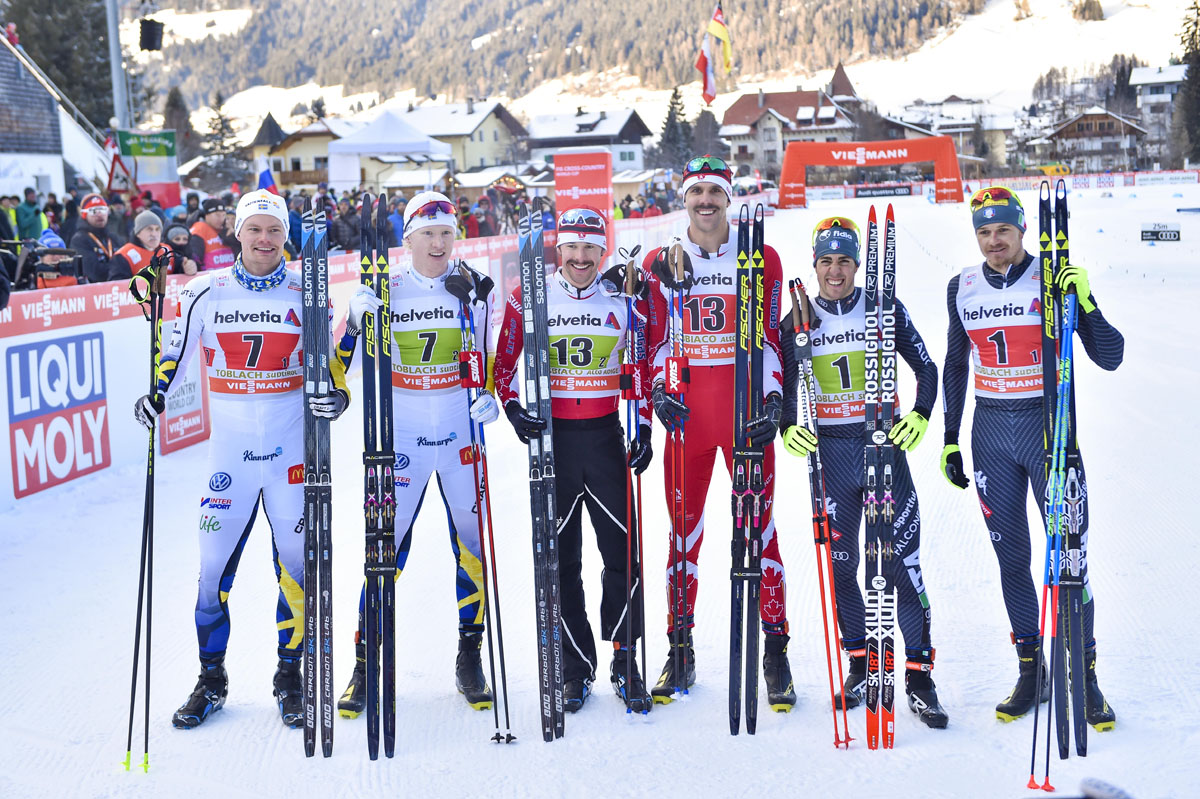
    The men’s freestyle team sprint podium on Sunday, Jan. 15 in Toblach, Italy, with Canada’s Alex Harvey and Len Valjas (c) in first, Sweden’s Oskar Svensson and Karl-Johan Westberg in second (l), and Italy’s Federico Pellegrino and Dietmar Noeckler in third (r). (Photo: Fischer/Nordic Focus)

    With that scoring metric, sprinters must achieve one top-6 result or two top-16 results to make the list. In distance races, athletes with one top-12 or two top-16 results, or two results with FIS points under 10, make the list. Members of a podium relay or team sprint effort will all make the list. And, in a special nod to the disciplines which will be contested at the Olympics, an athlete with a top-16 distance result and a top-16 classic sprint result will make the list.

    Harvey meets most of those requirements individually. Thanks to Canada’s third-place relay in Ulricehamn, Sweden, Devon Kershaw, Knute Johnsgaard, and Len Valjas join him on the nomination list.

    Of the group of four, Valjas is the only athlete other than Harvey who has also met the individual standards and would have qualified without the relay result (or a team sprint win with Harvey in Toblach, Italy), thanks to sprint results of 13th in Lillehammer, Norway; 14th in Davos, Switzerland; 16th in Val Mustair, Switzerland; 10th in Falun, Sweden; and fourth in PyeongChang, South Korea.

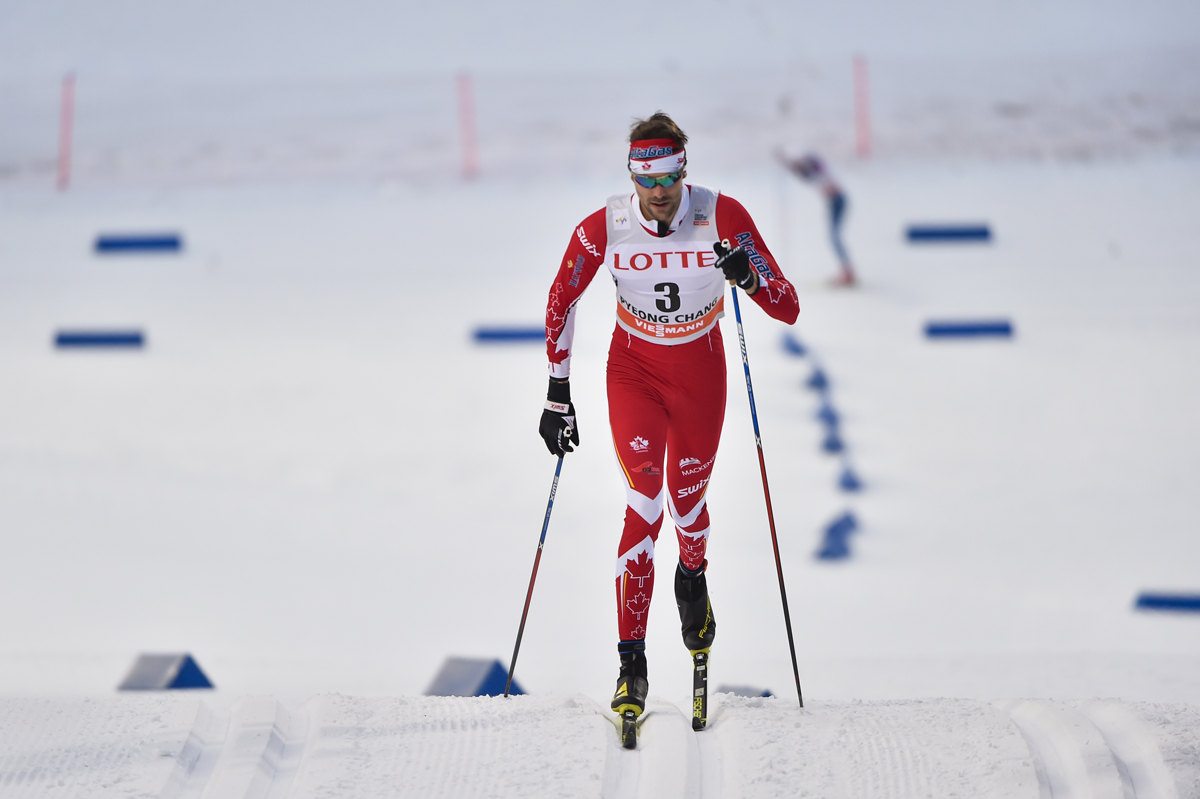
    Jesse Cockney has also met the individual nomination standards by finishing 10th in World Cup sprints in both PyeongChang, South Korea, and Quebec City, Canada.

    “So there’s [five] athletes that have met those criteria,” Holland said. “And then we move onto what’s called an ‘Alternate Qualifying Criteria A.’ In this criteria, they have to be three times in the top 30.”

    Alternate A, or Next On The List

    A number of athletes have met this next set of criteria.

    Dahria Beatty finished 25th in the sprint in Davos, 26th in the 10 k mass start in La Clusaz, France, and 29th in the sprint in Otepaa, Estonia.
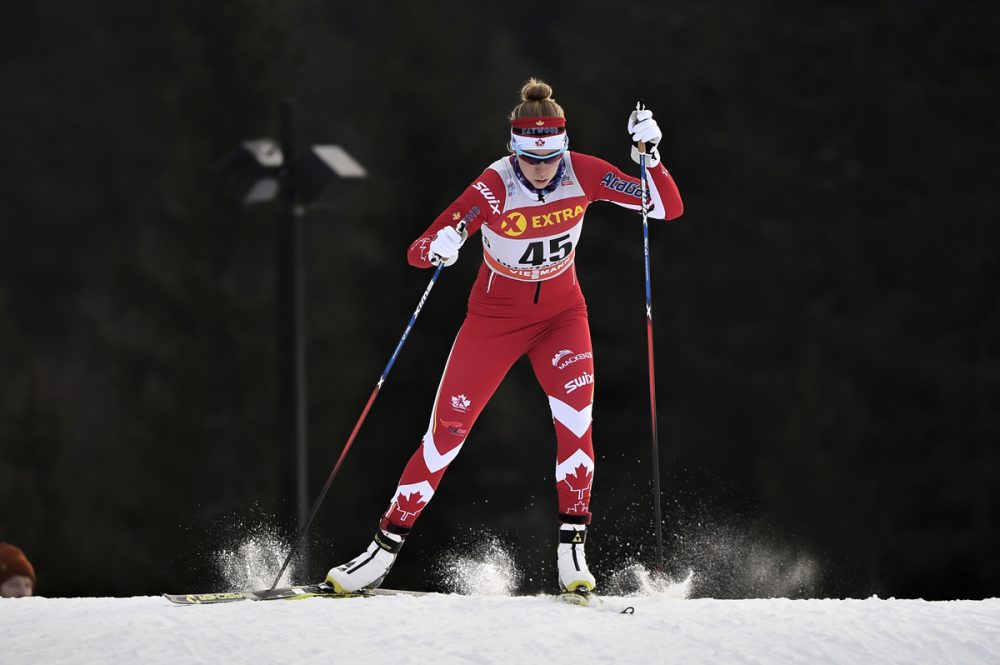
    Dahria Beatty is currently atop the women’s Olympic qualification list with three top-30 World Cup results last season. (Photo: Fischer/Nordic Focus)

    Graeme Killick finished 21st in the 30 k skate in Davos. He also had a few near-top-30’s which, with Olympic-style scoring, turn into top-30’s: 33rd in the 10 k mass start in Val Mustair, 32nd in the 15 k mass start in Val di Fiemme, Italy, and 32nd again in the same event in Quebec City.

    And Emily Nishikawa did it with finishes of 39th in the Lillhammer 10 k, 34th in Davos, and 37th in the Quebec City mass start, all of which are top-30’s with Olympic-style scoring.

    For these athletes, selection is not guaranteed. If more skiers meet the “Primary Qualifying Criteria” in December and January World Cups, they would get preference and those who only met “Alternate Qualifying Criteria” would get bumped down.

    Holland doesn’t envision that happening, though.

    “There’s nobody that skied at that level,” he said of the possibility that an athlete not already mentioned would pop a top-six or top-16 World Cup result in December. “If you haven’t done it once last year, it’s going to be hard to do it… But it’s not impossible.”

    There are several athletes who are on their way to meeting the “Alternate Qualifying Criteria A,” leaving open the possibility that the list of athletes meeting those requirements would be long enough that it would have to be winnowed down by ranking athletes according to their best results.

    Cendrine Browne finished 26th in the World Championships mass start 30 k. She also placed 35th in the 10 k skate in Ulricehamn, a result which turns into a top-30 with Olympic-style scoring.

    Julien Locke placed 20th in the sprint in Quebec City, and Bob Thompson placed 30th.

    (Thompson also placed 31st in PyeongChang, South Korea, a result which would be top-30 with Olympic-style scoring; several other Canadian athletes also finished in the top 30 that weekend. But their results won’t count towards Olympic qualification due to a depth-of-field calculation explained in a separate article.)

    So the list of athletes meeting “Alternate Qualifying Criteria A” could grow.

    “We have men that have top-30 World Cup sprints, so they could do it,” Holland said. “But I don’t expect on the women’s side [other than Browne] — we don’t have anybody that’s done any, so [for them] it’s going to be hard to do it three times.”

    Access to Points Races

    A fair number of athletes will have opportunities to work on qualifying criteria this winter, as Canada is planning to send a full team to Period I.

    Graeme Killick used the Tour de Ski to hit Olympic qualification criteria. (Photo: Fischer/NordicFocus)

    “We don’t want to take more than 12 [athletes],” Holland said. “That’s seems to be the magic number for us, because we know we can support that. So we are going to take at least four women and seven or eight men.”

    That’s the biggest chance athletes will get to avoid a nerve-wracking trip to Olympic Trials. While the selection document states that the qualifying period goes through January 21, in reality all of the World Cup-based qualifying will be done by Christmas.

    That is because the Canadian team only takes a small squad to the Tour de Ski, the first set of World Cups after Christmas. The selection criteria for 2017-2018 national team trips has not yet been posted on the CCC website, but in the 2016-2017 season, athletes had to achieve one top-12, two top-20s, or three top-30s in Period I in order to head to the Tour de Ski.

    In other words, anyone objectively qualifying for the Tour de Ski will have met some Olympic nomination criteria already.

    There is a way to reach the Tour without those top results – according to the criteria, athletes could be added to the team by discretion if they had scored World Cup points. In other words, for athletes with one or two top-30 finishes, it is up to coaching staff whether they would be brought along or not.

    Killick competed in the Tour de Ski last season through this mechanism – he had a lone top-30 result in Period I. Then he collected two more Olympic-style scoring top-30’s at the Tour de Ski.

    Those were the results that allowed Killick to meet the Olympic nomination criteria through “Alternative Qualifying Criteria A”, but this year, athletes in a similar position might not be so lucky.

    First of all, the Olympic Trials races are likely to be scheduled at roughly the same time – “around January 6th to 10th,” Holland said. So athletes would have to choose whether to risk a trip to the Tour de Ski, versus closing things out at Olympic Trials.

    And secondly, the Tour vs. Olympic Trials decision may not even be a choice. Holland indicated that if an athlete were close to qualifying but had not yet met the Tour de Ski standard – which could be very possible since last year’s Tour de Ski criteria specified World Cup points, not the adjusted, four-athletes-per-country scoring of the Olympic selection – they would not be offered the chance to finish things off in Europe.

    “We’re not going to take a whole pile of people to the Tour de Ski to try to qualify,” Holland said. “It’s better to do it in Canada head to head.”

    And so, although the selection document states that qualifying can be done through January 21st, Holland did not seem to consider the Tour de Ski or post-Tour World Cups in Dresden, Germany, and Planica, Slovenia, when discussing how athletes can qualify.

    “By the 10th [of January] you want to have your team picked,” he said. “You want to have your logistics, ideally you want that whole team to go to the Seefeld World Cup [January 27-28], and move to PyeongChang and get them in their training mode for the Games.”

    The Rest of the Process

    That means that for at least a few woman and perhaps one or two men, it will come down to the Trials races that Holland says will be held at Mont Sainte Anne.

    “We’re probably only looking for one man,” Holland said of the number of athletes that would be selected from those races. “We’ve had men who have scored World Cup points in sprint but not distance so odds are we’ll be looking for a sprinter. On the women’s side, it depends what happens on the World Cup. Cendrine Browne two out of three [top-30’s] so she could make that criteria in December. So on the women’s side it’s a little more open. I think we’re looking for both sprint and distance athletes, and if Cendrine makes it in December we’d only be looking at two women.”

    After that, selected athletes will refocus and begin preparing for their Olympic experience.

    “After the Tour de Ski, we’re going to skip the next two World Cup weekends,” Holland said of the team’s top athletes. “Then they’ll be training at altitude, probably in Livigno for the most part, and then they’ll go to the World Cup in Seefeld [Austria] with the whole Olympic team. The ones that come from Canada might just come over prior to Seefeld and spend some time in Davos [Switzerland], or something like that.”
     

  • Navigating Depth-of-Field at the PyeongChang World Cup for Canadian Olympic Qualification

    Navigating Depth-of-Field at the PyeongChang World Cup for Canadian Olympic Qualification

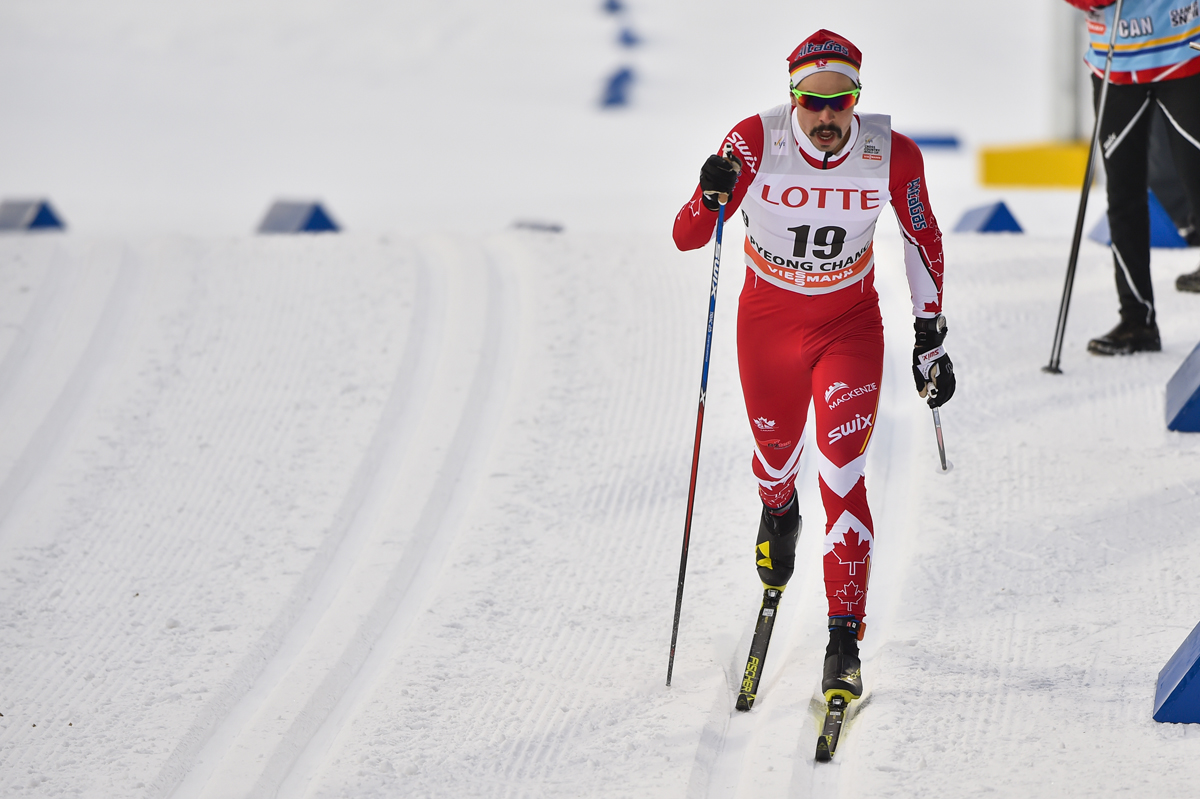
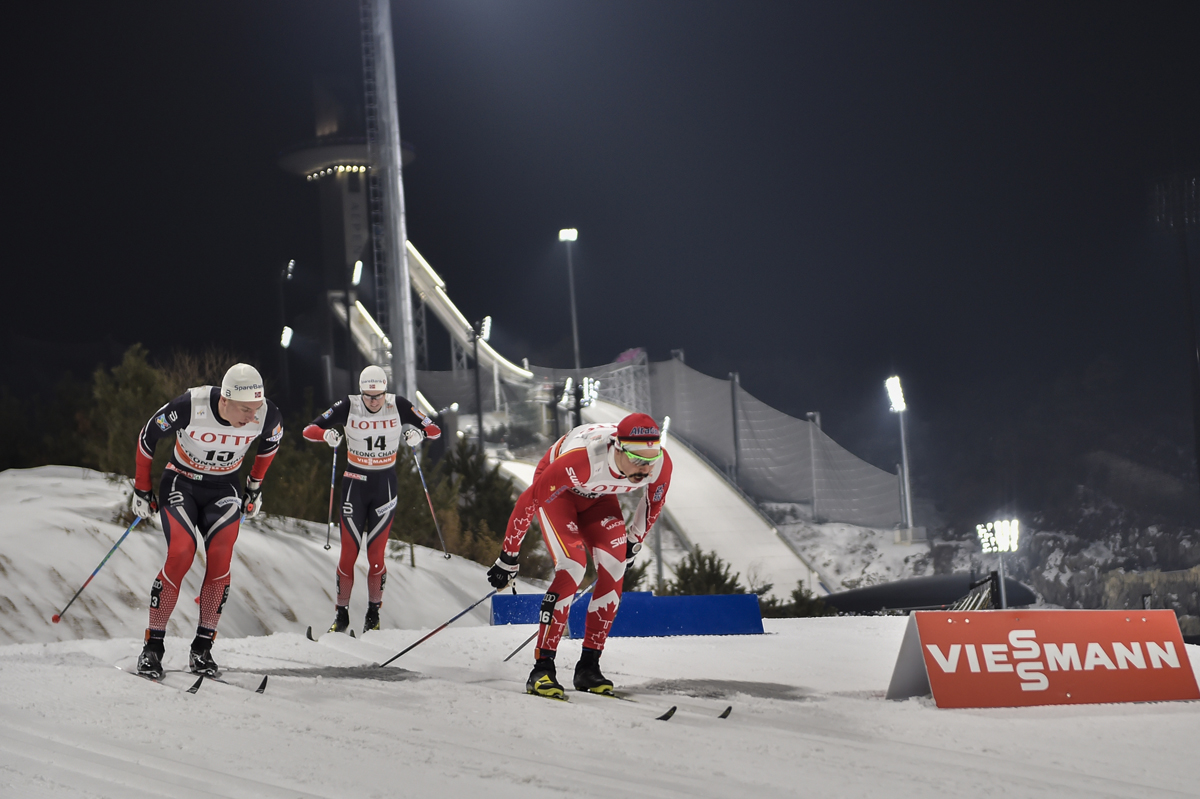
    Canada’s Jesse Cockney (r) racing to first in his quarterfinal in the men’s classic sprint at the PyeongChang World Cup, while leading Norway’s Mathias Rundgreen and Daniel Stock. Cockney finished tenth on the day and the result was one of two which has put him on the shortlist for Canada’s Olympic team. (Photo: Fischer/NordicFocus)

    As Cross Country Canada (CCC) looks at which athletes have made progress on qualifying for the 2018 Olympics in PyeongChang, South Korea, listing those with top-30 World Cup finishes is a good place to start.

    But there are a few athletes with those results that don’t come up in conversation.

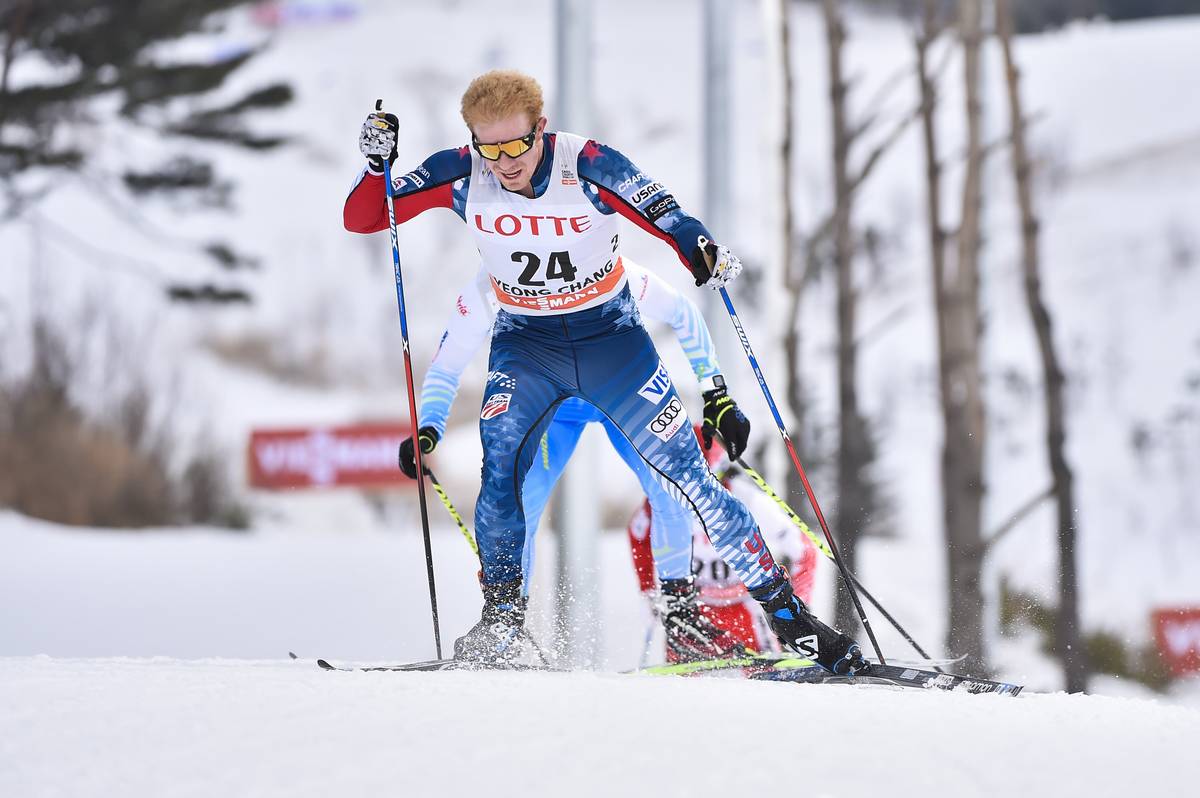
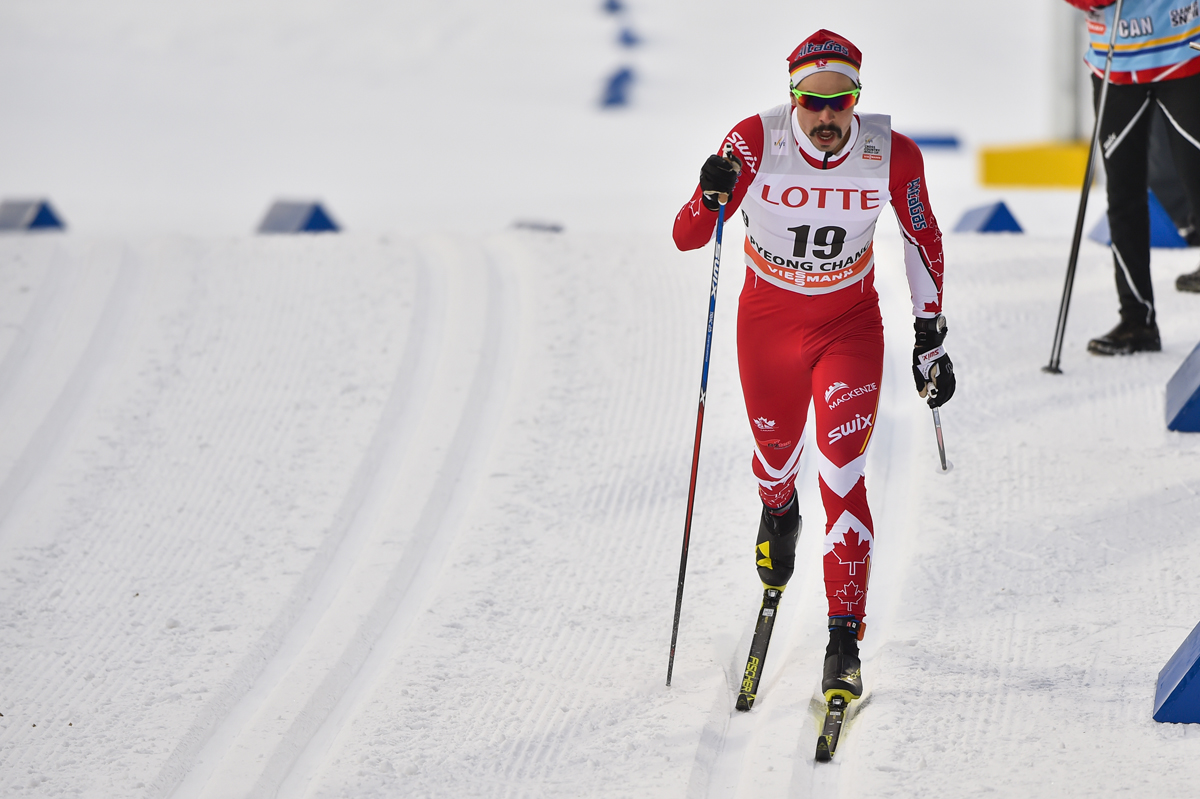
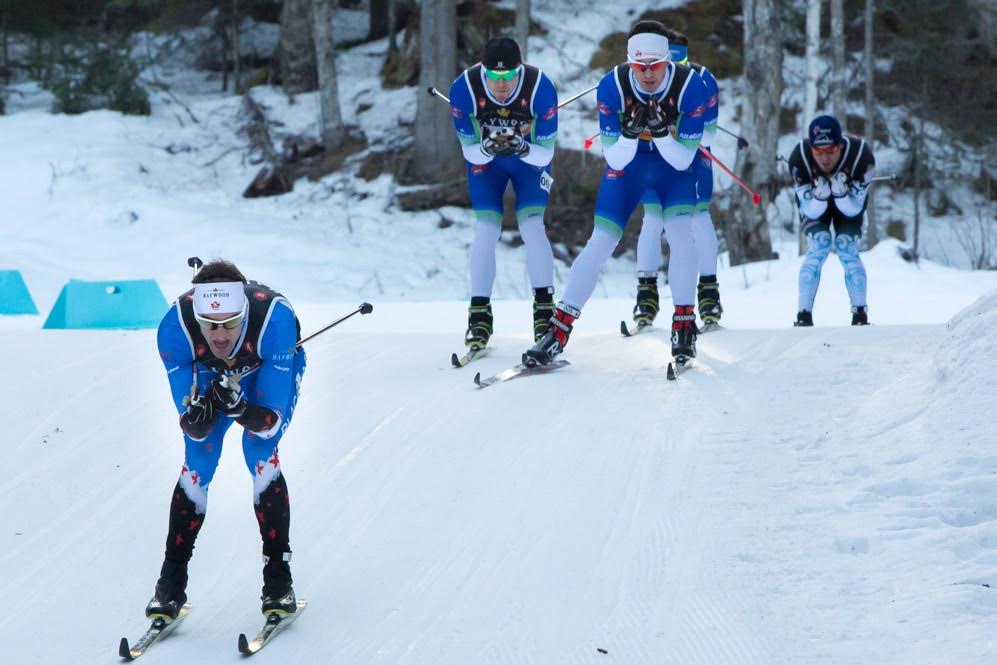
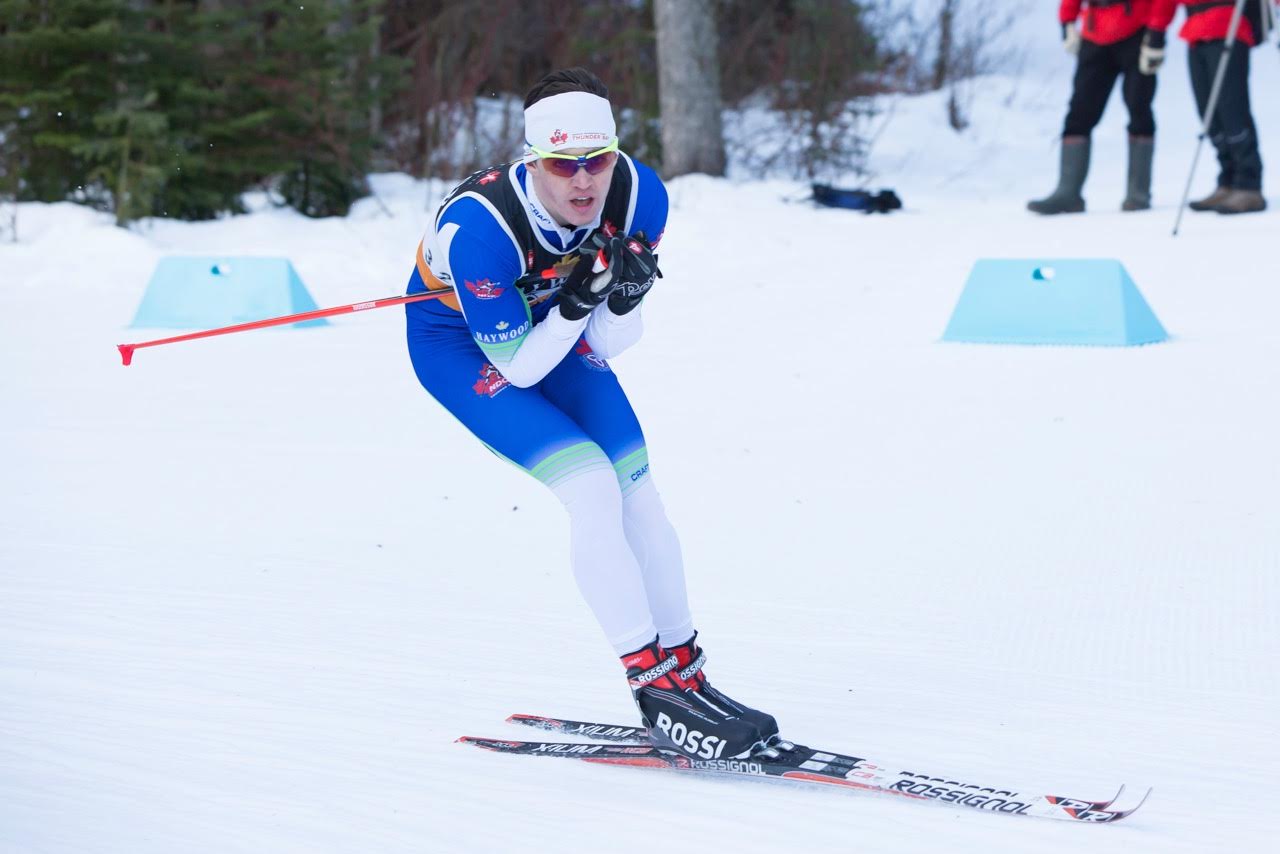
    Simon Lapointe finished 27th in the sprint and Bob Thompson 31st in the World Cup sprint in PyeongChang, South Korea last season – a result that would be bumped up top top-30 status if the Olympic-style scoring employed by CCC for selection, which counts only the top four athletes from each country, removed “extra” Russians from the results.

    Paralympic legend Brian McKeever finished 29th in the skiathlon in PyeongChang. And for the women, Annika Hicks and Sadie White finished 26th and 29th (out of 29) in the skiathlon, and 32nd and 34th in the sprint (in a field of 36) — which with Olympic-style scoring would become top-30 finishes.

    By a provision in CCC’s criteria, these results won’t count towards nomination to the Olympic team.

    “In order to maintain equity and fairness in this selection process, the HPC reserves the right to exclude, or to count only partially, the results of any World Cup event with a weak depth of field,” the criteria state. “The CCC Selection Committee will be charged with evaluating the depth of field in this circumstance based on comparative analysis of World Cups over two seasons (2015-16 and 2016-17). The CCC Selection Committee will bring forth to the HPC any such recommendation to exclude, in whole or part, a World Cup event. This analysis of depth of field will consider time behind the winner (FIS points), an analysis of the top 6, top 12 and top 16 individual athletes or team events in the race based on World Cup ranking, World Cup points, total FIS points of athletes in the race and any other factors that allow for a fair and equitable World Cup depth of field analysis.”

    With such a criteria, it’s fairly clear that finishing last in a World Cup race with only 30 athletes would not count towards Olympic qualification.

    But in terms of determining what would count, how CCC actually analyzes race results is multifaceted and not entirely transparent.

    “It is always best to look at as many data factors as possible when analyzing depth of field – weak depth of field can vary at the same World Cup event depending on gender and type of race,” CCC High Performance Director Tom Holland wrote in an email.

    He emphasized that the depth-of-field assessment is rarely used, citing PyeongChang as the only set of World Cups in the last Olympic cycle where results had been excluded for team qualification.

    What Results Count as Competitive

    Holland and the selection committee looked at different slices of the PyeongChang results. There are multiple ways to meet Olympic qualifying criteria: a top-six sprint result, a top-12 distance result, two top-16 World Cup results (all deemed “Primary Qualification Criteria”), or three top-30 World Cup results (deemed “Alternative Qualification Criteria”). The level of competition at each of these results cutoffs was considered.

    And according to Holland, the men’s races were competitive at the top end but not in the middle or bottom of the fields. That’s why Jesse Cockney, who finished 10th in the PyeongChang sprint, can count that as one of his two top-16 finishes and meet CCC nomination criteria – but Thompson, for instance, can’t count the result as his second of three top-30’s.

    (Thompson finished 30th in the World Cup Finals sprint in Quebec City in March, and now needs two more top-30’s for a shot at making the Olympics.)

    “What would be looked at varies between the Primary and Alternate A Criteria,” Holland wrote. “For the Primary Qualifying Criteria, the depth of field analysis being considered is top 6–16; World Cup ranking of athletes, particularly the number of red group athletes in the race would be the critical starting point of analysis, next would be time behind these athletes compared to similar placing in other [World Cup] events.

    “For the Alternate A Criteria, we are only looking at top 30 results counting top 4 per nation,” he continued. “The average top 30 [World Cup] FIS points over the past 2 seasons in that particular race distance per gender is a good indicator to start the analysis. Being in top half of the field (usually, but not always) and the number of top 30 ranked athletes in the race also need to be considered.”

    When asked whether it was appropriate to apply a depth-of-field adjustment differently within the results of the same individual race, the Canadian Olympic Committee (COC) declined to address the specific situation.

    “The COC provides national sport federations with a Guide to Drafting Internal Nomination Procedures (INP), which offers a framework, practical advice, and examples they can use in their drafting, interpretation, and implementation of their INP,” COC Manager for Corporate Communications Ricky Landry wrote in an email.

    “The COC then reviews all INPs to ensure that they comply with the COC Team Selection Policy, the Olympic Charter and other applicable COC rules and policies. Also, the COC reviews INPs to ensure the qualification and nomination timelines fall within COC and Organizing Committee (OCOG) deadlines. In general terms, the COC Team Selection Policy recognizes the NSF’s authority in setting qualification criteria appropriate for its sport and in determining which athletes and support personnel will be nominated to the COC Team Selection Committee for selection to the Canadian Olympic Team.”

    End result: for Lapointe, Thompson, and McKeever, their results were not enough to count towards Alternate Qualification Criteria. For Cockney, 10th was good enough for Primary Qualification Criteria.

    “I’ve got the spreadsheet… there were only nine out of the top 30 sprint group [on the start line] at that event,” Holland said in an interview earlier this summer. “So the depth of field and if you look at FIS points, it wasn’t there. But if you look at the top 10, it’s a little more legitimate.”

    There were only seven seeded World Cup sprinters on the start line in PyeongChang. All of them bested Cockney in qualification but he beat two of them, Baptiste Gros of France and Simi Hamilton of the United States, in the final results.

    That might be important, as Holland indicated that qualification versus heats racing were not necessarily considered in the same way.

    “If an athlete does well in the heats, I would be inclined to put more emphasis on the heats,” he wrote.

    Transparency and Athlete Expectations

    While it was clear to all that the depth of field in PyeongChang would be looked at carefully – Canada was not bringing most of its top athletes, and neither were other countries – the outcome of that analysis wasn’t known.

    That marks a major difference from this aspect of the criteria to the rest of CCC’s criteria. It’s fairly clear what athletes have to do to meet World Cup-based criteria: they have to hit certain results, and after a race they can look at the results sheet and immediately know whether they can check that box or not.

    At the end of that process, any remaining spots on the roster will be filled at Olympic Trials. Again, there it will be clear what finish is required to be named to the team.

    Going into the PyeongChang World Cups, athletes knew that a top-30 might not cut it, but what exactly they would have to do to have a result count towards Olympic qualification was unclear.

    “A lot of people didn’t go, so I believe they only counted a top 20 result,” Thompson said in an interview last week. “But I didn’t know that. There was a little bit of awareness that you had to do better than top 30, like maybe making the top 12 would be more respected.”

    Likewise, because the method of assessing depth-of-field is not a single mathematical formula that is evenly applied, even glancing at the results after a race may not make clear which athletes in the field had attained qualification standards and which hadn’t.

    “In the last few years, I haven’t paid so much attention to what selection criteria is worth in terms of specific scenarios,” Cockney said in an interview this week. “It’s not usually up to us what is deemed a usable race or a competitive race… I can’t decide who the competition is. I can just decide to ski. That’s the attitude I was taking in Korea – just to try to do my best and have a strong day, and thankfully I was able to put together a good day.”

    That’s just part of the game, Holland seemed to suggest, saying in an interview that athletes “should have been aware” that normal qualification standards wouldn’t apply before even leaving on the trip to South Korea.

  • Russia’s Sedov Tops PyeongChang Skiathlon; Hoffman 8th, Patterson 9th

    Russia’s Sedov Tops PyeongChang Skiathlon; Hoffman 8th, Patterson 9th

    Russia's Petr Sedov en route to his first World Cup win on Saturday in the PyeongChang World Cup 30 k skiathlon in South Korea. (Photo: Fischer/Nordic Focus)
    Russia’s Petr Sedov en route to his first non-stage World Cup win on Saturday in the PyeongChang World Cup 30 k skiathlon in South Korea. (Photo: Fischer/NordicFocus)

    The rough translation of the Korean word “기회” or “gihoe” into English is “opportunity”. And it’s the best way to describe what was on offer Saturday afternoon in PyeongChang, South Korea during the men’s World Cup 30-kilometer skiathlon.

    No seeded men on the World Cup contested the race. No Sundby. No Ustiugov. No Harvey. No Hellner. Lot’s of 기회.

    For the three skiers finishing in positions 1, 2, and 3, it was a career-first World Cup podium. Russia’s Petr Sedov placed first in 1:18:49.6. Norwegian Daniel Stock finished second 22.5 seconds back with his teammate Mathias Rundgreen third (+42.1).

    “I felt very strong today,” Sedov told the International Ski Federation (FIS) after the race. “I have to thank to my coach, service staff and to my family. I am very glad that my first ever World Cup podium is a win.”

    To be clear, It was Sedov’s first individual non-relay and non-tour stage World Cup podium. He’s placed second twice in 2010 and first once in 2011 as part of Russian relay teams. Sedov also won a 2012 World Cup stage 15 k skate pursuit in Falun, Sweden.

    And to discount the World Cup strength of some others would have been foolish. This was Stock’s sixth World Cup start. Yet he, too, like Sedov, came with realistic podium-hunting background: as recently as Jan. 21, he skied to fifth in the World Cup 15 k skate in Ulricehamn, Sweden. Canada’s Alex Harvey, Norway’s Martin Johnsrud Sundby, Sweden’s Marcus Hellner, and Switzerland’s Dario Cologna were the only athletes ahead of Stock that day.

    For Rundgreen, it’s the same: not a World Cup brand name, but bringing with him plenty of real-deal horsepower to shatter the race. He boasts three top-10 World Cup performances, including a first and second as part of Norwegian relay teams.

    Rundgreen held off three others for third place, including Sweden’s Gustav Eriksson in fifth (+46.8), Japan’s Keishin Yoshida in sixth (+47.1), and Russia’s Alexander Utkin in seventh (+49.0).

    The U.S. had two top 10’s, with the U.S. Ski Team’s Noah Hoffman in eighth (+1:06.2) and Scott Patterson (Alaska Pacific University) a spot behind in ninth (+1:28.4). Matt Gelso (Sun Valley Ski Education Foundation), the only other American starter, placed 19th (+5:00.8).

    Canada’s Brian McKeever (Canadian Para-Nordic Ski Team) finished 29th (+8:48.9) for his first regular-season World Cup top 30. (McKeever placed 21st in the 15 k skate at 2007 Sapporo World Championships.)

    The Classic Leg

    “At the beginning of the race the pace was a little bit subdued,” U.S. Ski Team Head Coach Chris Grover said on the phone. “Early on, no one was really charging too much.”

    Americans Matt Gelso (bib 24) and Scott Patterson (bib 10) striding in the pack during Saturday's 30 k skiathlon in PyeongChang, South Korea. Gelso went on to finish 19th overall while Paterson placed ninth. (Photo: Salomon/Nordic Focus)
    Norway’s Mathias Rundgreen (6) and Americans Matt Gelso (24) and Scott Patterson (10) striding in the pack during Saturday’s 30 k skiathlon in PyeongChang, South Korea. Gelso went on to finish 19th overall while Paterson placed ninth. (Photo: Salomon/Nordic Focus)

    Rundgreen controlled the tempo, leading the pack through the 5 k split at 14:16.

    “They were going so slow at one point that Noah just took off to the front and made a little surge,” Grover noted.

    That came at 6.15 k, and Hoffman won the first of two preems, or bonuses, in the race. Patterson came through in ninth, six seconds later.

    At 7.5 k, a line of 21 skiers lapped through the stadium —  Hoffman in third, Patterson ninth, four seconds out. Gelso trailed at the tail of that group, nine seconds off.

    At 9.9 k, it was a repeat; Hoffman took the second bonus, controlling the pace up front surging and slowing. (Both bonuses amounted to 30 extra World Cup points for Hoffman.) Gelso and Patterson came through about eight seconds later in 14th and 18th, respectively.

    “I was feeling pretty good on the classic,” Hoffman explained on the phone.

    American Noah Hoffman (r) racing alongside Norway's Daniel Stock during Saturday's 30 k skiathlon at the World Cup in PyeongChang, South Korea. (Photo: Fischer/Nordic Focus)
    American Noah Hoffman (r) racing alongside Norway’s Daniel Stock during Saturday’s 30 k skiathlon at the World Cup in PyeongChang, South Korea. (Photo: Fischer/NordicFocus)

    It was also an opportune time for U.S. Ski Team sponsors as Hoffman captured the majority of camera time. There was nothing about his skiing that didn’t appear confident. Solid striding, focused effort, and a will to position himself in the lead, or one or two spots back.

    But that was his bluff.

    “If I had been confident in my ability to win the race I probably would have really chilled on the classic —  which I didn’t do,” Hoffman said of his front-of-the-pack classic leg effort. “I was skiing up near the front a lot. I was snagging some of the preems. … I was kind of playing games a little bit, having fun with the pack a little bit which was really fun to do. And maybe you could mistake that for confidence, but I think it was probably the opposite.”

    Part of sport is gamesmanship. And part of opportunity is taking bold chances to seize it. The best athletes are not afraid of failure.

    “I got stretched a little bit on the last classic lap to the tune of maybe five seconds plus or minus,” Hoffman added.

    “My classic leg went pretty well for 2.5 loops,” Patterson wrote in an email. (Each loop was 3.75 k.) “I was hovering around 10th until we hit the longest down hill on the course. There were some surges for bonus points right before and I had a slight gap in front of me in my lane … I also ended up in a lane that had not glazed nearly as much as the primary center track. I probably went from 10th to around 25th. After that the rest of the classic I was spending too much energy to get back up close to the front and I ended coming through a bit off the lead group.”

    15 k of Skating

    Eleven skiers entered the classic to skate exchange with approximately 10 seconds separating the first from last. Hoffman had a seamless changeover, the second fastest, and left on his skate skis in fourth. Behind him, Patterson left the exchange 16th (+24.0).

    Initially Rundgreen led the line of 11 skaters that increasingly spread out. One by one, another dropped, losing a meter or two, then they’d up the tempo to catch back on. Then Sedov would pull with the same effect.

    But right there glued on at 17 k was Hoffman. He was in third at 19 k, but had bled nine seconds to Sedov and Stock now in the lead.

    At that mark, Patterson had ceded 39 seconds to the Sedov-Stock combo. Gelso had fallen a bit over two minutes behind.

    For the remaining distance, Sedov was the skier to beat as he slowly put a gap on Stock.

    Hoffman’s group, five skiers deep, could sniff the third podium spot and it became an every-skier-for-themselves effort.

    Norway's Mathias Rundgreen (6) outlunging Russia’s Konstantin Glavatskikh (l) for third in the men's 30 k skiathlon on Saturday at the PyeongChang World Cup in South Korea. (Photo: Fischer/NordicFocus)
    Norway’s Mathias Rundgreen (6) outlunging Russia’s Konstantin Glavatskikh (l) for third in the men’s 30 k skiathlon on Saturday at the PyeongChang World Cup in South Korea. (Photo: Fischer/NordicFocus)

    Rundgreen outlunged Russia’s Konstantin Glavatskikh for the final podium spot in a photo finish — they were given the same finishing time of 1:19:31.7.

    “It was fun, it was nice to ski back up front,” Hoffman said. “I was doing that a lot in 2012, 2013, 2014 … I was just being involved in the race. So I wanted to do a little bit of that. From that perspective, I think it was good, I was definitely involved in the race throughout.”

    Hoffman’s eighth place (+1:06.2) was his best result in a non-stage World Cup since placing eighth in a 2012 skiathlon in Canmore, Alberta. (Hoffman won the time of day in the 15 k pursuit four years ago in Kuusamo, Finland.)

    For Patterson, the skate leg competition analysis reveals his strong skiing —  most of his skate leg sector times rank in the top 10, with several top-five splits.

    “My skate leg was quite good,” Patterson wrote after finishing ninth, one spot behind Hoffman. “Unfortunately I had a bit to move up from the classic. I spent most of the skate chasing the pack that Noah was in. They would accelerate going into some of the bonus points and then I would gain back on the rest of the course. I think I could have been quite good if I was able to latch onto the pack but I never quite made it. Instead I just cruised past everyone who fell off.”

    Matt Gelso (SVSEF) racing to 19th in Saturday's World Cup 30 k skiathlon in PyeongChang, South Korea, for his first World Cup top 20. (Photo: Salomon/Nordic Focus)
    Matt Gelso (SVSEF) racing to 19th in Saturday’s World Cup 30 k skiathlon in PyeongChang, South Korea, for his first World Cup top 20. (Photo: Salomon/Nordic Focus)

    Saturday marked the first career World Cup points for Patterson. Gelso, who scored his first points during Friday’s sprints, fell back on the skate leg to finish 19th — still his first World Cup top 20.

    McKeever, a visually impaired skier who races without a guide in FIS World Cups, finished 29th to lead Canada, which started three men.

    “The strategy was simply to follow,” McKeever emailed. “No point in deluding myself that I’m at the same level as the top guys. They dictate how the race is run. I just try to react.  I just try to find decent wheels to follow and a rhythm that suits my style. … It was a tough day given recent shape. I was very sick after US nationals and spent a pretty uncomfortable week in bed. Given that, I’m quite happy with the effort being that it was really all I had.”

    Also for Canada, Bob Thompson (NTDC Thunder Bay) placed 32nd (lapped), and Simon Lapointe (CNEPH) did not finish.

    Results | Competition analysis

  • Saturday Rundown: PyeongChang, Soldier Hollow & Eastern Canadian Champs (Updated x3)

    The Russian men finishing in unison to take first, second and third in the men's 30 k skiathlon, the final race of 2017 U23 World Championships at Soldier Hollow in Midway, Utah. Alexander Bolshunov (8) was deemed the winner, Alexey Chervotkin (1) was second, and Denis Spitsov (11) third. (Photo: FlyingPointRoad.com)
    The Russian men finishing in unison to take first, second and third in the men’s 30 k skiathlon, the final race of 2017 U23 World Championships at Soldier Hollow in Midway, Utah. Alexander Bolshunov (8) was deemed the winner, Alexey Chervotkin (1) was second, and Denis Spitsov (11) third. (Photo: FlyingPointRoad.com)

    FIS Nordic Combined Junior World Championships (Park City and Midway, Utah): Normal hill/5 k

    American Ben Loomis (6) leads Norway's Lars Ivar Skaarset (7) during the third leg of the nordic-combined 4 x 5 k team event on Thursday at 2017 Nordic Junior Worlds at Soldier Hollow in Midway, Utah. Loomis brought the U.S. from ninth to seventh, and his team ultimately finished seventh. (Photo: FlyingPointRoad.com)
    American Ben Loomis (6) leads Norway’s Lars Ivar Skaarset (7) during the third leg of the nordic-combined 4 x 5 k team event on Thursday at 2017 Nordic Junior Worlds at Soldier Hollow in Midway, Utah. Loomis brought the U.S. from ninth to seventh, and his team ultimately finished seventh. (Photo: FlyingPointRoad.com)

    [UPDATED] In the individual normal hill/5-kilometer Gundersen on Saturday, the last nordic-combined competition of 2017 Nordic Junior World Championships, American Ben Loomis captured his first top 10 in his third Junior Worlds in ninth place.

    Eighteen-year-old Loomis jumped to 10th then picked off one place in the 5 k to finish ninth, 1:22.3 minutes behind the winner, Germany’s Vinzenz Geiger.

    Geiger led after the jump and started the ski race 4 seconds ahead of Japan’s Yuto Nakamura in second. Geiger was able to hold off Finland’s hard-charging Arttu Mäkiaho, who raced from ninth to second, by 22.6 seconds. France’s Laurent Muhlethaler raced from fifth to third (+23.9) for the final spot on the podium, while Nakamura slipped to fourth (+42.8).

    The U.S. had two in the top 15 with Stephen Schumann in 15th (+1:44.3), up from 20th after the jump. Grant Andrews placed 33rd (+2:40.0) and Tucker Hoefler finished 46th (+3:56.9).

    Results

    ***

    FIS Nordic U23 World Championships (Midway, Utah): 15/30 k skiathlon

    It was a Russian affair and a head scratcher for the photo-finish crew at U23 World Championships on Saturday, with three Russians putting enough time on the rest of the field in the men’s 30-kilometer skiathlon that they had time to slow to a stop and inch across the line in unison.

    The jury ultimately had to decide who won, awarding it to Alexander Bolshunov in 1:15:31.5 hours, 0.2 seconds ahead of Alexey Chervotkin in second. Denis Spitsov was listed as third (+0.5). France’s Jules Lapierre came closest to the Russians in fourth, finishing 11 seconds later.

    The field was considerably strung out by the end of the race, with Switzerland’s Jason Rueesh finishing 14.3 seconds out of first in fifth and Norway’s Gaute Kvaale crossing the line in sixth (+33.0), ahead of France’s Valentin Chauvin in seventh (+49.1), and Andorra’s Irineu Esteve Altimiras in eighth (+56.8).

    American Paddy Caldwell (SMS/USST) placed ninth for the second-straight race at U23s, finishing 1:24.4 behind the winner.

    The U.S. men had three in the top 15 for their best day of the championships, with John Hegman (SVSEF) placing a 11th (+1:53.5) and Adam Martin (NMU) 15th (+2:23.3) for their best results at U23 Worlds.

    Evan Palmer-Charrette (NTDC Thunder Bay) led the Canadian men in 26th (+5:44.6). Alexis Dumas (CNEPH) finished 33rd (+9:02.7) out of 36 finishers. Several North Americans did not finish, including Canada’s Julien Lamoureux and Julien Smith, and American Cal Deline.

    In the women’s 15 k skiathlon, Lotta Udnes Weng achieved her first gold of U23 Worlds, holding off Finland’s Johanna Matintalo by 3.8 seconds and crossing the line in 40:50.9 minutes. Russia’s Yana Kirpichenko reached the podium in third (+13.9), fewer than two seconds ahead of Weng’s twin sister, Tiril Udnes Weng in fourth (+15.6).

    Dahria Beatty, of the Alberta World Cup Academy and Canadian National U25 Team, led the North Americans in 19th (+2:18.1), and teammate Katherine Stewart-Jones (NTDC Thunder Bay/NST U25 Team) was 21st (+2:29.3) for her best U23 Worlds result.

    The Czech Republic’s Petra Hyncicova (University of Colorado-Boulder) followed in 22nd (+2:30.7), and three Canadian women finished in the top 30 with Frederique Vezina (CNEPH) in 29th (+3:36.2). Jenn Jackson did not finish.

    Jesse Knori (University of Colorado-Boulder) was the top American in 30th (+3:40.1), Alayna Sonnesyn followed in 31st (+3:42.5), Nichole Bathe (University of Alaska Fairbanks) in 33rd (+4:36.9), and Corey Stock (Bridger Ski Foundation) in 36th (+5:42.1).

    Mathilde Petitjean, who races for her native Togo but trains with the Quebec-based CNEPH, finished 38th (+6:04.8) of 38 finishers.

    Results: Men | Women

    ***

    FIS Cross-Country World Cup (PyeongChang, South Korea): 15/30 k skiathlon

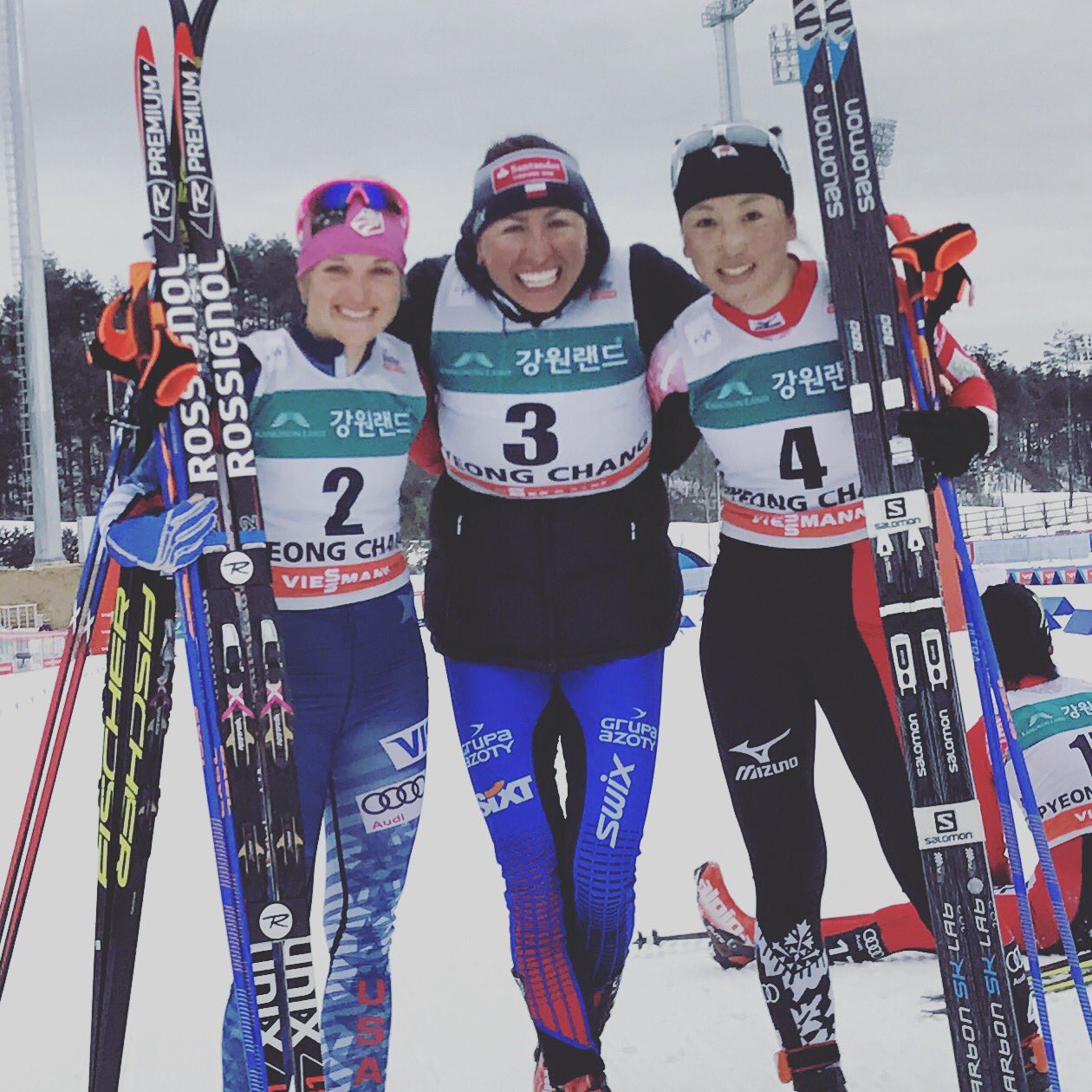
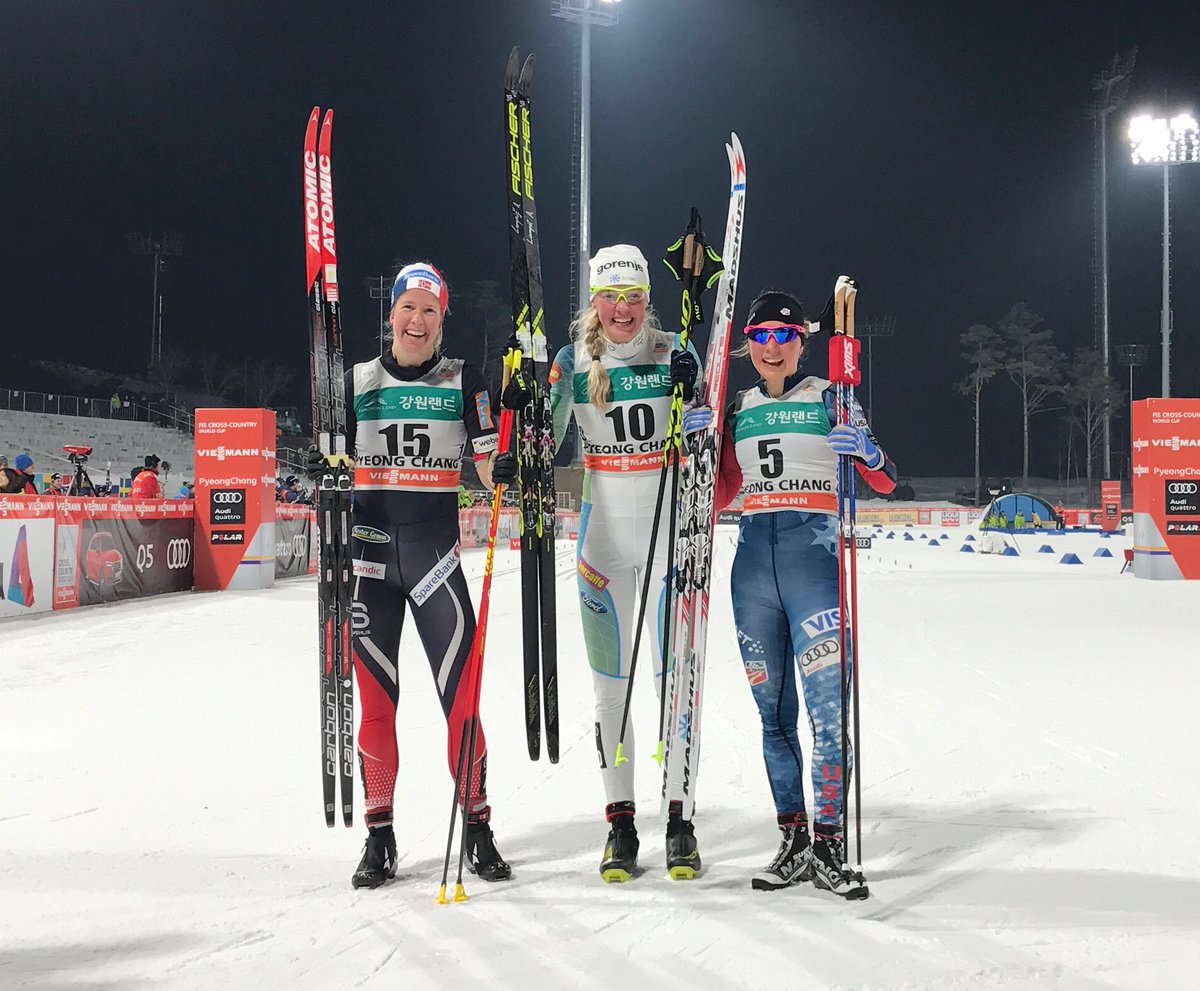
    The women's 15 k skiathlon podium at the PyeongChang World Cup in South Korea, with Poland's Justyna Kowalczyk (c) in first, American Liz Stephen (l) in second, and Japan's Masako Ishida in third. (Photo: FIS Cross Country/Twitter)
    The women’s 15 k skiathlon podium at the PyeongChang World Cup in South Korea, with Poland’s Justyna Kowalczyk (c) in first, American Liz Stephen (l) in second, and Japan’s Masako Ishida in third. (Photo: FIS Cross Country/Twitter)

    The second day of World Cup racing in PyeongChang, South Korea, took place this Saturday, with a skiathlon event for both genders. The women raced a total of 15 kilometers, the first 7.5 k leg classic and the second 7.5 k leg freestyle. Poland’s Justyna Kowalczyk came away with the women’s win (her first in three years), getting back to her old ways of breaking away from the pack to finish first in 43:54.7 minutes. Liz Stephen of the U.S. Ski Team (USST) claimed second place (+56.0), while Japan’s Masako Ishida took third (+1:14.8).

    For Stephen, second matched her best individual result in a from two years ago, when she placed second in a 10 k freestyle in Rybinsk, Russia. This year at the Tour de Ski, Stephen posted the second-fastest time up the final climb in Val di Fiemme, Italy. For Ishida, it was her first podium since 2009.

    Caitlin Patterson, racing for the U.S., finished just off the podium with a career-best fourth (+1:21.4) for her first top 20 on the World Cup,  and American Liz Guiney placed 13th (2:21.7) for her first top 20 as well. Jessica Yeaton, who trains with Alaska Pacific University and races for Australia, came in 24th (4:58.6).

    Two Canadian women competed with Annika Hicks leading the team in 26th (+5:17.8) followed by Sadie White in 29th (+6:54.7) for their first World Cup top 30s.

    In the men’s 30 k skiathlon that followed, Russia’s Petr Sedov broke away during the skate leg to take a decisive victory over Norway’s Daniel Stock and Mathias Rundgreen, finishing in 1:18:49.6 hours, 22.5 seconds clear of second place. It was Sedov’s first World Cup win and podium, and the first individual podiums for Stock and Rundgreen as well.

    Rundgreen edged Russia’s Konstantin Glavatskikh for the final spot on the podium, with both being listed as 42.1 seconds behind Sedov.

    While Rundgreen held off three others for third place, including Sweden’s Gustav Eriksson in fifth (+46.8), Japan’s Keishin Yoshida in sixth (+47.1), and Russia’s Alexander Utkin in seventh (+49.0), American Noah Hoffman kept his distance ahead of the second chase group to finish eighth (+1:06.2) for his best result in a non-World Cup stage since placing eighth in a 2012 skiathlon in Canmore, Alberta. (Hoffman won the time of day in the 15 k pursuit four years ago in Kuusamo, Finland.)

    Also for the U.S., Scott Patterson was next across the line in ninth (+1:28.4) for his first World Cup points, and Matt Gelso finished 19th (+5:00.8) for his first top 20.

    Brian McKeever of Canada’s Para-Nordic Ski Team was the lone Canadian finisher in 29th (+8:48.9). Bob Thompson was listed as placing 32nd of 37 after being lapped, and Simon Lapointe did not finish.

    Results: Women | Men

    ***

    NorAm Eastern Canadian Championships (Cantley, Quebec): Classic interval start

    The NorAm mini tour at the Nakkertok Nordic Centre continued on Saturday with Eastern Canadian Championships with classic individual start races.

    In the men’s 15 kilometre, Lappe Nordic’s Andy Shields took a lead in the first lap and held on to win in 39:14.7, just 0.7 seconds ahead of CNEPH’s Ricardo Izquierdo-Bernier.  Team R.A.D.’s Russell Kennedy collected his second bronze of the weekend, 24.7 seconds back.

    SMS Elite’s Anne Hart won the women’s 10 k in a reversal of Friday’s sprint podium.  Hart’s 30:03.3 finish gave her a 9.3 second edge on CNEPH’s Sophie Carrier-Laforte and 20.0 seconds on AWCA’s Maya MacIsaac-Jones.

    For the 123 men and 77 women doing the full distance, the weekend is a mini tour.  For the younger categories, it is three separate events allowing the kids who couldn’t skip school on Friday to race Saturday and Sunday.

    There should be over 700 finishers today with 768 on the start list. The volunteers will have more hours of work even after the open categories have finished.

    Results will update continuously as more categories start.

  • Under 23 Questions with Alexis Dumas

    Canada's Alexis Dumas (CNEPH) racing in the men's classic sprint qualifier at 2017 U23 World Championships, where he placed 42nd at Soldier Hollow in Midway, Utah, on Jan. 31. (Photo: FlyingPointRoad.com)
    Canada’s Alexis Dumas (CNEPH) racing in the men’s classic sprint qualifier at 2017 U23 World Championships, where he placed 42nd at Soldier Hollow in Midway, Utah, on Jan. 31. (Photo: FlyingPointRoad.com)

    In an effort to showcase the North Americans competing at this week’s International Ski Federation (FIS) 2017 USANA Nordic Junior World Championships and U23 Cross Country World Championships at Soldier Hollow in Midway, Utah, we asked those qualifying athletes several questions about themselves — actually, we had them fill in the blanks. Here we have 21-year-old Alexis Dumas, of the Centre National d’Entraînement Pierre-Harvey (CNEPH) a.k.a. Pierre-Harvey National Training Centre, who’s representing Canada at his second U23 Worlds.

    On Thursday of this week, Dumas placed 38th in the men’s 15 k freestyle (tying his best result at U23s), and on Tuesday, he was 42nd in the classic sprint. He’s listed as a starter for Saturday’s 30 k skiathlon

    ***

    “My full name is Alexis Dumas, but you can call me Dumas. I was born in Quebec, raised in Quebec, and one thing you should know about my hometown is we speak French, and yes, we are still part of Canada.

    I started cross-country skiing when I was three, thanks to my parents. I currently train in Quebec (Mont Sainte-Anne) with CNEPH [Centre National d’Entraînement Pierre-Harvey].

    If I’m not skiing, you might find me in my bed. If I had to pick a favorite book, it would be any book with pictures and not too much text.

    Canada's Alexis Dumas (CNEPH) racing to 38th in the men's 15 k freestyle at 2017 U23 World Championships at Soldier Hollow in Midway, Utah. (Photo: FlyingPointRoad.com)
    Canada’s Alexis Dumas (CNEPH) racing to 38th in the men’s 15 k freestyle at 2017 U23 World Championships at Soldier Hollow in Midway, Utah. (Photo: FlyingPointRoad.com)

    One of the things I’m most excited about for U23/Junior Worlds at Soldier Hollow is that my parents will be there to cheer. One race I’m especially targeting there is both distance races.

    The best advice anyone ever gave me about skiing or racing was the best way to climb a hill is to go straight up.

    One of the best race memories I have is winning my first big race when I was junior at nationals in Mont Sainte-Anne.

    If I could meet one World Cup skier, it would be Simon Lapointe. He is so handsome.

    If I don’t end up being a professional skier, I’ll probably be a mechanical engineer trying to find a way to make ski poles even lighter.

    I’m missing zero days of school to be here, and my professors are probably thinking, ‘Anyway, it’s an online class. He would be weird to show up at university.’ “

  • Valjas 4th, Newell 6th in PyeongChang Sprint Final

    Valjas 4th, Newell 6th in PyeongChang Sprint Final

    Russia's Gleb Retivykh (l) racing to his first World Cup victory and podium on Friday in the World Cup classic sprint in PyeongChang, South Korea, ahead of Norway's Sondre Turvoll Fossli (second from l), Canada's Len Valjas (behind Fossli), and Russia's Andrey Parfenov and Alexander Panzhinskiy. (Photo: Fischer/NordicFocus)
    Russia’s Gleb Retivykh (l) racing to his first World Cup victory and podium on Friday in the World Cup classic sprint in PyeongChang, South Korea, ahead of Norway’s Sondre Turvoll Fossli (second from l), Canada’s Len Valjas (behind Fossli), and Russia’s Andrey Parfenov (second from r) and Alexander Panzhinskiy (r). (Photo: Fischer/NordicFocus)

    As a sphere, the Earth is a tidy shape and can be divided into equal segments. It takes roughly 24 hours for the planet to rotate on its axis once, constituting a single day. So there’s 24 time zones, one for each hour of rotation. On Friday, the tidiness was disrupted a bit for European-based World Cup skiers. PyeongChang, South Korea, host of the 2018 Winter Olympics, was site of the men’s World Cup 1.5-kilometer classic sprint.

    PyeongChang sits a full eight hours ahead of Central European Time, a time zone most World Cup skiers are adjusted to. To accommodate the time shift, the sprints were run at night, under the lights.

    “It’s been tough. We knew the races were going to be really late here in Korea so that the T.V. time works in Europe,” U.S. Ski Team (USST) member Andy Newell said on the phone. “But as far as adjusting, you go in and out and definitely feel pretty tired at times, like when you’re trying to fire it up and get ready to race. But once you’re racing, it seems like it’s OK. You don’t notice the jet lag once you’re out there on the track.”

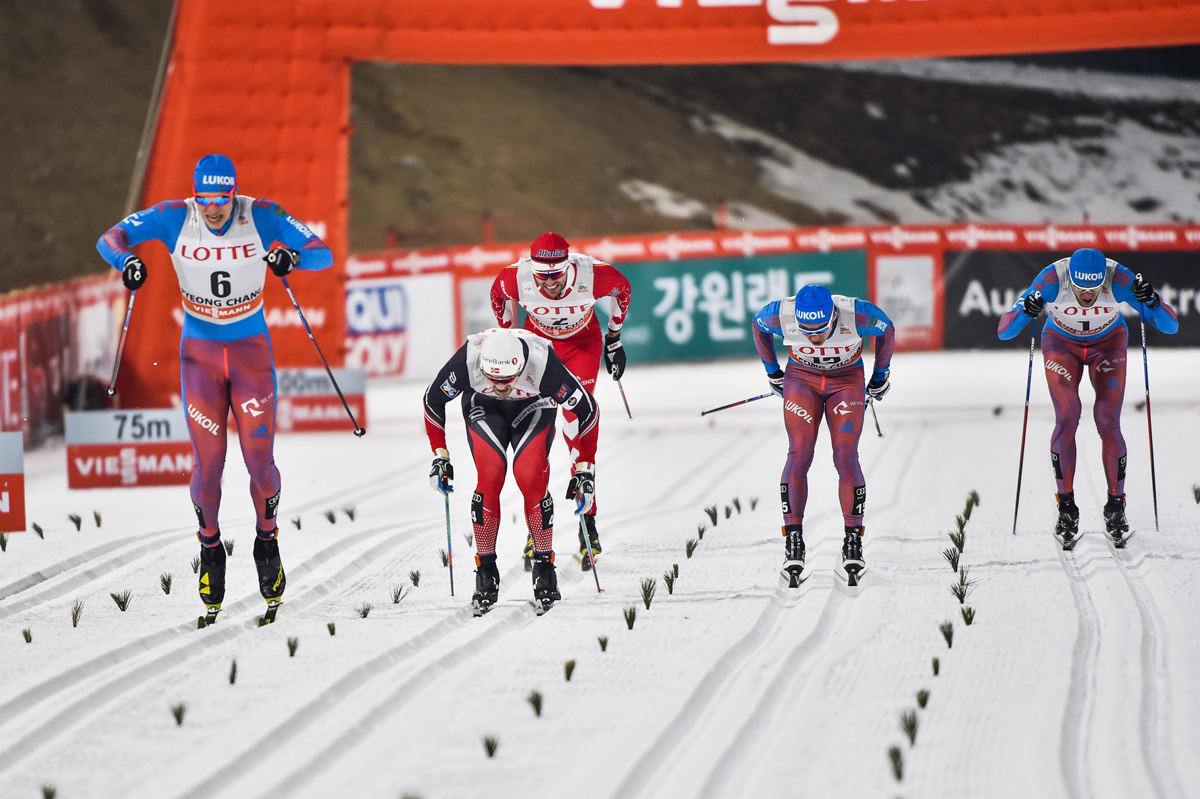
    In a field of 55 skiers, Newell was one of two North Americans to make the men’s final; the other was Canada’s Lenny Valjas. Newell placed sixth in the final (+17.1), Valjas fourth (+0.74) in a photo finish with Russia’s Andrey Parfenov (+0.73), who skied to third overall.

    “It was really close between me and Lenny,” Parfenov told the International Ski Federation (FIS), according to a press release. “I know he was next to me. I was lucky have a better lunge. It was a good track for classic. There is not so much double poling sections, more uphills and that was good for me. I am really happy for my second podium of my career.”

    Russia’s 26-year-old Gleb Retivykh won the final in 3:30.79, ahead of Norway’s Sondre Turvoll Fossli in second (+0.30). It was Retivykh’s first career World Cup win and first time on the podium, despite finishing in the top 10 in World Cup sprints on 10 other occasions. And despite his comments to FIS, the Russian’s speediness may just have allowed him to momentarily outrun the jet lag.

    “I arrived here yesterday so I am still jet lagged,” Retivykh said. “I knew Sondre is very strong. I did not think I could win. I was hoping for a good result. I had to wait six years for my first victory and it is great.”

    Valjas Leads Canada in 4th

    Time zones and new food be damned. For seasoned athletes like Valjas and Newell, planes, shuttle buses, and exploratory cuisine are all part of the international skiing life. Despite the time-zone-shift-wormhole, both skiers delivered.

    For Valjas, of Canada’s World Cup A-team, the vagaries of food prep in South Korea flummoxed him.

    “Adjusting to the time change went fairly well, but I ran into some trouble with the food here,” Valjas wrote in an email. He is allergic to peanuts and fish; two ingredients in the form of peanut and fish oil that’s ubiquitous in Korean meals.

    “The last two dinners I have not been able to eat because I had reactions,” Valjas added. “Even the ‘safe’ boiled potatoes ended up having peanut oil dribbled all over them. The language barrier makes it very hard to understand which foods may or may not kill me. I could feel my energy getting lower and lower today, could have been my inability to eat well or the jet lag after flying here two days ago.”

    Canada's Lenny Valjas racing to second in the men's classic sprint qualifier on Friday at the World Cup in PyeongChang, South Korea. (Photo: Fischer/Nordic Focus)
    Canada’s Lenny Valjas racing to second in the men’s classic sprint qualifier on Friday at the World Cup in PyeongChang, South Korea. (Photo: Fischer/Nordic Focus)

    Despite the lack of food intake, Valjas qualified in second place, 1.97 seconds back from fifth-place overall finisher and first-place qualifier Alexander Panzhinskiy of Russia.

    Valjas’s progression looked like this: second in his quarterfinal then advancing to the finals as the second lucky loser from the first semifinal. And ultimately his fourth place in the final — where he missed his eighth-career World Cup podium and his third of the season, by 0.01 seconds.

    “I have mixed feelings about today,” Valjas wrote about his PyeongChang classic sprint experience. “It’s tough to be that close and come up short.”

    Mindful that the day was also about gaining pre-Olympic beta, Valjas noted his time in South Korea was well spent.

    “On the bright side, I learned so much skiing the Olympic course today. It’s a very tough course, but it is built amazingly well,” he wrote. “The climbs are the perfect grade for striding, and racing at night with all the lights was really cool. … I hope I can use the valuable info I learned tonight to my advantage when I race here next winter in the Olympic sprint.”

    Jess Cockney (Canadian World Cup B-team) racing to 16th in the men's classic sprint qualifier on Friday at the World Cup in PyeongChang, South Korea. He went on to place 10th overall for a season best. (Photo: Fischer/NordicFocus)
    Jess Cockney (Canadian World Cup B-team) racing to 16th in the men’s classic sprint qualifier on Friday at the World Cup in PyeongChang, South Korea. He went on to place 10th overall for a season best. (Photo: Fischer/NordicFocus)

    Jess Cockney, of Canada’s World Cup B-team, placed 10th after qualifying 16th. Cockney skied to first in his quarterfinal after avoiding several skiers involved in crashes, including one involving U.S. Ski Team member Simi Hamilton.

    “I felt that I could ski relaxed and work my way through some positions in the second half of the course and it ended up being really good to also avoid the crashes in my heat,” Cockney wrote in an email.

    In his semifinal, Cockney was on fumes and finished fifth.

    “He gave it all on the quarterfinal so he lost a lot of energy there, but still making it to the semi is very good,” Charles Castonguay, Canada’s lead coach in PyeongChang, said on the phone. “But at the end, I think he did really well, too. Top 10 for him is really really good and he is pretty confident that he can repeat that for Lahti in two weeks [at World Championships]. We had a little chat after and he said he was pretty happy; he said he gave it his all. … It’s his best result since [last] year in Quebec [where he placed 10th in the freestyle sprint]. So yeah, it’s promising for him for the Otepää World Cup and the Worlds at Lahti.”

    The next best Canadian was Simon Lapointe, of the Pierre-Harvey National Training Centre (CNEPH), who qualified 25th and finished 27th overall. Friday marked his first international World Cup and his previous personal best was 70th in a Ski Tour Canada stage last year.

    Bob Thompson (NTDC Thunder Bay) missed qualifying by one-hundredth of a second in 31st (for his best World Cup result by 21 places), and Julien Locke (Alberta World Cup Academy/Canadian National U25 Team), in his first World Cup, placed 36th.

    Newell Sixth in Final

    The 1.5 k men’s course was a no-rest affair. Thirty seconds of initial double poling brought skiers into a roller coaster of a course — two big ups, quick downs, and a straight away finish all under the brights lights. 

    Leading the U.S. was veteran USST skier Newell in sixth overall. He qualified seventh (+5.18).

    “For me in the qualifier, how I gauge a good or bad qualifier, usually it doesn’t even necessarily depend on what place I finish, a lot of it is seconds back and a lot of it is how I feel if I nailed the course or not,” Newell said on the phone Friday night.

    A thorough student of the classic-skiing sprint scene, Newell adjusted after sensing he hadn’t skied the second major hill effectively.

    “I know my strengths and weaknesses on a course like this,” Newell said. “I know I can be as good as anyone on those hills and so that was kind of the goal, was to make sure I was in a good position.”

    American Andy Newell chasing Russia's Alexander Panzhinskiy during their quarterfinal of the men's classic sprint at the PyeongChang World Cup in South Korea. (Photo: Fischer/Nordic Focus)
    American Andy Newell (7) chasing Russia’s Alexander Panzhinskiy during their quarterfinal of the men’s classic sprint at the PyeongChang World Cup in South Korea. (Photo: Fischer/Nordic Focus)

    Newell was matched with top-qualifier Panzhinskiy in his quarter and semifinal. Panzhinskiy and Newell placed first and second in both, respectively, with Newell 0.63 seconds back in the quarter and 0.34 seconds back in the semi.

    “[Panzhinskiy] was the top qualifier so I knew he was going to be fast and so we were kind of really able to kind of get away from anyone in our heats in both the quarterfinal and the semifinal up that [second] hill,” Newell said.

    As a made-for-television production, the heats run on a tight schedule. And due to clearing the course after several crashes, organizers were running behind schedule. The time after the Newell’s semifinal to the final was reduced, hampering both Panzhinskiy’s and Newell’s normal pre-final recovery period.

    “Maybe we pushed each other a little too hard in the semifinal because I think we were both a little tired,” Newell reflected. “It just so happened that the schedule they were running behind with the heats today, which means the semifinal went off five to ten minutes late, but they have to keep the final on time. … That kind of took us by surprise because I think we both pushed each other pretty hard in that semi and then to have a short ten-minute recovery as opposed to one that’s fifteen or twenty, that was definitely a tough turnaround.”

    Newell skied from the back in the final. According to the Vermont-based skier, he changed skis in the final, and that decision compounded with his less-than-normal, pre-finals recovery period impacted his overall placing.

    “I swapped out for a different pair of skis and was using a different pair of skis in the final,” Newell said. “It was an easier-kicking pair of skis, which probably worked out great for the first few heats, but in the final I think one of the things that came to bite us was the fact that [my wax tech] Mark and I kept adding a layer of wax to make sure we had good grip up that big climb because it was such decisive part of the race. But by the final I think we were dragging a little bit too much wax, which really played a big role in me getting shelled off after about half way through because yeah, kick was dragging considerably in the final, but you know that’s all part of the game.”

    Newell ultimately finished 17.19 seconds back in sixth after realizing his efforts were in vain. But being present and racing well in PyeongChang remained important for Newell.

    “This race in particular was kind of one of the races I wanted to make sure I was at,” Newell said of how he planned out his current World Cup campaign. “My goals are really quite focused towards the Olympics next year. For me, the excitement was there today just because it’s a new venue and it’s the place where the Olympics are going to be taking place next year and I know I can be competitive in these classic sprints.”

    Newell will skip Saturday’s skiathlon to prep for Sunday’s freestyle team sprint. He’ll be racing the team sprint with Hamilton.

    “I was not feeling great all day, and it’s been kind of a tough week for me in general,” Hamilton wrote of his adjustment to South Korea. “I was definitely struggling with how my body was responding to big travel and a pretty significant time shift, but still, I think it is extremely valuable to be able to be here experiencing the courses and the layout of the land before 2018.”

    Simi Hamilton (U.S. Ski Team) racing to 12th in the men's classic sprint qualifier on Friday at the PyeongChang World Cup in South Korea. He went on to finish 17th overall after crashing in his quarterfinal and finishing fourth in that heat. (Photo: Fischer/NordicFocus)
    Simi Hamilton (U.S. Ski Team) racing to 12th in the men’s classic sprint qualifier on Friday at the PyeongChang World Cup in South Korea. He went on to finish 17th overall after crashing in his quarterfinal and finishing fourth in that heat. (Photo: Fischer/NordicFocus)

    Hamilton qualified 12th, which he was dissatisfied with.

    “I felt like I had a pretty weak qualifier, and was struggling to find big power and big glide on the two big climbs,” he wrote.

    Hamilton’s focus this year has been on skate sprinting: a traditionally strong technique for him.

    “But with so many skate sprints this year and the fact that the sprint in Lahti is skate, I haven’t really been thinking too much about classic sprinting or gearing my training towards classic sprinting,” he explained. “So I think with some focused training I’ll be able to dial in my preparations for this course specifically and hopefully feel much better in qualification the next time we are racing here.”

    In his quarterfinal, Hamilton was well positioned for the second climb — sitting back a few meters from the leaders.

    “Coming down the fast descent into the bottom of that hill, I made a slingshot move to the outside, open track on the far left, and was carrying some really good momentum past the two Norwegians in my heat,” he recalled.

    With his momentum carrying him up to the leaders, Norwegian Daniel Stock swerved into Hamilton’s tracks. (Stock was eventually relegated to 30th overall due to his obstructing Hamilton.)

    “I think he skied right over both of my bindings with his left ski as he was skating into that track. My feet were basically stopped dead in their tracks as the rest of my body was hurling up the hill.”

    A broken pole and stopped dead, Hamilton’s chances of advancing had been squelched.

    “As I got to my feet, the pack was already about 10 meters ahead of me and I realized that my night was over,” Hamilton added. He finished 17th overall.

    Another American, Matt Gelso (Sun Valley Ski Education Foundation) scored his first career World Cup points. Gelso had earned the World Cup starts as the Period 1 SuperTour leader.

    “It’s great to score my first ever World Cup points in my second-ever sprint,” Gelso wrote in an email. “Never thought my first points would come in a sprint. I skied the transitions well in my qualifier and accelerated through the course. I probably could have started harder but overall pacing was pretty good.”

    Gelso qualified 29th and placed 29th overall after finishing sixth in his heat.

    Also for the U.S., Scott Patterson (Alaska Pacific University) finished 44th and Noah Hoffman 48th in the qualifier.

    Results: Qualifier | Final

  • Friday Rundown: PyeongChang, Soldier Hollow & Eastern Canadian Champs (Updated x3)

    Katharine Ogden (SMS/USST) finishing third for bronze in the women's 10 k skiathlon on Friday at 2017 Junior World Championships at Soldier Hollow in Midway, Utah. She is the first American to reach the podium in a Junior World Championships. (Photo: FlyingPointRoad.com)
    Katharine Ogden (SMS/USST) finishing third for bronze in the women’s 10 k skiathlon on Friday at 2017 Junior World Championships at Soldier Hollow in Midway, Utah. She is the first American to reach the podium in a Junior World Championships. (Photo: FlyingPointRoad.com)

    FIS Nordic Junior World Championships (Midway, Utah): 10/20 k skiathlon

    A Junior World Championships medal has been on Katharine Ogden’s mind for some time — two years, to be exact.

    “Every day in training, it’s kind of something that I think about. It’s the little thing that helps me push myself,” Ogden, a 19-year-old member of the Stratton Mountain School and U.S. Ski Team D-team, said in a post-race interview with the U.S. Ski Team on Friday. “Even in the middle of June, I’ll be like, ‘You know what I want to be? On the podium at World Juniors.’ ”

    She did just that on Friday, racing to third in the women’s 10-kilometer skiathlon at 2017 Junior World Championships at Soldier Hollow in Midway, Utah. In doing so, she became the most successful American at World Juniors, surpassing Lindsey Williams’s previous best of fourth place in 2003.

    Ogden finished 10.4 seconds behind the winner, Norway’s Marte Mæhlum Johansen, who finished first in 27:17.3 minutes. Sweden’s Ebba Andersson took second, 6.6 seconds back. Behind Ogden, Italy’s Anna Comarella placed fourth (+51.6) ahead of Finland’s Eveliina Piippo in fifth (+58.7).

    Hailey Swirbul (University of Alaska Anchorage) was the second U.S. woman in 24th (+2:21.0), while Natalie Hynes (Whitehorse) led Canada in 28th (+3:11.3).

    Also for Canada, India McIsaac (Rocky Mountain Racers) finished 30th (+3:13.8), Lisle Compton (NTDC Thunder Bay) was 33rd (+3:45.5) and Annika Richardson (NTDC Thunder Bay) 41st (+4:49.3).

    Also for the U.S., Lauren Jortberg (Dartmouth) finished 37th (+4:04.5) and Taeler McCrerey (University of Denver) 38th (+4:07.5).

    [UPDATED] In the men’s 20 k skiathlon that followed, Russia’s Vladislav Vechkanov notched his second gold of the week in 49:40.5, outlasting Norway’s Thomas Helland Larsen by 1.9 seconds. Norway had two on the podium with Harald Østberg Amundsen in third (+2.2).

    Canada’s Gareth Williams (Telemark Race Team) was the top North American in 11th (+1:24.0) for his best result at his first Junior Worlds.

    American Wyatt Gebhardt (Steamboat Springs WSC) followed in 12th (+1:42.7) for his second-straight top 20 and Hunter Wonders (Alaska Pacific University) also finished in the top 20 for the second-straight race in 18th (+1:57.9).

    Canada’s Philippe Boucher (CNEPH) was 22nd (+3:15.7), Ryan Jackson (Team Hardwood) 31st (+3:52.5), and Remi Drolet (Black Jack) 49th (+6:57.3).

    Also for the U.S., Kam Husain (SMS) placed 50th (+6:59), and Logan Diekmann (University of Utah) was 53rd (+7:47.3).

    Results: Women | Men 

    ***

    NorAm Eastern Canadian Championships (Cantley, Quebec): Classic sprint

    The NorAm series resumed at the Nakkertok Nordic Centre on Friday with Eastern Canadian Championships with classic technique sprints.

    Alberta World Cup Academy’s Maya MacIsaac-Jones returned from U23s in time to win the 1.3 k A-final in 3:42.06, after qualifying sixth. Top qualifier Sophie Carrier-Laforte was second for CNEPH at her home event, 0.66 seconds behind. SMS Elite’s Anne Hart rounded out the podium at 3.40 seconds back.

    On the men’s side, AWCA’s Dominique Moncion-Groulx qualified first before winning every heat on his way to victory in 3:14.84 on a slightly longer 1.4 k course. NTDC Thunder Bay’s Angus Foster was a close second, 0.09 seconds behind. Team R.A.D.’s Russell Kennedy was a comfortable third, 2.75 seconds back, on a day marked by some surprising eliminations.

    The elite field is slightly smaller than usual with some athletes away in Soldier Hollow and PyeongChang. As many younger racers were stuck in school for the day, there are only about 500 starters for what is usually the largest FIS event in Canada.

    Results: Qualifier | Heats

    ***

    FIS Cross-Country World Cup (PyeongChang, South Korea): Classic sprint

    The women's 1.4 k classic sprint podium on Friday at the pre-Olympic PyeongChang World Cup in South Korea, with Slovenia's Anamarija Lampič (c) in first, Norway’s Silje Øyre Slind (l) in second, and American Ida Sargent (r) in third. It was the first time on the World Cup podium for all three athletes. (Photo: FIS Cross-Country/Twitter)
    The women’s 1.4 k classic sprint podium on Friday at the pre-Olympic PyeongChang World Cup in South Korea, with Slovenia’s Anamarija Lampič (c) in first, Norway’s Silje Øyre Slind (l) in second, and American Ida Sargent (r) in third. It was the first time on the World Cup podium for all three athletes. (Photo: FIS Cross-Country/Twitter)

    In the last month, we’ve seen two U.S. Ski Team members — Jessie Diggins and Sadie Bjornsen — on the World Cup podium. Add Ida Sargent to that list.

    On Friday, the Vermont native raced to third in the women’s 1.4-kilometer classic sprint at the first-ever World Cup in PyeongChang, South Korea. It was the first of three days of racing in PyeongChang, which will host the 2018 Winter Olympics next season.

    Sargent qualified fifth (4.76 seconds behind her teammate Sophie Caldwell, who won the qualifier in 3:40.89 minutes) and went on to win her quarterfinal in a photo finish, then placed second her semifinal (also in a photo finish), edging Russia’s Alisa Zhambalova in third by less than 0.01 seconds.

    Both advanced to the final, where Sargent ultimately finished third, 1.79 seconds behind Slovenia’s Anamarija Lampič, who won in 3:41.97. Norway’s Silje Øyre Slind took second (+1.6), just 0.19 seconds ahead of Sargent. For all three women, it was their first time on a World Cup podium.

    Sargent beat out Poland’s Justyna Kowalczyk for third by 0.56 seconds. Zhambalova finished fifth and Slovenia’s Katja Visnar was sixth (+17.1).

    “I’m really excited about the podium and it hasn’t really set in yet,” Sargent wrote in an email on Friday. “It has been a goal of mine for a long time to be on the podium so it was a very special day! I’ve been inspired by so many fast teammates so happy to follow in their footsteps!”

    All five U.S. women racing on Friday finished in the top 30 to qualify for the heats. Caldwell won the qualifier by 1.84 seconds over Kowalczyk, Caitlin Patterson qualified 22nd, Liz Guiney 25th and Liz Stephen 29th (Stephen’s first time making the heats in three years).

    Jessica Yeaton, who races for Australia but trains with Alaska Pacific University, took the last qualifying spot in 30th (+26.29).

    Canada’s Annika Hicks and Sadie White missed qualifying in 32nd (+32.96) and 34th (+38.96), respectively, out of 36 women.

    Caldwell won her quarterfinal but finished fourth in her semifinal (behind Slind, Kowalczyk, and Sweden’s Maria Nordström, respectively) to miss advancing to the final. She placed eighth overall.

    Guiney placed 24th overall after finishing fifth in her quarterfinal, Stephen was 25th after taking fifth in the same quarterfinal as Sargent (where Yeaton finished sixth for 30th overall), and Patterson was 27th after finishing sixth in her quarterfinal.

    ***

    Both Canada’s Len Valjas and American Andy Newell reached the final in the men’s 1.5 k classic sprint on Friday, where they raced to fourth and sixth, respectively.

    Valjas started the day by qualifying in second, 1.97 seconds behind Russia’s Alexander Panzhinskiy, who topped the qualifier in 3:26.78. The Canadian went on to advance in second from his quarterfinal and fourth as a lucky loser from the first semifinal. In the final, he missed out on the podium in a photo finish with Russia’s Andrey Parfenov, who took third, 0.01 seconds ahead of him.

    Meanwhile, Newell qualified seventh (+5.18) and took second in both his quarterfinal and semifinal (finishing the second semifinal 0.34 seconds behind Panzhinskiy in first).

    In the final, Russia’s 25-year-old Gleb Retivykh pulled off his first World Cup victory and podium with a 0.3-second win over Norway’s Sondre Turvoll Fossli in 3:30.79. Retivykh qualified sixth (+4.53) then won his quarterfinal and placed third in the same semifinal as Valjas, advancing as the other lucky loser.

    “I had wait six years for my first victory and it is great,” Retivykh said, according to an International Ski Federation (FIS) press release.

    Russia had two on the podium with Parfenov in third (+0.73), just ahead of Valjas. The third Russian in the final, Panzhinsky ended up fifth (+1.49), ahead of Newell in sixth (+17.19)

    Three Canadian men qualified for the heats, with Jess Cockney in 16th (+10.24) and Simon Lapointe in 25th (+14.15). Bob Thompson missed 30th by one-hundredth of a second in 31st (+16.95), and Julien Locke was 36th (+17.9).

    Three Americans qualified as well, with Simi Hamilton in 12th (+8.26) and Matt Gelso in 29th (+16.66). Distance skiers Scott Patterson and Noah Hoffman finished 44th (+24.21) and 48th (+25.28) out of 55.

    Cockney reached the semifinals after winning his quarterfinal. In the second semifinal with Newell, he placed fifth, 5.44 seconds behind Panzhinskiy, for 10th overall.

    In Cockney’s quarterfinal, Hamilton crashed and finished fourth (+41.9) for 17th overall.

    Canada’s 23-year-old Lapointe finished sixth in his quarterfinal to place 27th, besting his previous World Cup best by 43 places. Gelso took 29th for his first-ever World Cup points after placing sixth in his quarterfinal.

    Results:

    Women’s qualifier | Women’s brackets

    Men’s qualifier | Men’s brackets 

  • PyeongChang Pre-Olympic World Cup: Logistics of Racing in South Korea

    PyeongChang Pre-Olympic World Cup: Logistics of Racing in South Korea

    https://www.instagram.com/p/BP7QjWEgYnI/?taken-by=sophiecaldwell&hl=en

    “We are 7 hours behind you in Pacific time (and a day ahead),” U.S. Ski Team Head Coach Chris Grover wrote in an email from South Korea on Monday. But as his email hints, tracking time and day when criss-crossing time zones and arranging a phone call can be befuddling. So another way of stating what Grover wrote is that KST, or Korea Standard Time, is 17 hours ahead of the time at this reporter’s location in Bend, Ore.

    The call went down on Monday at 5 p.m. Pacific Standard Time. Just so we’re all straight, that was Tuesday, 10 a.m. KST.

    With all that travel, staying rested, staying fast and staying healthy are primary concerns for athletes and coaches traveling on the usually Eurocentric World Cup.

    “When you look at the U.S. team it is primarily a European-based team,” Grover said on the phone. Many U.S. athletes have been in Central Europe since mid-November. Maybe there’s a +1 hour difference from Central European Time (CET) when a race is hosted in, say, Finland. Most athletes haven’t had to deal with constant time-change jolts.

    As a pre-Olympic World Cup (the 2018 Winter Games will be held in PyeongChang, South Korea), organizers wanted athletes and team support to have an easy transition upon arrival. The races — a classic sprint on Friday, skiathlon on Saturday and freestyle team sprint on Sunday — are being held in the late afternoon or evening; at times compatible with Europe’s television market.

    Although the Korean times are atypical for Euro-based World Cups, they do correspond to the “physiological” times dictating when skiers are primed for racing. A 6 p.m. KST race is the equivalent of a 10 a.m. race in France.

    “It actually plays well for athletes coming from Europe because they can acclimate less because they can sleep in,” Grover said of how the time-zone change shouldn’t be a dramatic shift for the U.S. team. “They can sleep in for quite a while, get up late, have a late lunch, race, and then have a late dinner and shift their whole normal schedule further back in the day. So I’d say the primary strategy we are employing, but not every athlete can do it, or do it super effectively, but we are trying basically to keep these guys on a European time zone as much as possible while they are over here.”

    Yet remaining healthy while traveling and living abroad has been a puzzle for many skiers. On the flight over and while staying in hotels, Grover preaches good hygiene: wash hands and use hand sanitizer when hand washing isn’t convenient. The U.S. also asks that hosting hotels take precautions like disinfecting rooms prior to team’s arrival to help minimize germ exposure. In addition to these precautions, Grover had athletes consult face to face with a U.S. Ski Team (USST) nutritionist when the athletes were in Ulricehamn, Sweden, in mid-February. It was another aspect of monitoring athlete health.

    “[The nutritionist was] making sure everybody was doing OK nutritionally, making sure they are doing OK with their body composition,” Grover said. “It is one thing to monitor those things in the U.S. when everybody is in the training mode, it is another things when you move to Europe and all of sudden you are on a different diet pretty much every week and you are competing full time. … So everybody had a good check in there. If people needed a supplement of vitamin D or iron, or what have you, or to improve part of their nutritional program, then we addressed that a couple weeks ago. That’s one way that we are trying to stay healthy.”

    Another aspect of the quick-turnaround PyeongChang trip is transporting gear and making good and efficient use of the USST ski techs’ time while on the ground at the future Olympic venue.

    “We brought all of our own equipment; we had nothing here,” Grover explained. “This is the first time we have been here during the winter. That was of course one of the challenges is the logistics and the expense of moving all of our necessary gear over here. And all teams are obviously in that same boat.”

    (Story continues below)

    https://www.instagram.com/p/BP7EbKzDuWS/?taken-by=hoffnoah&hl=en

    The three U.S. coaches (Grover, Matt Whitcomb and Jason Cork) and four techs that made the trip to PyeongChang are there first to prepare athletes and skis for the three-race stop. But it’s also double duty in terms of Olympic prep. The USST staff will remain an extra day, the athletes depart for Europe next Monday, to further advance their venue-specific data set. Grover said this trip will remain the only USST testing trip prior to the 2018 Games.

    “We have definitely taken lessons that we have learned from Vancouver [and] from Sochi,” Grover said of the team’s de-emphasis on longer term, on-site testing. “You can definitely over test a bit in a place and kind of get heading in wrong directions that are not so applicable a year later when you have a different composition on the track between, say, manmade and natural snow, for example. … So the testing that we really want to do is important, but it is more on the fundamentals of structure of grinds, of base layers, that sort of thing.”

    The U.S. brought six current USST athletes to South Korea: Sophie Caldwell, Ida Sargent, Liz Stephen, Andy Newell, Simi Hamilton, and Noah Hoffman. Grover stated the remaining national-team members opted for a different schedule and did not make the trip.

    Matt Gelso and Liz Guiney earned start rights as Period 1 SuperTour leaders. According to Grover, the U.S. team invited two additional athletes as well, Caitlin Patterson (Craftsbury Green Racing Project) and her brother Scott Patterson (Alaska Pacific University).

    Neither of the Patterson siblings were selected for the upcoming World Championships in Lahti, Finland. Yet Grover stated he believed both deserved PyeongChang starts — specifically in the skiathlon.

    “They both had been sick immediately prior to the nationals and then actually the first part of the nationals as well. Especially in Scott’s particular case,” Grover explained. “But both had been skiing well not only in the early season this year, but also in the late season last year. Caitlin was taking World Cup points distance at the end of last year and at the beginning of this year in Kuusamo as well.”

    In Scott’s case, Grover mentioned he remained one of the top U.S. distance skiers behind USST members Erik Bjornsen and Hoffman.

    “The next guy that was getting close to perhaps breaking through to the top 30,” Grover said. “We wanted to find an opportunity to give them a distance start and to see what they could do.”

    The Canadians have also arrived in Asia. Coach Charles Castonguay, of the Pierre-Harvey National Training Centre, will be leading the team in South Korea, assisted by five Canadian team World Cup techs and Tom Holland, Cross Country Canada’s high-performance director.

    Representing Canada in the women’s races will be Annika Hicks (Alberta World Cup Academy) and Sadie White (NTDC Thunder Bay).

    On the men’s side, national-team members Len Valjas and Jess Cockney, Para-Nordic Ski Team member Brian McKeever, Bob Thompson (NTDC Thunder Bay), Julian Locke (Alberta World Cup Academy/National U25 Team), and Simon Lapointe (CNEPH) were slated to start Friday’s sprint in South Korea.

    In an email, Castonguay explained that team selection was premised on two criteria: 1. World Cup results (such as a top 30, which Len Valjas achieved), and 2. Classic sprint results and distance results from U.S. nationals last month (excluding athletes who were selected for Junior and U23 World Championships).

    Some athletes, who were also selected for senior [World Championships] in Lahti declined PyeongChang, like Knute [Johnsgaard], to get a better preparation for Lahti,” Castonguay wrote. “So we went down the rank list to select people for Korea.”

    Racing begins on Friday with the men’s and women’s classic sprints.

    Start lists: Women | Men

  • Holmes, Palmer-Charrette Win Black Jack Mini Tour

    Holmes, Palmer-Charrette Win Black Jack Mini Tour

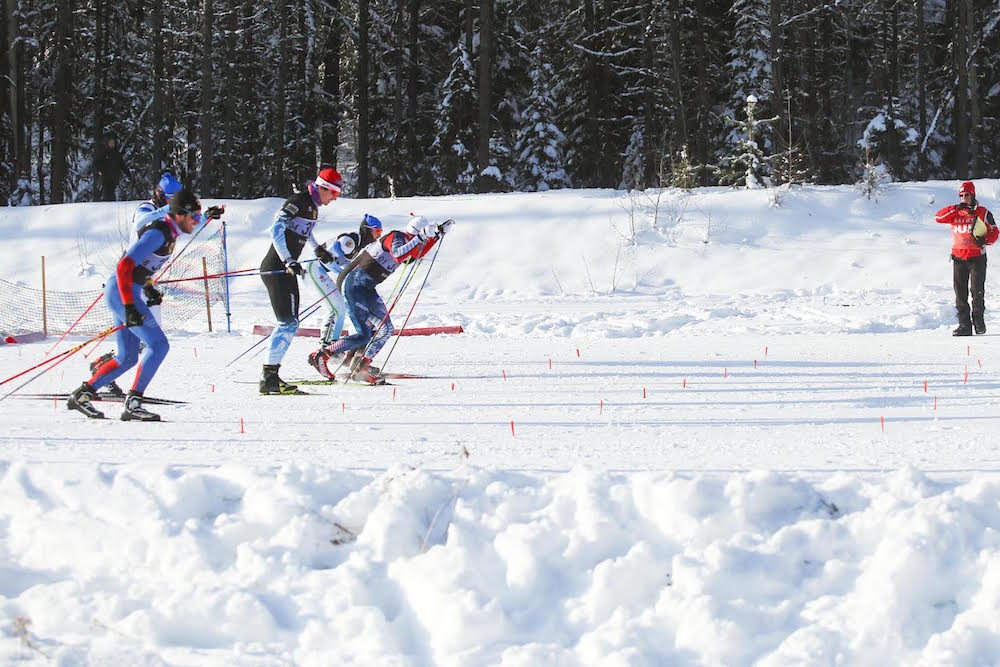
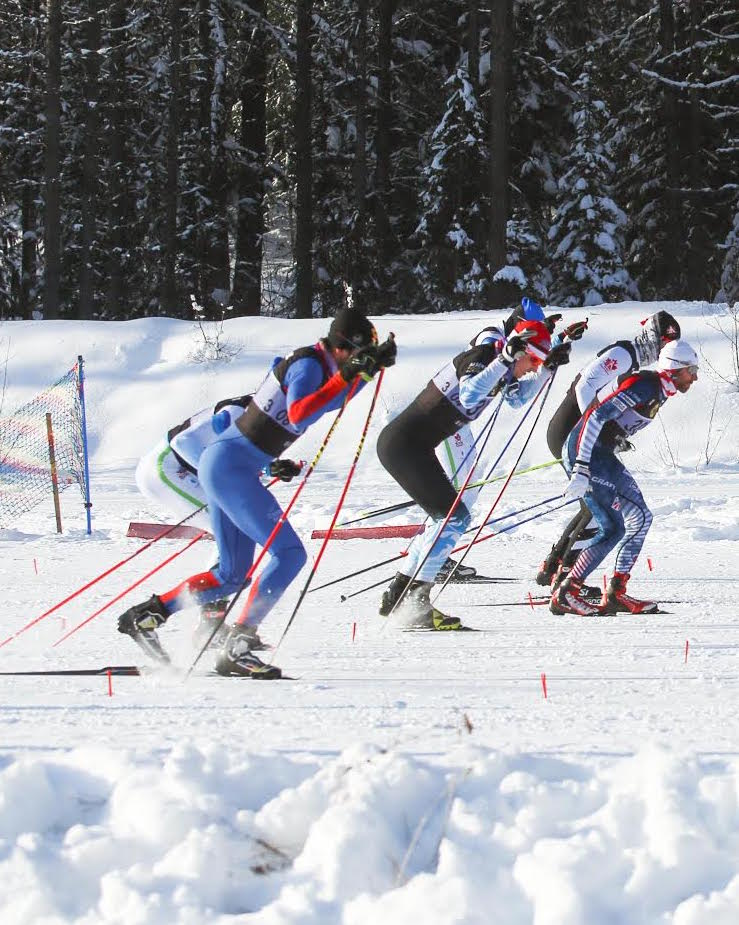
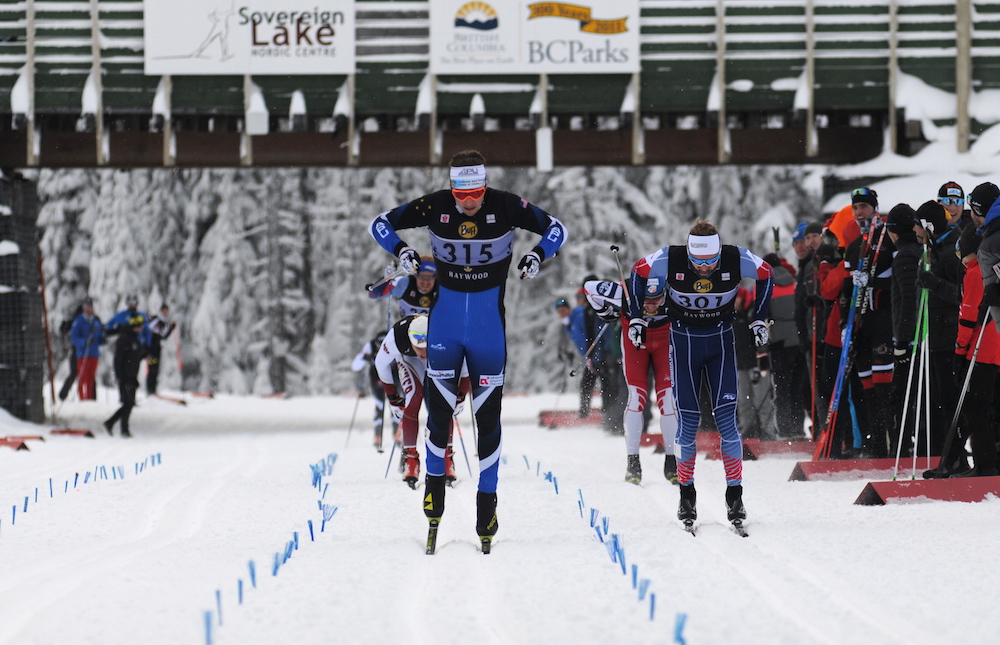
    The start of the A final, day two of of the BlackJack mini tour in Rossland. Newell (301) leads Locke (304, tallest) with Kennedy nearest. (Photo: Dafné Theroux Izquierdo)
    The start of the men’s freestyle sprint A-final on Day 2 of of the NorAm mini tour in at Black Jack Ski Club in Rossland, B.C. American Andy Newell (301) leads Julien Locke (304, tallest) with Russel Kennedy nearest. (Photo: Dafné Theroux Izquierdo)

    The Black Jack mini tour represented the final chance for Canadians to earn World Cup Period 2 starts. A timely week of snow and colder weather delivered great skiing conditions after an unusually warm November wreaked havoc on most of the western ski areas. That same warm weather canceled the Bozeman combined SuperTour/NorAm, which reduced the selection races from seven days to five.

    Chelsea Holmes of Alaska Pacific University (APU) continued her winning ways in Canada, destroying the field in the 10-kilometre freestyle on Friday, placing fourth in the Saturday freestyle sprints, and holding off the field in the 15 k classic pursuit on Sunday with the second-fastest race time to complete the weekend with an aggregate time of 1:08:04.4.

    Erika Flowers of the Stratton Mountain School (SMS) Elite team finished the weekend in second, 2:23.9 behind. Olivia Bouffard-Nesbitt of the Alberta World Cup Academy (AWCA) and Canadian National U25 Team took third, 0.2 seconds ahead of Katherine Stewart-Jones of the Thunder Bay National Team Development Centre (NTDC TBay).  Bouffard-Nesbitt and Stewart-Jones will also be very close on the NorAm leaderboard, and one of them has earned a quota spot for World Cup Period 2.

    In the men’s overall, Evan Palmer-Charrette (NTDC TBay) started the pursuit with a 37-second lead after winning the 15 k freestyle and placing third in the freestyle sprints. Palmer-Charrette held off the chasers to take the overall title and, most likely, the Continental Cup (COC) leader’s spot for World Cup Period 2.

    Alexis Dumas of the Pierre Harvey National Training Centre (CNEPH) charged up from a sixth-place start to grab second overall with the fastest time of the day, 52.2 seconds behind Palmer-Charrette. AWCA’s Jack Carlyle used the second fastest time of the day to take third overall, 1:10.1 back.

    Friday: Freestyle Interval Start

    In a reprise of the the previous Sunday’s event at Sovereign Lake, Holmes won the 10 k by an even larger margin, 1:49.4 minutes, finishing in 29:37.8.

    I love the courses here,” Holmes wrote in an email to FasterSkier. “Lots of steep climbing followed by technical downhills … very fun!”

    She learned from her 31-second victory five days earlier: “Last week in the 10k I exploded into a million pieces at 5km, so I tried very hard to control myself in the first lap today.”

    Flowers, who caught a ride with Holmes the previous week, moved up one place to second despite the larger time gap.

    I felt decent skiing (albeit a bit cold!) but definitely have some work to do on the downhills and keeping my tempo up on the hills,” Flowers wrote. “I tend to ski with a lot of glide so I am learning to turn it over a bit more when is cold like this and good glide is harder to come by.”

    This would be the warmest day of the three, with a high of -12 degrees Celsius.

    Bouffard-Nesbitt placed third (+2:27.2), and was already missing the deeper field of the previous weekend.

    “When you have 2:27 separating the top 3, that’s not something you really want to see at the highest level of domestic racing,” Bouffard-Nesbitt wrote.

    In the men’s 15 k, Palmer-Charrette made up for his head cold-induced DNF the previous weekend with the winning time of 40:36.7.

    Until today I had not had a strong distance race this year, so it was great to see the form come around.”

    Palmer-Charrette was also missing the deeper SuperTour field.

    “This weekend definitely is not as competitive […] as we had last weekend with the Americans in Sovereign Lake,” he wrote. “I’m disappointed [that] I was under the weather when we had the chance to race with them.”

    Russell Kennedy (Team R.A.D.) was leading after 5 k before fading to second, 31.1 seconds back.

    “I really wanted the win after the first lap but my body was feeling a little fatigued,” he explained in an email. “It was cold and the snow wasn’t very fast, but the weather was nice.”

    Erik Carleton, of Rocky Mountain Racers and the Canadian Para-Nordic Ski Team, was happy with his third place, 56 seconds back, especially after a late arrival on Thursday.

    “My teammate [and fellow Para-Nordic guide] Graham [Nishikawa] and I waxed our own skis, with the help of some good advice, and the outcome was positive,” Carleton wrote.

    Carleton and Nishikawa have raced at a lot of venues, while guiding paralympian Brian McKeever and in their own domestic and World Cup careers, and are a good source for course comparisons.

    “It was a fun and challenging course, with steeper climbs and slightly more technical downhills than most courses,” Carleton wrote of the Black Jack trails. “At -18C this morning, the snow was quite slow, especially on the steep uphills. If you had decent skis, the course was more of factor than the conditions. Climbing steep uphills with no glide was a key to a good race.”

    SMS Elite’s Andy Newell, freshly arrived from the World Cup circuit, placed fourth (+1:08.9).

    It’s my goal to use these races to help get back into the feeling of racing again after such a rocky start to the season,” Newell wrote after Friday’s race. “I was happy with the way today went and they way my body felt.”

    Newell is another athlete with wide experience of race courses: “Having just come off the world cup I can tell you that these courses here are top notch,” he wrote.

    Saturday: Freestyle Sprint

    Saturday brought a romantic result to a chilly day, with the affianced Flowers and Newell winning the women’s and men’s sprints, respectively.

    Bouffard-Nesbitt won the qualifier and easily moved through to the A-final, but Flowers was first at the line.

    Olivia skied really well off the line and up the entire first half of the course-super smooth and strong,” Flowers wrote. “I was able to jump in behind her in second and tried to chase her down leading up to the high point of the course. By the top of the first big climb we had a sizable gap on the rest of the field but she was still a few meters ahead of me so I tried to ski hard over the top of the hill and free skate the downhill in order to chase her down. I was able to get right behind her going into the last little uphill and felt good coming off the downhill into the finish stretch for a drag race finish.”

    The sprint course has some tricky descending which didn’t affect the top racers or Flowers’s enjoyment of the day.

    “I did get to see a few epic crashes on the S-turns and I thought it was fun to join my fiance Andy on the top of the podium!” she wrote.

    Bouffard-Nesbitt was also positive about her race, despite coming up 0.44 seconds short of the win.

    “I’m pretty happy with my race today!” she wrote. “Definitely happy with my qualifier. I skied the final just like I skied the final in Silver Star — I left it all out on the course.”

    Bouffard-Nesbitt found her legs were fading in the finishing stretch, after spending much of the summer on crutches.

    Stewart-Jones placed third (+7.89), edging Holmes by four-hundredths of a second.

    “Olivia and Erika skied impressively well, all day today!” Holmes wrote. “Olivia took the final out hard and Erika followed… I didn’t see much after that but the results tell the story!”

    Maya MacIsaac-Jones (AWCA/NST U25 Team), who is recovering from a more-recent foot injury than Bouffard-Nesbitt, held off her NTDC TBay’s Annika Richardson by nearly 2 seconds for fifth (+10.65).

    Newell won the men’s qualifier and every heat before topping the A-final in 2:44.81.

    Another view of the men's A final. Newell and Lapointe (black suit hidden by Newell) would lead out early. Kennedy is nearest, Locke is tallest, the TBay skiers are light blue. (Photo: Dafné Theroux Izquierdo)
    Another view of the men’s A-final. Newell (far right) and Lapointe (black suit hidden by Newell) take the lead out early, with Kennedy (nearest) Locke, and the Thunder Bay NTDC skiers in light blue. (Photo: Dafné Theroux Izquierdo)

    “I was happy with the race today,” he wrote. “The cold temperatures felt a little more manageable today and it was a great opportunity to race 4 hard rounds on a fun sprint course.

    “It was my strategy to be in a front position to be able to charge up the second hill and gap the field, which was the strategy I used in all the heats,” he added

    Former Black Jack racer Julian Locke (AWCA) was 1.05 back, outreaching Palmer-Charrette by 0.05 seconds.

    “[CNEPH’s] Simon Lapointe was pushing pretty hard with Newell and Russell Kennedy with him,” Locke wrote. “I had to put on the gas halfway up [the first long hill] to get back with the leaders and stay in the race. I made contact with the group going over the top and then got behind Newell going over the small hill in the middle of the course, following him down through the twists and into the finish. Evan Palmer-Charrette had some good speed coming into the lanes and we had a fun lunge to the line.”

    Kennedy was on the wrong side of the gap for fourth. Lapointe and NTDC TBay’s Angus Foster, who with Palmer-Charrette crashed out of the previous weekend’s sprint, rounded out the A-final in fifth (+6.26) and sixth (+6.97), respectively. 

    Sunday: Classic Pursuit

    Sunday brought slightly warmer conditions for the 10/15 k classic pursuits, but the waxing was still straightforward with -13-degree Celsius air and colder snow.

    Holmes started the 10 k pursuit with a 1:42 head start and kept the lead, finishing in 35:35.4, which stood as the second-fastest time of the day. Her race plan was simple.

    I think the expression is to go out ‘like a bat out of hell.’ ”she wrote on Saturday night.

    On Sunday, she was feeling more contemplative after the race: “I have never started off the front in a pursuit and quite honestly it made for some different feelings out there… surprisingly lonely.”

    Flowers was third on Sunday, 48.1 seconds back, but it was enough to maintain her second overall (+2:23.9).

    “I wasn’t thrilled with my race today but it was a good mental challenge to get out there and play around with some classic skiing,” Flowers wrote. “I have some work to do there technically for sure and while I wasn’t pleased with how I skied, I now know where to focus some training energy over the next few weeks so that’s a good thing!”

    Bouffard-Nesbitt was fifth-fastest on the day, 1:04.7 back, but was able to finish ahead of a flying Stewart-Jones by a scant 0.6 seconds for third on the mini-tour podium (+3:25.2).

    Stewart-Jones was the fastest in the 10 k classic, 6.2 seconds ahead of Holmes, for fourth overall (+3:25.7).

    “I was able to stay relaxed and set into a good pace on the first lap and really dig deep on the second,” Stewart-Jones wrote. “It took awhile to get into race shape but every race I have felt stronger. I’m really looking forward to the rest of the season!”

    Richardson was fourth-fastest of the day after starting fourth, dropping one place to Stewart-Jones who started 8 seconds behind her for fifth overall (+4:08.7).

    Palmer-Charrette started the men’s 15 k classic pursuit with a 38-second lead over Kennedy.

    I skied smooth and relaxed at the front of the race,” Palmer-Charrette wrote. “I kept the pace quite conservative until the second half of the last lap just to ensure I had an extra gear in the tank in case someone started to bring back major time.”

    Palmer-Charrette was very happy with his first time leading a pursuit and first mini-tour win. He finished 52.2 seconds clear of runner-up despite Dumas, who posted the fastest time of the day. (Palmer-Charrette’s time ranked fourth, 1:14.7 behind Dumas.)

    “I was really happy with my weekend, mostly with how consistent I was able to ski all three days. Today I was pretty far off the win [for time of day], but skiing out front racing for the mini tour overall I didn’t quite leave it all out there,” Palmer-Charrette wrote.

    Dumas started in sixth, 2:08 back, but was able to ski through to second after catching Kennedy, Newell, Carleton and Carlyle, all of whom started ahead of him. Carlyle had the second-best time of the day, 29.9 seconds slower than Dumas, to move from fifth to third overall (+1:10.1).

    Carleton was third on the day, 1:01.2 back, and came within 0.8 seconds of catching Kennedy, who finished the mini tour in fourth overall (+1:20.8) after starting second.

    “It was a good weekend,” Kennedy summarized. “I just couldn’t seem to hold it together in the classic but learned a lot and have some stuff to work on over Christmas!”

    ***

    At the end of the three days of racing, there were a lot of positive comments, but as Holmes put it:

    I am very glad that I chose to come to Rossland to finish off my early season racing — all the girls were super great, Canmore Nordic (who helped me with wax for the weekend) and the venue, organizers and volunteers were top notch!”

    ***

    Results: Day 1 | Day 2 (QualifierHeats) | Day 3 (click “overall results” and “aggregate results” tabs on top of page)

  • Americans Lock Out Canadians at Sovereign Lake NorAm/SuperTour

    Americans Lock Out Canadians at Sovereign Lake NorAm/SuperTour

    APU's Reese Hanneman (315) leading down the finishing stretch, with Sun Valley's Cole Morgan (r), Moritz Madlener (behind Hannneman) and Ben Saxton (behind Morgan) chasing. (Photo: Doug Stephen)
    APU’s Reese Hanneman (315) leading down the finishing stretch of the Sovereign Lake NorAm/SuperTour men’s classic sprint final on Dec. 10, with Sun Valley’s Cole Morgan (r), the University of Denver’s Moritz Madlener (behind Hanneman), Stratton’s Ben Saxton (behind Morgan), and Sun Valley’s Matt Gelso (behind Madlener) chasing. (Photo: Doug Stephen)

    VERNON, B.C. — It might’ve been the first Canadian NorAm of the season, but the Americans made it all about themselves in what also doubled as their second stop on the U.S. SuperTour circuit this past weekend at the Sovereign Lake Nordic Centre.

    U.S. skiers kept Canada off the podium in the classic sprints and freestyle intervals starts on Saturday, Dec. 10, and Sunday, Dec. 11, with Olivia Bouffard-Nesbitt, of the Alberta World Cup Academy (AWCA) and Canadian U25 Team, coming closest in fourth on Day 1.

    On Saturday, Bouffard-Nesbitt started off the very first NorAm race, a 1.2 k classic sprint, with a qualifying win. She went on to advance in second in her quarterfinal and third in her semifinal, before finishing fourth in the A-final, 1.49 seconds out of first.

    American Julia Kern of the Vermont-based Stratton Mountain School (SMS) Elite Team (formerly the T2 Team) won the women’s final in 3:17.04, after qualifying fifth and placing second in both her quarterfinal and semifinal. Kern led two Craftsbury Green Racing Project (CGRP) teammates, Liz Guiney and Kaitlynn Miller, in second (+0.67) and third (+0.91) on the podium, respectively.

    Bouffard-Nesbitt leads the American's through the bridge turn. Kern's tactical choice over a minute earlier gave her the inside position on Miller and the advantage she needed. (Photo: Peggy Hung)
    Olivia Bouffard-Nesbitt (AWCA) leads the Americans through the bridge turn in the women’s classic sprint A-final on Saturday, Dec. 10, at the Sovereign Lake NorAm/SuperTour. Stratton’s Julia Kern (second from r) made a tactical choice more than a minute earlier, which gave her the inside position on Craftsbury’s Kaitlynn Miller (l) and the advantage she needed to win. (Photo: Peggy Hung)

    Bouffard-Nesbitt led the six finalists into the finishing straight after opening up a wide gap at the top of the second climb.

    “Yeah, those Americans,” Bouffard-Nesbitt told FasterSkier after the race. “I was in first until we hit the final finishing straight, and then I just got out-double poled by three of the girls.”

    Kern, a U.S. Ski Team Development Team member and Dartmouth student, credited tactical choices for her victory.

    “In the quarterfinal, I made the mistake of not taking the outside, which turned into the inside turn on the second downhill,” Kern said.

    The second downhill on Sovereign’s sprint course has a gentle right turn leading into a high-speed left, followed by the long climb and then two sharp left turns to the finish. Keeping control of the inside for the last three turns gave Kern the ideal position to take the second skied-in finish lane to cross the line first.

    Guiney followed Kern to second, leaving Miller with the fresh snow in lane three.

    “I was in third the first half of the course, just stayed in the mix,” Miller said of the final. “I really like the striding hill at the end.”

    Despite being slowed in the final straight, Miller loved the conditions.

    “This course is really nice, the conditions are awesome,” she said. “I love all the fresh snow. We had really great skis today, so that always helps.”

    While Bouffard-Nesbitt was disappointed that there wasn’t a Canadian on the podium, she was happy with her day.

    “I haven’t really sprinted this year,” she said, referring to a stress fracture in her foot that put her on crutches for several months this summer. “The intensity I’ve done since I’ve been back on my feet has been almost exclusively controlled Zone 3.”

    The fourth American in the top five, Jennie Bender of the Bridger Ski Foundation (BSF) qualified third and finished fifth overall (+3.8). The SuperTour leader after West Yellowstone’s first two races of the season, she was disappointed with fifth.

    “It was a tough field out there,” Bender said. “It’s a really short course, lots of turns, three different 180-degree turns. I kind of got swallowed up on the last downhill and lost a little gusto.”

    Asked if she was tempted to double-pole the course, Bender laughed and said, “I was! I might of been interested to do it during the qualifier, but I was third, and yeah, I’ll keep the striding.”

    A third Craftsbury skier in the A-final, Heather Mooney qualified ninth and went on to finish sixth in the final (+19.84).

    “It’s a really fun course, fun with lots of transitions,” Mooney said. “Off the start of the final, I was really excited that we had three from our team. I just didn’t quite have it at the beginning, caught back up a little bit, but I was definitely on and off the back of the pack. Came in last, but it was a good day.”

    All six of the women’s B-finalists were American, with Becca Rorabaugh of Alaska Pacific University (APU) ultimately placing seventh, Erika Flowers (SMS Elite) eighth, Mary O’Connell (CGRP) ninth, Jessica Yeaton (APU) 10th, Mary Rose of the Sun Valley Ski Education Foundation (SVSEF) 11th, and Anne Hart (SMS Elite) 12th.

    Maya MacIsaac-Jones, who had earned the opportunity to race World Cup Period 1, raced the NorAm sprint after sesamoiditis changed her early season plans.

    “I definitely wasn’t skiing as fast as I would like to be,” MacIsaac-Jones said, “but I am definitely just happy to be racing and on snow.”

    She was eliminated after placing fifth in her quarterfinal and skipped the 10 k freestyle on Sunday for a distance training session instead.

    ***

    The men's final on the first downhill. Hanneman leads Madlener, Briand, Gelso, and Morgan (Photo: Peggy Hung)
    The men’s final on the first downhill at the Sovereign Lake NorAm/SuperTour on Dec. 10 near Vernon, B.C. Sun Valley’s Cole Morgan leads Denver’s Moritz Madlener, CNEPH’s Antoine Briand, Sun Valley’s Matt Gelso, and Stratton’s Ben Saxton Saxton in pursuit of APU’s Reese Hanneman (not shown). (Photo: Peggy Hung)

    The men’s classic sprint shared the same 1.2 k course and the same American domination of the podium after a semifinal crash took three Canadians out of contention.

    Reese Hanneman (APU) double poled to the win in 2:38.08 after qualifying 15th. Cole Morgan (SVSEF) and Ben Saxton (SMS Elite) rounded out the podium in second (+0.87) and third (+1.92), respectively.

    “I had a really bad qualifier, for me. I chose a classic ski,” Hanneman said of his qualification round. “But I think [grip wax] was much slower, as the heats showed.”

    He described the A-final as fast from the start.

    “I had a decent start; I was in second behind Cole up until the top of the first climb. I made a pass, double poled by him, and I was kind of leading into the big climb,” Hanneman recalled.

    “Then he and I were side by side, one and two, with a little gap. Then up the steep pitch, he took the lead and I tucked in behind him and just followed him over the bridge. I was able to close down the gap and then pass him and then turn on the jets coming in the final double-pole section.”

    Morgan, who won the qualifier and was one of the four others on skate skis in the final, was also pleased with his tactics.

    “I did the same tactic as I did in every heat, try to be in second place coming into the big downhill before the last hill,” Morgan said. “[I] was able to lead over the top, but didn’t have the same finish as Reese did.”

    Saxton double poled all four laps, as did Hanneman, Morgan and many of the top men.

    “I think that was the faster call, but it was definitely a physical task those last heats there,” Saxton said.

    Another double poler in the final, the University of Denver’s Moritz Madlener ended up fourth (+1.92) after qualifying third.

    “Considering how much we trained the last couple of weeks, it was a great result,” he said.

    For Madlener, who is originally from Germany, this marked his first visit to Canada.

    “This is German territory. The last time there was a World Cup here, the first five were Germans,” he said, probably not realizing that it was 11 years to the day since that 30 k pursuit event.

    The lone finalist on grip wax, Matt Gelso (SVSEF) finished fifth (+3.88) after winning his crash-marred semifinal. Antoine Briand of the Pierre-Harvey National Training Centre (CNEPH) was the lone Canadian in the A-final, with a lucky loser time that was faster than Gelso’s winning time from the other semifinal.

    Angus Foster untangles himself as Evan Palmer-Charrette waits underneath. The ski through the big belongs to Simon Lapointe. (Photo: Shelley Woodman)
    Angus Foster (309) untangles himself after a semifinal crash at the Sovereign Lake NorAm/SuperTour on Dec. 10, as his NTDC Thunder Bay teammate Evan Palmer-Charrette tries to get his breath back. The ski through the bib belongs to Simon Lapointe. (Photo: Shelley Woodman)

    For a few Canadian athletes, the crash in the second semifinal was the defining moment of the day. Only 50 metres into the race, Gelso used his inside position in the tight pack to pull in front of Angus Foster, of the Thunder Bay National Team Development Center (NTDC), but Gelso skied over Foster’s ski, triggering a chain reaction.

    “[Gelso] got through, but I went down, had two other Canadians go down with me,” Foster said after. “Probably the hardest crash we’ve ever had.”

    Foster fell sideways in front of NTDC teammate Evan Palmer-Charrette.

    “I just got unlucky, [Foster] fell right in front of me, and I just pitchforked over him, got the wind knocked out of me pretty bad,” Palmer-Charrette said. “Unfortunate, but that’s racing.”

    CNEPH’s Simon Lapointe was the third skier in the tangle. Lapointe got up quickly, but a broken binding required him to wait for a coach to run over with a spare ski.

    Palmer-Charrette was slow to get up, leaving Foster pinned in place. Foster finished the heat with three holes in the back of his race bib and likely a few ski-shaped bruises underneath.

    Lapointe, one of the top Canadians sprinters, was the most frustrated with the semifinal crash. He left the finish area with a quick French-language “nothing to say” before going on to win the B-final by 1.06 seconds over Palmer-Charrette in 2:43.31.

    None of the three Canadians protested to the jury member at the finish. Asked directly about whether there was cause for a protest, Foster said “That wasn’t a clean move, but that happens. People make mistakes.  Still frustrating, but….”

    Gelso was surprised to find only one skier with him at the top of the second climb. “We both went for a track at the same time, and I don’t know what happened,” Gelso said later, “but I’ve been on both ends of that.”
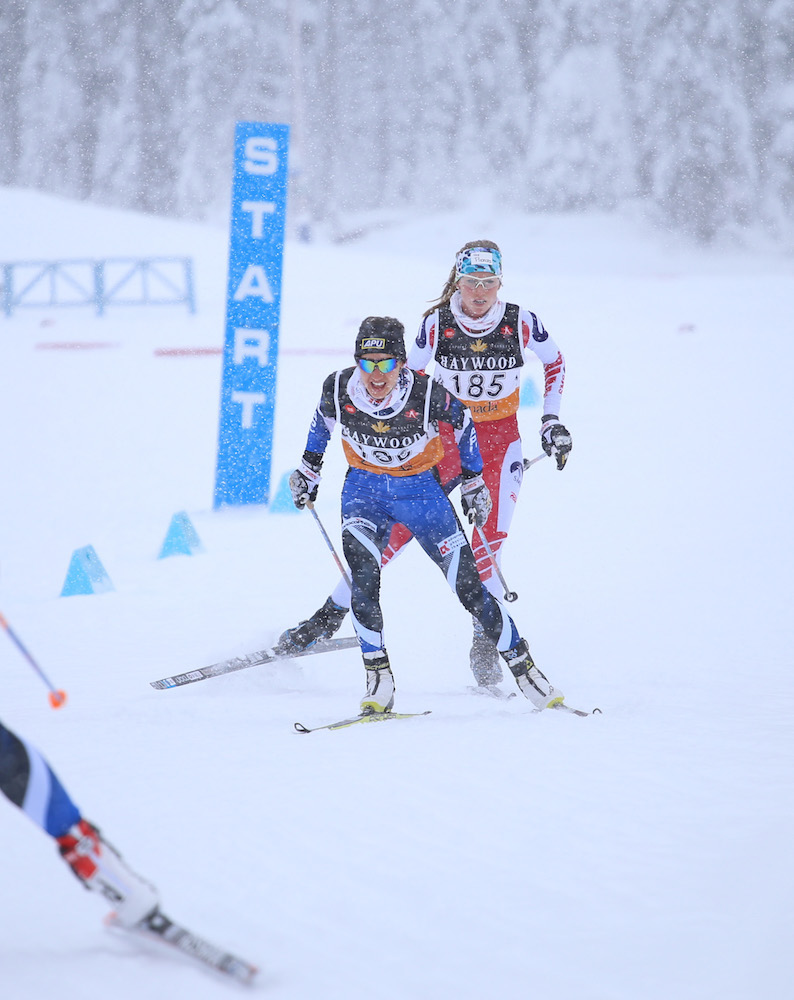
    Everyone interviewed spoke favorably of the combined NorAm/SuperTour weekend.

    “It’s really nice to get some deeper fields, to get the Americans and Canadians racing together,” Foster said. “It wasn’t so fun to watch the podium here.”

    Day 1 results: Classic sprint brackets

    ***

    APU's Scott Patterson leading Canadian junior Ty Godfrey (Team R.A.D.) during the men's 15 k freestyle interval start on Sunday, Dec. 11, at the Sovereign Lake NorAm/SuperTour. (Photo: Peggy Hung
    APU’s Scott Patterson leading Canadian junior Ty Godfrey (Team R.A.D.) during the men’s 15 k freestyle interval start on Sunday, Dec. 11, at the Sovereign Lake NorAm/SuperTour. (Photo: Peggy Hung)

    Day 2 at Sovereign proved to be more populated with Americans sweeping the top five and nearly the top 10 in the men’s and women’s distance freestyle interval starts.

    In the men’s 15 k, Scott Patterson (APU) topped the field by 13.2 seconds with a winning time of 40:00.2. Gelso reached the podium in second — his third this season in four SuperTour races — and Tad Elliott (Ski Club Vail) placed third (+26.6).

    The U.S. swept the top eight with Brian Gregg (Team Gregg) in fourth (+54.8), Paddy Caldwell (SMS Elite/Dartmouth/USST) in fifth (+1:20.5), Ben Lustgarten (CGRP) in sixth (+1:27.4), Madlener in seventh (+1:31.3), and Kyle Bratrud (CXC Team) in eighth (+1:33.5).

    Russell Kennedy of the Canmore-based Team R.A.D. was the top Canadian* in ninth (+1:38.8), and John Hegman (SVSEF) finished 10th (+1:44.2).
    (*While Kennedy lives and trains in Canada, he is originally from Truckee, Calif.)

    Out of 112 finishers in the men’s race, nearly 50 were American, and two were Australian national team members.

    “Gelso’s definitely in good shape so it was good to hear splits out there that I was leading,” Patterson said. He started in bib 94 behind Gelso in bib 80.

    “Fifteen k skate’s kind of been my game, one race I can always fall back to and know I can ski pretty fast,” Patterson added.

    Asked about the event doubling as a SuperTour, he said it added competition.

    “I would have loved to see the Canadians in West [Yellowstone], but it’s a weird course, makes sense to skip it,” he said of the SuperTour’s usual first stop on the circuit (one of the few places in the U.S. with reliable early season snow) at the Rendezvous Ski Trails in West Yellowstone, Mont. The SuperTour opener was originally scheduled for Bozeman, Mont., which would have been a NorAm as well, but moved because of low snow.

    “It’s always fun to have a bunch of people that you don’t know all that well,” Patterson added. “This is my first time in Silver Star and it’s been great.  Real winter, and we’ve been lacking that in Anchorage [Alaska].”

    After spending a good chunk of last season in Europe on the World Cup, Patterson noted that even those venues tend to rely on manmade snow.

    “It’s nice to have dumping snow out here,” he said.

    “I think the third lap, things started to slow down,” Patterson added about the race itself. “I was getting ice through my glasses and eyes. It made things feel a little more closed in, feel like it’s snowing harder. I think it slowed down a little bit, but maybe that’s just getting tired, too.”

    Sun Valley's Matt Gelso (front) charging a false flat on his first lap of the men's three-lap 15 k freestyle on Dec. 11 at the Sovereign Lake NorAm/SuperTour. (Photo: Peggy Hung)
    Sun Valley’s Matt Gelso (front) charging a false flat on his first lap of the men’s three-lap 15 k freestyle on Dec. 11 at the Sovereign Lake NorAm/SuperTour, followed by Welly Ramsey (Ford Sayre). (Photo: Peggy Hung)

    Gelso recalled a slower last lap as well, but was pleased with his effort.

    “It’s a great course, and it was fun,” he said.

    Gelso was strongly in favor of combining the two North American circuits whenever possible, recalling a conversation he had with some U.S. and Canadian national-team members at 2015 World Championships.

    “Devon Kershaw and a bunch of the Canadians and Americans were staying in the same hotel, and we were talking about how cool … instead of having one Canadian, one American that goes to the World Cup on the Continental Cup, why [doesn’t the International Ski Federation] give North America three spots for Canada and the US, and all of our races are together?” he said. “Sometimes it will be three Americans, sometimes it will be three Canadians, sometimes it will be two and one, whoever’s racing fast. The more we are racing together, I think the better we’re going to fare internationally.”

    “I mean, we’re friends with these guys, we know who they are,” Elliott said of racing with Canadians. “Michael Somppi, Kevin Sandau, they’ve been visited us at U.S. nationals last year. Silver Star’s gorgeous, great skiing, great course, well-run races, so it’s always a pleasure to visit here.”

    Elliott, a former U.S. Ski Team distance skier, described feeling surprised with his effort on Sunday after what he called a “great sprint” in West Yellowstone (in which he placed 14th) followed by a head cold, which forced him to skip the West Yellowstone distance race.

    “I rested all week indoors, and I felt incredible today,” he said.

    Kennedy in ninth called his race a solid start, but had hoped to finished a “little higher up.”

    “The U.S. guys are skiing super-strong right now, you could just see it out there,” Kennedy said. “I thought I was skiing pretty well, and then got some splits off of Gelso, and OK, they’re moving. I am hoping when we have [World Championships] trials in Park City, we’ll be a little bit more up there, but we’ll see. It’s good to have that competition, too. You can’t rest anywhere, you have to push everywhere, so that’s good.”

    Asked about the NorAm/SuperTour combo, he was also positive.

    “It’s good for us to have the extra competition and it’s good to race new faces,” Kennedy said. “Especially in sprints, you get used to the same tactics from the same people. When you have someone new, it’s nice to have to adjust your tactics and be prepared for what they’re going to do when you don’t know them as well. In distance, it’s really cool to have new guys to chase. I can kind of know the Canadians, what’s happening with them, but I was chasing down David [Norris] today, and he kind of surprised me how strong he was on the last lap, it was good to have that extra push, for sure.”

    The second-fastest Canadian man of the day, Alexis Dumas (CNEPH) placed 15th (+2:13.1).

    “I feel really fast on the one-skate, and the uphill was good, too,” Dumas said after. “I improved a lot my offset this summer, so it was good for this course.”

    In terms of season goals, he’s looking to qualify for U23 World Championships, where he’d like to achieve a top 20.

    ***

    Chelsea Holmes leads Erika Flowers at the 5 k mark of the women's 10 k freestyle interval start on Sunday, Dec. 11, at the Sovereign Lake NorAm/SuperTour. (Photo: Marie-Éve Bilodeau-Corriveau)
    Chelsea Holmes leads Erika Flowers at the 5 k mark of the women’s 10 k freestyle interval start on Sunday, Dec. 11, at the Sovereign Lake NorAm/SuperTour. (Photo: Marie-Éve Bilodeau-Corriveau)

    In the women’s 10 k, Chelsea Holmes (APU) took the win in 30:42.9, topping the time of the race’s previous leader, Katharine Ogden (SMS Elite) by 13.4 seconds. Stratton had two on the podium with Flowers in third, 36.4 seconds back from Holmes.

    “The course was really hard, but my techs and coaches gave us really good skis,” Holmes said after. “Today, I had the most amazing team, all the boys finished and they were cheering so hard.”

    Holmes started 30 seconds after Flowers and 1 minute behind her APU teammate Rosie Frankowski.

    “Chelsea started right behind me, and her and Frankie [Frankowski] and I all skied together for most of it, which made it a lot more fun cruising through the snow,” Flowers recalled. “We had a good little crew going, so it was hard, but hard with friends.”

    Frankowski finished with Holmes and 59.9 seconds off her winning time in sixth place, behind Gregg in fourth (+40.8) and Rose in fifth (+51.7). APU had three in the top seven with Rorabaugh in seventh (+1:09.8). Craftsbury’s Guiney placed eighth (+1:17.9), Deedra Irwin (SVSEF) was ninth (+1:18.4), and Kern, Saturday’s sprint winner, 10th (+1:24.8).

    For the second day in a row, Bouffard-Nesbitt was the top Canadian woman, placing 13th (+1:51.8). Of the top 20, the U.S. swept all but three places: 13th, 18th with NTDC’s Annika Richardson, and 20th with Sovereign Lake’s own Hannah Mehain. (Both Richardson and Mehain belong to Canada’s Junior National Team.)

    “I’ve never had an easy race at Silver Star,” Bouffard-Nesbitt said after Sunday’s 10 k. “It was really hard as usual. To be honest, all morning, I feel pretty wrecked from yesterday’s race. Whole body, that sprint really took a toll on me. I was kind of just trying to play the hand I was dealt the best I could, make the most of it. I think I’m happy with it.”

    Asked how she felt about being the top Canadian for the second-straight day, albeit outside the top 10, she replied, “Let’s say, bittersweet. Obviously, we want to have Canadians represented at the top of these fields, among the Americans, but of course I’m happy to be top Canadian.”

    Regardless, she was glad to have the competition.

    “We not coming here to have easy wins; we’re coming here to be challenged,” Bouffard-Nesbitt said. “I’m very happy to have them here, and I’m very happy when they can show us what fast racing looks like.”

    Sixty-two women finished the distance race, and about half were American. Most of the NorAm field is headed to Rossland, B.C., for next weekend’s NorAm, which is not a SuperTour and will not count toward the U.S. Ski & Snowboard Association’s (USSA) national ranking list.

    Day 2 results: 10/15 k freestyle


  • Second to Valjas in Skate Sprint Qualifier, Thompson Takes Top Prize

    Second to Valjas in Skate Sprint Qualifier, Thompson Takes Top Prize

    Bob Thompson (NDC Thunder Bay) sprinting to second in Thursday's skate-sprint qualifier at Frozen Thunder in Canmore, Alberta. The performance earned him the final spot on Canada's World Cup team for Period 1. (Photo: Drew Goldsack)
    Bob Thompson (NDC Thunder Bay) sprinting to second in Thursday’s skate-sprint qualifier at Frozen Thunder in Canmore, Alberta. The performance earned him the final spot on Canada’s World Cup team for Period 1. (Photo: Drew Goldsack)

    Qualification-only sprint races can be a little dull.  Four minutes of pain and done. Describing the action?  Even more dull.

    But for Bob Thompson of the Thunder Bay National Development Centre (NDC), Thursday’s freestyle sprint qualifier in Canmore, Alberta, was one he’ll hold in his mind for a long time. For him, a 25 year old who skied his first World Cup races at home at the Ski Tour Canada last March, placing second in the Frozen Thunder skate-sprint qualifier meant a trip to Europe for his first overseas World Cups.

    On Thursday, the final day of racing on Canmore’s early season snow, affectionately known as Frozen Thunder, Len Valjas (who hails from the same club as Thompson, Team Hardwood in Ontario) won the men’s qualifier in 3:25.23. Thompson’s time was just six-hundredths of a second slower, but enough to get him the final men’s quota spot for World Cup Period 1.

    Len Valjas sprinting to victory in the skate qualifier. (Photo: Glen Crawford Production Services)
    Len Valjas (Canadian World Cup A-team) sprinting to the victory in the skate sprint qualifier at Frozen Thunder on Thursday in Canmore, Alberta. (Photo: Glen Crawford Production Services)

    Valjas, a World Cup A-team member, was preselected for Period 1.

    Jess Cockney, of the World Cup B-team, won Tuesday’s classic sprint qualifier to lock down the first of two selections, an achievement that was officially announced at 9 a.m. Thursday, 30 seconds before Valjas attacked the course wearing bib 1.

    Two other favorites for the final World Cup spot, Julien Locke (Black Jack/NST U-25 Team) and Simon Lapointe of the Pierre-Harvey Training Centre (CNEPH) placed third and fourth, 0.22 and 1.29 seconds back, respectively. Graeme Killick, belying his distance-specialist persona, finished fifth.

    “The race today was great,” Thompson wrote in an email shortly after the race. “I told [my coach] Timo [Puiras] at the finish I was happy with how I performed and followed the plan and either way I wasn’t going to say I didn’t race my best.

    “I wanted to keep things controlled,” Thompson wrote of his race plan. “It’s important to keep the speed high on both laps and especially finishing the second half of the lap fast as it is mostly flat and rolling. Being able to really go the second time up the climb was what I was planning for. … Being out there and able to do that was great.”

    Like many of the sprinters seeking one of two remaining men’s World Cup spots, Thompson made this week a training target.

    “Timo and I had the plan made to be fast for these races since very early in the year,” he wrote. “Not much was changed other than the last few weeks of prep, dropping some volume and moving into more of a sprint intensity focused block.”

    Cross Country Canada (CCC) High Performance Director Tom Holland, a member of the selection committee and chief of competition for these races, studied the race closely.

    “Watching this morning, I wouldn’t call it tactics,” Holland said on the phone. “But the way people can ski corners, probably made the difference between who was the winner and who was second.”

    To put that in context, the difference between first and third was 0.22 seconds, or 1.5 metres at an average speed of 25 kilometers per hour. It wouldn’t take much of a difference to gain or lose that five feet.

    Last spring, CCC and a group of coaches decided on the using the sprint qualifiers to fill out the team for World Cup Period 1. 

    “The results show … that there’s five or six guys here that are reasonably close,” Holland said of the level of competition in Canada.

    Of those top skiers, CCC wanted to determine “who could do a qualifier fast for the World Cup and try to match it up with some of the courses they’ll be skiing in November and December.”

    The course held up fairly well for the men, despite the warm weather, with all the selection favourites starting within a five-minute period.

    Rosanna Crawford (Biathlon Canada) blasting the first climb of the two-lap course at the Frozen Thunder skate-sprint qualifier on Thursday. She won by 3 seconds. (Photo: Glen Crawford Production Services)
    Rosanna Crawford (Biathlon Canada) blasting the first climb of the two-lap course at the Frozen Thunder skate-sprint qualifier on Thursday. She won by 3 seconds. (Photo: Glen Crawford Production Services)

    “The track had broken down and was soft where the guys had skied,” women’s second-place finisher Olivia Bouffard-Nesbitt wrote in an email. “But there were a few sections of fast, firm snow to be found near the edges of the trail.”  

    The women started after all 34 men had completed two laps.

    Biathlon Canada’s Rosanna Crawford won the women’s qualifier in 3:58.20, followed by Bouffard-Nesbitt, 3.02 seconds behind, and Caitlin Gregg (Team Gregg/Madshus) in third (+4.5).

    “Conditions were a little bit mixed with some harder, almost icy sections and then some really soft, deep and slushy sections,” Gregg wrote of the course. “The conditions were the same for everyone so I don’t think it affected the results. I did speak to some other athletes afterwards who agreed that the conditions were tricky to master and really good practice!”

    “It was a fun race, super quick!” Crawford wrote in an email. “The Frozen Thunder loop is interesting, there’s always a hill and then a break, so you are able to push harder than on a normal race course I would say.”

    Four women were preselected to fill Canada’s women’s quota of three plus Continental Cup winner Dahria Beatty for World Cup Period 1: Emily Nishikawa (World Cup B-team), and U-25 Team members Beatty, Cendrine Browne and Maya MacIssac-Jones.

    On the men’s side, Canada’s quota is six plus Continental Cup winner Andy Shields. For the first period of the World Cup, it will field an eight-person team of Thompson and Cockney, and preselected athletes Alex Harvey, Devon Kershaw, Valjas, Killick, Knute Johnsgaard, and Shields.

    Note: The information regarding Canada’s World Cup team quota has been updated to reflect that four women total can start for Canada in Period 1.

    Complete results

    — Alex Kochon contributed

    Annika Hicks rocking the new AWCA suit to 4th place (Photo: Glen Crawford Production Services)
    Annika Hicks rocking the new AWCA suit to fourth in the women’s skate sprint qualifier at Frozen Thunder on Thursday. (Photo: Glen Crawford Production Services)

    FasterSkier is seeking photos from the 2016 races at Frozen Thunder. Please email submissions with caption and credit info to info@fasterskier.com.

  • Notes & Quotes: Post-Race with Nearly 50 North Americans at the STC

    Notes & Quotes: Post-Race with Nearly 50 North Americans at the STC


    With 49 North Americans competing at the Ski Tour Canada (26 Canadians and 23 Americans), there were a ton of tales to be told after the first two stages in Gatineau and Montreal, Quebec, respectively. FasterSkier did its best to check in with most of the North American racers.

    Check out some of the best of our post-race interviews from Day 1 and 2 below (and a guide to team affiliations at bottom*).

    For more on the top North American finishers, read our race reports:

    Stage 1 (Gatineau): Women’s freestyle sprint | Men’s freestyle sprint

    Stage 2 (Montreal):  Women’s 10.5 k classic mass start | Men’s 17.5 k classic mass start 

    What’s it like racing in Canada?

    Canadians:

    “Being able to race in front of a home crowd and going around the course twice and hearing my name, like, left, right and center was pretty crazy. It was definitely just an incredible experience.” — Alannah MacLean (NDC Thunder Bay), after finishing 63rd in Gatineau sprint

    “It was the loudest race I’ve ever done. It was crazy to hear all the noise. It was motivating.” — Olivia Bouffard-Nesbitt (CNST), 49th in sprint

    “It was just really amazing to be at home and have so many people watching.” — Katharine Stewart-Jones (NDC Thunder Bay and originally from Nakkertok), 68th in sprint

    “It’s really exciting because I get to race in front of my friends and family, which doesn’t happen very often, so that’s great to hear my name when I’m racing.” — Cendrine Browne (CNEPH/CNST), 55th in sprint

    “It was an amazing atmosphere. So many people cheering, and I felt a little distracted…” — Dahria Beatty (AWCA/CNST), 45th in sprint

    “The ambiance was pretty good and helped me a lot to do a good race.” — Simon Lapointe (Skinouk), 82nd in classic mass start

    “Racing in front of a home crowd and just having so many fans out cheering for us is really special.” — Emily Nishikawa (CNST), 66th in sprint

    “At every corner, at every point of the course there was a roar. It’s surreal racing in front of the home crowd. Looking to the crowd, and recognizing so many faces that are there to support you.” Mark Rajack (Trinidad & Tobago/XC Ottawa), 86th in the sprint

    “It’s just so great that we have such great volunteers and the organizing committees of all these places are really, ah, it’s fantastic.” — Devon Kershaw (Canadian World Cup Team), 50th in the sprint

    “Having this many races here at home is a nice advantage for us, not having the jet-lag and [such]. It’s pretty special being able to race in front of the home crowd.” — Graeme Killick (CNST), 76th in the sprint

    “Just tons of people cheering your name, and just cheering for Canada, so it’s really fun to be at home.” — Len Valjas (Canadian World Cup Team), 37th in the sprint

    Americans:

    Katharine Ogden (SMS/USST) racing to 59th in the women's 10.5 k classic mass start in Montreal, Quebec, at the second stage of the Ski Tour Canada. (Photo: Flyingpointroad.com/NNF)
    Katharine Ogden (SMS/USST) racing to 59th in the women’s 10.5 k classic mass start in Montreal, Quebec, at the second stage of the Ski Tour Canada. (Photo: Flyingpointroad.com/NNF)

    “It was exhilarating.” — Katharine Ogden (SMS/USST), 62nd in sprint

    “It’s nice that people are speaking English and we can use our phones. There’s a lot more comfort involved than being over in like Finland or somewhere.” — Tad Elliott (SSCV), 81st in sprint

    “The crowd is awesome. There’s so many Americans out here and it’s something special.” — Noah Hoffman (SSCV/USST), 74th in sprint

    “Everything here is awesome. The fans are amazing, like half of them are from the U.S. I think, and the other half are from Canada so it’s pretty awesome to be here.” — Liz Stephen (USST), 59th in sprint 

    “I grew up in Vermont so it’s not that far. It really helps. It makes everything feel more comfortable. Any taste of home on the trail is amazing.” — Jennie Bender (BSF), 51st in classic mass start

    “There were a lot of people cheering for us. A lot of Americans, a lot of Canadians. … Hope for even bigger crowds for the rest of the tour.” — Scott Patterson (APU), 75th in sprint

    “It was awesome. You hear your name everywhere.” — Dakota Blackhorse-von Jess (Bend Endurance Academy), 54th in the sprint

    Bonus: Great Britain

    “There were a few people cheering me on, that was nice.” — Andrew Musgrave, 44th in sprint

    What can you say about this opportunity?

    “These are my first World Cups so I’m just going out here and learning as much as I possibly can and seeing what the next level of skiing is.” — MacLean, 64th in classic mass start

    “It’s a really good team atmosphere. Everyone’s really stoked to have the opportunity to do these races in Canada.” — Michael Somppi (NDC Thunder Bay), 68th in sprint

    “To have 12 girls here is just incredible. It’s really important for our women’s program.” — Nishikawa

    “To have such a huge girls team is so awesome. I don’t think it’s ever been this big, and we’re all super supportive of each other. I think it’ll be a super-fun Tour.” — Annika Hicks (Canmore Nordic), 71st in sprint

    “I’m racing against people that are four years older and have lots more experience than me so I’m here for more experience.” — Marie Corriveau (CNEPH/Canadian National Junior Team), 67th in sprint

    “This is my first tour of World Cups, my first World Cups ever. So really every race is kind of a new adventure.” — Annie Hart (SMST2), 61st in classic mass start

    How are you feeling?

    Caitlin Gregg (Team Gregg/U.S. Ski Team) training on the course in Quebec City. (Photo: John Lazenby/Lazenbyphoto.com)
    Caitlin Gregg (Team Gregg/U.S. Ski Team) training on the course in Quebec City. (Photo: John Lazenby/Lazenbyphoto.com)

    “I’m feeling really good. I have a ton of energy and I can tell that I want to just keep going and going and going, kind of that long-distance kind of style racing.” — Caitlin Gregg (Team Gregg/USST), 47th in classic mass start 

    “I’ve been getting over a chest cold after the last World Cup [in Falun]. I don’t know why, it was just a terrible recovery. I’ve been able to ski the last week, but I’ve only done two intensities and they both really sucked. So, all things considered, the lungs held up OK with the temperature, but I was just missing a bit of a snap.” — Valjas, after sprint

    “I had a bit of issues with my back seizing. I’ve been struggling with that my last couple races.” — MacLean, 64th in classic mass start

    “I had a couple crashes out there, broke a pole and my back seized on the second lap after the first crash. The first lap went really well actually, and I was right up there in the group and I felt like I was skiing well. After the tucking section, I came into the second lap and stood up and just, bam, my back completely seized. The last two laps were a real struggle.” — Beatty, 65th in classic mass start

    “I don’t know what was going on, I was just so tired by the top [of the course]. …The body was doing something weird to me today.” — Andy Shields (NDC Thunder Bay), 76th in classic mass start 

    “I took a few spills, which sent me back a bit, but I felt good so I’m happy with that.” — Russell Kennedy (Canmore Nordic), 74th in classic mass start

    What was your strategy?

    “I took a lot of energy from the crowd and I just went out as hard as possible.” — MacLean, after sprint

    “I really tried to stay composed. Everyone was rushing at the start. I kept my eyes opened, stayed on my skis and skied relaxed…  Though I fell in the first lap like many others.” — Browne, 48th in classic mass start

    “I just really wanted to survive it, you know, not get lapped. As silly as that seems, setting the bar pretty low, I haven’t had great classic races this year so it was a concern in the back of my mind and I’m happy to have survived. … I raced the first 3 k as if it was a 3 k race. I was kind of racing for my life out there, trying to get up as far up into the field as I could, as soon as I could to avoid crashes and bottlenecks and it worked.” — Bouffard-Nesbitt, 53rd in classic mass start

    “I started really far back because I fell in the sprint … so it was just a matter of, let’s see how many spots I can move up, and I think I got about twenty so that was good.” — Bender, after the mass start

    What were the course and conditions like in Montreal?

    Kaitlynn Miller (Craftsbury Green Racing Project) on a cold training day in Quebec City on Thursday before the third stage of the Ski Tour Canada. (Photo: John Lazenby/Lazenbyphoto.com)
    Kaitlynn Miller (Craftsbury Green Racing Project) on a cold training day in Quebec City on Thursday before the third stage of the Ski Tour Canada. (Photo: John Lazenby/Lazenbyphoto.com)

    “It was a really technical course. The downhills were really icy and really hard to stay on your feet at some points, especially after some of the grueling uphills. I managed to stay upright and it was a success in that sense, but I wasn’t able to hang onto the group for as long as I would’ve liked.” — Knute Johnsgaard (CNST), 69th in classic mass start

    “I started pretty far back. I was seeded 75th and I noticed right up the first hill that I was in dead last. I’m thinking, ‘Oh man, something didn’t go right with that start.’ It was kind of a weird course with sharp downhills that got skidded to ice so it just scraped off all your wax and then it was like, herringbone and double pole, herringbone and double pole.” — Patterson, 55th in classic mass start

    “The downhills were very icy and very sketchy. Some of the most sketchy downhills I’ve had in a race. It was very icy around the turns and we were just all doing our best to stay on our feet and try not to get in any pileups.” — Eric Packer (APU), 67th in classic mass start

    “It was a tough day. I think the conditions made the course and the race even more challenging. But it’s always a learning experience for me, only my second World Cup today so I’ll take what I can get.” — Jenn Jackson (NDC Thunder Bay), 63rd in the classic mass start

    “I really enjoyed the course and just the energy of everyone cheering. My family and friends were there to watch so it was really fun.” — Kaitlynn Miller (CGRP), 39th in classic mass start

    What are your goals for the Tour? 

    I think all the Canadian girls are searching for those top 30s, and if a few of us can get it that’s gonna be great.” — Andrea Dupont (RMR), 56th in the sprint

    “Definitely trying to stay in the competition every race. … My goal is really a top 30, and I hope to get it one of these races.” — Beatty

    What race are you most looking forward to?

    “Very excited about having two 15 k skates.” — Brian Gregg (Team Gregg), 83rd in sprint

    “The pursuit in Canmore. It’s a course I know pretty well, and I had some great races on the exact course like for trials and other events. So I’m really excited to race the pursuit.” — Killick

    “I’m excited to go back to Quebec, but I’m really looking forward to Canmore. For me that’s home. That’s a home venue.” — Blackhorse-von Jess (of Bend, Oregon)

    “The classic sprint in Canmore. That suits me, that is my best event I think.” — Bob Thompson (NDC Thunder Bay), 52nd in sprint

    “I think each event presents it’s own learning experiences and challenges, but a classic sprint in Canmore — I really enjoyed the classic sprint in Canmore on the NorAms — so hopefully we can have some good races there.” — Jackson, 58th in sprint

    “Just getting to ski a lot of World Cups is a pretty awesome opportunity. Definitely looking forward to more of the distance races.” — Ogden

    “I’m quite looking forward to the skiathlon in Canmore, but there’s going to be a lot of good stages, good crowd here, so I think all of the stages will be fun if the crowd is good the whole way.” — Musgrave, after the sprint

    “The other athletes here worked their entire lives to be here. I literally started [skiing] three years ago and I just showed up. So my goal here is to come here and do justice to the sport and not erode the validity and integrity of the sport that these athletes worked so hard to create.” — Rajack, after the sprint

    Also:

    We missed NorAm leader Kevin Sandau (AWCA), but this video he made before the Ski Tour Canada sums up a lot (click here to view on YouTube)

    *Guide to North American teams:

    Canada:

    – AWCA: Alberta World Cup Academy

    – CNEPH: Pierre-Harvey National Training Centre (Centre National D’entraînement Pierre Harvey)

    – CNST: Canadian National Senior Team

    – NDC Thunder Bay: Thunder Bay National Development Centre

    – RMR: Rocky Mountain Racers

    USA:

    – APU: Alaska Pacific University

    – BSF: Bridger Ski Foundation

    – CGRP: Craftsbury Green Racing Project

    – SMS: Stratton Mountain School

    – SMST2: Stratton Mountain School T2 Team (elite team)

    – SSCV: Ski & Snowboard Club Vail

    – USST: U.S. Ski Team

  • Norway’s Emil Iversen Stuns for First Distance World Cup Win; Harvey 9th in Montreal

    STC Stage 2 winner - Emil Iversen (NOR) showed his strength today.  (photo: flyingpointroad.com/NNF)
    Norway’s 24-year-old Emil Iversen after winning his third-career World Cup race, and first distance race, at the second stage of the Ski Tour Canada on Wednesday: the 17.5 k classic mass start. (Photo:Flyingpointroad.com/NNF)

    (Note: This article has been updated to include details about a crash involving Norway’s Martin Johnsrud Sundby early in the men’s classic mass start.)

    Certainly it’s too soon for Norway’s Emil Iversen to tell his elders to move over. One of those elders is Norwegian teammate Martin Johnsrud Sundby, current overall World Cup leader. The other, Petter Northug Jr. is … Northug. 

    But at the second stage of the Ski Tour Canada (STC) on Wednesday, a 17.5-kilometer classic mass start in Montreal, Quebec, Norway’s 24-year old Iversen, strided, herringboned, and double poled to the win. 

    Exactly 45:05.4 minutes after the start, Iversen crossed the wind-swept finish line first, 5.3 seconds ahead of Northug. The overall leader of the STC and winner of Tuesday’s sprint, Russian Sergey Ustiugov, placed third (+14.5).

    The start of the men's 17.5 k classic mass start on the second day of the Ski Tour Canada in Montreal, Quebec. (Photo: Flyingpointroad.com/NNF)
    The start of the men’s 17.5 k classic mass start on the second day of the Ski Tour Canada in Montreal, Quebec. (Photo: Flyingpointroad.com/NNF)

    At 23 years old, it was Ustiugov who first showed his fearlessness. Establishing a tempo and drive that 3.5 k in showed he was going to be the pace-setter — Ustiugov went on to dictate the pace for most of the race.

    But at that 3.5 k mark it still could have been a number of skiers’ race to control. Strung out behind Ustiugov in a line were Norwegians Iversen, Sundby, Northug, Finn Hågen Krogh, Canada’s Alex Harvey, Norway’s Ola Vigen Hattestad, and Kazakhstan’s classic specialist, Alexey Poltoranin.

    It must have been something subtle. Maybe an extra effort herringboning up the steep, sugary hills, or double poling with his burly core, but only a kilometer later, Ustiugov played for keeps. Only Iversen and Northug could hang on.

    Sundby later told reporters that he had crashed early on an icy and curving descent.

    “I went on my face,” he told NRK, according to a translation.

    Slowly but surely, a gap back to Sundby grew. And as the moisture on Sundby’s beard began to freeze, so did his chances of bridging up to the leaders. At the 4.6 k mark, Sundby was 13 seconds behind.

    “I lost a lot of time and then it was [over],” he said. “I’m not sure what to say. We are trying to showcase our sport, but today I am unsure what we were doing. Was it cross-country…?

    “It was unusual conditions,” he added. “Fortunately, it was the same for all.”

    As the moisture on Sundby’s beard began to freeze, so did his chances of bridging up to the leaders. 

    By 12.5 k, Sundby chasing in fourth was 18.2 seconds behind the trio of Ustiugov, Iversen and Northug. It remained a long day of trying to play catch up for Sundby, who toiled in no man’s land, chasing solo for the remainder of the race. Sundby finished fourth, 39.8 seconds behind the upstart Iversen.

    It’s Northug’s signature tactic to let others set the pace until he marks the race with an exclamation point across the line. But Wednesday, Iversen, having grown up watching Northug’s bait-and-switch prowess over the years, left nothing for chance. With 1.5 k to go, Iversen began to stretch the rubberband back to Northug inch by inch. He had a 3.6-second lead on Northug, but even that small margin never vanished.

    Norway's Emil Iversen (l) and Russia's Sergey Ustiugov (red leader's bib) lead the men's 17.5 k classic mass start at the second stage of the Ski Tour Canada, while Norway's Petter Northug trails in third. Iversen went on to win, Northug placed second and Ustiugov took third. (Photo: John Lazenby/Lazenbyphoto.com)
    Norway’s Emil Iversen (l) and Russia’s Sergey Ustiugov (red leader’s bib) lead the men’s 17.5 k classic mass start at the second stage of the Ski Tour Canada in Montreal, Quebec, while Norway’s Petter Northug trails in third. Iversen went on to win, Northug placed second and Ustiugov took third. (Photo: John Lazenby/Lazenbyphoto.com)

    When Iversen made his decisive move, he simply upped the pace and never looked back.

    “In the fourth lap I saw Ustiugov was little bit tired,” Iversen said in the post-race press conference. “I decided to try and went for it 100 percent. I hoped I could get a gap and gain some seconds. My goal before the Ski Tour Canada was to have a good start. I’m sitting in second place. Now I have to take stage by stage and we see what happens.”

    With his win on Wednesday, Iversen took his first ever distance World Cup victory and the third of his career. Iversen’s other two World Cup victories, both of which were sprints, also came this season.

    Northug spoke about the trio out front and pushing an unrelenting pace.

    “The plan was to stay in front of the field,” Northug said during the press conference. “After one lap it was only three or four guys in the lead. The pace was very high. We had to fight hard against the wind and snow. Ustiugov did a lot of work in the lead. He was the strongest today. We can thank him for the high speed.”

    Ustiugov also acknowledged that he had taxed himself with the workload.

    “It was a very tough race,” Ustiugov said at the press conference, through a translator. “I knew the guys behind me were fresher than me as I did all the work in the front, but I am satisfied with third place and be in the lead of the Ski Tour.”

    With two consecutive podiums in as many stages so far, Ustiugov remains in first in the Tour standings, 6.1 seconds ahead of Iversen in second. Northug is third, 11 seconds back, and Sundby is nearly 1:40 minutes out of first in fourth overall.

    Harvey in the Hunt

    After two days of racing, both of which took place in his home province of Quebec, Harvey ranks sixth overall, 1:58.3 out of first, after placing ninth in Wednesday’s mass start (+1:16.4).

    While racing the five laps of Montreal’s 3.5 k loop, Harvey appeared to be one of the few who could match the front runners’ pace. At 5.5 k, the Canadian skied in sixth, 14.5 seconds back.

    Canadian World Cup Team member Alex Harvey racing to ninth at the second stage of the Ski Tour Canada, the 17.5 k classic mass start in Montreal, Quebec.  (Photo: flyingpointroad.com/NNF)
    Canadian World Cup Team member Alex Harvey (10) racing to ninth at the second stage of the Ski Tour Canada, the 17.5 k classic mass start in Montreal, Quebec.
    (Photo: flyingpointroad.com/NNF)

    Again and again, it seemed Harvey would cover the breakaway. In an in-person interview afterward, Harvey said those efforts were exhasting.

    “It was a drop in my energy.” Harvey said. “I tried closing the gap with the first three, but I exploded in trying to do so. I fought for the podium but the three guys at the front were out of reach. Ustiugov was really strong the first two laps. I paid at the end for my efforts.”

    Harvey did ski wisely. He was close enough to the front to fight for the two mid-race time bonuses. Harvey took an 8-second time bonus at 4.6 k and a 2-second time bonus at 11.6 k.

    Thinking more of the long-term than a one off race performance, Harvey said he is staying true to his STC plan.

    “My fitness level is good and stable, which is important because you can’t win the Tour in one day, but you can lose it in one day,” he said. “The goal is to not loose the Tour on any day.”

    The second best North American result came from fellow Canadian World Cup Team member Devon Kershaw, who began the day near the back of the pack in bib 50. Kershaw moved forward incrementally and by 5 k was skiing in 22nd place. He eventually skied across the finish in 17th (+1:38.9).

    It was a challenging day,” Kershaw said afterward. “Really soft snow, different conditions.”

    Despite the less-than-ideal fresh snow and blustery wind, Kershaw appreciated the opportunity to ski in a city some of his family calls home.

    “To race in front of friends and family here on the Island of Montreal is a pretty neat feeling,” he said. “It’s just so nice to have the home crowd behind you. My aunt and uncle live here, my mom and my brother live here as well. So I have a lot of family in the city. I heard their voices. It was pretty neat.”

    In the points, and moving up on a day with tricky snow and biting wind, Kershaw remained positive.

    “Seventeenth isn’t something we are going to be lighting fireworks off, calling everybody that I know,” he said. “But at the same time it’s a step in the right direction. I was pretty disappointed after yesterday so its better.”

    Kershaw placed 50th on Tuesday’s freestyle sprint and now sits 17th overall.

    A third Canadian World Cup Team skier in the points was Ivan Babikov in 29th (+2:32.1). Unlike Harvey, who started the day in bib 10 (meaning he had a good starting position heading into the courses steeply pitched and punchy climbs), Babikov wore bib 78. As a result, Babikov started near the rear in the field of 85 skiers.

    When the day’s sinuous track kicked up on lap one, skiers had to herringbone some of the soft headwalls.

    “There was actually a few places, mostly the first and second lap was the worst,” Babikov said on the phone after the race. “The course was just really interesting. I’ve never see something like that before.”

    Babikov described quick downhills that pitched up into mandatory herringbone sections. Those sections created bottlenecks since the herringboning forced skiers to keep their skis wide.

    “Oh yeah, like people crashing and tangling up all over the place,” Babikov said of the scene. “It also was really soft for the skis, so it created really like barely any track on the uphill where you could have strided … It was just a mess, broken poles, people falling down.”

    Babikov explained that maybe the first five, 10 or 15 skiers could ski cleanly through, but not the main pack. On his first lap, Babikov said he felt like he waited thirty seconds for the mess of skiers to clear before pushing ahead.

    When he finally did push ahead, he pushed hard. Of his jump from 78th to 29th place at the finish, Babikov said skiing conservatively wasn’t part of the plan.

    “You have to take a risk today,” Babikov said. “Like, at times to pass people on the downhills. My body felt pretty good. I tried to pass people whenever I could.”

    All that passing moved Babikov up in the overall standings. He now sits 33rd overall.

    Canadian Head Coach Justin Wadsworth was pleased with the day’s result.

    “It was actually a pretty solid day for us, three guys in the top 30, Alex in ninth, Devon in 17th and Ivan 29,” he said.

    Wadsworth also spoke about the benefits of World Cup racing for a future generation of Canadian skiers.

    “Today was an experience…,” he said. “For the younger athletes, it was a real eye opener. It was very hard conditions, with the wind and the snow and the course. I think our younger athletes, also arriving just last night … usually you get some time on the course ahead of time and there’s a ski warmup area and a testing area, and none of that happens here. Boom, you show up and you get ready to race on a race course your’ve never raced on at the highest level.”

    Also for Canada, Graeme Killick (CNST) placed 50th, Kevin Sandau (Alberta World Cup Academy) was 53rd, Len Valjas (CNST) 63rd, Patrick Stewart-Jones (AWCA) 64th, Jess Cockney (CNST) 66th, Michael Somppi (NDC Thunder Bay) 68th, Knute Johnsgaard (AWCA/CNST) 69th, Bob Thompson (NDC Thunder Bay) 73rd, Russell Kennedy (Canmore Nordic) 74th, Andy Shields (NDC Thunder Bay) 76th, and Simon LaPointe (Skinouk) 82nd.

    Bjornsen leads the U.S.

    Erik Bjornsen (Alaska Pacific University/U.S. Ski Team) was the top American in 31st, just 0.4 seconds outside the top 30 and 2:37.3 behind the winner. In a post-race phone call, Bjornsen said he is feeling good after two STC stages.

    Erik Bjornsen (USA) on his way to 31st place. (photo: flyingpointroad.com/NNF)
    Erik Bjornsen (USA) on his way to 31st place in the men’s 17.5 k classic mass start at Stage 2 of the Ski Tour Canada in Montreal, Quebec.. (Photo: Flyingpointroad.com/NNF)

    “Coming into today I knew that I have been feeling pretty good lately, so I was hoping for a good result,” he said.

    Bjornsen also noted the difficult herringboning and the likelihood for bottlenecks to develop.

    “It went out at a pretty hot pace just knowing things were going to get strung out having such a narrow course like that,” Bjornsen said. “But I felt like I went out all right. I struggled a bit with the herringboning and felt strong on the double pole. I was not happy with being so close to the top-thirty. Definitely hoping for a little more in the next few stages.”

    The STC is the second World Cup Tour for Bjornsen.

    “In the last Tour I was right outside the top 40,” Bjornsen said. “It’s my goal this time to be closer to the thirties, but I think if I finish in the top 30 I would be very happy with my overall result. We will see how it goes, there is definitely a couple of good races for me coming up. If I could pop into the top 20 in one race that would be absolutely awesome.”

    U.S. head coach Chris Grover discussed how the front-end racers escaped from the main group so quickly. Bottlenecks were a recurring theme.

    It was a pretty narrow course overall,” Grover said on the phone. “And in particular, the big longer herringbone hill was really only about one skier width … The packs got super strung out because the nature of the course but also because of the tough conditions. Once people got away from those that were trying to herringbone in the soft stuff, they really got away.”

    Grover said those rough-an- tumble patches took a toll on both the U.S. men and women.

    “We had a lot of broken equipment today,” he explained. “Just amongst our team, Ida Sargent broke a ski in a crash tangle-up right away. Brian Gregg broke a ski by having a binding rip off a ski. So it was definitely a challenging day.”

    American Matt Liebsch (Gear West) waits for his good friend and training partner Brian Gregg (Team Gregg) to finish the men's 17.5 k classic mass start at Stage 2 of the Ski Tour Canada in Montreal, Quebec. Gregg crashed and his binding ripped off his ski. (Photo: flyingpointroad.com/NNF)
    American Matt Liebsch (Gear West) waits for his good friend and training partner Brian Gregg (Team Gregg) to finish the men’s 17.5 k classic mass start at Stage 2 of the Ski Tour Canada in Montreal, Quebec. Gregg crashed and his binding ripped off his ski. (Photo: Flyingpointroad.com/NNF)

    Gregg ultimately finished 81st.

    “I had one pretty solid crash out there, which was certainly very frustrating but that’s part of racing,” Gregg said after.

    Noah Hoffman (Ski & Snowboard Club Vail/USST) placed 42nd. He reiterated the tough course.

    “It’s a really challenging course,” Hoffman said. “We were just standing still on the first lap, so often. It was so narrow, there’s so much herringbone. It was a challenge from way back off of yesterday’s finish.”

    Also for the U.S., Scott Patterson (APU) finished 55th, Simi Hamilton (SMST2/USST) was 58th, Eric Packer (APU) 67th, Reese Hanneman (APU) 70th, Andy Newell (SMST2/USST) 71st, Dakota Blackhorse-von Jess (Bend Endurance Academy) 77th, Matt Liebsch (Gear West) 79th, Tad Elliott (SSCV) 80th, and Gregg (Team Gregg) 81st.

    Results | Tour standings (after Stage 2)

  • Third in Gatineau Sprint, Hamilton Just Hundredths of a Second Out of First

    Third in Gatineau Sprint, Hamilton Just Hundredths of a Second Out of First

    American Simi Hamilton during his "victory lap" after finishing in the top three of the men's freestyle sprint at the Ski Tour Canada World Cup stage in Gatineau, Quebec. (Photo: John Lazenby/lazenbyphoto.com)
    American Simi Hamilton during his “victory lap” after finishing in the top three of the men’s freestyle sprint at the Ski Tour Canada World Cup stage in Gatineau, Quebec. (Photo: John Lazenby/Lazenbyphoto.com)

    For the men’s opening stage of the Ski Tour Canada on Tuesday,  a 1.7-kilometer freestyle sprint, the end is the best place to start.

    Adjacent a frozen Ottawa River in Gatineau, Quebec, those who withstood the -5 degree Celsius (23 Fahrenheit) cold, the tight corners, and the scrum-like jostling at the front of the pack went on to stand on the podium.

    Russia’s Sergey Ustiugov won the speedy and tightly contested final in 3:09.36 minutes, proving it’s not over until it’s over — but more on that in a bit. Richard Jouve from France placed second, just 0.08 seconds back. But the big news for North America, U.S. Ski Team sprinter Simi Hamilton took third in a photo finish with both Ustiugov and Jouve. Hamilton was only 0.09 seconds behind Ustiugov and 0.01 seconds out of second place.

    Hamilton: Waiting, Waiting, Then Pouncing

    For the Aspen, Colo., native, Canada is as close to home-racing soil as he’ll get on this year’s World Cup. Considering he spends most of the offseason training with Vermont’s Stratton Mountain School (SMS) T2 Team, a long drive south, Hamilton came prepared for what he hoped would be a solid day in front of family and friends. And he didn’t disappoint.

    In an in-person interview after the race, Hamilton, 28, explained the local support kept the stoke high.

    “You always kind of want to play it cool and stay engaged and focused, but it’s so awesome when you run to the start or even when you are racing and you hear, ‘USA,’ and ‘Simi,’ ” Hamilton said. “I have a lot of friends and family out here. It’s just super cool to race so close to home and people are fired up. I think we are bringing a lot of good energy to cross-country ski racing on this continent, and it’s fun to be part of that movement.”

    Simi Hamilton (U.S. Ski Team) racing to second in the men's 1.7 k freestyle sprint qualifier on Tuesday at Stage 1 of the Ski Tour Canada in Gatineau, Quebec. Hamilton went on to place third in the final for his second podium of the season. (Photo: John Lazenby/Lazenbyphoto.com)
    Simi Hamilton (U.S. Ski Team) racing to second in the men’s 1.7 k freestyle sprint qualifier on Tuesday at Stage 1 of the Ski Tour Canada in Gatineau, Quebec. Hamilton went on to place third in the final for his second podium of the season. (Photo: John Lazenby/Lazenbyphoto.com)

    Hamilton’s effort in the qualifier made a statement. He wore bib 2 throughout the heats as a result of his second-place qualifying time. Fastest qualifier, Norway’s Petter Northug set the best mark in 3:12.99. Hamilton was a bit more than an eyeblink behind, finishing only 0.45 seconds back.

    Quarterfinal 3, Hamilton’s heat, featured Norway’s Emil Iversen as a main threat — Iversen qualified fourth (+1.40). And in Lahti, Finland, the site of the last World Cup sprint, Iversen won out the day.

    Clearly in good form again on Tuesday, Iversen led Hamilton’s heat like a greyhound chasing the unreachable rabbit — just go, go, go. Hamilton remained in the back, shifting from third to fourth and back to third. On a portion of the course where two small straights are linked by a horseshoe-shaped bend, Hamilton said he began to learn how the course could be exploited.

    Today I kind of figured out in my quarterfinal that it’s good to conserve energy in the middle of the pack or close to the back of the pack,” Hamilton said in the post-race press conference. “And then I knew that I was skiing that horseshoe climb really well all day today. So I knew that I could put a move on there and I knew that a lot of other people were kind of letting off the gas a little bit on that climb and around the corner.”

    That’s where Hamilton began to move up and position himself for the final straight. Iversen took the heat win in 3:13.73, but Hamilton, who finished second (+0.35), took the best how-to-race notes.

    Hamilton moved onto the second semifinal where Northug, Jouve, and Norwegian Ola Vigen Hattestad awaited.

    With the flat light dulling the course, the star of the show appeared to be Northug. Sporting retro-looking mirrored sunglasses, Northug seemed ready for prime time. Having won his quarterfinal in iconic Northug fashion — never seeming to exert real effort yet moving faster than the others — he won out again in 3:13.38.

    In that semi, Hamilton played the same hand as he did in the quarters, with slightly less stellar results. He remained in the pack. He conserved energy. He navigated a pushy and tightly packed group of skiers, but he left his chances up to a nail-biter sprint down the home stretch. But the semi proved to be the faster of the two semifinals, by just under a second. Hamilton placed third, 0.42 seconds back, but his time was fast enough for a spot in the finals.

    Remember, Hamilton’s wore bib 2 for the day — a reminder to those around him how fast he had skied previously to reach the final. Lining up with Hamilton was a burly set of skiers, any one of which could take the day. There was third-fastest qualifier Ustiugov, the first semifinal winner Finn Hågen Krogh of Norway, his teammate Hattestad, France’s Jouve, and the ubiquitous Northug.

    For the first two thirds of the final, it appeared Hamilton had given his best shot. Never in the front, and at times seemingly at risk of dropping off, the group seemed too congested for any skier to move up from the back. Nearly two minutes into the final, Hamilton remained in sixth place.

    But Hamilton was playing it cool, knowing that his peers were used to shorter sprint courses over in Europe.

    “I knew that if I played my cards right, I could throw some moves kind of in that horseshoe climb,” Hamilton said in the press conference. “It was going well all day and I just kind of banked on having that in my quiver for the final. So I focused on conserving my energy until then. And then tried to lay down as big a move as possible coming over that hill.”

    Hamilton did make a move. But rather than appear decisive, it appeared to get him into a mix of skiers so closely clustered, all of them could end up a World Cup yard sale. Yet his positioning and timing worked.

    “It was a long course today. It’s something that we don’t see too much on the World Cup these days,” Hamilton said. “Most of our sprints this year have been about 2:30, so to have a sprint over three minutes was really cool. I think you have to think about some different tactics that you can play. So I figured out that that was kind of one my main strengths on the course today, and I really just relied on that in the final, to be able to put a move in and get ahead of some people there [on the horseshoe].”

    Russia's Sergey Ustiugov celebrates his win by mere hundredths of a second over France's Richard Jouve (not shown) and American Simi Hamilton, who lunged across the line and placed third for his second podium of the season. Norway's Finn Hågen Krogh placed fourth and Ola Vigen Hattestad (17) finished fifth, while Petter Northug was sixth. (Photo: John Lazenby/Lazenbyphoto.com)
    Russia’s Sergey Ustiugov (3) celebrates his win by mere hundredths of a second over France’s Richard Jouve (not shown) and American Simi Hamilton (2), who lunged across the line and placed third for his second podium of the season. Norway’s Finn Hågen Krogh placed fourth and Ola Vigen Hattestad (17) finished fifth, while Petter Northug was sixth. (Photo: John Lazenby/Lazenbyphoto.com)

    Into the home straight, Hamilton came charging up along the fence to challenge Ustiugov in the lead.

    The only thing clear at the finish was that the athlete with the biggest stretch would finish best. The race ended in a six-way photo finish with all six finalists within 0.72 seconds of Ustiugov.

    Hamilton’s lunge at the line? That was good enough for third behind Ustiugov and Jouve, and ahead of three Norwegians.

    “It’s great seeing the Norwegians win,” Hamilton reflected in the press conference. “They are incredible skiers, they come from an amazing skiing culture, but it’s pretty cool to be on the podium with people like Richard and Sergey. I think we are showing the rest of the world that this sport can be won by people other than the Norwegians and it’s fun to be able to be a part of that.”
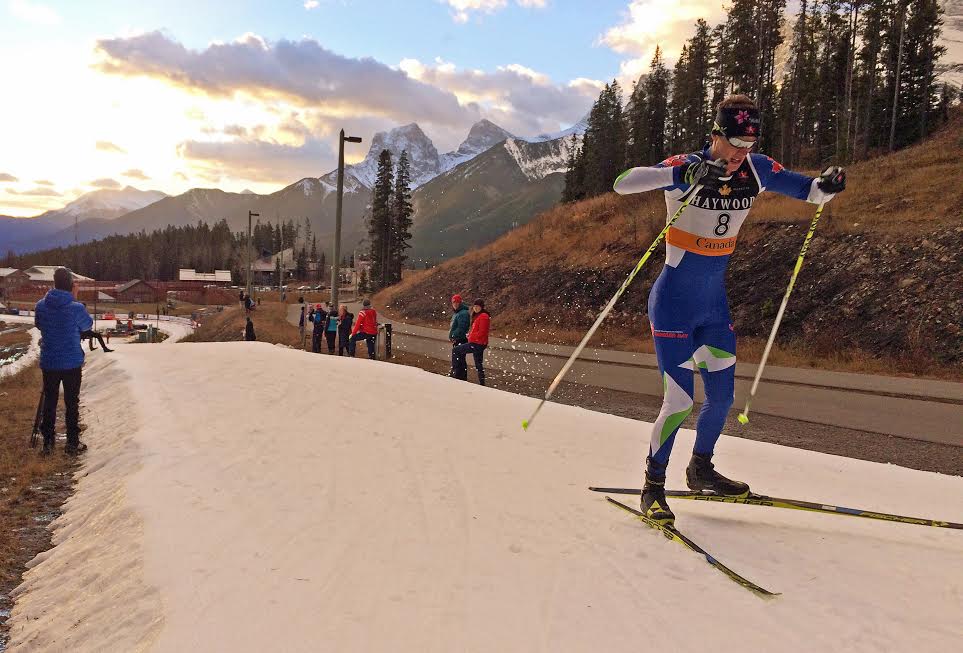
    Tuesday was Hamilton’s second podium of the season and third-career sprint podium.

    “I think we are showing the rest of the world that this sport can be won by people other than the Norwegians and it’s fun to be able to be a part of that.” — Simi Hamilton, second in the freestyle sprint at the Ski Tour Canada in Gatineau, Quebec
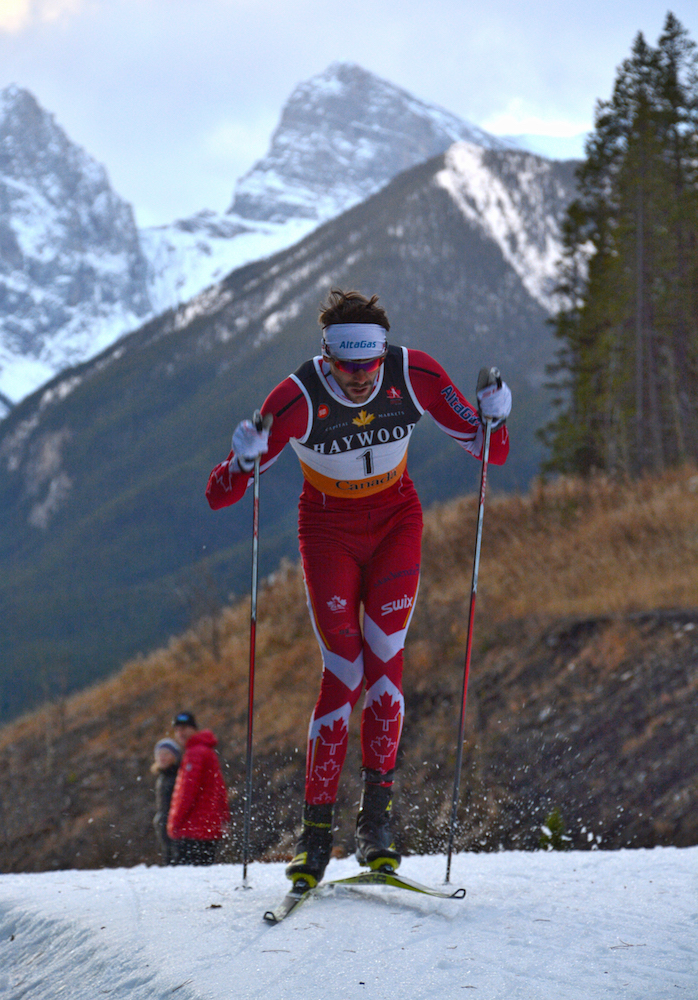
    Ustiugov’s Day

    A word or two about Ustiugov is well worth a mention. Like Hamilton, the 23-year-old Russian played his tactics well, qualifying in third then winning his fast quarterfinal in a three-way photo finish. (His quarterfinal time bested the fastest qualifying time by almost two seconds.)

    In his semifinal, Ustiugov broke a pole just after the start. Cooly, he power skated along until a Russian coach was able to hand him a new pole. On the longer-than-usual course, Ustiugov was able to eventually bridge back up to the leaders.

    It also seemed like an aha moment. It was as if the pole break taught Ustiugov something that Hamilton had learned: conserving energy early pays dividends in the end.

    By 1:49 into the semifinal, Ustiugov took the lead, despite his long-forgotten broken pole. He ended up second to Krogh in a photo finish.

    In the final, Ustiugov hovered in the back of the pack, looking like an afterthought until late in the race.

    “It was my tactical goal today,” Ustiugov said, according to a translation at the press conference. “In the quarterfinal, I also started very slowly. In the semifinal, I made a really fast start, and in the final again the same start like in the quarterfinal. So that was my tactic play today.”

    The men's freestyle sprint podium at the first stage of the Ski Tour Canada with Russian winner Sergey Ustiugov (c), France's Richard Jouve (l) in second and American Simi Hamilton (r) in third. (Photo: John Lazenby/Lazenbyphoto.com)
    The men’s freestyle sprint podium at the first stage of the Ski Tour Canada with Russian winner Sergey Ustiugov (c), France’s Richard Jouve (l) in second and American Simi Hamilton (r) in third. (Photo: John Lazenby/Lazenbyphoto.com)

    Gatineau marked Ustiugov’s first sprint victory since Nove Mesto, Czech Republic, where he won his first World Cup (a freestyle sprint) in January 2014. Last month, he won the 15 k freestyle mass start in Falun, Sweden for his second individual World Cup win.

    And on Tuesday, he outlasted five skiers in a photo finish for his third victory, with first through fourth being separated by just 0.13 seconds.

    Just a toe behind the Russian winner was Jouve. His plan, unlike Ustiugov’s building pace, was to hang on for as long as possible.

    “We had a good race tactic, from the quarterfinals all the way to the final,” Jouve said in the press conference. “We tried to stay at the front of the pack as long as we could.”

    Asked about lining up with Northug in the final, Jouve said he convinced himself he belonged.

    “It really impressed me being in the final, but I had to tell myself I was as good as any of the other finalists,” he said. “The French-speaking public was great and I want to thank all who cheered for me.”

    Including the team sprint in Planica, Slovenia, this was Jouve’s third podium of the season.

    The U.S.

    U.S. Ski Team member Erik Bjornsen was the next-best American in 25th overall. He qualified for his first sprint of the season in 27th, 7.3 seconds behind Northug’s top qualifying time.

    “It was fun to jump into the heats and mix it up a little bit,” Bjornsen told FasterSkier after his quarterfinal.

    Initially, at the start of his quarterfinal (the fourth of five), Bjornsen led the pack.

    “I was just feeling comfortable and I knew it was important to get a good spot and maybe I got a bit too comfortable out there,” he reflected. “And also I let one or two guys go thinking, ‘It’s going to be fine.’ ”

    Bjornsen was knocked out of the competition when he finished fifth in his quarterfinal, 2.17 seconds behind Northug as the winner of that heat.

    Bjornsen said he’s looking forward to the distance days to come, starting with a 20 k classic mass start on Wednesday in Montreal.

    “Tomorrow and then Canmore, both those classic distance races I’m pretty excited for,” he said.

    No other Americans qualified for the heats. Bjornsen’s Alaska Pacific University (APU) teammate Reese Hanneman placed 35th, Andy Newell (SMST2/USST) finished 42nd, Dakota Blackhorse-von Jess (Bend Endurance Academy) was 54th, Eric Packer (APU) 72nd, Noah Hoffman (SSCV/USST) 74th, Scott Patterson (APU) 75th, Tad Elliott (SSCV) 81st, Matt Liebsch (Gear West) 82nd, and Brian Gregg (Team Gregg) 83rd.

    The U.S. notched a never-before-seen double podium with both an American man (Hamilton) and woman (Jessie Diggins) on the podium, as Diggins placed third in the women’s final.

    “We are so proud of all the USA athletes today,” U.S. Head Coach Chris Grover said in a USSA press release. “It was really exciting to see Erik Bjornsen take his first sprint points of the season and finish 25th. … Once the heats began, both Jessie and Simi were masterful when it came to making space in which to pass their competitors. They made gaps open for themselves and timed their podium bids perfectly.”

    It’s Good to be Home

    Canadian World Cup Team member Alex Harvey, of St-Férréol-les-Neiges, Quebec, took advantage of the home field right from the go. He qualified 15th (+4.18) for his first time making the heats in a World Cup freestyle sprint this season.

    Alex Harvey (Canadian World Cup Team) racing to 15th in the 1.7 k freestyle sprint qualifier at the first stage of the Ski Tour Canada on Tuesday in Gatineau, Quebec. Harvey went on to reach the semifinals for 11th overall. (Photo: Peggy Hung)
    Alex Harvey (Canadian World Cup Team) racing to 15th in the 1.7 k freestyle sprint qualifier at the first stage of the Ski Tour Canada on Tuesday in Gatineau, Quebec. Harvey went on to reach the semifinals for 11th overall. (Photo: Peggy Hung)

    “It was a great start to the Tour. I felt really good out there as the day went on,” Harvey said in a Cross Country Canada press release. “I haven’t had much success this year qualifying in the sprint races so to be 15th was a good sign.”

    In his quarterfinal, the first of five, it didn’t appear Harvey would advance until the final stretch.

    “We had three of the fastest men pushing the pace in the quarterfinals,” Harvey said in a press release. “We get to pick our heats that we want to race in and I wanted that one because I knew it would be fast and a good chance to have a lucky loser spot.”
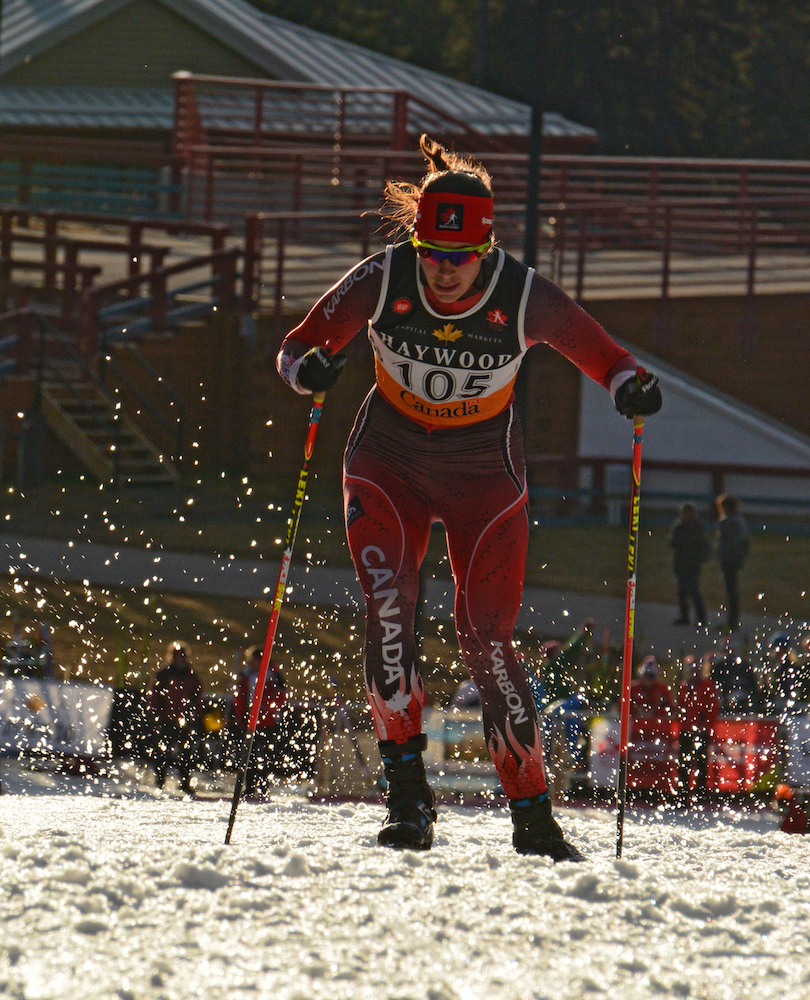
    In a four-way photo finish, Harvey finished fourth, 0.29 seconds behind Ustiugov, the winner of the heat. Krogh automatically advanced in second (+0.01), while Hattestad in third (+0.27) and Harvey two-hundredths of a second behind him reached the semifinals as lucky losers.

    Harvey did not advance beyond the semifinals, finishing sixth in the first semi (1.44 behind Ustiugov in first), and placed 11th overall. It was his second-best sprint of the season after placing seventh in a classic sprint last month in Stockholm, Sweden.

    “I was better positioned in the semis, but I almost crashed in that final corner and it scrubbed my speed. That was it for me,” Harvey said on Tuesday. “I felt really good as the day went on. The crowd was awesome today and really loud so it was a great start.”
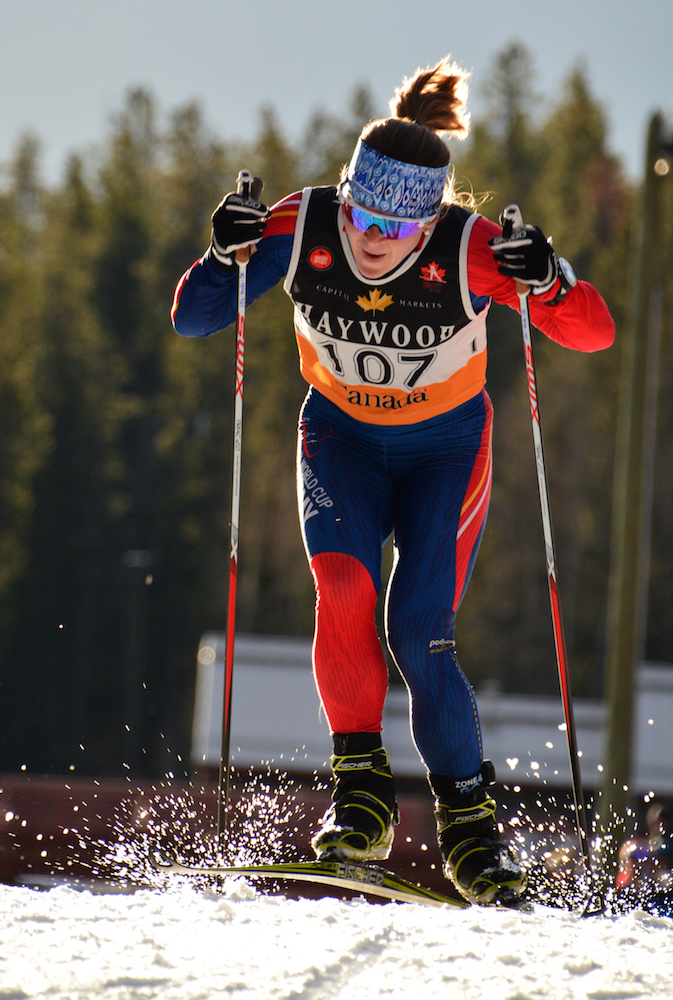
    That great start was not Harvey’s alone. Canadian National Development Team athlete Knute Johnsgaard, in his second World Cup sprint, qualified 29th (+7.80). He ended the day 30th overall for his first World Cup points.

    Johnsgaard told FasterSkier he tried to relax compared to his recent starts in Europe.

    “I think I maybe waited a little better,” Johnsgaard said. “The last rounds I did in Europe would have been the OPA Cup in Planica, the week before the World Cup weekend. And I was … getting a bit too excited off the start that time. So I was just trying to relax this time until the second lap, and maybe make a move on the second lap. But unfortunately everyone is so strong … I don’t think it was much about tactics today, just the strongest skiers went through.”
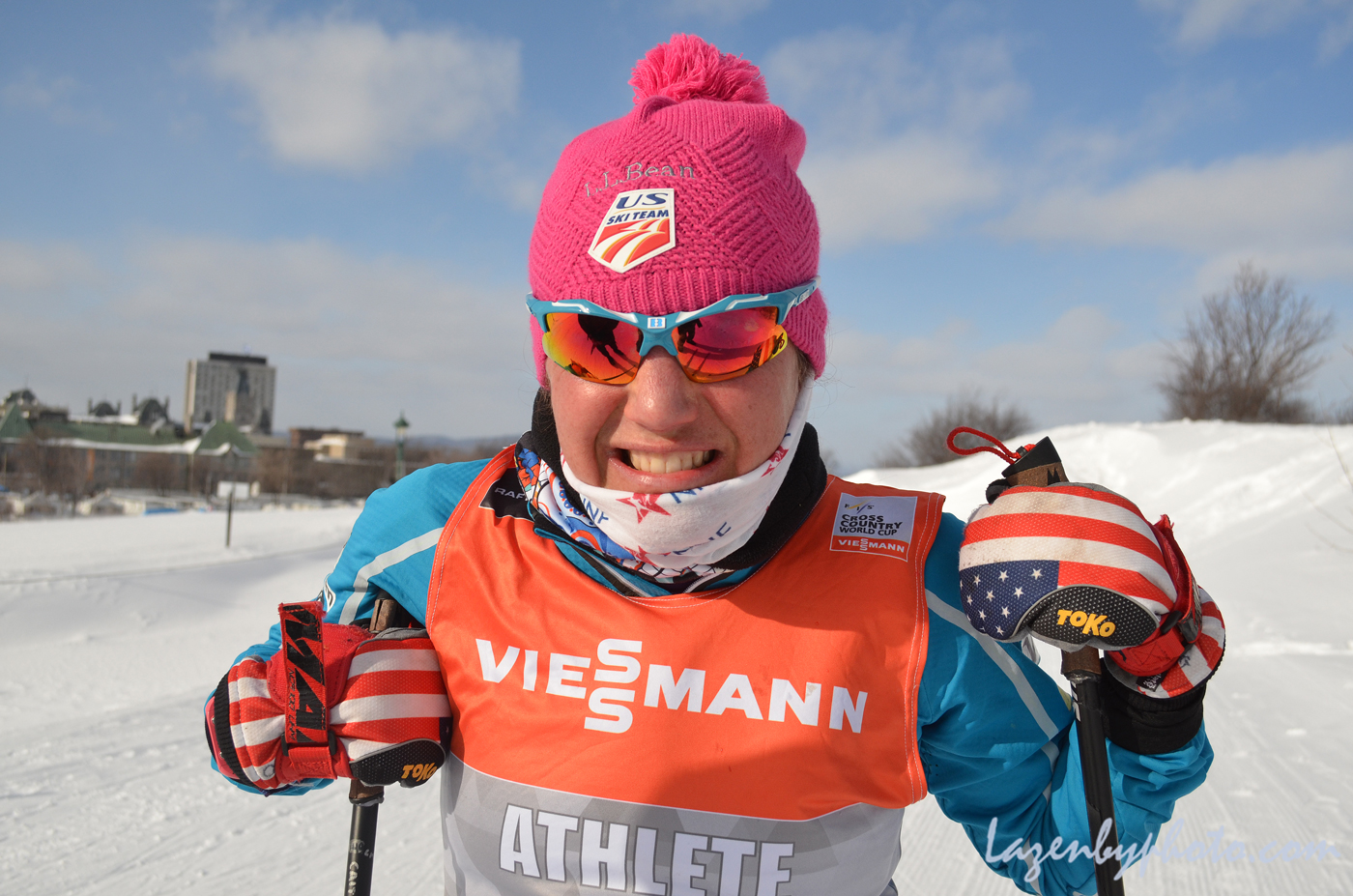
    Canadian World Cup Team member Len Valjas finished 37th, Andy Shields (Thunder Bay National Development Centre) placed 48th, Devon Kershaw (CNST) was 50th, Bob Thompson (NDC Thunder Bay) 52nd, Jesse Cockney (CNST) 53rd, Russell Kennedy (Canmore) 59th, Kevin Sandau (AWCA) 70th, Gatineau’s own Simon Lapointe (Skinouk) 71st, Graeme Killick (CNST) 76th, Ivan Babikov (CNST) 78th, and Patrick Stewart-Jones (AWCA) 84th.

    The Ski Tour Canada continues Wednesday in Montreal with the Stage 2 men’s 20 k classic mass start, and a 13 k women’s classic mass start on an approximately 3 k loop.

    Final results | Qualifier | Tour standings (through Stage 1)

    —  Gerry Furseth, Alex Slobodian, François Léger Dionne, and Harald Zimmer contributed reporting

  • Western Canadian Championships Recap: The Final Push

    Western Canadian Championships Recap: The Final Push

    Canmore's Annika Hicks (54) finished second in the women's 15 k classic mass start on the final day of Western Canadian Championships on Feb. 21, just ahead of Katherine Stewart-Jones (NDC Thunder Bay) in third.
    Canmore’s Annika Hicks (54) finished second in the women’s 15 k classic mass start on the final day of Western Canadian Championships on Feb. 21, just ahead of Katherine Stewart-Jones (NDC Thunder Bay) in third. (Photo: Sally Connon)

    Western Canadian Championships, the final NorAm weekend of the season took place Feb. 19-21 at the Otway Nordic Center in Prince George, B.C., with three races determining the final Ski Tour Canada (STC) roster for Canada.

    Dahria Beatty and Kevin Sandau left British Columbia as the overall NorAm leaders, granting them starts at the STC eight-stage World Cup.

    Beatty won the women’s 7.5-kilometre freestyle individual start on Friday, Feb. 19, by nearly 11 seconds in 19:02.7 to retake the NorAm lead from fellow U23 Development Team skier, Cendrine Browne, of the Pierre-Harvey National Training Centre (CNEPH).

    “I went out as if I was only racing 5km,” Beatty recalled in an email. “I felt really good on the first lap and then started to fade on the second lap as my legs filled with lactate. The downhills on the second lap were the hardest part as I struggled to stay on my feet I was so tired. I managed to regain a bit of composure for the final climb and hold onto the lead I had fortified on the first lap. This was my first time racing in Prince George and I really enjoyed the trails. Lots of fun and very technical!”

    U23+ Development Team skier Olivia Bouffard-Nesbitt finished second (+10.9), while Maya MacIsaac-Jones, of Rocky Mountain Racers (RMR) was 45.8 seconds behind in third, edging Annika Hicks (Canmore) by 2.1 seconds, for her first NorAm distance podium of the season.

    I’m definitely happy with the upward trend I’ve been experiencing,” Bouffard-Nesbitt wrote. “The only thing lacking is some power, but that is a result of my (lack of) summer training, so there’s nothing I can do about that now. I’m super excited to race some World Cups though!”

    Browne, citing fatigue after an altitude training block, finished fifth, 52.1 seconds behind Beatty.

    “I already knew in my warm up that something was wrong. I wasn’t feeling good,” Browne wrote in an email. “In the race, everything was confirmed. I felt awful. I couldn’t push my body was tired.”

    “When my coach called me on the phone and asked how my race went and when I said it was awful, he just said: Perfect, the altitude camp is working,” Browne added. “I was surprised by his answer but it cheered me up a little. He also said it would be hard doing the sprints too.”

    ***

    Day 2 brought another win for Beatty at Saturday’s 1.4 k classic sprint, as she beat out Bouffard-Nesbitt in the finishing straight to win by half a second in 3:44.2.  

    “I felt good in my semi and was able to carry that feeling into the final,” Beatty wrote. “Olivia led the entire race, she was skiing well and had a faster start than me to get out in front early. I just sat in behind her on both climbs as the middle track was a lot better than the two outside ones. You come into the finish off a downhill so I used her draft to step out beside and sprinted to the finish. I had a comfortable advantage by halfway down the finish shoot and carried that to the finish.”

    I raced the final how I wanted to,” Bouffard-Nesbitt explained. “I led the whole race and unfortunately got out-sprinted at the finish. It was a good wake up call, because now I can hit the gym and do some biceps curl reps to have me ready for the tour.”

    “It was a good wake up call, because now I can hit the gym and do some biceps curl reps to have me ready for the tour.” — Olivia Bouffard-Nesbitt on finishing second in the Westerns classic sprint

    MacIsaac-Jones again snatched the final podium spot, 4.55 seconds behind Beatty, ahead of Katherine Stewart-Jones (NDC Thunder Bay) in fourth.  Beatty’s second win of the weekend locked up her hold of the overall NorAm. MacIsaac-Jones took the NorAm sprint lead, displacing teammate Andrea Dupont, who skipped Westerns while racing Period 3 on the World Cup in Europe.

    “I went in today wanting to win, but I’m satisfied with a bronze medal,” MacIsaac-Jones wrote. “The race was good redemption for me from the Canada Winter Games race on this course last year, where I didn’t make the A Final. It was also a big improvement from my classic sprint at the Canmore NorAm in december, where I also didn’t make the A Final.

    “I knew that Dahria and Olivia would go for it once we hit the big climb so I just tried to hang on, but they were too fast for me and I wasn’t able to stick with them,” she added. “Katherine moved up beside me on the final climb, but I managed to hold her off and hang on to 3rd which I was really happy with.”

    As planned, Beatty headed home Sunday morning to start her final STC preparations.

    ***

    In Sunday’s 15 k classic mass start, Browne skied away to a 52-second victory in 46:00.1, while Hicks took second, 0.6 seconds ahead of Stewart-Jones in third.

    “I felt very good! The shape is back,” Browne wrote on Sunday. “Annika, Katherine and I stayed together for 2 and a half laps (we had 4 laps of 3.75km to do). I was feeling good today so I started going a little harder on the 3rd lap and starting the 4th lap, I knew I was by myself. I had really good kick so climbing the big climbs was where I knew I could break away. I went even harder on the last lap just to make sure the girls couldn’t catch up to me.”

    Junior Katie Weaver (Hollyburn) continued her steady rise, skiing with the lead three for the first lap before falling off the pace and finishing 2:48.1 back in fourth.

    Many of the STC-bound skiers skipped the distance race on Sunday.

    ***

    Black Jack's David Palmer (l) leading early in the men's 20 k classic mass start on the final day of Western Canadian Championships in Prince George, B.C., with Michael Somppi, Evan Palmer-Charrette, Andy Shields, and Patrick Stewart-Jones chasing.(Photo: Sally Connon)
    Black Jack’s David Palmer (l) leading early in the men’s 20 k classic mass start on the final day of Western Canadian Championships in Prince George, B.C., with Michael Somppi, Evan Palmer-Charrette, Andy Shields, and Patrick Stewart-Jones (r) chasing. (Photo: Sally Connon)

    On the men’s side, Andy Shields (NDC Thunder Bay) was within striking distance of Sandau’s overall lead before the weekend. With the third-ranked man, Knute Johnsgaard (AWCA/NDST) focussing on a training block before STC, it was a two-way fight for the title.  

    In Friday’s 10 k freestyle individual start, Russell Kennedy (Canmore) snatched the victory in 22:19.1, edging Sandau by 0.4 seconds and Michael Somppi (NDC Thunder Bay) by 2.5 seconds, for his first NorAm win of the season.

    “I was super pumped in my race today feeling was amazing conditions were really good and the downhills were fast and technical,” Kennedy wrote in an email.

    “There wasn’t much of a pacing strategy as it was 10k so really just had to start fast and hold on to as hard a pace as possible,” he added. “The splits were close so I knew I had to push it. I was feeling confident when we were close at the top of the last hill as I love downhills and have a good sprint. I didn’t really realize just how close it was until the after I finished though.”

    Sandau wrote in an email that he was happy to finishing in the top four considering how close it was, but always wants the win, especially considering how close he was behind Kennedy.

    “I’ve been teasing him all winter about nicking him in the distance races so he served up a nice rebuttal today,” Sandau wrote. “… I went off the line hard knowing there wasn’t room for mistakes and a lot of places to give up time. I was getting splits off Russell near the end that he was leading so I tried to claw back some time in the last few climbing sections but was just shy of enough.”

    “It’s a really good course for [Russell] and I knew with his consistency in skate races he was going to be one of the bigger threats out there,” Sandau added. “Plus he’s pretty good when he clips into a pair of alpine skis so the downhills were probably pretty easy for him, compared to me who felt like a tourist out for the first ski of the year at times.”

    Somppi in third described his race as “solid.”

    “The fitness is as good as it’s going to get at this point,” he wrote. “Now, it is all about finding the right mix of recovery and intensity to be primed and full of energy when the Tour starts.”

    Shields finished fourth, 9.7 seconds back, to stay in mathematical contention. To take the title, Shields would need at least a win and a second in the final two races.

    “I started pretty hard, got tired and had a rough middle section,” Shields wrote. “I was still getting good splits going into the last 4km so I was able to find some juice to finish off and still have a respectable split for the last lap.”

    ***

    Bob Thompson (NDC Thunder Bay) racing to second in the men's freestyle sprint qualifier at Western Canadian Championships in Prince George, B.C. He went on to win the men's final. (Photo: Sally Connon)
    Bob Thompson (NDC Thunder Bay) racing to second in the men’s classic sprint qualifier at Western Canadian Championships in Prince George, B.C. He went on to win the men’s final. (Photo: Sally Connon)

    Bob Thompson (NDC Thunder Bay) won the men’s 1.4 k classic sprint on Saturday, retaking the sprint series lead and the automatic STC start from Julien Locke (Black Jack), who was in Romania for U23 World Championships this week. Thompson needed the win to eclipse Locke in the sprint standings, taking the series 250 points to Locke’s 245.

    Also in the sprint final, Patrick Stewart-Jones (AWCA) placed second and Shields finished third. Sandau went out in the quarterfinals, having achieved his training goals.

    “Very happy that I was able to win when I needed to,” Thompson wrote in an email. “To win the NorAm sprint spot for the Tour of Canada I had to win to get enough points. Patrick was in the same position so I knew we would both be giving our all to lock the spot down. Was great that I was feeling really strong and had my best qualifier of the year as well.”

    Thompson qualified second behind Skinouk’s Simon Lapointe, who went on to place sixth in the final.

    ***

    Evan Palmer-Charrette (NDC Thunder Bay) outlasted teammate Andy Shields (l) and Patrick Stewart-Jones (AWCA) for the win in the men's 20 k classic mass start on Sunday, Feb. 21, at Western Canadian Championships in Prince George, B.C. (Photo: Sally Connon)
    Evan Palmer-Charrette (NDC Thunder Bay) outlasted teammate Andy Shields (l) and Patrick Stewart-Jones (AWCA) for the win in the men’s 20 k classic mass start on Sunday, Feb. 21, at Western Canadian Championships in Prince George, B.C. (Photo: Sally Connon)

    On Sunday, Evan Palmer-Charrette (NDC Thunder Bay) won a four-way race for first in the 20 k classic mass start. Shields finished second, 0.111 seconds back, and Stewart-Jones was third (+0.525). Somppi lost his balance in the final straight and finished fourth, 1.24 seconds behind Palmer-Charrette.  David Palmer (Black Jack) was dropped during the final lap to take fifth, 13.9 seconds out of first.

    I am quite happy with my race Sunday but overall the weekend was a bit disappointing,” Palmer-Charrette wrote. “The 10km skate on Friday is what I would pick as my strongest event and I really struggled that day. I had the race I wanted to on Sunday and am looking forward to next season!”

    The race on Sunday was a lot of fun, skiing at the front with my team-mates…,” Somppi wrote. “Tactically, I put myself in a great position to win. I led the final climbs, pushing the pace, and crested the final downhill in second, right behind Evan. Unfortunately I hit a patch of ice on the final downhill corner and stumbled, nearly crashing. Instead of using the draft and coming up beside Evan in the finish to contend for the win, I was double poling early in the finish stretch, trying to regain my speed.

    “I feel a little gypped after this weekend, to finish 3rd and 4th when I was only 2.5 seconds from winning one day and 1 second from winning the other day,” Somppi, last year’s NorAm winner, added. “I’m hoping my luck will turn in the Tour.”

    ***

    Western Canadian Championships results: Friday | Saturday | Sunday

    NorAm standings

    Photos: Friday | Saturday | Sunday