Tag: Sindre Bjoernestad Skar

  • Sunday Rundown: Davos, Pokljuka & Sovereign Lake (Updated x3)

    Sunday Rundown: Davos, Pokljuka & Sovereign Lake (Updated x3)

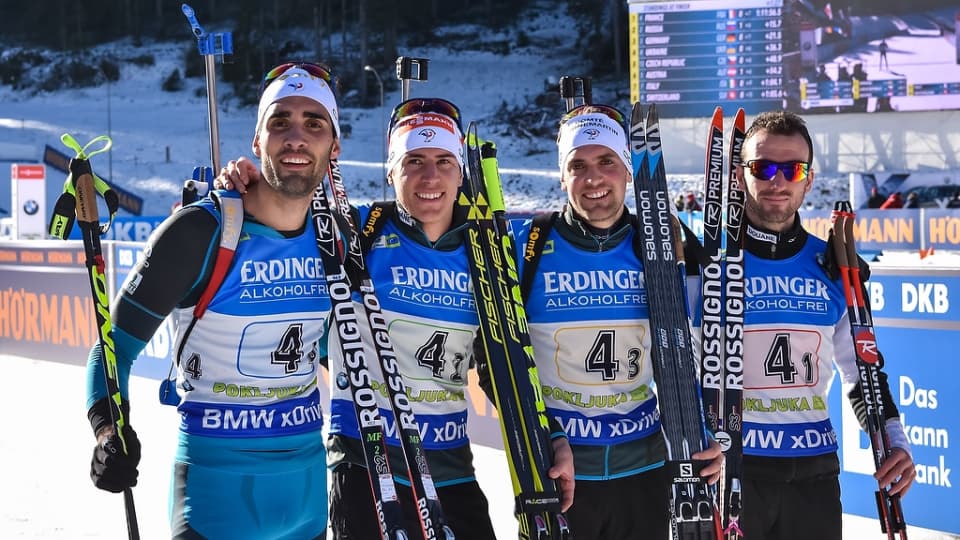
    The French men's relay team after their IBU World Cup win on Sunday in Pokljuka, Slovenia, with (from left to right) Martin Fourcade, Quentin Fillon Maillet, Simon Desthieux, and Jean-Guillaume Béatrix. They beat Russia by 15.7 seconds for the win. (Photo: IBU)
    The French men’s relay team after their IBU World Cup win on Sunday in Pokljuka, Slovenia, with (from left to right) Martin Fourcade, Quentin Fillon Maillet, Simon Desthieux, and Jean-Guillaume Béatrix. They beat Russia by 15.7 seconds for the win. (Photo: IBU)

    Welcome to The Rundown, your quick primer of need-to-know information about the day’s racing. We’ll be updating this digest as the day goes on with additional results, photos and quotes. The Rundown is NOT a race report; stay tuned for complete race reports later today with interviews from the day’s top racers.

    ***

    Note: This recap has been updated to reflect the correct positions each of the four Canadian women exchanged in during Sunday’s 4 x 6 k IBU World Cup relay. 

    IBU World Cup in Pokljuka: Men’s & Women’s Relays

    Germany and France reached the podium in both the men’s 4 x 7.5-kilometer and women’s 4 x 6 k sprints on Sunday, the final day of the International Biathlon Union (IBU) World Cup in Pokljuka, Slovenia.

    France won the men’s race by 15.7 seconds over Russia with a total of seven spare rounds and zero penalties. Jean-Guillaume Béatrix started off by putting the French team in fourth, then Quentin Fillon Maillet elevated them to first, a position both Simon Desthieux and Martin Fourcade held for the victory in 1:11:56.5.

    “When we started the relay, we thought that winning was possible,” Béatrix said, according to an IBU press release. “At the same time, the competition was very tough. There were many strong teams today.”

    “I was very happy to tag Martin with a 20-second lead,” Desthieux said. “This is good for my confidence.”

    Russia placed second with Maxim Tsvetkov, Anton Babikov, Matvey Eliseev, and Anton Shipulin, the four of which combined for one penalty (on Eliseev’s third leg) and six spare rounds.

    Germany rounded out the podium in third, 21.5 seconds behind France, with Erik Lesser, Matthias Dorfer, Benedikt Doll, and Simon Schempp. In ninth after Lesser’s first leg, Dorfer brough the team to eighth and Doll raced them into second before Schempp lost one place to end up third. They used a total of 11 spares but avoided the penalty lap.

    Canada placed 10th of 22 teams, 1:44.7 out of first with one penalty and seven spares. Christian Gow started the team out with clean shooting and tagged off in sixth at the first exchange, and his older brother Scott Gow also shot clean without any spares to move up to fourth at the second tag. Macx Davies required three spares and had to ski a penalty lap on his prone stage, then used another spare to clean standing and tagged off in 14th place. Brendan Green anchored the Canadians to 10th, using three spares but avoiding a penalty in prone, then cleaning standing without any spares.

    “I had a somewhat disappointing pursuit race yesterday, and my goal for today was to refocus on the range and push the ski speed as much as possible,” 28-year-old Scott Gow told Biathlon Canada, according to a press release. “I was happy with the overall performance I was able to put forward for my leg of the relay, and I was especially happy with another clean shooting day.

    “Today was an acceptable result for the team,” he added. “Christian and I are very proud of our results so far this season. We worked very hard all year to try and elevate our racing abilities to the next level, and we saw our hard work pay off today with great skiing and perfect shooting for both of us. It’s also a big confidence boost going forward with the season knowing we are capable of competing among the best.”
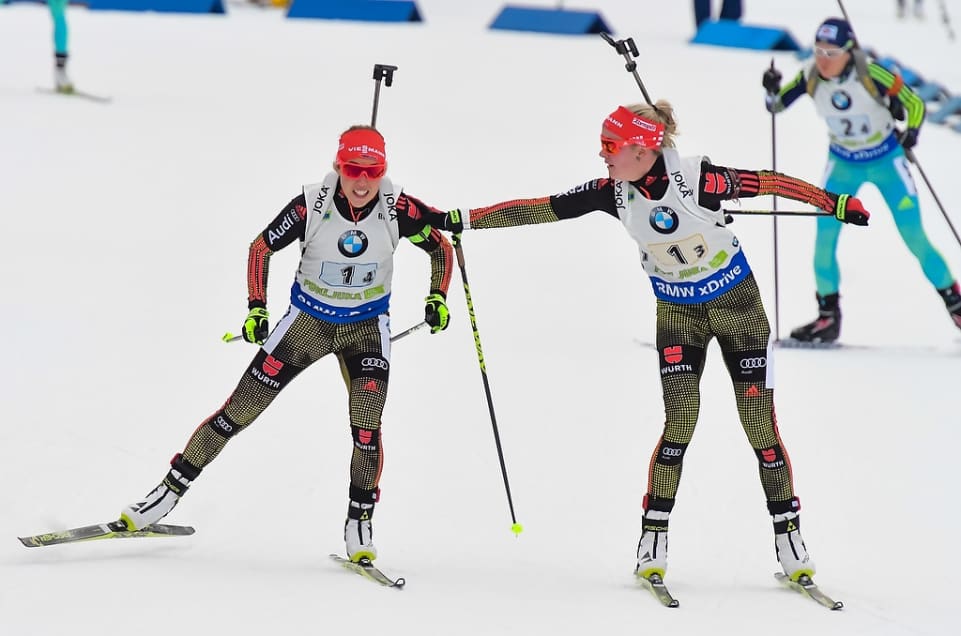
    Germany's Karen Hammerschmidt (l) tagging her teammate Laura Dahlmeier in second place at the final exchange of the women's 4 x 6 k relay at the IBU World Cup in Pokljuka, Slovenia. Dahlmeier anchored the team to the win by 10.1 seconds over France. (Photo: IBU)
    Germany’s Karen Hammerschmidt (l) tagging her teammate Laura Dahlmeier in second place at the final exchange of the women’s 4 x 6 k relay at the IBU World Cup in Pokljuka, Slovenia. Dahlmeier anchored the team to the win by 10.1 seconds over France. (Photo: IBU)

    In the women’s relay on Sunday, Germany took first by 10.1 seconds over France, using nine spares but no penalties.

    Vanessa Hinz started the Germans out and tagged off in fifth, and second-leg Franziska Hildebrand moved them up into second by the halfway point. Karen Hammerschmidt held that position, which was enough for Laura Dahlmeier who anchored them to the win in 1:11:31.1.

    “This was a brutally beautiful race today,” Dahlmeier told German broadcaster ZDF after her third win in as many races in Pokljuka. “It was very fun, and I was very relaxed because I knew we were competing as a team. Even if you don’t have as much power left there are still three others. I was on top of my game and just enjoyed it. I really looked forward to the race, although yesterday I was knocked out. But on the course I had a good feeling right from the start.”

    France in second and Ukraine in third (+37.7) both required just three spare rounds and no penalties per team. France secured second place with Anais Chevalier (who initially tagged off in 11th), Justine Braisaz (who picked off eight places to move into third), Celia Aymonier (who tagged off in first), and Marie Dorin Habert (who cleaned without any spares but came up 10 seconds short of Dahlmeier at the finish).

    Ukraine reached the podium with Iryna Varvynets, Yuliia Dzhima, Olena Pidhrushna, and Anastasiya Merkushyna.

    Canada placed 11th (+3:33.1) with a total of just four spares and no penalties. Sarah Beaudry initially tagged off in 23rd, Rosanna Crawford skied them into 18th, Megan Tandy shot clean without any spares and tagged off in 14th, and Julia Ransom anchored them to 11th out of 23 teams.

    The U.S. did not field a men’s or women’s relay team, with just three men and three women in Pokljuka.

    Results: Men | Women

    ***

    FIS Cross-Country World Cup in Davos: Freestyle Sprints

    In the men’s 1.6-kilometer freestyle sprint on Sunday it was Russia’s Sergey Ustiugov who emerged victorious, besting Finn Hågen Krogh of Norway and his Norwegian teammate Sindre Bjørnestad Skar for first.

    After qualifying 29th overall, Ustiugov crossed first in his quarterfinal and held the led through his semifinal and into the final, winning in a time of 2:24.65. Krogh crossed 0.59 tenths of a second behind him for second place and Skar took the final podium spot, crossing 3.29 seconds after Ustiugov.

    Also in the sprint final was Russia’s Alexey Petukhov, who finished just off the podium in fourth (+3.47), Norwegian Emil Iversen in fifth (+5.52) and France’s Lucas Chanavat  who won the qualifier — ended the day in sixth (+11.48).
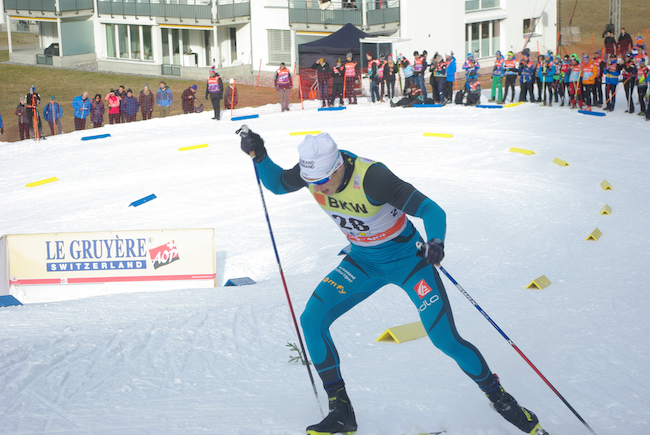
    Lucas Chanavat of France had the fastest men's qualifying time in the Davos World Cup freestyle sprint on Sunday.
    Lucas Chanavat of France had the fastest men’s qualifying time in the Davos World Cup freestyle sprint on Sunday.

    Canada’s Lenny Valjas was the top North American finisher for the day, qualifying 12th and advancing to the quarterfinals where he finished in 14th overall. No other Canadians made the sprint heats, with Alex Harvey left just outside advancing in 33rd, Devon Kershaw ending the day in 49th, Knute Johnsgaard 60th, Bob Thompson 67th, and Andy Shields 73rd. Jesse Cockney did not finish the race.

    Simi Hamilton led the U.S. in 24th (+3.88). Andy Newell was just outside the heats in 36th, and Eric Packer placed 95th (+21.62).

    In the women’s 1.6 k freestyle sprint, Maiken Caspersen Falla of Norway took the overall win, crossing in a time of 2:44.63. Just 0.53 tenths of a second behind Falla was her Norwegian teammate Ingvild Flugstad Østberg in second place overall. The final women’s podium finisher, Hanna Falk of Sweden was 0.60 tenths of second off Falla in third.

    U.S. Ski Team member, Jessie Diggins made the final, racing to a fifth place overall (+5.91), behind Sweden’s Jonna Sundling in fourth (+1.04) and ahead of Russia’s Natlalia Matveeva in sixth (+6.80).

    The United States put three other women into the heats, including Sophie Caldwell who finished 11th, Sadie Bjornsen 15th, and Ida Sargent 20th.

    American Caitlin Patterson ended the day 47th, Kikkan Randall 58th, and Liz Stephen 61st.

    Dahria Beatty was the top Canadian on Sunday, finishing in 25th overall. Cendrine Browne ended the day 53rd and Sophie Carrier-Laforte 59th.

    Qualifier Results: Men | Women

    Final Results: Men | Women

    ***

    NorAm/SuperTour at Sovereign Lake: 10/15 k Freestyle

    [UPDATE] It was Americans owning the podium again Sunday at Sovereign Lake, and a little bit more. It was warmer on Sunday, -7 Celsius, and snowed lightly throughout.

    The men’s 15 k freestyle was first on the schedule.  APU’s Scott Patterson won in 40:00.2, followed by Saturday’s A-finalist Matt Gelso at 13.2 seconds and Vail’s Tad Elliot at +26.6.

    The top Canadian was Team R.A.D.’s Russell Kennedy in ninth, at 1:38.8 behind.

    In the women’s 10 k freestyle, the podium was owned by APU’s Chelsea Holmes in 30:42.9. SMS Elite’s Katharine Ogden was second at 13.4 seconds, also winning the junior category. Her teammate Erika Flowers was third, 36.4 behind.

    AWCA’s Olivia Bouffard-Nesbitt was the top Canadian for the second day, placing 13th at 1:51.8.
  • Norway’s Brandsdal Wins Crash-Filled Lahti Skate Sprint, Newell Eighth for U.S.

    Norway’s Brandsdal Wins Crash-Filled Lahti Skate Sprint, Newell Eighth for U.S.

    FIS world cup cross-country, individual sprint, Lahti (FIN)
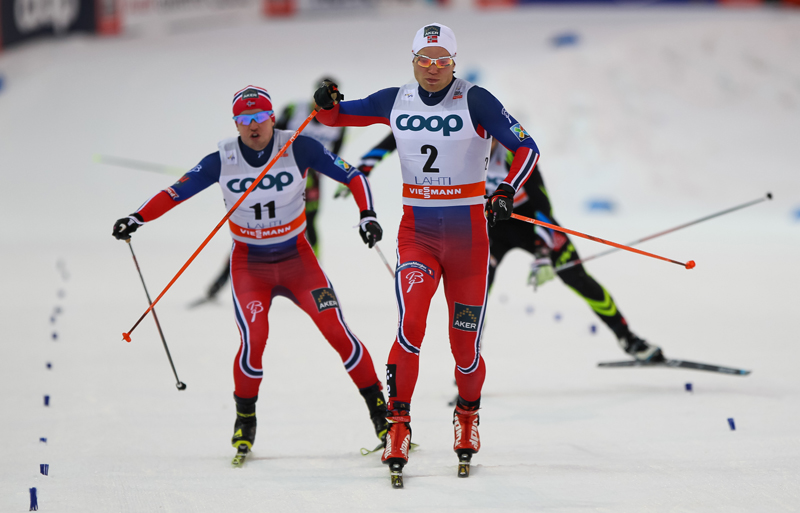
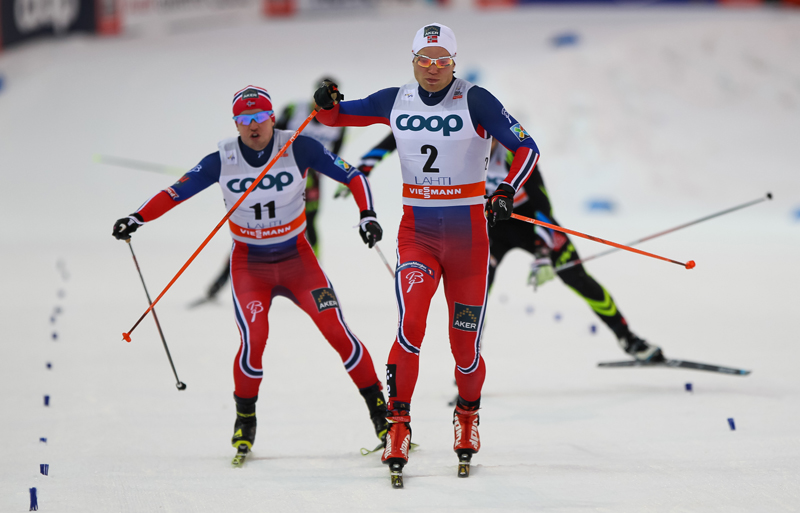
    Norway’s Erik Brandsdal (2) celebrates the win as he crosses the line first, ahead of fellow Norwegian Sindre Bjørnestad Skar (11) in the World Cup freestyle sprint final on Saturday in Lahti, Finland. (Photo: Fischer/Nordic Focus)

    One week after World Championships ended in Falun, Sweden, there wasn’t much time for rest for those headed into this weekend’s World Cup in Lahti, Finland. All the big names entered in the 1.5-kilometer freestyle sprint trying to get valuable International Ski Federation (FIS) points as the season winds down.

    Heading into Saturday’s sprint, Norway’s Finn Hågen Krogh was leading the overall Sprint World Cup with 398 points, ahead of Federico Pellegrino from Italy who had 356 points and Alexey Petukhov from Russia with 284 points. However, none of the top-three point leaders was a factor Saturday, opening the door for Norway’s Eirik Brandsdal, sitting in fourth, to gain valuable points and move up in the season-long sprint competition.

    The 1.5 k course in Lahti was very technical compared to the courses the competitors have faced this season. It was a mixture of hills and tricky turns that took their toll on some big-name competitors. Norway seemed to fare the worse, as Martin Johnsrud Sundby, Ola Vigen Hattestad, Sondre Turvoll Fossli, and Petter Northug all fell during Saturday’s sprint. Northug had a moment he probably would like to forget, falling flat on his face at the start of his semifinal heat.

    Norway’s Petter Northug (r) doesn’t even get out of the gate during his semifinal heat in the World Cup freestyle sprint on Saturday in Lahti, Finland. (photo: Fischer/Nordic Focus)

    Krogh was relegated during his semifinal for a rules violation and thus didn’t advance to the final.

    Throughout the rounds, Brandsdal was very consistent in his strategy, getting out in front and staying out of trouble.

    “I knew there were some issues with soft snow on the course and I wanted to be in front of the heat and I managed to control my heats,” he told FIS.

    After Sweden’s Johan Edin won the qualifier in 2:41.14, Brandsdal qualified second, 0.19 seconds back, and Krogh posted the third-fastest time (+1.44). Andy Newell was the lone North American to make the heats, qualifying in 13th (+3.02). Fellow U.S. Ski Team member Simi Hamilton missed advancing in 33rd, 0.32 seconds out of 30th. Also racing in the stars and stripes, Dakota Blackhorse-von Jess placed 55th in the qualifier and Erik Bjornsen was 57th.

    Among the Canadians, Lenny Valjas finished 48th, Alex Harvey placed 63rd, Jess Cockney was 68th, and Micheal Somppi 74th.

    Northug qualified in 10th and went on to win the first quarterfinal in 2:42.22, ahead of Finland’s Martti Jylhä in second (+0.42). The second quarterfinal featured Norway’s Sindre Bjørnestad Skar, who won in 2:40.71, and Brandsdal (+0.15) advancing. Newell topped the third quarterfinal in 2:39.80, ahead of Norway’s Håvard Solås Taugbøl (+0.12). France’s Richard Jouve won the fourth quarterfinal in 2:42.27, over Norway’s Anders Gløersen (+0.40), and another Frenchman, Baptiste Gros won the fifth quarterfinal in 2:40.35, while Edin advanced in second (+0.48). The lucky losers were Norway’s Mathias Rundgreen and France’s Renaud Jay.

    Brandsdal went on to win his semifinal in 2:42.88, and Skar finished 0.18 seconds back in second.  Jouve topped the second semifinal in 2:41.90, edging Taugbøl in a photo finish, while Jay and Gros in third (+0.22) and fourth (+0.14) made the final as well as lucky losers from that heat.

    Newell Makes Semis for Season Best

    Andy Newell (U.S. Ski Team) racing to 10th in the men's 1.4 k classic sprint qualifier on Thursday, the first official day of 2015 World Championships in Falun, Sweden. He went on to place fourth in his quarterfinal for 17th overall. (Photo: FlyingPointRoad)
    Andy Newell (U.S. Ski Team) racing to 10th in the men’s 1.4 k classic sprint qualifier at 2015 World Championships in Falun, Sweden. He went on to place fourth in his quarterfinal for 17th overall. (Photo: FlyingPointRoad)

    Newell narrowly missed advancing to the finals, finishing fourth in the first semifinal, 0.46 seconds behind Brandsdal and 0.12 seconds after Rundgreen, who was third. He ended the day in eighth overall for his best result of the season.

    “I’m finally feel like myself again sprinting so I’m excited for that,” Newell told USSA. “I really felt like I belonged in the final today, and it’s a good feeling to be back at that level.”

    It was the first time Newell had made the semifinals this season after posting a previous best of 12th in the World Cup classic sprint on Feb. 14 in Östersund, Sweden. There, he placed third in his quarterfinal to miss the semifinals by one place.

    Earlier in the day, Newell had qualified in 13th. He wrote in an email to FasterSkier that the fast course made qualifiers especially fun.

    “There are always a ton of skiers here at these World Cups so it can be a competitive field to qualify in,” he wrote.

    In terms of strategy on Saturday, Newell said he noticed several skiers were “sitting back and trying to attack the last half of the race.

    “That became my strategy and it worked out perfectly in the quarters and I was able to come in to the lead in the stadium and win the heat,” he explained. “I tried to do the same thing in the semis, but the pack was just a little too tight and wasn’t able to slighshot into the top two in the stadium.”

    “I’m happy with eighth but really felt good enough for the podium,” he wrote. “But most of all I’m stoked to be feeling much better at the end of the season than I did in the beginning.

    A Norway-France Final Showdown

    The final featured three Norwegians; Brandsdal, Skar and Taugbøl matched up against three Frenchmen: Jouve, Gros and Jay.

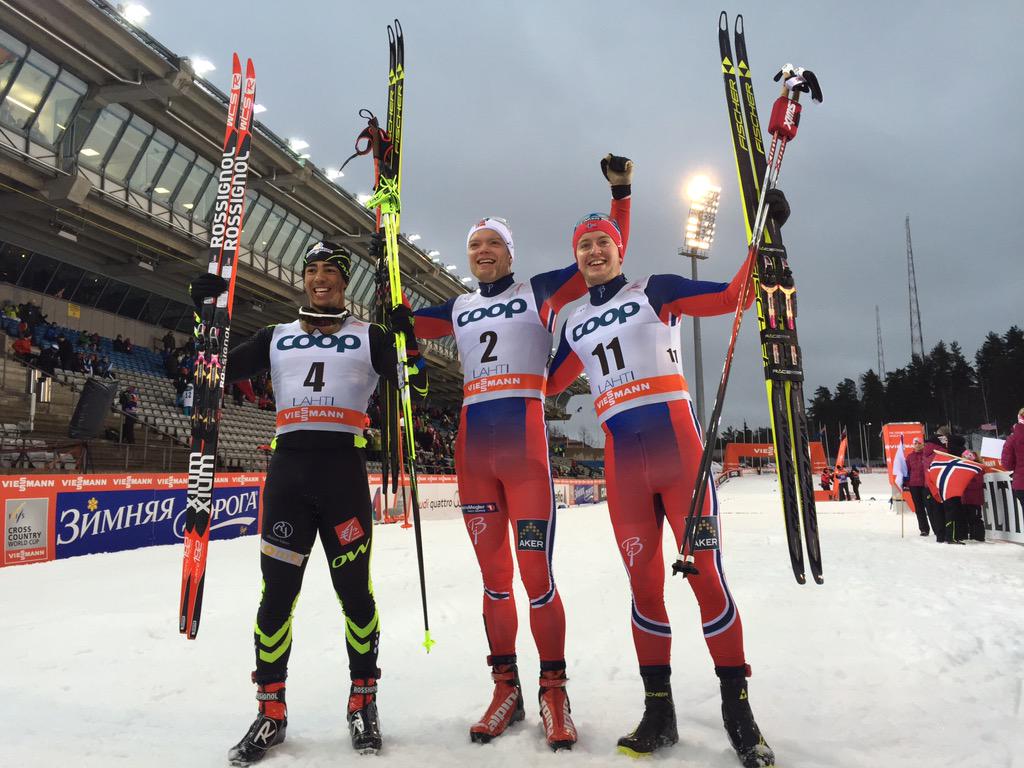
    Norway's Eirik Brandsdal (c) won Saturday's 1.5 k freestyle sprint at the World Cup in Lahti, Finland, ahead Norway's Sindre Bjørnestad Skar (r) and France's Richard Jouve (l), both of which achieved their first-ever World Cup podiums. (Photo: FIS Cross Country/Twitter)
    Norway’s Eirik Brandsdal (c) won Saturday’s 1.5 k freestyle sprint at the World Cup in Lahti, Finland, ahead Norway’s Sindre Bjørnestad Skar (r) and France’s Richard Jouve (l), both of which achieved their first-ever World Cup podiums. (Photo: FIS Cross Country/Twitter)

    Out of this unique final matchup, featuring three Norwegians and three Frenchmen, Brandsdal had the most experience, after recording a podium in Davos, Switzerland, and winning the World Cup opener in Kuusamo, Finland, at the start of this season.

    At the start, Brandsdal double poled his way into the lead and never lost it. He was followed closely behind by Skar, who was also racing for a personal-best finish. As the race unfolded, it was shaping up to be an all-Norwegian podium. With the three Norwegians skiing together, Skar and Taugbøl worked for Brandsdal to keep the French off the podium. The wall was finally broken about 200 meters from the finish when Jouve was able to glide past Taugbøl and into the top three.

    Brandsdal crossed the line first to win in 2.42.75, Skar was 0.21 seconds back in second, and Jouve finished 0.52 seconds behind in third. These were personal-best finishes for Skar and Jouve.

    “My goal today was to make it to the finals for the first time in my career,” Skar told reporters. “To finish on the podium in second place is pretty cool. I skied behind Eirik in the quarterfinal and semifinal. I managed to stay out of trouble also in the final.”

    A relative newcomer, Jouve, 20, has only competed in two other World Cups, both classic sprints, where he finished 49th in Otepää and 19th in Östersund earlier this season.

    “It was a very good day for me. I am very happy for third place,” Jouve told FIS. “It was my third World Cup appearance in my career and I did not expect this to happen. I am very proud to be on the podium. I felt very good in the qualification.”

    As a result of his win on Saturday and the 100 FIS points that go along with it, Brandsdal has moved into third overall in the Sprint World Cup. Krogh still leads with 399 points, Pellegrino is 33 points behind in second and Brandsdal 57 points back in third.

    There is only one sprint race left this season, a classic sprint on Wednesday in Drammen, Norway.

    Notes:

    There was a change to how the athletes were ranked for their qualification heats. FIS tested a new system this week and plans on doing it in next week’s classic sprint as well, in which qualified athletes choose their own quarterfinal matchups. The athletes ranked in the first top 11 positions after qualifying select their heat matchups first in reverse order, meaning the 11th-fastest qualifier selects first and the top qualifier selects their position last of that group. The athletes in 12th through 30th select the remaining quarterfinal positions in numerical order.

    Results

  • Russian Men Unsurprising In Junior Worlds Relay Victory

    Russian Men Unsurprising In Junior Worlds Relay Victory

    Sergey Ustiugov (RUS) on his way to taking his fourth gold medal of the week in Sunday's 4 x 5 k relay at World Juniors.

    ERZURUM, Turkey — As was to be expected given their performances the rest of this week, Russia was in control of the 4 x 5 k relay at World Juniors on Sunday from start to finish. Anchor leg Sergey Ustiugov secured his sweep of all four available gold medals when he crossed the line an untouchable 44.8 seconds ahead of Kazakhstan’s Roman Ragozin. Norway, anchored by Sindre Bjoernestad Skar, took home bronze.

    “The relay is always a very special race,” said Ustiugov. “The joy from the success is always bigger when you can share with your teammates.”

    The Russian relay team rushing to celebrate with Ustiugov after winning the gold medal.

    Russia presented other nations a formidable opponent on Sunday, as they’d swept or nearly swept every men’s race leading up to the relay, but in the scramble classic leg, Italy’s Mauro Brigadoi managed to stick with Artem Maltsev (RUS) through the tag-off.

    Italy faded to sixth in the second leg, but Kazakhstan’s Sergey Malyshev moved up from third to second to push Ermil Vokuev (RUS) from behind, and came through for the tag to only eight seconds down.

    The third leg was where Russia truly opened up the race. Dmitriy Rostovtsev (RUS) skied twelve seconds faster than the next closest competitor, and opened Russia’s lead to 20 seconds.

    “Dmitriy did a great job on the third leg,” said Ustiugov. “I felt comfortable before my 5 k.”

    The triple gold medalist looked as thought he was skiing at full force early in his leg, but as he came into the stadium for the final time, Ustiugov coasted through the finish with no one in sight.

    “I never expected I could be so successful,” he said. “I am leaving [for] home very satisfied.”

    Team Kazakhstan celebrating its first World Juniors medal since 2008.

    Barring severe equipment malfunction, Russia’s victory on Sunday had been close to guaranteed, but Kazakhstan’s silver-medal performance was a complete surprise for many.

    As Norway’s anchor, Skar thought he’d be the one racing for silver. When he got the tag, Norway was over 40 seconds behind Kazakhstan, and though he managed to pull within 15 seconds of them, it wasn’t enough to challenge them.

    “I opened it up hard but the anchorman from Kazakhstan was stronger than I thought,” said Skar. “I was not able to come closer to him.”

    When Roman Ragozin (KAZ) crossed the line in second, his team’s celebration was so great one would have thought they had won.

    “We were waiting a long time for the medal success,” said Nikita Tkachenko, Kazakhstan’s third leg. “Next time we might eve be fighting for the gold medal.”

    Canada and U.S. Finish 10th and 11th

    Further back in the pack featured a North American showdown of sorts, at least later in the race, as Canada and the U.S. finished 10th and 11th, respectively. The U.S. scrambler, Logan Hanneman, went out strong and put the Americans in fourth at the end of his leg, while Canada’s Alexis Turgeon had the Canucks sitting in 10th.

    In the subsequent two stages, the U.S. moved back while the Canadians moved up. Sebastian Dandurand (CAN), a Nordic Combiner, got put in as ringer for the Canadians as their fourth man had been unable to race this week due to naturally high hemoglobin levels.

    Cole Morgan (USA) skied the ninth-fastest anchor to hold off Finland’s Lahdemaki, and pulled to 5.7 behind Dandurand.

    Results.

  • Ustiugov Takes Third Straight Title in World Junior Skiathlon

    Ustiugov Takes Third Straight Title in World Junior Skiathlon

    Ustiugov leading the charge up the hill out of the stadium.

    ERZURUM, Turkey — With his third gold medal of the week in Friday’s 20 k skiathlon, Sergey Ustiugov (RUS) has taken on the aura of a new Russian ski star being born. A Norwegian duo took the early lead and briefly appeared to finally have the energy to disrupt Russia’s dominance of this week, but Ustiugov soon took over and, together with compatriot Artem Maltsev (RUS), Russia once again took the top two spots on the podium. Sindre Bjoernestad Skar (NOR) was third.

    “The race was perfect for me.  I was in front from the start and I felt very strong,” said Ustiugov. “I realized it would be my day, my victory.”

    Ustiugov was elated but humble in the press conference following his race. When asked if his winning streak a these World Junior Championships had him thinking ahead to becoming the next great Russian skier, he laughed, but shook his head and said no.

    The mass-start skiathlon was an exciting one to watch, as for much of the race, the three leaders each seemed within striking distance of the win.

    “It was a difficult competition today with many contacts between the skiers,” said Maltsev. “I am happy I survived without a collision.”

    “Sergey was pushing hard and I was following him… Sindre Bjoernestad Skar was following me closely. He was only three seconds behind.”

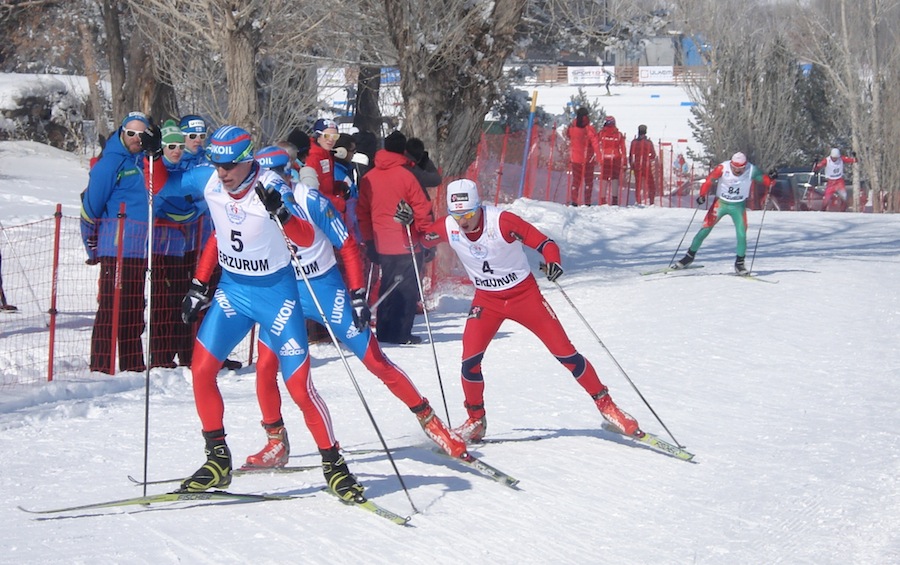
    Ustiugov (RUS) leading the pack during the classic leg. Photo: Reese Hanneman.

    In preparation for the Erzurum championships set at high altitude, the Russian squad trained for 17 days at 2,000 meters in Bulgaria prior to coming to Turkey. With the performances they’ve churned out so far, the camp has clearly paid off.

    The skiathlon consisted of eight laps—four classic and four skate—with one prominent climb each time around. None looked as strong or as efficient as the Russians. One coach observed at the top of the course that as everyone else was sputtering and out of breath on the big ascent, Ustiugov and his teammates appeared to be hardly working at all.

    Skar did his best to hang on, but in the end didn’t have the gas to respond to Ustiugov and Maltsev’s closing speed.

    “I tried to keep up with them but in the seventh lap, Sergey and Artem were going so fast. I was just standing with my eyes open,” said Skar, illustrating his point with a dumbfounded look.

    Unlike the Russians, Norway’s junior squad decided against an altitude camp prior to Erzurum, so as not be overtired for the long-term.

    “I did not have a chance. I am not used to competing at such a high altitude,” said Skar. “If we were lower I would have gone much harder. But here I had to be careful.”

    The Russians are the clear favorites to win the relay on Sunday, but Skar is hoping to give them a run for their money.

    “Russians are big favorites, but if we Norwegians all of us have a great day, we can be there as well. I will try to deliver my best and fight for victory,” Skar said.

    The pack skiing out of the stadium on the first lap. Photo: Reese Hanneman.

    Richards Leads Canadian Contingent in 20th; Hanneman 23rd

    Geoffrey Richards (CAN) skied a smart efficient race on Friday, sitting back before the exchange and waiting until his stronger skate technique to move up in the pack.

    “[My] plan was to ski conservative in the classic portion and stick around 35th,” said Richards, who ended up skiing around 45th in the beginning.

    From there, the he wanted to “have a good exchange and use the big climb on the course to move up the positions,” said Richards. “I ended up feeling pretty tired on the second and most of the third skate lap but threw down on the last time around and passed about six people on the climb.”

    In describing the race experience in Kandilli, where the altitude makes the climbs that much more painful, Richards said that he “definitely feels like I’m hanging on the back for the most part, although [I] felt a lot more in control with the skate, but still was running a little scared for the whole race.”

    Canada’s head coach Eric de Nys thought Richards had skied a smart race, and executed his plan to the T.

    “It worked out really well for him,” said de Nys.

    “And we beat the Americans,” he joked. “They beat us yesterday but we got ‘em today.”

    Logan Hanneman (USA) skied his best race of this week with a 23rd-place finish. In contrast to Richards’ race, he sat consistently in the top-20 for most of the 20 k.

    “I just locked on the lead pack in the classic and let them pull me around,” said Hanneman. “For the skate, they pulled away a little and then it was just—survive to the finish line.”

    Hanneman was pleased with the way his first skiathlon turned out.

    “My goal was to hang with them for the class and who cares what happens, as long as you try to hang with them… I did that, and survived.”

    The next North American was Alexis Turgeon (CAN), who skied to 31st place. Knute Johnsgaard (CAN) was 49th, Mike Vigers (USA) finished 54th, Will Wicherski (USA) was 57th, and Forrest Mahlen (USA) was 72nd.

    Results

  • Ustiugov Dominates For Skate Sprint Title at World Juniors

    Ustiugov Dominates For Skate Sprint Title at World Juniors


    The junior men's A-final finish in the skate sprint at World Juniors on Monday.

    ERZURUM, Turkey — For elite skiers under the age of 20, the FIS Junior World Championships are a focal point of the previous year’s training. No matter the national team, an athlete’s success at World Juniors causes elated finish-line celebrations, as it confirms he can ski as fast, or perhaps faster, than he ever thought possible.

    The freestyle sprint, the opening events of the 2012 championships at Kindalli Nordic Ski Center, was no exception. For the second year in a row, Sergey Ustiugov (RUS) claimed the top of the podium, having won last year’s classic sprint in Estonia. He raised his arms in triumph as he crossed the line ahead of two Norwegians, Sindre Bjoernestad Skar in second (+0.7) and Sondre Turvoll Fossli in third (+1.1).

    Roman Schaad (SUI) took fourth after a gap (+5.1) to lead a respectable showing for the Swiss—three in the top 10 on the men’s side. Ermil Vokuev (RUS) was fifth (+6.9) and Erwan Kaeser (SUI) sixth (+34.3), who suffered a fall and got left behind by the goup.

    Ustiugov was dominant all day on the 1.6 k course, having won the qualifier and every single one of his heats. During the final, he skied from the front right from the gun and never looked back. As the lead group of three free skated back down into the stadium, Ustiugov still led the Norwegians, and afterwards he remarked that he had been confident all day that he could win again.

    Skar and Fossli, close friends and competitors on the Norwegian squad, said in the press conference that they had each been aiming for the win, but still seemed pleased with podium finishes. Brit Baldishol, one of the Norwegian coaches, said she was “very happy” with how her athletes had performed.

    Asked if she had expected multiple podium finishes on Monday, Baldishol said, “It was not unexpected… But, you never know in sprints, how people will do.”

    The US men get started at World Juniors in the sprint qualifier.

    American Men Come Close, But Miss Heats

    In their first test against the best junior skiers in the world, the Americans Logan Hanneman and Cole Morgan came within a second of the top 30, but didn’t quite make it. Hanneman was 0.7 seconds out of qualifying in 34th, and Morgan was just behind him in 35th, 1.0 second back from 30th.

    Hanneman, a sprint-specialist, had been aiming to both qualify and move onto the semifinals, and was subdued after his inaugural World Junior Championship run.

    “I went fast, but it wasn’t quite fast enough,” he said after his qualifier. “Those guys are pretty quick.”

    In describing the course, Hanneman said it favored strong V2 skiers, as the climbs weren’t steep and the rest of the course was either transition or free skating.

    “It’s just on the gas all the time, and at altitude that’s a hard thing to do. Near the end you’re dying pretty good,” he said. “But, if you have something left in the tank, you didn’t go hard enough.”

    Hanneman thought he’d had plenty of time to adjust to the 5,000-plus feet of elevation, and though disappointed he’d fallen short in his main event, he was optimistic for the 10 k classic on Wednesday.

    “We have a whole week left.”

    Morgan, like Hanneman, was competing in the first Junior Worlds race on Monday. He took the one-second difference between himself and the heats as a source of confidence rather than disappointment.

    “I’m a little bummed about not making the heats,” Morgan admitted. “Those guys are fast; I was happy to be close. I wasn’t too far away, so it was kind of a confidence boost that I can ski a little bit with those guys.”

    Will Wicherski was the next U.S. finisher behind Morgan in 72nd (+25.39). As a distance-specialist, Wicherski hadn’t originally been planning on entering the sprint, but decided to ski to get another start under his belt.

    “I’m not much of a sprinter, so for me it was just hard to get that kind of power you need on these courses,” he said of his race.

    During the free-skating transitions of the course, Wicherski felt he skied well, but knows that he needs to develop his V2 power. His man focus this week, however, will be the 20 k pursuit. There, he’s hoping for a top-30.

    Forrest Mahlen was the fourth American in the qualifier in 87th (+38.46). He skied what he thought was a good sprint until the final downhill before the stadium, where his ski caught on the unusually wide corduroy and he fell, losing valuable momentum.

    “On the final descent, a coach was yelling for me to tuck skate, and I was just tucking,” Mahlen recalled. “My ski got caught in the grooming, and I took a little spill. Up to that point thought it was really good.”

    Mahlen didn’t appear to be taking his fall too hard, and was already looking forward to the 20 k pursuit.

    “I’m super stoked for that, it’s a mass start, it should be good… I’m feeling pretty ready to go.”

    Final results

    World Junior men's podium (l to r): Sindre Bjoernestad Skar (NOR) 2nd place, Sergey Ustiugov (RUS) 1st place, Sondre Turvoll Fossli (NOR) 3rd place, Roman Schaad (SUI) fourth place and Emil Vokuev (RUS) fifth place.