From the FasterSkier archive — posts syndicated from athletes’ and coaches’ own blogs between 2004 and 2012, kept online as published. Current coverage is at fasterskier.com.
Corresponding with a social media post from Johannes Høsflot Klæbo, the Norwegian news outlet NRK reported yesterday that each of the men’s national team sprinters who competed in Lahti last weekend has tested positive for COVID-19. Head sprint coach Arild Monsen told NRK that Håvard Solås Taugbøl was the first to test positive on Monday, followed by Erik Valnes, Pål Golberg, Sindre Bjørnestad Skar and Johannes Høsflot Klæbo on Tuesday. According to Trondheim regional newspaper Adresseavisen, the final Norwegian sprinter who raced in Lahti, Even Northug, has also been affected.
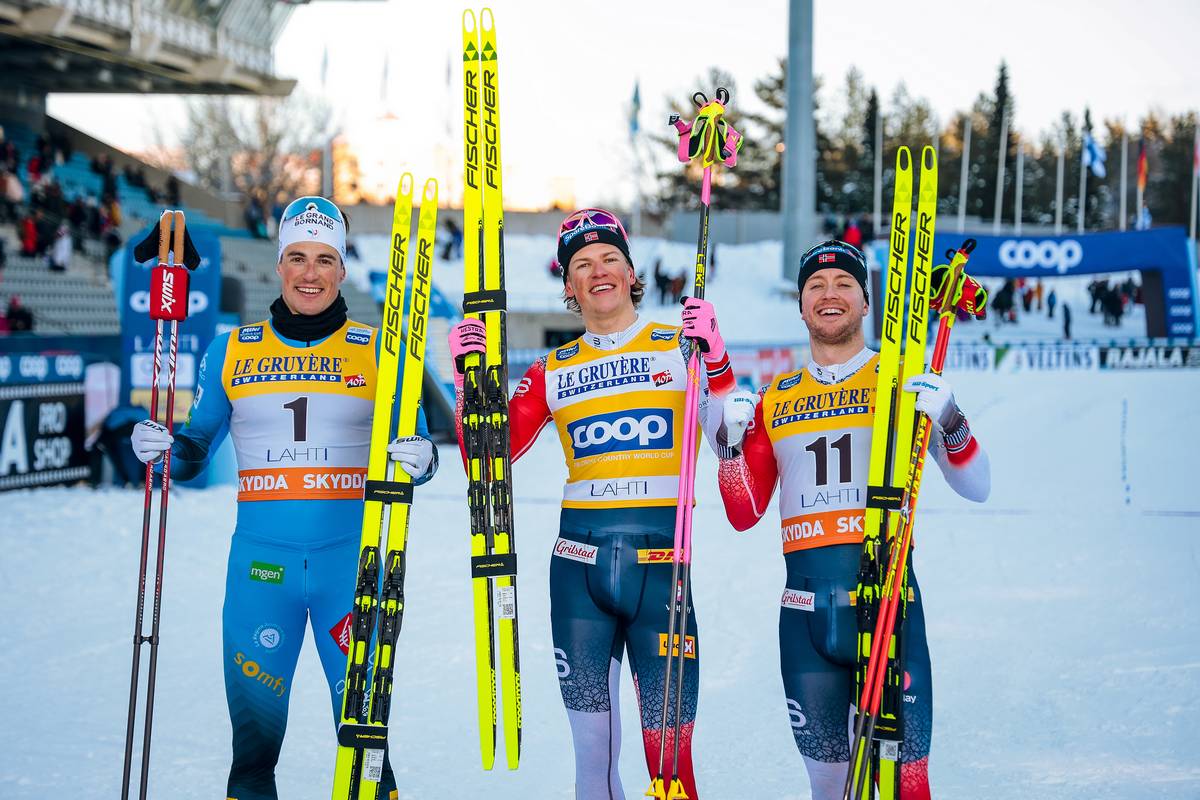
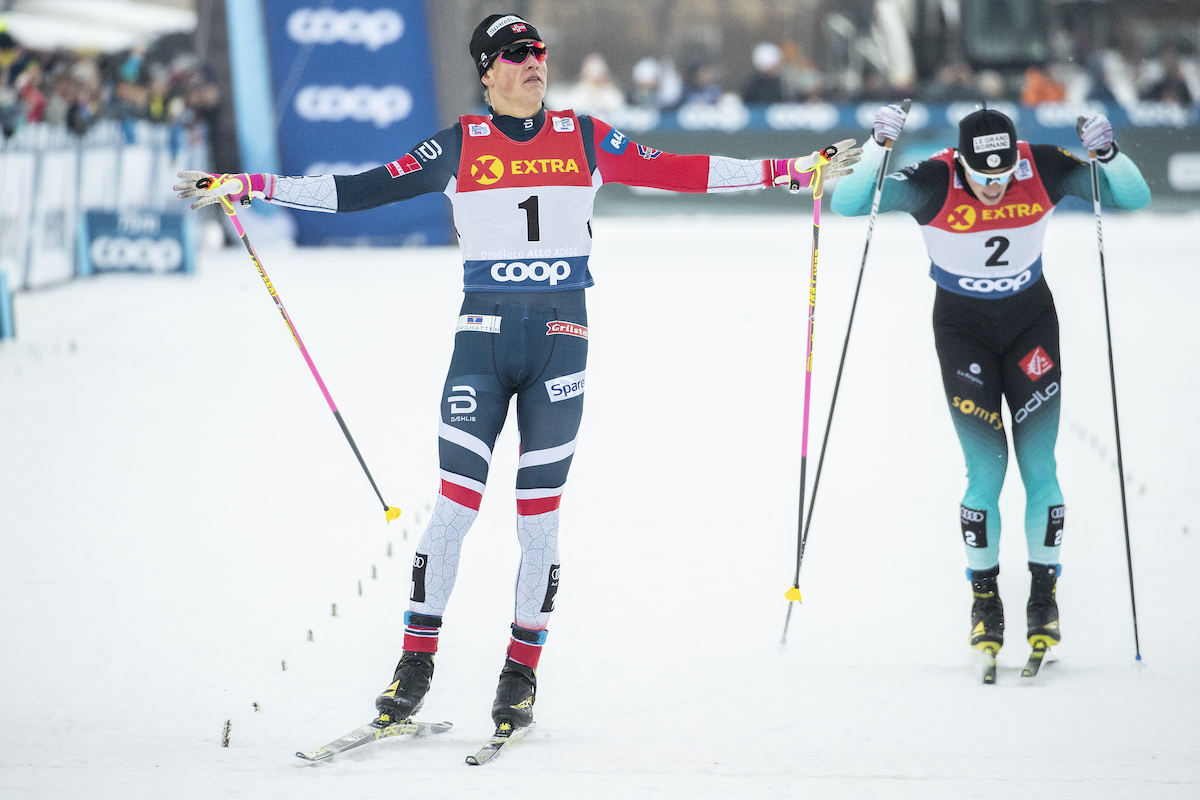
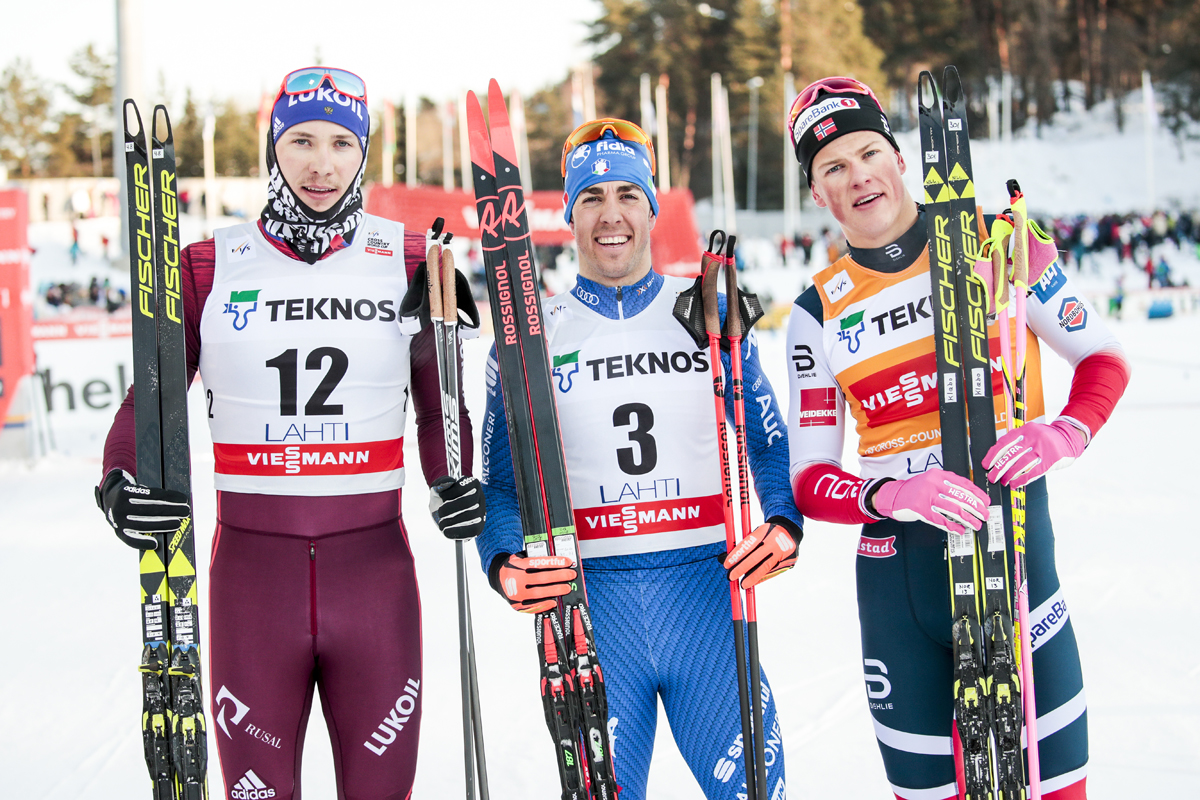
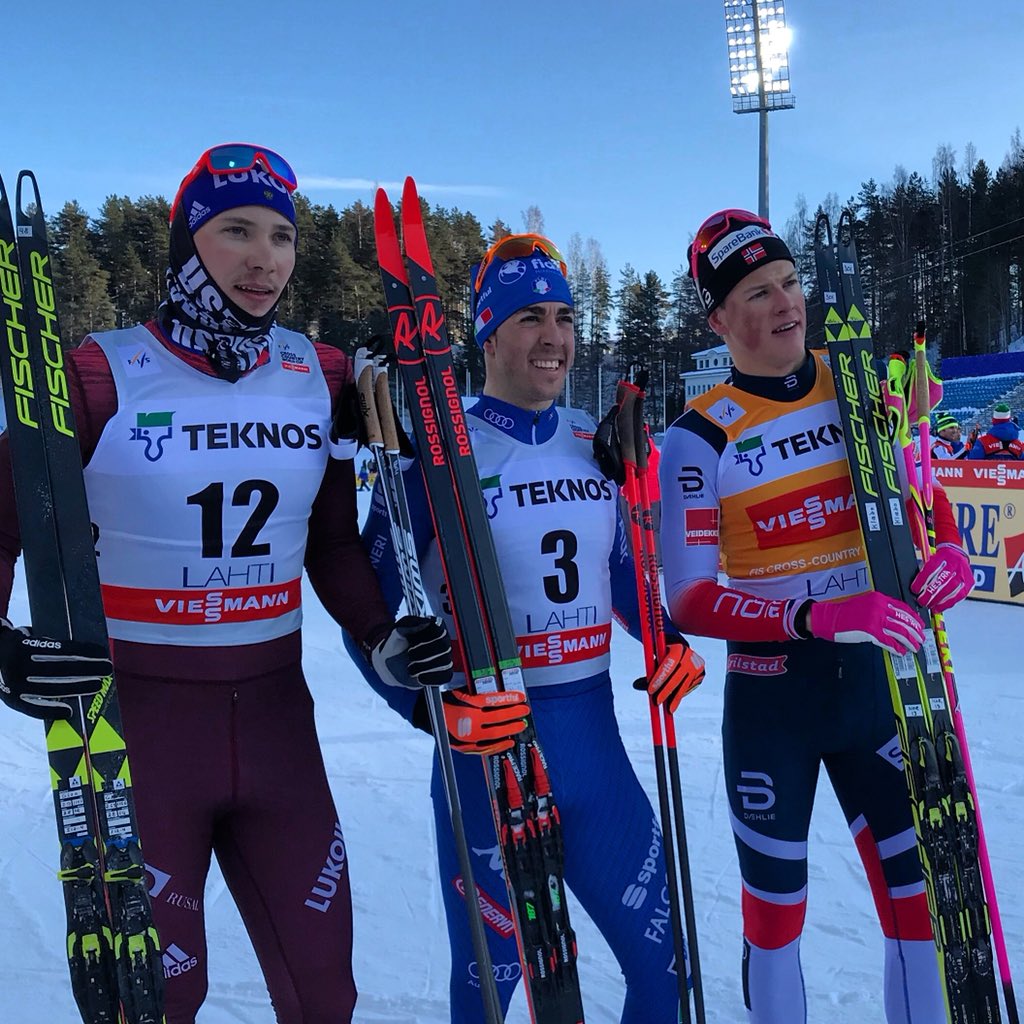
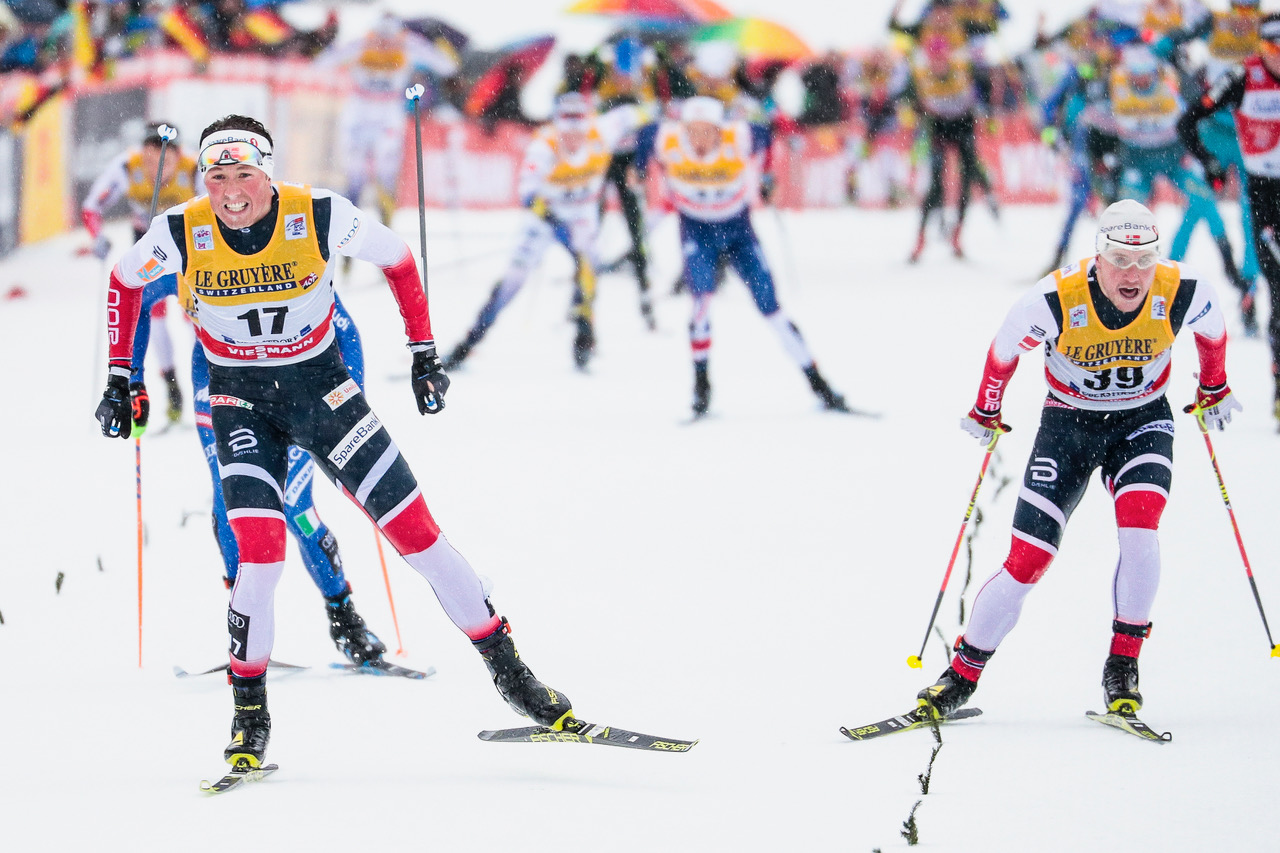
Johannes Høsflot Klæbo (NOR) takes the win in Lahti’s freestyle sprint ahead of Lucas Chanavat (FRA) and Sindre Bjørnestad Skar (NOR). (Photo: NordicFocus)
“It must have occurred in and around the stay in Lahti,” Monsen explained to NRK. “Håvard was the one who noticed symptoms on Monday. The others have little or no symptoms.”
Given the proximity to the upcoming sprint races in Drammen, Norway, Monsen indicated that these men would not be attending the competitions.
“What happens after that, we just have to look at. It’s boiling in many fields in the world now. This is smaller than other things, even though it is [disappointing] for those they concern,” Monsen continued.
At this time, no other athletes from the Norwegian program who attended the competitions in Lahti have tested positive. While the transmission link between the sprinters is clear, some athletes participated in both sprint and distance races, including Klæbo, who won the freestyle sprint and took second in the 15 k classic.
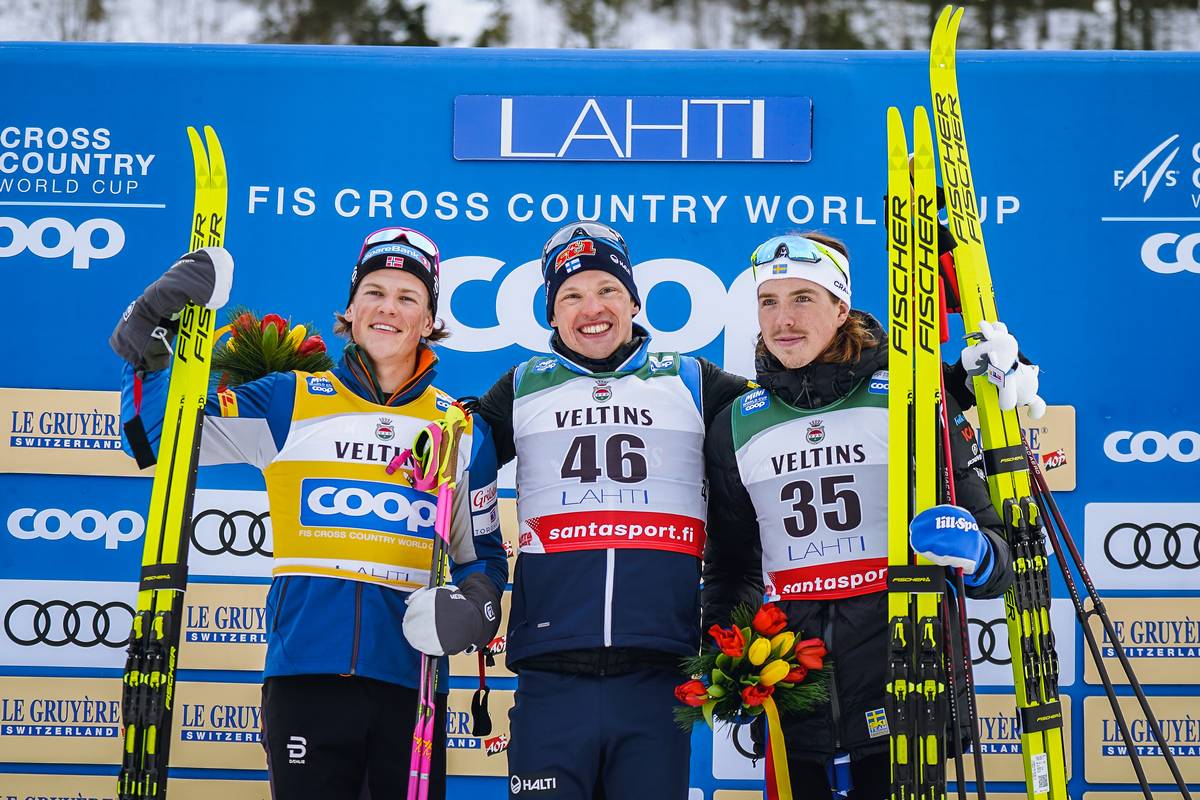
The men’s 15 k classic podium in Lahti: Iivo Niskanen (FIN) took the win in his signature event, ahead of Johannes Høsflot Klæbo (NOR) and William Poromaa (SWE). (Photo: NordicFocus)
Team doctor Øystein Andersen indicated to NRK that the original source of the outbreak remains unknown.
“It’s hard to say [how this began],” Andersen said. “Everyone came from their own bubbles before this race, after they returned home from the Olympics. We must now first map out whether there are more [positive cases] and conduct infection tracking, so that we avoid more infection.”
As the World Cup Finals slated for March 18-20th currently remain listed as “canceled” on the FIS calendar, it is unclear whether these athletes will be able to compete on the World Cup again this season.
Klæbo told NRK that “most indications are that the season is over,” however, the loss of competition would not significantly impact his season outcome. Klæbo currently leads the World Cup overall standings by nearly 500 points over Russia’s Alexander Bolshunov, who is also unable to compete as FIS banned athletes from Russia and Belarus from competition for the remainder of the season. The next closest athlete to Klæbo is Finland’s Iivo Niskanen, who sits nearly 800 points back with limited scoring opportunities remaining. As the Falun World Cups feature a mixed relay and team sprint, this leaves two sprints and two distance races, worth 100 World Cup points each, currently confirmed on the FIS calendar.
If World Cup Finals are held at an alternate venue, athletes could score a maximum of 50 points per day, with the opportunity for up to 200 bonus points should they win the three-day mini-tour.
This still leaves fewer than 800 points on the table, and as such, it looks like Klæbo will win the overall World Cup regardless of whether he competes again this season.
Klæbo also leads the World Cup sprint standings with a 210 point lead over Richard Jouve, and is 237 points of third-ranked Lucas Chanavat, both of France. Classic sprint events are scheduled for Drammen on Thursday, followed by another classic sprint in Falun on Friday, March 11th. If World Cup Finals take place, there will be a third sprint opportunity there, raced freestyle. This leaves 200 points available without the World Cup finals, and 250 including them.
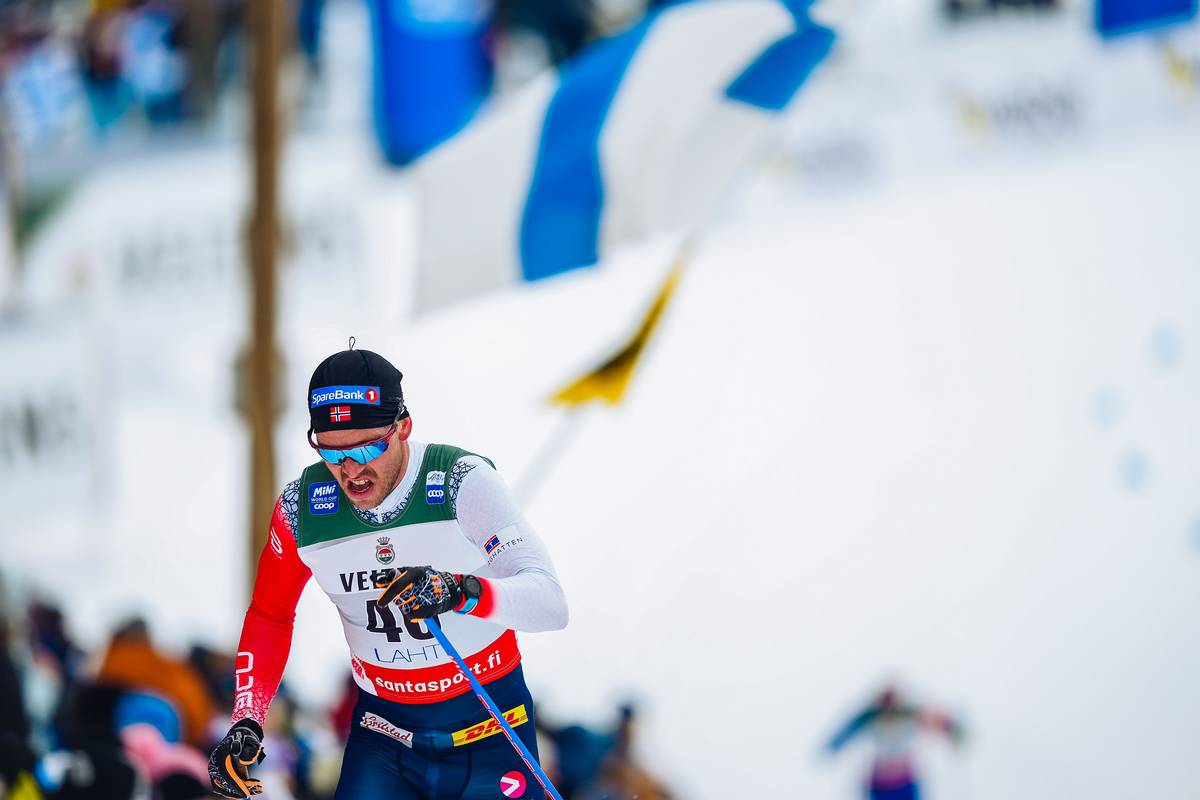
Norway’s Pål Golberg tested positive for COVID following the weekend of World Cup racing in Lahti. (Photo: NordicFocus)
“There is nothing to do but take it easy,” Pål Golberg said to NRK. “It’s [disappointing] that it’s coming now, but we can be very happy that we managed to avoid more infection in the camp before the Olympics when people became infected in Seiser Alm.”
On what is next, Golberg continued, “If I do not develop symptoms, it may be relevant to go to Falun next weekend. And then there are many [domestic] races over the late winter. Then we will see if it is worth it.”
On February 26th, the Norwegian Ski Association (NSA) released a statement indicating that in light of the nation’s recent invasion of the Ukraine, Russian participation was not welcome at the upcoming World Cup sprint races in Dramman or the storied Holmenkollen distance races outside of Oslo. In addition to these cross country events, Norway is scheduled to host competitions in alpine, nordic combined, and ski jumping, including the World Ski Flying Championships in Vikersund.
A press release shared by Norwegian news source NRK stated: “The board of the Norwegian Ski Association has today discussed the situation related to Russia’s invasion of Ukraine, and how this affects the upcoming World Cup races and the world championship in Norway. The Norwegian Ski Association’s message to Russia and Russian athletes is crystal clear; We do not want their participation!”
NSA president Erik Røste told NRK that a request had been made to the International Ski Federation (FIS) to officially bar the Russian program from participating, but as of Saturday, FIS had not taken action to comply with the request, instead pointing to the official cancellation of remaining FIS events held in Russia.
“The attack on the Ukrainian people and the great suffering we see pictures of now, the sport can not remain passive and be neutral,” Røste said of the request. “Therefore, the board of the Norwegian Ski Association was clear that this must have consequences beyond what has already been decided. Therefore, we will send a clear and distinct signal to FIS that we do not want Russia and Russian athletes to participate in competitions in Norway in the coming weeks.”
Ultimately, it is up to the board of FIS whether Russia will be allowed to compete in the remainder of World Cup events. A response NRK received via email today stated:
“The FIS board has been clear in its approach to Russian athletes in all FIS competitions. To ensure fair and inclusive competitions at all FIS events, national federations and local organizers should not exclude athletes on the grounds of gender, race, nationality or sexual orientation.”
Alexander Bolshunov (RUS) wins the 2020 Holmenkollen 50 k in the fog, ahead of Norway’s Simen Hegstad Krüger. (Photo: NordicFocus)
As such, no Russian athletes or coaches have been denied entry to Norway, and Stefan Marx, the general manager of Holmenkollen ski festival, indicated there is little more that the organizers can do to prevent Russian participation in the events.
“We must let them participate,” Marx said to NRK. “Those who FIS and the Norwegian Ski Association say must be allowed to participate. We do not have the authority to refuse anyone to participate, but we have supported the Ski Association and the Sports Association’s position. It is up to FIS or the authorities to decide, but we are clear in our support for the Ski Association’s proposal that Russian athletes are not wanted due to violations of international law that have been committed.”
After flying from Helsinki following the Lahti World Cup races, Russian teams have begun to arrive in Norway. When pressed by the media upon his arrival, World Cup distance leader and favorite for the upcoming 50 k classic at the Holmenkollen, Alexander Bolshunov chose to remain silent. NRK did, however, receive comments from multiple Russian coaches, including head coach Marcus Cramer who felt that sport and politics should be kept separate.
“What do sports and athletes have to do with this situation? It’s really tough. I just get sad that the Norwegian association thinks like that. We really have a good communication between us. With everyone who works there. It’s sad to hear this, especially when they take it to the press and not us first,” said Cramer.
Another Russian coach, Jegor Sorin, who had been working at the Junior/U23 World Championships in Lygna, NOR and planned to join the Russian team in Oslo, echoed that Russian athletes should not be held accountable for the
“I am very upset that the Norwegian association wants this,” Sorin told NRK. “I can understand that no one wants to travel to Tyumen for the World Cup, but I do not know what happens to us… We are Russian athletes. We are here, we are not in any war. We are athletes, not soldiers. Maybe they think we have weapons. We want peace and for me this is very strange.”
Alexander Bolshuonv is photographed with his four Olympic medals from the 2022 Games, with one event remaining. He would leave the Games with three gold medals, and a total of nine Olympic medals including those won in 2018. (Photo: NordicFocus)
Though the Russian coaches focused on a separation between sport and politics, others have pointed out the direct ties between sporting success and military recognition. Used as an example, Bolshunov and Denis Spitsov were promoted to the rank of captain in Russia’s National Guard in recognition of their success during the 2022 Olympics. Bolshunov, who has earned a medal in each of his nine Olympic appearances, including three gold medals in Beijing, received additional honors in the form of the Alexander Nevsky Order, given in recognition of “special service for the fatherland.”
FIS cross-country committee leader, Vegard Ulvang told NRK, “Russian athletes are [military] officers. This makes the symbolic value [of their participation] even greater.”
A similar statement was made by Global Athlete representative and former U.S. Ski Team athlete Noah Hoffman.
“While I feel for the individual athletes, all Russian skiers should be banned from the FIS Cross Country World Cup for the rest of the season,” Hoffman tweeted. “Their results are used to drum up nationalism and bolster the Russian State. Allowing them to compete aids Russia. #StandWithUkraine.”
Ulvang is urging a stronger response from the Norwegian Ski Federation, suggesting that they relinquish the FIS World Cup status of the events at the Holmenkollen in order to gain the authority to prohibit Russian participation.
Jan Petter Saltvedt, a Sports Commentator for NRK described Ulvang’s statements as a “moral ultimatum.”
“Ulvang demands an open rebellion from NSF against his own superiors,” Saltvedt said. “And he should get it. Vegard Ulvang puts so much pressure on the Norwegian Ski Association that they can not help but act… At the same time, he expresses a very strong and clear criticism of FIS, where he himself is one of the powerful committee leaders, but still does not feel he is heard at all.”
Norwegian athletes who have been asked for comment have given mixed responses, often acknowledging the complexity of the issue and whether the athletes themselves should be at fault for government decisions.
Among those with a clear stance, Erik Valnes spoke of disallowing Russian participation. “There is a heavy symbolism in it. It would send a signal. Since [Bolshunov] is [a captain of the Russian National Guard], they have already mixed sports and politics in a way. It is difficult. It is a great pity that it will be like that.”
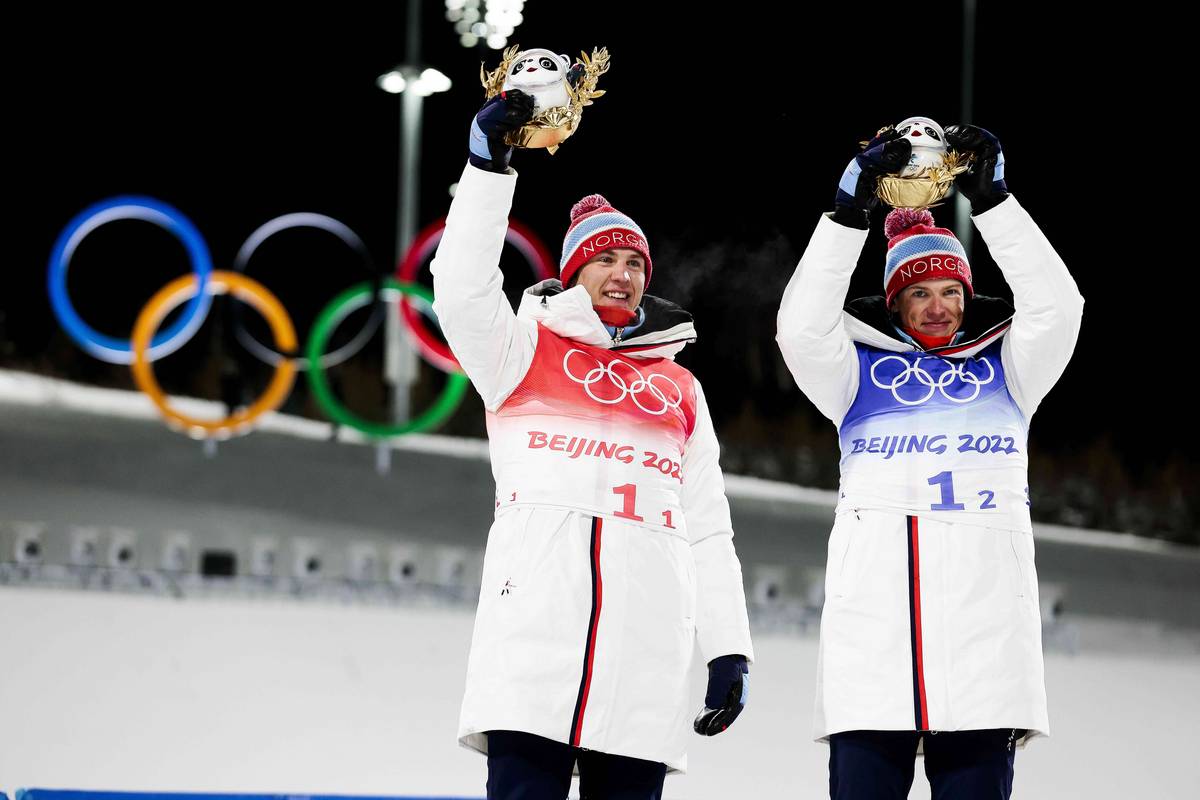
Erik Vales and Johannes Høsflot Klæbo earn gold in the classic team sprint during the 2022 Beijing Games. (Photo: NordicFocus)
Johannes Høsflot Klæbo also spoke in support of the NSA urging FIS to remove Russian athletes from competition.
“As an athlete, you want the best to start. We train all year to compete and then you want the best to participate,” Klæbo said to NRK. “At the same time, I support the attitude of the ski association now. There is no doubt about what is happening in Ukraine, and Russia must be condemned. I strongly condemn it and I think it is good that the association takes a stand.”
Therese Johaug acknowledged that athletes may not have direct involvement in the military actions of Russia, speaking instead to their role in representing their country through sport.
“I feel sorry for the athletes, first and foremost, I understand that they have nothing to do with this,” Therese Johaug told NRK after narrowly winning Lahti’s 10 k classic over Russian Natalia Nepryaeva. “But on the other hand, I think it is completely wrong. They front their country and the flag both on the chest and on the forehead. And that a country should also ravage the sports arena and fight for victories and front their country in the situation we are in – I think that is completely wrong.”
Therese Johaug voices her thoughts on Russian World Cup participation following her win in Lahti’s 10 k classic. (Photo: NordicFocus)
The stance is not unanimous amongst the Norwegian team. Sindre Bjørnestad Skar, who took third in Lahti’s freestyle sprint, spoke to the unfairness for Russian athletes.
“Of course, I am 100 percent against everything that is happening between Russia and Ukraine now. It is completely inconceivable. But then I also do not think that the fact that they have a Russian passport, means that they should be punished and deprived of the opportunity to do their job. In a way, I think that is a bit unfair too,” Skar told NRK.
For the time being, no further changes in Russian participation have been reported. FasterSkier will continue to follow this story as it evolves over the next few days. World Cup classic sprint races are currently scheduled in Drammen Thursday, with the women’s 30 k mass start classic in Oslo happening Saturday March 5th, followed by the men’s 50 k on Sunday.
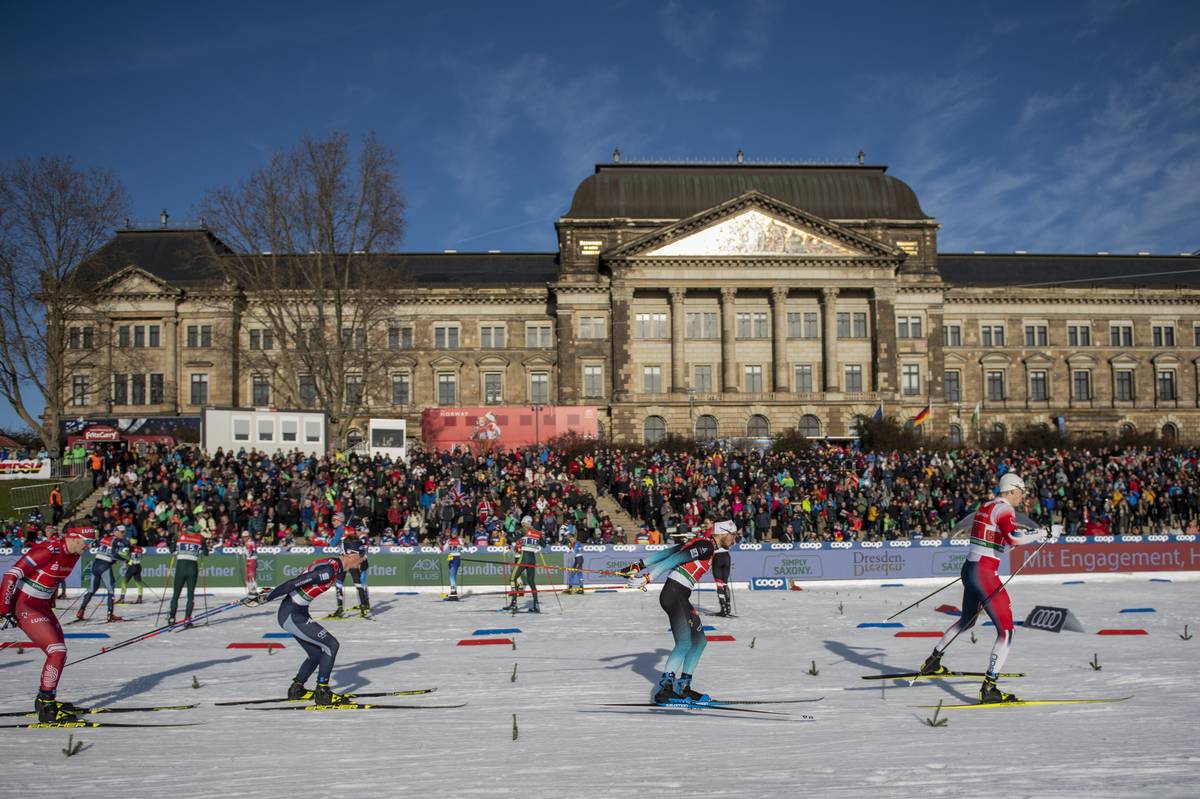
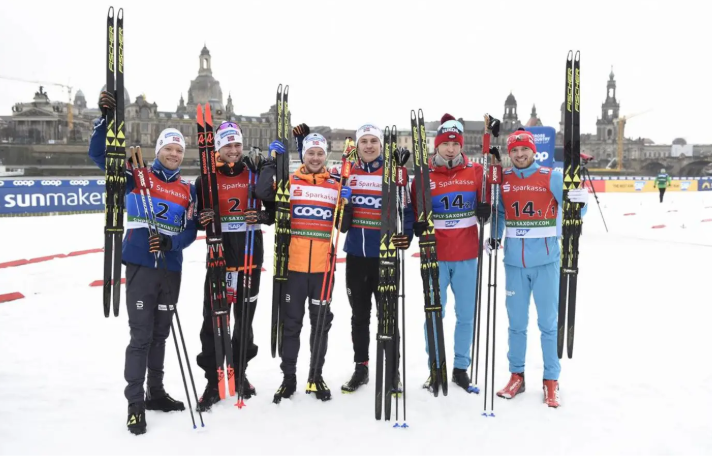
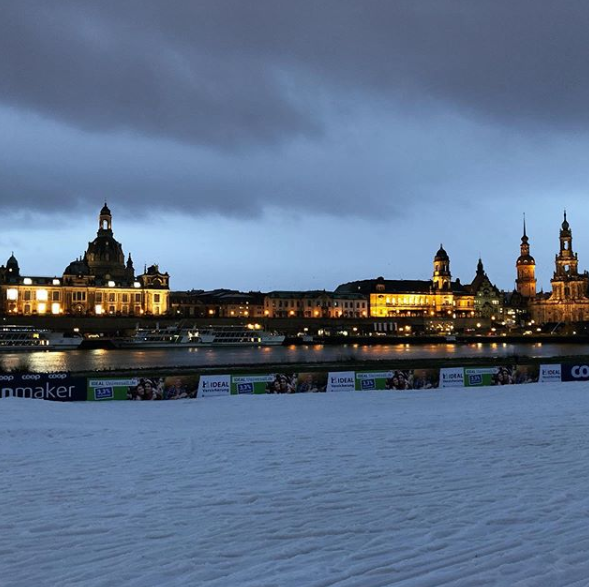
Overcast skies mute the spectacular architecture along the River Elbe, which provides the backdrop for the sprint track in Dresden, Germany. (Photo: NordicFocus)
This World Cup coverage is made possible through the generous support of Marty and Kathy Hall and the A Hall Mark of Excellence Award. To learn more about A Hall Mark of Excellence Award or to learn how you can support FasterSkier’s coverage please contact info@fasterskier.com.
In the wake of the American women taking second to the Swedish powerhouse duo, and yesterday’s top two spots on the podium, Maja Dahlqvist and Jonna Sundling, the men’s team of JC Schoonmaker and Kevin Bolger lined up to race the freestyle team sprint final on the track in historic Dresden, Germany.
“Together again,” wrote Bolger in a post-race email. “We teamed up 3 years ago when JC came over for his first World Cup and didnt ski great then together, but being able to team up again and move to the final after a really solid semi was super rad today! He skied really well all weekend and I’m so impressed with how he’s looking, so it made today really fun!”
Six quick laps each, eleven exchanges total, on a flat and fast city 0.65-kilometer loop with minimal recovery means flooded legs and tight racing. Like a series of just-over one minute intervals with equal rest, athletes take a conservative start, accruing fatigue while minimizing the opportunity for crashes and broken equipment to decide the race, over fitness and tactics. As the number of remaining laps dwindles, the pace steadily builds, like a bottle rocket, until the critical point arrives in the last few laps and leaders explode off the front in an effort to take control of the outcome.
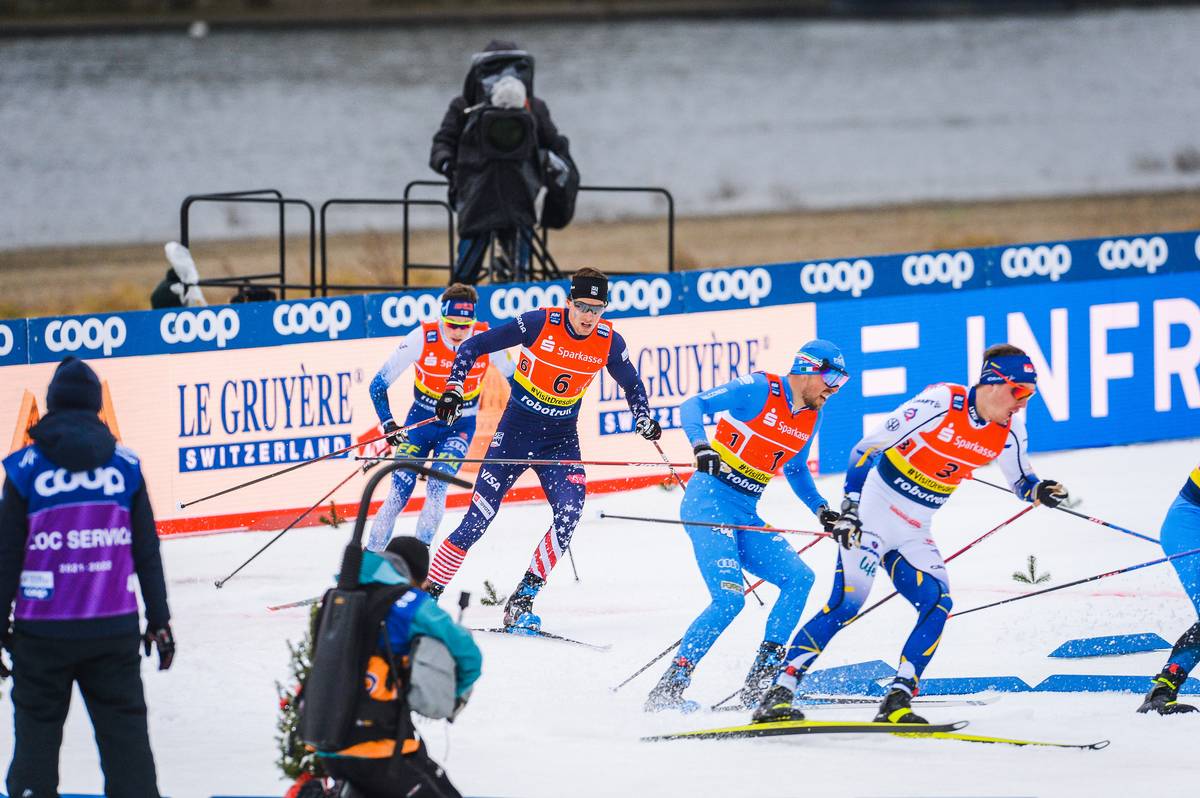
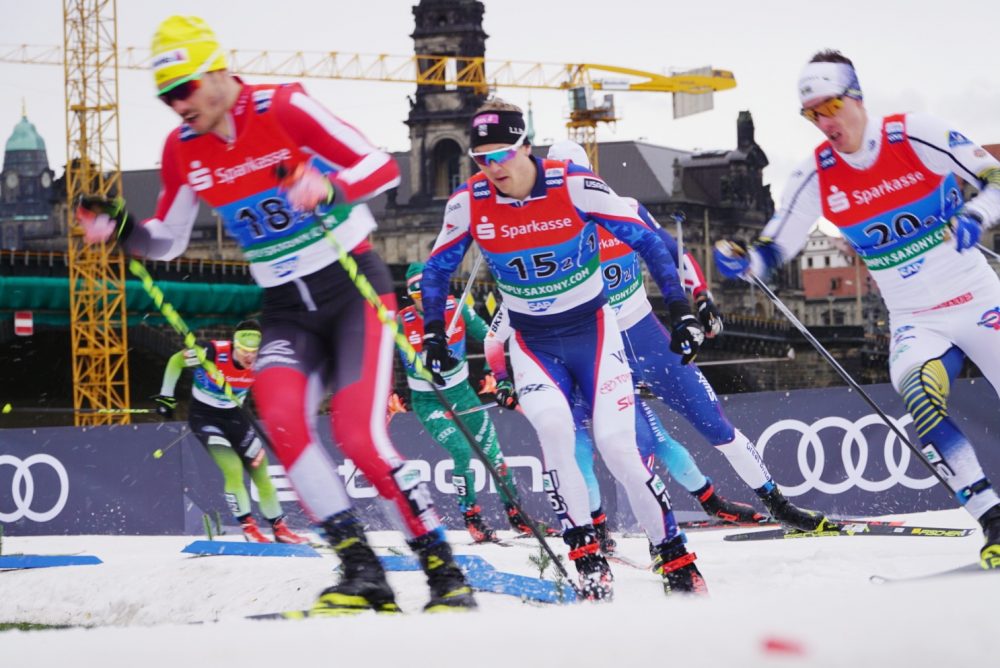
Kevin Bolger navigates a tight curve during the men’s team sprint in Dresden, Germany. (Photo: NordicFocus)
As expected from a lap that lasted just over a minute, the whole pack of ten teams stayed very tight through the halfway mark. The Norway II team of Thomas Larsen and Even Northug spent time at the front, putting in quick surges at the beginning of each leg to re-establish their position.
Tagging off after lap 6, the team tagged off with Great Britain on one side, and the Norway I team of Sindre Bjørnestad Skar and Håvard Solås Taugbøl, on the other. Still very much in the mix were the Russia I pairing of Alexander Bolshunov tagging Gleb Retivykh, Italy’s Francesco di Fabiani and Federico Pellegrino, and France’s Richard Jouve and Lucas Chanavat.
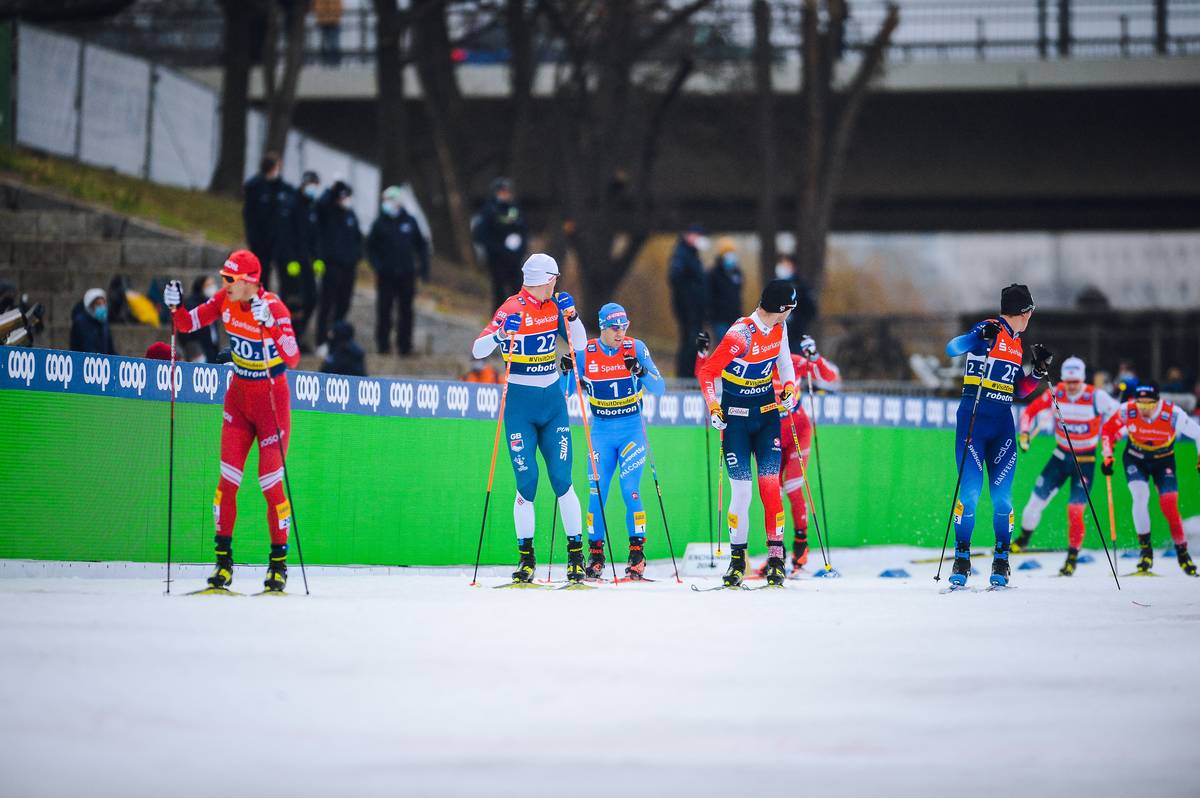
The leaders wait for a tag during the Dresden team sprint. (Photo: NordicFocus)
At the half, the Americans remained in contact near the back of the pack, as Bolger tagged Schoonmaker in 9th (+2.0).
Coming into lap 9, Bolshunov made a move to the front to take the reins for Russia I, with both Norway teams and Jouve quickly responding to his tempo, while Italy and Great Britain worked hard to maintain contact. This burst set the tone for the final three laps.
As Retivykh unsuccessfully attempted to drop Taugbøl and Northug in lap 10, the pack in pursuit began to stretch out. While all remained in contact with the leaders, Great Britain began to look out of the running for a win, with Italy and France remaining a podium-threat in fourth and fifth. The teams behind thinned rapidly.
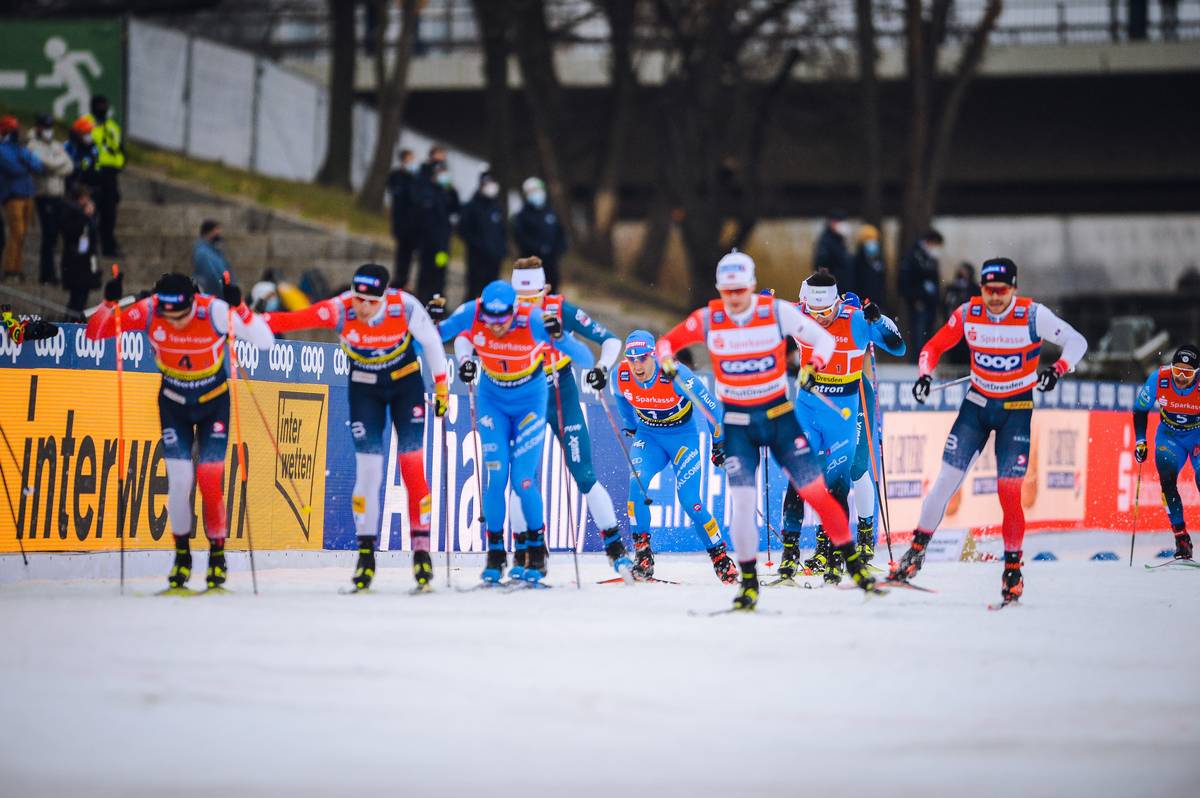
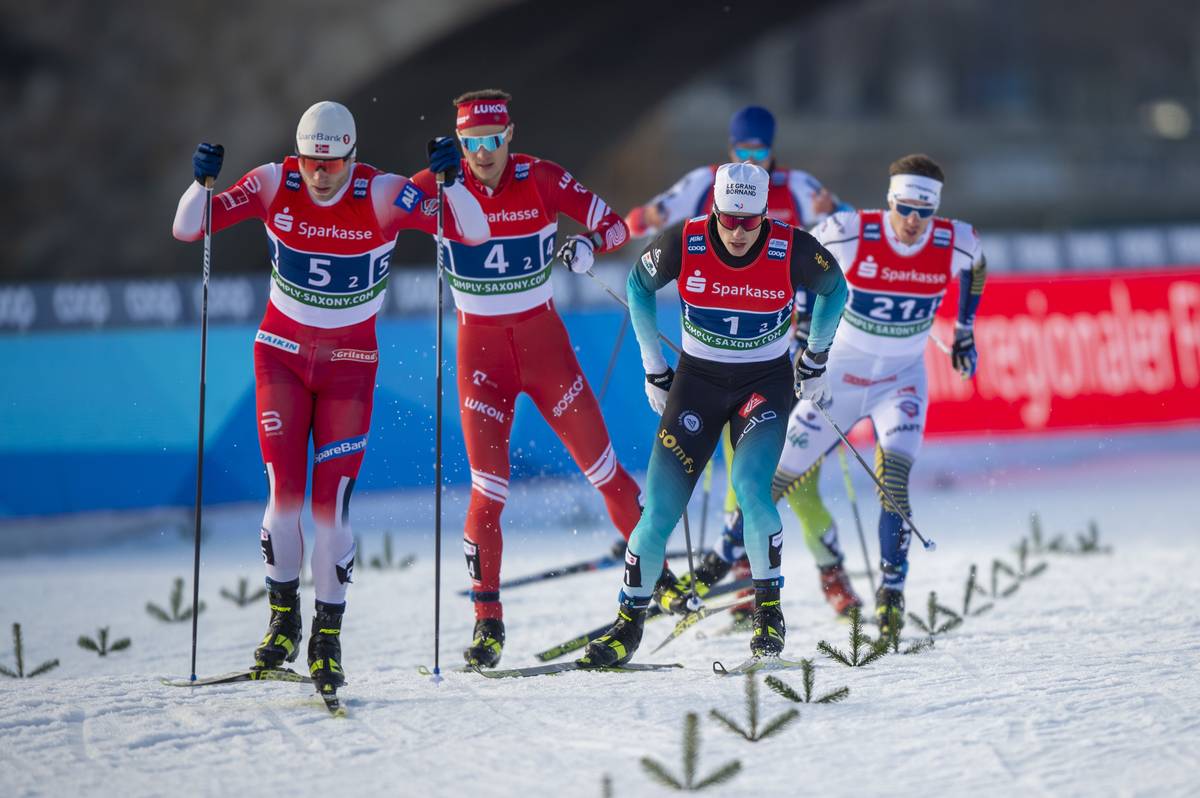
Still tight at the Tag, Norway II, Italy, and Norway I (left to right) head out for another lap during the Dresden team sprint. (Photo: NordicFocus)
In Bolshunov’s final lap, he rocketed off the front, skiing powerfully through his legs with an aggressive forward lean, carrying momentum between each push. Whereas the early laps, rounding the tight curves looked careful and calculated, the men shot around the degrading bends, losing no speed as they pushed into the straightaways.
Tagging off for the final lap, Northug accelerated ahead of Retivykh, free skating powerfully off the first roller to regain the lead for Norway II. Feet quickly stepping around the first curve, Norway II looked in control with Norway I and Russia not ceding the win just yet. Italy and France remained on their tails, still in position for the podium.
Coming into the final curve hot, Taugbøl made an attempt to slingshot Norway I to the lead, but the tactic was thwarted by the closing speed and power of Northug. Standing up to pump his fist into the air, Northug coasted over the line for the win in 14:19.34, while Taugbøl narrowly edged out a hard-closing Retivykh to make it Norway II, Norway I (+0.42), then Russia I (0.62) for the podium.
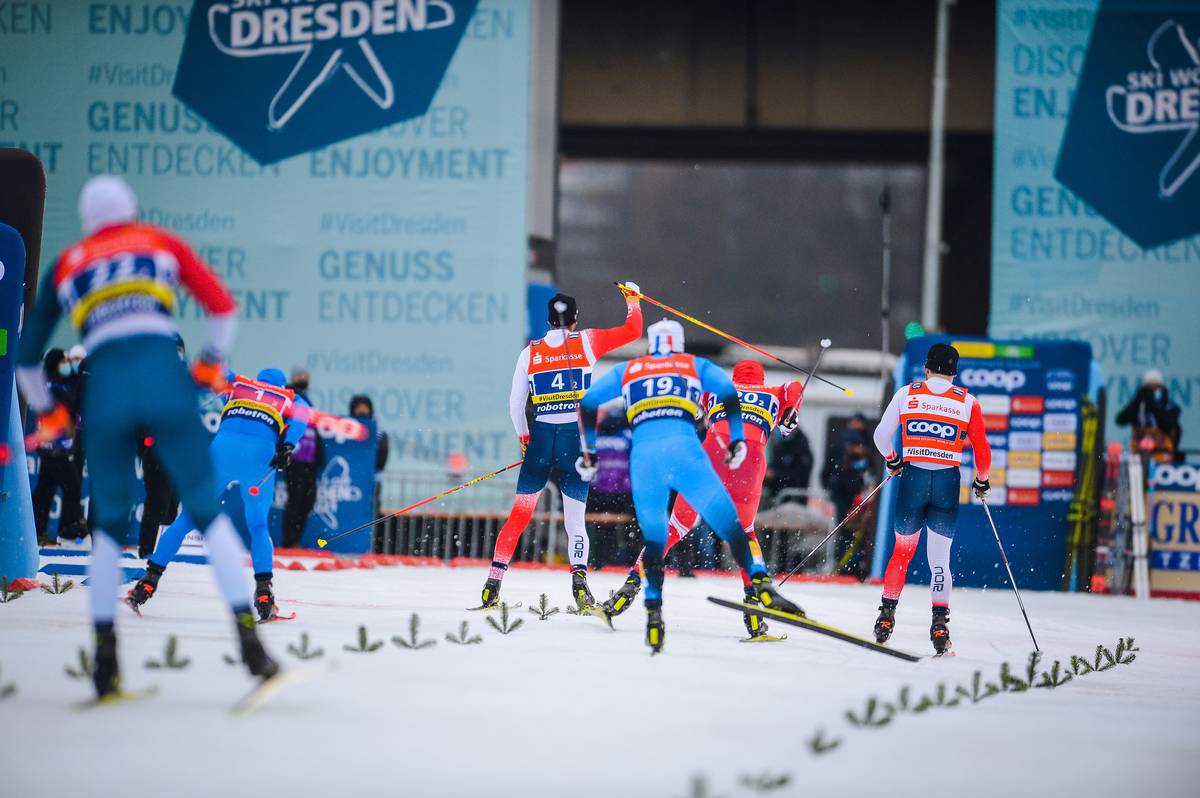
Even Northug pumps his fist as he takes the win, while the second and third spots on the podium remain up for grabs behind him. (Photo: NordicFocus)
“It was amazing,” Northug told FIS at the finish. “We struggled a little bit in the semifinal, but in the final we did everything right. Thomas sent me out first on the final lap and that was the plan. It was good.”
Speaking to the experience of racing with Northug, Larsen spoke highly of his partner, and of putting the Norway II team ahead of Norway I on the podium.
“It’s fantastic, he’s an incredibly good skier,” Larsen said. “He hasn’t had so many chances in the World Cup so far, but now he shows with yesterday and last week, he shows that he is one of the best in the world. I think this was a dream team today, and it’s cool to be the underdogs and just take it home.”After a fast final leg by Pellegrino to keep his team in the mix for the top-three, Italy was next over the line, narrowly missing the podium in fourth (+0.78), with Chanavat bringing the French I team home in fifth (+1.21). Knowing he was no longer in position to snag top-three, Great Britain’s Andrew Young relaxed in the final stretch, coasting over the line in sixth (+3.84), followed by a sizable gap to the next racers.
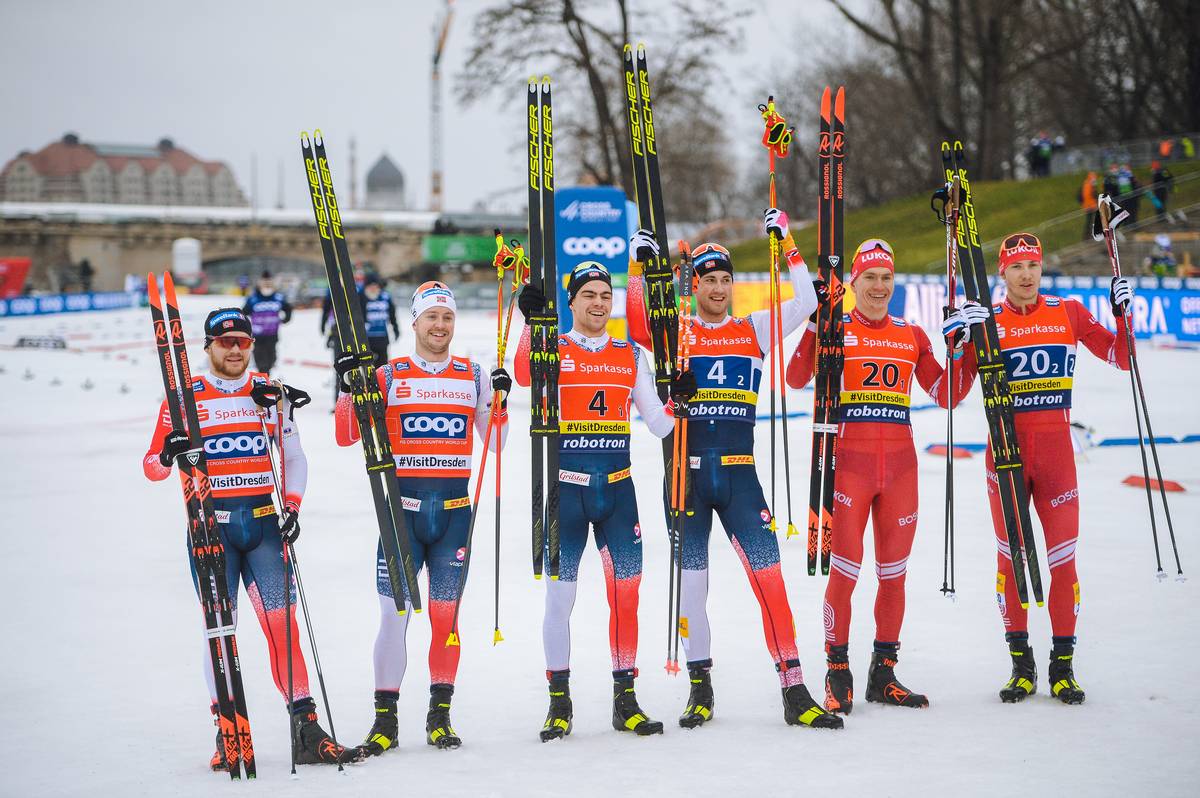
The men’s podium of the team sprint in Dresden: The Norway II team of Thomas Larsen and Even Northug took the win ahead of Norway I, Sindre Bjørnestad Skar and Håvard Solås Taugbøl, and Russia I, Alexander Bolshunov and Gleb Retivykh. (Photo: NordicFocus)
After losing contact in the final laps, Schoonmaker brought the American team to the line in 9th (+11.36).
“Dresden is a really fun event,” Bolger said after the race. “I think it’s something a lot of us skiers on the a World Cup enjoy to mix things up!”
Bolger explained that he and Schoonmaker “just wanted to stay out of trouble — and try as best as we could to put ourselves into a position to where we could attack when we needed to… I was hoping for more of a tactical final but it seemed like Bolshunov had a different plan and really pushed the pace for my leg the whole time, which made it really hurt, but I think that makes it really fun and competitive!”
Providing insights into the team’s tactics and his experience during the final, Schoonmaker provided the following comment in a post-race email from the road.
“I would say our main strategy going into the final was to conserve energy while staying in the top half of the field so that we would be able to match any moves made later in the race,” Schoonmaker explained. “It seems everyone had the same plan in mind, though, so it was tough to make that work. We were a little too far back to make anything happen when the pace picked up in the second half of the race. In Dresden, it really seems to be all about being out front because passing is just hard on a short, narrow and turny course. It’s a super fun format with the short laps, but also very challenging!”
Racing in semifinal B, Luke Jager and Logan Hanneman skied to 10th (+10.96), with the Canadian duo of Russell Kennedy and Graham Ritchie not far behind in 12th (+14.91). Neither team advanced to the finals.
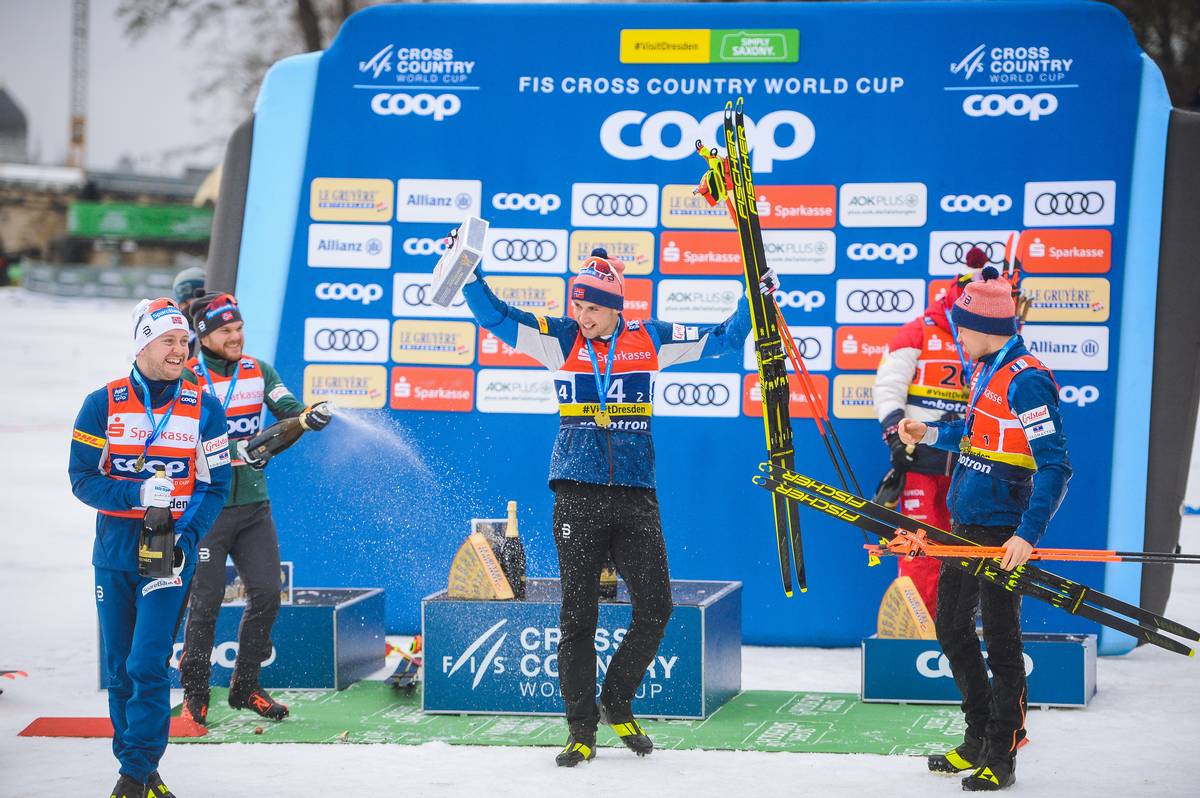
With champagne spraying, Even Northug and Thomas Larsen step off the top spot of the team sprint podium in Dresden. (Photo: NordicFocus)
Despite sitting out the weekend in Dresden, Norway’s Johannes Høsflot Klæbo currently leads both the World Cup overall and sprint standings. Klæbo is roughly 150 points ahead of Sergey Ustiugov (RUS) in the overall, and 60 points ahead of Taugbøl in sprinting.
Leading the American men, Schoonmaker sits in 11th place in the sprint standings with 112 World Cup points, and 20th in the overall. Schoonmaker is also the second ranked U23 skier, trailing Russia’s Alexander Terentev by 219 points.
Ben Ogden also ranks inside the top-30 in sprinting, sitting in 23rd with 46 points. Ogden is 4th on the U23 list, with Gus Schumacher 20 points behind in 7th. Luke Jager sits in 13th of the 21 athletes on the U23 list, with Zanden McMullen close behind in 16th. The future of American skiing is looking bright.
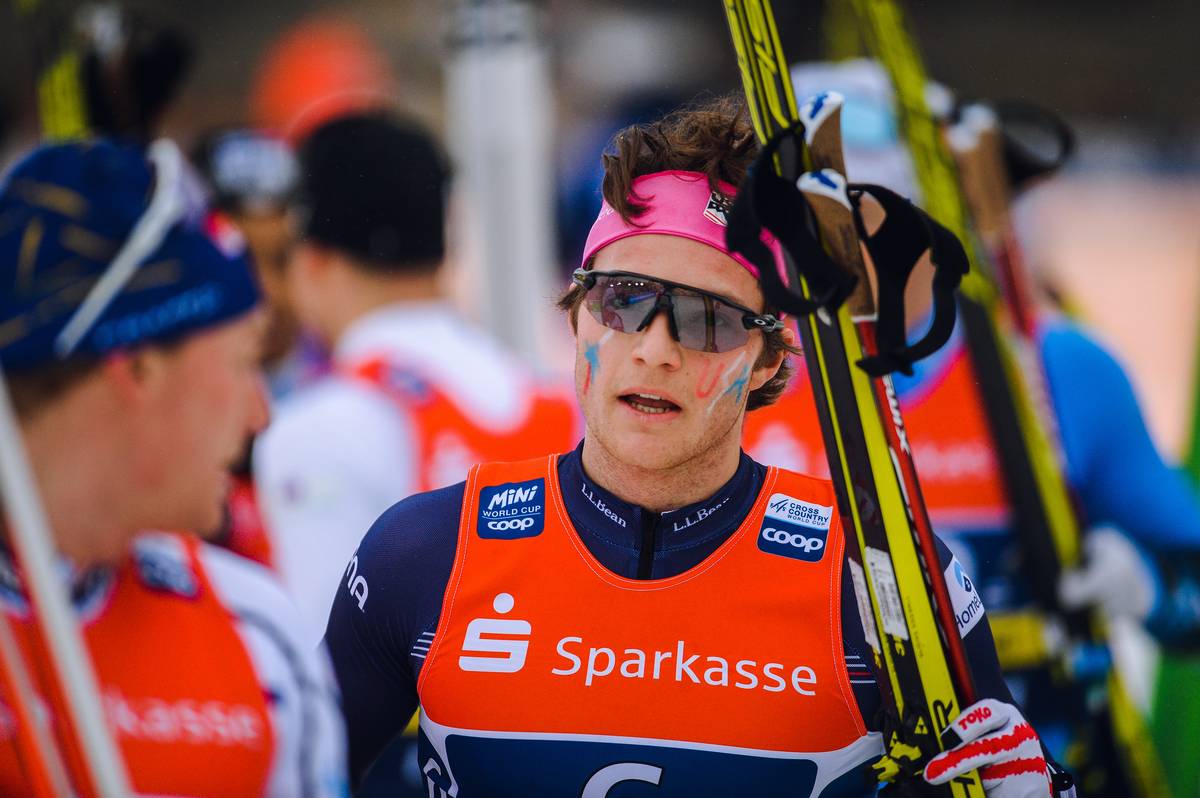
Face painted with stars and stripes, JC Schoonmaker leads the American men in the overall, sprint, and U23 World Cup standings. (Photo: NordicFocus)
After a holiday break, racing continues with the Tour de Ski, which kicks off in Lenzerheide, SUI on December 28th.
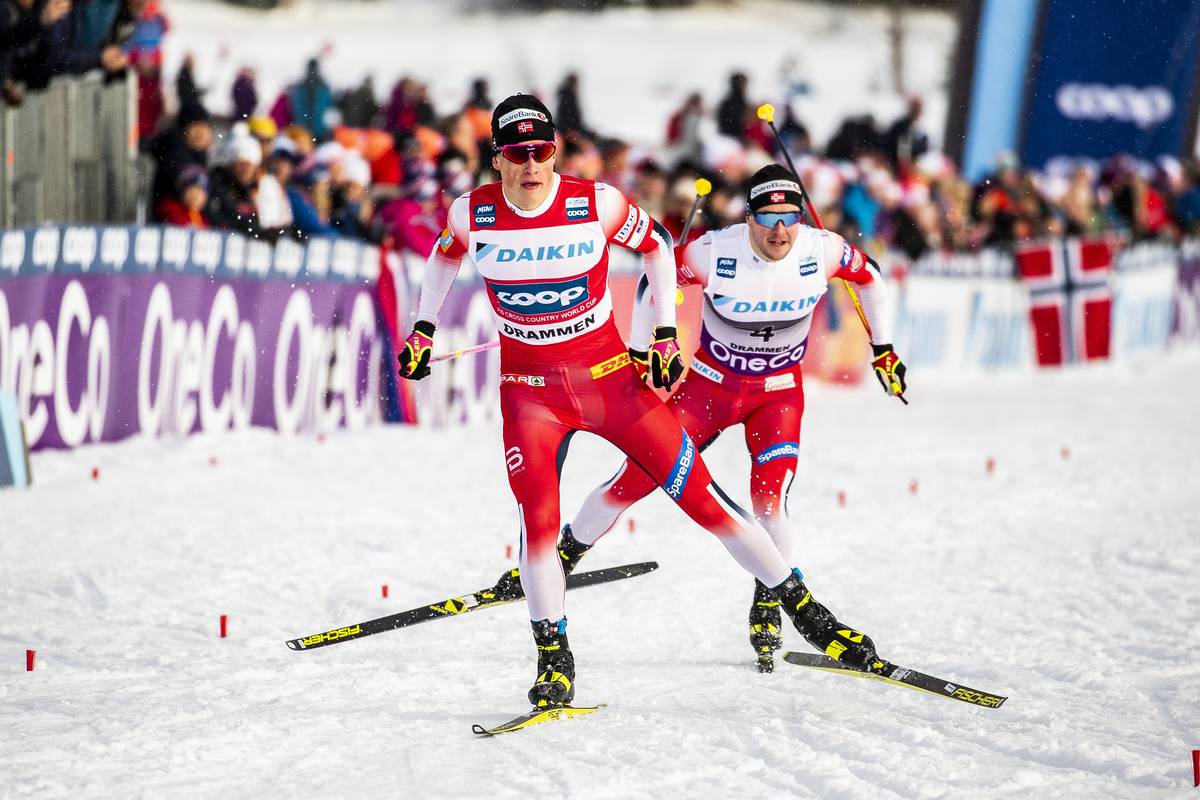
Perhaps unsurprisingly, the Norwegian men showed up on form for today’s freestyle sprints in Konnerud, just outside the city of Drammen. As the venue was used for the Norwegian National championship at the end of January, most of the team has already had a dress rehearsal racing on the windy course.
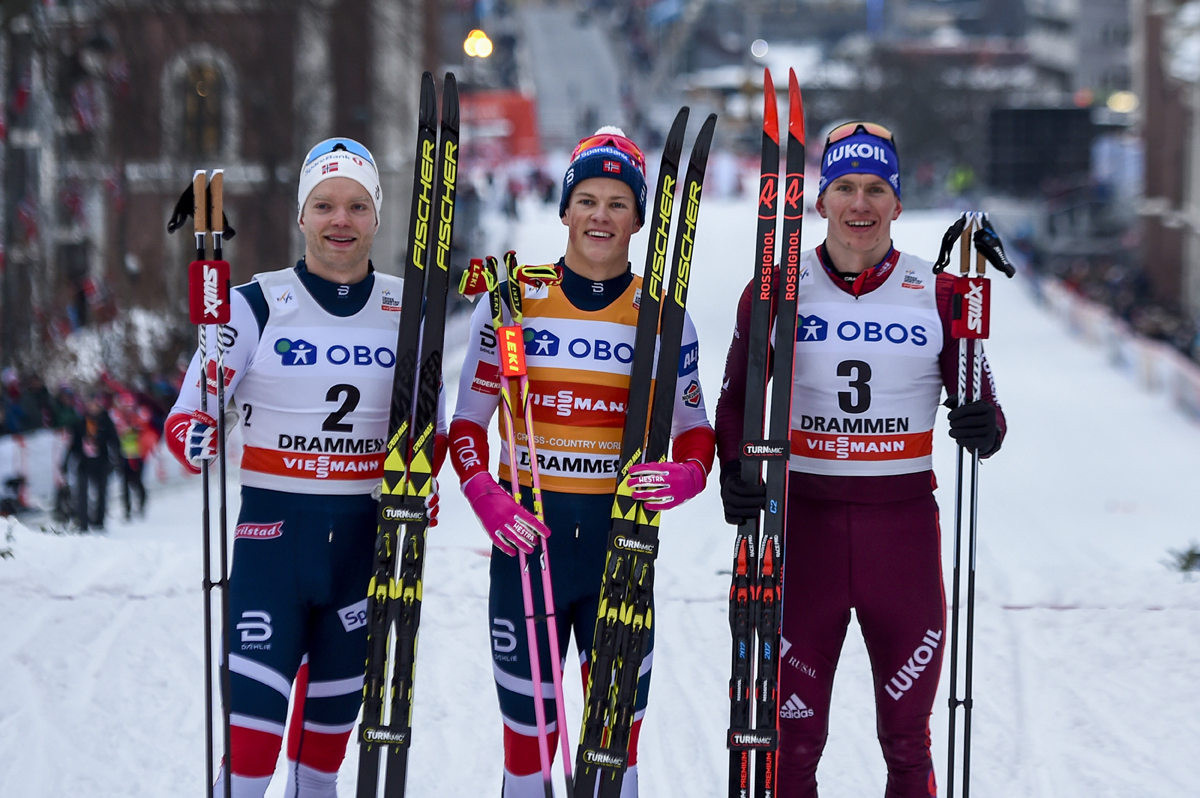
Johannes Høsflot Klæbo of Norway, where he is found most often: winning down the stretch. (Photo: NordicFocus)
It seems that Johannes Høsflot Klæbo, who sat out the national championships, did not need a dress rehearsal. He won the qualifier by a margin of nearly four seconds, continuing easily through the rounds to win the overall. This is Klæbo’s eighth sprint win of the season, matching last year’s record, and his 14th career World Cup freestyle sprint victory, the most of any male athlete.
Racing in the final with Klæbo were four of his teammates: Håvard Solås Taugbøl, Eirik Brandsdal, Sindre Bjørnestad Skar, and Erik Valnes, each of whom also raced in the national championship final on January 31st (and finished in a very similar order). Interrupting the all-Norwegian field was Alexander Bolshunov of Russia.
In the final, Klæbo hovered in the middle of the pack marking his teammates, with Taugbøl in the lead. When Brandsdal took control on the primary climb of the course, Klæbo swung outside of the group to move into second before tucking into the last downhill. As they passed under the arch and headed into the final straightaway, Klæbo engaged his unmatchable top gear, with Taugbøl and Brandsdal chasing.
After crossing in a photo finish, Taugbøl was deemed second (+0.65) — a World Cup career best individual result — with Brandsdal third (+0.69). Skar took fourth (+0.94), followed by Bolshunov in fifth (+1.92) and Valnes a late arriving sixth (+12.79).
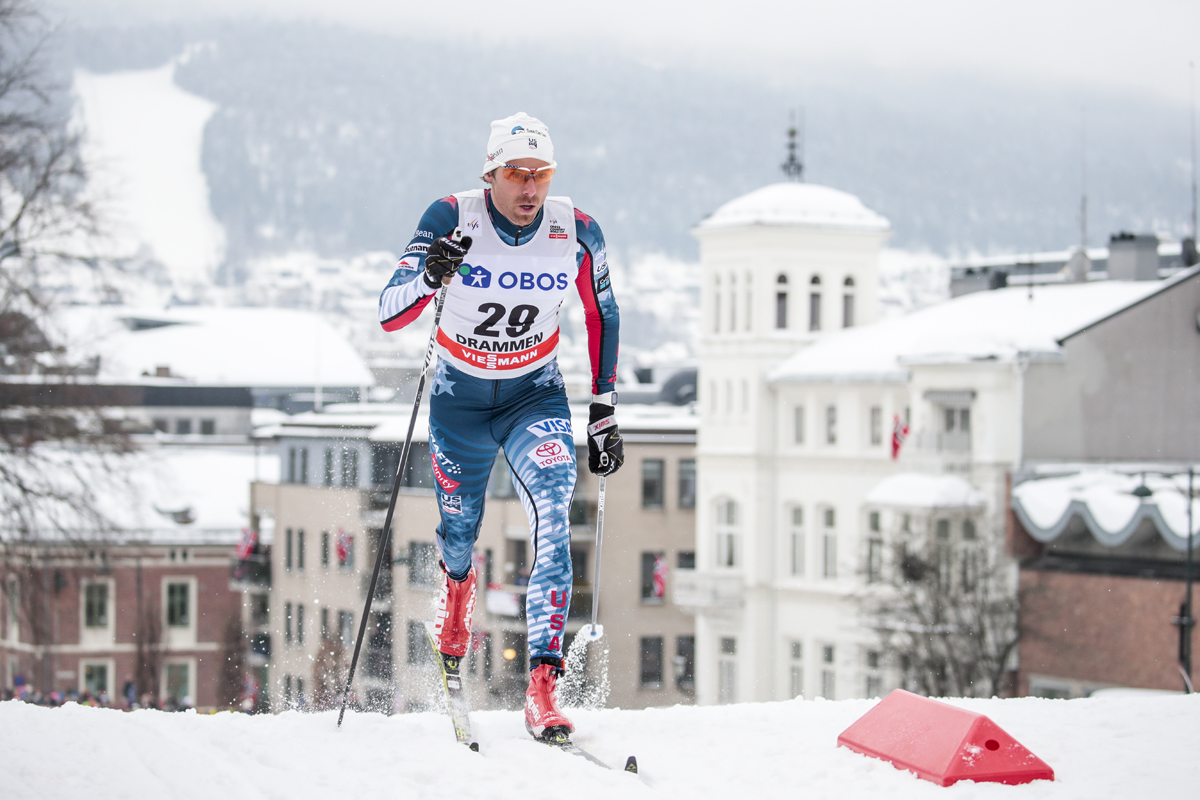
Simi Hamilton (bib 24) during his quarterfinal in Konnerud. (Photo: NordicFocus)
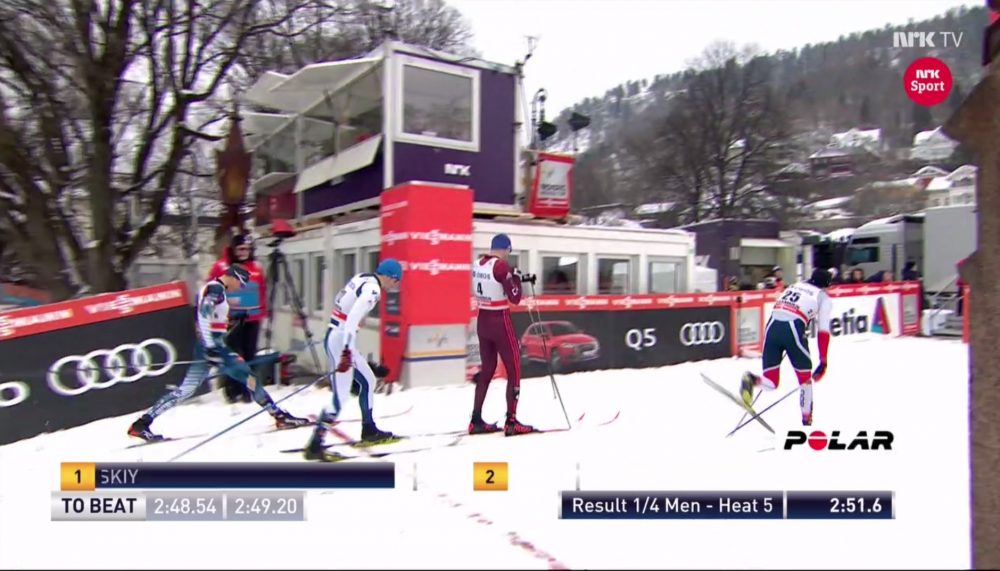
Simi Hamilton was the only American sprinter racing in Konnerud. He qualified in 24th and raced in the fourth heat of the quarterfinals, where he finished fifth, ending his day ranked the same in the overall as in his qualifier.
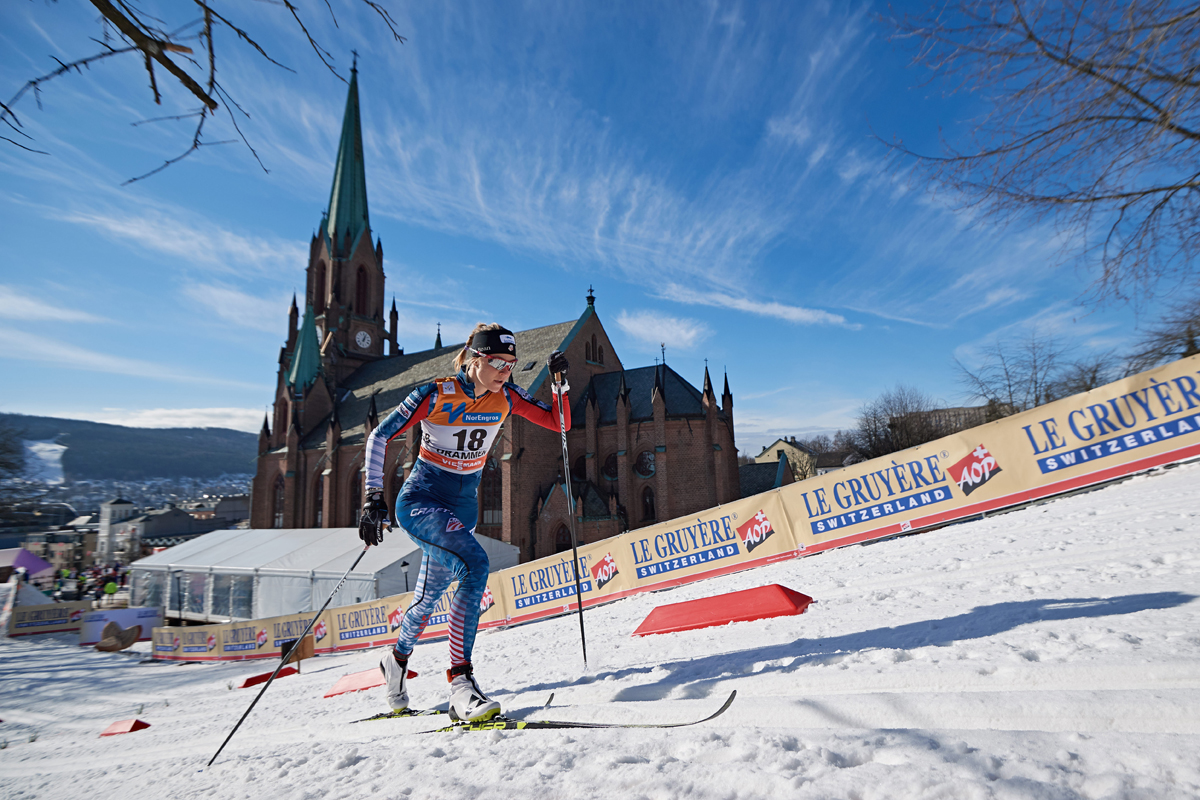
The looping sprint course around the ol’ church in Drammen, Norway will have to wait another year, or at least until sufficient snow: the iconic city sprint was moved to Konnerud due to insuffient snow in Drammen. Winter, please, pretty please, return to places such as Drammen.
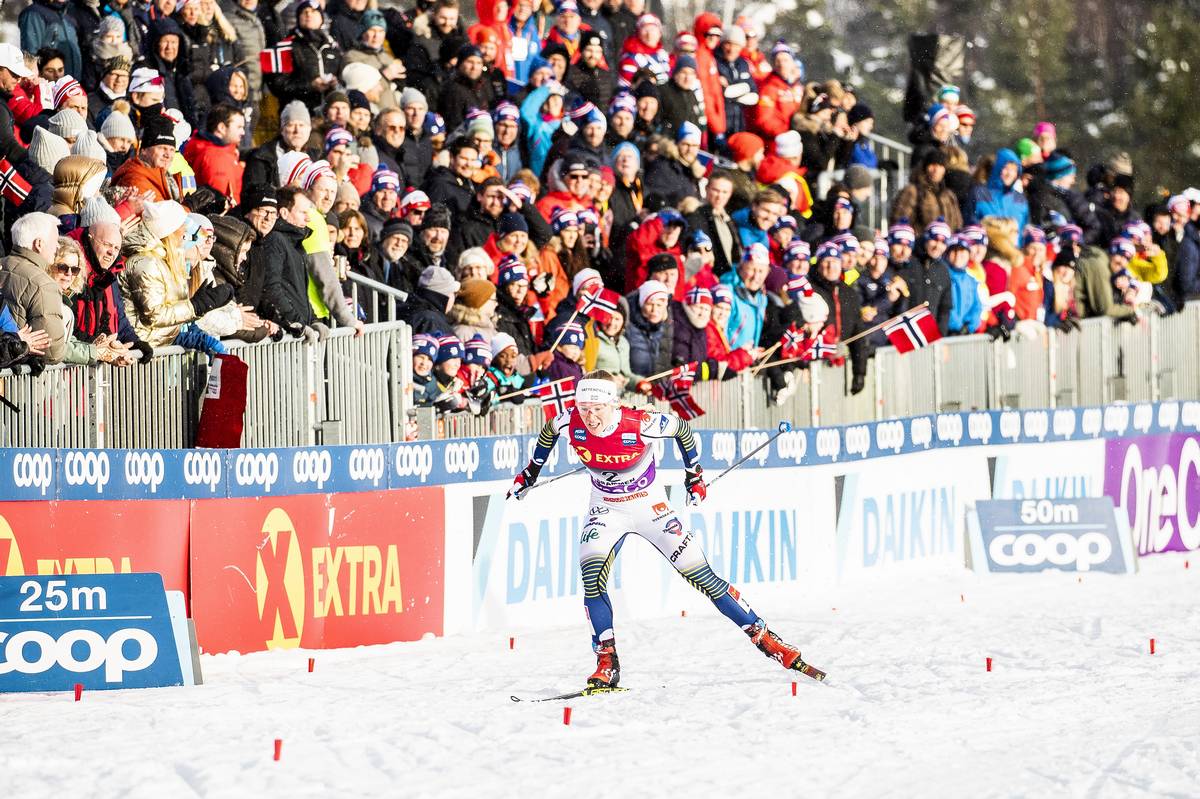
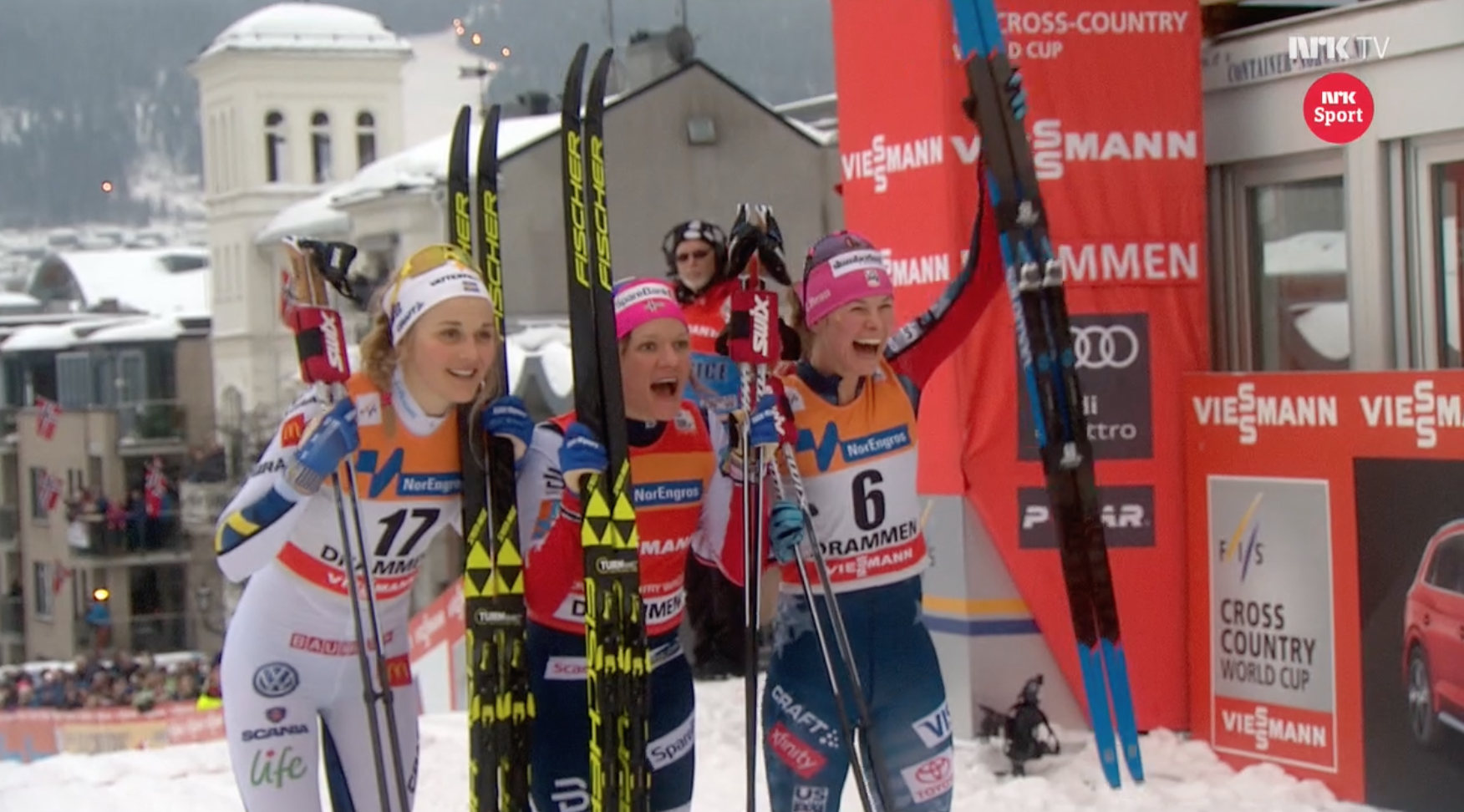
Powering home for the Konnerud win: Jonna Sundling of Sweden. (Photo: NordicFocus)
Although deep in Norway, but not so far from Sweden as the planes fly, Sweden took the win and third place in the World Cup’s relocated 1.2 k skate sprint in Konnerud. Jonna Sundling won the final in 2:38.41 — a toe and perhaps the tail of a ski ahead of Switzerland’s Nadine Faehndrich in second (+0.24). It was a photo finish for second through fourth. Linn Svahn, a U23 skier forgoing those championships, placed third (+0.39). Norway’s U23 Kristine Stavaas Skistad was fourth (+0.97), Sweden’s Maja Dahlqvist placed fifth (+5.70), and Anamarija Lampic of Slovenia sixth (+26.04).
Sundling powered down the final sraight outpacing Faehndrich in the final 100 meters. Sundling advanced to the finals as a lucky loser in the semis.
Sadie Bjornsen (bib 4) during her quarterfinal heat in Konnerud. (Photo: NordicFocus)
Sadie Bjornsen of the U.S. was the top American in 16th overall. Bjornsen qualified in fourth, 1.2seconds behind the top qualifier, Katja Visnar of Slovenia. Bjornsen placed fourth in the second quarterfinal and did not advance.
Jessie Diggins was the only other American to qualify.After qualifying in 12th , she placed sixth in the first quarterfinal, to end her day ranked 27th. Also for the U.S., Kaitlynn Miller placed 50th, and Becca Rorabaugh 54th.
Jessie Diggins sprinting in Konnerud. (Photo: NordicFocus)
Of note, Swedish sprinter, Hanna Falk, who suffered a back injust prior to the season, started her first World Cup of the year. She finished in 30th.
Racing continues Saturday with the women’s 30 k classic mass start. The men race a 50 k in Oslo on Sunday.
Spectators gather in Dresden, Germany to watch the team sprint. (Photo: NordicFocus)
It was dizzying in Dresden for the skate team sprints. The man-made loop of lightning-fast snow had skiers going literally round and round for a total of 11 exchanges between teammates. Each skier skated a single 0.7-kilometer lap, for a total of 7.8 k. Each skier raced six laps. Turn your head dizzy.
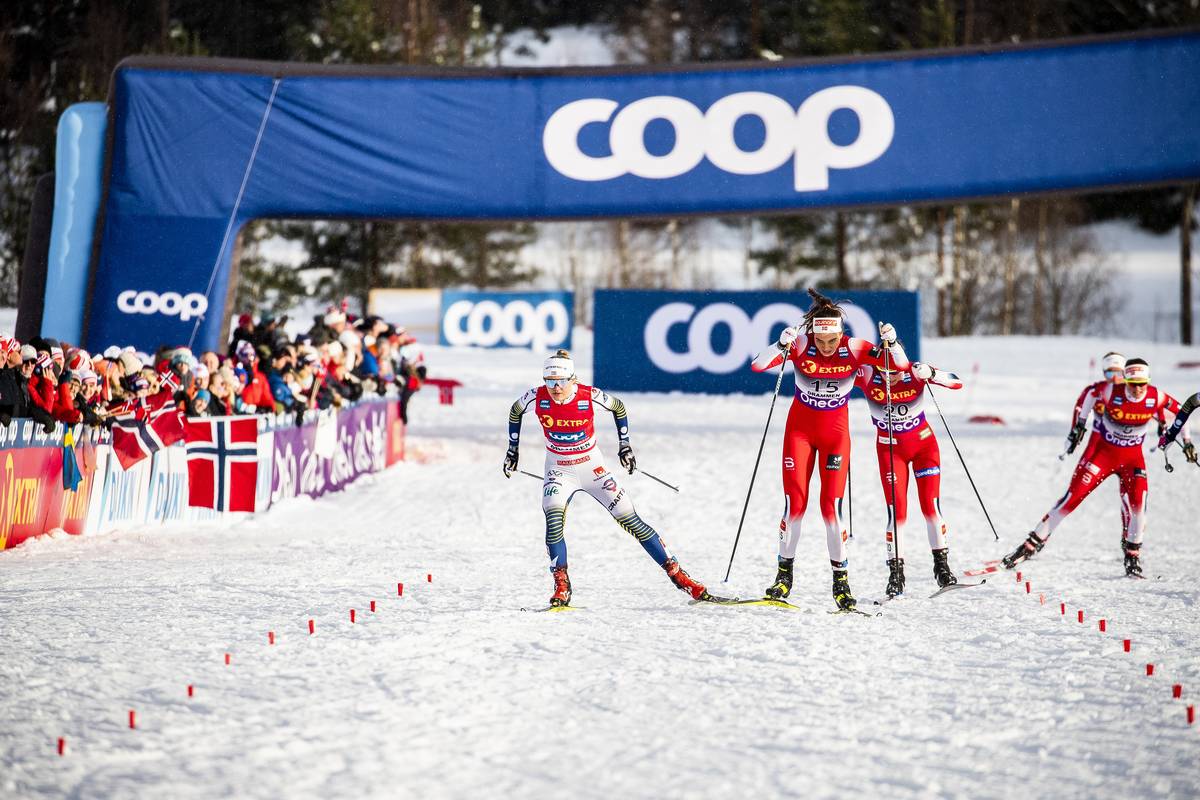
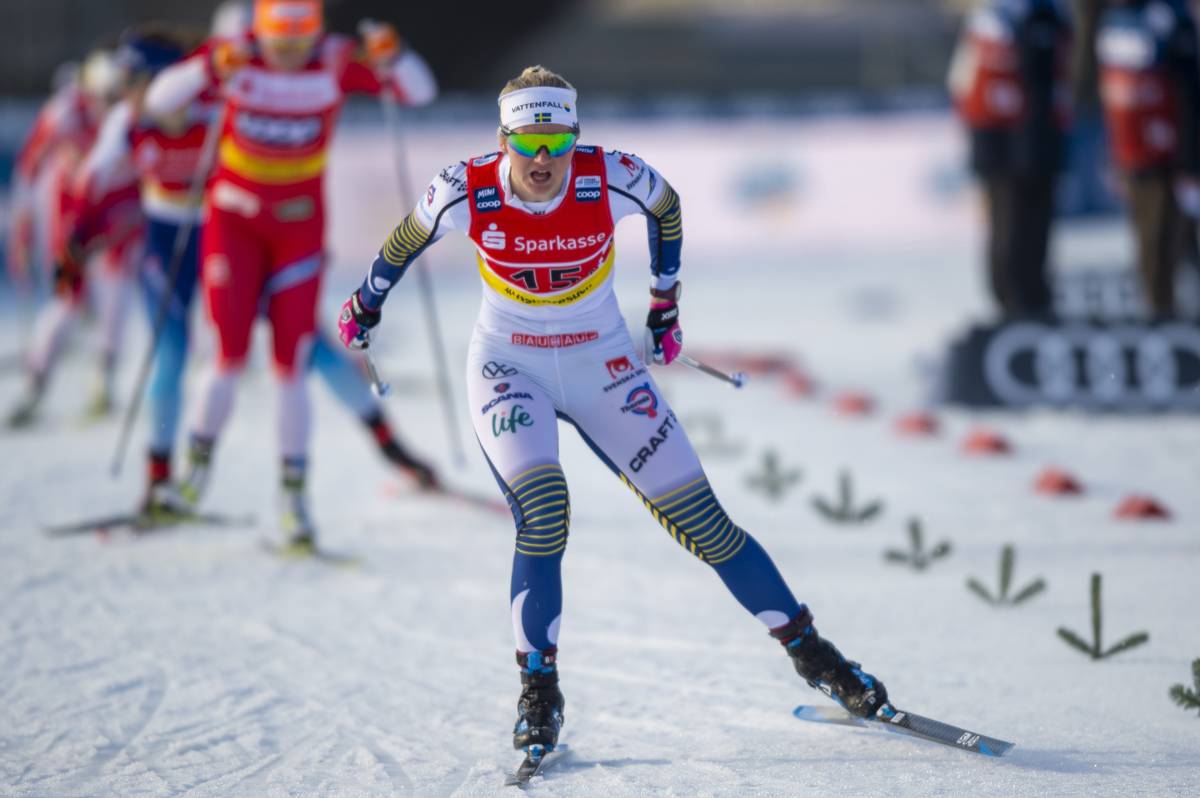
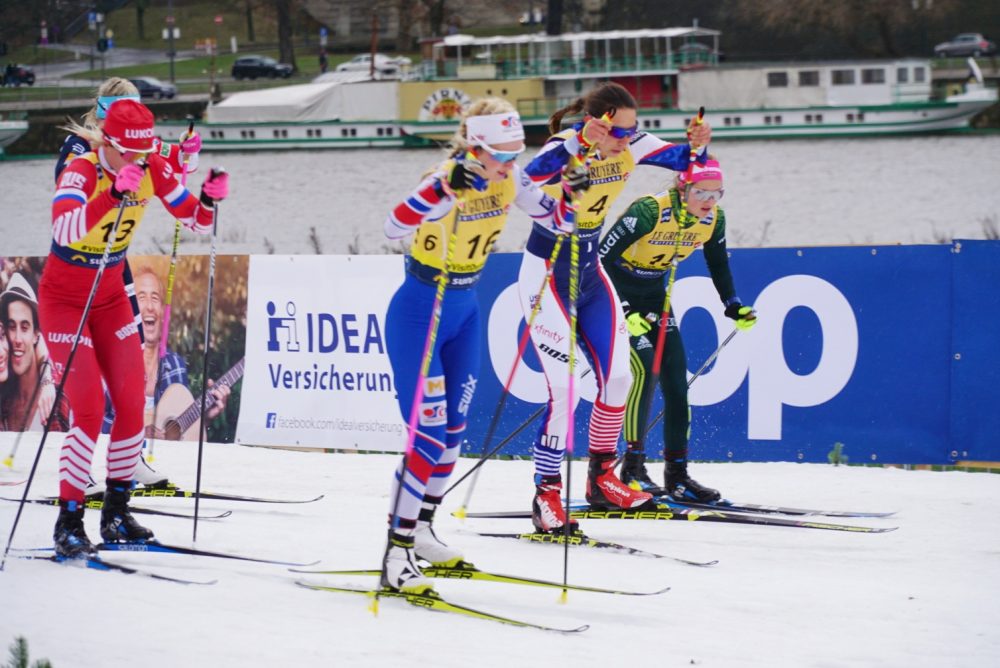
Maja Dahlqvist (bib 15) and teammate Linn Svahn maintain their lead in the final laps of the Dresden team sprint. (Photo: NordicFocus)
The Women’s Final
The finals consisted of ten teams. Sweden I animated the race with its display of pull ahead speed late in the race. Sweden I featured Maja Dahlqvist, who won this event last year with Stina Nillson. This year, Dahlqvist and Linn Svahn, yesterday’s skate sprint winner, had the pleasure of burning plenty of matches in Dresden.
Sweden I’s tactics were clear: late in the race, with several exchanges remaining, apply speed to the front, separate from the pack, and position themselves for the win. According to FIS, that has been somewhat easy for Sweden to do of late: Sweden has won seven of the last eight women’s team sprint World Cup events. This includes the last five in succession.
So it was today, as Dahlqvist tagged to Svahn on the final lap with a 0.8-second gap on Switzerland I’s Nadine Faehndrich. Norway I came through 3.6 seconds back, and Sweden II another 0.4 seconds behind.
That was the race. Faehndrich was able to close down and give Svahn a scare at the line for a photo-finish.
The finish line item read: Sweden I in first at 15:43.7, Switzerland I second (+0.09), and Sweden II third (+3.27).
The U.S. team of Julia Kern and Sophie Caldwell placed fifth overall (+6.61). The U.S. pairing advanced out of the semis after placing third behind Norway I in first and Switzerland I’s Laurien Van Der Graaf and Nadine Faehndrich.
Sophie Caldwell (bib 3) finds her line heading into the u-turn before the exchange zone. (Photo: NordicFocus)
Julia Kern (bib 3) shows poise in the pack during the team sprint. (Photo: NordicFocus)
Canada I’s Katharine Stewart-Jones and Dahria Beatty placed third in the second semi-final — in a photo finish with Germany I for second — and did not advance as a lucky loser. In the team sprint format, the two top teams advance, with the six remaining spots in the final given to the next six fastest teams via lucky loser spots. Canada I placed 11th on the day.
Canada II’s Maya Macisaac-Jones and Katherine Weaver were 23rd overall.
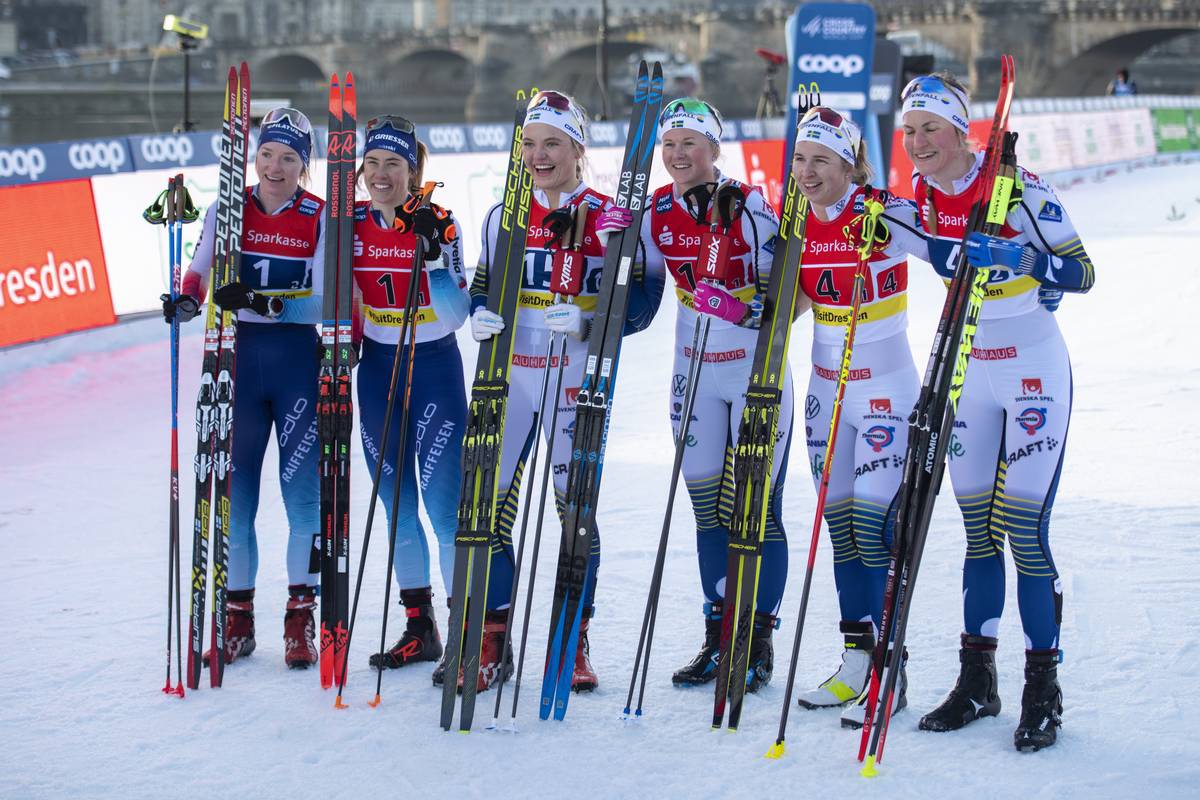
Laurien Van Der Graaff (SUI), Nadine Faehndrich (SUI), Maja Dahlqvist (SWE), Linn Svahn (SWE), Evelina Settlin (SWE), Linn Soemskar (SWE), (l-r) take the podium positions. (Photo: NordicFocus)
The Men’s Final
Looking for some smooth skiing technique cues for high speed skate skiing? Look no further than the Frenchman crossing the line in first on Sunday for France I. Lucas Chanavat — paired with Jay Renaud — was the kinesthetic perfection of coaches advising – and sometimes commanding — athletes to ski big and tall.
Lucas Chanavat (bib 1) put on a clinic this weekend in Dresden, Germany. (Photo: NordicFocus)
On Dresden’s quick 0.7 oval loop and deteriorating snow, Chanavat was simply big and smooth and just enough faster than the others.
In an event that saw five teams on the final tag within 1.4 seconds, France did not exactly have this Dresden team sprint nailed shut.
With the front five teams out of trouble, they came into the final straight drag race style. As noted, France I pipped in for the win. Sweden I’s Marcus Grate and Johan Haeggström were second (+0.09), and Russia I’s Andrey Krasnov and Gleb Retivykh third (+0.18). Norway I’s Håvard Solås Taugbøl and Sindre Bjørnestad Skar were fourth (+0.56).
Great Britain’s James Cluget and Andrew Young were eighth overall (+7.07).
Canada I’s Graham Ritchie and Bob Thompson were 14th overall, with Canada II 20th. For the U.S., JC Schoonmaker, a junior skier for the University of Anchorage Alaska, and Kevin Bolger were paired. They placed 21st for the day.
Marcus Grate (SWE), Johan Haeggstroem (SWE), Renaud Jay (FRA), Lucas Chanavat (FRA), Andrey Krasnov (RUS), Gleb Retivykh (RUS), (l-r) earn top honors in the men’s team sprint. (Photo: NordicFocus)
Canada’s Alex Harvey acknowledging the crowd after his second place in the men’s 15 k classic in Québec City. (Photo: John Lazenby/lazenbyphoto.com)
Amidst overcast skies and spectators bearing signs for the local cross-country favorite, Canadian Alex Harvey, World Cup Finals resumed on Saturday in Québec City, Québec with a men’s 15-kilometer classic mass start race.
Thanks to his win in Friday’s freestyle sprint, Norway’s Johannes Høsflot Klæbo lead Saturday’s 78 starters out of the gate, his yellow bib also indicative of his first place rank in the 2019 Overall World Cup Standings.
With Saturday and Sunday being the last competition days of the World Cup season, and only 24 points separating Klæbo’s first place (1443 points) from second place Alexander Bolshunov of Russia (1419 points) in the Overall Standings heading into the 15 k on Saturday, both athletes were looking for a win.Klæbo to solidify his position on top and Bolshunov to supersede it.
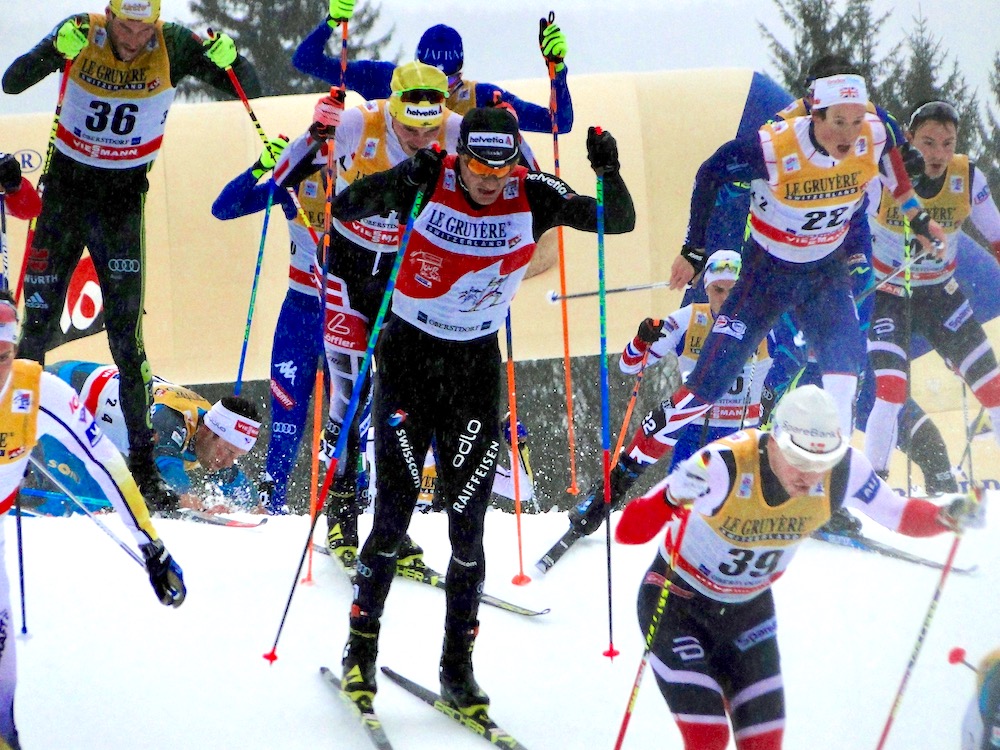
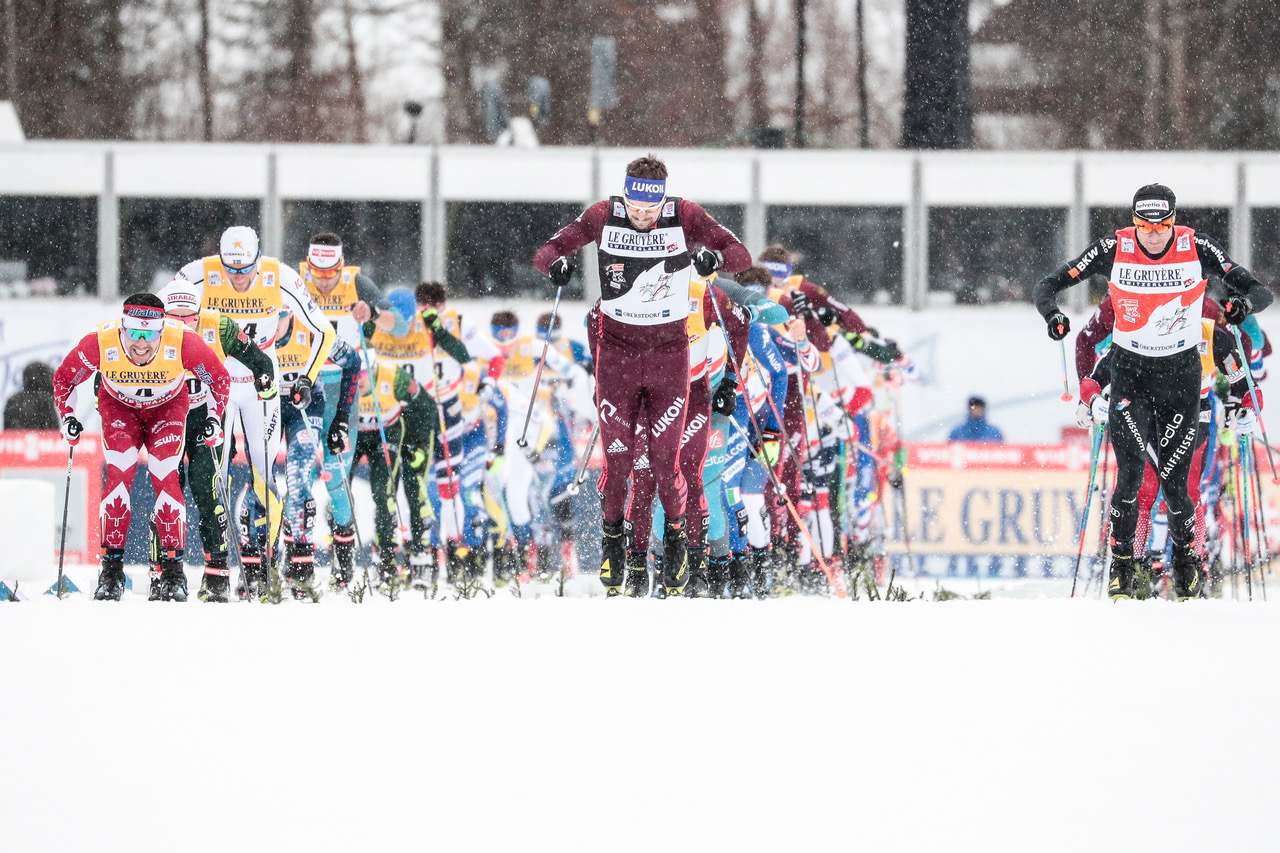
A literal mass of skiers after the start of the men’s 15 k mass start classic in Québec City. (Photo: John Lazenby/lazenbyphoto.com)
Leading up to 10 k, it appeared as if Bolshunov was on track to overhaul Klæbo’s immutable position on top. The Russian had positioned himself at the front of the lead pack’s 13 skiers which included Klæbo, Harvey, Italians Federico Pellegrino and Francesco de Fabiani, Russian Andrey Larkov, Switzerland’s Dario Cologna and Norwegians Didrik Tønseth, Sindre Bjørnestad Skar, Emil Iversen, and Sjur Røthe.
Taking charge through the climbs, Klæbo and Bolshunov went stride for stride, with Harvey hard pressed a little more than 1 second behind.
“I didn’t want to be leading because it was windy but I wanted to be near the lead every time,” Harvey told FasterSkier after the race.
Their descents through the tight sugary s-turns were maneuvered with ease. At 12 k, a Klæbo versus Bolshunov battle had directed most of the race and seemed fated to the finish.
However at the 13 k mark, halfway up one of the course’s major climbs, the bottom of Bolshunov’s right pole snapped. Although he received a replacement pole within a meter or so, the broken one did damage to his pace.
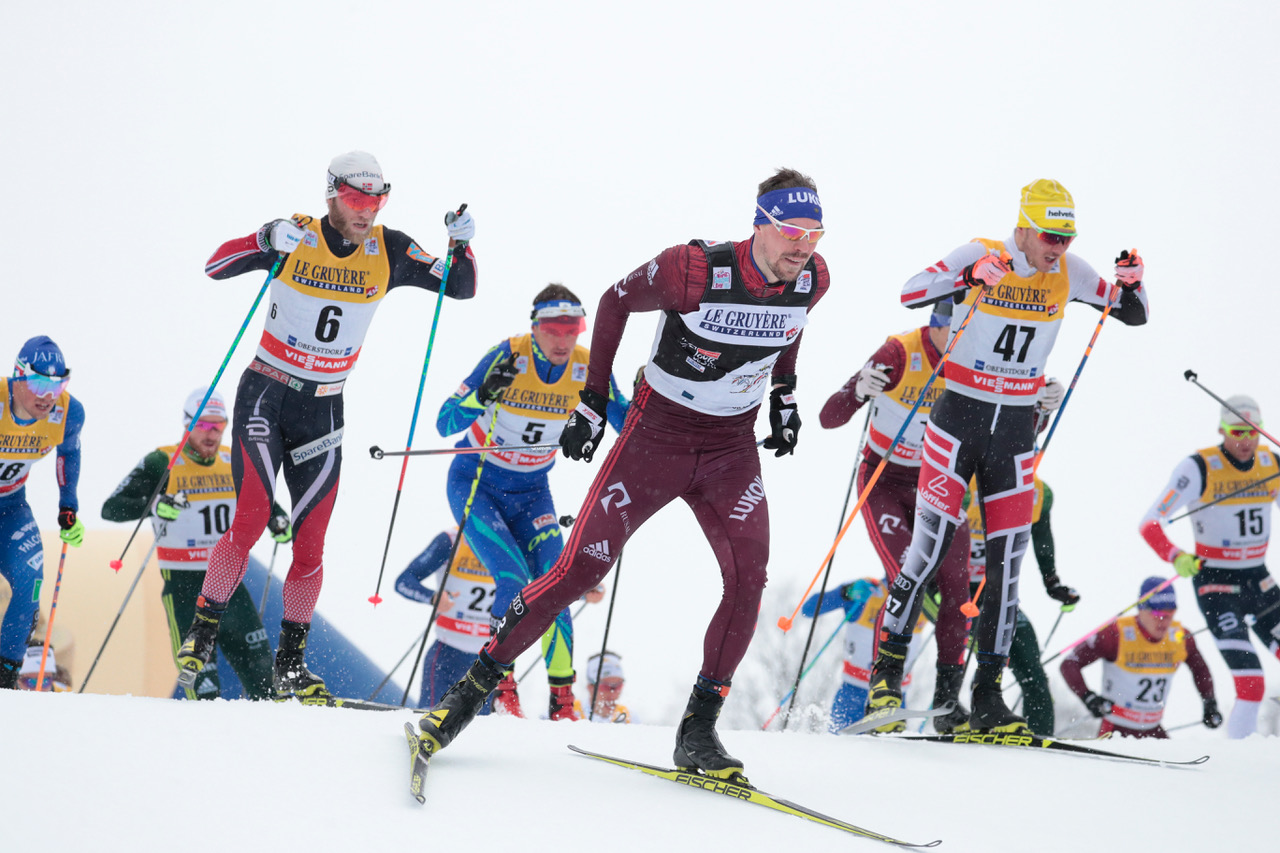
Russia’s Alexander Bolshunov leads the front group of skiers in the mens’s 15 k mass start classic in Québec City. (Photo: John Lazenby/lazenbyphoto.com)
“When I heard the Russian broke his pole, I went all in for Klæbo to make a gap as big as possible,” Tønseth told FasterSkier after the race. “We went for Klæbo and that’s the most important thing.”
With Tønseth pushing the pace, Bolshunov began to fall back. By the bottom of the next descent, the lead group had dwindled to five: Tønseth, Klæbo, de Fabiani, Røthe, and Harvey.
“We started to stretch the pack and…Didrik [Tønseth] is the strong guy that can make a hard drive in the final 2 kilometer to the finish he’s better than Johannes [Klæbo] or me in that so it was almost fun for him, if you want to be on the podium you got to punch it hard now and I knew for me it was going to help me,” Harvey said.
For the remaining 2 k, all five skied together until the finishing stretch. In the final 100-meters to the finish, Klæbo moved to the front and held off the charge of Harvey and Tønseth. Klæbo crossed first in a time of 36:10.9, while Harvey claimed second, just 0.8 seconds behind Klæbo, after a last minute surge past Tønseth.
Crossing 0.5 seconds back from Harvey and 1.3 seconds back from his teammate, Klæbo, was Tønseth in third.
“It’s a different scenario than two years ago when I came in newly World Champion fighting for the top three in the overall, I feel like this time I’ve had a harder season, was a bit more of an outsider,” the 31-year-old Harvey said. So I knew I needed my best race of the year to be on the podium and I was able to do that today so it’s pretty special.”
It is spring. “Go Alex!” (Photo: John Lazenby/lazenbyphoto.com)
Harvey confirmed earlier this season that World Cup Finals in Québec City will be the last World Cup races of his career. The Canadian will now start Sunday’s pursuit less than a second behind Klæbo.
“I felt strong today so I was able to come up in the front again. I needed these points for the total World Cup,” Klæbo told FasterSkier after the race.
With Saturday’s 15 k complete, Klæbo retained his top spot in the Overall Standings now with 1493 points. Bolshunov is currently second with 1451 points and Røthe third with 892 points.
Following Harvey was the U.S. Ski Team’s (USST) Erik Bjornsen in 18th (+1:04.3).
“I’m happy with the result,” Bjornsen told FasterSkier after the race. “I think it might have been the first time I was leading a World Cup for a bit. ”
Around 4 k, Bjornsen was at the front of the 78 skiers who started the race.
“The way my season’s been going it feels easy to go at race pace but when there are surges in the pack, if I try to go I just flood and I can’t really recover the way I’m hoping. But that was fun today,” Bjornsen said.
The next top North American finisher was Canada’s Len Valjas in 32nd (+1:43.6).
“It was one of the best distance races of my career,” Valjas told FasterSkier after the race. “I’ve had a few really good ones, but I don’t think I’ve ever been near [Top] 30 in my career other than the two podiums. So I’m super happy. Alex had a great day. I feel like I had a great day and I’m looking forward to tomorrow.”
“I was in bib 69 and I was skiing with some guys who were in the Top 20, so it’s really exciting for me to feel sort of back again,” Valjas added.
Following Valjas was the USST’s Simi Hamilton in 39th (+2:13.7). After the race, Hamilton indicated that prior to Saturday, his most recent classic distance race had been the Lillehammer 15 k back in December.
“I think by far the hardest part about today was the poling,” Hamilton told FasterSkier after the race. “It was just super rotten everywhere, the tracks stayed firm, which was nice, but the poling trenches just got so deep. I was constantly trying to look for harder snow on the outside and it made for, as a bit of a heavier skier, it made for a tricky 15k, but it was fun.”
Also skiing for the Americans was Kevin Bolger in 44th (+2:31.1), Scott Patterson in 50th (+2:37.9), Gus Schumacher in 56th (+3:44.1), David Norris 57th (+3:48.8), Ben Saxton 66th (+4:55.0), Logan Hanneman 67th (41:17.2) Ben Ogden 70th (+5:15.2) and Peter Holmes 73rd (+6:30.4). Andy Newell did not finish.
For the Canadians Remi Drolet finished 52nd (+2:57.4), Evan Palmer-Charette 55th (+3:16.6), Philippe Boucher 58th (+3:53.9), Jack Carlyle 59th (+4:13.6), Russell Kennedy 62nd (+4:27.0), Antoine Cyr 63rd (+4:29.8), Scott James Hill 64th (+4:46.5), Alexis Dumas 65th (+4:52.3), Bob Thompson 69th (+5:06.6), Antoine Briand 71st (+5:16.1), Julian Smith 72nd (+5:56.7), Julien Locke 74th (+6:31.8), Graham Ritchie 75th (+6:44.4).
The men’s podium from the 15 k classic mass start in in Québec City. Alex Harvey (bib 11) was given the honor of standing in the center. Harvey placed second to Johannes Høsflot Klæbo (left). Third place went to Didrik Tønseth (bib 17). (Photo: John Lazenby/lazenbyphoto.com)
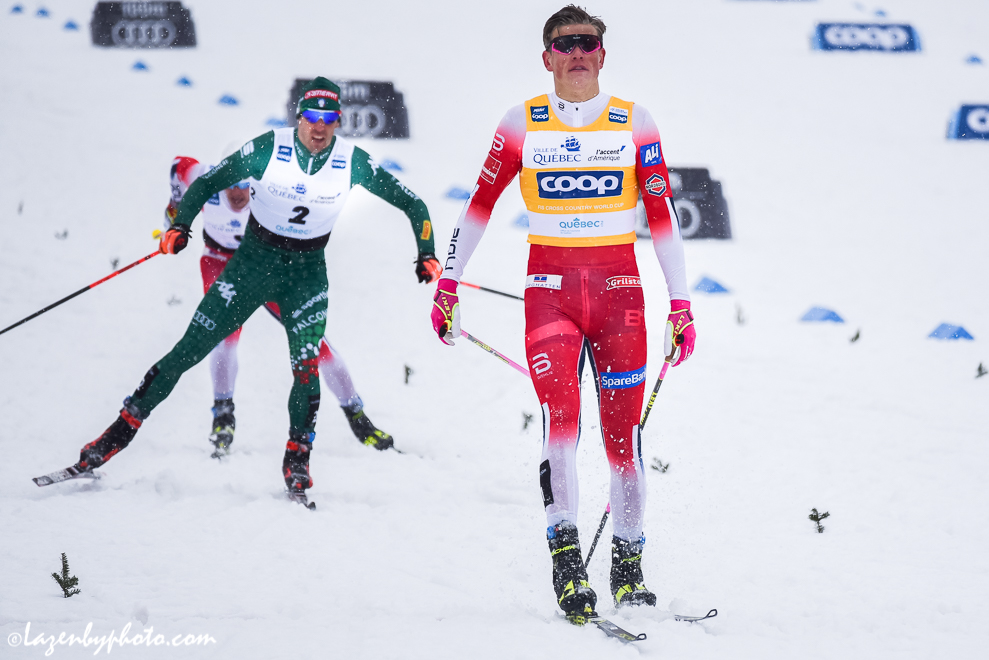
Johannes Høflot Klæbo wins the sprint with Federico Pelligrino and Sindre Bjørnestad Skar following. (Photo: John Lazenby/lazenbyphoto.com)
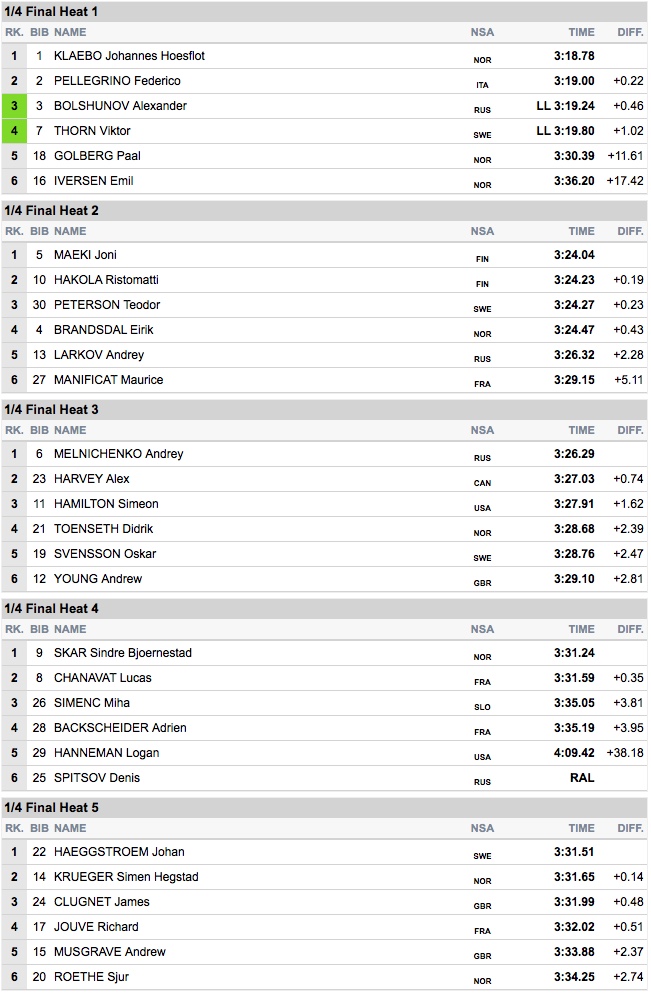
How to play the Johannes Høsflot Klæbo sprint game? It has got to go through every sprinter’s mind. As the day’s fastest qualifier, Klæbo set the tone in 3:07.61.
Prior to Friday’s 1.6-kilometer freestyle sprint in Québec, the young Norwegian had started nine World Cup sprints this season. He had won seven of them and placed second in another. And he had already locked up another sprint cup crystal globe becoming the first to win the prize in three successive seasons. With the globe pressure off, Klæbo could play his hand. Which brings us back to how he’d ski on a long sprint course with soft conditions and how his competitors would counter.
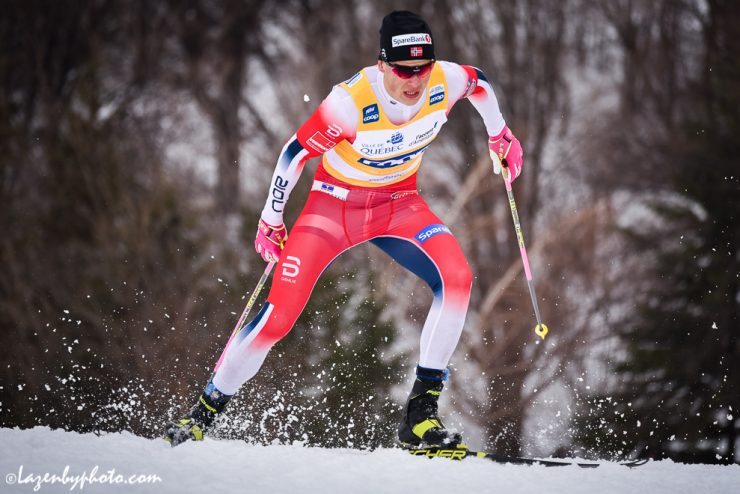
Johannes Høsflot Klæbo during the Quebec City sprint qualifier. (Photo: John Lazenby/lazenbypohoto.com)
Johannes Høsflot Klæbo during the Quebec City sprint. (Photo: John Lazenby/lazenbypohoto.com)
Russia’s Alexander Bolshunov, second in the World Cup overall standings, went head to head twice against Klæbo on Friday. In the quarterfinals, Bolshunov went full-throttle from the start. He looked like he could pull off the start-to-finish-pull for much of the first Klæbo encounter. Yet had did fade to place third in the heat which his nemesis won.
In the final with Klæbo, Bolshunov had a timid start. He hung in the back. This time playing a different strategy. Around 1:20 into the final, Bolshunov did accelerate. He gained a few spots to move into fourth.
Another skier in the final knowing it was Klæbo’s show, Italy’s Federico Pellegrino, made an up-tempo counter punch on a steep climb at the 1:55 mark. Hop-skating on the outside, Pellegrino pushed. Sindre Bjørnestad Skar of Norway led over the top and kept the Pellegrino move in check. With over a minute of racing to go, Klæbo kept in control. Skar took the lead, Klæbo followed, with the Italian and Bolshunov in third and fourth.
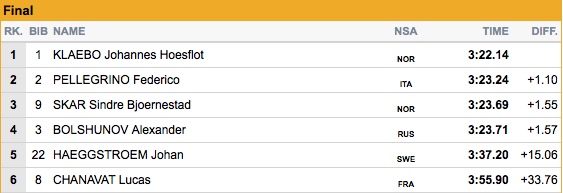
Nonchalantly, Klæbo took over race control ten seconds later. Nothing shiny. Nothing really marked with flare. Just simple flat out free-skating, V2ing, and lovely sprinting. He won in 3:22.14. Pellegrino was second (+1.10), and Skar third (+1.55). Bolshunov skied to fourth (+1.57).
The men’s sprint final in Quebec City. (Photo: John Lazenby/lazenbyphoto.com)
Johannes Høsflot Klæbo of Norway strining out the men’s sprint final in Quebec City. (Photo: John Lazenby/lazenbyphoto.com)
“Quite difficult conditions today, it was a really fun race,” Klæbo told FIS after the race. “I think the quarterfinal was the toughest one, it was really hard. It seems like Bolshunov is in good shape so it should be an interesting weekend.”
Coming into Friday’s races, Klæbo held a 14 point lead over Bolshunov for the World Cup overall. With the win, Klæbo earned 50 points, Bolshunov 40th for fourth. With two distances races remaining, it does get interesting. Klæbo leads with 1443 points to Bolshunov’s 1419.
In the press conference, Pellegrino made light of his second place finish as he deferred to a skier he has gained much respect for.
“This adds to the long list of second place behind Johannes,” Pellegrino said according to a translator. “It will be a long list. I will keep training very hard to be on top. I still have the legs to keep up so I will keep on trying. I have never made a podium in Québec before so I think I can do it again next year. I heard a lot of noise, ‘Pellegrino, Pellegrino’. In Europe, it’s hard to get people to come out and watch in bad weather. There was a lot of emotion in Alex [Harvey], but next year I hope they will still come to watch even without Alex. The courses were in good shape in spite of the conditions and the crowd here is amazing!”
Federico Pellegrino the men’s sprint qualifier in Quebec City. (Photo: John Lazenby/lazenbyphoto.com)
A spent Federico Pellegrino after the men’s sprint final in Quebec City. (Photo: John Lazenby/lazenbyphoto.com)
World Cup skiers understand Pellegrino’s sentiments. They too are here to soak in the Québec City atmosphere as it is an extension of Alex Harvey’s love for the sport and Québec’s love for him. Harvey qualified in 23rd on Friday and finished 10th overall.
“It was really good,” Harvey said in the mixed zone after the race. “I think in a stage event like this the goal for every sprint day is to make the semis, that’s where the sweet spot is for bonus seconds, so that was really good. … The semi-final was the fastest heat out of the two, it was just full gas the whole way with Bolshunov. So the other guys were just faster, but I haven’t qualified on the World Cup since December 2018. So I’m not the best sprinter anymore. So for me to make the semis it was great.”
This is Harvey country. (Photo: John Lazenby/lazenbyphoto.com)
Alex Harvey during the Quebec City sprint qualifier. (Photo: John Lazenby/lazenbypohoto.com)
Simi Hamilton was the top American on the day in 13th. After qualifying in 11th, Hamilton bowed out after placing third in his quarterfinal, roughly .5 seconds behind Harvey who skied to second.
“It’s just tough out there,” Hamilton said of the soft snow. “You know I think I’ve gotten better at skiing in those kinds of conditions, but still not totally there and it was just really soft and slow, made it extra hard with the headwind in places and it’s not fun skiing, but that’s ski racing. It’s not gonna be super enjoyable all the time. I think probably everyone feels like they can’t really ski out there today because it’s so hard.”
U.S. skier Logan Hanneman made the top-30 cut after qualifying in 29th. Skiing near the back of his heat in the quarters, Hanneman lost his balance around a dicey downhill corner.
“My ski just got grabbed by some of the snow,” Hanneman said of his tumble. “It’s pretty wet and deep on that corner especially and a snake jumped up and bit me and down I went. That’s how it goes I guess, but it’s tricky conditions out there and even on the downhill leading into it was grabbing the skis and going everywhere. You have to be light on your feet, which is not my forte.”
Simi Hamilton (bib 11) during his quarterfinal of the Quebec City sprints. (Photo: John Lazenby/lazenbyphoto.com)
Logan Hanneman during the Quebec City sprint qualifier. (Photo: John Lazenby/lazenbypohoto.com)
Hanneman has seized several opportunities this season on the World Cup. He first qualified for the World Cup heats this past February in Cogne, Italy.
“Just this season, I’ve only got a few World Cups in me and I qualified 15th in Cogne,” Hanneman said. “And then I qualified at World Champs and here and so I’m really happy to be making it into the heats now. I was really excited today to try to be a little more competitive in the heats because in the heats I’ve done before I’ve just been in the back. I don’t know when and where to pass because it’s so tight. So I was excited I felt pretty good on that uphill and I was excited for this uphill for sure and it didn’t happen so that’s okay.”
Racing continues tomorrow with a 15 k classic mass start race for the men and a 10 k for the women.
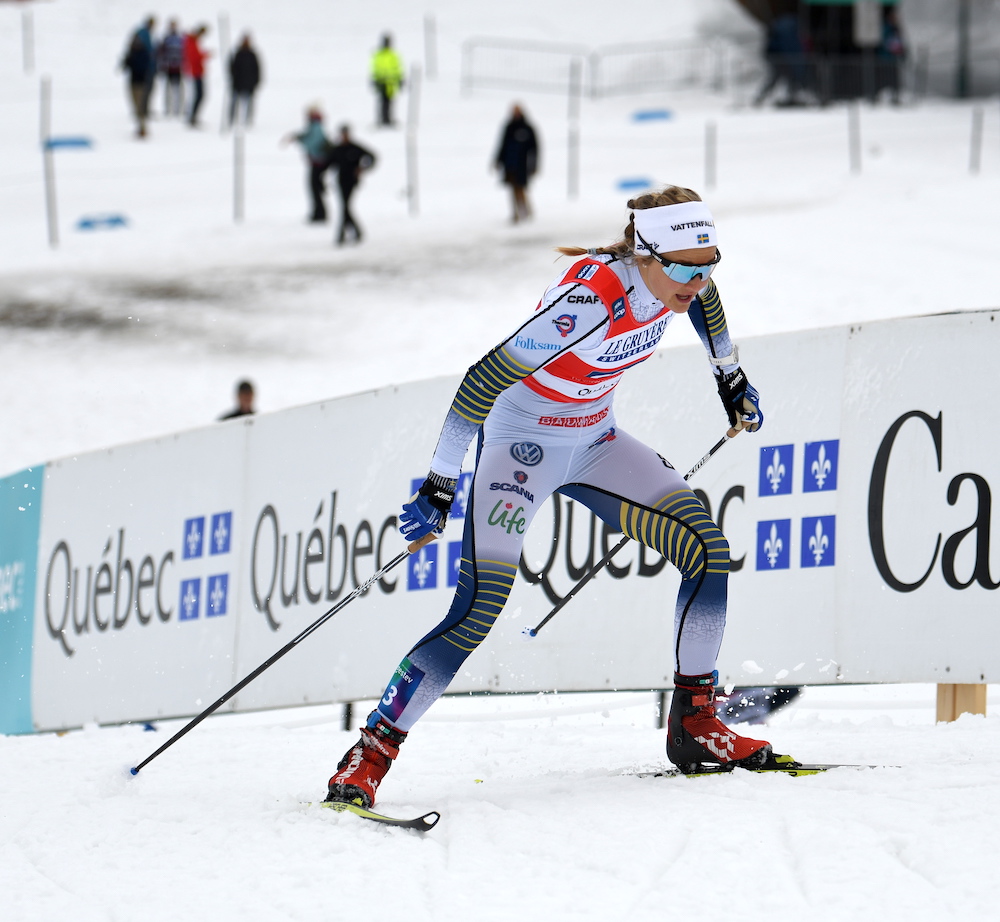
Sweden’s Stina Nilsson during the 1.6 k skate sprint qualifier in Quebec. Nilsson won the sprint final. (Photo: Doug Stephen)
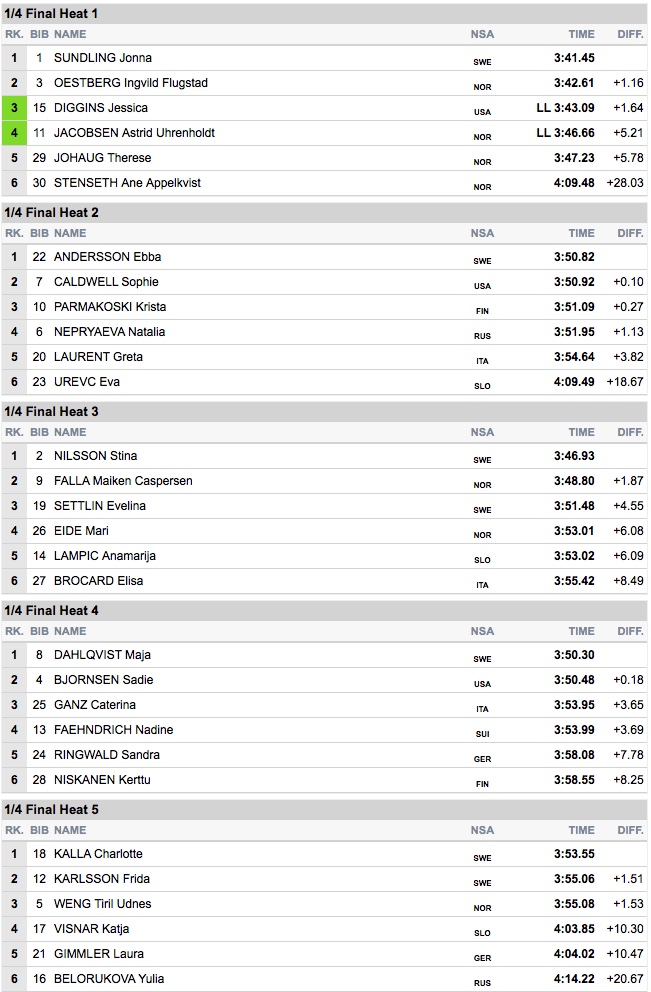
We’re changing the format for this race rundown. With many North Americans racing during World Cup finals in Québec, screenshots from Live Timing will keep the rundown updated efficiently.
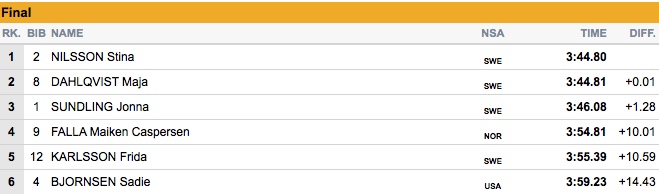
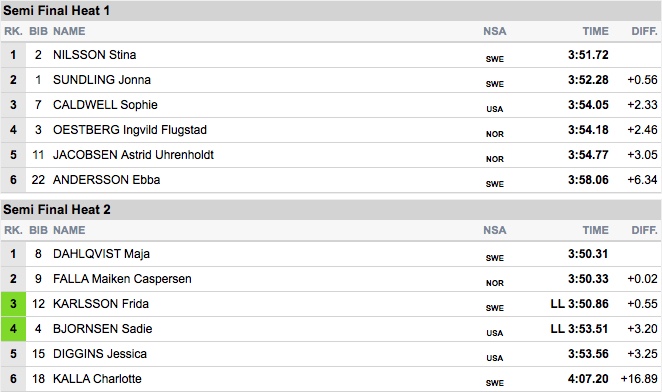
In the finals of Fridays; 1.6 k skate sprint in Québec, Stina Nilsson took the win and with it the sprint Crystal Globe overall. Sweden also took second and third place with Maja Dahlqvist and Jonna Sundling respectively. American Sadie Bjornsen placed sixth overall as the top North American finisher.
FIS World Cup 1.6 K Freestyle Sprint Québec
In the semi-finals, Jessie Diggins (USST), Bjornsen, and Sweden’s Charlotte Kalla tangled up early in the second semi-final as they rounded a tight corner. Kalla fell off the pace, while Diggins and Bjornsen fought to regain contact with the three skiers up ahead. Bjornsen out-toed Diggins for a lucky loser spot in the finals.
In the men’s race, Norway’s Johannes Høsflot Klæbo took control of the final late in the race to do as he does: win with little pressure to push a toe across the line. Italy’s Federico Pellegrino place second, with Sindre Bjørnestad Skar of Norway in third.
Canada’s Alex Harvey advanced to the semis where he was eliminated to place 10th in the final standings.
Simi Hamilton was the top-ranked U.S. skier finishing 13th in Thursday’s sprint. Logan Hanneman (APU), also for the U.S., fell in the fifth heat but ranked 25th overall.
After winning Saturday’s qualifier in a time of 3:21.99, Klæbo went on to win both his quarter and semi. He eventually crossed the final first in a time of 3:20.05 to complete his sweep of the day’s rounds.
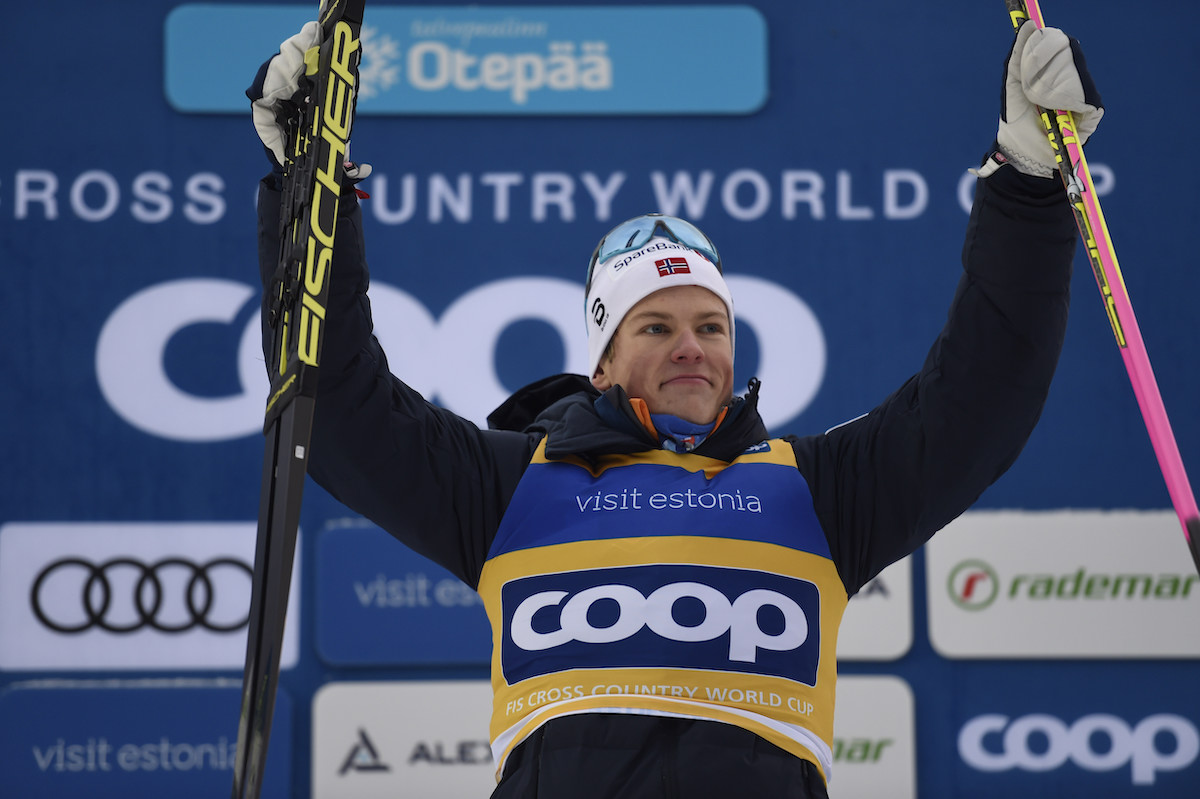
“It’s very cool to win here again,” Klæbo said during an interview with the International Ski Federation (FIS) after the race. “And I have a grandpa who is living here so that’s even better now, so I want to enjoy this.”
With the win, his 18th individual World Cup victory (12th in sprint), Klæbo could be on his way to his most winningest season yet. Last winter he departed the World Cup with 10 wins total. Thanks to a strong Tour de Ski and a few sprint races this year, Klæbo has already accumulated six individual victories in the 2018/2019 season.
The win this Saturday came in good company, as he raced the six man final with four other Norwegians: Pål Golberg, Eirik Brandsdal, Mattis Stenshagen and Erik Valnes. Alexander Bolshunov was the lone non-Norwegian to make the final.
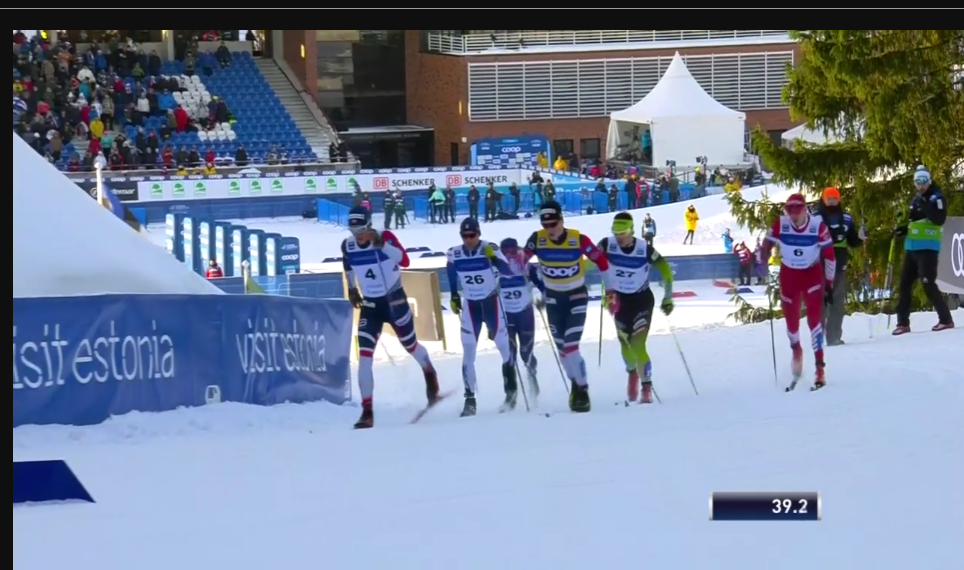
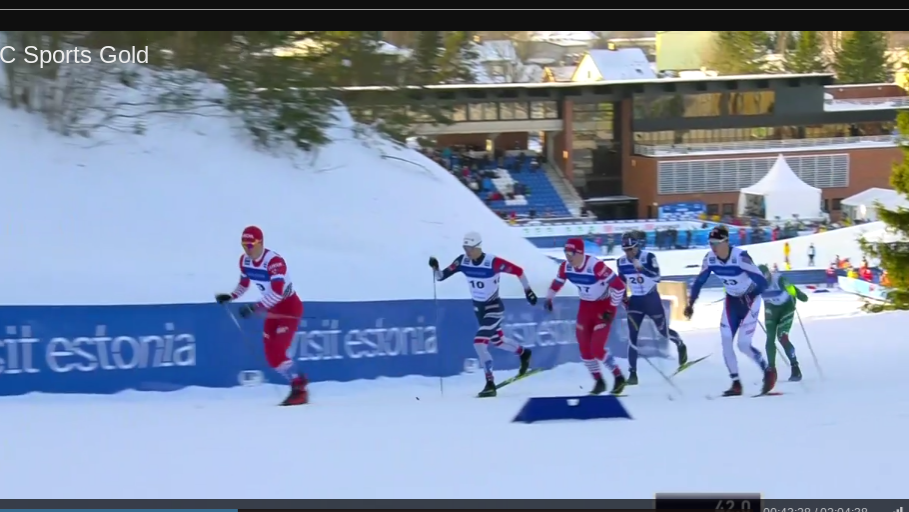
American Andy Newell (bib 26) racing the first quarterfinal of the the men’s 1.6-kilometer classic sprint final on Saturday in Otepää, Estonia. (Photo: NBC Gold screenshot)
Pitted against each other, Bolshunov appeared to be the only one in the final willing to challenge Klæbo. The two went head-to-head in the first major course climb, and by the following series of downhill S-turns, Bolshunov had positioned himself in the front. A brief double-pole section found Bolshunov and Klæbo side-by side once again, with Brandsdal and Stenshagen just behind.
As the six finalists geared up for the second major climb, a steep nearly vertical pitch that forced all racers to herringbone, Klæbo maneuvered to the outside right of Bolshunov. Using a quick, herringbone clip that almost made his skis look like a fish out of water, Klæbo passed Bolshunov by the top of the ascent.
After two double poles at the crest of the hill, Klæbo was tucked and descending back toward the stadium. His skis proved unmatchable by the Russian’s and by the bottom of the hill, he had put close to two meters on Bolshunov. Another meter behind Bolshunov was Golberg.
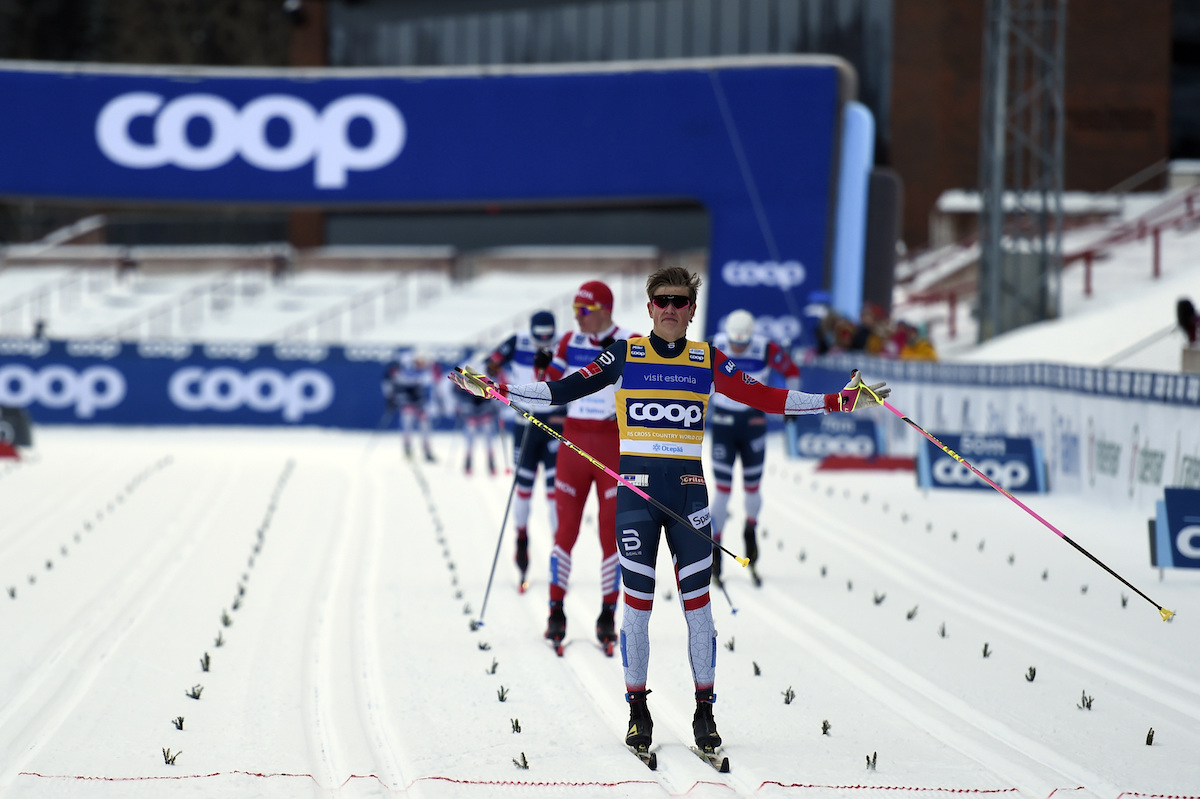
With no foreseeable challenge to the win, Klæbo double poled breezily to the finishing stretch and crossed first, arms outstretched in his signature celebratory gesture.
Norway’s Johannes Høsflot Klæbo (yellow bib) crossing first in the men’s 1.6-kilometer classic sprint final on Saturday in Otepää, Estonia. (Photo: Fischer/Nordic Focus)
Bolshunov crossed second (+1.51) for his seventh World Cup podium of the season.
In a lunge to the line, Golberg claimed third (+2.53) over Brandsdal in fourth (+2.57). Stenshagen crossed fifth (+7.69) and Valnes sixth (+11.99).
Rounding out the top ten was Norwegian Sindre Bjørnestad Skar in seventh, Sweden’s Viktor Thorn in eighth, Norway’s Sondre Turvoll Fossli in ninth and Italy’s Federico Pellegrino in tenth.
The U.S. had two men qualify, with Erik Bjornsen qualifying in 23rd (+8.20) and Andy Newell 26th (+8.75). Newell went on to race the first quarterfinal with Klæbo. Avoiding a crash from Russia’s Andrey Sobakarev in the herringbone hill, Newell crossed the quarterfinal in third to end the day in 15th overall.
American Erik Bjornsen (bib 23) racing the first quarterfinal of the the men’s 1.6-kilometer classic sprint final on Saturday in Otepää, Estonia. (Photo: NBC Gold screenshot)
Bjornsen, who was slotted into the second quarterfinal, jockeyed for position throughout his heat, taking aggressive lines during the course’s sweeping S-turns to move from fifth to third. He dropped back once again in the herringbone hill and crossed his heat in fifth for 24th overall.
“I was happy to qualify well today,” Bjornsen wrote in an email. “This season hasn’t gone as well as I hoped but I think I can turn things around before world champs. Today was a step in the right direction. Positioning was quite important in the second half of the course. Unfortunately I wasn’t where I needed to be before the steep climb.”
The U.S. Ski Team’s Kevin Bolger during his qualifier on Saturday in in Otepää, Estonia. (Photo: Fischer/Nordic Focus)
Also racing for the U.S., American Kevin Bolger finished in 41st (+13.13) and Ben Saxton in 44th (+14.16). Len Valjas racing for Canada finished in 43rd (+13.61) and Bob Thompson, also for Canada, placed 51st (+15.96).
The men’s team sprint podium from the Dresden, Germany World Cup team sprint: From left to right, Norway II in second, Norway I first, and Russia I third. (Photo: fis-ski.com screenshot)
A strip of imported snow along the Elbe river, iconic architectural reminders of old-world Europe’s city-scape in Dresden, Germany, Lycra, speedy skiers, and teams of two: all the ingredients for the men’s 1.6-kilometer freestyle team sprint.
With tight pack skiing a function of the the relatively flat Dresden ski loop, the ten teams in the final attempted to play stay-out-of-trouble-skiing for the six total laps. But with a crowded tag area and tight corners where skiers abruptly bled speed, mix ups and tumbles occasionally picked skiers out of the front scrum.
Coming into the final tag, 8 k into the race, the top-seven teams came through the time check all within 2.63 seconds of one another.
Norway II, Italy I, Russia II, Norway I, France I, Russia I, and Great Britain sped through with the remaining three teams in the finals, Switzerland I, Austria I, and Australia I within closing distance to the leaders.
Intermittently contracting and spreading out, no decisive moves to splinter the group materialized until the last lap.
In the team sprint, it’s not simply the fastest one or two lap skier who prevails — each athlete, during their three respective legs (each leg consisted of three laps), was required to mentally focus and push the boundaries of their aerobic and anaerobic engines for 4.8 k total.
On that last lap, the pull away move was simple enough.
Leading much of the final k was Norway I’s Sindre Bjørnestad Skar, the winner of Saturday’s skate sprint in Dresden. Skar kept out trouble, positioning himself at the front. He then shifted into a sixth or seventh gear no other skier could match.
Up to the point Skar began to channel his reserve of booster-fuel, it appeared it could have been one of several teams across the line first. But approximately 4.6 k into Skar’s pathway to the finish line, his top effort was simply too much. he was on another level of endurance-sprint fitness as he closed out the win.
Skar along with his teammate Erik Valnes won the final in 22:38.72 minutes.
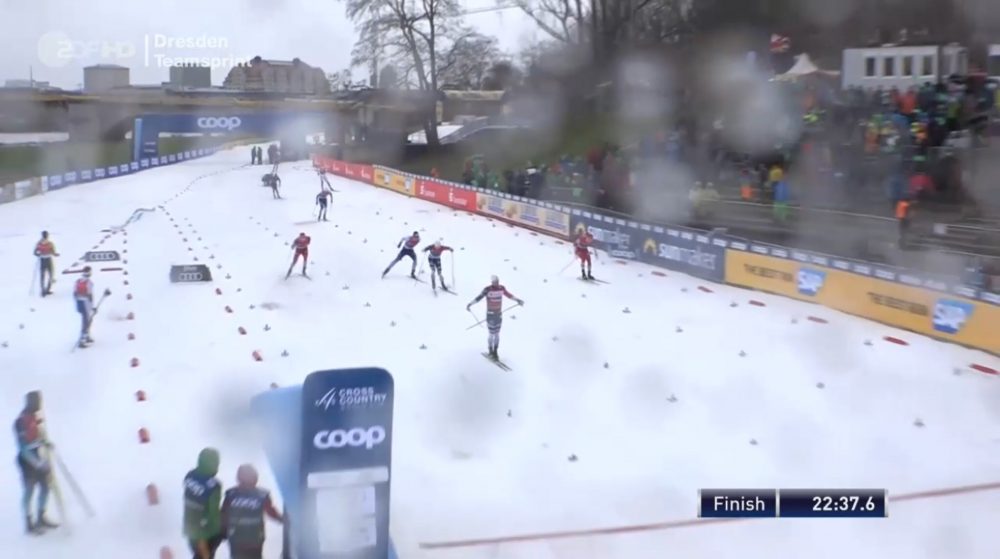
Sindre Bjørnestad Skar in front to finish first for Norway I during the Dresden, Germany World Cup team sprint on Sunday. (Photo: ZDF screenshot)
But behind Skar, a four team whirlwind charged down together on the finish. A photo-finish captured the moment to decide the final standings. In second (+0.75) was Norway II’s Pål Golberg and Eirik Brandsdal, Russia I’s Artem Maltsev and Gleb Retivykh third (+0.80).
Fourth place, 1.01 seconds back, went to Roland Schaad and Jovian Hediger of Switzerland. Russia II’s Andrey Krasnov and Alexander Terentev were fifth (+1.04).
Great Britains’s James Clugnet and Andrew Young placed sixth (+3.17).
Right in the middle of the the finishing lane mix, possibly fighting for podium scraps was Italy’s Federico Pellegrino. He appeared to catch his tip on another skiers ski-tail and took a spill. He and teammate Dietmar Nöckler placed 10th in the 10 team final. The Italian duo won last season’s team sprint in Dresden.
Canada’s Bob Thompson and Len Valjas placed seventh (+2.46) in the first semi-final and did not advance to the final. It was the same fate for the only U.S. team entered in the men’s team sprint. Andy Newell and Erik Bjornsen placed 10th (+3.66) in the second semi, and failed to make the finals.
Canada placed 15th in the final standings, the U.S. 19th.
In bib 15, the U.S. Ski Team’s Erik Bjornsen navigates the crowds during Dresden, Germany’s team sprint on Sunday. (Photo: Garrott Kuzzy)
Racing in bib 4 for the U.S., Julia Kern keeps pace in the women’s team sprint during the Dresden, Germany World Cup on Sunday. (Photo: Garrott Kuzzy).
FIS World Cup Dresden, Germany 6 x 1.6 k Freestyle Team Sprint
The first World Cup team sprint of the season was run amidst drizzle and the Dresden, Germany city-scape as the women raced a total of six 1.6-kilometer laps.
Round and round on the looping course, the pace was a mix of tactically subdued speeds with sustained bursts of energy to break the pack.
After all the speed changes and exchanges with one athlete tagging off to the next, it came down to a 1.11 second difference between first place Sweden I and the three closet teams chasing from behind that ended in a photo finish.
Sweden I’s Stina Nilsson and Maja Dahlqvist won in a time of 24:02.5 minutes. Sweden II’s Ida Ingemarsdotter and Jonna Sundling placed second (+1.11), and Norway I, with Eide Mari and Maiken Caspersen Falla in third (+1.11).
U.S. I, featuring Julia Kern and Sophie Caldwell placed fourth (+1.11) after the photo finish was reviewed.
The U.S. entered a second team, consisting of Ida Sargent and Hannah Halvorsen. That duo contested the first semi-final, the same semi as U.S. I, but did not advance after placing fourth (+5.44). The top-three teams from each semi advance to the final, along with the next four fastest teams which are the combined “lucky losers”. Today, the second semi was the faster of the two. The four lucky loser team advancing to the final all originated from the second semi.
In the men’s 6 x 1.6 k skate team sprint race, Norway I and Norway II took the top two podium spots.
In a lunge at the line, Norway I’s Erik Valnes and Sindre Bjørnestad Skar won the final in 22:38.72 minutes. Pål Golberg and Eirik Brandsdal of Norway II placed second (+0.75) and Russia I’s Artem Maltsev and Gleb Retivykh third (+0.80).
Canada’s Bob Thompson and Len Valjas placed seventh (+2.46) in the first semi-final and did not advance to the final. It was the same fate for the only U.S. team entered in the men’s team sprint. Andy Newell and Erik Bjornsen placed 10th (+3.66) in the second semi, and failed to make the finals.
Canada placed 15th in the final standings, the U.S. 19th.
IBU World Cup Oberhof, Germany 4 x 6 k / 4 x 7.5 k Relay
In the women’s 4 x 6 k relay, Russia placed first in a time of 1:18:46.4 hours. Evgeniya Pavlova, Margarita Vasileva, Larisa Kuklina, and Ekaterina Yurlova-Percht made up the team that used eight spares on their way to the win.
Germany placed second (+33.5) with two penalty loops and 10 spare rounds. Karolin Horchler, Franziska Hildebrand, Franziska Preuss, and Denise Hermann comprised Germany’s second place team that had two penalties while using 10 spares. The Czech Republic’s Lucie Charvatova, Veronika Vitkova, Marketa Davidova, and Eva Puskarcikova placed third (+36.7) with 1 penalty loop and six spares.
The top spot for the podium came down to the final leg, when Yurlova-Percht pulled out the win when Hermann skied two penalty loops. The Russian used three spares but escaped with no penalties to take the lead out of the shooting range on the final ski loop.
Susan Dunklee, Clare Egan, Joanne Reid, and Emily Dreissigacker all represented the U.S. and placed 12th (+5:35.8) while skiing five penalty loops and using 16 spares.
Canada’s Sarah Beaudry, Emma Lunder, Megan Bankes, and Rosanna Crawford finished in 13th (+5:58.8) with four penalty loops and 15 spares.
Russian also claimed the men’s relay, winning in a time of 1:20:54.3 hours. The winning team of Maxim Tsvetkov, Evgeniy Garanichev, Dmitry Malyshko, and Alexander Loginov skied no penalty laps and used six spares on their way to victory.
Antonin Guigonnat, Simon Desthieux, Quentin Fillon Maillet, and Martin Fourcade raced for France. The French team placed second (+1:01.1) while skiing a single penalty lap and using eight spares.
Austria’s Tobias Eberhard, Simon Eder, Dominik Landertinger and Julian Eberhard placed third (+2:18.6) with one penalty lap and using seven spares.
Canada’s Scott Gow, Christian Gow, Jules Burnotte, and Brendan Green and the U.S. team of Leif Nordgren, Sean Doherty, Travis Cooper, and Max Durtschi were eventually lapped. Neither team was given an official finishing time.
Canada was ranked 18th in the final standings, the U.S. 19th.
For both relays today, the snowy weather and tough course conditions made for a strenuous day of shooting and skiing.
Dresden, Germany looking good for the city sprints. (Photo: @skiweltcupdresden Instagram screenshot)
FIS World Cup Dresden, Germany 1.6 k Freestyle Sprint
The city of Dresden resting alongside the River Elbe hosted a 1.6-kilometer freestyle sprint for the second year running.
Hannah Falk of Sweden, last year’s sprint winner in Dresden, won the qualifier in a time of 3:41.85 minutes. The U.S. Ski Team’s (USST) Sophie Caldwell was the second fastest qualifier (+0.49), with Falk’s teammate, Stina Nilsson, qualifying in third (+0.80).
Canada’s Dahria Beatty placed 20th (+8.72) in qualification, while Julia Kern (USST D-Team) in her first European based World Cup qualified in 23rd (+10.84).
Both Beatty and Kern were eliminated in the first heat which was won by Nilsson in 3:43.87. Beatty placed third (+1.18), Kern fourth (+1.25).
Beatty ended the day in 16th place overall, Kern 19th.
Caldwell advanced to the finals where she finished in fifth place, 2.61 seconds behind the day’s sprint winner Nilsson. Nilsson won the final in 3:48.49 minutes. It was an all Sweden podium as Maja Dahlqvist placed second (+0.24) and Jonna Sundling third (+0.54).
No other North American women advanced to the heats.
Hannah Halvorsen (USST D-Team) racing in her first World Cup placed 35th overall. Ida Sargent (USST) placed 38th, first time World Cup participant Hailey Swirbul (USST D-Team) 41st.
For the men, Italy’s Federico Pellegrino qualified first in 3:21.12 minutes. Britain’s Andrew Young was second fastest (+0.47), and Gleb Retivykh third (+1.27).
In his return to World Cup skiing after racing the domestic circuit, American Andy Newell was the highest ranked North American in qualification, placing 19th (+5.58). Kevin Bolger (USST) qualified in 28th (+6.76).
Newell and Bolger both raced the third heat where they were eliminated from the rounds. Newell placed fifth (+1.31), Bolger sixth (+1.45) in the third heat, which was won by Richard Jouve of France in 3:28:24.
In the final standings, Newell ranked 25th, Bolger 29th overall.
The race was won by Norway’s Sindre Bjørnestad Skar in 3:25.95 minutes. Retivykh placed second (+0.11), and Erik Valnes of Norway third (+2.83).
Erik Bjornsen (USST) finished in 33rd (+7.43), Simi Hamilton (USST) did not start due to illness.
For Canada, Bob Thompson placed 32nd overall, Lenny Valjas 47th (+9.55).
IBU World Cup Oberhof, Germany 10 k / 12.5 k Pursuit
In the women’s pursuit Lisa Vittozzi of Italy, who was the first skier off today as she won Thursday’s sprint, also won the 10 k pursuit in a time of 32:32.9 minutes. Vittozzi had two penalties (0+1+1+0) on her way to the win.
Anastasiya Kuzmina of Slovakia was second with four penalties (2+1+1+0), 14.5 seconds back. Kuzmina was the seventh starter, and began the race 30 seconds behind Vittozzi. Anaïs Chevalier of France place third (+27.9, 2+1+2+0). Chevalier was the second starter, beginning with a five second deficit.
Susan Dunklee of the US Biathlon Team had a season best result, placing seventh overall (+1:01.2). Dunklee was the 10th starter, setting off 41 seconds back. Dunklee had five penalties (2+1+1+1) on her way to seventh place.
Also for the U.S., Clare Egan, who place 13th in the sprint, fell back to 33rd in the pursuit after skiing seven penalty laps.
For Canada, Emma Lunders placed 39th (+3:31.4) with six penalties on her day. Rosanna Crawford placed 52nd (+5:23.4) also with six penalties.
In the men’s pursuit, Norway’s Johannes Thingnes Bø claimed the win in a time of 34:29.8 after three missed shots (0+1+1+1).
Arnd Peiffer of Germany place second on Saturday, finishing 15.1 seconds back from Bø after one penalty (1+0+0+0). Italy’s Lucas Hofer snagged the third and final podium, finishing 15.8 seconds behind the winner after shooting clean.
Two North Americans competed on Saturday, with American Sean Doherty finishing in 18th (+2:29.9) after skiing two penalties (2+0+0+0). Canadian Christian Gow also skied into the top 30, finishing in 27th (+2:57.4). Gow had two misses (1+0+0+1).
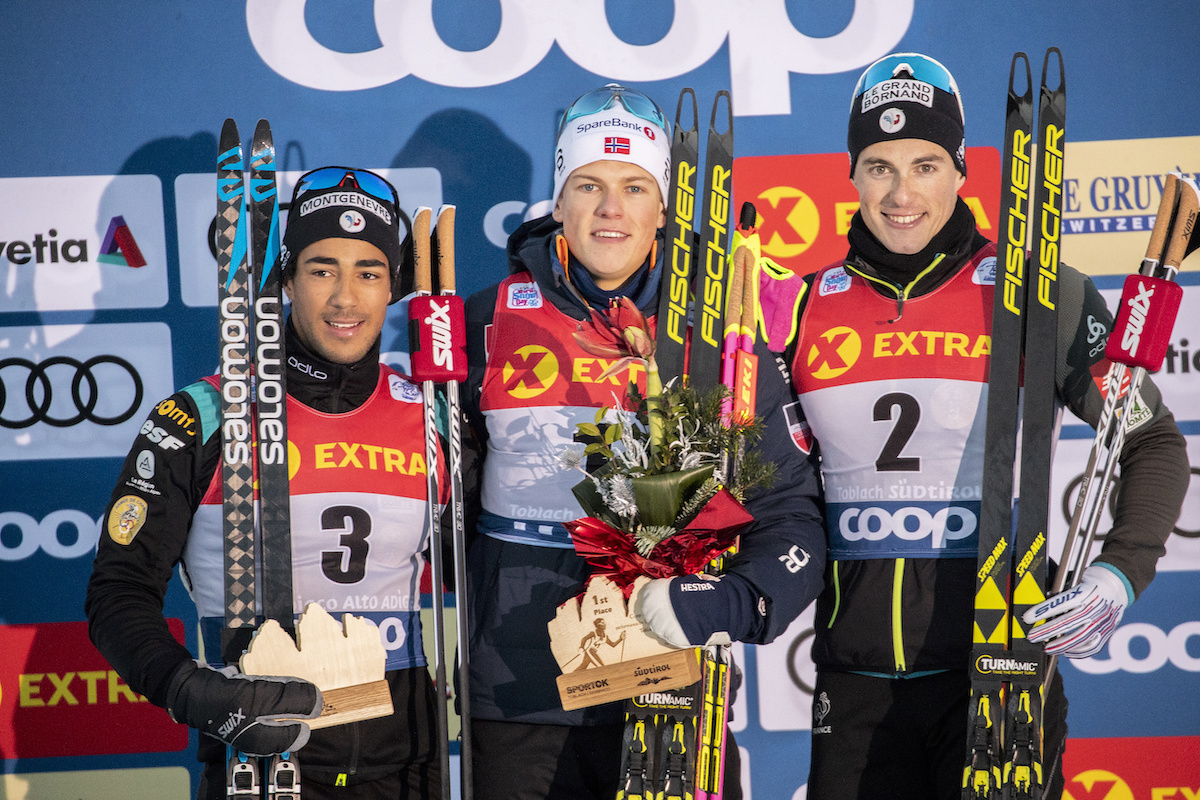
The men’s podium from Toblach, Italy’s first stage of the 2018/2019 Tour de Ski — a 1.3 k skate sprint. Richard Jouve (left) from France placed second, Johannes Hoesflot Klaebo (center) of Norway was first, and Lucas Chanavat of France (right) was third. (Photo: Fischer/Nordic Focus)
*Note: This article has been updated to include comments from U.S. Ski Team B-Tean member, Kevin Bolger
Without the visual of the grey and white U23 marker next to his name on an FIS results sheet, it’s easy to forget Norwegian Johannes Høsflot Klæbo is still under 23 years of age. As the Tour de Ski (TdS) celebrates its 13th edition this year, the twenty-two-year-old Klæbo (he celebrated his 22nd birthday this October) is only in his first TdS. He did not start last season’s 2017/2018 Tour. Nor did he start the 2016/2017 TdS. His debut World Cup race came in the spring of 2016.
Even so, by the opening race of this season’s TdS, a 1.3-kilometer freestyle sprint in Toblach, Italy, Klæbo maintained the composure of a seasoned Tour veteran. A skier used to winning and ready to do it again.
He started by posting the day’s fastest qualification time, placing first in a time of 2:16.86 minutes.
Klæbo then advanced to Quarterfinal 1, exchanging the lead with Russia’s Sergey Ustiugov for the first half of the sprint loop, before taking command and eventually duking it out with France’s Lucas Chanavat and Norwegian Sindre Bjørnestad Skar in the finishing stretch.
Johannes Høsflot Klæbo (bib 1) from Norway winning the men’s final in Toblach, Italy. Klæbo looked in form during the first stage of the 2018/2019 Tour de Ski.(Photo: Fischer/Nordic Focus)
Klæbo eventually won that quarterfinal, crossing first in a time of 2:19.71 minutes, just ahead of Chanavat. Both he and the Frenchman advanced to semi-final 1. Skar squeaked into the second semi as a Lucky Loser thanks to the heat’s fast times.
In the first semi-final, Klæbo once again took the lead from the start. He was shadowed closely by Chanavat and Italy’s Federico Pellegrino until the course’s second climb. There, the Italian made a push to the front, but by the bottom of the following hill, Chanavat had maneuvered his way around Pellegrino to take the lead. As the first semi-final skiers cornered into the finishing stretch, it was a four-skier battle between Chanavat, Pellegrino, Klæbo and Norwegian Eirik Brandsdal.
Chanavat took the semi final win. Crossing behind Chanavat, Klæbo (+0.07) bested Pellegrino (+0.10) by 0.03 hundredths of a second to advance to the final. Pellegrino did not move on.
By the time the men’s final rolled around, the line up included three Norwegians, two Frenchman, and a Russian. Norway’s Emil Iversen and Skar had advanced to the final as the two Lucky Losers from the second semi, which was won by France’s Richard Jouve followed by Russia’s Alexander Bolshunov.
From the start of the gun, it was Klæbo in front in the final. Clinging to his skis were Jouve and Bolshunov as the group headed toward the first climb. Klæbo maintained the leader’s pull just until the top of the climb, where Bolshunov positioned himself in first for the descent. Rolling into the second short climb, Bolshunov and Klæbo went head-to-head. Lurking just behind them was the French duo.
As they headed into the third climb, Chanavat moved to the outside right of the group. Jouve followed. By the time the final field crested the last climb on course, Klæbo was positioned in first, Jouve in second and Chanavat in third.
A final sling around the curve to the finish revealed Klæbo flurrying to hold off the attacks of Chanavat and Jouve. His efforts paid off and the Norwegian finished the sprint, his first TdS race, in first in a time of 2:17.99 minutes. Chanavat crossed 0. 34 seconds behind Klæbo for second.
Crossing a mere 0.05 hundreths of a second behind Chanavat was Jouve in third (+0.39). The podium is Jouve’s sixth in the top three (fifth individual) all of which, like his compatriot, were in the freestyle sprint discipline.
Rounding out the top 10 was Pellegrino in seventh, Brandsdal, in eighth, Sweden’s Oskar Svensson in ninth and Norway’s Finn Hågen Krogh in 10th.
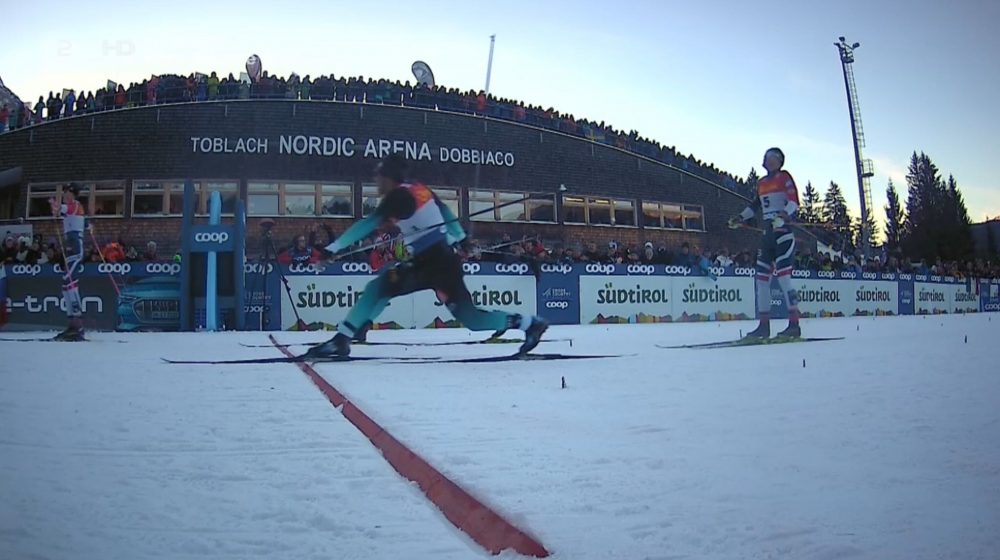
Johannes Høsflot Klæbo of Norway crossing the line in first as France’s Richard Jouve placed second and his teammate, Lucas Chavanat, was third. (Photo: ZDF Screenshot)
Two Americans qualified for the heats, with Simi Hamilton qualifying in eighth (+3.00) and Kevin Bolger of the U.S. qualifying in 13th (+3.98).
Hamilton, who advanced to the second quarterfinal, looked strong for the first two-thirds of the course. However, in the last climb of the sprint loop, while moving from fifth to third, Hamilton fell. The crash cost him advancing to the semis and he crossed his heat in sixth, ending the day’s sprint in 26th.
“I think he unfortunately just took himself out,” U.S. World Cup head coach, Matt Whitcomb said during a phone conversation. “From the side angle, it looked like he just started getting a little bit too far forward. He thought he might have hit something…But it was a bummer because he had a really speedy qualification and was just positioned perfectly to move on and was feeling great.
“It’s one of those instances where you can be disappointed but not discouraged because he’s where you want him to be,” Whitcomb continued. “He’s in a place where he’s good enough to be on the podium, can certainly ski with the best, but unfortunately that didn’t unfold today.”
The U.S. Ski Team’s Kevin Bolger during the first stage of the 2018/2019 Tour de Ski — a 1.3k skate sprint. Bolger placed 21st overall. (Photo: Fischer/Nordic Focus)
Bolger, who advanced to the fifth quarterfinal remained in contact with Swedish skiers Karl-Johan Westberg and Viktor Thorn and Russian Alexander Bolshunov, who lead through the first and second climbs. Bolshunov picked up the pace on the second hill, pulling the rest of the field with him.
“I kind of assumed Bolshunov would want to take command of the heat, and he did from the start, and then he put in that surge just over the top of the second climb, I felt like I was ready but not in the best position to react, and was able to get back in contact with the group over the last climb, but making a move from there was tough,” Bolger wrote in an email to FasterSkier on Saturday. “We had one of the fastest heats of the day, if I was in any other heat I think I would have qualified.”
The Russian crossed the quarterfinal first with Poland’s Maciej Starega holding onto him to cross in second. Bolger eventually crossed in fifth for 21st on the day.
“Really exciting to see Kevin qualify,” Whitcomb said. “Watching his qualification rounds, he must have skied one of the fastest first climbs. His V1s were absolutely lightning fast. We’re really impressed with his trajectory throughout Period 1 getting gradually faster and faster and almost being there in Davos and he’s clearly there now.”
Two weekends ago, Bolger finished the Davos, Switzerland sprint in 31st, just one place outside of qualifying. These were the first heats of the season in which he qualified.
“I was excited, but also relaxed,” Bogler wrote of how he was feeling. “I don’t feel like a newbie in the world cup heats anymore, I’ve had experience. So I wanted to ski aggressive and attack and be in the mix from the start.”
“I will be dropping out of the tour after the 3rd stage, along with Simi, and Sophie,” Bolger continued. “But tomorrow’s 15 k skate will be a hard effort, but a fun fast course I’m looking forward to having a good race, but I’ll be putting a little more focus into the next skate sprint in Val Müstair!”
Canadians Alex Harvey finished in 50th (+7.16), Len Valjas in 55th (+7.46), and Bob Thompson 62nd (+8.10).
“My skis were great today!” Harvey wrote in an email after the sprint. “I was actually feeling quite good in the warm up and in the race. I just think that a 2:16 sprint is a bit too short for me. The conditions made for a quick and fairly easy prologue, I think 2 years ago in was more around 2:45 so to shave 30 sec of a sprint course is pretty impressive.”
“I would have liked to get in the heats and maybe put some time on some of the contenders for the overall but I guess I’ll have to wait for tomorrow to do that!” he added.
Another duo of North Americans started the qualifier, with Erik Bjornsen (USST) and Ben Lustgarten (CGRP) of the U.S. placing 76th (+10.38) and 105th (+15.23), respectively.
The women’s podium from the 2018 1.3 k World Cup freestyle sprint in Lillehammer, Norway. Sweden’s Jonna Sundling (center) won, teammate Stina Nilsson (left) was second, and U.S. skier Sadie Bjornsen (right) third.
FIS Cross-Country World Cup in Lillehammer Norway: Freestyle Sprint
In Friday’s women’s 1.3-kilometer freestyle sprint in Lillehammer, Norway, the first day of three successive days of World Cup racing, the women’s sprint final was stacked with Swedes, with four of six athletes sporting the yellow, blue, and white.
In the final, Jonna Sundling of Sweden passed teammate Stina Nilsson meters before the finish line to take the win in 2:52.74 minutes. It was Sundling’s first career individual World Cup win. Nilsson placed second (+.34), the U.S. Ski Team’s (USST) Sadie Bjornsen was third (+3.03).
Evelina Settlin, also of Sweden, placed fourth (+3.82), Kristine Stavås Skistad from Norway was fifth (+6.65), while the day’s fastest qualifier, Hannah Falk, finished sixth (+9.81).
American’s Jessie Diggins and Rosie Brennan were knocked out when they placed fourth and fifth respectively in the second heat. The top-four spots in the second heat were separated by 0.42 seconds. Diggins finished the day in 17th, Brennan in 21st.
Sweden’s Falk won the qualifier in 2:56.43 minutes.
The U.S. Ski Team’s (USST) Bjornsen was the fastest North American qualifier in sixth (+1.88). Brennan qualified in ninth (+3.11), Diggins 12th (+3.66).
Ida Sargent (USST) qualified 34th (+7.28), Kelsey Phinney (SMS T2) in 38th (+8.76), Caitlin Patterson (CGRP) 59th (+13.18), and Kaitlynn Miller (CGRP) 73rd (+20.78).
USST athlete Sophie Caldwell did not start as she is fighting a cold.
No Canadian women were entered
The men raced on a slightly longer 1.6 k course. Italy’s Federico Pellegrino, known for his skate sprint flash, won the men’s final in 3:19.17 minutes. On-form Norwegian Emil Iversen was second (+0.44), while Canada’s Alex Harvey, took third (+0.68).
Norway’s Sindre Bjørnestad Skar placed fourth overall (+0.91), with Finn Hågen Krogh racing to fifth (+1:07). Finland’s Ristomatti Juhani Hakola crossed the line in sixth (+2.43).
Norway’s Johannes Høsflot Klæbo won the qualifier in a time of 3:07.63. Klæbo placed sixth in the first semifinal finishing over thirty seconds back after breaking a pole.
Canada’s Alex Harvey and USST skier Simi Hamilton were the only North American men to qualify for the heats. Harvey qualified 17th (+7.59), Hamilton 22nd (+8.72). While Harvey eventually moved onto the final, placing third, Hamilton bowed out in the third heat. Hamilton placed fourth and was unable to advance as a lucky loser. Hamilton finished 19th overall in Friday’s sprint.
For Canada, Andy Shields placed 60th (+14.59), Russell Kennedy (Team R.A.D.) 64th (+15.21), Julien Locke (CNST) did not start.
The USST’s Kevin Bolger was the next best placed American in 61st (+14.63). Also for the USST, Erik Bjornsen was 63rd (+15.04), Paddy Caldwell 82nd (+19.34). David Norris (APU) placed 90th (+20.71), Scott Patterson of the USST finished in 92nd (+22.21), and Adam Martin (CGRP) 108th (+32.72).
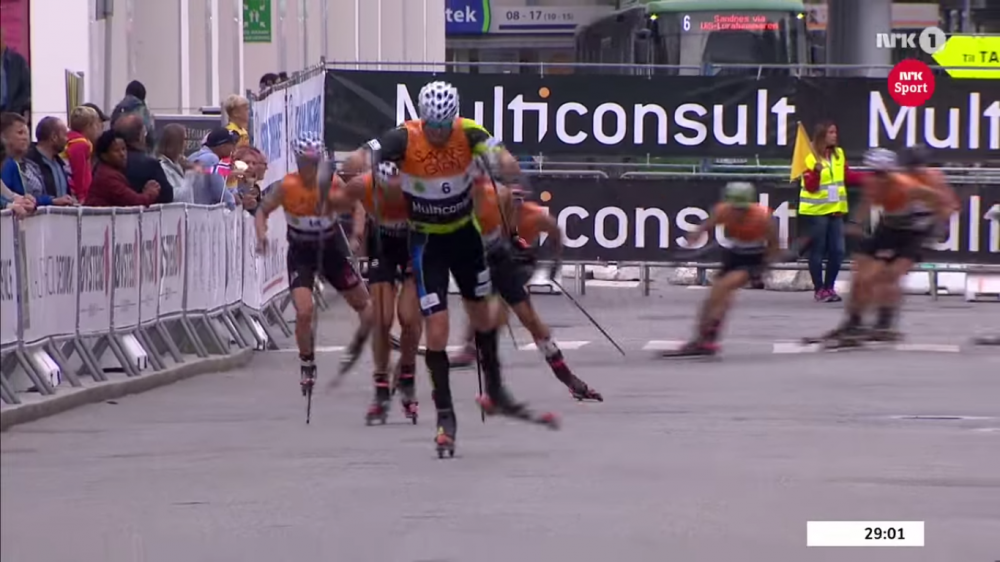
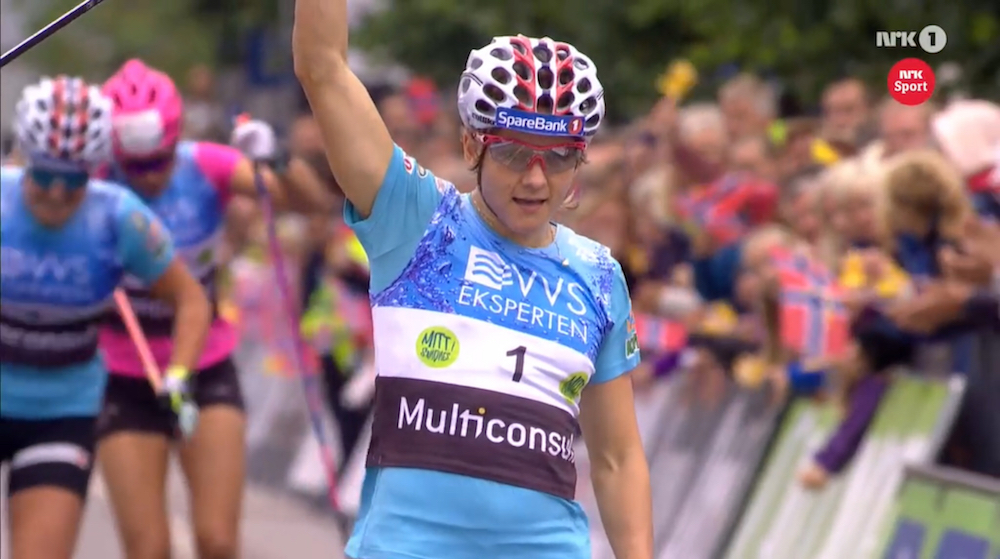
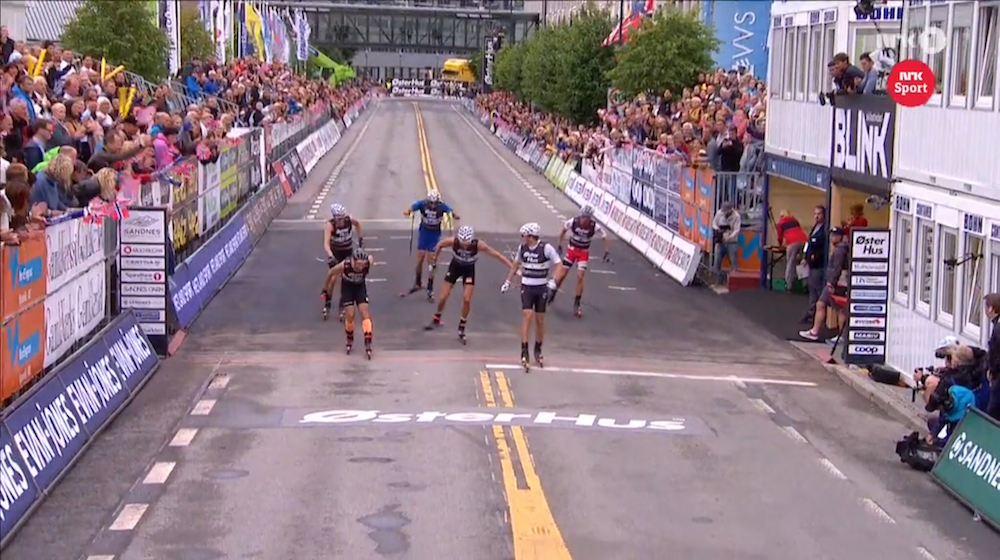
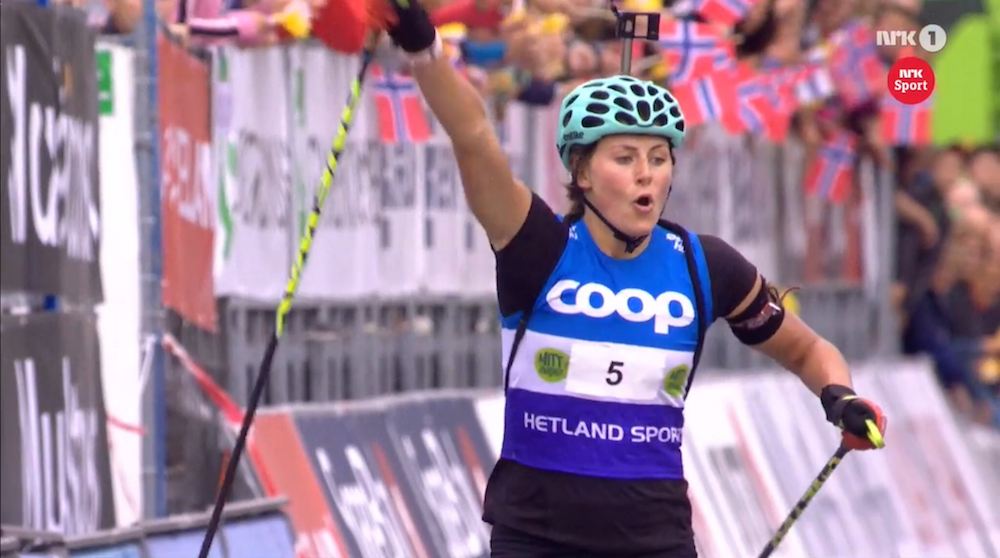
Norway’s Maiken Caspersen Falla (1) winning Saturday’s women’s cross-country sprint final on the last day of the 2018 Blink Ski Festival in Sandnes, Norway. (Photo: Blink Ski Festival/Axelar/Arild Aarnes)
The 2018 Blink Ski Festival continued in full force on Friday and Saturday, with cross-country and biathlon prologues, 10- and 15-kilometer cross-country races and biathlon mass starts all taking place on Friday, followed by sprints on Saturday.
Elite racing began in the afternoon with the men’s prologue (no prologue was held for the women), Norway’s Gjøran Holstad Tefre posted the fastest time of 3:12.21. Finishing 1.89 seconds back was another Norwegian, Aleksander Dyrberg Ek, and Great Britain’s Andrew Young claimed the prologue’s final podium spot, finishing 2.27 seconds off the winning time.
Also in the top 10 were Norway’s Morten Eide Pedersen in fourth (+4.7), Britain’s James Clugnet in fifth (+4.76), France’s Lucas Chanavat in sixth (+5.09), Norway’s Stian Grastveit in seventh (+5.70), France’s Renaud Jay in eighth (+5.75), and Norway’s Sindre Folkvord and Harald Østberg Amundsen in ninth (+6.00) and 10th (+6.03), respectively.
Canada’s Evan Palmer-Charrette finished 34th (+16.68), Scott Hill placed 39th (+19.37) and Bob Thompson was 40th (+19.54) out of 47 finishers.
After the elite men’s prologue, athletes geared up for a men’s and women’s biathlon prologues.
Norway’s Johannes Thingnes Bø took the men’s biathlon prologue win in a time of 10:30.2 after two misses (1+1). One second back, it was a tie for second place between another Norwegian, Lars Aasheim Svaland, who had one penalty (0+1), and France’s Antonin Guigonnat, with one miss as well (1+0).
Slovenia’s Anastasiya Kuzmina, who took one gold and two silver medals at the 2018 Olympics, won Friday’s women’s prologue with clean shooting and a time of 11:34.6. Just 0.6 seconds behind was Norway’s Emilie Ågheim Kalkenberg, who placed second with perfect 10-for-10 shooting as well. France’s Justine Braisaz claimed third, 10.7 seconds out of first, after missing two targets (0+2).
The next event on Friday’s program was the women’s 10 k cross-country mass start, which Norwegian sprint specialist Maiken Caspersen Falla won in 20:39.4. She bested fellow Norwegian Mari Eide by 1.9 seconds, and Sweden’s Charlotte Kalla and Norway’s Kari Øyre Slind followed in third (+3.9) and fourth (+3.9), respectively, with the same time.
Working their way into the top 10 were Russia’s Elena Soboleva in fifth (+4.9), Finland’s Krista Pärmäkoski in sixth (+5.0), Norway’s Ingvild Flugstad Østberg and Ragnhild Haga in seventh (+5.1) and eighth (+5.2), respectively, Austria’s Teresa Stadlober in ninth (+6.6), and Russia’s Natalia Matveeva in 10th (+8.7). Out of 31 women, Nichole Bathe, racing for Great Britain, finished in 23rd (+1:09).
Sweden’s Hanna Öberg (front) racing to first in the women’s biathlon mass start on Friday the 2018 Blink Ski Festival in Sandnes, Norway. (Screenshot: NRK broadcast)
Friday’s program then moved on to the women’s biathlon mass start. Sweden’s Hanna Öberg won the event in a time of 13:19.4 despite three misses (0+1+2+0). Kuzmina finished second, crossing 2.1 seconds behind the Swede after a penalty in each stage (1+1+1+1). Third place went to another Swede, Mona Brorsson, who crossed 5.9 seconds after Öberg and shot four penalties (2+1+1+0).
Norway’s Henrik L’abeé-Lund (r) winning the men’s biathlon mass start on Friday at the 2018 Blink rollerski festival, ahead of his teammate Johannes Thingnes Bø in second in Sandnes, Norway. (Screenshot: NRK broadcast)
Following the women’s biathlon race, the men’s biathlon mass start got underway. Norway’s Henrik L’abeé-Lund emerged as the winner, crossing the line in 17:21.3 after shooting four penalties (1+1+2+0). Exactly three seconds behind him was J.T. Bø in second place with two misses (1+0+1+0). Sealing the all-Norwegian podium was Vetle Sjåstad Christiansen, who missed six targets (1+1+2+2) and finished 12.1 seconds after L’abeé-Lund for third.
Russia’s Sergey Ustiugov leading the pack of the elite men’s 15-kilometer freestyle cross-country mass start on Friday at the 2018 Blink Ski Festival in Sandnes, Norway. (Screenshot: NRK broadcast)
Friday’s final race turned back to cross-country for the elite men’s 15 k freestyle mass start. Russian skier, Sergey Ustiugov, who was banned from competing at the 2018 Winter Olympics, won it in 29:26.0, 2.1 seconds ahead of Norway’s Aleksander Ek, (who had placed second in the prologue to start the day). Italy’s Federico Pellegrino was just another 0.6 seconds back in third (+2.7).
“I was a little nervous today because I won it last year and I wanted to repeat my success here again today,” Ustiugov told NRK through a translator. “It didn’t go easy, but I did manage to do what I wanted to do, and I would like to thank all my team, Markus [Cramer], and the rest of the team. That was great.”
The remaining top ten included Norway’s Vebjørn Turtveit in fourth (+2.9), Sindre Bjørnestad Skar in fifth (+3.9), Øystein Pettersen in sixth (+5.4), and Torstein Bu in seventh (+5.8). France’s Adrien Backscheider and Clement Parisse placed eighth (+5.9) and ninth (+6.2) respectively, followed by Norway’s Eirik Brandsdal in tenth (+6.2).
Racing for Canada, Alex Harvey finished 14th (+7.5).
Norway’s Maiken Caspersen Falla winning the women’s cross-country sprint on Saturday at the Blink Ski Festival in Sandnes, Norway. It was her second-straight victory after topping Friday’s 10 k freestyle mass start as well. (Screenshot: NRK broadcast)
Saturday marked the final day of the Blink rollerski festival and included cross-country and biathlon sprints. In the women’s cross-country final, Norway’s Falla picked up her second-straight win, ahead of Russia’s Matveeva in second (+1.6) and Sweden’s Ida Ingemarsdotter in third (+2.4). Norway’s Eide was just off the podium in fourth (+2.9), Norway’s Barbro Kvåle Trømborg placed fifth (+3.7), and another Norwegian, Linn Ravndal, finished 8 seconds back in sixth.
Falla’s won the final in 3:40.8 after topping her quarterfinal and semifinal as well.
The men’s cross-country racing began with a prologue, which Norway’s Vetle Christiansen won in 1:31.92, just three-hundredths of a second ahead of his fellow countryman, Ek. France’s Baptiste Noel placed third in the prologue, 1.76 seconds out of first.
Russia’s Gleb Retivykh (second from r) winning the men’s cross-country sprint final on Saturday at the Blink Ski Festival in Sandnes, Norway. (Screenshot: NRK broadcast)
In the heats later in the day, Russia’s Gleb Retivykh came out on top of the final, getting there by placing second in both his quarterfinal and semifinal, then winning the last round by 0.2 seconds over Pellegrino in a time of 3:15.5. Pellegrino had won his quarterfinal but advanced as a lucky loser in fourth out of the second semifinal. The 25-year-old Ek capped off his successful series with another podium, placing third in the final, just 0.3 seconds out of first.
In a post-race interview with NRK, Retivykh explained this was his first time at Blink.
“I am very happy,” he said in English. “Today is my first win at Blink, and [it was my] first time here.”
In a close final, Norway’s Gjøran Tefre and Brandsdal followed in fourth (+0.5) and fifth (+0.7), respectively, Italy’s Francesco De Fabiani was just behind in sixth (+0.8).
France’s Justine Braisaz celebrating across the line as she wins the women’s biathlon super sprint on the last day of 2018 Blink Ski Festival on Saturday in Sandnes, Norway. (Screenshot: NRK broadcast)
Biathletes were able to experience head-to-head sprint racing as well (a deviation from the typical biathlon World Cup sprint format, which is individual), in the women’s and men’s biathlon supersprints, which included one prone and one standing shooting stage per heat.
France’s Braisaz won the women’s final in 7:45.3. She had previously won her quarterfinal (which was a longer distance), then placed seventh in the first semifinal (same distance as final). Norway’s Marte Olsbu placed second in the final (+0.4), and Sweden’s Brorsson returned to the podium in third (+0.9).
“It was really close at the end, but I am very happy about the weekend here,” Braisaz told NRK on English after. “Everything is perfect, even though the weather is a little bit — how do you say — moody. But it’s OK. And I am really happy to be in Norway and I will make my stay longer after the festival weekend.”
Norway’s Vetle Sjåstad Christiansen winning the men’s biathlon supersprint on Saturday, the last day of the Blink Ski Festival, in Sandnes, Norway. (Screenshot: NRK broadcast)
In the men’s biathlon super sprint, Norway’s Christiansen dominated the day, winning his quarterfinal and semifinal before beating J.T.Bø by 2.2 seconds in the men’s final with a time of 12:01.8. France’s Guigonnat completed the podium in third, 8.5 seconds behind Christiansen.
Norway’s Johannes Høsflot Klæbo (l) edging Russia’s Alexander Bolshunov (3) and Norway’s Eirik Brandsdal (not shown) in the first semifinal of the men’s classic sprint at the World Cup in Drammen, Norway. Klæbo went on to win the final, ahead of Brandsdal in second and Bolshunov in third. (Photo: Fischer/Nordic Focus)
In the classic venue that are the Drammen city sprints, it was a singular affair from start to finish during the men’s World Cup 1.2-kilometer classic sprint on Wednesday. In a race format that tapered from a field of 61 skiers to the winner, one only needs to track the skier in the overall World Cup’s leader bib to follow along.
The yellow-bibbed skier, Norway’s Johannes Høsflot Klæbo, didn’t surprise with his sprint win in Drammen as much as place another high performance stamp on his 2017/2018 campaign.
Klæbo won the qualifier in 2:49.32 minutes. Teammate Eirik Brandsdal skied to second in the qualifier, 3.5 seconds behind Klæbo. Russian Alexander Bolshunov skied the third-fastest qualifying time, finishing 4.48 seconds back. This puts some things in perspective, if anybody thought Klæbo would bloat in his post-Olympic gold medal glow — he won three golds in PyeongChang — you’d be wrong.
Klæbo would have have good reason to cash it in. What exactly does the 21 year old need to prove? Coming into Wednesday’s race, Klæbo had already captured the Sprint World Cup Crystal Globe. It’s the Norwegian phenom’s second-consecutive overall sprint title.
Yet Klæbo is also on the verge of sealing up his first Overall World Cup title. After the Drammen sprints, Klæbo leads the overall standings with 1308 points. Behind him, Martin Johnsrud Sundby of Norway (who did not contest Wednesday’s sprint), trails in second place with 980 points total.
Johannes Høsflot Klæbo leads his quarterfinal with fellow Norwegian Fredrik Riseth (l) and Sweden’s Emil Jönsson (30) at the World Cup classic sprint in Drammen, Norway. (Photo: Fischer/NordicFocus)
“It was really important to me to get the 100 points today,” Klæbo told the International Ski Federation (FIS) after the race. “I need as many points as I can get against the other guys for the [overall] Crystal Globe. I will race the Holmenkollen 50 k this weekend and I know it will be tough. Also it’s great to win here in front of all the people. I was second here last season and I’m really happy to now have won Drammen.”
Let’s circle back to what Klæbo needs to prove, beyond padding his overall lead by another 100 points by winning the Drammen sprint. He’s proving at his young age, pending any monumental flameout, that he’s setting the stage for a historic international cross-country ski career.
This season alone, Klæbo has won six of nine individual sprint World Cups. He’s won 10 World Cup races in total. That win total puts Klæbo in rarefied company: in the men’s field, only Petter Northug (with 10 wins) and Sundby (16 wins) have won 10 or more World Cup races in a single season.
Winners want to win. Amidst the five-deep crowd surrounding the sprint course featuring Drammen’s iconic Bragernes Church, with his pink-themed flare, Klæbo proved once again he is a consummate winner.
There was his dominating qualifier. Then there was Klæbo’s quarterfinal, in which he looked less threatening. He won the first quarterfinal by 0.7 seconds in a photo finish with Brandsdal. That heat seemed to be a test run, as if Klæbo were feeling the course out and asking himself how it skied with five other bodies jousting for tracks and inside lines. There was never the hallmark Klæbo burst of speed or any real dominance. Klæbo kept in contact up the long initial uphill, and down through the tight and sinuous S-turns after the course’s highpoint.
If in fact the first quarterfinal was a dress rehearsal, Klæbo must have realized that any real podium threats would be drag racing up the final quarter-kilometer climb that finished nearly smack-dab in front of the church.
The first semifinal featured the day’s top-three qualifiers: Klæbo, Brandsdal and Bolshunov. (Bolshunov advanced by winning the second quarterfinal.) The three skiers finished 1-2-3 with Klæbo taking the win in another photo finish with Brandsdal.
Russia’s Alexander Bolshunov leads five Norwegians in the men’s classic sprint final at the World Cup in Drammen, Norway: (from l to r) Eriik Brandsdal, Johannes Høsflot Klæbo (yellow bib), Sindre Bjørnestad Skar (10), Kasper Stadaas (16), and Emil Iversen. (Photo: Fischer/Nordic Focus)
Tactically, Bolshunov played his hand early. Determined to break Klæbo, the Russian led out hard and took the sharp end of the race in earnest. At the top of the course, Bolshunov had strung the five other skiers out behind him. Moments before the highpoint and entering the technical downhill S-turns, Bolshunov and Klæbo gave a burst of speed and distanced themselves by 10 meters. As Klæbo learned in his heat, even with speedy skis, the downhill is not decisive. It’s more a function of skiing out front, staying on your feet and entering the final straight with enough high-octane gas to turbo the finish.
Up the final climbing stretch, which seems as eternal as some flame burning inside the Bragernes Church, Bolshunov faded slightly, while Klæbo and Brandsdal pulled ahead.
Klæbo’s second takeaway: he already knew the course was won on the final straightaway climb. If he could match Bolshunov on the remainder of the course, Bolshunov could not mirror him in the final meters.
The final played out like Klæbo’s semi. Bolshunov punched it early. Klæbo sat behind the Russian, matching him pole for pole, stride for stride. Up front was as good a place as any for Bolshunov. Besides the Russian, it was an all-Norwegian final. There was Klæbo and Brandsdal, along with Sindre Bjørnestad Skar, Kasper Stadaas and Emil Iversen.
The men’s podium from Drammen’s 2018 classic sprint. Norway’s Johannes Høsflot Klæbo (c) placed first, his teammate Eirik Brandsdal (l) was second, and Russia’s Alexander Bolshunov (r) finished third. (Photo: Fischer/NordicFocus)
Bolshunov again led up and over the top of the course, through the S-turns and through the tucking downhill. Brandsdal trailed by 10 meters, but by the final turn before the uphill to the church’s front door, the threesome had regrouped. Again, as the double poling got down to business, Bolshunov faded, Klæbo pulled away and Brandsdal could only stay a second behind the day’s winner. And of course Klæbo was able to toe the line as he bowed to the frenzied crowd. Nothing to prove except he can win with panache and win in style when the Norwegian cameras turn out in force.
Klæbo won the final in 2:44.69 minutes. Brandsdal followed 1.04 seconds back in second place, Bolshunov finished third (+3.78), Bjørnestad fourth (+6.55), Kaspar fifth (+8.71), and Iversen sixth (+11.45).
Bjornsen Reaches Quarterfinals, 18th Overall
Erik Bjornsen was the lone North American who advanced to the heats, qualifying in 26th and finishing the day in 18th.
“I was feeling good,” Bjornsen told FasterSkier after the race. “It’s a tight course. It was a bit scrappy. … It’s my first time here qualifying for the heats, so I’m learning some things, for sure.”
Bjornsen skied in the fifth quarterfinal with Iversen, Russia’s Alexander Panzhinskiy, Finland’s Ristomatti Hakola, Emil Nyeng of Norway, and France’s Lucas Chavanat.
The American skied near the back of the group but avoided any real mishaps. Although the sport is not roller derby, Drammen’s tight-and-rutted corners offer up a close cross-country skiing cousin.
The U.S. Ski Team’s Erik Bjornsen toeing the line in fourth during Wednesday’s fifth heat in Drammen, Norway. Bjornsen placed 18th on the day. (Screenshot: NRK broadcast)
“I feel like – I kind of missed a few spots,” Bjornsen said. “At the bottom corner I was pushed to the outside. I was almost moving up into second, and looking back maybe I should have gone around him on the other side.”
Up the never-ending final straightaway, Bjornsen poled himself into a position to potentially advance to the semifinals as a lucky loser. However, that didn’t pan out for Bjornsen. Iversen won the heat in 2:51.96 minutes, Panzhinskiy placed second (+0.20), Hakola third (+0.99), with Bjornsen in fourth (+1.18).
Andy Newell racing to 33rd in the men’s classic sprint qualifier at the World Cup in Drammen, Norway. (Photo: Fischer/NordicFocus)
Also for the U.S., Andy Newell missed the quarterfinals after finishing 33rd in qualification, 0.9 seconds out of 30th. Logan Hanneman and Kevin Bolger finished 49th and 50th, respectively, and Reese Hanneman 56th. The U.S. Ski Team’s Simi Hamilton sat out Wednesday’s sprint as he is recovering from an illness.
For Canada, Julien Locke finished 51st in qualifying, Alex Harvey was 54th, and Andy Shields 58th.
Maiken Caspersen Falla of Norway (center) won the classic sprint in Drammen and all but wrapped up the Sprint Cup. Stina Nilsson of Sweden (left) was second and Jessie Diggins of the United States third. (NRK screencap)
FIS Cross Country World Cup (Drammen, Norway): Classic sprints
The cross-country World Cup hit the city on Wednesday, with classic sprints contested in the Oslo suburb of Drammen on snow which had been trucked onto the streets. And the crowd was rewarded with wins by two Norwegian favorites: Maiken Caspersen Falla in the women’s sprint and Johannes Høsflot Klæbo in the men’s race.
In the women’s final, Falla and Natalia Nepryaeva of Russia battled at the lead for much of the race, but Falla pulled away from the field on the last climb to the finish. Stina Nilsson of Sweden and Jessie Diggins of the United States pulled past Nepryaeva in the final few hundred meters to claim spots on the podium; Krista Parmakoski of Finland was fifth and Katja Visnar of Slovenia sixth.
With the win, Falla all but wrapped up the World Cup’s Sprint Cup crystal globe: she is just two points from having it clinched, with one sprint remaining on the calendar. In Falun, Sweden, in ten days, she more or less just has to make the heats to earn her third Sprint Cup in a row.
Also racing for the United States, Sadie Bjornsen and Sophie Caldwell made the quarterfinals, but did not advance past that round. Bjornsen ended the day in 21st and Caldwell in 27th.
Ida Sargent and Rosie Brennan were 47th and 48th in qualifying, followed by Kikkan Randall in 50th and Kaitlynn Miller in 53rd.
For Canada, Emily Nishikawa finished 52nd and Dahria Beatty 55th.
Great Britain’s Nichole Bathe, who raced for the University of Alaska Fairbanks, finished 58th.
In the men’s final, Russia’s Alexander Bolshunov set the pace for most of the heat. Klæbowas on his ski tails, and drew even on the course’s on downhill, where Norwegian teammate Eirik Brandsdal also caught up to them. Skiing back up to the finish, Klæbo ramped up to a furious tempo and was uncatchable. Brandsdal passed Bolshunov to claim second by a healthy margin. Sindre Bjørnestad Skar finished fourth, Kasper Stadaas fifth, and Emil Iversen sixth, all for Norway.
The lone North American to make the heats, Erik Bjornsen, qualified in 26th and finished the day in 18th. Teammate Andy Newell just missed the quarterfinals after finishing 33rd in qualification. Logan Hanneman and Kevin Bolger finished 49th and 50th, and Reese Hanneman 56th.
For Canada, Julien Locke placed 51st in qualifying, Alex Harvey 54th, and Andy Shields 58th.
The men’s 1.6 k freestyle sprint podium at Saturday’s World Cup in Lahti, Finland, with Italy’s Federico Pellegrino (c) in first, Russia’s Gleb Retivykh (l) in second and Norway’s Johannes Høsflot Klæbo (r) in third. (Photo: Fischer/NordicFocus)
The men’s freestyle sprint final in Lahti, Finland, started in almost comical fashion: the six men who had made it to the final heat of the day skied slowly, then even slower, as nobody wanted to lead.
The final was full of dangerous men. Norwegian youngster Johannes Høsflot Klæbo has won five sprints this season, and he just became an Olympic gold medalist in the sprint in PyeongChang, South Korea, a mere ten days ago. In his quarterfinal and semifinal heats, he had put in big turns of speed which had dropped most of the field.
They hadn’t dropped Italy’s Federico Pellegrino, though, and the 2017 World Champion was the only man competing in Lahti who had beaten Klæbo in a sprint this season.
Then there was France’s Lucas Chanavat, who put in a huge burst of speed up a hill in his own quarterfinal, perhaps mimicking the move that Klæbo usually makes to test it out or prove a point.
They were all lurking there in the final, along with Russia’s Gleb Retivykh, Finland’s Ristomatti Hakola – consistently one of the fastest qualifiers on the World Cup – and Norway’s Sindre Bjørnestad Skar.
Norway’s Johannes Høsflot Klæbo leading his quarterfinal, which included Italy’s Federico Pellegrino (3) and American Erik Bjornsen (29), in the men’s 1.6 k skate sprint at the World Cup in Lahti, Finland. (Photo: Fischer/NordicFocus)
Klæbo finally got up to some sort of speed on a gradual downhill, stringing out the field after a full 90 seconds of being clumped together and moving at walking pace. But he still wasn’t going full bore. On one of the final opportunities, it was Skar who went to the front and sprinted up a hill, finally turning the speed dial to “full”.
Coming down the final hill into the stadium, it was Skar, Klæbo, and Pellegrino, who overtook the leader going into the last turn. In the finishing stretch, the two Norwegians seemed to just fade away; Pellegrino sprinted for the line and a big win of 0.77 seconds.
“I think that when I returned after the Olympics, back home I had a very good time, really good weather in the Alps,” Pellegrino – the silver medalist in the PyeongChang sprint – said in a post-race interview with FIS. “And it was very good to recover and train a lot, so that I could come here in the best shape. I’m really proud of this.”
Also surging past the Norwegian duo was Retivykh, who had accelerated into and through the final corners and pulled away in finishing lane.
“I have been waiting quite long for the World Cup podium,” said Retivykh, according to FIS. “Last time I was top three was in PyeongChang last year. So it feels great to be back. I am not surprised to be second because I knew I could do it. It feels great… I am sharing the podium with two great athletes.”
Klæbo hung on for third, +0.90 seconds, and Skar was fourth, +1.30. He edged Hakola (+1.44) while Chanavat was left in sixth (+7.55).
Coming into the final as the giant everyone feared, Klæbo’s tactics had not paid off.
“I’m glad this was not the Olympics,” Klæbo told Norwegian broadcaster NRK, according to a translation. “Pellegrino was too strong. I had nothing to answer with. Then you have to be thankful for third place. And I’m still smiling pretty wide.”
Pellegrino, meanwhile, played his cards exactly right. He also beat Klæbo here one year ago to win World Championships gold, and he channeled that experience.
“I lost too many races in the past when I was leading almost the whole race,” he told FIS. “I think that on this track I know how to do it.”
And with the win, Pellegrino became the most decorated skate sprinter in men’s World Cup history. It was his tenth skate sprint victory, a new record.
With third place, however, Klæbo has sealed this year’s overall Sprint Cup trophy even though there are still two sprints to come in Drammen, Norway, and Falun, Sweden.
“That is a bright spot, then,” he told NRK. “It helps a little, but there was no snap today. The [qualifier] was good, but otherwise it was a bit dead.”
By placing 11th in the freestyle sprint in Lahti, Sun Valley’s Kevin Bolger won some Gruyere cheese for being the top-ranked Continental Cup skier of the day. (Photo: Matt Whitcomb)
Bolger 11th in World Cup Debut, Bjornsen 20th
You didn’t have to scroll very far down the qualifier results sheet to find the name of a World Cup debutant. In 16th place was Kevin Bolger of the Sun Valley XC Gold Team. The SuperTour leader made the most of his opportunity, and NRK broadcasters referred to him as “the surprising man – Kevin Bolger.”
“Honestly, I didn’t necessarily expect him to qualify in a Scandinavian World Cup, in his first go at it,” Bolger’s coach Chris Mallory wrote in an email. “He generally builds into sprint days as they progress, as he’s a bit of an all-arounder. But he really stepped up to the plate today.”
In his quarterfinal, Bolger was last out of the start gates and sat in sixth place for much of the race. But near the end of the heat he moved into fifth and then coming into the finish turned on the afterburners to move up to fourth.
The last of the quarterfinals, it also turned out to be the fastest one, and both Bolger and third-place Karl-Johan Westberg of Sweden moved on to the semifinals as lucky losers behind Retivykh, the heat’s winner, and second-place Franceso De Fabiani of Italy.
“He’s a big glider, and can carry his speed really well, but he’s focused a lot on improving his speed this year,” Mallory wrote of that finishing sprint.
In the semifinal, Bolger couldn’t quite pull the same move. He was again in sixth out of the gate, but Pellegrino broke a pole, dropping to last. The two traded off places as Pellegrino then caught back up, and then replaced his pole again. Then Bolger passed Emil Iversen, but the Norwegian passed him back by the finish and Bolger ended up sixth in the semifinal and 11th on the day.
Bolger before the start of his semifinal heat. (NRK screencap)
Bolger graduated from the University of Utah last year and it is his first season as a full-time senior racer with the Gold Team, although Mallory said that Bolger had trained with Sun Valley for two years as a high school postgraduate before heading to college.
Before heading to Europe for the World Cup, Bolger had won a SuperTour sprint in Ishpeming, Michigan, and placed second and sixth in 20 k and 10 k races there. Earlier in the season, he was second in the skate sprint and fifth in the classic sprint at U.S. National Championships.
“My goal was for him to get some World Cup starts and a top 30 this season, so those opportunities would keep coming,” Mallory explained. “I watched FIS live timing all night, normally not so exciting, but last night it was!”
Erik Bjornsen of the U.S. Ski Team and APU qualified in 29th place and in his quarterfinal, had a poor start position as a result of his bib and was immediately shunted to the back of the heat.
“Up the first climb I tried to make a couple moves, but I was just kind of boxed in,” he explained.
He was in the first quarterfinal, along with Klæbo, Pellegrino, and Renaud Jay of France. By late in the heat Bjornsen was able to move up to fifth when Poland’s Maciej Starega, who had led early, began to fade. Then in the final downhill he moved into fourth and held that position through the finish.
Norway’s Johannes Høsflot Klæbo and Italy’s Federico Pellegrino (3) going head to head down the finishing stretch in the first men’s quarterfinal at the World Cup 1.6 k skate sprint in Lahti, Finland, with American Erik Bjornsen (l) chasing. (Photo: Fischer/NordicFocus)
But he hadn’t been able to get to the front early in the heat, and by the finish, the two eventual podium finishers were jetting off at hyperspeed. Though he wasn’t able to catch onto their tails, Bjornsen said that he was feeling better than he had at the Olympics, where his results had been disappointing.
“I definitely kind of struggled,” he admitted of the 2018 Olympic experience. “It was some of my worst distance racing of the year, so it was obviously very frustrating.”
After today’s sprint, however, there might be light at the end of the tunnel.
“I felt like I had good energy left,” Bjornsen said of his heat. “I tried making moves on both sides… the fitness is feeling a lot better than it was a couple of weeks ago. And so, I mean, the peaking plan for the Olympics didn’t work as planned. But it’s been a relatively good season for me, pretty consistent. I had a lot of top 30 finishes… I’m just trying to move past [the Olympics] and have a solid period four on the World Cup.”
He now looks to the 15 k classic on Sunday, which he called “one of my favorite races.”
And on getting upstaged by Bolger, Bjornsen seemed the opposite of upset.
“I was just really psyched to see that,” he said. “The kid has put in a lot of work the last few years and – I mean, I was very surprised. It was great to see. I like to see those younger dudes coming here and having successful results. It’s really impressive. You know, it’s his first World Cup and he just looked comfortable and good out there. It’s just the perfect transition to the World Cup. Keep it up!”
Canada’s Julien Locke on his way to 42nd in the men’s 1.6 k skate sprint at the World Cup in Lahti, Finland. (Photo: Fischer/NordicFocus)
“It was so awesome to have two World Cup first timers, Kelsey [Phinney] and Kevin, have such impressive results,” agreed teammate Sophie Caldwell. “Kevin had the race of the day and it was so inspiring for our entire team, staff, and hopefully all the skiers back home to see that success in a young, up and coming racer who just sent it today. We were going crazy!”
The rest of the North American field did not make it into the quarterfinals. In the qualifier, Logan Hanneman (APU) placed 49th (+11.45). Paddy Caldwell (U.S. Ski Team/SMS T2) finished 59th (+13.55), and APU’s Reese Hanneman and David Norris placed 61st (+14.33) and 67th (+19.27).
Julien Locke led Canada in 42nd place (+9.78), and Andy Shields finished 60th (+14.29).
Logan Hanneman (Alaska Pacific University) on his way to 49th in the men’s 1.6 k skate sprint at the World Cup in Lahti, Finland. (Photo: Fischer/NordicFocus)
The men’s 1.6 k freestyle sprint podium at Saturday’s World Cup in Lahti, Finland, with Italy’s Federico Pellegrino (c) in first, Russia’s Gleb Retivykh (l) in second and Norway’s Johannes Høsflot Klæbo (r) in third. (Photo: FIS Cross Country/Twitter)
FIS Cross Country World Cup (Lahti, Finland): Men’s & women’s freestyle sprints
The defending world championships from the 2017 freestyle sprint prevailed again in Lahti on Saturday, with Norway’s Maiken Caspersen Falla winning the women’s 1.4-kilometer freestyle sprint final and Italy’s Federico Pellegrino coming out on top in the men’s 1.6 k final at last year’s World Championships venue.
Falla’s rise to the final started with her qualifying in 12th, 7.96 seconds off the fastest qualifying time set by Sweden’s Hanna Falk in 2:54.72. Russia’s Natalia Nepryaeva qualified second (+0.63) and Finland’s Krista Pärmäkoski third (+3.62), just ahead of Germany’s Victoria Carl in fourth (+3.88) and American Sadie Bjornsen in fourth (+3.88). Four American women qualified for the heats, with Sophie Caldwell in 17th, Ida Sargent in 21st and Rosie Brennan in 29th.
The women’s 1.4 k freestyle sprint podium at Saturday’s World Cup in Lahti, Finland, with Norway’s Maiken Caspersen Falla (c) in first, and Sweden’s Stina Nilsson (l) and Hanna Falk (r) in second and third, respectively. (Photo: FIS Cross Country/Twitter)
Falla went on to place second in the first quarterfinal, 0.71 seconds behind Sweden’s Stina Nilsson in first. According to the race jury’s ruling, Carl obstructed Pärmäkoski coming out of the last downhill before they entered the finishing straight and both crashed out of contention, with Pärmäkoski finishing fifth in the heat (+12.11) and Carl sixth (+49.5). Carl was relegated to last (30th place) for the obstruction.
Falla then won the first semifinal by just 0.04 seconds over Nilsson in second. The two other Swedes in that heat, Falk and Ida Ingemarsdotter, advanced to the final as well as lucky losers with fast-enough times.
In the final, Falla found herself at the front of the pack early then held her position to the finish, crossing the line in 2:54.83 and beating Nilsson by 0.36 seconds. Sweden had two on the podium with Falk in third (+0.78), Germany’s Sandra Ringwald placed fourth (+0.88), Ingemarsdotter was fifth (+1.83), and Switzerland’s Laurien van der Graaff placed sixth (+3.02).
Caldwell was the lone American woman to make it past the quarterfinals, as she placed second in her quarterfinal, 0.25 seconds behind Ringwald in first, then fourth in the second semifinal, 1.46 seconds behind Ringwald, who also won that heat. Overall, Caldwell finished the day in eighth.
Bjornsen placed 17th overall after finishing fourth in her quarterfinal, 2.84 seconds behind Falk in first. Sargent had been second in her quarterfinal until the final tight lefthand corner into the finishing straight, where she slipped to sixth and ultimately finished sixth, 1.07 seconds behind Sweden’s Anna Dyvik in first. Overall, Sargent finished the day in 27th, and Brennan placed 29th overall after finishing sixth in her quarterfinal, 4.91 seconds behind Ingemarsdotter in first.
Two American men advanced to the heats as well, with Kevin Bolger of the Sun Valley Ski Education Foundation (SVSEF) qualifying in 16th in his World Cup debut, 6.38 seconds behind Norway’s Johannes Høsflot Klæbo, who topped the qualifier in 2:59.06. Erik Bjornsen of the U.S. Ski Team qualified 29th, 8.29 seconds back.
Meanwhile, Pellegrino qualified for the heats in third (+1.9) behind France’s Baptiste Gros in second (+1.23).
There, Pellegrino won the first quarterfinal by 0.19 seconds over Klæbo, with the Norwegian visibly backing off before the finish — comfortable enough to automatically advance to the semifinals in second place. But Klæbo showed Pellegrino what he’s made of in the first semifinal and beat the Italian by nine-hundredths of a second.
Bolger also raced in that first semifinal after placing fourth in his quarterfinal, 0.73 seconds behind Russia’s Gleb Retivykh in first. Bolger’s time was good enough for one of two lucky loser spots in the semifinals, where he went on to finish sixth, 1.86 seconds after Klæbo. Overall Bolger finished the day in 11th.
Erik Bjornsen placed 20th on the day after finishing fourth in the first quarterfinal (with Pellegrino and Klæbo), 1.56 seconds out of first.
In the final, Klæbo set the tone, slowing the pace to almost a stop at one point, while he and Pellegrino stood side by side at the top of the course. On the way down, they accelerated, but Norway’s Sindre Bjørnestad Skar was the one who truly attacked. It might’ve been a bit too early, as Pellegrino caught him by the top of the final climb and took the lead on the following downhill into the stadium. Pellegrino held off his challengers, including Retivykh who came on strong out of the downhill, to take the win in 3:16.73, 0.77 seconds ahead of Retivykh in second and 0.9 seconds ahead of Klæbo in third. Skar settled for fourth (+1.3), Finland’s Ristomatti Hakola placed fifth (+1.44) and France’s Lucas Chanavat finished sixth (+7.55).
In the qualifier, Canada’s Dahria Beatty finished 34th, +13.39 and just 0.9 seconds from making the quarterfinals. She was the only Canadian woman competing.
American Kelsey Phinney (SVSEF) was also close to making the cut. In her first European World Cup, she placed 36th in the qualifier, +13.74. Caitlin Patterson and Kaitlynn Miller, both of the Craftsbury Green Racing Project, placed 56th (+20.12) and 61st (+21.70).
Mathilde Petitjean of Togo, a primarily Quebec-based skier, finished in 59th (+20.80).
In the men’s qualifier, Logan Hanneman (APU) placed 49th (+11.45). Paddy Caldwell (U.S. Ski Team/SMS T2) finished 59th (+13.55), and APU’s Reese Hanneman and David Norris placed 61st (+14.33) and 67th (+19.27).
Julien Locke led Canada in 42nd place (+9.78), and Andy Shields finished 60th (+14.29).
American Chloe Levins racing to seventh in the junior women’s 7.5 k sprint on Saturday at IBU Junior World Championships in Otepää, Estonia. (Photo: Terri Dickson)
Poland’s Kamila Zuk won her second race in a row, taking gold in the junior women’s 7.5 k sprint after also winning the individual at World Junior Championships. Zuk had one penalty to two by second-place Marketa Davidova of the Czech Republic, who finished 26.0 seconds back. Bronze went to Myrtille Begue of France, who shot clean to finish 52 seconds back.
The sole U.S. starter, Chloe Levins followed up her sixth-place finish in the individual with seventh place in the sprint. Levins had a single penalty and finished +1:31.7.
For Canada, Megan Bankes was close behind Levins in ninth, with two penalties and +1:49.5. Teammate Nadia Moser was 21st, also with two penalties, +2:46.2. Emily Dickson finished 36th, +3:50.5 with two penalties, and Zoe Pekos just missed the pursuit cutoff in 66th (+6:22.4) with four missed shots.
In the junior men’s 10 k sprint, Vasilii Tomshin of Russia took the gold with perfect shooting. France’s Martin Perillat Bottonet was second, less than a penalty-loop’s worth of time back at 20.5 seconds – and he did have one penalty. Norway’s Sverre Dahlen Aspenes took bronze (+29.4) with two missed shots.
Trevor Kiers led Canada in 16th, a breakthrough result; his previous World Juniors best was 39th in the pursuit last season. Kiers missed two shots, both in prone, and finished 1:34.9 behind the time set by Tomshin.
Adam Runnalls placed 26th for Canada (+2:08.3) with three missed shots. Teo Sanchez also qualified for the pursuit by placing 53rd (+3:19.2) with one penalty, and Angus Tweedie was left on the outside looking in with 69th place (+4:41.3) with three missed shots.
Cody Johnson led the Americans in 37th, with clean shooting, 2:31.1 back from Tomshin’s time. Tim Cunningham was the next finisher in 71st (+5:13.5) with seven missed shots, followed by Jacob Pearson in 79th (+6:24.2) with two penalties and Cam Christiansen in 86th (+7:52.5) with three penalties.
This pretty much sums up Stage 5 of the 2018 Tour de Ski, with a France’s Adrien Backscheider (an early race leader) crashing in the background while Switzerland’s Dario Cologna (red Tour leader’s bib) and Great Britain’s Andrew Musgrave (22) and others chase Norway’s Sindre Bjørnestad Skar (39) and others not shown in the men’s 15 k freestyle mass start on Thursday in Oberstdorf, Germany. (Photo: Harald Zimmer)
Like ants swarming a bread crumb — skating ants — on ice. That was one image that could be conceived from the men’s 15-kilometer freestyle mass start on Thursday, which served as Stage 5 of the 2018 Tour de Ski in Obertsdorf, Germany.
After high winds and fallen trees Wednesday in Obertsdorf left race organizers scrambling to set a new course for Thursday’s distance races, the end result was a 2.1 k loop (the women’s sprint course plus a flat section) with a maximum climb of 16 meters per lap for both the men and the women. The men rounded it seven times for 14.7 k and the women lapped five times for 10.5 k.
While Oberstdorf’s distance courses are typically “challenging and hilly and filled with attacks and strategic moves”, according to U.S. Ski Team Women’s Coach Matt Whitcomb, Thursday’s race was mostly flat. “It was probably the flattest race that many of these athletes have ever raced on the World Cup so it made for a really exciting pack race.
“[The organizers] just couldn’t use the course with the hills because the trees and the forest were unstable,” Whitcomb explained on the phone Thursday evening. “They also didn’t have time to clear the wood that fell. There were six or seven huge trees that fell on the course.”
It had also rained on Wednesday — in fact, a lightening storm struck the venue and led to the cancellation of Stage 4 after the women’s qualifier — so organizers opted to salt the course to preserve it as much as possible for the mass starts. It was raining again on Thursday, leaving the course icy with a thin coat of slush on top by the time the men raced after the women.
Start of the men’s 15 k freestyle at Stage 5 of the 2018 Tour de Ski in Oberstdorf, Germany, with Canada’s Alex Harvey (4), Russia’s Sergey Ustiugov (black bib) and Switzerland’s Dario Cologna (red Tour leader’s bib) up front. (Photo: Fischer/NordicFocus)
The men’s field, led by Russians Sergey Ustiugov and Alexander Bolshunov for almost all of the first lap, completed Lap 1 of seven in 4 minutes and 16 seconds (with Sweden’s Calle Halfvarsson leading through the checkpoint). There, at 2.1 k, all 67 starters were within 16 seconds of the lead.
One lap later, as Great Britain’s Andrew Musgrave led the large group through the stadium, just ahead of Norway’s Martin Johnsrud Sundby, Switzerland’s Dario Cologna, and Canada’s Alex Harvey, only one man had been dropped. Sixty-six still skied within 19 seconds of first.
Crashes dotted the entire race, with Bolshunov going down at least twice. Mostly, skiers tripped over one another on the slightly rolling course. Harvey even broke a pole at one point in the middle of the second-to-last lap. In a phone interview on Thursday, the lone Canadian in this year’s Tour de Ski (TdS) estimated he witnessed several crashes per lap.
“I saw for sure between 10 and 15 crashes that happened within my surroundings,” Harvey said.
For the first two laps, Harvey positioned himself in the top five, coming through the 3.6 k sprint bonus in fifth place to earn six bonus seconds (which count toward the overall Tour standings). On Lap 3, he dropped back to around seventh, still within 2 seconds of Musgrave and Norway’s Didrik Tønseth, who swapped the lead throughout the third lap.
On Lap 4, Cologna moved to the front, just ahead of Musgrave, Tønseth, Sundby and 30 others within 10 seconds of first at 7.8 k. There, Harvey was back in 30th, 9.2 seconds back. About 1.5 seconds behind him at 8.4 k, the end of Lap 4, was American Erik Bjornsen in 36th.
“I didn’t want to fall that far back, but I made a couple bad decisions, like picking wrong lanes and it was just a bit of a slower lane on one hill, so you’d lose five, six spots,” Harvey recalled. “Somebody would fall in front of you or in your lane, so then you’d come to a stop and lose 10 spots, so it was just real mayhem there. But my plan was to try to stay in the top five, top 10 all day, but I just didn’t do that.”
Lap 5 saw Cologna, Sundby, Tønseth, and even France’s Clement Parisse at the front of the pack, while Harvey moved back up to around 20th, just 3.5 seconds out of first.
On the penultimate lap, Harvey broke a pole.
“I had been kind out of position for a lap and half by then, so I was just trying to find ways to move, going on the outside, I think somebody just stepped on my pole, but it’s hard to tell,” he said.
Despite dropping to what he estimated to be 40th on that sixth lap, Harvey recovered, thanks to the tightly packed group, and lapped through the stadium in 27th, 5.3 seconds behind Tønseth in first.
Over the final 2.1 k, Harvey continued to pick off the places. One and a half k later, he was up to eighth, 3.4 seconds behind Norway’s Sindre Bjørnestad Skar in first.
“I was really focusing on staying outside the whole time, never going for the inside lane and then maybe people were starting to get tired a little bit, even though the course was not hard and the course was fast,” Harvey said. “… I think a lot of it was luck.”
In the final meters, when everyone at the front of the race turned it up another notch and Norway’s Emil Iversen attacked on the final rise before descending into the stadium, Harvey came out on top off a three-way photo finish for fifth place, edging Musgrave in sixth and Norway’s Finn Hågen Krogh in seventh. All three were within 4 seconds of first place, which went to Iversen.
Norway’s Emil Iversen (17) racing to the line with his teammate Sindre Bjørnestad Skar (39) for first in the men’s 15 k freestyle mass start on Thursday, which Iversen won by 0.4 seconds for his first win and podium of the season, and the first for a Norwegian man in the 2018 TdS. (Photo: Fischer/NordicFocus)
The win was Iversen’s first of the season, and Norway’s first on the men’s side in the 2018 TdS, and puts him in 13th, 2:13 minutes out of first, with two stages remaining.
“It was a fight from the start to the end, and I just had to be in my head… doing the right things,” Iversen told reporters in English after the race. “I did that really good today so I am satisfied with that.”
Iversen crossed finished first in 29:49.8, just 0.4 seconds ahead of his Norwegian teammate Skar in second place. Italy’s Francesco De Fabiani — who had been 34th at 8.6 k, seven seconds back and just ahead of Bjornsen — claimed third place, just 0.9 seconds behind Iversen. Cologna finished fourth (+3.7) to extend his overall TdS lead, followed by Harvey in fifth. Harvey is still fourth in the Tour, now 1:23.1 behind Cologna.
Asked if he was mostly focused on finishing close to Cologna, Harvey said he was actually keeping track of Bolshunov, who ended up 40th (+15.9) on Thursday. Heading into Stage 5, the Russian U23 skier was third in the Tour, 6.3 seconds ahead of Harvey in fourth. So Harvey knew that even 6 bonus seconds at one of two sprint bonuses on the course could be the difference between third or fourth in the standings.
At the first bonus sprint, where Harvey picked up 6 seconds, Bolshunov picked up 3. Then, at the second bonus sprint at 7.8 k, the Russian clocked through in sixth for 5 seconds. Harvey was 30th there for zero. At the end of the day, Harvey held onto fourth in the standings, 1:21.3 minutes behind Cologna, 30.1 behind Ustiugov, who’s still in second, and 15.5 behind Sundby, who improved to third. Meanwhile, Bolshunov slipped to fifth, 3.6 seconds behind Harvey.
“… He ended up crashing on the last lap, I think,” Harvey said of Bolshunov. “I was focusing more on the guys that are closer to me because Dario, he’s so solid, he never really has a bad day. I think a lot of people — nobody’s giving it to him, but it’s going be hard to get back on him, so I think people are starting to fight more for second place. It was more about Bolshunov and Ustiugov.”
Russia’s Sergey Ustiugov leading Norway’s Martin Johnsrud Sundby (6), Austria’s Dominik Bauldof (47), Kazakhstan’s Alexey Poltoranin (5) and the rest of the men’s field during the men’s 15 k freestyle mass start at Stage 5 of the Tour de Ski. (Photo: Fischer/NordicFocus)
Ustiugov finished 28th on Thursday (+11.1) and now trails Cologna by 53 seconds in the overall. Sundby finished eighth (+4.2) and picked up 23 bonus seconds in Thursday’s mass start to move up from sixth to third overall (+1:07.6).
“For sure, it has been difficult weather, difficult conditions for those who make this race, and I think you can argue in a lot of ways today, the race was difficult and blew many racers’ chances, both with the difficulties with the skis and poles,” Sundby told reporters in English after. “But I am happy that they decided to do the race. They found a short track we could ski in and no cancellation I think that was good.
“My main goal for the season is Olympics,” Sundby continued. “I think we use this Tour for, one: I love the Tour de Ski; it’s a beautiful competition, and two: to get in better shape for the Olympics. That is the main goal this season, but I still want to fight for the first [in the Tour]. It looks a bit a long ahead at this point, but we have two more races to go.”
For Harvey, the race was also about distancing himself from some of his biggest threats in the final climb on Sunday, such as Sweden’s Marcus Hellner, who entered Stage 5 in 10th and about 35 seconds behind him overall, and France’s Maurice Manificat, who was previously 36 seconds behind him in 14th overall. They’re still at least 37 seconds behind Harvey after Manificat finished 10th on Thursday to move up to 10th overall (+1:59.0), tied with Germany’s Thomas Bing, who placed ninth Thursday to put himself ninth overall (+1:59.0). Hellner follows in 11th overall (+2:05.3) after finishing 22nd in Stage 5.
“I think for me today was a really good opportunity to make some time, especially on the guys close behind me, like Manificat and Hellner,” Harvey said. “I didn’t lose much, but I kind of missed the opportunity to give myself a bit more of a cushion for the climb, so that’s mostly what I’m bummed out about. That and looking at the schedule of the Tour, [this mass start] was for sure where I thought my best chance at a podium would be. So I’m a bit bummed out that I missed out on that, but it’s part of the game.”
In a Cross Country Canada press release, Harvey was quoted on his frustration with the mass start being held on a short, narrow and relatively easy course.
“It’s just too bad, the organizing committee or the jury should have just made it a sprint or an individual start,” Harvey told FasterSkier. “It was just kind of a stupid race. I was lucky that I ended up not losing too much time but I didn’t feel like I raced. It was easy the whole time, with just nerves the whole time, trying not to fall and stay out of trouble, even though nobody I think was able to stay fully out of trouble today.”
Bjornsen ended up 32nd at the finish, 11.7 seconds out of first, and leaves the TdS in 20th (+3:10.7). After initially planning to race the entire Tour, he spoke with Whitcomb about withdrawing after Stage 5 on Tuesday night.
“Erik is in a great spot,” Whitcomb said. “He’s had a really strong period [1 on the World Cup]. He’s skiing a really strong Tour. He’s made a distinct step forward this year, and we want to not lose sight of the goal of doing well at the Olympics. Erik’s a guy where in a number of events, but especially in the team sprint, a medal could be on the table for him, so we’re really focused on making sure we don’t tap things too deeply when we don’t need to. So Erik decided to ski through today, then head to Ramsau for a little rest, then a training camp.”
“It was a hard decision since I’m feeling good and sitting in 20th place,” Bjornsen wrote in an email. “There is a team sprint coming up in a little over a week [in Dresden, Germany] that I want to prepare for. There are only a couple team sprints each year and I feel that is my best chance of stepping onto a World Cup podium. I can’t let those opportunities pass me by.”
“I was pretty disappointed with my result,” Bjornsen wrote of Thursday’s mass start. “I’ve been feeling strong and felt like I wasn’t able to use my fitness out there today. It was great practice skiing in a tight pack. The finish came way too fast.”
Also for the U.S., Paddy Caldwell raced to 39th on Thursday (+15.5), and Andy Newell was 53rd (+43.2) while Simi Hamilton did not start. Newell and Hamilton have also decided to leave the Tour, as they had originally planned after Oberstdorf, and head to Ramsau, Austria, in advance of the Dresden city sprint World Cup weekend Jan. 13-14.
“I chose to race today because I had held back a bit in the last skate race on stage 3 to rest up for the sprint, and then sure enough It was canceled,” Newell wrote. “So I felt like I still had some good energy and It was worth having one more hard race.
“I felt a lot better racing today than in the distance races at altitude so I was stoked about that,” he added. “It was raining and icy and fast so it made for an exciting time. Lots of crashes and broken poles for sure, it felt more like rollerski racing with such a tight pack. Aside from several small tangles on the uphills, I tried to avoid trouble and was happy to ski with the main pack during the the majority of the race.”
“Kind of a weird stage for sure but I think it’s actually good for the TDS,” he wrote. “Adds some excitement and plays to a different skill set to race on an icy flat course like that. Racing is racing. We have an all uphill stage of the TDS, I think it should be customary to have a flat one:) similar to cycling.”
He leaves the Tour in 65th (+9:37.1), while Caldwell will continue in his first-ever Tour de Ski ranked 60th (+6:58.2) out of 67.
“I felt like I was skiing with new people all the time,” Caldwell wrote in an email about Stage 5. “It was a very dynamic and chaotic race. There were countless crashes and tangles out there. Absolute mayhem. Poles breaking every climb and at least one serious pile up every lap.
“I am happy with my performance today though it is bittersweet being so close to the points and the top guys,” he wrote of his 39th-place stage result. “It has been a pretty rough Tour for me so far fighting a cold, but today was definitely a step in the right direction. Right now I am just hoping to keep working out this cold and be able to put together good efforts for the next two races.”
“I actually thought he skied fantastically today,” Whitcomb said, “and he’s sounding much better tonight so I think there’s quite a bit of hope for Paddy. He’s looking good right now.”
Other notable withdrawals from the Tour include Sweden’s Halfvarsson and Finland’s Iivo Niskanen. Halfvarsson placed 54th on Thursday to leave the Tour in 24th overall. Niskanen did not race in Oberstdorf.