From the FasterSkier archive — posts syndicated from athletes’ and coaches’ own blogs between 2004 and 2012, kept online as published. Current coverage is at fasterskier.com.
This World Cup coverage is made possible through the generous support of Marty and Kathy Hall and the A Hall Mark of Excellence Award. To learn more about A Hall Mark of Excellence Award or to learn how you can support FasterSkier’s coverage please contact info@fasterskier.com.
By Rachel Bachman Perkins and Ian Tovell
During a brief reprieve from racing, the top tier of international racing made its way from the high desert of Zhangjiakou, China to a venue tucked into snow-capped pines and nestled amongst the lakes of southern Finland. With more start spots per country than during the Games and some athletes choosing a weekend away from the World Cup, a number of new faces appeared on the start lists in Lahti for the 1.6-kiilometer freestyle sprint.
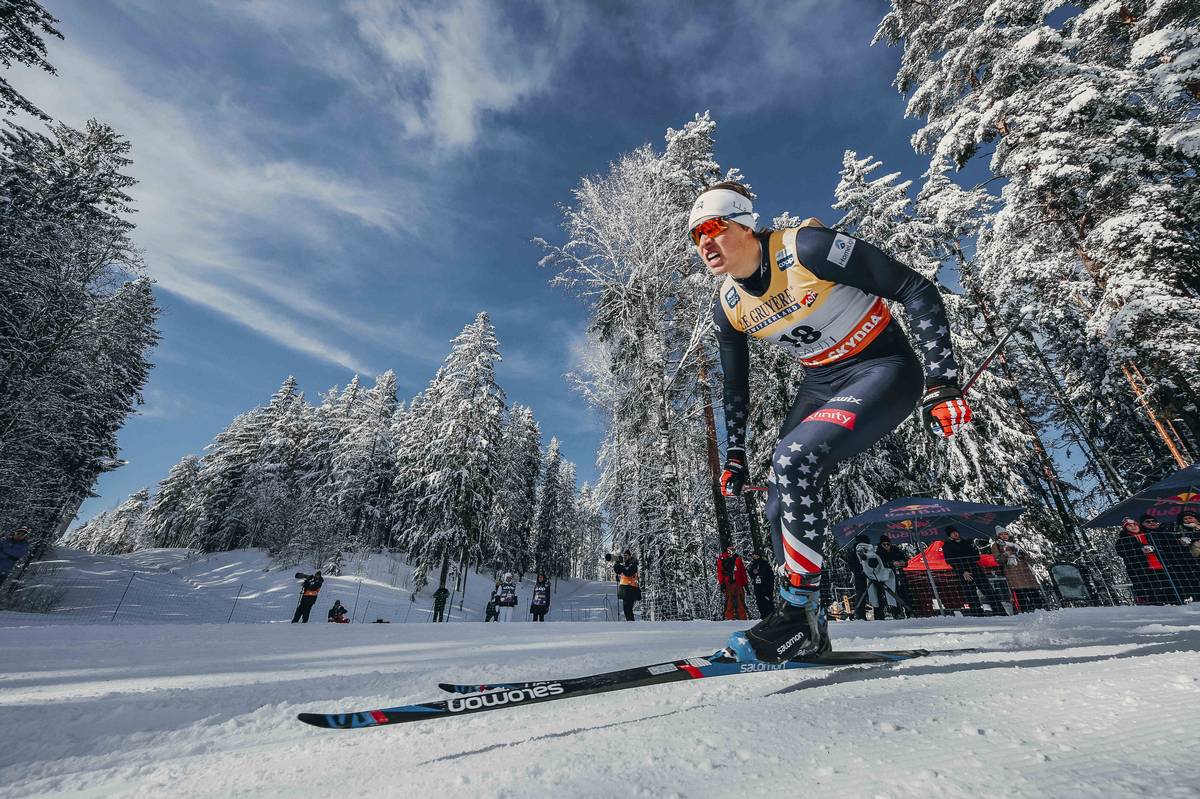
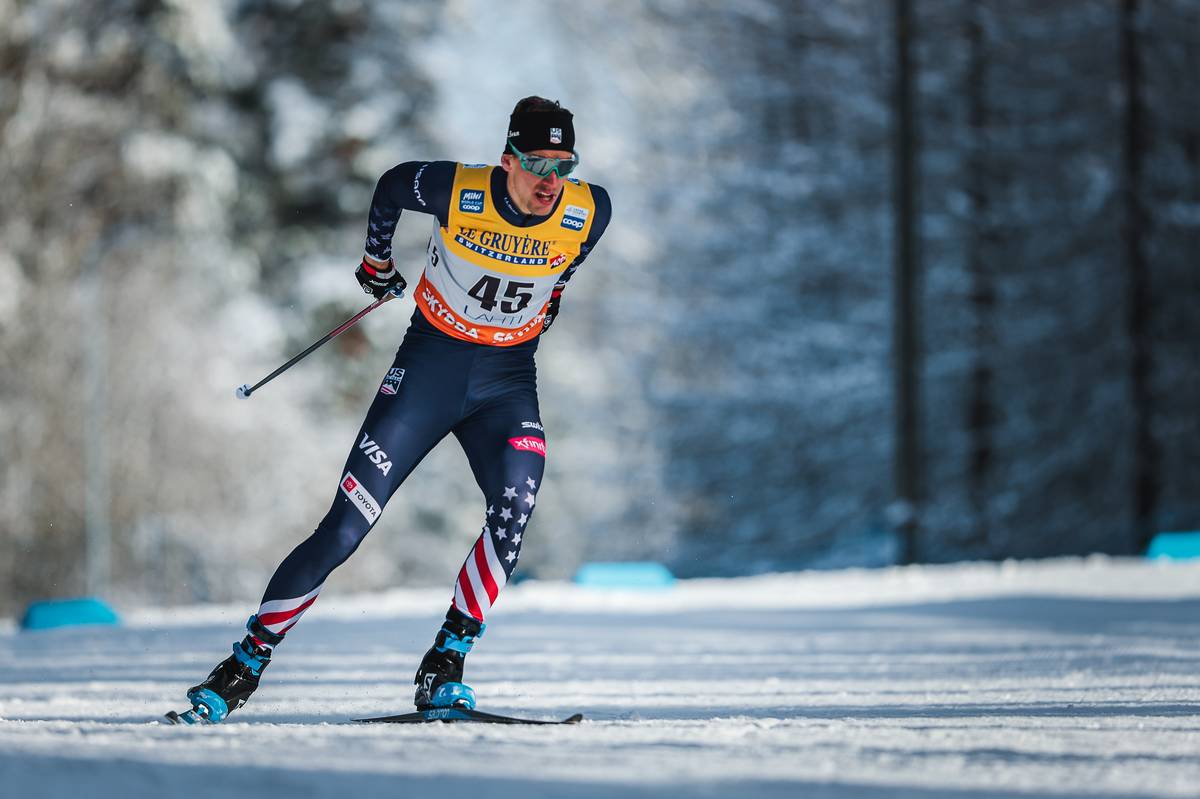
Logan Diekmann (BSF Pro) makes his first World Cup appearance in the 1.6 k freestyle sprint qualifier in Lahti, FIN. (Photo: NordicFocus)
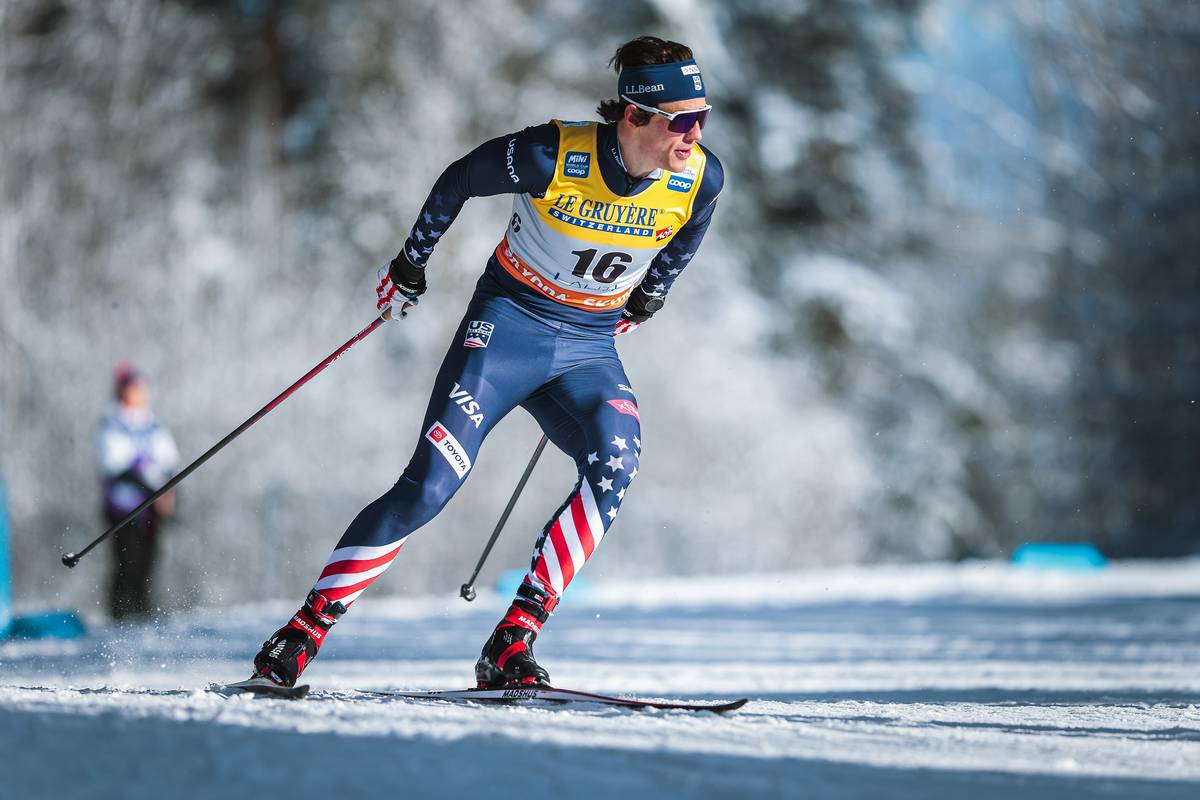
For the U.S., these names included Logan Diekmann (BSF Pro Team) and Bill Harmeyer (SMS T2), both of whom earned their first World Cup starts this weekend via their performance on the SuperTour circuit this season. These athletes joined Kevin Bolger, Logan Hanneman, and Zak Ketterson; the Team Birkie athlete also earned his first World Cup starts earlier this year at the Tour de Ski.
Diekmann currently leads the SuperTour sprint standings with 119 points. He was second in the freestyle sprint during the U.S. Cross Country Championships in Soldier Hollow in January and skied to 5th in the sprint in both Duluth and Lake Placid.
Harmeyer was ranked third in the sprint standings with 83 points, behind Noel Keeffe who is currently racing at the 2022 U23 World Ski Championships in Lygna, NOR. Harmeyer has consistently posted top-five times in qualification during the SuperTour sprint races, and has raced into the final in three out of six SuperTour sprints. A fall in the quarterfinal during US Nationals left him in 24th after qualifying in fifth.
Bill Harmeyer (SMS T2) makes his first World Cup appearance in the 1.6 k freestyle sprint qualifier in Lahti, FIN. (Photo: NordicFocus)
Lucas Chanavat (FRA) was the top qualifier finishing the course in a time of 2:57.85. All five of the Americans finished outside the top-30 in qualification, but Canadian Graham Ritchie cracked into the heats for North America in 27th (+7.73).
The quarterfinal rounds played out mostly as expected, with Chanavat and Johannes Høsflot Klæbo (NOR) advancing from the first round after a close finish. Norway’s Håvard Solås Taugbøl and Olympic silver medalist Federico Pellegrino of Italy crossed the line first and second in heat two, spread by just 0.06 seconds. Winning the third heat, Andrew Young (GBR) crossed the line in 3:04.32, just ahead of Russia’s Gleb Retivykh (+.20).
The fourth quarterfinal heat saw a close finish, as Sindre Bjørnestad Skar (NOR) took the race to the line alongside Richard Jouve of France and Alexander Bolshunov of Russia were right at his heels. Skar won the closing sprint with Jouve +0.01 behind and Bolshunov in third (+0.07). Michal Novak (+.49) of the Czech Republic finished in fourth, with both Novak and Bolshunov narrowly missing out on lucky losers.
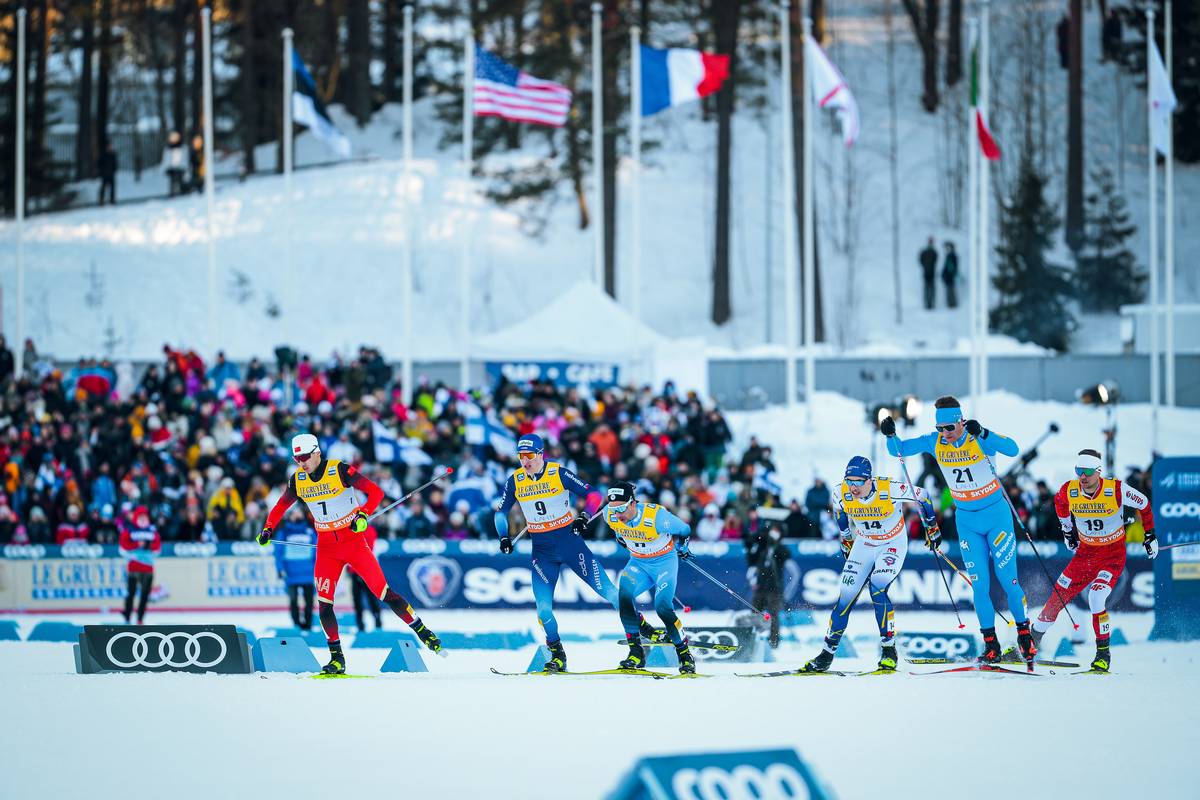
Fast racing in the fifth heat saw four competitors advance to the next round. Janik Riebli (SUI) won the heat in a time of 2:59.56, while China’s Qiang Wang finished second (+.10) to move onto the semis. A top prospect for the Chinese ski program, this is Wang’s first World Cup appearance since the pandemic began. Wang was fifth in qualification during the Olympic freestyle sprint in Zhangjiakou, where he took second in his heat to Norway’s Erik Valnes before being issued a disqualification for obstruction and being relegated last in the heat.
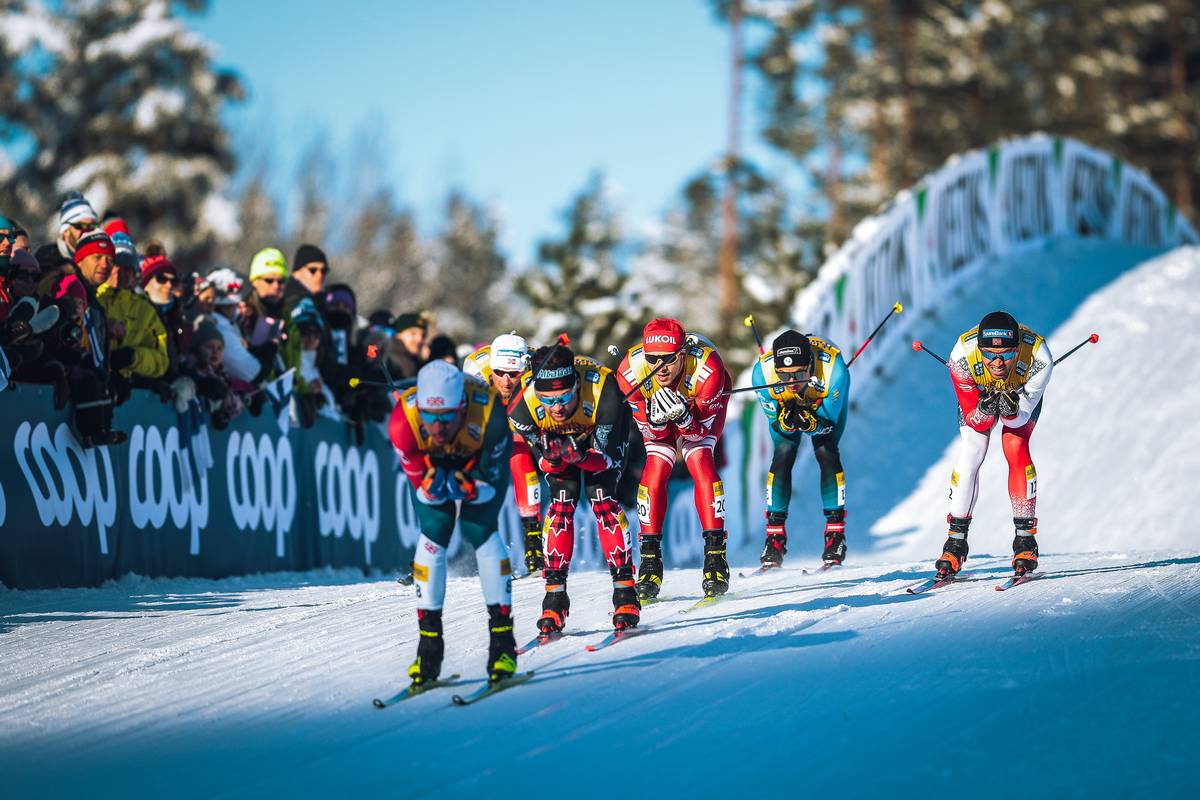
Qiang Wang (CHN) leads at the start of the fifth quarterfinal heat in Lahti. (Photo: NordicFocus)
Following the pace of the leaders, Maciej Starega (+.64) of Poland and Arnaud Chautemps (+1.61) of France crossed the line third and fourth to advance into the semis as lucky losers.
In the first semifinal, five skiers all remained close coming into the finish to vie for the two automatic spots. Pellegrino was able to hold the field off and win the semi with a time of 2:59.57, however, he was later disqualified, pushing him to sixth place. Klæbo crossed in second (+.07), guaranteeing his spot in the final, while Chanavant and Taugbøl were third (+.21) and fourth (+.37), respectively. Due to Pellegrino’s disqualification, Taugbøl was able to make it through to the final as a lucky loser.
In the second semi, Retivykh held off a push from Skar to win in 2:59.67, with the Norwegian 0.02 behind. Wang crossed third (+.34) with a time fast enough to earn the second lucky loser spot in the final.
Sindre Bjørnestad Skar leads his heat during the freestyle sprint in Lahti, FIN. (Photo: NordicFocus)
In the final, an early tangle between Wang and Retivykh as the two rounded a corner sent the Chinese athlete to the ground, losing contact with the pack.
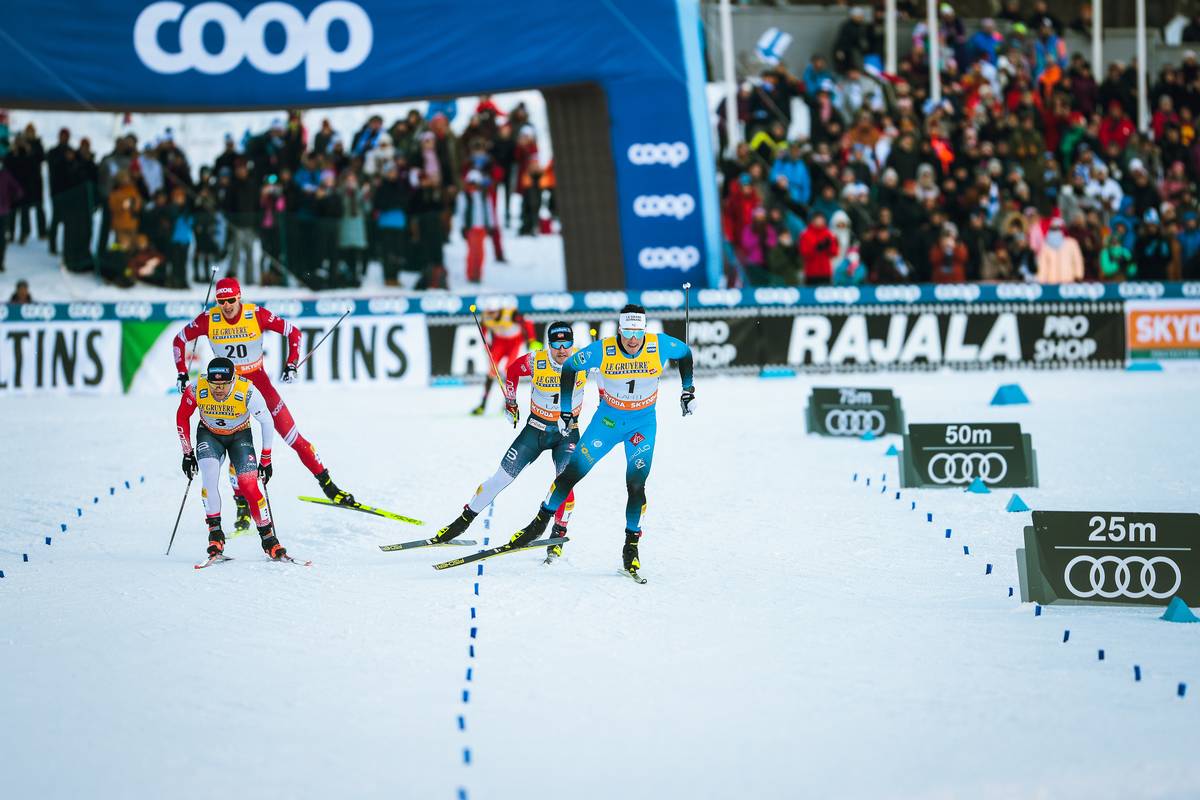
The remaining five men stayed close as they powered through the course. Rounding the bend into the final 100 meters, four skiers remained in contention for the podium, but it was Klæbo who slingshot from the outside, putting his closing speed on display as he threw his boot to win a photo finish with Chanavat in 2:58.34, Skar and Taugbøl on their tails.
Johannes Høsflot Klæbo with a look before taking the win in the freestyle sprint in Lahti, FIN. (Photo: NordicFocus)
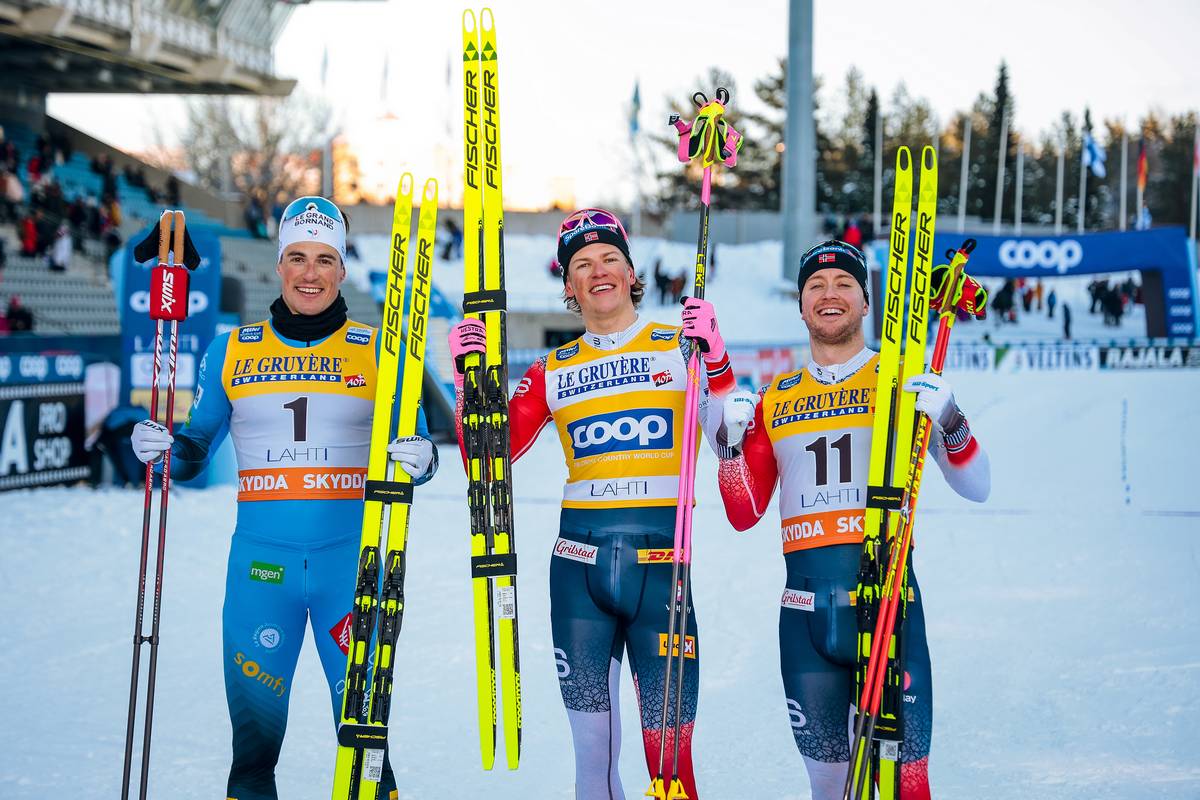
The Norwegian had advantage at the finish, with Chanavat just 0.04 seconds back in second place. Skar held off his teammate for the final podium spot in third (+.23), while Taugbøl took fourth (+0.58). Retivykh crossed a few meters back in fifth (+0.90), while Wang rebounded from his crash to finish 7.77 seconds behind in sixth.
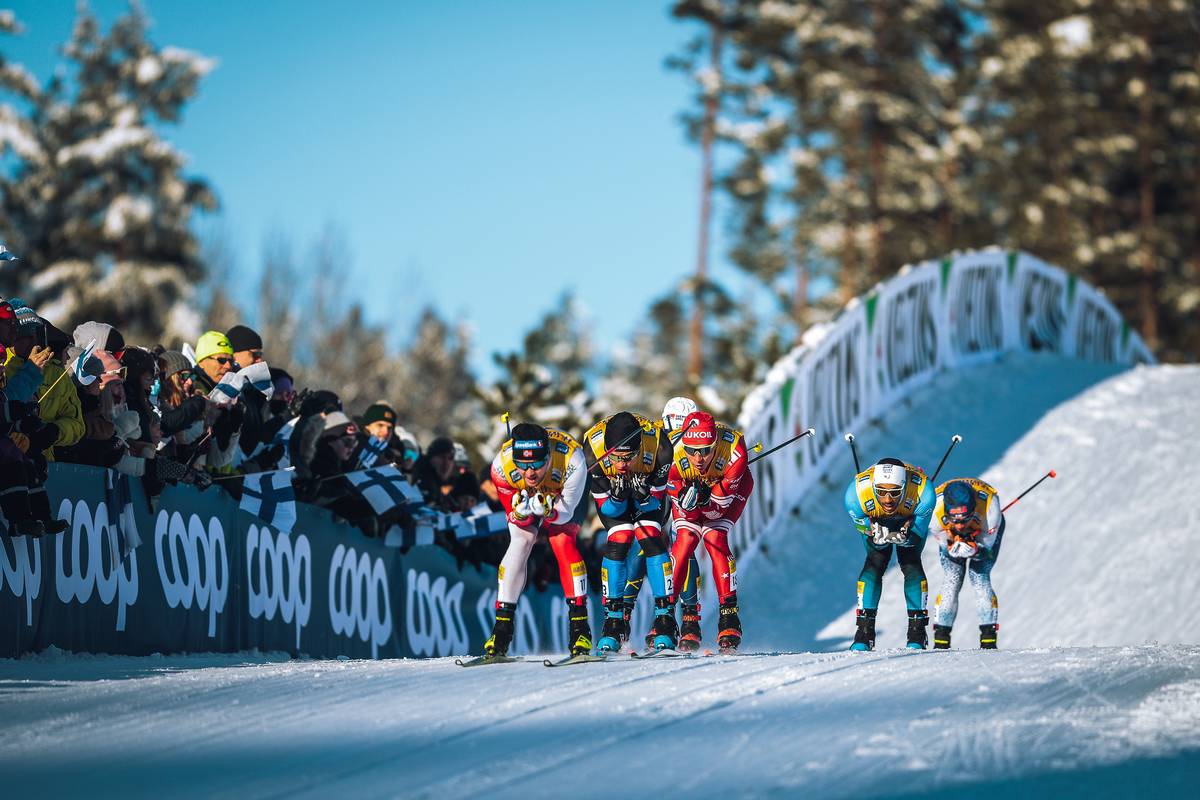
A close race for second and third heads into the final 25 meters in Lahti. (Photo: NordicFocus)
“It was amazing,” Klæbo told FIS after the race. “It isn’t so many days since we competed in the Olympics, but still, it’s always fun to race.”
Klæbo commented on the excitement of racing in Lahti, which has hosted many championship events including the 2019 World Championships. He added that the racing on these tracks is often tight, which keeps it exciting for spectators – of which there were many today. When asked about racing in front of a crowd after nearly two years of empty stadiums, Klæbo smiled.
“It was amazing. I think what they have done, and finally seeing the end of the COVID situation – I think it’s amazing. It’s always great to compete against a big crowd, and it was amazing today as well.”
Johannes Høsflot Klæbo (NOR) takes the win in Lahti’s freestyle sprint ahead of Lucas Chanavat (FRA) and Sindre Bjørnestad Skar (NOR). (Photo: NordicFocus)Graham Ritchie races in the quarterfinal of the freestyle sprint in Lahti, FIN. (Photo: NordicFocus)
After finishing fifth in a tightly spread third quarterfinal heat, Graham Ritchie bumped up from his bib rank to finish 24th.
Kevin Bolger was the top American qualifier in Lahti in 33rd (+8.90), just 0.41 seconds off the mark needed for the top-30. On his tails was Diekmann in 34th (+9.14), with Hanneman close behind in 39th (+9.79). Ketterson was next for the U.S. in 49th (+12.13), with Harmeyer next in 50th (+12.28).
Kevin Bolger leads the American men in 33rd during the freestyle sprint qualifier in Lahti, FIN. (Photo: NordicFocus)Antoine Cyr (CAN) races the qualifier of Lahti’s freestyle sprint. (Photo: NordicFocus)
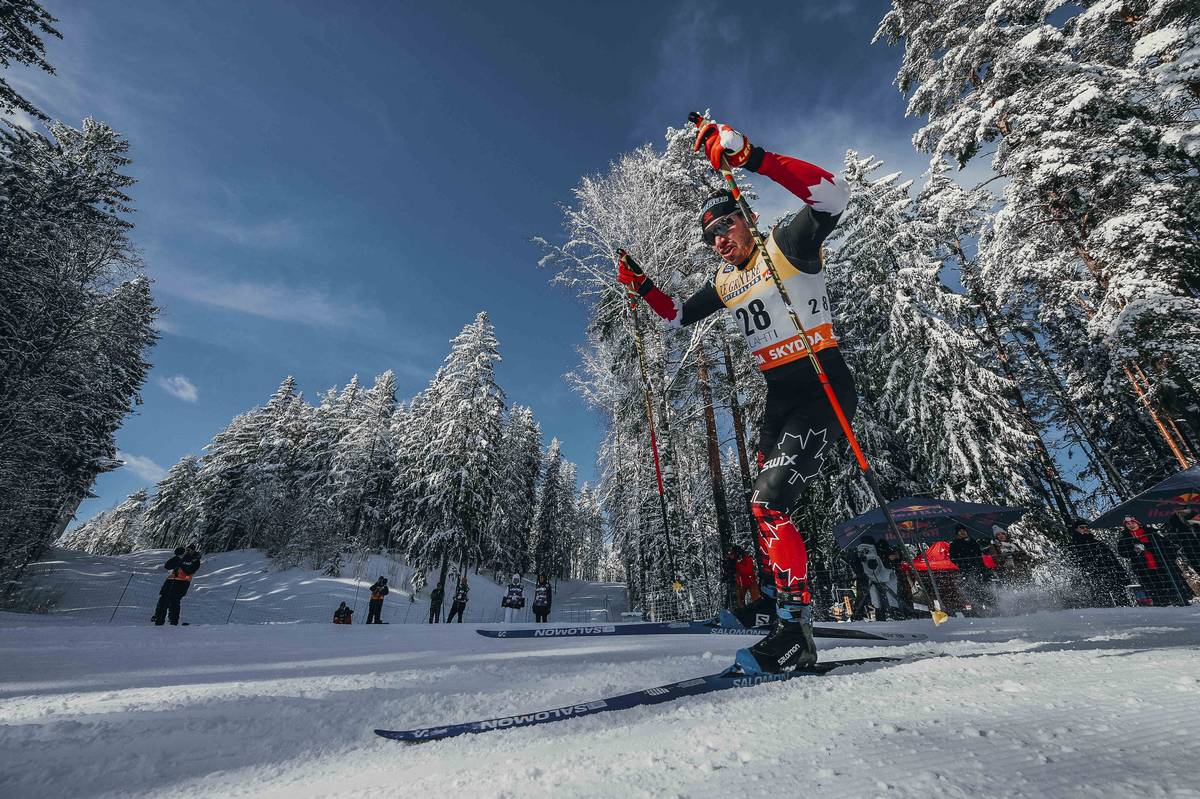
Outside the top-30 for Canada, Antoine Cyr was 40th in qualification (+9.99), with Olivier Léveillé next in 46th (+11.79), followed by Phillippe Boucher in 55th (+14.02) and Rémi Drolet in 58th (+15.87).
Racing continues tomorrow with a 15 k individual start classic.
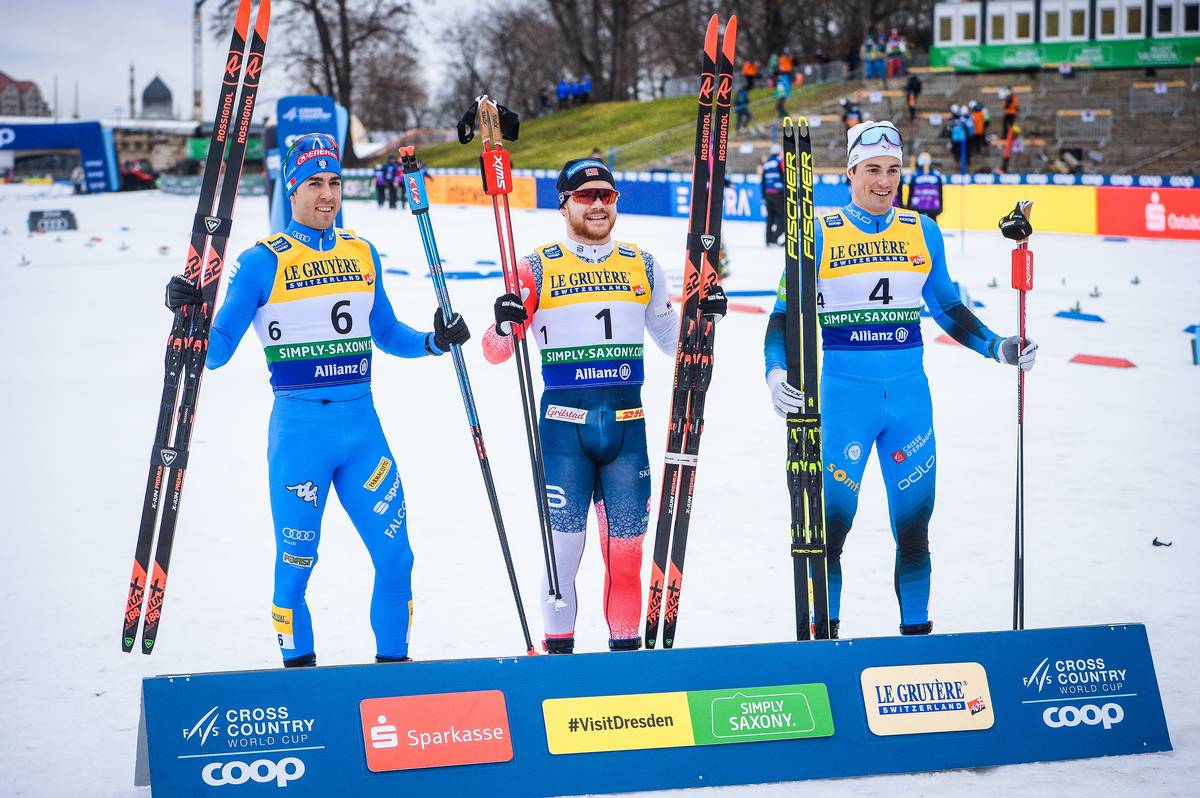
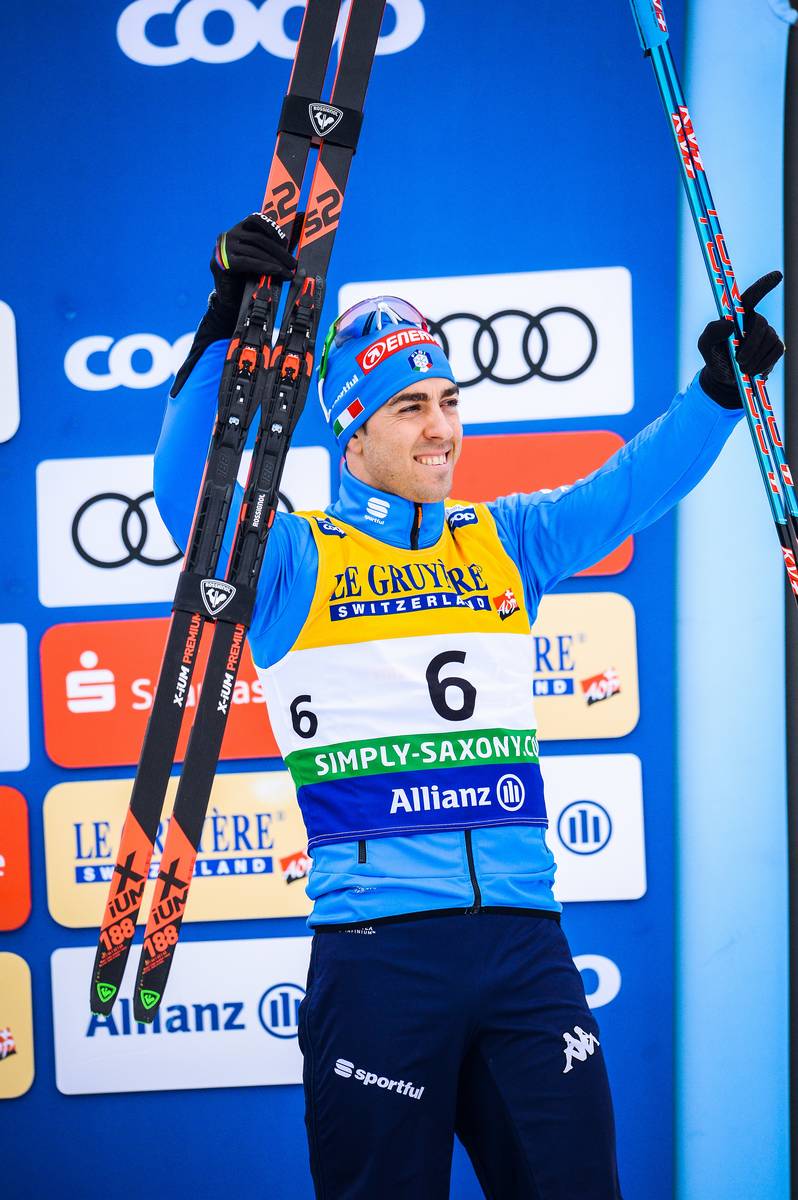
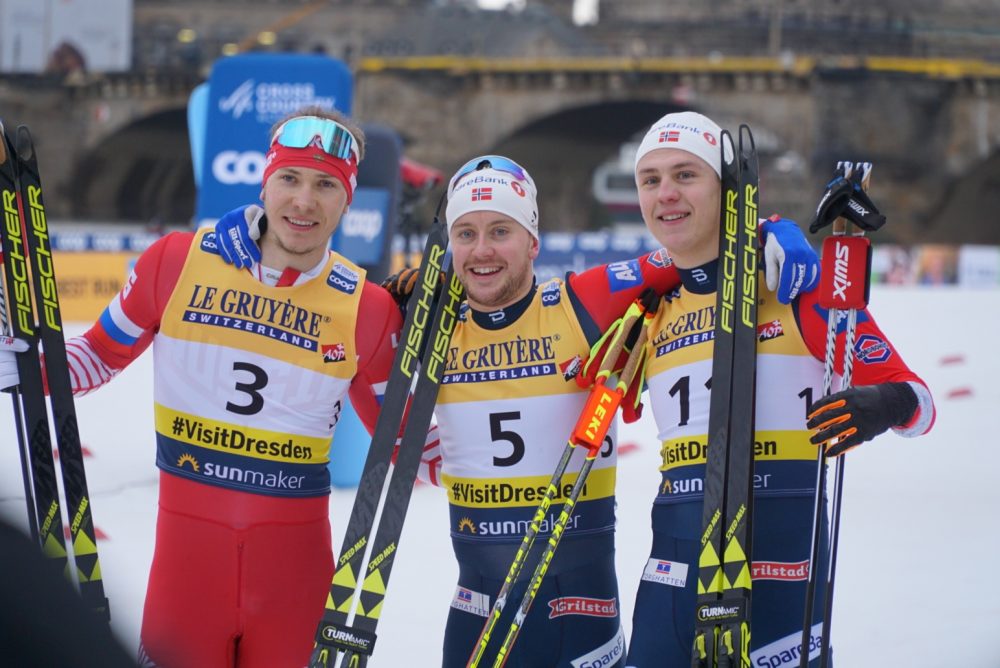
The men’s podium of Dresden’s individual freestyle sprint. Håvard Solås Taugbøl (NOR) took the win ahead of Federico Pellegrino (ITA) and Lucas Chanavat (FRA). (Photo: NordicFocus)
This World Cup coverage is made possible through the generous support of Marty and Kathy Hall and the A Hall Mark of Excellence Award. To learn more about A Hall Mark of Excellence Award or to learn how you can support FasterSkier’s coverage please contact info@fasterskier.com.
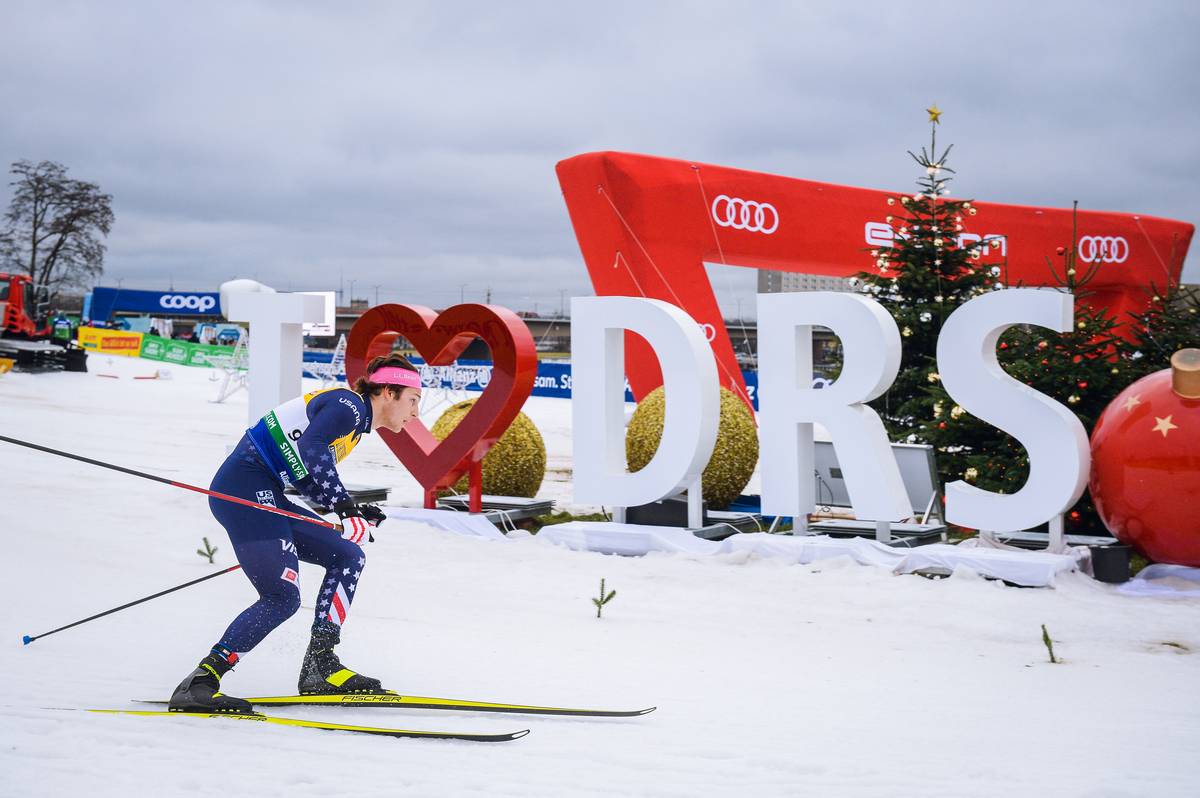
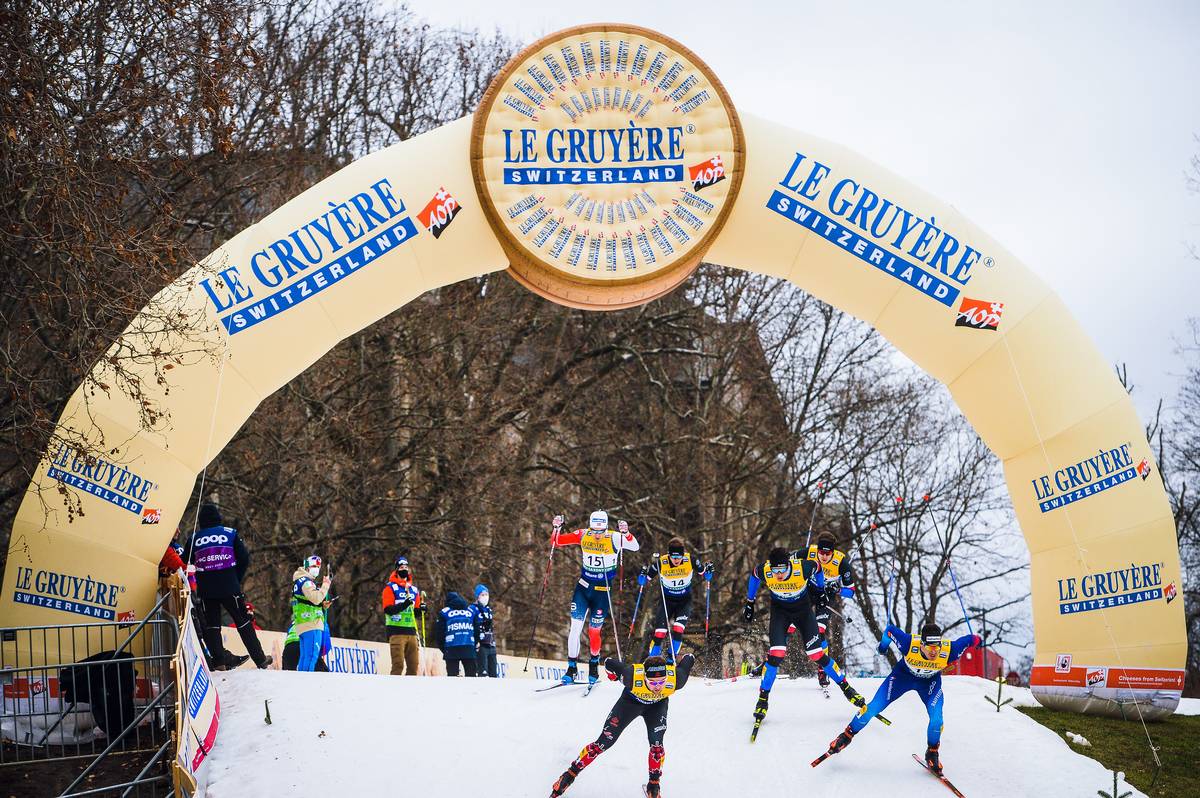
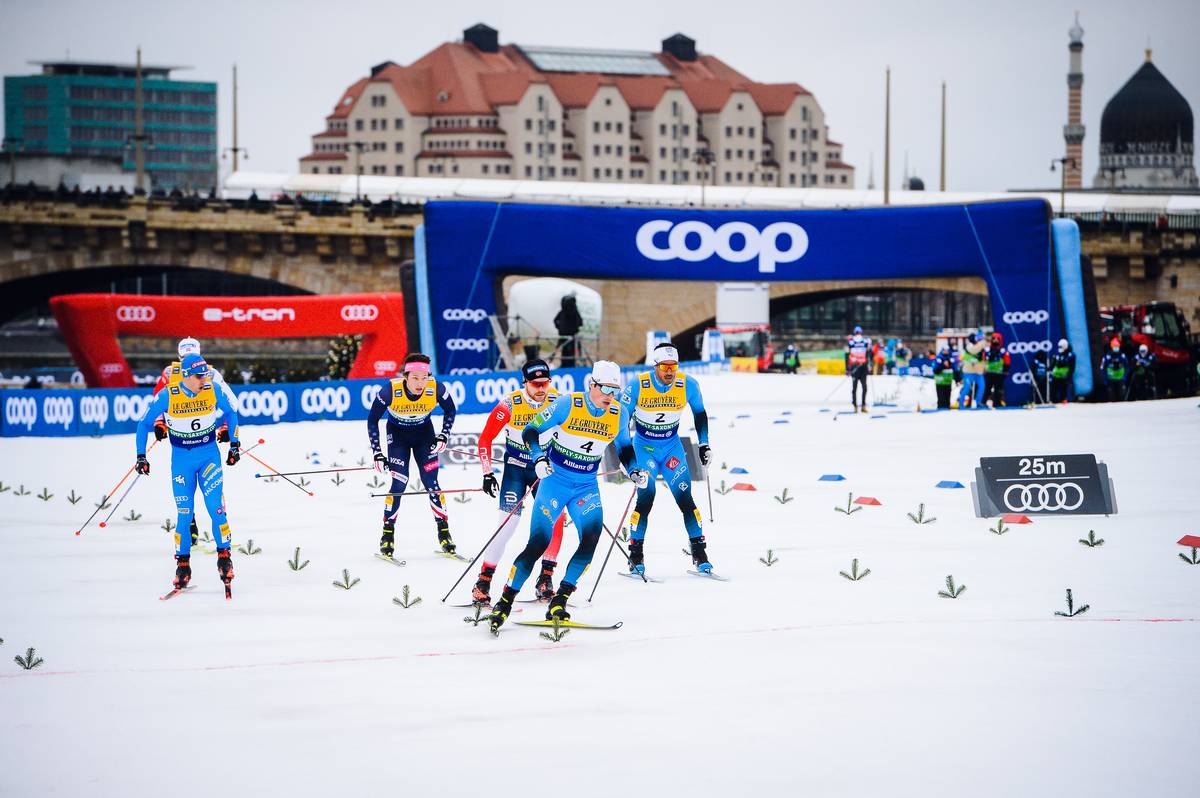
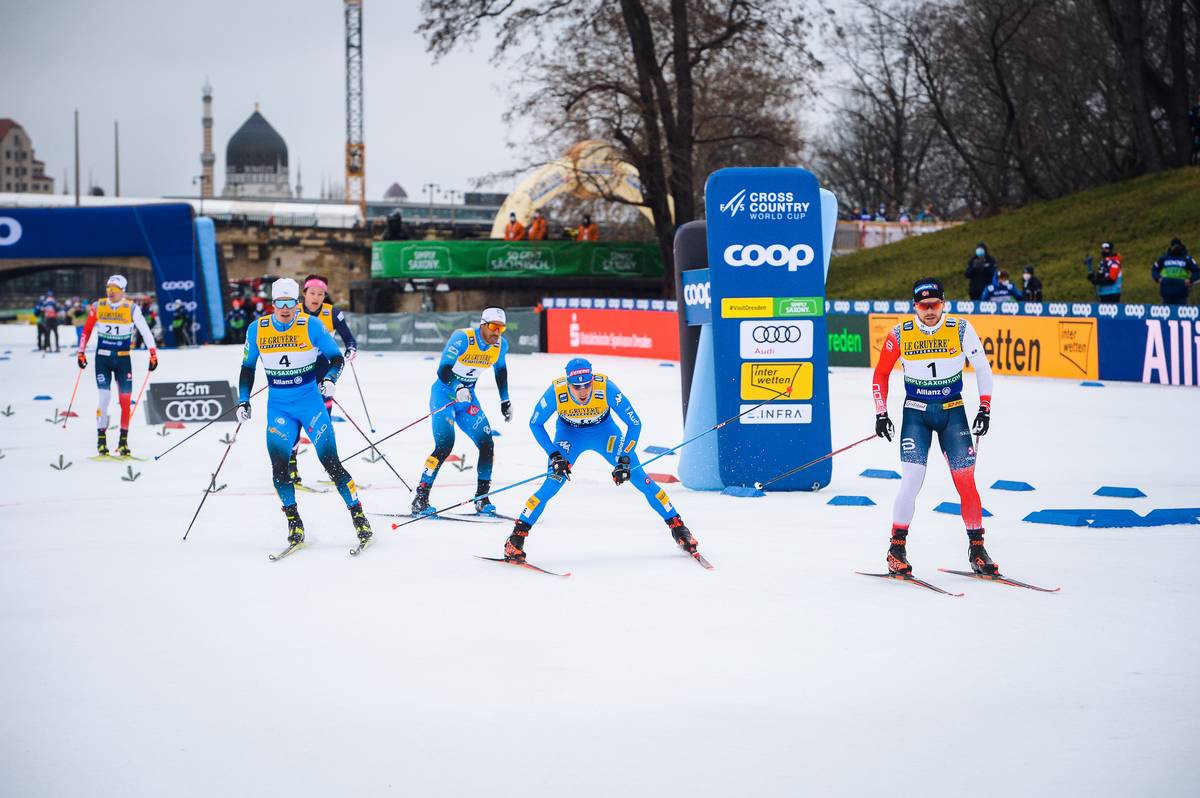
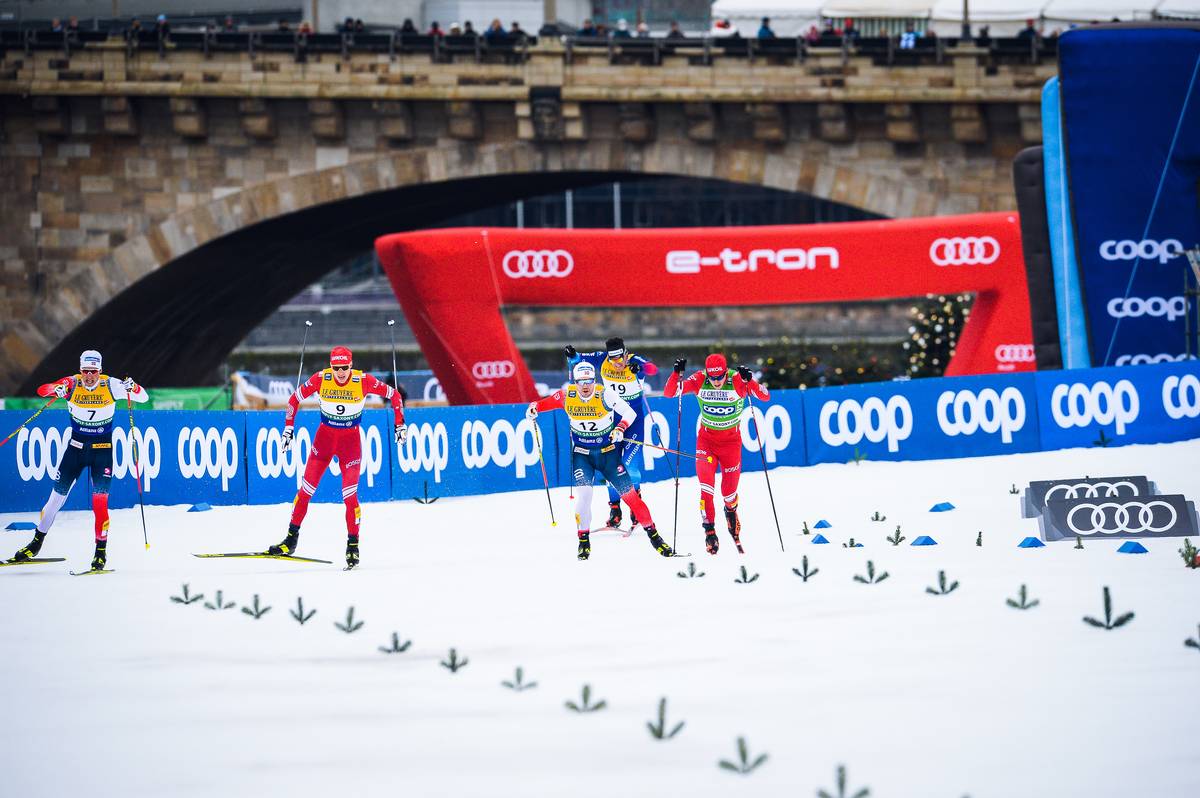
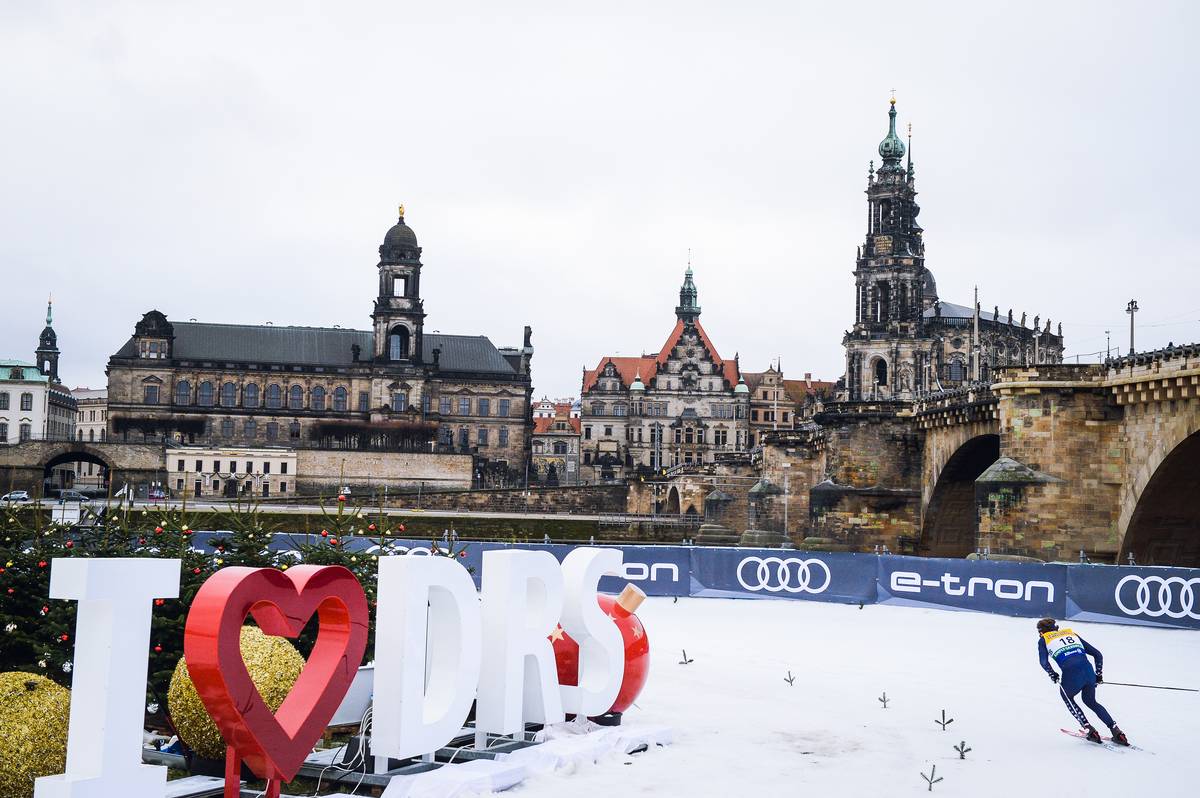
With Christmas decor lining a ribbon of snow providing a better indication that we are nearing the end of Period I and heading into the holiday season than the surrounding green grass in Dresden, Germany, athletes took to the track in the city for yet another iteration of its thrilling sprint weekend. Humid conditions well above freezing made for fast racing on the two-lap course, which often sees spicy turns and tactics, without a significant climb to separate the field in a deciding manner.
If you’d like a throwback from January, 2018, here’s a video clip from Instagram where Simi Hamilton painfully face-plants, just after having broken the pole of Johannes Høsflot Klæbo. This left Hamilton with a lip full of carbon-fiber splinters and plenty of abrasions from the harsh granular track. Good times.
After the first three weekends of racing, 21-year-old JC Schoonmaker sat in second place in the U23 World Cup standings, and 27th in the overall World Cup ranks. Showing he was ready to build on this platform, Schoonmaker smashed the qualifier, finishing third, 1.16 seconds behind Norway’s Håvard Solås Taugbøl and roughly 0.3 behind Richard Jouve of France, who qualified in second.
In an episode of Nordic Nation recorded earlier this week, Schoonmaker, along with teammates Ben Ogden and Gus Schumacher, discussed how their results in the early season races have encouraged them to raise their limits and take chances in their sprinting as they transition into their senior racing careers. Instead of choosing heat four or five, which they explained shows that one is limiting their potential on the day to the semifinal, they wanted to begin racing in earlier heats with the top qualifiers. Thus increasing their risk of being knocked out early, but also learning what it takes to advance further through the rounds.
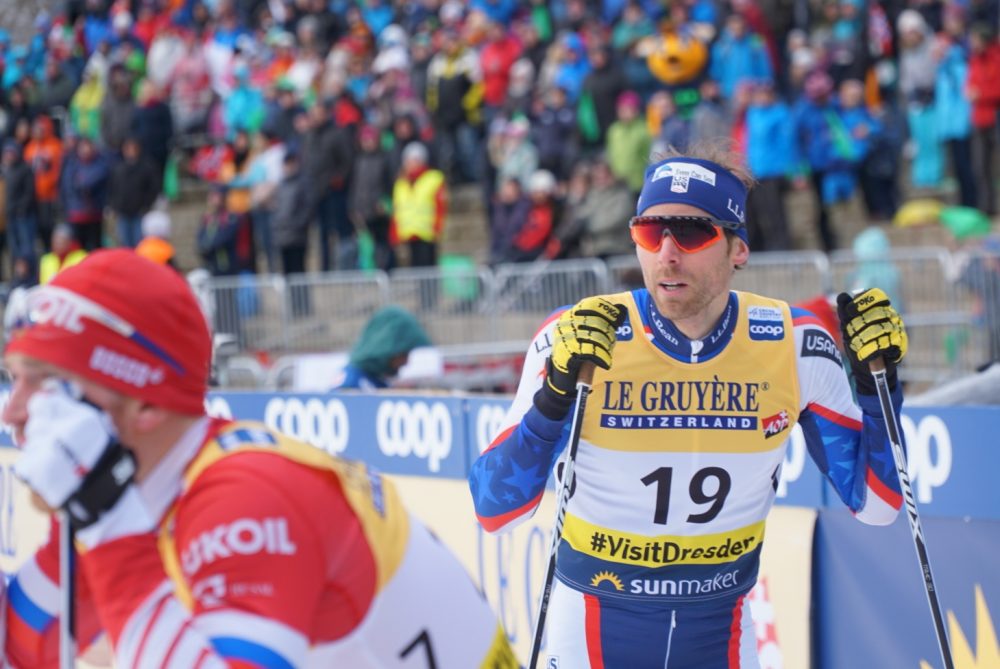
JC Schoonmaker skis to 3rd in qualification in Dresden. (Photo: NordicFocus)
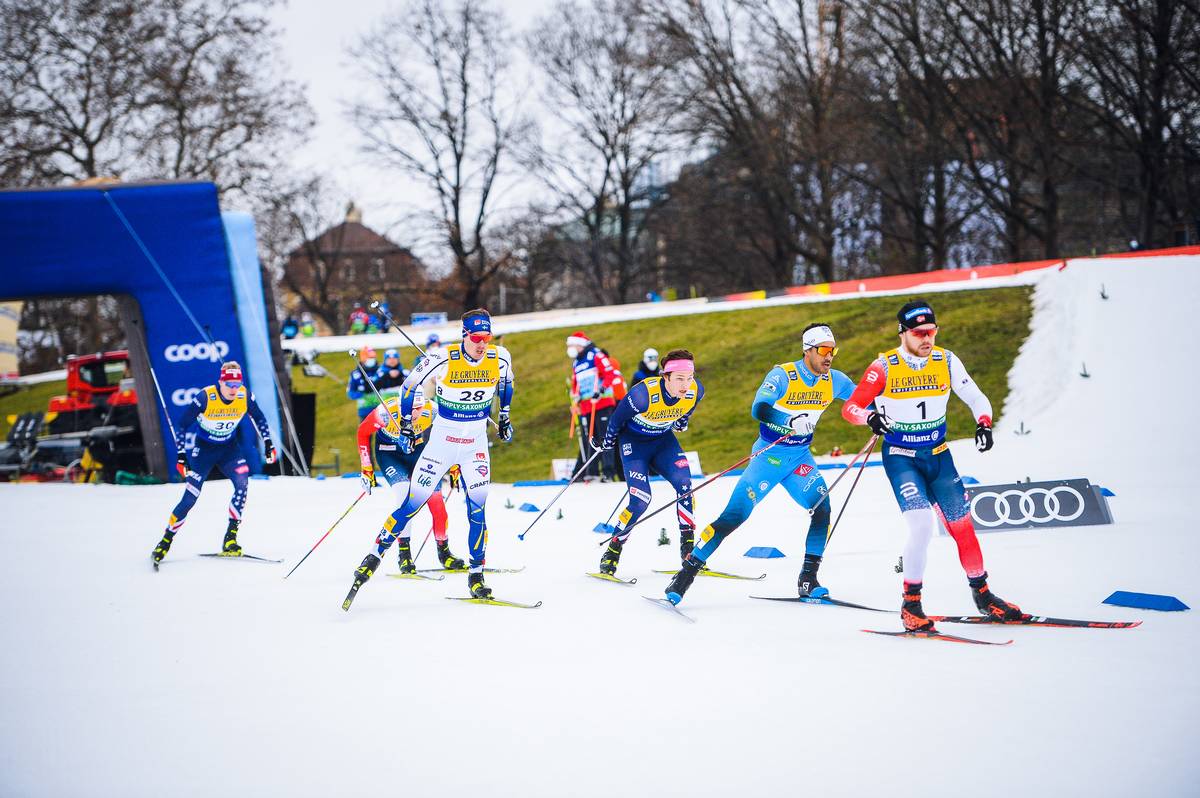
Today, Schoonmaker raced in heat one alongside Taugbøl and Jouve, along with Even Northug (NOR), Johan Häggström (SWE), and teammate Logan Hanneman, who qualified in 7th, 28th, and 30th, respectively.
The first lap of the race, the pace was fast but the men looked cool, each carefully navigating the hairpin curves and not racing aggressively. As they accelerated in the second lap, Schoonmaker kept himself in contact with Jouve, who was not in the lead, but still racing in a position of control at the front with Taugbøl. Dropping into a tuck coming off a roller and safely rounding the hairpin, Schoonmaker headed to the final straight behind Jouve. As they powered through the final lanes, it was Taugbøl and Jouve at the front for a photo finish, with Northug finishing just ahead of Schoonmaker close on their tails for third and fourth.
JC Schoonmaker marks Richard Jouve (FRA) during the first quarterfinal heat in Dresden. Logan Hanneman stays in contact with the pack in bib 30. (Photo: NordicFocus)
As the remaining quarterfinals progressed, it became clear that Heat 1 was the fastest, allowing both Northug and Schoonmaker to advance to the semifinals.
Hanneman also stayed in contact through the round, finishing 1.88 second behind the leaders, but sixth in the heat. After the final rounds were decided, Hanneman’s position was 30th overall on the day.
Also racing in the quarters, Canada’s Graham Ritchie qualified in 16th and raced in the fifth quarterfinal heat. In a competitive position throughout the second lap, Ritchie came into the final hairpin on the inside of the curve, looking to slide up in position heading into the final stretch. Perhaps lacking real estate along the v-board, Ritchie went down, losing his position and ability to advance further. He ended his day in 26th.
Graham Ritchie pushes the pace in the quarterfinal in Dresden. (Photo: NordicFocus)
A post-race Instagram story posted by Ritchie’s coach Erik Bråten captioned “sh*t happens” showed his ski tip had broken off and the base had delaminated — not ideal.
Racing in the first semifinal, Schoonmaker looked comfortable and smooth, approaching the round in a similar way as the first in terms of his positioning heading into the second lap.
At the front, Italy’s Federico Pellegrino, last year’s winner, set the tone alongside Taugbøl, with Jouve in a strong position on their tails.
Lapping through the finish, JC Schoonmaker stays in position with the leaders to advance into the final round. (Photo: NordicFocus)
Putting faith in his boards and catching a quick draft, Schoonmaker again dropped low coming down the last roller and into the final curve. Once again, he was following Jouve and in contact with the front of the pack, however, as they headed into the final lanes, he was only in position to take fifth in the heat, unable to advance into the final round.
Still a very strong overall result, Schoonmaker ended his day in 9th overall.
In a post-race interview, Schoonmaker discussed his decision to select heat one, along with his rollerski warm up, maintaining the headspace needed to perform between rounds, and what’s next for him over the next few weeks. A quick note, we had some trouble with WiFi connection, which interrupted some of Schoonmaker’s comments. The trials of remote reporting from eight time zones away.
Taugbøl took the win in the first semi, with Pellegrino narrowly staying ahead of Chanavat in second and third. Jouve was just 0.3 seconds behind his teammate, leaving the two Frenchman in wait to see whether they would advance as lucky losers.
A close finish for the top-four, JC Schoonmaker crosses in fifth in his semifinal heat. (Photo: NordicFocus)
Lead changes and tight racing developed the plot line of the second heat of the semis, which featured Northug and his teammate Sindre Bjørnestad Skar fighting for position at the front with two Russians, Gleb Retivykh and Alexander Terentev, who beat Klæbo in the opening sprint in Ruka and currently ranks just ahead of Schoonmaker in the U23 standings.
Each unable to break away at the front on the fast and flat tracks, Northug, Skar, and Retivykh came to the line in unison, throwing their boots for a three-way photo finish. Though their times were indistinguishable, it was determined that their finish order was just that: Northug, Skar, Retivykh, with Terentev a ski length behind in fourth. Men crashed in every direction crossing the line, falling to the ground and gasping for air to evidence the intensity of the effort.
Heading into the finish, the second semifinal was tight between two Russians and two Norwegians. (Photo: NordicFocus)
By the clock, Jouve and Terentev were on the wrong side of the cusp for lucky loser. They ended their day in the semis, while Retivykh and Chanavat advanced to the final.
More lead changes and thrill, Chanavat took the lead in the first lap of the final. Lapping over the finish line for the first time, Taugbøl moved to the front while Pellegrino lurked on their tails. Down the backstretch, the Italian moved up alongside Chanavat, skiing powerfully on Taugbøl’s tails as they safely rounded the first hairpin. Not looking to cede space, Taugbøl held himself in a position of command at the front.
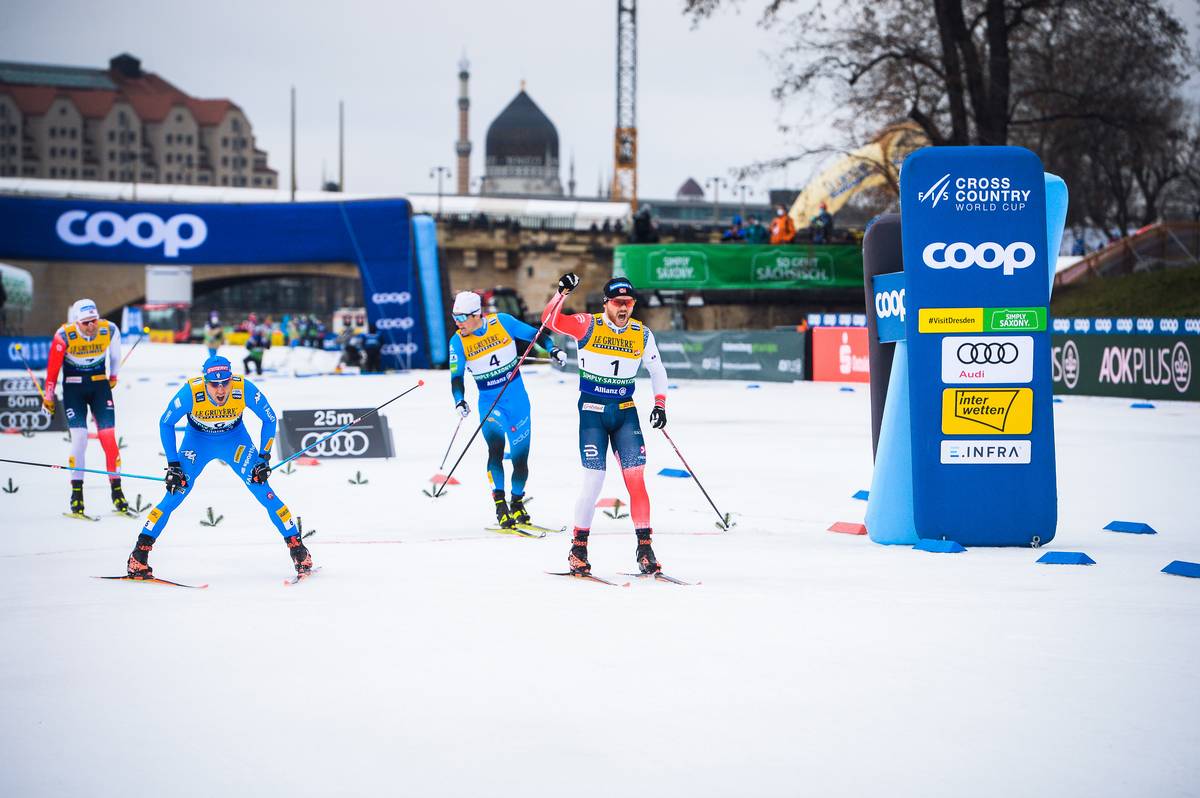
Around the final curve, Pellegrino tried to sneak around the outside of Taugbøl, but could not quite gain enough ground to find the lead. Heading into the final straightaway, Pellegrino was attacking the track with a powerful V2, but it was still Taugbøl with the advantage at the front, crossing the line just 0.15 seconds ahead of the Italian.
Norway’s Håvard Solås Taugbøl takes his first World Cup victory ahead of Federico Pellegrino (ITA) and Lucas Chanavat (FRA). (Photo: NordicFocus)
In pursuit, France’s Lucas Chanavat crossed the line a ski length behind Pellegrino for the third step of the podium (+0.68), with Northug, Skar, and Retivykh crossing a few meters behind to close out the final round in fourth (+1.22), fifth (+2.01), and sixth (+6.15).
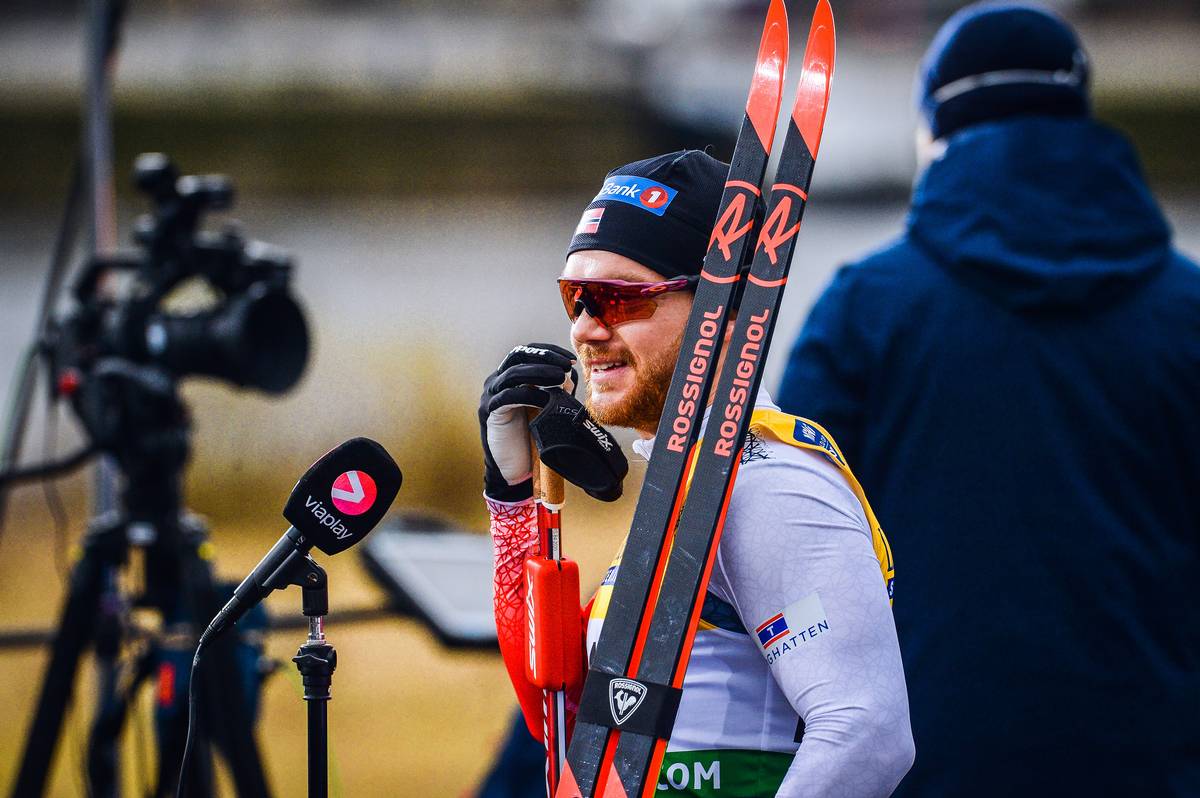
Today’s result marked Taugbøl’s fist career World Cup victory.
“It feels pretty good,” he told FIS humbly after the race. “It’s of course a goal I have tried to reach my whole life, and to do that in Dresden in a show sprint venue, it’s really fun and I’m proud of myself today.”
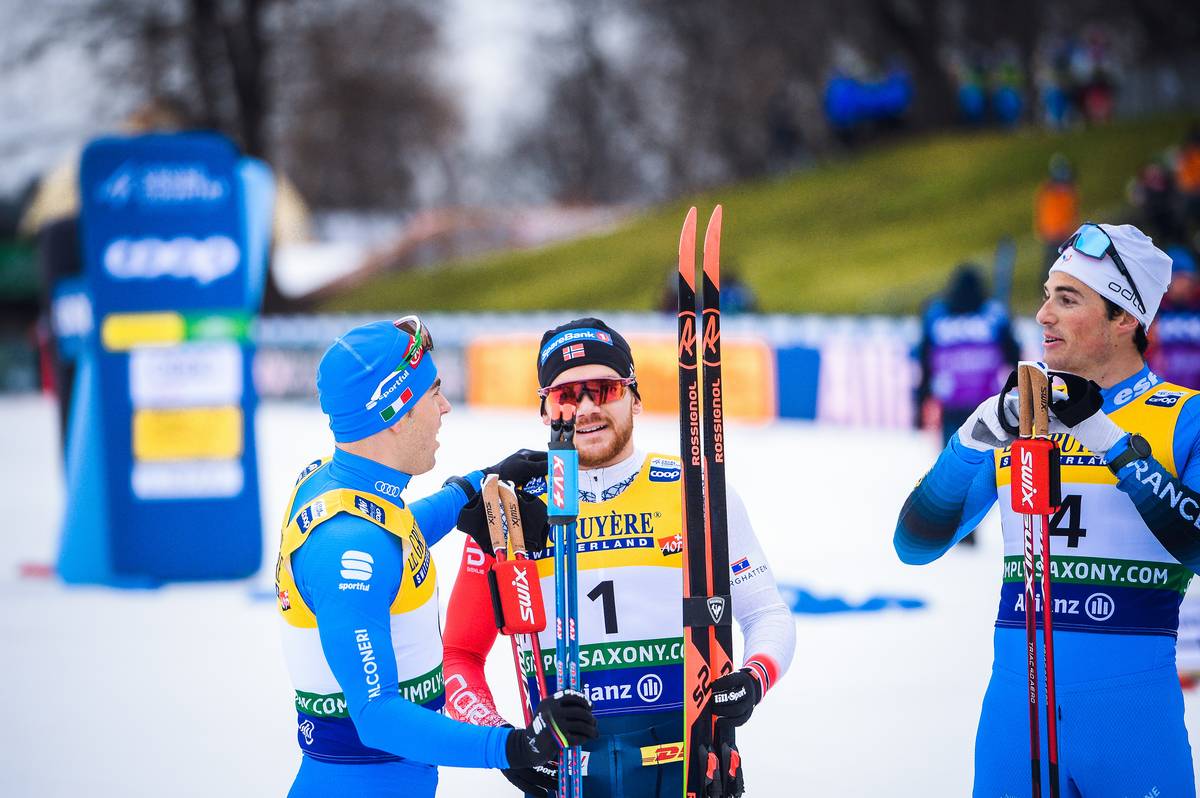
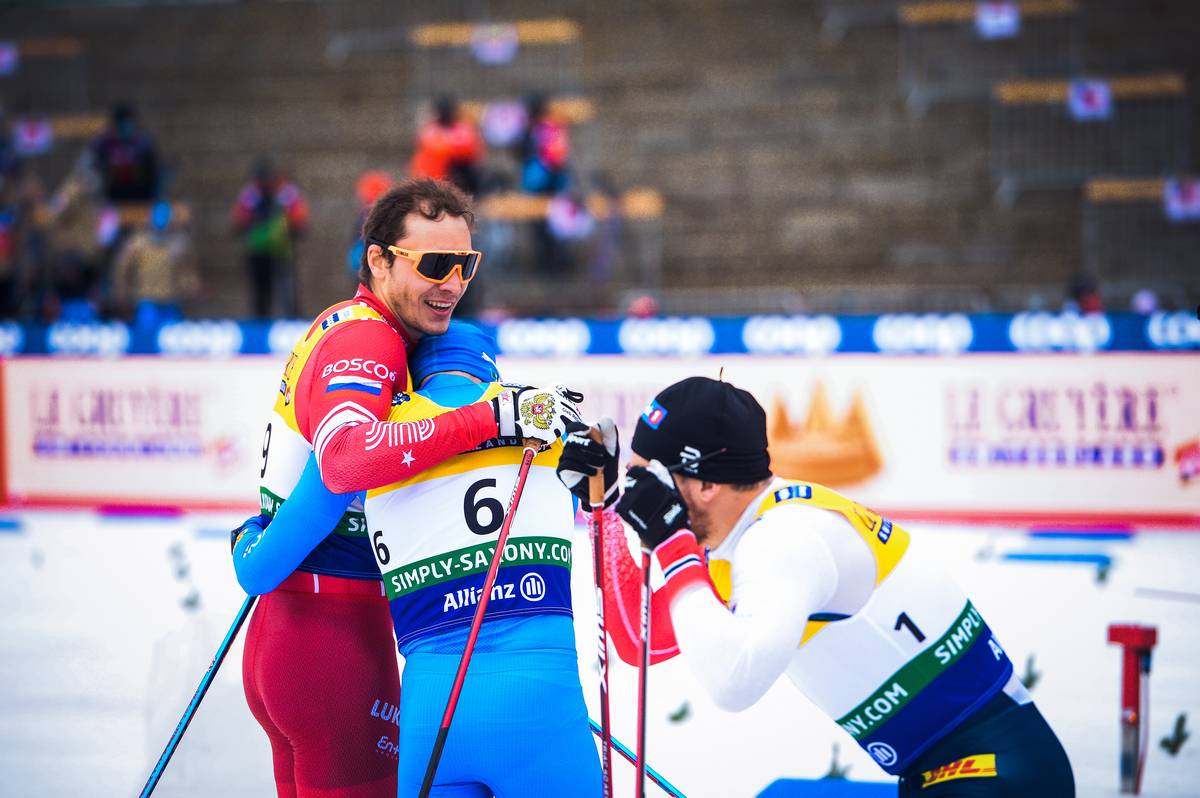
The men’s podium congratulates one another on their efforts in Dresden. (Photo: NordicFocus)Sportsmanship and respect on display at the finish of the men’s sprint in Dresden. (Photo: NordicFocus)
Taugbøl also spoke to his highly-respected opponents with whom he shared the podium.
“Of course to beat guys like Pellegrino and Chanavat, it’s a dream come true. If you try to count how many podiums and victories they have, I can’t count so far. So it’s amazing to be there with them.”
Norway’s Håvard Solås Taugbøl earned his first World Cup victory on the tracks in Dresden. (Photo: NordicFocus)
Despite not adding another win to his resume, today’s result perhaps marks a turning point in the start of Pellegrino’s season. The Italian, who has been a force in skate sprints for many seasons now, had not raced in a final yet this season.
In an Olympic year that features a freestyle sprint, Pellegrino will be looking to find his peak form in February. The Italian was 11th in the event at the 2014 Olympics in Sochi, and took second in the classic sprint, his weaker discipline, in PyeongChang in 2018, just behind Klæbo.
Italy’s Federico Pellegrino skis back into form in Dresden. (Photo: NordicFocus)
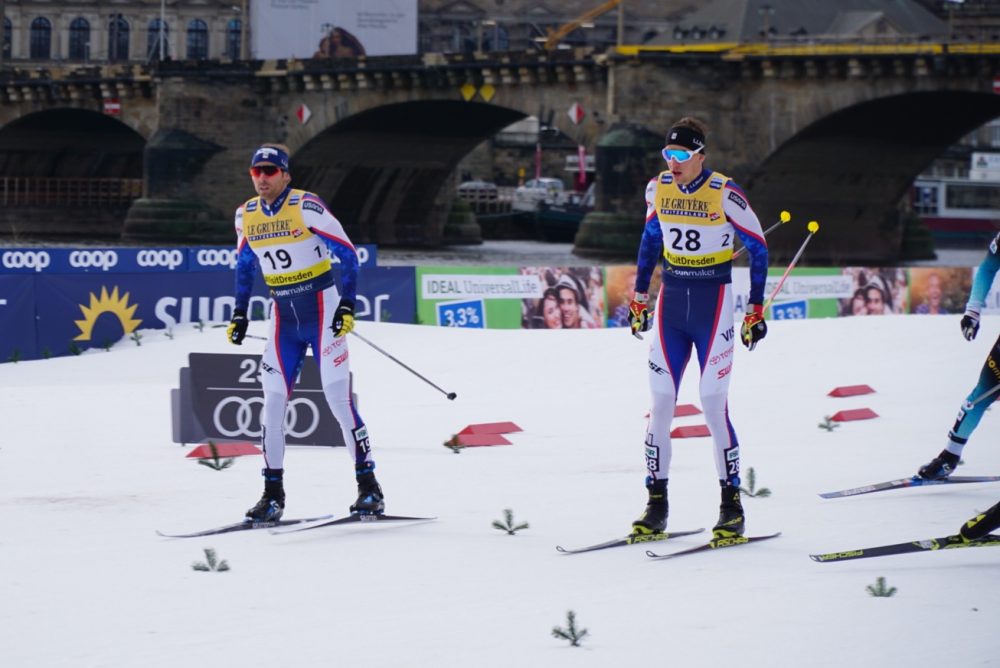
Outside the top 30, Kevin Bolger, who was 6th in the individual sprint in Dresden last year, qualified in 42nd (+7.97). Bolger was roughly two seconds outside the top-30.
Following Bolger, Ben Ogden finished 51st in the qualifier (+9.37), with Luke Jager in 63rd (+10.73).
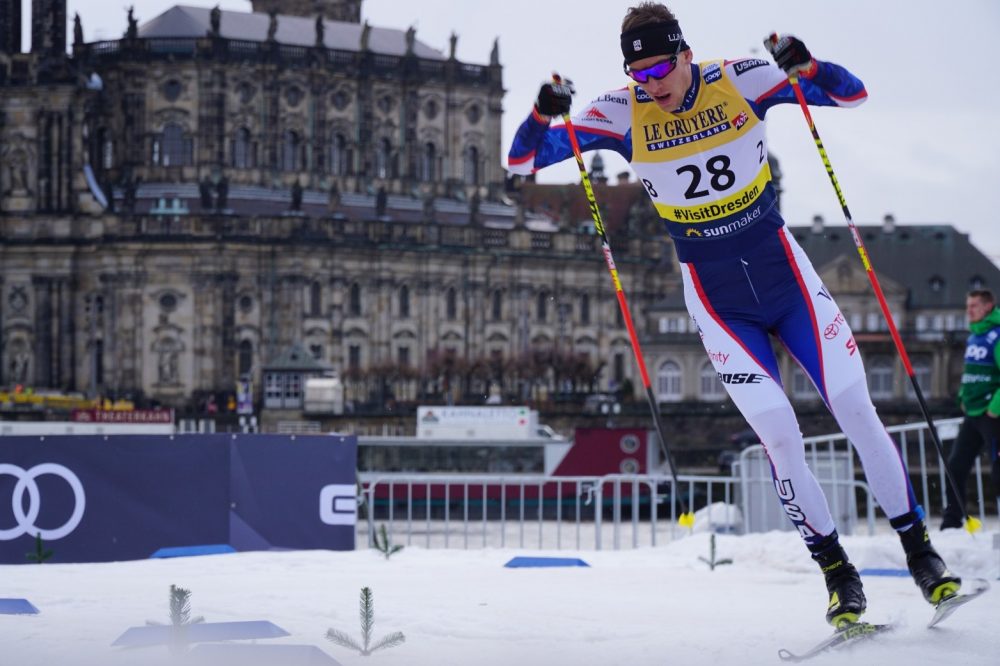
Ben Ogden races the qualifier with the spectacular skyline of Dreden in the background. (Photo: NordicFocus)
Racing for Canada, Russell Kennedy took 48th (+8.85) in qualification.
The weekend of city sprinting continues tomorrow with men’s and women’s team sprints.
The men’s podium of the freestyle team sprint in Planica, Slovenia. The Norway I team of Sindre Bjørnestad Skar and Erik Valnes took the win over the Norway II and Finland teams. (Photo: NordicFocus)
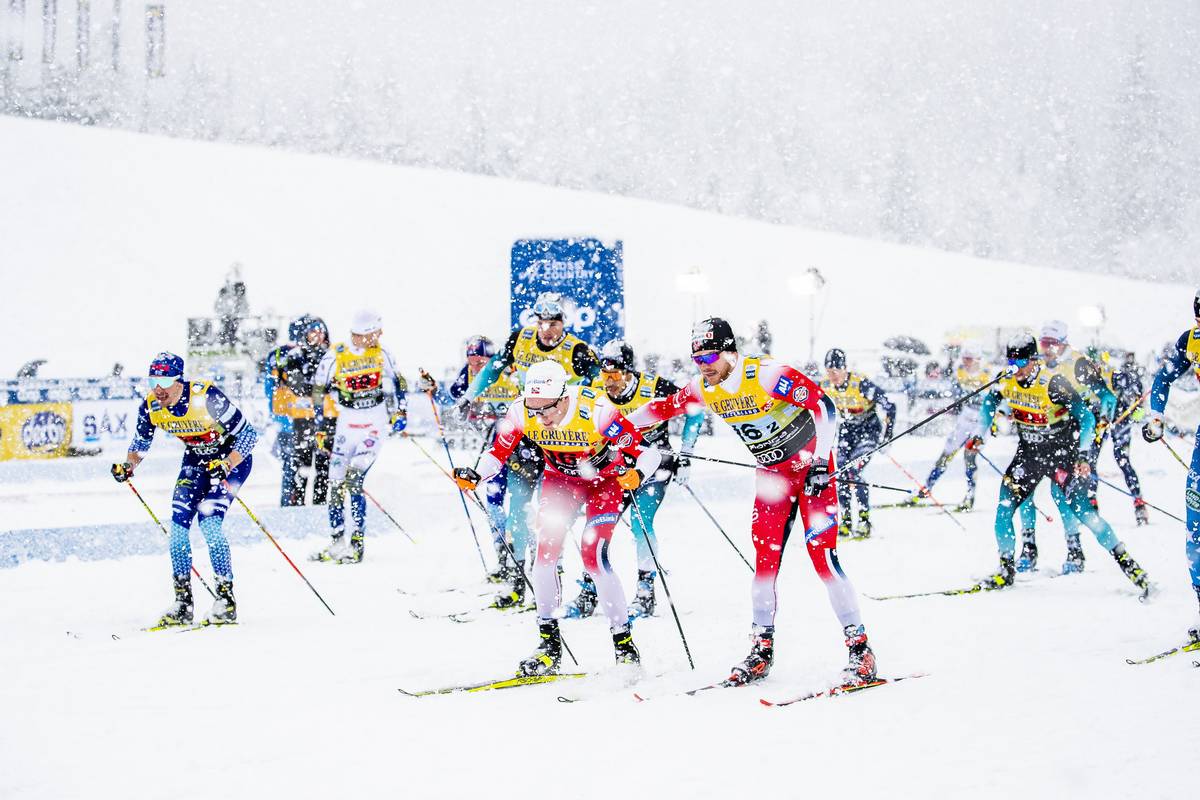
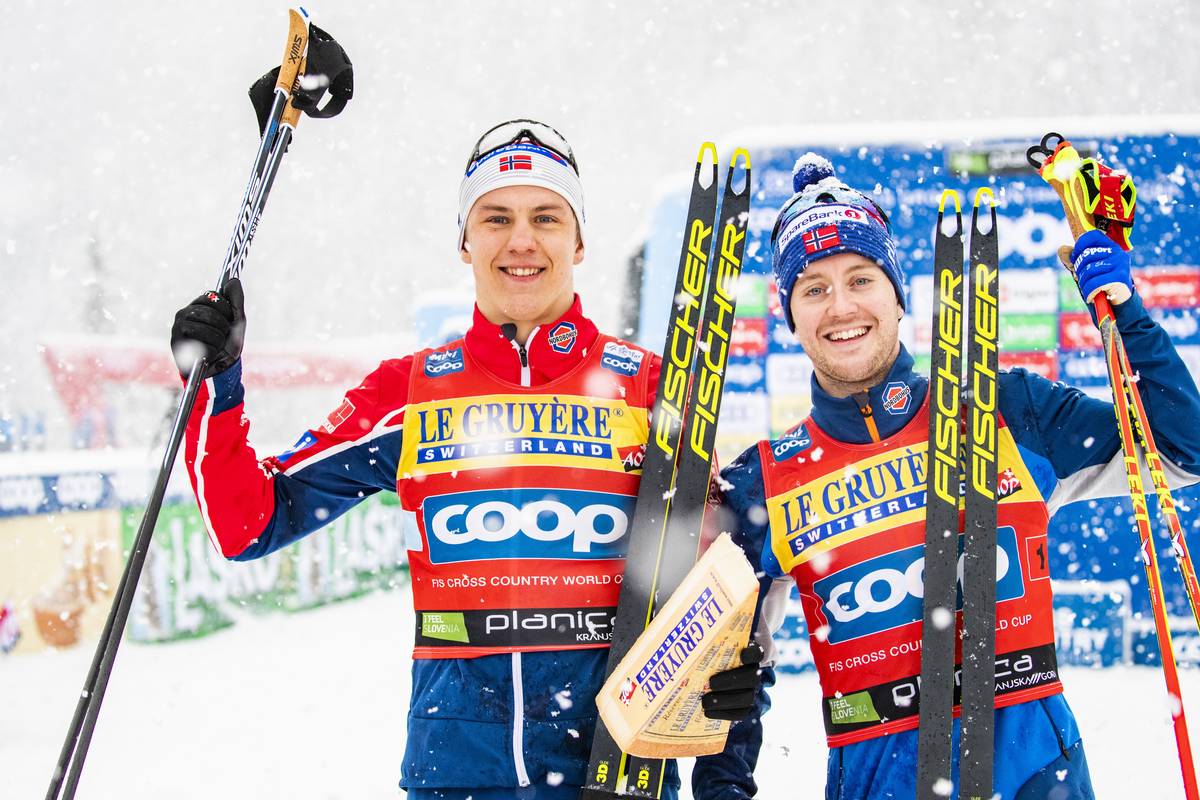
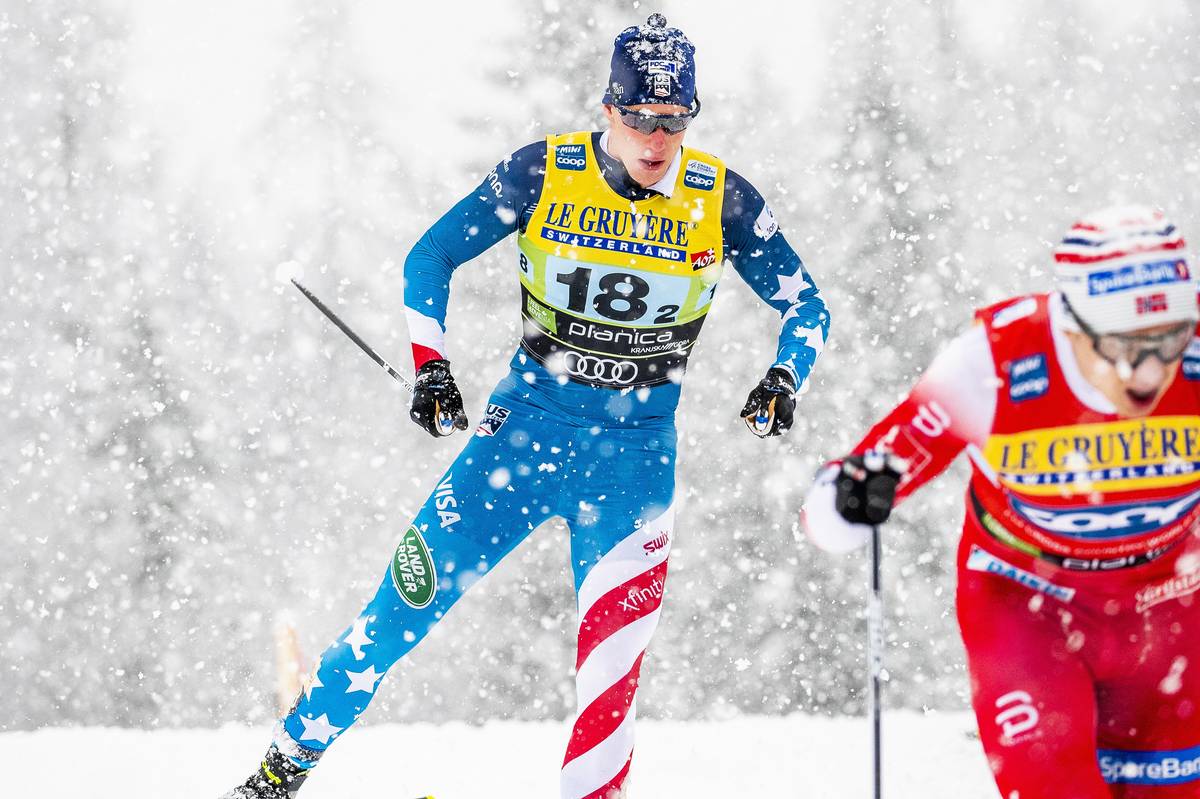
From under the umbrella to inside the snow globe. Fat flakes were falling in Planica, Slovenia at the start of the freestyle team sprint. A painful mix of speed and endurance, each team member skied three 1.2-kilometer laps for a total of 7.2 k. Comprising the victorious Norway I team, Sindre Bjørnestad Skar and Erik Valnes stopped the clock at 16:54.52. Fellow countrymen Håvard Solås Taugbøl and Gjøren Tefre took the Norway II team to second place (+1.29) followed by the Finnish team of Ristomatti Hakola and Joni Mæki in third (+1.43).
Coming into the third exchange at the halfway mark of the race, the pack of athletes included all ten teams, no one able to break apart the masses in the slow conditions. A variety of teams including Norway, Finland, and France took turns trying to create a gap, but wasting energy too early in the slow snowy conditions risked hazard.
The Norway II team of Håvard Solås Taugbøl and Gjøren Tefre tag off in a tight field during the freestyle team sprint in Planica, Slovenia. (Photo: NordicFocus)
By the fourth exchange, there was no longer time to wait. Skar of Norway I pushed by Tefre of Norway II began to surge. He quickly created a small gap to all but Richard Jouve of France and Hakola of Finland I who went with the leaders in red.
Though the density was lowered, the spread of the top eight teams was less than nine seconds as they made the final exchange. Having mingled with the leaders throughout, the American duo of Kevin Bolger and Logan Hanneman sat in fifth, less than three seconds back on the Norwegians.
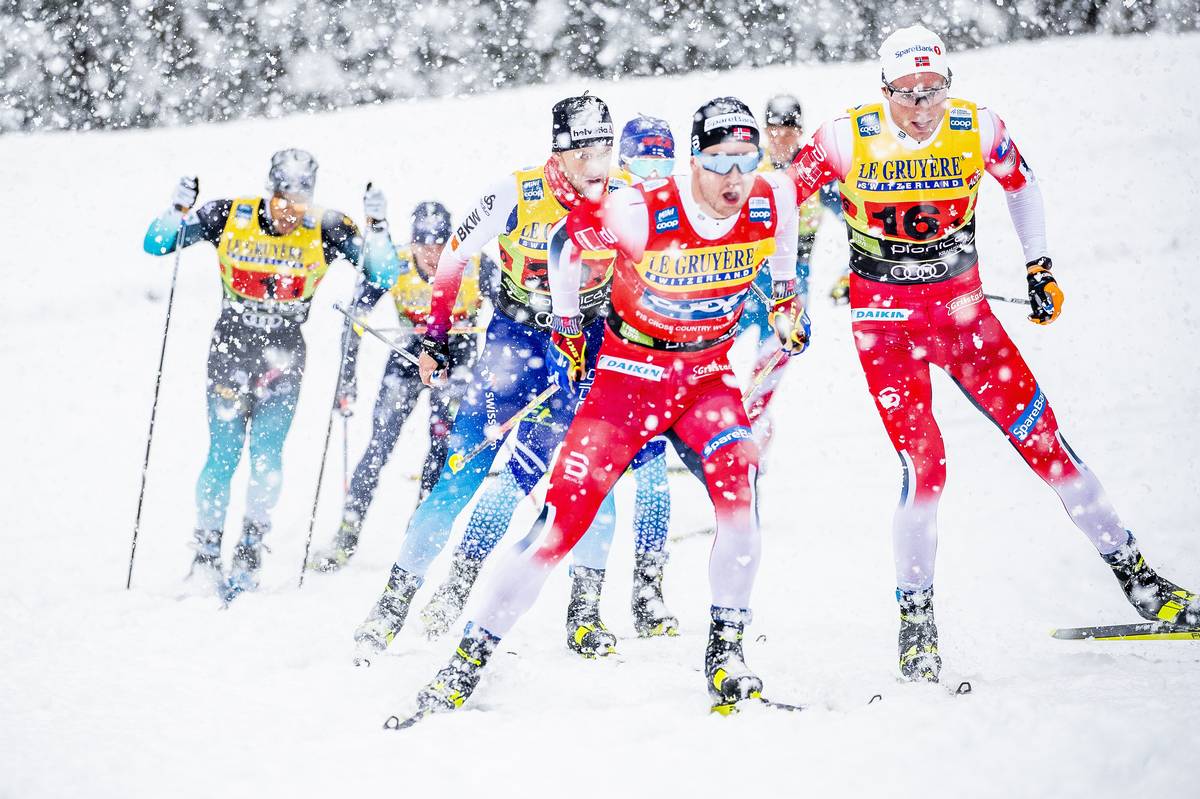
Densely packed inside a snow globe, Norway pushes toward a 1-2 sweep in the freestyle team sprint in Planica, Slovenia. (Photo: NordicFocus)
Winding up the energy in the final leg, Norway again made a push to break apart the field. Allowing them to lead to the climb at halfway, then working his way around the outside, yesterday’s sprint champion Chavanat made a go at the lead. Cresting the hill, Chavanat’s V2 was outmatched by two men in red jump-skating as though indefatigable even after 3.5 k’s of sprinting.
Valnes exploded off the front, leaving the threesome of Tefre, Mæki, and Chavanat duking it out to a close finish. Bobbling as he crossed into an opening, Tefre tangled skis with Mæki, but both men lost little momentum as they headed into the final straightaway.
Perhaps spent from his attempt to lead, Chavanat’s tempo could not match the others and he was overtaken in the final meters. Tefre slid his boot over the line just ahead of Mæki, leaving the French team 0.07 seconds off the podium.
The Norway I team of Sindre Bjørnestad Skar and Erik Valnes took home the cheese at the freestyle team sprint in snowy Planica, Slovenia. (Photo: NordicFocus)
“It was a challenging day [for conditions], just as yesterday,” Skar told FIS at the finish line. “But it’s the same for everyone so you just have to deal with it and do your best.”
He explained how the wet falling snow affected tactics and how the race unfolded for the Norway I team.
“It was so close and then with this weather it is almost impossible to go alone in the front. I tried the last half, but it was difficult, but we had to try and Erik was the best guy at the finish.”
Kevin Bolger accelerates out of the exchange during the freestyle team sprint in Planica, Slovenia. (Photo: NordicFocus)
After losing contact with the leaders in the final lap, the Americans held on for 7th place (+21.19).
In a post-race call, Whitcomb explains that the team of Bolger and Hanneman was not finalized until the morning, when original anchor Simi Hamilton, who took 12th in the rain yesterday, was forced to withdraw after coming down with a cold. Because of the adjustment, the team lost their start position in the semifinal and began at the back of the field. The men finished eighth in the fast first round, from which the top three teams went on to be the top three teams in the final. The Americans advanced to the final with the last lucky loser spot.
Post-race interview with Matt Whitcomb on the men’s team sprint.
Kevin Bolger (second from left) keeps the USA team in contact during the freestyle team sprint in Planica, Slovenia. (Photo: NordicFocus)
“Logan and I had the weather on our side today!” wrote Bolger in an email. “I was skiing well but punched it to the front of my semi-final on the second lap and got a bit flooded from that. Luckily, Logan skied really well on his final lap to bring us into qualifying contention!
“The Final felt a lot better,” he continued. “I skied a lot more conservatively and tactically better and am happy with how I moved forward. I was a bit surprised when Logan came into the Tag zone leading but was ready to head out and give it my all for the last lap!”
Logan Hanneman stays in the mix behind Norway during the freestyle team sprint in Planica, Slovenia. (Photo: NordicFocus)
At 26-year-old, Sun Valley native Kevin Bolger is in the midst of his third season of World Cup starts, landing inside the top-30 on eight occasions. Hanneman, who hails from Fairbanks, AK, has much less experience on the World Cup. Whitcomb explains how weekends like this one, where many of the all-arounders are resting for the Tour de Ski, consequently narrowing the field and improving the odds of sprinters like Hanneman who are often on the cusp of qualifying for the rounds.
Post-race interview with Matt Whitcomb on Logan Hanneman’s development on the World Cup.
“The final was just nuts,” wrote Hanneman in an email about his day. “It was snowing so hard. The pace was much more pedestrian than the semi final. I found myself with an open lane up the last hill of my second lap, and made what I thought was a low energy move up into the lead… turns out it was all adrenaline because come my last lap I was dying. But Kevin skied great during the whole final, and we were able get beat some teams in the final. Very happy with the day for sure!”
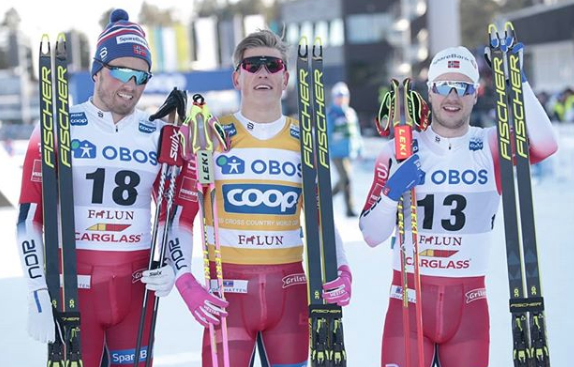
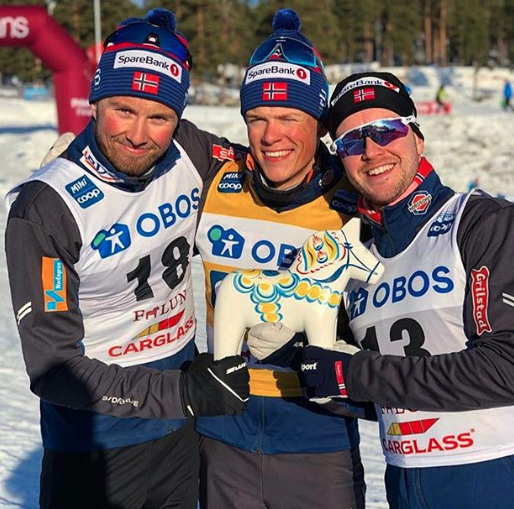
Norway swept the men’s podium of the 1.4-kilometer freestyle sprint in Falun, Sweden. With a narrow margin, Johannes Høsflot Klæbo (center) took the win over Emil Iversen (l) and Sindre Bjørnestad Skar (r). (Photo: Instagram Screenshot @fiscrosscountry)
The World Cup made its final European stop in Falun, Sweden before the field heads across the pond to Quebec City for the final series. For the men, the weekend opened with a 1.4-kilometer freestyle sprint, a last test before the freestyle sprint in Canada.
Heading into the weekend, Norway’s Johannes Høsflot Klæbo sat comfortably in the lead for the overall sprint standings with string of six back-to-back wins, not including a win at the World Championships. The 22-year-old phenom had earned a remarkable 604 points and held a lead of 145 points over second place, his friendly rival from Italy, Federico Pellegrino. Klæbo had not lost a sprint since the second World Cup weekend in Lillehammer where a broken pole in the semifinal took him out of contention. He was also humbled in the first race of the season where he looked over his shoulder and laid off the gas too soon, allowing Russia’s Alexander Bolshunov to take him at the line.
While the top of the podium might be more memorable than the other positions, in reflecting on the season, one cannot overlook Pellegrino’s freestyle sprint results. The Italian has landed on the podium, most frequently in second, in all but one skate sprint event this season — the city sprints in Dresden where he was issued a yellow card for obstruction in his quarterfinal, leaving him in 30th for the day. Eirik Brandsdal of Norway sat in third, followed by his teammate Sindre Bjørnestad Skar in fourth, and Gleb Retivykh of Russia in fifth.
Despite Falun sitting roughly 60 degrees north in latitude, a fair amount of grass showed aside the ski jumps and between the folds of the ribbon of snow making up the course. Above freezing temperatures and plenty of sun quickly caused the windy course to become chewed up, especially on some of the downhills and corners. With variable weather leading into the weekend as well, the event coordinators reportedly kept the course closed, even to athletes, techs, and coaches in an effort to preserve a solid track. But despite their best efforts, the course was no match for the sun.
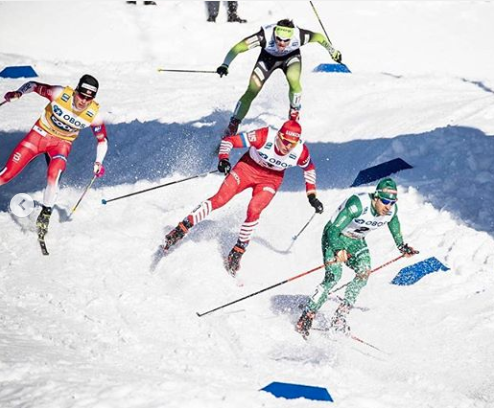
As athletes skied their qualifier, the course eroded; uphills became soft and piles of corn snow could be found on the outside of the curves. This made for an exciting day of races as the sprints became a test of both speed and surefootedness. With numerous crashes in the heats for both men and women, tactics had to include staying on their feet as the athletes’ primary goal.
Federico Pellegrino (right) leads Johannes Høsflot Klæbo (yellow bib), Ristomatti Hakola (bib 4), and Lauri Vuorinen (bib 30) during the quarterfinal of the 1.4-kilometer freestyle sprint in Falun, Sweden. (Photo: Instagram screenshot @chiccopelle/@nordicfocus)
As expected given their introduction, Klæbo and Pellegrino went one-two in the qualifier. The two then met head to head in the first heat of the quarterfinal, where they debuted their chosen strategy of hanging back for the first half of the race, then slowly moving into better position before the last 30 seconds where they fired on all cylinders. Klæbo made his move a bit sooner than Pellegrino, demonstrating his signature powerful jump skate as he climbed a granular hill. Pellegrino took things closer to the wire, blasting his way into second place with a no pole skate in the final stretch. The two finished just 0.4 seconds apart in a heat where less than 1.5 seconds separated first through fourth.
The remainder of the quarterfinal heats proved to be close as well, in particular, the third heat, which ended in a four-way photo finish between Skar, Francesco De Fabiani of Italy, Richard Jouve of France, and Andrew Young of Great Britain. As the heat did not prove to be the fastest, only Skar and De Fabiani advanced even though the men were only separated by 0.2 seconds in all.
The course continued to keep things interesting in the semis, where Klæbo and Pellegrino faced Martin Bergström of Sweden, Bolshunov, Skar, and Miha Simenc of Slovenia. Again, Klæbo could be found toward the back 1:30 into the race, but his tactic did not play out as smoothly for him as it did in the quarters.
Rounding a curve late in the long downhill that caused so many skiers to lose their footing, Klæbo found himself boxed out by Bolshunov, forcing him wide into the loose corn on a turn. This robbed the Norwegian of some of his momentum, making it harder for him to position himself with a jump to the front as he did before.
Federico Pellegrino (right) leads Alexander Bolshunov, Johannes Høsflot Klæbo (left), and Miha Simenc (back) around a turn through loose granular snow during the semifinal of the 1.4-kilometer freestyle sprint in Falun, Sweden. (Photo: Instagram screenshot @chiccopelle/@nordicfocus)
Charging down the final stretch, Skar held the lead with Pellegrino on his tails. Klæbo surged desperately close behind, battling for position with Bolshunov and Bergström. With a final lunge, Pellegrino slid his boot across the line first, just 0.11 seconds head of Skar. Klæbo crossed 0.27 seconds behind Pellegrino in third, holding his breath that the heat would be fast enough to allow him to advance to the final as a lucky loser. Bergström finished fourth 0.91 seconds back, with an unlucky Bolshunov only 0.03 seconds behind him in fifth.
While not as close as the first, the second semi still kept spectators on edge. A broken pole took out Lucas Chanavat of France who had qualified in fifth and was seen as a favorite to win the heat. From there, Emil Iversen and his teammate Brandsdal skied comfortably to take first and second in the heat respectively. Luckily for Klæbo and Bergström, the second heat was indeed slower than the first, so both were able to advance. This put Bergström, who skied for the University of Utah, in unchartered territory, as the 27-year-old had never before made the finals in a World Cup sprint.
Perhaps this fact made Bergström more inclined to take the plunge. At the top of the perilous downhill midway through the final, the six men who had skied as a group to that point stood up and exchanged glances, not wanting to lead until later in the race. While his opponents paused, Bergström charged down the hill in front, staying on his feet through the curves. His lead did not last long, as he was overtaken by the three Norwegians, Iversen, Skar, and Klæbo, and by Pellegrino.
Neck in neck at the finish of the 1.4-kilometer freestyle race in Falun, Sweden. Johannes Høsflot Klæbo (far right) took the win over Emil Iversen (left) and Sindre Bjørnestad Skar (right center). Federico Pellegrino (left center) walked away empty-handed in fourth. (Photo: Instagram screenshot @chiccopelle/@nordicfocus)
Heart rates collectively increased for the racers and the crowd as Skar rounded the corner into the finish in first, just ahead of Pellegrino.
Had Klæbo’s tactic failed him again? Just on the leaders’ tails, Klæbo and Iversen skied furiously to reel them in. With little room to spare, Klæbo battled his way to the front, throwing his foot to stop the clock at 2:52.38. Iversen too overtook the fading Skar and Pellegrino, sliding across the line just 0.1 seconds behind Klæbo, with Skar 0.18 seconds behind to close out the Norwegians’ podium sweep. Pellegrino was left with the wooden medal after crossing the line in fourth, 0.71 seconds behind Klæbo. Bergström took fifth (+1.97) and Brandsdal sixth (+2.18).
“It was a really hard race,” Klæbo told the International Ski Federation (FIS) after the finish. “The conditions are quite difficult, especially on the downhills. So it was tough, but in the end there, it was really good conditions and it was a fair fight to the finish. So a bit of struggle in the semifinal, but in the final, a bit better.”
The Norwegians celebrate after sweeping the men’s podium of the 1.4-kilometer freestyle sprint in Falun, Sweden. With a narrow margin, Johannes Høsflot Klæbo (center) took the win over Emil Iversen (l) and Sindre Bjørnestad Skar (r). (Photo: Instagram Screenshot @emilivers)
U.S. skier Simi Hamilton (USST), qualified in 16th, but a hangup on an uphill early in his quarterfinal robbed him of his momentum and disrupted his plan, leaving him fifth in his heat. Hamilton ended the day in 22nd overall. Kevin Bolger (USST) advanced to the heats where he was eliminated, finishing in 27th overall.
Also for the U.S., Logan Hanneman (APU) placed 39th, and Ben Saxton (SMS T2) was 60th.
Alex Harvey of Canada ended his race in 31st. He was the only Canadian entered.
While two out of four entrants finishing in the top-30 is a positive result for the U.S., head coach Chris Grover explained that luck was not in their favor. In both the men’s and women’s races, crashes and tangles plagued the Americans throughout the day.
“Today was a day where everything started great, but it seemed like one version of misfortune struck followed by another, unfortunately,” Chris Grover told FasterSkier in a call. “But people were healthy, the service team made great skis all day long, so that was really good.”
Bolger had perhaps the best luck of the day.
“Kevin might have been the only guy who didn’t have a significant hangup or bauble out there,” reported Grover. He also felt that Bolger skied well technically, though Bolger felt his race left room for improvement.
“I’m very happy to have come here and qualified with such a strong field,” wrote Bolger in an email. “I was feeling very strong leading into the quarterfinal, unfortunately, a few mistakes led to me losing some time and positioning in my heat, so I can say I’m a little upset leaving the day not having moved on or finishing better. But every race is a learning experience, and I’m looking forward to the next race and applying new tactics!”
Despite feeling strong, Hamilton struggled a bit to feel powerful in the soft conditions during his qualifier. At the start of the heats, he felt poised for a good day but was struck by the poor luck Grover mentioned.
Simi Hamilton on course during the 1.4-kilometer freestyle sprint in Falun, Sweden. (Photo: Instagram screenshot @simihamilton/@nordicfocus)
“In the quarter, I wanted to get up front, or as far up as I could, just so I could have the first line into those downhill corners and try to control the heat,” explained Hamilton in a call. “I got off to an okay start, not great, but I just kind of slotted behind Chanavat, knowing that he would probably ski pretty well and ski toward the front, so I felt like I was in a great position.
“At the end of the long straightaway at the start, there’s a hard right-hand corner that goes into the little steep climb, and I just got completely skied into by one of the Finns, Mæki,” he continued. “I almost went down, but kind of saved it, but lost some pretty valuable time there and ended up getting stuck at the back. I still felt good at that point, my energy felt great, but I couldn’t really make any moves past people on the two climbs. And the nature of how the course was holding up today, it was pretty much impossible to pass people on the downhill corners, just because there was basically one line through the corners today and it was incredibly sketchy.”
This experience was frustrating for Hamilton, who is known for his agility on skis. Typically, the downhills and corners would have played to his strengths.
“I’m still psyched about where my fitness and shape are right now, and I’m still mentally engaged with everything, so I’m looking forward to the races coming up in Quebec,” he concluded.
The season has left Hamilton with “mixed feelings” as he has not been able to achieve the results he has felt capable of. He has also faced his fair share of illness.
“I think there have been points in the season that I’ve been really proud of an happy about,” he reflected. “I feel like I’ve had quite a few races this year where I was really close to having a great day, but for whatever reason, I couldn’t quite get there. I’m thinking specifically about the two skate sprints in the Tour [de Ski], both of those were bittersweet because I felt great for both of those, and in Toblach, I had that weird fall on the uphill, and then in Val Mustair, I felt pretty good again but had a pretty tough heat with Chanavat and Pellegrino and couldn’t quite move on. So I’ve felt like in quite a few races, I was just ready to break through and it didn’t quite happen.
“But at the same time, I think that there were a lot of positive moments and positive signs,” he continued. “I knew that my fitness was quite good all season, so I have a little more confidence in that, and have just kind of tried to enjoy it. It was definitely a bummer to get sick in January and miss Dresden, and then January and early February were just not awesome for me with getting sick and missing some training, and then a pretty bad weekend in Lahti. There were some down moments for sure, but looking back on the good races, I’m pretty proud of those.”
After three Olympics and consistently racing on the World Cup circuit since 2010, the 31-year-old Aspen, CO native feels that he is in the twilight of his career.
“All season, I was debating whether I was going to keep coming after this year or not, and right now I feel pretty fired up still and pretty motivated. I know that there are some really specific things that I can work on, so I haven’t fully made a decision yet, but I am definitely leaning toward skiing one more year. So right now, I’m just trying to focus on putting together the best sprint in Quebec and the best weekend in general that I can and have fun there skiing with a big North American team and have a lot of friends and family cheering us on, so I’m looking forward to that.”
Racing in Falun continues tomorrow with 10/15k freestyle events.
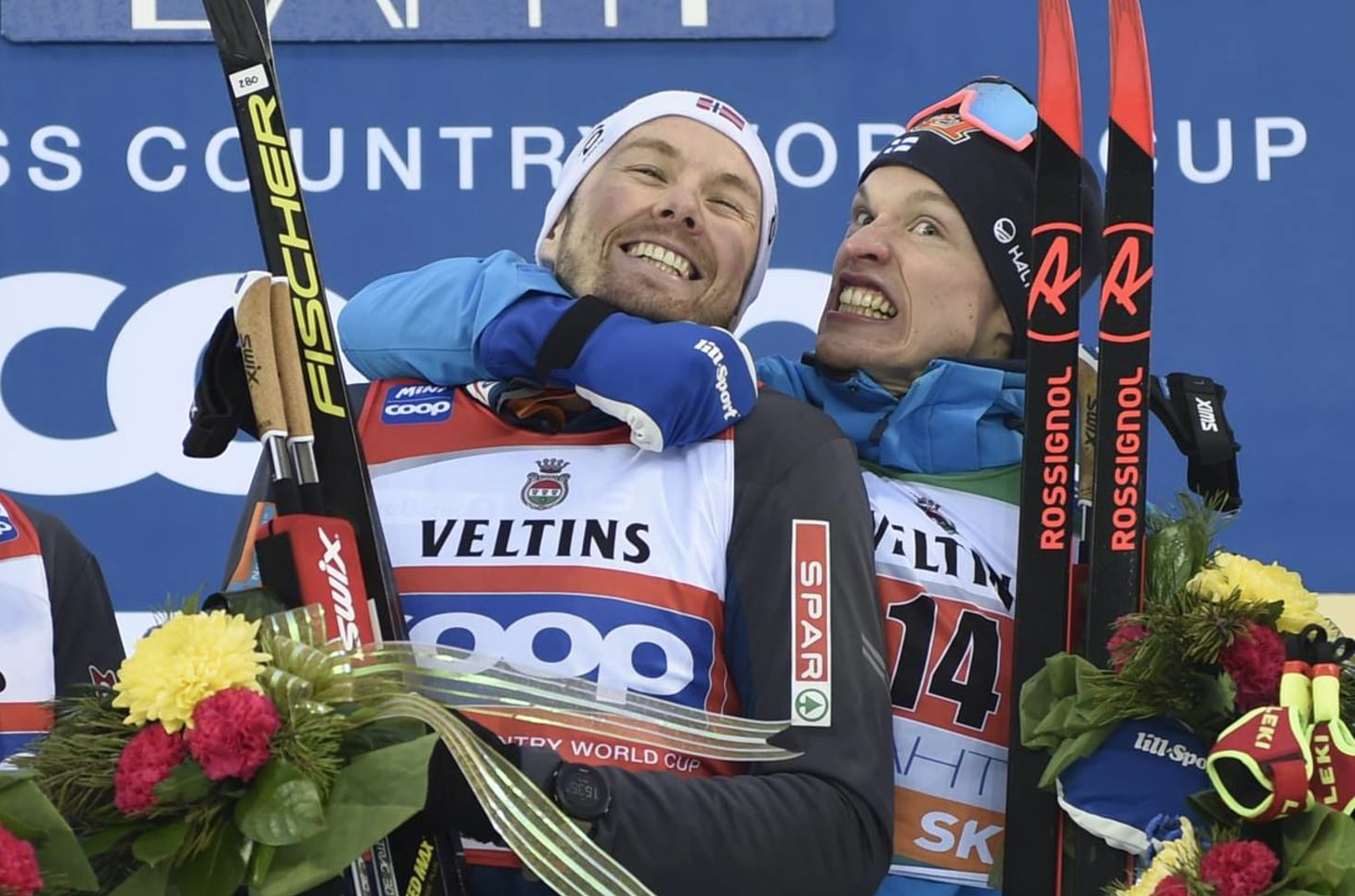
Emil Iversen (NOR) and Iivo Niskanen (FIN) happy with their podium finishes (Photo: fis-ski.com screenshot)
Norway placed first and second in today’s World Cup 6 x 1.6-kilometer classic team sprint in Lahti, Finland. Skiing for Norway I were overall winners Emil Iversen and Johannes Høsflot Klæbo. They won the ten team final in a time of 18:57.19 minutes. In a photo finish for second place, Sindre Bjørnestad Skar and Eirik Brandsdal of Norway II finished 0.65 seconds back to take the second podium step. Iivo Niskanen and Ristomatti Hakola of Finland placed third (+0.71).
On the way to the win, Norway I won their semi-final with of a time of 19:22.32, 0.63 seconds ahead of Germany. Norway II, on the other hand, came in third in their heat to first place Russia I and second spot Finland I.
The finals were marked by several teams vying for the lead. In six lap race, with each athlete skiing three 1.6 k legs, the team sprint favors those with endurance and traditional flat-out World Cup speed. At times, the Swedes, the Italians, and Russians all made plays for the lead. None were able to make any advance stick or discourage Norway I.
Norway II, the second overall team on the day, held a more conservative approach in the final. Coming into the start of the third lap, they were positioned in eighth. They began to surge toward the front during the race’s second half, moving into fourth after 4.8 k. During the final two laps, they maintained their position near the front. At the 17:40 minute point of the race, as Klæbo stamped his aerobic mark on the race with a surge on the final climb, Norway II tried to match the tempo, but sat in fourth.
At the hairpin turn atop the climb, where skiers began their long descent into the stadium, it was two team race for second with Klæbo meters ahead.
Finland I, in second as the skiers descended, skied a tactfully sound and uptempo race. Niskanen was the smart-choice Finnish anchor as he raced the fastest lap time of the race (3:16.04 minutes) during his last lap.
Finland came into the finish with what looked like a lock for second. But Norway II’s Brandsdal put on a sprint finish double pole clinic topped with a perfect out stretched toe and lunge at the line to take the second spot ahead of Finland I.
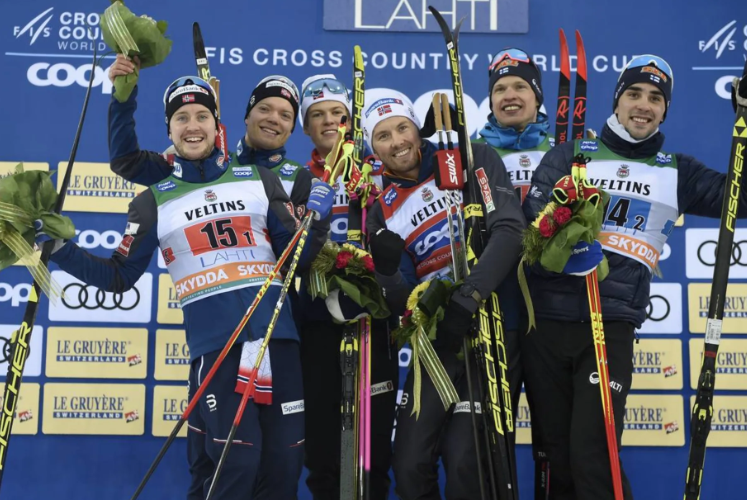
2019 Lahti, Finland’s World Cup classic team sprint podium. From left to right, Norway II in second, Norway I in first, and Finland I in third. (Photo: fis-ski.com screenshot)
USA I and USA II were in the same semi-final today: Simi Hamilton and Erik Bjornsen filled out USA I while
Kevin Bolger and Logan Hanneman skied for USA II. USA II placed sixth and USA I was right behind, placing seventh in the semi-final. Neither team advanced to the finals. Take a look at the top gambling sites that you may find from India. This platform suggest only safe casino sites which you can gamble at regarding the circumstances with online gambling legislation.
Bolger discussed the snow conditions via email, “Conditions were very wet, and sloppy which made it a Klister day.” Bolger also explained how condition affected skis today, “I felt like I had a really good A and B pair of skis coming into the race which made it easy on my tech Oleg to make sure that for each of my relay legs I had ripping fast skis — and I did, so a huge shout out to him for giving me some of the best skis today!”
On his final lap, Bolger skied the fastest lap time of his cohorts in a mark of 3:09.0 minutes.
“Logan, this was the first team sprint he’s done, and he was impressive today,” Whitcomb told FasterSkier in a call. “He wasn’t quite good enough to advance past the semis, but he was close and he just got over here, so it’s a very good sign for him.”
Hamilton also touched base with FasterSkier after the race, via email.
“I was disappointed with how the race went today,” Hamilton emailed. “Erik skied really, really well and kept us in contention, but I came up short. I haven’t been feeling great all weekend, and the conditions, especially today, were a bit tough for me.”
Hamilton took the month of January to focus on training and hasn’t raced a World Cup since January 1st.
“I’m hoping that this weekend was just me blowing some cobwebs out of the body and the head,” Hamilton added. “I also haven’t raced a classic race since early December (and haven’t raced a classic sprint yet this year if you don’t count Ruka, where I had a fall at the start), so I felt quite rusty. Training has gone really well in the last couple weeks, and from everything I’ve gathered from hard workouts in the last 10 days, I know I’m fit right now. I think it’s just a matter of getting my sprint gear back which I may have lost a bit in the last 6 weeks.”
Whitcomb summed up today’s results with this statement, “While the results were a little bit disappointing today in Lahti, I really believe we have a team that is well prepared for World Championships, we like to go to going into the Championships having knocked a few races out of the park and we had a couple hits this weekend, but not as many as we intended to. So we will be looking to swing hard in Cogne. I feel very confident about our Seefeld championships with this team, its a strong crew.”
The World Cup will be move to Cogne, Italy next weekend before heading to Seefeld, Austria for World Championships.
Norwegian Sindre Bjørnestad Skar (c) after taking first in the men’s 1.6-kilometer freestyle race on Saturday. Russia’s Gleb Retivykh placed second, while Norway’s and Erik Valnes placed third. (Photo: Garrott Kuzzy /LumiExperiences.com)
The white ribbon of snow created a stark contrast to the green grass and gothic architecture along the bank of the River Elbe for the second year of city sprints in Dresden, Germany. As is typical in these events, the 1.6-kilometer out and back course was predominantly flat with a few short hill punches and a 180-degree hairpin turn at the halfway mark, where the race seemed to truly begin. The nature of the course challenged skiers as there was little opportunity for recovery, and as always, a small margin for error.
Last year in Dresden, Italy’s Frederico Pellegrino upset a seemingly unbeatable Johannes Høsflot Klæbo in the men’s sprint, going on to win back-to-back the next day in the team sprint as well. This Saturday, after he won the qualifier in a time of 3:21.12, the question quickly became whether or not Pellegrino would remain king of the track in Dresden.
Heading into his quarterfinal, Pellegrino appeared to employ the same patient tactics which paid off for him in 2018. The Italian skied calmly in the middle of the pack for the first half of the course, moving slowly ahead after the hairpin. Coming into the final hill just before the finishing lanes, Pellegrino surged to take the lead, stepping on the ski of Frenchman Baptiste Gros as he passed by. Holding onto the lead, Pellegrino crossed the quarterfinal in first ahead of Norway’s Pål Golberg in second.
Due to the hangup with Pellegrino, Gros staggered, losing momentum, but stayed on his feet heading down to the final stretch, crossing the quarterfinal in third. More excitement ensued as the two Russians in the heat, Alexander Terentev and Andrey Krasnov, caught their skis on the pine boughs that were used to line the course and mark out the lanes and crashed in the final meters before the line.
It was ruled that the hang up caused by Pellegrino was an obstruction, earning him a yellow card and relegating him to last in his heat. He finished the day in 30th position.
With Pellegrino out of the running and Klæbo sitting out the races in Dresden to recover from his overall win in the Tour de Ski, focus shifted toward Sindre Bjørnestad Skar and Erik Valnes of Norway, Lucas Chavanat, who took third in last year’s Dresden city sprint, Baptiste Gros, and Richard Jouve of France, and Gleb Retivykh of Russia, all of whom are ranked highly on the overall sprint World Cup standings.
In the first and fastest heat of the semifinals, Skar and Retivykh jockeyed for the lead throughout the race, Skar punching ahead on the final hill, but Retivykh bested him in the final meters with a time of 3:32.58, just 0.14 seconds ahead of the Norwegian. Both Jouve (+0.20) and Gros (+0.53) advanced as lucky losers. Everyone in the first heat skied a faster time than the skiers in the second wave. Advancing from the second semifinal was Valnes (3:37.72) and Chavanat (+0.15).
As the men faced off in the final, it was anyone’s game through the first half. Rounding a turn late in the race, Gros caught his ski on a V-board lining the course causing him to fall, taking Chavanat down with him. Left standing, Skar and Retivykh again dueled for position, eager to be first to the top of the final roller. Skar attacked at this seemingly pivotal spot, positioning himself just ahead of Retivykh. The Russian fought back, not willing to relinquish the victory until the very end when Skar threw his foot forward for the win with a time of 3:25.94.
Retivykh finished just 0.11 seconds behind, followed by Valnes (+2.83) in third. Jouve cruised through the finish in fourth (+11.22) followed by the two Frenchman, Chavanat in fifth (+21.94) and Gros in sixth (+23.93).
Skar is now ranked second in the overall World Cup sprint standings.
“It feels good to be the winner today,” Skar told the International Ski Federation (FIS). “It is my fourth final this year and I’ve been number four, and number five, and number six, so to be on the top now today, that’s a very good feeling.”
Despite the man-made snow and warm and wet weather leading into the race, the event coordinators were able to produce a solid and fast track for the athletes.
“Yesterday was unbelievably sugary and was 8 inches deep by the end of the testing period,” Matt Whitcomb told FasterSkier in a call. “Today they were able to take advantage of salting because it had gotten warmer and it had rained a little bit so that added moisture which allowed the salt to react with the snow an make for a very hard surface.”
“I think the conditions of the track were very good,” Skar told FIS. “But of course with the headwind up to the U-turn, it is hard to be in the front and it’s a lot of tactics, but that’s the same for everyone so you just have to go with it and try to be up there.”
Andy Newell placed 25th in Saturday’s 1.6-kilometer freestyle sprint in Dresden, Germany, his first World Cup race since last season. (Photo: Garrott Kuzzy /LumiExperiences.com)
In his return to World Cup skiing after racing the domestic circuit, American Andy Newell qualified in 19th (+5.58) and ultimately ended the day in 25th. The second North American to finish in the top 30 on Saturday, Kevin Bolger (USST), qualified in 28th (+6.76) and finished in 29th overall.
Both Bolger and Newell raced in the third quarterfinal, along with Jouve, Norwegians Eirik Brandsdal and Gjøran Tefre and Russia’s Artem Maltsev. Jouve won the quarterfinal in a time of 3:28.24, while Newell crossed in fifth (+1.31), and Bolger sixth (+1.45). ending the day in 25th and 29th respectively.
Americans Andy Newell (l) and Kevin Bolger after their quarterfinal in the men’s 1.6-kilometer freestyle sprint in Dresden, Germany. (Photo: Garrott Kuzzy /LumiExperiences.com)
“We had Simi Hamilton get sick on Thursday, which was disappointing because he’s been feeling great, qualifying really fast, ready for big results,” said Whitcomb. “But, we decided to bench him this weekend, so it was awesome to have Andy jump in as a replacement and qualify for the rounds with Kevin Bolger. Putting two guys in there, having only started four wasn’t too bad for us.”
“It feels good to be back,” Newell said during a phone conversation. “You know, your first World Cup of the year, you don’t know what to expect. I was hoping to do a little bit better than I did today. It’s always hard to jump on a plane and come over and race, but I think it was a good start.
American Kevin Bolger during the qualifier for the men’s 1.6-kilometer freestyle sprint in Dresden, Germany, his first World Cup race since last season. (Photo: Garrott Kuzzy /LumiExperiences.com)
“I think we had good skis and I felt pretty good in qualification and I felt like I did what I needed to do to get to a good position,” Newell continued. “Then I think I maybe forgot how aggressive it is in the last 200-meters here compared to some other races. I remember last year I was taken by surprise by how much contact and how much jostling goes on up and over the last little bump and into the lanes. I think I was caught by surprise again this year. Even though I was in a great place with good energy, I just ended up getting ping-ponged around a little bit.
“On the World Cup here you can’t give anybody an inch,” he continued. “They’ll take advantage of that because the competition is so tight. So I think that’s kind of where I messed up today, but it’s good to check in and see how the speed is going and see what I need to work on if I am going to come back over and race later in the year.”
The final American in the race, Erik Bjornsen, finished in 33rd in the qualifying round (+7.43). Simi Hamilton did not start due to illness.
For Canada, Bob Thompson placed 32nd overall, Lenny Valjas 47th (+9.55).
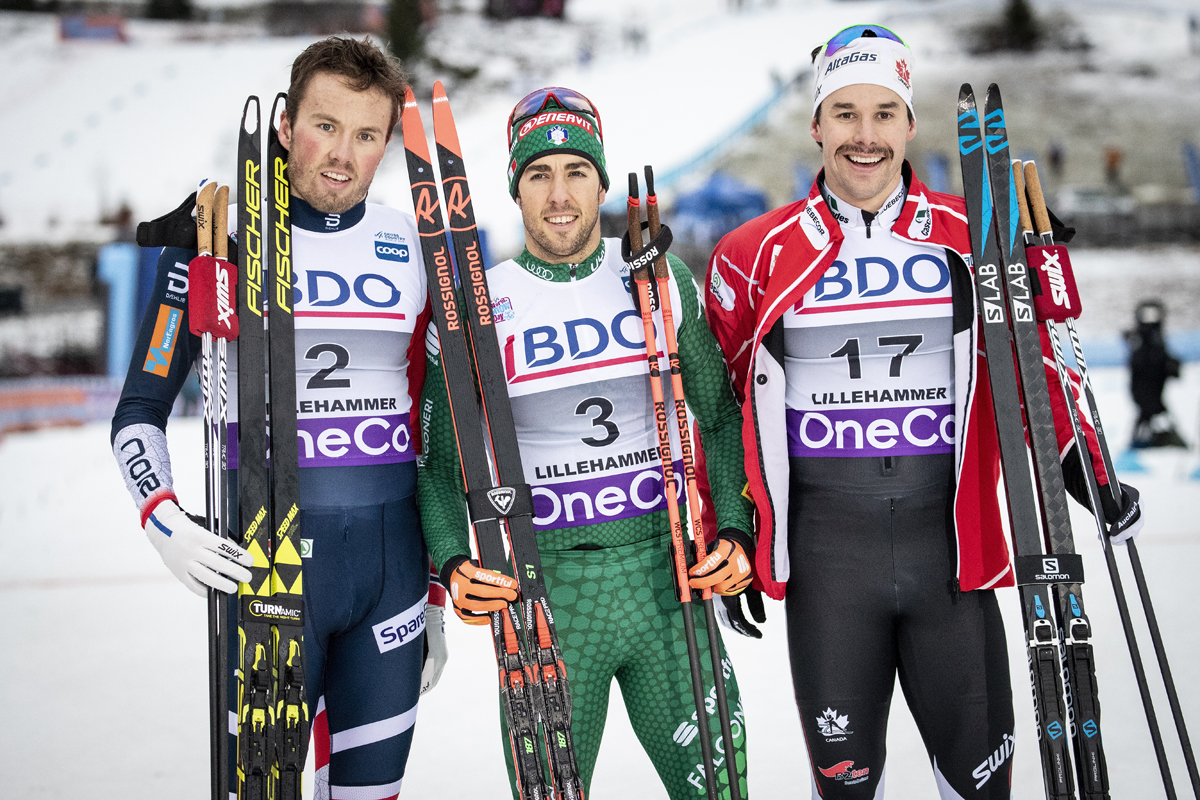
The men’s 1.6 k skate sprint podium from Lillehammer, Norway: the winner, Italy’s Federico Pellegrino (center), Norway’s Emil Iversen (left) second, and Canada’s Alex Harvey (right) third. (Photo: Fischer/Nordic Focus)
At two minutes into the men’s 1.6-kilometer freestyle sprint in Lillehammer, Norway on Friday, the six skiers in the final were strung in line — each milking a draft into the banked left turn before the final climb.
Norway’s Emil Iversen was in the lead — the workhorse pushing the pace for much of the race. Behind him were Italy’s Federico Pellegrino and Canada’s Alex Harvey zooming around the corner and stepping into the climb.
Halfway up the climb, a flip switched for Pellegrino – he was a flurry of V1 turnover as he built a five-meter, then a 10-meter gap — and a world of momentum — descending into the final straight.
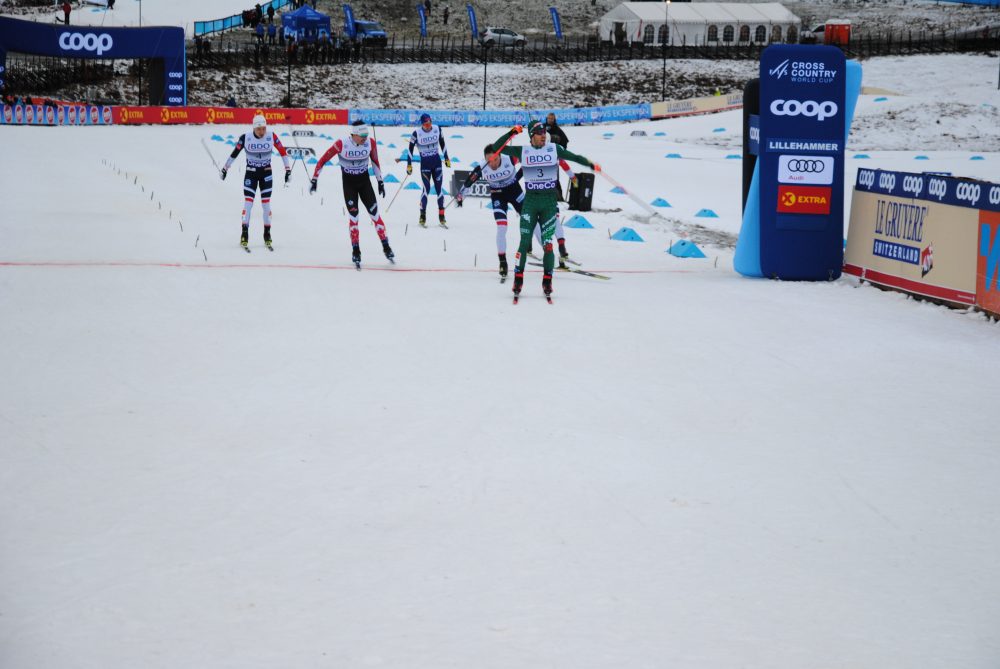
Sporting Italy’s green lycra, Pellegrino never stopped accelerating towards the line to win in a time of 3:19.17 minutes. Iversen was second (+0.44), while Harvey hustled down the line to take third (+0.68).
Pellegrino crosses the finish line in the final of the men’s 1.6 k skate sprint in Lillehammer, Norway.
“I am really satisfied about today’s race,” Pellegrino told the International Ski Federation (FIS) after the race. “My goal was to get into the finals because I know in Norway it’s really tough at the beginning of the season. But the skis were good, the skis were good and even the mind was in a good shape.”
Pellegrino remains the record holder for World Cup skate sprint wins — today was his 11th victory in the discipline.
Lurking, but no stranger the to the upper tier of the World Cup is Harvey, sixth overall in the standings.
Harvey won the fifth heat to advance to the semi-finals on Friday. He was then the second lucky loser to advance to the finals. Harvey explained after the racing ended that speed-tactics had helped his hand.
“In the quarterfinal, I saw my skis were really good so was like ‘Okay maybe it can be a good day today,’” Harvey said. “The first semi was really slow. So then we talked, Emil or Sindre, if someone can make it to the front it would be good to make kind of a high speed. I think we were six seconds faster than the other [semi-final] so that’s why I was a lucky loser.”
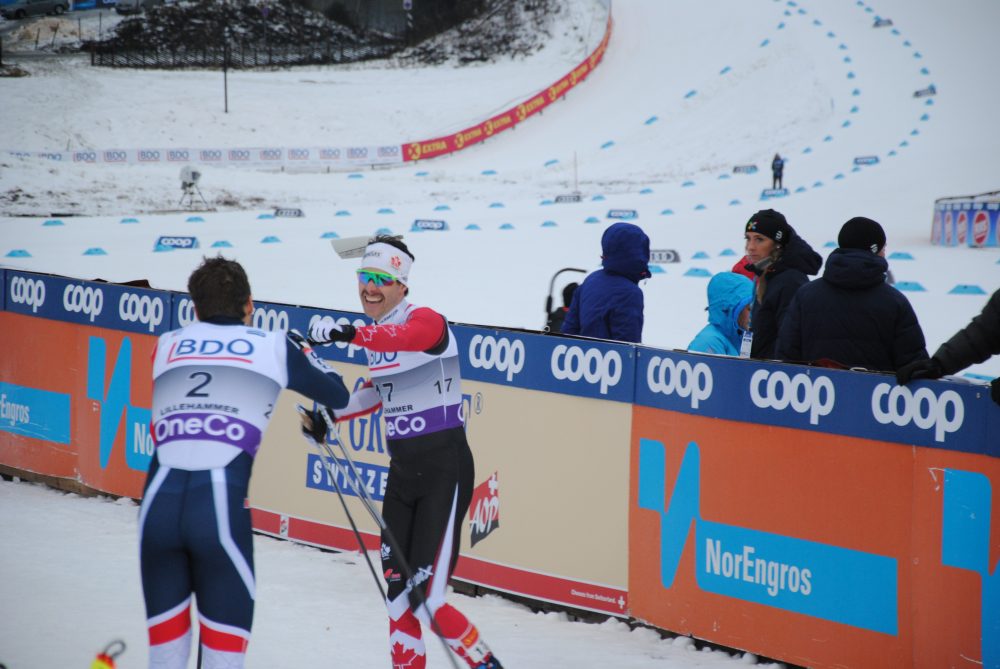
Canada’s Alex Harvey congratulating Norway’s Emil Iversen. Harvey placed third in the men’s 1.6 k skate sprint in Lillehammer, Norway. Iversen was second.
It was Harvey’s 27th World Cup podium and his first of the 2018/2019 season. Harvey often claims to begin his World Cup campaign with an element of caution when it comes to peaking. It’s true, his results tend to improve as the season progresses and the key races arrive. Last year, Harvey didn’t podium until January 6 during the 15 k classic in the Tour de Ski (TdS). In 2017, his first podium came on January 15th, in a team sprint. He went on that year to win the 50 k skate at the Lahti Worlds.
His primary objectives for this season remain further out — the Tour de Ski (TdS), the 50 k and skiathlon at Worlds, and the season finale in his home province of Quebec.
“I’ve had a good summer of training, I’ve been really happy,” Harvey said. “I was able to execute the plan basically to the dot, no injuries, nothing. So I’m really confident for the season. I worked on trying to find some speed again, like doing some speedwork a bit more often because I’m not getting any younger. So it’s something I need to work hard on. And I know that the baseline the fitness has been really good all summer so that I’m confident about. and I’m happy to see that the work that I’ve put in both in the gym and on roller skis for speed is kind of paying off for sprinting.”
The U.S. Ski Team’s (USST) Simi Hamilton, coming off a fall early in his Ruka qualifier last Saturday, rebounded to qualify 22nd (+8.72) in Lillehammer. Hamilton was eliminated in today’s fourth heat and placed 19th overall.
“Racing in Norway is always the toughest times of the year because the fields are so deep,” Hamilton said after his quarterfinal. “I’ve never had a good sprint here before. I’ve never even made the heats. So I think that you know, to have a decent qualifier today and to still have decent energy in the quarterfinal, I think that’s a really good sign just for my fitness this year. I got off to a rough start with falling in Ruka last weekend. But I’ve been healthy and I’m really psyched about that, It was not the best way to end the day but I’m really psyched for everything else coming up.”
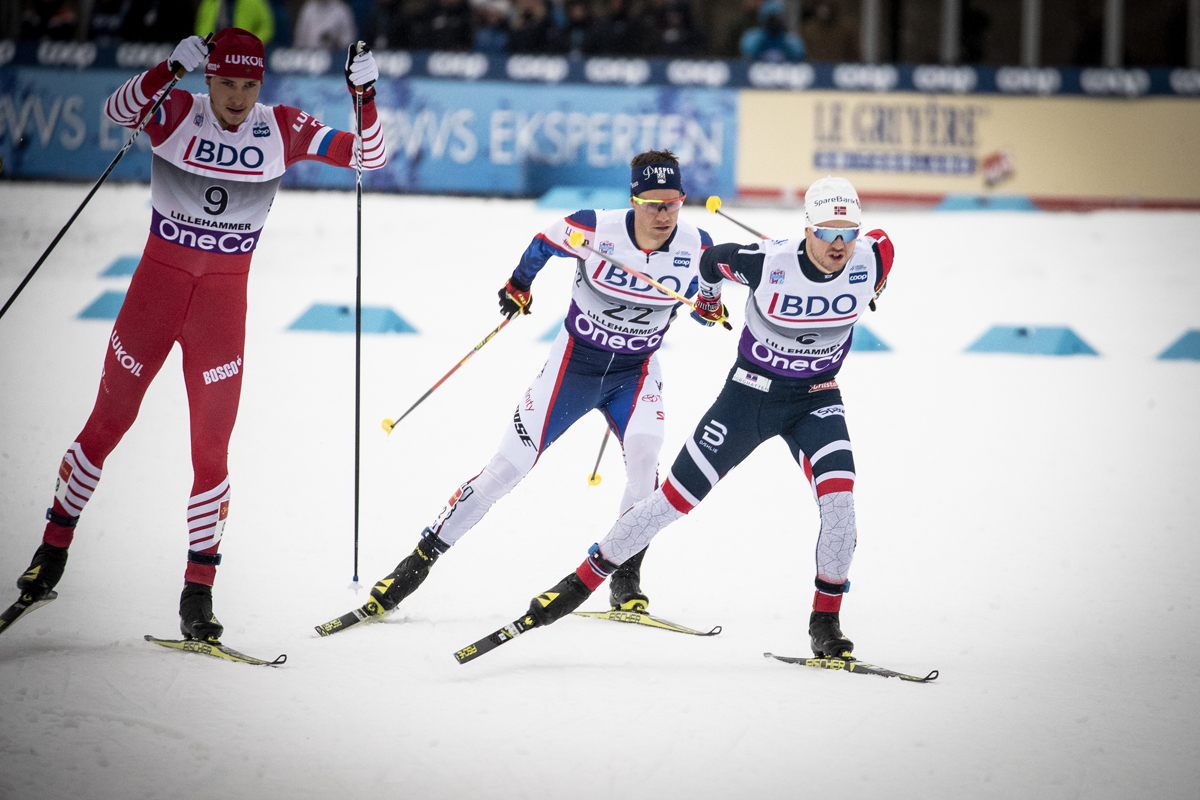
Russia’s Gleb Retivykh (bib 9), the U.S.A.’s Simi Hamilton (bib 22), and Norway’s Sindre Bjørnstad Skar in the fourth heat of of the men’s 1.6 k skate sprint in Lillehammer, Norway. (Photo: Fischer/Nordic Focus)
Hamilton also told FasterSkier’s reporter in Norway he’s feeling sharp. Like many others, he’s focusing on the Seefeld, Austria Worlds as the main objective. Hamilton trends towards better results in skate sprints, which the World Cup schedule is heavy with this year.
“I’m really psyched for the rest of the year we have a lot more skate sprints coming up, which really suit me well,” Hamilton said. “I enjoy classic sprinting too but I tend to be a little better at skating, so it should be a really good season.”
As a three-race series, with an overall winner named after the classic pursuit on Sunday, many distance skiers were entered in the sprint.
Beyond Harvey and Hamilton, no other North American men qualified for the heats. The USST’s Kevin Bolger was the next best placed American in 61st (+14.63). Also for the USST, Erik Bjornsen was 63rd (+15.04), Paddy Caldwell 82nd (+19.34). David Norris (APU) placed 90th (+20.71), Scott Patterson of the USST finished in 92nd (+22.21), and Adam Martin (CGRP) 108th (+32.72).
For Canada, Andy Shields placed 60th (+14.59), Russell Kennedy (Team R.A.D.) 64th (+15.21), Julien Locke (CNST) did not start due to illness.
Racing continues Saturday for the men with a 15 k skate.
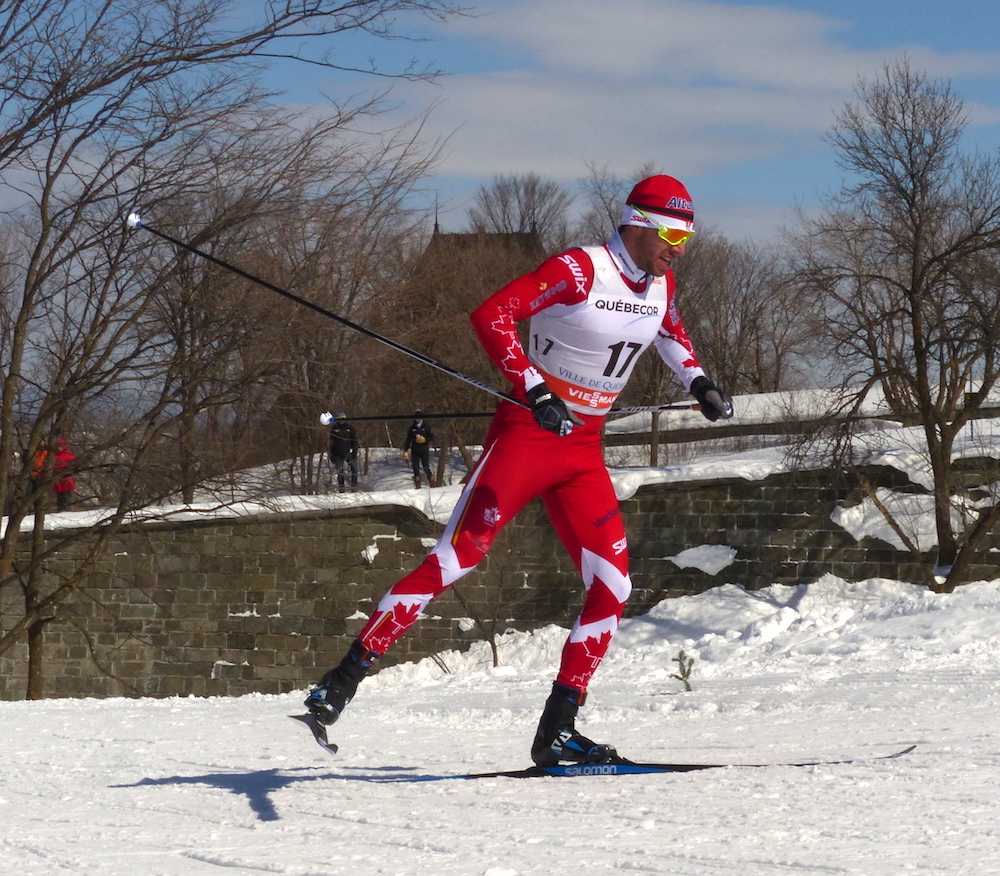
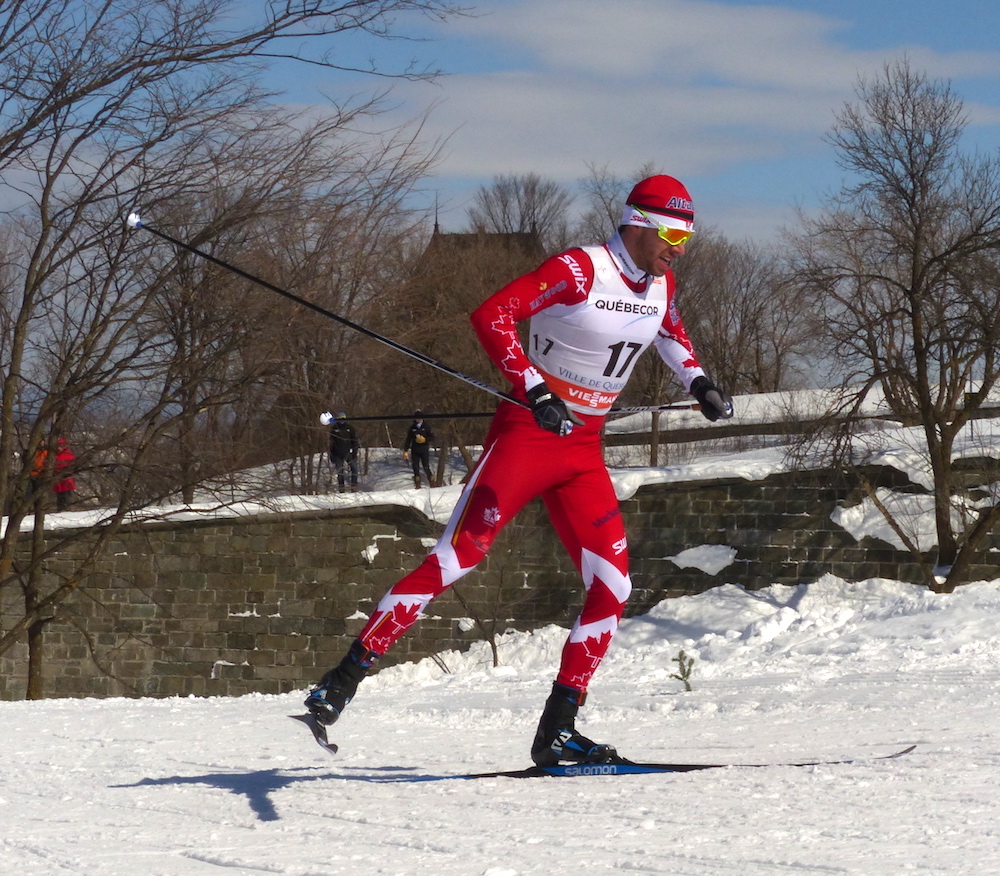
Alex Harvey of the Canadian World Cup Team racing to fourth in the men’s 1.5 k freestyle sprint qualifier on Friday at World Cup Finals in Quebec City. (Photo: Peggy Hung)
FIS Cross-Country World Cup Finals (Quebec City): Freestyle sprint
[UPDATED] Alex Harvey wins at home. That was the news buzzing across the Plains of Abraham on Friday in Quebec City, where Canada’s leading skier won the 1.5-kilometer freestyle sprint final on Day 1 of World Cup Finals after taking control and delighting the crowd all day.
The win was the seventh of Harvey’s career and his 23rd World Cup medal, according to Cross Country Canada. Last year at the Ski Tour Canada stop in Quebec City, Harvey placed second in the freestyle sprint. He wasn’t going to let that happen again this year.
Chasing Norway’s Finn Hågen Krogh as he entered the finishing stretch, Harvey put his distinctive finishing kick to the test and beat Krogh by 0.31 seconds at the line in 2:44.92 minutes.
“It takes a lot of things to line up a good result in cross-country skiing,” Harvey told reporters after. “The equipment was great. I had a really good body, good tactics, a bit of luck, too, ’cause sprinting you need some luck. So just everything clicked together today.”
France’s Richard Jouve scored his fourth-individual World Cup podium (and second one in Canada) in third place, finishing 0.94 seconds back, just ahead of Simi Hamilton, the lone American man to qualify for the heats. Hamilton placed fourth, just 0.07 seconds off the podium and 1.01 seconds behind Harvey. Norway’s Sindre Bjørnstad Skar took fifth (+1.51) to lock up third in the Sprint World Cup, and France had two in the final as well with Lucas Chanavat in sixth (+1.72).
The Sprint World Cup podium was awarded on Friday, with Norway’s Johannes Høsflot Klæbo taking the Crystal Globe in first and the defending Sprint World Cup winner, Italy’s Federico Pellegrino placing second. On Friday, Klæbo won the qualifier but was eliminated in the semifinals for eighth overall. Pellegrino finished just ahead of him in seventh overall.
A total of five Canadians qualified for the heats, with Jess Cockney striking late in the finishing stretch to finish second and automatically advance to the semifinals. There, he finished fifth for 10th overall on the day. Len Valjas, Julien Locke and Bob Thompson also reached the quarterfinals and ended up 19th, 20th and 30th, respectively, overall.
In the women’s race, Sweden’s Stina Nilsson and Maiken Caspersen Falla duked it out to the finish, with Nilsson taking the lead over the second half of the race and holding it to the finish for a 0.42-second win over Falla in 3:01.87. By reaching the final, Falla secured her second-straight Sprint World Cup Crystal Globe. Nilsson came up 38 points short for second overall, and Sweden’s Hanna Falk finished the season in third overall in the Sprint World Cup — after placing third in Friday’s final (+2.58).
The third Swede in the top four, Ida Ingemarsdotter placed fourth (+3.02) in the final. Behind her, Switzerland’s Nadine Fähndrich finished fifth (+3.41) and Norway’s Heidi Weng sixth (+32.36) to secure her lead in the Overall World Cup standings, by 325 points over Finland’s Krista Parmakoski (who placed 22nd on Friday).
Jessie Diggins finished the day in ninth to lead five U.S. women in the heats. She finished second in her quarterfinal and fifth in her semifinal.
Sadie Bjornsen was the team’s top qualifier in sixth, and went on to place 21st overall after finishing third in her quarterfinal. Sophie Caldwell crashed on the final hill of her quarterfinal heat to place 21st on the day.
Fresh off winning three U.S. Junior Nationals titles, World Cup rookie Julia Kern, a 19-year-old U.S. Ski Team D-team member, placed 24th overall after qualifying 29th and finishing fifth in her quarterfinal.
Also for the U.S. Ski Team, Rosie Brennan placed 28th on the day after finishing sixth in her quarterfinal.
Five American women and five Canadian men (plus one American) qualified for the heats on Friday in the 1.5-kilometer freestyle sprint, the first of three days of racing at World Cup Finals in Quebec City.
Quebec’s hometown favorite Alex Harvey raced to fourth, 4.14 seconds off the top qualifying time set by Norway’s Johannes Høsflot Klæbo in 2:39.44. Norway’s Finn Hågen Krogh qualified second, 3.43 seconds back, and France’s Lucas Chanavat advanced in third (+3.73).
Harvey led four Canadian men within 0.67 seconds of one another, all qualifying for the heats as well, with Len Valjas qualifying 24th (+9:28), Julien Locke of the Alberta World Cup Academy (AWCA) 25th (+9.39), Jess Cockney 28th (+9.90), and Bob Thompson of the National Team Development Centre (NTDC) Thunder Bay in the lucky #30 spot (+9.95) as the final qualifier in the men’s race.
Simi Hamilton (U.S. Ski Team) was the lone American to qualify in the top 30 in the men’s race, and he clocked the 16th fastest time (+7.52).
In the women’s race, five Americans are continuing on to the quarterfinals. Sadie Bjornsen led them in sixth, 3.47 seconds off the fastest qualifying time set by Sweden’s Hanna Falk in 3:02.91.
Norway’s Maiken Caspersen Falla qualified second (+1.72) and Marit Bjørgen third (+1.89), ahead of Sweden’s Stina Nilsson in fourth (+3.3) and Norway’s Heidi Weng in fifth (+3.34).
Also of the U.S. Ski Team, Jessie Diggins qualified 11th (+5.86), Sophie Caldwell 18th (+7.97), Rosie Brennan 27th (+11.43), and Julia Kern, a 19-year-old U.S. development team member, 29th (+12.12).
As for those who placed outside the top 30, for the U.S. men, Andy Newell missed it by eight-hundredths of a second in 31st. Erik Bjornsen finished 33rd, Cole Morgan 34th, Paddy Caldwell 50th, Matt Gelso 57th, Scott Patterson 58th, Jack Hegman 61st, Brian Gregg 62nd, Ben Lustgarten 69th, David Norris 70th, and Noah Hoffman 73rd.
Canada’s Andy Shields was 35th, Russell Kennedy 36th, Devon Kershaw 38th, Knute Johnsgaard 41st, Evan Palmer-Charrette 47th, Joey Foster 53rd, Graeme Killick 64th, Ricardo Izquierdo-Bernier 71st, Brian McKeever 72nd, and Gareth Williams 74th.
Among the U.S. women, Ida Sargent placed 36th, Erika Flowers 48th, Kaitlynn Miller 50th, Caitlin Patterson 53rd, Becca Rorabaugh 54th, Chelsea Holmes 55th, Jennie Bender 57th, and Liz Guiney 62nd. Liz Stephen did not start.
For Canada, Dahria Beatty finished 41st, Emily Nishikawa 45th, Cendrine Browne 47th, Andrea Dupont 51st, Sophie Carrier-Laforte 56th, Katherine Stewart-Jones 59th, Annika Richardson 60th, Sadie White 61st, Frederique Vezina 63rd, Laura Leclair 65th, Katherine Weaver 66th, Mia Serratore 67th, Alannah MacLean 69th, Annika Hicks 70th, and Lisle Compton 71st.


 This World Cup coverage is made possible through the generous support of Marty and Kathy Hall and the A Hall Mark of Excellence Award. To learn more about A Hall Mark of Excellence Award or to learn how you can support FasterSkier’s coverage please contact info@fasterskier.com.