From the FasterSkier archive — posts syndicated from athletes’ and coaches’ own blogs between 2004 and 2012, kept online as published. Current coverage is at fasterskier.com.
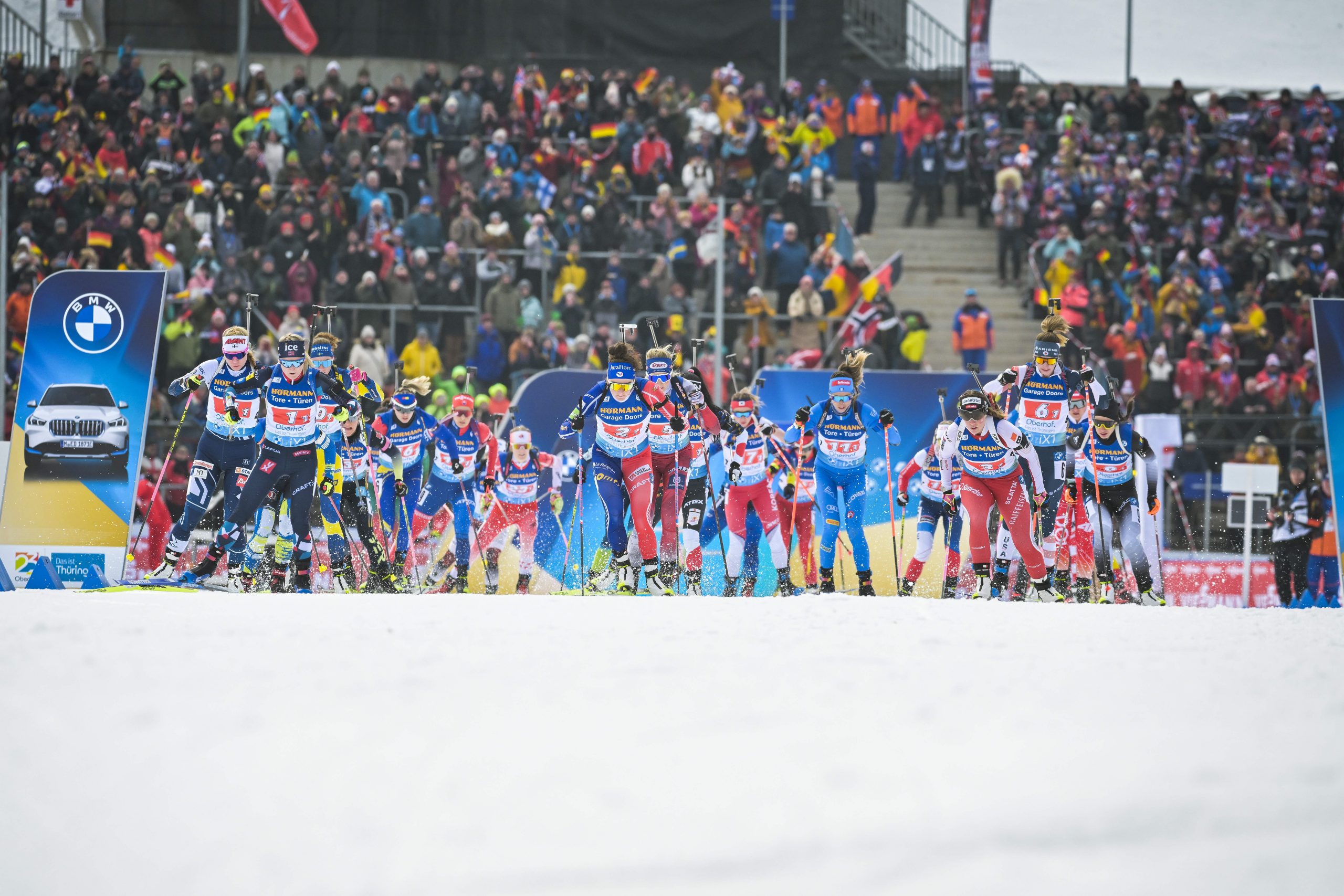
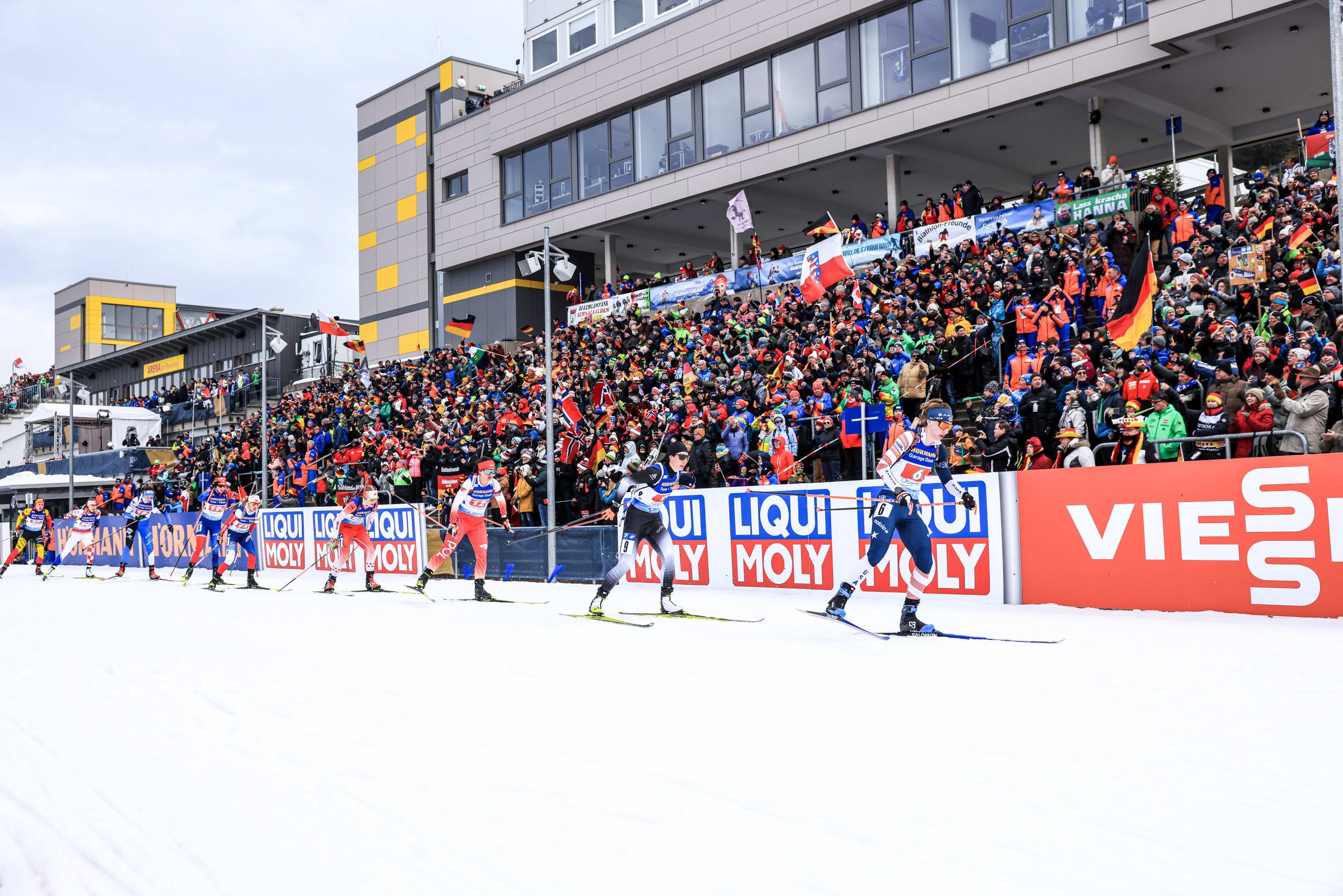
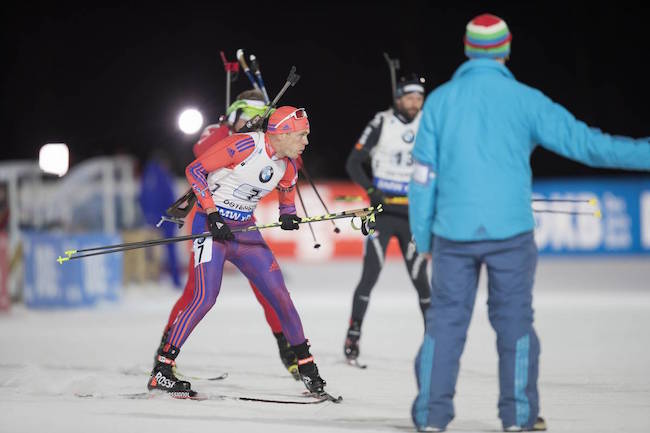
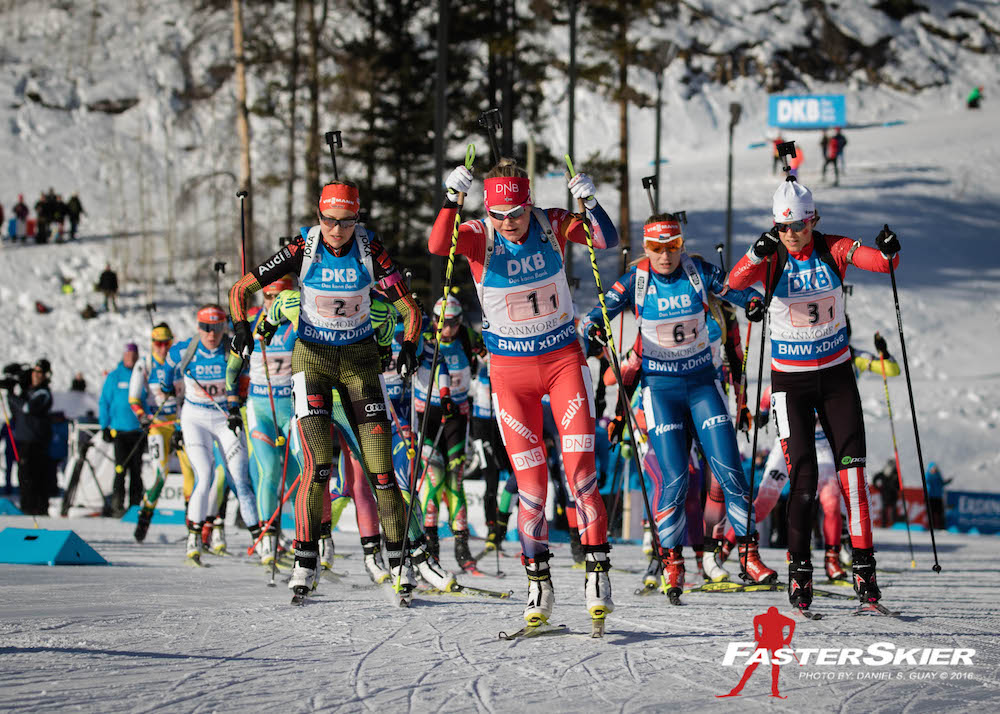
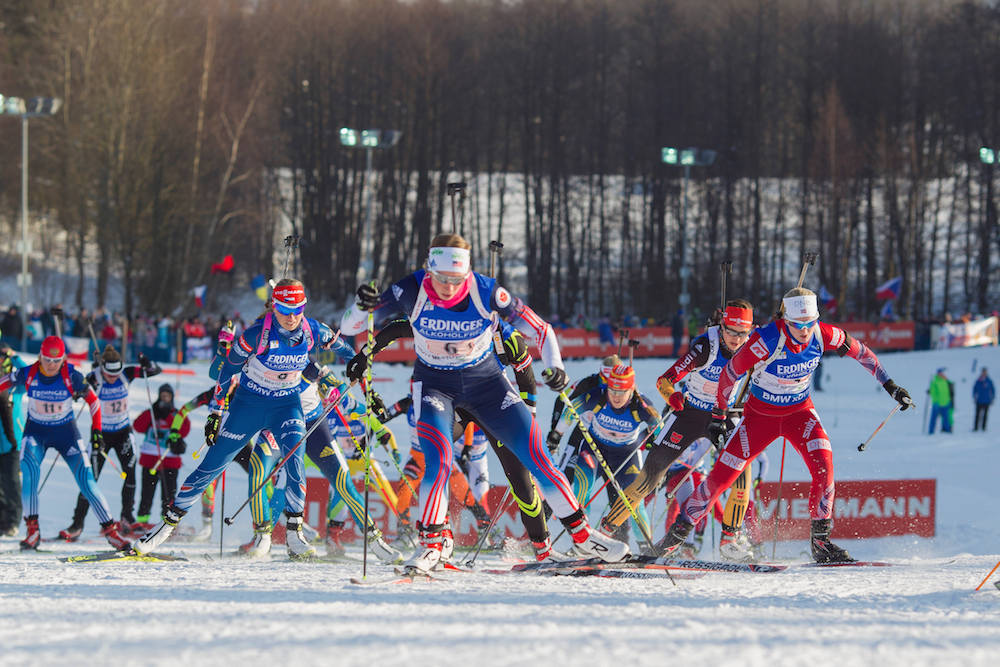
The start of the Single-Mixed Relay at IBU World Championships in Oberhof, Germany. (Photo: NordicFocus).
Twenty seven nations took part in the Single-Mixed Relay today at Biathlon World Championships in Oberhof, Germany, but none could match the star power of Norwegian duo, Marte Olsbu Roeiseland and Johannes Thignes Boe. They teamed up to win Boe’s fifth straight gold medal at the 2023 Championships, and Olsbu’s record-breaking 13th World Championship gold. But it did not come easily.
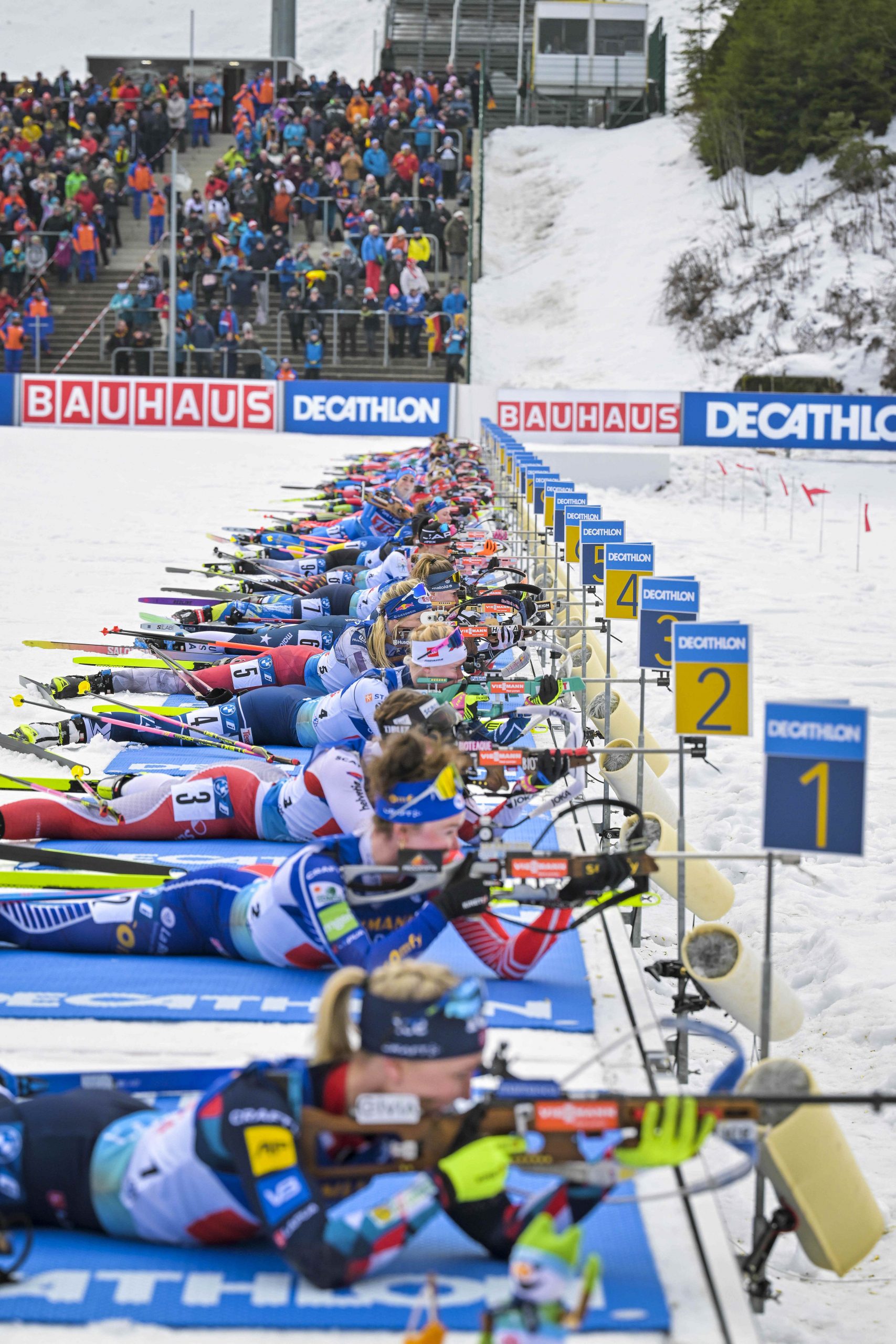
The first shooting stage of the Single-Mixed Relay at the IBU World Championships. On Lane 11, Lisa Vittozzi is already getting up, having shot faster than anyone else. (Photo: NordicFocus)
Though Norway were heavy favorites coming into the race, nothing is certain in biathlon, least of all in the Single-Mixed Relay. The event combines the performances of one woman and one man who each ski two short biathlon races, tagging off in between. Shooting accuracy plays an outsized role in the Single-Mixed Relay because the ski loop is only 1.5 k; there is relatively little distance over which to recover lost time. Shooting speed is also critical. In all biathlon relays, athletes can use up to three spare rounds per stage to hit their five targets; even fast shooters need about seven seconds to load each spare round so it pays to hit all five on the first pass.
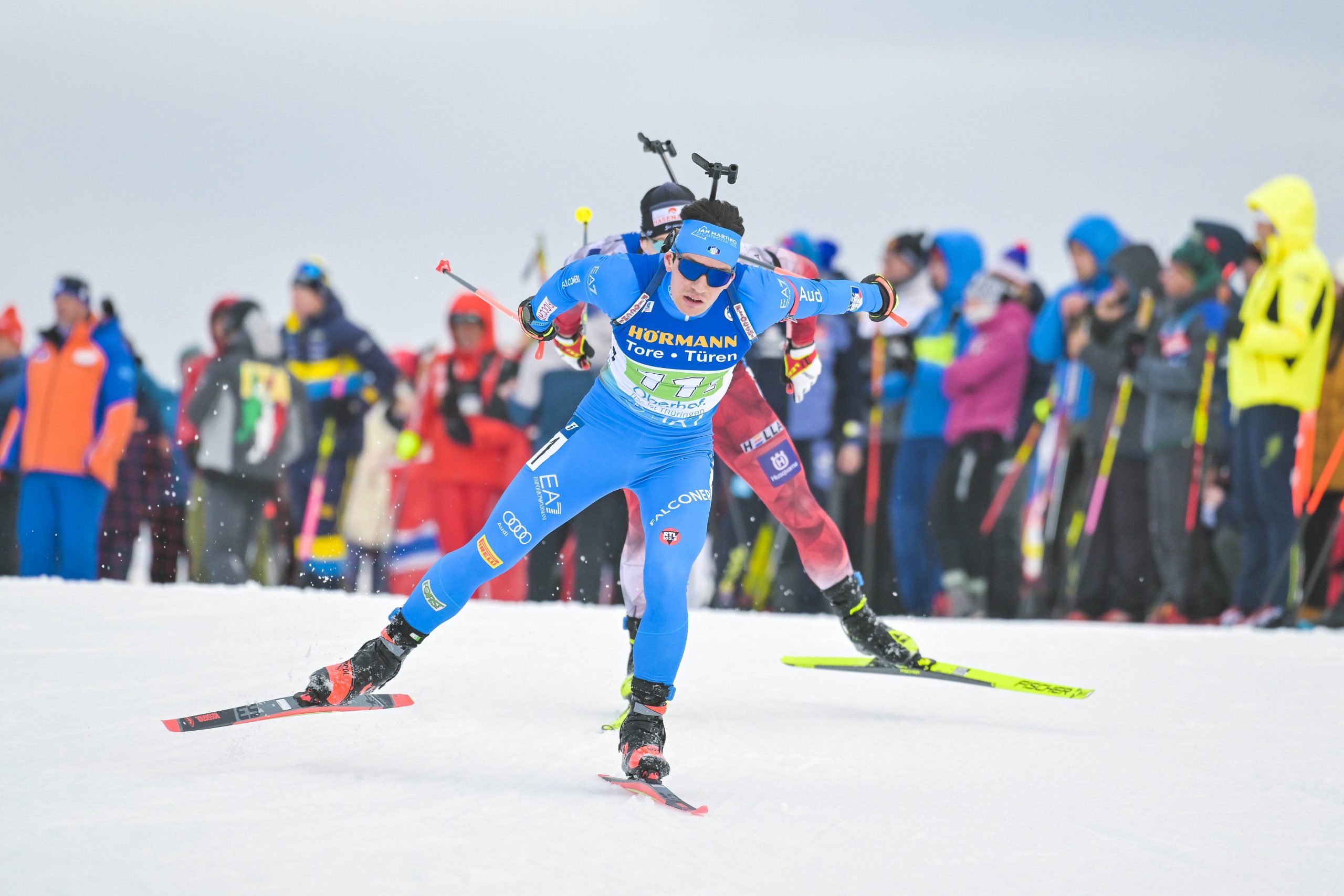
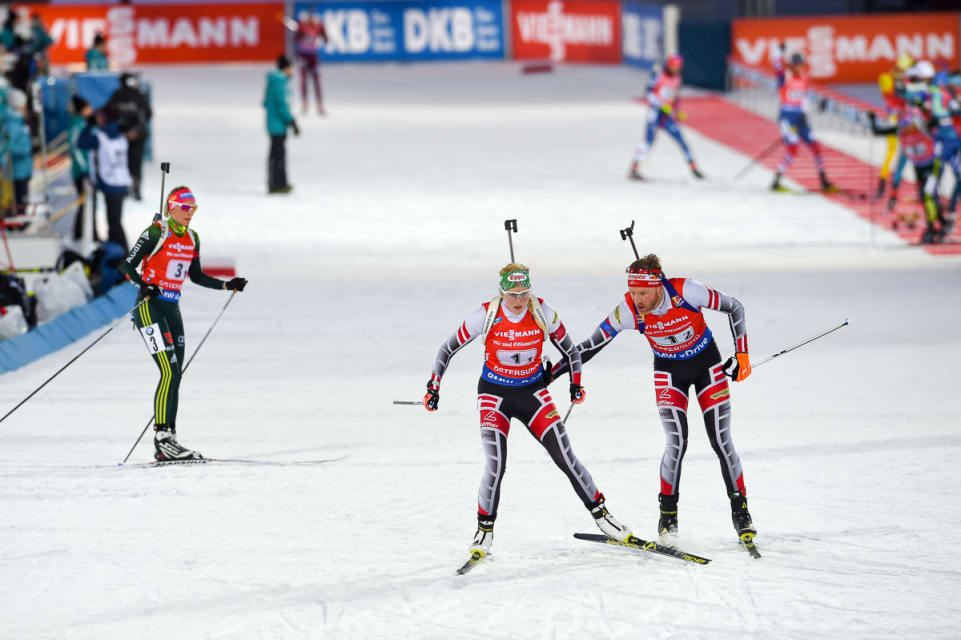
Tommaso Giacomel (ITA) leading David Komatz (AUT) in the IBU World Championships Single-Mixed Relay in Oberhof, Germany. (Photo: NordicFocus)
During the first 33 minutes of the race leading up to the final shooting, Norway was only in the lead for about four. The rest of the time, Italy and Austria set the pace. A decisive moment occurred at Shooting 6, the final stage for the women, when Italy’s Lisa Vittozzi and Austria’s Lisa Hauser both missed and Roeiseland went clean. Roeiseland tagged the unbeatable Boe in first, setting Norway up for a near certain victory. Boe arrived at the second-to-last shooting bout with a ten second lead. But instead of his typical fast and clean shooting, he missed three from the magazine and one of the spares, sending himself into the penalty loop! The race was suddenly open again. Tommasso Giacomel (ITA) and David Komatz (AUT) capitalized on Boe’s mistakes, leaving the range together with an 11 second advantage over the Norwegian.
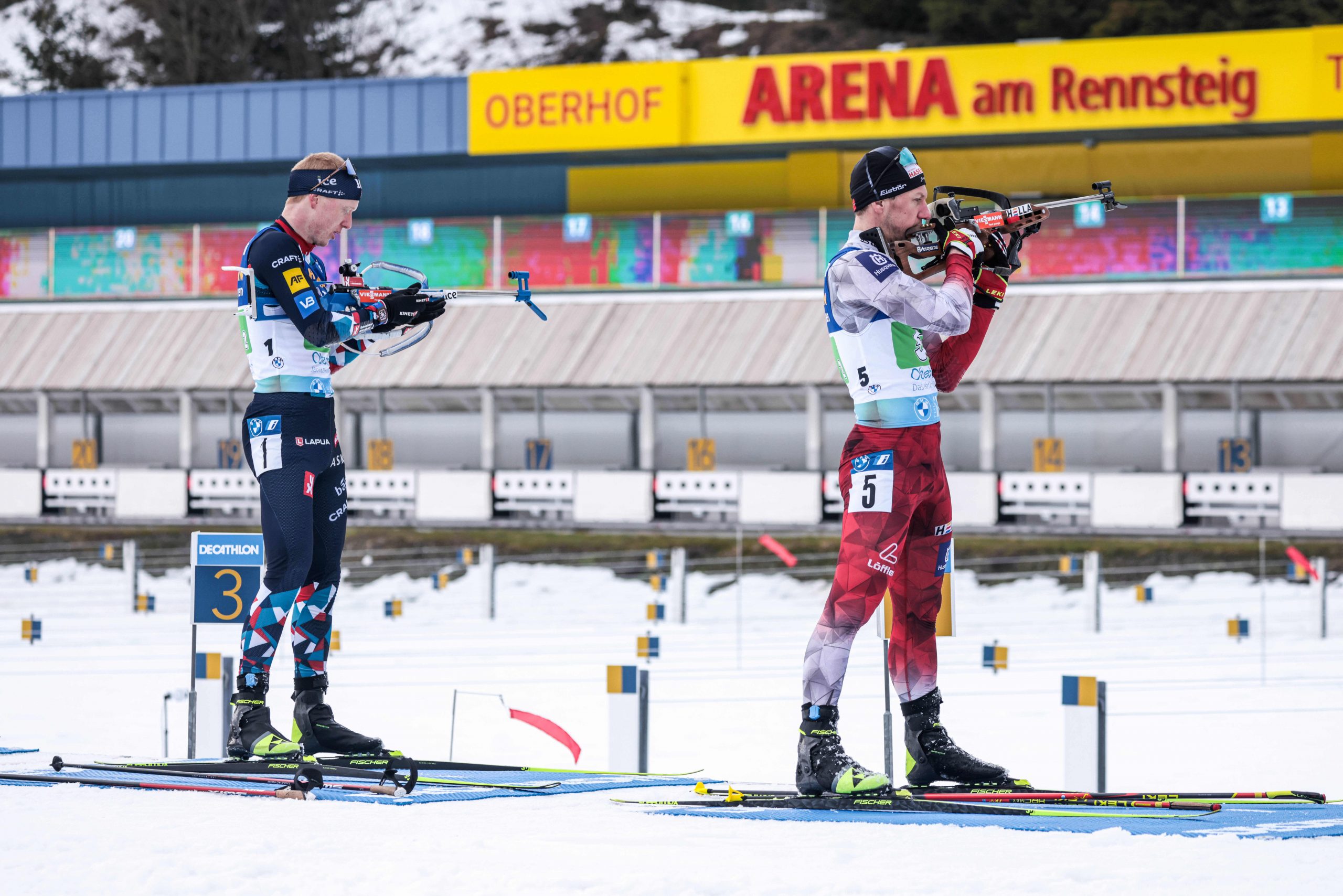
Johannes Thingnes Boe (NOR) and David Komatz (AUT), (l-r) in the final shooting stage of the IBU World Championships Single-Mixed Relay. (Photo: NordicFocus)
Boe shifted into another gear to catch Komatz and Giacomel on course. He let Komatz lead into the range, putting the much less-experienced Austrian on Lane 1 for the final shooting. Komatz handled the pressure brilliantly, using only one spare, but Boe was already gone. He had cleared his five targets in just 17.8 seconds. Giacomal, who maintained his composure so beautifully to secure silver for Italy in the final stage of last week’s Mixed Relay, couldn’t repeat his performance today and ended up with two penalty loops. He got extremely lucky, as nearly all the teams behind him also shot penalty loops, so he didn’t lose a single place.
Paul Schommer (USA) follows Flourent Claude (BEL) in the stadium at the IBU World Championships in Oberhof, Germany. (Photo: NordicFocus)
Eleven of the 21 teams that had not been lapped by that point in the race did at least one penalty loop on the final stage, in part due to pressure distractions, but also due to wind gusts. Unfortunately, the US was one of them. Paul Schommer was shooting on Lane 10 when he missed four from his magazine, but managed to recover well by hitting all three spares to incur just one penalty loop. Schommer and teammate Deedra Irwin finished 11th, just two seconds behind Finland.
Deedra Irwin (USA), leads the chase pack into the stadium during the IBU World Championships Single-mixed relay. (Photo: NordicFocus)
Canadians Emma Lunder and Adam Runnalls were down in 18th at the second exchange but with a solid second half they moved up to 13th.
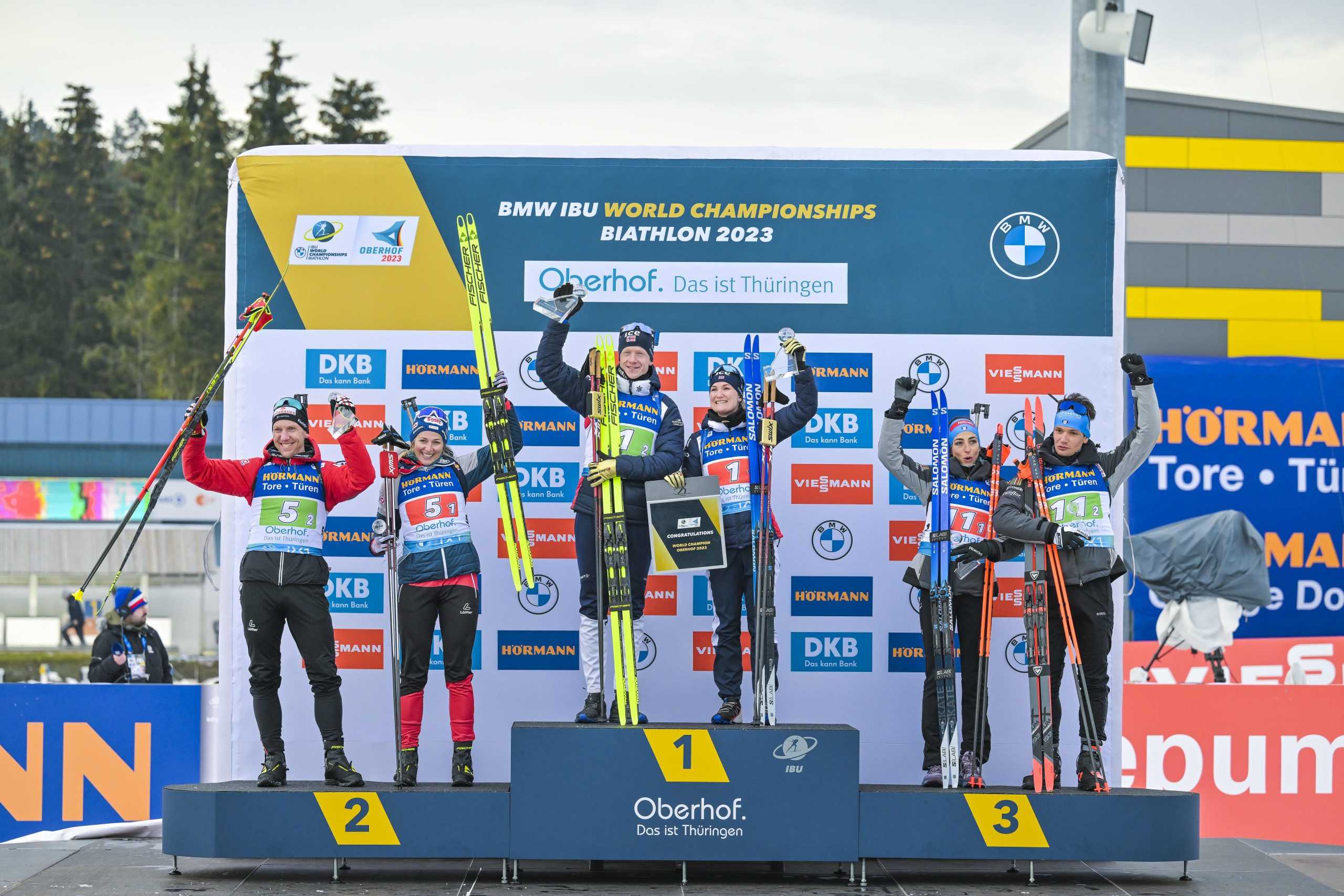
Single-Mixed Relay medalists , (l-r): David Komatz (AUT), Lisa Theresa Hauser (AUT), Johannes Thingnes Boe (NOR), Marte Olsbu Roeiseland (NOR), Lisa Vittozzi (ITA), Tommaso Giacomel (ITA). (Photo: NordicFocus)
Biathlon World Championships Single-Mixed Relay RESULTS
UP NEXT:
Saturday at 5:45AM Eastern Time: Men’s 4 x 7.5k Relay
Saturday at 9:00AM Eastern Time: Women’s 4 x 6k Relay
Sunday at 6:30AM Eastern Time: Men’s 15k Mass Start
Sunday at 9:30AM Eastern Time: Women’s 12.5 Mass Start
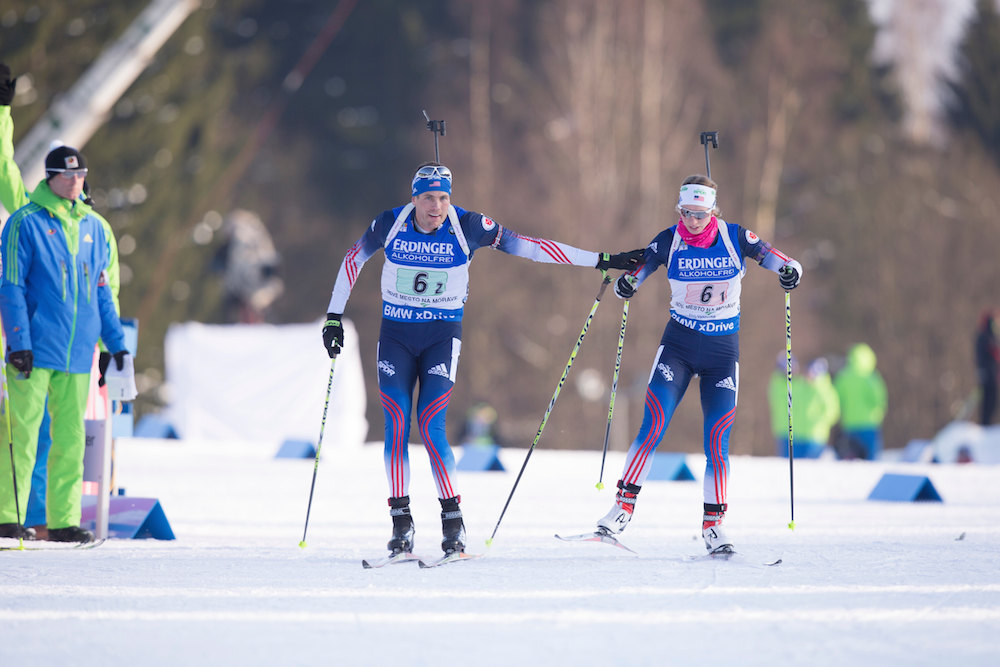
Simon Eder tags off to Lisa Theresa Hauser for Austria during the single mixed relay World Cup in Östersund, Sweden. The pair raced to a 16.5-second win. (Photo: IBU/biathlonworld)
This year, same race, same place, Smith sat out because of a sore throat but Crawford and Christian Gow teamed up for Canada to take on the event again. Partway through the race they were in podium position before a serious crash took them more than out of medal contention; the team was lapped and finished 22nd.
“Pretty bummed,” Crawford said.
Through the first leg, she had used two spare rounds but still tagged off in third place, just 7.1 seconds out of the lead. Then Gow shot perfectly to hang onto fourth, 18.4 seconds out of the lead as the Austrian duo of Lisa Theresa Hauser and Simon Eder had taken control of the race and would never be out of the lead, eventually winning by 16.5 seconds.
Crawford chased hard and passed Italy’s Alexia Runggaldier.
“I thought, I’ll just tuck in behind the Italian, but then I thought, oh, she’s going too slow,” Crawford said. “That’s always an amazing feeling when you think, I feel stronger than you, I can pass you.”
After a tough season for much of the Canadian team last year, that feeling was particularly nice, she added.
Crawford was skiing in third just on the tails of Germany’s Vanessa Hinz when she hit ice on one of the last downhills of the loop and “did a few somersaults.” She stayed on the ground for several seconds and Canada’s hopes for another podium were dashed.
“My head was fine,” Crawford said. “There were quite a few physiotherapists who ran over, so they were asking what’s my name, where am I, what date it was. I got all of that right. But when I went to go and push myself up, my shoulder was really sore.”
After at least a minute or two, Crawford headed back out onto the trail, but in a very different part of the race than she had been before. Then there was the issue of her rifle, which she said didn’t have any serious damage but at the time wasn’t working well.
“Just snow everywhere,” Crawford said. “I think the sights might be twisted a little bit, or something happened because then when I did take a shot I was, like, 10 cm above the standing target. Something was off.”
Even with spare rounds which are allowed in relay races, Crawford was left doing two penalty loops and in the meantime, the leaders lapped through. Canada’s day was over.
While Crawford doesn’t have any serious injuries, her shoulder was banged up.
“It is just bruised,” she explained. “The skin tore a little bit where the rifle must have hit it… I probably should have just stopped. Our physio here [later] said, yeah, you have quite a bit of adrenaline going through, so if something feels like it still hurts, then it means that it’s probably pretty bad.
“But it’s so hard, especially in relays,” Crawford said. “Christian is such an amazing shooter, he’s so fast and so accurate and he had done so well. I really didn’t want to let him down. And then I was also thinking about Nations Cup points. If I didn’t finish then we would get no points, whereas even if we were lapped at least we would get some points. So all of that was going through my head.”
Canada finished 22nd, and did get a few Nations Cup points.
Another lesson: stick with the plan.
“My race plan was to not take that inside corner,” Crawford said of the spot where she crashed. “I changed it halfway through the race bcause other people were taking it… On my second time down the hill, so after my first prone shooting, I was behind Hauser, and she took the inside line and I lost a little bit of a gap on her. So I thought, okay, next time I will take the inside line. So the third time going down the hill I was behind Hinz. She took the inside line and I was right behind her.
“In hindsight I probably should have just stuck with my race plan and taken it a little bit wide, because I have been here many, many years,” she concluded.
Austria Shines as France Falters
Meanwhile, the Austrian duo was extending their lead. France had come in as heavy favorites, with Martin Fourcade and Marie Dorin Habert having won the same race last season, Fourcade having won the overall World Cup, and Dorin Habert finishing fourth in the women’s World Cup Total Score last season.
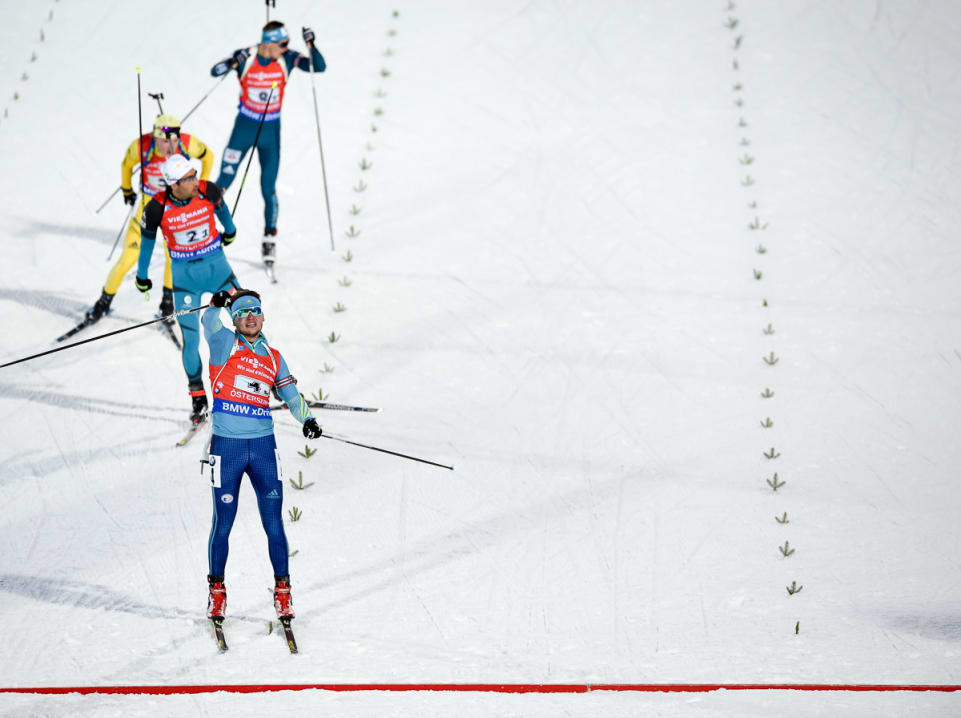
Kazakhstan’s Maxim Braun celebrates third place ahead of Martin Fourcade of France, Sebastian Samuelsson of Sweden, and Dmytro Pidruchniy of Ukraine. (Photo: IBU/biathlonworld)
But the duo put together a sloppy shooting race, using 10 spare rounds over 40 targets. The Austrians, on the other hand, were nearly perfect, using just two spare rounds and cleaning their targets quickly.
By the time Eder came in for the final shooting bout, he could have used at least two spare rounds and still left with the lead. Instead, he cleaned.
“First race, first victory – this is a dream,” Eder said in an Austrian Ski Federation press release. “It already paid off to toil for another year. I knew this would be one of the toughest single mixed competitions, because you always carry the exhaustion from the last climb to the shooting range. But I could pace myself well. I think tactically it was a strong performance, and that’s the most important thing in the single mixed. It’s not about always going full throttle, otherwise the shooting series won’t work out anymore. It was just perfect on the range today.”
“It’s just incredible to immediately be on the top of the podium in the first race,” she said in the same press release. “The first race is always something special, because you are extremely stressed.”
Behind them, an interesting race was unfolding. The German team used nine spare rounds and had only a single perfect shooting stage, and Hinz said that her legs were “not yet quite where I’d like them to be.” But teammate Erik Lesser was aggressive on the trails, having the third-fastest time on each of his relay legs, and he skied across the finish line in second place, well clear of the rest of the field.
And that’s where things got really crazy. A number of teams had left the range the final time quite close together: Kazakhstan with Maxim Braun, then Lesser (who immediately passed him), then Italy and Ukraine. Italy’s Thomas Bormolini charged hard and skied his way into third position.
But on one of the final downhills Bormolini fell, taking out Dmytro Pidruchnyi of Ukraine as well. That allowed Braun, who had been left behind, to sail past them. It also allowed Fourcade and Sebastian Samuelsson of Sweden, who had started the final loop many seconds back, to catch further up.
In the end it was Braun taking third place for Kazakhstan, France fourth, and Sweden fifth.
“I opened my eyes and I saw the athletes from Sweden and Ukraine just lying in the trail,” Braun said through a translator in the post-race press conference. “I would like to have watched the race myself to realize what was going on. I realized it was my chance and I grabbed it… this summer we worked really really hard, and this is a fantastic beginning of the season for us.”
While he acknowledged that he had “a little bit of luck,” it was also good biathlon: with just five spare rounds, Kazakhstan had the second-best shooting of the day.
Americans 19th After Fast Start
The single mixed relay was the first World Cup start of Emily Dreissigacker’s career. The Americans started in bib six and Dreissigacker soon found herself among the race leaders.
Emily Dreissigacker of the United States competing in the single mixed relay in Ostersund, Sweden. (Photo: USBA/NordicFocus)
“My plan was to get in behind someone and try to pace myself and relax on the first lap, especially up the first hill,” Dreissigacker wrote in an email. “But it turns out I just have this instinct in a mass start to get to the front. At the time it felt easy and it was super fun to lead even if it was just for a hot sec. But of course once the adrenaline wore off I definitely paid for it.”
Dreissigacker got through the first shooting stage with perfect shooting, and headed out again. But the effort early on was indeed catching up with her.
“I think it’s important in a single mixed relay to pace yourself on the first leg, which is something I did not execute well today,” she wrote. “My legs flooded really badly and didn’t start to clear at all until my very last loop.”
She had to use all three spare rounds in standing, and tagged off to Leif Nordgren in 20th. Nordgren, though, used only one spare round total over his next prone and standing stages, and was able to bring the Americans into 12th.
Dreissigacker then took a penalty loop in both of her second-leg shooting stages, and then Americans ended up in 19th place after being lapped.
“Prone felt good but my group moved right and down,” Dreissigacker explained. “I’m not sure why, it could have been the wind, it could have been something slightly off in my position but I was happy to at least hit all of my spares… Overall I’m happy with [the race]. I have a lot to learn still and a lot I can improve upon, but you have to start somewhere.”
That’s a sentiment for Nordgren, too, who is hoping for better things later in the year.
“It’s a long season with the highlights being the Olympics so I didn’t really expect much from today,” Nordgren wrote. “That being said it’s always nice to get a chance to race, it’s a different type of stimulus for the the body then just a hard intervals session. Emily had a rough day on the skis. It’s a pretty brutal single mixed course here, so if you aren’t ready to go hard right from the start you’ll pay for it later. The snow was a little deep today as a result of the grooming so that makes it a little bit tougher on the legs too. It’s not the end of the world not getting to race the second leg – it was nice to get back in race mode even if just for a little bit.”
For Nordgren, just to be racing and feel good was an achievement compared to last year, when it was on this very day that he realized a toe injury sustained just before the start of the race season was actually a big problem. Nordgren ended up taking several weeks off of racing completely to heal.
“Last year it was a dark time for me!” he wrote. “It’s really nice to have not had any trouble like that heading into the season. Overall the preparation has been pretty good this year, so I’m excited to get into the individual races starting next week.”
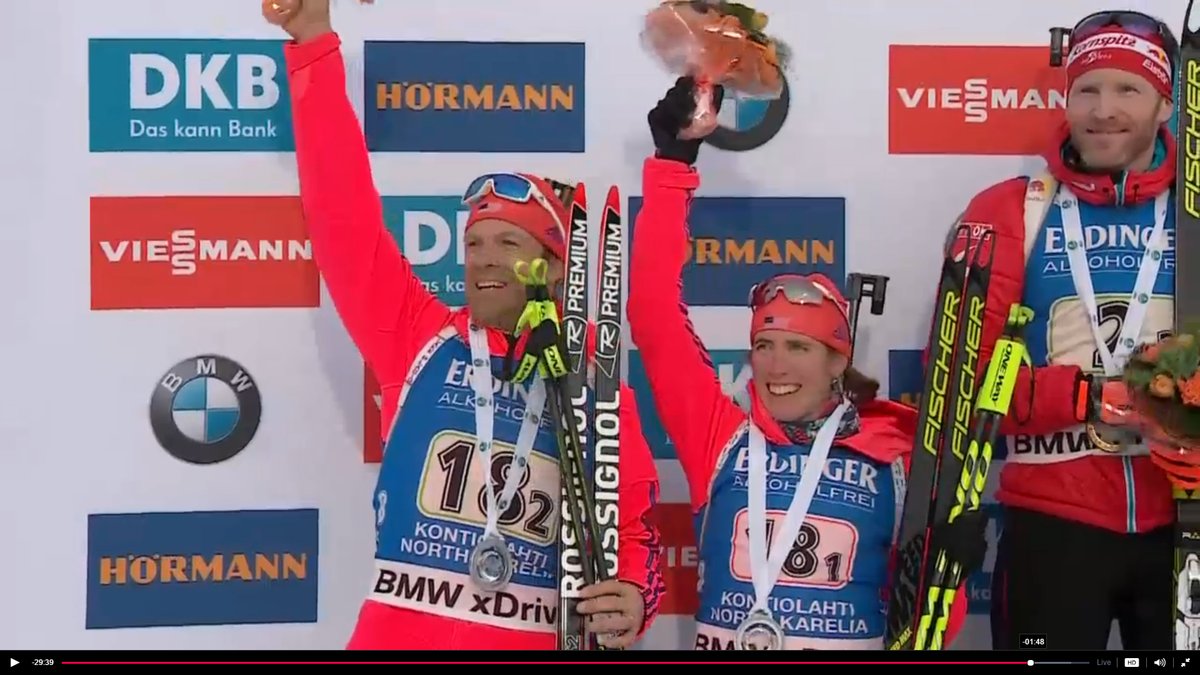
Lowell Bailey and Susan Dunklee celebrate finishing second in the single mixed relay in Kontiolahti, Finland. (Screencap: US Biathlon/Twitter)
IBU Biathlon World Cup (Kontiolahti, Finland): Single Mixed Relay
In the last single mixed relay of the season, Susan Dunklee held the lead after two loops of skiing. She was looking for a top tag-off to American Lowell Bailey, but she crashed on a downhill. Nevertheless, she was able to focus on the shooting range and climb back into podium position.
The leaders were gone, however: Simon Eder and Lisa Therese Hauser of Austria ran away with the competition, using five spare rounds to race to a 32.8-second victory.
Bailey left the last shooting in third position, and caught Germany’s Roman Rees on the trails. The pair also managed to hold off Jean Guillaume Beatrix of France, who left the range just behind them. It came down to a sprint finish, with Bailey besting Rees (and his relay partner, World Cup Total Score winner Laura Dahlmeier). The U.S. had five spare rounds to Germany’s six.
It was the first relay podium of any kind for the United States since 1994, when the women finished second in a relay in Canmore, Alberta.
The Canadian team of Julia Ransom and Christian Gow finished 19th (+2:27.0) with eight spare rounds.
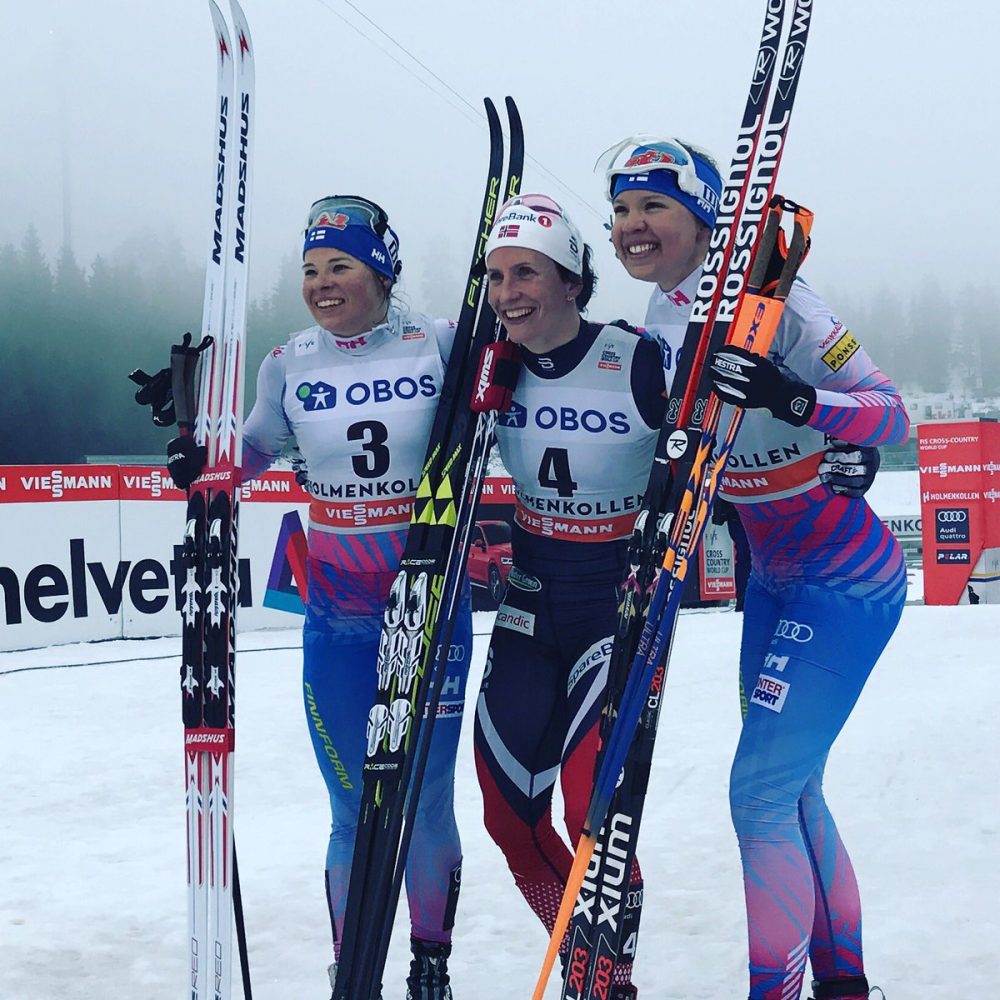
Left to right: Finland’s Krista Pärmäkowski, Norway’s Marit Bjørgen and Finland’s Kertu Niskanenen after the women’s 30kiloimeter World Cup classic mass start on Saturday in Oslo, Norway. (Photo: FIS Cross-Country/Twitter)
FIS Cross-Country World Cup (Oslo, Norway): Holmenkollen 30 k classic mass start:
Norwegian Marit Bjørgen won the women’s 30-kilometer classic mass start at Homenkollen on Sunday, in a time of 1:22:59.2. She bested two Finns, Krista Pärmäkoski and Kerttu Niskanen. Pärmäkoski finished in second (+2:05.8) and Niskanen in third (+2:07.0).
Norway’s Heidi Weng finished fourth (+2:08.6), outlasting Sweden’s Charlotte Kalla (fifth, +2:11.7). Poland’s Justyna Kowalczyk finished sixth (+2:12.9), Finland’s Aino-Kaisa Saarinen seventh (+2:19.6), Norway’s Ingvild Flugstad Øtsberg in eighth (+2:31.3), Sweden’s Anna Haag in ninth (+3:27.9) and Finland’s Laura Mononen in tenth (+3:28.7).
The first North American to finish on Sunday was Kikkan Randall, who placed 20th (+6:17.2). The next North American across the line was the U.S. Ski Team’s Sadie Bjornsen in 24th (+6:48.8). Liz Stephen finished in 31st (+8:46.8), and Chelsea Holmes (Alaska Pacific University) in 39th (+11:19.1).
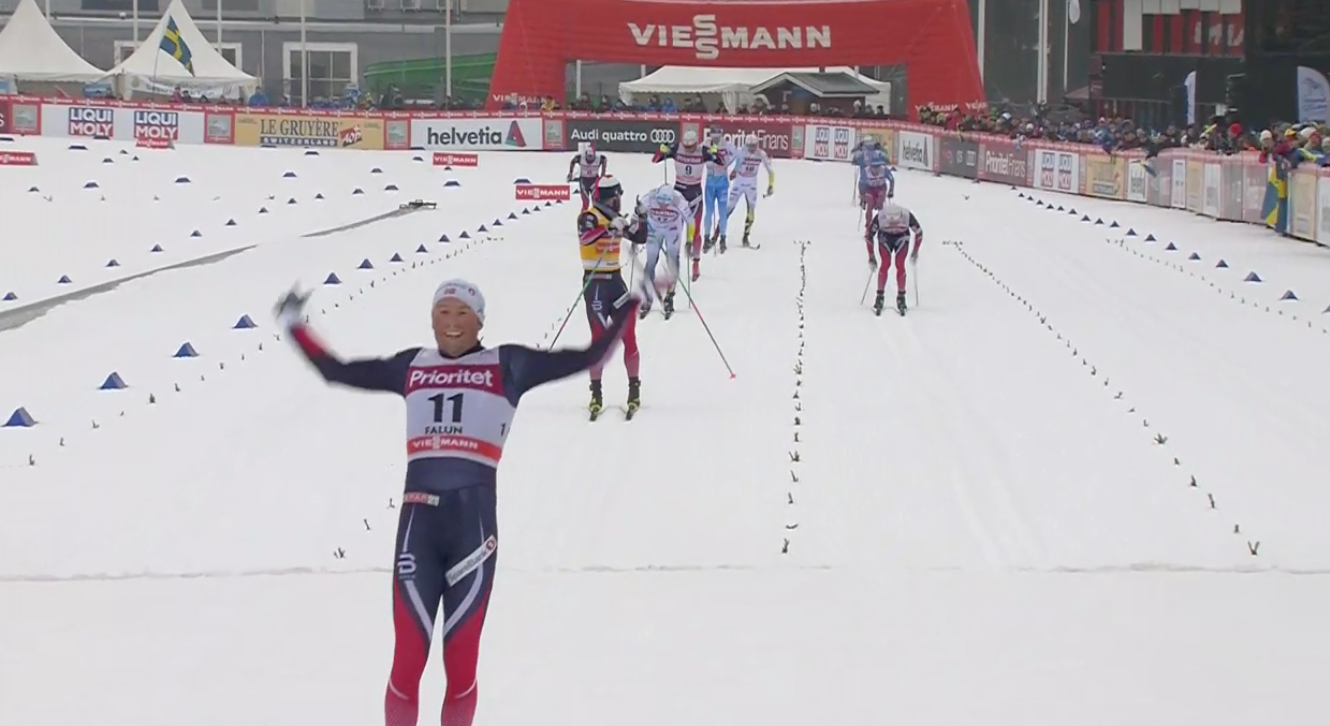
Emil Iversen celebrates his win in the 30 k classic mass start in Falun, Sweden, on Sunday. Norwegian teammate Martin Johnsrud Sundby finished second and Sweden’s Calle Halfvarsson third.
FIS Cross-Country World Cup (Falun, Sweden): 15 / 30 k classic mass start
In the women’s 15-kilometer classic mass start on Sunday, Norway swept the podium with Marit Bjørgen taking the win in a time of 41:28.8 in Falun, Sweden. Crossing just half a second behind her was her teammate, Ingvild Flugstad Østberg in second place. Rounding out the podium was Heidi Weng in third (+8.1).
American Jessie Diggins was the first to cross the line for the U.S. in 10th (+1:37.5). Three other U.S. women finished in the top 30, with Sadie Bjornsen finishing 21st (+2:43.6), Rosie Brennan 24th (+2:57.0), and Liz Stephen in 29th (+3:24.5).
Just outside of scoring World Cup points was American Caitlin Patterson in 32nd (+3:47.6) and Ida Sargent in 34th (+4:02.8). Canada’s Cendrine Browne finished 46th (+5:41.4) and American Liz Guiney 49th (+6:22.6).
After losing the skate sprint yesterday in a photo finish to Italy’s Federico Pellegrino, Emil Iversen ascended to the top step of the podium in the men’s 30 k classic mass start on Sunday in Falun.
The Norwegian was often near the front, but hadn’t tried to lead a breakaway like his teammates Martin Johnsrud Sundby and Sjur Røthe did earlier in the race. In the final two kilometers, Sundby – the overall World Cup leader – put in a sprint to try to drop the field. But Iversen caught up, drafting his veteran teammate into the stadium. In the final up-and-over before the finish line, Iversen made a pass and then accelerated down the finishing stretch to beat Sundby by 1.14 seconds.
“I got motivation from yesterday’s last 20 meters,” Iversen told FIS in a finish-line interview. “So today I fought all the way, and I was really stronger. It is amazing for me to be second yesterday and first today. I’m really proud of that.”
Calle Halfvarsson, who had been falling off the back of the lead pack just a few kilometers earlier, managed to get back to the front and claim third place for Sweden (+1.72 seconds) in a photo finish with Røthe (+1.76 seconds). Niklas Dyrhaug was next (+2.52 seconds) to give the Norwegian men’s team four in the top five.
In his return to the World Cup stage, Norway’s Petter Northug finished 31st (+3:10.6).
Alex Harvey was the lone Canadian on the start line. After skiing near the front of the field for the early part of the race he was dropped by the lead pack in the final kilometers, finishing 15th (+1:17.5).
Erik Bjornsen and Noah Hoffman took 35th and 37th places for the United States, finishing +3:30.8 and +3:59.8, respectively. SuperTour leader Matthew Gelso — familiar with the Falun course after competing in 2015 World Championships — finished 44th (+5:23.6), and Andy Newell placed 53rd (+7:45.3).
IBU Open European Championships (Duszniki-Zdrój, Poland): Single mixed & mixed relay
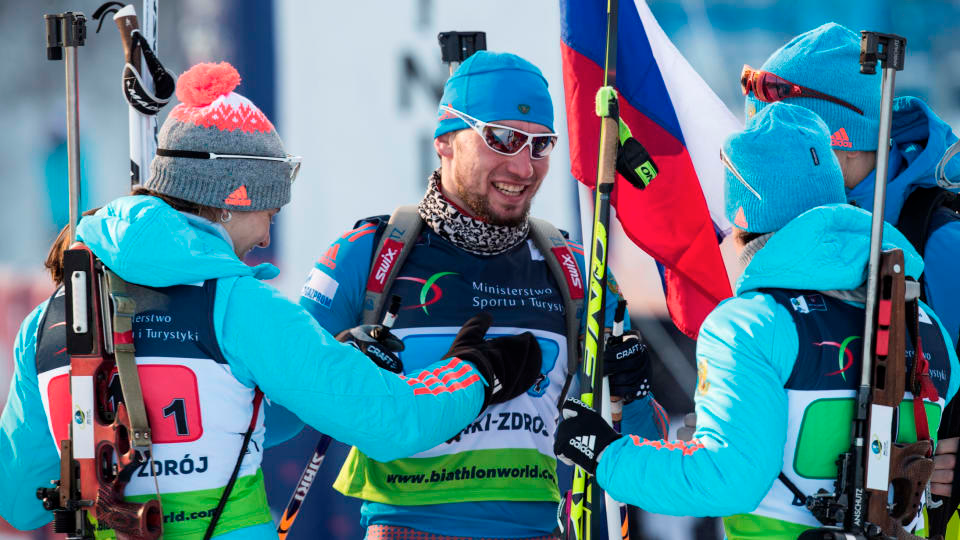
Russia’s Alexander Loginov (center) is greeted at the finish by his teammates Irina Starykh, Svetlana Sleptsova and Alexey Volkov after anchoring his team to the gold medal in the mixed relay at the 2017 IBU Open European Championships in Duszniki-Zdrój, Poland. (Photo: IBU)
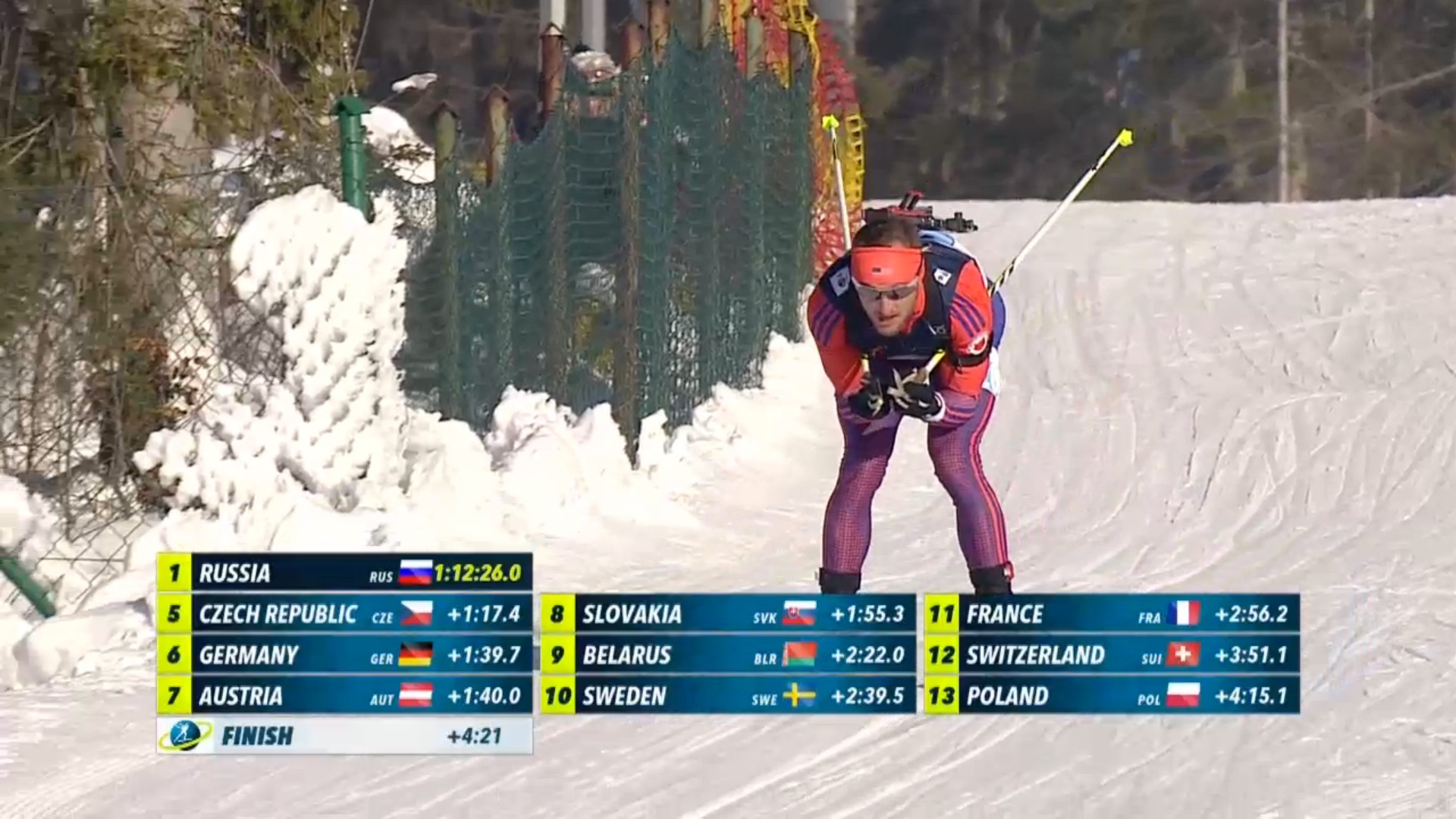
[UPDATED] The Russian victory in the final 2 x 6 + 2 x 7.5-kilometer mixed relay event of the 2017 International Biathlon Union (IBU) Open European Championships in Duszniki-Zdrój, Poland, was only briefly in doubt, when Alexander Loginov skiing the anchor leg required all spares in his prone shooting stage. But with his final shot he managed to also hit that target to avoid the penalty lap, leaving the range with a lead of more than 30 seconds.
Loginov then did not need any spares in the last standing stage, and could take his time on the final loop. Unlike Russia’s Evgeniy Garanichev earlier in the day during the single mixed relay, he also managed to pick up a flag for the final meters of the race, crossing the line in a time of 1:12:26.0 hours.
The Russian team with Irina Starykh, Svetlana Sleptsova, Alexey Volkov and Loginov led from the first exchange and required only six spares with zero penalties.
With this medal, the 28-year-old Volkov became the most successful athlete in history at European Championships, according to an IBU press release, surpassing the retired Polish biathlete Tomasz Sikora. Russia was the most successful team of the 2017 Open European Championships with six gold, four silver, and three bronze medals.
Behind them, a number of teams vied for the positions on the podium. Sweden initially looked like a strong contender exchanging in second place after the women, but fell back with three penalty laps to only finish 10th.
Still six seconds back after the final shooting, Norway’s Fredrik Gjesbakk caught up to and outsprinted Ukraine’s Ruslan Tkalenko in the finishing stretch to claim the silver medal (+36.4) with the bronze left for Ukraine (+37.1).
“I thought that I made sufficient gap to win silver,” Tkalenko told the IBU. “But in the end, on the final downhill before the finish, I was very surprised when the Norwegian guy passed me, I truly did not expect that.”
The Norwegian team with Karoline Erdal, Marion Rønning Huber, Erlend Bjøntegaard, and Gjesbakk needed nine spares and had no penalties.
Ukraine with Anastasiya Merkushina, Yulia Dhzyma, Oleksander Zhyrnyi (who originally started for Russia before making the switch in 2014) and Tkalenko required six spares, and Dhzyma had to ski a penalty lap only temporarily setting the team back.
Bulgaria finished fourth (+1:16.4), with its anchor Vladimir Iliev narrowly beating Czech Republic’s Lukas Kristejn (+1:17.4) in the finishing stretch. Both teams needed 11 spares and had no penalties.
Jakob Ellingson skiing the anchor leg for the U.S. mixed relay at the 2017 IBU Open European Championships in Duszniki-Zdrój, Poland. The U.S. team finished 14th. (Photo: IBU/Eurovisionsports.tv screenshot)
Starting at the back of the field in bib 20, US Biathlon’s Emily Dreissigacker got her team off to a strong start with a clean prone shooting and one spare round in standing, exchanging in 10th, a minute behind the leaders. Hallie Grossman needed one spare in each of her stages, tagging off to the men in 14th position and now 2:39 behind. Max Durtschi also had one miss each in prone and standing, coming into the last exchange still in 14th position, but another minute back. Jakob Ellingson required all three of his spares in his prone shooting stage narrowly avoiding the penalty lap, and one more in his final shooting stage. As the team from Finland was racing over a minute behind the Americans, he was able to keep the 14th position into the finish (+4:47.4), with a team total of nine spares and no penalties overall.
For Biathlon Canada, Erin Yungblut starting in bib 19 shot clean in her prone stage and required two spares in her standing shooting, tagging off in 18th position and more than two minutes back from first. Leilani Tam von Burg stayed clean in her prone shooting stage and needed one spare in standing, moving up two positions to exchange in 16th place, yet more than four minutes behind the leaders. After the exchange to the men, both Matthew Neumann and anchor Carsen Campbell managed to shoot clean in all of their stages, but lost additional time on the course to finish 16th (+6:39.9) ahead of four lapped teams.
Canada had the best shooting result of all 20 teams starting the relay, with just three spares and no penalty.
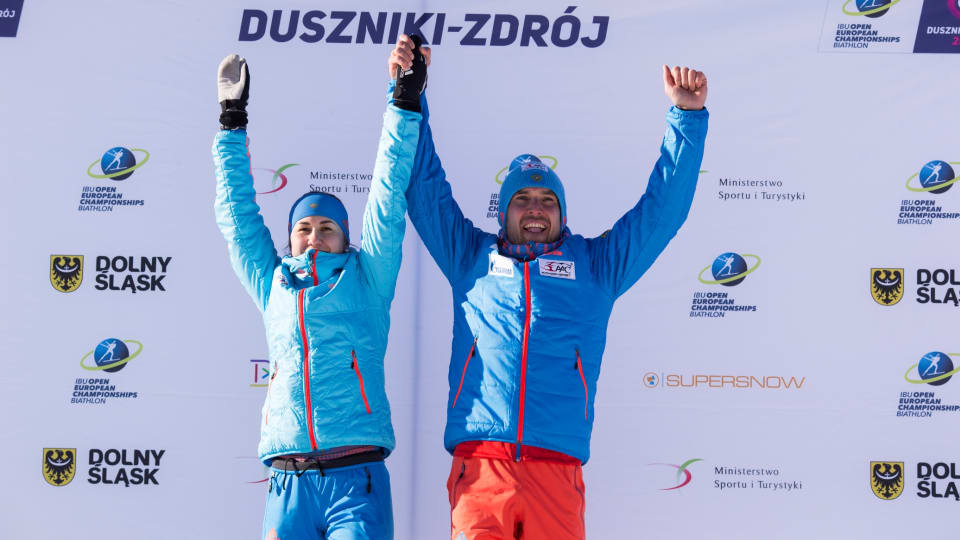
Russia’s Daria Virolaynen (l) and Evgeniy Garanichev after winning Sunday’s single mixed relay at the 2017 Open European Championships in Duszniki-Zdrój, Poland. (Photo: IBU)
Earlier on Sunday, pretty much the only thing that went wrong for Russia’s Daria Virolaynen and Evgeniy Garanichev in the single mixed relay happened on the last meters of the finishing stretch, with Garanichev gesturing for a Russian flag he wanted to cross the line with. But the handoff was too short and the flag dropped past his outstretched hand to the snow. He glanced back, weighing if his lead was big enough to ski back, but decided it was not worth the risk, instead skiing into the arms of his partner waiting for him behind the line in a time of 37:10.2 minutes.
Russia needed seven spare rounds and incurred zero penalties. Garanichev secured the victory in the final shooting, when he only needed one spare – albeit fumbling a few seconds to insert it – while his direct opponents standing next to him required more time to hit their targets.
“Probably, I took some risk at the last standing,” Garanichev said, according to an IBU press release. “I wanted to shoot fast and clean, but missed with the last shot. But in general, I felt very comfortable; came and worked at the range in my rhythm.”
6.3 seconds behind, Norway with the team of Ingrid Landmark Tandrevold and Vetle Sjåstad Christiansen placed second, with seven spares and zero penalties.
“These are very short loops,” Christiansen commented on the fairly new, single mixed relay format. “You feel the pressure from the crowd and to shoot fast every time.”
The 20-year-old Tandrevold previously earned three bronze medals, including one in the single mixed relay, also with Christiansen, at last year’s Open European Championships in Tyumen, Russia.
To big cheers from their home crowd fans who had come out to the Duszniki Arena in beautiful but cold weather, the Polish husband-and-wife team of Krystyna Guzik and Grzegorz Guzik placed third with just five spares and zero penalties (+13.9), not quite able to keep up with Christiansen on the final loop after leaving the range together within a second.
“It is so nice to win a medal here in Poland,” Krystyna Guzik said. “We were both very disappointed with all of our mistakes in the other competitions. So today, we were relaxed and laughing before the competition, hoping not to have those mistakes again. We did not … and now have a medal.”
It was the first medal for Poland at these championships.
Ukraine with Iryna Varvynets and Andriy Dotsenko finished fourth, also with five spares and zero penalties (+20.9).
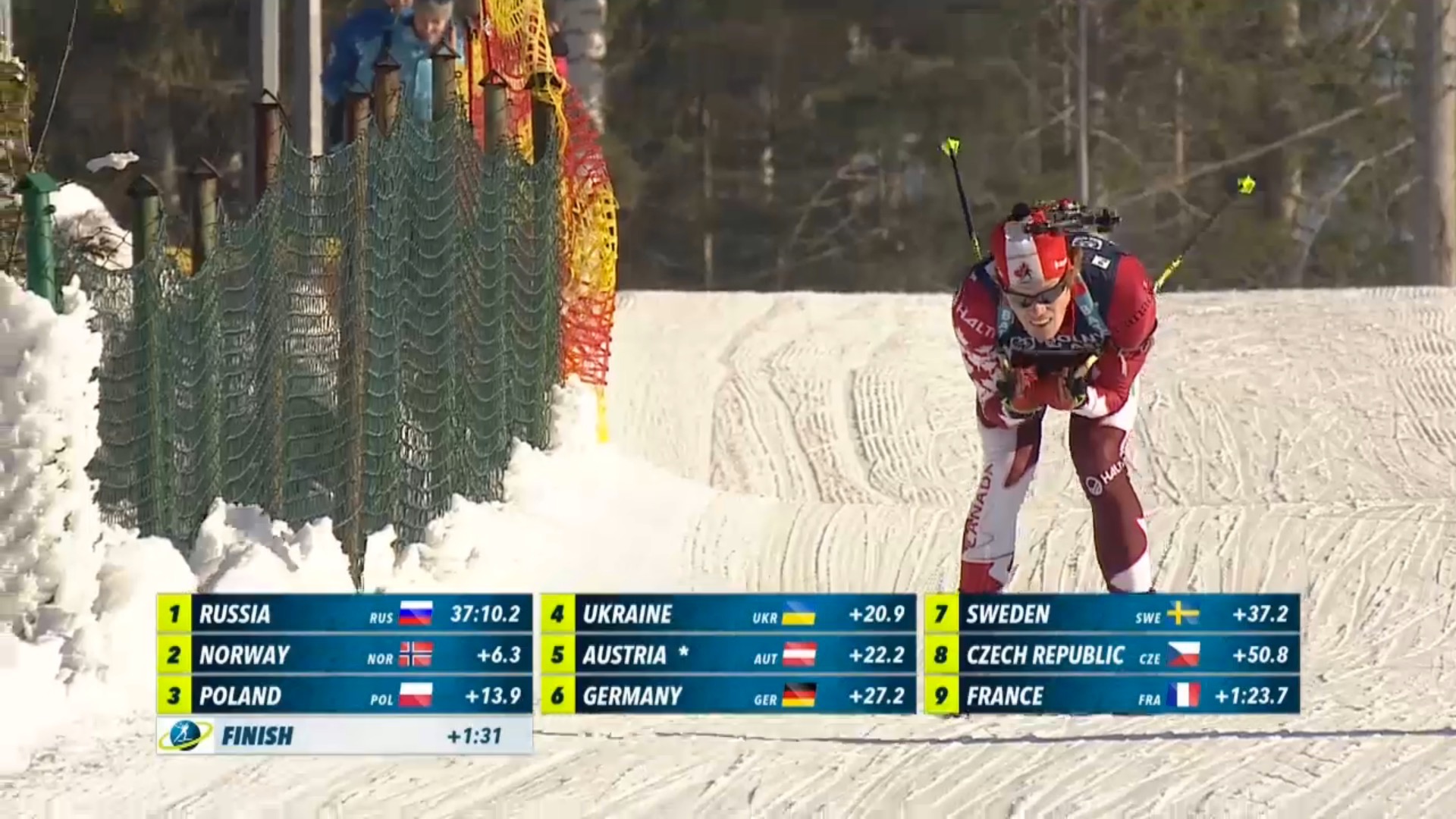
Biathlon Canada’s Aidan Millar skiing the final loop of the single mixed relay at the 2017 IBU Open European Championships in Duszniki-Zdrój, Poland. With teammate Sarah Beaudry, Canada finished 13th (Photo: IBU/Eurovisionsports.tv screenshot)
For Biathlon Canada, Sarah Beaudry and Aidan Millar required seven spares during their race and had no penalty, just like the winning Russians and Norwegians, but could not quite keep up with the best teams on the course in the fast-paced race format with short loops somewhat comparable to a team sprint in cross-country.
Beaudry cleaned her first shooting stage and then needed one spare to hit all targets in standing. At the first exchange Canada was 10th, 35.8 seconds behind the then leading team from Poland.
Millar missed one shot in his first prone stage, leaving the range again in ninth position. Then he needed two spares in his standing shooting on the way to exchanging back to Beaudry in 11th (+56.4).
On her second leg, Beaudry had one miss in prone and required two spares in standing, falling back a bit to exchange in 13th (+2:12.0).
On his final leg, Millar was able to shoot clean in both stages, reducing the time gap to the top but not able to make up another position, and finished in 13th place (+1:56.1).
US Biathlon is only represented with two women at the Open European Championships in Poland, and decided to forgo a start in the single mixed relay, instead entering a team in the mixed relay later on Sunday.
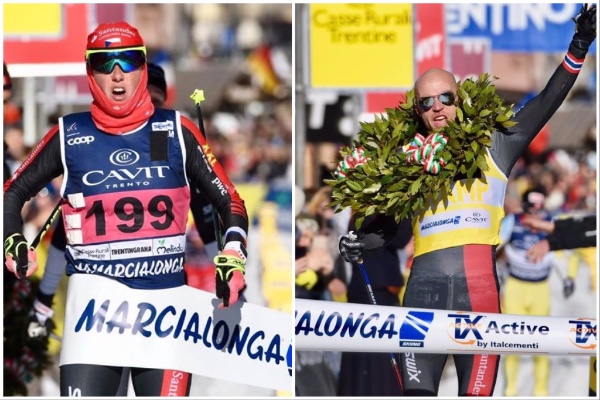
Katerina Smutna (left) and Tord Asle Gjerdalen (right) of Team Santander won the 2017 Marcialonga. (Photo: Visma Ski Classics)
Tord Asle Gjerdalen won the Marcialonga, a Worldloppet and Swix Ski Classics marathon for the third time – in a row. This year was on a shortened course, “just” 57 rather than the traditional 70 kilometers.
The Team Santander athlete finished in two hours, eight minutes, and 36 seconds, edging Johan Kjølstad (Team United Bakeries) and Morten Eide Pedersen (Team BN Bank) in a sprint finish by 2.6 and 2.9 seconds, respectively.
Tyler Kornfield and David Norris of Alaska Pacific University finished 43rd (+5:03.8) and 66th (+10:43.1). Canadian Paralympian Brian McKeever finished 57th (+9:13.5) and guide Graham Nishikawa 81st (+12:56.5), followed by Ian Murray in 85th (+13:37.5) and Erik Carleton in 111th (+17:50.2).
In the women’s competition, Katerina Smutna, also of Team Santander, won her third straight Ski Classics competition. She crossed the line in two hours, 22 minutes, and 46.4 seconds. Britta Norgren of Team Lager 157 was second by just 0.8 seconds, and Sara Lindborg (Team Serneke) third, +4:22.2. University of Utah alum Maria Graefnings was tenth, +10:35.8.
Biathlete Tim Burke coming into the shooting range during the mixed relay in Oestersund, Sweden, on Sunday. The United States ultimately finished eighth in the competition. (Photo: USBA/NordicFocus.com)
The IBU World Cup kicked off in Östersund, Sweden, on Sunday, with a doubleheader of mixed relay action. Perhaps not surprisingly, two of the most dominant teams of last season picked up wins: Norway and France.
Norway topped the 2 x 6 k + 2 x 7.5 k mixed relay, with the United States team of Susan Dunklee, Clare Egan, Lowell Bailey, and Tim Burke eighth (+2:38.5) and the Canadian team of Julia Ransom, Megan Tandy, Scott Gow, and Brendan Green 22nd (lapped).
In the single mixed relay, French dream duo Marie Dorin Habert and Martin Fourcade came out on top. Canada’s Rosanna Crawford and Nathan Smith finished seventh (+1:44.7) and Americans Joanne Reid and Leif Nordgren 19th (lapped).
Besides being the first race of the season, with all of the excitement and jitters that entails, Östersund had some big wind gusts in store for the World Cup field. Here are some reactions from the North American competitors.
On Testing Ski Speed for the First This Season
“The first race of the season is always an unknown, and a good way to let out the opening season jitters… I’m feeling pretty good about my prep and where I am right now, so I’m optimistic about the individual race in a few days. It’ll be a good way to really test the body and see what I can pull off in the range.”
-Scott Gow (CAN)
“You never know where you’re going to be going into the first race of the season. You do all this hard work and no matter how well you did it over the summer, there’s always this uncertainty for the first race. I was certainly hoping that I would be around here.”
-Susan Dunklee (USA), who led the mixed relay field at the first tag
“I knew there was a good chance that Susan would tag me in first place, so I was prepared for that scenario. She has led the first leg many times before, plus I witnessed firsthand the significant improvements she made over the summer, so I know she is at a very high level and I think we will see many more great things from her this winter.”
-Clare Egan (USA), who took the tag
“I did not expect to stay in front for as long as I did (about 1k), nor to be able to stay with the other women once they passed me. But I felt very comfortable in the lead pack, and that was a welcome confirmation that my summer training went well and that I am in great shape. No matter what stage of development you are at, it is a pivotal moment when you realize that the superstars are not superhuman. That happened yesterday for me!”
-Egan
What About Shooting Speed?
“The biggest thing I was waiting to see was the shooting speed because I’ve put a lot of effort into bringing my shooting times down over the summer and I think that has paid off quite a bit. I mean, I missed three targets and had to use three spares so that slowed me down a little bit, but the rest of the shooting times were pretty quick… In the past I don’t think I would have had the chance of being tagging off in the lead with three spares, and now because my shooting speeds are a little bit faster it makes it possible, which is really cool.”
-Dunklee
“I think the single mixed especially, because the ski length is the same as a [cross-country] sprint, has more focus on fast shooting and fast hand loading (the single bullet you load in a relay when you miss a shot), and I don’t have either of those skills down completely yet.”
-Joanne Reid (USA)
On Wind
“When I came in for standing the wind had picked up and many of the athletes around me used all three spares and a few ended up in the penalty loop with me. The wind was part of my problem, but additionally I was nervous. There is a catch-22: if you are not confident, it’s almost impossible to shoot well, but if you don’t shoot well consistently, it is almost impossible to be confident. I am trying to work around that!”
-Egan, who cleaned prone with no spare rounds but was stuck with two penalty loops in standing
“Prone was somewhat normal for myself, with the windy range calling for one more spare. However, I think jet lag caught up to me a bit, making for a hard time on the skis, and an absolutely terrible time in the range (standing). I think it was a lack of mental sharpness that caused standing to unravel, which was not only disappointing but embarrassing because I know I’m better than that!”
-Julia Ransom, who led things off for Canada and also had two penalty loops in standing
On Ice
“It was really good snow cover, but it rained a couple days ago and so all the sidewalks around town are still just sheet ice, and sheet ice under the snow. Some of the downhills, right in the corner where you want to turn you have to be really careful because you’re going to skid out. And also some of the uphills you had to be really careful about which side of the hill you went on, because some of it was all the snow on top was scraped off and it was sheet ice so that was tricky.”
-Dunklee
“Three people fell in front of me in the first lap alone.”
-Reid
“After my last shooting as I was rushing to get out of the range so I could go and tag to Nathan, I hit one of those ice patches and slipped as I was trying to put my pole on, and it just fell out of my hand. I was able to grab it really quick, but it’s still something that kind of throws off your rhythm. Luckily I didn’t have to go ski a whole loop, I just had to tag Nathan right away!”
-Rosanna Crawford (CAN)
“It was definitely tricky this evening with a lot of icy patches. My lower legs are feeling quite strained and a little painful now.”
-Nathan Smith (CAN)
On No-Man’s-Land
“I was tagged fairly far back and unfortunately there weren’t very many people around me. There was one athlete about 30 seconds ahead and another about 30 seconds behind, so I was fighting to catch up to one and fighting to stay ahead of the other. For my leg of the race I was just trying to have a good personal performance and try to make up time where I could.”
-Gow
On Teammates
“Today I am starting fresh and coming up with a plan to try to mitigate what happened yesterday for future performances. It’s always hard having those bad days when others are counting on you, but I am lucky to have such awesome, understanding teammates.”
-Ransom
“It’s hard to start out the season with a relay, since there’s more pressure than usual – there are other people depending on your ski speed and shooting accuracy… I don’t know which is worse- being the person that has to go into the penalty lap in the relay, or having to watch your relay teammate go into the penalty lap-yikes!”
-Reid, who had a penalty loop in her first shooting stage
Racing continues in Östersund on Wednesday with the women’s 15 k individual and on Thursday with the men’s 20 k individual.
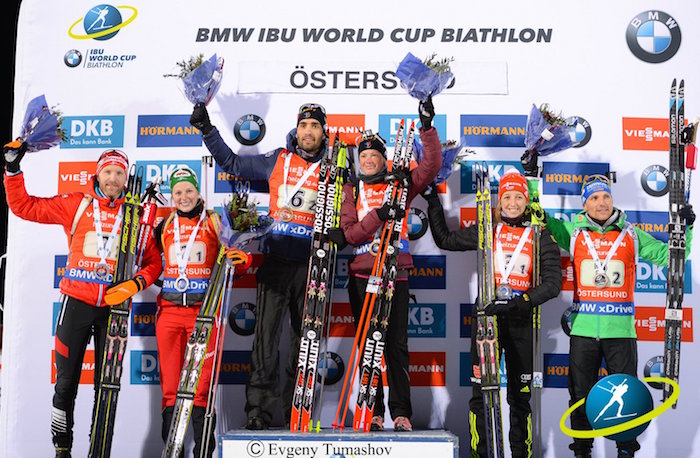
On the podium in the single mixed relay: France (Martin Fourcade and Marie Dorin Habert), Austria (Simon Eder and Lisa Theresa Hauser), and Germany (Erik Lesser and Franziska Preuss). (Photo: IBU/Evgeny Tumashov/Twitter)
By mid-afternoon in Östersund, Sweden, on Sunday, Norway had already claimed a win in the mixed relay. But there was another event still on the schedule: the single mixed relay, a relatively new format with just one man and one woman per team, skiing short loops of a kilometer and a half. Each athlete skis and shoots twice, then tags off, then repeats: two relay legs each for a total of eight shooting bouts.
While Norway had put their best athletes in the traditional mixed relay — perhaps because it is a World Championships event, unlike the newer format, and some teams considered it important to have relay teams begin to gel — a few other countries had decided to put all their eggs in the single mixed relay basket.
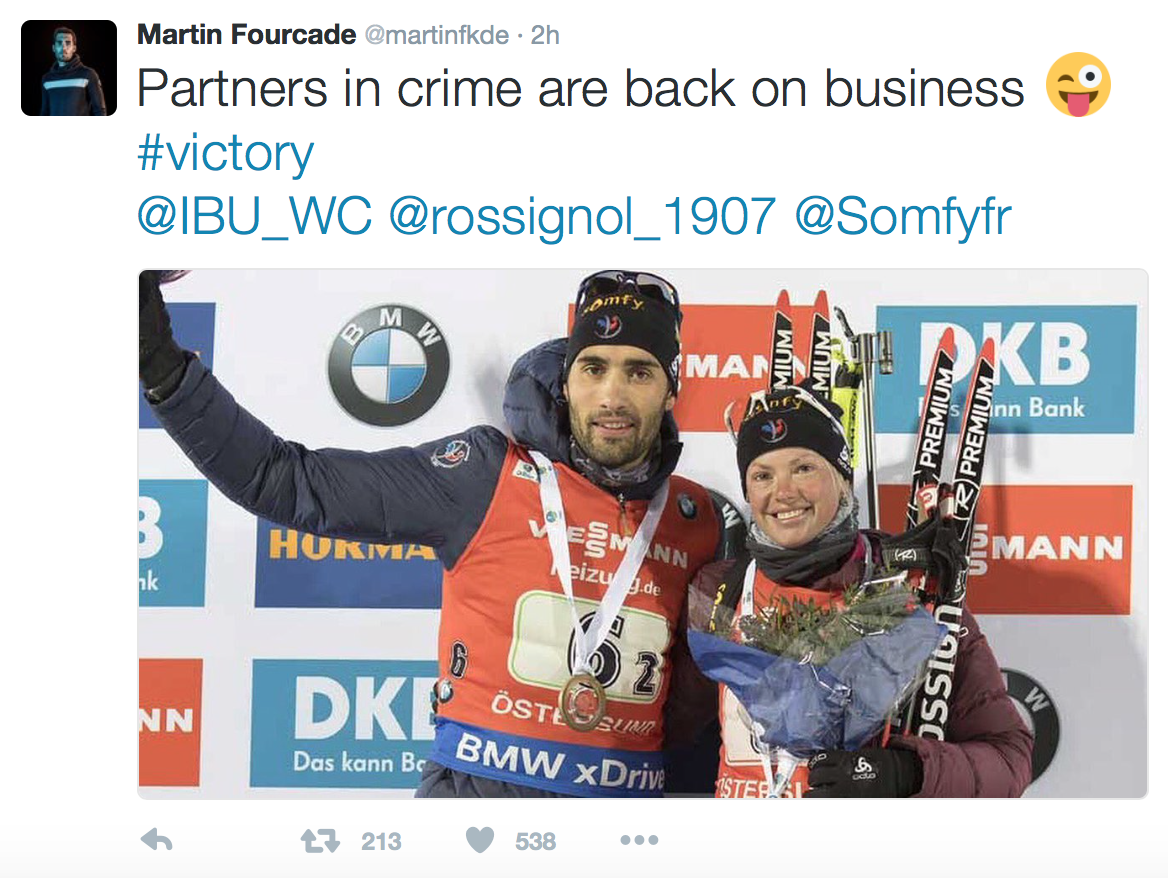
Namely: France, who paired the two most successful athletes of the 2016 IBU World Championships into one team toeing the start line. Marie Dorin Habert was never far from the lead, and by the time Martin Fourcade crossed the finish line 16 seconds clear of second-place Austria, he made it look like just another training session.
“The single mixed relay is that kind of competition when you have to be in both: a good shooter and good skier,” Fourcade said in a post-race press conference. “I am satisfied about my fast prone shooting.”
The French pair used just four spare rounds total across the eight shooting stages, representing some of the best shooting of the field.
“As we all know, Fourcade and Marie Dorin are a tough pair to beat,” Canada’s Nathan Smith wrote in an email.
Second place went to Austria’s Lisa Theresa Hauser and Simon Eder, who, like the French, were nearly perfect on the range; the pair combined for six spare rounds. Eder, a constant threat for individual wins, had the crux performance in the anchor leg to hold off Erik Lesser of Germany. But it was 22-year-old Hauser, who had her first two World Cup top-10s last season, who surprised by turning in the fastest third-leg time of the field.
“Of course it is great to stand on the podium already in the first race,” she said in an Austrian Ski Association press release. “Today the second loop on the first leg was surely the hardest to race, because the tempo was extremely high at the start.”
Lesser and German teammate Franziska Preuss finished third (+25.2).
“I am happy that I came through the shootings fine today,” Preuss said in an interview with German television station ZDF. “I tried to shoot fast because it’s a single mixed relay, and two misses is alright. I already noticed during the summer that I took a step forward, became more consistent, technically clean in my skiing, and just going all-out.”
Canada followed France and Austria in putting their top athletes in the two-person race, and the strategy had previously paid big dividends. Last season, Rosanna Crawford and Nathan Smith had a breakthrough in this event and finished second in Östersund, the first relay medal ever for the team. The pair were together again on Sunday, and ended up seventh (+1:44.7).
Crawford led out of the start and stayed out of trouble in the chaotic mass start, but then used two spare rounds in her first prone.
“I really wanted to start strong and get to the front of the pack so I could control things a little bit more, and I’m happy with how I executed that part of my race,” Crawford wrote in an email. “I struggled a little bit with prone today but had some solid standing which was nice… my first loop I felt quite strong and then things just got a little bit slower from there, some heavy concrete-feeling legs. We got here from Canada late Wednesday evening, so still dealing with a bit of jet lag.”
Despite feeling heavy, Crawford had the fifth-ranked times for both of her relay legs; Smith’s were ranked 10th and 13th.
“We knew that a medal would be possible today but everything would have to go our way like last year,” Smith explained. “Rosanna was definitely strong enough to put us in contention. If I had felt better and perhaps using a couple less spares it would have been possible to threaten for a podium. It also seems like a few more teams put their strongest two athletes in the mix this year.”
Smith mentioned that he had been dealing with fatigue in the last few weeks before leaving for Europe, but thought that he had his health sorted out. Nevertheless, it remains to be seen whether he would get off to the same start that saw him place ninth in the sprint this opening week in both 2015 and 2014.
“I had some good feeling intensity sessions shortly before travelling to Europe,” he wrote. “I’ve generally had some strong results in Östersund the last few years. However this has only been the case maybe 50% of the time in the relays, so I know not to be overly concerned with perhaps a rougher than hoped-for start physically.”
Crawford is also hoping for strong performances when individual racing kicks off later in the week. She won two trials races in Canmore, Alberta, before leaving for Europe, as well as two cross-country ski races against some of Canadian national team.
“Even though I had some strong races in Canmore, it’s hard to know how you’re going to compare against the Europeans,” she wrote. “This race is so short and so quick on such a small loop that it’s hard to know how this will relate to our longer individual races. I think it was a really good opportunity to blow out the cobwebs and get ready for the races for the rest of the season. I learned a few things about shooting that I need to work on and am happy to have two days to fine-tune those things.”
The American team of Joanne Reid and Leif Nordgren had a penalty loop and seven spare rounds, finishing 19th; they were lapped before completing the race course.
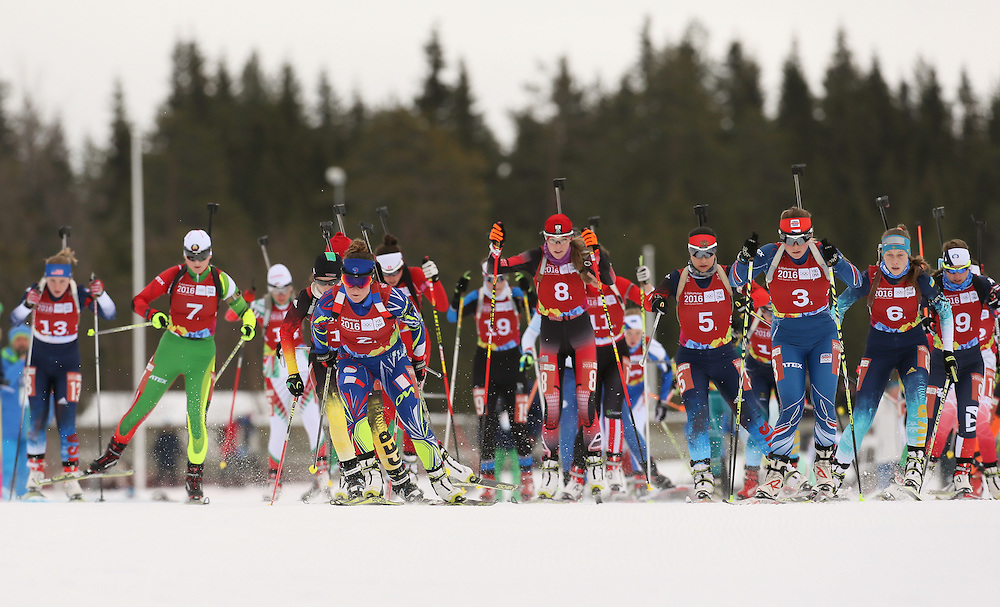
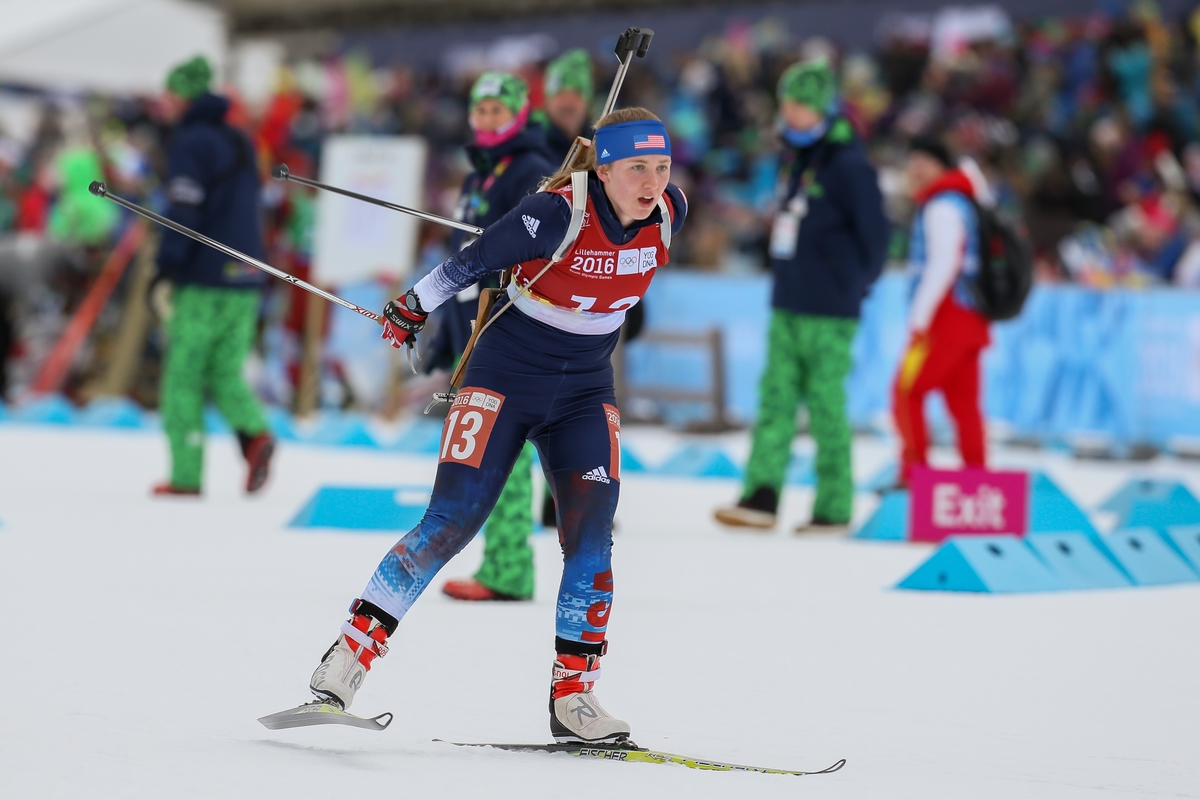
The start of Wednesday’s single mixed relay at the Birkebeineren Biathlon Stadium during the 2016 Winter Youth Olympic Games in Lillehammer Norway, with Chloe Levins of the U.S. at the far left. (Photo: Arnt Folvik for YIS/IOC)
Out of 27 teams, the U.S. found itself in second at the final exchange of the first-ever biathlon single mixed relay held at the Youth Olympic Games on Wednesday in Lillehammer, Norway. That was quite the rush for two 17-year-old Americans.
“Getting tagged off in 2nd just behind a couple seconds behind Norway was surreal,” U.S. anchor Vasek Cervenka described in an email.
In the biathlon pursuit two days earlier, Cervenka, a Czech Republic native who lives in Boulder, Colo., raced to 20th with 19-for-20 shooting. His teammate in the single mixed relay on Wednesday, Chloe Levins cleaned the four-stage pursuit and placed fourth.
“Biathlon is similar to golf in that the main goal is to try to be in contention coming into the last stage (or round),” Levins, who skied the first and third legs for the U.S., wrote in an email. “During that last stage (or round), however, whatever happens is only partially in your control. Autopilot comes on, time takes over, and whatever happens is very difficult to control.”
In the single mixed relay, each competitor rounded the 1.5-kilometer course six times — three times on each leg. They stopped to shoot twice during each leg (first prone, then standing). Misses could be remedied by using up to three spare rounds, but beyond those spares, an athlete had to ski 75-meter penalty loops for the number of targets they failed to clean.
U.S. biathlete Chloe Levins racing in the single mixed relay at the 2016 Youth Olympics in Lillehammer, Norway. With teammate Vasek Cervenka (not shown), the duo went on to place sixth. (Photo: Arnt Folvik for YIS/IOC)
Levins tagged Cervenka for the fourth-and-last leg, 2.2 seconds behind Norway and 1 second ahead of France in third. She had used a total of four spares throughout her four shooting stages and avoided the penalty lap (0+1, 0+0; 0+1, 0+2).
“The start of the relay was very crowded,” Levins recalled. “Nevertheless, extremely fast skis and the use of just one extra round helped me navigate through some of the other competitors.”
At the first exchange, she tagged Cervenka in seventh, 24 seconds behind China in first. Cervenka then cleaned his prone and used one spare in standing to tag Levins in fourth, 12.5 seconds behind Finland — which had moved into the lead. Meanwhile, China dropped to 10th with two penalty loops in the standing stage of that leg.
“Vasek’s excellent shooting in his first leg put us in fourth, and set me up for a very exciting second round,” Levins explained. “During my second leg, I had more room to ski my own pace on the course. After using one extra round in the prone stage, I left the range with the leader in sight. I am a little frustrated that it took me two extra rounds to hit my miss in the last standing stage, but some mistakes by some of the more competitive nations opened the door for us to move into second position after my second leg.”
On the last two legs, China hit all of its targets to recover from 10th into fourth, and then finally first at the finish. Fanqi Meng and Zhenyu Zhu claimed gold in 41:35.4, just two-tenths of a second ahead of Norway in second and 14.9 seconds ahead of Russia in third.
The anchor legs for Norway, France, Russia, Germany, and the U.S. (Cervenka), used three spares apiece in their final standing stages. France also had a penalty, Germany had two penalties, and Cervenka had to ski a penalty loop as well after the last stage. That put the U.S. in sixth at the finish, 53.8 seconds behind the winners, with a total of one penalty and eight spares (0+0, 0+1; 0+0, 1+3 for Cerkenva).
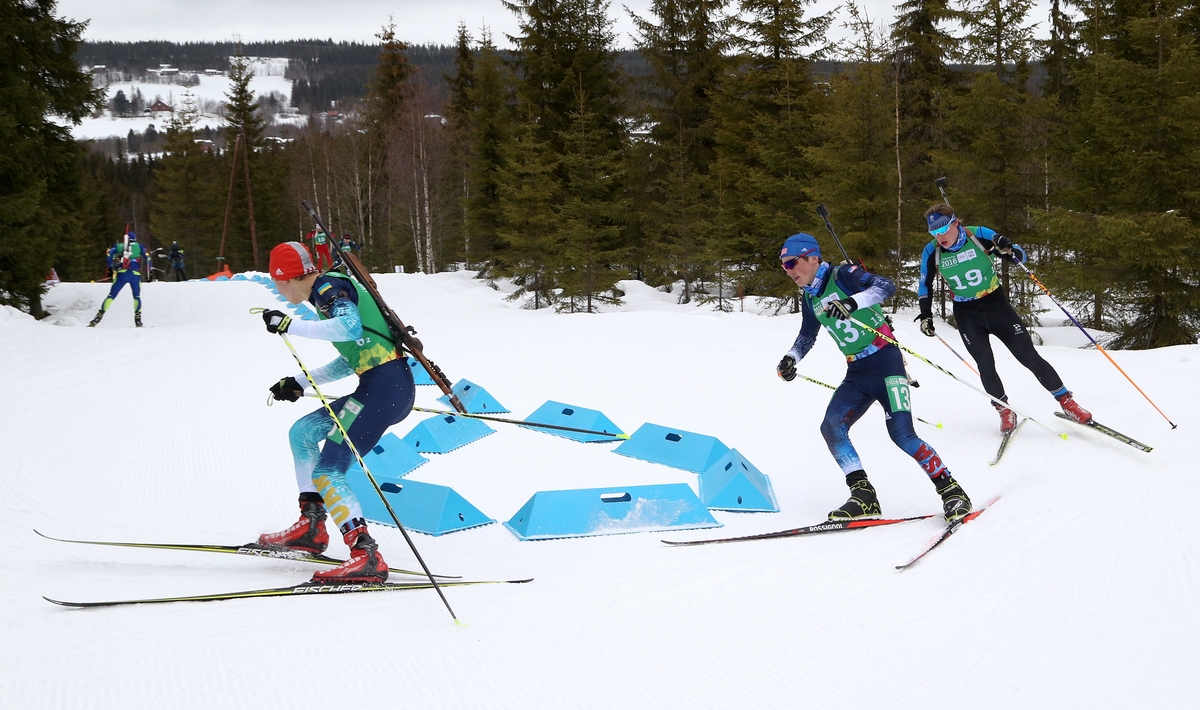
Ukraine’s Serhiy Telen (l) leads Vasek Cervenka of the U.S. (c) and Finland’s Tuomas Harjula (r) around a turn in the single mixed relay at the 2016 Youth Olympics in Lillehammer, Norway. (Photo: Jed Leicester for YIS/IOC)
“It is too bad that I couldn’t clean my last standing shooting,” wrote Cervenka, who turned 17 earlier this month. “We would of had a really great shot at a medal. I was pretty satisfied with our results in the end. All the guys in the top 6 had a solid half a foot in height on me and were overall stronger skiers. I am so proud of Chloe for her performance today, she is awesome.”
Just 0.2 seconds from gold, Norway took silver with Marthe Johansen and Fredrik Qvist Bucher-Johannessen, with a total of one penalty and 12 spares. Russia earned bronze with Ekaterina Ponedelko and Egor Tutmin, with three penalties and 13 spares. France was fourth (+30.2) with Lou Jeanmonnot-Laurent and Emilien Claude combining for three penalties and eight spares, and Germany (Juliane Frühwirt/Danilo Riethmüller) finished fifth (+53.8), about five seconds ahead of there U.S., with one penalty and eight spares.
“Today’s race was a great learning experience for Vasek and myself,” Levins wrote. “We are satisfied and thankful for all of the work and encouragement our coaches do and give to us during every race. We may not have made the podium, but I think we had the most fun today!”
“I was pretty satisfied with our results in the end,” Cervenka wrote. “Thanks to my parents, coaches, teammates, and wax techs for tons of support and wicked fast skis.”
Canada finished 13th (+3:23.0) with Tekarra Banser and Ben Churchill combining for two penalties and 10 spares. The anchor, Churchill cleaned three of four stages, using just one spare in his second prone stage (0+0, 0+0; 0+1, 0+0).
“This was an excellent opportunity for us to try and do some damage among the field in a new event,” Churchill said in a Biathlon Canada press release. “It was a lot of fun to try and pace myself well through both legs, stay warm in the interim, and keep my cool mentally no matter how Tekarra was doing.”
In Monday’s 10 k pursuit, Churchill shot 18-for-20 and achieved a career-best 10th. He had previously placed 17th in the 7.5 k sprint.
“I went into the pursuit feeling hungry and aiming to improve on my sprint result,” Churchill said. “Taking some lessons from the sprint, I attacked the course more intelligently, pushing harder up the hill each time. Execution in the pursuit was much more put-together, and I was thrilled to notch my first top-10 result in an international competition. Big thanks goes out to our wax technicians and the invaluable behind-the-scenes support from our coach, Luke McGurk, and the rest of the Team Canada Mission Staff!”
In the relay, Banser accounted for both penalties and nine spares (0+2, 0+3; 2+3, 0+1). At the first exchange, the Canadians were in 21st, 1:47 back from the leaders, then improved to 14th (+1:27) at the second handoff, before Banser tagged Churchill for the last time in 16th, 2:16 back. He brought them to 13th at the finish.
“Competing in the single mixed relay was exhilarating to say the least. Starting in a mass start format with 26 other countries made it tougher to focus, but I was able to get into my zone,” Banser said. “Fighting to stay with the pack on the first lap was challenging. The corners were tight and the other athletes were just as aggressive as I was. I ran into a few obstacles throughout my portion of the race, although I kept fighting to the last second and left nothing in the tank.”
“My experience at YOG has been spectacular so far,” Levins wrote. “Because the Norwegian culture is rooted in cross-country skiing and biathlon, fans have flooded the stadium for every one of our competitions! It feels great to be a part of an atmosphere that cares so much about the sport Vasek and I dedicate so much of our time to. The organizers have done an excellent job of maintaining near-perfect snow conditions on the track as well.”
“So far the YOG experience has been incredible,” Cervenka wrote. “So much time has been put into this event I am glad it is going so well.”
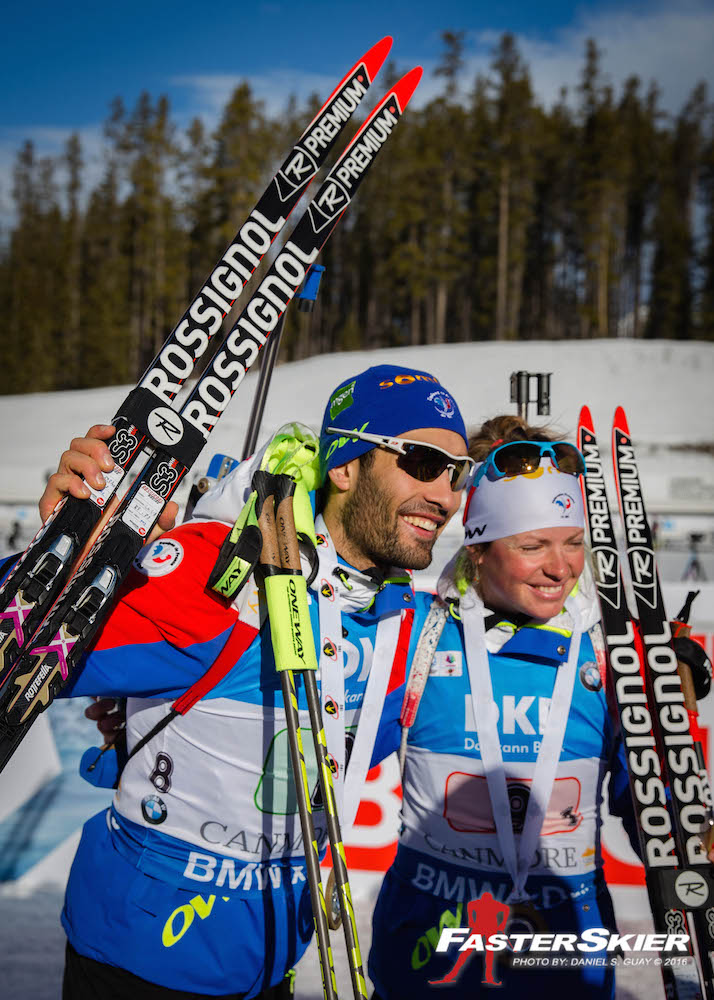
Teammates in the single mixed relay on Sunday, France’s Martin Fourcade and Marie Dorin Haber after winning the first of two relays on the last day of the IBU World Cup in Canmore, Alberta. (Photo: Daniel S. Guay)
France was determined to win the International Biathlon Union (IBU) World Cup 13.5-kilometer single mixed relay on Sunday in Canmore, Alberta, using their best athletes with men’s overall World Cup leader Martin Fourcade and Marie Dorin Habert, who ranks third in the women’s standings. And they succeeded in convincing fashion, finishing first in 37:58.0 minutes, with four spares and no penalties.
The first time the new race format was on the calendar this season at the World Cup in Östersund, Sweden, the French duo of Dorin Habert and Martin’s older brother Simon Fourcade thought they had won the race, but because Fourcade had not fired a shot during the competition the team was slapped with a four-minute penalty, putting them back to 21st place.
On Sunday morning, France made no such mistakes and didn’t leave the other teams any chance in nearly a start-to-finish victory. Dorin Habert took the lead out of the arena, stayed there for most of her leg and tagged narrowly in first place, before both Fourcade and Dorin Habert expanded their lead on the next three legs with good shooting and fast skiing. Fourcade put an exclamation mark on the victory by sprinting into the finish despite knowing he had a comfortable lead of more than half a minute on the final loop.
“It was a really exciting race. I like these kind of short races. I tried to be as strong as Martin, it’s an honor to run with him,” Dorin Habert said at the post-race press conference. “It was in our head before the competition to win, but this is biathlon and everything can happen on the [shooting range].
“I tried to train the finish, I think that was a good opportunity,” Fourcade explained during the press conference. “But I actually didn’t compete the full last loop,” he added with a smile. “I only did for some parts, the ones in front of the TV.”
“Today I was satisfied even if I needed two extra shots, two too much,” Fourcade later told the IBU in an interview. “It was a good competition for both of us.”
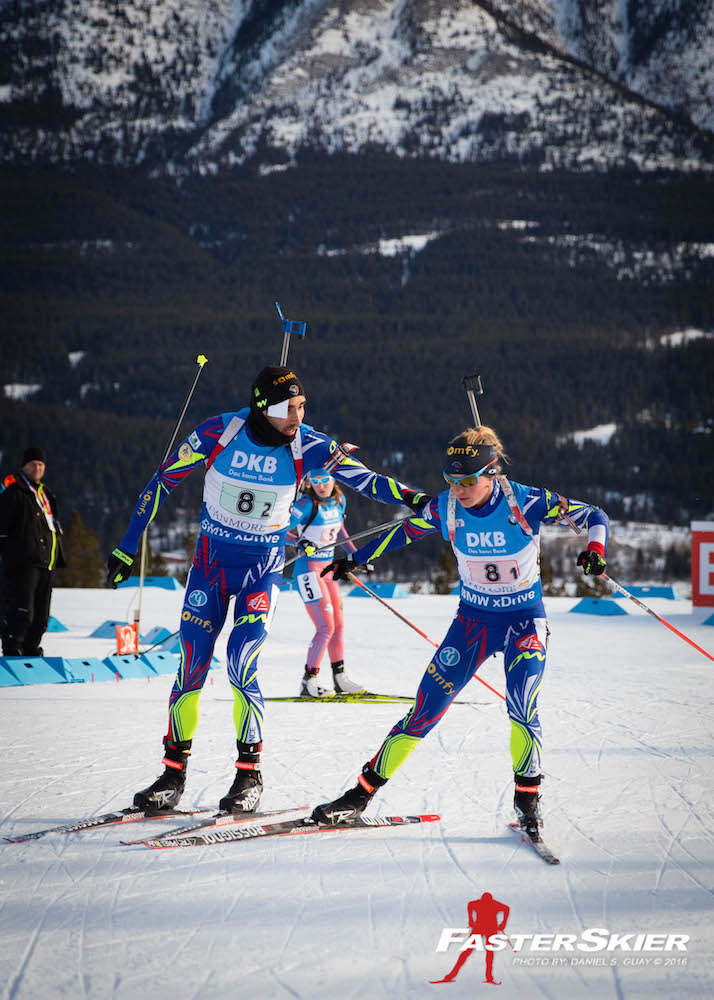
France’s Martin Fourcade (l) tags teammate Marie Dorin Habert for her the third of four legs in the single mixed relay at the IBU World Cup in Canmore, Alberta. They ended up winning by 45 seconds. (Photo: Daniel S. Guay)
Second place went to the Austrian duo Lisa Therese Hauser and Simon Eder, 45.2 seconds back, with eight spares and no penalties. It was Hauser’s first World Cup podium.
Norway’s Hilde Fenne and Lars Helge Birkeland secured the third spot on the podium, 55.3 seconds back, with seven spares and no penalties. Birkeland defended his lead on the final loop, coming into the finish two seconds ahead of Russia’s Olga Podchufarova, who teamed up with Alexey Volkov to finish fourth (+57.3), with no penalties and just two spares.
New since the 2014/2015 season and only held for the third time at the World Cup level on Sunday, the single mixed format was established by the IBU to have another action-packed event and give “smaller” biathlon nations a shot at the podium. For some countries, it presented an opportunity to start a team event. It is not yet a part of Biathlon World Championships or Olympic Games.
“The single mixed relay is interesting for smaller nations, because they maybe don’t have five women and five men who can compete with the top, but maybe one or two,” Canadian head coach Matthias Ahrens told German TV broadcaster ZDF in an interview before the race. “Then you can use those in the mixed or single mixed relay, thereby potentially getting a chance to reach the podium, which worked pretty well for us at the season-opening in Östersund [where Canada placed second].”
On Sunday, some teams, such as France — though not an example for a “small” biathlon nation — Austria and Latvia (in eighth place), made use of that by putting their best racers in the event. Other teams decided to focus on the “normal” mixed relay, with two women and two men on each team, that followed later on Sunday in Canmore.
The single mixed relay features the shortest loops in biathlon, with the athletes skiing a 1.5-kilometer loop between each shooting stage, then immediately exchanging after the standing shooting. After the female team member starts and shoots one prone and one standing stage, she exchanges to her male teammate, then the woman gets tagged again to ski the third leg (six kilometers total), and the man closes out on the fourth anchor leg racing an additional 1.5 k after the final standing shooting, which adds up to the odd 13.5 k distance. The athletes are allowed to use three spare rounds per shooting like in a normal relay, and the penalty lap is also shortened to 75 meters (usually 150).
Thus the whole race is extremely fast-paced, and rather resembles a cross-country team sprint than a traditional biathlon or cross-country relay.
“This was a new start for me in the World Cup, because I never did a single mixed relay before,” Fourcade said at the press conference. “I already did it a lot during the show competitions like Schalke [World Team Challenge in late December] or Moscow or Tyumen [Race of Champions, another invitational at the end of the season]. I really love that. But it was different today … with the pressure of the World Cup… I think the single mixed relay is really good for biathlon.”
“The single mixed relay is a super fun race format, but you really have to shoot well to have a chance,” U.S. Biathlon’s Annelies Cook wrote in an email.
“Certain abilities are demanded, especially ‘shooting efficiency,’ ” Ahrens told ZDF. “That means you need athletes who, first of all, can shoot well and hit, but also shoot very fast.”
Germany’s Luise Kummer (2), Norway’s Hilde Fenne (1) and Canada’s Julia Ransom (3) early in the single mixed relay at the IBU World Cup in Canmore, Alberta. Norway went on to place third, Germany seventh and Canada finished 12th. (Photo: Daniel S. Guay)
Conditions on Sunday were good throughout the race, with calm winds and the sun shining in the Canadian Rocky Mountains, after the athletes had struggled with snowfall and strong gales in the previous days.
“I think we were all satisfied to know that it would be fair and beautiful conditions. It’s the [kind of] biathlon we love,” Fourcade said in an interview with the IBU.
“Today was the best snow conditions of the week. There was a light wind, but it seemed pretty consistent,” Canada’s Nathan Smith wrote in an email.
France steadily expanded its lead throughout the race. At the first exchange, Dorin Habert tagged Fourcade in first, just 0.4 seconds ahead of Sweden. Fourcade slightly expanded that lead to 6.5 seconds over Russia in second place by the next exchange, and then Dorin Habert cleaned both shooting stages on her second leg to balloon the gap to 50.1 seconds over Norway in second. Essentially, Fourcade just needed to go through the motions on his last leg to lock up first.
Before the final shooting, Germany’s Erik Lesser had been in second place behind Fourcade. But unable to clean his targets and running out of spares, Lesser incurred a penalty lap and ended up seventh (+1:29.6), as teams passed him with better shooting. Lesser and teammate Luise Kummer combined for one penalty and eight spares.
This brought back some painful memories from the first time a single mixed relay was held in a year ago in February 2015 in Nove Mesto, Czech Republic. Lesser and Kummer had been in the lead before the final shooting, then Lesser slipped into fourth with a penalty.
After Sunday’s race, suffice to say Lesser wasn’t happy.
“Does anyone still want to see that? I don’t!” Lesser quipped when the interviewer in the mixed zone asked him to take a look at a replay of his targets in the final shooting stage. “It really doesn’t matter where those [shots] went, I just didn’t hit, fired four really poor shots,” he added after taking a glance at the fairly close misses. “If Mark [Kirchner, men’s head coach] wants to chew me out for that, I hard-earned it.”
“On the first spare I was already thinking, ‘Oh great, this is going the same way as last year,’ ” Lesser continued. “On the second leg I struggled, I tried to keep the others at bay on the course so they would not catch up, but I somehow didn’t move well, got tense on the shooting range, and then the misses happened. I am completely annoyed, mega-disappointed… This is the World Cup level, so you should also be able to hit with tired legs.”
Kummer used four spares and was also disappointed, but didn’t pin the blame on Lesser.
“A [single mixed] relay is comprised of two people, everything has to work out, and that mistake can happen to everybody,” she told ZDF. “You are always happy yourself to get through [a relay shooting stage] unscathed, so that shouldn’t be a problem…. I still think it’s a very exciting competition for the spectators, very fast-paced exchanges. It doesn’t have the same standing as a relay or mixed relay yet, but one can see that it is developing.”
Lesser’s troubles allowed Austria’s quick-shooting Eder to pass him and secure second place, after he and Hauser had been just outside the podium ranks for most of the race.
“I am really happy about this podium today. It’s my first one. I dreamed about it, and today it worked,” the 22-years-old Hauser told reporters at the press conference. “My shooting was not so good especially in prone. Simon and I are both fast shooters and also good shooters, but today it was not the best.”
“I felt great on the course, I always could keep up or even close gaps,” Hauser added in an Austrian Ski Federation press release. “On the shooting range I let the stress get to me a little bit, that caused the spares. But of course I am overjoyed by the podium finish.”
“The first turn did not go according to plan on the shooting range. I had problems with my ski poles and used too many spares,” Eder, 32, said in the press release. “But the second turn went all the better, I could really push the tempo also on the shooting range. Finally we have a place on the podium also in a mixed relay.”
In the absence of their usual stars that are skipping the North American World Cups in the leadup to 2016 World Championships at home in Oslo, the Norwegians still reached the podium with Fenne and Birkeland, who both improved on their second legs to move from seventh at the first exchange to third at the finish. (Birkeland also won the first single mixed race of the season, though with Kaia Woeien Nicolaisen as his partner.)
“I am not sure why, we just always try to do good races,” Fenne said during the post-race press conference when asked why Norway seems to do so well in the single mixed relay. She added that the coaching staff picked the lineups for Sunday, so she didn’t know why she was put on the single mixed relay instead of the four-person mixed relay.
Canada 12th, U.S. 16th
Representing Canada at home in Canmore, Julia Ransom, who is competing in her first full World Cup season, teamed up with veteran Nathan Smith, who raced to second in the Östersund single mixed relay with Rosanna Crawford.
Canada’s Nathan Smith (behind) coming through the exchange zone to tag teammate Julia Ransom during single mixed relay at the IBU World Cup in Canmore, Alberta. (Photo: Daniel S. Guay)
This time, the Canadians ended up nearly two minutes off the podium in 12th (+1:54.3), with 10 spares and no penalties.
On her first leg, Ransom used one spare round in her first prone, but then required all three spares in standing to narrowly avoid a penalty lap.
“It was hard, very hard,” Ransom said in a Biathlon Canada press release. “I haven’t done that format before. I felt that one for sure. This is the first time I’ve done a relay with Nathan so it was lot of fun for me, and a great experience.
“I was bouncing around at the start and maybe nerves got to me a little bit because I didn’t know what to expect,” she added. “The techs just told me to ‘reel it in.’ ”
After the first 1.5 k, she tagged Smith 47.0 seconds behind in 19th of 23 teams. On his first leg, Smith cleaned prone without any spares and only required one spare in standing to keep his distance to the top, handing off to Ransom 49.2 seconds back in 11th.
“We unfortunately fell back pretty early in the race. Julia had some difficulty in the range,” Smith wrote in an email to FasterSkier. “The time lost loading spares is even more penalizing when the loops are so short. The format itself is pretty fun to race, and quite a bit different from traditional races. It’s almost more like two races back to back with a little break. It suits my quick shooting speed really well.”
Ransom cleaned her next prone stage as she had done repeatedly in recent weeks, but with two more spares in standing, she lost a minute to the top.
Still in 11th when he received the tag, Smith again hit all targets in his prone stage, but required three spares in his last standing to avoid the penalty lap, approximately holding his gap to the leaders.
“Other than my last standing my [two relay] legs went really well. Prone felt amazing. Probably almost the best ever. Just fast, easy and accurate,” Smith wrote. “I ended up battling a lot with [Latvia’s] Rastorgujevs. He surprised me by matching my shooting speed. He’s always one of the fastest out there. It was too much for me to hang on to on the last lap.”
“It was my best race this week. The legs felt a lot better today. Not amazing, but quite good until that last lap,” Smith said in the team press release. “One of the toughest things to do is race at home with the pressure we put on ourselves with our friends and family watching all the volunteers we know out here. I obviously wanted to peak here and do well but there are so many factors that come into play. It was a great experience racing at home that we’ll be able to take with us.”
For the U.S., Cook teamed up with Leif Nordgren. In Östersund, their teammates, Clare Egan and Sean Doherty finished 15th in the single mixed relay. This time, the Americans finished in the same range in 16th place (+3:20.1), with one penalty and 14 spares.
Annelies Cook (US Biathlon) during one of her two standing stages in Sunday’s single mixed relay at the IBU World Cup in Canmore, Alberta. She teamed up with Leif Nordgren to place 16th. (Photo: Daniel S. Guay)
After using just one spare in her first prone stage, Cook incurred a penalty in her first standing stage, quickly disappearing out of the focus of the TV cameras, tagging Nordgren in 20th, about 1:05 behind the leaders.
“I felt good on skis and was in the mix, but I had a hard time holding back in the skiing and was probably breathing too hard to shoot well in standing,” Cook wrote in an email. Her course time ranked seventh fastest of the first-leg skiers. “My penalty in standing took us too far from the top to have contact.”
Nordgren needed two spare rounds in prone and another one in standing, losing about another 30 seconds to the top teams on his leg (+1:41.3) as he tagged Cook in 18th.
“This format is for sure a little different than a typical relay,” Nordgren explained in an email. “The pace is usually fast right from the start, and because the loops are so short it really puts all the focus on the shooting since its hard to really break away on such a short loop. It’s nice to have that difference, but you really have to be on top of your game in the shooting to be competitive.”
On her second leg, Cook again emerged from prone with just one spare, but needed another three spare rounds to clean her final standing stage and avoid another penalty. When she exchanged back to Nordgren, the U.S. was 3:04.7 out of first in 20th.
“The race does feel like a cross country sprint. But what makes it hard is knowing that you still have to hit targets, and finding the balance between all out sprinting and going just at the level where you can manage to hit your targets is tricky,” Cook wrote. “I just tried to make up time lost on the range by catching up on skiing as best as I could. There were a few of us together each lap, so it felt like a competition between that group of people.
“I had a hard time holding back because I really love sprinting, and that probably kept me from hitting in standing,” she added. “That put Leif on a position where he had to try and chase people down. He did a really good job of that and I was proud of him for catching people in the last loop.”
On the anchor leg, Nordgren mirrored his performance from his first round, again requiring two spares in prone and one in standing, but only lost 15 more seconds to the leaders and leapt to 16th by overtaking Romania, Slovenia, Belarus and Finland.
“Today neither Annelies nor I really had a great day on the range so we had a hard time to stay with the top teams,” Nordgren concluded. “The tracks were in perfect shape today which is always nice. Our techs did a great job to give us fast material, but we weren’t able to put it to good use.”
Staying Warm
In the exchange zone, several teams could be seen using spinning bikes to keep warm and stay loose during their race breaks while their teammate was out on the course, something the Norwegians pioneered for the single mixed relay in Östersund, though the Americans and Canadians opted for a traditional warmup.
“I just ran around to keep warm,” Cook wrote. “It’s not a big break and we don’t have a team bike. But running was totally fine for me.”
“During the break both of us just opted to jog around, being that it’s such a short race, it’s more important to stay warm any way possible,” Nordgren wrote. “Today was the first day in a several that the wind was pretty low, so that made staying warm a little easier.”
“I just jogged around while Julia was doing her second leg,” Smith explained in his email. “I considered using a spin bike but decided it would be best to practice like at World Champs.”
Moving on to Presque Isle
Nathan Smith (Biathlon Canada) during Sunday’s single mixed relay at the IBU World Cup in Canmore, Alberta. He teamed up with Julia Ransom to place 12th. (Photo: Daniel S. Guay)
The IBU World Cup now moves east to Presque Isle, Maine, with sprints for the women and men on Thursday, followed by pursuit races on Friday, and traditional relays on Saturday (men) and Sunday (women).
“Today was the best I’ve felt in a couple weeks. I hope my shape continues to return to normal through Presque Isle,” Smith wrote.
While Smith continues to work to hold his own in the overall World Cup standings (he’s currently 19th), the rest of Canada’s A-team, those pre-qualified for World Championships, will skip the Presque Isle World Cup and train in Canmore until Feb. 22, according to Crawford. That includes Crawford, Ransom, Sarah Beaudry, Brendan Green, Scott Gow, Christian Gow, and Macx Davies.
Smith and a women’s contingent of Emma Lunder, Zina Kocher, Audrey Vaillancourt, and Erin Yungblut will head to Maine, and after those races, the Canadian team will select its fourth woman for World Championships.
“I think we’re … looking forward to racing next week on home soil in Presque Isle,” Nordgren wrote on behalf of the U.S. team. “I haven’t raced there for about 5 years, so it will be fun to be back!”
In the four-person mixed relay that followed Sunday afternoon, the U.S. notched a team-best fourth with Susan Dunklee, Hannah Dreissigacker, Tim Burke, and Lowell Bailey, while Canada tied its previous best of sixth, with Crawford, Beaudry, Davies, and Green. Stay tuned for a separate report.
Note: Presumably due to a software bug, the IBU’s competition analysis report for the single mixed relay contained erroneous ranks for data such as course and shooting times, with higher numbers than the 23 teams that started in this race, so no such information was used for this article.
Tim Burke (l) tags U.S. teammate Annelies Cook in 15th in the second-to-last exchange in Friday’s single mixed relay at the IBU World Cup in Nove Mesto, Czech Republic. The two went on to place ninth when Burke skied up from 14th on his second-and-final leg. (Photo: USBA/NordicFocus)
He felt a little weird saying it, but US Biathlon Chief of Sport Bernd Eisenbichler viewed Friday’s single mixed relay — a brand-new event which was first tested in Oslo last season — as a “good training opportunity.”
Between that two-person race and the four-person mixed relay that followed on the same day at the IBU World Cup in Nove Mesto, Czech Republic, there was plenty of racing to go around. Some people needed to get in some intensity after the nearly two-week break from racing.
Each nation entered in both Friday’s single mixed relay and the 2 x 6-kilometer + 2 x 7.5 k mixed relay had to determine a) which six athletes to divvy up among those events and b) the starting order for both. Eisenbichler said on the phone late Friday that the US Biathlon staff decided to pair Annelies Cook and Tim Burke up for the single mixed relay, which is more of a team sprint than any other format, because both needed hard workouts. This way, those two could log intervals on race day.
Meanwhile, Susan Dunklee and Hannah Dreissigacker were put in their “traditional” starting positions of first and second, respectively, in the four-person mixed relay. With Lowell Bailey out sick and recovering in Ruhpolding, Germany, the U.S. opted to start Leif Nordgren as the third leg and 19-year-old Sean Doherty as anchor.
“We see every race as a practice,” Eisenbichler said, pointing to next month’s World Championships in Kontiolahti, Finland, as the end goal. “Every race in their [usual positions] is still a really good experience. It was also, for the boys today, being in the mixed relay in front of 30,000 spectators, a good experience.”
Both races turned out to be something the U.S. was proud of, especially in the four-person mixed relay where the team finished seventh and two-tenths of a second from the flower ceremony. Cook and Burke teamed up for ninth in the single mixed relay (out of 20 teams) despite some shooting struggles.
“I think with two top-10 results we accomplished our Nations Cup points and our goals for the weekend,” Eisenbichler said. “Top eight or top 10 is always what we reach for, I would rather say top eight … and in mixed relay at world championships, I would say top six.”
Single mixed relay
Annelies Cook (6) heads out of the mass start in Friday’s single mixed relay at the IBU World Cup in Nove Mesto, Czech Republic. Cook and teammate Tim Burke went on to place ninth for the U.S. in the first of two mixed relays on Friday. (Photo: USBA/NordicFocus)
The single mixed relay, in which each male and female on a two-person team races three 1.6 k laps twice, tagging their partner in between, made its debut last year on the same day as a set of men’s and women’s mass starts, which created an even busier day. Dreissigacker and Nordgren raced that event for the U.S., making Cook and Burke total newbies to the format on Friday.
“I was really excited about doing this race today because it was something new and such a fun format,” Cook wrote in an email. “I always loved doing sprints and team sprints in cross-country skiing and this was a little bit like that. I am not sure exactly how the coaches picked the teams for today, but they know I like to sprint and maybe that was part of it.”
Burke explained that he requested to be put in that race because he wanted “to try something different.”
“This format definitely makes for a different race feel,” he wrote in an email after Friday’s race. “It is quite awkward to go from a full sprint into the shooting range. … The ski speed definitely felt faster than any other format.”
Biathlon Canada entered Megan Heinicke and Scott Gow, but Heinicke was too ill to race on Friday so the team did not start the single mixed relay.
“Megan was already showing signs of sickness the day before, that is the reason we put her into the single mix relay otherwise she would have been in the mixed relay,” national team head coach Matthias Ahrens wrote in an email.
For the mixed relay, Canada started Audrey Vaillancourt, followed by Rosanna Crawford, Nathan Smith, and Brendan Green. The four combined for 14th after skiing two penalty loops and using 13 spare rounds.
Between Cook and Burke in the relay earlier that afternoon, the two Americans used 13 spares but avoided penalties, with Cook using three spares on the first shooting stage and Burke using six between two stages on his first leg.
“The first leg was so close to being really good, but I think I was too excited in prone and had random misses,” Cook reflected.
She went on to clean the first stage of her second leg, and used two spares on her last standing.
“Maybe the only difference in my second leg was to just come into the range a little calmer, while still trying to hammer the rest of the course,” she wrote. “It was all a learning experience since I haven’t done anything like this before. Somehow that took the pressure off, but still made it really fun and exciting.”
Burke felt he struggled with the change of pace between sprinting and then suddenly shooting, noting that he was too cautious in the range on his first two stages. The next time around, he used one spare in each shooting stage.
“I adjusted for my second leg and I very happy with how that went,” he wrote. “I think this is an interesting format but it definitely puts a huge emphasis on the shooting.”
The two skied in the top 15 for much of the race, and by the second exchange, they were more than two minutes behind Germany’s Luise Kummer and Erik Lesser in the lead. Cook tagged Burke for the last time in 14th, 2:40.6 back. There, Burke resolved to put them in the top 10.
With the fastest course time of any anchor, he did so, finishing ninth, 2:39.7 behind Russia’s Yana Romanova and Alexey Volkov, who won in 35:43.3.
The Russians took control on the anchor leg after coming through the final exchange in third, 5 seconds behind Germany and 4.8 seconds behind Ukraine. Lesser cleaned prone but missed most of his shots on his final standing stage and had to use three spares and ski three penalty loops.
Volkov cleaned his final shooting to move to first, 26.5 seconds ahead of Ukraine’s Artem Tyschenko in second. Norway’s Henrik L’Abee-Lund used one spare in his final prone and cleaned standing to improve to third overall with one lap to go, less than a second behind Tyschenko. Lesser dropped to fourth, 34.7 seconds back.
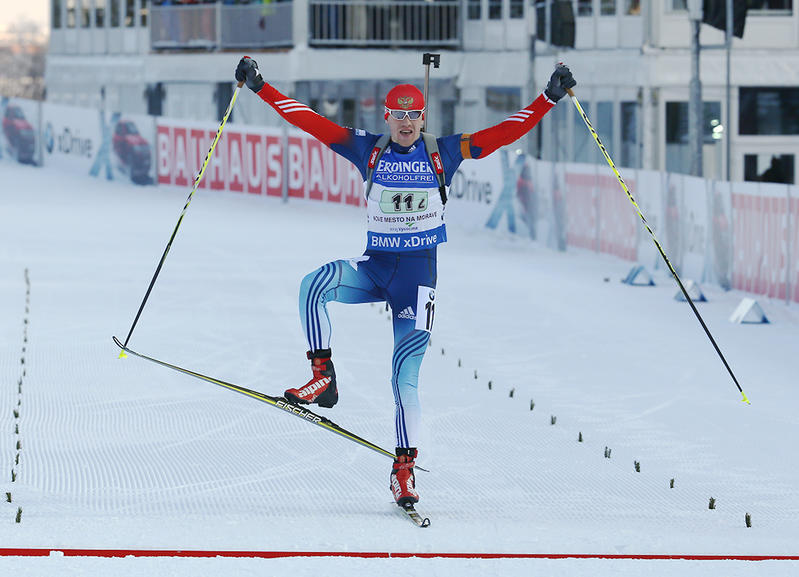
Alexey Volkov anchored Russia’s two-person single mixed relay (with Yana Romanova) to first on Friday at the IBU World Cup in Nove Mesto, Czech Republic. (Photo: IBU/Kustoslav Frgal)
On the final lap, Volkov stayed in the clear, looking back near the top of the final rise before the stadium and soon after celebrating with a Captain Morgan-like pose at the finish.
L’Abee-Lund passed Tyschenko to clinch second for Norway (with teammate Marte Olsbu), 21.5 seconds out of first and 3.1 seconds ahead of Ukraine (with Juliya Dzhyma) with in third. A not-so-happy-looking Lesser crossed the line in fourth for Germany, 38.9 seconds back from Russia.
“I always dreamed about taking part in this type of the mixed relay since I saw the test event last season in Oslo,” Romanova told the IBU after the race. “I like it very much and like the short distance where everything depends on shooting!”
Romanova cleaned all four of her stages to put the Russians in third at the last exchange, and Volkov used a total of five spares to secure first place.
“I think that both Tim and I had one bad stage of shooting that hurt our chances for a top result, but I am still happy at the end of the day,” Cook wrote. “I really loved this race format and the only thing I would change is to not have extra rounds as part of it. It would be even crazier with just a short penalty loop.”
Burke agreed.
“I think they should at least do away with the extra rounds, so you spend a little less time on the range,” he wrote after the first-and-only single mixed relay scheduled this season.
Eisenbichler noted that while he’s “not the biggest fan” of the format, “today, it worked out for us. … But for a small team, it’s a really hard stretch to send two teams to the relays,” he added.
On the World Cup circuit, most nations have recently reached the point where they can field competitive teams for the four-person mixed relay, still a relatively new competition itself. Eisenbichler explained that he’d rather see one mixed relay or the other — not both.
“I don’t think it’s just the right format,” he said of the two-person event.
At the same time, the single mixed relay drew tens of thousands of spectators on Friday.
“The idea to do something is interesting …. I think it was a good try,” Eisenbichler said. “I think there will be a decision [after the season] if it goes further on or if there’s a changed format. … It would be really tough to schedule it into world champs in the future.”
Ahrens wrote that he wasn’t the biggest fan of the single mixed relay after last year’s test event, but added Friday that “it could have potential with shorter loops of 1km, no spares to be used and exchange between men and women after each shooting. … The single mixed is more of a shooting race but not so much biathlon with a 50/50 combination.”