Fat biking and skiing coexist, with Eli Brown skiing alongside his son Leland on the Vasa trail in Traverse City, Mich. (All photos: Jake Ellis)
If you are craving a challenging ski workout that will train your agility, boost your strength, and add variety to your skiing, you should look no further than your local fat-bike, singletrack ride.
Have you ever tried to keep up with the fat bikes? On their trail?
“Hardest workout out there!” said Eli Brown, a longtime U.S. Ski Team volunteer wax tech from Michigan, who is doing the majority of his skiing this season on singletrack.
Bikes and skis have different advantages in different conditions, but most often you’ll be desperately chasing your pedaling friends. This activity will burn off that second helping you had at Christmas dinner, and/or open up a caloric deficit for your New Year’s Eve indulgences.
Another bonus is that the different features of a fat-bike trail will increase your skiing dexterity. There will be berms, bumps and ruts that you won’t encounter on the typical ski trail. After a few singletrack skis, you’ll be a lot more likely to stay upright the next time you’re surprised by less-than-perfect trail conditions that would have taken you down before.
This is a fun activity that can help you make a breakthrough with your smiling technique; it’s a lot of fun.
The Workout: Join your local fat-bike singletrack ride, and try to keep up!
Warmup: 15-20 minutes. Get ready to go out hard!
Be careful to not smile TOO hard too early, save some for the finish 🙂
Cool down: Have a beer with your cycling buddies and recount the joyful tales of skiing singletrack with a group of fat bikers.
If you don’t have a local winter singletrack trail, or want to work up to it, you can get a lot of the same benefits from any off-piste (ungroomed) skiing. No-wax classic rock skis and poles with big baskets are a good start, and more advanced adrenaline junkies can try faster ski setups.
Winter singletrack groomed by a small snowmobile on the Vasa trail in Traverse City, Mich.
Cycling and skiing, side by side, with Eli Brown and his son Leland on the Vasa trail in Traverse City, Mich.
The chase is on!
He brought skis to a bike ride. (Pictured: Eli Brown)
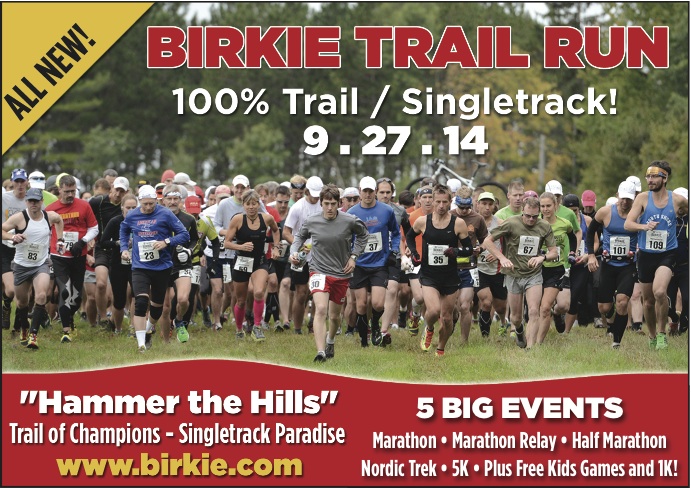
HAYWARD, Wisconsin (June 27, 2014) – The five events of the 12th annual Birkie Trail Run & Trek on Sept. 27 put you on some of the best sections of the world-class Birkie Trail system and now some of the best singletrack in the Upper Midwest as well. These singletrack sections are part of the CAMBA trail system, considered “the singletrack capital of the Midwest.” The Birkie Trail Marathon, Marathon Relay, and Half Marathon courses will all include these new singletrack sections. The new courses are made possible by a brand new start/finish venue for the events—the new Birkie Ridge Trailhead. The American Birkebeiner Ski Foundation completed this latest addition to the Birkie Trail system last fall.
The new Birkie Ridge trailhead is on Hwy 63, just 11 miles north of Hayward, WI, and five miles south of Cable, WI. Starting at this new trailhead takes runners right into the heart of some of the best sections of the Birkie Trail and the CAMBA singletrack system. Over 44 miles of the CAMBA singletrack system are the hidden jewel in this area. Many portions of it run adjacent to the Birkie Trail, crossing the Birkie Skate and Classic Trails every four to five kilometers.
Adding singletrack to the Birkie Trail Run events is a natural. It will satisfy the cravings of the most passionate, dirt-loving trail runners! Many local and regional trail runners already know about this combination of trails. The Birkie Trail Run & Trek opens up this hometown secret to trail runners across the country.
The Birkie Trail system itself has some roots and rocks, but is relatively smooth. The terrain (including those Birkie hills) makes it interesting for avid trailrunners. For road runners looking to break free from their usual routes, it is a great crossover and introduction to trail running. The main course is 30 feet wide, grass covered, and mowed, with a bike path down the middle to keep those sections fast. There is plenty of room to pass on the uphills, downhills, and flats. This is the Birkie Trail, so there are hills. Hammer it or cover your favorite distance at a recreational pace.
This event has a great, friendly vibe and a finish-line party with loads of local food and craft beer on tap from the Cabin Stop of Hayward. All registered participants eat free at this picnic at the start/finish line tent. Spectators, family, and friends can purchase a picnic ticket. The grills will be fired up, so plan to stay for the party!
“If you love to run great trail, this is the event to put on your calendar now,” says Ben Popp, Executive Director of the American Birkebeiner Ski Foundation. “Get ready for some great new sections of trail, beautiful views, and a whole new running experience on the Birkie Trail!”
For more information, visit www.birkie.com or call the Birkie office at 715-634-5025.
The Birkie Trail Run & Trek Is Sponsored By: Salomon, FITS, Dr, Brent Carlson, MD, Out There Nordic Sports, and the Cabin Stop
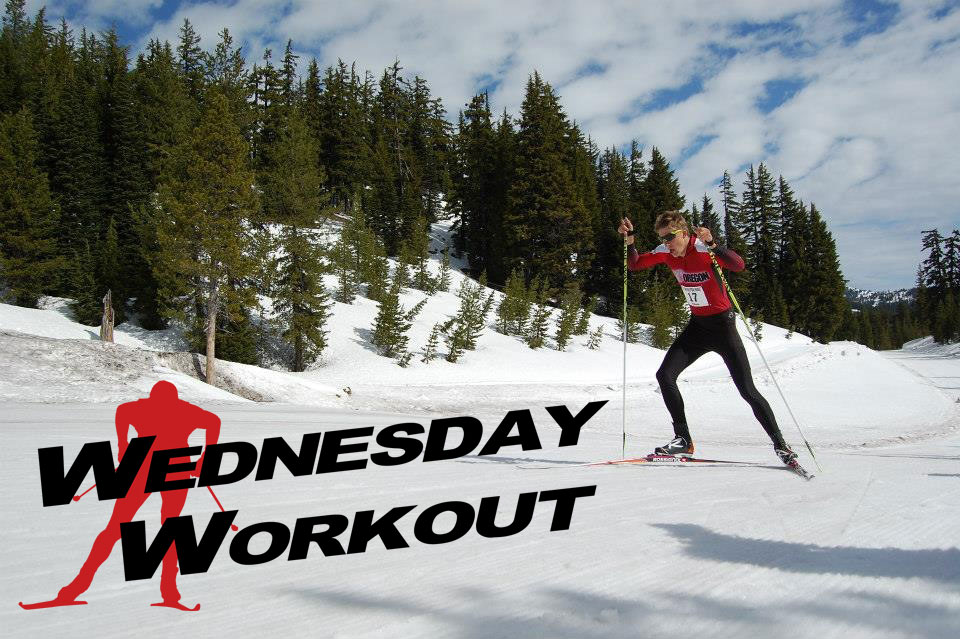
XC Oregon’s Matt Briggs on his way to third in the Pole Pedal Paddle on May 17 in Bend, Ore. (Photo: Neil Korn/BendOR Magazine)
In his Pole Pedal Paddle (PPP) debut two weekends ago, Matt Briggs, 27, placed third behind fellow XC Oregon skiers Marshall Greene and Andrew Boone, respectively. For Greene, it was his sixth victory in the six-stage, multi-event race (his first since winning four years ago). Briggs left inspired. “I’ve got to come back and beat the old guys,” he told The Bend Bulletin. “I’ll beat [Greene] before he retires.”
In preparation, Briggs explained in an email that he didn’t do anything too out of the box.
“Basically all I did was a bunch of easy running, mountain biking, kayaking, and a few interval workouts cycling, running, and skiing,” he wrote. But there was one workout — really the only special one — he did leading up to the PPP, and he called it Sanity Day.
***
Bend, Oregon is a town obsessed with recreating. We have world class running, biking, and skiing and for a few choice months in the spring all of it is at its very best. On the third weekend in May the whole city turns out to try to figure out who’s the best at stringing all our favorite endurance sports together in an annual celebration called the Pole Pedal Paddle.
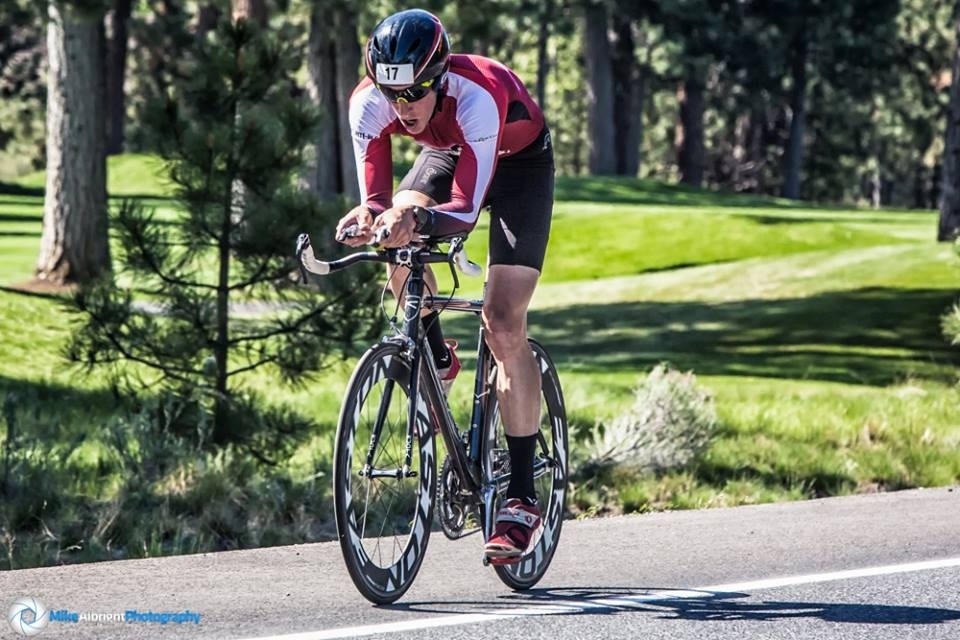
Matt Briggs during the 2014 Pole Pedal Paddle in Bend, Ore., in which he placed third.(Photo: Mike Albright/Mike Albright Photography)
The PPP is made up of six legs: a ski down the alpine mountain, a seven kilometer Nordic ski, a twenty mile bike on the road from the mountain to town, a five mile run along the river, a two mile paddle on the Deschutes, and a half-mile sprint into the finish line.
The winner of this race is awarded celebrity status, year-long bragging rights, and the unofficial title as Bend’s fittest athlete. The race is often dominated by Nordic skiers and has been won over the years by some names FasterSkier readers will recognize, including Dan Simoneau, Justin Wadsworth, Ben Husaby, Marshall Greene, and Kris Freeman. In this town, this race is a huge deal.
As if it wasn’t hard enough to deal with trying to get race-level fitness in five sports (including teaching myself to paddle a tippy surfski in 45 degree water) this race also presents massive logistical problems.
I needed two dedicated helpers (one at the mountain and one in town) to help with transitions.
I needed rear-entry alpine boot shells large enough to fit my Nordic boots inside of (so that I wasn’t putting on Nordic boots three minutes after the gun).
I needed a TT bike with fast wheels and a massive front chainring to push the gears down the steep declines of the 2500 foot drop in the course (the top three all ran a 58-tooth chainring/dinner plate).
I needed a fast kayak and a carbon-wing paddle.
I had to deal with more media interviews and photo shoots than I have in my life. All of that on top of the normal concerns that go with a Nordic ski race (testing, waxing, structure, etc.) This race was basically a full-time job for the three weeks leading up to the race. It was hard at times to keep a clear mind on why I was putting myself through it all. It was a lot of fun putting all the pieces of the puzzle together but if I had let it, the race and preparation would drive me out of my mind.
So my most important workout each week (above the 5×1 mile running repeats, the 40 minute bike TTs, the 5x6min ski intervals, and the cold hours spent in the kayak trying to keep it upright) is a workout I call “Sanity Day.”
Sanity Day would start with me calling my friend who was getting married the same day as PPP and telling him that I had had enough PPP business for a lifetime. He would reply by telling me that he and his fiancée were thinking of eloping just to avoid any further planning. I’d tell him I’d meet them at their house the next morning. I’d head over there on my mountain bike and meet the two of them for our big day out. We’d start by drinking a bunch of coffee and eating any wedding-cupcake samples they had left over and talk about what trails we should check out that day. We’d set a conservative plan and saddle up and head out. The conversation would sound like this:
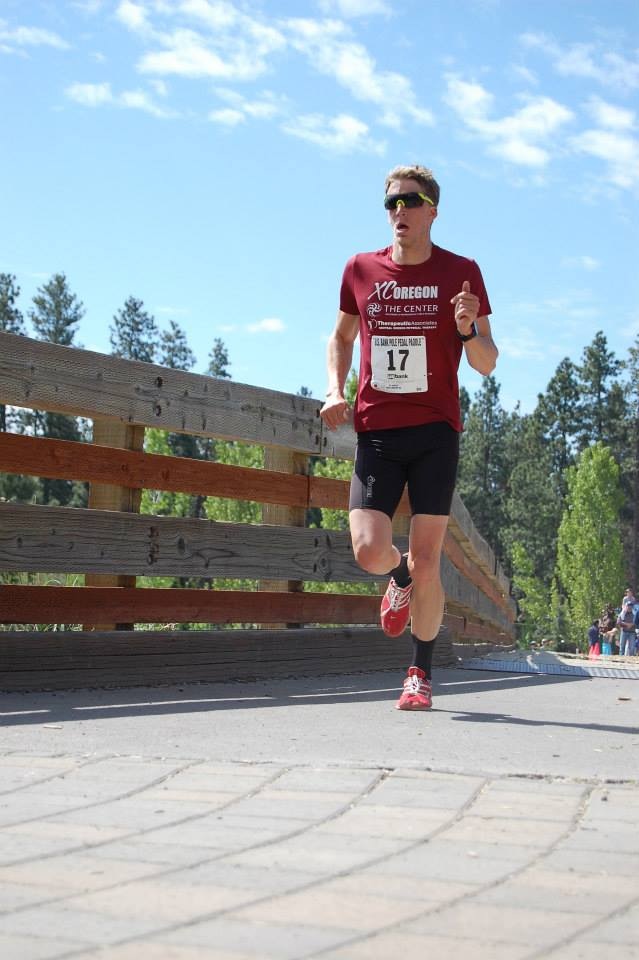
Matt Briggs during the 2014 Pole Pedal Paddle in Bend, Ore., in which he placed third. (Photo: Neil Korn/BendOR Magazine)
“I can’t find a decent kayak and I really don’t have 1500 dollars to drop on a new boat right now.”
“Did I tell you about what the napkin people are trying to charge us?”
“Do you think I should try to carry a bottle on my bike or do you think it’s not worth it?”
“How long into the night do we play the ’80s hits before switching to ’90s hip-hop?”
“You think I can take Marshall by two minutes on this run course?”
“Oh shoot we can’t forget to call the shuttle people as soon as we get home!”
You get the idea. Our heads were all spinning with logistics and we were in need of the soothing relaxation that can only come from a high-quality piece of singletrack. We’d hit the trailhead, stop and drink Gatorade, make a few jokes, and finally hit the trail. The pace was not high. The miles were not tough. I can’t honestly say anyone was getting fit out there. But it doesn’t take long on singletrack before you’re pretty well focused on the task at hand and only stopping to drink some water, tell some stories, and figure out where to go next. By the time we’re coming in (and sometimes this was pretty quickly after we started), the conversation was more fluid, less stressed, and a whole lot more interesting:
“I bet you crush Marshall on the ski and hold him off on the bike.”
“Either way, I’m gonna crush it on the dance floor when Country Grammar comes on.”
The pace was not high. The miles were not tough. I can’t honestly say anyone was getting fit out there. But it doesn’t take long on singletrack before you’re pretty well focused on the task at hand.
In hindsight there are a lot of workouts I maybe should have done that I didn’t do to take back the 2:48 I lost on first place and 2:16 I lost on second, but it feels to me like I would have been in a whole lot more trouble if I had passed on these sanity days in lieu of one more ski, road ride, run, or paddle. It might be a little cliché but it’s definitely important to build these days in because if you’re training for any race or preparing for any event and not having fun out there you’re probably not doing it right.
***
Editor’s Notes: The non-traditional Sanity Day workout should be based on time, not mileage. Briggs usually aims for 1-2 hours or whatever time one has between appointments and meetings. To be clear, this is not a rest day “but the training load was pretty low,” he explains. “Mostly it was not going to be hard because we were too busy telling stories and stuff, but also because I had probably done intervals the day before and had to do some more the next day.”